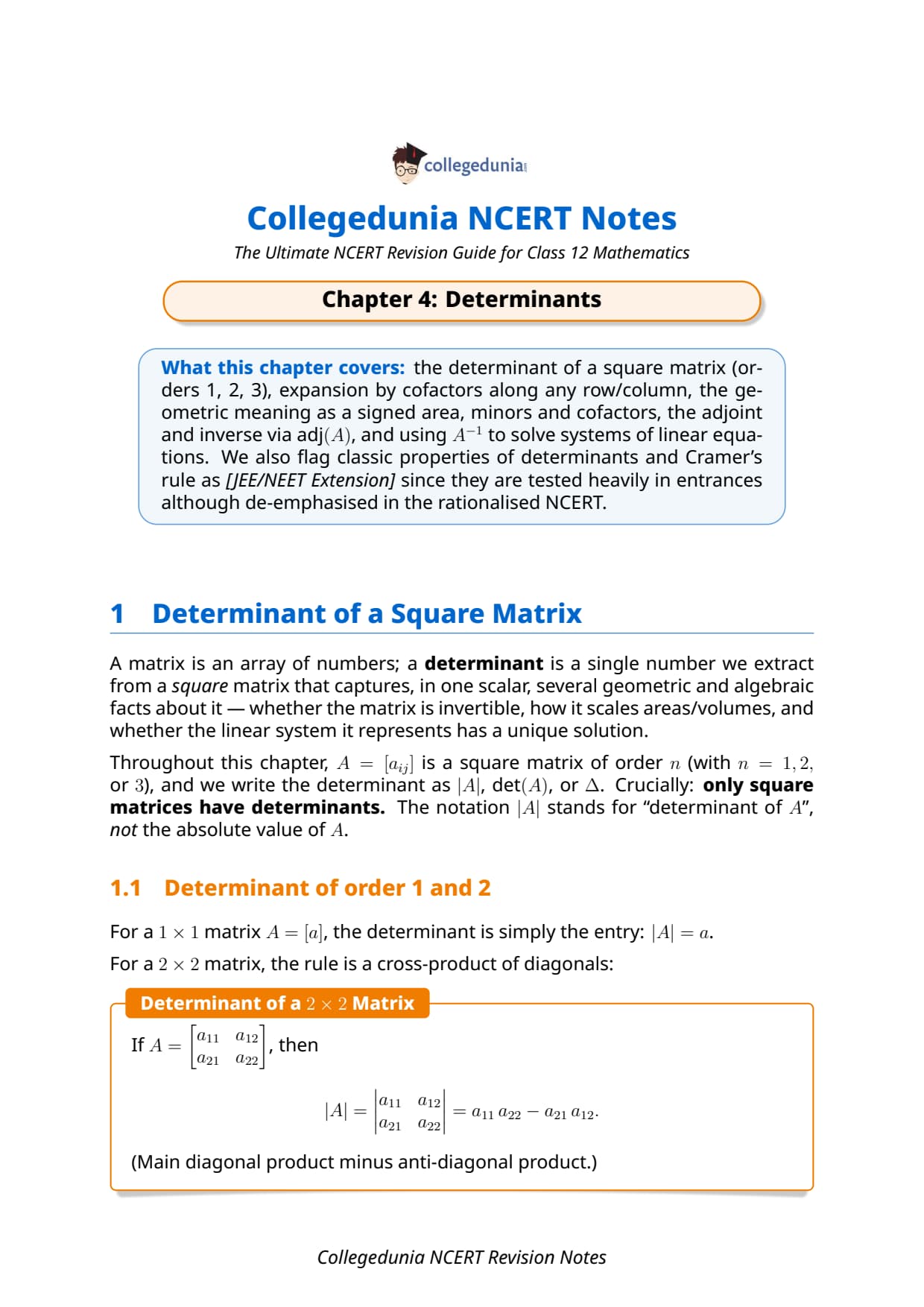
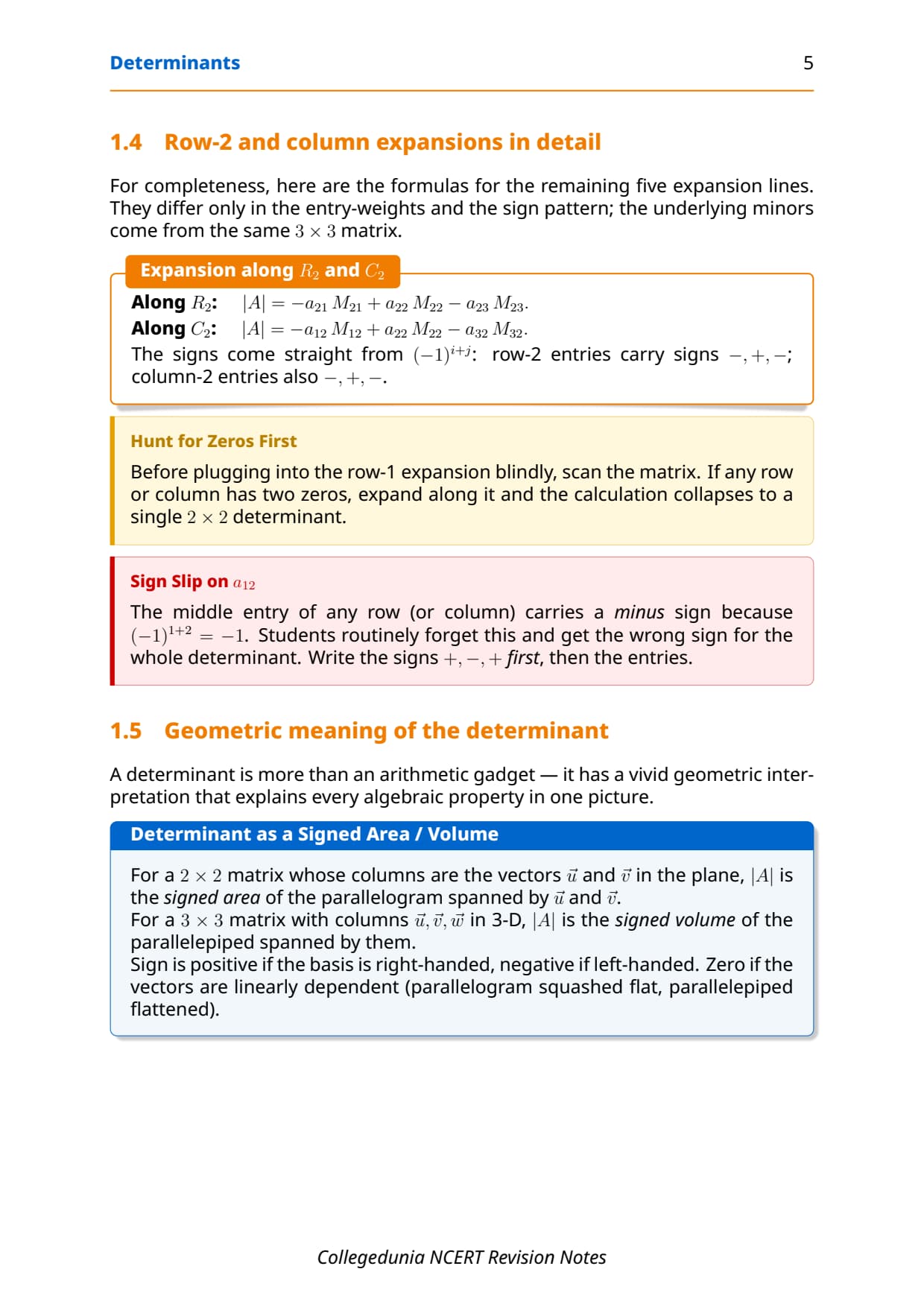
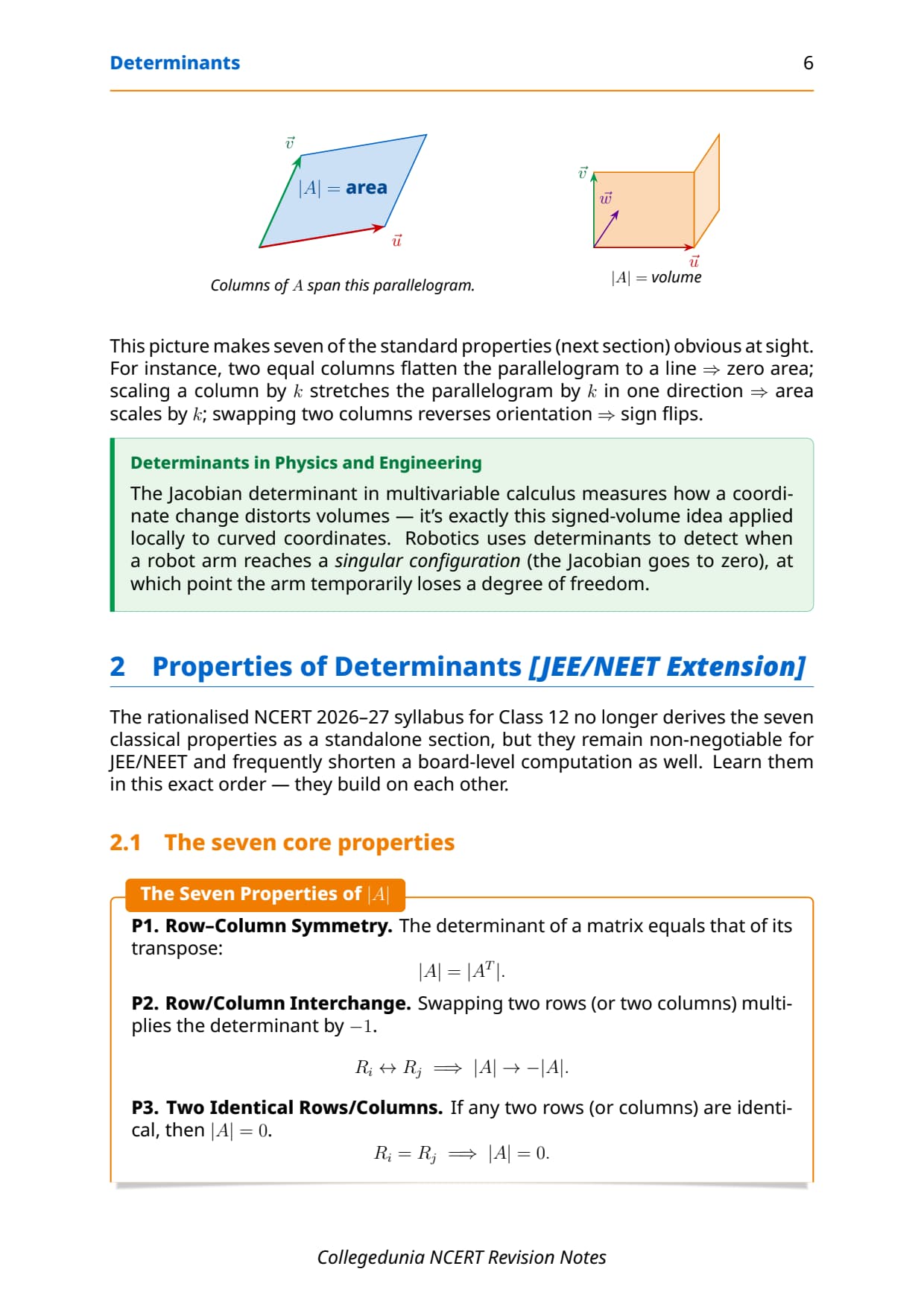
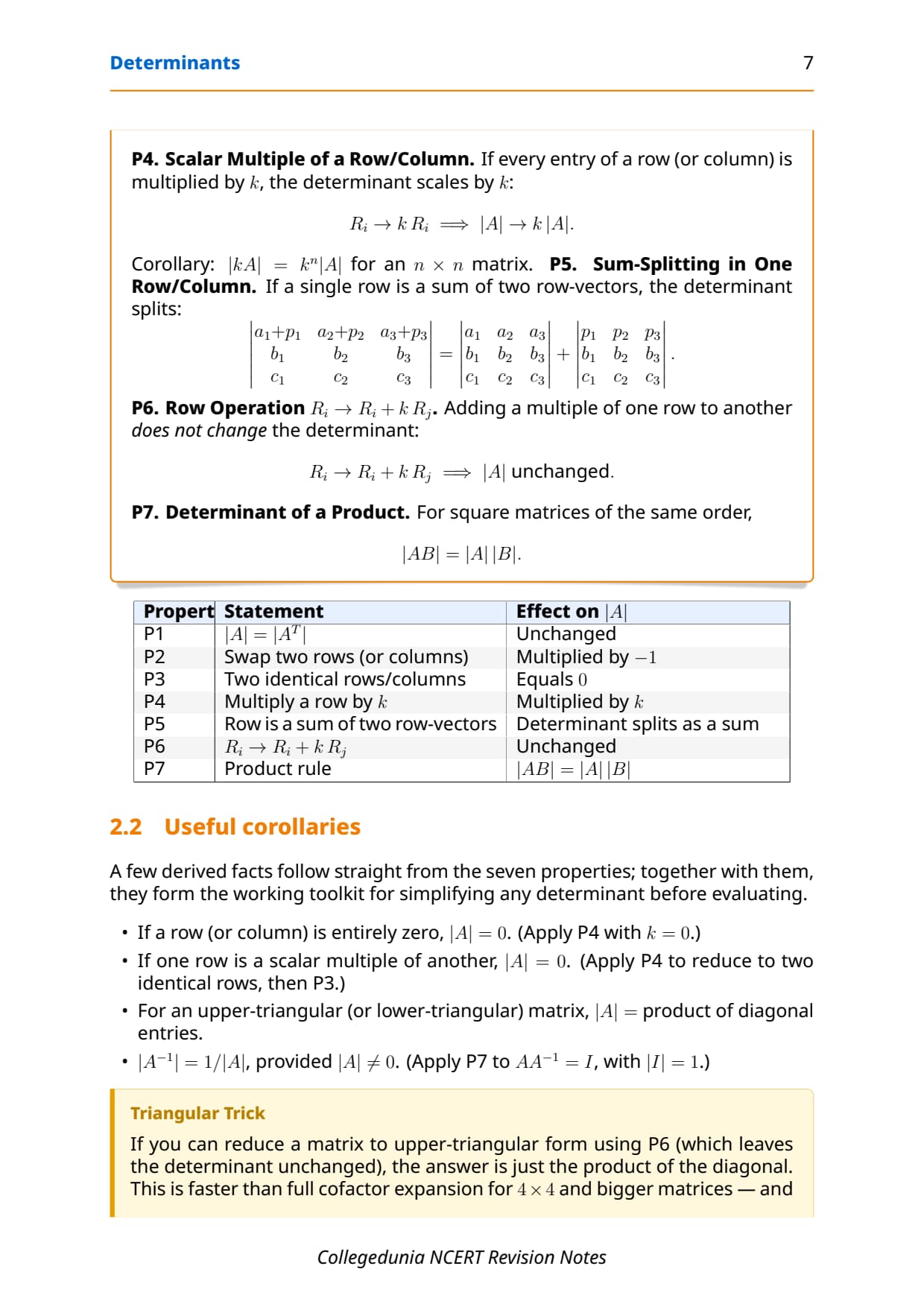
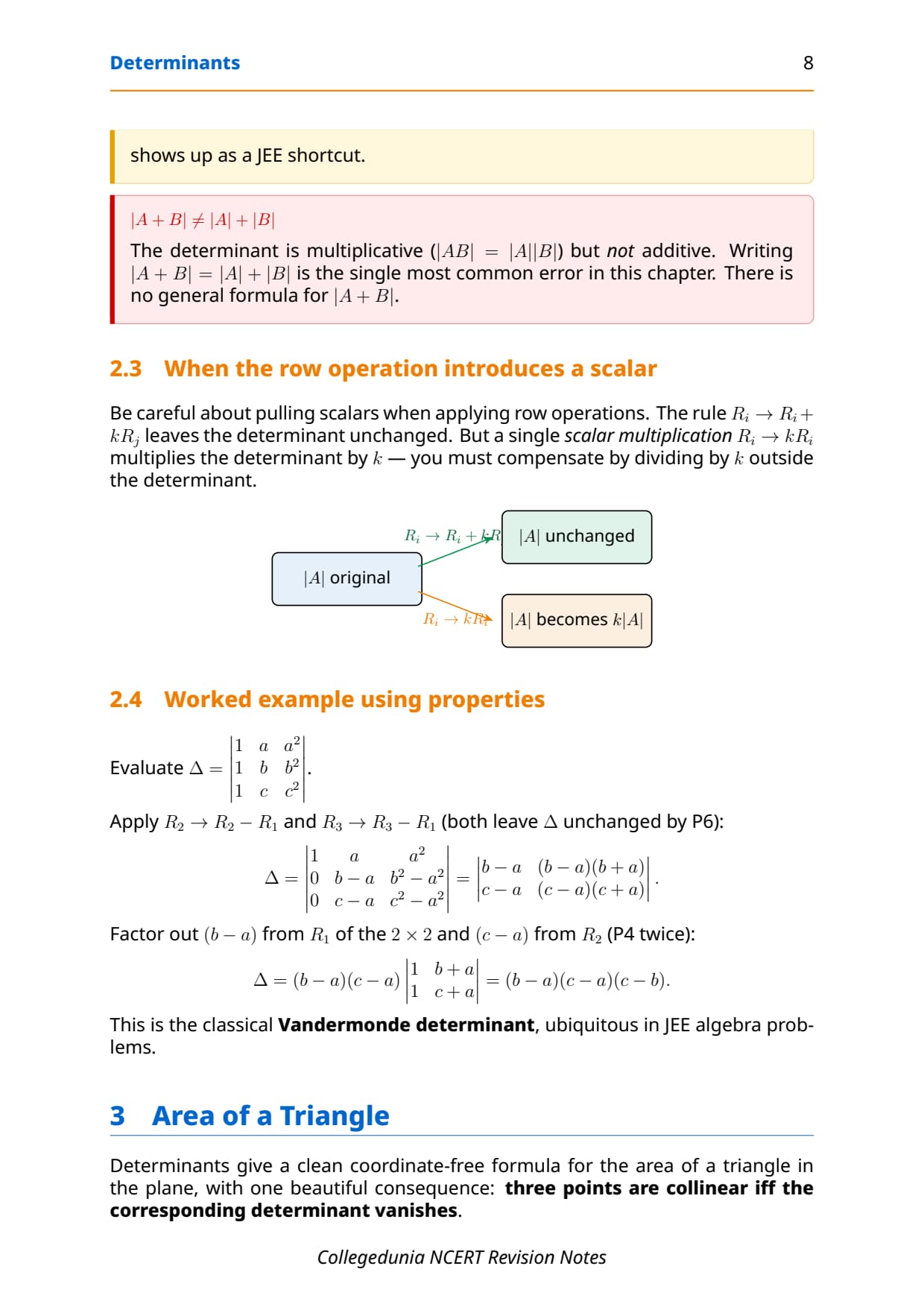
Download the Determinants Class 12 Notes as a free PDF. The Determinants Class 12 Notes condense Class 12 Mathematics Chapter 4 Determinants into a compact, exam-ready text with theorems, proofs, formulae and solved examples set out in sequence. The notes cover expansion, properties, minors, cofactors and the adjoint of a determinant.

  • CBSE Boards: 6 to 8 marks alone, and 10 to 13 marks when paired with Matrices in the Algebra unit.
  • JEE Main: Matrices and Determinants together carry 2 to 3 questions per shift, about 6 to 8% of the Maths section.
  • CUET (UG) Maths: 2 to 3 direct MCQs on properties, adjoint, inverse, and Cramer's rule every cycle.
Chapter 4 Determinants Notes PDF
Pages: 24 Properties: 7 Solved formulas: 16 Syllabus: 2026-27

Pair these NCERT Class 12 Maths Chapter 4 Determinants Notes with the NCERT Solutions PDF, so every property here lines up with a solved exercise that demonstrates it.

These Collegedunia the Determinants Class 12 Notes are compiled by Class 12 Maths specialists and checked against the 2026-27 NCERT print and the last five CBSE marking schemes, so revision matches what examiners award.

Also Check:

Determinants Notes - Class 12 Maths
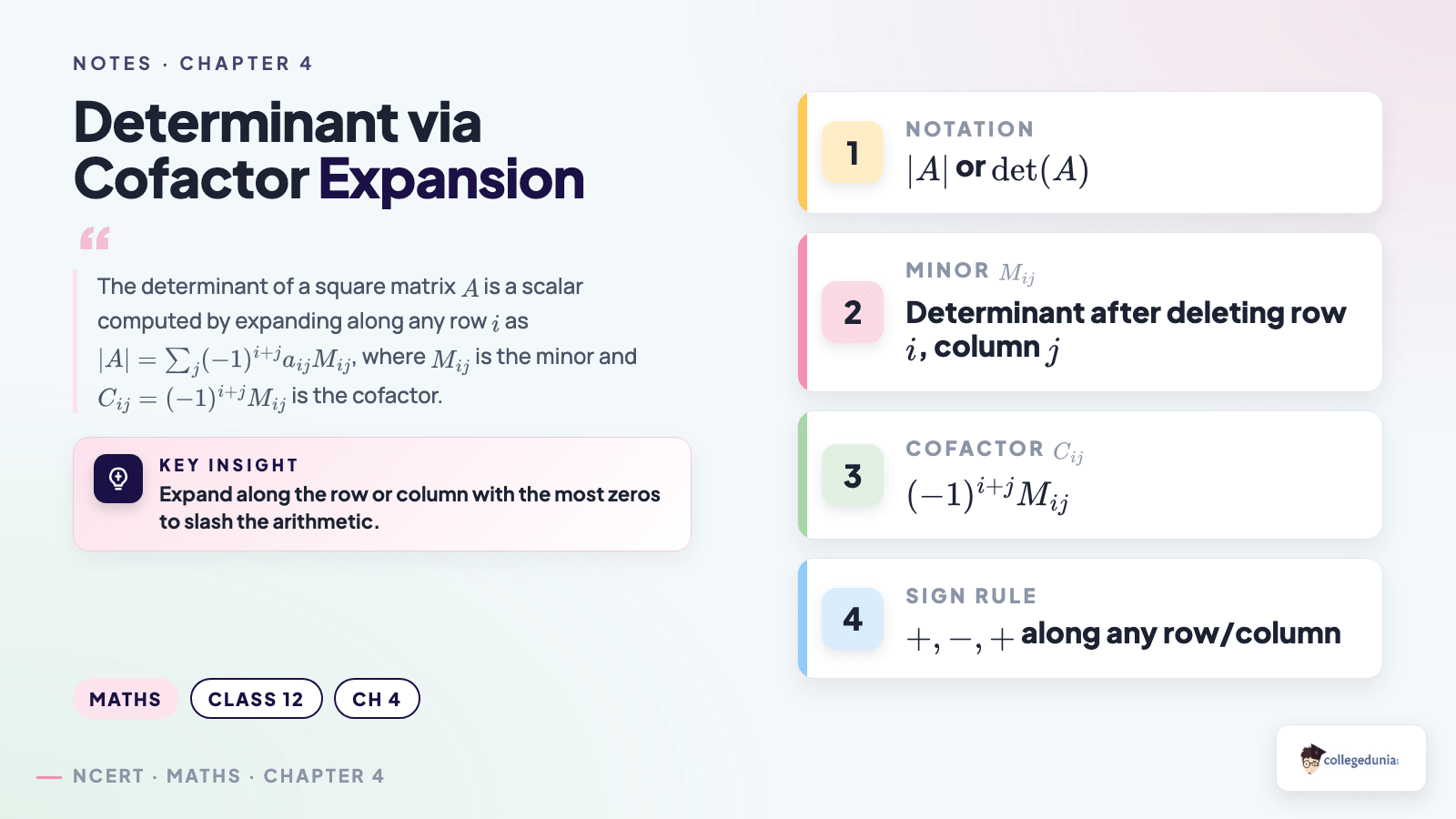
Determinant via cofactor expansion concept card

How will Collegedunia's NCERT Notes for Class 12 Maths Chapter 4 help you?

CBSE has asked an adjoint-and-inverse question in 4 of the last 5 board papers. These Determinants Class 12 Notes are organised around visual recall of every property, a templated method for adjoint and inverse, and a clean bridge to systems of linear equations.

  • P1 to P7 are stated in one line each, turning the property checklist into a single-page recall tool.
  • The adjoint-and-inverse procedure is laid out as a templated 5-step answer, the format CBSE rewards in a 4-mark question.
  • Matrix method X = A-1B and Cramer's rule are contrasted so you pick the faster route under exam pressure.
  • Property mnemonics and singular vs non-singular flags are embedded after each section for glance revision.

Determinants Video Walkthrough

Source: Magnet Brains on YouTube

Class 12 Maths Determinants: Prerequisite Concepts Before You Start

Determinants relies on matrix algebra from Chapter 3 and a couple of Class 11 ideas. Confirm these before the property proofs land.

  • Matrix multiplication and order (Chapter 3), for verifying A · adj(A) = |A| I .
  • Transpose and (AB)T = BT AT (Chapter 3), for P1 |AT| = |A| .
  • 2x2 determinant ad - bc (Class 11), the base case for 3x3 expansion.
  • Linear equations in 2 and 3 variables (Class 11), reframed as AX = B .
  • Area of triangle by coordinate formula (Class 10/11), re-derived as a 3x3 determinant here.
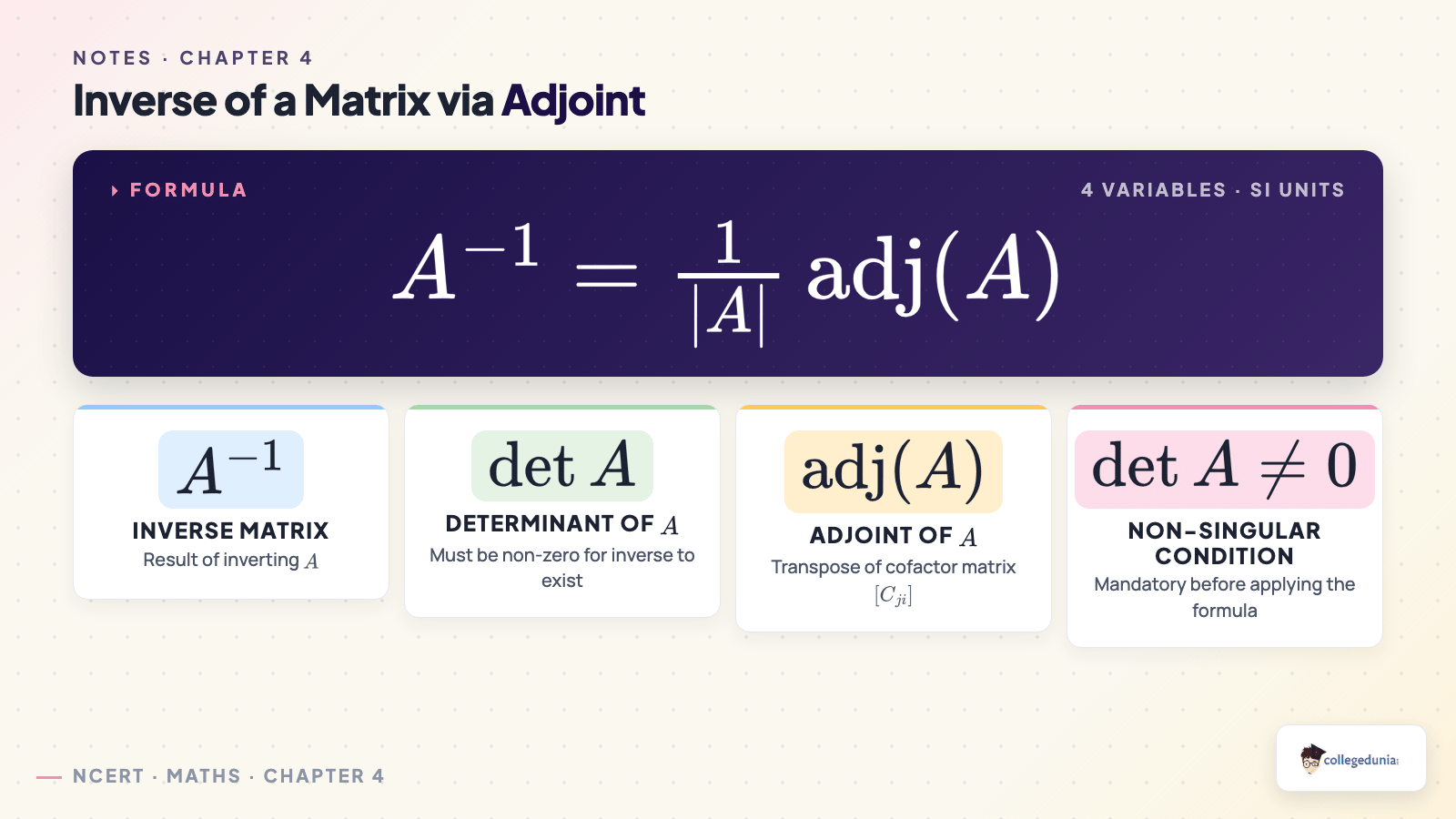
Inverse of a matrix via adjoint formula breakdown

Class 12 Maths Chapter 4 Determinants: Topic-by-Topic Concept Walkthrough

The chapter introduces the object, then properties, then geometric interpretation, then inverse algebra, then linear systems. Here is the walkthrough in that order, with the formulas you must memorise.

1. Definition of a Determinant and 2x2, 3x3 Expansion

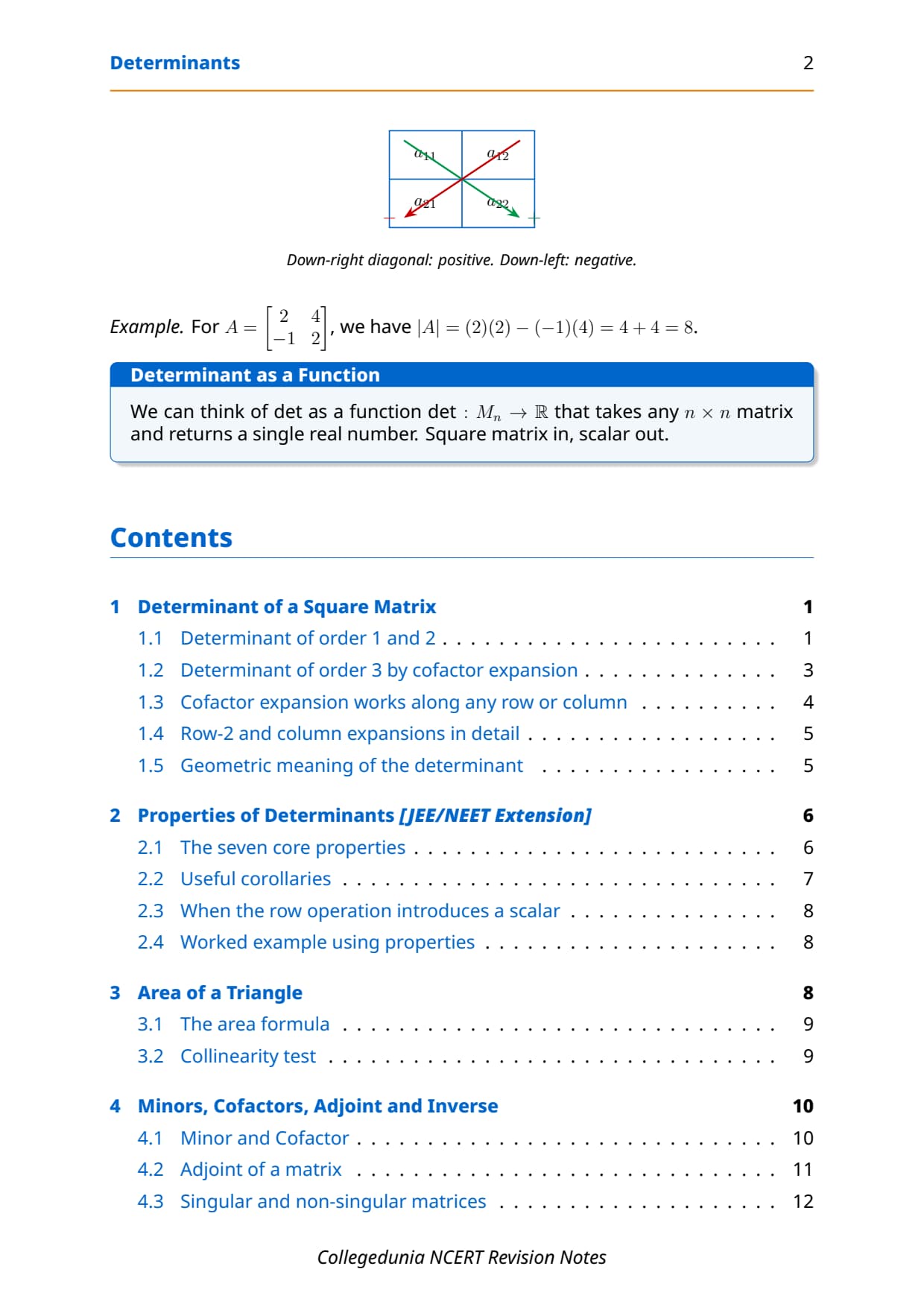
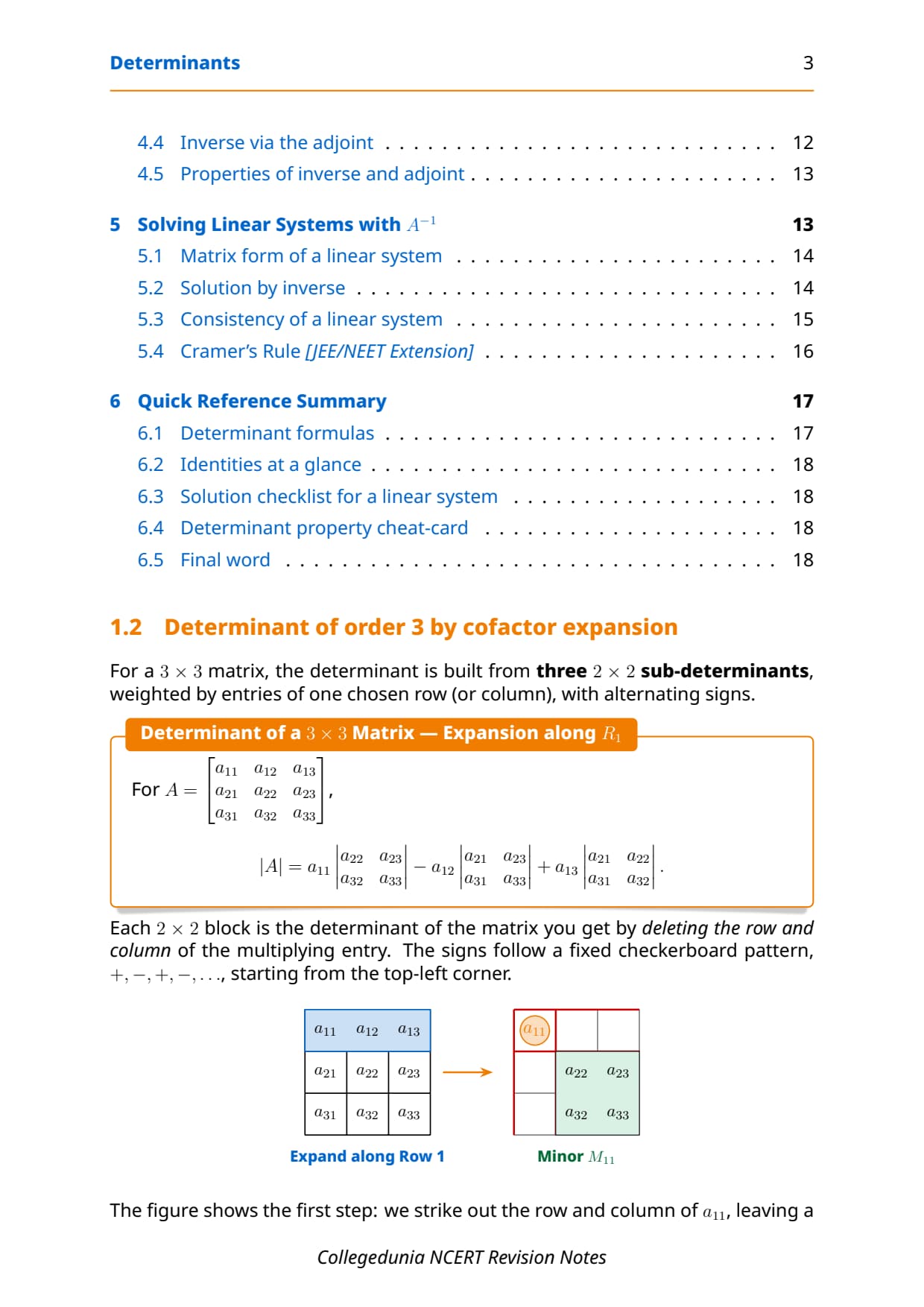
Every square matrix A = [aij] of order n has a scalar determinant |A| . For a 2x2, |A| = ad - bc . For a 3x3, expand along any row or column:

$$ |A| = a_{11} C_{11} + a_{12} C_{12} + a_{13} C_{13} $$

where Cij = (-1)i+j Mij and Mij is the minor obtained by deleting row i and column j .

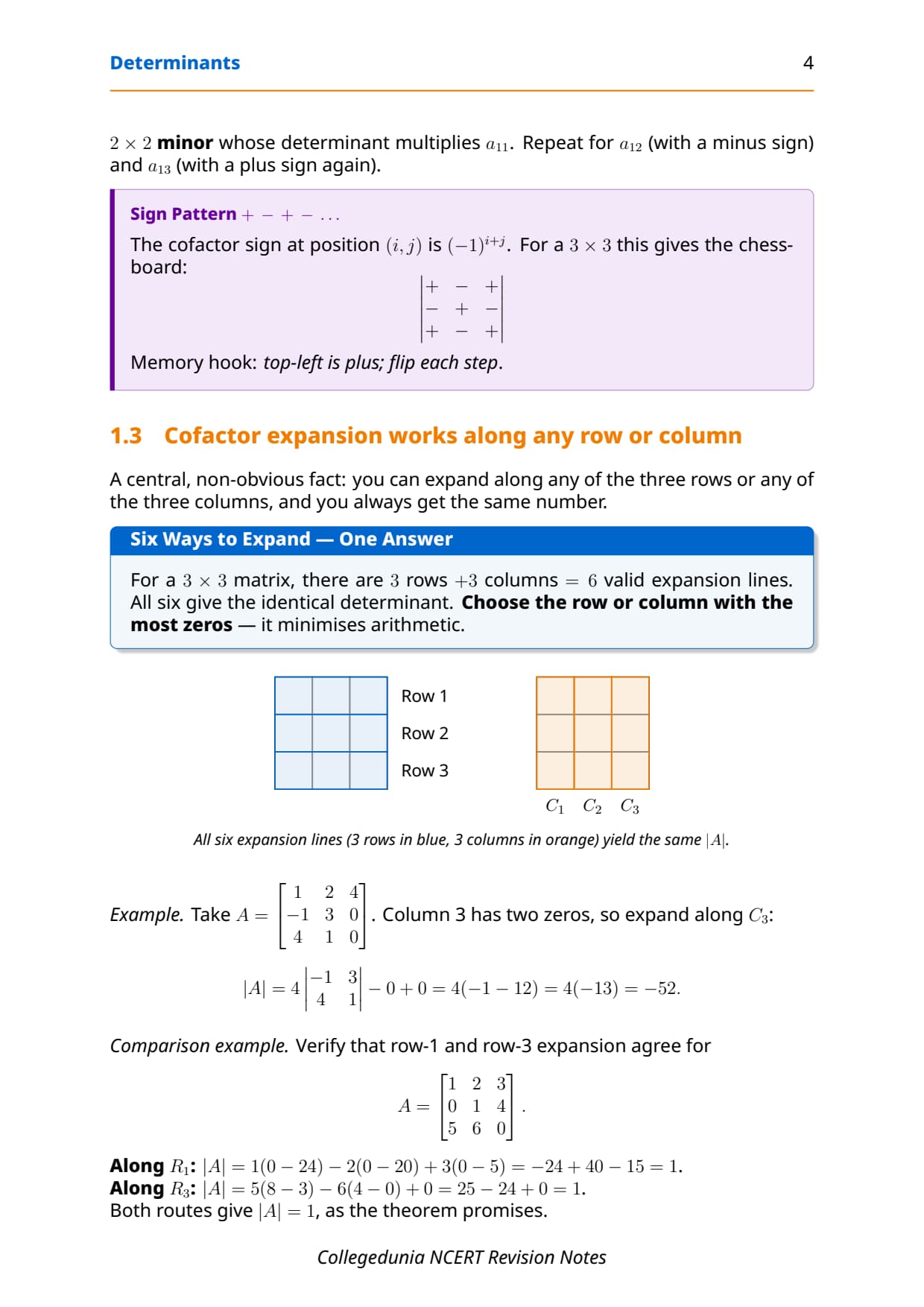
Easy Tip: Expand along the row or column with the most zeros, this can cut a 3x3 evaluation from nine multiplications to three.

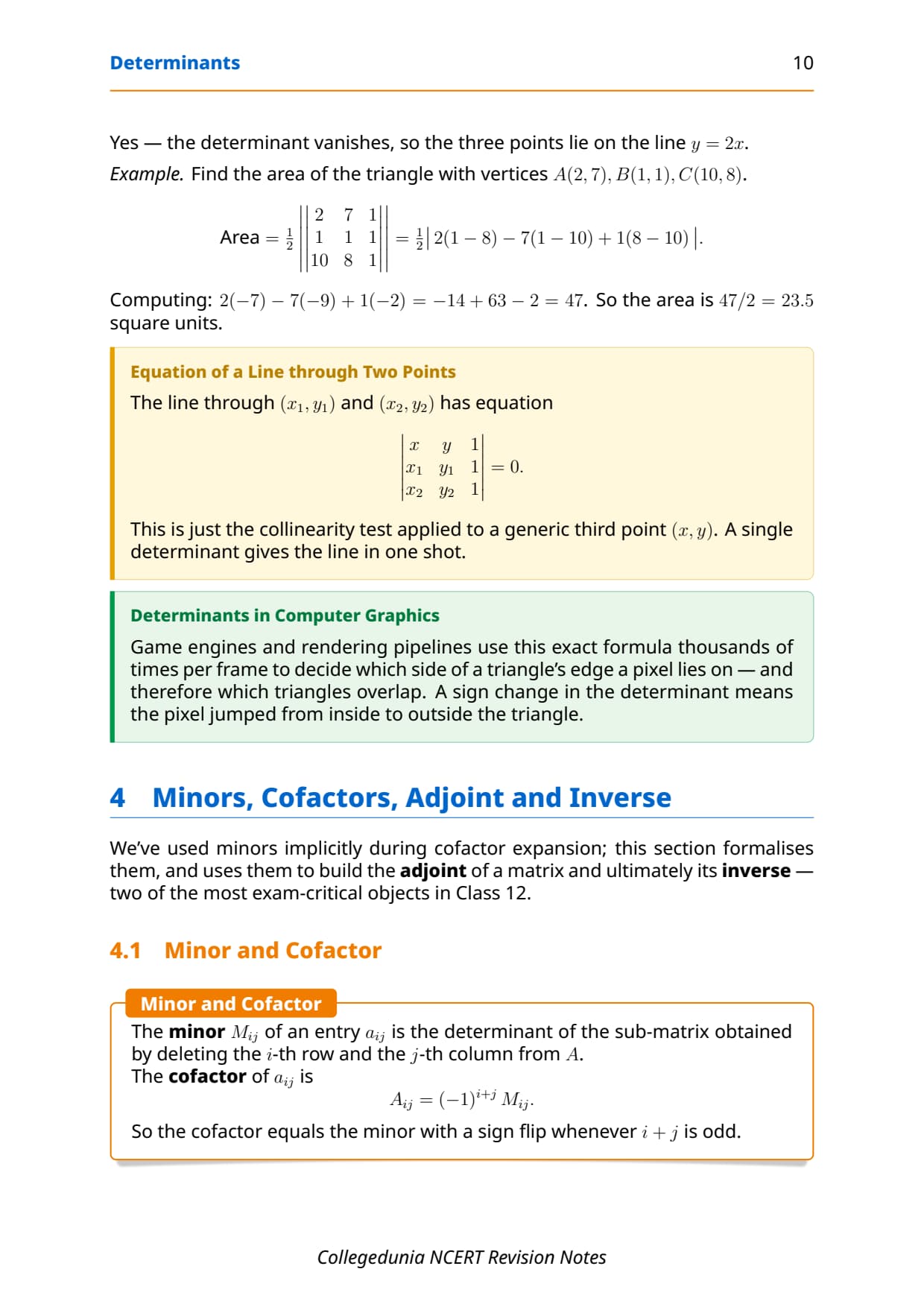
2. Minors and Cofactors

The minor Mij is the determinant of the submatrix obtained by deleting row i and column j . The cofactor attaches a sign: Cij = (-1)i+j Mij . The sign board for a 3x3 is the standard + - + / - + - / + - + chessboard pattern.

Common Confusion: The minor is the raw determinant of the sub-block; the cofactor wears the ± sign. CBSE always asks for the cofactor, not the minor.

3. The Seven Properties of Determinants

The whole chapter rests on these seven properties. Memorise them by P-number to spot which one a question is testing.

  • P1: |AT| = |A| . Row-wise and column-wise reading give the same value.
  • P2: Interchanging two rows (or columns) multiplies the determinant by -1 .
  • P3: Two identical rows or columns force |A| = 0 .
  • P4: Multiplying one row by k multiplies the determinant by k ; equivalently, |kA| = kn |A| .
  • P5: A row of sums splits the determinant into a sum of two determinants.
  • P6: Ri → Ri + k Rj leaves the determinant unchanged, the workhorse for simplification.
  • P7: A row (or column) of zeros forces |A| = 0 .

Mnemonic, "TIPSSZZ": Transpose-same, Interchange-flips, Proportional-zero, Scalar-out, Split-sum, Zero-row, Zero-op (P6).

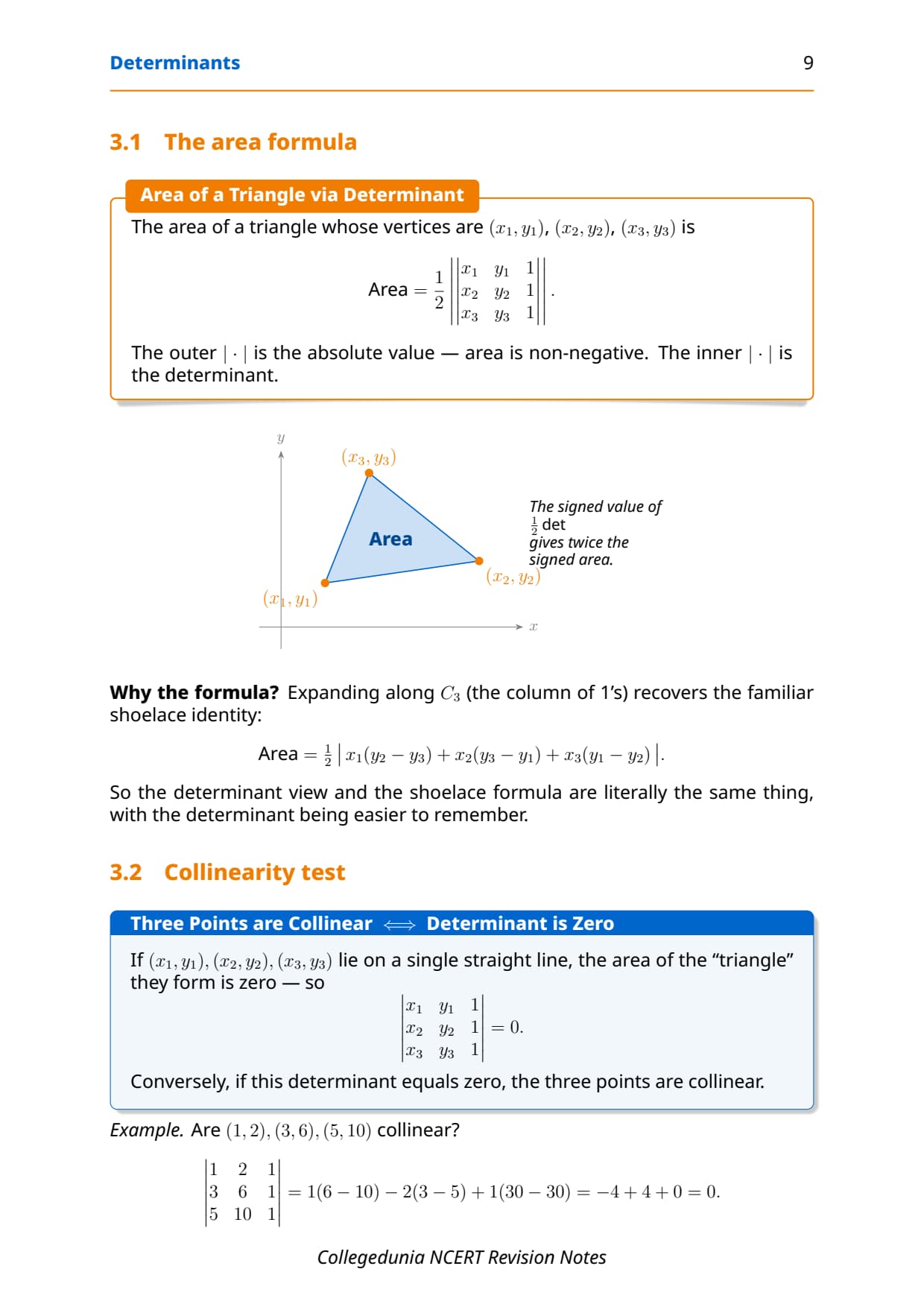
4. Area of a Triangle Using Determinants

For vertices (x1, y1) , (x2, y2) , (x3, y3) : $$ \text{Area} = \tfrac{1}{2}\,\left|\begin{matrix} x_1 & y_1 & 1 \\ x_2 & y_2 & 1 \\ x_3 & y_3 & 1 \end{matrix}\right| $$ The vertical bars are absolute value, since area is non-negative. Three points are collinear iff this determinant is zero.

Board Tip: CBSE frames this as a 2-mark "find area" or "show collinear" question. Writing the absolute-value bars explicitly protects the mark when the raw determinant is negative.

5. Adjoint of a Matrix and Its Properties

The adjoint adj(A) is the transpose of the cofactor matrix. The defining identity is: $$ A \cdot \text{adj}(A) = \text{adj}(A) \cdot A = |A|\, I_n $$ Consequences: |adj(A)| = |A|n-1 and adj(AB) = adj(B) adj(A) .

Watch Out: The adjoint is the transpose of the cofactor matrix. Skipping the transpose flips off-diagonal entries and gives a wrong inverse.

6. Inverse of a Matrix Using Adjoint

A is non-singular if |A| ≠ 0 , singular if |A| = 0 . The inverse exists iff A is non-singular, and is given by: $$ A^{-1} = \tfrac{1}{|A|}\,\text{adj}(A) $$ The standard 5-step CBSE layout: compute |A| , confirm non-zero, find nine cofactors, transpose for adj(A) , divide by |A| .

7. System of Linear Equations: Matrix Method and Cramer's Rule

A 3-variable system is AX = B . If |A| ≠ 0 , the unique solution is X = A-1B . If |A| = 0 and (adj A)B = O , there are infinitely many solutions; if (adj A)BO , the system is inconsistent.

Cramer's rule avoids the inverse: $$ x = \tfrac{|A_1|}{|A|}, \quad y = \tfrac{|A_2|}{|A|}, \quad z = \tfrac{|A_3|}{|A|} $$ where Ai is A with column i replaced by B .

Key Insight: Cramer's rule is faster when only one variable is needed. Use the matrix method when CBSE specifies "by matrix method", which it does for the 5-mark question.

Class 12 Maths Chapter 4 Determinants Important Derivations for CBSE Boards 2026

These four derivations appear in nearly every board cycle as a direct proof, MCQ stem, or assertion-reason pair. Memorise the one-line statement and the standard layout for each.

DerivationWhat it provesMark allotment
Cofactor expansion along any row/column gives the same valueDeterminant is well-defined, route-independent.1 to 2 marks (MCQ)
A · adj(A) = |A| In Underpins the inverse formula and |adj A| = |A|n-1 .3 to 4 marks
A-1 = 1|A| adj(A) when |A| ≠ 0 Existence/uniqueness of inverse for non-singular A.4 marks (4 of last 5 papers)
Cramer's rule for AX = B Each variable as a ratio of determinants.5 marks (long-answer)

Determinants Glossary: 10 Key Terms for Quick Recall

Locking in the vocabulary is a five-minute job that pays off in MCQs and assertion-reason items.

TermOne-line meaning
DeterminantScalar value |A| assigned to every square matrix.
Minor Mij Determinant of the sub-block after deleting row i and column j .
Cofactor Cij Signed minor: Cij = (-1)i+j Mij .
Singular / Non-singular |A| = 0 (no inverse) vs |A| ≠ 0 (inverse exists).
Adjoint adj(A) Transpose of the cofactor matrix.
Inverse A-1 = 1|A| adj(A) , exists iff A is non-singular.
Cramer's ruleSolution of AX = B as ratios |Ai|/|A| .
Consistent / InconsistentAt least one solution vs no solution.
Homogeneous system AX = O ; non-trivial solution exists iff |A| = 0 .

Class 12 Maths Chapter 4 Determinants: Topic-wise CBSE Weightage

This compact table maps each sub-topic to its CBSE intensity from the last five board papers, so you know which rows deserve your last-night focus.

Sub-topicCBSE intensity
Expansion, minors, cofactorsMedium (1 to 2 mark MCQ)
Seven properties (especially P6)High (3 to 4 mark proof)
Area of triangle, collinearityMedium (2 mark direct)
Adjoint and inverse via adjointHigh (4 mark templated answer)
Matrix method for AX = B High (5 mark long-answer)
Cramer's rule, consistencyMedium (3 to 4 mark sub-part)

Determinants Class 12 Notes: Most Repeated Questions in CBSE Class 12 Board Exams

Five years of CBSE Class 12 Maths papers show the same Determinants questions returning almost every cycle. Lock these in and you have already practised most of the marks the Determinants Class 12 Notes can carry.

Ques. If A is a square matrix of order 3 with |A| = 4 , find |adj(A)| . (2024, 2022, 2019)

[1 Mark] Using |adj(A)| = |A|n-1 with n = 3 : |adj(A)| = 42 = 16 .

Ques. Solve x + 2y + z = 7, x + 3z = 11, 2x - 3y = 1 using the matrix method. (2024, 2023, 2020)

[5 Marks] Write as AX = B , compute |A| ≠ 0 , find the nine cofactors, transpose to get adj(A) , then X = 1|A| adj(A) B . State x, y, z explicitly to claim the final method mark.

Ques. Using properties, prove |matrix a & b & c a - b & b - c & c - a b + c & c + a & a + b matrix| = a3 + b3 + c3 - 3abc . (2023, 2021, 2018)

[4 Marks] Apply R1 → R1 + R2 + R3 to create a common factor (a + b + c) , take it out, then expand using the identity a3 + b3 + c3 - 3abc = (a + b + c)(a2 + b2 + c2 - ab - bc - ca) .

Ques. Find k for which x + ky + 3z = 0, 3x + ky - 2z = 0, 2x + 3y - 4z = 0 has a non-trivial solution. (2022, 2019)

[3 Marks] Non-trivial solution iff |A| = 0 . Expand, set to zero, solve for k . Answer: k = 332 .

Ques. Verify that the points (1, -1) , (2, 1) , (4, 5) are collinear using the determinant method. (2021, 2020)

[2 Marks] The area determinant evaluates to zero, confirming collinearity.

Determinants Top 5 Formulae for Quick Recall

The five formulae below cover almost every numerical you will see in CBSE and JEE Main Determinants questions. The complete learn sheet with solved illustrations sits on the dedicated Collegedunia Formula Sheet.

#FormulaWhen to use
1 |A| = a11C11 + a12C12 + a13C13 3x3 cofactor expansion.
2 |kA| = kn |A| Scaling an n × n matrix.
3 A · adj(A) = |A| In Inverse derivation, |adj A| = |A|n-1 .
4 A-1 = 1|A| adj(A) 4-mark inverse-by-adjoint.
5 xi = |Ai||A| Cramer's rule, single variable.

Full learn sheet: Class 12 Maths Chapter 4 Determinants Formula Sheet

Common Misconceptions Students Hold in Determinants

Most marks lost in Determinants come from conceptual confusions, not arithmetic slips. Clear these once and accuracy jumps a full grade band.

  • "Adjoint and cofactor matrix are the same." The adjoint is the transpose of the cofactor matrix.
  • " |kA| = k|A| ." Wrong: for an n × n matrix, |kA| = kn |A| .
  • "A homogeneous system always has a unique solution." AX = O always has the trivial solution; a non-trivial solution exists iff |A| = 0 .
  • "If |A| = 0 , the system is inconsistent." Not always, |A| = 0 gives no solution or infinitely many depending on whether (adj A)B is non-zero or zero.
  • "Row operation Ri → Ri + k Rj changes the determinant." No, P6 leaves the determinant unchanged.

Determinants Notes: PYQ Trends Across CBSE, JEE Main, and CUET 2021 to 2025

Across five years of Class 12 board, JEE Main, and CUET papers, three patterns cover. The full year-by-year map sits on the NCERT Solutions page.

  • Adjoint and inverse via adjoint: the most-repeated 4-mark question, in 4 of the last 5 CBSE papers.
  • Matrix method for a 3-variable system: the recurring 5-mark long-answer.
  • Property-based determinant proof using P5 and P6: appears as a 4-mark question in 3 of every 5 papers.

Full year-wise PYQ map: NCERT Solutions for Class 12 Maths Chapter 4 Determinants

Determinants Weightage in JEE Main, CUET, and CBSE 2026

Beyond boards, Determinants is part of the Matrices-and-Determinants block in JEE Main and a steady scorer in CUET Mathematics. A clean grip on properties, adjoint, and Cramer's rule pays off across all three exams.

ExamWeightageImportant Topics
JEE Main 20252 to 3 questions (Matrices + Determinants, ~6 to 8%)Properties, adjoint, inverse, system of equations, parameter-based singular matrix questions
CBSE Boards 20256 to 8 marks (with Matrices, 10 to 13 marks)Adjoint + inverse, matrix method for 3-variable system, property-based proofs
CUET (UG) 2025 Maths2 to 3 MCQsCofactors, area of triangle, inverse formula, Cramer's rule
JEE Main 2026Pending (exam rescheduled)-

NCERT Notes for Class 12 Maths: All Chapters

Use the table below to jump to any other Class 12 Maths chapter's Collegedunia Notes page. The current chapter (Ch 4) is intentionally excluded.

Determinants Class 12 Notes: available above as a free PDF download, aligned to the 2026-27 NCERT Class 12 Mathematics syllabus.

Determinants Class 12 Notes - Quick Summary

  • The Determinants Class 12 Notes cover every section of Class 12 Mathematics Chapter 4 Determinants, aligned to the 2026-27 NCERT print.
  • The Determinants Class 12 Notes include formal definitions, solved examples and end-of-section formula recap suitable for board and JEE Main preparation.
  • The Determinants Class 12 Notes are downloadable as a free PDF and follow the notation of the official NCERT textbook line for line.

Exercise-wise Breakdown of the Determinants Chapter

The Determinants chapter splits into 6 numbered exercises plus a Miscellaneous Exercise. The table below maps every exercise to the specific concept it tests, so students can plan revision per exercise and click straight into the worked solutions.

ExerciseTopic Tested
Exercise 4.1Evaluation of 2x2 and 3x3 determinants
Exercise 4.2Properties of determinants; area of a triangle
Exercise 4.3Minors and cofactors
Exercise 4.4Adjoint and inverse of a matrix
Exercise 4.5Applications: solving systems of linear equations
Exercise 4.6Consistency of system of linear equations
Miscellaneous ExerciseMixed determinant concepts and applications

PDF Download Formats and Languages for the Determinants Chapter

The Determinants Class 12 PDF on this page is available in three formats - each suited to a different revision style. The table below summarises what each format is best for:

FormatBest forApprox. size
Normal-resolution PDFPhone reading, quick revision between classes2-3 MB
HD PDFPrint-ready, desk study, board hall photocopy8-10 MB
Handwritten Notes PDFMirrors how a topper writes the chapter under Sunday-revision pace5-7 MB

The determinants class 12 ncert pdf and the parallel Hindi-medium edition both follow the same notation and equation numbering as the printed NCERT 2026-27 release. Key points students should know:

  • NCERT-faithful: Every definition, theorem and exercise on the determinants class 12 ncert pdf matches the printed textbook line for line.
  • Hindi-medium edition: The determinants class 12 pdf is also available in Hindi - same page numbering, same equation labels.
  • Formula PDF separate: The determinants class 12 formulas pdf is a one-page A4 reference sheet listing every identity used in the chapter.
  • Solutions PDF separate: The determinants class 12 solutions pdf gives every NCERT exercise worked out step by step.
  • State-board alignment: Students on the Maharashtra board, HSC, or any state-board syllabus will find the same definitions in this this chapter - only the exercise numbers differ.

Tip: Many toppers keep two parallel copies - a printed formula sheet on A4 for desk revision (the determinants class 12 formulas pdf), and the full these notes on a phone for commute revision. Both files are free and linked above.

Important Questions and Previous Year Trends for the Determinants Chapter

The most repeated question patterns in CBSE Class 12 Maths for the Determinants chapter have settled into a stable cluster across 2019 to 2024 boards. Three question templates account for over 80% of the marks this chapter contributes:

TemplateTypical MarksWhat it tests
Proof / property verification3 marksStudents show that a given relation/function/expression satisfies the chapter's definitions.
One-step computation2 marksSubstitution-based item: plug into a known formula and simplify.
Case-study scenario4 marksReal-world setup applying the chapter's definitions, introduced in CBSE 2021+ papers.

Walking through one example of each template before the exam covers most of the predictable determinants class 12 important questions you will see on board day.

  • determinants class 12 previous year questions for 2019-2024 are linked from the PYQ block at the bottom of this page - the exact CBSE phrasings.
  • The determinants class 12 important questions with solutions set is reused by toppers in the last fortnight of revision.
  • For NCERT Exemplar practice, the matching determinants class 12 extra questions set adds advanced problems suitable for JEE Main and JEE Advanced.
  • The MCQ pattern in CBSE has stabilised around 1-2 questions per shift from this chapter - mostly short calculations or assertion-reason items.

Year-wise PYQ Distribution

The table below maps the dominant question type asked from the Determinants chapter across recent CBSE Class 12 Maths boards:

YearDominant Question TypeApprox. Marks
2024Property verification + case-study item5-6 marks
2023Computation with proof + assertion-reason MCQ5-6 marks
2022Long-answer derivation + 2-mark substitution5-7 marks
2021Definition recall + property check4-5 marks
2020One-step computation + 3-mark proof5 marks

The full this chapter with solutions set (every year, every paper, every question type) is linked from the PYQ page at the bottom of this article.

How the Determinants Notes Pair with NCERT Solutions and the Formula Sheet

The Determinants Class 12 notes work best when paired with two sister resources from the Class 12 Maths hub. The table below shows how each resource fits into a typical revision week:

ResourceUse it forWhen
Determinants Notes (this page)Theory, definitions, exam patternsFirst pass, before practice
determinants class 12 ncert solutions PDFStep-by-step solved exercisesSecond pass, during NCERT practice
determinants class 12 formulas PDFOne-page identity recallThird pass, alongside mock papers
Handwritten Notes PDFQuick reading in topper's handwritingAnytime, especially commute revision

Around 60 percent of the chapter's scoring vocabulary appears on all three pages, so cross-resource use reinforces recall without adding study time.

  • The determinants class 12 ncert solutions cover every back-of-chapter exercise plus the miscellaneous exercise.
  • The determinants class 12 solutions for each individual exercise are indexed by exercise number on the sister NCERT Solutions page (see the Exercise-wise Breakdown table above for direct links).
  • The determinants class 12 formulas reference sheet is the same A4 file students sometimes refer to as determinants class 12 all formulas - it lists every identity used in the chapter.
  • State-board references: RD Sharma, ML Aggarwal, Teachoo and the Maharashtra board determinants class 12 textbook PDF all share the same core definitions.
  • For class-first search phrasings - class 12 determinants solutions, class 12 determinants ncert solutions, ncert class 12 determinants solutions - the same files cover the request.

Reference Books and State-Board Mapping

Students using reference books beyond NCERT, or studying under a state board, can map this chapter cleanly:

ReferenceHow it maps to the chapter notes
RD Sharma Class 12 DeterminantsQuestion patterns overlap with NCERT at ~70%; an advanced supplement.
ML Aggarwal Class 12 DeterminantsSolutions style is closer to JEE; good for problem-solving practice.
Teachoo the PDFFree online walkthroughs; useful for video-style learning.
Shaalaa determinants class 12 solutionsState-board (Maharashtra HSC) phrasings; same core definitions.
Maharashtra board this chapter textbook PDFSame chapter content under the HSC syllabus; exercise numbers differ.
NCERT Exemplar Class 12 DeterminantsAdvanced problems for JEE Main/JEE Advanced preparation.

How to Use the Determinants Notes Page Most Effectively

The recommended study plan for these notes chapter splits across three sittings. The table below outlines what to do in each:

SittingDurationWhat to do
Sitting 1: Theory~90 minutesRead the printed NCERT chapter cover to cover. Mark every definition and theorem statement. Then read the formula recall section on this page.
Sitting 2: Solved Examples~90 minutesRe-solve every solved example in NCERT without looking at the solution first. Compare your steps against the printed working. Use the determinants class 12 ncert solutions PDF if stuck.
Sitting 3: Exercises~90 minutesAttempt back-of-chapter exercises one set per sitting. Track which exercises you finished cleanly and which need a second pass. Click into the linked exercise pages above for verification.

For students preparing for both CBSE board and JEE Main:

  • 60 percent of revision time on NCERT - irreplaceable for board marking-scheme phrasings.
  • 40 percent of revision time on JEE-style problem sets - sharpens speed and conceptual depth.
  • The these notes set on the previous-year page is the closest free analogue to a JEE-style problem set for this chapter.
  • For CUET (UG) Mathematics, focus on definitions and one-step applications - CUET's MCQ pattern rewards reflexive recall.

Determinants Class 12 Notes - Frequently Asked Questions

Ques. What is the weightage of Determinants in CBSE Class 12 Maths Board Exam 2026?

Ans. Determinants alone carries about 6 to 8 marks, and together with Matrices (Chapter 3) the Algebra unit contributes 10 to 13 marks in the CBSE Class 12 Maths paper. The chapter has consistently produced one short MCQ, a 3-mark property-based determinant proof, and a 4 or 5-mark question on adjoint, inverse, or the matrix method for a system of equations.

Ques. What are the seven properties of determinants in Class 12 Maths?

Ans. The seven properties are: (P1) the determinant of a matrix equals that of its transpose, (P2) interchanging two rows or columns changes the sign, (P3) two identical rows make the determinant zero, (P4) multiplying one row by k multiplies the determinant by k, (P5) a row of sums splits the determinant into a sum of two determinants, (P6) adding a scalar multiple of one row to another leaves the determinant unchanged, and (P7) a row of zeros makes the determinant zero.

The mnemonic "TIPSSZZ" captures all seven.

Ques. How do you find the inverse of a matrix using its adjoint?

Ans. First compute the determinant |A| and confirm it is non-zero (otherwise the inverse does not exist). Next compute the cofactor of every entry of A. Transpose the cofactor matrix to obtain the adjoint, written adj(A) . Finally, A-1 = 1|A| adj(A) . The five-step layout is exactly what CBSE expects for the 4-mark answer.

Ques. What is the difference between the matrix method and Cramer's rule for solving a system of linear equations?

Ans. Both solve AX = B provided |A| ≠ 0 . The matrix method writes X = A-1 B , which requires computing the full inverse (nine cofactors for a 3x3 case).

Cramer's rule gives each variable directly as xi = |Ai|/|A| , where Ai is A with its i th column replaced by B . Cramer's rule is faster when only one variable is needed; the matrix method is the standard 5-mark CBSE choice when the question specifies "by matrix method."

Ques. When is a system of linear equations inconsistent in Class 12 Maths?

Ans. For AX = B , if |A| = 0 and (adj A) BO , the system has no solution and is called inconsistent. If |A| = 0 and (adj A) B = O , the system has infinitely many solutions (consistent dependent). Only when |A| ≠ 0 does the system have a unique solution.

Ques. Are Determinants easy to score in Class 12 Maths?

Ans. Yes, Determinants is one of the most predictable chapters in the Class 12 Maths syllabus. The seven properties cover almost every proof question, and the adjoint-inverse-matrix-method chain cover the 4 and 5-mark slots. Students who internalise the property mnemonic and practise three to four full matrix-method problems consistently score the full 6 to 8 marks in the Determinants Class 12 Notes.

Ques. Should I study Determinants before or after Matrices?

Ans. Always after Matrices. Chapter 3 introduces matrix multiplication and the transpose, which Chapter 4 then uses inside the property |AT| = |A| and the identity A · adj(A) = |A| I . Studying the two chapters in NCERT order, Matrices first then Determinants, mirrors the way CBSE phrases the 4 and 5-mark questions that combine both ideas.