




These Class 12 Geography Chapter 8 International Trade notes cover every NCERT definition, the basis of trade, types of trade, balance of trade, the WTO, trade blocs, ports and free-trade concerns, aligned to the 2026-27 syllabus.
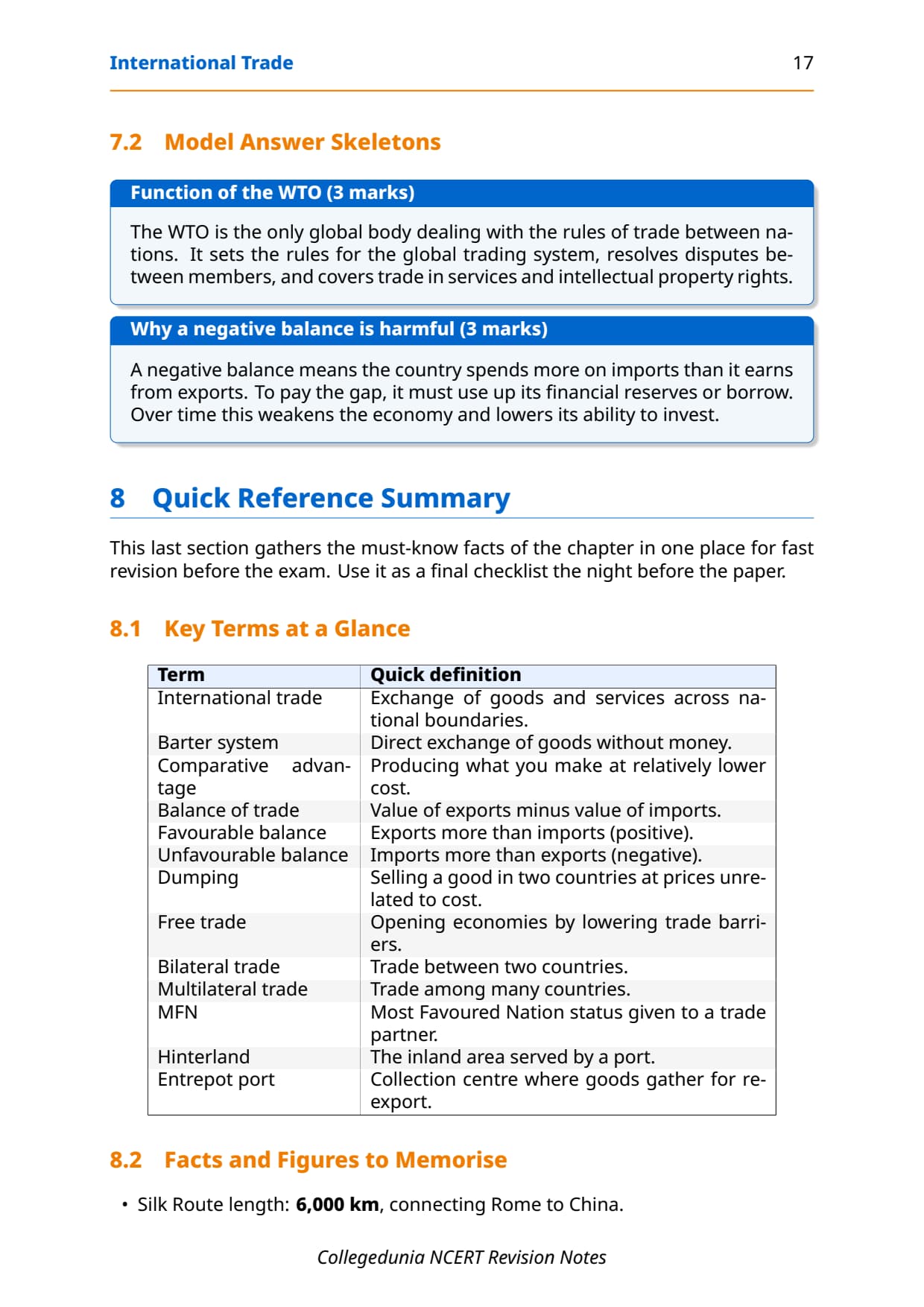
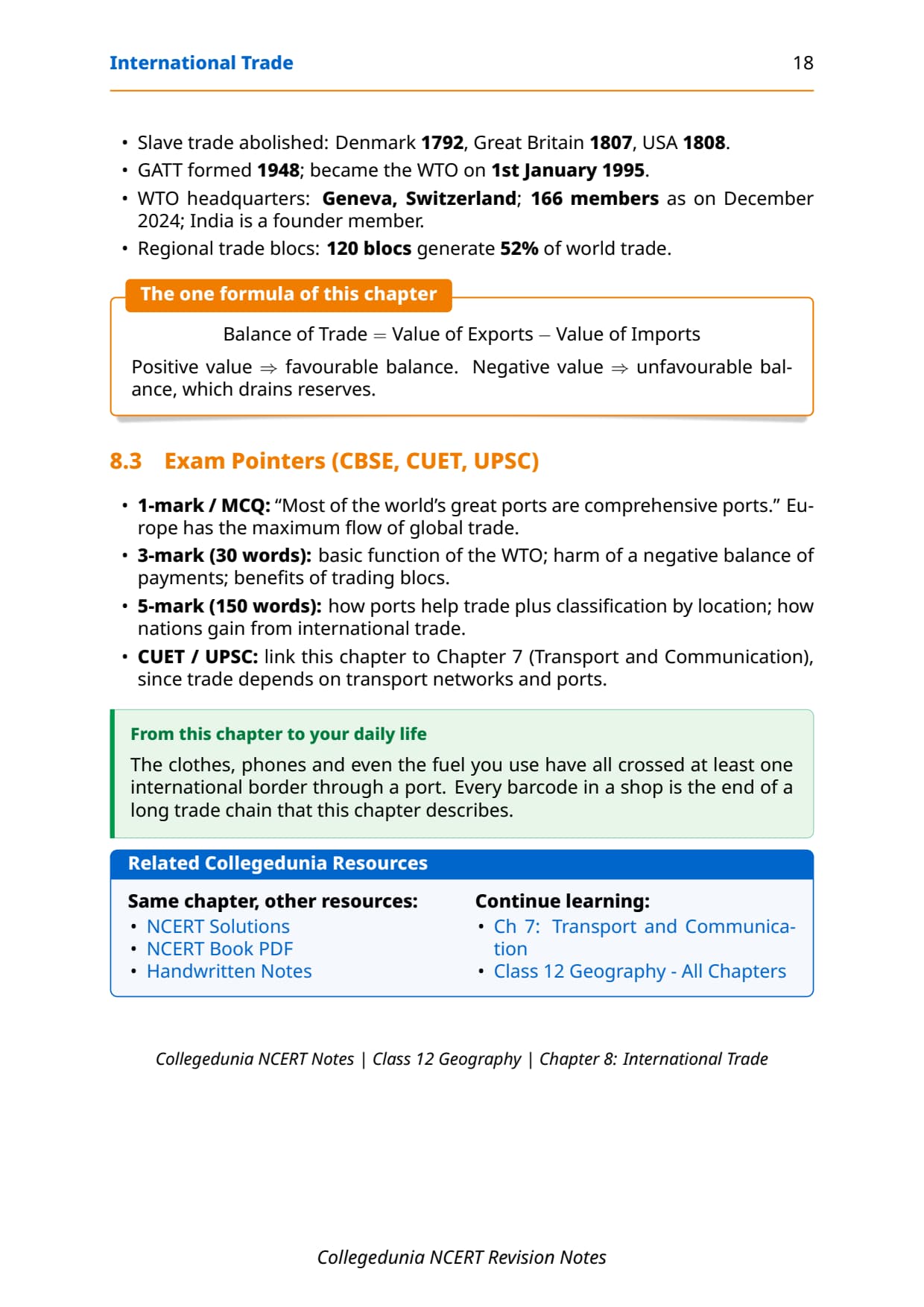


- Concept-first revision: why trade exists, the five bases of trade, types of trade, balance of trade vs payments, and what WTO does.
- All key definitions, port comparison tables and the free trade versus protectionism debate.
- Cross-pointers to the matching NCERT Solutions, Handwritten Notes and NCERT Book PDF.
Written by Collegedunia geography experts, mapped to the 2026-27 NCERT textbook and recent CBSE, CUET and UPSC trends.
Student Feedback
69% of students found the five bases of trade and balance of trade vs balance of payments the most-confused areas. Toppers who paired these notes with the Solutions PDF gained 2 to 3 marks per answer.
Source: 2026-27 Class 12 Geography poll of 8,720 CBSE students.
Quick Concept Recap: International Trade at a Glance
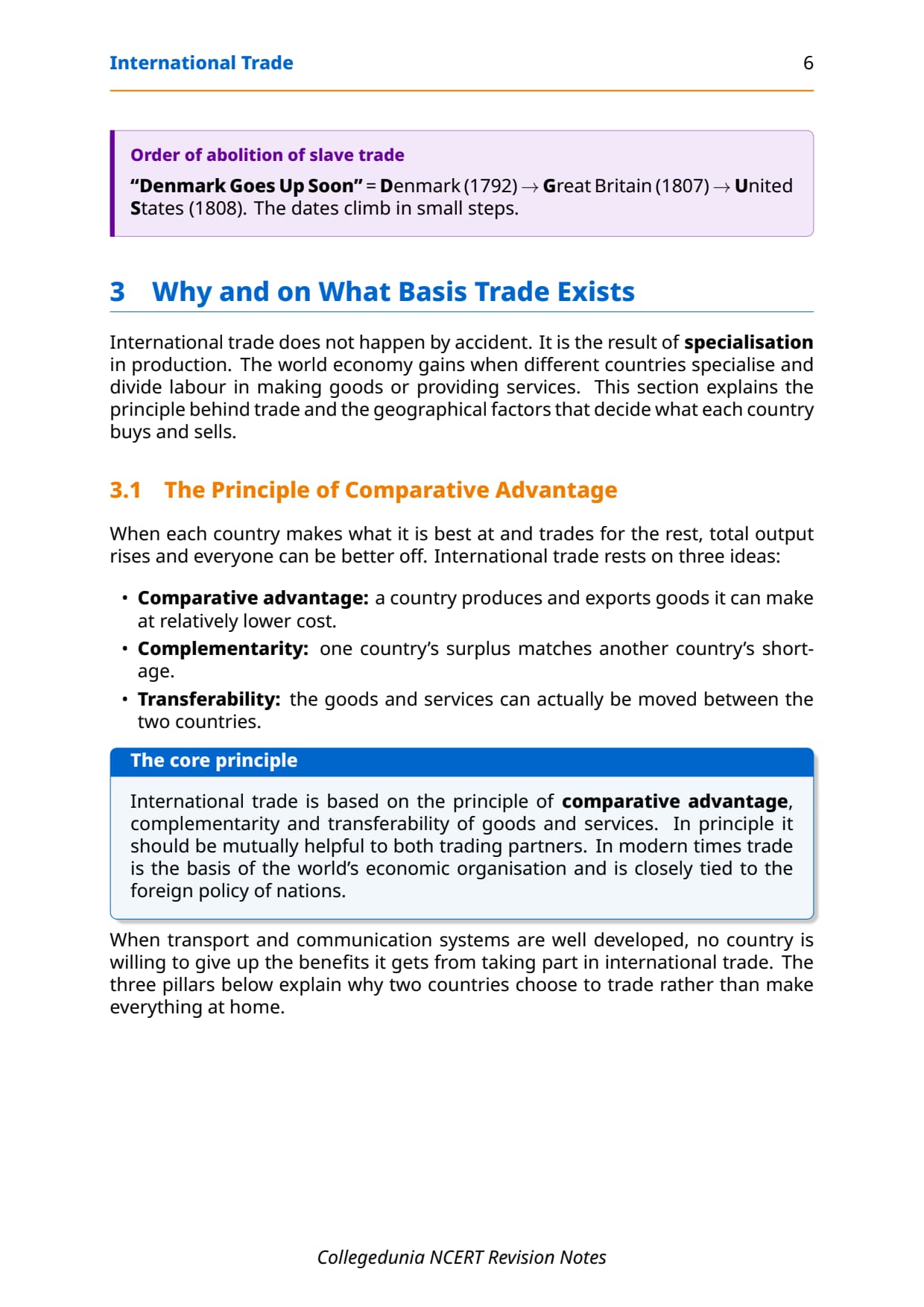
Trade is the voluntary exchange of goods and services; when it crosses national boundaries it becomes international trade. No nation can produce everything efficiently, so specialisation through comparative advantage leaves the whole world better off.
- Why trade exists: uneven resources, population and culture, economic development, foreign investment and transport.
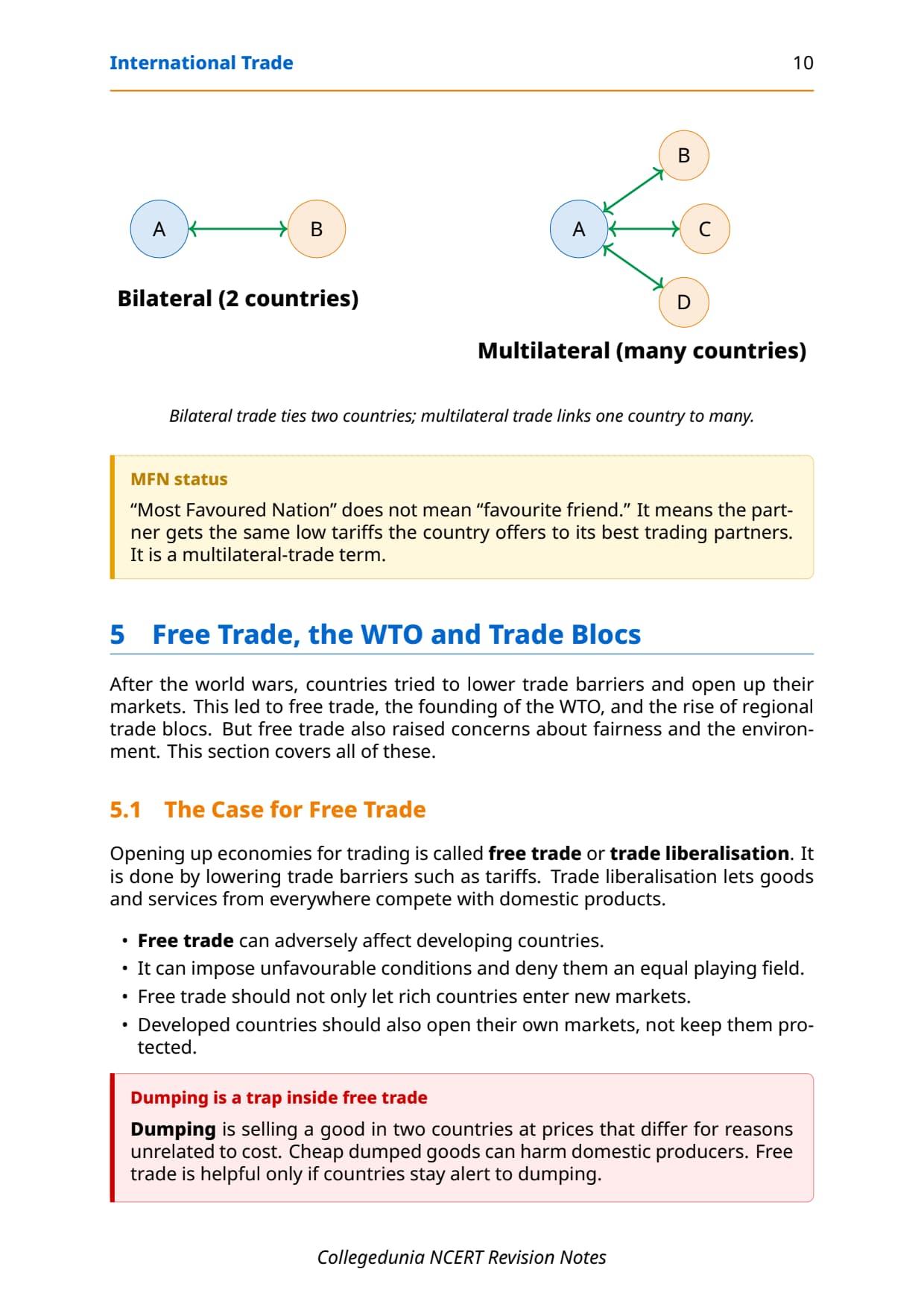
- Two types: bilateral (two countries), multilateral (one with many).
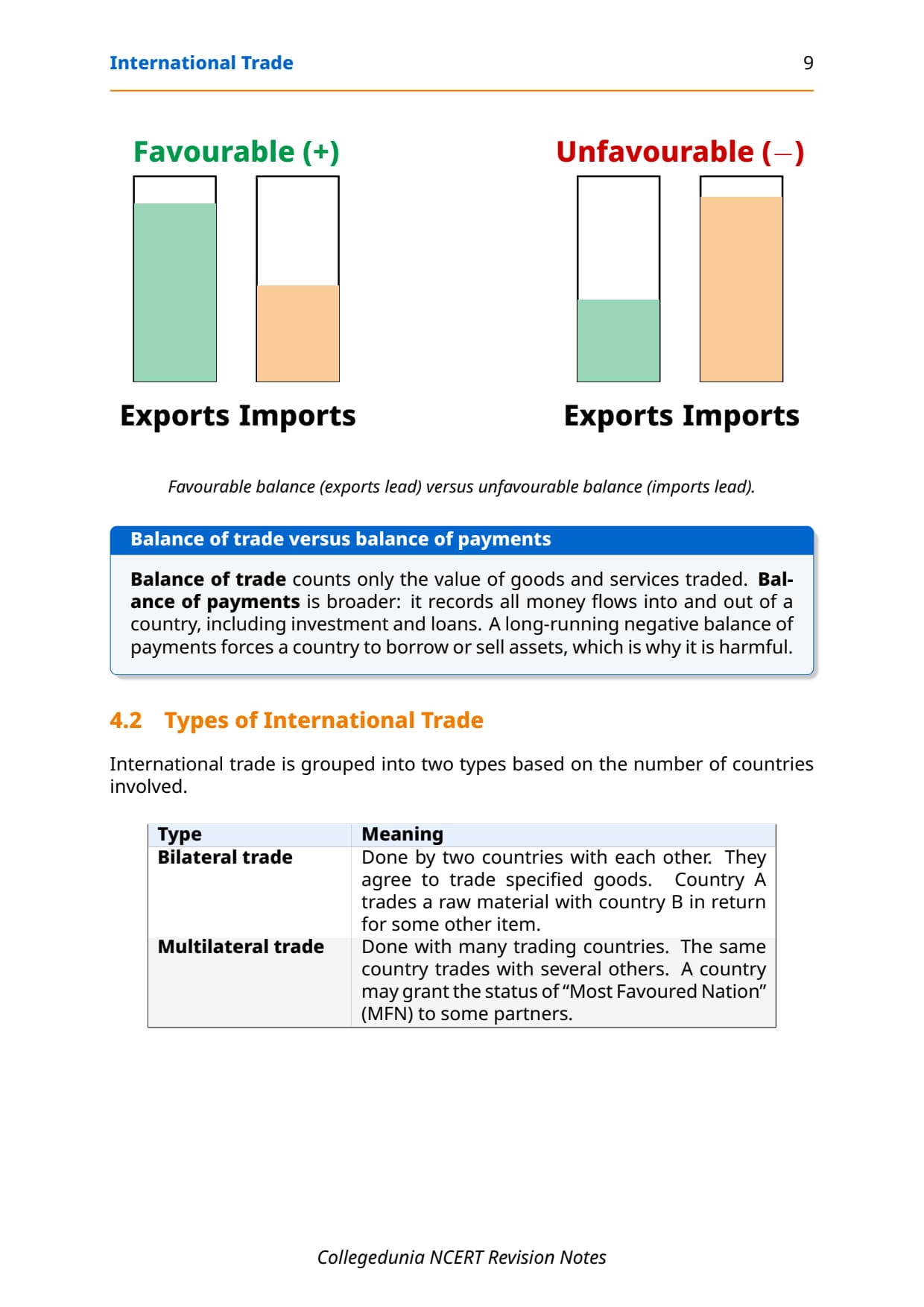
- Balance of trade: favourable if exports exceed imports, unfavourable if imports exceed exports.
- WTO: sets global trade rules; successor to GATT (1948), operational from 1 January 1995.
Use the matching NCERT Solutions for Class 12 Geography Chapter 8 for the exercise drill.
Source: Humanities Wallah - Class 12th on YouTube
Key Definitions for International Trade Class 12 Notes
The definitions below use the one-line form CBSE markers expect.
| Term | One-line definition | NCERT section pointer |
|---|---|---|
| International Trade | The exchange of goods and services among countries across national boundaries, driven by specialisation and comparative advantage. | Chapter 8 intro |
| Barter System | The earliest form of trade in which goods were exchanged directly for other goods without the use of money. | Chapter 8 intro |
| Comparative Advantage | The ability of a country to produce a good or service at a lower opportunity cost than other countries, forming the core basis of international trade. | Why International Trade Exists |
| Balance of Trade | A record of the volume and value of goods and services imported and exported by a country in a given period; favourable when exports exceed imports. | Balance of Trade section |
| Bilateral Trade | Trade conducted between exactly two countries, usually under a specific agreement to exchange particular commodities. | Types of International Trade |
| Multilateral Trade | Trade conducted by one country with many trading partners simultaneously; a country may also grant Most Favoured Nation (MFN) status to some partners. | Types of International Trade |
| Most Favoured Nation (MFN) | A trade status granted by one country to another, ensuring the receiving country gets the most favourable trade terms offered to any third country. | Types of International Trade |
| Dumping | The practice of selling a commodity in another country at a price lower than its cost of production or below the price charged in the home market. | Dumping section |
| Free Trade (Trade Liberalisation) | The removal of trade barriers such as tariffs to allow goods and services from all countries to compete freely with domestic products. | Case for Free Trade |
| World Trade Organisation (WTO) | The only international body that sets global rules of trade between nations, resolves trade disputes and promotes free and fair trade; successor to GATT, established 1 January 1995. | WTO section |
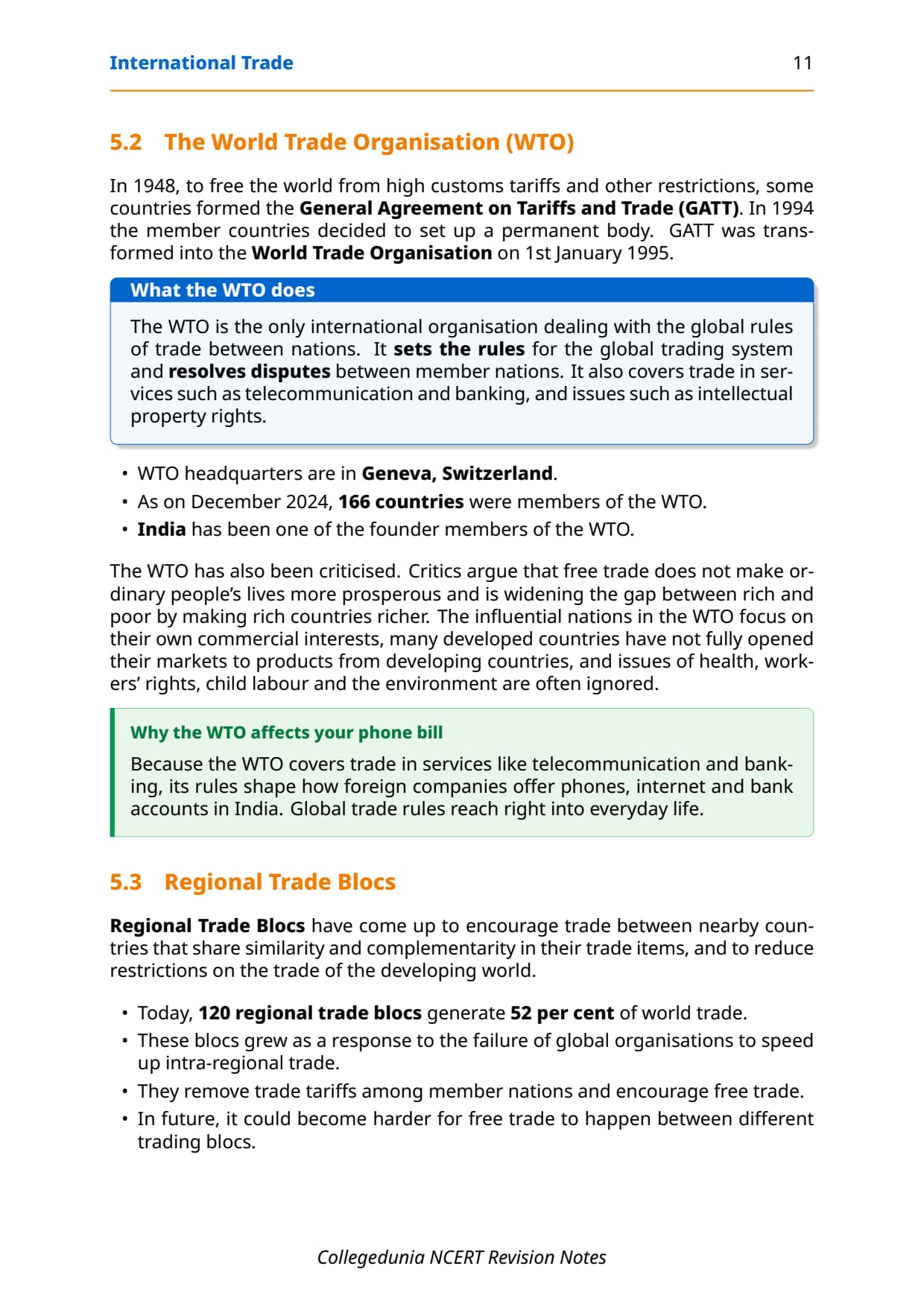
| Regional Trade Blocs | Groups of geographically proximate countries that reduce tariffs among themselves to encourage intra-regional trade; currently 120 blocs generate 52% of world trade. | Regional Trade Blocs section |
| Entrepot Port | A port that serves as a collection centre where goods from different countries are brought for re-export; Singapore (Asia), Rotterdam (Europe) and Copenhagen (Baltic) are examples. | Gateways of International Trade |
These cover roughly 8 of the 10 theory questions CBSE has asked since 2021.
Basis of International Trade: Five Factors Explained
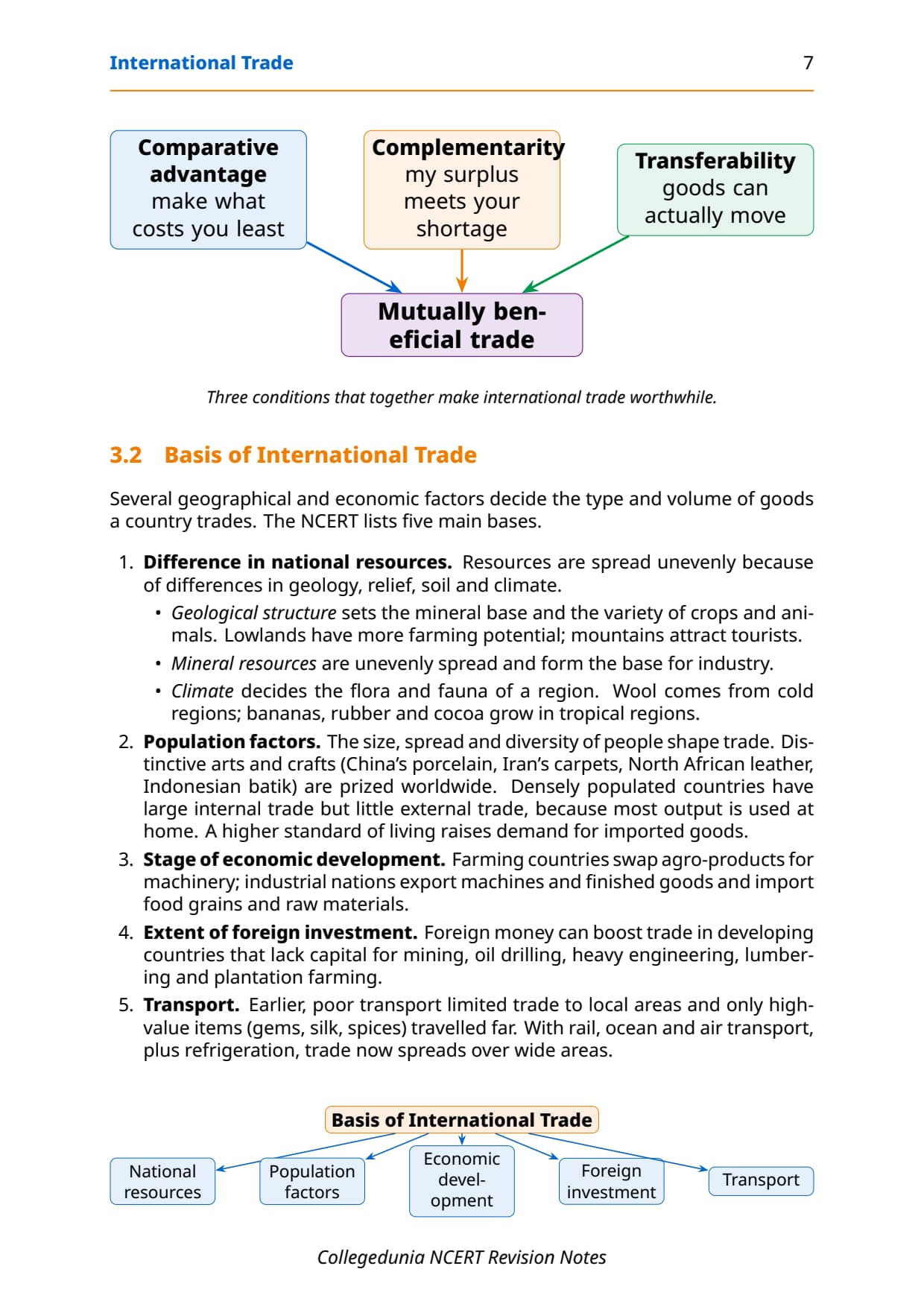
The NCERT chapter gives five main reasons why countries trade, and CBSE or CUET asks one question on it every cycle.
Factor 1: Difference in Natural Resources
Natural resources are distributed unevenly because of geology, relief, soil and climate, the most fundamental reason for trade.
- Geological structure: sets the mineral base; lowlands suit agriculture, mountains attract tourism.
- Minerals: unevenly distributed; they underpin industry in some regions.
- Climate: decides what can grow; wool suits cold regions, bananas, rubber and cocoa the tropics.
Factor 2: Population Factors
- Cultural factors: distinctive craft is valued globally: China for porcelain, Iran for carpets, Indonesia for batik.
- Population size: densely populated countries often have high internal but less external trade; standard of living decides how many can afford imports.
Factor 3: Stage of Economic Development
Agricultural economies export raw materials and import manufactured goods, while industrialised nations export machinery and finished products and import food and raw materials.
Factor 4: Extent of Foreign Investment
Foreign investment boosts trade in developing countries that lack capital for mining, oil, lumbering or plantation agriculture. Investing nations secure food and mineral imports and new markets for their products.
Factor 5: Transport
Before modern transport, only high-value, low-bulk items like gems, silk and spices moved long distances. Rail, ocean and air transport plus refrigeration drove the spatial expansion of trade to bulky, perishable goods.
Types of International Trade and Balance of Trade
Bilateral Trade
Bilateral trade happens between exactly two countries under a formal agreement to trade specific commodities.
Multilateral Trade
In multilateral trade, one country trades with many partners at once. It may grant Most Favoured Nation (MFN) status to selected partners, giving them the best available terms. Most trade today is multilateral, which is why the WTO sets consistent rules.
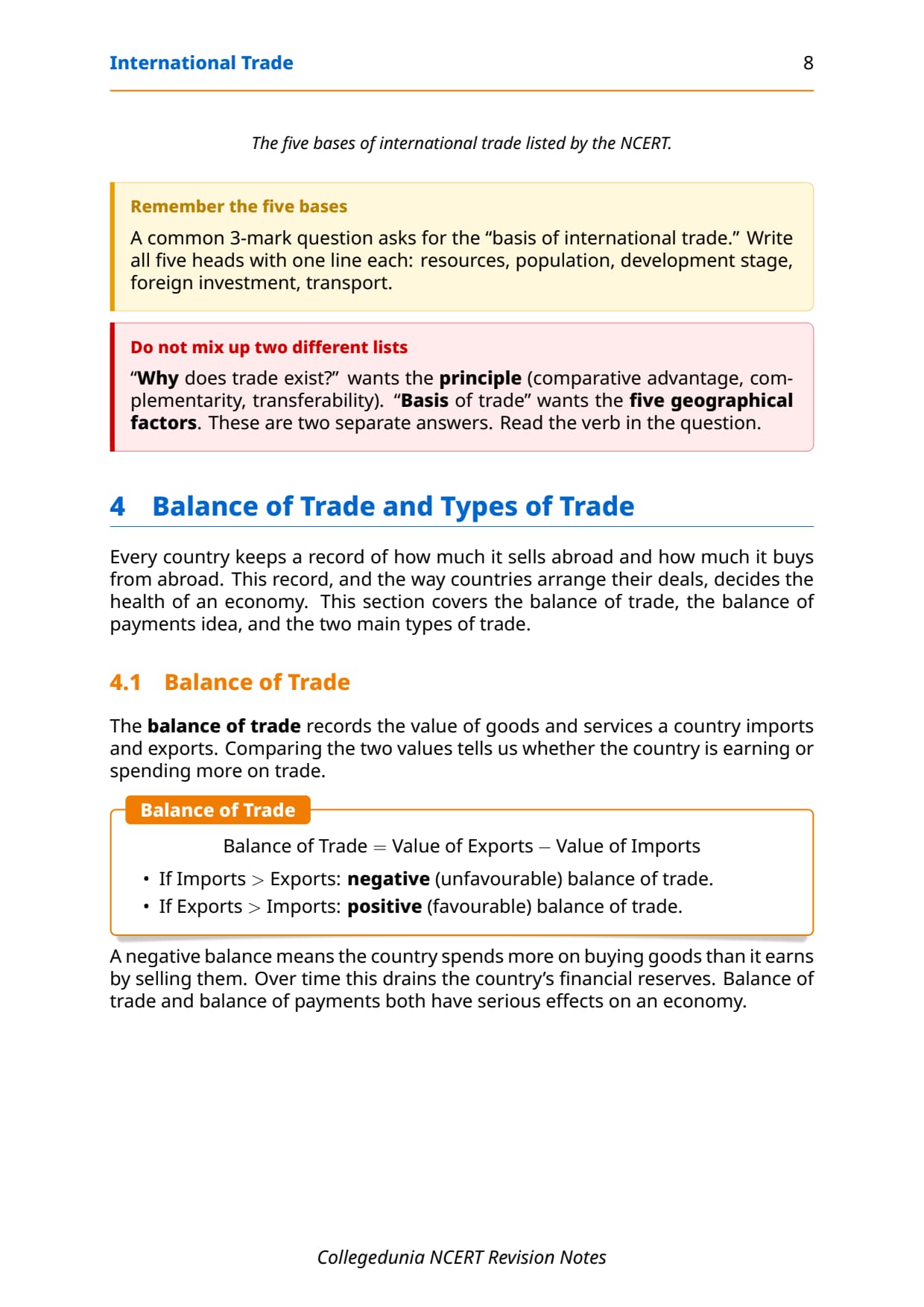
Balance of Trade
| Situation | What it means | Effect on economy |
|---|---|---|
| Favourable (Positive) Balance | Exports exceed imports in value | Country earns more from foreign trade than it spends; strengthens financial reserves |
| Unfavourable (Negative) Balance | Imports exceed exports in value | Country spends more on buying goods than it earns by selling; can exhaust financial reserves over time |
| Balance of Payments | Includes both goods and services, capital flows and transfer payments | Wider measure than balance of trade; a persistent deficit signals serious economic concern |
A negative balance of trade means a country spends more on imports than it earns; if it continues, foreign exchange reserves may run out.
Memory hook: Balance of Trade covers goods only; Balance of Payments covers everything, including services, remittances and capital flows. A country can have an unfavourable balance of trade but still balance payments if service exports are high, as India does with IT.
World Trade Organisation and Regional Trade Blocs
World Trade Organisation (WTO)
GATT (1948) reduced customs tariffs; in 1994 members replaced it with a permanent body. The WTO came into force on 1 January 1995, headquartered in Geneva. As of December 2024 it had 166 members, and India is a founding member.
- The only international body that sets global trade rules and resolves disputes between nations.
- Covers trade in goods, services (telecom, banking) and intellectual property rights.
Criticism of WTO: wealthy countries protect their own markets while pushing developing countries to open theirs, and health, labour and environment issues are often sidelined.
Regional Trade Blocs
Regional trade blocs emerged as a response to slow global trade negotiations, grouping nearby, complementary countries and removing tariffs among members. Today, 120 blocs generate 52% of world trade.
| Aspect | Details |
|---|---|
| Purpose | Encourage trade between geographically close and economically complementary countries; reduce trade restrictions for developing-world exporters |
| How they work | Member nations remove or reduce tariffs among themselves while maintaining separate trade policies with non-member countries |
| Scale today | 120 blocs, responsible for 52% of global trade |
| Future concern | If blocs become too powerful, free trade between different blocs may become harder, creating new barriers at bloc boundaries |
| Examples | EU (Europe), ASEAN (Southeast Asia), SAARC (South Asia), NAFTA / USMCA (North America), African Union trade zone |
Know what a trade bloc is, why it formed and one concern about its future. UPSC answers can add examples (SAARC, ASEAN, EU).
Gateways of International Trade: Types of Ports
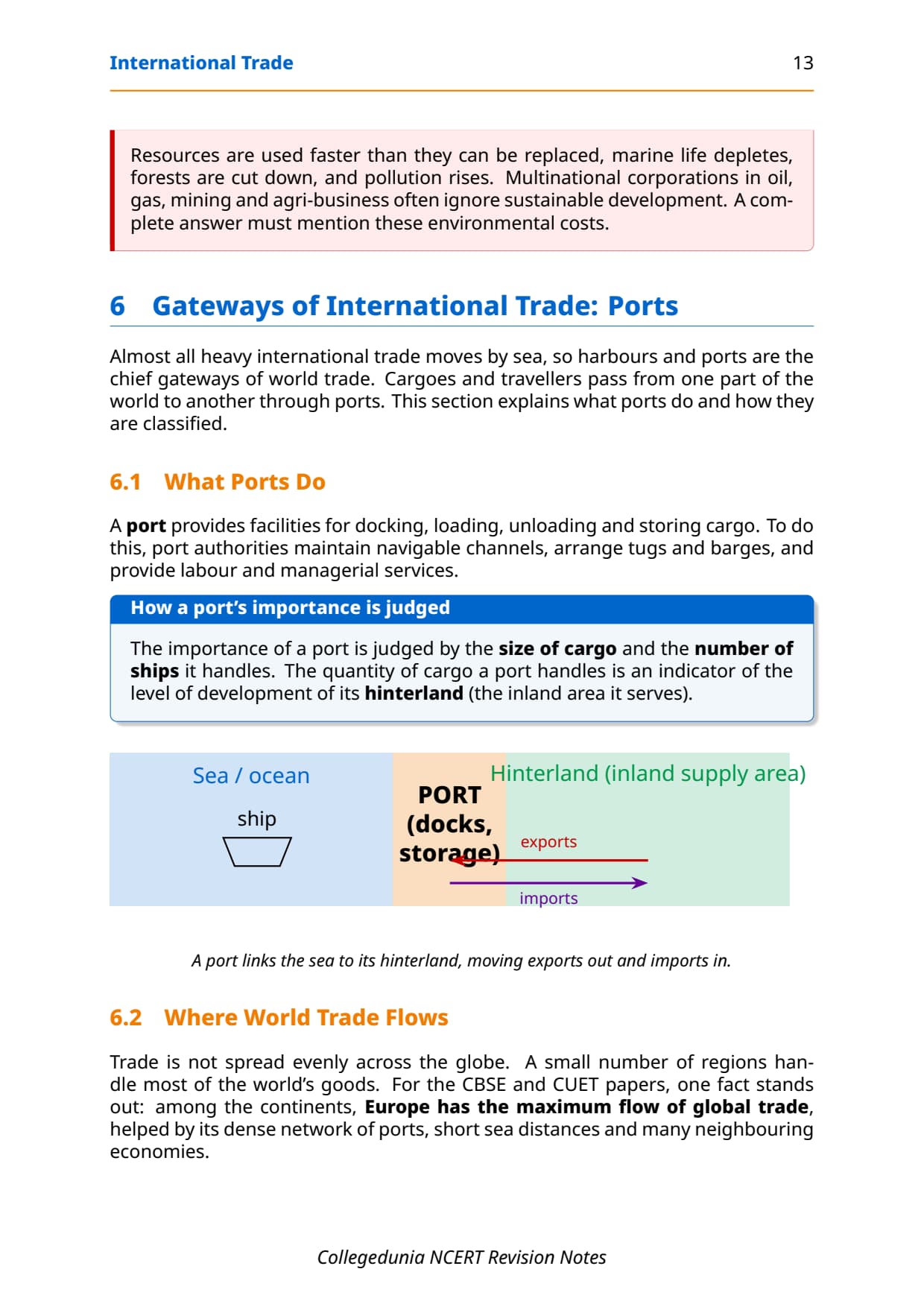
Ports are the chief gateways for international trade, providing docking, loading, unloading and storage. A port's importance is judged by the cargo it handles and the ships that call, which also reflects the development of its hinterland (the interior region it serves).
Ports Classified by Type of Cargo Handled
| Type | What it handles | Example |
|---|---|---|
| Industrial Ports | Bulk cargo only: grain, sugar, ore, oil, chemicals | Abadan (Iran), Maracaibo (Venezuela) |
| Commercial Ports | General (packaged) cargo and manufactured goods; also handles passengers | Most major city ports |
| Comprehensive Ports | Both bulk and general cargo in large volumes | Most of the world's great ports |
Ports Classified by Location
| Type | Description | Examples |
|---|---|---|
| Inland Ports | Located away from the sea coast, connected to the sea via river or canal; accessible to flat-bottom ships and barges | Manchester (canal), Memphis (Mississippi), Kolkata (Hoogli), Mannheim and Duisburg (Rhine) |
| Out Ports | Deep-water ports built away from the main port to receive large ships that cannot approach the parent port | Athens and its out port Piraeus (Greece) |
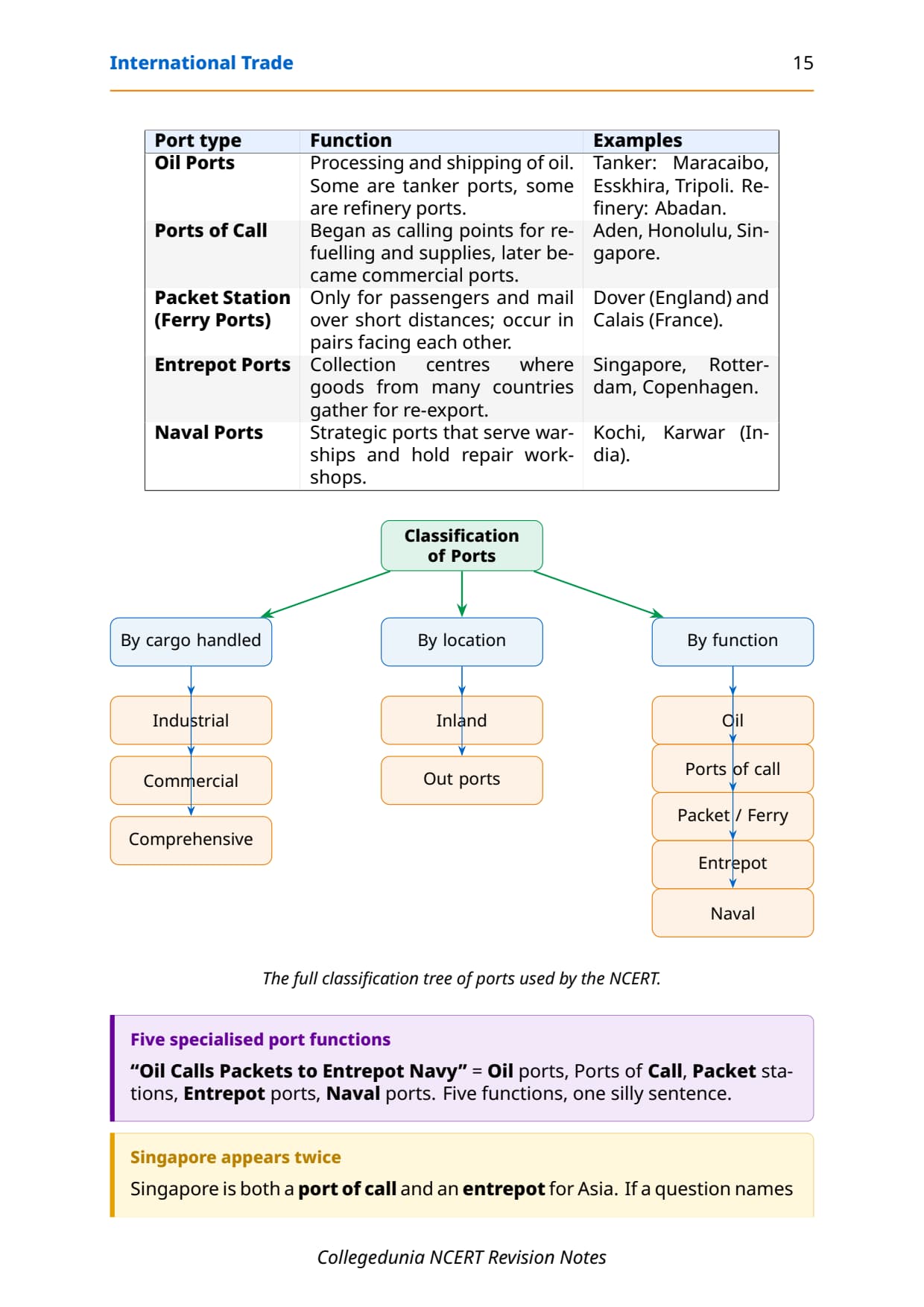
Ports Classified by Specialised Function
| Type | Function | Examples |
|---|---|---|
| Oil Ports | Processing and shipping of oil; includes tanker ports and refinery ports | Maracaibo (Venezuela), Esskhira (Tunisia), Tripoli (Lebanon) - tanker ports; Abadan (Persian Gulf) - refinery port |
| Ports of Call | Originally refuelling and watering stops on main sea routes; later evolved into commercial ports | Aden, Honolulu, Singapore |
| Packet Stations (Ferry Ports) | Handle passengers and mail across short water bodies; occur in pairs facing each other | Dover (England) and Calais (France) across the English Channel |
| Entrepot Ports | Collection centres where goods from different countries are brought for re-export to other countries | Singapore (Asia), Rotterdam (Europe), Copenhagen (Baltic region) |
| Naval Ports | Strategic ports serving warships only; have repair workshops | Kochi and Karwar (India) |
Exam tip: learn one example per port category. The difference between entrepot ports (re-export hubs) and comprehensive ports (all cargo) is a regular one-mark CUET question.
Free Trade, Dumping and Concerns of International Trade
Free Trade vs Protectionism
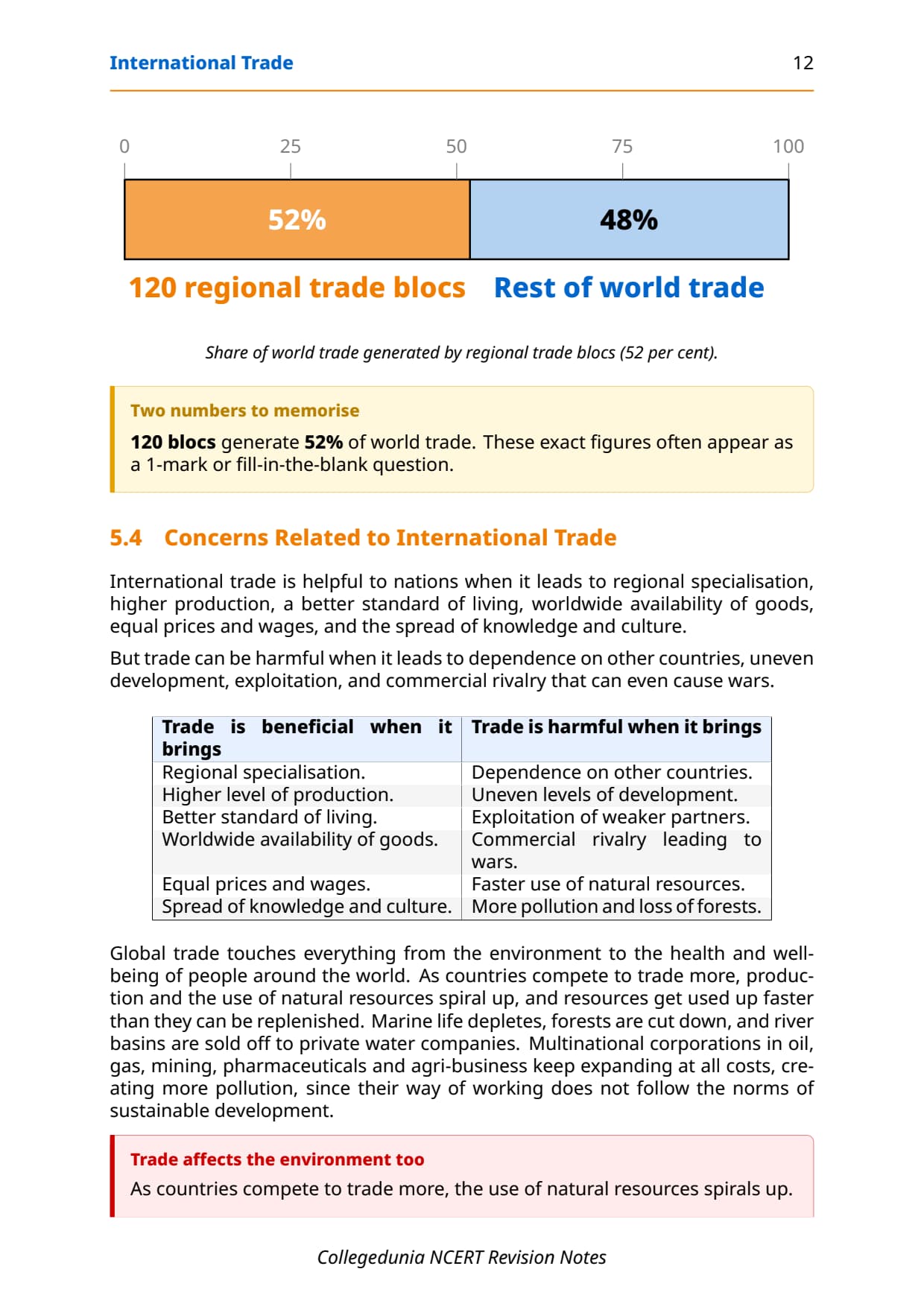
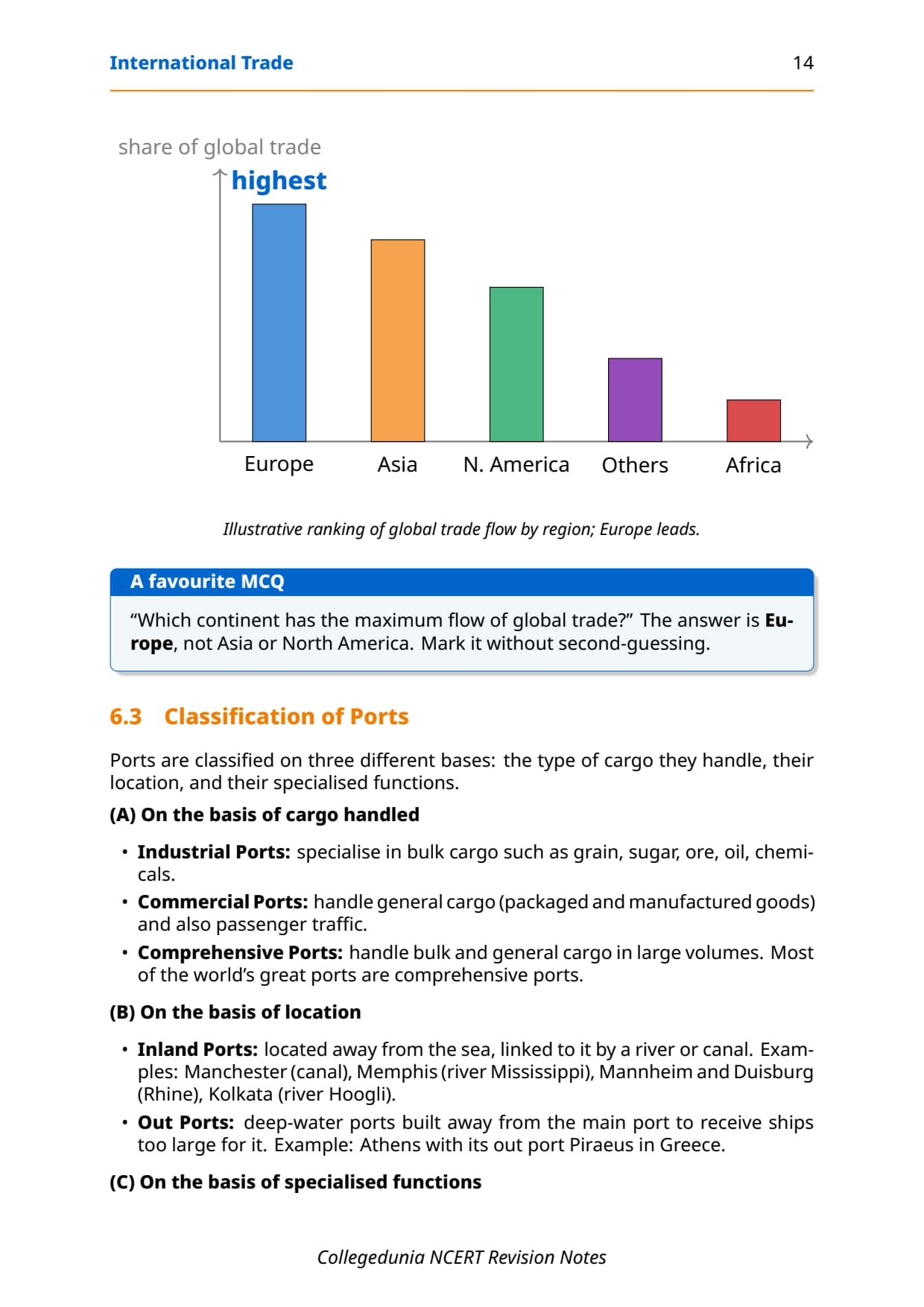
Free trade means removing barriers like tariffs so goods compete freely. The case for it: regional specialisation, higher production, better living standards and worldwide availability of goods.
The case against unchecked free trade is that it can hurt developing economies:
- Creating dependence on other countries for essentials.
- Widening the rich-poor gap, as wealthy countries subsidise their industries while demanding open markets.
- Driving overuse of resources like forests and fisheries.
- Letting multinationals ignore sustainable development norms.
Repeat-offender mistakes CBSE examiners flag each year:
- Bilateral vs multilateral: bilateral is exactly two countries; multilateral is many.
- Balance of trade vs payments: trade covers only goods; payments also includes services and capital flows.
- WTO year: 1948 is GATT; WTO began 1 January 1995.
- Singapore is not a naval port: it is an entrepot port and port of call; naval ports serve warships (Kochi, Karwar).
- Dumping is not illegal export: it is selling below cost abroad, harming the importing country's producers.
Dumping
Dumping is selling a commodity abroad below its cost of production or home-market price. It can wipe out local industries, so countries impose anti-dumping duties.
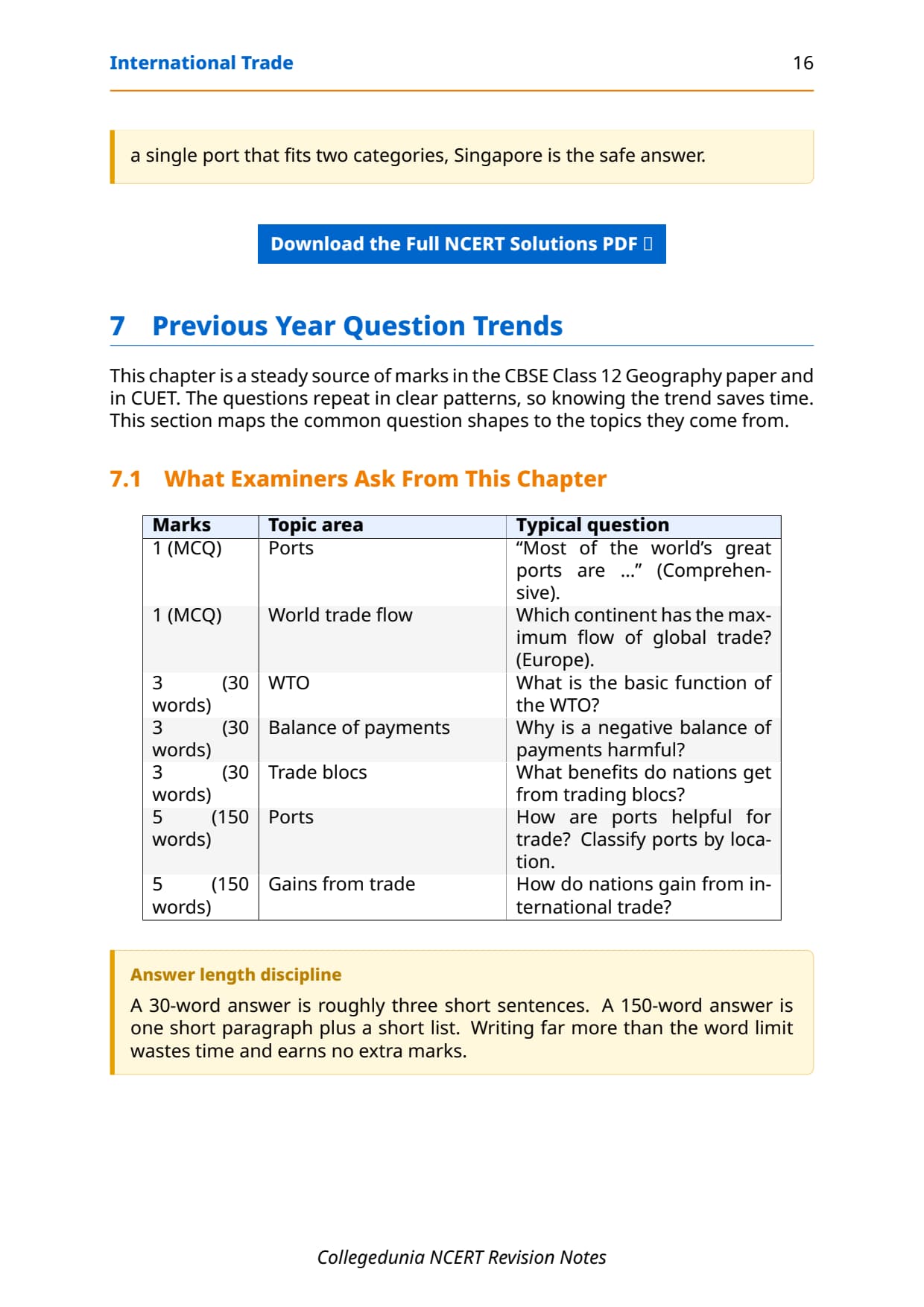
Previous Year Question Trends from International Trade Chapter 8
The table below maps what CBSE has asked over the last five years.
| Year | Question type asked | Marks | Notes section to revise |
|---|---|---|---|
| 2025 | Distinguish between balance of trade and balance of payments + explain dumping | 3 + 3 | Types of Trade + Free Trade section |
| 2024 | Classify ports on the basis of location with examples | 5 | Gateways of International Trade section |
| 2023 | State the basic function of WTO + explain any three bases of international trade | 2 + 4 | WTO section + Basis of Trade section |
| 2022 | Why does international trade exist? Explain with comparative advantage | 5 | Quick Concept Recap + Basis of Trade section |
| 2021 | What are regional trade blocs? Give two benefits of forming one | 4 | WTO and Regional Trade Blocs section |
The chapter carries 8 to 10 marks per year.
Other Resources for Class 12 Geography Chapter 8 International Trade
Pair these notes with the resources below.
| Resource | What it covers | Open |
|---|---|---|
| Notes | Concept-first revision notes covering definitions, bases of trade, types of trade, WTO, ports and free trade concerns. | You are here |
| NCERT Solutions | Step-by-step answers to all three exercise questions with Expert's Solution alternatives for every question. | Class 12 Geography Chapter 8 NCERT Solutions |
| Handwritten Notes | Topper's handwritten revision pages for last-minute board exam practice. | Class 12 Geography Chapter 8 Handwritten Notes |
| NCERT Book PDF | Official NCERT Fundamentals of Human Geography Chapter 8 textbook in PDF form. | Class 12 Geography Chapter 8 NCERT Book PDF |
| Subject Hub | All chapters of Class 12 Geography with every resource in one place. | Class 12 Geography Subject Hub |
All Chapters Notes for Class 12 Geography (Fundamentals of Human Geography)
Related Links: Notes for the other chapters of Class 12 Geography Fundamentals of Human Geography.
| Chapter | Topic | Notes link |
|---|---|---|
| Chapter 1 | Human Geography: Nature and Scope | Class 12 Geography Chapter 1 Notes |
| Chapter 2 | The World Population: Distribution, Density and Growth | Class 12 Geography Chapter 2 Notes |
| Chapter 3 | Human Development | Class 12 Geography Chapter 3 Notes |
| Chapter 4 | Primary Activities | Class 12 Geography Chapter 4 Notes |
| Chapter 5 | Secondary Activities | Class 12 Geography Chapter 5 Notes |
| Chapter 6 | Tertiary and Quaternary Activities | Class 12 Geography Chapter 6 Notes |
| Chapter 7 | Transport and Communication | Class 12 Geography Chapter 7 Notes |
| Chapter 8 | International Trade | You are here |
NCERT Notes Class 12 Geography Chapter 8 International Trade FAQs
Ques. What is international trade in Class 12 Geography?
Ans. International trade is the exchange of goods and services among countries across national boundaries. Countries trade because no single nation can produce everything it needs, and specialisation based on comparative advantage allows the world economy to produce more efficiently. The NCERT Class 12 Geography chapter on international trade covers its history from the barter system to the WTO, the five bases of trade, types of trade, balance of trade and the classification of world ports.
Ques. What are the five bases of international trade in Class 12 Geography?
Ans. The five bases of international trade as given in the NCERT Class 12 Geography textbook are: (1) Difference in natural resources due to geology, relief, soil and climate; (2) Population factors including cultural diversity and population size and density; (3) Stage of economic development, which determines what a country exports and imports; (4) Extent of foreign investment, which enables capital-poor countries to develop export industries; and (5) Transport improvements, which made it economical to trade bulky and perishable goods over long distances. CBSE typically asks for three of these five in a 4-mark or 5-mark question.
Ques. What is the difference between balance of trade and balance of payments?
Ans. Balance of trade records only the value of goods (visible trade) imported and exported by a country. If exports exceed imports, the balance is favourable; if imports exceed exports, it is unfavourable. Balance of payments is a wider concept that includes goods, services (invisible trade), capital flows, remittances and transfer payments. A country can have a negative balance of trade but a positive balance of payments if its service exports (for example, IT and software) are large enough to offset the goods deficit. India is a common real-world example of this in CBSE answers.
Ques. What is the WTO and what does it do for Class 12 Geography?
Ans. The World Trade Organisation (WTO) is the only international body that sets the global rules of trade between nations. It came into being on 1 January 1995 as the successor to GATT (1948) and is headquartered in Geneva, Switzerland. As of December 2024, it has 166 member countries, and India is a founding member. WTO resolves trade disputes, promotes free and fair trade, and covers trade in goods, services and intellectual property rights. Critics argue that it favours rich countries and ignores health, labour and environmental concerns.
Ques. How are ports classified according to the NCERT Class 12 Geography Chapter 8 notes?
Ans. Ports are classified in three ways in the NCERT Class 12 Geography chapter. By cargo type: industrial ports (bulk cargo like ore, oil, grain), commercial ports (packaged goods and passengers) and comprehensive ports (both bulk and general cargo in large volumes). By location: inland ports (connected to the sea via river or canal, e.g. Kolkata on the Hoogli, Manchester via canal) and out ports (deep-water ports away from the parent port, e.g. Piraeus for Athens). By specialised function: oil ports, ports of call (e.g. Singapore, Aden, Honolulu), packet stations or ferry ports (e.g. Dover and Calais), entrepot ports (e.g. Singapore, Rotterdam, Copenhagen) and naval ports (e.g. Kochi and Karwar in India).
Ques. What is dumping in the context of international trade class 12?
Ans. Dumping is the practice of selling a commodity in another country at a price below its cost of production or below the price charged in the home market. It is a concern in international trade because cheaply dumped goods can destroy the domestic industries of the importing country, as local producers cannot compete at the artificially low price. Countries protect themselves through anti-dumping duties. The NCERT Class 12 Geography chapter mentions dumping in the context of concerns related to free trade and globalisation.
Ques. What are regional trade blocs and how many exist today?
Ans. Regional trade blocs are groups of geographically close and economically complementary countries that reduce or remove tariffs among themselves to encourage intra-regional trade. They developed because global trade organisations like WTO were seen as too slow to deliver benefits for developing countries. Today, 120 regional trade blocs generate 52% of world trade. Examples include the European Union (EU), ASEAN (Southeast Asia), SAARC (South Asia) and USMCA (North America). One concern is that as blocs grow stronger, trade between different blocs may become more restricted, creating new barriers at the bloc boundary.
Ques. What is an entrepot port and how is it different from a commercial port?
Ans. An entrepot port is a collection centre where goods from different countries are brought specifically for re-export to other countries, not for domestic consumption. Singapore (Asia), Rotterdam (Europe) and Copenhagen (Baltic region) are classic entrepot ports. A commercial port, by contrast, handles general packaged cargo and manufactured goods that are destined for the domestic market, and also serves passenger traffic. The key difference is that entrepot ports are re-export hubs while commercial ports serve end consumers in their own region.
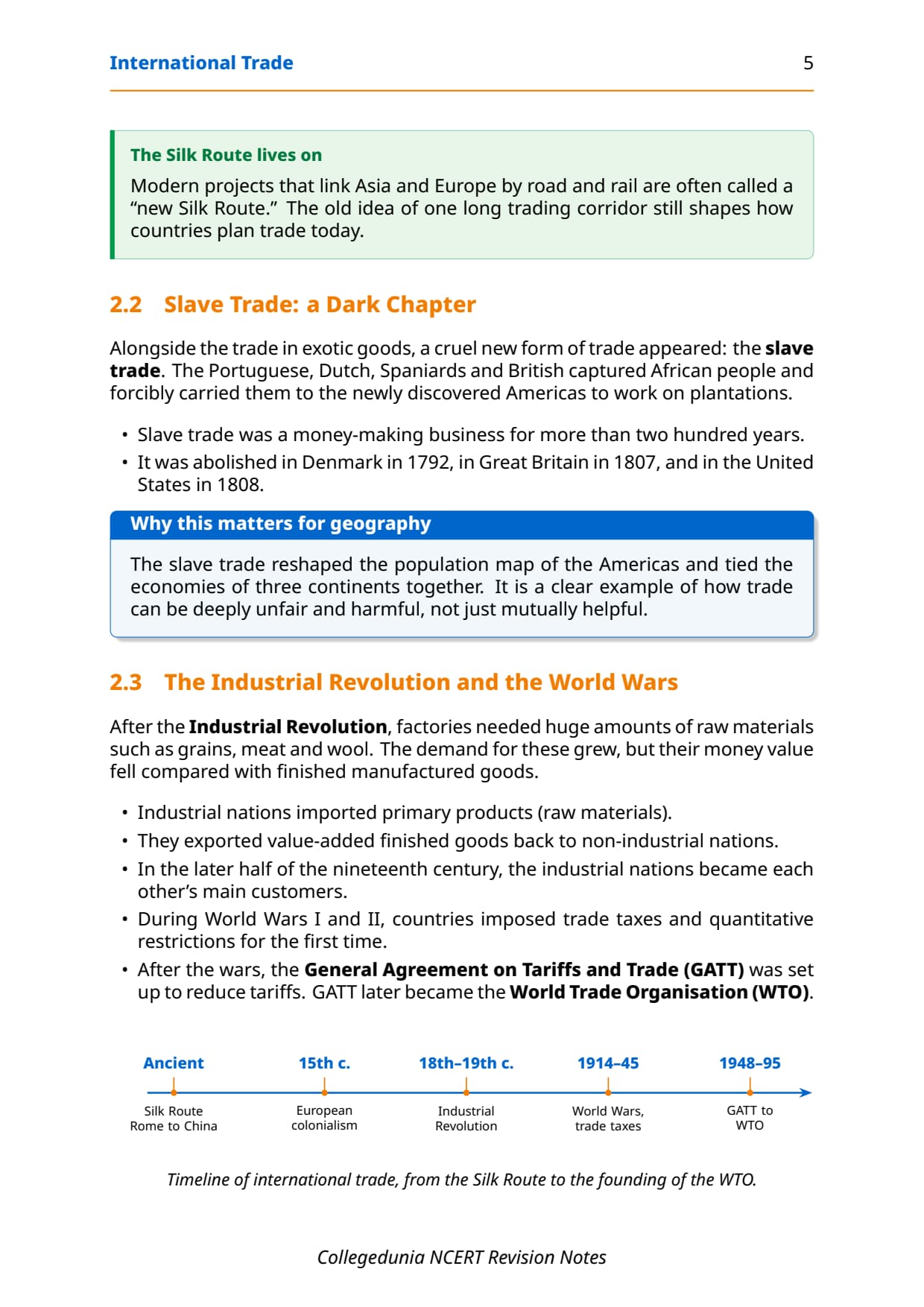
Ques. What is the Silk Route and why is it mentioned in international trade class 12 notes?
Ans. The Silk Route was an early example of long-distance international trade connecting Rome to China over a roughly 6,000 km land route. Traders transported Chinese silk, Roman wool, precious metals and high-value commodities through intermediate points in India, Persia and Central Asia. The NCERT Class 12 Geography chapter mentions the Silk Route in the history of international trade section to show that organised long-distance trade existed even in ancient times, driven by the same principle of exchanging what one region produces well for what it lacks. CBSE occasionally asks a one-mark or two-mark question on this history section.
Ques. Are these international trade notes enough for CBSE boards in 2026-27?
Ans. These international trade class 12 notes are sufficient for all theory, definition and 3-mark to 5-mark short-answer questions in the CBSE 2026-27 board exam. The Notes cover every concept, definition, table and classification given in the NCERT chapter. For the exercise questions (which require full written answers), students should also use the matching NCERT Solutions PDF, which works through all three exercise questions step by step. Students targeting full marks should complete at least one timed practice of the exercise questions after revising these notes, then check their answers against the Solutions PDF.
Ques. Is international trade in Class 12 Geography important for CUET and UPSC?
Ans. Yes. For CUET Geography, international trade is tested through definition questions (WTO, balance of trade, types of ports, dumping) and application questions on why countries trade. For UPSC Preliminary, the chapter's content on WTO, free trade, regional trade blocs and port types directly maps to the geography and economy sections of the General Studies paper. UPSC Mains students benefit from adding current examples of trade disputes, WTO functioning and India's trade balance. These notes cover the full NCERT base; UPSC aspirants should extend this with current affairs on trade policy.



Comments