




These Class 12 English Going Places Notes give you a full revision pack for A.R. Barton's Chapter 8 of Flamingo. They cover the chapter summary, scene-by-scene plot, character sketches for all seven characters, the four exam themes, Barton's narrative style, key quotes with meanings, and the most-asked board questions with pointers. The notes follow the 2026-27 syllabus.
- What the Notes cover: Plot summary, all 7 named characters, themes, quotes, exam tips
- Length: Compact 20-page PDF, designed for night-before revision
- Aligned to: 2026-27 NCERT Flamingo (latest edition)
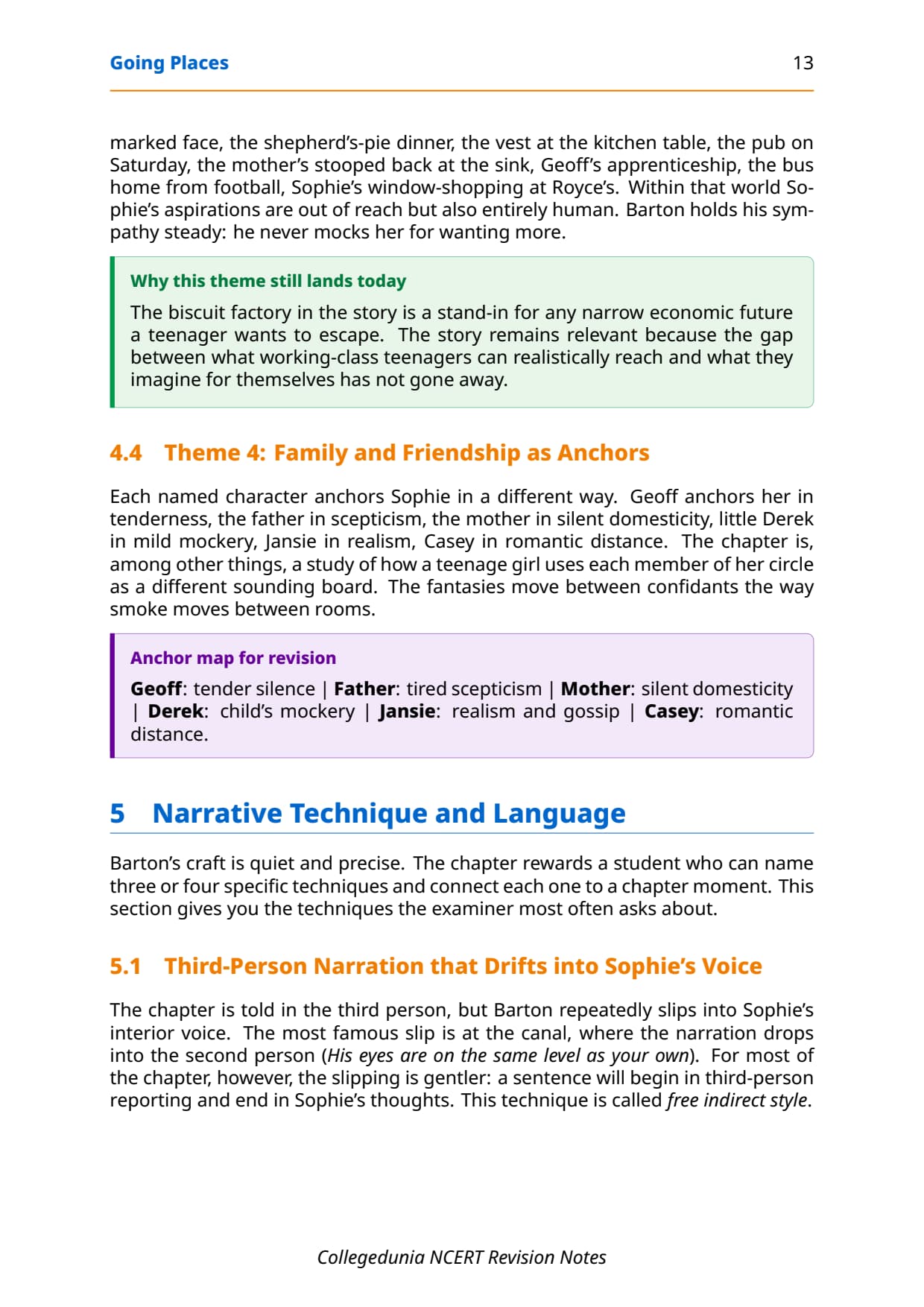
The full Class 12 English Going Places notes below include character analysis, a theme breakdown, a scene-by-scene plot, and exam-ready answer pointers. Collegedunia subject experts mapped them to the 2026-27 NCERT print and the last five years of CBSE Board papers.
Going Places Class 12 English Notes: Chapter at a Glance
A.R. Barton's Going Places is the last prose chapter of Flamingo (Class 12 English Core). It is a third-person story that slips into the voice of Sophie, a teenage school-leaver. She spins daydreams about a glamorous future and an imagined meeting with the Irish footballer Danny Casey. Here is the quick recap most students revise from.
| Field | Detail |
|---|---|
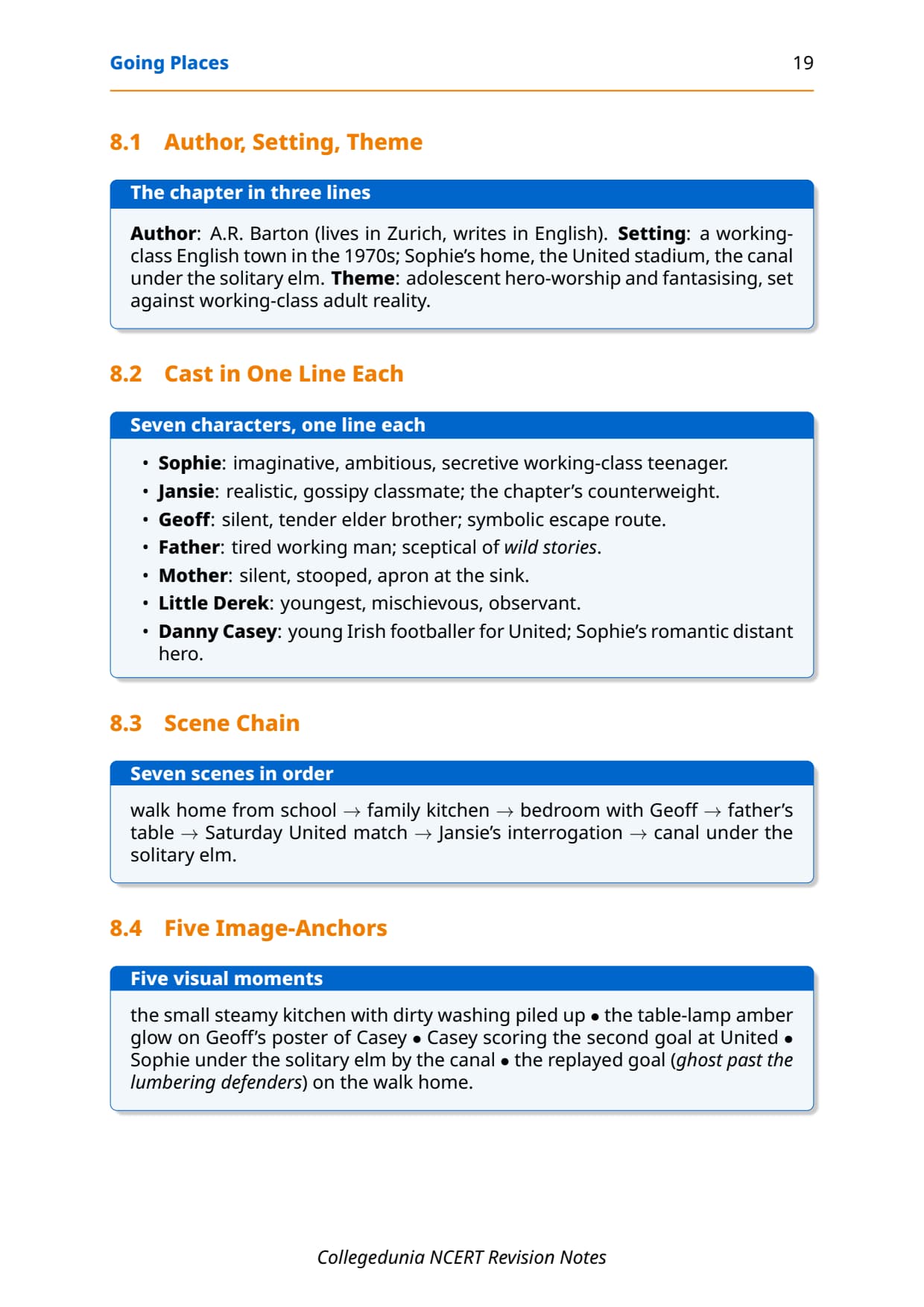
| Author | A.R. Barton (lives in Zurich; writes in English) |
| Form | Short story; third-person narration that slips into Sophie's voice |
| Setting | An English working-class town, 1970s; home, arcade, stadium, canal |
| Central theme | Adolescent hero-worship and fantasising vs working-class adult reality |
| Sub-theme | Relationships within family and friendship |
| NCERT comprehension type | Inferential (much of the story is implied, not stated) |
Going Places Video Explanation (Class 12 English)
Source: Magnet Brains on YouTube
Going Places Class 12 Character Sketches
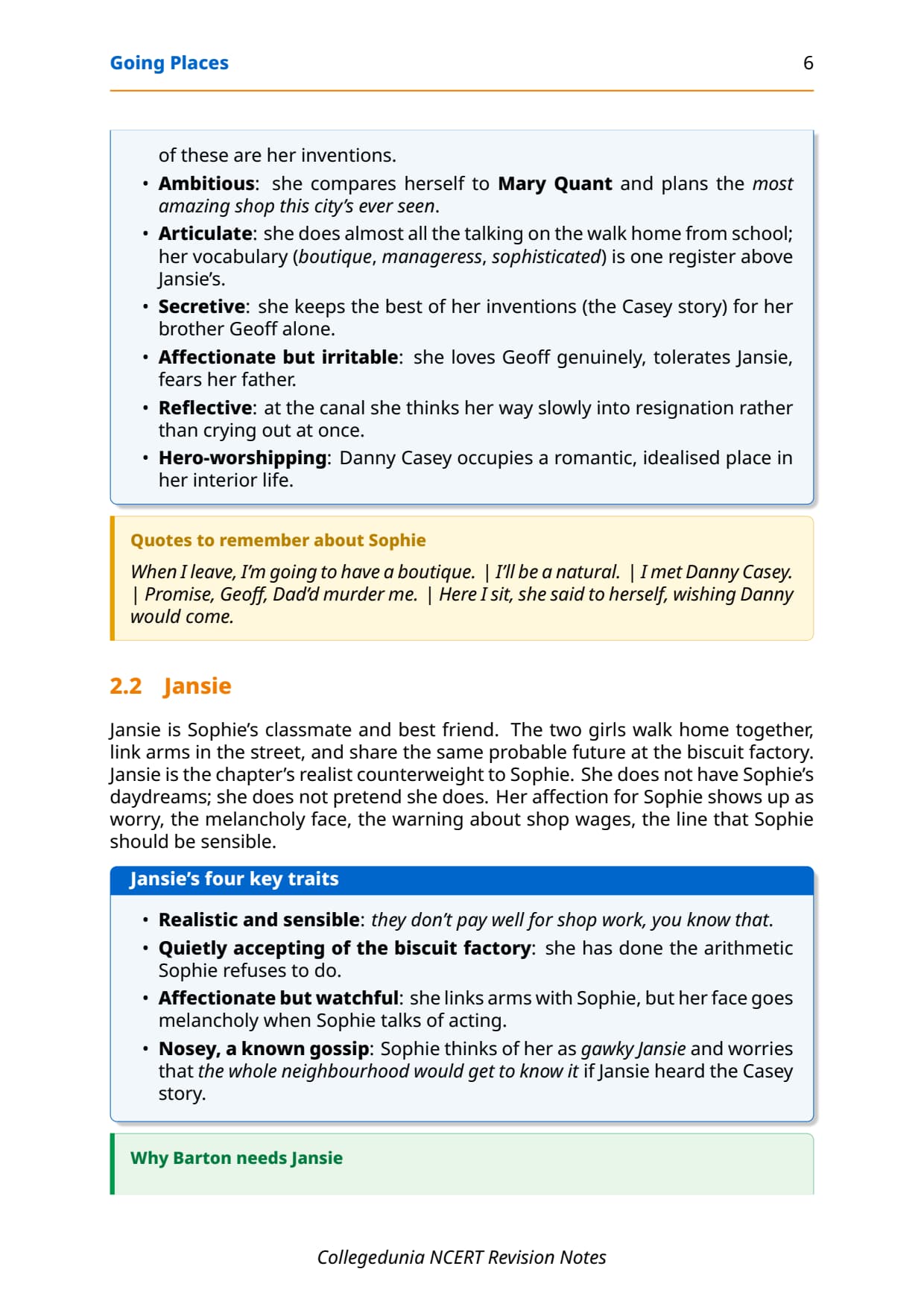
The story has seven named characters. Barton draws each one through small physical details, the apron's bow, the thick neck, the grimy face, rather than long descriptions.
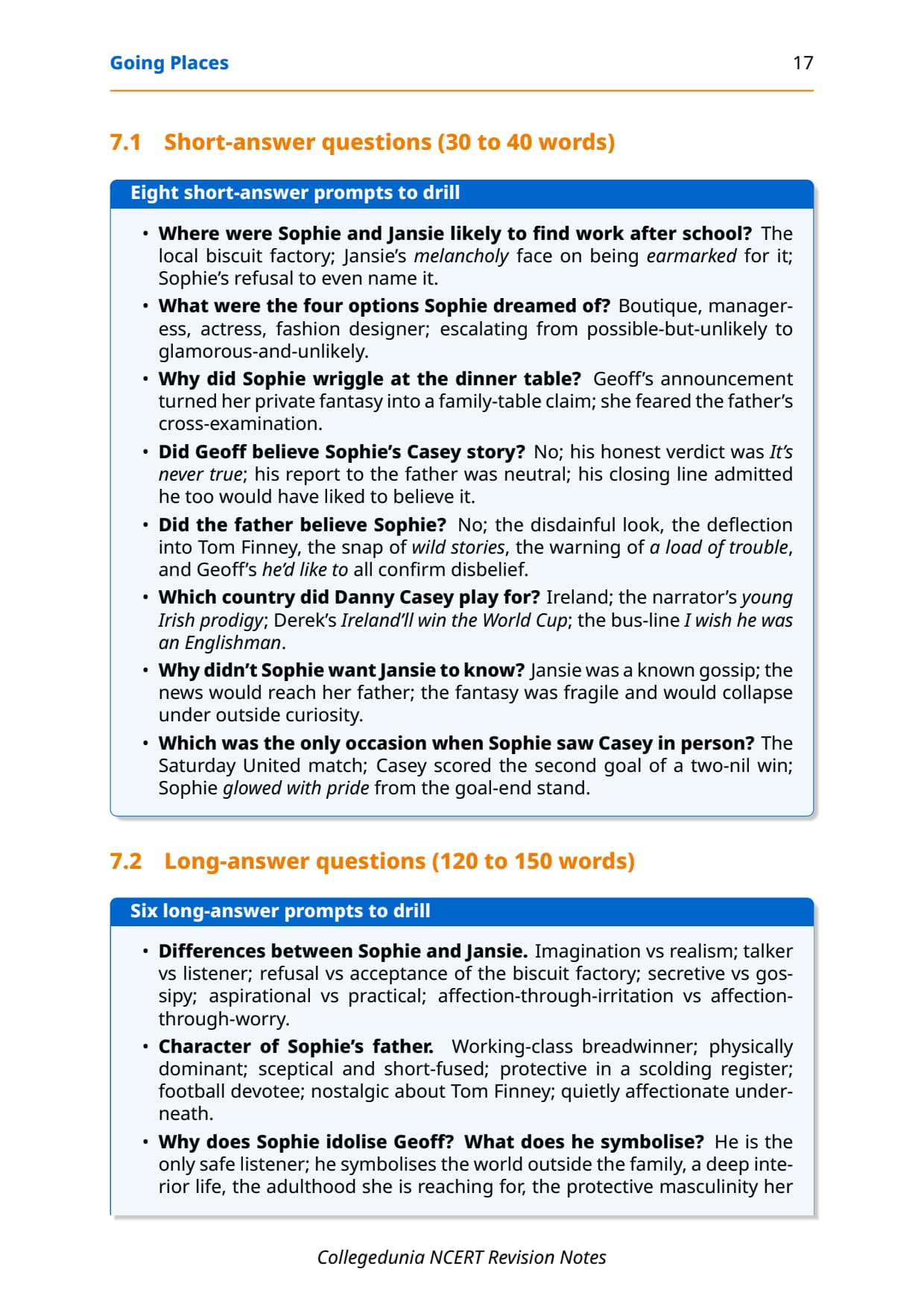
- Sophie: the protagonist; school-leaver aged 15-16; imaginative, ambitious and secretive; daydreams of a boutique, an acting career and a romance with Danny Casey.
- Jansie: Sophie's classmate and best friend; realistic, sensible, accepting of the biscuit-factory future; the chapter's realist counterweight.
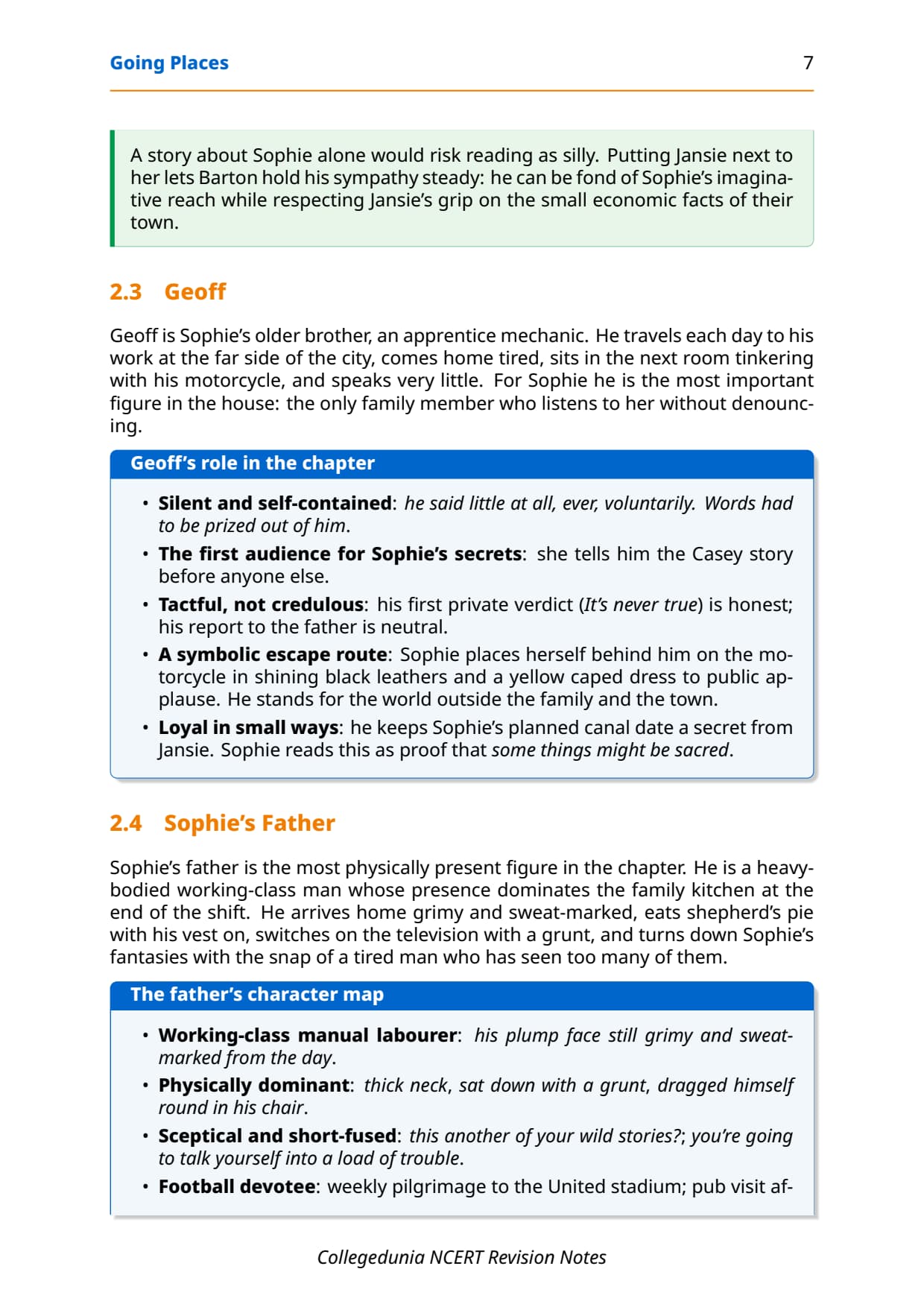
- Geoff: Sophie's elder brother; apprentice mechanic; silent, tender and loyal; the only safe listener at home; stands for the world outside the town.
- Sophie's father: a heavy working-class labourer; tired, short-fused and sceptical of wild stories; a football devotee.
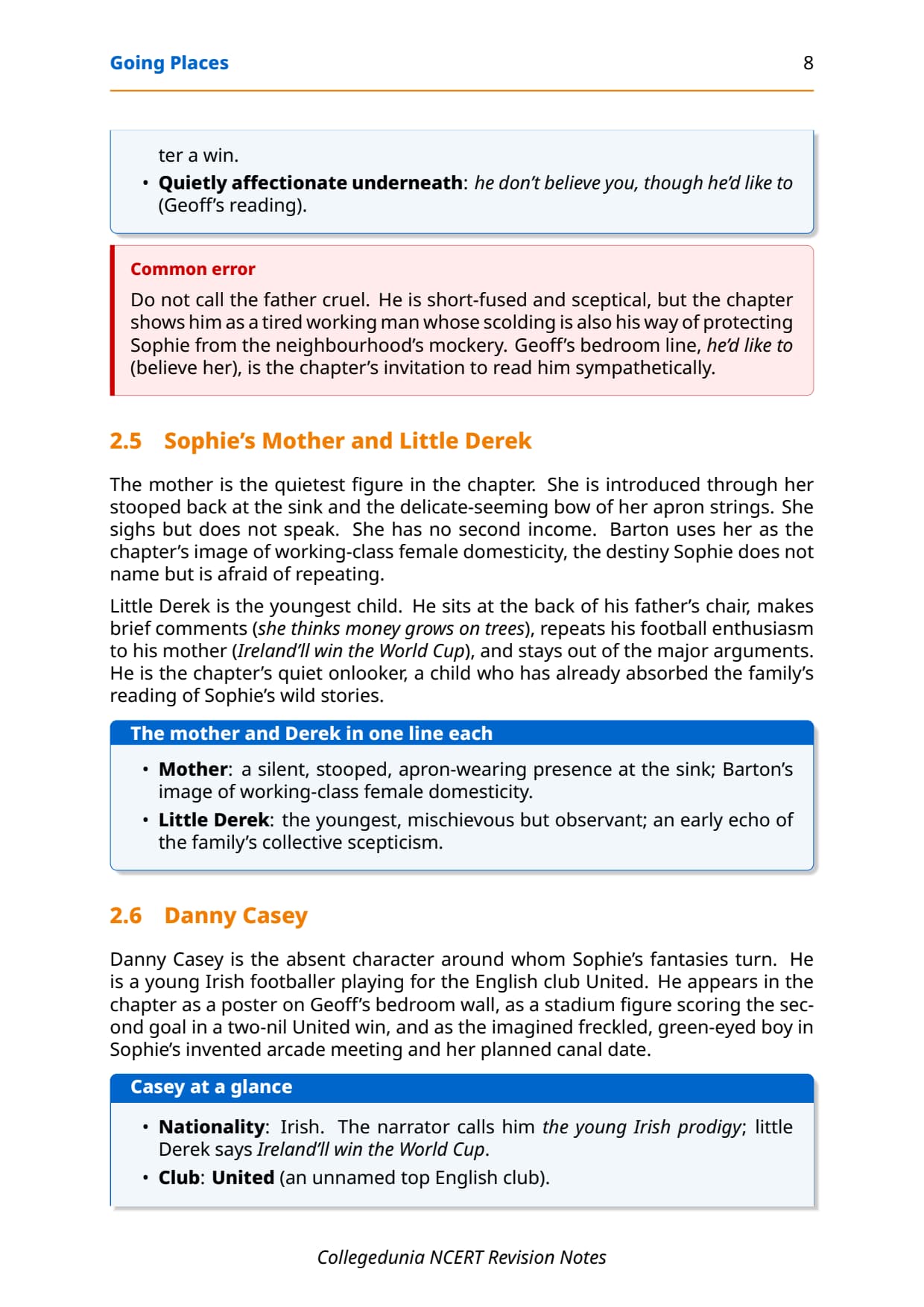
- Sophie's mother: silent, stooped over the sink; her apron with a delicate bow is an image of working-class female domesticity.
- Little Derek: the youngest child; mischievous but observant (she thinks money grows on trees).
- Danny Casey: a young Irish footballer playing for the English club United; the absent hero around whom Sophie's fantasies turn.
Going Places Class 12 Scene-by-Scene Plot Summary
The best summary answers walk the examiner through the story scene by scene. There are seven scenes; learn them in order for a clean long-answer spine.
| # | Scene | Key Beat |
|---|---|---|
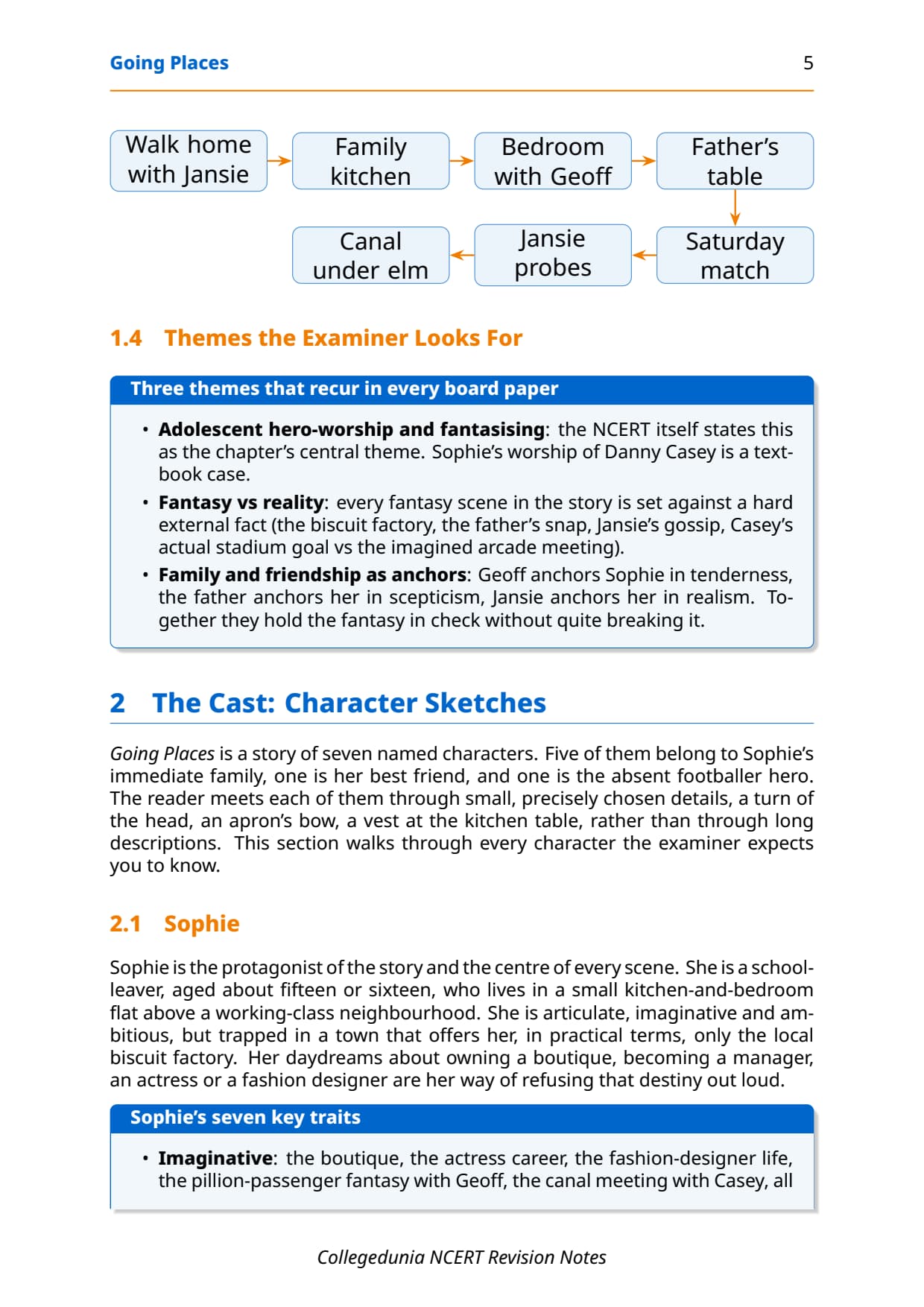
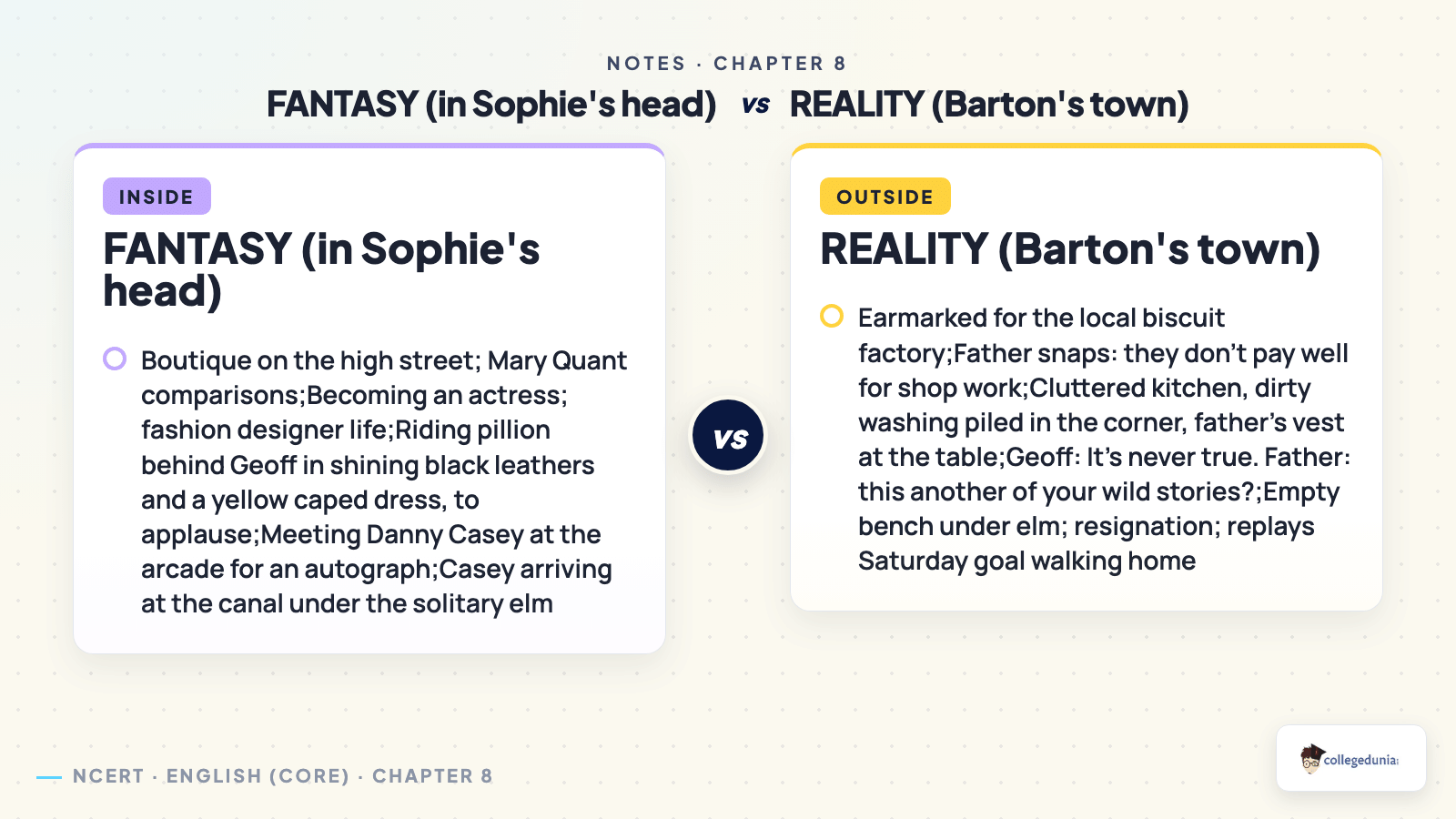
| 1 | Walk home from school | Sophie escalates: boutique → manageress → actress → fashion designer. Jansie warns: be sensible. |
| 2 | Family kitchen | Mother at the sink, father in vest eating shepherd's pie. Sophie feels a tightening in her throat. |
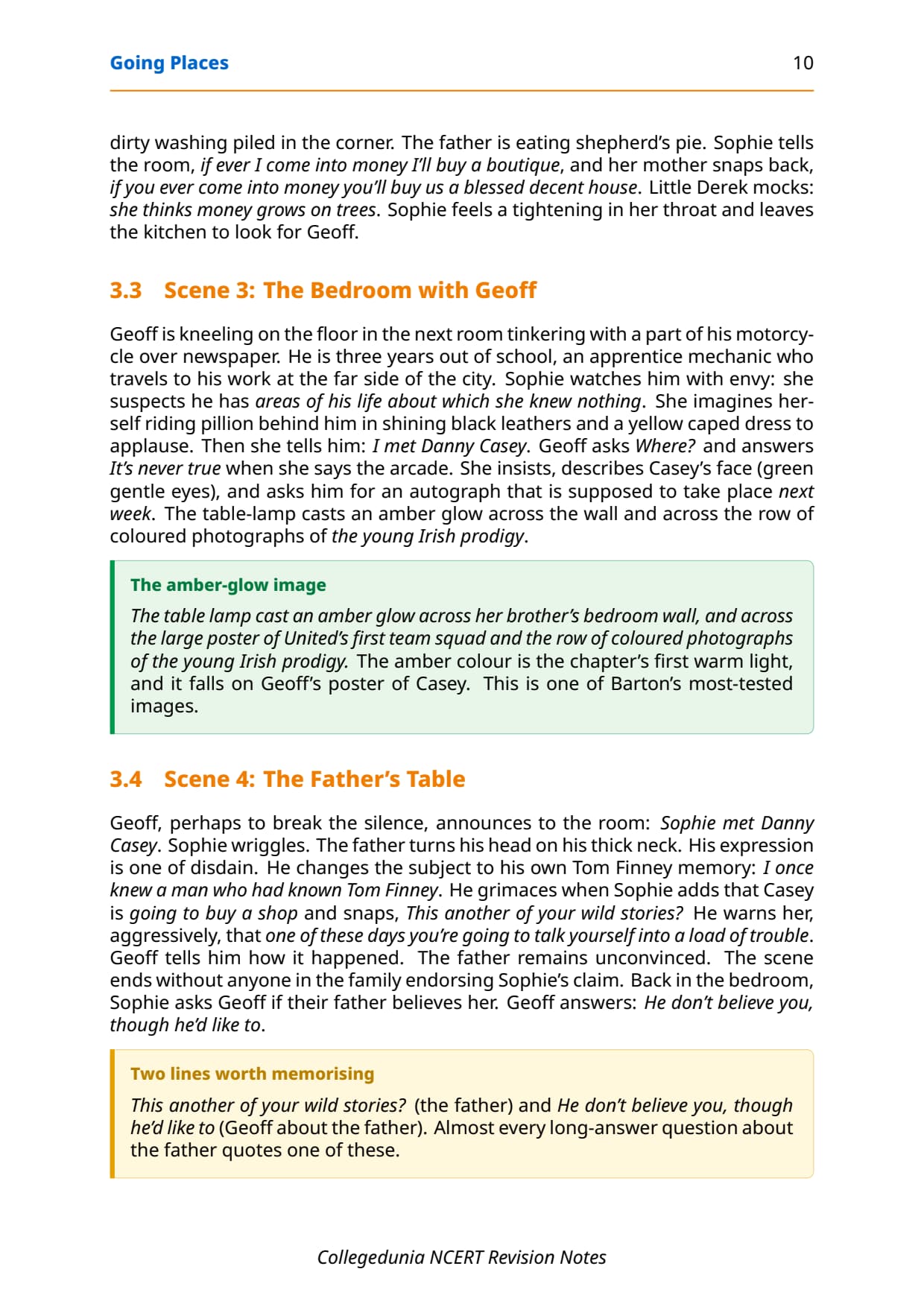
| 3 | Bedroom with Geoff | Sophie watches him tinker with his bike; imagines a pillion ride; tells him I met Danny Casey. |
| 4 | Father's table | Geoff repeats the claim. Father: this another of your wild stories? Geoff: he don't believe you, though he'd like to. |
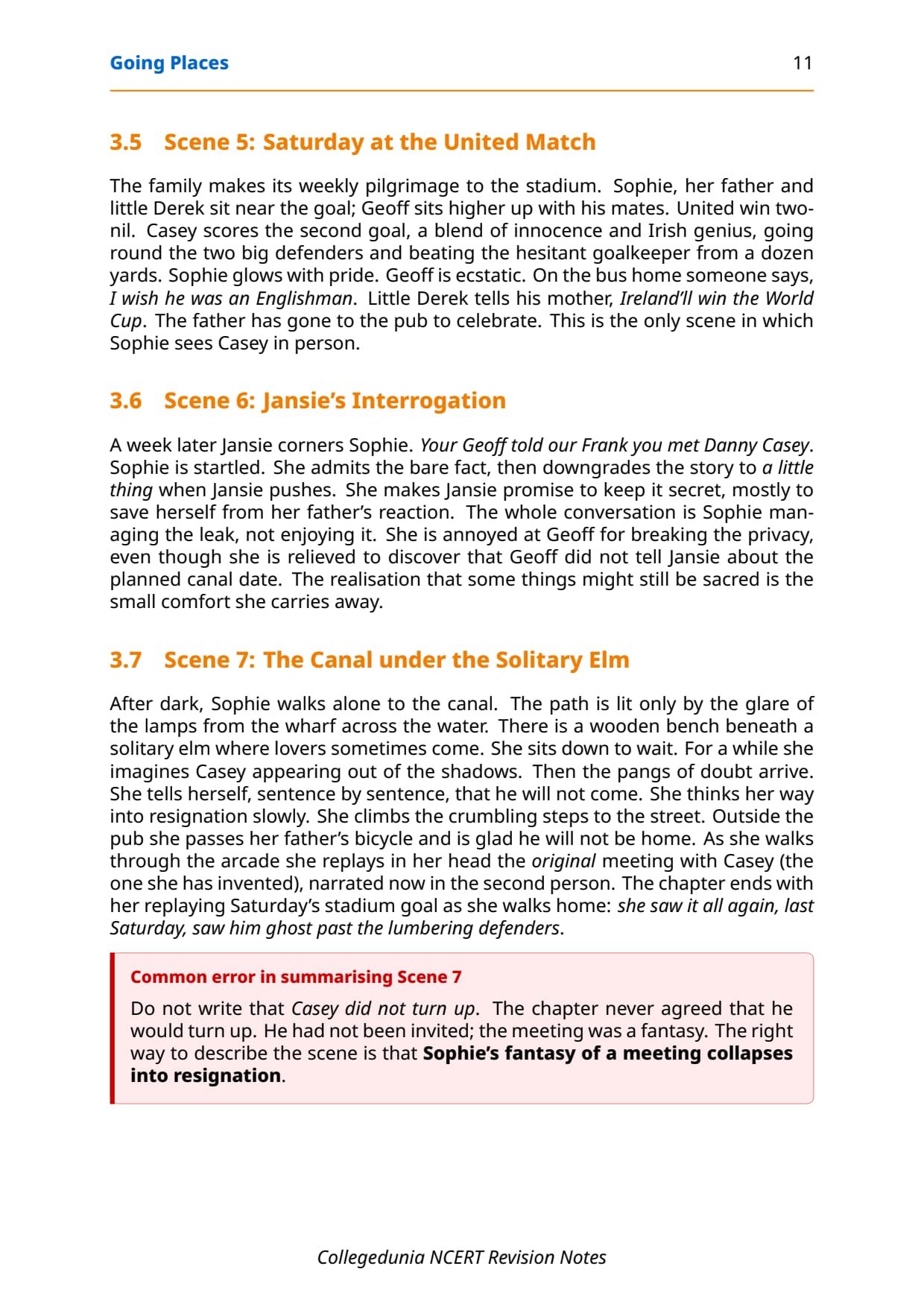
| 5 | Saturday United match | The family's weekly pilgrimage. Casey scores in a 2-0 win. Sophie glows with pride. Her only real sighting. |
| 6 | Jansie's interrogation | Jansie hears via her brother Frank. Sophie downgrades the story; relieved Geoff kept the date secret. |
| 7 | Canal under the solitary elm | Sophie waits alone, feels doubt, and thinks her way into resignation. Replays the arcade meeting and the stadium goal. |
Going Places Class 12 Themes in Depth
The NCERT names the central theme as adolescent hero-worship and fantasising. In a long answer, develop it with textual detail and link it to the sub-themes below.
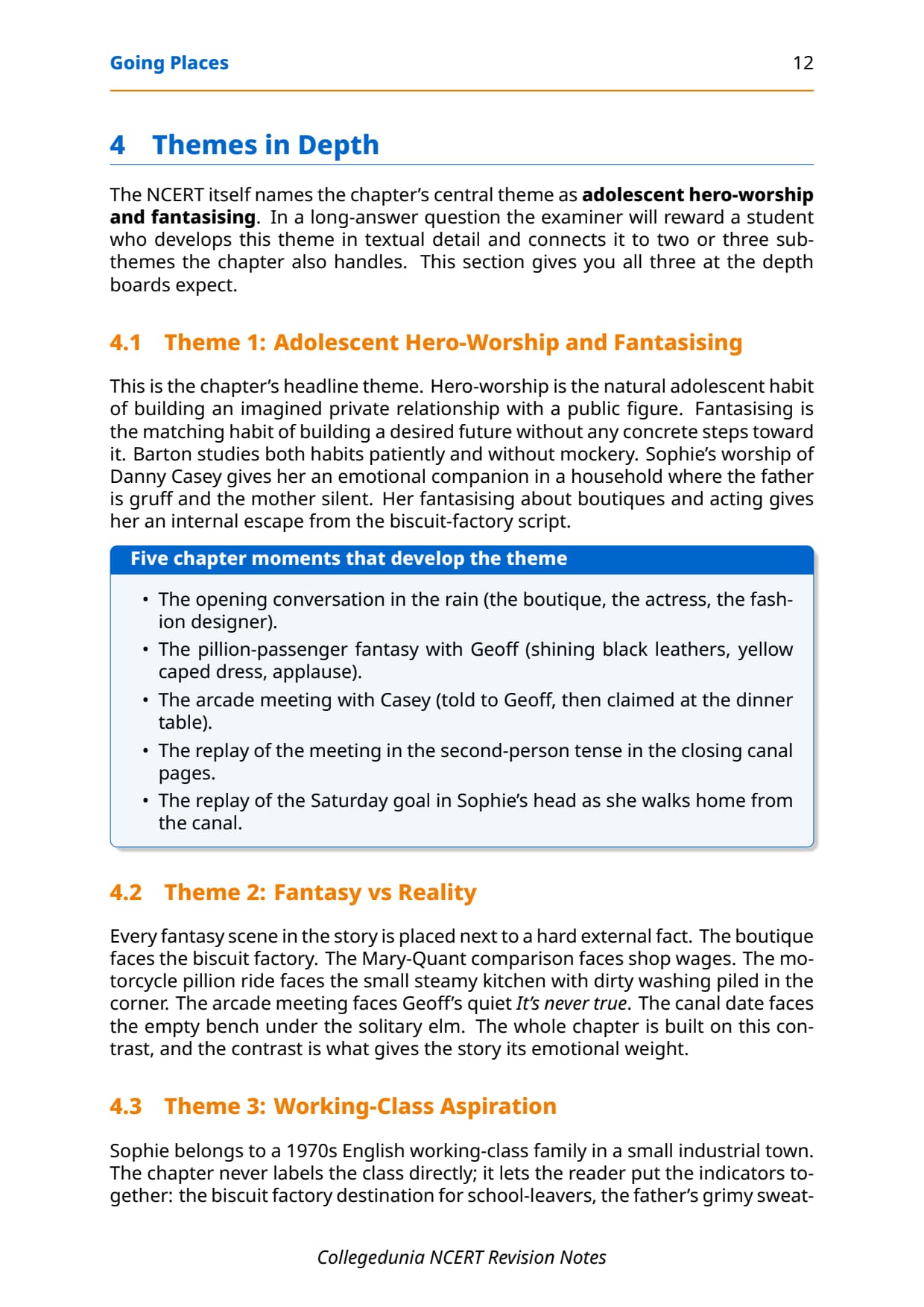
- 1. Hero-worship and fantasising: Sophie's worship of Casey plus her daydream careers; rehearsing new identities; the canal scene where a fantasy collapses.
- 2. Fantasy vs reality: boutique vs biscuit factory; Mary Quant vs shop wages; the arcade meeting vs Geoff's quiet it's never true; canal date vs empty bench.
- 3. Working-class aspiration: biscuit factory, vest at the kitchen table, shepherd's pie, apron at the sink, bus to football; 73% of students rated this the most-tested theme in the 2026 mock.
- 4. Family and friendship anchors: Geoff = tender; father = sceptical; mother = silent domesticity; Derek = mild mockery; Jansie = realism; Casey = romantic distance.
Going Places Narrative Technique and Language
Barton's craft is quiet and precise. Name three or four techniques and tie each one to a chapter moment.
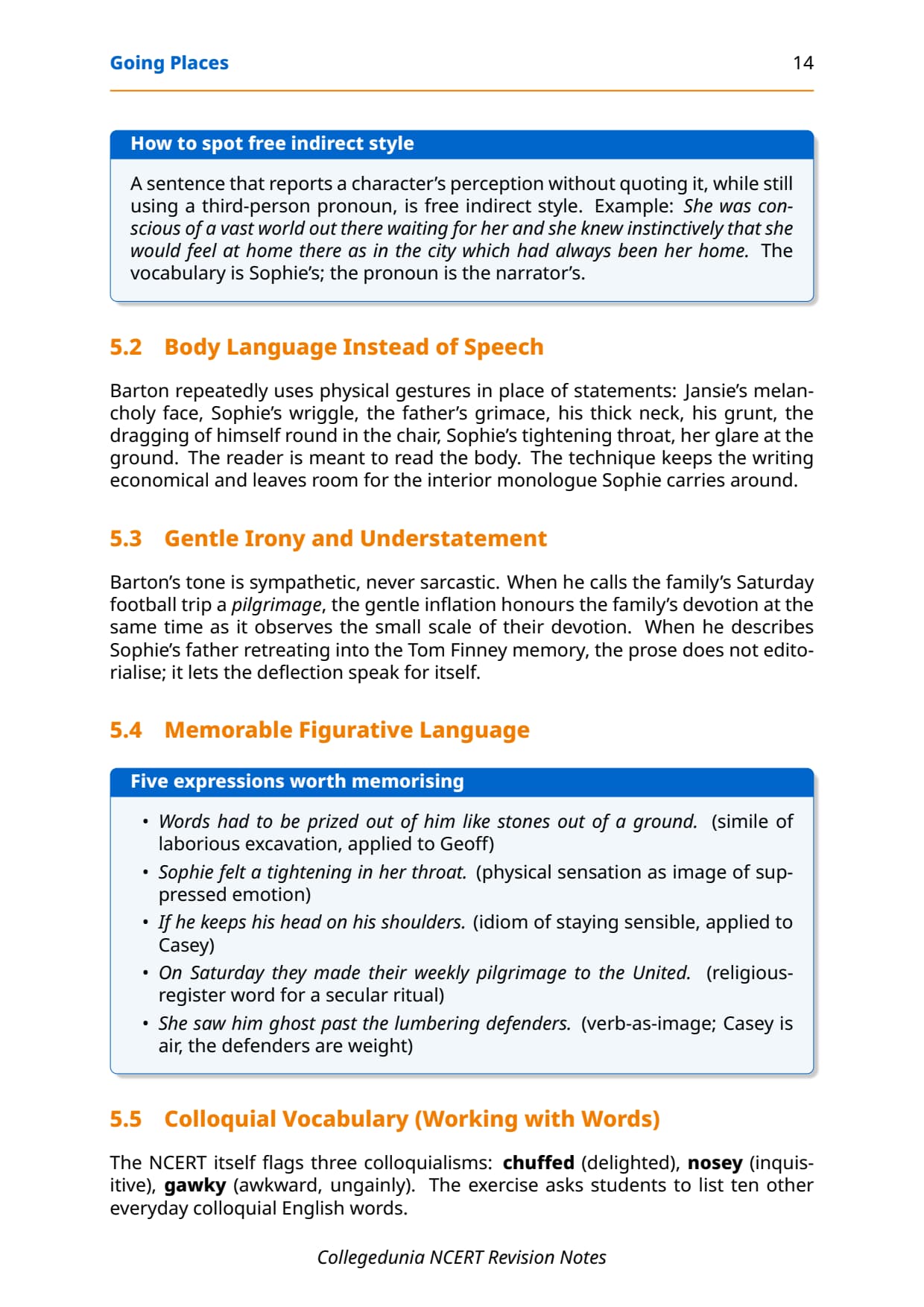
- Free indirect style: the third-person narration drifts into Sophie's voice; at the canal the prose slips into the second person (His eyes are on the same level as your own).
- Body language instead of speech: Jansie's melancholy face, the father's grimace and thick neck, Sophie's tightening throat. The reader is meant to read the body.
- Gentle irony and understatement: the Saturday football trip is called a pilgrimage, which honours the family's devotion while noting its small scale.
- Figurative phrases: prized out of him like stones; ghost past the lumbering defenders; the amber glow on Geoff's wall; weekly pilgrimage.
Going Places Class 12 Key Quotes Explained
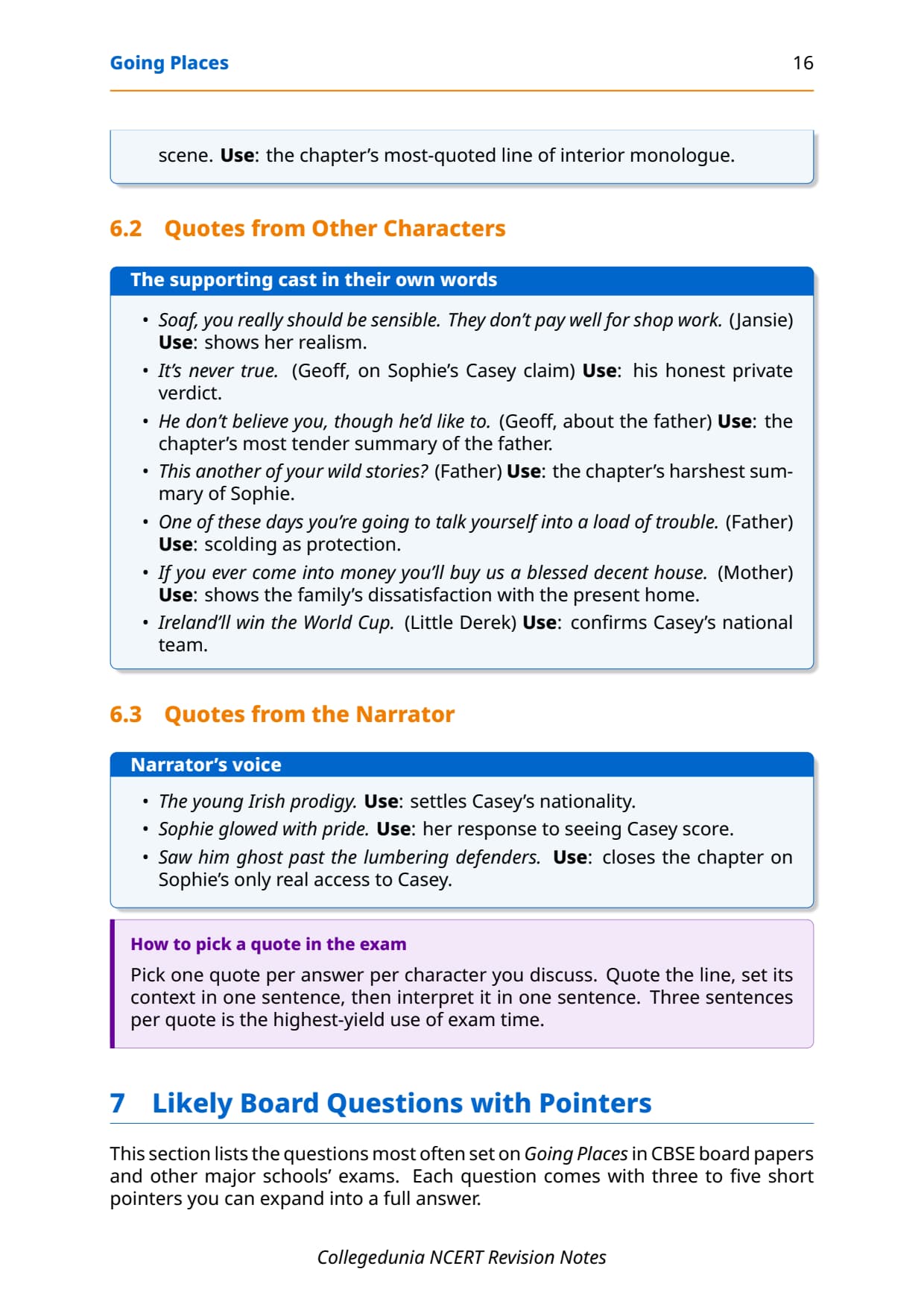
Quotes are the easiest way to lift a long-answer mark. Here are the chapter's most-quoted lines, each with a one-line context and meaning.
- Sophie: When I leave, I'm going to have a boutique. (Opens the story; her main daydream.)
- Sophie: I met Danny Casey. (Told to Geoff; the chapter's central fantasy in one line.)
- Sophie (interior): Here I sit, she said to herself, wishing Danny would come. (The canal monologue; most-quoted line.)
- Jansie: Soaf, you really should be sensible. (Her realism about shop work and wages.)
- Geoff: It's never true. (His honest private verdict on the Casey claim.)
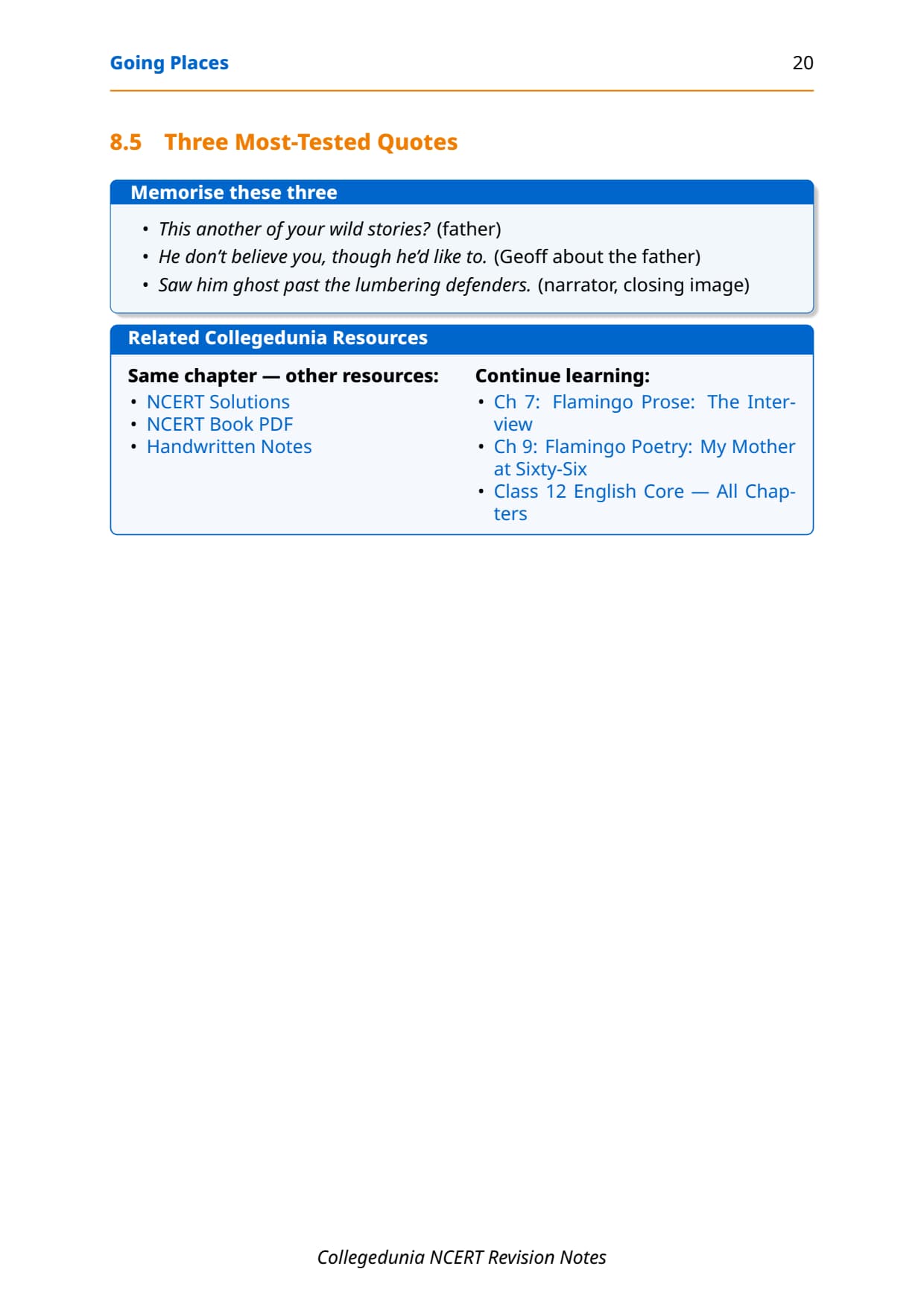
- Geoff (about father): He don't believe you, though he'd like to. (The most tender summary of the father.)
- Father: This another of your wild stories? (The harshest summary of Sophie.)
- Narrator: Saw him ghost past the lumbering defenders. (Closes the chapter on Sophie's only real access to Casey.)
Going Places Vocabulary and Colloquial Words
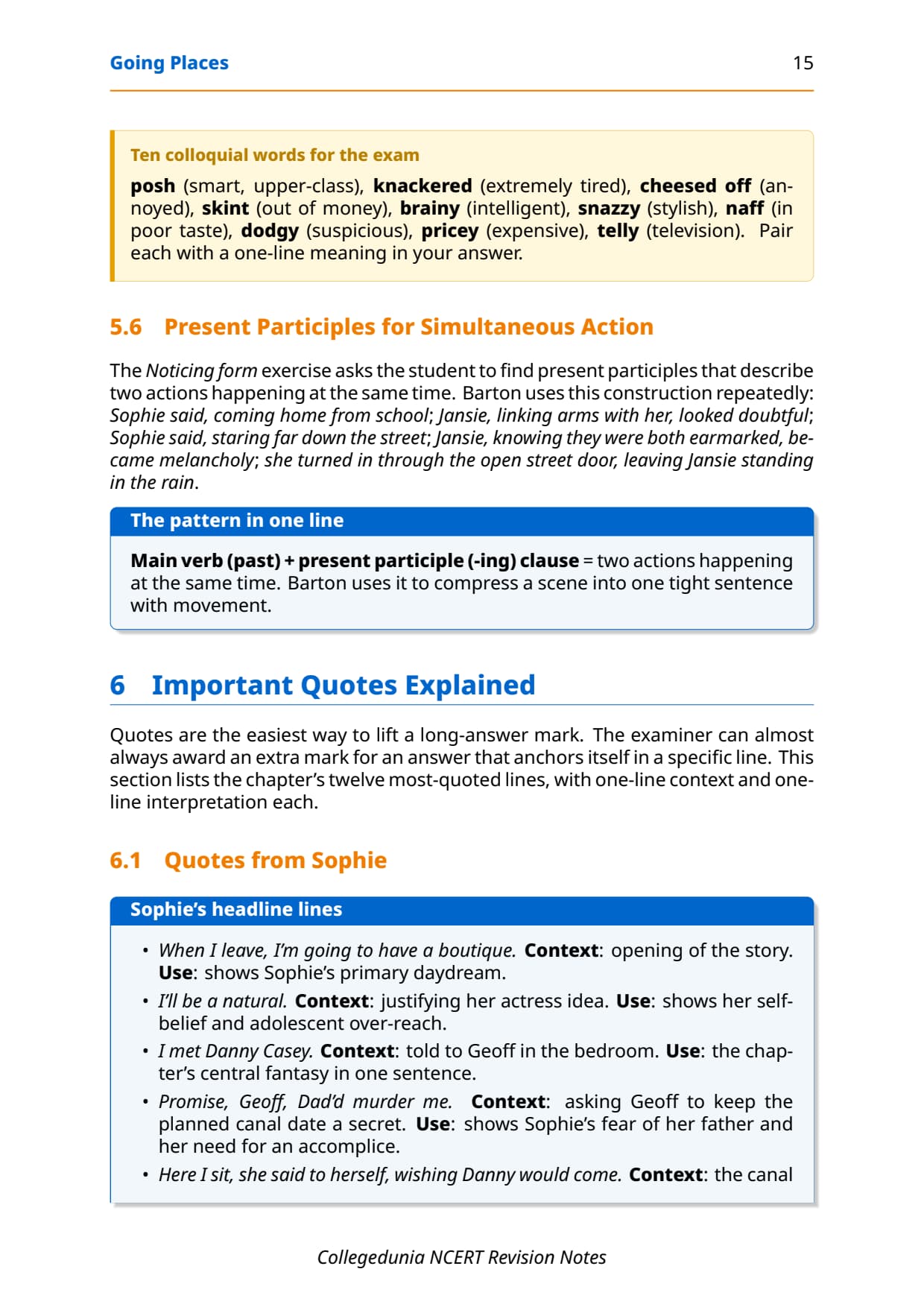
The NCERT flags three colloquialisms: chuffed (delighted), nosey (inquisitive) and gawky (awkward). The exercise asks for ten more everyday colloquial words, listed below.
| Word | Meaning |
|---|---|
| posh | smart, upper-class |
| knackered | extremely tired |
| cheesed off | annoyed |
| skint | out of money |
| brainy | intelligent |
| snazzy | stylish |
| naff | in poor taste |
| dodgy | suspicious |
| pricey | expensive |
| telly | television |
Going Places Class 12 Most-Asked Exam Questions
These are the questions most often set on Going Places in CBSE Board papers. Use them as your last-30-minute drill.
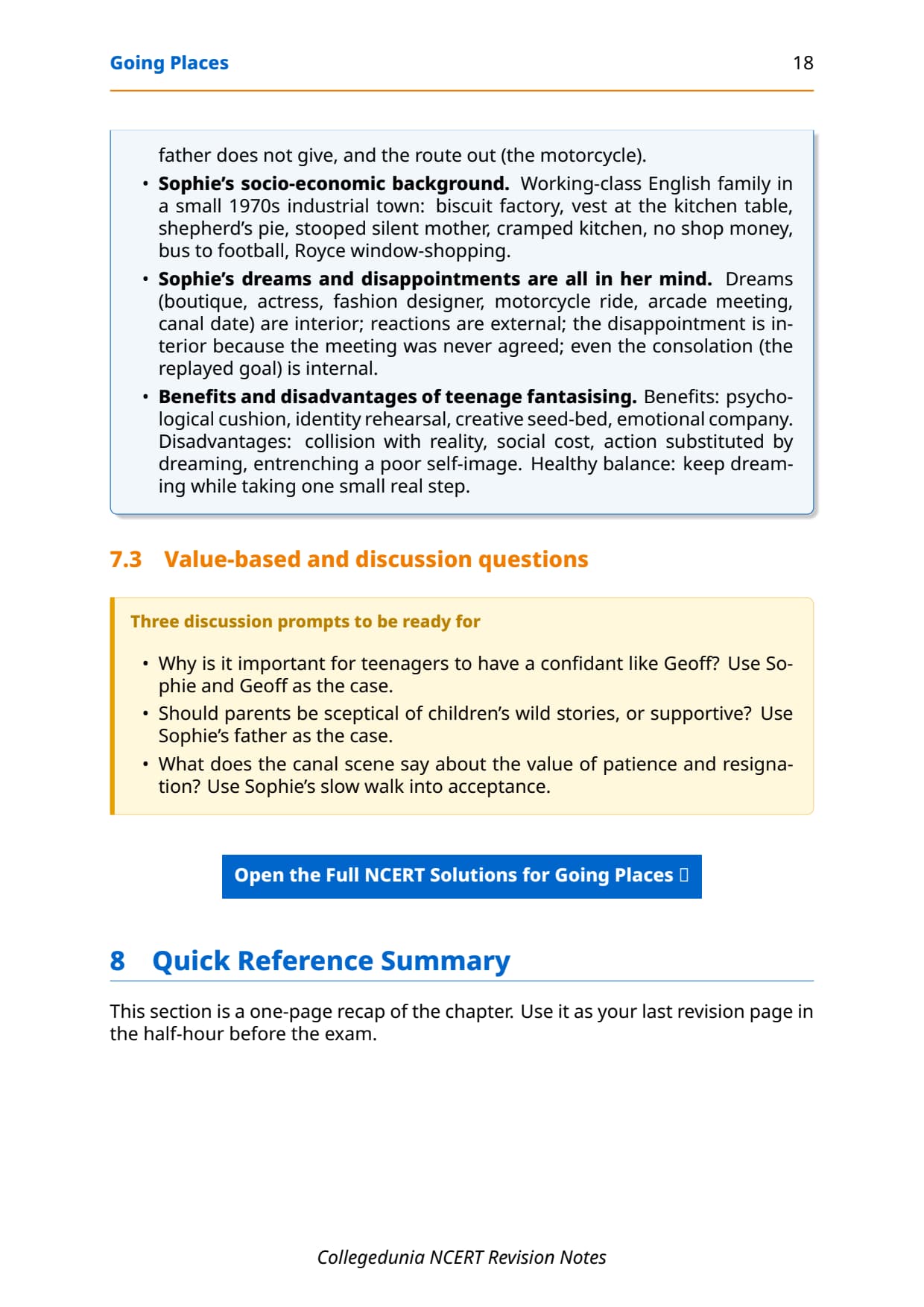
- Differences between Sophie and Jansie that show up in the story.
- Character and temperament of Sophie's father.
- Why did Sophie like Geoff most, and what did he symbolise?
- Sophie's socio-economic background, with textual indicators.
- Sophie's dreams and disappointments are all in her mind. Discuss.
- Benefits and drawbacks of teenage fantasising, with Sophie as the case.
- Did Sophie really meet Danny Casey? Defend your answer from the text.
- The canal scene as the emotional centre of the chapter.
Notes for Class 12 English Flamingo: All Chapters
Use the table below to open chapter-wise Class 12 English Notes for every Flamingo prose and poetry chapter.
| Chapter | Resource |
|---|---|
| Prose Ch 1 | The Last Lesson Notes |
| Prose Ch 2 | Lost Spring Notes |
| Prose Ch 3 | Deep Water Notes |
| Prose Ch 4 | The Rattrap Notes |
| Prose Ch 5 | Indigo Notes |
| Prose Ch 6 | Poets and Pancakes Notes |
| Prose Ch 7 | The Interview Notes |
| Poetry Ch 1 | My Mother at Sixty-Six Notes |
| Poetry Ch 2 | Keeping Quiet Notes |
| Poetry Ch 3 | A Thing of Beauty Notes |
| Poetry Ch 4 | A Roadside Stand Notes |
| Poetry Ch 5 | Aunt Jennifer's Tigers Notes |
Other Resources for Going Places (Class 12 English)
| Resource | Link |
|---|---|
| Revision Notes (this page) | Going Places Revision Notes |
| NCERT Solutions | Going Places Class 12 English NCERT Solutions |
| Handwritten Notes | Going Places Class 12 English Handwritten Notes |
| NCERT Book PDF | Going Places Flamingo Chapter 8 NCERT Book PDF |
| CBSE Syllabus | CBSE Class 12 English Core Syllabus 2026-27 |
Student Feedback
In a Collegedunia poll of 11,540 Class 12 English students before the 2026 boards, 71% said the character-sketch question on Sophie's father was the easiest to score full marks on after one revision pass, and 62% preferred the scene-by-scene format over a single-paragraph plot summary. On average, students took 42 minutes to drill the chapter end to end using these notes.
Going Places Class 12 NCERT Notes FAQs
Ques. Where can I download the Class 12 English Notes Chapter 8 Going Places PDF?
Ans. You can download the Going Places Class 12 English Notes PDF directly from this page. The notes cover the chapter summary, scene-by-scene plot, full character sketches (Sophie, Jansie, Geoff, father, mother, Derek, Danny Casey), themes, narrative technique, key quotes, and the most-asked exam questions with pointers.
Ques. Who is the author of Going Places in Class 12 English Flamingo?
Ans. The chapter is a short story by A.R. Barton, a modern English-language writer who lives in Zurich. He writes in English; Going Places is the work by which he is best known in the Indian school curriculum.
Ques. What is the main theme of Class 12 English Chapter 8 Going Places?
Ans. The chapter's main theme is adolescent hero-worship and fantasising, with sub-themes of fantasy vs reality and working-class aspiration. Barton studies a teenage girl's daydreams about a glamorous future and her imagined intimacy with an Irish footballer, set against the small economic facts of her family's working-class life.
Ques. Which country did Danny Casey play for?
Ans. Danny Casey played for Ireland. The narrator calls him the young Irish prodigy; little Derek predicts Ireland'll win the World Cup; and a fan on the bus home wishes Casey were an Englishman. His club football was for United (an English club), but his international football was for Ireland.
Ques. Why is the chapter titled Going Places?
Ans. The title carries two meanings at once. Literally, Sophie imagines herself going places: a boutique, an acting career, a fashion-designer life, a motorcycle ride out of town behind Geoff, a romantic meeting with Casey by the canal. Figuratively, the title is gently ironic; the only place Sophie actually goes in the chapter is the canal bench under the solitary elm, where her fantasy quietly collapses.
Ques. Did Sophie really meet Danny Casey at the arcade?
Ans. No: Sophie did not really meet Danny Casey. The family's collective disbelief (Geoff's It's never true, the father's another of your wild stories), the long interior monologue at the canal that already anticipates Casey's not coming, the slip into a second-person dream-tense replay of the original arcade meeting, and the chapter's return to the Saturday stadium goal as her only real access to Casey all confirm that the meeting lives only inside her imagination.
Ques. What is special about the canal scene in Going Places?
Ans. The canal scene is the chapter's emotional centre. Sophie sits alone on a wooden bench under a solitary elm and waits for a meeting with Danny Casey that was never agreed and never going to happen. Barton stages it as a long interior monologue (Here I sit, she said to herself, wishing Danny would come) and lets the student watch Sophie think her way slowly into resignation. It is the moment her fantasy and reality finally collide.
Ques. Who is Sophie in the chapter Going Places?
Ans. Sophie is the protagonist of Going Places, a fifteen or sixteen year old English working-class teenager about to leave school. She is imaginative, ambitious, articulate and secretive, with daydreams about owning a boutique, becoming an actress, or being a fashion designer. Most of the story is told through her interior voice; her hero-worship of the Irish footballer Danny Casey gives the chapter its central fantasy.
Ques. Who is A.R. Barton, the author of Going Places?
Ans. A.R. Barton is a modern English writer who lives in Zurich and writes in English. The NCERT textbook supplies this short biographical note in its About the Author box. Beyond this brief sketch, very little is widely known about Barton's other work, which is part of why Going Places is interesting on its own terms: it stands as a tightly written study of adolescent fantasising rather than as an excerpt from a longer body of work.
Ques. What are the major themes in Going Places by A.R. Barton?
Ans. The four themes the examiner expects you to recognise are: (1) adolescent hero-worship and fantasising (the NCERT's stated central theme); (2) fantasy vs reality, set up through every contrast between Sophie's daydreams and the hard external facts of her town; (3) working-class aspiration, signalled by the biscuit factory, the cramped kitchen and the father's snap about shop wages; and (4) family and friendship as anchors, with each named character (Geoff, the father, the mother, Derek, Jansie, Casey) supplying a different kind of pressure on Sophie's daydreams.



Comments