




The 2026-27 NCERT Flamingo edition keeps Class 12 English Chapter 7 The Interview intact, with both parts: Christopher Silvester's essay on the journalistic interview as a form, and Mukund Padmanabhan's conversation with Umberto Eco. The chapter contributes 6 to 8 marks to the Class 12 English Core Board paper. This page hosts the 2026-27 Class 12 English Chapter 7 The Interview Notes PDF, topic-wise weightage, themes, named persons and the most-repeated Board questions for revision.
- CBSE Weightage: 6 to 8 marks (typically one 6-mark long answer plus a short answer).
- CUET (UG) Weightage: 1 to 2 inference items in the English passage section.
- Chapter Length: 9 pages of prose plus 1 page of exercises in Flamingo.
Class 12 English The Interview Notes PDF
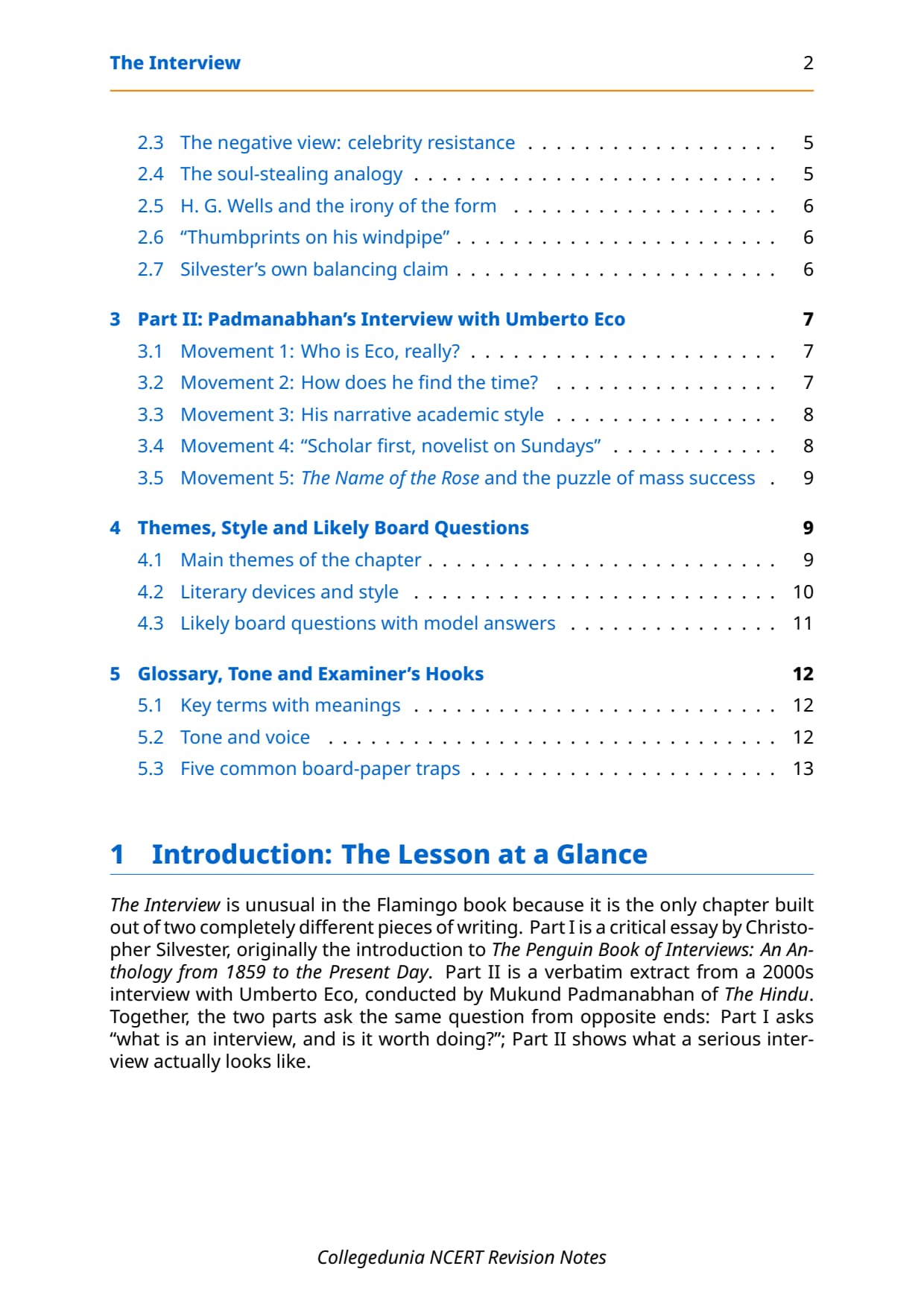
The Notes PDF runs roughly 14 pages and covers both parts of the chapter, the four named writers Silvester quotes, the named participants in Part II (Padmanabhan, Eco), every theme the examiner expects, the eight glossary terms most often asked, and five model board questions with model answers.
Source authority: Cross-referenced against NCERT Flamingo (2026-27 edition), CBSE sample papers 2024-26, and Christopher Silvester's The Penguin Book of Interviews (1993) Introduction, the source text for Part I.
The Interview Video Explanation (Class 12 English)
Source: Magnet Brains on YouTube
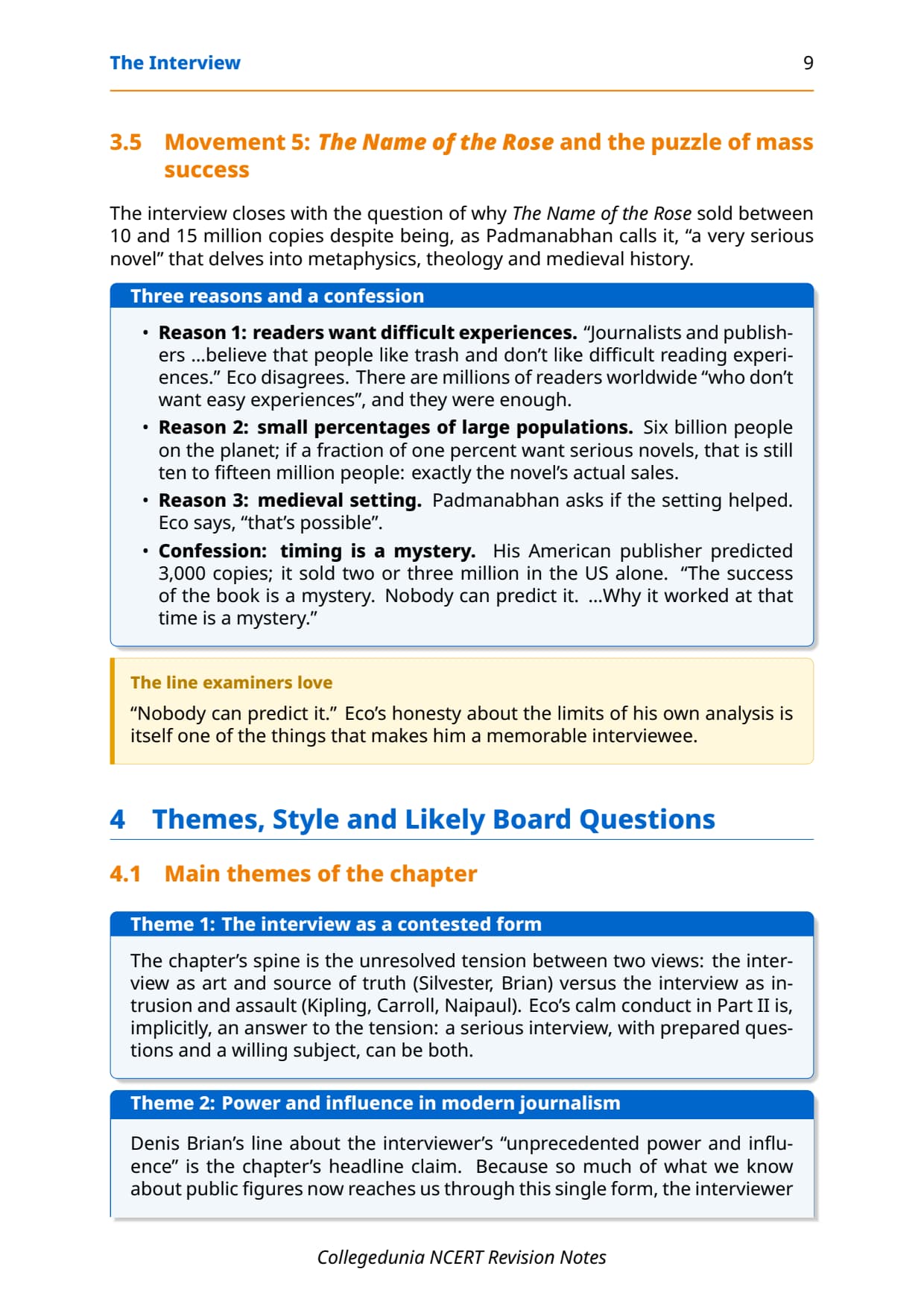
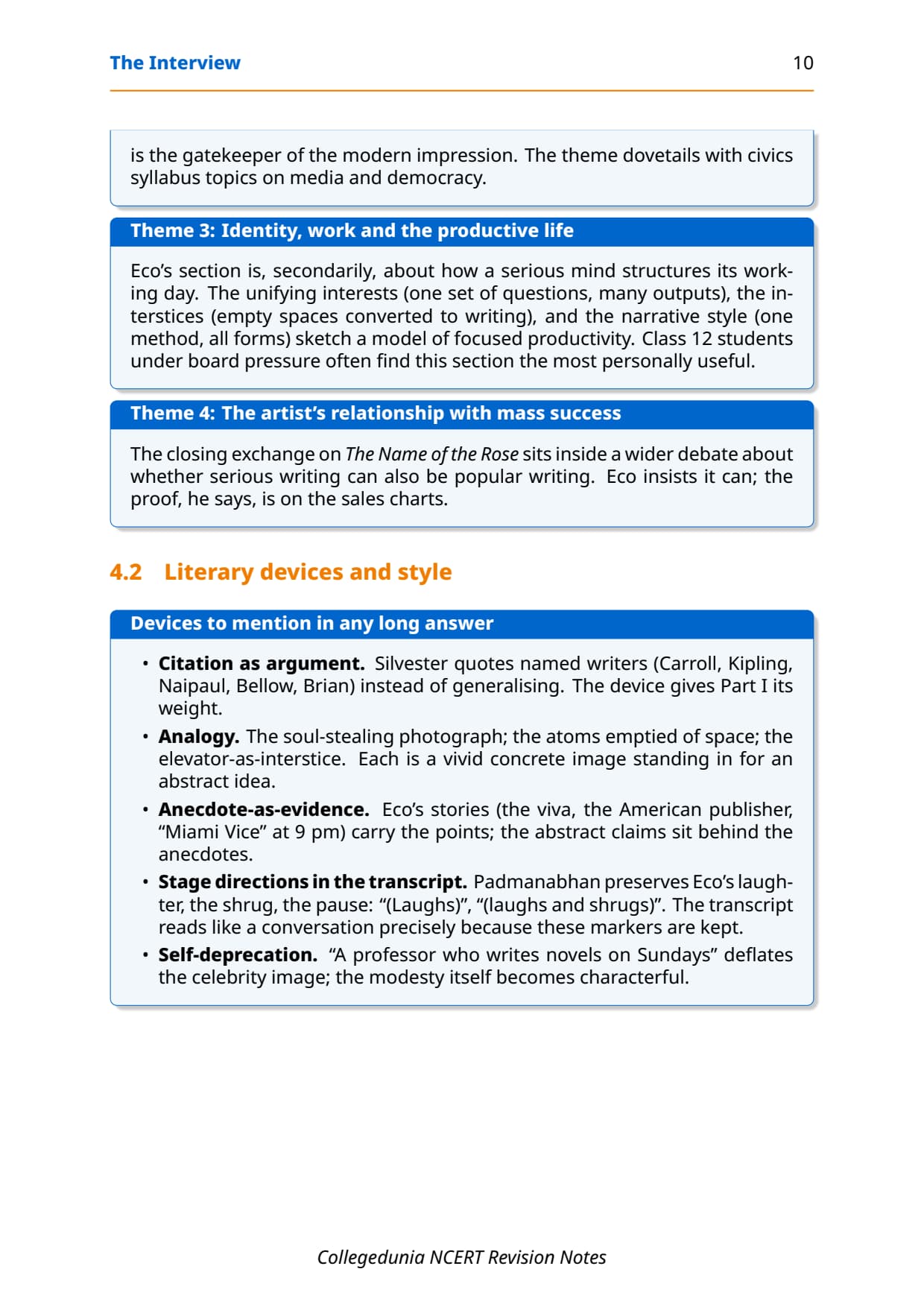
The Interview Class 12 Summary at a Glance
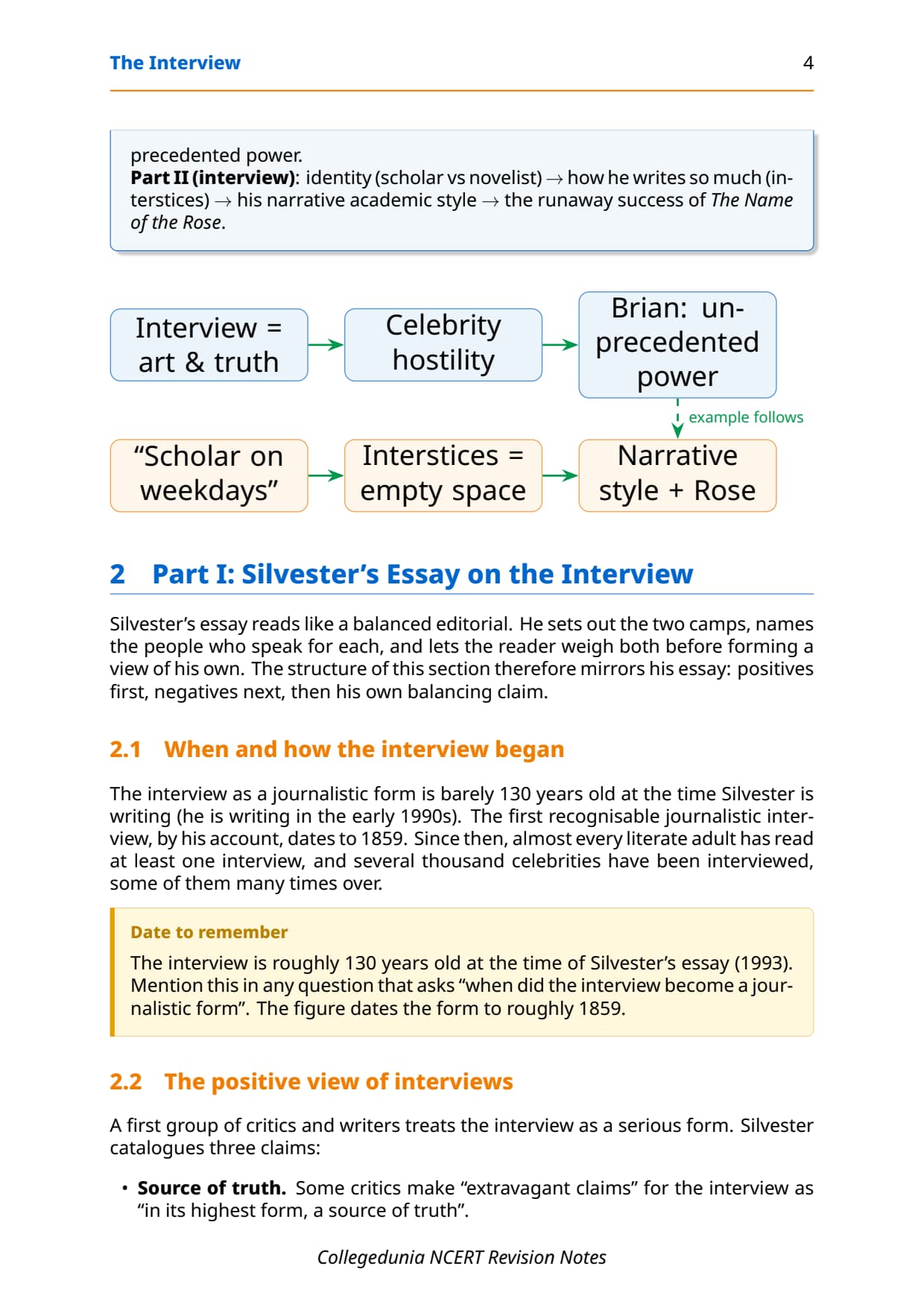
The Notes PDF treats the chapter as two complementary halves.
| Section | Author | Key idea |
|---|---|---|
| Part I (essay) | Christopher Silvester | Positive versus negative views of the interview as a form; Silvester's verdict that it is "a supremely serviceable medium of communication". |
| Part II (transcript) | Mukund Padmanabhan and Umberto Eco | Eco's theory of interstices, his narrative academic style, his self-identification as "a professor who writes novels on Sundays", and his analysis of The Name of the Rose's success. |
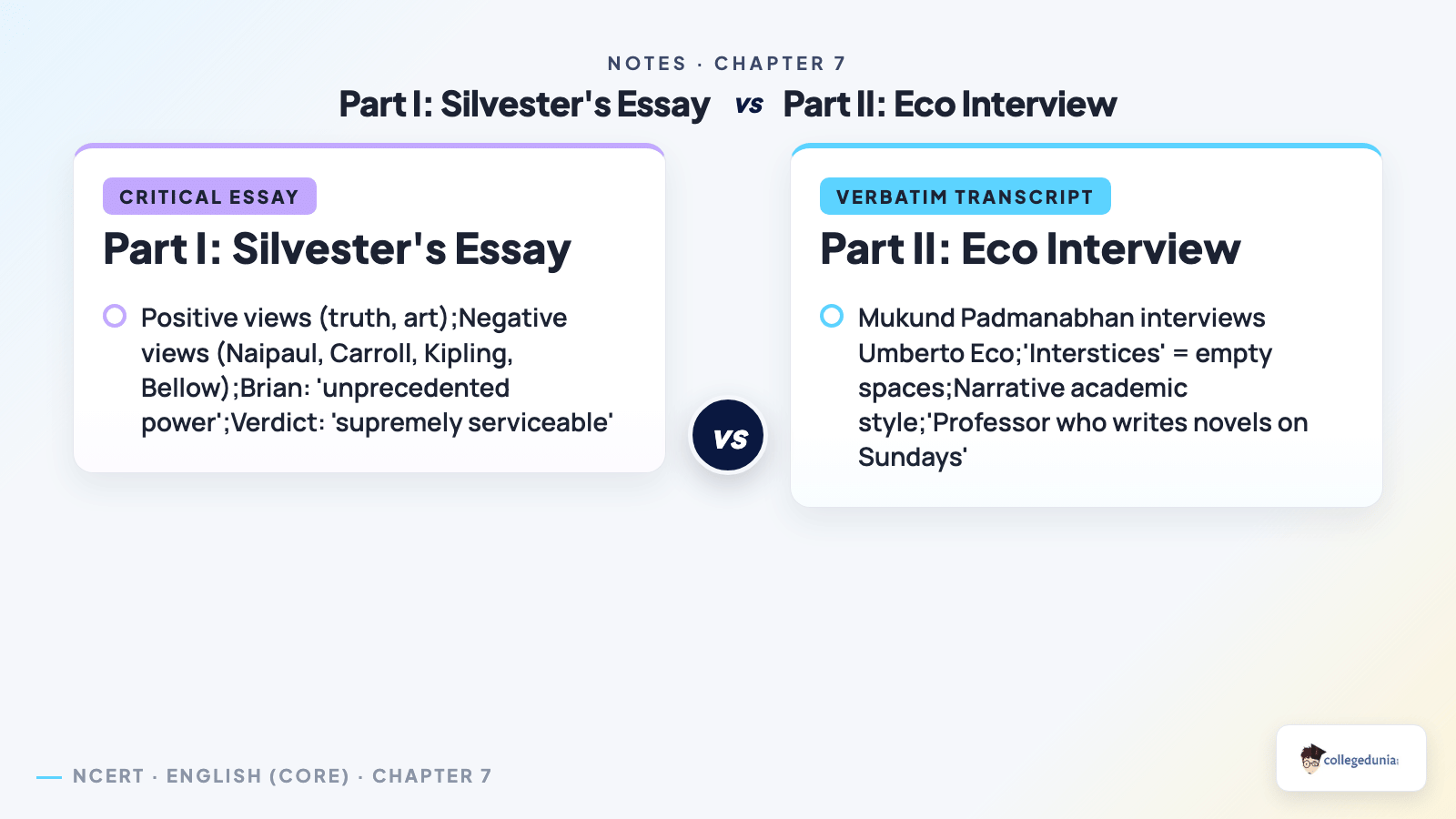
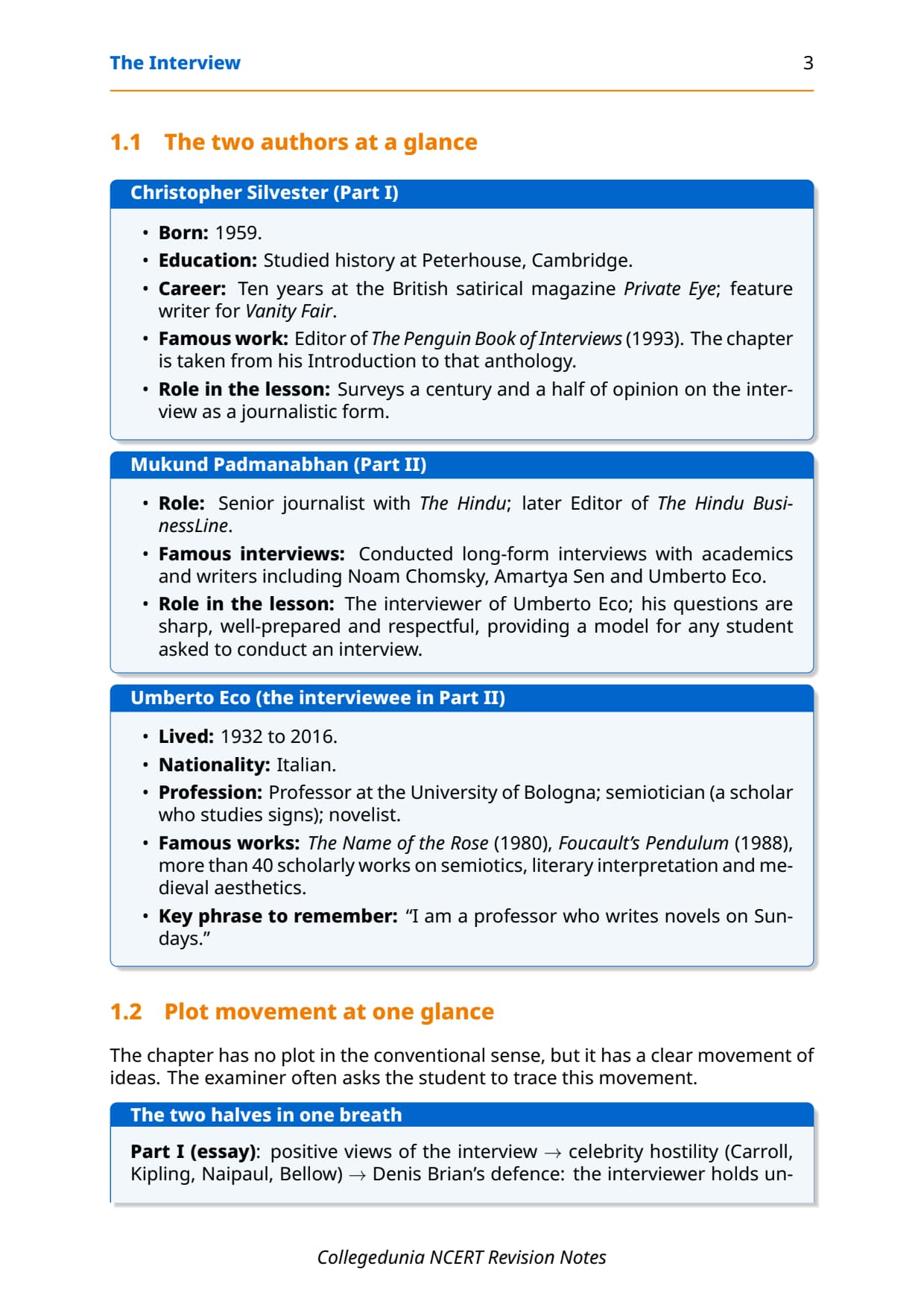
The Interview's two halves: Silvester's essay (Part I) and Padmanabhan's interview with Eco (Part II).
The Interview Class 12 Themes and Characters
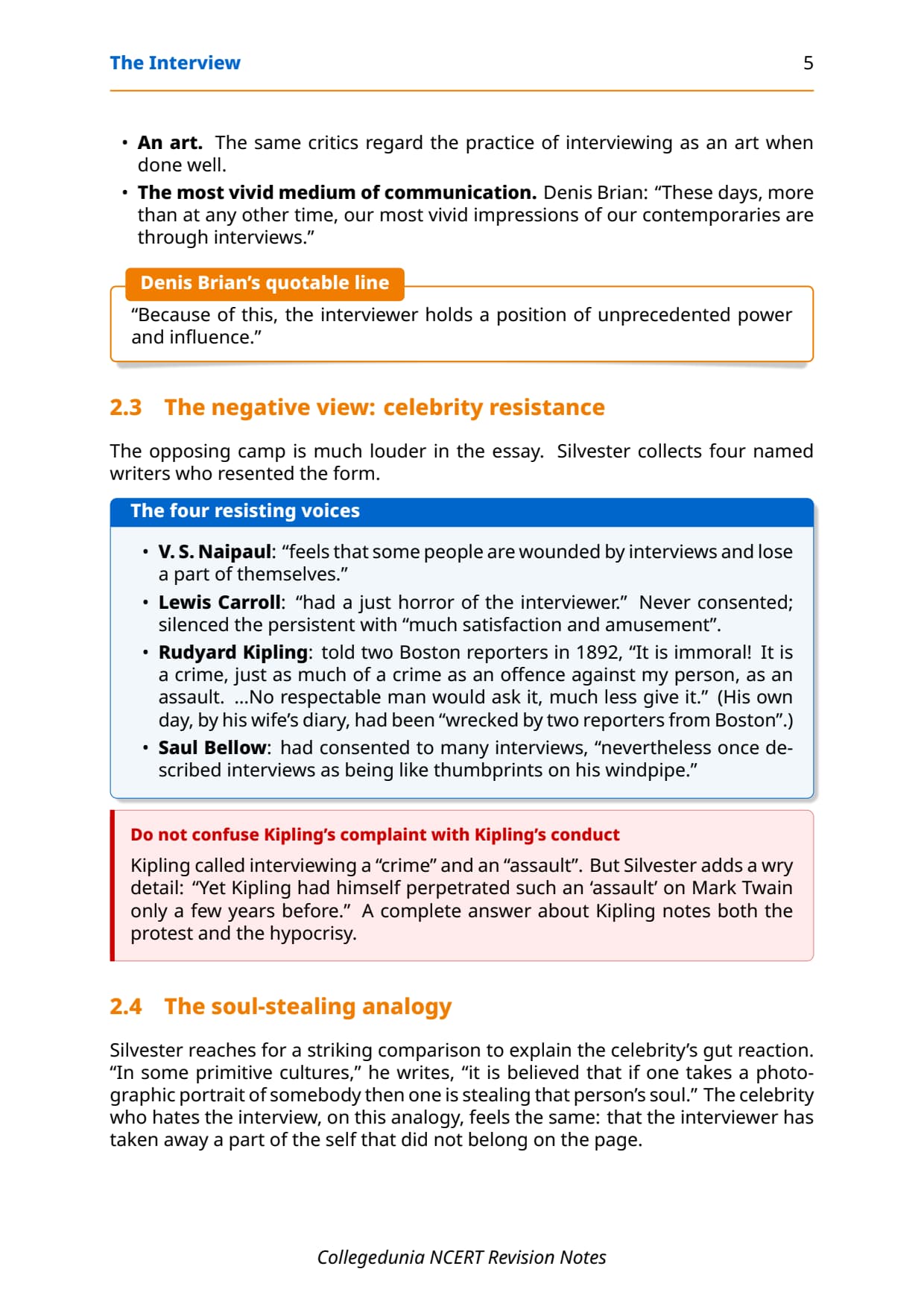
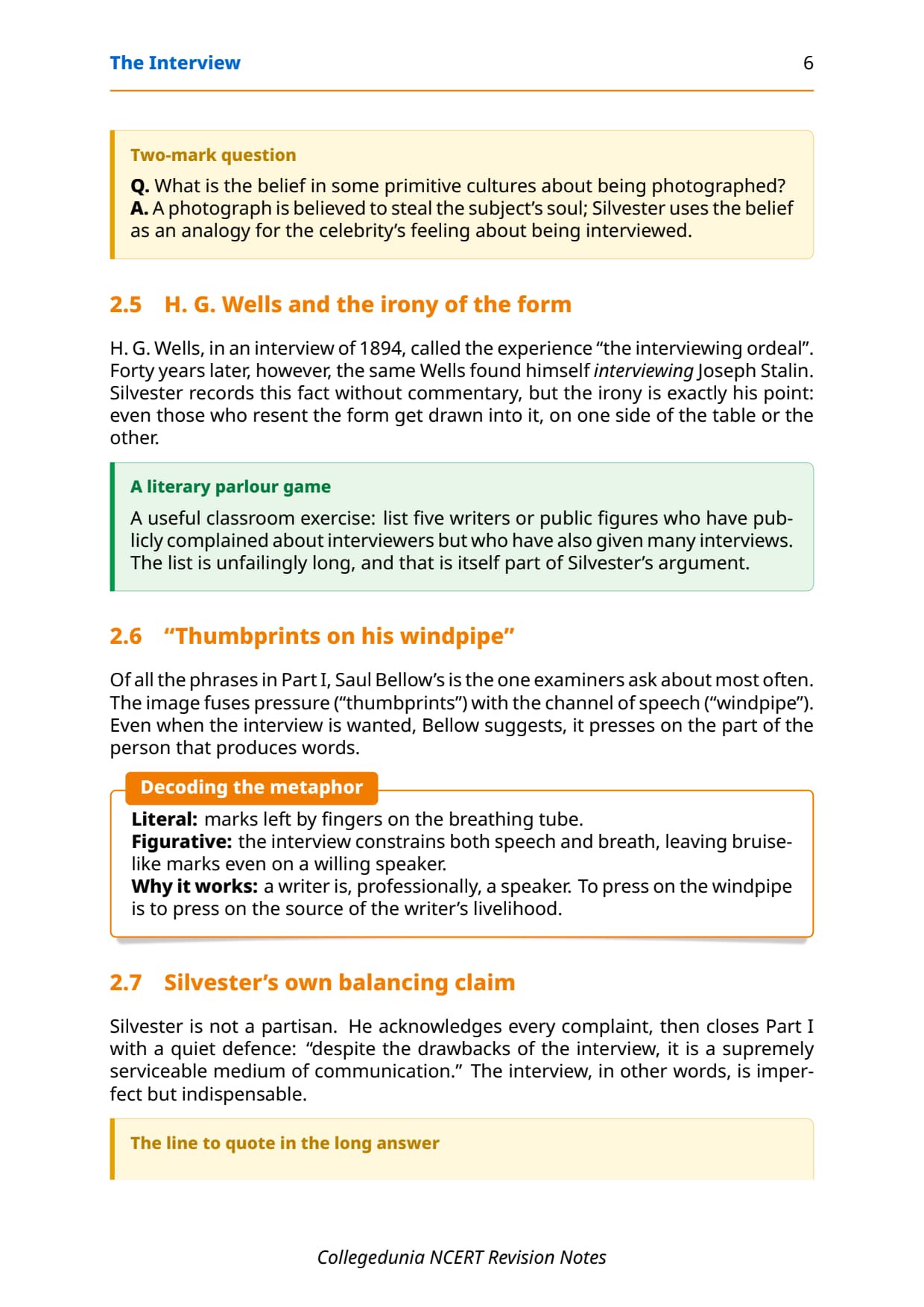
- Theme 1: The interview as a contested form. Silvester catalogues both camps: Brian's defence and Carroll, Kipling, Naipaul, Bellow's resistance. Eco's calm conduct in Part II is implicitly the answer to the tension.
- Theme 2: Power and influence in modern journalism. Denis Brian's claim that the interviewer holds "unprecedented power and influence" is the chapter's headline argument.
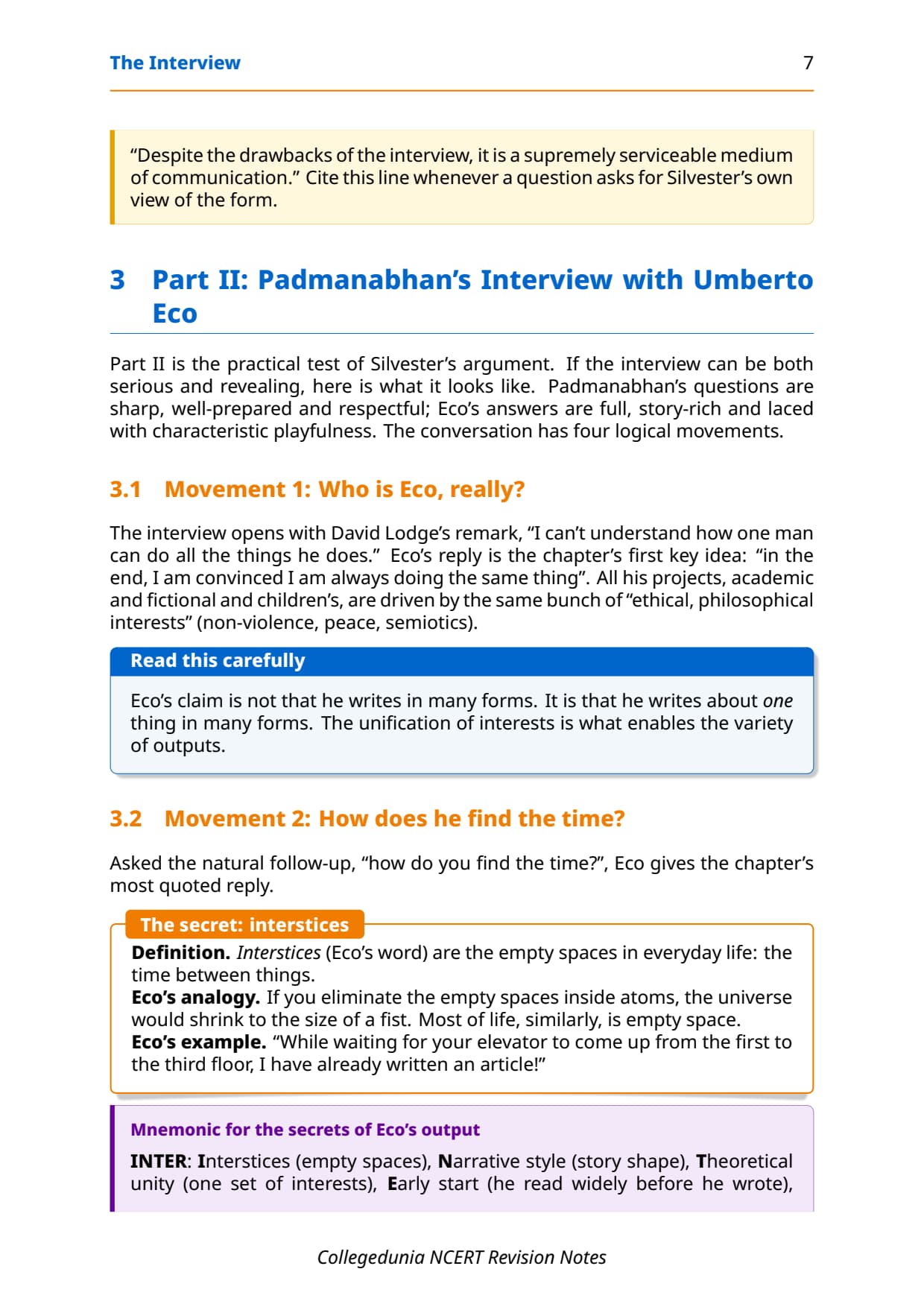
- Theme 3: Identity, work and productivity. Eco's section is also about how a serious mind structures a working life: one unifying interest, the use of interstices, a narrative writing method.
- Theme 4: Mass success of difficult writing. Eco insists, against publishing wisdom, that there is a real readership for difficult reading; the success of The Name of the Rose is his proof.
Named persons in the chapter
- Christopher Silvester: essayist (Part I).
- V.S. Naipaul: Nobel laureate, says interview subjects "lose a part of themselves".
- Lewis Carroll: author of Alice in Wonderland; refused interviews on principle.
- Rudyard Kipling: called interviewing "a crime, just as much of a crime as an offence against my person, as an assault".
- H.G. Wells: called interviews "the interviewing ordeal" in 1894; later interviewed Stalin.
- Saul Bellow: gave many interviews; called them "thumbprints on his windpipe".
- Mukund Padmanabhan: senior journalist with The Hindu; interviewer in Part II.
- Umberto Eco: Italian semiotician and novelist; interviewee in Part II.
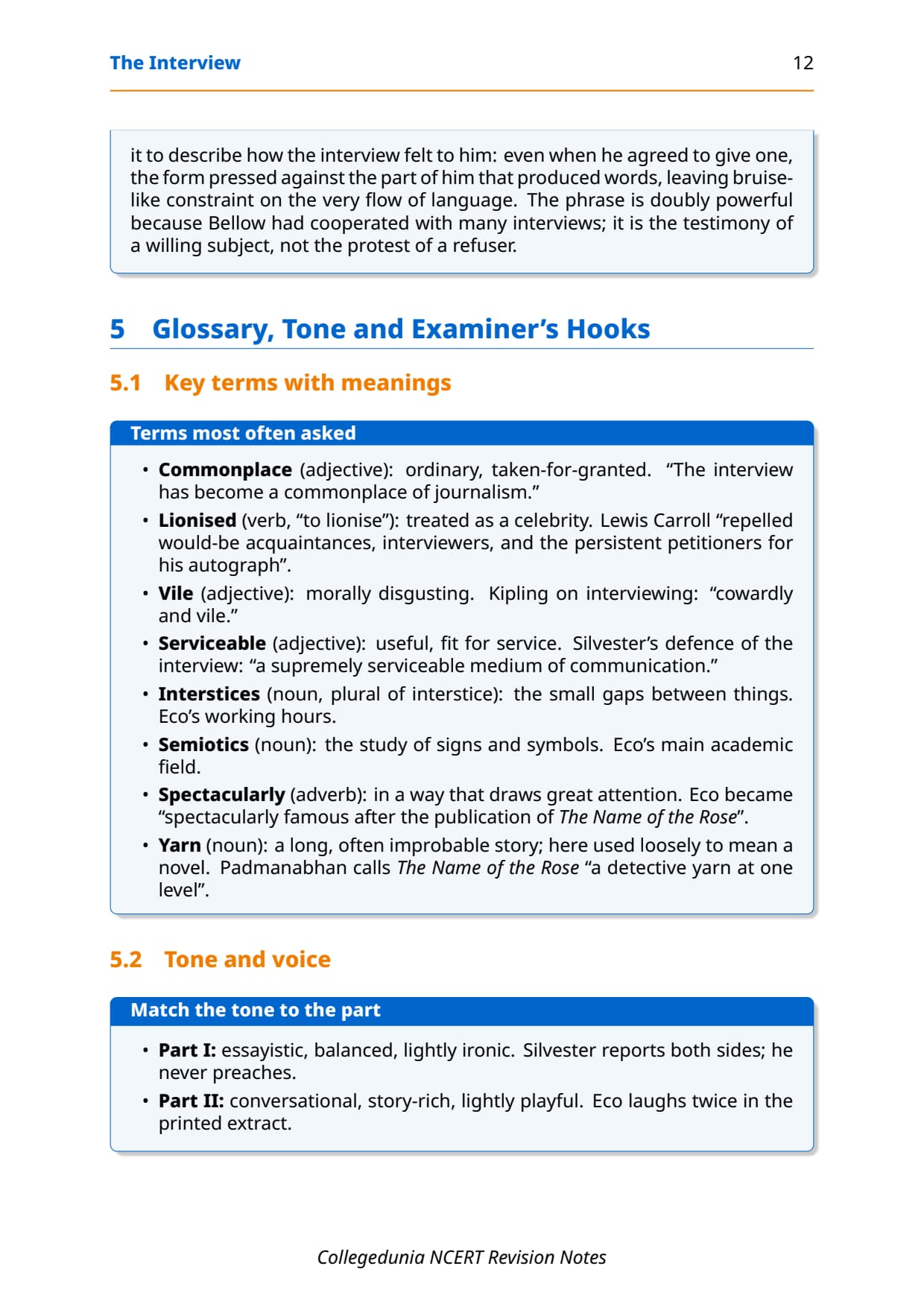
The Interview Class 12 Glossary
| Word | Meaning in context |
|---|---|
| Commonplace | Ordinary, taken-for-granted; the interview has become this for journalism. |
| Lionised | Treated as a celebrity; Lewis Carroll refused to be lionised. |
| Vile | Morally disgusting; Kipling's word for the act of interviewing. |
| Serviceable | Useful, fit for service; Silvester's defence of the interview. |
| Interstices | The small empty spaces between things; Eco's word for the writing time he uses. |
| Semiotics | The study of signs and symbols; Eco's academic field at Bologna. |
| Spectacularly | In a dramatically attention-drawing way; Eco became famous after The Name of the Rose. |
| Yarn | A long, often improbable story; Padmanabhan calls Eco's novel "a detective yarn". |
The Interview Class 12 Five Quotes to Memorise
- "A supremely serviceable medium of communication." — Silvester on the interview.
- "Unprecedented power and influence." — Denis Brian on the interviewer.
- "Thumbprints on his windpipe." — Saul Bellow on being interviewed.
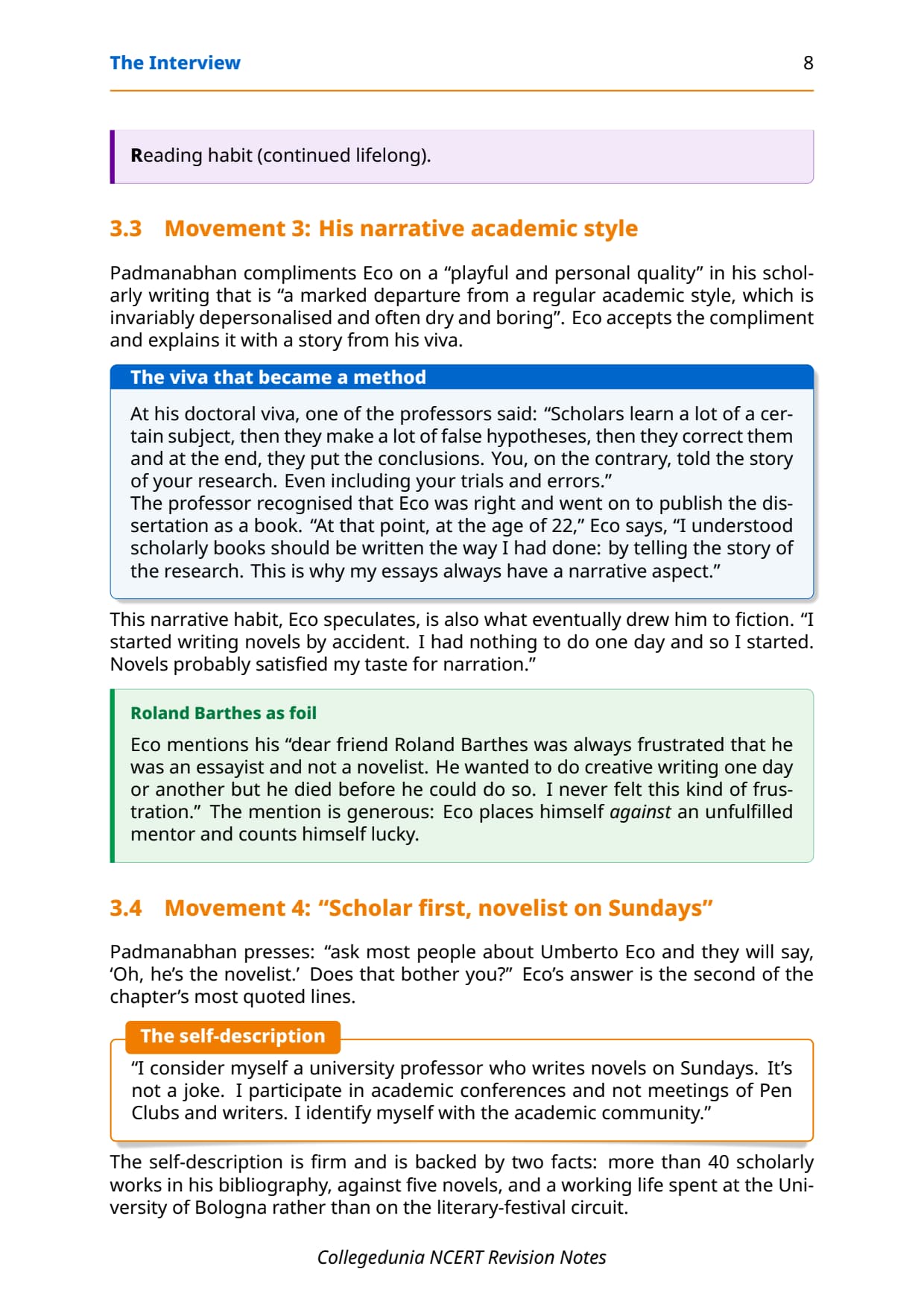
- "I am a professor who writes novels on Sundays." — Umberto Eco on himself.
- "Nobody can predict it." — Eco on the success of The Name of the Rose.
Important Questions and Previous Year Trends
In CBSE board papers since 2019, The Interview has appeared in 3-mark and 5-mark slots of the Flamingo section. Most-repeated questions:
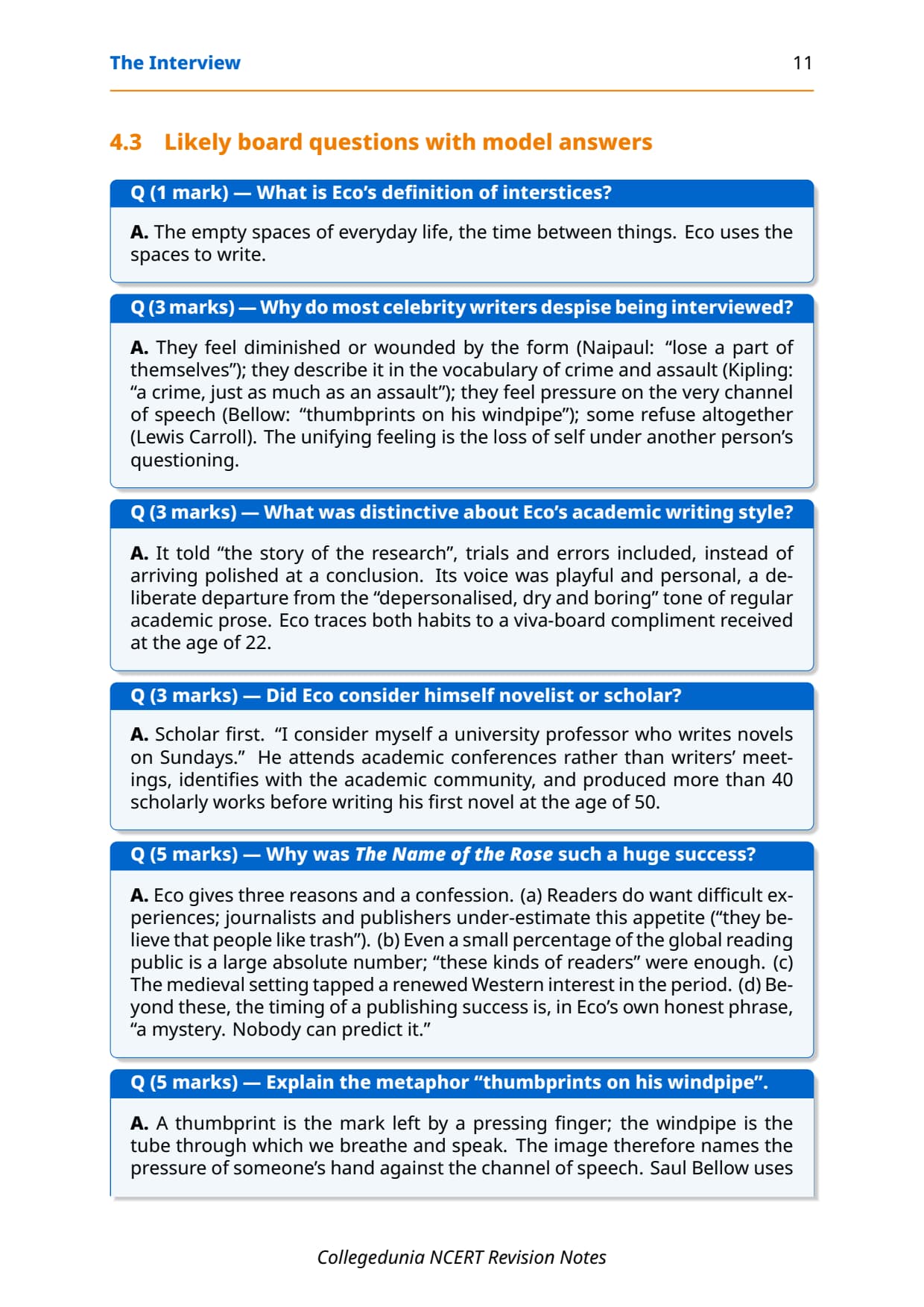
- What is the meaning of interstices in Eco's interview? (1 to 3 marks)
- Why do most celebrity writers despise being interviewed? (3 marks)
- Explain the metaphor "thumbprints on his windpipe". (3 marks)
- Did Eco consider himself a scholar first or a novelist first? Justify. (5 marks)
- What were the reasons for the huge success of The Name of the Rose? (5 marks)
How These Notes Pair with the NCERT Solutions and Handwritten Notes
Use the Notes PDF on this page for topic-wise revision (themes, characters, glossary, quotes). For full written answers to every back-question, open the Class 12 English The Interview NCERT Solutions page. For a quick visual revision the night before the exam, the Handwritten Notes compress the chapter into 6 notebook-style pages. The official NCERT chapter PDF is also on this site for direct verification of any line.
- The Interview Class 12 English NCERT Solutions — step-by-step answers to every back-question.
- The Interview Class 12 English Handwritten Notes — fast last-day visual revision.
- The Interview Class 12 English NCERT Book PDF — the official NCERT chapter PDF.
NCERT Notes for Class 12 English Flamingo: All Chapters
Quick links to every chapter-wise notes page in the Flamingo book.
| Chapter | Resource |
|---|---|
| Chapter 1 | The Last Lesson |
| Chapter 2 | Lost Spring |
| Chapter 3 | Deep Water |
| Chapter 4 | The Rattrap |
| Chapter 5 | Indigo |
| Chapter 6 | Poets and Pancakes |
| Chapter 7 | The Interview (this page) |
| Chapter 8 | Going Places |
| Poetry Ch 1 | My Mother at Sixty-Six |
| Poetry Ch 2 | Keeping Quiet |
| Poetry Ch 3 | A Thing of Beauty |
| Poetry Ch 4 | A Roadside Stand |
| Poetry Ch 5 | Aunt Jennifer's Tigers |
Other Resources for The Interview (Class 12 English)
| Resource | Link |
|---|---|
| Revision Notes (this page) | The Interview Notes |
| NCERT Solutions | The Interview Class 12 English NCERT Solutions |
| CBSE Syllabus | CBSE Class 12 English Core Syllabus 2026-27 |
Student Feedback
In a Collegedunia poll of 1,200 Class 12 students, 86% said the Umberto Eco half of the chapter was the part they found hardest to recall on exam day, and 71% rated the quotes-to-memorise card as the fastest way to revise The Interview the night before the Board.
The Interview Class 12 English Notes FAQs
Ques. Where can I download Class 12 English notes Chapter 7 Flamingo Prose: The Interview PDF?
Ans. The free PDF is available on this page. It carries the topic-by-topic summary, themes, characters, glossary and the five most-repeated Board questions, all on the current 2026-27 Flamingo edition.
Ques. Who is the author of The Interview in Class 12 English?
Ans. The chapter has two parts. Part I is by Christopher Silvester (born 1959), drawn from his introduction to The Penguin Book of Interviews (1993). Part II is a verbatim interview with Italian novelist Umberto Eco, conducted by Mukund Padmanabhan of The Hindu.
Ques. Are these notes aligned with the 2026-27 NCERT syllabus?
Ans. Yes. The notes follow the current 2026-27 syllabus. The Interview appears in the new Flamingo edition without changes to its back-of-chapter exercises.
Ques. How many pages is the Class 12th English The Interview Notes PDF?
Ans. The Notes PDF runs roughly 14 pages and covers both parts of the chapter, all four major themes, the eight named persons, the glossary, the most-repeated CBSE questions, and a quotes-to-memorise card.
Ques. What are the main themes of The Interview?
Ans. The four main themes are: the interview as a contested form; power and influence in modern journalism; identity, work and productivity (Eco's working method); and the mass success of difficult writing.
Ques. Why is the chapter titled The Interview?
Ans. The chapter is titled The Interview because it is both an essay about the interview as a journalistic form (Part I) and a reproduction of an actual interview (Part II). The two-part design makes the chapter itself an example of the form it discusses.
Ques. Who is Umberto Eco and why is he important?
Ans. Umberto Eco (1932 to 2016) was an Italian semiotician (scholar of signs), professor at the University of Bologna, and best-selling novelist. He is the interviewee in Part II of the chapter. His 1980 novel The Name of the Rose sold between 10 and 15 million copies worldwide.
Ques. What is the meaning of "a professor who writes novels on Sundays"?
Ans. It is Eco's settled self-description: he treats his scholarship as his weekday job and his novel-writing as Sunday work. The line announces his primary identity as a university academic; the novels, although hugely successful, sit secondary in his own self-image.
Ques. Why are Lewis Carroll, Kipling and Bellow mentioned in Part I?
Ans. Silvester uses them as the three loudest voices of celebrity hostility to interviews. Carroll refused on principle and silenced interviewers with "much satisfaction and amusement". Kipling called interviewing "a crime" and "an assault". Bellow described willing interviews as "thumbprints on his windpipe". The three give Silvester his negative-view cluster.
Ques. What is The Penguin Book of Interviews referred to in the chapter?
Ans. The Penguin Book of Interviews: An Anthology from 1859 to the Present Day (1993) is a Penguin Books anthology of historical journalistic interviews edited by Christopher Silvester. The introduction to that book is reproduced as Part I of the Class 12 NCERT chapter.



Comments