




These the tiger king class 12 notes are aligned to the current 2026-27 NCERT Vistas print and condense the entire 10-page Vistas Chapter 2 story by Kalki Krishnamurthy into an exam-ready 11-page revision document. The notes follow a fixed four-pass workflow used by CBSE markers for the Vistas Long Answer slot: setting and context, scene-by-scene plot, character arcs, and theme-tagged value points with built-in conservation reading.
- CBSE Weightage: 6 marks per Vistas Long Answer in Section C, drawn from the five Reading with Insight questions
- Coverage: 2 character sketches, a scene-by-scene plot map, a six-symbol table, and a sample 6-mark answer
These Collegedunia notes are curated by senior English educators, mapped line-by-line to the 2026-27 NCERT Vistas textbook, and refined against the last five years of CBSE Class 12 English Core Board papers.
The Tiger King Class 12 Notes: What the Chapter Covers
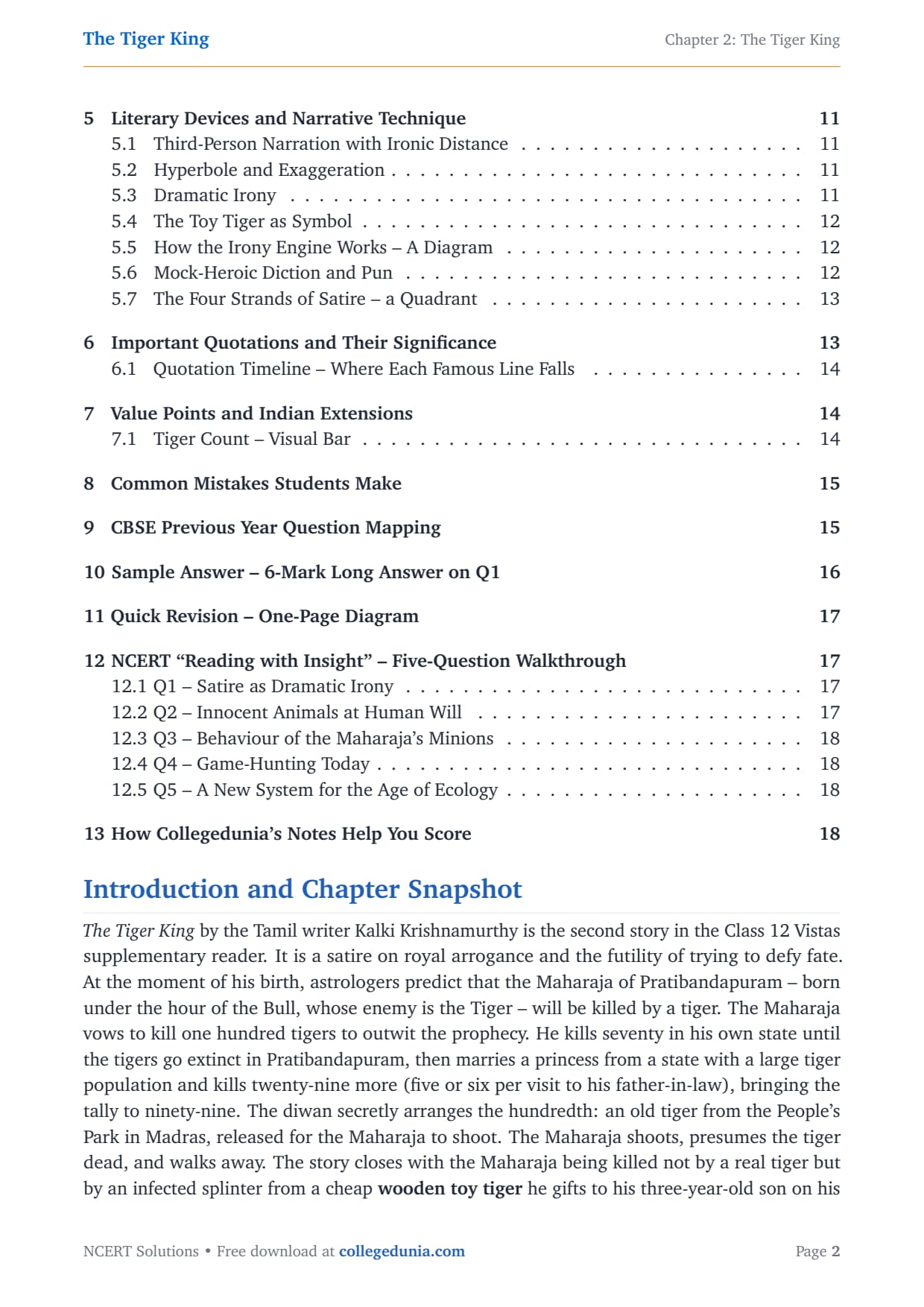
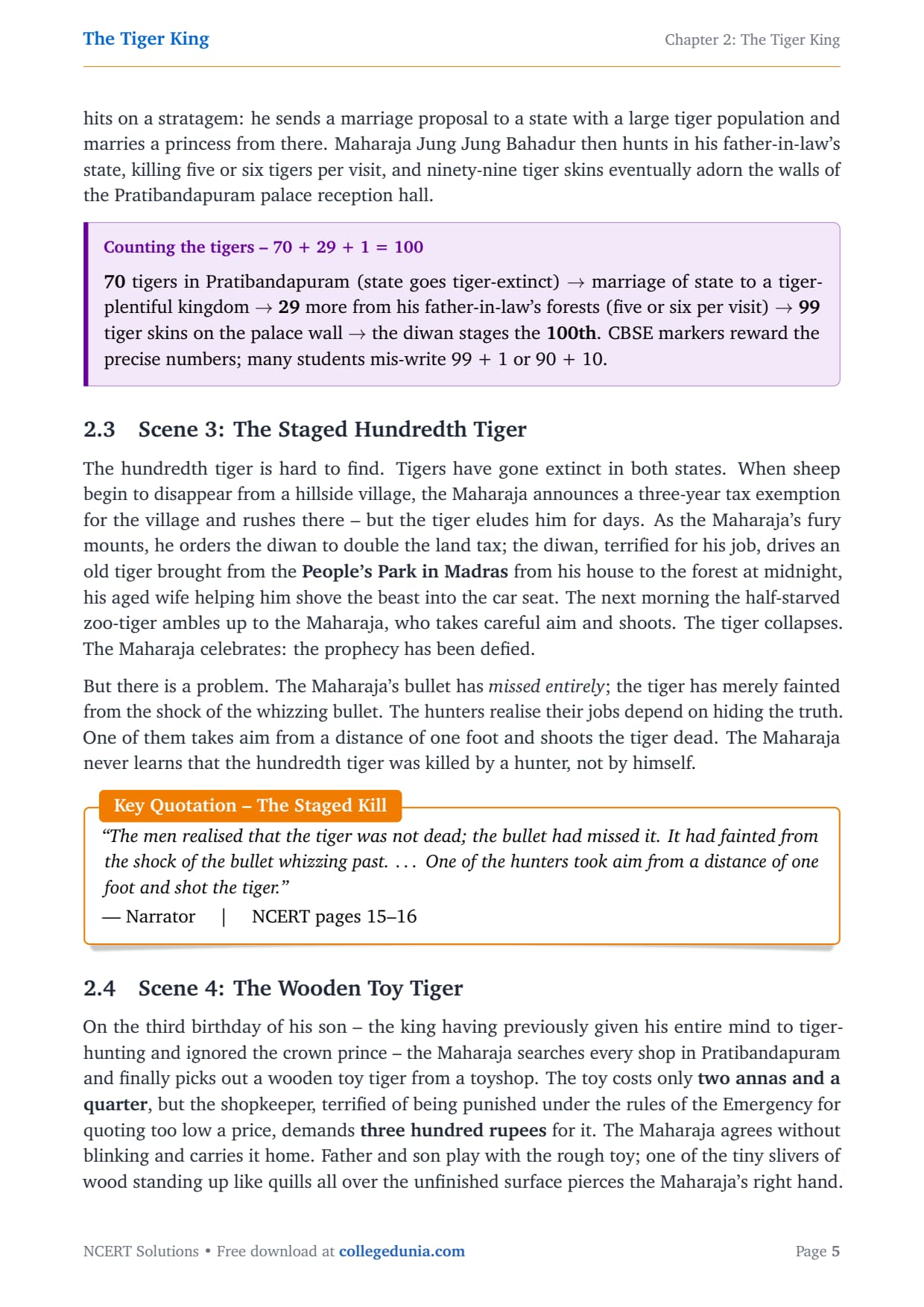
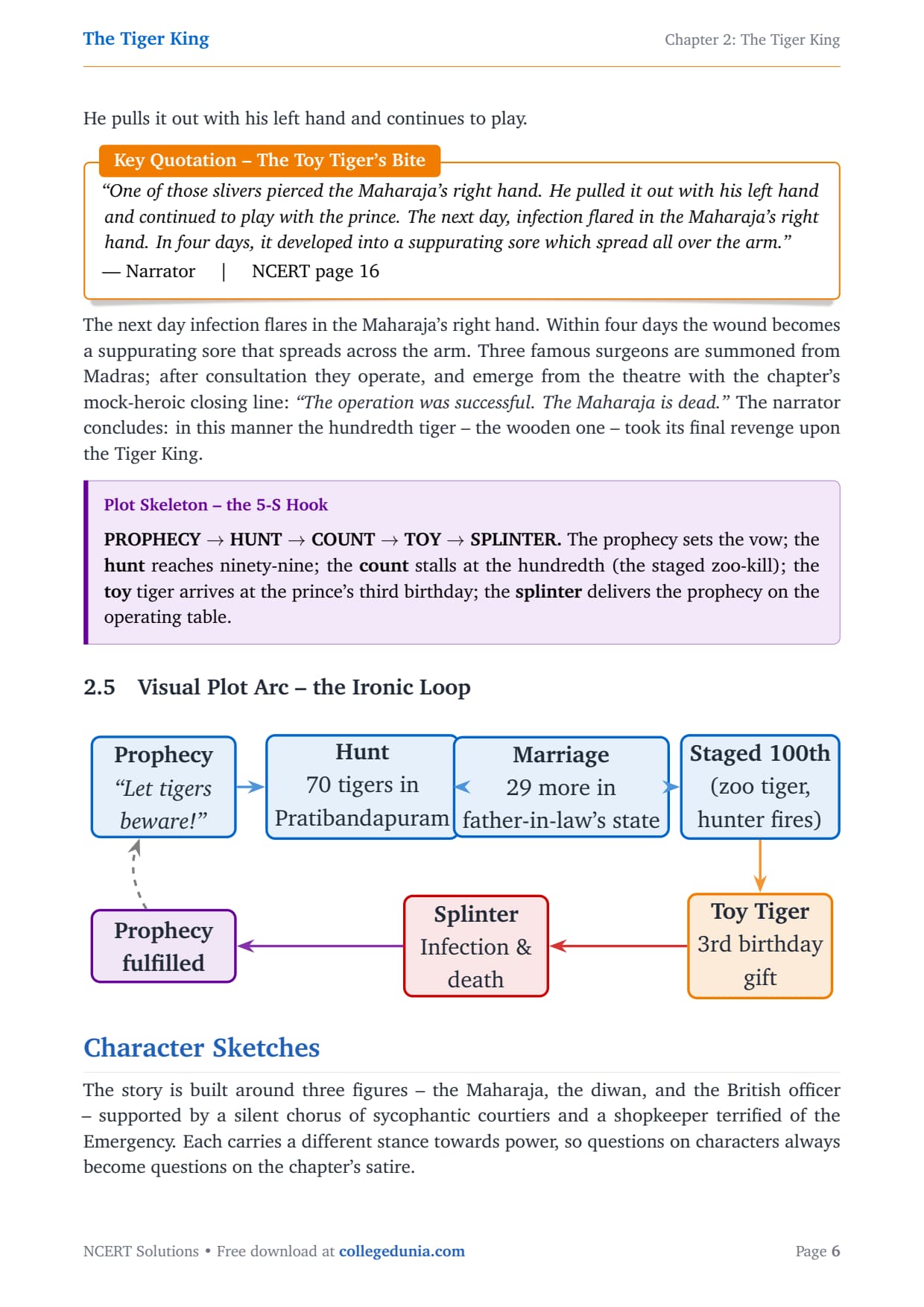
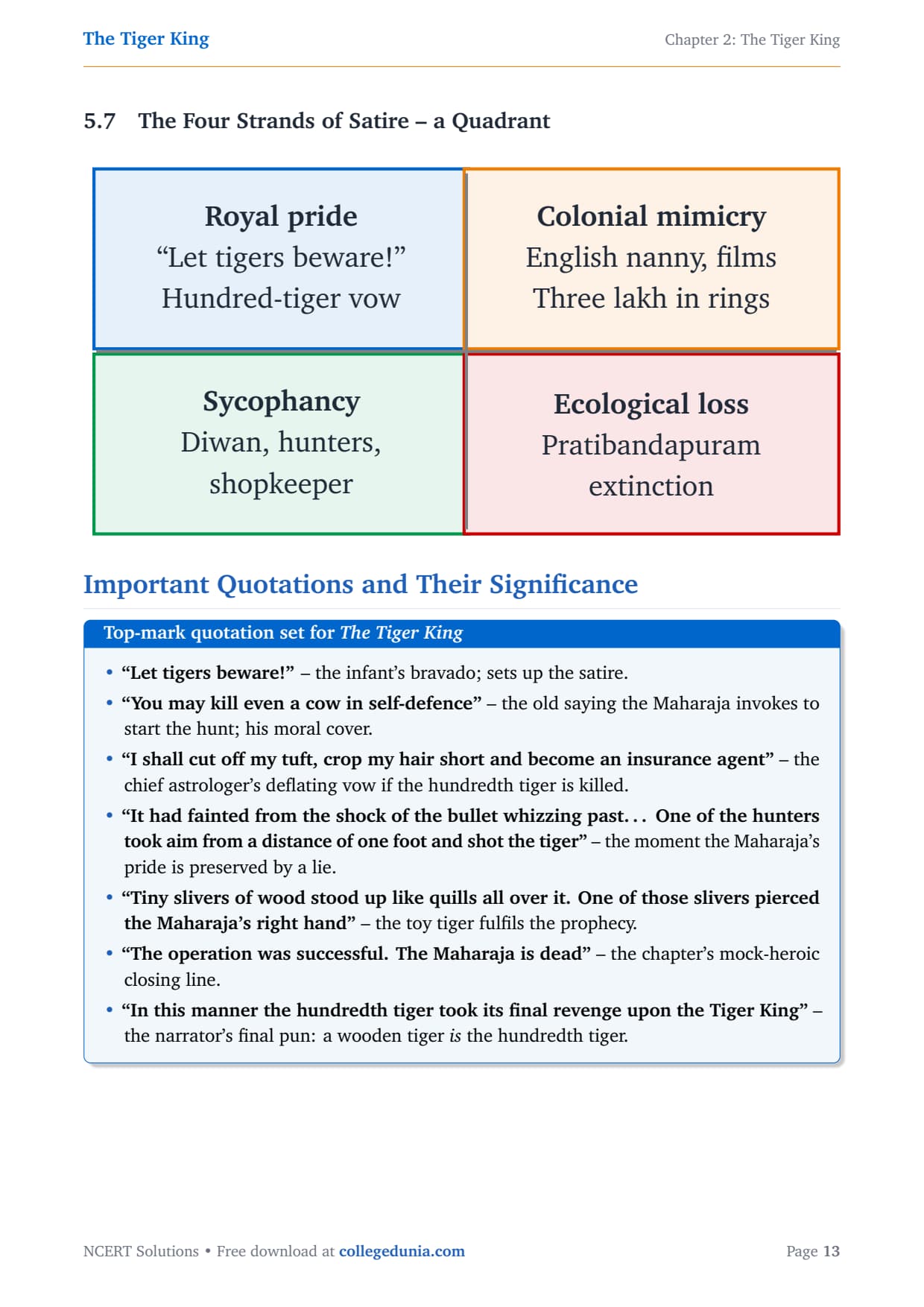
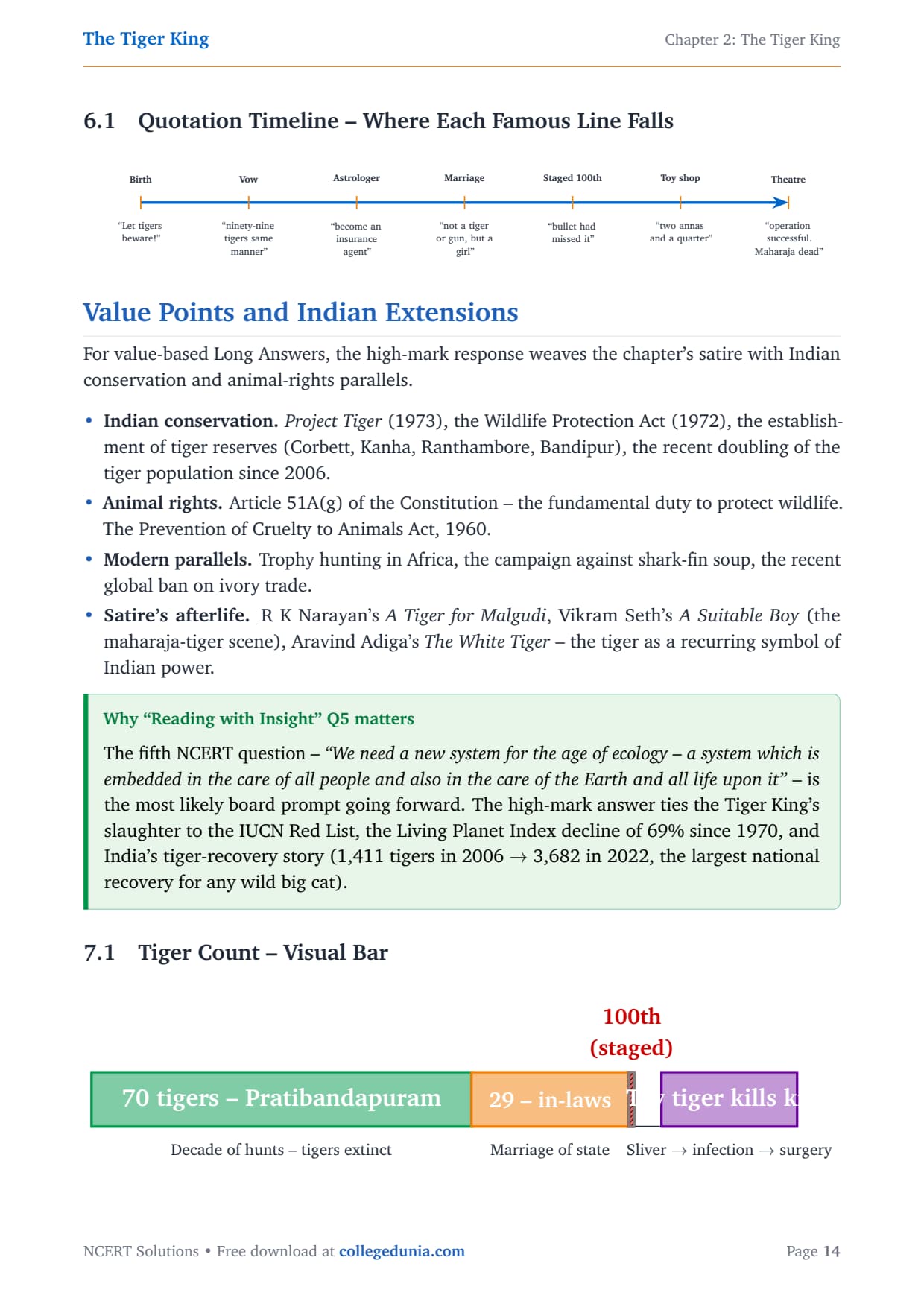
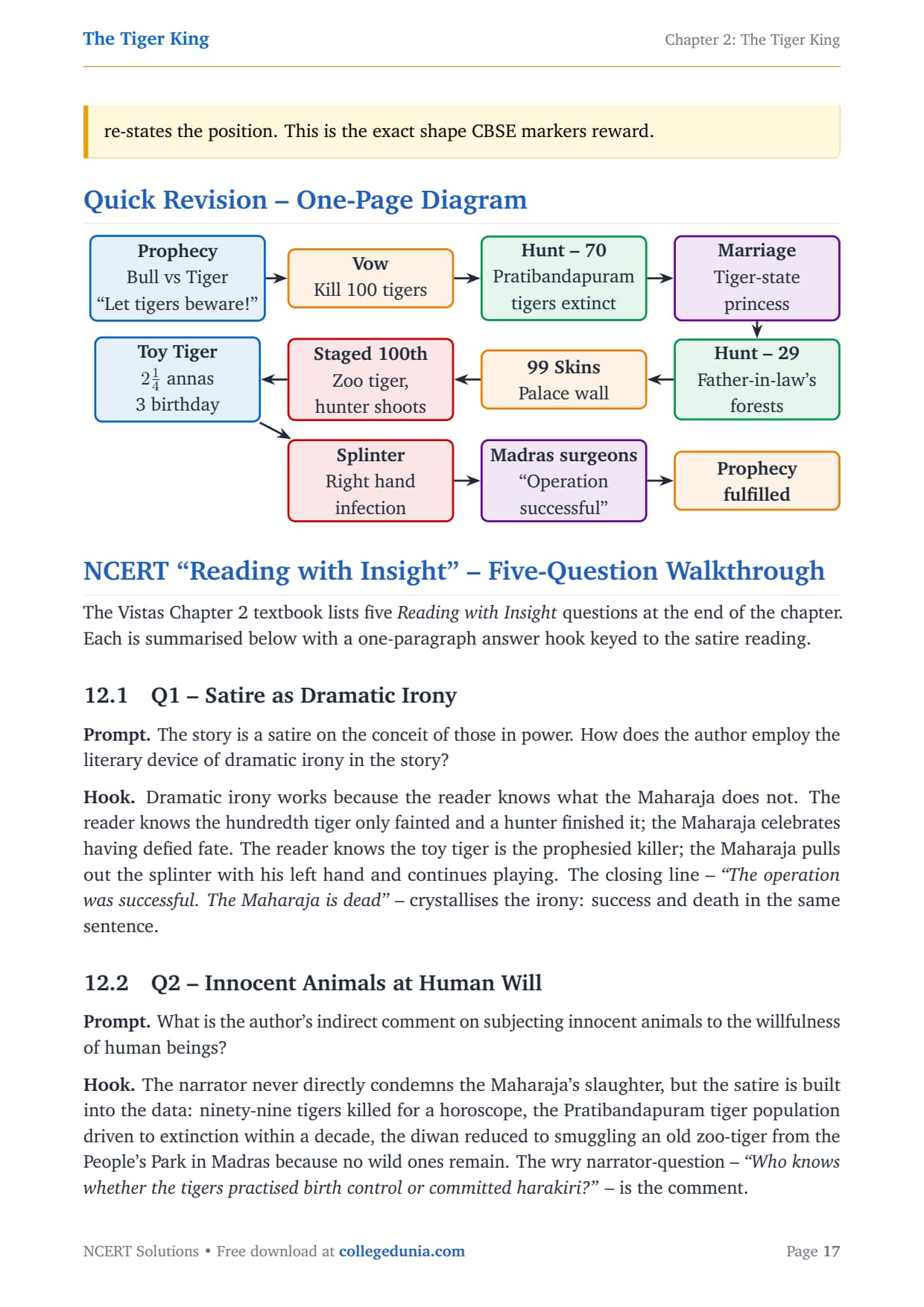
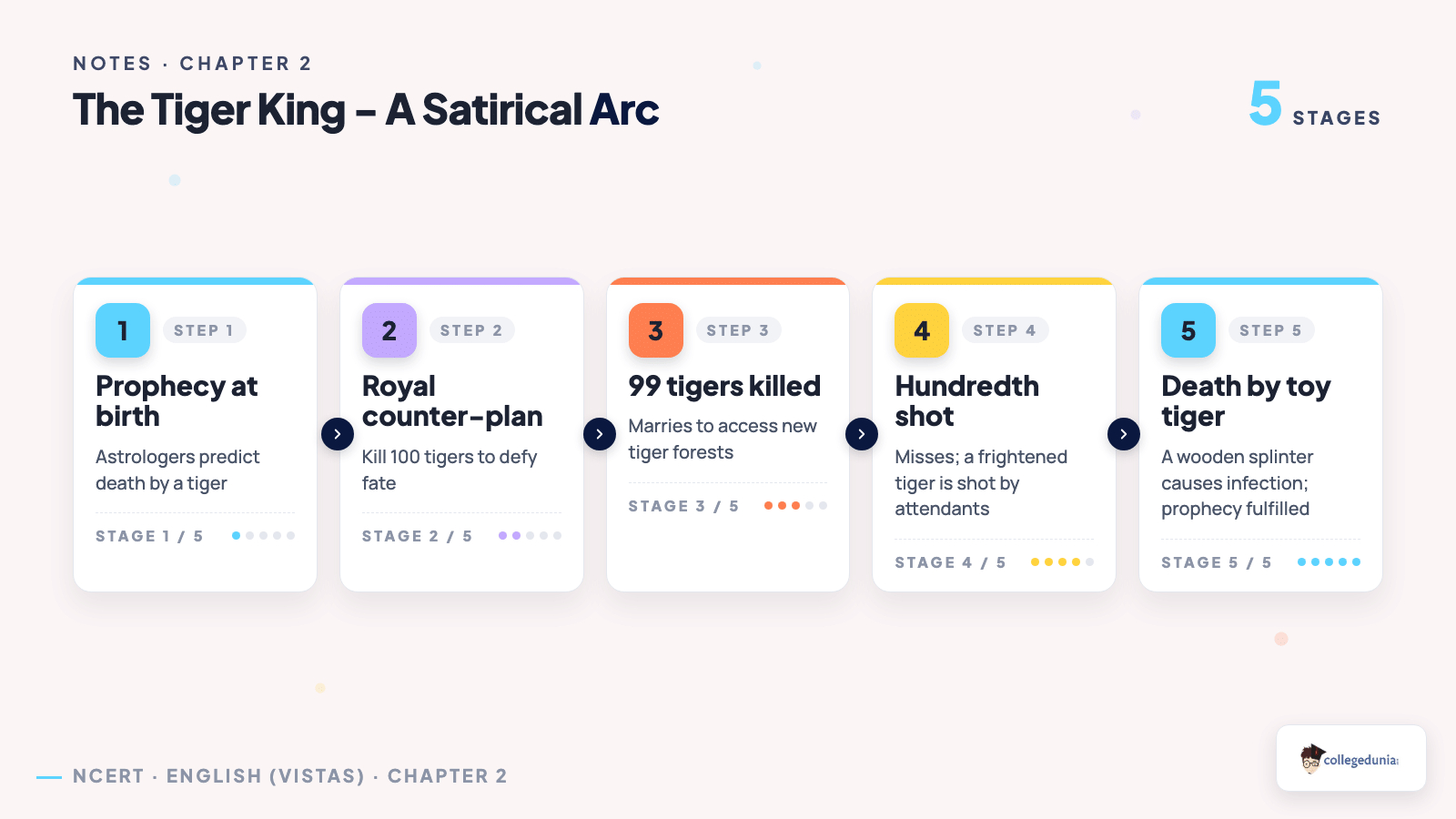
The Tiger King is the second story in the Class 12 Vistas reader, by the Tamil writer Kalki Krishnamurthy (1899-1954). It is a satire on the conceit of those in power and the futility of defying fate. At his birth, astrologers predict the Maharaja of Pratibandapuram will be killed by a tiger. He vows to kill one hundred tigers: seventy in his own state, twenty-nine in his father-in-law's, and a staged hundredth from the People's Park in Madras. He is finally killed not by a real tiger but by an infected sliver from a cheap wooden toy tiger he gifts to his three-year-old son.
| Section | What It Covers | Typical Mark Yield |
|---|---|---|
| Setting and author | Kalki Krishnamurthy; fictional Pratibandapuram; colonial hunting culture | 1-2 (MCQ) |
| Plot summary | The prophecy, the seventy-tiger run, the marriage, the People's Park tiger, the wooden toy | 2-3 (SA) |
| Character of the Maharaja | Brave-as-bravado, superstitious, authoritarian, self-deluded | 3-6 (LA) |
| Character of the dewan | Sycophantic comic foil; a survivor of court culture | 3-5 (LA) |
| Themes and value points | Conceit of power, animal cruelty, fate vs free will, sycophancy | 4-6 (LA) |
| Literary devices | Ironic narration, hyperbole, dramatic irony, the toy tiger as symbol | 2-3 (SA) |
CBSE almost always sets one 6-mark Long Answer from the character or theme rows, so these notes put those parts first.
The Tiger King Video Explanation (Class 12 English)
Source: Magnet Brains on YouTube
Setting: Pratibandapuram and the Princely-State Backdrop
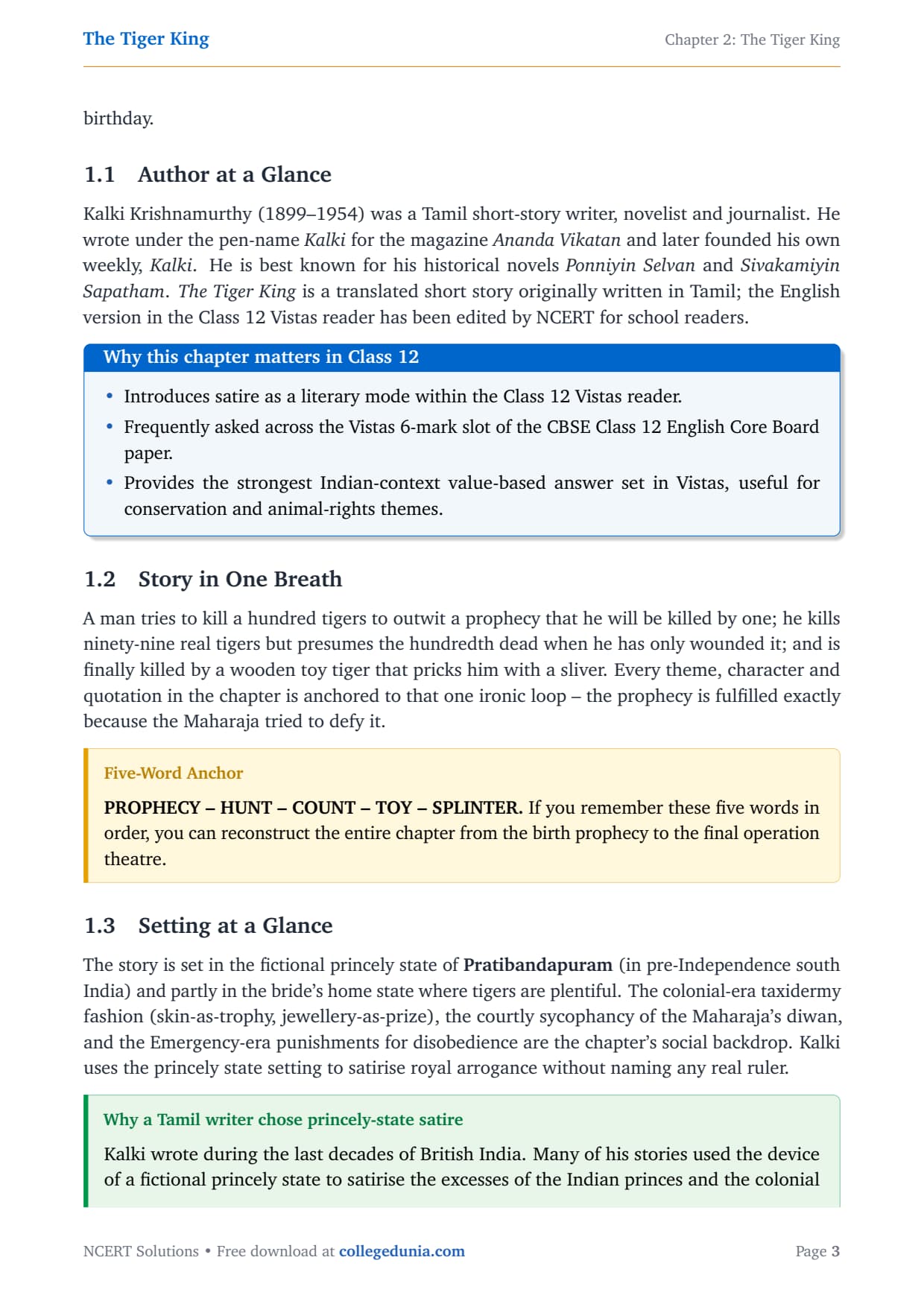
The story is set in the fictional princely state of Pratibandapuram in pre-Independence south India, and partly in the bride's tiger-plentiful home state. The colonial hunting culture (skin-as-trophy, the British officer, the duraisani's diamond rings) and the courtly sycophancy of the dewan are the social backdrop. Kalki uses the setting to satirise royal arrogance without naming a real ruler.
Character Sketch: The Maharaja of Pratibandapuram
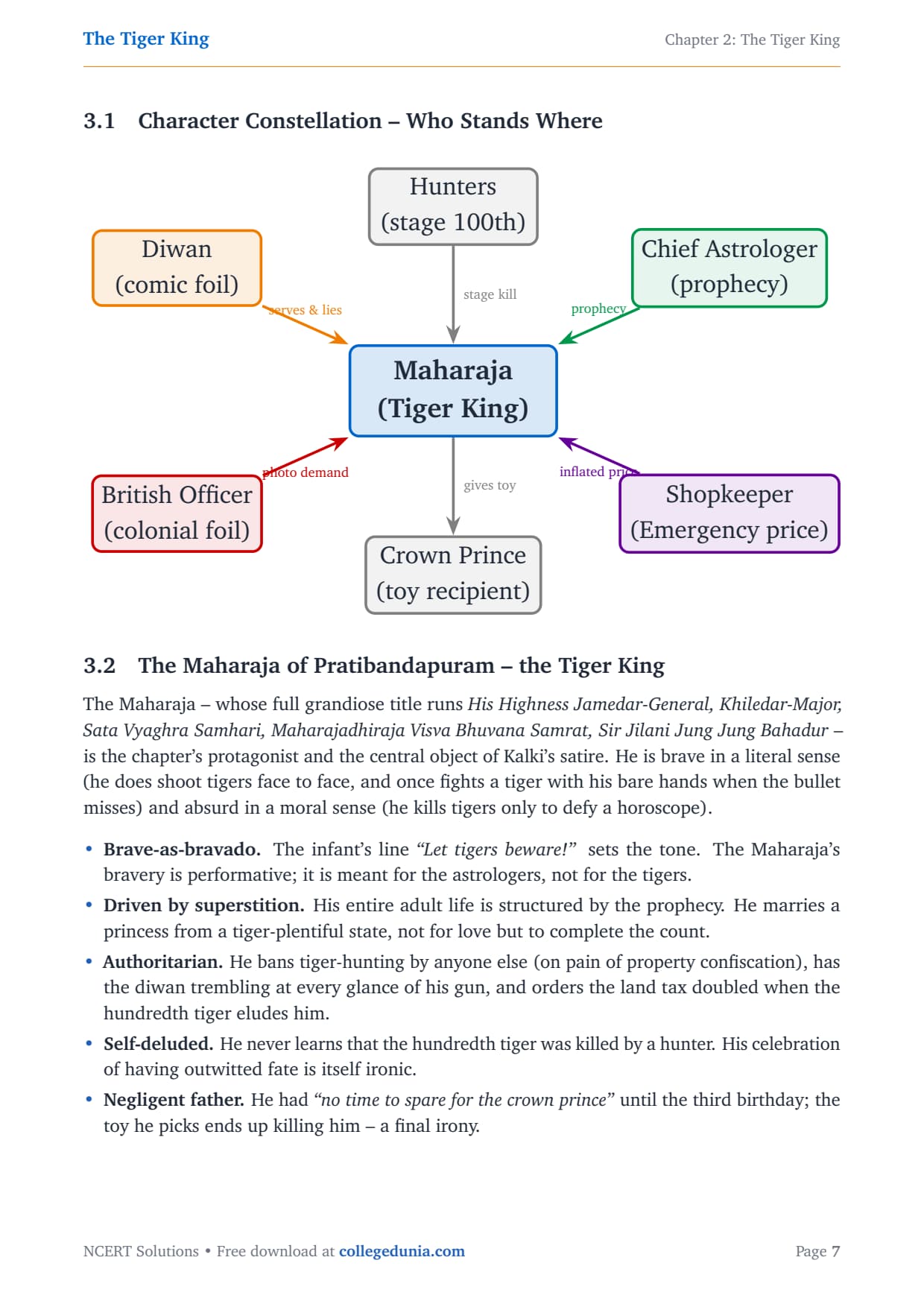
The Maharaja is the protagonist and the central object of Kalki's satire, brave in a literal sense but absurd in a moral one, since he kills tigers only to defy a horoscope.
- Brave-as-bravado. The infant's line "Let tigers beware!" sets the tone; his bravery is performative, meant for the astrologers.
- Driven by superstition. His adult life is structured by the prophecy; he marries not for love but to complete the count.
- Authoritarian. He bans others from hunting, doubles the land tax when the hundredth tiger eludes him, and sacks officers in his rage.
- Self-deluded. He never learns that a hunter killed the hundredth tiger; his triumph over fate is itself ironic.
Character Sketch: The Dewan, the Comic Foil
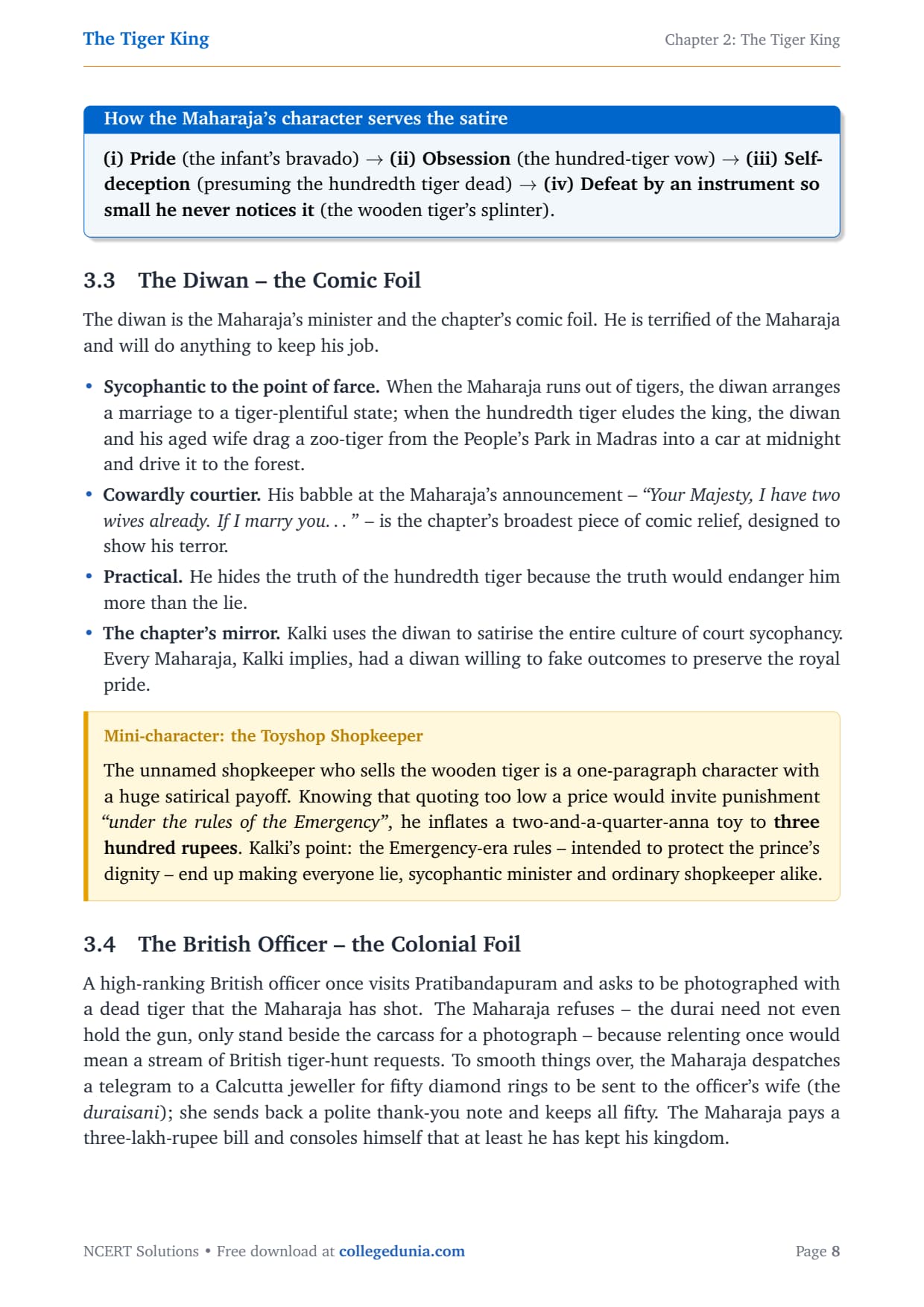
The dewan is the Maharaja's minister and the chapter's comic foil. He is terrified of the Maharaja and will do anything to keep his job.
- Sycophantic to the point of farce. He arranges the marriage and later brings a People's Park tiger and hides it in his own house.
- Practical. He and his aged wife drag the tiger to the car at midnight and drive it to the forest, the comic image of the chapter.
- The chapter's mirror. Kalki uses him to satirise court sycophancy, implying every Maharaja had a dewan willing to fake outcomes to preserve royal pride.
Symbolism: The Wooden Toy Tiger and the Sliver
The wooden toy tiger is the chapter's central symbol: cheap, badly made, two annas and a quarter, its surface rough with tiny slivers. The satire's punchline is that the king who killed ninety-nine tigers is killed by the worst tiger of all, a wooden one. The sliver that pierces his right hand fulfils the prophecy: "the hundredth tiger took its final revenge upon the Tiger King."
| Symbol | Meaning |
|---|---|
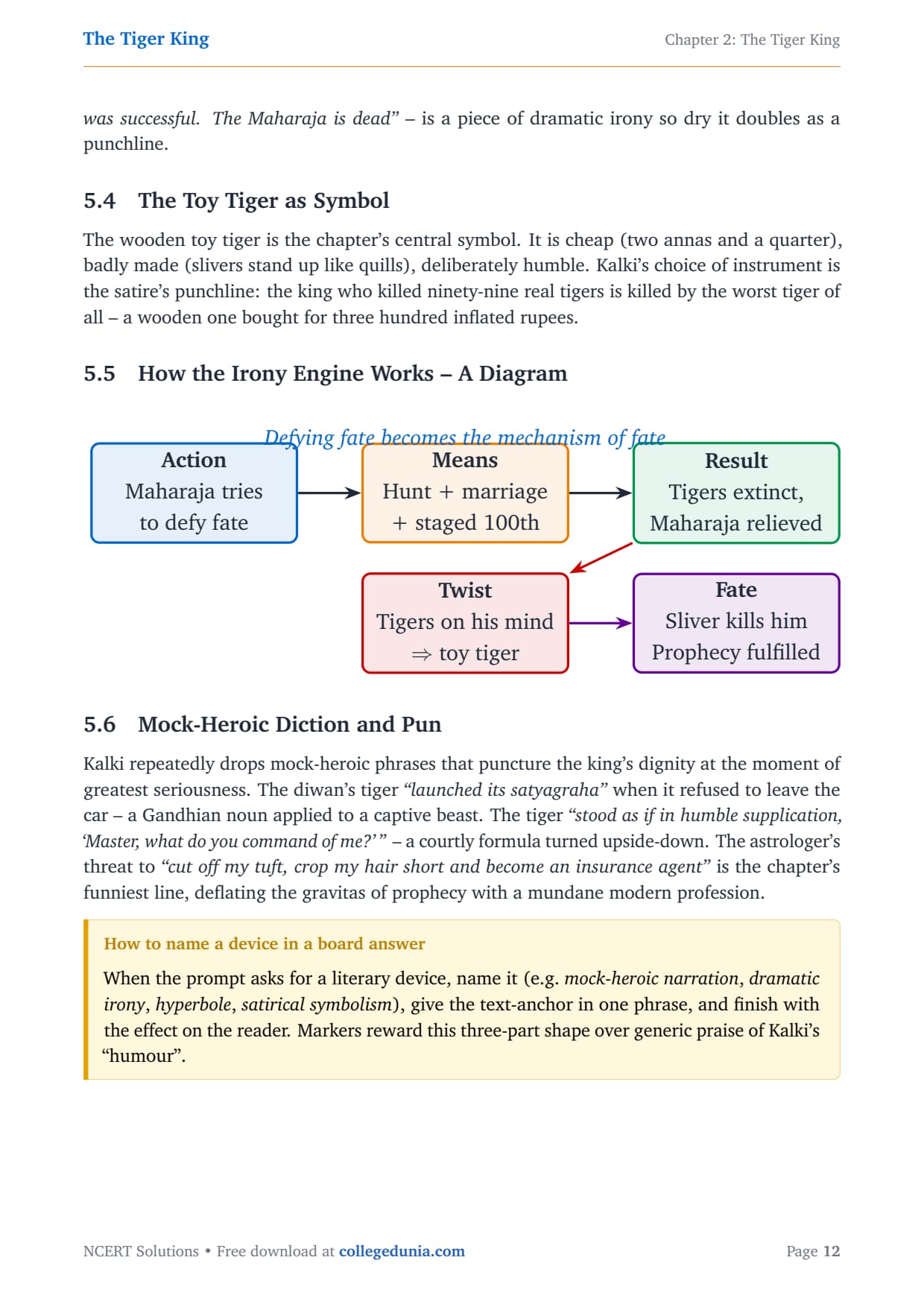
| The prophecy | The plot engine; the effort to defy fate becomes the way fate is fulfilled |
| The hundred-tiger vow | Royal arrogance; pride as policy |
| The diplomatic marriage | Pride dictating personal life; the satire of court-state alliances |
| The diamond rings | The colonial gift cycle; fifty rings and a three-lakh bill for royal pride |
| The staged hundredth tiger | The system's small lie that preserves royal pride |
| The wooden toy tiger | Fate's punchline; a tiny instrument mocks the largeness of the pride |
Themes in The Tiger King: Four Lines to Memorise
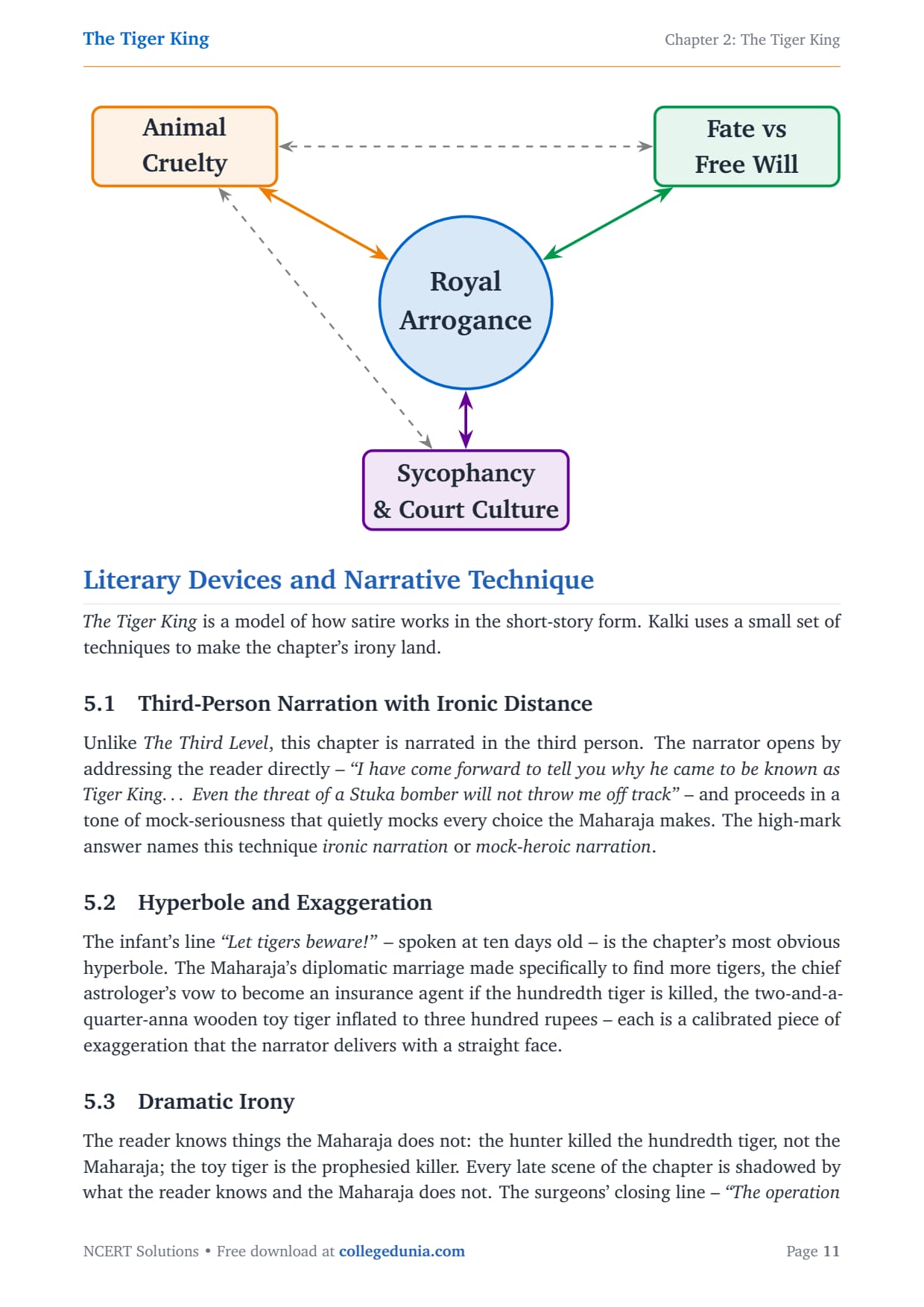
- Satire on the conceit of those in power. The Maharaja's whole life is Kalki's exhibit of royal pride taking itself too seriously.
- Animal cruelty and conservation. The conservation reading is the most modern and exam-popular; the slaughter of ninety-nine tigers is an ecological disaster wrapped in a horoscope.
- Fate versus free will. The Maharaja's very effort to defy fate becomes the mechanism by which fate is fulfilled; he buys a wooden tiger only because tigers are on his mind.
- Sycophancy and court culture. The dewan's terror and the silent hunters who fake the hundredth kill show a princely state running on lies and gifts more than on rule.
The Tiger King: Scene-by-Scene Summary
| # | Scene | Key Detail |
|---|---|---|
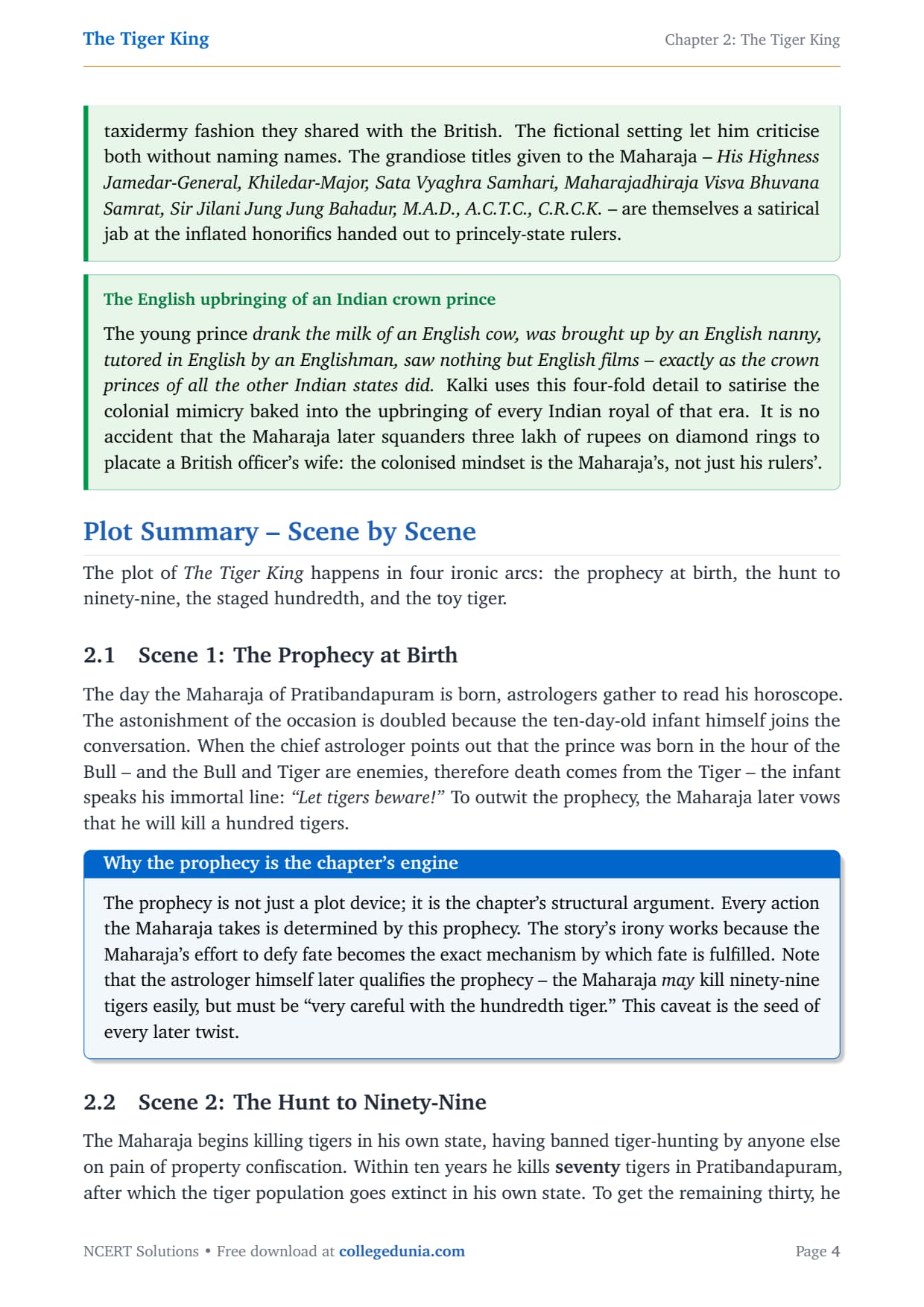
| 1 | The prophecy at birth | Astrologers predict death by tiger; the infant's line "Let tigers beware!"; the vow to kill one hundred |
| 2 | The hunt to seventy | He bans others from hunting, kills seventy in ten years, and sends fifty diamond rings to the duraisani; tigers in his state run out |
| 3 | The diplomatic marriage | He marries a princess from a tiger-plentiful state and kills twenty-nine more, reaching ninety-nine |
| 4 | The staged hundredth tiger | The dewan drags a People's Park tiger to the forest at midnight; the Maharaja's bullet misses, the tiger only faints, and a hunter finishes it from one foot away |
| 5 | The wooden toy tiger | A birthday gift for his son; a sliver pierces his right hand, the wound turns septic, and "the operation was successful, the Maharaja is dead" |
Common Mistakes Students Make in The Tiger King Answers
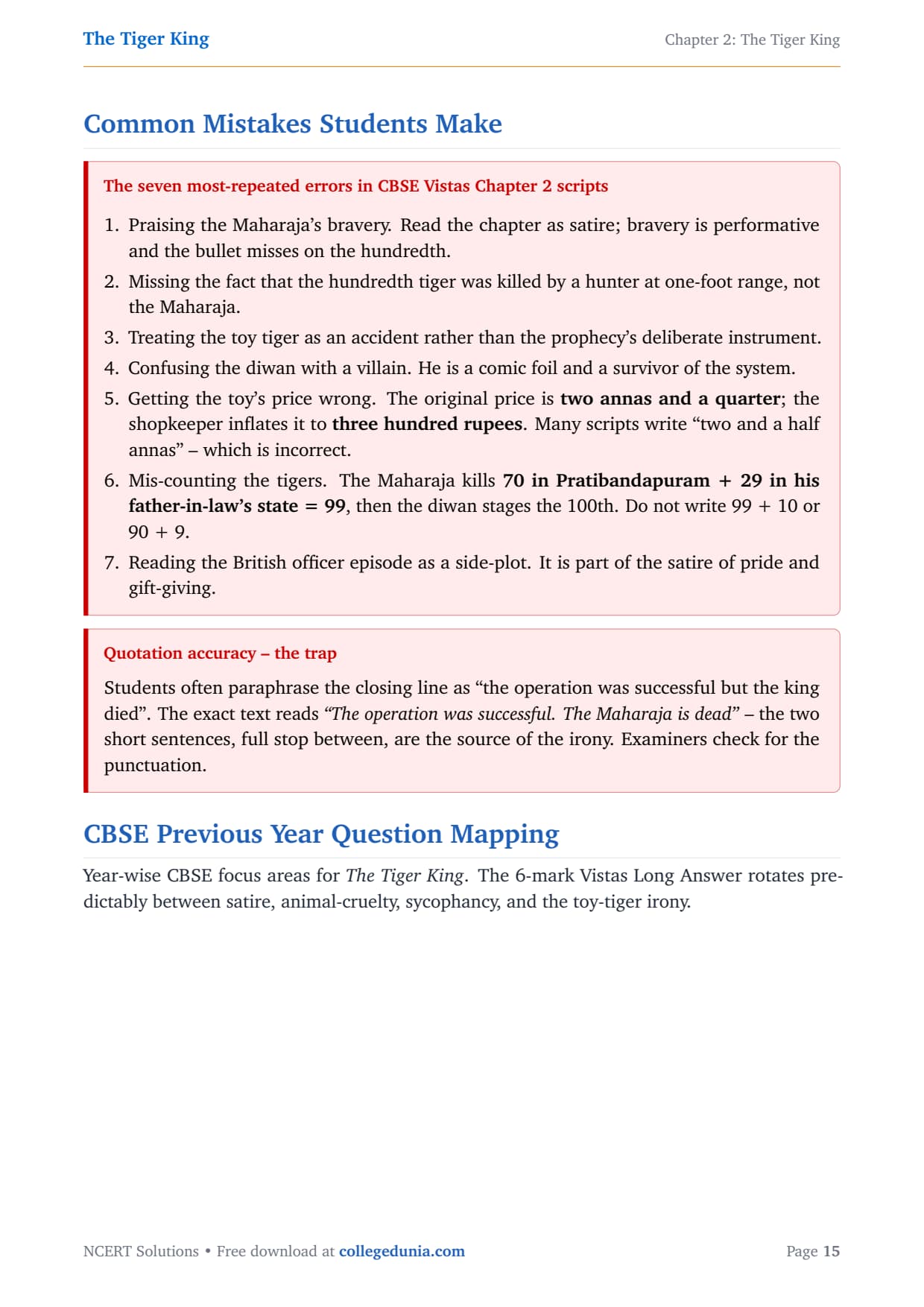
- Praising the Maharaja's bravery; read the chapter as satire, where bravery is performative.
- Missing that a hunter killed the hundredth tiger from one foot away; the Maharaja's bullet missed and the tiger had only fainted.
- Treating the toy tiger as an accident rather than the prophecy's deliberate instrument.
- Quoting the toy's cost wrongly; the story says "two annas and a quarter".
- Calling the dewan a villain; he is a comic foil and a survivor of the system.
- Missing the conservation reading, which CBSE has set as a value-based question for years.
CBSE Class 12 English Previous Year Question Mapping for The Tiger King
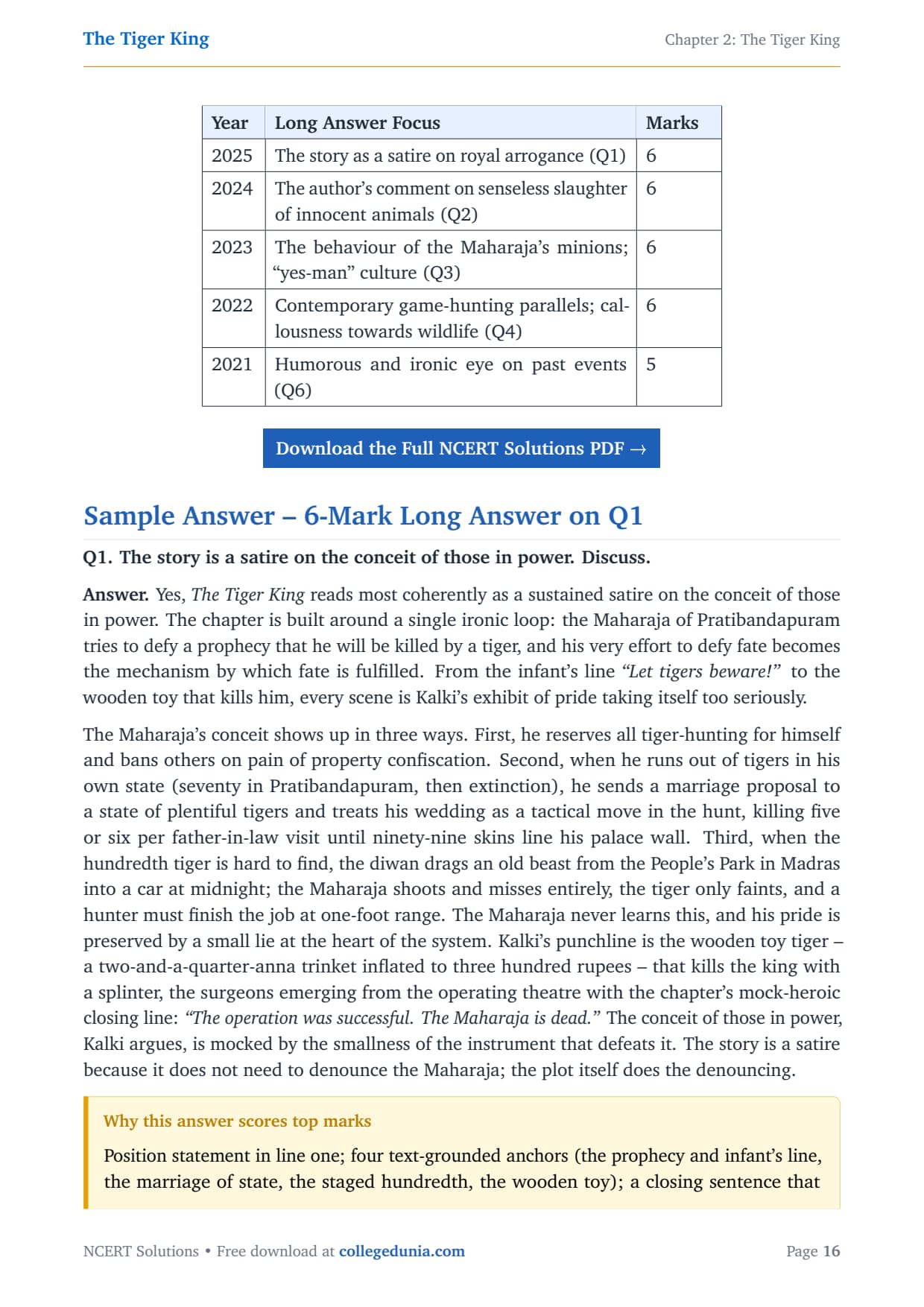
The 6-mark Vistas Long Answer rotates between satire, animal cruelty, sycophancy, and the modern game-hunting prompt.
| Year | Long Answer Focus | Marks |
|---|---|---|
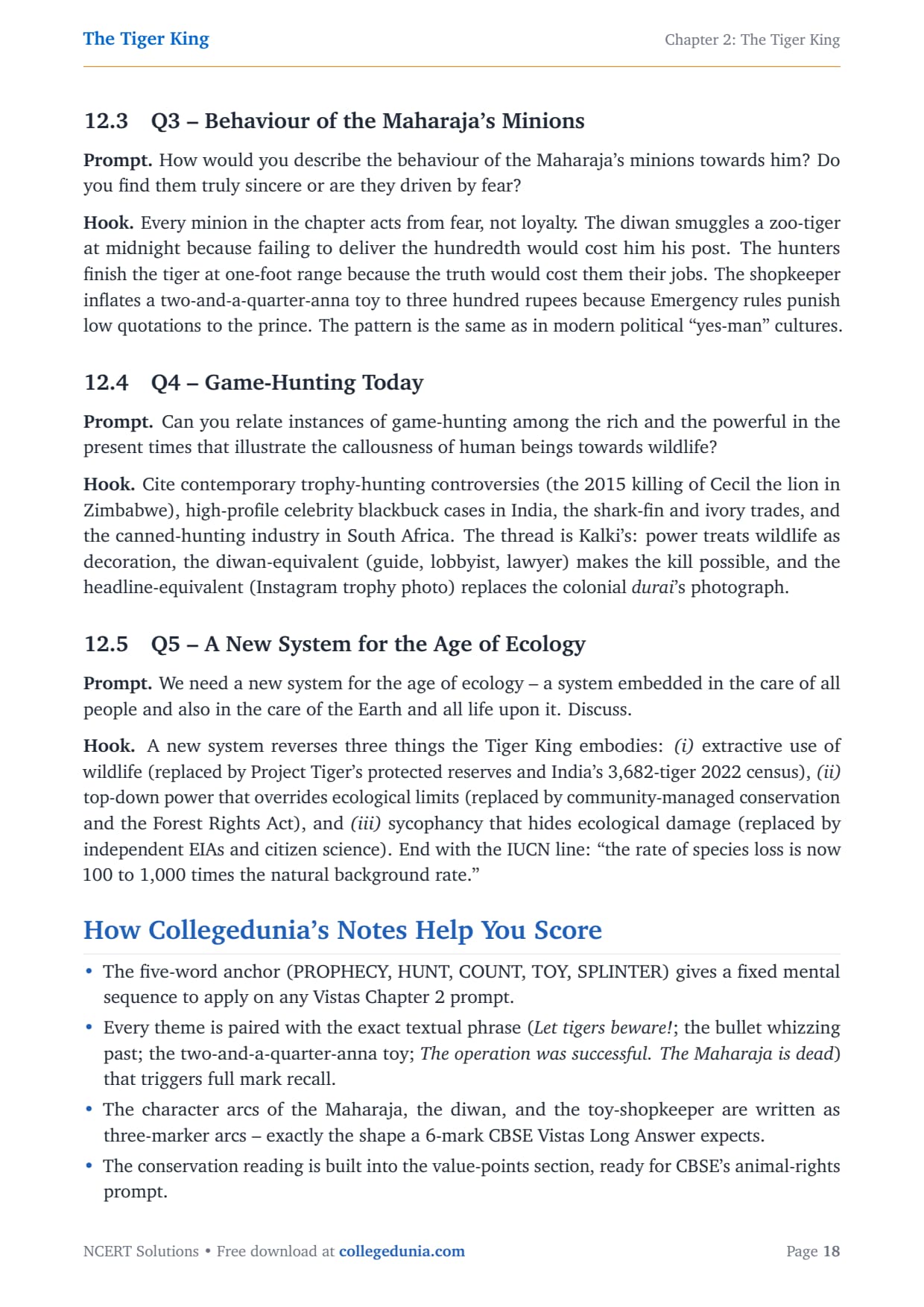
| 2025 | The story as a satire on the conceit of those in power (Q1) | 6 |
| 2024 | The author's comment on the willfulness of human beings towards innocent animals (Q2) | 6 |
| 2023 | The behaviour of the Maharaja's minions; sincerity or fear (Q3) | 6 |
| 2022 | Contemporary game-hunting parallels; callousness towards wildlife (Q4) | 6 |
| 2021 | A new system for the age of ecology (Q5) | 5 |
Other Resources for The Tiger King (Class 12 English)
| Resource | Link |
|---|---|
| Notes (this page) | The Tiger King Notes |
| NCERT Solutions | The Tiger King Class 12 English NCERT Solutions |
| CBSE Syllabus | CBSE Class 12 English Core Syllabus 2026-27 |
NCERT Notes for Class 12 English Vistas: All Chapters
| Chapter | Notes Link |
|---|---|
| Chapter 1 | The Third Level Notes |
| Chapter 3 | Journey to the End of the Earth Notes |
| Chapter 4 | The Enemy Notes |
| Chapter 5 | On the Face of It Notes |
| Chapter 6 | Memories of Childhood Notes |
Student Feedback
In a Collegedunia poll of 1,200 Class 12 students, 77% said the scene-by-scene table made the Maharaja's story easy to recall in the exam, and 73% rated the conservation reading as the angle they leaned on for CBSE's value-based question.
FAQs on The Tiger King Class 12 Notes
FAQs on The Tiger King Class 12 Notes
What is the central theme of The Tiger King Class 12?
The central theme is the satire of the conceit of those in power and the futility of trying to defy fate. The Maharaja of Pratibandapuram tries to outwit a birth prophecy by killing one hundred tigers (seventy in his own state, twenty-nine in his father-in-law's, one staged from the People's Park in Madras) and is finally killed by a cheap wooden toy tiger - the chapter's ironic punchline.
How does the Tiger King die?
The Maharaja dies of an infected wound caused by a sliver from a cheap wooden toy tiger he gifts to his son. The toy had been carved by an unskilled carpenter and cost only two annas and a quarter; a sliver pierces his right hand while he is playing with the three-year-old prince, the wound turns septic, and the Maharaja dies on the operating table after three famous surgeons are brought in from Madras.
Why does the Maharaja kill one hundred tigers?
At birth, astrologers prophesy that the Maharaja will be killed by a tiger. He vows to kill one hundred tigers to defy the prophecy. He kills seventy in his own state in ten years, marries a princess from a tiger-plentiful state and kills twenty-nine more in his father-in-law's state, and finally has the dewan arrange a tiger from the People's Park in Madras so he can claim the hundredth kill.
Who actually killed the hundredth tiger?
The Maharaja's bullet missed. The tiger had only fainted from the shock of the bullet whizzing past. After the Maharaja left in his car, the hunters realised the tiger was alive, and one of them shot it dead from a distance of one foot. They hid the truth from the Maharaja because, if he learnt of it, they would lose their jobs - the chapter's central exhibit of court sycophancy.
Who is the author of The Tiger King?
The Tiger King is written by the Tamil short-story writer and journalist Kalki Krishnamurthy (1899-1954). It appears as Chapter 2 in the Class 12 Vistas supplementary reader for English Core.
How many pages is the The Tiger King Class 12 Notes PDF?
The Collegedunia The Tiger King Class 12 Notes PDF runs 11 pages and covers setting, plot, character sketches, themes, literary devices, important quotations, common mistakes, and a year-wise CBSE PYQ map with a sample 6-mark answer.



Comments