




Keeping Quiet is Pablo Neruda's radical request that all of humanity count to twelve and stay still. These Keeping Quiet Class 12 notes compress the second Flamingo poem into a board-ready revision guide: stanza-by-stanza summary, three core themes, five poetic devices, and the year-wise CBSE question map.
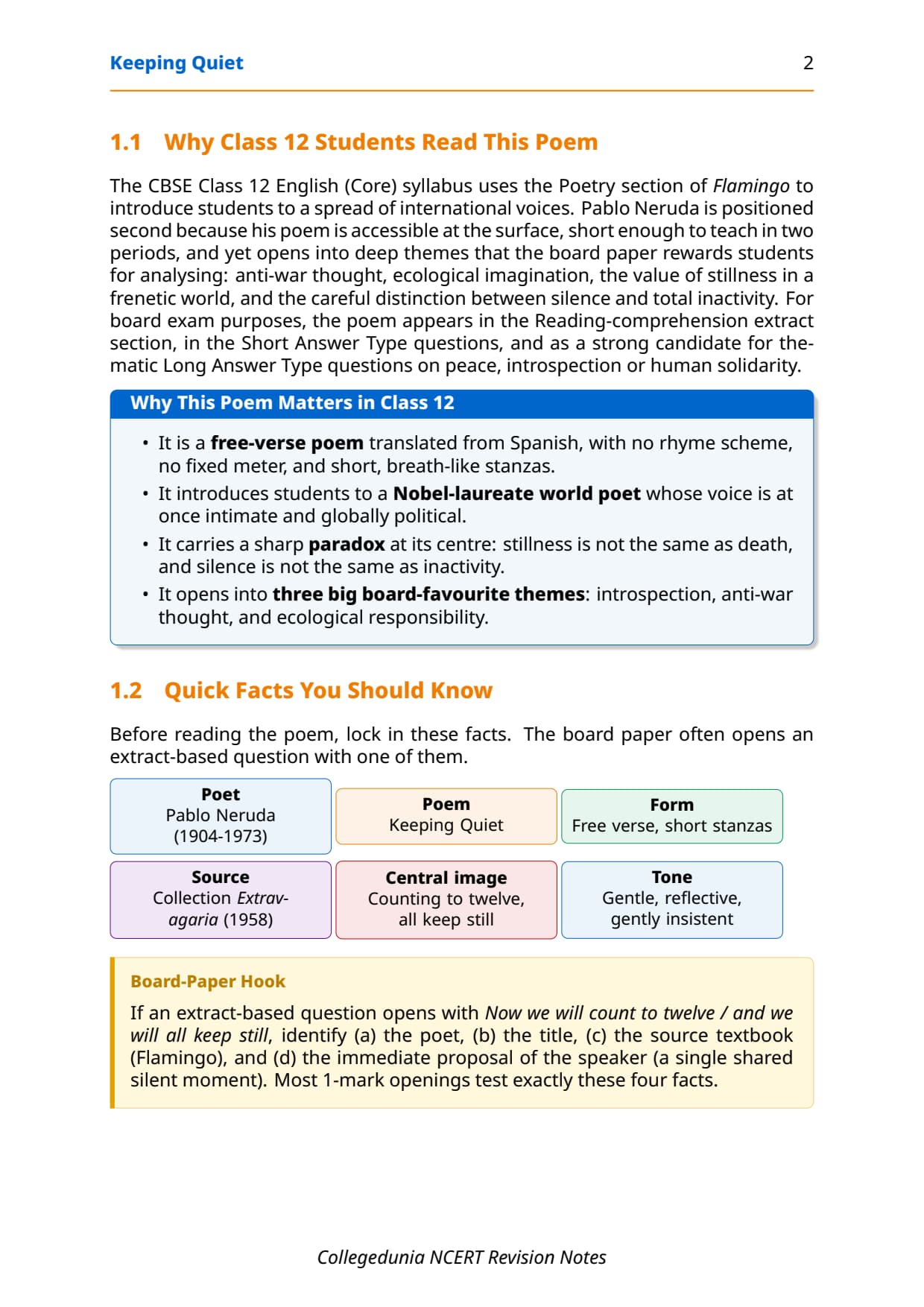

No rhyme, breath-like stanzas
Pablo Neruda, 1958, Spanish original
NCERT Flamingo print aligned
- CBSE Weightage: 6 to 10 marks, typically one Reference-to-Context extract (4-6 marks) plus a short or long answer on the central paradox
- CUET (UG) Relevance: 2 to 3 questions on the poet, the symbol of twelve, and poetic devices
These Class 12 English Chapter 8 notes are mapped to the 2026-27 NCERT print of Flamingo and cross-checked against the last five years of CBSE Board and CUET English papers.
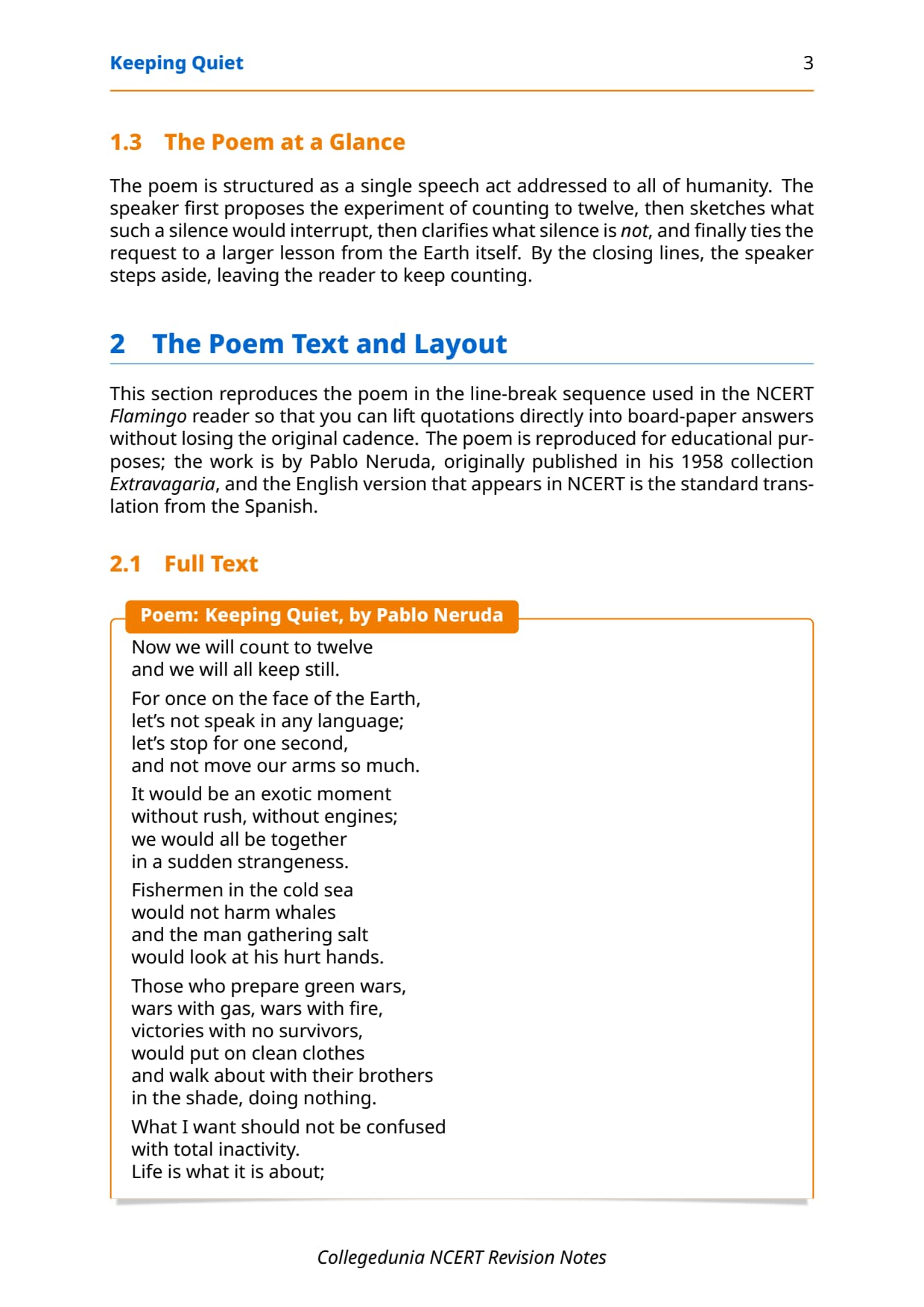
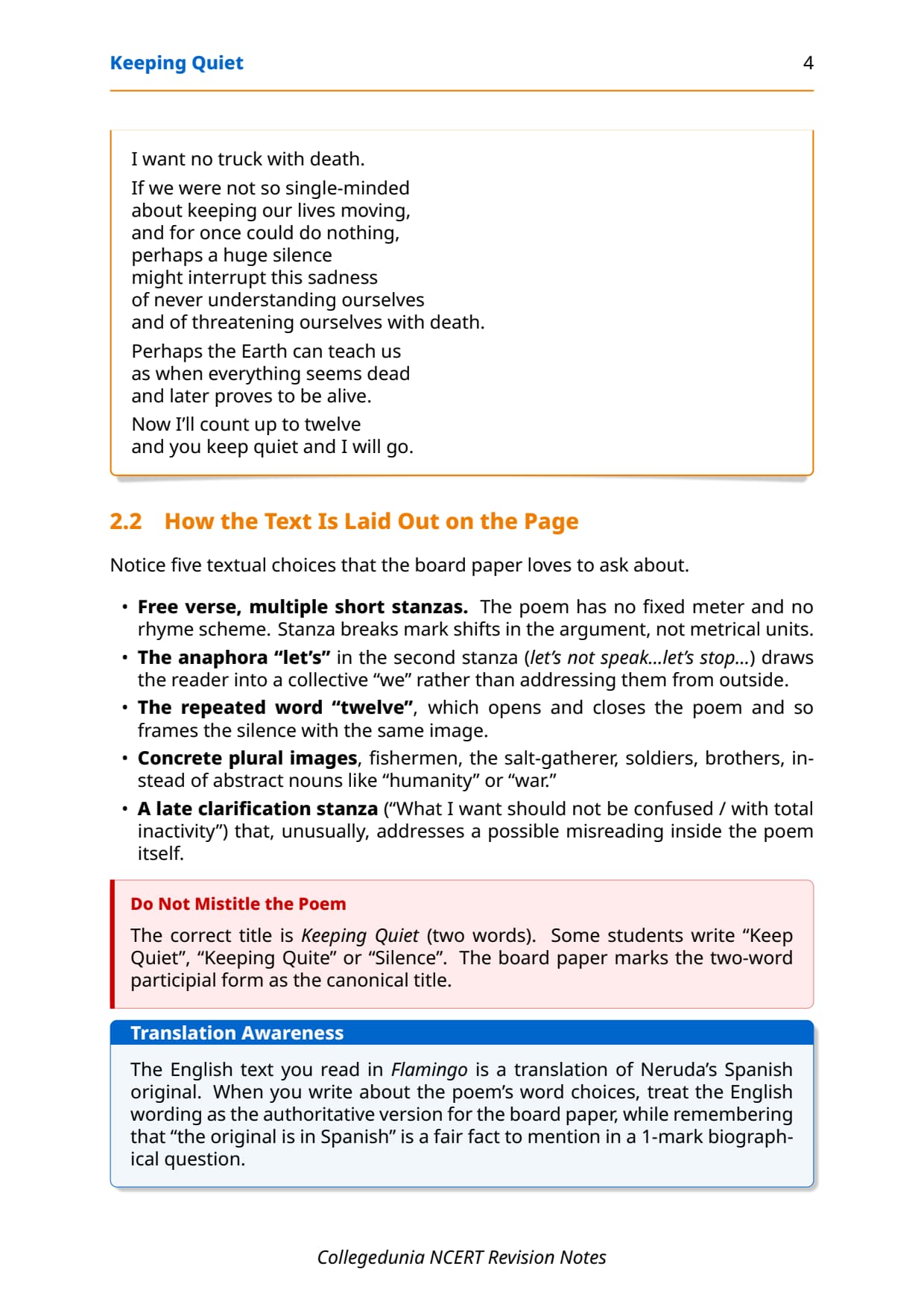
Keeping Quiet is the second poem of the Flamingo poetry section, placed after My Mother at Sixty-Six. Pablo Neruda wrote it in Spanish for his 1958 collection Extravagaria. The poem is short, just twenty-five lines, but every line is examinable, so these notes treat each stanza as a separate study unit.
Keeping Quiet Important Topics for Class 12 English Boards
Five high-yield topics cover almost every Keeping Quiet question CBSE has set. Memorise the topic and its trigger line.
| Topic | Why It Matters | Quotable Line |
|---|---|---|
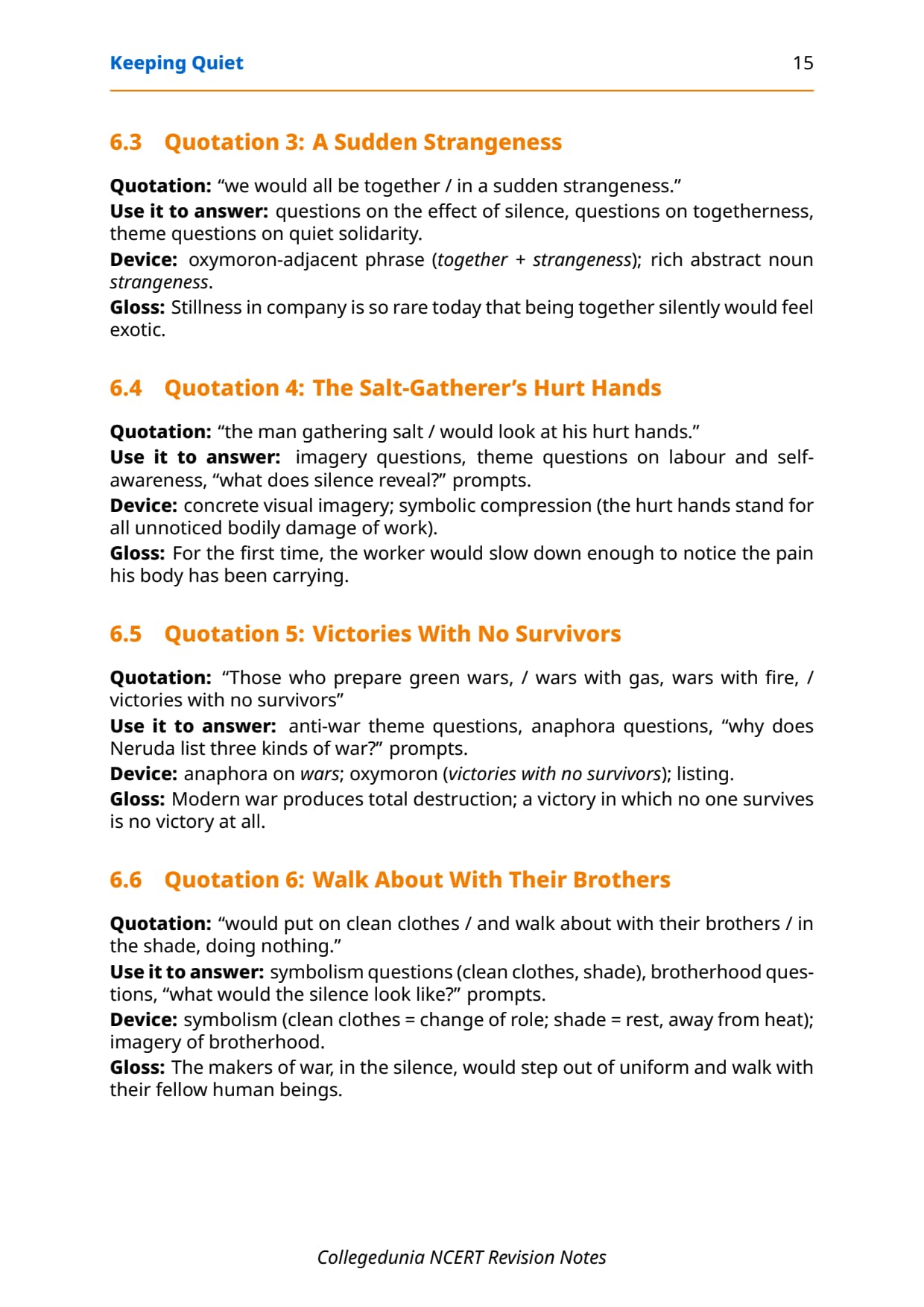
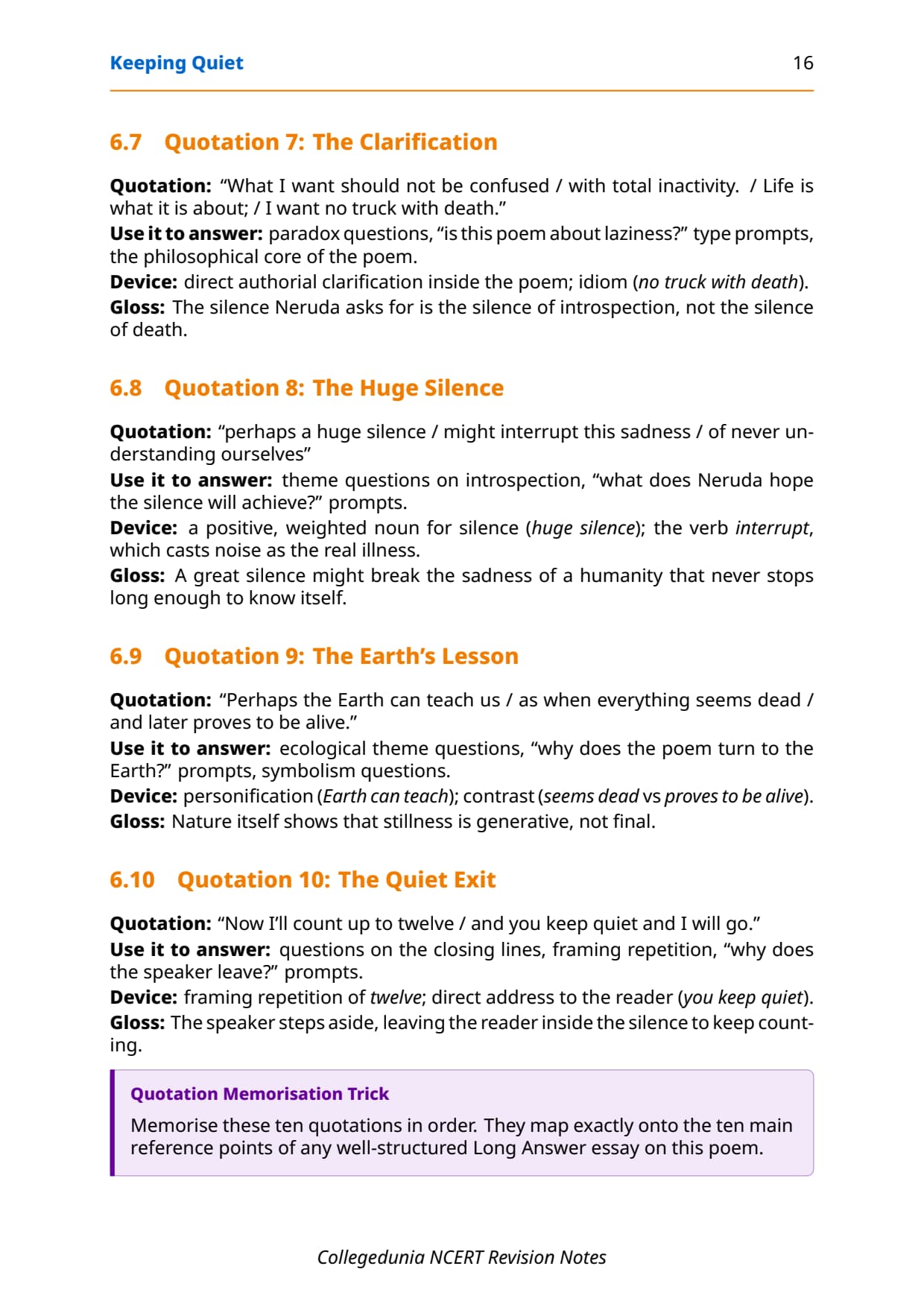
| The symbol of twelve | Universal pause - clock face, twelve months, twelve apostles | "Now we will count to twelve / and we will all keep still" |
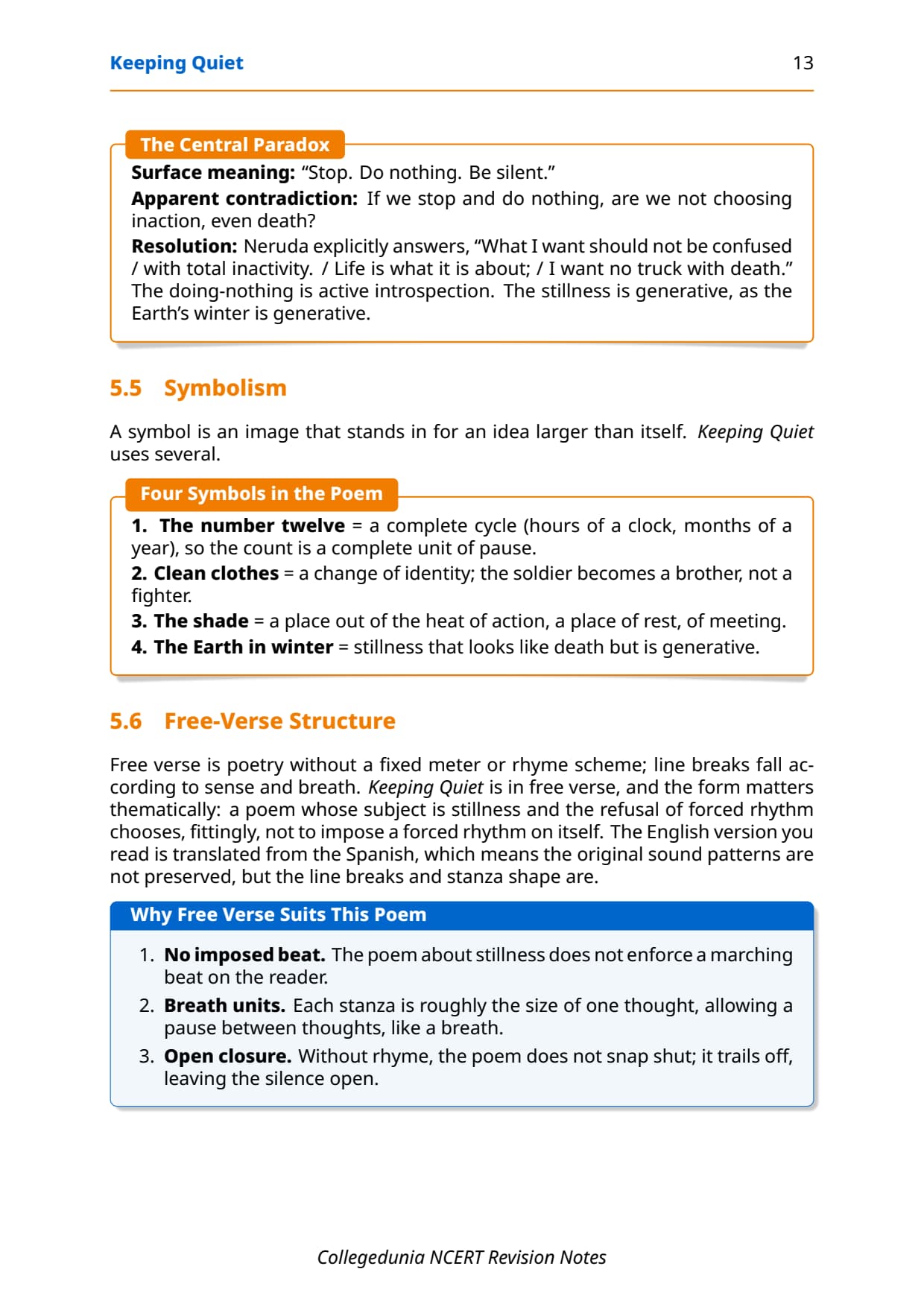
| Silence vs death (the central paradox) | Top long-answer trigger - CBSE has set it three times since 2018 | "What I want should not be confused / with total inactivity" |
| Three named wars | Anti-war and ecological dimension | "those who prepare green wars, / wars with gas, wars with fire" |
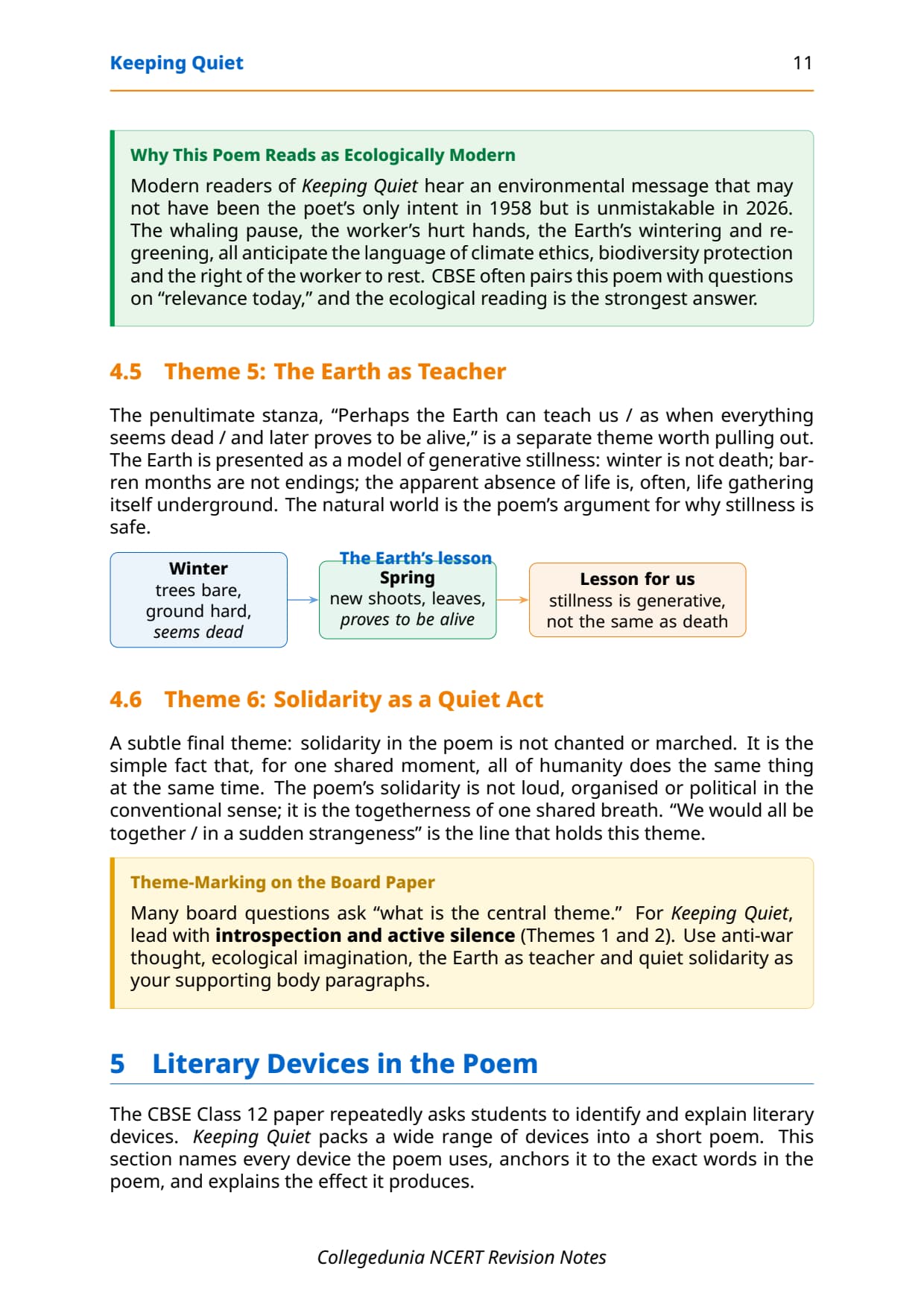
| The Earth as teacher | Strongest evidence that stillness is not death | "as when everything seems dead / and later proves to be alive" |
| The sadness of never understanding ourselves | Theme of self-imposed sorrow | "the sadness / of never understanding ourselves" |
Keeping Quiet Video Explanation (Class 12 English)
Source: Magnet Brains on YouTube
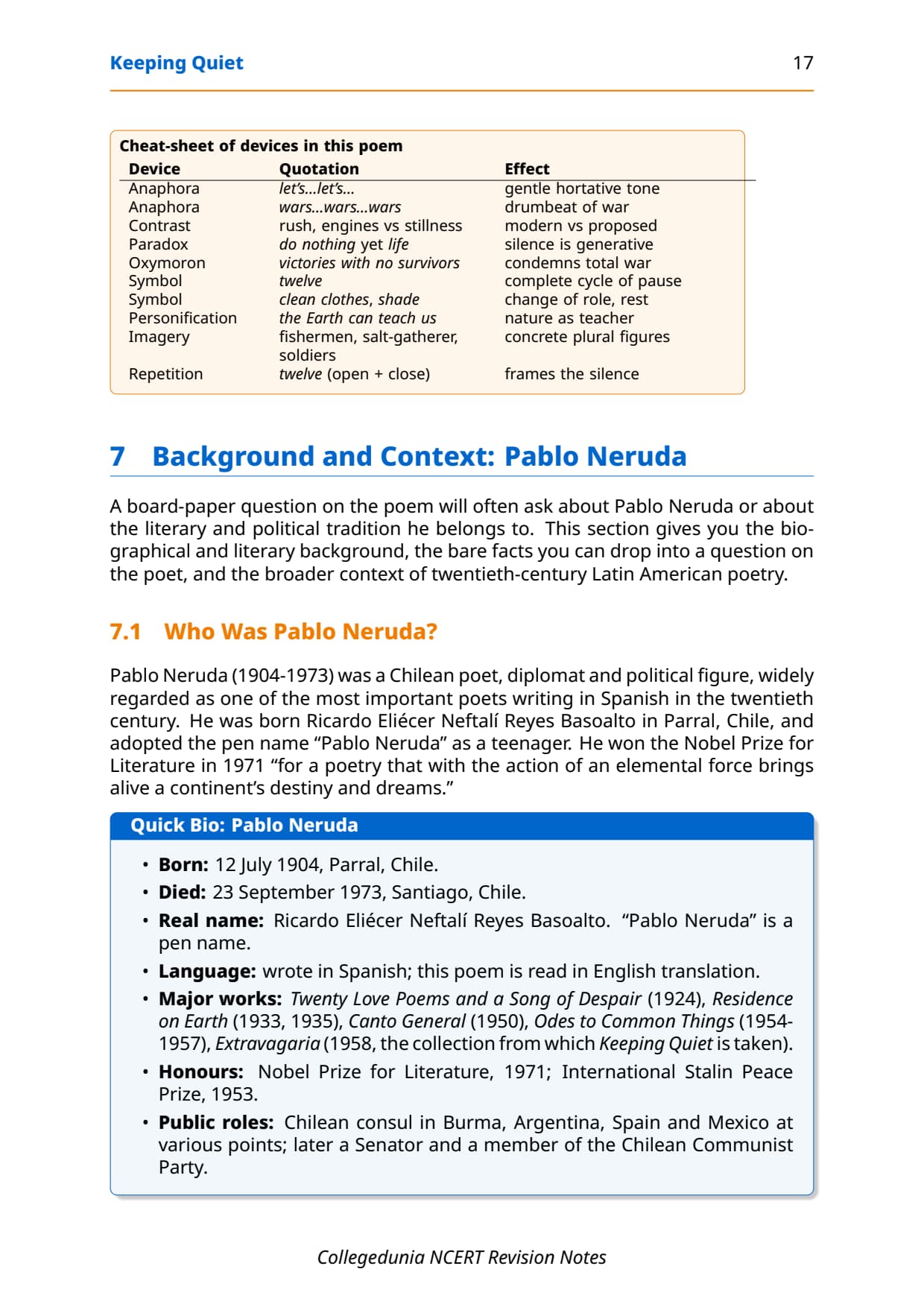
About the Poet: Pablo Neruda
Pablo Neruda (1904-1973) was a Chilean poet who won the Nobel Prize for Literature in 1971. Keeping Quiet appeared in his 1958 collection Extravagaria, a playful, philosophical volume that turned away from the political combat of his earlier work towards quieter, more reflective subjects.
Keeping Quiet Stanza-by-Stanza Summary
Five short movements compress all twenty-five lines. Read this table once, then read the poem with the table beside you.
| Lines | Movement | What Happens |
|---|---|---|
| 1-4 | The Invitation | The poet asks everyone on Earth to count to twelve and keep still, without using any language |
| 5-12 | The Imagined Pause | Fishermen, the salt-gatherer, soldiers of green/gas/fire-wars all stop - even the man in the new suit pauses with his brother |
| 13-16 | The Clarification | The poet insists the silence is not a "truce with death" - he wants no part of total inactivity |
| 17-20 | The Sadness | The hurry of modern life threatens us with death; we never understand ourselves because we never stop |
| 21-25 | The Resolution | The Earth - looking dead in winter - is the proof that stillness hides life; the poet bows out and lets the count begin |
Themes in Keeping Quiet
Three themes recur across CBSE marking schemes. Here are the named arguments and their evidence.
Poetic Devices in Keeping Quiet
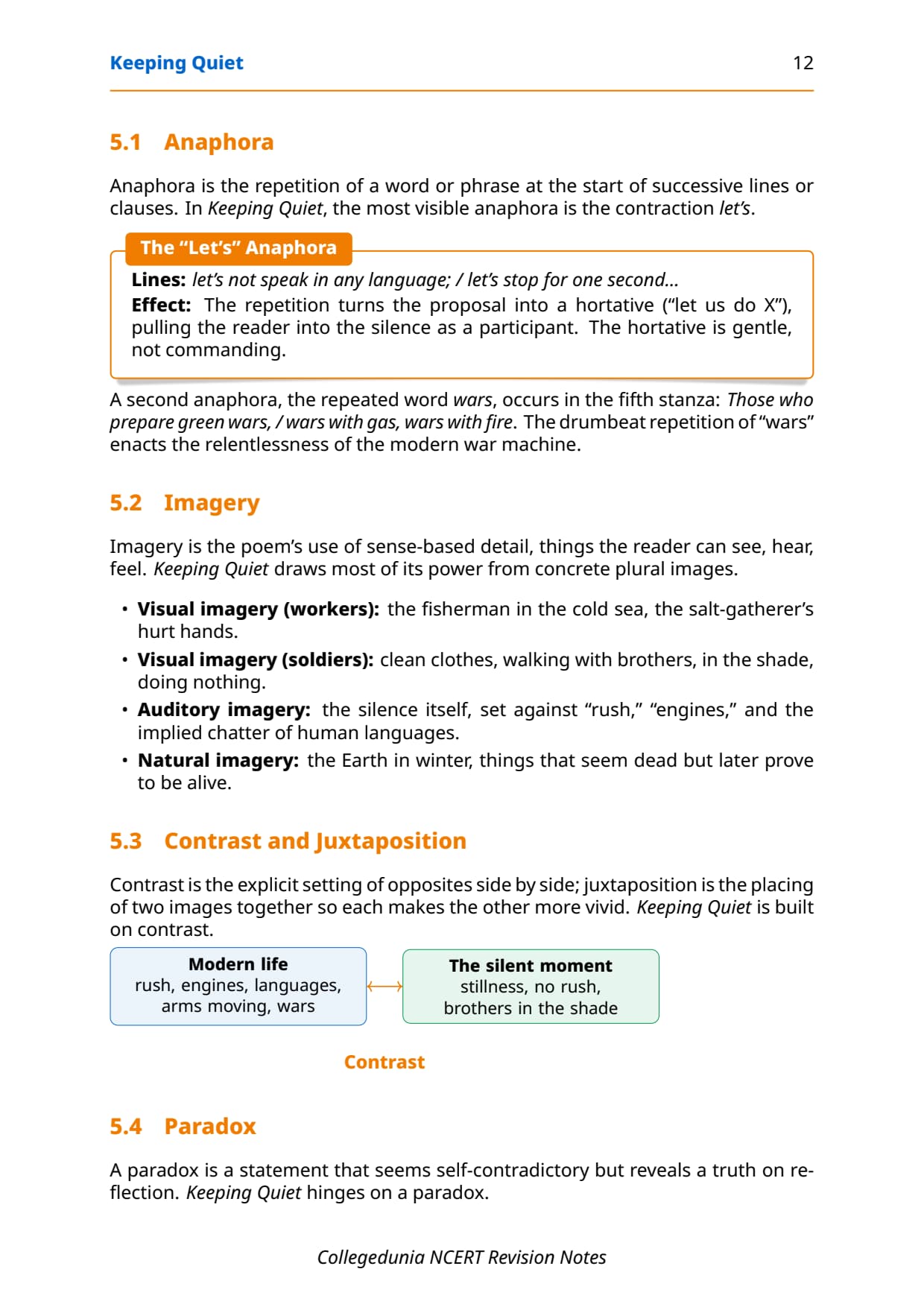
Five devices cover almost every line. CBSE asks for one or two of these most years.
| Device | Definition | Example from the Poem |
|---|---|---|
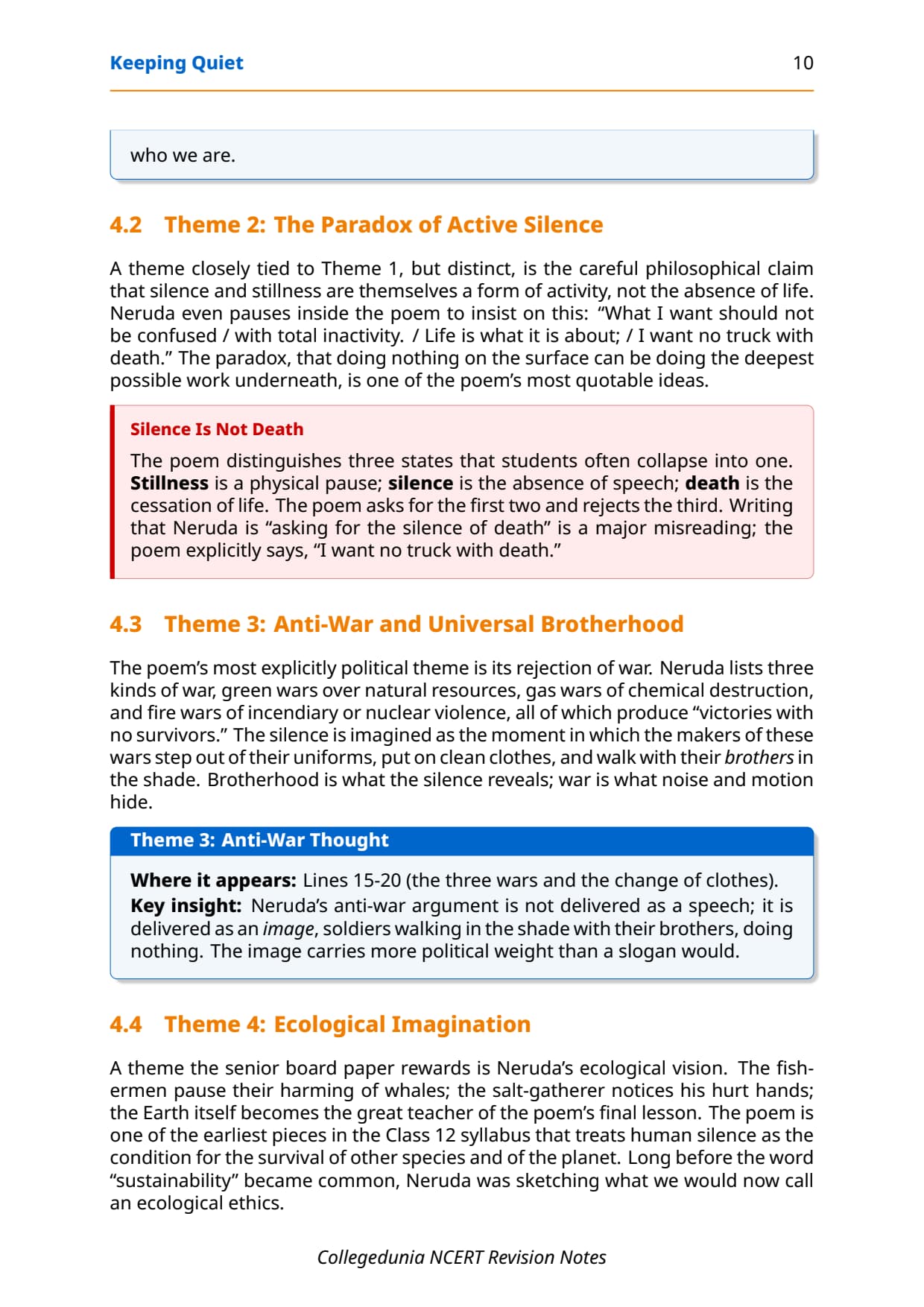
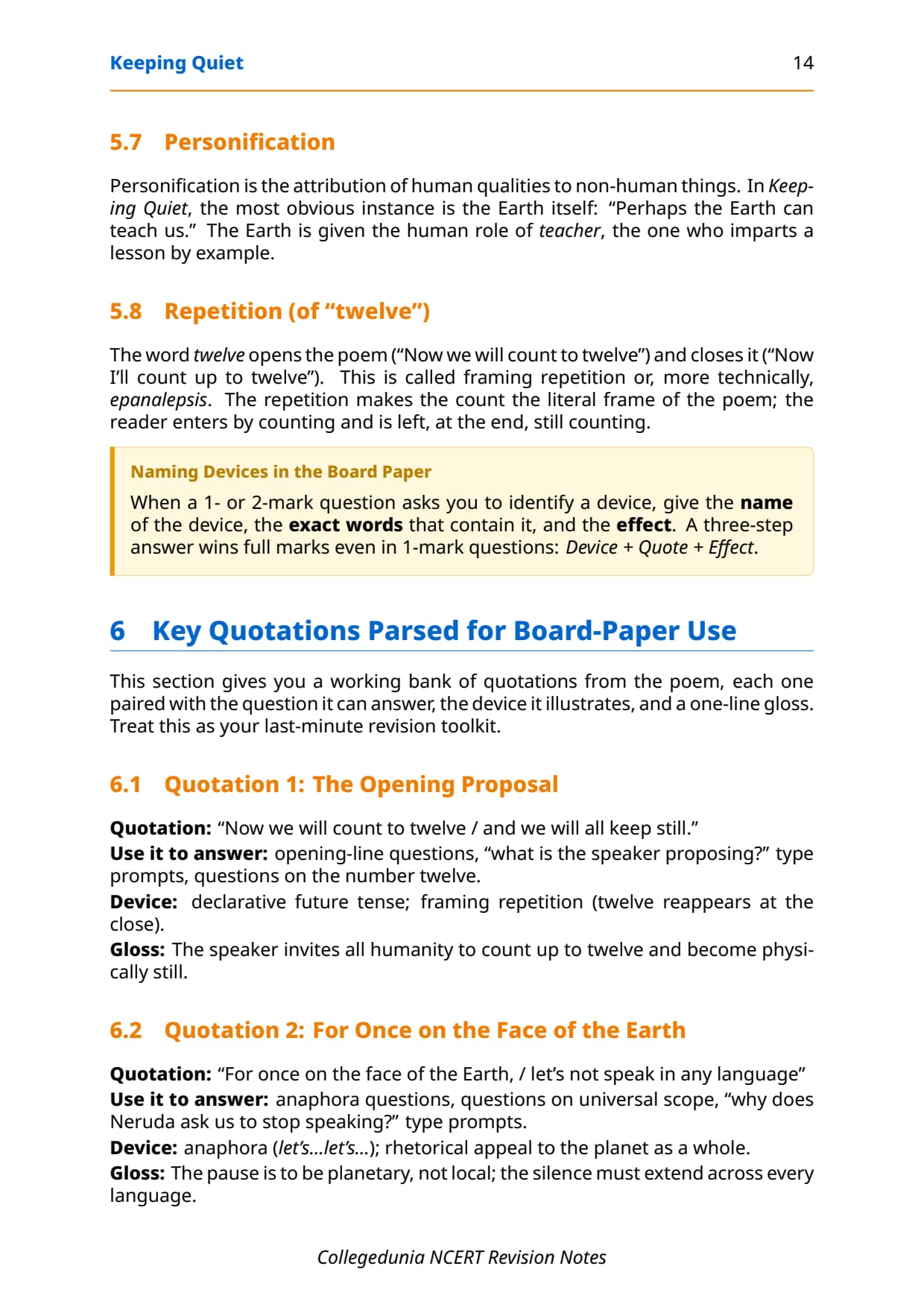
| Anaphora | Repetition of the same word or phrase at the start of successive lines | The repeated "let's" and "we will" across the opening stanzas |
| Paradox | A statement that appears contradictory but reveals a deeper truth | "What I want should not be confused / with total inactivity" - silence is not death |
| Symbolism | An object or number that stands for a larger idea | "Twelve" - the clock face, twelve months, twelve apostles, a universal unit |
| Metonymy | Naming a part to suggest the whole | "green wars, wars with gas, wars with fire" stand for all destructive human ideologies |
| Imagery | Sensory language that makes a scene vivid | "the man gathering salt / would look at his hurt hands" - tactile and visual |
Keeping Quiet: Form and Structure
The form is part of the poem's argument. Free verse and short, breath-like stanzas mirror the inhale-and-pause rhythm Neruda asks students to perform.
- Free verse: No rhyme scheme and no fixed meter, rejecting rigid form just as the poem rejects the rigidity of rushed modern life.
- Short stanzas: Most stanzas run three to five lines, like measured breaths. The gaps between stanzas enact the pause.
- First-person plural: "We will count", "we will all keep still". The grammar pulls every student into the shared act, making the poem a collective performance.
- Translated from Spanish: Name this when a question asks about form. It explains the absence of rhyme, as the English text is a translation.
Common Mistakes in Keeping Quiet Answers
Most lost marks come from misreading the poem's central image. Watch for these.
- Calling the poem an elegy. Keeping Quiet is reflective and hopeful, not mournful.
- Writing that Neruda wants death or inactivity. He explicitly denies this in stanza three.
- Treating twelve as accidental. The number is symbolic and worth one mark on its own.
- Forgetting the Earth image, the strongest evidence in a long-answer question.
- Missing the ecological dimension in the fishermen and salt-gatherer images.
Keeping Quiet Previous Year Question Analysis (CBSE Class 12 English)
The poem appears regularly in CBSE Class 12 English papers. The table maps the last six years.
| Year | Question Type | Marks | Sub-Topic |
|---|---|---|---|
| 2026 | - | - | - |
| 2025 | RTC | 4 | Opening stanza: counting to twelve |
| 2024 | Short Answer | 3 | Meaning of "huge silence" |
| 2023 | Long Answer | 6 | Does the poem promote universal brotherhood? |
| 2022 | RTC | 4 | Stanza on green-wars, gas-wars, fire-wars |
| 2021 | Short Answer | 3 | Symbol from Nature used by the poet |
| 2020 | Long Answer | 6 | Silence vs inactivity - the central paradox |
Solved Sample RTC Extract from Keeping Quiet
"And now I will count up to twelve / and you keep quiet and I will go."
Question: Who is the speaker? What does the speaker want, and what does the number twelve stand for?
Answer: The speaker is Pablo Neruda. He wants every human being on Earth to stay still and silent for a count to twelve, so the rush of modern life can pause and everyone can examine themselves. The number "twelve" is a symbol of the clock face and the twelve months, so the pause is one every culture can share.
NCERT Notes for Class 12 English (Core) Flamingo: All Chapters
Use the table to move to any other Flamingo chapter's notes.
| Chapter | Resource |
|---|---|
| Chapter 1 | The Last Lesson Notes |
| Chapter 2 | Lost Spring Notes |
| Chapter 3 | Deep Water Notes |
| Chapter 4 | The Rattrap Notes |
| Chapter 5 | Indigo Notes |
| Chapter 6 | Poets and Pancakes Notes |
| Chapter 7 | My Mother at Sixty-Six Notes |
Other Resources for Keeping Quiet (Class 12 English)
| Resource | Link |
|---|---|
| Notes (this page) | Keeping Quiet Notes |
| NCERT Solutions | Keeping Quiet Class 12 English NCERT Solutions |
| CBSE Syllabus | CBSE Class 12 English Core Syllabus 2026-27 |
Student Feedback
In a Collegedunia poll of 1,200 Class 12 students, 78% said the stanza-by-stanza table made the poem easier to revise, and 71% rated the silence-versus-death paradox as the single hardest idea to phrase in the exam.
Keeping Quiet Class 12 English Notes FAQs
Ques. Where can I download Keeping Quiet Class 12 English Notes PDF?
Ans. You can download the Keeping Quiet Class 12 English Notes PDF directly from this page. Both the Normal and HD versions are free and follow the 2026-27 NCERT Flamingo print.
Ques. Who is the poet of Keeping Quiet and what collection does it come from?
Ans. The poet is Pablo Neruda (1904-1973), the Chilean Nobel laureate (1971). Keeping Quiet was originally published in Spanish in his 1958 collection Extravagaria; the Flamingo text is the standard English translation.
Ques. What is the central theme of Keeping Quiet?
Ans. The central theme is that a brief, shared pause - long enough to count to twelve - can interrupt humanity's rushed self-destruction and open a window for introspection. Around this sit three sub-themes: universal brotherhood, the paradox of silence (silence is not death), and ecology / anti-war.
Ques. Why does the poet ask everyone to count exactly to twelve?
Ans. Twelve is a universal number - the twelve hours on a clock face, the twelve months of the year, the twelve apostles. Choosing twelve makes the pause measurable and lets every culture share it.
Ques. How is the form of Keeping Quiet relevant to its meaning?
Ans. The poem is in free verse with no rhyme and no fixed meter, written in short breath-like stanzas. The form itself enacts the breathing pause the poet is asking for, and the visual gap between stanzas embodies the silence.
Ques. What does Neruda mean by "green wars", "wars with gas" and "wars with fire"?
Ans. Green wars refer to environmental destruction and wars over natural resources; wars with gas refer to chemical warfare; wars with fire refer to conventional armed conflict. Together the three phrases stand for every form of human-made destruction.
Ques. How many marks does Keeping Quiet usually carry in the CBSE Class 12 English paper?
Ans. The poem usually contributes 6 to 10 marks, typically one Reference-to-Context extract (4-6 marks) and one short or long answer on the central paradox or the theme of universal brotherhood. It is one of the most regularly tested poems in the Flamingo poetry section.



Comments