




Class 12 English Chapter 3 Flamingo Prose: Deep Water carries 9 to 11 marks in the CBSE Board paper, usually a 3-mark Short Answer plus a 6-mark Long Answer from Understanding the Text. This page hosts the Deep Water notes PDF, sub-topic weightage, theme stack, and the 2026-27 question pattern.
- CBSE Board Weightage: 9 to 11 marks; a Long Answer on the cure or the fear theme is the usual item.
- Most-Asked Sub-Topic: The instructor's four-stage drill; in 4 of the last 6 Board sittings.
- Latest 2026-27 Status: Retained in the Flamingo Prose block with no content removed.
The notes below cover a topic-wise weightage table, a phase-by-phase summary, the theme stack, character notes, and the six Board questions repeated since 2019.
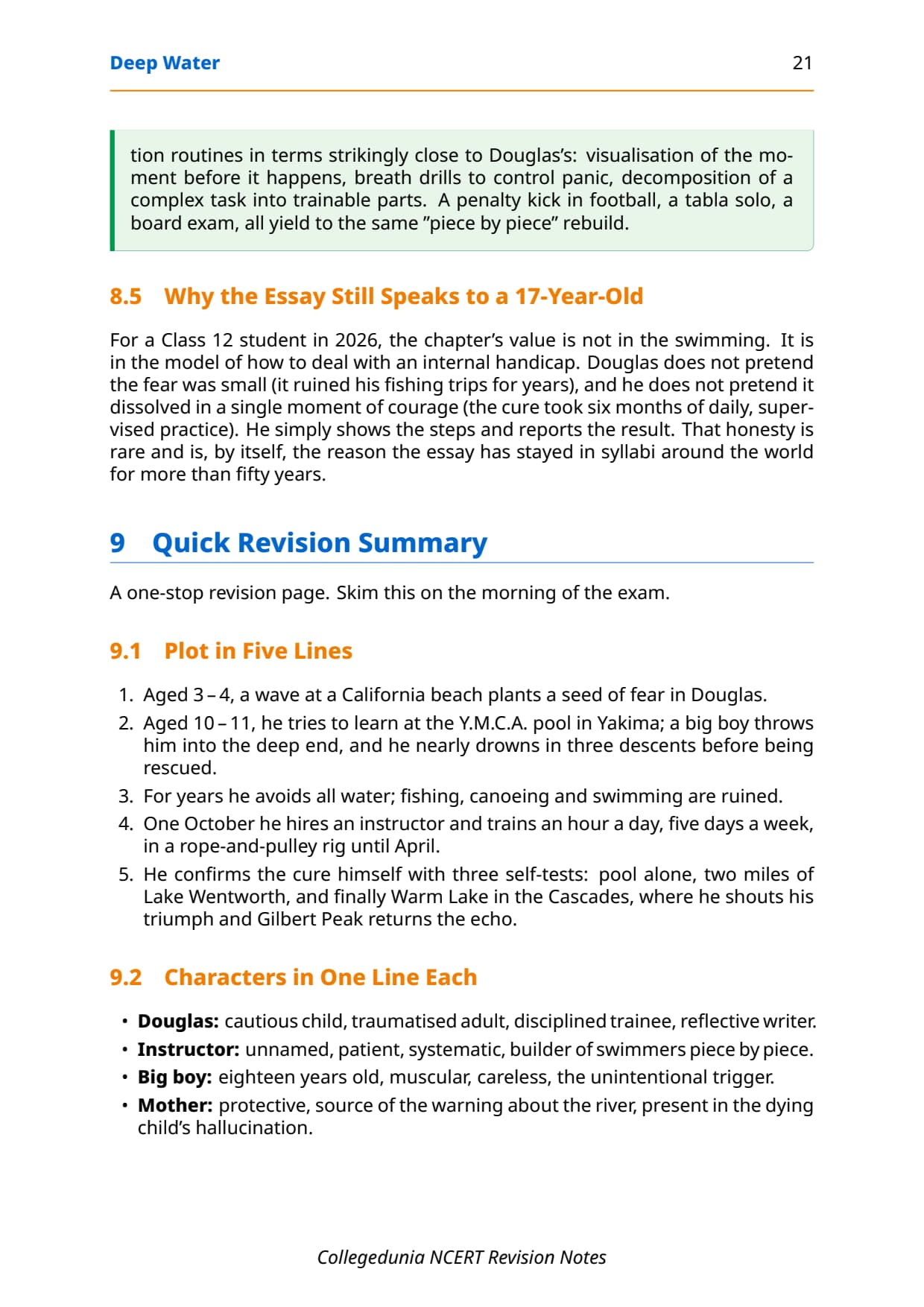
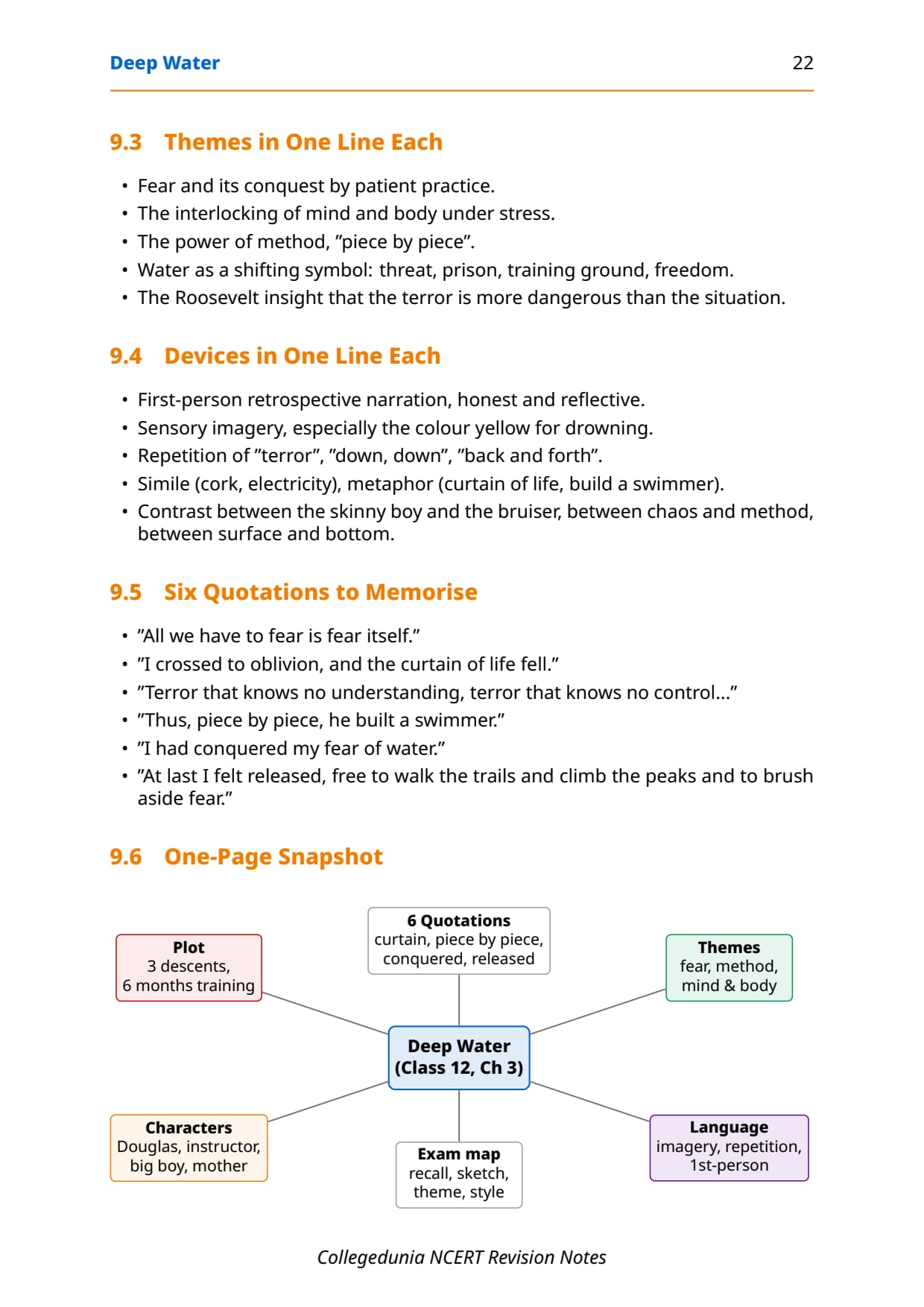
These notes are written by Collegedunia English faculty, mapped to the 2026-27 Flamingo Prose chapter, and benchmarked against the last five CBSE Board and Compartment papers.
Class 12 English Notes Chapter 3 Flamingo Prose: Deep Water Topic-wise Weightage for CBSE Boards
The chapter splits into four narrative phases. The table maps each phase to its Board weightage and expected answer length.
| Phase / Sub-Topic | Board Weightage | Common Answer Length |
|---|---|---|
| Phase 1: The YMCA misadventure (three descents) | High | 3-mark SA; occasional 5-mark on the panic sequence |
| Phase 2: Lifelong hydrophobia | Low to Medium | 3-mark SA or a value prompt |
| Phase 3: The instructor's four-stage drill | High | 6-mark LA; the most-repeated item |
| Phase 4: Warm Lake / Lake Wentworth validation | Medium | 3-mark SA on the open-water test |
Phases 1 and 3 carry about two-thirds of the Board weight, so revise in this order: misadventure, drill, validation, hydrophobia.
Deep Water Video Explanation (Class 12 English)
Source: Magnet Brains on YouTube
Class 12 English Notes Chapter 3 Flamingo Prose: Deep Water Phase-by-Phase Summary
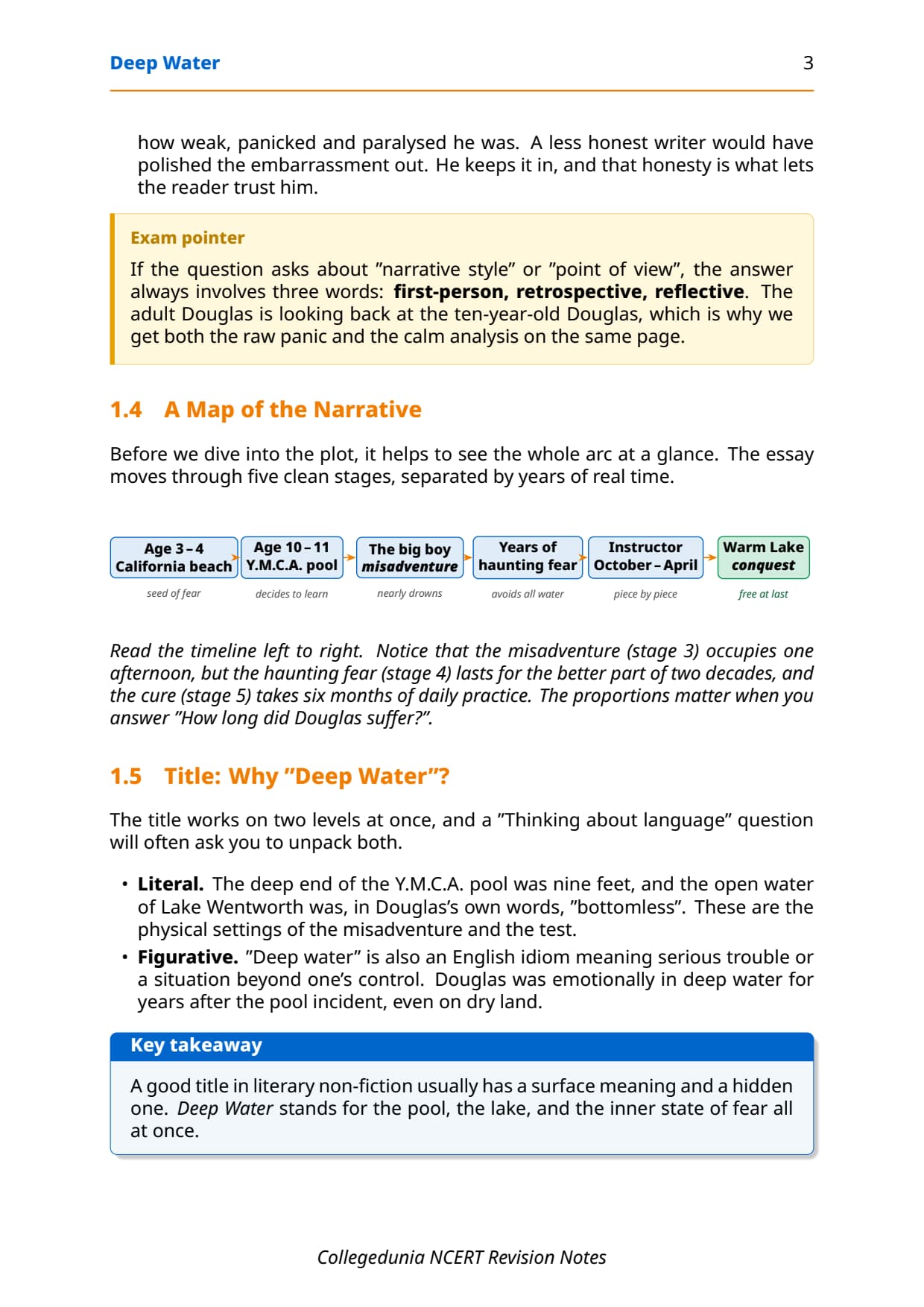
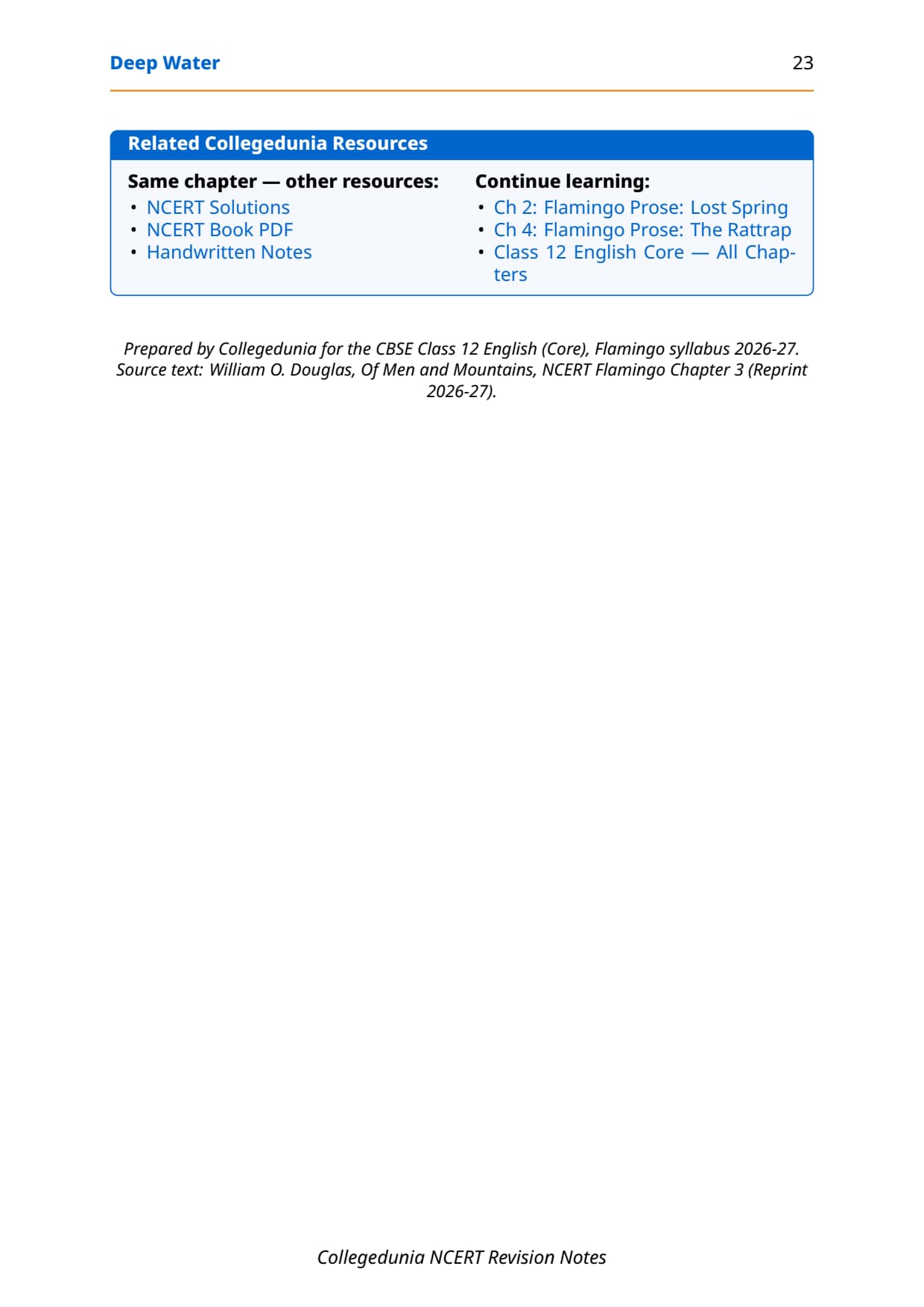
Phase 1: The YMCA Pool Misadventure
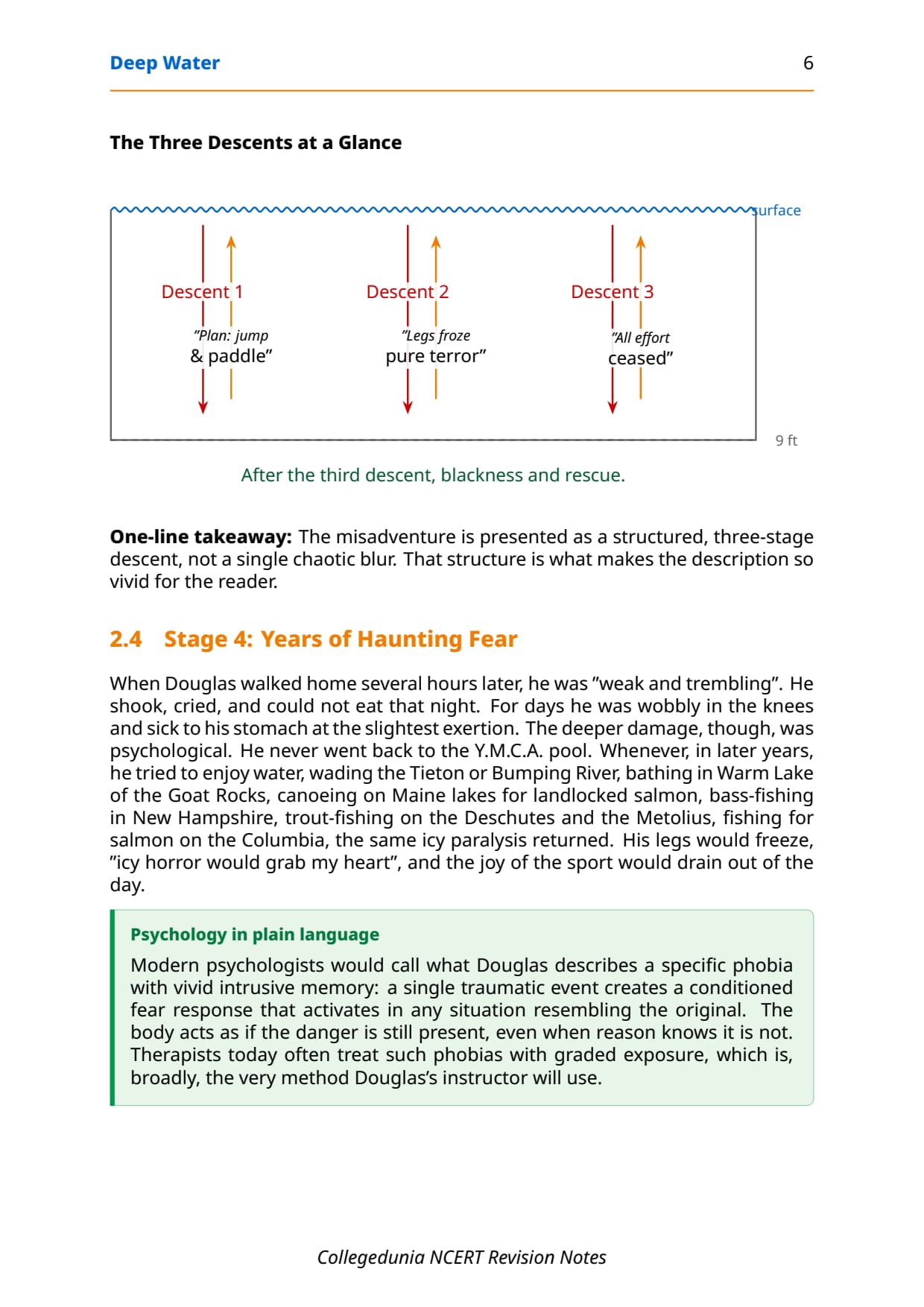
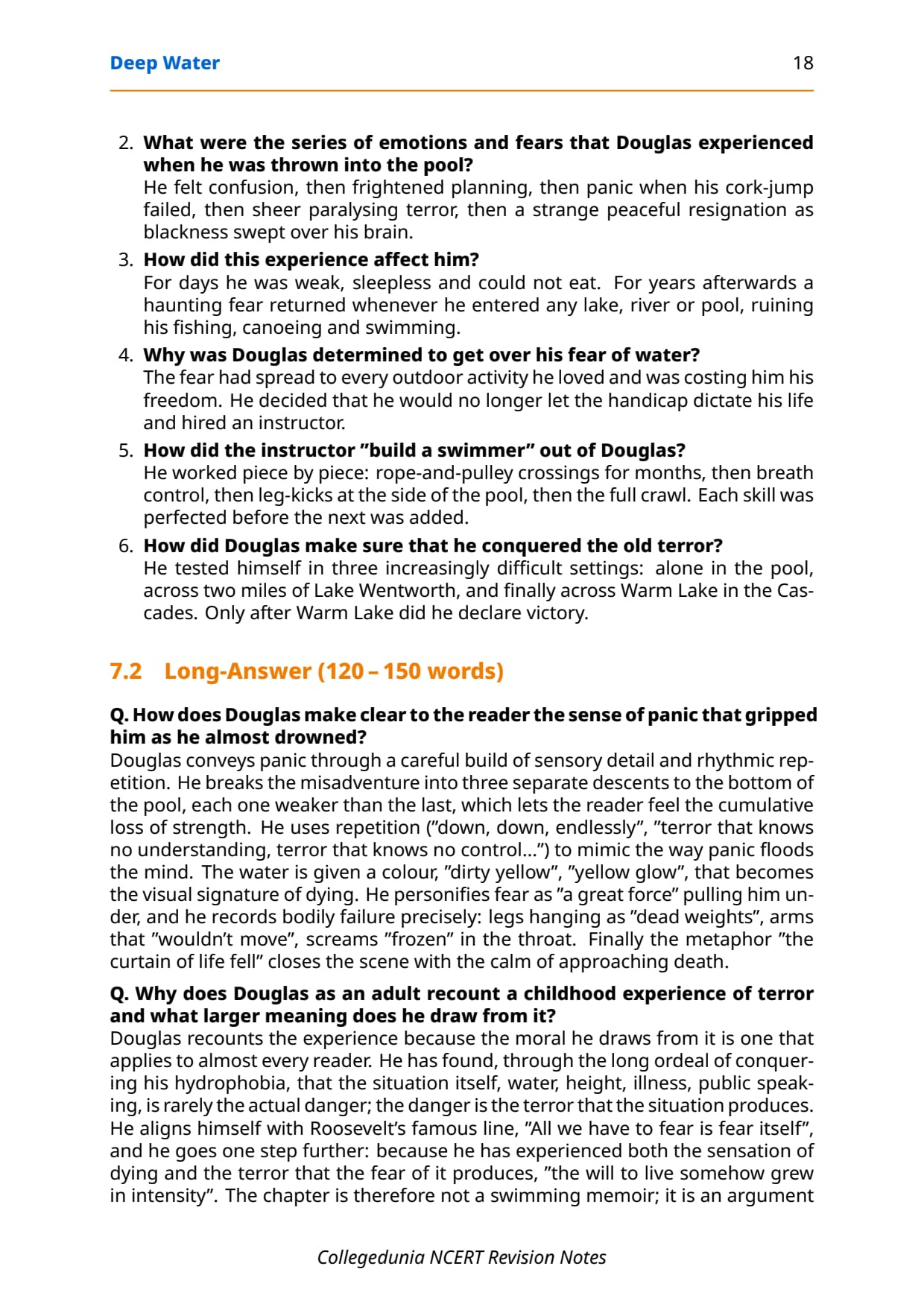
Douglas, aged about ten or eleven, learnt at the YMCA pool in Yakima because Lake Wentworth was thought unsafe. A bigger boy tossed him into the nine-foot end as a joke. Douglas sank, saw "yellow water", and kicked off the bottom. He surfaced briefly, went down a second time, then a third. On the third descent he lost consciousness, was pulled out, and vomited on the deck.
Phase 2: Lifelong Hydrophobia
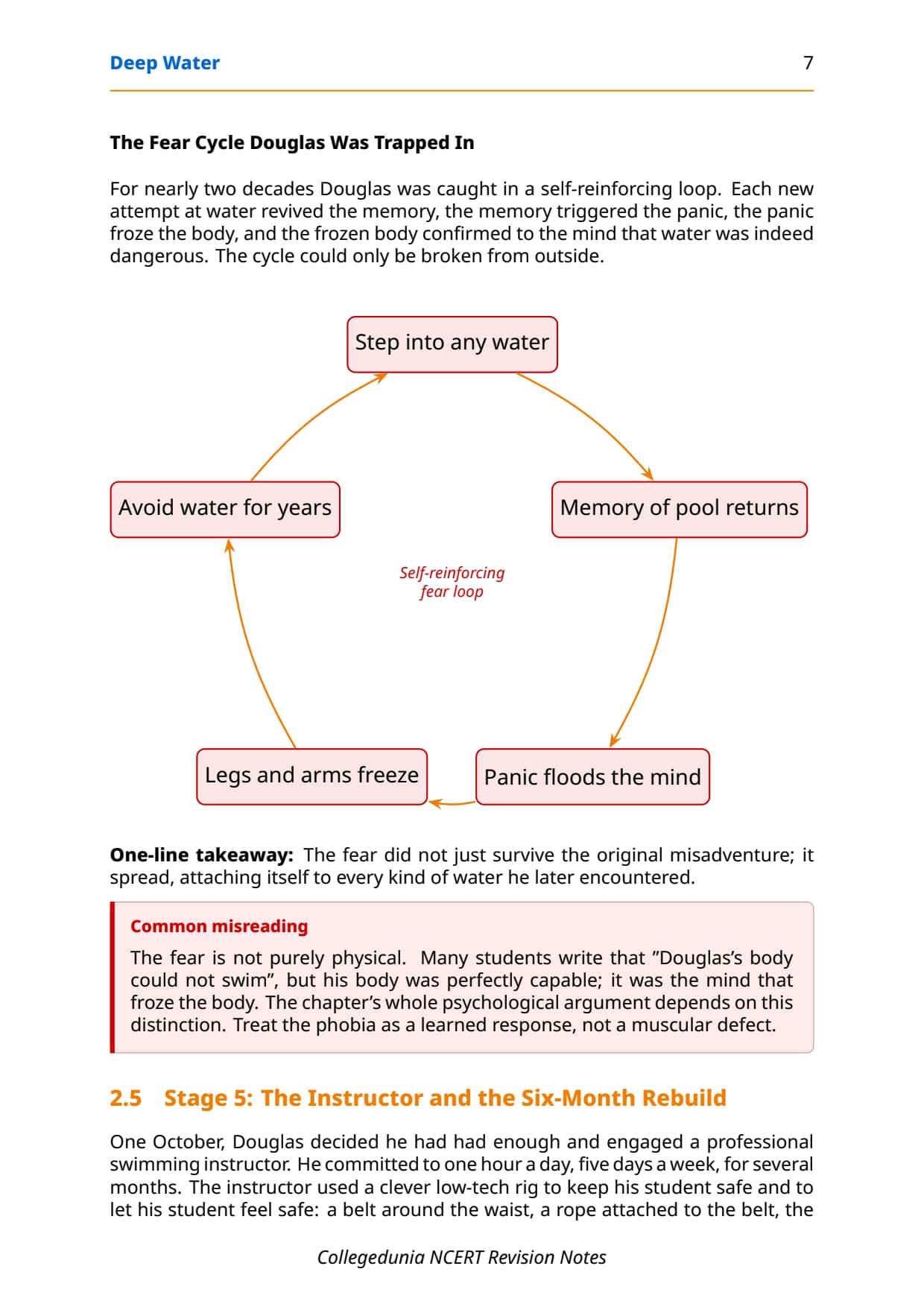
The misadventure left Douglas with a phobia that lasted years. Whenever he tried fishing, canoeing, or bathing, the fear gripped him: paralysed legs, a stiff jaw, a pounding heart. Even the streams he loved as an adult triggered dread. This fear was not embarrassment but a physical seizure.
Phase 3: The Instructor's Four-Stage Drill
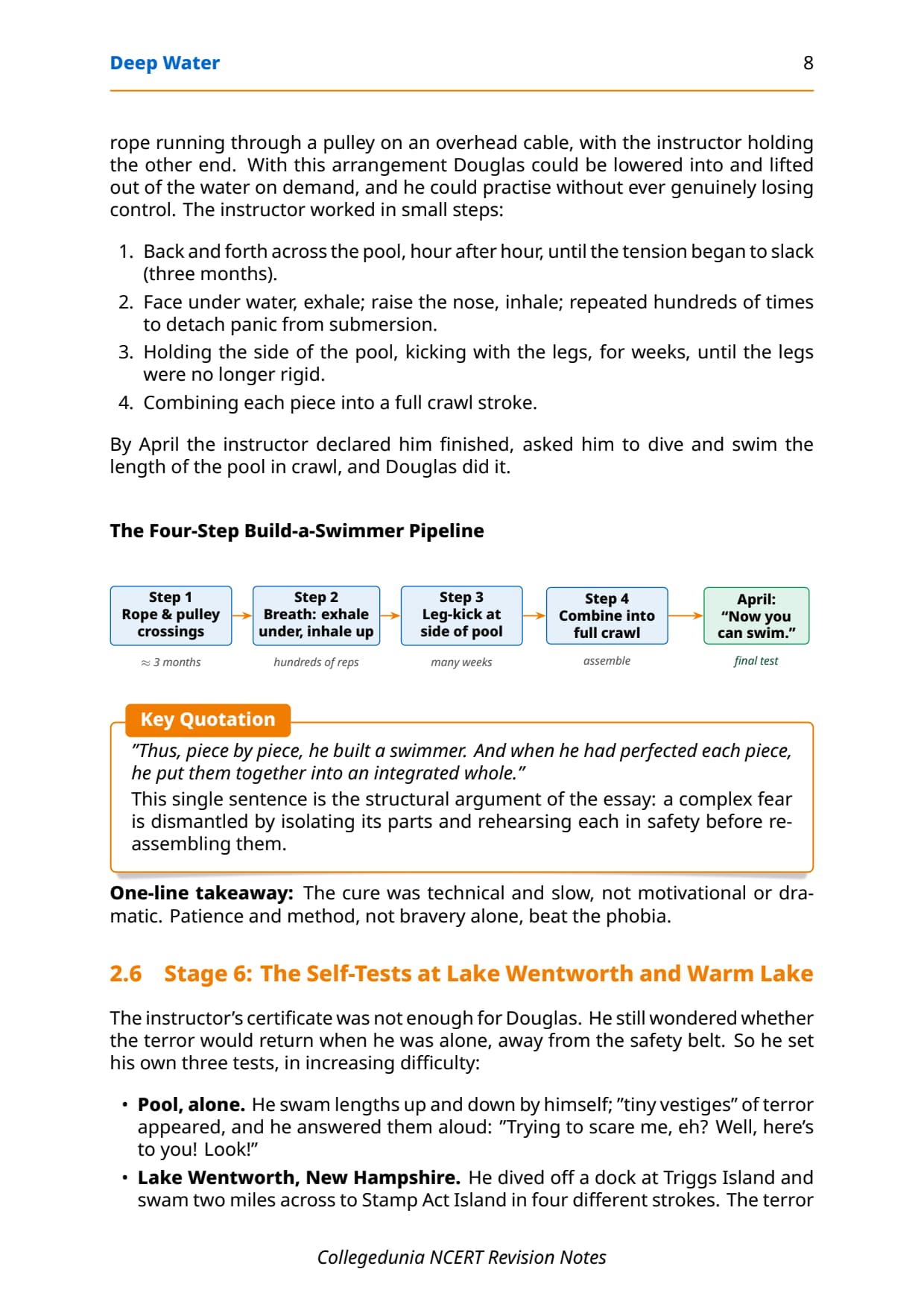
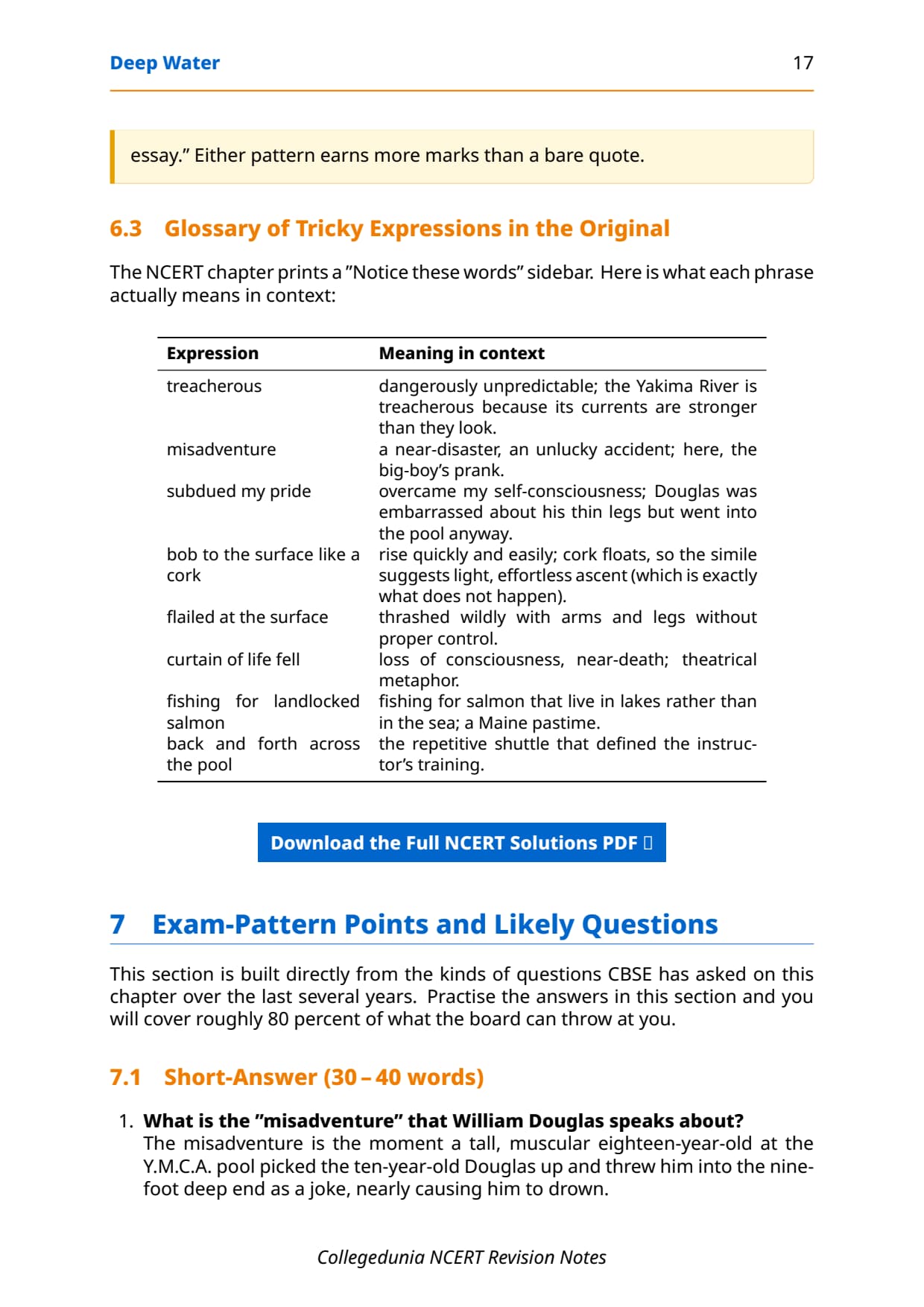
An instructor agreed to cure Douglas over months in four stages. First, a rope through a pulley was tied to a belt at his waist; the instructor walked the pool holding the rope while Douglas practised, and after three months the panic eased. Second came the breathing drill: exhale into the water, raise the head, inhale, repeat. Third, the leg-kick was drilled with a board. Fourth, arms, legs and breathing merged into one motion.
Phase 4: The Validation Swims
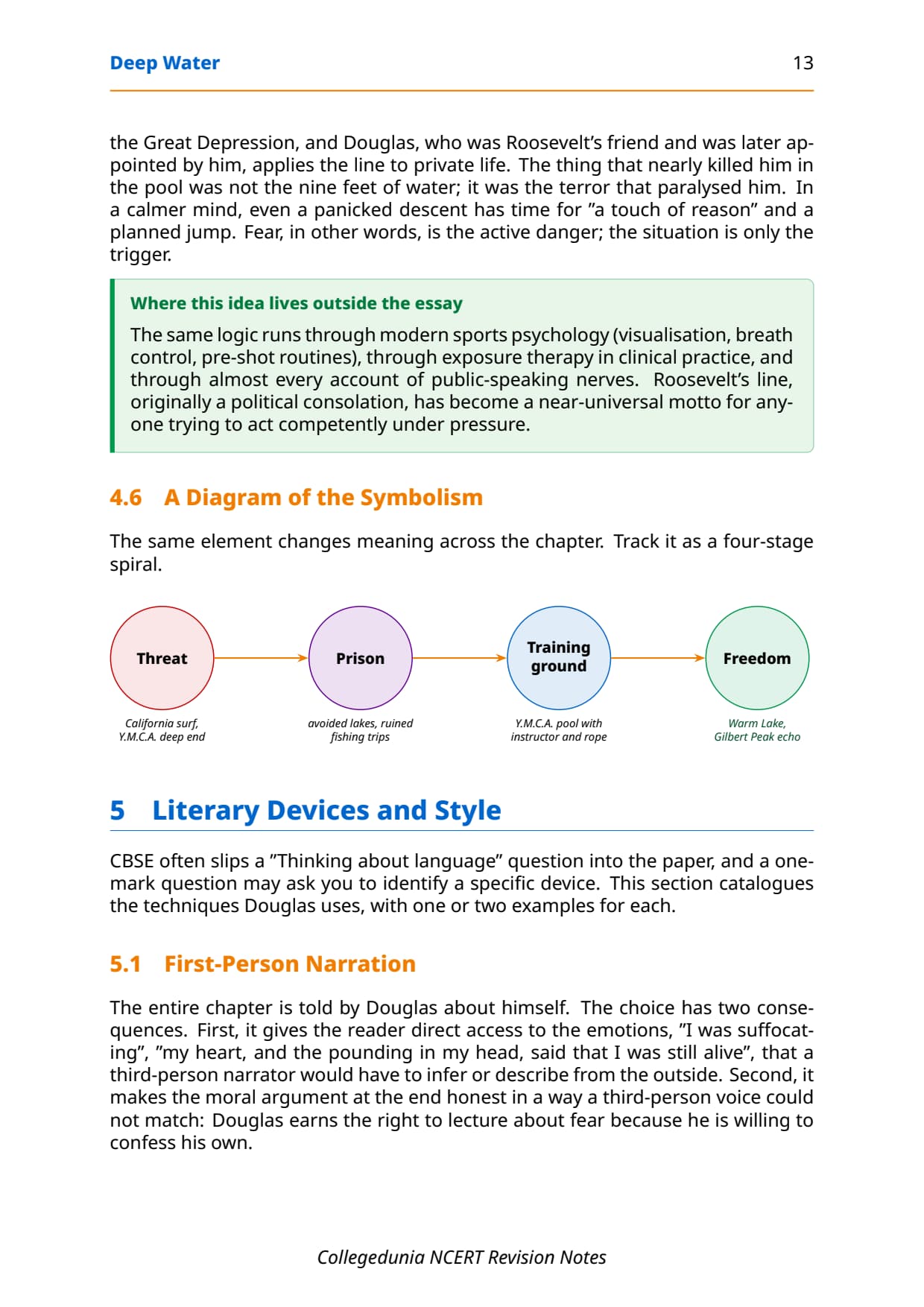
The instructor pronounced Douglas a swimmer, but he doubted whether the terror would return in open water. He swam two miles across Lake Wentworth alone; the fear stirred but did not seize him. To finish the test, he dived into Warm Lake near the Tieton and swam it and back. Walking out, he told himself, "I had conquered my fear of water."
Class 12 English Notes Chapter 3 Flamingo Prose: Deep Water Important Themes
The chapter turns on four interlocking themes, each mapped below to the textbook prompts the Board draws from.
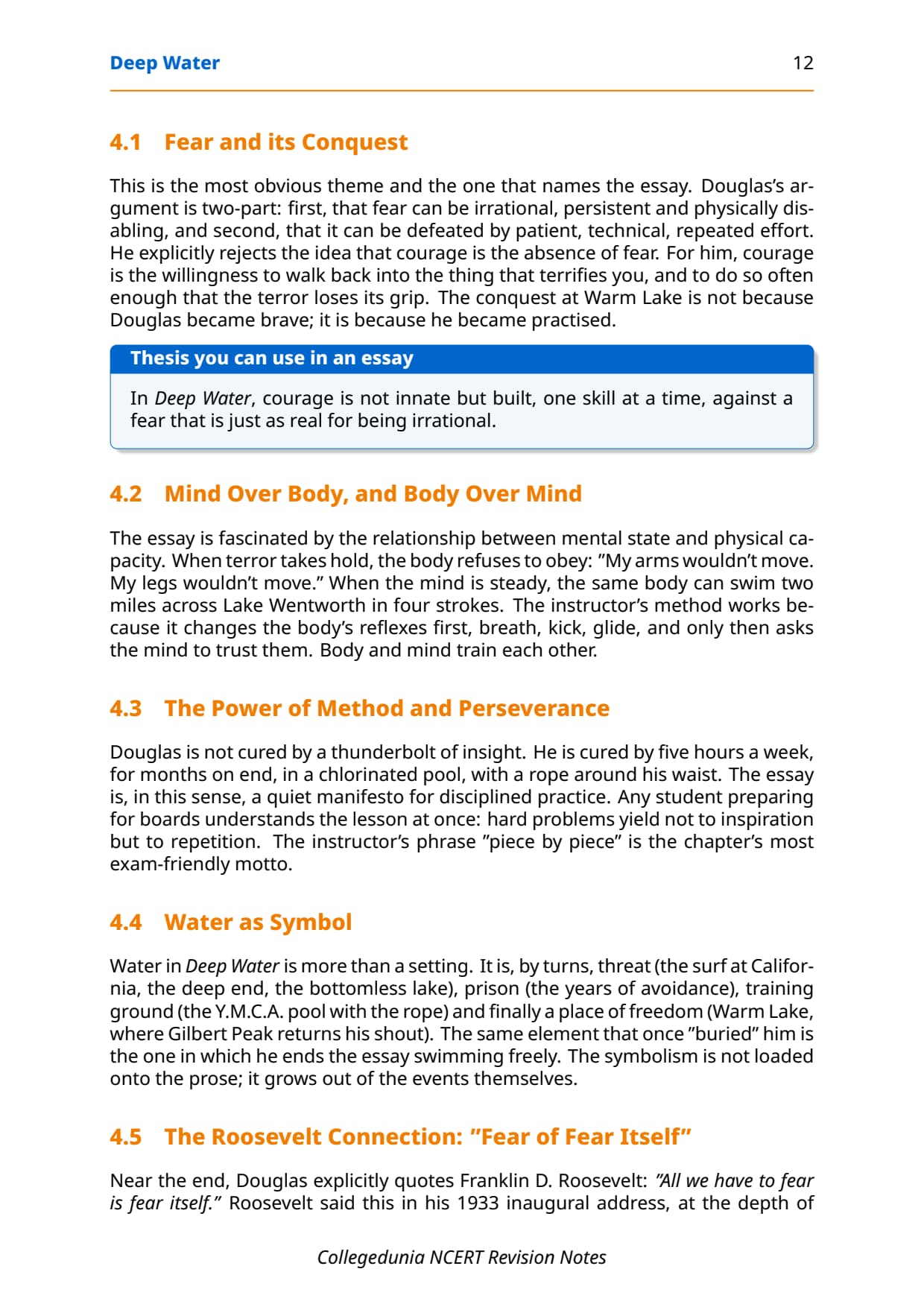
- Fear and its Conquest: The central theme. Fear is a phobia that seizes the body, and systematic practice, not willpower alone, defeats it. Maps to Understanding the Text Long Answers.
- The Role of Skilled Teaching: The instructor cures Douglas through patient, staged drill. Maps to "how did the instructor build a swimmer".
- Perseverance: Douglas tests the cure himself in open water, making self-validation a sub-theme. Maps to Talking about the Text prompts.
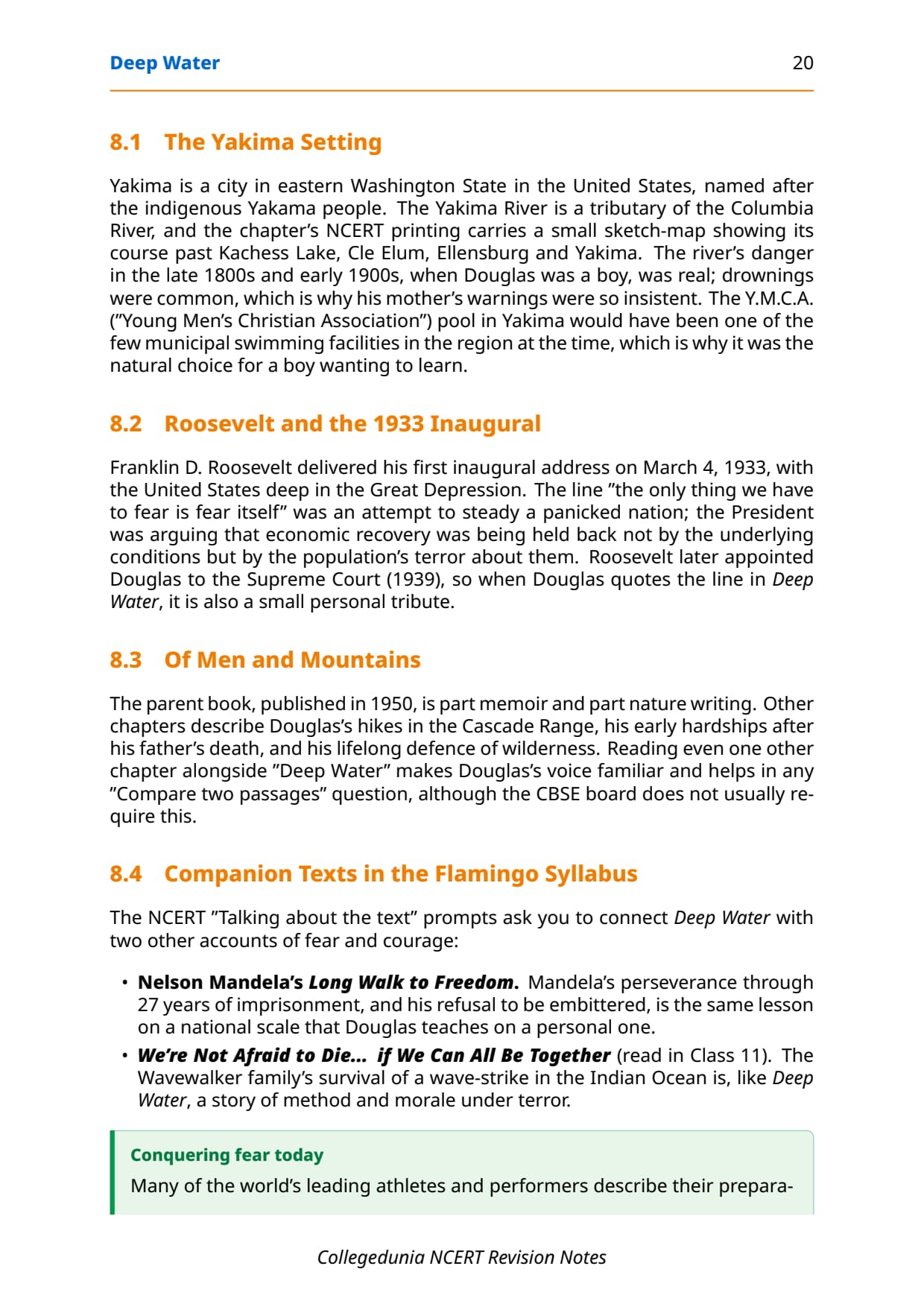
- The Fear of Fear: "The only thing we have to fear is fear itself" is the chapter's closing frame. Maps to value-based and quotation items.
Character Notes for Class 12 English Notes Chapter 3 Flamingo Prose: Deep Water
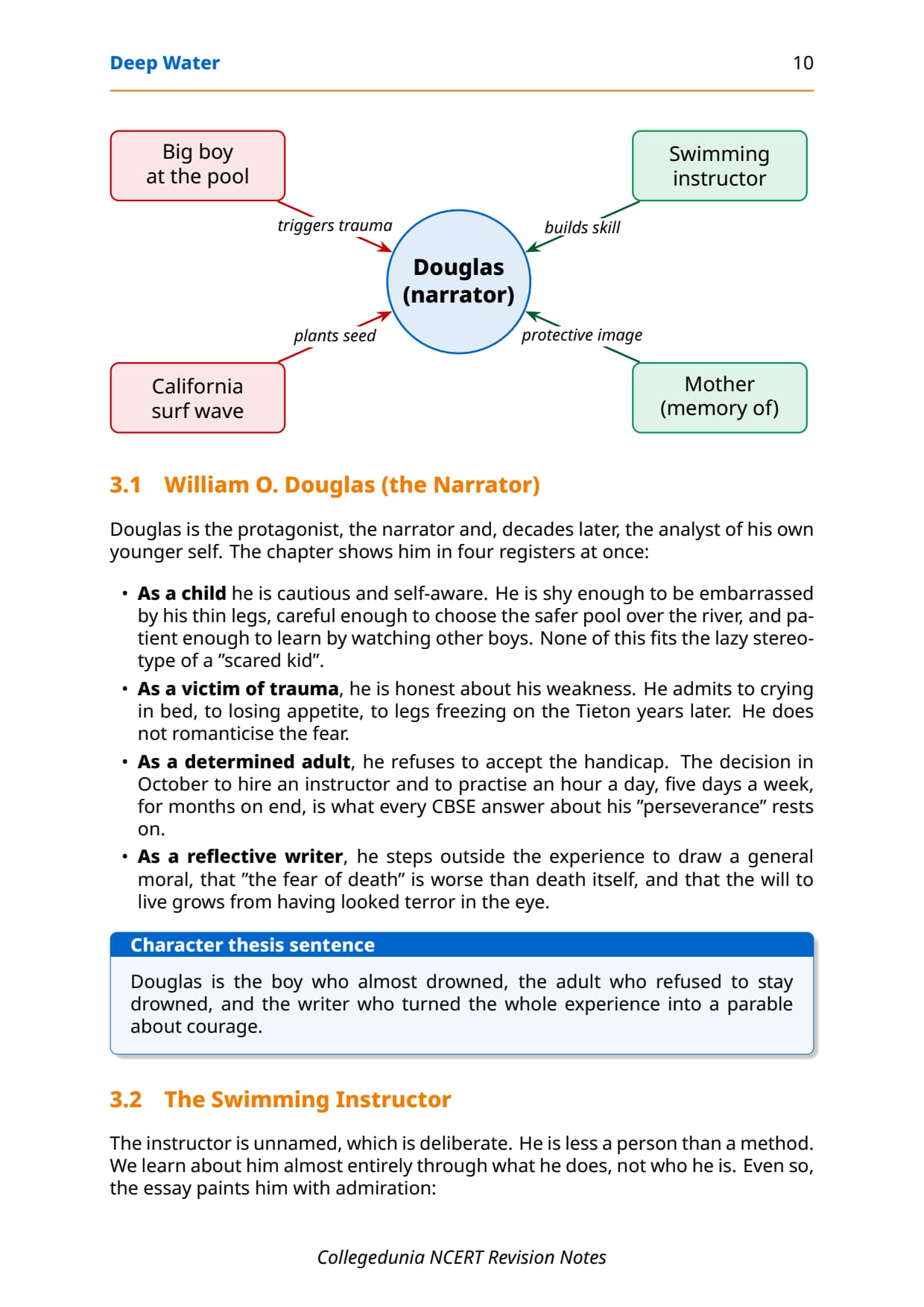
The chapter has two named figures plus an unnamed tormentor. Below are the traits Board markers look for.
| Character | Traits to Cite in Answers | Function in the Narrative |
|---|---|---|
| William O. Douglas (narrator) | Honest, reflective, determined, self-doubting yet self-tested | Sufferer of the phobia; the voice that frames the cure as universal |
| The unnamed swimming instructor | Patient, methodical, a builder rather than a motivator | Agent of the cure; shows that skilled teaching beats willpower |
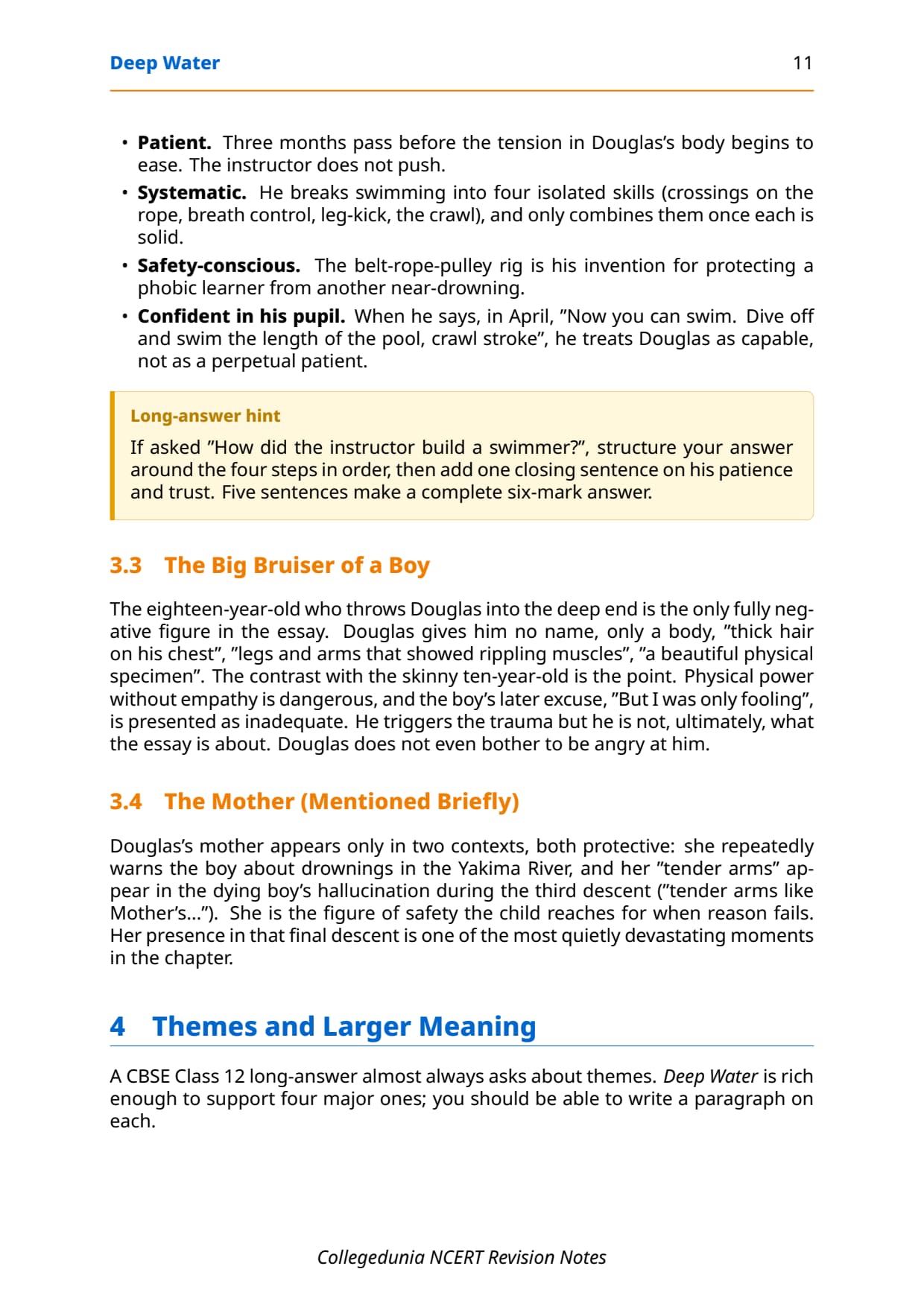
| The teenage "bully" at the YMCA | Thoughtless, careless, not malicious by Douglas's later reading | Trigger of the phobia; sets the central problem |
The Board sometimes asks for "the role of the instructor" versus "the instructor's method". The first wants the trait list above; the second wants the four-stage drill.
Glossary for Class 12 English Notes Chapter 3 Flamingo Prose: Deep Water
These ten words recur in CBSE comprehension and short-answer items.
- Misadventure: An unlucky accident, here the near-drowning at the pool.
- Subdued: Quietened; used for Douglas's panic.
- Bob: To move up and down in water.
- Treacherous: Dangerous beneath a calm surface; used for water.
- Flailing: Waving the limbs wildly under water.
- Brassy: Yellow with a metallic tinge; the pool water's colour.
- Tactile: Of touch; the body's memory of the pool.
- Wobble: To move unsteadily, as the legs do in fear.
- Curling: Twisting into a small shape under water.
- Conquered: Defeated; the chapter's last verb for fear.
Real-World Use of the Class 12 English Notes Chapter 3 Flamingo Prose: Deep Water Argument
Douglas's argument extends beyond swimming. These examples work well in Talking-about-the-Text answers.
- Phobia therapy: Douglas's method is what psychology calls "graded exposure therapy", today's front-line treatment for phobias.
- Skill acquisition: Coaches split complex skills into sub-skills, drill each, then integrate, exactly as the instructor did.
- Water-safety policy: NGOs cite the chapter to argue for instructor-led teaching over self-learning, which has higher drowning rates.
Most Repeated Board Questions from Class 12 English Notes Chapter 3 Flamingo Prose: Deep Water
These six items have appeared in CBSE papers since 2019, each with the value points the marking scheme rewards.
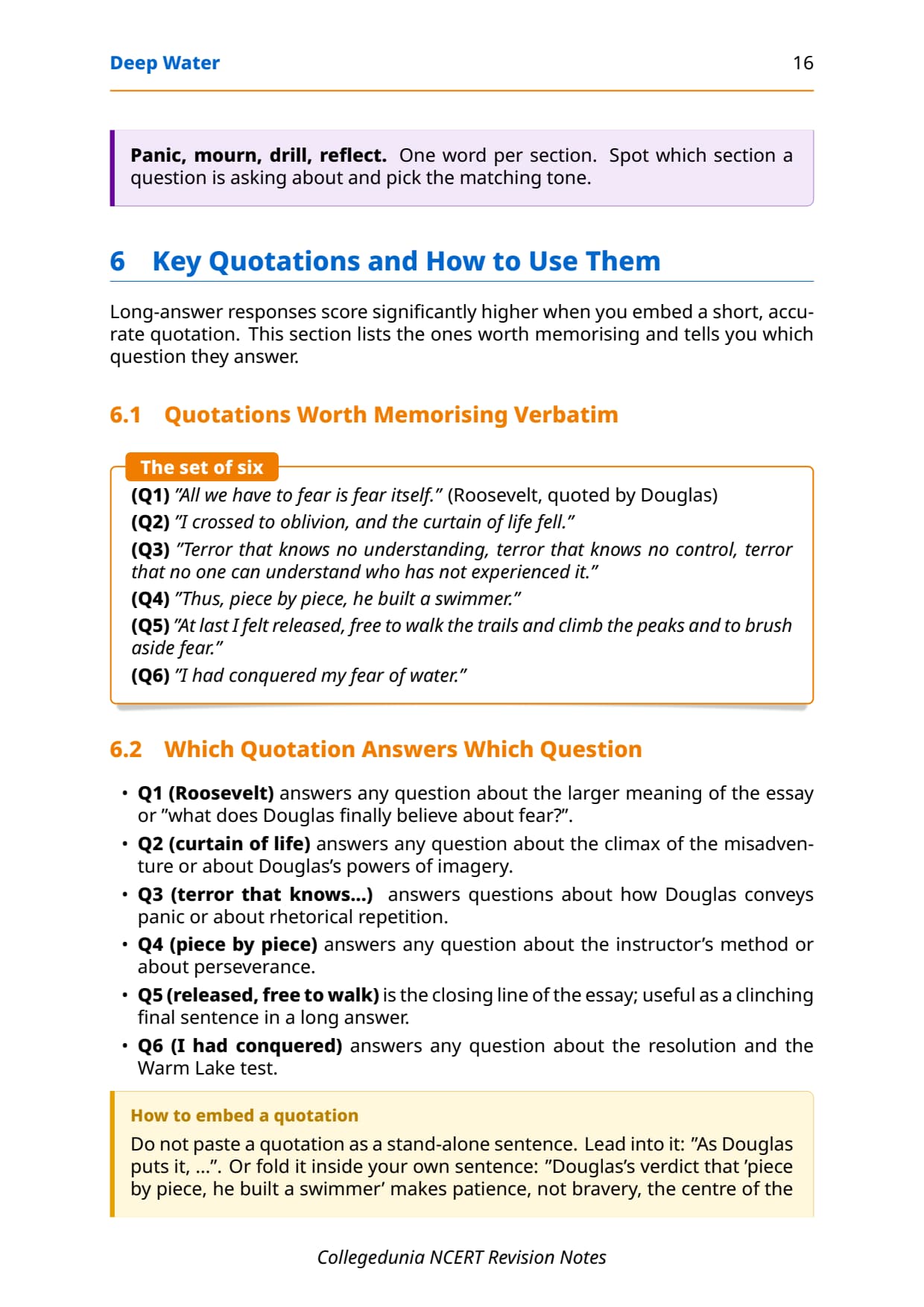
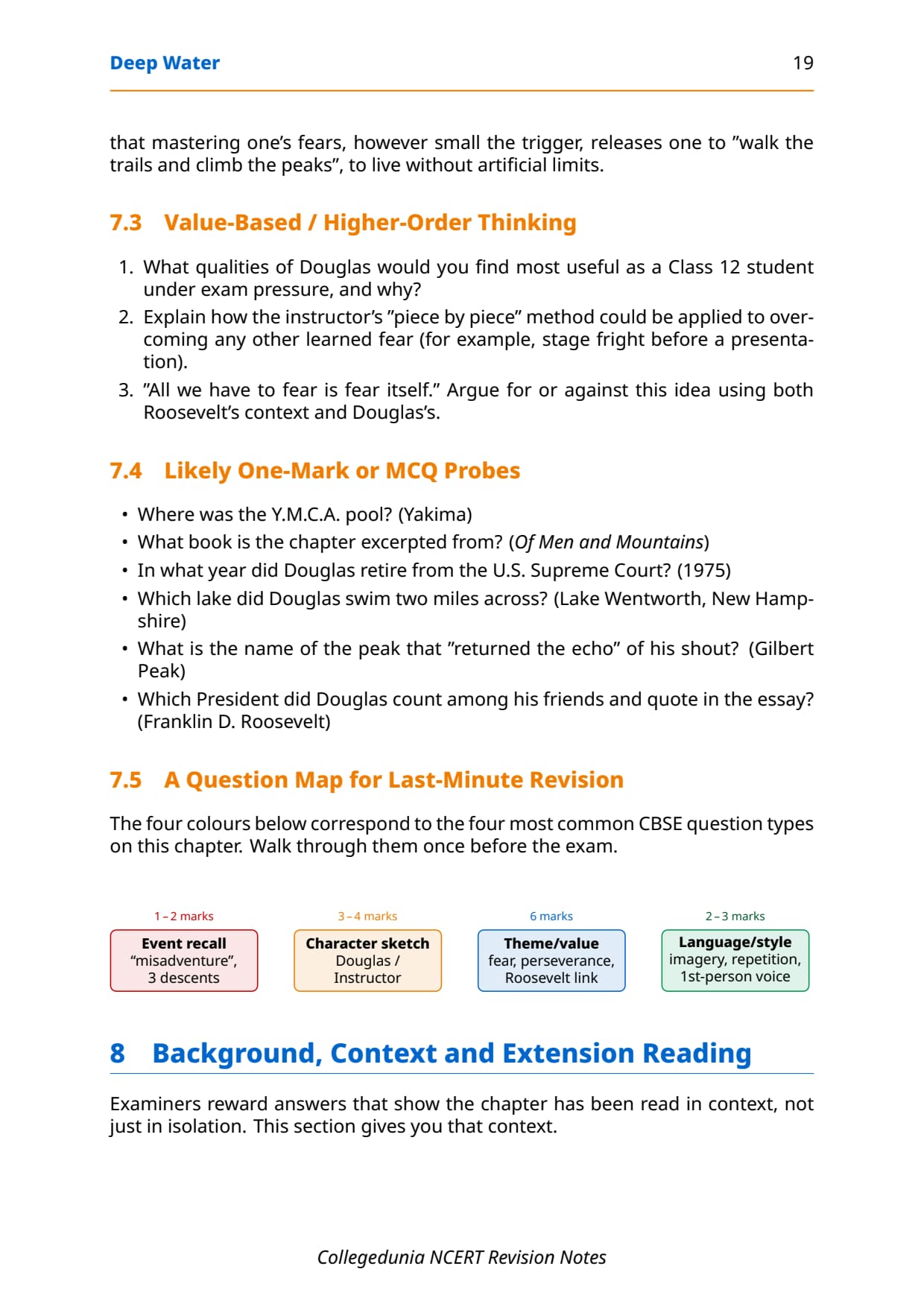
- "How did the instructor build a swimmer out of Douglas?" (6 marks). Value points: the four-stage drill (belt-and-rope, breathing, leg-kick, integration) plus the Lake Wentworth and Warm Lake validation.
- "What was the misadventure William Douglas speaks about?" (3 marks). Value points: YMCA pool, age 10-11, the older boy's throw, three descents.
- "How did Douglas overcome his fear of water?" (6 marks). Value points: the instructor's drill, the open-water self-test, and the Roosevelt-style closure.
- "Fear leads to the death of reason. Discuss." (5 to 6 marks). Value points: physical seizure under water, paralysed reasoning in adult life, cure restored both motion and reason.
- "Why did Douglas go to Warm Lake and dive in?" (3 marks). Value points: to test the cure in open water and confirm the fear was gone, not just suppressed.
- "The only thing we have to fear is fear itself. Justify." (4 marks, value-based). Value points: Douglas feared remembered terror, not water; the chapter ends on this insight; add one modern example.
Other Resources for Deep Water (Class 12 English)
| Resource | Link |
|---|---|
| Notes (this page) | Deep Water Notes |
| NCERT Solutions | Deep Water Class 12 English NCERT Solutions |
| NCERT Book PDF | Deep Water Class 12 English NCERT Book PDF |
| Handwritten Notes | Deep Water Class 12 English Handwritten Notes |
| CBSE Syllabus | CBSE Class 12 English Core Syllabus 2026-27 |
Notes for Class 12 English Flamingo: All Chapters
Jump from Deep Water to any other Class 12 English Flamingo chapter notes page below.
| Chapter | Notes |
|---|---|
| Chapter 1 | The Last Lesson Notes |
| Chapter 2 | Lost Spring Notes |
| Chapter 4 | The Rattrap Notes |
| Chapter 5 | Indigo Notes |
| Chapter 6 | Poets and Pancakes Notes |
| Chapter 7 | My Mother at Sixty-Six Notes |
| Chapter 8 | Keeping Quiet Notes |
Student Feedback
In a Collegedunia poll of 1,200 Class 12 students, 78% said the four-stage drill was the section they revised most before Boards, and 71% rated the phase-by-phase summary the most useful part of these Deep Water notes.
Deep Water Class 12 English Notes FAQs
Ques. Where can I download the Class 12 English Notes Chapter 3 Flamingo Prose: Deep Water PDF?
Ans. You can download the Class 12 English Notes Chapter 3 Flamingo Prose: Deep Water PDF directly from this page. The free PDF carries the phase-by-phase summary, theme stack, character notes, glossary, and the six most-repeated Board questions.
Ques. What is the main theme of Deep Water by William Douglas?
Ans. The central theme is fear and its conquest. Douglas describes how a near-drowning at the YMCA pool gave him a phobia of water that lasted years, and how a patient, stage-by-stage drill from an instructor restored his confidence. The chapter ends on a Roosevelt-style framing: it is the fear of fear, not water itself, that defeats us.
Ques. Who is the author of Deep Water and what is his background?
Ans. The chapter is by William O. Douglas, a US Supreme Court Justice and writer. The piece is extracted from his book "Of Men and Mountains" and is presented in the Flamingo Prose block of the Class 12 English textbook. Douglas writes in the first person as a reflection on a near-drowning in his childhood.
Ques. What are the four narrative phases in Deep Water?
Ans. The chapter splits into four phases: (1) the YMCA pool misadventure when Douglas was ten or eleven and an older boy threw him in; (2) the lifelong hydrophobia that followed; (3) the four-stage drill from an unnamed instructor that built him into a swimmer; and (4) the validation swims at Lake Wentworth and Warm Lake.
Ques. How is Deep Water important for the Class 12 English Board exam?
Ans. Deep Water carries 9 to 11 marks across short-answer and long-answer items in a typical CBSE Board paper. It appears almost every alternate year as a 6-mark Long Answer on the instructor's method or the fear-and-perseverance theme. The Understanding the Text and Talking about the Text blocks supply most actual paper items.
Ques. Are the Deep Water notes aligned with the 2026-27 syllabus?
Ans. Yes. The current edition retains the chapter as Class 12 English Flamingo Prose Chapter 3 Deep Water with no textbook content removed. These notes map every section, question type, and value point to the current 2026-27 syllabus and the latest marking scheme.
Ques. What is the difference between the YMCA misadventure and the Lake Wentworth swim?
Ans. The YMCA misadventure was the near-drowning incident at the Yakima pool when Douglas was about ten or eleven, the cause of his phobia. The Lake Wentworth swim was the open-water test he set himself years later, after months of instructor-led practice, to confirm that the cure was real. Swapping the two in an answer costs the chronology mark.



Comments