




Class 12 English Chapter 2 Flamingo Prose: Lost Spring by Anees Jung carries roughly 8 to 10 marks in the CBSE Class 12 English Core paper and 2 to 3 inference questions in CUET English. These notes cover both stories, themes, characters, devices, and answer-writing frames.
- CBSE Weightage: 8 to 10 marks across the Flamingo prose long-answer slot
- CUET English Weightage: 2 to 3 inference questions per shift
- Reading-Comprehension Frequency: Lost Spring extracts appear in nearly every CBSE Class 12 English sample paper since 2019
These notes are mapped to the 2026-27 NCERT Flamingo textbook and refined against the last five years of CBSE Class 12 board papers and CUET English shifts.
Class 12 English Notes Chapter 2 Flamingo Prose: Lost Spring Topic-wise Weightage
The map below shows where CBSE pulls Lost Spring questions from in the Class 12 English Core paper.
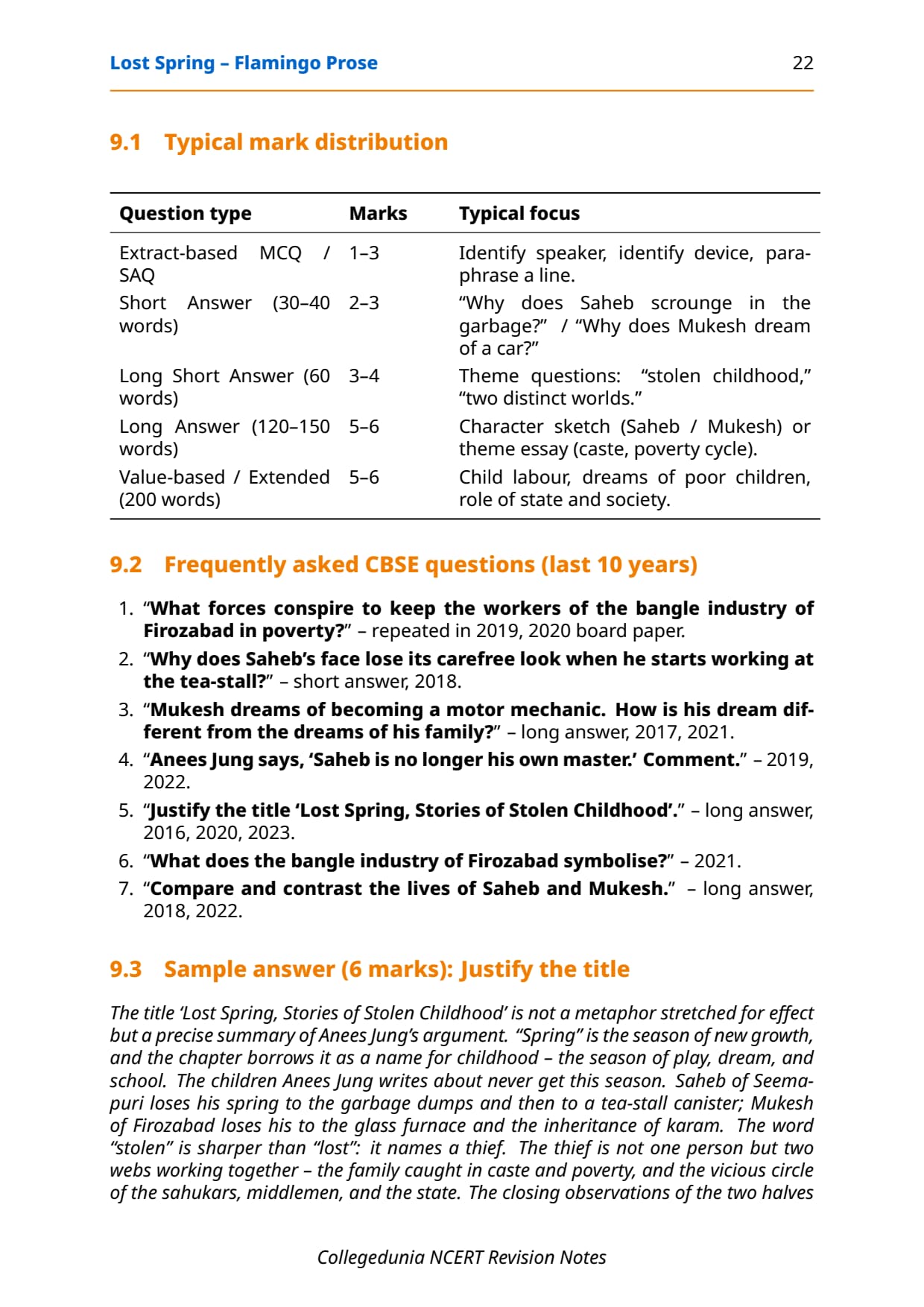
| Sub-topic | Weightage | CBSE Frequency |
|---|---|---|
| Mukesh and Firozabad bangle industry | High | 4 out of last 5 years |
| Saheb at Seemapuri and tea stall | High | 3 out of last 5 years |
| Themes (stolen childhood, poverty, caste) | High | Every year (5/5) |
| Literary devices (hyperbole, metaphor, simile) | Medium | 3 out of last 5 years |
| Title justification | Medium | 2 out of last 5 years |
| Vocabulary inference (eight phrases) | Low | 1 out of last 5 years |
Lost Spring Video Explanation (Class 12 English)
Source: Magnet Brains on YouTube
Class 12 English Notes Chapter 2 Flamingo Prose: Lost Spring Topic-by-Topic Summary
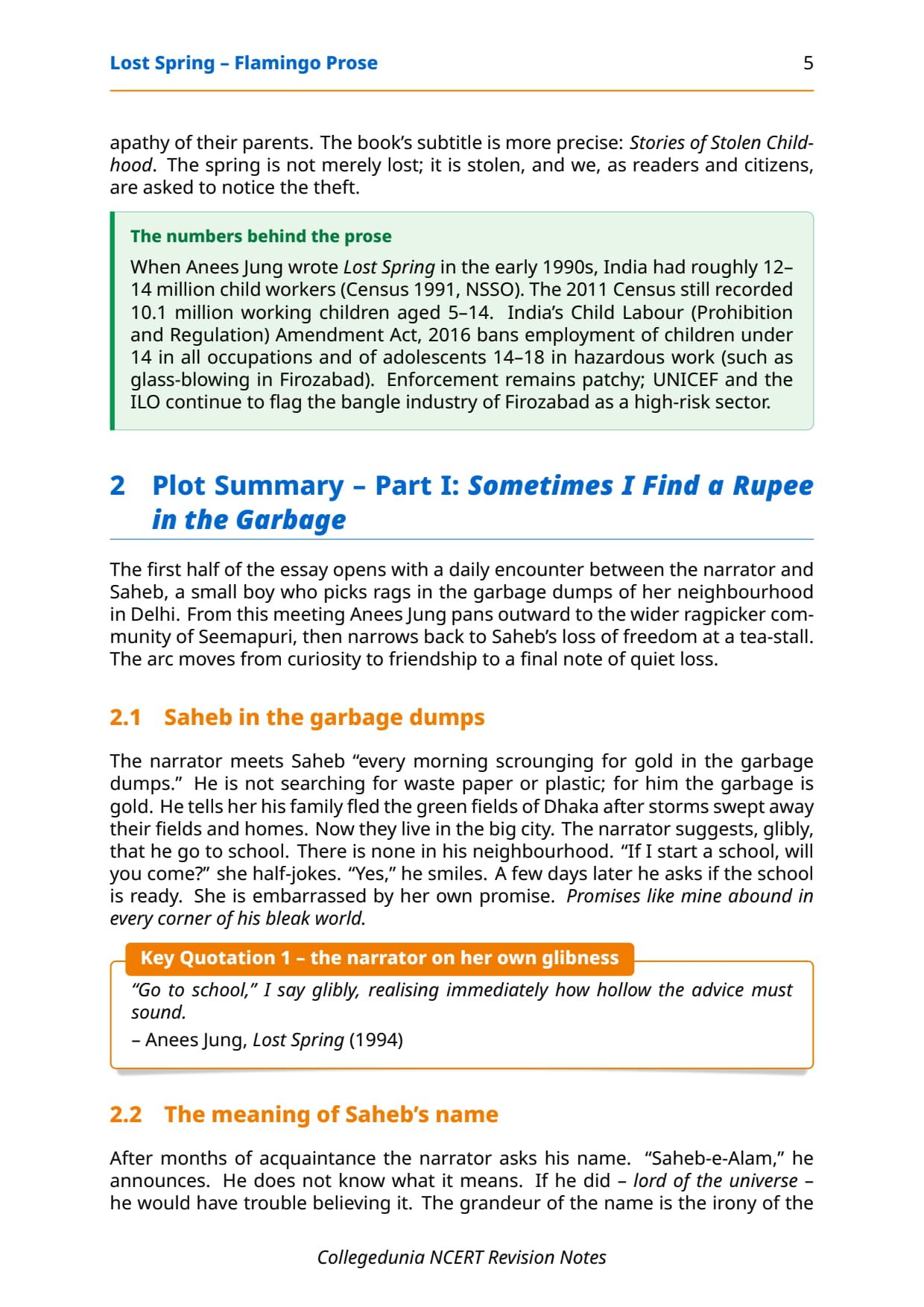
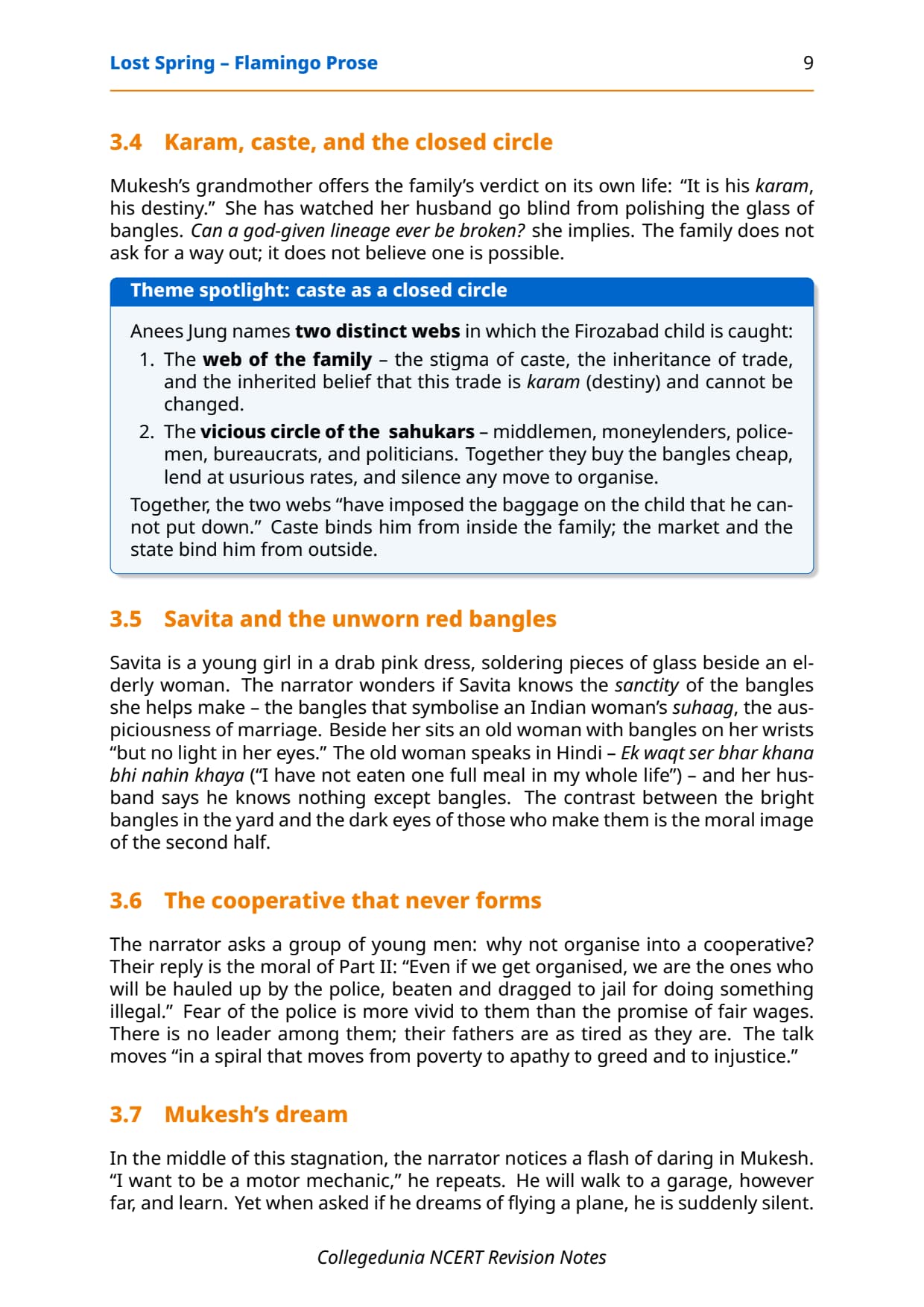
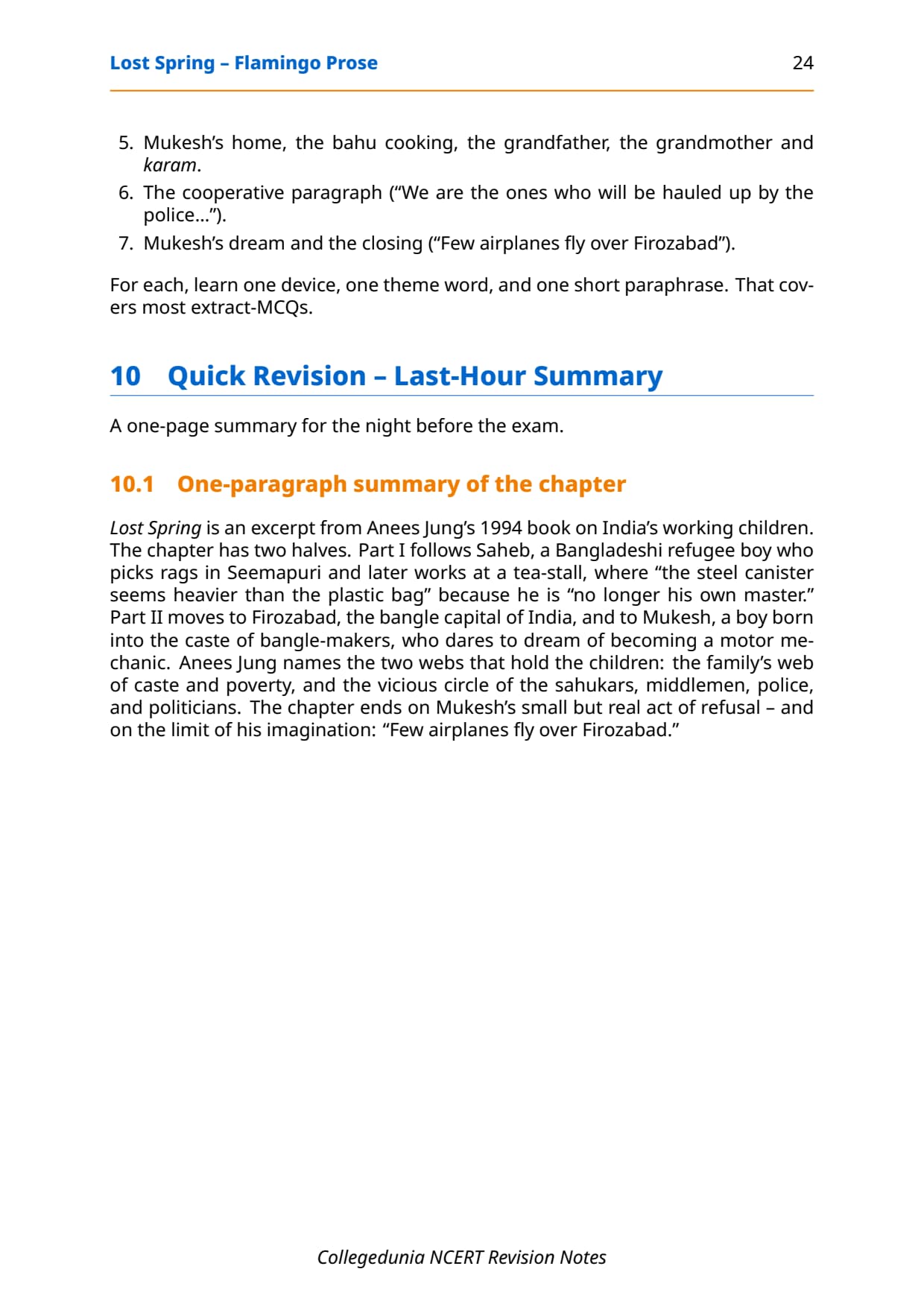
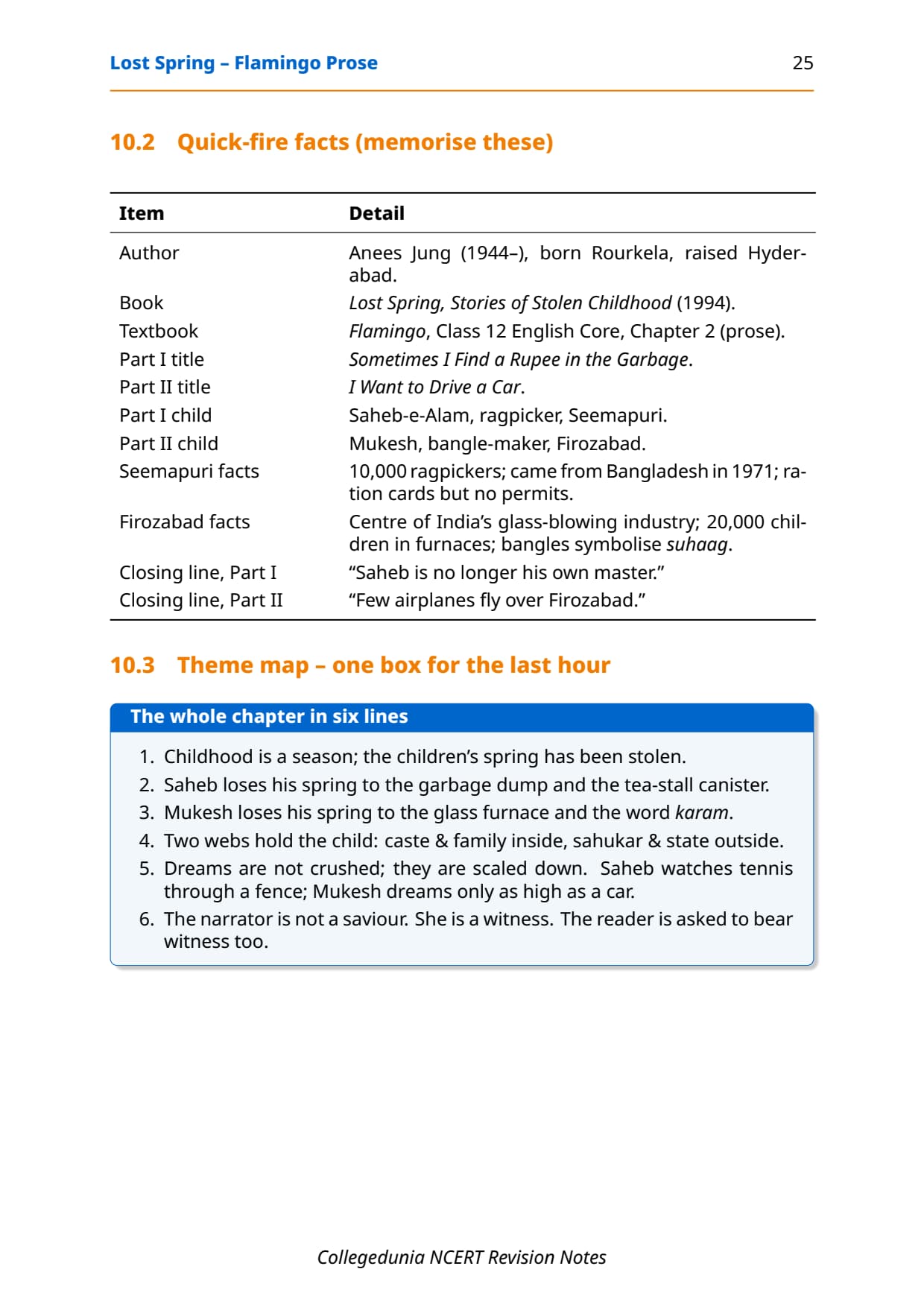
The chapter is an excerpt from Anees Jung's book Lost Spring, Stories of Stolen Childhood. It has two sections that share one concern: how poverty and tradition steal childhood from Indian children.
About the Author Anees Jung
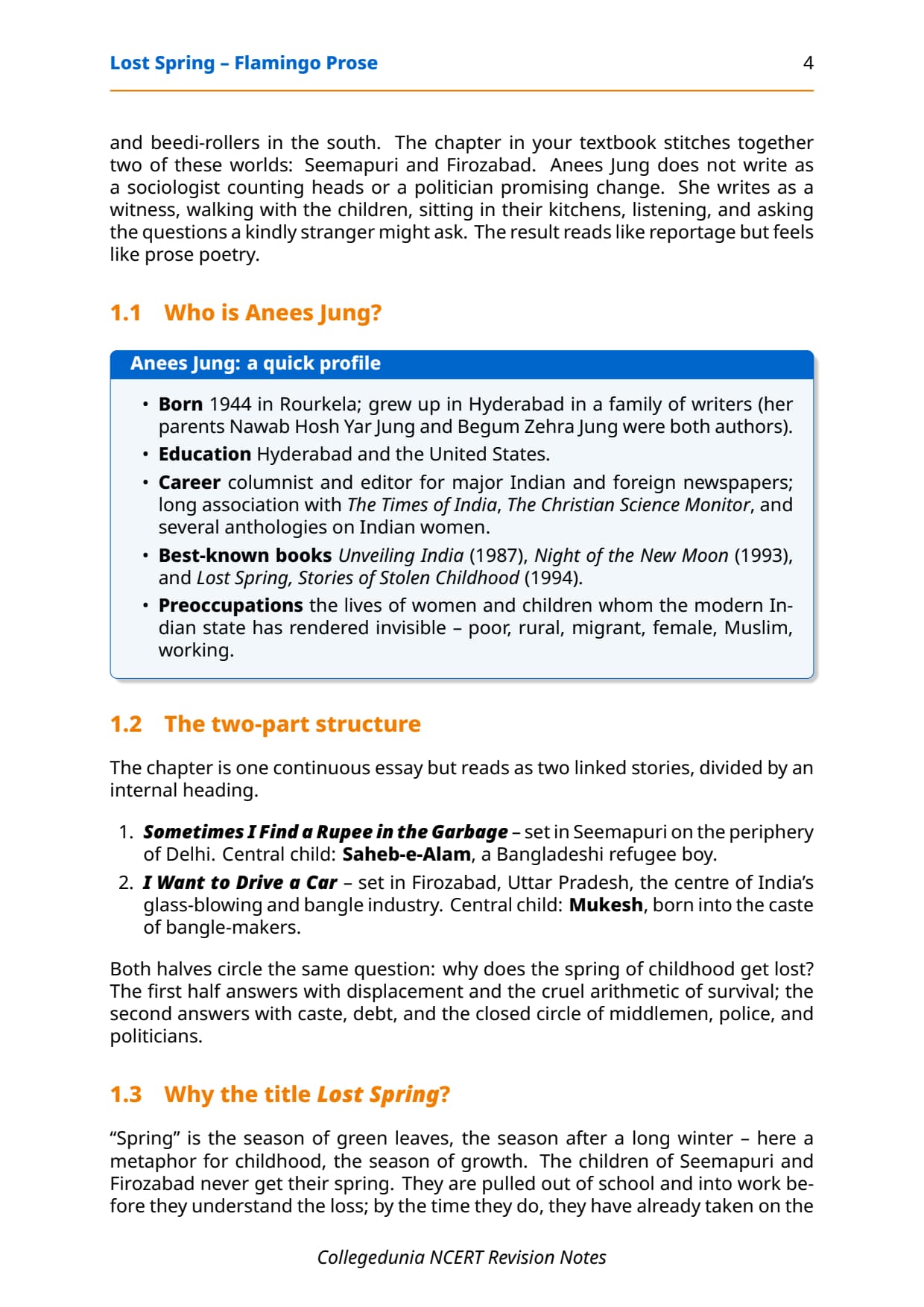
Anees Jung (born 1944, Rourkela) grew up in Hyderabad and was educated there and in the United States. An editor and columnist for major Indian newspapers, she wrote several books. The Flamingo excerpt comes from her book Lost Spring, Stories of Stolen Childhood, on the poverty and traditions that condemn children to exploitation.
Section 1: Sometimes I Find a Rupee in the Garbage (Saheb at Seemapuri)
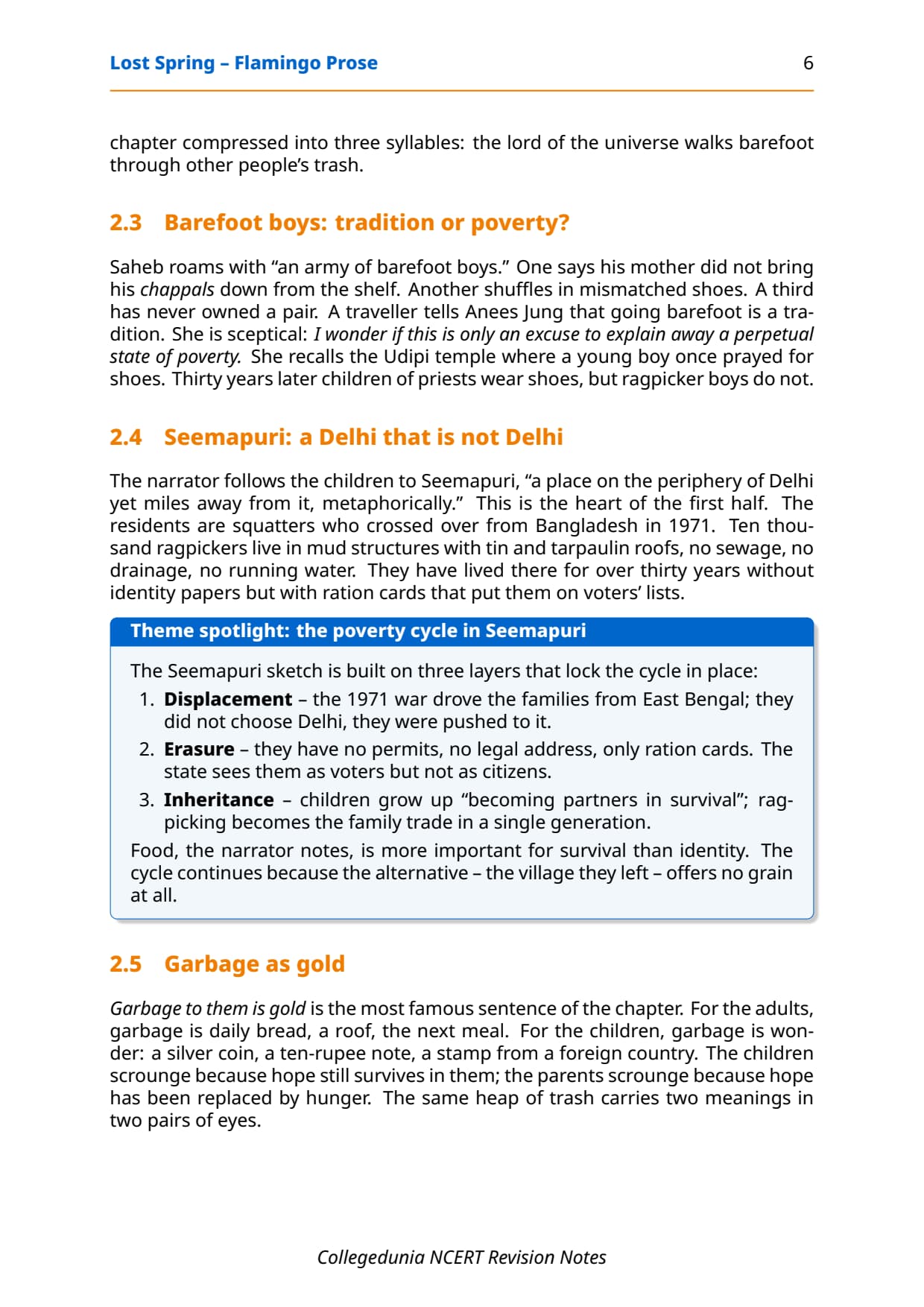
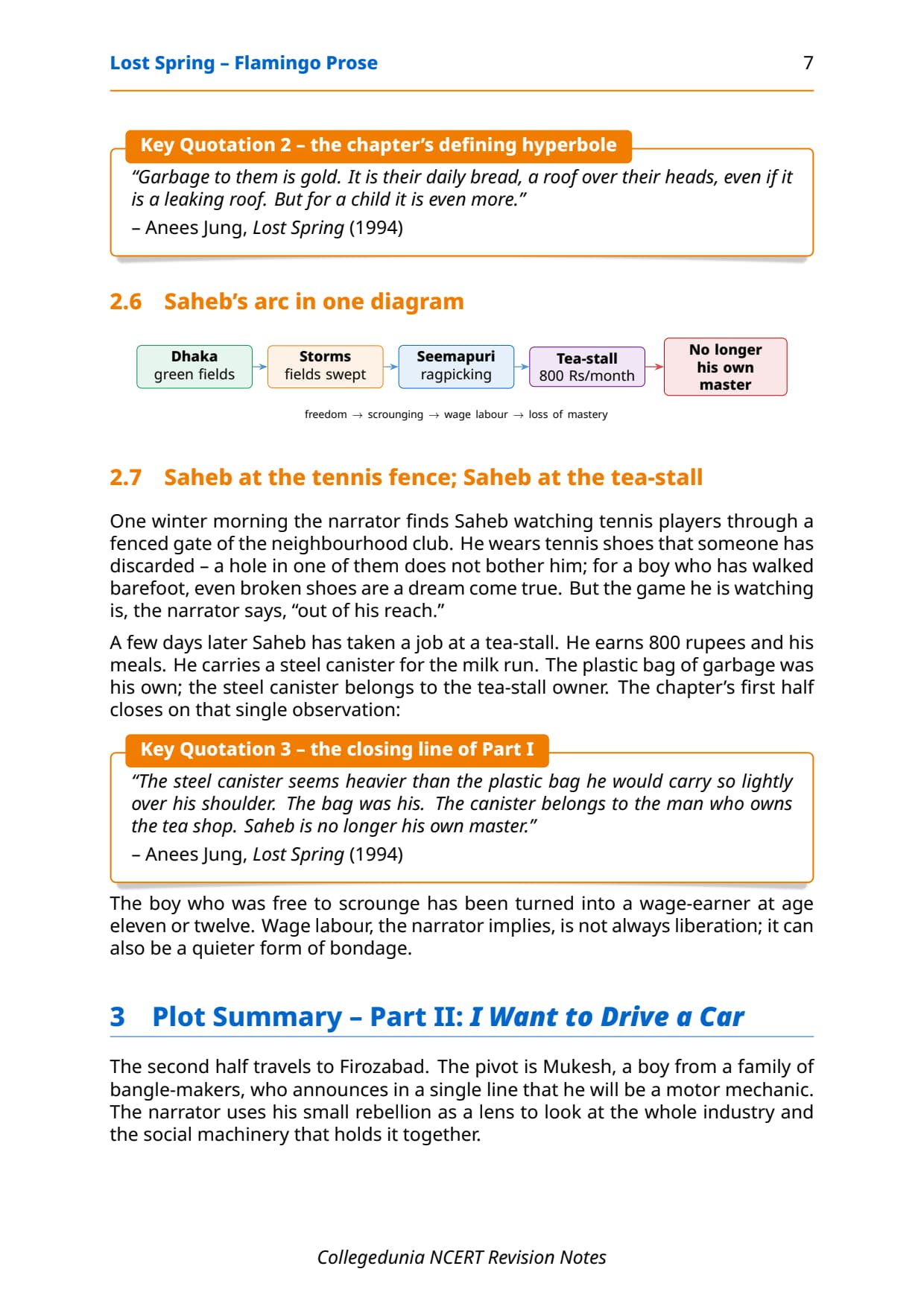
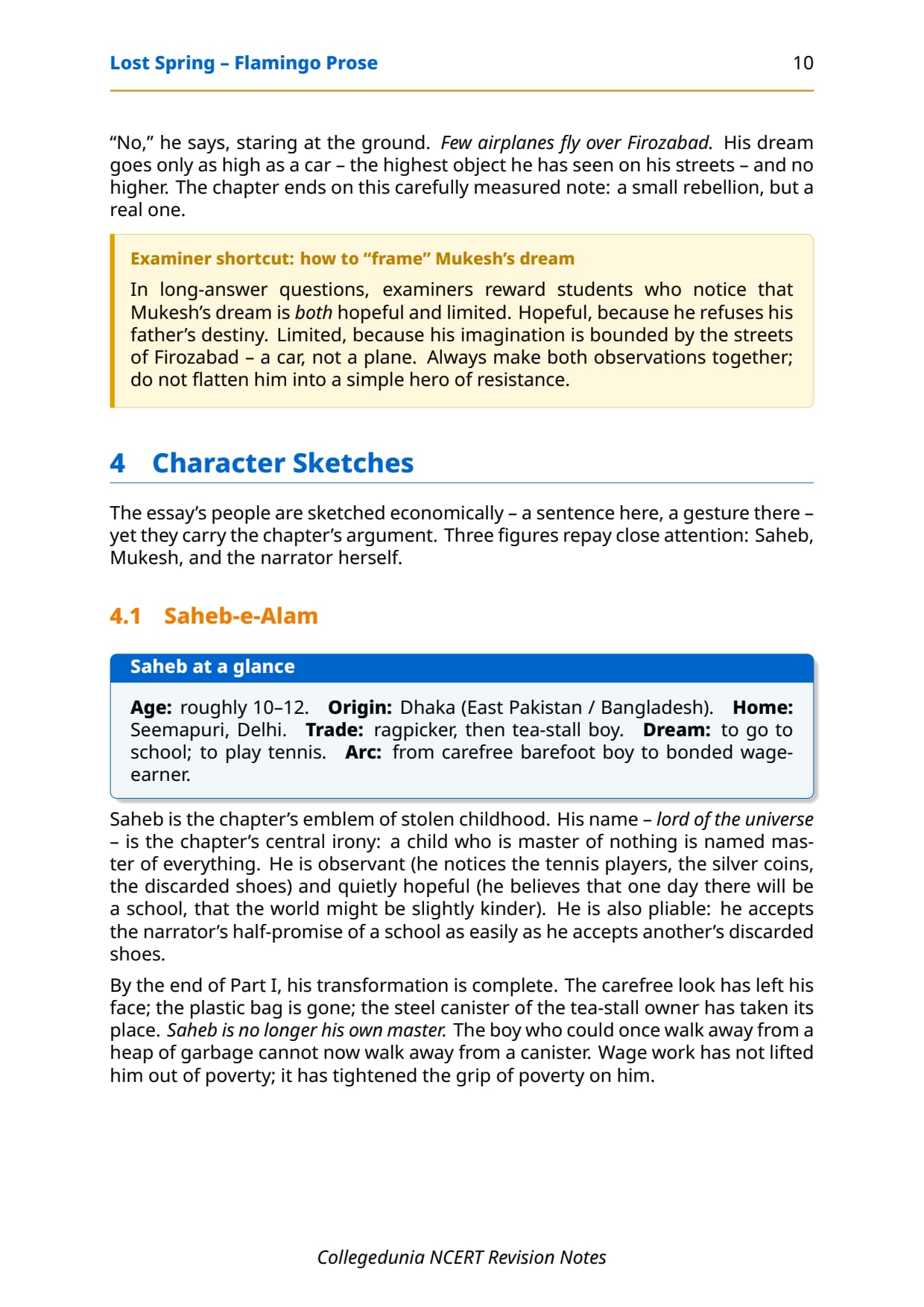
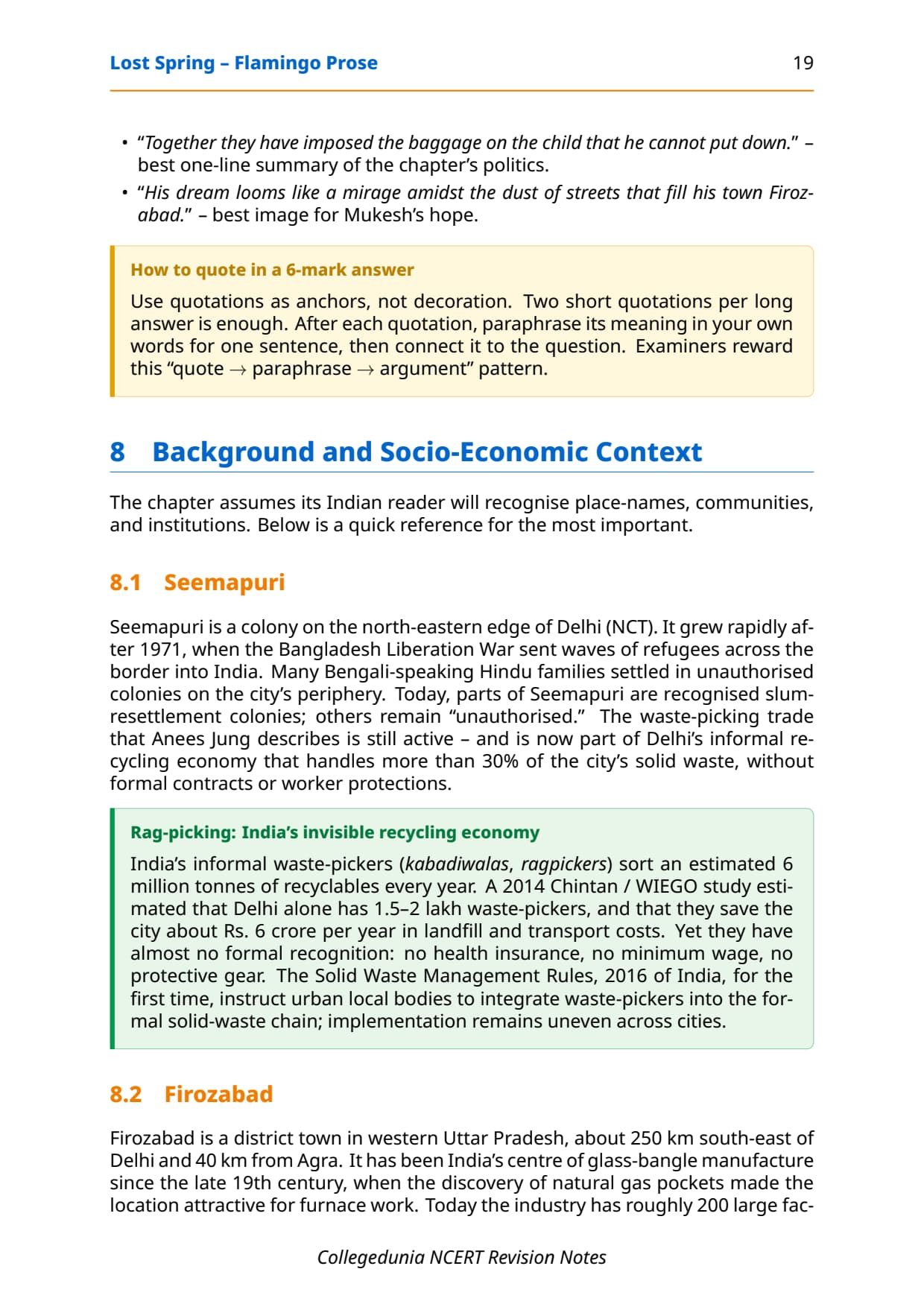
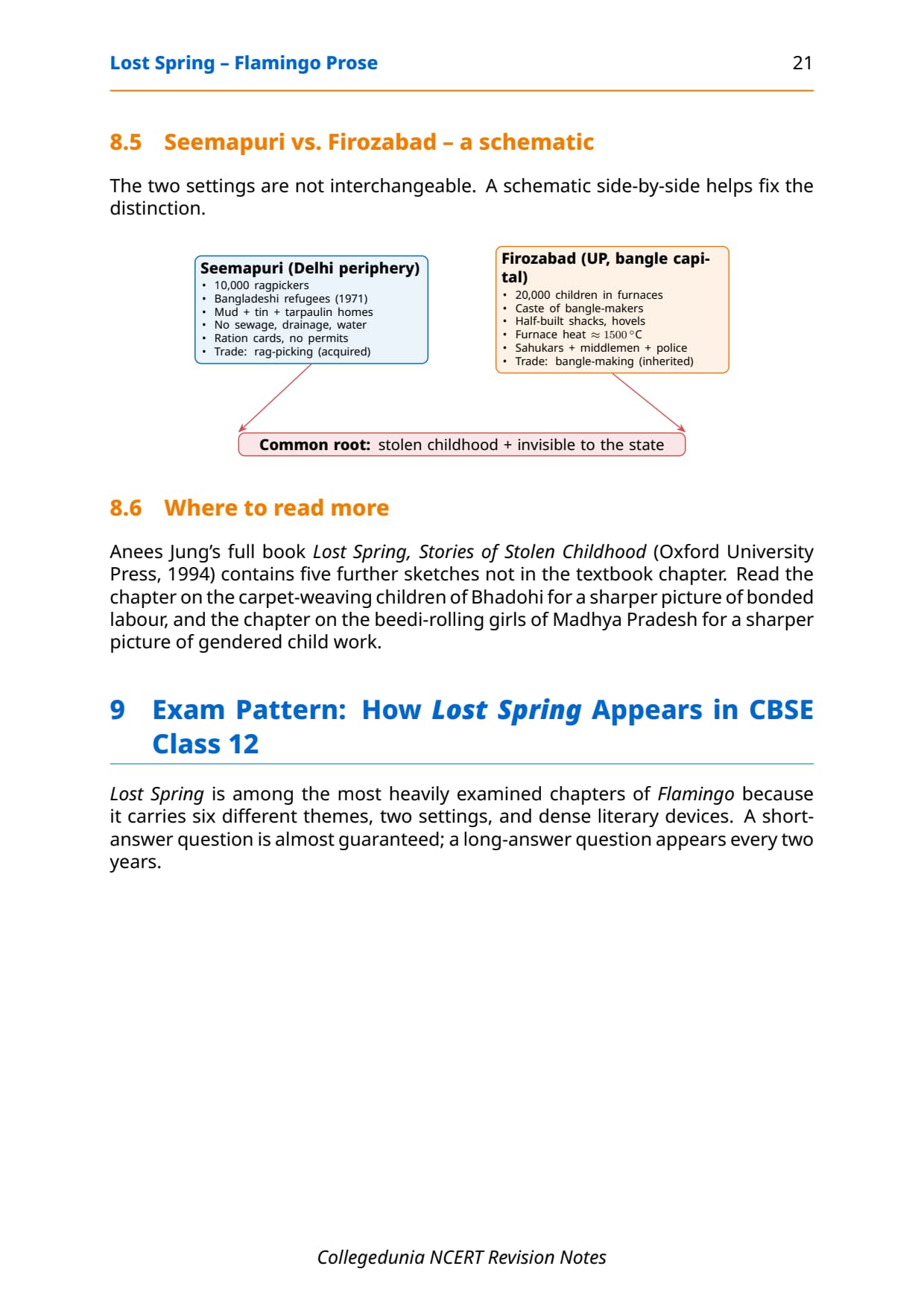
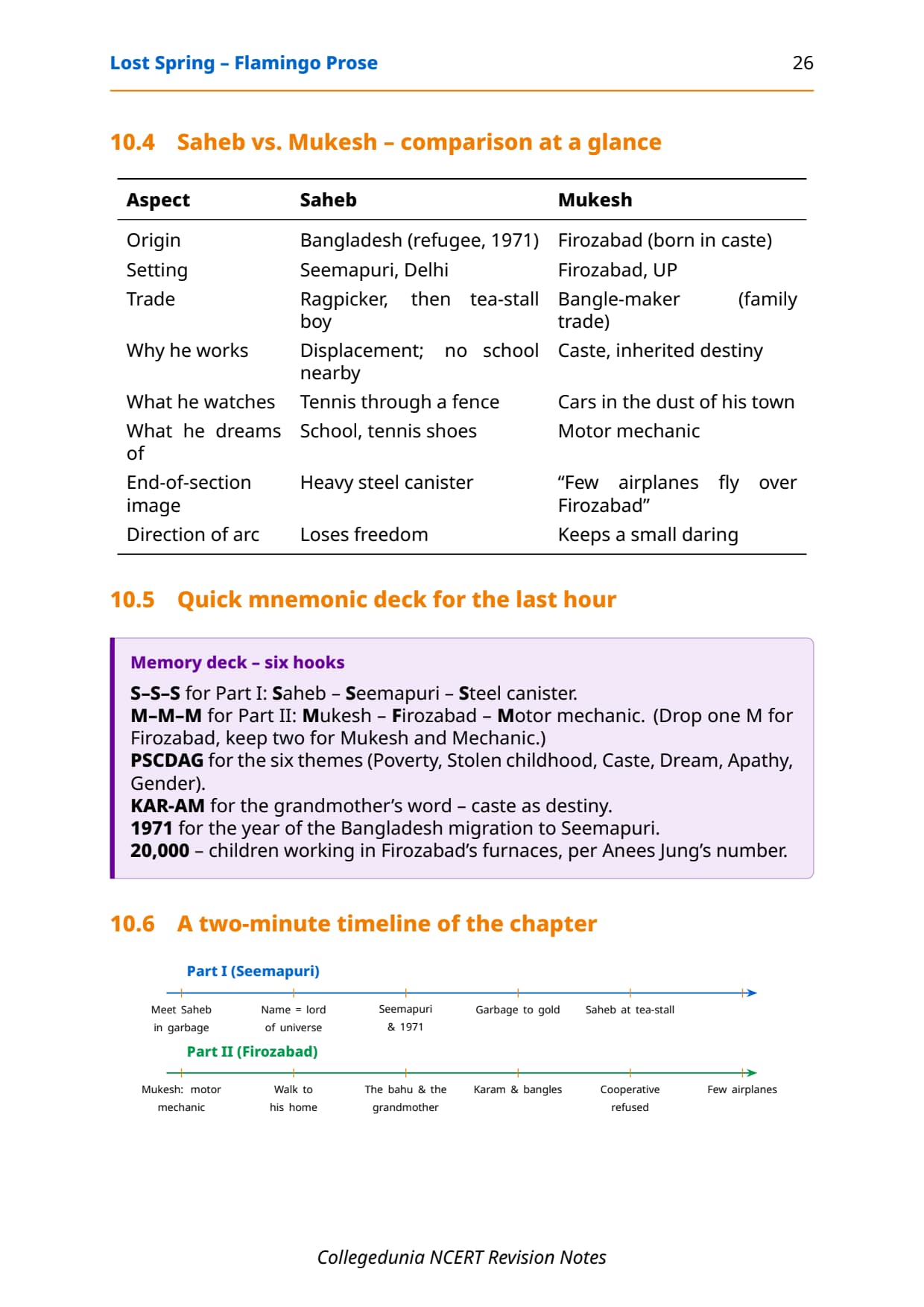
Saheb-e-Alam is a young rag-picker the narrator encounters every morning scrounging for gold in garbage dumps. His family left the green fields of Dhaka after storms destroyed their home and now lives in Seemapuri, a settlement on the periphery of Delhi housing about 10,000 ragpickers. They have ration cards but no permits, identity, or running water. Saheb has no school in his neighbourhood. Eventually, he is hired at a tea stall for 800 rupees and meals, but the steel canister he now carries is heavier than the plastic bag of garbage. He no longer controls his own day.
Section 2: I Want to Drive a Car (Mukesh at Firozabad)
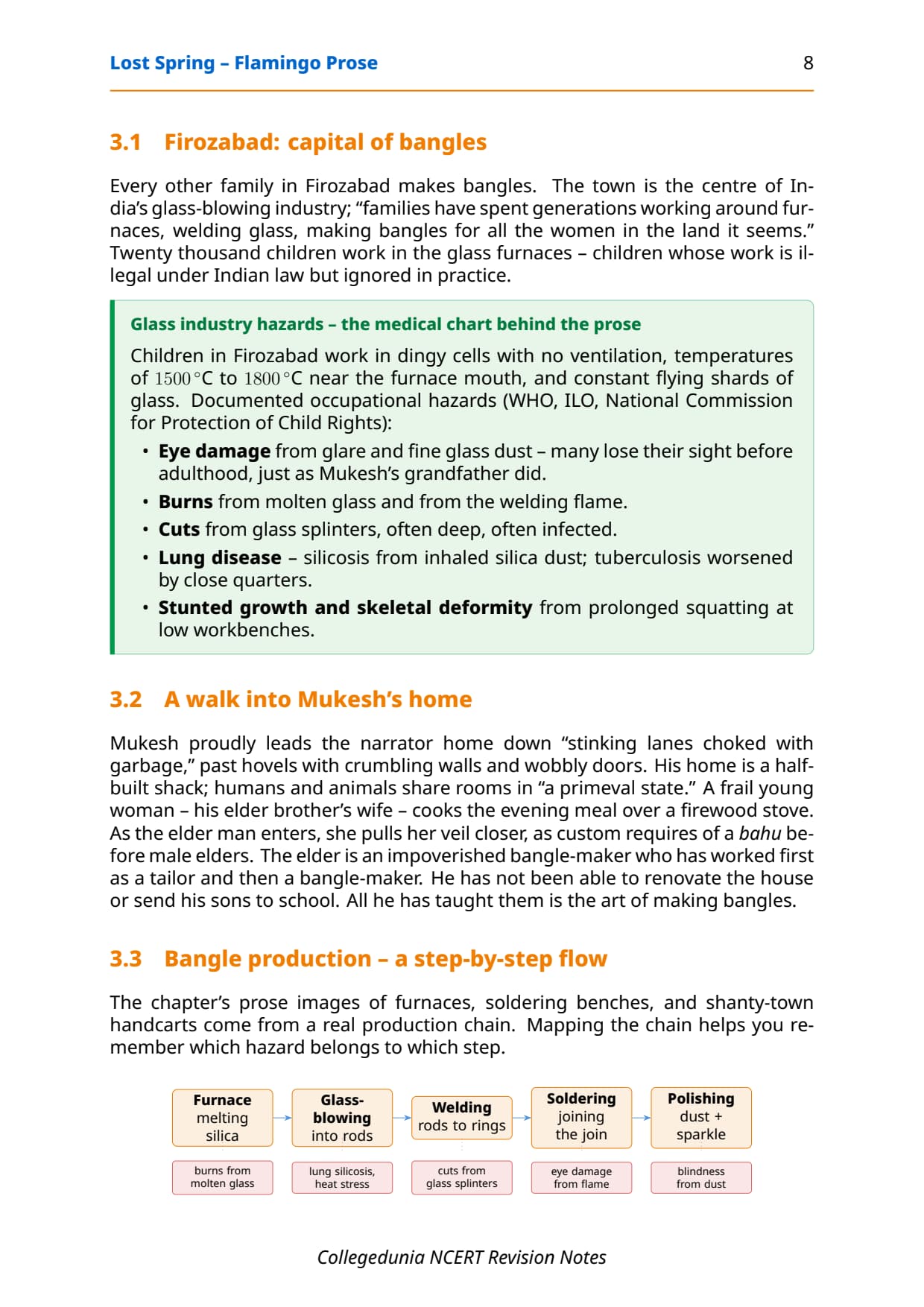
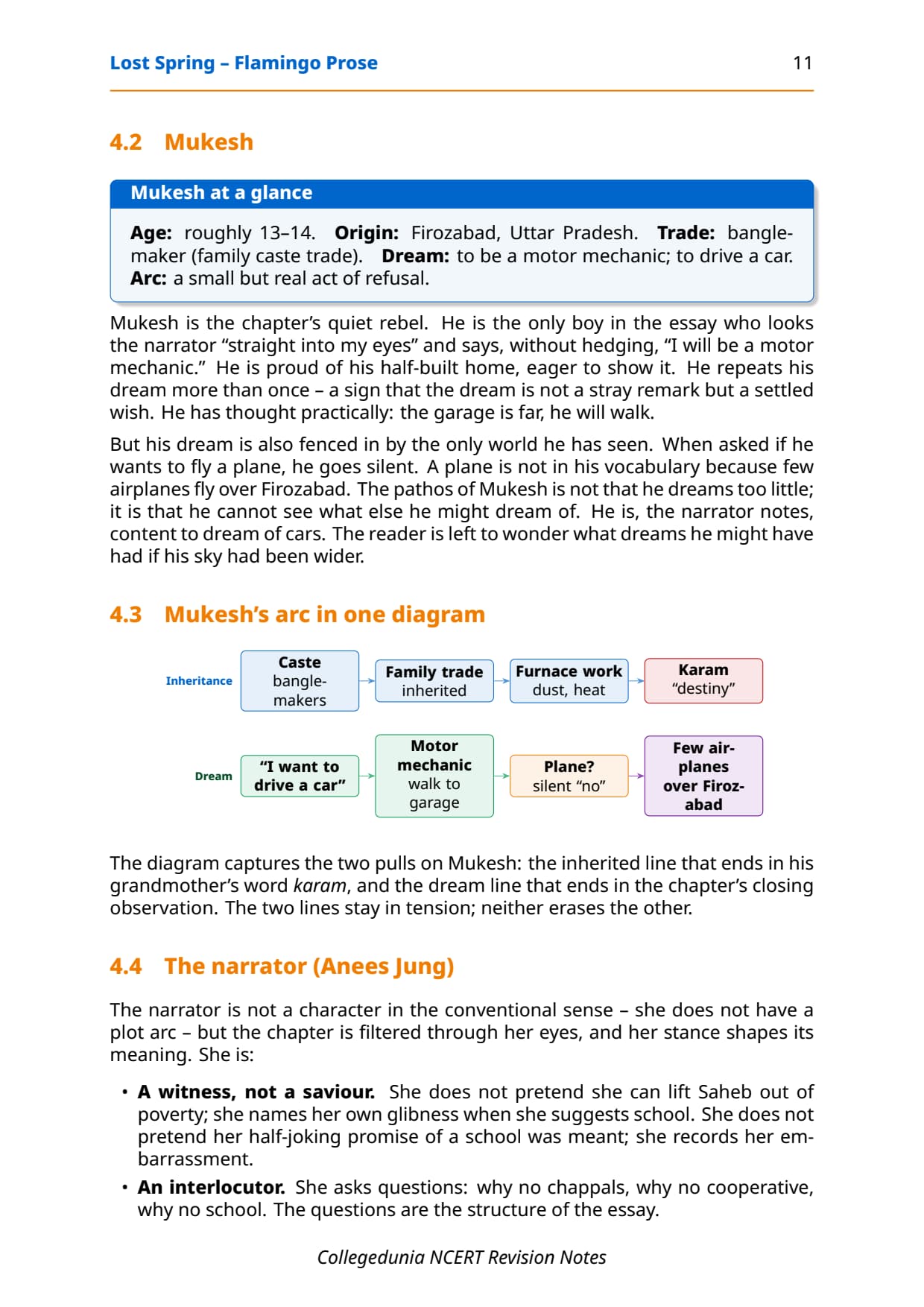
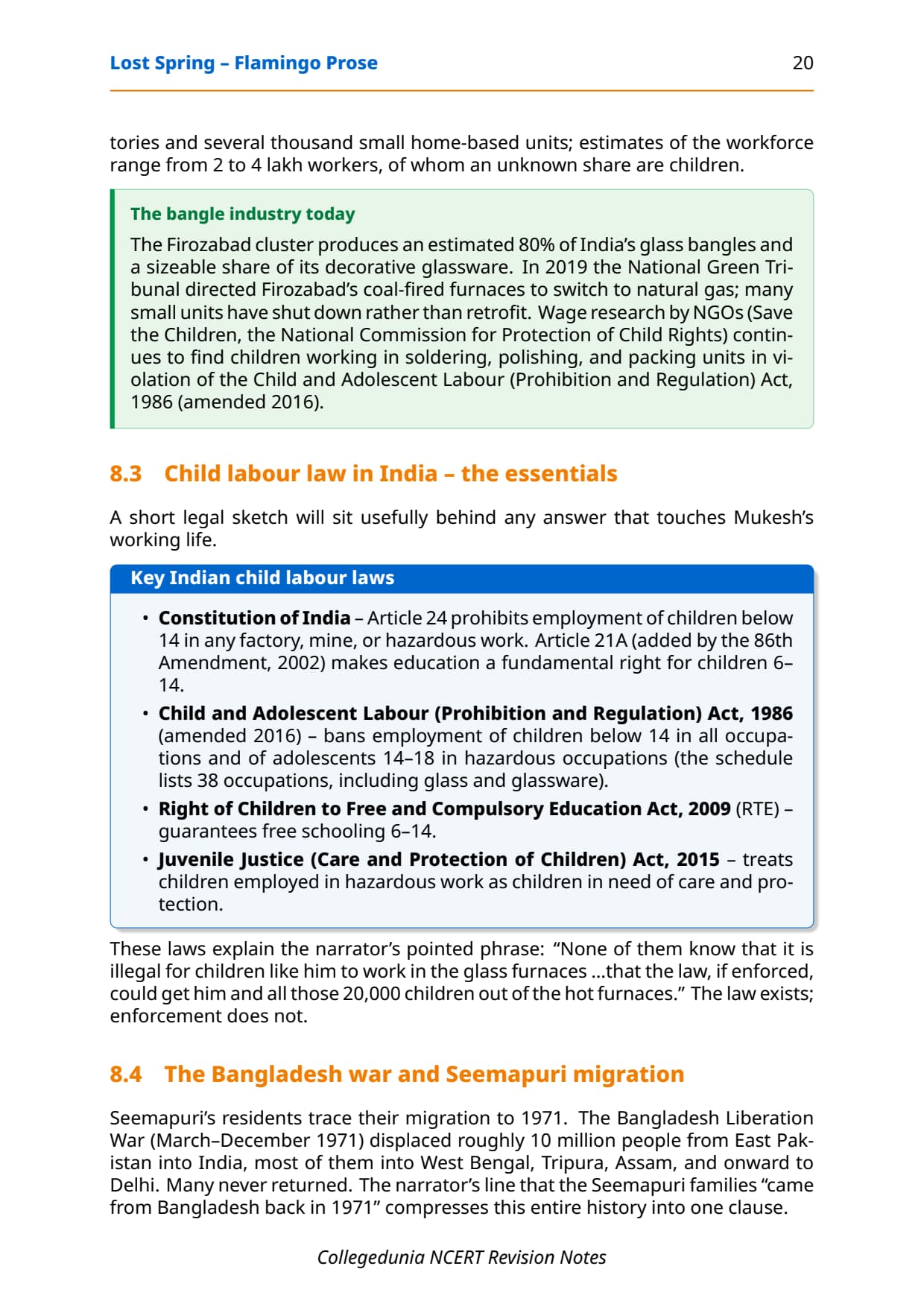
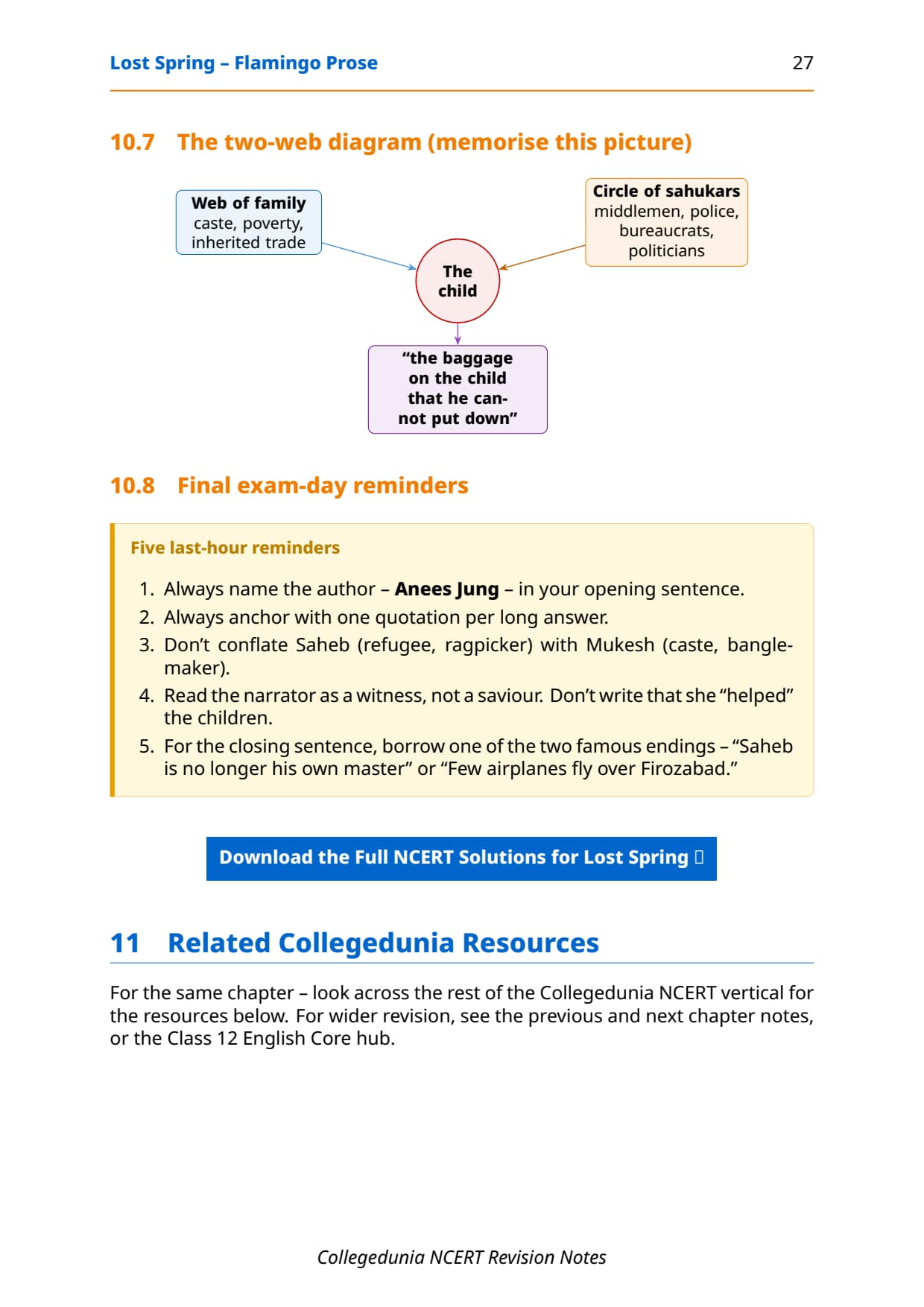
Mukesh is a young boy in Firozabad, the centre of India's glass-blowing bangle industry. About 20,000 children work illegally in dingy cells with high temperatures, often losing their eyesight before they become adults. Mukesh's family, like every other in Firozabad, makes bangles. His grandmother frames their situation as karam, the destiny of being born into the caste of bangle-makers. They are trapped by middlemen, police, bureaucrats, and politicians. Mukesh, unlike his elders, dares to dream of becoming a motor mechanic and learning to drive a car. He has no airplane ambition though, because "few airplanes fly over Firozabad."
Themes in Lost Spring
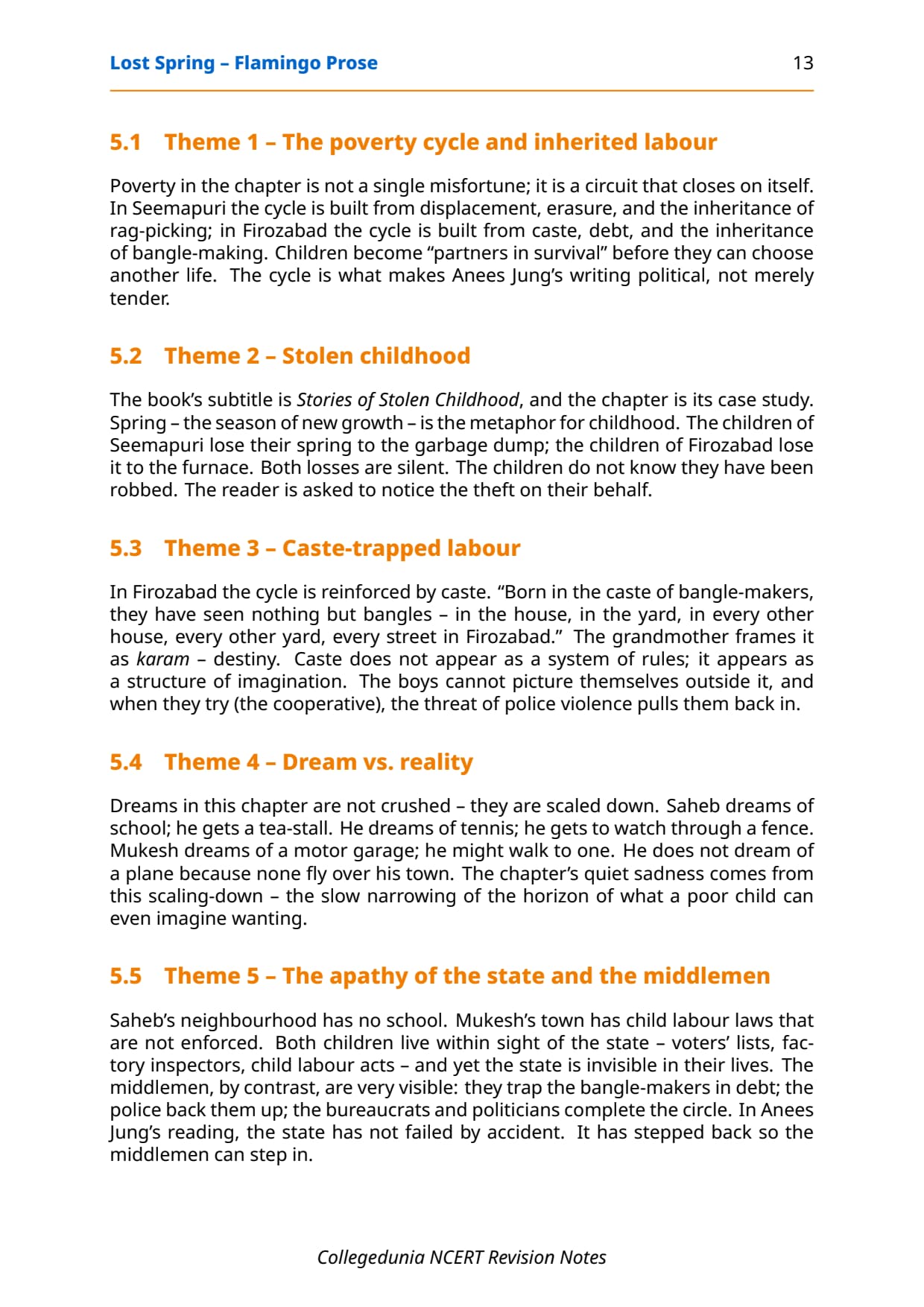
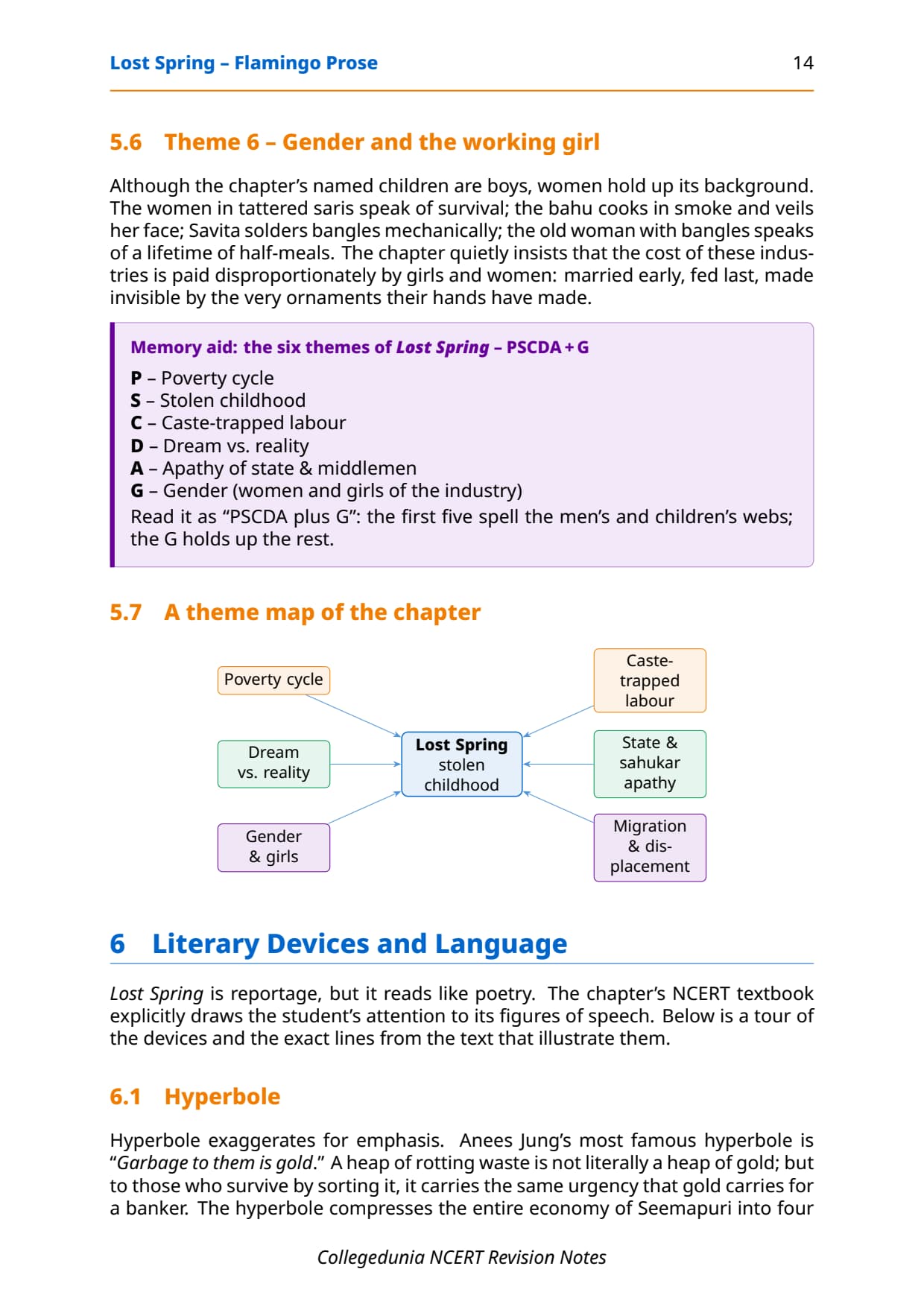
Five themes recur across both sections. Stolen childhood links the title to both boys. Grinding poverty is the structural cause behind ragpicking and bangle-making. Caste tradition keeps the bangle-makers in their hereditary trade. Apathy of authority (police, sahukars, bureaucrats) prevents change. Hope versus resignation contrasts Mukesh's small dream with the grandmother's karam acceptance.
How will Collegedunia's Class 12 English Notes Help You with Lost Spring?
These notes drill the five answer-writing patterns Class 12 markers reward.
- 2026-27 NCERT alignment: Every theme and quotation matches the current Flamingo print.
- Verified quotation bank: Each theme carries one direct line, so students cite without misquoting.
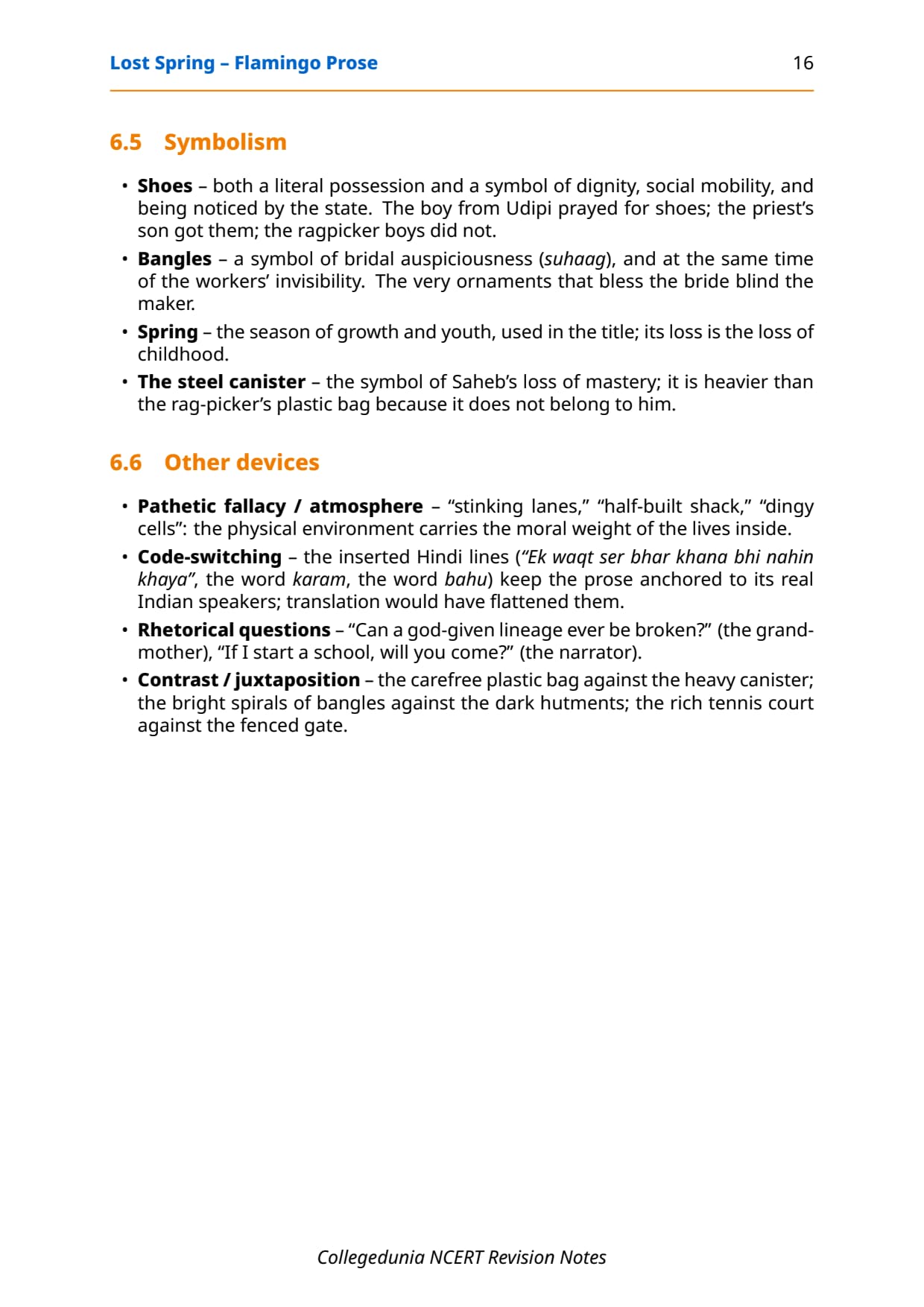
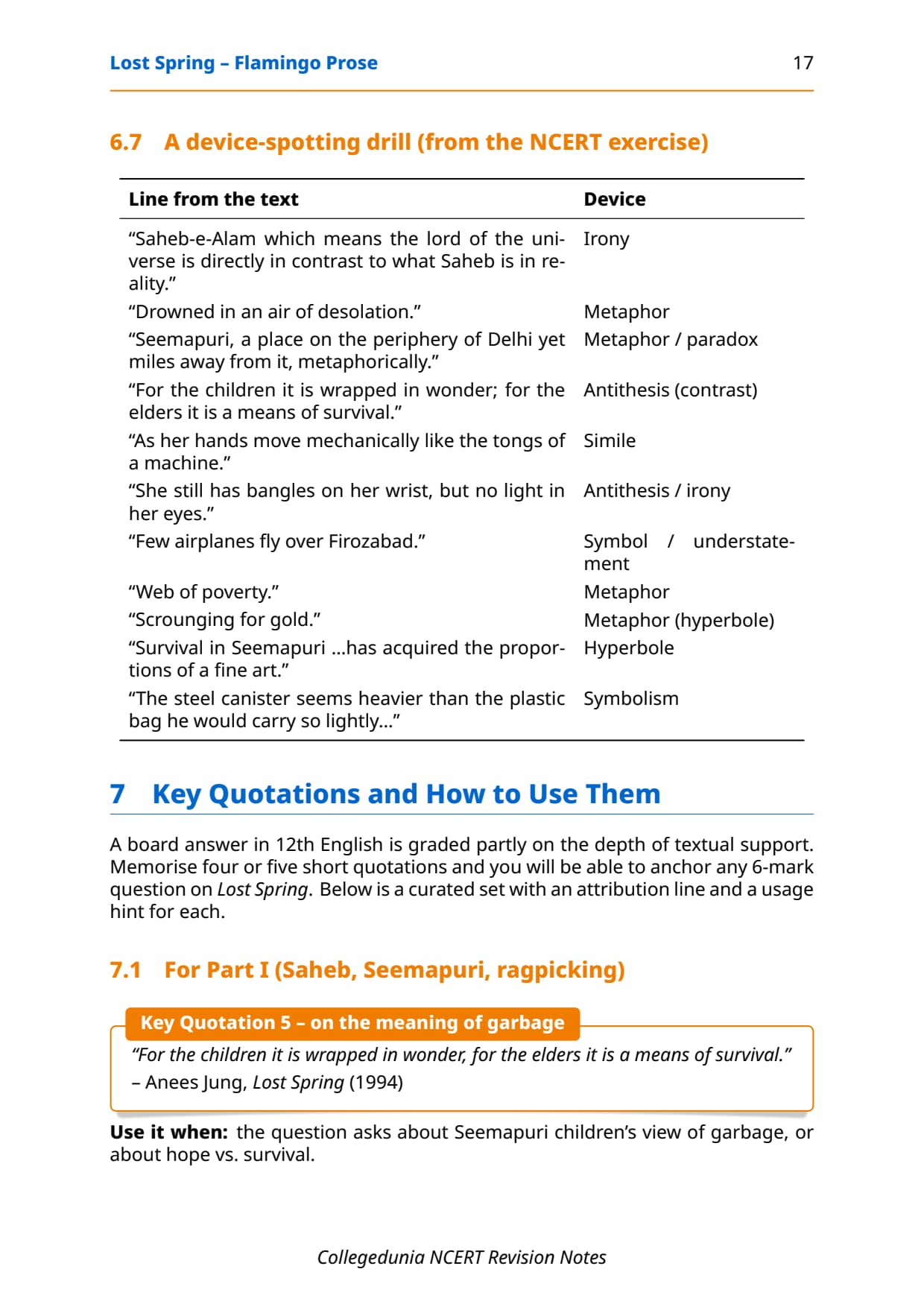
- Device-spotting practice: All 11 Thinking-about-language sentences are pre-tagged as hyperbole, metaphor, or simile.
- Last-day formula box: A 5-line summary at the end of each section for the night before the exam.
Lost Spring Class 12 Character Sketches
The five characters CBSE asks character-sketch questions on, in descending order of board frequency.
- Saheb-e-Alam: Bangladeshi-origin rag-picker from Seemapuri. Carefree as a barefoot ragpicker; loses spirit at the tea stall. Symbol of stolen childhood.
- Mukesh: Young boy from a bangle-maker family in Firozabad. Dares to dream of being a motor mechanic. Symbol of small rebellious hope.
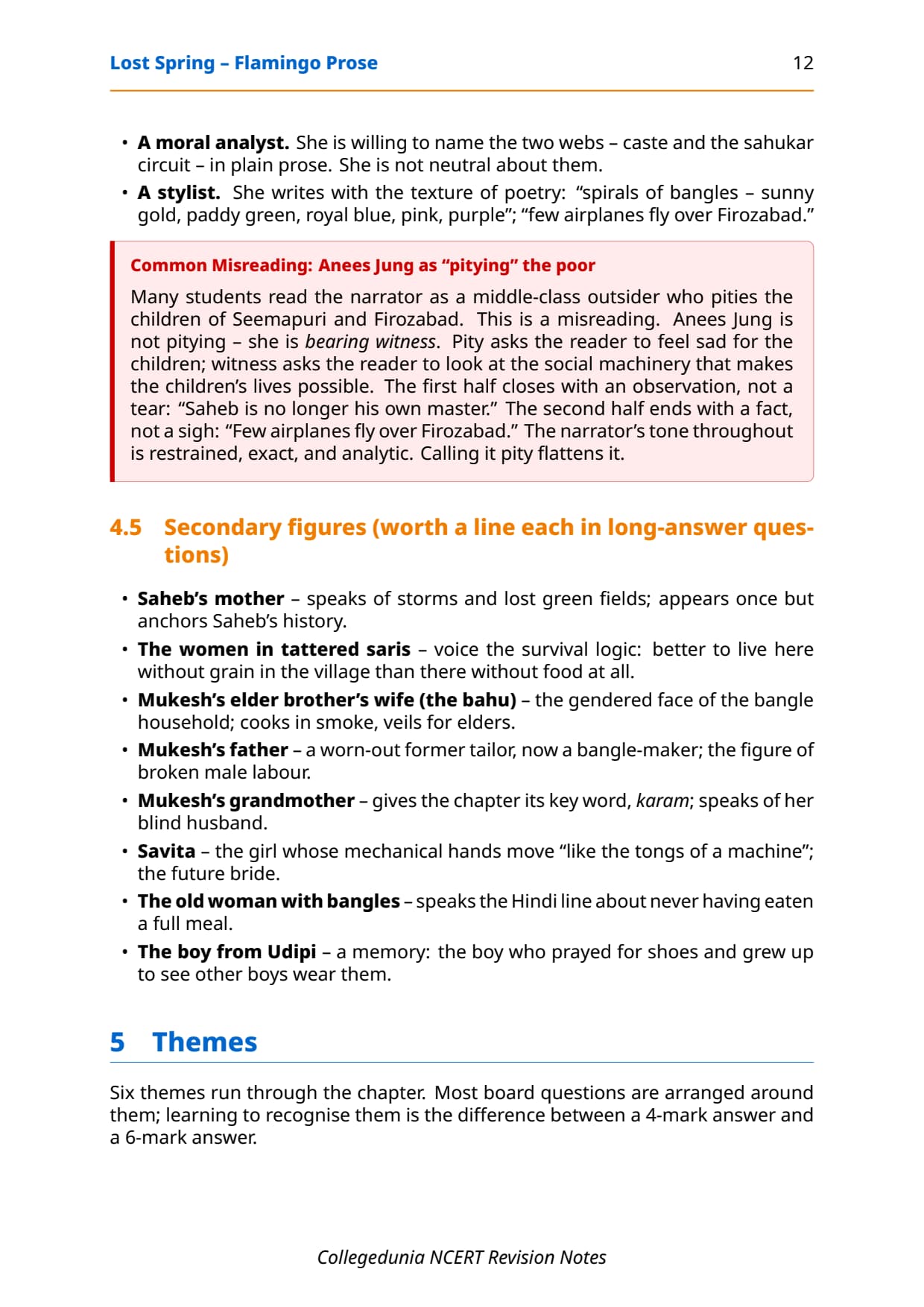
- Mukesh's Grandmother: Frames the family's destiny as karam. Represents acceptance of tradition.
- Savita: Young girl in a drab pink dress, soldering bangles. Symbol of every Firozabad girl whose suhaag will one day be on her own wrist.
- The Narrator (Anees Jung): Empathetic but conscious of her glib advice ("Go to school") to a child who has no school nearby.
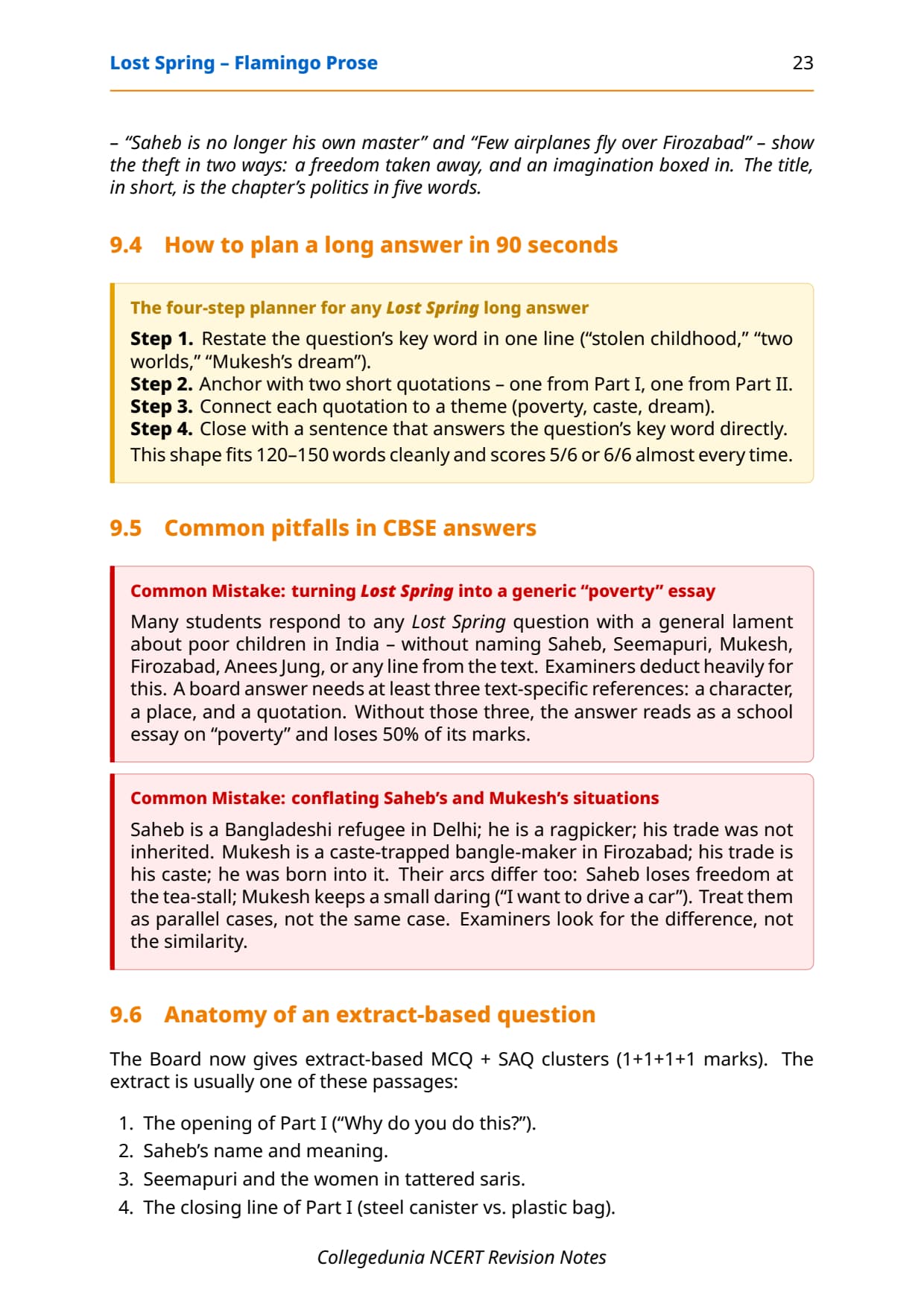
Lost Spring Most Repeated Class 12 English Board Questions
Four PYQ-style blocks from the last five CBSE Class 12 English Core sessions.
Class 12 English Notes Chapter 2 Flamingo Prose: Lost Spring Important Quotations Box
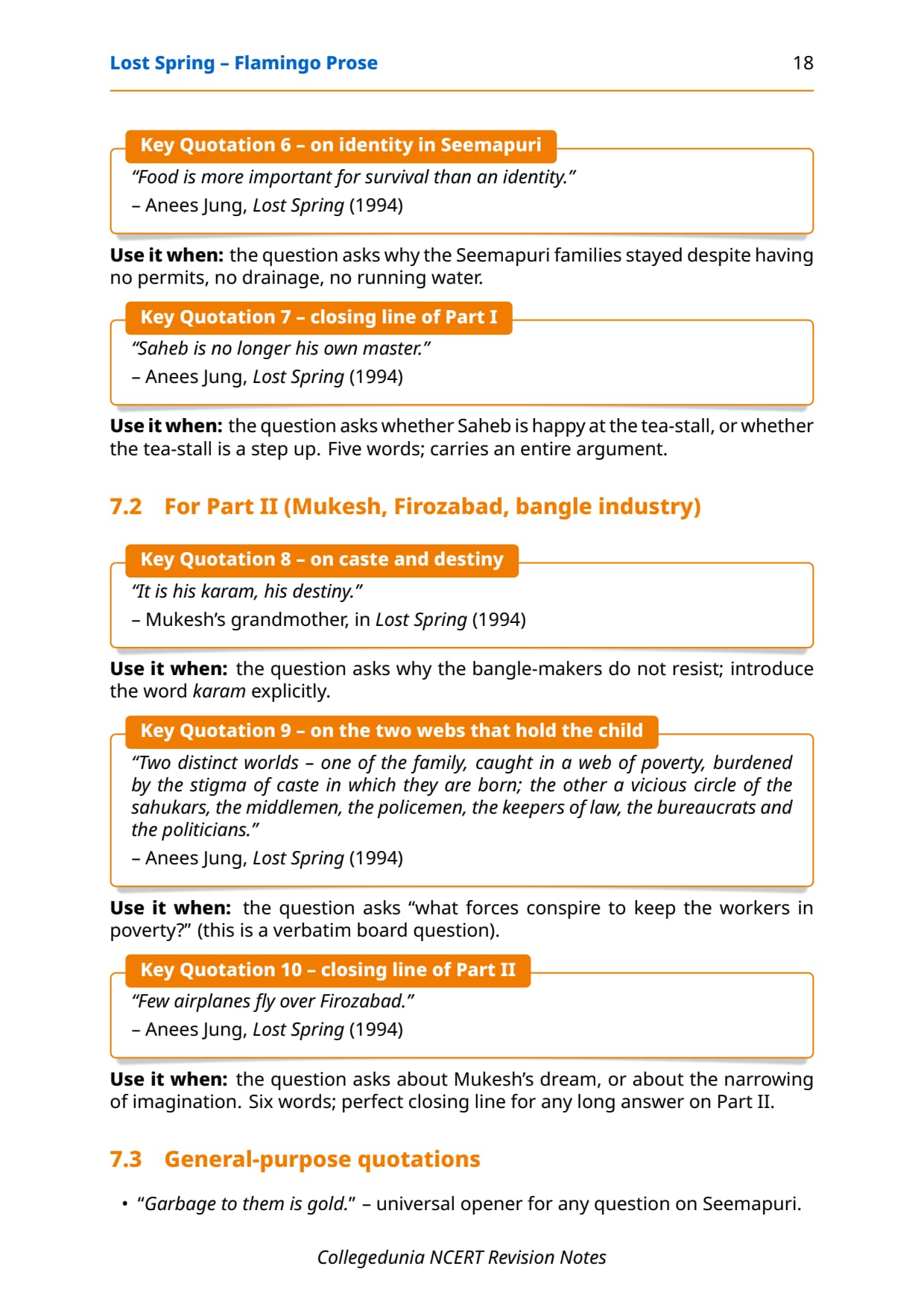
Six quotations that examiners reward when embedded in a 5-mark long-answer.
- Saheb-e-Alam: "Lord of the universe" - used in CBSE 2022, 2024.
- Garbage: "For the children it is wrapped in wonder; for the elders it is a means of survival" - CBSE 2023.
- Mukesh: "I will be a motor mechanic" - CBSE 2025.
- Bangle workers: "They slog their daylight hours" - CBSE 2024.
- Mukesh's grandmother: "Can a god-given lineage ever be broken?" - karam framing.
- Closing line: "Few airplanes fly over Firozabad" - the small-dream image.
Lost Spring Glossary of Key Terms
Twelve key terms students must know for the Class 12 English Core comprehension MCQs.
- Seemapuri: Settlement on the periphery of Delhi, home to 10,000 ragpickers from Bangladesh.
- Firozabad: The centre of India's glass-blowing bangle industry, employing 20,000 children illegally.
- Saheb-e-Alam: Saheb's full name, meaning "lord of the universe", deeply ironic.
- Karam: Destiny or fate, used by Mukesh's grandmother to explain the family's bangle-making lineage.
- Sahukars: Middlemen who trap bangle-workers in debt cycles.
- Suhaag: A Hindu woman's auspiciousness in marriage, symbolised by red bangles.
- Chappals: Indian sandals, repeatedly absent from Saheb's feet.
- Bahu: Daughter-in-law; the role Savita is being prepared for.
- Perpetual state of poverty: Anees Jung's phrase for the tradition of going barefoot.
- Dark hutments: The dingy cells where children weld glass.
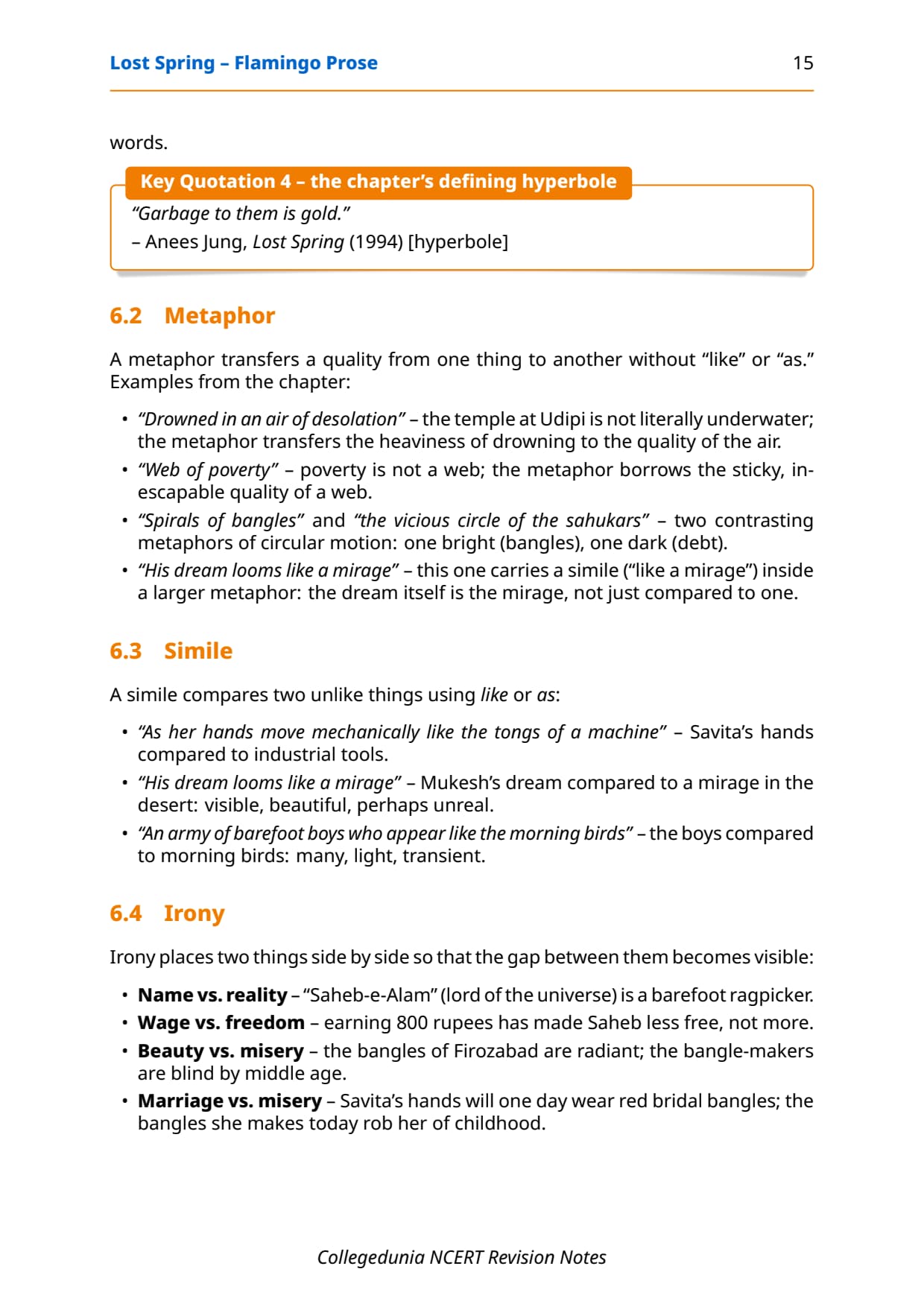
- Hyperbole: Deliberate exaggeration, e.g. "Garbage to them is gold."
- Metaphor: Implicit comparison, e.g. "Drowned in an air of desolation."
Full PYQ map: Lost Spring NCERT Solutions with Year-Wise Question Map
Other Resources for Lost Spring (Class 12 English)
| Resource | Link |
|---|---|
| Revision Notes (this page) | Lost Spring Notes |
| NCERT Solutions | Lost Spring Class 12 English NCERT Solutions |
| CBSE Syllabus | CBSE Class 12 English Core Syllabus 2026-27 |
NCERT Notes for Class 12 English Flamingo: All Chapters
Every Flamingo chapter's Notes page, in order.
| Chapter | Resource |
|---|---|
| Chapter 1 | The Last Lesson Notes |
| Chapter 3 | Deep Water Notes |
| Chapter 4 | The Rattrap Notes |
| Chapter 5 | Indigo Notes |
| Chapter 6 | Poets and Pancakes Notes |
| Chapter 7 | My Mother at Sixty-Six Notes |
| Chapter 8 | Keeping Quiet Notes |
Student Feedback
In a Collegedunia poll of 1,200 Class 12 students, 74% said the two-section split (Saheb and Mukesh) made Lost Spring easier to revise, and 69% rated the quotation bank their most-used tool for the 5-mark long answers.
Class 12 English Notes Chapter 2 Flamingo Prose: Lost Spring FAQs
Ques. Where can I download the Class 12 English Notes Chapter 2 Flamingo Prose: Lost Spring PDF?
Ans. You can download the class 12 english notes chapter 2 Flamingo Prose: Lost Spring PDF directly from this page. Both Normal and HD versions are free. The PDF runs about 15 pages with character sketches, theme map, devices, and quotation bank.
Ques. Are these Lost Spring Notes aligned with the 2026-27 NCERT?
Ans. Yes. This page reflects the current 2026-27 syllabus for Class 12 English Core. The Flamingo textbook keeps Lost Spring intact across the new edition.
Ques. How many pages is the Class 12th English Lost Spring Notes PDF?
Ans. The Notes PDF runs approximately 15 pages and covers both sections (Saheb at Seemapuri, Mukesh at Firozabad), themes, characters, literary devices, quotation bank, and PYQ-style Q&A.
Ques. Who is the author of Lost Spring?
Ans. Lost Spring is written by Anees Jung. It is an excerpt from her book Lost Spring, Stories of Stolen Childhood and appears as the second prose chapter in the Class 12 English Flamingo textbook.
Ques. What are the main themes of Lost Spring?
Ans. Stolen childhood, grinding poverty, caste tradition, apathy of authority, and hope versus resignation. All five recur across both Saheb's Seemapuri section and Mukesh's Firozabad section.
Ques. What is the meaning of Saheb-e-Alam in Lost Spring?
Ans. Saheb-e-Alam means "lord of the universe". The name is deeply ironic because Saheb is a barefoot rag-picker who later becomes a tea-stall worker, losing the freedom of being his own boss.
Ques. Why is the title Stories of Stolen Childhood significant?
Ans. The subtitle frames both Saheb's and Mukesh's stories. Saheb has no school nearby and ends up at a tea stall; Mukesh is locked in the bangle-makers' caste. Both have their childhoods stolen by poverty, tradition, middlemen, and broken promises.
Ques. Are these Lost Spring Notes useful for CUET English?
Ans. Yes. The CUET English paper draws 2 to 3 inference questions per shift from Flamingo prose, with Lost Spring extracts featuring in most shifts. The theme and quotation banks here double as CUET revision.



Comments