




These The Last Lesson Class 12 notes follow the 2026-27 NCERT Flamingo print and condense Alphonse Daudet's chapter into an exam-ready revision document, using a fixed four-pass workflow: context, character arcs, scene summary, and theme-tagged value points.
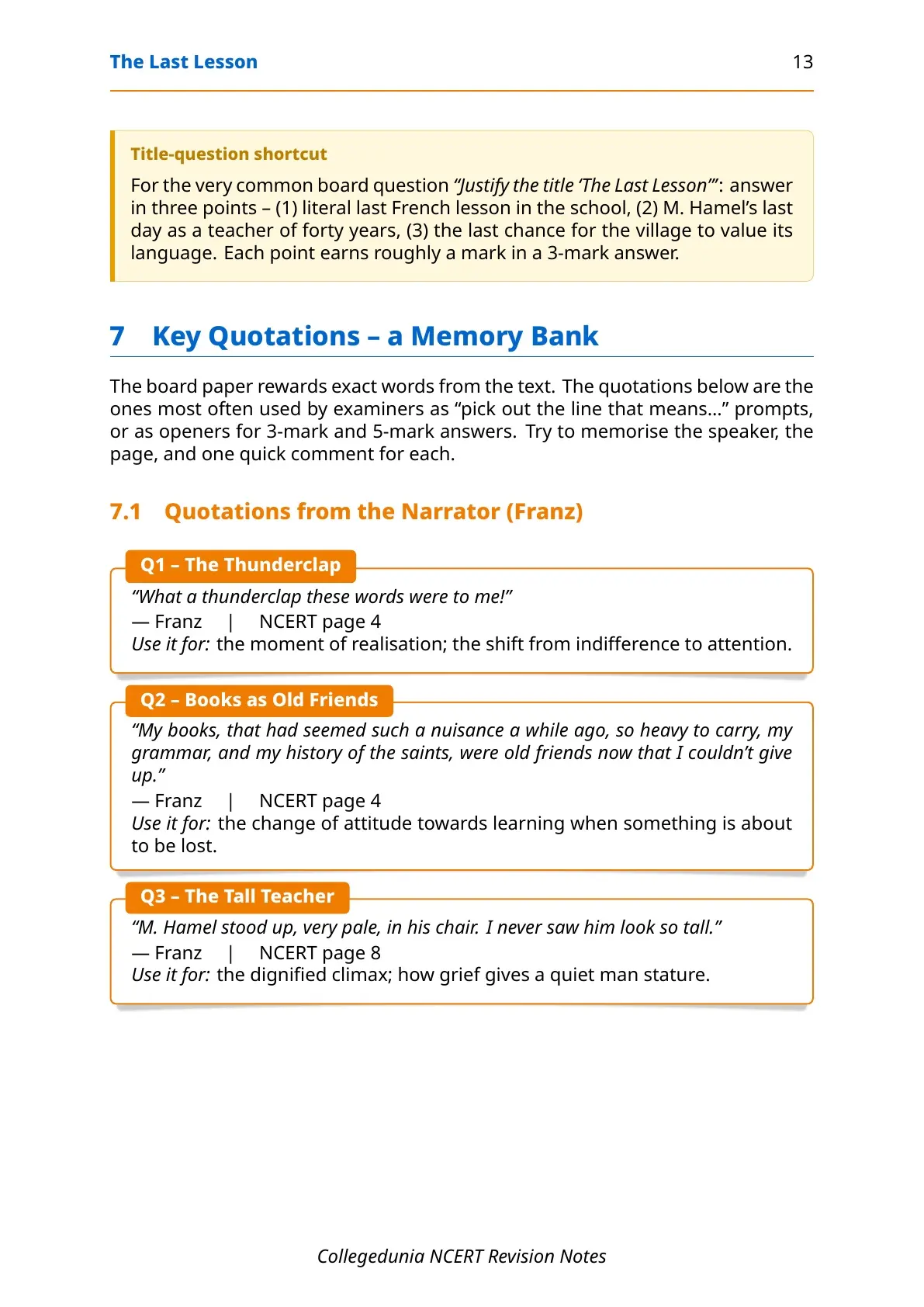
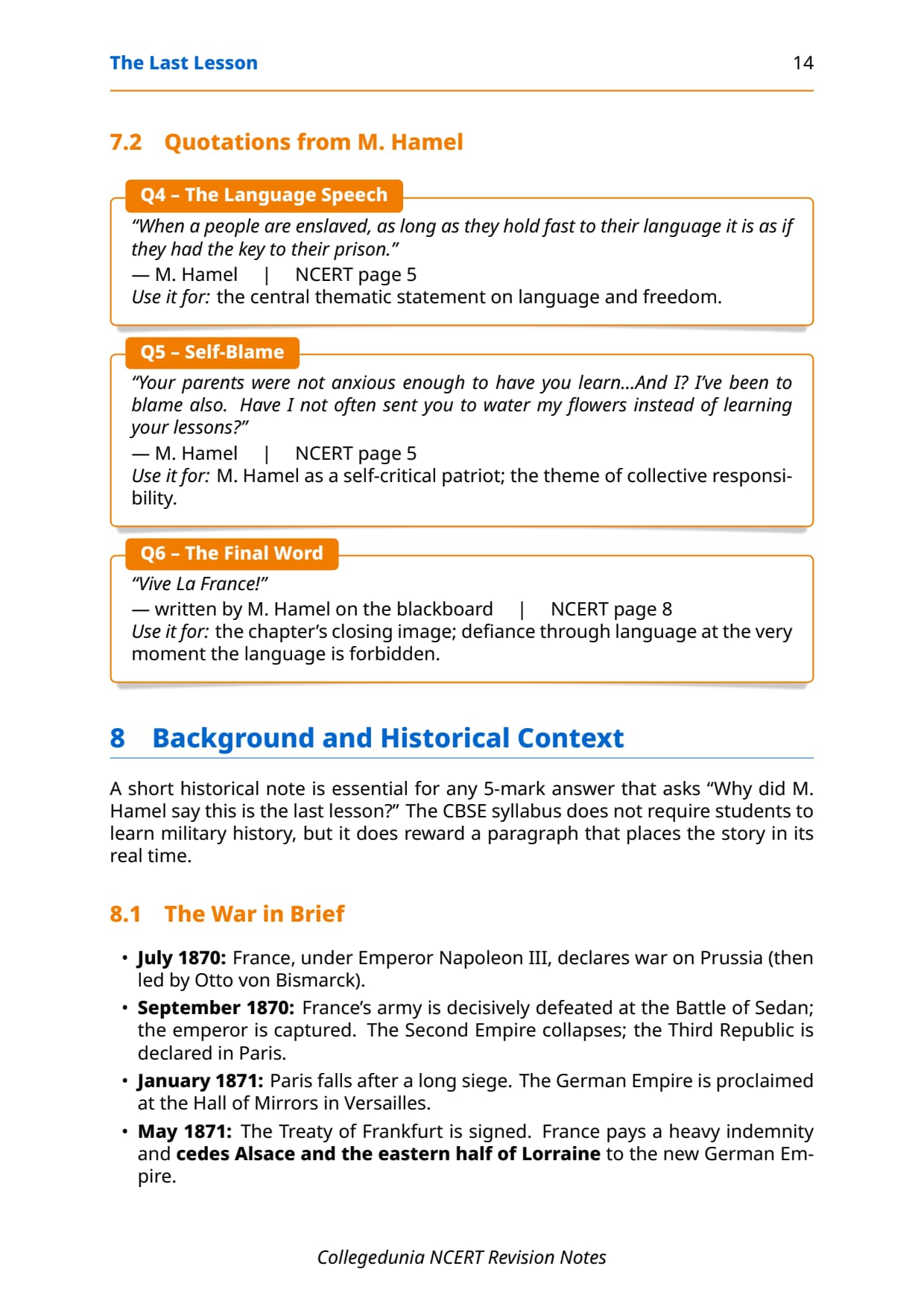
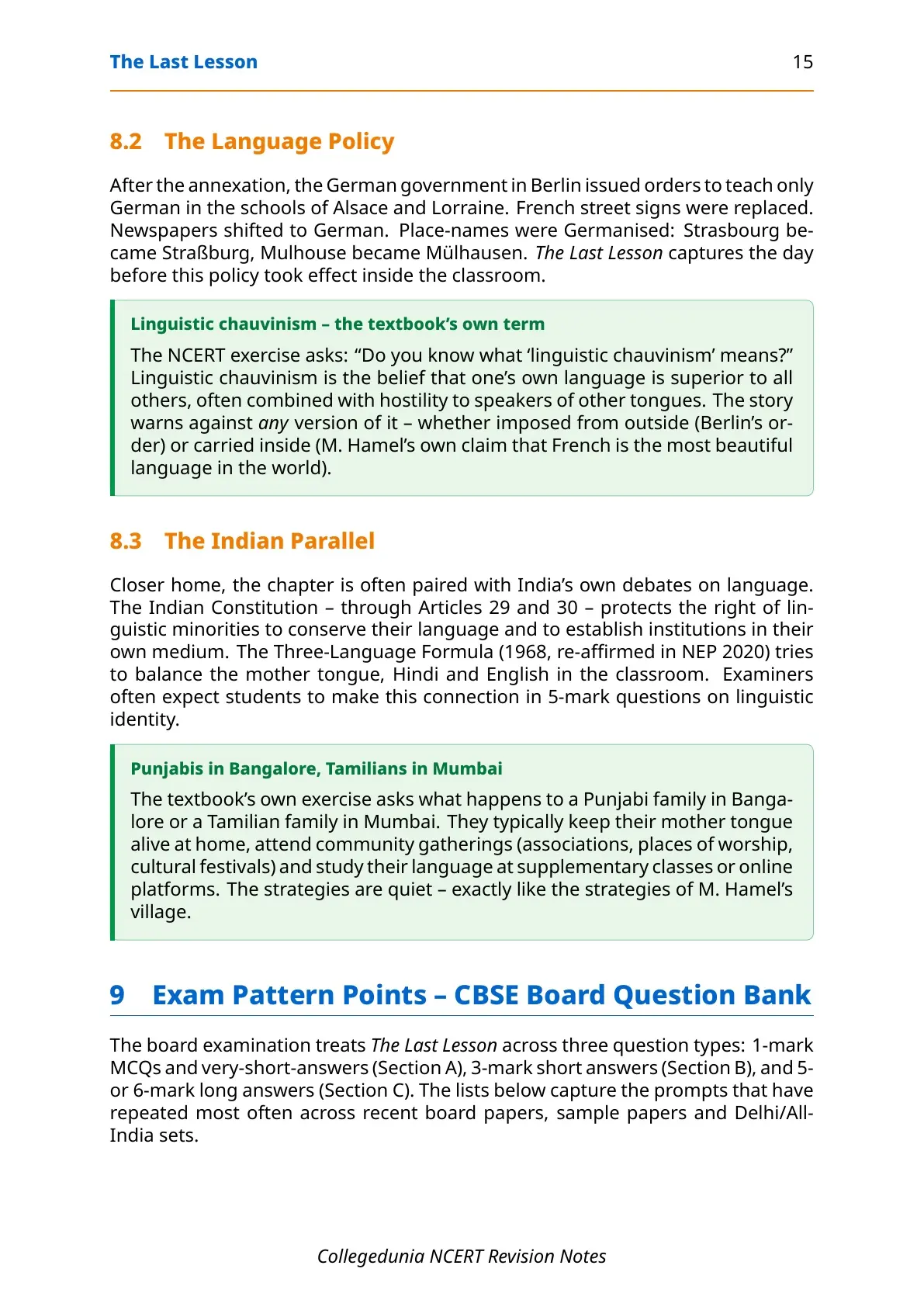
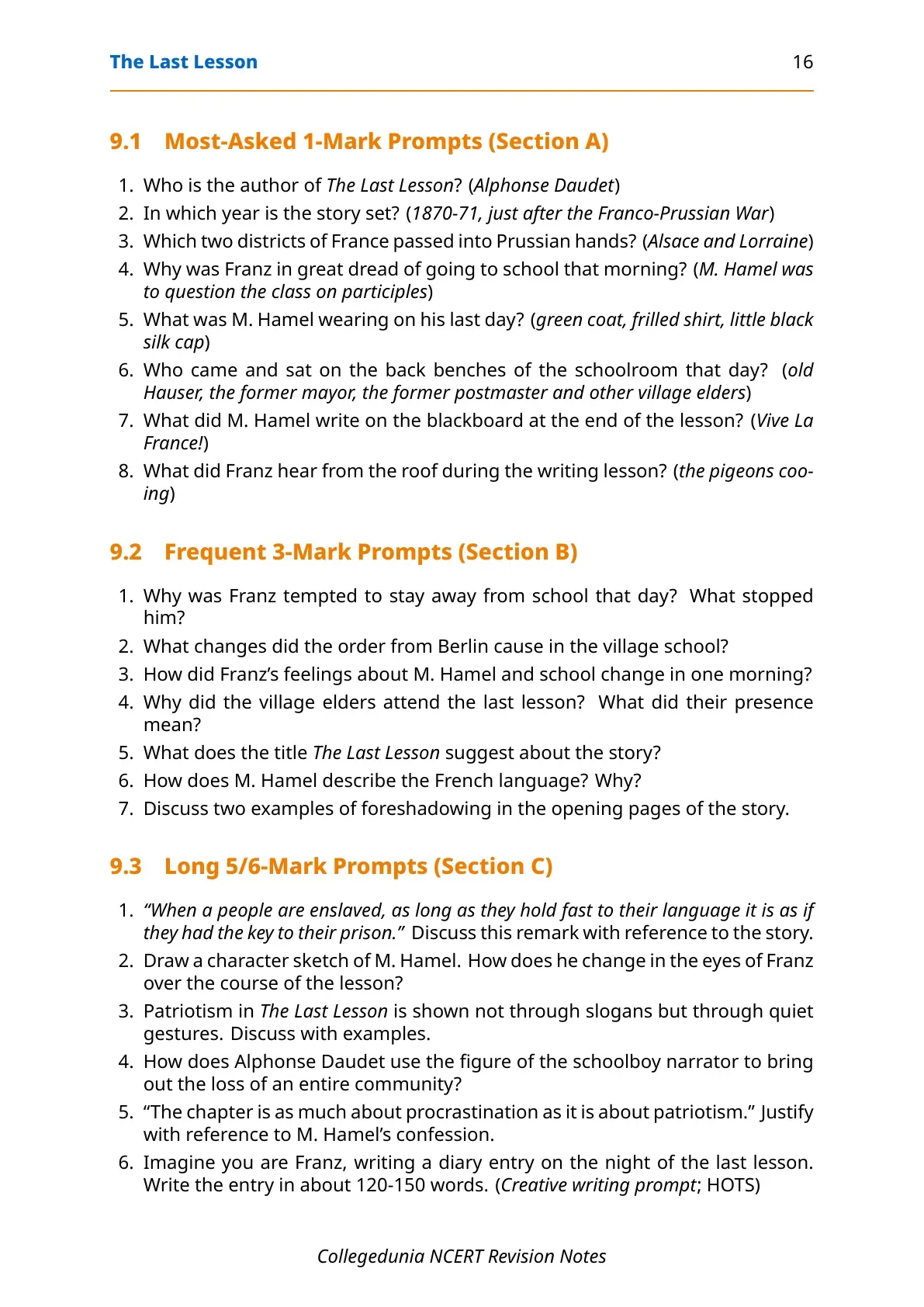
- CBSE Weightage: 6 to 10 marks in Section C, usually one 4 to 6 mark Long Answer plus a 1-mark MCQ tag
- Coverage: 22-page PDF, 6 themed sections, 4 character sketches, scene summary table
These notes are mapped to the 2026-27 NCERT Flamingo textbook and refined against the last five years of CBSE Class 12 English Core papers.

The Last Lesson Class 12 Notes: What the Chapter Covers
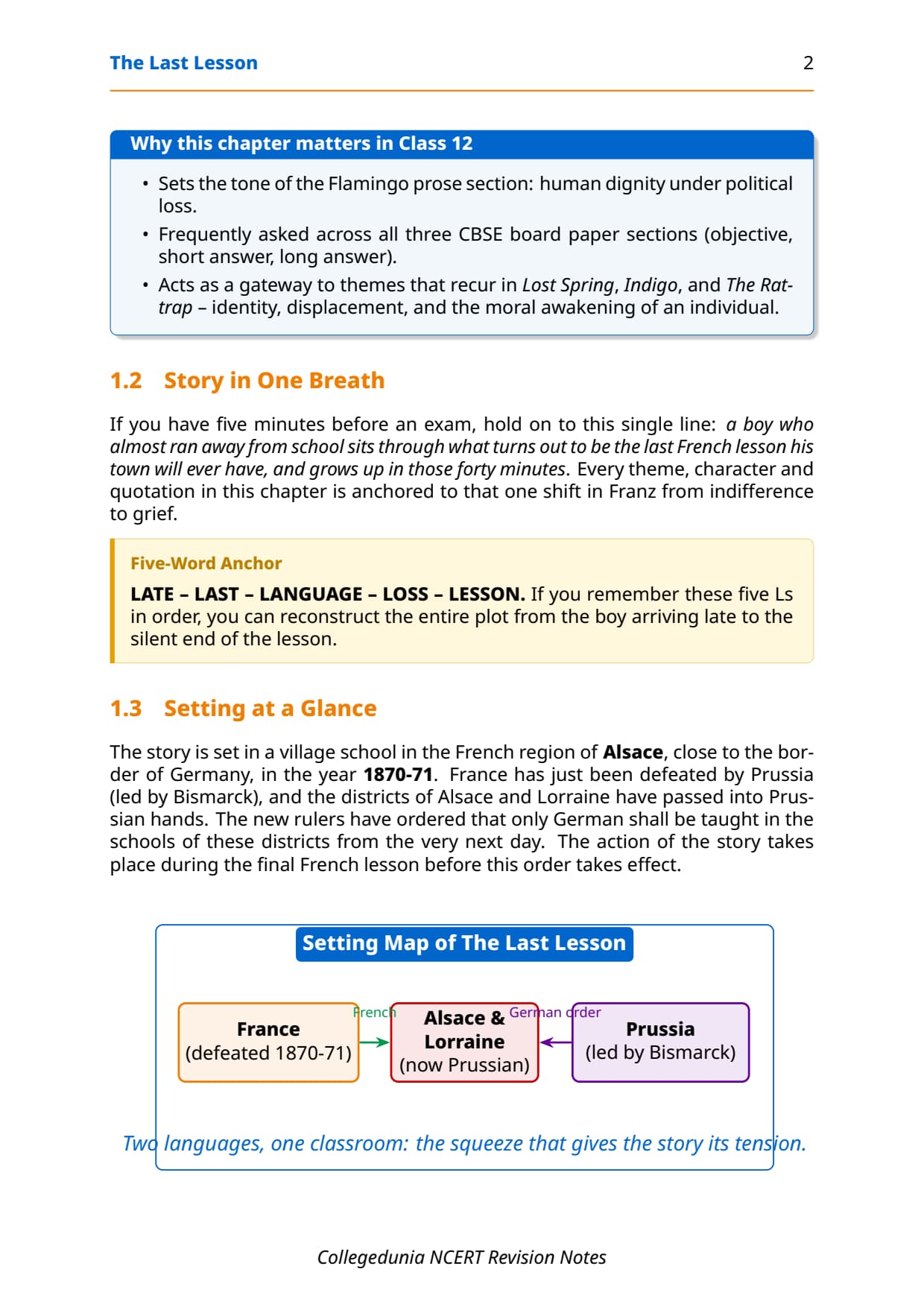
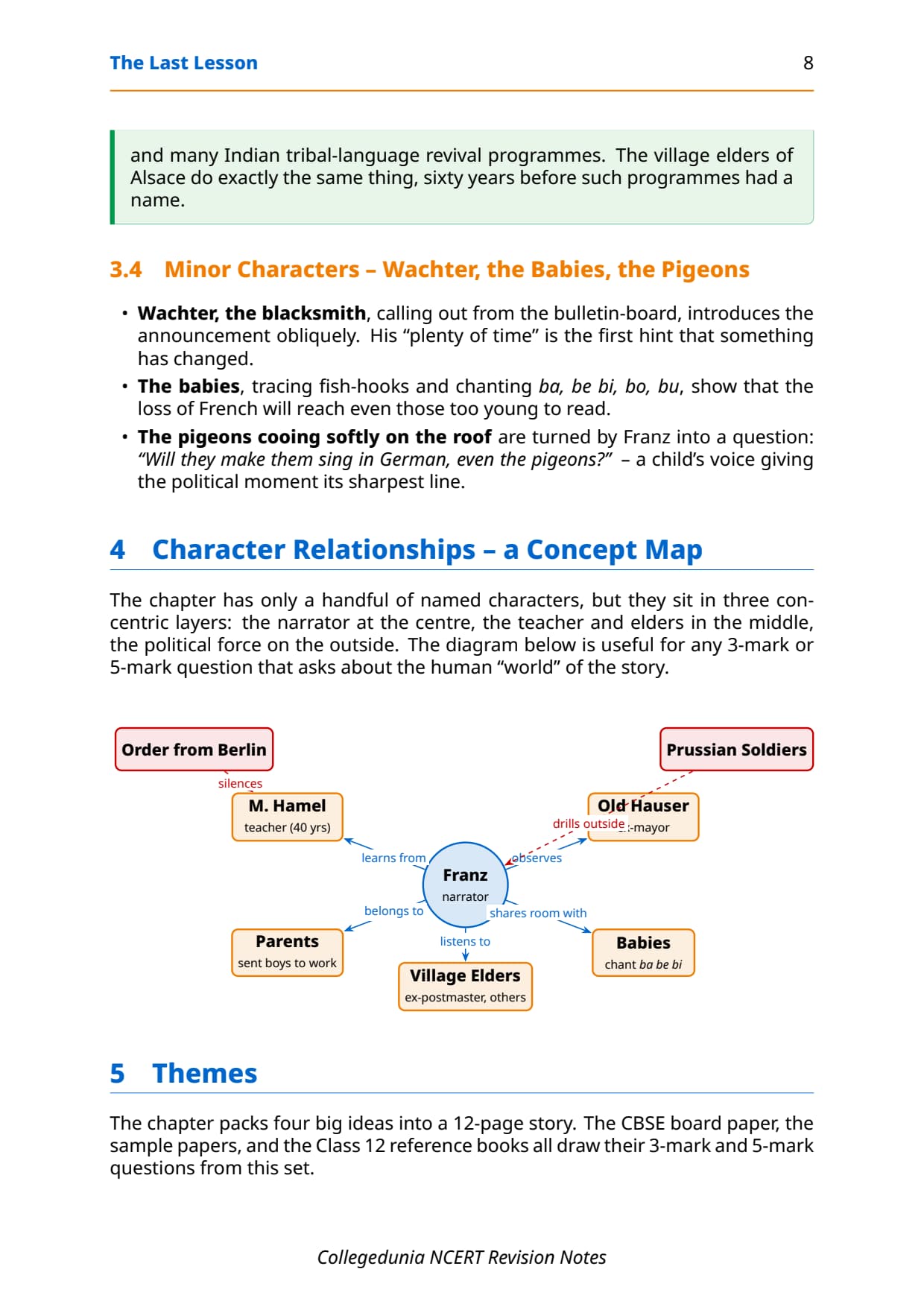
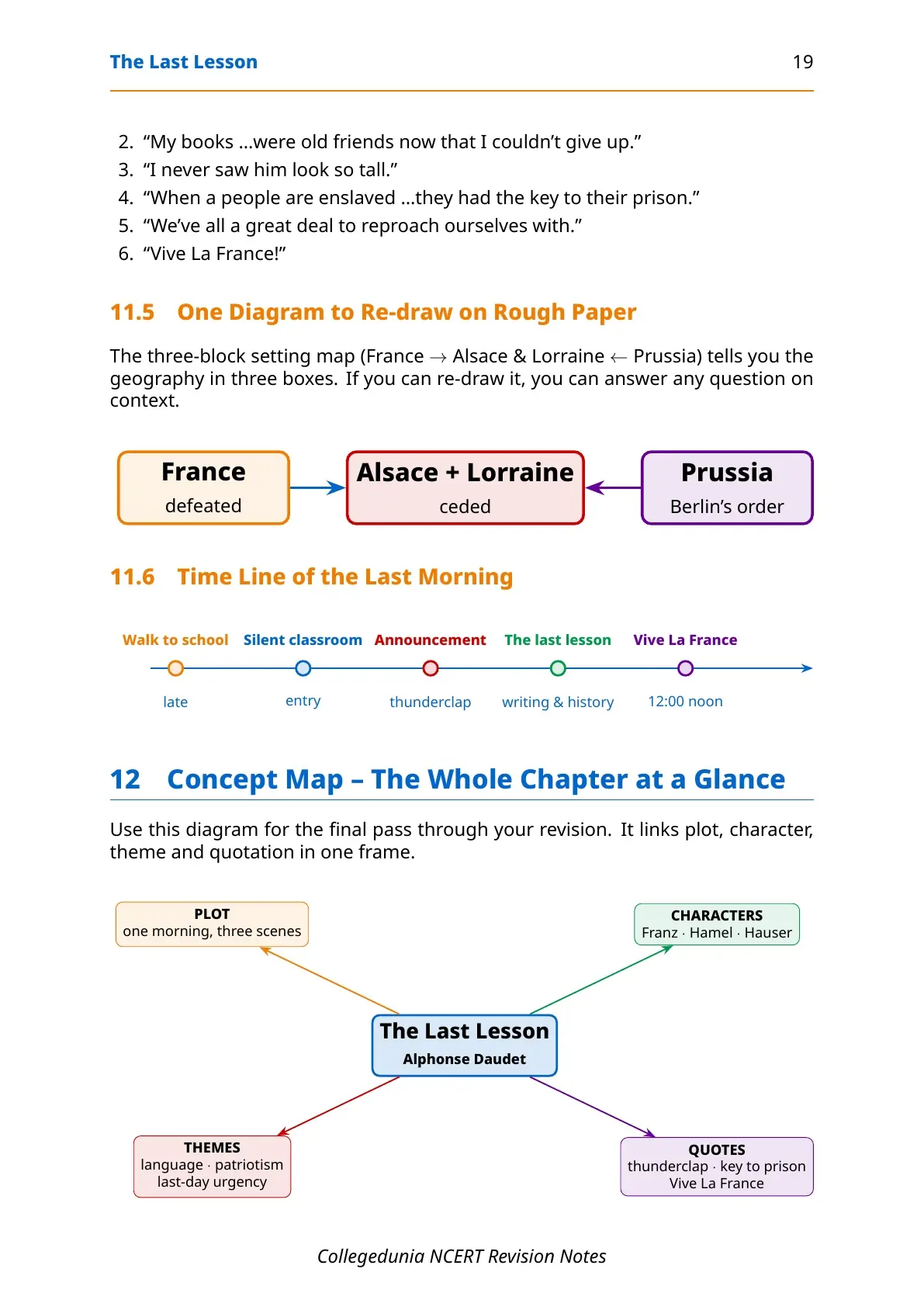
The Last Lesson opens the Class 12 Flamingo textbook. Written by Alphonse Daudet (1840-1897), it is set in a village school in Alsace during the Franco-Prussian War of 1870-71. France has been defeated by Bismarck's Prussia, Alsace and Lorraine are ceded, and Berlin orders that only German will be taught. Franz narrates; M. Hamel is his teacher.
| Section | What It Covers | Typical Mark Yield |
|---|---|---|
| 1. Historical Context | Franco-Prussian War, defeat of France, Bismarck, cession of Alsace-Lorraine, Berlin order | 1 to 2 marks MCQ |
| 2. Setting and Narrator | Village school in Alsace, classroom interior, Franz as first-person narrator | 1 to 2 marks SA |
| 3. Character of Franz | Reluctant student to repentant patriot; "even the pigeons?" | 3 to 4 marks |
| 4. Character of M. Hamel | Forty-year teacher; Sunday clothes; gentle final speech; "Vive La France!" | 3 to 4 marks |
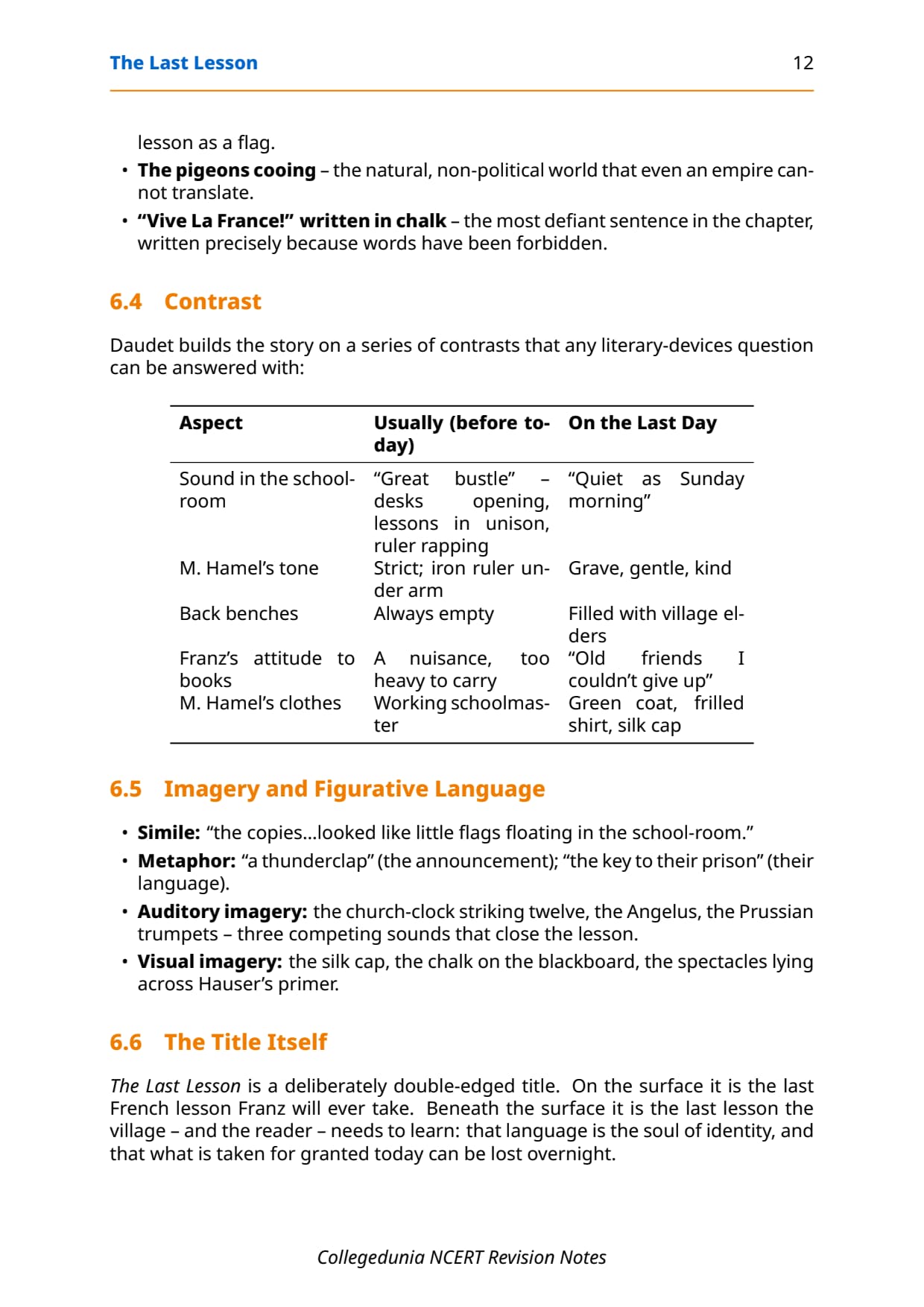
| 5. Symbolism | Pigeons, "France, Alsace" copies as flags, church-clock, Prussian trumpets | 2 to 3 marks |
| 6. Themes and Value Points | Linguistic chauvinism, mother-tongue patriotism, regret, dignity of profession | 4 to 6 marks |
The Last Lesson Video Explanation (Class 12 English)
Source: Magnet Brains on YouTube
The Four-Pass Framework for Reading and Revising The Last Lesson
Every Flamingo prose chapter breaks into the same four passes. A fixed order removes the "where do I start" problem before the exam.
- Context. Learn the Franco-Prussian War timeline, Bismarck, the Alsace-Lorraine cession. CBSE 1-mark MCQs test these facts.
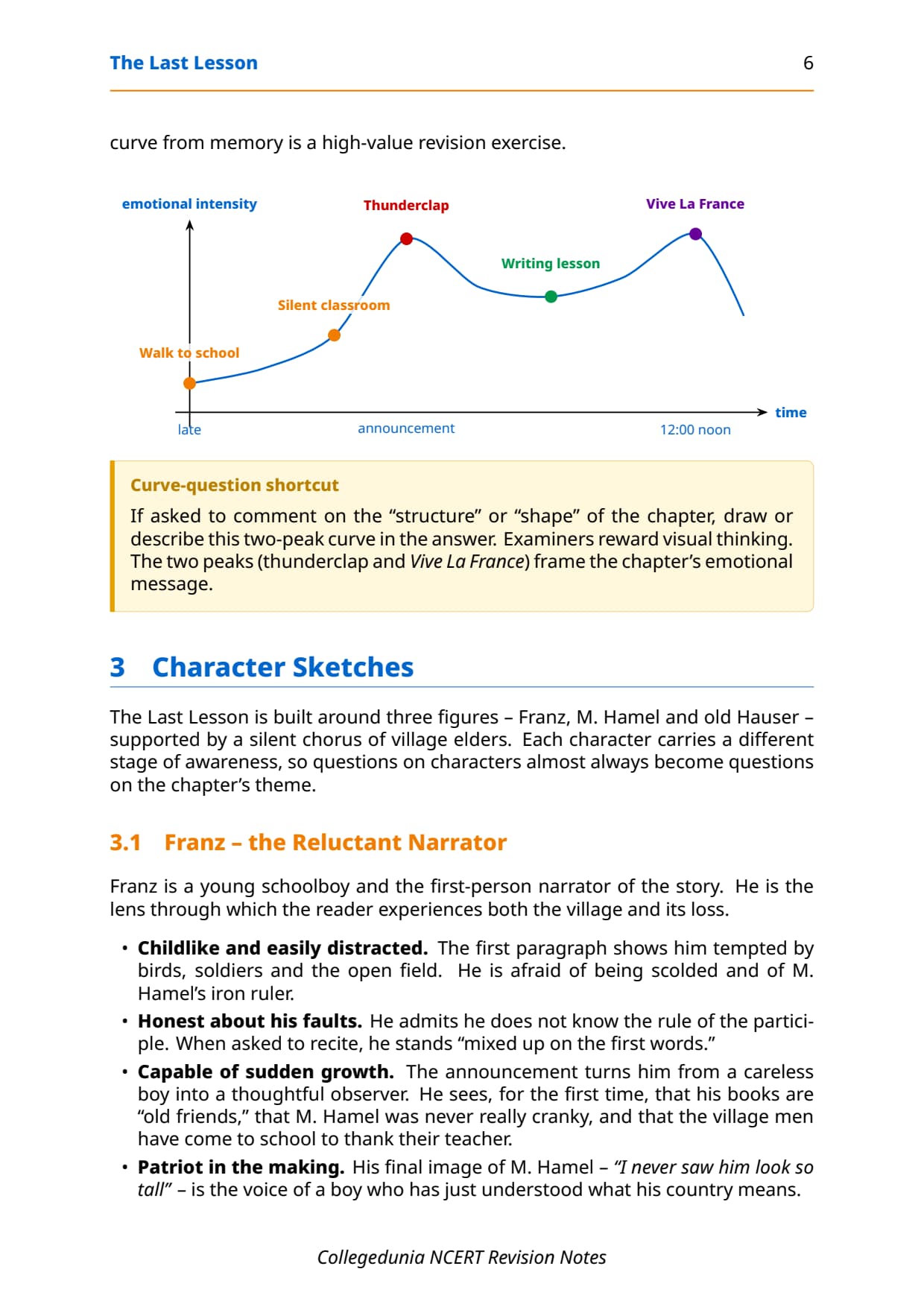
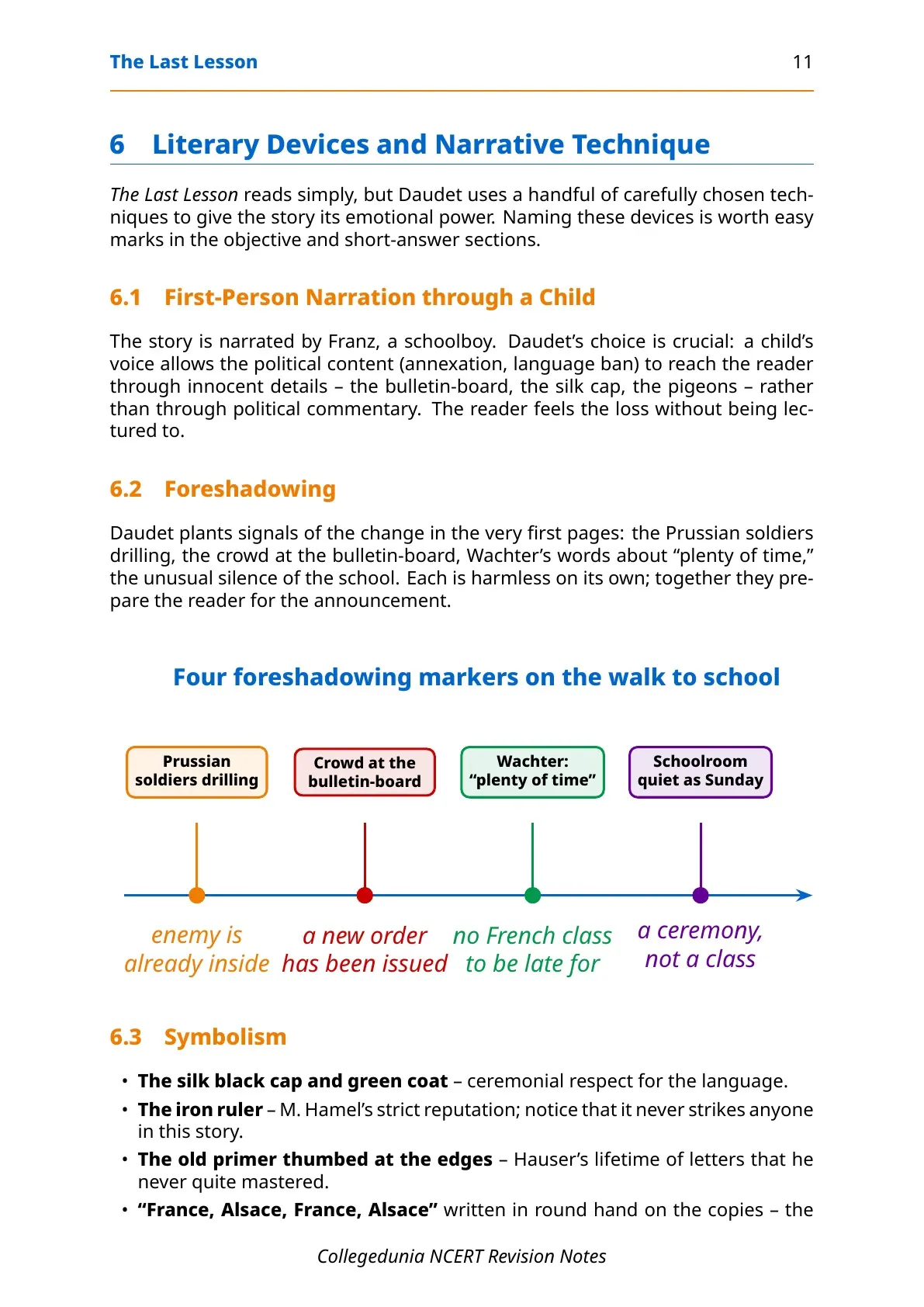
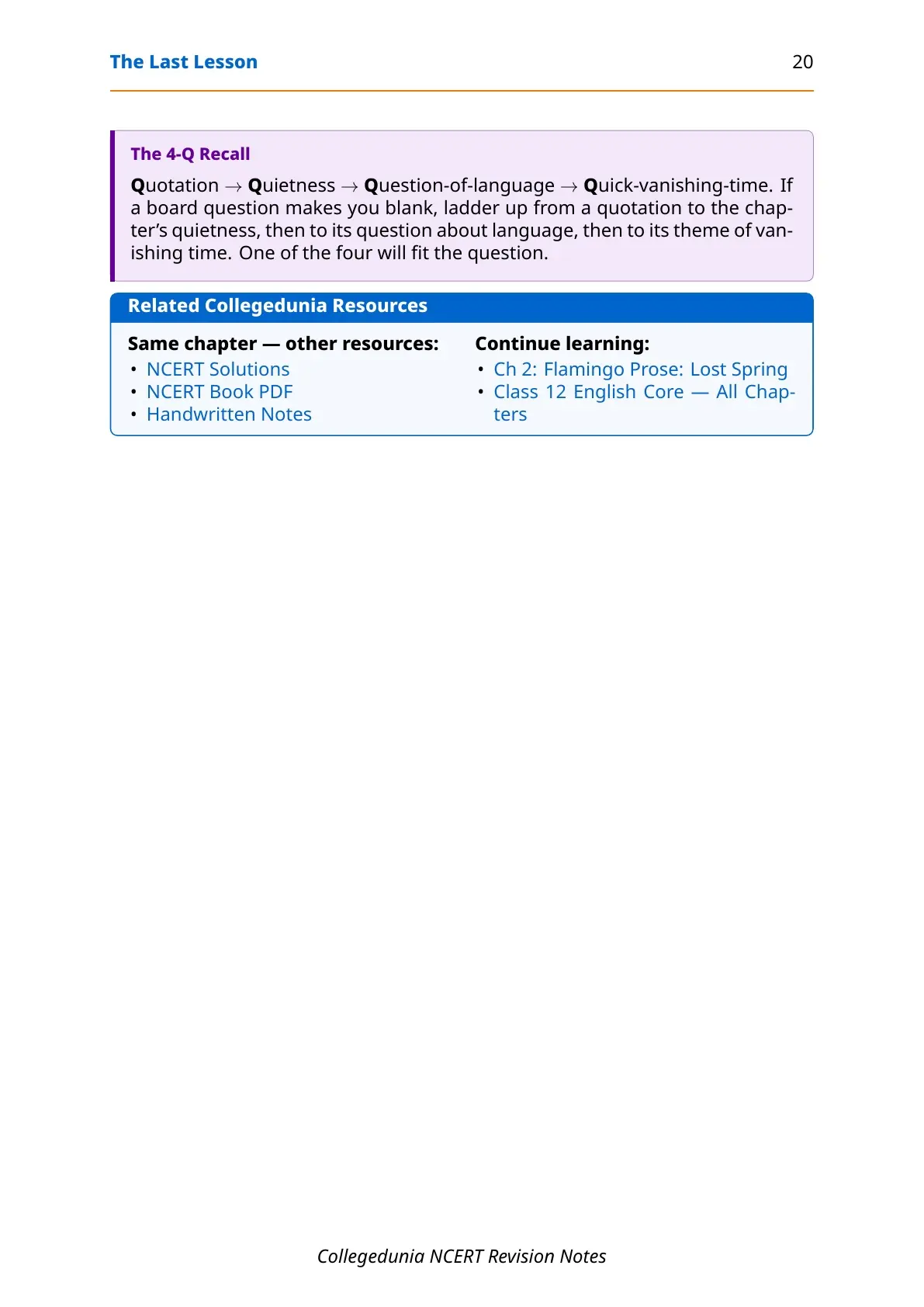
- Scene. Walk the day in five beats: the late start, the silent classroom, the announcement, the lessons, and the noon climax.
- Sketch. Build Franz's and M. Hamel's arcs on three markers.
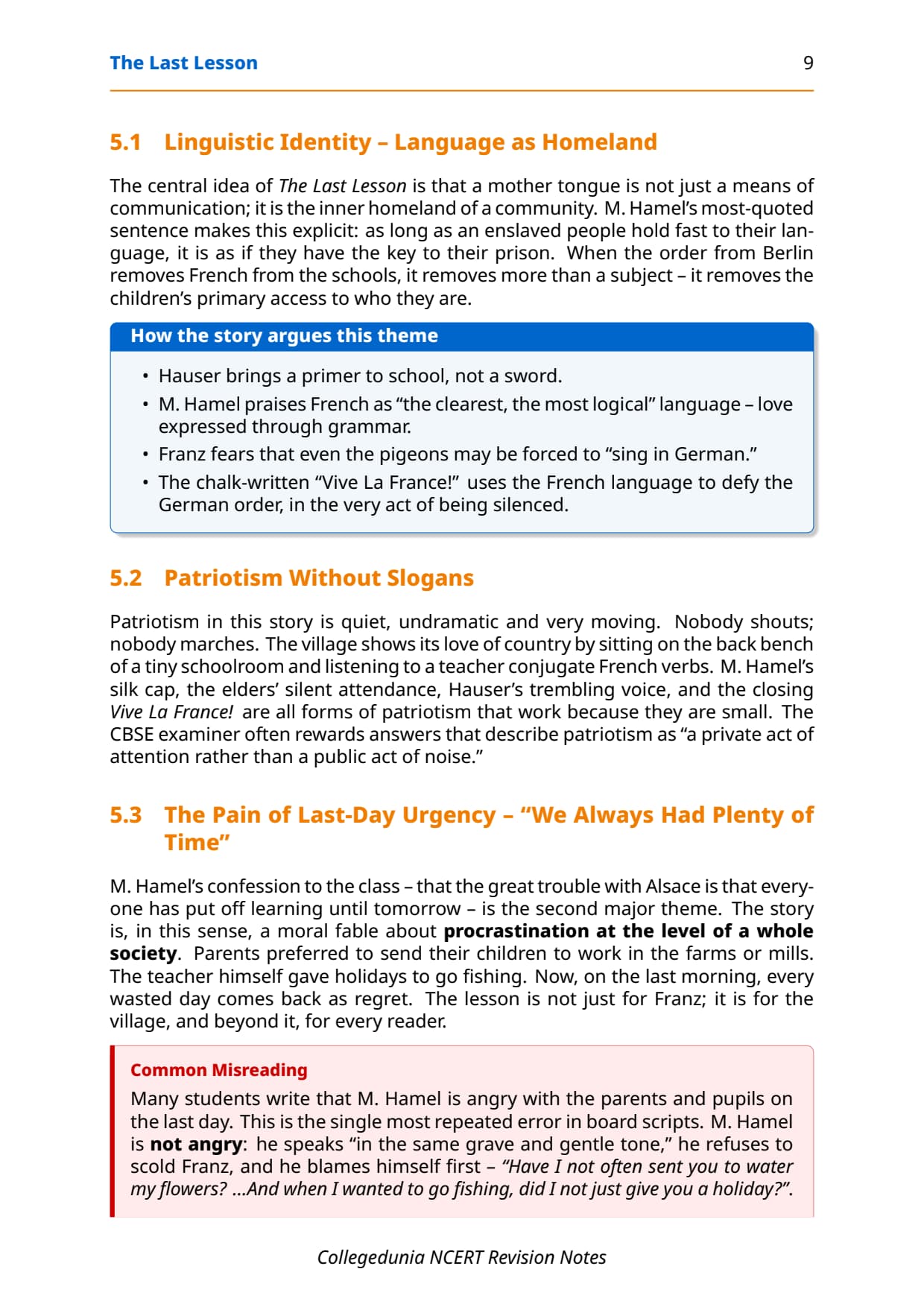
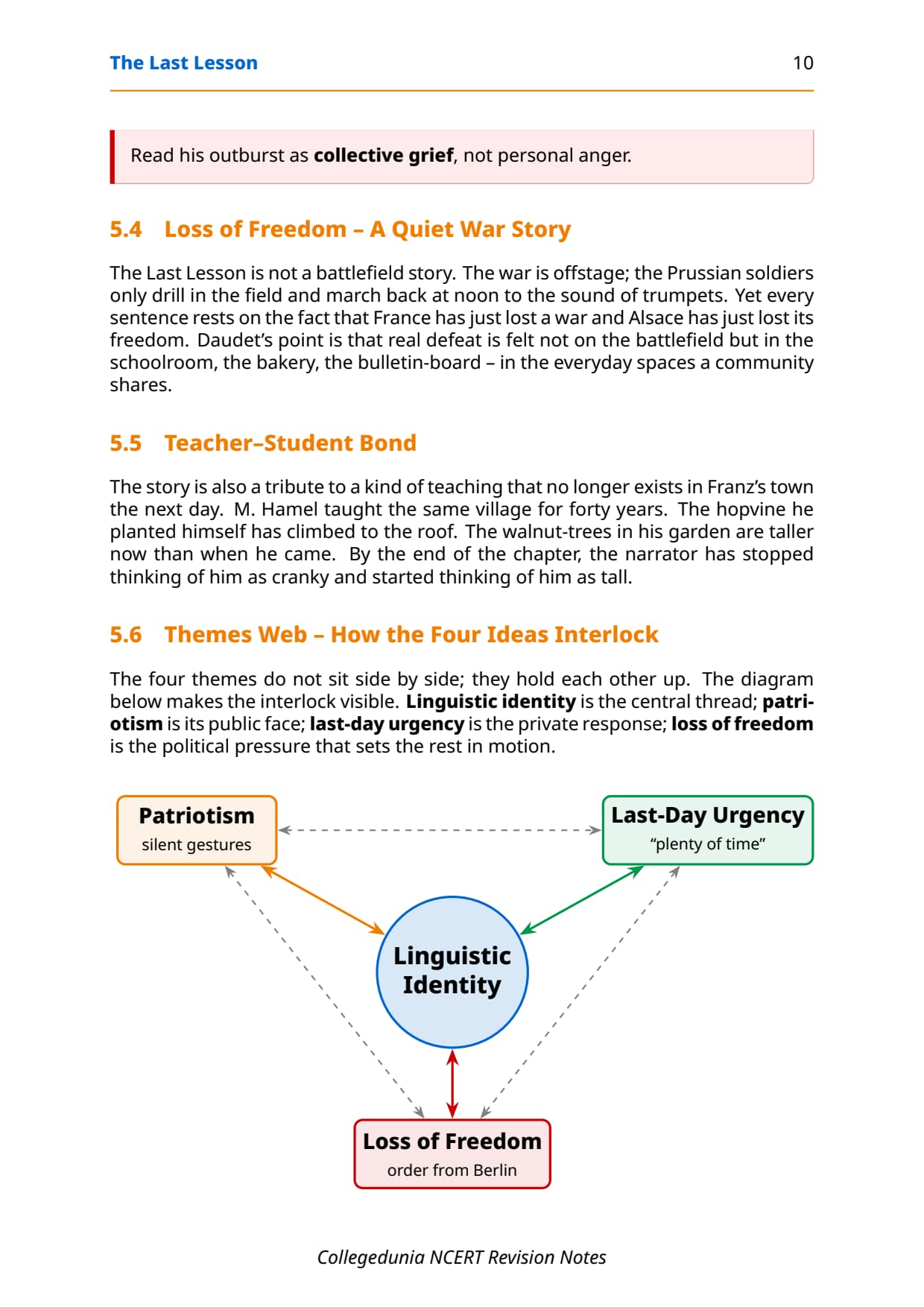
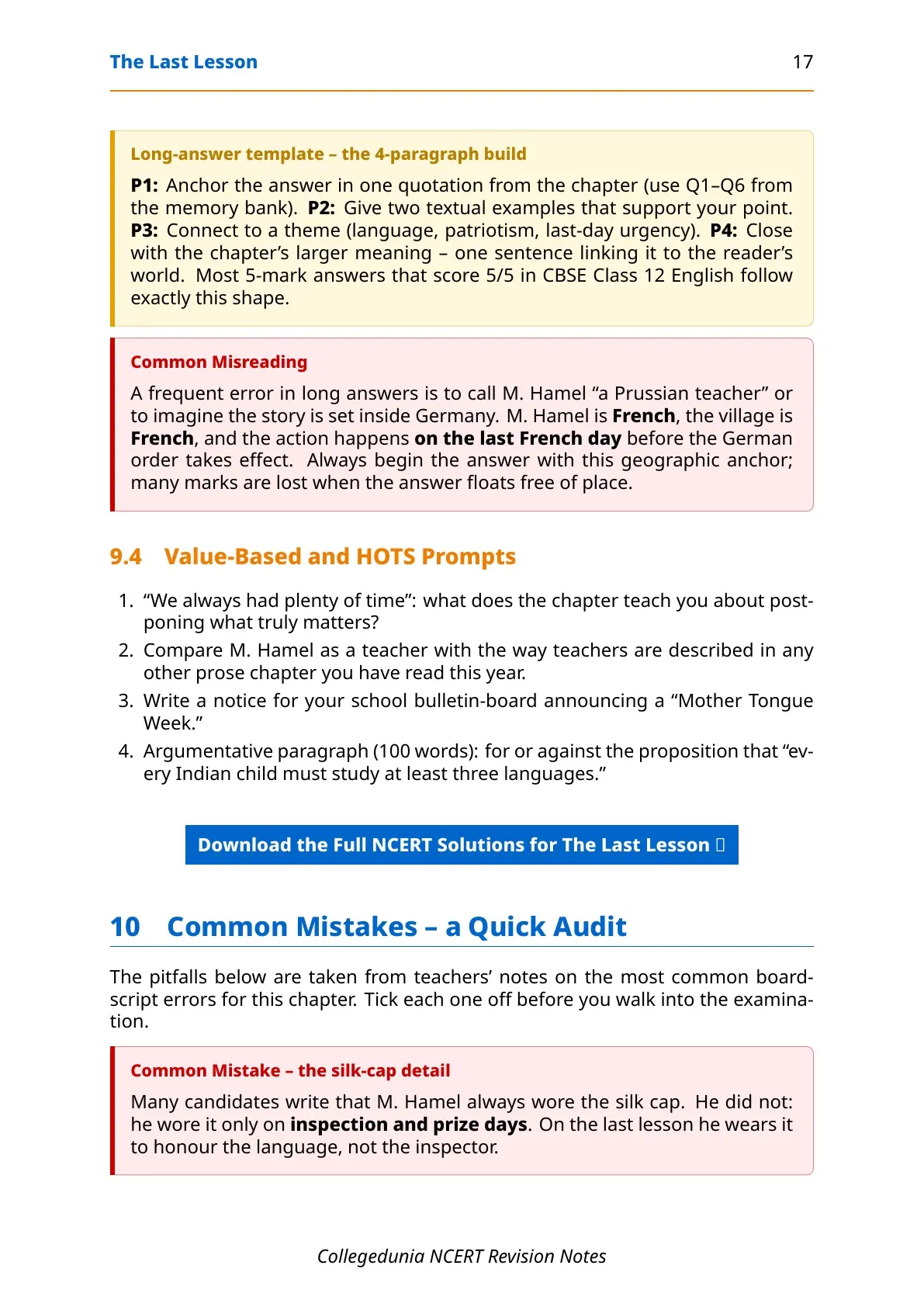
- Theme. Fix the argument in one line ("when language is taken, identity is taken") and tag each quotation to a core theme.
Setting: Alsace, 1870-71, and the Franco-Prussian War
Alsace and Lorraine are two French districts on the eastern border with Germany. The Franco-Prussian War broke out in July 1870. France was defeated at Sedan, and the Treaty of Frankfurt (May 1871) ceded Alsace and most of Lorraine to the new German Empire that Bismarck had unified under Prussia.
The order "from Berlin" decrees that schools in the ceded territories will teach in German, not French. M. Hamel's last lesson happens the morning after it is posted on the bulletin-board. The order is the central plot device; every emotional beat follows from it.
Character Sketch: Franz, the Reluctant-to-Repentant Narrator
Franz is the first-person narrator and one of the two protagonists. He would rather skip class than face M. Hamel's questions on participles. The chapter charts his change from a careless child into a boy who grasps what he is about to lose.
- Opening Franz. Late for school, "in great dread of a scolding", tempted to skip class.
- Mid-story Franz. The silent classroom, the elders on the back benches, and the announcement pry his perception open. "What a thunderclap these words were to me!" marks the turn.
- End-of-story Franz. He follows the grammar lesson closely and ends with tender concern: "even the pigeons?"
Character Sketch: M. Hamel, the Forty-Year Teacher
M. Hamel is the village schoolmaster and second protagonist. He has taught here forty years. On the last day he becomes a symbol of his country, his profession, and the language he must give up.
- The Sunday clothes. The green coat, frilled shirt and embroidered silk cap he wore only on prize days. He dresses for a national occasion.
- The gentle voice. The man who once used the iron ruler now speaks with self-reproach: "I've been to blame."
- The speech on language. "The French language is the most beautiful in the world... we must guard it and never forget it."
- The "Vive La France!" climax. When the Prussian trumpets sound at noon, he cannot finish. He writes "Vive La France!" and dismisses the class.
Symbolism: Reading Daudet's Five Embedded Symbols
The chapter is built around five recurring symbols. Tagging each by meaning gives instant 1-mark MCQ recall and depth in long answers.
| Symbol | Surface Image | Meaning |
|---|---|---|
| The Pigeons | Birds cooing on the school roof | Innocent victims of the new order; "even the pigeons?" |
| The New Copies | Sheets reading "France, Alsace" in round hand | Little flags; private resistance after public surrender |
| Hauser's Primer | Old textbook "thumbed at the edges" | Elders honour the language; learning becomes patriotism |
| The Iron Ruler | M. Hamel's "terrible iron ruler" | Stern authority on a normal day; gone on the last, replaced by gentleness |
| The Prussian Trumpets | Trumpets under the school window at noon | The occupier's victory; silences M. Hamel mid-sentence |
Themes: Four Lines You Should Memorise
- Linguistic chauvinism. The Berlin order claims German should replace French in conquered schools, echoing the Welsh Not in Britain and the suppression of Korean under Japanese rule.
- Mother-tongue patriotism. "As long as they hold fast to their language it is as if they had the key to their prison." The mother tongue is a homeland the occupier cannot confiscate.
- Regret as motivator. Franz, M. Hamel and the elders all regret not valuing the language enough.
- Dignity of teaching. Forty years of "faithful service" earn M. Hamel his Sunday clothes; teaching is treated as a national service.
Scene-by-Scene Summary
| # | Scene | Key Detail |
|---|---|---|
| 1 | Franz starts late for school | "In great dread of a scolding" about participles |
| 2 | The bulletin-board crowd | Two years of bad news have come from here |
| 3 | The silent classroom | M. Hamel in Sunday clothes; elders on the back benches; Hauser's primer |
| 4 | The announcement | "This is the last lesson... The order has come from Berlin" |
| 5 | The grammar lesson | Franz finally understands every rule |
| 6 | The writing lesson | New copies of "France, Alsace"; pigeons on the roof |
| 7 | The babies' alphabet | Babies chant "ba, be, bi, bo, bu"; Hauser cries while spelling |
| 8 | The climax | Clock strikes twelve; trumpets sound; M. Hamel writes "Vive La France!" |
Common Mistakes Students Make in The Last Lesson Answers
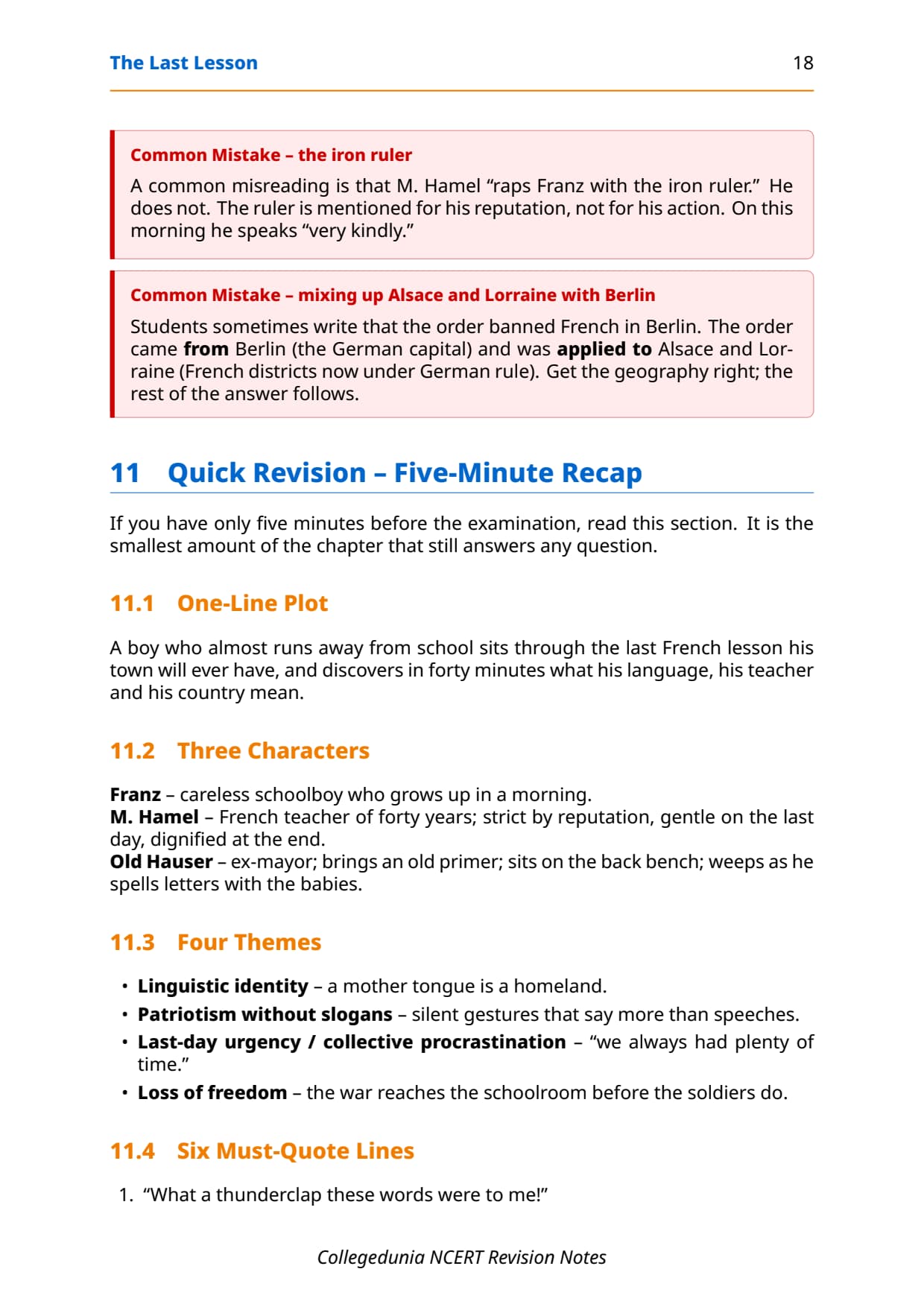
- Locating Alsace in Germany instead of France (it was French territory ceded after 1871).
- Treating M. Hamel as a flat "stern teacher" without tracking his arc.
- Missing the noon-bell, Angelus and trumpet convergence as the climax.
- Quoting "Vive La France!" without the gloss "Long live France".
- Treating Franz's regret as adult patriotism, not a child's grasp of loss.
- Confusing the Franco-Prussian War (1870-71) with the First World War.
- Forgetting the order comes "from Berlin", a fact CBSE tests in MCQs.
CBSE Class 12 English Previous Year Question Mapping for The Last Lesson
Year-wise CBSE focus areas. The 4 to 6 mark Long Answer rotates between language-as-identity, character-arc, and "linguistic chauvinism" value questions.
| Year | Long Answer Focus | Marks |
|---|---|---|
| 2025 | Language as identity: the "key to their prison" line | 6 |
| 2024 | Franz's changed feelings about M. Hamel and school | 5 |
| 2023 | Role of the village elders in the last lesson | 6 |
| 2022 | Why M. Hamel wore his Sunday clothes | 4 |
| 2021 | Franz's transformation across the day | 6 |
Full PYQ map: The Last Lesson NCERT Solutions with year-wise PYQ workings.
Other Resources for The Last Lesson (Class 12 English)
| Resource | Link |
|---|---|
| Revision Notes (this page) | The Last Lesson Notes |
| NCERT Solutions | The Last Lesson Class 12 English NCERT Solutions |
| CBSE Syllabus | CBSE Class 12 English Core Syllabus 2026-27 |
Student Feedback
In a Collegedunia poll of 1,200 Class 12 students, 78% said the C-S-S-T framework made The Last Lesson faster to revise, and 71% rated the five-symbol table their most-used one-pager before the Board exam.
NCERT Notes for Class 12 English Flamingo: All Chapters
| Chapter | Notes Link |
|---|---|
| Chapter 2 | Lost Spring Notes |
| Chapter 3 | Deep Water Notes |
| Chapter 4 | The Rattrap Notes |
| Chapter 5 | Indigo Notes |
| Chapter 6 | Poets and Pancakes Notes |
| Chapter 7 | My Mother at Sixty-Six Notes |
| Chapter 8 | Keeping Quiet Notes |
FAQs on The Last Lesson Class 12 Notes
Q. What is the main theme of The Last Lesson?
The main theme is linguistic chauvinism versus mother-tongue patriotism. Daudet uses the Berlin order forbidding French in Alsatian schools to argue that language is identity: when the occupier takes your language, the occupier takes your nation. M. Hamel's "key to their prison" line is the chapter's thesis.
Q. Who wrote The Last Lesson and what is its historical setting?
The Last Lesson was written by the French novelist and short-story writer Alphonse Daudet (1840-1897). It is set in a village school in the French province of Alsace during the Franco-Prussian War of 1870-71, on the morning after Berlin orders that only German will be taught in Alsace and Lorraine.
Q. Why was M. Hamel called "poor man" by Franz?
Franz called M. Hamel "poor man" out of sudden empathy. The teacher had served the village for forty faithful years, dressed in his Sunday clothes for what should have been an ordinary day, and was about to leave Alsace forever the next morning. Franz also realised he might never see his teacher again, which converted his earlier resentment into compassion.
Q. What was the order that came from Berlin?
The order from Berlin was that only German would be taught in the schools of Alsace and Lorraine from the next day onwards. A new master would arrive to replace M. Hamel, and French - the language of the conquered Alsatians - would no longer be the medium of instruction.
Q. What does "Vive La France!" mean and when does M. Hamel write it?
"Vive La France!" means "Long live France!" in French. M. Hamel writes it on the blackboard with all his might at the very end of the chapter, when the church-clock strikes twelve, the Angelus rings, and the trumpets of the returning Prussians sound under the school window. Unable to finish his goodbye speech, he writes those three words and dismisses the class with a single gesture.
Q. Why did the village elders attend the last lesson?
Old Hauser, the former mayor, the former postmaster, and others came to honour M. Hamel for his forty years of faithful service and to pay their respect to the country - and the language - that was theirs no more. Hauser even brought his old primer, "thumbed at the edges", to spell letters with the babies, turning learning itself into a final act of patriotism.



Comments