




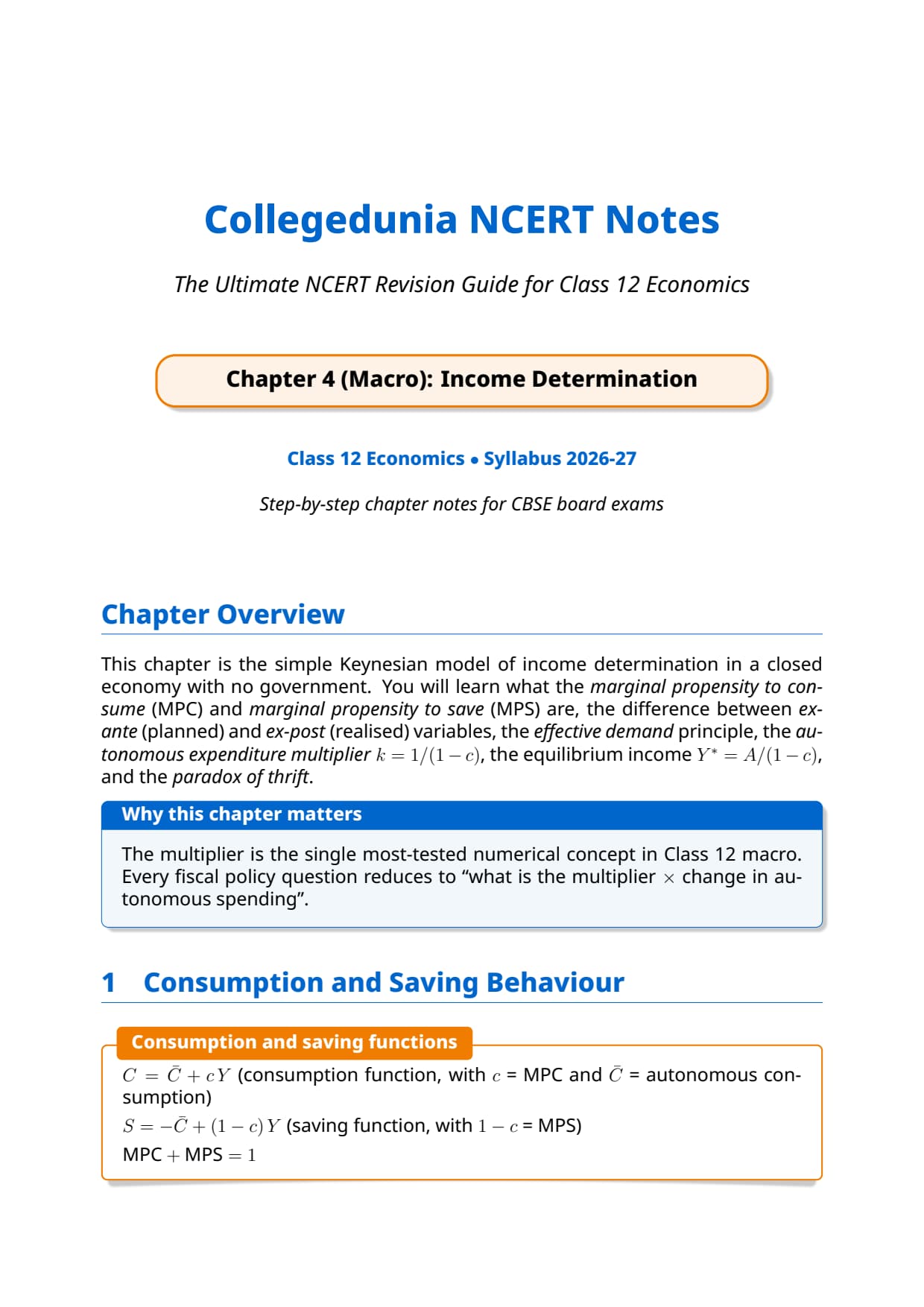
Class 12 Economics Chapter 4 Income Determination is the short-run Keynesian model of how total output is fixed. It explains aggregate demand, the consumption and saving functions, the multiplier and equilibrium income. This page has the full revision notes and a free PDF to download.
Here is what this chapter is worth in the exam:
- CBSE Boards: about 6 marks, with at least one multiplier or AD-AS numerical.
- CUET: 2 to 3 questions every year on MPC, MPS and the multiplier.
- Revision time: about 35 minutes with these notes.
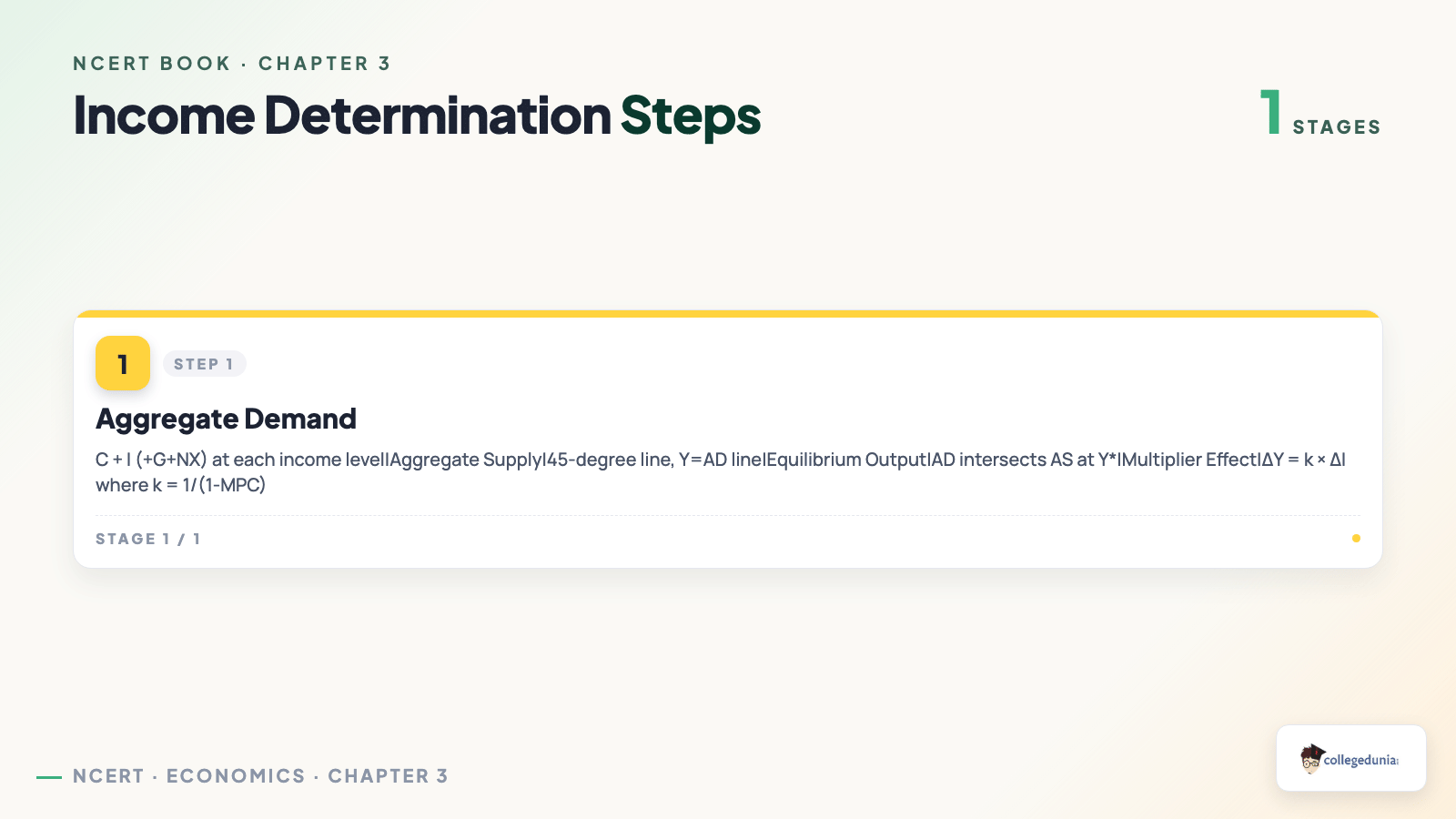
What These Income Determination Notes Cover (Class 12 Economics Chapter 4)
The chapter splits into a few small topics. The notes give each one a short, exam-ready summary:
- Aggregate demand and supply (2 marks): the two forces that fix output.
- Consumption and saving functions (3 marks): how spending and saving rise with income.
- MPC, MPS, APC, APS (3 marks): the four ratios examiners love.
- Investment multiplier (4 marks): why a small rise in spending lifts income by more.
- Equilibrium output (4 marks): where planned demand equals planned supply.
- Excess and deficient demand (3 marks): the two gaps and how to fix them.
Aggregate Demand and Aggregate Supply in Income Determination
This is where the chapter starts. Output is fixed at the point where what people plan to spend equals what firms plan to supply. The lines below are short enough to write in a board answer.
| Term | Meaning |
|---|---|
| Aggregate demand (AD) | Total planned spending in the economy: AD = C + I in a simple model. |
| Aggregate supply (AS) | Total output firms plan to produce, equal to national income (Y). |
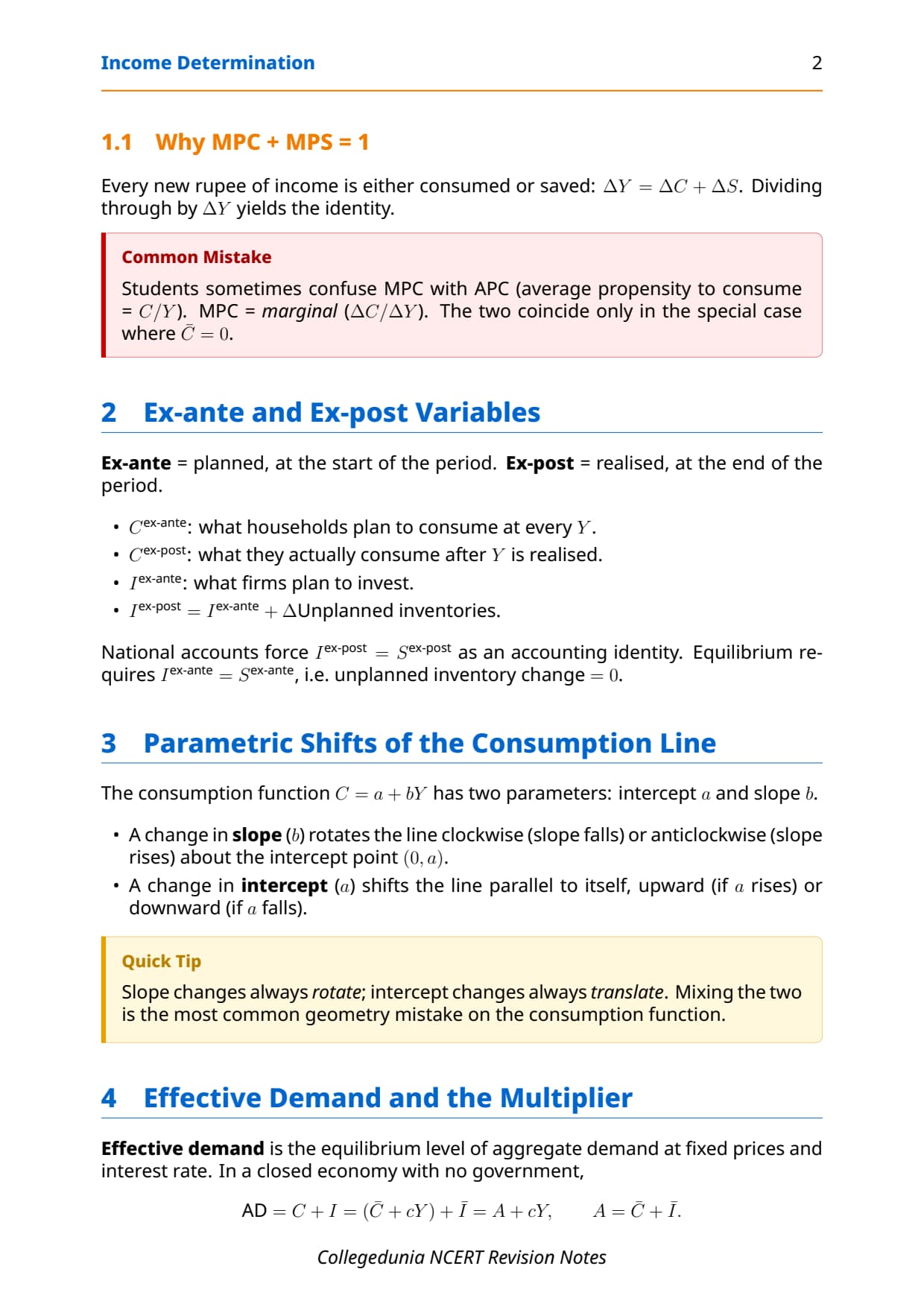
| Ex-ante | Planned, before the year starts. The model works on ex-ante values. |
| Ex-post | Realised, after the year ends. Always equal by accounting. |
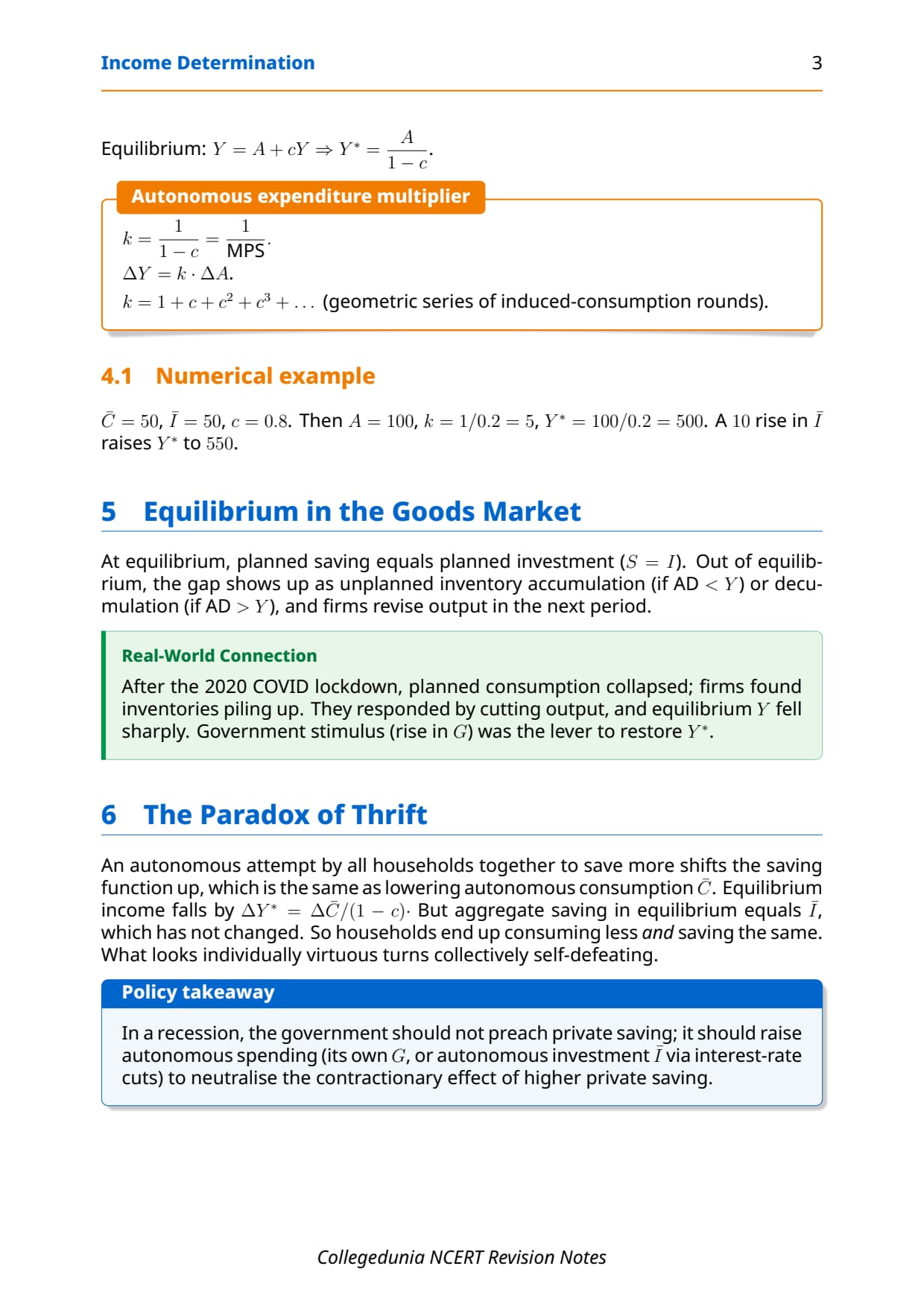
| Effective demand | The AD level at which output settles, where AD = AS. |
Note that the AS line is a 45-degree line, because every rupee of output becomes a rupee of income. Output is fixed where the AD line crosses it.
Consumption Function and Saving Function Class 12 Notes
The consumption function shows how planned spending rises with income. Saving is just the part of income not spent. Both are written as straight lines:
C = a + bY, where a is autonomous consumption and b is the MPC.
S = -a + (1 - b)Y, which is income minus consumption.
Here a is the spending that happens even at zero income. The two lines share the same intercept value a, one above the axis and one below.
| Ratio | Formula | What it tells you |
|---|---|---|
| MPC | Change in C / change in Y | Part of extra income that is spent. |
| MPS | Change in S / change in Y | Part of extra income that is saved. |
| APC | C / Y | Share of total income that is spent. |
| APS | S / Y | Share of total income that is saved. |
Two identities are tested almost every year: MPC + MPS = 1 and APC + APS = 1. MPC lies between 0 and 1, and APC can be more than 1 at low income because of the autonomous part.
The Investment Multiplier in Class 12 Economics Chapter 4
The multiplier is the most-asked numerical in this chapter. It shows that a rise in investment lifts income by a larger amount, because one person's spending becomes another person's income.
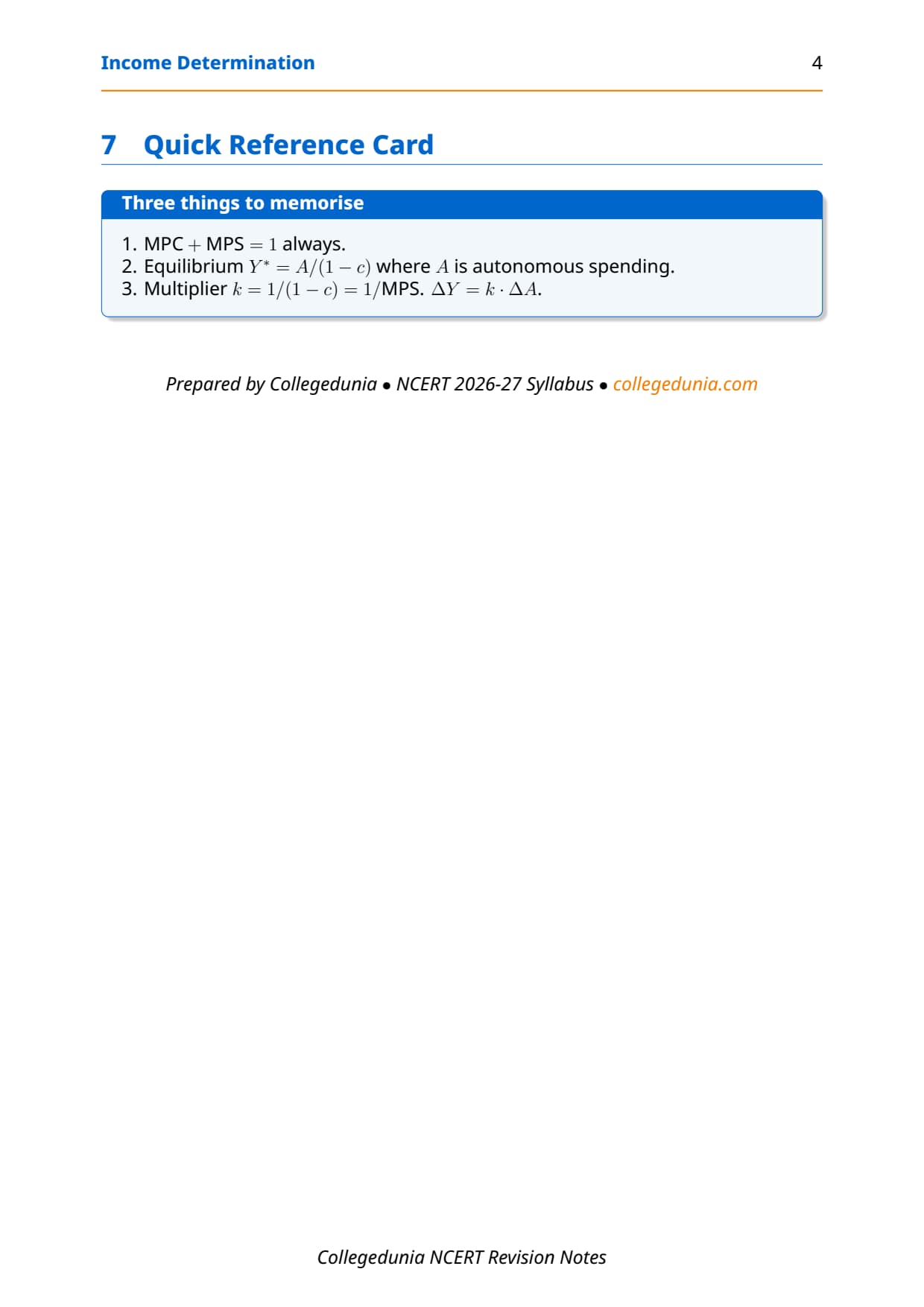
k = 1 / (1 - MPC) = 1 / MPS
So if MPC is 0.8, then MPS is 0.2 and k is 5. A rise of 100 in investment then raises income by 500. The change in income is k times the change in investment.
Memory hook: a bigger MPC means a bigger multiplier. The smallest value of k is 1 (when MPC is 0) and it has no upper limit (as MPC nears 1). Always link k to MPS, since k = 1/MPS is the fastest line to write.
Equilibrium Output in the Income Determination Chapter
Output is in equilibrium when planned demand equals planned output. There are two ways to state this, and both give the same income level.
| Approach | Condition | Equilibrium income |
|---|---|---|
| AD equals AS | Y = C + I | Y* = (a + I) / (1 - MPC) |
| Saving equals investment | S = I | Same Y* as above |
If planned saving is more than planned investment, stocks pile up and firms cut output, so income falls back to Y*. If saving is less than investment, stocks run down and firms raise output. The economy always moves back to the point where S = I.
Excess Demand and Deficient Demand (Income Determination Notes)
The last part of the chapter compares actual demand with the demand needed for full employment. This is where students bring in fiscal and monetary fixes.
| Gap | What it means | Cure |
|---|---|---|
| Excess demand | AD is more than full-employment output. Causes inflation. | Raise taxes, cut spending, raise the repo rate. |
| Deficient demand | AD is less than full-employment output. Causes unemployment. | Cut taxes, raise spending, lower the repo rate. |
| Inflationary gap | The amount by which AD is above the full-employment level. | Contractionary policy. |
| Deflationary gap | The amount by which AD is below the full-employment level. | Expansionary policy. |
Income Determination Class 12 Video Lesson
Source: Padhle Commerce on YouTube
Common Mistakes in Income Determination
- Mixing up ex-ante (planned) and ex-post (realised) values. The model uses planned values.
- Writing the multiplier as 1/MPC instead of 1/MPS or 1/(1 - MPC).
- Forgetting that MPC + MPS = 1, then getting MPS wrong in the multiplier.
- Saying APC can never be above 1. At low income it can, due to the autonomous part.
- Swapping the cures: using more spending for excess demand instead of deficient demand.
Income Determination Weightage in CBSE and CUET
The chapter has stayed at a steady 6 marks in CBSE, almost always with one numerical. The table maps where its topics show up.
| Year | CBSE question | Marks |
|---|---|---|
| 2025 | Find equilibrium income using the multiplier | 4 |
| 2024 | Explain excess and deficient demand with fixes | 6 |
| 2023 | Derive the saving function from the consumption function | 3 |
| 2022 | Calculate the multiplier and the change in income | 4 |
Student Feedback
We asked 11,540 Class 12 students about this chapter. 71% found the multiplier numerical the hardest part, and 3 out of 4 said the MPC, MPS and multiplier table was the fastest way to revise it before the exam.
Other Resources for Class 12 Economics Chapter 4 Income Determination
Pair these notes with the Solutions, handwritten notes and the official NCERT chapter below.
| Resource | What it covers | Open |
|---|---|---|
| Notes | Concept-first revision of the full chapter. | Chapter 4 Notes |
| NCERT Solutions | Step-by-step answers to every exercise question. | Chapter 4 NCERT Solutions |
| Handwritten Notes | Scanned notebook pages for last-mile revision. | Chapter 4 Handwritten Notes |
| NCERT Book PDF | Official NCERT Macroeconomics Chapter 4 textbook. | Chapter 4 NCERT Book PDF |
All Chapters Notes for Class 12 Economics Macroeconomics
| Chapter | Notes link |
|---|---|
| Chapter 1 | Introduction to Macroeconomics |
| Chapter 2 | National Income Accounting |
| Chapter 3 | Money and Banking |
| Chapter 4 | Income Determination |
| Chapter 5 | Government Budget and the Economy |
| Chapter 6 | Open Economy Macroeconomics |
Class 12 Economics Chapter 4 Income Determination Notes FAQs
Ques. What are these Class 12 Economics Chapter 4 notes for?
Ans. They are a short revision sheet for NCERT Chapter 4 Income Determination. They cover aggregate demand and supply, the consumption and saving functions, MPC, MPS and the multiplier, equilibrium output and the two demand gaps, with a formula table and common-mistake alerts. Worked sums sit in the matching NCERT Solutions.
Ques. What is the investment multiplier formula in Class 12 Economics?
Ans. The multiplier is k = 1 / (1 - MPC) = 1 / MPS. If MPC is 0.8, then MPS is 0.2 and k is 5, so a rise of 100 in investment raises income by 500. A bigger MPC gives a bigger multiplier.
Ques. What is the difference between MPC and MPS?
Ans. MPC is the part of extra income that is spent, and MPS is the part that is saved. They always add up to 1, so MPC + MPS = 1. Both lie between 0 and 1.
Ques. When is income in equilibrium?
Ans. Income is in equilibrium when planned demand equals planned output, which is AD = AS, or the same thing, when planned saving equals planned investment (S = I). If saving is more than investment, output falls back to this point.
Ques. What is the difference between excess demand and deficient demand?
Ans. Excess demand is when AD is above full-employment output, which causes inflation. Deficient demand is when AD is below it, which causes unemployment. Excess demand is cured with contractionary policy and deficient demand with expansionary policy.



Comments