




Class 12 Economics Chapter 3 Money and Banking explains how money replaced barter, how the RBI measures money supply, and how banks create credit. These notes give a short, exam-ready summary of every NCERT definition, formula and policy tool. This page also hosts the full revision PDF to download free.
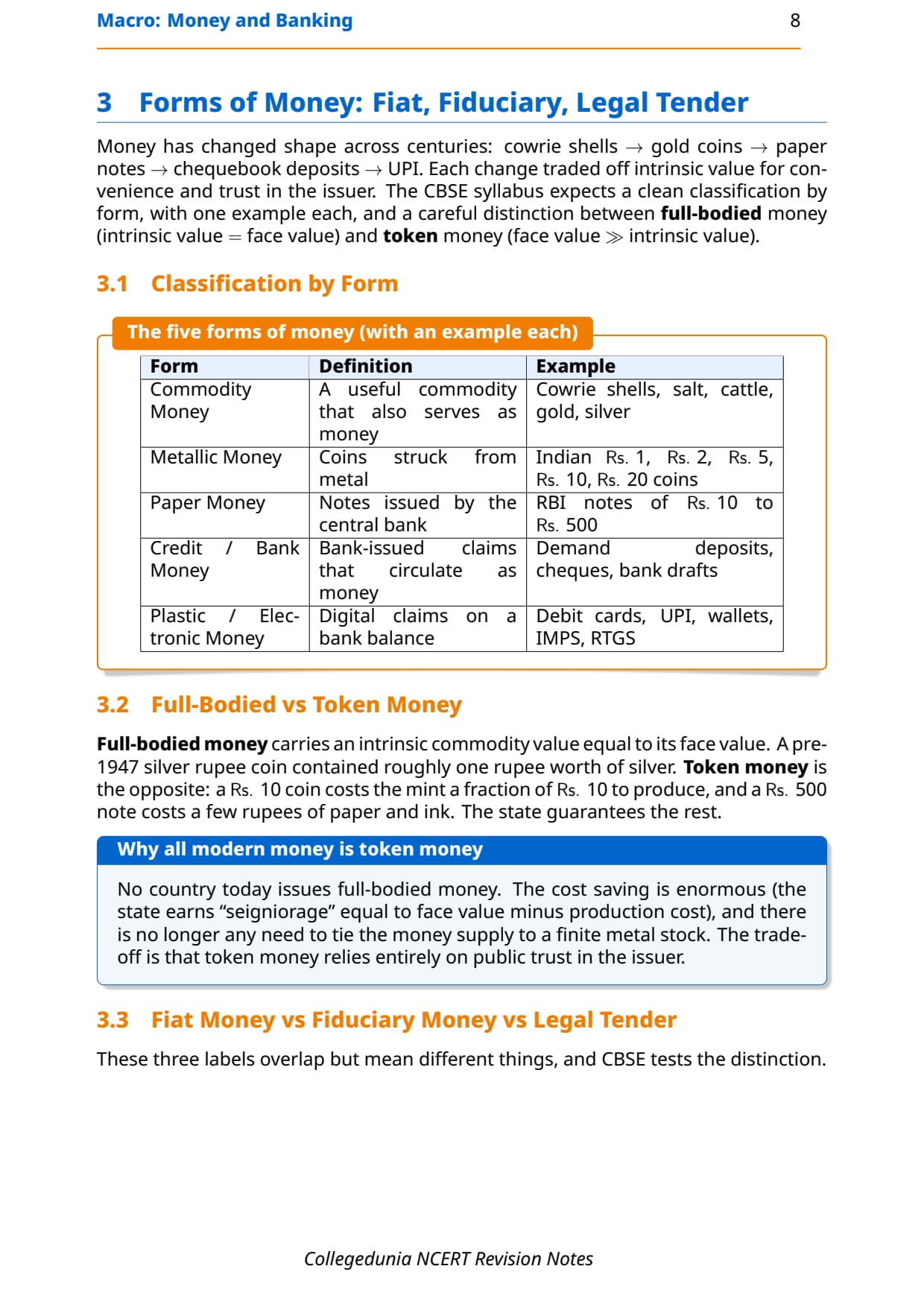
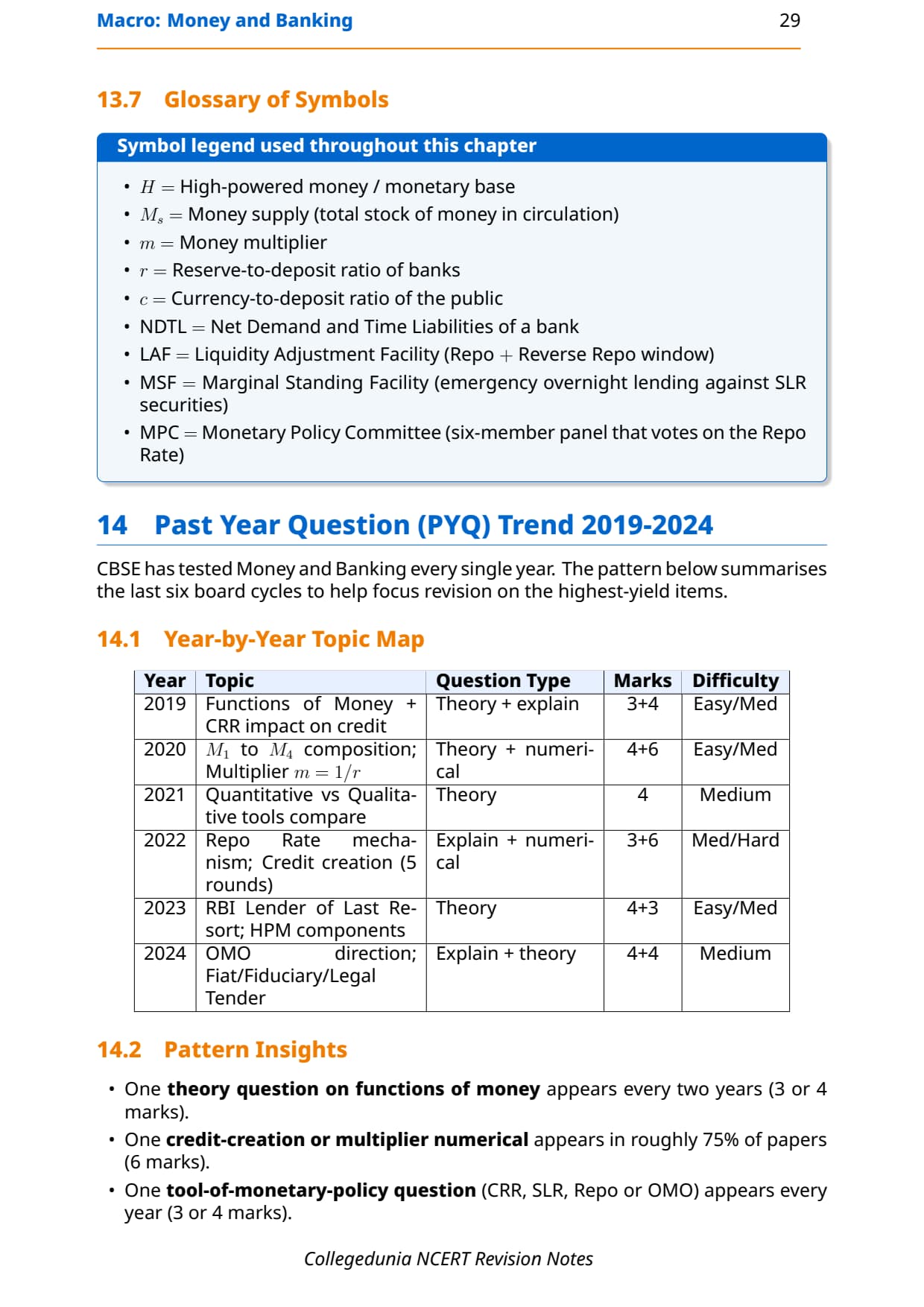
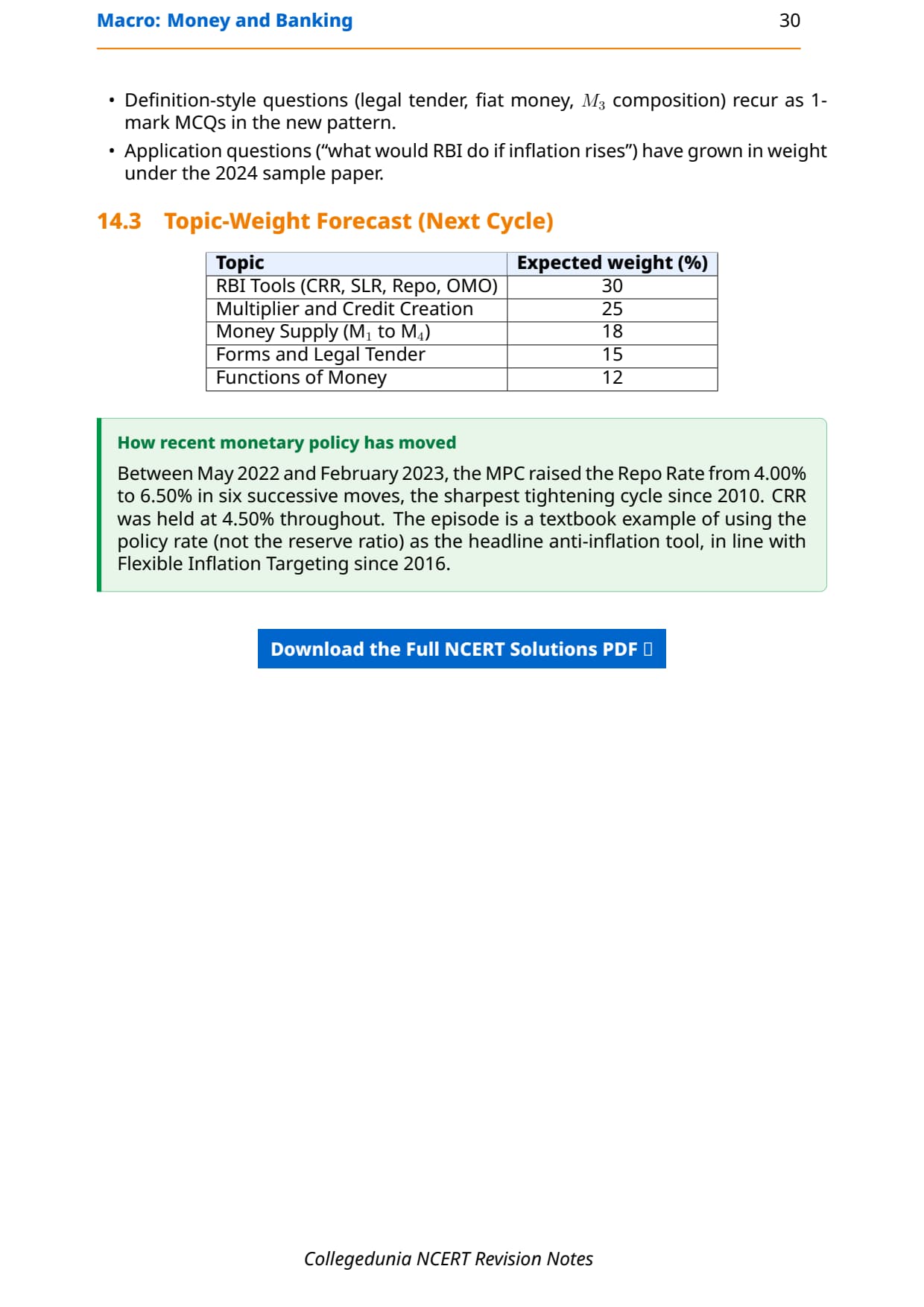
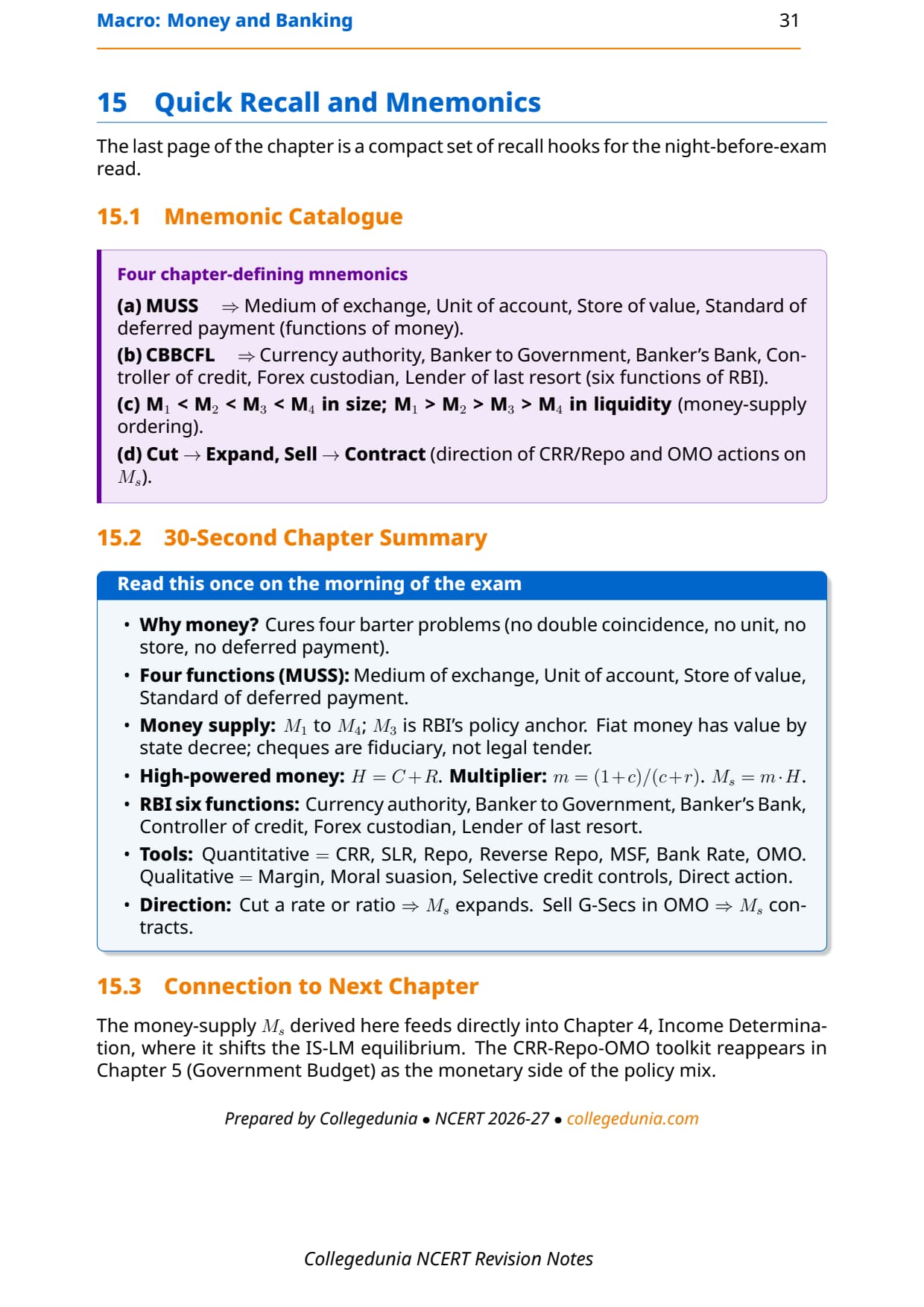
Here is what this chapter is worth in the exam:
- CBSE Boards: about 7 to 8 marks, with theory plus one numerical on the money multiplier.
- CUET: 2 to 3 questions each year on functions of money, money supply and RBI tools.
- Revision time: about 30 minutes with these notes.
What These Money and Banking Class 12 Notes Cover
The chapter splits into four blocks. These notes give each one a short, exam-ready summary:
- Functions of money (3 to 4 marks): the four jobs money does and the barter drawbacks they fix.
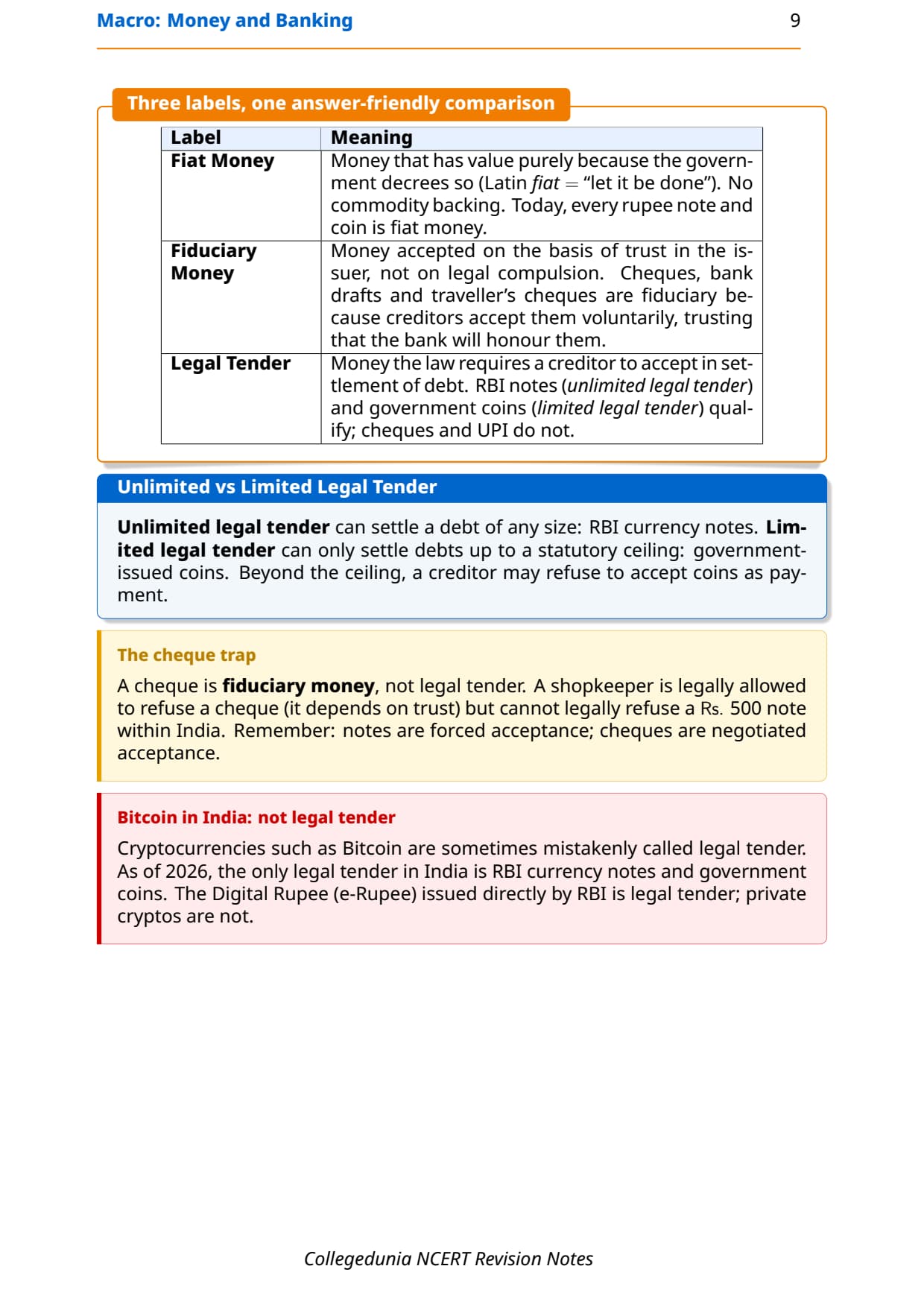
- Money supply (3 marks): the M1 to M4 measures, with M3 as the RBI target.
- Credit creation (4 to 6 marks): how banks multiply deposits and the money multiplier.
- RBI and monetary policy (4 marks): the six functions of the RBI and its ten policy tools.
Functions of Money in Class 12 Economics Chapter 3
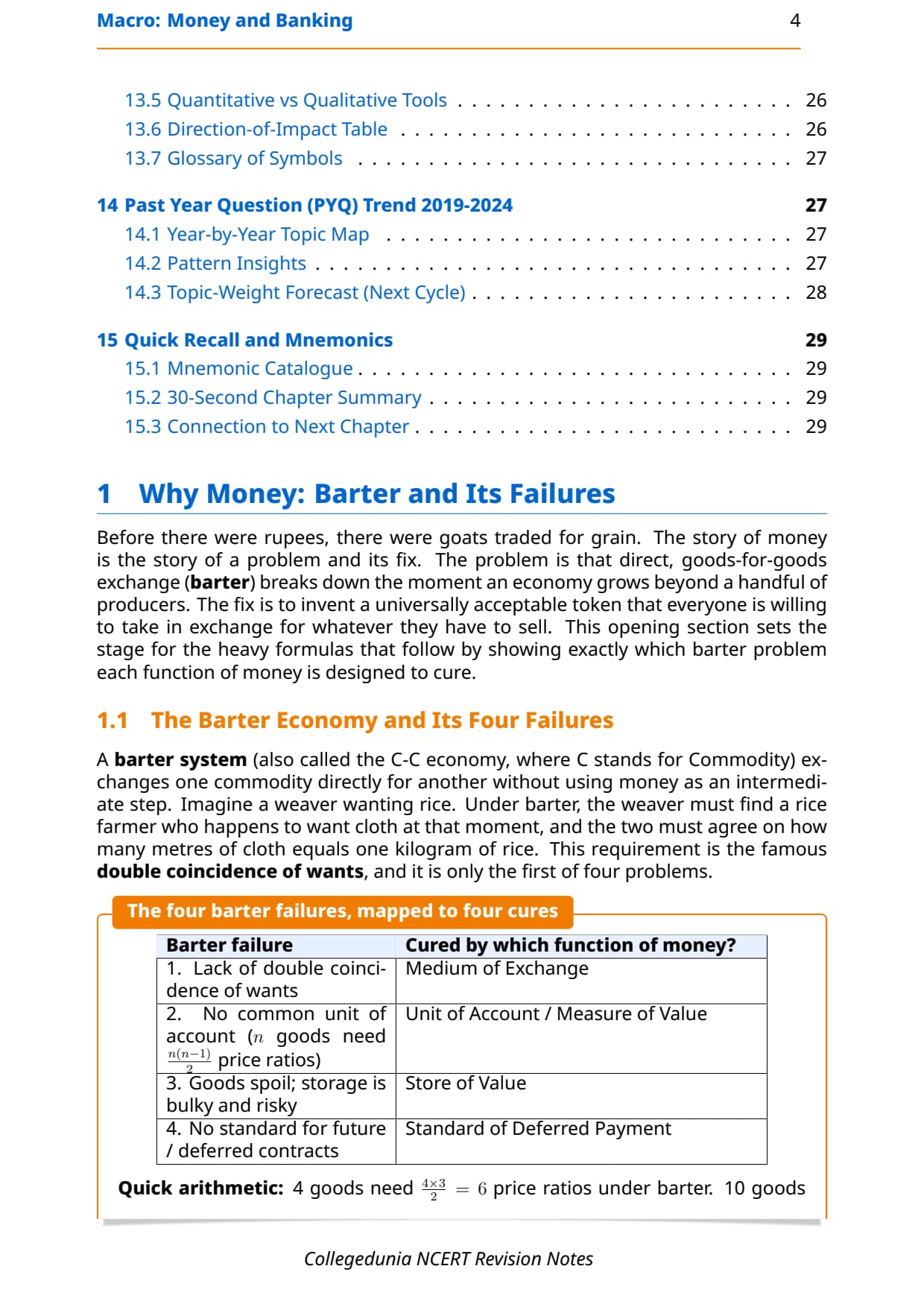
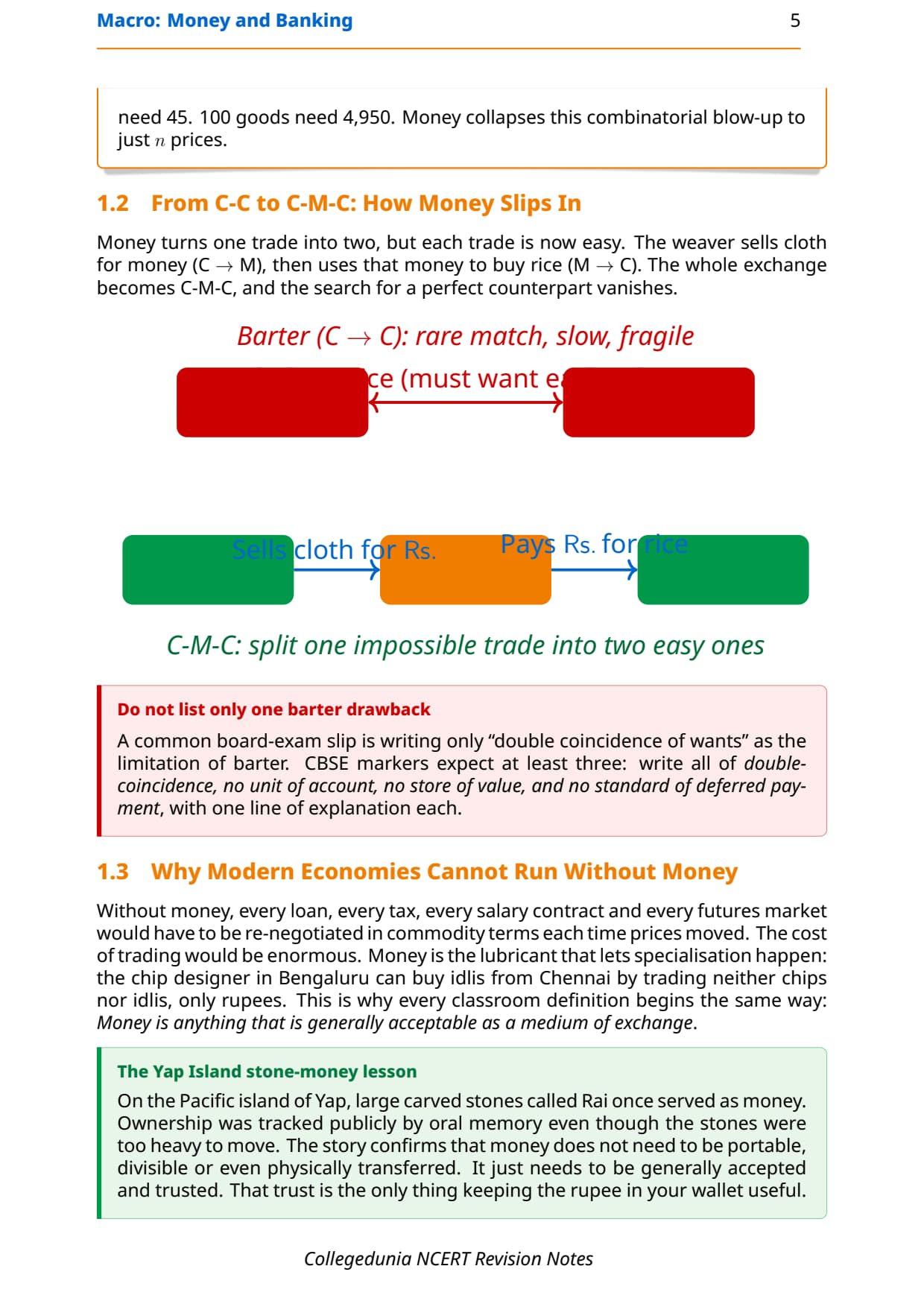
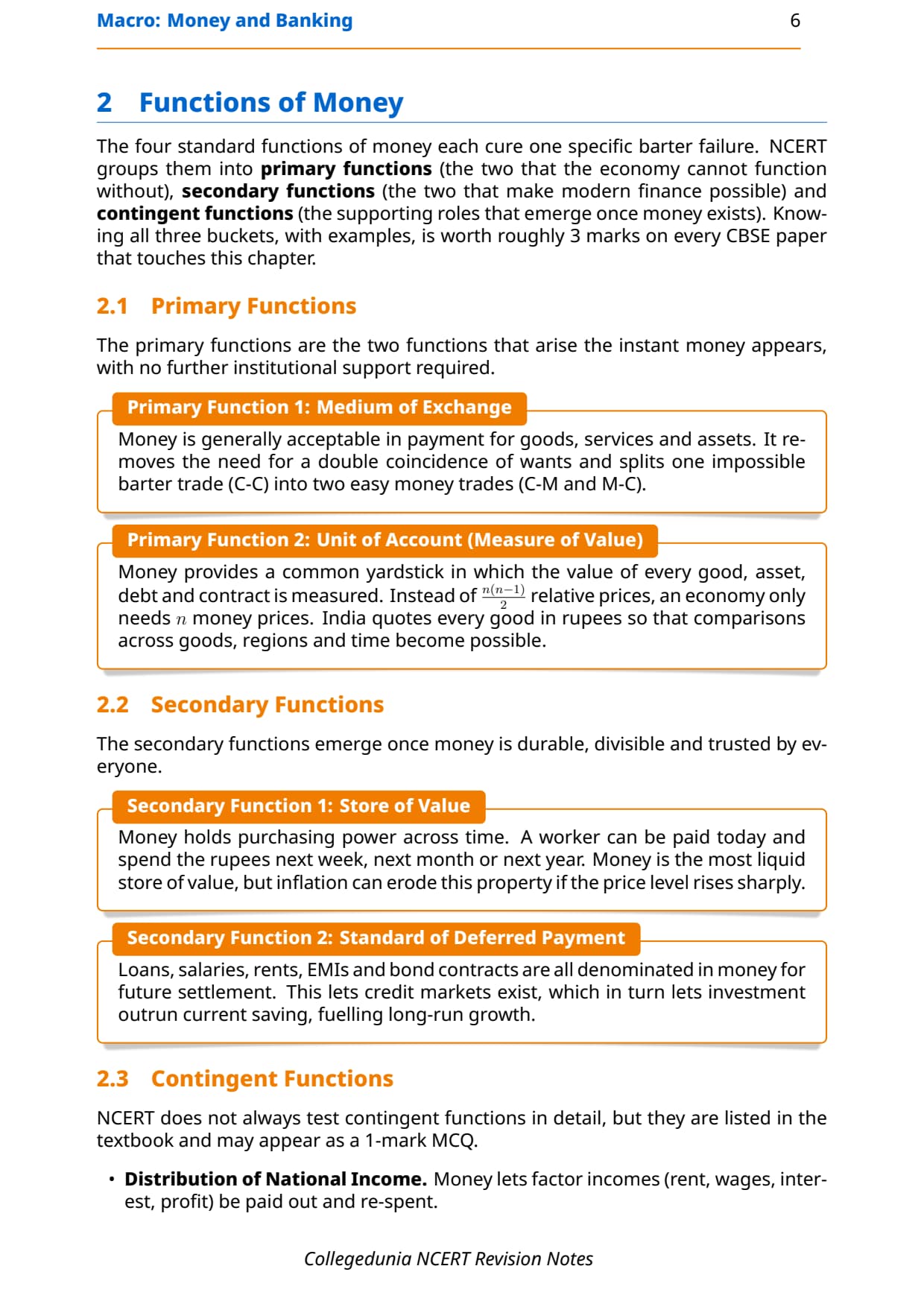
Most questions start here. Barter failed because trade needed a double coincidence of wants. Money fixes that by doing four jobs. The first two are primary functions; the last two are secondary.
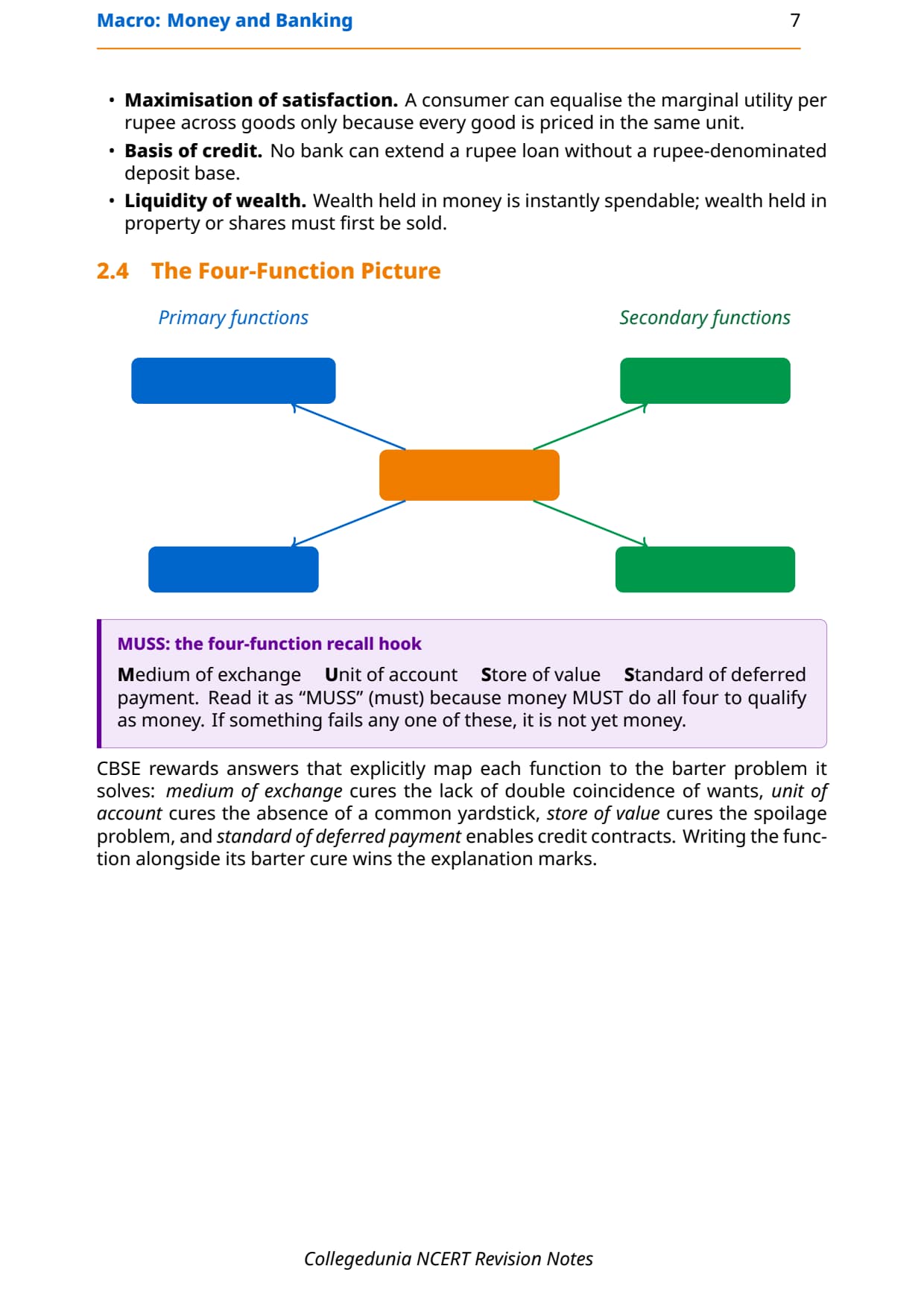
| Function | What it does | Barter drawback it fixes |
|---|---|---|
| Medium of exchange | Money is accepted by all, so wants need not match. | Double coincidence of wants. |
| Unit of account | Prices and debts are stated in one common unit. | No common measure of value. |
| Store of value | Money holds purchasing power over time. | No durable store of wealth. |
| Standard of deferred payment | Loans and future payments are written in money. | No stable unit for future deals. |
Use the hook M.U.S.S. (Medium, Unit, Store, Standard) to recall all four. Write each function with the barter drawback it cures.
Money Supply Measures M1 to M4 in Class 12 Economics
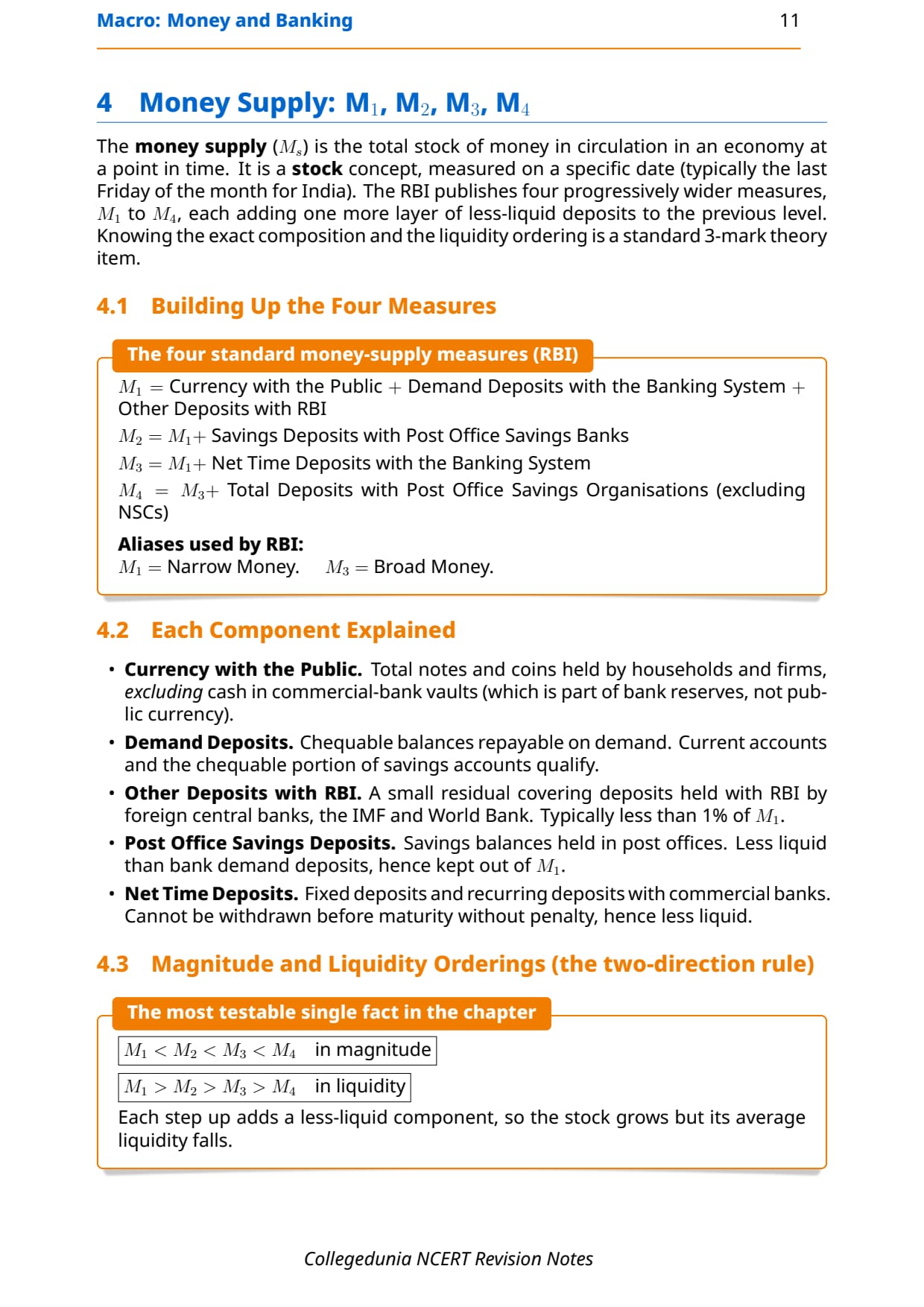
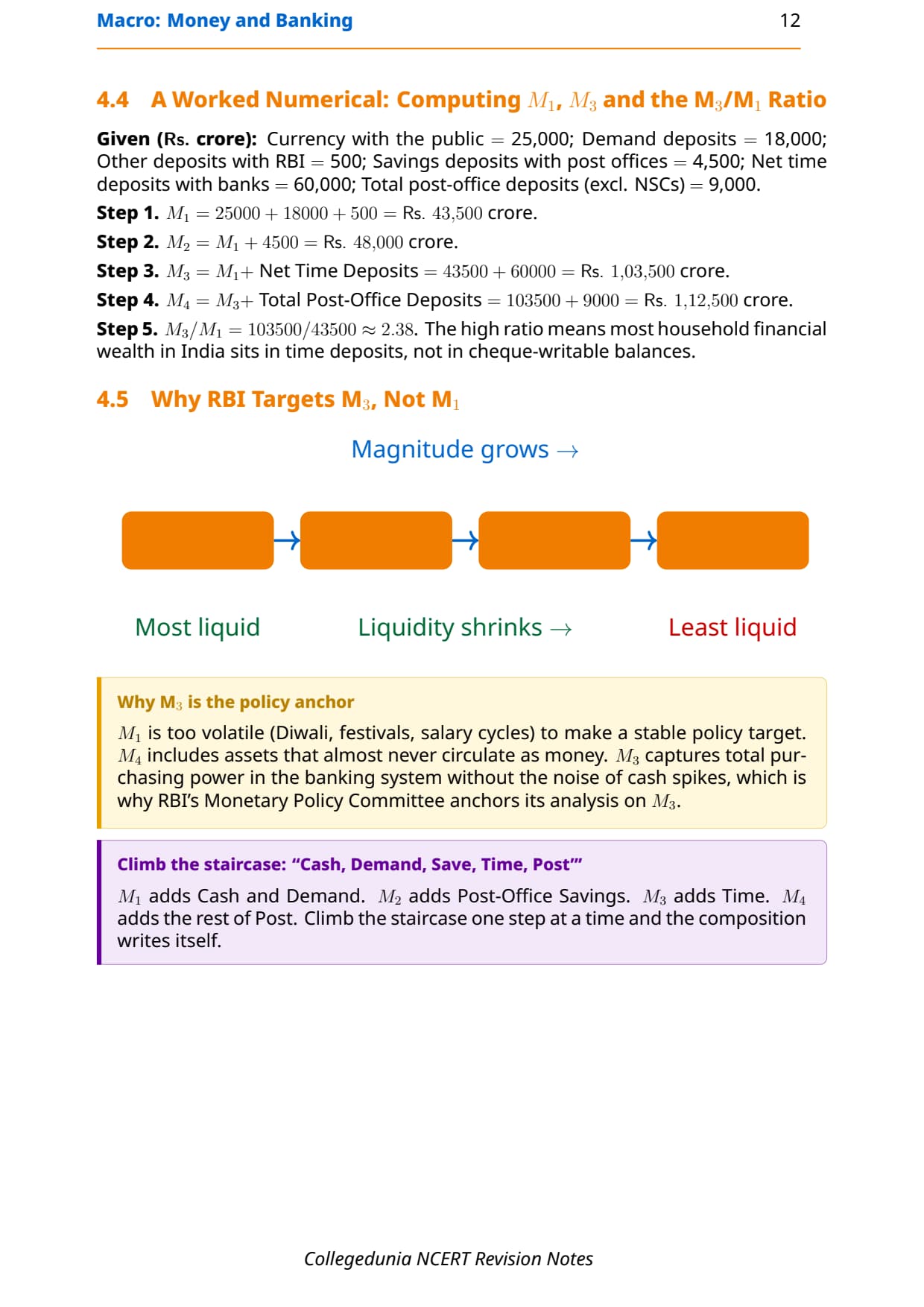
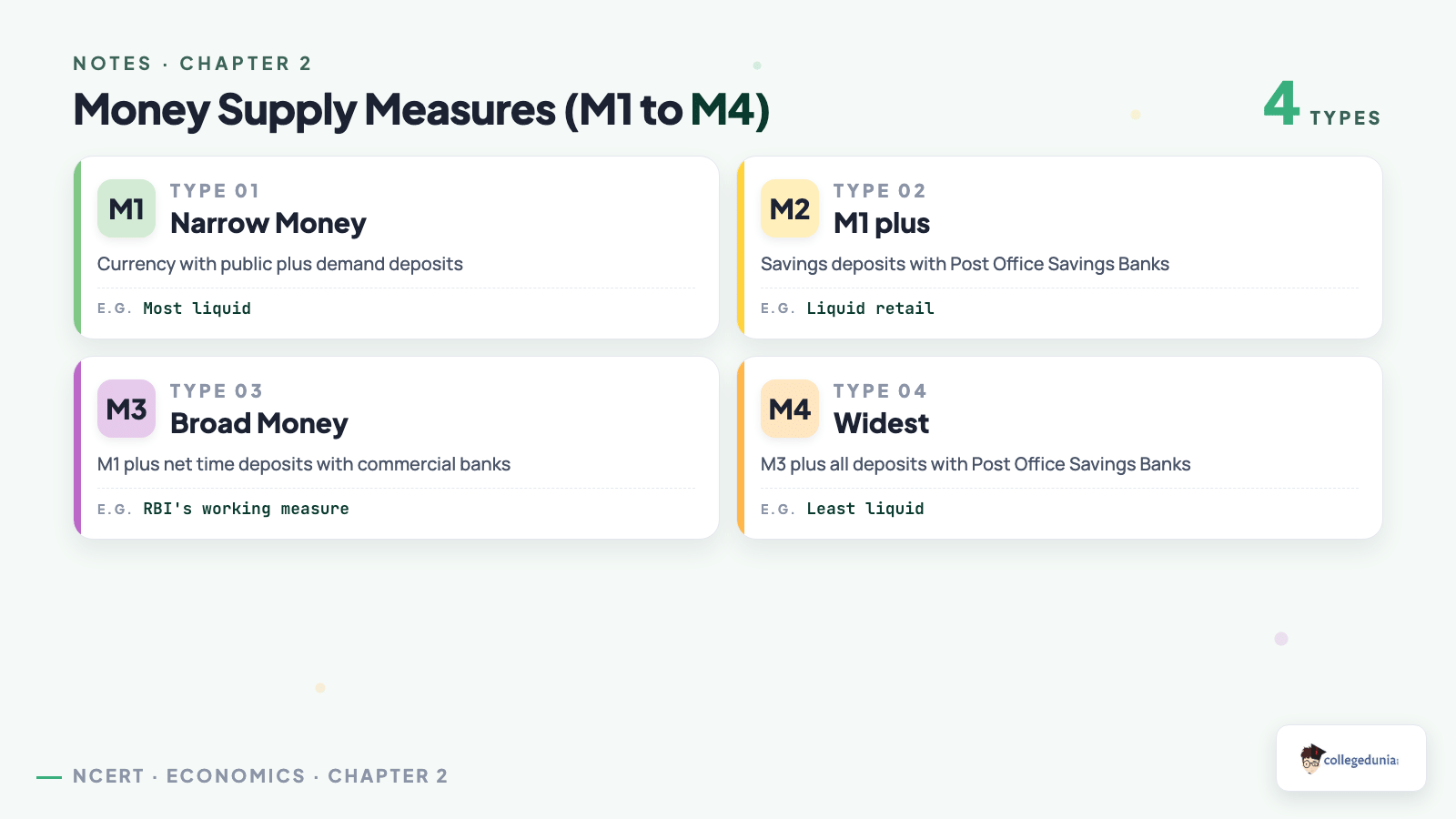
The RBI gives four measures of money supply. Each adds a less-liquid item to the one before. M1 is the most liquid; M4 is the broadest. The RBI tracks M3 as its main policy target.
| Measure | Composition | Liquidity |
|---|---|---|
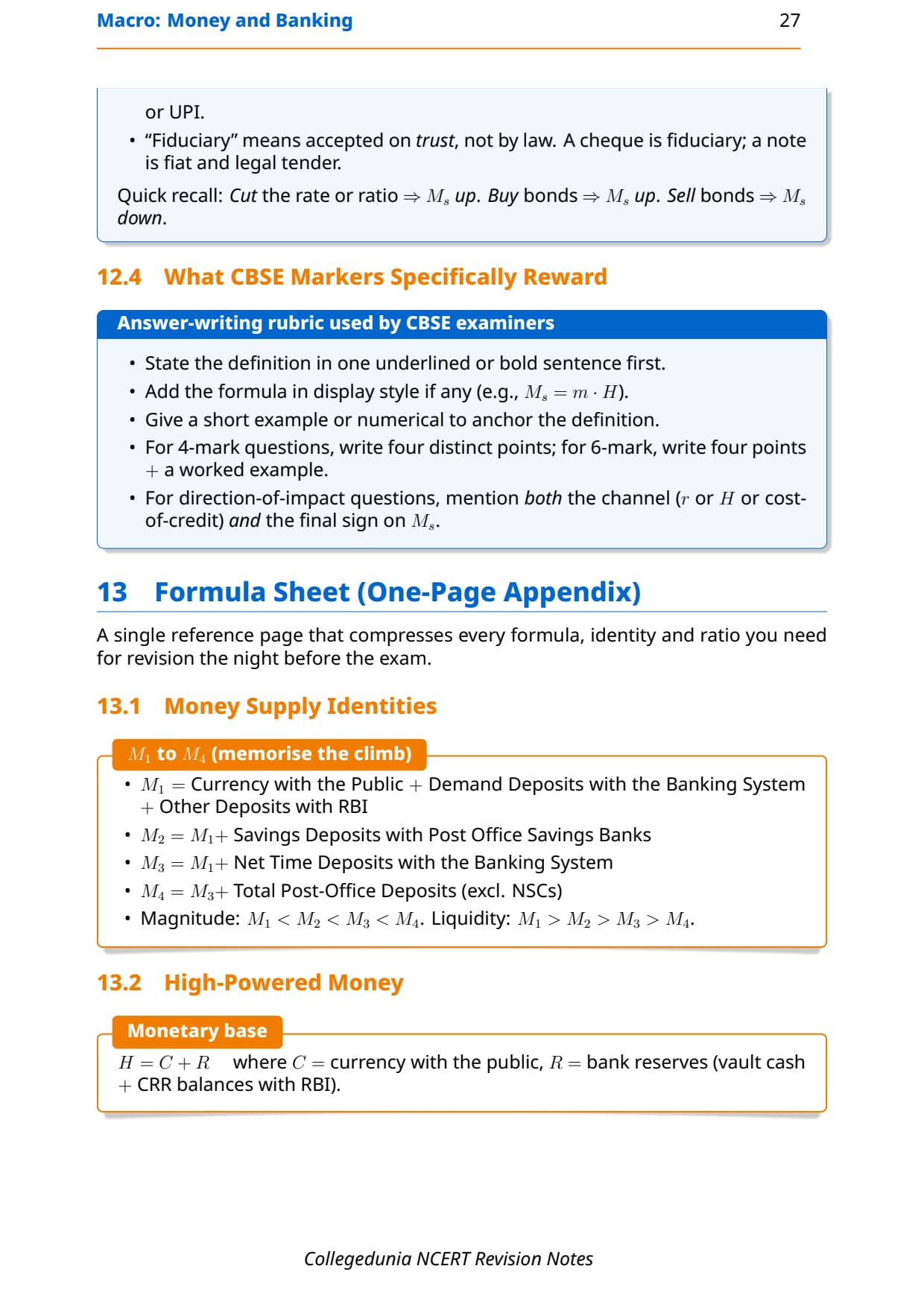
| M1 (narrow money) | Currency with public + Demand deposits + Other deposits with RBI. | Highest |
| M2 | M1 + Post office savings deposits. | High |
| M3 (broad money) | M1 + Time deposits with banks. | Medium |
| M4 | M3 + All post office deposits (except NSCs). | Lowest |
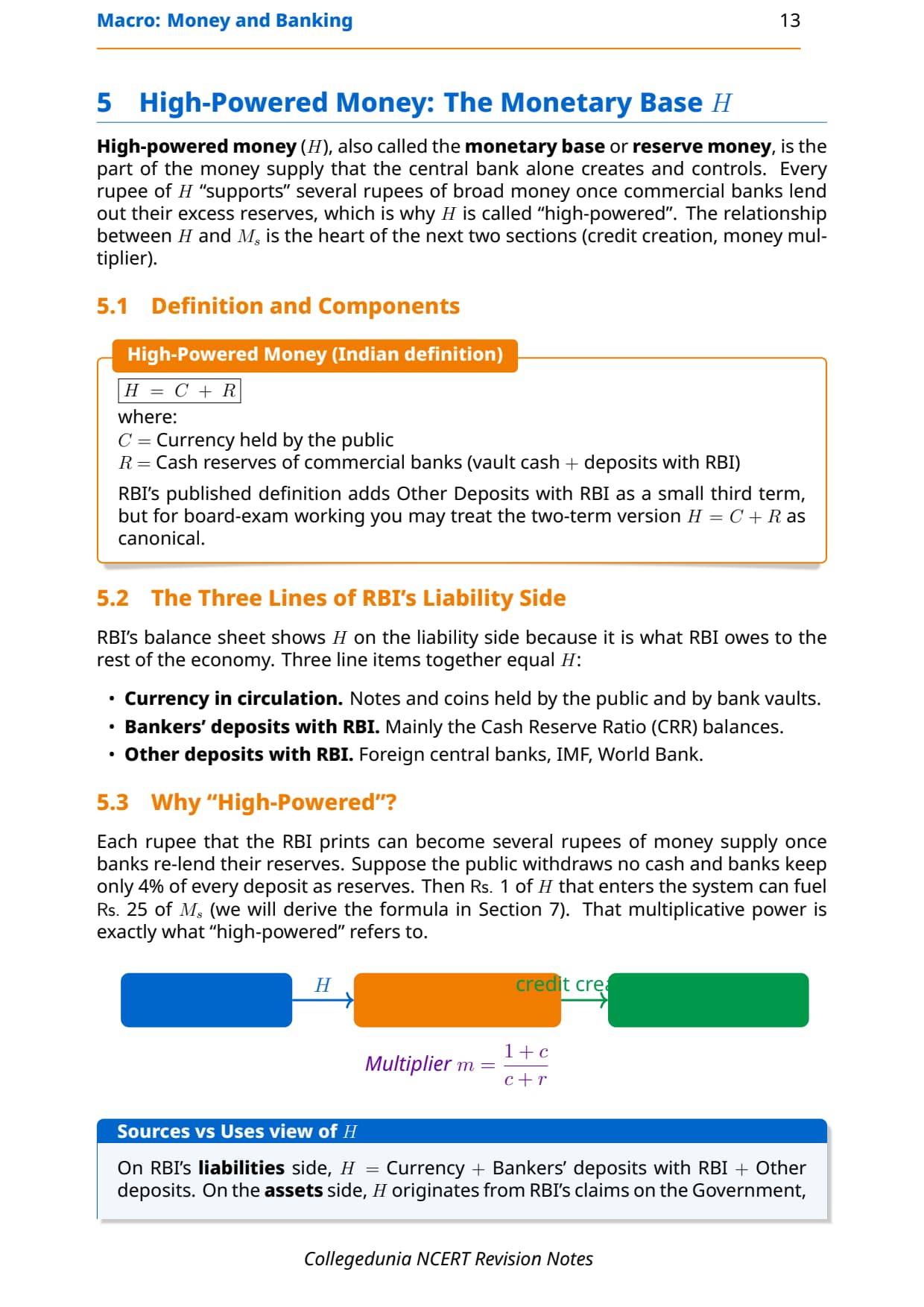
Two cross-checks the board expects: in size, M1 < M2 < M3 < M4; in liquidity, M1 > M2 > M3 > M4. High-powered money H is currency with the public plus bank reserves with the RBI plus other deposits with the RBI. It is "high powered" because each rupee of H backs several rupees of M3.
Commercial Banks and Credit Creation Class 12
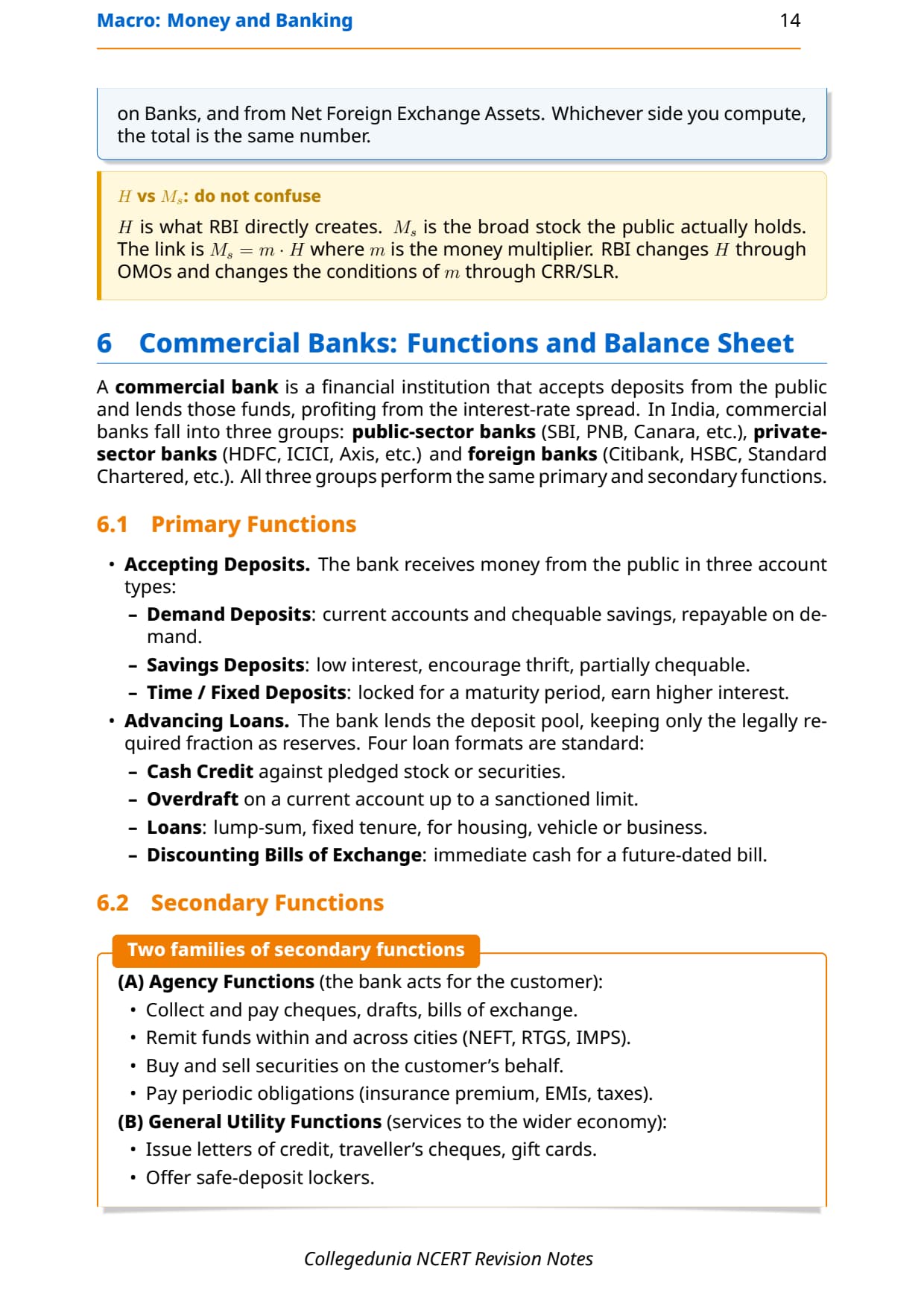
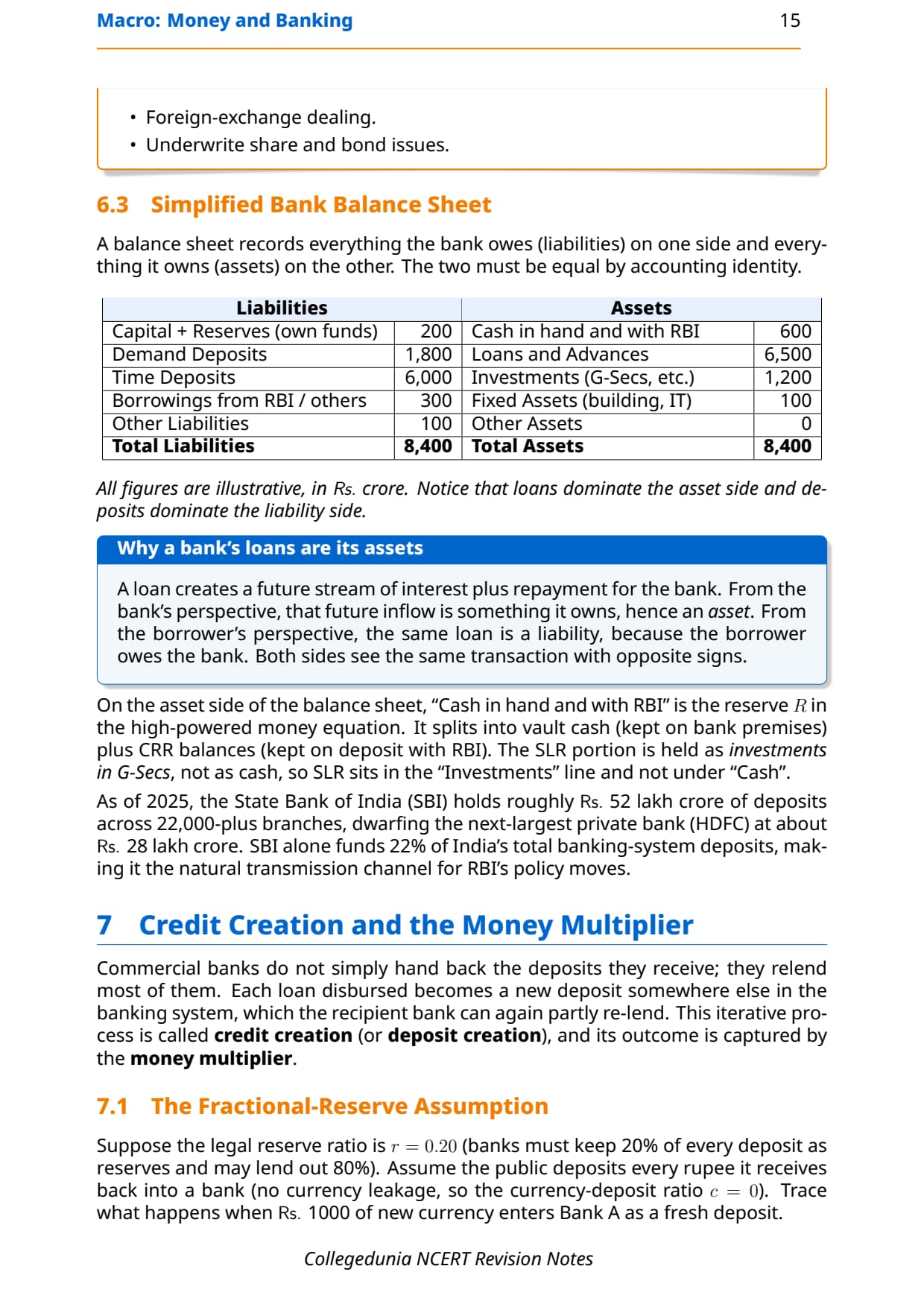
Banks keep only a fraction of deposits as cash, fixed by the CRR. They lend the rest. Each loan is spent and lands as a new deposit in another bank, which lends again. This is how banks create money without the RBI issuing more high-powered money.
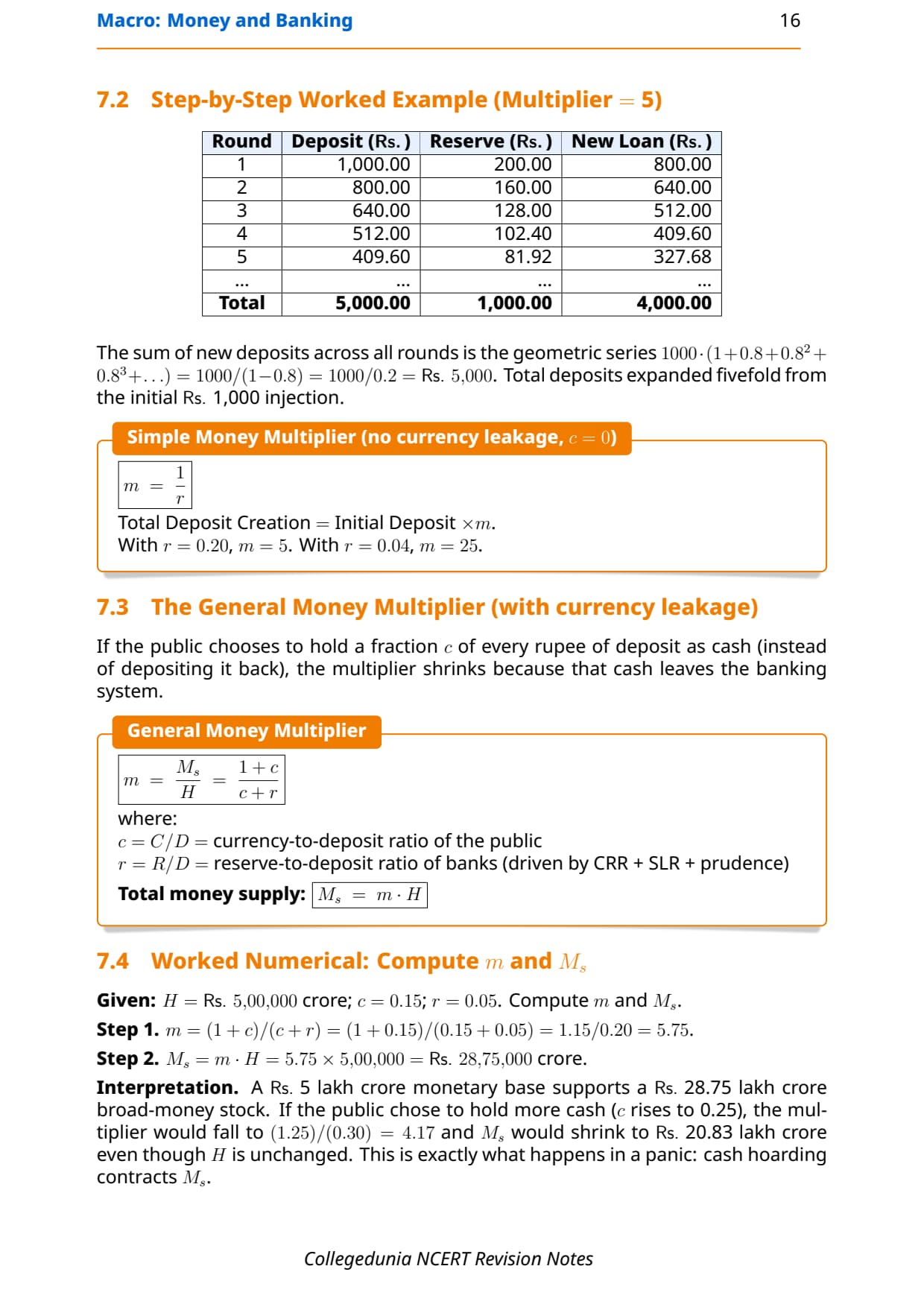
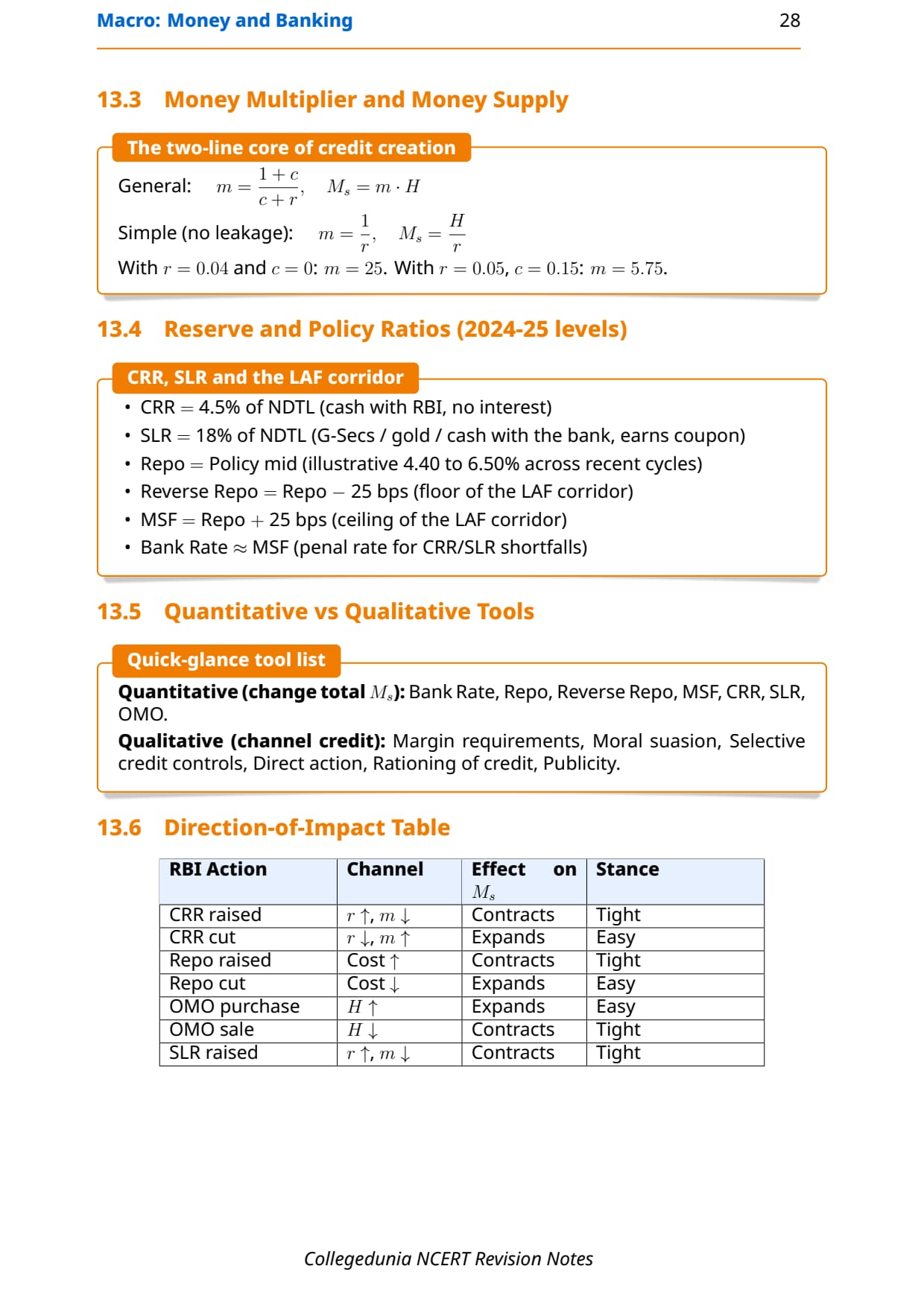
Money multiplier: m = (1 + c) / (c + r)
Here r is the reserve ratio (set by the CRR) and c is the public's currency-to-deposit ratio.
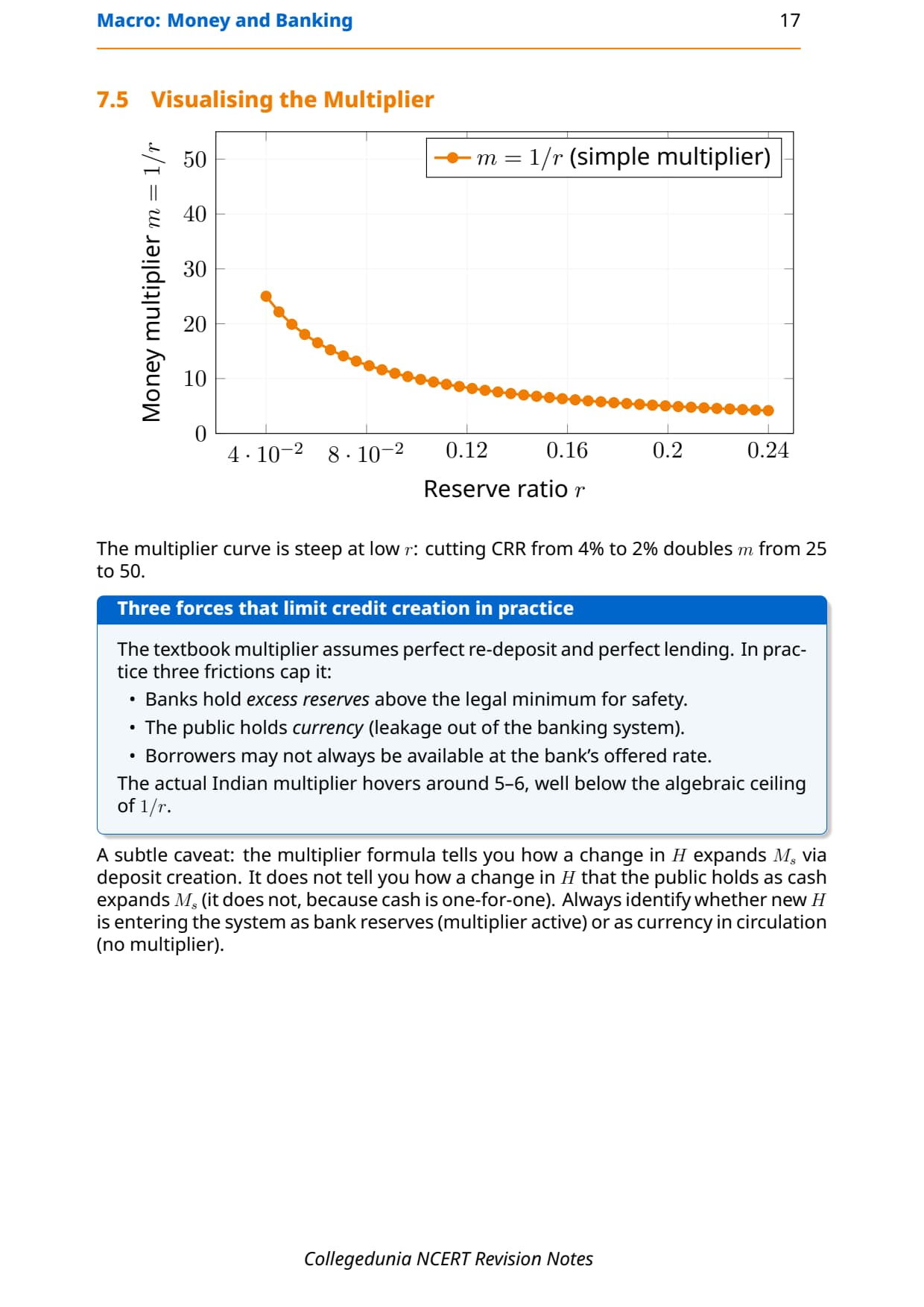
Simple case (c = 0): m = 1 / r. With r = 0.04 (CRR of 4%), m = 25.
Money supply: Ms = m × H.
- If CRR = 10% and the first deposit is ₹10,000, total deposits become ₹1,00,000.
- Credit creation is limited by the CRR, the SLR, the ratio c and how much people want to borrow.
- This appears as a 4-mark or 6-mark question roughly every alternate board cycle.
Central Bank (RBI) Functions for Class 12 Economics
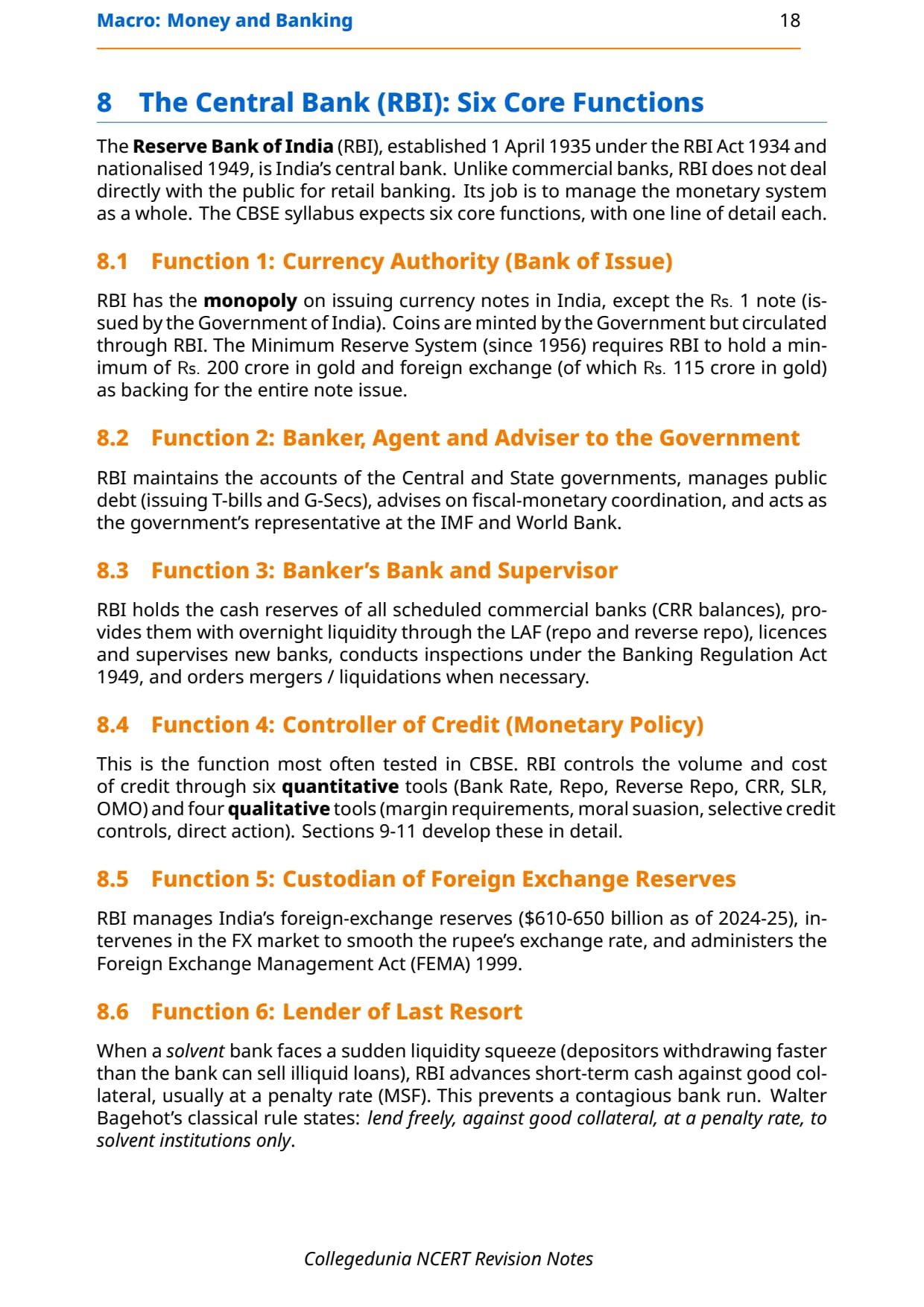
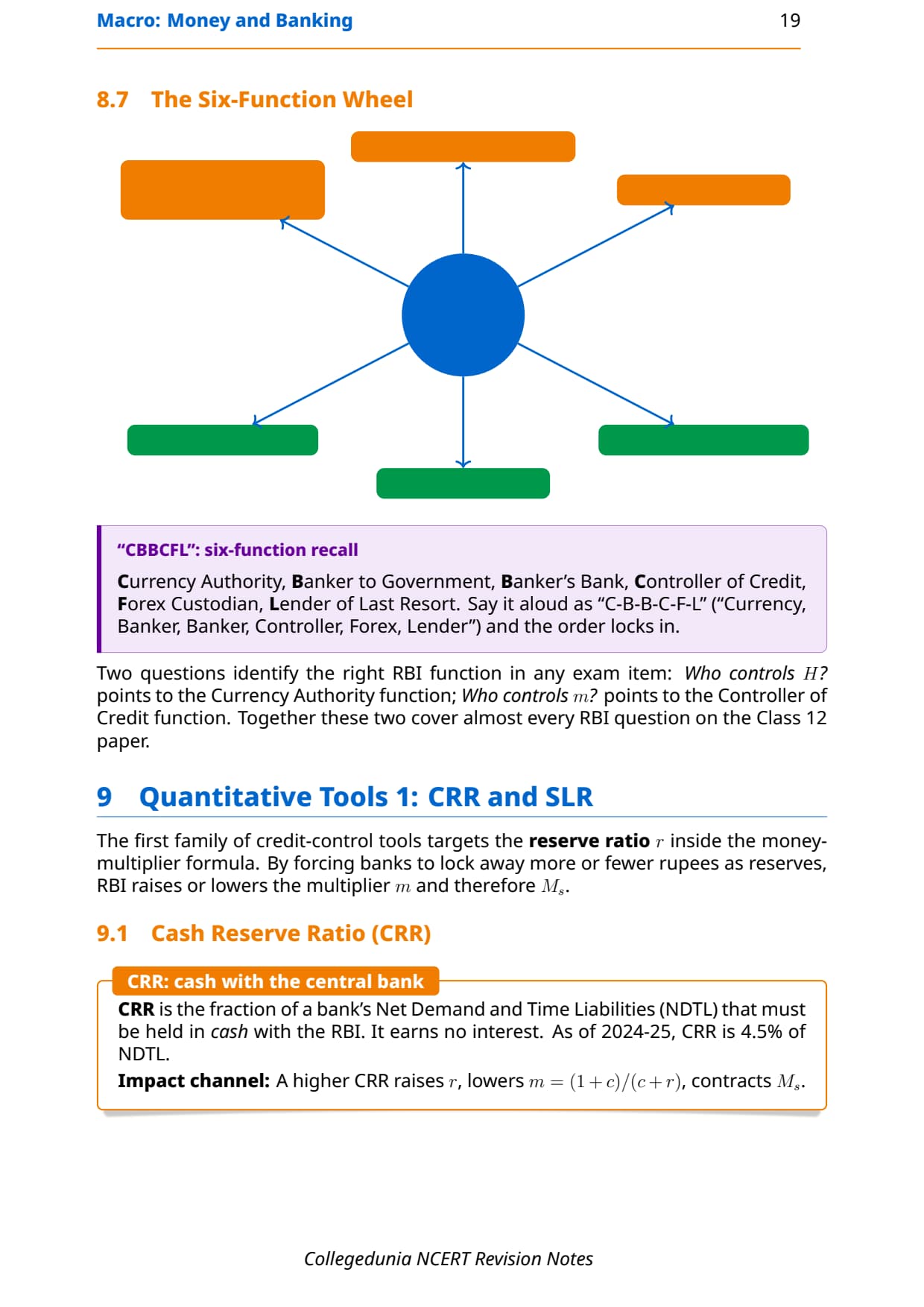
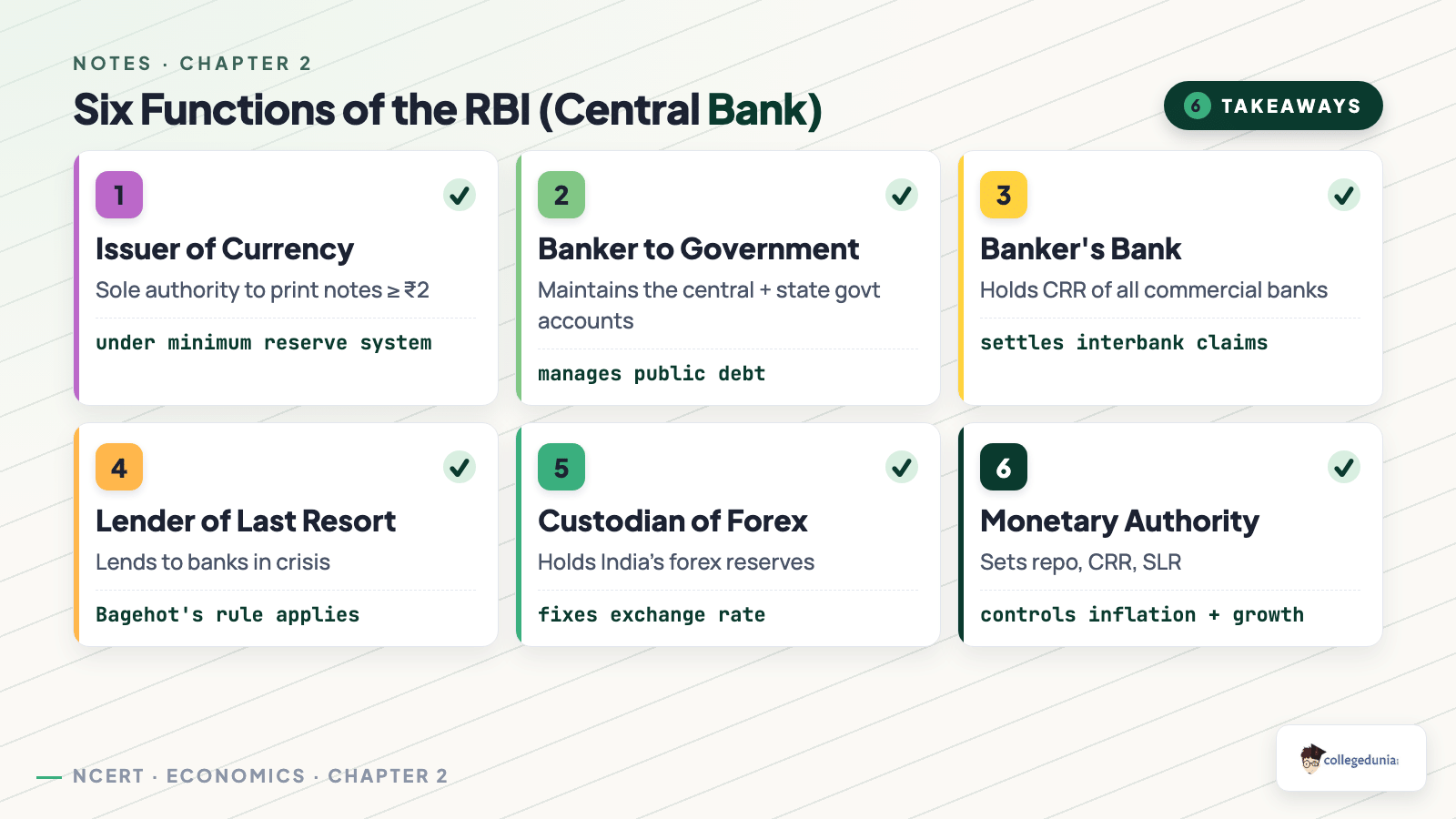
The Reserve Bank of India is the apex monetary authority. It performs six functions. The board paper asks students to list at least four with a one-line note on each.
| Function | What the RBI does |
|---|---|
| Currency authority | Sole issuer of currency notes (except the one-rupee note). |
| Banker to the government | Runs government accounts and manages public debt. |
| Banker's bank | Holds bank reserves and supervises the banking system. |
| Lender of last resort | Gives emergency credit to solvent banks against good collateral. |
| Custodian of forex | Holds gold and foreign currency reserves and manages the rupee. |
| Monetary authority | Frames and runs monetary policy using its ten instruments. |
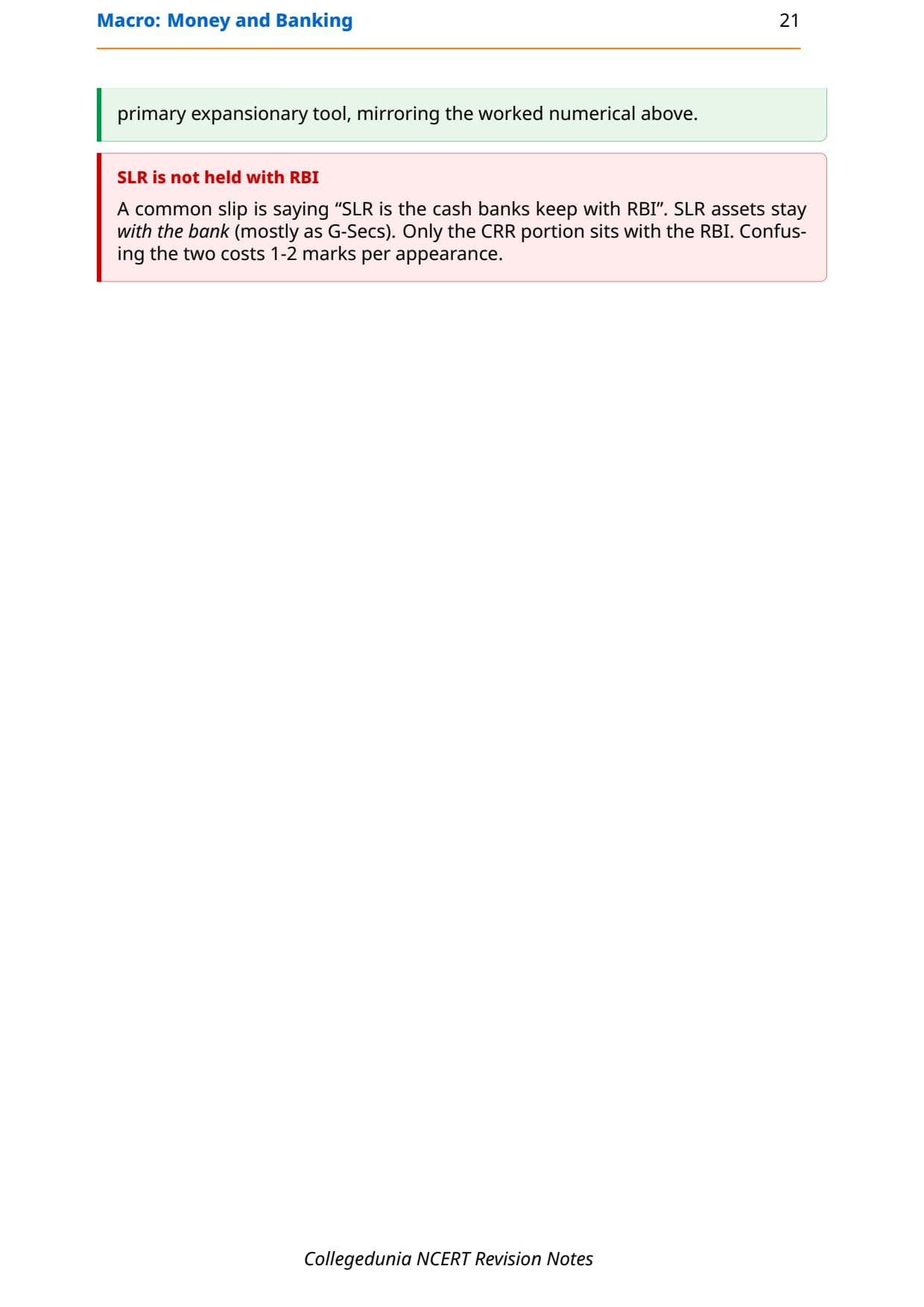
Instruments of Monetary Policy in Money and Banking Class 12
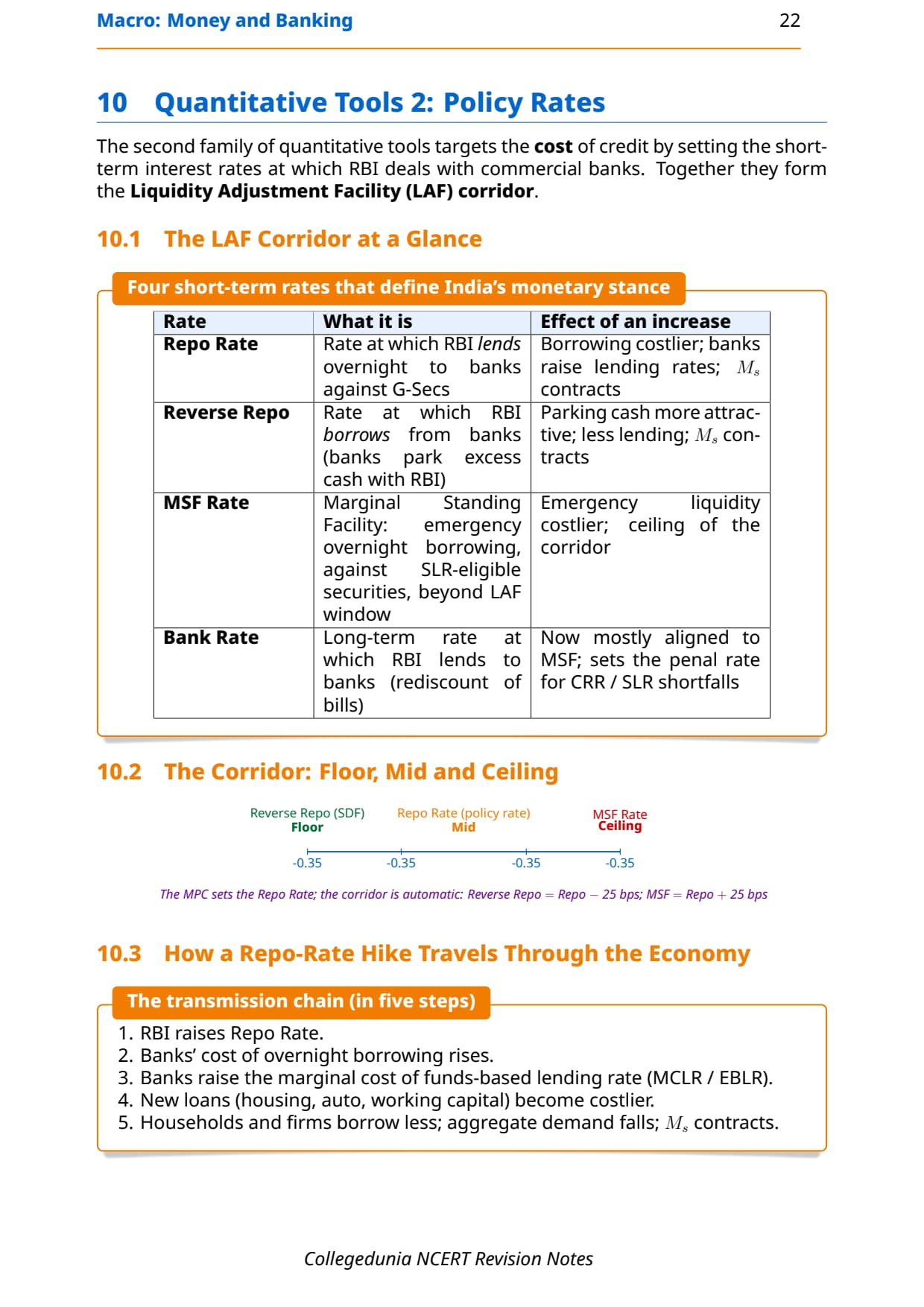
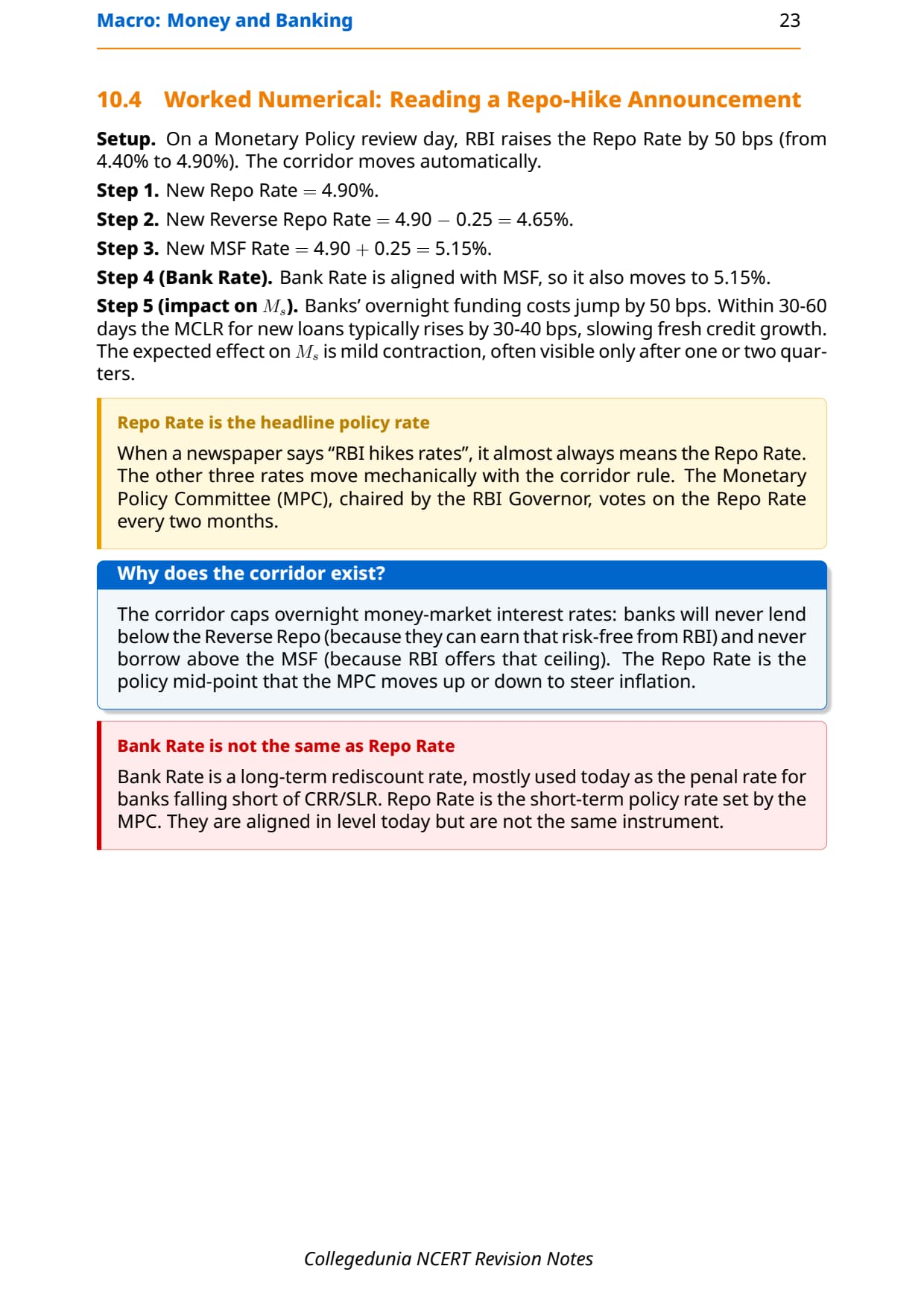
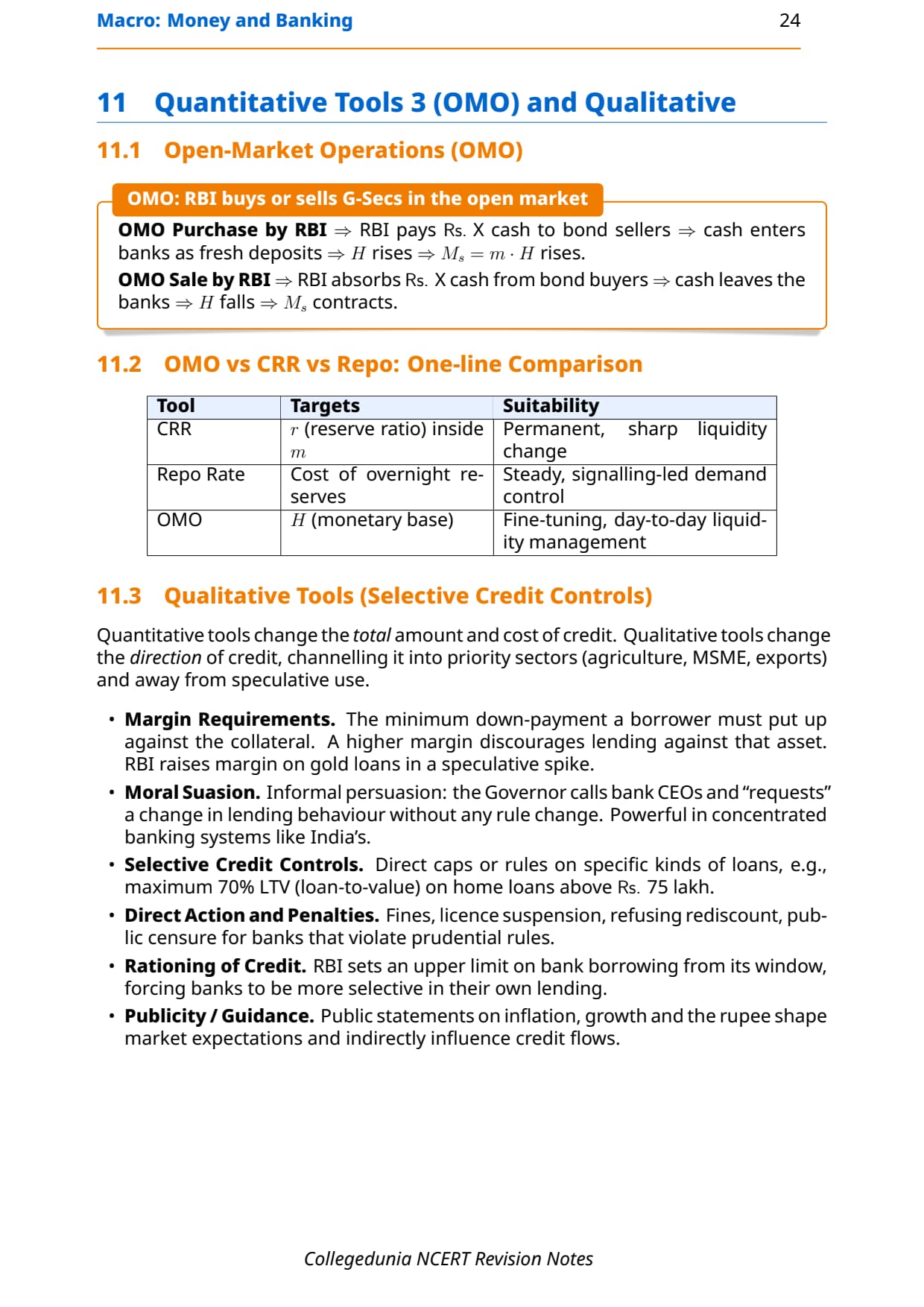
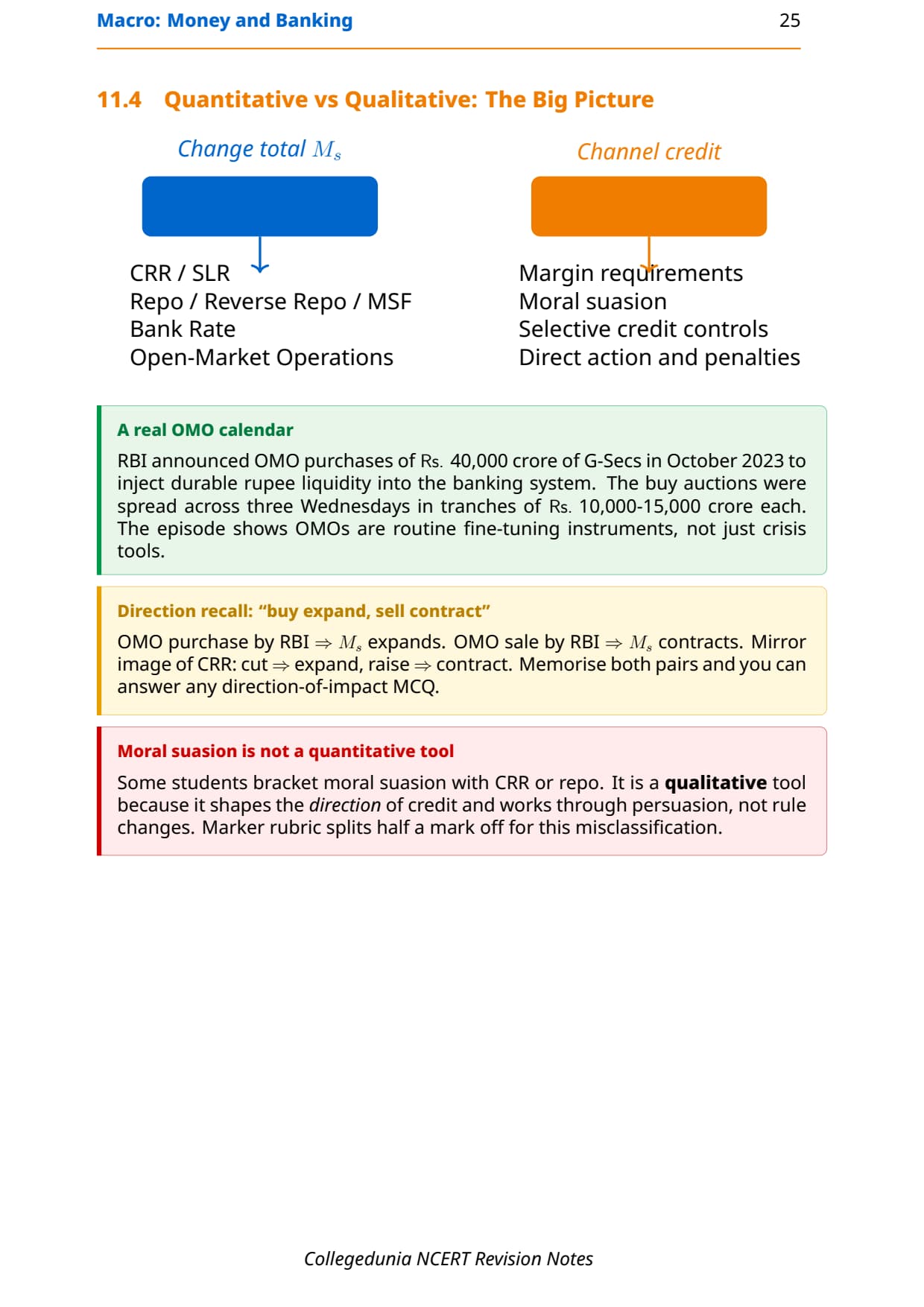
The RBI uses six quantitative tools that change the total stock of money, and four qualitative tools that steer credit to set sectors. Learn each tool with its expansionary and contractionary direction.
| Tool | To expand money | To contract money |
|---|---|---|
| Bank rate | Lower it. | Raise it. |
| Repo rate | Cut it. | Raise it. |
| Reverse repo rate | Cut it. | Raise it. |
| CRR | Lower it. | Raise it. |
| SLR | Lower it. | Raise it. |
| Open market operations | Buy G-Secs. | Sell G-Secs. |
The four qualitative tools are margin requirements, moral suasion, selective credit controls, and direct action. Use the hook BR-RR-RRR-CRR-SLR-OMO to recall the six quantitative tools in one line.
Money and Banking Class 12 Formula Sheet
This is the block to revise in the last 20 minutes before the exam.
| Concept | Formula |
|---|---|
| High-powered money | H = Currency with public + Bank reserves with RBI + Other deposits with RBI |
| Money multiplier (general) | m = (1 + c) / (c + r) |
| Money multiplier (simple) | m = 1 / r |
| Money supply | Ms = m × H |
| Narrow money | M1 = Currency + Demand deposits + Other deposits with RBI |
| Broad money | M3 = M1 + Time deposits with banks |
| Size order | M1 < M2 < M3 < M4 |
| Liquidity order | M1 > M2 > M3 > M4 |
Money and Banking Class 12 Video Lesson
Watch this short walkthrough of the chapter before you revise the formula sheet.
Source: Magnet Brains on YouTube
Common Mistakes in Money and Banking Class 12
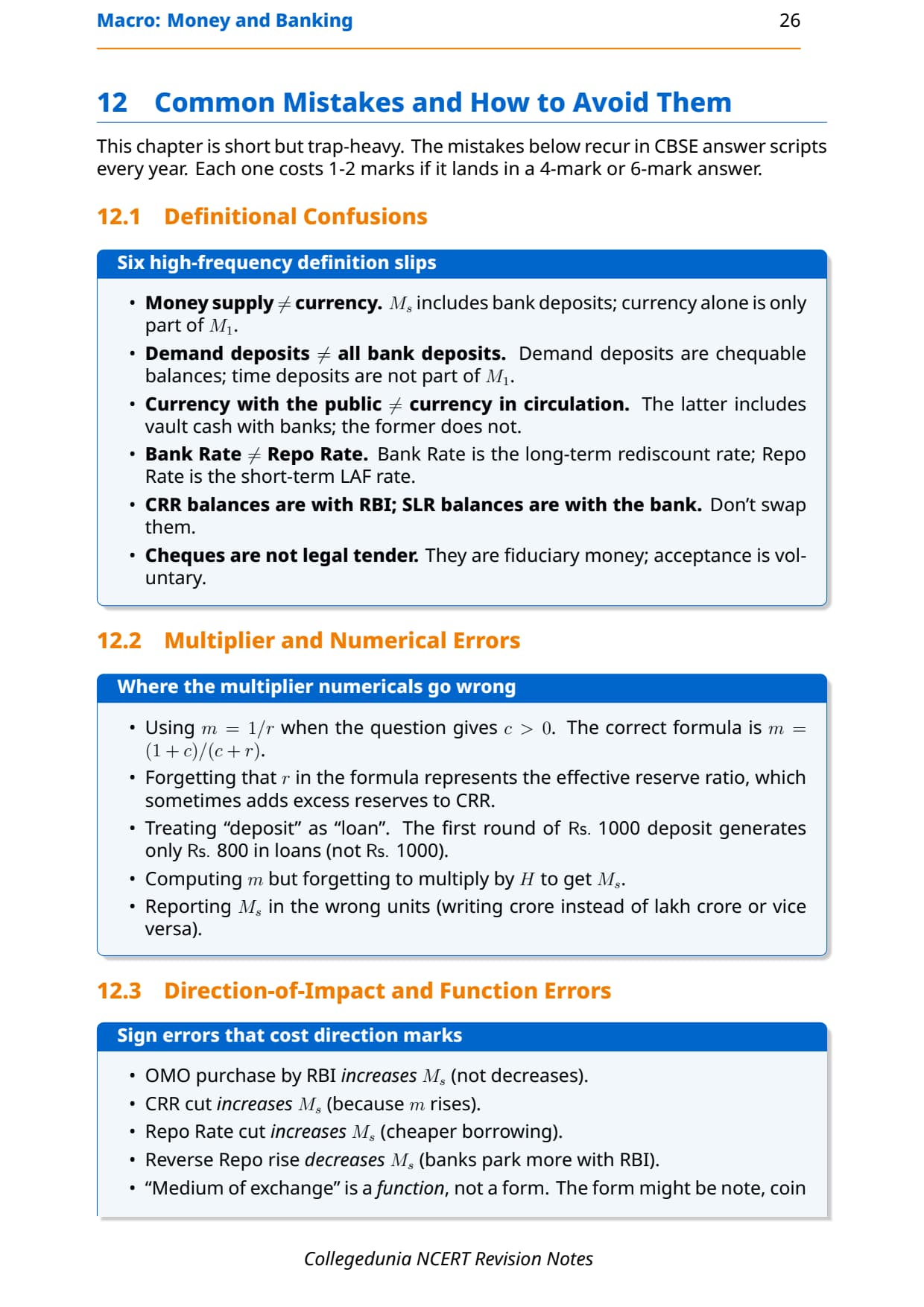
- Listing only "double coincidence of wants" as the drawback of barter, instead of three or four.
- Swapping M1 and M3, or inverting the size and liquidity orders.
- Using m = 1/r when c is not zero. The general form is m = (1 + c)/(c + r).
- Mixing up repo (RBI lends) and reverse repo (RBI borrows).
- Treating the RBI like a commercial bank that takes public deposits.
Money and Banking Weightage in CBSE and CUET
The chapter carries a steady 7 to 8 marks in CBSE. The table maps where its topics show up.
| Year | CBSE question | Marks |
|---|---|---|
| 2025 | Define the money multiplier and solve a numerical on m and Ms | 7 |
| 2024 | Distinguish CRR and SLR, plus RBI as banker's bank | 7 |
| 2023 | Functions of money MCQ, plus repo and reverse repo | 4 |
| 2022 | Money supply M1 to M4, plus four quantitative tools | 7 |
Student Feedback
We asked 11,640 Class 12 students about this chapter. 71% said the money multiplier and the M1 versus M3 split were the hardest parts, and 3 out of 4 rated the central bank tools table as the best block to print as a one-page revision sheet.
Other Resources for Class 12 Economics Chapter 3 Money and Banking
Pair these notes with the Solutions, handwritten notes and the official NCERT chapter below.
| Resource | What it covers | Open |
|---|---|---|
| Notes | Concept-first revision of the full chapter. | Chapter 3 Notes |
| NCERT Solutions | Step-by-step answers to every exercise question. | Chapter 3 NCERT Solutions |
| Handwritten Notes | Scanned notebook pages for last-mile revision. | Chapter 3 Handwritten Notes |
| NCERT Book PDF | Official NCERT Macroeconomics Chapter 3 textbook. | Chapter 3 NCERT Book PDF |
| Subject Hub | All chapters and resources for Class 12 Economics. | Class 12 Economics Hub |
All Chapters Notes for Class 12 Economics Macroeconomics
| Chapter | Notes link |
|---|---|
| Chapter 1 | Introduction to Macroeconomics |
| Chapter 2 | National Income Accounting |
| Chapter 3 | Money and Banking |
| Chapter 4 | Income Determination |
| Chapter 5 | Government Budget and the Economy |
| Chapter 6 | Open Economy Macroeconomics |
NCERT Notes Class 12 Economics Chapter 3 Money and Banking FAQs
Ques. What are these Class 12 Economics Chapter 3 notes for?
Ans. They are a short revision sheet for NCERT Chapter 3. They cover the functions of money, the M1 to M4 measures, credit creation, RBI functions and the monetary policy tools, with a formula sheet and common-mistake alerts. Worked numericals sit in the matching NCERT Solutions.
Ques. What is the money multiplier formula in Class 12?
Ans. The money multiplier is m = (1 + c)/(c + r), where c is the currency-to-deposit ratio and r is the reserve ratio set by the CRR. When c is zero, it becomes m = 1/r. Money supply is Ms = m × H, where H is high-powered money.
Ques. What is the difference between M1 and M3?
Ans. M1 is narrow money: currency with the public plus demand deposits plus other deposits with the RBI. M3 is broad money: M1 plus time deposits with banks. M1 is the most liquid but smallest; the RBI uses M3 as its main policy target.
Ques. What is the difference between CRR and SLR?
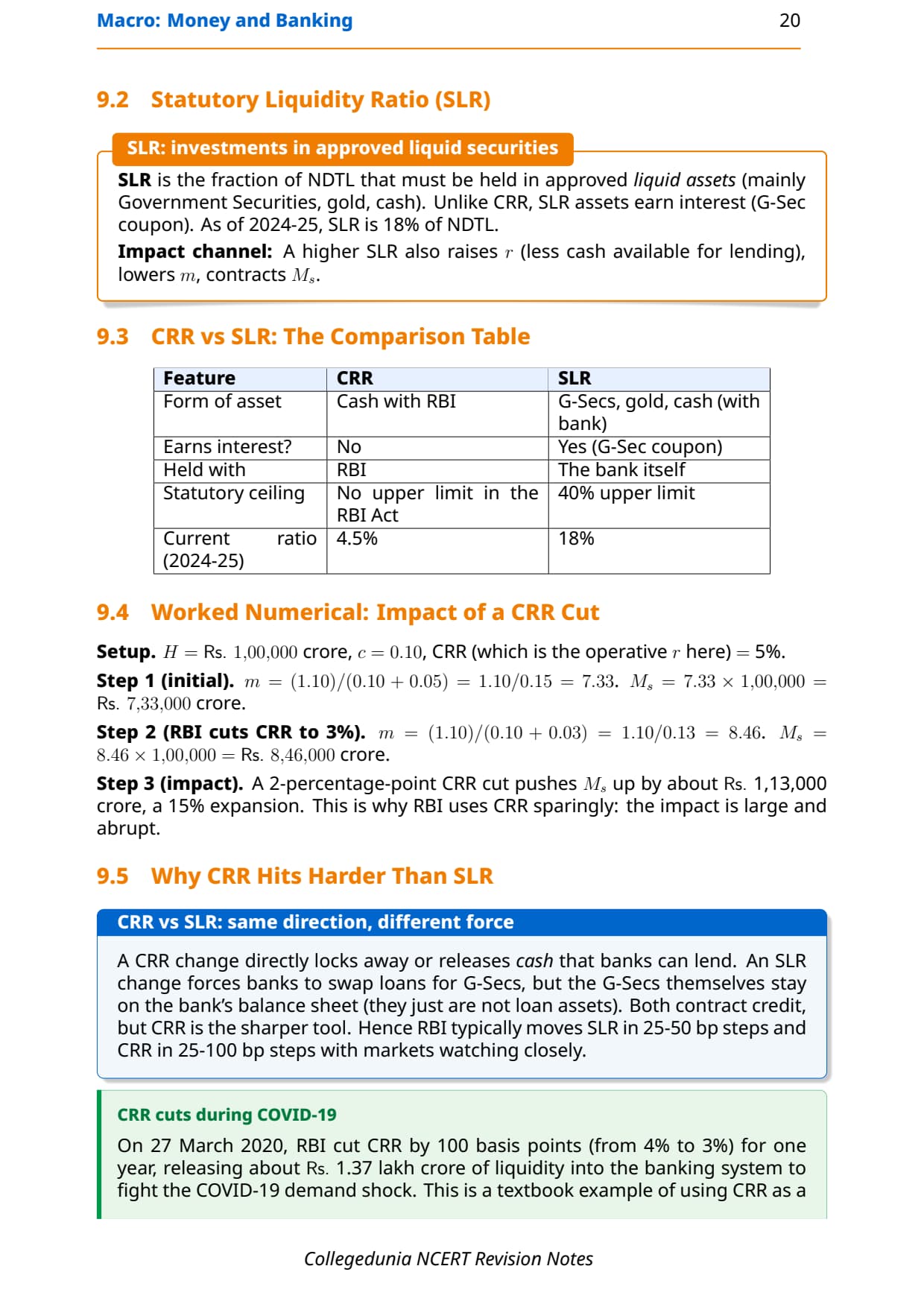
Ans. CRR is the fraction of deposits a bank must keep as cash with the RBI. SLR is the fraction it must hold in liquid securities like government bonds on its own books. Both cut credit when raised, but the asset form differs.
Ques. What are the six functions of the RBI?
Ans. They are currency authority, banker to the government, banker's bank, lender of last resort, custodian of foreign exchange, and monetary authority. CBSE expects students to list at least four with a one-line note on each.



Comments