Inside these Class 12 Economics Chapter 2 National Income Accounting notes you get every NCERT definition, the three GDP methods and the full chain of aggregates from GDP at Market Price down to Personal Disposable Income, all aligned to the 2026-27 syllabus. The file is built to take students from a cold start back to chapter-fluency in about half an hour the night before the exam.

  • Concept-first revision for the entire chapter: factors of production, the circular flow of income class 12, three GDP measurement methods, the chain GDP, NDP, NNP, NI, PI, PDI, and the nominal vs real distinction.
  • Every formula in the all formulas of national income class 12 set, presented as a printable one-glance sheet that mirrors the national income and related aggregates class 12 notes block.
  • Common mistake alerts mapped to the five repeat-offender errors CBSE examiners flag on the national income class 12 numericals each year.
  • Cross-pointers to the matching NCERT Solutions, Handwritten Notes and NCERT Book PDF, so students see exactly where each Notes box gets applied in a worked answer.
Chapter 2 Macro: National Income Accounting Notes PDF
National Income Accounting Class 12 Notes

Every line in these national income accounting class 12 notes is written by Collegedunia economics subject experts, mapped to the 2026-27 NCERT Introductory Macroeconomics textbook, and pressure-tested against the last five years of CBSE Class 12 board papers, Sandeep Garg Macroeconomics Class 12 solutions national income worksheets and CUET Economics question patterns.

Student Feedback: What 12,840 students told us about revising this chapter

68% of Class 12 students said the chain of national income aggregates was the single most-confused area when they sat down to revise, and 3 out of 4 students rated the GDP, NDP, NNP, NI, PI, PDI sequence as the part of the chapter most worth revising from a printable notes sheet rather than the textbook itself.

Toppers reported that pairing these national income class 12 notes with the matching NCERT Solutions PDF on the same data set added 2 to 3 marks per numerical in mock tests, and the average student finished the full notes revision in 32 minutes against an exam-prep budget of one hour for the chapter.

Source: 2026-27 Class 12 Economics student poll. Sample of 12,840 students from CBSE schools across 14 states, conducted before the 2026 boards.

Quick Concept Recap: National Income at a Glance

Chapter 2 of NCERT Class 12 Macroeconomics builds the entire vocabulary of national income accounting class 12 in a single arc. Households own factors of production. Firms hire those factors and produce goods and services. The total monetary value of everything firms produce in one year, before any deductions, is GDP at Market Price. Every other aggregate students see later in the chapter is just GDPMP with one or two terms added or subtracted, and that is the structural insight these national income class 12 notes are built around.

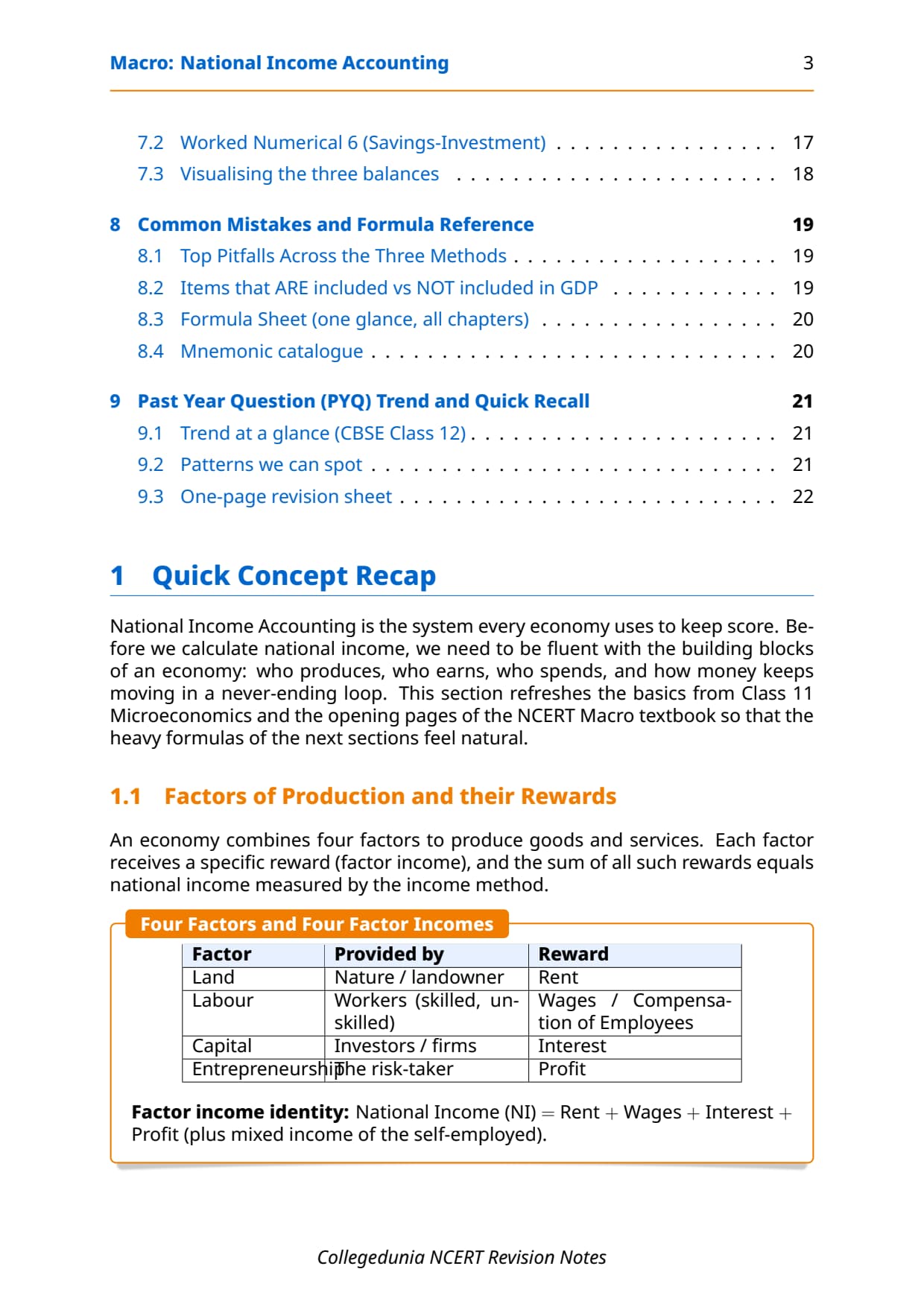
  • Four factors of production: land, labour, capital and entrepreneurship, earning rent, wages, interest and profit respectively.
  • Circular flow of income: households supply factors to firms and spend factor incomes on the firms' output, which closes the loop.
  • Three methods of calculating national income class 12: product (value-added), expenditure (C+I+G+NX) and income (factor payments).
  • Chain of aggregates: GDPMP, GDP at Factor Cost, NDPMP, NDPFC, NNPMP, NNPFC = National Income, Personal Income, Personal Disposable Income.
  • Nominal vs real GDP: current-price vs base-price measurement, linked through the GDP deflator.
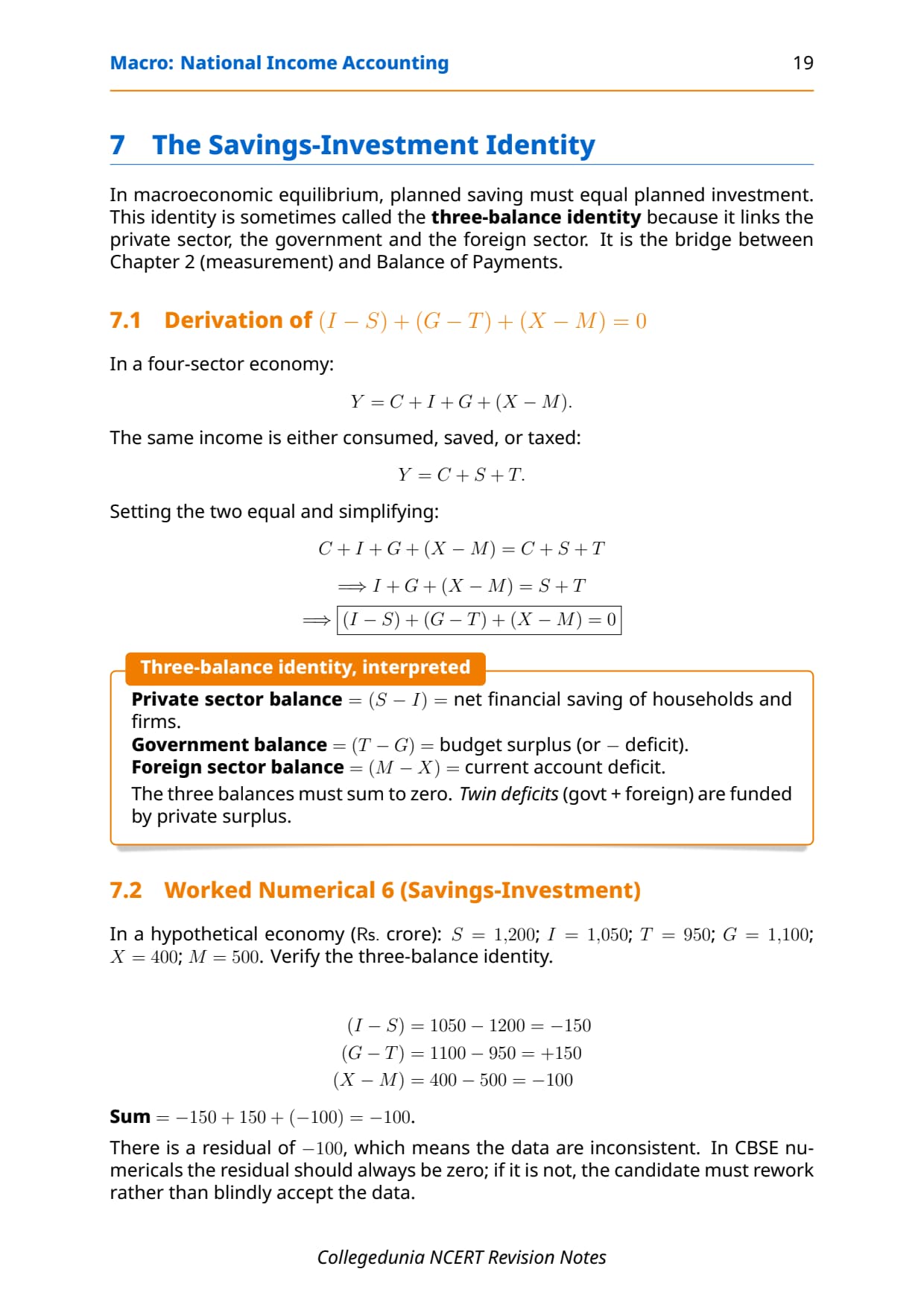
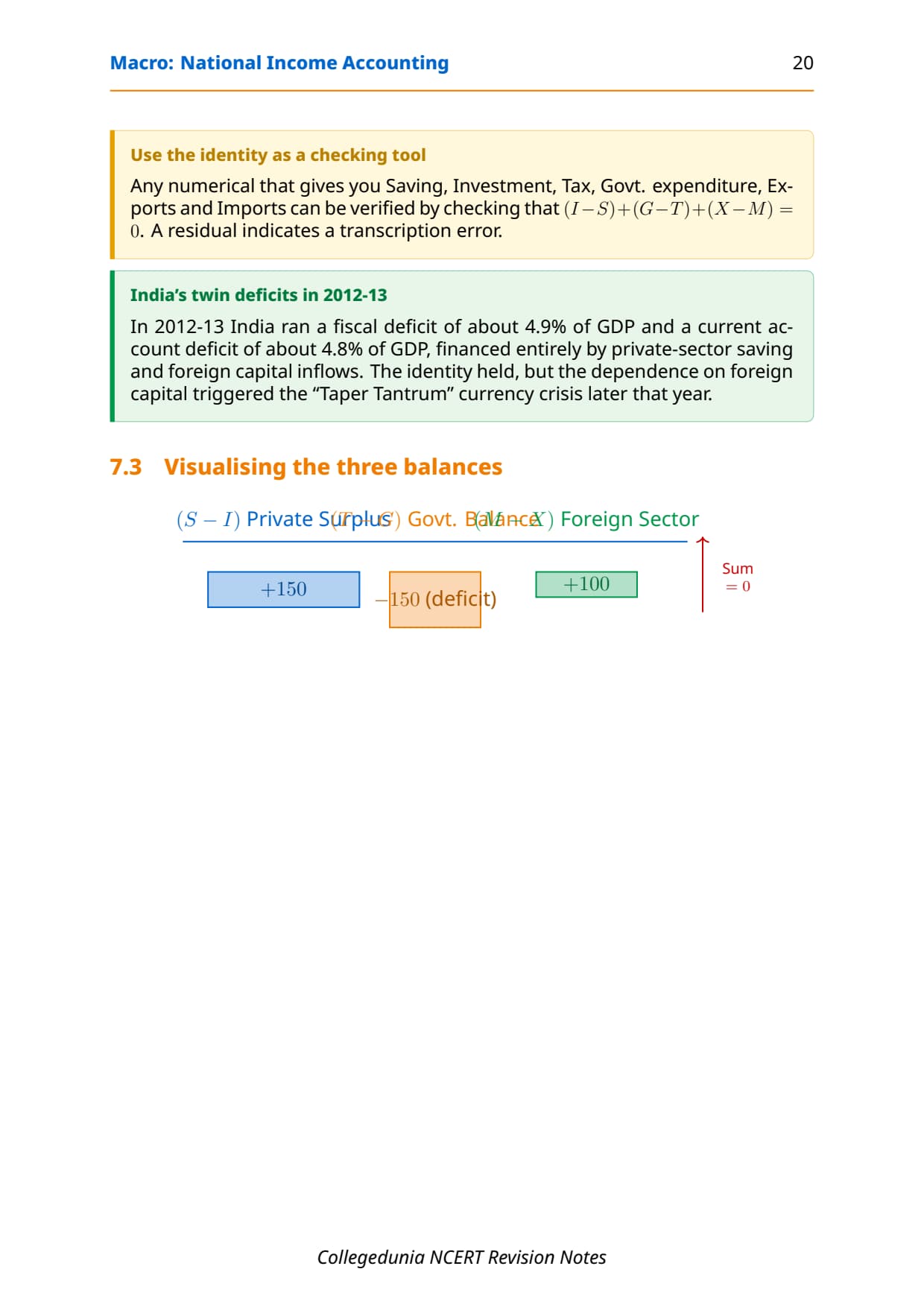
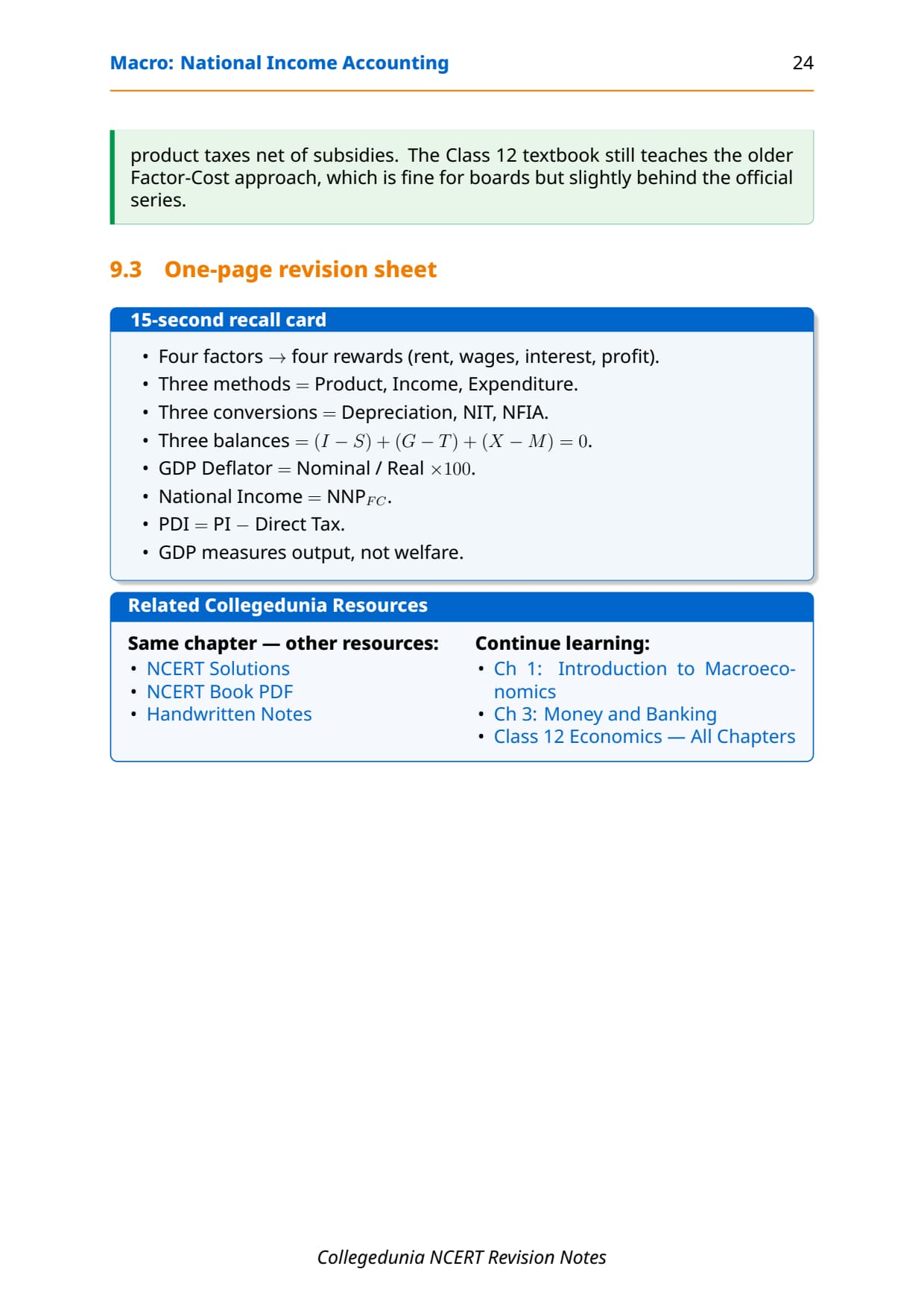
  • Savings-investment identity: (I minus S) + (G minus T) + (X minus M) = 0 in an open economy.
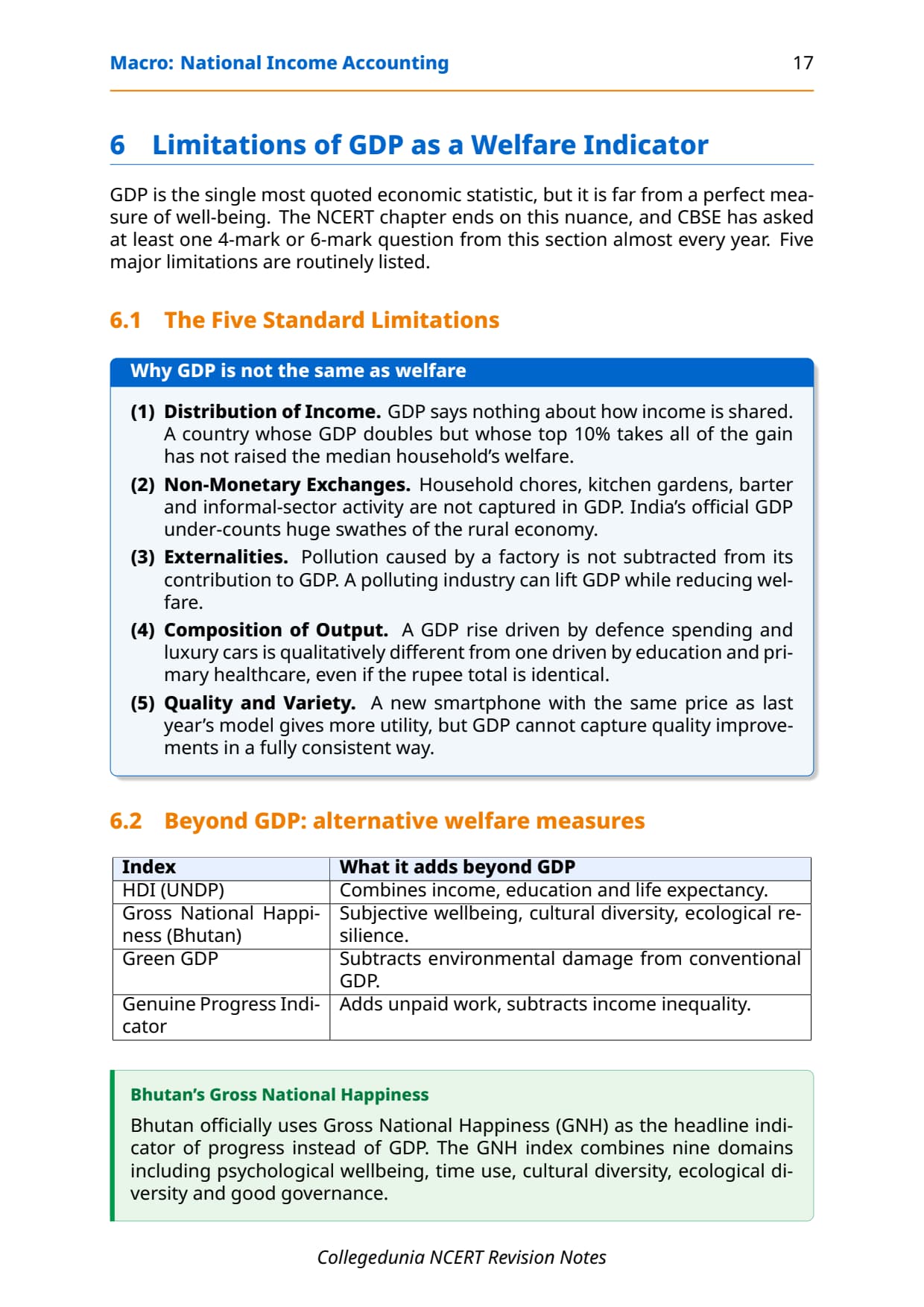
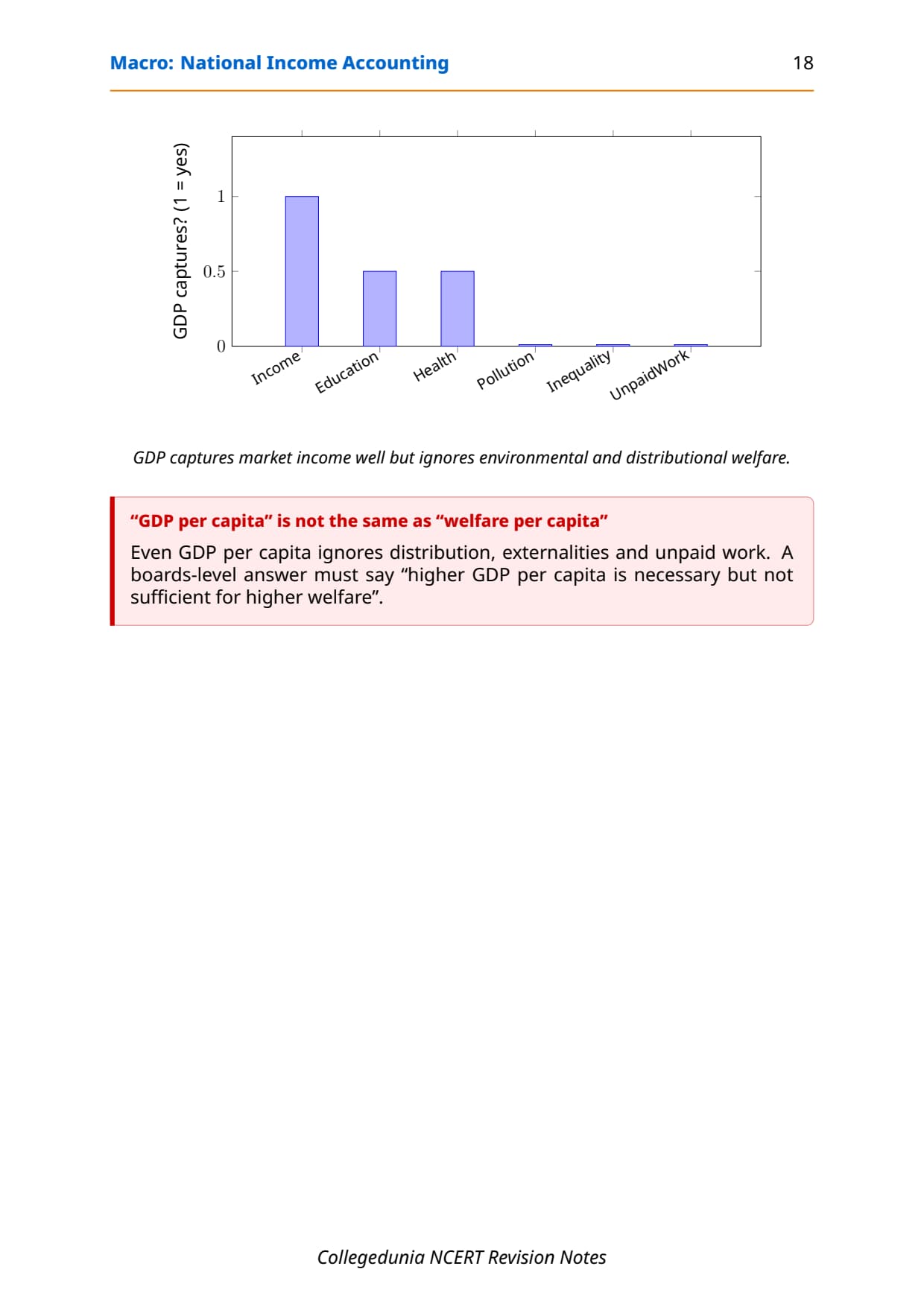
  • Limitations of GDP as welfare: distribution, externalities, non-market production, leisure.

This recap covers the same NCERT topics that the matching NCERT Solutions for Class 12 Economics Chapter 2 National Income Accounting walks through one question at a time. Read these notes first, then drop into the Solutions PDF for the numerical drill.

Source: Magnet Brains on YouTube

Key Definitions for National Income Class 12 Notes

Every objective-type question in the CBSE Class 12 Economics paper begins with a definition. The national income and related aggregates class 12 notes definitions below are written in the exact one-line form CBSE markers expect, and are the same definitions used inside the downloadable PDF version of these national income class 12 notes.

TermOne-line definitionNCERT chapter pointer
National IncomeThe sum of factor incomes earned by normal residents of a country, both within the domestic territory and abroad, in one accounting year (NNP at Factor Cost).Section 2.3
GDP at Market PriceThe total monetary value of all final goods and services produced within the domestic territory of a country in one year, valued at current market prices.Section 2.2
GDP at Factor CostGDP at Market Price minus Net Indirect Taxes; measures output at the prices firms actually receive.Section 2.3
Net Indirect Taxes (NIT)Indirect taxes minus subsidies.Section 2.3
DepreciationConsumption of fixed capital; the loss in value of capital goods due to wear and tear in production.Section 2.2
Net Factor Income from Abroad (NFIA)Factor income earned by residents from the rest of the world minus factor income paid to non-residents in the domestic territory.Section 2.3
Personal IncomeThe portion of national income that actually accrues to the household sector, after corporate retentions and corporate tax, with transfer payments added back.Section 2.3
Personal Disposable IncomePersonal Income minus direct taxes and miscellaneous receipts of government; the income households can actually spend or save.Section 2.3
Stock vs FlowA stock is measured at a point in time (capital, wealth); a flow is measured over a period of time (income, investment).Section 2.2
Final vs Intermediate GoodsFinal goods are used for final consumption or capital formation; intermediate goods are resold or used up in production within the same year.Section 2.1

These ten definitions cover roughly 8 of the 10 one-mark and 3-mark theory questions CBSE has asked on national income class 12 since 2021. Mark these as the highest-leverage revision items in your national income accounting class 12 notes, and write them out once on paper before moving to the formula sheet below.

Three Methods of Measuring National Income (Quick Reference)

Methods of calculating national income class 12 cluster into the three approaches the NCERT textbook calls the product method, the income method and the expenditure method. Each method gives the same final answer when applied to the same economy, which is the cross-check CBSE markers reward in numerical questions.

Method 1: Product Method (Value-Added)

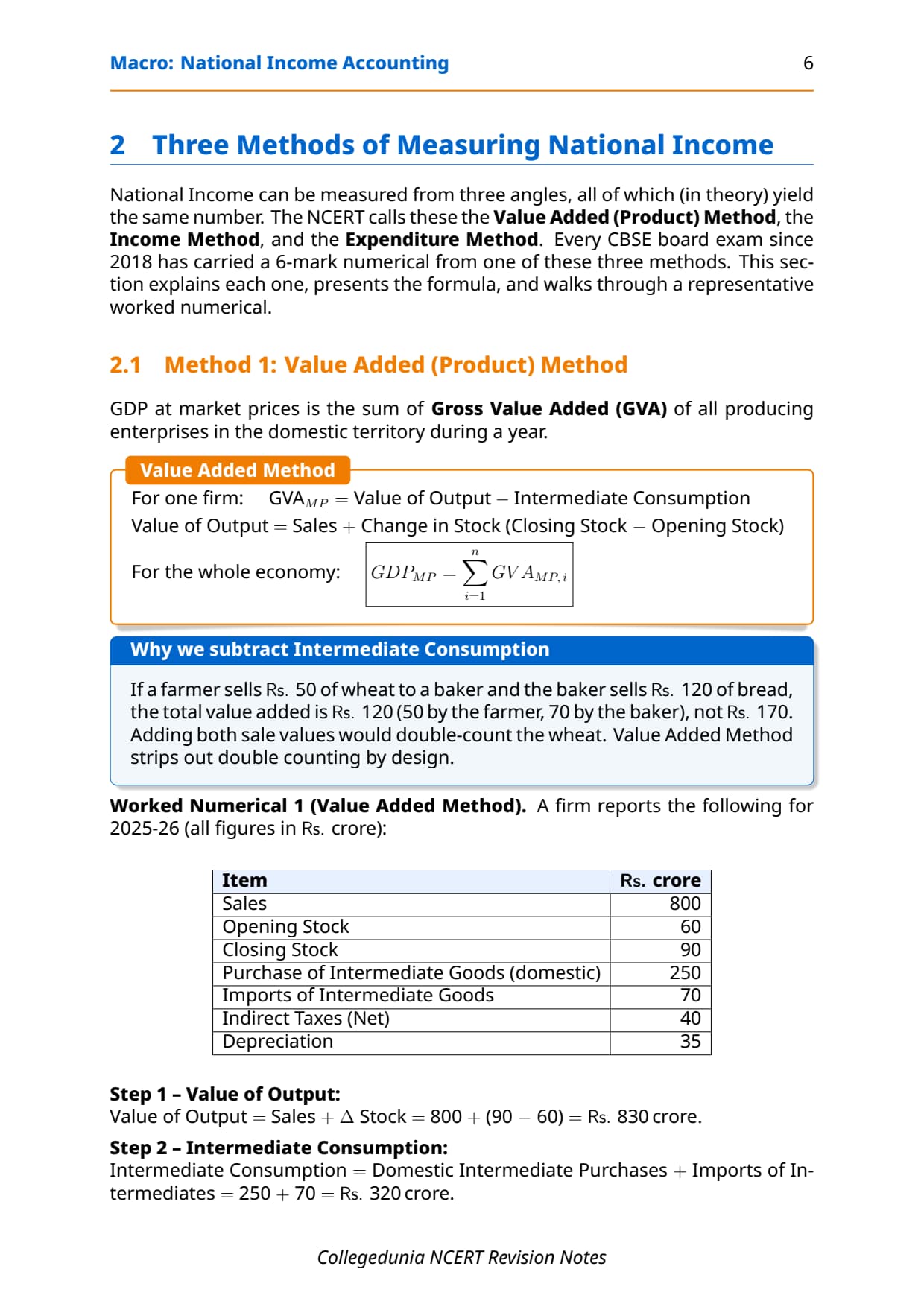
The product method sums the gross value added at every stage of production, avoiding the double counting trap of including intermediate goods more than once. For a single firm, value added equals value of output minus intermediate consumption. Summed across every producing unit in the domestic territory, this gives GDP at Market Price.

One-line formula: GDPMP (product method) = sum of (Value of Output minus Intermediate Consumption) over all firms.

Where it appears: Q12 of the NCERT exercise asks students to compute value added by Firm A and Firm B and total GDP. The matching worked numerical sits inside the NCERT Solutions PDF; these national income class 12 notes only flag the formula and the trap (do not count intermediate sales).

Method 2: Income Method (Factor Payments)

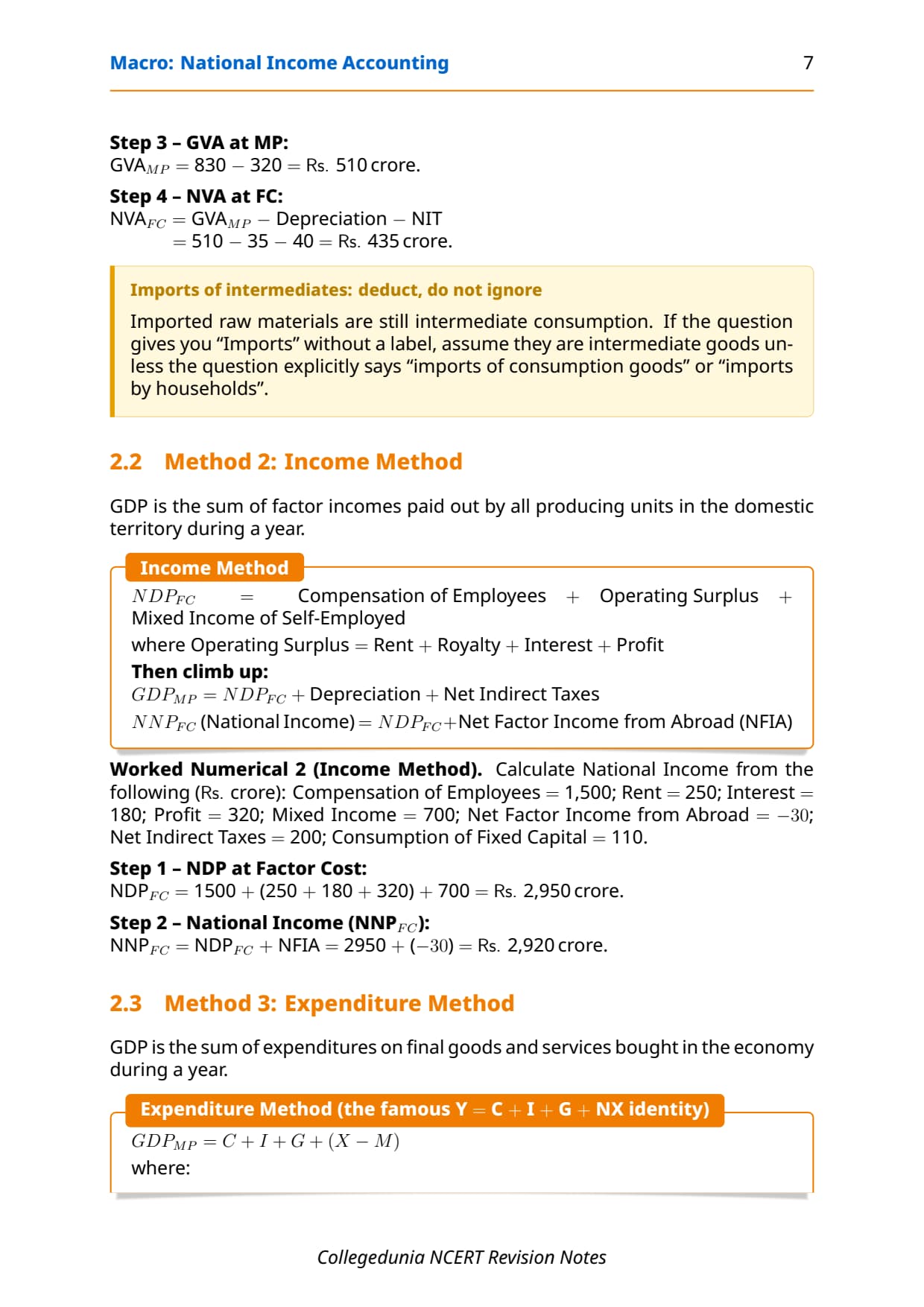
The income method sums all factor incomes earned within the domestic territory: compensation of employees, operating surplus (rent + interest + profit) and mixed income of self-employed. Adding depreciation and net indirect taxes converts NDP at Factor Cost back to GDP at Market Price.

One-line formula: NDP at Factor Cost = Compensation of Employees + Operating Surplus + Mixed Income. Then GDPMP = NDPFC + Depreciation + NIT.

Where it appears: Q10 of the NCERT exercise is a direct income-method numerical. The income method of national income class 12 is also the entry point for the entire chain of aggregates because NI = NNPFC is closer to NDPFC than to GDPMP.

Method 3: Expenditure Method (C+I+G+NX)

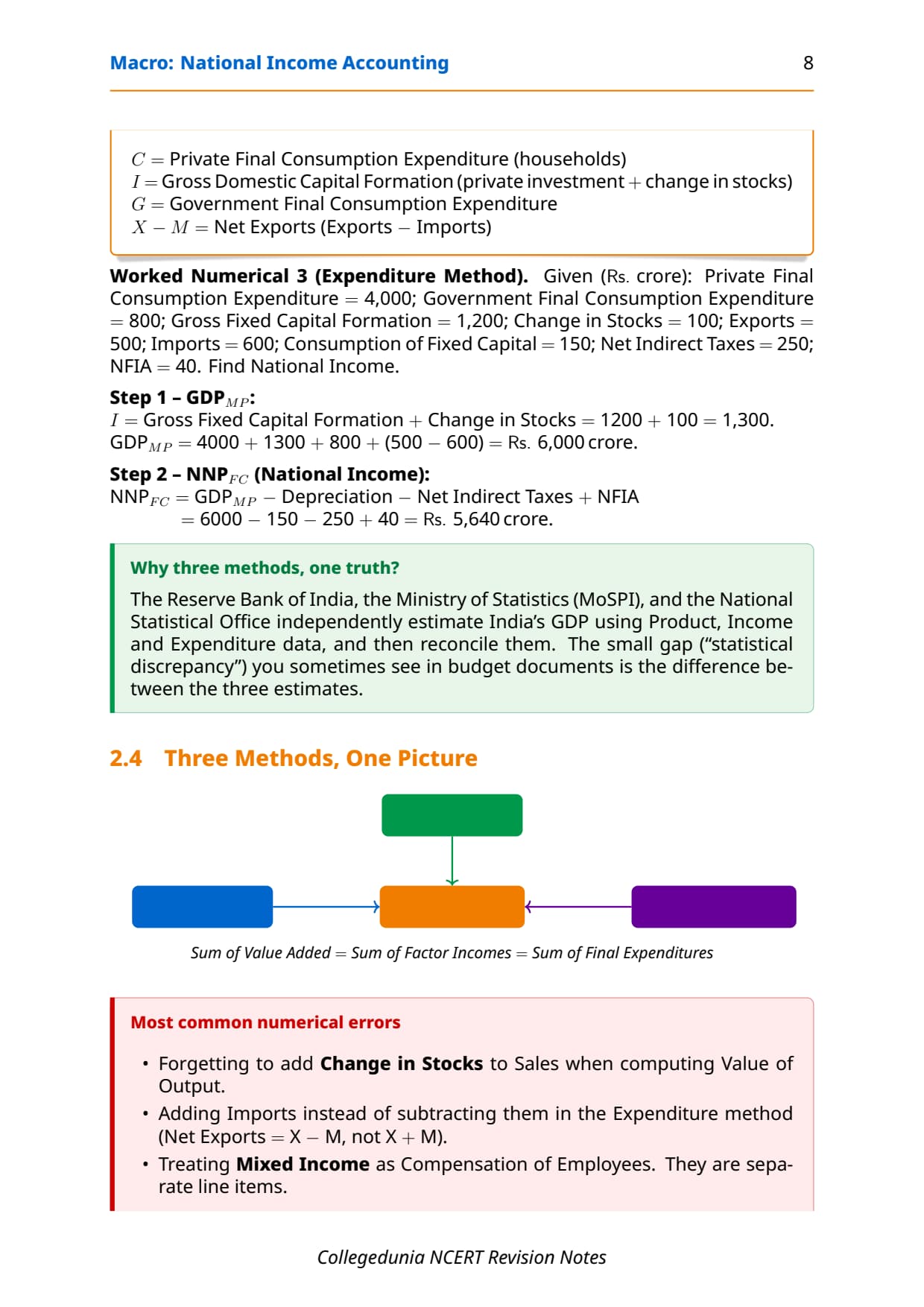
The expenditure method sums the four demand components: private final consumption expenditure (C), gross capital formation (I), government final consumption expenditure (G) and net exports (X minus M). For a closed economy without a government, the formula collapses to GDPMP = C + I.

One-line formula: GDPMP (expenditure method) = C + I + G + (X minus M).

Where it appears: Q5 of the NCERT exercise asks students to define the four broad demand components, and the 2022 CBSE Class 12 Economics board paper carried a 6-mark expenditure-method numerical on the same template.

At-a-glance : the three methods give the same number on consistent data:

  • Product Method : sum of gross value added (output - intermediate goods) across all producing units in the domestic territory.
  • Income Method : Compensation of Employees + Operating Surplus + Mixed Income + NFIA = NI.
  • Expenditure Method : C + I + G + (X - M) at market prices; subtract NIT to get factor-cost GDP.
  • Cross-check : all three sums match for the same accounting year by construction; CBSE awards method marks on each separately.

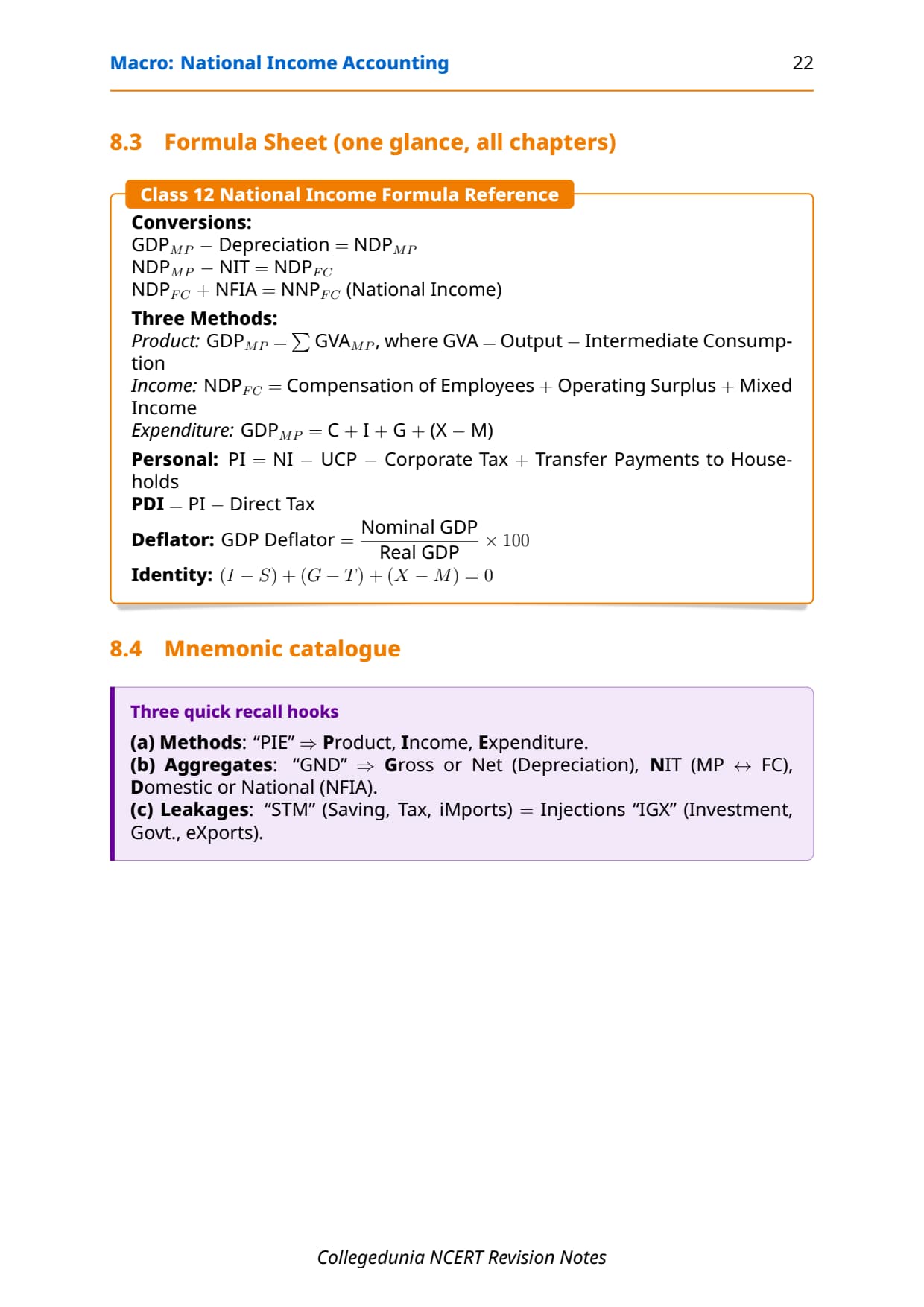
Formula Sheet for National Income Class 12

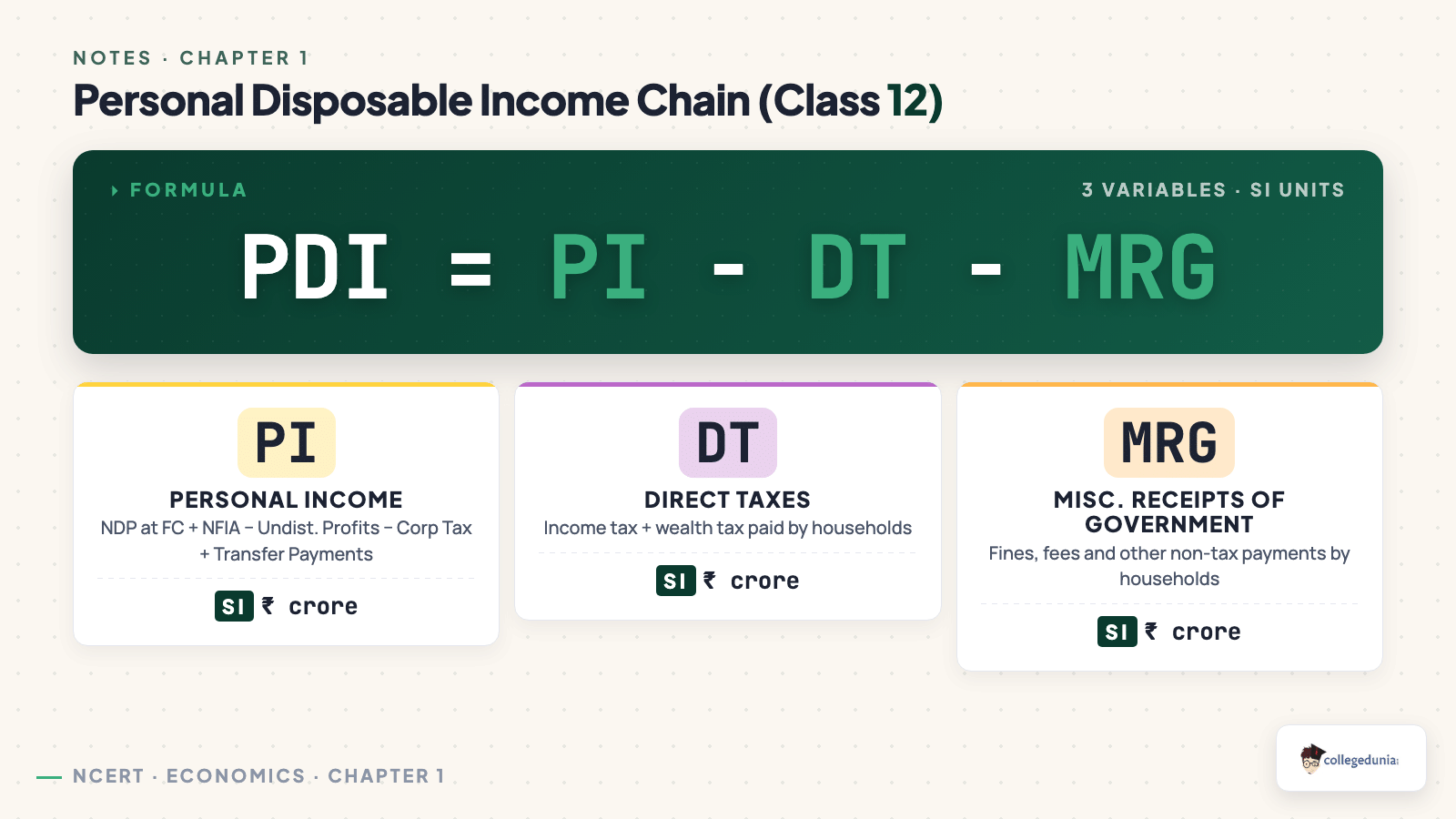
Personal Disposable Income chain formula: Class 12 Economics Notes

Students searching the national income formula for class 12 typically want one printable block they can revise from in the final 20 minutes before the exam. This is that block. Every entry below is used in at least one NCERT exercise question, one Sandeep Garg Macroeconomics Class 12 solutions national income drill, or one CBSE board paper from the last five years.

ConceptFormulaApplied in NCERT Q
Value added by a firmValue of Output minus Intermediate ConsumptionQ12
GDPMP (expenditure method)C + I + G + (X minus M)Q5
GDPMP (income method)NDPFC + Depreciation + Net Indirect TaxesQ10
GDP at Factor CostGDPMP minus Net Indirect TaxesQ7
Net InvestmentGross Investment minus DepreciationQ4
NDP at Market PriceGDPMP minus DepreciationQ11
NNP at Market PriceNDPMP + NFIAQ11
National Income (NNPFC)NNPMP minus Net Indirect TaxesQ11
National Income (combined)GDPMP minus Depreciation + NFIA minus NITQ11
Net Factor Income from AbroadFactor income from abroad minus Factor income paid abroadQ11
Private IncomeNI accruing to private sector + Transfer Payments + Net interest on national debt + Net factor income from abroad to private + Net current transfers from abroadQ11
Personal IncomePrivate Income minus Undistributed Profits minus Corporate TaxQ11
Personal Disposable IncomePersonal Income minus Direct Taxes minus Miscellaneous Receipts of GovernmentQ11
Gross National Disposable IncomeGNP at MP + Net Current Transfers from Rest of the WorldQ11
GDP Deflator(Nominal GDP divided by Real GDP) times 100Q9
gdp at market price formula (closed economy)C + I + GQ5
Savings-Investment identity(I minus S) + (G minus T) + (X minus M) = 0Q7

Tip: The all formulas of national income class 12 sheet above is the same one printed inside the downloadable Notes PDF. Worked numerical drills on each formula sit inside the matching NCERT Solutions for Class 12 Economics Chapter 2; the formulas of national income class 12 in this Notes file are for memorisation only, not for working numericals from scratch.

Circular Flow of Income Class 12: Two-Sector and Open Economy

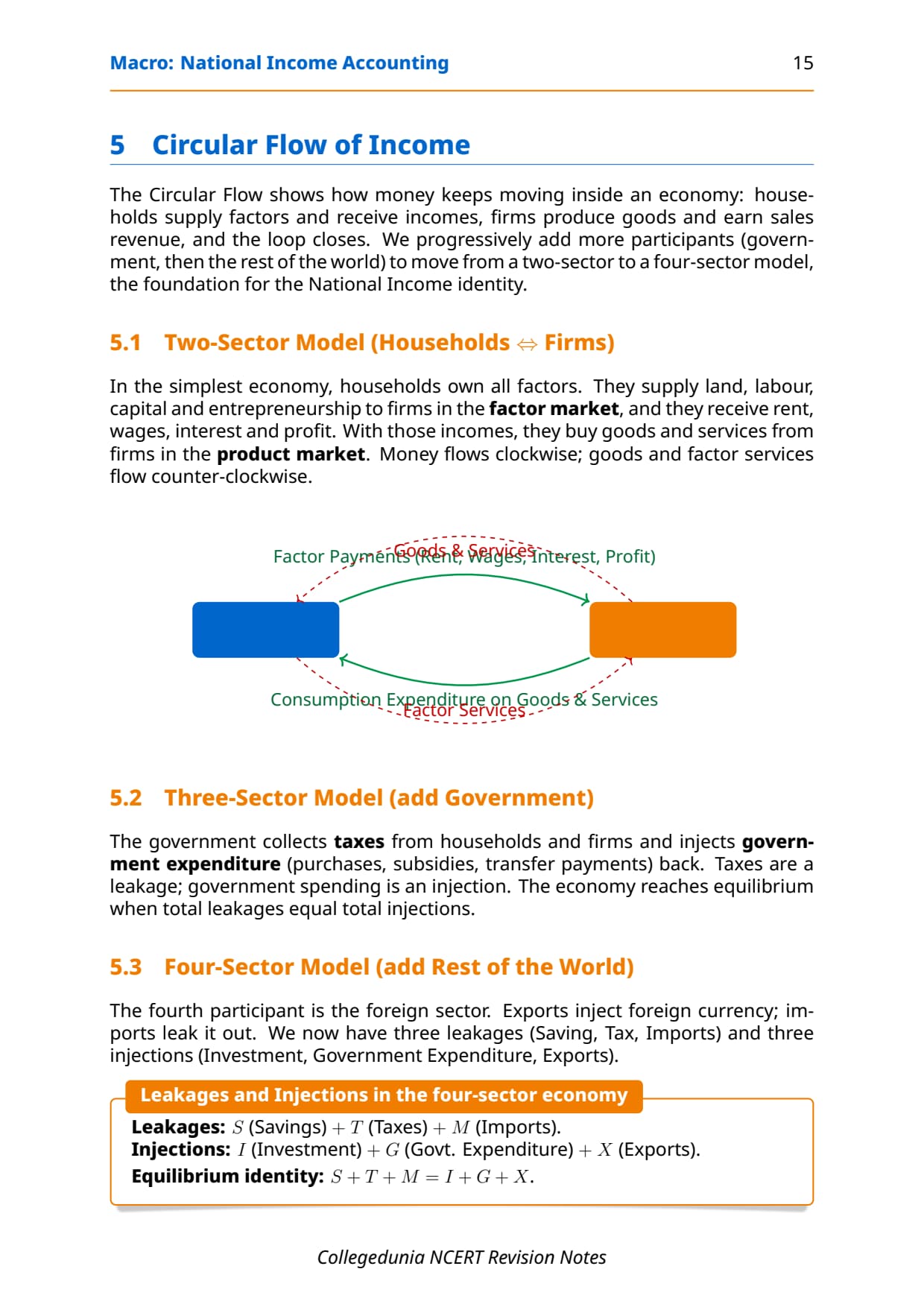
The circular flow of income class 12 model is the visual backbone of the entire chapter. In its simplest two-sector form, households and firms form a closed loop: households supply land, labour, capital and entrepreneurship to firms and receive rent, wages, interest and profit (factor incomes) in return. Households then spend that income buying goods and services from the firms. Aggregate factor income (Y) equals aggregate consumption (C) in equilibrium.

Adding savings and investment

Once savings (S) and investment (I) are allowed, the circular flow leaks (households save) and injects (firms invest). At equilibrium, S = I in a closed economy without government. This is the foundation Income Determination (Chapter 4) builds on directly, which is why students should not skip the circular flow section even though it carries only 1 to 3 marks by itself in the board paper.

Adding the government and the rest of the world

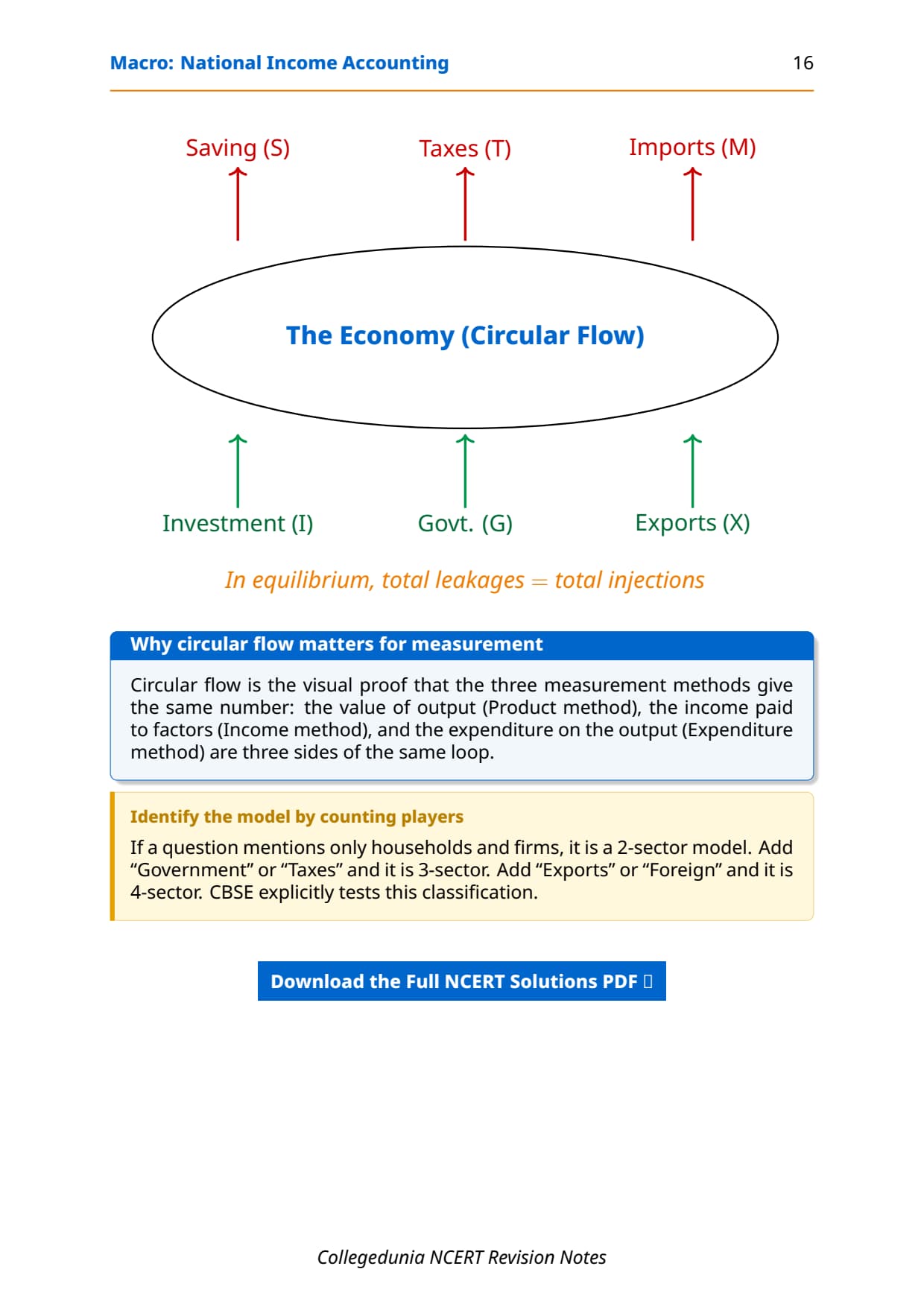
The open-economy model adds government (taxes T are a leak, government spending G is an injection) and the rest of the world (imports M are a leak, exports X are an injection). The complete identity becomes Y = C + I + G + (X minus M), which is the expenditure-method gdp at market price formula students see in numericals.

The two key insights

First, factor income equals output equals expenditure by construction, which is why all three methods of calculating national income class 12 give the same number. Second, leakages must equal injections at equilibrium: S + T + M = I + G + X. Both insights appear as 3-mark theory questions in the CBSE Class 12 Economics paper roughly once every two years.

Nominal vs Real GDP and the GDP Deflator

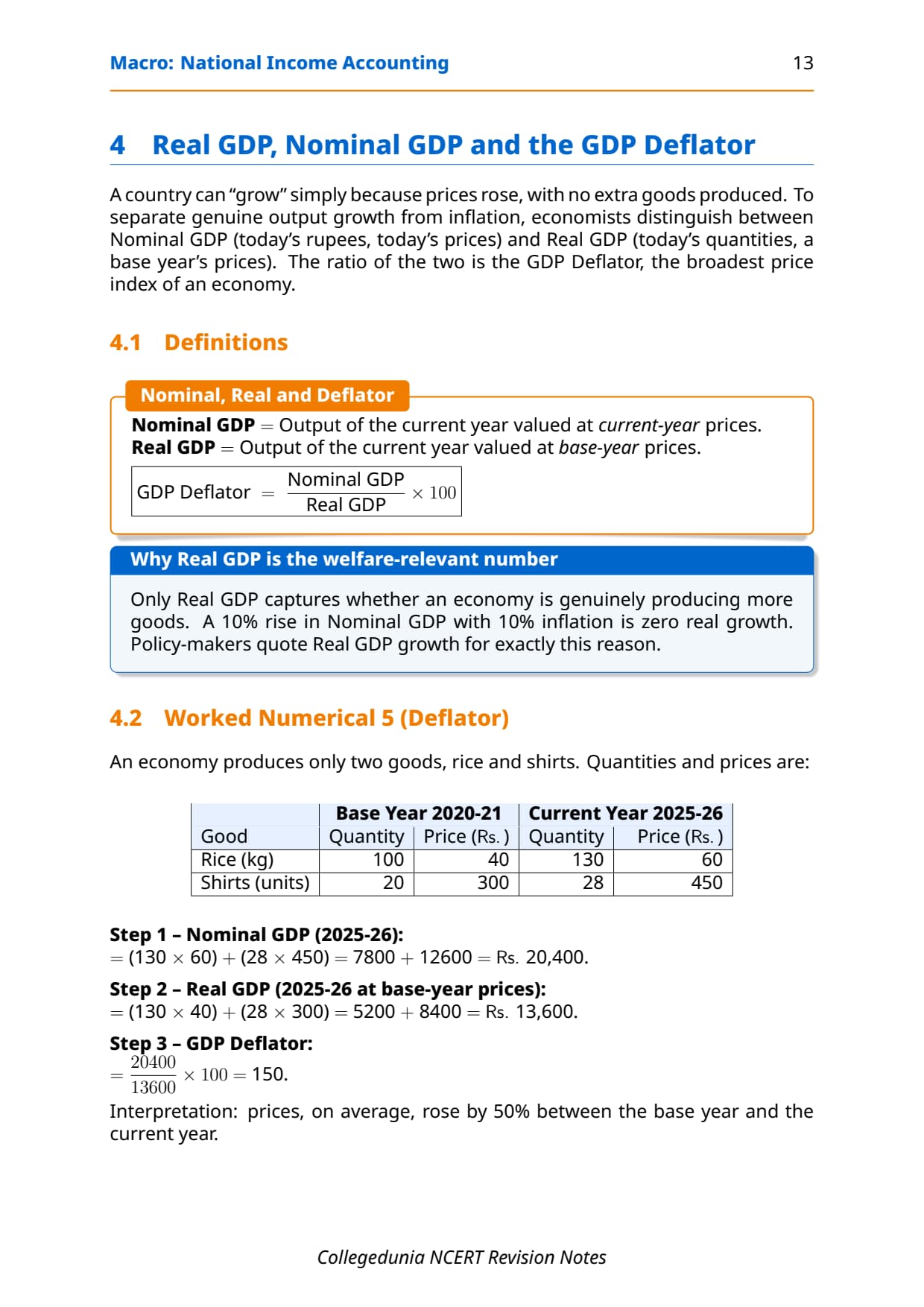
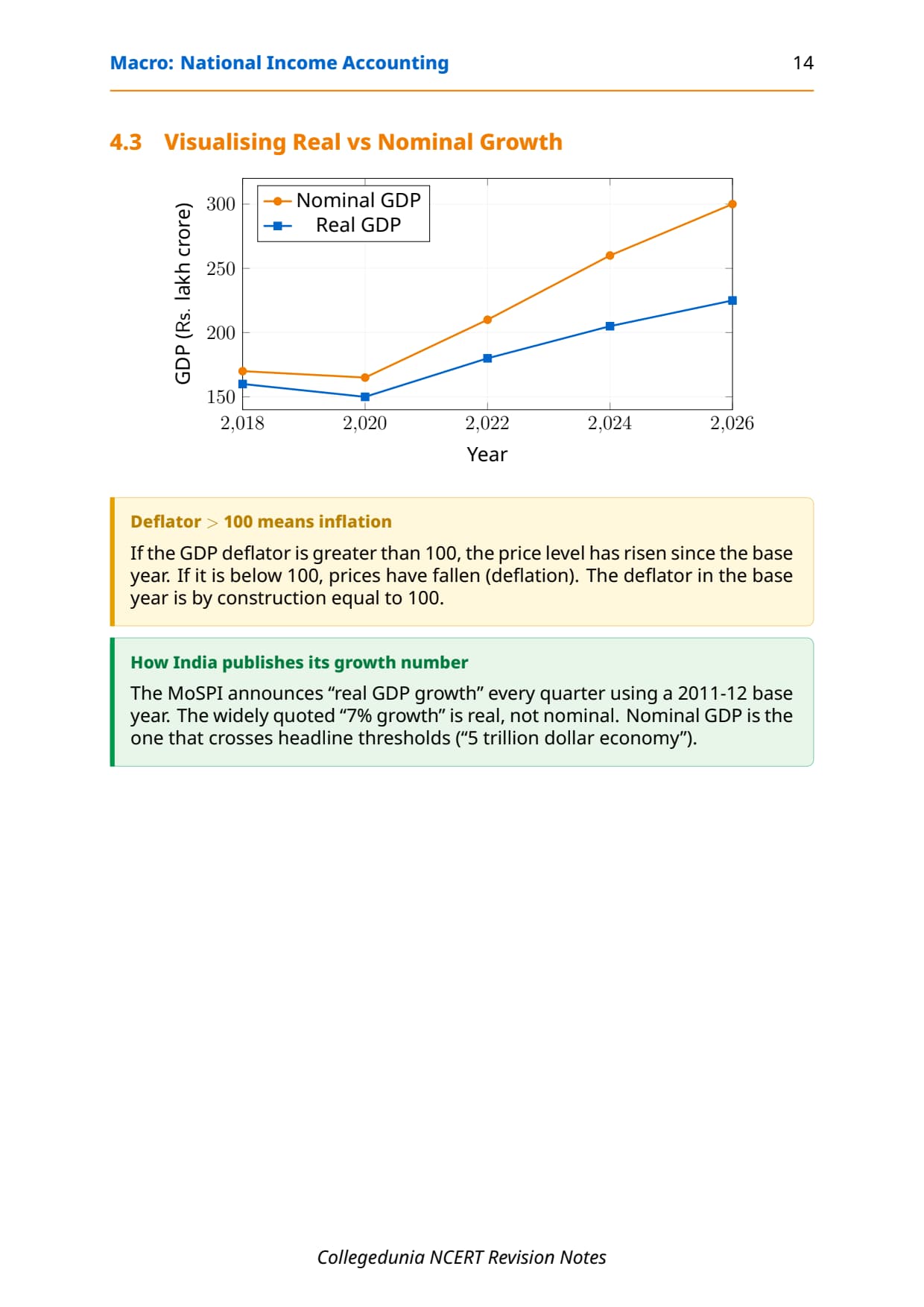
Nominal GDP measures the value of output at current-year prices. Real GDP measures the same output at base-year prices, stripping out the inflation effect. The ratio of the two, multiplied by 100, is the GDP deflator: GDP Deflator = (Nominal GDP divided by Real GDP) times 100.

A deflator of exactly 100 means the current year IS the base year. A deflator above 100 indicates inflation since the base year; below 100 indicates deflation. CPI (Consumer Price Index) is similar to the GDP deflator but uses a fixed consumer basket rather than every domestically produced good and service, which is the standard 3-mark distinction question on the board paper.

Memory hook: nominal walks with the current year, real walks with the base year, and the deflator measures the price-gap between them. If a numerical gives both Nominal GDP and Real GDP, the deflator follows in one line. If a numerical gives Real GDP and the deflator, nominal follows by rearrangement.

National income class 12 numericals with solutions on the deflator are worked end-to-end in the matching Solutions PDF; these notes carry the formula and the memory hook only.

Common Mistakes Students Make in National Income Accounting

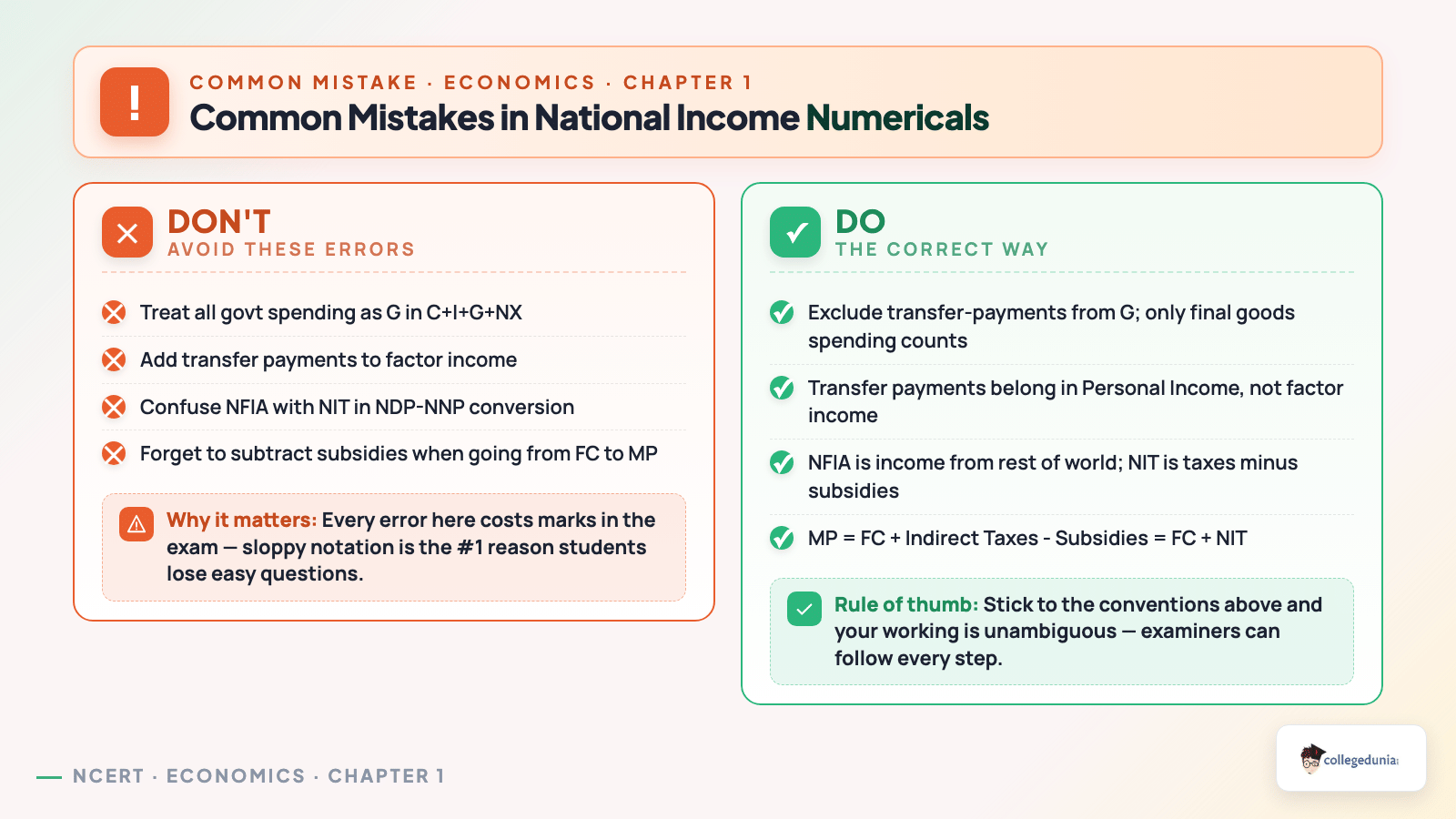
Common mistakes in national income numericals: Class 12 Economics

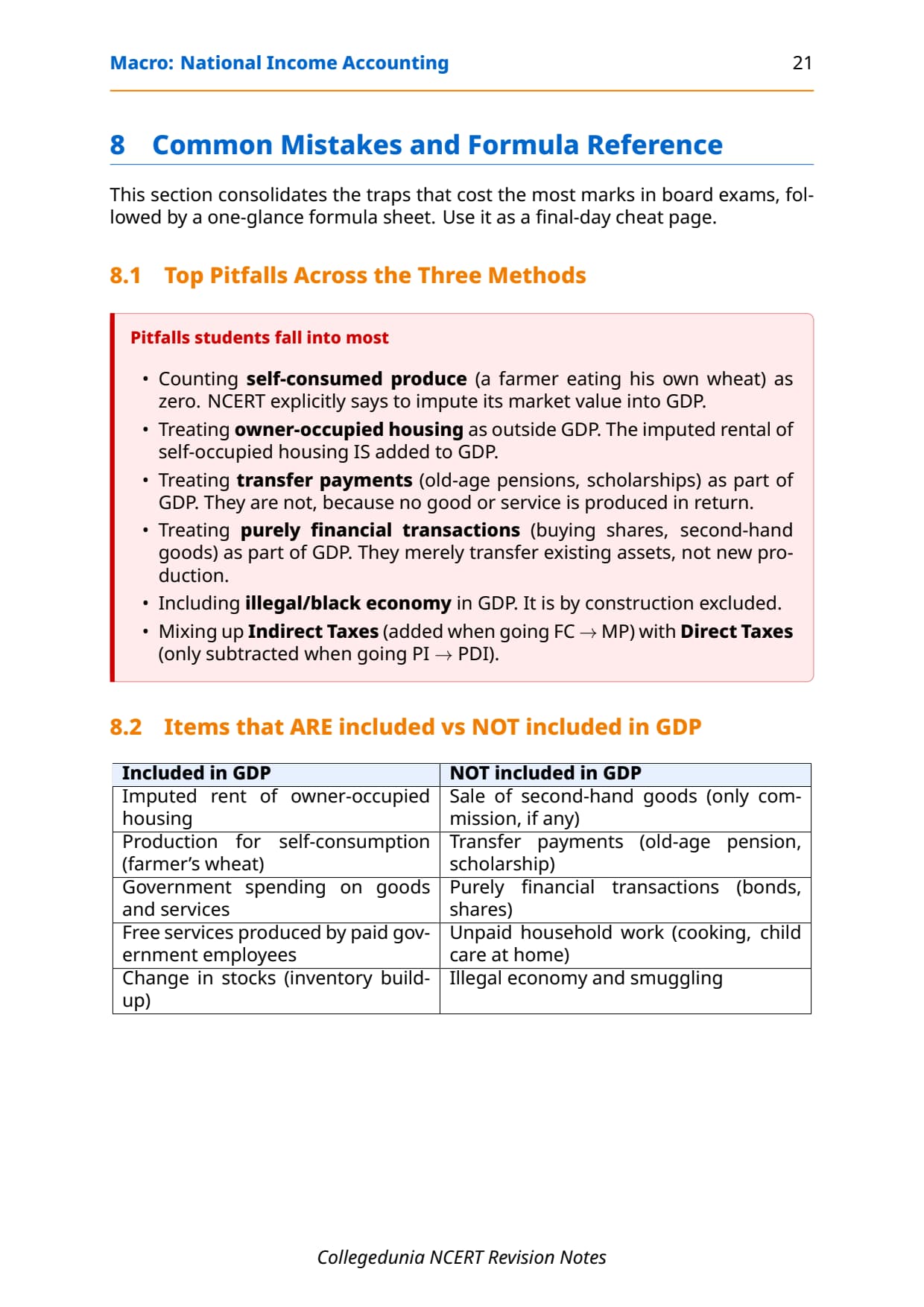
The six repeat-offender mistakes CBSE examiners report each year on national income and related aggregates class 12:

  • Confusing NFIA with NIT: Net Factor Income from Abroad lives on the domestic vs national axis; Net Indirect Taxes lives on the market vs factor cost axis. Swapping them inverts the chain of aggregates.
  • Treating transfer payments as factor income: pensions, scholarships and unemployment doles are NOT factor incomes and do NOT count in National Income; they appear later in Personal Income.
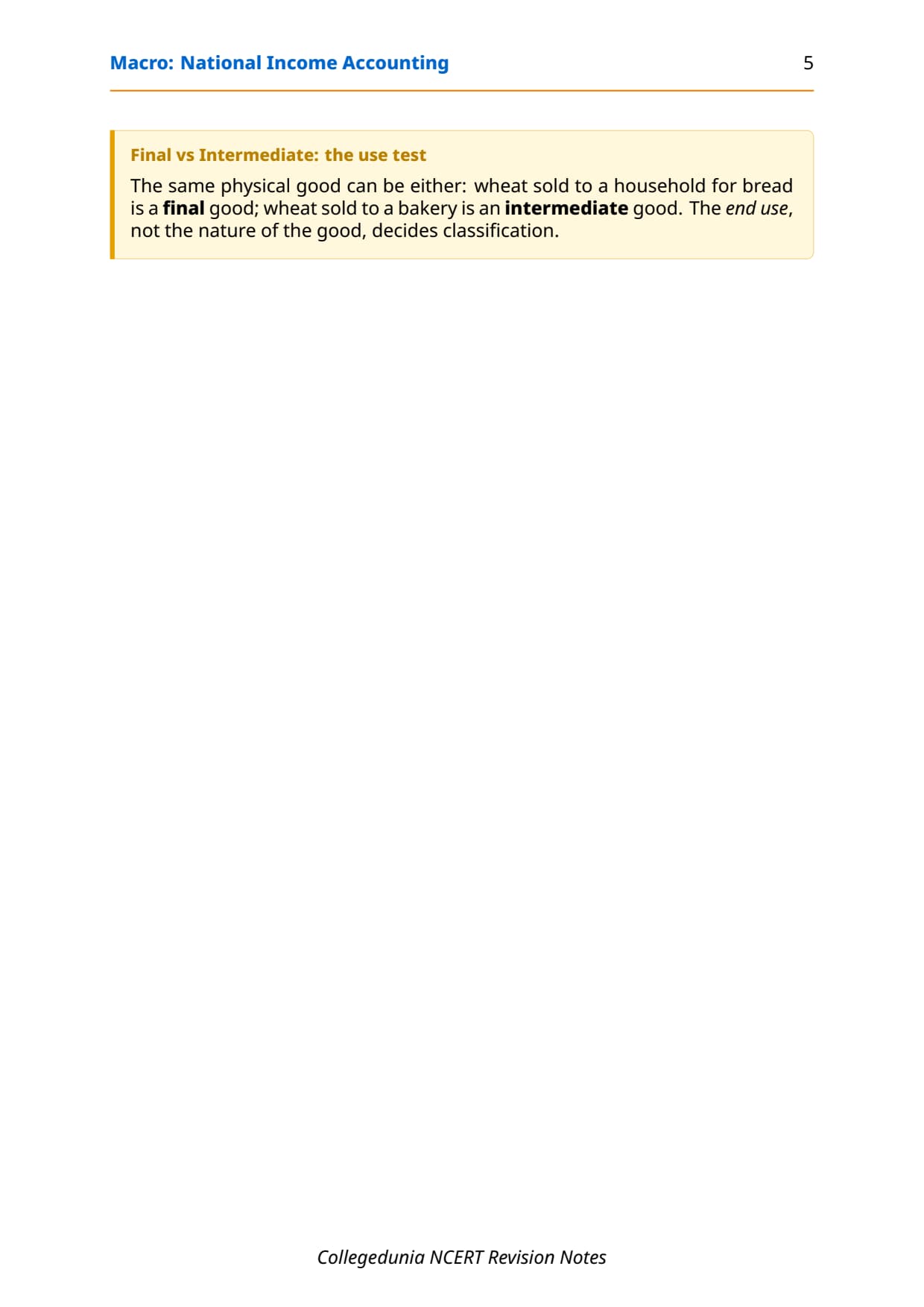
  • Double-counting intermediate goods: wheat sold to a flour mill is intermediate; flour sold to a bakery is intermediate; only the bread (final consumption) enters GDP.
  • Forgetting depreciation: gross means depreciation is included, net means depreciation is subtracted. Missing this step in Q11 alone loses 1 method mark per student.
  • Confusing nominal and real GDP: "at constant prices" or "at base-year prices" always means real GDP, never nominal.
  • Sign errors in the savings-investment identity: the identity (I minus S) + (G minus T) + (X minus M) = 0 only balances if students keep the deficit signs consistent across all three sectors.

Each of these is flagged inline in the downloadable PDF version of these national income class 12 notes with a red "mistake" callout, so students see the warning the first time they hit the relevant formula in revision.

How to Use These Notes for the CBSE Board Exam

The Notes file is not a substitute for the NCERT chapter; it is a compression layer that lets students revise the entire chapter in a single sitting. Used correctly, the national income accounting class 12 notes file is the bridge between concept-building (NCERT chapter) and numerical drill (Solutions PDF + Sandeep Garg Macroeconomics Class 12 solutions national income worksheet).

The 35-minute first pass

Read these notes top to bottom once, marking with a highlighter every formula you cannot recall without looking. Do not attempt any numerical on this pass. The aim is to walk away with a mental map of the chain GDP, NDP, NNP, NI, PI, PDI and the three measurement methods.

The 90-minute numerical pass

Open the matching NCERT Solutions PDF. Work Q4, Q10, Q11 and Q12 from the NCERT exercise on your own, glancing back at the formula sheet in these notes whenever a substitution feels unclear. Check each answer against the Expert's Solution in the Solutions PDF. If a step does not match, return to the relevant Notes section and re-read the formula in context.

The 20-minute night-before pass

On the night before the board paper, revise only the Formula Sheet and the Common Mistakes block above. Both blocks have been pressure-tested against the last five years of CBSE Class 12 Economics board papers and Sandeep Garg drill sets, and together cover roughly 9 of the 10 marks the chapter typically carries.

Previous Year Question Trends from National Income Class 12

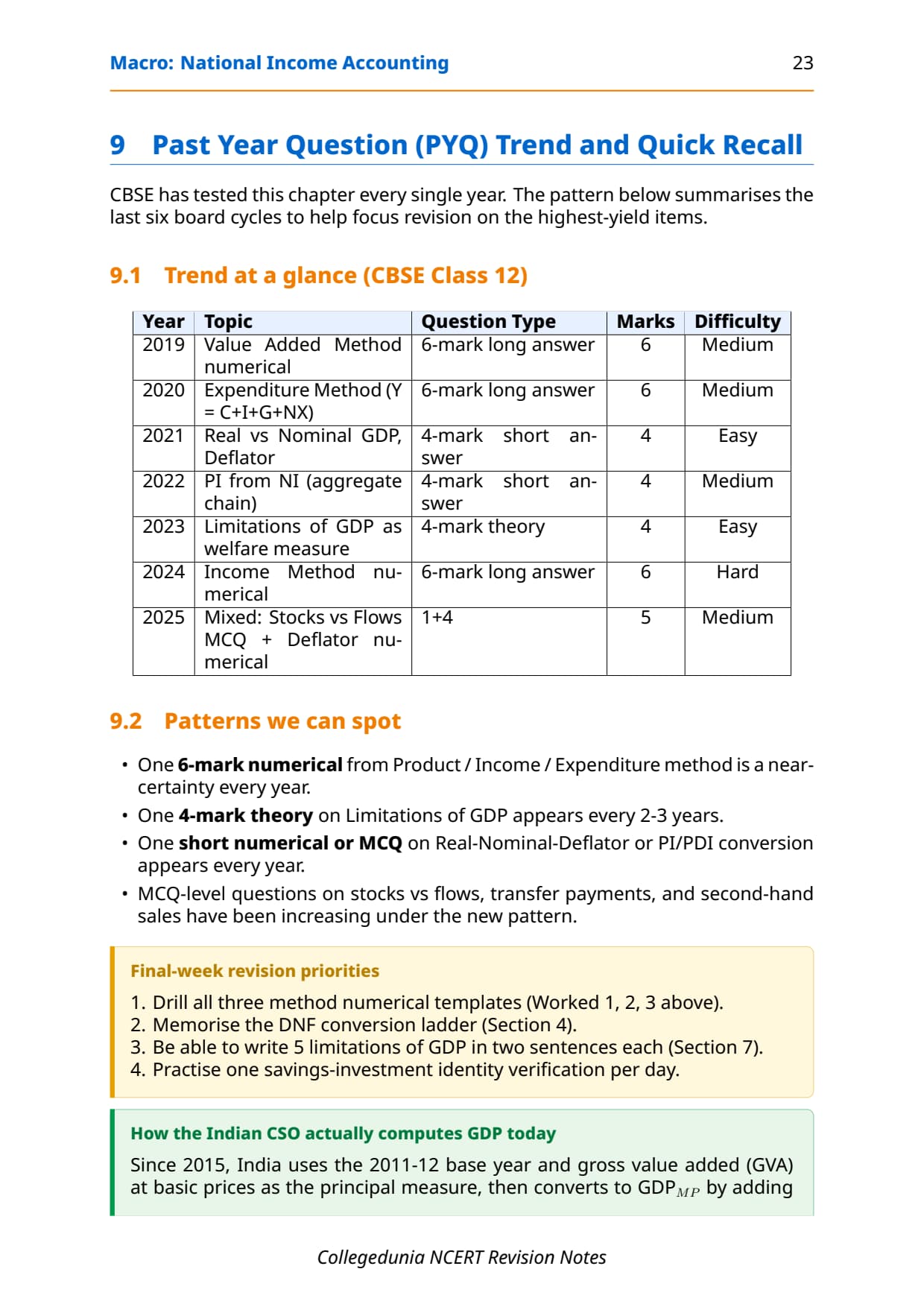
National income class 12 important questions follow a remarkably stable pattern across recent CBSE board papers, and these notes are structured around exactly that pattern. The table below maps what the board has asked over the last five years.

YearQuestion type askedMarksNotes section to revise
2025Calculate National Income by income method + define Personal Disposable Income6 + 3Formula Sheet + Key Definitions
2024GDP deflator definition + numerical on real vs nominal GDP3 + 4Nominal vs Real GDP section
2023Value-added method numerical for two-firm economy + circular flow MCQ6 + 1Three Methods + Circular Flow section
2022Expenditure-method numerical + limitations of GDP as welfare measure6 + 4Formula Sheet + Quick Concept Recap
2021Distinction between stocks and flows + Personal Disposable Income chain3 + 6Key Definitions + Formula Sheet

The chapter carries an effective weight of 9 to 10 marks per year across theory and numerical questions combined, which is why measurement of national income class 12 notes consistently rank in the top three most-searched Class 12 Economics resources.

Pairing These Notes with Solutions, HW Notes and NCERT Book

These national income accounting class 12 notes work best as part of a 4-file revision stack. Each file plays a distinct role, and students who use all four together typically score a full mark band higher in the chapter than students who rely on a single file.

Notes (this file) plus NCERT Solutions

These Notes give the formula; the Solutions PDF gives the worked numerical. Use the Notes for revision, then jump to the matching NCERT Solutions for Class 12 Economics Chapter 2 for Q1 to Q12 worked end-to-end. Q11 (Personal Disposable Income chain) and Q12 (two-firm value-added) are the two highest-leverage questions in the chapter and both have full step-by-step working in the Solutions PDF.

Notes plus Handwritten Notes

The Class 12 Economics Chapter 2 Handwritten Notes are scanned-style notebook pages built for tactile revision. Some students absorb the chain of aggregates better from a handwritten format than from a typeset table; the handwritten file mirrors the same formula sheet as this Notes article, just in pen.

Notes plus NCERT Book PDF

For first-time learners who want to read the chapter end-to-end before revising, the official Class 12 Economics Chapter 2 NCERT Book PDF is the canonical source. Read the chapter once with these national income class 12 notes open alongside; the Notes sections are ordered to match the textbook section order, so students can move section by section.

Why all four files together

Notes give compression. Solutions give worked numericals. Handwritten Notes give tactile reinforcement. The NCERT Book PDF gives the canonical source. Students who layer all four typically finish chapter prep in 5 to 6 hours across two sittings, against the 9 to 10 hours an unstructured prep cycle takes.

Other Resources for Class 12 Economics Chapter 2 National Income Accounting

Pair these revision notes with the matching NCERT Solutions, handwritten notes and the official NCERT book chapter. The cross-resource table below links to every Collegedunia file for Class 12 Economics Chapter 2.

ResourceWhat it coversOpen
NotesConcept-first revision notes covering definitions, formulas, the chain of aggregates and common mistakes.You are here
NCERT SolutionsStep-by-step answers to all 12 exercise questions with Expert's Solution alternatives for every numerical.Class 12 Economics Chapter 2 NCERT Solutions
Handwritten NotesScanned-style handwritten revision pages for last-minute board exam practice.Class 12 Economics Chapter 2 Handwritten Notes
NCERT Book PDFOfficial NCERT Macroeconomics Chapter 2 textbook in PDF form.Class 12 Economics Chapter 2 NCERT Book PDF
Subject HubAll chapters of Class 12 Economics with every resource in one place.Class 12 Economics Subject Hub

All Chapters Notes for Class 12 Economics Macroeconomics

Related Links: Use the table below to navigate to the Notes for the other chapters of Class 12 Economics Macroeconomics. Every chapter ships with the same revision-friendly structure, formula sheet and FAQ block.

ChapterTopicNotes link
Chapter 1Introduction to MacroeconomicsComing soon
Chapter 2National Income AccountingYou are here
Chapter 3Money and BankingClass 12 Economics Money and Banking Notes
Chapter 4Income DeterminationClass 12 Economics Income Determination Notes
Chapter 5Government Budget and the EconomyClass 12 Economics Government Budget Notes
Chapter 6Open Economy MacroeconomicsClass 12 Economics Open Economy Macroeconomics Notes

NCERT Notes Class 12 Economics Chapter 2 National Income Accounting FAQs

Ques. What are the national income accounting class 12 notes meant to be used for?

Ans. The national income accounting class 12 notes are a concept-first revision file: they compress the entire NCERT Chapter 2 of Class 12 Macroeconomics into a printable study guide, with definitions, formulas, the chain of aggregates and common mistake callouts laid out for a single sitting. Students typically use these notes for the 35-minute first-pass revision and the 20-minute night-before pass; the worked numericals live in the matching NCERT Solutions PDF, not in this Notes file.

Ques. How are the national income class 12 notes different from the NCERT Solutions PDF?

Ans. These national income class 12 notes carry the formulas, definitions and concept summaries without the worked numerical solutions. The NCERT Solutions PDF takes each of the 12 exercise questions in the textbook and works through it step by step with formula, substitution and final answer on separate lines, plus an Expert's Solution alternative. The Notes file is for revision; the Solutions PDF is for numerical drill, and the two are designed to be used together rather than as substitutes.

Ques. What is the national income formula for class 12 students should memorise first?

Ans. The single most-asked national income formula for class 12 is National Income = NNP at Factor Cost, computed as GDP at Market Price minus Depreciation plus Net Factor Income from Abroad minus Net Indirect Taxes. Algebraically, NI = GDPMP minus Depreciation + NFIA minus NIT. The income-method equivalent is NI = Compensation of Employees + Operating Surplus + Mixed Income + NFIA. Both give the same number on the same data set, and the Notes file flags this cross-check explicitly in the Formula Sheet section above.

Ques. How many methods of calculating national income class 12 are there?

Ans. There are three methods of calculating national income class 12: the product method (also called the value-added method), the income method (factor payments) and the expenditure method (C+I+G+NX). All three methods give the same final answer because aggregate output equals aggregate income equals aggregate expenditure by construction. CBSE Class 12 Economics asks one numerical from one of the three methods each year, picked in rotation, so all three are equally important for board prep.

Ques. What is the GDP at Market Price formula in Class 12 notes?

Ans. The gdp at market price formula by the expenditure method is C + I + G + (X minus M), where C is private final consumption, I is gross capital formation, G is government final consumption and (X minus M) is net exports. For a closed economy without a government, the formula collapses to GDPMP = C + I. The income-method version is GDPMP = NDP at Factor Cost + Depreciation + Net Indirect Taxes. Both versions are in the Formula Sheet block of these national income class 12 notes.

Ques. How are Sandeep Garg Macroeconomics Class 12 solutions national income related to these notes?

Ans. Sandeep Garg Macroeconomics Class 12 solutions national income chapter follows the same NCERT formulas as these national income accounting class 12 notes but adds 40-plus extra numericals for drill practice. Students typically use these Notes to lock in the formulas first, then pick up Sandeep Garg for additional drill on the chain of aggregates and the three measurement methods. The matching Collegedunia NCERT Solutions PDF includes 10 supplementary numericals at the back that mirror the Sandeep Garg style.

Ques. How do I revise the chain GDP, NDP, NNP, NI, PI, PDI from these notes?

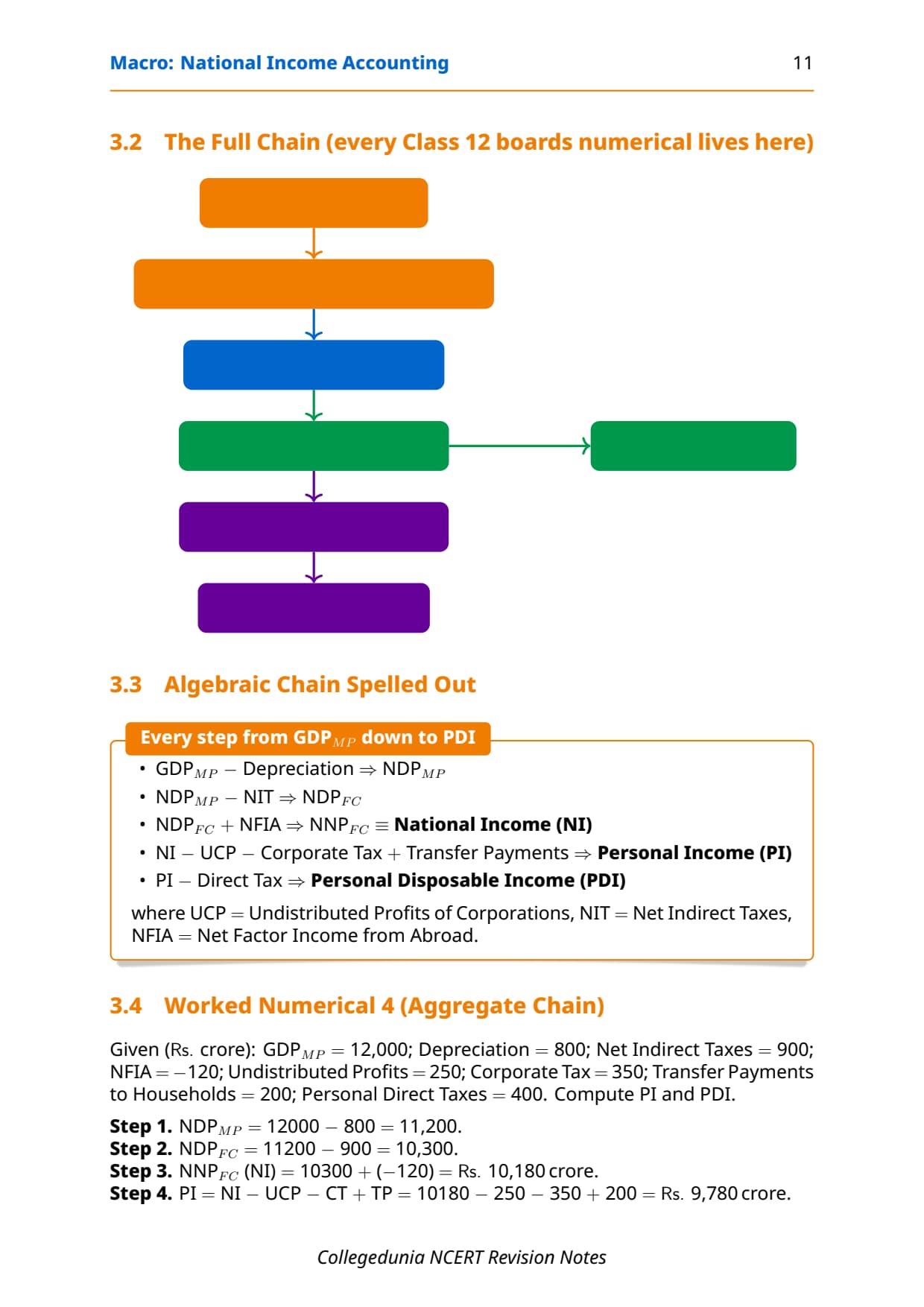
Ans. Open the Formula Sheet table in the Notes section above and read the chain top to bottom: GDPMP, GDPFC, NDPMP, NDPFC, NNPMP, NNPFC = National Income, Personal Income, Personal Disposable Income. Each step is one term added or subtracted (Depreciation, Net Indirect Taxes, NFIA, Undistributed Profits, Corporate Tax, Transfer Payments, Direct Taxes). Memorise the order of the chain first and the sign of each adjustment second; the Notes file separates the two so students do not mix them up.

Ques. Are these national income notes class 12 enough for the CBSE board exam?

Ans. These national income notes class 12 are sufficient for the theory and 1-mark to 3-mark questions, but the numerical practice in this file is limited to formula recall, not worked solutions. Students aiming for 90-plus in CBSE Class 12 Economics should pair the Notes with the matching NCERT Solutions PDF (12 exercise questions worked end-to-end) and one Sandeep Garg drill set (40-plus extra numericals). All three resources are linked in the cross-resource table above.

Ques. How long does it take to revise these national income accounting class 12 notes?

Ans. The full notes file is designed for a 25 to 35 minute first-pass revision and a 20-minute night-before pass. Students who already have the chapter under their belt finish the file in 22 minutes; first-time revisers take closer to 40 minutes. The Formula Sheet and Common Mistakes blocks alone take 8 to 10 minutes to revise and cover roughly 9 of the 10 marks the chapter typically carries in the board paper.

Ques. Is the Class 12 Economics syllabus for these notes changing in 2026-27?

Ans. No major reductions in 2026-27. The Introductory Macroeconomics textbook chapter structure is unchanged for the current cycle, and the CBSE marking scheme continues to reward step-by-step formula working in numerical questions. These national income accounting class 12 notes for the 2026-27 cycle are aligned to the unchanged textbook and the latest CBSE sample paper released for the 2026 boards.

Ques. What is the difference between nominal GDP and real GDP in these Class 12 notes?

Ans. Nominal GDP measures output at current-year prices; real GDP measures the same output at base-year prices, stripping out inflation. The ratio, multiplied by 100, is the GDP deflator. CBSE Class 12 Economics asks a 3-mark theory question on this distinction in alternate years, and the Notes file flags the memory hook (nominal walks with the current year, real walks with the base year) inside the Nominal vs Real GDP section above.

Ques. Why include the savings-investment identity in national income and related aggregates class 12 notes?

Ans. The savings-investment identity (I minus S) + (G minus T) + (X minus M) = 0 sits at the back of Chapter 2 in the NCERT textbook, but it powers every Balance of Payments numerical, and that is why these national income and related aggregates class 12 notes flag it explicitly. Students who skip the identity here typically lose 2 to 3 marks in the Balance of Payments numerical later in the same paper. The identity is also tested in alternate years as a stand-alone 3-mark theory question on Chapter 2 itself.