




The NCERT notes on Amines (Chapter 9) help you cover diazonium salts, basicity order, and the main reactions in 1 to 2 hours during revision. If you are new to the chapter, pair these notes with the PYQ and Solutions PDF.
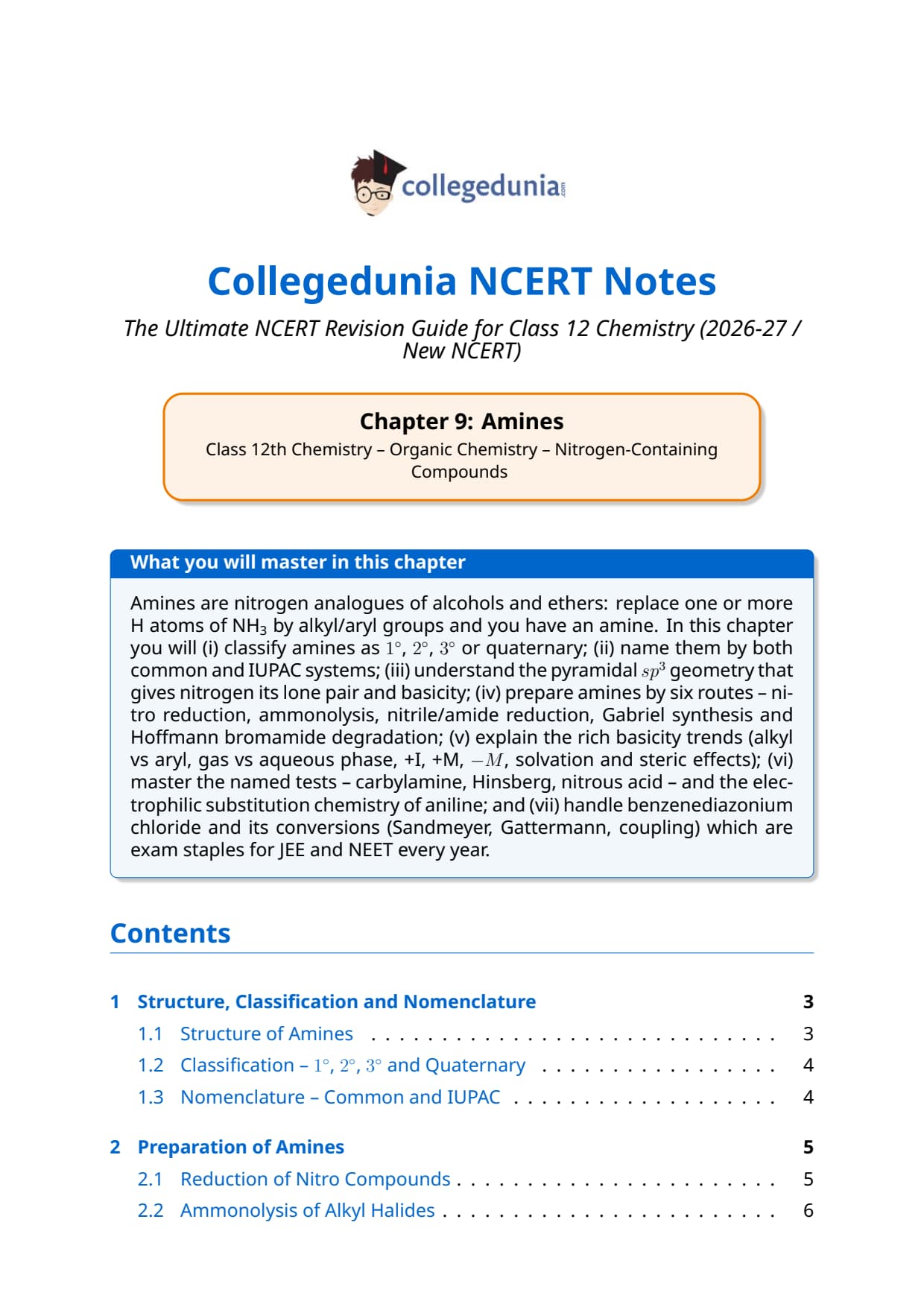
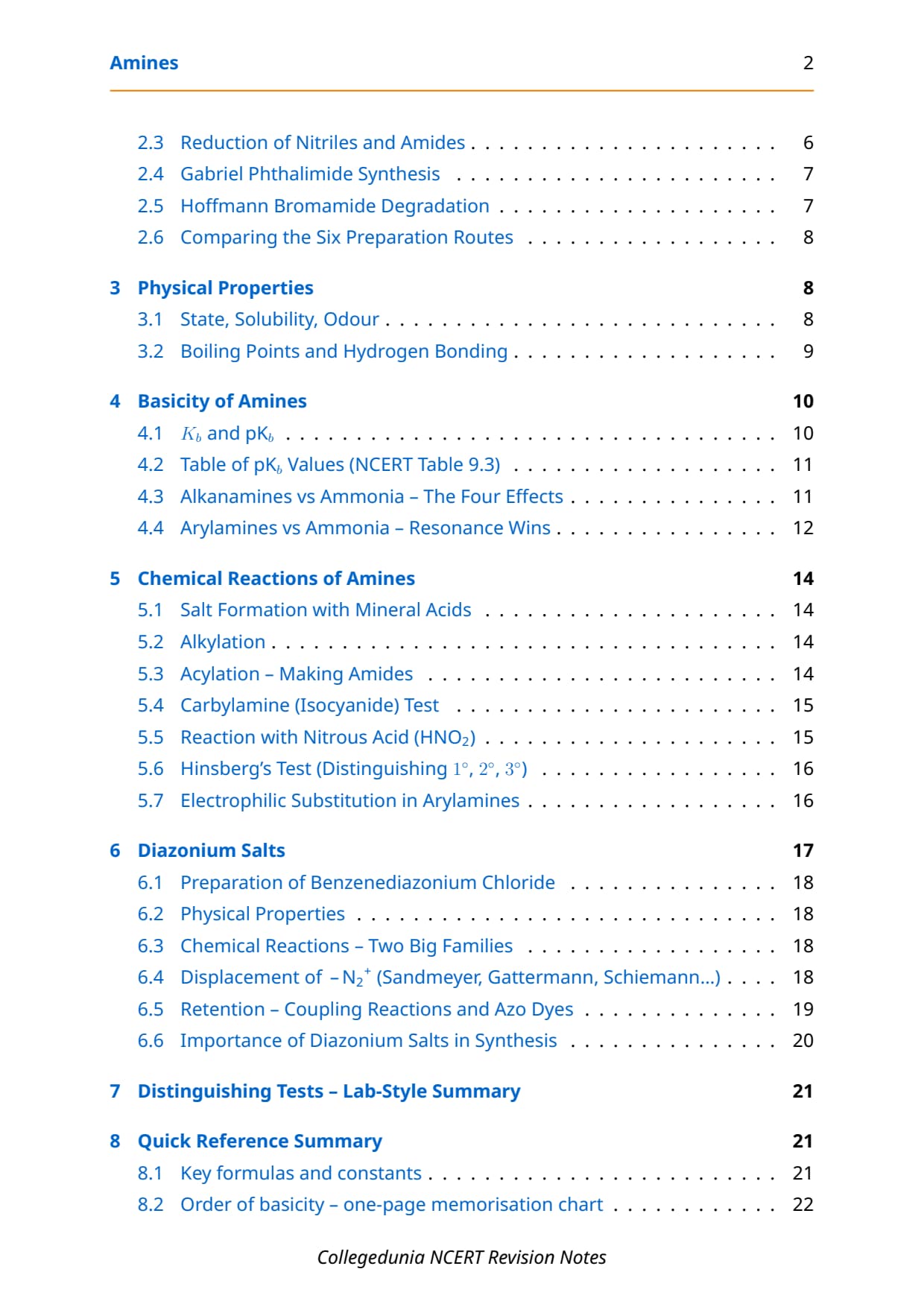
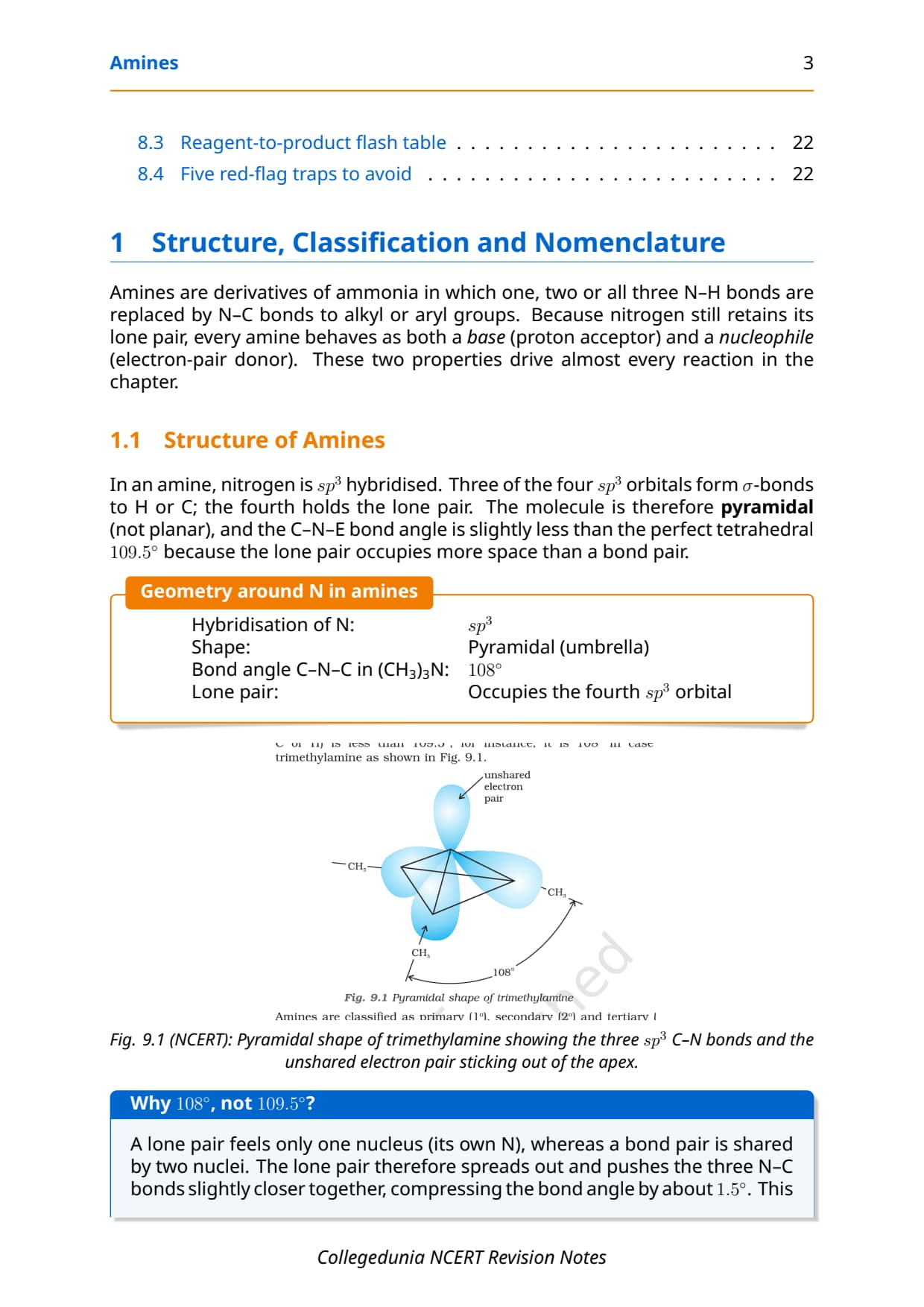
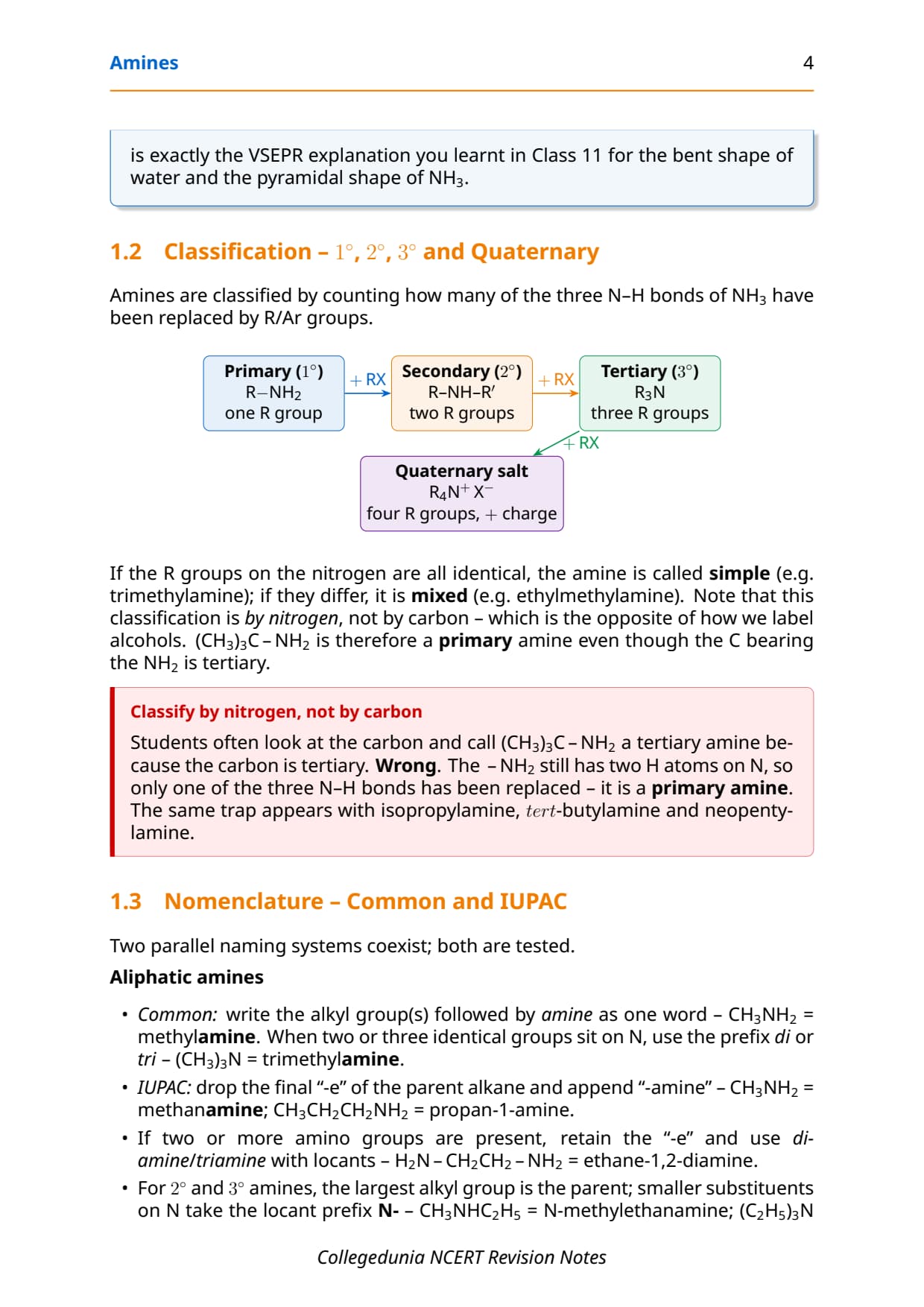
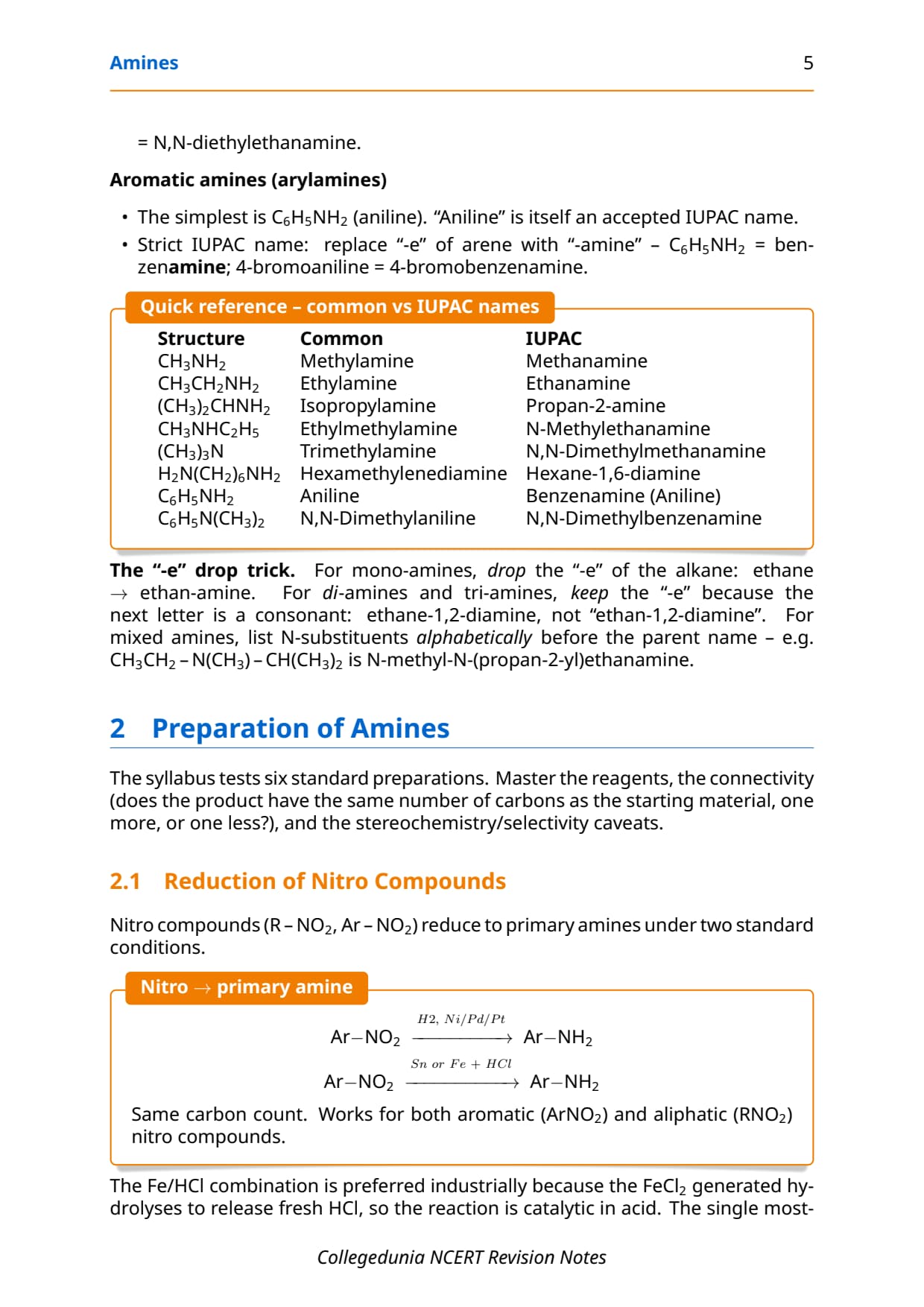
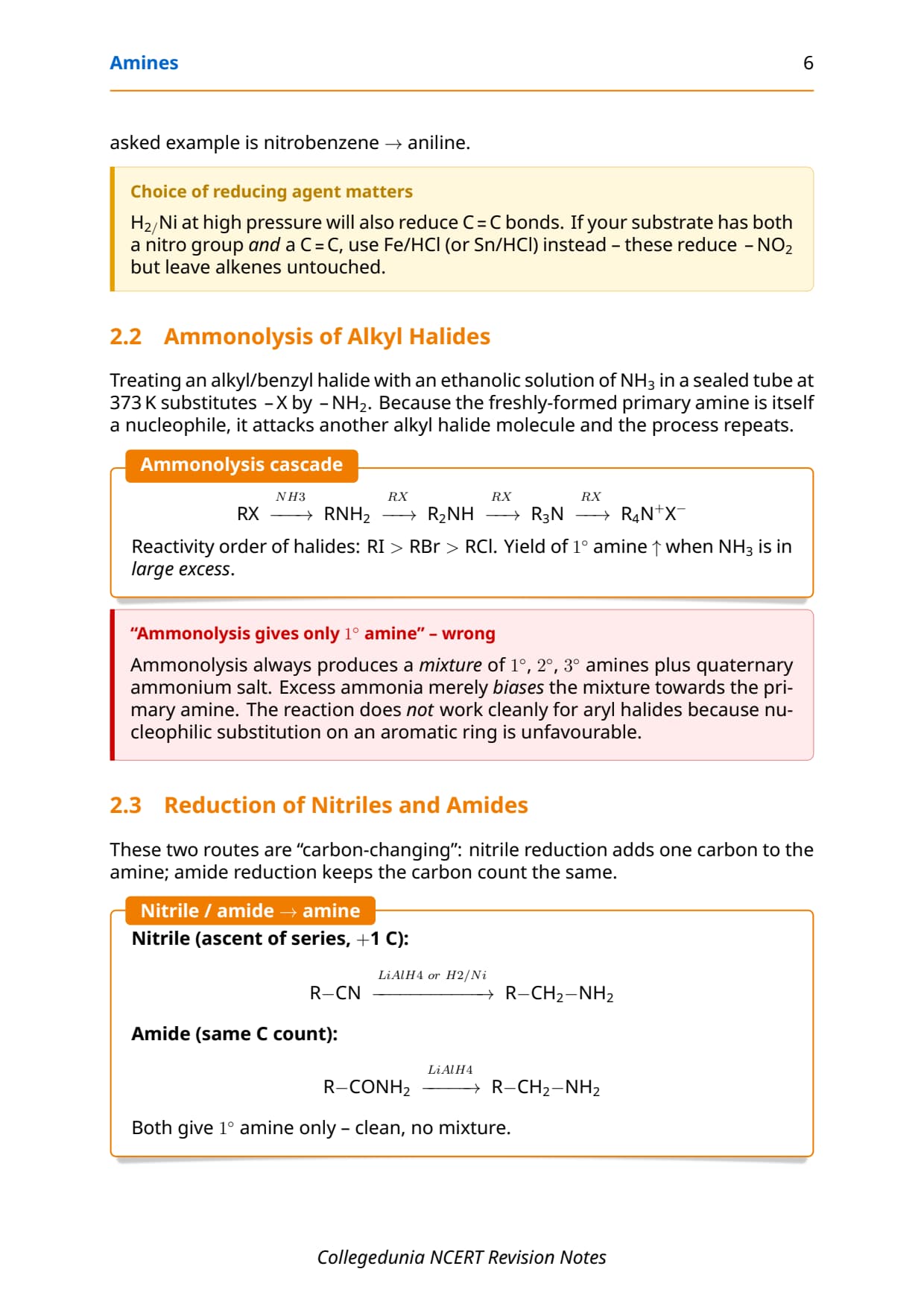
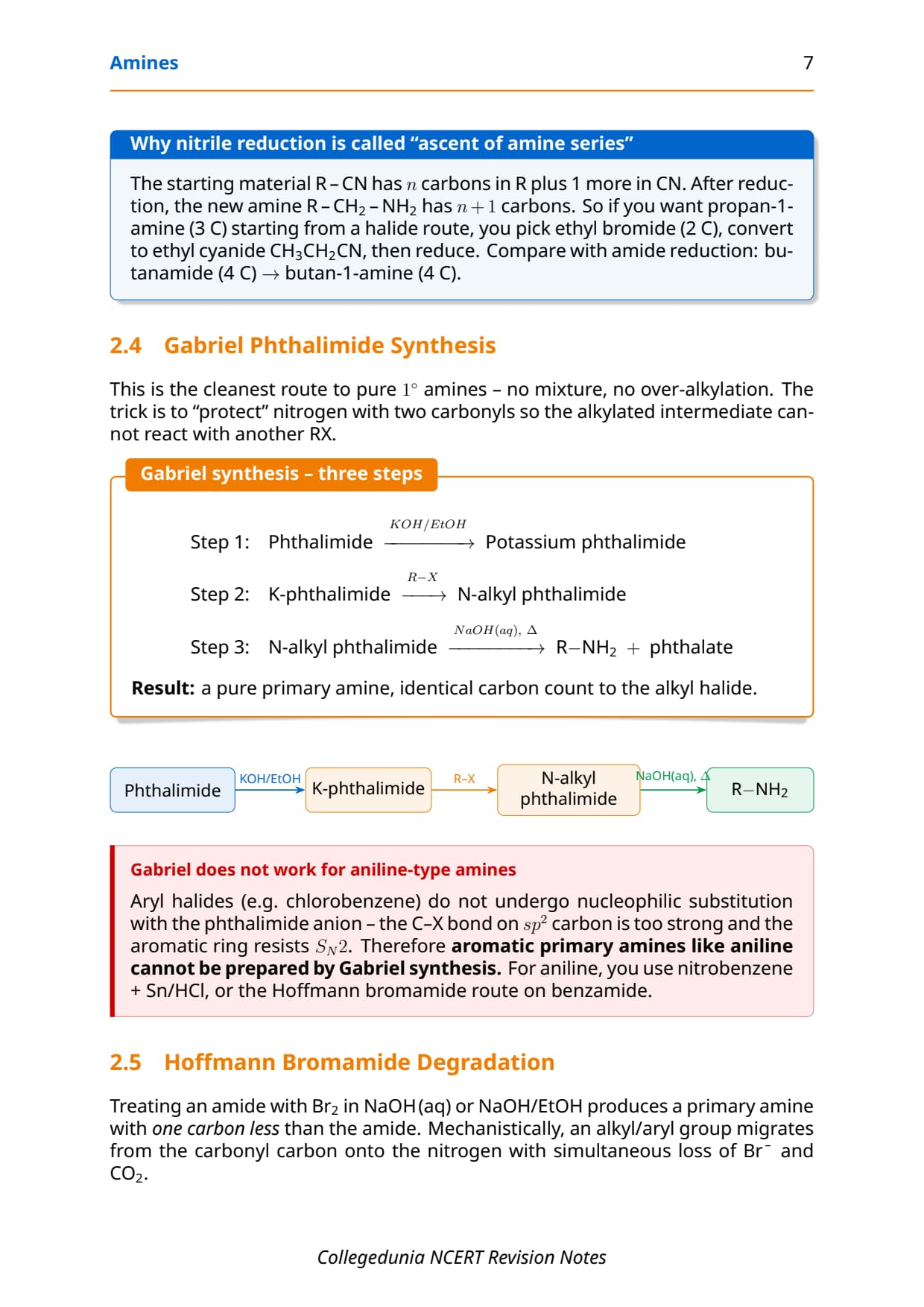
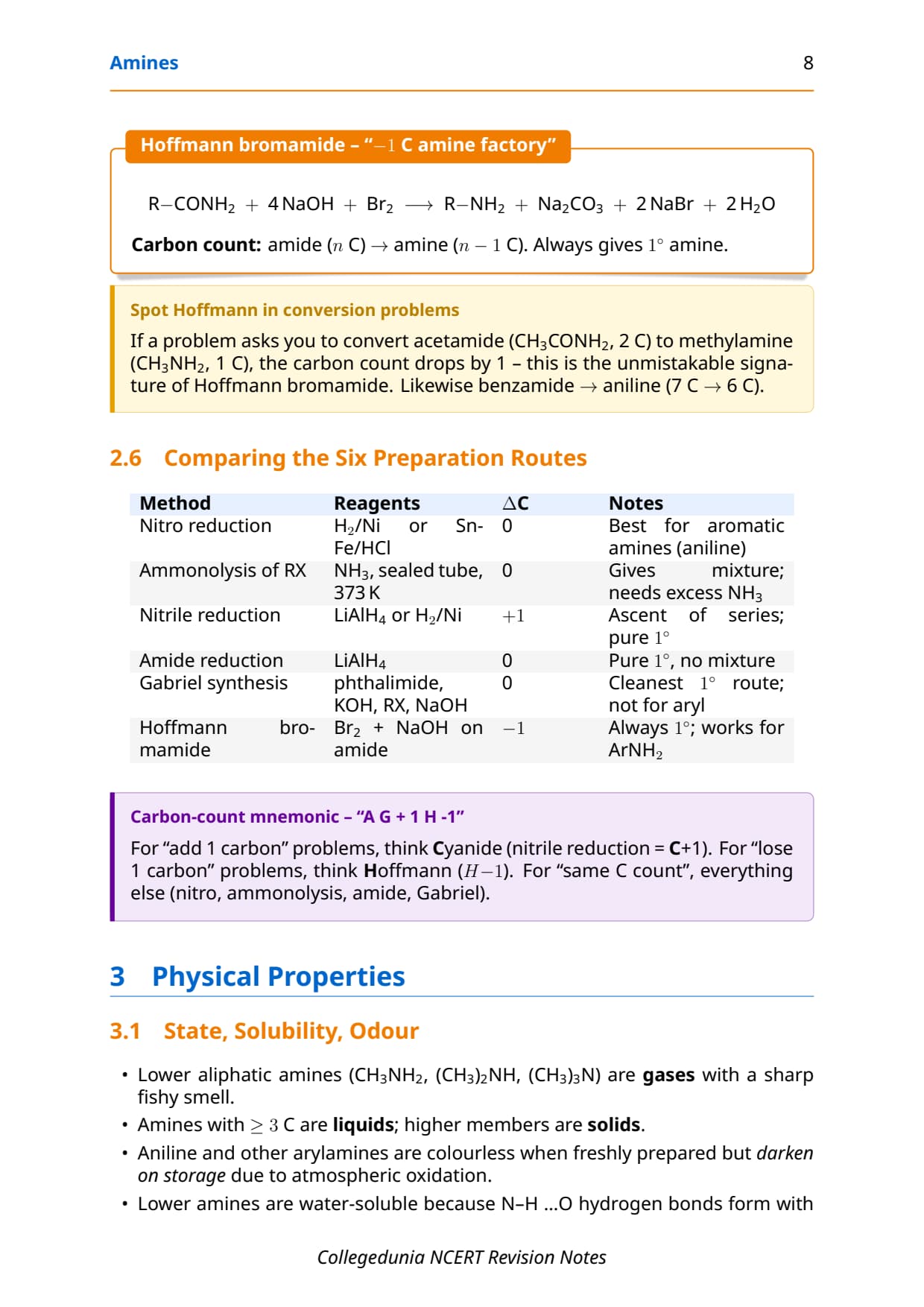
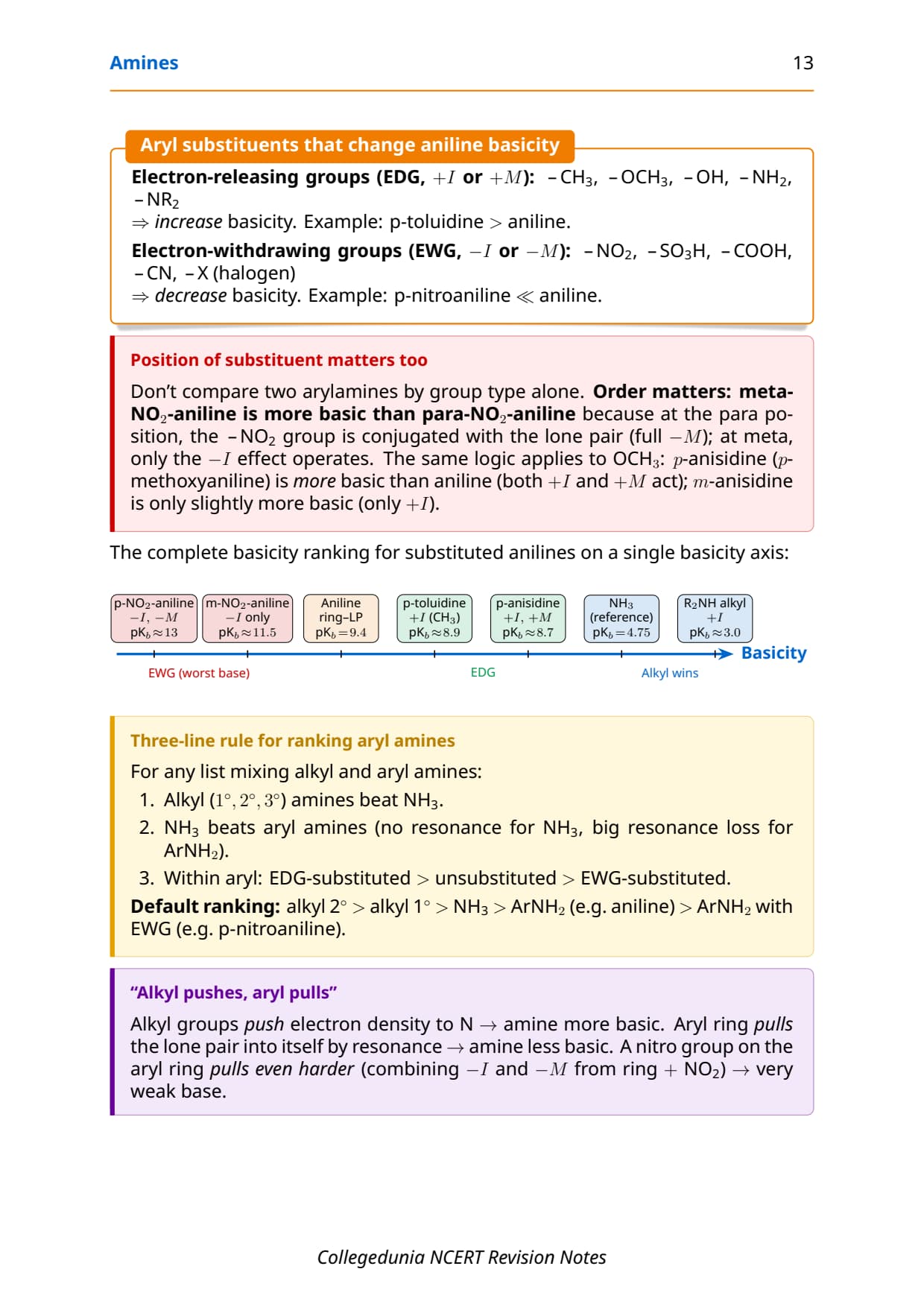
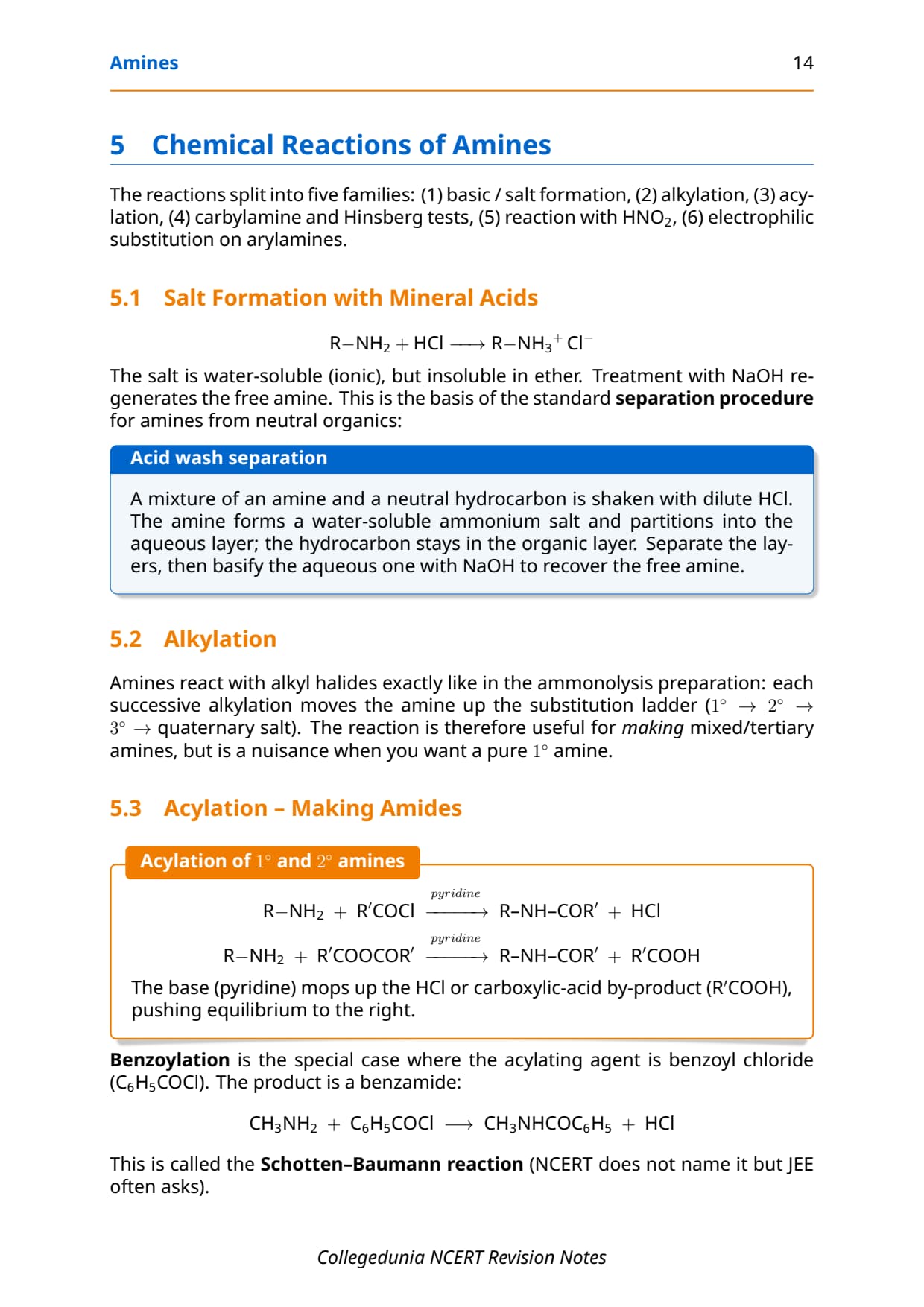
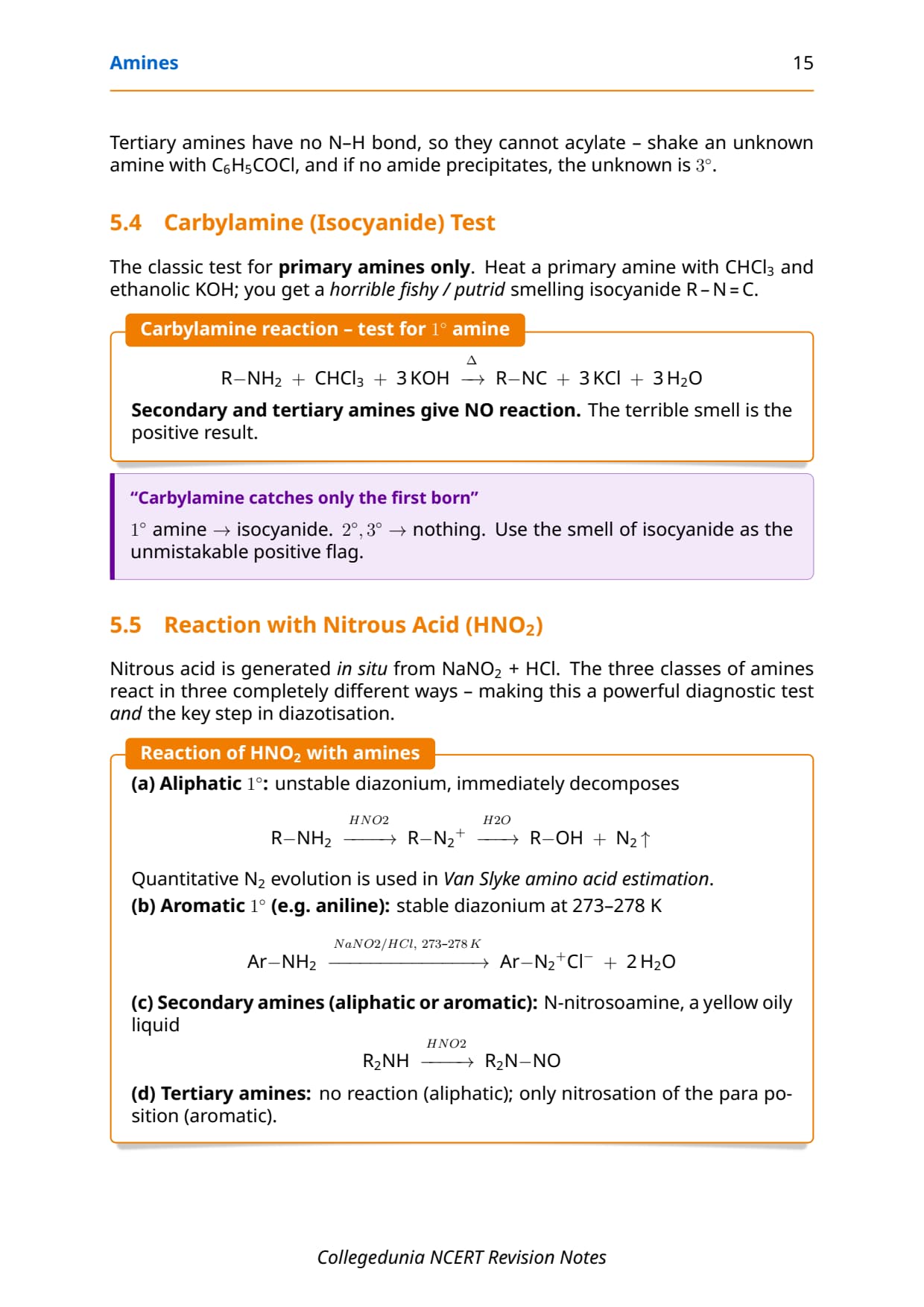
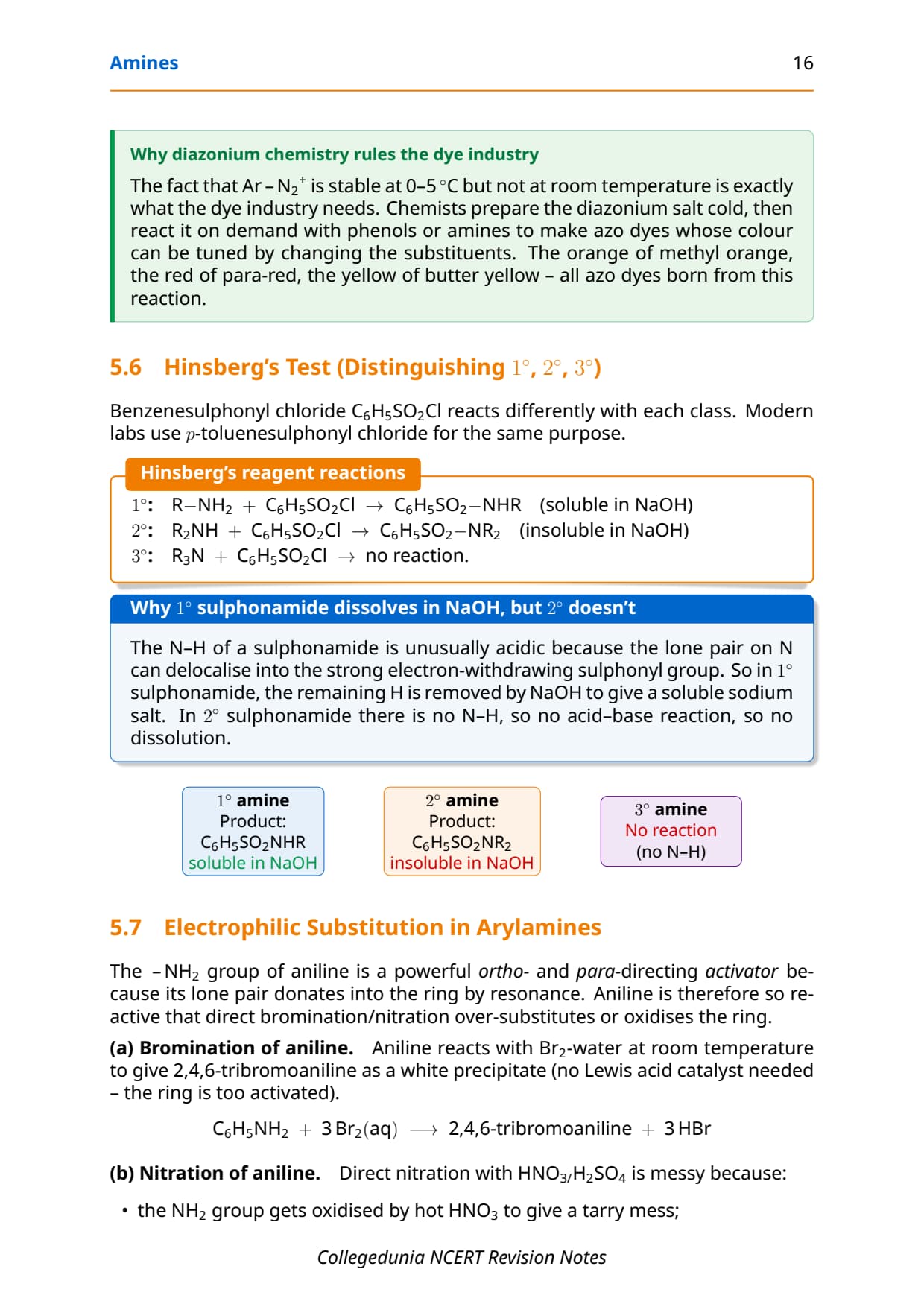
This page covers the most frequently asked Amines topics in CBSE, JEE, and NEET.
- CBSE Boards: 4 to 6 marks every year, usually split into a 3-mark conversion question (Hofmann or Gabriel or diazonium) plus a 2-mark basicity-order or distinguishing-test problem.
- JEE Main: 2 to 3% of the Chemistry paper, with 1 to 2 questions per shift on basicity in gas vs aqueous phase, Hinsberg test, and Sandmeyer reactions.
- NEET: 2 to 3 questions per year on amine classification, carbylamine test, and diazonium-coupling-product identification.
The article below carries the basicity ladder, all nine named conversions, the diazonium reaction wall, and mechanism walk-throughs.
Why Amines Matters for Class 12 Boards, JEE Main, and NEET 2026-27
Amines is the final organic chapter of Class 12 Chemistry and the gateway to nitrogen groups in medicines, dyes, and biochemistry. Almost every JEE organic-synthesis chain (Ch 6 to 9) ends at an amine or diazonium salt.
In 4 of the last 5 CBSE papers, the 3-mark conversion question routed through an amine.
Amines Class 12 Chemistry Video Lecture
Source: Magnet Brains on YouTube
How will Collegedunia's NCERT Notes Help You with Amines?
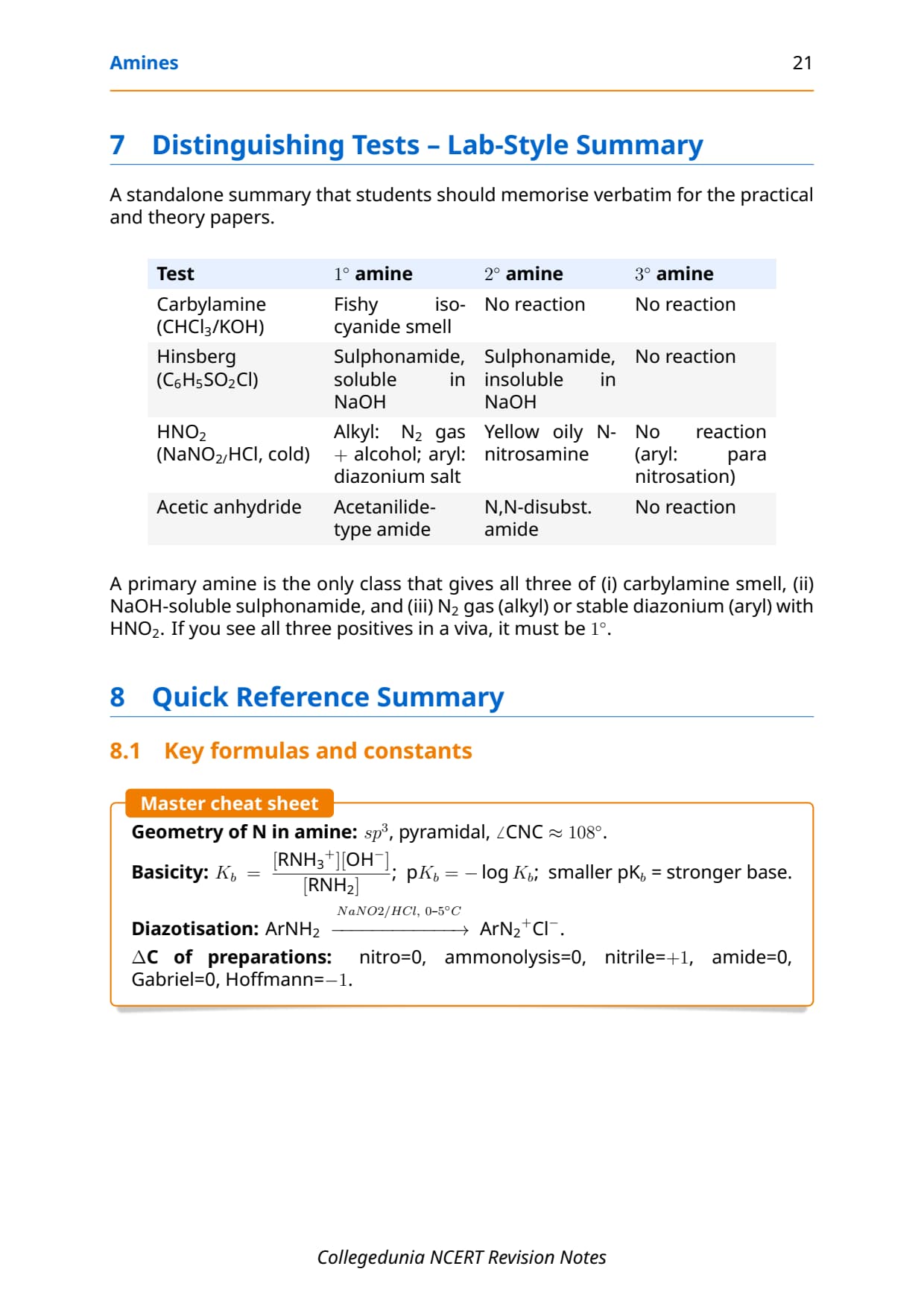
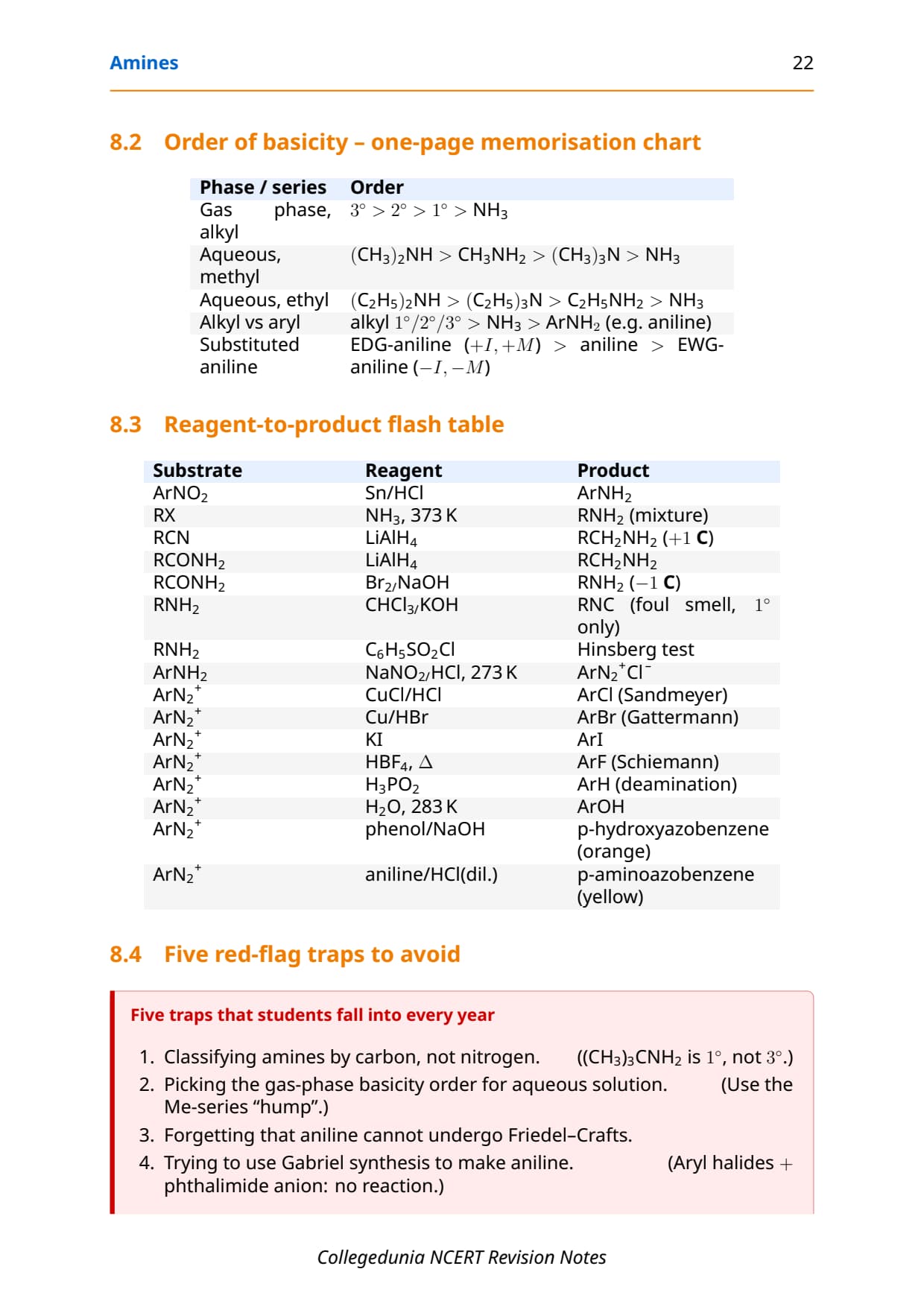
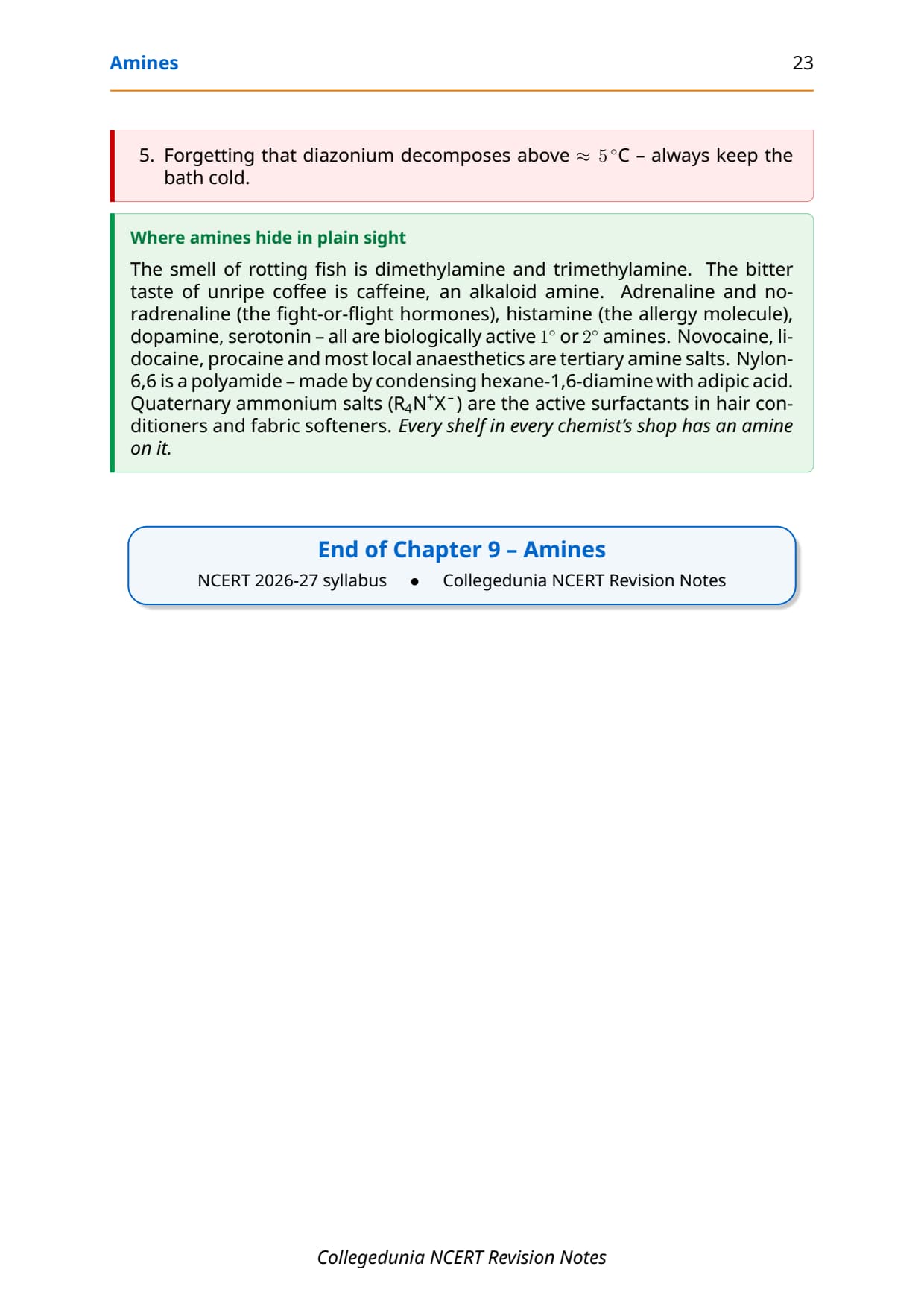
These Notes target the four spots students lose marks on: the gas-phase vs aqueous basicity table (a trap CBSE set 3 of the last 5 years), the Hofmann/Gabriel/reduction preparation grid, a colour-coded diazonium reaction wall, and a Hinsberg/carbylamine/azo-dye flowchart for 1o, 2o, 3o ID.
- 2026-27 NCERT aligned: basicity framed via inductive + solvation balance.
- Mechanism walk-throughs: carbylamine, Hofmann, Gabriel, and diazo coupling with arrow pushing.
- Conversion map: any starting compound to any amine or diazonium product in 3 or fewer steps.
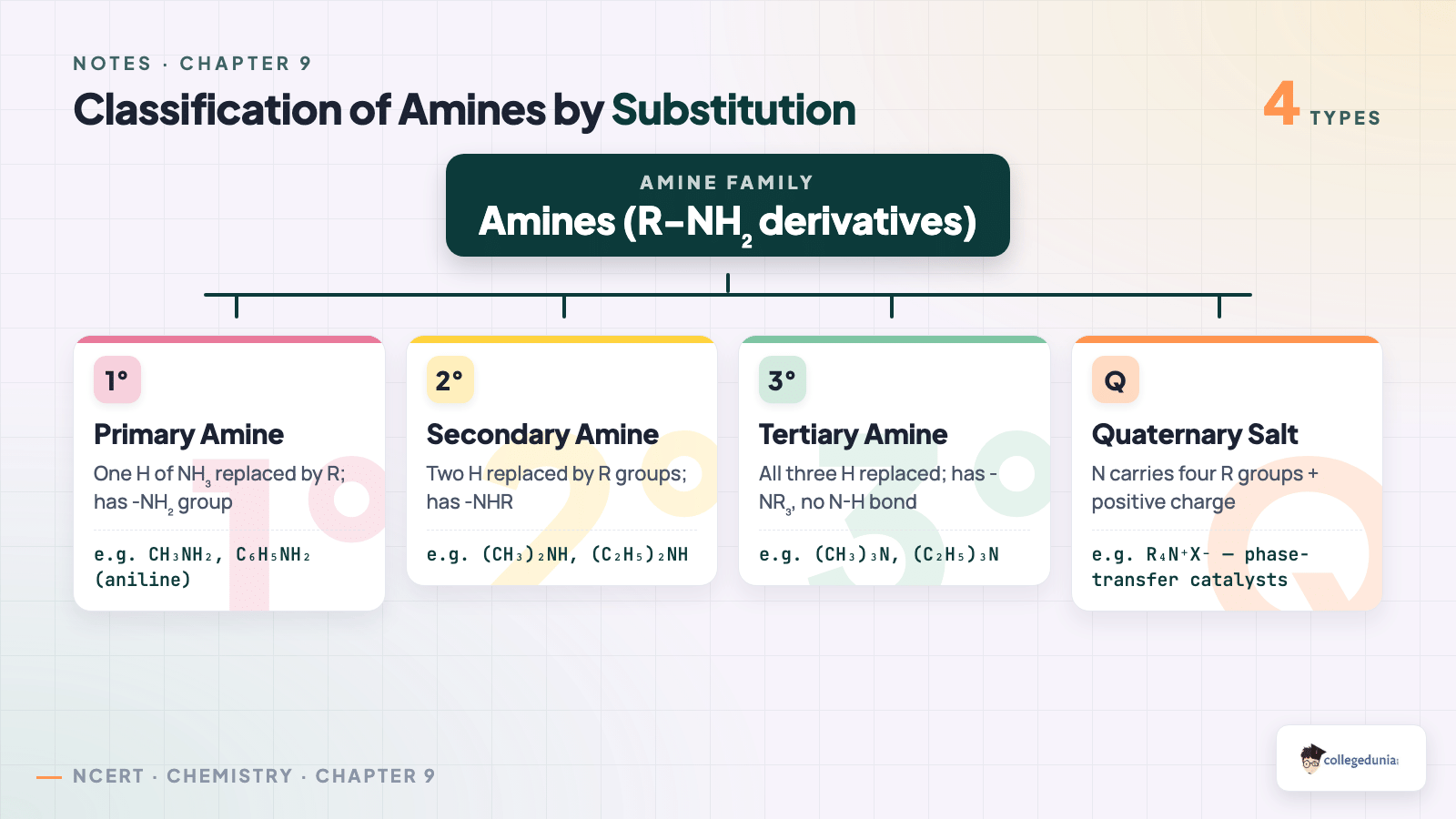
Amines Topic-by-Topic Notes for Class 12 Chemistry
Each block maps to a numbered NCERT section in the 2026-27 print.
Lock the gas vs aqueous basicity order and the eight diazonium conversions first.
Amines Class 12 Topic-wise Weightage for CBSE Boards
Marks averaged over CBSE, JEE, and NEET, 2021 to 2025.
| Sub-Topic | Section | CBSE Marks | Frequency |
|---|---|---|---|
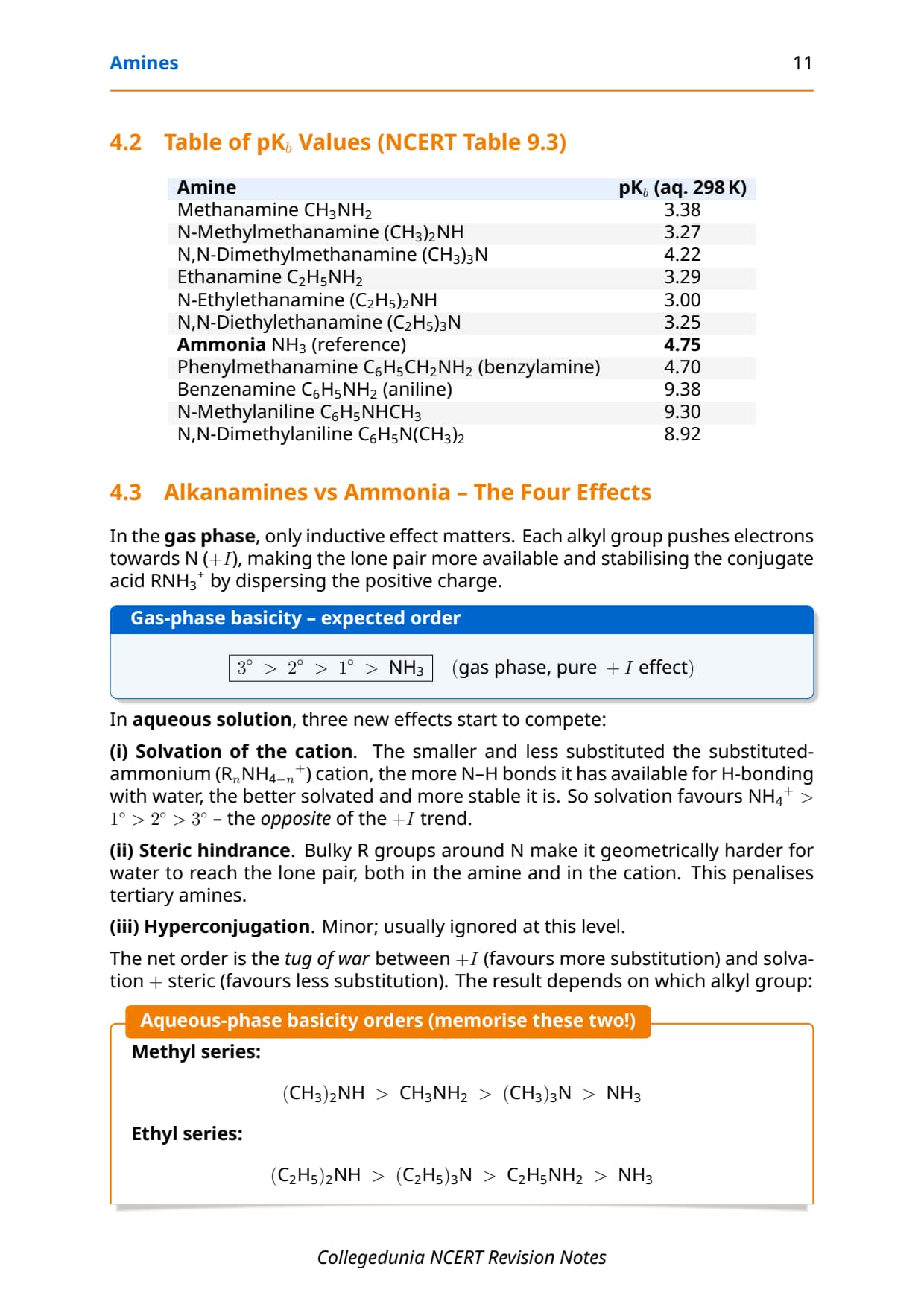
| Basicity (gas vs aqueous) | 9.5 | 2 - 3 | Very High |
| Diazonium and Sandmeyer / Gattermann | 9.6 | 2 - 3 | Very High |
| Preparation (Hofmann, Gabriel, reduction) | 9.3 | 2 | High |
| Hinsberg, Carbylamine, Acylation | 9.5 | 1 - 2 | High |
| Classification and Nomenclature | 9.1 - 9.2 | 1 | Medium |
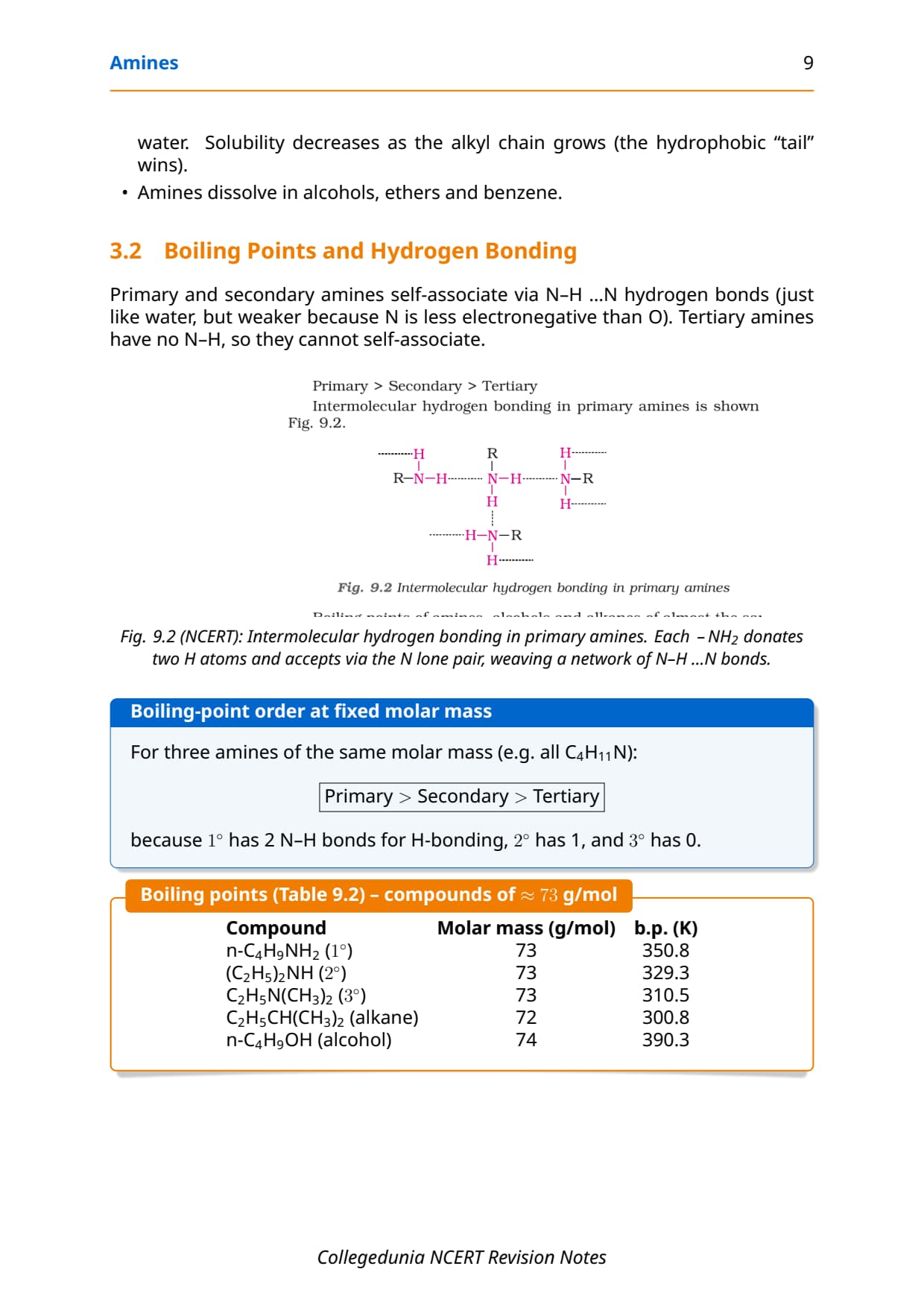
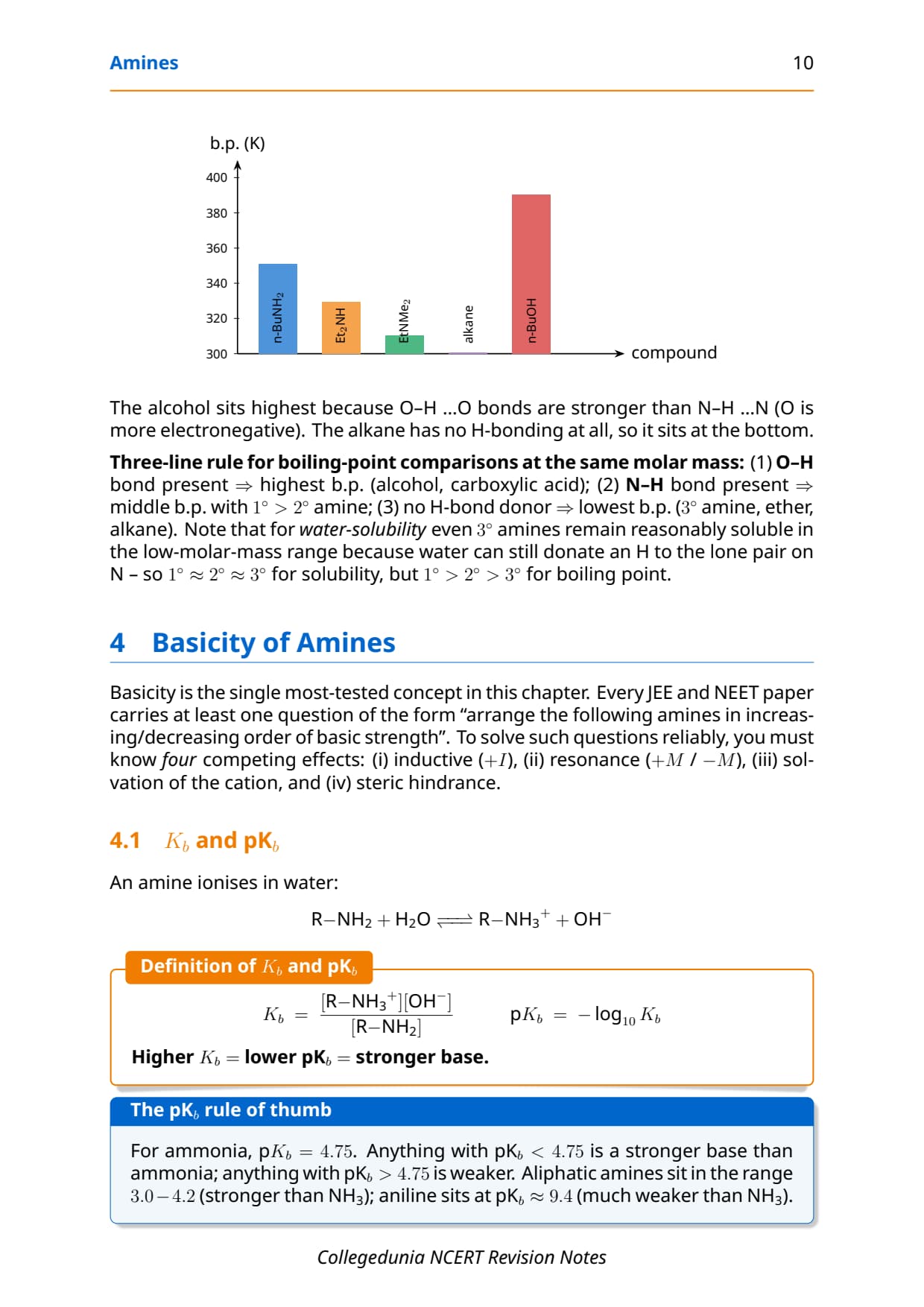
| Physical Properties | 9.4 | 1 | Low |
Class 12 Chemistry Ch 9 Important Named Reactions and Distinguishing Tests
These nine reactions cover every amine and diazonium conversion CBSE has asked since 2021.
| Name | Reagent | Substrate → Product |
|---|---|---|
| Hofmann bromamide | Br2, 4 NaOH | RCONH2 → RNH2 (1 C less) |
| Gabriel synthesis | K-phthalimide + RX, then KOH | RX → RNH2 (pure 1o) |
| Carbylamine test | CHCl3, alc. KOH | RNH2 → RNC (foul) |
| Hinsberg test | PhSO2Cl + KOH | 1o: KOH-soluble; 2o: insoluble; 3o: no rxn |
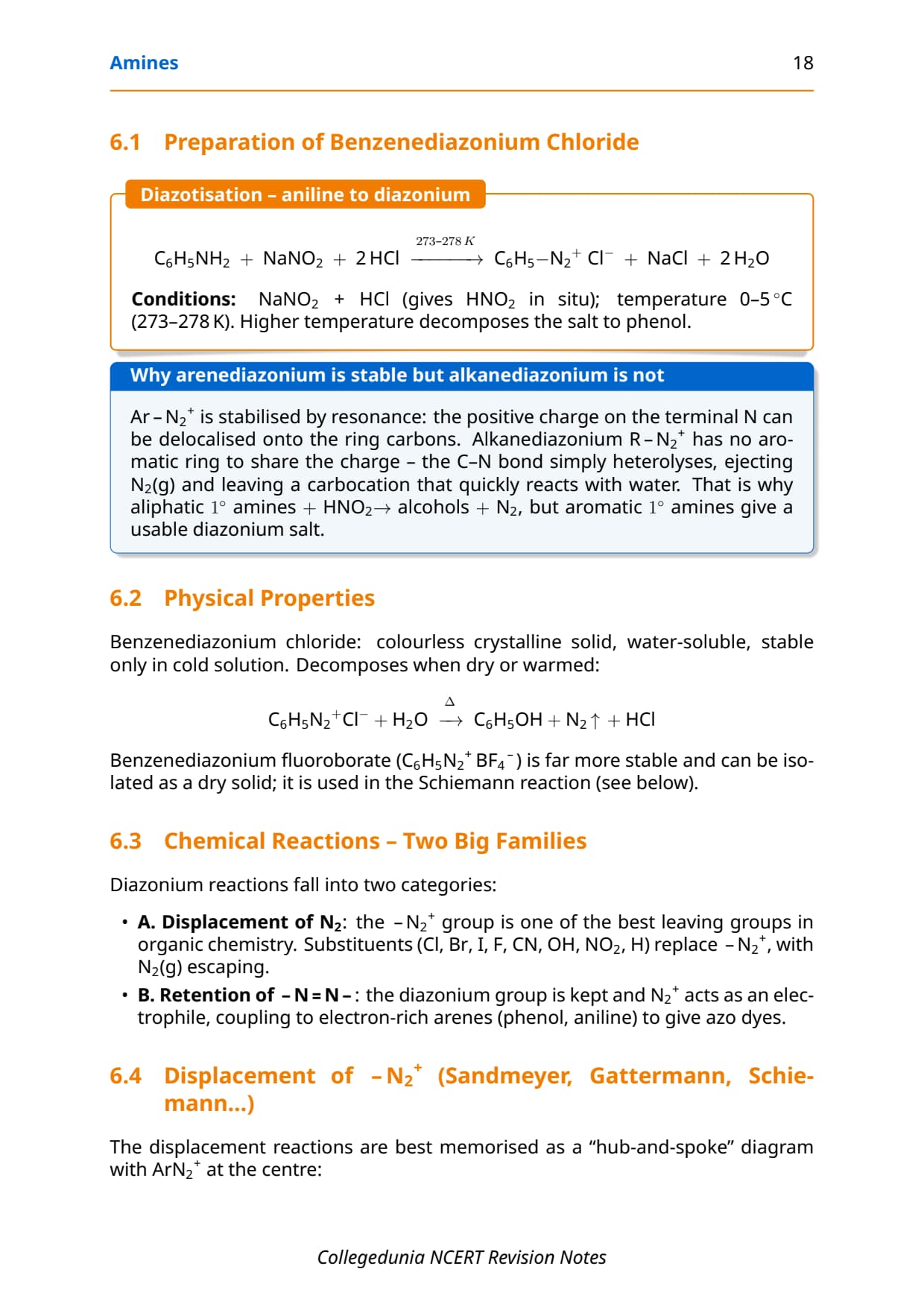
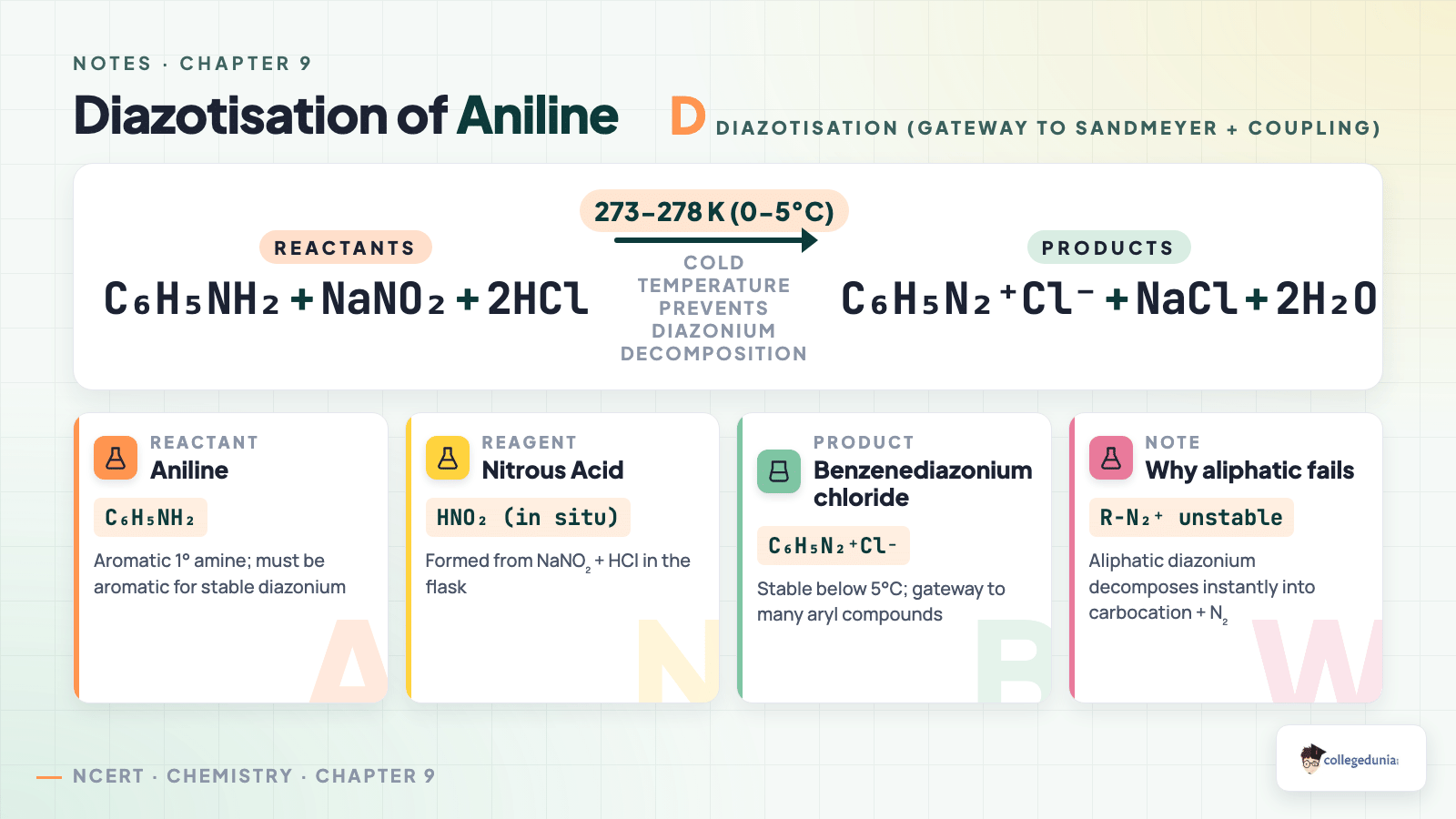
| Diazotisation | NaNO2/HCl, 273-278 K | ArNH2 → ArN2+Cl- |
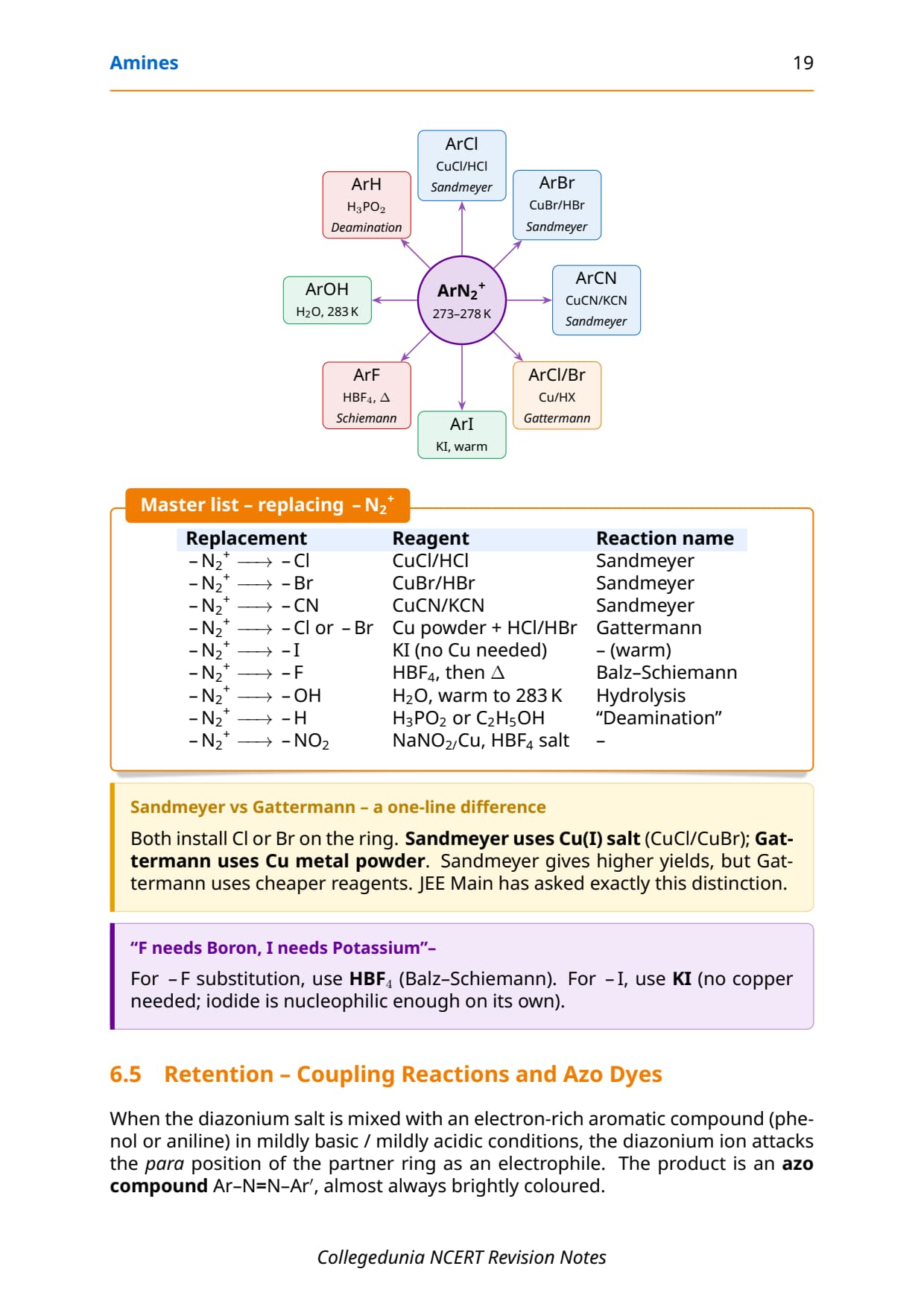
| Sandmeyer | CuCl / CuBr / CuCN | ArN2+ → ArCl / ArBr / ArCN |
| Gattermann | Cu/HCl or Cu/HBr | ArN2+ → ArCl / ArBr |
| Balz-Schiemann | HBF4, then heat | ArN2+ → ArF (only route) |
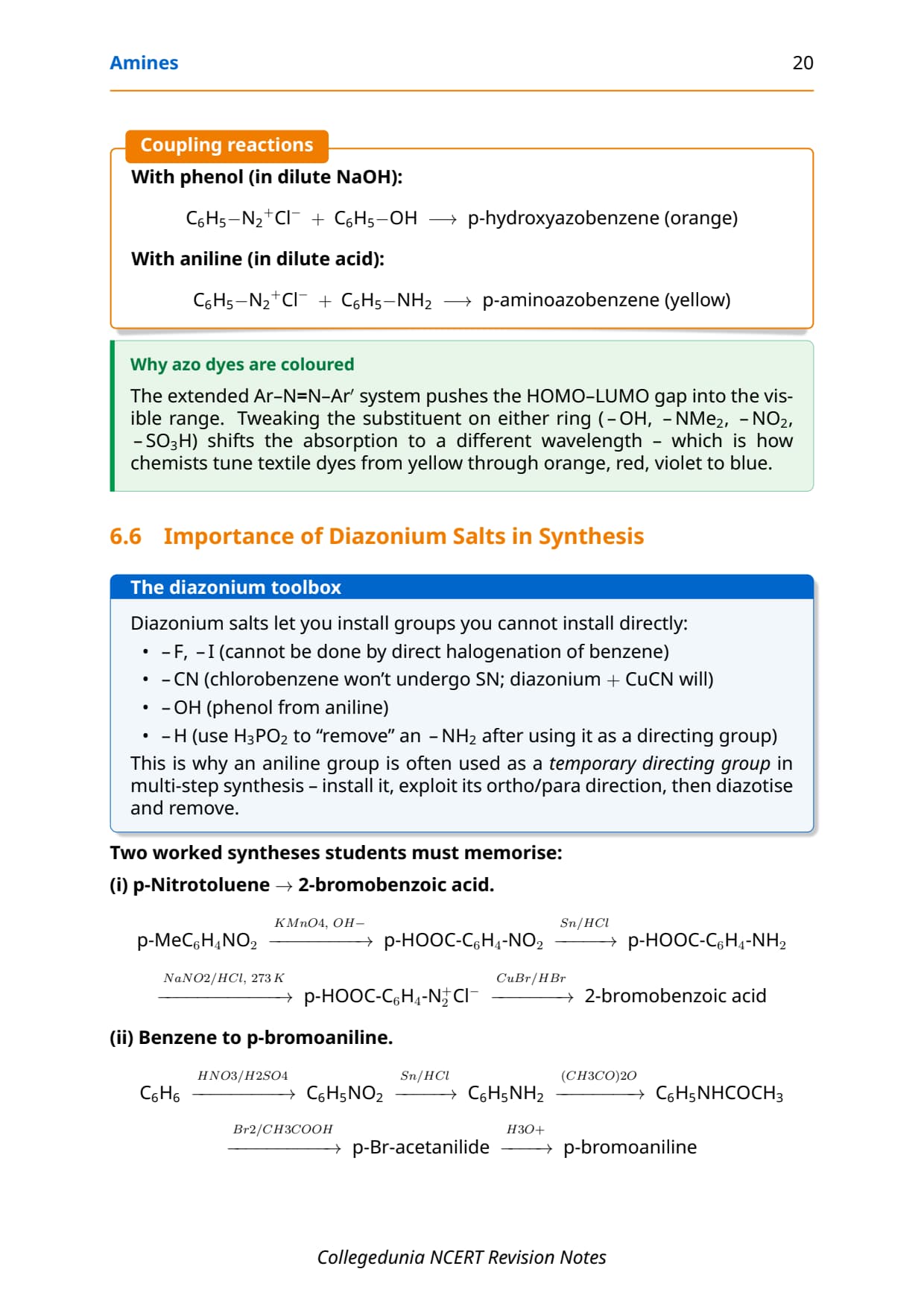
| Azo coupling | ArOH (mild base) or ArNH2 (mild acid), 0-5 degree C | ArN2+ + PhOH → p-hydroxyazobenzene (orange); ArN2+ + PhNH2 → p-aminoazobenzene (yellow) |
CBSE has framed "Identify A, B, C" from this reagent grid in 4 of the last 5 papers.
Important Derivations and Mechanisms in 12th Chemistry Chapter 9
The PDF carries five fully-worked mechanisms; these are the ones most likely in CBSE 3- and 5-mark slots.
- Hofmann bromamide: N-Br forms, alpha-elimination to nitrene, alkyl migration to isocyanate, hydrolysis to amine. CBSE 2024, 2022.
- Gabriel synthesis: phthalimide K-salt, SN2 alkylation, hydrolysis to 1o amine + phthalate. CBSE 2025, 2023.
- Carbylamine: CHCl3 + KOH → :CCl2, insertion into N-H, double dehydrohalogenation to R-N=C:. CBSE 2024, 2021.
- Diazotisation: aniline N attacks NO+, loss of 2 H+ and H2O → ArN2+; above 278 K it decomposes to phenol. CBSE 2025, 2022.
- Azo coupling: ArN2+ attacks the para of an activated arene, loss of H+ restores aromaticity. CBSE 2023.
Real-World Applications of Amines
Where amines show up beyond the exam.
- Pharmaceuticals: adrenaline, paracetamol, sulphonamides, and antihistamines all contain amine groups.
- Dyes: azo coupling of diazonium salts gives most synthetic textile and food dyes.
- Polymers: nylon-6,6, melamine, and Kevlar rely on amine monomers.
- Biology: amino acids, neurotransmitters, and DNA bases all carry the amine group.
Full year-wise PYQ map: Amines Class 12 Chemistry NCERT Solutions
Student Feedback
In a Collegedunia poll of 1,080 Class 12 students, 81% said the gas-phase vs aqueous basicity table cleared their biggest doubt, and 4 in 5 revised the diazonium reaction wall the night before the exam.
Other Resources for Amines Class 12 Chemistry
| Resource | Link |
|---|---|
| NCERT Solutions | Amines Class 12 Chemistry NCERT Solutions |
| Formula Sheet | Amines Class 12 Chemistry Formula Sheet |
| NCERT Book PDF | Amines Class 12 Chemistry NCERT Book PDF |
| Handwritten Notes | Amines Class 12 Chemistry Handwritten Notes |
| Exemplar Solutions | Amines Class 12 Chemistry NCERT Exemplar Solutions |
| Exemplar Book PDF | Amines Class 12 Chemistry NCERT Exemplar Book PDF |
| Notes | Amines Class 12 Chemistry Notes |
NCERT Notes for Class 12 Chemistry: All Chapters
Continue revising the rest of the Class 12 Chemistry NCERT with the chapter-wise Notes library below.
| Chapter | Notes Page |
|---|---|
| Chapter 1 | Solutions Notes |
| Chapter 2 | Electrochemistry Notes |
| Chapter 3 | Chemical Kinetics Notes |
| Chapter 4 | The d- and f-Block Elements Notes |
| Chapter 5 | Coordination Compounds Notes |
| Chapter 6 | Haloalkanes and Haloarenes Notes |
| Chapter 7 | Alcohols, Phenols and Ethers Notes |
| Chapter 8 | Aldehydes, Ketones and Carboxylic Acids Notes |
| Chapter 9 | Amines Notes |
| Chapter 10 | Biomolecules Notes |
Amines Class 12 Chemistry Notes FAQs
Ques. How many marks does Chapter 9 Amines carry in the CBSE Class 12 board exam?
Ans. Chapter 9 Amines carries 4 to 6 marks in the CBSE Class 12 Chemistry board exam, averaged across the last five board papers. The marks are typically split as one 3-mark conversion or mechanism question (Hofmann, Gabriel, or diazonium) plus a 2-mark basicity-order or distinguishing-test problem.
Ques. Why are aliphatic 2o amines more basic than 1o and 3o amines in aqueous solution?
Ans. Two effects compete. The +I (inductive electron-donating) effect of alkyl groups increases the lone-pair density on nitrogen, which would predict 3o > 2o > 1o. But in water, the protonated amine RnH(3-n)+ is stabilised by hydrogen bonding to water molecules, and bulky alkyl groups block this solvation. The net result for aliphatic amines in water is 2o > 1o > 3o. In the gas phase, where there is no solvation, the order reverts to the pure +I prediction: 3o > 2o > 1o.
Ques. What is the difference between Hofmann bromamide degradation and Gabriel phthalimide synthesis?
Ans. Both make 1o amines, but they start from different substrates and have different limits. Hofmann starts from an amide RCONH2 and produces RNH2 with one fewer carbon (the C=O carbon is lost as CO2). Gabriel starts from an alkyl halide RX, passes through N-alkyl phthalimide, and gives RNH2 with the same carbon count. Gabriel fails on aryl halides (the C-X bond is too strong for SN2); Hofmann works on aryl amides. Use Hofmann when shortening the chain by one carbon; use Gabriel when you want a pure 1o amine with no 2o/3o contamination.
Ques. Why is the diazotisation reaction carried out at 273 to 278 K?
Ans. Benzenediazonium chloride is thermally unstable. Above 278 K it decomposes in two ways: in water it forms phenol plus N2, and in HCl it slowly gives chlorobenzene without Cu(I). Both side products contaminate the desired ArN2+Cl- intermediate. Maintaining the reaction at 273 to 278 K (0 to 5 degrees Celsius) keeps the diazonium salt stable long enough to use it for Sandmeyer, Gattermann, Balz-Schiemann, or azo-coupling reactions in the next step.
Ques. How does the Hinsberg test distinguish between primary, secondary, and tertiary amines?
Ans. Benzenesulphonyl chloride (C6H5SO2Cl) reacts with 1o and 2o amines, but not with 3o. With a 1o amine, the product C6H5SO2NHR has an acidic N-H and dissolves in KOH (soluble solid). With a 2o amine, the product C6H5SO2NR2 has no N-H and is insoluble in KOH (insoluble solid). A 3o amine has no N-H to react with the sulphonyl chloride, so no reaction occurs (clear liquid). Three different outcomes from one test reagent.
Ques. Which compounds give a positive carbylamine test, and what does it confirm?
Ans. The carbylamine test is positive only for primary amines (both aliphatic and aromatic). The amine is heated with chloroform and alcoholic KOH; the foul-smelling odour of an alkyl or aryl isocyanide (RNC) confirms a 1o amine. Secondary and tertiary amines do not react under these conditions. The test is therefore used in qualitative analysis to confirm the presence of a -NH2 group on a single carbon (1o) rather than on two or three carbons (2o, 3o).
Ques. Is this Amines Notes PDF aligned with the 2026-27 NCERT?
Ans. Yes. This page reflects the current 2026-27 syllabus for Class 12 Chemistry. The new NCERT edition keeps the full six-section Amines chapter intact, including the diazonium-salts section (9.6) and all named conversions (Sandmeyer, Gattermann, Balz-Schiemann, azo coupling). The basicity discussion in the new edition emphasises the gas-phase vs aqueous-phase comparison, which CBSE has tested in 3 of the last 5 papers.
Ques. How many pages is the Class 12th Chemistry Amines Notes PDF?
Ans. The Notes PDF runs approximately 24 pages and covers all six NCERT sections of Chapter 9 Amines: classification, nomenclature, preparation routes (Hofmann, Gabriel, reduction), physical properties, basicity in gas and aqueous phases, chemical reactions (acylation, carbylamine, Hinsberg), and diazonium salts including Sandmeyer, Gattermann, Balz-Schiemann, and azo coupling. Every mechanism is illustrated with arrow pushing; every named reaction has its reagent and product flagged for memorisation.
Ques. Why does aniline give 2,4,6-tribromoaniline in aqueous Br2 and what is the workaround for p-bromoaniline?
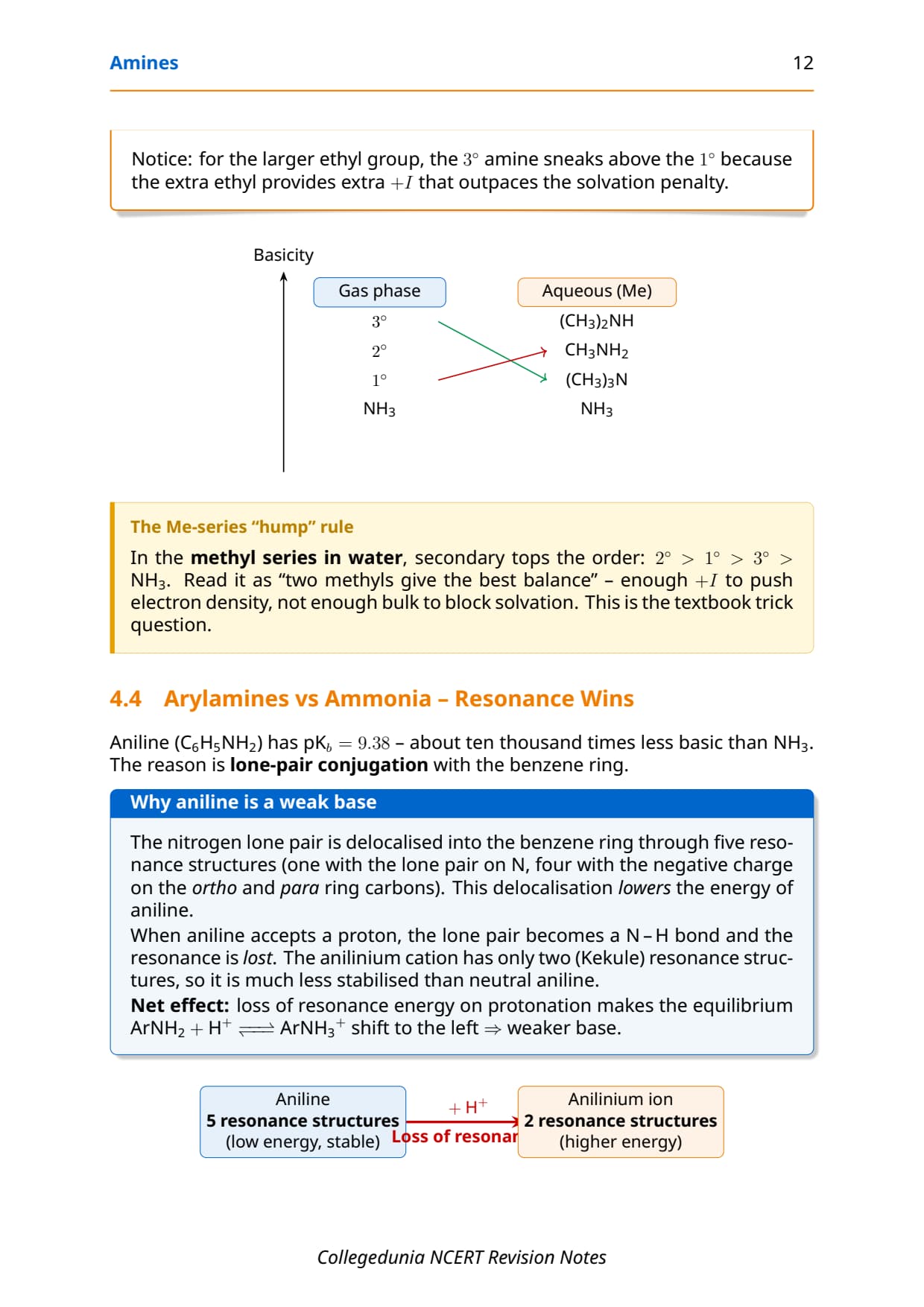
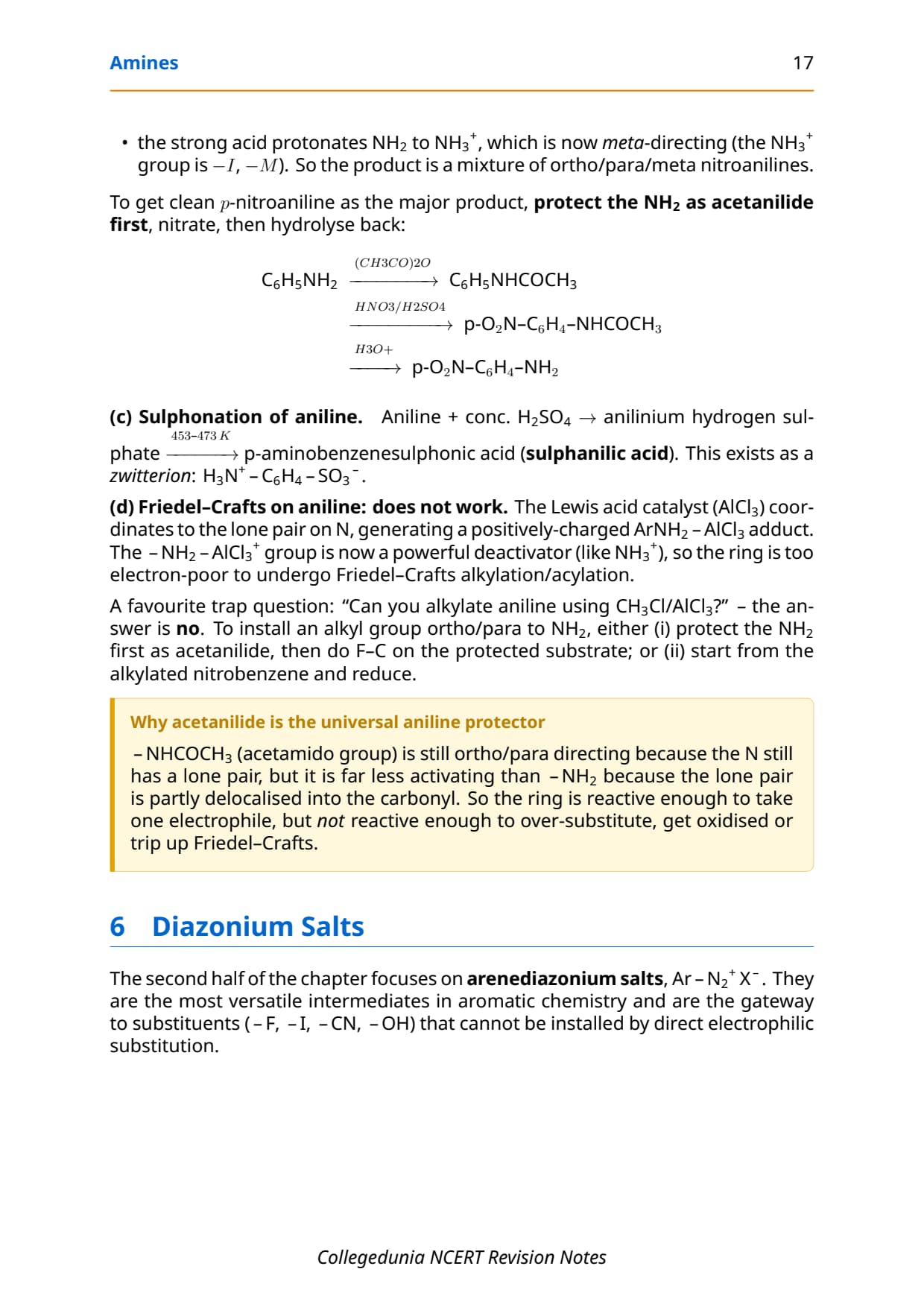
Ans. Aniline carries an -NH2 group whose lone pair is delocalised into the ring, making the ortho and para carbons exceptionally electron-rich. In aqueous bromine, all three activated positions react simultaneously to give 2,4,6-tribromoaniline as a white precipitate, with no mono-substituted product isolable. To obtain pure p-bromoaniline, the standard CBSE-marked workaround is the protect-brominate-deprotect sequence: acetylate the amine with acetic anhydride to acetanilide (-NHCOCH3) which is only weakly activating, brominate in glacial CH3COOH to give p-bromoacetanilide, and hydrolyse the protecting group with H3O+ to recover the para-substituted amine.
Ques. What is the Balz-Schiemann (Schiemann) reaction and which functional group does it install?
Ans. The Balz-Schiemann reaction converts an aryl diazonium chloride into an aryl fluoride. The aryl diazonium chloride is first treated with HBF4 (fluoroboric acid) to precipitate the aryl diazonium fluoroborate, a salt that is stable at room temperature. Dry heating of this fluoroborate releases N2 and BF3, leaving Ar-F as the product. This is the only Class 12 synthetic route to an aryl fluoride; direct fluorination with F2 and Sandmeyer with CuF both fail.
Ques. Why is the anilinium ion a meta-director, and how does this trap appear in CBSE nitration questions?
Ans. In conc. HNO3/H2SO4, the sulphuric acid protonates aniline's -NH2 to -NH3+, generating the anilinium ion. The -NH3+ group is strongly electron-withdrawing through induction and has no lone pair to donate by resonance, so it deactivates the ring and directs incoming electrophiles to the meta position. Direct nitration of aniline therefore yields about 47% m-nitroaniline (along with some o and p products), not pure p-nitroaniline as students often write. The fix is to acetylate first, nitrate the less-activated acetanilide, then hydrolyse.
Ques. Where can I download the Class 12 Chemistry Chapter 9 Amines notes PDF for free?
Ans. You can download the complete 24-page Class 12 Chemistry Chapter 9 Amines Notes PDF for free from the download card at the top of this page. Both Normal and HD versions are available. The PDF is mapped to the 2026-27 NCERT print and includes every named reaction (Hofmann, Gabriel, Sandmeyer, Gattermann, Balz-Schiemann), all five mechanism walk-throughs, distinguishing tests (carbylamine, Hinsberg, azo dye), and a single-page diazonium conversion wall on the last page for last-minute revision.



Comments