




The NCERT Notes on Aldehydes, Ketones, and Carboxylic Acids will help complete important topics in one shot during exam time. In CBSE, you can see a sure shot 1 question from this chapter. This page contains the 2026-27 Notes PDF, reaction mechanism, named-reaction chart, and PYQ tracker.
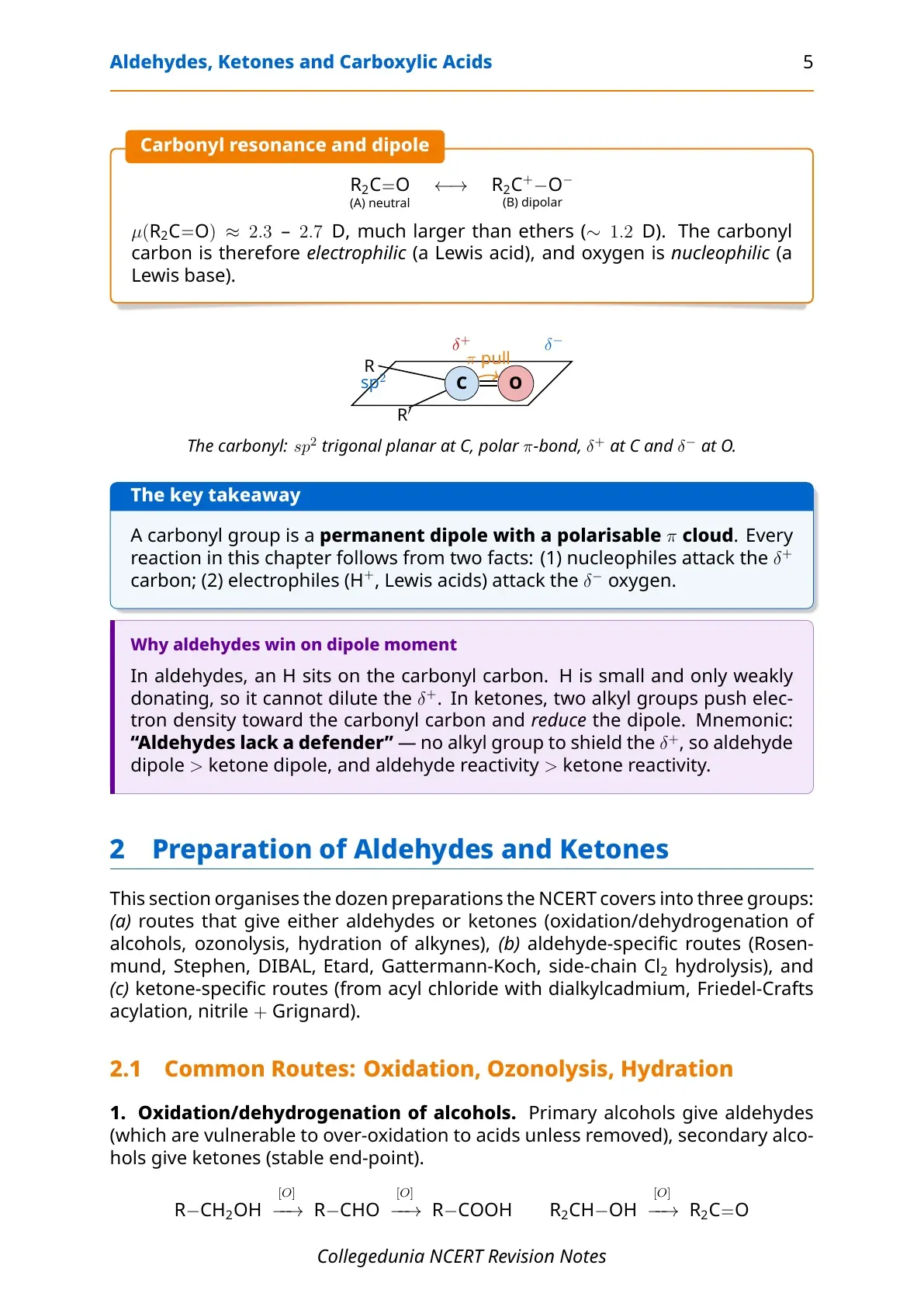
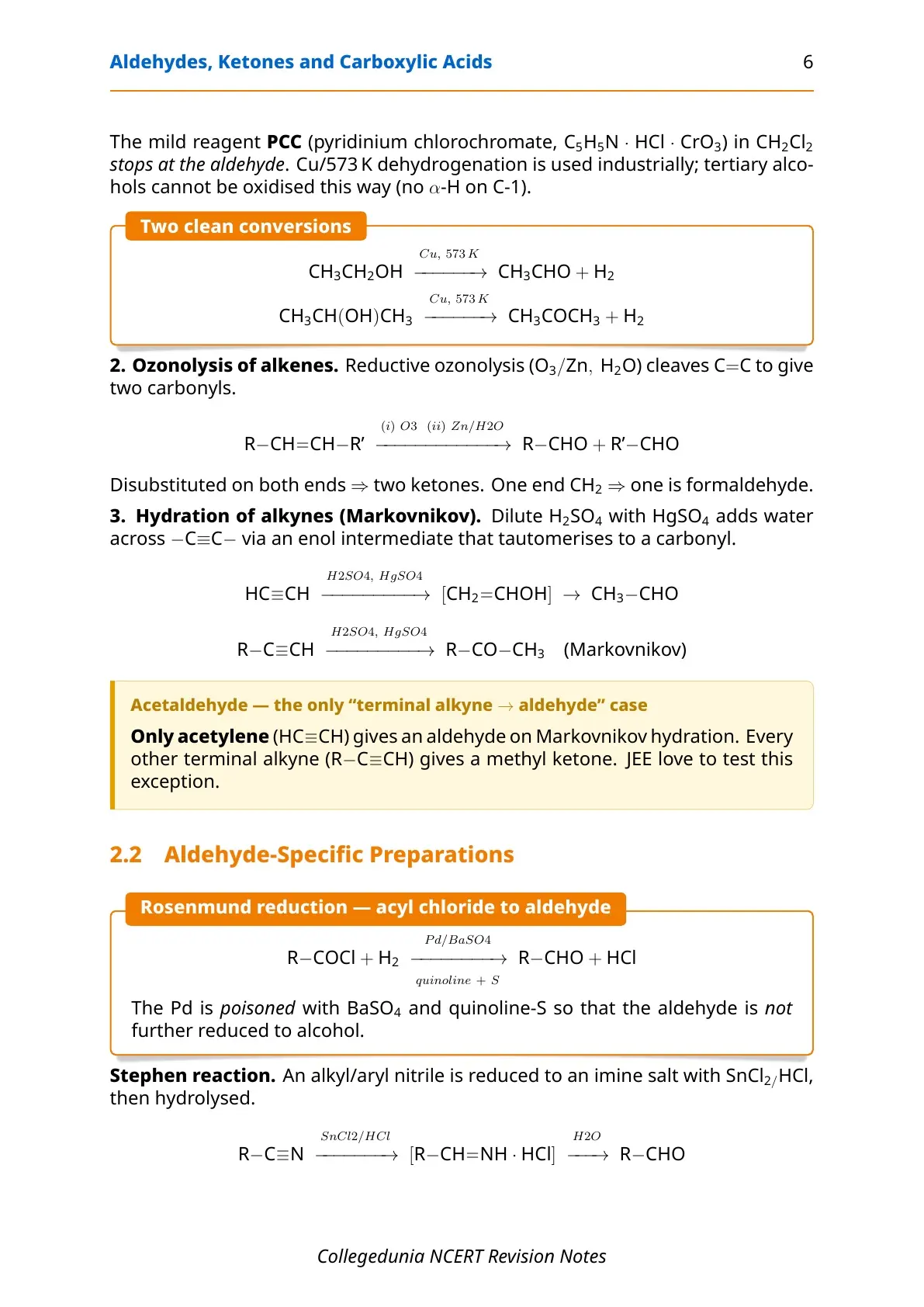
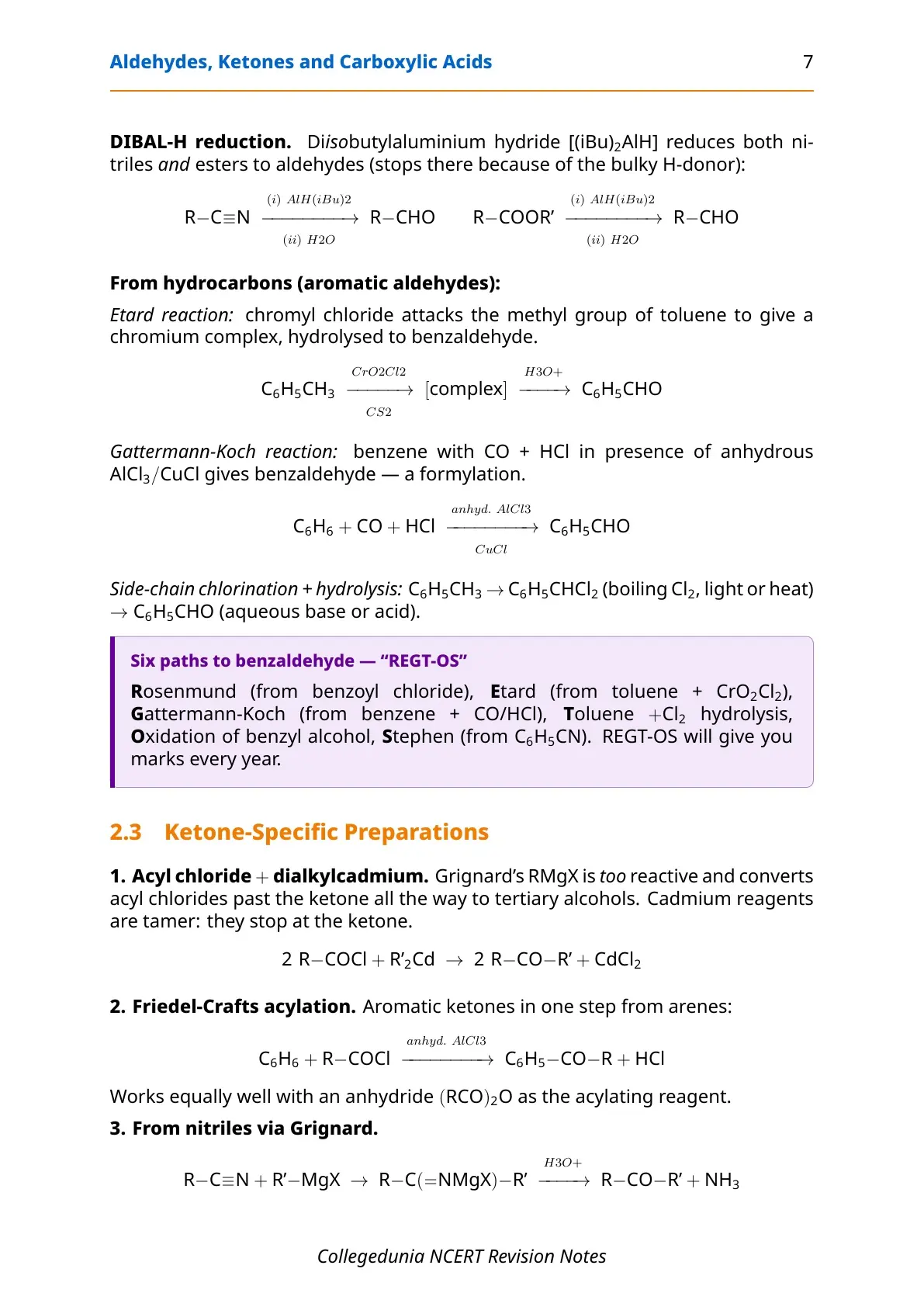
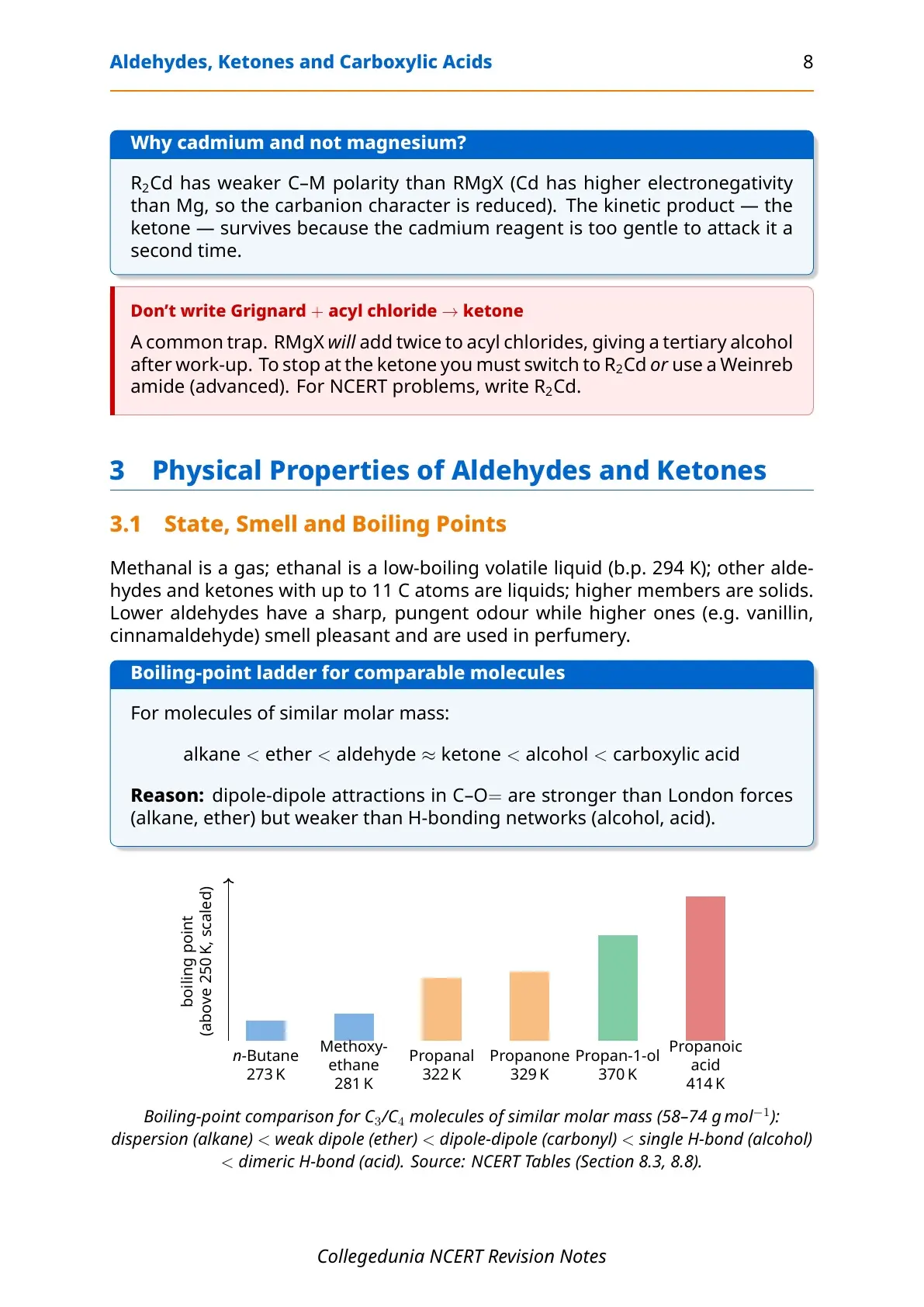
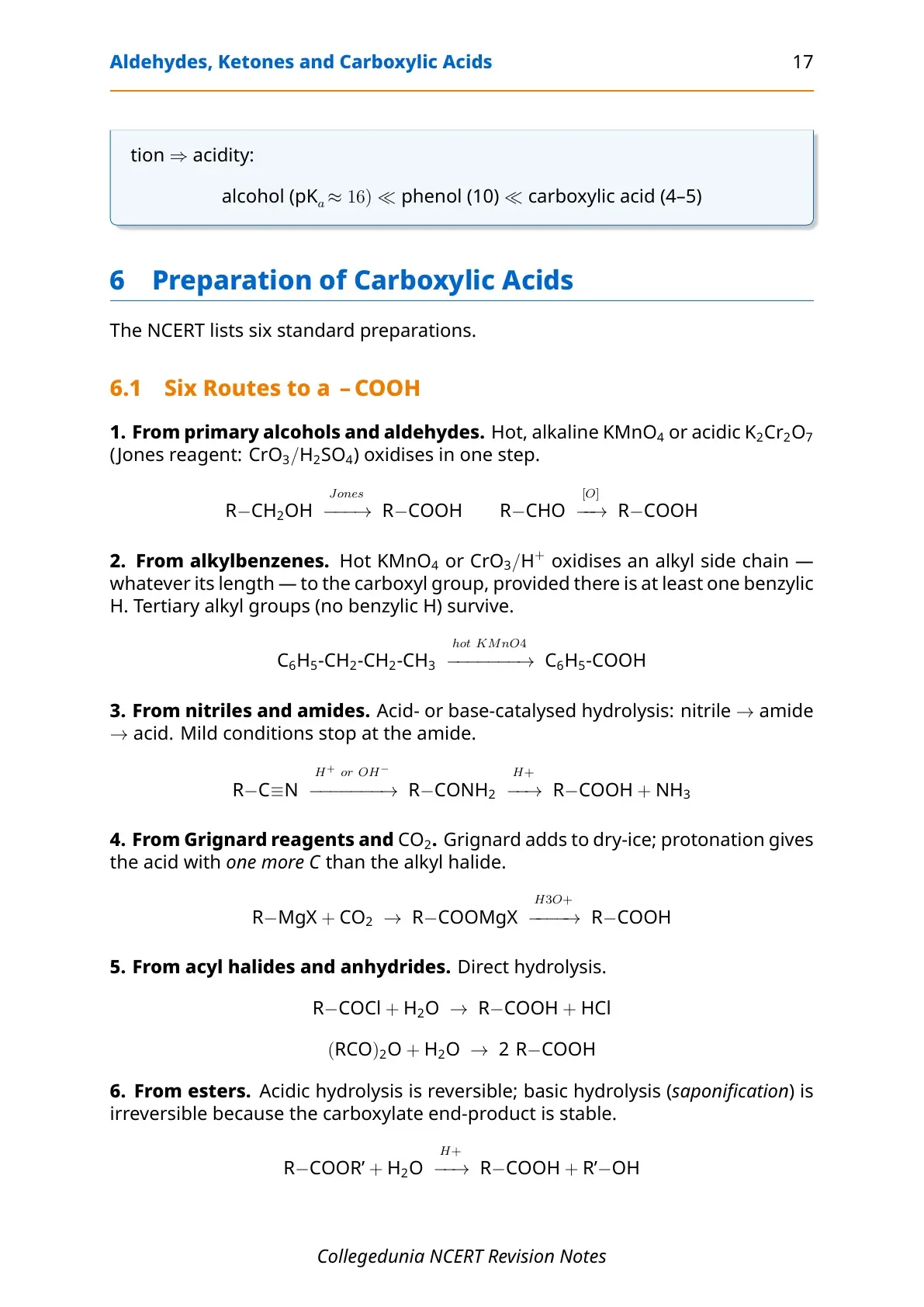
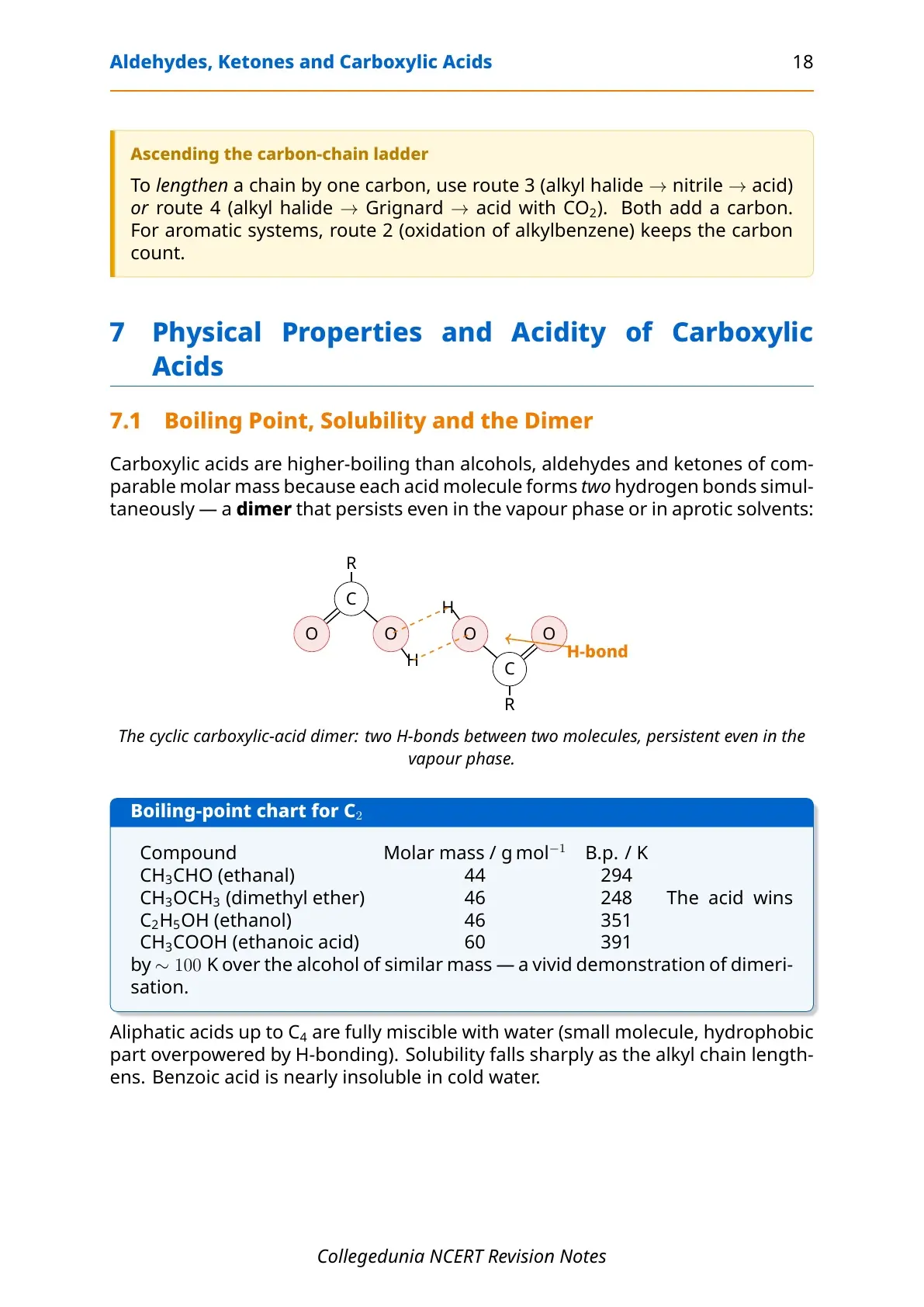
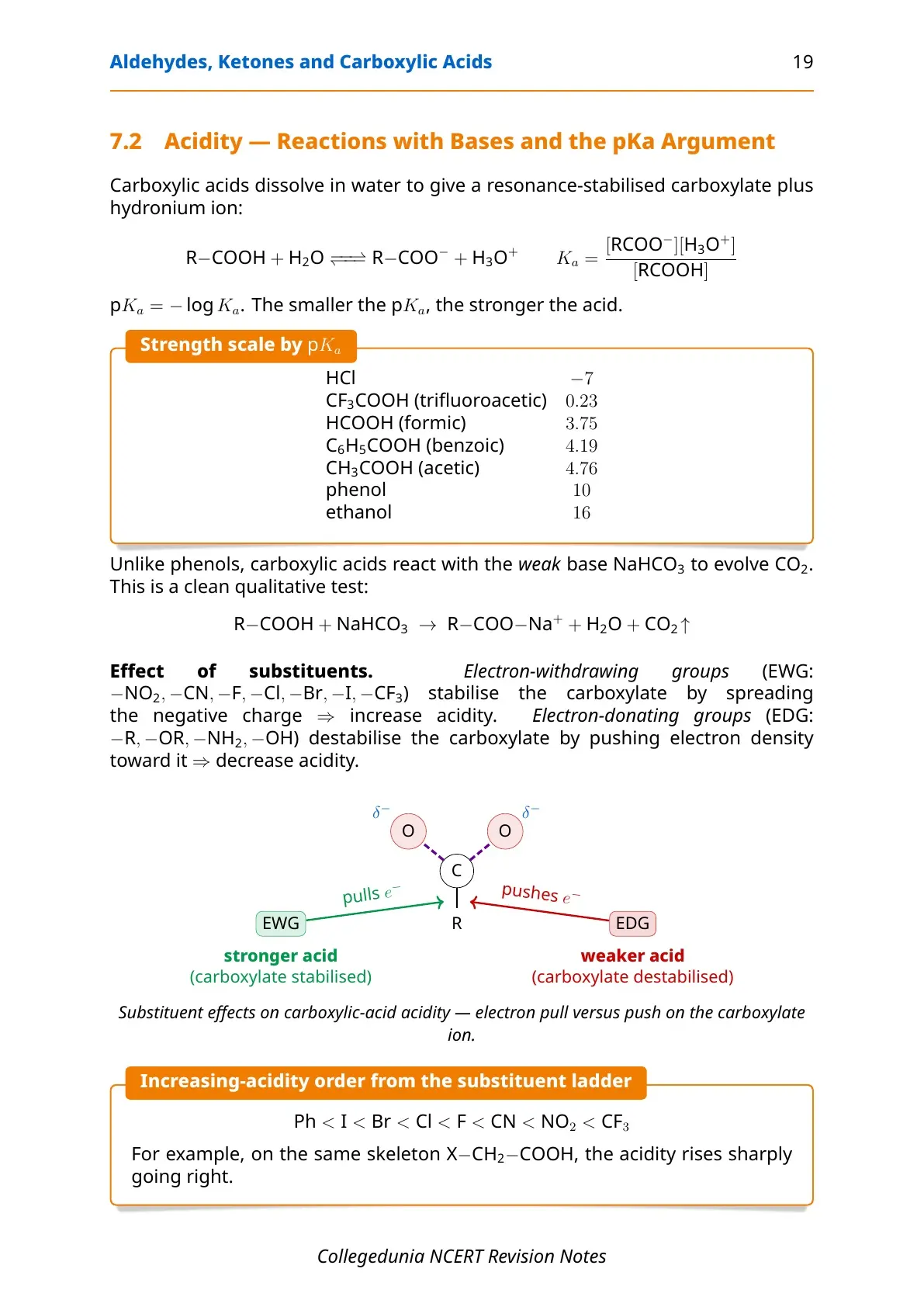
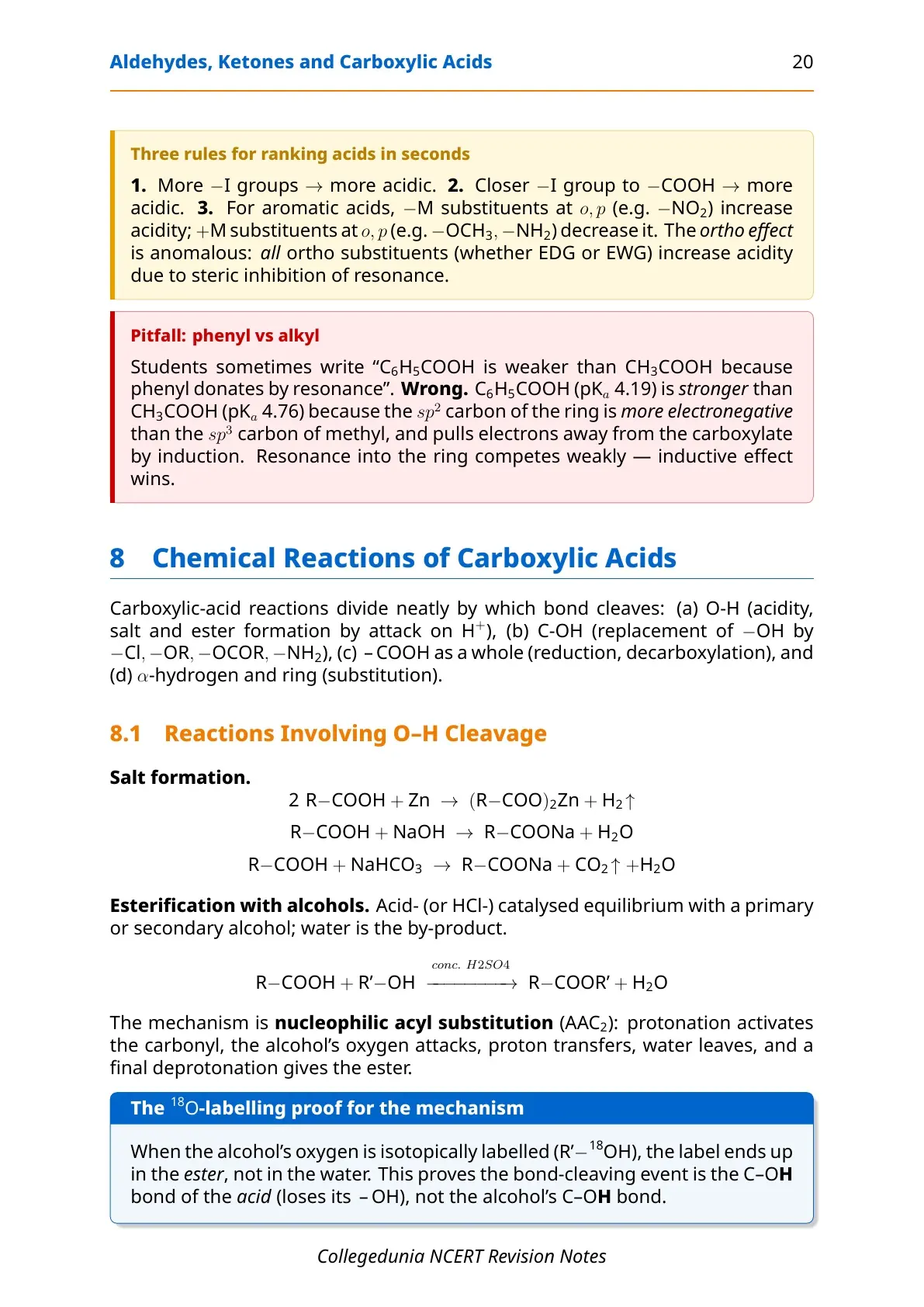
- CBSE Boards: 5 to 7 marks every year, usually one 3-mark mechanism on aldol/Cannizzaro plus one 2-mark reagent-identification problem.
- JEE Main: 3 to 4% of the Chemistry paper, with 1 to 2 questions per shift on aldol, Cannizzaro, HVZ, and acidity order.
- NEET: 2 to 3 questions per year on carbonyl reactivity order, named tests (Tollens, Fehling, iodoform), and redox outcomes.
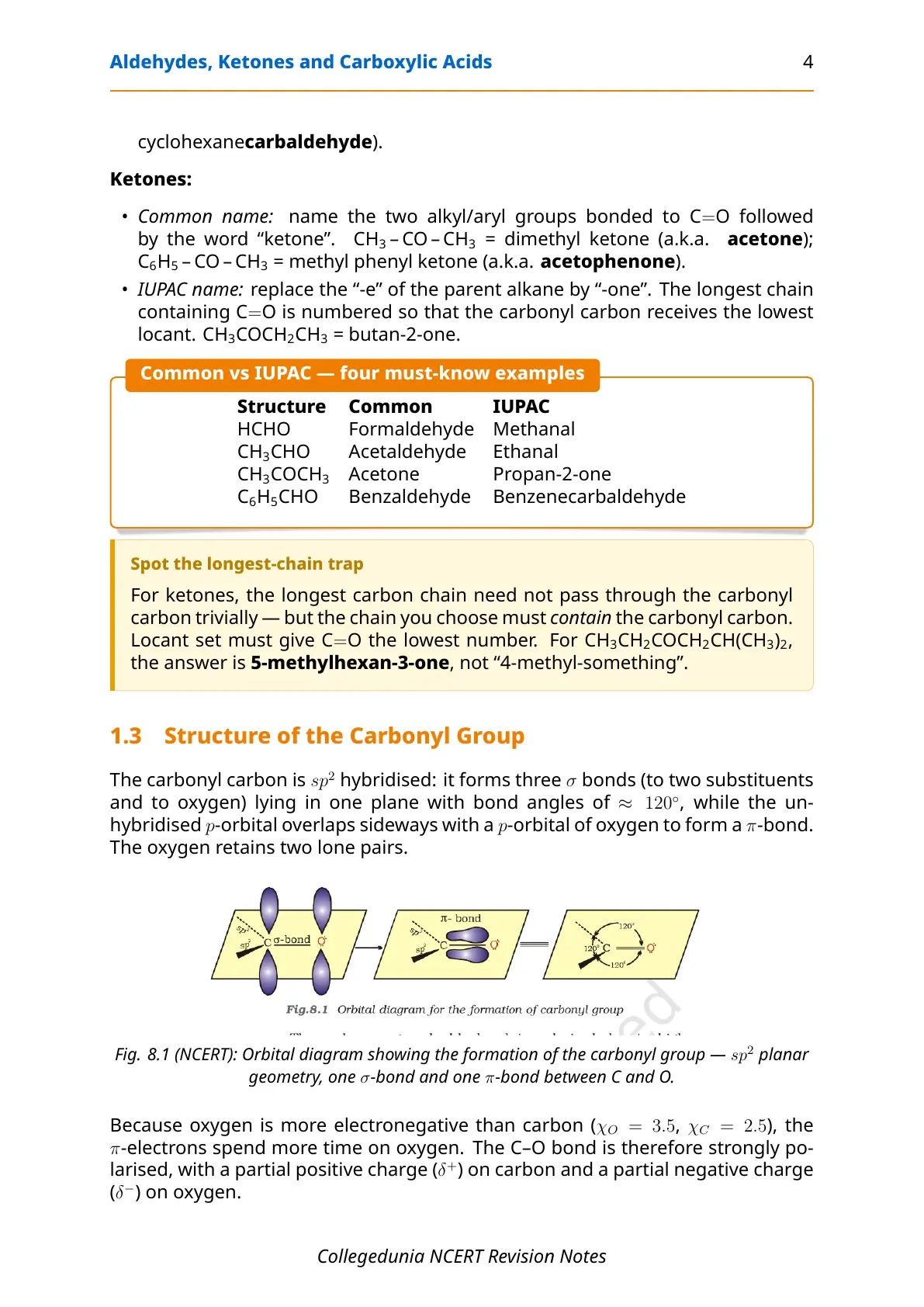
The 26-page PDF runs the chapter the way CBSE marks it: nomenclature and structure, then preparation, nucleophilic addition, the named-reaction wall, and carboxylic acid acidity.
Aldehydes, Ketones and Carboxylic Acids Class 12 Chemistry Video Lecture
Source: Magnet Brains on YouTube
How will Collegedunia's NCERT Notes Help You with Aldehydes, Ketones and Carboxylic Acids?
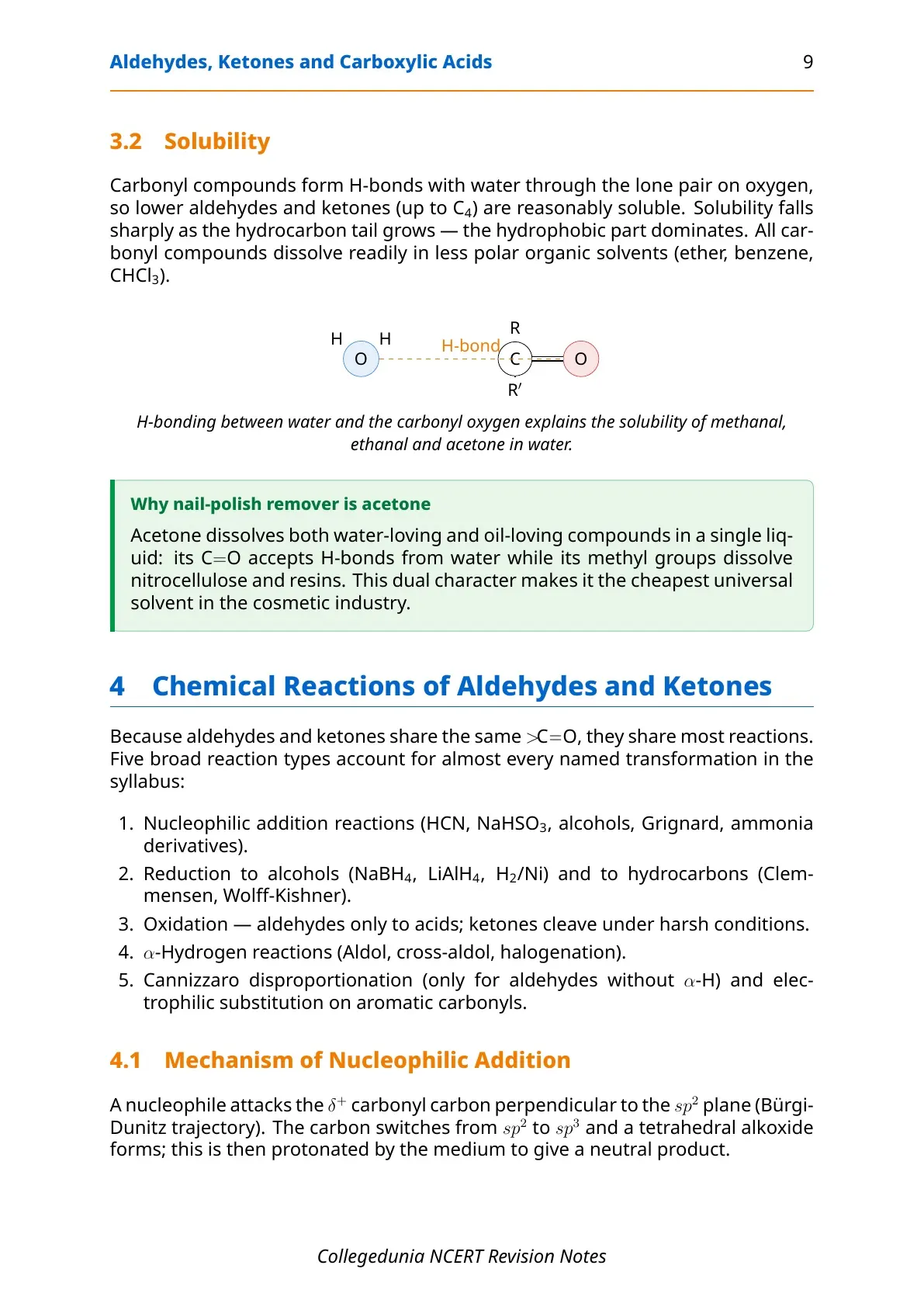
The Notes target four things students lose marks on: the nucleophilic-addition reactivity ladder, a colour-coded named-reaction wall, an acidity-order chart for substituted benzoic acids, and a distinguishing-test flowchart for carbonyl pairs. They are built for three passes: a first read, a pre-mock review, and an exam-morning flick.
Aldehydes, Ketones and Carboxylic Acids Class 12 Topic-wise Weightage for CBSE Boards
The marks below average CBSE, JEE, and NEET papers, 2021 to 2025.
| Sub-Topic | NCERT Section | CBSE Marks | JEE / NEET Frequency |
|---|---|---|---|
| Nucleophilic Addition + Reactivity | 8.3 | 2 - 3 | Very High |
| Named Reactions (aldol, Cannizzaro, Clemmensen, Wolff-Kishner) | 8.3 | 2 - 3 | Very High |
| Preparation of Aldehydes (Rosenmund, Stephen, Etard) | 8.2 | 1 - 2 | High |
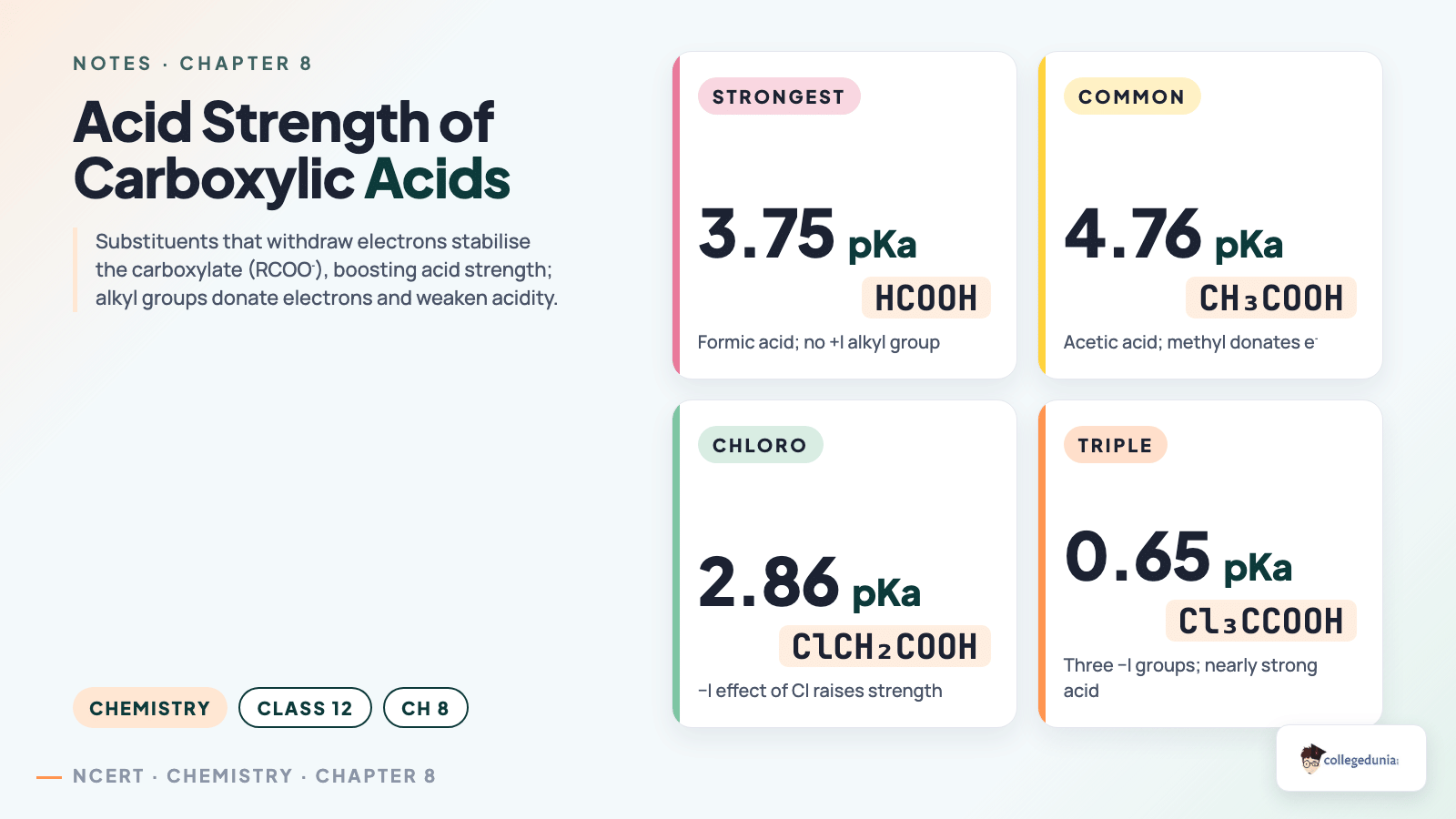
| Carboxylic Acid Acidity / Substituent Effects | 8.7 | 1 - 2 | High |
| Distinguishing Tests (Tollens, Fehling, Iodoform) | 8.3 | 1 - 2 | Medium |
| HVZ and alpha-Halogenation | 8.7 | 1 | Medium |
Section 8.3 alone carries roughly 4 marks every year, so master nucleophilic addition and the named-reaction wall first.
Aldehydes, Ketones and Carboxylic Acids Topic-by-Topic Notes for Class 12 Chemistry
Each block maps to a numbered NCERT section in the 2026-27 print.
Six out of every ten board conversion questions come from sections 8.2 and 8.3, so memorise both the preparation grid and the reactivity ladder.
Class 12 Chemistry Ch 8 Important Named Reactions and Distinguishing Tests
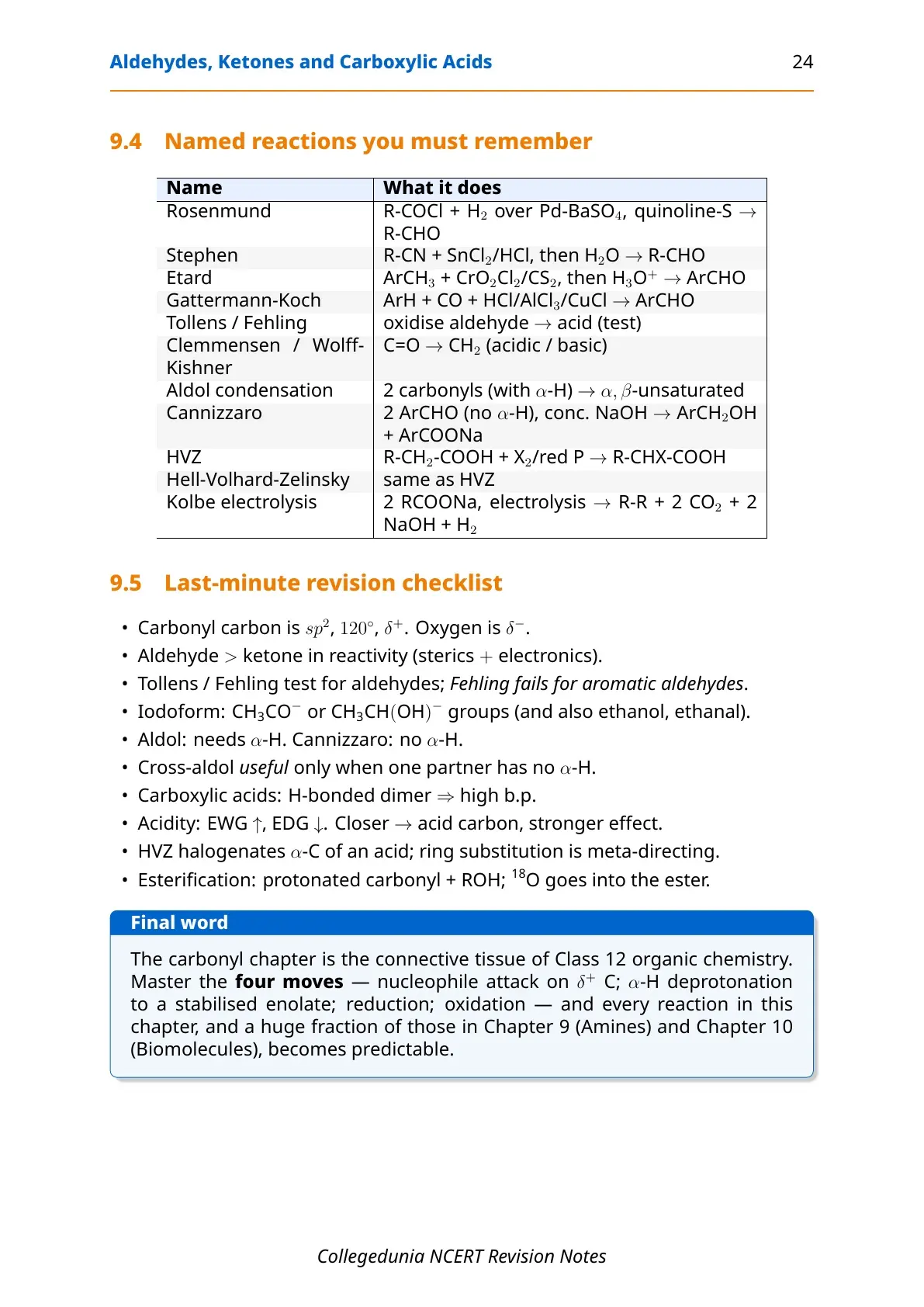
These eleven reactions cover every carbonyl synthesis CBSE has asked since 2021. Memorise reagent and product.
| Name | Reactants → Products | Conditions |
|---|---|---|
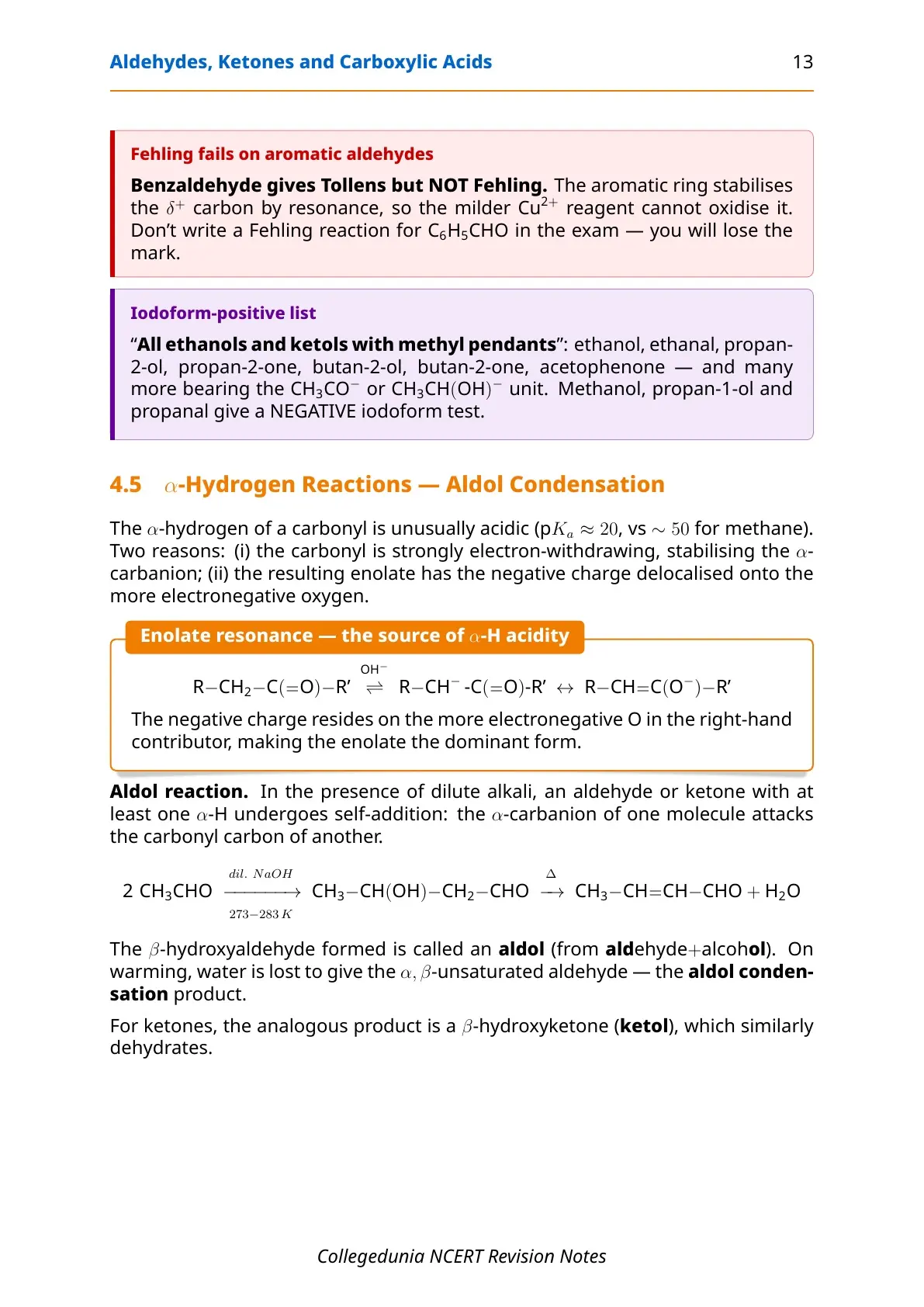
| Aldol Condensation | 2 RCHO (alpha-H) → beta-OH then alpha-beta unsat aldehyde | Dilute NaOH; heat dehydrates |
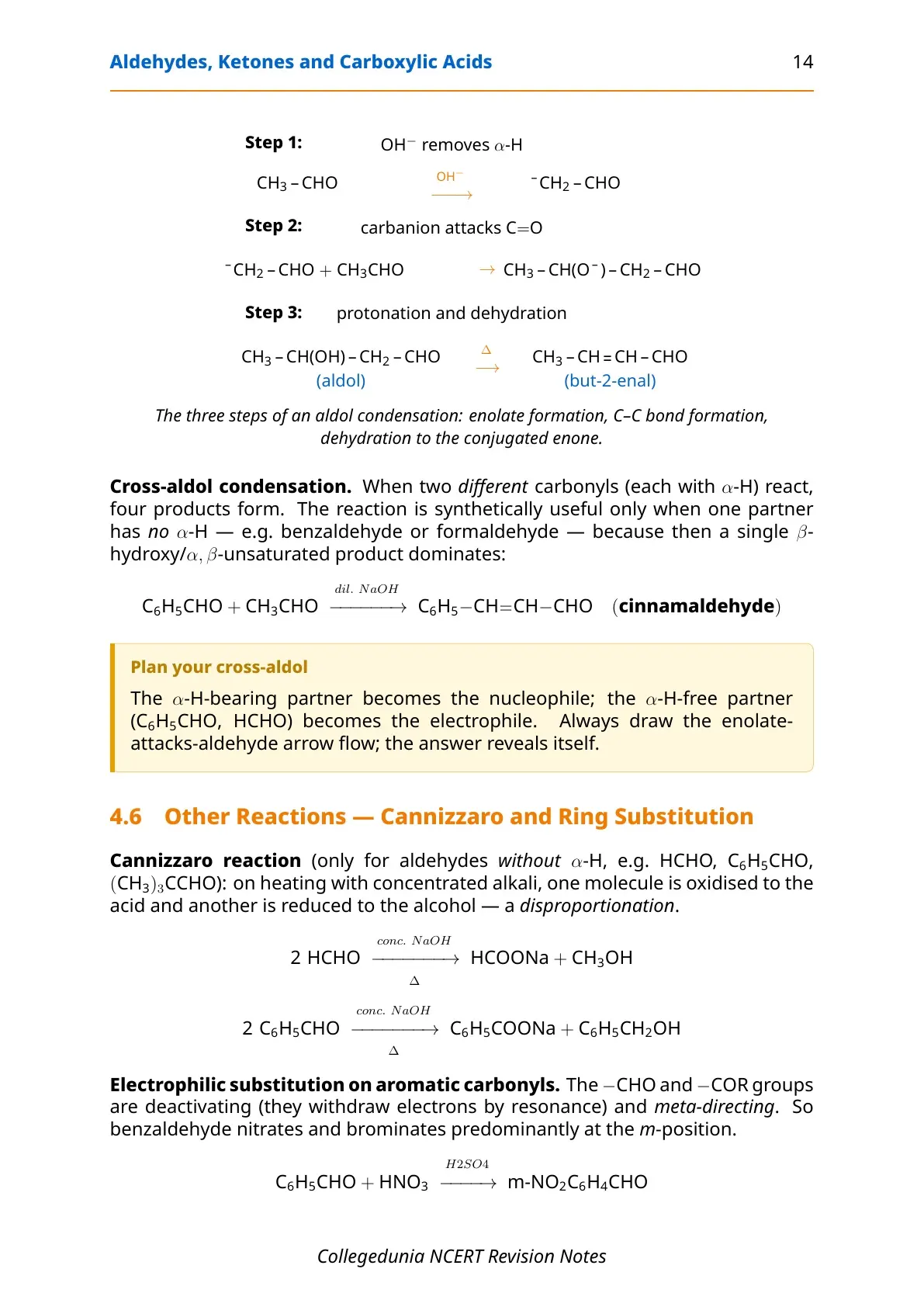
| Cannizzaro | 2 PhCHO + conc. NaOH → PhCH2OH + PhCOO- | No-alpha-H aldehydes only |
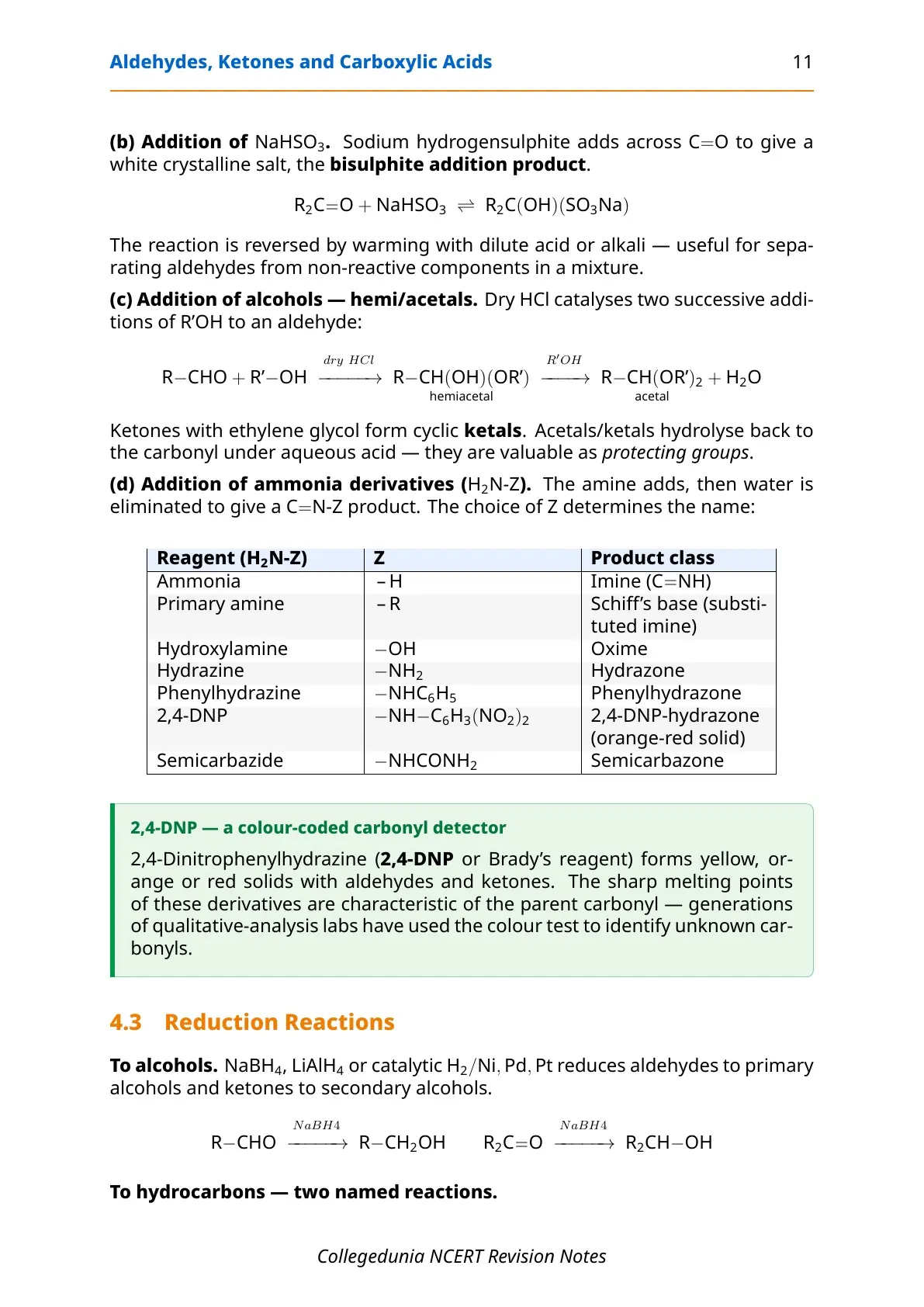
| Clemmensen | R2C=O → R2CH2 | Zn-Hg / conc. HCl |
| Wolff-Kishner | R2C=O → R2CH2 | NH2NH2, KOH, glycol |
| Rosenmund | RCOCl + H2 → RCHO | Pd-BaSO4, S-poisoned |
| Stephen | RCN + SnCl2/HCl → RCHO | Hydrolyse imine stage |
| Etard | PhCH3 + CrO2Cl2 → PhCHO | CS2 solvent |
| Gattermann-Koch | C6H6 + CO/HCl → PhCHO | AlCl3, Cu2Cl2 |
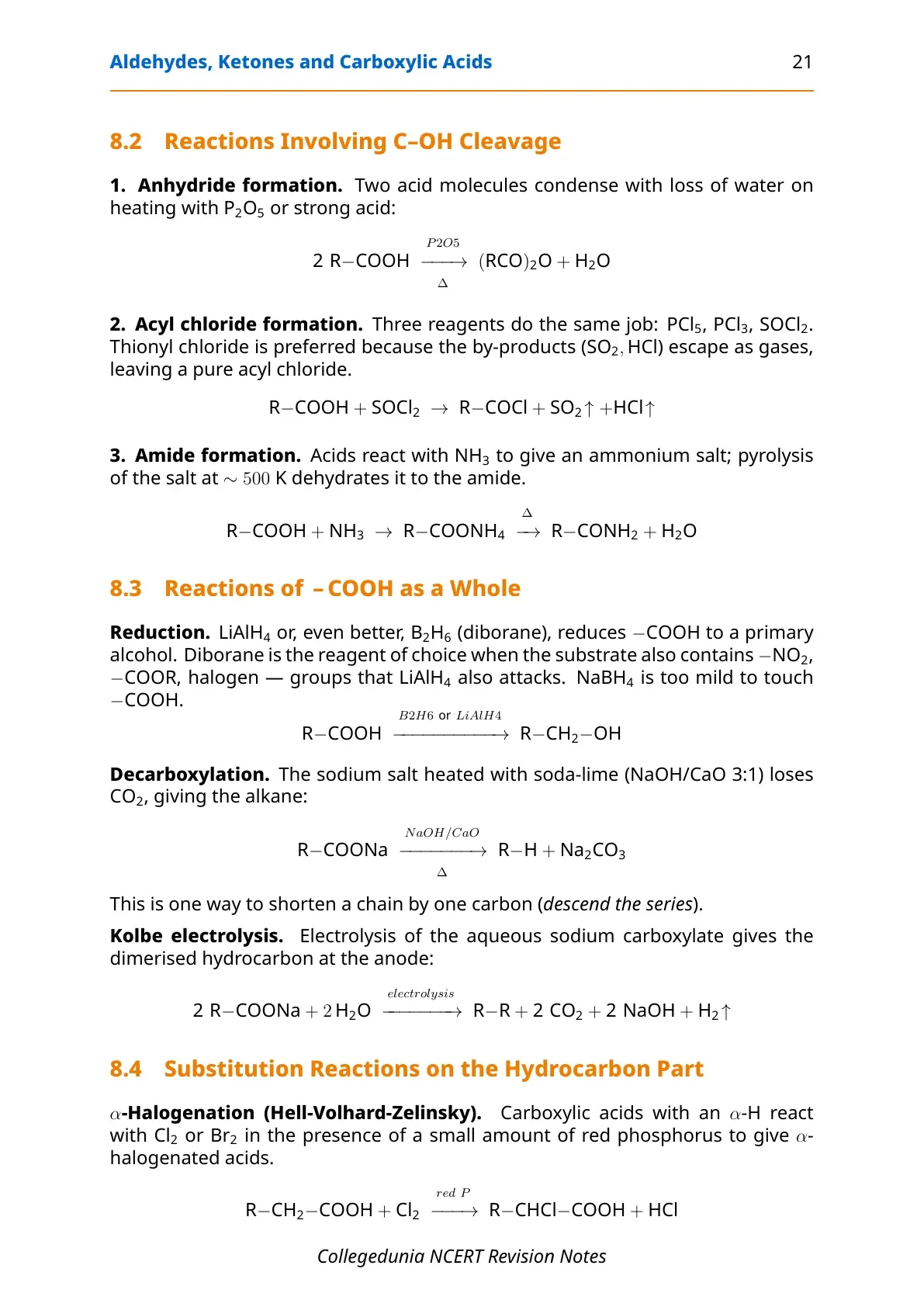
| HVZ | RCH2COOH + X2 → RCHX-COOH | Red P, alpha-position |
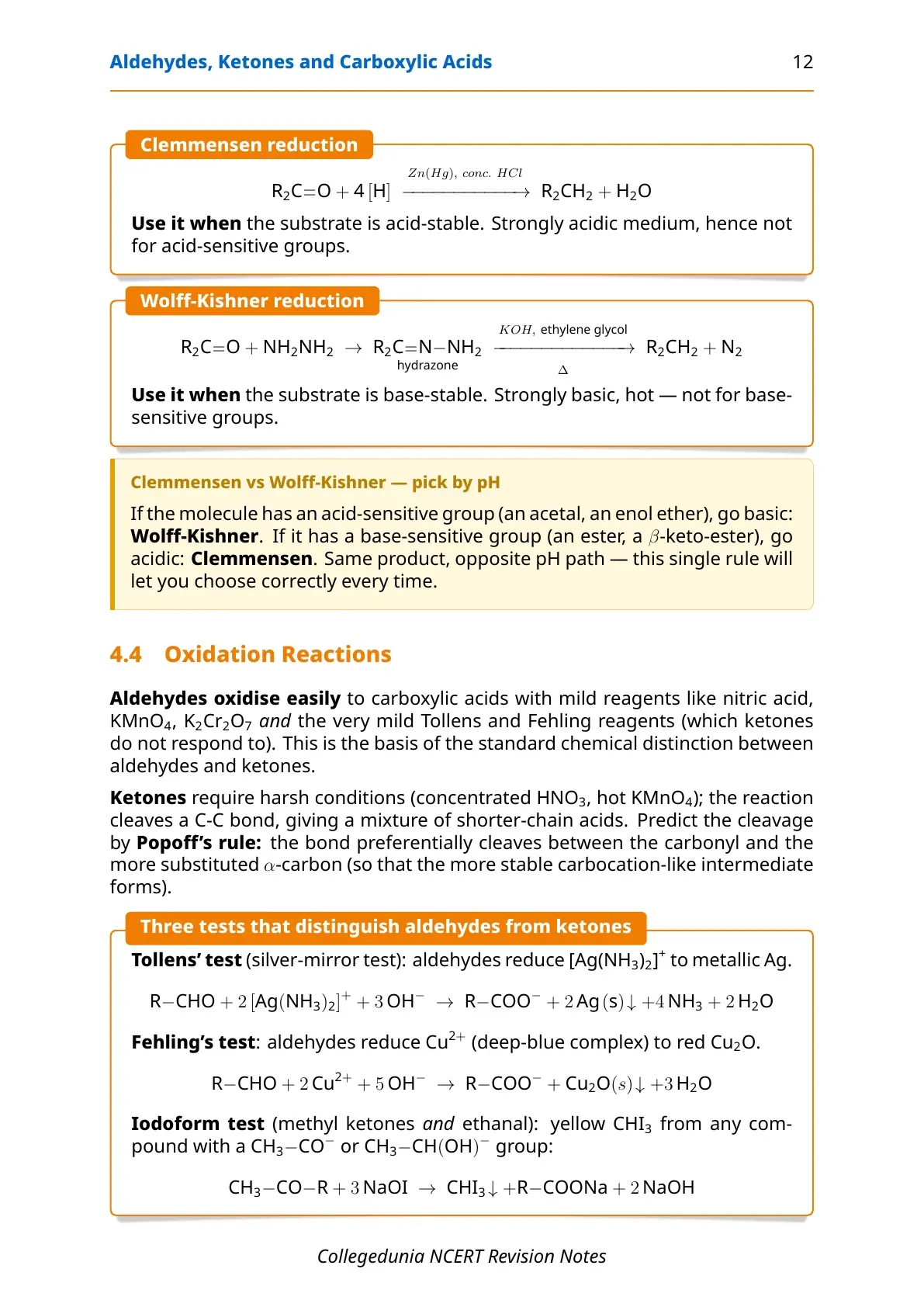
| Tollens | RCHO + Ag(NH3)2+ → Ag mirror | All aldehydes positive |
| Iodoform | CH3CO-R + I2/NaOH → CHI3 | Methyl ketones, ethanol |
Important Derivations and Mechanisms in 12th Chemistry Chapter 8
The PDF carries six fully-worked mechanisms, the ones most likely in CBSE 3-mark and 5-mark slots.
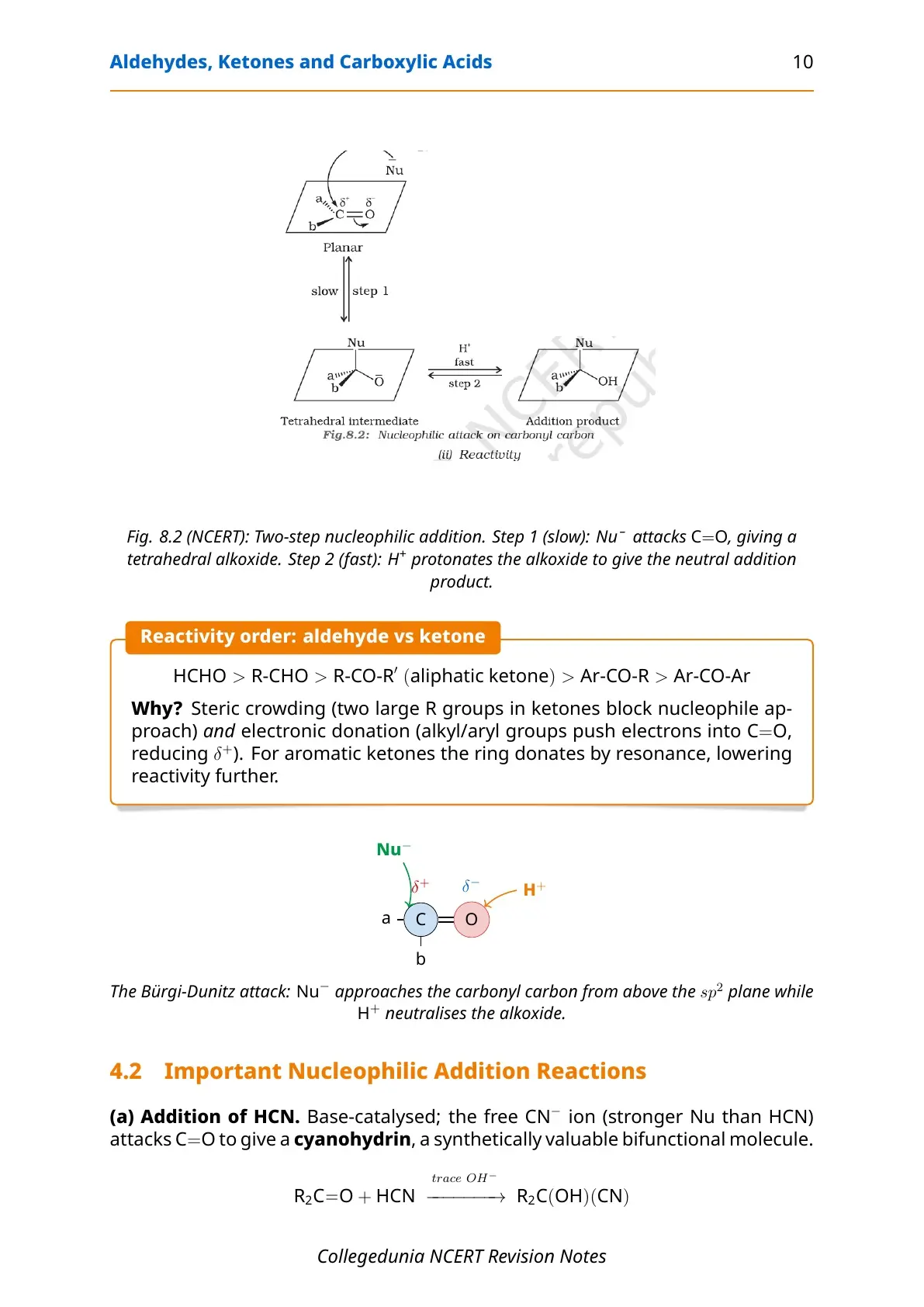
- HCN addition to aldehyde: CN- attacks sp2 carbon, oxygen alkoxide picks H+ to give cyanohydrin.
- Aldol of ethanal: OH- abstracts alpha-H, enolate attacks 2nd CH3CHO, gives 3-hydroxybutanal, then dehydrates to but-2-enal.
- Cannizzaro of PhCHO: OH- adds to one PhCHO, H- transfers to a second PhCHO, giving PhCOO- + PhCH2OH.
- Fischer esterification: C=O protonates, ROH attacks, water leaves; reversible.
- Acetal formation: hemiacetal forms, second ROH replaces -OH; a protecting group.
- HVZ alpha-halogenation: PBr3 converts -COOH to -COBr, enol forms, attacks Br2, hydrolysis returns -COOH with alpha-Br in place.
Aldehydes, Ketones and Carboxylic Acids Top 5 Formulae for Quick Recall
These five show up most in CBSE and JEE reactivity-comparison questions. The full master table is on the Formula Sheet.
| Concept | Quick Recall |
|---|---|
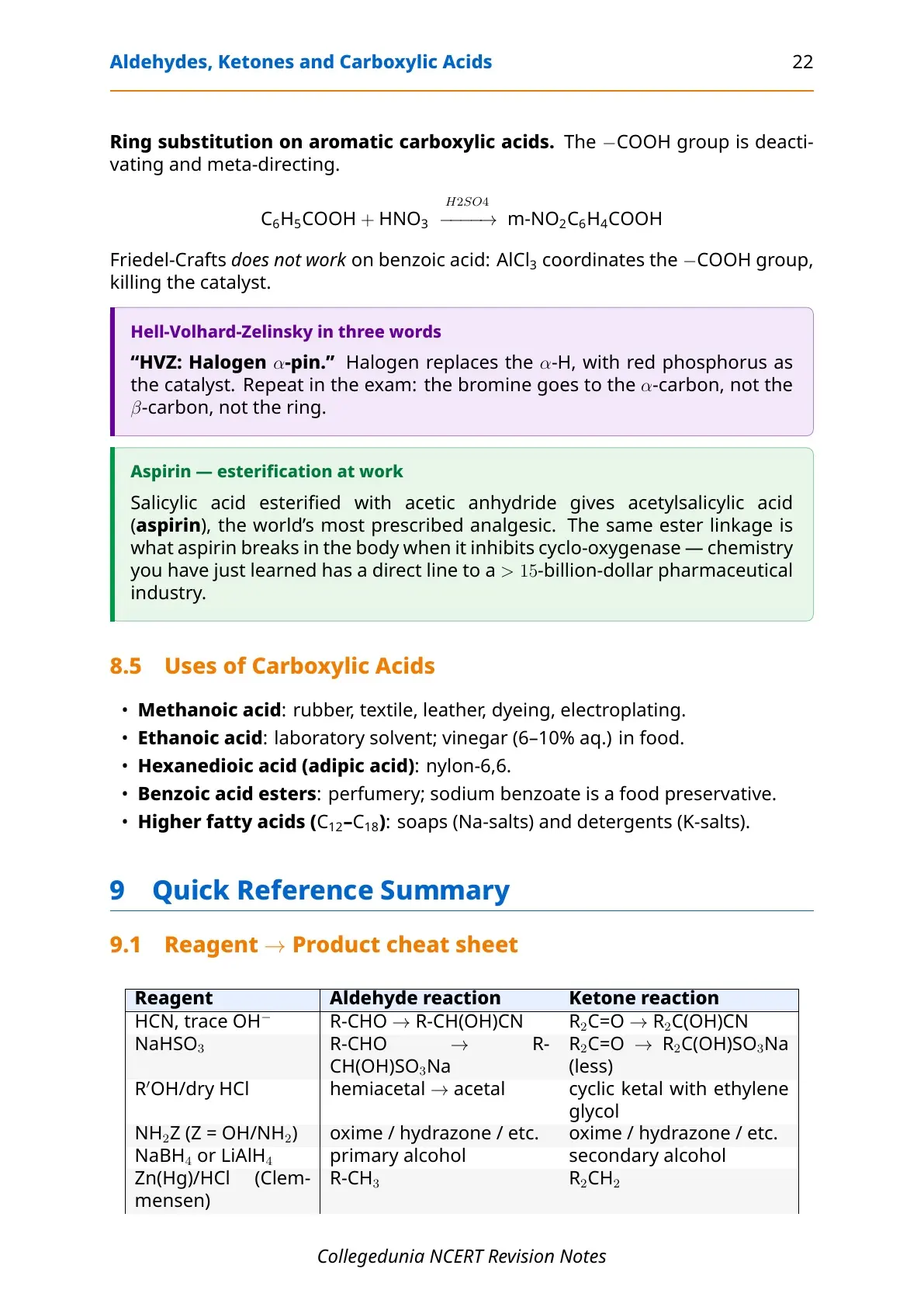
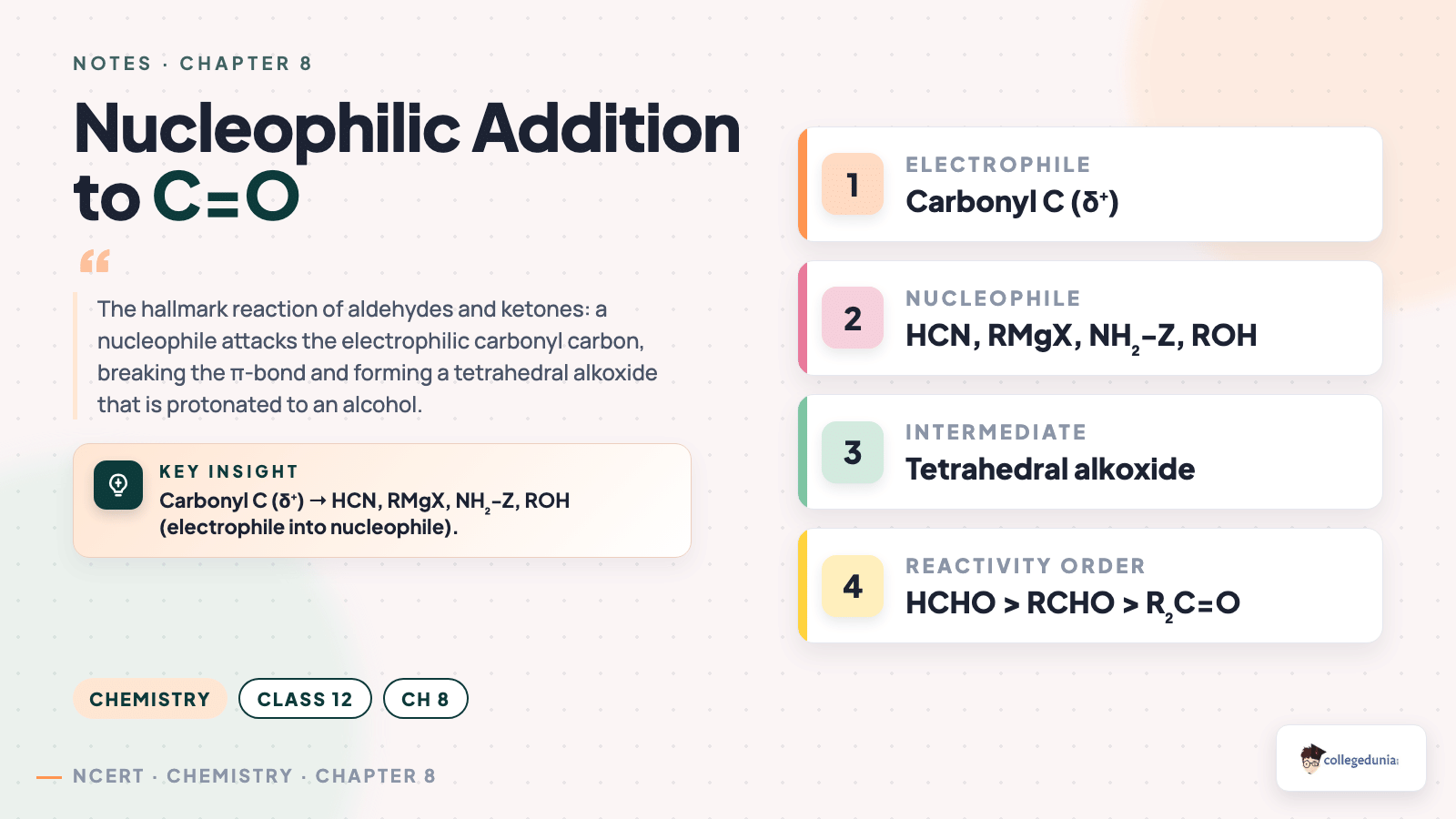
| Nucleophilic addition reactivity | HCHO > CH3CHO > RCHO > ArCHO > R2CO |
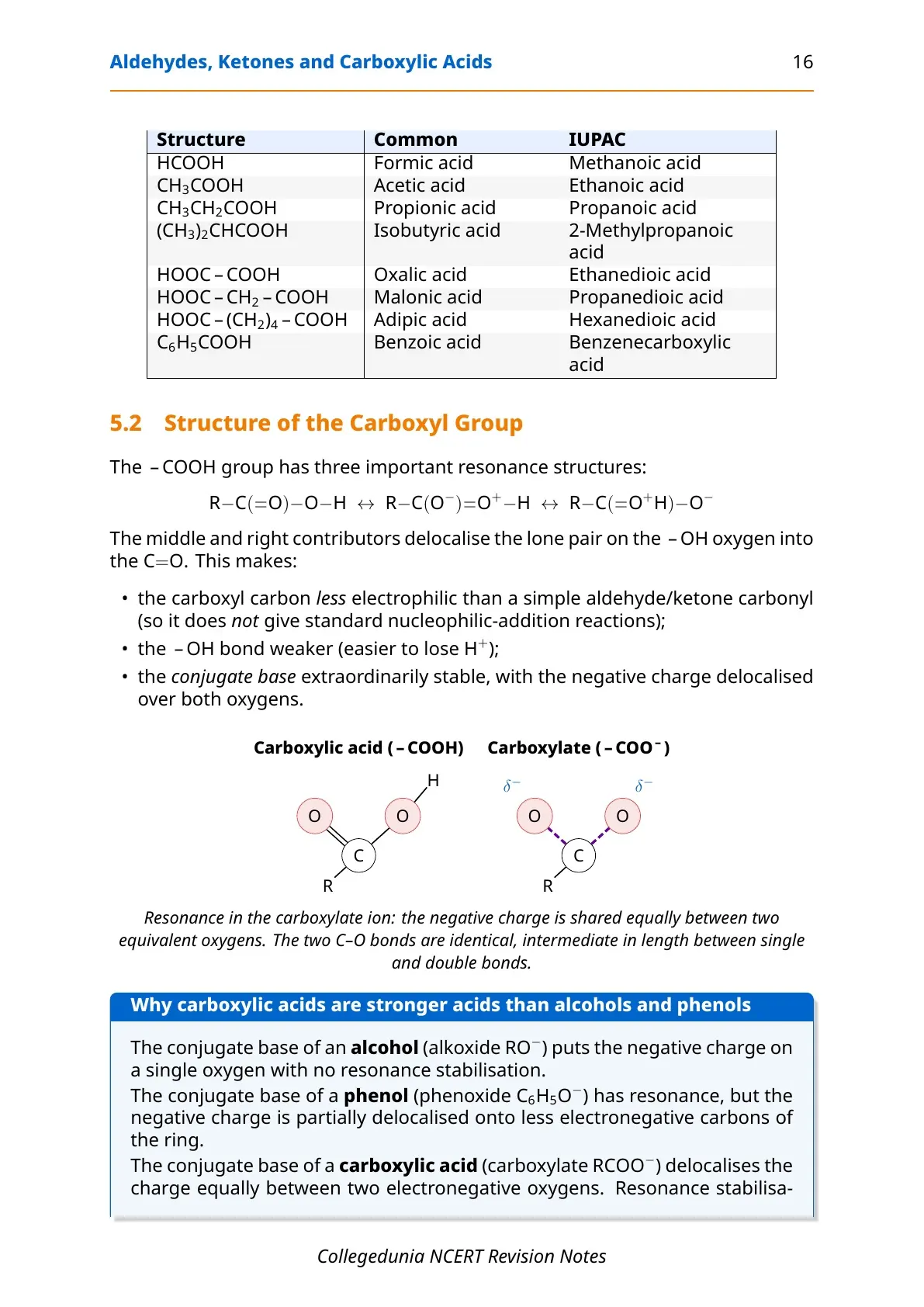
| Aliphatic acid acidity | HCOOH > CH3COOH > CH3CH2COOH (+I lowers acidity) |
| Substituted benzoic acid | p-NO2 > p-Cl > PhCOOH > p-OCH3 |
| Tollens reagent | [Ag(NH3)2]+OH-; silver mirror with aldehyde only |
| Iodoform positive | Methyl ketones, ethanol, CH3CH(OH)-R; yellow CHI3 |
Full master table: Aldehydes, Ketones and Carboxylic Acids Class 12 Chemistry Formula Sheet
Real-World Applications of Aldehydes, Ketones and Carboxylic Acids
Chapter 8 carbonyl chemistry powers many products, each a possible 1-mark "uses" or assertion-reason stem.
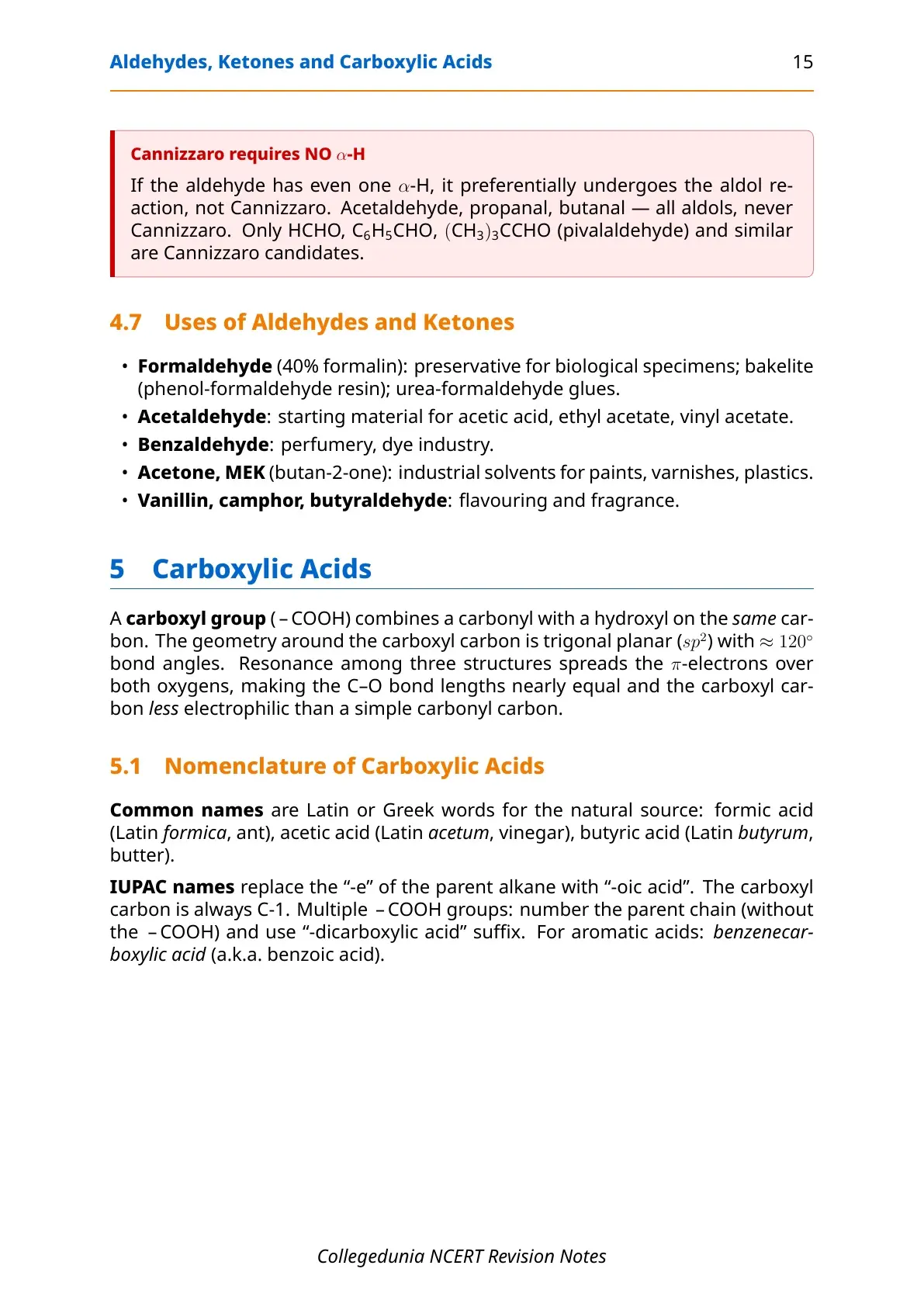
- Formalin and bakelite: 40% HCHO preserves specimens and condenses with phenol to bakelite.
- Acetic acid: vinegar; precursor for vinyl acetate and aspirin.
- Acetone: solvent for resins; feedstock for bisphenol-A.
- Citric and oxalic acids: citric chelates; oxalic removes ink and rust.
- Benzaldehyde: almond aroma in flavours.
Student Feedback
In a Collegedunia poll of 1,240 Class 12 students, 81% said the colour-coded named-reaction wall was the fastest way to revise Chapter 8, and 3 in 4 kept the acidity-order chart open during mock tests.
Other Resources for Aldehydes, Ketones and Carboxylic Acids Class 12 Chemistry
NCERT Notes for Class 12 Chemistry: All Chapters
Continue revising the rest of the Class 12 Chemistry NCERT with the chapter-wise Notes library below.
| Chapter | Notes Page |
|---|---|
| Chapter 1 | Solutions Notes |
| Chapter 2 | Electrochemistry Notes |
| Chapter 3 | Chemical Kinetics Notes |
| Chapter 4 | The d- and f-Block Elements Notes |
| Chapter 5 | Coordination Compounds Notes |
| Chapter 6 | Haloalkanes and Haloarenes Notes |
| Chapter 7 | Alcohols, Phenols and Ethers Notes |
| Chapter 8 | Aldehydes, Ketones and Carboxylic Acids Notes |
| Chapter 9 | Amines Notes |
| Chapter 10 | Biomolecules Notes |
Aldehydes, Ketones and Carboxylic Acids Class 12 Notes FAQs
Ques. How many marks does Chapter 8 carry in the CBSE Class 12 Chemistry board exam?
Ans. Chapter 8 carries 5 to 7 marks, averaged over the last five board papers. It usually splits into one 3-mark mechanism question (aldol, Cannizzaro, or a multi-step preparation) plus one 2-mark distinguishing-test or acidity-order question.
Ques. Why are aldehydes more reactive than ketones towards nucleophilic addition?
Ans. Ketones carry two alkyl groups whose +I effect lowers the partial positive charge on the carbonyl carbon, so the nucleophile is less attracted. The two groups also crowd the carbonyl carbon, blocking approach. Aldehydes face neither penalty, so they react faster.
Ques. What is the difference between the aldol condensation and the Cannizzaro reaction?
Ans. Aldol condensation needs an alpha-hydrogen: base removes the alpha-H, the enolate attacks a second carbonyl, and an alpha-beta unsaturated carbonyl forms after dehydration. Cannizzaro works only on aldehydes with no alpha-H (HCHO, PhCHO) in concentrated NaOH, where one aldehyde reduces to alcohol and the other oxidises to carboxylate. The two are mutually exclusive.
Ques. How do Tollens and Fehling tests work, and why does benzaldehyde fail the Fehling test?
Ans. Tollens reagent, [Ag(NH3)2]+OH-, oxidises an aldehyde to carboxylate and deposits a silver mirror. Fehling solution, alkaline copper(II) tartrate, oxidises aliphatic aldehydes to carboxylates and gives a red Cu2O precipitate. Benzaldehyde does not respond to Fehling because its reduction potential is too low for the test, but it still gives a positive Tollens result.
Ques. Why are carboxylic acids more acidic than phenols and alcohols?
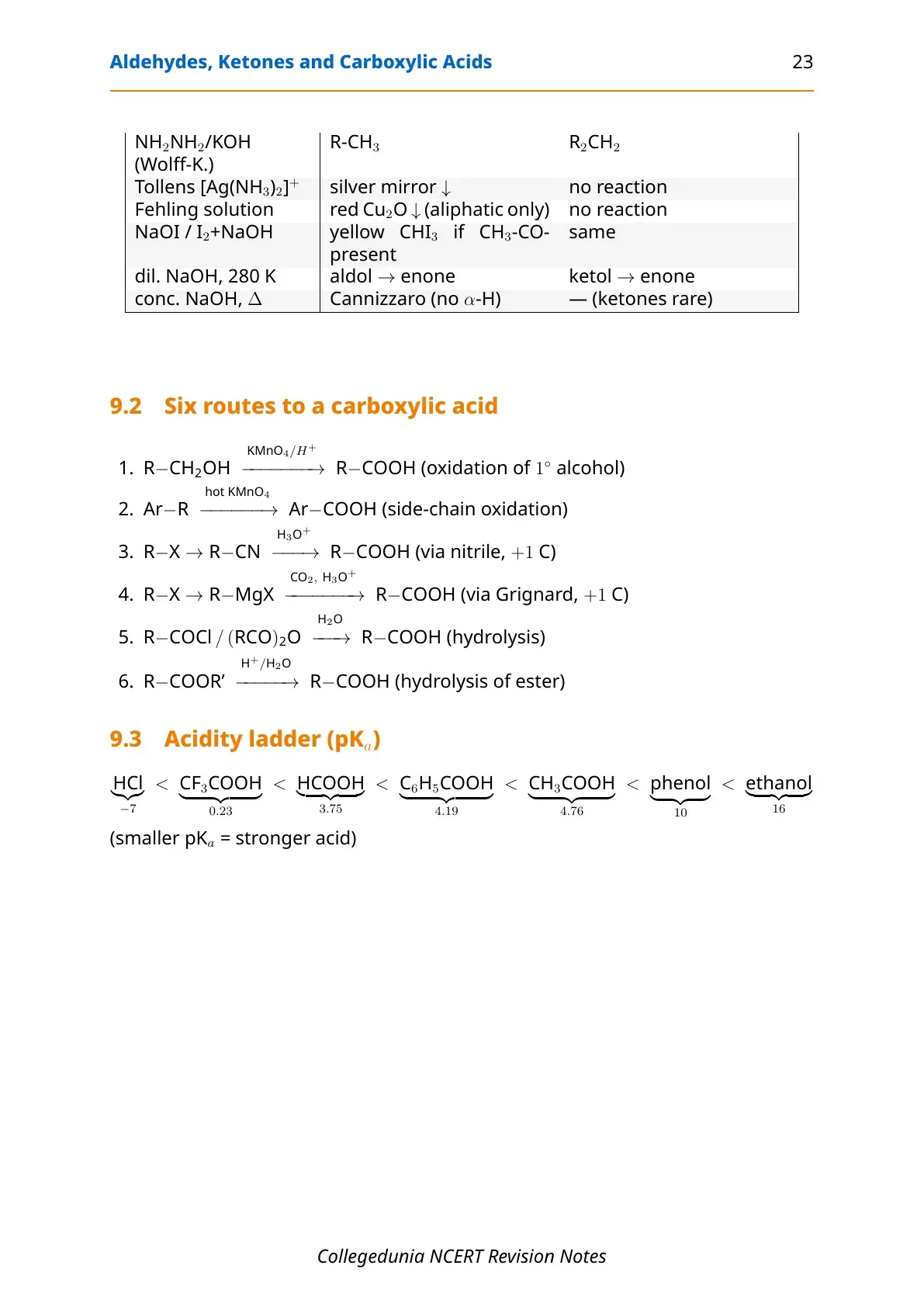
Ans. The carboxylate anion is resonance-stabilised by two equivalent oxygens that share the negative charge equally. Phenoxide spreads the charge over an aromatic ring with non-equivalent positions, and ethoxide has no delocalisation. A more stable conjugate base means a stronger acid, so pKa runs roughly 4 to 5 (acid), 10 (phenol), and 16 (alcohol).
Ques. Which compounds give a positive iodoform test?
Ans. Any compound with the CH3CO- group or one that oxidises to it under I2/NaOH: acetaldehyde, all methyl ketones (acetone, acetophenone, butan-2-one), ethanol, and secondary methyl-carbinols CH3CH(OH)-R. Methanol, benzaldehyde, and other primary alcohols give a negative test.
Ques. Where can I download the Class 12 Chemistry Chapter 8 Notes PDF for free?
Ans. Download the complete 26-page Chapter 8 Notes PDF free from the card at the top of this page. It is mapped to the 2026-27 NCERT and covers every named reaction, all six mechanism walk-throughs, distinguishing tests, and a quick-recall acidity-order chart.



Comments