



The notes for NCERT Chapter 1 Solutions will help prepare important topics such as Molarity, Molality, Mole Fraction, and numericals on it. The Solutions Chapter in Physical Chemistry Class 12 carries a high weightage of around 7-8 marks in the CBSE Board exam. You can see both conceptual as well as numerical questions from this chapter in CBSE Boards, JEE and NEET exams.
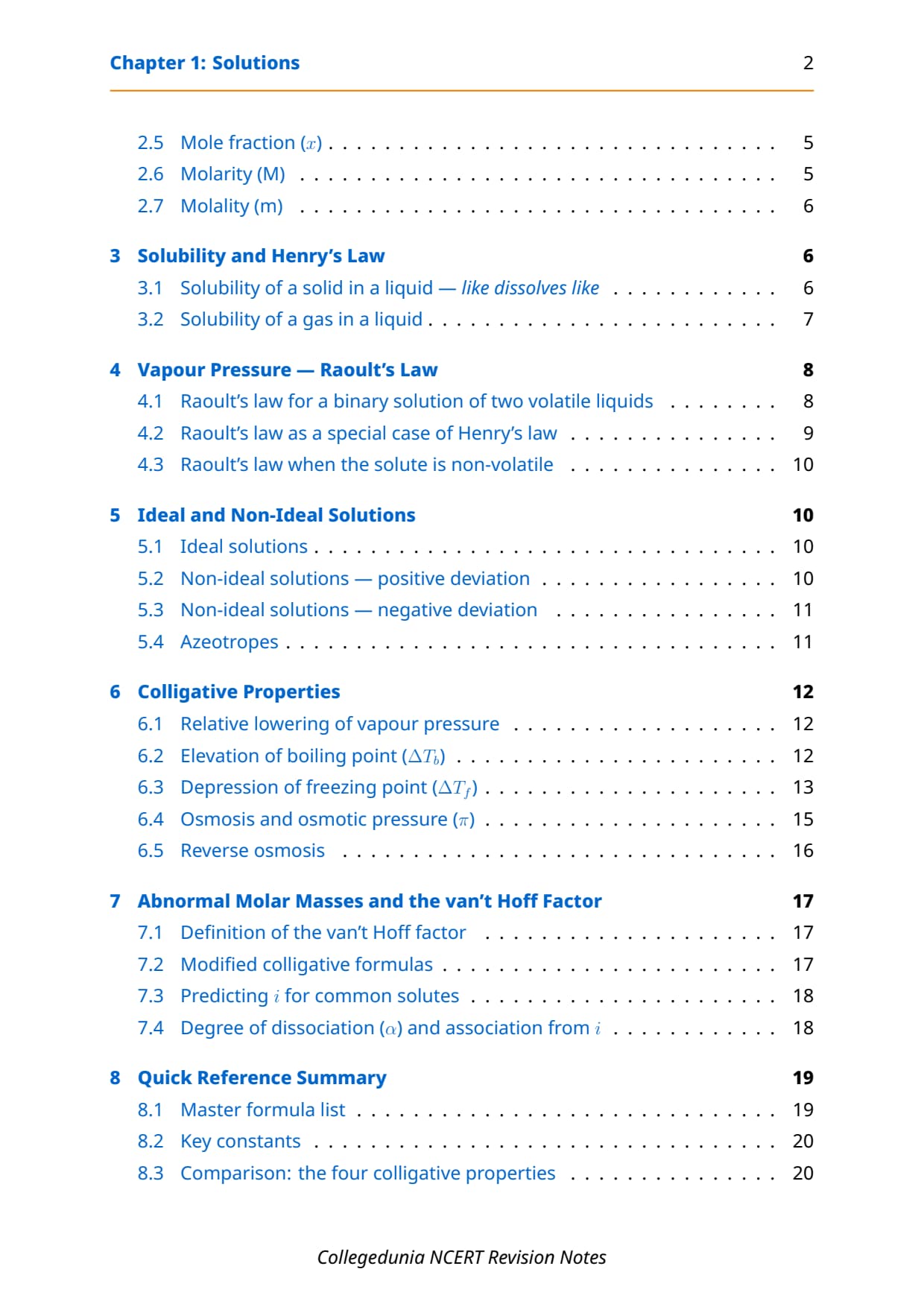
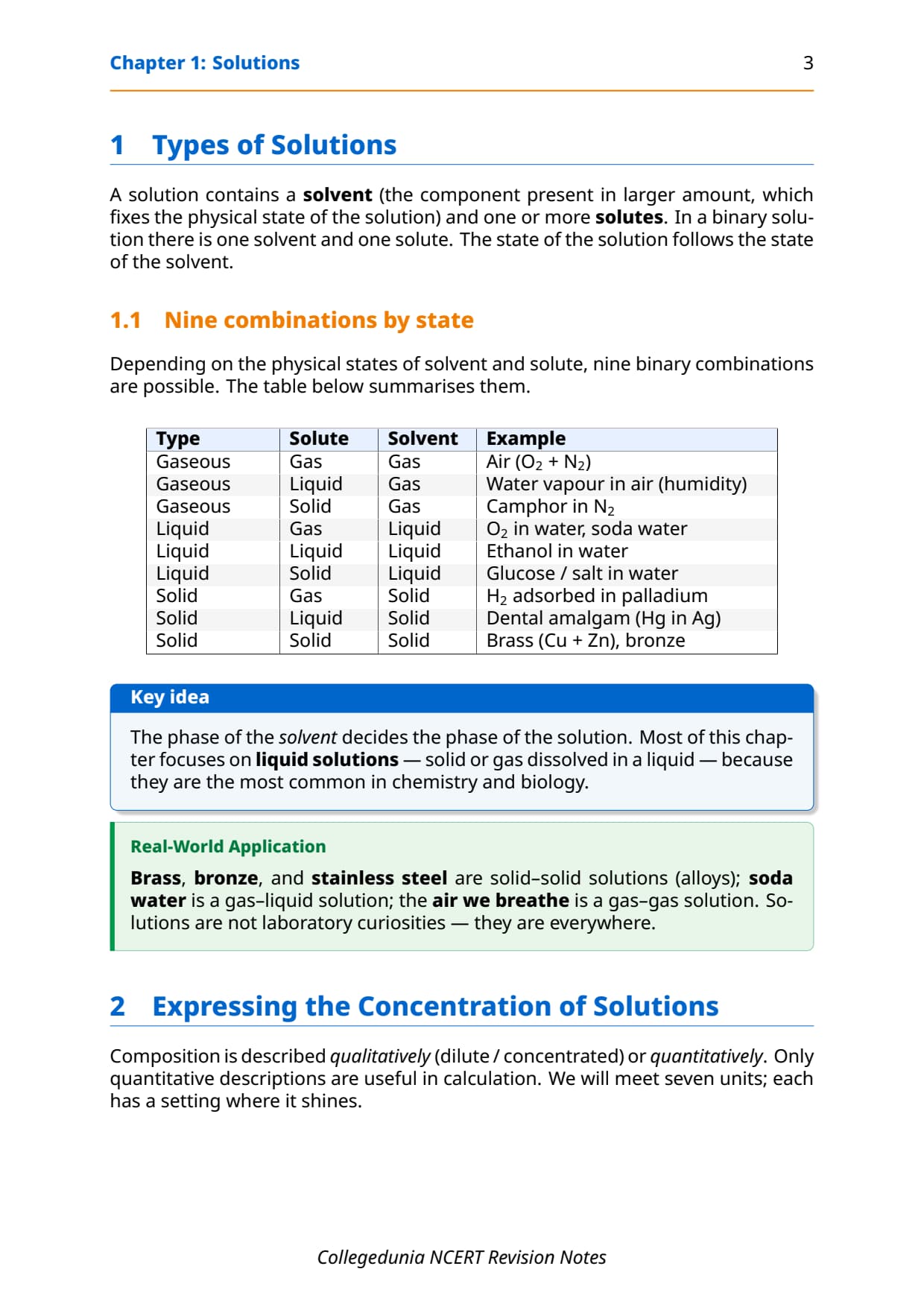
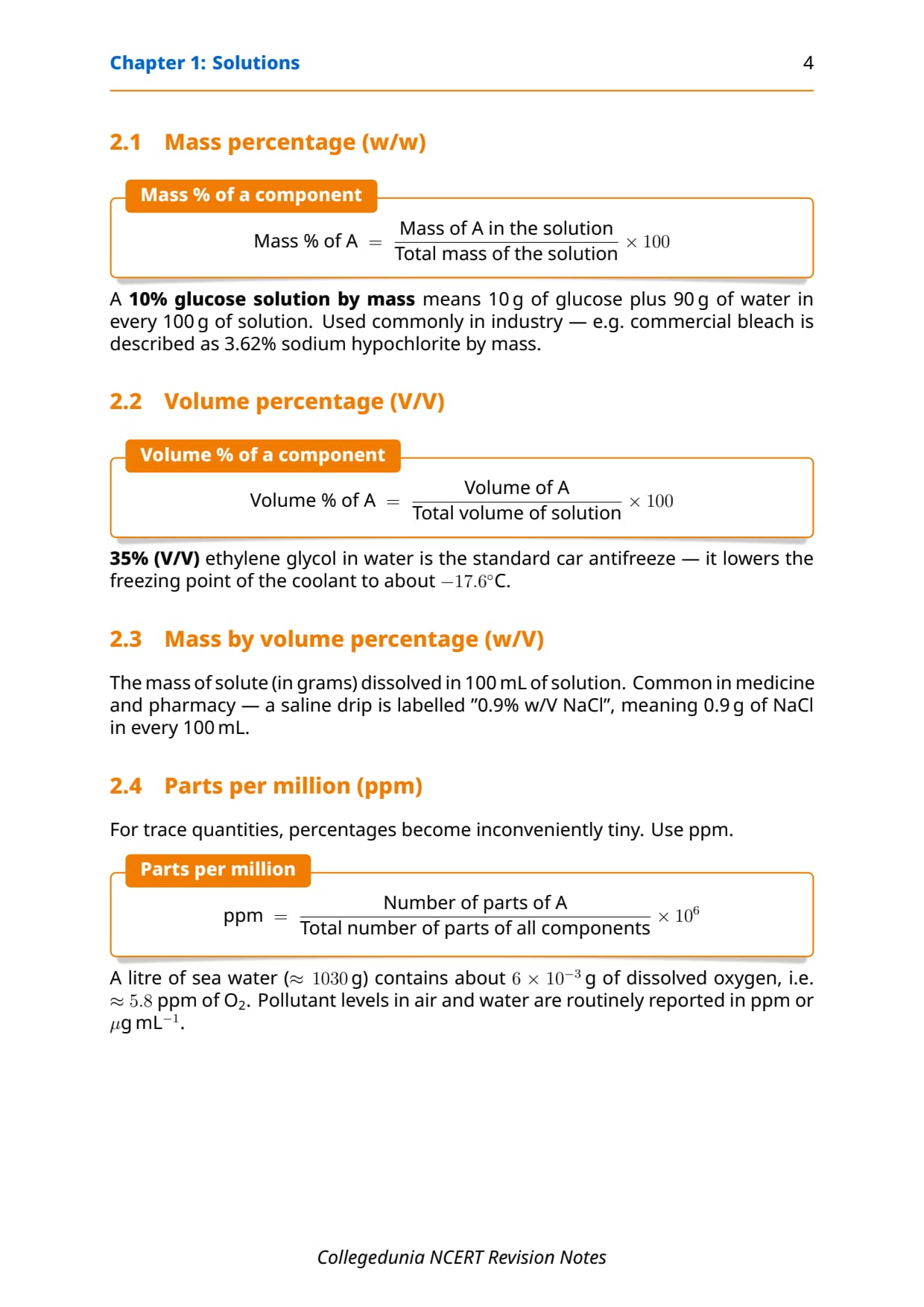
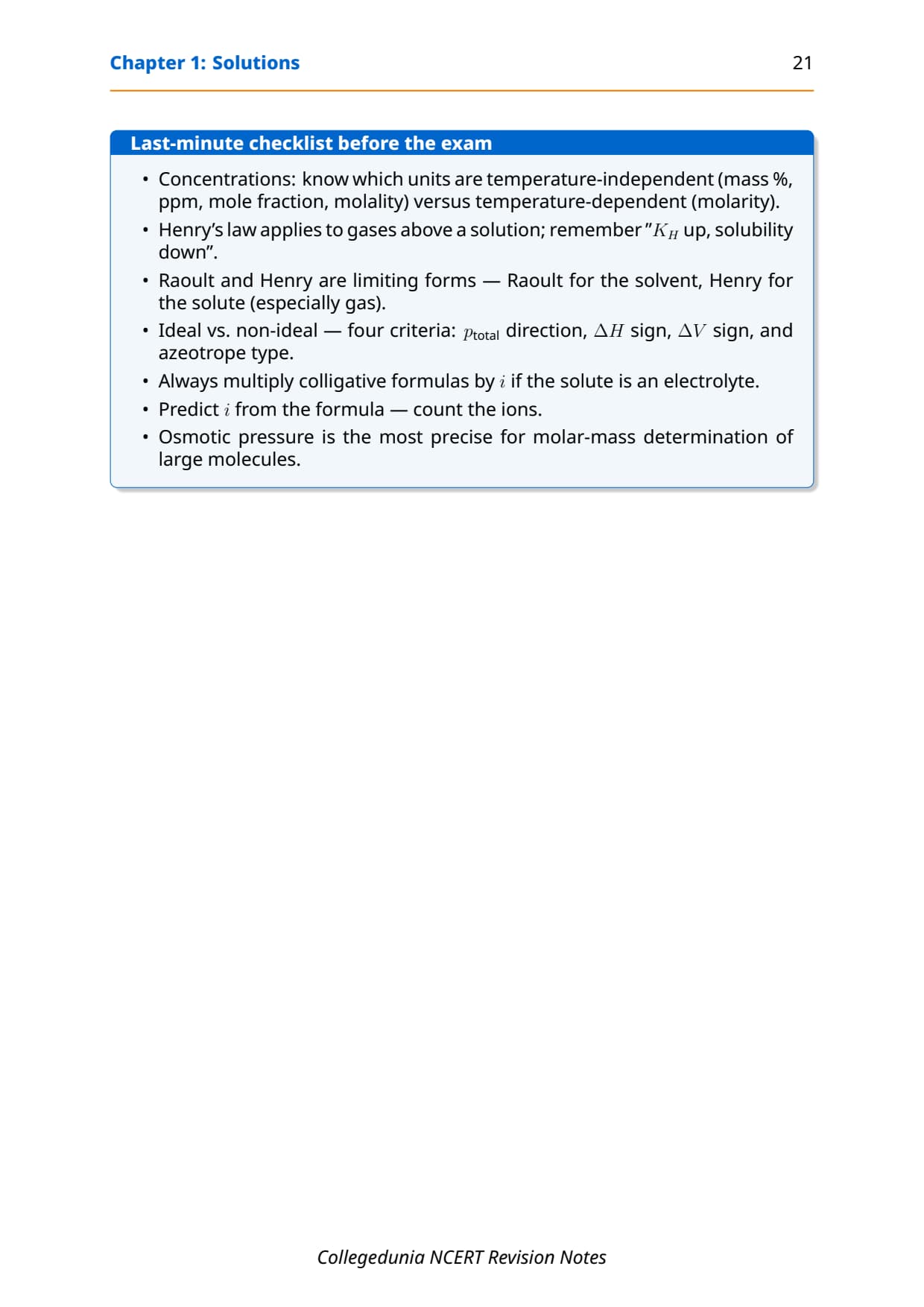
This page hosts the notes PDF, sub-topic weightage, key derivations, and the latest CBSE question pattern.
- CBSE Weightage: 6 to 8 marks, usually one short-answer plus one numerical on Raoult's law or colligative properties
- JEE Main Weightage: 3 to 4% (1 to 2 questions per shift on van't Hoff factor, osmotic pressure, or molarity-molality conversion)
- NEET Weightage: 2 to 3 questions per year, mostly colligative properties and concentration units
The Notes below cover every derivation, formula, and sub-topic weightage, mapped to the 2026-27 NCERT and the last five years of CBSE, JEE, and NEET papers.
Solutions Topic-wise Weightage for CBSE Class 12 Chemistry
This table maps each sub-topic to its CBSE frequency over five Board cycles. Give the High rows most of your revision time.
| Sub-topic | Weightage | CBSE Frequency |
|---|---|---|
| Colligative properties and molar mass determination | High | Every year (2021-2025) |
| Raoult's law and ideal/non-ideal solutions | High | 4 out of last 5 years |
| van't Hoff factor and abnormal molar mass | Medium | 3 out of last 5 years |
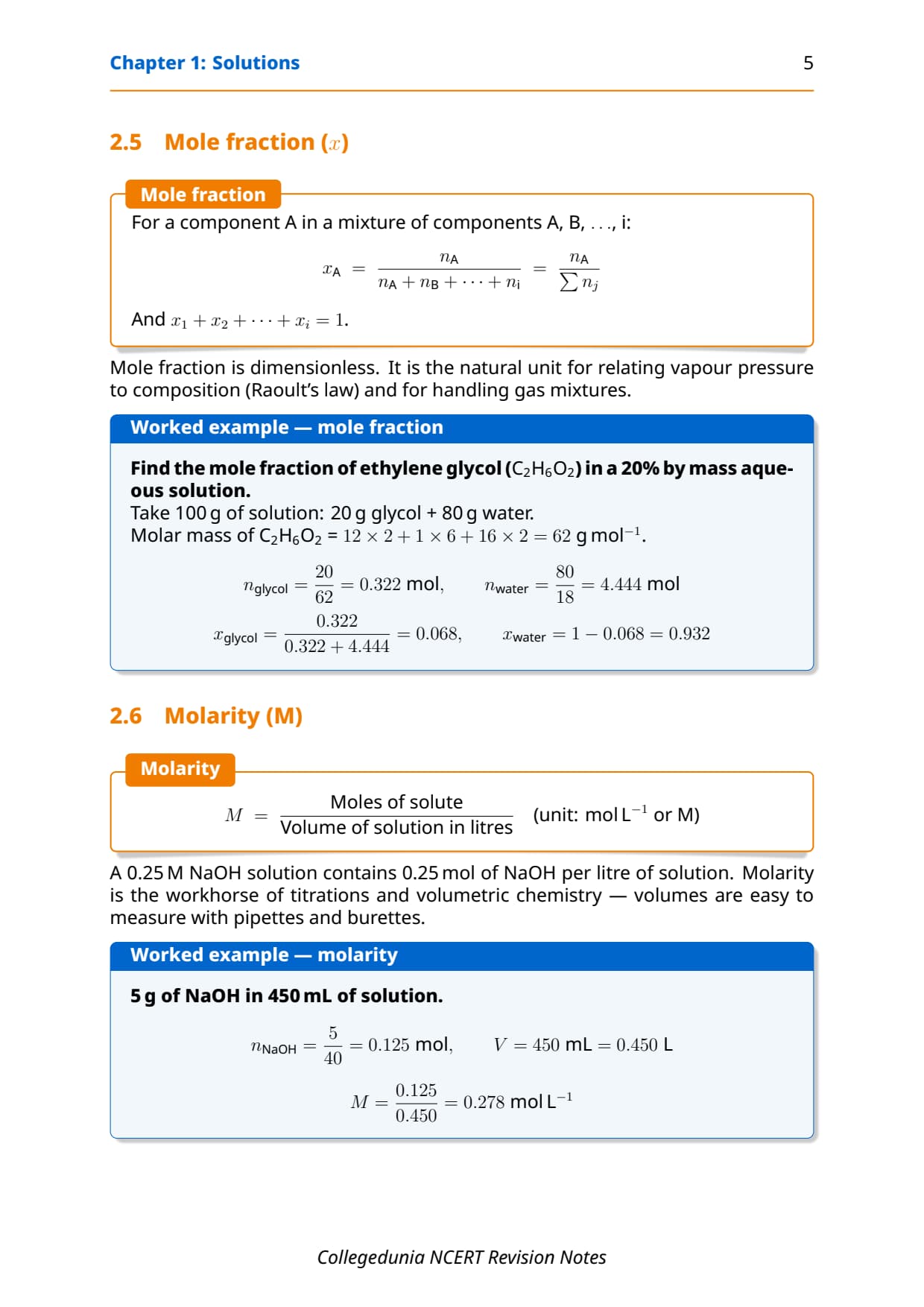
| Concentration units (molarity, molality, mole fraction) | Medium | 3 out of last 5 years (numerical-only) |
| Henry's law and gas solubility | Medium | 2 out of last 5 years |
| Types of solutions and solubility of solids in liquids | Low | 1 out of last 5 years (1-mark MCQ) |
Solutions Class 12 Chemistry Video Lecture
Source: Magnet Brains on YouTube
Class 12 Chemistry Chapter 1 Solutions: Full Concept Notes
Each sub-section stays within the 2026-27 NCERT scope, with worked numericals and tips where students slip up.
Types of Solutions and Concentration Units
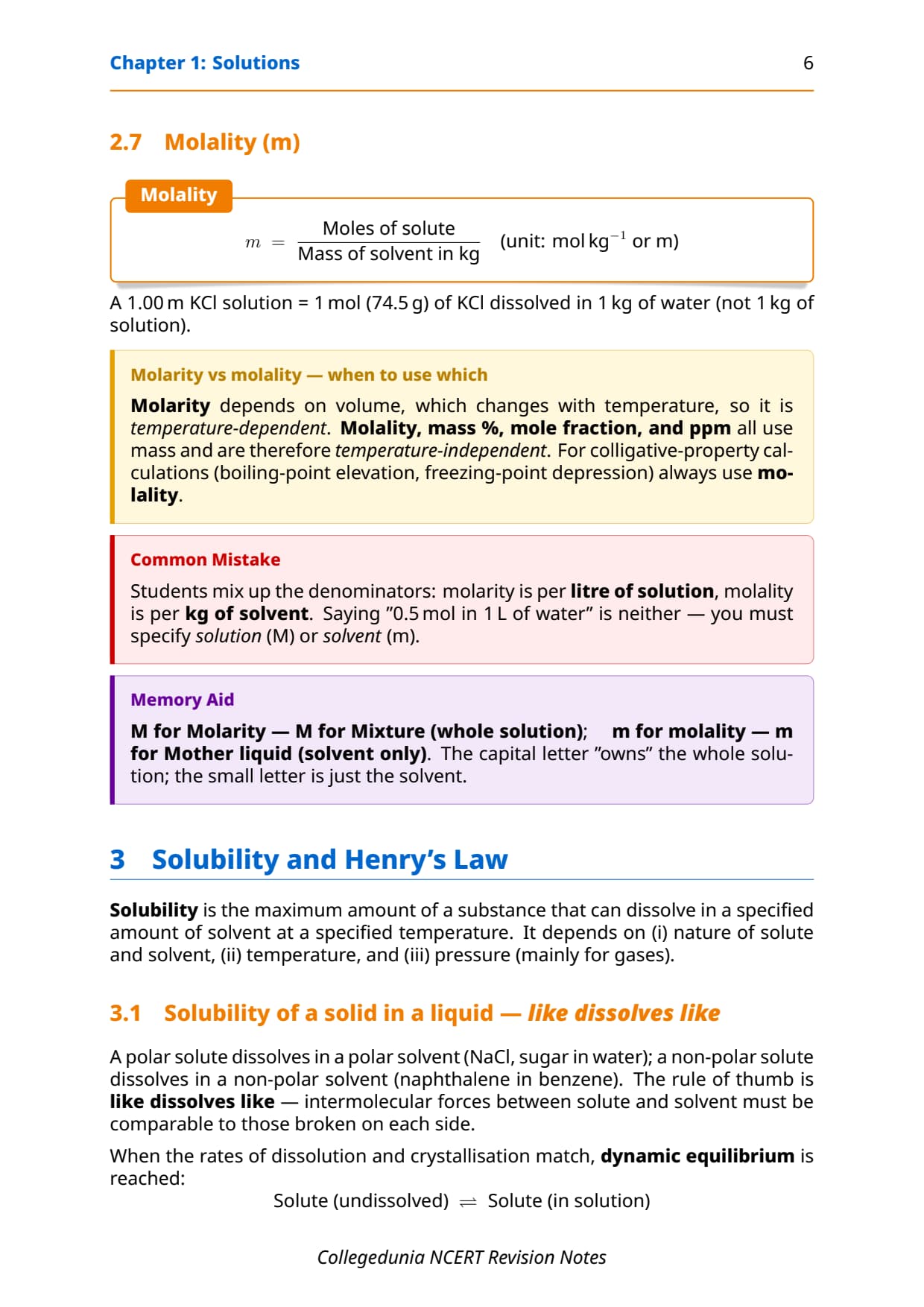
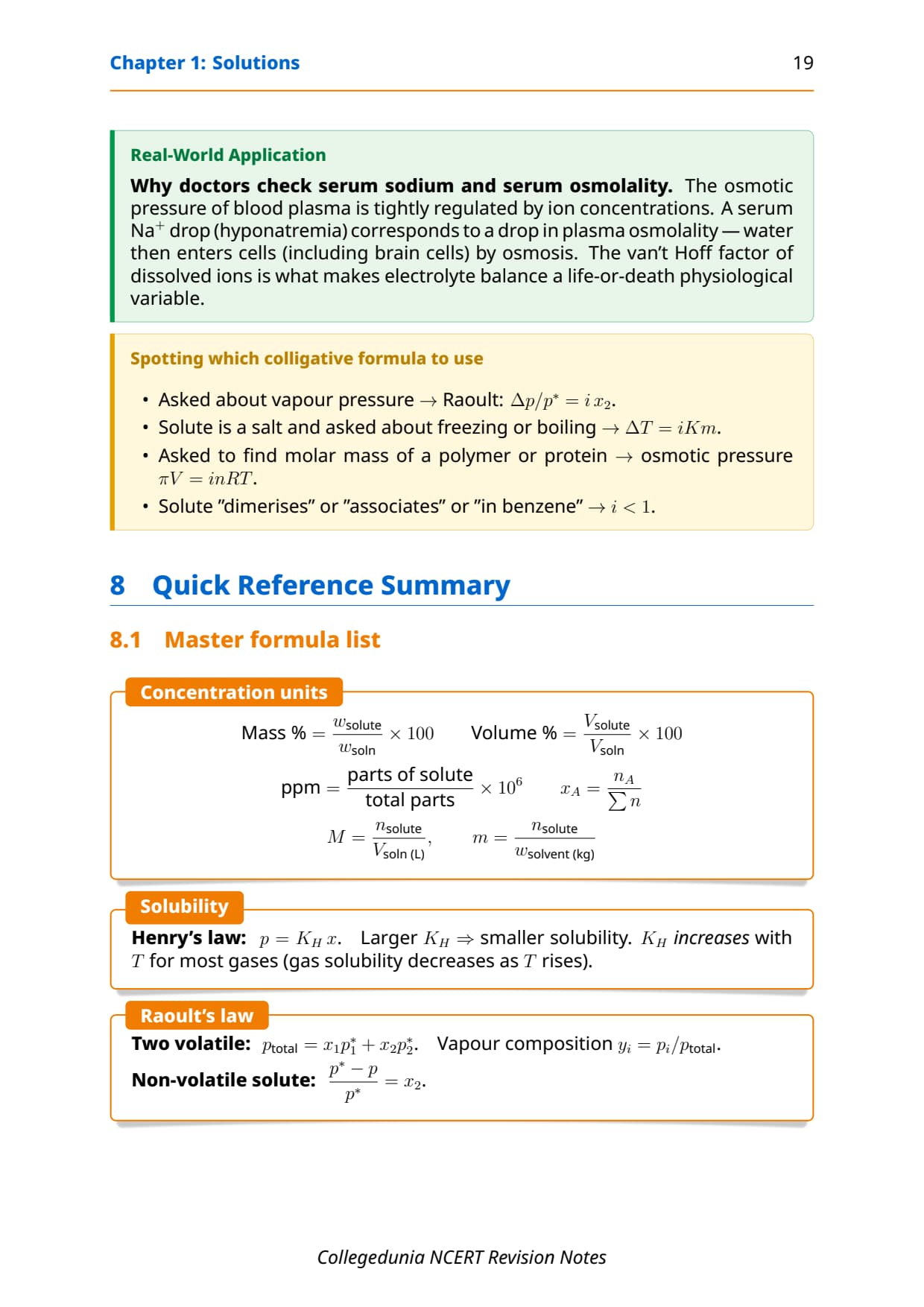
A solution is a homogeneous mixture whose larger component is the solvent. Four units matter: mass percent, mole fraction x , molarity M = nsolute / Vsolution (L) , and molality m = nsolute / msolvent (kg) . Molality is preferred for colligative work as it is temperature-independent.
Solubility and Henry's Law
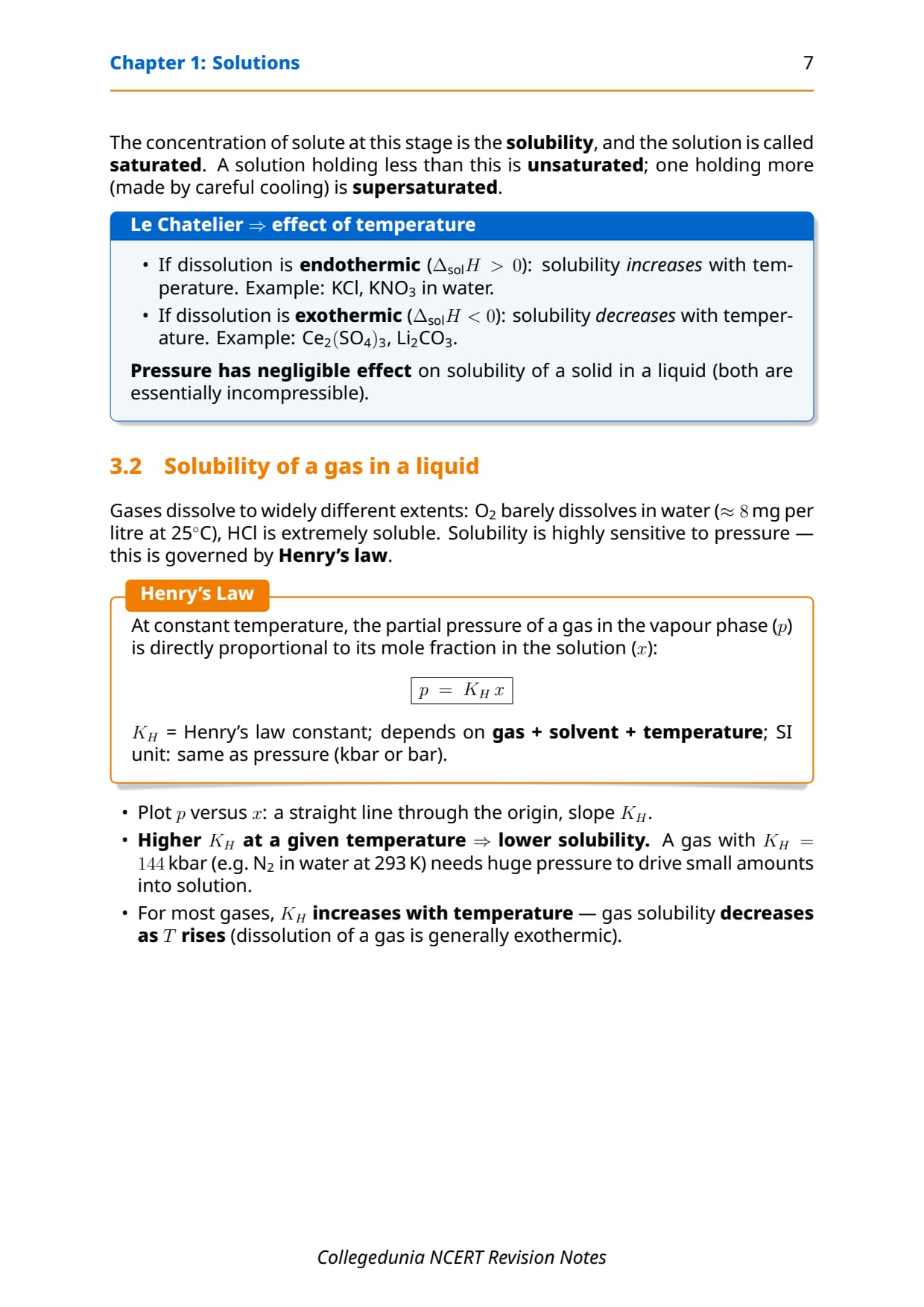
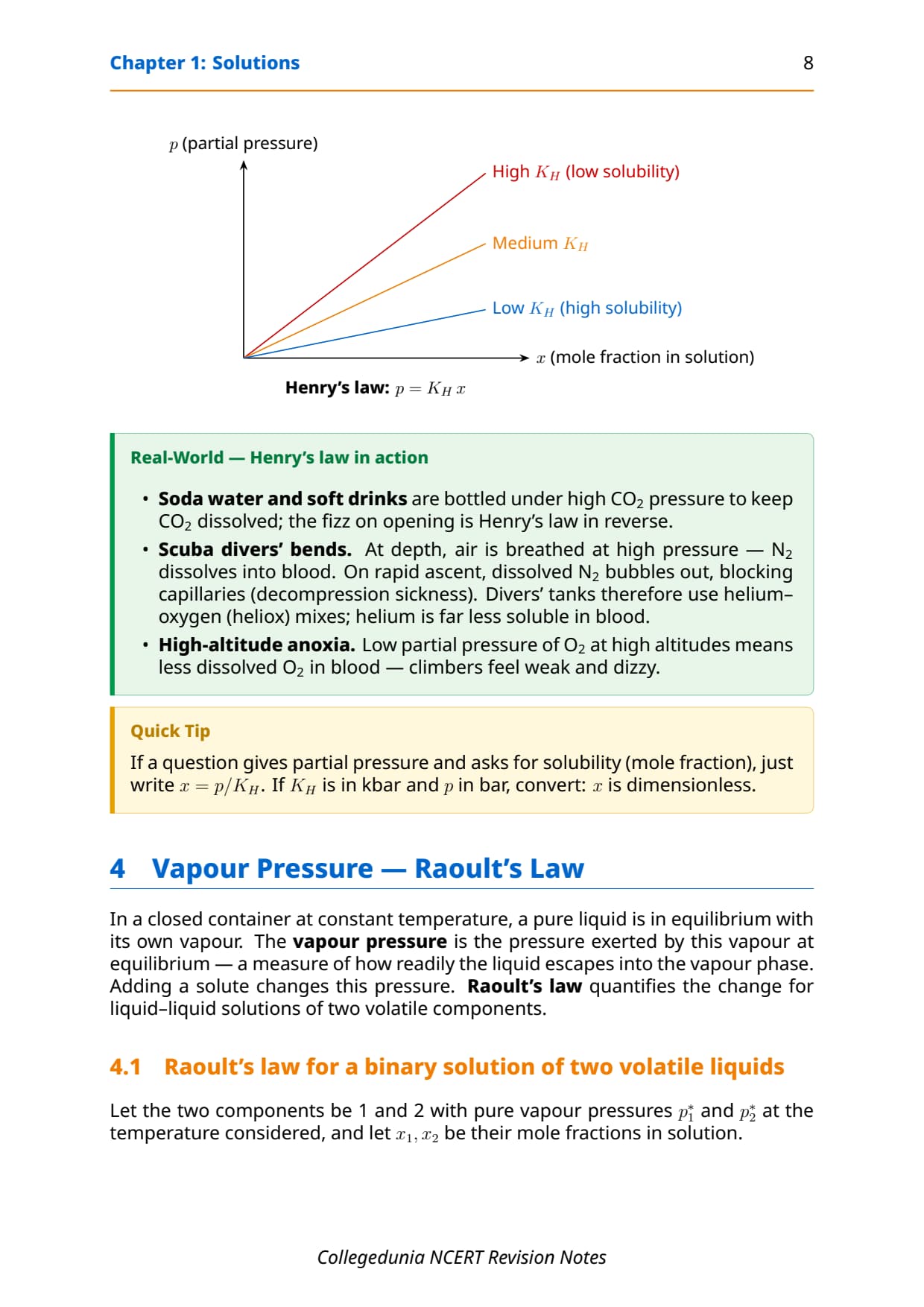
Solid solubility follows "like dissolves like" and rises with temperature for endothermic dissolution. Gas solubility follows Henry's law: p = KH · x , so higher KH means lower solubility. It explains diver bends, drink fizz, and altitude sickness.
Raoult's Law and Vapour Pressure
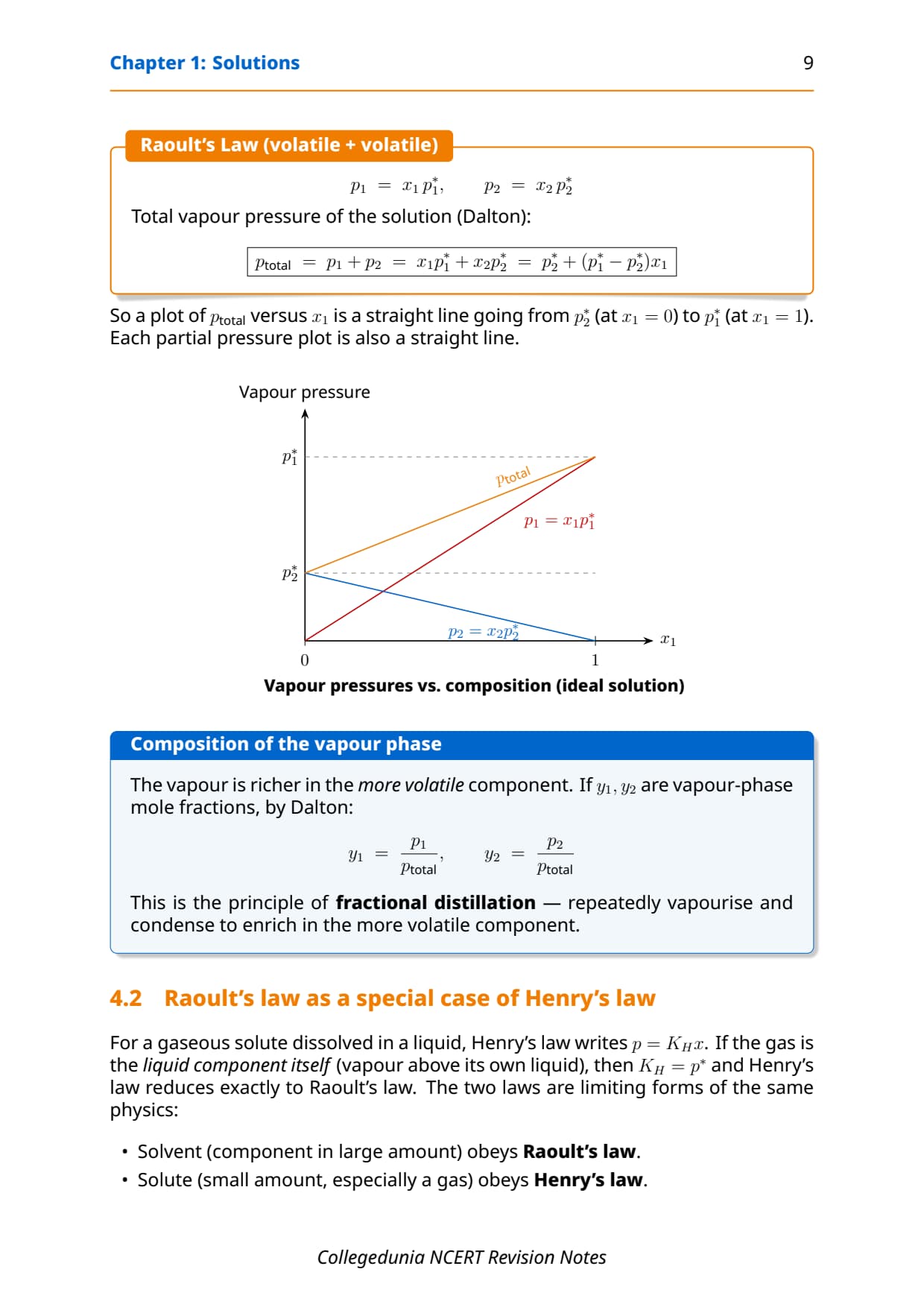
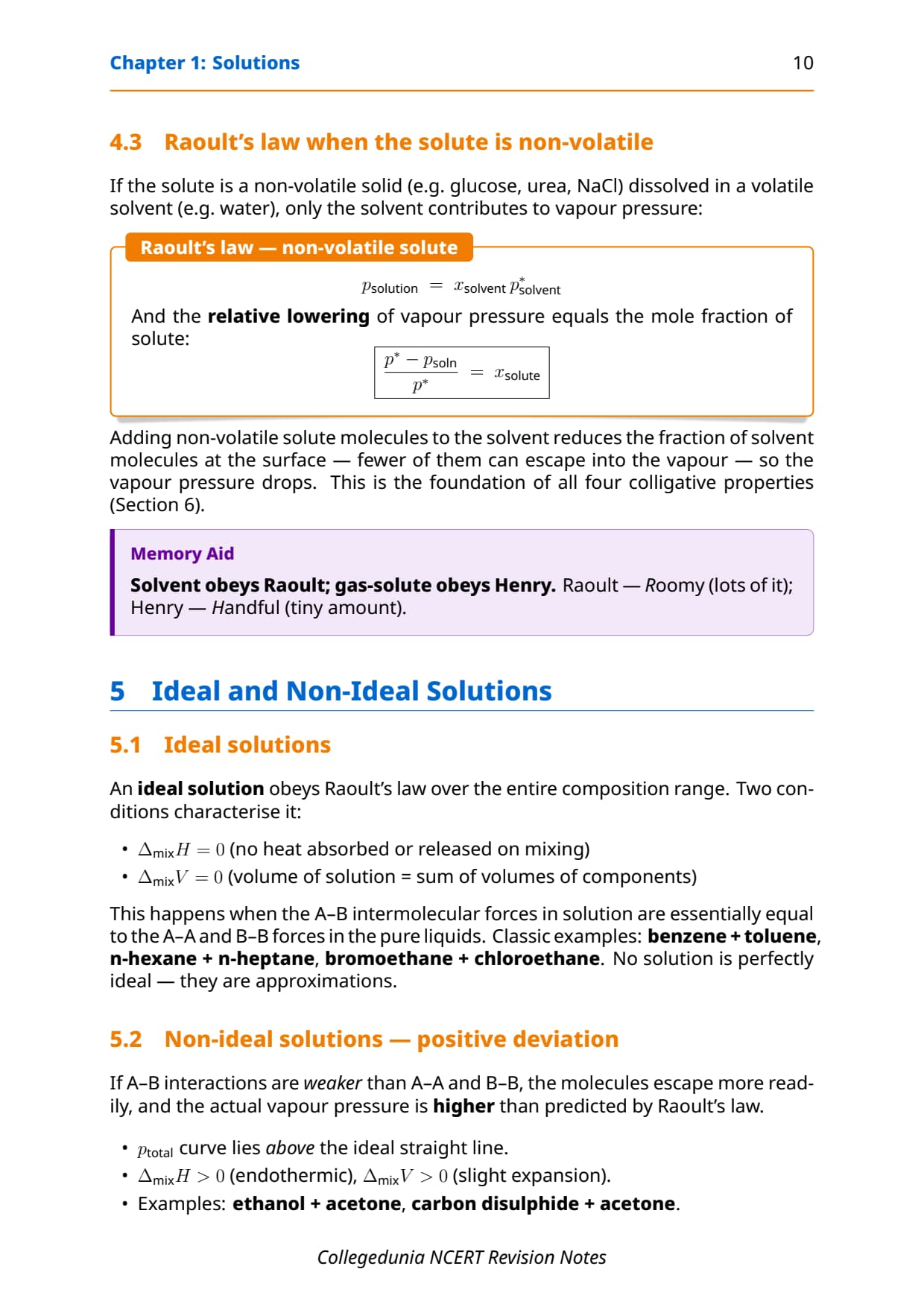
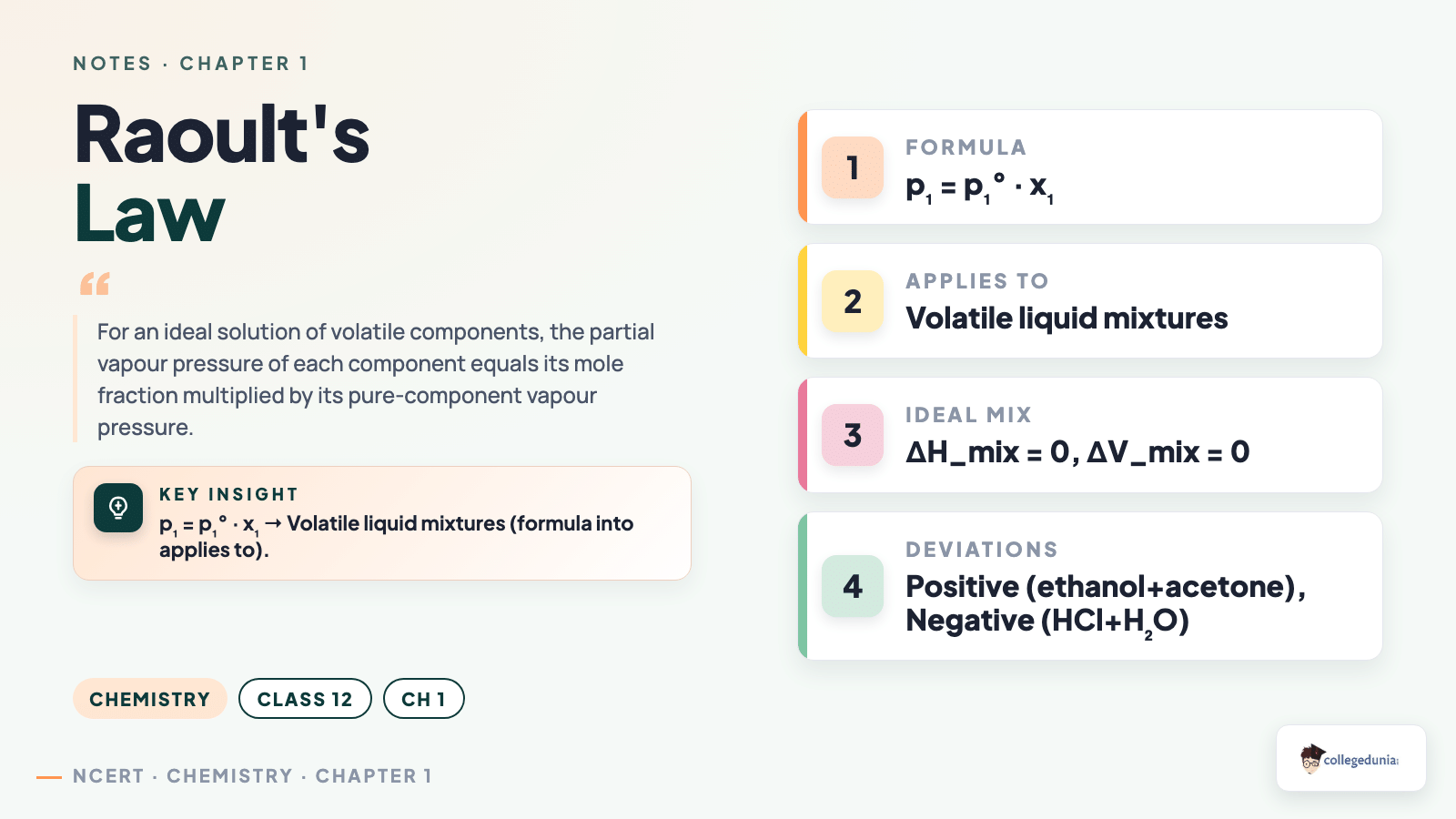
For two volatile liquids, Raoult's law gives p1 = p1∘ x1 and p2 = p2∘ x2 . For a non-volatile solute, this reduces to (p1∘ - p1) / p1∘ = x2 , the form CBSE asks most often.
Ideal and Non-Ideal Solutions, Azeotropes
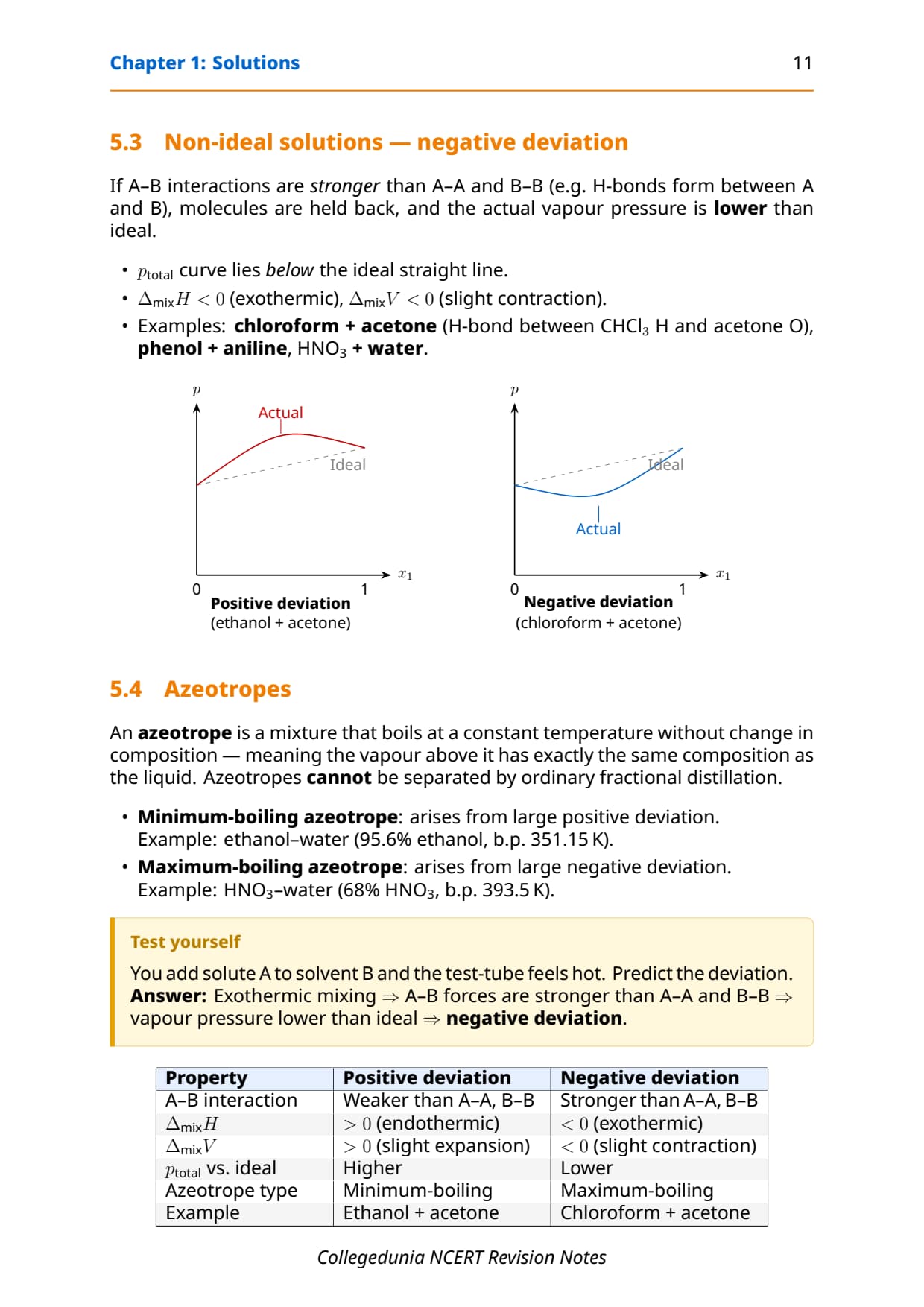
Ideal solutions obey Raoult's law with Δ Hmix = 0 (n-hexane + n-heptane). Non-ideal solutions show positive deviation (acetone + ethanol) or negative deviation (chloroform + acetone). Azeotropes boil at constant composition: minimum-boiling from large positive deviation, maximum-boiling from large negative.
Colligative Properties
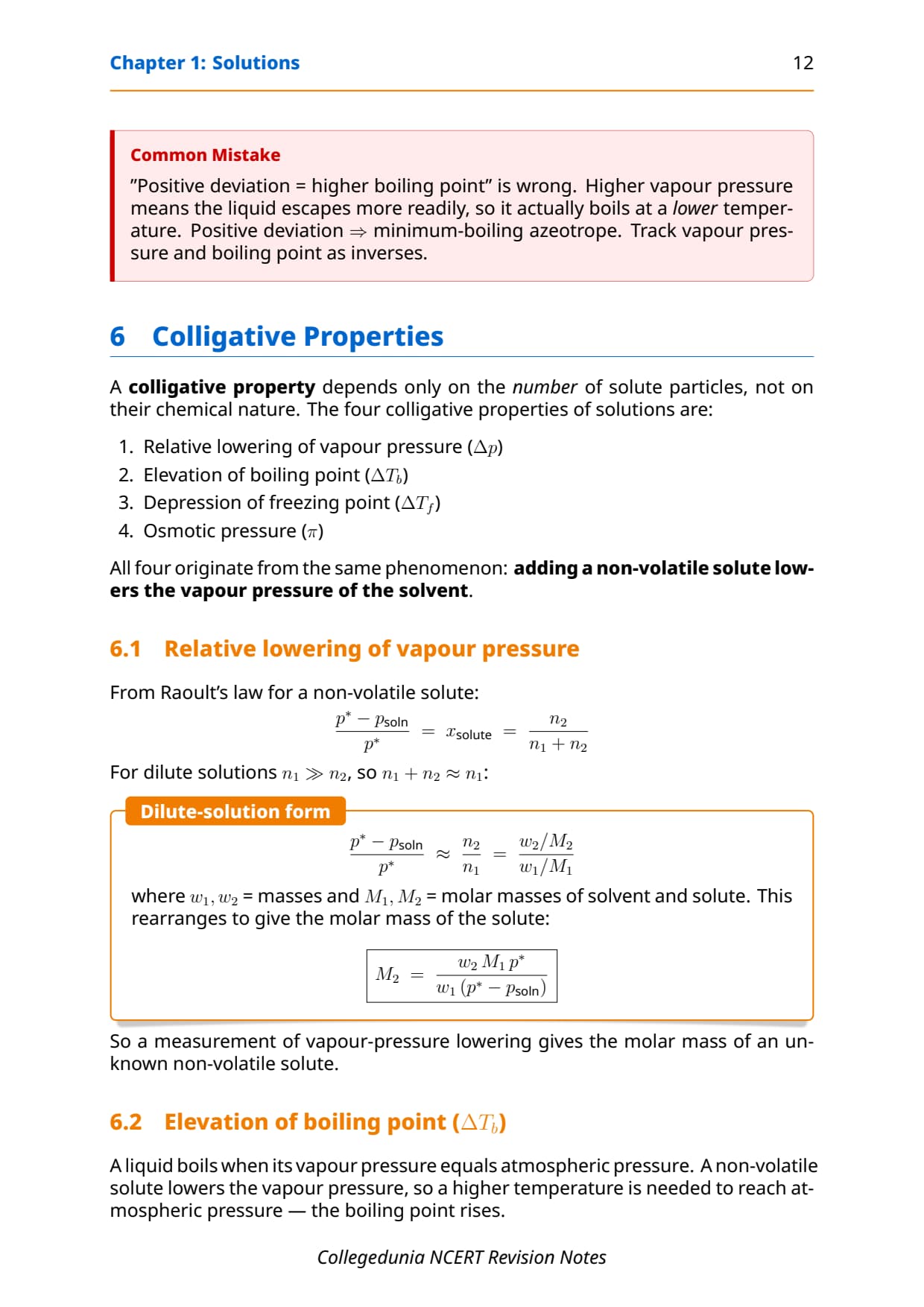
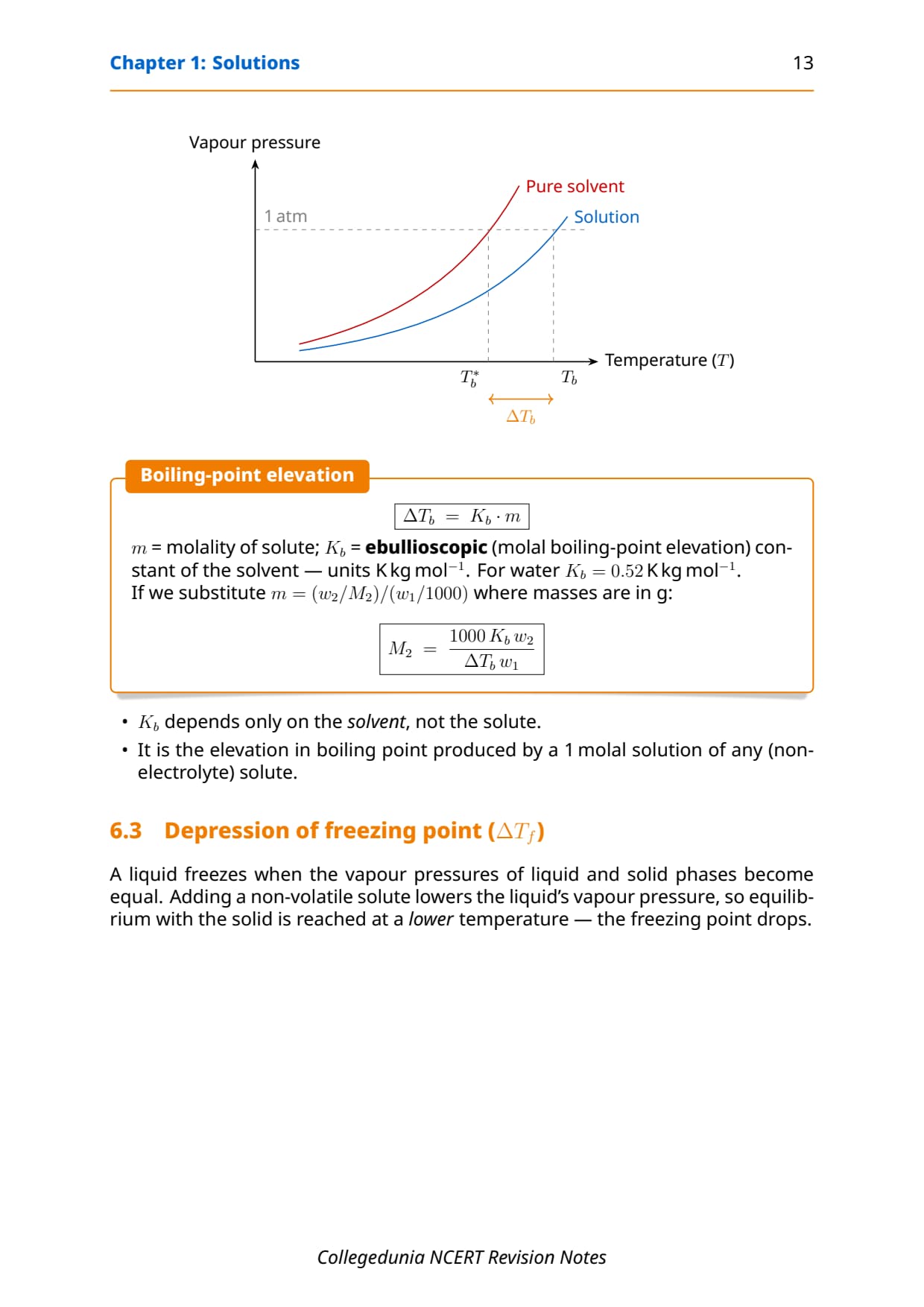
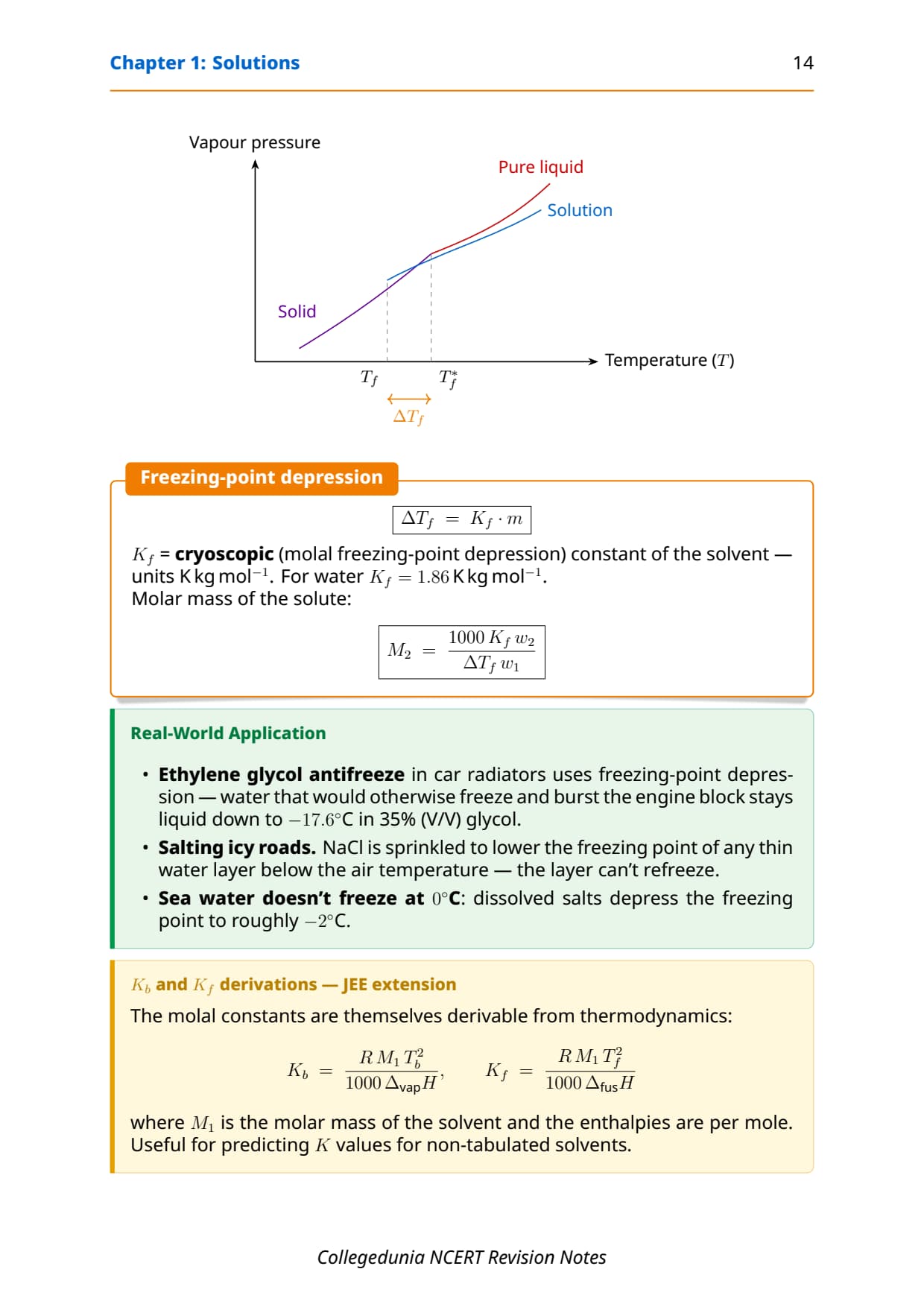
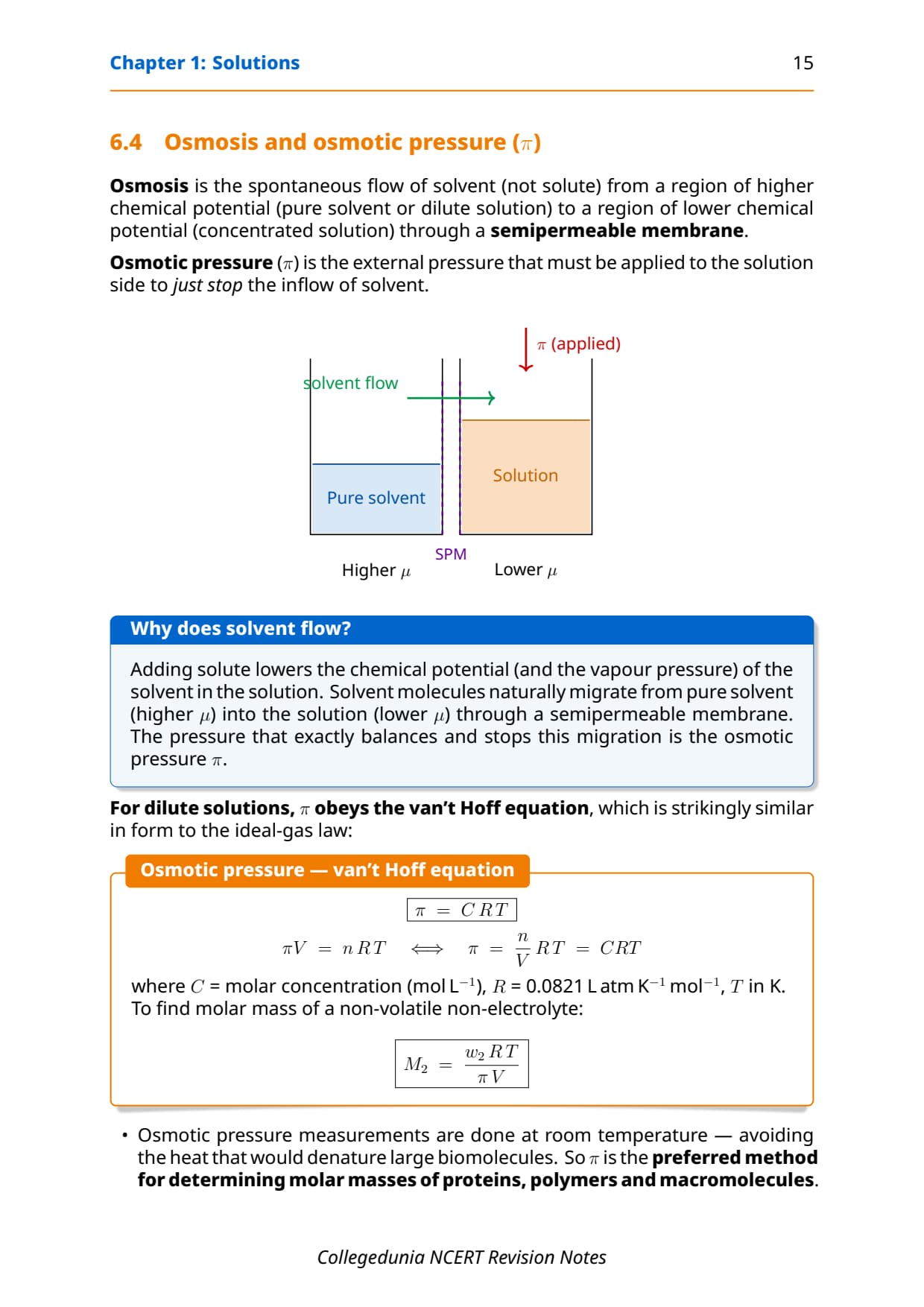
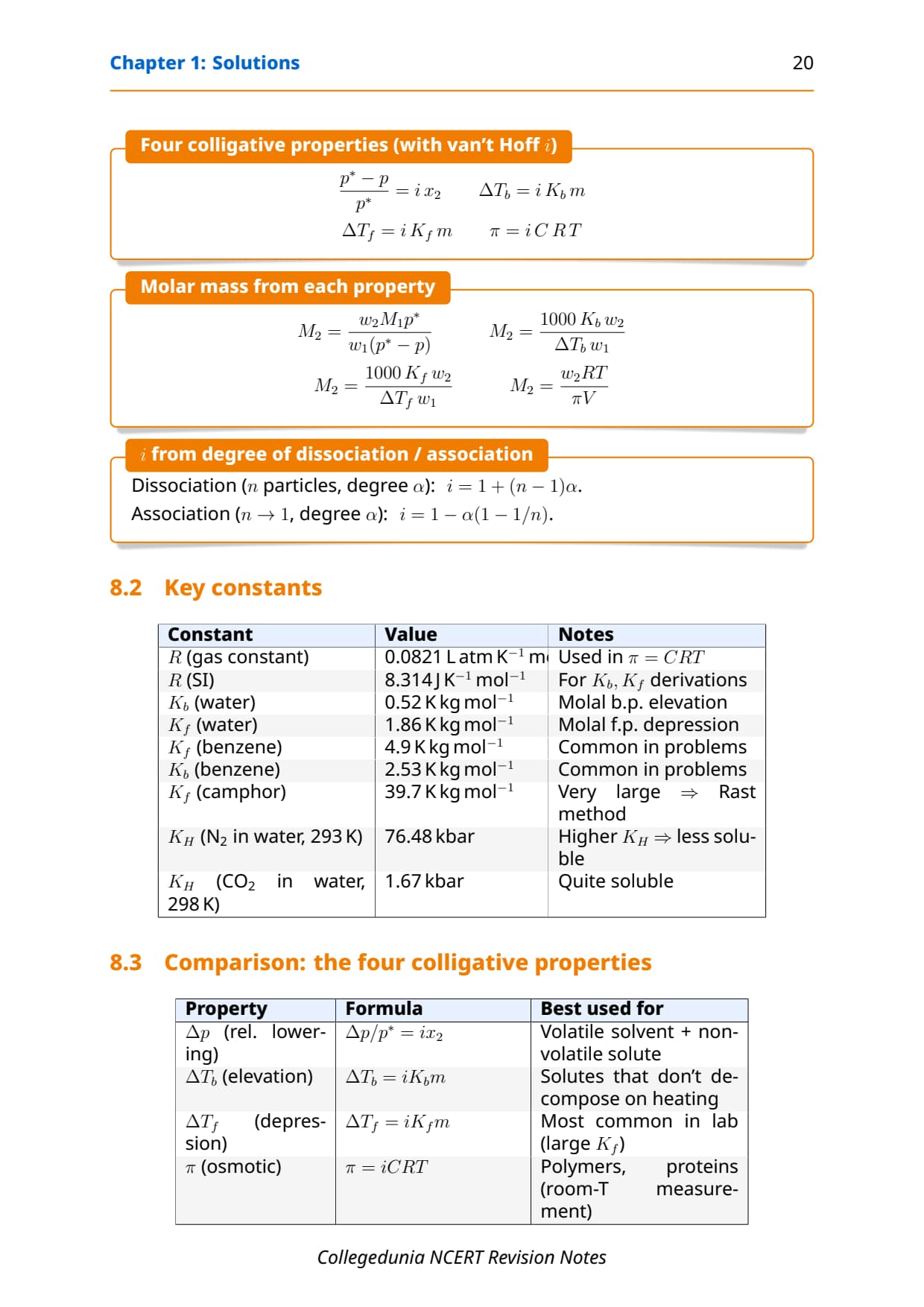
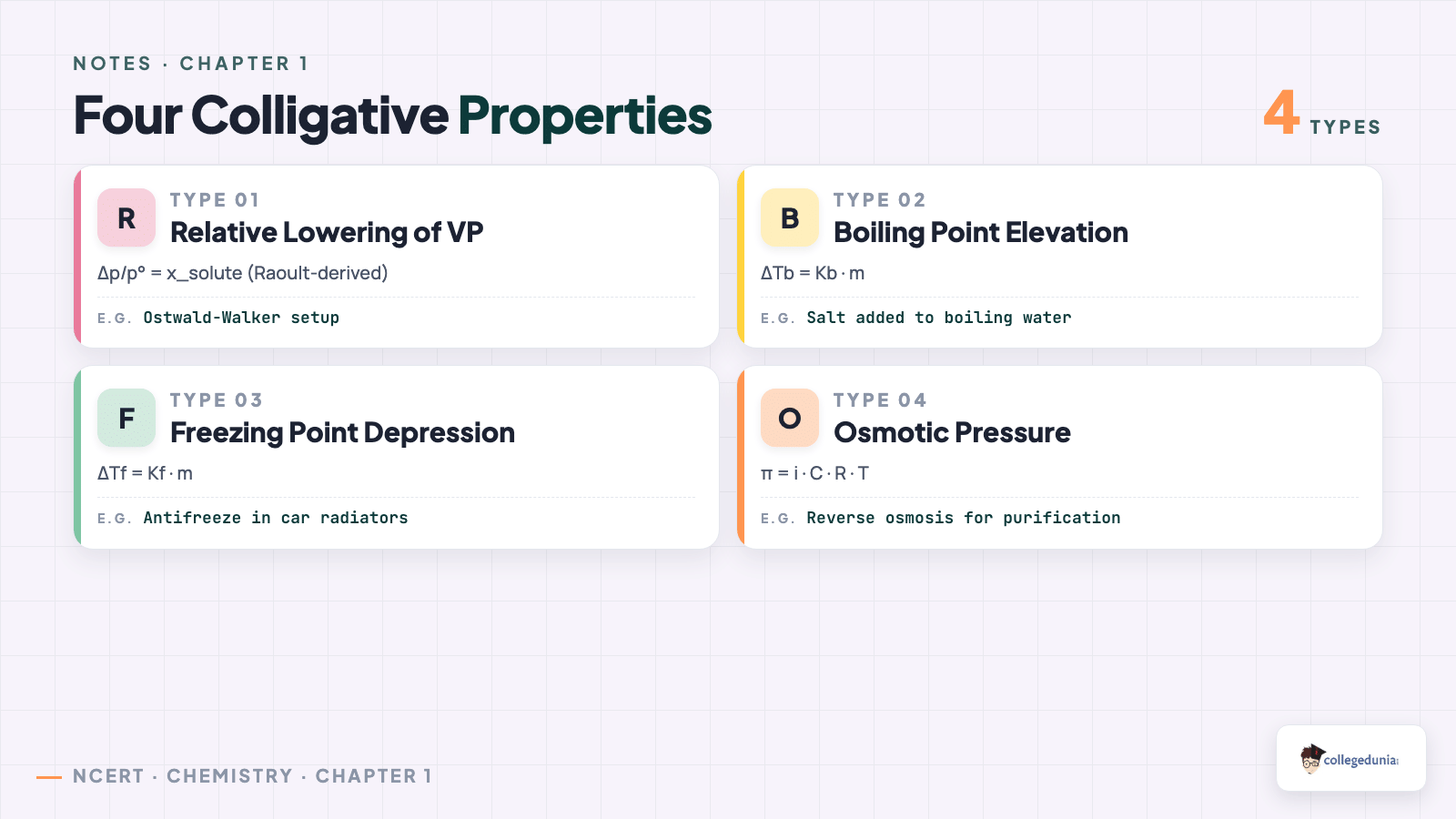
Four properties depend only on the number of solute particles: relative lowering of vapour pressure, Δ Tb = Kb m , Δ Tf = Kf m , and osmotic pressure π = CRT . Osmotic pressure suits biomolecules, where dilute solutions still read well.
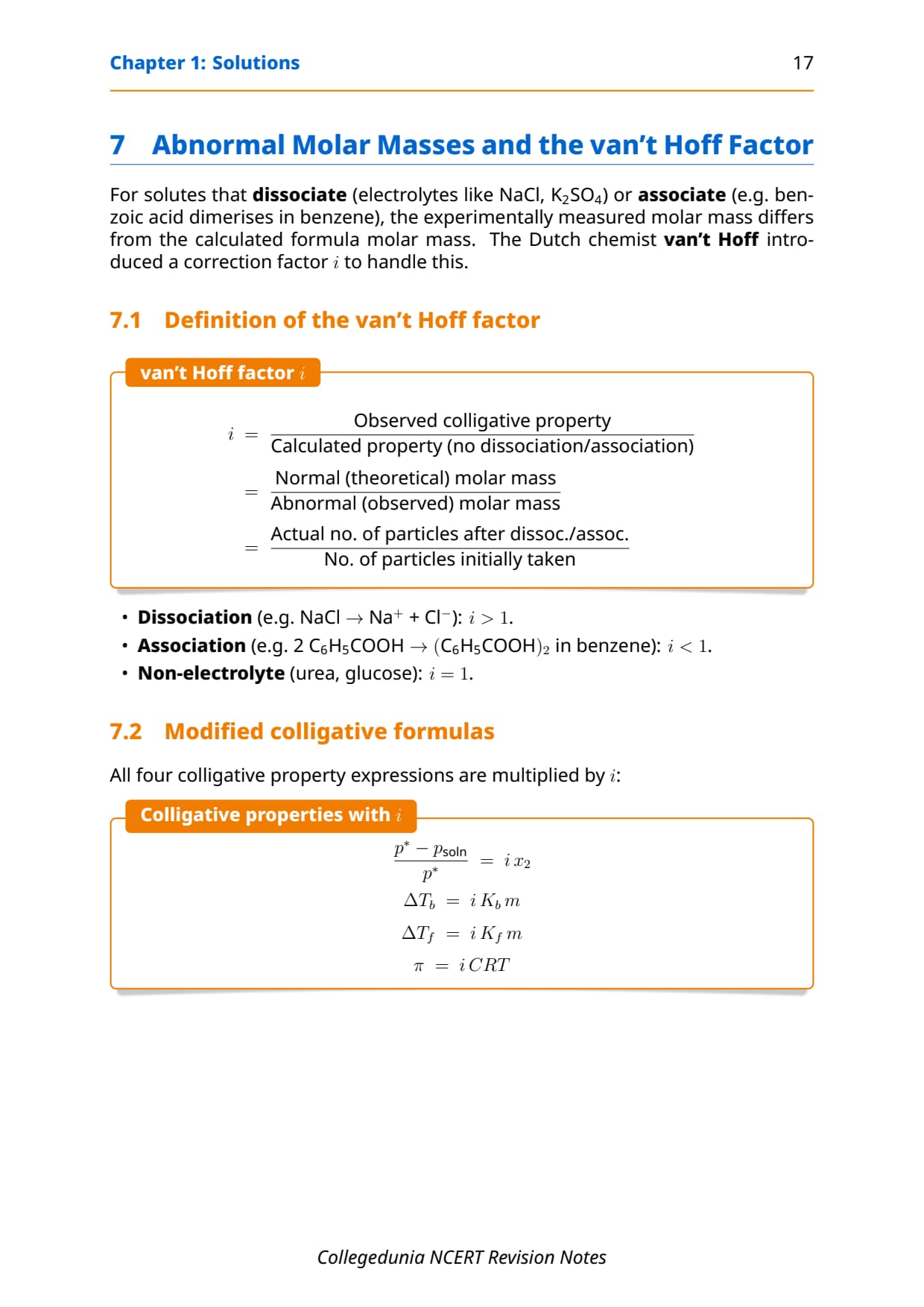
van't Hoff Factor and Abnormal Molar Mass
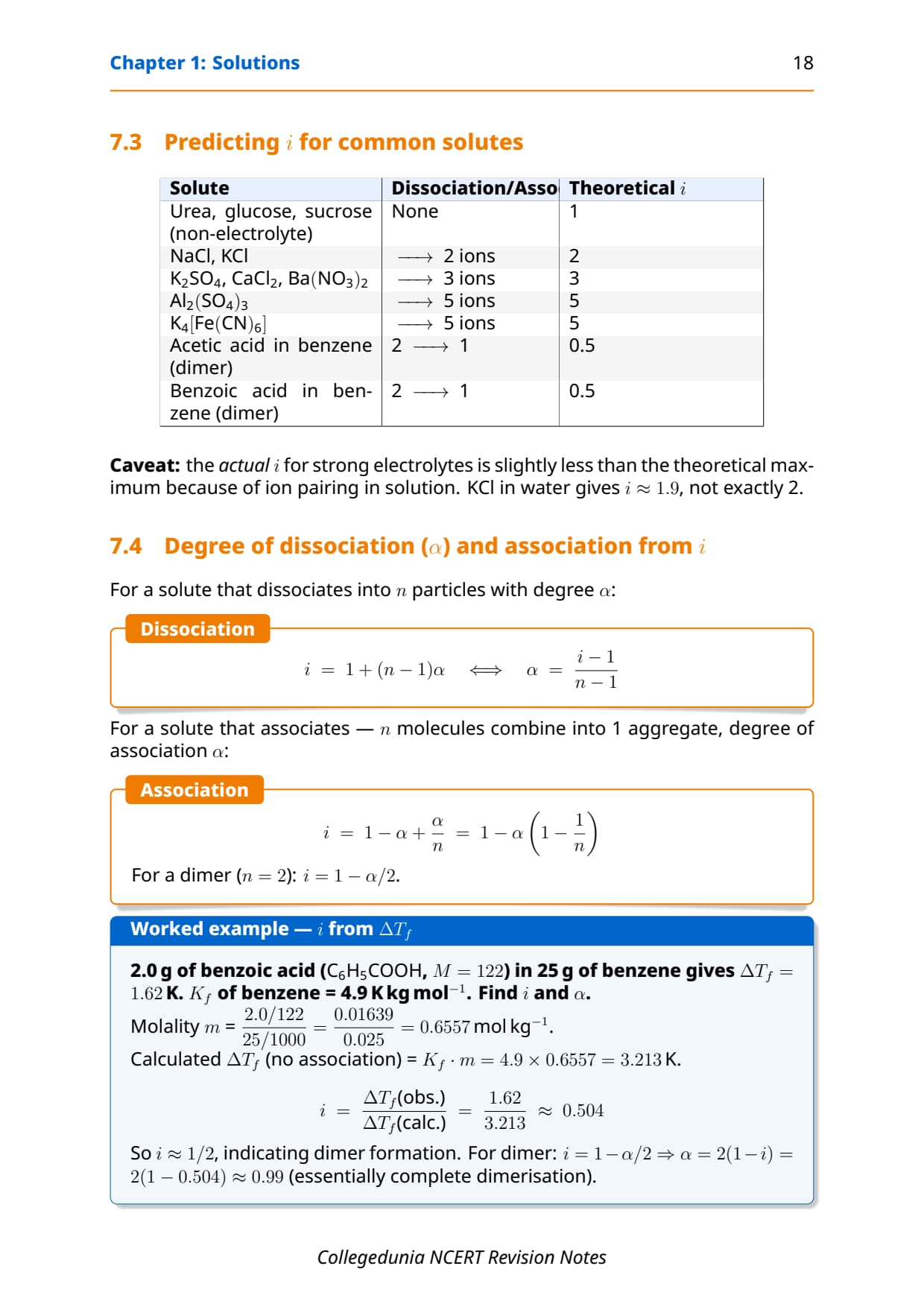
For dissociating solutes (NaCl, K4[Fe(CN)6]) or associating ones (benzoic acid in benzene), the van't Hoff factor i = 1 + (n-1)α corrects every formula: π = iCRT , Δ Tb = iKb m , Δ Tf = iKf m .
Solutions Important Derivations for Class 12 Boards
These six derivations are the spine of the chapter. At least one appears every CBSE year.
- Raoult's law for non-volatile solute: proves (p1∘ - p1)/p1∘ = x2 -- CBSE 2024, 2022, 2021
- Boiling-point elevation and Kb : Δ Tb = Kb m via Clausius-Clapeyron -- CBSE 2025, 2023
- Freezing-point depression and Kf : Δ Tf = Kf m -- CBSE 2024, 2022
- Osmotic pressure and van't Hoff equation: π V = nRT by gas-law analogy -- CBSE 2025, 2023, 2021
- van't Hoff factor and degree of dissociation: i = 1 + (n-1)α -- CBSE 2024, JEE Main 2024 (Jan shift)
- Henry's constant temperature dependence: KH rises with temperature for most gases -- CBSE 2022
How will Collegedunia's Notes Help You with Solutions?
- 2026-27 NCERT aligned: older Polymers and Surface Chemistry units flagged as out of scope.
- Worked numericals: one full solution per colligative property, with step tags.
- Last-day recap: a two-page strip of every formula, constant, and top CBSE question stem.
Solutions Class 12 Chemistry Previous Year Questions Trend
These three topics repeat most across CBSE, JEE Main, and NEET. The full year-by-year map is on the NCERT Solutions page.
| Topic | Years repeated | Exams |
|---|---|---|
| Boiling-point elevation / freezing-point depression numerical | 2025, 2024, 2023, 2022 | CBSE, JEE Main, NEET |
| van't Hoff factor for ionic solutes | 2025, 2024, 2022 | CBSE, JEE Main |
| Henry's law conceptual / numerical | 2025, 2023, 2021 | CBSE, NEET |
Full year-wise PYQ map: Solutions Class 12 Chemistry NCERT Solutions
Solutions Top 5 Formulae for Quick Recall
These five cover almost every CBSE numerical since 2021; the full master table is on the Formula Sheet.
| Quantity | Formula |
|---|---|
| Molality | m = nsolute / msolvent (kg) |
| Relative lowering of vapour pressure | (p1∘ - p1)/p1∘ = x2 |
| Boiling-point elevation | Δ Tb = i Kb m |
| Freezing-point depression | Δ Tf = i Kf m |
| Osmotic pressure | π = i C R T |
Full master table: Solutions Class 12 Chemistry Formula Sheet
Solutions Common Misconceptions Class 12 Students Carry
Four traps catch even bright students. One slip can cost 4 to 5 marks, so fix them before the Board paper.
- Mole fraction has no units. Never write "mol/mol" in a CBSE answer.
- Henry's constant KH is inverse to solubility. High KH means poor solubility.
- For benzoic acid in benzene, i < 1 . It dimerises, so particles drop below formula count.
- Osmotic pressure uses molar concentration C. All other colligative formulas use molality.
Solutions Real-World Applications for Class 12 Chemistry
These keep coming back on CBSE assertion-reason questions. Memorise the "why" with each.
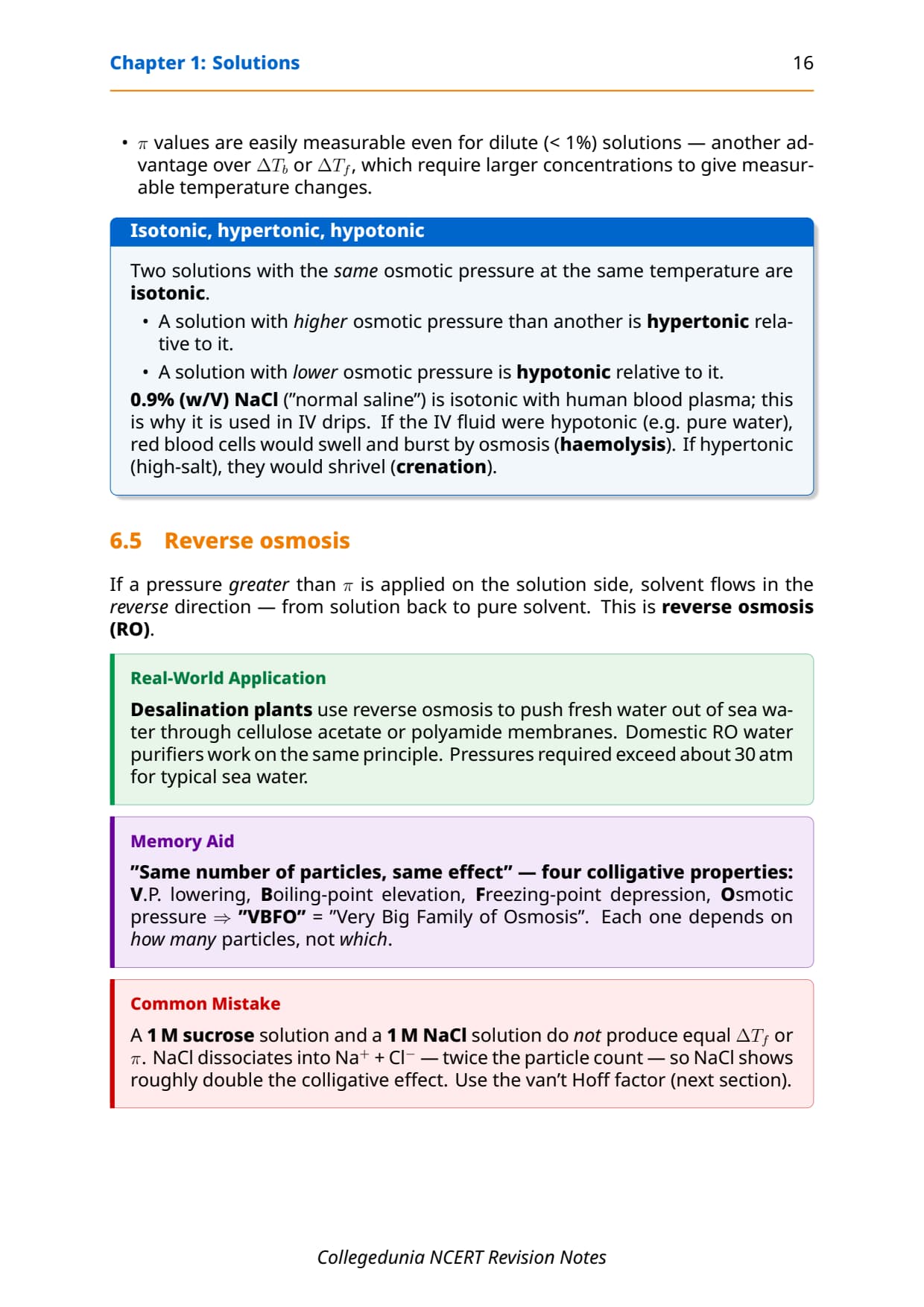
- Reverse osmosis: sea water is pushed through a membrane above its osmotic pressure (~30 atm), leaving salt behind.
- Antifreeze: ethylene glycol drops water's freezing point to about -36 °C at 50% w/w.
- Salt on icy roads: calcium chloride ( i ≈ 3 ) melts ice faster than NaCl at the same mass.
- IV fluids: 0.9% saline is isotonic with blood, so cells neither swell nor shrink.
Student Feedback
In a Collegedunia poll of 1,150 Class 12 students, 78% said the worked colligative-property numericals were the most useful part of these Notes, and 4 in 5 kept the last-day recap strip open during revision.
Other Resources for Solutions Class 12 Chemistry
| Resource | Link |
|---|---|
| NCERT Solutions | Solutions Class 12 Chemistry NCERT Solutions |
| Formula Sheet | Solutions Class 12 Chemistry Formula Sheet |
| NCERT Book PDF | Solutions Class 12 Chemistry NCERT Book PDF |
| NCERT Exemplar Book PDF | Solutions Class 12 Chemistry NCERT Exemplar Book PDF |
| NCERT Exemplar Solutions | Solutions Class 12 Chemistry NCERT Exemplar Solutions |
| Handwritten Notes | Solutions Class 12 Chemistry Handwritten Notes |
| Notes | Solutions Class 12 Chemistry Notes |
NCERT Notes for Class 12 Chemistry: All Chapters
Use this table to jump to the Notes PDF for any other Class 12 Chemistry chapter once you finish Solutions.
| Chapter | Resource |
|---|---|
| Chapter 1 | Solutions Notes |
| Chapter 2 | Electrochemistry Notes |
| Chapter 3 | Chemical Kinetics Notes |
| Chapter 4 | The d- and f-Block Elements Notes |
| Chapter 5 | Coordination Compounds Notes |
| Chapter 6 | Haloalkanes and Haloarenes Notes |
| Chapter 7 | Alcohols, Phenols and Ethers Notes |
| Chapter 8 | Aldehydes, Ketones and Carboxylic Acids Notes |
| Chapter 9 | Amines Notes |
| Chapter 10 | Biomolecules Notes |
Solutions Class 12 Chemistry Notes FAQs
Ques. Where can I download Solutions Class 12 Chemistry Notes PDF?
Ans. You can download the Solutions Class 12 Chemistry Notes PDF directly from this page. Both the Normal and HD versions are available, and both are free. The Notes are written by Collegedunia subject experts and aligned to the 2026-27 NCERT.
Ques. Is this Notes PDF aligned with the 2026-27 NCERT for Class 12 Chemistry?
Ans. Yes. The Notes reflect the current 2026-27 syllabus for Class 12 Chemistry. The older units on Surface Chemistry, p-Block Elements, General Principles of Isolation of Metals, Polymers, and Chemistry in Everyday Life are no longer part of Chapter 1's scope and have been excluded.
Ques. How many pages is the Class 12th Chemistry Solutions Notes PDF?
Ans. The Notes PDF runs approximately 26 pages and covers every sub-topic in Chapter 1 Solutions: types of solutions, concentration units, solubility and Henry's law, Raoult's law, ideal and non-ideal solutions, azeotropes, the four colligative properties, the van't Hoff factor, and worked CBSE-style numericals.
Ques. What is the CBSE weightage of Chapter 1 Solutions for Class 12 Chemistry Boards?
Ans. Chapter 1 Solutions carries 6 to 8 marks in the CBSE Class 12 Chemistry Board exam. Most years see one 3-mark numerical on colligative properties plus one short-answer on Henry's law or Raoult's law.
Ques. Are these Notes useful for JEE Main and NEET 2026 preparation?
Ans. Yes. JEE Main typically asks 1 to 2 questions from Solutions per shift, focusing on van't Hoff factor, osmotic pressure, and molality conversions. NEET asks 2 to 3 questions per year, mostly conceptual on colligative properties. The Notes flag every JEE/NEET-relevant formula.
Ques. Which derivations from Solutions are most important for CBSE Class 12?
Ans. Six derivations carry the chapter: Raoult's law for non-volatile solute, boiling-point elevation, freezing-point depression, the van't Hoff equation for osmotic pressure, the relation between the van't Hoff factor and degree of dissociation, and Henry's law constant's temperature dependence. The Important Derivations Box above lists each with the years it has appeared in CBSE.
Ques. What is the difference between molarity and molality, and why does Solutions Chapter 1 prefer molality?
Ans. Molarity is moles of solute per litre of solution; molality is moles of solute per kilogram of solvent. Molality is preferred for colligative-property calculations because it does not change with temperature, whereas molarity does (solution volume expands or contracts with temperature).
Ques. What are the four colligative properties covered in Class 12 Chemistry Chapter 1 Solutions?
Ans. The four colligative properties are (i) relative lowering of vapour pressure, (p1∘ - p1)/p1∘ = x2 ; (ii) elevation in boiling point, Δ Tb = Kb m ; (iii) depression in freezing point, Δ Tf = Kf m ; and (iv) osmotic pressure, π = CRT . Each depends only on the number of solute particles, not on their chemical identity. For electrolytes, every formula picks up a van't Hoff factor i .
Ques. State Henry's law and give one real-life application.
Ans. Henry's law states that at constant temperature, the partial pressure of a gas above a liquid is directly proportional to its mole fraction in solution, p = KH x . A higher Henry's constant KH means lower solubility. Two canonical applications are aerated soft drinks (CO2 is bottled under pressure to keep it dissolved) and scuba diving (high pressure at depth dissolves more N2 in blood, causing decompression sickness on rapid ascent).
Ques. What is an azeotrope and why does it form?
Ans. An azeotrope is a liquid mixture that boils at a constant temperature with the same composition in liquid and vapour phases, so fractional distillation cannot separate the components further. Minimum-boiling azeotropes (95% ethanol + water) come from large positive deviation; maximum-boiling azeotropes (68% HNO3 + water) come from large negative deviation. The chapter notes derive both cases with vapour-pressure diagrams.
Ques. How does the van't Hoff factor explain abnormal molar mass?
Ans. The van't Hoff factor i corrects every colligative-property formula for solute dissociation or association. i = 1 + (n-1)α for dissociation; i = 1 - (1-1/n)α for association. Observed molar mass = normal molar mass / i . For NaCl with full dissociation, i = 2 , giving an observed molar mass of 29 g mol-1 (half of 58.5). For benzoic acid in benzene, dimerisation gives i = 0.5 and doubles the observed molar mass.
Ques. What is reverse osmosis and how is it used in desalination?
Ans. In normal osmosis, solvent flows from the dilute side to the concentrated side through a semipermeable membrane. Reverse osmosis applies a pressure greater than the osmotic pressure on the concentrated side, pushing solvent the opposite way and leaving solute behind. Commercial RO desalination uses about 30-40 atm on seawater (osmotic pressure roughly 27 atm) to produce potable water; the same principle drives household RO water purifiers.



Comments