




The 2026-27 NCERT keeps Biodiversity and Conservation as Chapter 13 of Class 12 Biology, the most NEET-quotable chapter for number-heavy MCQs. Every fact, from 34 hotspots to z = 0.1 to 0.2, is a one-line MCQ. This page hosts the Notes PDF with master numerical tables.
- CBSE Weightage: 4 to 6 marks
- NEET Weightage: 2 to 4 questions per year
- AIIMS-style entrance: 1 to 2 questions per paper
These Class 12 Biology Chapter 13 notes are curated by Collegedunia subject experts, mapped to the 2026-27 NCERT, and checked against the last five years of CBSE Board and NEET papers.
Also Check:
- Biodiversity and Conservation Class 12 Biology Handwritten Notes
- Biodiversity and Conservation Class 12 Biology Formula Sheet
- Biodiversity and Conservation Class 12 Biology NCERT Book PDF
Biodiversity and Conservation Video Lecture for Class 12 Biology
Source: Magnet Brains on YouTube
Biodiversity and Conservation Topic-by-Topic Notes for Class 12 Biology
The chapter moves from the levels of diversity through global patterns, the Evil Quartet, ecosystem services, and the in-situ and ex-situ conservation toolkit. Use the summary below as a first revision pass.
Three Levels of Biodiversity
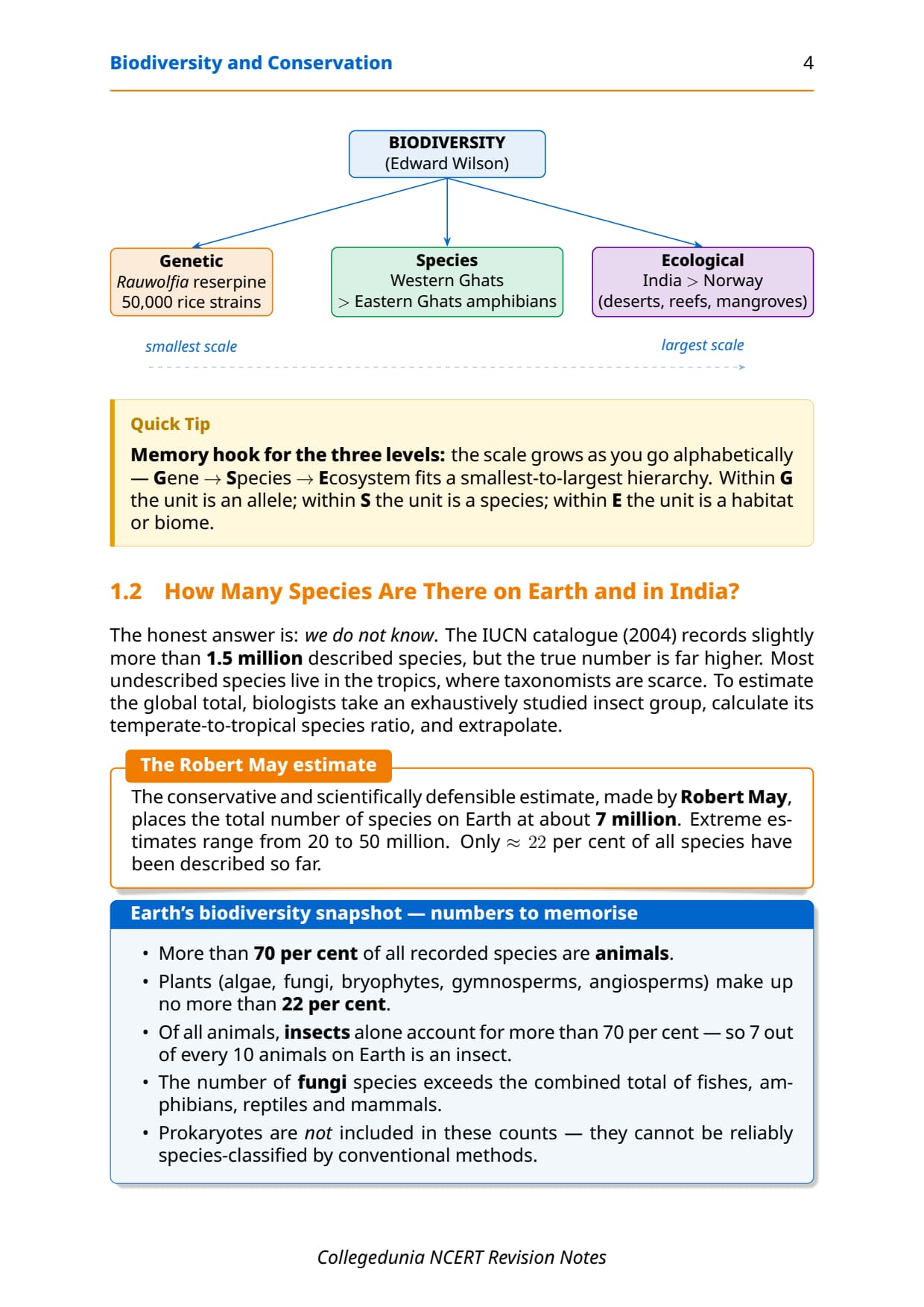
Edward Wilson popularised the term. NCERT lists three levels. Genetic diversity: variation within a species (e.g. Rauwolfia vomitoria shows different reserpine potencies across the Himalaya). Species diversity: variation between species (Western Ghats hold more amphibians than the Eastern Ghats). Ecological diversity: variation between ecosystems (India, with deserts, rainforests and coral reefs, versus Norway).
How Many Species Are There?
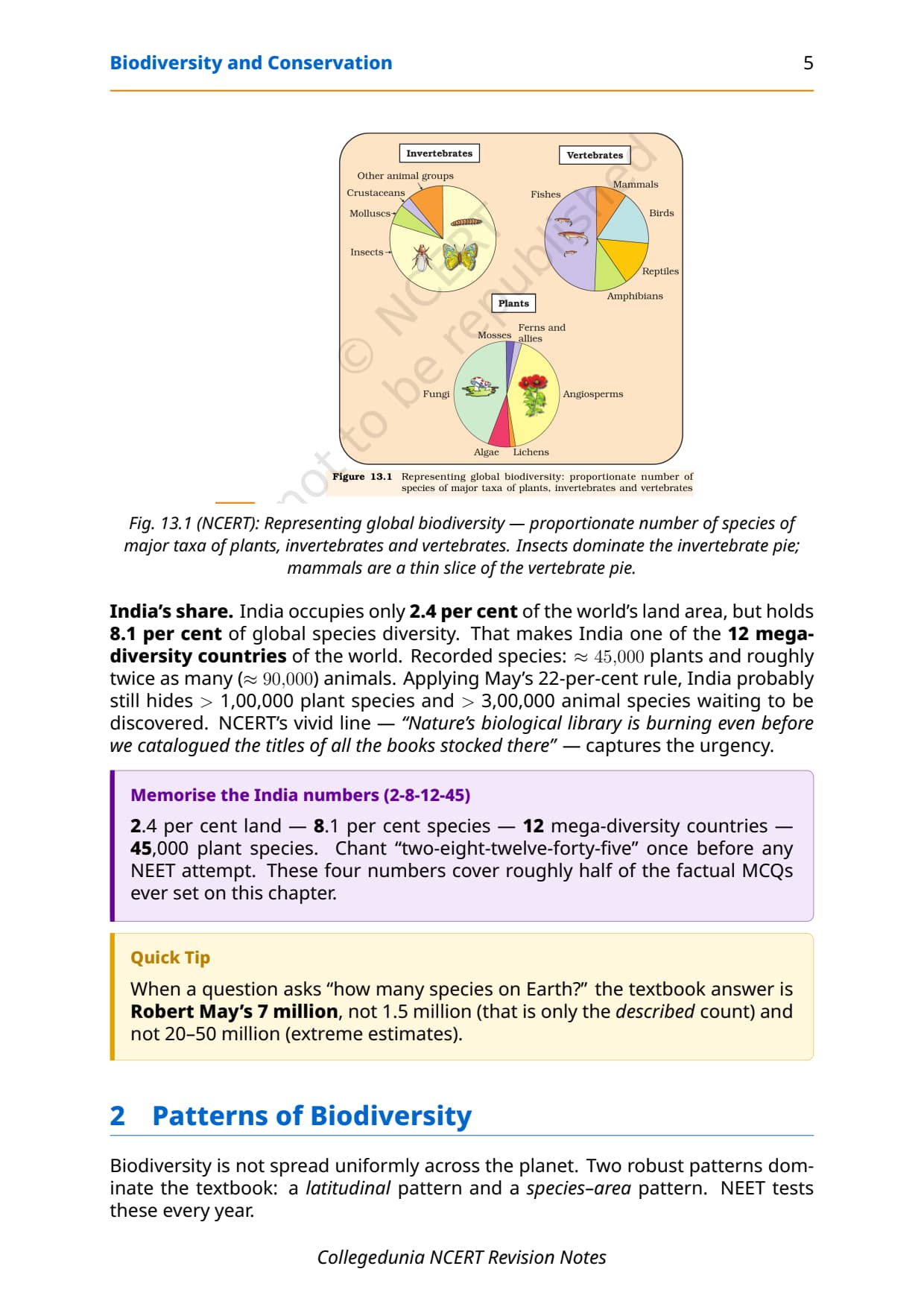
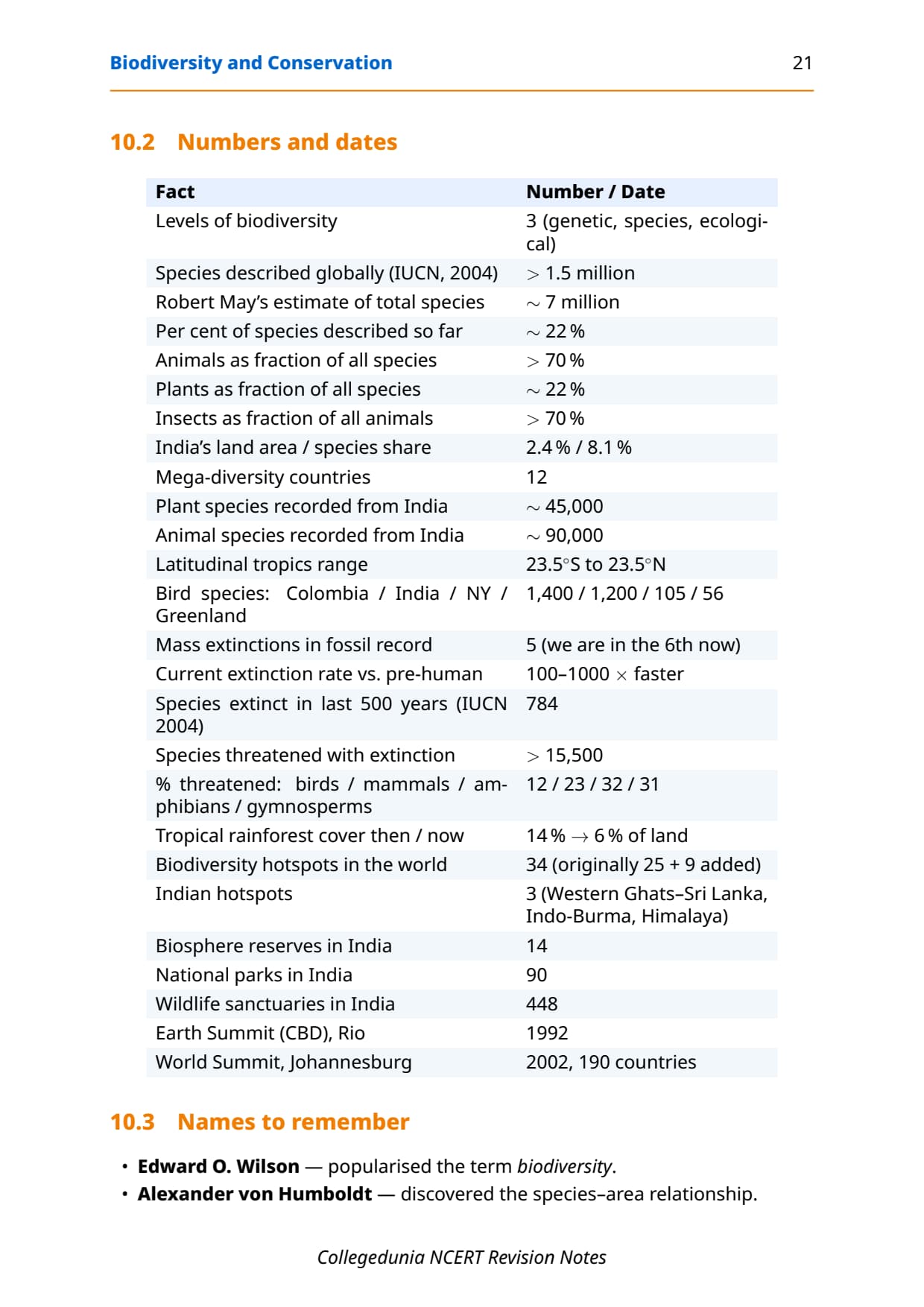
IUCN 2004 records over 1.5 million described species. Robert May's estimate is about 7 million in total. Animals are over 70% of described species, and insects alone are over 70% of animals. India hosts about 45,000 plant species and is one of the 12 mega-diversity countries.
Patterns of Biodiversity
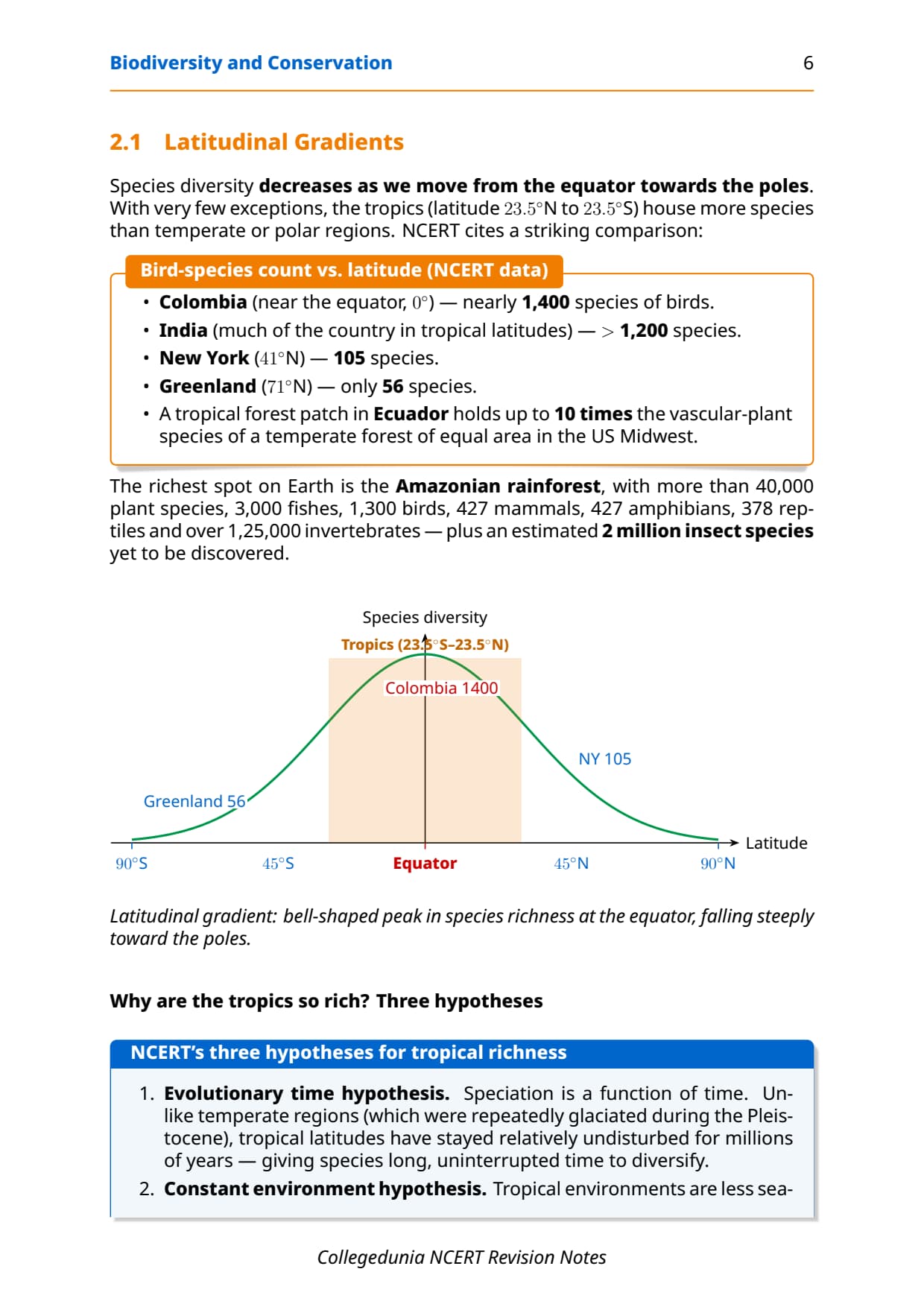
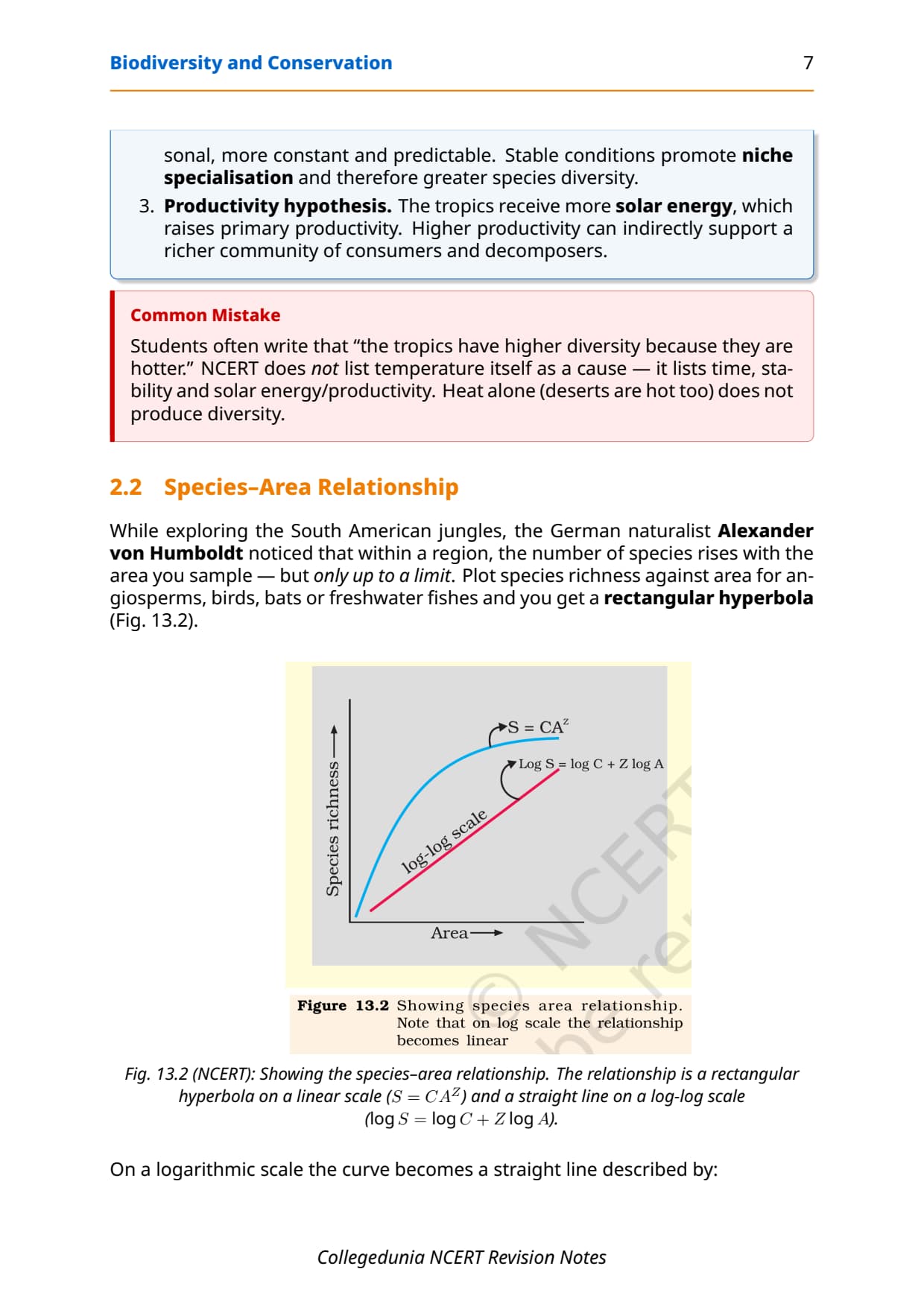
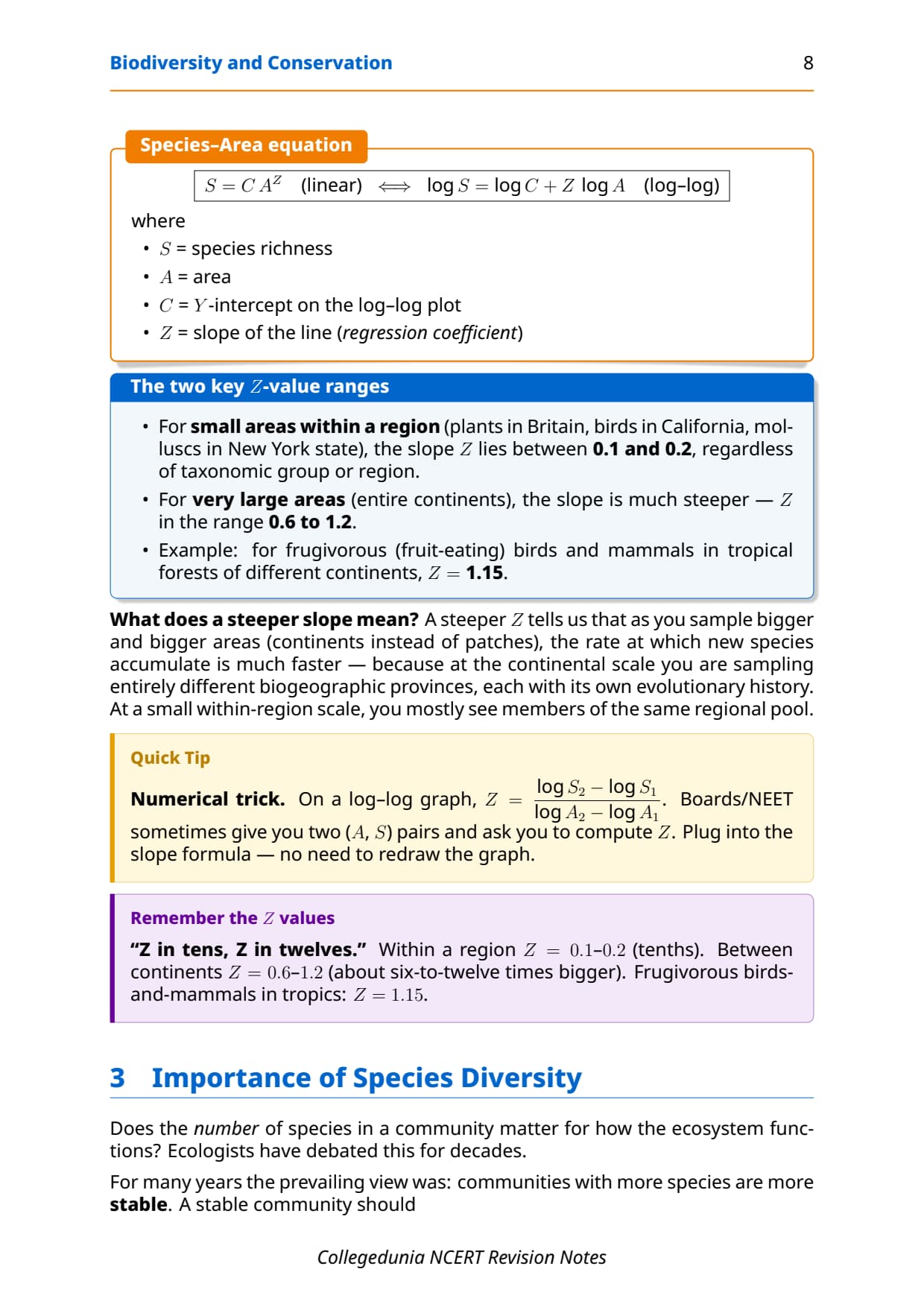
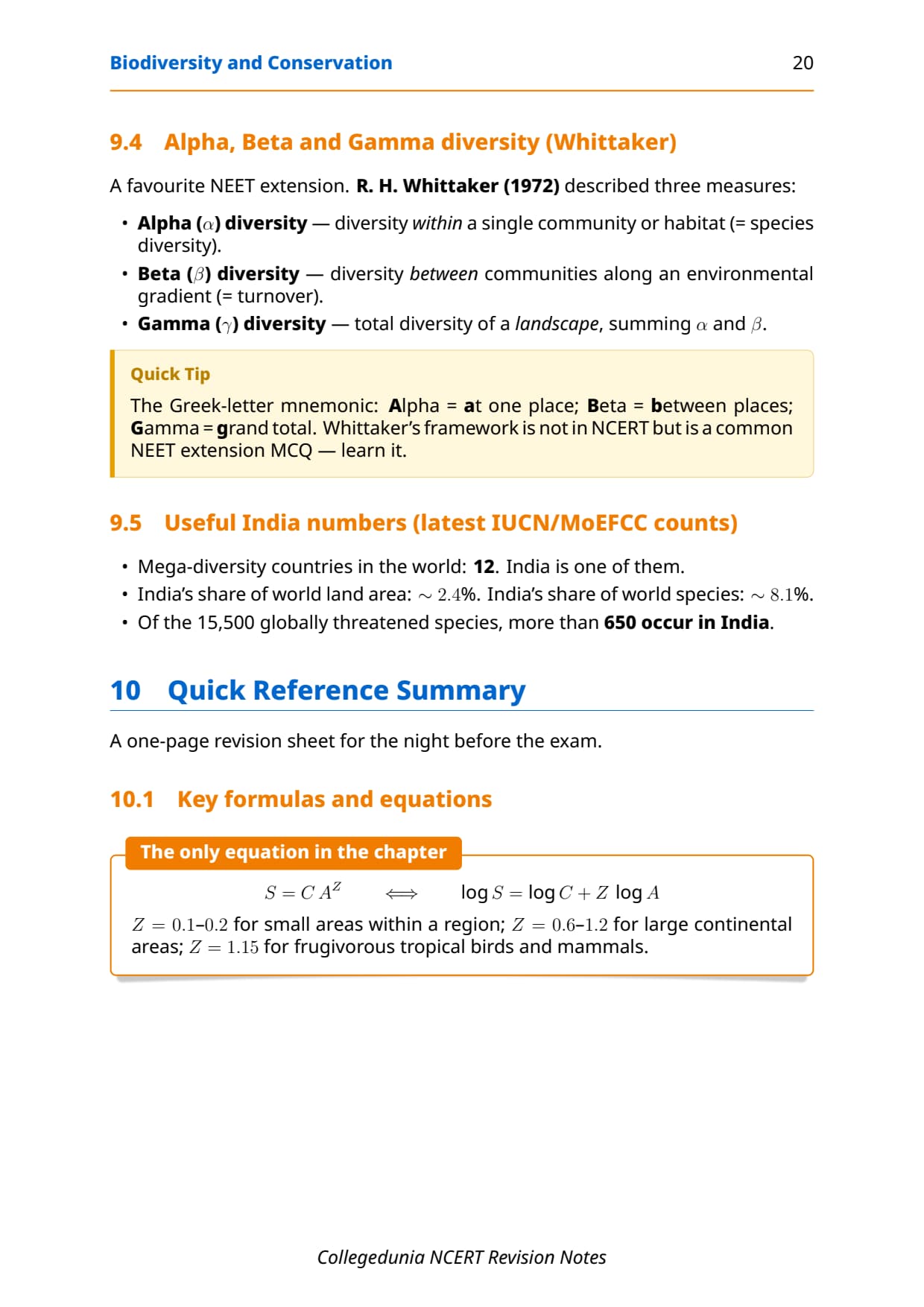
Latitudinal gradient: diversity peaks at the equator and falls towards the poles, explained by more evolutionary time, a constant environment and higher solar energy. Species-area relationship: richness rises with area as a rectangular hyperbola (Humboldt). On log-log axes it is a straight line log S = log C + z log A , with slope z = 0.1 to 0.2 for small areas and 0.6 to 1.2 for large continents (Whittaker).
Loss of Biodiversity: The Evil Quartet
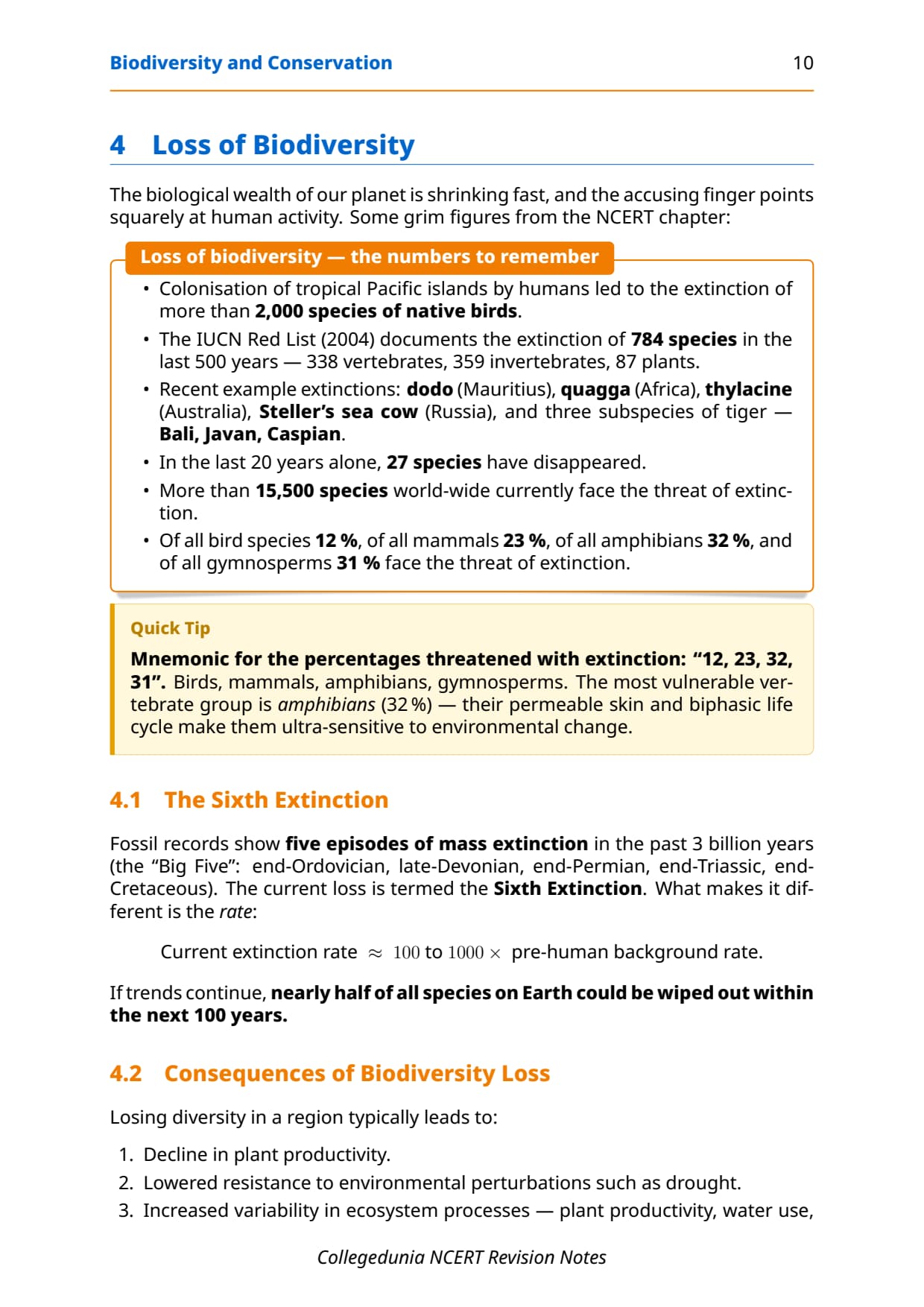
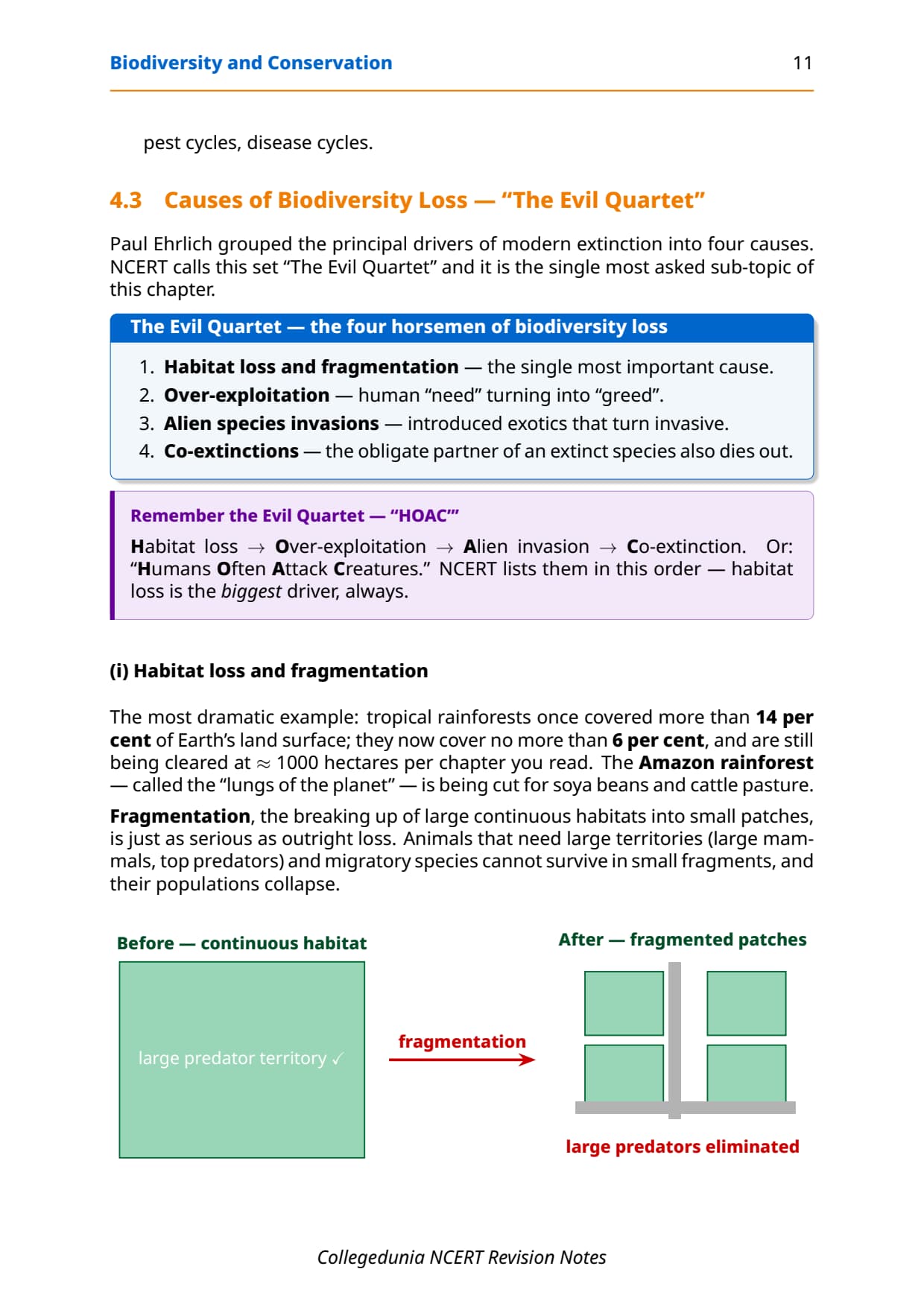
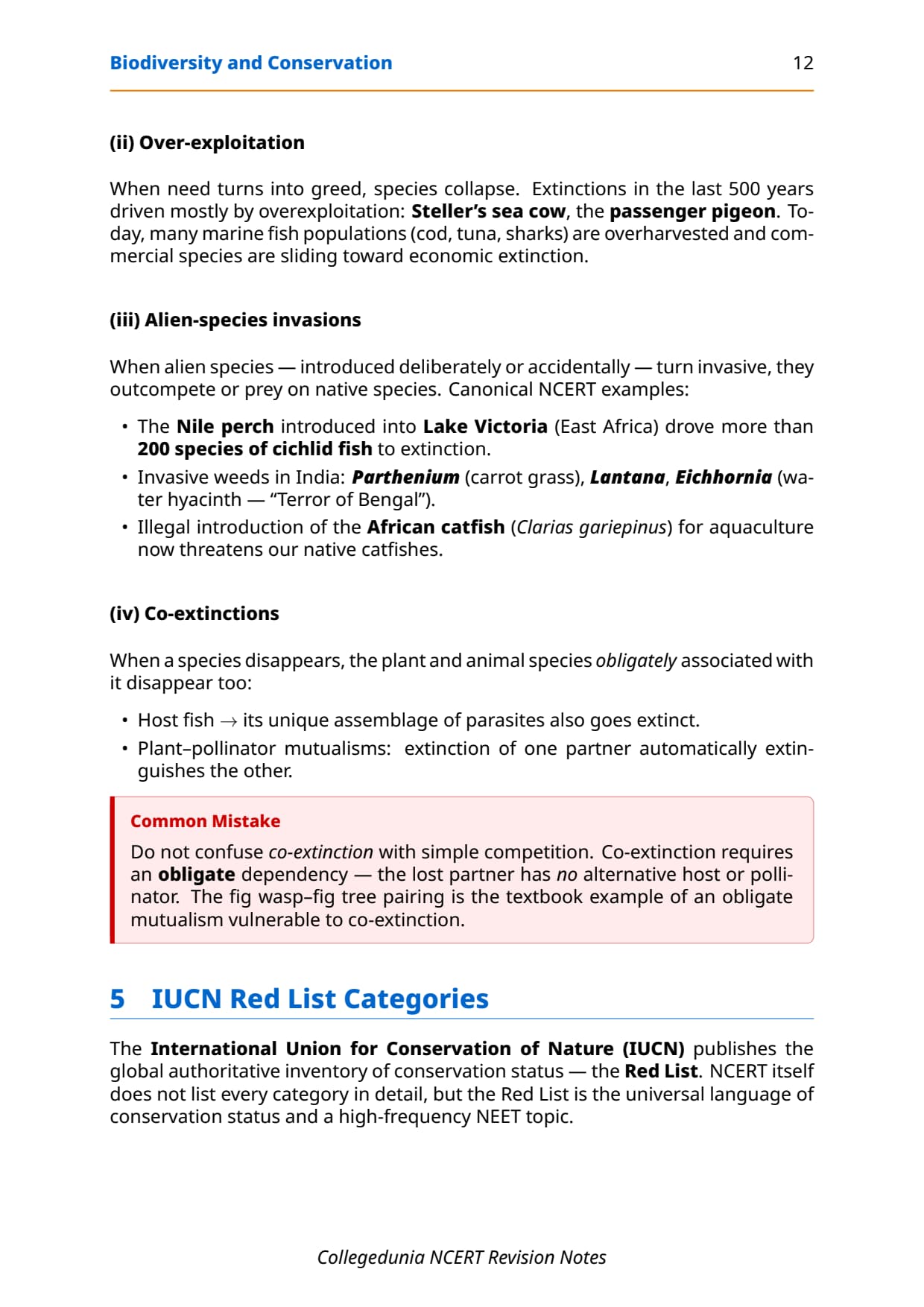
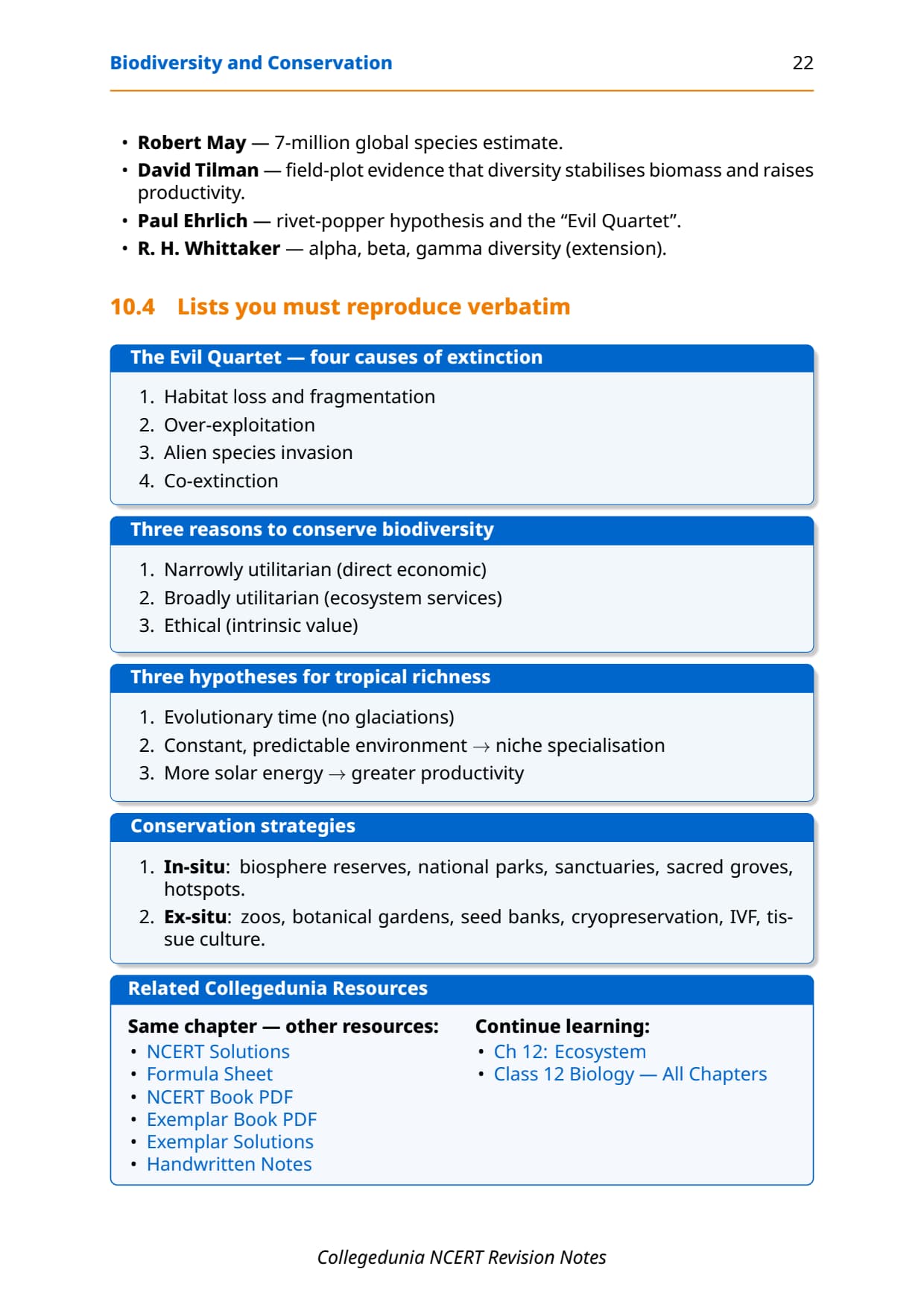
The present extinction rate is 100 to 1000 times the natural background rate. Edward Wilson's Evil Quartet names four causes: (1) habitat loss and fragmentation (the prime cause); (2) over-exploitation (Steller's sea cow, passenger pigeon); (3) alien species invasions (Nile perch wiped out 200 cichlids; water hyacinth); (4) co-extinctions (a host's loss takes its dependents too).
Importance and Ecosystem Services
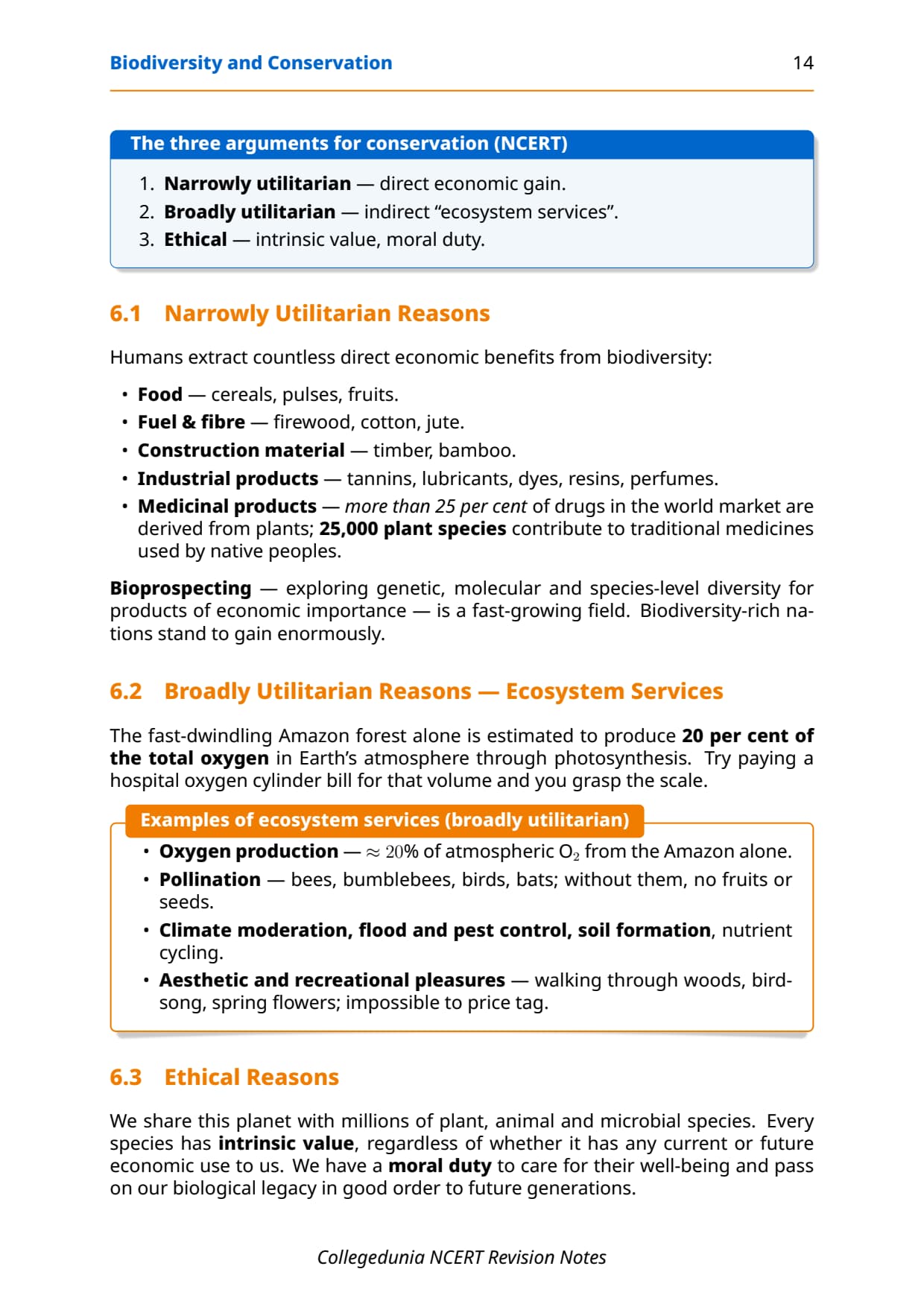
NCERT gives three reasons to conserve: narrowly utilitarian (food, fibre, medicines), broadly utilitarian (ecosystem services like pollination, climate control and the oxygen forests release), and ethical (a duty to the next generation). Robert Costanza valued these services at about 33 trillion US dollars a year, and the Amazon alone supplies nearly 20% of atmospheric oxygen.
In-Situ Conservation
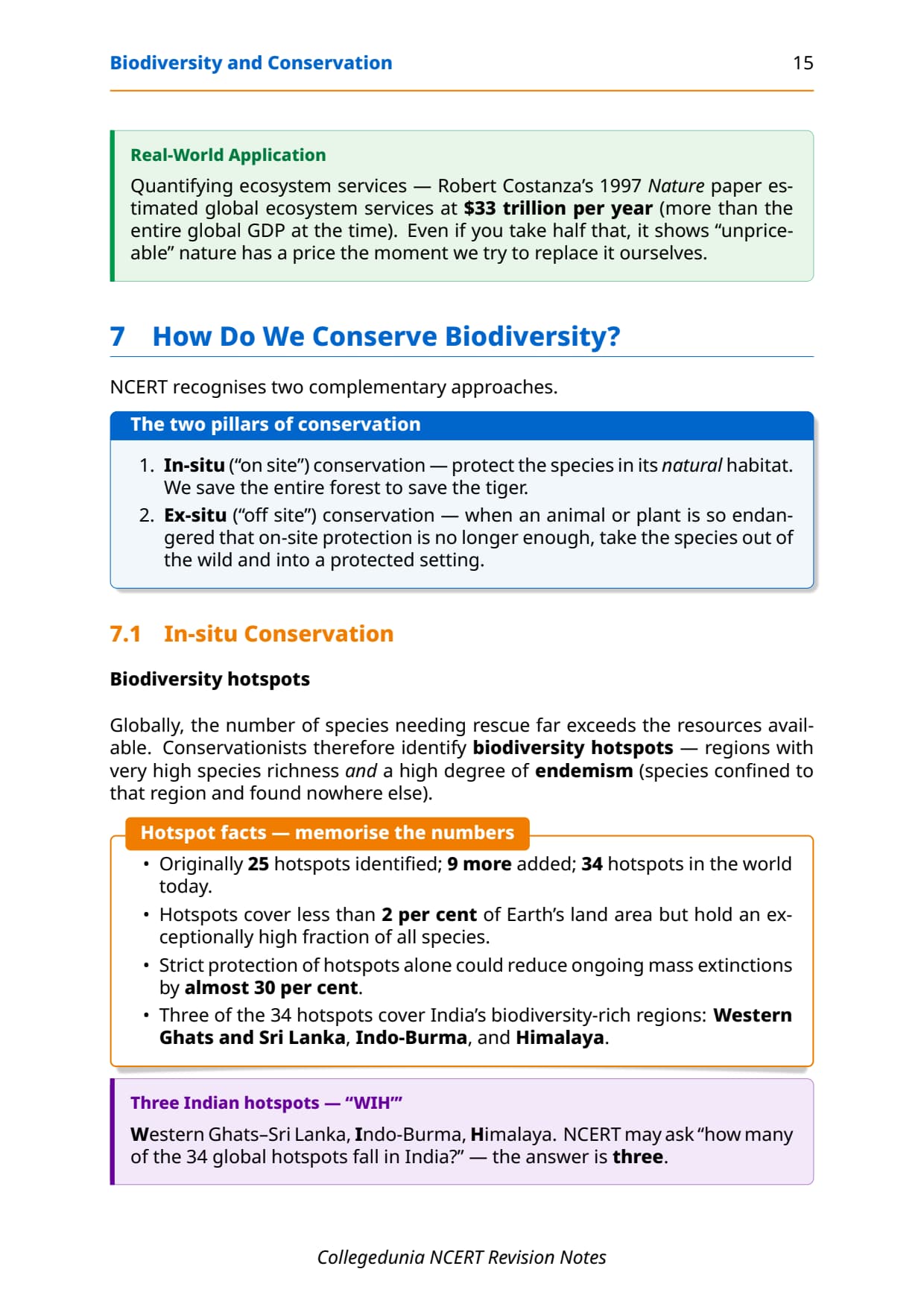
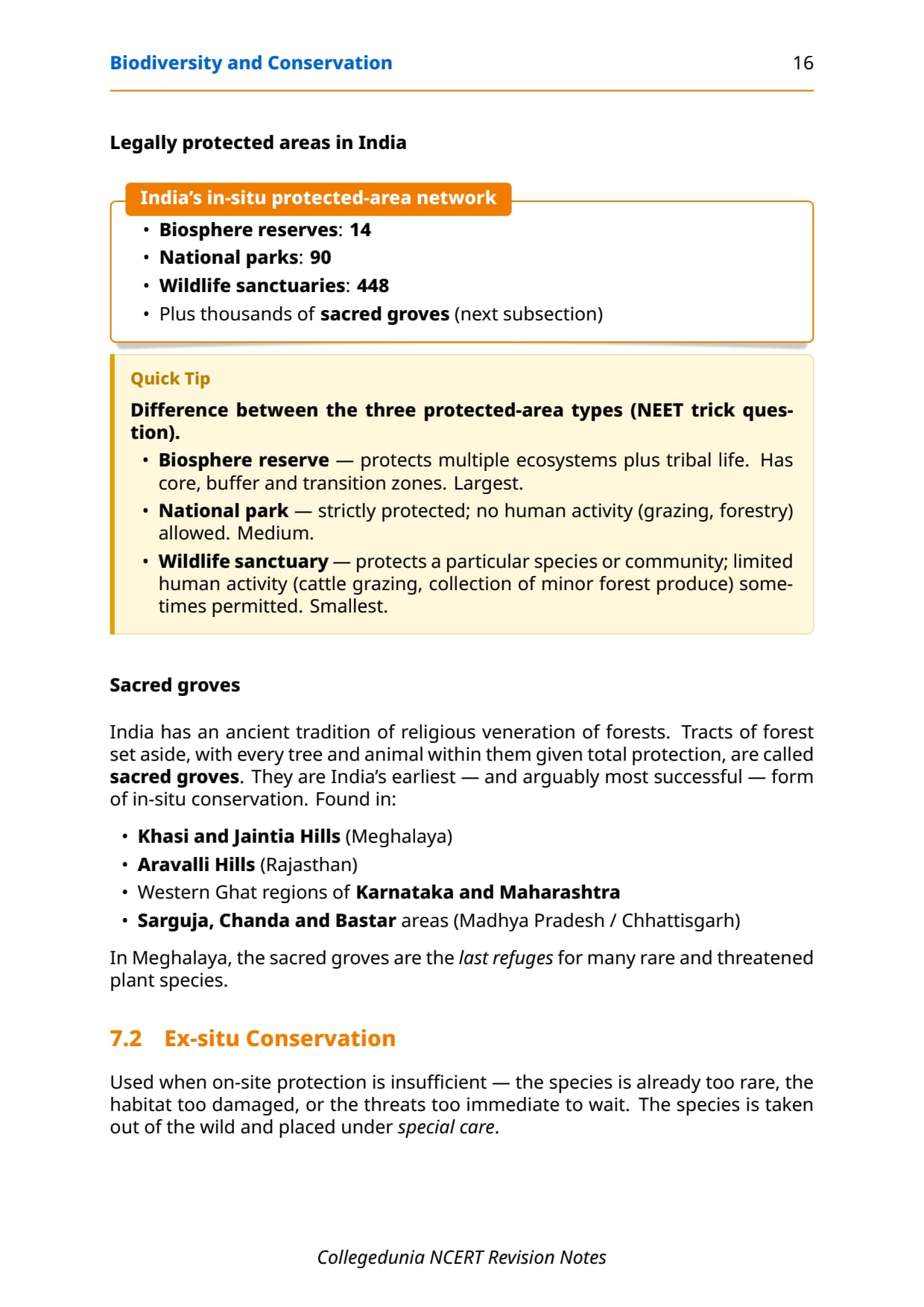
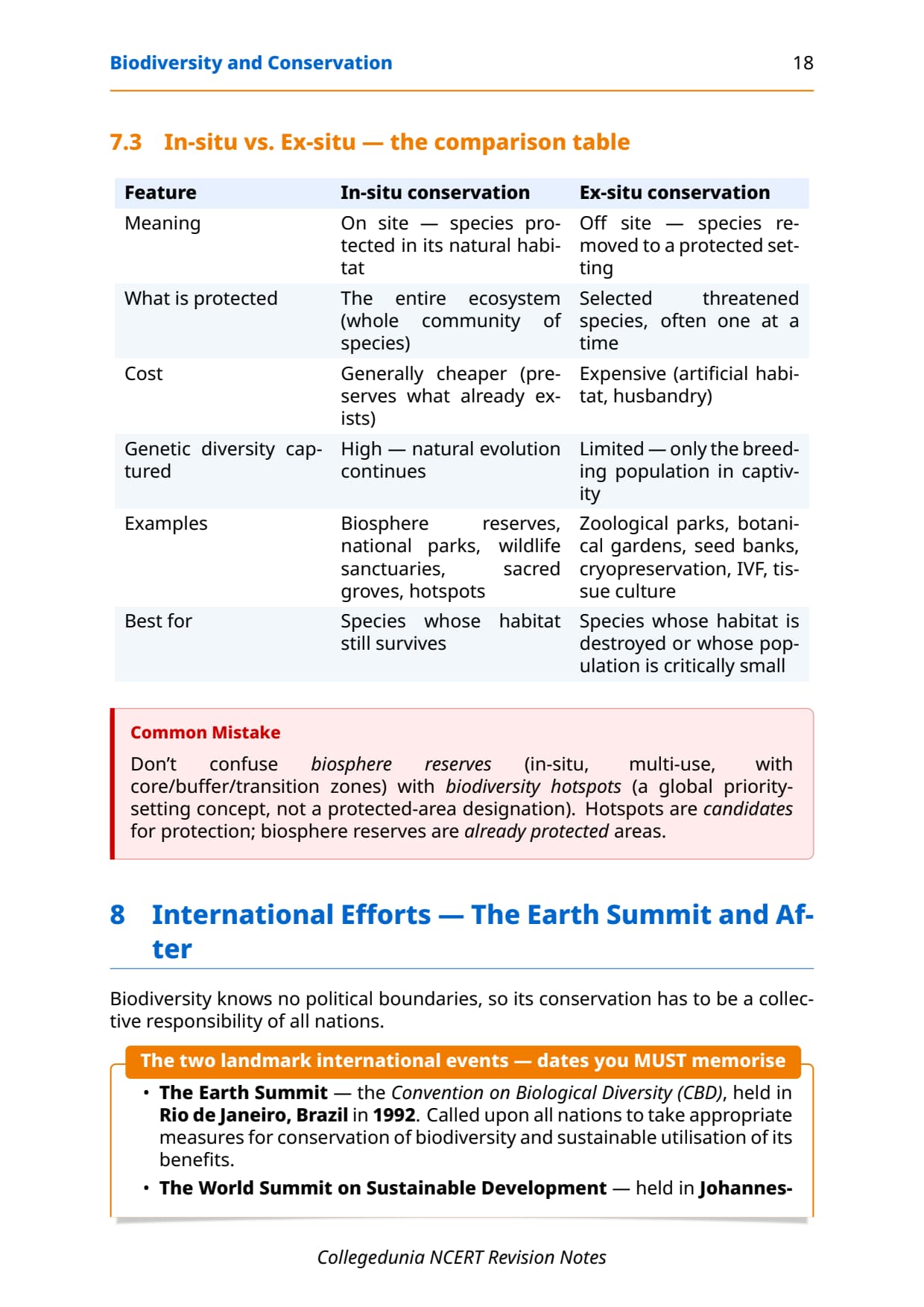
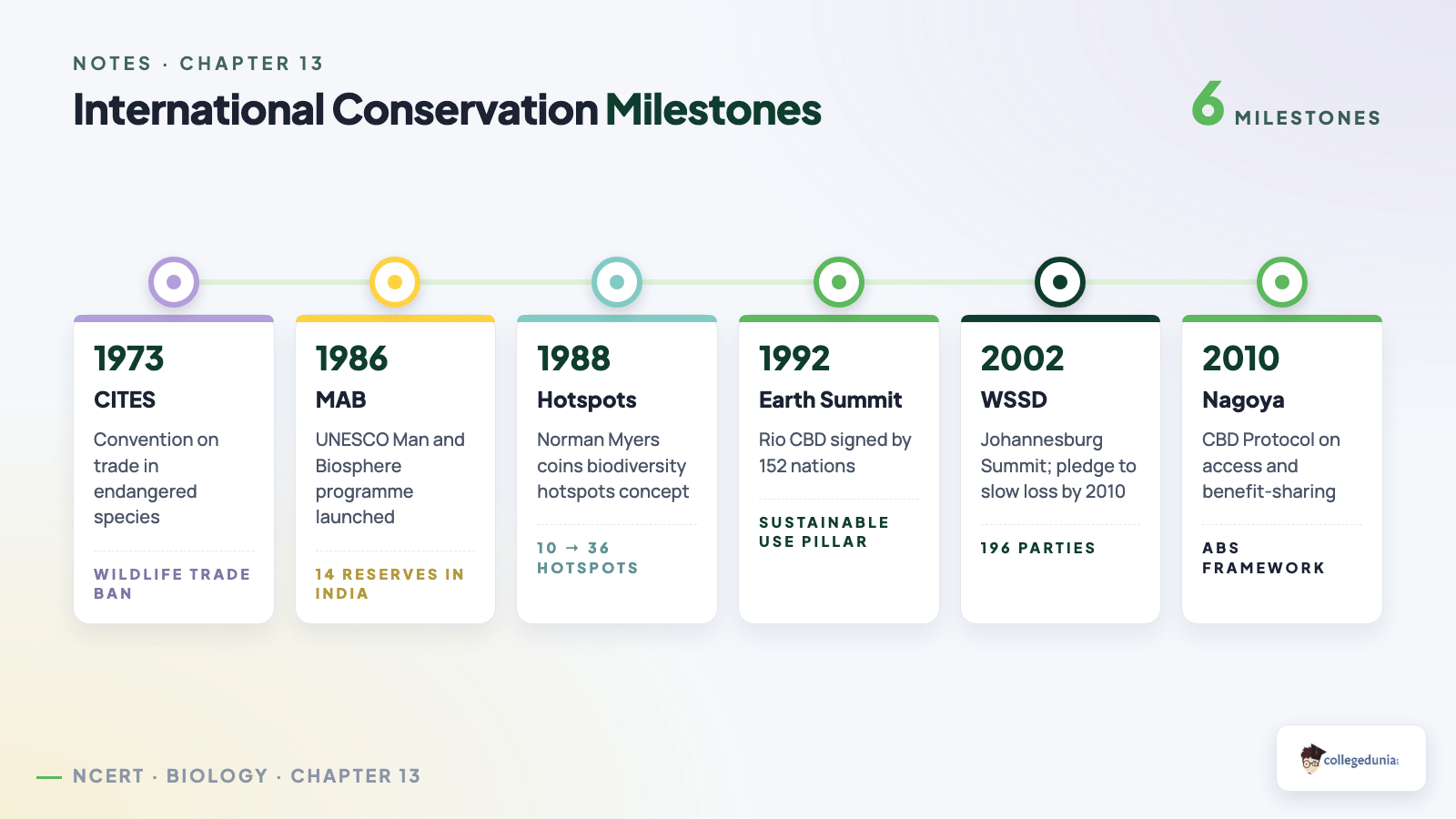
This protects species in their natural home. There are 34 hotspots worldwide; three reach into India (Western Ghats - Sri Lanka, Himalaya, Indo-Burma). India's legal network has 14 biosphere reserves, 90 national parks and 448 wildlife sanctuaries. Sacred groves (Khasi-Jaintia Hills, Aravalli Hills, Western Ghats) shelter many rare plants.
Ex-Situ Conservation
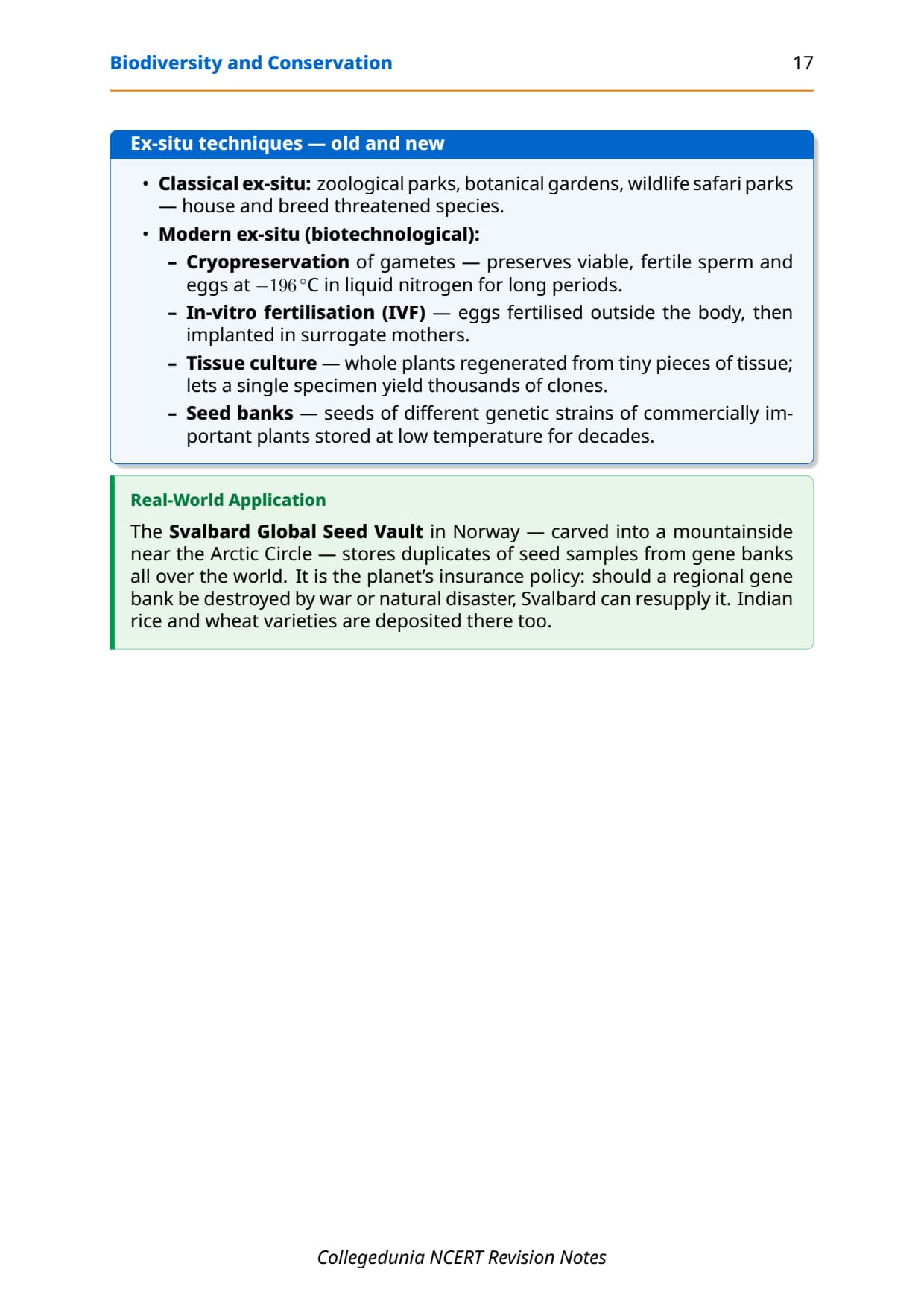
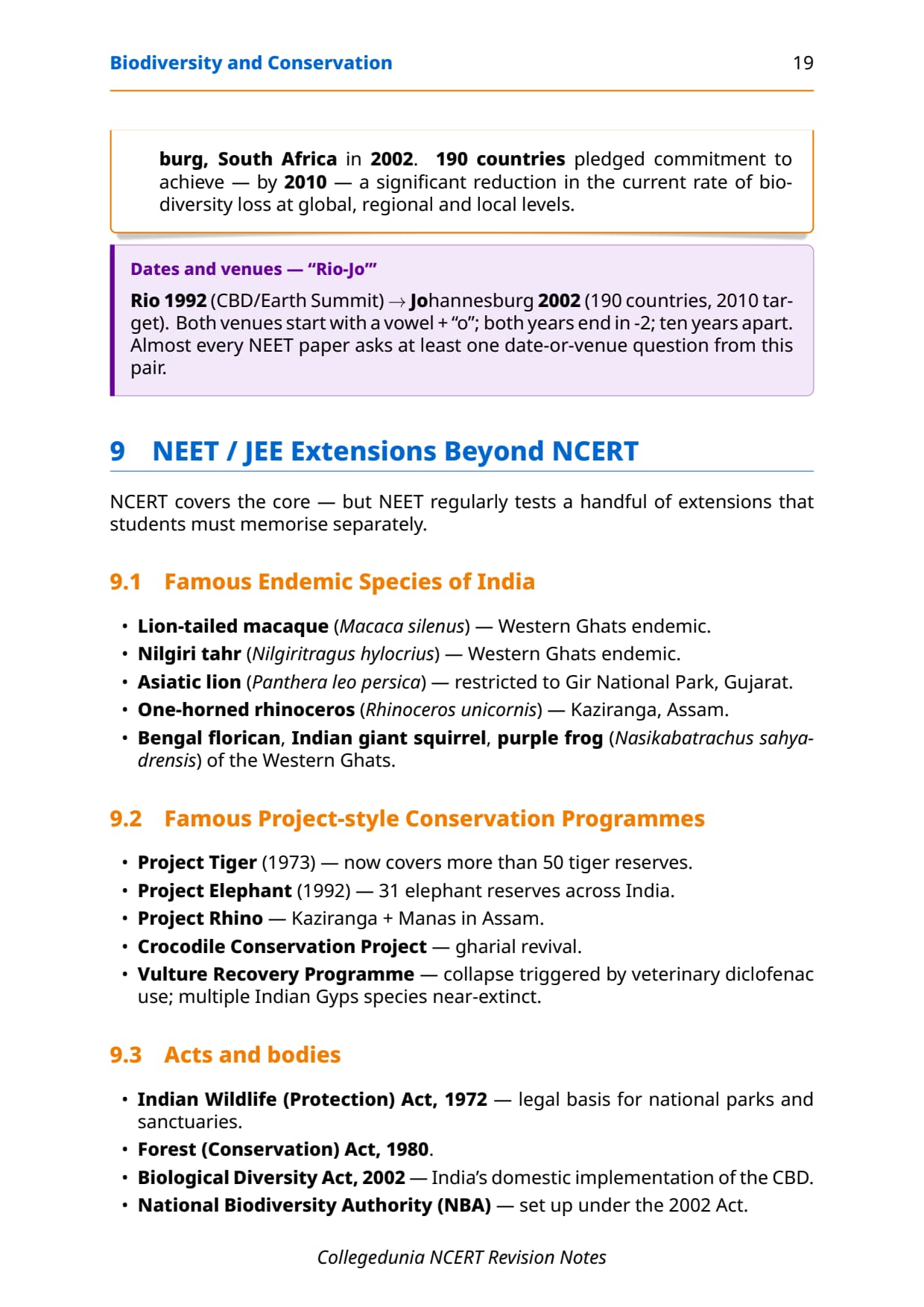
This protects species away from their habitat in zoos, botanical gardens and safari parks. Modern tools include gamete cryopreservation, in vitro fertilisation, tissue culture and seed banks. The 1992 Earth Summit at Rio (Convention on Biological Diversity) and the 2002 Johannesburg World Summit anchor the global framework.
Biodiversity and Conservation Topic-wise Weightage for CBSE Class 12 Biology
The table maps each sub-topic to its CBSE frequency.
| Sub-topic | Weightage | CBSE Frequency |
|---|---|---|
| Hotspots and in-situ conservation | High | 5 out of 5 years |
| Patterns: species-area, latitudinal gradient | High | 4 out of 5 years |
| Evil Quartet of biodiversity loss | High | 4 out of 5 years |
| Sacred groves and biosphere reserves | Medium | 3 out of 5 years |
| Ex-situ techniques (cryopreservation, IVF, tissue culture) | Medium | 3 out of 5 years |
| Levels of biodiversity (genetic, species, ecological) | Medium | 3 out of 5 years |
| Ecosystem services (Costanza valuation) | Low | 1 out of 5 years |
Three themes carry over 65% of CBSE marks: hotspots, patterns and the Evil Quartet.
Biodiversity and Conservation Top 5 Numerical Facts for Quick Recall
The five facts below recur most often in NEET and CBSE.
| Numerical Fact | Value |
|---|---|
| Global biodiversity hotspots | 34 (3 in India) |
| Species-area slope z (large area) | 0.6 to 1.2 (Whittaker) |
| India's protected network | 14 biosphere reserves + 90 national parks + 448 sanctuaries |
| Total described / estimated species | 1.5 million / ~ 7 million (Robert May) |
| Present extinction rate | 100 to 1000 times background |
Full master sheet: Biodiversity and Conservation Class 12 Biology Formula Sheet
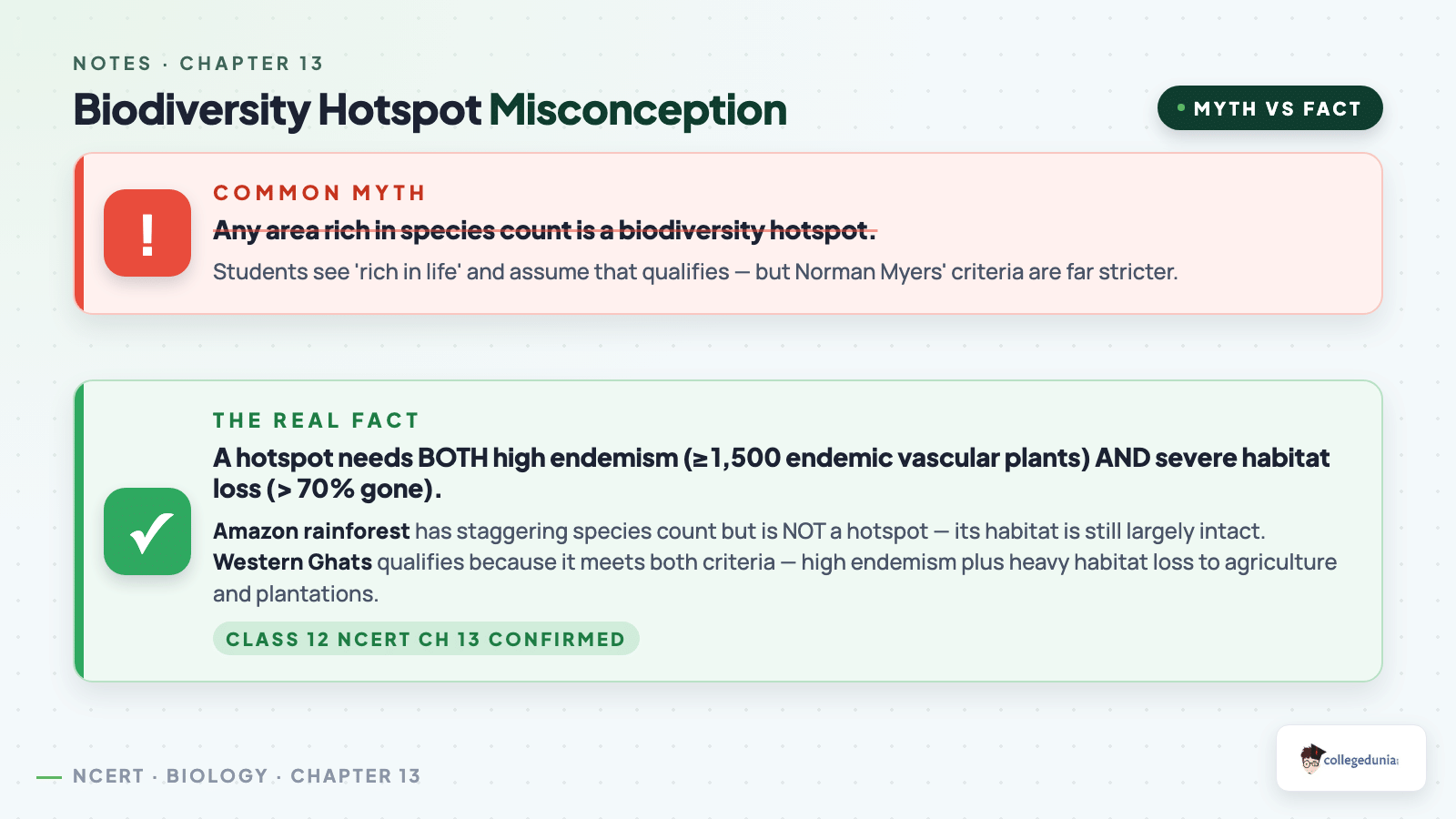
Common Misconceptions in Biodiversity and Conservation
Each wrong belief below is a common NEET distractor.
- India has 2 hotspots. Wrong - India shares 3: Western Ghats - Sri Lanka, Himalaya, Indo-Burma.
- In-situ is conservation in zoos. Wrong - in-situ is in the natural habitat; ex-situ is in zoos, gardens and seed banks.
- Robert May estimated 1.5 million species. Wrong - 1.5 million is already described; May estimates ~ 7 million in total.
- Species-area slope is the same everywhere. Wrong - z = 0.1 to 0.2 for small areas, 0.6 to 1.2 for whole continents.
- Sacred groves are government-managed. Wrong - they are community-protected by religious tradition, not by the Forest Department.
Biodiversity and Conservation Glossary for Class 12 Biology
Eight high-frequency terms, each asked in CBSE or NEET in recent years.
| Term | Definition |
|---|---|
| Biodiversity | Sum of all diversity from genes to ecosystems (Wilson). |
| Hotspot | A region of exceptionally high endemism that faces accelerated habitat loss (Norman Myers). |
| Endemic species | A species found only in a specific region and nowhere else. |
| Evil Quartet | Wilson's four causes of biodiversity loss. |
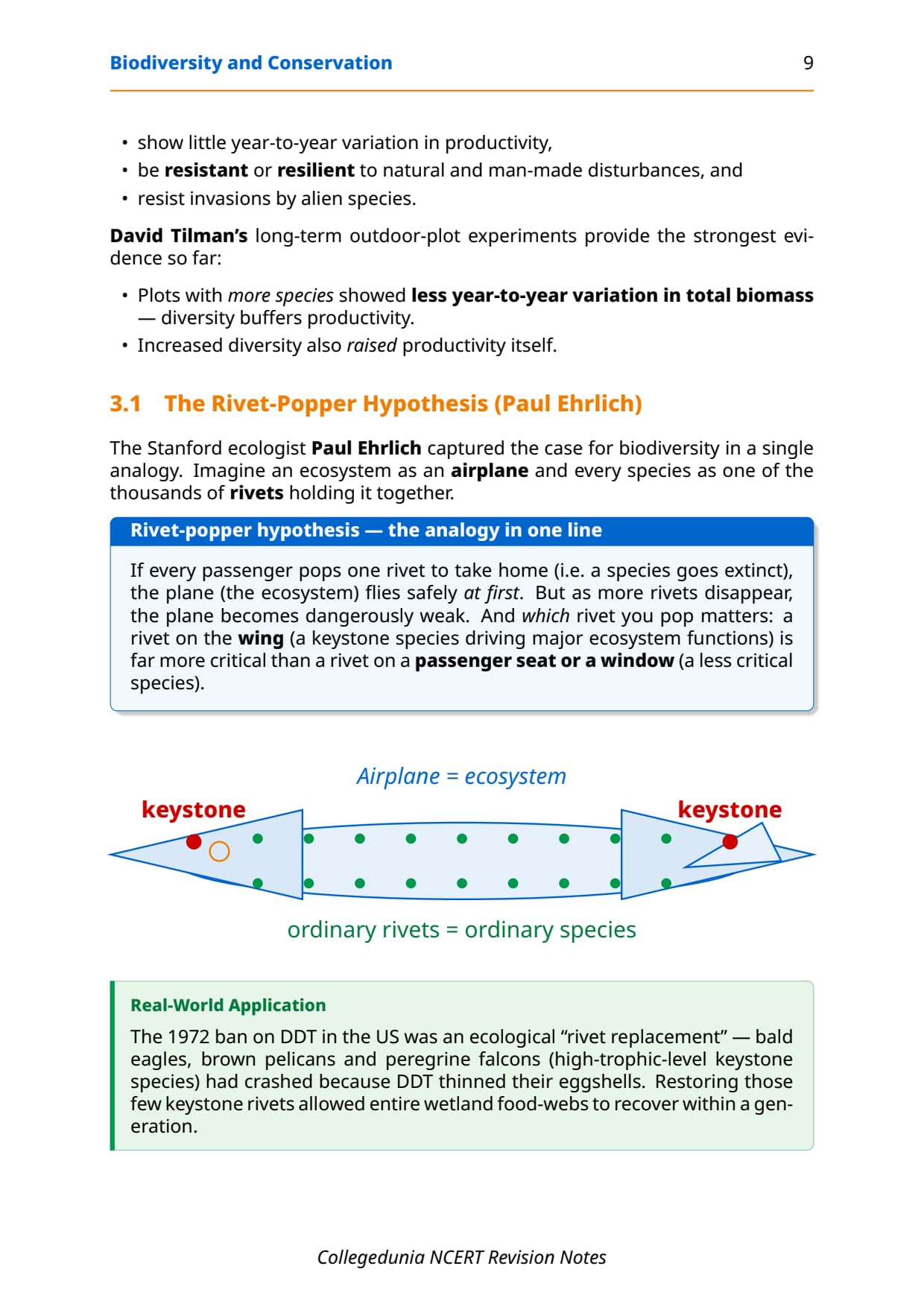
| Rivet popper hypothesis | Paul Ehrlich's analogy: every species is a rivet on the aeroplane of the ecosystem. |
| Sacred grove | Forest tract preserved by community religious tradition. |
| In-situ conservation | Conservation in the natural habitat. |
| Ex-situ conservation | Conservation away from the habitat in zoos, gardens and seed banks. |
Biodiversity and Conservation Previous Year Questions Snapshot (2025 to 2021)
Hotspots and patterns have appeared in every CBSE paper. The full year-wise map is on the Collegedunia NCERT Solutions page.
| Year | CBSE Topic Asked | NEET Topic Asked |
|---|---|---|
| 2025 | Hotspots (3 marks); Evil Quartet (2 marks) | 34 hotspots; species-area slope |
| 2024 | In-situ vs ex-situ (5 marks); India's mega-diversity rank (1 mark) | Rivet popper; sacred groves |
| 2023 | Species-area (3 marks); Sacred groves (3 marks) | Latitudinal gradient; insects fraction |
| 2022 | S = CA^z slope ranges (3 marks); Levels of biodiversity (2 marks) | Whittaker z-range; Nile perch |
| 2021 | Habitat loss with examples (3 marks) | Alien invasive species pair |
Full year-wise PYQ map: Biodiversity and Conservation Class 12 Biology NCERT Solutions
Student Feedback on Biodiversity and Conservation Class 12 Biology
In a survey of 10,800 Class 12 Biology students, the species-area numerical came out as the hardest part of the chapter. The box below has the full breakdown.
Student Feedback
What 10,800 students told us about Chapter 13:
- 72% of students found the species-area curve (log S = log C + Z log A) the hardest sub-topic.
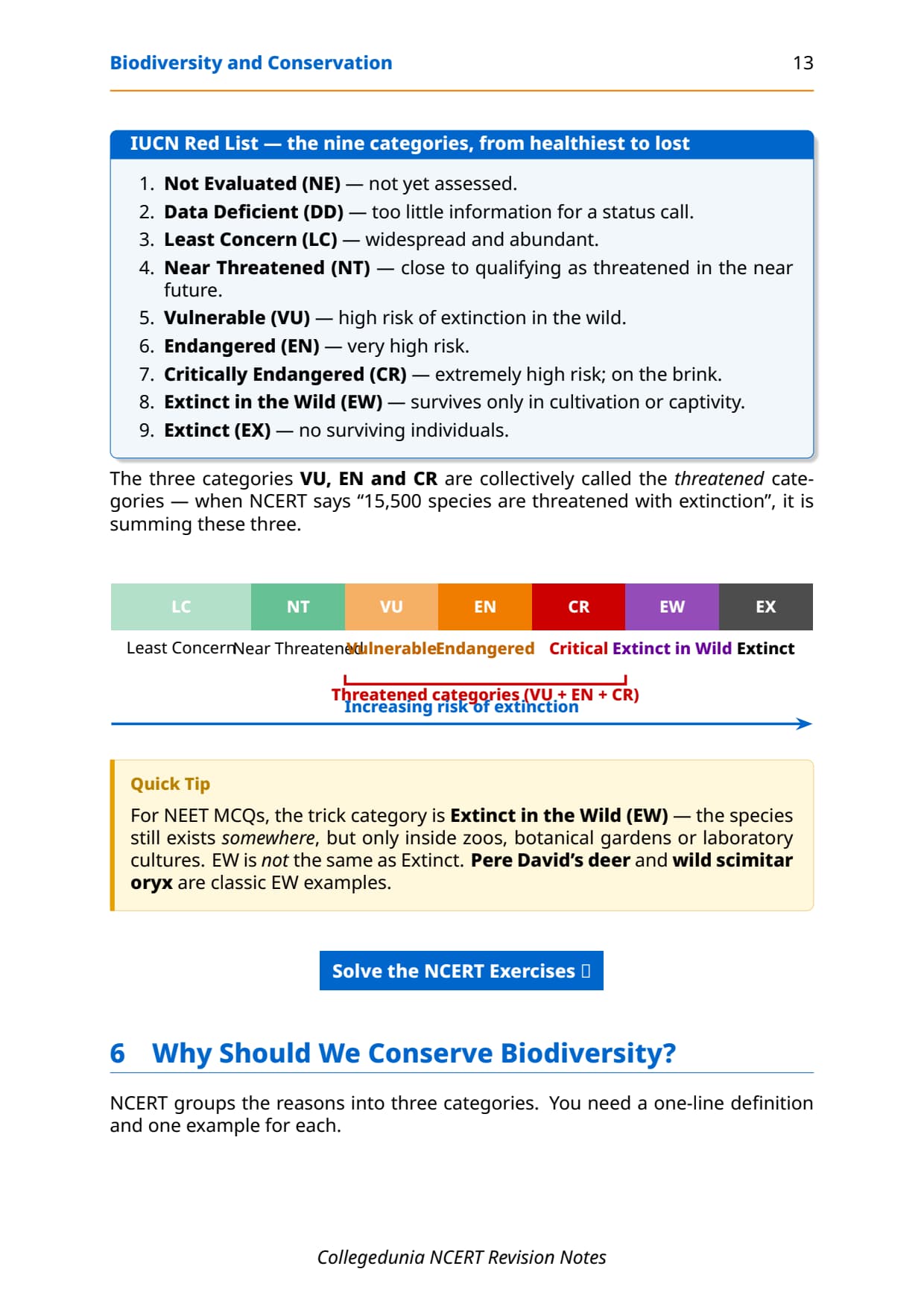
- 61% lost 1-2 marks on matching IUCN categories (EX, EW, CR, EN, VU, NT, LC).
- 4 out of 5 students skipped the world hotspot map in their answer sheet.
- Average revision time was 4.8 hours for the first read and 2.0 hours for a focused recap.
Source: 2025-26 Class 12 Biology survey of 10,800 students from CBSE schools across 18 states.
Other Resources for Biodiversity and Conservation Class 12 Biology
The other Chapter 13 resources are below.
| Resource | Link |
|---|---|
| Notes (this page) | Biodiversity and Conservation Notes |
| NCERT Solutions | Biodiversity and Conservation NCERT Solutions |
| Formula Sheet | Biodiversity and Conservation Formula Sheet |
| Handwritten Notes | Biodiversity and Conservation Handwritten Notes |
| NCERT Book PDF | Biodiversity and Conservation NCERT Book PDF |
| NCERT Exemplar Solutions | Biodiversity and Conservation Exemplar Solutions |
| NCERT Exemplar Book PDF | Biodiversity and Conservation Exemplar Book PDF |
NCERT Notes for Class 12 Biology: All Chapters
Pick any other chapter's Notes PDF below.
| Chapter | Notes |
|---|---|
| Chapter 1 | Sexual Reproduction in Flowering Plants |
| Chapter 2 | Human Reproduction |
| Chapter 3 | Reproductive Health |
| Chapter 4 | Principles of Inheritance and Variation |
| Chapter 5 | Molecular Basis of Inheritance |
| Chapter 6 | Evolution |
| Chapter 7 | Human Health and Disease |
| Chapter 8 | Microbes in Human Welfare |
| Chapter 9 | Biotechnology - Principles and Processes |
| Chapter 10 | Biotechnology and Its Applications |
| Chapter 11 | Organisms and Populations |
| Chapter 12 | Ecosystem |
| Chapter 13 | Biodiversity and Conservation |
Biodiversity and Conservation Class 12 Biology Notes FAQs
Ques. Where can I download Biodiversity and Conservation Class 12 Biology Notes PDF?
Ans. You can download the Biodiversity and Conservation Class 12 Biology Notes PDF directly from this page. Both the Normal and HD versions are free, and the file is mapped to the 2026-27 NCERT.
Ques. Is this Biodiversity and Conservation Notes PDF aligned with the 2026-27 NCERT?
Ans. Yes. This page reflects the current 2026-27 syllabus for Class 12 Biology Chapter 13. Both major sections - Biodiversity (levels, patterns, loss, importance) and Biodiversity Conservation (hotspots, in-situ, ex-situ) - are retained in the new NCERT edition without removal.
Ques. How many pages is the Class 12th Biology Biodiversity and Conservation Notes PDF?
Ans. The Notes PDF runs approximately 24 pages and covers all seven sub-sections (13.1 to 13.2) plus a NEET extensions block with Rivet Popper hypothesis, Costanza valuation, Amazon O2 share and the Earth Summit framework.
Ques. What are the most important topics in Biodiversity and Conservation Class 12 for NEET?
Ans. The species-area relationship (z = 0.1 to 0.2 and 0.6 to 1.2), the 34 hotspots and 3 Indian hotspots, the Evil Quartet of biodiversity loss, the in-situ / ex-situ split with India's 14 biosphere reserves, 90 national parks and 448 sanctuaries, and the latitudinal gradient hypotheses carry the highest NEET frequency.
Ques. What is the species-area relationship as per NCERT Class 12 Biology Chapter 13?
Ans. Alexander von Humboldt found that species richness rises with area as S = C Az , a rectangular hyperbola. On log-log axes it becomes a straight line log S = log C + z log A . The slope z is 0.1 to 0.2 for small areas (within a single biome) and 0.6 to 1.2 for very large areas like continents (Whittaker). The steeper slope at large scales is why fragmentation of big tracts causes disproportionately large species losses.
Ques. How many biodiversity hotspots are there and which lie in India?
Ans. There are 34 biodiversity hotspots globally (originally identified by Norman Myers). Three extend into India: the Western Ghats - Sri Lanka, the Himalaya, and Indo-Burma. Strict protection of these 34 hotspots alone could reduce ongoing mass extinctions by almost 30 percent.
Ques. What is the Evil Quartet and who proposed it?
Ans. The Evil Quartet was proposed by Edward Wilson to name the four major causes of biodiversity loss: habitat loss and fragmentation, over-exploitation of species, alien species invasions (water hyacinth, Nile perch, African catfish), and co-extinctions when host species are lost and their dependents follow.
Ques. Are these Biodiversity and Conservation notes useful for NEET 2027?
Ans. Yes. NEET draws 2 to 4 questions from this chapter every year, mostly as direct number-recall MCQs on hotspots, the species-area slope or India's protected network. The notes flag NEET-only depth such as the Rivet Popper hypothesis, Costanza's ecosystem-services valuation and the Amazon O2 share so you do not need a separate NEET book for this chapter.



Comments