




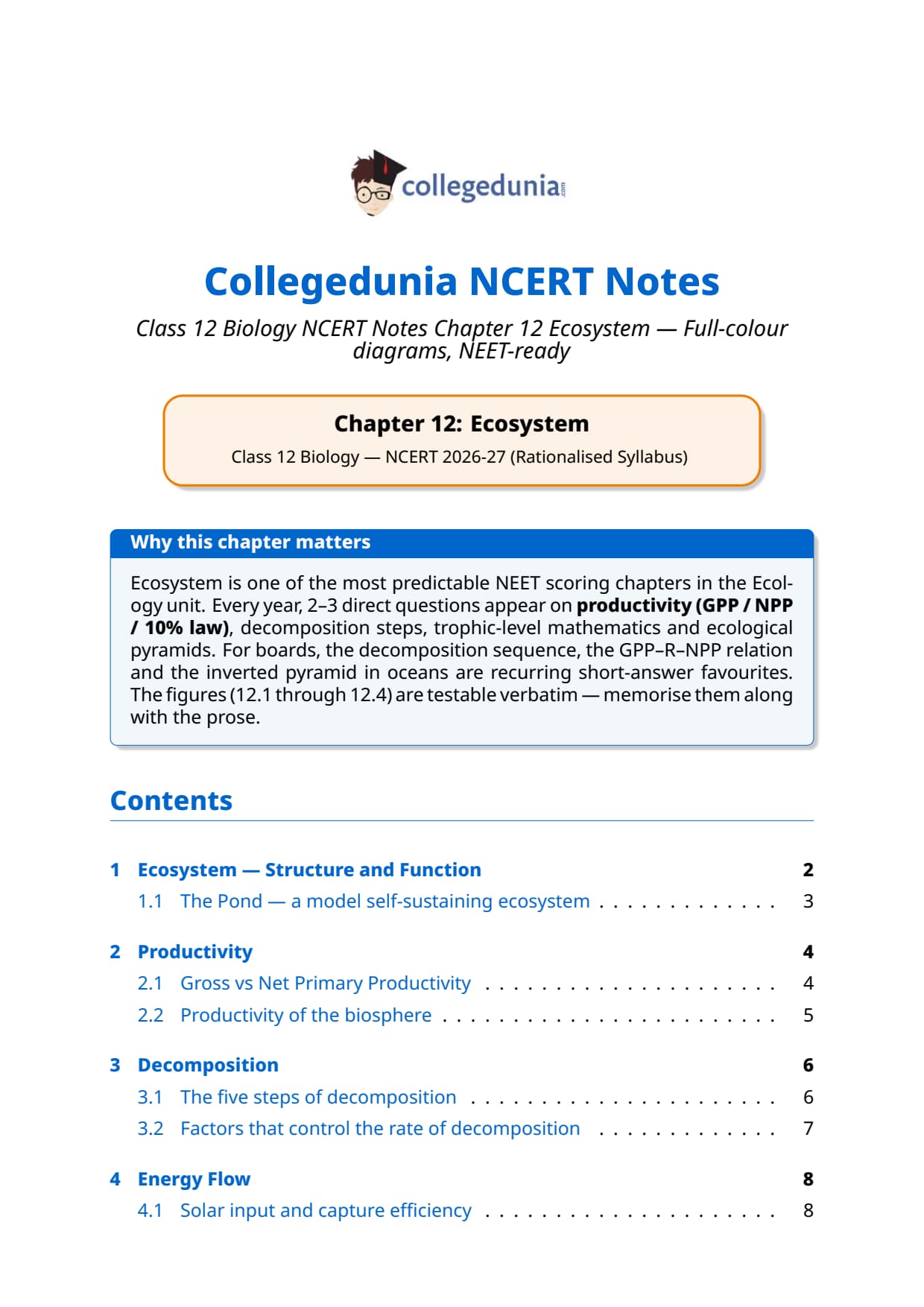
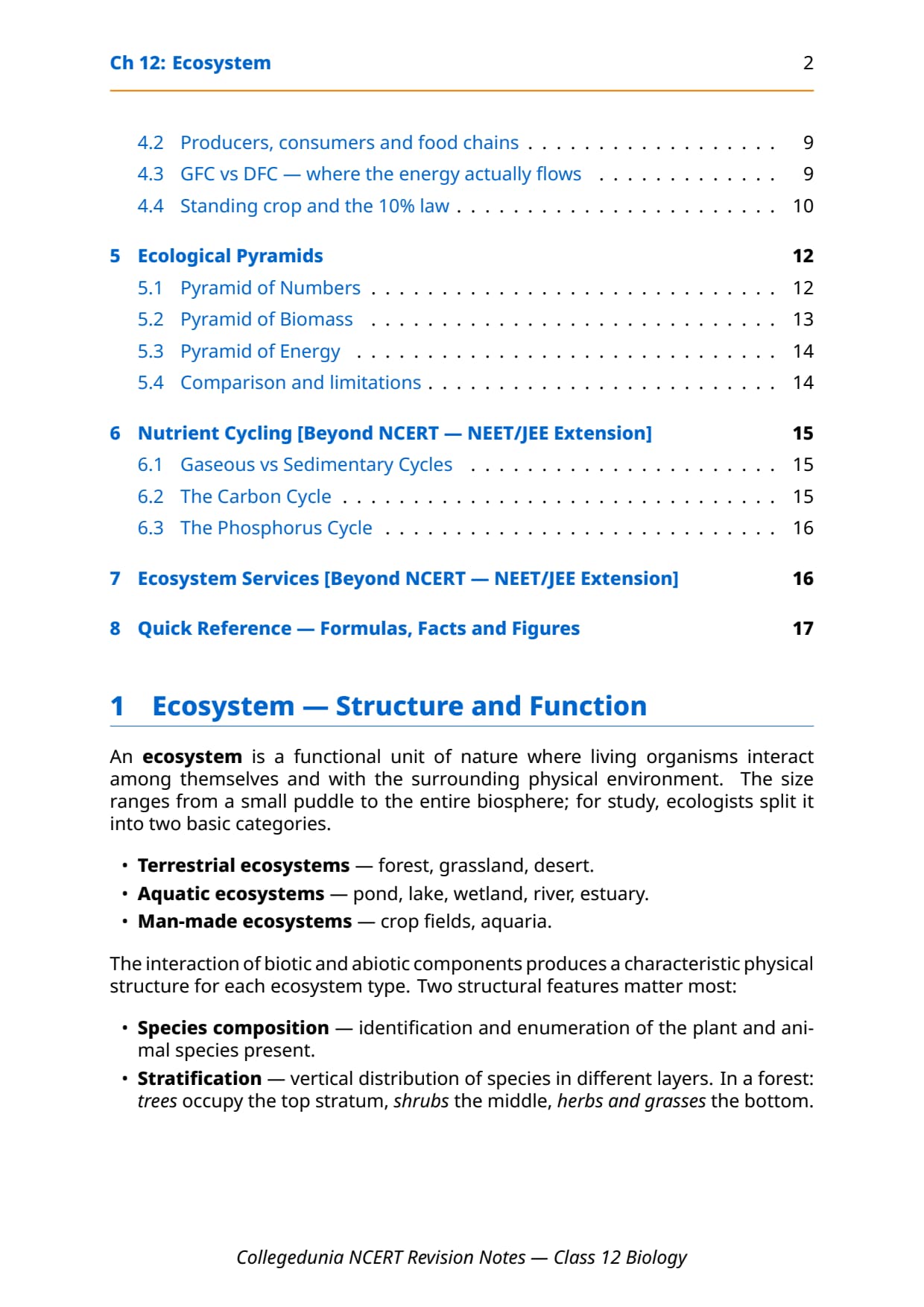
The 2026-27 NCERT lists Ecosystem as Chapter 12 of Class 12 Biology (formerly Chapter 14). It is a CBSE 5 to 7 mark anchor and a sure NEET scorer through productivity, energy flow, the pyramids and nutrient cycles. This page hosts the full Notes PDF with master flow charts.
- CBSE Weightage: 5 to 7 marks
- NEET Weightage: 2 to 3 questions per year
- AIIMS / CUET: 1 question per paper
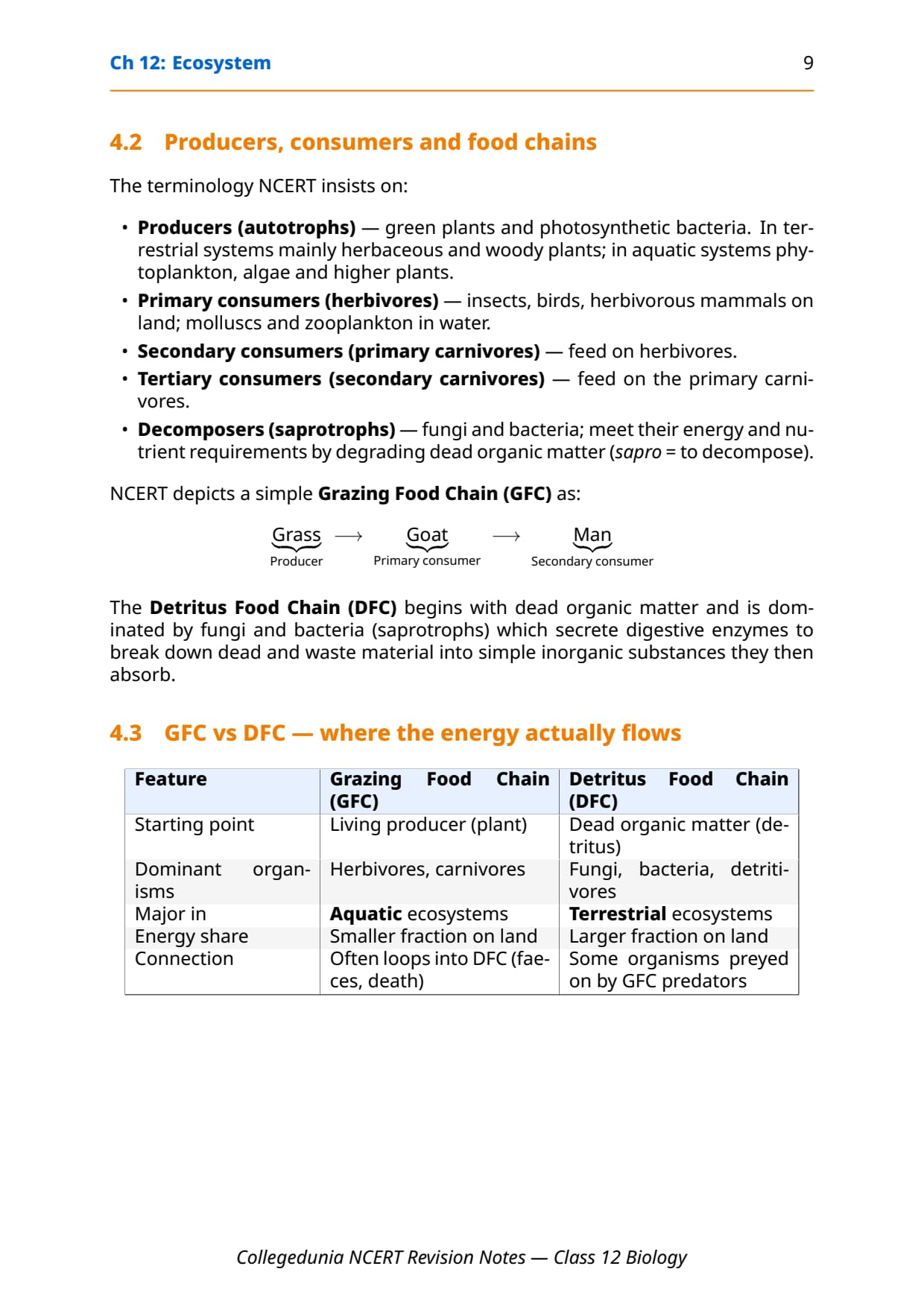
These notes combine the NCERT text with the energy-flow chart, both cycle diagrams, a pyramid table and a number sheet.
Curated by Collegedunia subject experts, mapped to the 2026-27 NCERT and verified against the last five years of CBSE and NEET papers.
Ecosystem Video Lecture for Class 12 Biology
Source: Magnet Brains on YouTube
Ecosystem Topic-by-Topic Notes for Class 12 Biology
The chapter runs from ecosystem structure through productivity, decomposition, energy flow, the three pyramids, succession and nutrient cycles. The concept summary below is a first revision pass.
Ecosystem: Structure and Function
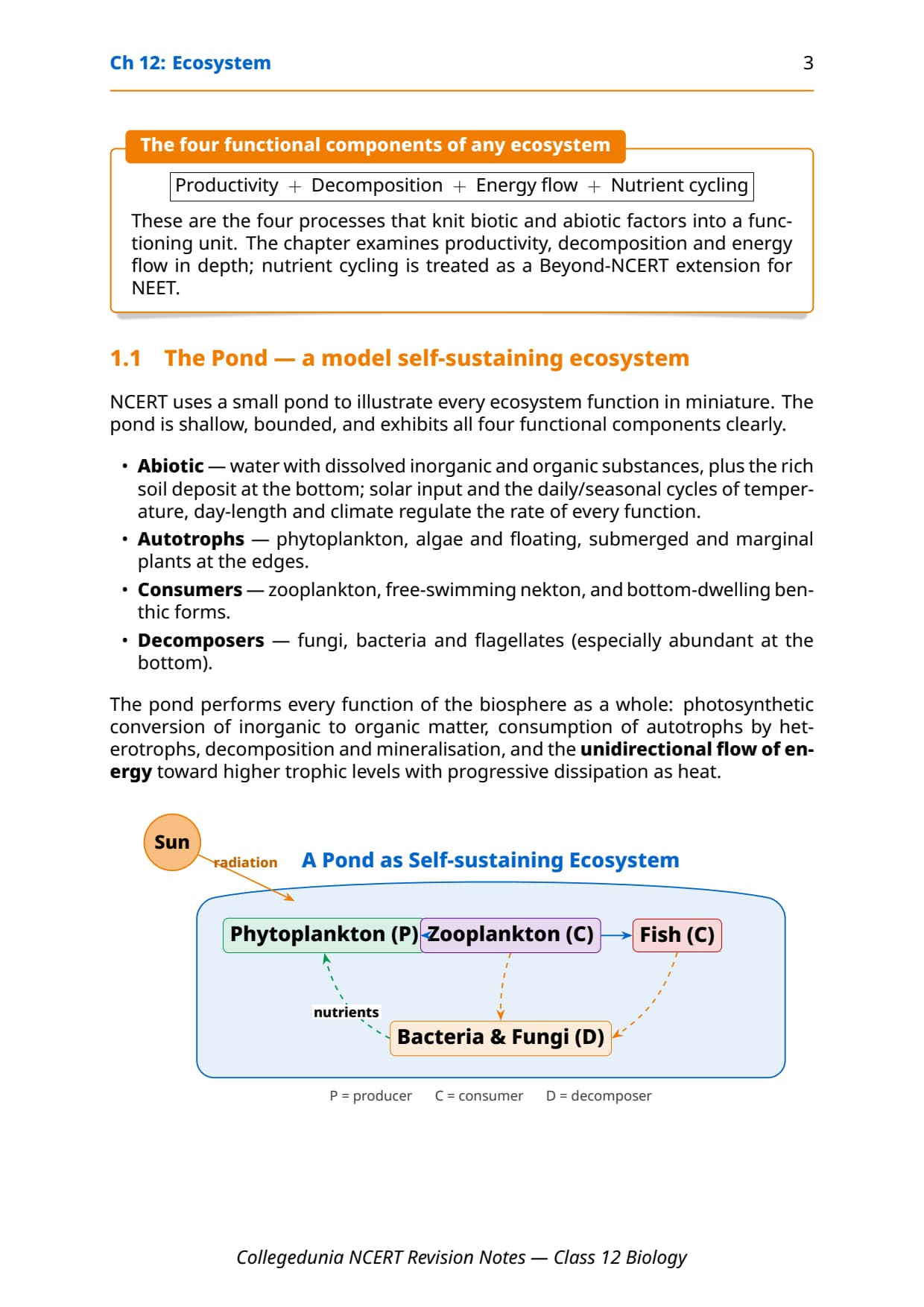
An ecosystem is a functional unit where living organisms interact with the abiotic environment. It is terrestrial (forest, grassland, desert) or aquatic (pond, lake, estuary). Components are biotic (producer, consumer, decomposer) and abiotic (climate, soil, water, nutrients). The four key processes are productivity, decomposition, energy flow and nutrient cycling. A pond is the standard example.
Productivity: GPP, NPP and Standing Crop
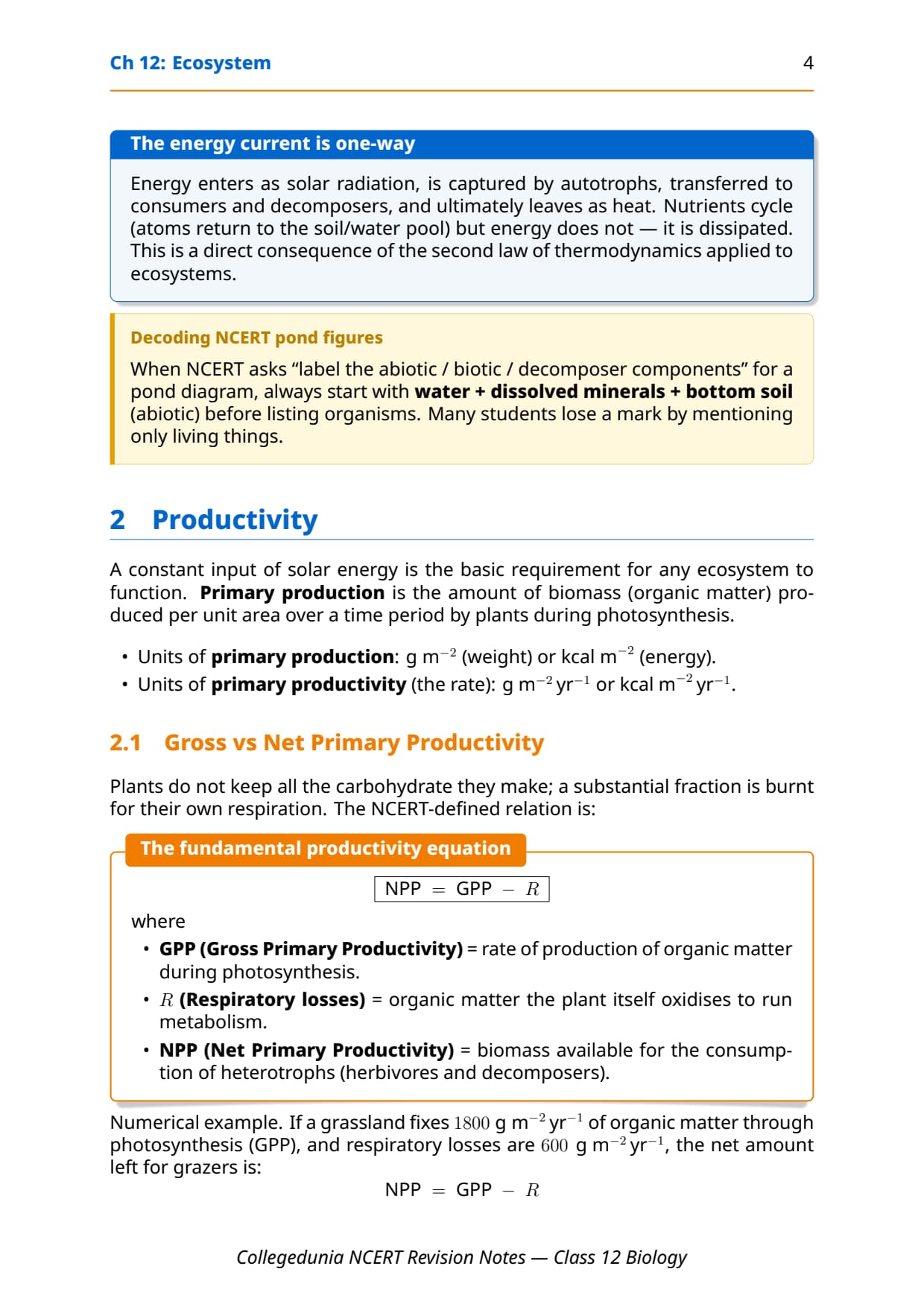
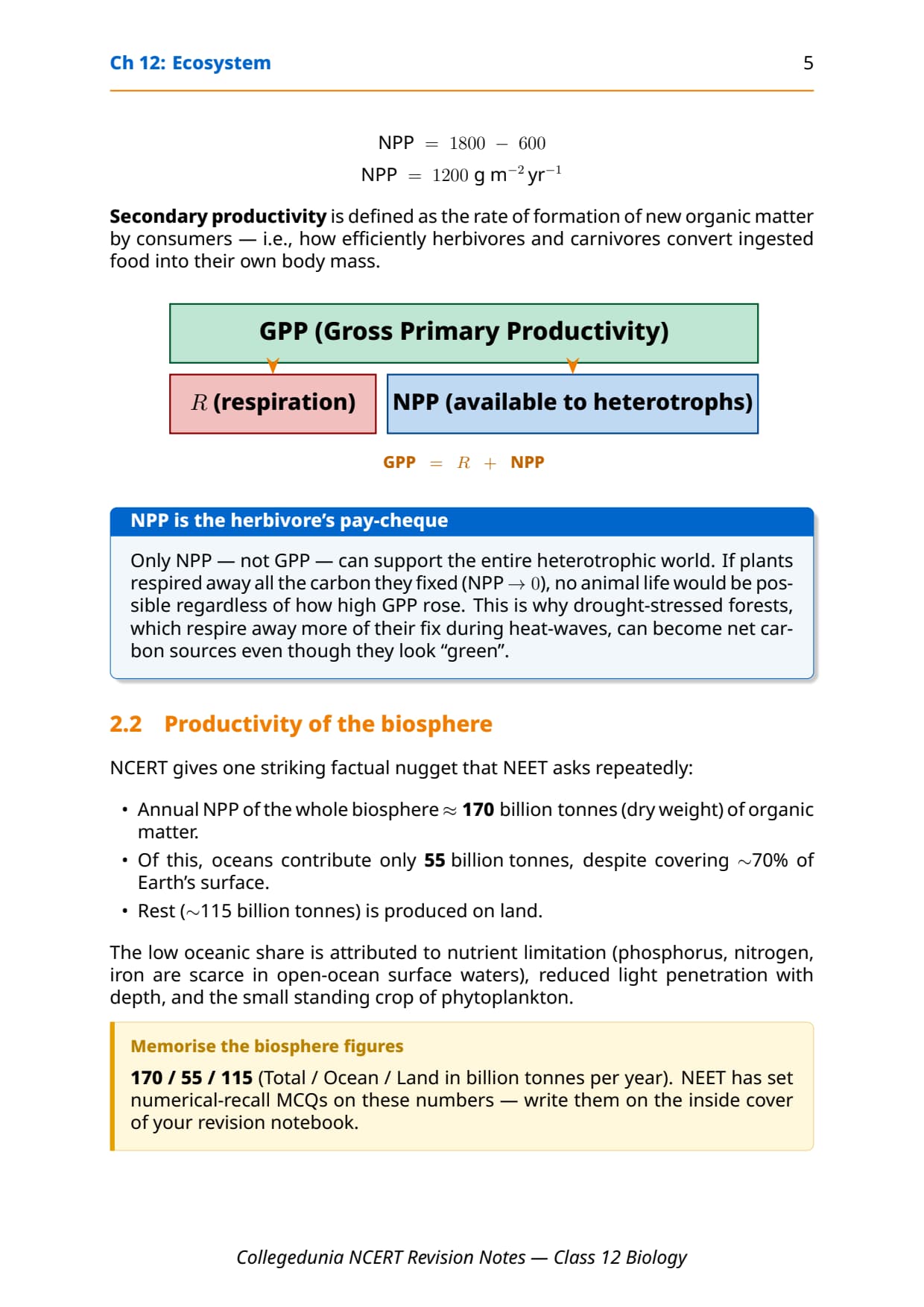
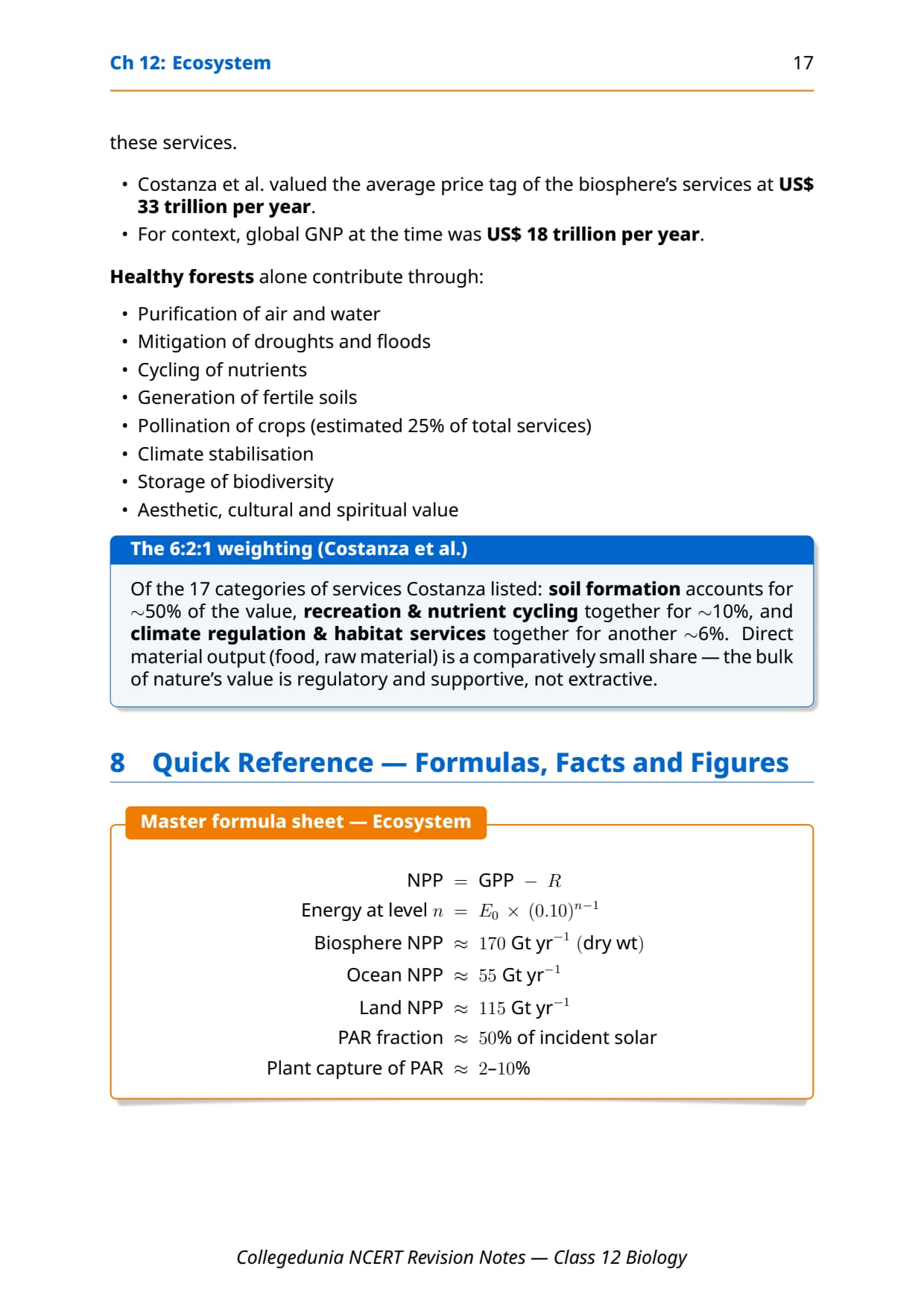
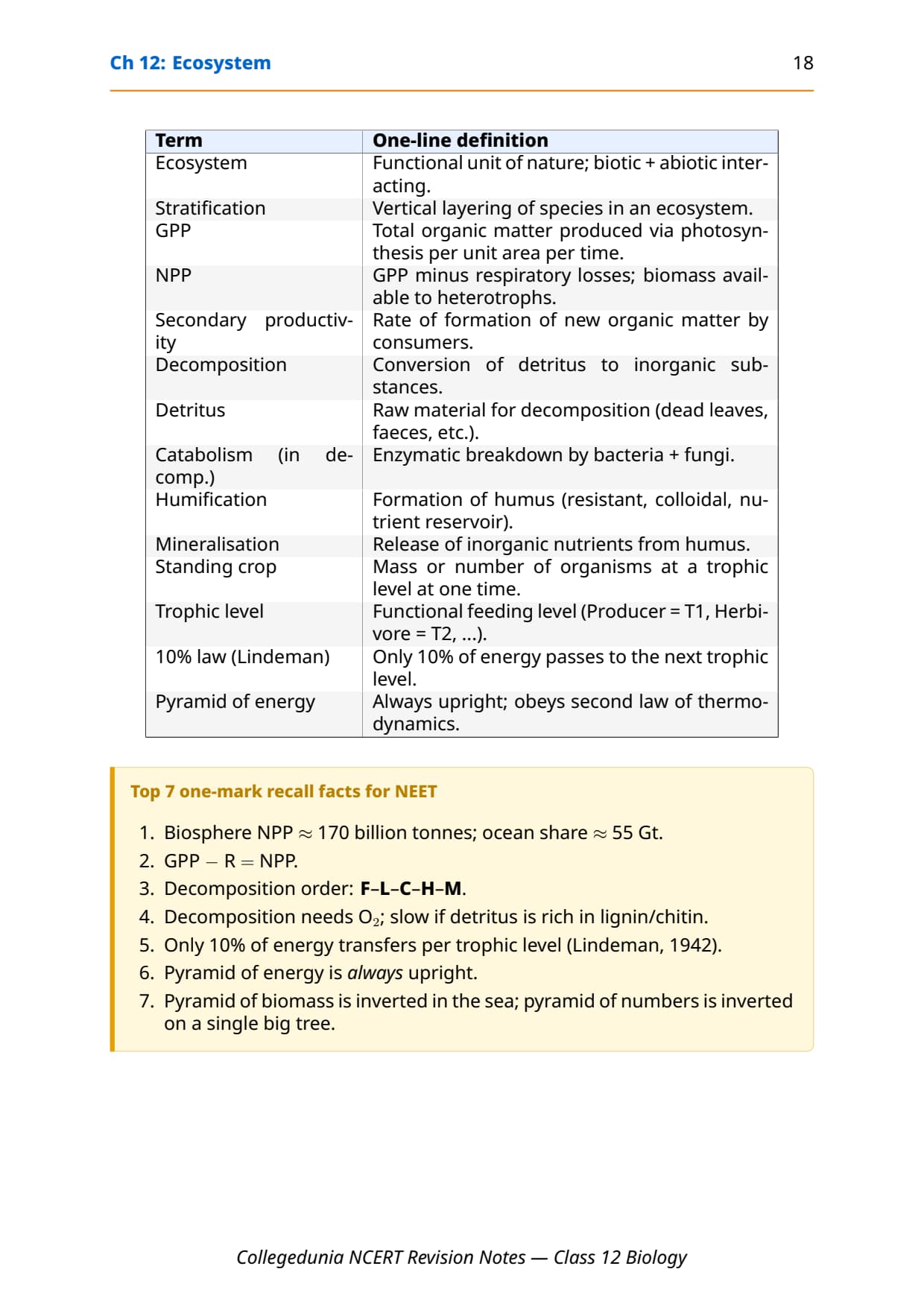
Primary productivity = biomass produced per unit area per unit time (g m−2 yr−1). GPP = total organic matter fixed by photosynthesis; NPP = GPP − R (R = producer respiration). NPP is what is available to herbivores; NEET tests this exact wording. Annual biosphere NPP = ~170 billion tonnes; oceans add less than half. Standing crop = biomass present at a point in time.
Decomposition: Five Steps
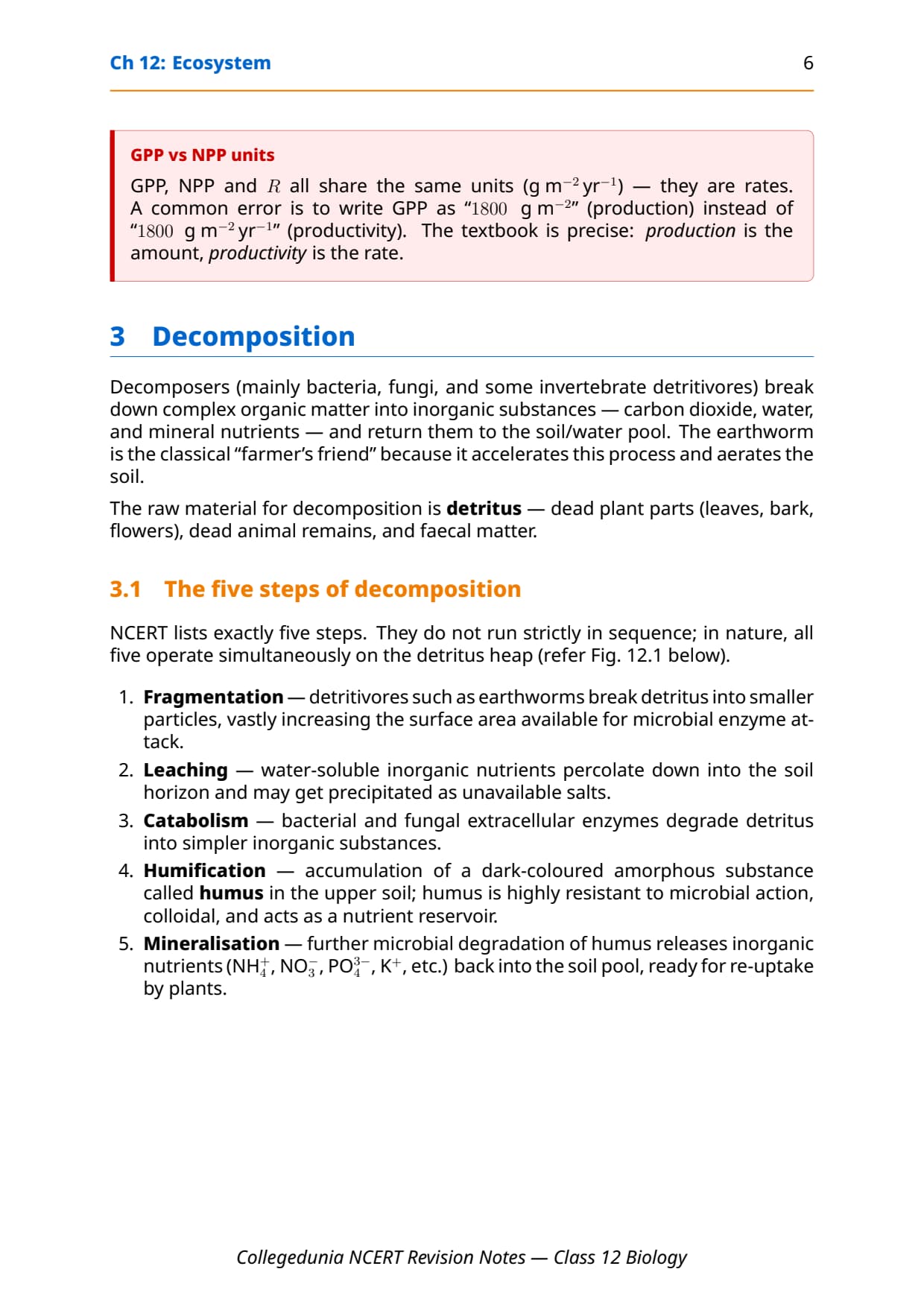
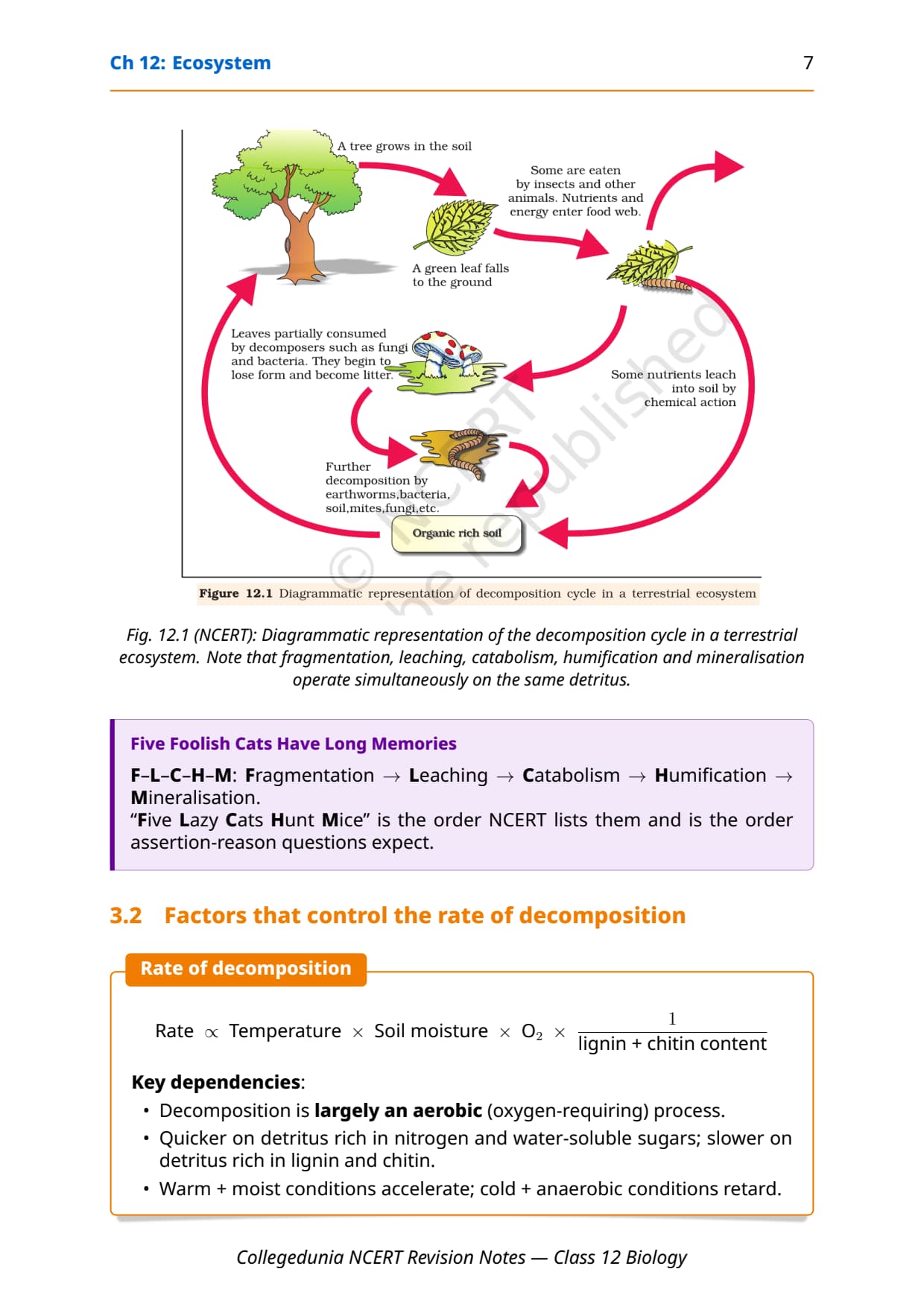
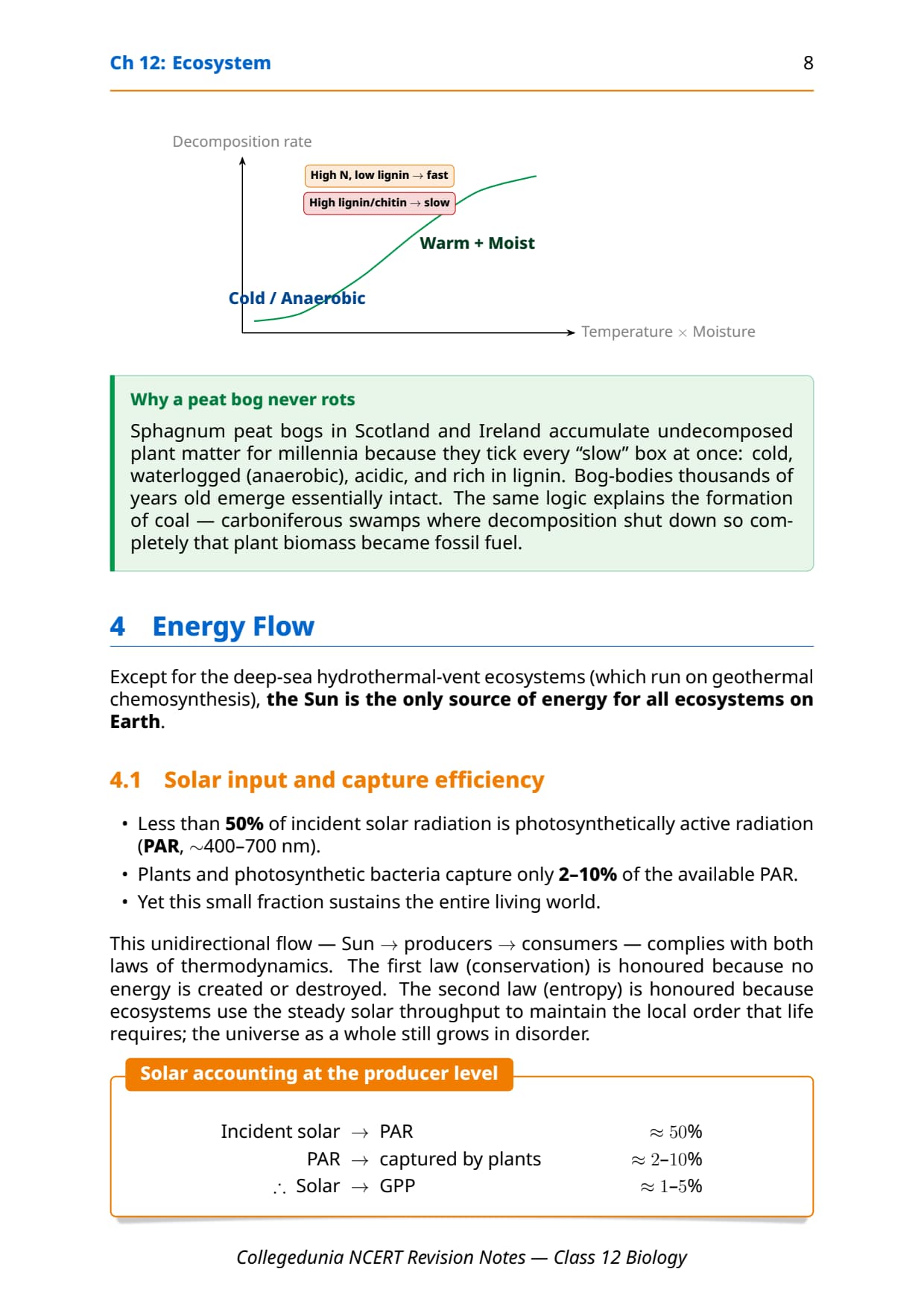
Detritivores fragment dead matter; decomposers (fungi, bacteria) mineralise it. The five steps are fragmentation → leaching (water carries soluble salts down) → catabolism (enzymes degrade detritus) → humification (formation of dark, colloidal humus, a nutrient reservoir resistant to microbes) → mineralisation (humus releases inorganic CO2, H2O, NH4+). The rate is faster in warm, moist, O2-rich conditions.
Energy Flow: Single-Channel Model and 10% Law
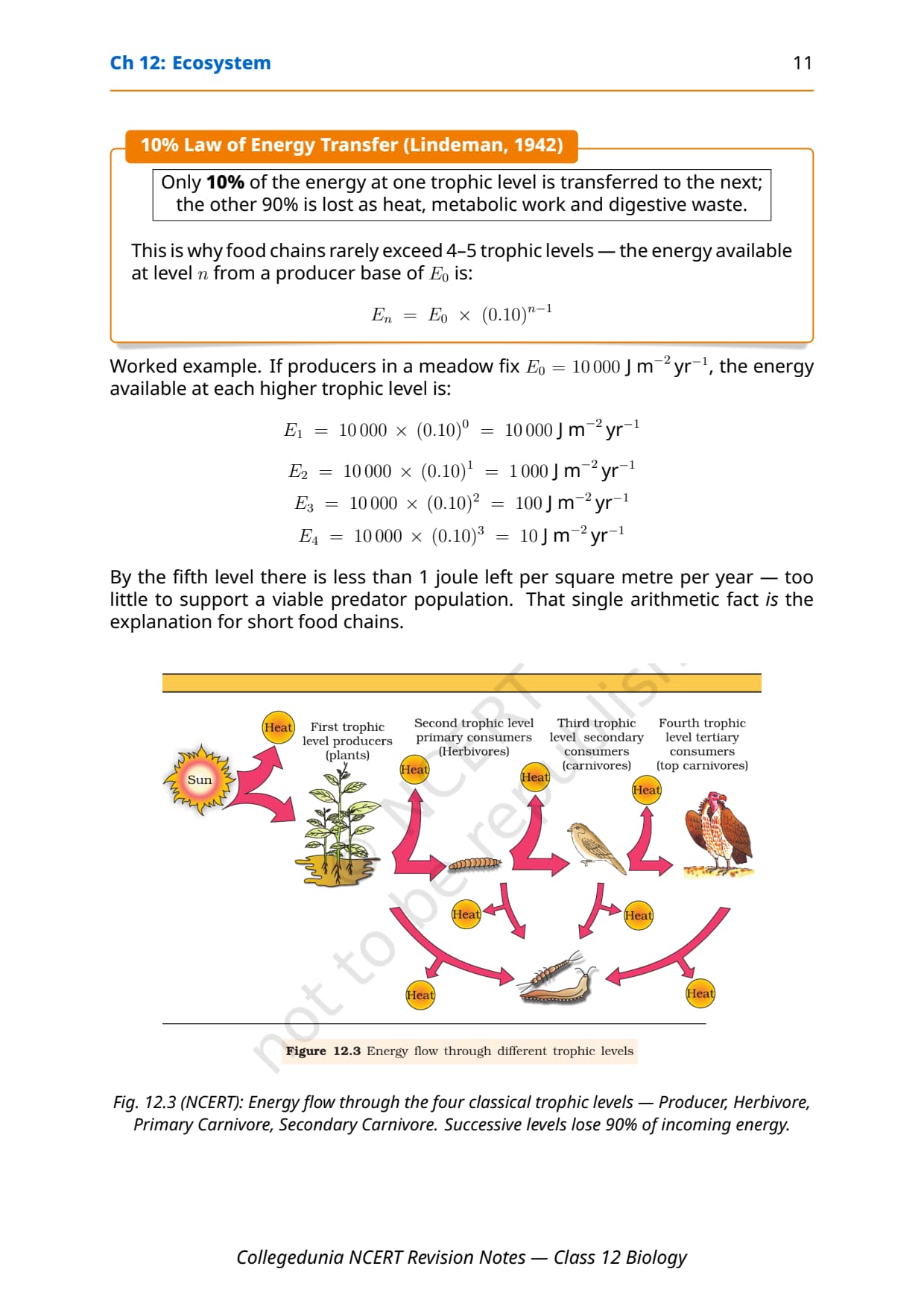
The Sun is the only energy source. Producers capture < 1% of incident PAR. Energy flows uni-directionally: Sun → Producer → Herbivore → Carnivore → Top carnivore. Lindeman's 10% law: only 10% of energy transfers to the next trophic level; the rest is lost as heat. GFC (grazing food chain) starts with a producer; DFC (detritus food chain) starts with dead matter. GFC dominates aquatic ecosystems; DFC carries far more energy on land.
Ecological Pyramids: Number, Biomass, Energy
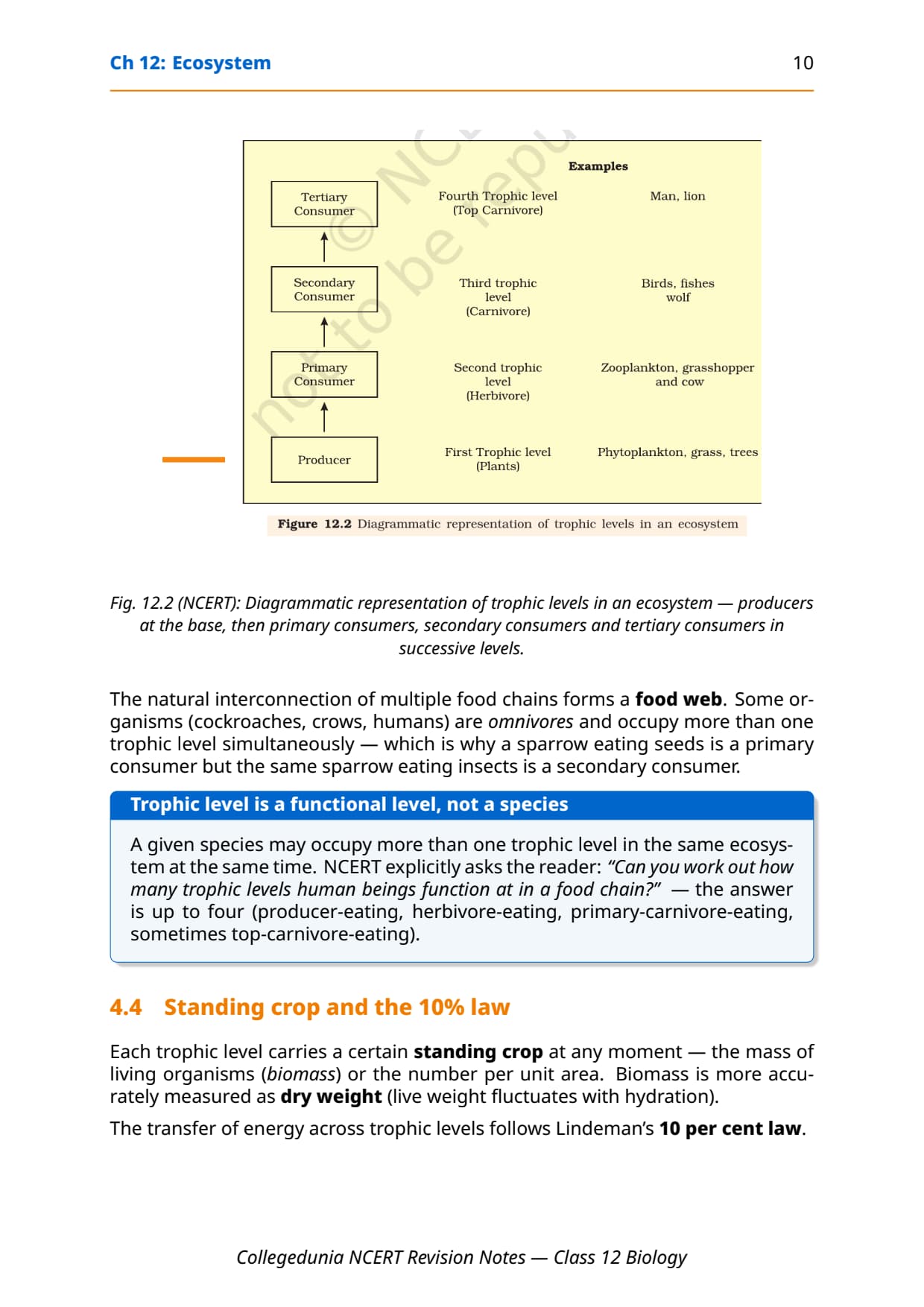
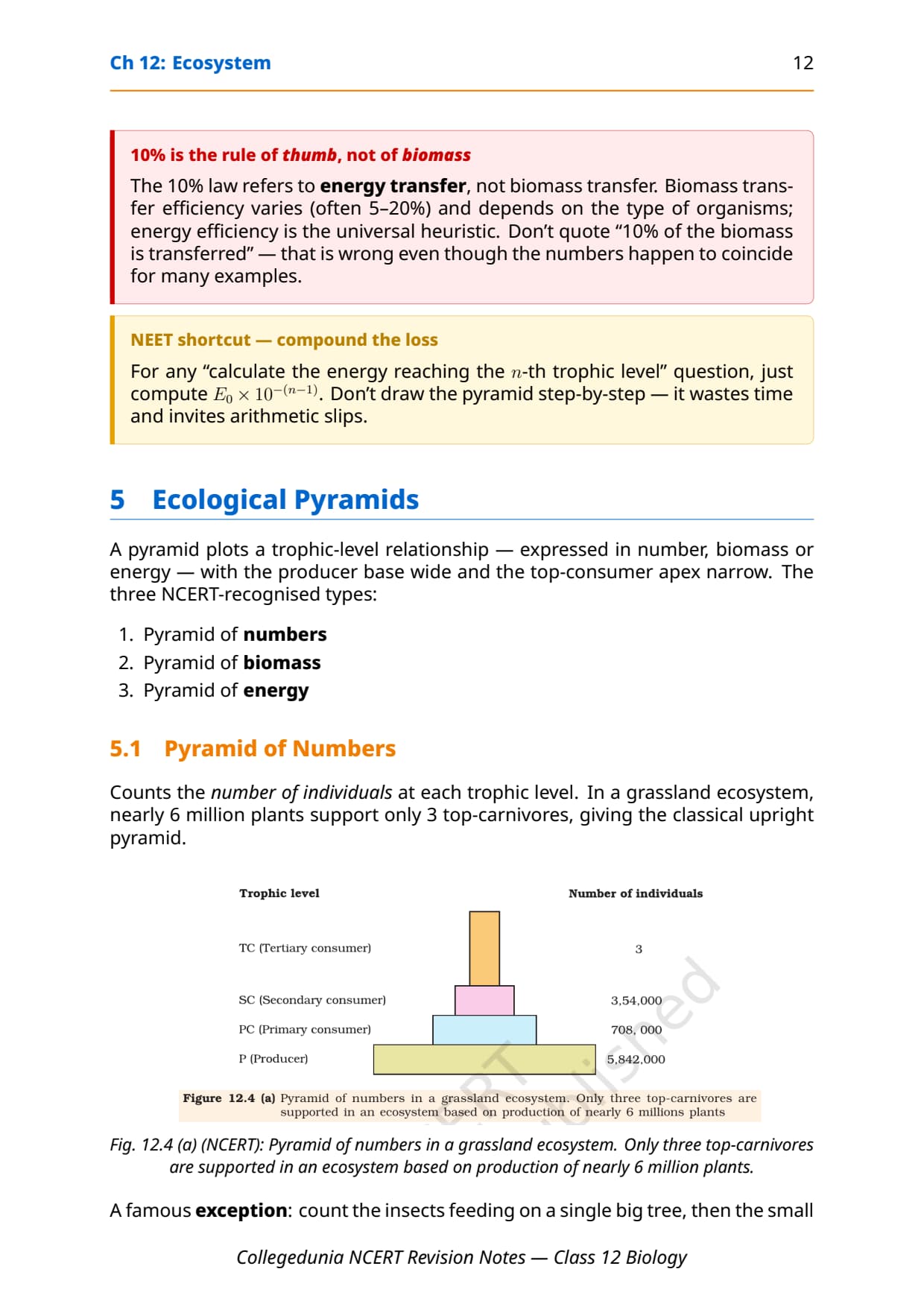
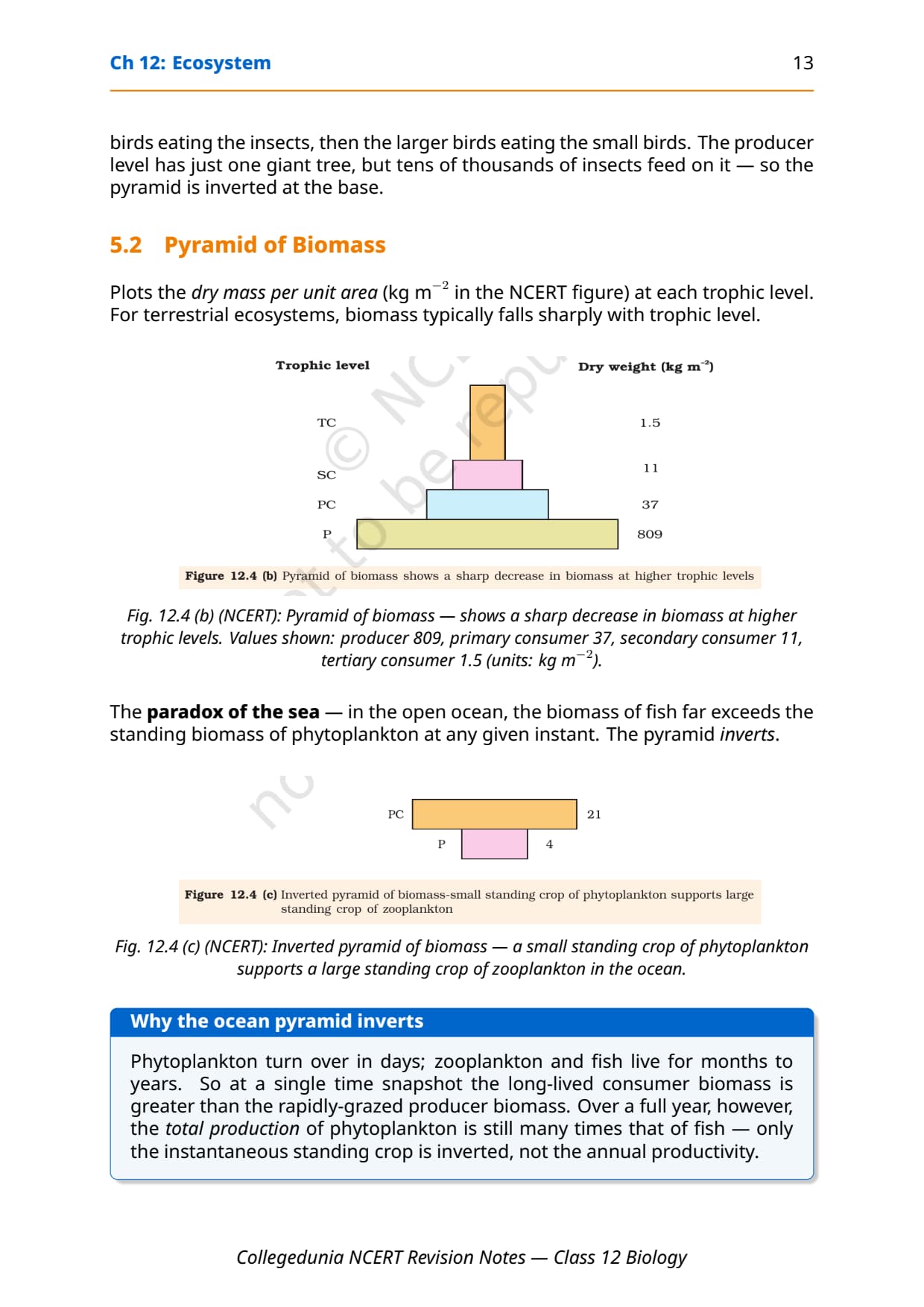
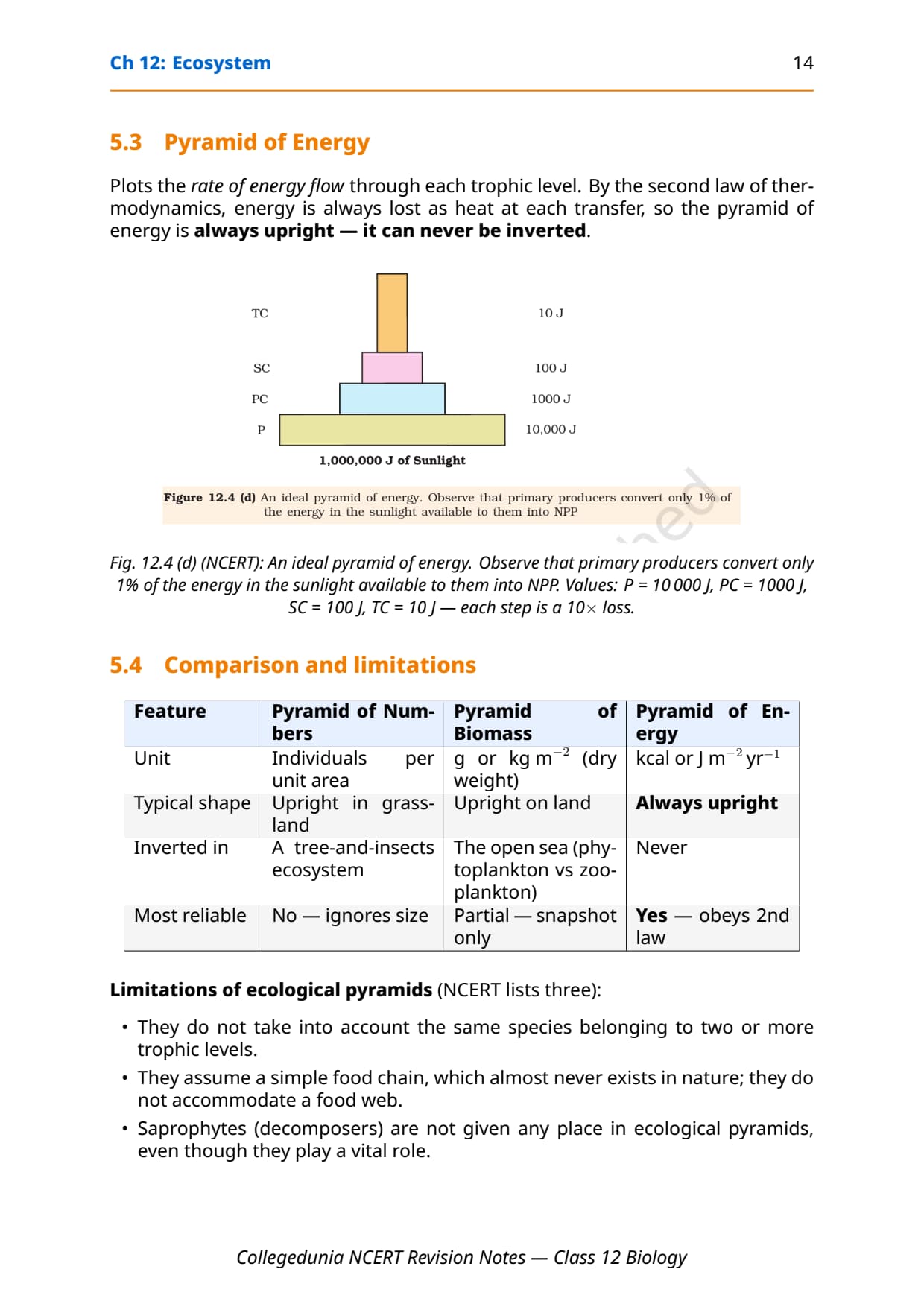
A pyramid plots a parameter at successive trophic levels with producers at the base. The pyramid of numbers can be upright (grassland) or inverted (parasitic chain). The pyramid of biomass is usually upright but inverted in a pond. The pyramid of energy is always upright because of the 10% law. A pyramid assumes a single linear chain and ignores saprophytes.
Ecological Succession: Hydrarch and Xerarch
An orderly, predictable change of community composition in an area. Primary succession begins on a bare lifeless area (new rock, lava); secondary succession begins where a community was disturbed but soil survives. Hydrarch succession runs in water, ending in a mesic forest; xerarch succession runs on bare rock, from crustose lichens through to trees. The final stage is the climax community.
Nutrient Cycling: Carbon and Phosphorus
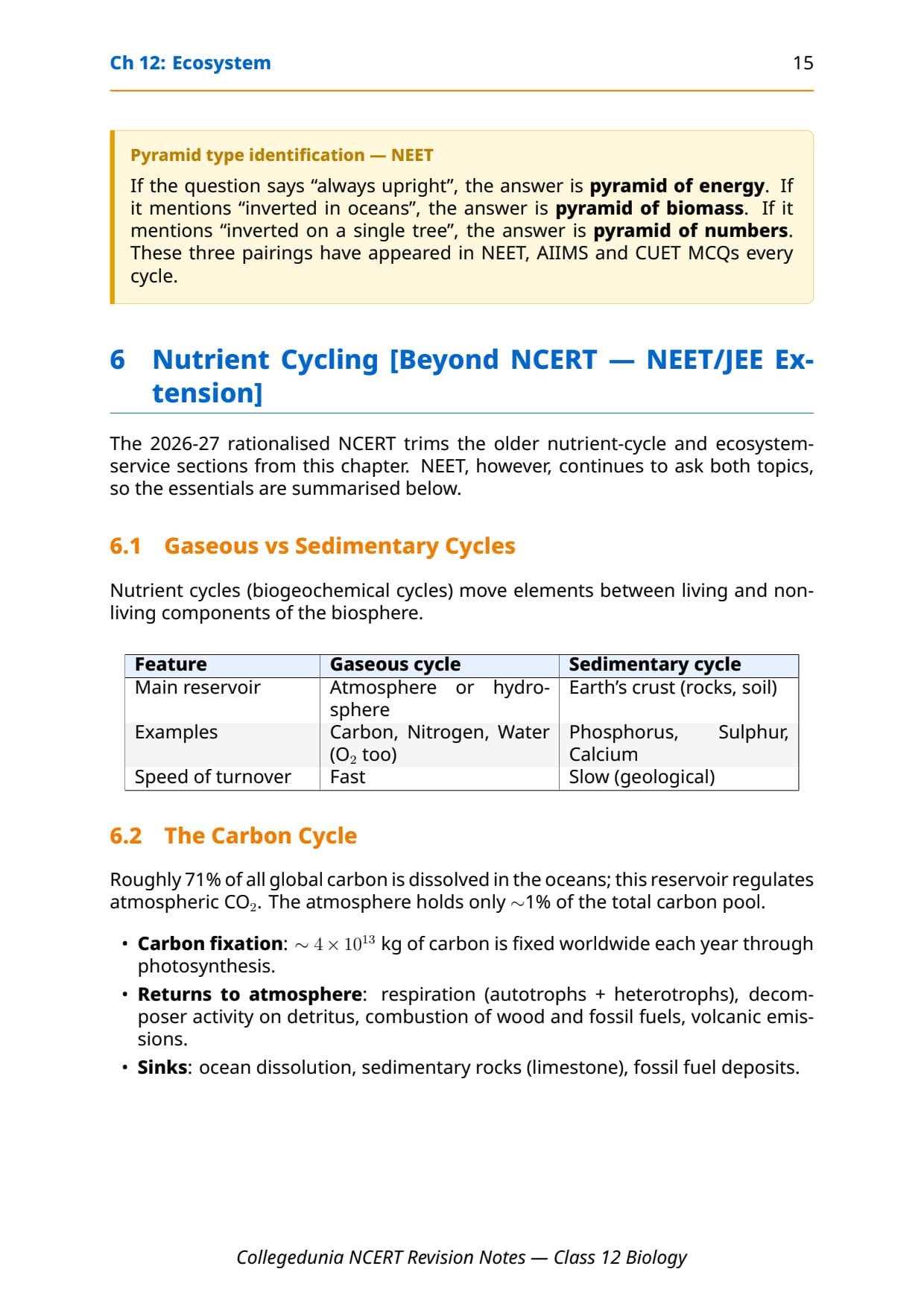
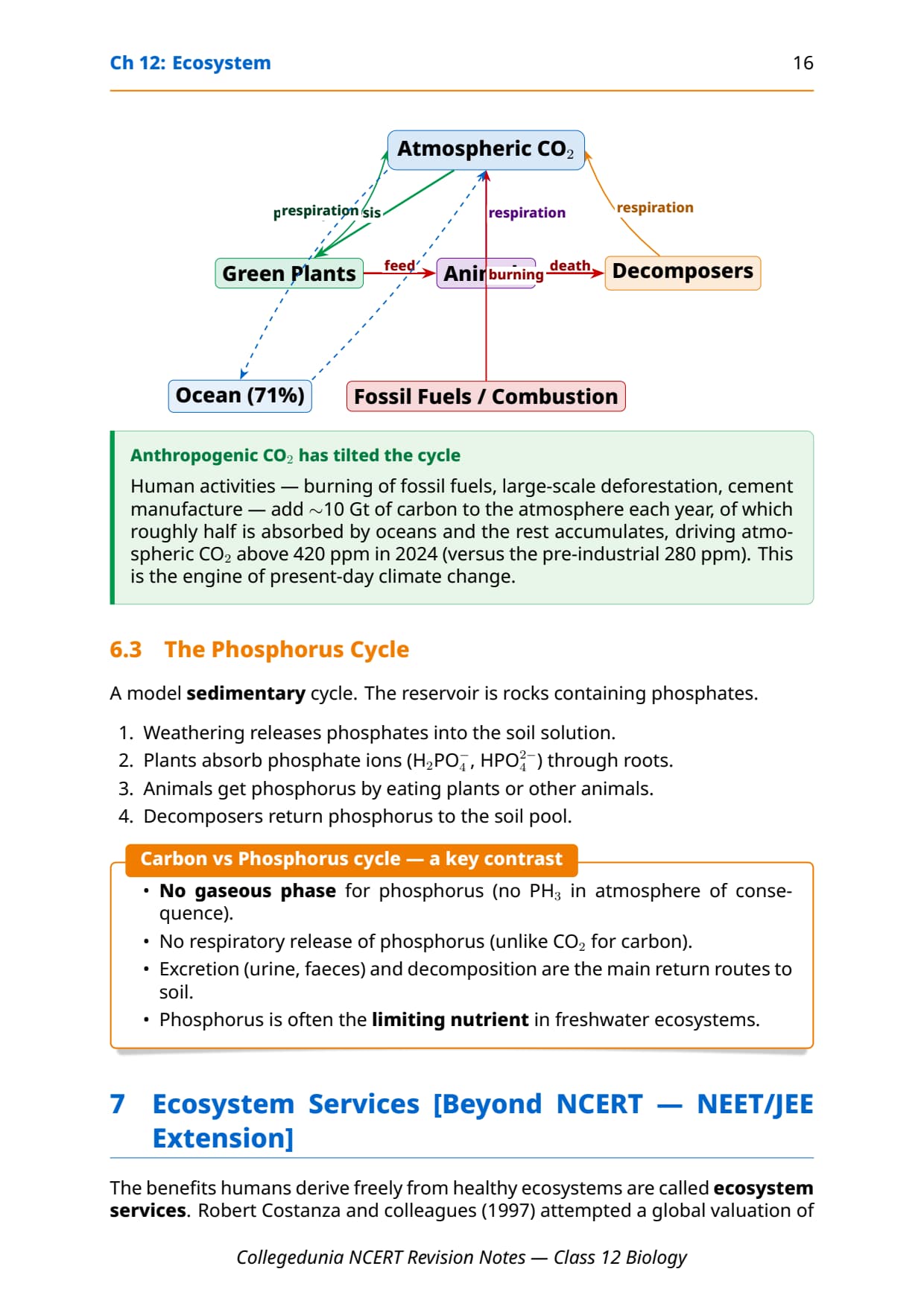
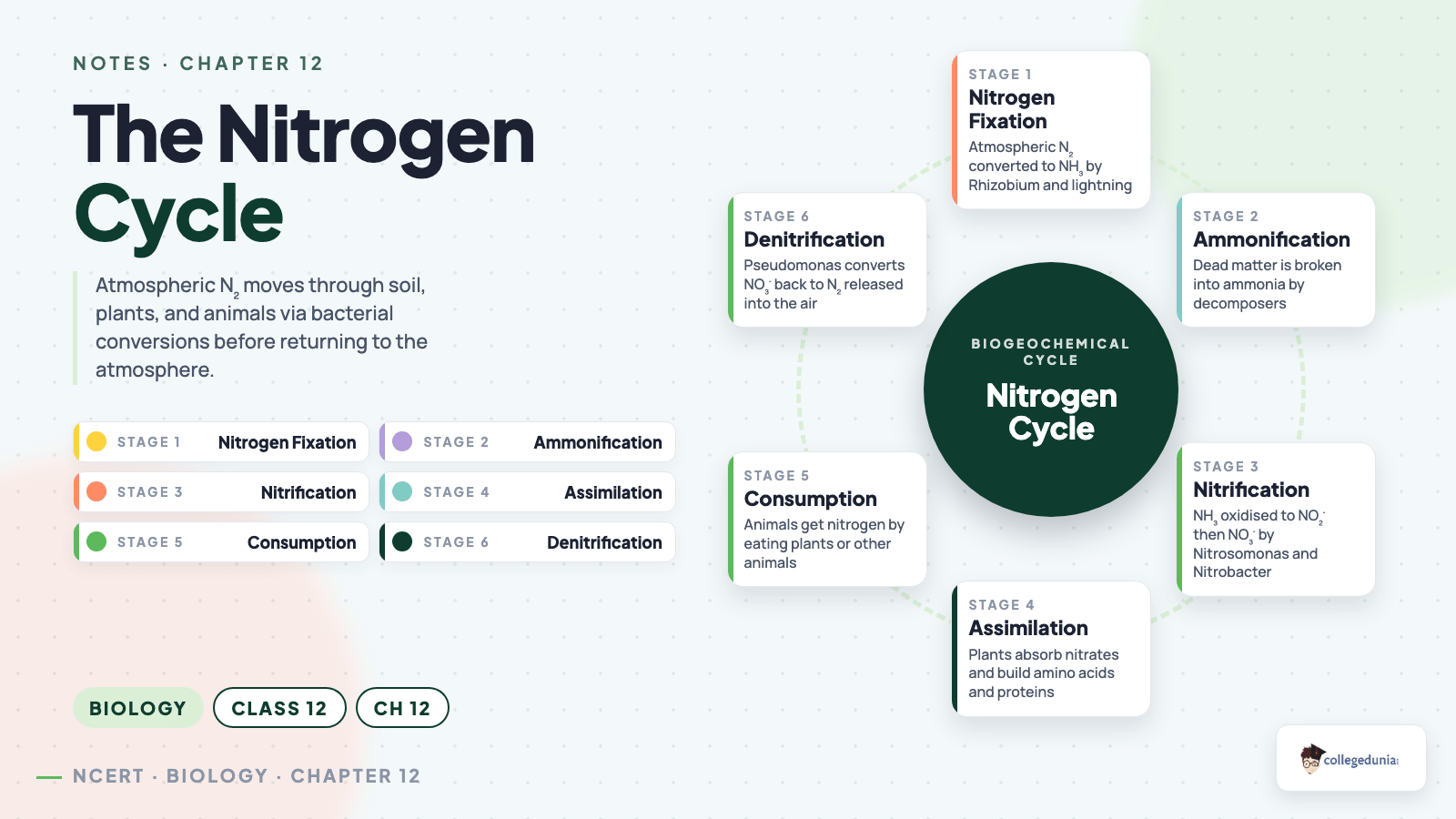
A biogeochemical cycle moves nutrients between biotic and abiotic reservoirs. Gaseous cycles (C, N, O) have an atmospheric reservoir; sedimentary cycles (P, S) have a rock reservoir. The carbon cycle is gaseous (71% of C in oceans); the phosphorus cycle is sedimentary with no atmospheric phase. The full comparison is in the table below. CBSE asks it every other year.
Ecosystem Services
Goods and processes a healthy ecosystem gives free: clean air and water, pollination, climate moderation, nutrient cycling, soil formation and flood control. Robert Costanza (1997) valued the global biosphere at US $33 trillion per year, against a global GNP of ~US $18 trillion. Soil formation alone is about 50% of that.
How Will Collegedunia's NCERT Notes Help You with Ecosystem?
These notes blend the full NCERT chapter with NEET depth, built for how Class 12 students revise: skim, recall, drill.
- 2026-27 NCERT alignment: every section mapped to the latest print, with NEET add-ons flagged.
- Master number table: one table holds every key number asked in five years.
- Diagram-first layout: energy-flow chart, the two cycles and a pyramid comparison as labelled figures.
Ecosystem Topic-wise Weightage for CBSE Class 12 Biology
Energy flow and nutrient cycles repeat most, then productivity numerics and the pyramids. The table maps each sub-topic to its CBSE frequency.
| Sub-topic | Weightage | CBSE Frequency |
|---|---|---|
| Energy Flow + 10% Law | High | Almost every year |
| Carbon & Phosphorus Cycles | High | 4 out of 5 years |
| Productivity (GPP, NPP, R) | High | 4 out of 5 years |
| Ecological Pyramids | Medium | 3 out of 5 years |
| Decomposition (5 steps) | Medium | 3 out of 5 years |
| Succession (hydrarch / xerarch) | Medium | 2 out of 5 years |
| Ecosystem Services | Low | 1 out of 5 years |
Ecosystem Master Number Table for NEET and CBSE
Numbers a NEET aspirant must know cold, each asked in CBSE or NEET in five years.
| Parameter | Value | Note |
|---|---|---|
| Annual biosphere NPP | ~170 billion tonnes (dry organic matter) | Land + ocean |
| Oceans' share of NPP | < 50% | Despite 70% area |
| PAR captured by producers | < 1% | Of solar PAR |
| Energy transfer per trophic level | 10% | Lindeman's 10% law |
| Costanza ecosystem services valuation | US $33 trillion / yr | Vs global GNP US $18 trillion |
| Pyramid of energy direction | Always upright | 10% law forces this |
| Pyramid of biomass in a pond | Inverted | Producer < consumer biomass |
| Pyramid of numbers in a parasitic chain | Inverted | Tree → birds → lice |
| Climax of xerarch succession | Mesic forest | Pioneers: crustose lichens |
Full worked answers to every NCERT question: Ecosystem Class 12 Biology NCERT Solutions.

Ecosystem Carbon vs Phosphorus Cycle Comparison
A direct CBSE 3-marker and NEET MCQ favourite.
| Feature | Carbon Cycle | Phosphorus Cycle |
|---|---|---|
| Cycle type | Gaseous | Sedimentary |
| Reservoir | Atmosphere + oceans (71%) | Phosphate-bearing rocks |
| Atmospheric phase | Yes (CO2) | No |
| Fixation route | Photosynthesis | Weathering → soil → plants |
| Anthropogenic impact | Fossil fuel burning, deforestation | Detergent run-off, eutrophication |
| Annual flux (producer side) | ~4 × 10¹³ kg C / yr | Slow geological release |
Where Students Lose Marks in Ecosystem (Class 12 Biology)
Mistake 1. Writing GPP = NPP + Decomposition. The correct relation is NPP = GPP − R (R = producer respiration, not decomposition).
Mistake 2. Saying the pyramid of energy can be inverted. It is always upright; only numbers and biomass invert.
Mistake 3. Calling the phosphorus cycle a "gaseous cycle". It is sedimentary, with no atmospheric phase.
Mistake 4. Confusing detritivores (fragmenters) with decomposers (mineralisers).
Mistake 5. Listing fewer than five decomposition steps: fragmentation → leaching → catabolism → humification → mineralisation.
Student Feedback
In a survey of 13,100 Class 12 Biology students, energy flow and the pyramids topped the difficulty list:
- 74% of students found the 10% law and pyramid-of-energy diagram hardest.
- 63% lost 1-2 marks mixing up GPP, NPP and secondary productivity.
- 4 out of 5 skipped the carbon and nitrogen cycle flowchart in answers.
- Average student: 5.6 hours for the first read, 2.3 hours for revision.
Source: 2025-26 Class 12 Biology survey of 13,100 students.
Other Resources for Ecosystem Class 12 Biology
| Resource | Link |
|---|---|
| Notes (this page) | Ecosystem Class 12 Biology Notes |
| NCERT Solutions | Ecosystem Class 12 Biology NCERT Solutions |
| Formula Sheet | Ecosystem Class 12 Biology Formula Sheet |
| Handwritten Notes | Ecosystem Class 12 Biology Handwritten Notes |
| NCERT Book PDF | Ecosystem Class 12 Biology NCERT Book PDF |
| Exemplar Solutions | Ecosystem Class 12 Biology Exemplar Solutions |
| Exemplar Book PDF | Ecosystem Class 12 Biology Exemplar Book PDF |
NCERT Notes for Class 12 Biology: All Chapters
Browse Class 12 Biology Notes for the 2026-27 syllabus on Collegedunia.
| Chapter No. | Chapter Title |
|---|---|
| Chapter 1 | Sexual Reproduction in Flowering Plants Notes |
| Chapter 2 | Human Reproduction Notes |
| Chapter 3 | Reproductive Health Notes |
| Chapter 4 | Principles of Inheritance and Variation Notes |
| Chapter 5 | Molecular Basis of Inheritance Notes |
| Chapter 6 | Evolution Notes |
| Chapter 7 | Human Health and Disease Notes |
| Chapter 8 | Microbes in Human Welfare Notes |
| Chapter 9 | Biotechnology: Principles and Processes Notes |
| Chapter 10 | Biotechnology and Its Applications Notes |
| Chapter 11 | Organisms and Populations Notes |
| Chapter 12 | Ecosystem Notes |
| Chapter 13 | Biodiversity and Conservation Notes |
Ecosystem Class 12 Biology Notes FAQs
Ques. What is an ecosystem in Class 12 Biology?
Ans. An ecosystem is a functional unit of nature where living organisms interact with each other and with the non-living abiotic environment. Examples include a pond, forest, grassland or desert. It has biotic (producer, consumer, decomposer) and abiotic (climate, soil, water, nutrients) components.
Ques. What is the difference between GPP and NPP?
Ans. GPP (Gross Primary Productivity) is the total organic matter fixed by producers per unit area per unit time. NPP (Net Primary Productivity) is the energy left after the producer's own respiration is subtracted: NPP = GPP − R. NPP is what becomes available to herbivores.
Ques. Why is the pyramid of energy always upright?
Ans. Because of Lindeman's 10% law: only 10% of the energy of one trophic level transfers to the next, so the higher level always carries less energy than the level below. This forces the pyramid into an upright shape in every ecosystem.
Ques. What are the five steps of decomposition?
Ans. Fragmentation (detritivores break down detritus), leaching (water carries soluble nutrients into soil), catabolism (enzymes degrade detritus), humification (formation of humus) and mineralisation (release of inorganic nutrients).
Ques. What is the difference between the carbon cycle and the phosphorus cycle?
Ans. The carbon cycle is a gaseous cycle with an atmospheric phase (CO2) and 71% of reserves in oceans. The phosphorus cycle is a sedimentary cycle with no atmospheric phase; the reservoir is phosphate-bearing rock. Both involve biological uptake and decomposition, but P moves slowly via geological weathering while C cycles rapidly via photosynthesis and respiration.
Ques. What is the 10% law in an ecosystem?
Ans. Lindeman's 10% law states that only about 10% of the energy at one trophic level is converted to biomass at the next trophic level. The remaining 90% is lost mainly as heat during respiration and as un-ingested or un-assimilated matter.
Ques. What is ecological succession?
Ans. Ecological succession is the orderly, predictable change in community composition in a given area over time, ending in a stable climax community. Hydrarch succession starts in water and ends in mesic forest; xerarch succession starts on bare rock with crustose lichens as pioneers and ends in a forest community.
Ques. What are ecosystem services and what is their estimated value?
Ans. Ecosystem services are the goods and processes provided free by a healthy ecosystem: purification of air and water, pollination, climate moderation, nutrient cycling, soil formation, flood and drought control. Robert Costanza (1997) estimated the global value at US $33 trillion per year; soil formation alone contributes about 50%.



Comments