




The Class 12 Accountancy Notes (2026-27 syllabus) sum up every chapter of the NCERT Part 1 and Part 2 books. They give you short revision notes for the 80-mark CBSE theory paper.
Class 12 Accountancy Notes Part 1 PDF Download


Class 12 Accountancy Notes Part 2 PDF Download
The 4 chapters from Part 1 (Accounting for Partnership Firms and Companies). Each chapter's Notes PDF distils the full partnership lifecycle - basic concepts, admission, retirement / death, dissolution - into 14 to 22 pages of revision-ready content.
These are the 6 Part 2 chapters. They cover Share Capital, Debentures, Financial Statements, Analysis, Ratios, and Cash Flow Statement. Each Notes PDF has a formula box for every ratio and a journal-entry template for every transaction.
Each chapter comes as a free PDF. You get concept summaries, journal-entry templates, working-note examples, and the Schedule III formats CBSE markers reward.
- Chapters covered: 10 chapters in total - 4 Part 1 chapters (Partnership Accounts) plus 6 Part 2 chapters (Company Accounts and Financial Statement Analysis)
- Format: chapter-wise PDFs plus one combined all-chapters file, all free
- Length: 14 to 22 pages per chapter. Long enough for a second read, short enough to finish in one sitting.
- Exam alignment: CBSE Class 12 Accountancy theory paper (80 marks) plus CUET-UG Accountancy domain paper
Subject experts make every chapter in this Collegedunia Class 12 Accountancy Notes set. Each one is mapped to the 2026-27 NCERT, and checked against the last five years of CBSE Board sample papers and the latest CBSE marking scheme.
How will Collegedunia's Class 12 Accountancy Notes Help You?
Class 12 Accountancy Notes are for the student who has read the chapter once and now wants a fast second read. The notes shrink the chapter's journal patterns. They keep every formula and every working-note example that CBSE has tested before.
- 2026-27 NCERT alignment: every concept, formula, and journal-entry template matches the current Part 1 and Part 2 textbooks.
- Examiner-style structure: concept introduction, formula box, journal-entry template, working-note example, common-mistake callout, exam-day quick-recall summary.
- Colour-coded callouts: formula boxes in orange, concept boxes in teal, common-mistake boxes in red, working-note examples in cream. The visual structure speeds up second and third revision passes.
- Schedule III headings preserved verbatim: Part 2 Ch 3 (Financial Statements) Notes carry the Schedule III format in its exact CBSE-required heading order.
- Cross-resource navigation: jump from any chapter's notes into the back-exercise NCERT Solutions, the source chapter PDF, or the handwritten revision notes in one click.
- Mobile-friendly PDFs: standard-resolution downloads for phone reading and HD print-ready files for the board-day printout.
What 12,640 students told us about their Class 12 Accountancy revision routine using chapter notes
Source: Magnet Brains on YouTube
Class 12 Accountancy Topic Map (2026-27 NCERT)
How the 10 chapters group across the two NCERT books and the four CBSE units. Each chapter's Notes PDF covers the topics listed in NCERT order.
| Part / Unit | Chapters | What this unit covers |
|---|---|---|
| Part A, Unit 1: Accounting for Partnership Firms | Ch 1, Ch 2, Ch 3, Ch 4 (Part 1) | Partnership deed, profit sharing ratio, capital accounts (fixed and fluctuating), goodwill treatment, sacrificing ratio, gaining ratio, revaluation of assets and liabilities, admission, retirement, death and dissolution of a partnership firm. The 35-mark Part A backbone of the paper. |
| Part A, Unit 2: Accounting for Companies | Part 2 Ch 1, Ch 2 | Issue, forfeiture and reissue of shares, oversubscription and undersubscription, issue of debentures (at par, premium, discount), redemption of debentures by various methods (lump sum, draw of lots, conversion, purchase). 25 marks of the Part A block. |
| Part B, Unit 3: Analysis of Financial Statements | Part 2 Ch 3, Ch 4, Ch 5 | Financial Statements of a Company as per Schedule III of the Companies Act 2013, tools of financial statement analysis (comparative, common-size statements), liquidity, solvency, activity and profitability ratios. 12 marks of Part B. |
| Part B, Unit 4: Cash Flow Statement | Part 2 Ch 6 | Cash Flow Statement preparation as per AS-3 (Revised) using the indirect method; classification into operating, investing and financing activities; treatment of provisions and non-cash items. 8-mark long answer slot. |
NCERT Class 12 Accountancy Deleted Syllabus 2026-27
The examination authority has trimmed the NCERT 2026-27 syllabus for Class 12 Accountancy. This cuts the study load for CBSE Boards and CUET. The topics below are officially out of the 2026-27 question paper, so skip them while revising.
| Chapter | Deleted Topics (2026-27) |
|---|---|
| Partnership Fundamentals (Part 1, Ch 1) | Some sub-topics on past adjustments and rectification of errors trimmed; profit-sharing and interest-on-capital retained. |
| Goodwill Treatment (Part 1, Ch 2-3) | Capitalisation method of goodwill valuation (one of three methods) removed; average-profit and super-profit methods retained. |
| Retirement and Death of a Partner (Part 1, Ch 4) | Joint-life policy treatment (sub-parts) removed; gaining ratio and revaluation retained. |
| Issue and Redemption of Debentures (Part 2, Ch 2) | Debentures issued as collateral security - detailed journal entries trimmed. |
| Analysis of Financial Statements (Part 2, Ch 4-5) | Some ratio analysis sub-cases (turnover ratios) removed; profitability and liquidity ratios retained. |
| Cash Flow Statement (Part 2, Ch 6) | Indirect method - some adjustments around extraordinary items removed; direct-vs-indirect comparison retained. |
The chapter-wise resources in the All Chapters index above already mark every deleted line inline. So you will not waste revision hours on dropped topics.
Class 12 Accountancy Chapter-wise Important Questions
The five chapter clusters below carry most of the CBSE 2026 Class 12 Accountancy paper. They repeat almost every year. The first column lists the long-answer topics that come up as 3-mark and 5-mark questions. The second column lists the application questions that appear as 1-3 mark numericals, MCQs, and case studies in CBSE and CUET UG.
| Chapter Cluster | Important Theory / Long Answers (4-6 marks) | Important Numerical / Practical Problems (3-4 marks) |
|---|---|---|
| Partnership Fundamentals (Part 1, Ch 1-2) | 1. Profit-and-loss appropriation account format. 2. Interest on capital and drawings - rules. 3. Guarantee of profit to a partner. | Calculation of new profit-sharing ratio, distribution of profit with past adjustments, partner's capital account preparation. |
| Goodwill and Reconstitution (Part 1, Ch 3-5) | 1. Average-profit and super-profit valuation methods. 2. Treatment of goodwill on admission of a partner. 3. Revaluation account on retirement. | Sacrificing ratio and gaining ratio calculation, treatment of unrecorded assets / liabilities, capital adjustment after admission. |
| Dissolution of Partnership Firm (Part 1, Ch 6) | 1. Realisation account format and process. 2. Treatment of partner's loan and unrecorded items. 3. Insolvency of a partner - Garner v Murray. | Realisation A/c preparation, payment to partners in dissolution, ranking of claims. |
| Company Accounts - Shares and Debentures (Part 2, Ch 1-2) | 1. Issue of shares at par / premium / discount. 2. Forfeiture and re-issue of forfeited shares. 3. Redemption of debentures - methods. | Journal entries for share issue, share-capital balance sheet extract, debenture interest calculation. |
| Financial Statement Analysis (Part 2, Ch 3-6) | 1. Comparative and common-size statements. 2. Profitability and liquidity ratio formulae. 3. Cash flow statement (indirect method). | Ratio calculation from balance sheet data, cash flow from operating / investing / financing, interpretation questions. |
The same five clusters appear in CUET UG 2026 Accountancy with a near-identical split. Theory-heavy topics (goodwill, dissolution, debentures) fill the MCQ section. Ratio analysis and cash flow appear as case-study sets. The Expert's Solution tab on each chapter page shows the CUET-style multiple-choice method next to the CBSE board-style structured answer.
NCERT NOTES · CLASS 12 ACCOUNTANCY
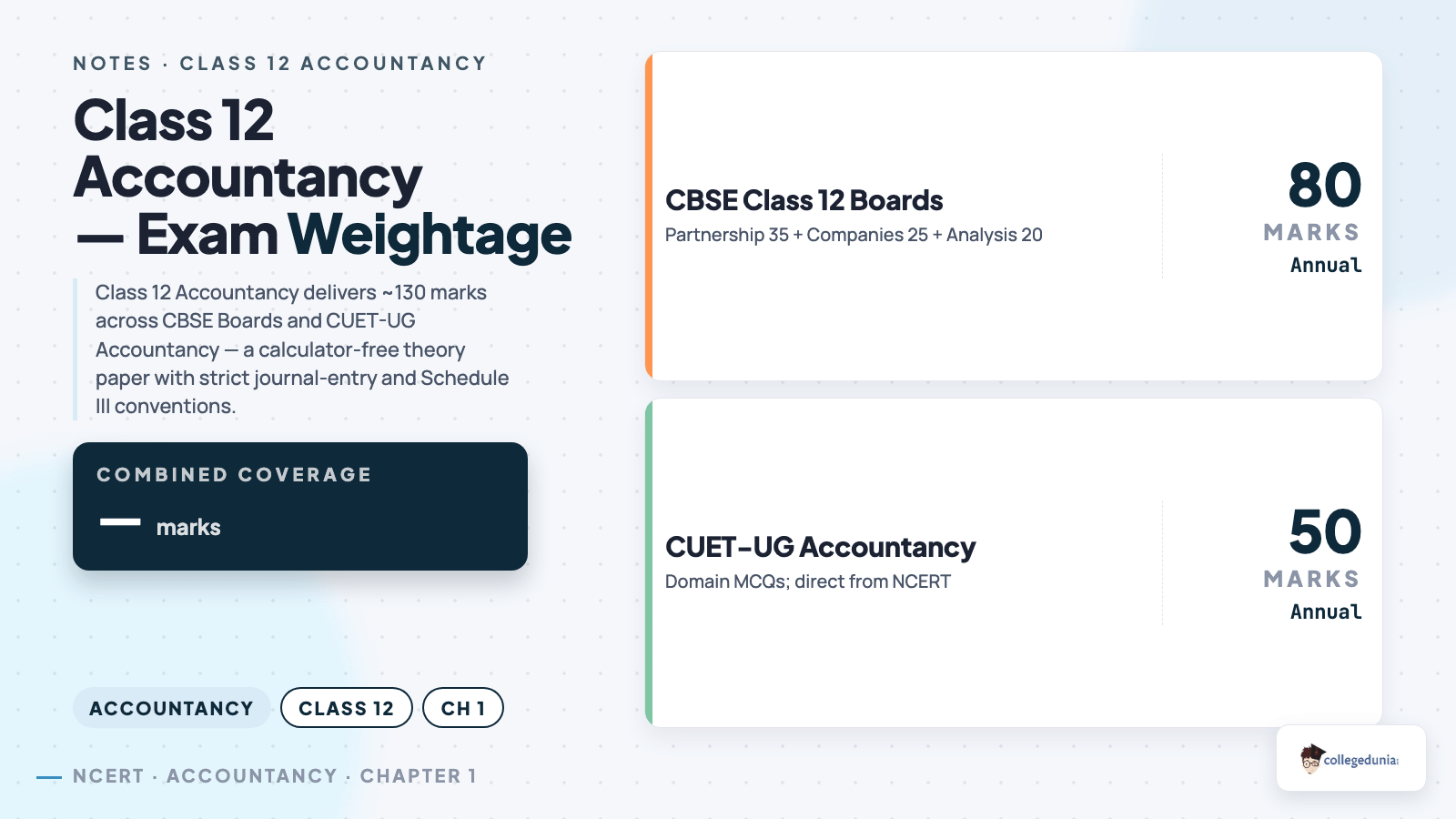
Class 12 Accountancy - Exam Weightage
Class 12 Accountancy is worth about 130 marks in total across CBSE Boards and CUET UG (Commerce domain). It is the base paper for B.Com, BBA, and CA / CS / CMA entry-route prep.
Class 12 Accountancy Notes Weightage Snapshot (CBSE 2026 Theory Paper)
The Partnership Firms unit leads the 80-mark paper at 35 marks. Use the snapshot below to plan how much time each chapter's Notes deserve in your revision.
| Unit | Chapters | CBSE Marks (2026) |
|---|---|---|
| Part A, Unit 1: Accounting for Partnership Firms | Ch 1, Ch 2, Ch 3, Ch 4 (Part 1) | 35 marks |
| Part A, Unit 2: Accounting for Companies | Part 2 Ch 1, Ch 2 | 25 marks |
| Part B, Unit 3: Analysis of Financial Statements | Part 2 Ch 3, Ch 4, Ch 5 | 12 marks |
| Part B, Unit 4: Cash Flow Statement | Part 2 Ch 6 | 8 marks |
| Theory paper total | 10 chapters across 2 parts | 80 marks |
| Project work (internal assessment) | n/a | 20 marks |
Class 12 Accountancy CBSE 2026 Paper Pattern Snapshot
The 80-mark CBSE Class 12 Accountancy theory paper runs 3 hours. It has two compulsory parts plus the internal-assessment project. Knowing the weight of each section is half your revision plan. Once you know which section a chapter feeds, you can pick the right resource. Use Notes for journal recall and NCERT Solutions for the practical long-answer working.
- Part A (60 marks): Accounting for Partnership Firms and Companies. Compulsory for every student. Covers all four Part 1 chapters (Partnership Accounts) plus the first two Part 2 chapters (Share Capital and Debentures). The 35-mark Partnership block alone gives most of the long-answer questions.
- Part B (20 marks): Analysis of Financial Statements. About 90% of CBSE Accountancy students pick this Part B option. It covers Part 2 Ch 3, Ch 4, Ch 5, and Ch 6. The Cash Flow Statement chapter alone carries an 8-mark long-answer slot.
- Part B alternative (20 marks): Computerised Accounting. Schools choose between Analysis of Financial Statements and Computerised Accounting at the start of the year. Most CBSE schools pick the first one, which is the default on this listing.
- Project work (20 marks internal assessment): this includes one full project (Segment Reporting, Cash Flow Statement, or Ratio Analysis) plus a viva. The school gives the marks with help from an external examiner.
- Calculator policy: CBSE does NOT allow calculators in the Class 12 Accountancy theory paper. You must work every percentage, ratio, depreciation calculation, and revaluation adjustment by hand. Build this skill through repeated practice from the NCERT back-exercise.
The 80-mark theory paper plus the 20-mark project make the 100-mark scheme. Part A gives 60 of those 80 marks. So getting strong at Ch 1 to Ch 4 (Partnership) plus Part 2 Ch 1 and Ch 2 (Share Capital, Debentures) is the best-value revision plan for any Accountancy student.
Where to Start with Class 12 Accountancy Notes
NCERT order is the safest way to revise. The shortlist below covers the highest-scoring long-answer chapters:
- Ch 1 Basic Concepts of Partnership: the deed clauses, capital methods, and interest conventions reused across all four Part 1 chapters.
- Ch 2 Admission of a Partner: the largest single chapter. The sacrificing-ratio and revaluation patterns deserve a slow read.
- Ch 3 Retirement / Death of a Partner: the gaining-ratio convention is the mirror image of Ch 2's sacrificing ratio.
- Part 2 Ch 1 Share Capital: the Company Accounts entry point. Issue, allotment, calls in arrears, forfeiture and reissue patterns sit here.
- Part 2 Ch 5 Accounting Ratios: every ratio category in one formula box. The best single chapter for final-week revision.
- Part 2 Ch 6 Cash Flow Statement: classification per AS-3 is the step that drives marks. The Notes carry a one-page classification reference table.
Class 12 Accountancy Notes: PDF Formats and Languages
- HD print-ready PDF: high-resolution figures and equations, recommended for the printed revision booklet.
- Standard download PDF: smaller file size for phone reading.
- Hindi-medium PDF: chapter-wise Hindi translations using NCERT's own technical vocabulary (Lekha Shastra), including terms like साझेदारी (partnership) and शोधन (redemption).
- Combined all-chapters PDF: the entire subject's Notes as a single file for offline reading.
- Part-wise compilations: separate combined PDFs for Part 1 and Part 2 if you want to revise one part at a time.
- Handwritten counterpart: the same content in notebook-style scanned-look format for board-feel revision in the final weeks.
How Class 12 Accountancy Notes Pair with the Other Resources
- Class 12 Accountancy NCERT Solutions: open the Solutions alongside the Notes when you want to verify your working on the back-exercise.
- Class 12 Accountancy NCERT Book PDF: the source text. Go back to it when a Notes formula points to a derivation or worked illustration.
- Class 12 Accountancy Handwritten Notes: notebook-style revision for the final two weeks. Pair it with the Notes for the chapter recall pass.
How to Use the Class 12 Accountancy Notes Most Effectively
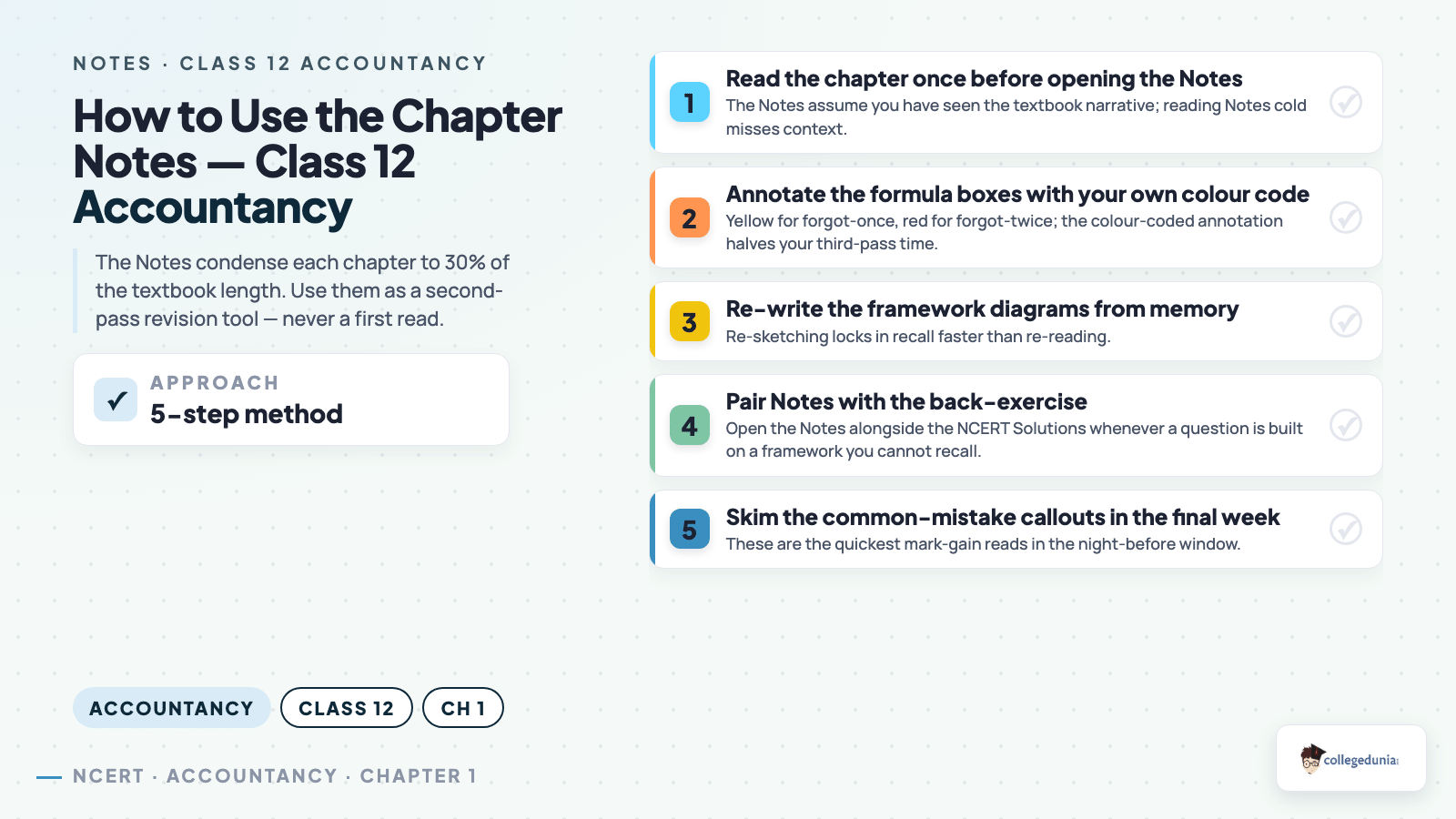
5-STEP METHOD · CBSE TOPPER ROUTINE
How to Use the NCERT Notes - Class 12 Accountancy
- 1Read the chapter first. Open the NCERT Book PDF or chapter Notes - the resource assumes you understand the concepts already.
- 2Attempt each question on your own. Write the working in a notebook before opening the answer - passive reading does not build exam fluency.
- 3Compare your working to the resource. Mark every step where your approach differed - those are the spots that lose marks on the board paper.
- 4Flag questions taking over 7 minutes. These go on the re-attempt list for the final-week revision pass.
- 5Sketch each concept-map from memory. Before re-reading the Notes PDF, draw the chapter's flow in your own hand - recall is what builds exam fluency, not passive review.
- 1 month before the boards: first-pass reading of every chapter's Notes in NCERT order, marking unclear formulae or journal patterns with a coloured tag for revisiting.
- 2 weeks before the boards: second-pass reading focused on the high-weightage chapters above. Re-write the journal-entry templates from memory before you check them against the Notes.
- 1 week before the boards: third-pass skim of the formula boxes and the common-mistake callouts only. Pair the Notes with the Handwritten Notes for last-day journal-entry recall.
Common Mistakes Class 12 Accountancy Students Make Across Chapters
- Ignoring the sacrificing or gaining ratio on a goodwill question: Ch 2 (Admission) tests the sacrificing ratio. Ch 3 (Retirement) tests the gaining ratio. Students who jump straight to the goodwill journal entry, without working out the ratio, lose 2-3 marks per question.
- Mixing up fixed and fluctuating capital methods: Ch 1 problems name the method in the question. Students who switch method mid-answer break the Balance Sheet. Always re-read the deed clause before you draft the Partners' Capital Account.
- Treating dissolution and reconstitution as the same thing: Ch 4 Dissolution closes all books for good. Ch 2 and Ch 3 rebuild the firm and keep it running. The Realisation Account belongs only to Dissolution. The Revaluation Account belongs to Admission and Retirement.
- Forgetting Schedule III headings on a Balance Sheet question: Part 2 Ch 3 (Financial Statements) is marked strictly on the Schedule III format. Equity and Liabilities goes on top, Assets on the bottom. The sub-headings (Shareholders' Funds, Non-Current Liabilities, Current Liabilities, Non-Current Assets, Current Assets) must appear word for word.
- Computing ratios without showing the formula and the substitution: Part 2 Ch 5 (Accounting Ratios) questions reward the formula + substitution + result format. Writing only the final ratio (e.g. 2.5:1) loses the formula and substitution marks, even when the answer is right.
- Classifying interest paid or dividend received in the wrong activity: Part 2 Ch 6 (Cash Flow Statement) is strict on classification per AS-3. For a non-financial company, interest paid is Financing and dividend received is Investing. A wrong class breaks the whole cash flow.
- Skipping working notes on a long-answer question: CBSE Accountancy markers award working-note marks separately from the final answer. A right answer with no working notes loses 2-4 marks. A wrong answer with correct working notes still earns the method marks.
Student Feedback: What 12,640 Class 12 Accountancy Students Told Us
What 12,640 students told us about their Class 12 Accountancy revision routine using chapter notes
- 69% of students rated Reconstitution of a Partnership Firm: Admission of a Partner (Ch 2) as the highest-effort chapter, ahead of Cash Flow Statement at 58% and Accounting Ratios at 47%. The goodwill + capital adjustment combination in Ch 2 explains the gap.
- Most-skipped chapter: Part 2 Ch 4 Analysis of Financial Statements (skipped by ~26% of students despite carrying 4 marks). Toppers called this an easy reclaim, because the comparative-and-common-size format becomes routine once you practise it.
- Toppers said that writing every long answer with working notes added 4-6 marks on the 80-mark theory paper. This helped most on the partnership reconstitution and company accounts questions, where CBSE markers give working-note marks separately.
- The average Class 12 Accountancy student spent 62 hours across the 10 chapters of Part 1 and Part 2 to finish the NCERT back-exercise once. Ch 2, Ch 3, and Part 2 Ch 1 (Share Capital) took the most time per question.
Also Check: Related Class 12 Accountancy Resources
- Also Check: CBSE Class 12 exam pattern, dates, and full-subject hub
- Also Check: CBSE Class 12 Syllabus 2026-27
- Also Check: CUET-UG 2026 (commerce-stream colleges)
- Also Check: CUET-UG 2026 Syllabus
Topper-tested takeaways for Class 12 Accountancy Notes
- Use the Notes for chapter-level concept revision. Pair them with the NCERT back-exercise for practice, because Notes alone do not build calculator-free speed.
- Mark the Partnership chapters with your own colour code: sacrificing ratio (yellow), gaining ratio (green), and revaluation gain/loss (red). The colour code fixes the rule in memory.
- The Ratios chapter (Part 2 Ch 5) Notes carry every formula. Print this chapter as a reference and tape it inside your notebook.
- Skip the prose introductions on the second read of the Notes. Focus on the journal entries and the working-note examples.
Class 12 Accountancy Notes FAQs
Ques. Where can I download the Class 12 Accountancy Notes PDF for all chapters?
Ans. You can download every chapter-wise Class 12 Accountancy Notes PDF from the index above. It covers all 4 Part 1 chapters (Partnership Accounts) plus all 6 Part 2 chapters (Company Accounts and Financial Statement Analysis). A combined all-chapters PDF is also linked at the top of this page, free in both Normal and HD resolutions.
Ques. Is this Class 12 Accountancy Notes aligned with the 2026-27 NCERT?
Ans. Yes. Every chapter follows the current 2026-27 NCERT for both Part 1 (Accounting for Partnership Firms and Companies) and Part 2 (Company Accounts and Analysis of Financial Statements). Where NCERT cut content from the older edition, the affected sections show an inline callout marking the change.
Ques. How many chapters are there in Class 12 Accountancy per the 2026-27 NCERT?
Ans. Class 12 Accountancy has 10 chapters in total spread across two NCERT books: 4 chapters in Part 1 (Accounting for Partnership Firms and Companies - Partnership Accounts) and 6 chapters in Part 2 (Company Accounts and Analysis of Financial Statements). The Topic Map table above lists every chapter grouped by part and unit.
Ques. Which Class 12 Accountancy chapter has the highest CBSE board weightage?
Ans. The Partnership Firms block (Ch 1 through Ch 4 in Part 1) carries 35 of the 80 theory marks. It is the single heaviest block on the paper. Inside it, Ch 2 (Reconstitution: Admission of a Partner) is the largest chapter and the most common long-answer slot. The Weightage Snapshot table above tracks each unit's mark share.
Ques. How are the Class 12 Accountancy Notes different from the other Class 12 Accountancy resources?
Ans. The Class 12 Accountancy Notes pair best with the worked NCERT Solutions for back-exercise practice and the NCERT Book PDF for the in-chapter illustrations. Each resource type covers the same 10-chapter syllabus but in a different format. Together they make a complete revision toolkit.
Ques. Is a calculator allowed in the CBSE Class 12 Accountancy theory paper?
Ans. No. The CBSE Class 12 Accountancy theory paper is calculator-free. You must do every percentage (interest on capital, interest on drawings), every depreciation working, every ratio, and every revaluation adjustment by hand. Build this skill by working the NCERT back-exercise without a calculator from day one. The speed you gain pays off on the exam.
Ques. Are the NCERT solutions enough for the CBSE Class 12 Accountancy board paper or do I also need T.S. Grewal?
Ans. The NCERT Accountancy back-exercise is the main source for every CBSE board question. NCERT alone is enough to score in the 70-80 mark range. Extra books like T.S. Grewal, D.K. Goel, and Sultan Chand help with more practice, especially the longer numericals. But they do not replace NCERT. Open them only after you finish the NCERT chapter and back-exercise.
Ques. Are these Class 12 Accountancy Notes files available in Hindi medium?
Ans. Yes. Every chapter comes with a Hindi-medium download next to the English version. The Hindi files use NCERT's own technical words (Lekha Shastra), with terms like साझेदारी (partnership), ख्याति (goodwill), and शोधन (redemption) kept as NCERT writes them. CBSE accepts answers in Hindi or English. Pick the language you practised the journal-entry words in.
Ques. Which Class 12 Accountancy chapter should I start with?
Ans. Start with Ch 1 Accounting for Partnership: Basic Concepts. It sets up the partnership-deed framework, capital methods, and adjustment patterns that Ch 2 (Admission), Ch 3 (Retirement / Death), and Ch 4 (Dissolution) all reuse. Trying Ch 2 or Ch 3 before you are strong on Ch 1 is the biggest mistake CBSE Accountancy students make in the first half of the year.
Ques. How important is the Cash Flow Statement chapter on the CBSE board paper?
Ans. Cash Flow Statement (Part 2 Ch 6) carries the 8-mark long-answer slot in Part B. It appears on every recent CBSE Accountancy paper. The classification step (operating, investing, financing as per AS-3) loses the most marks. Students slip on the classification rule, not the arithmetic.
Ques. What does Class 12 Accountancy cover?
Ans. Class 12 Accountancy covers two NCERT books across 10 chapters: Part 1 (Accounting for Partnership Firms and Companies, with the 4 Partnership chapters) and Part 2 (Company Accounts and Analysis of Financial Statements, with 6 chapters covering Share Capital, Debentures, Financial Statements, Analysis, Ratios, and Cash Flow). The 80-mark theory paper plus the 20-mark internal-assessment project together make the 100-mark scheme.
Ques. How should I structure my Class 12 Accountancy preparation?
Ans. Build chapter by chapter in NCERT order. Put Part A (60 marks: Partnership + Company Accounts) before Part B (20 marks: Financial Analysis + Cash Flow). Use the NCERT Book for concept reading, the NCERT Solutions for back-exercise practice, the Notes for second-pass revision, and the Handwritten Notes for the final two weeks. The Study Plan section above maps the 1-month / 2-week / 1-week countdown most Accountancy toppers use.



Comments