




These Class 11 Physics Notes Chapter 10 Thermal Properties of Matter pull together every temperature scale, expansion coefficient, specific heat, latent heat, and heat-transfer law that the Boards, JEE Main, JEE Advanced, NEET, CUET and NDA papers actually test in 2026-27. Use them to revise the whole chapter fast, with formulas, definitions and diagrams described in one place.
This chapter links measurement to real heat effects, and its formulas feed directly into Thermodynamics and Kinetic Theory later in the year.
- CBSE Weightage: 4 to 6 marks, usually one short answer plus one numerical on expansion, calorimetry or conduction.
- Topics covered: temperature and heat, thermal expansion, specific heat, calorimetry, change of state, latent heat, and the three modes of heat transfer.
- Key formulas: expansion coefficients, the heat equation, Newton's law of cooling, Stefan's law and Wien's law.
These Class 11 Physics Notes Chapter 10 Thermal Properties of Matter are curated by subject experts, based on the 2026-27 NCERT textbook, and checked against the last five years of CBSE Board, JEE Main and NEET papers.
Topic-by-Topic Summary of Thermal Properties of Matter
The chapter builds heat physics step by step. It starts with temperature and thermometry, then moves to how matter expands, how much heat it stores, how it changes state, and finally how heat travels. Here is the quick map of what each topic gives you.
- Temperature and heat: heat is energy in transit, while temperature decides its direction of flow, measured on the Celsius, Fahrenheit and Kelvin scales.
- Thermal expansion: solids and liquids grow with temperature, described by the linear, area and volume coefficients.
- Specific heat and calorimetry: the heat needed to warm a body, and the mixing rule that heat lost equals heat gained.
- Change of state and latent heat: melting, boiling and the hidden heat absorbed at constant temperature.
- Heat transfer: conduction, convection and radiation, plus Newton's law of cooling and Stefan's law.
Revise the topics in this order, because each one leans on the one before it. Fix the temperature scales first, and every later numerical becomes far easier. These Class 11 Physics Notes Chapter 10 Thermal Properties of Matter follow the same sequence as the NCERT textbook.
Temperature, Heat and the Kelvin, Celsius and Fahrenheit Scales
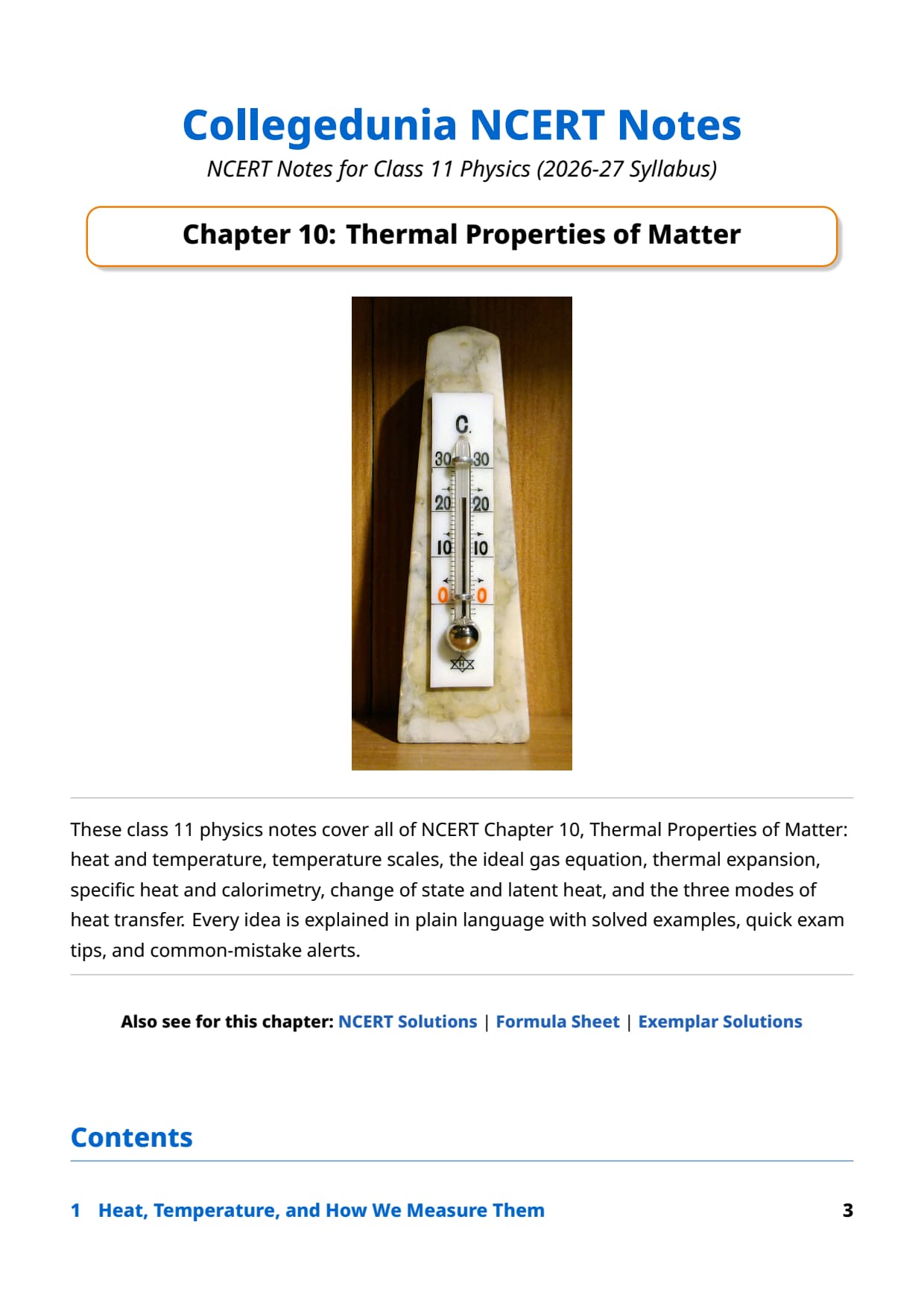
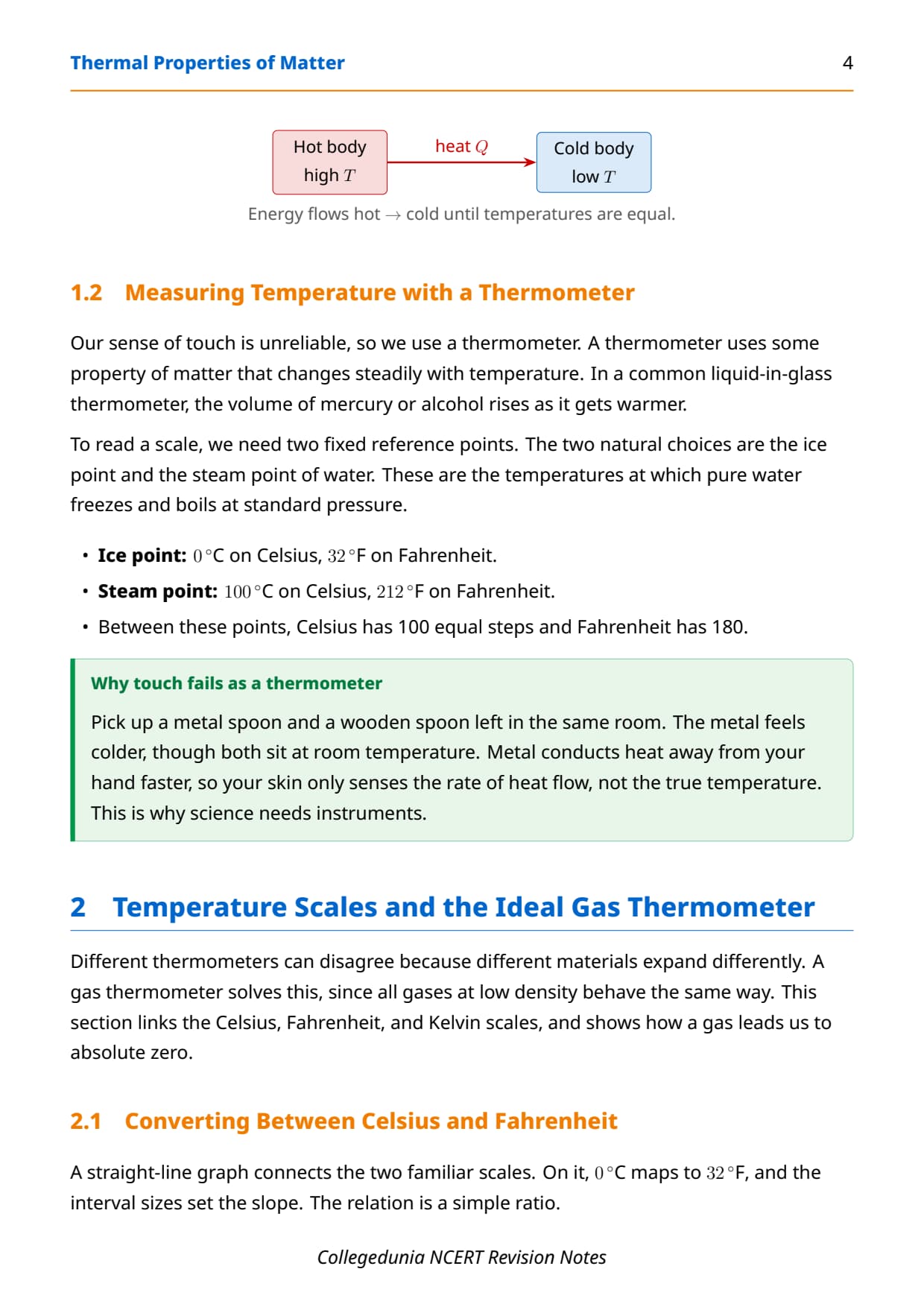
Measurement of heat starts with a fixed way to read temperature. Heat is the energy that flows between two bodies because of a temperature difference. Temperature is the property that decides which way that heat flows. Three scales are used in the chapter, and you must be able to convert between them.
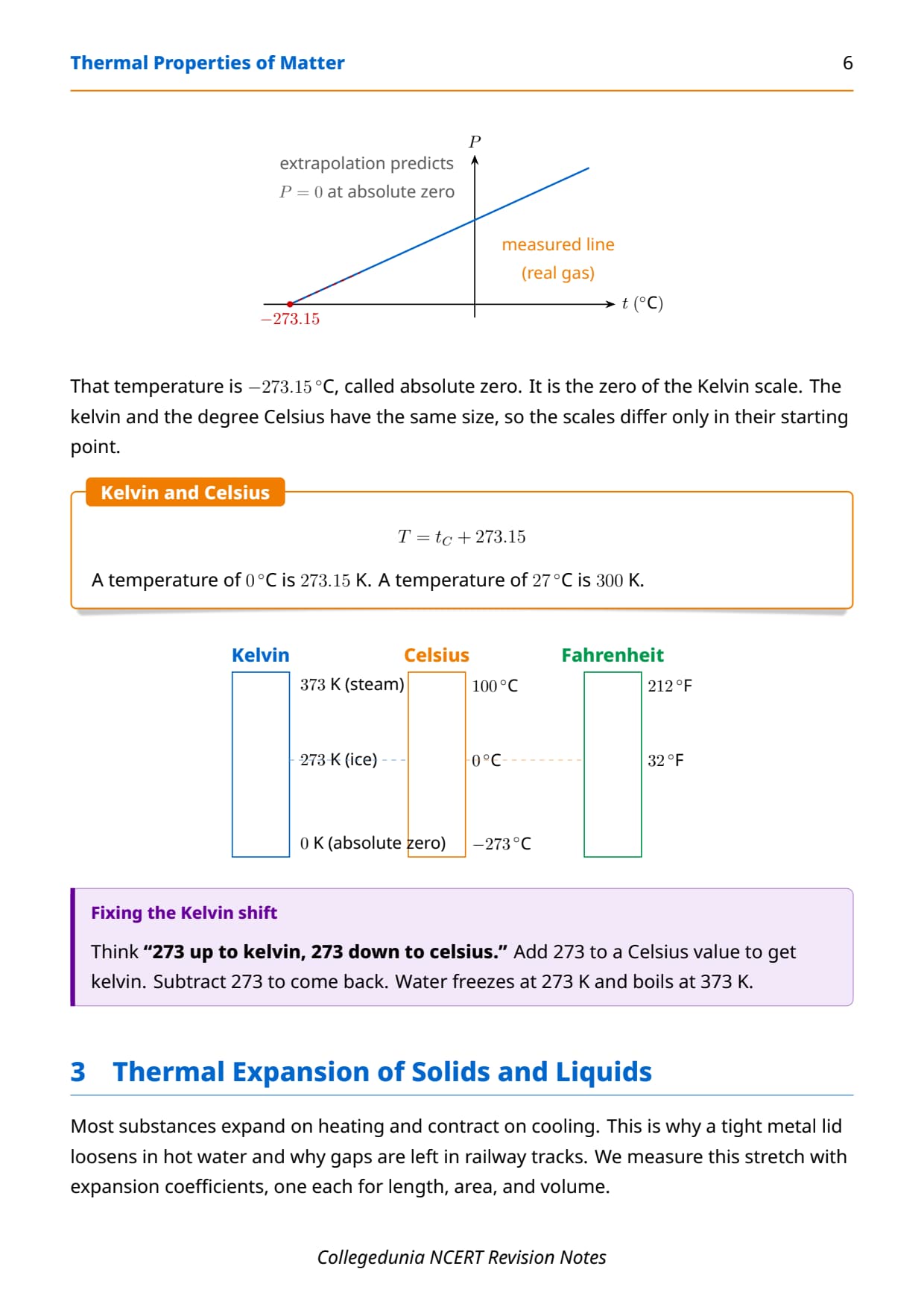
| Scale | Ice point | Steam point |
|---|---|---|
| Celsius (°C) | 0 °C | 100 °C |
| Fahrenheit (°F) | 32 °F | 212 °F |
| Kelvin (K) | 273.15 K | 373.15 K |
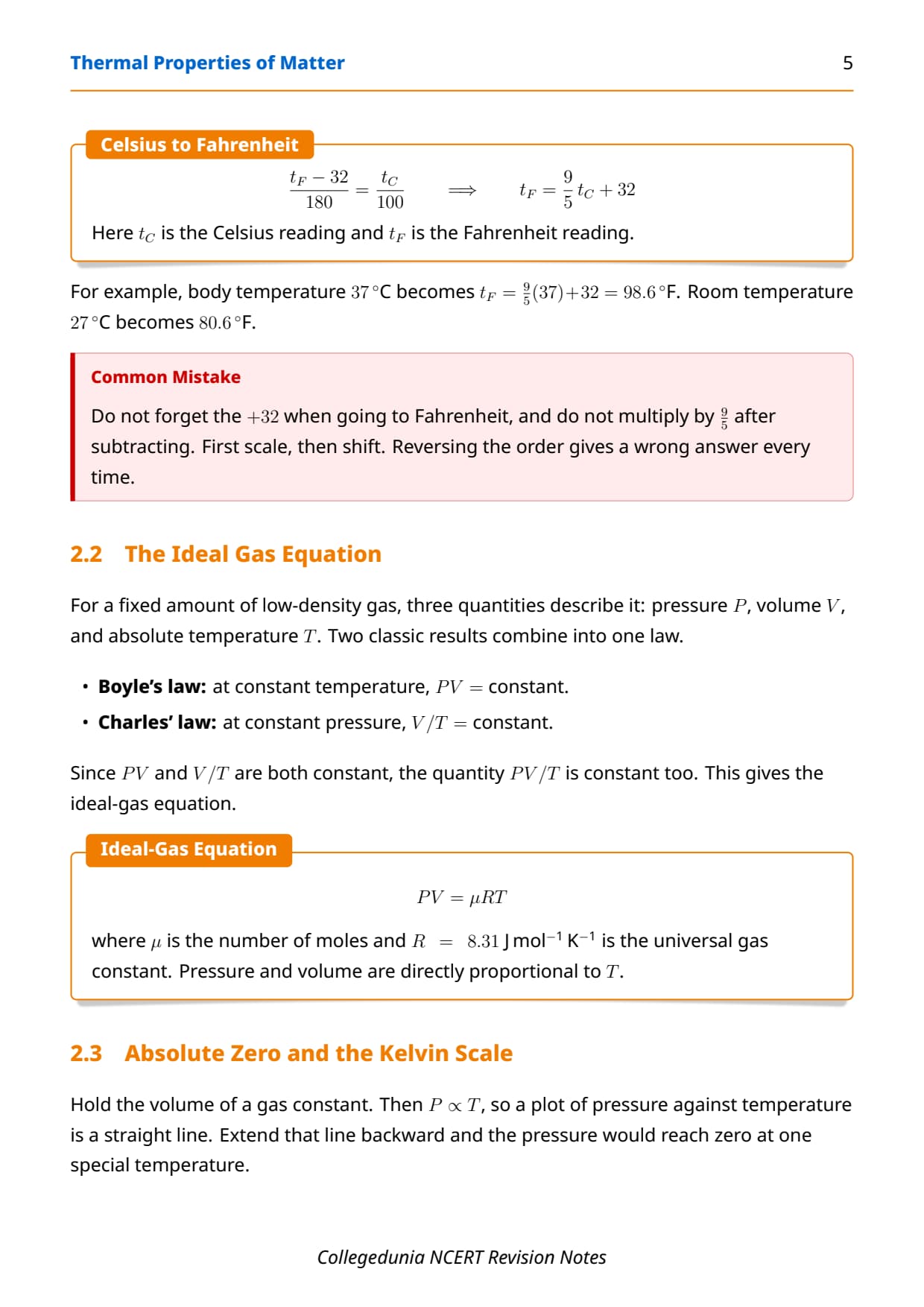
The Kelvin scale is the absolute scale, and its zero is the lowest possible temperature. An ideal gas at constant volume shows that pressure falls to zero at absolute zero, −273.15 °C. Always convert temperatures to kelvin before using any gas relation. Celsius and kelvin have the same size of degree, so a temperature difference is the same number on both.
Thermal Expansion: Linear, Area and Volume Coefficients
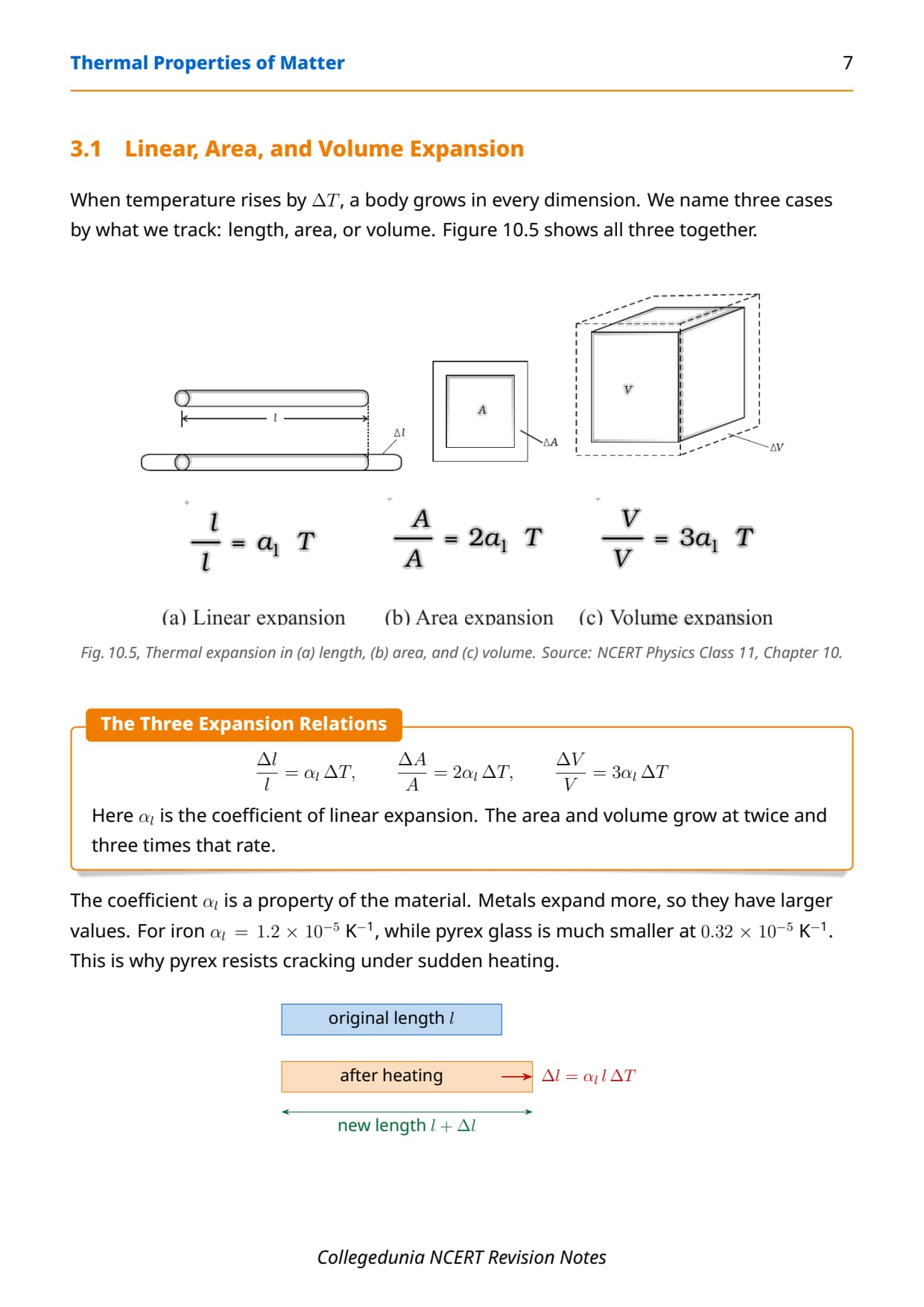
Most solids and liquids grow larger when heated. The chapter measures this with three coefficients of thermal expansion, one each for length, area and volume. They are linked by a simple ratio you should memorise.
- Linear expansion: a rod of length L grows by ΔL = αLΔT, where α is the coefficient of linear expansion.
- Area expansion: a sheet of area A grows by ΔA = βAΔT, with β = 2α.
- Volume expansion: a solid of volume V grows by ΔV = γVΔT, with γ = 3α.
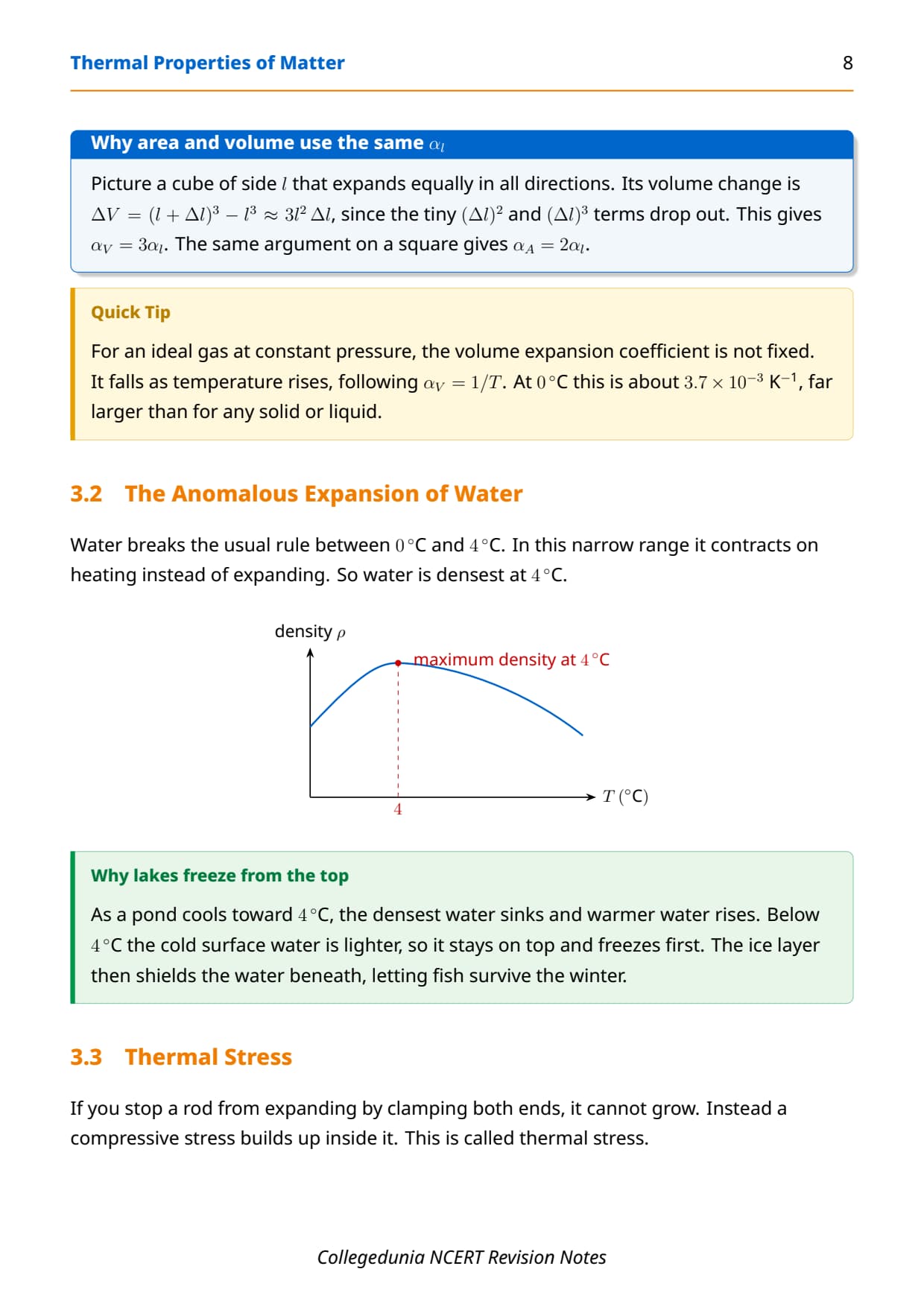
For an isotropic solid the coefficients are in the ratio α : β : γ = 1 : 2 : 3. Water is the famous exception, called anomalous expansion. Between 0 °C and 4 °C water contracts instead of expanding, so it is densest at 4 °C. This one fact is why lakes freeze from the top down and fish survive the winter below.
Specific Heat Capacity and Molar Specific Heat
Different materials need different amounts of heat to warm up. Specific heat capacity is the heat needed to raise the temperature of one kilogram of a substance by one kelvin. It sets the size of every calorimetry numerical in the chapter.
- Heat equation: the heat supplied is Q = mcΔT, where c is the specific heat capacity.
- Molar specific heat: for one mole, C = Q/(nΔT), used mostly for gases.
- Water benchmark: water has a high specific heat of 4186 J kg-1 K-1, which keeps climates near large lakes mild.
Gases have two molar specific heats, one at constant pressure (Cp) and one at constant volume (Cv), and Cp is always the larger of the two. The high specific heat of water is the single most-tested value from this section. Keep it ready for both Boards and NEET.
Calorimetry and the Principle of Mixtures
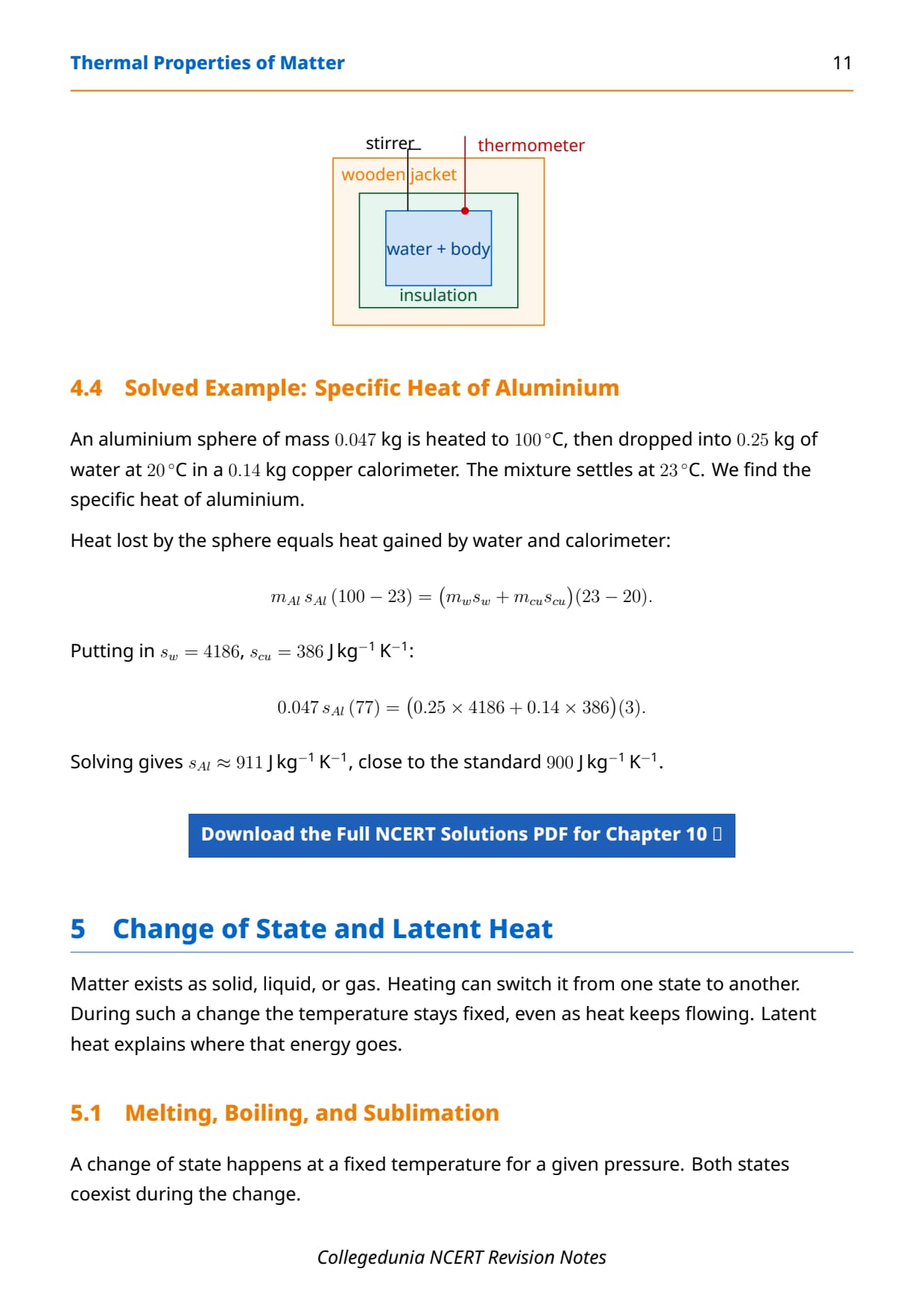
Calorimetry measures heat by mixing a hot body with a cold one and watching them reach a common temperature. The whole method rests on one conservation rule, and most exam numericals use nothing more than this.
Principle of calorimetry: when no heat leaks out, heat lost by the hot body = heat gained by the cold body. Write both sides as mcΔT terms and solve for the unknown.
When a change of state happens during mixing, add an mL term for the melting or boiling part. Watch the sign of each temperature change, since the hot body cools and the cold body warms. A calorimeter is made of a metal with low specific heat so it stores little heat itself. Ignoring the heat absorbed by the calorimeter is the most common numerical slip here.
Change of State and Latent Heat of Fusion and Vaporisation
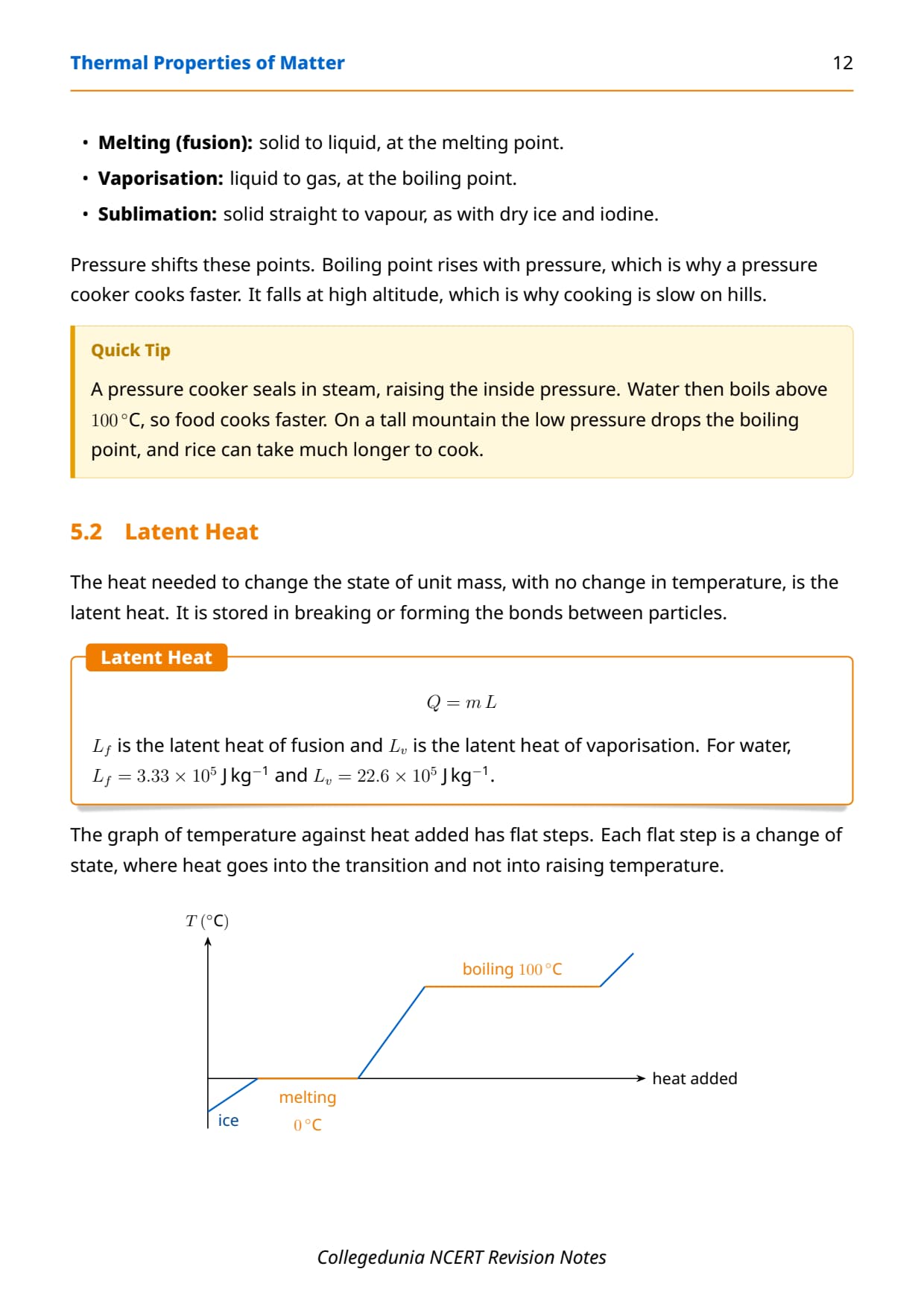
Matter can switch between solid, liquid and gas. During a change of state the temperature stays fixed even though heat keeps flowing in. That hidden heat is called the latent heat, and it explains why boiling water stays at 100 °C.
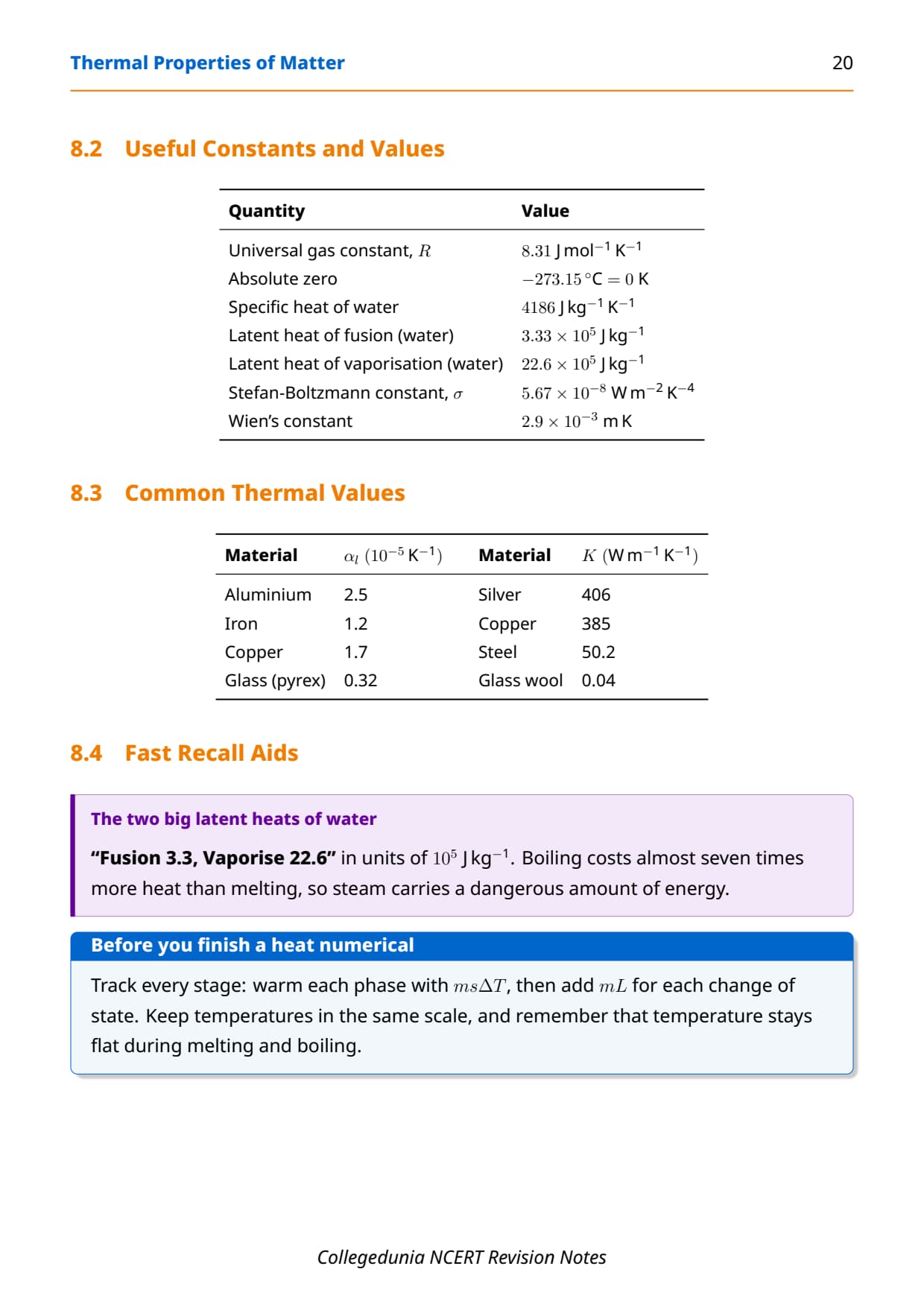
- Latent heat of fusion: the heat to melt one kilogram of a solid at its melting point, Lf. For ice it is 3.33 × 10⁵ J kg-1.
- Latent heat of vaporisation: the heat to boil one kilogram of a liquid at its boiling point, Lv. For water it is 22.6 × 10⁵ J kg-1.
- Triple point: the single temperature and pressure where solid, liquid and gas coexist. For water it is 273.16 K.
The heat needed for a change of state is Q = mL, with no ΔT term because the temperature does not move. Steam causes worse burns than boiling water because it releases its large latent heat of vaporisation on the skin. Melting and boiling points also shift with pressure, which is why food cooks slower on a mountain.
All Formulas for Thermal Properties of Matter
Every formula you need for the chapter sits in one table below, with its meaning and its SI unit. Learn the expansion and heat-transfer rows first, since those carry the most marks in both Boards and entrance papers.
| Formula | What it means | SI unit |
|---|---|---|
| tF = (9/5)tC + 32 | Celsius to Fahrenheit conversion | degree Fahrenheit |
| T = tC + 273.15 | Celsius to kelvin conversion | kelvin (K) |
| ΔL = αLΔT | Change in length by linear expansion | metre (m) |
| ΔA = βAΔT, β = 2α | Change in area by area expansion | square metre (m2) |
| ΔV = γVΔT, γ = 3α | Change in volume by volume expansion | cubic metre (m3) |
| Q = mcΔT | Heat to change a body's temperature | joule (J) |
| Q = mL | Heat for a change of state (latent heat) | joule (J) |
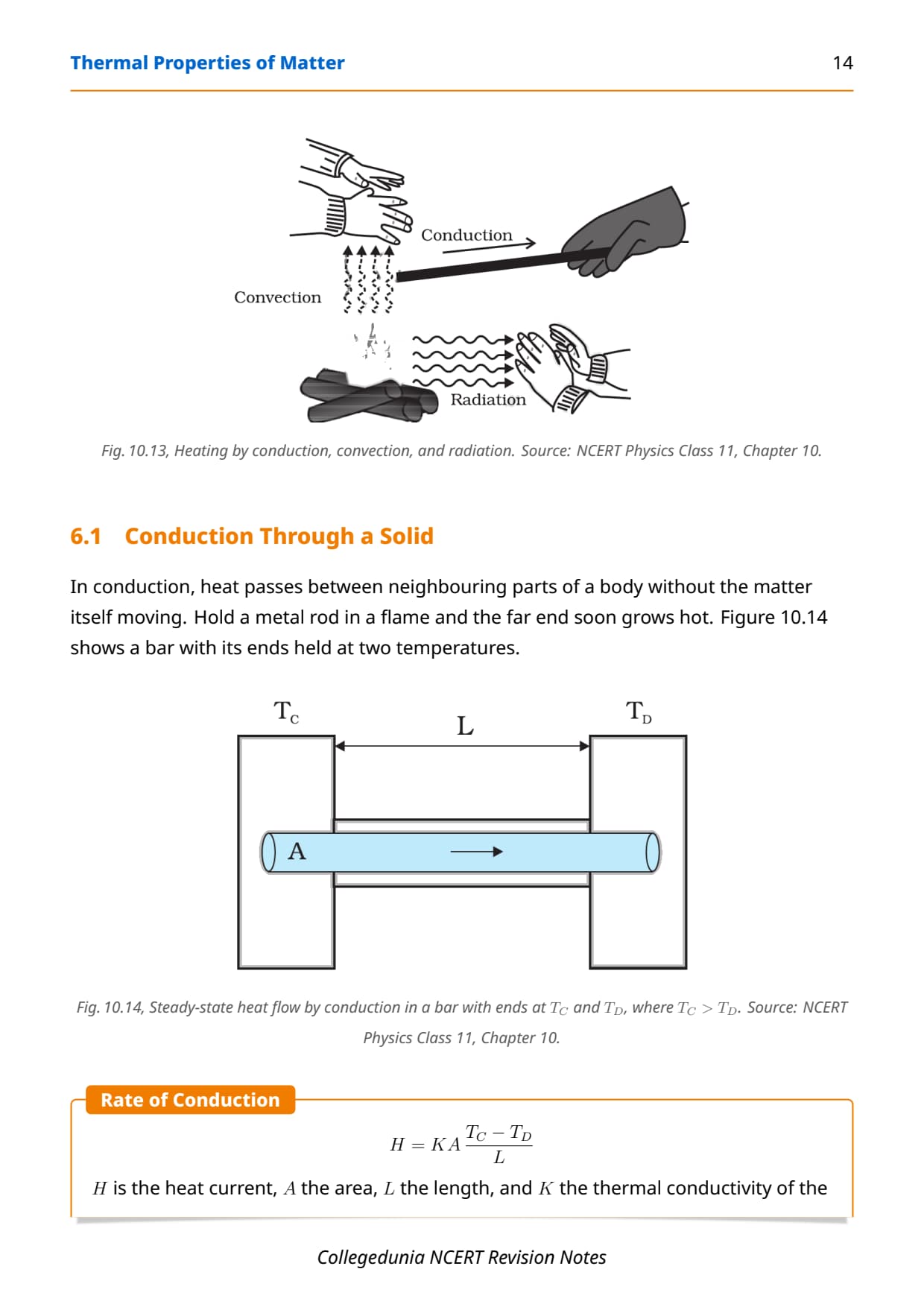
| H = KA(T1 − T2)/L | Rate of heat flow by conduction | watt (W) |
| dT/dt = −k(T − T0) | Newton's law of cooling | kelvin per second |
| H = σAT4 | Stefan-Boltzmann law for a blackbody | watt (W) |
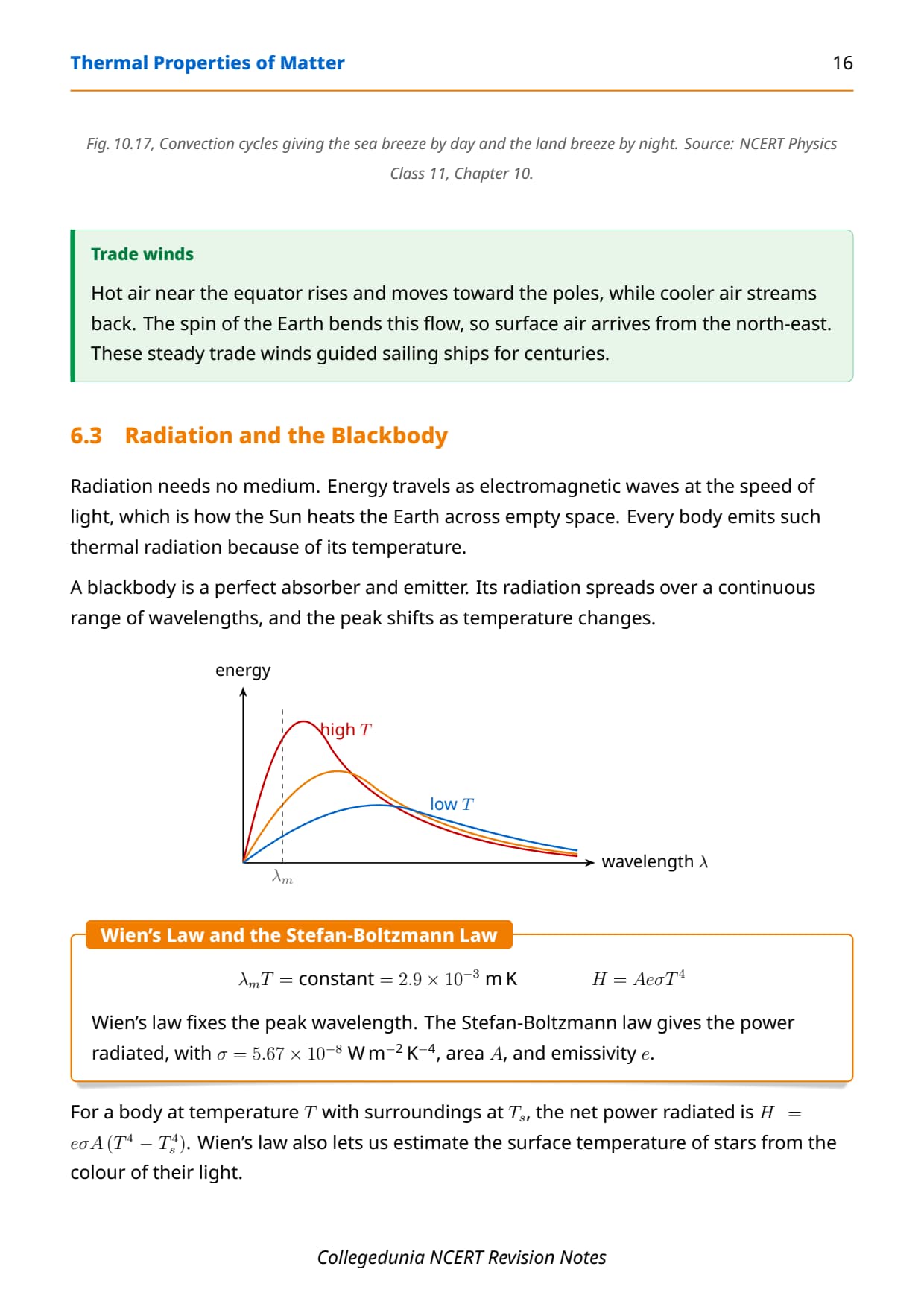
| λmT = b | Wien's displacement law, b = 2.9 × 10⁻³ m K | metre kelvin (m K) |
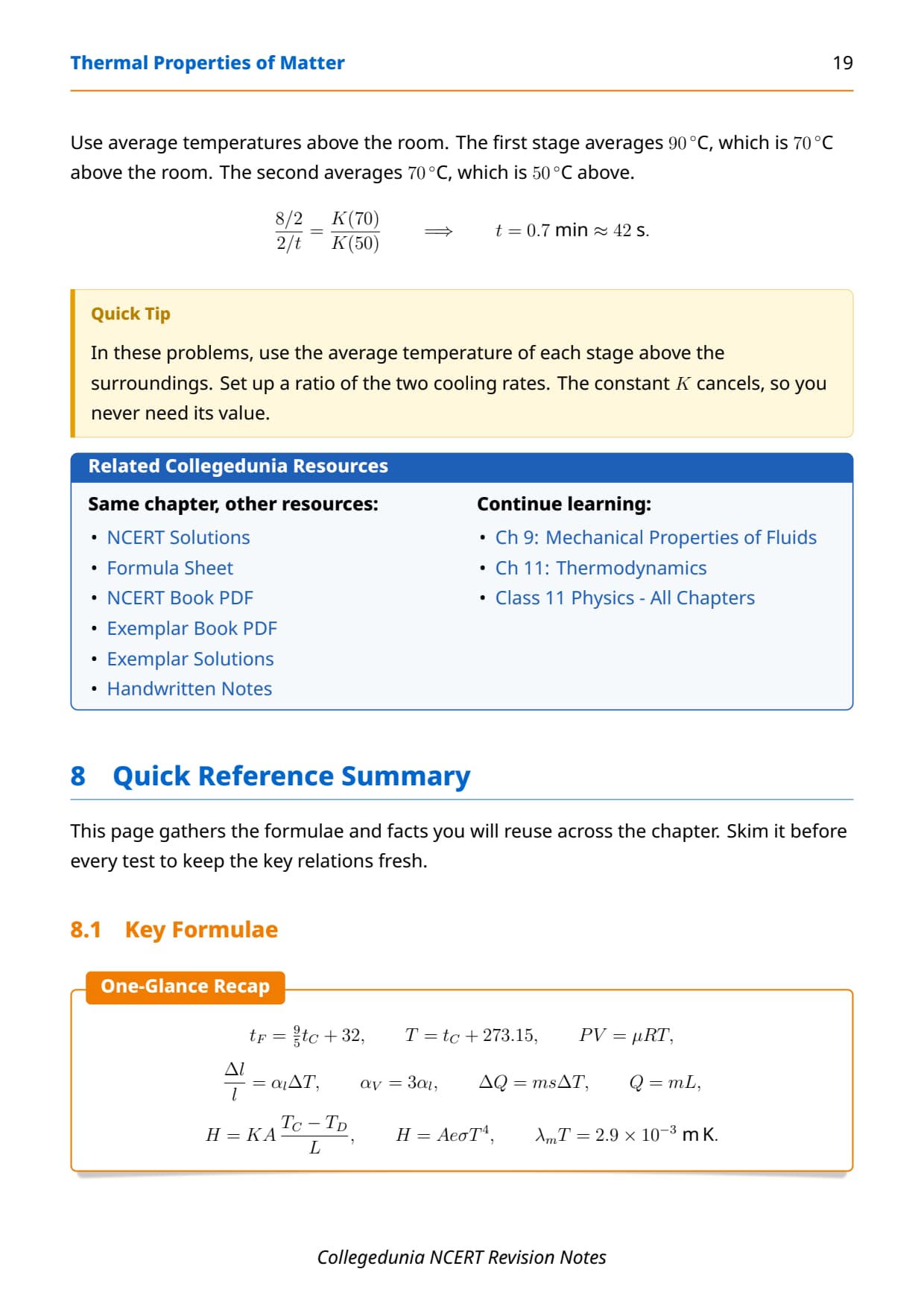
Carry the SI unit on every line of your working. Convert every temperature difference to kelvin and every length to metre before you substitute. Keep this table open while you solve the back-exercise numericals in these Class 11 Physics Notes Chapter 10 Thermal Properties of Matter.
Key Definitions and Derivations for Thermal Properties of Matter
Boards short-answer questions often ask for a clean definition in one or two lines. Learn these word-for-word, because a vague definition loses easy marks. Each one also sets up a derivation you can be asked to show.
| Term | Definition |
|---|---|
| Heat | Energy that flows between two bodies because of a temperature difference. |
| Coefficient of linear expansion | The fractional change in length per unit rise in temperature. |
| Specific heat capacity | The heat needed to raise the temperature of one kilogram of a substance by one kelvin. |
| Latent heat | The heat per unit mass absorbed or released during a change of state at constant temperature. |
| Thermal conductivity | The rate of heat flow through unit area of a material for unit temperature gradient. |
| Blackbody | A body that absorbs all radiation falling on it and is the best possible emitter. |
A common derivation asks you to link the three expansion coefficients. Start from a cube of side L, expand each side, and keep only the first-order term to get γ = 3α. The same first-order method gives β = 2α for a square sheet.
Heat Transfer: Conduction, Convection and Radiation
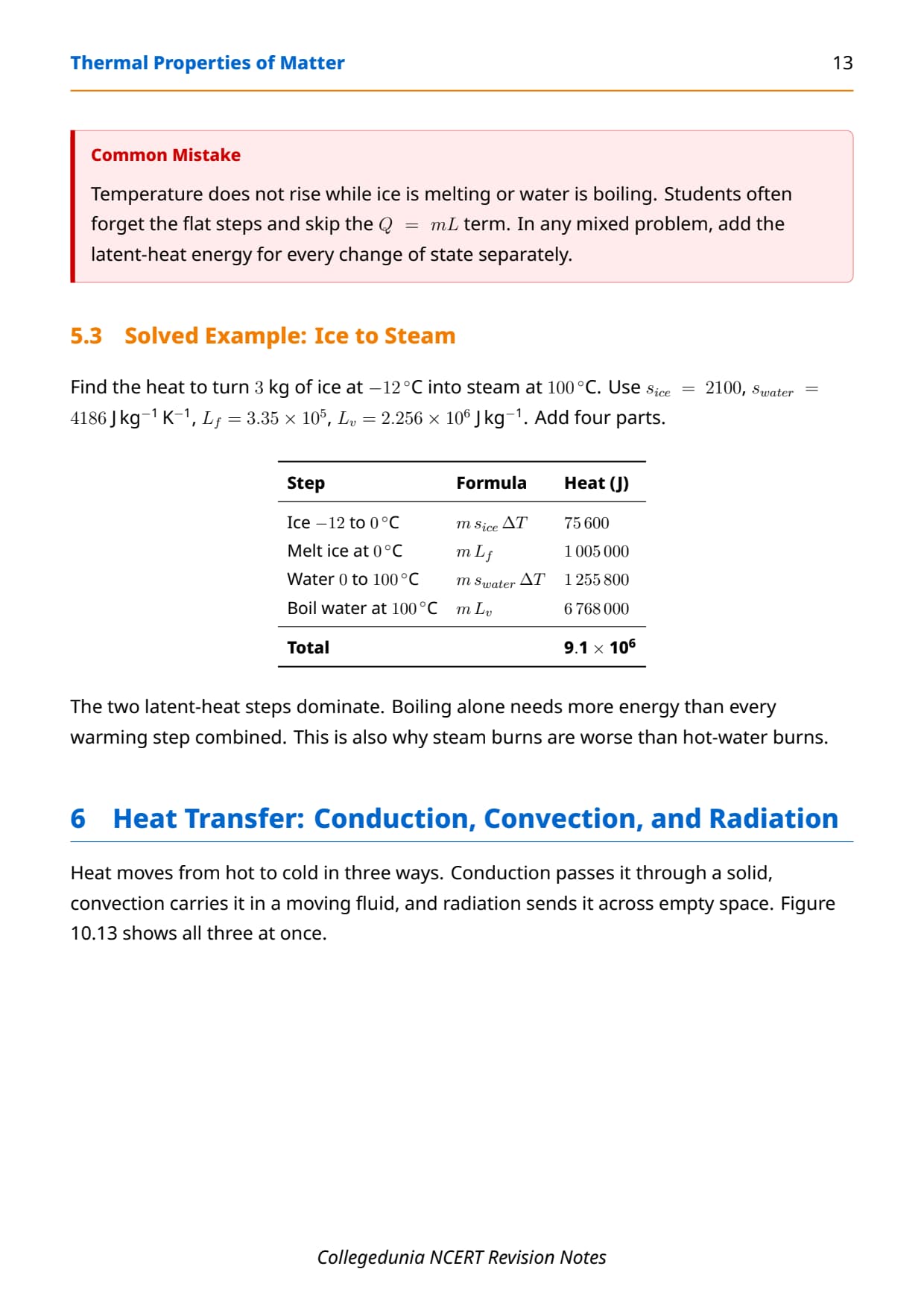
Heat moves from a hot region to a cold one in three distinct ways. The chapter treats each mode separately, and the exam often asks you to name the mode behind an everyday example. Keep the three clear in your head.
| Mode | How heat travels | Everyday example |
|---|---|---|
| Conduction | Through a solid, energy passed particle to particle without the particles moving | A metal spoon heating in hot tea |
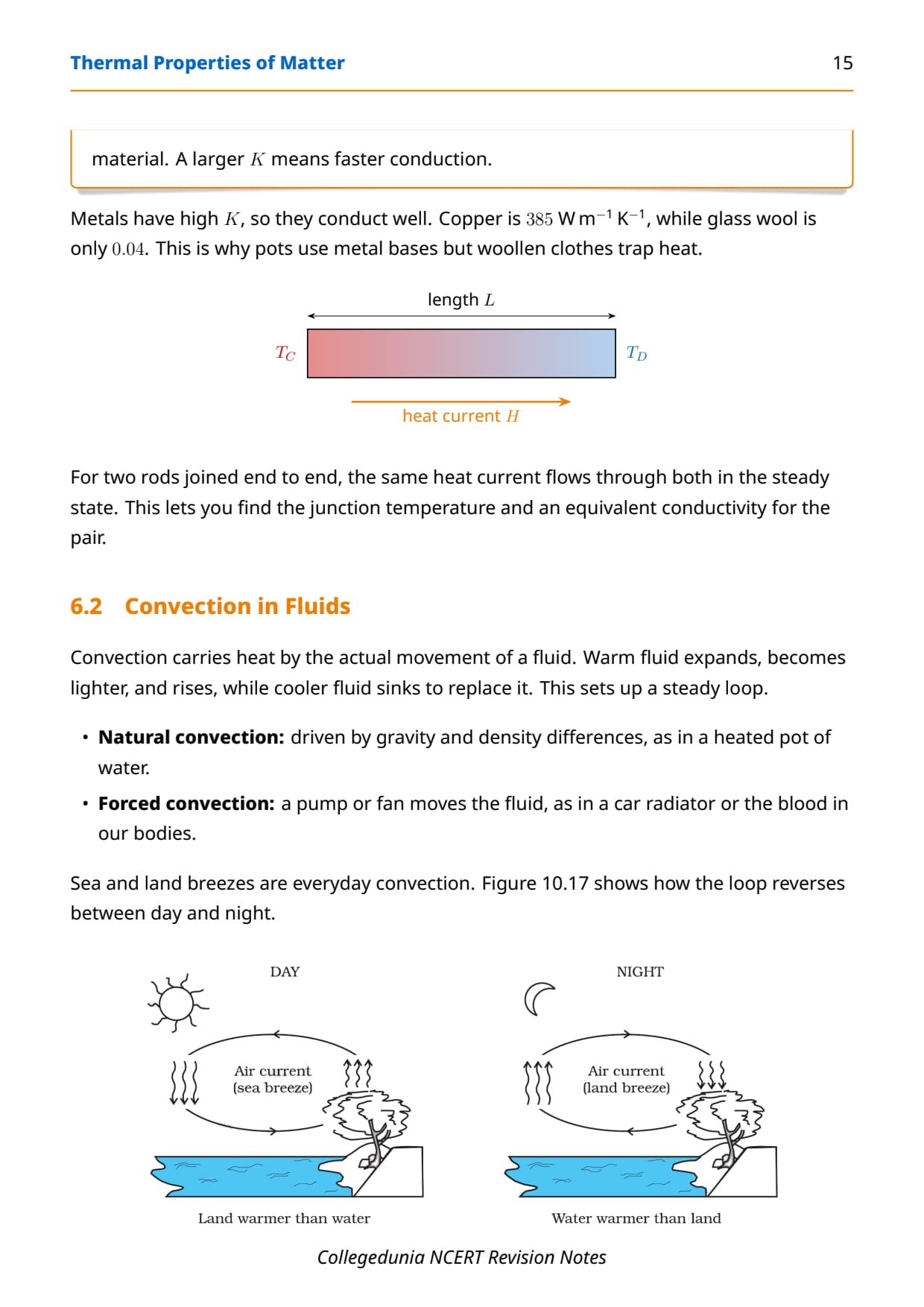
| Convection | In fluids, warm material itself rises and carries heat with it | Boiling water and sea breezes |
| Radiation | As electromagnetic waves, needing no medium at all | The Sun's heat reaching Earth |
For a rod in the steady state the rate of heat flow is H = KA(T1 − T2)/L, where K is the thermal conductivity. A good conductor has a high value of K; a good insulator has a low one. Radiation is the only mode that works through a vacuum, which is how the Sun warms the Earth across empty space.
Newton's Law of Cooling, Stefan's Law and Wien's Law
The last block of the chapter covers how a hot body loses heat by radiation and cools down. Three named laws do all the work here, and each one shows up as a short numerical or a graph question in the exam.
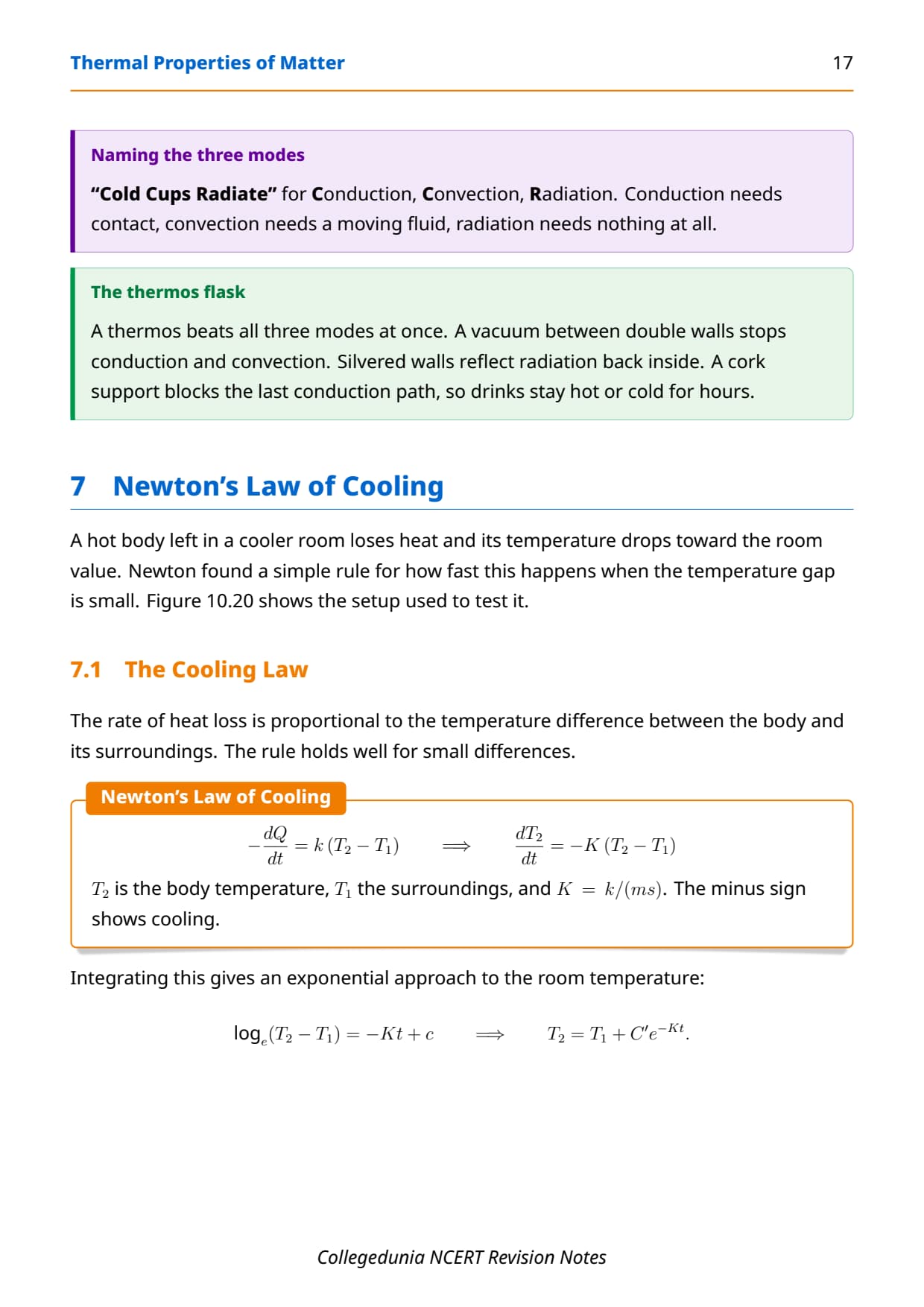
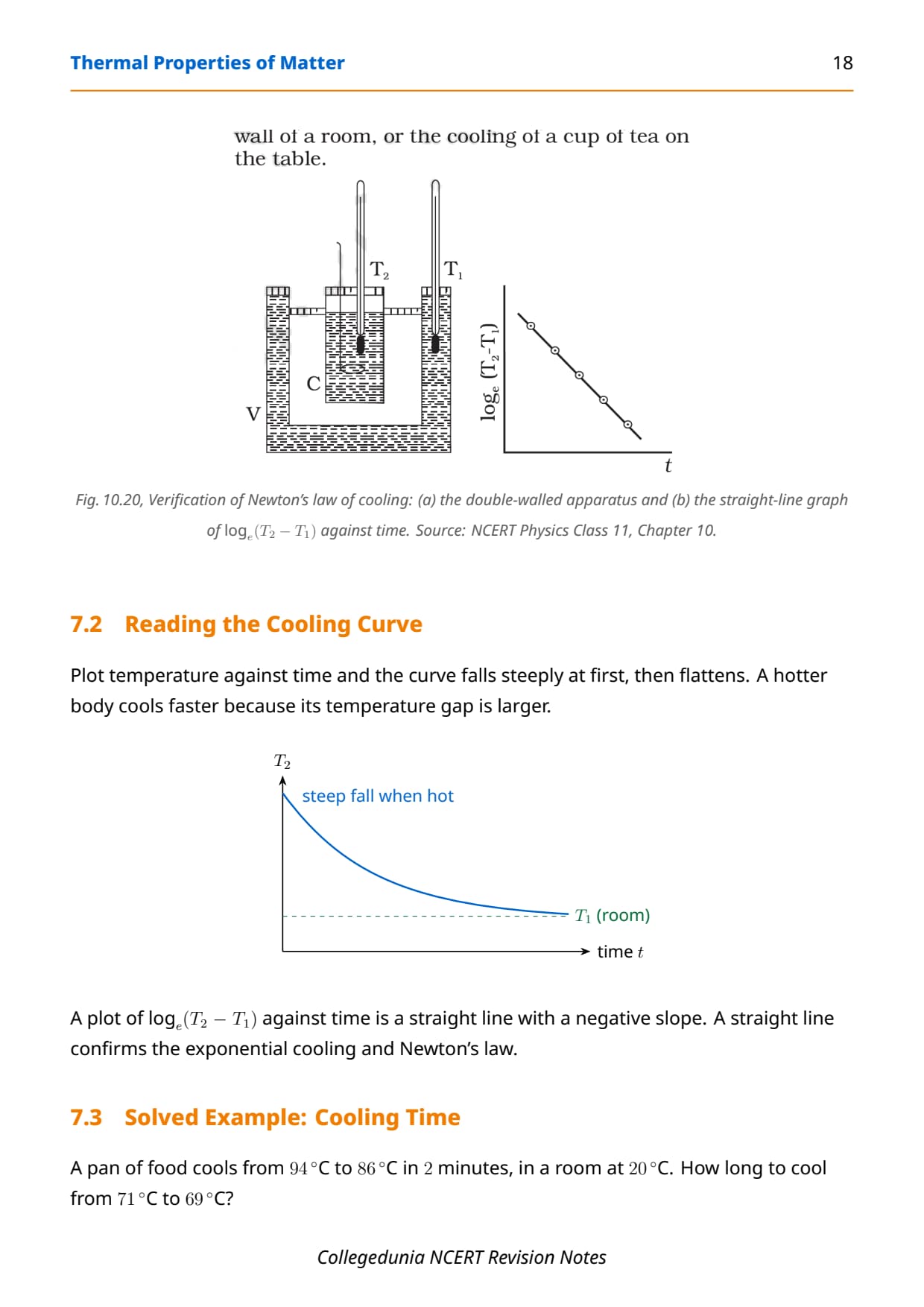
- Newton's law of cooling: a body cools at a rate proportional to the temperature difference with its surroundings, dT/dt = −k(T − T0). It holds only for a small difference.
- Stefan-Boltzmann law: a blackbody radiates power H = σAT4, so radiated power rises with the fourth power of the absolute temperature.
- Wien's displacement law: the wavelength of peak emission shifts as λmT = b, so a hotter body glows more towards blue.
Stefan's law uses the absolute temperature to the fourth power, so a small rise in temperature causes a large rise in radiated heat. Wien's law explains why a heated iron glows red first, then orange, then white as it gets hotter. Always use kelvin, never Celsius, in both these radiation laws.
Common Mistakes Students Make in Thermal Properties of Matter
These slips happen while writing or calculating, not because the concept is unclear. Each one costs 1 to 3 marks in the paper, so watch for them at the exact step.
Mistake 1: Using Celsius in Stefan's law or a gas relation. Both need the absolute temperature in kelvin.
Mistake 2: Forgetting the latent heat term during a change of state. Add mL for the melting or boiling part, with no ΔT.
Mistake 3: Mixing up the coefficients. Remember β = 2α and γ = 3α for an isotropic solid.
Mistake 4: Ignoring the heat absorbed by the calorimeter itself in a calorimetry numerical.
Thermal Properties of Matter Weightage in CBSE Boards, JEE and NEET
This chapter is a steady scorer. It usually carries a short answer plus a numerical in the Boards, and it feeds objective questions in every entrance paper. Here is how the marks split across the main exams for 2026-27.
| Exam | Typical weightage | What is asked |
|---|---|---|
| CBSE Boards | 4 to 6 marks | One short answer plus one numerical on expansion, calorimetry or conduction |
| JEE Main | 1 to 2 questions | Calorimetry, conduction, and Stefan's or Wien's law |
| NEET | 1 to 2 questions | Specific heat, latent heat, and heat transfer |
| CUET and NDA | 1 objective question | Temperature scales and thermal expansion |
Calorimetry and conduction together are the most tested ideas from this chapter across all four exams. Master them first, then radiation laws, then thermal expansion, in that order of return on effort.
How to Revise Thermal Properties of Matter Quickly
Use these Class 11 Physics Notes Chapter 10 Thermal Properties of Matter for a fast, ordered recap the night before a test. The checklist below takes about 30 minutes and hits every marks-heavy idea.
- First 10 minutes: write the three expansion coefficients, their ratio, and the heat equation from memory.
- Next 10 minutes: redo one calorimetry numerical with a change of state, and one conduction numerical.
- Last 10 minutes: revise Newton's law of cooling, Stefan's law and Wien's law, and one everyday example of each mode of heat transfer.
Close the loop by sketching the temperature-versus-time graph for ice heated to steam. If you can label both flat portions as latent-heat stages, the chapter is exam-ready. Keep the All Formulas table beside you for the first pass only, then try it closed-book.
Student Feedback on the Thermal Properties of Matter Notes
What 11,540 students told us about their Thermal Properties of Matter revision:
- 64% of students rated calorimetry with a change of state as the hardest sub-topic in the chapter.
- Most-skipped step: adding the latent-heat term during mixing, missed by about 3 in 10 students.
- Students who revised the heat-transfer table first said the radiation laws felt far easier.
Source: 2026-27 Class 11 Physics student poll. Sample of 11,540 students from CBSE schools across 14 states, conducted before the 2026 boards.
Other Thermal Properties of Matter Class 11 Physics Resources
Pair these notes with the solved answers, the handwritten notes, the formula sheet, and the textbook PDF for the same chapter.
| Resource | Link |
|---|---|
| NCERT Solutions | Thermal Properties of Matter Class 11 NCERT Solutions |
| Handwritten Notes | Thermal Properties of Matter Class 11 Handwritten Notes |
| Formula Sheet | Thermal Properties of Matter Class 11 Formula Sheet |
| NCERT Book PDF | Thermal Properties of Matter Class 11 Book PDF |
NCERT Notes for Class 11 Physics: All Chapters
Jump to the revision notes for any other Class 11 Physics chapter below.
| Chapter | NCERT Notes |
|---|---|
| Chapter 1 | Units and Measurements |
| Chapter 2 | Motion in a Straight Line |
| Chapter 3 | Motion in a Plane |
| Chapter 4 | Laws of Motion |
| Chapter 5 | Work, Energy and Power |
| Chapter 6 | System of Particles and Rotational Motion |
| Chapter 7 | Gravitation |
| Chapter 8 | Mechanical Properties of Solids |
| Chapter 9 | Mechanical Properties of Fluids |
| Chapter 10 | Thermal Properties of Matter |
| Chapter 11 | Thermodynamics |
| Chapter 12 | Kinetic Theory |
| Chapter 13 | Oscillations |
| Chapter 14 | Waves |
FAQs on Thermal Properties of Matter Class 11 Physics Notes
Thermal Properties of Matter Notes - Frequently Asked Questions
Ques. What topics do the Class 11 Physics Notes Chapter 10 Thermal Properties of Matter cover?
Ans. These Class 11 Physics Notes Chapter 10 Thermal Properties of Matter cover temperature and the three temperature scales, thermal expansion with the linear, area and volume coefficients, specific heat capacity and calorimetry, change of state and latent heat, and the three modes of heat transfer with Newton's law of cooling, Stefan's law and Wien's law. Every key formula and definition is included for fast revision.
Ques. What are the three coefficients of thermal expansion?
Ans. The three coefficients are the coefficient of linear expansion (α), area expansion (β) and volume expansion (γ). For an isotropic solid they are related by β = 2α and γ = 3α, so their ratio is 1 : 2 : 3. Each measures the fractional change in length, area or volume per unit rise in temperature.
Ques. What is latent heat and why does temperature stay constant during a change of state?
Ans. Latent heat is the heat per unit mass a substance absorbs or releases while changing state, given by Q = mL. The temperature stays constant because the heat goes into breaking or forming the bonds between particles, not into raising their kinetic energy. The latent heat of fusion of ice is 3.33 × 10⁵ J kg-1 and the latent heat of vaporisation of water is 22.6 × 10⁵ J kg-1.
Ques. What is the difference between conduction, convection and radiation?
Ans. In conduction, heat passes through a solid from particle to particle without the particles moving. In convection, warm fluid itself rises and carries heat with it. In radiation, heat travels as electromagnetic waves and needs no medium, which is how the Sun's heat reaches the Earth through empty space.
Ques. What is Newton's law of cooling?
Ans. Newton's law of cooling states that the rate of cooling of a body is proportional to the difference between its temperature and that of its surroundings, written as dT/dt = −k(T − T0). It holds only when the temperature difference is small. It explains why a hot cup of tea cools quickly at first and then more slowly.
Ques. What is the weightage of Thermal Properties of Matter in the CBSE board exam?
Ans. Thermal Properties of Matter carries about 4 to 6 marks in the CBSE Class 11 Physics paper, usually one short answer plus one numerical on expansion, calorimetry or conduction. It also appears in JEE Main and NEET as objective questions on specific heat, latent heat, heat transfer, and Stefan's or Wien's law.



Comments