




The class 11 maths notes chapter 6 permutations and combinations pull together every counting rule, factorial identity, and selection formula that the CBSE Boards, JEE Main, JEE Advanced, and CUET actually test in 2026-27. These revision notes explain the fundamental principle of counting, factorial notation, permutations, and combinations in plain language, with a full formula table for quick recall.
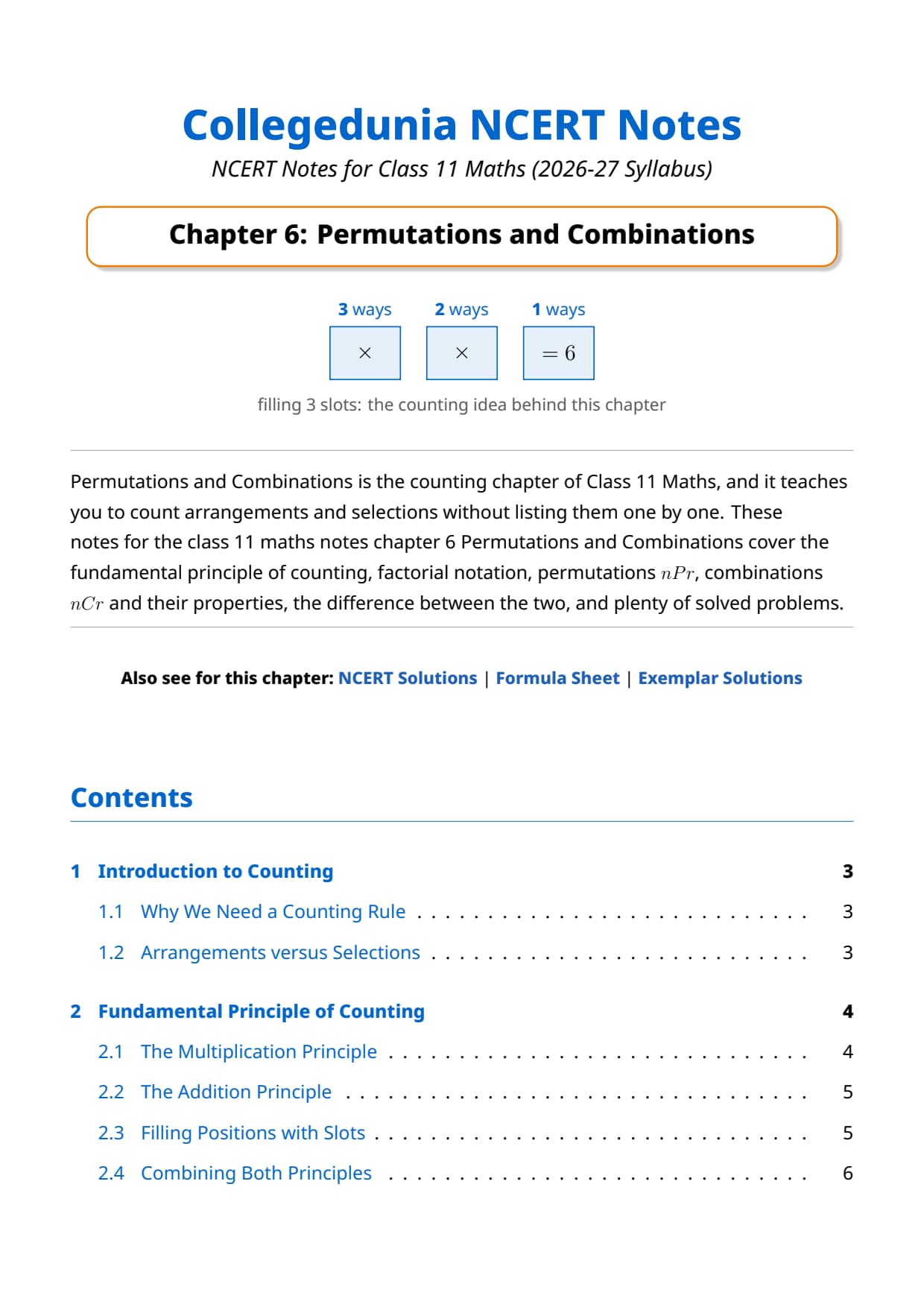
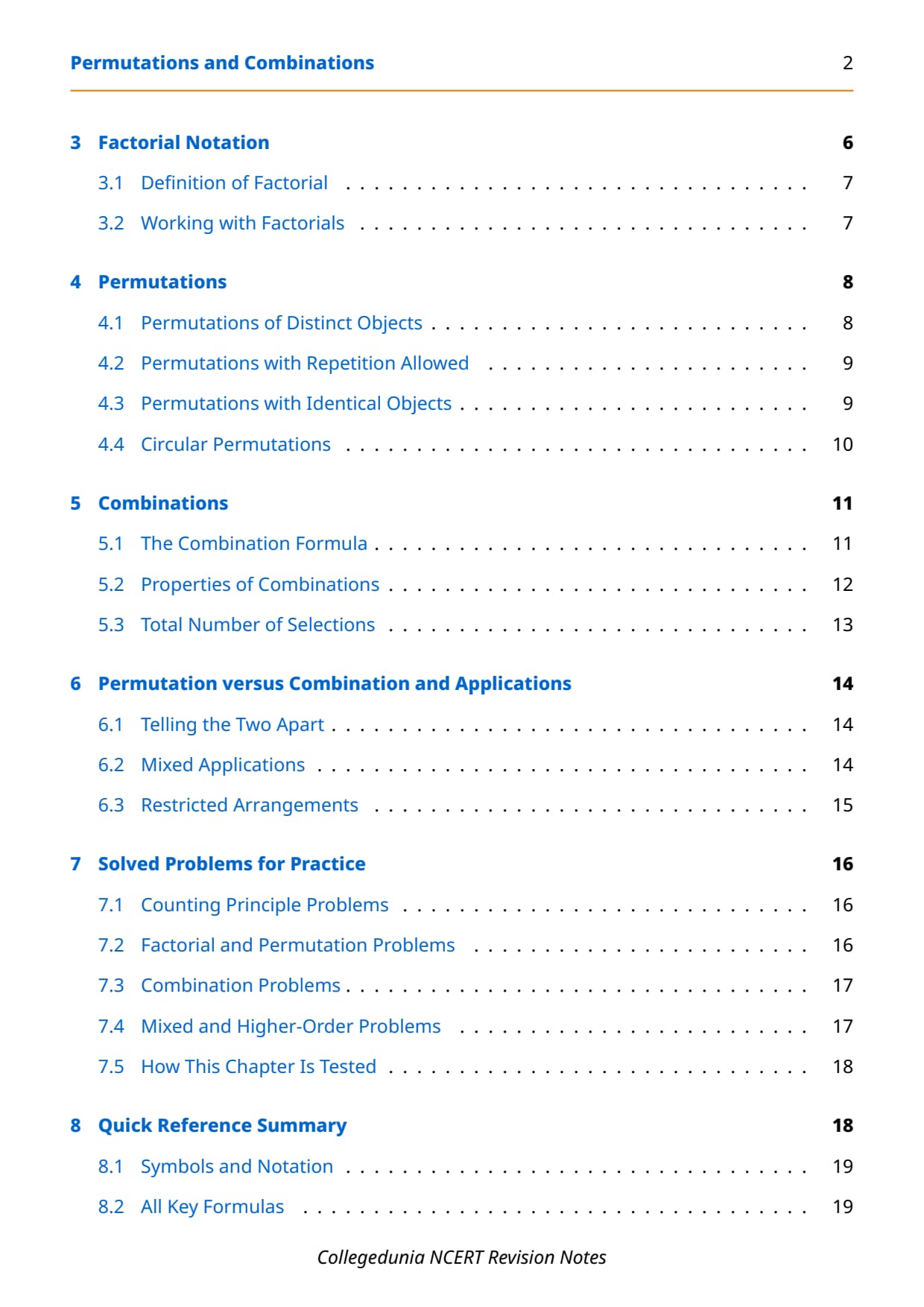
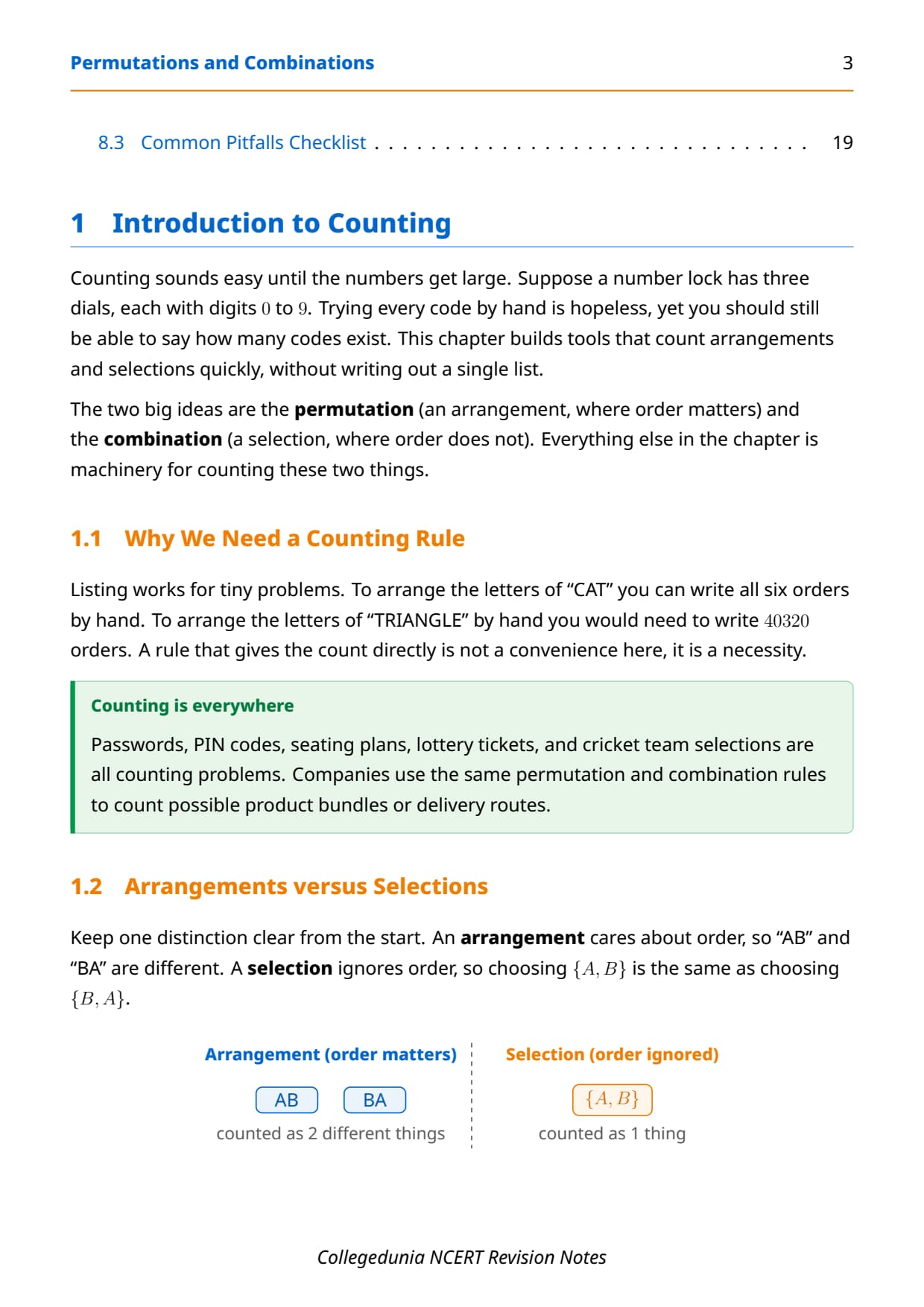
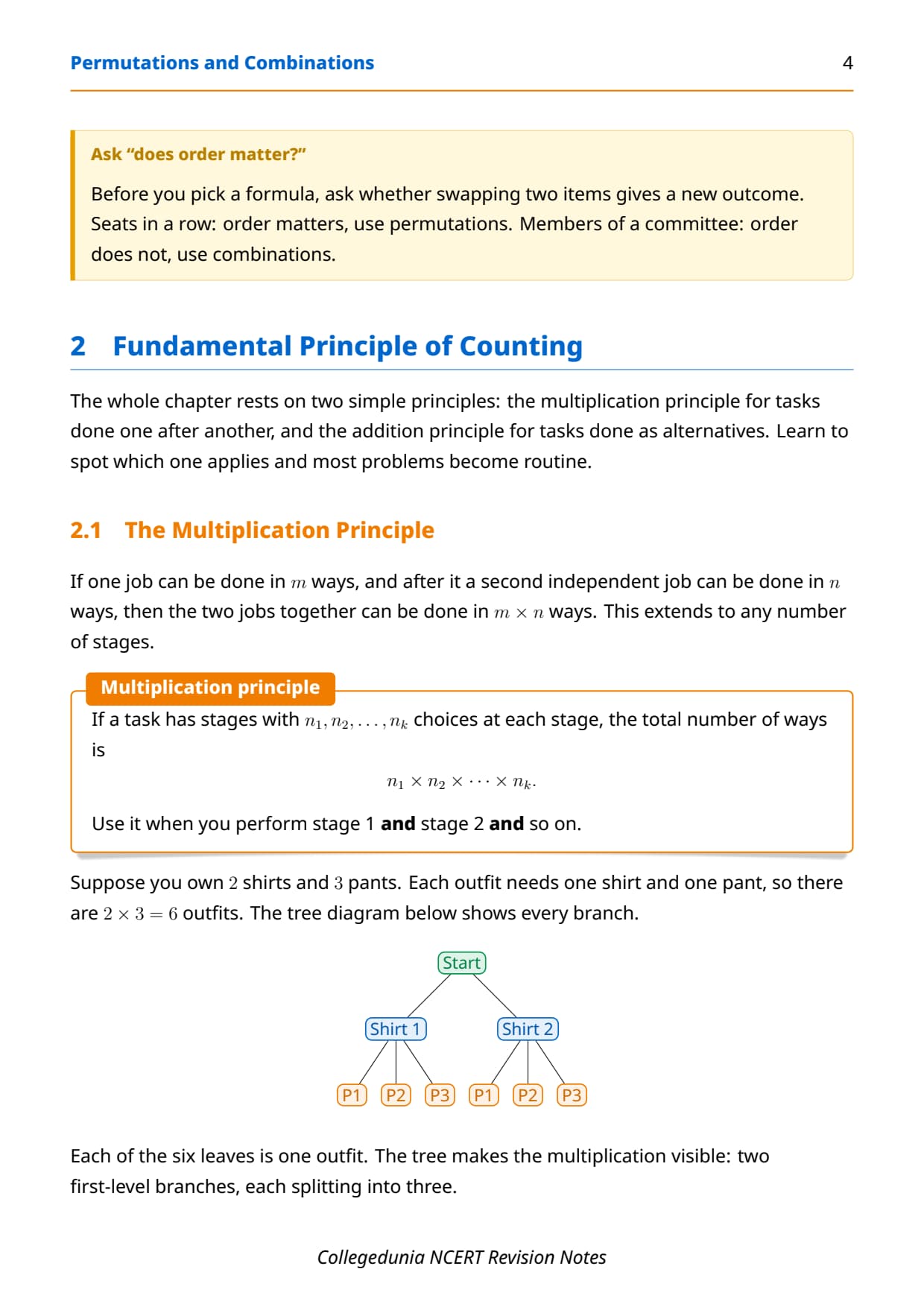
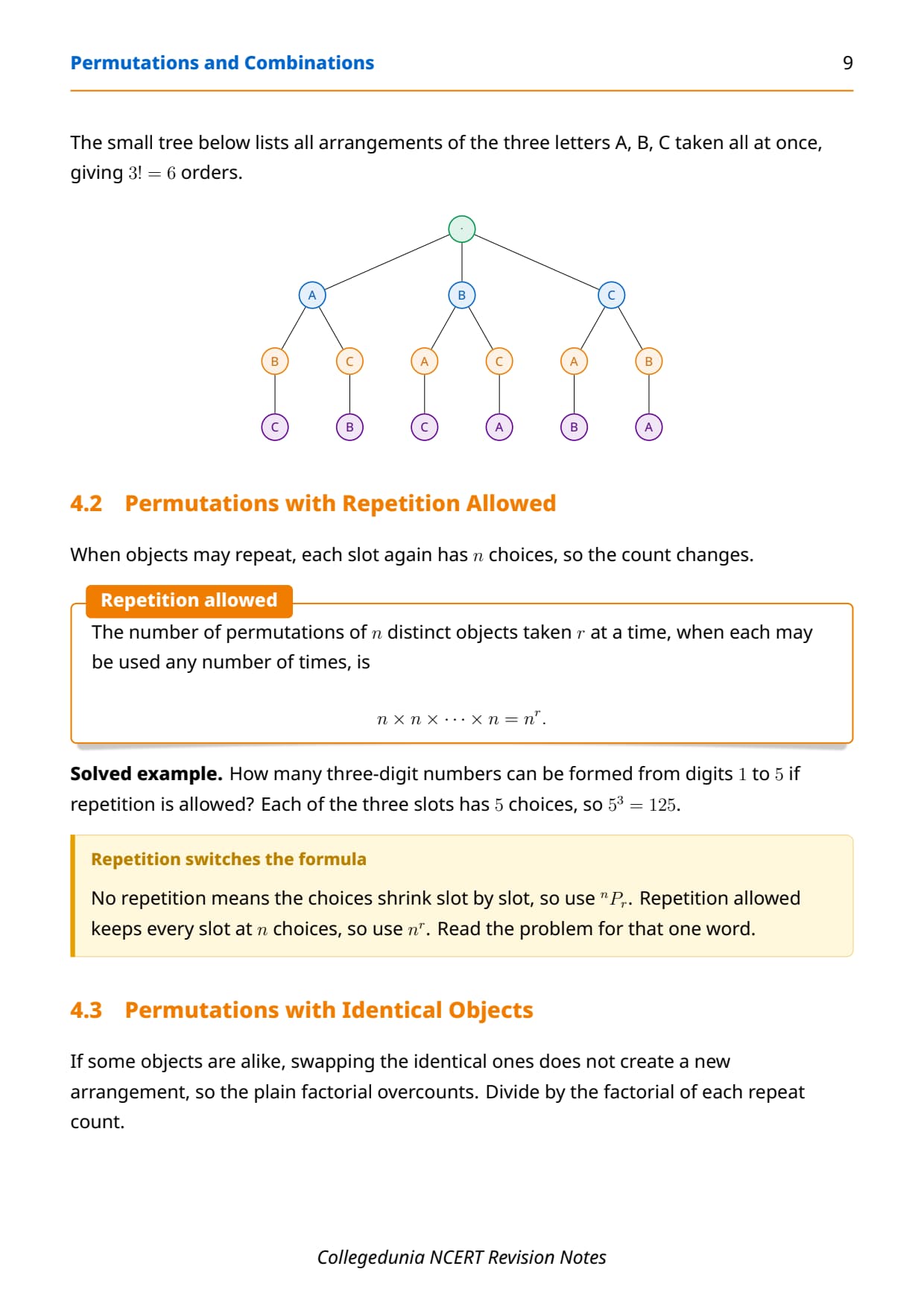
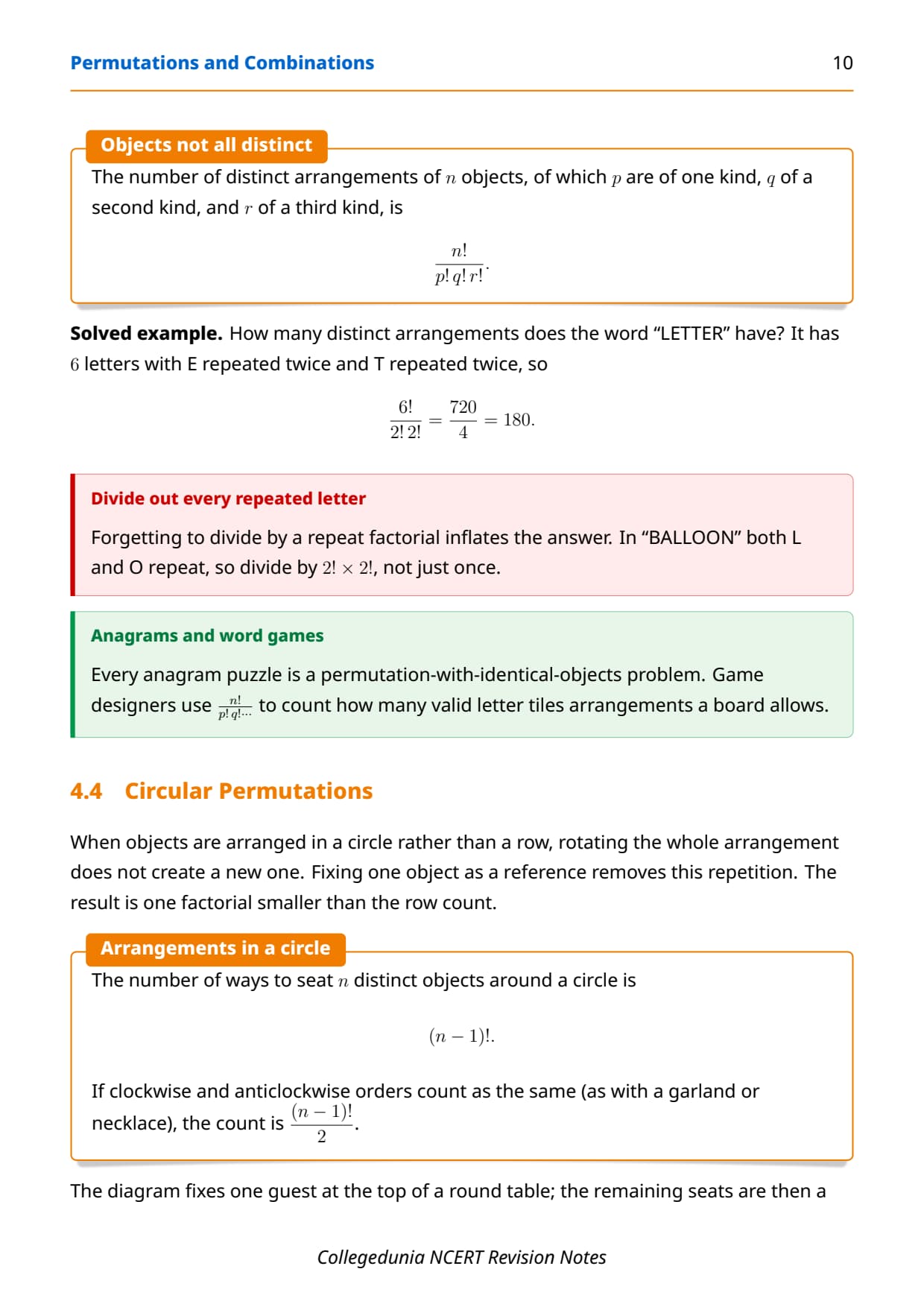
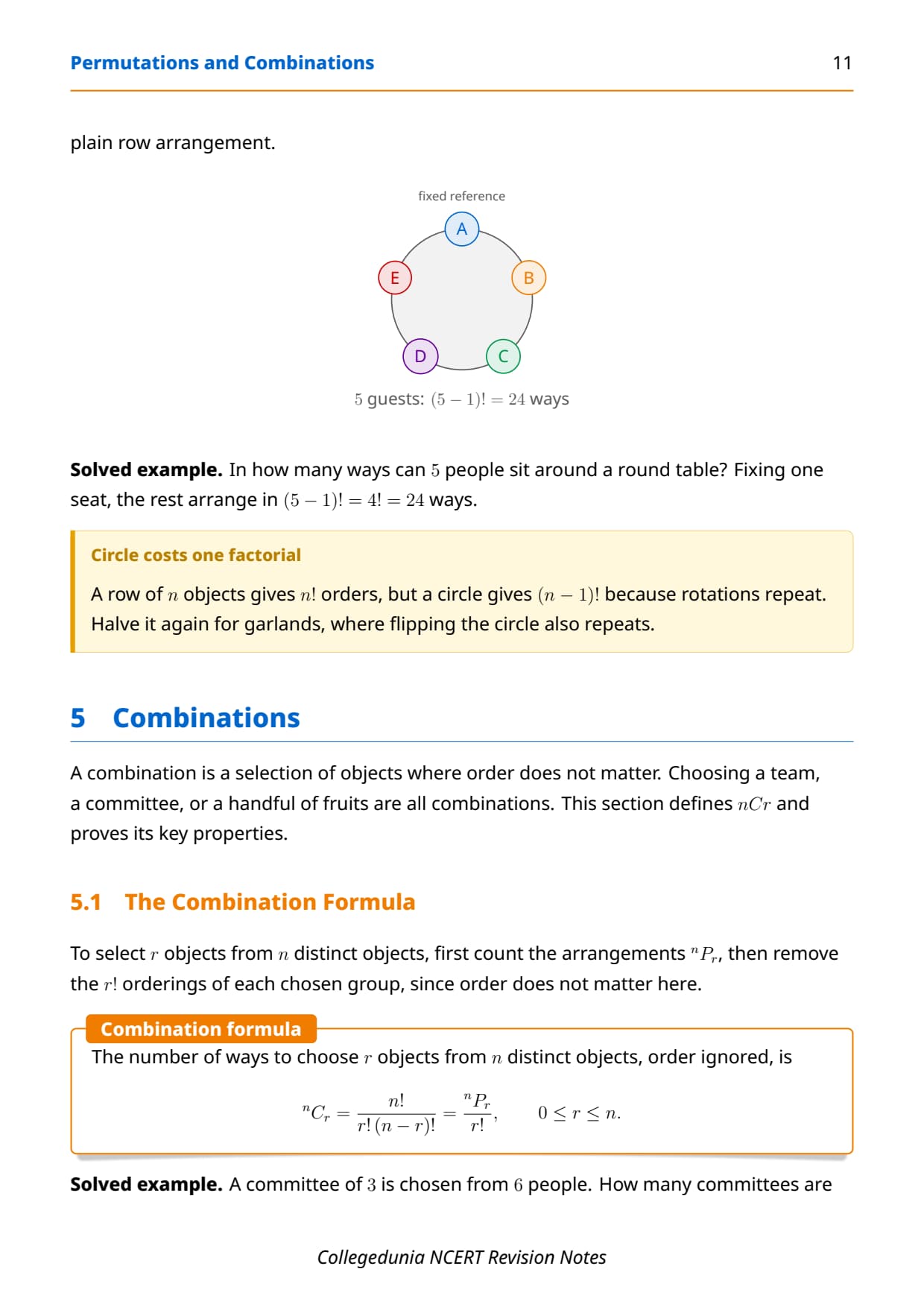
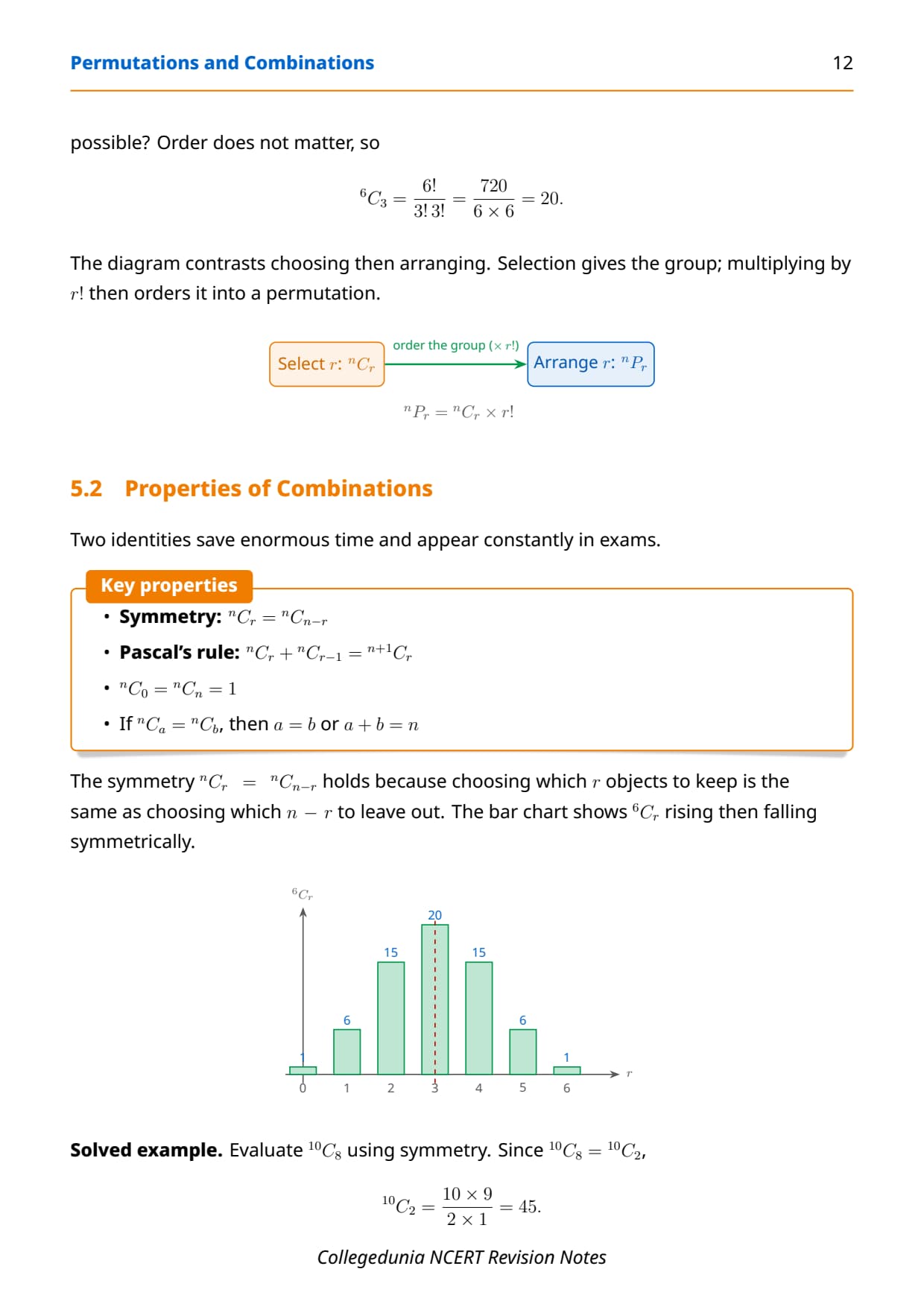
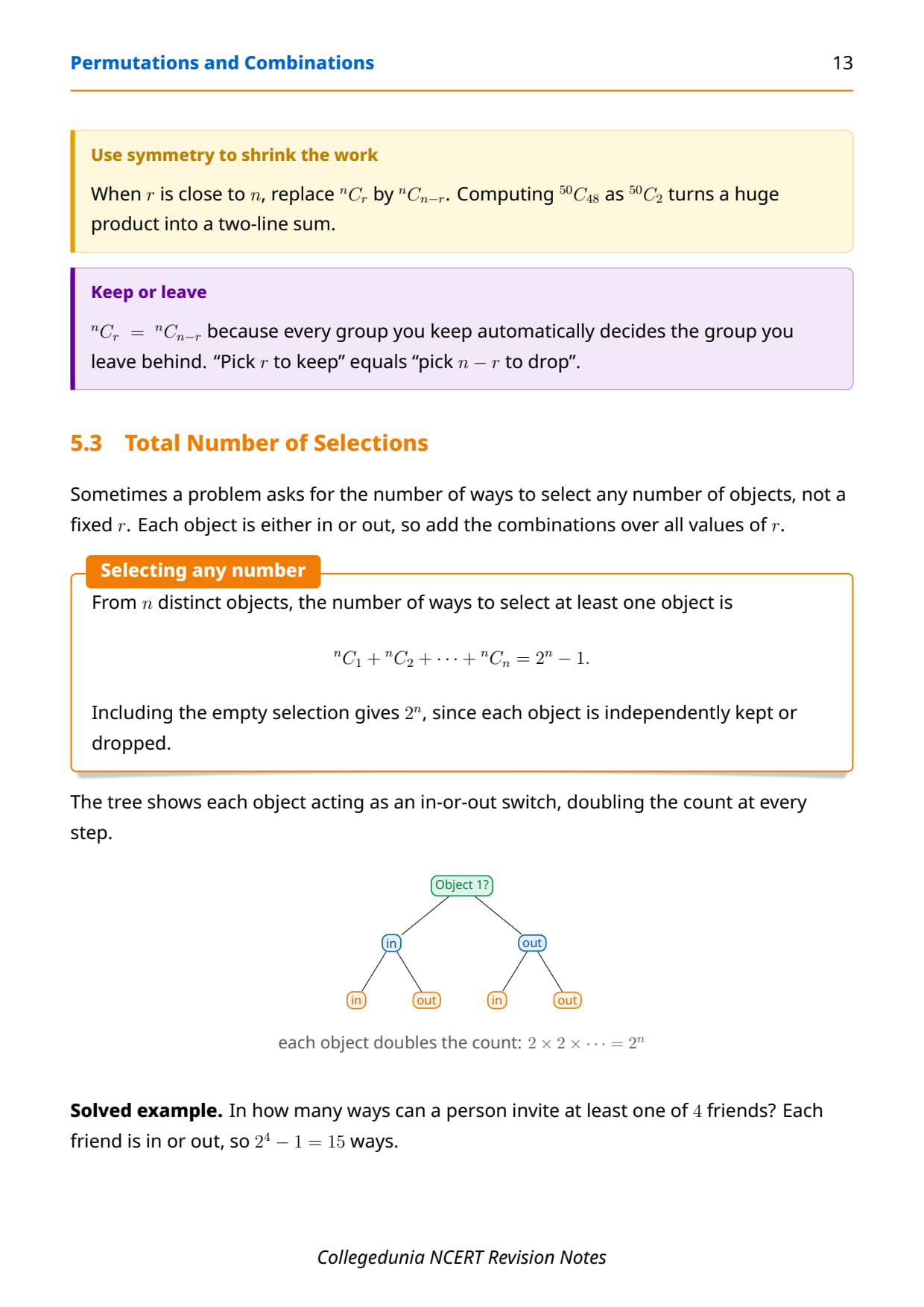
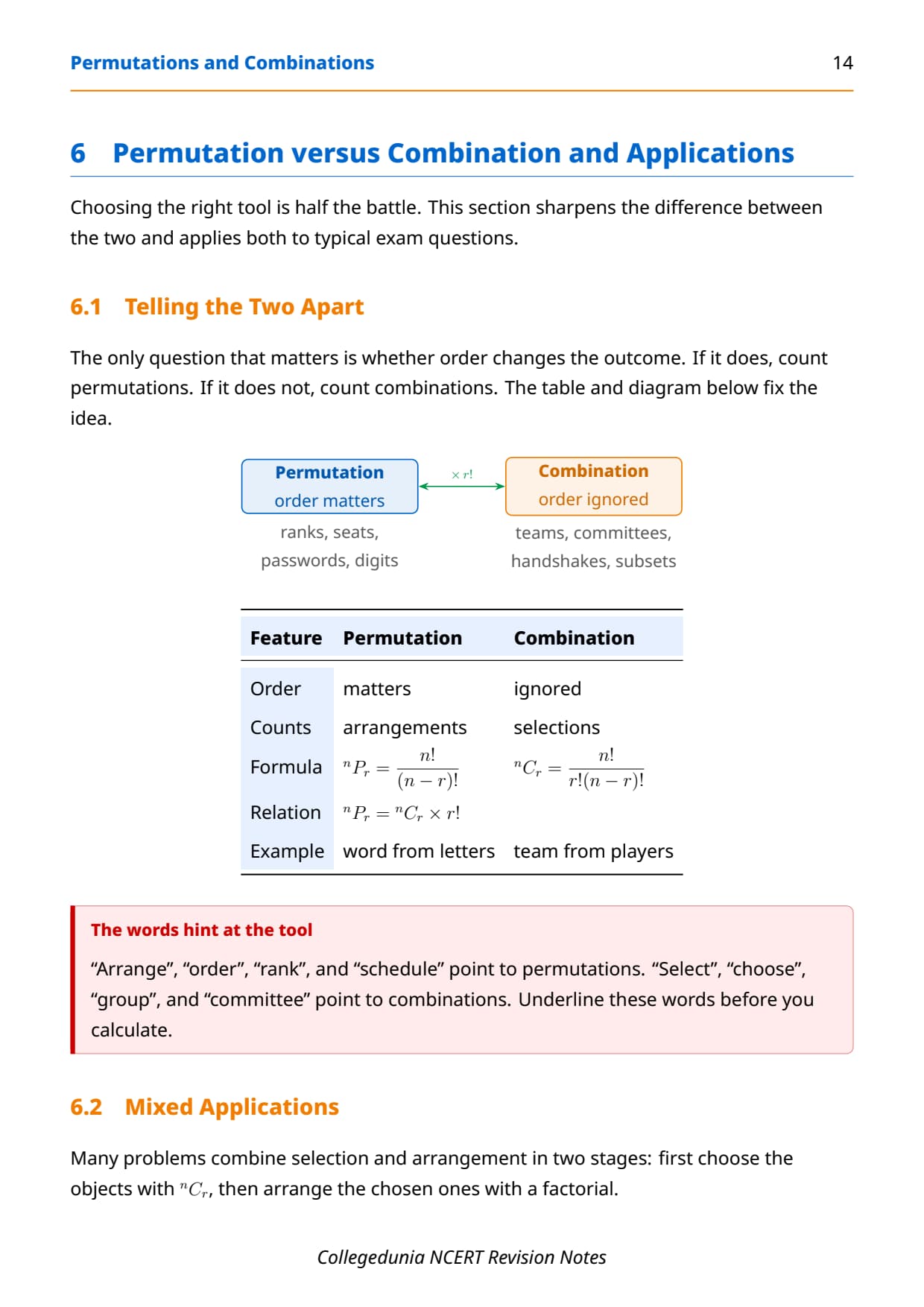
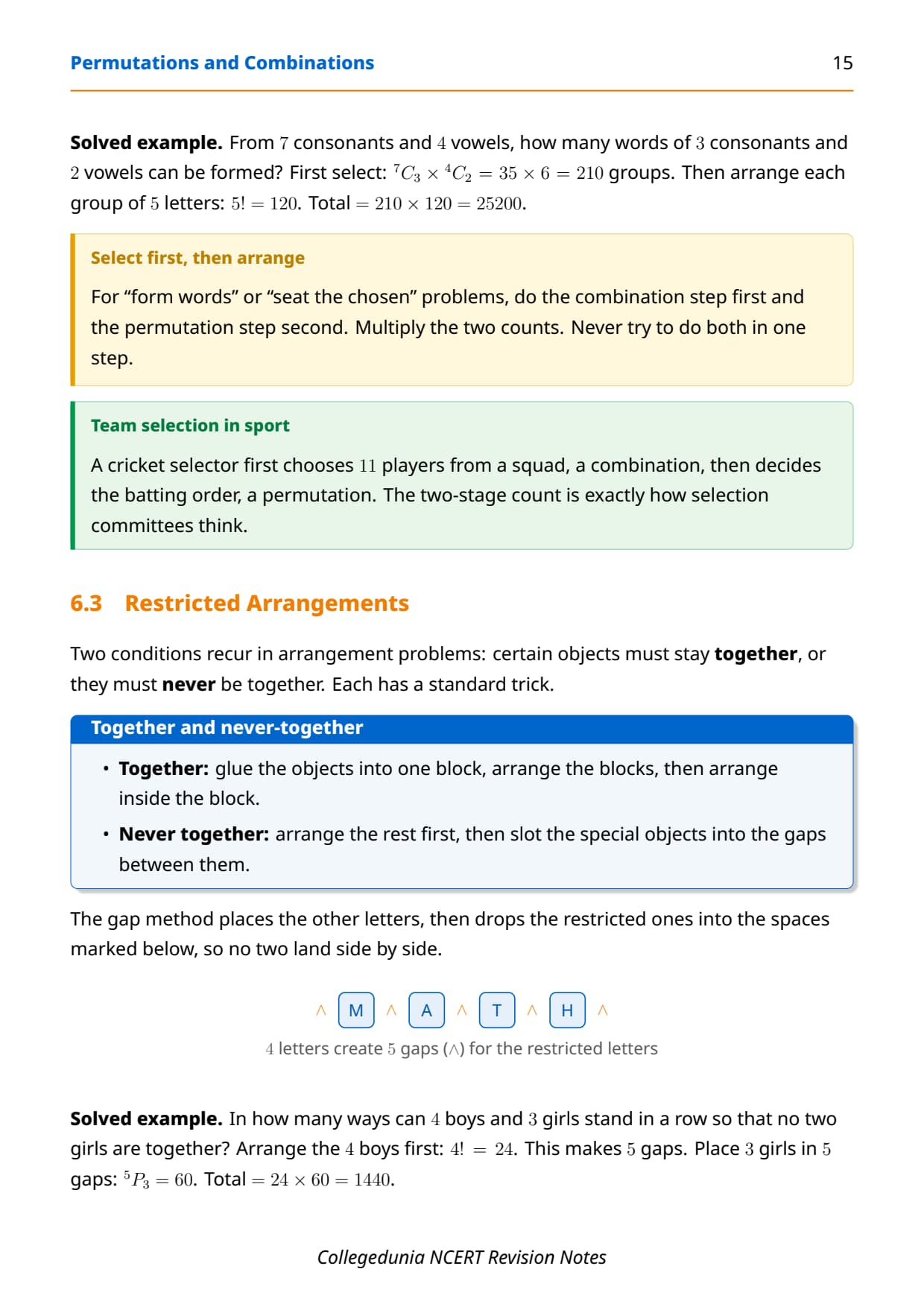
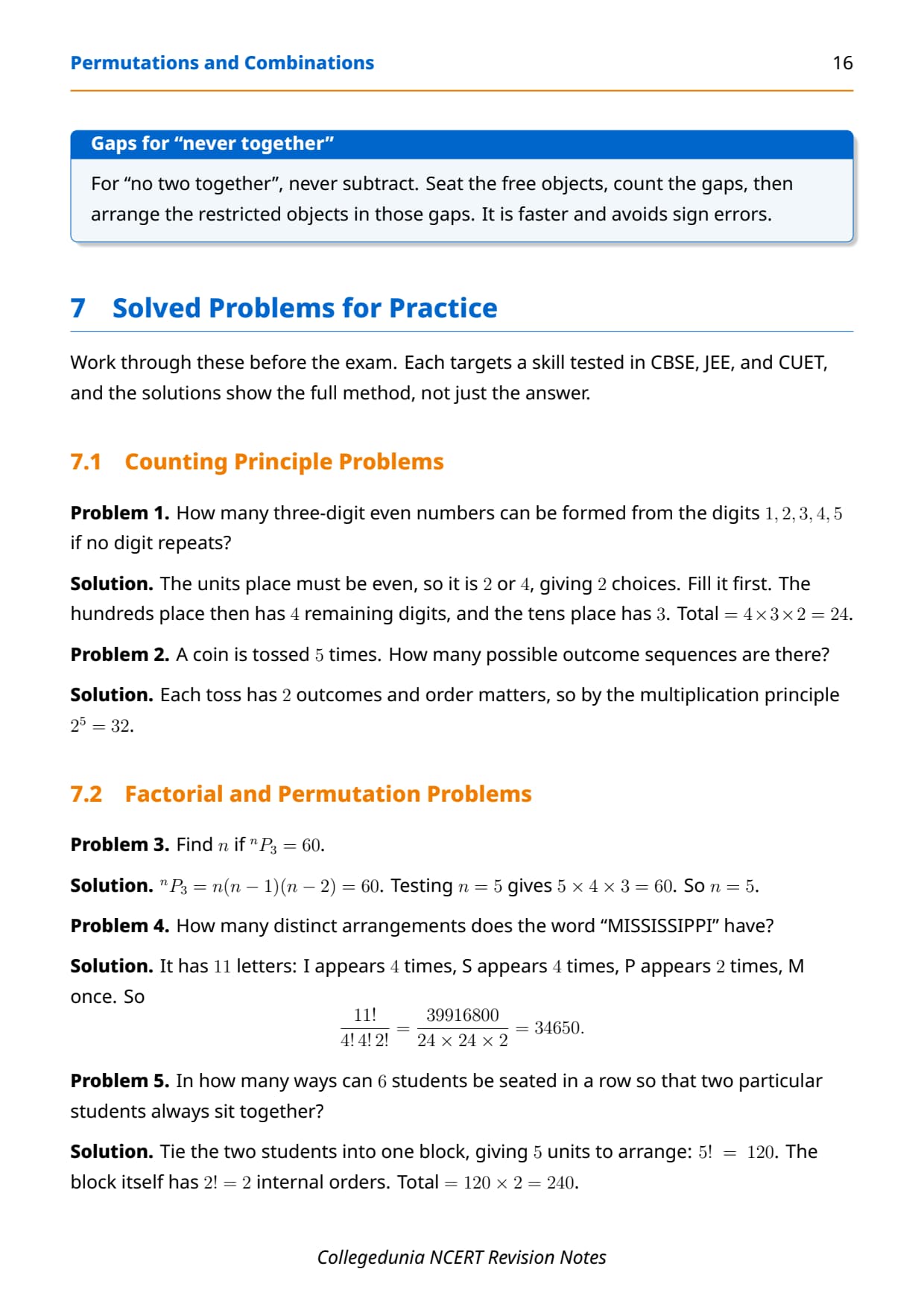
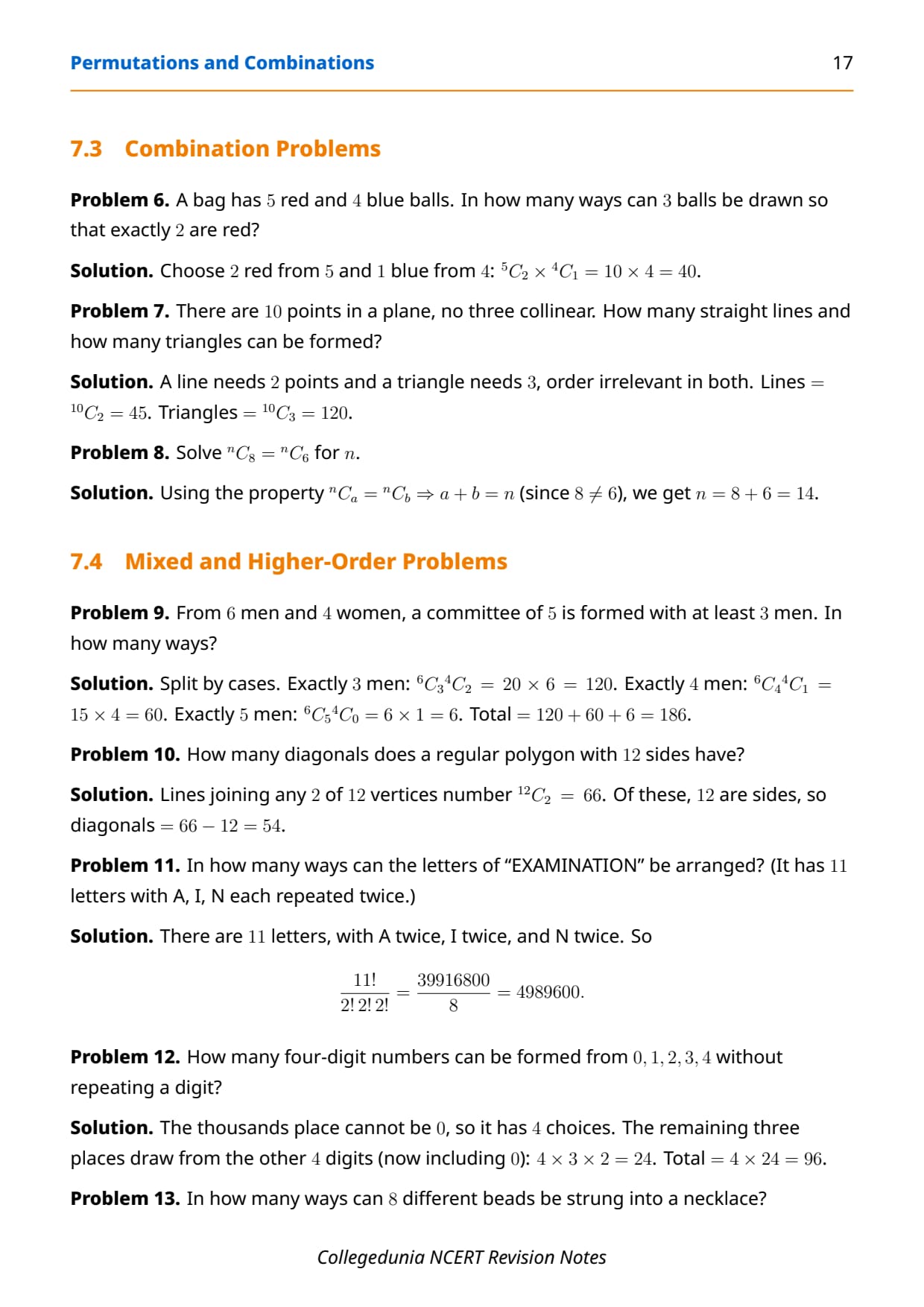
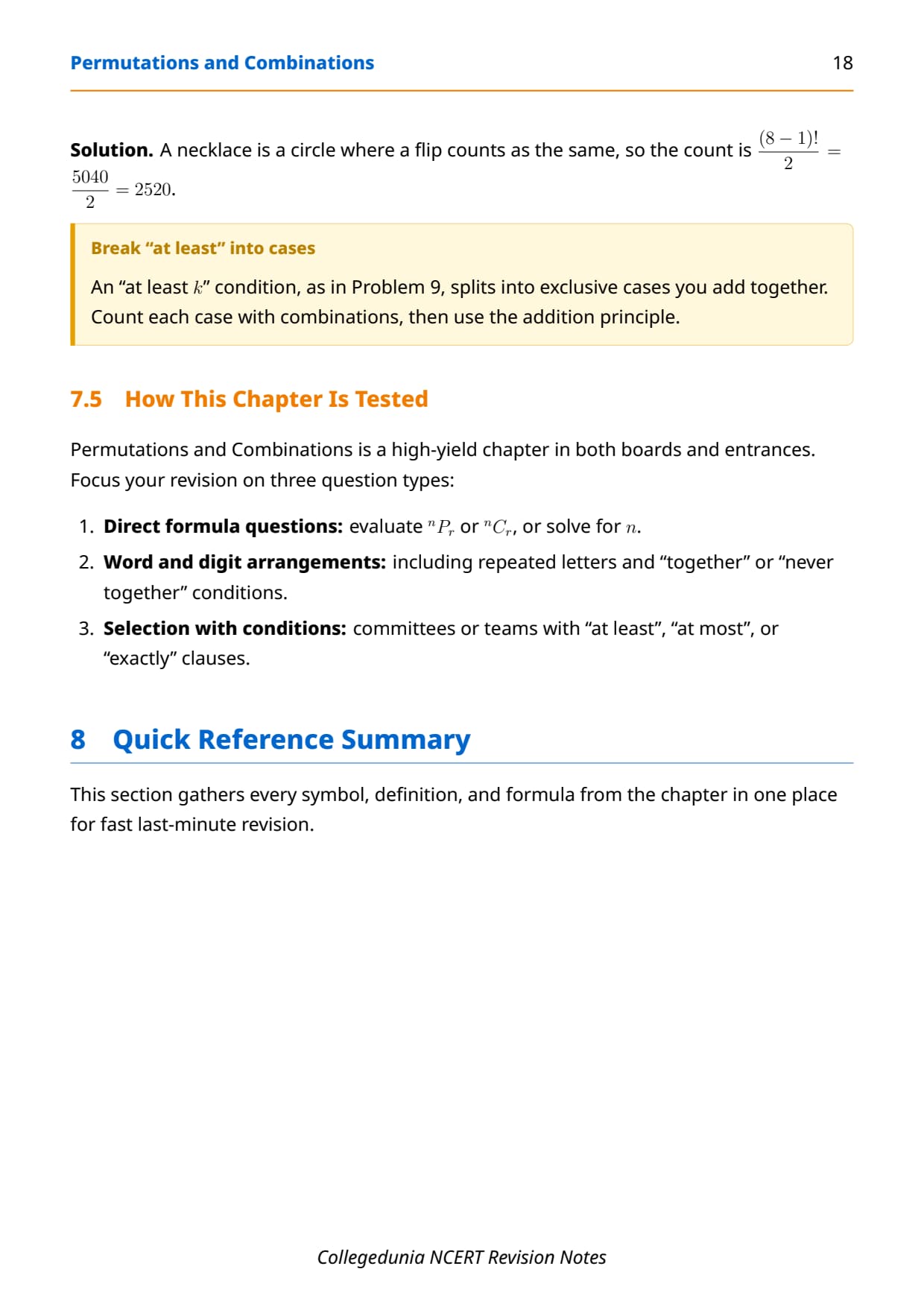
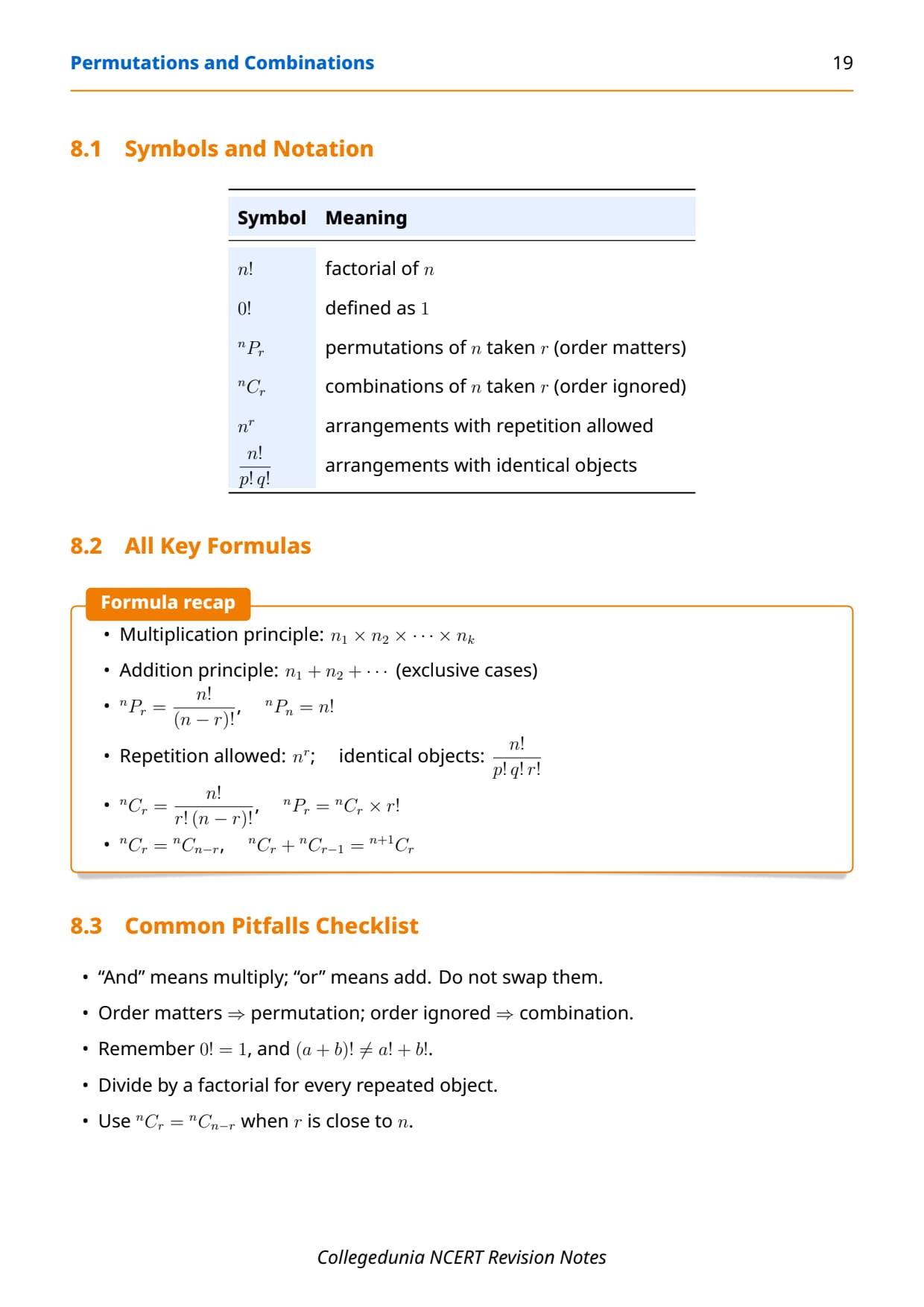
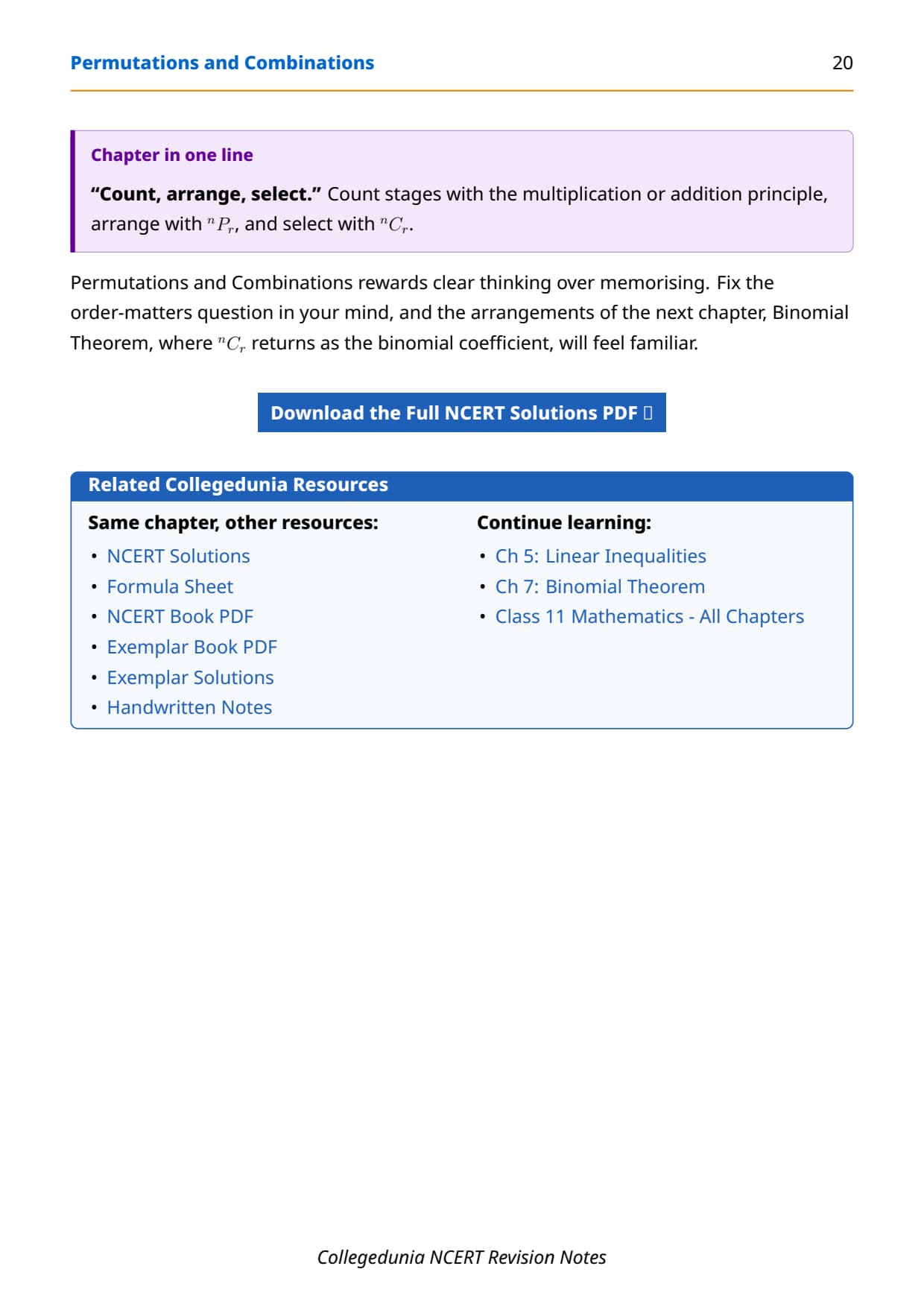
You can download the complete Permutations and Combinations notes PDF above, then use the topic-by-topic summary and the formula table on this page for a fast last-minute revision.
- CBSE Boards: Permutations and Combinations sits in Unit 1 (Sets, Relations and Functions area) and carries roughly 5 to 7 marks on its own.
- JEE Main and CUET: expect 1 to 2 direct questions on nPr, nCr, and arrangement-with-restriction problems every year.
- What is covered: the multiplication and addition principles, factorials, permutations with and without repetition, combinations, and their key properties.
Every entry in these Permutations and Combinations notes is curated by Collegedunia subject experts, mapped to the 2026-27 NCERT textbook, and checked against the last five years of CBSE Board and JEE Main papers.
Also Check:
- NCERT Solutions for Class 11 Maths Permutations and Combinations
- Class 11 Maths Permutations and Combinations Handwritten Notes
Topic-by-Topic Summary of Permutations and Combinations for Class 11 Maths
The Permutations and Combinations chapter splits into four sub-topic blocks. The class 11 maths notes chapter 6 permutations and combinations map each block to what the exam asks, so students know where the marks sit before they revise.
- Fundamental principle of counting: the multiplication and addition rules that underpin every counting problem. Usually a 1 to 2-mark starter.
- Factorial notation: defining n! and simplifying factorial expressions. A frequent short-answer step inside larger questions.
- Permutations: arrangements where order matters, using nPr, repetition, and restrictions. The 3 to 4-mark core of the chapter.
- Combinations: selections where order does not matter, using nCr and its properties. A common 2 to 3-mark question.
The rest of these notes take each block in order, so a first read from top to bottom mirrors the NCERT chapter flow.
Fundamental Principle of Counting: Multiplication and Addition Rules
The fundamental principle of counting is the foundation of the whole chapter. It lets students count the number of outcomes of a task without listing them one by one.
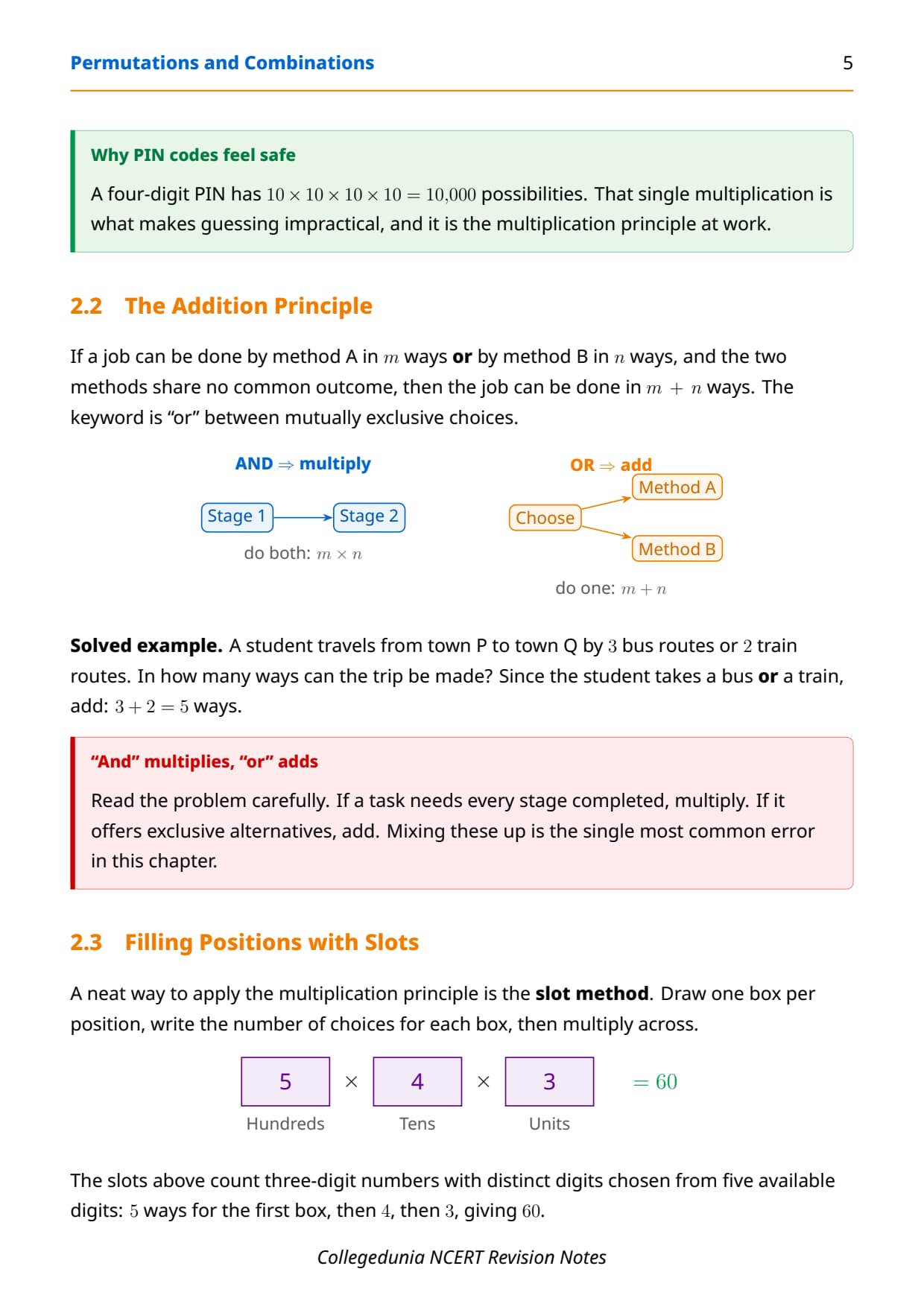
- Multiplication principle: if one event can happen in m ways and, following it, a second event can happen in n ways, then the two events together can happen in m × n ways. Use "and" between stages.
- Addition principle: if one event can happen in m ways and a separate event in n ways, and the two cannot happen together, then either can happen in m + n ways. Use "or" between choices.
Quick example: a menu with 3 starters and 4 main courses gives 3 × 4 = 12 possible two-course meals by the multiplication principle. If a student may pick only one dish, either a starter or a main, that is 3 + 4 = 7 choices by the addition principle. Deciding between "and" (multiply) and "or" (add) is the single most useful skill in this chapter.
Factorial Notation Explained
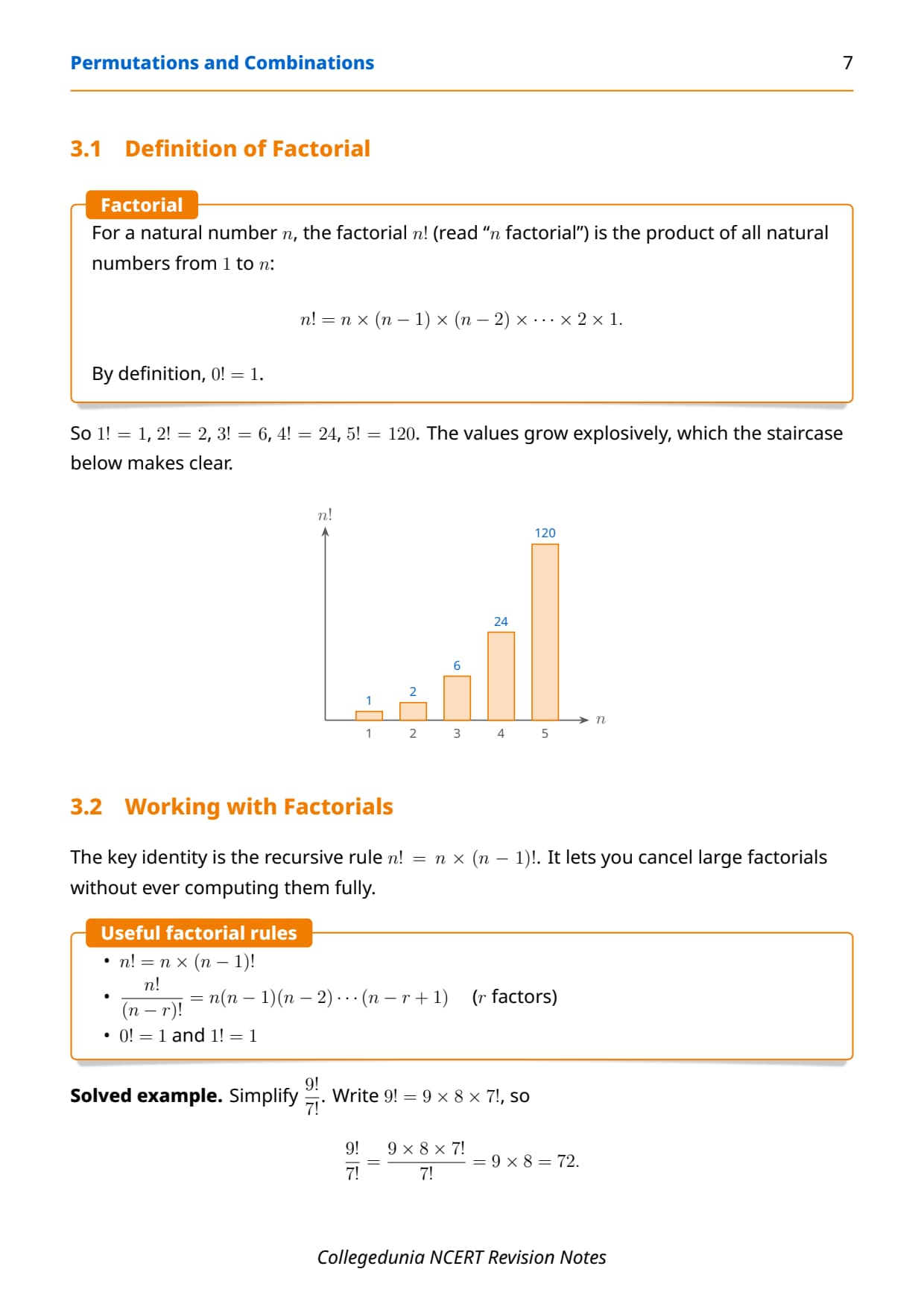
A factorial is a compact way to write the product of the first n natural numbers. For a natural number n, n! (read "n factorial") is defined as n! = n × (n − 1) × (n − 2) × ... × 2 × 1.
- By definition, 0! = 1 and 1! = 1. The value of 0! is a convention that makes the permutation and combination formulas work.
- A useful identity is n! = n × (n − 1)!, which is how most factorial expressions are simplified before cancelling.
- Example: 5! = 5 × 4 × 3 × 2 × 1 = 120, and 6! = 6 × 5! = 6 × 120 = 720.
Factorials grow very fast, so questions almost always ask students to simplify a ratio such as 8! / 6! rather than compute a giant number. Here 8! / 6! = 8 × 7 = 56, because the 6! cancels.
Permutations: nPr, Repetition, and Restrictions
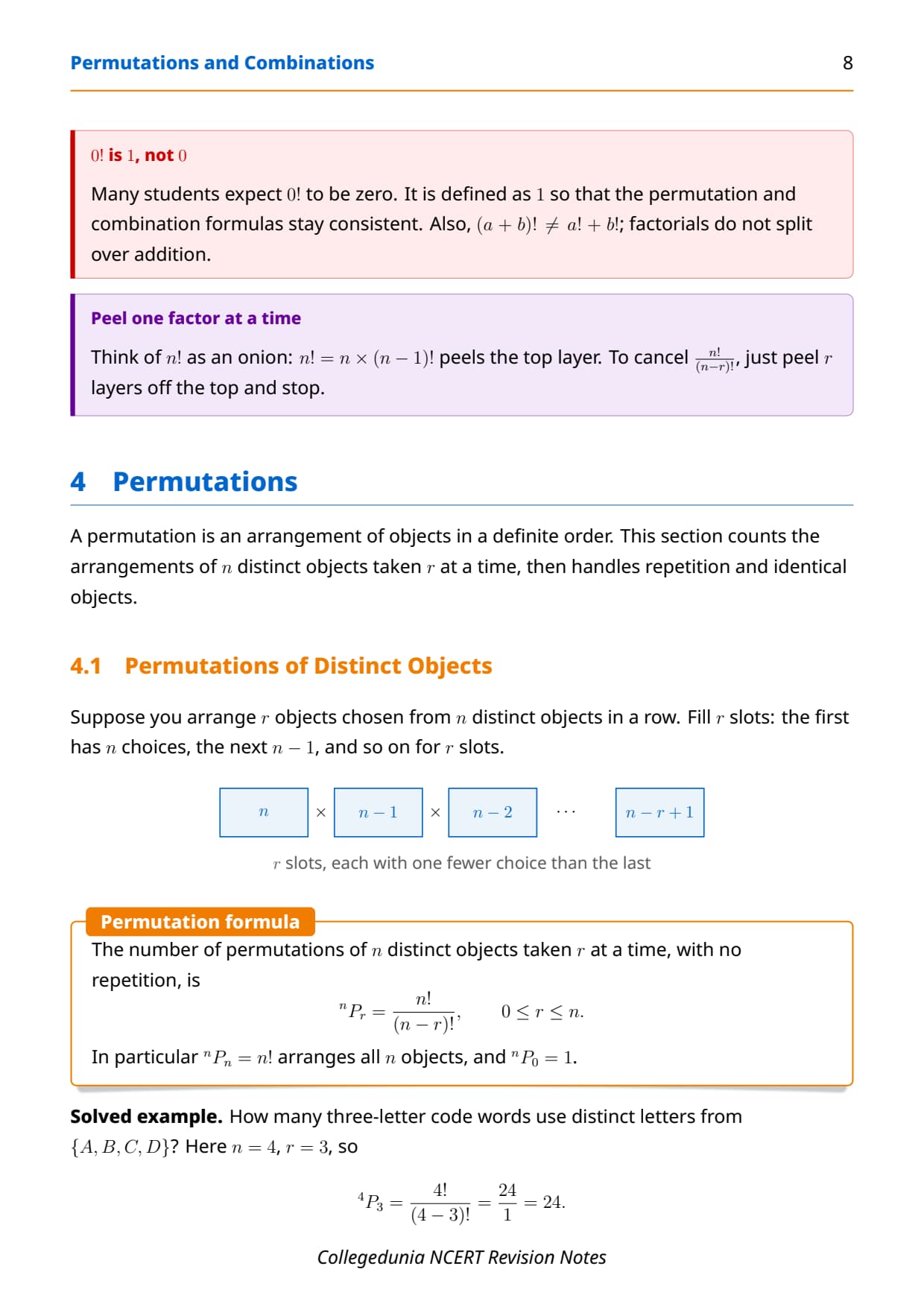
A permutation is an arrangement of objects in a definite order. When order matters, the class 11 maths notes chapter 6 permutations and combinations use the nPr formula to count the arrangements.
The number of permutations of n distinct objects taken r at a time, without repetition, is nPr = n! / (n − r)!, where 0 ≤ r ≤ n. Two special cases follow directly:
- All objects arranged: nPn = n!, the number of ways to arrange all n objects in a row.
- Permutations with repetition allowed: if each place can be filled by any of the n objects again, the count is nr (n raised to the power r).
- Objects not all distinct: the number of arrangements of n objects where one kind repeats p times and another q times is n! / (p! × q!).
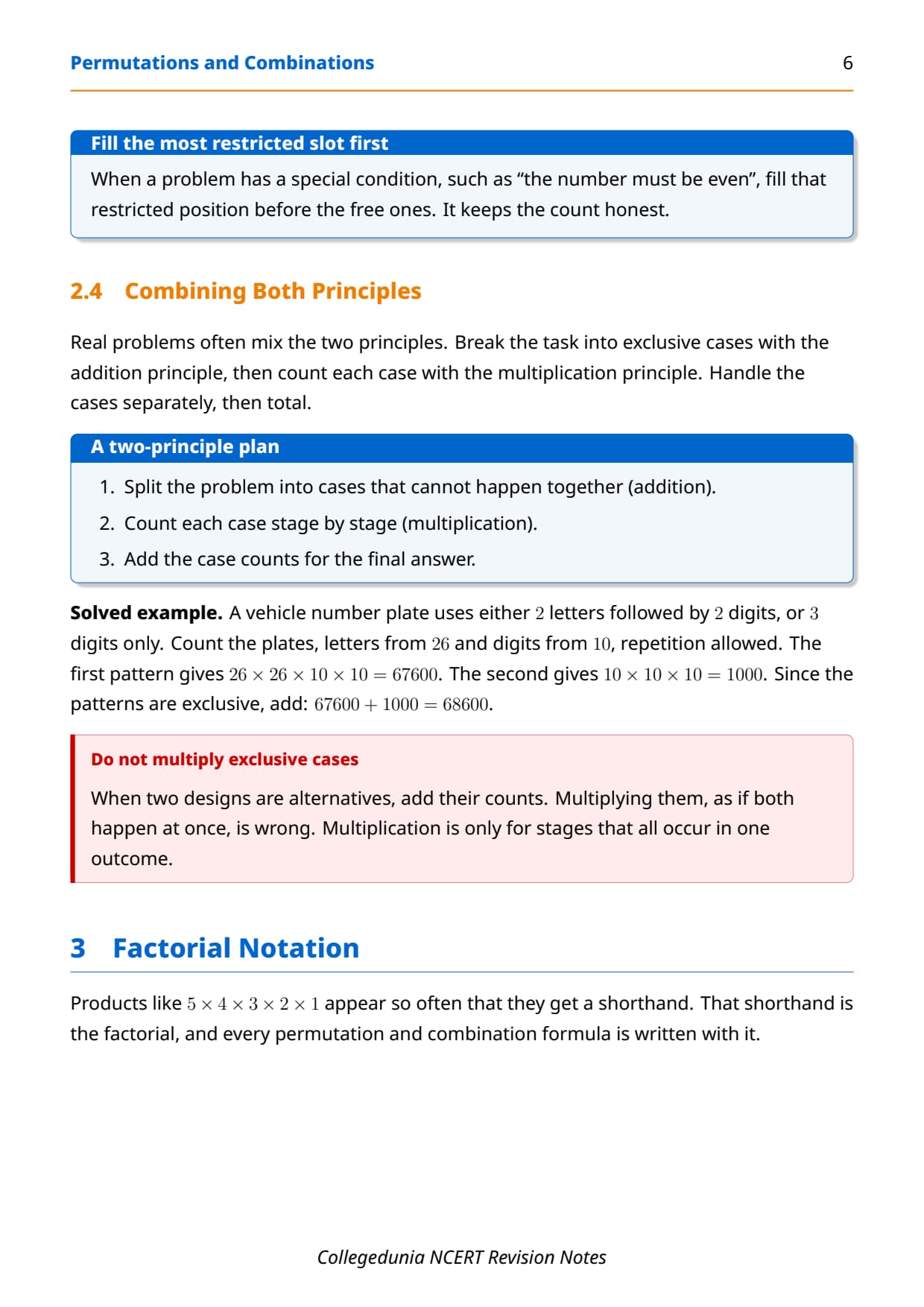
Many board questions add a restriction, such as fixing certain letters together or keeping two people apart. The standard trick is to treat objects that must stay together as a single block, arrange the block, and then arrange the objects inside it. For example, the number of ways to arrange the letters of a word so that two chosen letters are always together is found by tying them into one unit first.
Combinations: nCr and Its Properties
A combination is a selection of objects where order does not matter. Choosing a team of 3 from 5 players is a combination, because the same three players form the same team no matter how they are listed.
The number of combinations of n distinct objects taken r at a time is nCr = n! / [r! × (n − r)!], for 0 ≤ r ≤ n. The relationship between permutations and combinations is nPr = nCr × r!, because every selection of r objects can itself be arranged in r! orders.
- Symmetry property: nCr = nC(n − r). Choosing r to keep is the same as choosing n − r to leave out.
- Pascal's rule: nCr + nC(r − 1) = (n + 1)Cr. This is how each row of Pascal's triangle is built.
- Boundary values: nC0 = nCn = 1, and nC1 = n.
These properties turn slow, direct calculations into one-line answers, so examiners test them often in MCQ form.
All Formulas for Permutations and Combinations: Quick-Reference Table
The formula table below covers every counting rule the Permutations and Combinations chapter can generate. These formulas are the ones students should copy onto a flashcard before the exam.
| Formula | What It Means | When to Use |
|---|---|---|
| Total ways = m × n | Multiplication principle | Stages joined by "and" |
| Total ways = m + n | Addition principle | Choices joined by "or" |
| n! = n × (n − 1) × ... × 2 × 1 | Factorial of n | Counting full arrangements |
| nPr = n! / (n − r)! | Permutations of n taken r, no repetition | Order matters |
| nPn = n! | Arranging all n objects | Full-row arrangements |
| Arrangements with repetition = nr | Each of r places filled from n objects | Repetition allowed |
| n! / (p! × q!) | Arrangements when objects repeat | Objects not all distinct |
| nCr = n! / [r! × (n − r)!] | Combinations of n taken r | Order does not matter |
| nPr = nCr × r! | Link between permutations and combinations | Converting selections to arrangements |
| nCr = nC(n − r) | Symmetry property | Simplifying large nCr |
| nCr + nC(r − 1) = (n + 1)Cr | Pascal's rule | Building nCr values |
| nC0 = nCn = 1 | Boundary combinations | Selecting none or all |
Important: the nPr = nCr × r! relation is the single most useful bridge in this chapter, because it lets students move between "arrange" and "select" problems in both CBSE Boards and JEE Main.
Key Definitions and Theorems in Permutations and Combinations
Beyond the formulas, a few named definitions carry marks in the reasoning-style questions. These are the results the class 11 maths notes chapter 6 permutations and combinations expect students to state precisely.
- Permutation: an arrangement of a number of objects taken some or all at a time, in which the order of the objects is important.
- Combination: a selection of a number of objects taken some or all at a time, in which the order of the objects does not matter.
- Factorial: n! is the product of the first n natural numbers, with 0! defined as 1.
- Fundamental principle of counting: the multiplication rule for events happening in succession and the addition rule for mutually exclusive choices.
- Permutation-combination link: nPr = nCr × r!, since each of the nCr selections can be ordered in r! ways.
Stating a definition in the exact NCERT wording, then applying it, is what turns a partial answer into full marks in the board exam.
Difference Between Permutation and Combination
Telling permutations and combinations apart is the deciding skill of this chapter. The rule of thumb is simple: if rearranging the objects gives a new outcome, it is a permutation; if it gives the same outcome, it is a combination.
| Point | Permutation | Combination |
|---|---|---|
| Meaning | Arrangement of objects | Selection of objects |
| Order | Order matters | Order does not matter |
| Formula | nPr = n! / (n − r)! | nCr = n! / [r! × (n − r)!] |
| Example | Forming a 3-digit number from digits | Choosing 3 students for a committee |
| Count for same n, r | Always larger (or equal) | Always smaller (or equal) |
Signal words help: "arrange", "order", "rank", and "form a number" point to permutations, while "select", "choose", "team", and "committee" point to combinations.
Common Mistakes Students Make in Permutations and Combinations
Mistake 1: Using a permutation when order does not matter. A committee of 3 is a combination, so use nCr, not nPr.
Mistake 2: Multiplying when the choices are joined by "or" instead of adding them. Read the problem for "and" versus "or".
Mistake 3: Forgetting that 0! = 1, which breaks the nPr and nCr formulas at the boundary.
Mistake 4: Ignoring repeated objects. Arrangements of a word with repeated letters need division by the factorials of the repeats.
Each slip costs 1 to 2 marks in the board exam.
Permutations and Combinations Weightage in CBSE Boards, JEE Main and CUET
Permutations and Combinations is a scoring chapter because the questions are rule-based once the setup is clear. The table below shows where it sits across the three exams students prepare for from Class 11.
| Exam | Typical Weightage | Most-Tested Topic |
|---|---|---|
| CBSE Class 11 Boards | 5 to 7 marks | nPr and nCr word problems with restrictions |
| JEE Main | 1 to 2 questions per year | Arrangements with repetition and grouping |
| CUET (UG) Mathematics | 1 to 2 MCQs per paper | Direct nPr, nCr, and factorial simplification |
Tip: because Permutations and Combinations feeds directly into the Binomial Theorem and Probability, a strong grip here pays off across the whole Class 11 and Class 12 syllabus.
How to Revise Permutations and Combinations Quickly
This chapter can be revised in about 90 minutes because the content is compact. Use the class 11 maths notes chapter 6 permutations and combinations in the three-block plan below for a last-minute recap.
- 0 to 30 min: the multiplication and addition principles, factorial notation, and simplifying factorial ratios.
- 30 to 60 min: permutations, nPr, repetition, and one or two restriction problems by the block method.
- 60 to 90 min: combinations, nCr, the properties, and two or three mixed word problems.
Finish by flushing through the twelve-row formula table until every rule can be written from memory.
Student Feedback on the Permutations and Combinations Notes
In a Collegedunia poll of 10,820 Class 11 Maths students conducted before the 2026 boards, 68% of students rated telling a permutation apart from a combination as the trickiest part of the chapter, ahead of restriction problems.
What 10,820 students told us about the Permutations and Combinations revision journey:
- 68% of students surveyed found deciding between nPr and nCr the hardest step.
- 57% said they had multiplied instead of added on an "or" problem at least once in a class test.
- 4 out of 5 students revised the formula table the night before the exam.
- Out of 10,820 students, 63% said the block method made restriction problems easier to handle.
Source: 2026-27 Class 11 Maths student poll. Sample of 10,820 students from CBSE schools across 14 states.
Other Permutations and Combinations Class 11 Maths Resources
Use these notes together with the linked resources below for the full Permutations and Combinations study set. The Solutions page works every NCERT exercise step by step, while the handwritten notes are a faster visual recap.
| Resource | What It Gives You |
|---|---|
| NCERT Solutions for Class 11 Maths Permutations and Combinations | Step-by-step answers to every exercise question |
| Class 11 Maths Permutations and Combinations Handwritten Notes | Neat handwritten revision notes with formula boxes |
| Class 11 Maths Permutations and Combinations NCERT Book PDF | The official NCERT chapter PDF to read alongside |
NCERT Notes for Class 11 Maths: All Chapters
| Chapter | Revision Notes |
|---|---|
| Chapter 1 | Sets Notes |
| Chapter 2 | Relations and Functions Notes |
| Chapter 3 | Trigonometric Functions Notes |
| Chapter 4 | Complex Numbers and Quadratic Equations Notes |
| Chapter 5 | Linear Inequalities Notes |
| Chapter 6 | Permutations and Combinations Notes (this page) |
| Chapter 7 | Binomial Theorem Notes |
| Chapter 8 | Sequences and Series Notes |
| Chapter 9 | Straight Lines Notes |
| Chapter 10 | Conic Sections Notes |
| Chapter 11 | Introduction to Three Dimensional Geometry Notes |
| Chapter 12 | Limits and Derivatives Notes |
| Chapter 13 | Statistics Notes |
| Chapter 14 | Probability Notes |
FAQs on Permutations and Combinations Class 11 Maths Notes
Permutations and Combinations Notes - Frequently Asked Questions
Ques. What are the main topics in the class 11 maths notes chapter 6 permutations and combinations?
Ans. These Permutations and Combinations notes cover the fundamental principle of counting (multiplication and addition rules), factorial notation, permutations using nPr with and without repetition and restrictions, combinations using nCr, and the key properties that link the two.
Ques. What is the difference between a permutation and a combination?
Ans. A permutation is an arrangement of objects in which the order is important, counted by nPr = n! / (n − r)!. A combination is a selection in which order does not matter, counted by nCr = n! / [r! × (n − r)!]. For the same n and r, the number of permutations is always greater than or equal to the number of combinations.
Ques. What is the formula for nPr and nCr?
Ans. The permutation formula is nPr = n! / (n − r)!, and the combination formula is nCr = n! / [r! × (n − r)!], both for 0 ≤ r ≤ n. They are linked by nPr = nCr × r!, because each selection of r objects can be arranged in r! orders.
Ques. Why is 0! equal to 1?
Ans. The value 0! = 1 is a convention. It keeps formulas consistent, for example nCn = n! / [n! × 0!] must equal 1, which only works if 0! = 1. It also gives nP0 = 1 and nC0 = 1, meaning there is exactly one way to arrange or select no objects.
Ques. What is the fundamental principle of counting?
Ans. The fundamental principle of counting has two parts. The multiplication principle says if one event occurs in m ways and a following event in n ways, both occur in m × n ways. The addition principle says if two events cannot happen together, then one or the other occurs in m + n ways.
Ques. How do you handle permutations with repeated objects?
Ans. When some objects are identical, the number of arrangements of n objects, where one kind repeats p times and another q times, is n! / (p! × q!). For example, the number of distinct arrangements of the letters in a word with repeated letters is found by dividing by the factorials of the repeated letters.
Ques. Is Permutations and Combinations important for JEE Main and CUET?
Ans. Yes. Permutations and Combinations usually gives 1 to 2 questions in JEE Main and CUET (UG) Mathematics every year, mostly on arrangements with restrictions, grouping, and direct nPr and nCr calculations. It also underpins the Binomial Theorem and Probability, so it is worth revising fully.
Ques. Where can I download the Class 11 Maths Permutations and Combinations notes PDF?
Ans. The Permutations and Combinations notes PDF is available on this page through the download card above. It covers the fundamental principle of counting, factorial notation, the full formula table, permutations, and combinations, and matches the 2026-27 NCERT chapter.



Comments