




These hydrocarbons class 11 notes gather every structure, reaction, and reaction rule that the CBSE Boards, JEE Main, JEE Advanced, NEET and CUET papers test in 2026-27. Revise alkanes, alkenes, alkynes, and aromatic compounds fast, with each named reaction and its mechanism in one place.
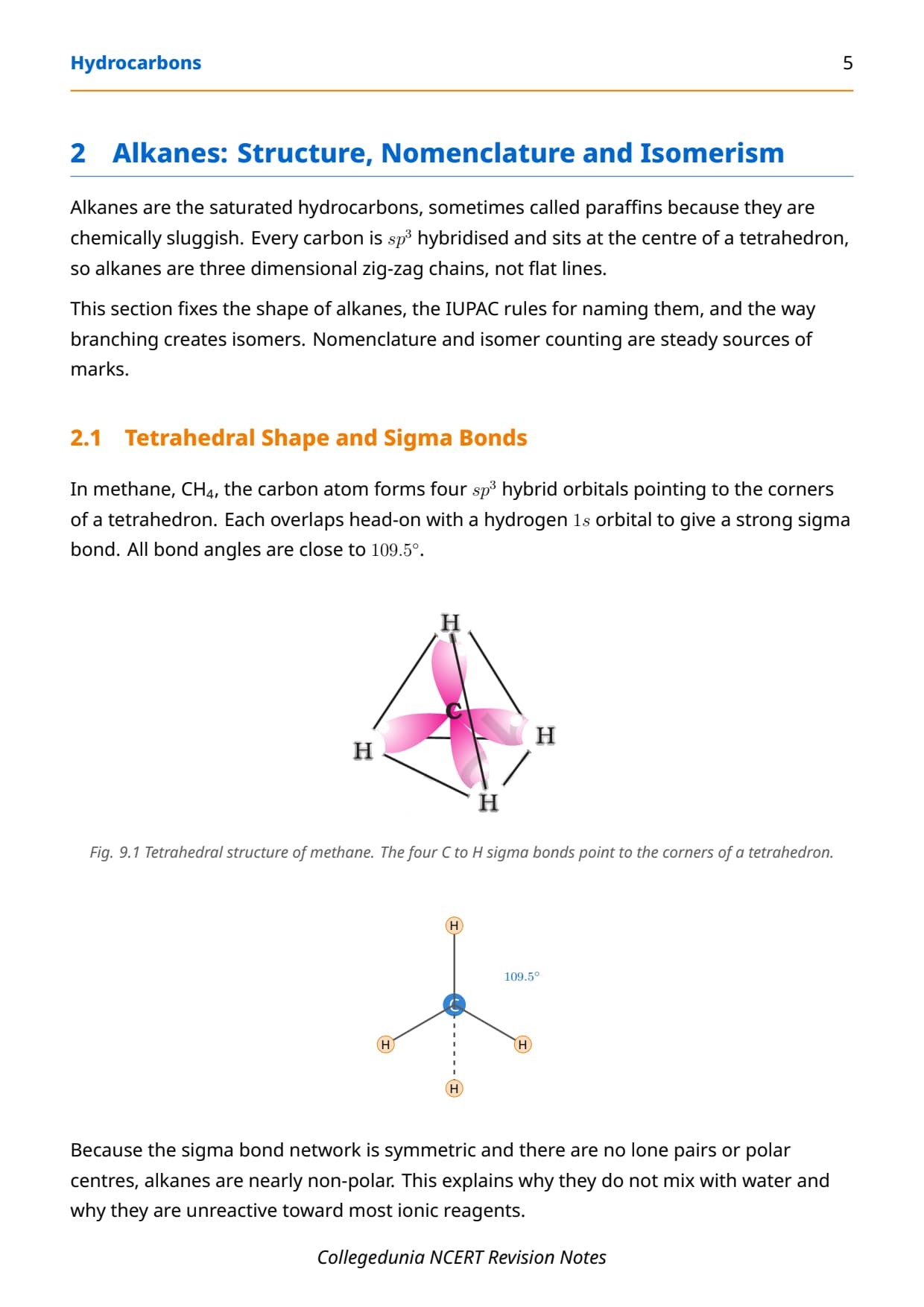
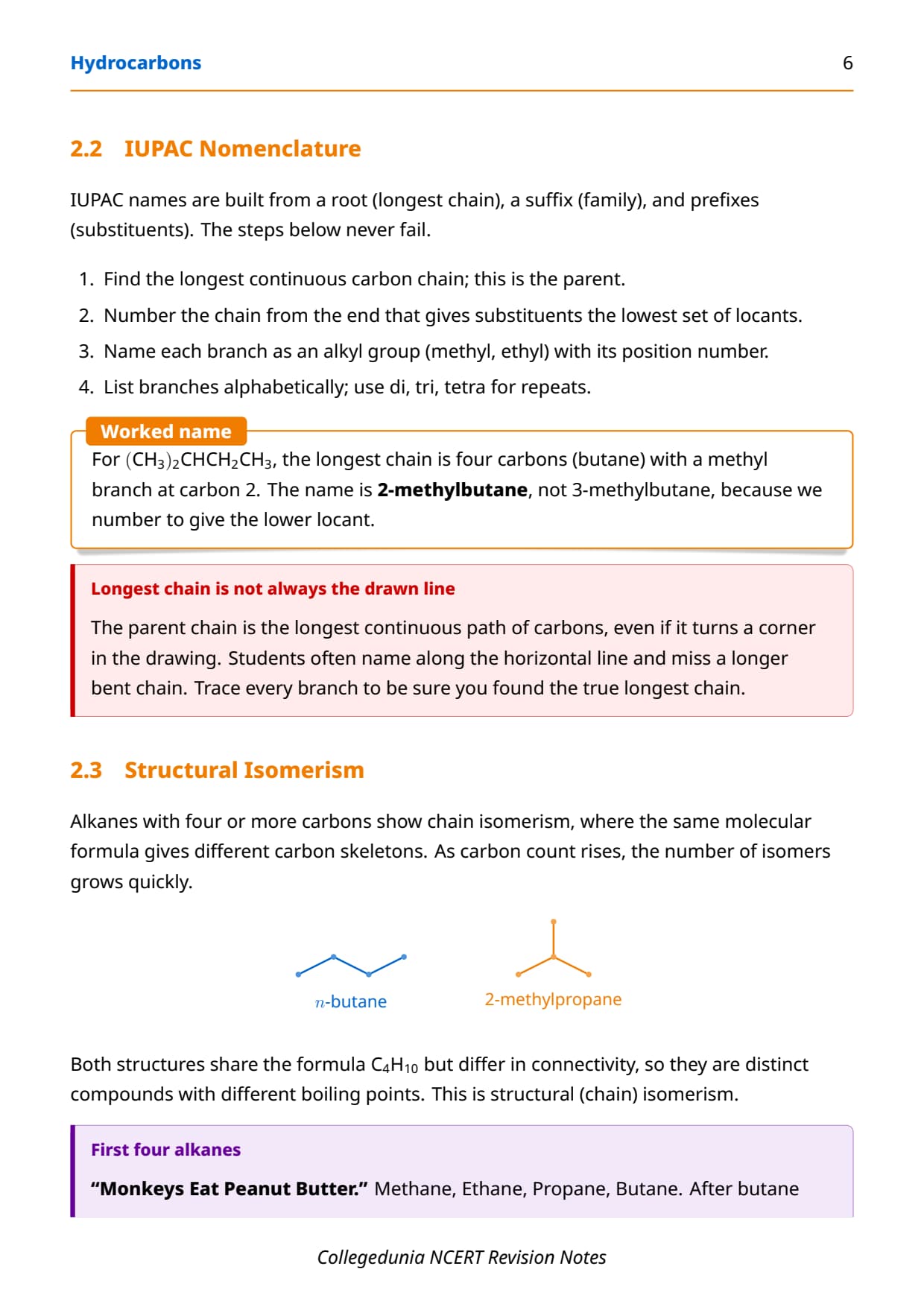
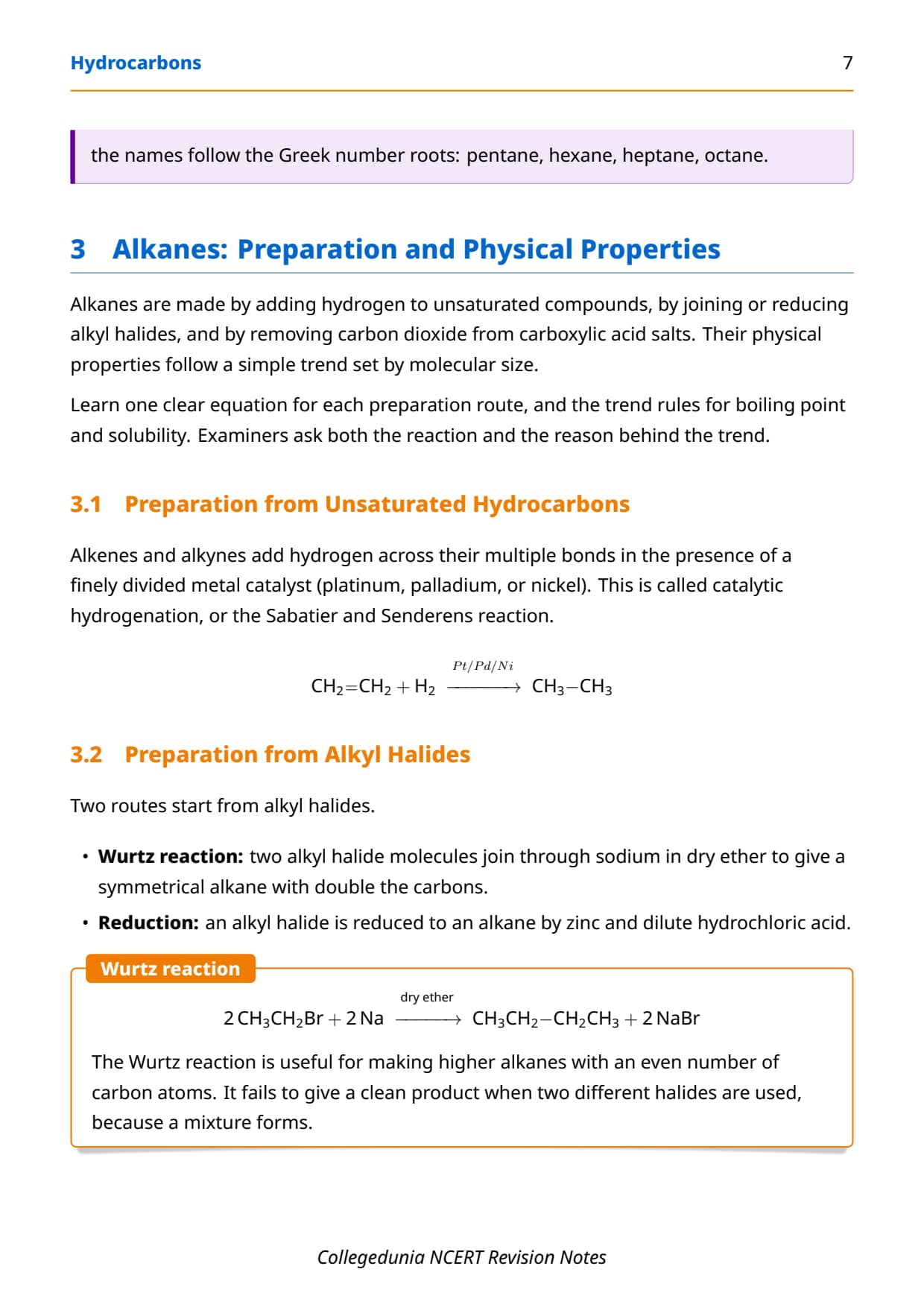
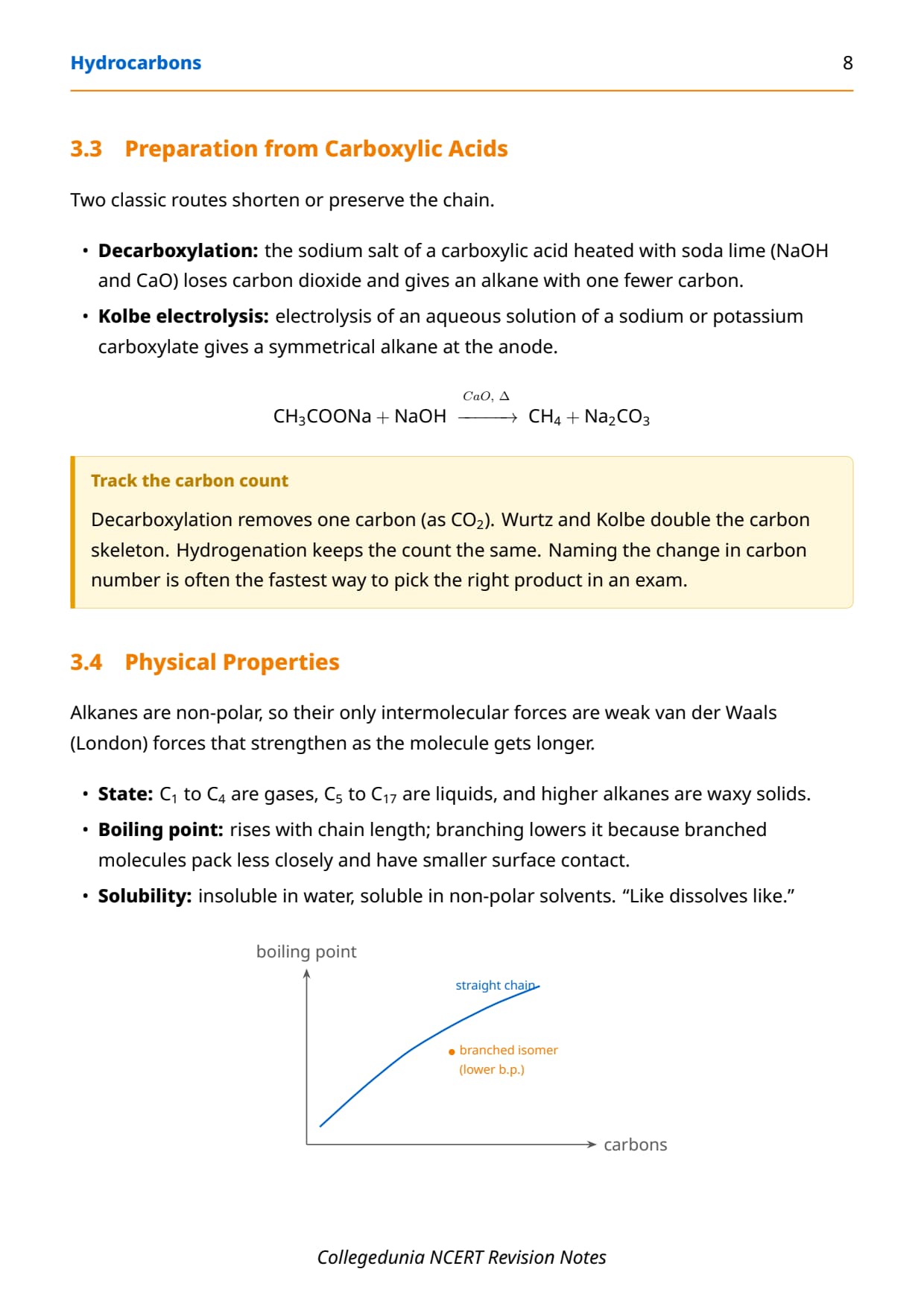
This is one of the most reaction-heavy chapters in Class 11 organic chemistry, and the addition and substitution rules you learn here carry straight into Class 12.
- CBSE Weightage: 6 to 8 marks, usually one reaction-conversion question plus one short answer on mechanism or aromaticity.
- Topics covered: classification of hydrocarbons, alkanes, alkenes, alkynes, aromatic compounds, and their preparation and reactions.
- Key reactions: free-radical halogenation, Markovnikov and anti-Markovnikov addition, ozonolysis, and electrophilic substitution on benzene.
These hydrocarbons class 11 notes are curated by subject experts, based on the 2026-27 NCERT textbook, and checked against the last five years of CBSE Board, JEE Main and NEET papers.
Topic-by-Topic Summary of Hydrocarbons
Hydrocarbons are compounds made of only carbon and hydrogen. The chapter sorts them into four families and then teaches the preparation and reactions of each. Here is the quick map of what each topic gives you.
- Classification: the split into saturated, unsaturated, and aromatic hydrocarbons based on the type of carbon-carbon bond.
- Alkanes: single-bonded, saturated hydrocarbons and their free-radical reactions.
- Alkenes: hydrocarbons with a carbon-carbon double bond and their electrophilic addition reactions.
- Alkynes: hydrocarbons with a carbon-carbon triple bond and their weakly acidic terminal hydrogen.
- Aromatic hydrocarbons: ring compounds like benzene that follow Huckel's rule and undergo electrophilic substitution.
Learn the four families in this order, because each new family adds one type of unsaturation and one new reaction pattern. Master the mechanism names first, and every conversion question becomes easy. These hydrocarbons class 11 notes follow the same sequence as the NCERT textbook.
Classification of Hydrocarbons: Saturated, Unsaturated and Aromatic
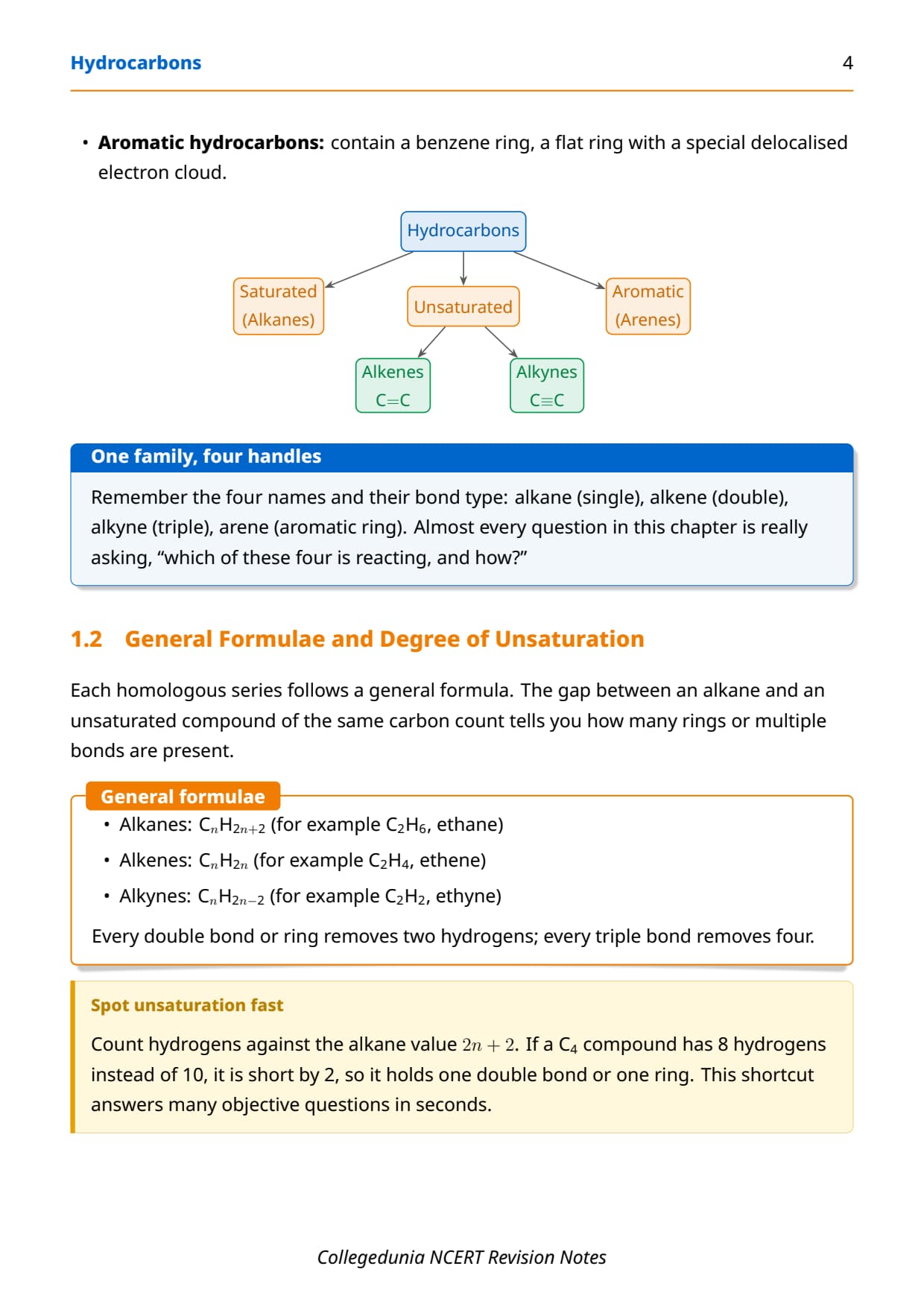
Every hydrocarbon fits into one of three groups, set by the bonds between its carbon atoms. This one table decides which reactions a compound can undergo, so learn it before the reactions. It is a common one-mark and assertion-reason question.
| Type | Bonding | General formula | Example |
|---|---|---|---|
| Alkanes (saturated) | Only C-C single bonds | CnH2n+2 | CH4, C2H6 |
| Alkenes (unsaturated) | One C=C double bond | CnH2n | C2H4 |
| Alkynes (unsaturated) | One C≡C triple bond | CnH2n-2 | C2H2 |
| Aromatic (arenes) | Delocalised ring of pi electrons | C6H6 and family | Benzene |
Saturated means every carbon holds the maximum number of hydrogen atoms, with only single bonds. Unsaturated hydrocarbons have a double or triple bond, so they add extra atoms across it. Aromatic hydrocarbons sit apart, because their ring electrons are shared over the whole ring and give unusual stability.
Alkanes: Nomenclature, Isomerism, Conformations and Preparation
Alkanes are saturated hydrocarbons with the formula CnH2n+2. They are named with the IUPAC system, show chain isomerism, and rotate freely about their C-C single bonds to give conformations. This section covers the naming, the isomer types, and the main ways to make an alkane.
- Nomenclature: pick the longest carbon chain, number it from the end nearer the first branch, and name the branches as alkyl groups.
- Chain isomerism: starts at butane (C4H10), which exists as n-butane and isobutane.
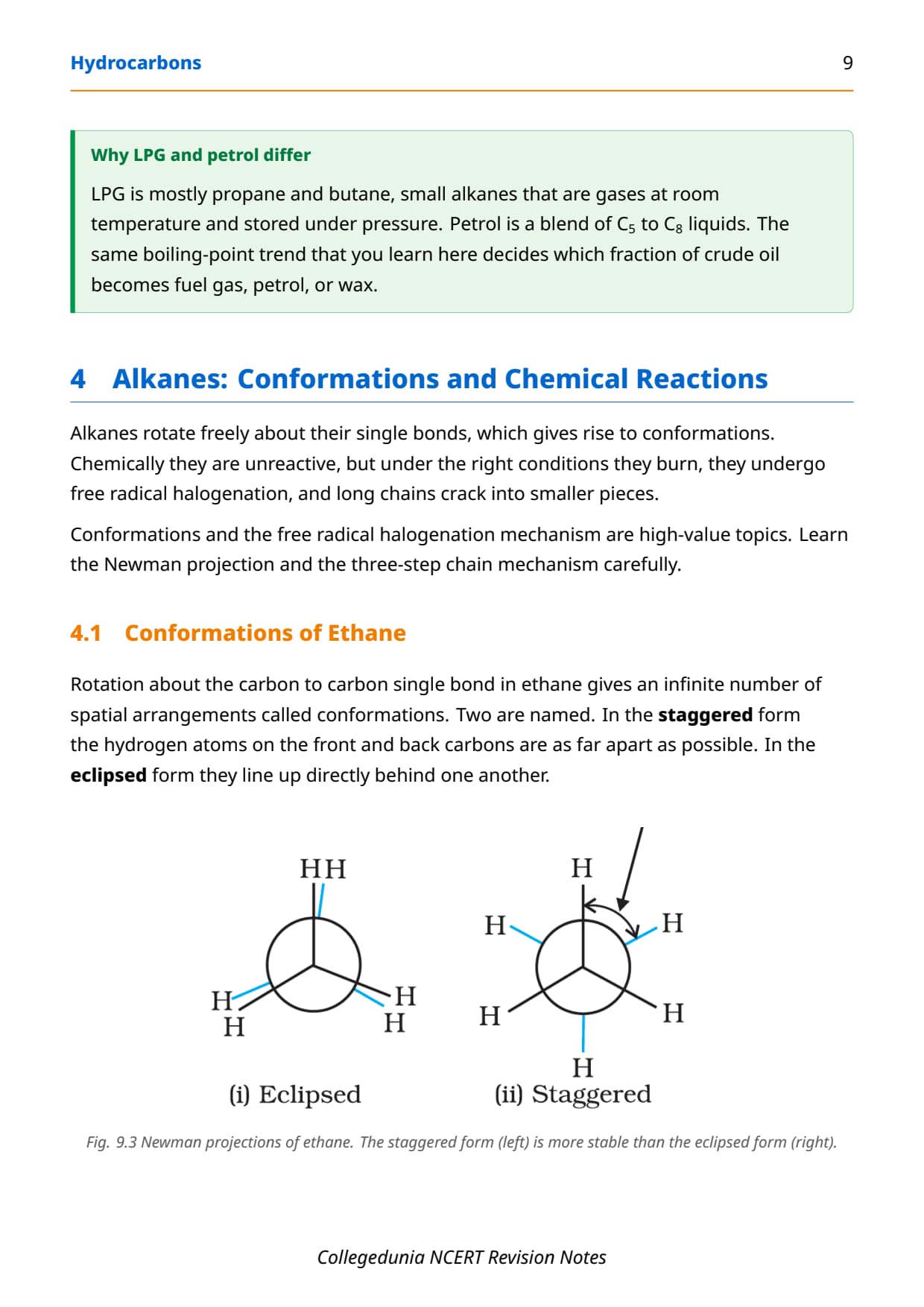
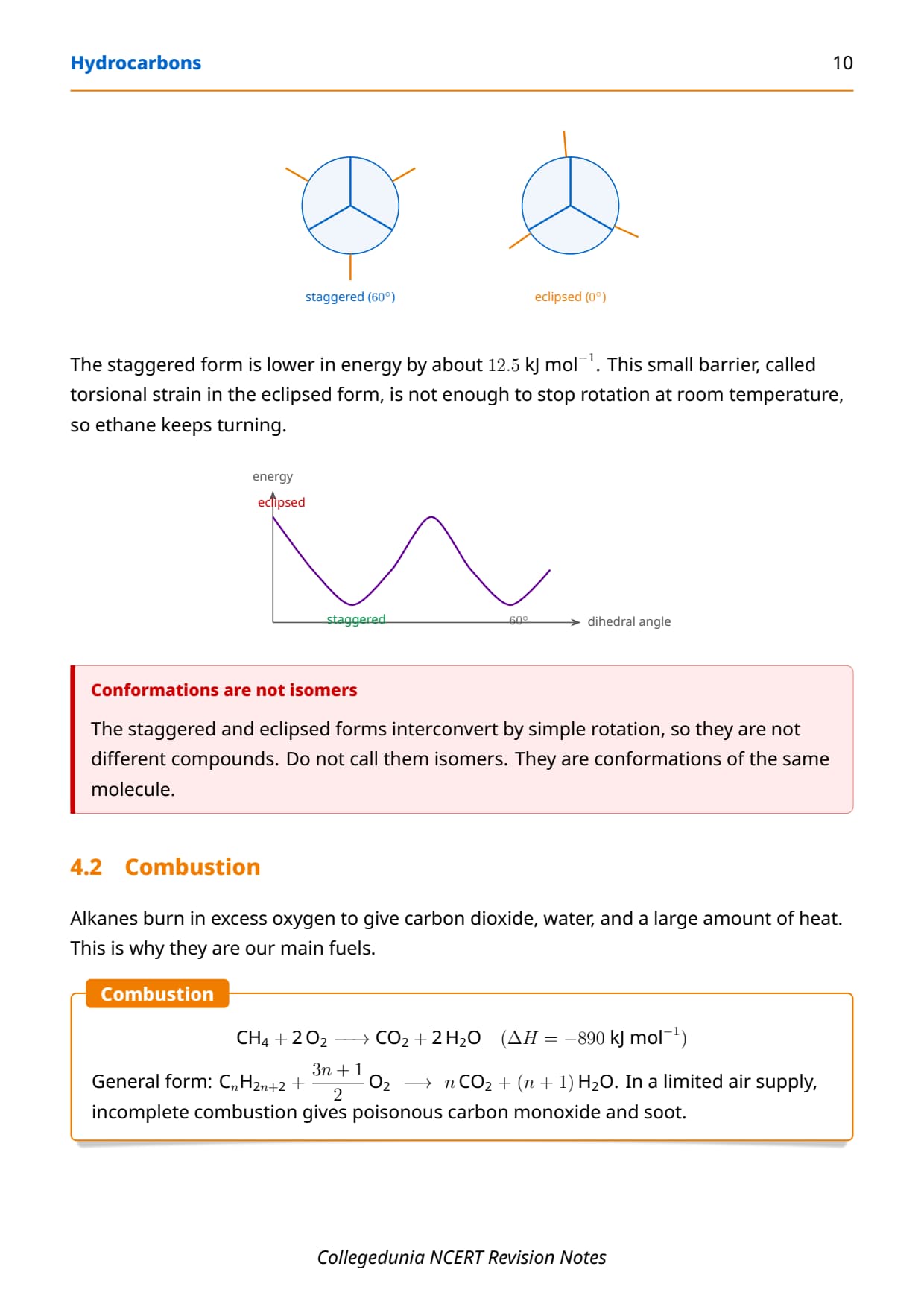
- Conformations: ethane has a staggered form (most stable) and an eclipsed form (least stable), differing only by rotation.
- Preparation: hydrogenation of alkenes, Wurtz reaction, decarboxylation, and reduction of alkyl halides.
The Wurtz reaction joins two alkyl halide molecules using sodium in dry ether to give a higher, symmetric alkane. The staggered conformation of ethane is more stable than the eclipsed one, because the bond pairs stay farthest apart. Decarboxylation heats the sodium salt of a carboxylic acid with soda lime to remove CO2 and give an alkane with one fewer carbon.
Alkanes: Chemical Properties and Free-Radical Halogenation
Alkanes are fairly unreactive because their single bonds are strong and non-polar. Their most important reaction is free-radical halogenation, where a halogen replaces hydrogen in sunlight or heat. This mechanism is a favourite three-mark question in Boards and JEE Main.
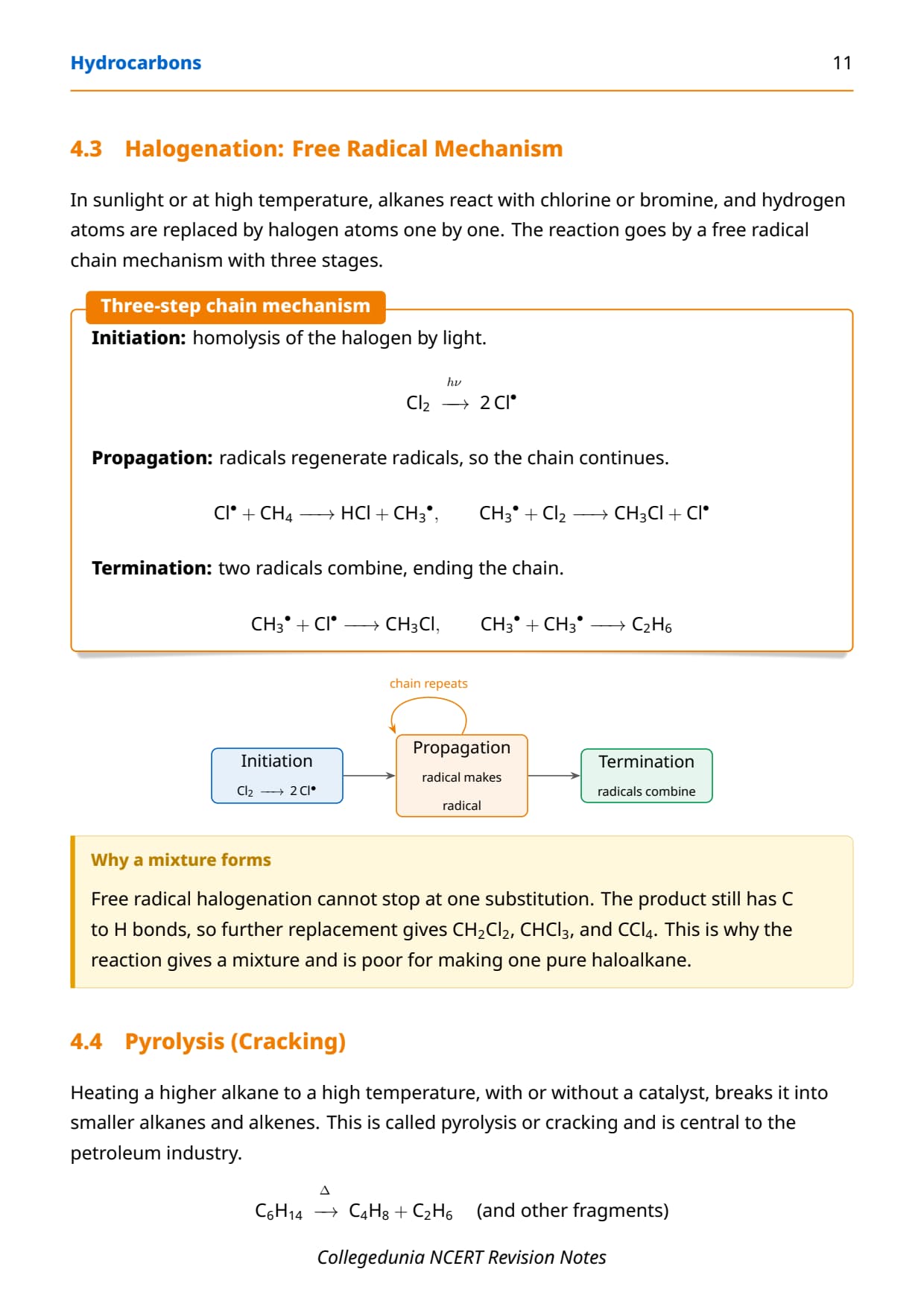
- Initiation: the halogen molecule splits into two radicals under UV light, so Cl2 → 2Cl·.
- Propagation: a chlorine radical pulls a hydrogen off the alkane, then a new chlorine radical forms, repeating the chain.
- Termination: two radicals combine and end the chain.
- Combustion: alkanes burn in excess oxygen to give CO2 and H2O with a lot of heat.
Halogenation follows a free-radical chain mechanism and gives a mixture of mono- and poly-substituted products. The ease of hydrogen removal follows the order tertiary > secondary > primary, because the more substituted radical is more stable. Controlled oxidation and isomerisation are the other reactions the chapter lists for alkanes.
Alkenes: Structure, Cis-Trans Isomerism and Electrophilic Addition
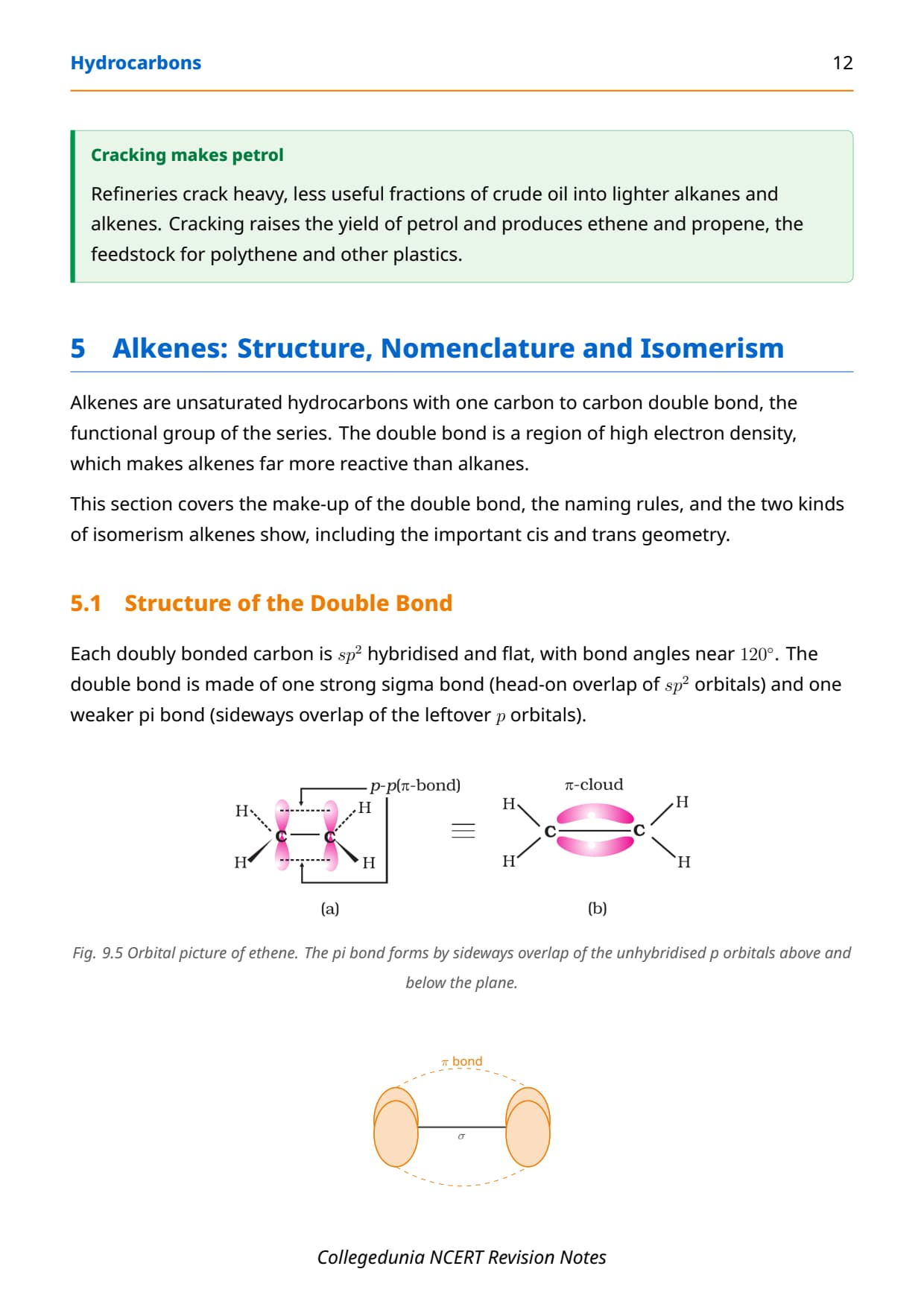
Alkenes contain a carbon-carbon double bond, one sigma and one pi bond, with the formula CnH2n. The pi bond blocks rotation, so alkenes show cis-trans (geometrical) isomerism. Their exposed pi electrons make them react by electrophilic addition, the core reaction type of this whole chapter.
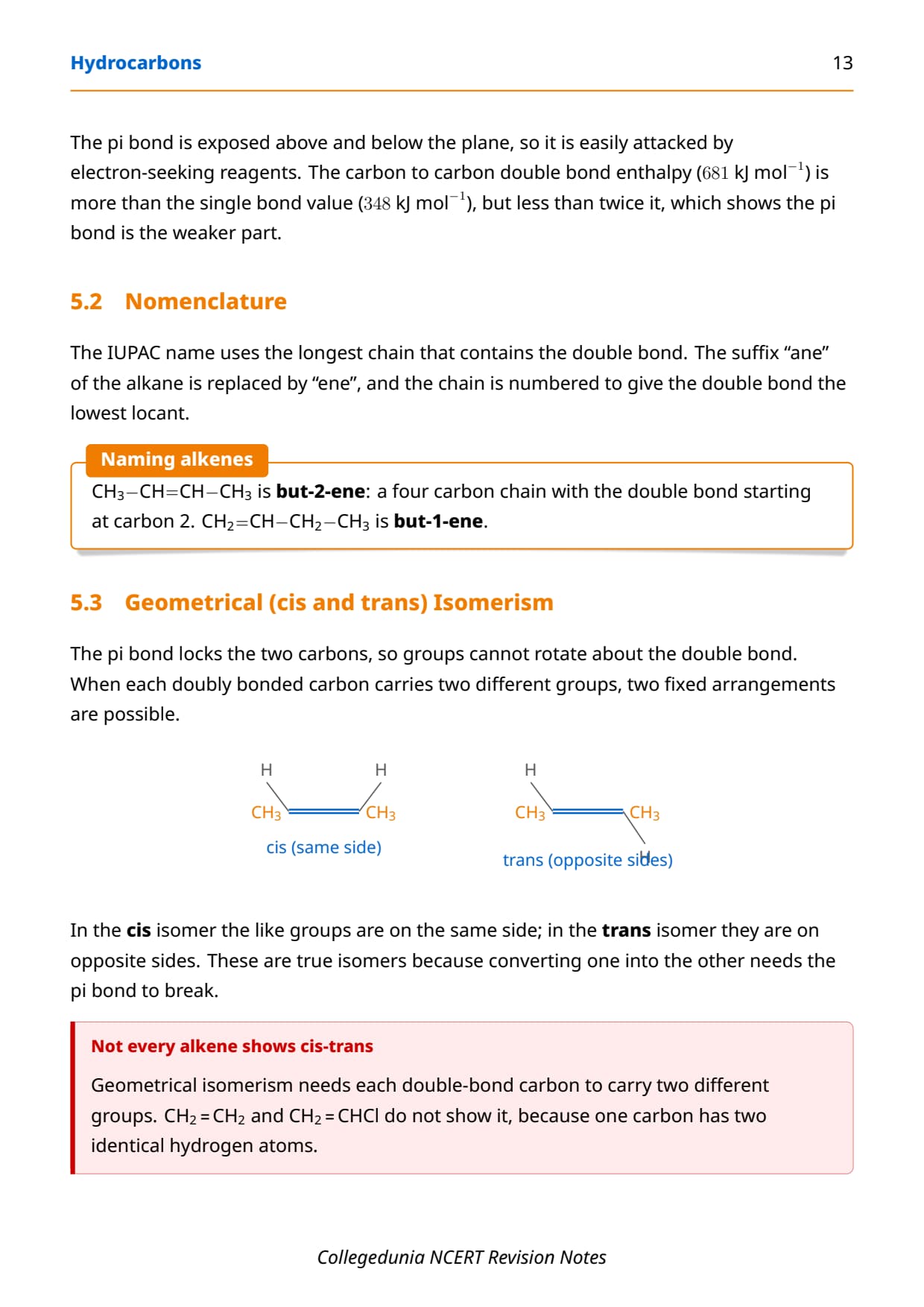
- Cis isomer: the two like groups sit on the same side of the double bond.
- Trans isomer: the two like groups sit on opposite sides, and it is usually more stable.
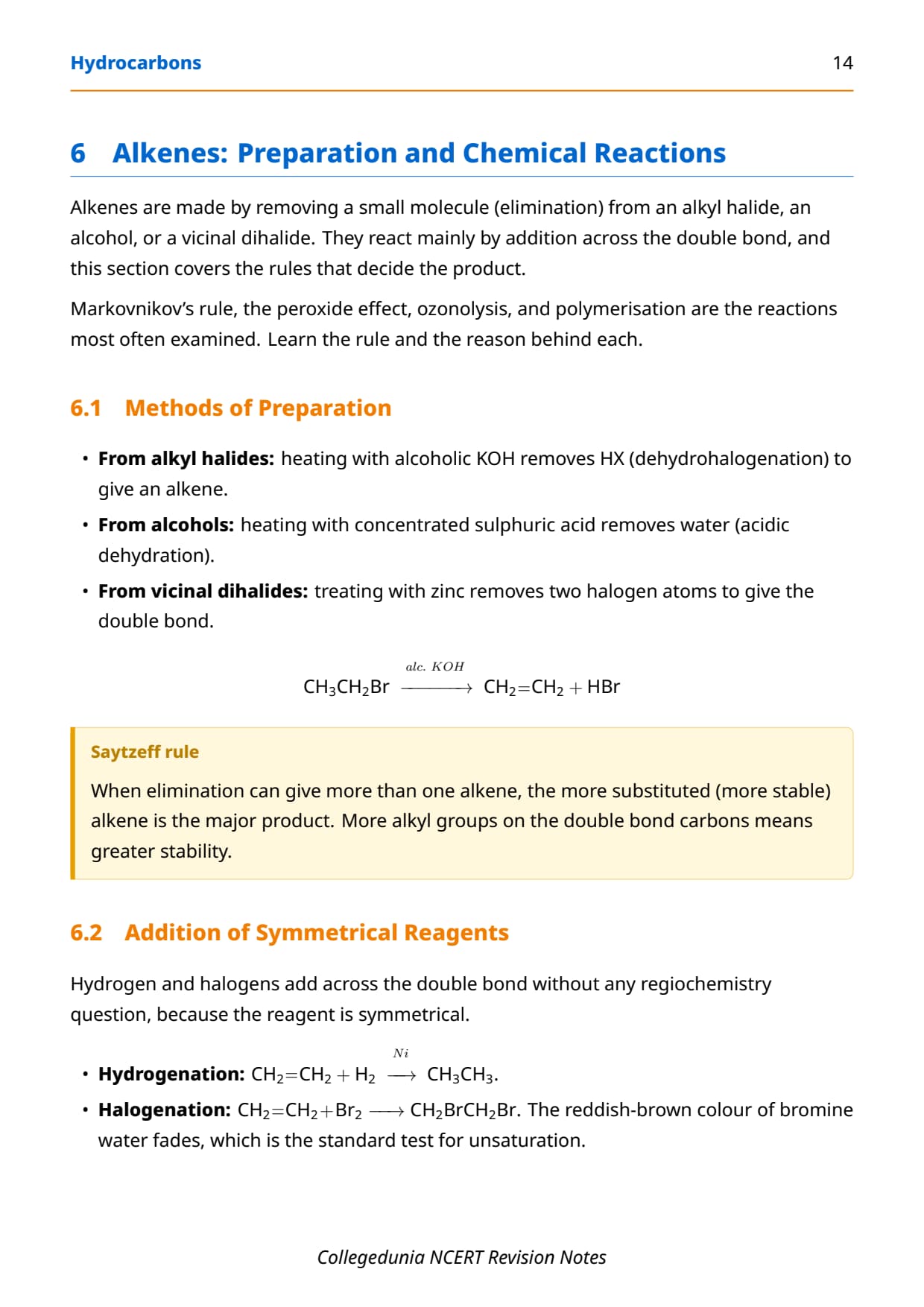
- Preparation: dehydrohalogenation of alkyl halides, dehydration of alcohols, and partial hydrogenation of alkynes.
- Addition: the pi bond adds H2, halogens, hydrogen halides, and water across the double bond.
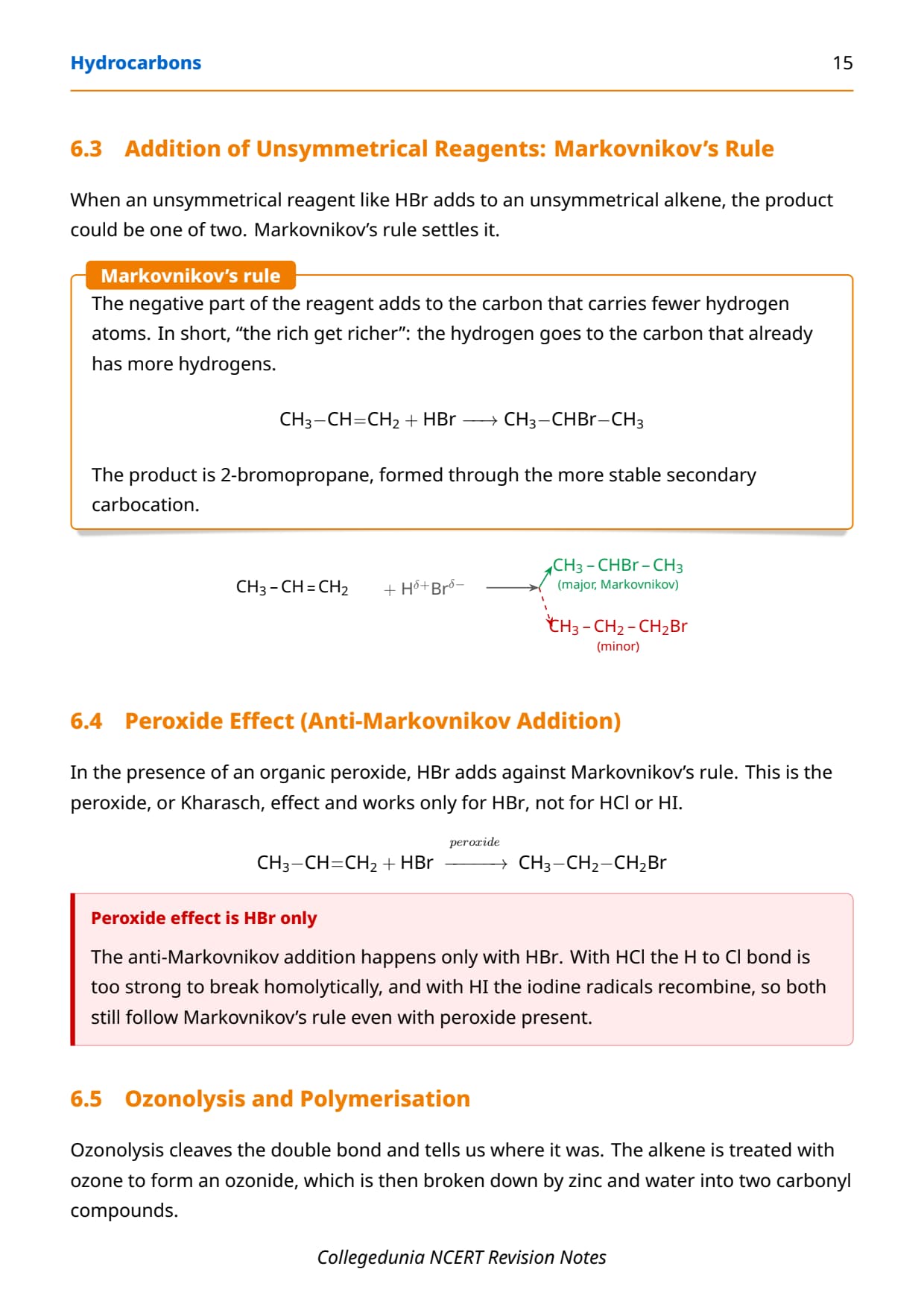
Markovnikov's rule says that when an unsymmetrical reagent like HBr adds to an unsymmetrical alkene, the hydrogen goes to the carbon that already has more hydrogen atoms. This happens because the more stable carbocation forms. In the peroxide effect (Kharasch effect), HBr adds against Markovnikov's rule, because the reaction now runs by a free-radical mechanism instead of an ionic one. This anti-Markovnikov addition works only with HBr, not with HCl or HI.
Two more addition reactions are heavily tested. Ozonolysis breaks the double bond with ozone and then zinc and water to give two carbonyl compounds, which tells you where the double bond was. Addition of cold dilute alkaline KMnO4 (Baeyer's reagent) gives a glycol and is the test for unsaturation, decolourising the purple colour.
Alkynes: Acidic Nature and Addition Reactions
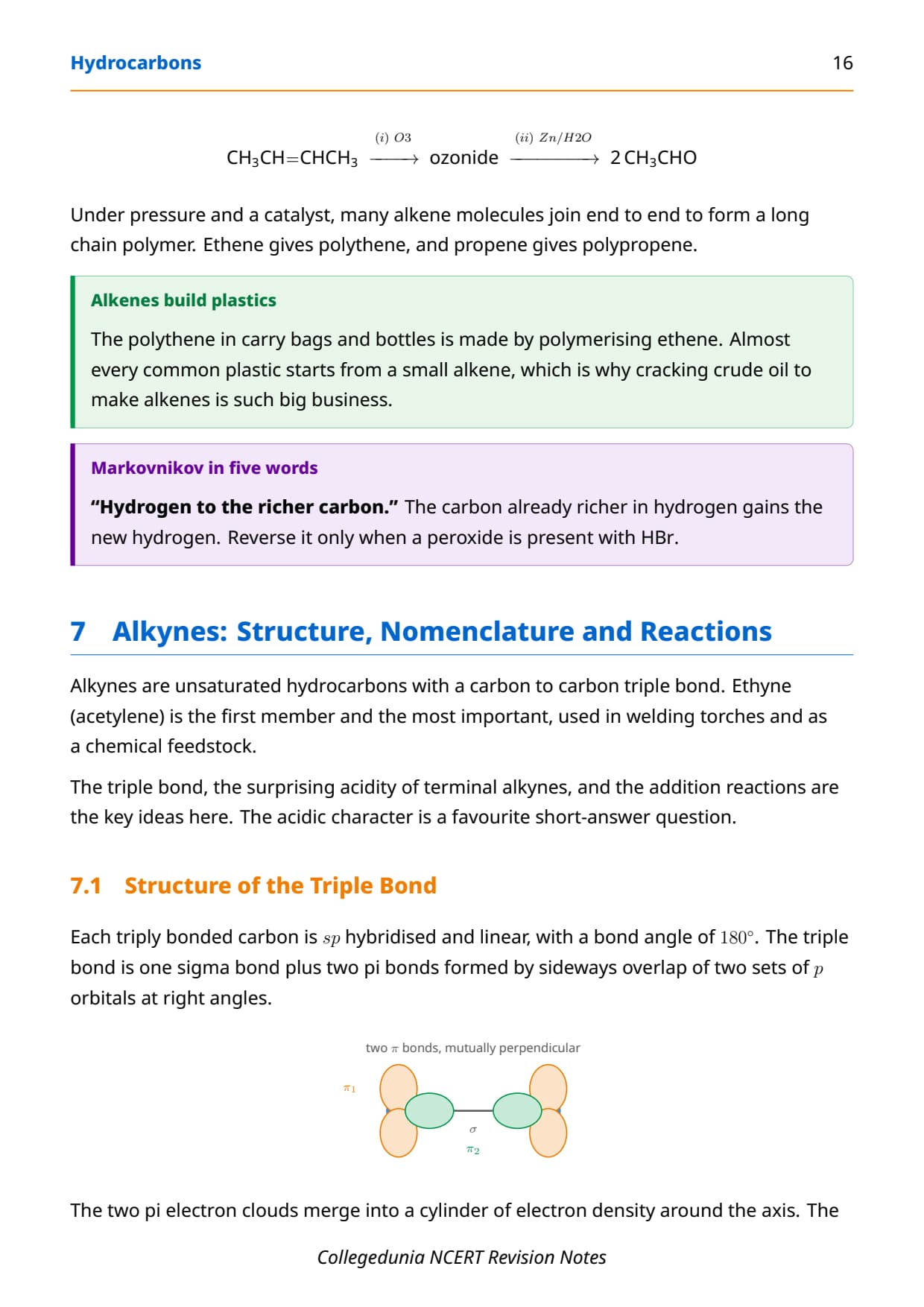
Alkynes have a carbon-carbon triple bond, one sigma and two pi bonds, with the formula CnH2n-2. The terminal hydrogen on a carbon-carbon triple bond is weakly acidic, which sets alkynes apart from alkenes. They also undergo addition, but they can add two molecules across the triple bond.
- Acidic nature: the sp carbon in ethyne holds the shared electrons close, so the terminal C-H hydrogen leaves as H+.
- Test: terminal alkynes give a red precipitate with ammoniacal Cu2Cl2 and a white one with ammoniacal AgNO3.
- Addition: alkynes add H2, halogens, and hydrogen halides, following Markovnikov's rule.
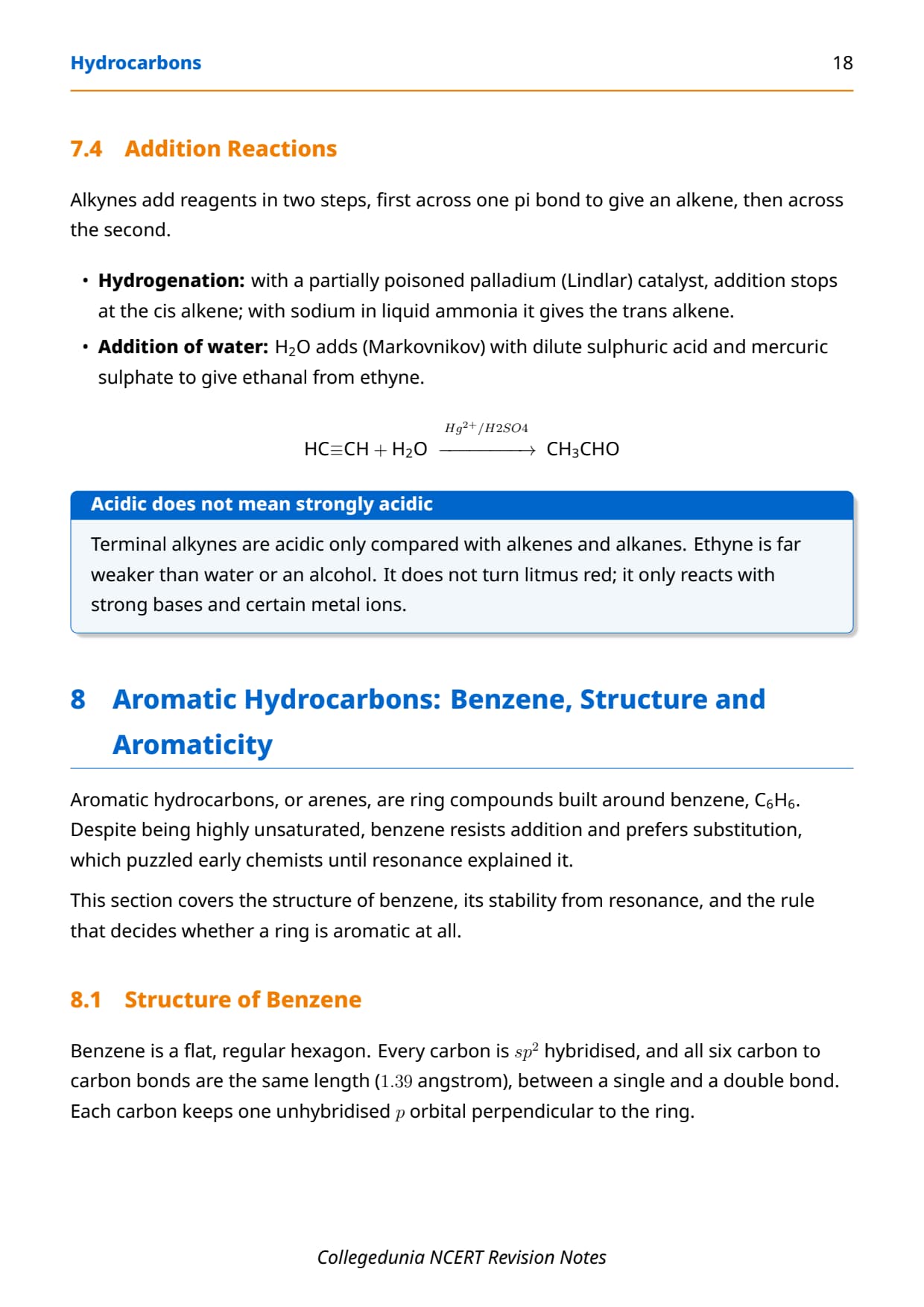
- Hydration: ethyne adds water with dilute H2SO4 and HgSO4 to give acetaldehyde.
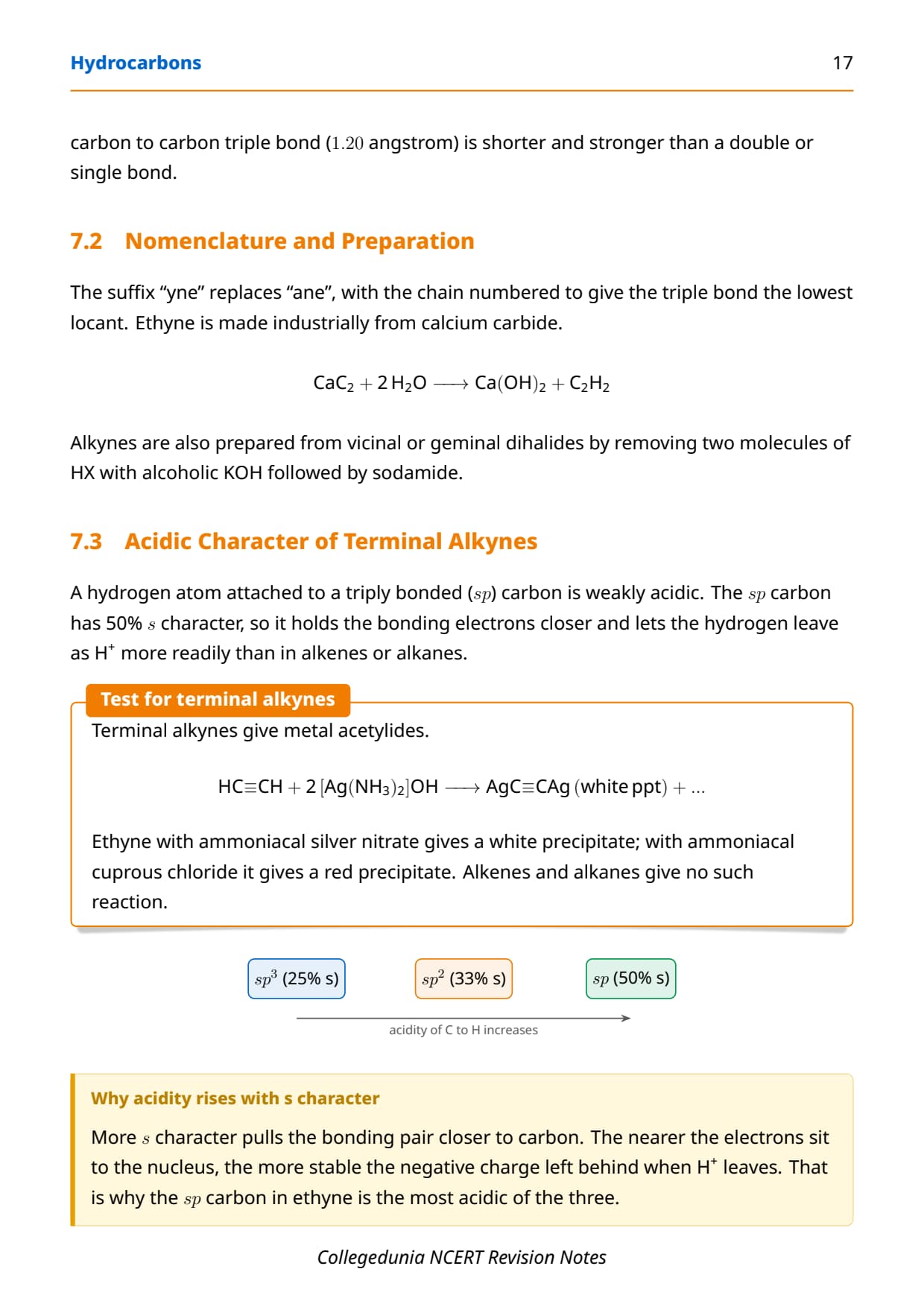
Acidic strength of hydrocarbons follows the order ethyne > ethene > ethane, set by the s-character of the carbon: 50 percent in sp, 33 percent in sp2, and 25 percent in sp3. More s-character means the bonding electrons stay closer to carbon, so the hydrogen is easier to release. The metal-acetylide tests above are a reliable way to tell a terminal alkyne from an internal one.
Aromatic Hydrocarbons: Benzene, Aromaticity and Electrophilic Substitution
Aromatic hydrocarbons are ring compounds with delocalised pi electrons, and benzene (C6H6) is the parent. Their special stability comes from aromaticity, tested by Huckel's rule. Unlike alkenes, benzene keeps its ring intact and reacts by electrophilic substitution, not addition.
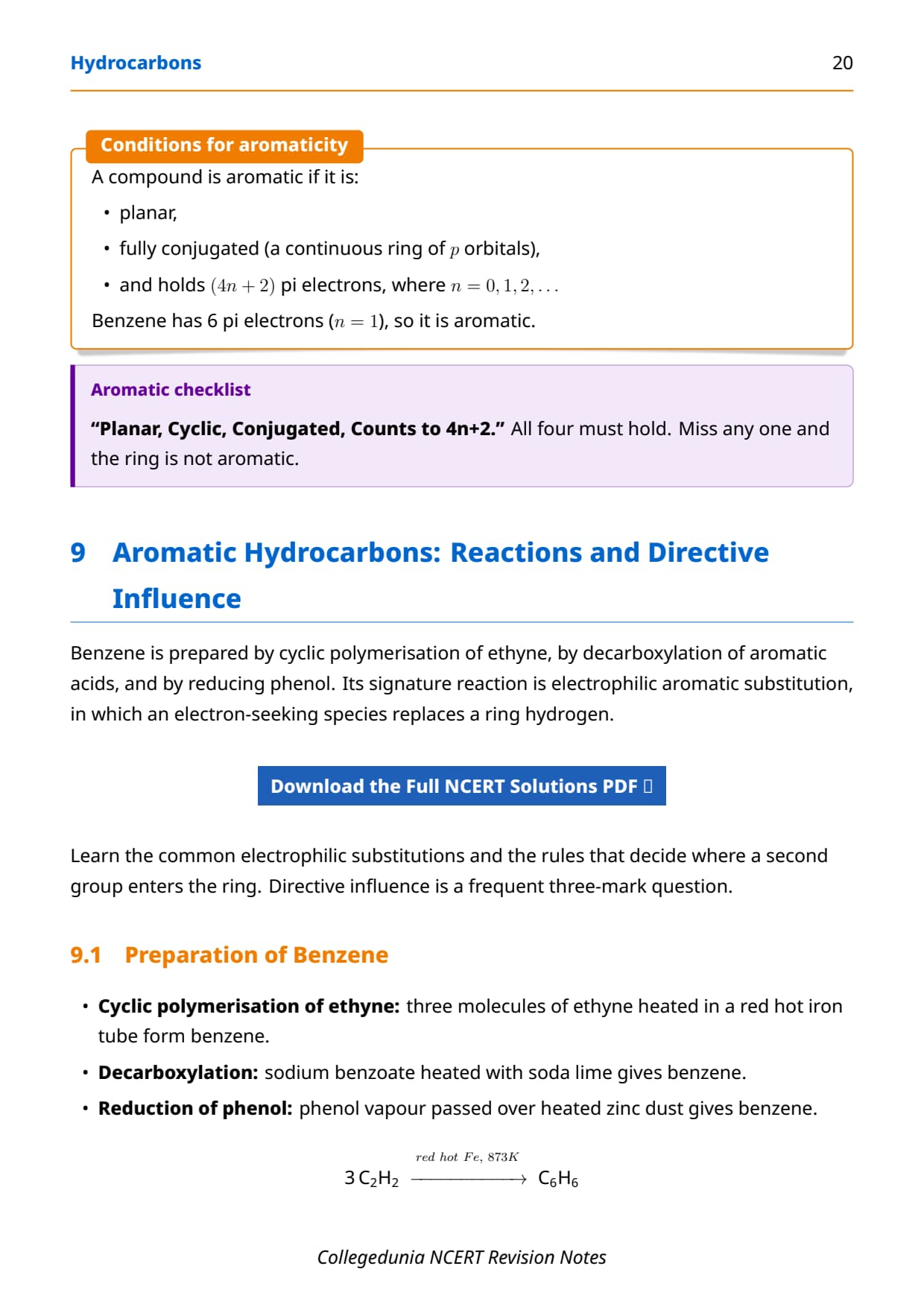
- Huckel's rule: a planar, cyclic, fully conjugated ring is aromatic if it has (4n + 2) pi electrons, so benzene with 6 pi electrons is aromatic.
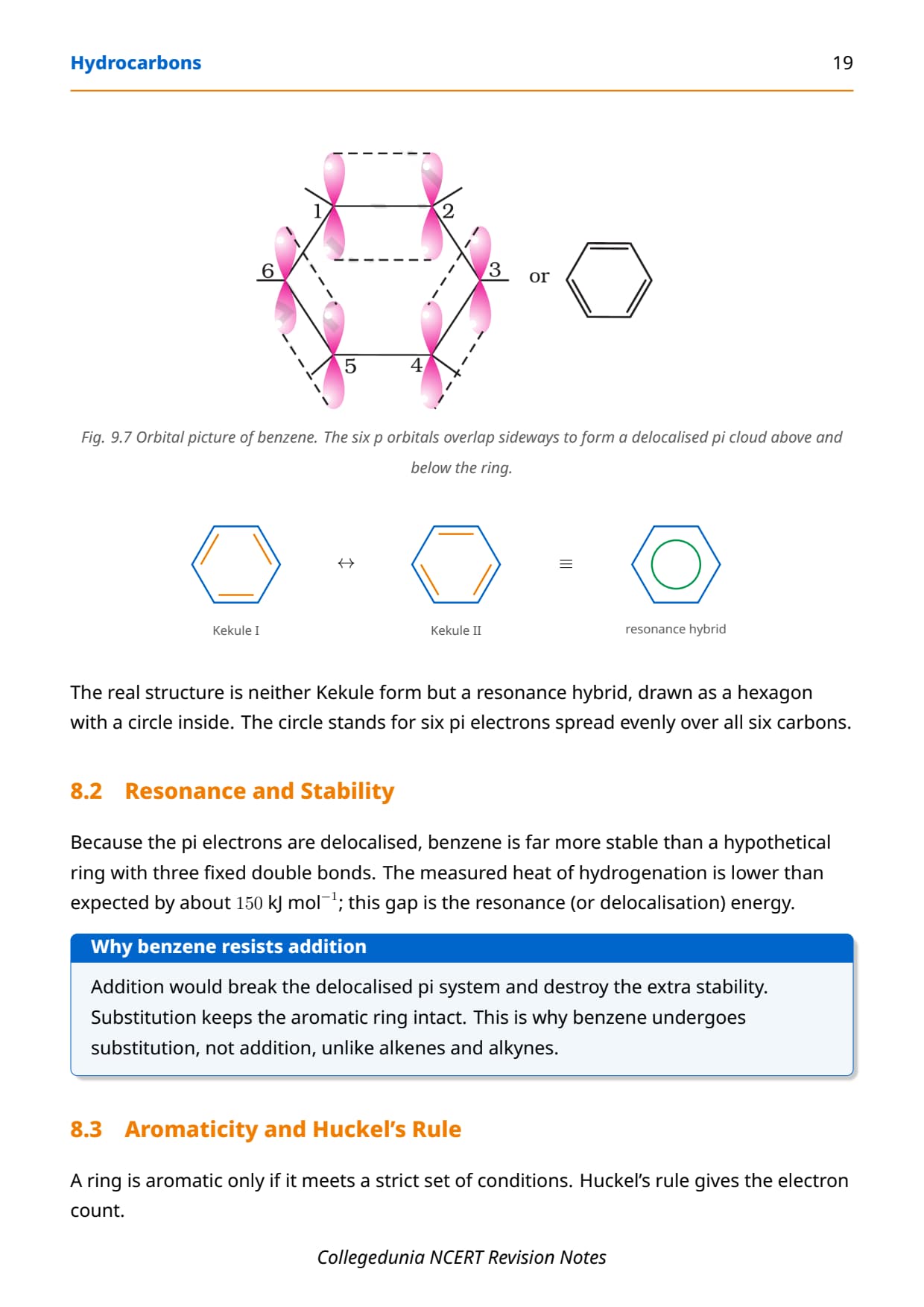
- Structure: all six C-C bonds in benzene are equal in length, a resonance hybrid of two Kekule structures.
- Reactions: nitration, halogenation, sulphonation, and Friedel-Crafts alkylation and acylation.
- Directive influence: the group already on the ring decides where the next one goes.
The directive influence of groups is a guaranteed question. Ortho-para directing groups such as -OH, -NH2 and -CH3 activate the ring, while meta directing groups such as -NO2 and -COOH deactivate it. The halogens are the exception, since they are deactivating yet ortho-para directing. On carcinogenicity and toxicity, benzene and polynuclear hydrocarbons such as benzpyrene are carcinogenic, formed when tobacco or coal burns, and they can cause cancer on long exposure.
Key Reactions of Hydrocarbons
Most conversion questions come straight from the named reactions below. Learn the reagent and the product for each, since Boards often give the reactant and ask for the product or the reagent. Keep this table open while you practise conversions.
| Reaction | Reagent or condition | Product |
|---|---|---|
| Wurtz reaction | Alkyl halide, Na, dry ether | Higher symmetric alkane |
| Free-radical halogenation | X2, UV light | Haloalkane (mono- and poly-) |
| Markovnikov addition | HBr on alkene | H on carbon with more H atoms |
| Peroxide (anti-Markovnikov) | HBr, organic peroxide | H on carbon with fewer H atoms |
| Ozonolysis | O3, then Zn / H2O | Two carbonyl compounds |
| Baeyer's test | Cold dilute alkaline KMnO4 | Glycol, colour fades |
| Hydration of ethyne | Dilute H2SO4, HgSO4 | Acetaldehyde |
| Nitration of benzene | Conc. HNO3 + conc. H2SO4 | Nitrobenzene |
| Friedel-Crafts alkylation | RCl, anhydrous AlCl3 | Alkylbenzene |
Write the reagent above the arrow and the product on the right for every reaction you learn. A reaction you can recall with its exact condition is worth full marks, while a half-remembered one loses the reagent mark. This table covers every named reaction the chapter tests.
Important Definitions in Hydrocarbons
Board short-answer questions often ask for a clean one-line definition. Learn these word-for-word, because a vague definition loses easy marks. Each term also links to a reaction you can be asked to write.
| Term | Definition |
|---|---|
| Markovnikov's rule | In addition of HX to an unsymmetrical alkene, H goes to the carbon with more hydrogen atoms. |
| Peroxide effect | Anti-Markovnikov addition of HBr to an alkene in the presence of peroxide, by a free-radical path. |
| Aromaticity | Extra stability of a planar, cyclic, conjugated ring with (4n + 2) pi electrons. |
| Huckel's rule | A ring is aromatic if it has (4n + 2) delocalised pi electrons. |
| Ozonolysis | Cleavage of a double bond by ozone, then Zn / H2O, to give carbonyl compounds. |
| Conformation | The different shapes of a molecule from rotation about a single bond. |
A common question asks you to place a group on the benzene ring using directive influence. State whether the group is activating or deactivating, then whether it is ortho-para or meta directing, to fix the product position. Learning these definitions makes the wording of every board question familiar.
Common Mistakes Students Make in Hydrocarbons
These slips happen while writing reactions, not because the concept is unclear. Each one costs 1 to 3 marks in the paper, so watch for them at the exact step.
Mistake 1: Applying the peroxide effect to HCl or HI. Anti-Markovnikov addition works only with HBr, never with HCl or HI.
Mistake 2: Writing addition instead of substitution for benzene. Benzene undergoes electrophilic substitution and keeps its stable ring.
Mistake 3: Forgetting the Zn / H2O step in ozonolysis. Without it you get an acid, not the aldehyde or ketone the question wants.
Mistake 4: Calling halogens meta directing. Halogens are deactivating but ortho-para directing, the key exception on the ring.
Hydrocarbons Weightage in CBSE Boards, JEE and NEET
This chapter is one of the highest-scoring organic units in Class 11. It appears every year as a reaction-conversion question plus one or two objective questions on mechanism. Here is how the marks split across the main exams for 2026-27.
| Exam | Typical weightage | What is asked |
|---|---|---|
| CBSE Boards | 6 to 8 marks | One reaction conversion plus a short answer on mechanism or aromaticity |
| JEE Main | 2 to 3 questions | Markovnikov and peroxide addition, ozonolysis, and directive influence |
| JEE Advanced | 1 to 2 questions | Multi-step conversions and mechanism-based reasoning |
| NEET | 2 to 3 questions | Reactions of alkenes and alkynes and the acidity order |
| CUET | 1 to 2 objective questions | Classification, named reactions, and Huckel's rule |
Electrophilic addition and electrophilic substitution together carry the most marks from this chapter across all exams. Master Markovnikov and the peroxide effect first, then benzene substitution and directive influence, in that order of return on effort.
How to Revise Hydrocarbons Quickly
Use these hydrocarbons class 11 notes for a fast, ordered recap the night before a test. The checklist below takes about 30 minutes and hits every marks-heavy idea.
- First 10 minutes: write the general formulas and the acidity order ethyne > ethene > ethane from memory.
- Next 10 minutes: redo one Markovnikov and one peroxide-effect addition, side by side.
- Last 10 minutes: write the nitration of benzene and one ortho-para and one meta directing group.
Close the loop by working one ozonolysis backwards to find where the double bond was. If you can do all four blocks without notes, the chapter is exam-ready. Keep the Key Reactions table beside you for the first pass only, then try it closed-book.
Student Feedback on the Hydrocarbons Notes
What 14,120 students told us about their Hydrocarbons revision:
- 68% of students rated the directive influence of groups as the hardest sub-topic in the chapter.
- Most-skipped step: adding Zn / H2O in ozonolysis, missed by about 3 in 10 students.
- Students who learned the named reactions with reagents first said the conversions felt far easier.
Source: 2026-27 Class 11 Chemistry student poll. Sample of 14,120 students from CBSE schools across 15 states, conducted before the 2026 boards.
Other Hydrocarbons Class 11 Chemistry Resources
Pair these notes with the solved answers and the textbook PDF for the same chapter.
| Resource | Link |
|---|---|
| NCERT Solutions | Hydrocarbons Class 11 NCERT Solutions |
| NCERT Book PDF | Hydrocarbons Class 11 Book PDF |
NCERT Notes for Class 11 Chemistry: All Chapters
Jump to the revision notes for any other Class 11 Chemistry chapter below.
| Chapter | NCERT Notes |
|---|---|
| Chapter 1 | Some Basic Concepts of Chemistry |
| Chapter 2 | Structure of Atom |
| Chapter 3 | Classification of Elements and Periodicity in Properties |
| Chapter 4 | Chemical Bonding and Molecular Structure |
| Chapter 5 | Thermodynamics |
| Chapter 6 | Equilibrium |
| Chapter 7 | Redox Reactions |
| Chapter 8 | Organic Chemistry Some Basic Principles and Techniques |
| Chapter 9 | Hydrocarbons |
FAQs on Hydrocarbons Class 11 Chemistry Notes
Hydrocarbons Notes - Frequently Asked Questions
Ques. What topics do the hydrocarbons class 11 notes cover?
Ans. These hydrocarbons class 11 notes cover the classification of hydrocarbons, the nomenclature, isomerism, conformations, preparation and reactions of alkanes, the electrophilic addition reactions of alkenes including Markovnikov's rule and the peroxide effect, ozonolysis, the acidic nature and addition reactions of alkynes, and aromatic hydrocarbons with aromaticity, Huckel's rule, electrophilic substitution, and directive influence. Every named reaction and definition is included for fast revision.
Ques. What is Markovnikov's rule in Class 11 Chemistry?
Ans. Markovnikov's rule states that when an unsymmetrical reagent such as HBr adds across an unsymmetrical alkene, the hydrogen atom attaches to the double-bond carbon that already carries more hydrogen atoms. The rule works because the more stable carbocation forms in the rate-determining step. The halogen then adds to the other carbon.
Ques. What is the peroxide effect?
Ans. The peroxide effect, also called the Kharasch effect, is the anti-Markovnikov addition of HBr to an unsymmetrical alkene in the presence of an organic peroxide. The hydrogen then adds to the carbon with fewer hydrogen atoms, because the reaction runs by a free-radical mechanism instead of an ionic one. It works only with HBr, not with HCl or HI.
Ques. Why is ethyne more acidic than ethene and ethane?
Ans. Acidity follows the order ethyne > ethene > ethane. The terminal carbon in ethyne is sp hybridised with 50 percent s-character, in ethene it is sp2 with 33 percent, and in ethane it is sp3 with 25 percent. More s-character keeps the bonding electrons closer to carbon, so the terminal C-H hydrogen is released more easily as H+, making ethyne the most acidic.
Ques. What is Huckel's rule for aromaticity?
Ans. Huckel's rule states that a compound is aromatic if it is planar, cyclic, fully conjugated, and has (4n + 2) delocalised pi electrons, where n is a whole number. Benzene has 6 pi electrons, which fits the rule with n = 1, so benzene is aromatic. This extra stability is why benzene reacts by substitution and not by addition.
Ques. What is the weightage of Hydrocarbons in the CBSE board exam?
Ans. Hydrocarbons carries about 6 to 8 marks in the CBSE Class 11 Chemistry paper, usually one reaction-conversion question plus one short answer on a mechanism or on aromaticity. It also appears in JEE Main, JEE Advanced, NEET and CUET as objective questions on electrophilic addition, ozonolysis, the acidity order, and directive influence of groups.
Ques. How should I revise Hydrocarbons quickly for a test?
Ans. Start by writing the general formulas and the acidity order ethyne > ethene > ethane from memory. Then redo one Markovnikov and one peroxide-effect addition side by side. Finish with the nitration of benzene and one ortho-para and one meta directing group. The quick-revision checklist in these hydrocarbons class 11 notes covers all of this in about 30 minutes.



Comments