




These redox reactions class 11 notes pull together every oxidation-number rule, reaction type, balancing method, and electrode idea that the CBSE Boards, JEE Main, JEE Advanced, NEET and CUET papers test in 2026-27. Revise the whole chapter fast, from the electron-transfer definition to the electrochemical series, in one place.
Redox reactions are electron-transfer reactions, and the counting skill you build here carries straight into Class 12 Electrochemistry.
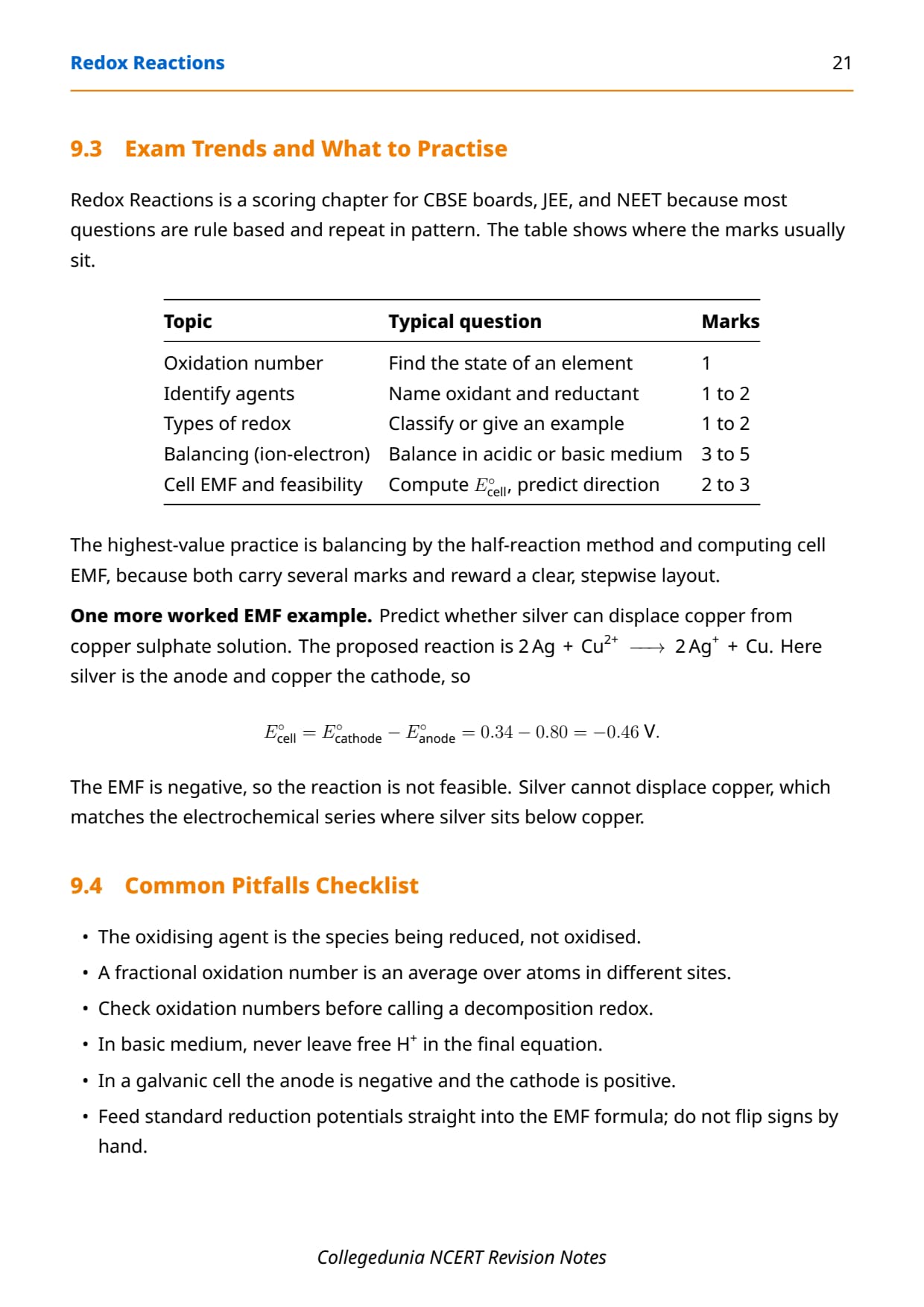
- CBSE Weightage: 6 to 8 marks, usually one balancing question plus one oxidation-number or agent question.
- Topics covered: classical and electronic concepts, oxidation number rules, four reaction types, two balancing methods, redox titrations, and electrode potential.
- Key skills: assigning oxidation numbers, balancing by the half-reaction method, and computing cell EMF to predict feasibility.
These redox reactions class 11 notes are curated by subject experts, based on the 2026-27 NCERT textbook, and checked against the last five years of CBSE Board, JEE Main and NEET papers.
Topic-by-Topic Summary of Redox Reactions
The chapter builds from a simple idea. One species loses electrons while another gains them, and the two changes always happen together. It starts with old oxygen-hydrogen definitions, moves to the electron picture, then to oxidation numbers, and ends with cells. Here is the quick map of each topic.
- Classical concept: oxidation as addition of oxygen or loss of hydrogen, and reduction as the reverse.
- Electronic concept: oxidation as loss of electrons and reduction as gain of electrons.
- Oxidation number: a signed count that tracks electron control in any molecule or ion.
- Types of redox: combination, decomposition, displacement, and disproportionation.
- Balancing: the oxidation-number method and the half-reaction (ion-electron) method.
- Electrode processes: redox titrations, electrode potential, and the electrochemical series.
Revise the topics in this order, because each one leans on the one before it. Master oxidation numbers first, and both balancing and cell problems turn into simple arithmetic. These redox reactions class 11 notes follow the same sequence as the NCERT textbook.
Classical and Electronic Concepts of Oxidation and Reduction
Before the electron was understood, chemists defined oxidation and reduction using oxygen and hydrogen. The classical concept still gives a fast first reading of many reactions. The electronic concept replaced it because it covers every case, even reactions with no oxygen or hydrogen present.
- Oxidation (classical): addition of oxygen or removal of hydrogen, as in 2Mg + O2 → 2MgO.
- Reduction (classical): removal of oxygen or addition of hydrogen, as in CuO + H2 → Cu + H2O.
- Oxidation (electronic): loss of electrons by a species.
- Reduction (electronic): gain of electrons by a species.
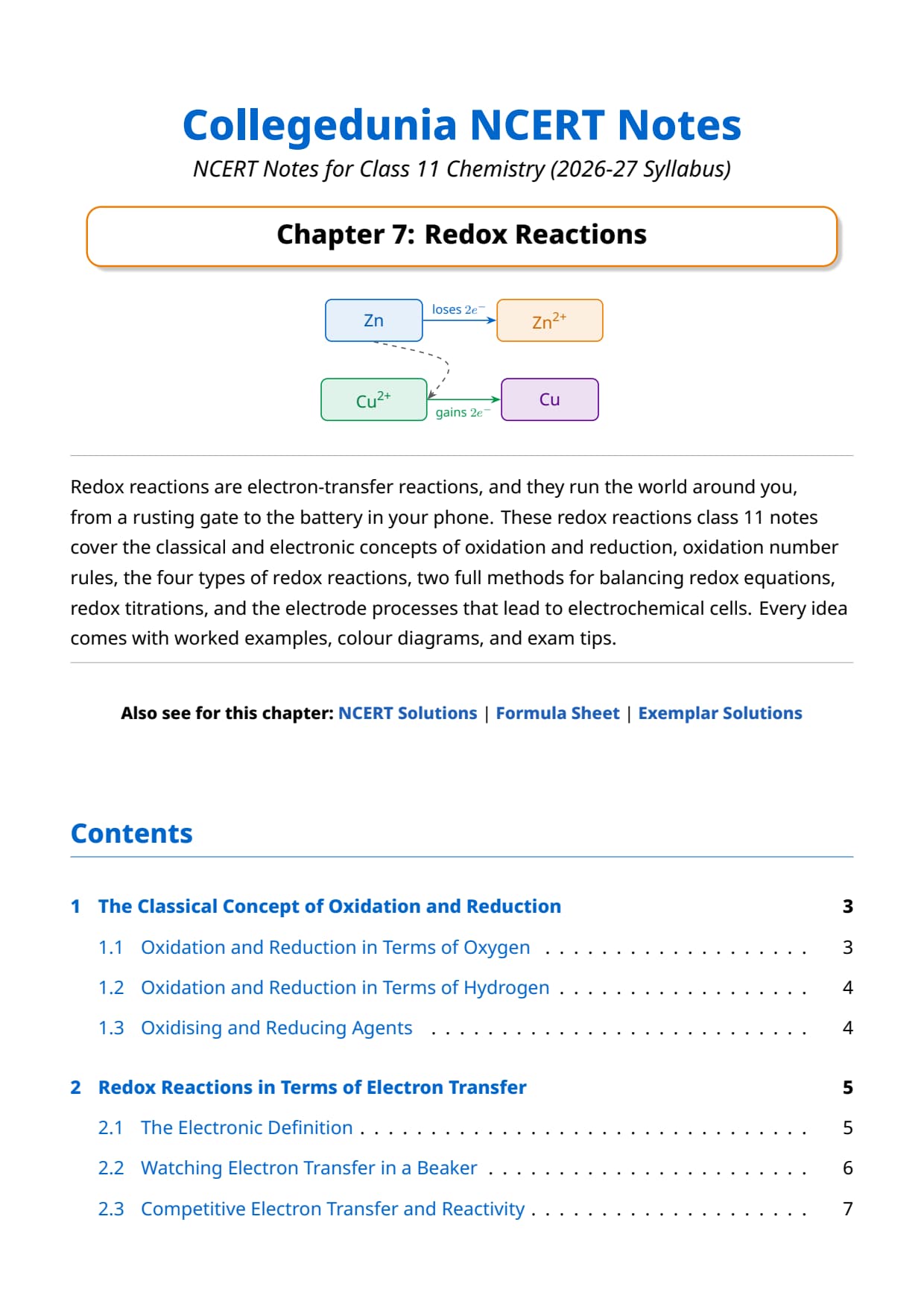
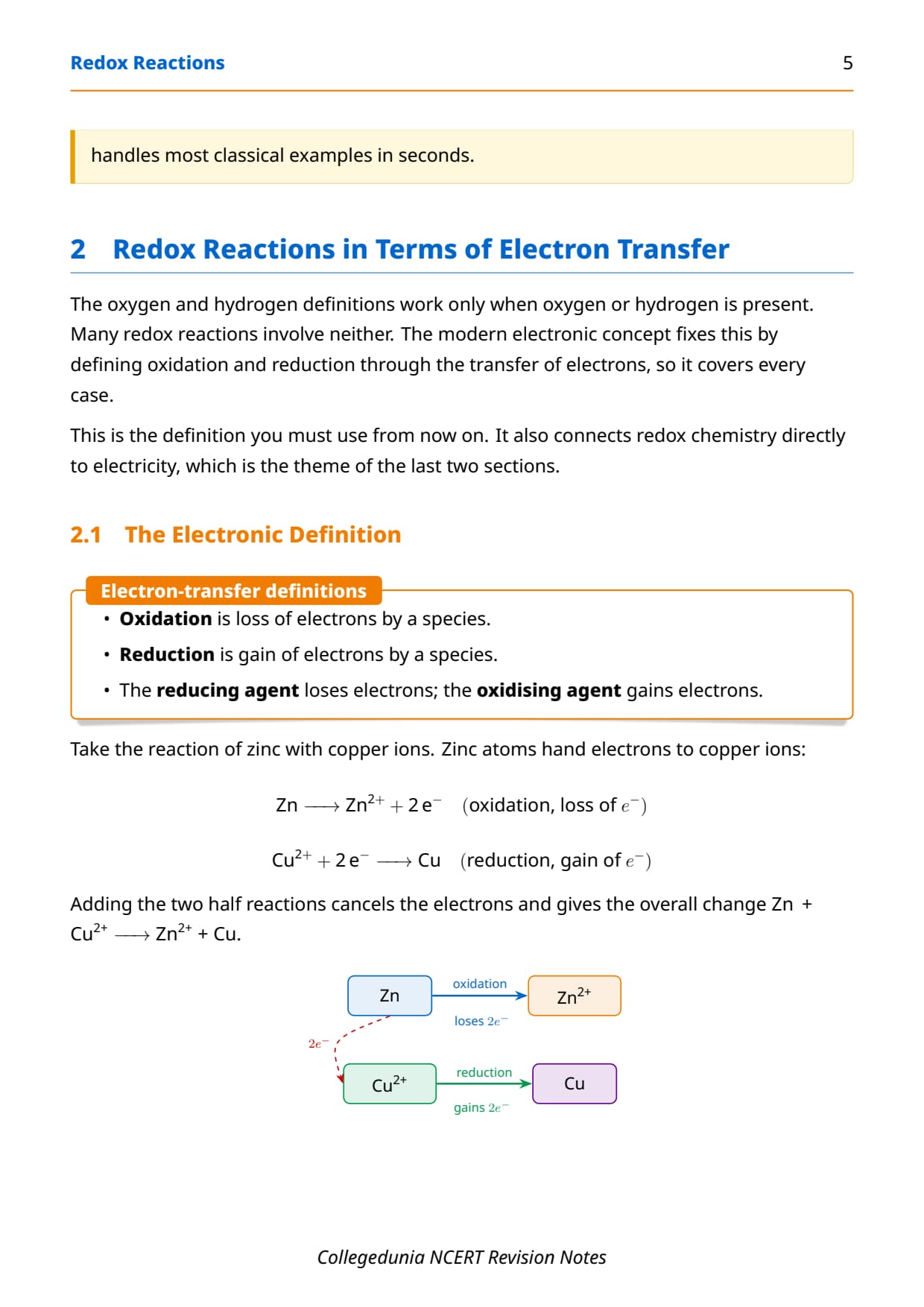
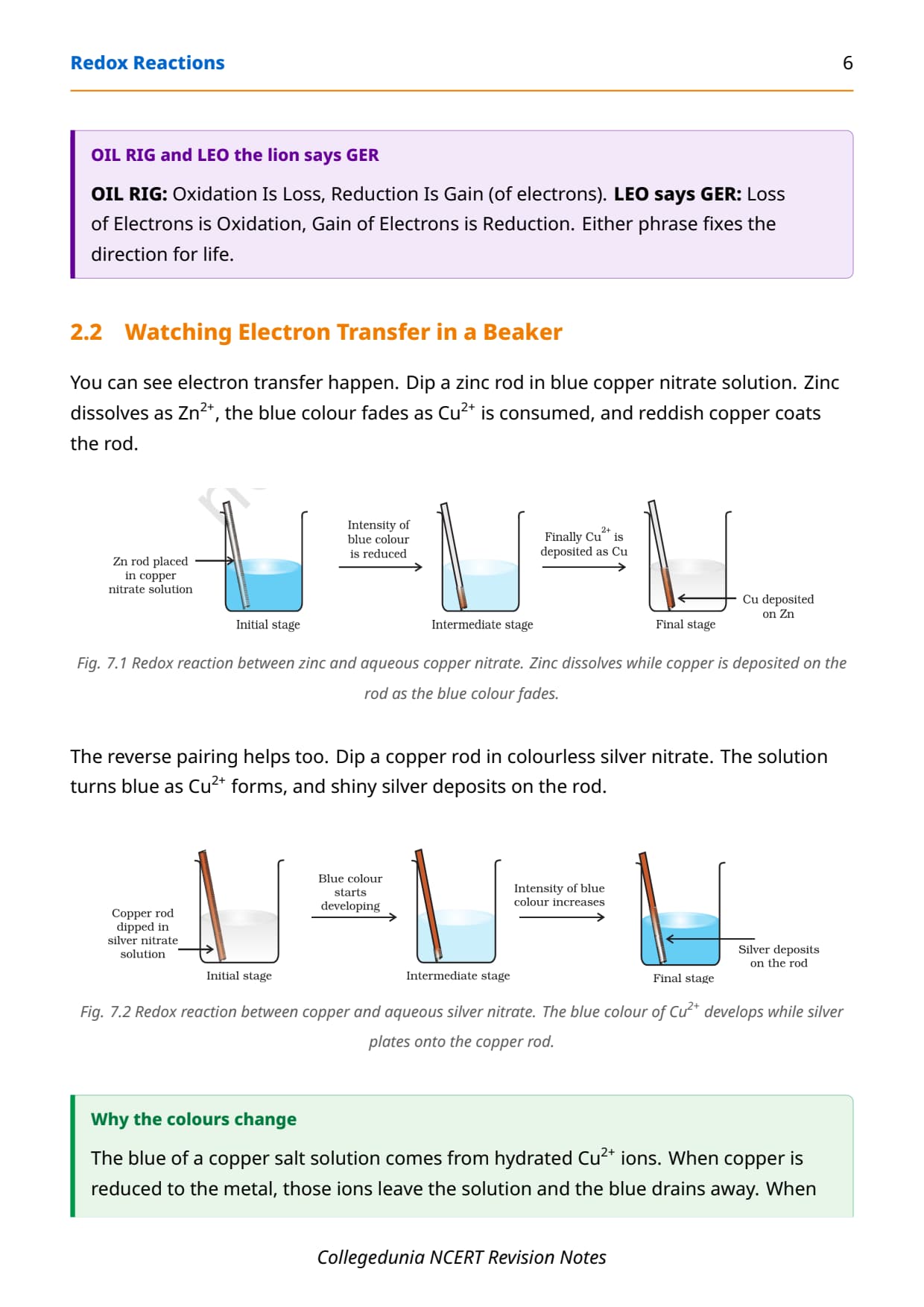
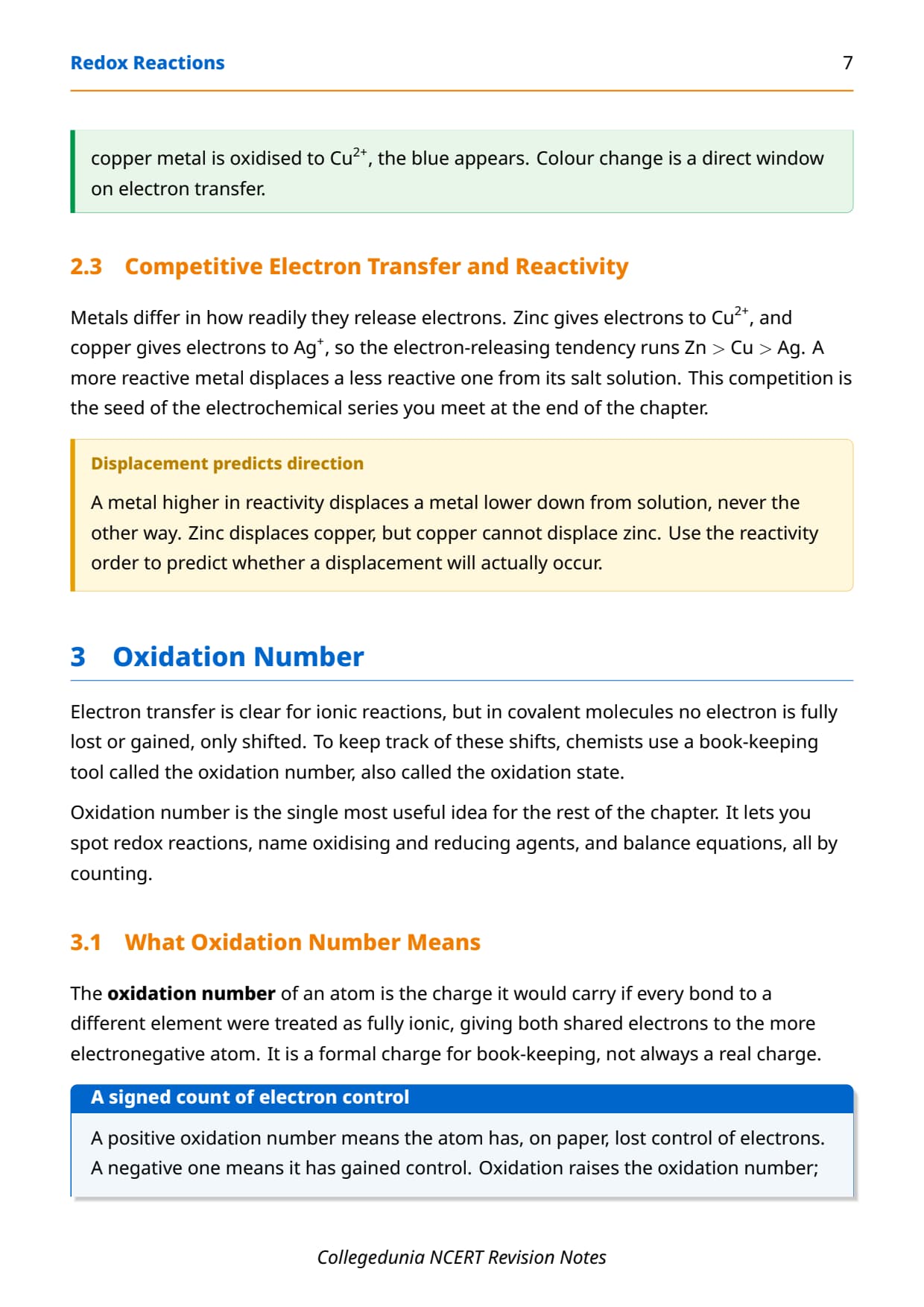
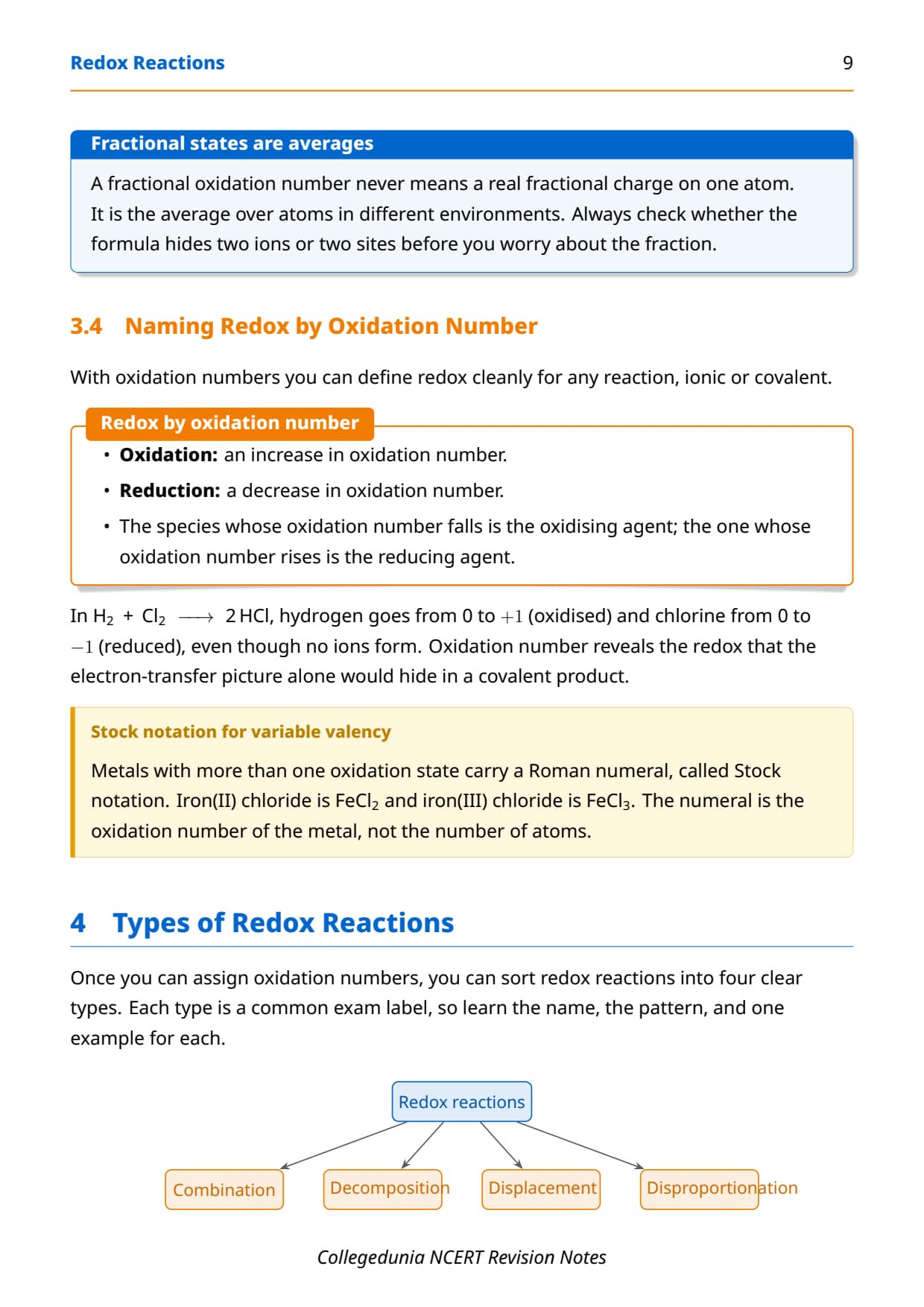
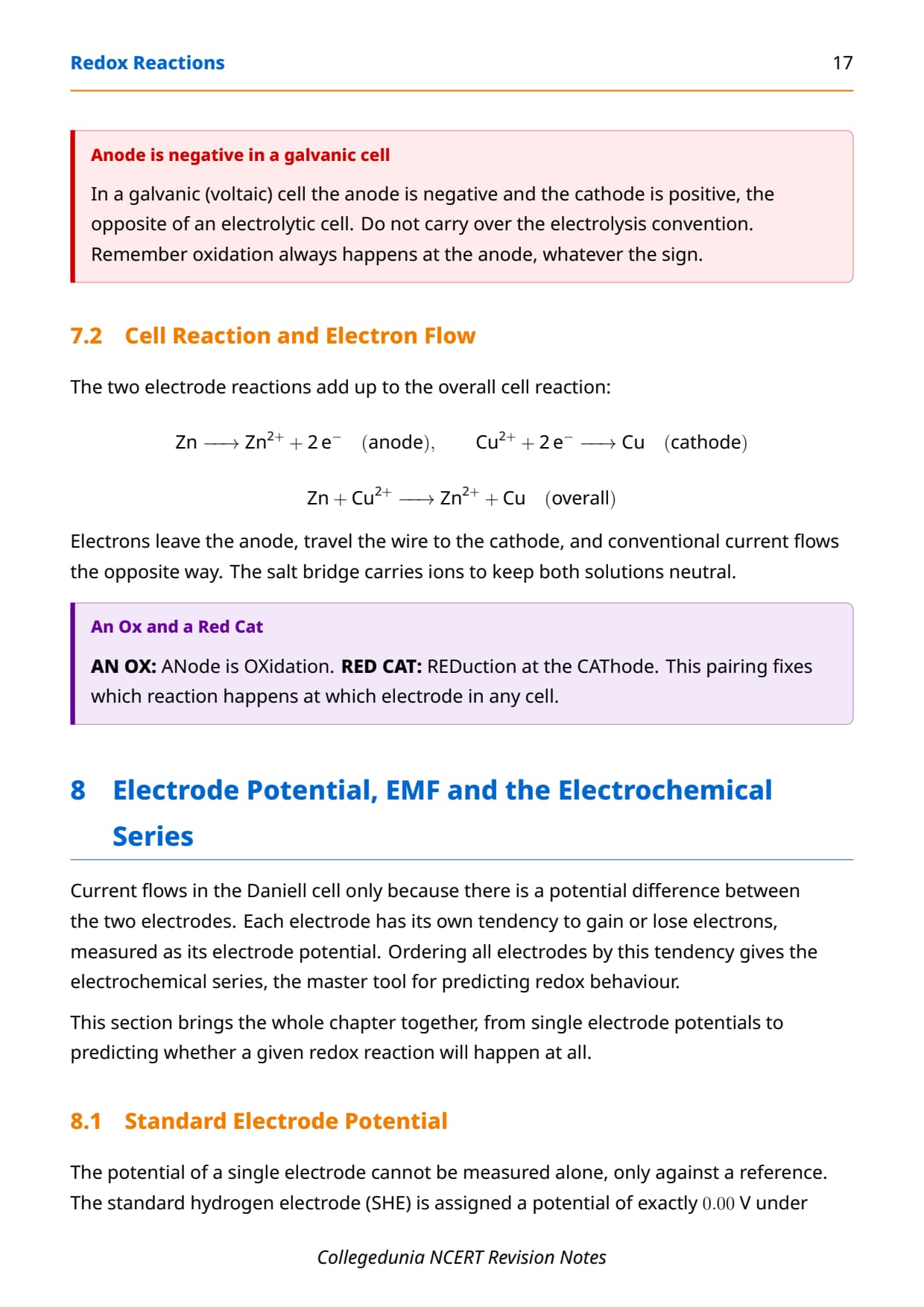
Take zinc reacting with copper ions. Zinc hands two electrons to each copper ion, so Zn → Zn2+ + 2e- is oxidation and Cu2+ + 2e- → Cu is reduction. The reducing agent loses electrons and is itself oxidised; the oxidising agent gains electrons and is itself reduced. Remember the direction with OIL RIG: Oxidation Is Loss, Reduction Is Gain of electrons.
Oxidation Number and the Rules for Assigning It
In covalent molecules no electron is fully lost or gained, only shifted. The oxidation number, also called the oxidation state, is a book-keeping charge that tracks these shifts. It is the single most useful idea in the chapter, because it lets you spot redox, name agents, and balance equations by counting.
- The oxidation number of any free element is zero, as in O2, P4 and Zn.
- For a monatomic ion, it equals the charge, so Na+ is +1 and S2- is -2.
- Fluorine is always -1; hydrogen is +1 except -1 in metal hydrides like NaH.
- Oxygen is usually -2, but -1 in peroxides such as H2O2.
- The sum of oxidation numbers is zero in a neutral molecule and equals the charge in an ion.
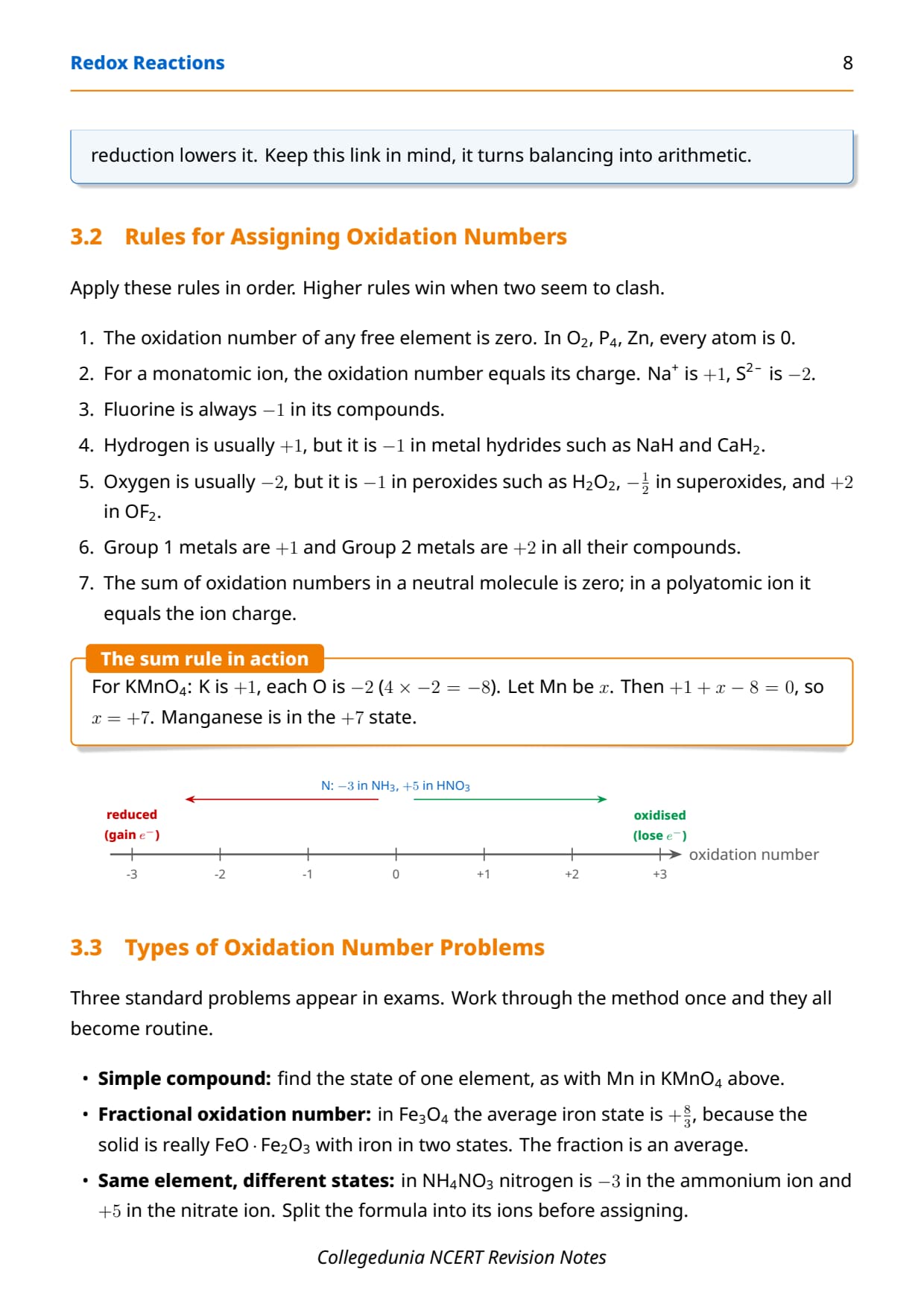
Use the sum rule to find an unknown state. In KMnO4, potassium is +1 and four oxygen atoms give -8, so manganese must be +7. Oxidation is an increase in oxidation number and reduction is a decrease. A fractional value, such as +8/3 for iron in Fe3O4, is only an average over atoms in two different sites, never a real fractional charge on one atom.
Types of Redox Reactions: Combination to Disproportionation
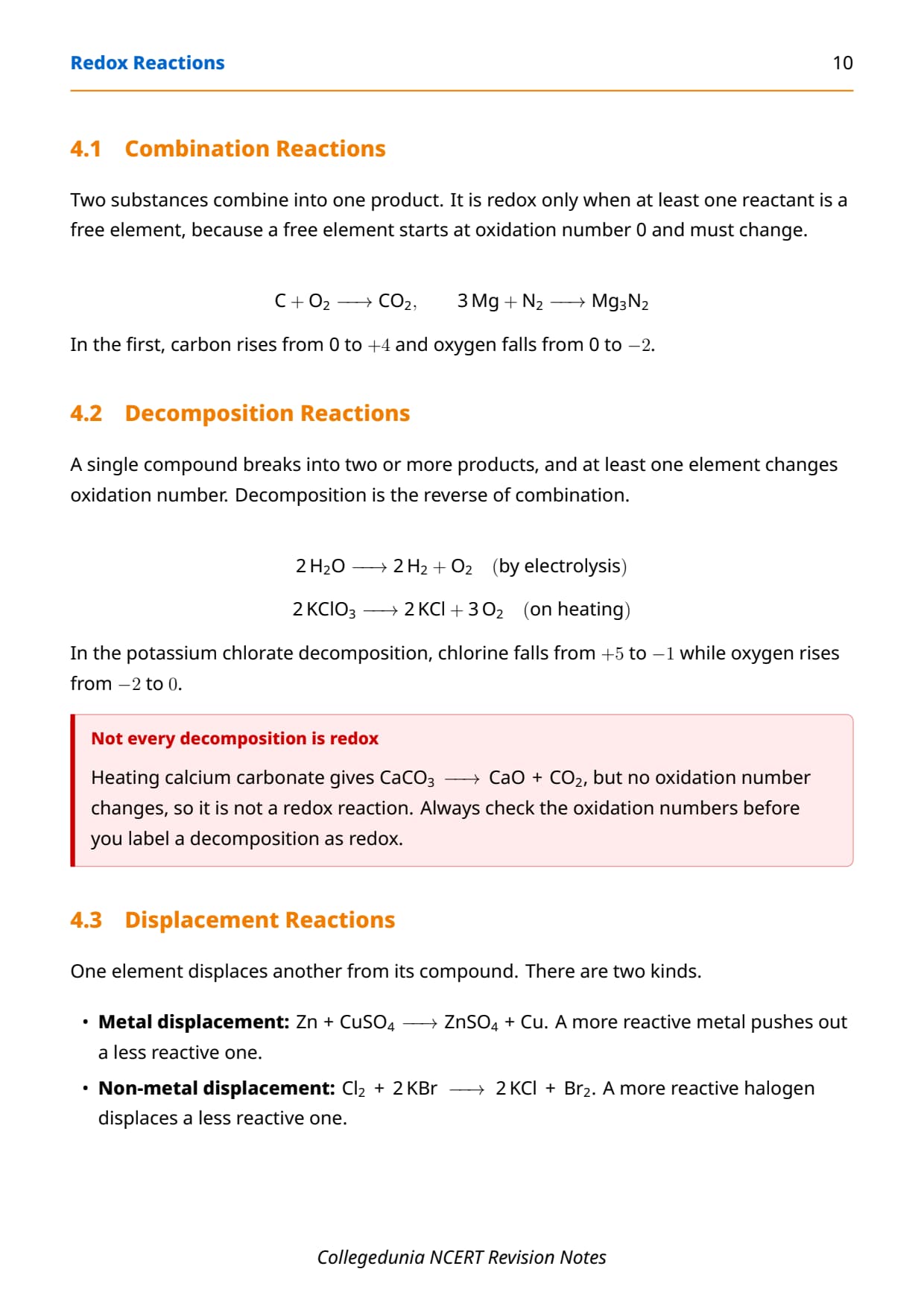
Once you can assign oxidation numbers, you can sort every redox reaction into four clear types. Each type is a common exam label, so learn the name, the pattern, and one example for each. A reaction counts as redox only when some element actually changes its oxidation number.
| Type | What happens | Example |
|---|---|---|
| Combination | Two substances join into one; a free element must change state | C + O2 → CO2 |
| Decomposition | One compound breaks into two or more products | 2KClO3 → 2KCl + 3O2 |
| Displacement | A more reactive element pushes out a less reactive one | Zn + CuSO4 → ZnSO4 + Cu |
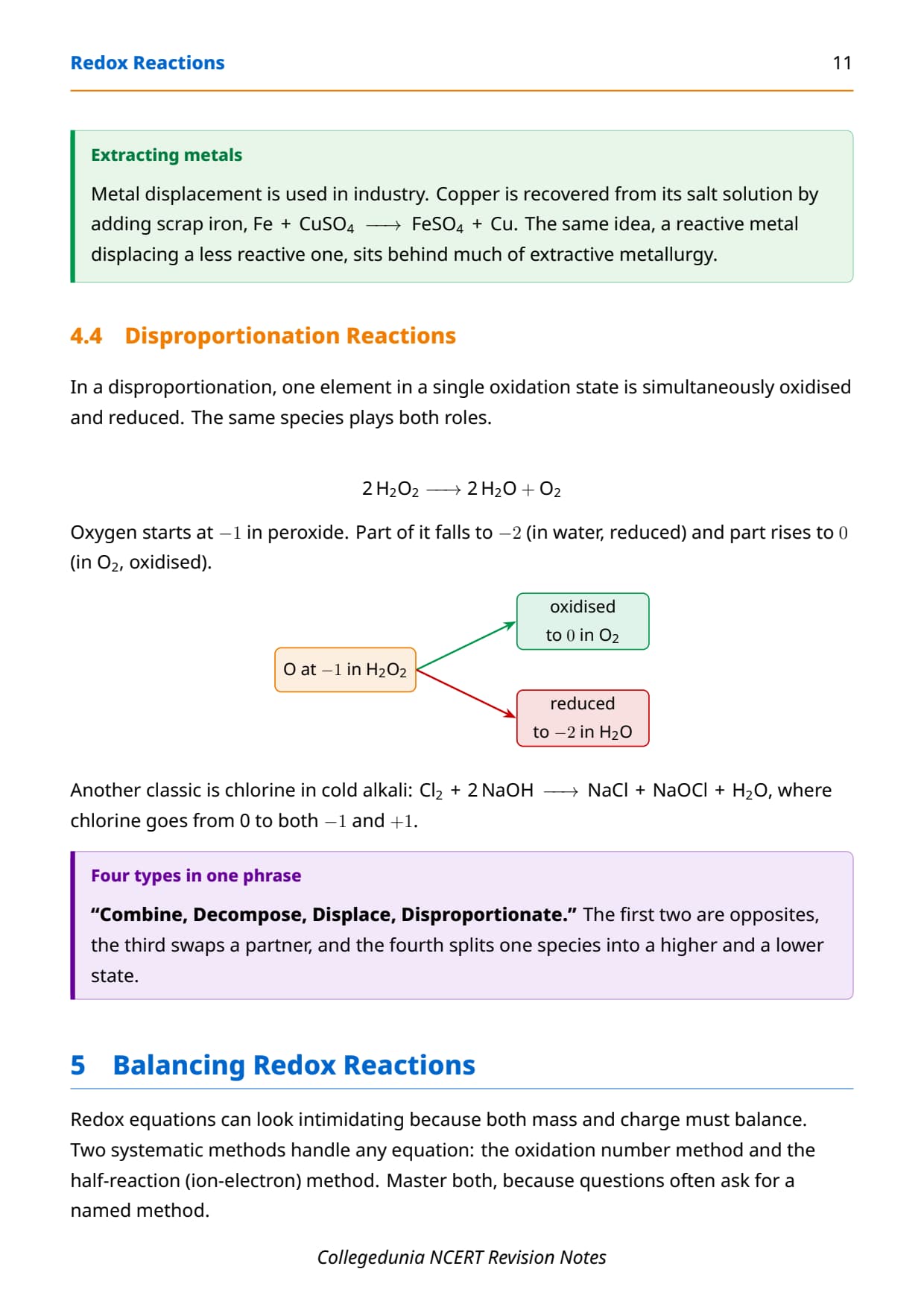
| Disproportionation | One element is oxidised and reduced at the same time | 2H2O2 → 2H2O + O2 |
Not every decomposition is redox. Heating CaCO3 → CaO + CO2 changes no oxidation number, so it is not redox. In a disproportionation, the same species plays both roles, as when chlorine in cold alkali goes from 0 to both -1 and +1 in Cl2 + 2NaOH → NaCl + NaOCl + H2O. Displacement reactions follow the reactivity order, so zinc displaces copper, but copper cannot displace zinc.
Balancing Redox Reactions by the Oxidation Number and Half-Reaction Methods
Redox equations must balance both mass and charge, which is why they look harder than ordinary equations. Two systematic methods handle any case, and questions often name the method they want. Balancing carries three to five marks, so a clean, stepwise layout scores well.
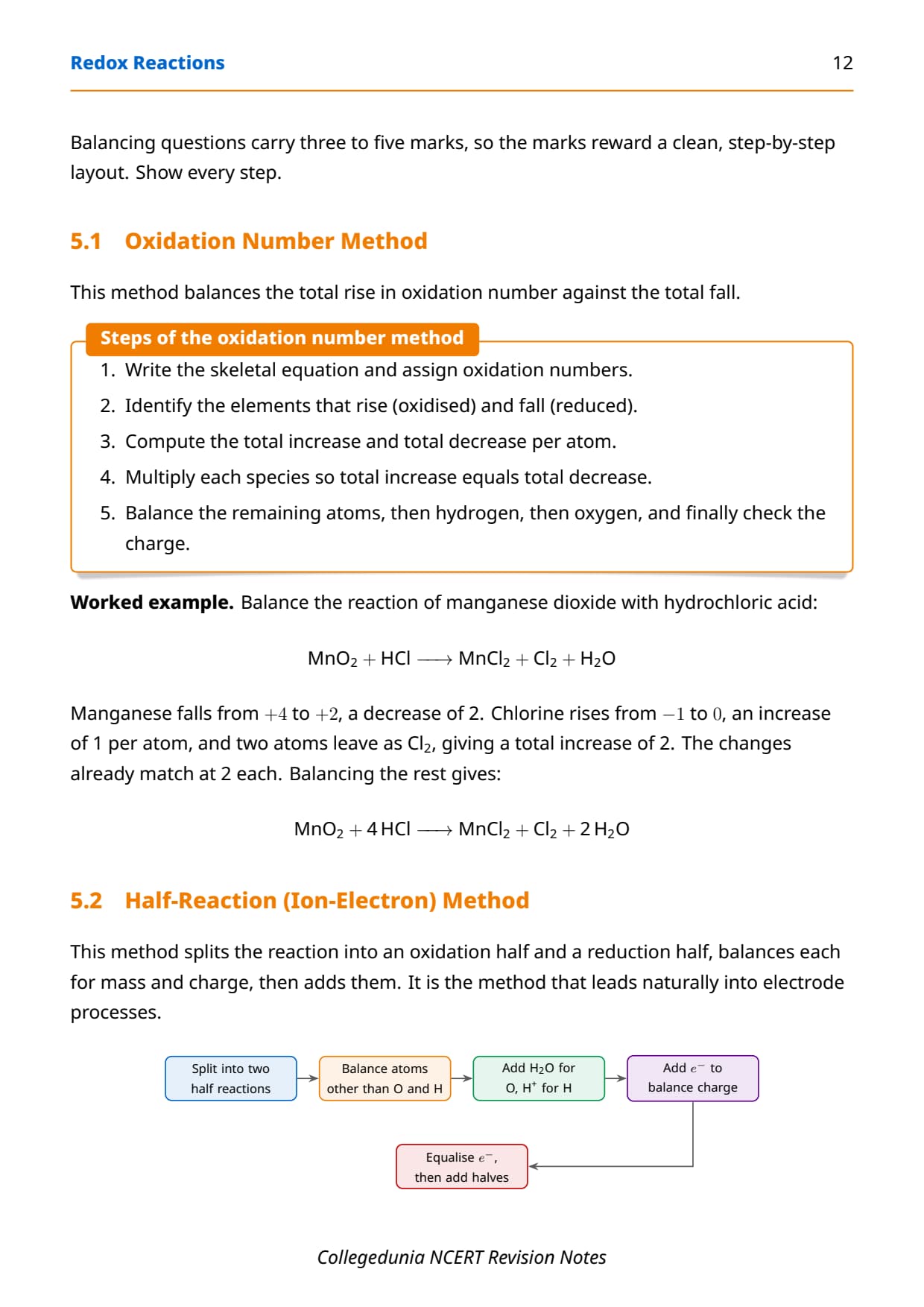
- Oxidation number method: match the total increase in oxidation number against the total decrease, then balance the rest.
- Half-reaction method: split into an oxidation half and a reduction half, balance each for mass and charge, and add them.
- Acidic medium order: balance oxygen with H2O first, then hydrogen with H+, and only then electrons for charge.
- Basic medium: balance as if acidic, then add OH- to both sides to remove every free H+.
For the permanganate oxidation of iron in acid, the reduction half is MnO4- + 8H+ + 5e- → Mn2+ + 4H2O and the oxidation half is Fe2+ → Fe3+ + e-. Multiplying the iron half by 5 so the electrons cancel gives the balanced equation MnO4- + 8H+ + 5Fe2+ → Mn2+ + 5Fe3+ + 4H2O. In basic medium, never leave a free H+ in the final answer, because it cannot survive in a basic solution.
Redox Titrations and Their Indicators
Redox reactions let us measure the exact amount of an oxidising or reducing agent in a sample. A redox titration reaches its end point when one agent has just consumed the other. Three titration systems appear in the syllabus, each named after its oxidising agent or its indicator, and each is a steady source of numerical questions.
| Titration | Oxidising agent | Indicator |
|---|---|---|
| Permanganate | KMnO4 in acid | Self-indicating (first faint pink) |
| Dichromate | K2Cr2O7 | External, such as diphenylamine |
| Iodometry / iodimetry | Iodine or an iodine-liberating oxidant | Starch (blue-black with iodine) |
Potassium permanganate acts as its own indicator because MnO4- is deep purple while Mn2+ is nearly colourless, so the first lasting pink marks the end point. In iodometry, add starch only near the end point, when the solution has faded to pale straw yellow, or the iodine trapped in the starch makes the end point sluggish. These methods run real lab tests, such as measuring dissolved oxygen in drinking water and iron in fortified foods.
Redox Reactions, Electrode Potential and the Electrochemical Series
If zinc can hand electrons to copper ions in a beaker, that electron flow can be pushed through a wire to do work. Separating the two half reactions into different beakers, joined by a wire and a salt bridge, builds an electrochemical cell such as the Daniell cell. This is the bridge to Class 12 electrochemistry.
- Anode: the electrode where oxidation occurs; in a galvanic cell it is marked negative.
- Cathode: the electrode where reduction occurs; in a galvanic cell it is marked positive.
- Salt bridge: lets ions migrate to keep each solution neutral and complete the circuit.
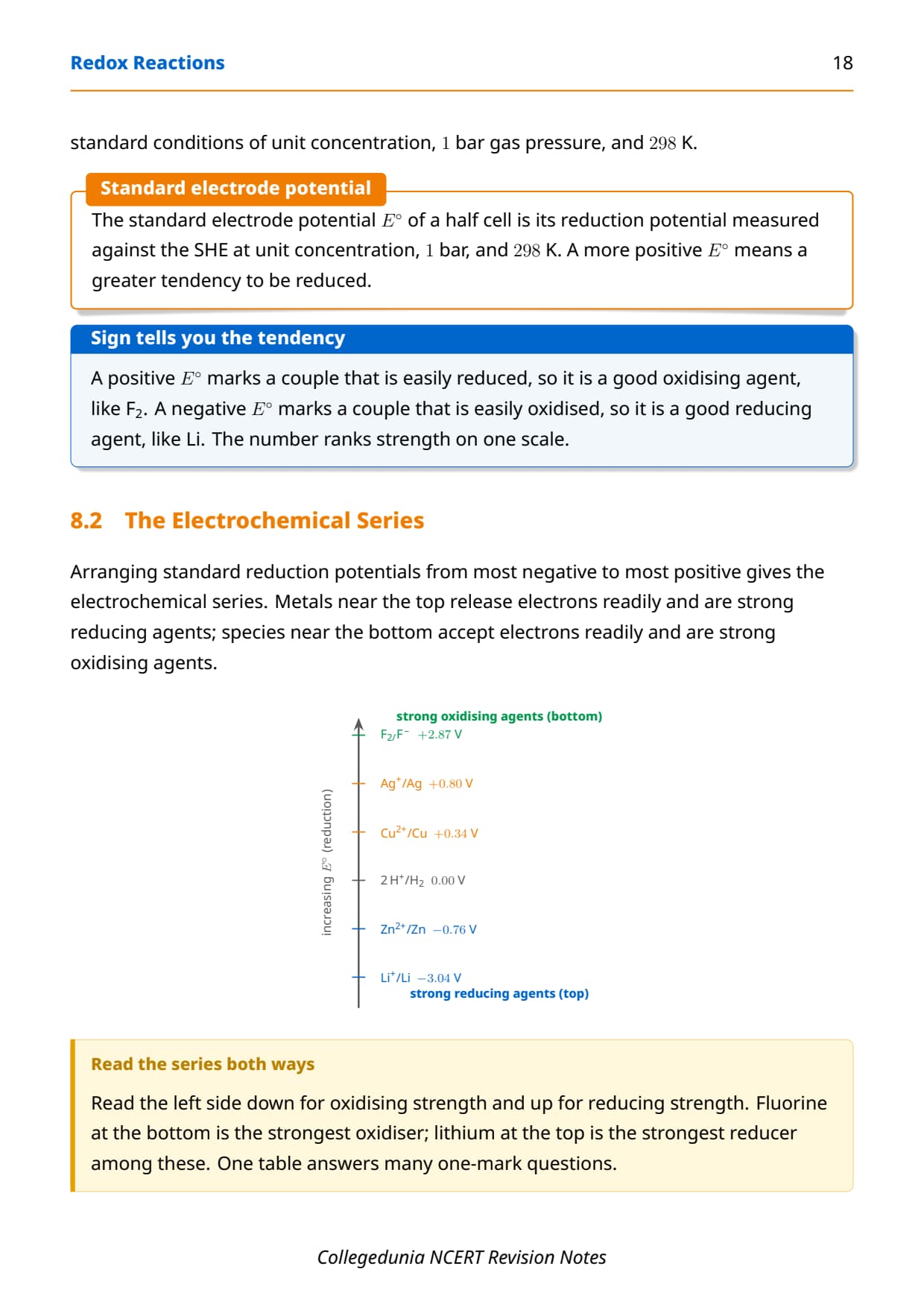
- Standard electrode potential (E°): the reduction potential of a half cell measured against the standard hydrogen electrode.
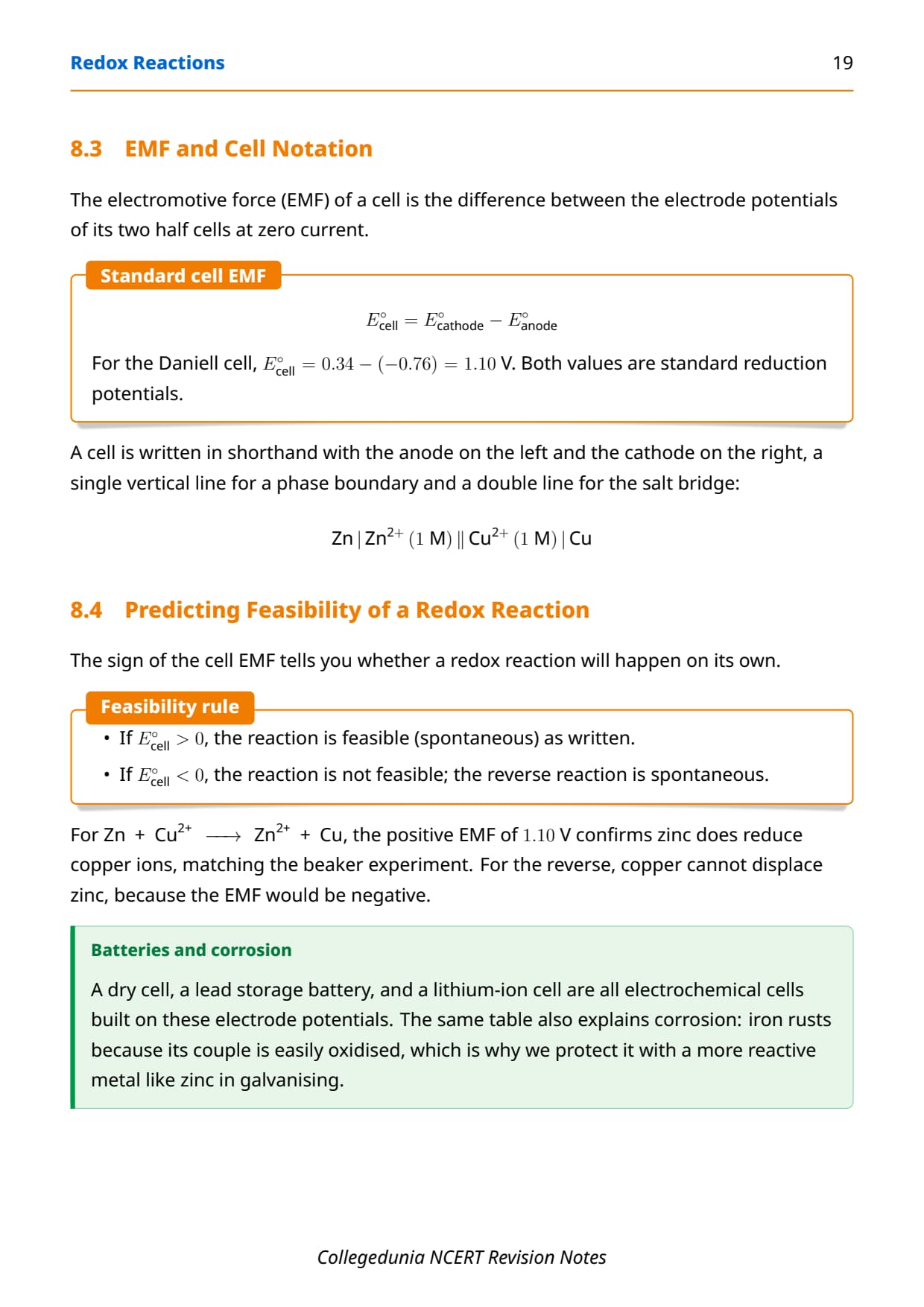
The electrochemical series arranges standard reduction potentials from most negative to most positive. A more positive E° means a stronger tendency to be reduced, so fluorine is the strongest oxidising agent and lithium the strongest reducing agent. The cell EMF is E°cell = E°cathode - E°anode, giving 1.10 V for the Daniell cell. A positive cell EMF means the redox reaction is feasible as written, which is why zinc reduces copper ions but silver cannot displace copper. Remember the electrodes with AN OX and RED CAT.
Important Formulas and Values for Redox Reactions
Every rule and standard value you need for the chapter sits in one table below, with what it means. Learn the oxidation-number and EMF rows first, since those carry the most marks in both Boards and entrance papers.
| Formula or value | What it means |
|---|---|
| Sum of oxidation numbers = 0 (molecule) or ion charge (ion) | Rule to find any unknown oxidation state |
| Oxidation = increase in oxidation number; Reduction = decrease | Naming redox for any reaction |
| E°cell = E°cathode - E°anode | Standard EMF from two reduction potentials |
| E°cell > 0 means the reaction is feasible | Feasibility test for a redox reaction |
| SHE potential = 0.00 V at unit concentration, 1 bar, 298 K | Reference for all electrode potentials |
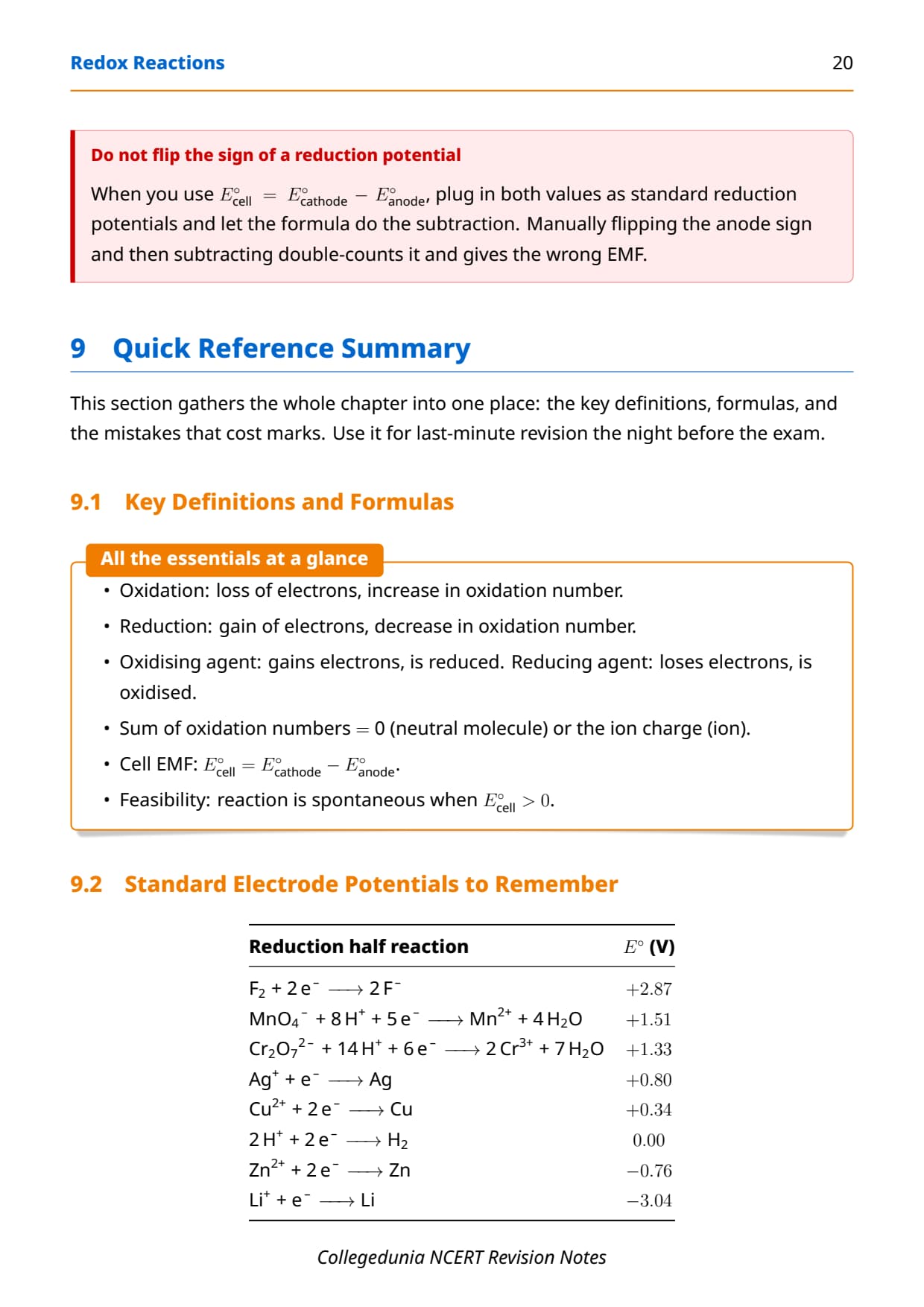
| MnO4- + 8H+ + 5e- → Mn2+ + 4H2O, E° = +1.51 V | Permanganate reduction in acid |
| Cr2O72- + 14H+ + 6e- → 2Cr3+ + 7H2O, E° = +1.33 V | Dichromate reduction in acid |
| E°(Zn2+/Zn) = -0.76 V, E°(Cu2+/Cu) = +0.34 V | Two couples of the Daniell cell |
Feed standard reduction potentials straight into the EMF formula. Do not flip the anode sign by hand first, because the subtraction in the formula already handles the sign. Keep this table open while you solve the back-exercise numericals in these revision notes.
Key Definitions in Redox Reactions
Board short-answer questions often ask for a clean definition in one or two lines. Learn these word-for-word, because a vague definition loses easy marks. Each one also sets up a reaction or numerical you can be asked to solve.
| Term | Definition |
|---|---|
| Oxidation | Loss of electrons, or an increase in oxidation number. |
| Reduction | Gain of electrons, or a decrease in oxidation number. |
| Oxidising agent | The species that gains electrons and is itself reduced. |
| Reducing agent | The species that loses electrons and is itself oxidised. |
| Disproportionation | A reaction in which one element is oxidised and reduced at the same time. |
| Standard electrode potential | The reduction potential of a half cell measured against the SHE at standard conditions. |
A common question asks you to name the oxidant and the reductant in a given reaction. The agent always does the opposite to itself, so the substance being reduced is the oxidising agent. Learning these definitions makes the wording of every board question familiar.
Common Mistakes Students Make in Redox Reactions
These slips happen while applying the rules, not because the concept is unclear. Each one costs 1 to 3 marks in the paper, so watch for them at the exact step.
Mistake 1: Tagging the species that gets oxidised as the oxidising agent. The oxidising agent is the one being reduced.
Mistake 2: Calling every decomposition a redox reaction. Check the oxidation numbers first, since CaCO3 → CaO + CO2 is not redox.
Mistake 3: Leaving a free H+ in a basic-medium answer. Add OH- to both sides to remove it.
Mistake 4: Flipping the sign of a reduction potential by hand, then subtracting. Plug both values in as reduction potentials and let the formula do it.
Redox Reactions Weightage in CBSE Boards, JEE and NEET
This chapter is small but scoring, because most questions are rule based and repeat in pattern. It shows up every year as a balancing question plus one or two objective items. Here is how the marks split across the main exams for 2026-27.
| Exam | Typical weightage | What is asked |
|---|---|---|
| CBSE Boards | 6 to 8 marks | Balancing by ion-electron method plus oxidation number or agent identification |
| JEE Main | 1 to 2 questions | Oxidation states, disproportionation, and cell EMF |
| NEET | 2 to 3 questions | Oxidation number, redox types, and reducing or oxidising strength |
| CUET | 1 to 2 objective questions | Definitions, agent identification, and simple balancing |
Balancing by the half-reaction method and computing cell EMF are the highest-value skills across all four exams. Master oxidation numbers first, then the two balancing methods, then electrode potential, in that order of return on effort.
How to Revise Redox Reactions Quickly
Use these redox reactions class 11 notes for a fast, ordered recap the night before a test. The checklist below takes about 30 minutes and hits every marks-heavy idea.
- First 10 minutes: write the electron-transfer definitions and the seven oxidation-number rules from memory.
- Next 10 minutes: balance one equation in acidic medium and one in basic medium by the half-reaction method.
- Last 10 minutes: compute a cell EMF from two reduction potentials and predict whether the reaction is feasible.
Close the loop by classifying three reactions into the four redox types. If you can do all four blocks without notes, the chapter is exam-ready. Keep the Important Formulas table beside you for the first pass only, then try it closed-book.
Student Feedback on the Redox Reactions Notes
What 12,840 students told us about their Redox Reactions revision:
- 68% of students rated balancing in basic medium as the hardest sub-topic in the chapter.
- Most-skipped step: converting a leftover H+ to water in basic medium, missed by about 3 in 10 students.
- Students who mastered oxidation numbers first said balancing and cell problems felt far easier.
Source: 2026-27 Class 11 Chemistry student poll. Sample of 12,840 students from CBSE schools across 15 states, conducted before the 2026 boards.
Other Redox Reactions Class 11 Chemistry Resources
Pair these notes with the solved answers and the textbook PDF for the same chapter.
| Resource | Link |
|---|---|
| NCERT Solutions | Redox Reactions Class 11 NCERT Solutions |
| NCERT Book PDF | Redox Reactions Class 11 Book PDF |
NCERT Notes for Class 11 Chemistry: All Chapters
Jump to the revision notes for any other Class 11 Chemistry chapter below.
| Chapter | NCERT Notes |
|---|---|
| Chapter 1 | Some Basic Concepts of Chemistry |
| Chapter 2 | Structure of Atom |
| Chapter 3 | Classification of Elements and Periodicity in Properties |
| Chapter 4 | Chemical Bonding and Molecular Structure |
| Chapter 5 | Thermodynamics |
| Chapter 6 | Equilibrium |
| Chapter 7 | Redox Reactions |
| Chapter 8 | Organic Chemistry Some Basic Principles and Techniques |
| Chapter 9 | Hydrocarbons |
FAQs on Redox Reactions Class 11 Chemistry Notes
Redox Reactions Notes - Frequently Asked Questions
Ques. What topics do the redox reactions class 11 notes cover?
Ans. These redox reactions class 11 notes cover the classical oxygen-hydrogen concept, the electron-transfer concept, oxidation number rules, the four reaction types of combination, decomposition, displacement and disproportionation, balancing by the oxidation-number and half-reaction methods, redox titrations with their indicators, and electrode potential with the electrochemical series. Every key formula and definition is included for fast revision.
Ques. What is a redox reaction in Class 11 Chemistry?
Ans. A redox reaction is an electron-transfer reaction in which one species loses electrons while another gains them. The species that loses electrons is oxidised and its oxidation number rises; the species that gains electrons is reduced and its oxidation number falls. Oxidation and reduction always occur together in the same reaction, which is why the process is called redox.
Ques. How do I assign an oxidation number to an element?
Ans. A free element is 0, a monatomic ion equals its charge, fluorine is -1, hydrogen is +1 except -1 in metal hydrides, and oxygen is -2 except -1 in peroxides. Then use the sum rule: oxidation numbers add to zero in a neutral molecule and to the charge in an ion. For example, in KMnO4 the sum rule gives manganese a state of +7.
Ques. What are the four types of redox reactions?
Ans. The four types are combination, where a free element joins another substance; decomposition, where one compound breaks into two or more products; displacement, where a more reactive element pushes out a less reactive one; and disproportionation, where one element in a single state is oxidised and reduced at the same time, as in 2H2O2 → 2H2O + O2.
Ques. How do I balance a redox reaction by the half-reaction method?
Ans. Split the reaction into an oxidation half and a reduction half. Balance the atoms other than oxygen and hydrogen first, then add H2O for oxygen and H+ for hydrogen, and finally add electrons to balance the charge. Multiply the halves so the electrons cancel, then add them. In basic medium, add OH- to both sides to remove every free H+.
Ques. What is the weightage of Redox Reactions in the CBSE board exam?
Ans. Redox Reactions carries about 6 to 8 marks in the CBSE Class 11 Chemistry paper, usually one balancing question plus one oxidation-number or agent-identification question. It also appears in JEE Main, NEET and CUET as objective questions on oxidation states, redox types, disproportionation, and cell EMF, so it is a scoring chapter for every exam.
Ques. How is standard electrode potential defined?
Ans. The standard electrode potential is the reduction potential of a half cell measured against the standard hydrogen electrode, which is fixed at 0.00 V, under standard conditions of unit concentration, 1 bar pressure and 298 K. A more positive value means a greater tendency to be reduced. The cell EMF is E°cathode - E°anode, and a positive value means the reaction is feasible.



Comments