




These equilibrium class 11 notes gather every equilibrium law, constant, and pH formula that the CBSE Boards, JEE Main, JEE Advanced, NEET and CUET papers actually test in 2026-27. Revise physical and chemical equilibrium, Kc and Kp, Le Chatelier's principle, and the full ionic equilibrium block in one place.
This is one of the most scoring chapters in the Class 11 syllabus, and its ionic equilibrium half feeds straight into Class 12 electrochemistry and salt analysis.
- CBSE Weightage: 7 to 9 marks, usually one Kc/Kp or pH numerical plus one Le Chatelier short answer.
- Topics covered: physical and chemical equilibrium, law of mass action, Kc and Kp, reaction quotient, Le Chatelier's principle, acids and bases, Ka, Kb, pH, buffers, common ion effect, Ksp, and salt hydrolysis.
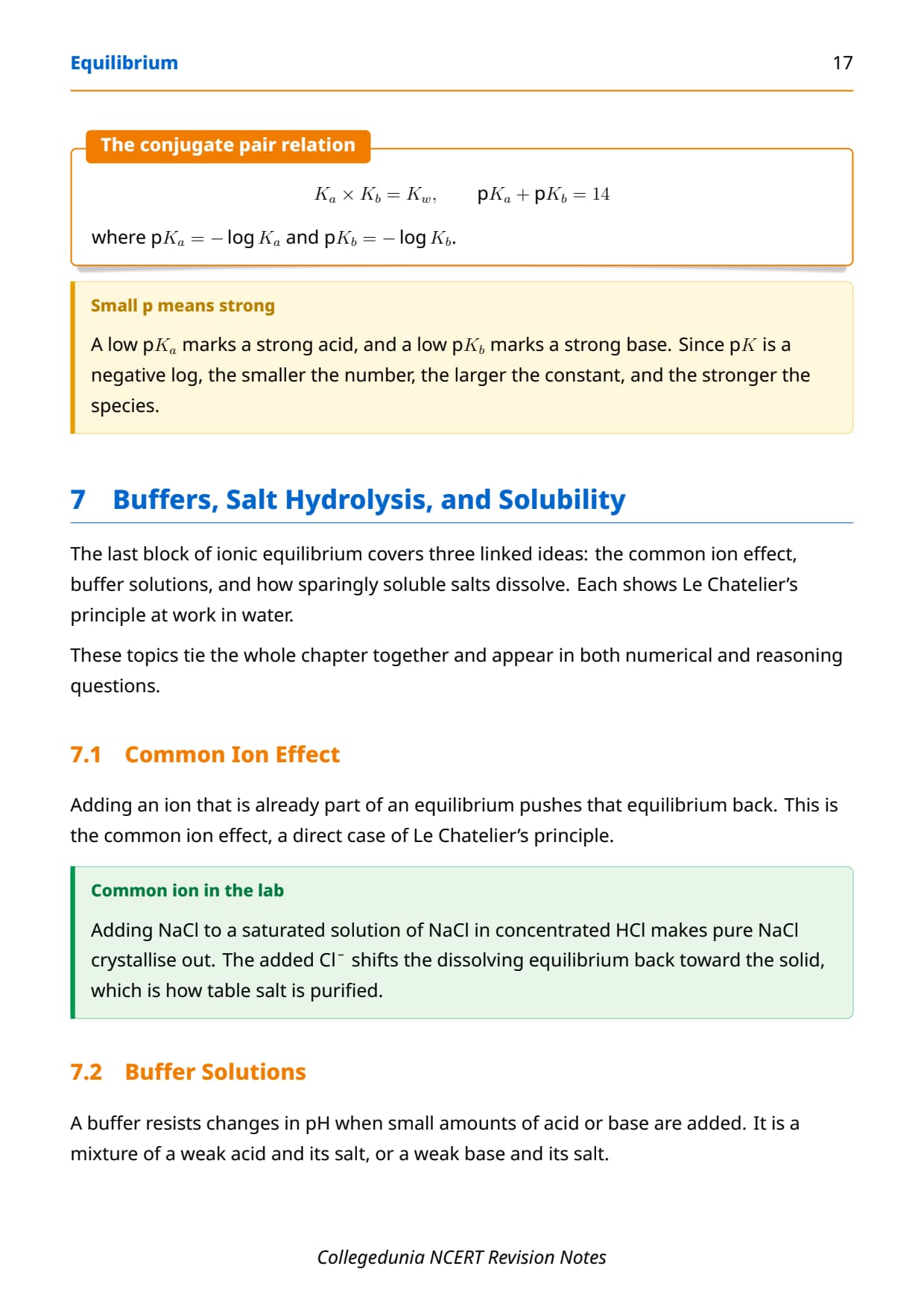
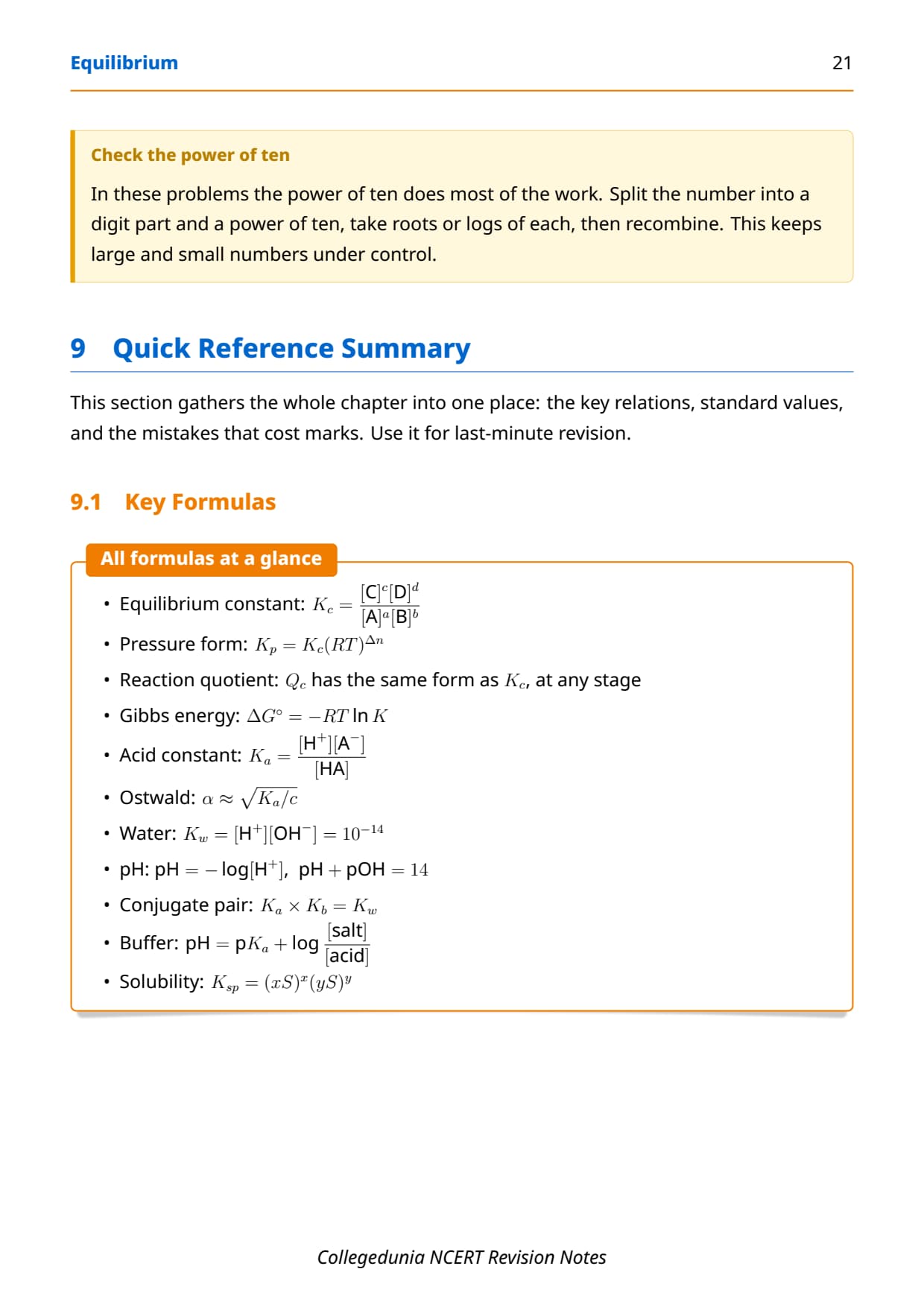
- Key formulas: Kp = Kc(RT)Δn, pH = -log[H+], the Henderson equation, and Ksp from solubility.
These equilibrium class 11 notes are curated by subject experts, based on the 2026-27 NCERT textbook, and checked against the last five years of CBSE Board, JEE Main and NEET papers.
Topic-by-Topic Summary of Equilibrium
The chapter has two clear halves. The first builds physical and chemical equilibrium and the equilibrium constant, and the second applies the same idea to acids, bases, and sparingly soluble salts in water. Here is the quick map of what each topic gives you.
- Physical and chemical equilibrium: the dynamic state where forward and reverse rates become equal.
- Law of mass action and Kc: the rule that fixes the equilibrium constant from active masses.
- Kp and the reaction quotient: the constant in terms of pressure, and the test for reaction direction.
- Le Chatelier's principle: how concentration, pressure, and temperature shift the position of equilibrium.
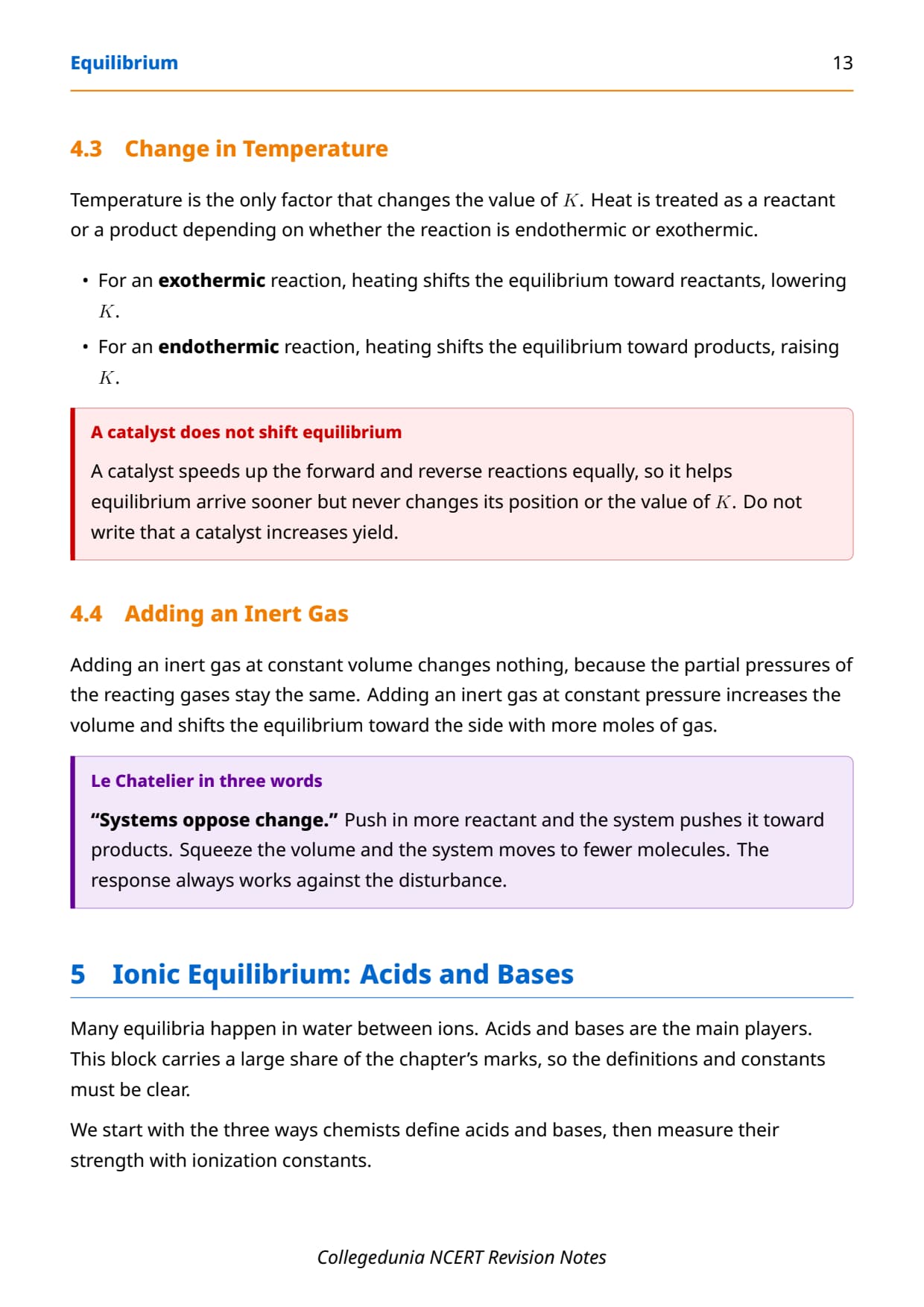
- Acids, bases and pH: the Arrhenius, Bronsted-Lowry and Lewis views, plus Ka, Kb and pH.
- Buffers, common ion effect and Ksp: ionic equilibrium in real solutions, including salt hydrolysis.
Revise the two halves in order, because the ionic half is just the equilibrium constant applied to water. Master Kc and Le Chatelier first, and the entire pH block becomes easy. These equilibrium class 11 notes follow the same sequence as the NCERT textbook.
Physical and Chemical Equilibrium and the Law of Mass Action
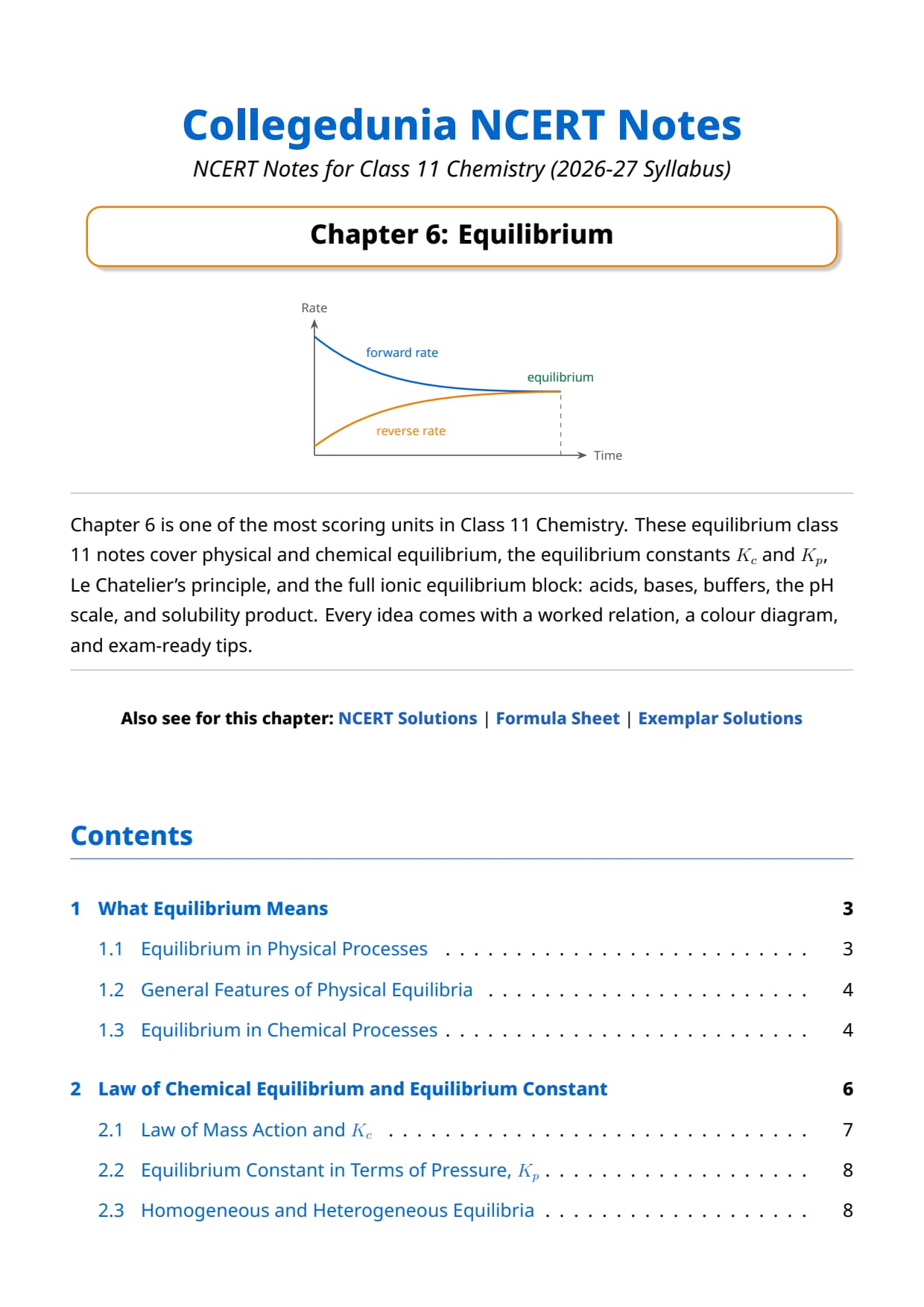
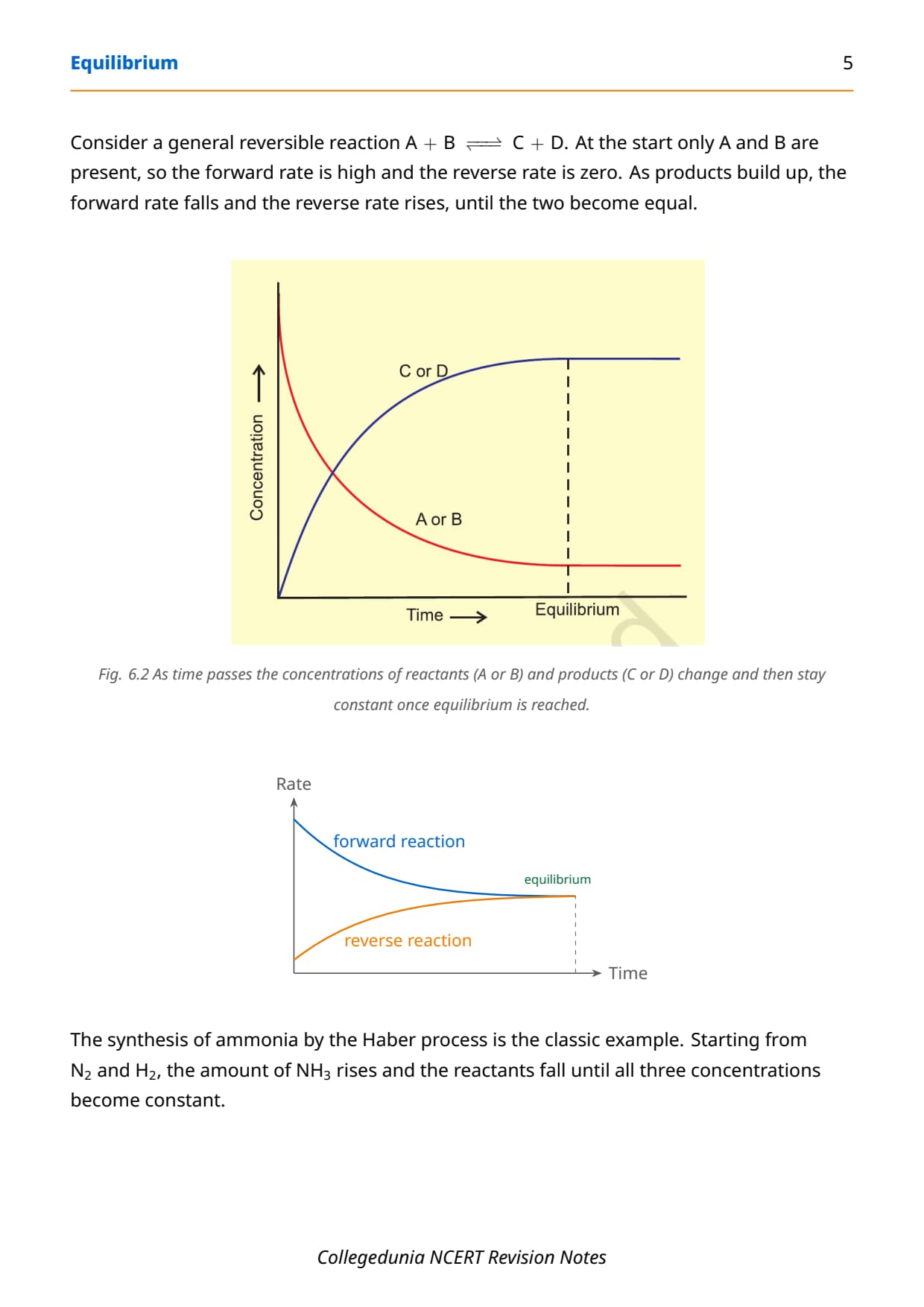
Equilibrium is a dynamic state, not a stopped reaction. In a closed system, the forward and reverse reactions keep running, but at equal rates, so the amounts of reactants and products stop changing. This idea holds for both physical changes and chemical reactions.
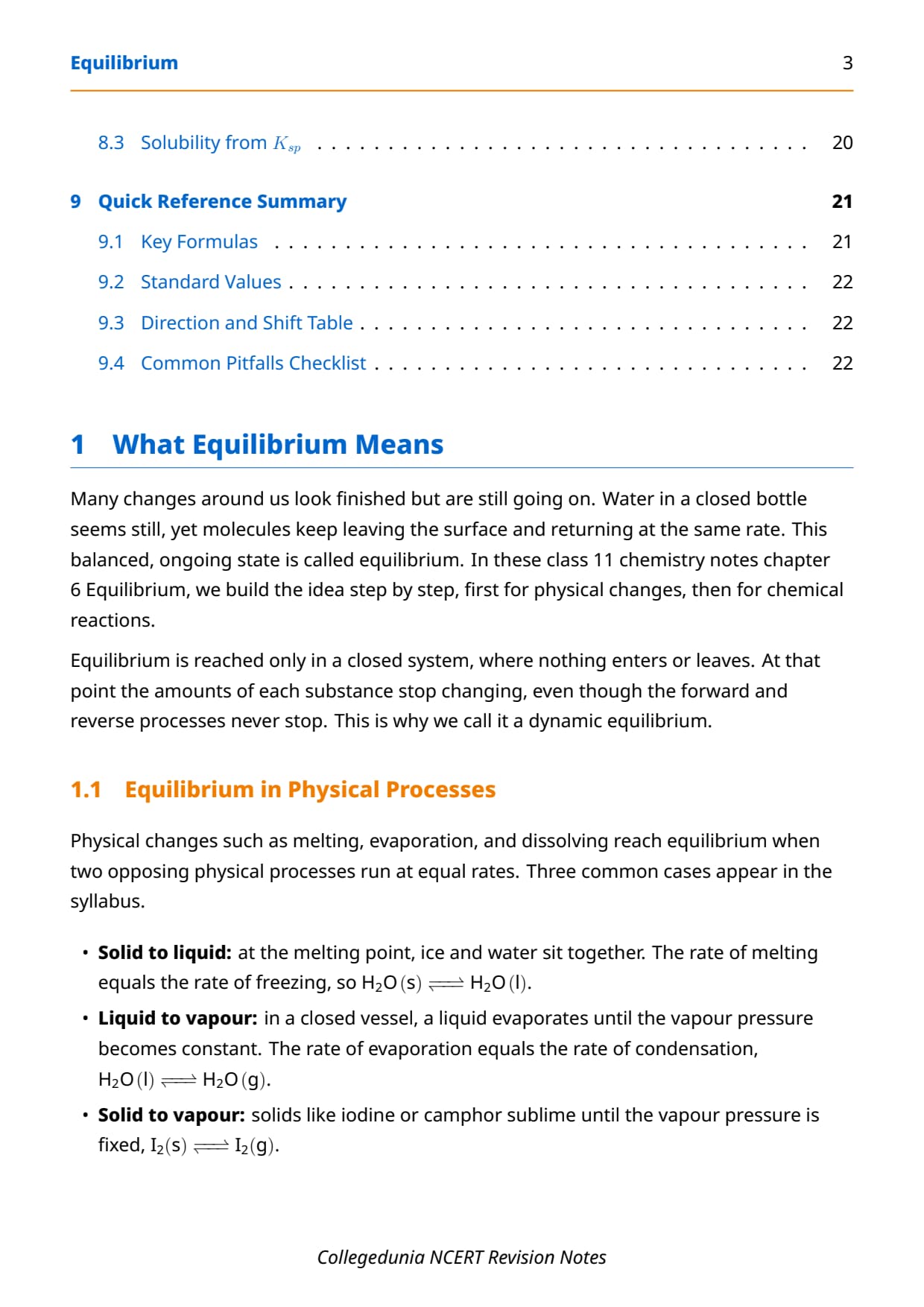
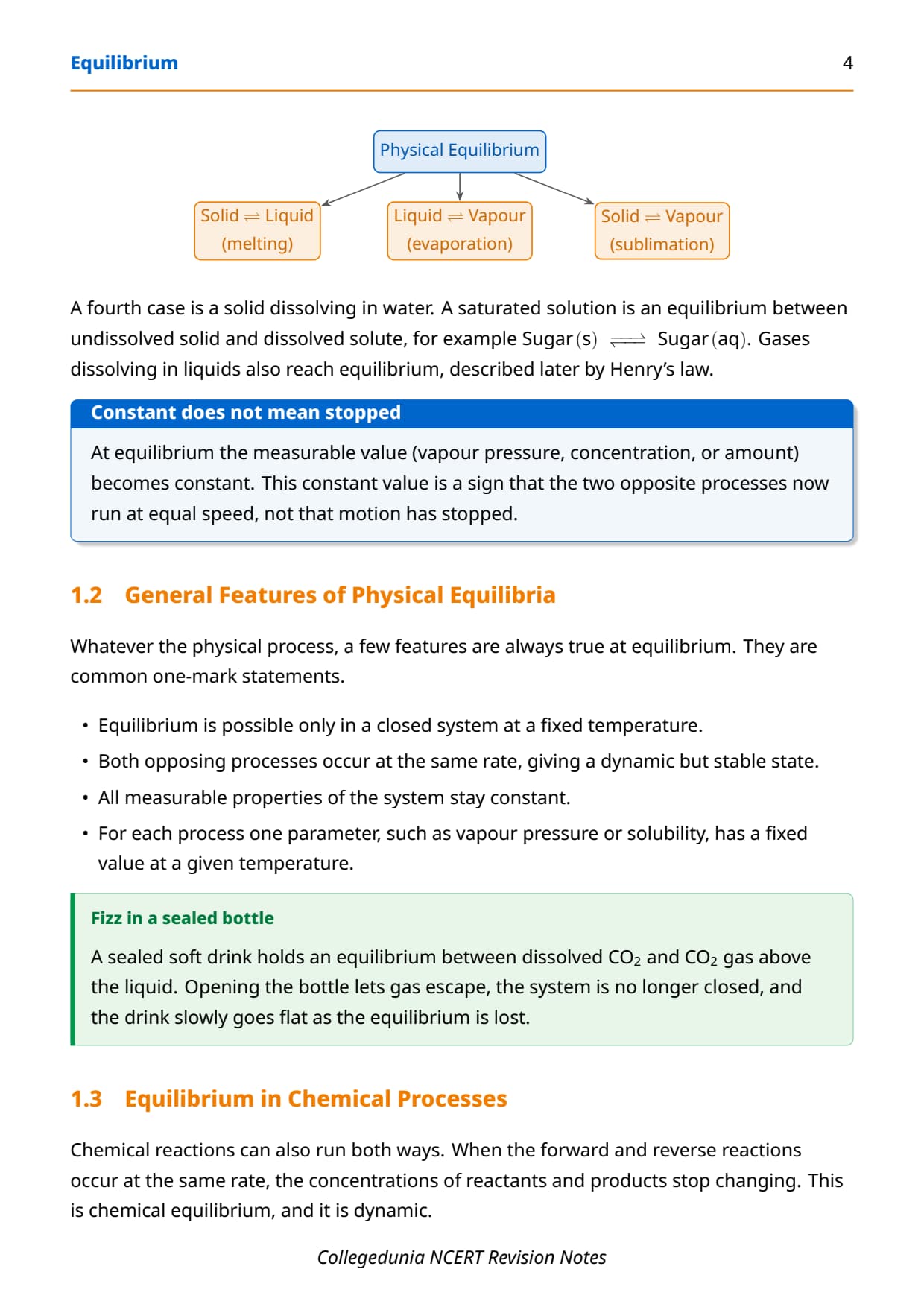
- Physical equilibrium: a phase change in balance, such as water in equilibrium with its vapour in a closed flask.
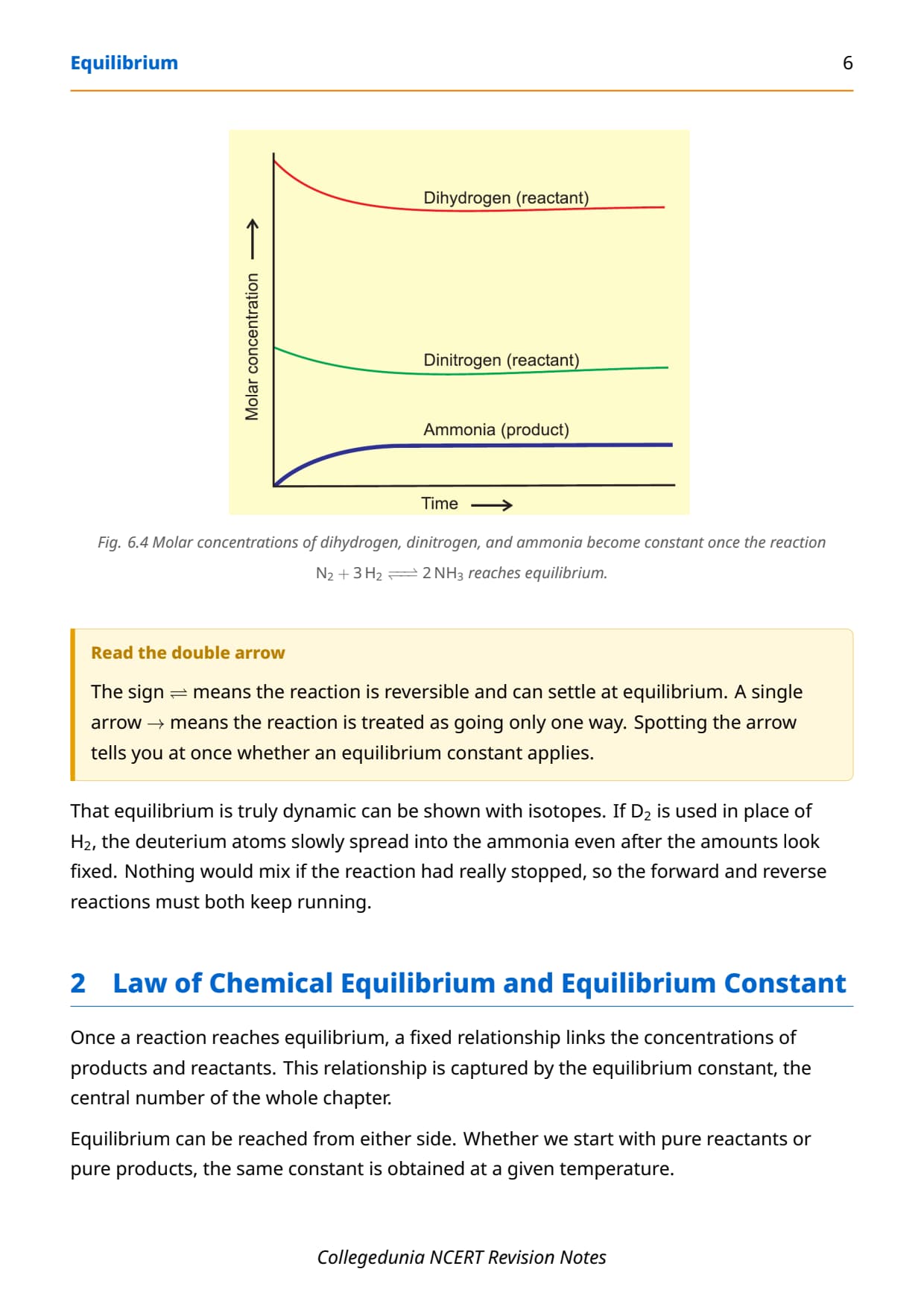
- Chemical equilibrium: a reversible reaction where forward and reverse rates are equal, such as N2 + 3H2 ↔ 2NH3.
- Dynamic nature: both reactions continue at the molecular level even though nothing changes on the outside.
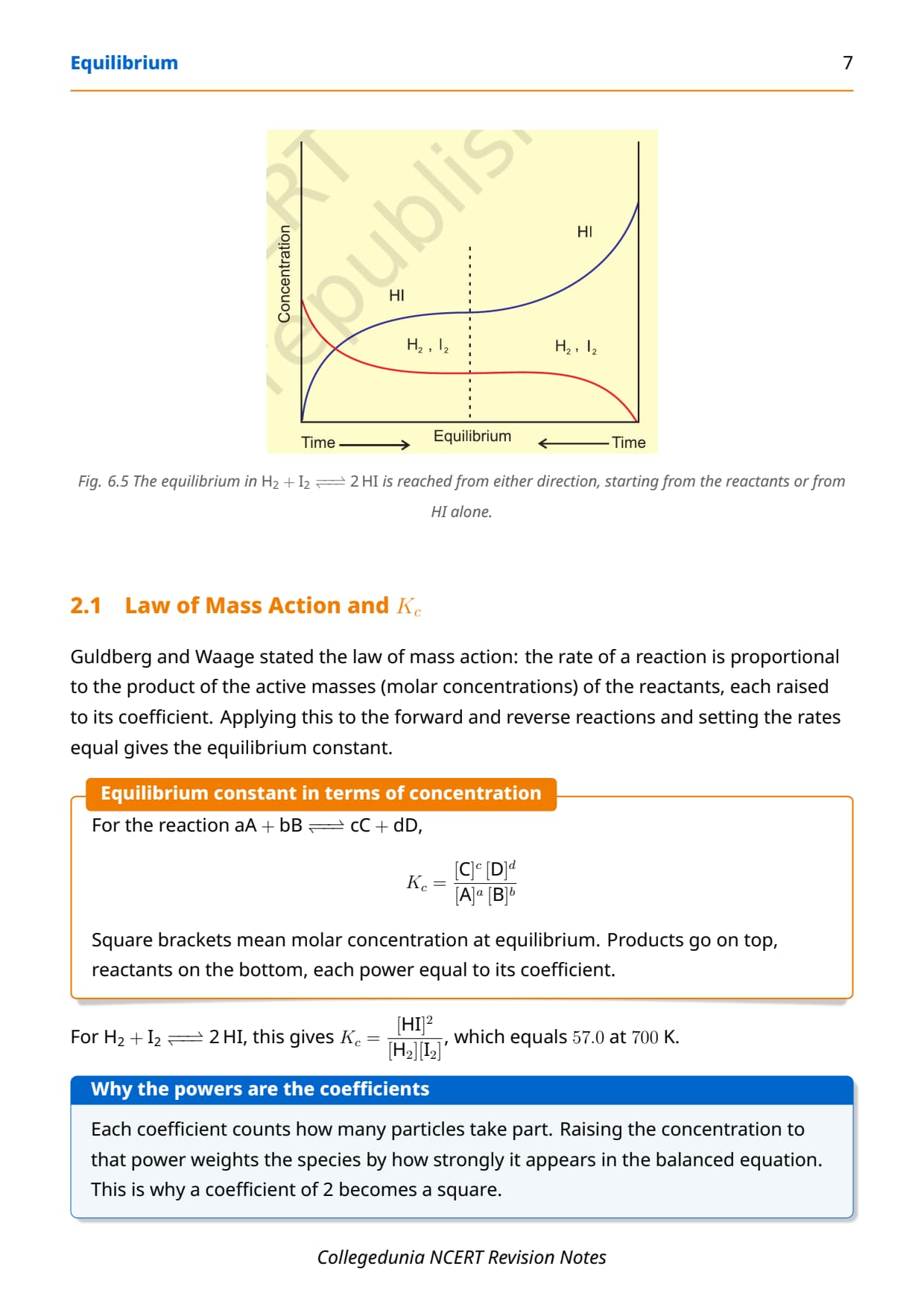
- Characteristics: equilibrium is reached only in a closed system and can be approached from either side.
The law of mass action says the rate of a reaction is proportional to the product of the active masses of the reactants. Applying it to both directions and setting the rates equal gives the equilibrium constant. For a A + b B ↔ c C + d D, the constant is Kc = [C]c[D]d / [A]a[B]b, with every concentration measured at equilibrium.
Equilibrium Constants: Kc, Kp and Their Relation
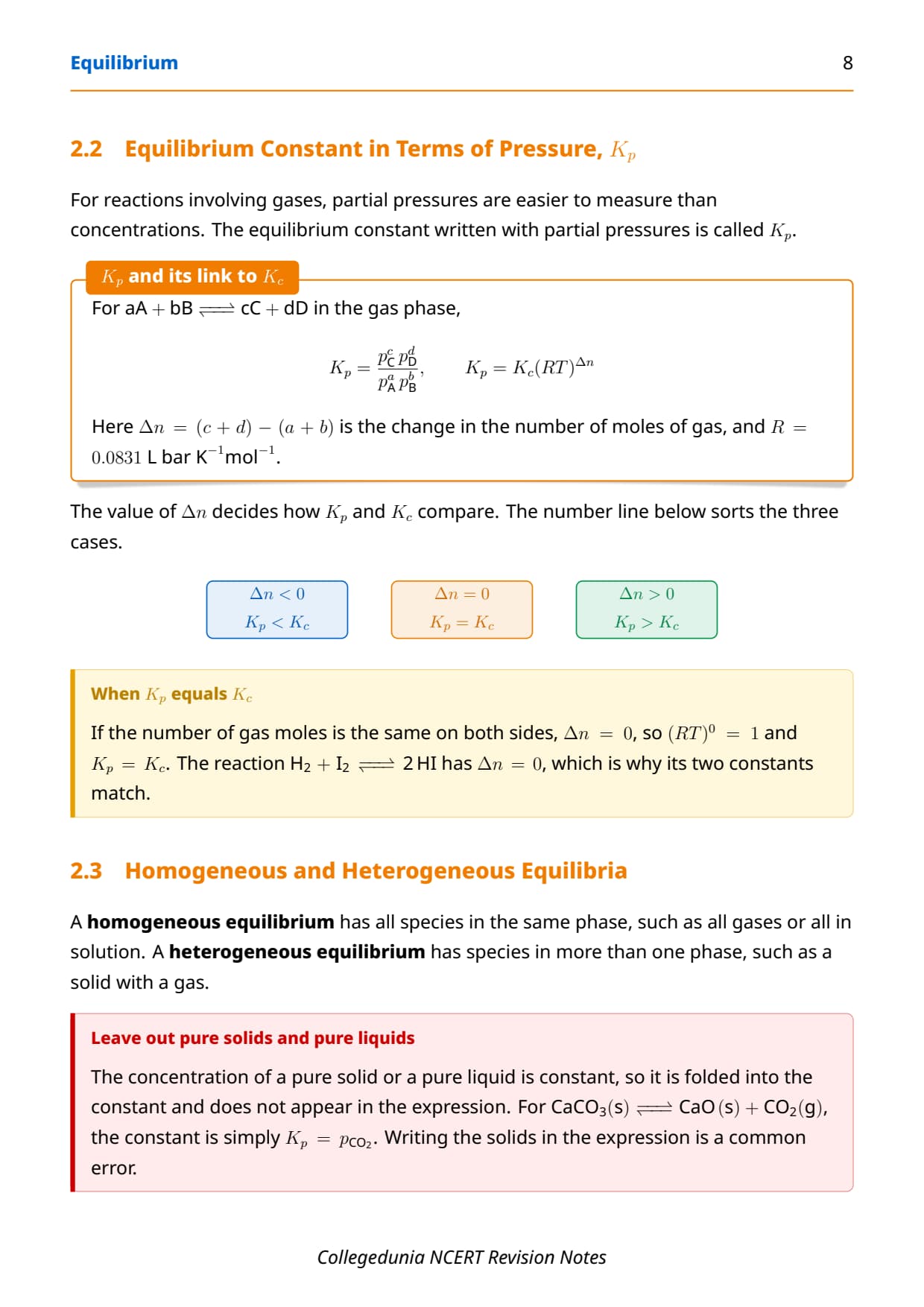
For gaseous reactions, concentration can be replaced by partial pressure. This gives a second equilibrium constant, Kp, written from the partial pressures of the gases. Kc and Kp describe the same equilibrium and are linked by a simple gas-law relation.
- Kc: the equilibrium constant in terms of molar concentrations of reactants and products.
- Kp: the equilibrium constant in terms of partial pressures, used only for gaseous species.
- Relation: Kp = Kc(RT)Δn, where Δn is moles of gaseous products minus moles of gaseous reactants.
- Units: K depends on Δn, so it has units unless the total moles of gas stay the same.
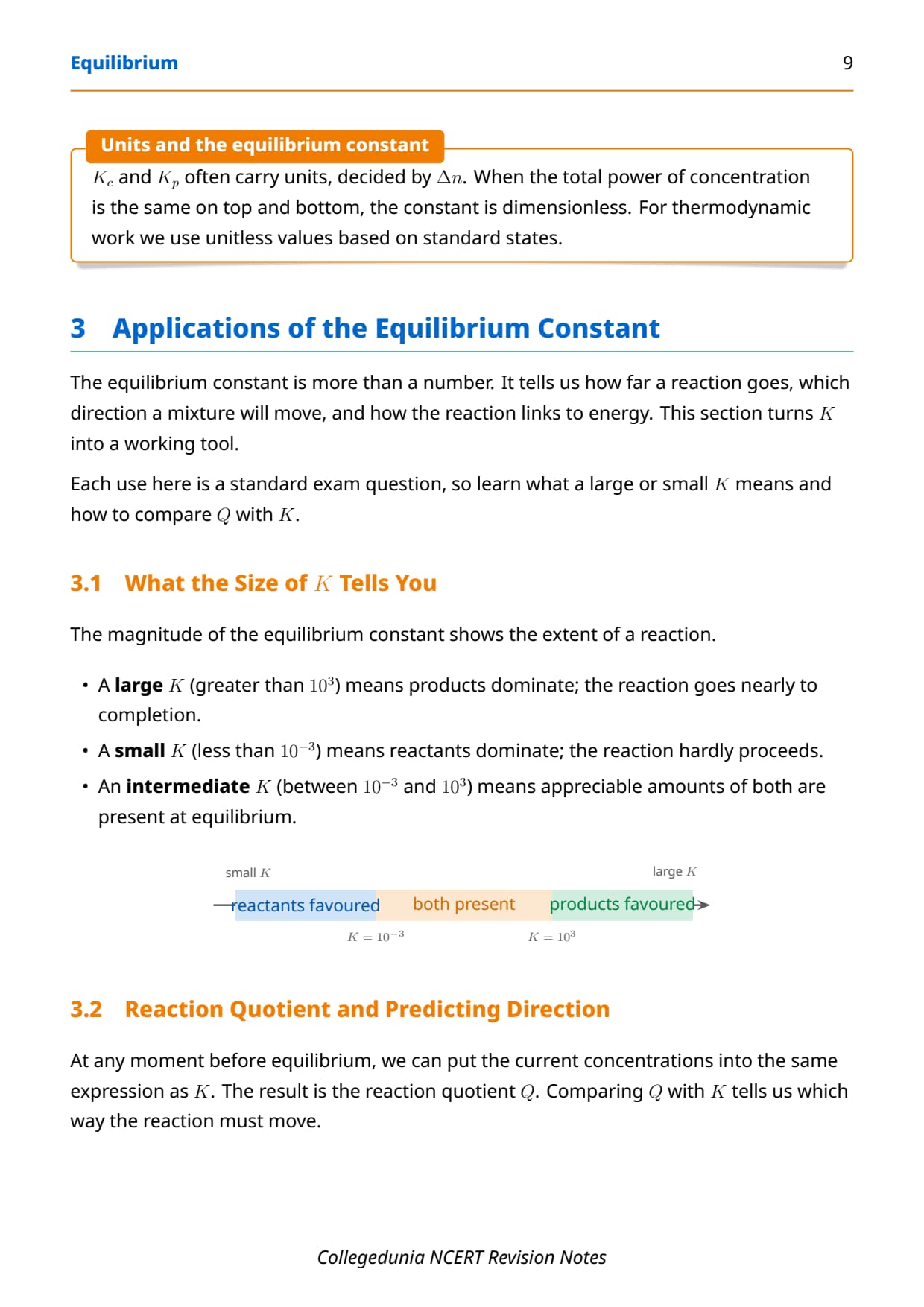
When Δn = 0, Kp equals Kc and both are unitless, as in H2 + I2 ↔ 2HI. A large K (much greater than 1) means the products dominate at equilibrium, and a small K means the reactants dominate. Pure solids and pure liquids are left out of the K expression because their active mass is taken as one. Keep the Kc-Kp relation at the centre, since most numericals start from it.
Reaction Quotient Q and Le Chatelier's Principle
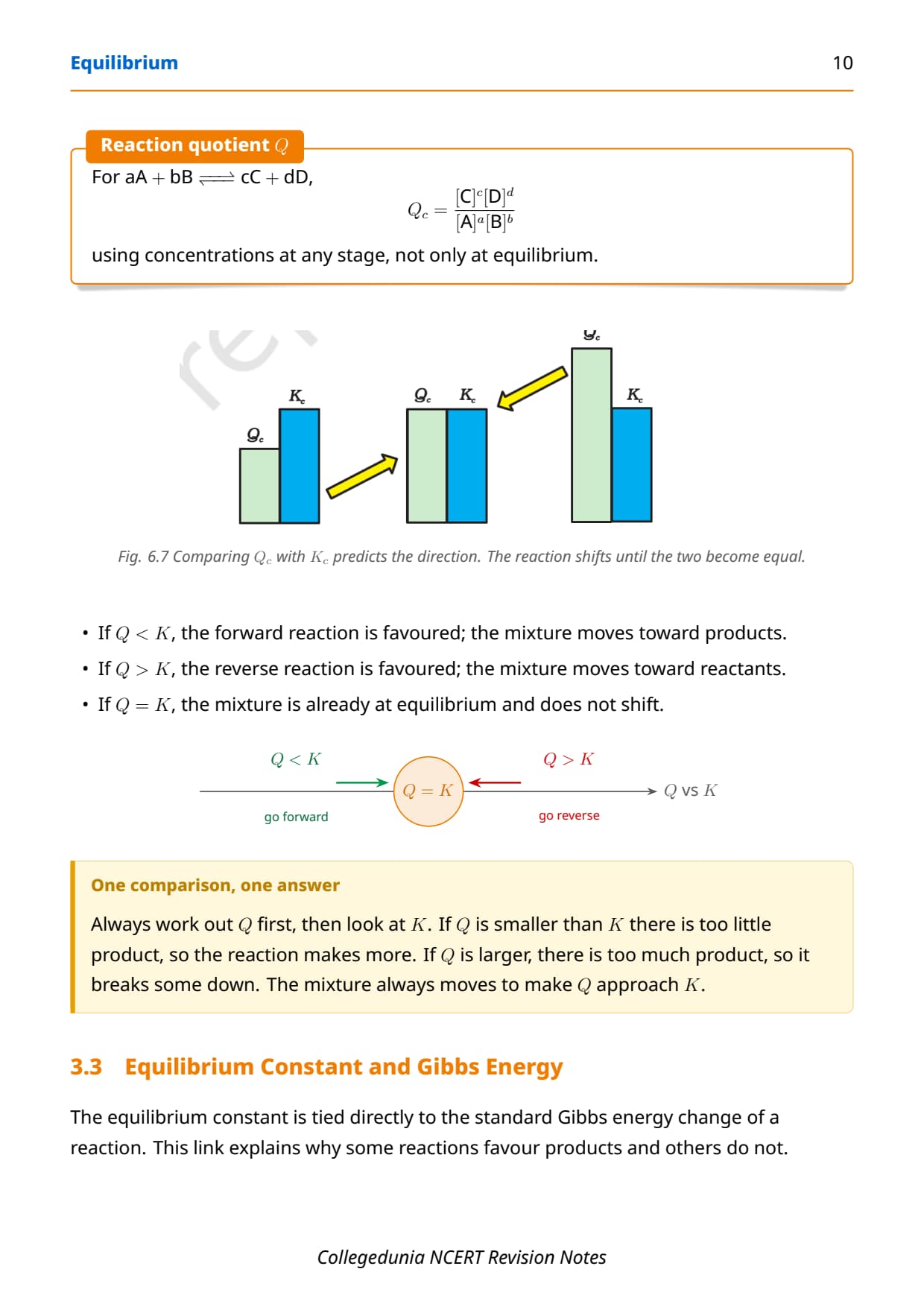
The reaction quotient Q uses the same expression as K, but with concentrations at any moment, not just at equilibrium. Comparing Q with K tells you which way the reaction must move. Le Chatelier's principle then predicts how a disturbance shifts the equilibrium.
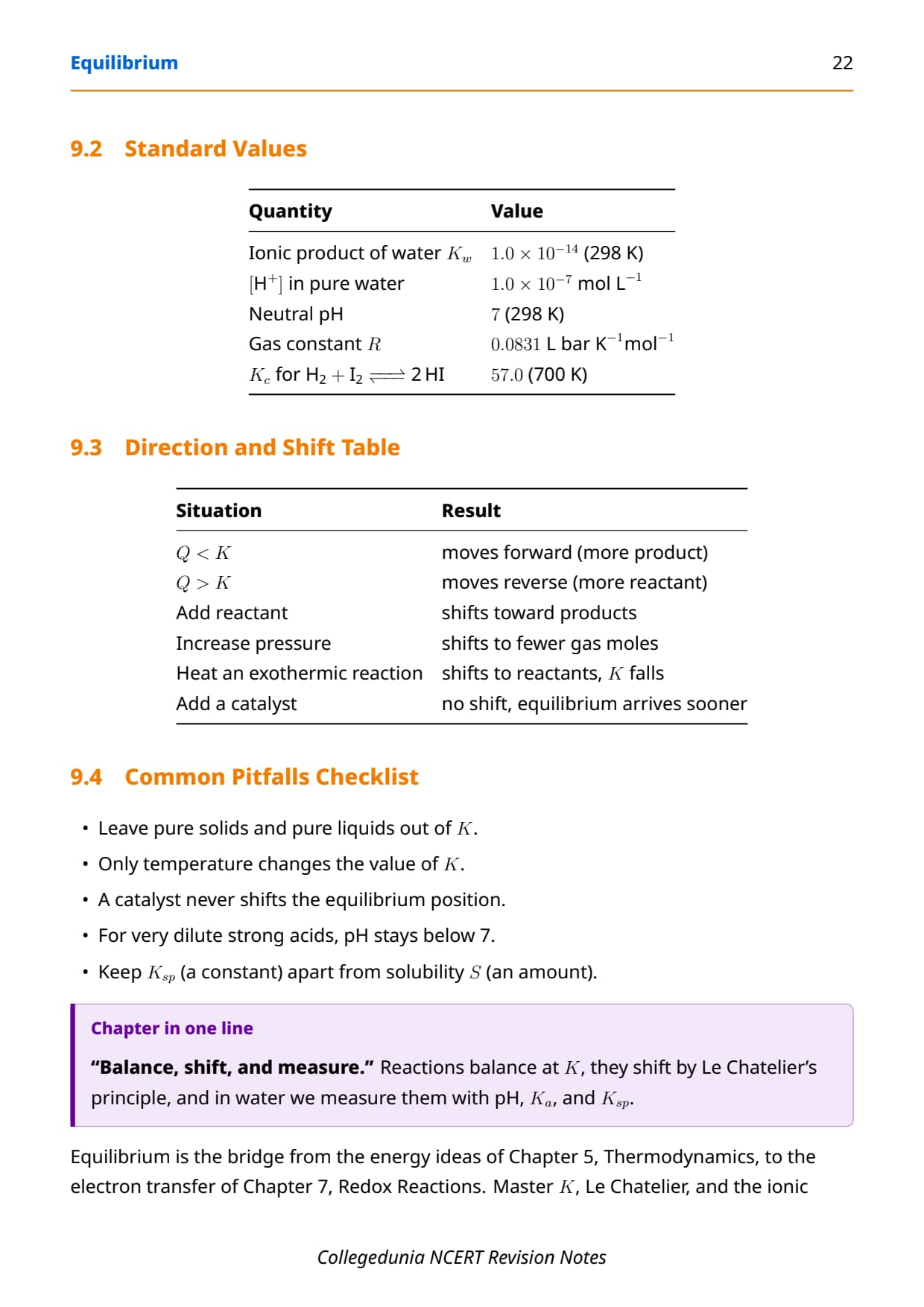
- Q < K: too few products, so the forward reaction runs until Q rises to K.
- Q = K: the system is at equilibrium and no net change happens.
- Q > K: too many products, so the reverse reaction runs until Q falls to K.
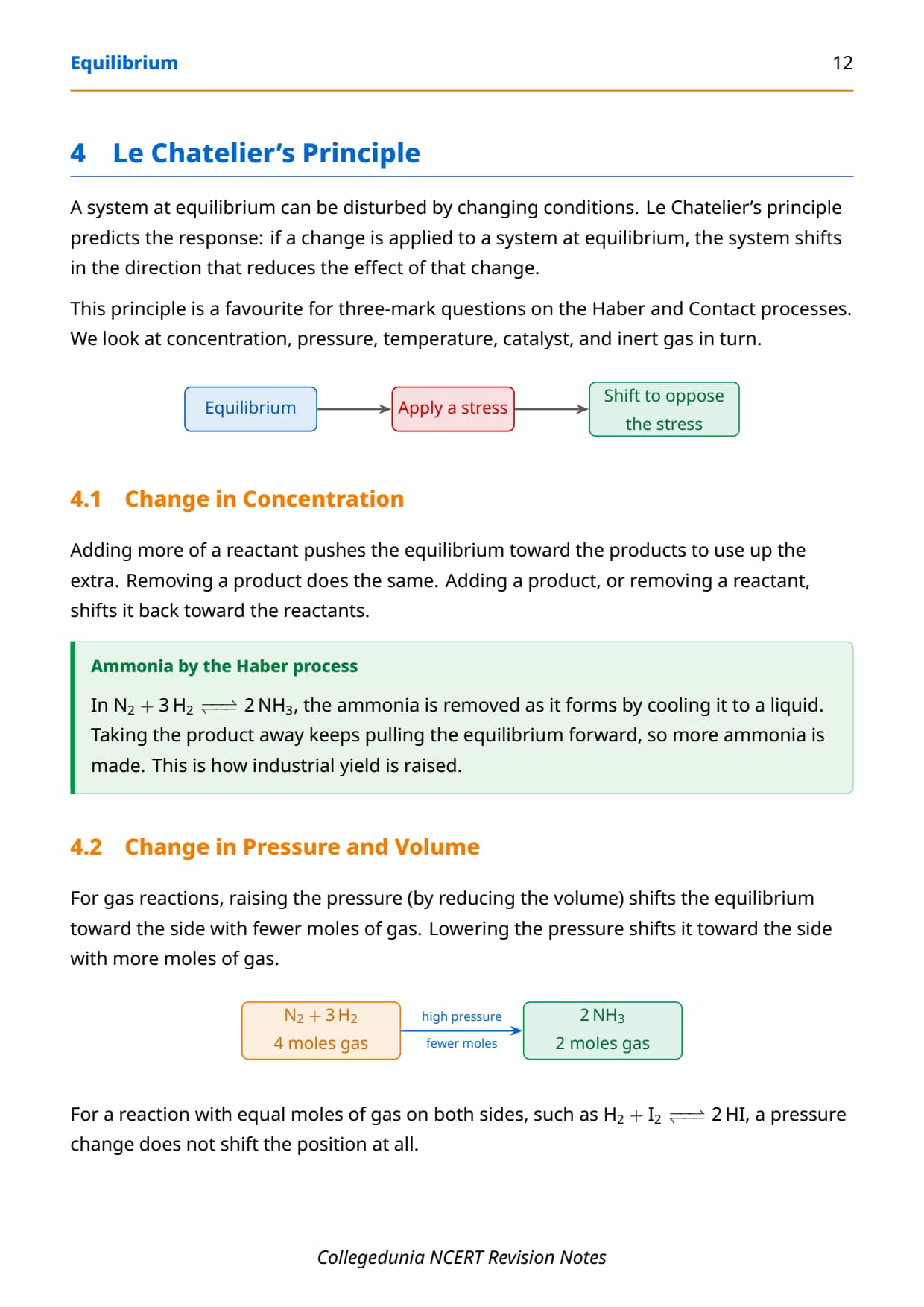
Le Chatelier's principle states that when a system at equilibrium is disturbed, it shifts to oppose the change. Adding a reactant shifts the equilibrium forward, and raising the pressure shifts it towards the side with fewer gas moles. Raising the temperature favours the endothermic direction, while a catalyst changes neither K nor the position of equilibrium. A catalyst only helps the system reach equilibrium faster, which is a favourite assertion-reason trap.
Ionic Equilibrium: Acids, Bases and the Ionization of Water
Ionic equilibrium applies the equilibrium constant to ions in water. It starts with three definitions of acids and bases, then adds the strength constants Ka and Kb, and finally the self-ionization of water that fixes the pH scale.
| Concept | Definition | Example |
|---|---|---|
| Arrhenius acid/base | Gives H+ / OH- ions in water | HCl, NaOH |
| Bronsted-Lowry acid/base | Proton (H+) donor / acceptor | NH4+ donates, NH3 accepts |
| Lewis acid/base | Electron-pair acceptor / donor | BF3 accepts, NH3 donates |
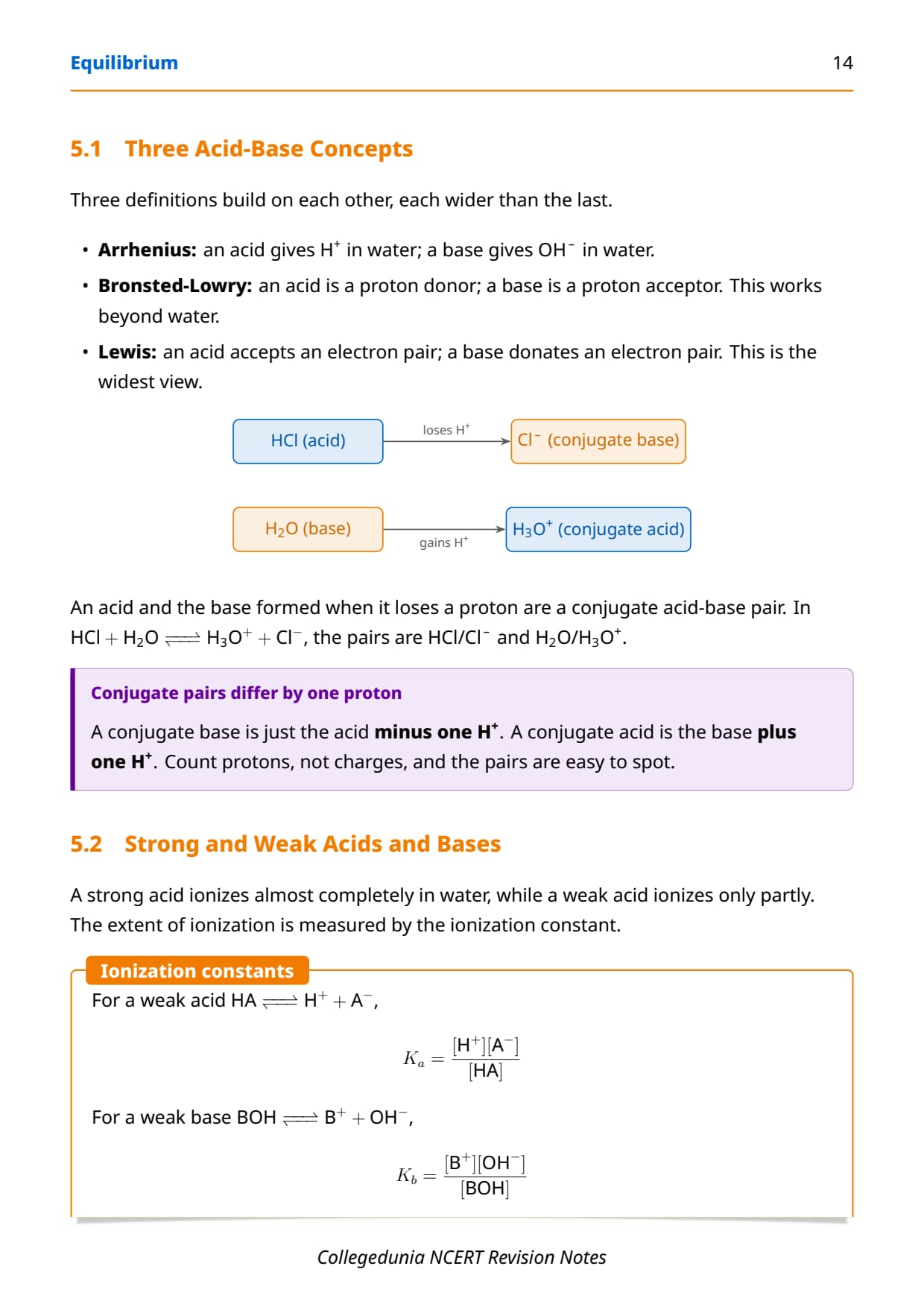
| Ka / Kb | Ionization constant of a weak acid / base | Larger Ka means a stronger acid |
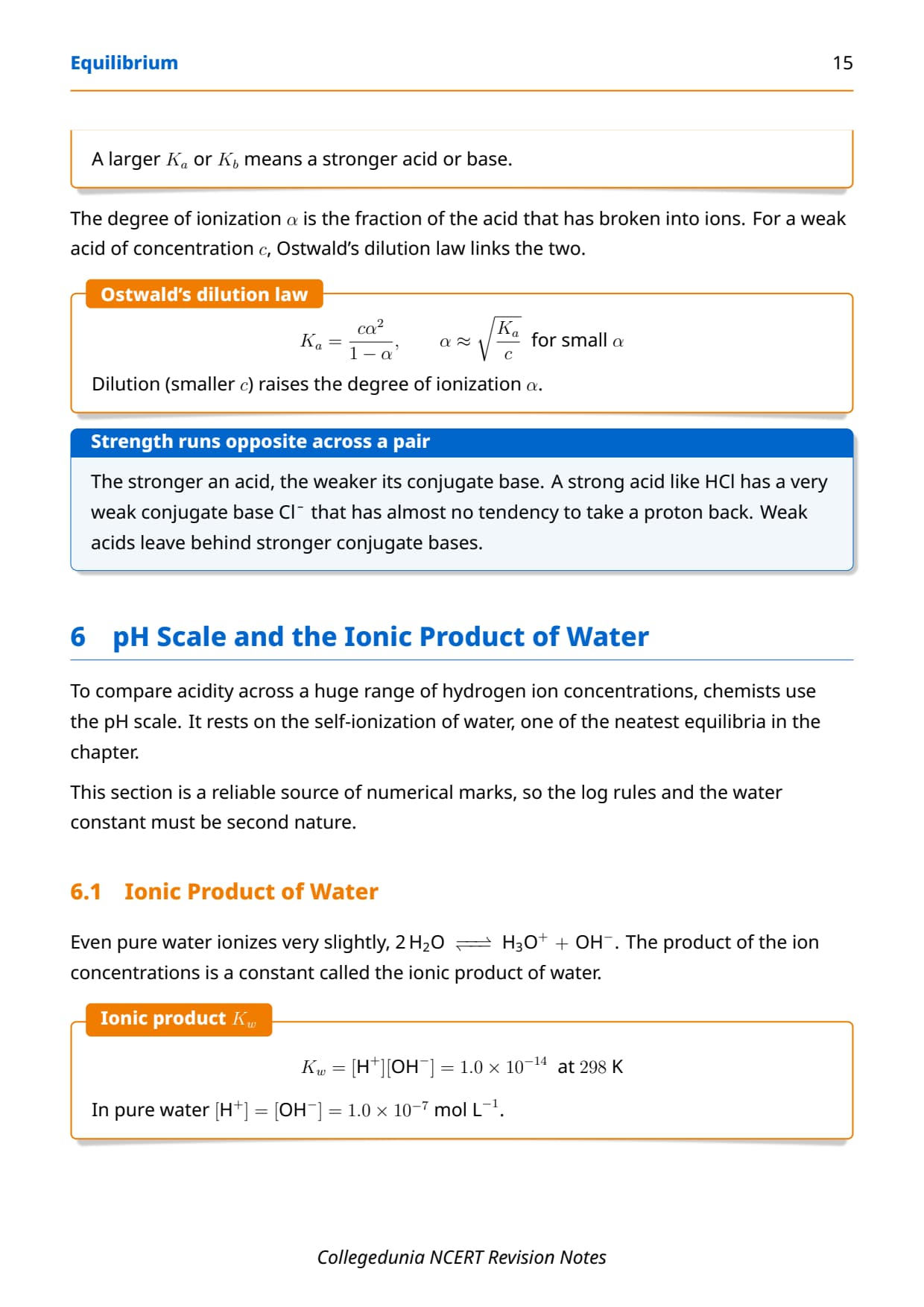
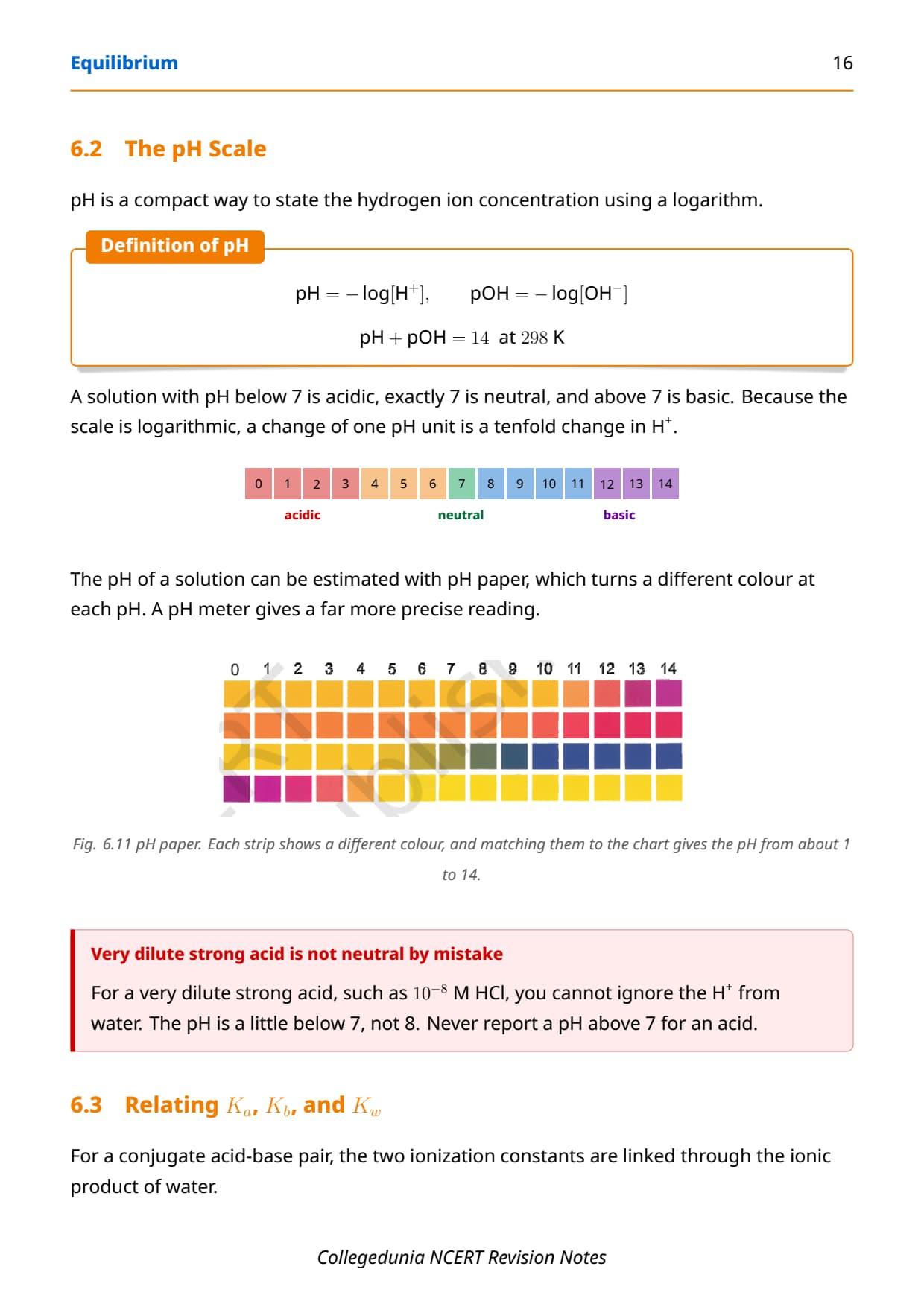
Water ionizes slightly, giving the ionic product Kw = [H+][OH-] = 1.0 × 10⁻¹⁴ at 298 K. From this comes the pH scale, where pH = -log[H+] and pH + pOH = 14. A neutral solution has pH 7, an acidic one below 7, and a basic one above 7. For a weak acid, Ka and Kb of its conjugate base are linked by Ka × Kb = Kw, a relation these equilibrium class 11 notes use throughout the ionic block.
Buffer Solutions, Common Ion Effect and Solubility Product
The last block covers real solutions where more than one equilibrium runs at once. It brings in buffers, the common ion effect, the solubility product for sparingly soluble salts, and the hydrolysis of salts. Each idea is the equilibrium constant applied to a specific mixture.
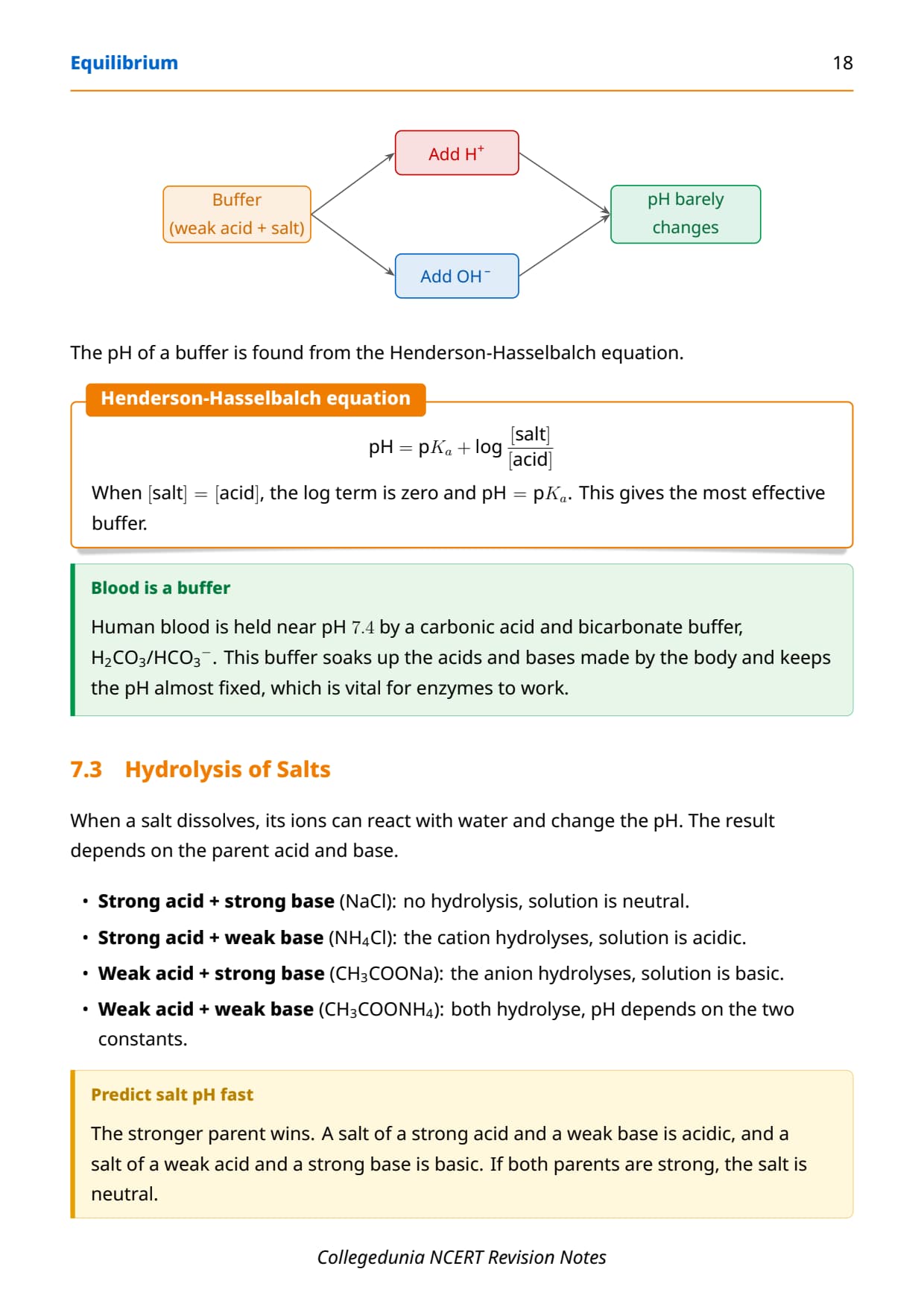
- Buffer solution: a mixture of a weak acid and its salt (or a weak base and its salt) that resists pH change on adding small amounts of acid or base.
- Henderson-Hasselbalch equation: pH = pKa + log([salt] / [acid]), used to find the pH of an acidic buffer.
- Common ion effect: adding an ion already present in an equilibrium suppresses the ionization of a weak electrolyte.
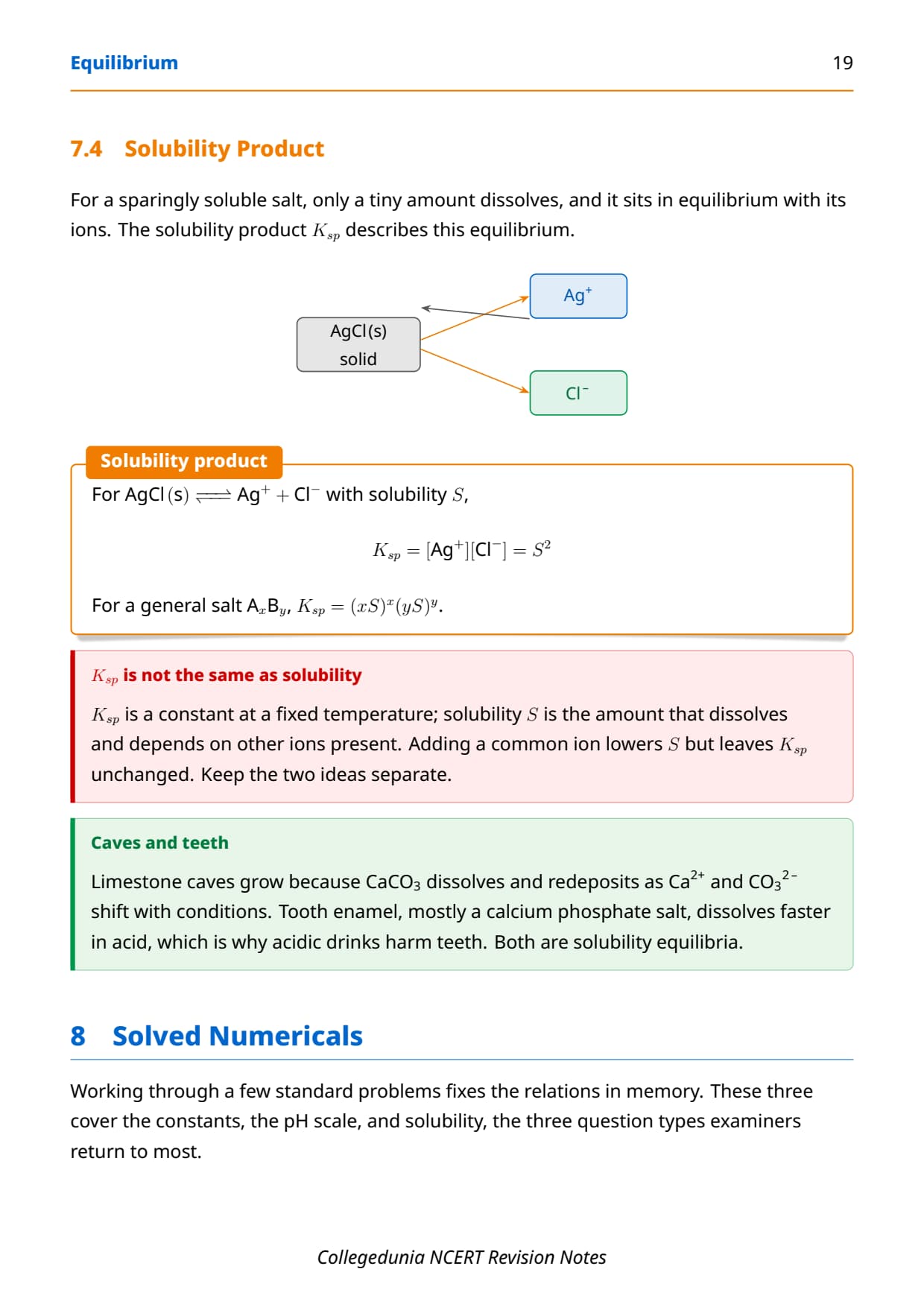
- Solubility product: Ksp is the equilibrium constant for a sparingly soluble salt dissolving into its ions.
- Salt hydrolysis: the reaction of a salt's ions with water, which makes the solution acidic, basic, or neutral.
For a salt AxBy, the solubility product links to solubility s, so a salt like AgCl has Ksp = [Ag+][Cl-] = s2. A precipitate forms only when the ionic product exceeds Ksp. A salt of a strong acid and weak base gives an acidic solution, while a salt of a weak acid and strong base gives a basic one. The common ion effect is why adding a bit of the salt lowers a weak acid's ionization and raises its pH.
Important Formulas and Values for Equilibrium
Every formula and value you need for the chapter sits in one table below, with what it means. Learn the Kp-Kc and pH rows first, since those carry the most marks in both Boards and entrance papers.
| Formula or value | What it means |
|---|---|
| Kc = [C]c[D]d / [A]a[B]b | Equilibrium constant from molar concentrations |
| Kp = Kc(RT)Δn | Links the pressure and concentration constants |
| Kw = [H+][OH-] = 1.0 × 10⁻¹⁴ | Ionic product of water at 298 K |
| pH = -log[H+] | Acidity of a solution on the pH scale |
| pH + pOH = 14 | Relation between pH and pOH at 298 K |
| Ka × Kb = Kw | Link between a weak acid and its conjugate base |
| pH = pKa + log([salt] / [acid]) | Henderson equation for an acidic buffer |
| Ksp = [A+][B-] | Solubility product of a sparingly soluble salt |
| α = √(Ka / C) | Degree of ionization of a weak acid (Ostwald's law) |
Carry the unit on every line of your working. Losing a unit or a log step is a silent way to drop the final mark even when the number is right. Keep this table open while you solve the back-exercise numericals in these revision notes.
Key Definitions in Equilibrium
Board short-answer questions often ask for a clean definition in one or two lines. Learn these word-for-word, because a vague definition loses easy marks. Each one also sets up a numerical you can be asked to solve.
| Term | Definition |
|---|---|
| Chemical equilibrium | The state where the forward and reverse reaction rates are equal in a closed system. |
| Equilibrium constant | The fixed ratio of product to reactant active masses at equilibrium, at a given temperature. |
| Reaction quotient | The concentration ratio in the K expression at any instant during the reaction. |
| Buffer solution | A solution that resists a change in pH when a small amount of acid or base is added. |
| Common ion effect | The suppression of ionization of a weak electrolyte by adding a common ion. |
| Solubility product (Ksp) | The equilibrium constant for a sparingly soluble salt in equilibrium with its ions. |
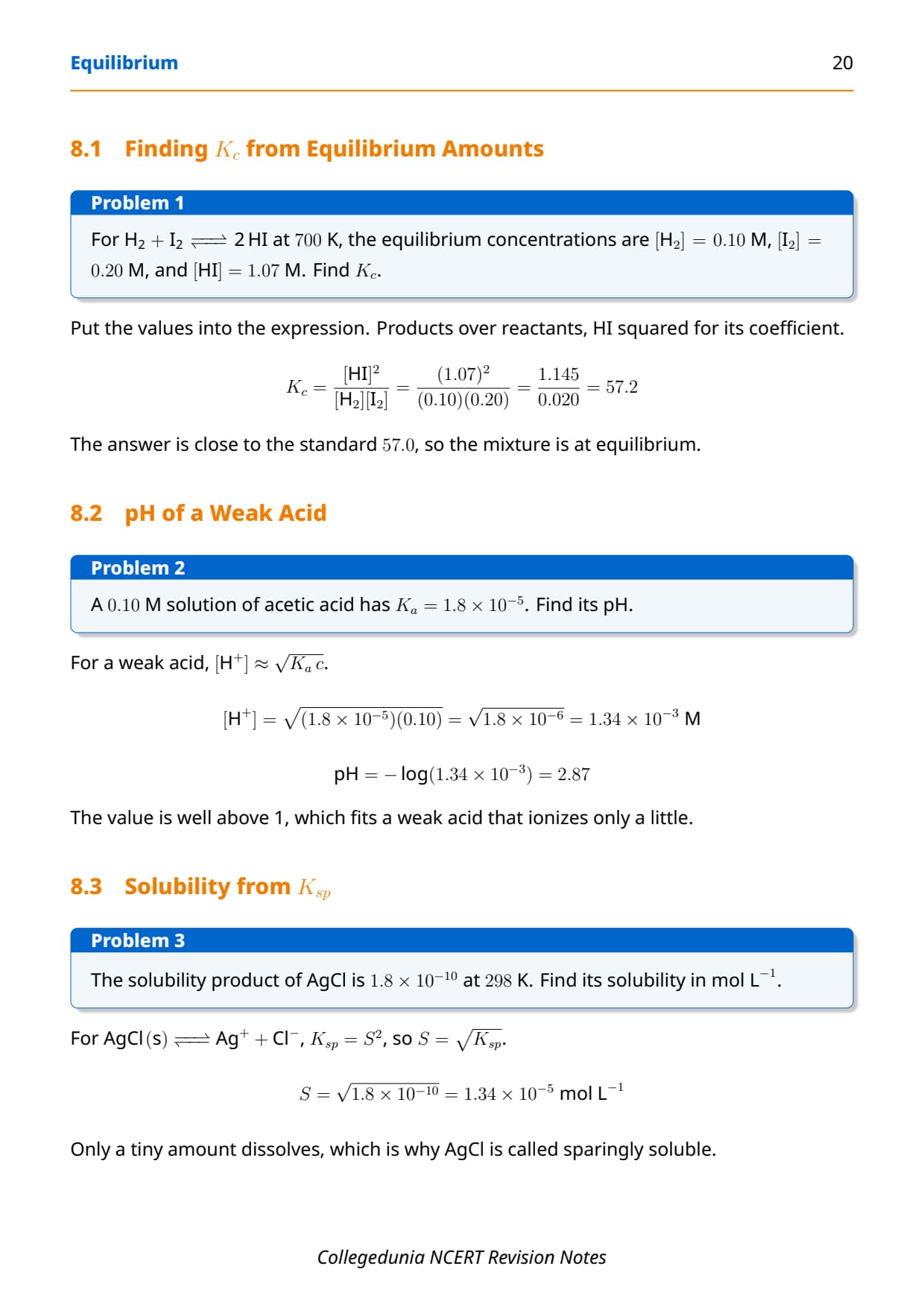
A common numerical asks you to find the pH of a weak acid or a buffer. Use Ka for the weak acid, then the Henderson equation for the buffer, and keep the log values handy. Learning these definitions makes the wording of every board question familiar.
Common Mistakes Students Make in Equilibrium
These slips happen while setting up or calculating, not because the concept is unclear. Each one costs 1 to 3 marks in the paper, so watch for them at the exact step.
Mistake 1: Including pure solids and liquids in the K expression. Their active mass is one, so leave them out of Kc and Kp.
Mistake 2: Using the wrong sign of Δn in Kp = Kc(RT)Δn. Count moles of gaseous products minus gaseous reactants only.
Mistake 3: Thinking a catalyst changes K or the equilibrium position. A catalyst only speeds up how fast equilibrium is reached.
Mistake 4: Forgetting the negative sign in pH = -log[H+], which flips acidic and basic answers.
Equilibrium Weightage in CBSE Boards, JEE and NEET
This chapter is large and consistently high-scoring. It carries both a numerical and a reasoning question every year, and its ionic half is a favourite in entrance papers. Here is how the marks split across the main exams for 2026-27.
| Exam | Typical weightage | What is asked |
|---|---|---|
| CBSE Boards | 7 to 9 marks | One Kc/Kp or pH numerical plus one Le Chatelier short answer |
| JEE Main | 2 to 3 questions | Kp-Kc relation, pH, buffers, and Ksp |
| JEE Advanced | 1 to 2 questions | Multi-equilibria, common ion effect, and salt hydrolysis |
| NEET | 2 to 3 questions | Le Chatelier, pH, Ka/Kb, and solubility product |
Ionic equilibrium, pH and buffers together carry more questions than the Kc-Kp block in NEET and JEE Main. Master the equilibrium constant first, then Le Chatelier, then the full pH and Ksp block, in that order of return on effort.
How to Revise Equilibrium Quickly
Use these equilibrium class 11 notes for a fast, ordered recap the night before a test. The checklist below takes about 30 minutes and hits every marks-heavy idea.
- First 10 minutes: write the Kc expression, the Kp = Kc(RT)Δn relation, and the Q-versus-K rule from memory.
- Next 10 minutes: list the three shifts of Le Chatelier's principle and solve one pH problem for a weak acid.
- Last 10 minutes: write the Henderson equation and one Ksp expression, then decide the nature of two hydrolysed salts.
Close the loop by predicting the direction of one disturbed equilibrium. If you can do all three blocks without notes, the chapter is exam-ready. Keep the Important Formulas table beside you for the first pass only, then try it closed-book.
Student Feedback on the Equilibrium Notes
What 14,210 students told us about their Equilibrium revision:
- 68% of students rated the ionic equilibrium and pH block as the hardest part of the chapter.
- Most-skipped step: getting the sign of Δn right in the Kp-Kc relation, missed by about 3 in 10 students.
- Students who revised the equilibrium constant first said the buffer and Ksp problems felt far easier.
Source: 2026-27 Class 11 Chemistry student poll. Sample of 14,210 students from CBSE schools across 15 states, conducted before the 2026 boards.
Other Equilibrium Class 11 Chemistry Resources
Pair these notes with the solved answers and the textbook PDF for the same chapter.
| Resource | Link |
|---|---|
| NCERT Solutions | Equilibrium Class 11 NCERT Solutions |
| NCERT Book PDF | Equilibrium Class 11 Book PDF |
NCERT Notes for Class 11 Chemistry: All Chapters
Jump to the revision notes for any other Class 11 Chemistry chapter below.
| Chapter | NCERT Notes |
|---|---|
| Chapter 1 | Some Basic Concepts of Chemistry |
| Chapter 2 | Structure of Atom |
| Chapter 3 | Classification of Elements and Periodicity in Properties |
| Chapter 4 | Chemical Bonding and Molecular Structure |
| Chapter 5 | Thermodynamics |
| Chapter 6 | Equilibrium |
| Chapter 7 | Redox Reactions |
| Chapter 8 | Organic Chemistry Some Basic Principles and Techniques |
| Chapter 9 | Hydrocarbons |
FAQs on Equilibrium Class 11 Chemistry Notes
Equilibrium Notes - Frequently Asked Questions
Ques. What topics do the equilibrium class 11 notes cover?
Ans. These equilibrium class 11 notes cover physical and chemical equilibrium, the law of mass action, the equilibrium constants Kc and Kp with their relation, the reaction quotient, Le Chatelier's principle, acids and bases by the Arrhenius, Bronsted-Lowry and Lewis views, Ka and Kb, the ionization of water and pH, buffer solutions, the common ion effect, the solubility product Ksp, and salt hydrolysis. Every key formula and definition is included for fast revision.
Ques. What is the relation between Kp and Kc?
Ans. For a gaseous reaction, Kp = Kc(RT)Δn, where R is the gas constant, T is the temperature in kelvin, and Δn is moles of gaseous products minus moles of gaseous reactants. When Δn is zero, Kp equals Kc and both are unitless, as in the reaction H2 + I2 ↔ 2HI. Getting the sign of Δn right is the most common place students lose the mark.
Ques. What is Le Chatelier's principle?
Ans. Le Chatelier's principle states that when a system at equilibrium is disturbed, it shifts in the direction that reduces the disturbance. Adding a reactant shifts it forward, increasing the pressure shifts it towards fewer gas moles, and raising the temperature favours the endothermic direction. A catalyst changes neither the value of K nor the position of equilibrium; it only helps the system reach equilibrium faster.
Ques. How do I calculate the pH of a solution?
Ans. The pH is the negative logarithm of the hydrogen ion concentration, pH = -log[H+]. A neutral solution has pH 7, an acidic one is below 7, and a basic one is above 7. Since Kw = [H+][OH-] = 1.0 × 10⁻¹⁴ at 298 K, pH and pOH always add up to 14. For a weak acid, first find [H+] using Ka, then take the negative log.
Ques. What is a buffer solution and the Henderson equation?
Ans. A buffer solution resists a change in pH when a small amount of acid or base is added. An acidic buffer is a weak acid with its salt, and a basic buffer is a weak base with its salt. The pH of an acidic buffer is found from the Henderson-Hasselbalch equation, pH = pKa + log([salt] / [acid]). Buffers work because of the common ion effect, which keeps the acid mostly un-ionized.
Ques. What is the weightage of Equilibrium in the CBSE board exam?
Ans. Equilibrium carries about 7 to 9 marks in the CBSE Class 11 Chemistry paper, usually one Kc/Kp or pH numerical plus one short answer on Le Chatelier's principle. It is also heavily tested in JEE Main, JEE Advanced and NEET, where the ionic equilibrium half, covering pH, buffers, common ion effect and Ksp, carries more questions than the gaseous equilibrium block.
Ques. How should I revise Equilibrium quickly for a test?
Ans. Start by writing the Kc expression, the Kp = Kc(RT)Δn relation, and the Q-versus-K rule from memory. Then list the three shifts of Le Chatelier's principle and solve one weak-acid pH problem. Finish with the Henderson equation, one Ksp expression, and the nature of two hydrolysed salts. The quick-revision checklist in these equilibrium class 11 notes covers all of this in about 30 minutes.



Comments