




These thermodynamics class 11 notes pull together every law, term, and energy formula that the CBSE Boards, JEE Main, JEE Advanced, NEET and CUET papers test in 2026-27. Revise the whole chapter fast, with the first law, enthalpy, entropy, and the Gibbs energy criterion for spontaneity all in one place.
This chapter builds the energy side of chemistry, and the sign rules you learn here decide whether a reaction gives out heat, absorbs it, or happens on its own.
- CBSE Weightage: 7 to 8 marks, usually one enthalpy or Gibbs energy numerical plus one short answer on the laws.
- Topics covered: system and surroundings, state functions, first law, enthalpy, heat capacity, Hess's law, bond enthalpy, entropy, and Gibbs energy.
- Key formulas: ΔU = q + w, ΔH = ΔU + ΔngRT, Cp − Cv = R, and ΔG = ΔH − TΔS.
These thermodynamics class 11 notes are curated by subject experts, based on the 2026-27 NCERT textbook, and checked against the last five years of CBSE Board, JEE Main and NEET papers.
Topic-by-Topic Summary of Thermodynamics
The chapter studies the flow of energy in chemical and physical changes. It starts by defining the system and the ways it exchanges energy, then builds the first law, enthalpy, and finally the entropy and Gibbs energy that decide spontaneity. Here is the quick map of what each topic gives you.
- System and surroundings: the part under study and everything else, plus open, closed and isolated types.
- State functions: properties like U, H, S and G that depend only on the state, not the path.
- First law of thermodynamics: the conservation of energy written as ΔU = q + w.
- Enthalpy and heat capacity: heat at constant pressure, and how much heat raises the temperature.
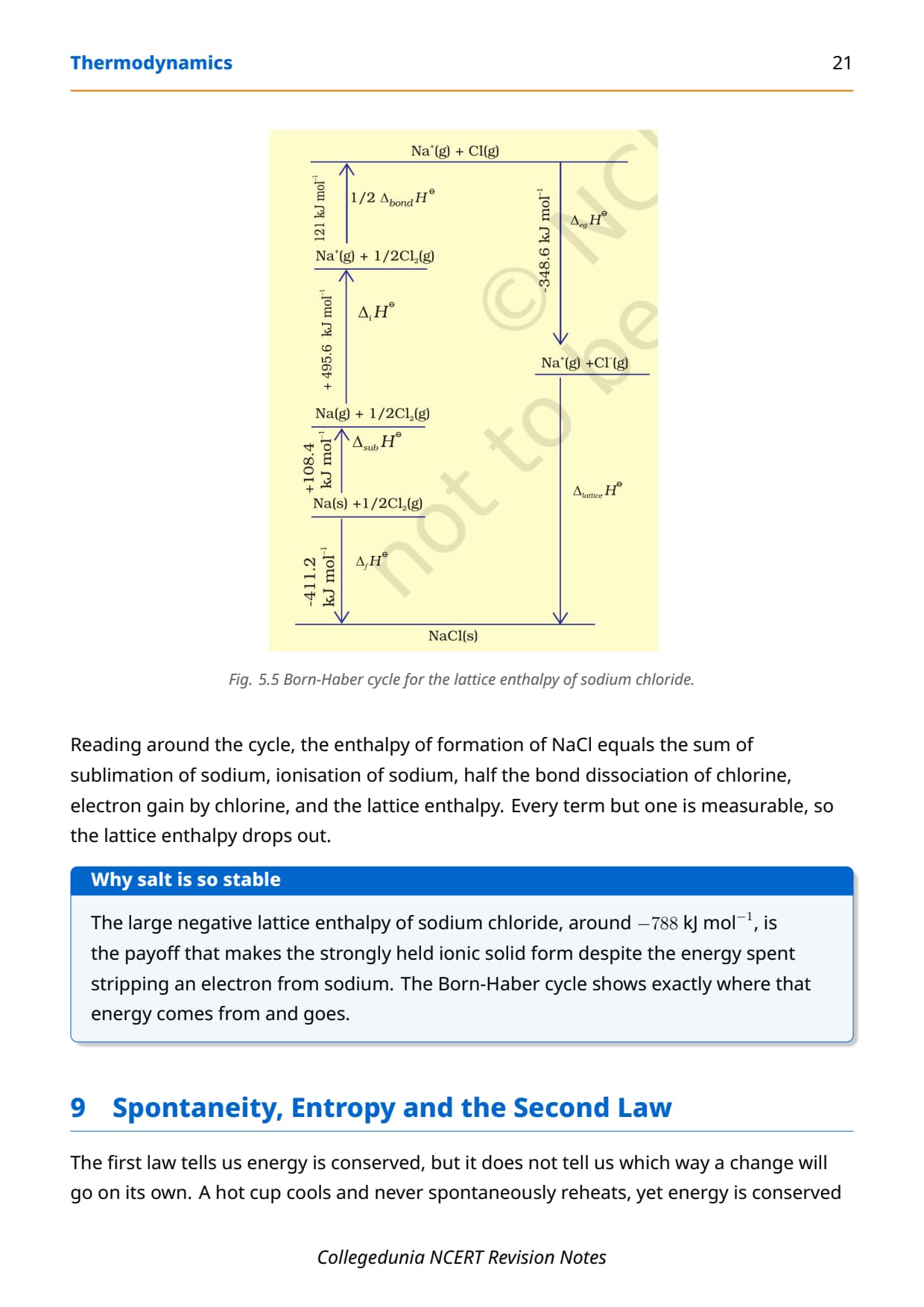
- Hess's law and bond enthalpy: adding reaction enthalpies, and energy stored in bonds.
- Entropy and Gibbs energy: the disorder of a system and the criterion for a spontaneous change.
Revise the topics in this order, because each one uses the one before it. Get the sign conventions right first, and every enthalpy and Gibbs energy numerical becomes easy. These thermodynamics class 11 notes follow the same sequence as the NCERT textbook.
System, Surroundings and Types of Thermodynamic System
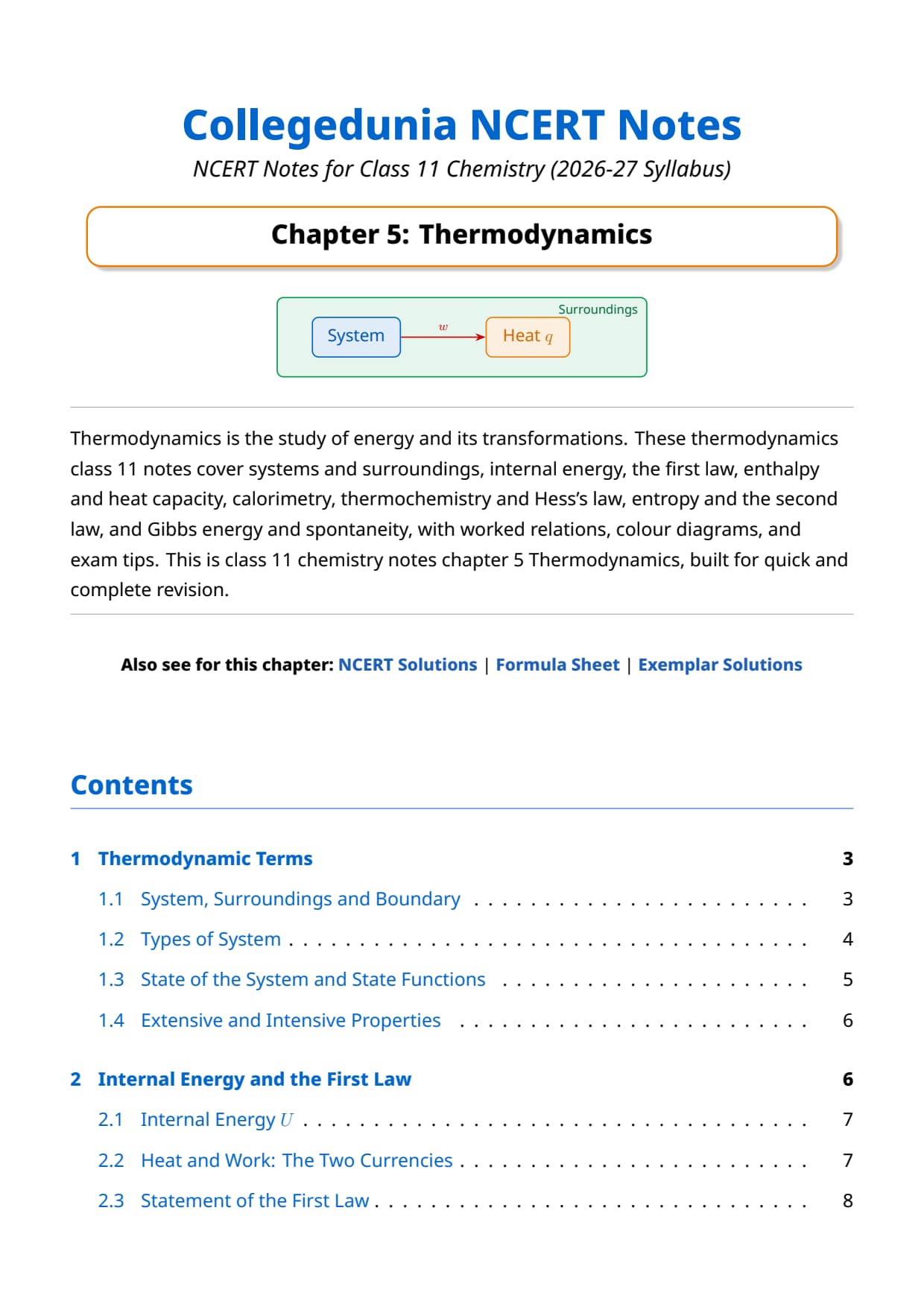
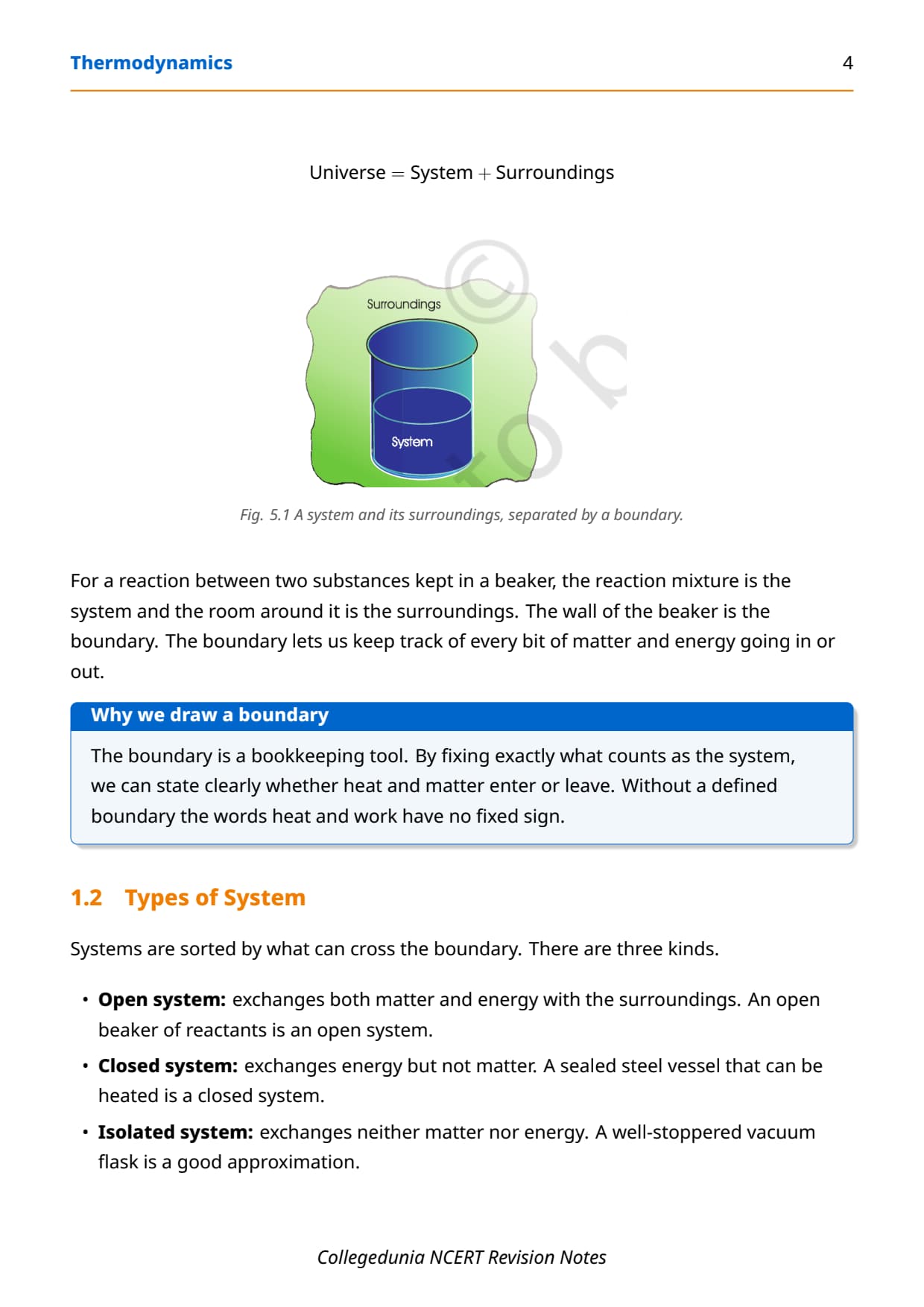
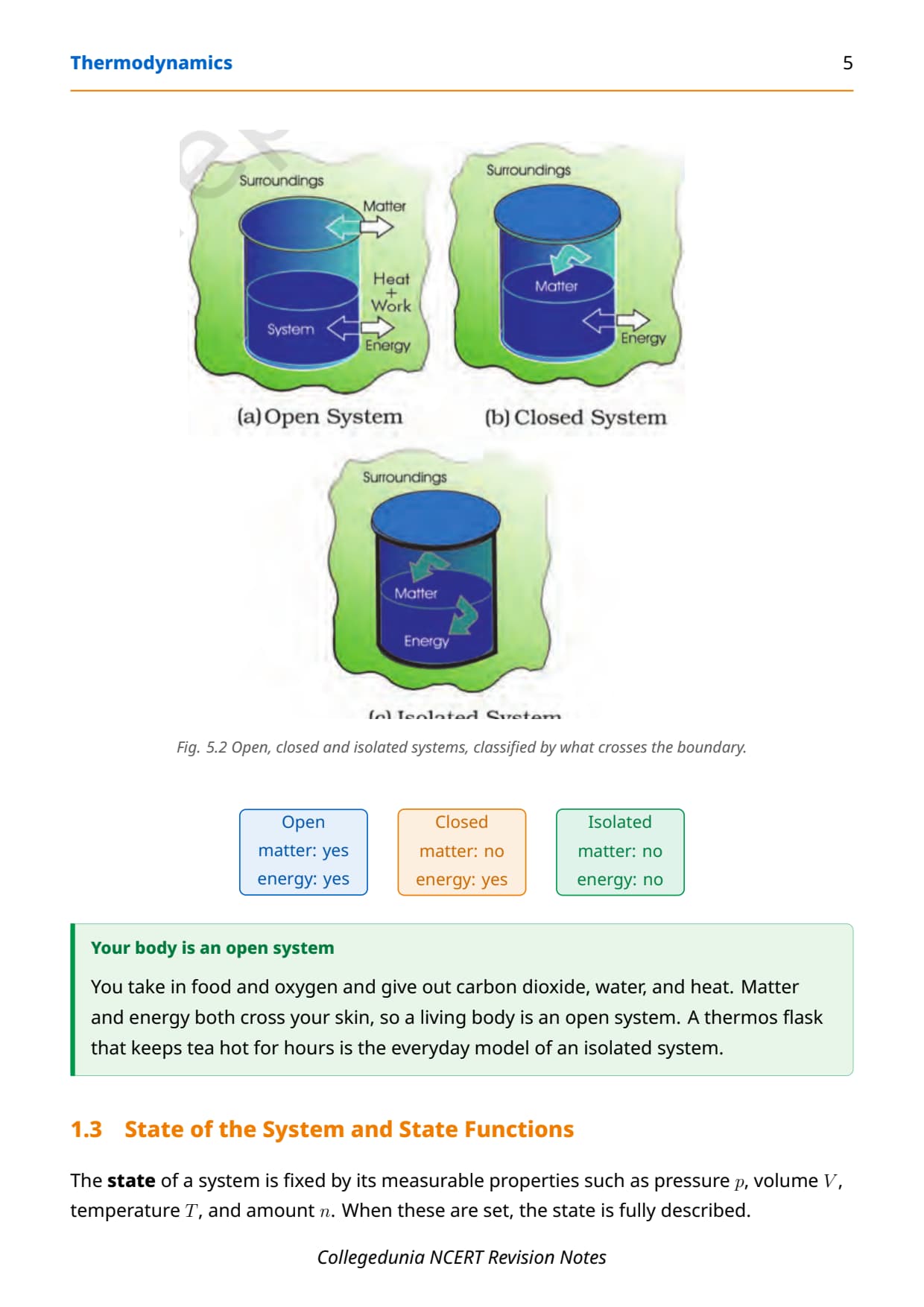
Thermodynamics splits the universe into two parts. The system is the part you study, and the surroundings is everything outside it. The boundary between them can let matter and energy pass, or block them, and that choice fixes the type of system.
- Open system: exchanges both matter and energy with the surroundings, like hot water in an open beaker.
- Closed system: exchanges energy but not matter, like water in a sealed metal container.
- Isolated system: exchanges neither matter nor energy, like coffee in a perfect thermos flask.
- Types of process: isothermal (constant T), isobaric (constant P), isochoric (constant V), and adiabatic (no heat exchange, q = 0).
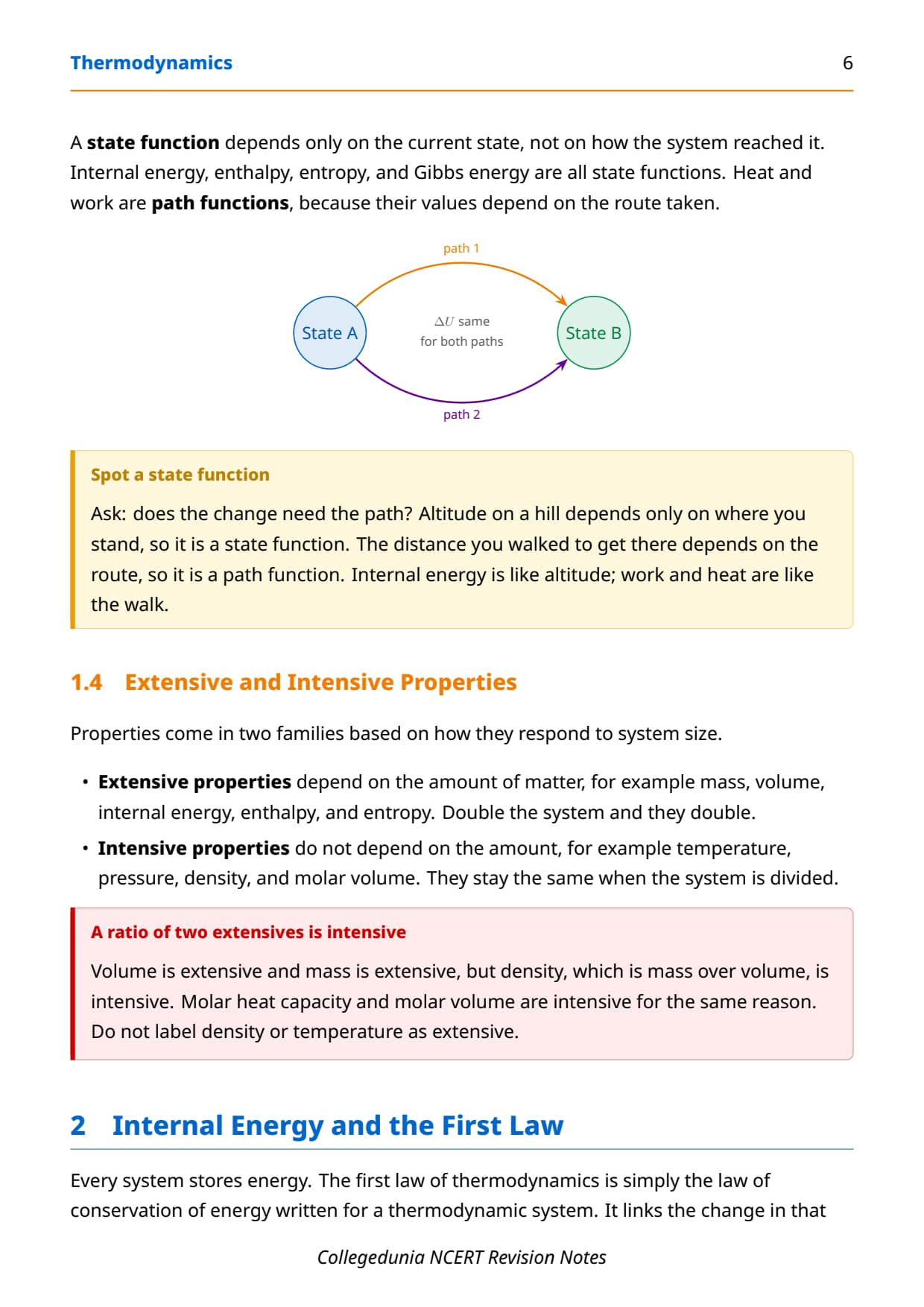
A state function depends only on the present state of the system, not on how it got there. Internal energy, enthalpy, entropy and Gibbs energy are all state functions, so their change is fixed by the start and end points. Heat and work are path functions, so their values change with the route taken between the same two states.
Internal Energy, Work, Heat and the First Law of Thermodynamics
The internal energy (U) is the total energy stored in a system as kinetic and potential energy of its particles. A system changes its internal energy by exchanging heat (q) and work (w) with the surroundings. The first law ties these three together and is simply the conservation of energy.
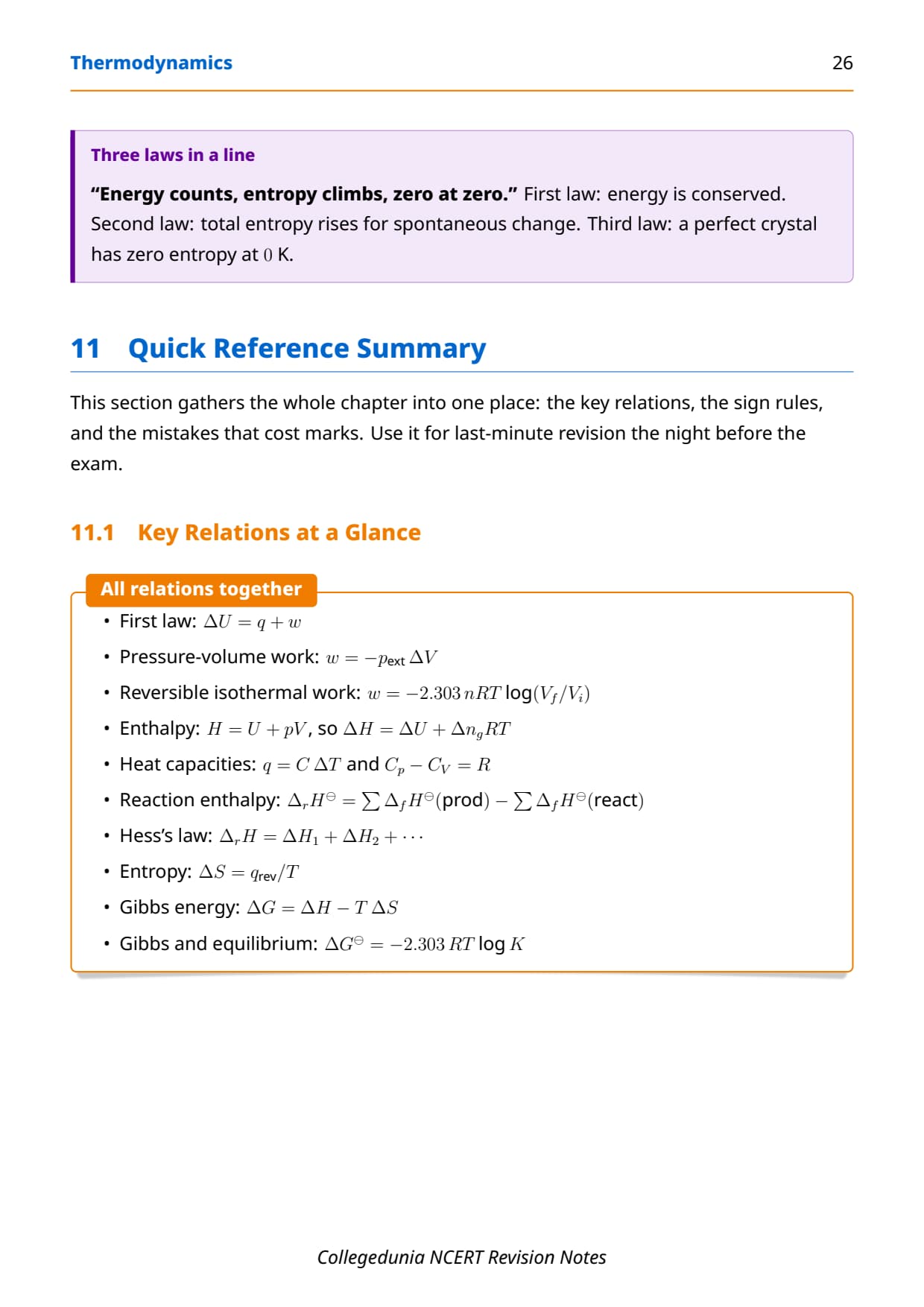
- First law: ΔU = q + w, so the change in internal energy equals heat added plus work done on the system.
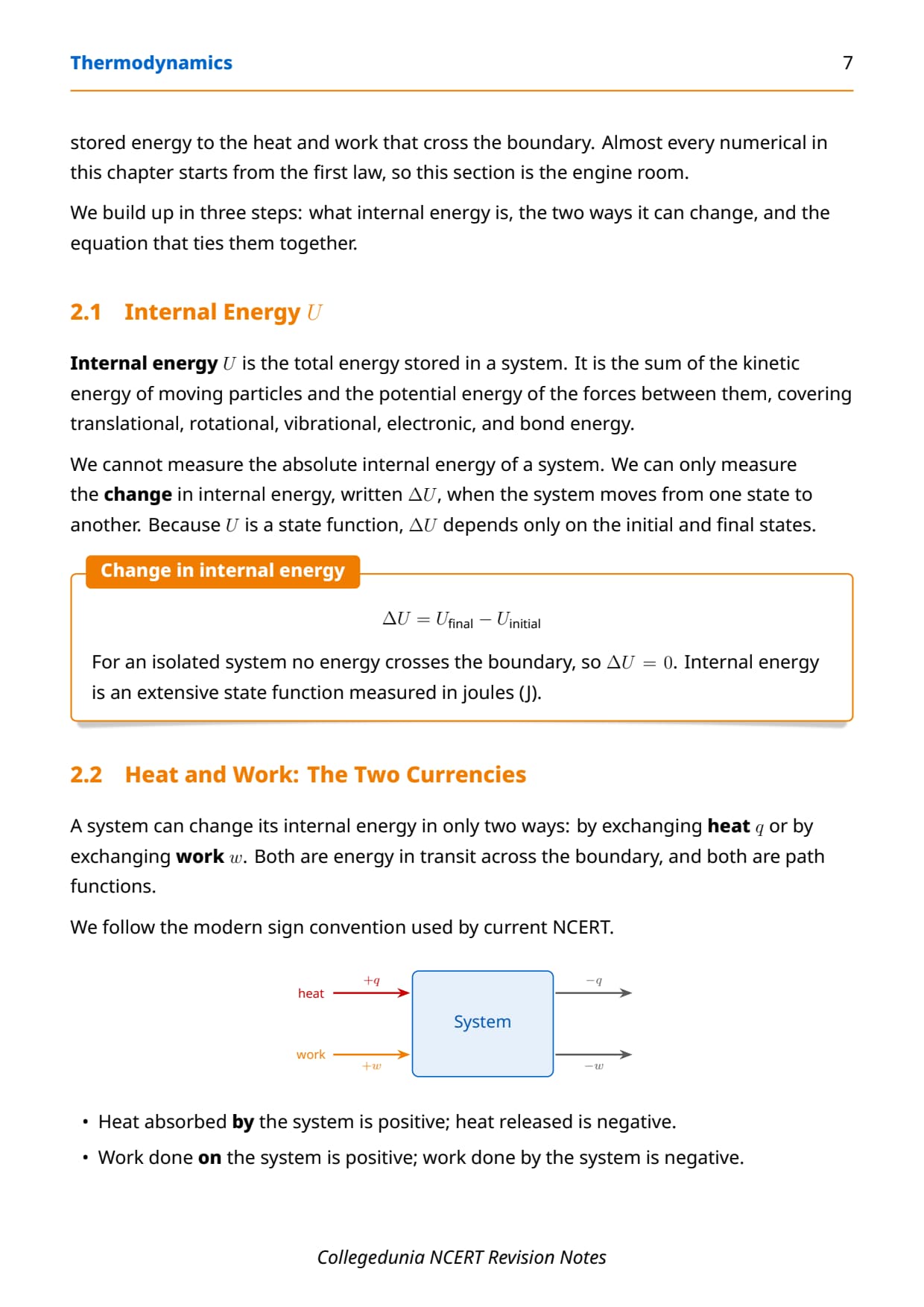
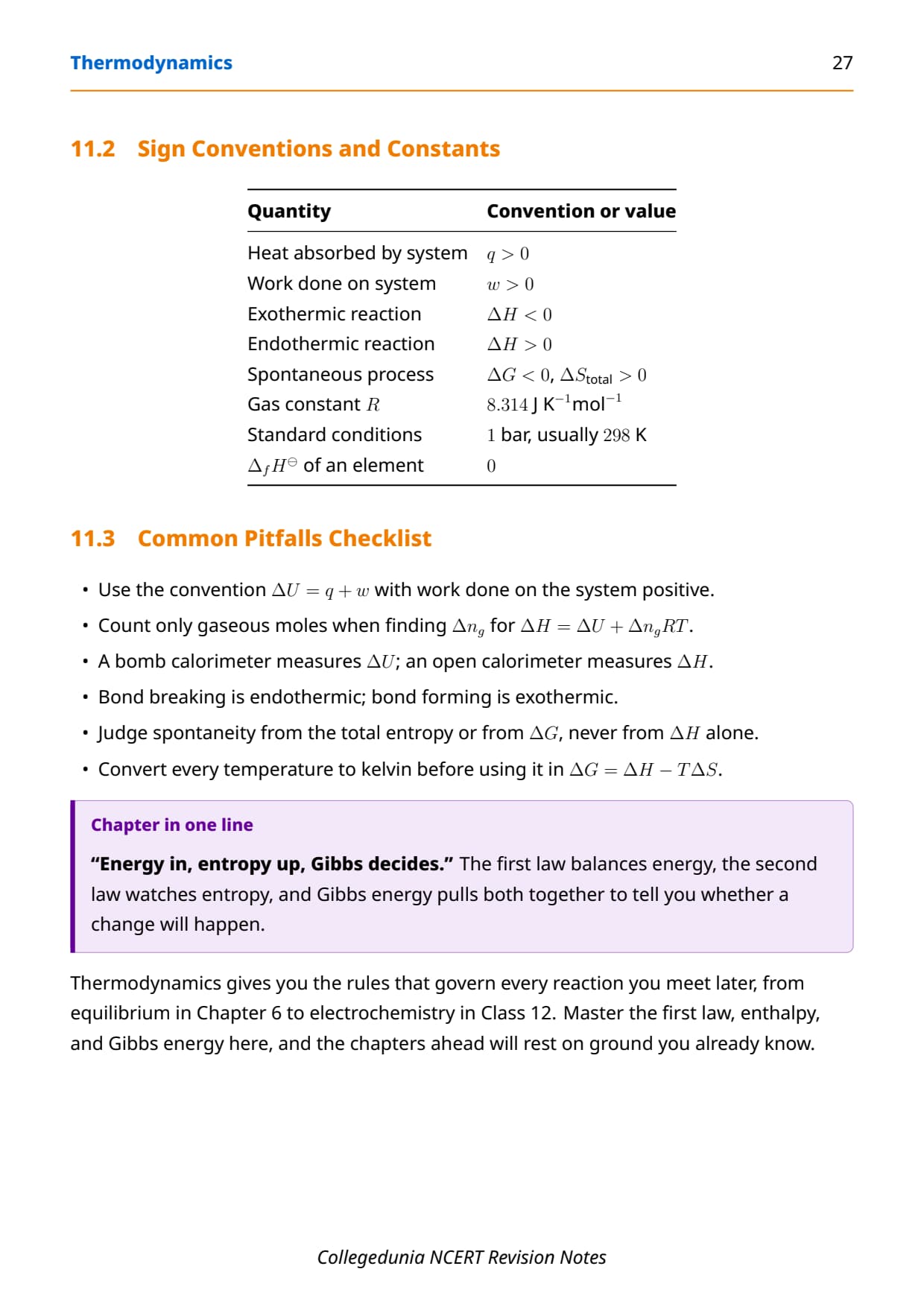
- Sign of heat: q is positive when heat is absorbed by the system and negative when heat is released.
- Sign of work: w is positive when work is done on the system and negative when the system does work on the surroundings.
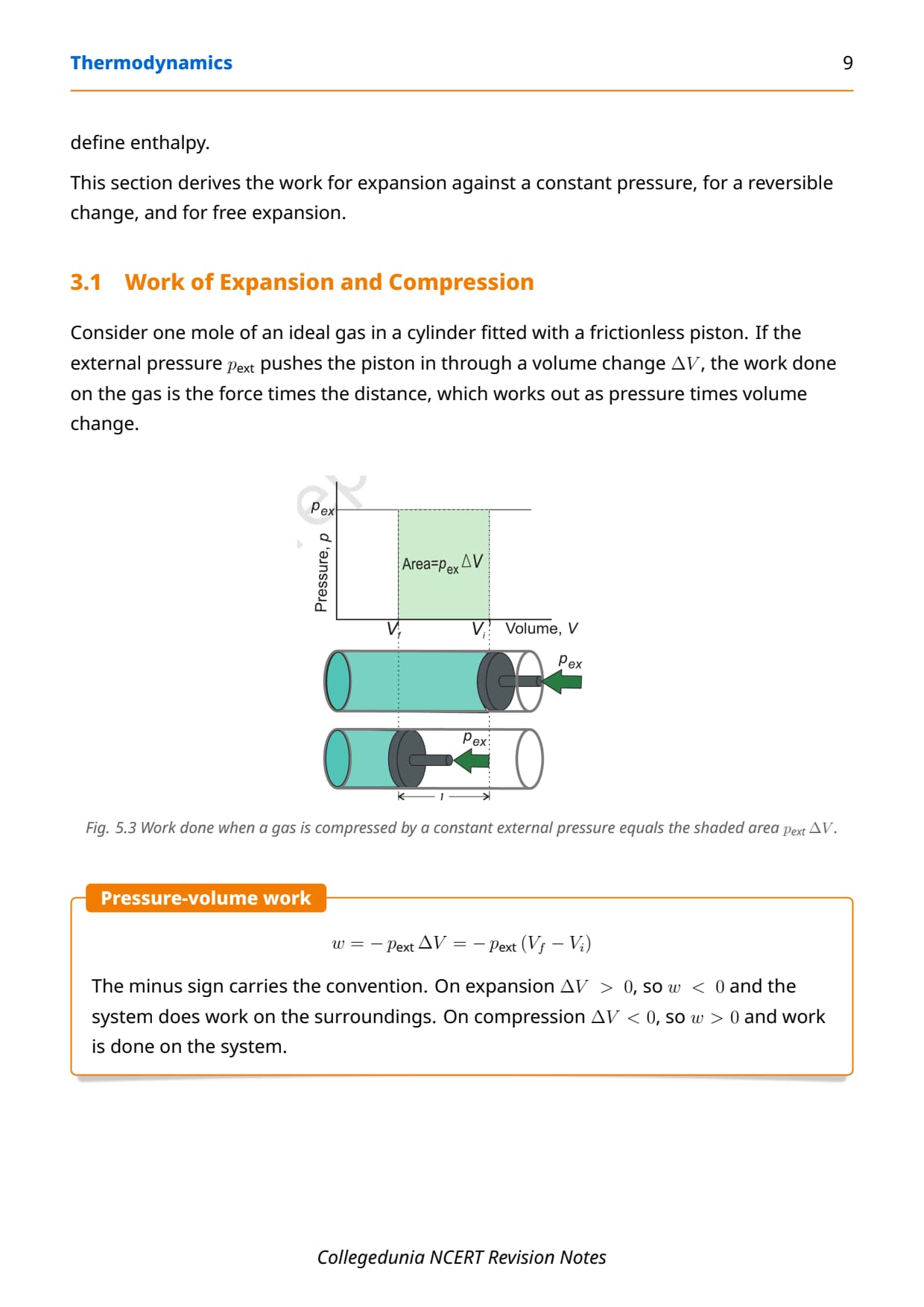
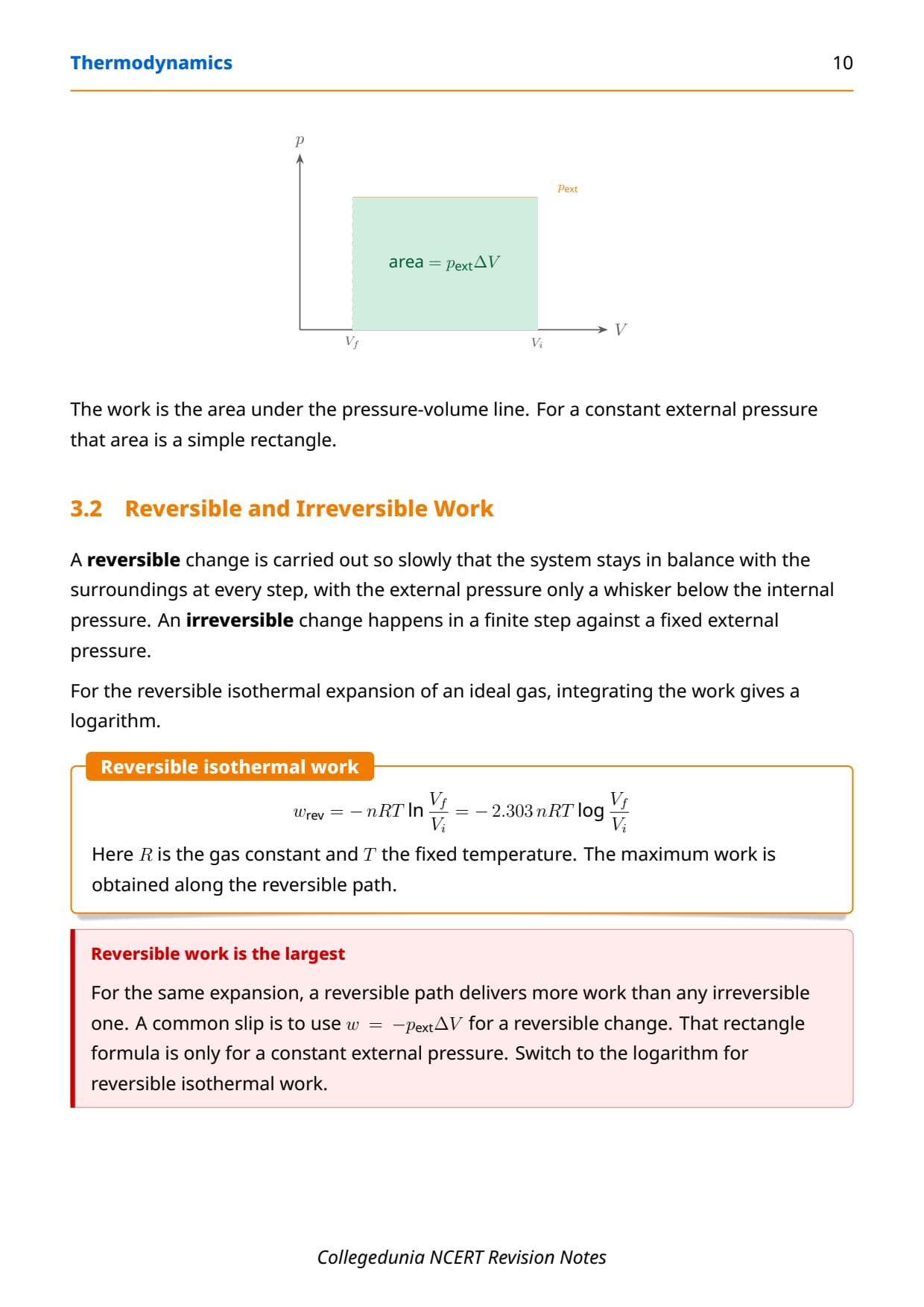
- Pressure-volume work: for expansion against constant pressure, w = −PextΔV.
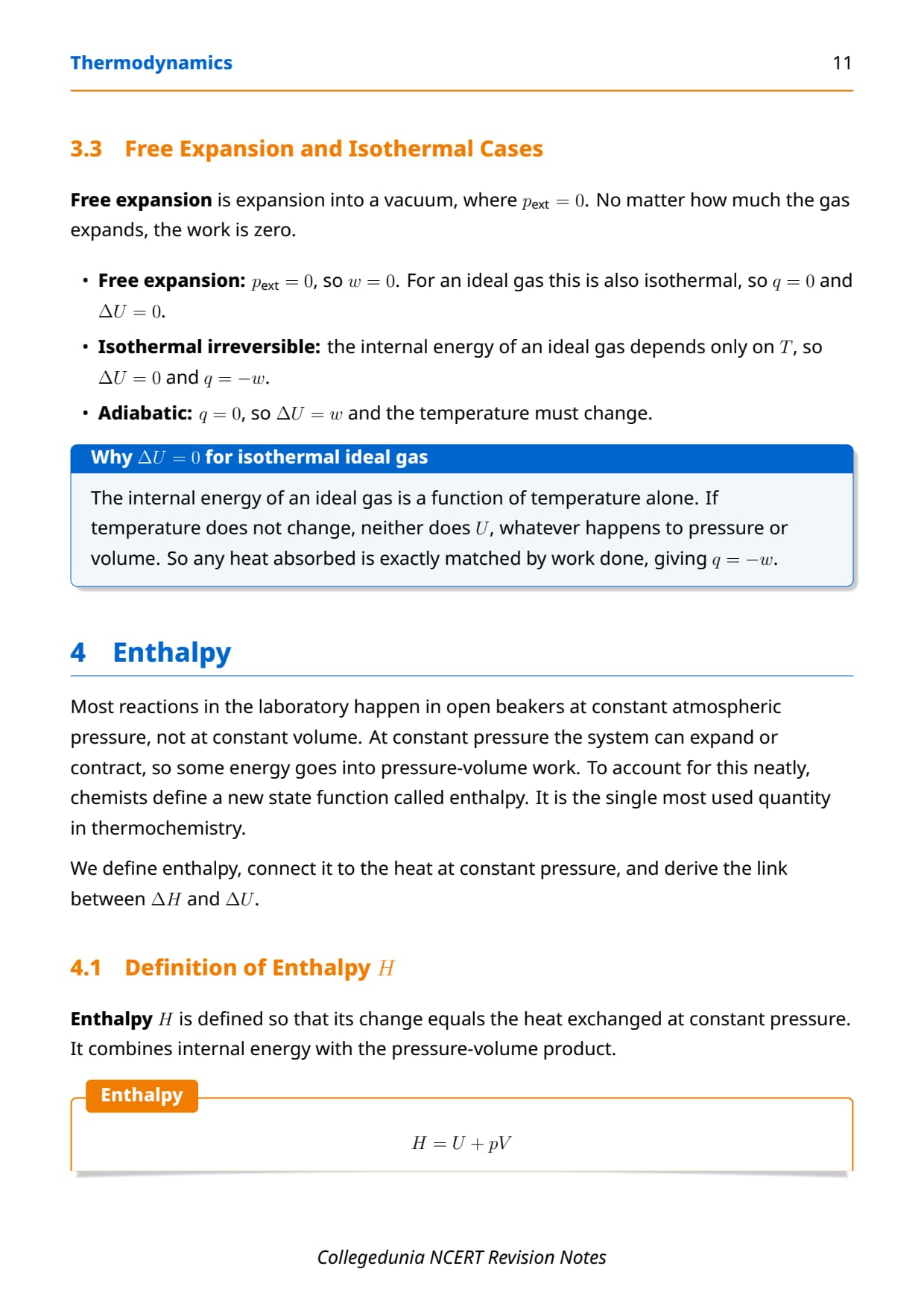
For an isothermal expansion of an ideal gas, ΔU = 0, so q = −w. For an adiabatic change, q = 0, so ΔU = w. Keeping the sign of q and w correct is the single most common place students lose marks in this chapter. The NCERT sign convention treats work done on the system as positive, so always write the first law as ΔU = q + w in these revision notes.
Enthalpy, Heat Capacity and Enthalpies of Reaction
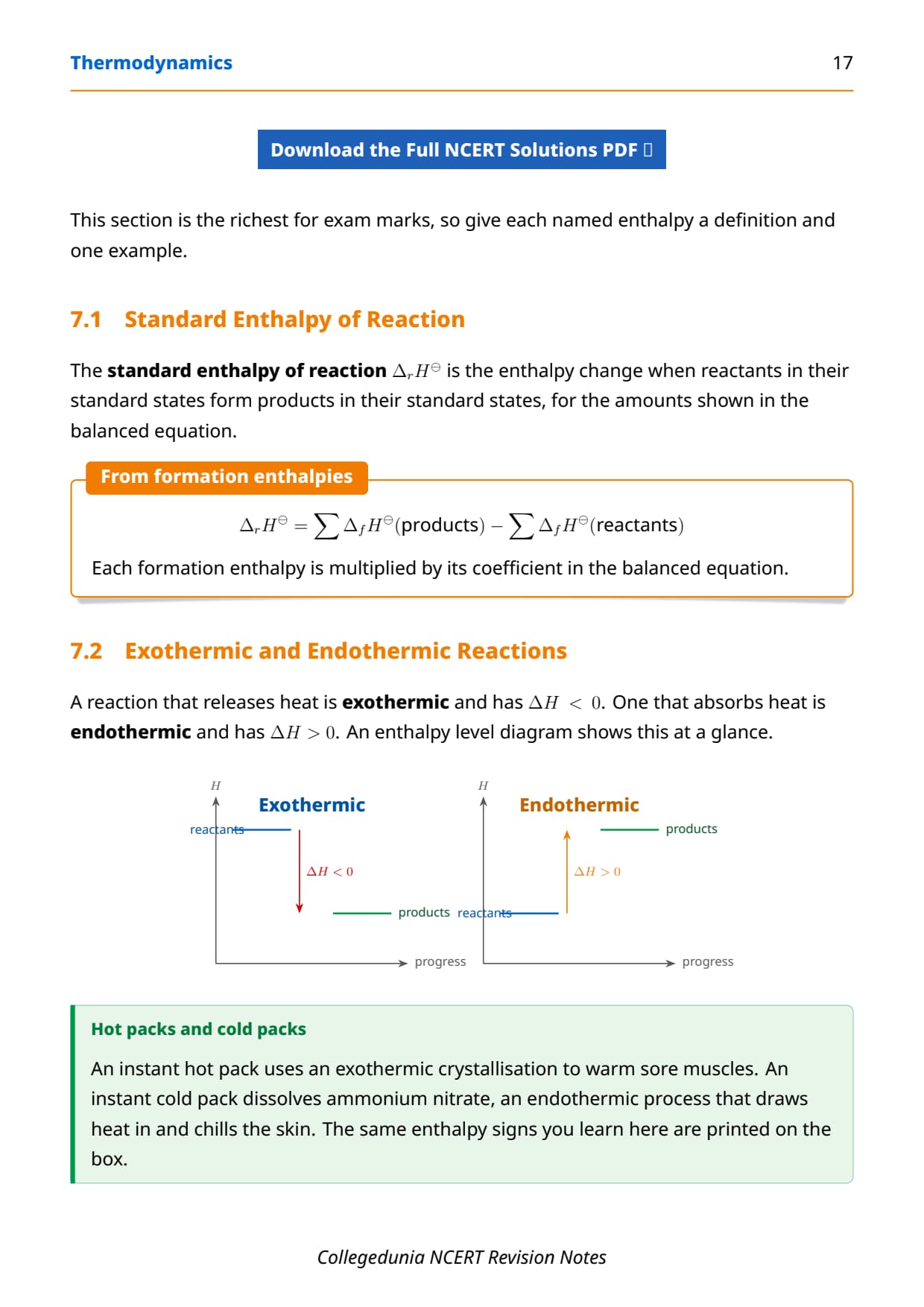
Enthalpy (H) is the heat content of a system at constant pressure, defined as H = U + PV. Most reactions happen in open containers at constant pressure, so the heat exchanged equals the enthalpy change, ΔH = qp. A negative ΔH means an exothermic reaction, and a positive ΔH means an endothermic one.
- Enthalpy of a reaction: the heat released or absorbed when the reaction happens at constant pressure.
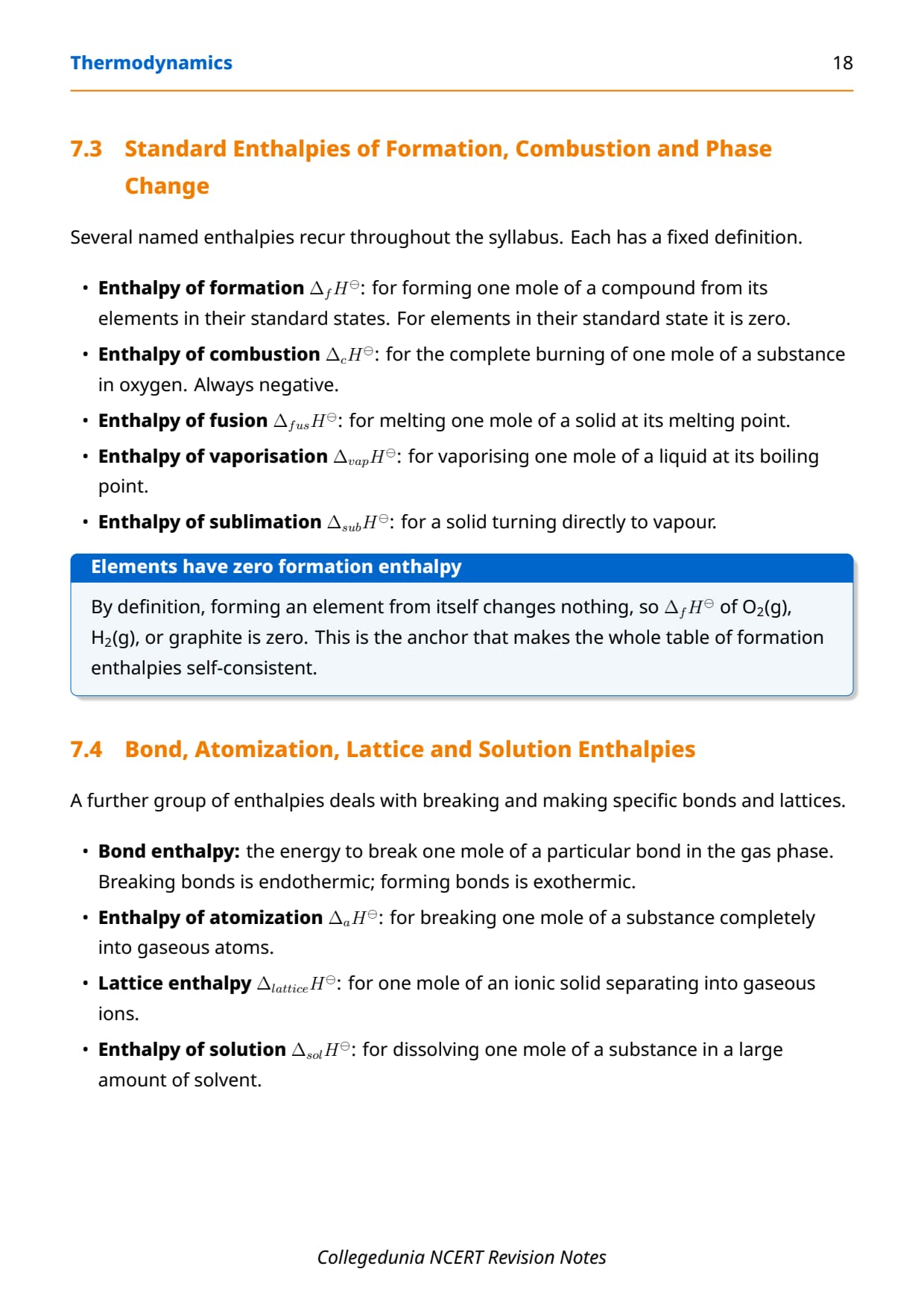
- Enthalpy of formation: the enthalpy change when one mole of a compound forms from its elements in their standard states.
- Enthalpy of combustion: the enthalpy change when one mole of a substance burns completely in oxygen.
- Heat capacity: the heat needed to raise the temperature of a substance by one degree; Cp at constant pressure and Cv at constant volume.
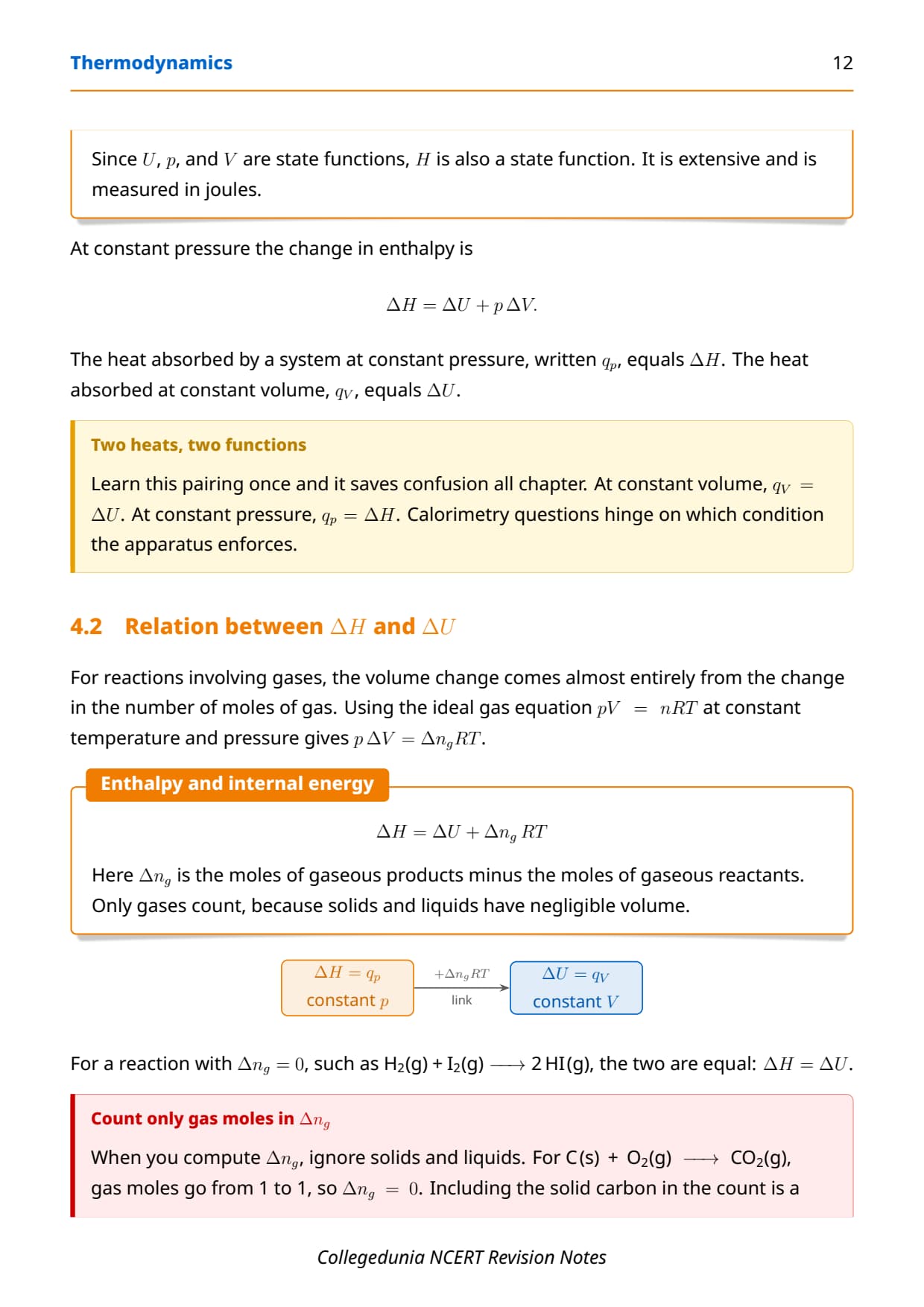
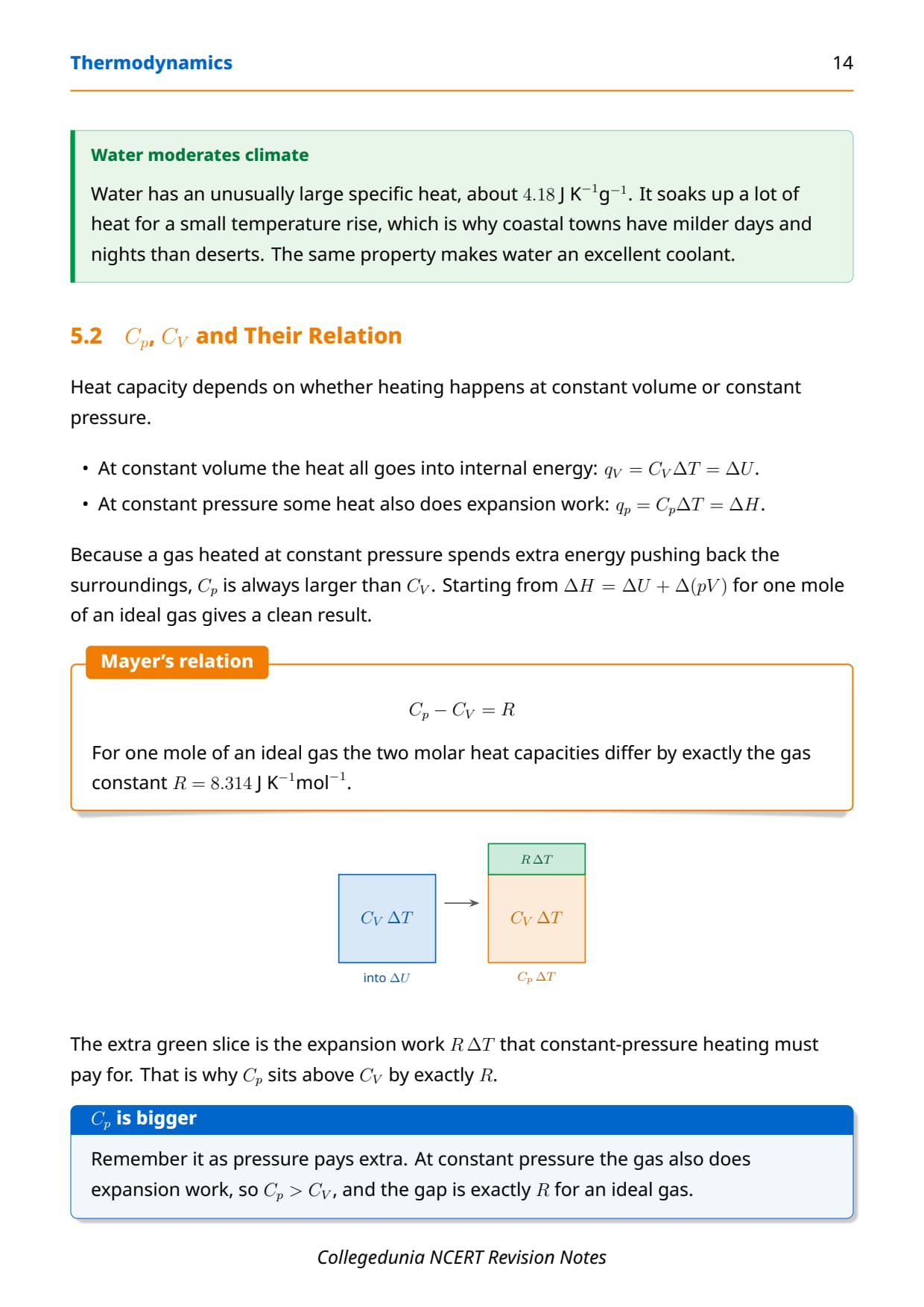
The two heat capacities of an ideal gas are linked by Cp − Cv = R, where R is the gas constant. Enthalpy and internal energy changes are related by ΔH = ΔU + ΔngRT, where Δng is the change in moles of gas. For the reaction N2 + 3H2 → 2NH3, Δng = 2 − 4 = −2, so ΔH is smaller than ΔU.
Hess's Law of Constant Heat Summation and Bond Enthalpy
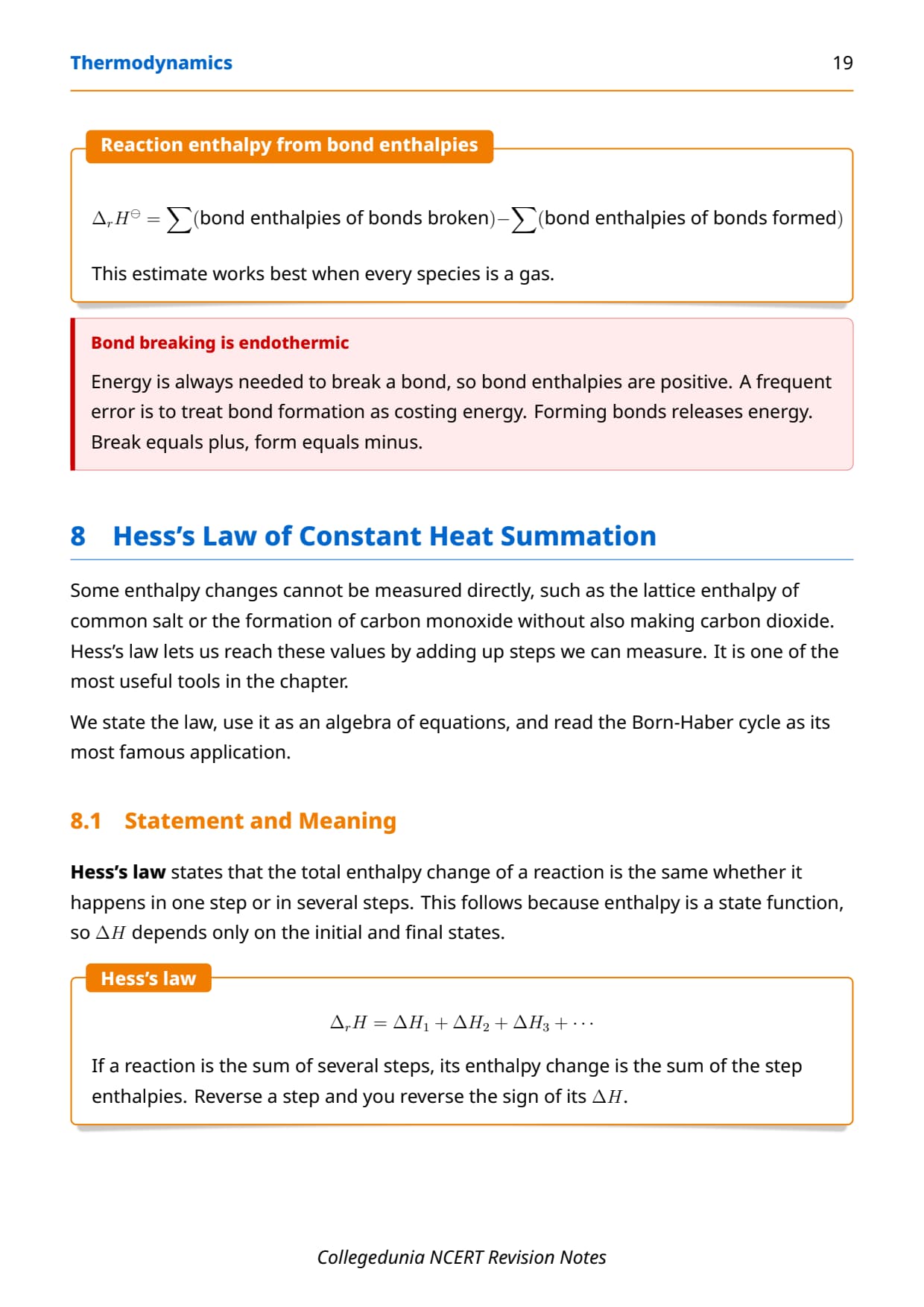
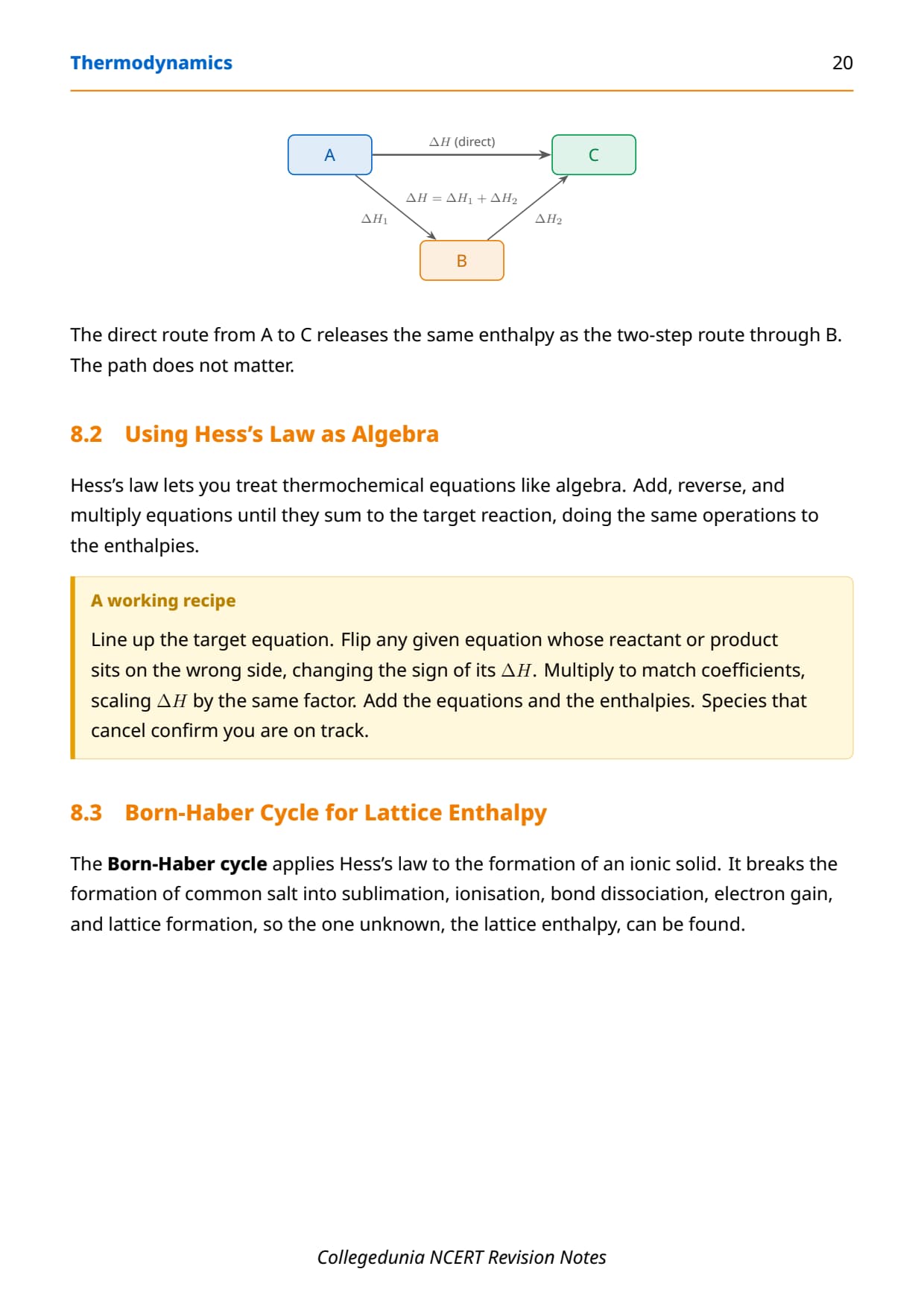
Because enthalpy is a state function, the total enthalpy change of a reaction does not depend on the route. This is Hess's law: the enthalpy change of a reaction is the same whether it happens in one step or many. It lets you add known enthalpy changes to find one you cannot measure directly.
- Write the target reaction, then add the given steps so they sum to it.
- Reverse a step and its ΔH changes sign; multiply a step and its ΔH scales too.
- Bond enthalpy: the energy needed to break one mole of a particular bond in the gas phase.
- ΔH = (sum of bond enthalpies of bonds broken) − (sum of bond enthalpies of bonds formed).
Breaking bonds absorbs energy and forming bonds releases it, so a reaction is exothermic when stronger bonds form than break. Hess's law and bond enthalpy are two ways to reach the same ΔH, and board papers often ask you to check one against the other. This is a guaranteed 3-mark question, so practise adding the steps carefully in these thermodynamics class 11 notes.
Entropy, Gibbs Energy and the Criterion for Spontaneity
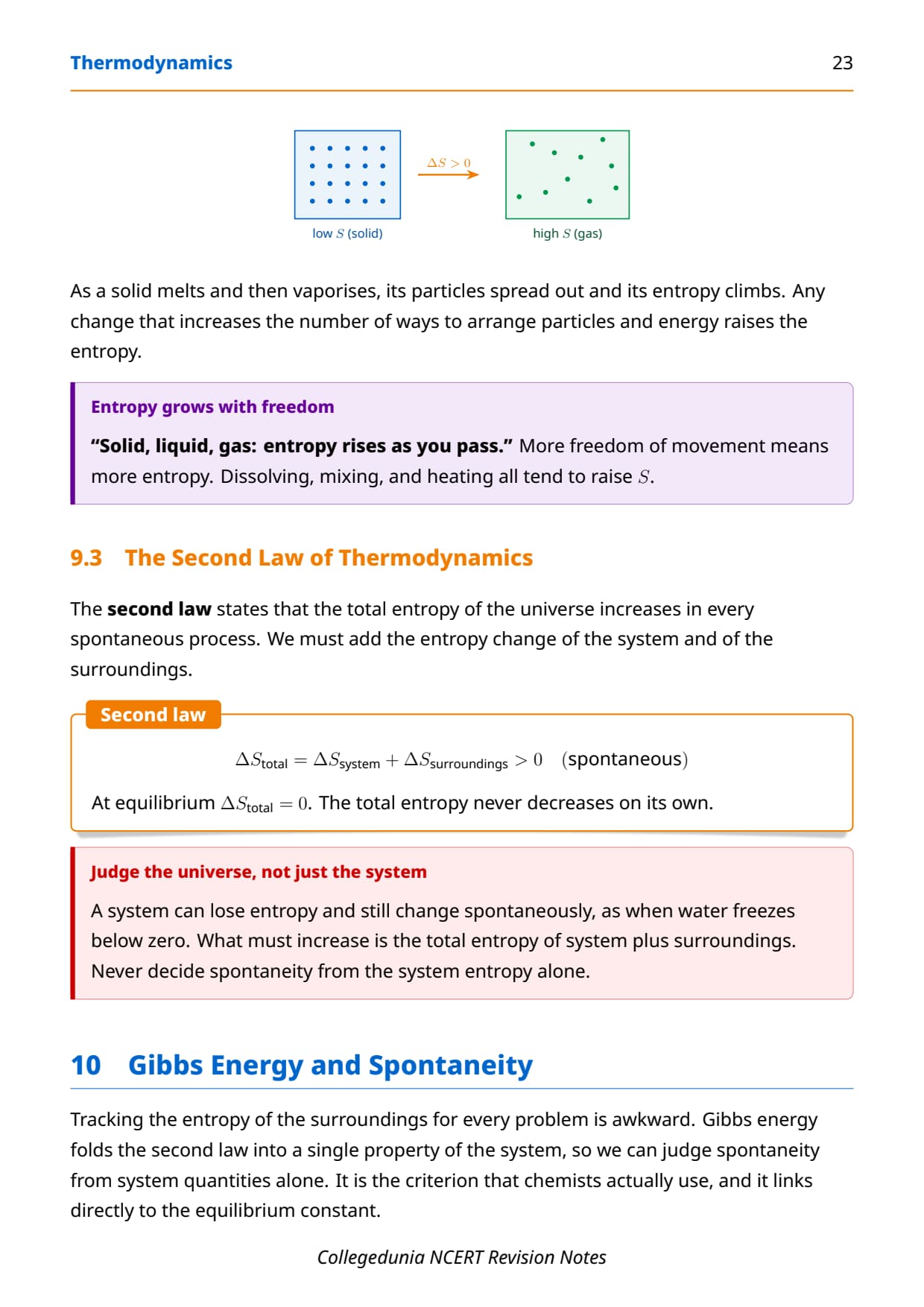
Entropy (S) measures the disorder or randomness of a system, and it is a state function. The second law says the entropy of the universe always increases in a spontaneous change. To avoid checking the whole universe, chemists use the Gibbs energy (G) of the system alone to decide spontaneity.
- Entropy change: ΔS = qrev / T for a reversible process at temperature T.
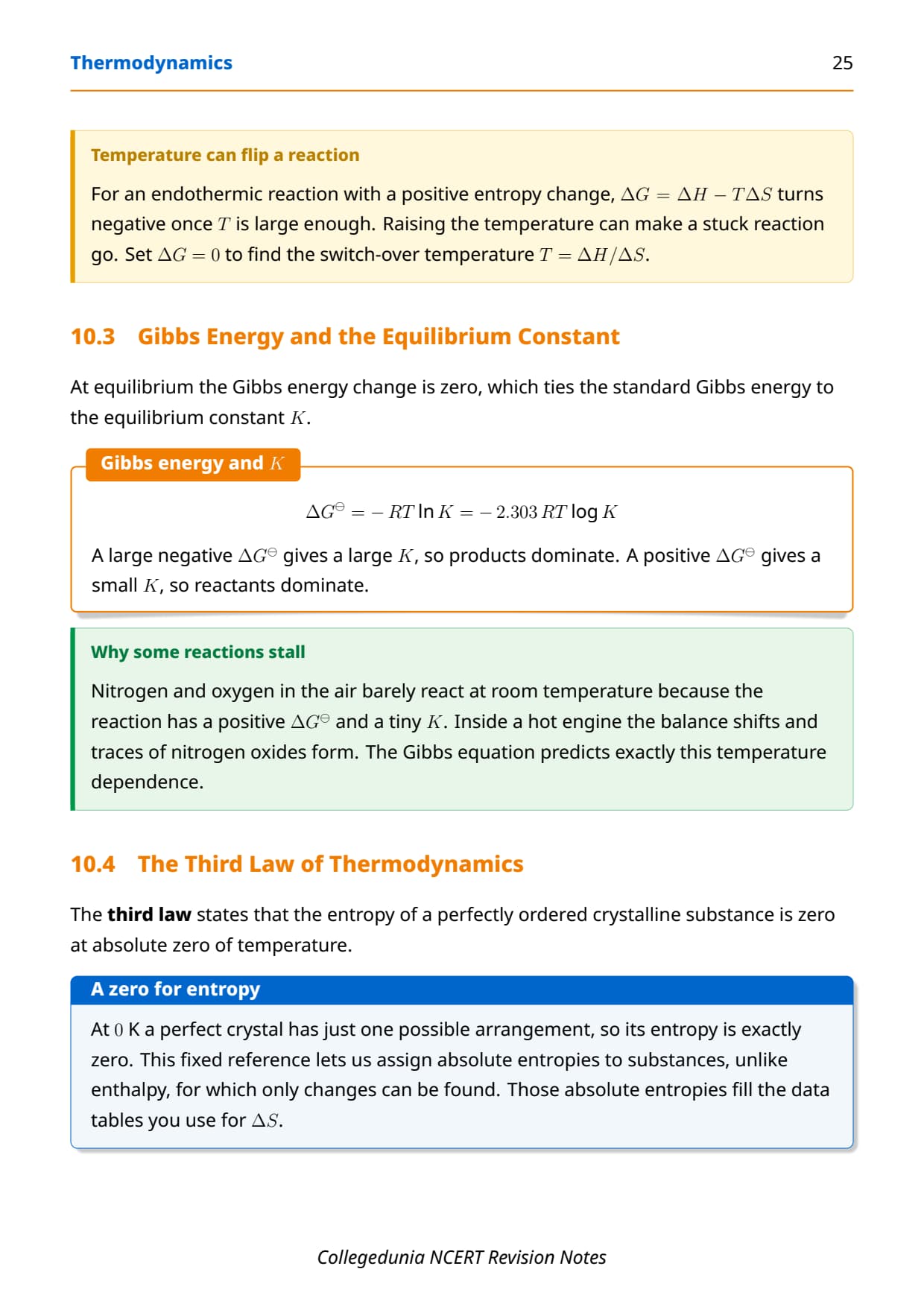
- Gibbs energy: G = H − TS, and its change is ΔG = ΔH − TΔS at constant temperature and pressure.
- Spontaneous: ΔG is negative, so the reaction happens on its own.
- Equilibrium: ΔG is zero, and a positive ΔG means the reaction is non-spontaneous.
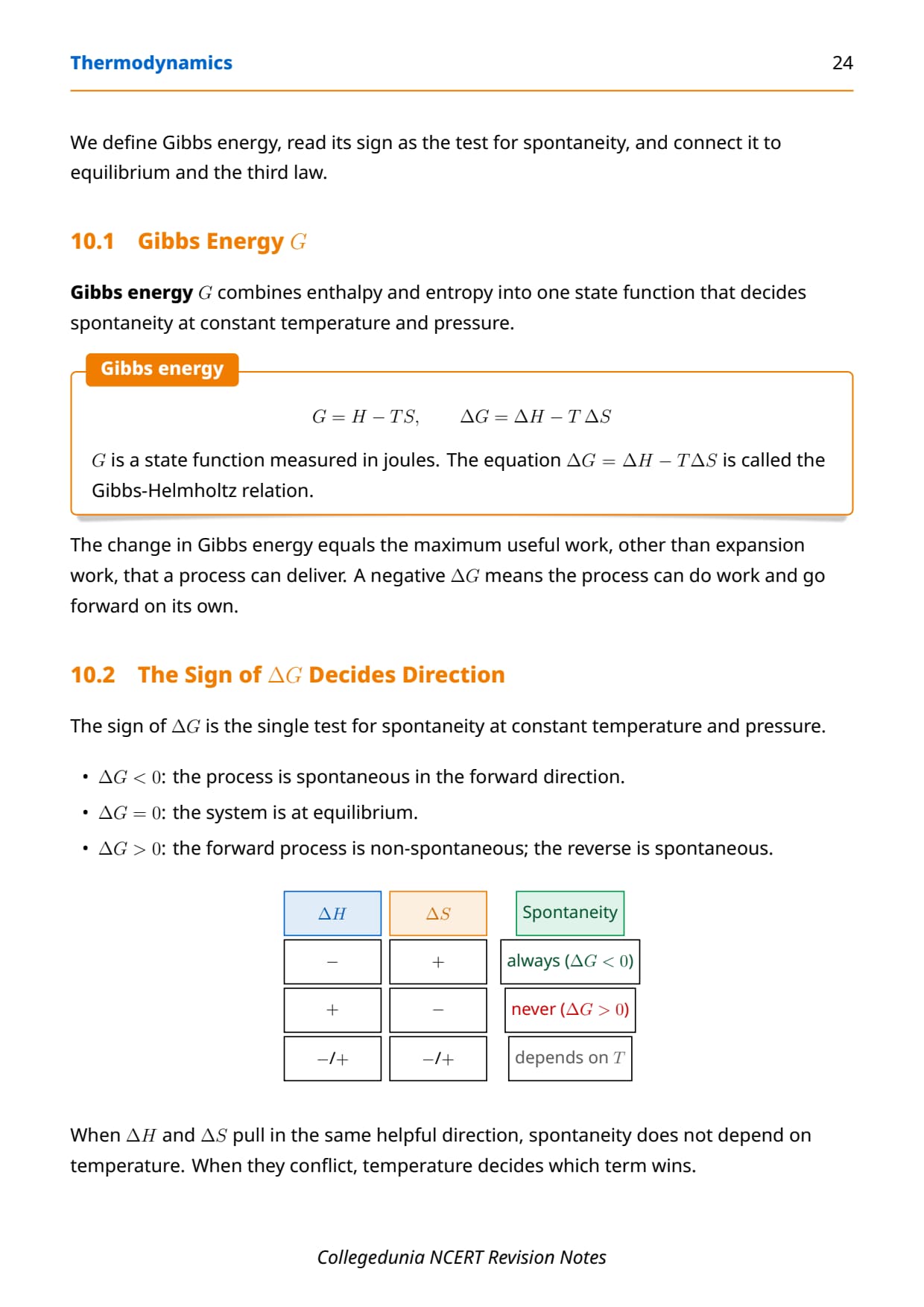
A reaction is spontaneous only when ΔG is negative. When ΔH is negative and ΔS is positive, ΔG is negative at every temperature, so the change is always spontaneous. When both signs oppose this, temperature decides the outcome. The standard Gibbs energy links to the equilibrium constant by ΔG° = −RT ln K, so a negative ΔG° gives K greater than 1.
Important Formulas and Values for Thermodynamics
Every formula and value you need for the chapter sits in one table below, with what it means. Learn the first law, enthalpy, and Gibbs energy rows first, since those carry the most marks in both Boards and entrance papers.
| Formula or value | What it means |
|---|---|
| ΔU = q + w | First law: change in internal energy from heat and work |
| w = −PextΔV | Pressure-volume work in expansion or compression |
| H = U + PV | Definition of enthalpy, the heat content at constant pressure |
| ΔH = ΔU + ΔngRT | Link between enthalpy and internal energy change for gases |
| Cp − Cv = R | Difference of heat capacities for one mole of an ideal gas |
| ΔH = Σ(bonds broken) − Σ(bonds formed) | Reaction enthalpy from bond enthalpies |
| ΔS = qrev / T | Entropy change for a reversible process at temperature T |
| ΔG = ΔH − TΔS | Gibbs energy change that decides spontaneity |
| ΔG° = −RT ln K | Standard Gibbs energy linked to the equilibrium constant |
| R = 8.314 J K-1 mol-1 | The universal gas constant used in these formulas |
Carry the sign and unit on every line of your working. A dropped minus sign flips an exothermic reaction into an endothermic one and loses the whole mark. Keep this table open while you solve the back-exercise numericals in these revision notes.
Key Definitions in Thermodynamics
Board short-answer questions often ask for a clean definition in one or two lines. Learn these word-for-word, because a vague definition loses easy marks. Each one also sets up a numerical you can be asked to solve.
| Term | Definition |
|---|---|
| Internal energy (U) | The total kinetic and potential energy stored in a system. |
| State function | A property whose change depends only on the initial and final states. |
| Enthalpy (H) | The heat content of a system at constant pressure, H = U + PV. |
| Hess's law | The total enthalpy change of a reaction is the same by any route. |
| Entropy (S) | A measure of the disorder or randomness of a system. |
| Gibbs energy (G) | The energy available to do useful work, G = H − TS. |
A common numerical gives you ΔH and ΔS and asks whether a reaction is spontaneous at a stated temperature. Put the values into ΔG = ΔH − TΔS and check the sign of ΔG. Learning these definitions makes the wording of every board question familiar.
Common Mistakes Students Make in Thermodynamics
These slips happen while calculating, not because the concept is unclear. Each one costs 1 to 3 marks in the paper, so watch for them at the exact step.
Mistake 1: Getting the sign of work wrong. Work done on the system is positive; work done by the system is negative in the ΔU = q + w convention.
Mistake 2: Forgetting the ΔngRT term when converting between ΔH and ΔU for reactions that change the moles of gas.
Mistake 3: Using temperature in degrees Celsius in ΔG = ΔH − TΔS. Temperature must always be in kelvin.
Mistake 4: Mixing the units of ΔH and ΔS. ΔH is usually in kJ and ΔS in J per kelvin, so convert one before subtracting.
Thermodynamics Weightage in CBSE Boards, JEE and NEET
This chapter is high scoring and appears every year. It carries a numerical plus a short-answer question in the boards, and it is a steady source of objective questions in the entrance exams. Here is how the marks split across the main exams for 2026-27.
| Exam | Typical weightage | What is asked |
|---|---|---|
| CBSE Boards | 7 to 8 marks | One enthalpy or Gibbs energy numerical plus one short answer on the laws |
| JEE Main | 2 to 3 questions | First law, Hess's law, bond enthalpy, and spontaneity |
| NEET | 1 to 2 questions | Enthalpy of reaction, entropy, and the Gibbs energy criterion |
| CUET | 1 to 2 objective questions | Types of system, state functions, and simple enthalpy problems |
The Gibbs energy criterion for spontaneity is the single most tested idea from this chapter across all four exams. Master the first law and sign conventions first, then enthalpy and Hess's law, then entropy and Gibbs energy, in that order of return on effort.
How to Revise Thermodynamics Quickly
Use these thermodynamics class 11 notes for a fast, ordered recap the night before a test. The checklist below takes about 30 minutes and hits every marks-heavy idea.
- First 10 minutes: write the first law, the sign rules for q and w, and the Cp − Cv = R relation from memory.
- Next 10 minutes: redo one enthalpy numerical using Hess's law, and one using bond enthalpies.
- Last 10 minutes: write ΔG = ΔH − TΔS and decide spontaneity for two different sign combinations.
Close the loop by linking ΔG° to the equilibrium constant K. If you can do all three blocks without notes, the chapter is exam-ready. Keep the Important Formulas table beside you for the first pass only, then try it closed-book.
Student Feedback on the Thermodynamics Notes
What 14,210 students told us about their Thermodynamics revision:
- 68% of students rated the sign conventions for heat and work as the hardest part of the chapter.
- Most-skipped step: converting the temperature to kelvin before using the Gibbs energy formula, missed by about 3 in 10 students.
- Students who fixed the first-law sign rules first said the enthalpy and Gibbs energy numericals felt far easier.
Source: 2026-27 Class 11 Chemistry student poll. Sample of 14,210 students from CBSE schools across 15 states, conducted before the 2026 boards.
Other Thermodynamics Class 11 Chemistry Resources
Pair these notes with the solved answers and the textbook PDF for the same chapter.
| Resource | Link |
|---|---|
| NCERT Solutions | Thermodynamics Class 11 NCERT Solutions |
| NCERT Book PDF | Thermodynamics Class 11 Book PDF |
NCERT Notes for Class 11 Chemistry: All Chapters
Jump to the revision notes for any other Class 11 Chemistry chapter below.
| Chapter | NCERT Notes |
|---|---|
| Chapter 1 | Some Basic Concepts of Chemistry |
| Chapter 2 | Structure of Atom |
| Chapter 3 | Classification of Elements and Periodicity in Properties |
| Chapter 4 | Chemical Bonding and Molecular Structure |
| Chapter 5 | Thermodynamics |
| Chapter 6 | Equilibrium |
| Chapter 7 | Redox Reactions |
| Chapter 8 | Organic Chemistry Some Basic Principles and Techniques |
| Chapter 9 | Hydrocarbons |
FAQs on Thermodynamics Class 11 Chemistry Notes
Thermodynamics Notes - Frequently Asked Questions
Ques. What topics do the thermodynamics class 11 notes cover?
Ans. These thermodynamics class 11 notes cover the system and surroundings, types of thermodynamic system, state functions, internal energy, work and heat, the first law of thermodynamics, enthalpy and heat capacity, enthalpies of reaction, formation and combustion, Hess's law, bond enthalpy, entropy, and the Gibbs energy criterion for spontaneity. Every key formula and definition is included for fast revision.
Ques. What is the first law of thermodynamics?
Ans. The first law of thermodynamics is the law of conservation of energy applied to a system. It is written as ΔU = q + w, where ΔU is the change in internal energy, q is the heat absorbed, and w is the work done on the system. Energy is neither created nor destroyed; it only moves between the system and the surroundings.
Ques. What is the difference between enthalpy and internal energy?
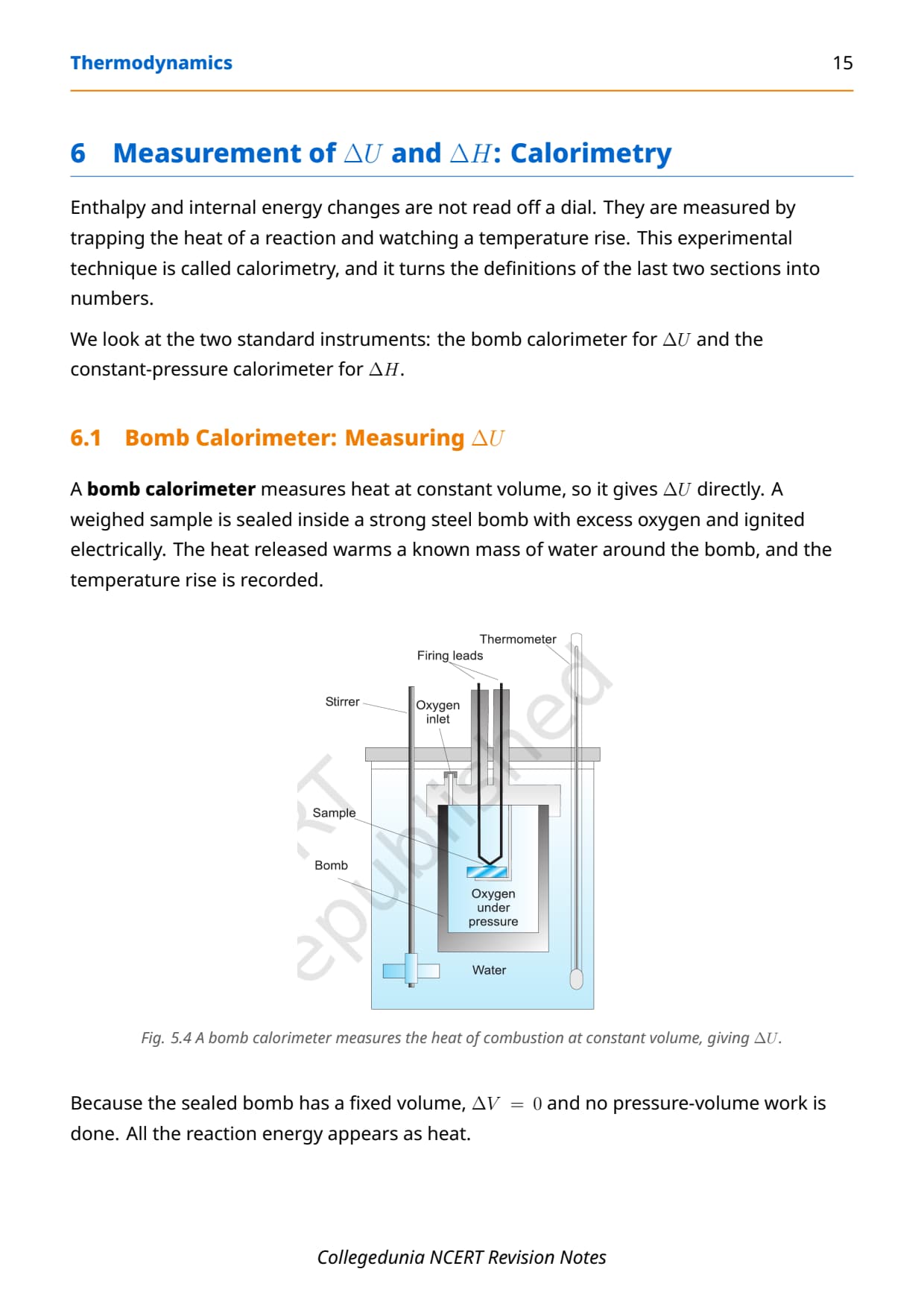
Ans. Internal energy (U) is the total energy of a system, and its change equals the heat exchanged at constant volume, ΔU = qv. Enthalpy (H) is defined as H = U + PV, and its change equals the heat exchanged at constant pressure, ΔH = qp. The two are linked by ΔH = ΔU + ΔngRT for reactions involving gases.
Ques. What is Hess's law of constant heat summation?
Ans. Hess's law states that the total enthalpy change of a reaction depends only on the initial and final states, not on the route taken. This is true because enthalpy is a state function. The law lets you add the enthalpy changes of several known steps to find the enthalpy change of a reaction that cannot be measured directly.
Ques. When is a reaction spontaneous in thermodynamics?
Ans. A reaction is spontaneous when ΔG is negative, where ΔG = ΔH − TΔS. If ΔH is negative and ΔS is positive, the reaction is spontaneous at all temperatures. When ΔG is zero the system is at equilibrium, and when ΔG is positive the reaction is non-spontaneous in the forward direction.
Ques. What is the weightage of Thermodynamics in the CBSE board exam?
Ans. Thermodynamics carries about 7 to 8 marks in the CBSE Class 11 Chemistry paper, usually one enthalpy or Gibbs energy numerical plus one short answer on the laws. It also appears in JEE Main, NEET and CUET as objective questions on the first law, Hess's law, bond enthalpy, and the spontaneity criterion.
Ques. How should I revise Thermodynamics quickly for a test?
Ans. Start by writing the first law, the sign rules for heat and work, and the Cp − Cv = R relation from memory. Then redo one enthalpy numerical using Hess's law and one using bond enthalpies. Finish with ΔG = ΔH − TΔS and decide spontaneity for two sign combinations. The quick-revision checklist in these thermodynamics class 11 notes covers all of this in about 30 minutes.



Comments