




These some basic concepts of chemistry class 11 notes bring together every law, formula, and mole calculation that the CBSE Boards, JEE Main, JEE Advanced, NEET and CUET papers actually test in 2026-27. Revise the whole chapter fast, with the laws of chemical combination, the mole concept, and every concentration term in one place.
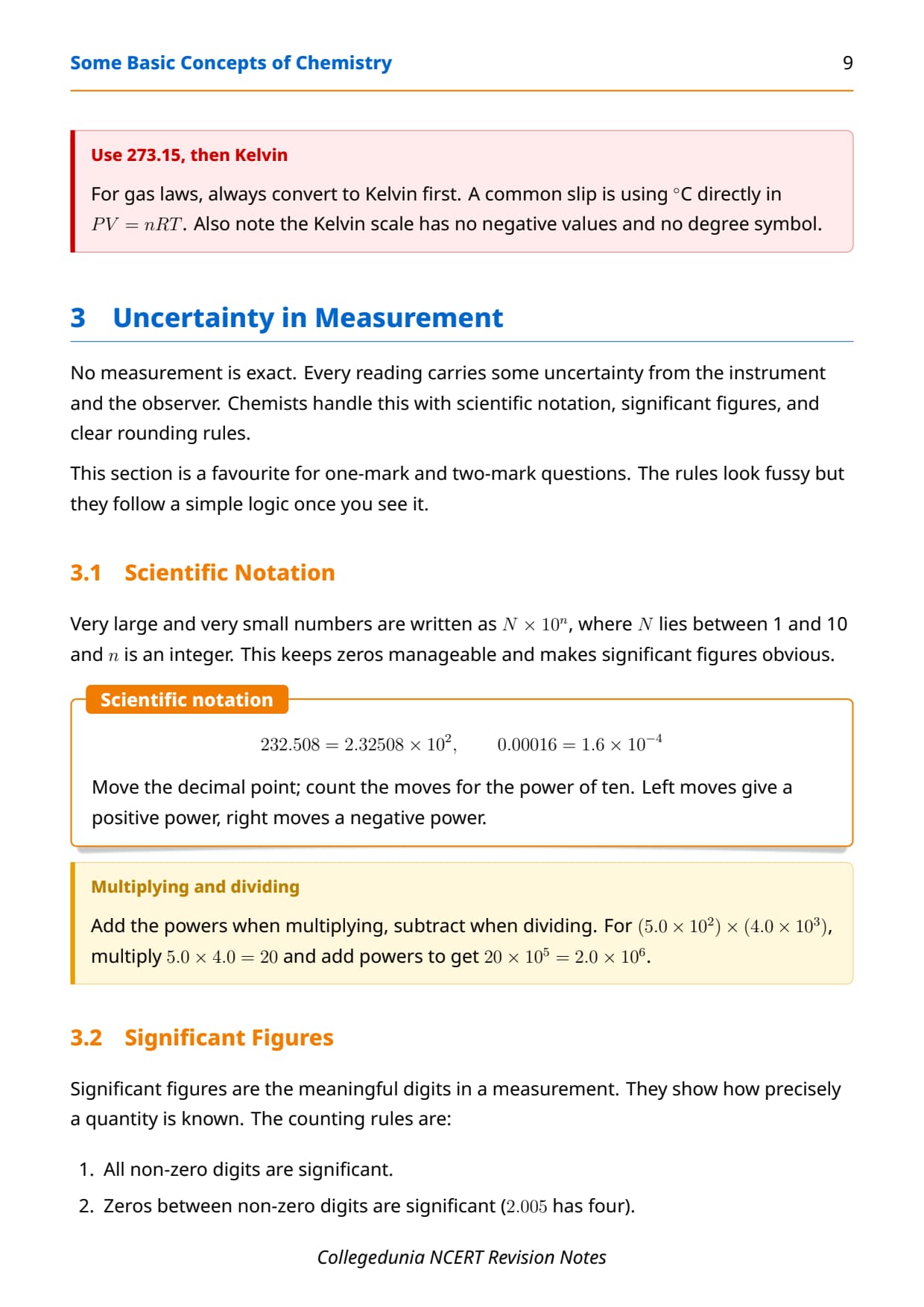
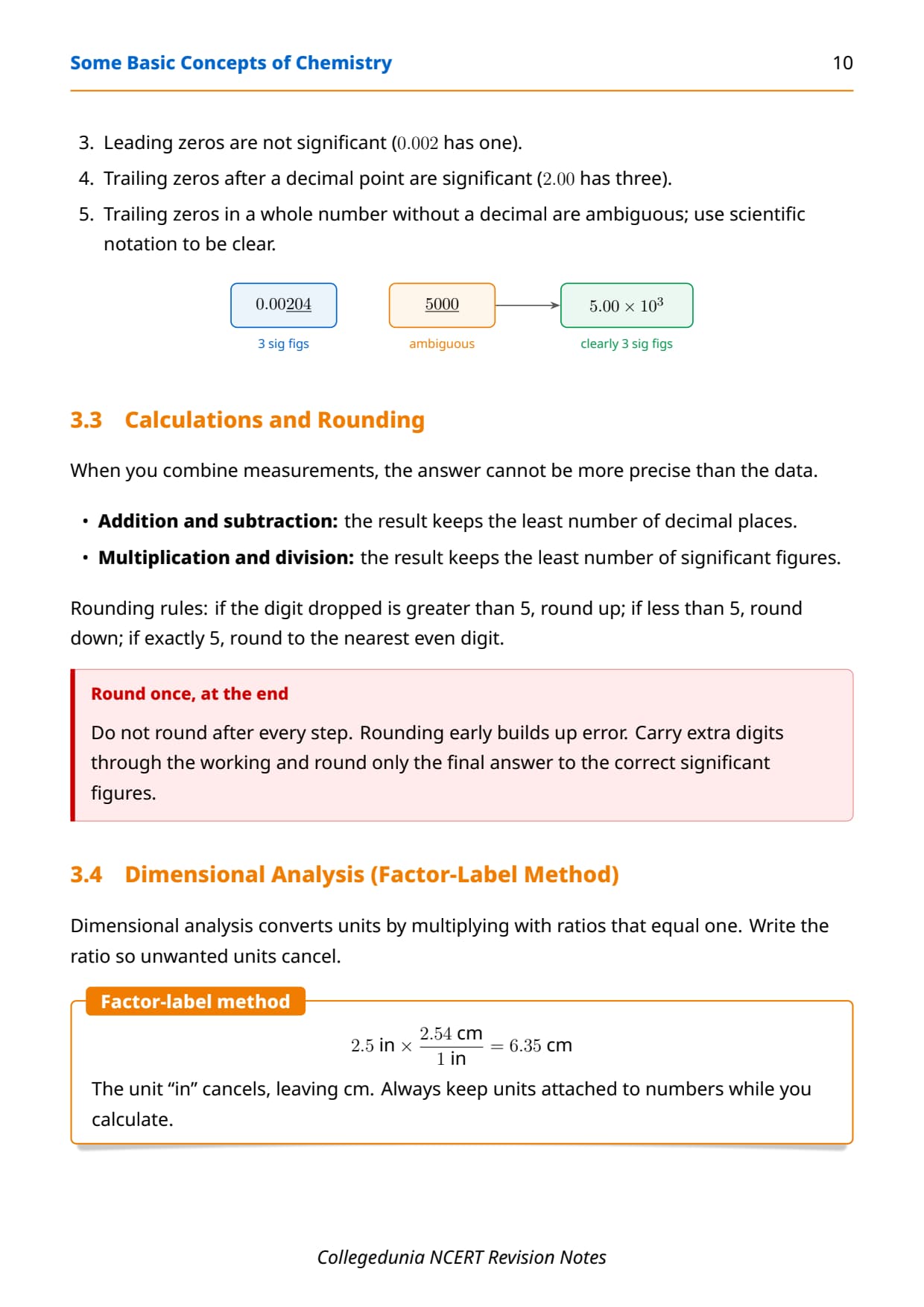
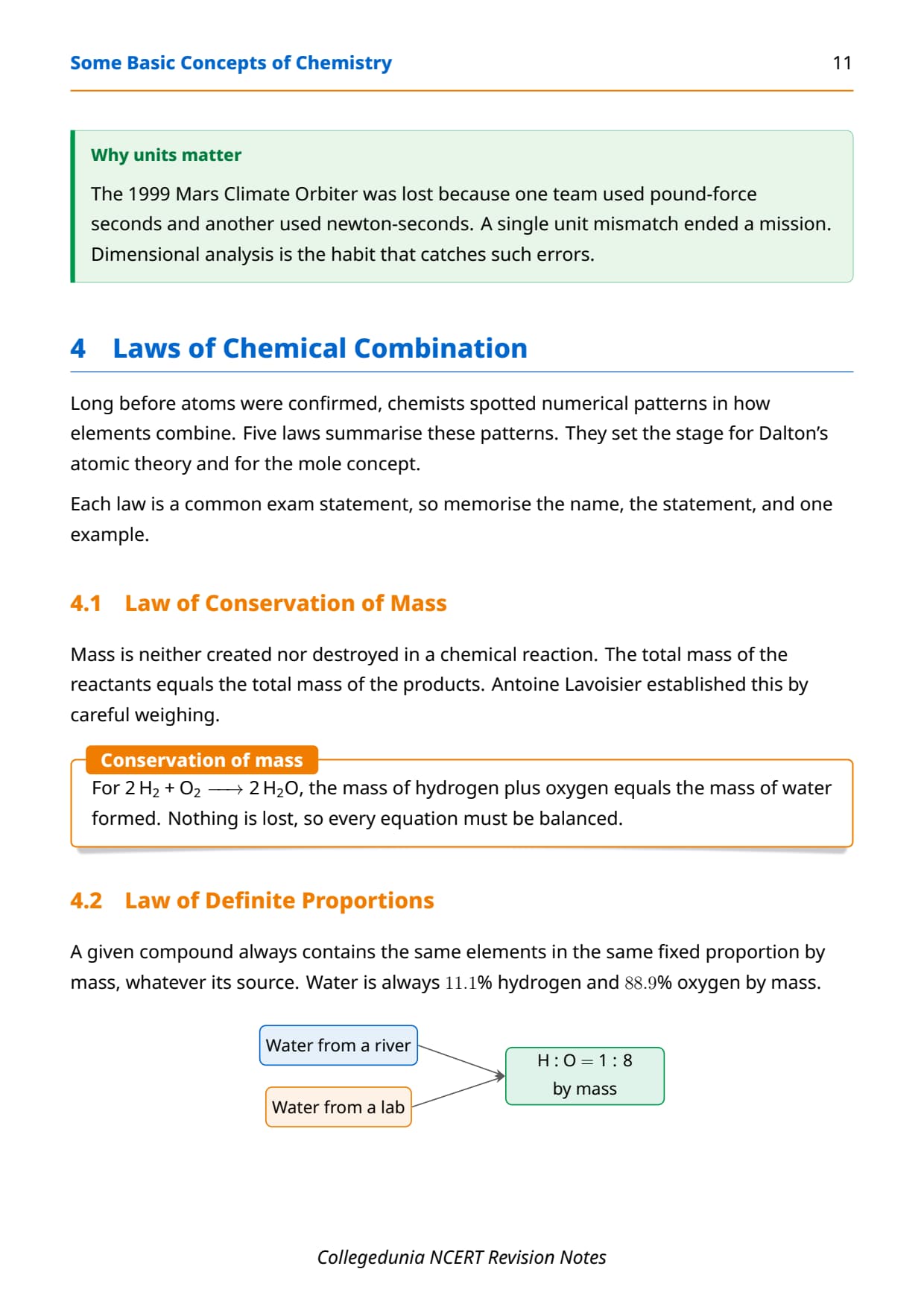
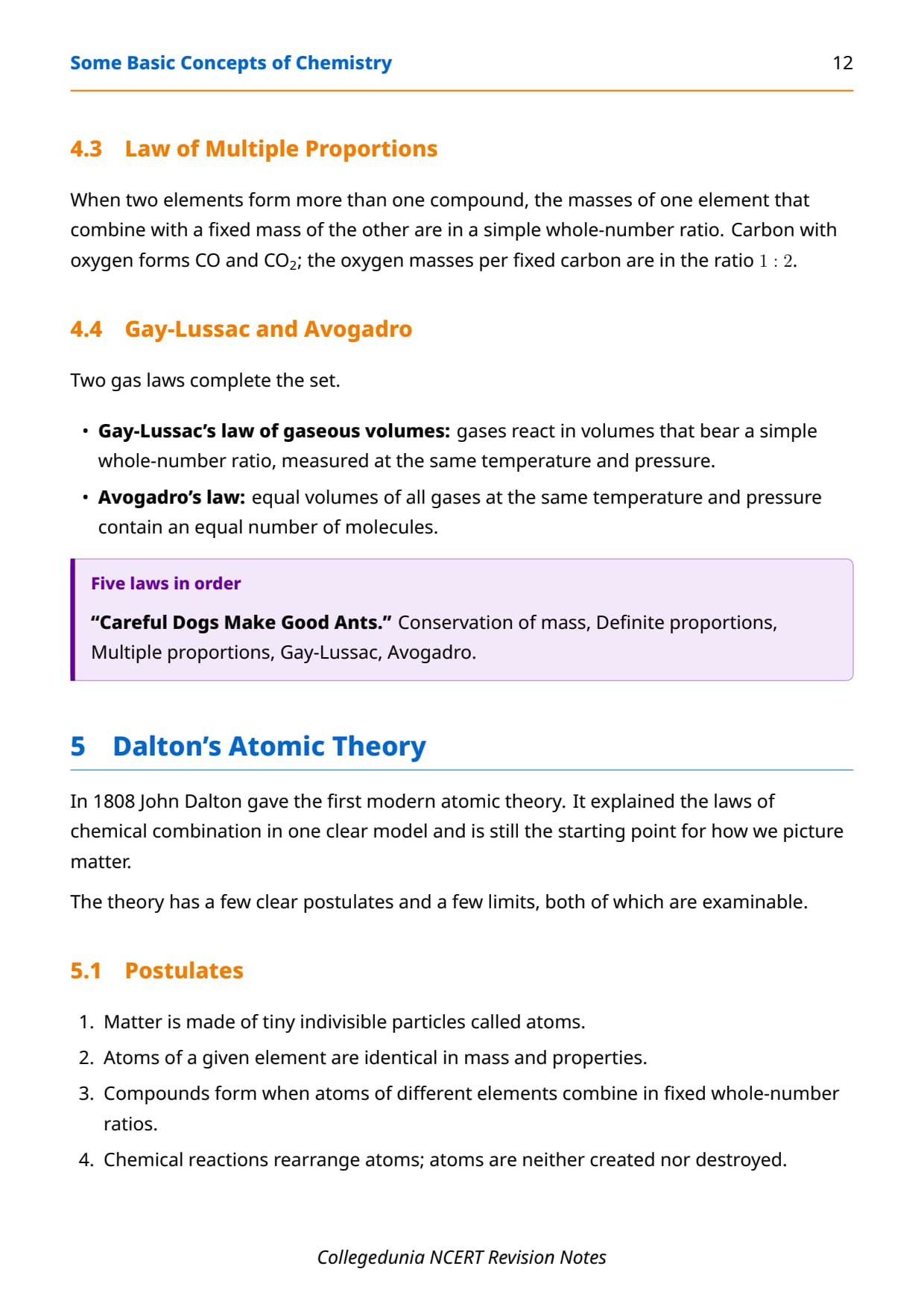
This is the first chapter of the NCERT textbook, and the mole idea you learn here runs through every numerical you solve for the rest of the year.
- CBSE Weightage: 6 to 8 marks, usually one mole or stoichiometry numerical plus one short answer.
- Topics covered: laws of chemical combination, Dalton's atomic theory, atomic and molecular mass, the mole concept, empirical and molecular formula, stoichiometry, and concentration terms.
- Key formulas: moles from mass, molarity, molality, mole fraction, and the limiting reagent method.
These some basic concepts of chemistry class 11 notes are curated by subject experts, based on the 2026-27 NCERT textbook, and checked against the last five years of CBSE Board, JEE Main and NEET papers.
Topic-by-Topic Summary of Some Basic Concepts of Chemistry
The chapter builds the counting logic of chemistry from the ground up. It starts with the laws that fix how elements combine, then moves to atomic mass, the mole, and finally to solving reaction and solution problems. Here is the quick map of what each topic gives you.
- Laws of chemical combination: the five rules that govern how masses of elements react and combine.
- Dalton's atomic theory: the model that explains those laws using indivisible atoms.
- Atomic and molecular mass: the average mass of an atom or molecule on the unified mass (u) scale.
- Mole concept and molar mass: the bridge between the mass you weigh and the number of particles.
- Formulae and stoichiometry: empirical and molecular formula, plus balancing mass in a reaction.
- Concentration terms: molarity, molality, and mole fraction for solutions.
Revise the topics in this order, because each one uses the one before it. Master the mole first, and every stoichiometry and solution problem becomes easy. These some basic concepts of chemistry class 11 notes follow the same sequence as the NCERT textbook.
Laws of Chemical Combination and Dalton's Atomic Theory
Chemistry starts with fixed rules about how elements join. Five laws of chemical combination describe the mass relationships in every reaction, and Dalton's atomic theory later explained why they hold. These laws appear often as short-answer and assertion-reason questions.
- Law of conservation of mass: mass is neither created nor destroyed in a chemical reaction.
- Law of definite proportions: a pure compound always has the same elements in the same fixed mass ratio.
- Law of multiple proportions: when two elements form more than one compound, the masses of one that combine with a fixed mass of the other are in a simple whole-number ratio.
- Gay Lussac's law of gaseous volumes: gases react in volume ratios that are simple whole numbers at the same temperature and pressure.
- Avogadro's law: equal volumes of all gases at the same temperature and pressure contain equal numbers of molecules.
Dalton's atomic theory tied these laws together. It said that matter is made of tiny indivisible atoms, that all atoms of one element are identical in mass, and that atoms combine in small whole-number ratios to form compounds. The theory explains conservation of mass and definite proportions in one model. Water, for example, is always H2O with hydrogen and oxygen in a fixed 1:8 mass ratio.
Atomic Mass, Molecular Mass and the Mole Concept
To count atoms by weighing, chemistry needs a mass scale and a counting unit. The atomic mass is measured in unified mass units, and the mole links that mass to a real number of particles. This is the single most important idea in the whole chapter.
- Atomic mass: the average mass of an atom, in unified mass units (u), taken relative to one-twelfth of a carbon-12 atom.
- Molecular mass: the sum of the atomic masses of every atom in a molecule, so water is 18 u and CO2 is 44 u.
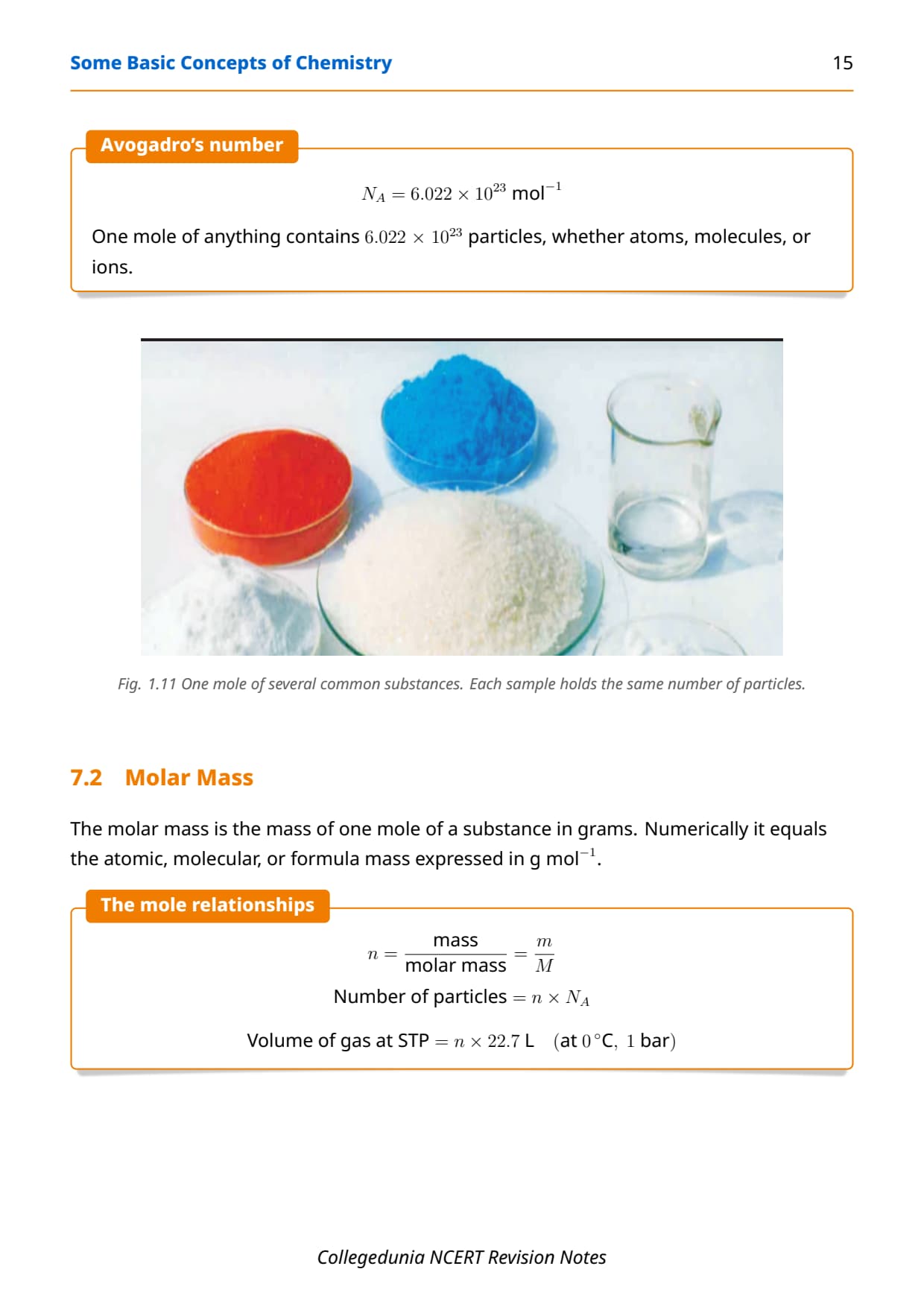
- Mole: the amount of a substance that contains 6.022 × 10²³ particles, called Avogadro's number.
- Molar mass: the mass of one mole in grams, equal in number to the atomic or molecular mass in u.
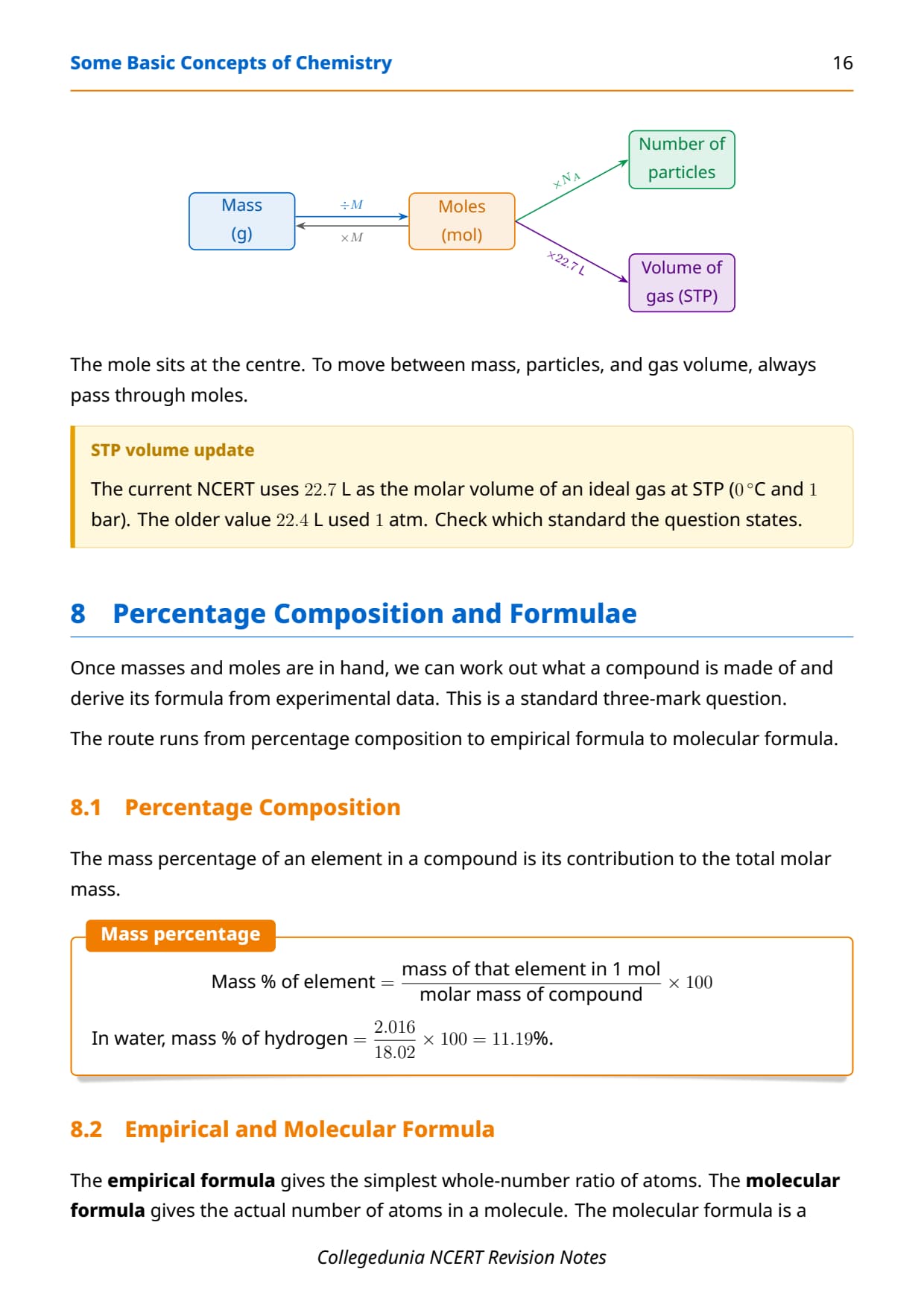
The number of moles is found from the mass you weigh. Use moles = given mass in grams / molar mass whenever a problem gives you a mass. One mole of any gas also occupies 22.4 litres at STP, which turns a gas volume straight into a mole count. Keeping the mole at the centre of your working is what makes these some basic concepts of chemistry class 11 notes fast to revise.
Percentage Composition, Empirical and Molecular Formula
A formula tells you which atoms are in a compound and in what ratio. The chapter teaches you to move from experimental data, such as percentage composition, to the empirical formula and then the molecular formula. This is a guaranteed 2 to 3 mark question in the board paper.
- Percentage composition: the mass percent of each element, found as (mass of element / molar mass of compound) × 100.
- Empirical formula: the simplest whole-number ratio of atoms in a compound, such as CH for benzene.
- Molecular formula: the actual number of atoms in a molecule, such as C6H6 for benzene.
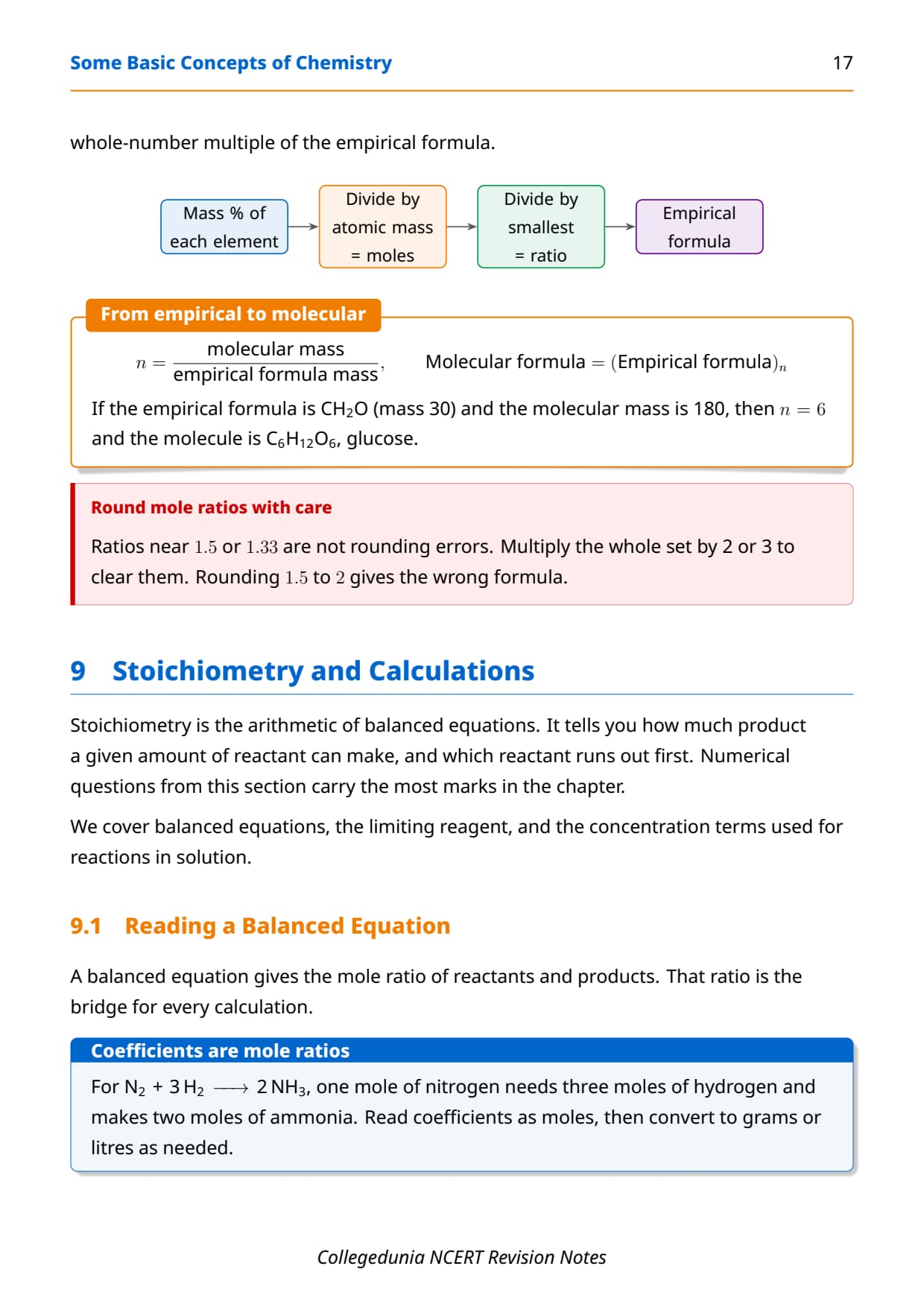
The two formulae are linked by a whole number, n, where molecular formula = (empirical formula) × n, and n = molecular mass / empirical formula mass. To find the empirical formula, divide each element's percentage by its atomic mass, then divide all results by the smallest value. The molecular formula is always a whole-number multiple of the empirical formula.
Stoichiometry and the Limiting Reagent Method
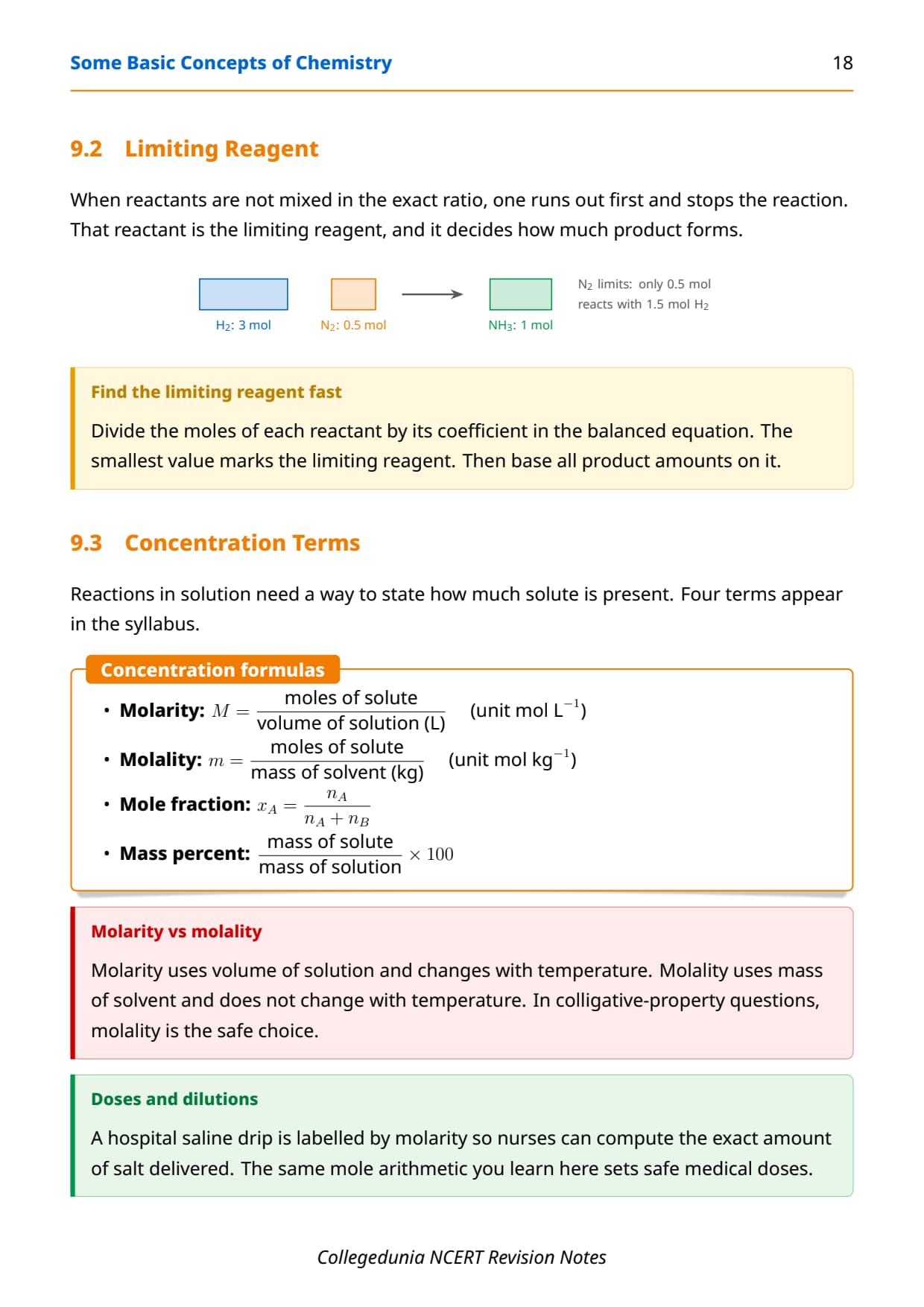
Stoichiometry is the calculation of the amounts of reactants and products in a balanced equation. The coefficients in the equation give the mole ratio, and every mass or volume question runs through that ratio. The limiting reagent is the reactant that finishes first and decides how much product forms.
- Balance the equation first, then read the coefficients as a mole ratio.
- Convert every given mass or volume to moles before comparing.
- The reactant with fewer moles than the ratio needs is the limiting reagent.
- Calculate the product from the limiting reagent only, never from the excess one.
For the reaction N2 + 3H2 → 2NH3, one mole of nitrogen needs three moles of hydrogen. If hydrogen runs short, it limits the ammonia formed. Always identify the limiting reagent before you calculate the yield, because using the excess reactant gives a wrong, larger answer. This step is the most common place students lose marks in numerical questions.
Concentration Terms: Molarity, Molality and Mole Fraction
Solutions are described by how much solute sits in a fixed amount of solvent or solution. The chapter uses three main concentration terms, and each has a precise formula. Molarity depends on temperature, while molality and mole fraction do not.
| Term | Definition | Formula |
|---|---|---|
| Molarity (M) | Moles of solute per litre of solution | M = moles of solute / volume of solution in litres |
| Molality (m) | Moles of solute per kilogram of solvent | m = moles of solute / mass of solvent in kg |
| Mole fraction (x) | Moles of one component over total moles | xA = nA / (nA + nB) |
| Mass percent | Mass of solute per 100 g of solution | (mass of solute / mass of solution) × 100 |
Molality and mole fraction stay the same when temperature changes, but molarity does not, because volume expands on heating. The sum of the mole fractions of all components in a solution is always 1. Remember to convert the solute mass to moles before you use any of these formulas.
Important Formulas and Values for Some Basic Concepts of Chemistry
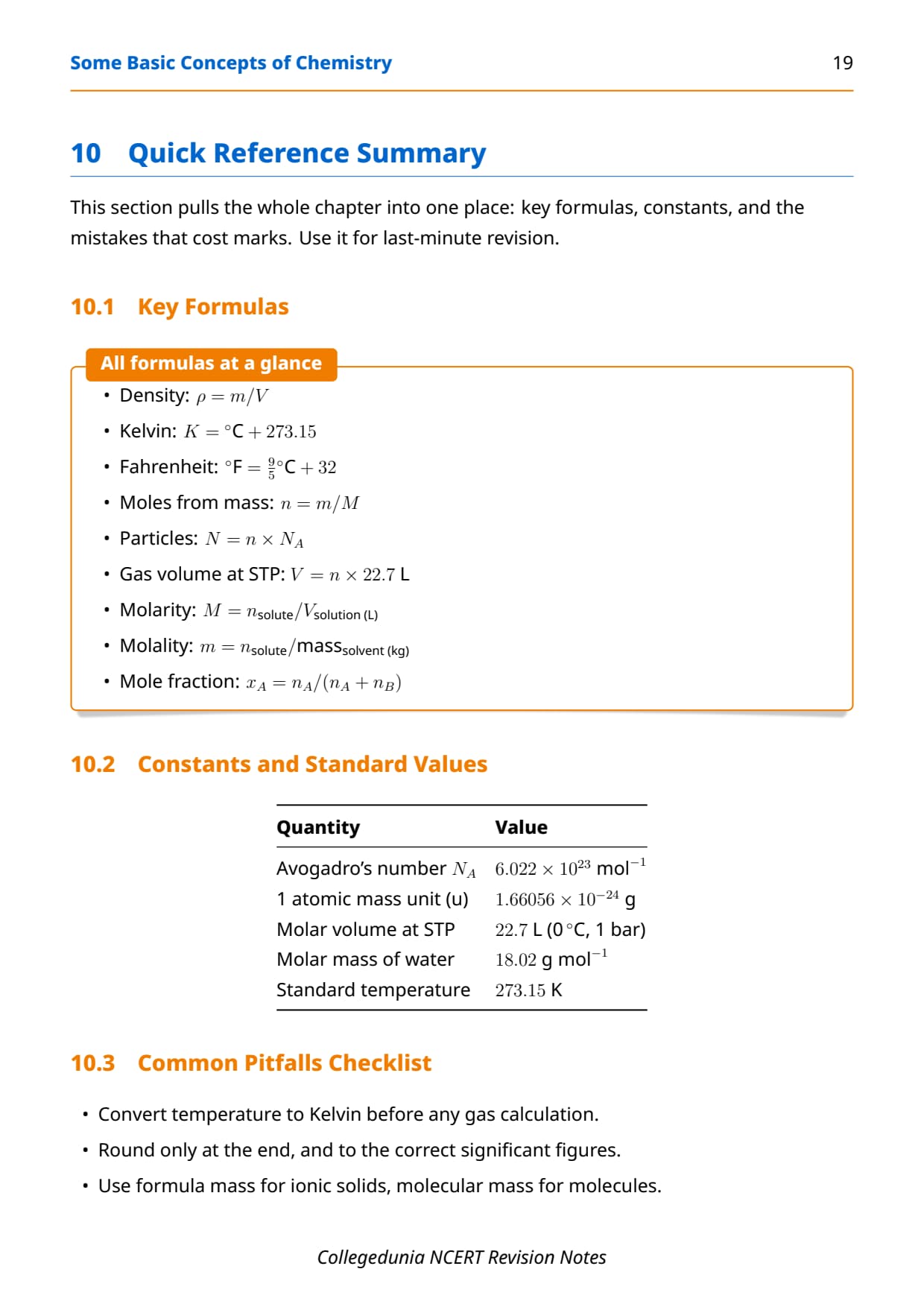
Every formula and constant you need for the chapter sits in one table below, with what it means. Learn the mole and concentration rows first, since those carry the most marks in both Boards and entrance papers.
| Formula or value | What it means |
|---|---|
| Moles = mass (g) / molar mass (g mol-1) | Number of moles from a weighed mass |
| Number of particles = moles × 6.022 × 10²³ | Atoms or molecules from moles |
| Avogadro's number = 6.022 × 10²³ mol-1 | Particles in one mole |
| Molar volume of a gas = 22.4 L at STP | Volume of one mole of any gas at STP |
| Molarity (M) = moles of solute / volume of solution (L) | Concentration by solution volume |
| Molality (m) = moles of solute / mass of solvent (kg) | Concentration by solvent mass |
| Mole fraction xA = nA / (nA + nB) | Fraction of total moles that is A |
| n = molecular mass / empirical formula mass | Multiplier linking the two formulae |
| Mass percent = (mass of element / molar mass) × 100 | Percentage composition of a compound |
Carry the unit on every line of your working. Losing a unit is a silent way to drop the final mark even when the number is right. Keep this table open while you solve the back-exercise numericals in these revision notes.
Key Definitions in Some Basic Concepts of Chemistry
Board short-answer questions often ask for a clean definition in one or two lines. Learn these word-for-word, because a vague definition loses easy marks. Each one also sets up a numerical you can be asked to solve.
| Term | Definition |
|---|---|
| Mole | The amount of a substance that contains 6.022 × 10²³ elementary particles. |
| Molar mass | The mass of one mole of a substance, in grams per mole. |
| Atomic mass unit (u) | One-twelfth of the mass of one carbon-12 atom. |
| Empirical formula | The simplest whole-number ratio of atoms in a compound. |
| Limiting reagent | The reactant that is fully used up first and limits the product formed. |
| Molarity | The number of moles of solute per litre of solution. |
A common numerical asks you to prepare a solution of a given molarity from a solid solute. Convert the required mass to moles, then divide by the volume in litres to check the molarity. Learning these definitions makes the wording of every board question familiar.
Common Mistakes Students Make in Some Basic Concepts of Chemistry
These slips happen while calculating, not because the concept is unclear. Each one costs 1 to 3 marks in the paper, so watch for them at the exact step.
Mistake 1: Using the excess reactant instead of the limiting reagent. Always find the limiting reagent first, then calculate the product from it alone.
Mistake 2: Confusing molarity and molality. Molarity uses litres of solution; molality uses kilograms of solvent.
Mistake 3: Forgetting to balance the equation before reading the mole ratio. An unbalanced equation gives the wrong ratio and the wrong answer.
Mistake 4: Reporting the empirical formula as the molecular formula. Multiply by n = molecular mass / empirical formula mass to get the molecular formula.
Some Basic Concepts of Chemistry Weightage in CBSE Boards, JEE and NEET
This chapter is small but scoring. It rarely carries a long answer, yet it shows up every year as a numerical plus an objective question. Here is how the marks split across the main exams for 2026-27.
| Exam | Typical weightage | What is asked |
|---|---|---|
| CBSE Boards | 6 to 8 marks | One mole or stoichiometry numerical plus one short answer on the laws |
| JEE Main | 1 to 2 questions | Mole concept, limiting reagent, and concentration terms |
| NEET | 2 to 3 questions | Mole calculations, empirical formula, and molarity |
| CUET | 1 to 2 objective questions | Laws of chemical combination and simple mole problems |
The mole concept is the single most tested idea from this chapter across all four exams. Master it first, then stoichiometry and the limiting reagent, then concentration terms, in that order of return on effort.
How to Revise Some Basic Concepts of Chemistry Quickly
Use these some basic concepts of chemistry class 11 notes for a fast, ordered recap the night before a test. The checklist below takes about 30 minutes and hits every marks-heavy idea.
- First 10 minutes: write Avogadro's number, molar volume, and the moles-from-mass formula from memory.
- Next 10 minutes: redo one stoichiometry numerical and find the limiting reagent in it.
- Last 10 minutes: write the molarity, molality, and mole-fraction formulas and solve one solution problem.
Close the loop by converting one empirical formula into a molecular formula. If you can do all four blocks without notes, the chapter is exam-ready. Keep the Important Formulas table beside you for the first pass only, then try it closed-book.
Student Feedback on the Some Basic Concepts of Chemistry Notes
What 13,420 students told us about their Some Basic Concepts of Chemistry revision:
- 71% of students rated the limiting reagent as the hardest sub-topic in the chapter.
- Most-skipped step: converting mass to moles before comparing reactants, missed by about 3 in 10 students.
- Students who revised the mole concept first said the rest of the chapter felt far easier.
Source: 2026-27 Class 11 Chemistry student poll. Sample of 13,420 students from CBSE schools across 15 states, conducted before the 2026 boards.
Other Some Basic Concepts of Chemistry Class 11 Chemistry Resources
Pair these notes with the solved answers and the textbook PDF for the same chapter.
| Resource | Link |
|---|---|
| NCERT Solutions | Some Basic Concepts of Chemistry Class 11 NCERT Solutions |
| NCERT Book PDF | Some Basic Concepts of Chemistry Class 11 Book PDF |
NCERT Notes for Class 11 Chemistry: All Chapters
Jump to the revision notes for any other Class 11 Chemistry chapter below.
| Chapter | NCERT Notes |
|---|---|
| Chapter 1 | Some Basic Concepts of Chemistry |
| Chapter 2 | Structure of Atom |
| Chapter 3 | Classification of Elements and Periodicity in Properties |
| Chapter 4 | Chemical Bonding and Molecular Structure |
| Chapter 5 | Thermodynamics |
| Chapter 6 | Equilibrium |
| Chapter 7 | Redox Reactions |
| Chapter 8 | Organic Chemistry Some Basic Principles and Techniques |
| Chapter 9 | Hydrocarbons |
FAQs on Some Basic Concepts of Chemistry Class 11 Chemistry Notes
Some Basic Concepts of Chemistry Notes - Frequently Asked Questions
Ques. What topics do the some basic concepts of chemistry class 11 notes cover?
Ans. These some basic concepts of chemistry class 11 notes cover the five laws of chemical combination, Dalton's atomic theory, atomic and molecular mass, the mole concept and molar mass, empirical and molecular formula, stoichiometry with the limiting reagent, and concentration terms such as molarity, molality and mole fraction. Every key formula and definition is included for fast revision.
Ques. What is the mole concept in Class 11 Chemistry?
Ans. The mole is the SI unit for the amount of a substance. One mole contains 6.022 × 10²³ elementary particles, a value called Avogadro's number. The number of moles equals the given mass in grams divided by the molar mass. The mole concept is the most important idea in this chapter and is used in every stoichiometry problem.
Ques. How do I find the limiting reagent in a reaction?
Ans. First balance the equation and read the coefficients as a mole ratio. Convert each reactant's mass to moles, then check which reactant has fewer moles than the ratio needs. That reactant is the limiting reagent, and it decides how much product forms. Always calculate the product from the limiting reagent, never from the excess reactant.
Ques. What is the difference between molarity and molality?
Ans. Molarity is the number of moles of solute per litre of solution, and it changes with temperature because volume expands on heating. Molality is the number of moles of solute per kilogram of solvent, and it does not change with temperature. For this reason, molality is preferred in problems that involve heating or cooling a solution.
Ques. What is the weightage of this chapter in the CBSE board exam?
Ans. Some Basic Concepts of Chemistry carries about 6 to 8 marks in the CBSE Class 11 Chemistry paper, usually one mole or stoichiometry numerical plus one short answer on the laws. It also appears in JEE Main, NEET and CUET as objective questions on the mole concept, limiting reagent, and concentration terms.
Ques. How do I convert an empirical formula into a molecular formula?
Ans. First find the empirical formula from the percentage composition by dividing each element's percentage by its atomic mass and then by the smallest value. Next find the empirical formula mass. Divide the molecular mass by the empirical formula mass to get the whole number n, then multiply the empirical formula by n to get the molecular formula.
Ques. How should I revise Some Basic Concepts of Chemistry quickly for a test?
Ans. Start by writing Avogadro's number, the molar volume, and the moles-from-mass formula from memory. Then redo one stoichiometry numerical and find the limiting reagent in it. Finish with the molarity, molality and mole-fraction formulas and one solution problem. The quick-revision checklist in these some basic concepts of chemistry class 11 notes covers all of this in about 30 minutes.



Comments