




These animal kingdom class 11 notes pull together every feature, phylum, and class that the CBSE Boards, NEET and CUET papers actually test in 2026-27. Revise the whole chapter fast, with the six fundamental features that classify animals, all eleven phyla from Porifera to Chordata, and the seven vertebrate classes gathered in one place.
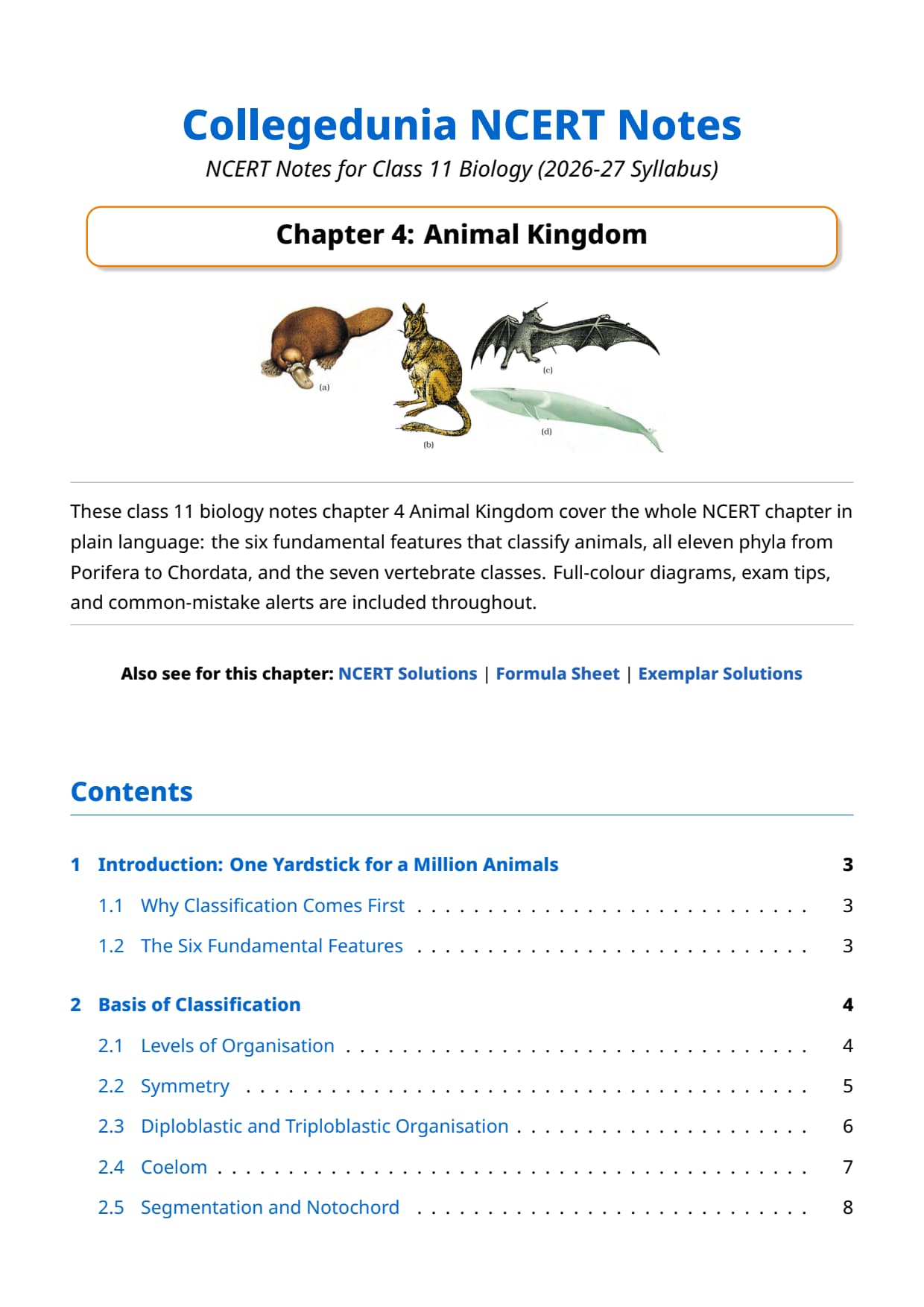
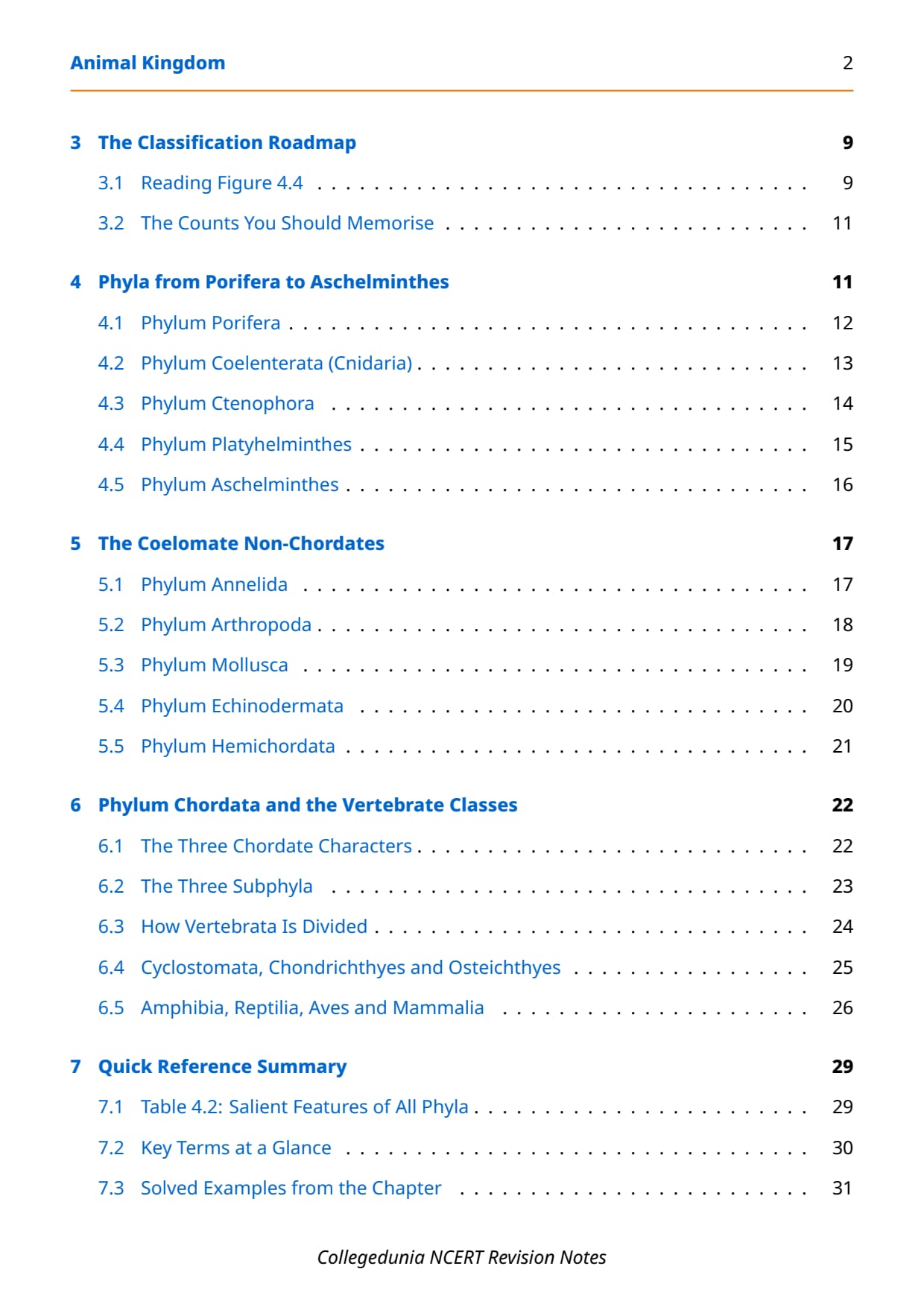
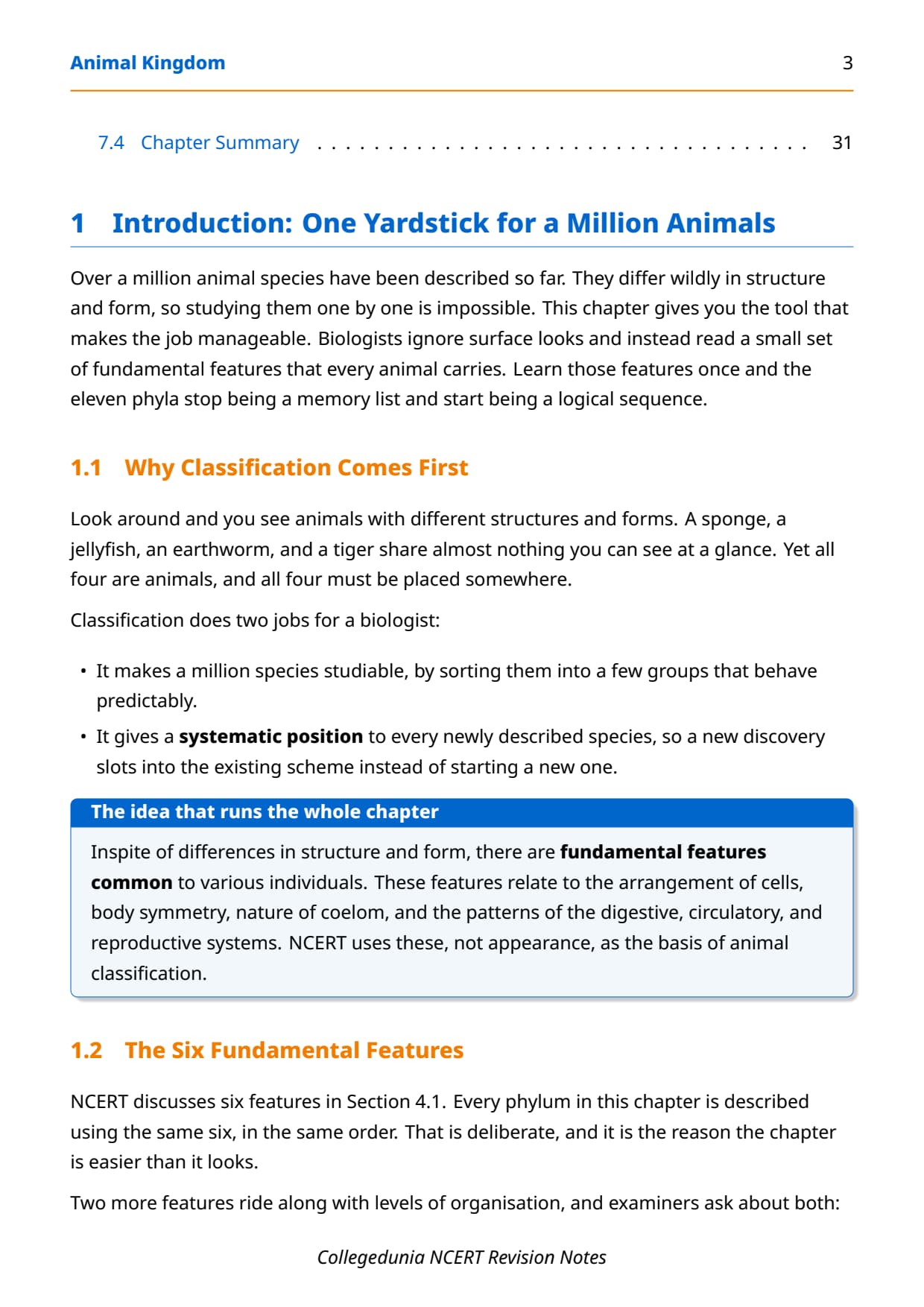
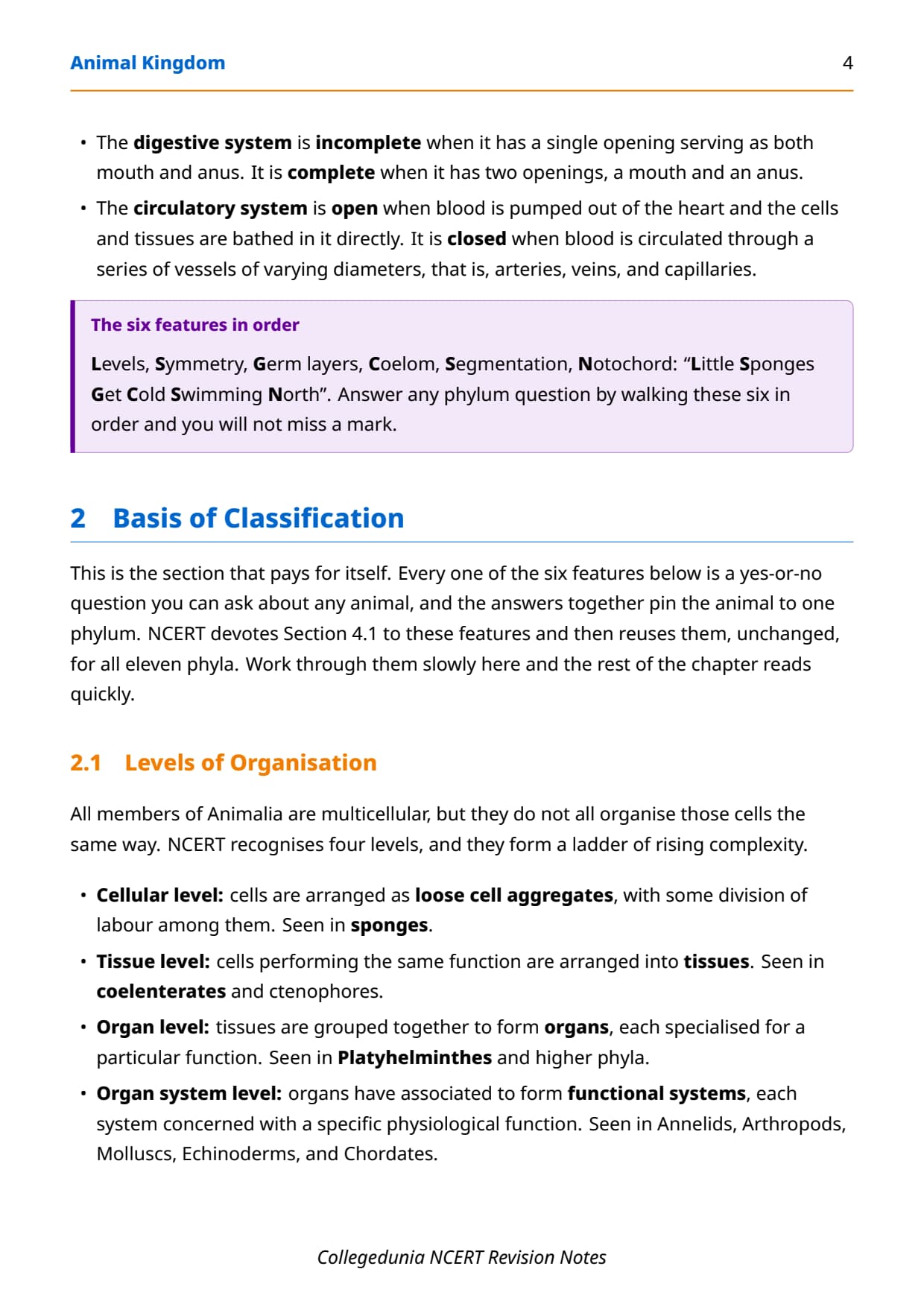
This chapter gives you one yardstick for over a million animal species, and that same set of features returns in Structural Organisation in Animals and in every later diversity question of Class 11 Biology.
- CBSE Weightage: 4 to 6 marks, usually one question on the basis of classification plus a phylum or vertebrate-class comparison.
- Topics covered: the six fundamental features, levels of organisation, symmetry, germ layers, coelom, segmentation, notochord, the eleven phyla, phylum Chordata, and the seven vertebrate classes.
- Key rules: the classification chain read in a fixed order, the three chordate characters, and the rule that all vertebrates are chordates but all chordates are not vertebrates.
These animal kingdom class 11 notes are curated by subject experts, based on the 2026-27 NCERT textbook, and checked against the last five years of CBSE Board and NEET papers.
Topic-by-Topic Summary of Animal Kingdom
The chapter teaches one skill: reading a small set of body features to place any animal in its phylum. It opens with six features, compresses them into a single classification chart, then walks the eleven phyla and the seven vertebrate classes in a fixed order. Here is the quick map of what each topic gives you before you revise the detail.
- Basis of classification: the six features, that is, levels of organisation, symmetry, germ layers, coelom, segmentation, and notochord.
- Classification roadmap: how those features branch into eleven phyla through three routes out of Animalia.
- Porifera to Aschelminthes: the first five phyla, from the simplest cellular body to the first complete gut.
- Coelomate non-chordates: Annelida, Arthropoda, Mollusca, Echinodermata, and Hemichordata, each fixed by one distinctive structure.
- Chordata and vertebrates: the three chordate characters, three subphyla, and the seven classes from Cyclostomata to Mammalia.
Revise the topics in this order, because each phylum is described using the same six features you learn first. Master the six fundamental features, and the eleven phyla stop being a memory list and become a logical sequence. These animal kingdom class 11 notes follow the same order as the NCERT textbook.
Basis of Classification: The Six Fundamental Features
Animals differ wildly in structure and form, so surface looks are useless for sorting them. NCERT instead reads six fundamental features that every animal carries, and it reuses the same six, in the same order, for all eleven phyla. Each feature is a simple yes-or-no question, and the answers together pin an animal to one phylum. Work through them slowly here and the rest of the chapter reads quickly.
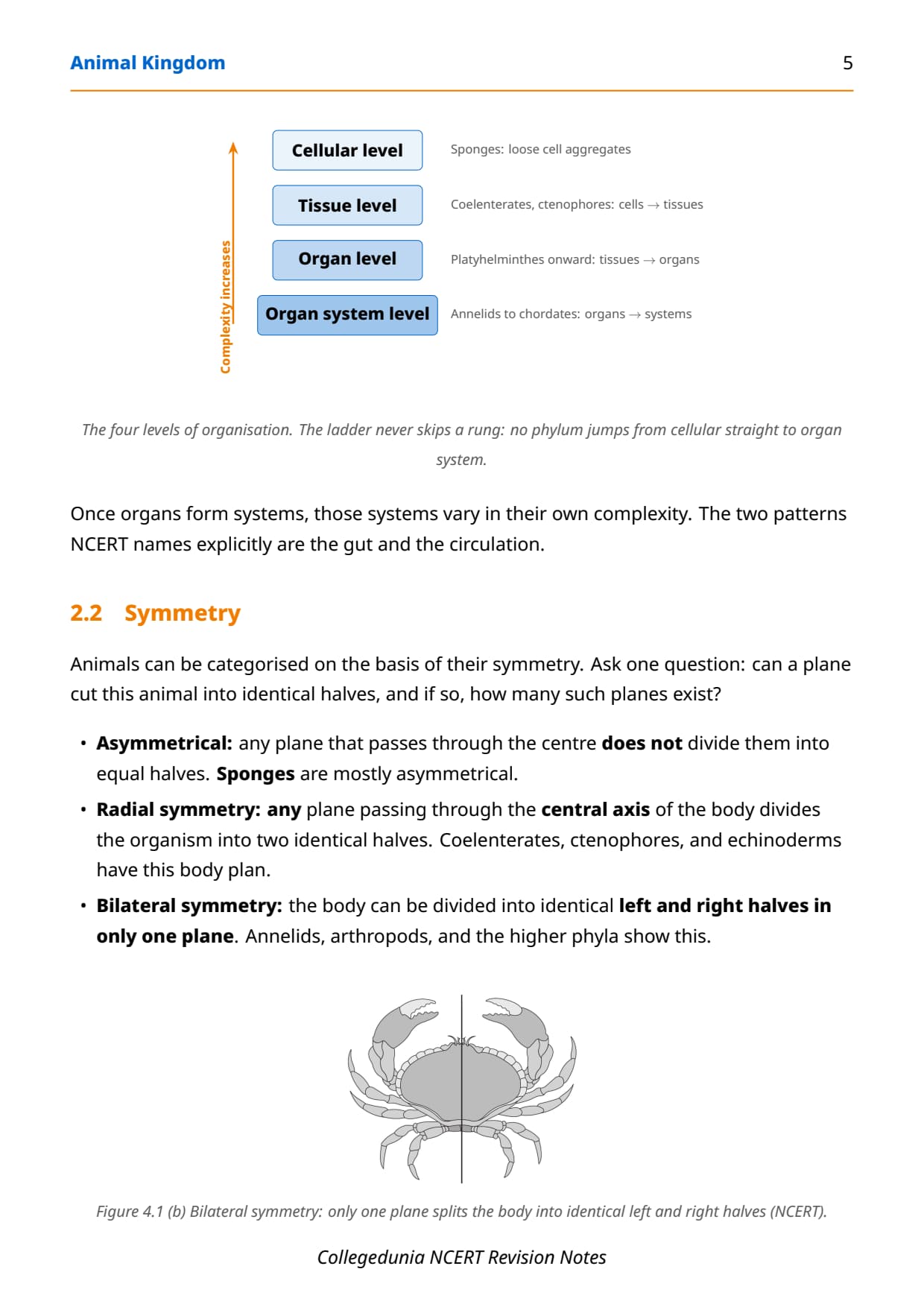
- Levels of organisation: the cellular level in sponges, the tissue level in coelenterates, the organ level in Platyhelminthes, and the organ system level from annelids onward.
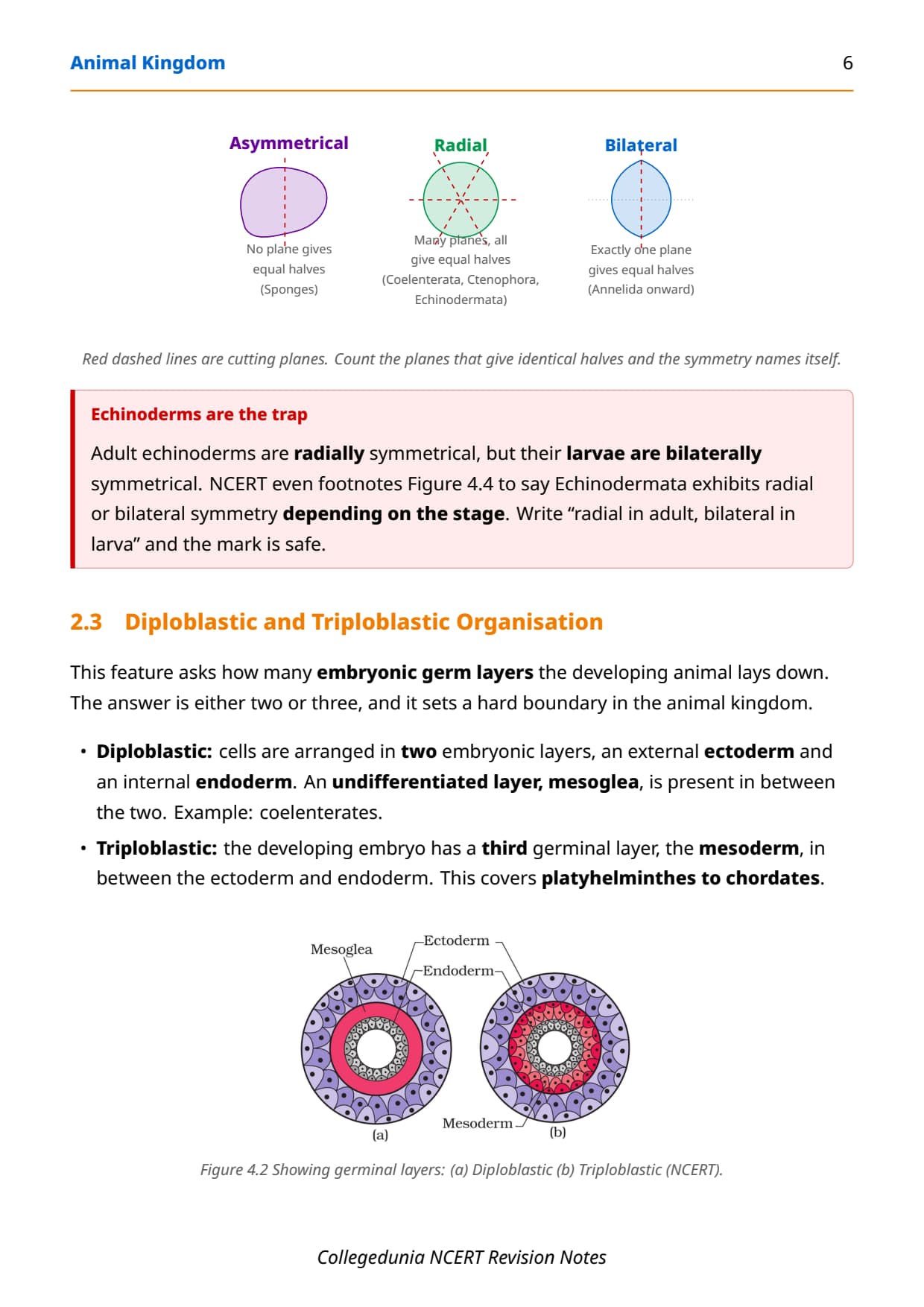
- Symmetry: asymmetrical in most sponges, radial in coelenterates and adult echinoderms, and bilateral from annelids up.
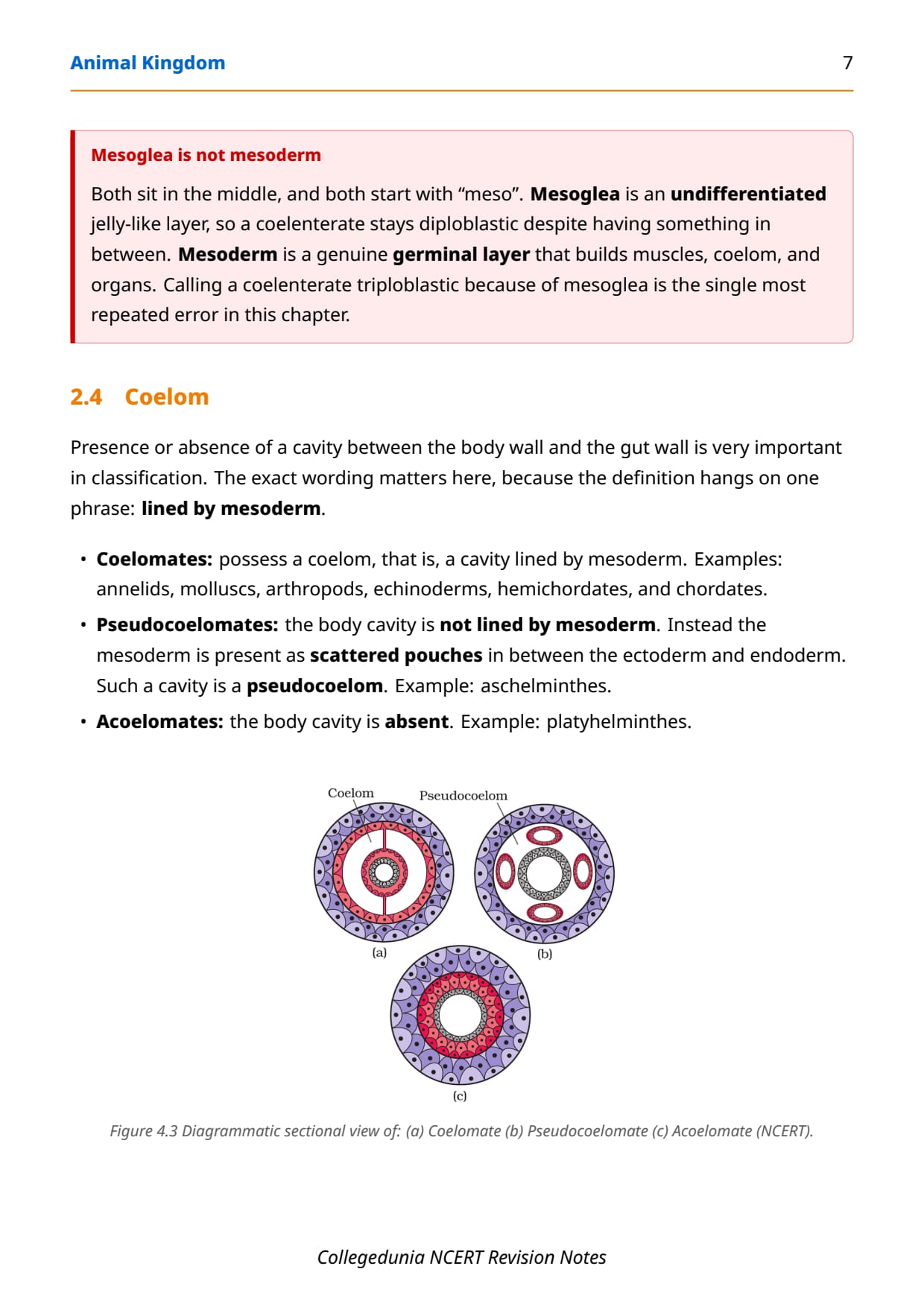
- Germ layers: diploblastic animals lay down two layers with an undifferentiated mesoglea in between, while triploblastic animals add a true mesoderm.
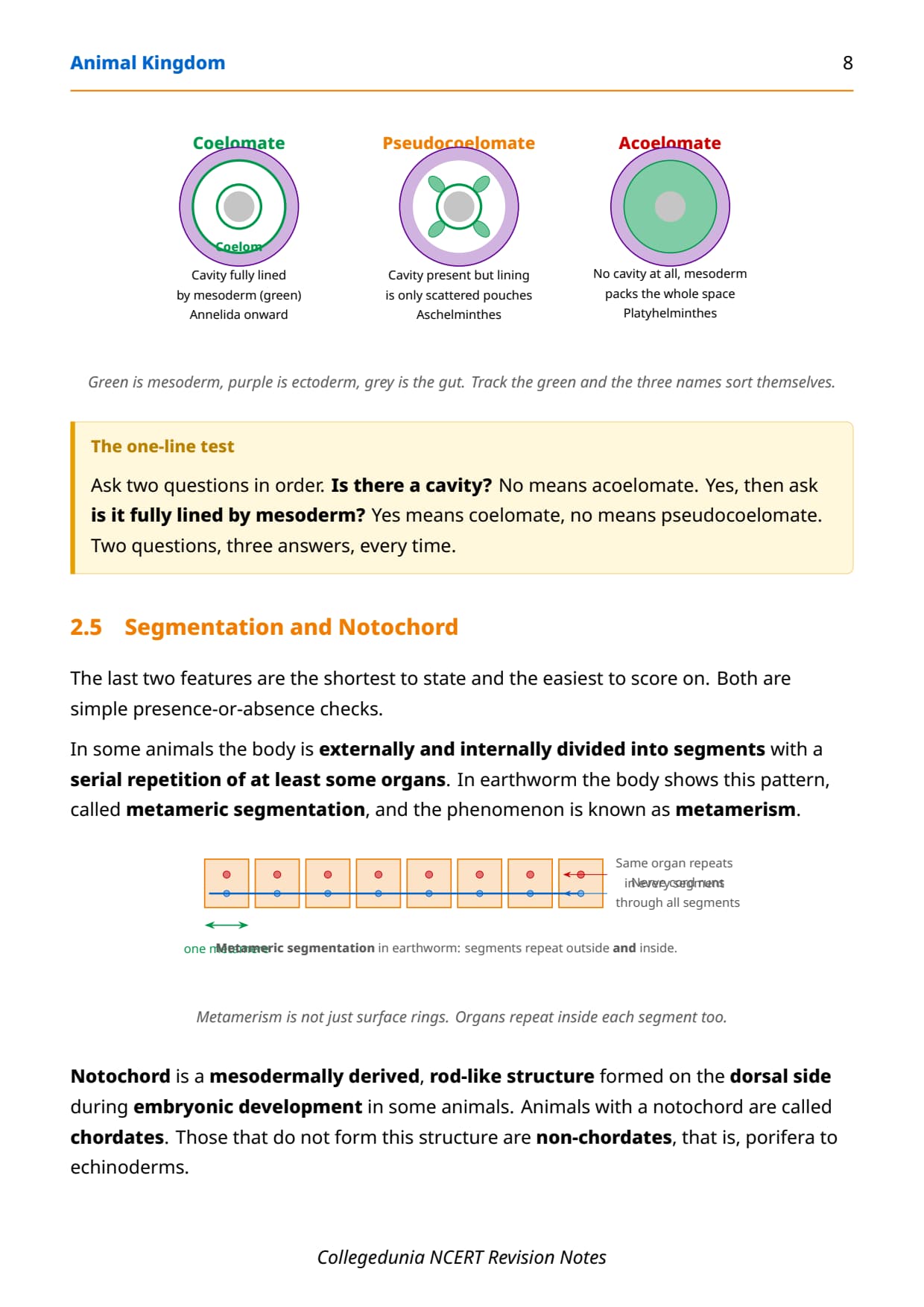
- Coelom: a coelomate has a cavity fully lined by mesoderm, a pseudocoelomate has one that is not, and an acoelomate has none.
- Segmentation and notochord: the body may be divided into serially repeated segments (metamerism), and a mesodermal notochord may form on the dorsal side during embryonic development.
Two more patterns ride along with these features. The digestive system is incomplete with a single opening or complete with a separate mouth and anus, and the circulatory system is open when blood bathes the tissues directly or closed when it stays in vessels. Answer the six features in order and the phylum falls out, which is exactly how NCERT Figure 4.4 is built. A useful memory aid for the order is "Little Sponges Get Cold Swimming North" for Levels, Symmetry, Germ layers, Coelom, Segmentation, Notochord.
The Classification Roadmap: Eleven Phyla in Three Routes
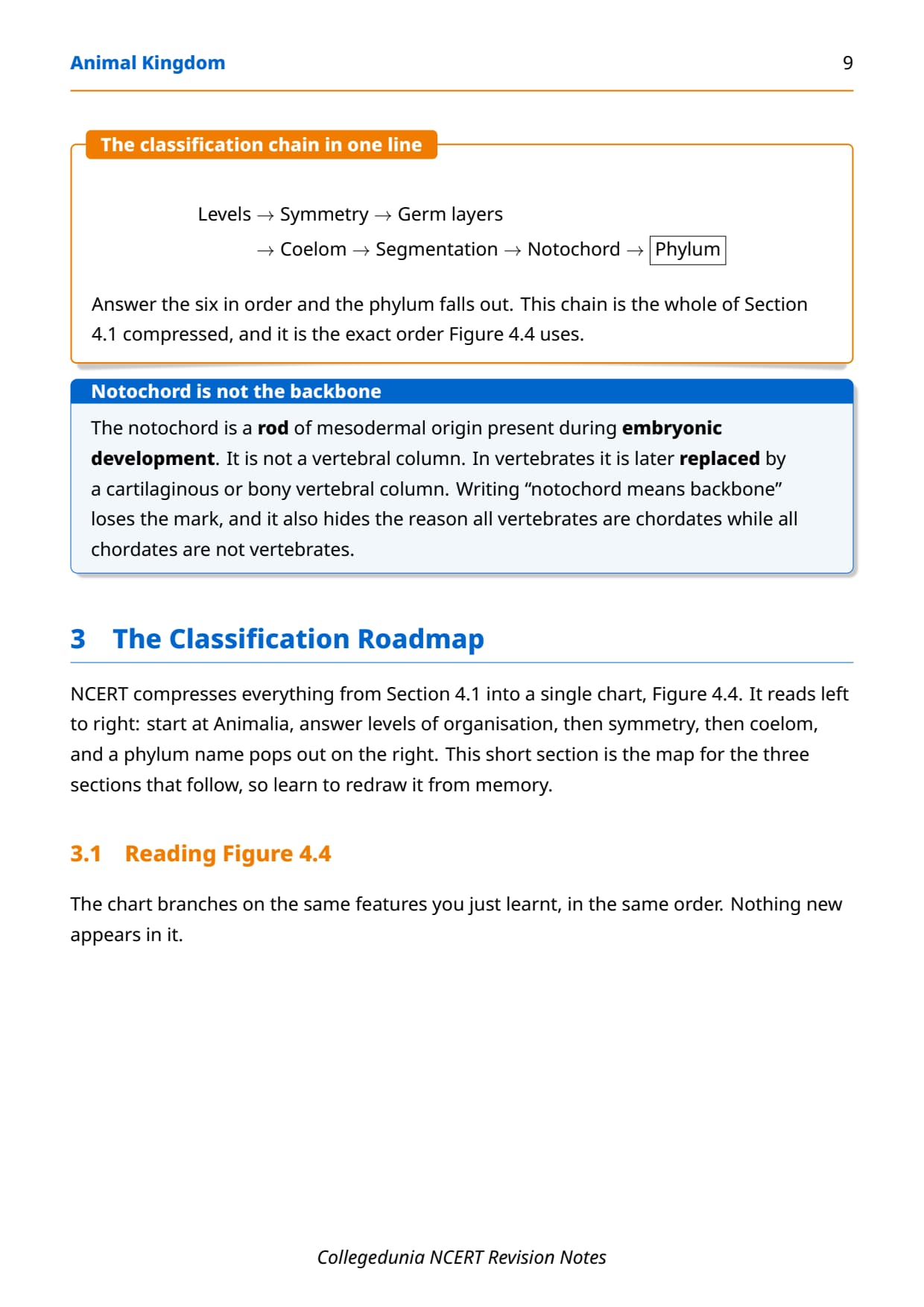
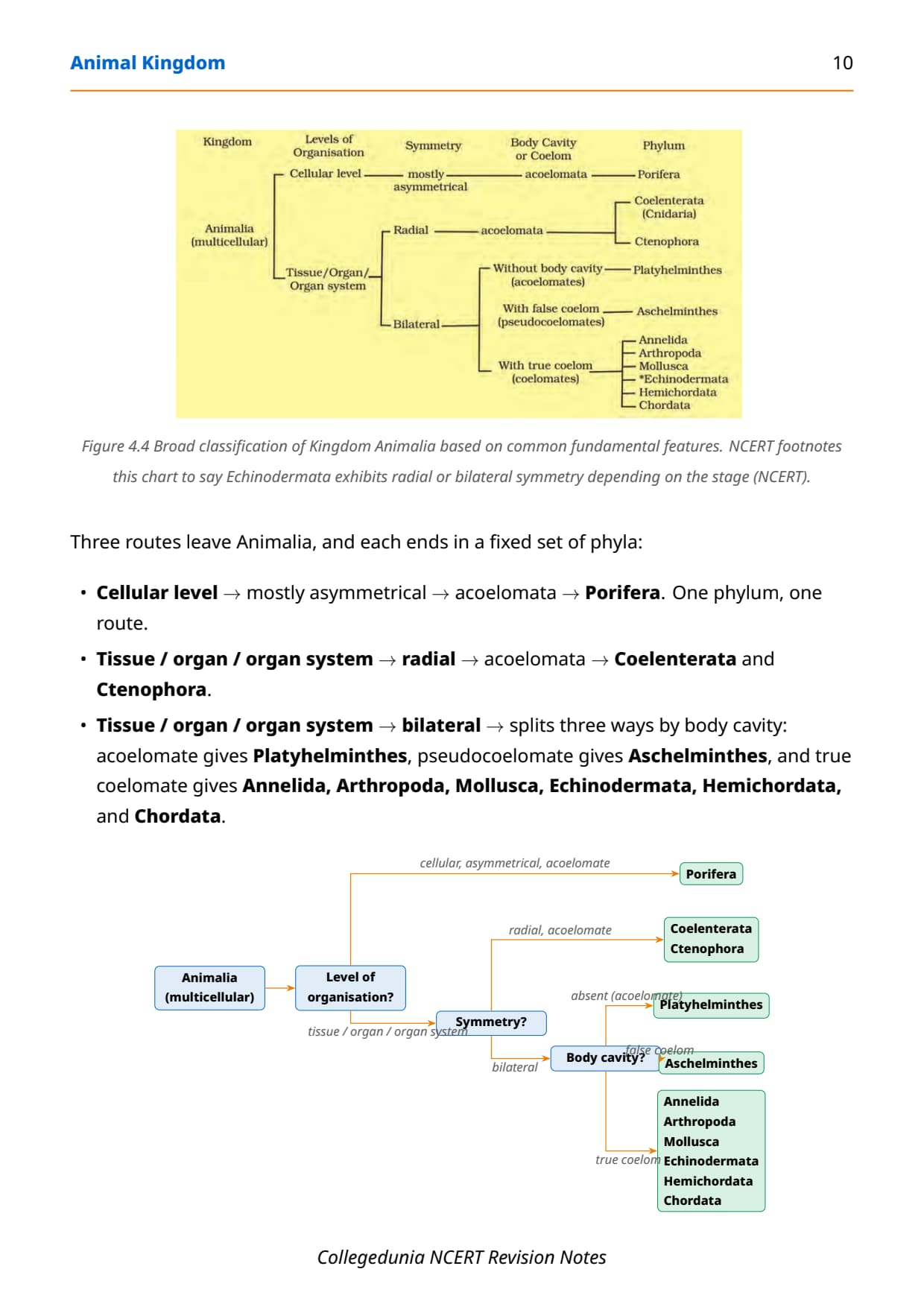
NCERT compresses all six features into a single decision chart, Figure 4.4, that reads left to right from Animalia to a phylum name. Three routes leave Animalia, and each one ends in a fixed set of phyla, so learning the routes fixes most of the chapter. This short map sits behind the three sections that follow.
- Cellular route: cellular level, mostly asymmetrical, acoelomate, gives one phylum, Porifera.
- Radial route: tissue or higher level, radial symmetry, gives Coelenterata and Ctenophora.
- Bilateral route: bilateral symmetry, then splits by body cavity, that is, acoelomate gives Platyhelminthes, pseudocoelomate gives Aschelminthes, and true coelomate gives Annelida, Arthropoda, Mollusca, Echinodermata, Hemichordata, and Chordata.
A few counts make the rest of the chapter self-checking. Only two phyla are diploblastic, only one is pseudocoelomate, and only three are segmented, that is, Annelida, Arthropoda, and Chordata. If your answer names four diploblastic phyla or a pseudocoelomate other than Aschelminthes, it is wrong. Run these counts over any answer before moving on, and use the roadmap as the frame that holds all eleven phyla in place.
Phyla from Porifera to Aschelminthes
The first five phyla take you from the simplest animal body to the first complete gut. Read each against the six features and watch the complexity climb: cells become tissues, tissues become organs, two germ layers become three, and a solid body finally opens a cavity. Every description below follows the NCERT order, so what you write in the exam matches the book.
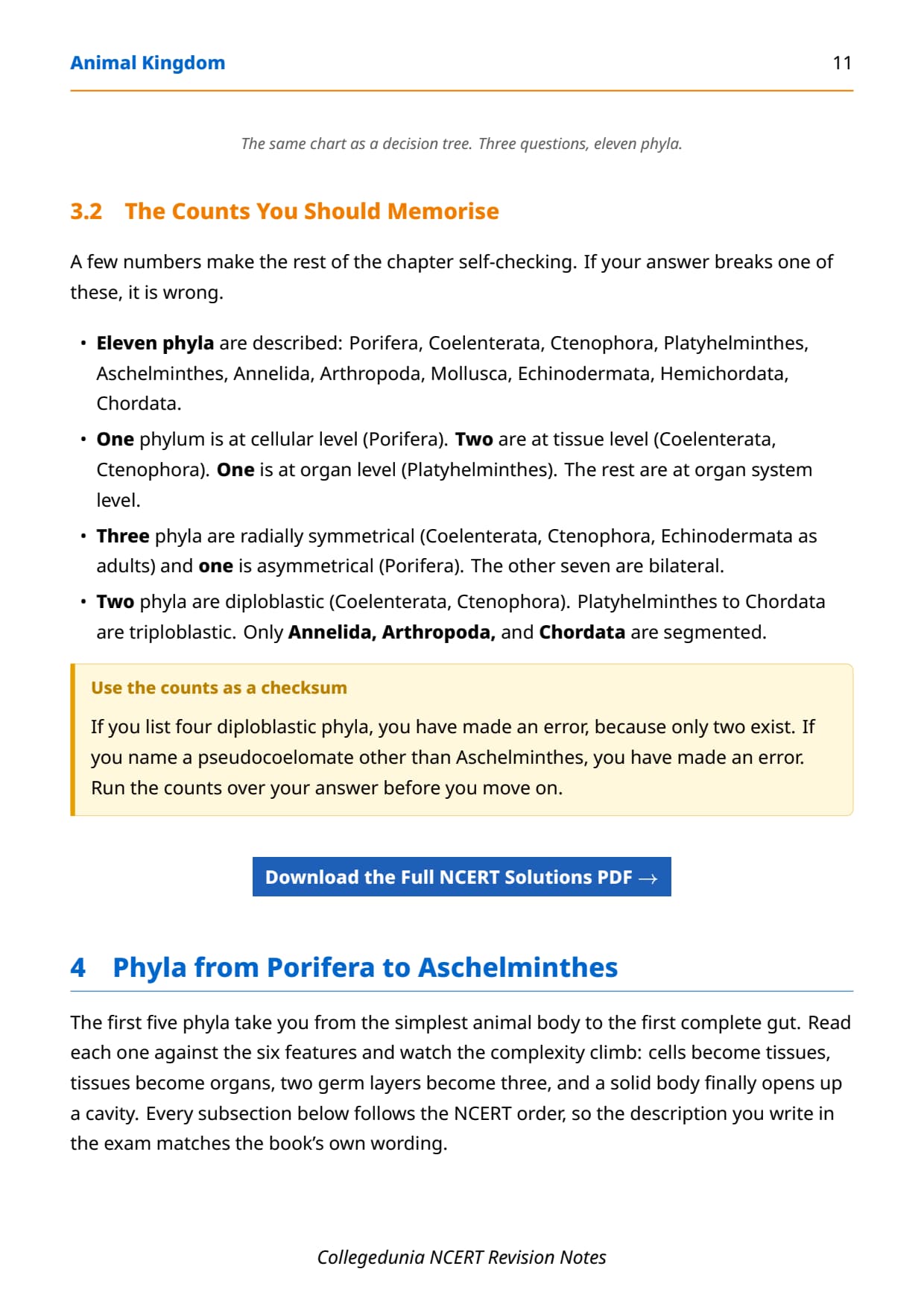
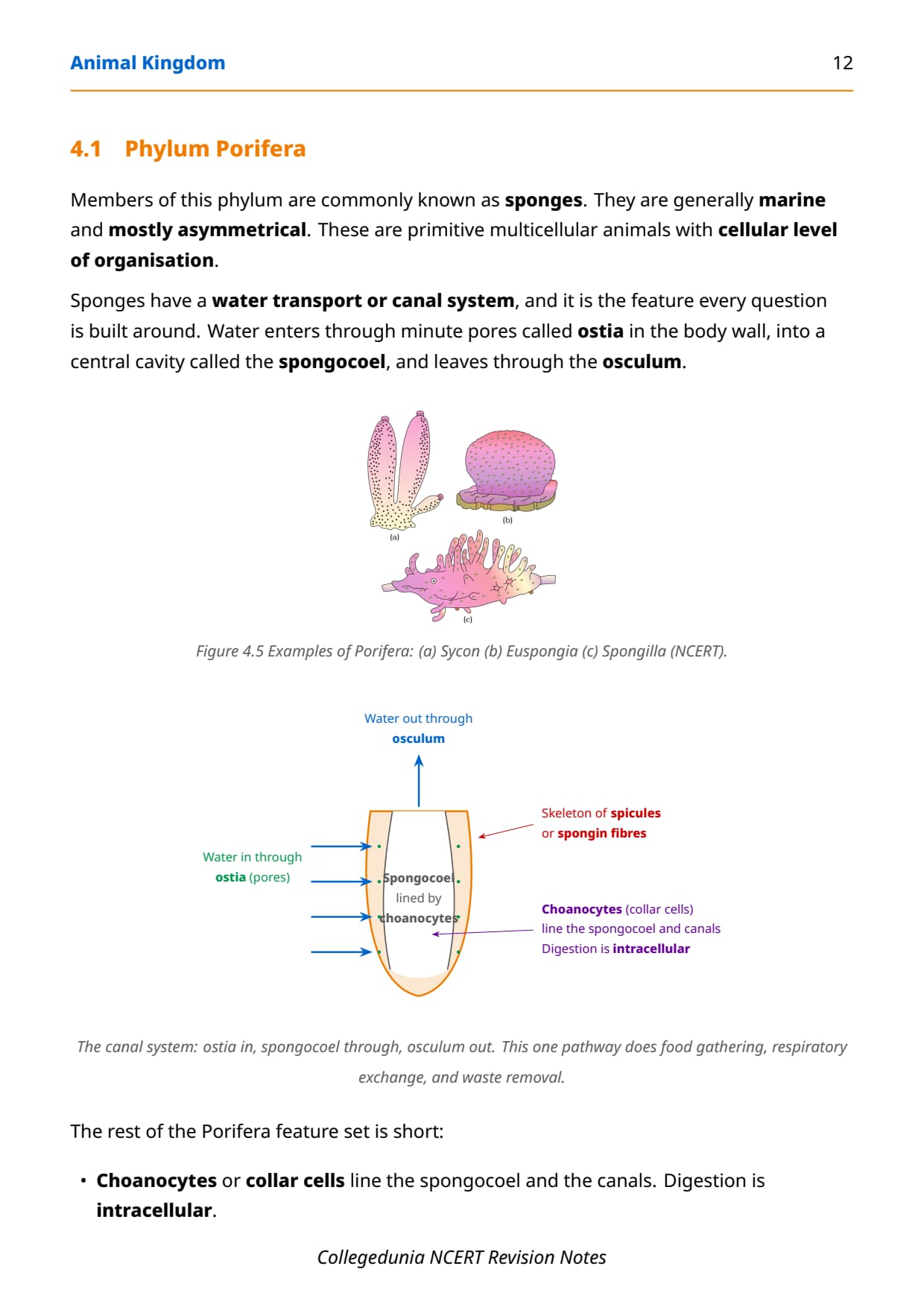
- Porifera (sponges): marine, mostly asymmetrical, cellular level. Water flows in through ostia to the spongocoel and out of the osculum. Choanocytes line the canals and the skeleton is of spicules or spongin. Examples: Sycon, Spongilla, Euspongia.
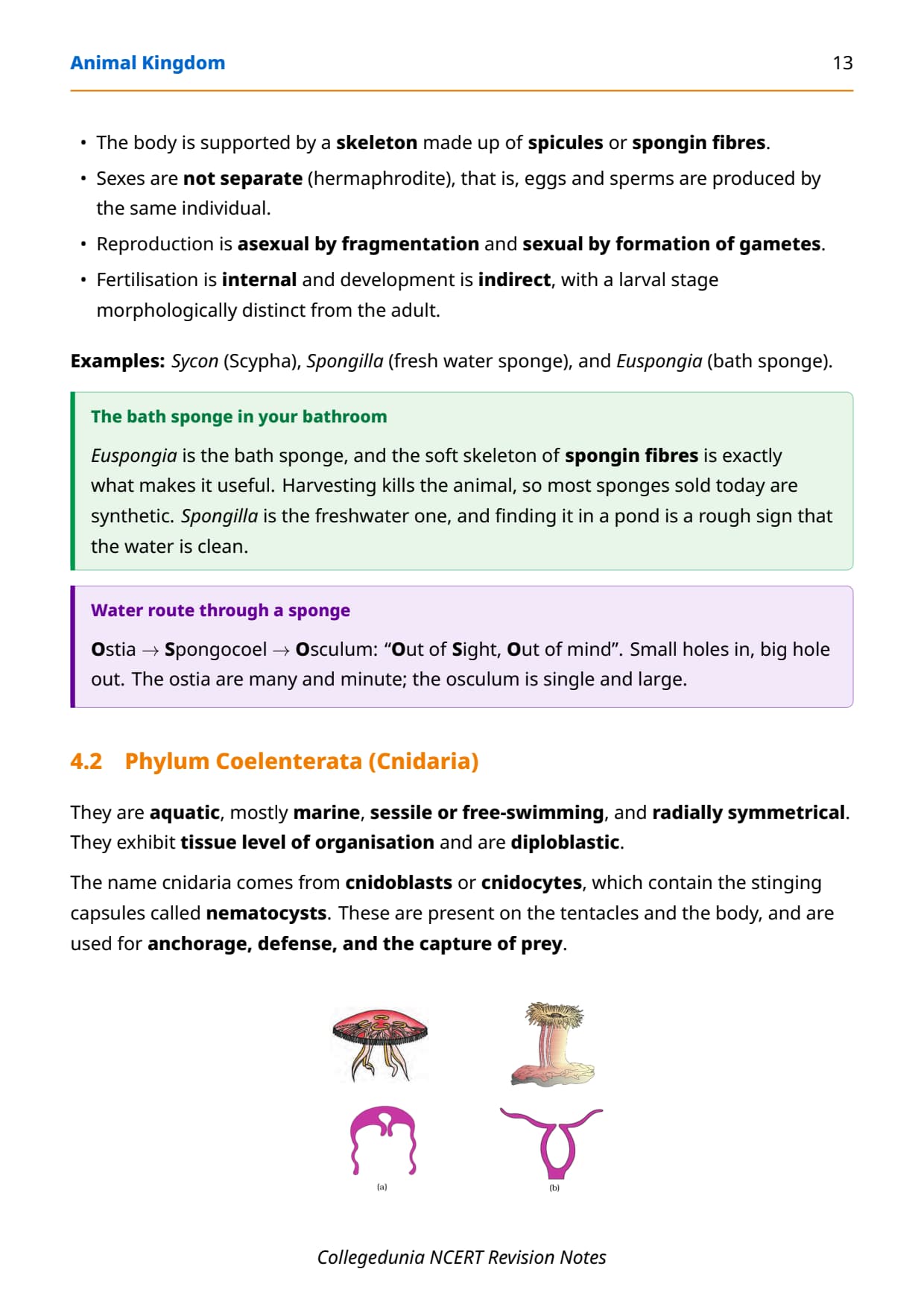
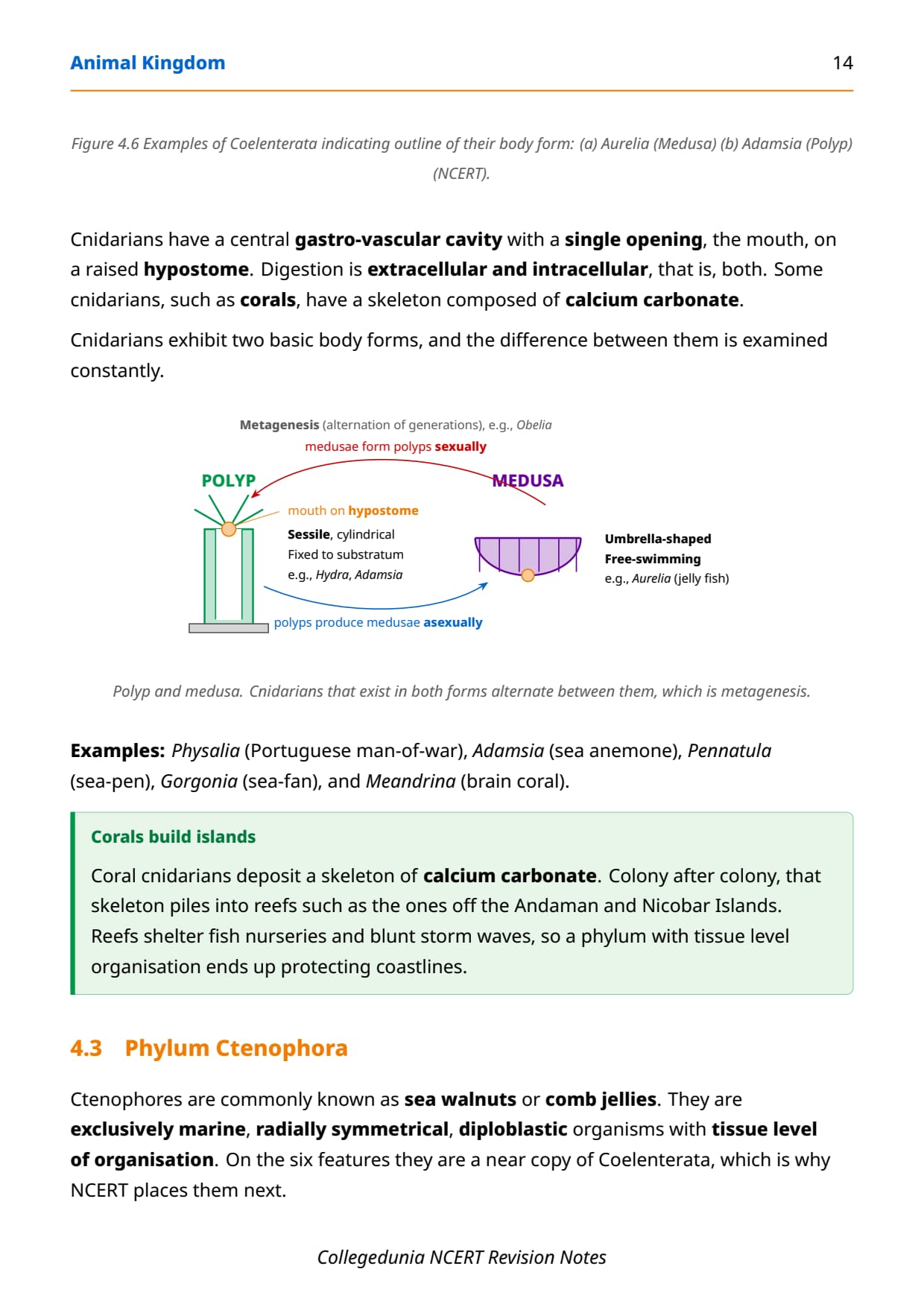
- Coelenterata (Cnidaria): radial, diploblastic, tissue level. Cnidoblasts with nematocysts capture prey, and body forms are the sessile polyp and free-swimming medusa. Examples: Hydra, Adamsia, Physalia.
- Ctenophora (comb jellies): marine, radial, diploblastic, with eight rows of comb plates and marked bioluminescence. Reproduction is only sexual. Examples: Pleurobrachia, Ctenoplana.
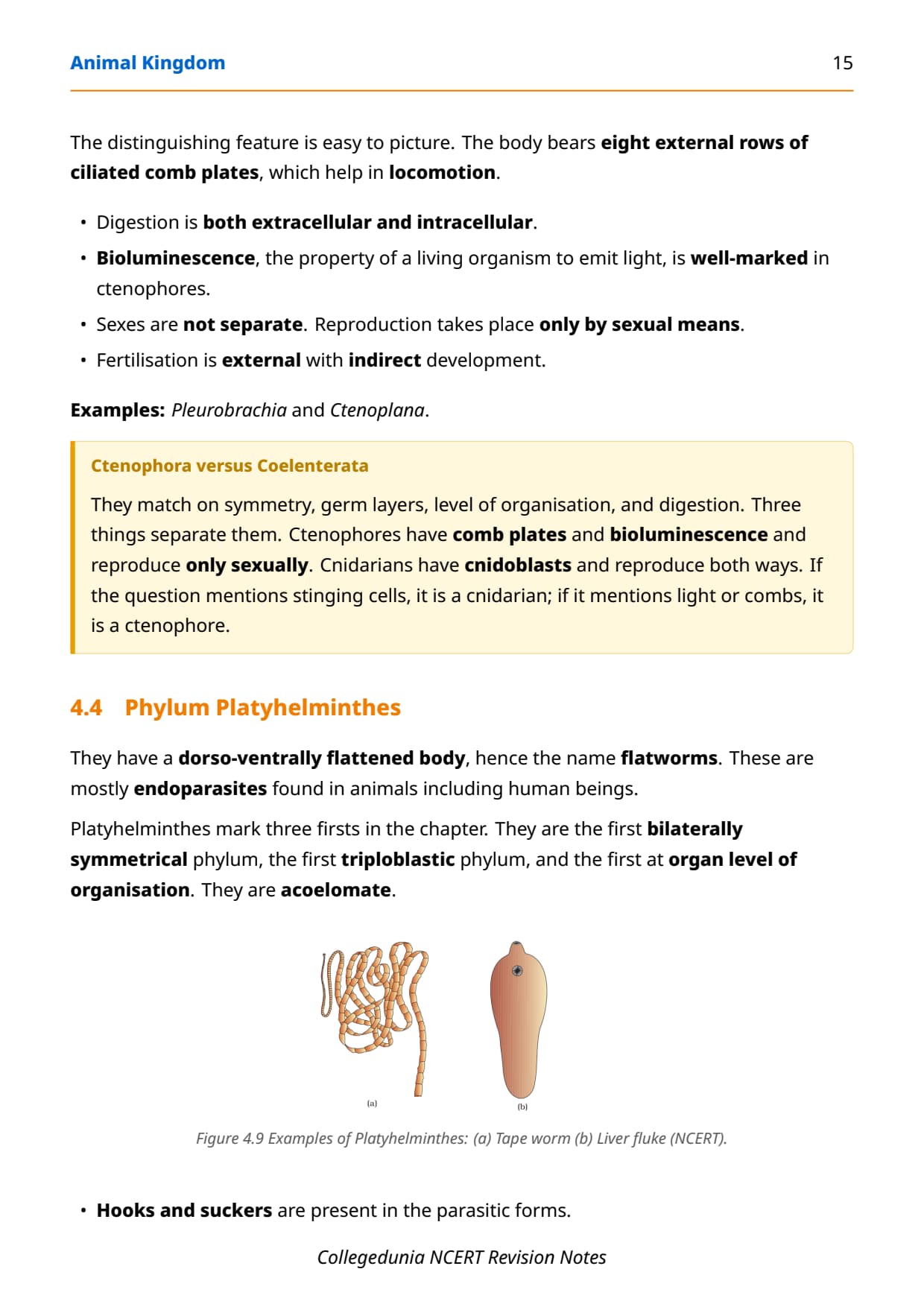
- Platyhelminthes (flatworms): the first bilateral, first triploblastic, and first organ-level phylum, and acoelomate. Flame cells handle excretion. Examples: Taenia, Fasciola.
- Aschelminthes (roundworms): the only pseudocoelomate phylum, with the first complete gut and separate sexes. Examples: Ascaris, Wuchereria, Ancylostoma.
Aschelminthes marks the first complete alimentary canal in the chapter, with a mouth and a separate anus. Watch the mesoglea trap here too: a coelenterate stays diploblastic despite the jelly-like mesoglea in between, because mesoglea is undifferentiated and is not a true germ layer. These animal kingdom class 11 notes keep that distinction front and centre, since it is the single most repeated error in the chapter.
The Coelomate Non-Chordates: Annelida to Hemichordata
These five phyla share the same three answers, that is, organ system level, triploblastic, and a true coelom. Because the basics are fixed, each phylum is now identified by one distinctive structure rather than a full feature list. Learn the distinctive structure and you have learnt the phylum.
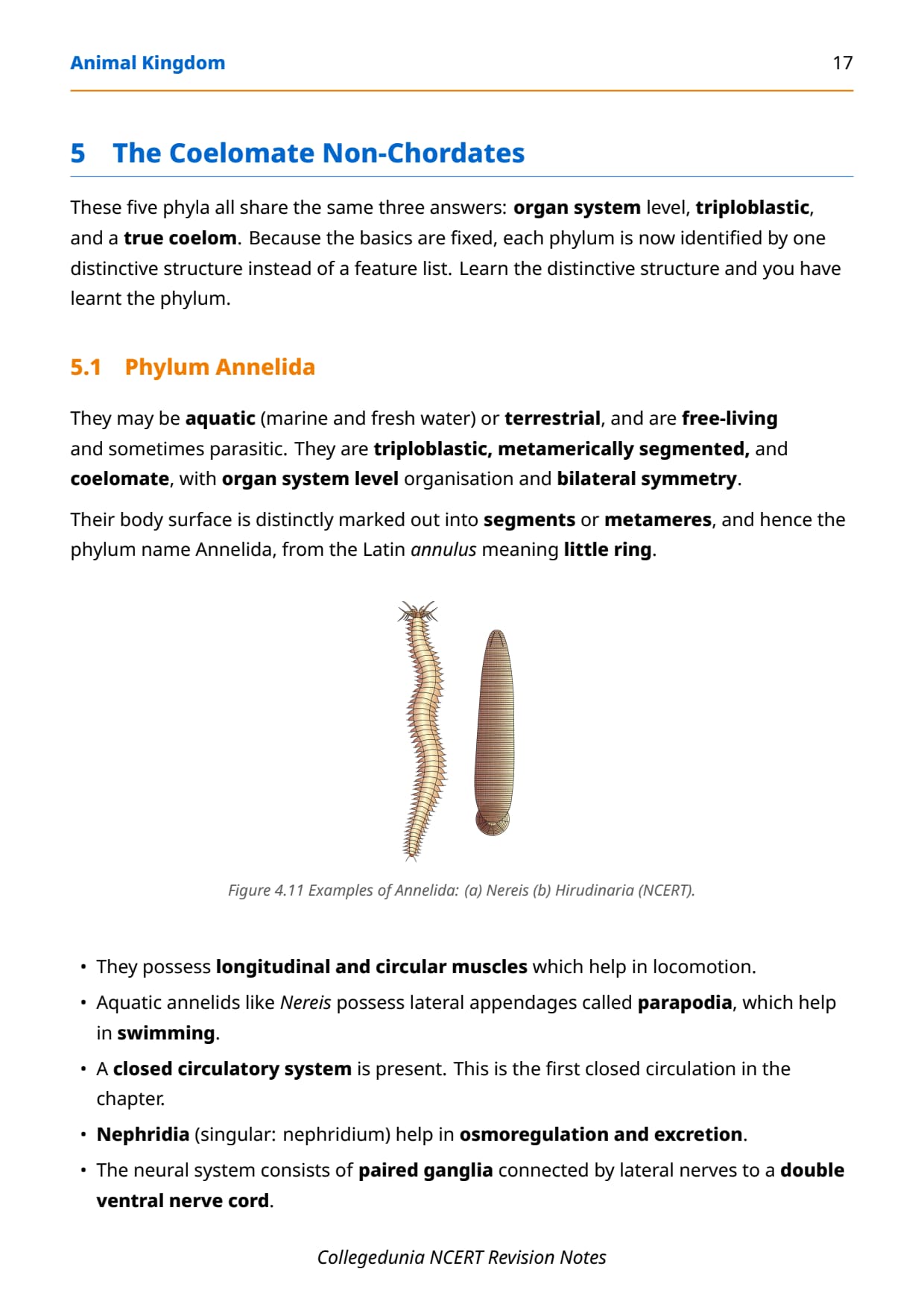
- Annelida: the first metamerically segmented phylum with the first closed circulation. Nephridia excrete, and Nereis bears parapodia. Examples: Nereis, Pheretima (earthworm), Hirudinaria (leech).
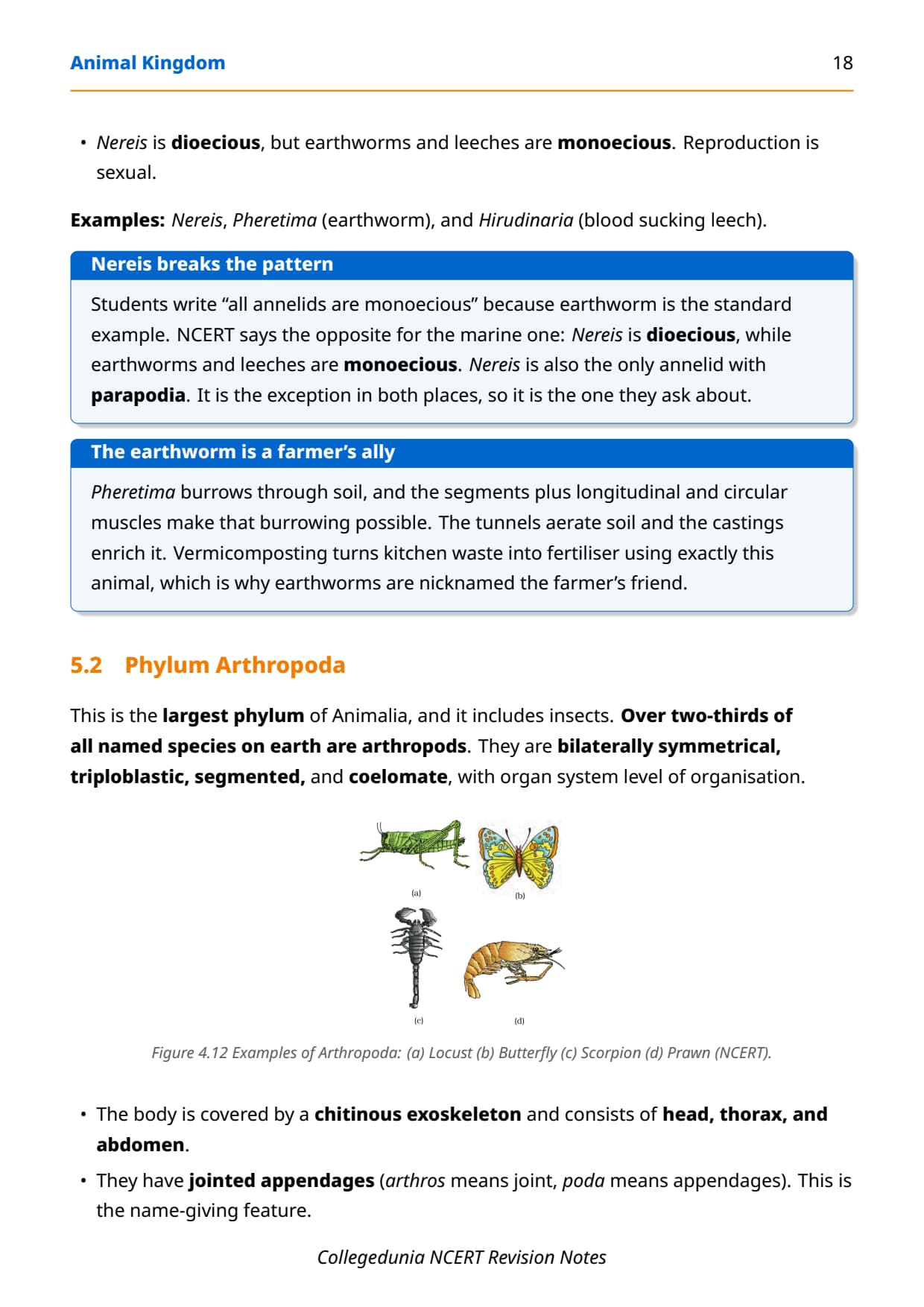
- Arthropoda: the largest phylum, with a chitinous exoskeleton, jointed appendages, open circulation, and malpighian tubules. Examples: Apis, Bombyx, Anopheles, Limulus (living fossil).
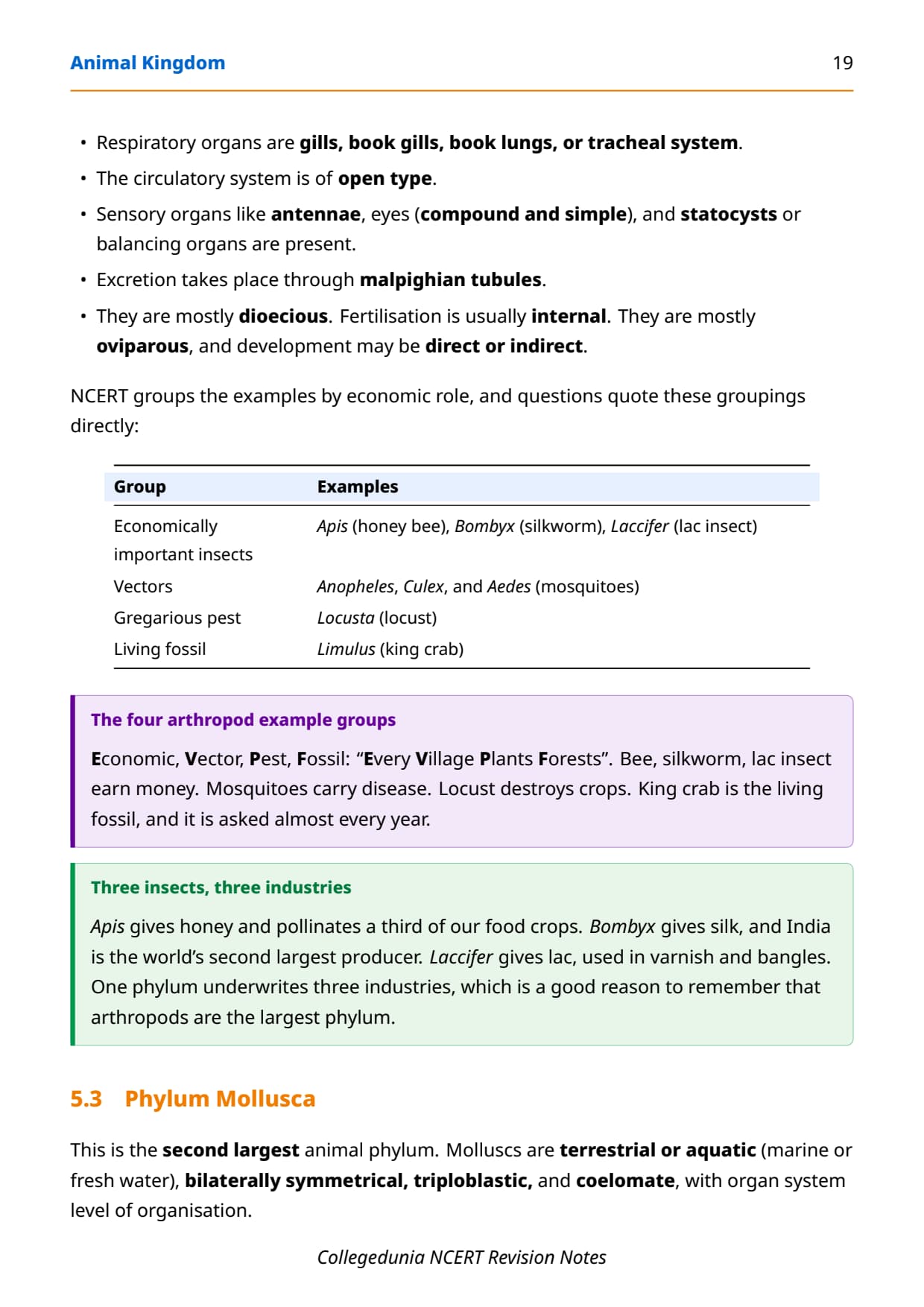
- Mollusca: the second largest phylum, with a calcareous shell, a muscular foot, a mantle, and a file-like radula. Examples: Pila, Pinctada, Sepia, Octopus.
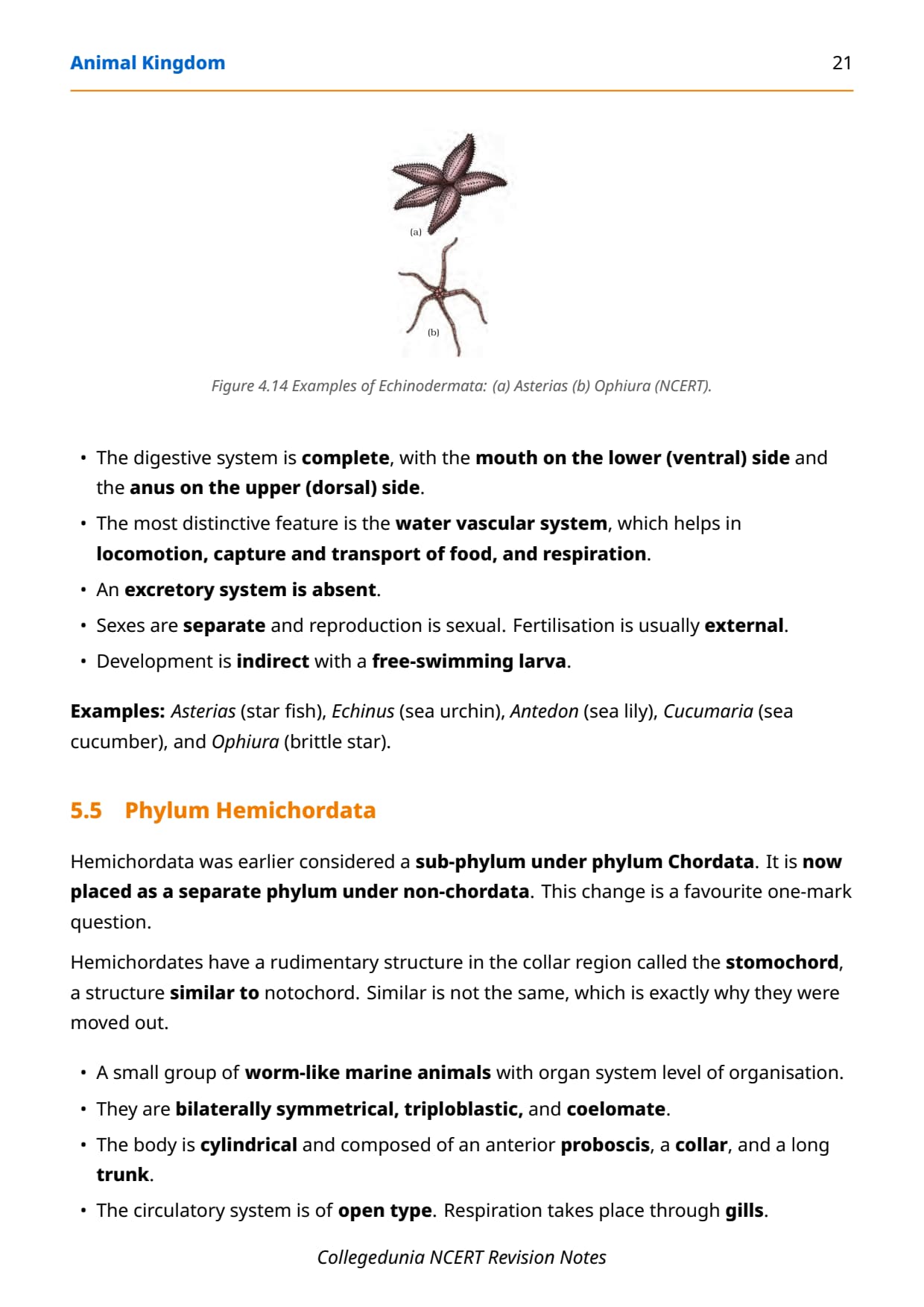
- Echinodermata: all marine, with an endoskeleton of ossicles and the water vascular system. Adults are radial, larvae are bilateral, and excretory system is absent. Examples: Asterias, Echinus, Ophiura.
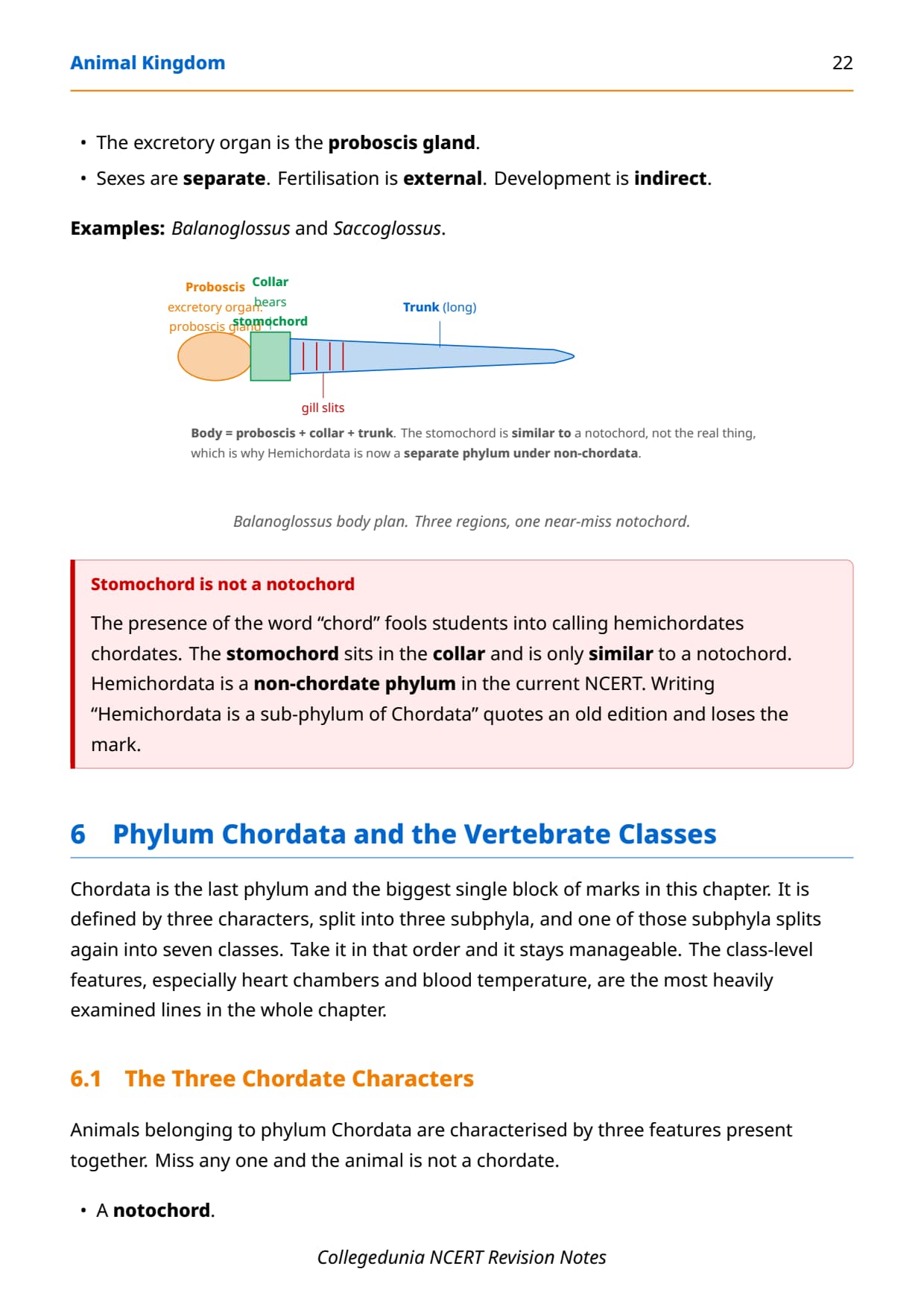
- Hemichordata: worm-like marine animals with a body of proboscis, collar, and trunk, and a stomochord only similar to a notochord. Examples: Balanoglossus, Saccoglossus.
Hemichordata was once a sub-phylum of Chordata but is now a separate phylum under non-chordata, because its stomochord is only similar to a notochord, not a real one. Two other lines earn marks here: Nereis is the annelid exception, being dioecious and the only one with parapodia, while earthworms and leeches are monoecious. Echinoderm symmetry is the classic trap, so always write radial in the adult and bilateral in the larva.
Phylum Chordata and the Vertebrate Classes
Chordata is the last phylum and the biggest single block of marks in this chapter. It is defined by three characters, split into three subphyla, and one subphylum splits again into seven classes. The class-level features, especially heart chambers and blood temperature, are the most heavily examined lines in the whole chapter, so take the topic in that fixed order.
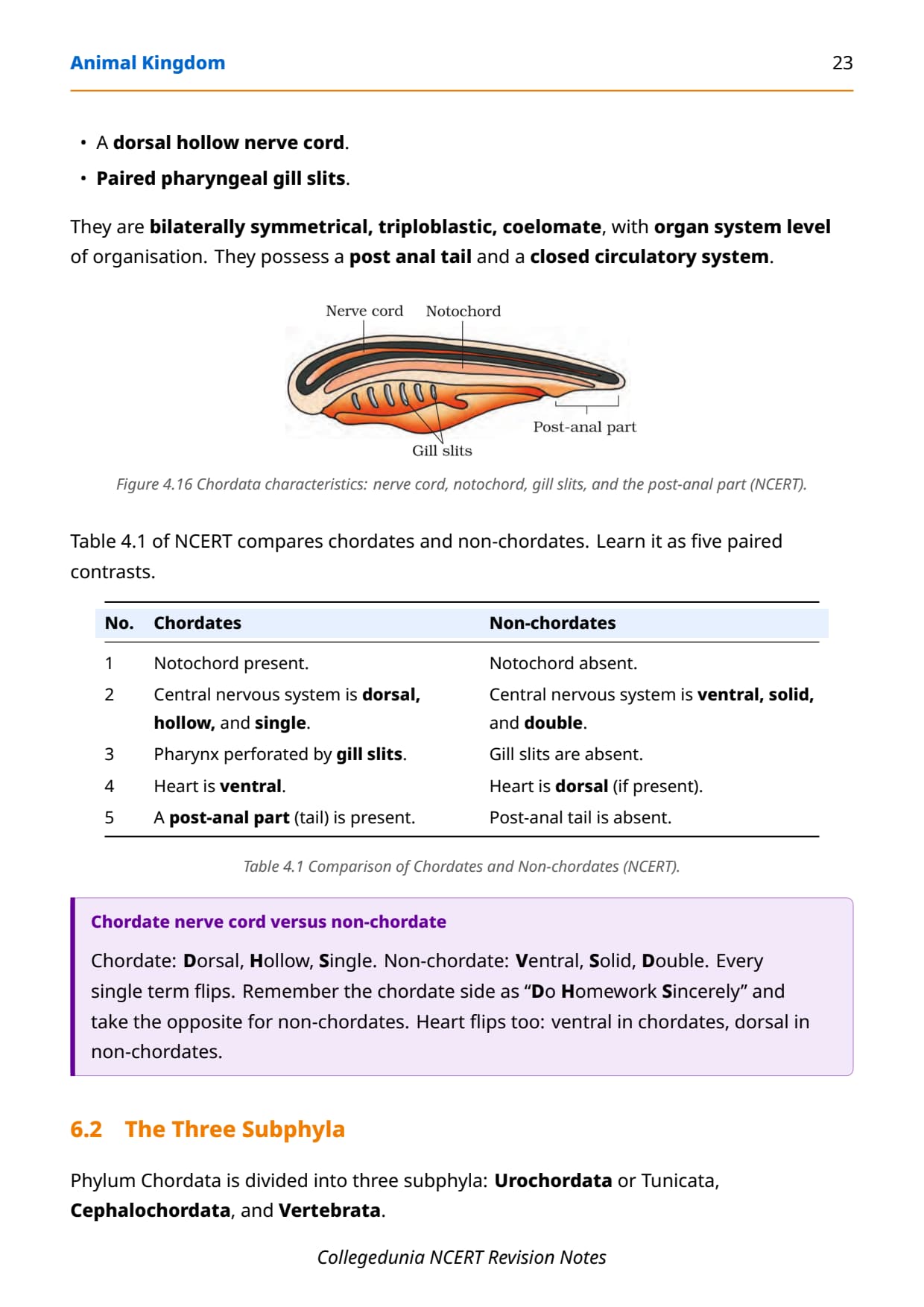
- The three chordate characters: a notochord, a dorsal hollow nerve cord, and paired pharyngeal gill slits, all present together. Non-chordates have a ventral, solid, double nerve cord and no notochord.
- The three subphyla: Urochordata (notochord only in the larval tail), Cephalochordata (notochord from head to tail, lifelong), and Vertebrata (notochord replaced by a vertebral column). Urochordata and Cephalochordata are the marine protochordates.
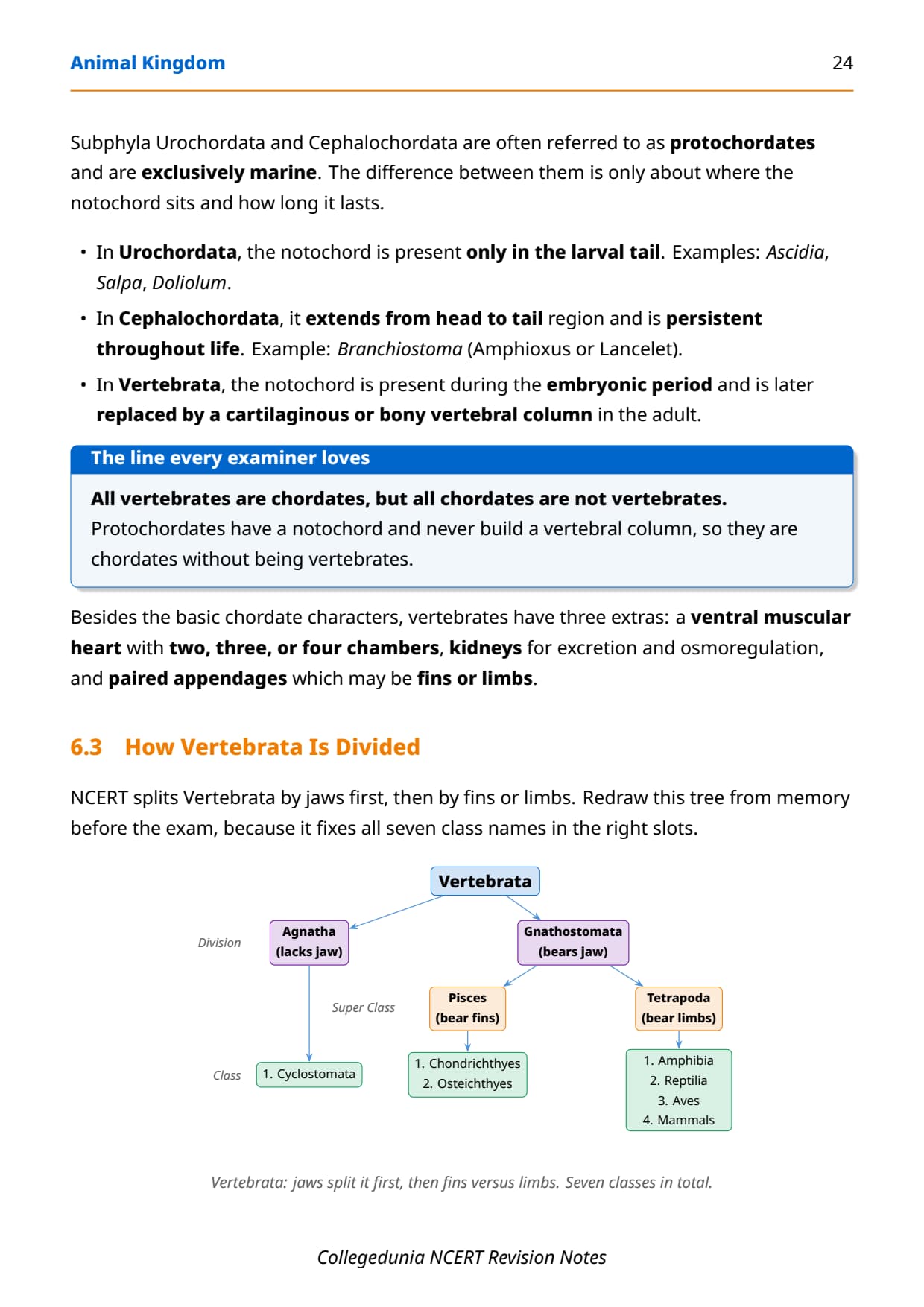
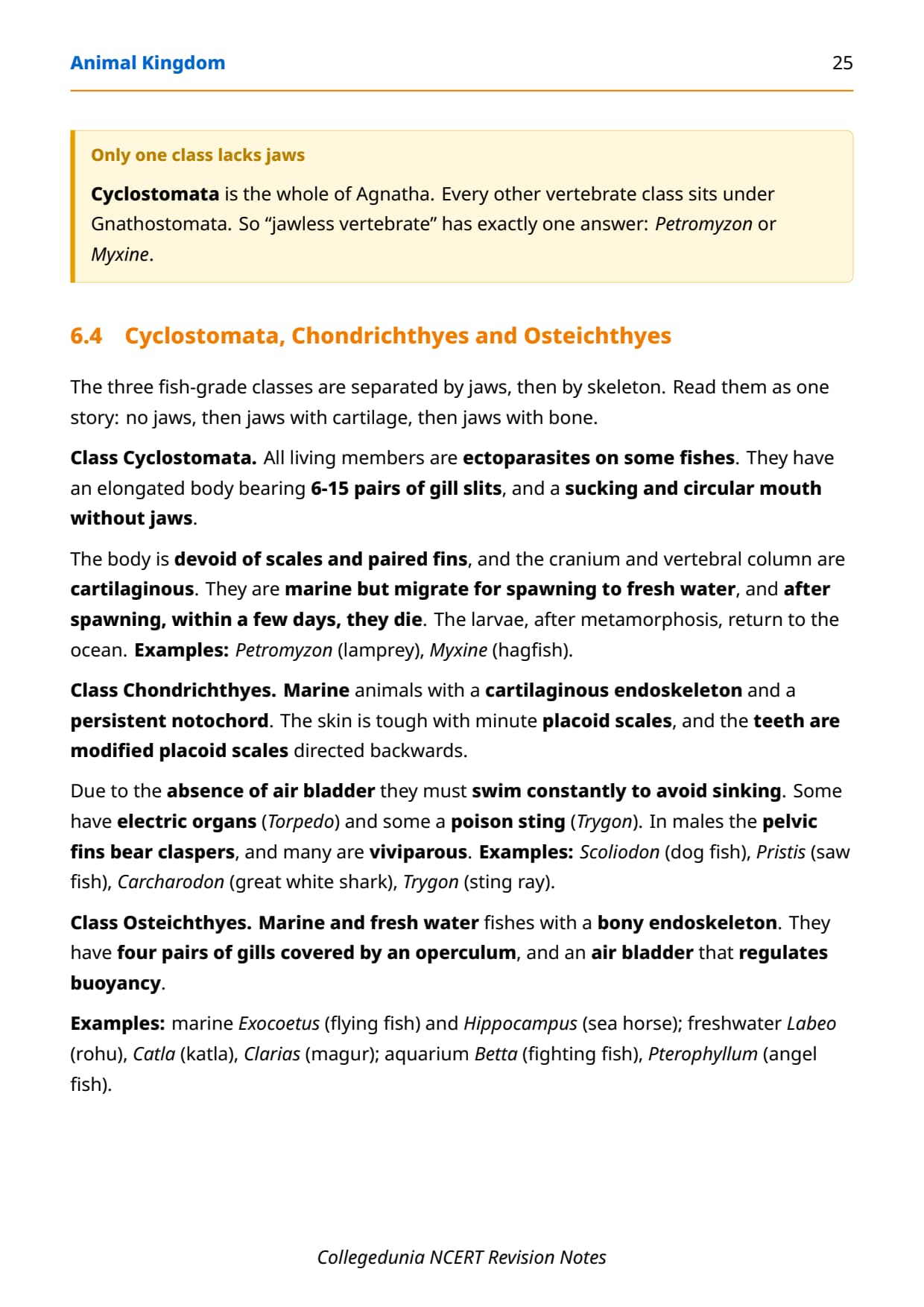
- Vertebrata splits by jaws: Agnatha (Cyclostomata) lacks jaws, and Gnathostomata bears them, dividing into Pisces (fins) and Tetrapoda (limbs).
- The seven classes: Cyclostomata, Chondrichthyes, Osteichthyes, Amphibia, Reptilia, Aves, and Mammalia.
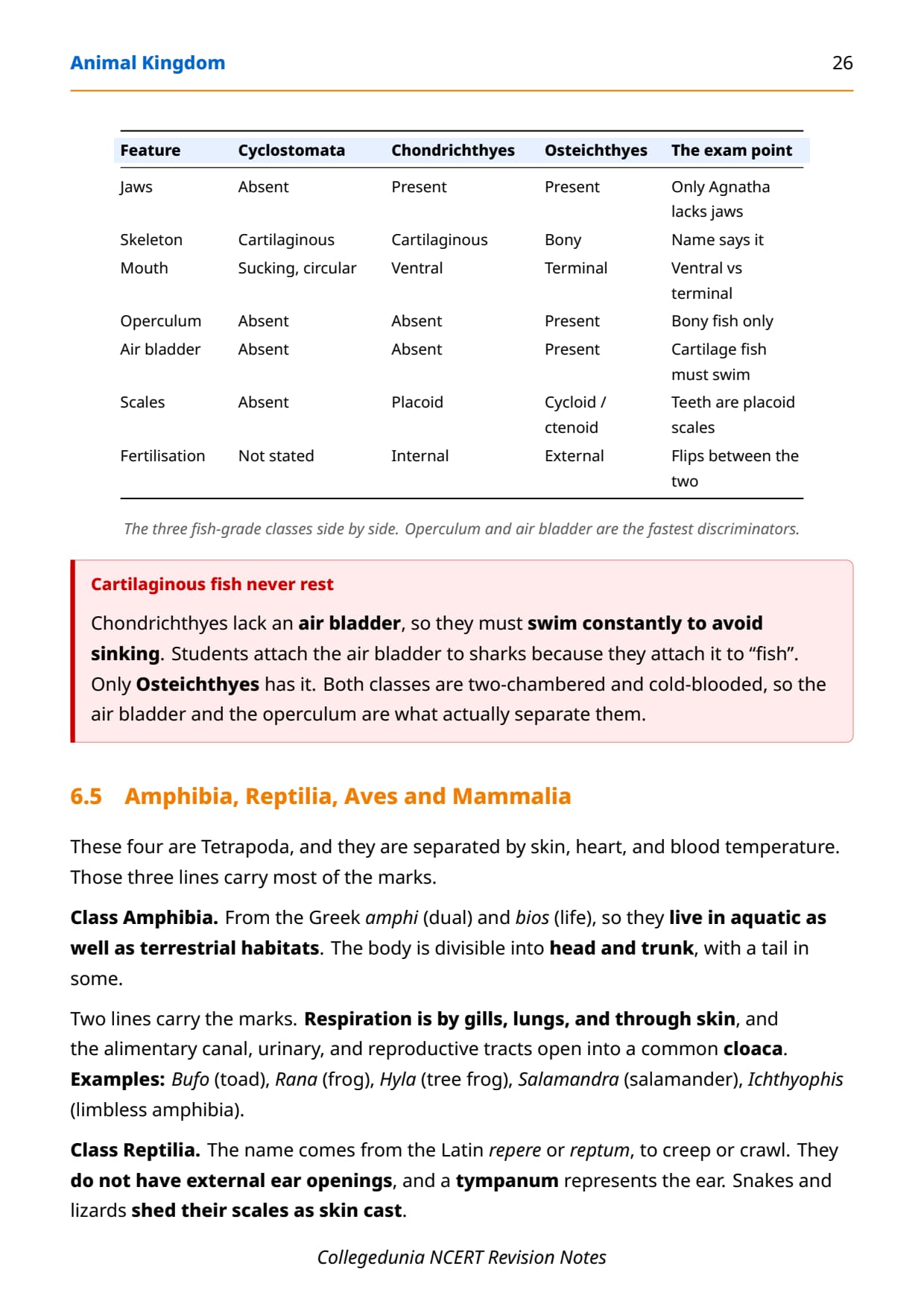
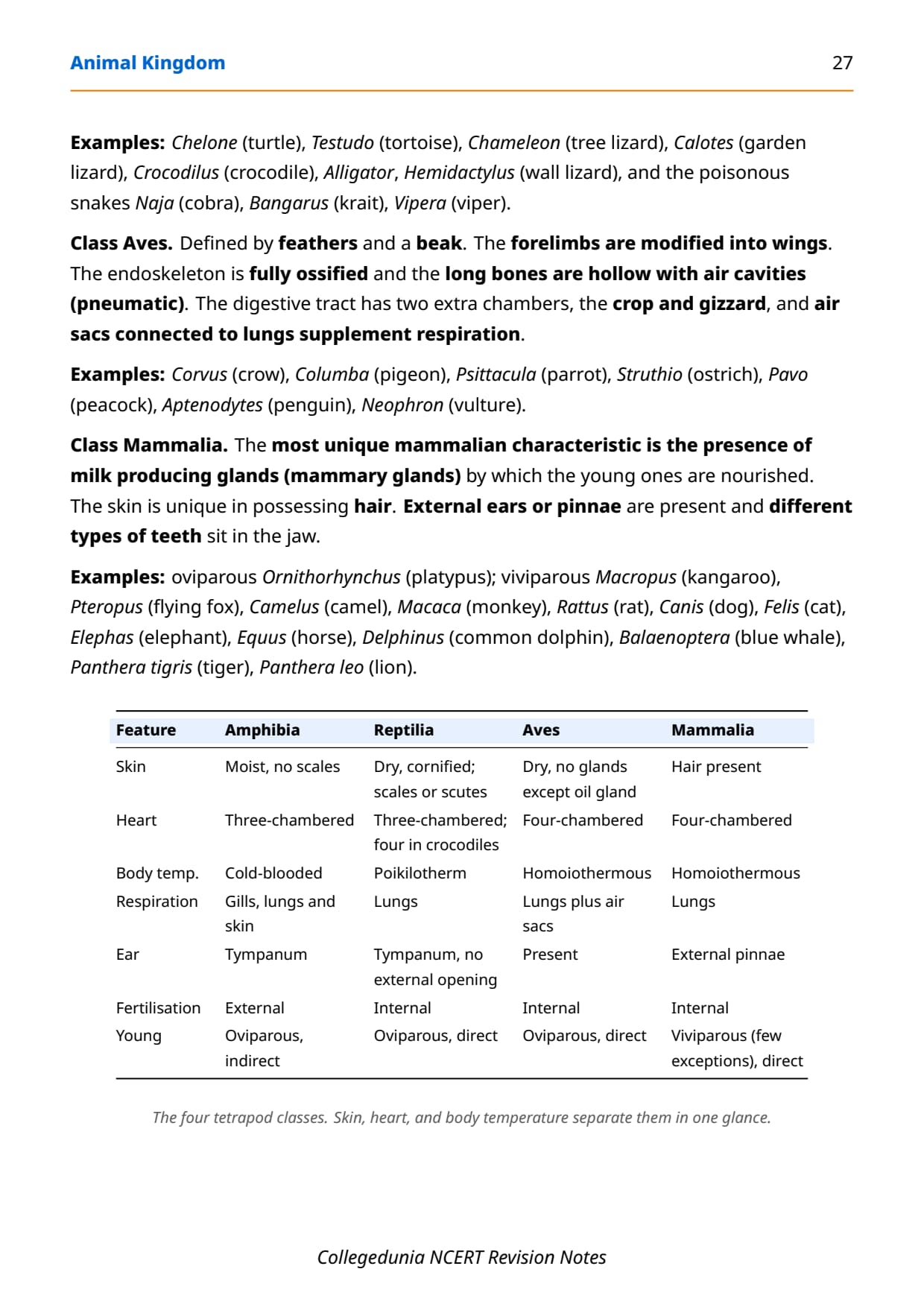
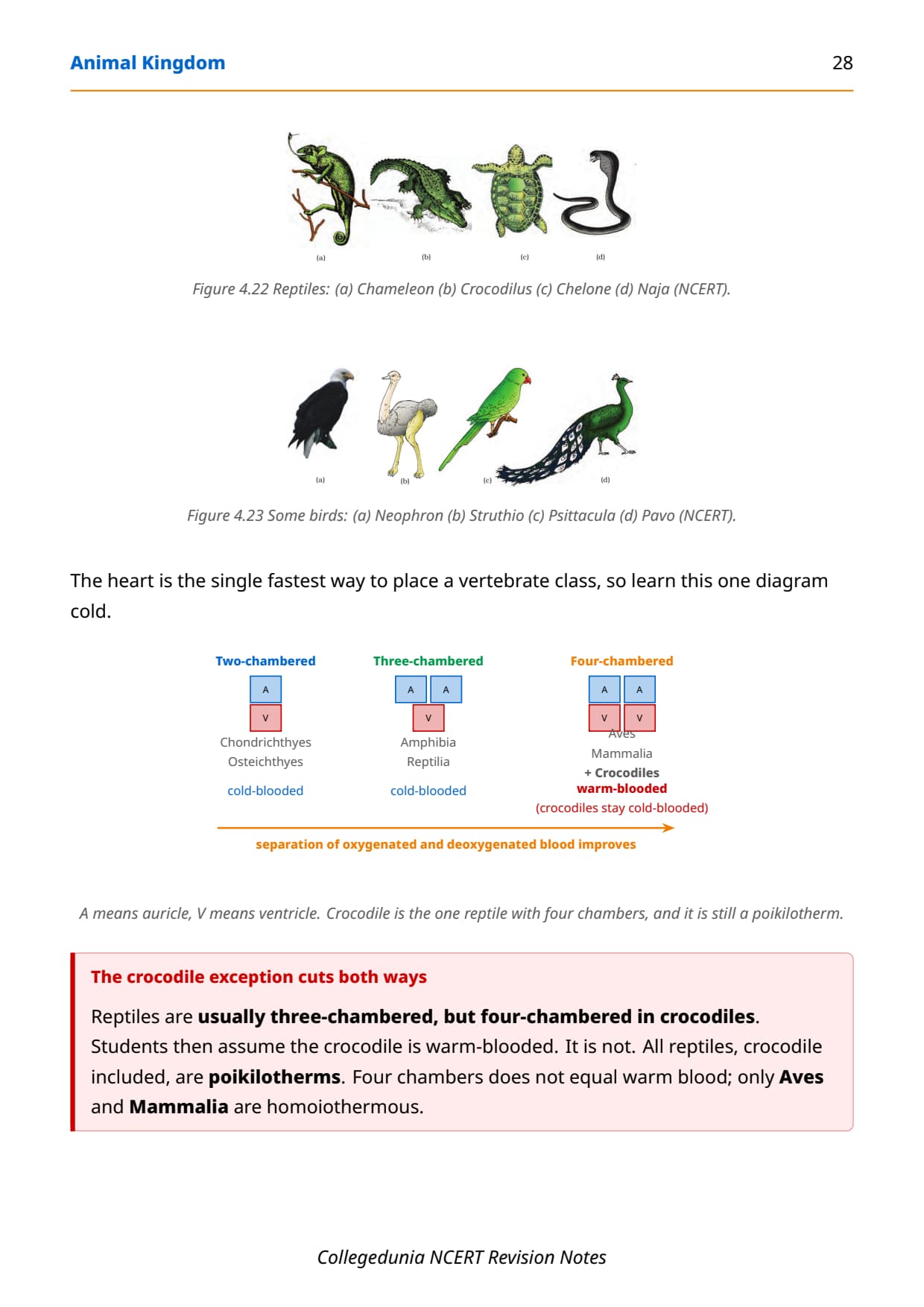
The three fish-grade classes read as one story, that is, no jaws, then jaws with cartilage, then jaws with bone. Cyclostomata are jawless ectoparasites like Petromyzon. Chondrichthyes are cartilaginous with placoid scales and no air bladder, so they must swim constantly, as in Scoliodon. Osteichthyes are bony with an operculum and an air bladder, as in Labeo. Among the four tetrapod classes, skin, heart, and body temperature carry the marks: Amphibia and Reptilia are cold-blooded and three-chambered, while Aves and Mammalia are warm-blooded and four-chambered. The crocodile is the one reptile with a four-chambered heart, yet it stays a poikilotherm. Mammalia is defined by mammary glands, and only the platypus, Ornithorhynchus, is oviparous.
Key Definitions in Animal Kingdom
Board short-answer questions often ask for a clean definition in one or two lines, and a vague answer loses easy marks. Learn these word-for-word, because the wording of the exam question is usually built straight from the NCERT definition. Each term below also connects to a phylum you can be asked to name.
| Term | Definition |
|---|---|
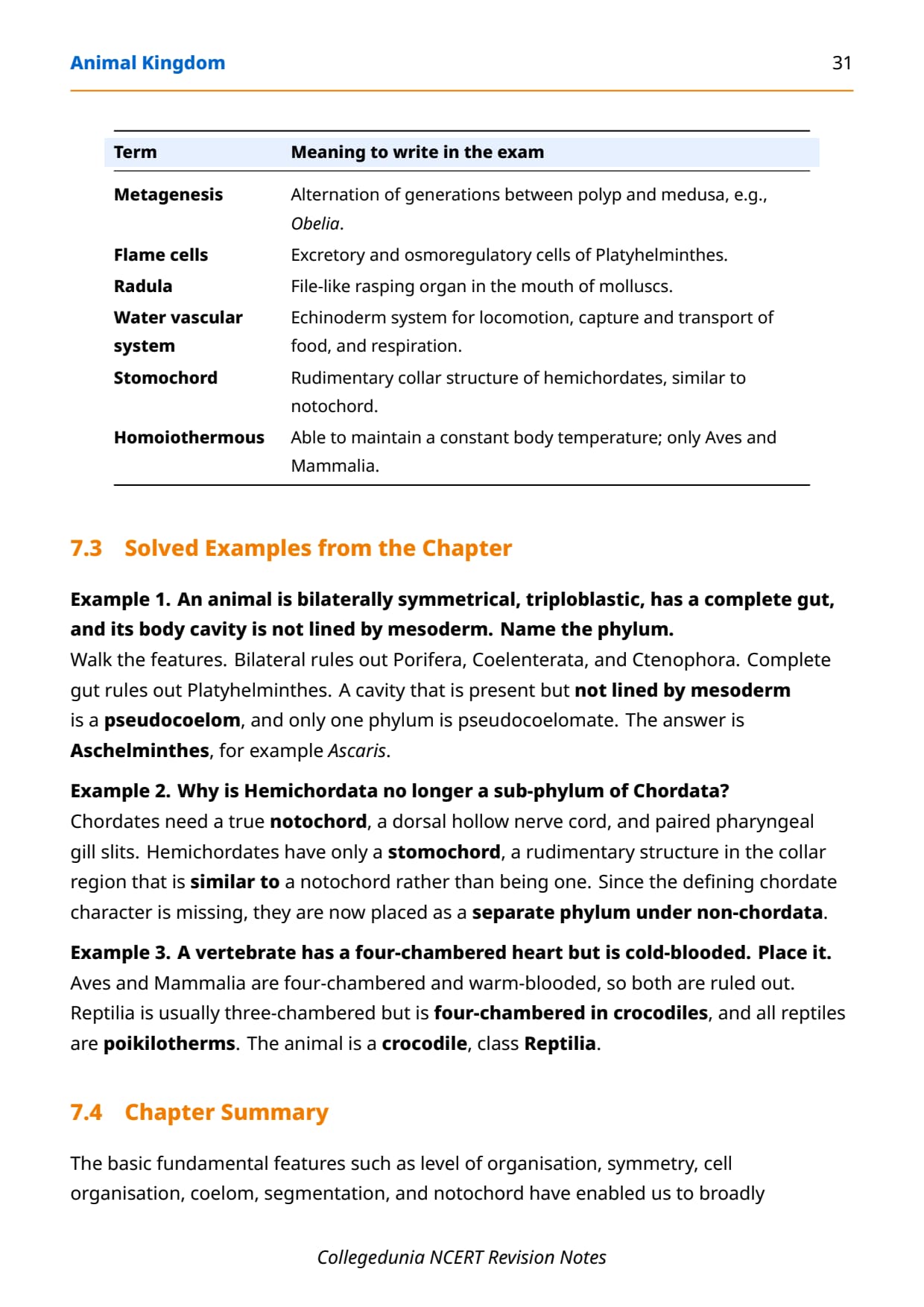
| Coelom | A body cavity lined by mesoderm; present in annelids, molluscs, arthropods, echinoderms, hemichordates, and chordates. |
| Pseudocoelom | A body cavity not lined by mesoderm, with mesoderm present as scattered pouches; found only in Aschelminthes. |
| Mesoglea | An undifferentiated jelly-like layer between ectoderm and endoderm in diploblastic animals. |
| Metamerism | Body externally and internally divided into segments with serial repetition of at least some organs. |
| Notochord | A mesodermally derived, rod-like structure formed on the dorsal side during embryonic development. |
| Choanocytes | Collar cells lining the spongocoel and canals of sponges; digestion in Porifera is intracellular. |
| Metagenesis | Alternation of generations between polyp and medusa, as in Obelia. |
A common board question asks you to distinguish coelomates, pseudocoelomates, and acoelomates. State the mesoderm-lining test first, then name one example of each to earn the full mark. Learning these definitions makes the wording of almost every one-mark and two-mark question in this chapter familiar.
Common Mistakes Students Make in Animal Kingdom
These slips happen because two terms look alike, not because the concept is hard. Each one costs 1 to 2 marks in the paper, so watch for them at the exact step where they occur.
Mistake 1: Calling a coelenterate triploblastic because of mesoglea. Mesoglea is undifferentiated, not a germ layer, so coelenterates stay diploblastic.
Mistake 2: Writing that echinoderms are only radial. Adults are radial, but the larvae are bilaterally symmetrical.
Mistake 3: Calling Hemichordata a sub-phylum of Chordata. It has a stomochord, not a notochord, and is now a separate non-chordate phylum.
Mistake 4: Assuming the crocodile is warm-blooded because it has four heart chambers. All reptiles, crocodile included, are poikilotherms.
Mistake 5: Giving sharks an air bladder. Only Osteichthyes has one; Chondrichthyes lack it and must swim to avoid sinking.
Animal Kingdom Weightage in CBSE Boards, NEET and CUET
This chapter is content-heavy and consistently scoring. It is one of the most reliable NEET chapters from Class 11, and in the boards it usually appears as a classification question plus a phylum or class comparison. Here is how the marks split across the main exams for 2026-27.
| Exam | Typical weightage | What is asked |
|---|---|---|
| CBSE Boards | 4 to 6 marks | One question on the basis of classification plus a phylum or vertebrate-class comparison |
| NEET | 2 to 4 questions | Diagnostic features of phyla, chordate characters, and vertebrate class discriminators |
| CUET | 1 to 3 objective questions | Matching animals to phyla, symmetry and coelom types, and named examples |
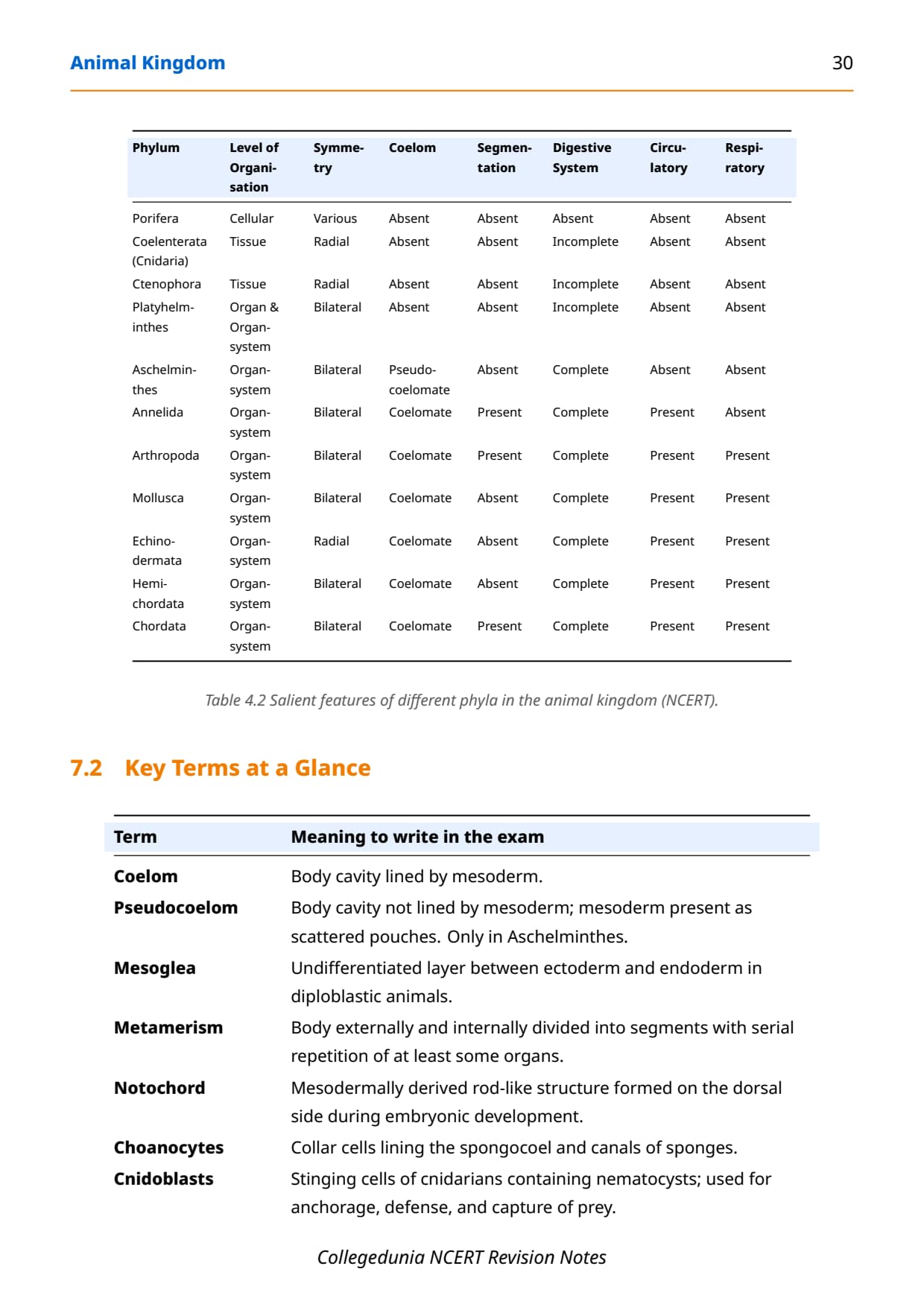
The diagnostic features of the phyla and the vertebrate class table are the two most tested ideas from this chapter across all three exams. Master the six features and Table 4.2 first, then the three chordate characters, then the seven-class table, in that order of return on effort for the 2026-27 session.
How to Revise Animal Kingdom Quickly
Use these animal kingdom class 11 notes for a fast, ordered recap the night before a test. The checklist below takes about 25 minutes and hits every marks-heavy idea in the chapter without opening the full textbook.
- First 9 minutes: write the six fundamental features in order, then place all eleven phyla by level of organisation, symmetry, and coelom.
- Next 8 minutes: write the three chordate characters and draw the Vertebrata tree from jaws down to the seven classes.
- Last 8 minutes: fill the tetrapod table columns for skin, heart, body temperature, and young, and note the crocodile and platypus exceptions.
Close the loop by naming the phylum of an animal that is bilateral, triploblastic, has a complete gut, and a cavity not lined by mesoderm. The answer is Aschelminthes, and if you reach it by walking the features, the chapter is exam-ready. Keep Table 4.2 and the vertebrate class table beside you for the first pass only, then try the whole checklist closed-book.
Student Feedback on the Animal Kingdom Notes
What 12,340 students told us about their Animal Kingdom revision:
- 71% of students rated the six fundamental features and Table 4.2 as the part most worth memorising for the exam.
- Most-confused pair: mesoglea versus mesoderm, mixed up by about 4 in 10 students.
- Students who learnt the vertebrate classes with the heart-chamber diagram said the crocodile and platypus exception questions felt easy afterwards.
Source: 2026-27 Class 11 Biology student poll. Sample of 12,340 students from CBSE schools across 15 states, conducted before the 2026 boards.
Other Animal Kingdom Class 11 Biology Resources
Pair these notes with the solved answers, the formula sheet, and the textbook PDF for the same chapter.
| Resource | Link |
|---|---|
| NCERT Solutions | Animal Kingdom Class 11 NCERT Solutions |
| Formula Sheet | Animal Kingdom Class 11 Formula Sheet |
| Exemplar Solutions | Animal Kingdom Class 11 Exemplar Solutions |
| NCERT Book PDF | Animal Kingdom Class 11 Book PDF |
| Exemplar Book PDF | Animal Kingdom Class 11 Exemplar Book PDF |
NCERT Notes for Class 11 Biology: All Chapters
Jump to the revision notes for any other Class 11 Biology chapter below.
| Chapter | NCERT Notes |
|---|---|
| Chapter 1 | The Living World |
| Chapter 2 | Biological Classification |
| Chapter 3 | Plant Kingdom |
| Chapter 4 | Animal Kingdom |
| Chapter 5 | Morphology of Flowering Plants |
| Chapter 6 | Anatomy of Flowering Plants |
| Chapter 7 | Structural Organisation in Animals |
| Chapter 8 | Cell The Unit of Life |
| Chapter 9 | Biomolecules |
| Chapter 10 | Cell Cycle and Cell Division |
| Chapter 11 | Photosynthesis in Higher Plants |
| Chapter 12 | Respiration in Plants |
| Chapter 13 | Plant Growth and Development |
| Chapter 14 | Breathing and Exchange of Gases |
| Chapter 15 | Body Fluids and Circulation |
| Chapter 16 | Excretory Products and their Elimination |
| Chapter 17 | Locomotion and Movement |
| Chapter 18 | Neural Control and Coordination |
| Chapter 19 | Chemical Coordination and Integration |
FAQs on Animal Kingdom Class 11 Biology Notes
Animal Kingdom Notes - Frequently Asked Questions
Ques. What topics do the animal kingdom class 11 notes cover?
Ans. These animal kingdom class 11 notes cover the basis of classification through the six fundamental features, that is, levels of organisation, symmetry, germ layers, coelom, segmentation, and notochord. They then walk the eleven phyla from Porifera to Chordata, the three chordate characters, the three subphyla, and the seven vertebrate classes from Cyclostomata to Mammalia, along with Table 4.2, the key terms, and the common exam traps.
Ques. What are the six fundamental features used to classify animals?
Ans. NCERT classifies animals using six fundamental features: levels of organisation (cellular, tissue, organ, or organ system), body symmetry (asymmetrical, radial, or bilateral), the number of germ layers (diploblastic or triploblastic), the nature of the coelom (coelomate, pseudocoelomate, or acoelomate), segmentation, and the presence or absence of a notochord. Answering these six in order for any animal places it in its phylum.
Ques. What is the difference between a coelomate, a pseudocoelomate, and an acoelomate?
Ans. A coelomate has a true body cavity fully lined by mesoderm, as in annelids and chordates. A pseudocoelomate has a body cavity that is not lined by mesoderm, the mesoderm being present as scattered pouches, and this occurs only in Aschelminthes. An acoelomate has no body cavity at all, mesoderm filling the space, as in Platyhelminthes.
Ques. What are the three characteristic features of phylum Chordata?
Ans. Chordates are characterised by three features present together: a notochord, a dorsal hollow nerve cord, and paired pharyngeal gill slits. They are also bilaterally symmetrical, triploblastic, and coelomate, with a post-anal tail and a closed circulatory system. Because vertebrates replace the notochord with a vertebral column, all vertebrates are chordates, but all chordates are not vertebrates.
Ques. Why is Hemichordata no longer a sub-phylum of Chordata?
Ans. Chordates need a true notochord, a dorsal hollow nerve cord, and paired pharyngeal gill slits. Hemichordates have only a stomochord, a rudimentary structure in the collar region that is similar to a notochord rather than being one. Since the defining chordate character is missing, the current NCERT places Hemichordata as a separate phylum under non-chordata, with examples Balanoglossus and Saccoglossus.
Ques. How do you tell the vertebrate classes apart?
Ans. Vertebrata splits first by jaws into Agnatha (Cyclostomata, jawless) and Gnathostomata (jawed). Gnathostomata divides into fishes and tetrapods. Chondrichthyes are cartilaginous with no air bladder, Osteichthyes are bony with an operculum and air bladder. Among tetrapods, Amphibia and Reptilia are cold-blooded, while Aves and Mammalia are warm-blooded and four-chambered. The crocodile is the four-chambered exception among reptiles but stays cold-blooded.
Ques. What is the weightage of Animal Kingdom in the CBSE and NEET exams?
Ans. Animal Kingdom carries about 4 to 6 marks in the CBSE Class 11 Biology paper, usually one question on the basis of classification plus a phylum or vertebrate-class comparison. It is one of the highest-yield Class 11 chapters for NEET, contributing 2 to 4 questions on diagnostic features, chordate characters, and named examples, and it also appears in CUET as objective questions for the 2026-27 session.



Comments