




These plant kingdom class 11 notes bring together every group, feature, and example that the CBSE Boards, NEET and CUET papers actually test in 2026-27. Revise the whole chapter fast, with how Plantae is classified, and the five groups inside it, that is, algae, bryophytes, pteridophytes, gymnosperms and angiosperms, in one place.
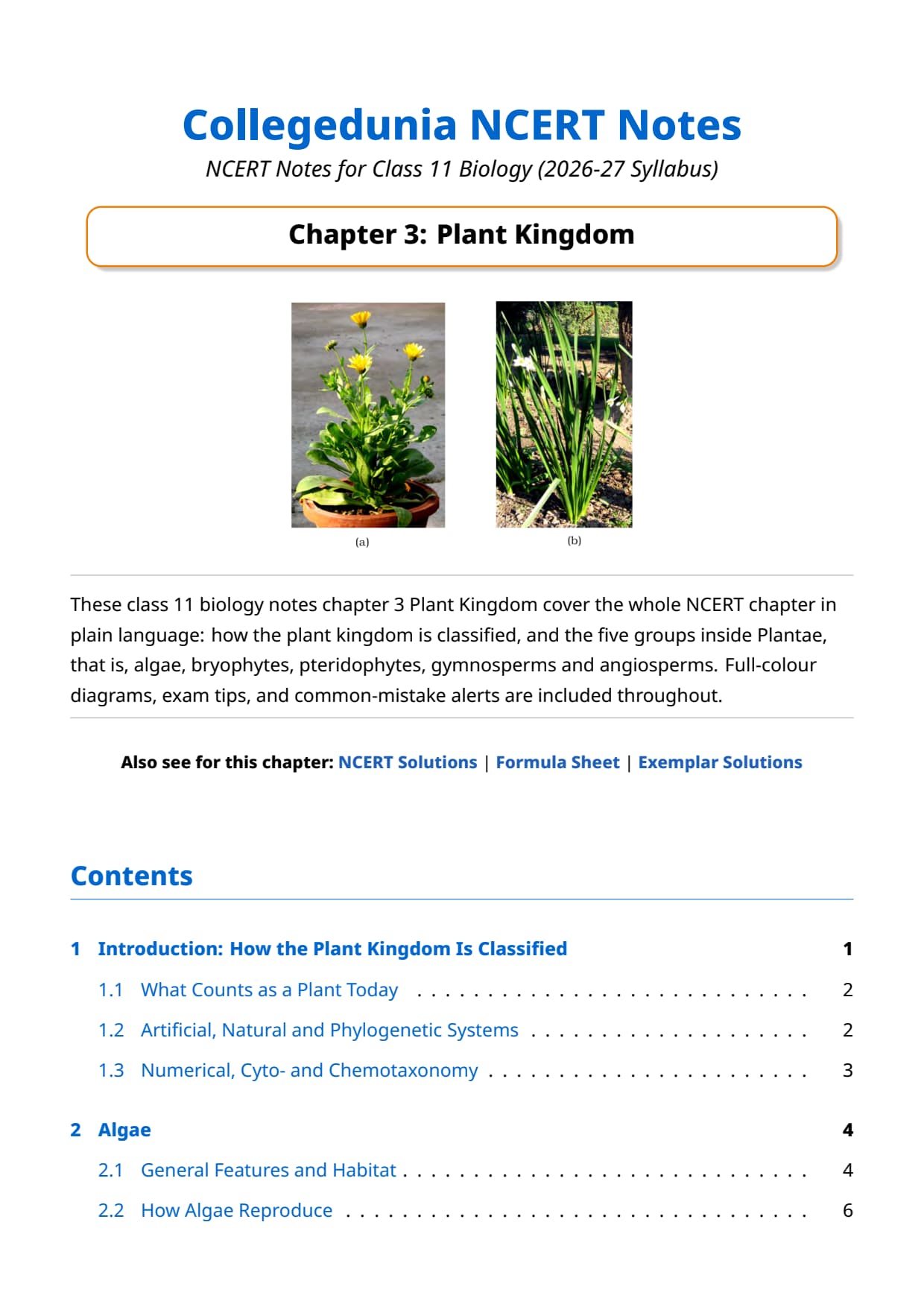
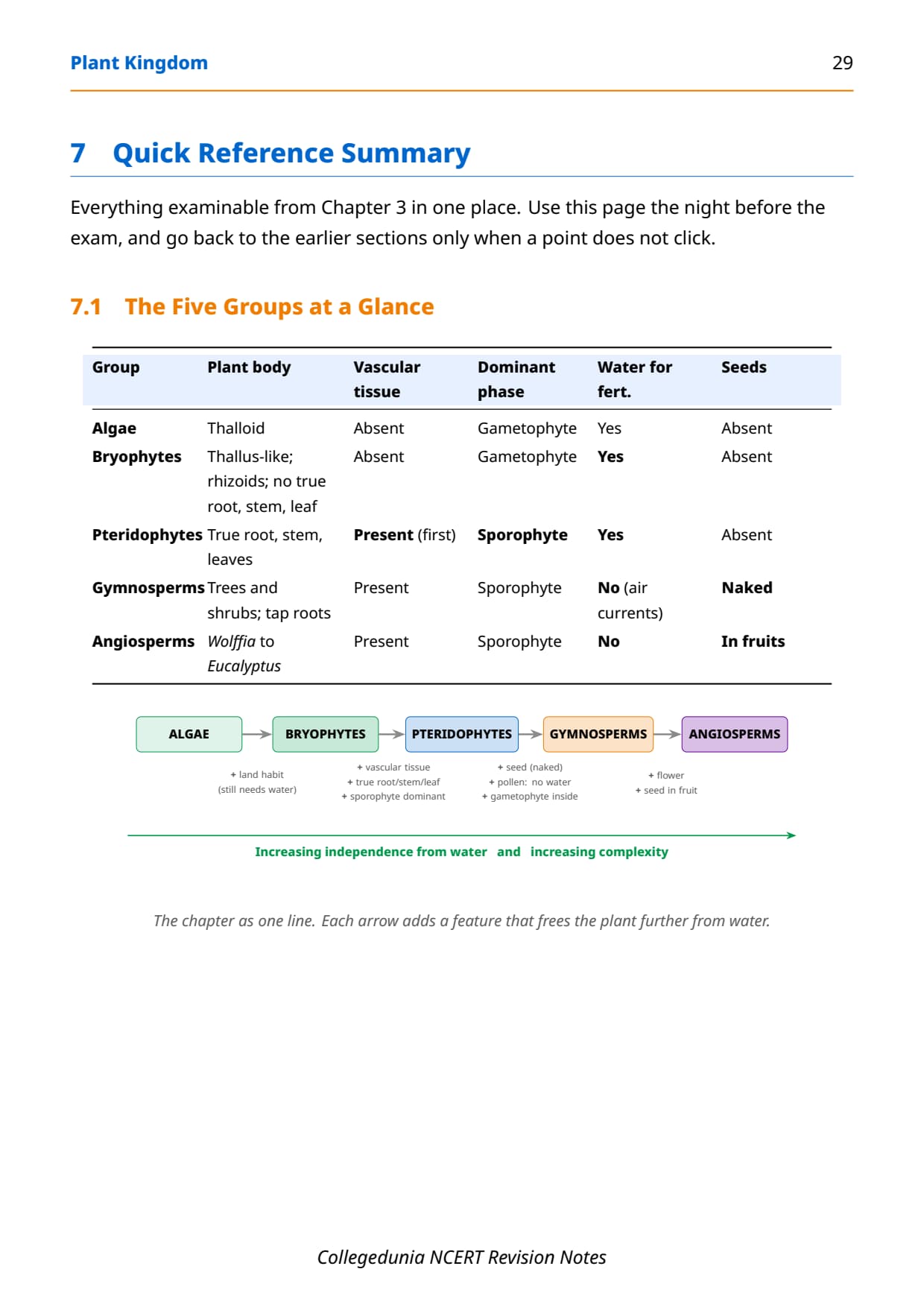
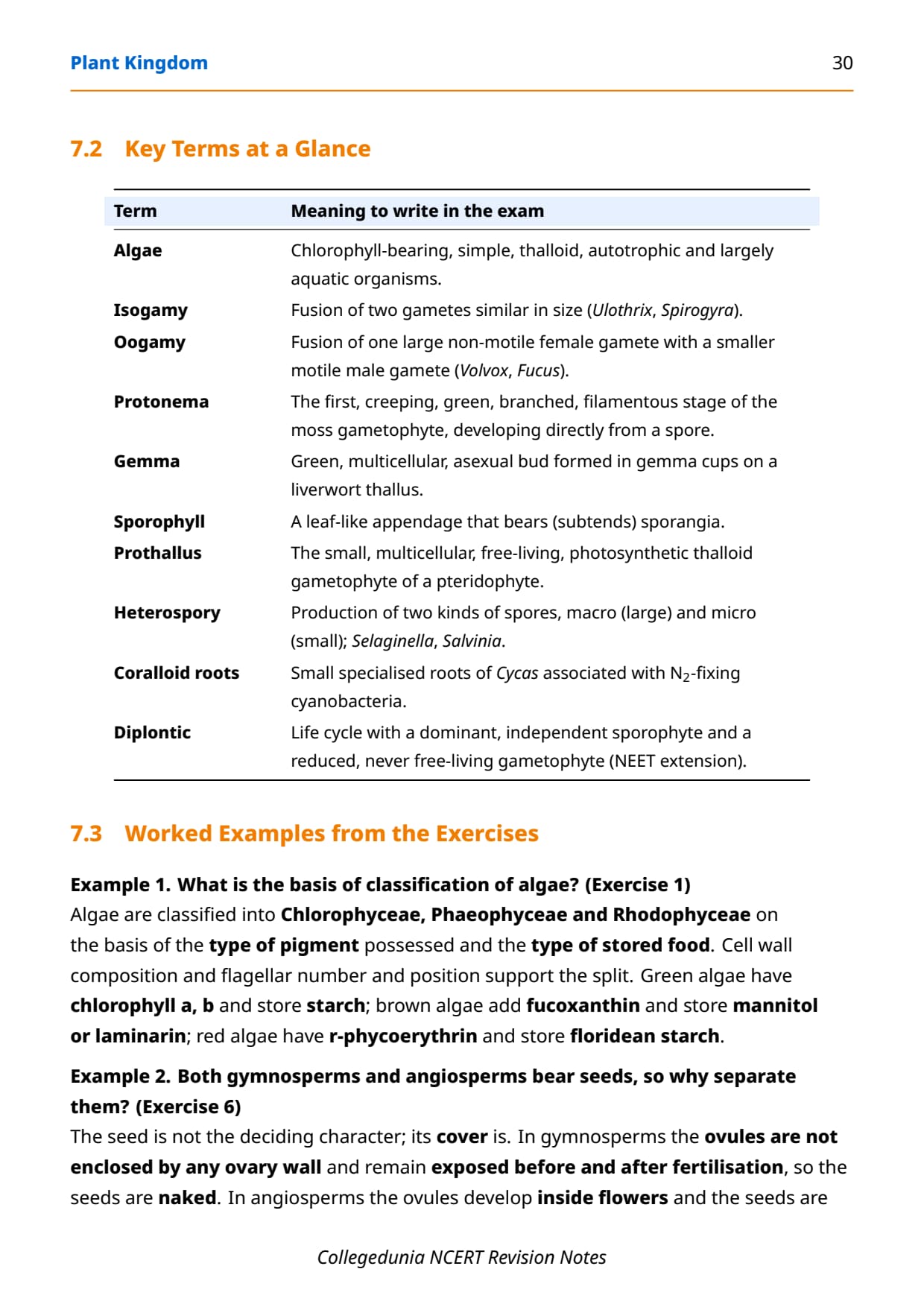
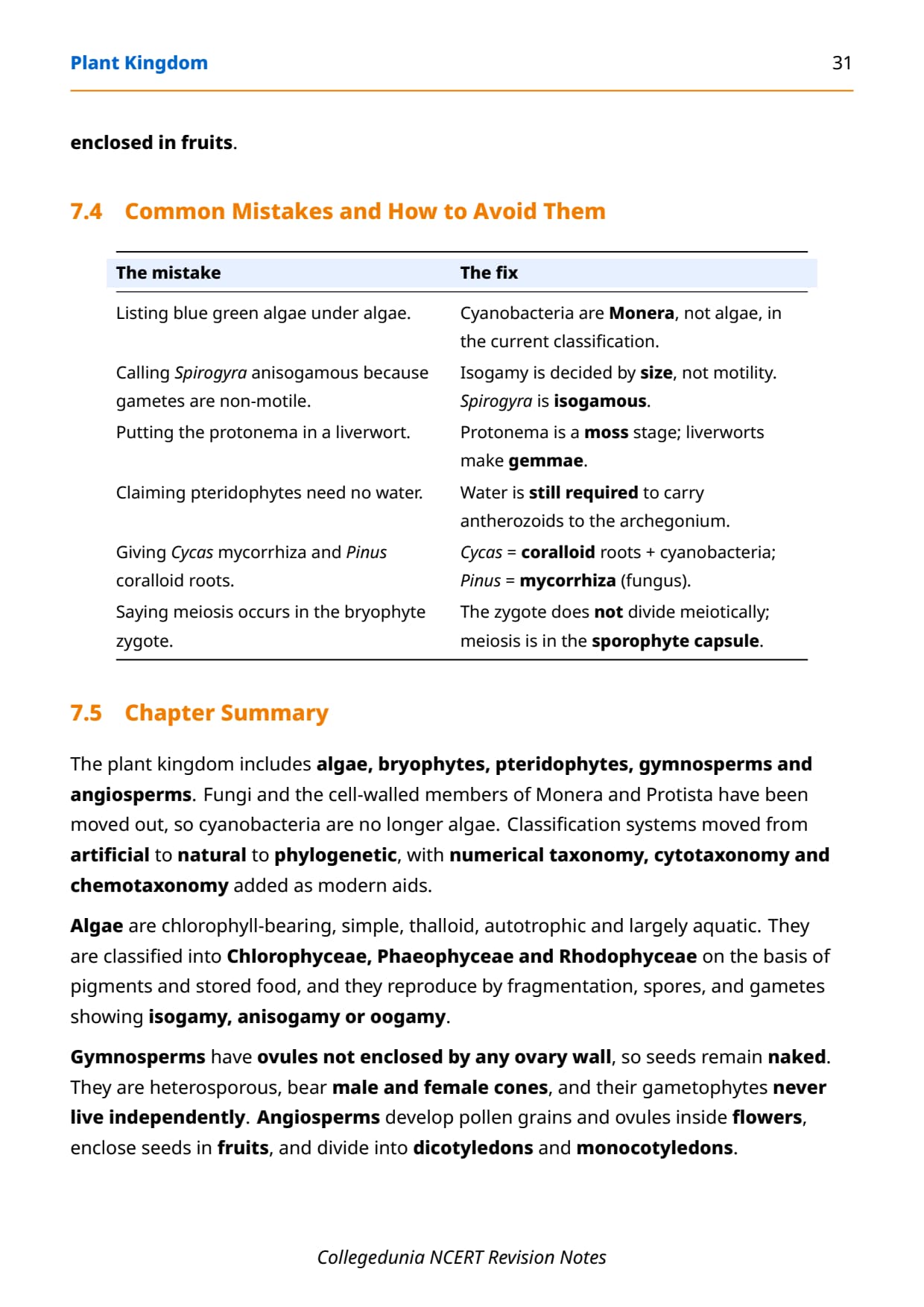
This chapter opens one of Whittaker's five kingdoms, Plantae, and looks inside, so the gametophyte and sporophyte vocabulary you learn here returns in the reproduction chapters of Class 12.
- CBSE Weightage: 5 to 7 marks, usually one long or short answer on the five plant groups plus objective questions on life cycles and examples.
- Topics covered: how the plant kingdom is classified, the artificial, natural and phylogenetic systems, algae and their three classes, bryophytes, pteridophytes, gymnosperms and angiosperms, and the alternation of generations.
- Key rules: the gametophyte-to-sporophyte dominance flip, the naked seed versus enclosed seed difference, and micro means male while mega means female.
These plant kingdom class 11 notes are curated by subject experts, based on the 2026-27 NCERT textbook, and checked against the last five years of CBSE Board and NEET papers.
Topic-by-Topic Summary of Plant Kingdom
The chapter walks up a ladder of increasing independence from water. It starts with the simplest algae, moves to bryophytes that live on land but still need water to reproduce, then to the first vascular pteridophytes, and finally to the seed plants that break free of water altogether. One idea threads through all of it, that is, dominance passes from the haploid gametophyte to the diploid sporophyte as you climb. Here is the quick map of what each topic gives you before you revise the detail.
- Classifying Plantae: fungi and the cell-walled members of Monera and Protista are now out, and classification moved from artificial to natural to phylogenetic systems.
- Algae: chlorophyll-bearing, simple, thalloid, autotrophic and largely aquatic, split into green, brown and red algae by pigment and stored food.
- Bryophytes: the amphibians of the plant kingdom, gametophyte dominant and tied to water for reproduction.
- Pteridophytes: the first vascular plants, where the sporophyte becomes dominant and true root, stem and leaf appear.
- Gymnosperms: seed plants with naked seeds, needing no water for fertilisation.
- Angiosperms: flowering plants with seeds enclosed in fruits, divided into dicotyledons and monocotyledons.
Revise the topics in this order, because each group adds a feature to the one before it. Master the gametophyte-to-sporophyte dominance flip first, and most bryophyte-versus-pteridophyte questions answer themselves. These plant kingdom class 11 notes follow the same sequence as the NCERT textbook.
How the Plant Kingdom Is Classified
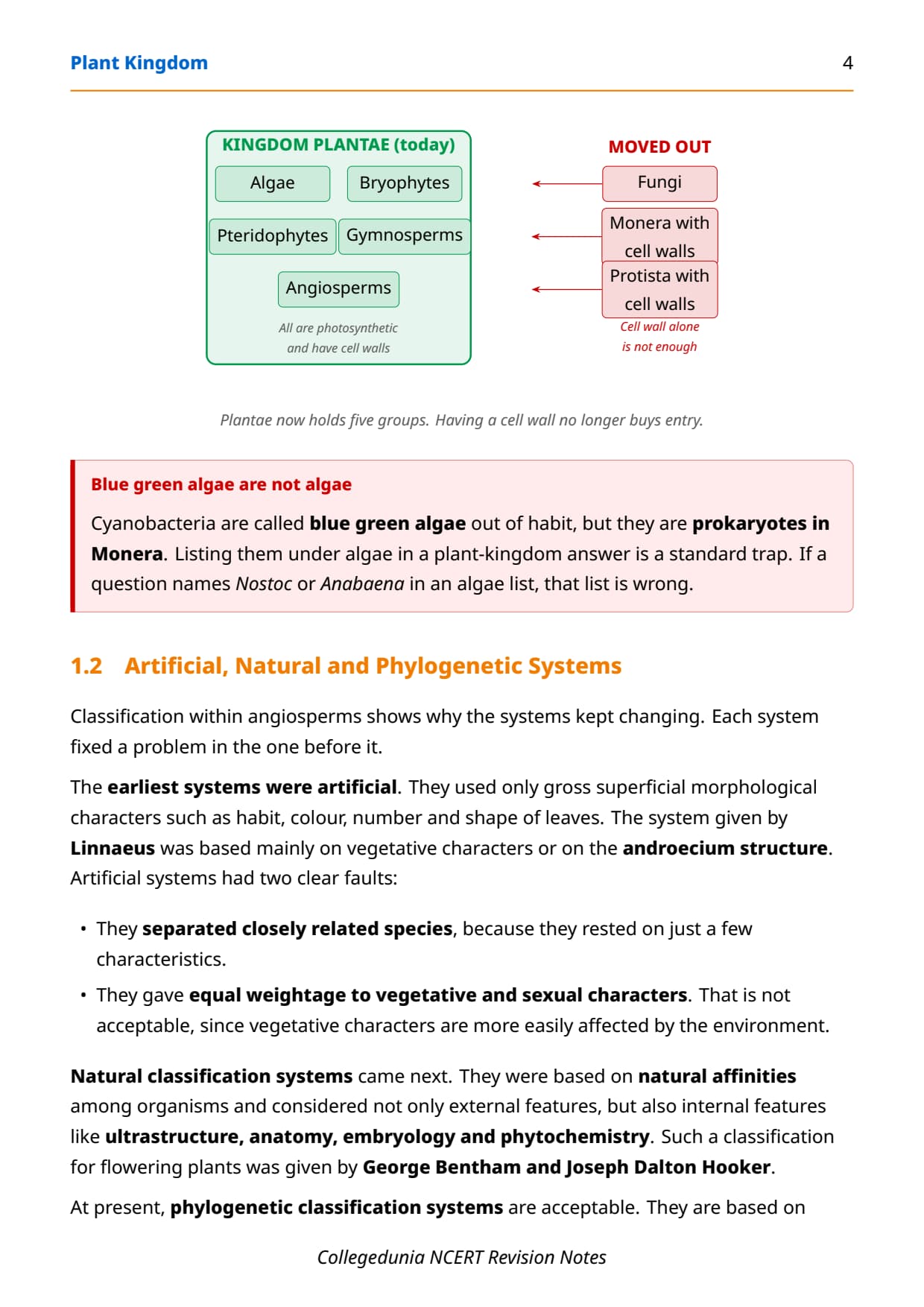
Older classifications were generous, and anything with a cell wall tended to land in Plantae. That is no longer true. Three groups have now been excluded from Plantae, that is, fungi, the cell-walled members of Monera such as bacteria, and the cell-walled members of Protista. The most quoted consequence is that cyanobacteria, still called blue-green algae out of habit, sit in Monera and are not algae any more. The way botanists build a classification has also changed three times, and NCERT expects you to know all three systems by name.
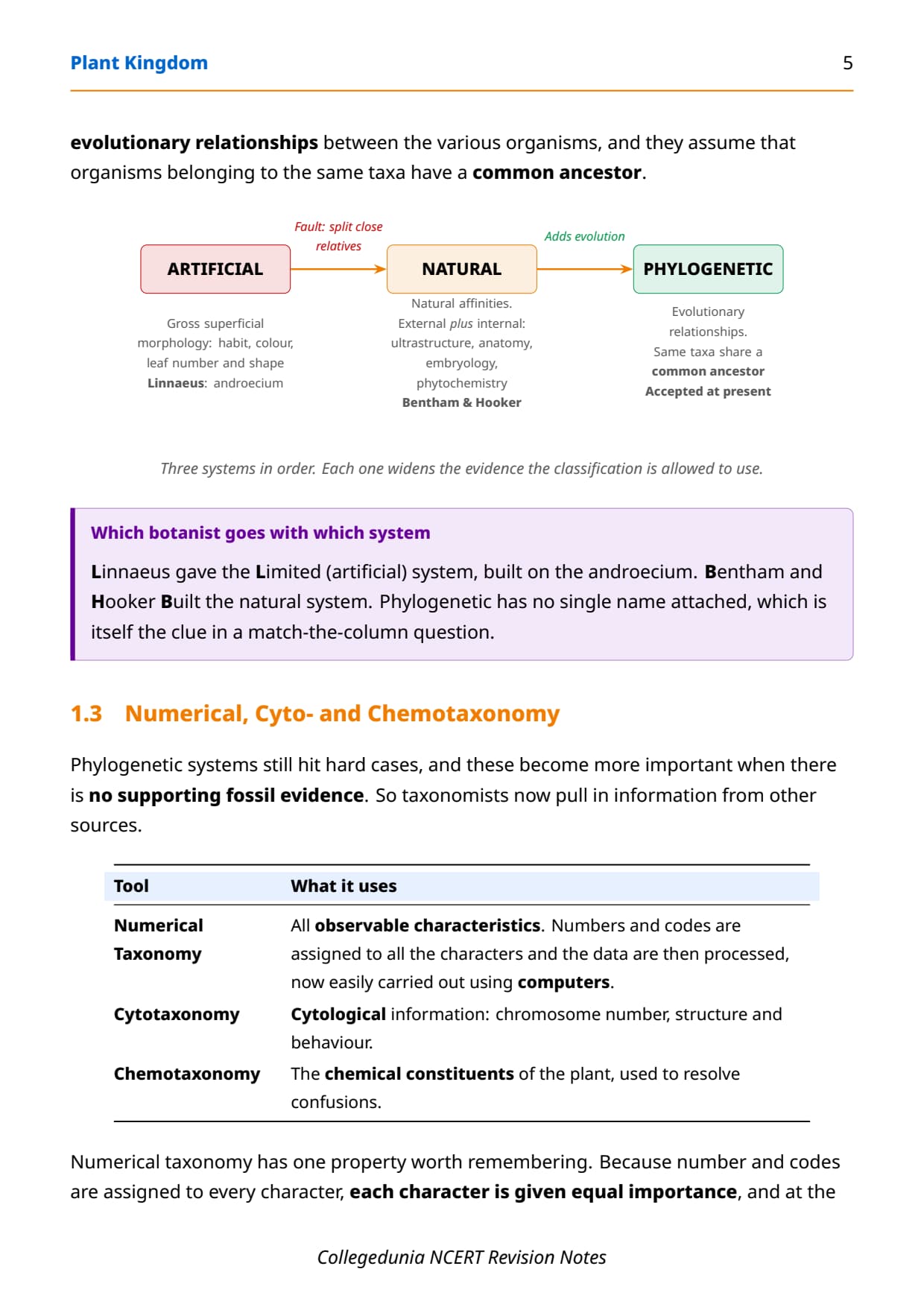
- Artificial systems: the earliest, using only gross superficial morphology such as habit, colour and leaf shape. The system of Linnaeus rested mainly on the androecium. Its fault was that it separated closely related species and gave equal weight to vegetative and sexual characters.
- Natural systems: based on natural affinities, using external and internal features like anatomy, embryology and phytochemistry. The flowering-plant classification of Bentham and Hooker is the example.
- Phylogenetic systems: accepted at present, based on evolutionary relationships, assuming organisms of the same taxa share a common ancestor.
Modern taxonomists pull in extra evidence when fossil data is missing. Numerical taxonomy assigns numbers and codes to all observable characters and processes them by computer, so every character gets equal importance and hundreds can be considered at once. Cytotaxonomy uses cytological information such as chromosome number and behaviour, and chemotaxonomy uses the chemical constituents of the plant. Spot the tool from the keyword, that is, chromosome means cytotaxonomy, chemical constituent means chemotaxonomy, and computer or codes means numerical taxonomy.
Algae: The Simplest Members of Plantae
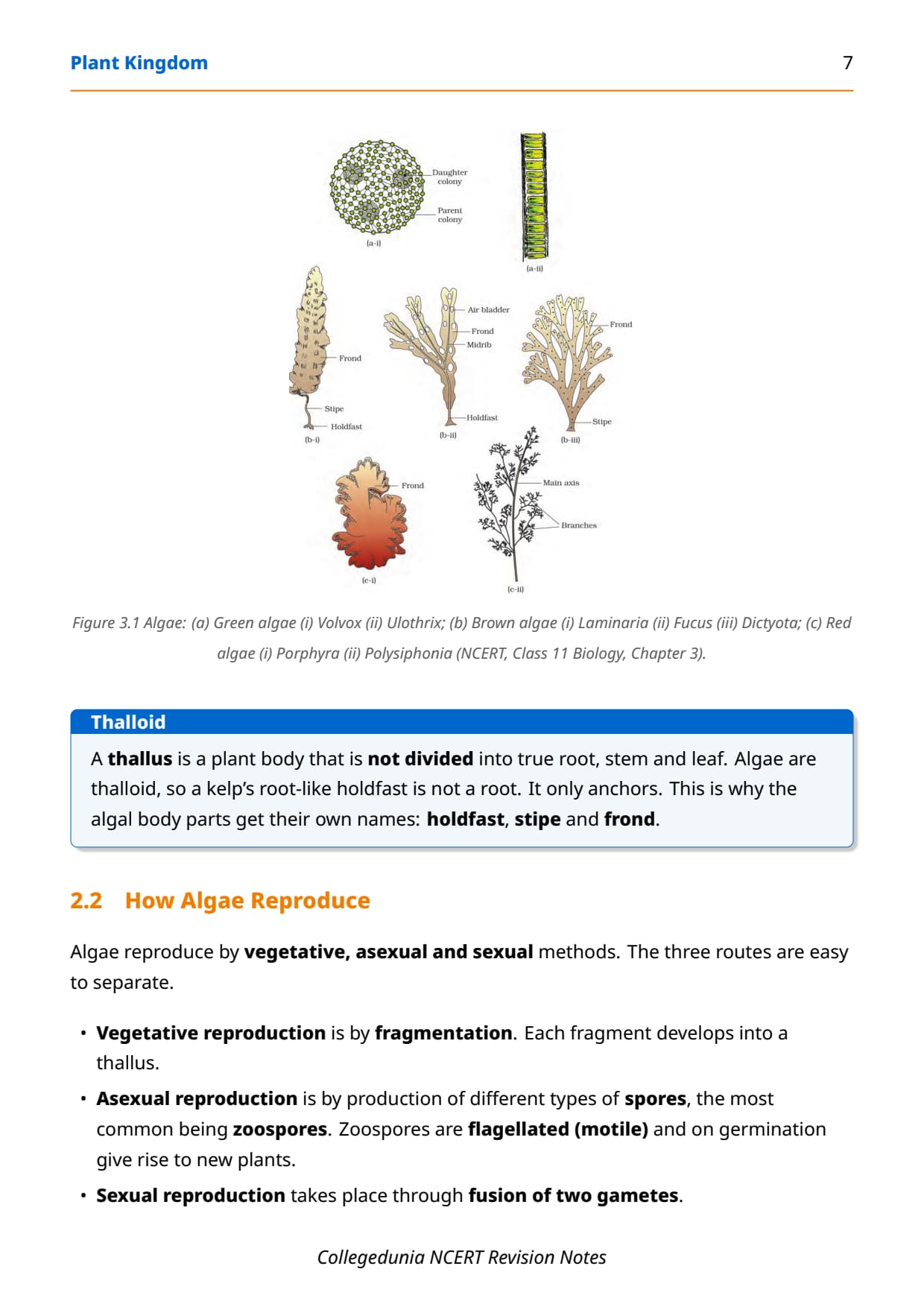
Algae are chlorophyll-bearing, simple, thalloid, autotrophic and largely aquatic organisms, and that definition is worth memorising word for word. They range from a single cell to a 100 metre kelp, occurring in fresh and marine water, on moist stones and soil, and in association with fungi as lichen or with animals such as the sloth bear. Their body is a thallus, that is, not divided into true root, stem and leaf, which is why algal body parts get their own names, that is, holdfast, stipe and frond.
- Reproduction: by vegetative fragmentation, asexual spores, most commonly motile zoospores, and sexual fusion of gametes.
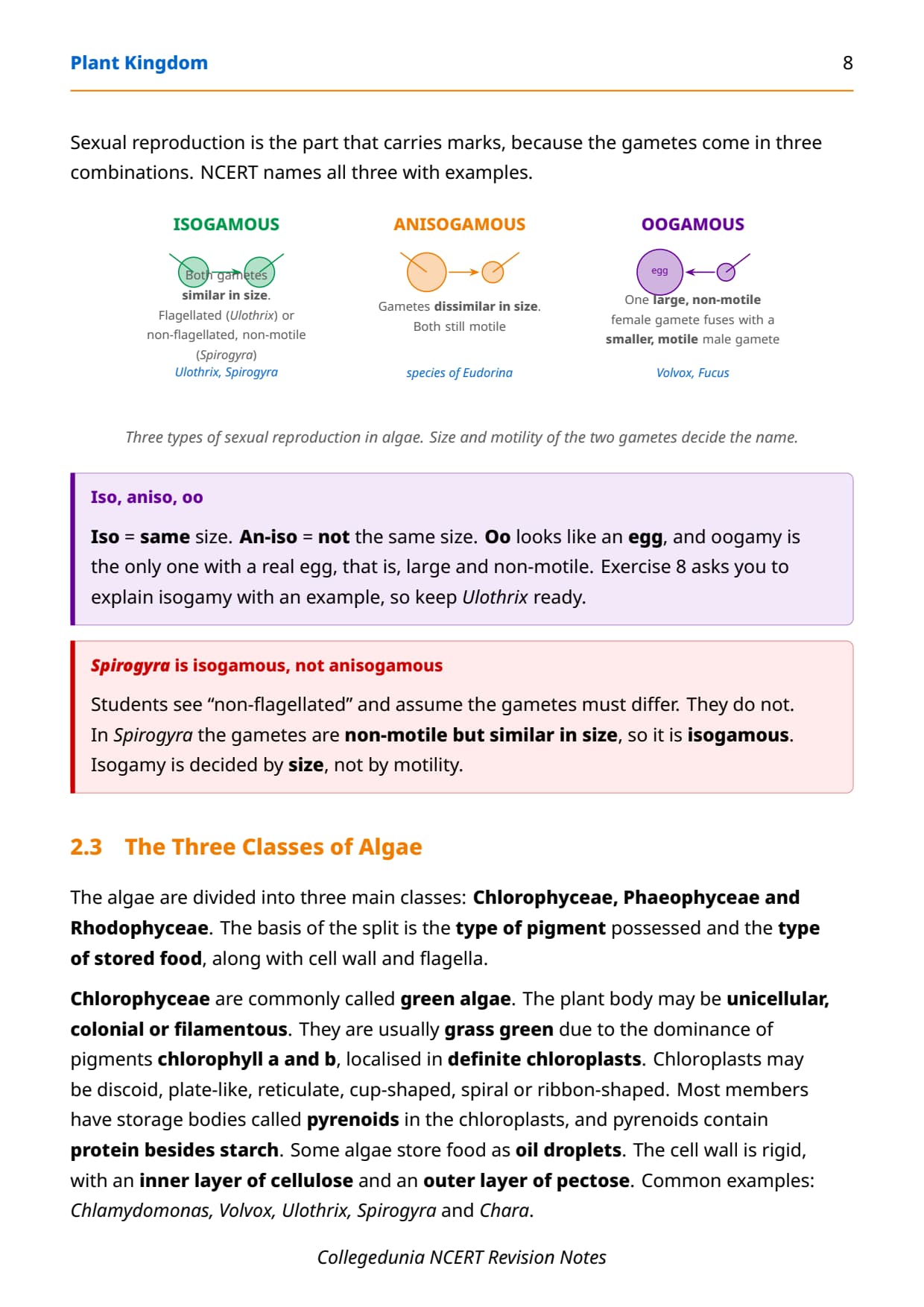
- Isogamy: fusion of two gametes similar in size, as in Ulothrix and Spirogyra. Note that Spirogyra gametes are non-motile but still similar in size, so it stays isogamous.
- Anisogamy: fusion of two gametes dissimilar in size, both still motile, as in species of Eudorina.
- Oogamy: fusion of one large non-motile female gamete with a smaller motile male gamete, as in Volvox and Fucus.
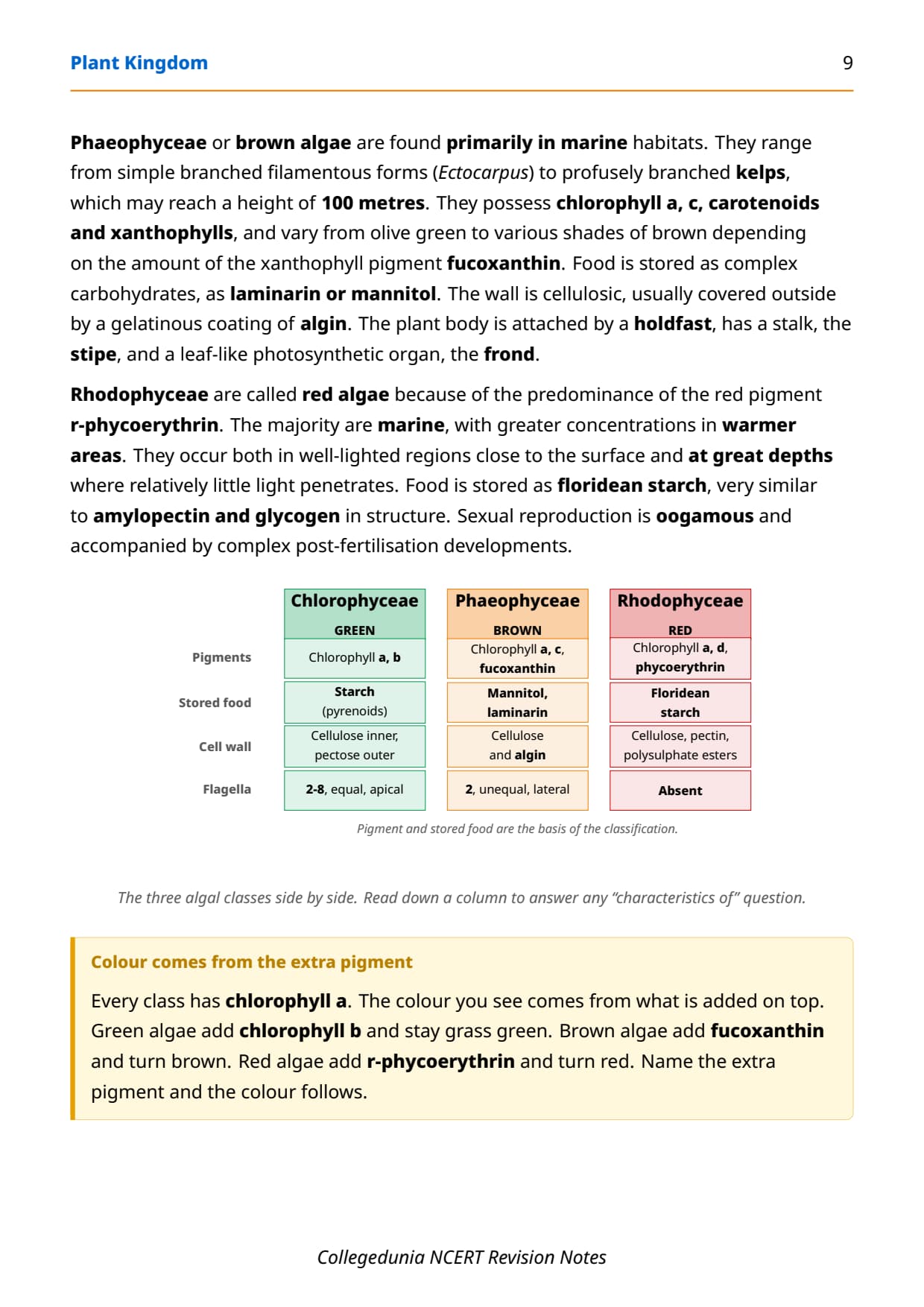
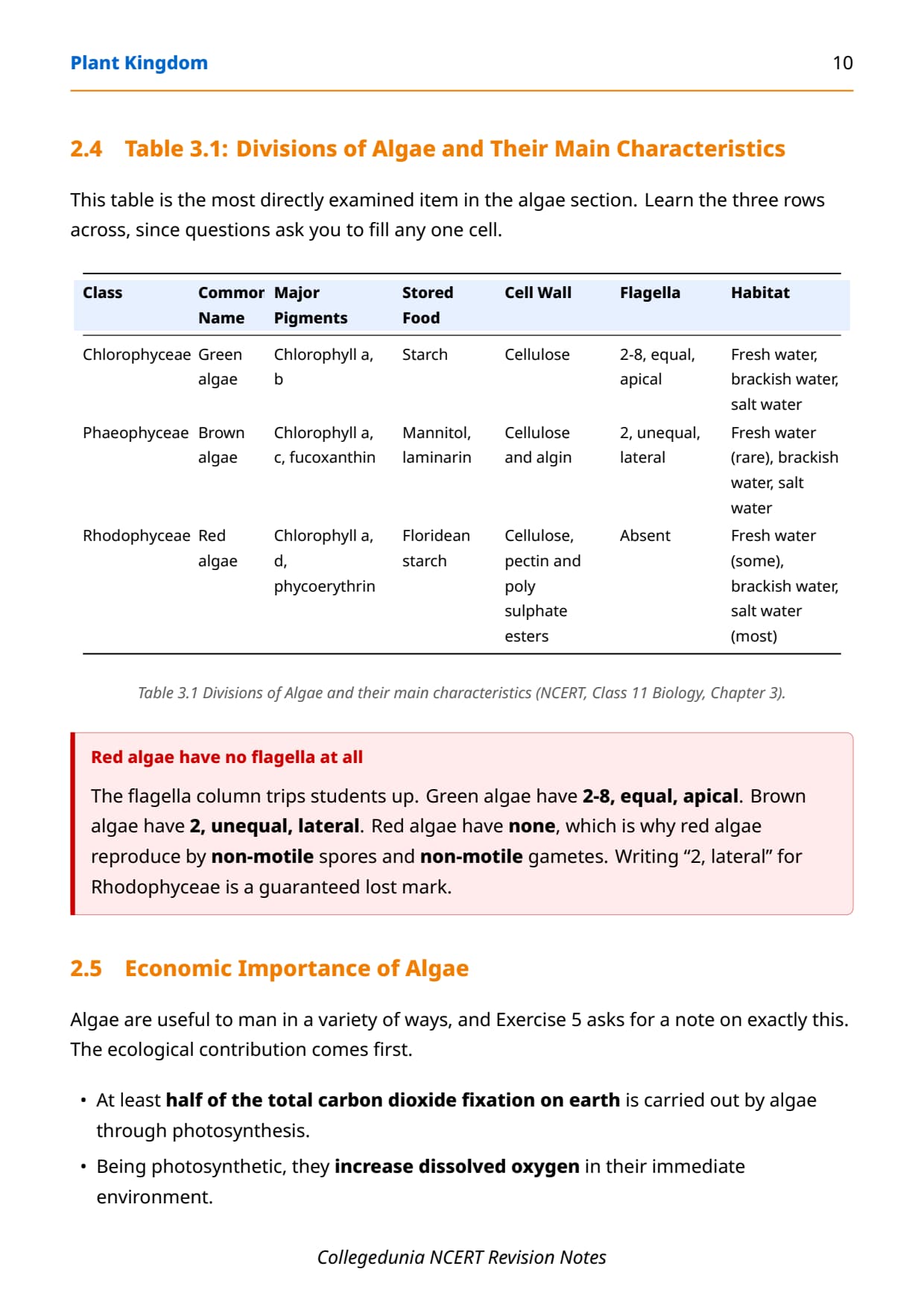
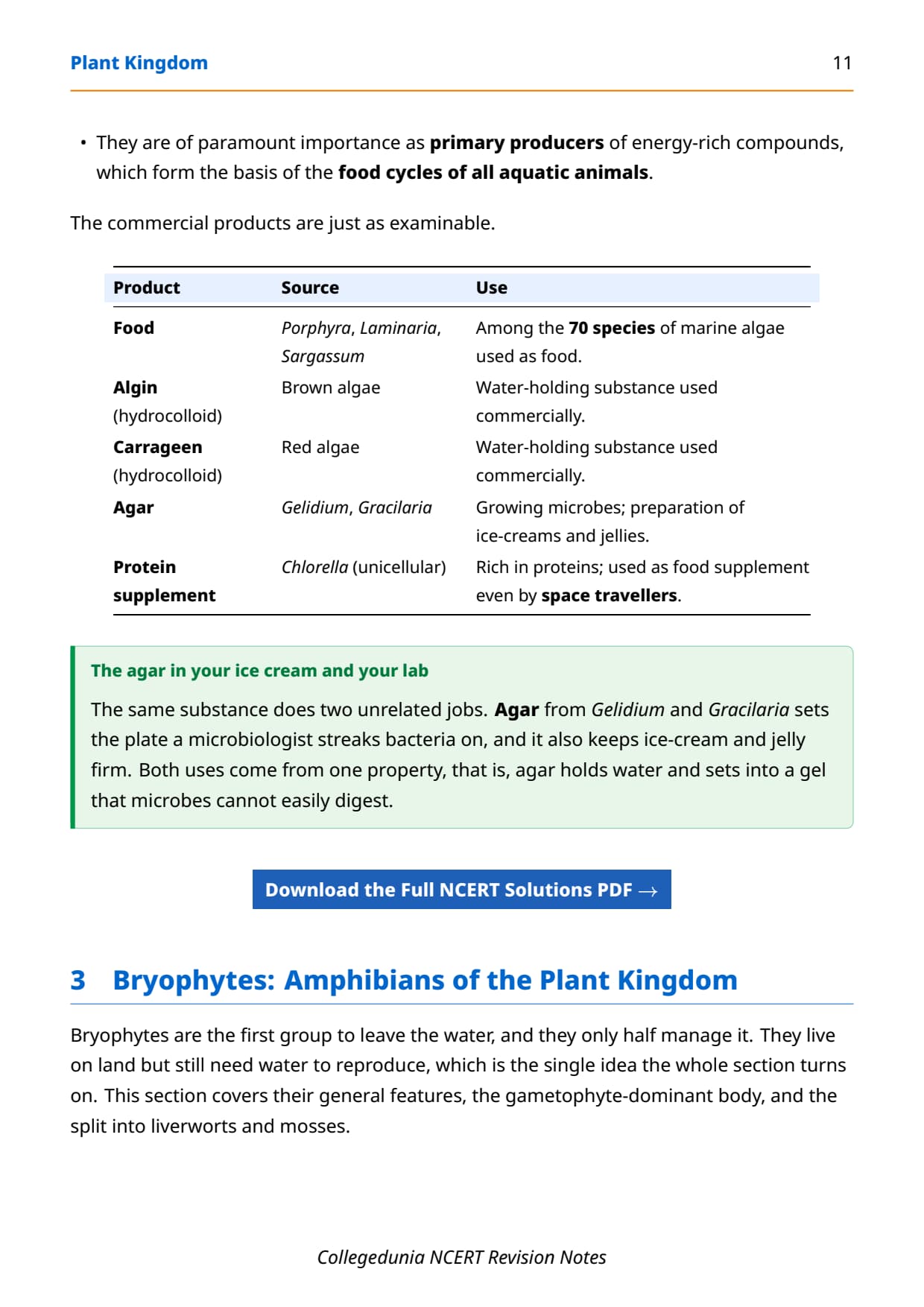
The algae are divided into three classes on the basis of the type of pigment and stored food, along with cell wall and flagella. Every class has chlorophyll a, and the extra pigment sets the colour. Chlorophyceae or green algae add chlorophyll b, store starch, and include Chlamydomonas, Volvox and Spirogyra. Phaeophyceae or brown algae add fucoxanthin, store mannitol or laminarin, and include the giant kelps. Rhodophyceae or red algae add r-phycoerythrin, store floridean starch, and have no flagella at all. At least half of the total carbon dioxide fixation on earth is carried out by algae, and they are the primary producers of the aquatic food chains. Commercially they yield agar from Gelidium and Gracilaria, algin from brown algae, and carrageen from red algae.
| Class | Common name | Major pigments | Stored food | Flagella |
|---|---|---|---|---|
| Chlorophyceae | Green algae | Chlorophyll a, b | Starch | 2 to 8, equal, apical |
| Phaeophyceae | Brown algae | Chlorophyll a, c, fucoxanthin | Mannitol, laminarin | 2, unequal, lateral |
| Rhodophyceae | Red algae | Chlorophyll a, d, phycoerythrin | Floridean starch | Absent |
This is Table 3.1, the most directly examined item in the algae section. The flagella column trips students up, so learn it carefully. Red algae have none, which is why they reproduce with non-motile spores and gametes, and writing "2, lateral" for Rhodophyceae is a guaranteed lost mark.
Bryophytes: Amphibians of the Plant Kingdom
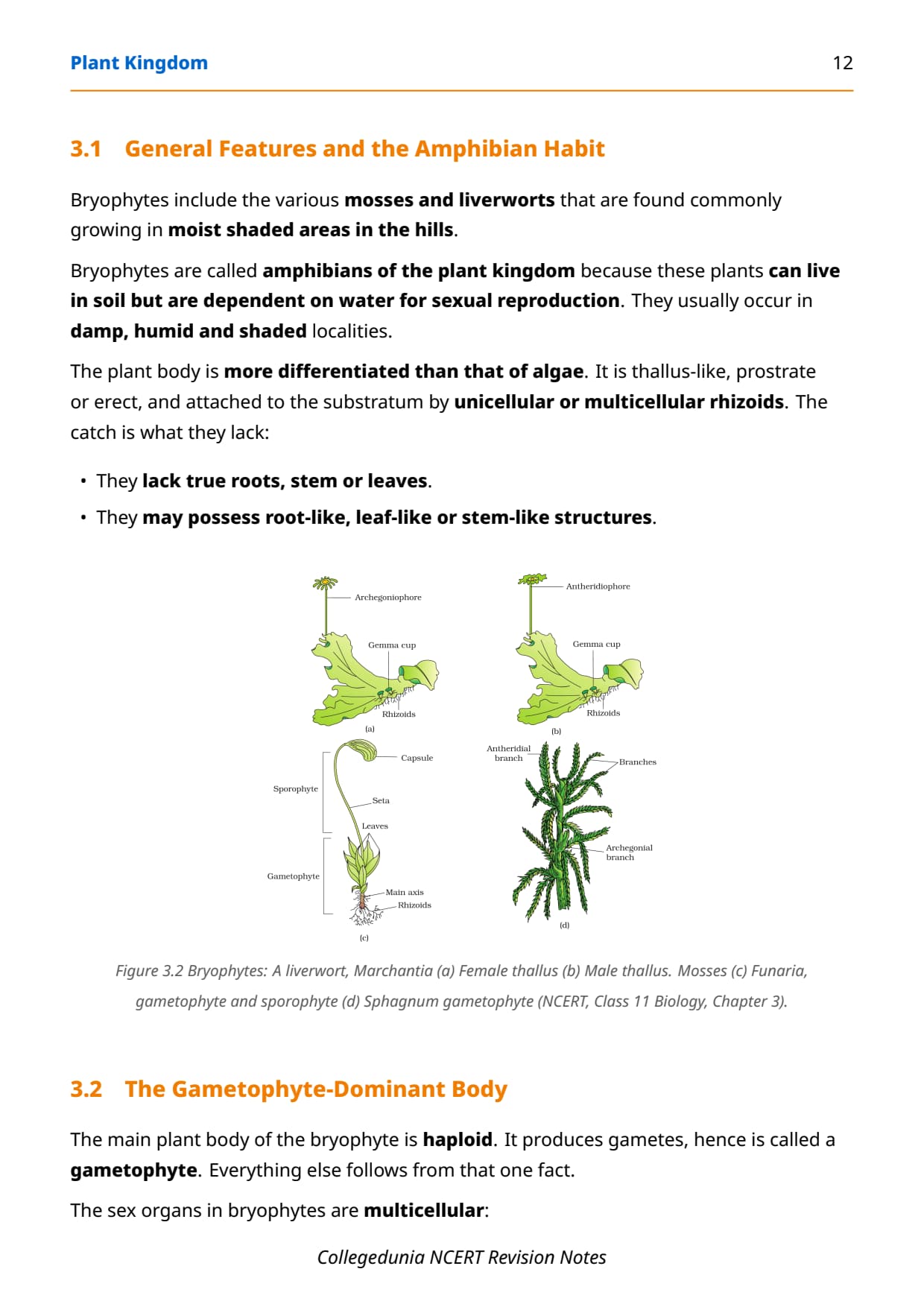
Bryophytes are the mosses and liverworts of moist, shaded places, and they are called the amphibians of the plant kingdom because they live on land but depend on water for sexual reproduction. Their body is more differentiated than algae but still lacks true roots, stem and leaves, showing only root-like, leaf-like or stem-like structures attached by rhizoids. The single idea the whole section turns on is that the main plant body is the haploid gametophyte, which produces the gametes.
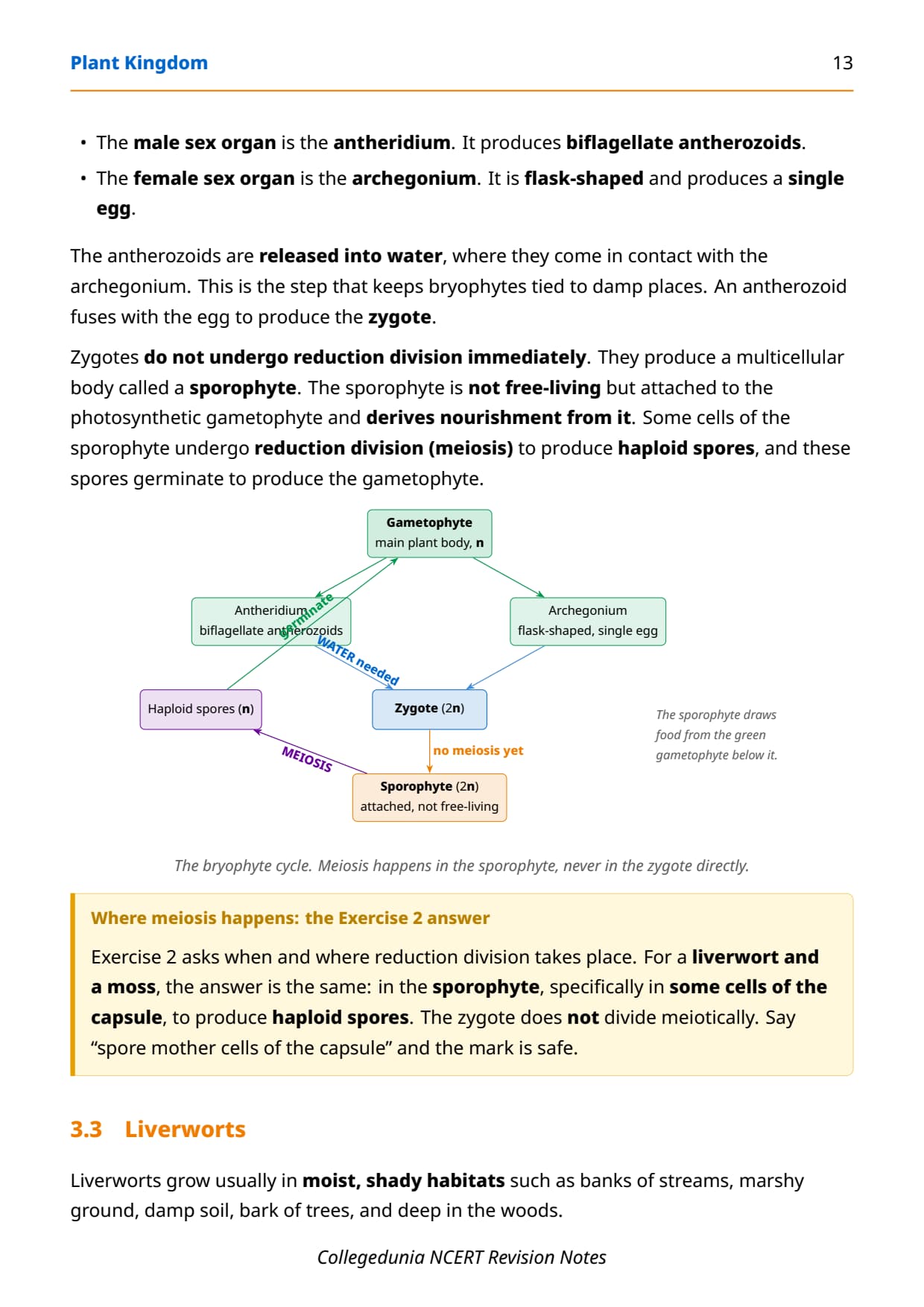
- Sex organs: the male antheridium produces biflagellate antherozoids, and the flask-shaped female archegonium produces a single egg.
- Water dependence: antherozoids are released into water, where they reach the archegonium and fuse with the egg to form the zygote.
- Sporophyte: the zygote does not divide meiotically at once. It forms a sporophyte that is not free-living but attached to and dependent on the gametophyte. Some sporophyte cells undergo meiosis to make haploid spores.
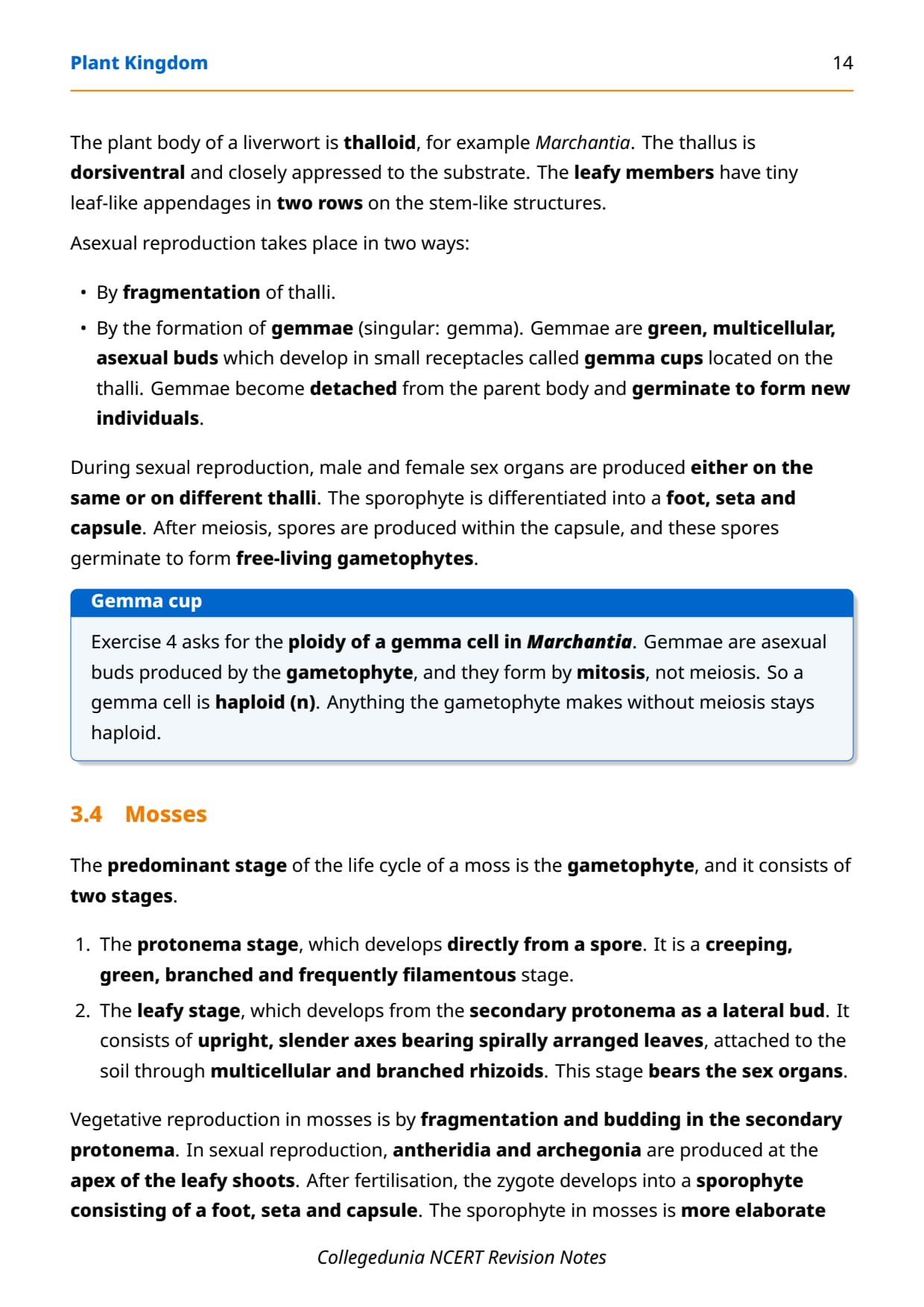
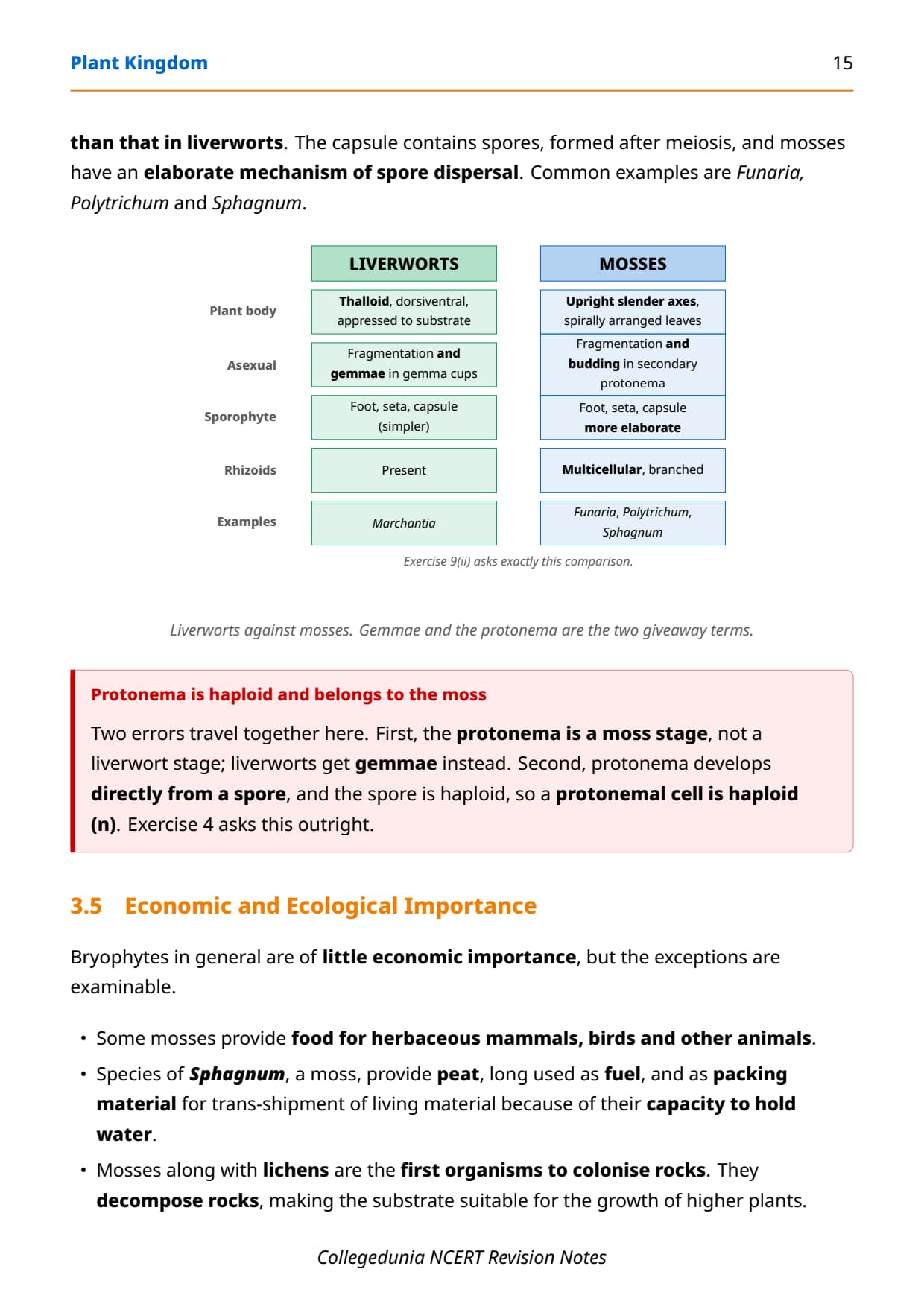
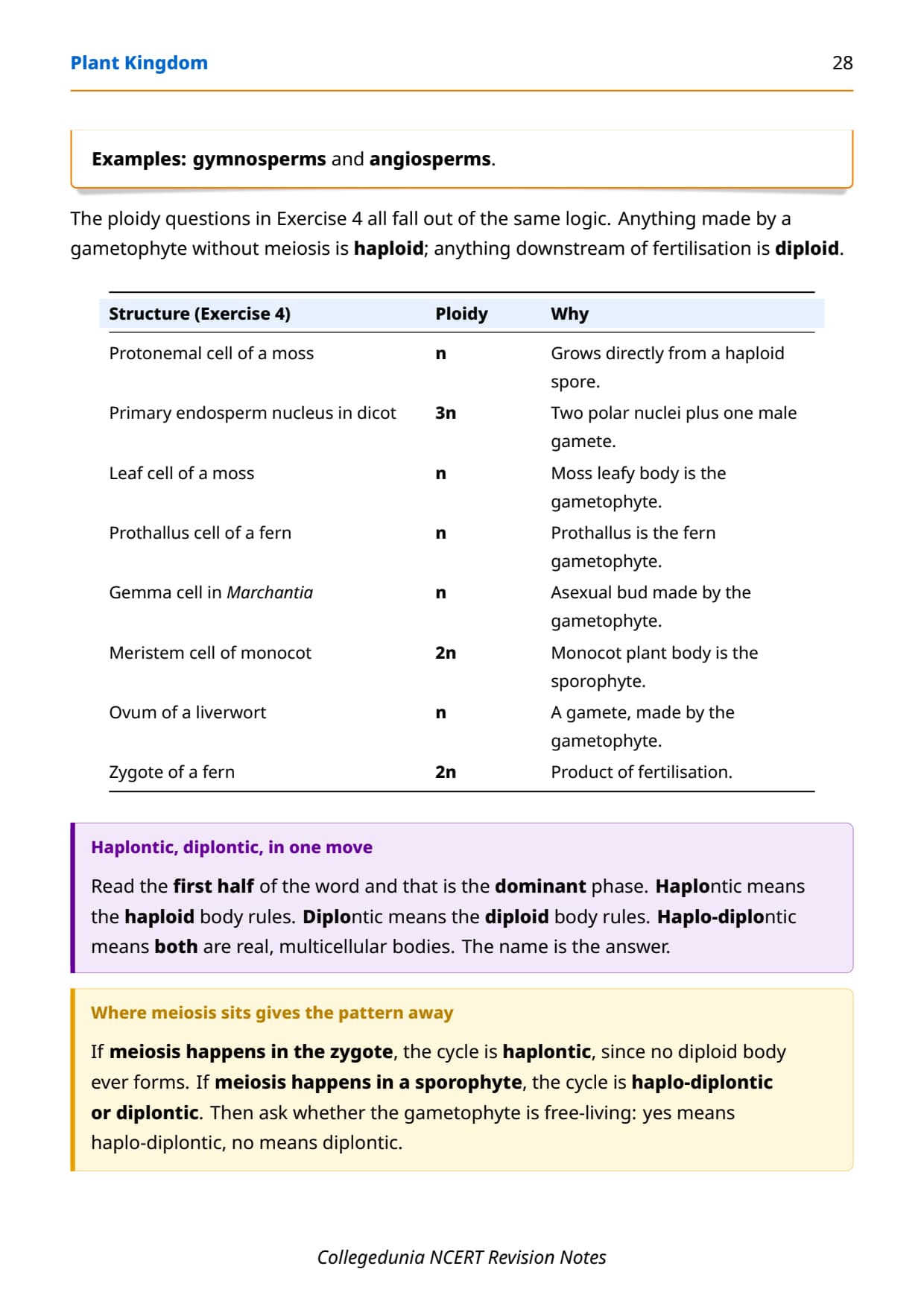
Bryophytes split into two groups. Liverworts, such as Marchantia, have a thalloid, dorsiventral body and reproduce asexually by fragmentation and by gemmae, that is, green multicellular buds in gemma cups. Mosses, such as Funaria, Polytrichum and Sphagnum, have a gametophyte in two stages, that is, the creeping filamentous protonema and the leafy stage that bears the sex organs. Meiosis in bryophytes happens in the sporophyte capsule, never in the zygote, so a gemma cell and a protonemal cell are both haploid. Economically, Sphagnum provides peat used as fuel and packing material, and mosses with lichens are the first organisms to colonise bare rocks and prevent soil erosion.
Pteridophytes: The First Vascular Plants
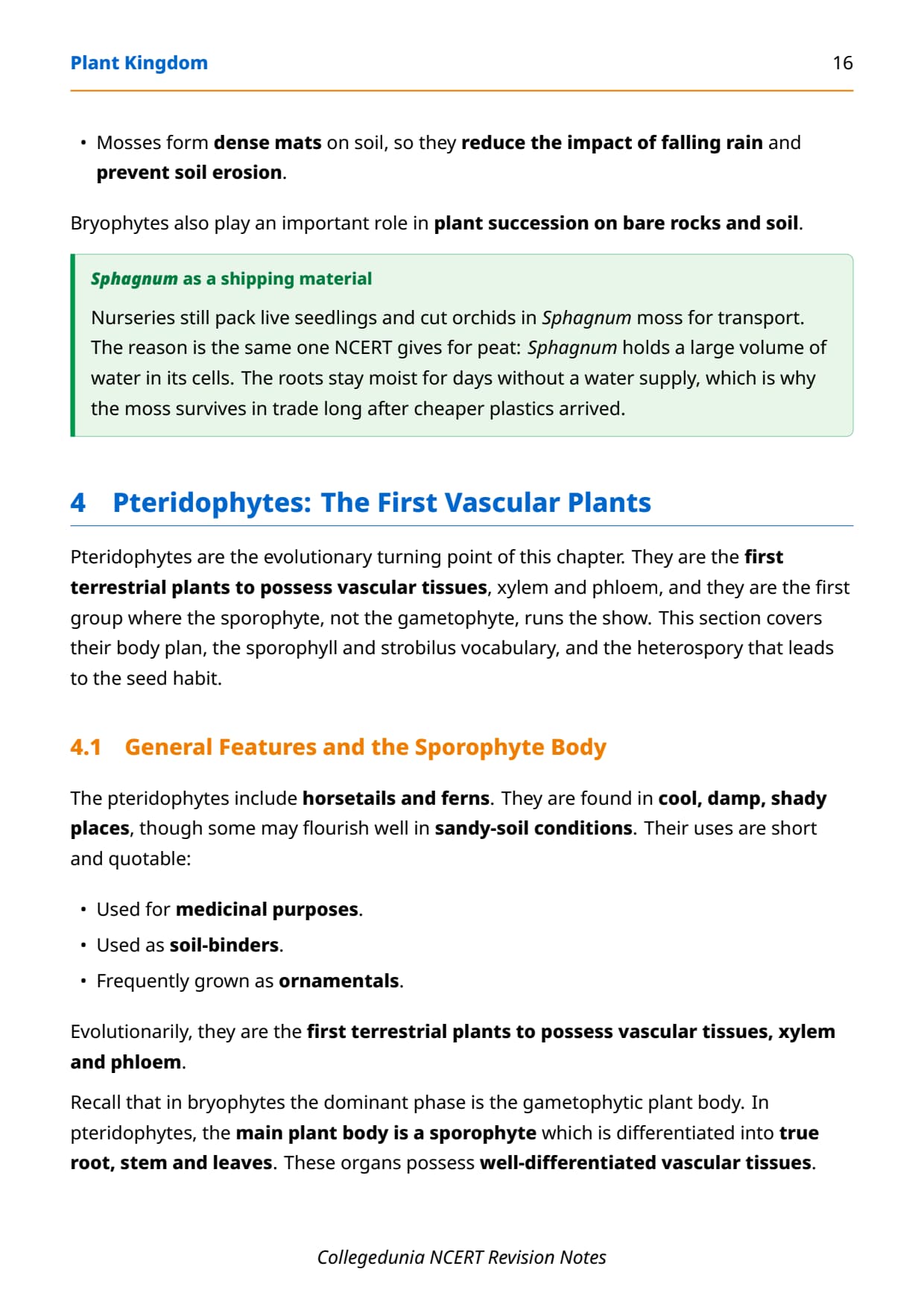
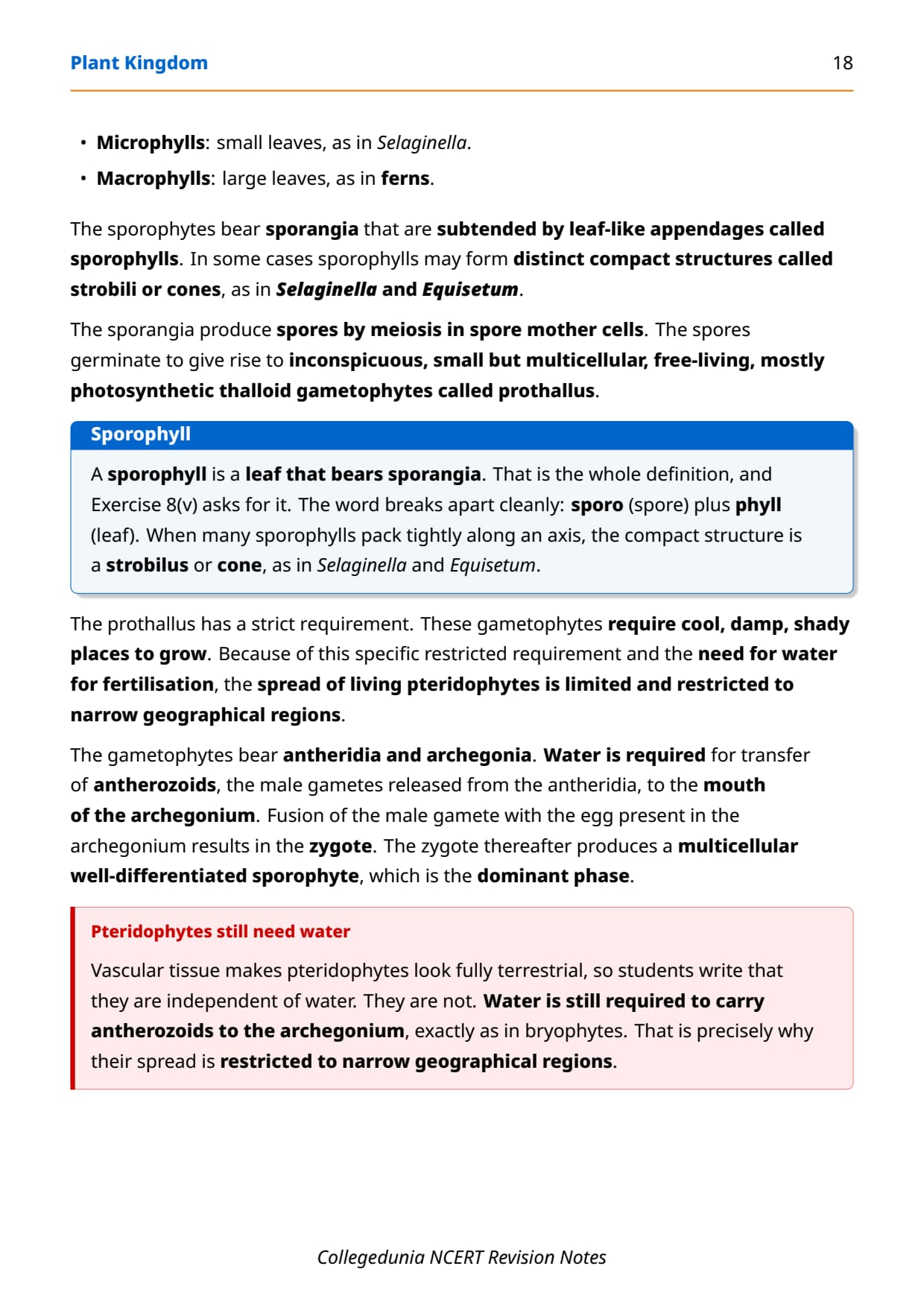
Pteridophytes, the horsetails and ferns, are the evolutionary turning point of this chapter. They are the first terrestrial plants to possess vascular tissues, that is, xylem and phloem, and they are the first group where the sporophyte becomes the dominant phase, differentiated into true root, stem and leaves. Algae and bryophytes are gametophyte dominant, while pteridophytes, gymnosperms and angiosperms are sporophyte dominant, and this dominance flip happens exactly here, together with vascular tissue.
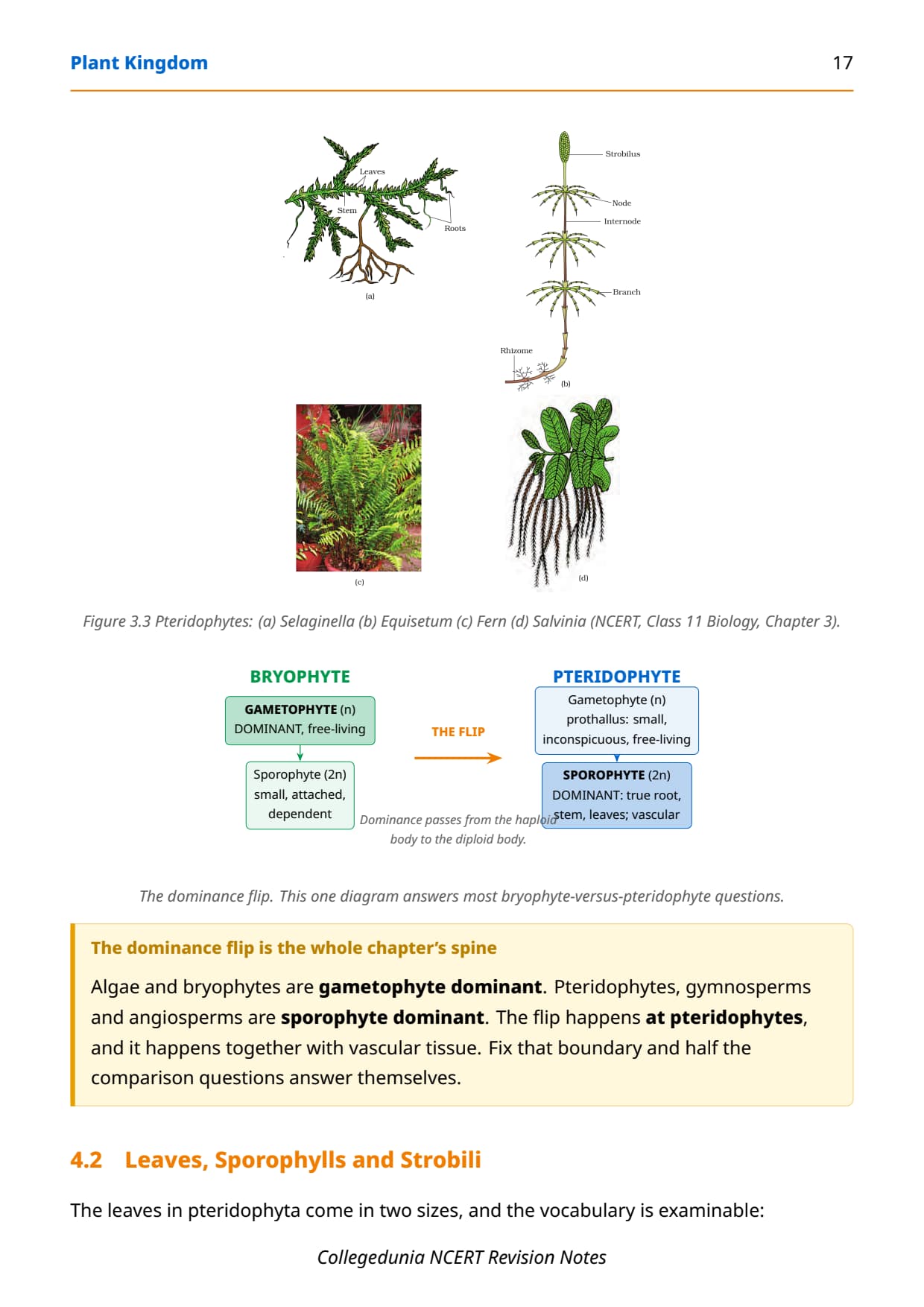
- Sporophylls: the sporophyte bears sporangia on leaf-like sporophylls, which may pack into compact strobili or cones, as in Selaginella and Equisetum.
- Prothallus: spores made by meiosis germinate into a small, free-living, photosynthetic gametophyte called the prothallus, which needs cool, damp, shady places.
- Water still needed: water is required to carry antherozoids to the archegonium, which is why the spread of pteridophytes is restricted to narrow geographical regions.
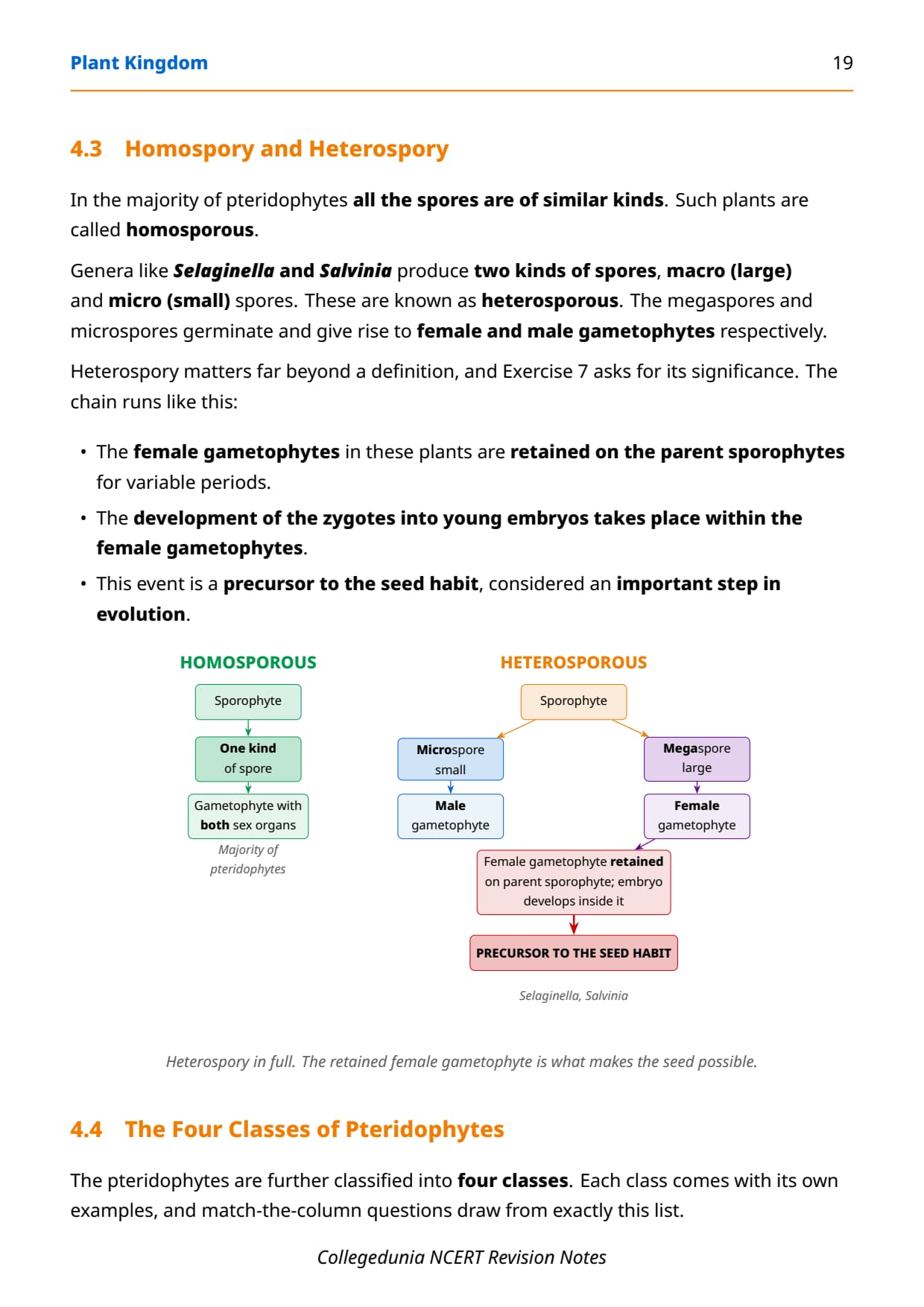
- Homospory and heterospory: most produce one kind of spore (homosporous), but Selaginella and Salvinia produce large megaspores and small microspores (heterosporous).
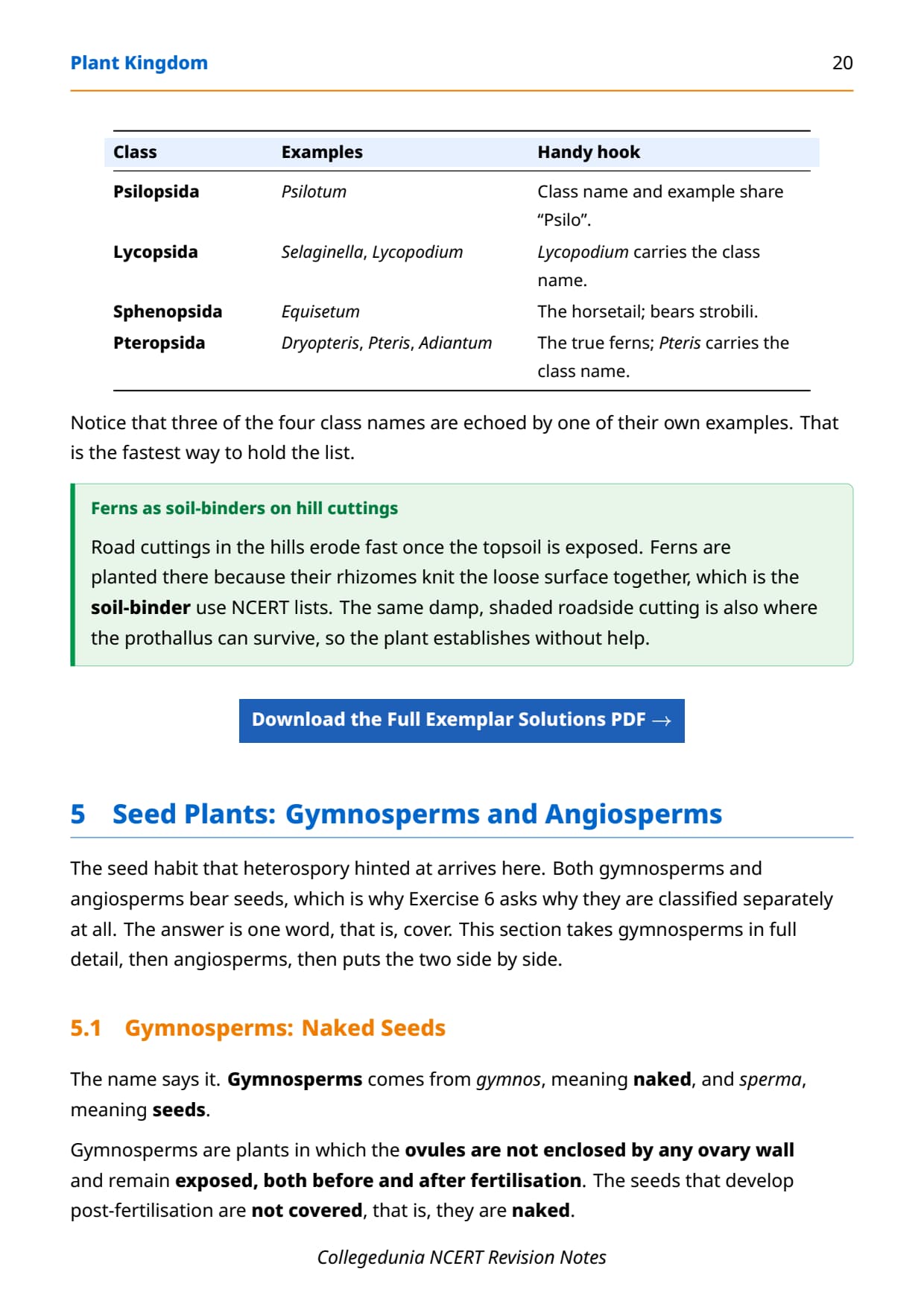
Heterospory matters far beyond a definition. In heterosporous plants the female gametophyte is retained on the parent sporophyte, and the zygote develops into a young embryo inside it, which is a precursor to the seed habit and an important step in evolution. Micro always means male and mega always means female, a rule that holds in pteridophytes, gymnosperms and angiosperms alike. The pteridophytes are further classified into four classes, that is, Psilopsida (Psilotum), Lycopsida (Selaginella, Lycopodium), Sphenopsida (Equisetum) and Pteropsida, the true ferns (Dryopteris, Pteris, Adiantum).
Seed Plants: Gymnosperms and Angiosperms
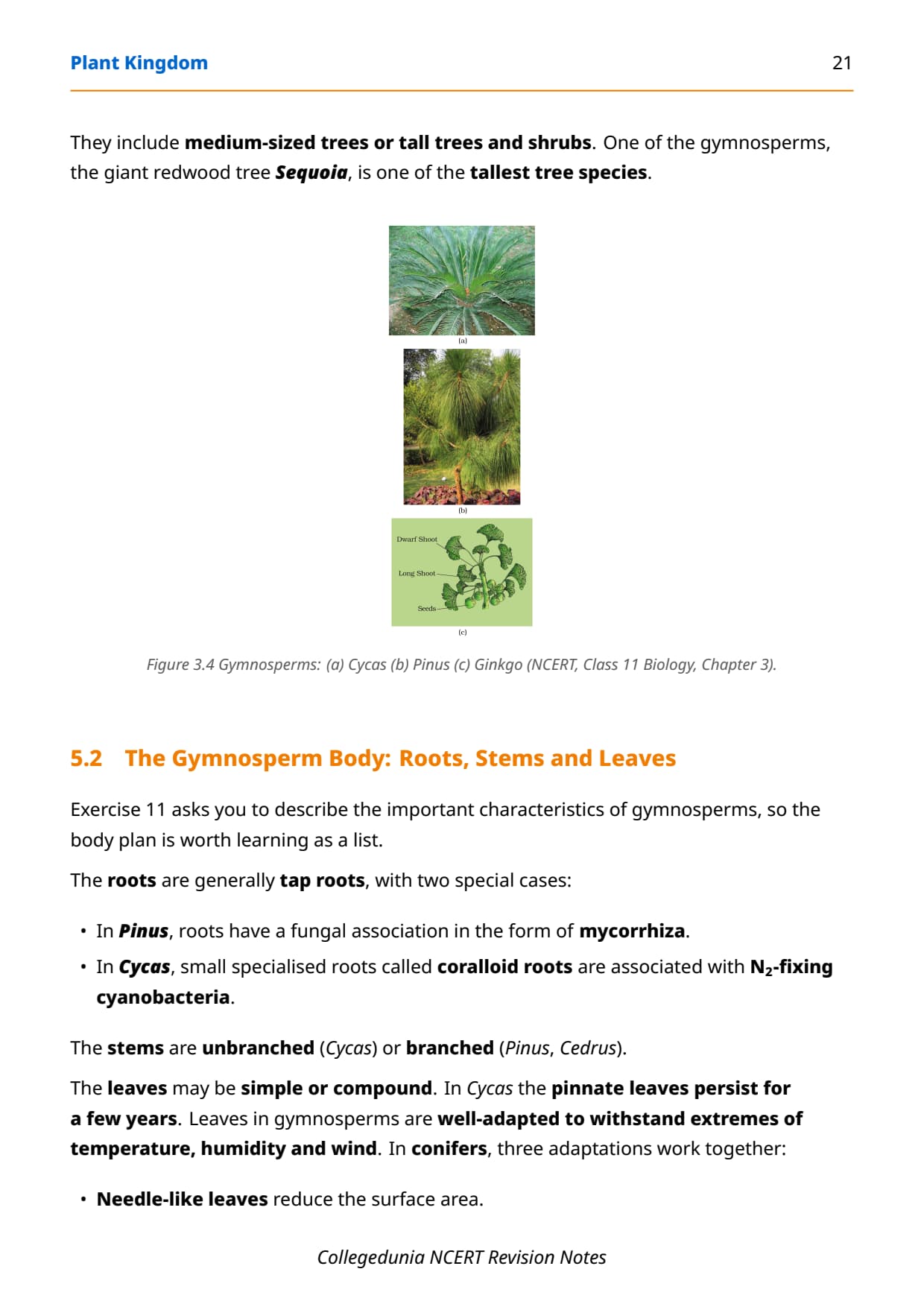
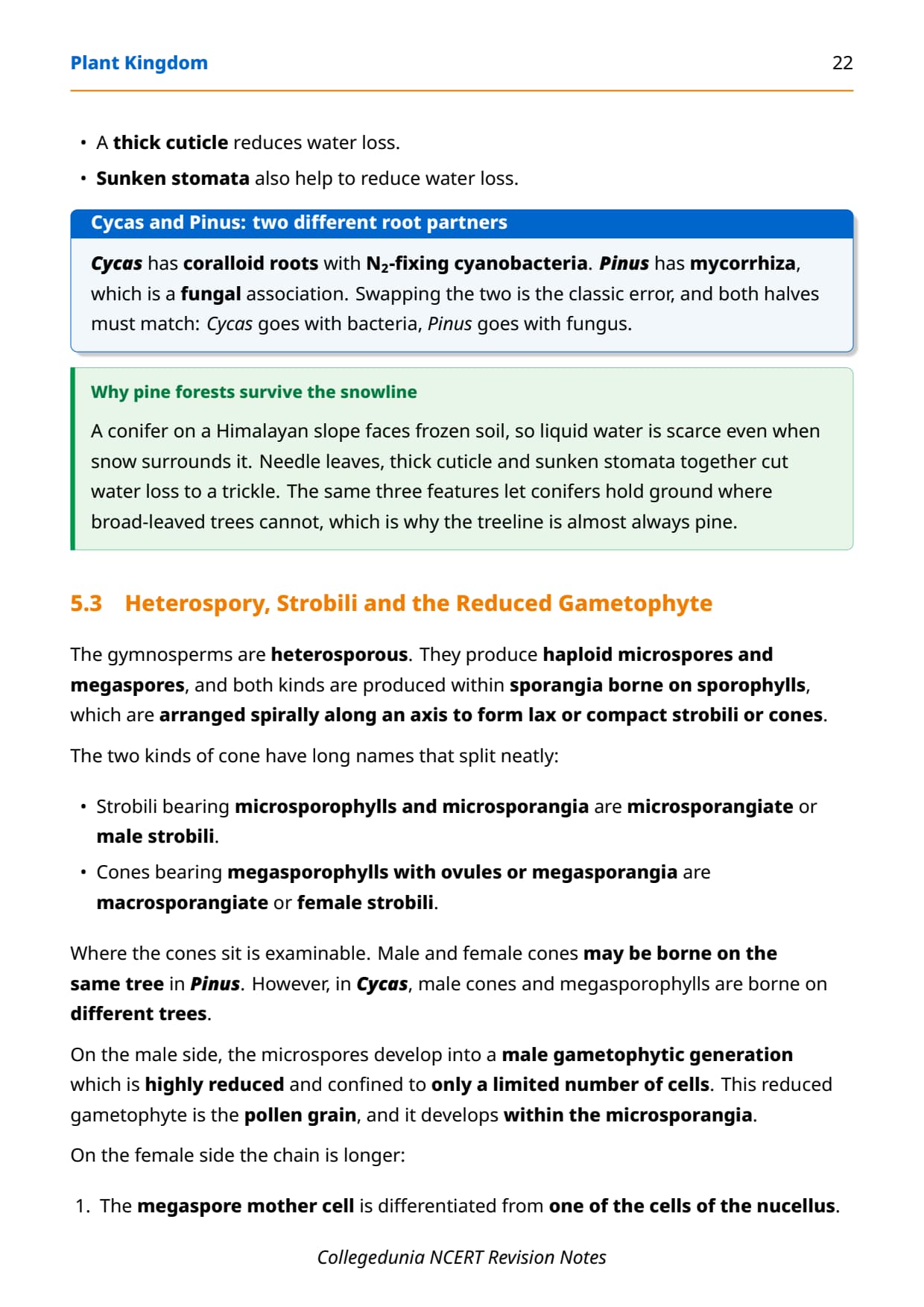
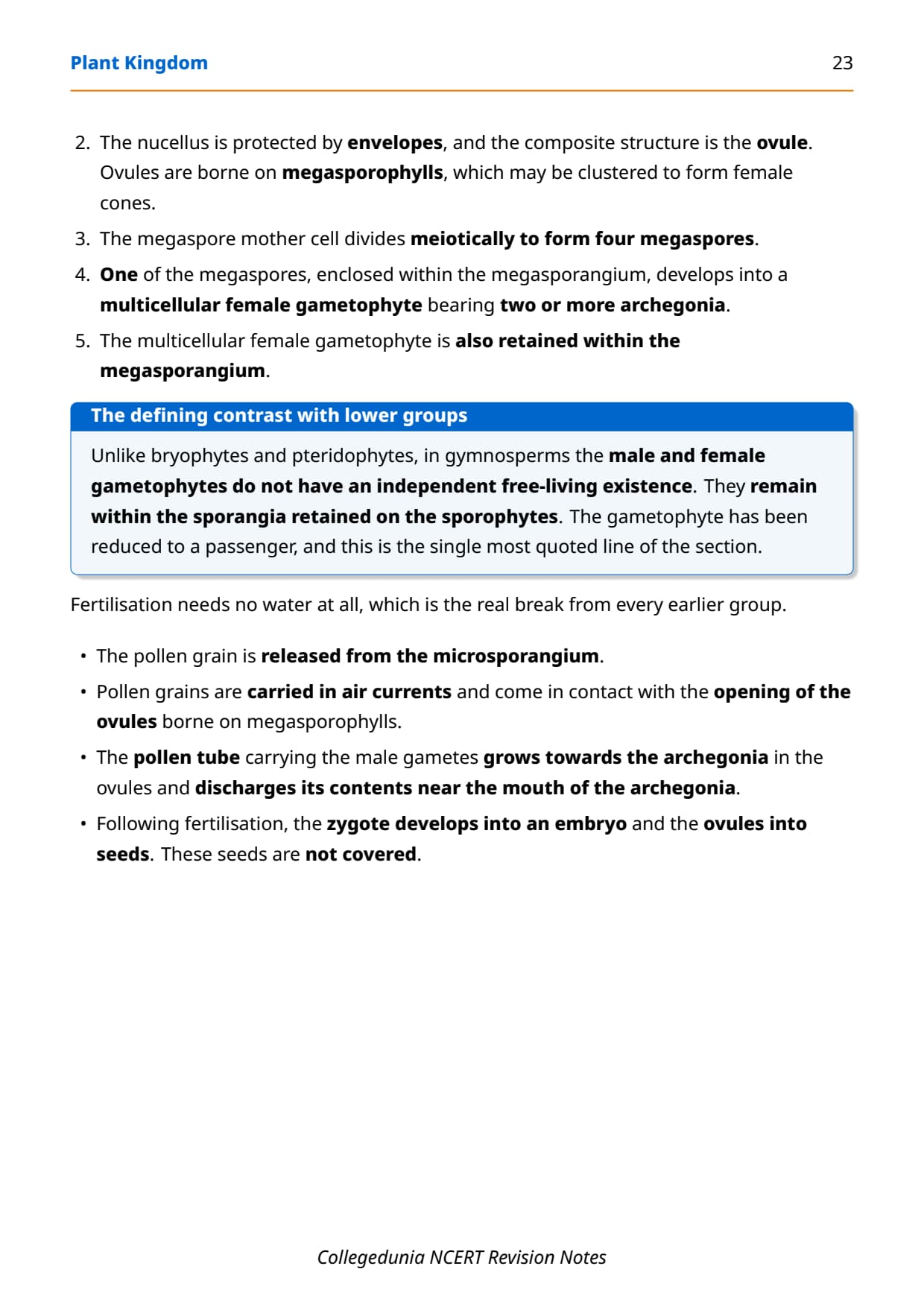
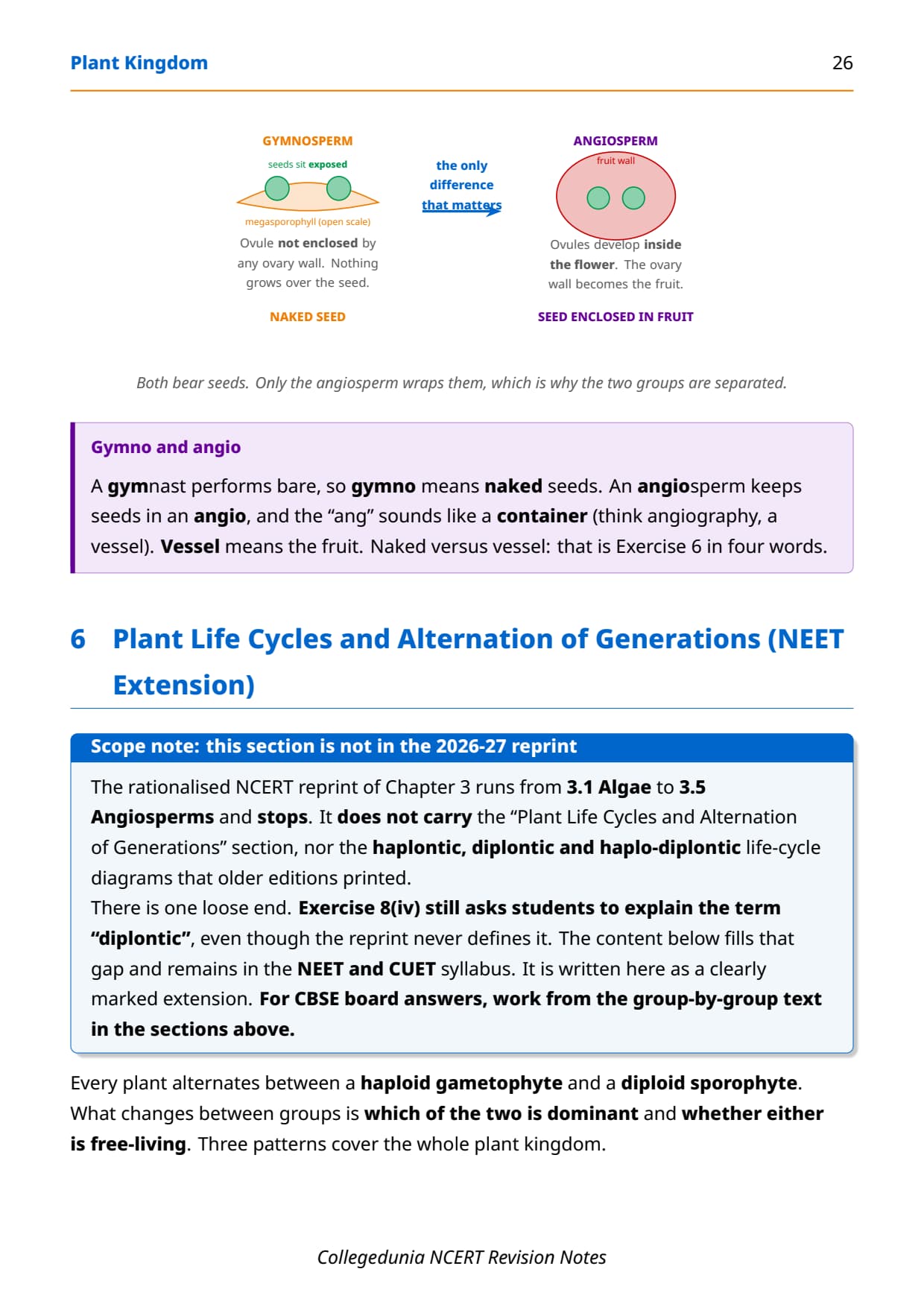
The seed habit that heterospory hinted at arrives here. Both gymnosperms and angiosperms bear seeds, so why are they separate groups? The answer is one word, that is, cover. Gymnosperms, from gymnos meaning naked and sperma meaning seeds, are plants in which the ovules are not enclosed by any ovary wall and remain exposed before and after fertilisation, so the seeds are naked. They include tall trees such as the giant redwood Sequoia, and their leaves resist extremes with needle shapes, a thick cuticle and sunken stomata in conifers.
- Two root partners: Pinus roots have a mycorrhiza, a fungal association, while Cycas has coralloid roots with N₂-fixing cyanobacteria. Swapping the two is a classic error.
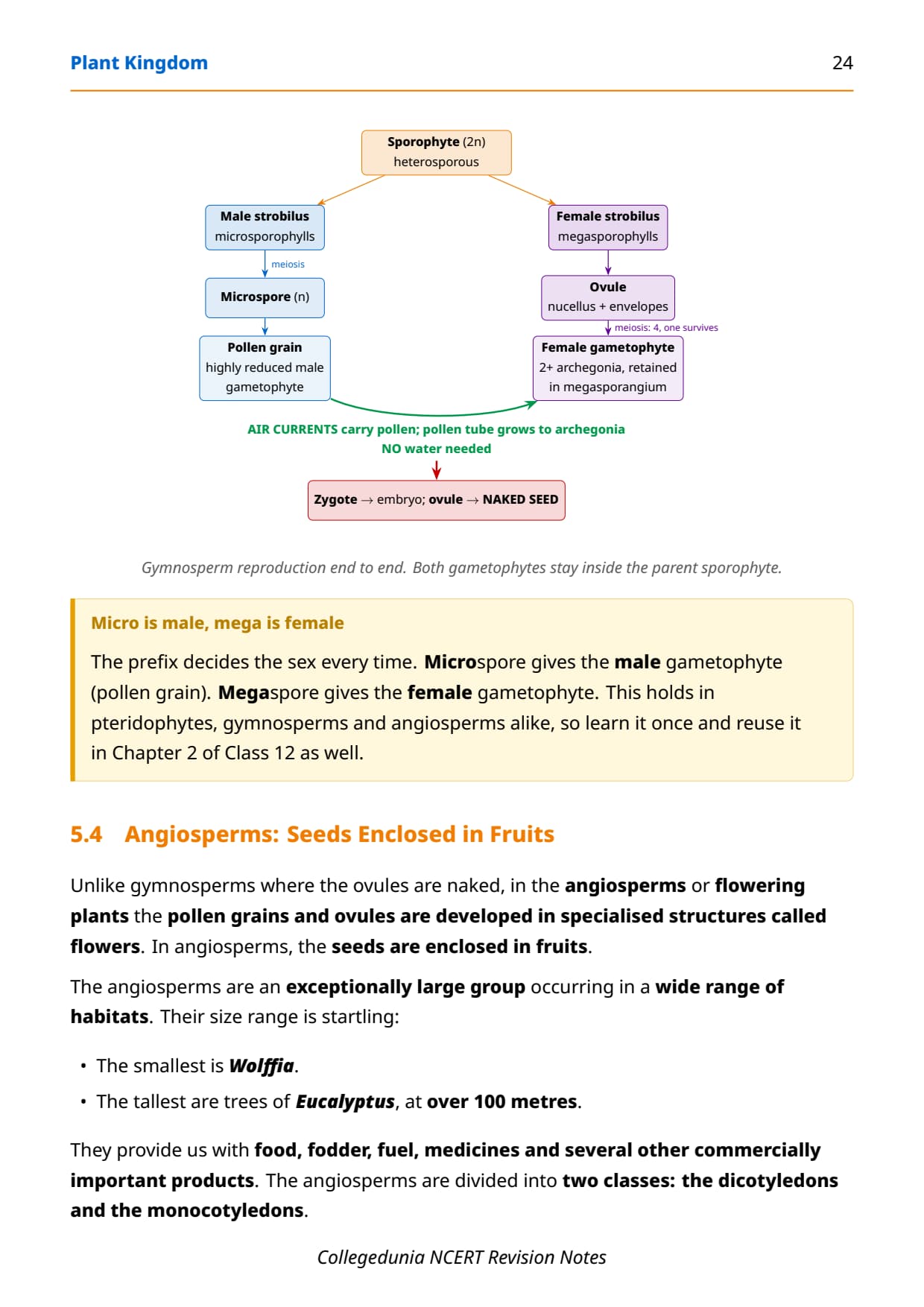
- Reduced gametophyte: gymnosperms are heterosporous, bearing male and female cones. The male gametophyte is a highly reduced pollen grain, and both gametophytes stay within the sporangia on the parent sporophyte, never free-living.
- No water for fertilisation: pollen is carried by air currents to the ovule, and the pollen tube grows to the archegonia, so the zygote becomes an embryo and the ovule becomes a naked seed.
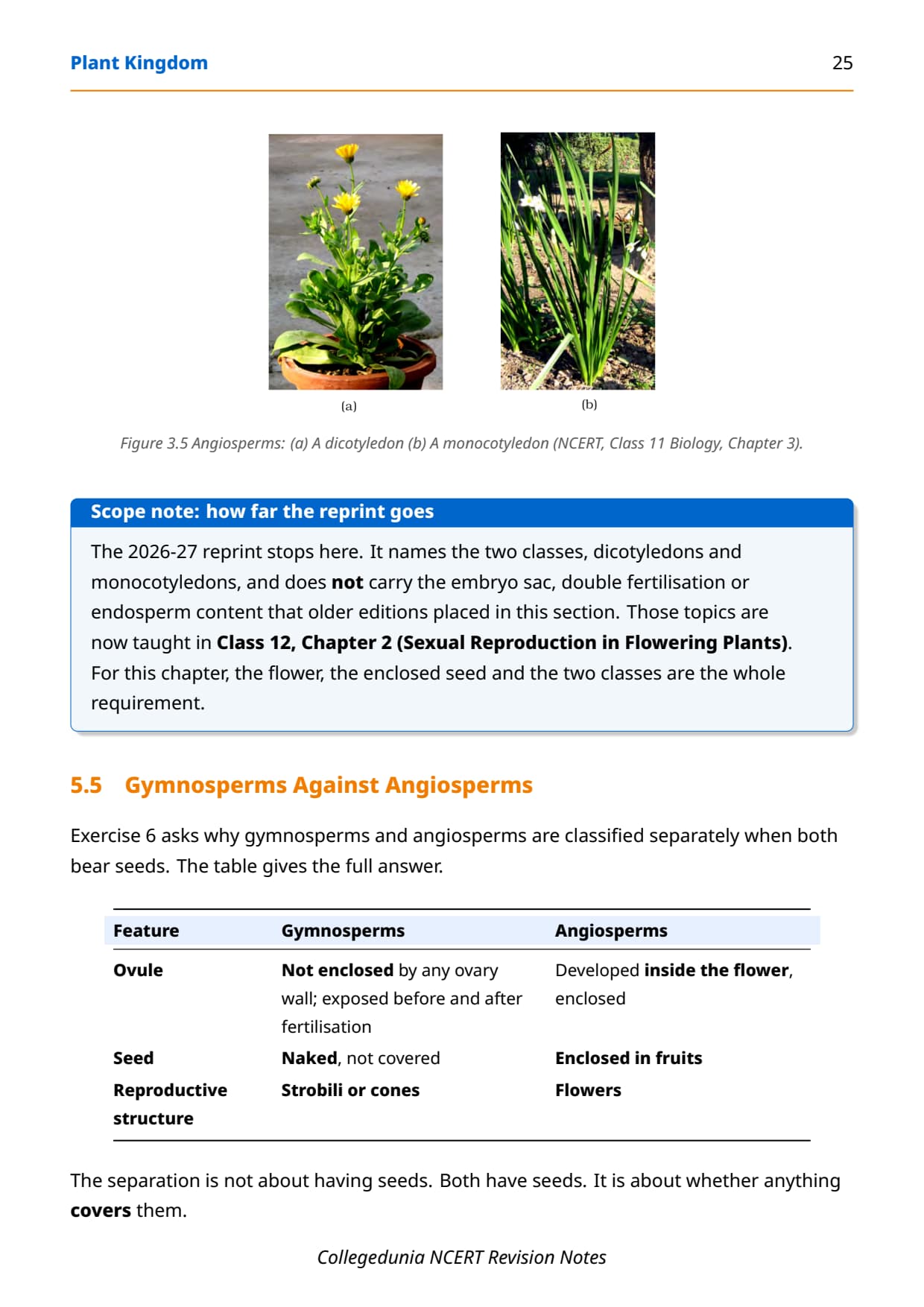
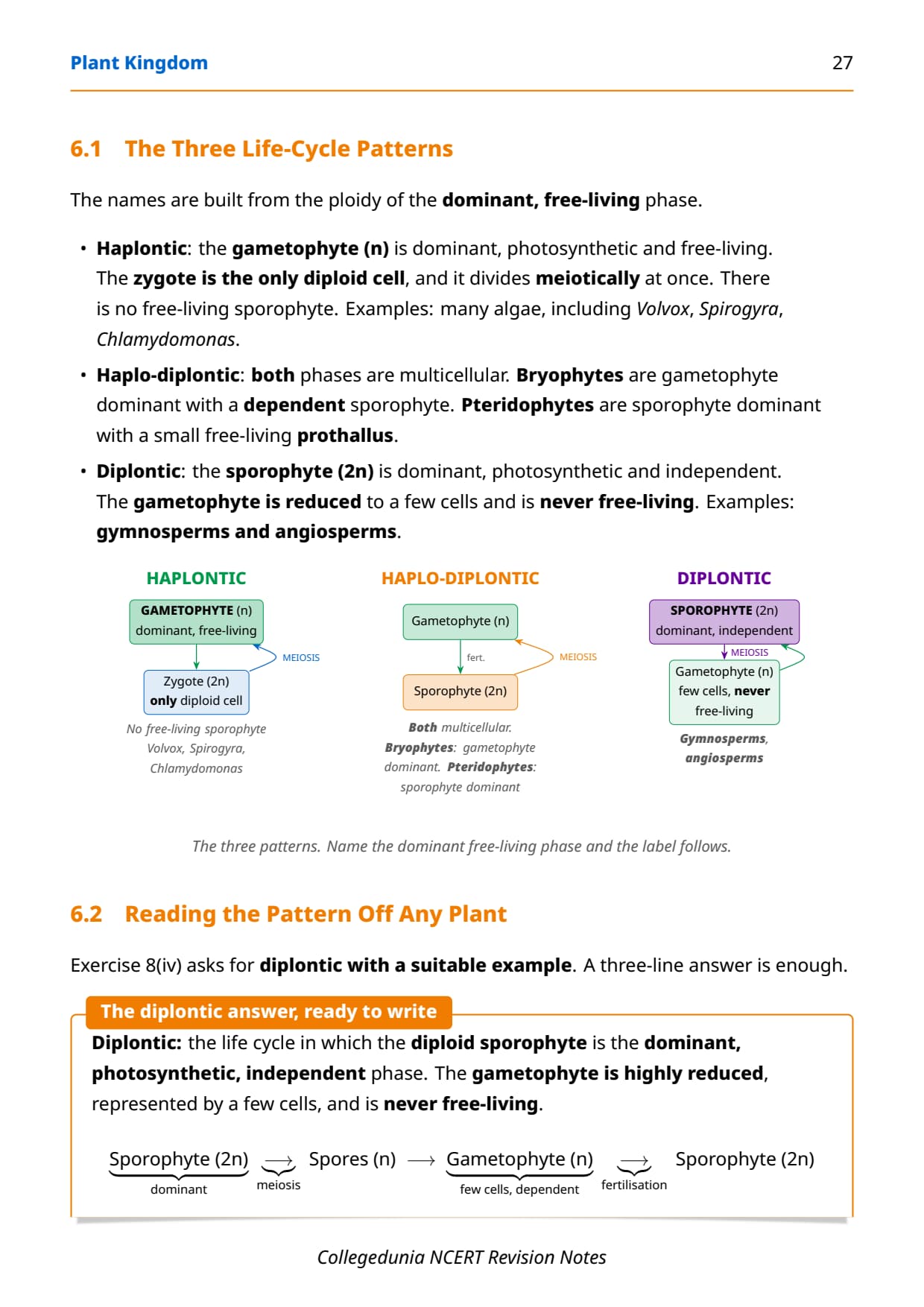
In the angiosperms or flowering plants, the pollen grains and ovules develop inside flowers, and the seeds are enclosed in fruits. They range from the smallest Wolffia to Eucalyptus trees over 100 metres tall, and they divide into two classes, that is, the dicotyledons and the monocotyledons. The separation of gymnosperms and angiosperms is not about having seeds, since both have them, but about whether anything covers them. The 2026-27 reprint stops at naming the two angiosperm classes, since the embryo sac, double fertilisation and endosperm content are now taught in Class 12. Across the whole kingdom, life cycles run from haplontic algae, through haplo-diplontic bryophytes and pteridophytes, to diplontic gymnosperms and angiosperms, where the sporophyte dominates and the gametophyte is never free-living. This alternation of generations stays in the NEET and CUET syllabus, so revise it as an extension while working CBSE answers from the group text above.
Key Definitions in Plant Kingdom
Board short-answer questions often ask for a clean definition in one or two lines, and a vague answer loses easy marks. Learn these word-for-word, because the wording of the exam question is usually built straight from the NCERT definition. Each term below also connects to an example you can be asked to name.
| Term | Definition |
|---|---|
| Algae | Chlorophyll-bearing, simple, thalloid, autotrophic and largely aquatic organisms. |
| Isogamy | Fusion of two gametes similar in size, as in Ulothrix and Spirogyra. |
| Oogamy | Fusion of one large non-motile female gamete with a smaller motile male gamete, as in Volvox and Fucus. |
| Protonema | The first creeping, green, filamentous stage of the moss gametophyte, developing directly from a spore. |
| Sporophyll | A leaf-like appendage that bears or subtends sporangia. |
| Heterospory | Production of two kinds of spores, macro (large) and micro (small), as in Selaginella and Salvinia. |
| Coralloid roots | Small specialised roots of Cycas associated with N₂-fixing cyanobacteria. |
A common board question asks why gymnosperms and angiosperms are classified separately when both bear seeds. State that the seed is not the deciding character but its cover is, then give naked seeds versus seeds enclosed in fruits to earn the full mark. Learning these definitions makes the wording of almost every one-mark and two-mark question in this chapter familiar.
Common Mistakes Students Make in Plant Kingdom
These slips happen because two terms look alike, not because the concept is hard. Each one costs 1 to 2 marks in the paper, so watch for them at the exact step where they occur.
Mistake 1: Listing blue-green algae under algae. Cyanobacteria are Monera, not algae, in the current classification.
Mistake 2: Calling Spirogyra anisogamous because its gametes are non-motile. Isogamy is decided by size, not motility, so Spirogyra is isogamous.
Mistake 3: Putting the protonema in a liverwort. Protonema is a moss stage, while liverworts make gemmae.
Mistake 4: Claiming pteridophytes need no water. Water is still required to carry antherozoids to the archegonium.
Mistake 5: Giving Cycas mycorrhiza and Pinus coralloid roots. Cycas has coralloid roots with cyanobacteria, and Pinus has mycorrhiza, a fungus.
Plant Kingdom Weightage in CBSE Boards, NEET and CUET
This chapter is long but predictable, and almost every mark comes from comparing the five groups. It carries steady marks in the board paper as short and long answers, and it is one of the highest-yielding chapters in NEET because life cycles, ploidy and examples generate many direct questions. Here is how the marks split across the main exams for 2026-27.
| Exam | Typical weightage | What is asked |
|---|---|---|
| CBSE Boards | 5 to 7 marks | Comparison of the five plant groups, algal classes, and gymnosperm versus angiosperm |
| NEET | 3 to 4 questions | Life cycles and ploidy, heterospory, algal pigments, and examples of each group |
| CUET | 2 to 3 objective questions | Definitions, dominance of gametophyte or sporophyte, and matching plants to their group |
The five-group comparison and the gametophyte-to-sporophyte dominance flip are the two most tested ideas from this chapter across all three exams. Master Table 3.1 for algae first, then the bryophyte and pteridophyte life cycles, then the gymnosperm versus angiosperm contrast, in that order of return on effort for the 2026-27 session.
How to Revise Plant Kingdom Quickly
Use these plant kingdom class 11 notes for a fast, ordered recap the night before a test. The checklist below takes about 25 minutes and hits every marks-heavy idea in the chapter without opening the full textbook.
- First 8 minutes: write the five groups in order with their dominant phase and whether they need water for fertilisation.
- Next 9 minutes: fill Table 3.1 for the three algal classes, and list isogamy, anisogamy and oogamy with one example each.
- Last 8 minutes: write the gymnosperm versus angiosperm contrast, and match haplontic, haplo-diplontic and diplontic to their groups.
Close the loop by explaining where the dominance flip happens and why gymnosperm seeds are called naked. If you can do all three blocks without notes, the chapter is exam-ready. Keep Table 3.1 and the five-group summary beside you for the first pass only, then try the whole checklist closed-book.
Student Feedback on the Plant Kingdom Notes
What 12,470 students told us about their Plant Kingdom revision:
- 74% of students rated the five-group comparison and the dominance flip as the part most worth memorising for the exam.
- Most-confused pair: the protonema of mosses versus the gemmae of liverworts, mixed up by about 3 in 10 students.
- Students who learnt Cycas with coralloid roots and Pinus with mycorrhiza as a fixed pair said the match-the-column questions felt easy afterwards.
Source: 2026-27 Class 11 Biology student poll. Sample of 12,470 students from CBSE schools across 15 states, conducted before the 2026 boards.
Other Plant Kingdom Class 11 Biology Resources
Pair these notes with the solved answers, the formula sheet, the exemplar material, and the textbook PDF for the same chapter.
| Resource | Link |
|---|---|
| NCERT Solutions | Plant Kingdom Class 11 NCERT Solutions |
| Formula Sheet | Plant Kingdom Class 11 Formula Sheet |
| Exemplar Solutions | Plant Kingdom Class 11 Exemplar Solutions |
| NCERT Book PDF | Plant Kingdom Class 11 Book PDF |
| Exemplar Book PDF | Plant Kingdom Class 11 Exemplar Book PDF |
NCERT Notes for Class 11 Biology: All Chapters
Jump to the revision notes for any other Class 11 Biology chapter below.
| Chapter | NCERT Notes |
|---|---|
| Chapter 1 | The Living World |
| Chapter 2 | Biological Classification |
| Chapter 3 | Plant Kingdom |
| Chapter 4 | Animal Kingdom |
| Chapter 5 | Morphology of Flowering Plants |
| Chapter 6 | Anatomy of Flowering Plants |
| Chapter 7 | Structural Organisation in Animals |
| Chapter 8 | Cell The Unit of Life |
| Chapter 9 | Biomolecules |
| Chapter 10 | Cell Cycle and Cell Division |
| Chapter 11 | Photosynthesis in Higher Plants |
| Chapter 12 | Respiration in Plants |
| Chapter 13 | Plant Growth and Development |
| Chapter 14 | Breathing and Exchange of Gases |
| Chapter 15 | Body Fluids and Circulation |
| Chapter 16 | Excretory Products and their Elimination |
| Chapter 17 | Locomotion and Movement |
| Chapter 18 | Neural Control and Coordination |
| Chapter 19 | Chemical Coordination and Integration |
FAQs on Plant Kingdom Class 11 Biology Notes
Plant Kingdom Notes - Frequently Asked Questions
Ques. What topics do the plant kingdom class 11 notes cover?
Ans. These plant kingdom class 11 notes cover how the plant kingdom is classified, the artificial, natural and phylogenetic systems, algae and their three classes, bryophytes as the amphibians of the plant kingdom, pteridophytes as the first vascular plants, gymnosperms with naked seeds, angiosperms with seeds in fruits, and the alternation of generations. Table 3.1, key definitions and examples are all included for fast revision.
Ques. Why are bryophytes called the amphibians of the plant kingdom?
Ans. Bryophytes are called the amphibians of the plant kingdom because they can live in soil but are dependent on water for sexual reproduction. Their male antheridium releases biflagellate antherozoids into water, and these swim to the flask-shaped archegonium to fertilise the egg. This tie to water is why bryophytes are restricted to damp, humid and shaded places.
Ques. What is the basis of classification of algae?
Ans. Algae are classified into Chlorophyceae, Phaeophyceae and Rhodophyceae on the basis of the type of pigment possessed and the type of stored food, supported by cell wall composition and flagellar number and position. Green algae have chlorophyll a and b and store starch, brown algae add fucoxanthin and store mannitol or laminarin, and red algae have r-phycoerythrin and store floridean starch.
Ques. Where does the gametophyte to sporophyte dominance flip happen?
Ans. Algae and bryophytes are gametophyte dominant, while pteridophytes, gymnosperms and angiosperms are sporophyte dominant. The dominance flip happens at the pteridophytes, which are also the first plants to possess vascular tissue and true root, stem and leaves. Fixing this boundary answers most bryophyte-versus-pteridophyte comparison questions at once.
Ques. Why are gymnosperms and angiosperms classified separately when both bear seeds?
Ans. The seed is not the deciding character, its cover is. In gymnosperms the ovules are not enclosed by any ovary wall and remain exposed before and after fertilisation, so the seeds are naked. In angiosperms the ovules develop inside flowers and the seeds are enclosed in fruits. Both bear seeds, but only the angiosperm wraps them, which is why the two groups are separated.
Ques. What is heterospory and why is it important?
Ans. Heterospory is the production of two kinds of spores, macro or megaspores and microspores, as in Selaginella and Salvinia. It matters because the female gametophyte is retained on the parent sporophyte, and the zygote develops into a young embryo inside it. This retention is a precursor to the seed habit and is considered an important step in evolution.
Ques. What is the weightage of this chapter in the CBSE board exam?
Ans. Plant Kingdom carries about 5 to 7 marks in the CBSE Class 11 Biology paper, usually one long or short answer comparing the five plant groups plus objective questions on life cycles and examples. It is also one of the highest-yielding chapters in NEET, generating questions on life cycles and ploidy, algal pigments, heterospory, and the examples of each group for the 2026-27 session.



Comments