




These biological classification class 11 notes pull together every kingdom, criterion, and example that the CBSE Boards, NEET and CUET papers actually test in 2026-27. Revise the whole chapter fast, with why the two-kingdom system broke down, Whittaker's five kingdoms, the bacteria of Monera, the groups of Protista and Fungi, and the acellular viruses, viroids, prions and lichens in one place.
This chapter opens the classification story that Chapter 1 began, and the kingdom vocabulary you learn here feeds straight into Plant Kingdom and Animal Kingdom in the chapters that follow.
- CBSE Weightage: 4 to 6 marks, usually one question on the five kingdoms plus a short answer on Monera, Protista, Fungi, or the acellular agents.
- Topics covered: the two-kingdom system and why it failed, Whittaker's five kingdom classification, Kingdom Monera, Kingdom Protista, Kingdom Fungi, a note on Plantae and Animalia, and the viruses, viroids, prions and lichens that sit outside all five kingdoms.
- Key rules: Whittaker's five criteria, the chitin versus cellulose wall difference, and the rule that no virus carries both RNA and DNA.
These biological classification class 11 notes are curated by subject experts, based on the 2026-27 NCERT textbook, and checked against the last five years of CBSE Board and NEET papers.
Topic-by-Topic Summary of Biological Classification
The chapter is really a story about criteria. It shows how classification moved from Aristotle's rough sorting, through the two-kingdom system, to Whittaker's five kingdoms, and then places the odd organisms that fit nowhere. Nothing about an organism changes when it moves between groups; only our basis for grouping changes. Here is the quick map of what each topic gives you before you revise the detail.
- Two-kingdom system: Plantae and Animalia only, which proved inadequate once cell structure and nutrition were considered.
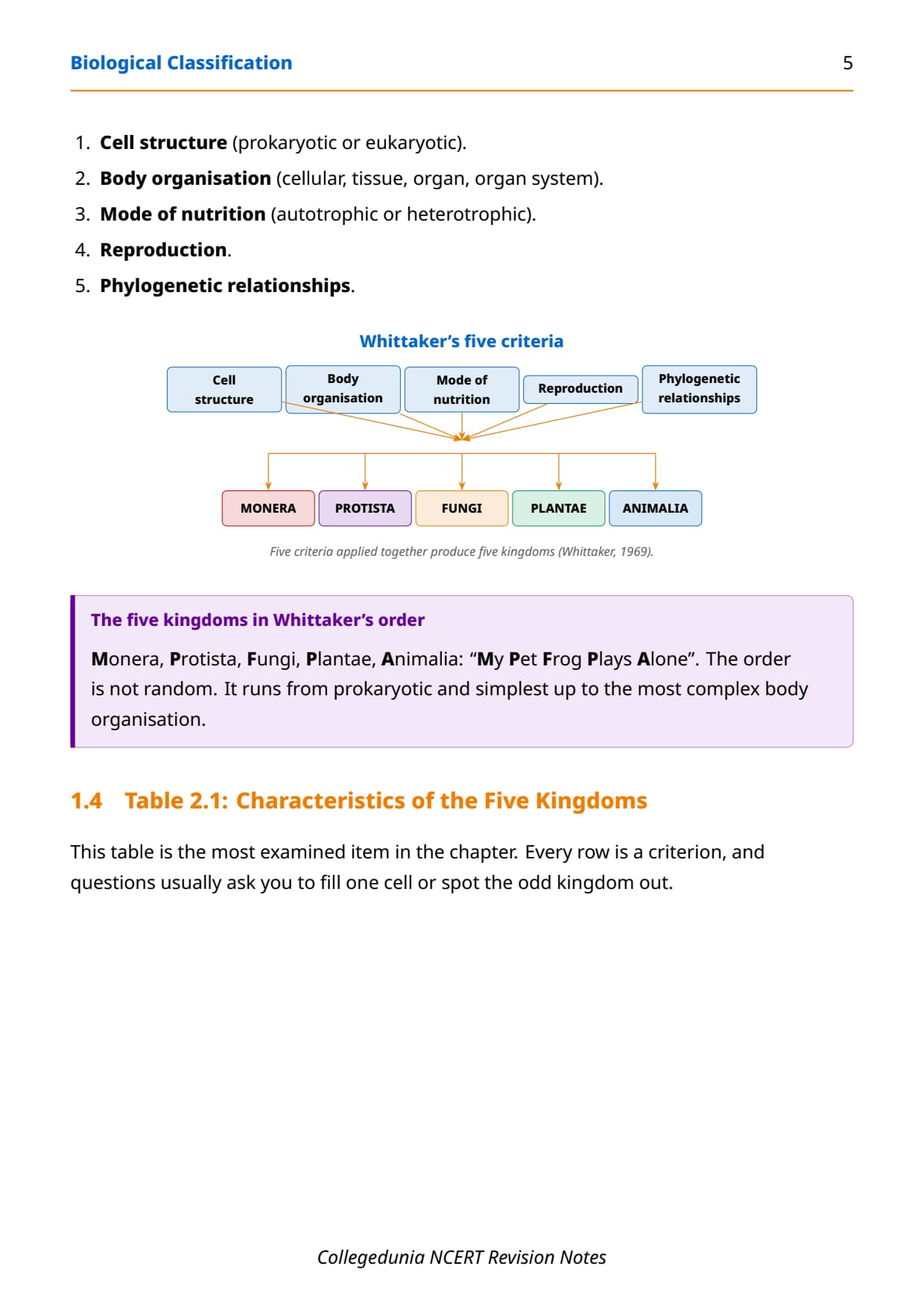
- Five kingdom classification: Monera, Protista, Fungi, Plantae and Animalia, proposed by R.H. Whittaker in 1969 on five criteria.
- Kingdom Monera: the bacteria, the only prokaryotes, showing the widest metabolic diversity of any group.
- Kingdom Protista: the single-celled eukaryotes, that is, chrysophytes, dinoflagellates, euglenoids, slime moulds and protozoans.
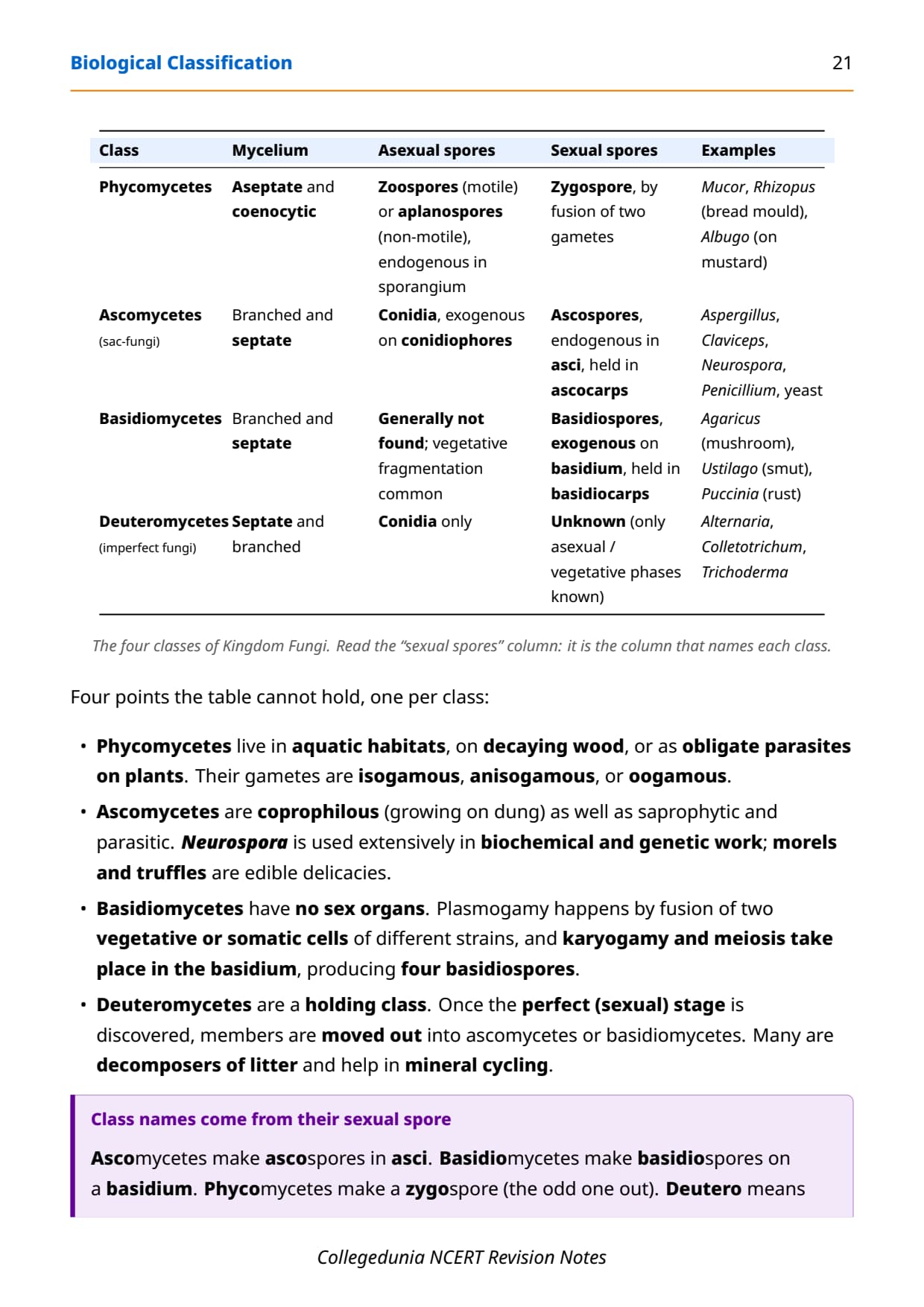
- Kingdom Fungi: the heterotrophs with chitin walls, split into four classes by their sexual spores.
- Outside the kingdoms: viruses, viroids and prions are acellular agents, and lichens are algae-fungi partnerships.
Revise the topics in this order, because each one uses the one before it. Master Table 2.1, the five kingdom comparison, first, and the individual kingdoms fall into place around it. These biological classification class 11 notes follow the same sequence as the NCERT textbook.
Why the Two Kingdom System Failed and Whittaker's Five Kingdoms
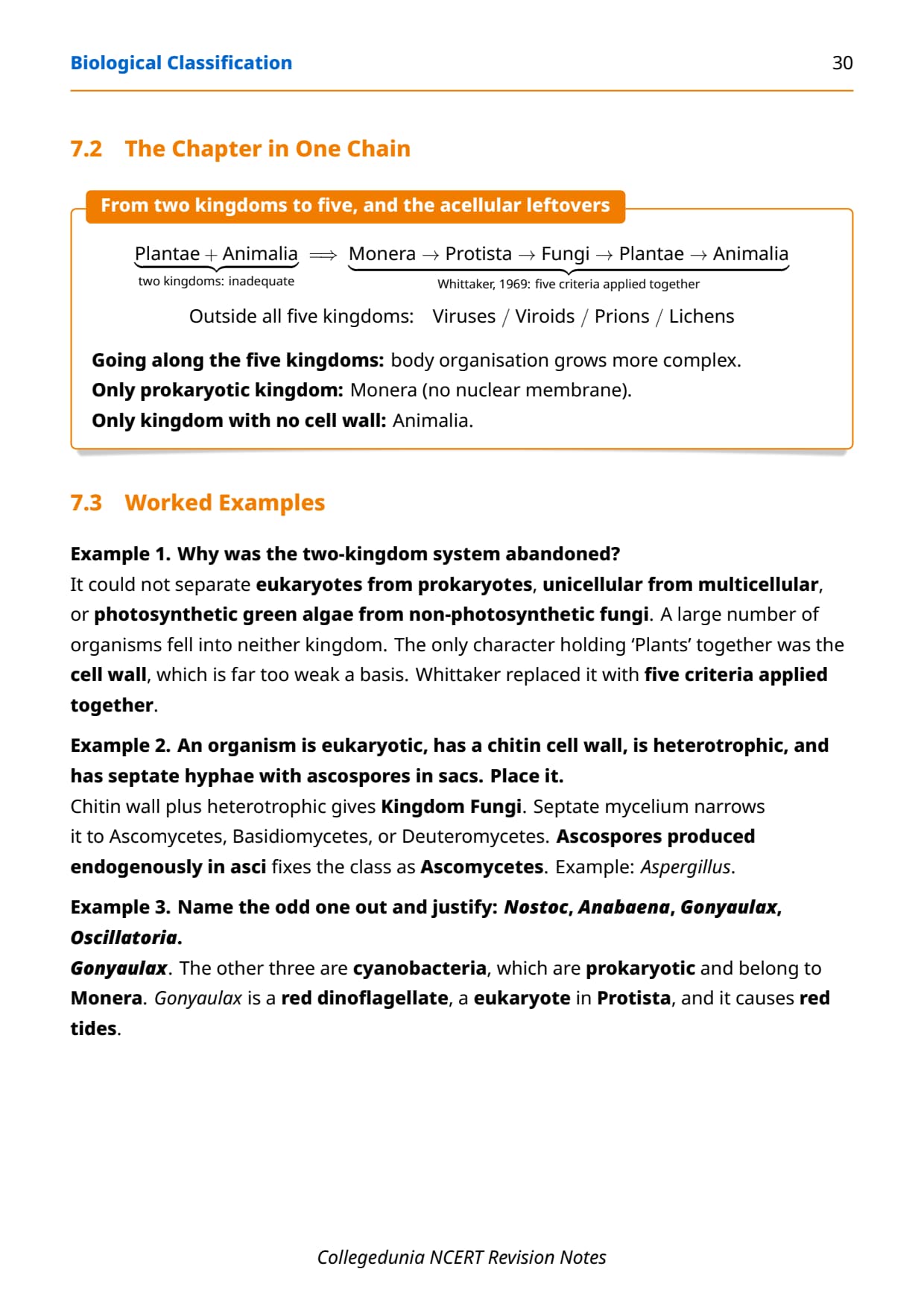
Sorting life into groups is old work, done for food, shelter and clothing long before biology existed as a subject. Aristotle made the earliest scientific attempt, sorting plants into trees, shrubs and herbs, and animals into those with red blood and those without. In Linnaeus' time a Two Kingdom system of Plantae and Animalia was developed. It was easy to understand, but it did not last, because it could not separate several genuinely different pairs.
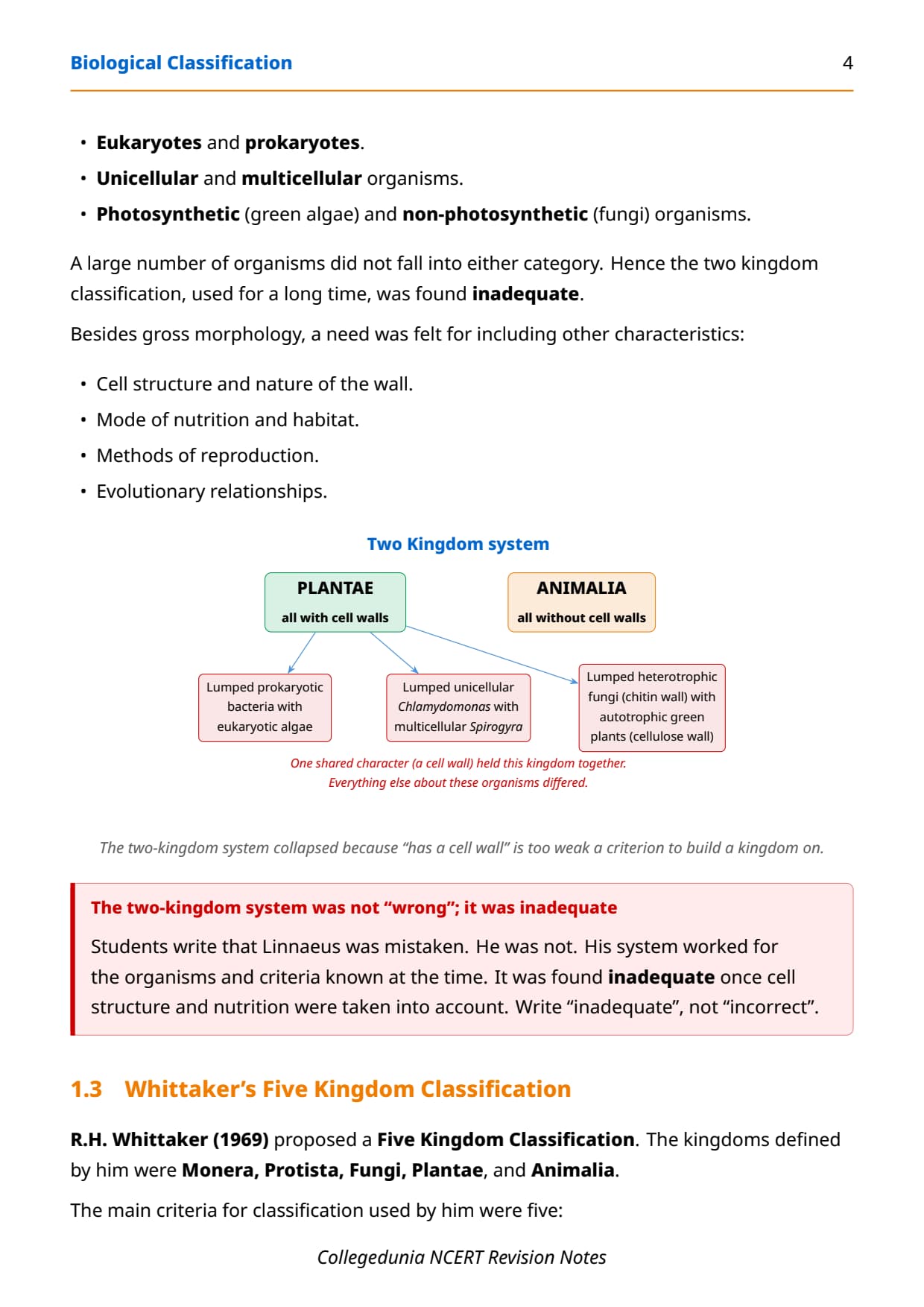
- Eukaryotes and prokaryotes: it lumped prokaryotic bacteria with eukaryotic algae under Plants.
- Unicellular and multicellular: it placed single-celled Chlamydomonas beside multicellular Spirogyra.
- Photosynthetic and non-photosynthetic: it kept green algae and non-photosynthetic fungi in the same kingdom.
The only character holding Plants together was that all had a cell wall, which is far too weak a basis for a kingdom. So R.H. Whittaker (1969) proposed a Five Kingdom Classification of Monera, Protista, Fungi, Plantae and Animalia, using five criteria together, that is, cell structure, body organisation, mode of nutrition, reproduction, and phylogenetic relationships. Write that the two-kingdom system was inadequate, not incorrect, because it worked for the organisms and criteria known at the time. A three-domain system later split Monera into two domains, giving a six kingdom scheme, but NCERT leaves that for higher classes. In this chapter you study Monera, Protista and Fungi in detail, while Plantae and Animalia are dealt with in Chapters 3 and 4.
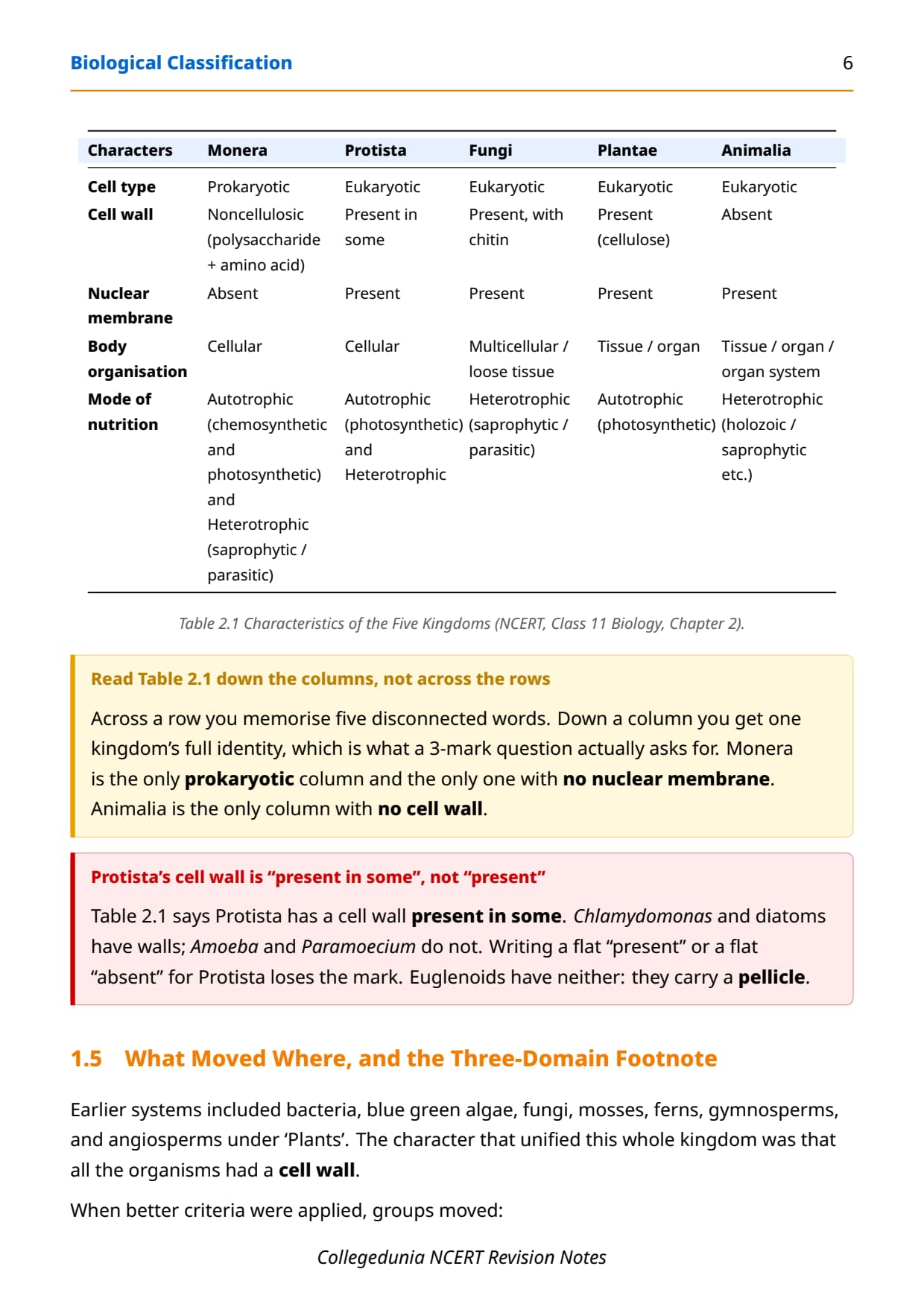
| Character | Monera | Protista | Fungi | Plantae | Animalia |
|---|---|---|---|---|---|
| Cell type | Prokaryotic | Eukaryotic | Eukaryotic | Eukaryotic | Eukaryotic |
| Cell wall | Noncellulosic | Present in some | Present, with chitin | Present, cellulose | Absent |
| Nuclear membrane | Absent | Present | Present | Present | Present |
| Body organisation | Cellular | Cellular | Multicellular / loose tissue | Tissue / organ | Tissue / organ / organ system |
| Mode of nutrition | Autotrophic and heterotrophic | Autotrophic and heterotrophic | Heterotrophic | Autotrophic | Heterotrophic (holozoic) |
This is Table 2.1, the single most examined item in the chapter. Read it down the columns, not across the rows, because one column gives a whole kingdom's identity. Monera is the only prokaryotic column and the only one with no nuclear membrane, while Animalia is the only column with no cell wall. Protista's wall is present in some, since Chlamydomonas and diatoms have walls but Amoeba does not.
Kingdom Monera: The Bacteria
Bacteria are the sole members of Kingdom Monera and the only prokaryotes in the five kingdom system. They are the most abundant micro-organisms on earth, with hundreds present in a handful of soil, and they live even in extreme habitats such as hot springs, deserts, snow and deep oceans. Though their structure is simple, bacteria as a group show the most extensive metabolic diversity of any organisms, and everything here rests on one fact, that is, no nuclear membrane.
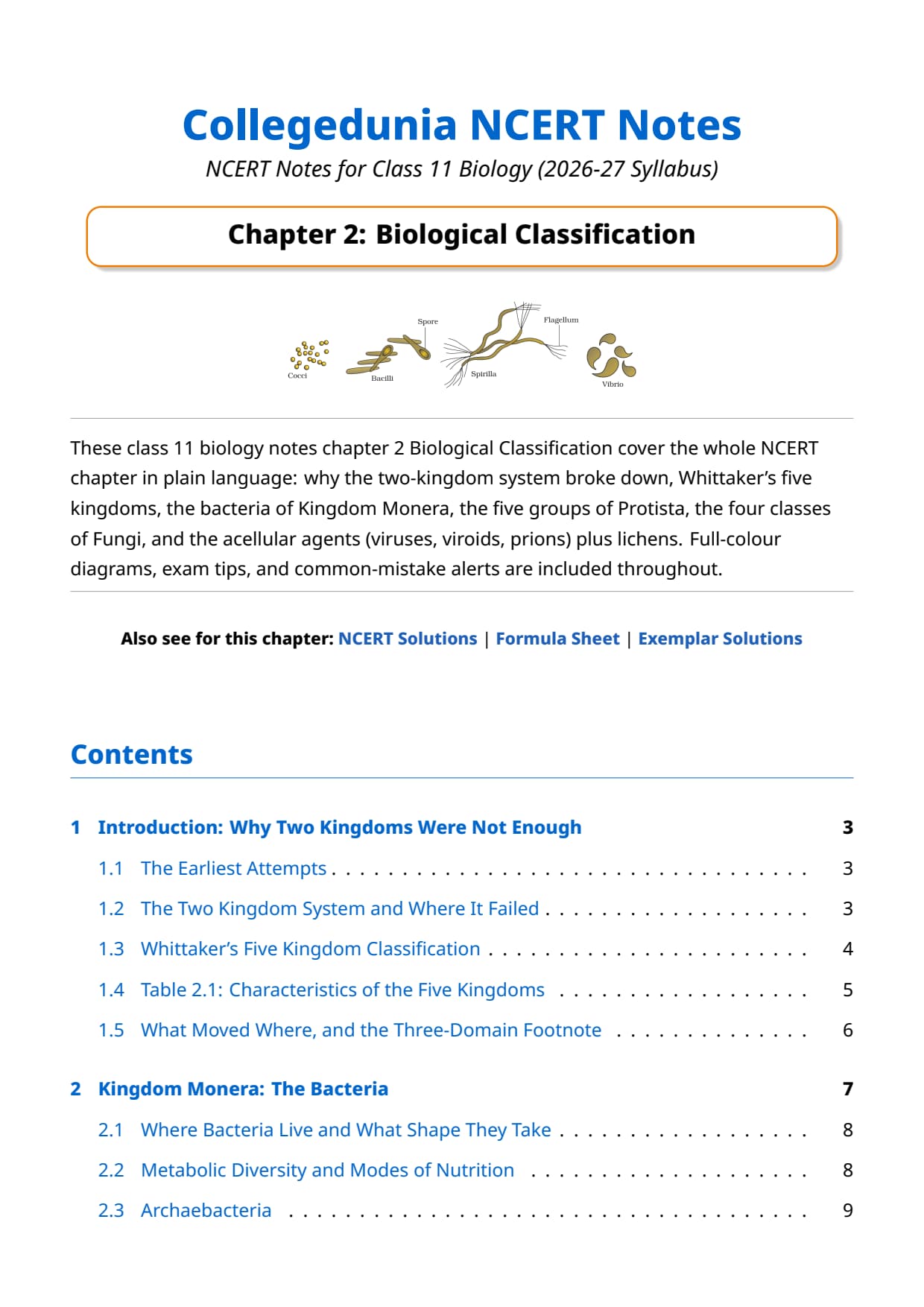
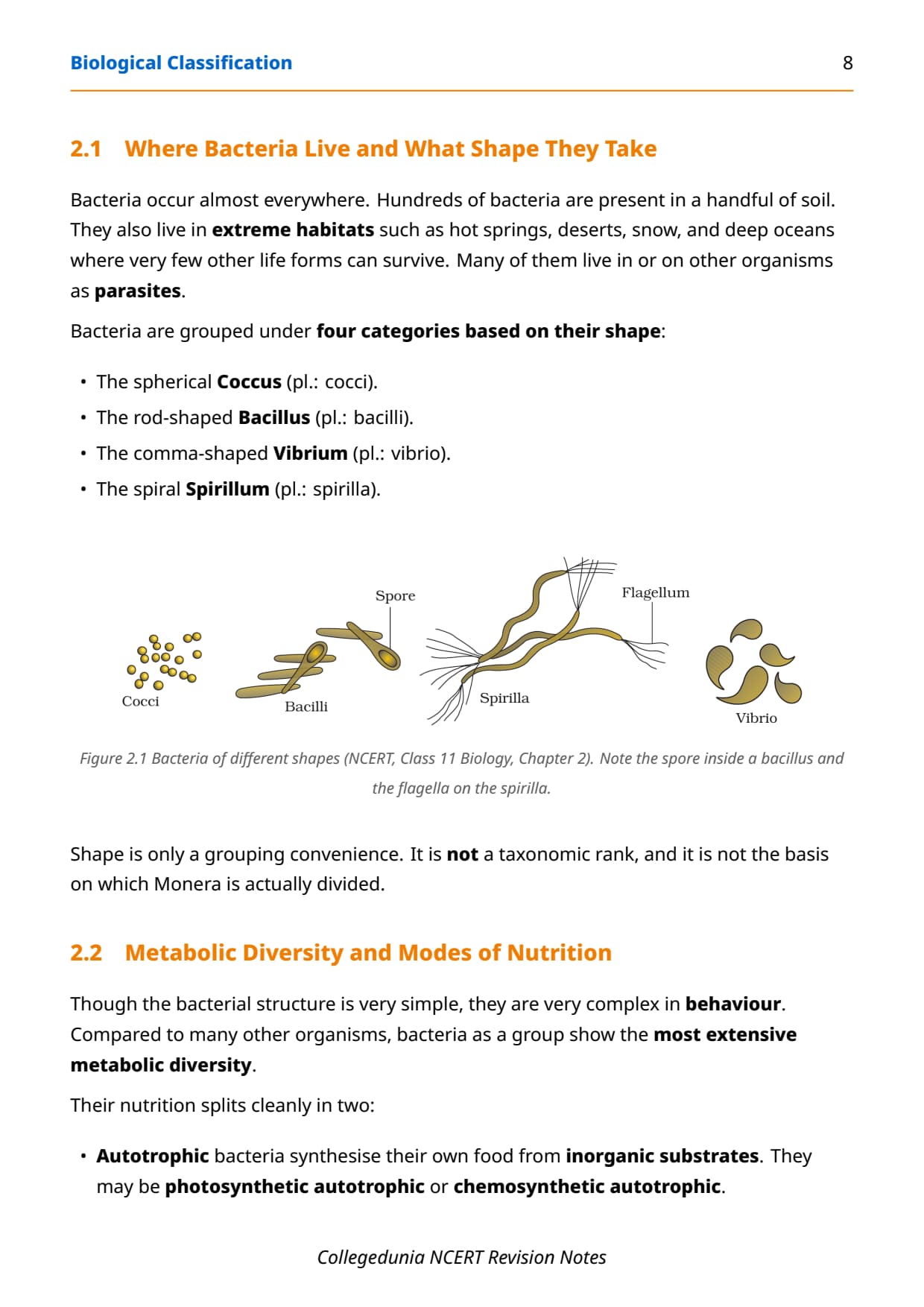
- Four shapes: the spherical Coccus, the rod-shaped Bacillus, the comma-shaped Vibrium, and the spiral Spirillum. Shape is a grouping convenience, not a taxonomic rank.
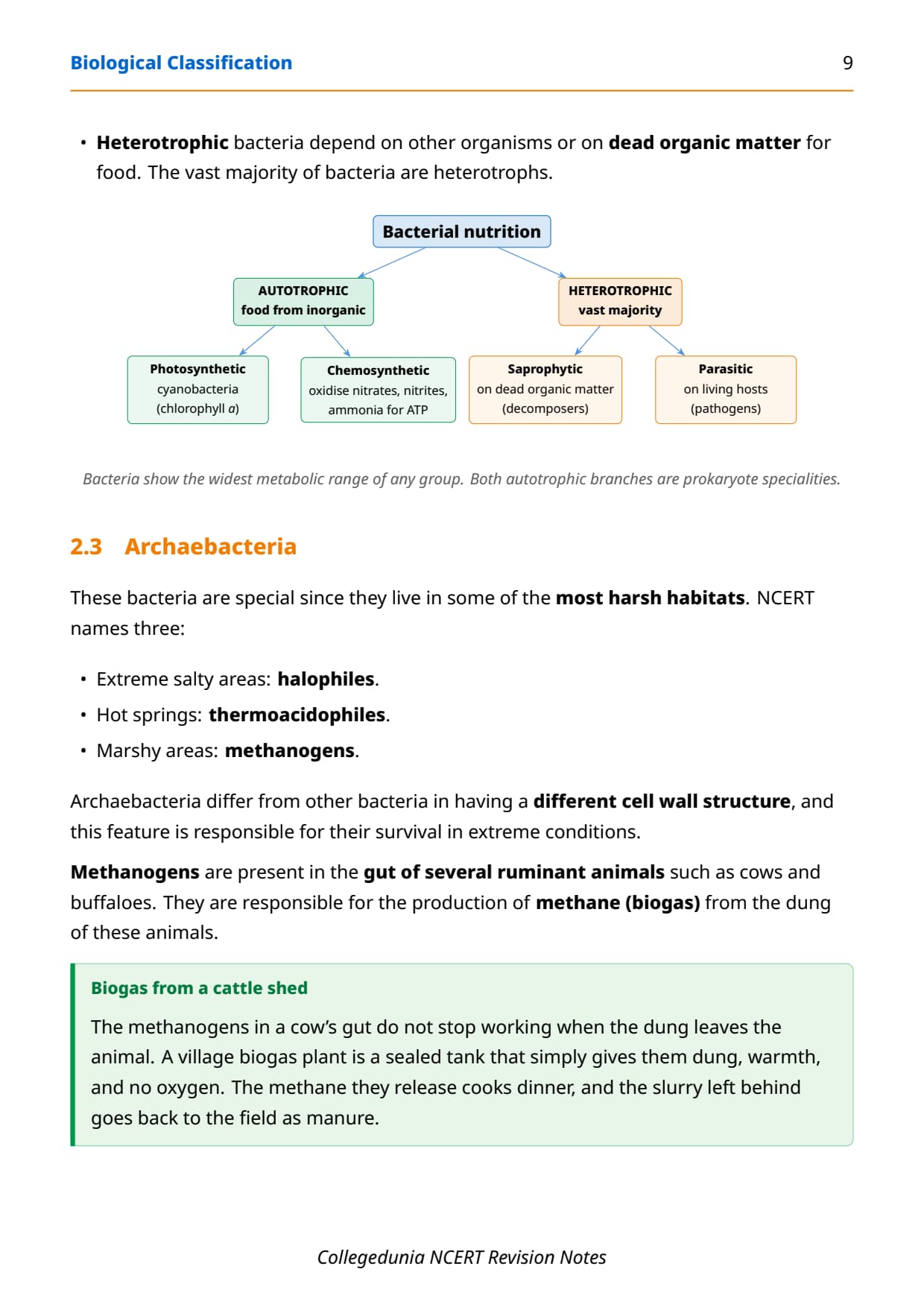
- Autotrophic bacteria: synthesise food from inorganic substrates, either photosynthetic or chemosynthetic.
- Heterotrophic bacteria: the vast majority, feeding on dead organic matter or living hosts, and the most important decomposers in nature.
- Archaebacteria: live in the harshest habitats, that is, halophiles in salt, thermoacidophiles in hot springs, and methanogens in marshy areas and the gut of ruminants.
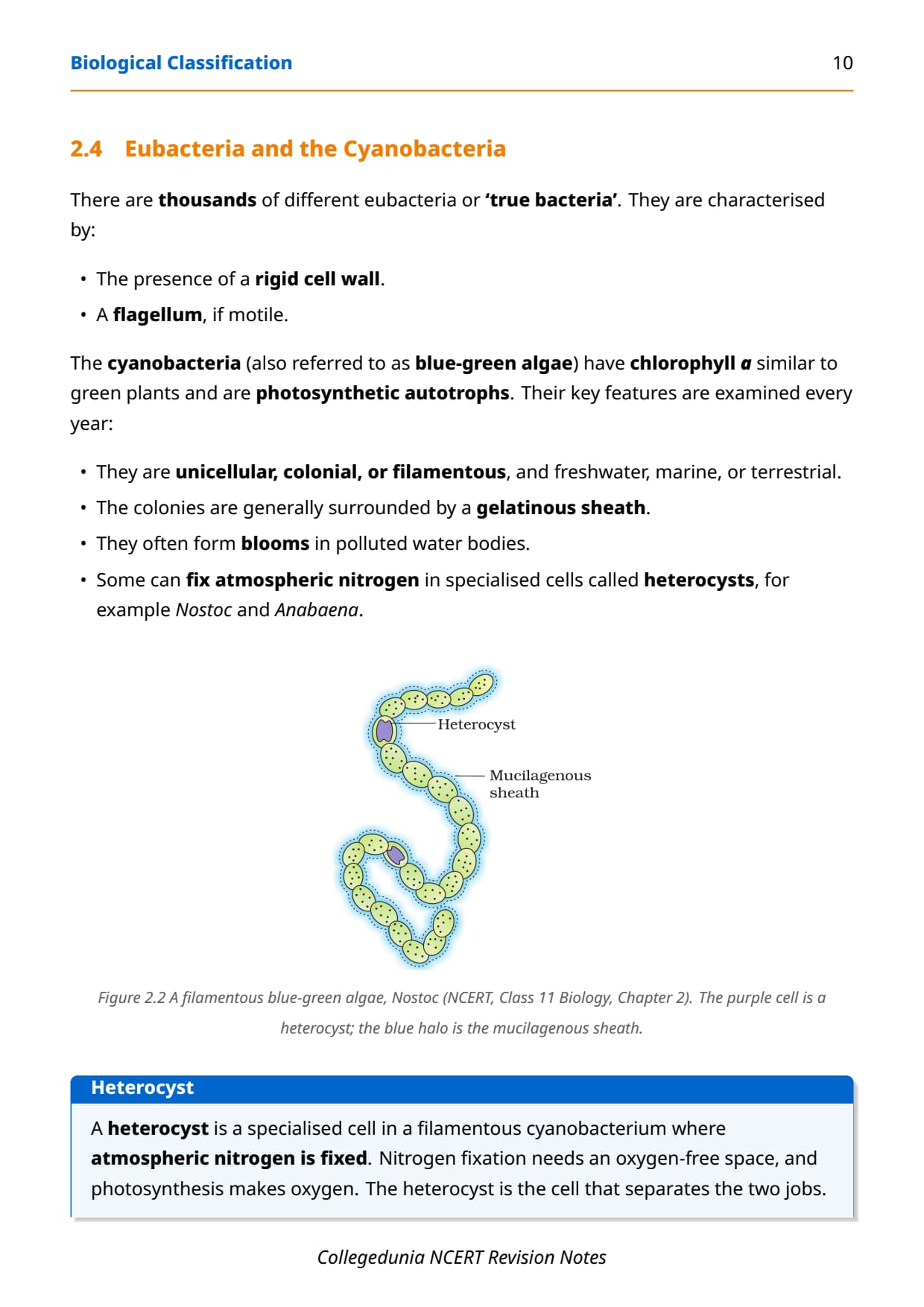
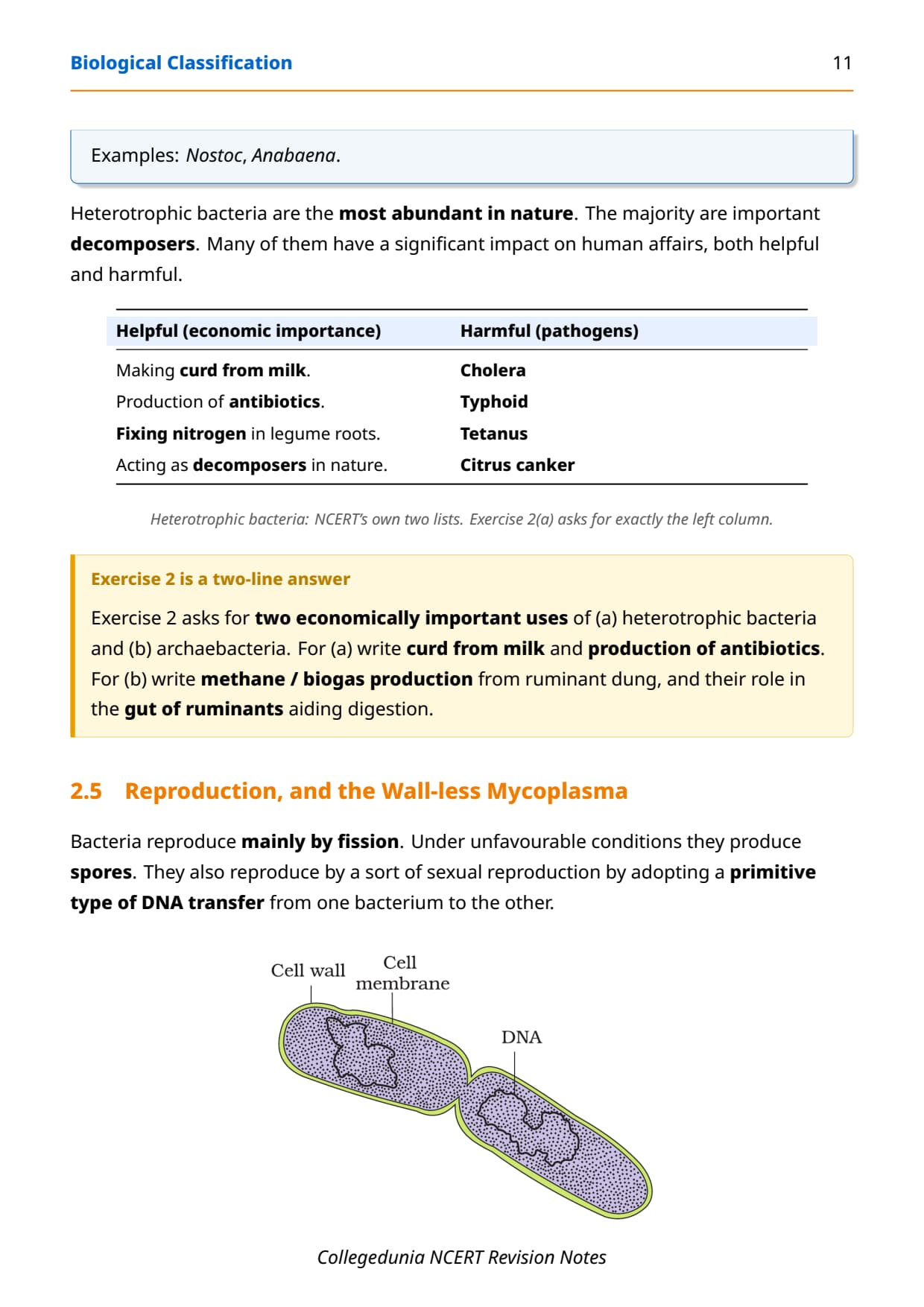
Cyanobacteria, also called blue-green algae, have chlorophyll a and are photosynthetic autotrophs. They may be unicellular, colonial or filamentous, often form blooms in polluted water, and some fix atmospheric nitrogen in specialised cells called heterocysts, for example Nostoc and Anabaena. The methanogens in a cow's gut produce methane, which is why a village biogas plant is simply a sealed tank of dung, warmth and no oxygen. Bacteria reproduce mainly by fission, form spores under unfavourable conditions, and can transfer DNA in a primitive sexual manner. The Mycoplasma are the odd ones out, completely lacking a cell wall, and are the smallest living cells known.
Kingdom Protista: The Single-Celled Eukaryotes
All single-celled eukaryotes are placed under Protista, though NCERT is honest that the boundaries are not well defined. What is a photosynthetic protistan to one biologist may be a plant to another. Members are primarily aquatic, have a well defined nucleus and membrane-bound organelles, and the kingdom forms a link with the plants, animals and fungi. NCERT includes five groups, and this section is where criteria clearly do the work, since Protista brought together organisms once split across the plant and animal kingdoms.
- Chrysophytes: diatoms and golden algae, microscopic plankton with silica-embedded walls that fit like a soap box and leave behind gritty diatomaceous earth. Diatoms are the chief producers in the oceans.
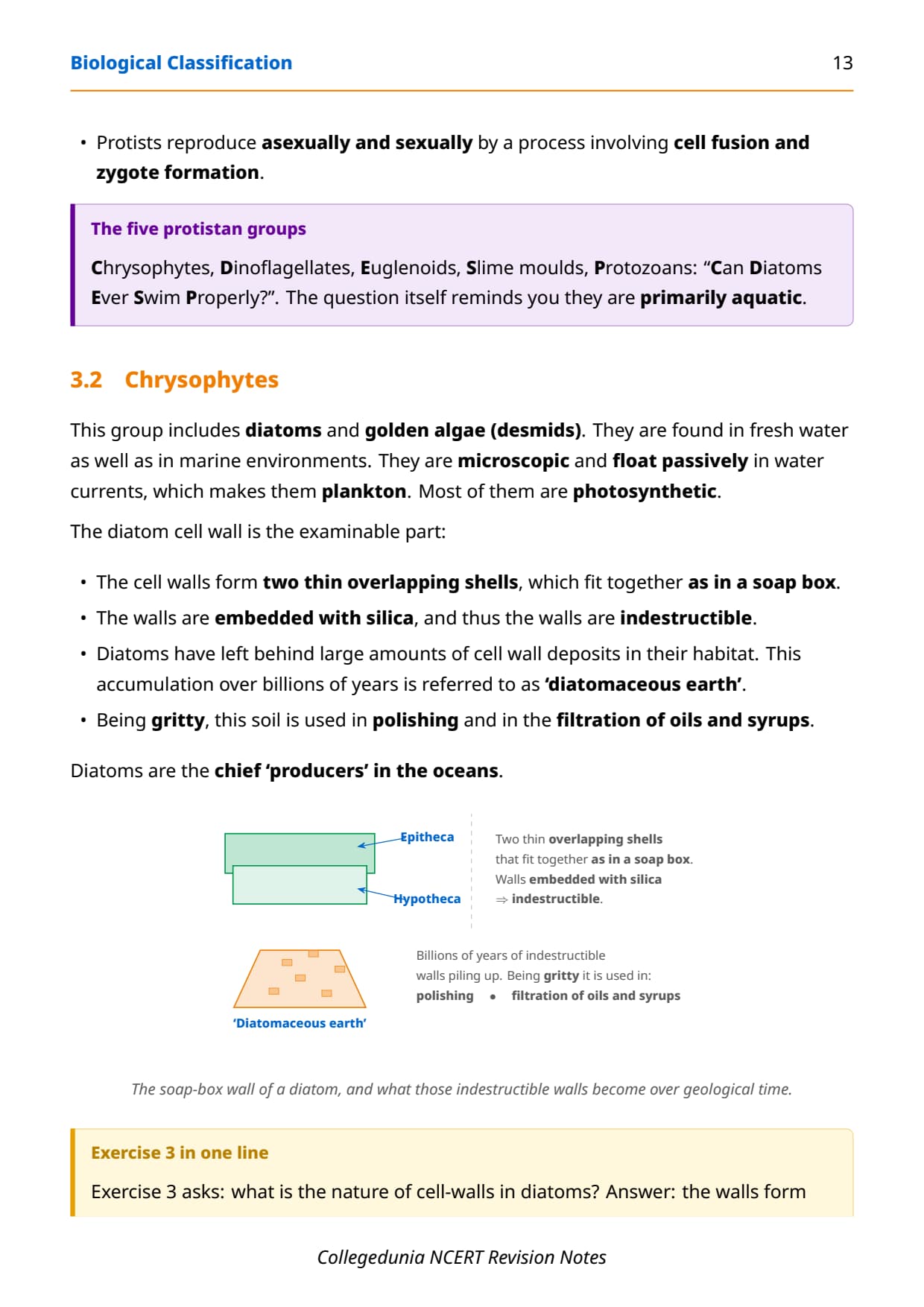
- Dinoflagellates: mostly marine and photosynthetic, with stiff cellulose plates and two flagella. Red forms such as Gonyaulax multiply to cause red tides, releasing toxins that kill fishes.
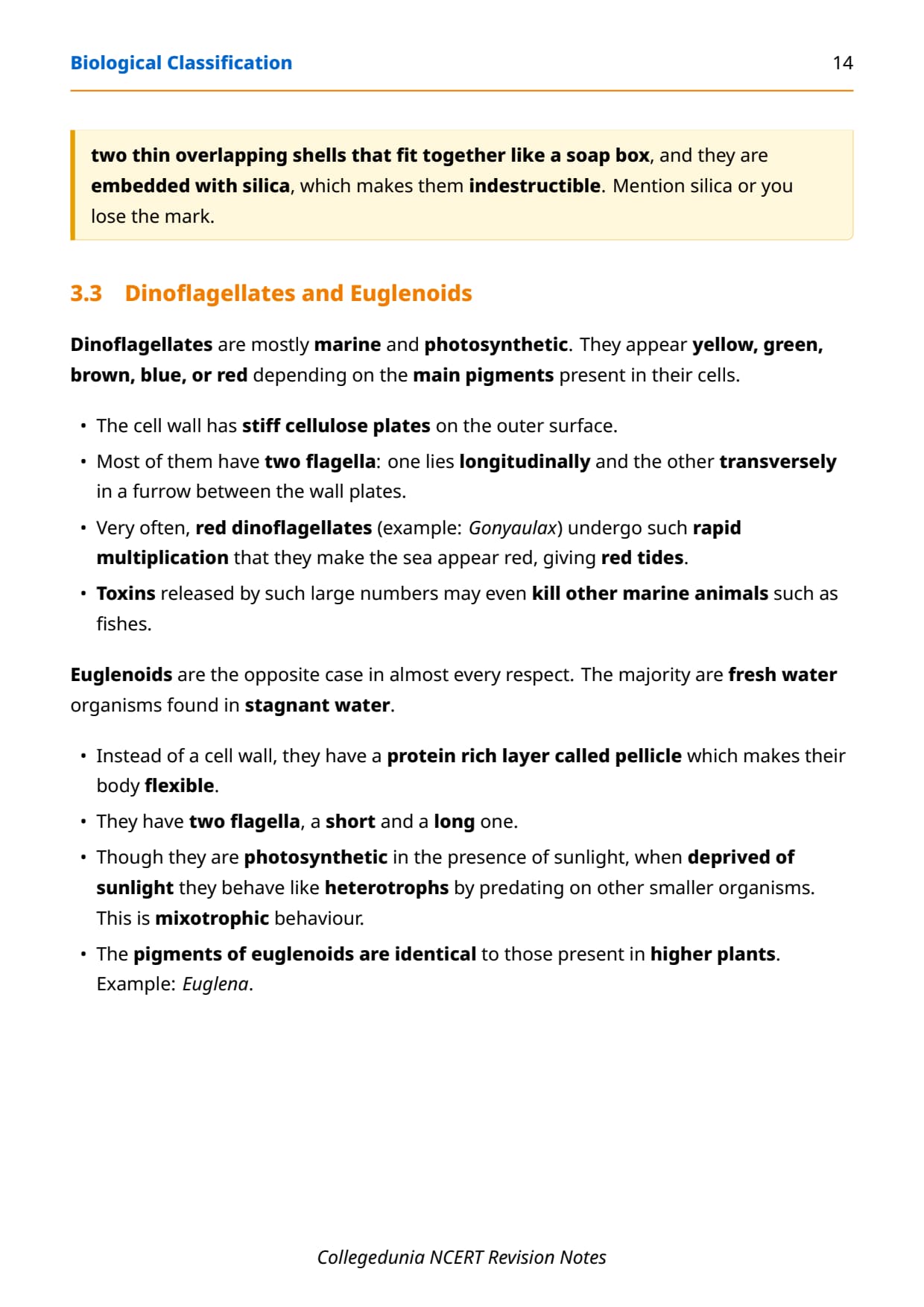
- Euglenoids: fresh water forms with no cell wall but a protein-rich pellicle. They are photosynthetic in sunlight and heterotrophic in the dark, a mixotrophic habit. Example, Euglena.
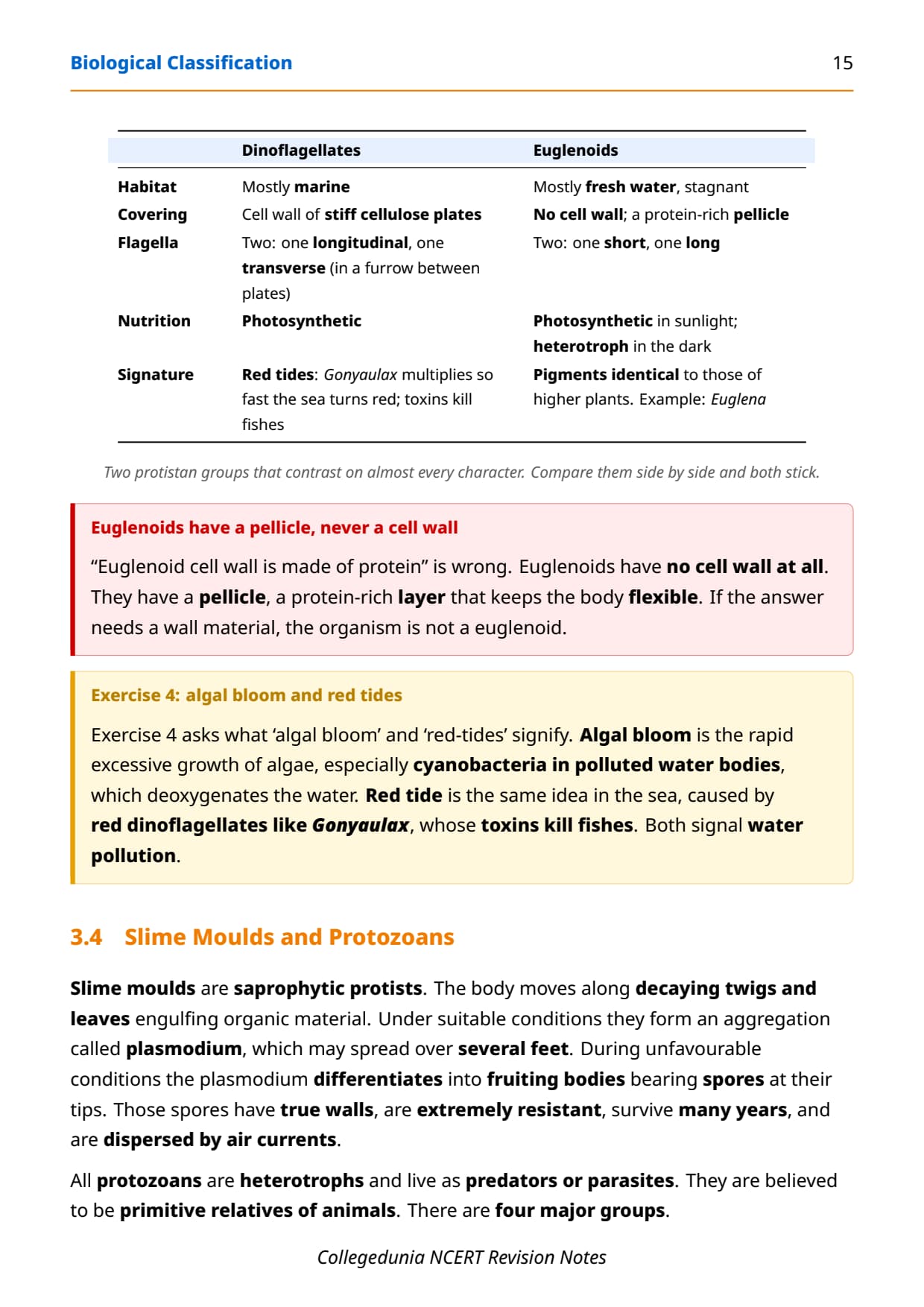
- Slime moulds: saprophytic protists that form a plasmodium and produce resistant spores on fruiting bodies.
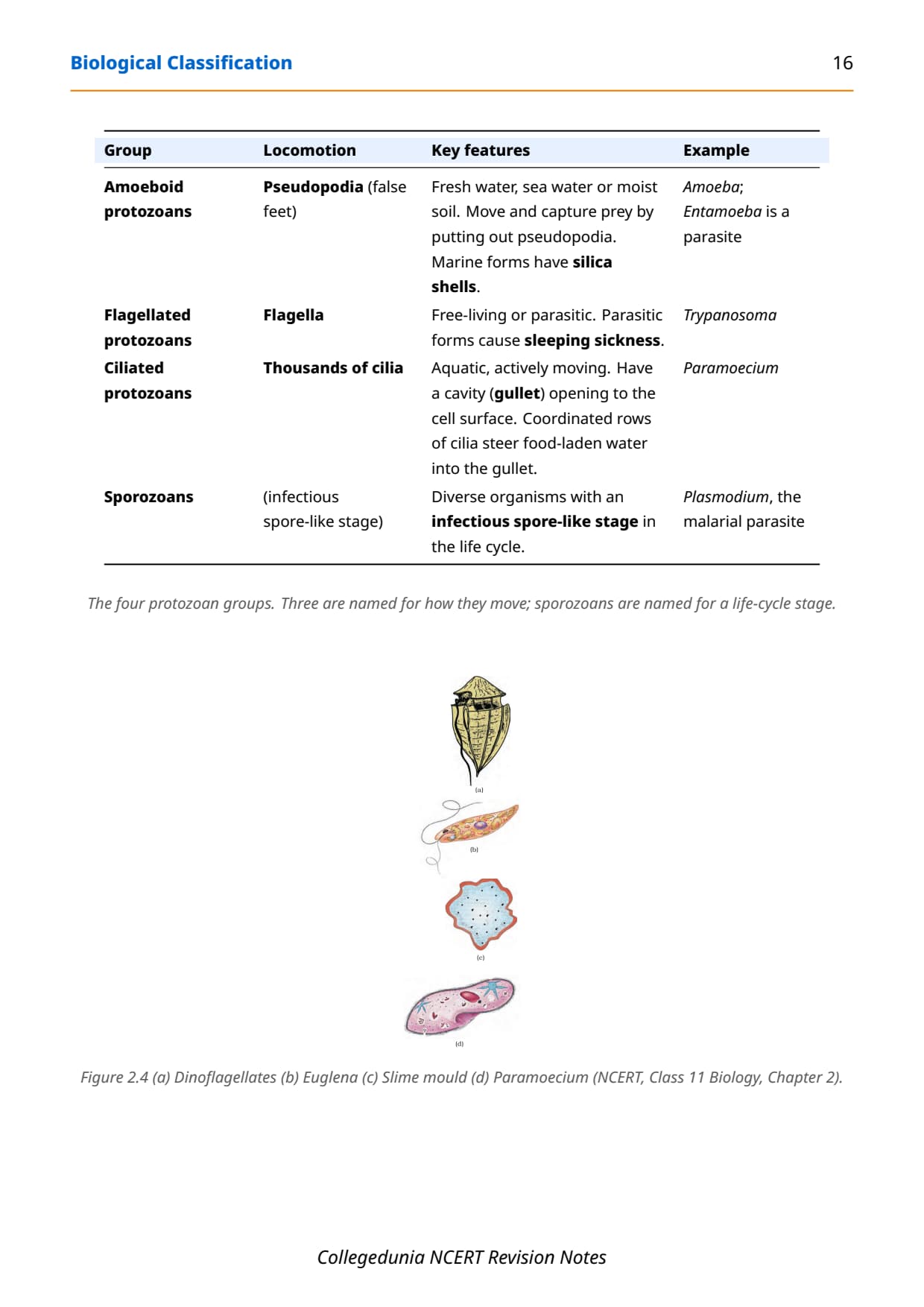
- Protozoans: heterotrophs and primitive relatives of animals, in four groups, that is, amoeboid (Amoeba), flagellated (Trypanosoma), ciliated (Paramoecium) and sporozoans (Plasmodium).
The examinable contrasts are worth fixing in pairs. Dinoflagellates have a cellulose-plate wall while euglenoids have no wall at all, only a pellicle, and dinoflagellates are marine while euglenoids live in stagnant fresh water. An algal bloom is the rapid growth of cyanobacteria in polluted water, and a red tide is the same idea in the sea caused by red dinoflagellates, and both signal water pollution. Among protozoans, three groups are named for how they move, while sporozoans are named for an infectious spore-like stage in the life cycle, as in the malarial parasite Plasmodium.
Kingdom Fungi: The Heterotrophs with Chitin Walls
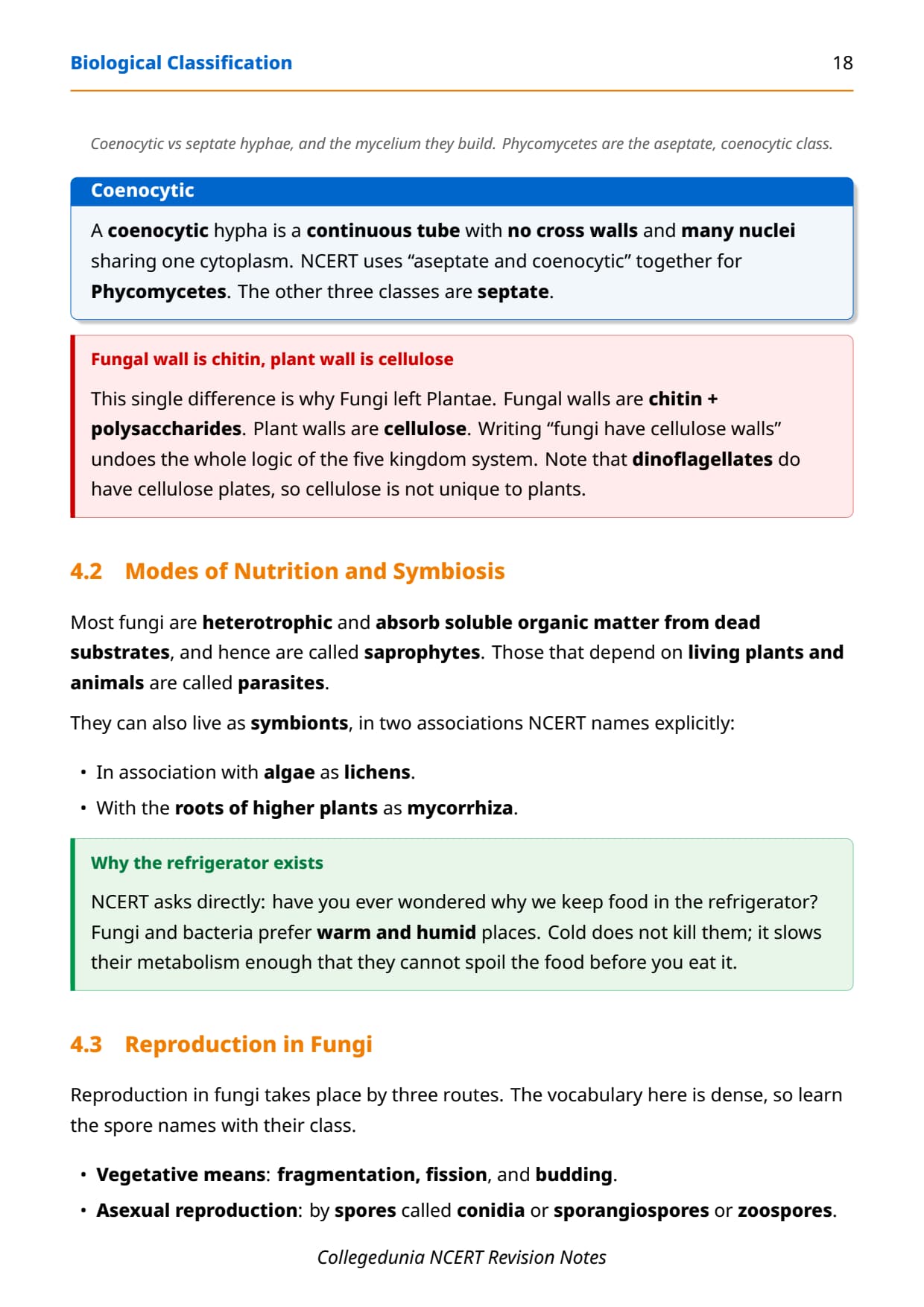
The fungi form a unique kingdom of heterotrophic organisms you have met without naming, that is, the mould on bread, the mushroom on your plate, and the white spots on mustard leaves. They are cosmopolitan and prefer warm, humid places, which is exactly why food is kept in the refrigerator. The one difference that pushed fungi out of Plantae is the wall, that is, fungal walls are chitin and polysaccharides while plant walls are cellulose, and fungi are heterotrophic.
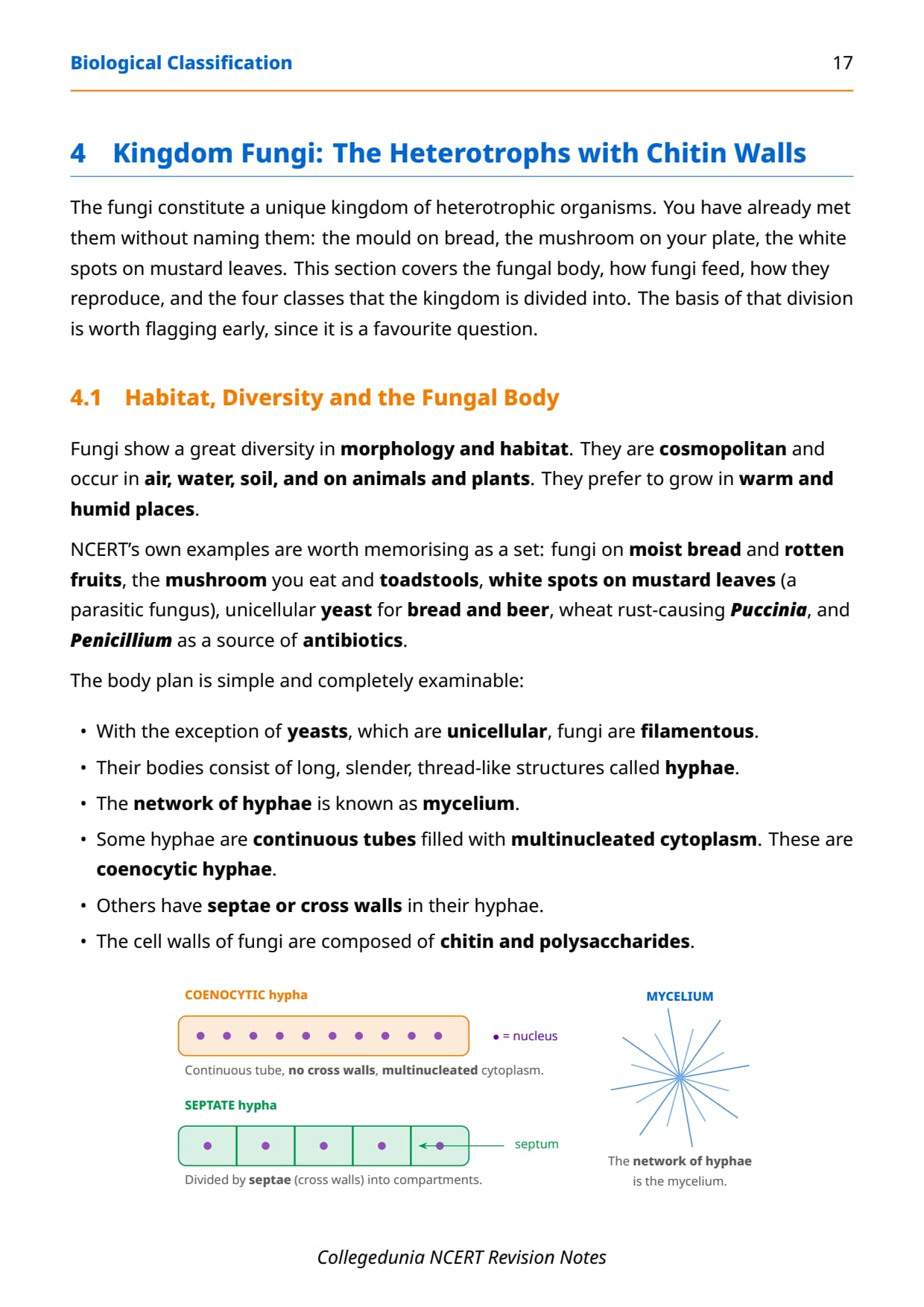
- Fungal body: filamentous, except unicellular yeasts. The thread-like hyphae form a network called mycelium. Hyphae may be coenocytic, that is, continuous multinucleated tubes, or septate with cross walls.
- Nutrition: mostly saprophytes absorbing from dead matter, some parasites on living hosts, and some symbionts as lichens with algae or as mycorrhiza with plant roots.
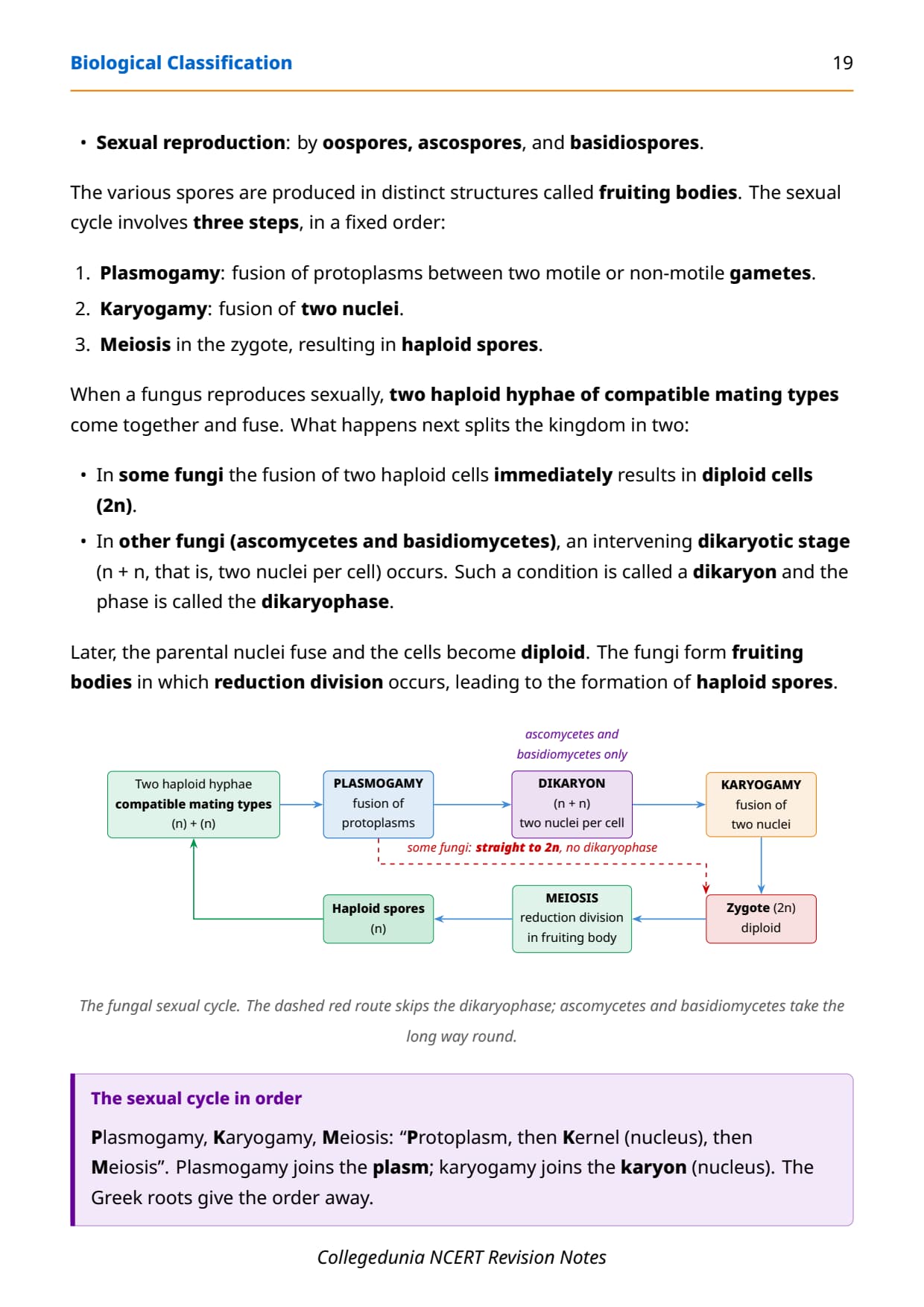
- Sexual cycle: three steps in fixed order, that is, plasmogamy (fusion of protoplasms), karyogamy (fusion of two nuclei), then meiosis giving haploid spores. Ascomycetes and basidiomycetes pass through an intervening dikaryotic stage.
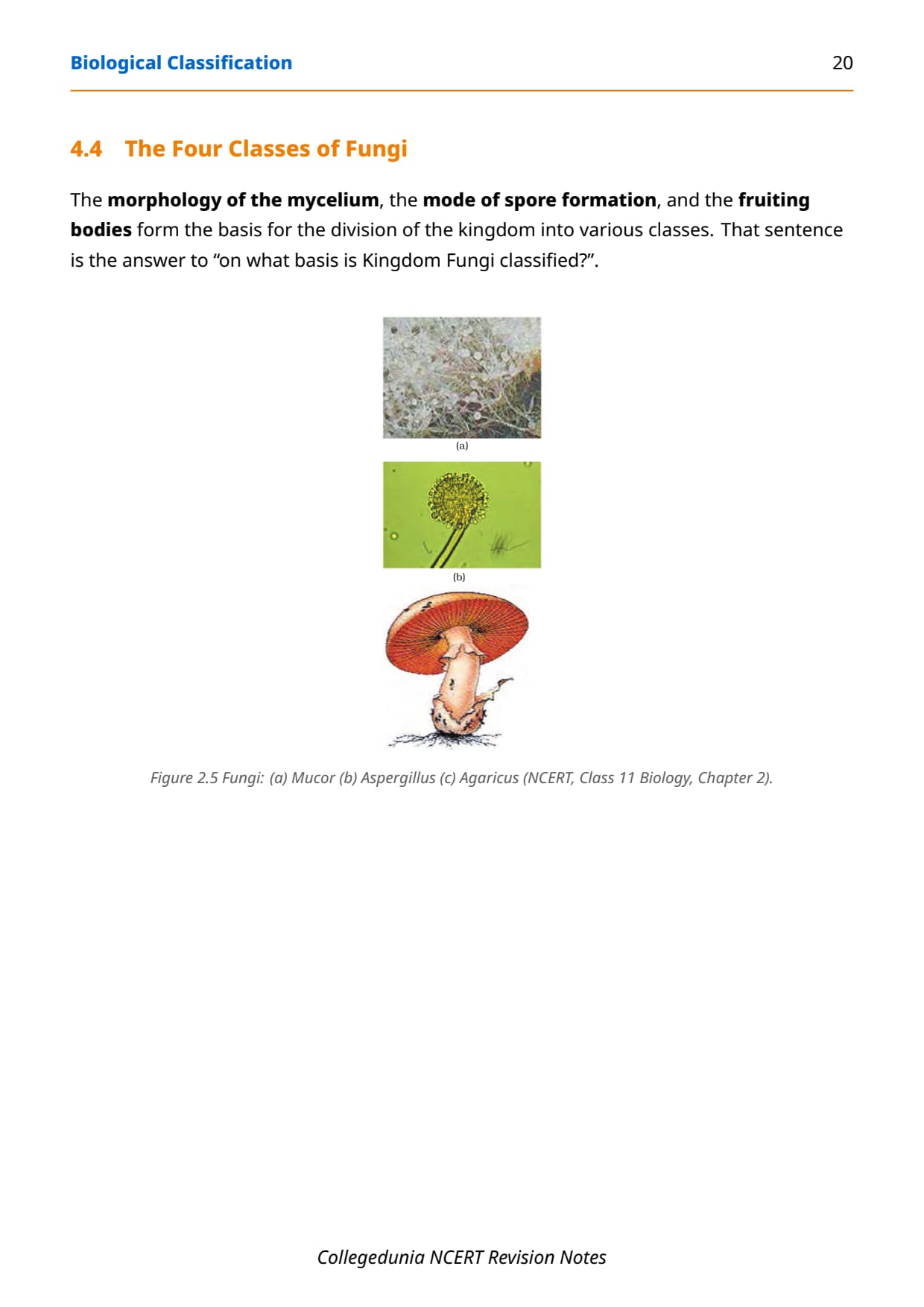
The morphology of the mycelium, the mode of spore formation, and the fruiting bodies form the basis for dividing the kingdom into four classes. The sexual spore names each class. Phycomycetes are aseptate and coenocytic and make a zygospore, examples Mucor, Rhizopus and Albugo. Ascomycetes are septate and make ascospores endogenously in asci, examples Aspergillus, Penicillium and Neurospora. Basidiomycetes make basidiospores exogenously on a basidium, examples Agaricus, Ustilago and Puccinia. Deuteromycetes are a holding class of imperfect fungi with no known sexual stage, and members move out once their perfect stage is discovered.
Viruses, Viroids, Prions and Lichens
Whittaker's five kingdoms have no place for lichens or for the acellular agents, that is, viruses, viroids and prions. NCERT introduces them briefly at the end of the chapter, outside the kingdom system entirely, yet they are examined out of all proportion to the space they get. Viruses did not find a place in classification because they are not considered truly living, since they are non-cellular and show an inert crystalline structure outside the host cell. Once inside, they take over the host machinery to replicate.
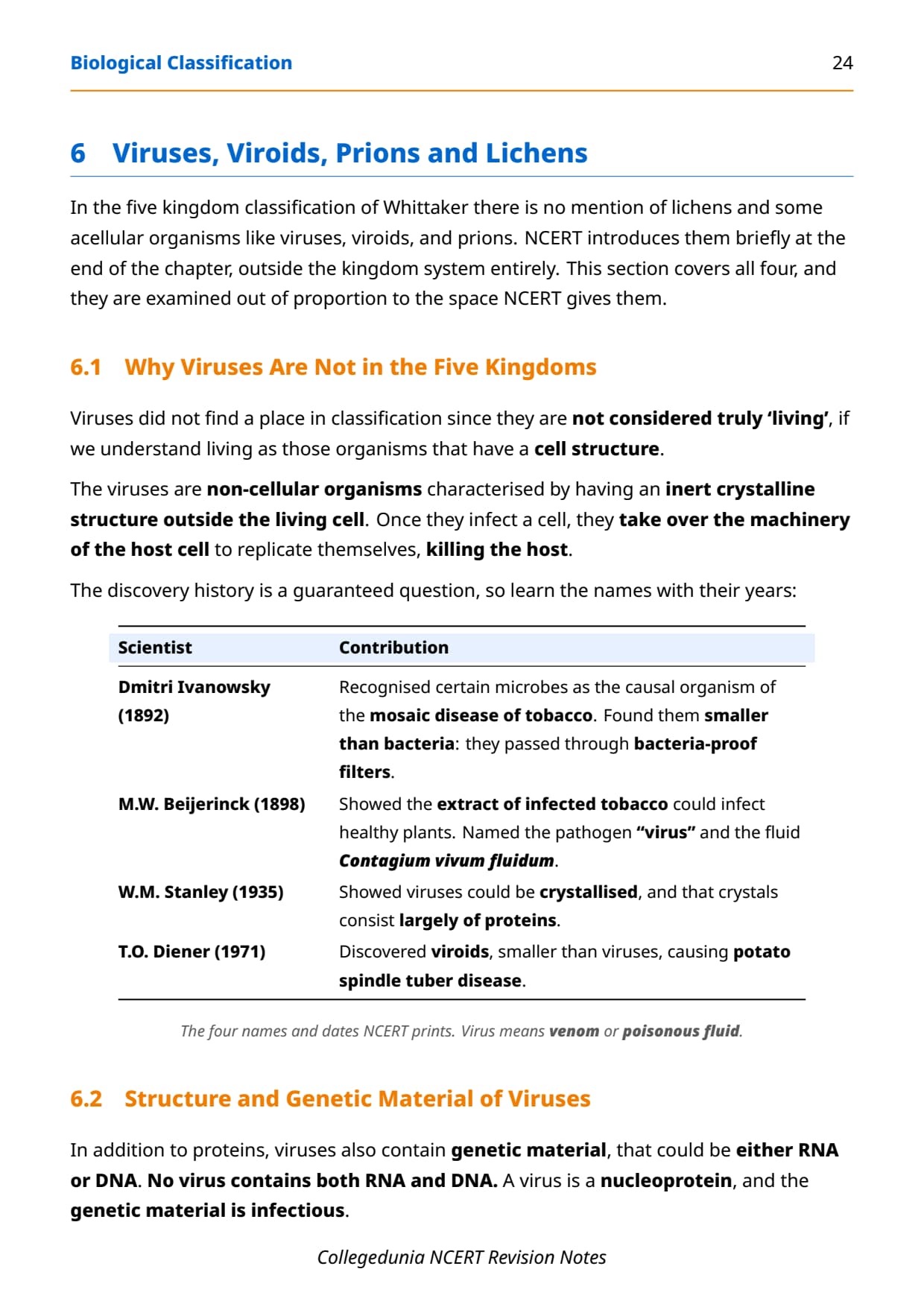
- Discovery: Ivanowsky found the tobacco mosaic pathogen was smaller than bacteria, Beijerinck named it a virus, Stanley showed viruses could be crystallised, and Diener discovered viroids in 1971.
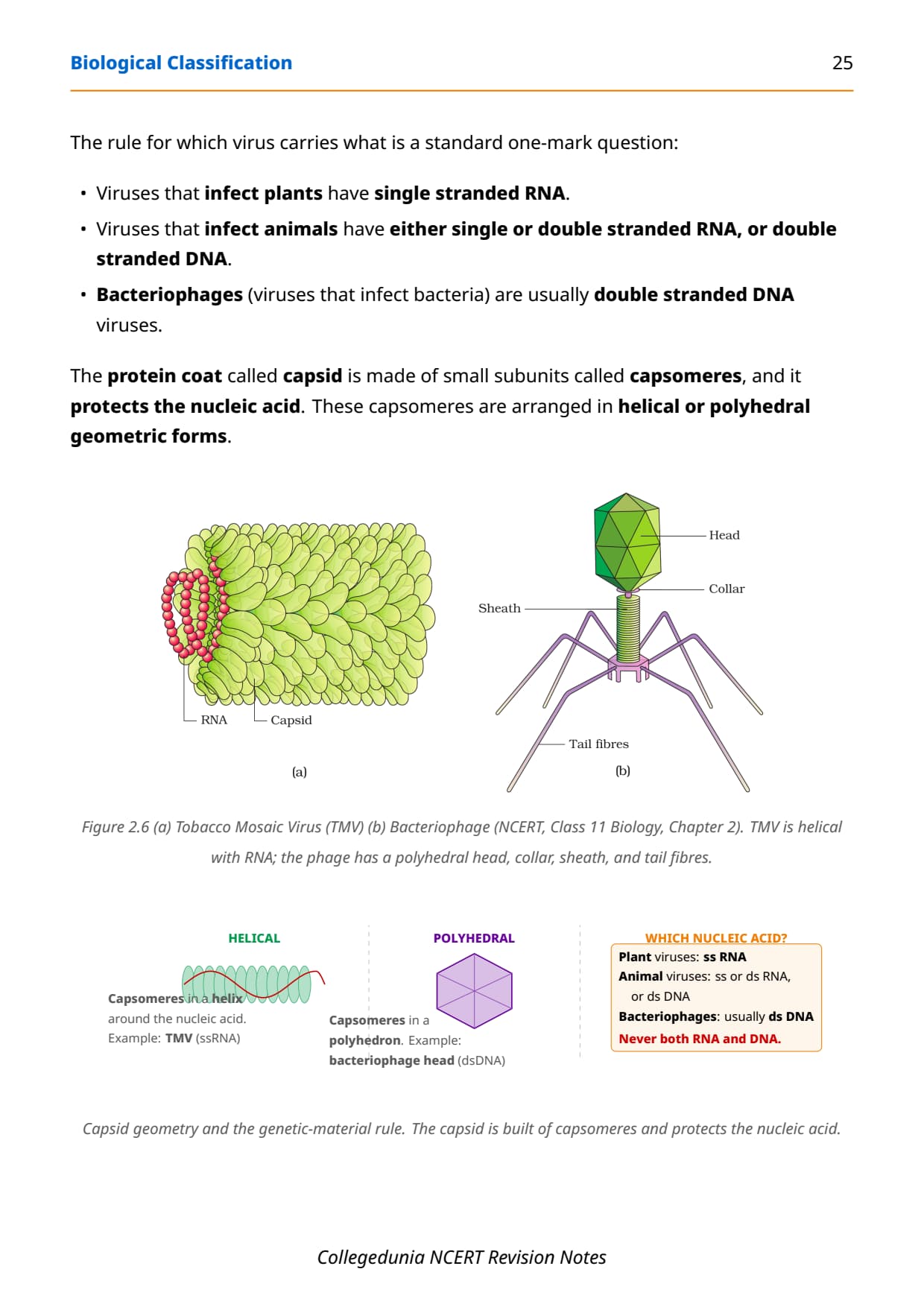
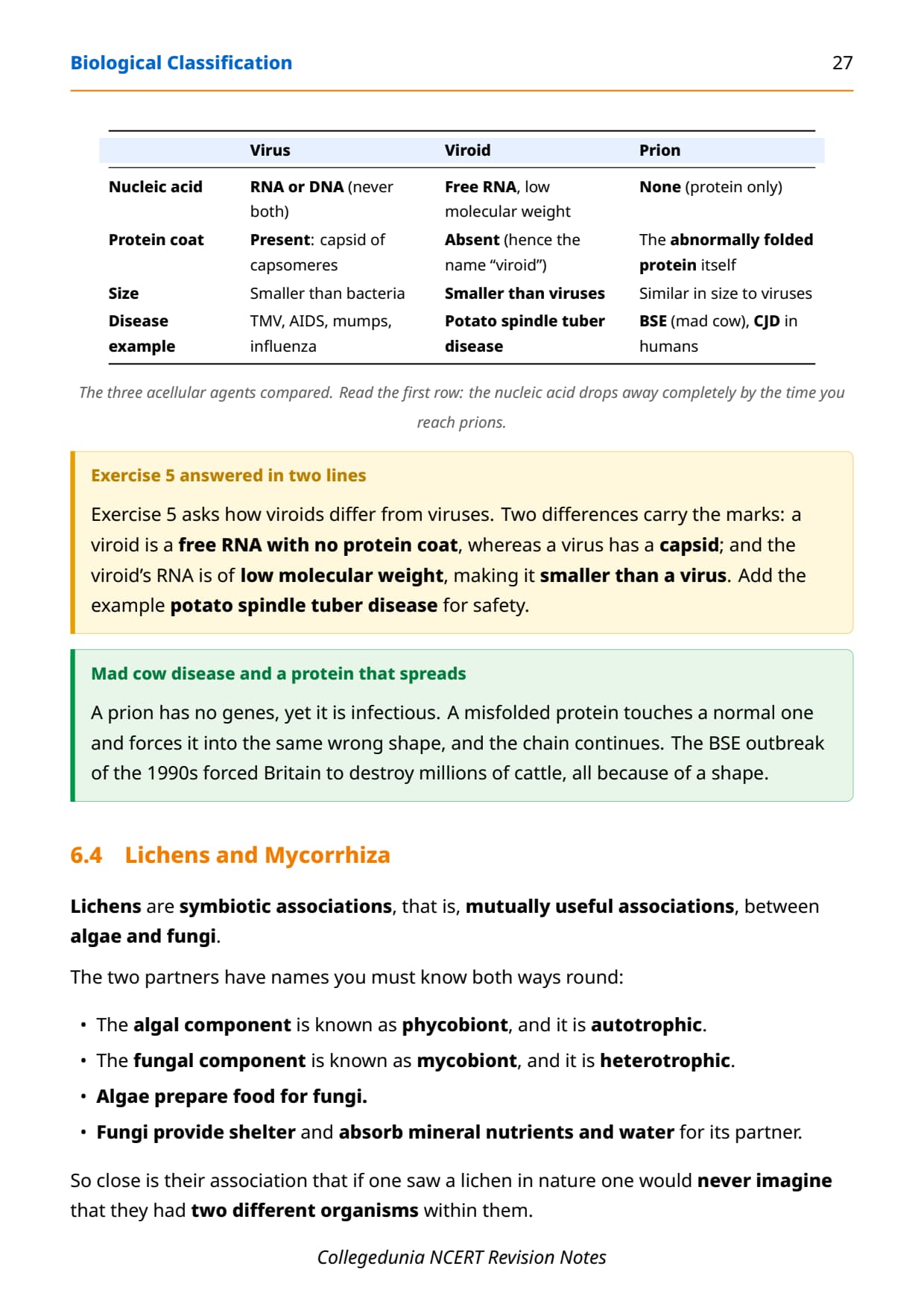
- Genetic material: a virus is a nucleoprotein carrying either RNA or DNA, never both. Plant viruses have single stranded RNA, animal viruses have RNA or double stranded DNA, and bacteriophages are usually double stranded DNA. The protein coat is the capsid, built of capsomeres.
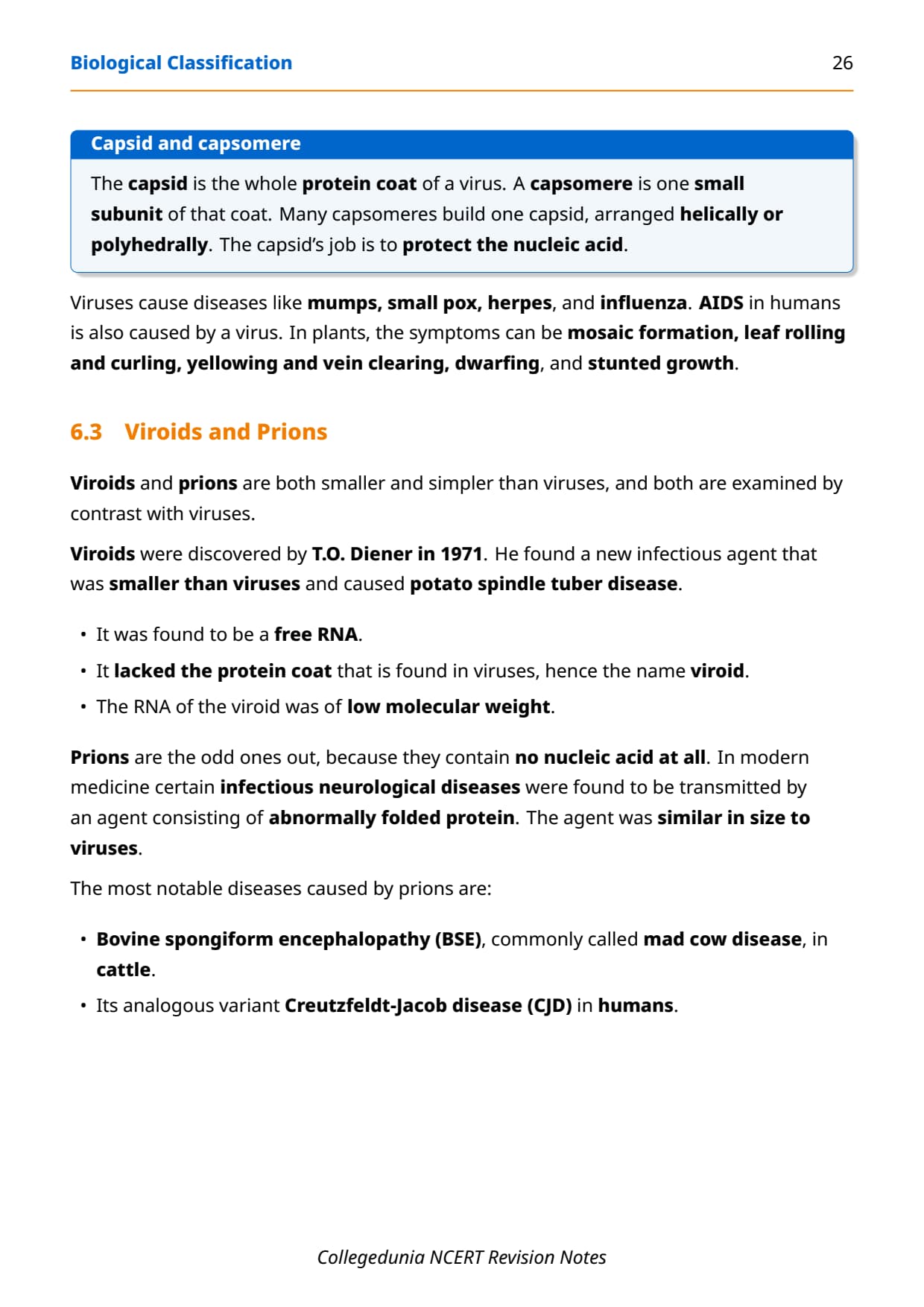
- Viroids: free RNA of low molecular weight with no protein coat, smaller than viruses, causing potato spindle tuber disease.
- Prions: abnormally folded proteins with no nucleic acid, causing mad cow disease (BSE) in cattle and CJD in humans.
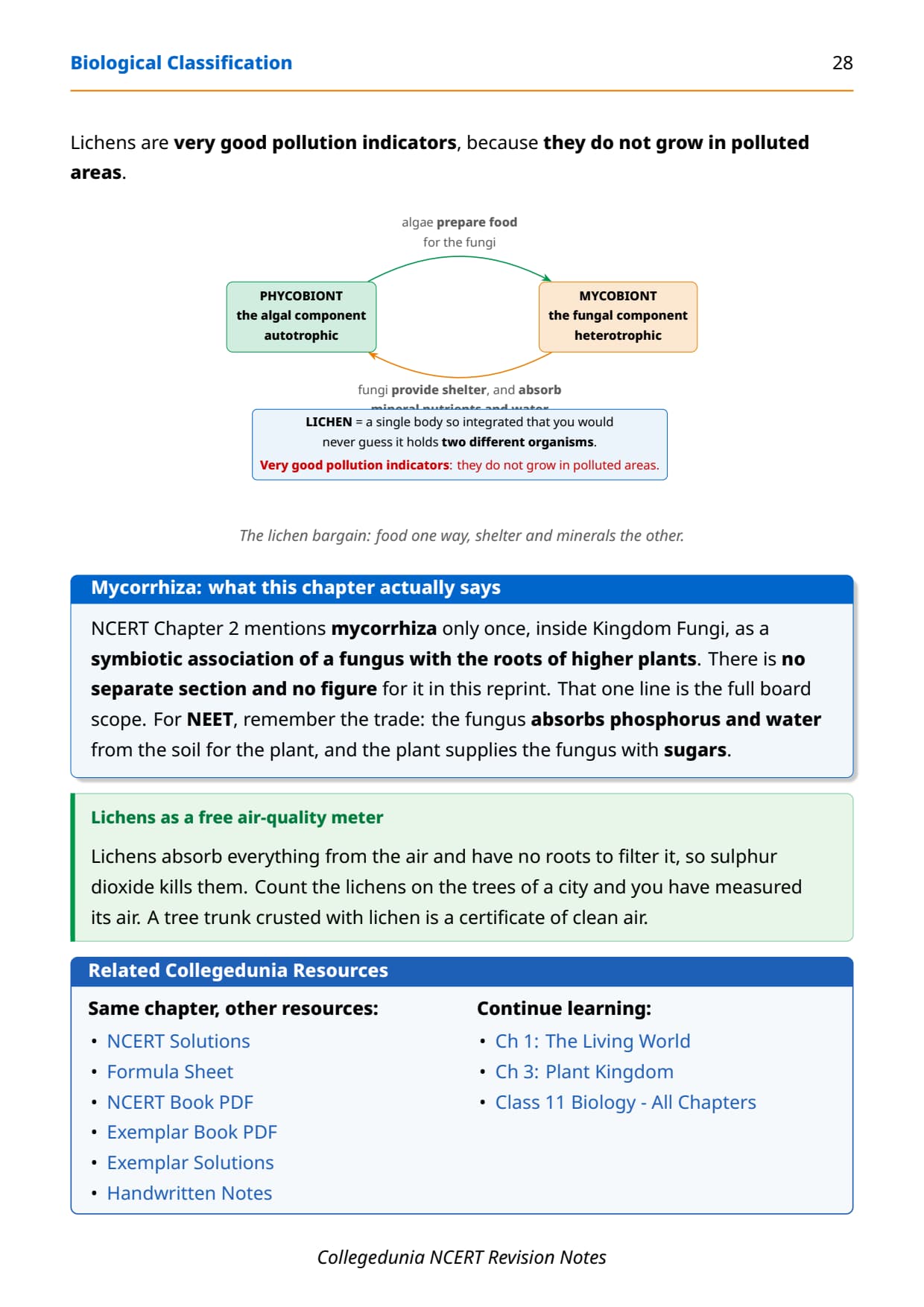
Lichens are symbiotic, mutually useful associations between algae and fungi. The algal component is the phycobiont, which is autotrophic and prepares food, while the fungal component is the mycobiont, which is heterotrophic and provides shelter and absorbs minerals and water. Lichens are very good pollution indicators, because they do not grow in polluted areas. Mycorrhiza is mentioned only once in this chapter, as a symbiotic association of a fungus with the roots of higher plants, and that one line is the full board scope.
Key Definitions in Biological Classification
Board short-answer questions often ask for a clean definition in one or two lines, and a vague answer loses easy marks. Learn these word-for-word, because the wording of the exam question is usually built straight from the NCERT definition. Each term below also connects to an example you can be asked to name.
| Term | Definition |
|---|---|
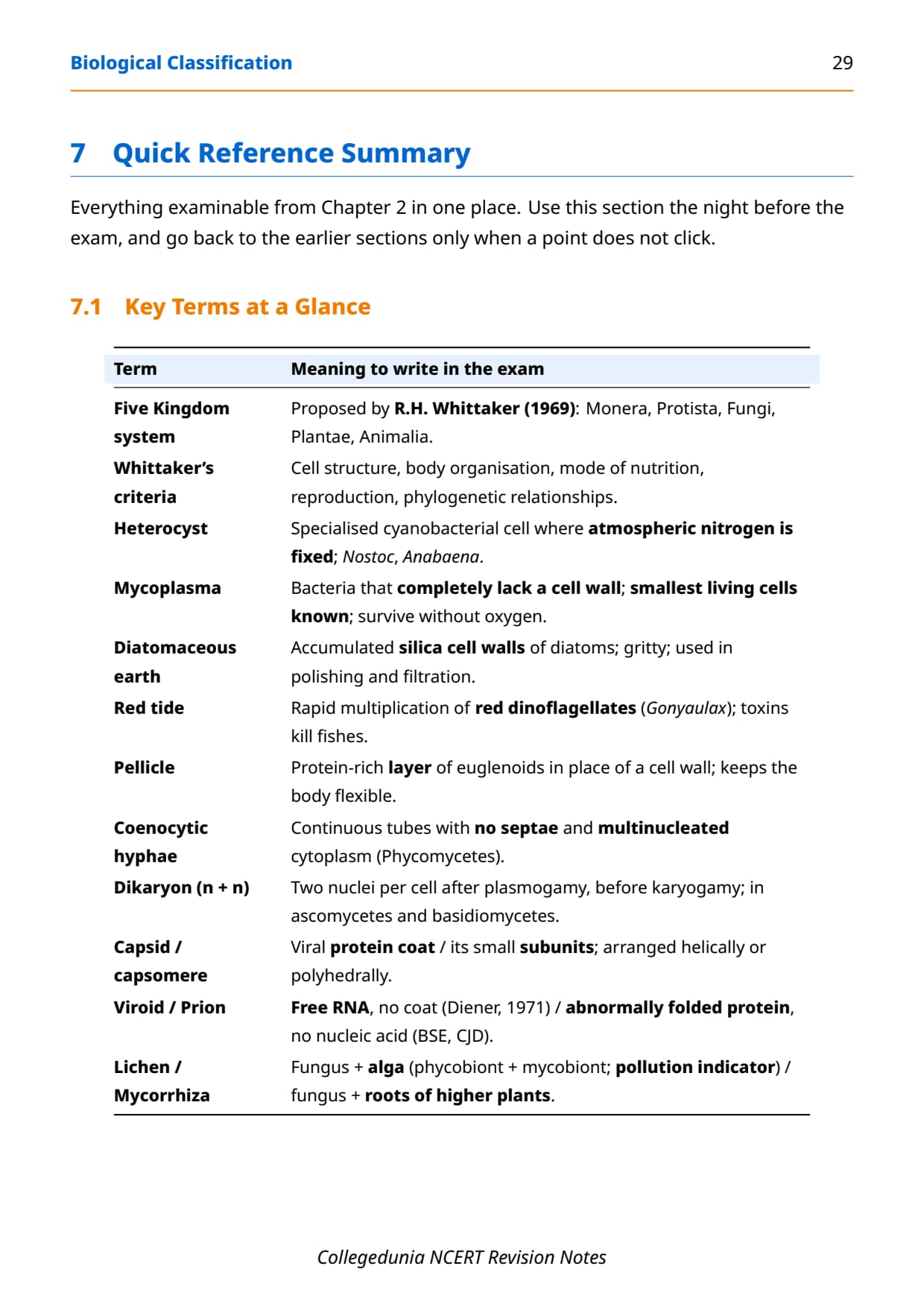
| Five kingdom system | Classification proposed by R.H. Whittaker in 1969 into Monera, Protista, Fungi, Plantae and Animalia. |
| Heterocyst | A specialised cyanobacterial cell where atmospheric nitrogen is fixed; examples Nostoc and Anabaena. |
| Mycoplasma | Bacteria that completely lack a cell wall; the smallest living cells known, able to survive without oxygen. |
| Pellicle | The protein-rich flexible layer of euglenoids in place of a cell wall. |
| Coenocytic hyphae | Continuous fungal tubes with no cross walls and multinucleated cytoplasm, as in Phycomycetes. |
| Capsid | The protein coat of a virus, made of subunits called capsomeres, arranged helically or polyhedrally. |
| Lichen | A symbiotic association of an alga (phycobiont) and a fungus (mycobiont); a good pollution indicator. |
A common board question asks how a viroid differs from a virus. State that a viroid is free RNA of low molecular weight with no protein coat, then add the example of potato spindle tuber disease to earn the full mark. Learning these definitions makes the wording of almost every one-mark and two-mark question in this chapter familiar.
Common Mistakes Students Make in Biological Classification
These slips happen because two terms look alike, not because the concept is hard. Each one costs 1 to 2 marks in the paper, so watch for them at the exact step where they occur.
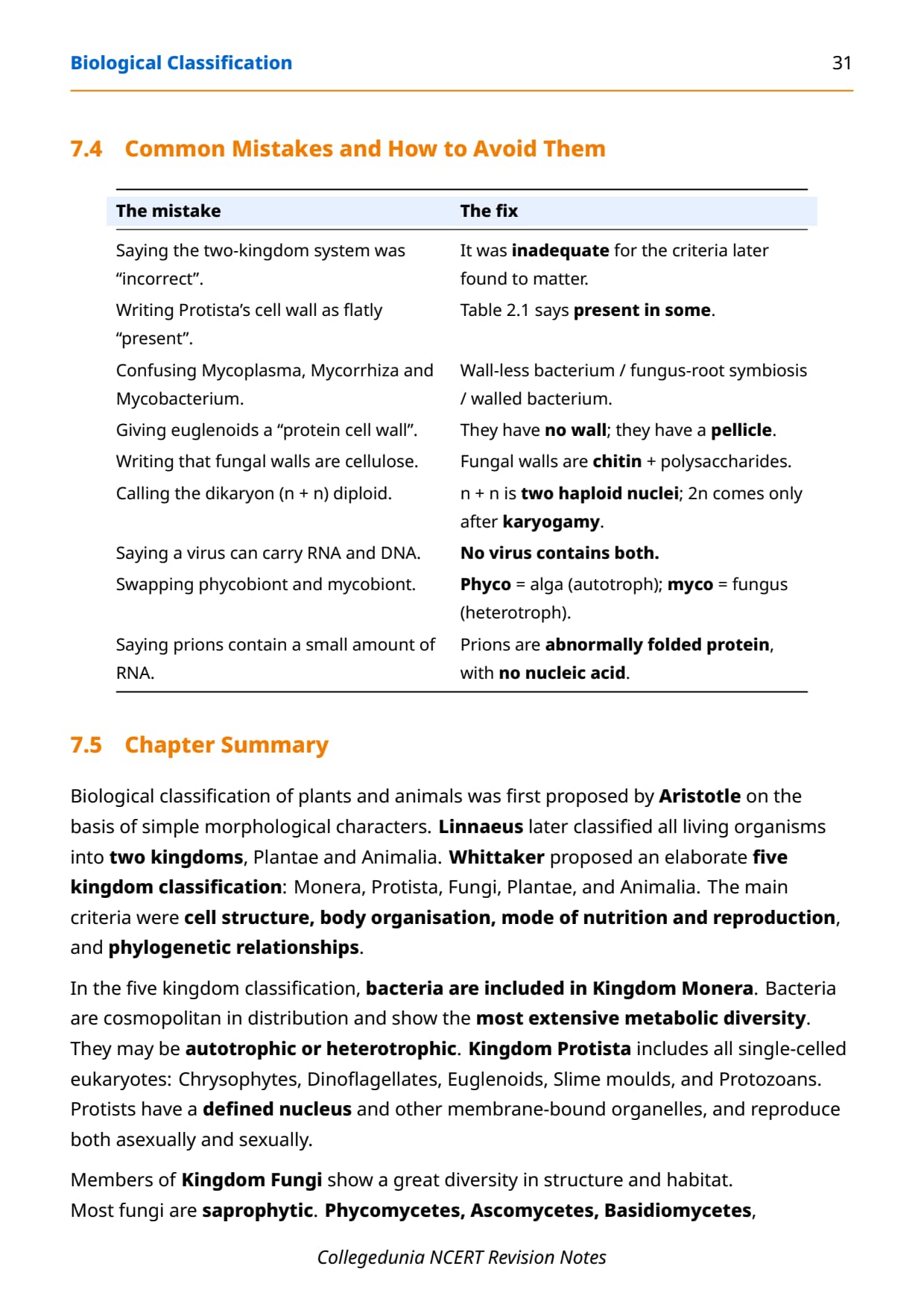
Mistake 1: Calling the two-kingdom system "incorrect". It was inadequate for the criteria later found to matter, not wrong for its time.
Mistake 2: Confusing Mycoplasma, Mycorrhiza and Mycobacterium. These are a wall-less bacterium, a fungus-root symbiosis, and a walled bacterium.
Mistake 3: Giving euglenoids a protein cell wall. They have no wall at all, only a pellicle.
Mistake 4: Writing that fungal walls are cellulose. Fungal walls are chitin and polysaccharides, which is why fungi left Plantae.
Mistake 5: Saying a virus can carry both RNA and DNA, or that prions contain some RNA. No virus contains both, and prions have no nucleic acid at all.
Biological Classification Weightage in CBSE Boards, NEET and CUET
This chapter is factual and scoring. It carries steady marks in the board paper as definitions and short answers, and it is one of the most productive chapters in NEET because the five kingdoms and the acellular agents generate direct one-mark questions. Here is how the marks split across the main exams for 2026-27.
| Exam | Typical weightage | What is asked |
|---|---|---|
| CBSE Boards | 4 to 6 marks | The five kingdoms plus a short answer on Monera, Protista, Fungi, or viruses and lichens |
| NEET | 2 to 3 questions | Five kingdom criteria, cyanobacteria, fungal classes, and the virus, viroid and prion contrast |
| CUET | 2 to 3 objective questions | Definitions, examples of each kingdom, and matching organisms to their group |
The five kingdom comparison and the acellular agents are the two most tested ideas from this chapter across all three exams. Master Table 2.1 first, then the four fungal classes, then the virus, viroid and prion contrast, in that order of return on effort for the 2026-27 session.
How to Revise Biological Classification Quickly
Use these biological classification class 11 notes for a fast, ordered recap the night before a test. The checklist below takes about 25 minutes and hits every marks-heavy idea in the chapter without opening the full textbook.
- First 8 minutes: write Whittaker's five kingdoms with their cell type and cell wall from Table 2.1, and Whittaker's five criteria.
- Next 9 minutes: list the five Protista groups with one example each, and the four fungal classes with their sexual spore.
- Last 8 minutes: fill the virus, viroid and prion contrast, and name both partners of a lichen.
Close the loop by explaining why cyanobacteria are no longer called algae and why fungi left Plantae. If you can do all three blocks without notes, the chapter is exam-ready. Keep Table 2.1 and the fungal-class table beside you for the first pass only, then try the whole checklist closed-book.
Student Feedback on the Biological Classification Notes
What 12,140 students told us about their Biological Classification revision:
- 71% of students rated Table 2.1 and the four fungal classes as the part most worth memorising for the exam.
- Most-confused set: Mycoplasma, Mycorrhiza and Mycobacterium, mixed up by about 3 in 10 students.
- Students who learnt viruses, viroids and prions as a single contrast table said the one-mark NEET questions felt easy afterwards.
Source: 2026-27 Class 11 Biology student poll. Sample of 12,140 students from CBSE schools across 15 states, conducted before the 2026 boards.
Other Biological Classification Class 11 Biology Resources
Pair these notes with the solved answers, the formula sheet, the exemplar material, and the textbook PDF for the same chapter.
| Resource | Link |
|---|---|
| NCERT Solutions | Biological Classification Class 11 NCERT Solutions |
| Formula Sheet | Biological Classification Class 11 Formula Sheet |
| Exemplar Solutions | Biological Classification Class 11 Exemplar Solutions |
| NCERT Book PDF | Biological Classification Class 11 Book PDF |
| Exemplar Book PDF | Biological Classification Class 11 Exemplar Book PDF |
NCERT Notes for Class 11 Biology: All Chapters
Jump to the revision notes for any other Class 11 Biology chapter below.
| Chapter | NCERT Notes |
|---|---|
| Chapter 1 | The Living World |
| Chapter 2 | Biological Classification |
| Chapter 3 | Plant Kingdom |
| Chapter 4 | Animal Kingdom |
| Chapter 5 | Morphology of Flowering Plants |
| Chapter 6 | Anatomy of Flowering Plants |
| Chapter 7 | Structural Organisation in Animals |
| Chapter 8 | Cell The Unit of Life |
| Chapter 9 | Biomolecules |
| Chapter 10 | Cell Cycle and Cell Division |
| Chapter 11 | Photosynthesis in Higher Plants |
| Chapter 12 | Respiration in Plants |
| Chapter 13 | Plant Growth and Development |
| Chapter 14 | Breathing and Exchange of Gases |
| Chapter 15 | Body Fluids and Circulation |
| Chapter 16 | Excretory Products and their Elimination |
| Chapter 17 | Locomotion and Movement |
| Chapter 18 | Neural Control and Coordination |
| Chapter 19 | Chemical Coordination and Integration |
FAQs on Biological Classification Class 11 Biology Notes
Biological Classification Notes - Frequently Asked Questions
Ques. What topics do the biological classification class 11 notes cover?
Ans. These biological classification class 11 notes cover why the two-kingdom system was inadequate, Whittaker's five kingdom classification and its five criteria, Kingdom Monera and the bacteria, Kingdom Protista and its five groups, Kingdom Fungi and its four classes, a note on Plantae and Animalia, and the viruses, viroids, prions and lichens that sit outside all five kingdoms. Table 2.1, key definitions and examples are all included for fast revision.
Ques. What are the five kingdoms and who proposed them?
Ans. The five kingdoms are Monera, Protista, Fungi, Plantae and Animalia, proposed by R.H. Whittaker in 1969. He used five criteria applied together, that is, cell structure, body organisation, mode of nutrition, reproduction, and phylogenetic relationships. The order is not random, since it runs from the prokaryotic, simplest Monera up to the most complex body organisation in Animalia.
Ques. Why was the two kingdom system of classification rejected?
Ans. The two-kingdom system of Plantae and Animalia was found inadequate, not incorrect, because it could not distinguish eukaryotes from prokaryotes, unicellular from multicellular organisms, or photosynthetic green algae from non-photosynthetic fungi. The only character holding Plants together was the cell wall, which is too weak a basis. Whittaker replaced it with five criteria applied together.
Ques. Why are cyanobacteria not classified as algae any more?
Ans. Cyanobacteria are still commonly called blue-green algae out of habit, but they are prokaryotes with no nuclear membrane, so they belong to Kingdom Monera. They have chlorophyll a and are photosynthetic, and some fix nitrogen in heterocysts, as in Nostoc and Anabaena. Listing them under algae in a classification answer is a standard trap.
Ques. What is the basis of classification of Kingdom Fungi into four classes?
Ans. Kingdom Fungi is divided into Phycomycetes, Ascomycetes, Basidiomycetes and Deuteromycetes on the basis of the morphology of the mycelium, the mode of spore formation, and the fruiting bodies. The sexual spore is the easiest guide, that is, ascomycetes make ascospores in asci, basidiomycetes make basidiospores on a basidium, phycomycetes make a zygospore, and deuteromycetes have no known sexual stage.
Ques. How do viruses, viroids and prions differ?
Ans. A virus carries either RNA or DNA, never both, inside a protein coat called a capsid. A viroid is free RNA of low molecular weight with no protein coat, and it is smaller than a virus, causing potato spindle tuber disease. A prion has no nucleic acid at all, being only an abnormally folded protein, and it causes mad cow disease and CJD. The nucleic acid drops away completely by the time you reach prions.
Ques. What is the weightage of this chapter in the CBSE board exam?
Ans. Biological Classification carries about 4 to 6 marks in the CBSE Class 11 Biology paper, usually one question on the five kingdoms plus a short answer on Monera, Protista, Fungi, or the acellular agents. It is one of the most productive chapters in NEET as well, generating direct one-mark questions on the five kingdom criteria, the fungal classes, and the virus, viroid and prion contrast for the 2026-27 session.



Comments