




These excretory products and their elimination class 11 notes gather every definition, number, and pathway that the CBSE Boards, NEET and CUET papers actually test in 2026-27. Revise the whole chapter fast, with the three nitrogenous wastes, the human excretory system, the nephron, the three steps of urine formation, the counter current mechanism, and the hormones that control the kidney in one place.
This is Chapter 16 of the NCERT textbook and one of the highest scoring topics in the Human Physiology unit, because its diagrams, numbers, and stepwise processes convert straight into board and NEET marks.
- CBSE Weightage: 3 to 5 marks, usually one diagram-based or short answer on the nephron and urine formation plus one on the counter current mechanism or hormonal control.
- Topics covered: modes of nitrogenous excretion, excretory structures across animals, the human excretory system, the nephron, glomerular filtration, reabsorption and secretion, the counter current mechanism, hormonal regulation, micturition, and kidney disorders.
- Key numbers: about a million nephrons per kidney, GFR of 125 ml/min or 180 litres a day, nearly 99% reabsorption, and a medullary gradient of 300 to 1200 mOsmol/L.
These excretory products and their elimination class 11 notes are curated by subject experts, based on the 2026-27 NCERT textbook, and checked against the last five years of CBSE Board and NEET papers.
Topic-by-Topic Summary of Excretory Products and their Elimination
The chapter follows waste from the moment it is made to the moment it leaves the body. It starts with the kinds of nitrogen waste different animals produce, builds the human excretory system organ by organ, then explains how the nephron turns 180 litres of filtrate into about 1.5 litres of urine. Here is the quick map of what each topic gives you before you revise the detail.
- Nitrogenous wastes and modes: ammonia, urea, and uric acid, and the modes named after them, ammonotelism, ureotelism, and uricotelism.
- Excretory structures: protonephridia, nephridia, Malpighian tubules, green glands, and kidneys across the animal kingdom.
- Human excretory system and nephron: kidneys, ureters, bladder, urethra, and the working unit made of a glomerulus and a renal tubule.
- Urine formation: the three steps of filtration, reabsorption, and secretion, with the job of each tubule segment.
- Counter current mechanism: how Henle's loop and the vasa recta build the salt gradient that concentrates urine.
- Regulation and disorders: ADH, the renin-angiotensin system, and ANF, micturition, other excretory organs, and the main kidney disorders.
Revise the topics in this order, because each one uses the one before it. Master the nephron and the three steps of urine formation first, and the counter current mechanism and hormonal control fall into place around them. These excretory products and their elimination class 11 notes follow the same sequence as the NCERT textbook.
Excretion and the Three Nitrogenous Wastes
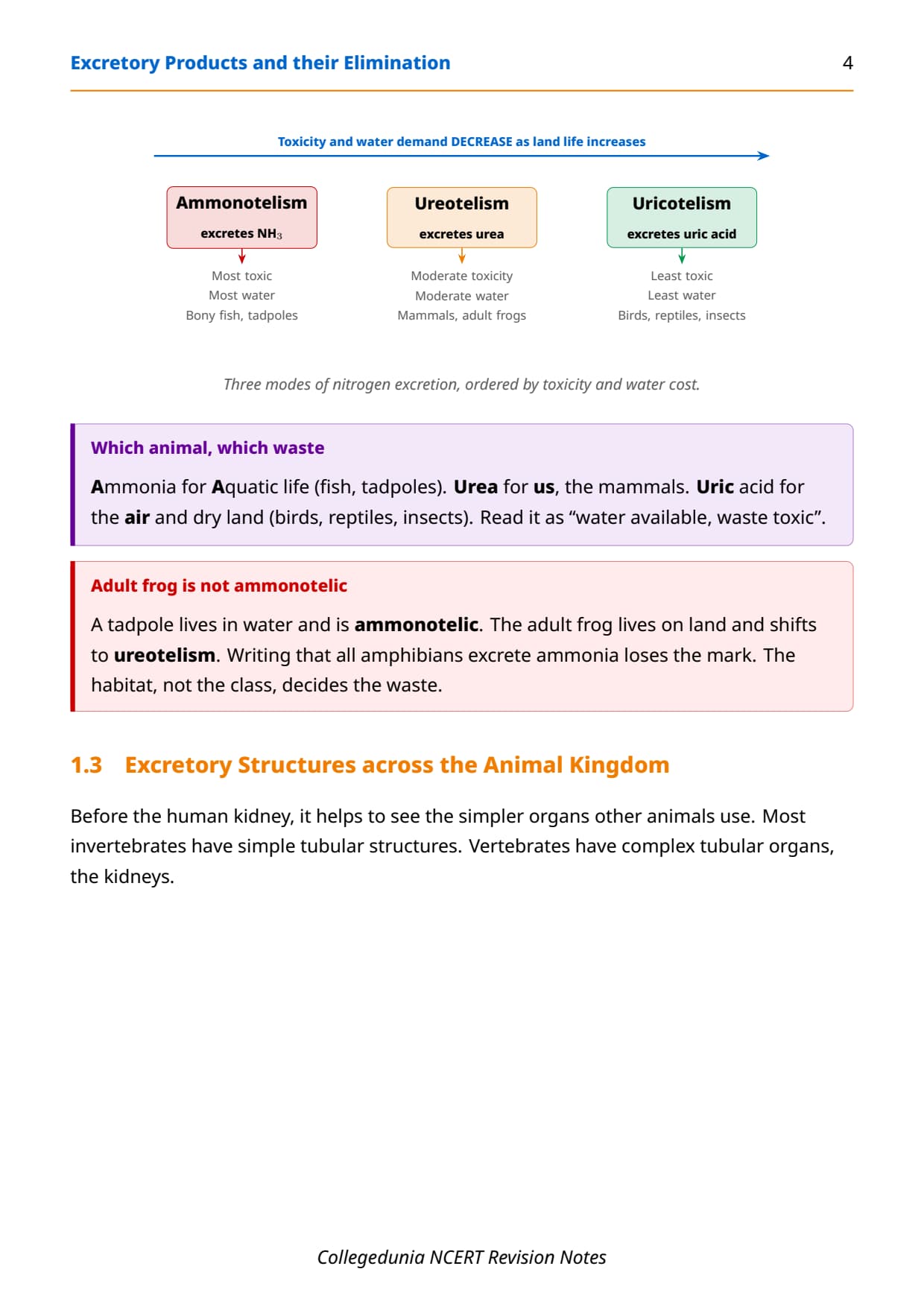
Metabolism and extra intake constantly leave the body with wastes like ammonia, urea, uric acid, carbon dioxide, water, and ions such as Na+, K+, and Cl-. These have to be removed, and this chapter focuses on the nitrogen wastes. The three major nitrogenous wastes differ in two linked ways: how toxic they are, and how much water is needed to flush them out. The more toxic the waste, the more water it takes to excrete safely. This single trade-off explains why aquatic animals use one waste and land animals another.
- Ammonia: the most toxic waste, needing the most water for removal, and very soluble, so it leaves by diffusion across body or gill surfaces.
- Urea: moderately toxic, needing moderate water, made from ammonia in the liver and filtered out by the kidneys.
- Uric acid: the least toxic, needing the least water, leaving as a paste or dry pellet.
The mode of excretion is named after the waste. Ammonotelism is excreting ammonia, seen in many bony fishes, aquatic amphibians, and aquatic insects. Ureotelism is excreting urea, seen in mammals, marine fishes, and many land amphibians. Uricotelism is excreting uric acid, seen in reptiles, birds, land snails, and insects. A common trap is calling all amphibians ammonotelic, but a tadpole in water is ammonotelic while the adult frog on land shifts to ureotelism, so the habitat, not the class, decides the waste. Before the human kidney, simpler organs do this job in other animals: protonephridia (flame cells) in flatworms, nephridia in earthworms, Malpighian tubules in insects, and antennal or green glands in crustaceans, while vertebrates use complex kidneys.
The Human Excretory System and the Nephron
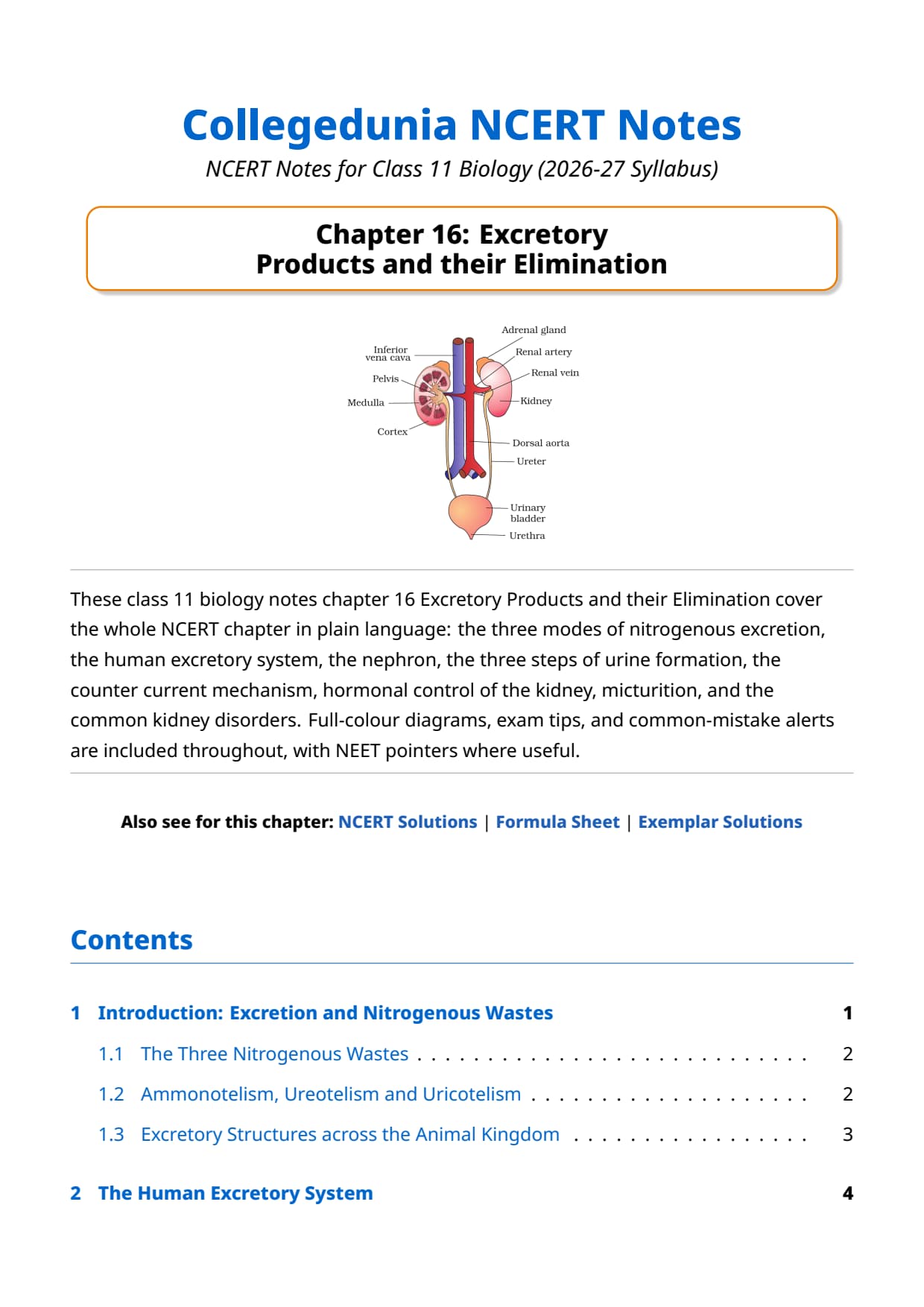
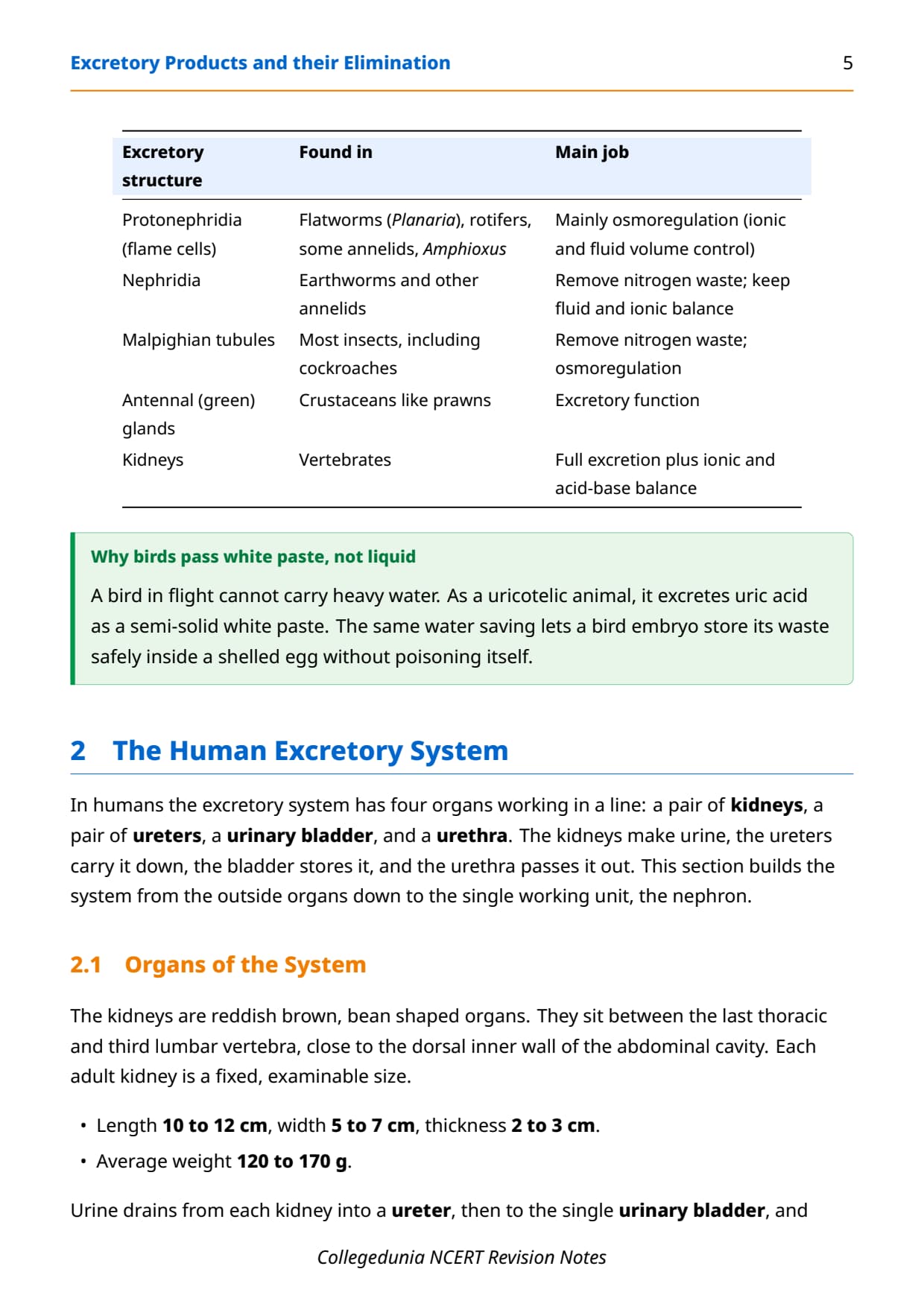
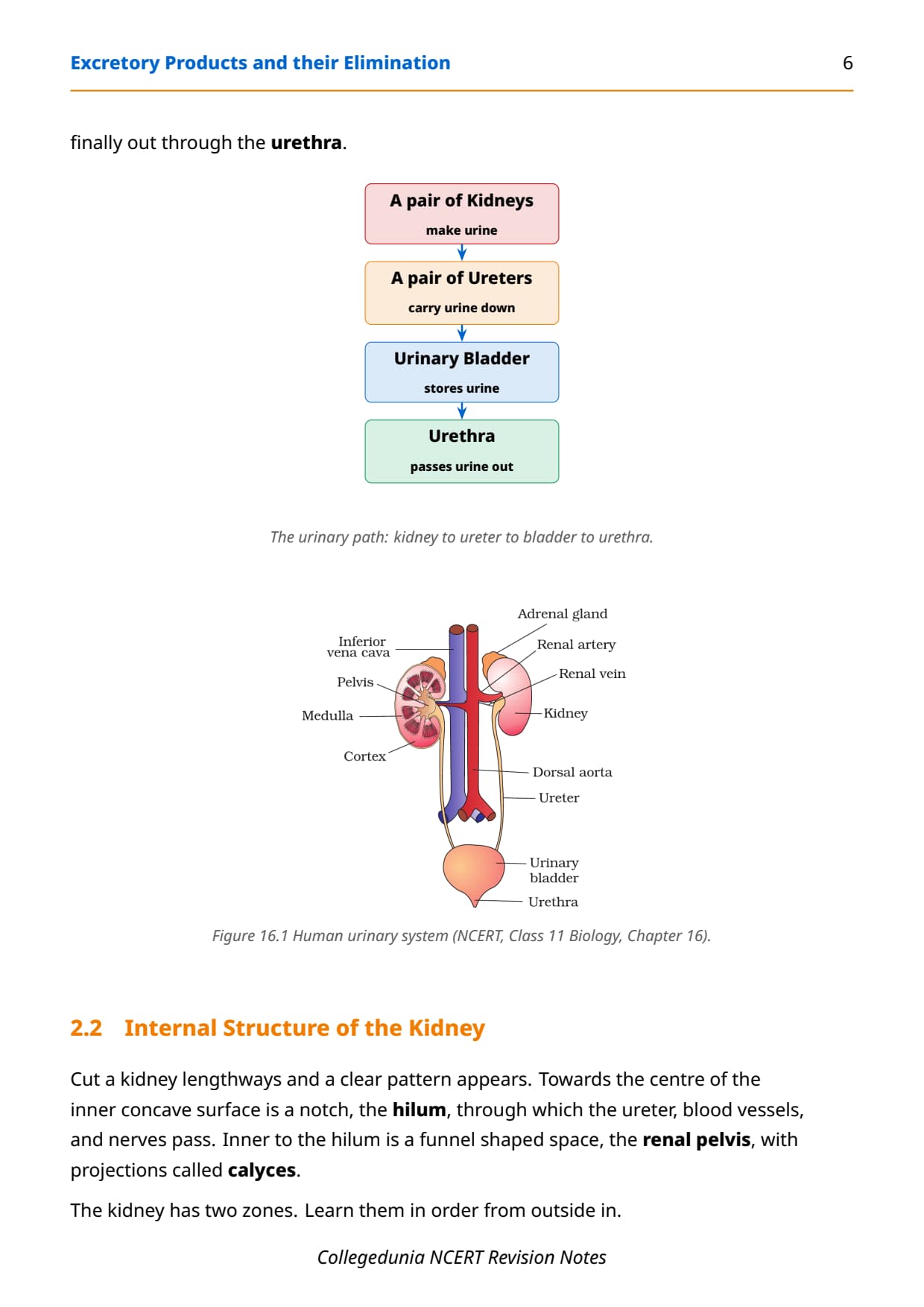
In humans the excretory system has four organs working in a line: a pair of kidneys, a pair of ureters, a urinary bladder, and a urethra. The kidneys make urine, the ureters carry it down, the bladder stores it, and the urethra passes it out. Each kidney is a reddish brown, bean shaped organ lying between the last thoracic and third lumbar vertebra, and its size is examinable.
- Kidney size: length 10 to 12 cm, width 5 to 7 cm, thickness 2 to 3 cm, and average weight 120 to 170 g.
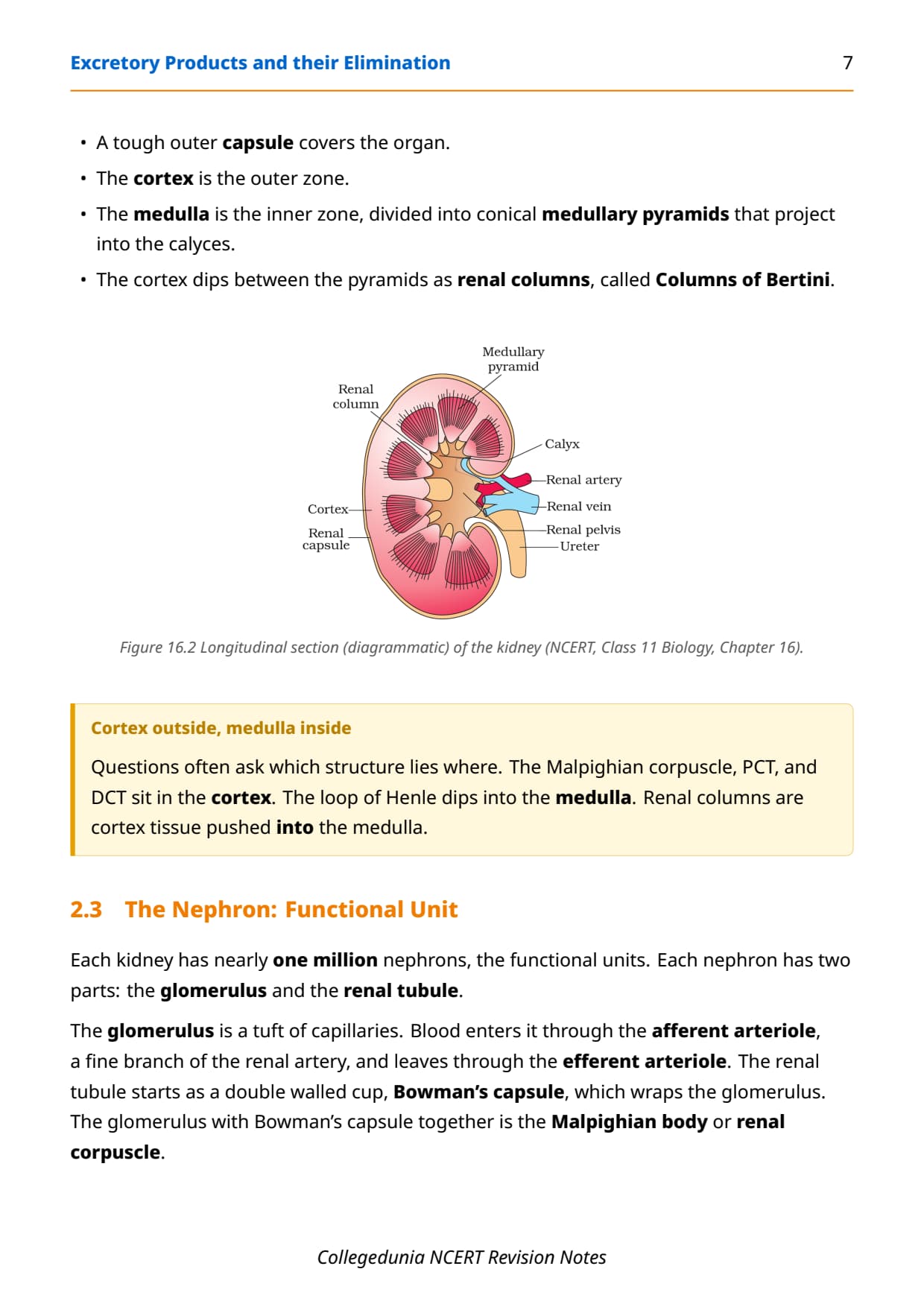
- Internal zones: an outer cortex and an inner medulla with conical medullary pyramids, plus renal columns (Columns of Bertini) where cortex dips into the medulla.
- Nephron count: nearly one million nephrons per kidney, each the functional unit.
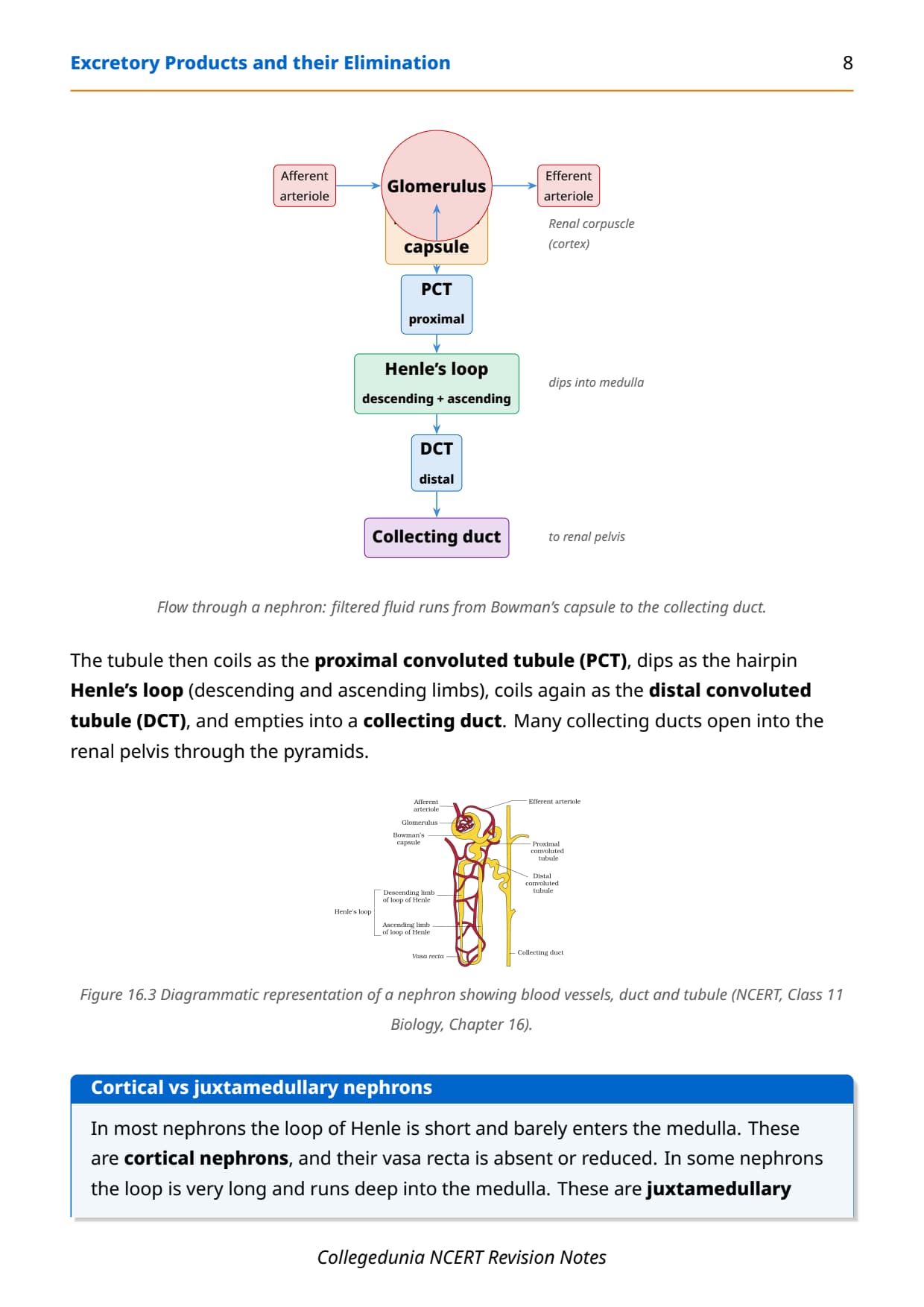
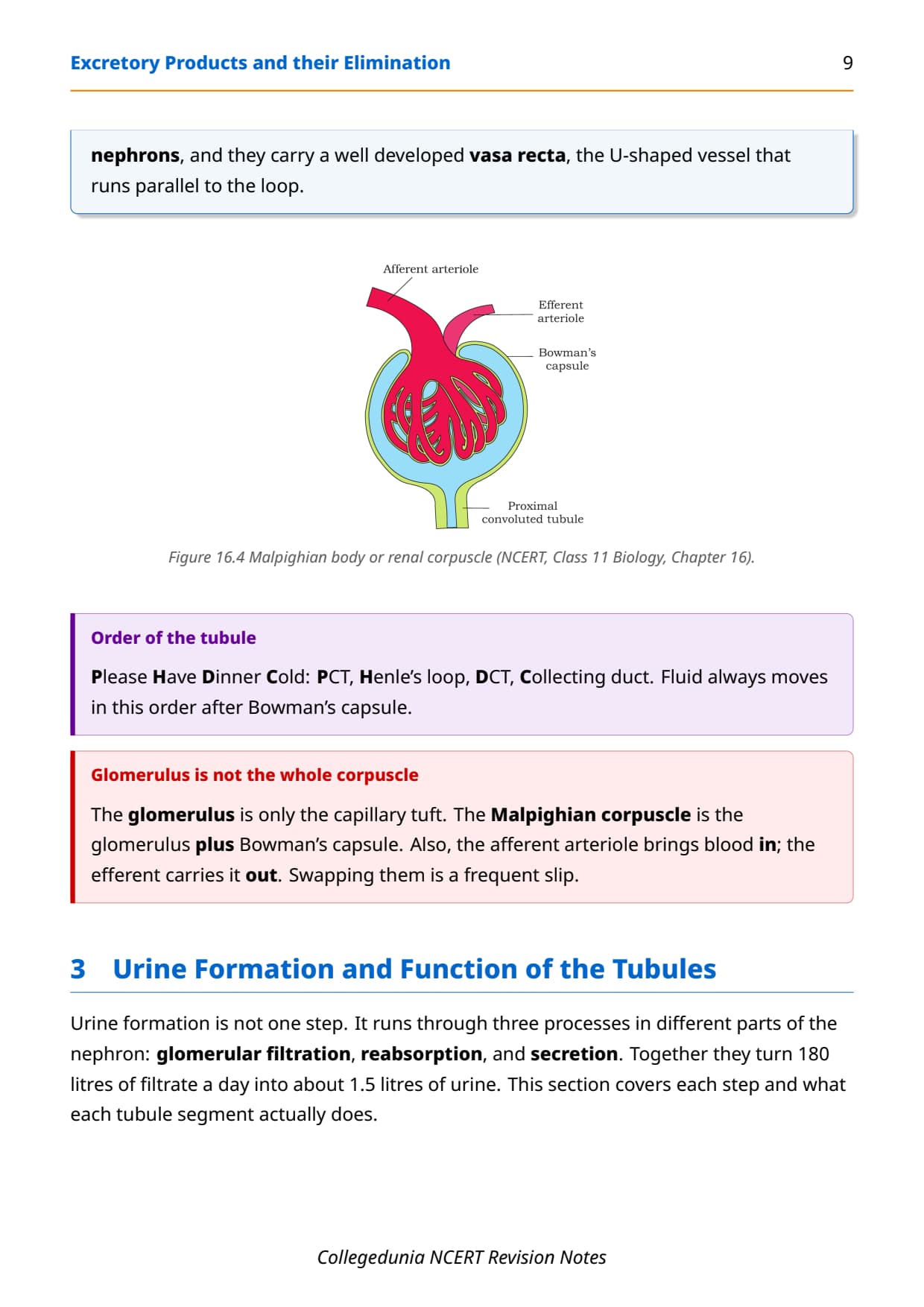
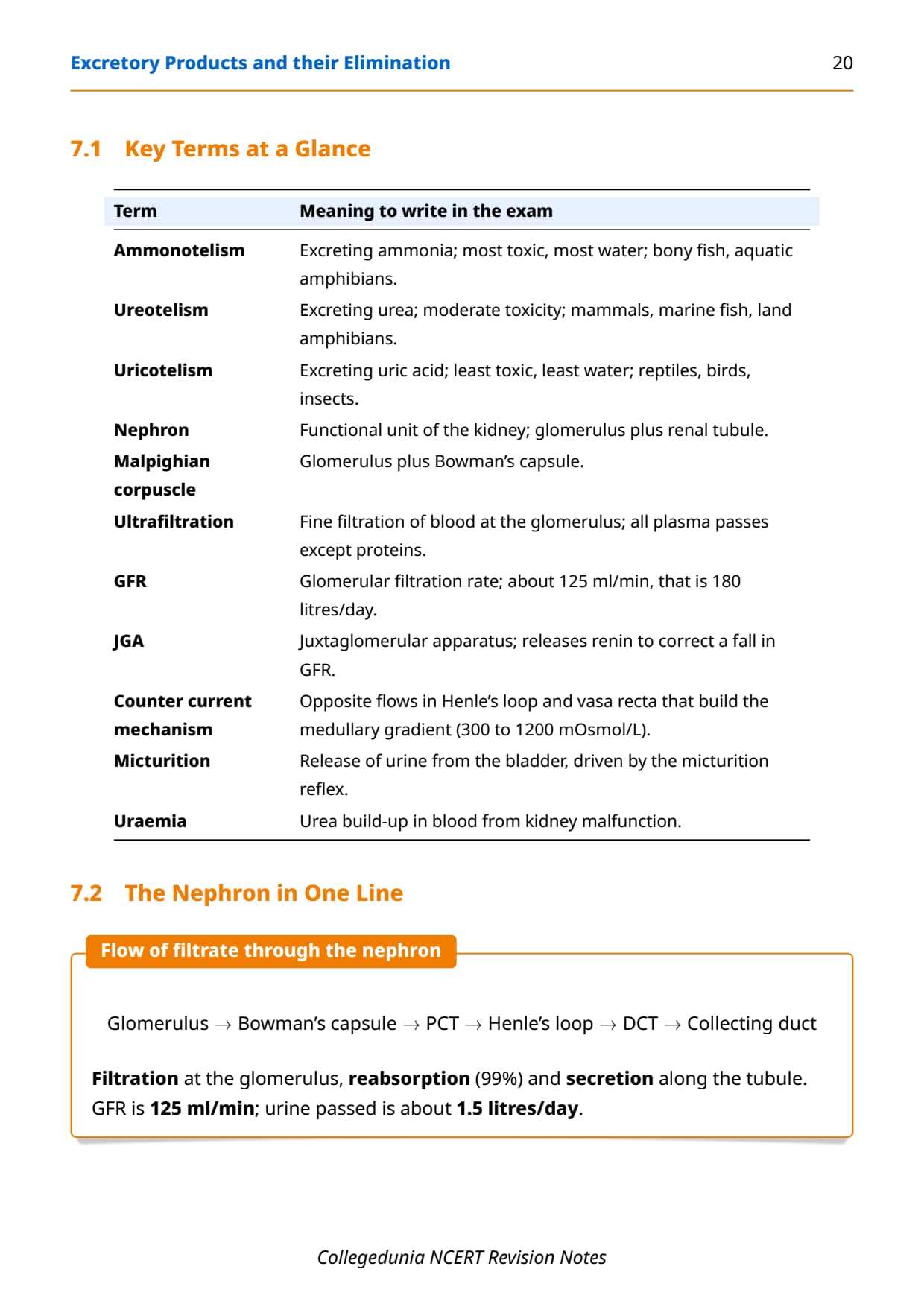
Each nephron has two parts, the glomerulus and the renal tubule. The glomerulus is a tuft of capillaries fed by the afferent arteriole and drained by the efferent arteriole. It sits inside a double walled cup, Bowman's capsule, and the two together form the Malpighian body or renal corpuscle. The tubule then runs as the proximal convoluted tubule (PCT), dips as the hairpin Henle's loop, coils again as the distal convoluted tubule (DCT), and empties into a collecting duct. A frequent slip is treating the glomerulus as the whole corpuscle, but the corpuscle is the glomerulus plus Bowman's capsule. In cortical nephrons the loop barely enters the medulla, while juxtamedullary nephrons have long loops and a well developed vasa recta that does the heavy concentrating work.
Urine Formation: Filtration, Reabsorption and Secretion
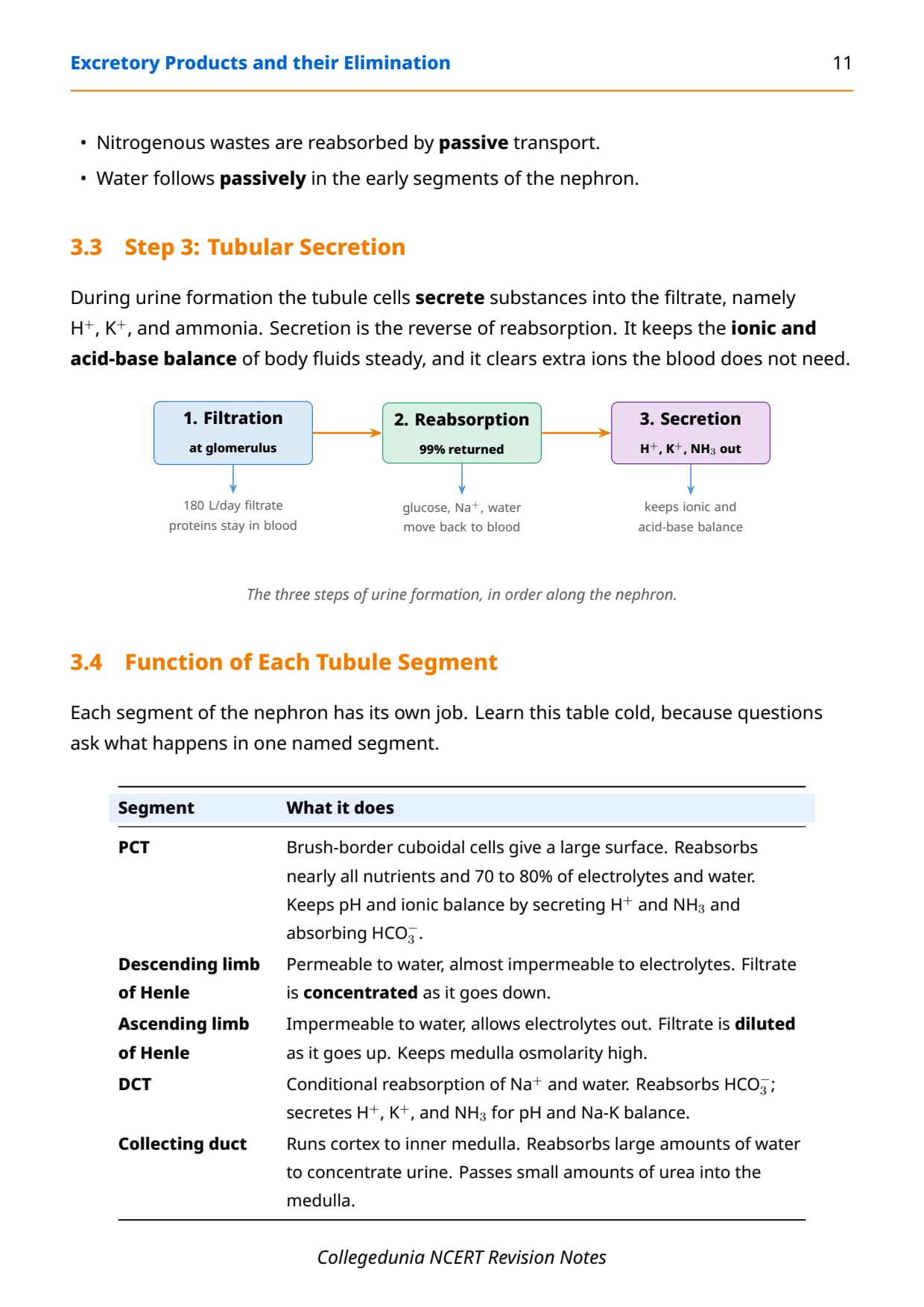
Urine formation is not one step. It runs through three processes in different parts of the nephron: glomerular filtration, reabsorption, and tubular secretion. Together they turn about 180 litres of filtrate a day into roughly 1.5 litres of urine. Learning the job of each step and each tubule segment is what earns the diagram and short answer marks.
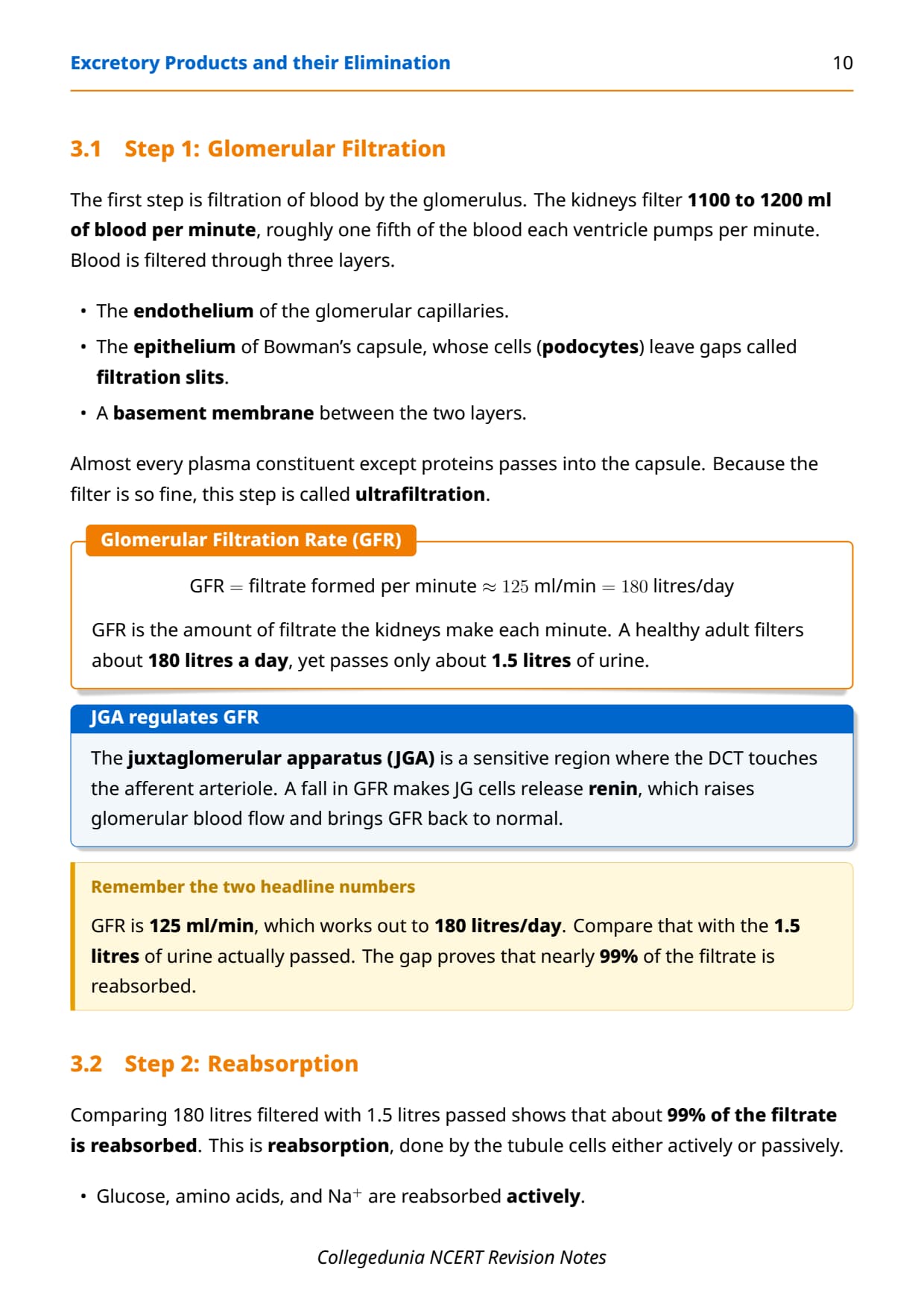
- Step 1, filtration: the glomerulus filters 1100 to 1200 ml of blood per minute through three layers, the capillary endothelium, the basement membrane, and the podocytes of Bowman's capsule with their filtration slits. Everything except proteins passes, so this fine step is called ultrafiltration. The glomerular filtration rate (GFR) is about 125 ml/min, or 180 litres a day.
- Step 2, reabsorption: comparing 180 litres filtered with 1.5 litres passed shows nearly 99% of the filtrate is reabsorbed. Glucose, amino acids, and Na+ are reabsorbed actively, while water follows passively.
- Step 3, secretion: tubule cells secrete H+, K+, and NH3 into the filtrate to keep the ionic and acid-base balance of body fluids steady.
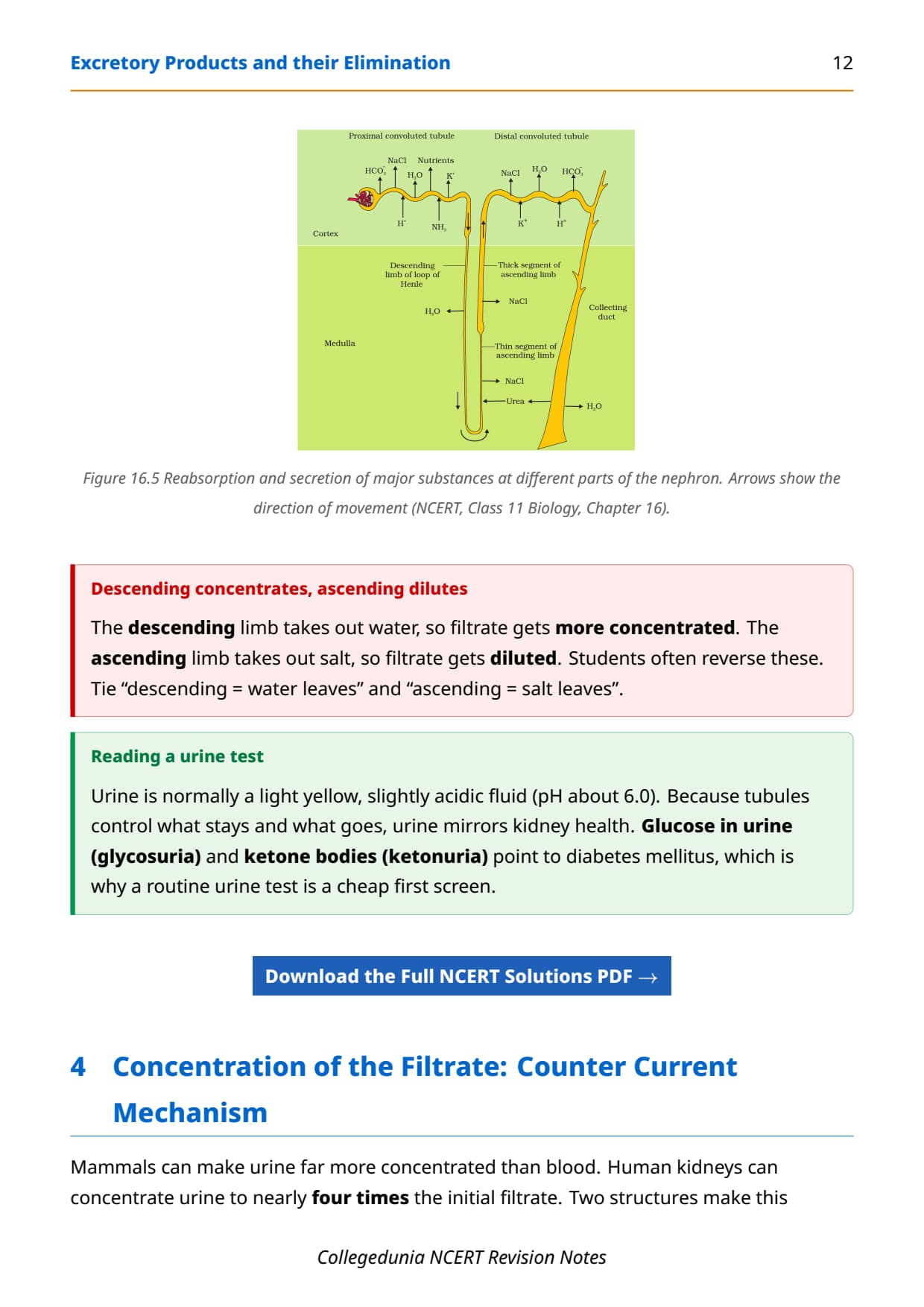
Each segment has its own role. The PCT reabsorbs nearly all nutrients and 70 to 80% of electrolytes and water. The descending limb of Henle is permeable to water but not salt, so filtrate is concentrated going down, while the ascending limb lets salt out but not water, so filtrate is diluted going up. The DCT does conditional reabsorption of Na+ and water, and the collecting duct reabsorbs large amounts of water to concentrate the urine. A fall in GFR makes the juxtaglomerular apparatus (JGA), where the DCT touches the afferent arteriole, release renin to bring GFR back to normal. You can follow the same worked reasoning in the chapter Solutions when you practise Exercise 1.
Counter Current Mechanism and Urine Concentration
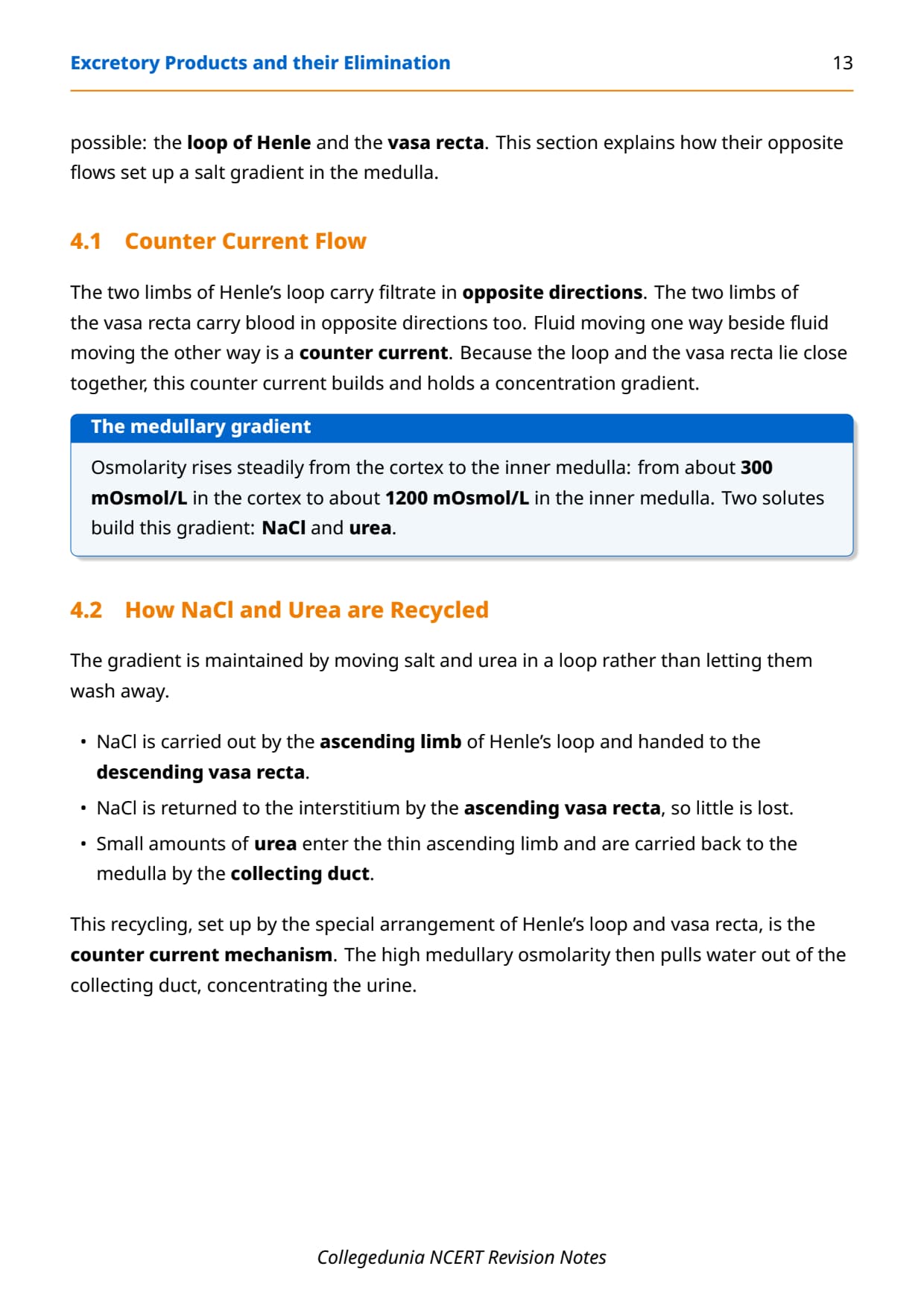
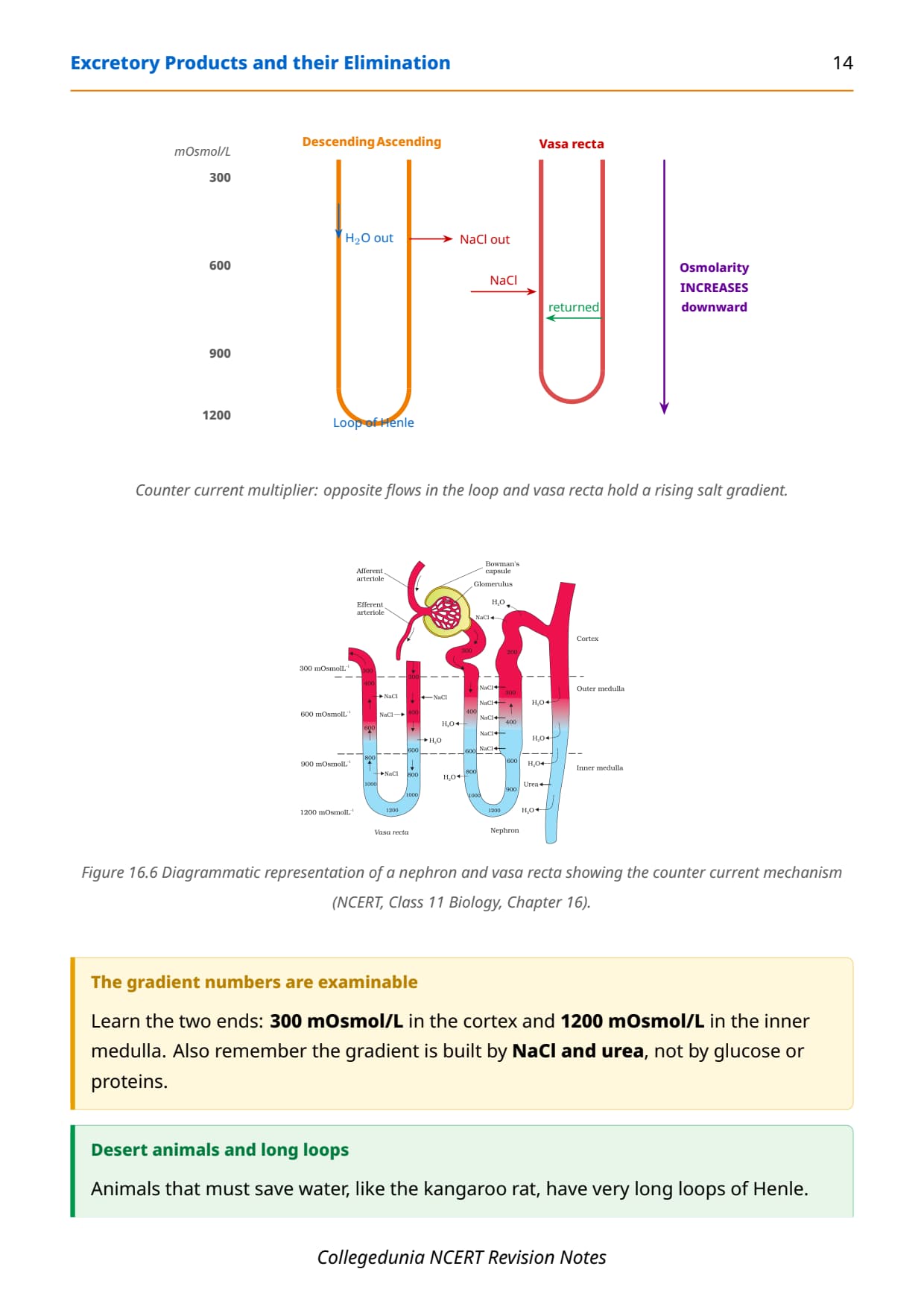
Mammals can make urine far more concentrated than blood, up to nearly four times the initial filtrate. Two structures make this possible: the loop of Henle and the vasa recta. Their two limbs carry fluid in opposite directions, and fluid moving one way beside fluid moving the other way is a counter current. Because the loop and the vasa recta lie close together, this counter current builds and holds a rising concentration gradient in the medulla.
- The gradient: osmolarity rises from about 300 mOsmol/L in the cortex to about 1200 mOsmol/L in the inner medulla.
- The two solutes: the gradient is built by NaCl and urea, not by glucose or proteins.
- Recycling: NaCl is carried out by the ascending limb and handed to the descending vasa recta, then returned by the ascending vasa recta, while small amounts of urea move from the collecting duct back into the medulla.
This recycling, set up by the special arrangement of Henle's loop and the vasa recta, is the counter current mechanism. The high medullary osmolarity then pulls water out of the collecting duct, concentrating the urine. The two examinable numbers here are 300 mOsmol/L in the cortex and 1200 mOsmol/L in the inner medulla. Animals that must save water, such as the kangaroo rat, have very long loops of Henle that build a steeper gradient, which is why their juxtamedullary nephrons concentrate urine so strongly. The same principle explains why long-looped nephrons do the heavy concentrating work in humans.
Hormonal Regulation, Micturition and Other Organs
The kidney does not work on its own. Hormones from the hypothalamus, the JGA, and the heart tune its output minute by minute, and three feedback systems keep blood volume, pressure, and ion levels steady. Each is triggered by a different signal, so learn them as a set of three.
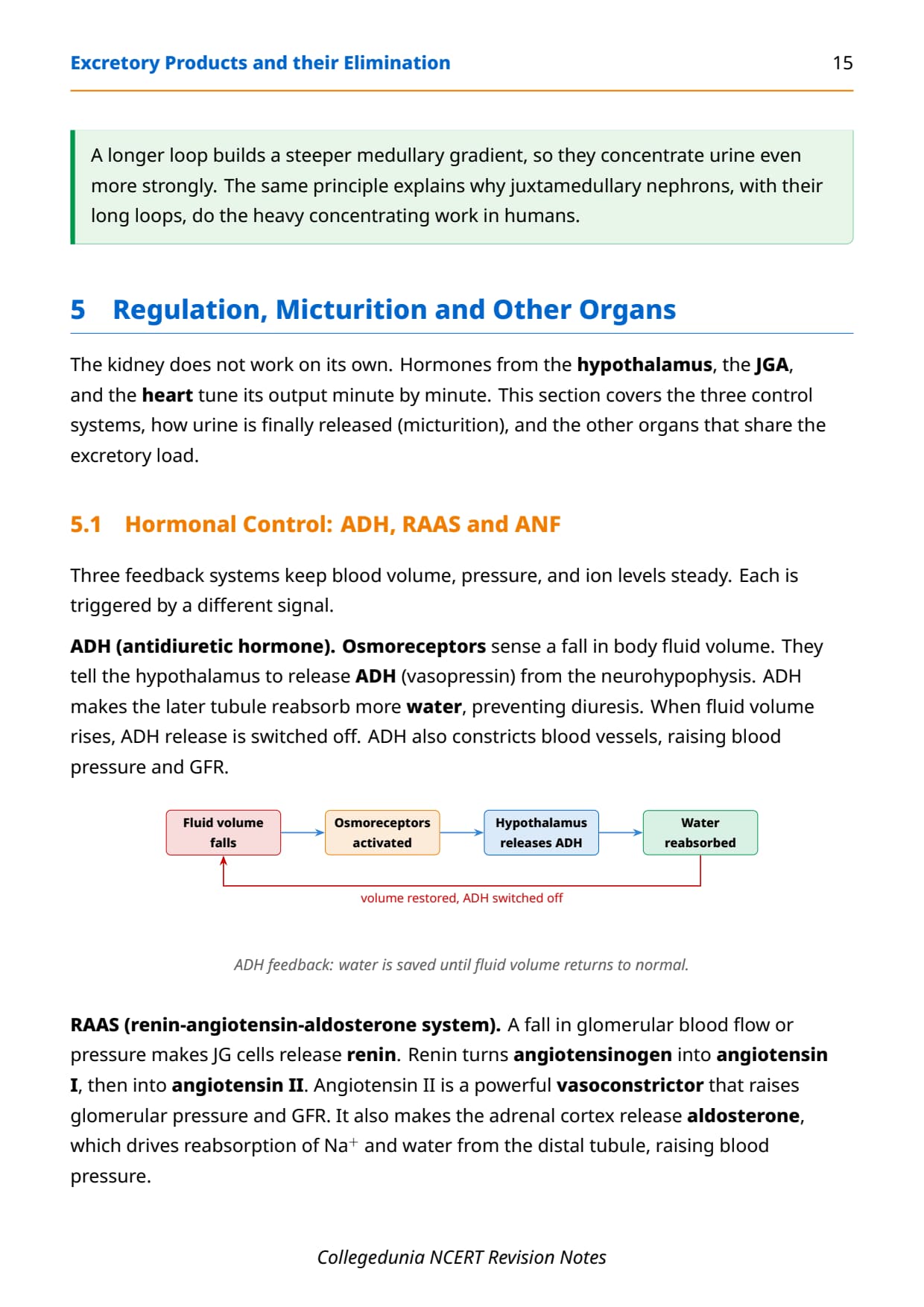
- ADH (antidiuretic hormone): osmoreceptors sense a fall in fluid volume and tell the hypothalamus to release ADH, which makes the later tubule reabsorb more water, preventing diuresis. When volume rises, ADH release is switched off.
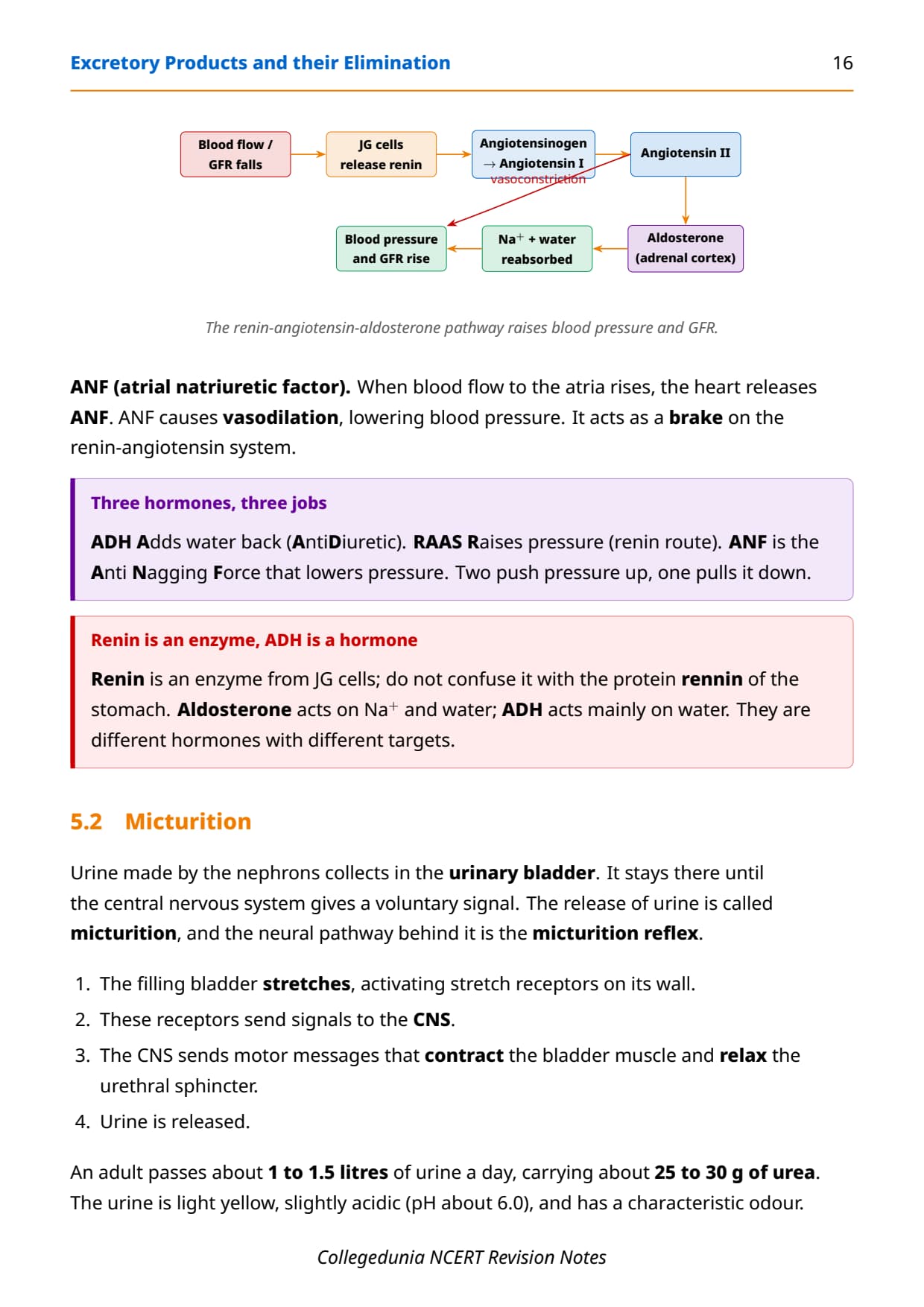
- RAAS (renin-angiotensin-aldosterone system): a fall in glomerular blood flow makes JG cells release renin, which forms angiotensin II, a powerful vasoconstrictor that raises GFR and triggers aldosterone, driving Na+ and water reabsorption.
- ANF (atrial natriuretic factor): released by the heart when atrial blood flow rises, ANF causes vasodilation and acts as a brake on the renin-angiotensin system.
Urine collects in the bladder until the central nervous system gives a voluntary signal. The stretched bladder wall activates receptors, the CNS contracts the bladder muscle and relaxes the urethral sphincter, and urine is released. This is micturition, driven by the micturition reflex. An adult passes about 1 to 1.5 litres of urine a day, carrying about 25 to 30 g of urea, light yellow and slightly acidic at pH about 6.0. The kidney is not the only excretory organ: the lungs remove CO2 and some water, the liver passes out bile pigments like bilirubin, and the skin releases NaCl, a little urea, and lactic acid through sweat. Note that renin is an enzyme, not the stomach protein rennin, and ADH acts mainly on water while aldosterone acts on Na+ and water.
Disorders of the Excretory System
When kidneys fail, wastes build up in the blood and turn dangerous. NCERT lists a small set of disorders and the two ways doctors correct kidney failure, dialysis and transplantation. Each disorder has a one-line cause worth learning exactly, because single-mark questions often just ask you to name the disorder from its cause.
- Uraemia: urea builds up in the blood when kidneys malfunction. It is highly harmful and can lead to renal failure, so the urea must be removed artificially.
- Renal calculi: stones, that is insoluble masses of crystallised salts such as oxalates, formed inside the kidney.
- Glomerulonephritis: inflammation of the glomeruli of the kidney.
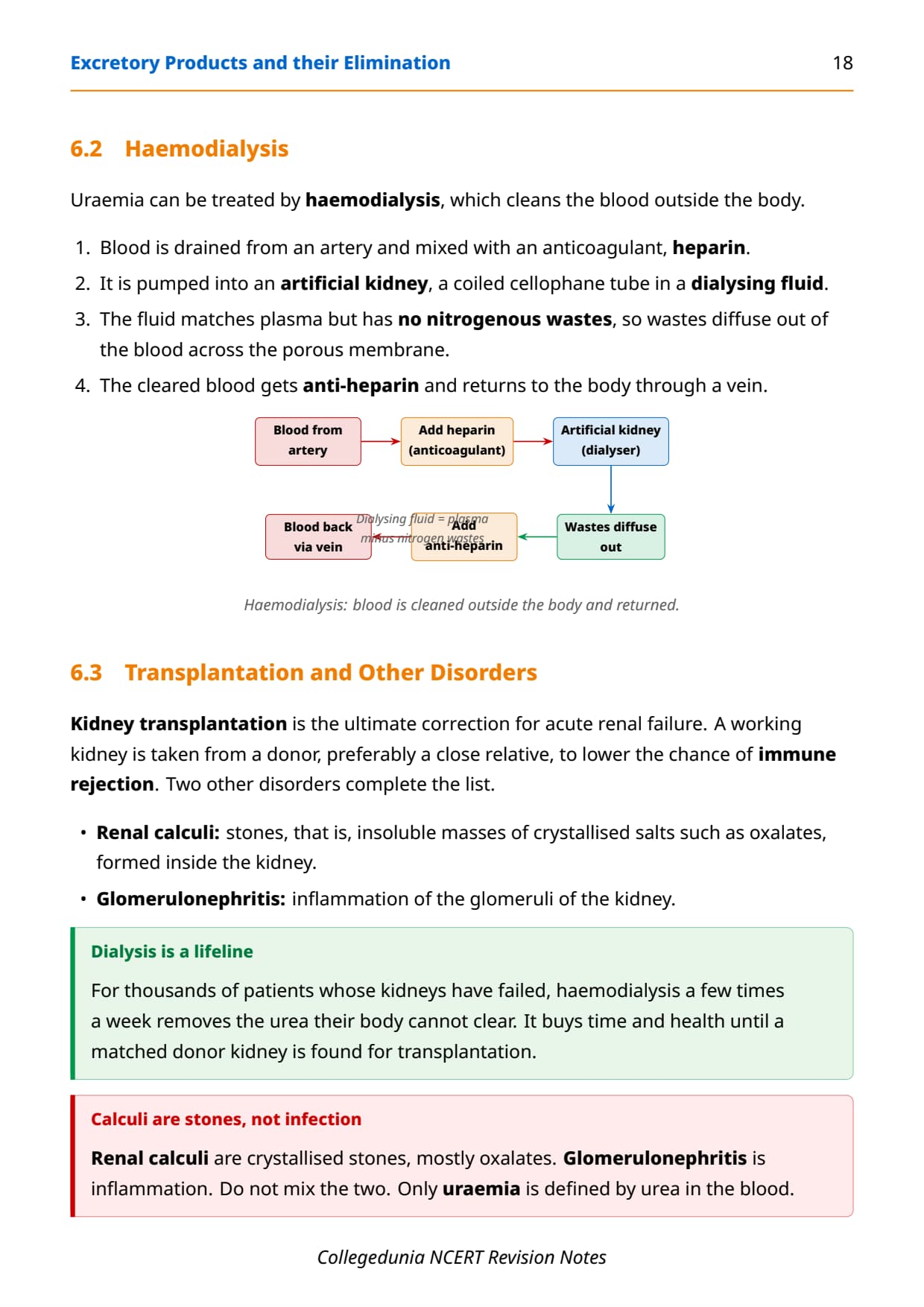
Uraemia is treated by haemodialysis, which cleans the blood outside the body. Blood is drained from an artery, mixed with the anticoagulant heparin, and pumped into an artificial kidney, a coiled cellophane tube bathed in a dialysing fluid that matches plasma but has no nitrogenous wastes. The wastes diffuse out across the porous membrane, the cleared blood gets anti-heparin, and it returns through a vein. The ultimate correction for acute renal failure is kidney transplantation, ideally from a close relative to lower the chance of immune rejection. A useful check on the naming: uraemia is defined by urea in the blood, calculi are crystallised stones, and glomerulonephritis is inflammation, so do not mix the three.
Key Definitions in Excretory Products and their Elimination
Board short-answer questions often ask for a clean definition in one or two lines, and a vague answer loses easy marks. Learn these word-for-word, because the wording of the exam question is usually built straight from the NCERT definition. Each term below also connects to a diagram or number you can be asked to explain.
| Term | Definition |
|---|---|
| Ammonotelism | Excreting ammonia; most toxic, most water; seen in bony fishes and aquatic amphibians. |
| Ureotelism | Excreting urea; moderate toxicity; seen in mammals, marine fishes, and land amphibians. |
| Uricotelism | Excreting uric acid; least toxic, least water; seen in reptiles, birds, and insects. |
| Nephron | The functional unit of the kidney; a glomerulus plus a renal tubule. |
| Ultrafiltration | Fine filtration of blood at the glomerulus; all plasma constituents pass except proteins. |
| GFR | Glomerular filtration rate; about 125 ml/min, that is roughly 180 litres a day. |
| Counter current mechanism | Opposite flows in Henle's loop and the vasa recta that build the medullary gradient of 300 to 1200 mOsmol/L. |
A common board question asks you to define ultrafiltration and then explain why proteins stay in the blood. State the definition first, then add that the filter is too fine to pass large protein molecules to earn the full mark. Learning these definitions makes the wording of almost every one-mark and two-mark question in this chapter familiar.
Common Mistakes Students Make in Excretory Products and their Elimination
These slips happen because two terms look alike, not because the concept is hard. Each one costs 1 to 2 marks in the paper, so watch for them at the exact step where they occur.
Mistake 1: Calling all amphibians ammonotelic. Tadpoles are ammonotelic in water, but adult frogs shift to ureotelism on land, so habitat decides the waste.
Mistake 2: Saying the glomerulus is the renal corpuscle. The corpuscle is the glomerulus plus Bowman's capsule, and the afferent arteriole brings blood in while the efferent carries it out.
Mistake 3: Reversing the loop limbs. The descending limb loses water and concentrates the filtrate; the ascending limb loses salt and dilutes it.
Mistake 4: Confusing renin with rennin. Renin is a kidney enzyme in the RAAS pathway, while rennin is a stomach enzyme.
Mistake 5: Treating calculi as an infection. Renal calculi are crystallised stones, mostly oxalates, while glomerulonephritis is inflammation of the glomeruli.
Excretory Products and their Elimination Weightage in CBSE Boards, NEET and CUET
This chapter is diagram-heavy and scoring. It sits inside the Human Physiology unit, which carries the largest share of the Class 11 Biology paper, and its nephron and urine formation questions repeat every year. Here is how the marks split across the main exams for 2026-27.
| Exam | Typical weightage | What is asked |
|---|---|---|
| CBSE Boards | 3 to 5 marks | Nephron structure and urine formation, plus the counter current mechanism or hormonal control |
| NEET | 1 to 2 questions | Modes of excretion, tubule functions, GFR numbers, and kidney disorders |
| CUET | 1 to 2 objective questions | Definitions, the nephron parts, and the roles of ADH, renin, and ANF |
The nephron and the three steps of urine formation are the single most tested ideas from this chapter across all three exams. Master the nephron diagram first, then the counter current mechanism, then the three regulating hormones, in that order of return on effort for the 2026-27 session.
How to Revise Excretory Products and their Elimination Quickly
Use these excretory products and their elimination class 11 notes for a fast, ordered recap the night before a test. The checklist below takes about 25 minutes and hits every marks-heavy idea in the chapter without opening the full textbook.
- First 9 minutes: draw the nephron from the glomerulus to the collecting duct and label the PCT, Henle's loop, DCT, and Bowman's capsule.
- Next 8 minutes: write the three steps of urine formation with the GFR number, then note which loop limb concentrates and which dilutes.
- Last 8 minutes: match ADH, renin, and ANF to their triggers, and name uraemia, renal calculi, and glomerulonephritis from their causes.
Close the loop by explaining how the counter current mechanism concentrates urine using the 300 to 1200 mOsmol/L gradient. If you can do all three blocks without notes, the chapter is exam-ready. Keep the nephron diagram beside you for the first pass only, then try the whole checklist closed-book.
Student Feedback on the Excretory Products and their Elimination Notes
What 11,540 students told us about their Excretory Products and their Elimination revision:
- 71% of students rated the nephron and urine formation steps as the part most worth memorising for the exam.
- Most-confused pair: the descending versus ascending limb of Henle's loop, mixed up by about 3 in 10 students.
- Students who learnt ADH, renin, and ANF as a set of three triggers said the hormonal control questions felt easy afterwards.
Source: 2026-27 Class 11 Biology student poll. Sample of 11,540 students from CBSE schools across 15 states, conducted before the 2026 boards.
Other Excretory Products and their Elimination Class 11 Biology Resources
Pair these notes with the solved answers, the formula sheet, the exemplar material, and the textbook PDF for the same chapter.
| Resource | Link |
|---|---|
| NCERT Solutions | Excretory Products and their Elimination Class 11 NCERT Solutions |
| Formula Sheet | Excretory Products and their Elimination Class 11 Formula Sheet |
| Exemplar Solutions | Excretory Products and their Elimination Class 11 Exemplar Solutions |
| NCERT Book PDF | Excretory Products and their Elimination Class 11 Book PDF |
| Exemplar Book PDF | Excretory Products and their Elimination Class 11 Exemplar Book PDF |
NCERT Notes for Class 11 Biology: All Chapters
Jump to the revision notes for any other Class 11 Biology chapter below.
| Chapter | NCERT Notes |
|---|---|
| Chapter 1 | The Living World |
| Chapter 2 | Biological Classification |
| Chapter 3 | Plant Kingdom |
| Chapter 4 | Animal Kingdom |
| Chapter 5 | Morphology of Flowering Plants |
| Chapter 6 | Anatomy of Flowering Plants |
| Chapter 7 | Structural Organisation in Animals |
| Chapter 8 | Cell The Unit of Life |
| Chapter 9 | Biomolecules |
| Chapter 10 | Cell Cycle and Cell Division |
| Chapter 11 | Photosynthesis in Higher Plants |
| Chapter 12 | Respiration in Plants |
| Chapter 13 | Plant Growth and Development |
| Chapter 14 | Breathing and Exchange of Gases |
| Chapter 15 | Body Fluids and Circulation |
| Chapter 16 | Excretory Products and their Elimination |
| Chapter 17 | Locomotion and Movement |
| Chapter 18 | Neural Control and Coordination |
| Chapter 19 | Chemical Coordination and Integration |
FAQs on Excretory Products and their Elimination Class 11 Biology Notes
Excretory Products and Their Elimination Notes - Frequently Asked Questions
Ques. What topics do the excretory products and their elimination class 11 notes cover?
Ans. These excretory products and their elimination class 11 notes cover the three nitrogenous wastes and the modes ammonotelism, ureotelism, and uricotelism, the excretory structures across animals, the human excretory system and the nephron, the three steps of urine formation, the tubule functions, the counter current mechanism, the hormonal control by ADH, the renin-angiotensin system, and ANF, micturition, the role of other organs, and the main kidney disorders. Every key definition and number is included for fast revision.
Ques. What are the three steps of urine formation?
Ans. Urine formation happens in three steps. Glomerular filtration is the ultrafiltration of blood at the glomerulus, forming about 180 litres of filtrate a day at a GFR of roughly 125 ml/min. Reabsorption returns nearly 99% of that filtrate, with glucose, amino acids, and Na+ reabsorbed actively. Tubular secretion moves H+, K+, and NH3 into the filtrate to keep the ionic and acid-base balance steady. The result is about 1.5 litres of urine a day.
Ques. What is the counter current mechanism?
Ans. The counter current mechanism is set up by the loop of Henle and the vasa recta, whose limbs carry fluid in opposite directions. This counter current builds and holds a concentration gradient that rises from about 300 mOsmol/L in the cortex to about 1200 mOsmol/L in the inner medulla, using NaCl and urea. The high medullary osmolarity then pulls water out of the collecting duct, so the urine becomes concentrated, up to nearly four times the initial filtrate.
Ques. What is the functional unit of the kidney?
Ans. The nephron is the functional unit of the kidney, and each kidney holds nearly one million of them. Each nephron has a glomerulus, a tuft of capillaries fed by the afferent arteriole, sitting inside Bowman's capsule to form the Malpighian corpuscle, and a renal tubule that runs as the PCT, Henle's loop, and DCT before opening into a collecting duct. Cortical nephrons have short loops, while juxtamedullary nephrons have long loops and a vasa recta that concentrates urine.
Ques. Which hormones regulate kidney function?
Ans. Three feedback systems regulate the kidney. ADH from the hypothalamus makes the later tubule reabsorb more water when fluid volume falls. The renin-angiotensin-aldosterone system, triggered by a fall in glomerular blood flow, forms angiotensin II and releases aldosterone to raise GFR and reabsorb Na+ and water. ANF from the heart causes vasodilation and acts as a brake on the renin-angiotensin system. Renin is an enzyme, not the stomach protein rennin.
Ques. What is the difference between uraemia and renal calculi?
Ans. Uraemia is the build-up of urea in the blood when the kidneys malfunction, and it can lead to renal failure treated by haemodialysis or transplantation. Renal calculi are stones, that is insoluble masses of crystallised salts such as oxalates, formed inside the kidney. A third disorder, glomerulonephritis, is inflammation of the glomeruli. Reading the word parts helps, since uraemia means urea in the blood and glomerulonephritis means inflammation of the glomeruli.
Ques. What is the weightage of this chapter in the CBSE board exam?
Ans. Excretory Products and their Elimination carries about 3 to 5 marks in the CBSE Class 11 Biology paper, usually a diagram-based or short answer on the nephron and urine formation plus one on the counter current mechanism or hormonal control. It also appears in NEET and CUET as objective questions on the modes of excretion, tubule functions, GFR numbers, and kidney disorders, which makes it a scoring chapter for the 2026-27 session.



Comments