




These respiration in plants class 11 notes pull together every pathway, enzyme, and ATP figure that the CBSE Boards, NEET and CUET papers actually test in 2026-27. Revise the whole chapter fast, from how plants swap gases without lungs, through glycolysis, fermentation, the Krebs cycle and the electron transport system, all the way to the 38 ATP balance sheet and the respiratory quotient in one place.
This chapter builds directly on photosynthesis from Chapter 11, because the glucose a plant makes in the light is the same glucose it oxidises here to release usable energy.
- CBSE Weightage: 5 to 6 marks, usually one long answer on the aerobic pathway or balance sheet plus a short answer on glycolysis or the respiratory quotient.
- Topics covered: gas exchange in plants, respiration versus combustion, glycolysis and the EMP pathway, alcoholic and lactic acid fermentation, the link reaction, the Krebs cycle, the electron transport system, oxidative phosphorylation and chemiosmosis, the 38 ATP balance sheet, the amphibolic pathway, and the respiratory quotient.
- Key numbers: a net 2 ATP from glycolysis, 3 ATP per NADH, 2 ATP per FADH2, 38 ATP per glucose overall, and RQ values of 1.0, 0.9 and 0.7 for carbohydrate, protein and fat.
These respiration in plants class 11 notes are curated by subject experts, based on the 2026-27 NCERT textbook, and checked against the last five years of CBSE Board and NEET papers.
Topic-by-Topic Summary of Respiration in Plants
The chapter follows one glucose molecule from the moment it is broken down to the moment its energy is banked as ATP. It starts with how plant tissues get oxygen, splits glucose in the cytoplasm, then sends the products either down the low-yield fermentation route or into the mitochondria for full oxidation. Here is the quick map of what each topic gives you before you revise the detail.
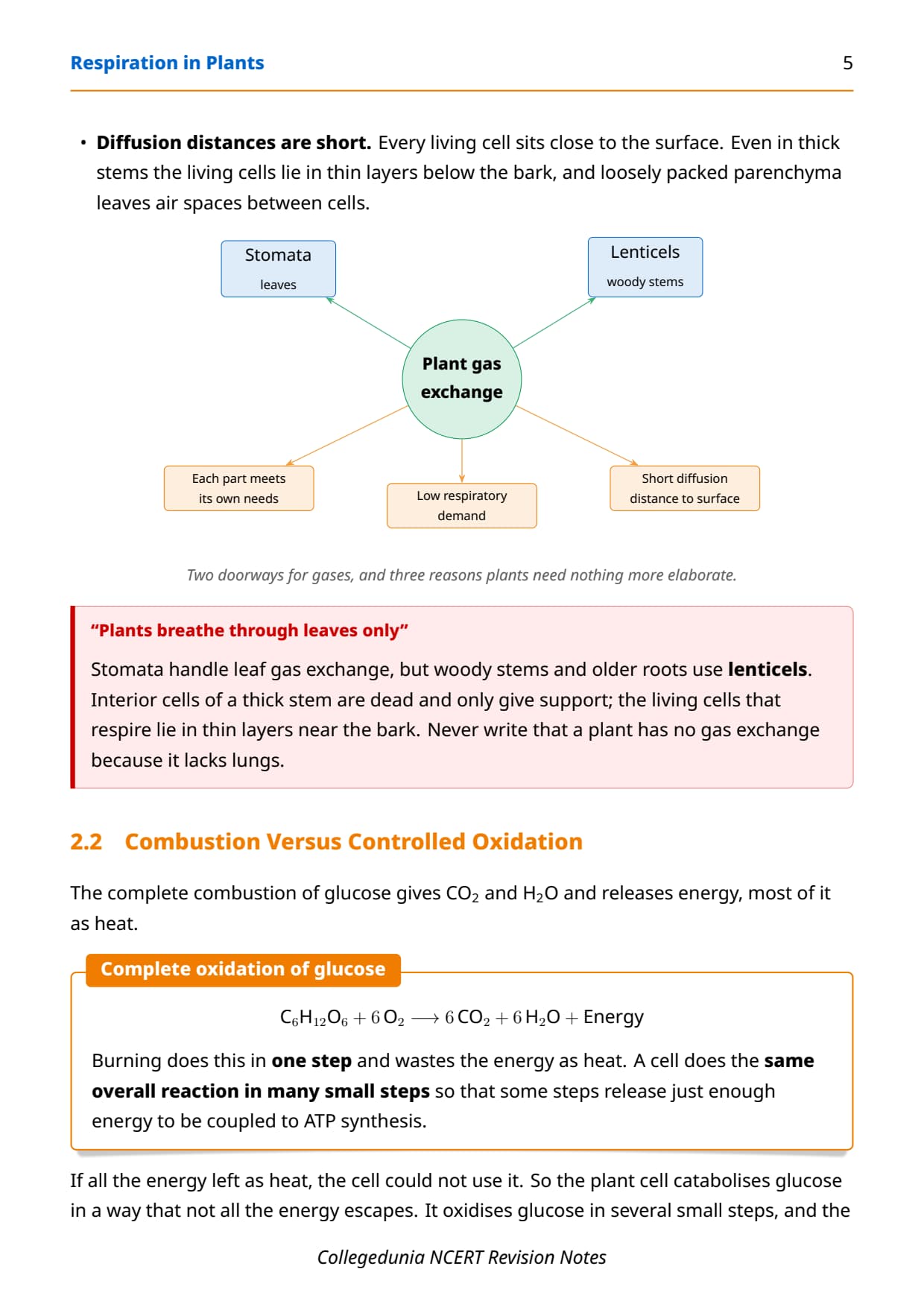
- Gas exchange: plants respire in every living cell but use stomata and lenticels instead of lungs, for three clear reasons.
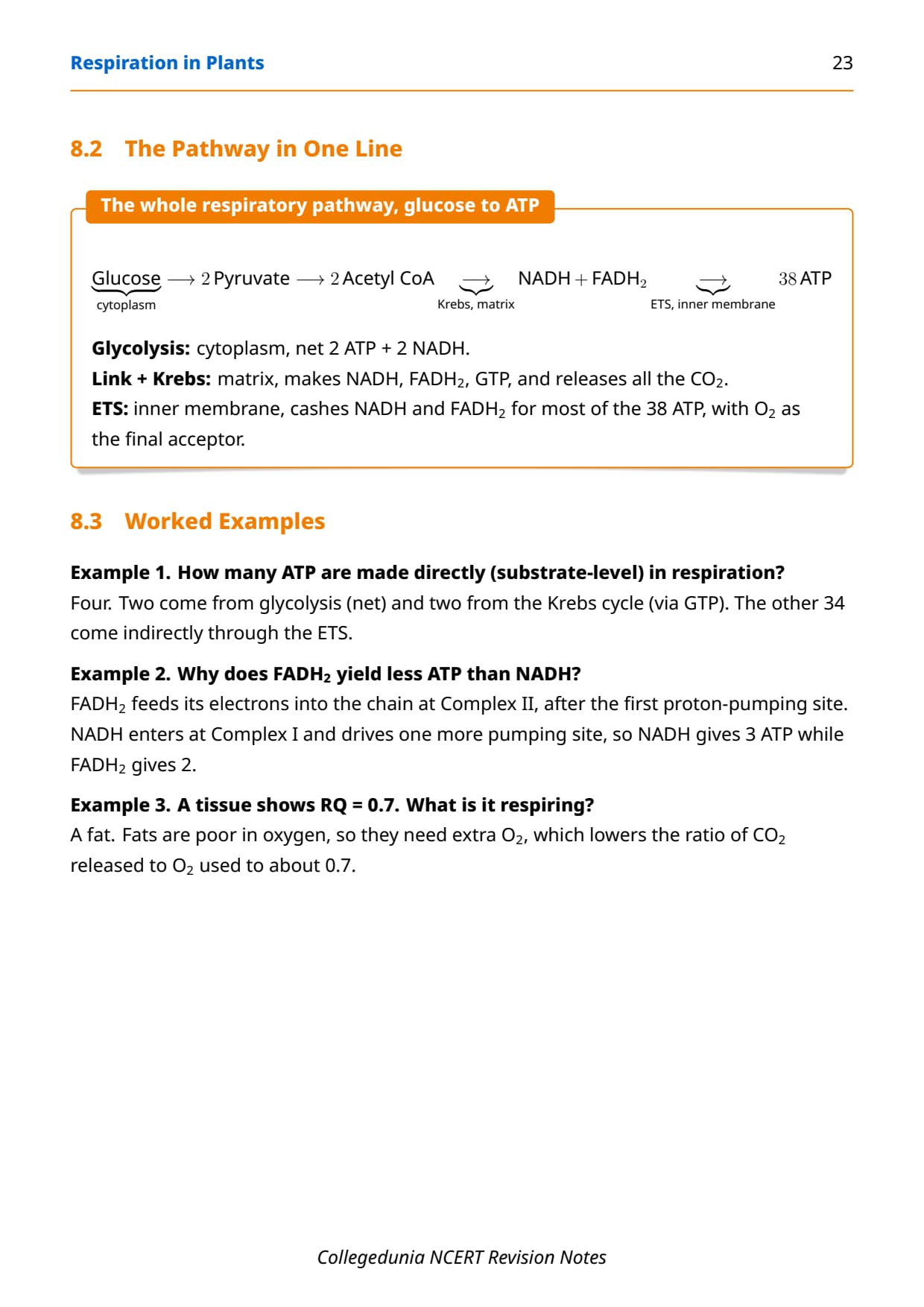
- Glycolysis: the partial oxidation of one glucose into two pyruvate in the cytoplasm, giving a net 2 ATP and 2 NADH.
- Fermentation: the anaerobic fate of pyruvate, making ethanol or lactic acid for a net of only 2 ATP.
- Aerobic respiration: the link reaction, the Krebs cycle, and the electron transport system that fully oxidise pyruvate to CO2 and water.
- Balance sheet: the theoretical net gain of 38 ATP per glucose and the four assumptions it rests on.
- Amphibolic pathway and RQ: why respiration also builds molecules, and how the respiratory quotient reveals the substrate being burned.
Revise the topics in this order, because each one feeds the next. Fix the ATP yield of NADH and FADH2 first, and the whole 38 ATP balance sheet falls into place around it. These respiration in plants class 11 notes follow the same sequence as the NCERT textbook.
Do Plants Breathe? Gas Exchange and Controlled Oxidation
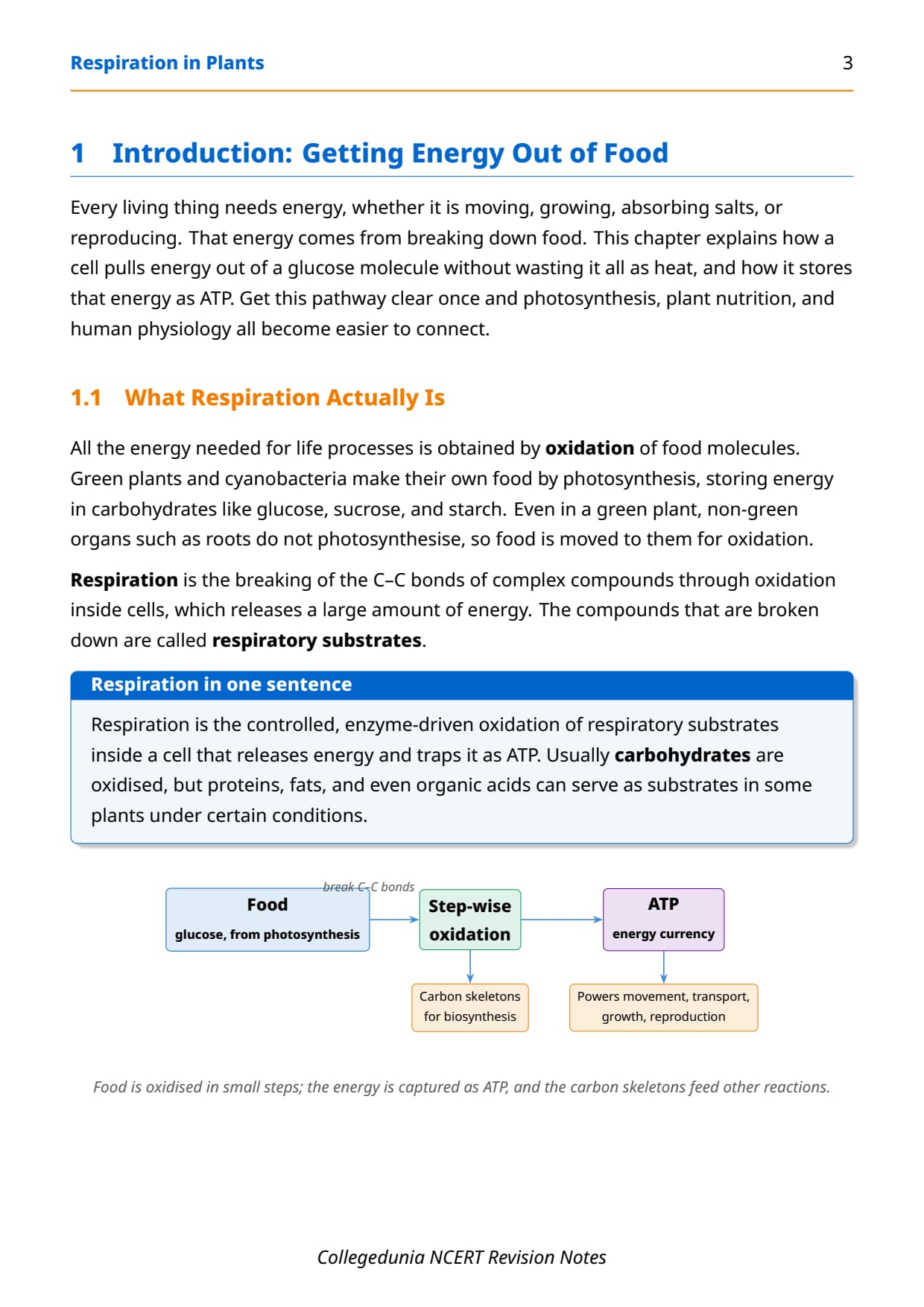
Animals have lungs and gills, so students often ask what a plant uses instead. Plants do need O2 for respiration and they give out CO2, yet they never evolved special breathing organs. Instead they exchange gases through stomata on leaves and lenticels on woody stems, and they manage this because every living cell sits close to the surface. Respiration itself is the breaking of the C-C bonds of complex compounds through oxidation inside cells, which releases energy that is trapped as ATP rather than lost as heat.
- Each part looks after itself: there is very little transport of gases between plant parts, so each organ meets its own needs.
- Demand is low: roots, stems and leaves respire far more slowly than animal tissues, so large gas flows are not needed.
- Diffusion distances are short: living cells lie in thin layers below the bark, and loosely packed parenchyma leaves air spaces between cells.
- Respiratory substrate: usually a carbohydrate such as glucose, but proteins, fats and organic acids can also be oxidised in some plants.
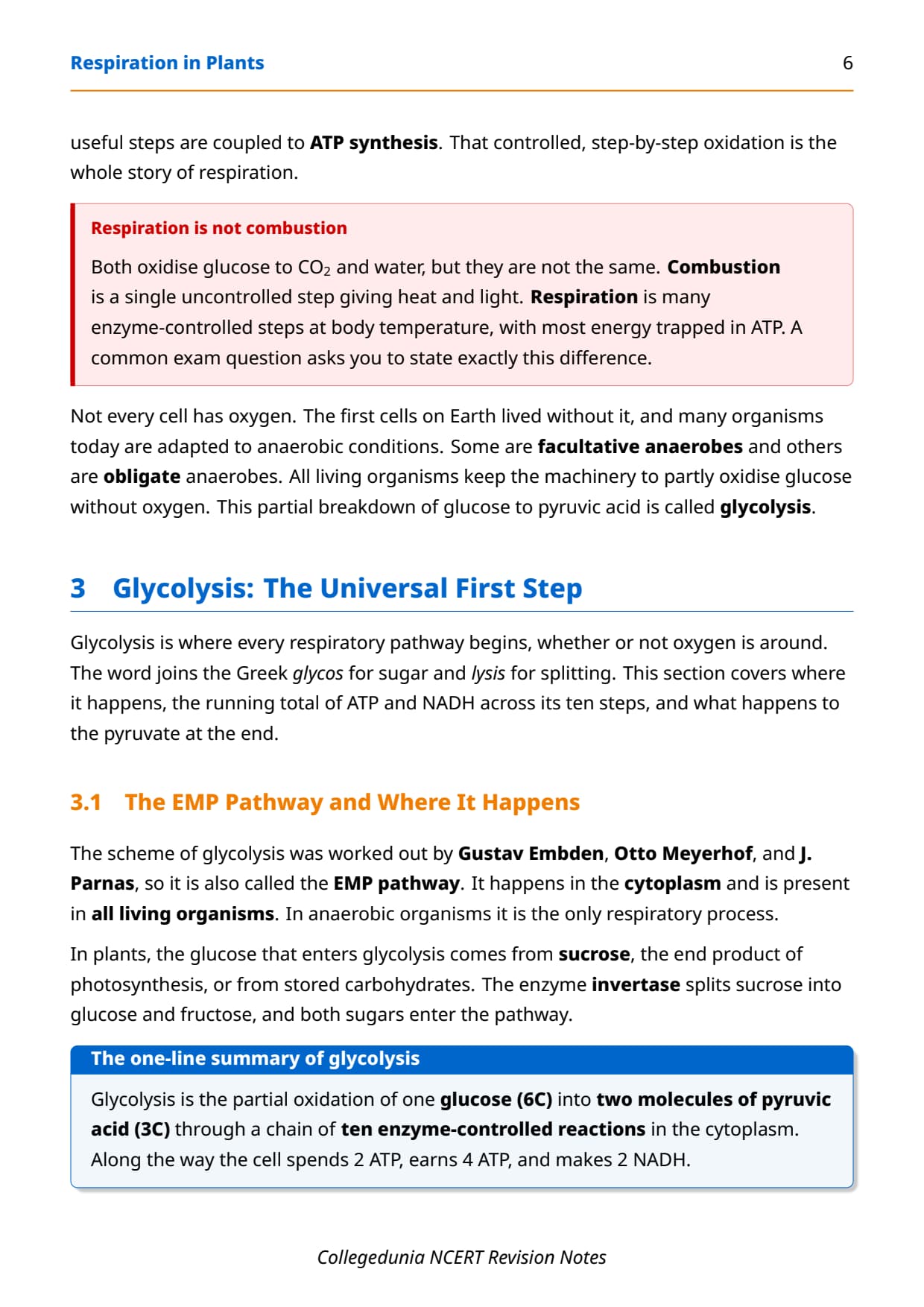
The full oxidation of glucose can be written as C6H12O6 + 6O2 → 6CO2 + 6H2O + Energy. Burning does this in a single violent step and wastes the energy as heat, but a cell does the same overall reaction in many small enzyme-controlled steps, so the useful steps are coupled to ATP synthesis. Respiration is not combustion: it is many controlled steps at body temperature, with most of the energy captured as ATP. When oxygen is absent, cells still keep the machinery to partly oxidise glucose to pyruvic acid, a step called glycolysis.
Glycolysis: The Universal First Step
Glycolysis is where every respiratory pathway begins, whether or not oxygen is around, and the word joins the Greek glycos for sugar and lysis for splitting. It happens in the cytoplasm of all living organisms and is the only respiratory process in anaerobic organisms. It was worked out by Gustav Embden, Otto Meyerhof and J. Parnas, so it is also called the EMP pathway. In plants the glucose comes from sucrose, the end product of photosynthesis, which the enzyme invertase splits into glucose and fructose.
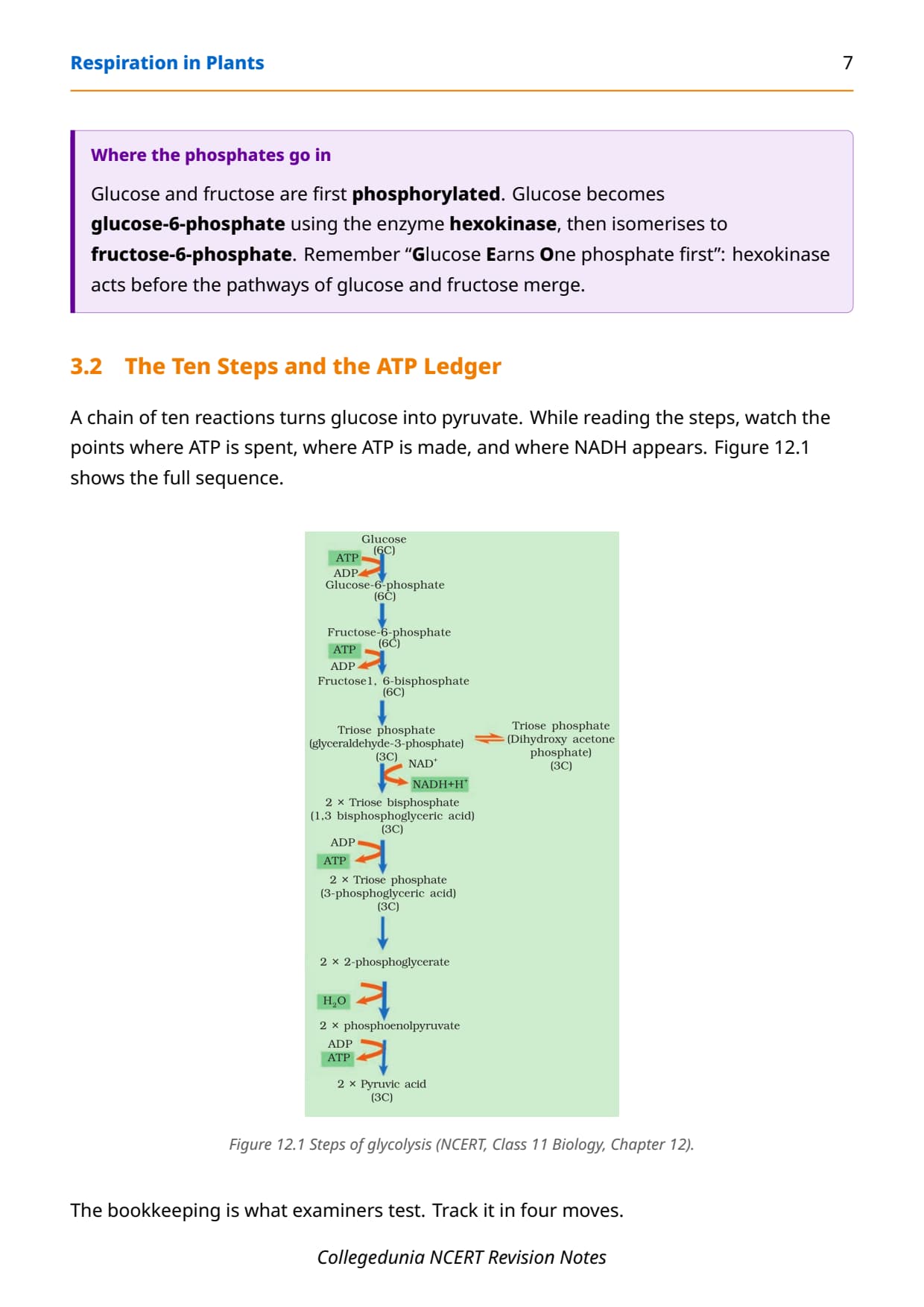
- The scheme: one glucose (6C) is partially oxidised through ten enzyme-controlled reactions into two molecules of pyruvic acid (3C).
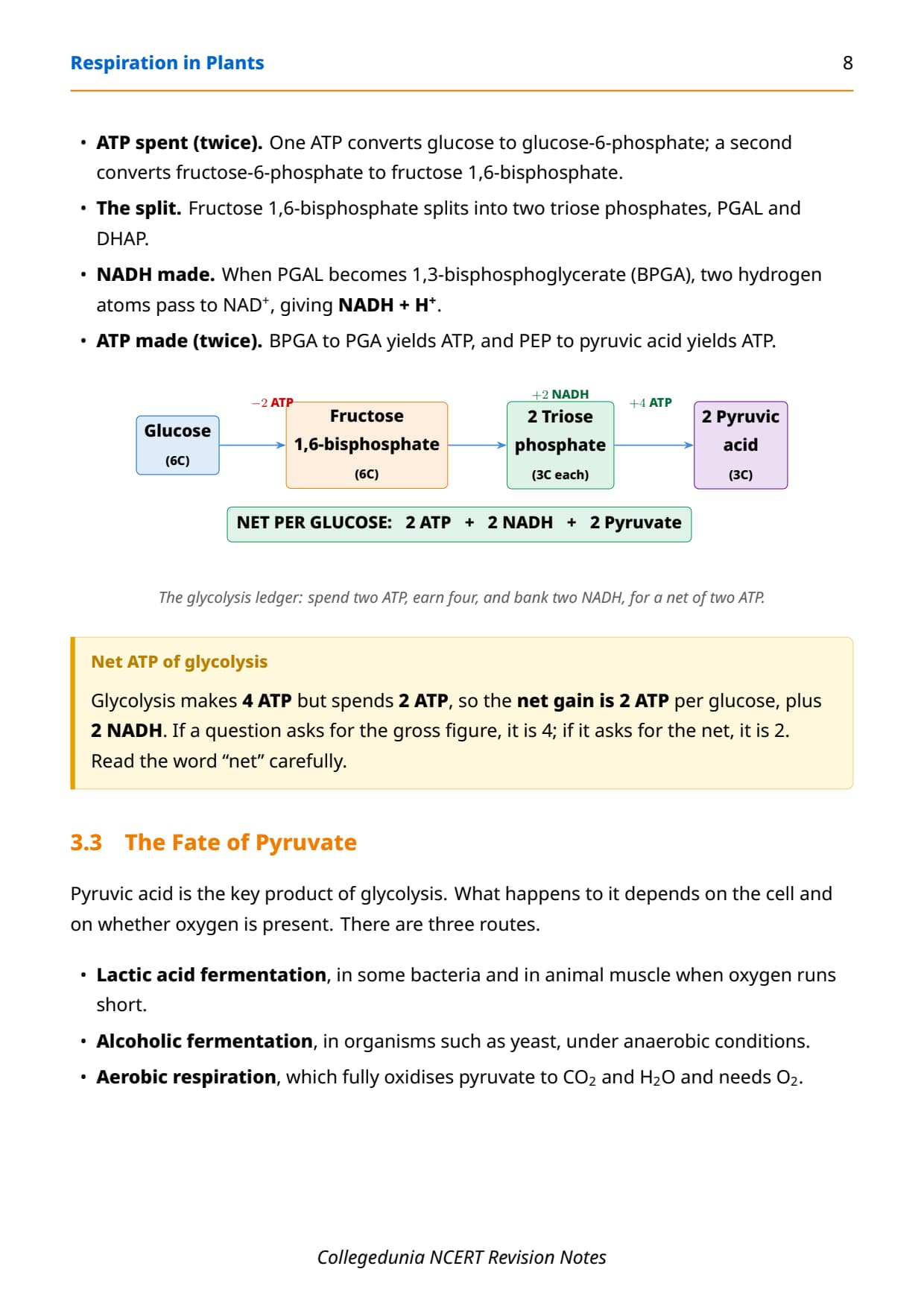
- ATP spent: one ATP converts glucose to glucose-6-phosphate, and a second converts fructose-6-phosphate to fructose 1,6-bisphosphate.
- NADH made: when PGAL becomes 1,3-bisphosphoglycerate, two hydrogen atoms pass to NAD+, giving NADH + H+.
- ATP made: two later steps, BPGA to PGA and PEP to pyruvic acid, each release ATP by substrate-level phosphorylation.
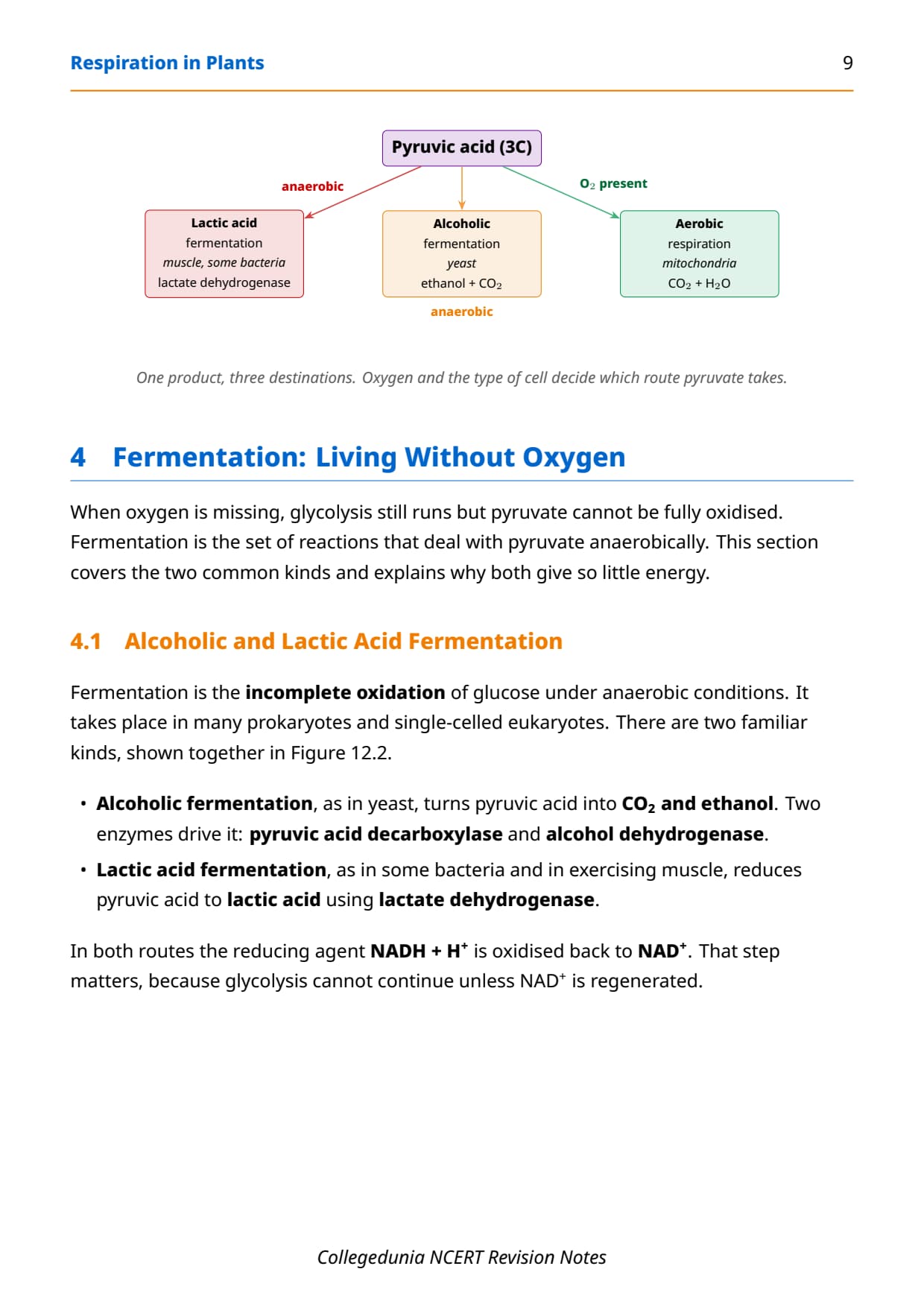
The bookkeeping is what examiners test. Glycolysis makes a gross 4 ATP but spends 2 ATP, so the net gain is 2 ATP per glucose, plus 2 NADH. Read the word "net" carefully, because a question asking for the gross figure wants 4. The pyruvic acid formed at the end has three fates: lactic acid fermentation in muscle and some bacteria, alcoholic fermentation in yeast, or full aerobic respiration in the mitochondria when oxygen is present.
Fermentation: Respiration Without Oxygen
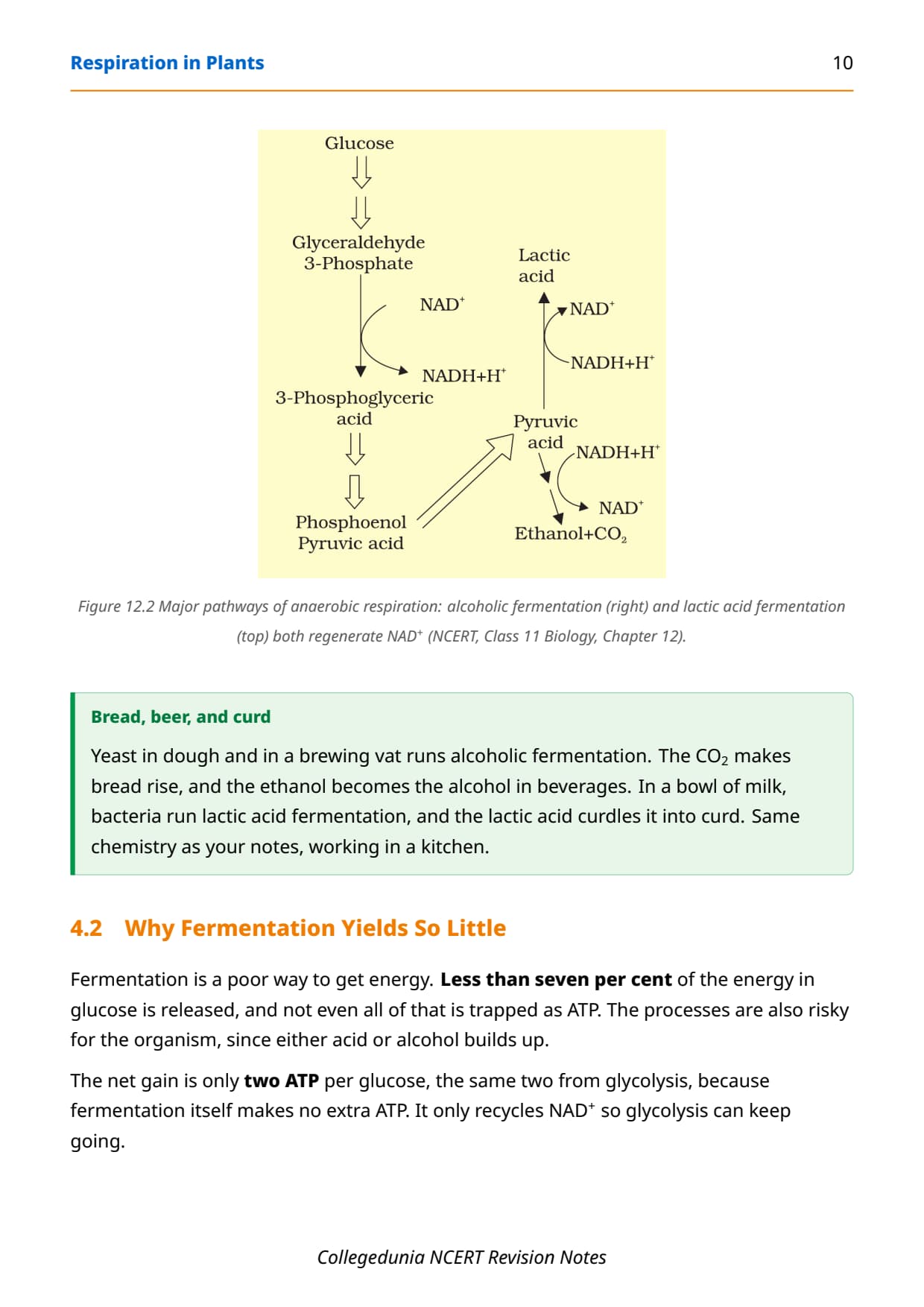
When oxygen is missing, glycolysis still runs but pyruvate cannot be fully oxidised, so fermentation deals with it anaerobically. Fermentation is the incomplete oxidation of glucose under anaerobic conditions, and it takes place in many prokaryotes and single-celled eukaryotes. There are two common kinds, and both share one job beyond disposing of pyruvate: they regenerate NAD+ so that glycolysis can keep running.
- Alcoholic fermentation: in yeast, pyruvic acid becomes CO2 and ethanol, driven by pyruvic acid decarboxylase and alcohol dehydrogenase.
- Lactic acid fermentation: in some bacteria and in exercising muscle, pyruvic acid is reduced to lactic acid by lactate dehydrogenase.
- NAD+ recycled: in both routes the reducing agent NADH + H+ is oxidised back to NAD+, which glycolysis needs to continue.
Fermentation is a poor way to get energy, because less than seven per cent of the energy in glucose is released, and the net gain is still only 2 ATP, the same two from glycolysis. Fermentation itself makes no extra ATP; its role is only to reoxidise NADH. It is also risky, since acid or alcohol builds up. Yeast, for instance, dies once the alcohol it makes reaches about 13 per cent, which is why stronger beverages need distillation rather than fermentation alone. In everyday life this same chemistry raises bread, brews beer, and curdles milk into curd.
Aerobic Respiration: Link Reaction, Krebs Cycle and ETS
When oxygen is available, eukaryotic cells send pyruvate into the mitochondria and oxidise it completely, releasing far more energy than fermentation. Aerobic respiration runs in three connected stages after glycolysis: the link reaction and the Krebs cycle in the matrix, and the electron transport system on the inner membrane. These respiration in plants class 11 notes track every carrier the pathway produces, because that is exactly what the balance sheet later cashes in for ATP.
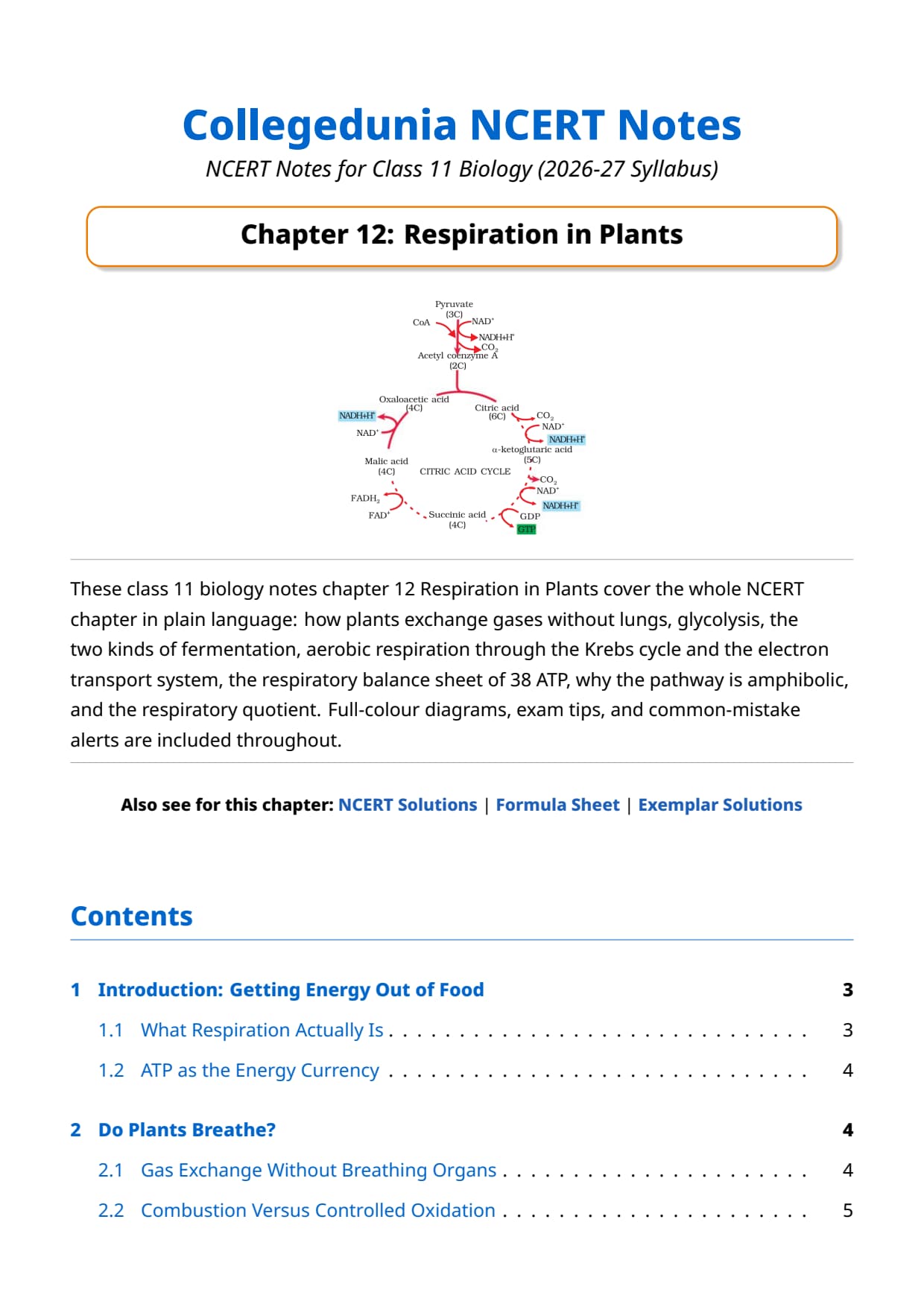
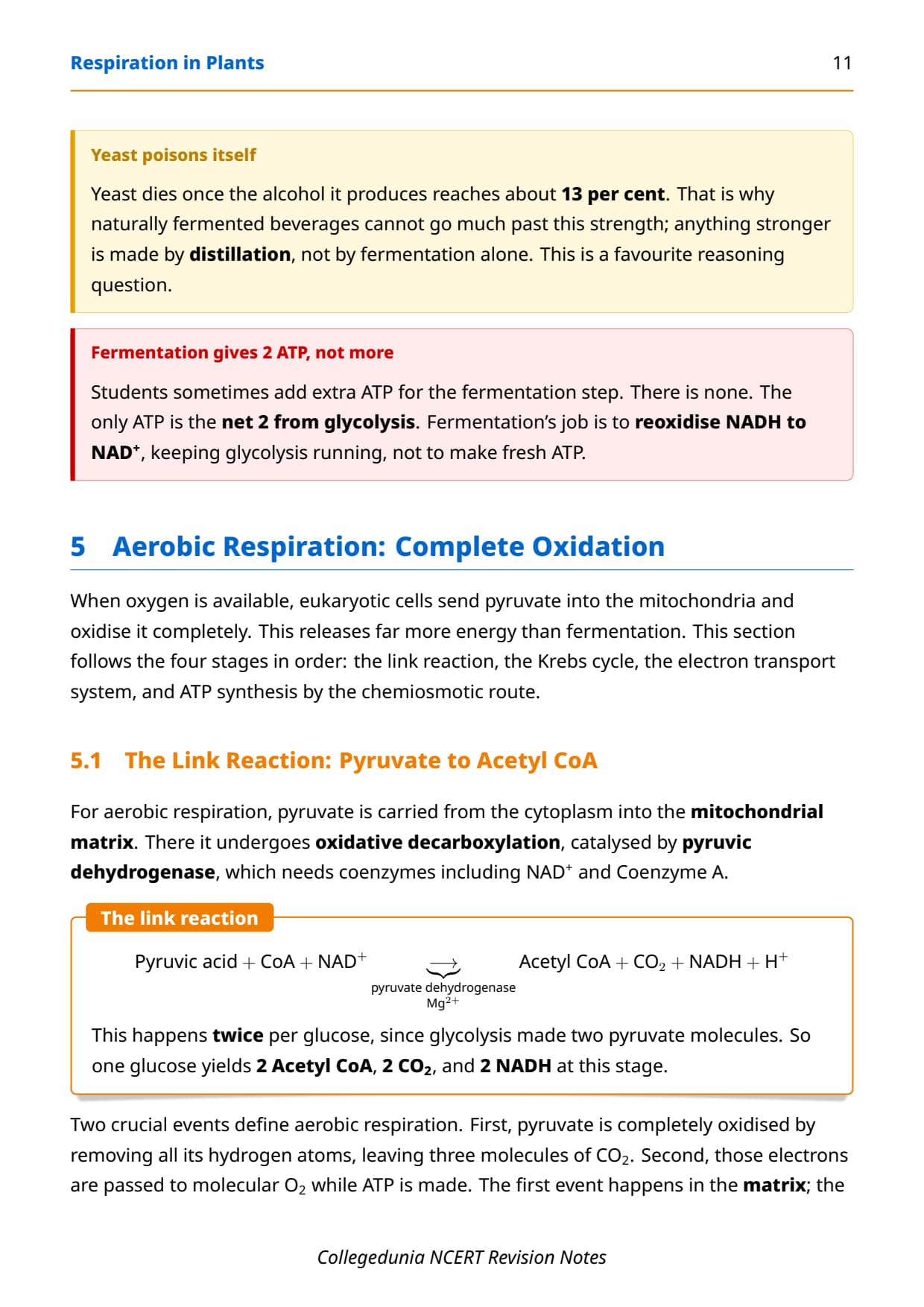
- Link reaction: pyruvate undergoes oxidative decarboxylation by pyruvic dehydrogenase to give acetyl CoA, CO2 and NADH. It runs twice per glucose, so one glucose gives 2 acetyl CoA, 2 CO2 and 2 NADH here.
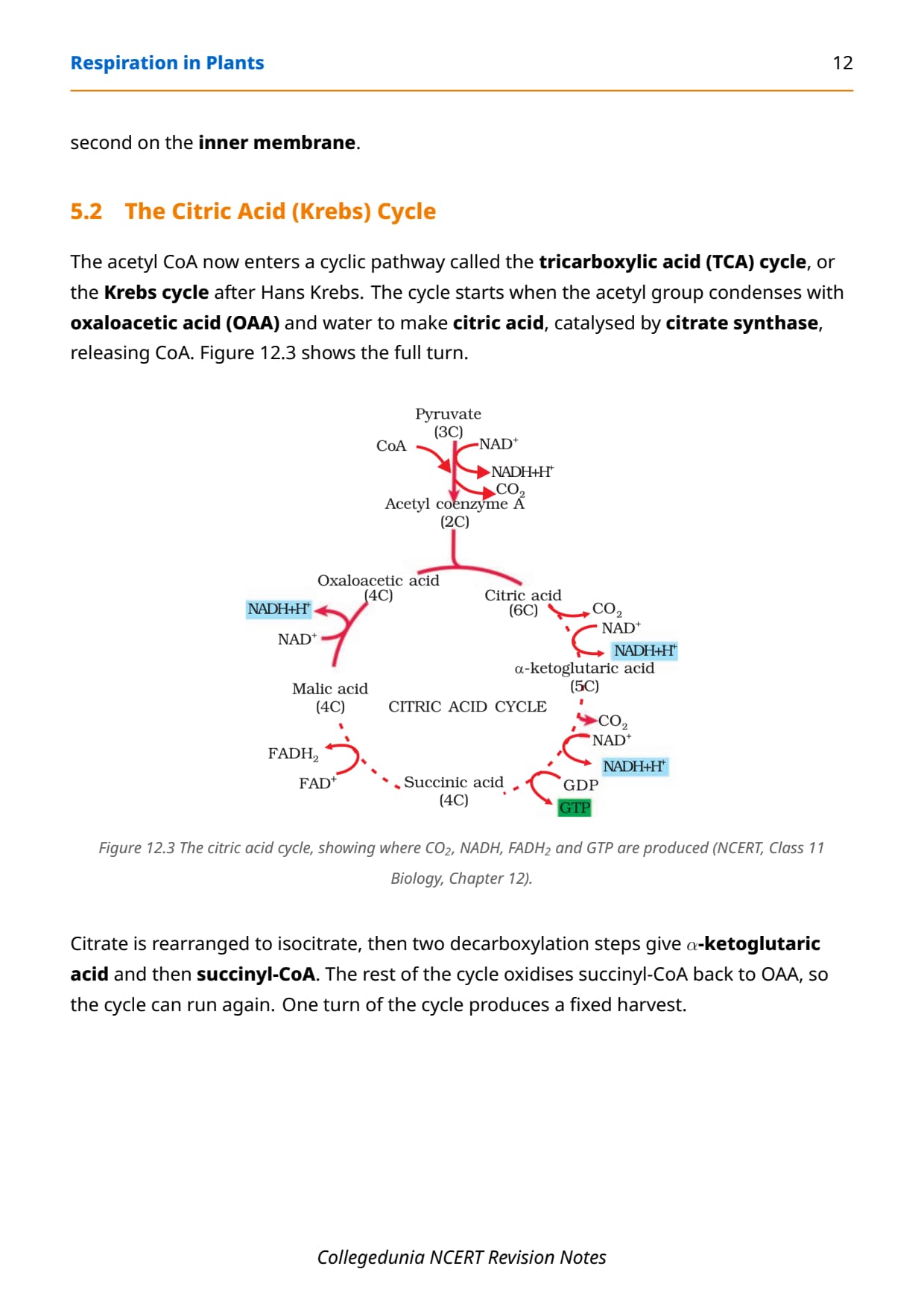
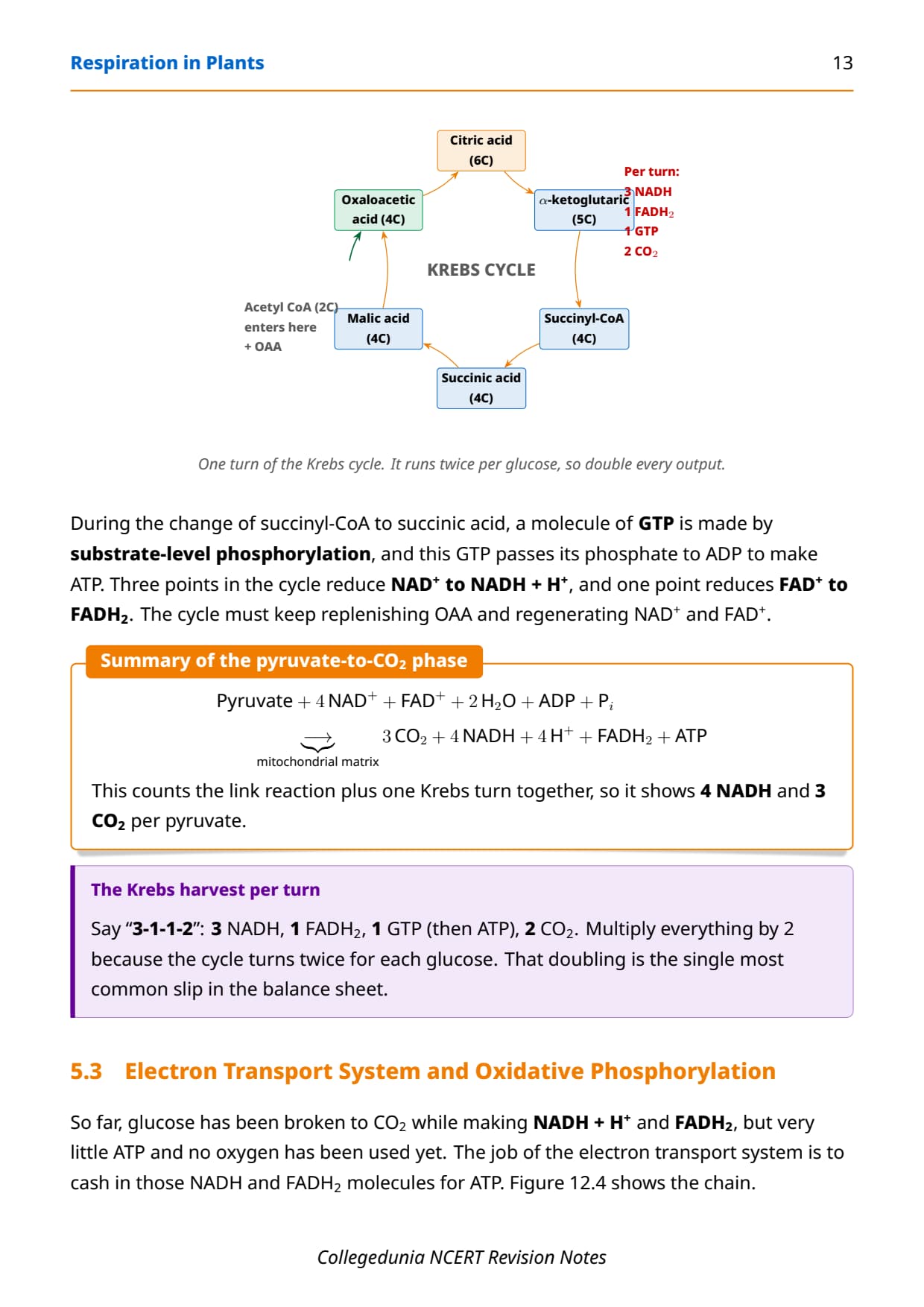
- Krebs (TCA) cycle: acetyl CoA condenses with oxaloacetic acid to form citric acid, and one full turn yields 3 NADH, 1 FADH2, 1 GTP and 2 CO2. The cycle turns twice per glucose, so double every output.
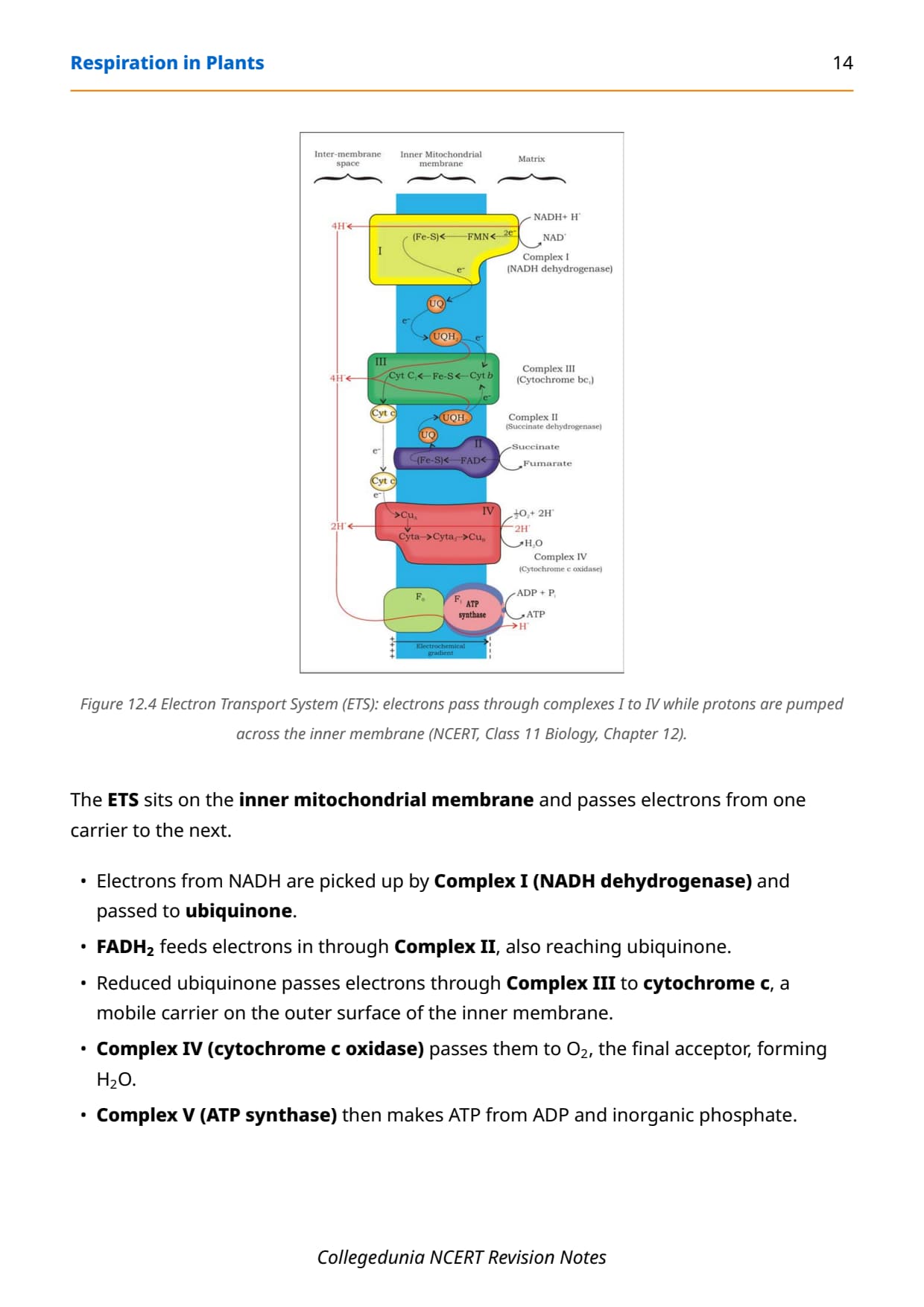
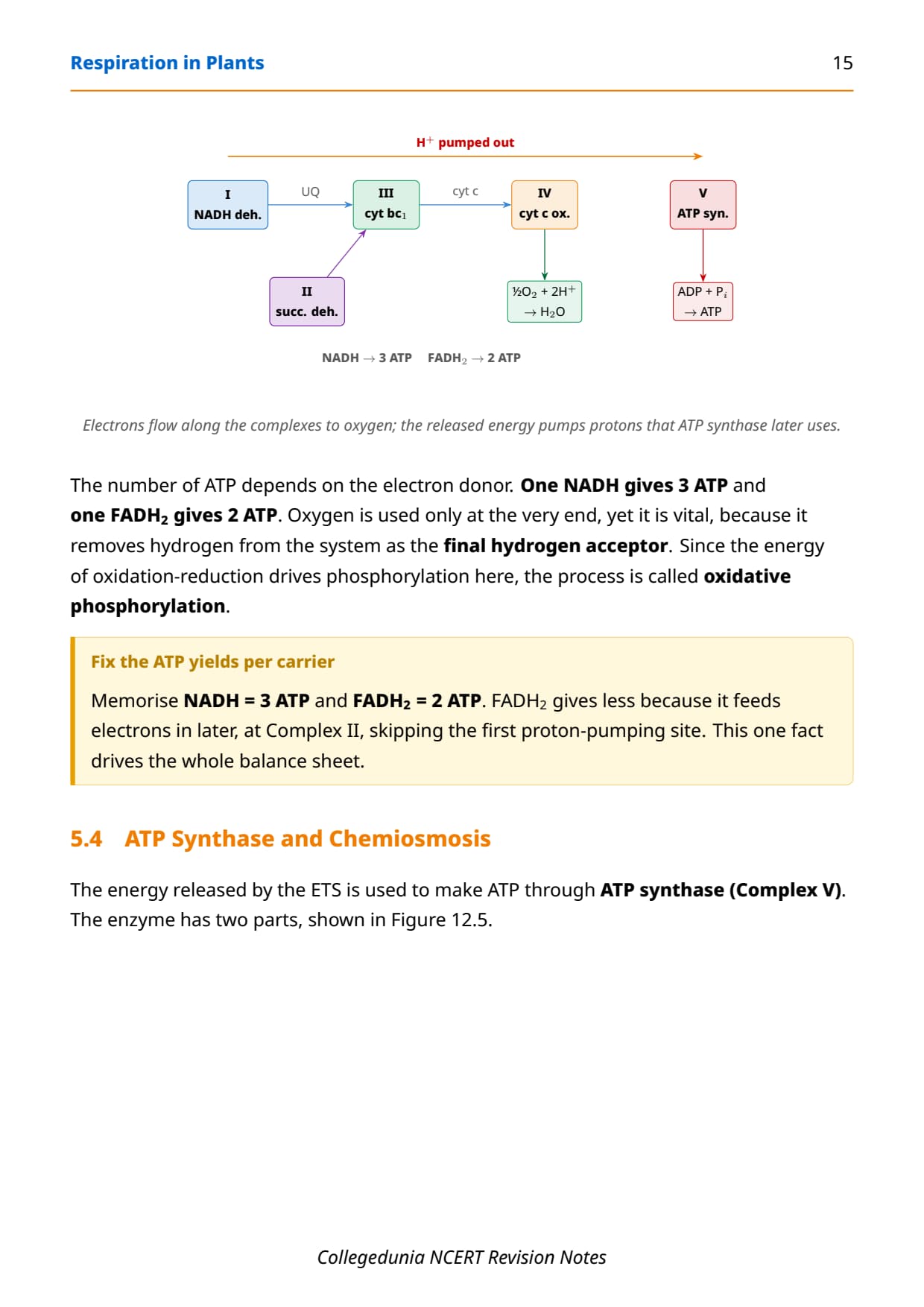
- Electron transport system: NADH and FADH2 pass electrons through complexes I to IV on the inner membrane to O2, the final acceptor, forming water.
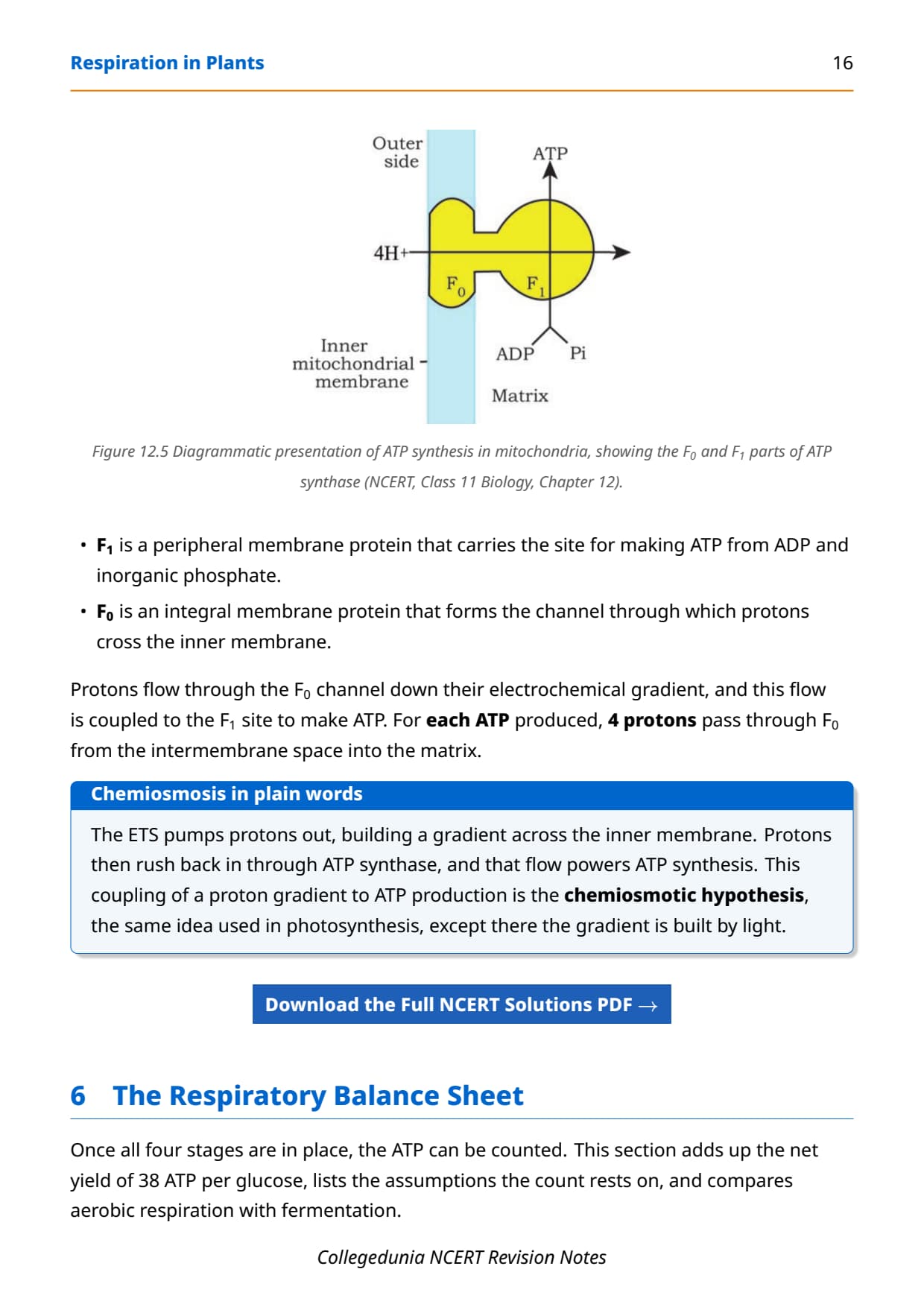
- ATP synthase (Complex V): makes ATP from ADP and inorganic phosphate as protons flow back through the F0 channel.
The number of ATP depends on the electron donor: one NADH gives 3 ATP and one FADH2 gives 2 ATP. FADH2 yields less because it feeds electrons in later, at Complex II, skipping the first proton-pumping site. Because the energy of oxidation-reduction drives phosphorylation here, the process is called oxidative phosphorylation. The ETS pumps protons out to build a gradient, and protons then rush back through ATP synthase, coupling the gradient to ATP synthesis. This coupling is the chemiosmotic hypothesis, the same idea used in photosynthesis except that there the gradient is built by light.
The Respiratory Balance Sheet: Counting 38 ATP
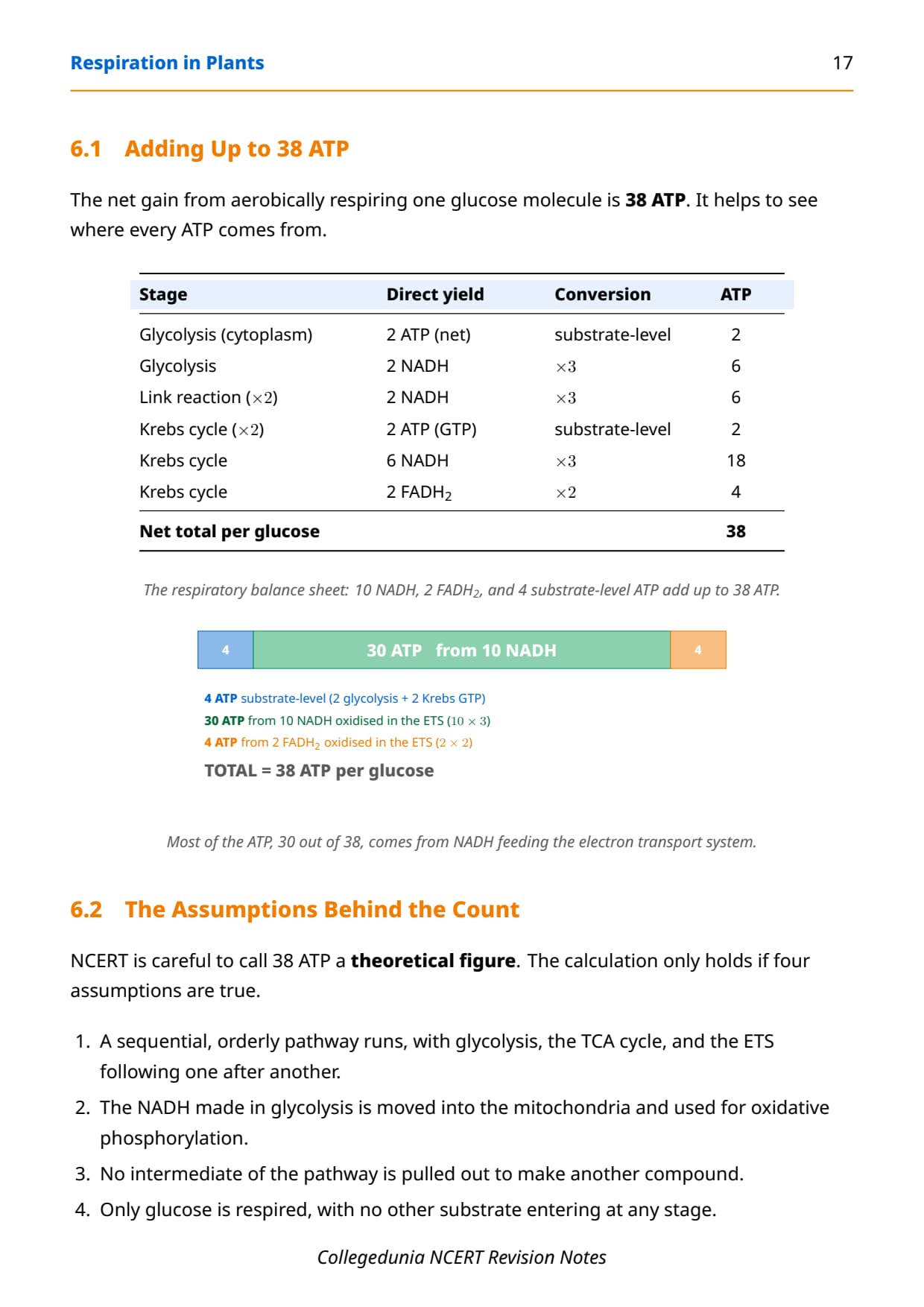
Once all four stages are in place, the ATP can be added up. The net gain from aerobically respiring one glucose is a theoretical 38 ATP, and it helps to see where every ATP comes from. The table below is the single most quoted item from this chapter, so learn each row rather than just the total.
| Stage | Direct yield | Conversion | ATP |
|---|---|---|---|
| Glycolysis (cytoplasm) | 2 ATP (net) | substrate-level | 2 |
| Glycolysis | 2 NADH | × 3 | 6 |
| Link reaction (× 2) | 2 NADH | × 3 | 6 |
| Krebs cycle (× 2) | 2 ATP (GTP) | substrate-level | 2 |
| Krebs cycle | 6 NADH | × 3 | 18 |
| Krebs cycle | 2 FADH2 | × 2 | 4 |
| Net total per glucose | 38 |
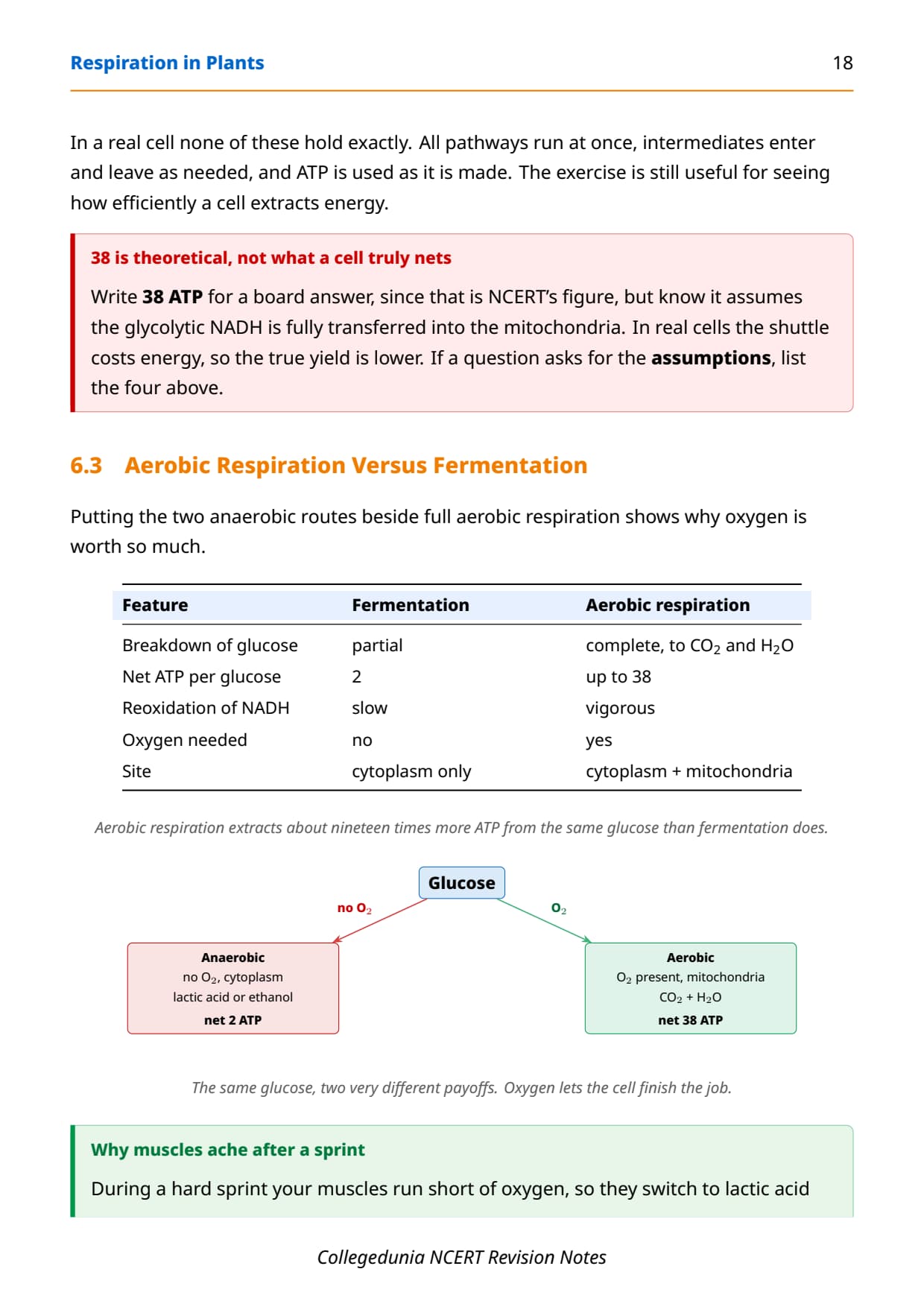
Notice that 30 of the 38 ATP come from the 10 NADH feeding the electron transport system, with 4 substrate-level ATP and 4 more from the 2 FADH2. NCERT is careful to call 38 a theoretical figure, because the calculation only holds under four assumptions: the pathways run sequentially, the glycolytic NADH is fully shuttled into the mitochondria, no intermediate is withdrawn, and only glucose is respired. In a real cell none of these hold exactly, so write 38 for a board answer but know the true yield is lower. Against fermentation's net of 2 ATP, aerobic respiration extracts roughly nineteen times more energy from the same glucose.
Amphibolic Pathway and the Respiratory Quotient
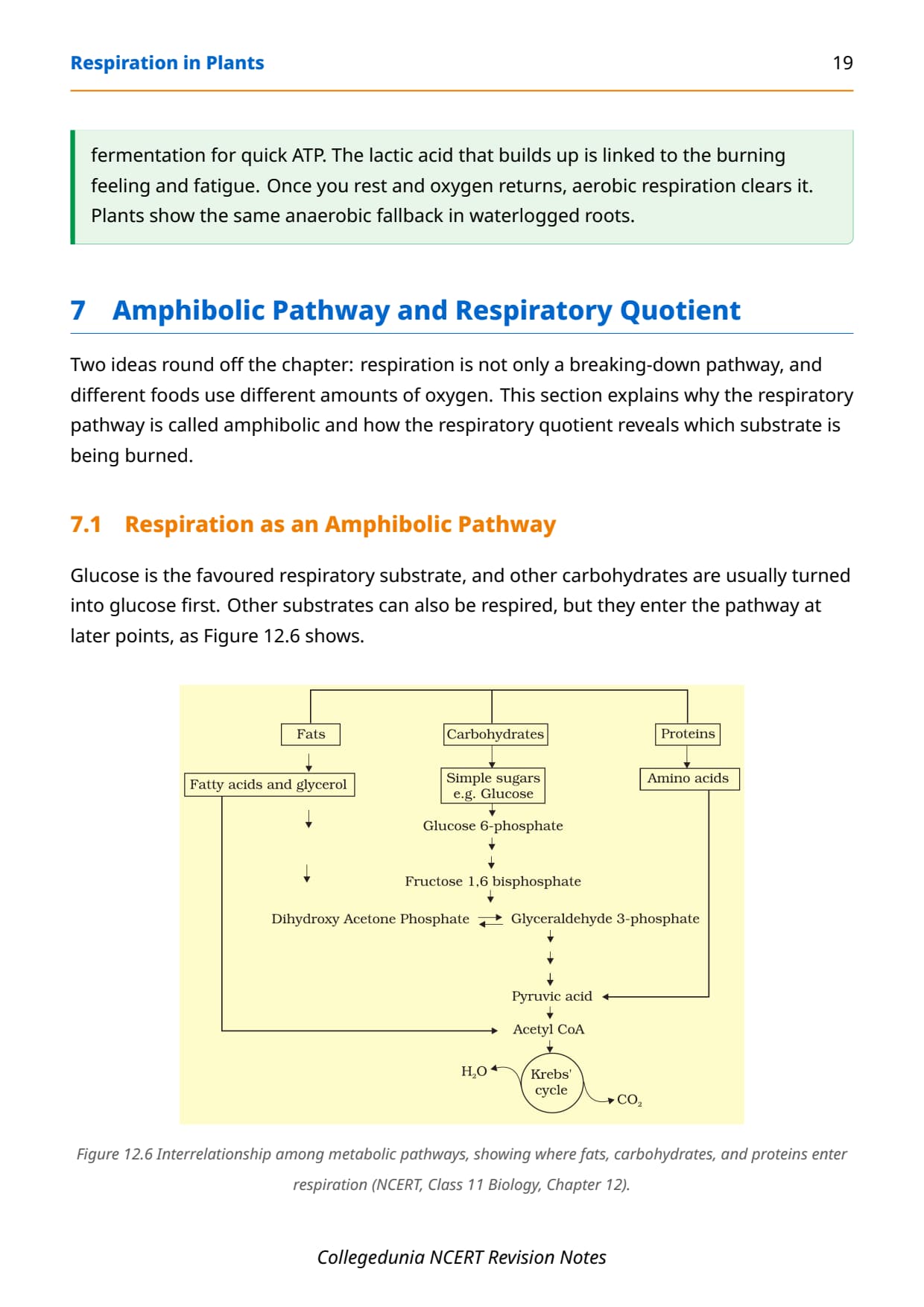
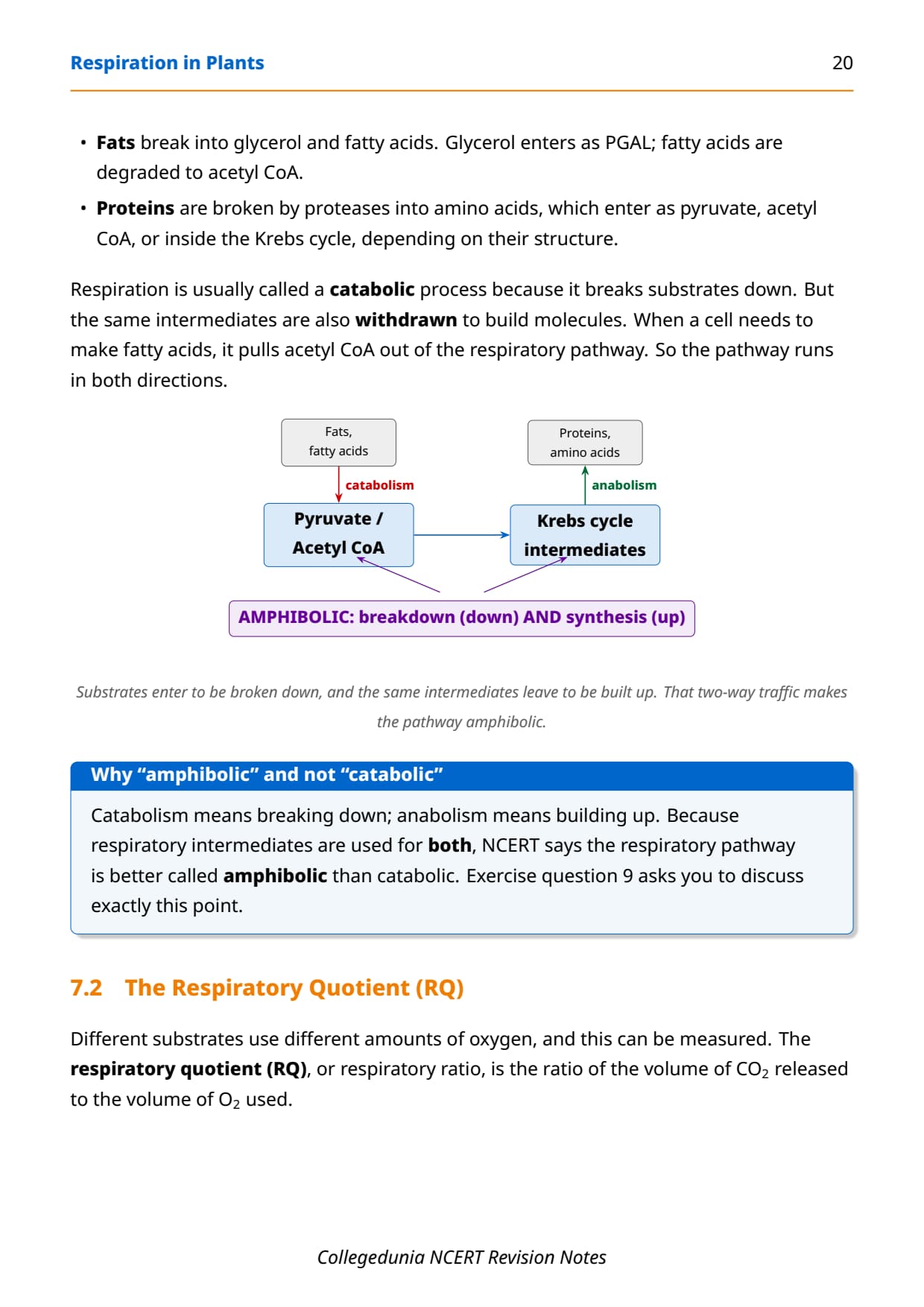
Two ideas round off the chapter. First, respiration is not only a breaking-down pathway. Glucose is the favoured substrate, but fats and proteins can also be respired, entering at later points. Fats break into glycerol, which enters as PGAL, and fatty acids, which become acetyl CoA, while proteins are broken to amino acids that enter as pyruvate, acetyl CoA or Krebs intermediates. Because the same intermediates are also withdrawn to build molecules, the respiratory pathway is called amphibolic rather than simply catabolic.
- Catabolism: substrates such as fats and proteins are broken down and fed into respiration for energy.
- Anabolism: intermediates like acetyl CoA are pulled out to build fatty acids and other molecules.
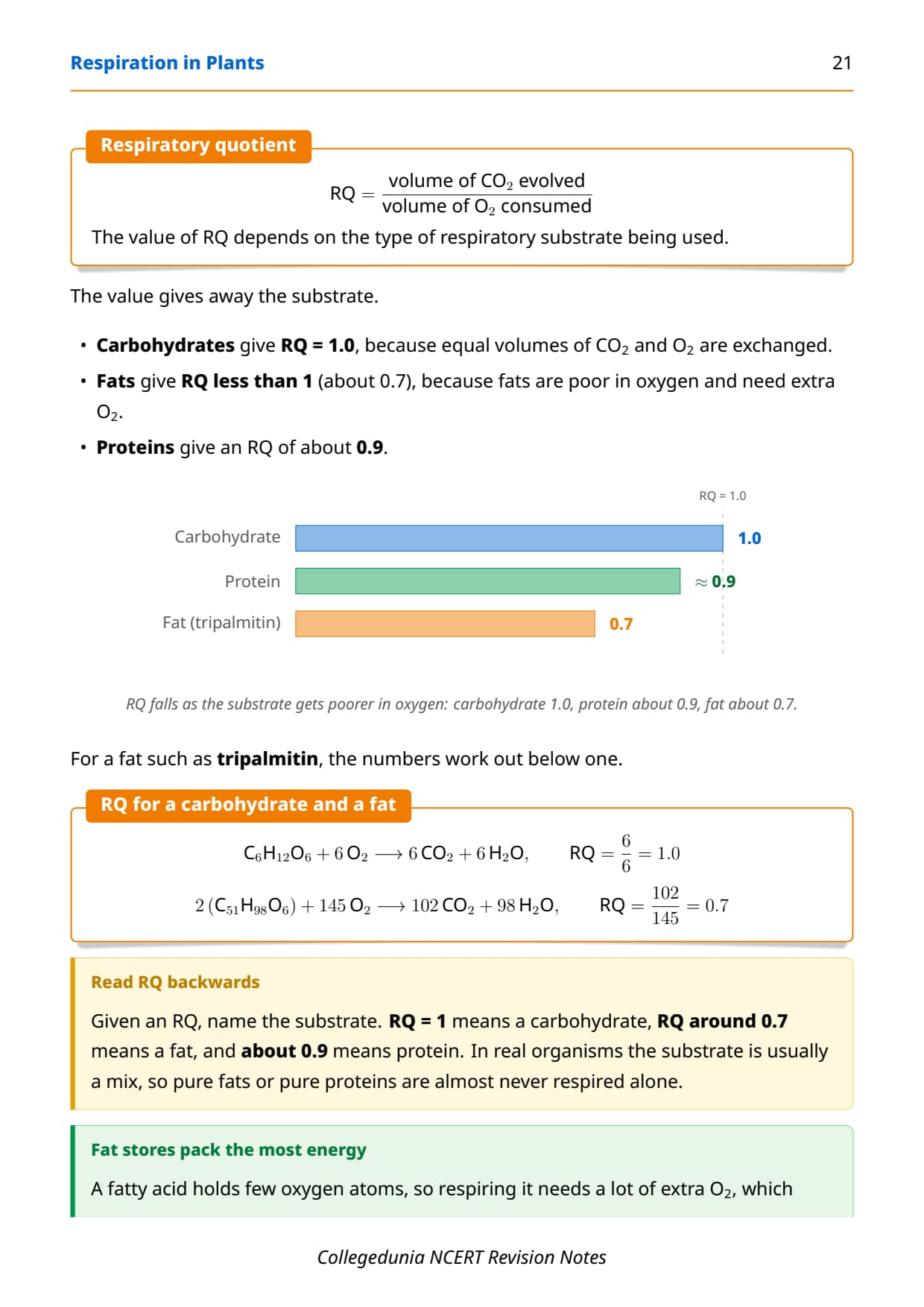
- Respiratory quotient (RQ): the ratio of the volume of CO2 evolved to the volume of O2 consumed, which reveals the substrate being used.
The RQ formula is RQ = volume of CO2 evolved ÷ volume of O2 consumed, and its value gives away the substrate. Carbohydrates give RQ = 1.0, fats give about 0.7, and proteins give about 0.9. A carbohydrate like glucose exchanges equal volumes of the two gases, so 6CO2 ÷ 6O2 = 1.0, while a fat such as tripalmitin is poor in oxygen and needs extra O2, giving 102CO2 ÷ 145O2 = 0.7. Read RQ backwards in the exam: given a value, name the substrate. In real organisms the substrate is usually a mixture, so pure fats or proteins are rarely respired alone.
Key Definitions in Respiration in Plants
Board short-answer questions often ask for a clean definition in one or two lines, and a vague answer loses easy marks. Learn these word-for-word, because the wording of the exam question is usually built straight from the NCERT definition. Each term below also connects to a stage or figure you can be asked to explain.
| Term | Definition |
|---|---|
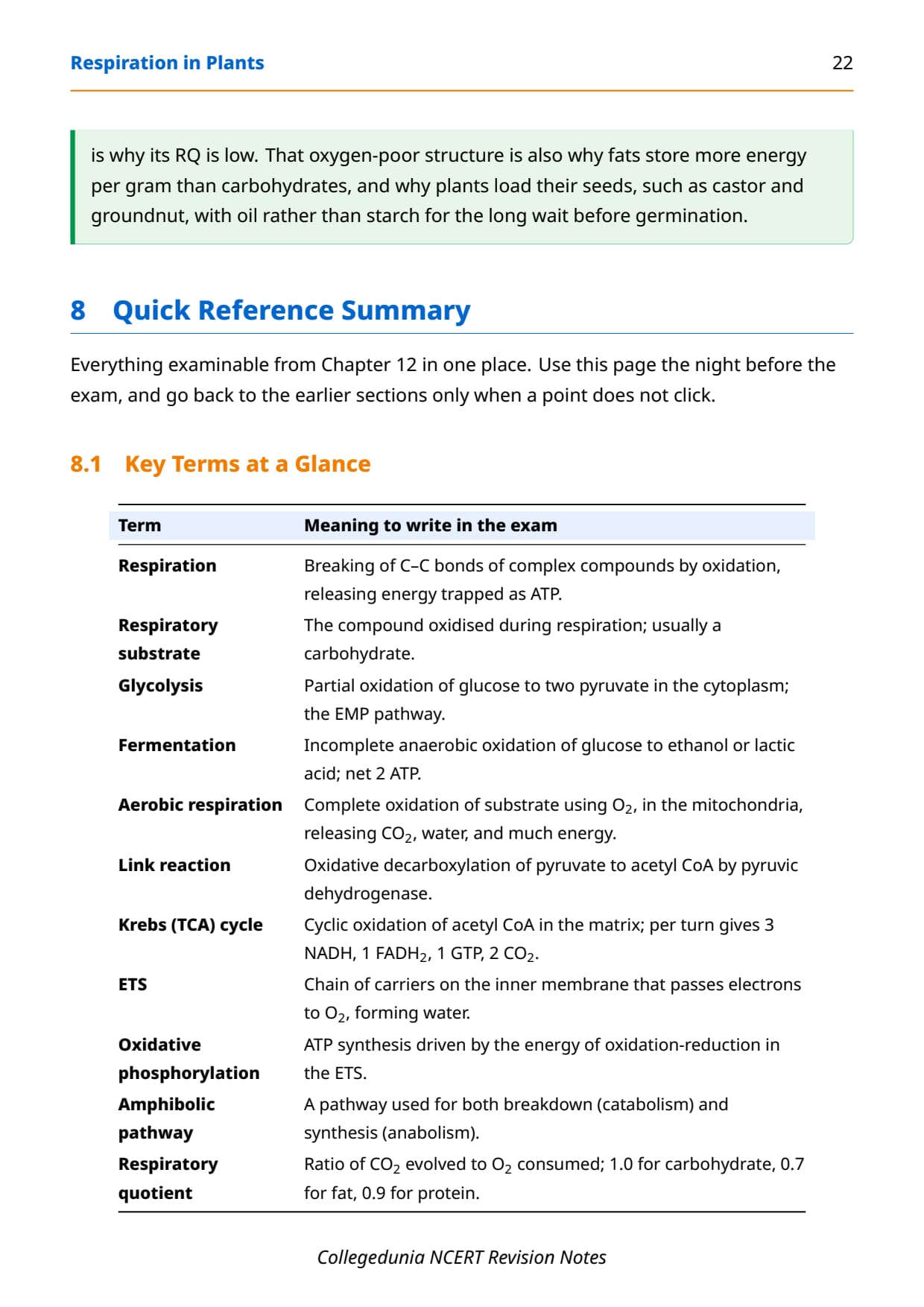
| Respiration | Breaking of the C-C bonds of complex compounds by oxidation inside cells, releasing energy trapped as ATP. |
| Glycolysis | Partial oxidation of one glucose to two pyruvate in the cytoplasm; the EMP pathway; net 2 ATP and 2 NADH. |
| Fermentation | Incomplete anaerobic oxidation of glucose to ethanol or lactic acid, with a net gain of only 2 ATP. |
| Link reaction | Oxidative decarboxylation of pyruvate to acetyl CoA by pyruvic dehydrogenase in the matrix. |
| Krebs (TCA) cycle | Cyclic oxidation of acetyl CoA in the matrix; per turn gives 3 NADH, 1 FADH2, 1 GTP and 2 CO2. |
| Oxidative phosphorylation | ATP synthesis driven by the energy of oxidation-reduction as electrons pass down the ETS to O2. |
| Respiratory quotient | Ratio of CO2 evolved to O2 consumed; 1.0 for carbohydrate, 0.7 for fat, 0.9 for protein. |
A common board question asks you to define oxidative phosphorylation and then explain why O2 is vital even though it is used only at the end. State the definition first, then add that oxygen acts as the final hydrogen acceptor that keeps the whole chain running. Learning these definitions makes the wording of almost every one-mark and two-mark question in this chapter familiar.
Common Mistakes Students Make in Respiration in Plants
These slips happen because two numbers or two terms look alike, not because the concept is hard. Each one costs 1 to 2 marks in the paper, so watch for them at the exact step where they occur.
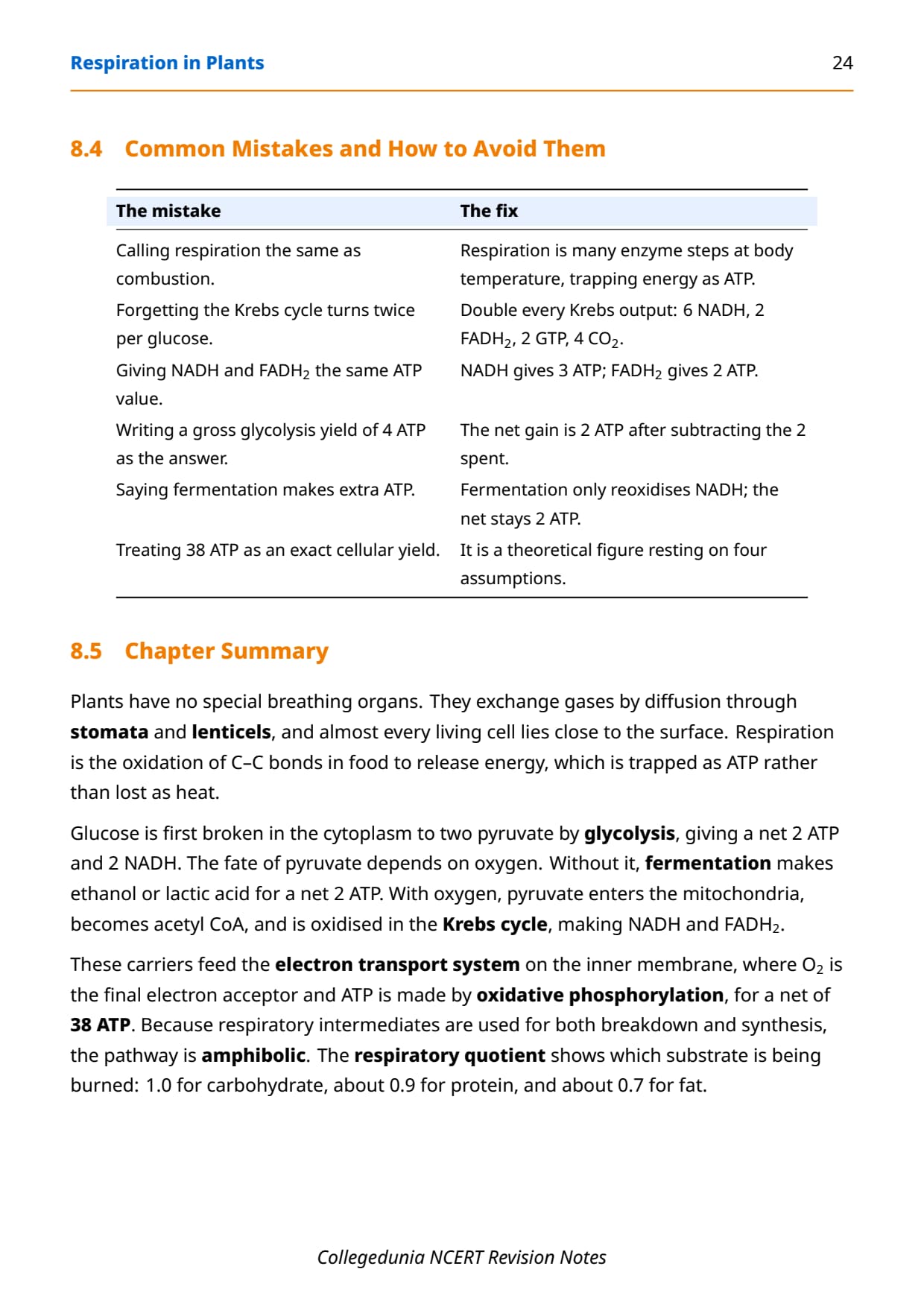
Mistake 1: Calling respiration the same as combustion. Both oxidise glucose to CO2 and water, but respiration is many enzyme-controlled steps at body temperature, trapping energy as ATP, while combustion is one uncontrolled step giving heat and light.
Mistake 2: Forgetting the Krebs cycle turns twice per glucose. Double every Krebs output to 6 NADH, 2 FADH2, 2 GTP and 4 CO2.
Mistake 3: Giving NADH and FADH2 the same ATP value. NADH gives 3 ATP; FADH2 gives 2 ATP, because it enters the chain later at Complex II.
Mistake 4: Writing the gross glycolysis yield of 4 ATP as the answer. The net gain is 2 ATP after subtracting the 2 spent.
Mistake 5: Saying fermentation makes extra ATP. It only reoxidises NADH to NAD+; the net stays 2 ATP from glycolysis.
Respiration in Plants Weightage in CBSE Boards, NEET and CUET
This chapter is one of the most scoring in the unit, because the pathways are fixed and the numbers are easy to reproduce once learnt. It appears every year as a pathway question, a balance-sheet calculation, or a reasoning question on RQ. Here is how the marks split across the main exams for 2026-27.
| Exam | Typical weightage | What is asked |
|---|---|---|
| CBSE Boards | 5 to 6 marks | One long answer on the aerobic pathway or the 38 ATP balance sheet plus a short answer on glycolysis, fermentation or RQ |
| NEET | 2 to 3 questions | ATP yields, the Krebs cycle harvest, ETS complexes, chemiosmosis, and RQ values |
| CUET | 1 to 2 objective questions | Definitions, the site of each stage, and the respiratory quotient of a named substrate |
The 38 ATP balance sheet and the per-carrier ATP yields are the single most tested ideas from this chapter across all three exams. Master the ATP ledger first, then the Krebs cycle harvest, then the respiratory quotient, in that order of return on effort for the 2026-27 session.
How to Revise Respiration in Plants Quickly
Use these respiration in plants class 11 notes for a fast, ordered recap the night before a test. The checklist below takes about 25 minutes and hits every marks-heavy idea in the chapter without opening the full textbook.
- First 8 minutes: write the four stages in order with their sites, then reproduce the 38 ATP balance sheet table from memory.
- Next 8 minutes: write the net ATP of glycolysis and fermentation, and the per-turn harvest of the Krebs cycle, doubling it for one glucose.
- Last 9 minutes: state why FADH2 yields less than NADH, and match RQ values of 1.0, 0.9 and 0.7 to carbohydrate, protein and fat.
Close the loop by explaining why 38 ATP is only a theoretical figure and listing the four assumptions. If you can do all three blocks without notes, the chapter is exam-ready. Keep the balance sheet and the RQ values beside you for the first pass only, then try the whole checklist closed-book.
Student Feedback on the Respiration in Plants Notes
What 12,140 students told us about their Respiration in Plants revision:
- 74% of students rated the 38 ATP balance sheet as the part most worth memorising for the exam.
- Most-confused pair: the ATP yield of NADH versus FADH2, mixed up by about 3 in 10 students.
- Students who learnt the Krebs harvest as "3-1-1-2" and remembered to double it said the balance-sheet questions felt easy afterwards.
Source: 2026-27 Class 11 Biology student poll. Sample of 12,140 students from CBSE schools across 15 states, conducted before the 2026 boards.
Other Respiration in Plants Class 11 Biology Resources
Pair these notes with the solved answers, the formula sheet, and the textbook PDFs for the same chapter.
| Resource | Link |
|---|---|
| NCERT Solutions | Respiration in Plants Class 11 NCERT Solutions |
| Formula Sheet | Respiration in Plants Class 11 Formula Sheet |
| Exemplar Solutions | Respiration in Plants Class 11 Exemplar Solutions |
| NCERT Book PDF | Respiration in Plants Class 11 Book PDF |
| Exemplar Book PDF | Respiration in Plants Class 11 Exemplar Book PDF |
NCERT Notes for Class 11 Biology: All Chapters
Jump to the revision notes for any other Class 11 Biology chapter below.
| Chapter | NCERT Notes |
|---|---|
| Chapter 1 | The Living World |
| Chapter 2 | Biological Classification |
| Chapter 3 | Plant Kingdom |
| Chapter 4 | Animal Kingdom |
| Chapter 5 | Morphology of Flowering Plants |
| Chapter 6 | Anatomy of Flowering Plants |
| Chapter 7 | Structural Organisation in Animals |
| Chapter 8 | Cell The Unit of Life |
| Chapter 9 | Biomolecules |
| Chapter 10 | Cell Cycle and Cell Division |
| Chapter 11 | Photosynthesis in Higher Plants |
| Chapter 12 | Respiration in Plants |
| Chapter 13 | Plant Growth and Development |
| Chapter 14 | Breathing and Exchange of Gases |
| Chapter 15 | Body Fluids and Circulation |
| Chapter 16 | Excretory Products and their Elimination |
| Chapter 17 | Locomotion and Movement |
| Chapter 18 | Neural Control and Coordination |
| Chapter 19 | Chemical Coordination and Integration |
FAQs on Respiration in Plants Class 11 Biology Notes
Respiration in Plants Notes - Frequently Asked Questions
Ques. What topics do the respiration in plants class 11 notes cover?
Ans. These respiration in plants class 11 notes cover how plants exchange gases through stomata and lenticels, glycolysis and the EMP pathway, alcoholic and lactic acid fermentation, the link reaction, the Krebs cycle, the electron transport system, oxidative phosphorylation and chemiosmosis, the 38 ATP balance sheet with its four assumptions, why respiration is an amphibolic pathway, and the respiratory quotient. Every key definition, number and example is included for fast revision.
Ques. How many ATP are produced in aerobic respiration of one glucose?
Ans. The complete aerobic respiration of one glucose gives a theoretical net of 38 ATP. This comes from 2 net ATP in glycolysis, 2 GTP-derived ATP in the Krebs cycle, and the rest from the ETS, where 10 NADH give 30 ATP and 2 FADH2 give 4 ATP. NCERT calls 38 a theoretical figure because it assumes the glycolytic NADH is fully shuttled into the mitochondria and no intermediates are withdrawn. In real cells the true yield is somewhat lower.
Ques. Why does NADH yield more ATP than FADH2?
Ans. One NADH yields 3 ATP while one FADH2 yields 2 ATP. NADH donates its electrons at Complex I, so they pass through all the proton-pumping sites of the electron transport system. FADH2 feeds its electrons in later, at Complex II, skipping the first pumping site, so fewer protons are pumped and less ATP is made. This single fact drives the whole respiratory balance sheet.
Ques. What is the difference between fermentation and aerobic respiration?
Ans. Fermentation is the incomplete, anaerobic oxidation of glucose to ethanol or lactic acid in the cytoplasm, with a net gain of only 2 ATP. Aerobic respiration completely oxidises glucose to CO2 and water using oxygen, in the cytoplasm and mitochondria, releasing up to 38 ATP. Fermentation only reoxidises NADH to keep glycolysis running, while aerobic respiration vigorously reoxidises NADH through the ETS, which is why oxygen raises the energy yield about nineteen times.
Ques. Why is the respiratory pathway called amphibolic?
Ans. Respiration is usually called catabolic because it breaks substrates down, but its intermediates are also withdrawn to build molecules. Fats and proteins are broken down and fed in as glycerol, fatty acids or amino acids, while acetyl CoA is pulled out to make fatty acids when the cell needs them. Because the pathway serves both breakdown and synthesis, NCERT says it is better called amphibolic than catabolic.
Ques. What is the respiratory quotient and what are its values?
Ans. The respiratory quotient (RQ) is the ratio of the volume of CO2 evolved to the volume of O2 consumed during respiration. Its value reveals the substrate being oxidised: a carbohydrate gives RQ = 1.0 because equal volumes of the two gases are exchanged, a fat gives about 0.7 because it is poor in oxygen and needs extra O2, and a protein gives about 0.9. In real organisms a mixture of substrates is usually respired.
Ques. What is the weightage of this chapter in the CBSE board exam?
Ans. Respiration in Plants carries about 5 to 6 marks in the CBSE Class 11 Biology paper, usually one long answer on the aerobic pathway or the 38 ATP balance sheet plus a short answer on glycolysis, fermentation or the respiratory quotient. It also appears in NEET and CUET as objective questions on ATP yields, the Krebs cycle harvest, the ETS complexes and RQ, which makes it a high-return chapter for the 2026-27 session.



Comments