



These the living world class 11 notes bring together every definition, rule, and taxonomy idea that the CBSE Boards, NEET and CUET papers actually test in 2026-27. Revise the whole chapter fast, with what counts as living, the rules of binomial nomenclature, and the full taxonomic hierarchy from species up to kingdom in one place.
This is the first chapter of the NCERT textbook, and the naming and classification vocabulary you learn here returns in every later chapter of Class 11 Biology.
- CBSE Weightage: 3 to 5 marks, usually one short answer on nomenclature plus one question on the taxonomic hierarchy.
- Topics covered: diversity in the living world, biodiversity, the defining traits of living organisms, nomenclature and binomial naming, classification, taxonomy, systematics, the seven taxonomic categories, and taxonomical aids.
- Key rules: the four rules of binomial nomenclature, the two naming codes ICBN and ICZN, and the golden rule of the hierarchy.
These the living world class 11 notes are curated by subject experts, based on the 2026-27 NCERT textbook, and checked against the last five years of CBSE Board and NEET papers.
Topic-by-Topic Summary of The Living World
The chapter builds the language biologists use to describe, name, and sort the variety of life on earth. It starts with how vast that variety is, moves to giving each organism one worldwide name, and ends with the ladder of ranks that places every organism in a group. Here is the quick map of what each topic gives you before you revise the detail.
- Diversity and biodiversity: the range of living organisms on earth, described as 1.7 to 1.8 million species so far.
- Defining traits of living organisms: metabolism, cellular organisation, and consciousness as the traits that truly define life.
- Nomenclature: standardising names so one organism is known by the same name worldwide, under the codes ICBN and ICZN.
- Binomial nomenclature: the two-word naming system of genus plus specific epithet, given by Carolus Linnaeus.
- Classification, taxonomy and systematics: the process of grouping organisms and the study of their evolutionary relationships.
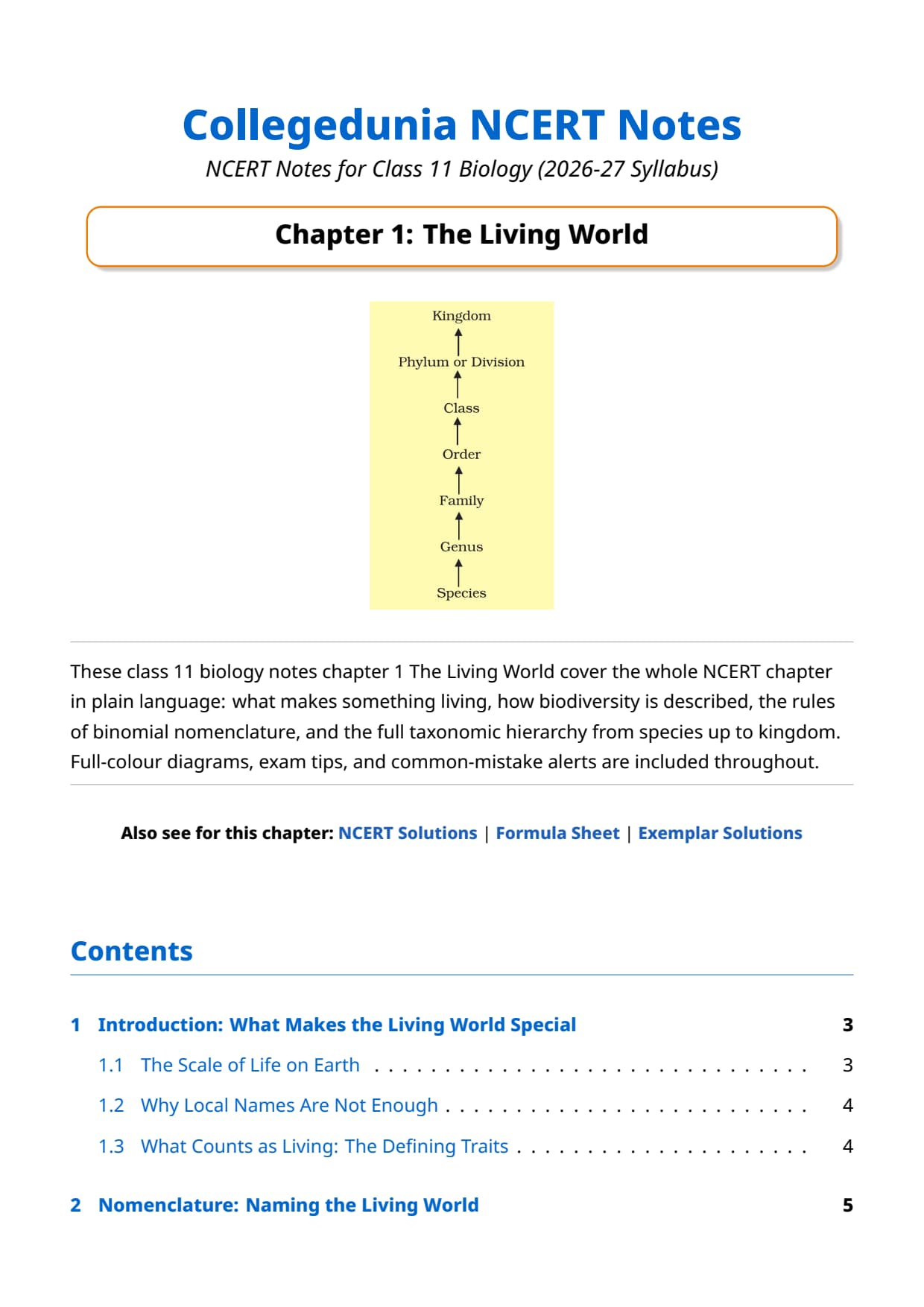
- Taxonomic categories and hierarchy: the seven ranks from species up to kingdom, and the golden rule that shared characters fall as you climb.
Revise the topics in this order, because each one uses the one before it. Master the taxonomic hierarchy first, and the naming rules and definitions fall into place around it. These the living world class 11 notes follow the same sequence as the NCERT textbook.
Diversity in the Living World: Biodiversity and What Is Living
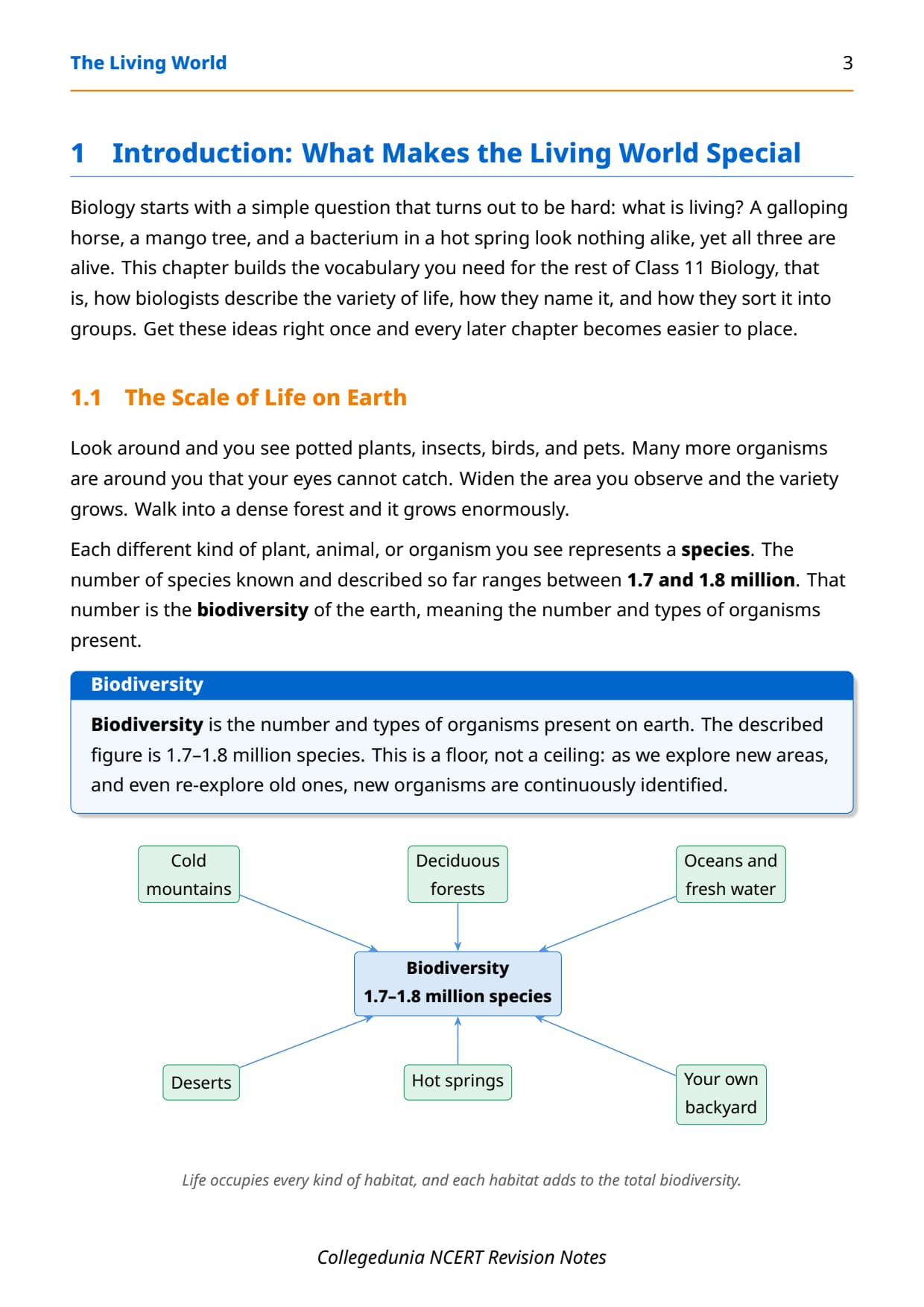
Biology opens with a simple question that is surprisingly hard to answer: what is living? A galloping horse, a mango tree, and a bacterium in a hot spring look nothing alike, yet all three are alive. The variety of organisms around us is enormous, and the number and types of organisms present on earth is called biodiversity. Widen the area you observe and the variety grows, which is why this chapter first sets a scale before it starts naming and sorting.
- Species: each distinct kind of plant, animal, or microbe you can tell apart from another counts as a species.
- Biodiversity: the number and types of organisms on earth, described so far as 1.7 to 1.8 million species, a floor that keeps rising as new areas are explored.
- Metabolism: the sum of all chemical reactions in the body, a defining trait that no non-living object shows.
- Cellular organisation: all living bodies are made of cells, the other clearly defining trait of life.
- Consciousness: the ability to sense the surroundings and respond to stimuli, the trait that best separates living from non-living.
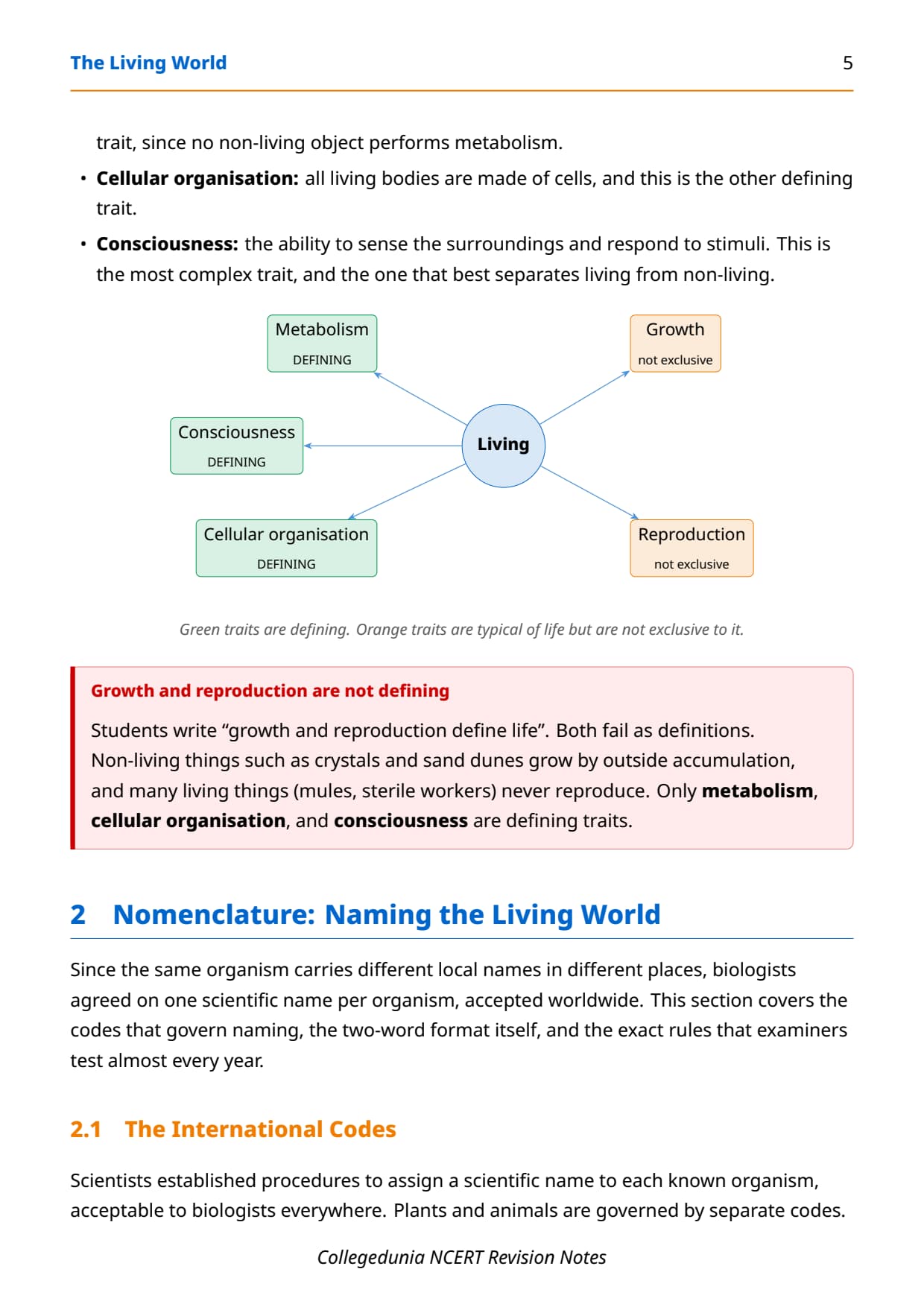
Growth and reproduction are typical of life but do not define it, because a crystal or a sand dune grows by adding material on the outside, and many living things such as mules or sterile worker bees never reproduce. Only metabolism, cellular organisation, and consciousness are defining traits. The 2026-27 rationalised NCERT reprint opens straight into diversity and does not carry a separate "what is living" section, but these traits are still asked in NEET and CUET, so keep them ready as an extension while writing board answers from the NCERT text.
Nomenclature: Naming the Living World
The same organism carries different local names in different places, and even a single fish can have four names in four districts. That creates real confusion when two biologists try to discuss the same organism, so the naming of living organisms has to be standardised such that one organism is known by the same name all over the world. This process is nomenclature, and it works only if the organism is first described correctly and we know to what organism the name is attached, which is identification.
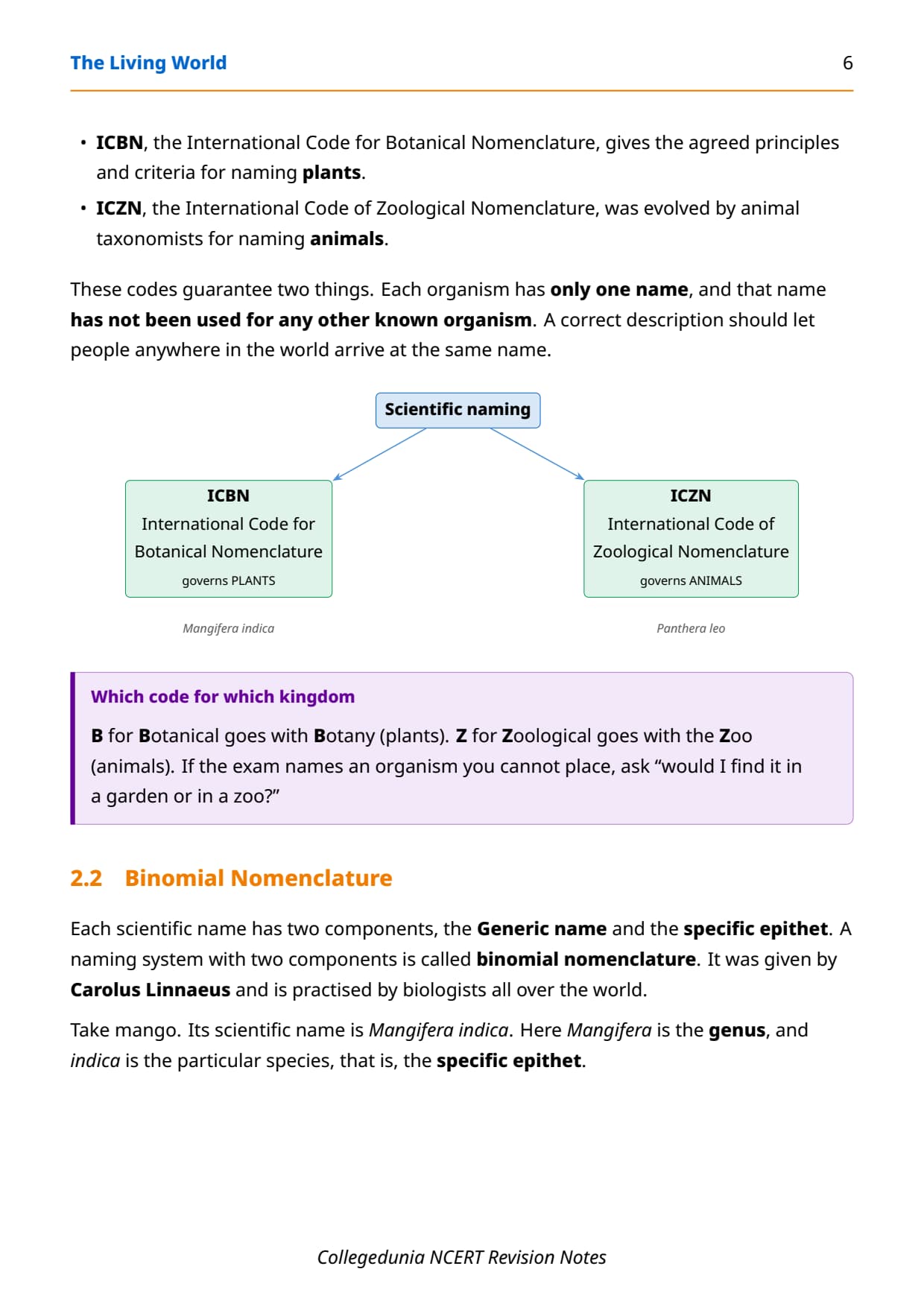
- ICBN: the International Code for Botanical Nomenclature, which gives the agreed rules for naming plants.
- ICZN: the International Code of Zoological Nomenclature, evolved by animal taxonomists for naming animals.
- Binomial nomenclature: naming with two components, the generic name and the specific epithet, given by Carolus Linnaeus.
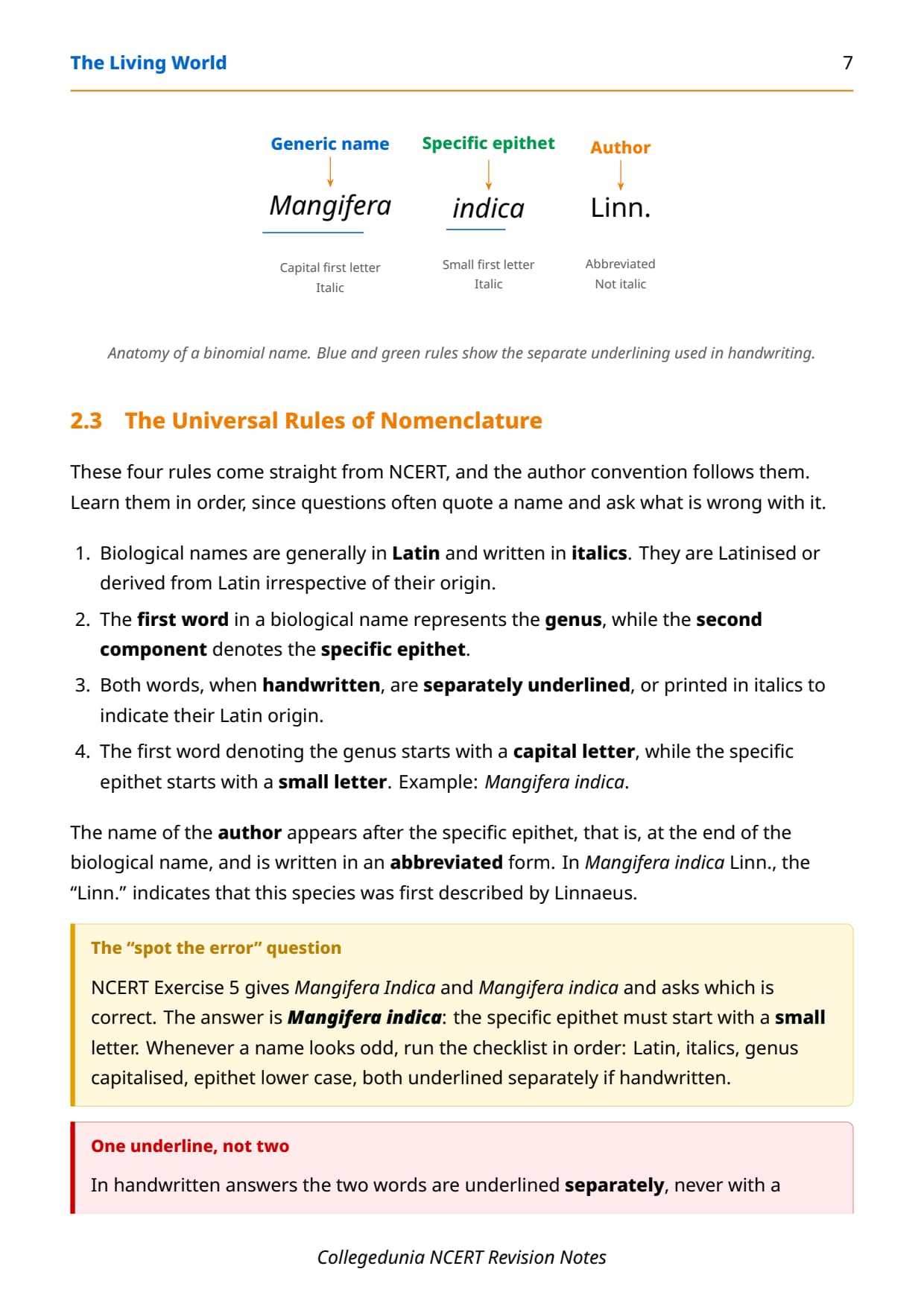
Each scientific name has a genus and a species part, so mango is Mangifera indica, where Mangifera is the genus and indica is the specific epithet. Four rules govern every name: biological names are in Latin and written in italics; the first word is the genus and the second is the specific epithet; when handwritten, both words are underlined separately; and the genus starts with a capital letter while the epithet starts with a small letter. The author's name, such as Linn. in Mangifera indica Linn., is written in abbreviated form at the end. A common exam question gives Mangifera Indica and asks what is wrong, and the answer is that the specific epithet must start with a small letter.
Classification, Taxonomy and Systematics
It is nearly impossible to study every one of the millions of organisms individually, so biologists group them into convenient categories based on easily observable characters. This process is classification, and we already do it without thinking: say "mammals" and you picture animals with external ears and body hair. This section separates four terms that students routinely mix up, because questions often test the exact difference between them.
- Classification: grouping organisms into convenient categories based on easily observable characters.
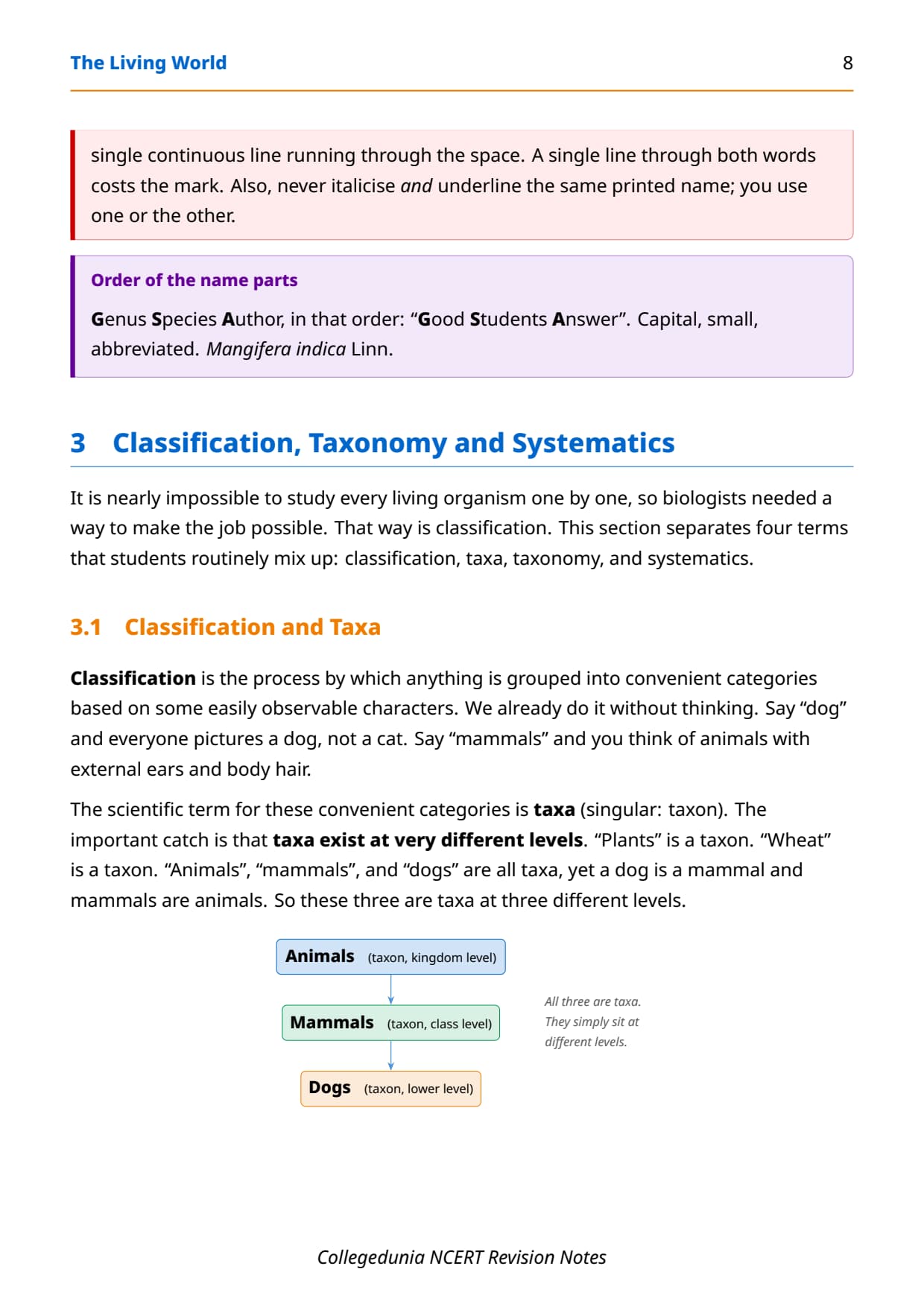
- Taxa (singular taxon): the scientific term for these categories, which exist at very different levels, so "animals", "mammals", and "dogs" are all taxa at three different ranks.
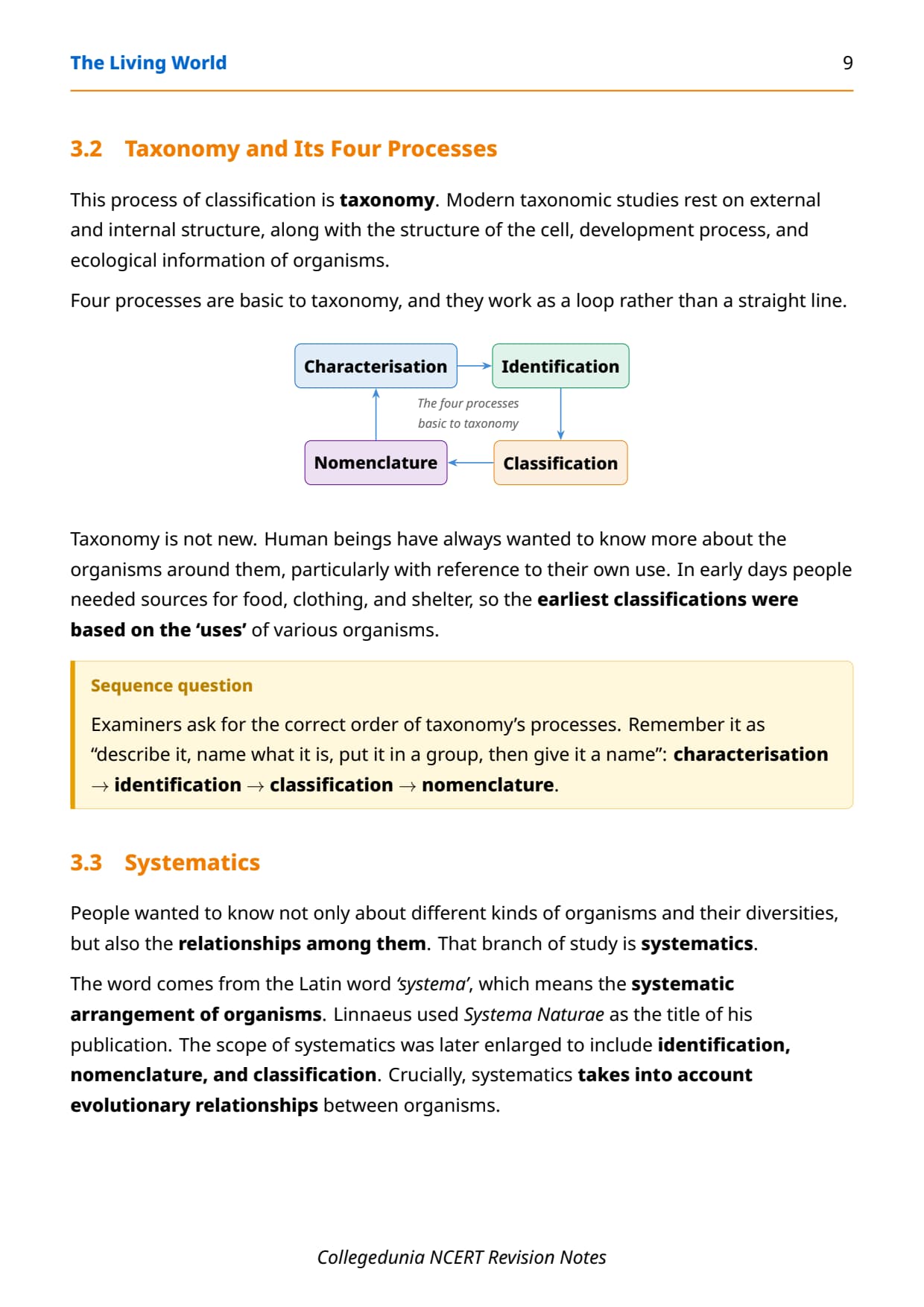
- Taxonomy: the process of classification, resting on four steps, that is, characterisation, identification, classification, and nomenclature.
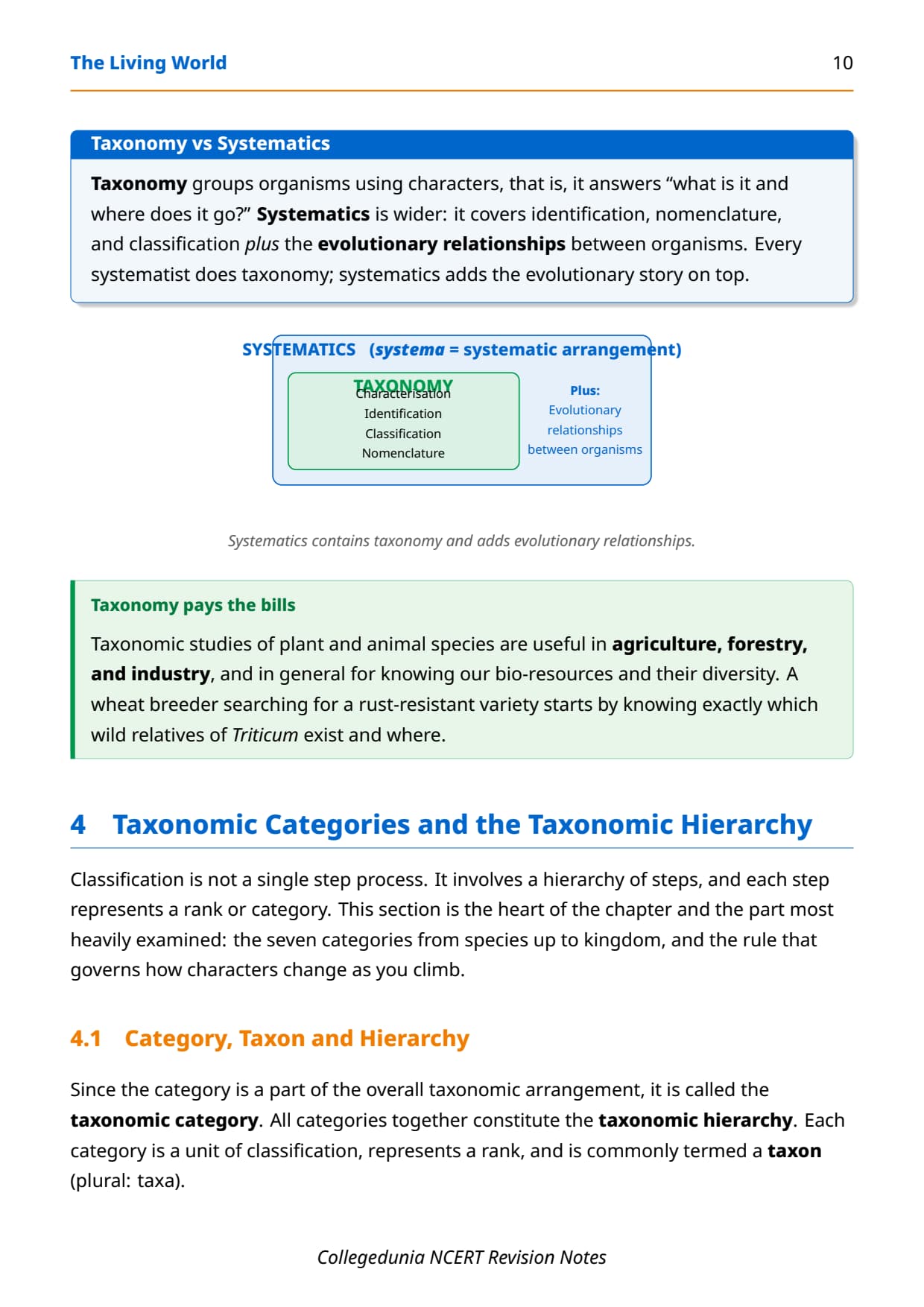
- Systematics: from the Latin systema, the study that adds the evolutionary relationships between organisms on top of taxonomy.
Modern taxonomy rests on external and internal structure, the structure of the cell, the development process, and ecological information. The earliest classifications, by contrast, were based simply on the uses of organisms for food, shelter, and clothing. Systematics is wider than taxonomy because it takes evolutionary relationships into account, and Linnaeus used Systema Naturae as the title of his famous work. Taxonomic studies are useful in agriculture, forestry, and industry, and in general for knowing our bio-resources and their diversity, so a wheat breeder searching for a rust-resistant variety starts by knowing exactly which wild relatives of Triticum exist.
Taxonomic Categories and the Taxonomic Hierarchy
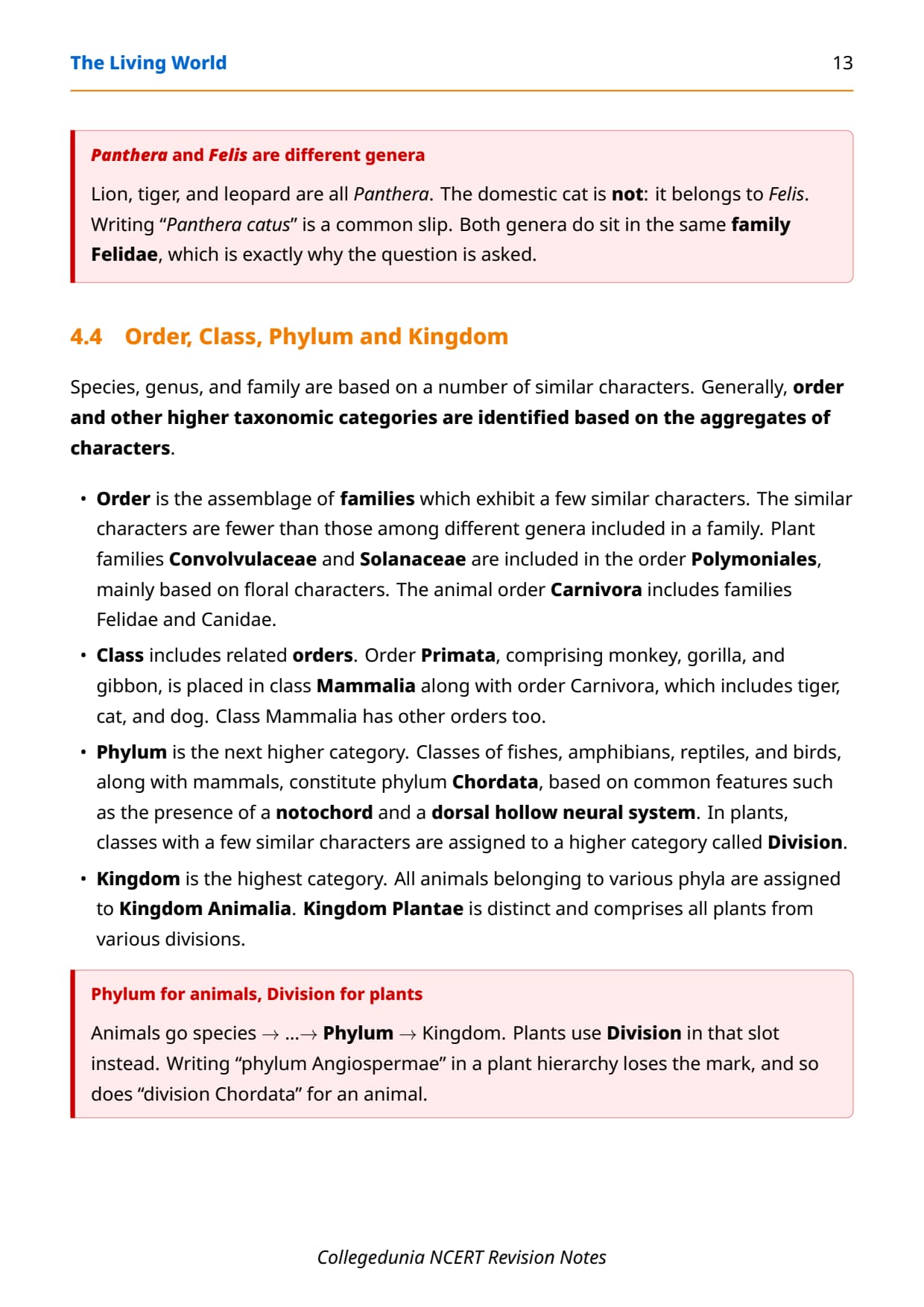
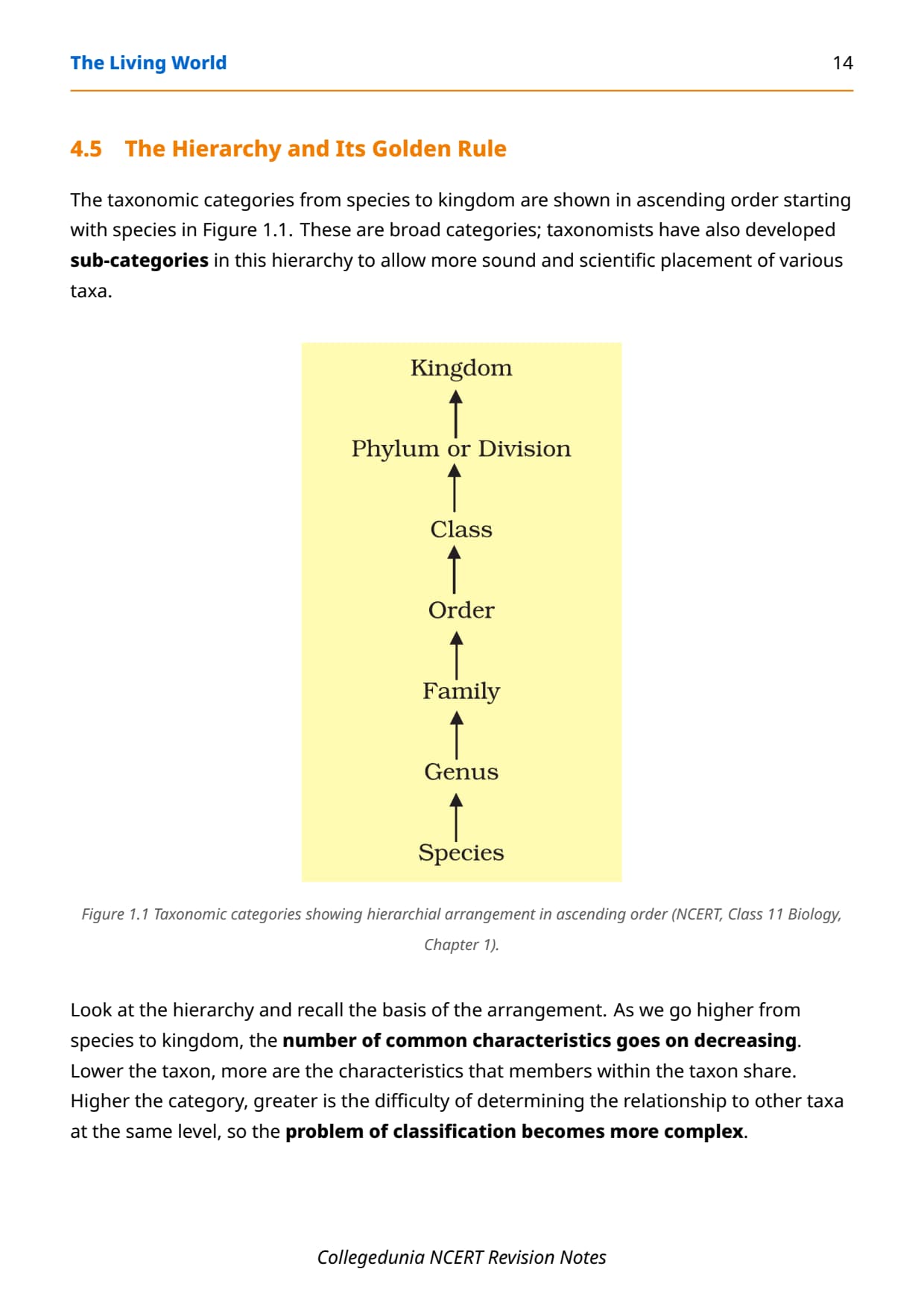
Classification is not a single step. It involves a hierarchy of steps where each step represents a rank or category, called a taxonomic category, and all categories together make the taxonomic hierarchy. This is the heart of the chapter and the most heavily examined part, so learn the seven categories and the rule that governs how characters change as you climb. Every organism, plant or animal, has species as its lowest category.
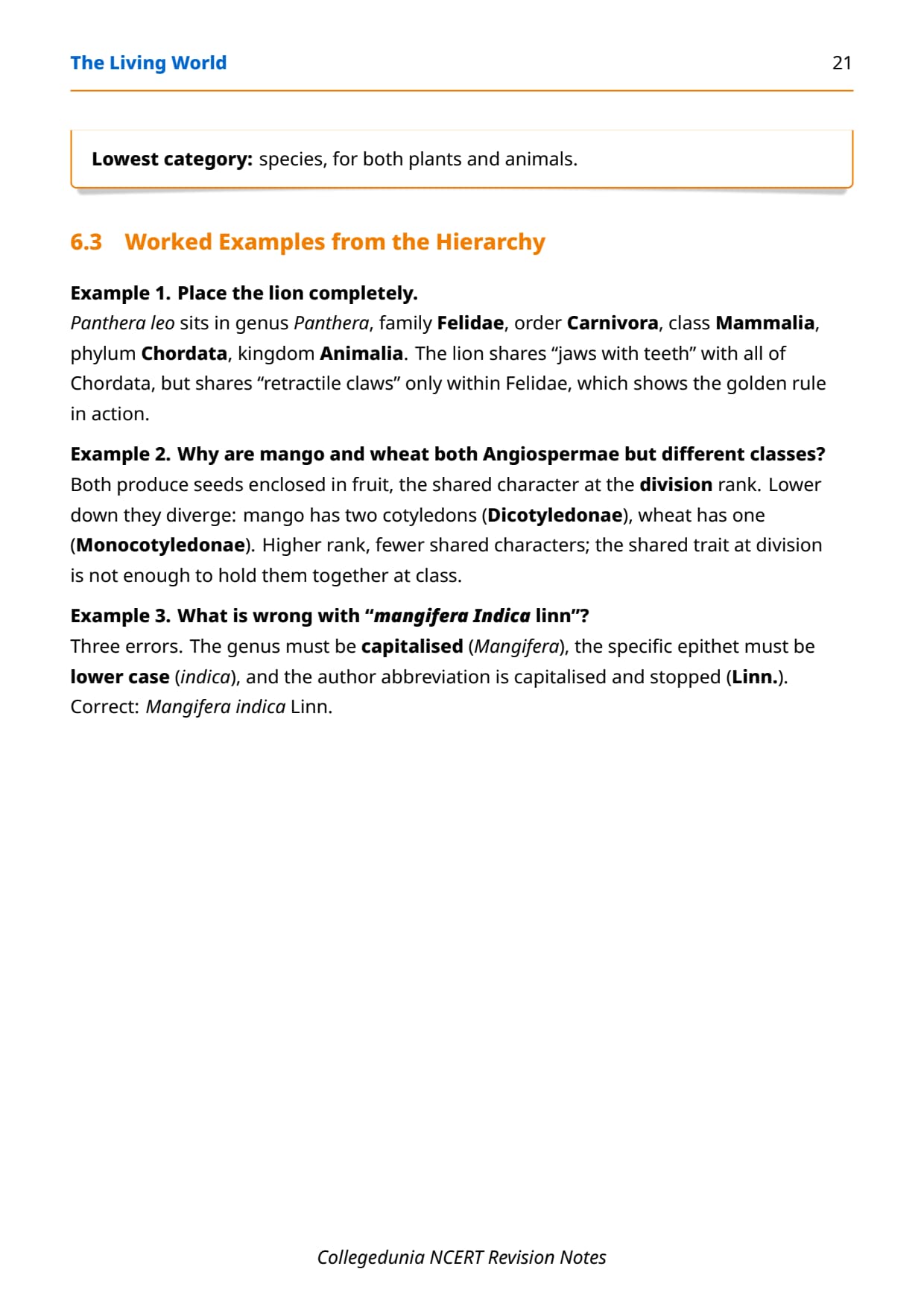
- Species: a group of individual organisms with fundamental similarities, separable from a close species by distinct morphological differences, such as Panthera leo for lion.
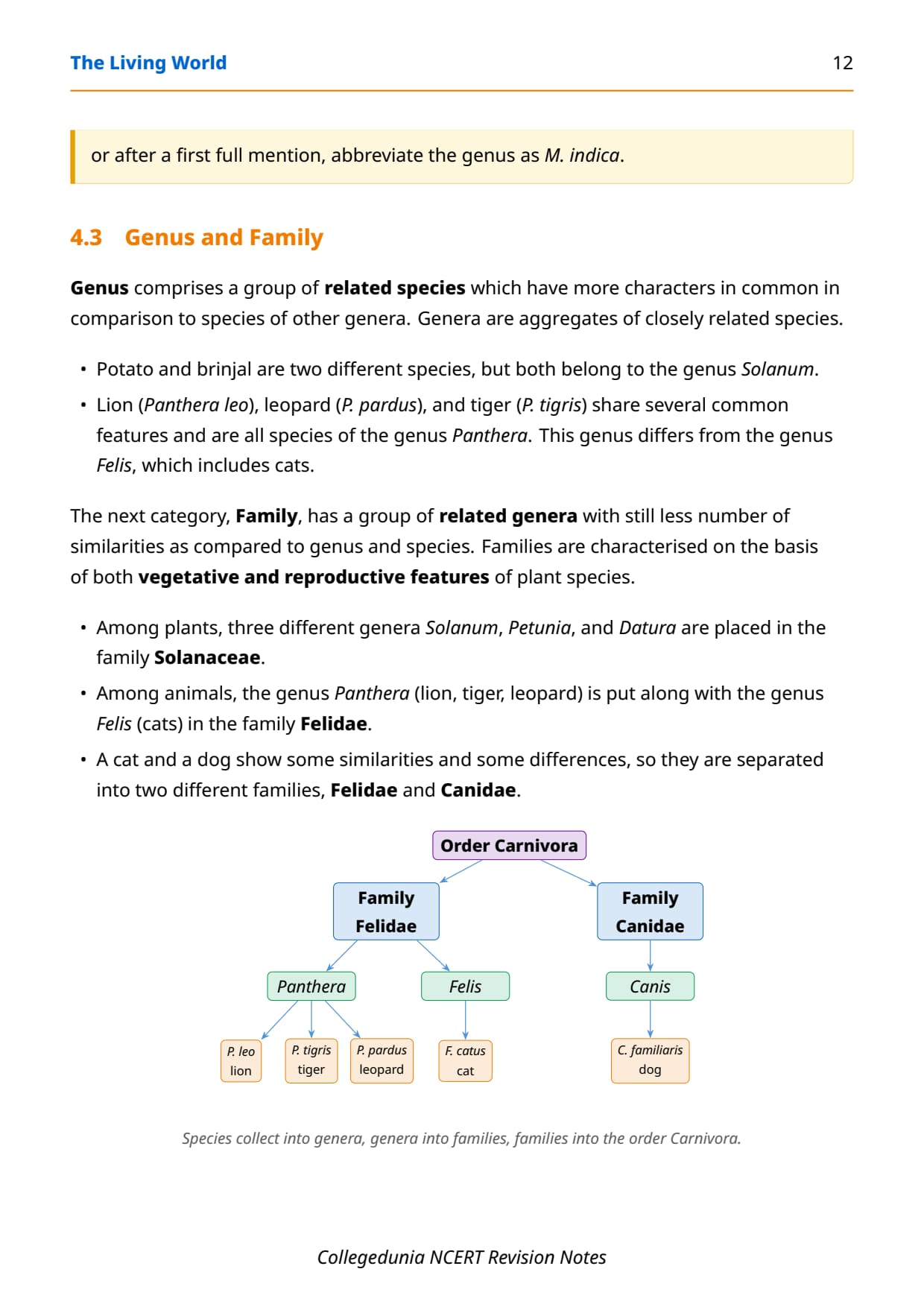
- Genus: a group of related species with more characters in common, such as Panthera holding lion, tiger, and leopard.
- Family: a group of related genera, such as Felidae holding both Panthera and Felis (cats).
- Order: an assemblage of families with a few similar characters, such as Carnivora holding Felidae and Canidae.
- Class: related orders grouped together, such as Mammalia holding Primata and Carnivora.
- Phylum or Division: related classes, with Phylum used for animals (Chordata) and Division for plants (Angiospermae).
- Kingdom: the highest category, that is, Animalia for all animals and Plantae for all plants.
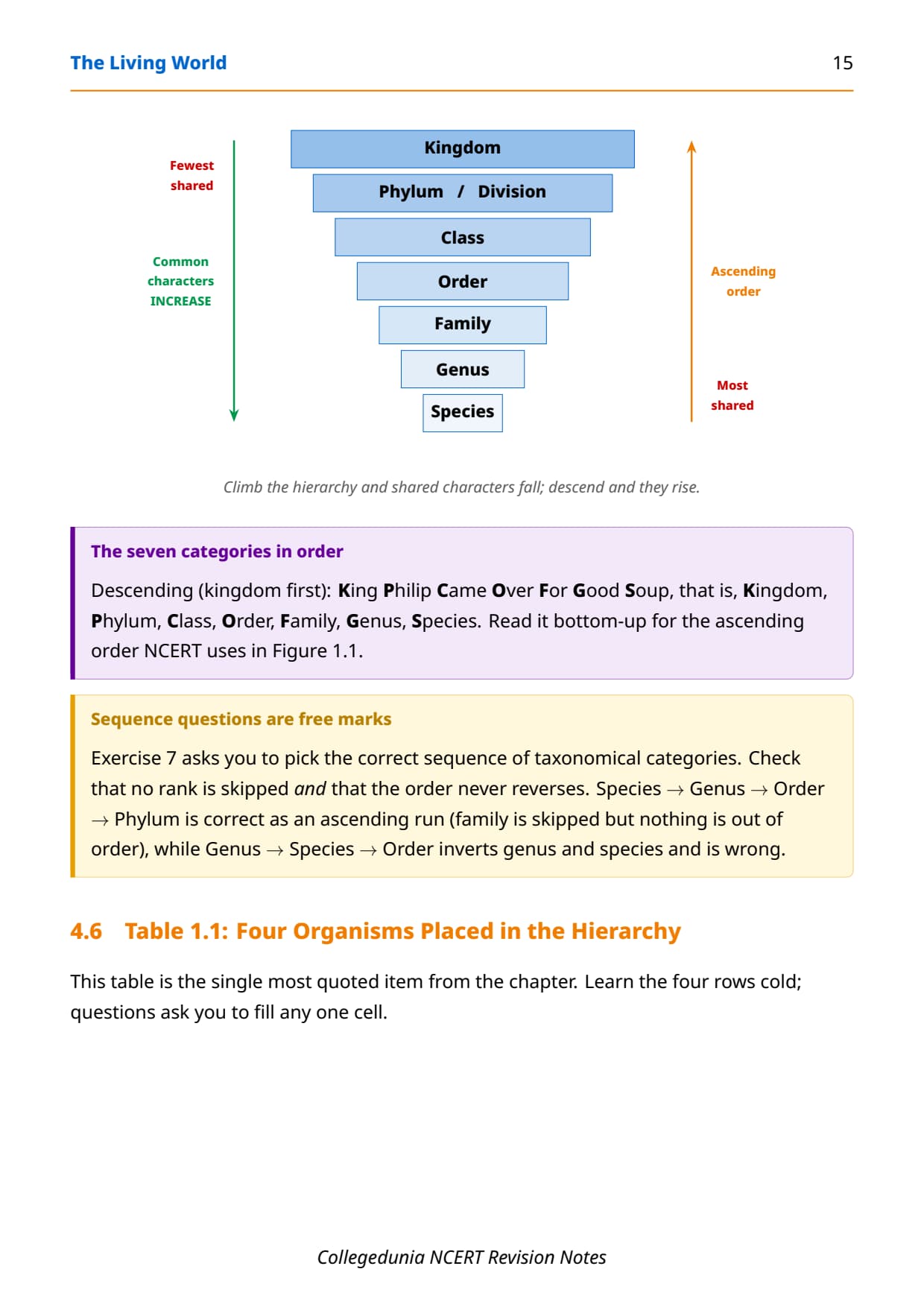
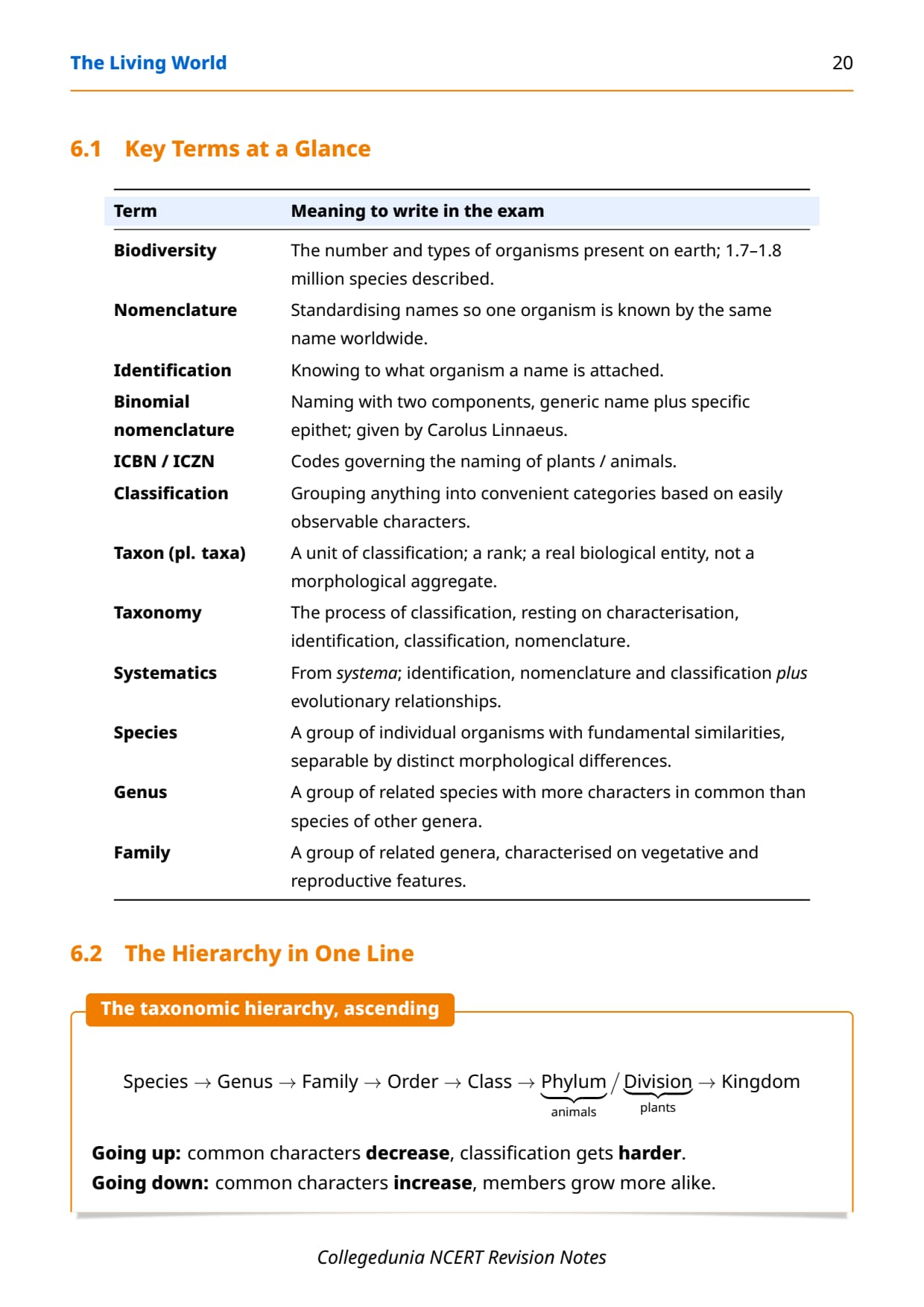
The golden rule ties the ladder together: as you go higher from species to kingdom, the number of common characters keeps decreasing, and the problem of classification becomes more complex. Lower the taxon, the more characters its members share. The classic memory aid is "King Philip Came Over For Good Soup" for Kingdom, Phylum, Class, Order, Family, Genus, Species. Read it bottom-up for the ascending order NCERT shows in Figure 1.1.
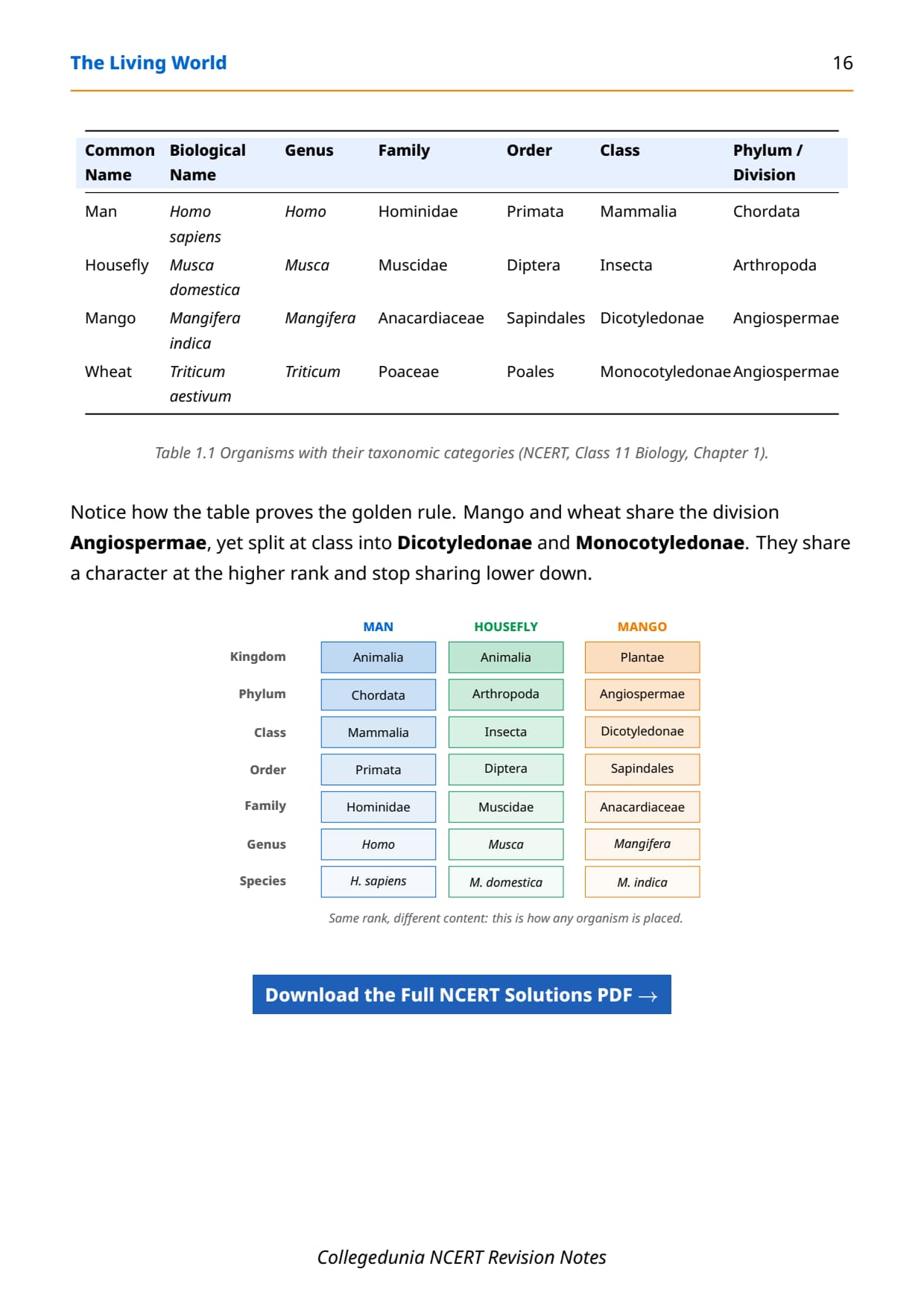
| Category | Man | Housefly | Mango | Wheat |
|---|---|---|---|---|
| Kingdom | Animalia | Animalia | Plantae | Plantae |
| Phylum / Division | Chordata | Arthropoda | Angiospermae | Angiospermae |
| Class | Mammalia | Insecta | Dicotyledonae | Monocotyledonae |
| Order | Primata | Diptera | Sapindales | Poales |
| Family | Hominidae | Muscidae | Anacardiaceae | Poaceae |
| Genus | Homo | Musca | Mangifera | Triticum |
| Species | sapiens | domestica | indica | aestivum |
This is Table 1.1, the single most quoted item from the chapter. Notice how mango and wheat share the division Angiospermae yet split at class into Dicotyledonae and Monocotyledonae, which proves the golden rule: they share a character at a higher rank and stop sharing lower down. Learn all four columns cold, because questions ask you to fill any one cell.
Taxonomical Aids: Tools for Study and Identification (NEET Extension)
Classification needs raw material, that is, actual specimens collected, preserved, and stored so any biologist can check them later. The facilities and records that make this possible are the taxonomical aids. The 2026-27 rationalised reprint does not carry this section, but it stays in the NEET and CUET syllabus and appears in older question banks, so revise it as a clearly marked extension and skip it only for CBSE board answers.
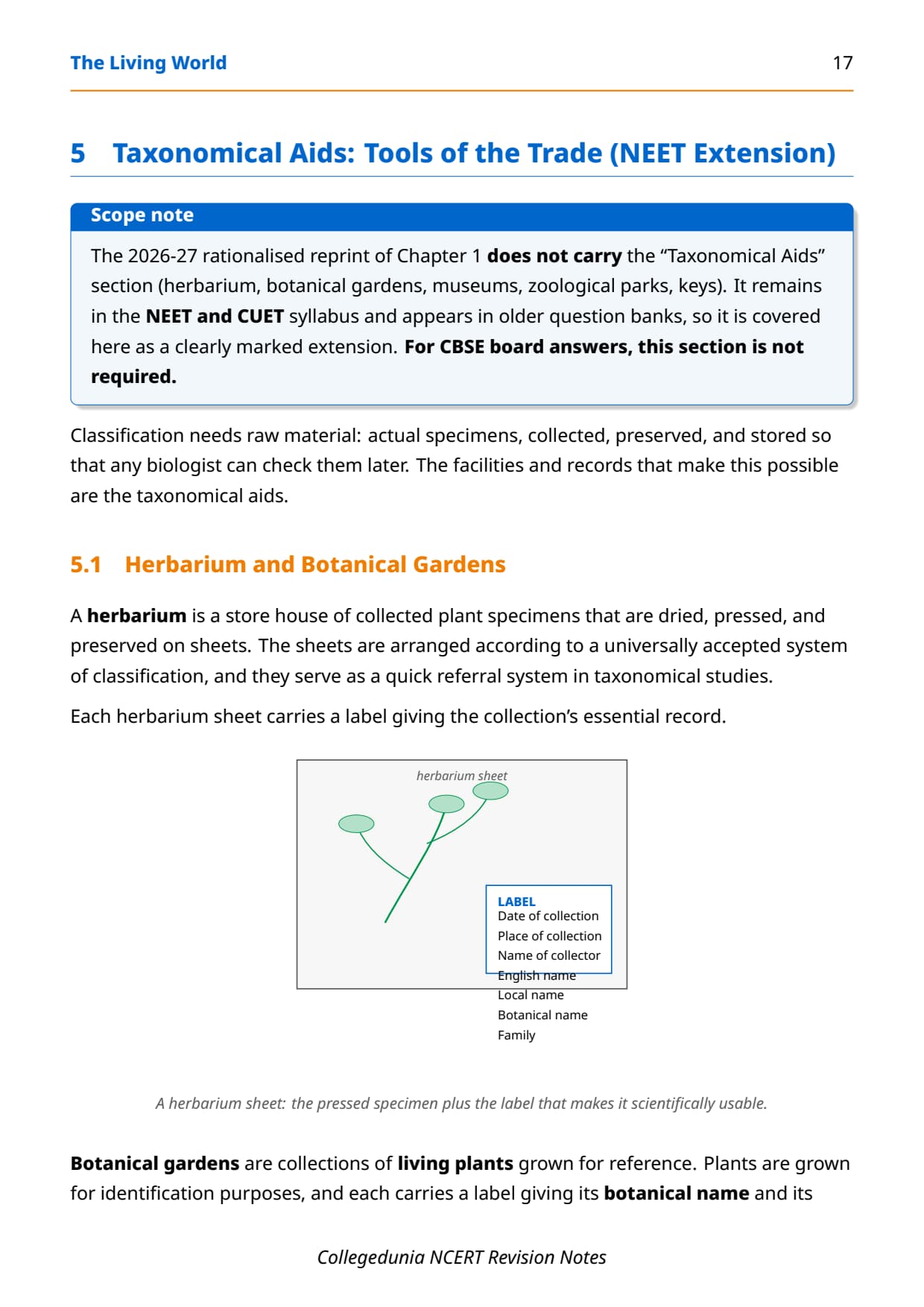
- Herbarium: a store house of plant specimens that are dried, pressed, and preserved on labelled sheets arranged by a universal classification system.
- Botanical gardens: collections of living plants grown for reference, each labelled with its botanical name and family, such as Kew in England.
- Museums: collections of preserved plant and animal specimens in jars, as dry specimens, in insect boxes, or as stuffed animals and skeletons.
- Zoological parks: places where living wild animals are kept in protected conditions close to their natural habitats.
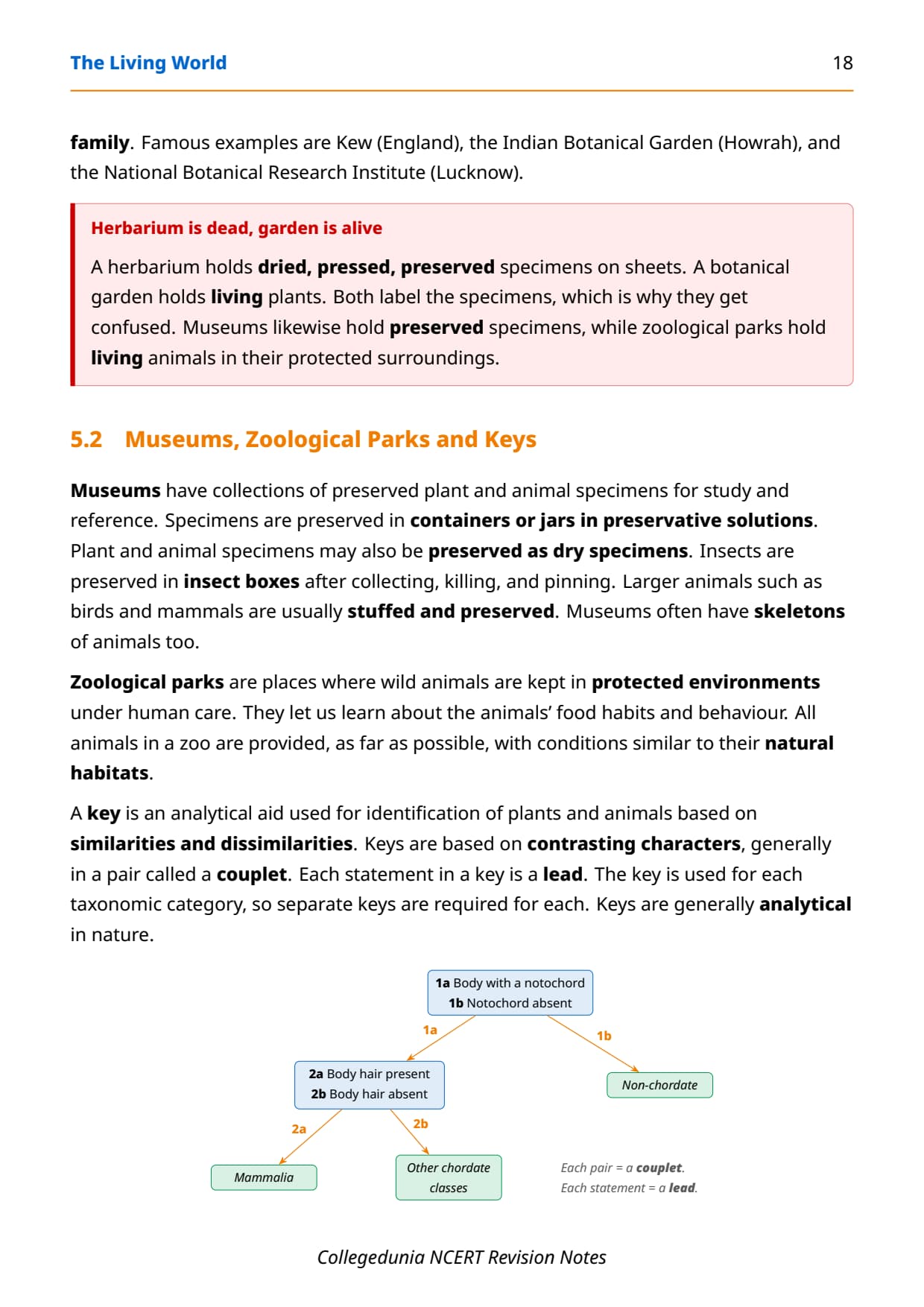
- Keys: analytical aids for identification based on contrasting characters, arranged in pairs called couplets, where each statement is a lead.
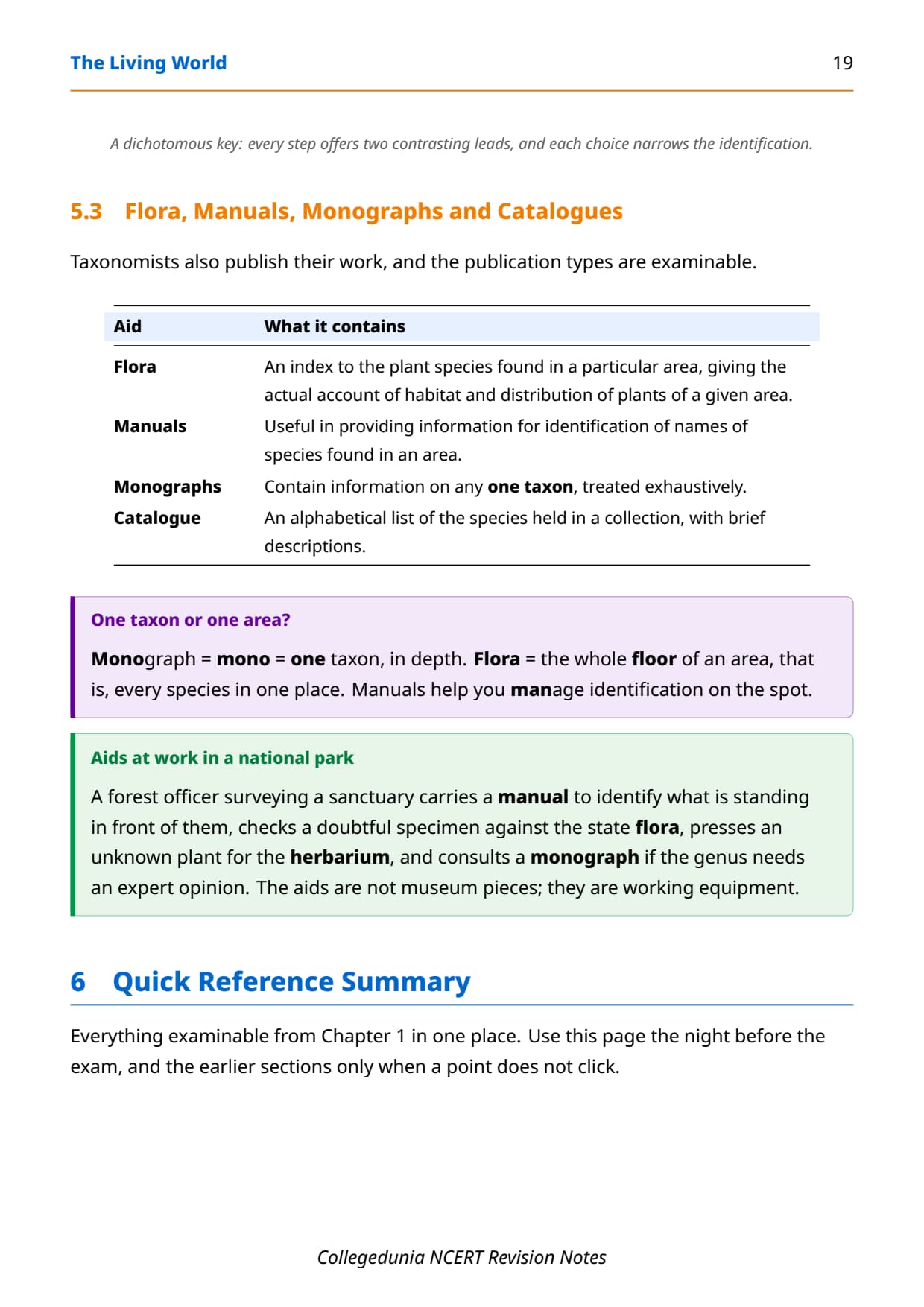
The easiest way to keep these straight is to sort them by living versus preserved. A herbarium and a museum hold preserved specimens, while a botanical garden and a zoological park hold living organisms. Taxonomists also publish their work, so a flora lists all plant species of an area, a manual helps identify species, a monograph treats one taxon in depth, and a catalogue is an alphabetical list of a collection. A forest officer surveying a sanctuary uses these as working equipment, not museum pieces.
Key Definitions in The Living World
Board short-answer questions often ask for a clean definition in one or two lines, and a vague answer loses easy marks. Learn these word-for-word, because the wording of the exam question is usually built straight from the NCERT definition. Each term below also connects to a diagram or example you can be asked to explain.
| Term | Definition |
|---|---|
| Biodiversity | The number and types of organisms present on earth; about 1.7 to 1.8 million species described so far. |
| Nomenclature | Standardising names so that one organism is known by the same name all over the world. |
| Binomial nomenclature | Naming with two components, the generic name and the specific epithet; given by Carolus Linnaeus. |
| Taxon | A unit of classification at any rank; a real biological entity, not just a group of look-alikes. |
| Taxonomy | The process of classification, resting on characterisation, identification, classification, and nomenclature. |
| Systematics | The study of the diversity of organisms and all their evolutionary relationships. |
| Species | A group of individual organisms with fundamental similarities, separable by distinct morphological differences. |
A common board question asks you to define nomenclature and then explain why local names are not enough. State the definition first, then give the example of one fish with four district names to earn the full mark. Learning these definitions makes the wording of almost every one-mark and two-mark question in this chapter familiar.
Common Mistakes Students Make in The Living World
These slips happen because two terms look alike, not because the concept is hard. Each one costs 1 to 2 marks in the paper, so watch for them at the exact step where they occur.
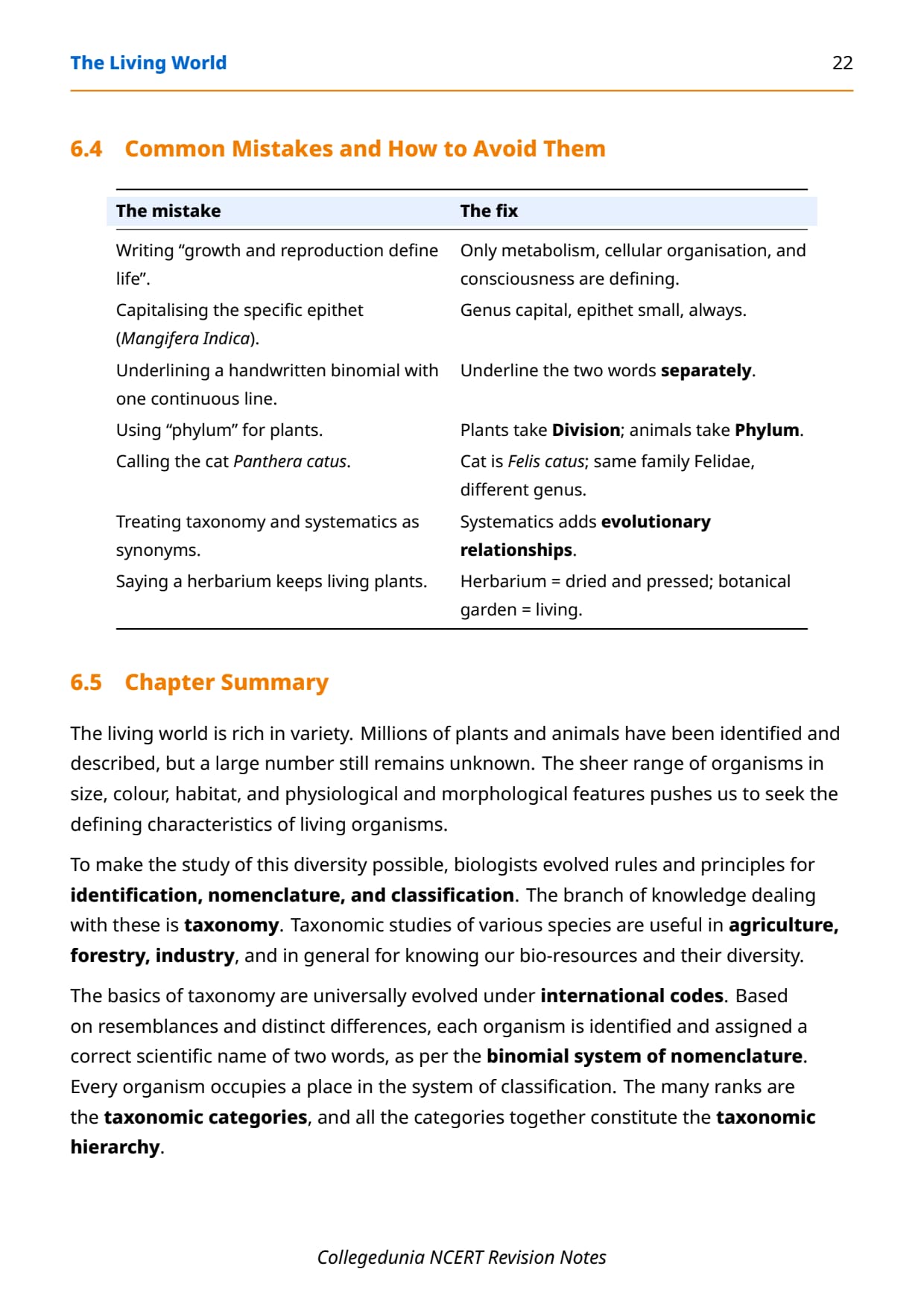
Mistake 1: Writing "growth and reproduction define life". Only metabolism, cellular organisation, and consciousness are defining traits, because non-living crystals grow and many living things never reproduce.
Mistake 2: Capitalising the specific epithet, as in Mangifera Indica. The genus takes a capital and the epithet always takes a small letter.
Mistake 3: Using "phylum" for plants. Plants take Division in that slot, while animals take Phylum.
Mistake 4: Calling the cat Panthera catus. The cat is Felis catus, the same family Felidae but a different genus from lion and tiger.
Mistake 5: Treating taxonomy and systematics as the same thing. Systematics adds the evolutionary relationships between organisms.
The Living World Weightage in CBSE Boards, NEET and CUET
This chapter is short but scoring. It rarely carries a long answer, yet it appears every year as a definition or a hierarchy question, and it is the foundation for the classification chapters that follow. Here is how the marks split across the main exams for 2026-27.
| Exam | Typical weightage | What is asked |
|---|---|---|
| CBSE Boards | 3 to 5 marks | One short answer on nomenclature or definitions plus one on the taxonomic hierarchy |
| NEET | 1 to 2 questions | Taxonomic categories, binomial rules, and taxonomical aids |
| CUET | 1 to 2 objective questions | Definitions, the naming codes, and the classification of a named organism |
The taxonomic hierarchy is the single most tested idea from this chapter across all three exams. Master Table 1.1 first, then the four rules of binomial nomenclature, then the taxonomical aids, in that order of return on effort for the 2026-27 session.
How to Revise The Living World Quickly
Use these the living world class 11 notes for a fast, ordered recap the night before a test. The checklist below takes about 25 minutes and hits every marks-heavy idea in the chapter without opening the full textbook.
- First 8 minutes: write the seven taxonomic categories from species to kingdom, then fill the mango and human columns of Table 1.1 from memory.
- Next 8 minutes: write the four rules of binomial nomenclature and correct one wrongly written name such as mangifera Indica.
- Last 9 minutes: list the three defining traits of life and match each taxonomical aid to living or preserved.
Close the loop by explaining why mango and wheat are both Angiospermae but different classes. If you can do all three blocks without notes, the chapter is exam-ready. Keep Table 1.1 and the four naming rules beside you for the first pass only, then try the whole checklist closed-book.
Student Feedback on the The Living World Notes
What 11,860 students told us about their The Living World revision:
- 68% of students rated the taxonomic hierarchy and Table 1.1 as the part most worth memorising for the exam.
- Most-confused pair: herbarium versus botanical garden, mixed up by about 3 in 10 students.
- Students who learnt the binomial rules with the Mangifera indica example said the "spot the error" questions felt easy afterwards.
Source: 2026-27 Class 11 Biology student poll. Sample of 11,860 students from CBSE schools across 15 states, conducted before the 2026 boards.
Other The Living World Class 11 Biology Resources
Pair these notes with the solved answers and the textbook PDF for the same chapter.
| Resource | Link |
|---|---|
| NCERT Solutions | The Living World Class 11 NCERT Solutions |
| NCERT Book PDF | The Living World Class 11 Book PDF |
NCERT Notes for Class 11 Biology: All Chapters
Jump to the revision notes for any other Class 11 Biology chapter below.
| Chapter | NCERT Notes |
|---|---|
| Chapter 1 | The Living World |
| Chapter 2 | Biological Classification |
| Chapter 3 | Plant Kingdom |
| Chapter 4 | Animal Kingdom |
| Chapter 5 | Morphology of Flowering Plants |
| Chapter 6 | Anatomy of Flowering Plants |
| Chapter 7 | Structural Organisation in Animals |
| Chapter 8 | Cell The Unit of Life |
| Chapter 9 | Biomolecules |
| Chapter 10 | Cell Cycle and Cell Division |
| Chapter 11 | Photosynthesis in Higher Plants |
| Chapter 12 | Respiration in Plants |
| Chapter 13 | Plant Growth and Development |
| Chapter 14 | Breathing and Exchange of Gases |
| Chapter 15 | Body Fluids and Circulation |
| Chapter 16 | Excretory Products and their Elimination |
| Chapter 17 | Locomotion and Movement |
| Chapter 18 | Neural Control and Coordination |
| Chapter 19 | Chemical Coordination and Integration |
FAQs on The Living World Class 11 Biology Notes
The Living World Notes - Frequently Asked Questions
Ques. What topics do the the living world class 11 notes cover?
Ans. These the living world class 11 notes cover the diversity in the living world and biodiversity, the defining traits of living organisms, nomenclature with the codes ICBN and ICZN, binomial nomenclature and its four rules, classification, taxonomy and systematics, the seven taxonomic categories from species to kingdom, Table 1.1, and the taxonomical aids. Every key definition and example is included for fast revision.
Ques. What are the defining characteristics of living organisms?
Ans. Living organisms show growth, reproduction, metabolism, cellular organisation, and consciousness. Of these, only metabolism, cellular organisation, and consciousness are truly defining. Growth and reproduction are not defining, because non-living crystals and sand dunes grow by outside accumulation and many living things such as mules and sterile worker bees never reproduce. Consciousness, the ability to sense and respond to the surroundings, is the trait that best separates living from non-living.
Ques. What is binomial nomenclature and who gave it?
Ans. Binomial nomenclature is the system of naming an organism with two components, the generic name and the specific epithet, and it was given by Carolus Linnaeus. For example, the mango is Mangifera indica, where Mangifera is the genus and indica is the specific epithet. The genus starts with a capital letter and the epithet with a small letter, both are written in italics, and both are underlined separately when handwritten.
Ques. What is the difference between taxonomy and systematics?
Ans. Taxonomy is the process of classification, resting on characterisation, identification, classification, and nomenclature, and it answers what an organism is and where it belongs. Systematics is wider, because along with identification, nomenclature, and classification it also takes into account the evolutionary relationships between organisms. The word systematics comes from the Latin systema, which Linnaeus used in the title Systema Naturae.
Ques. What is the correct order of the taxonomic categories?
Ans. In ascending order the seven taxonomic categories are Species, Genus, Family, Order, Class, Phylum or Division, and Kingdom. Plants use Division while animals use Phylum in that slot. As you go higher from species to kingdom, the number of common characters keeps decreasing and classification becomes more complex. A common memory aid is "King Philip Came Over For Good Soup" read from kingdom down to species.
Ques. What is the weightage of this chapter in the CBSE board exam?
Ans. The Living World carries about 3 to 5 marks in the CBSE Class 11 Biology paper, usually one short answer on nomenclature or definitions plus one question on the taxonomic hierarchy. It also appears in NEET and CUET as objective questions on the taxonomic categories, the binomial naming rules, and the taxonomical aids, which makes it an easy scoring chapter for the 2026-27 session.
Ques. What are taxonomical aids and are they in the CBSE syllabus?
Ans. Taxonomical aids are the facilities and records that help study and identify organisms, that is, herbaria and museums that hold preserved specimens, botanical gardens and zoological parks that hold living organisms, and keys that identify organisms using contrasting characters. The 2026-27 rationalised NCERT reprint does not carry this section, so it is not needed for CBSE board answers, but it remains in the NEET and CUET syllabus and should be revised for those exams.



Comments