




Class 11 Applied Mathematics Chapter 4 Relations notes help students revise ordered pairs, Cartesian product, domain, range, co-domain and relation properties for the 2026-27 CBSE syllabus. Use these notes with the PDF when you need a quick recap before school tests, CUET Mathematics practice or JEE Main basics.


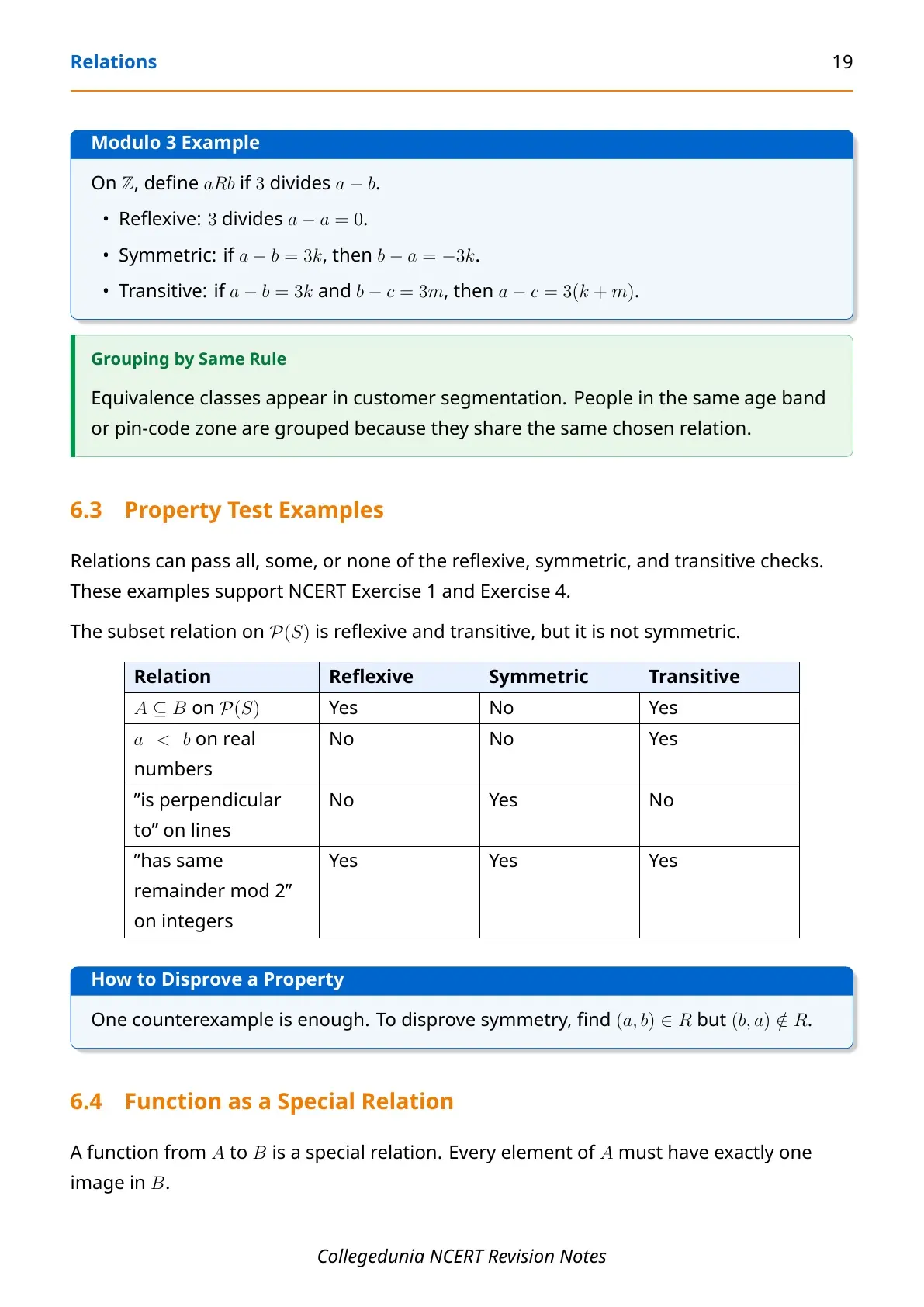


Student Feedback: In a Collegedunia poll of more than 10,000 students before the 2026 boards, most students said Relations becomes easier after they write the ordered pairs first. The biggest doubt was the difference between range and co-domain.
- Best for revision: ordered pairs, Cartesian product, domain, range and relation types stay in one place.
- Exam focused: examples show how to test reflexive, symmetric and transitive relations quickly.
- Aligned to 2026-27: follows the Class 11 Applied Mathematics Algebra unit.
|
Table of Contents |
Ordered Pairs and Cartesian Product in Relations
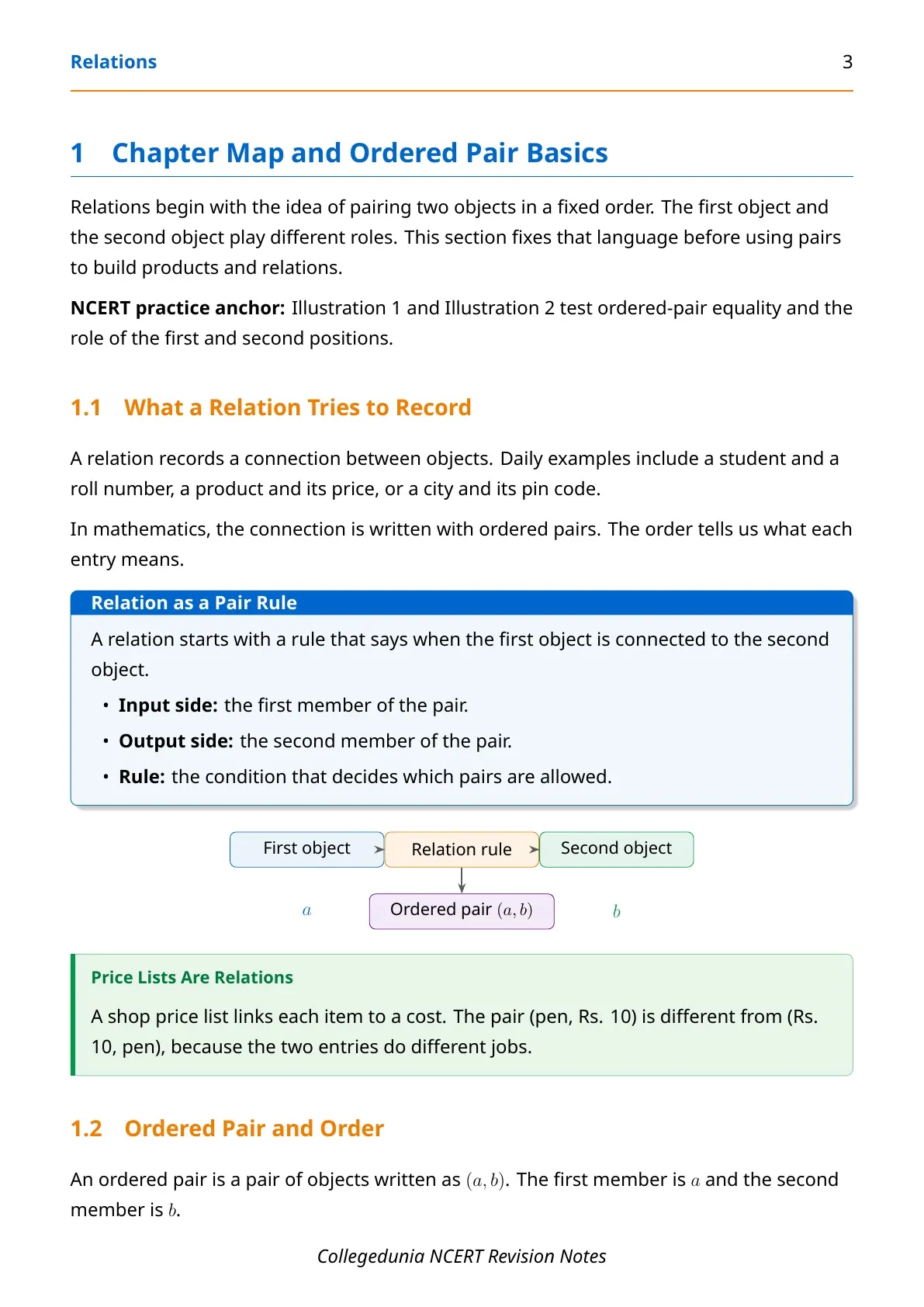
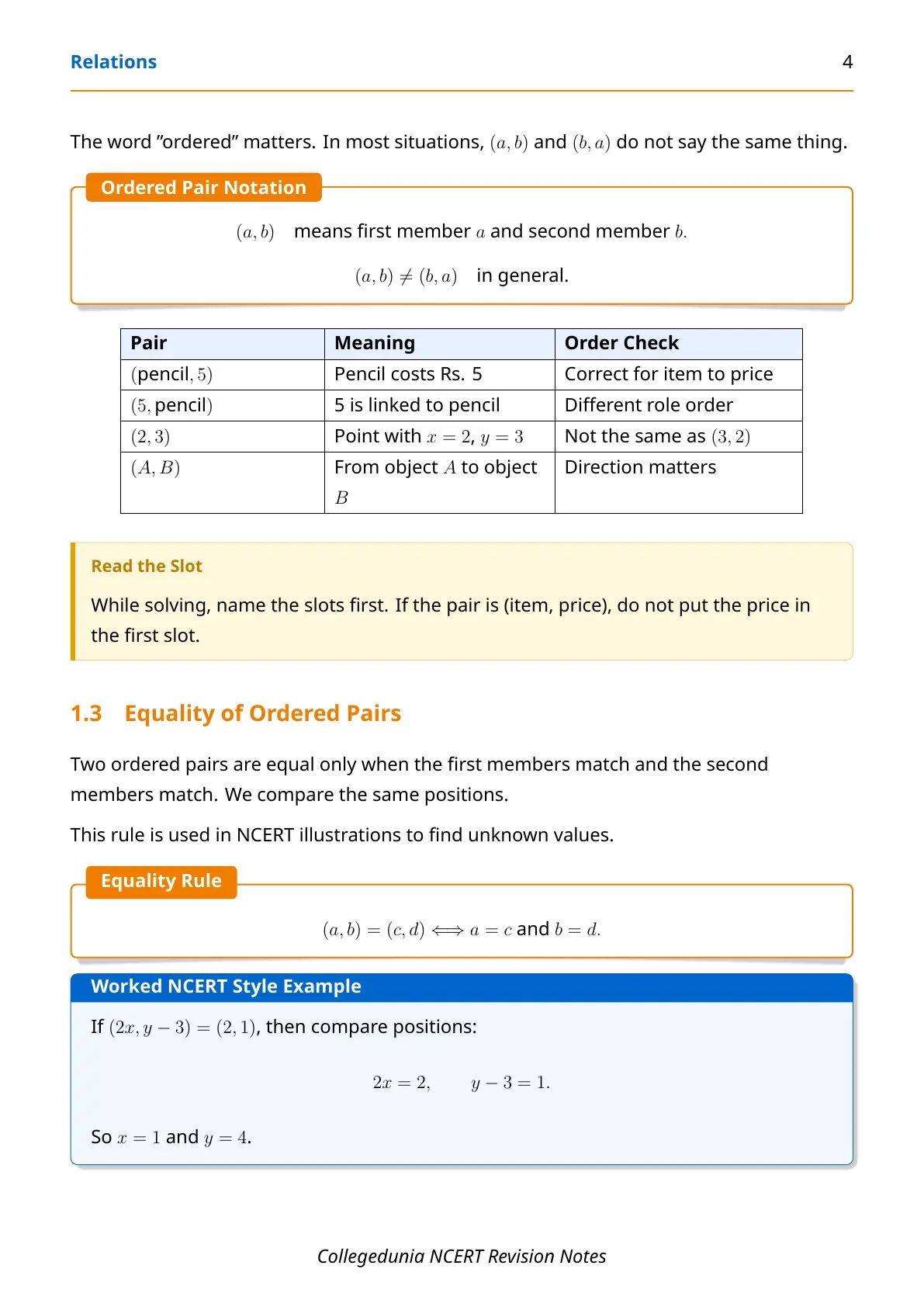
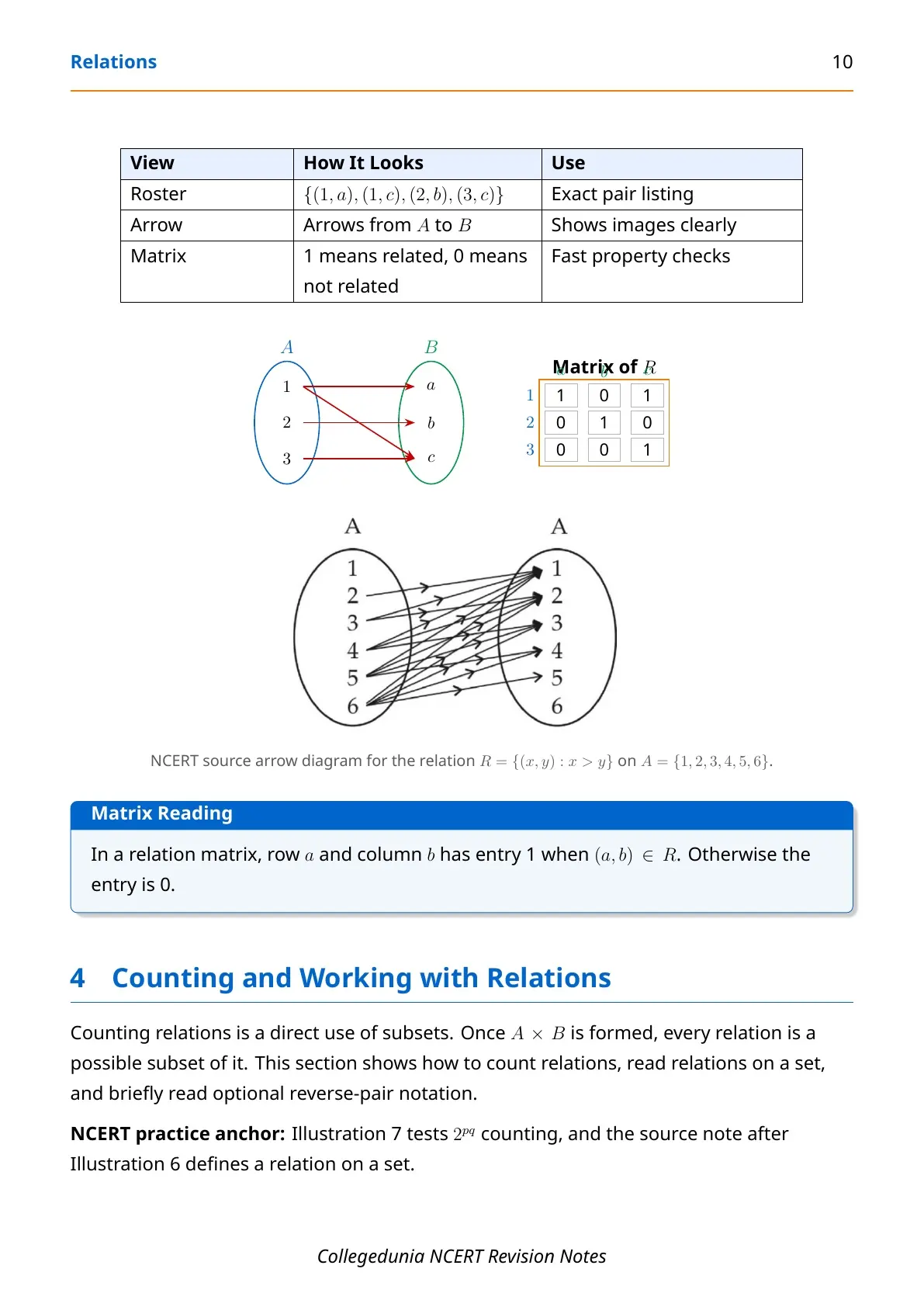
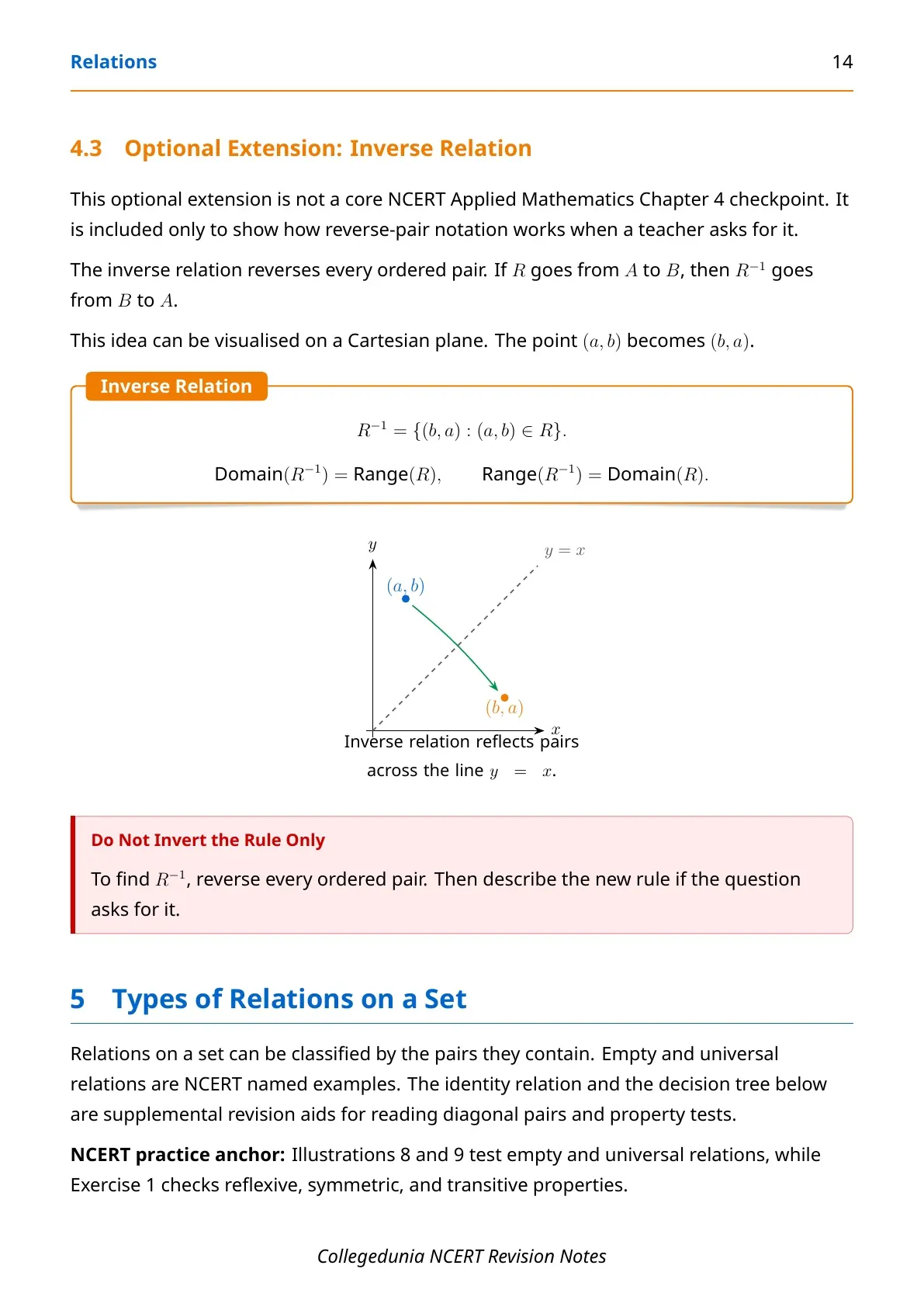
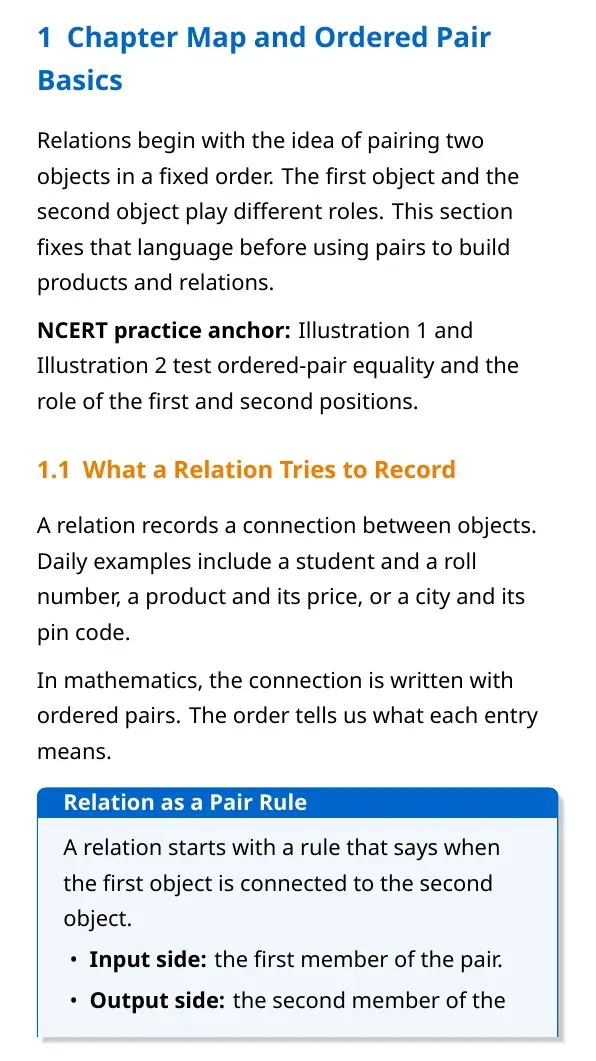
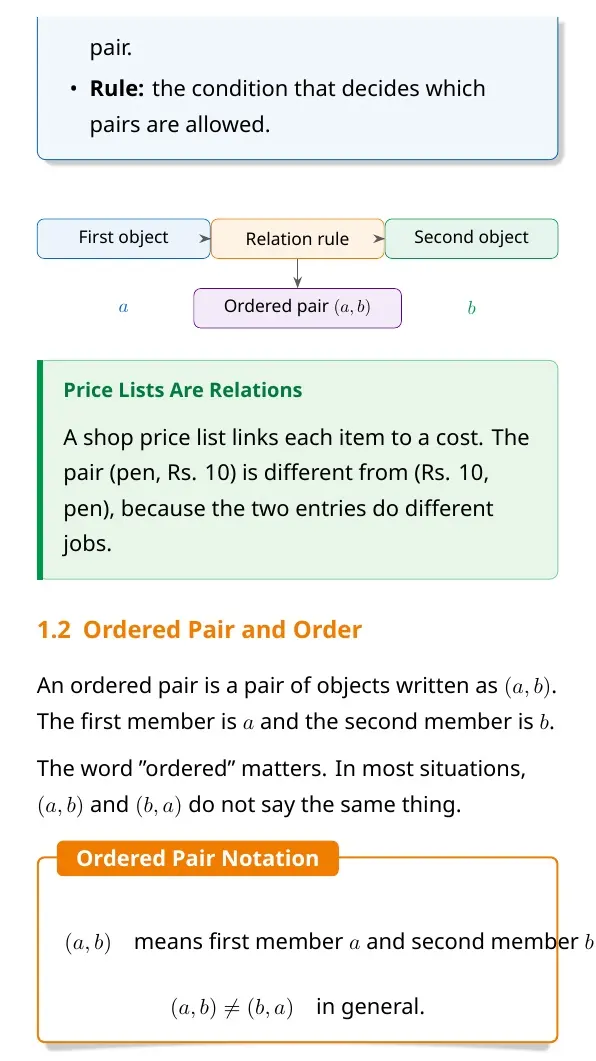
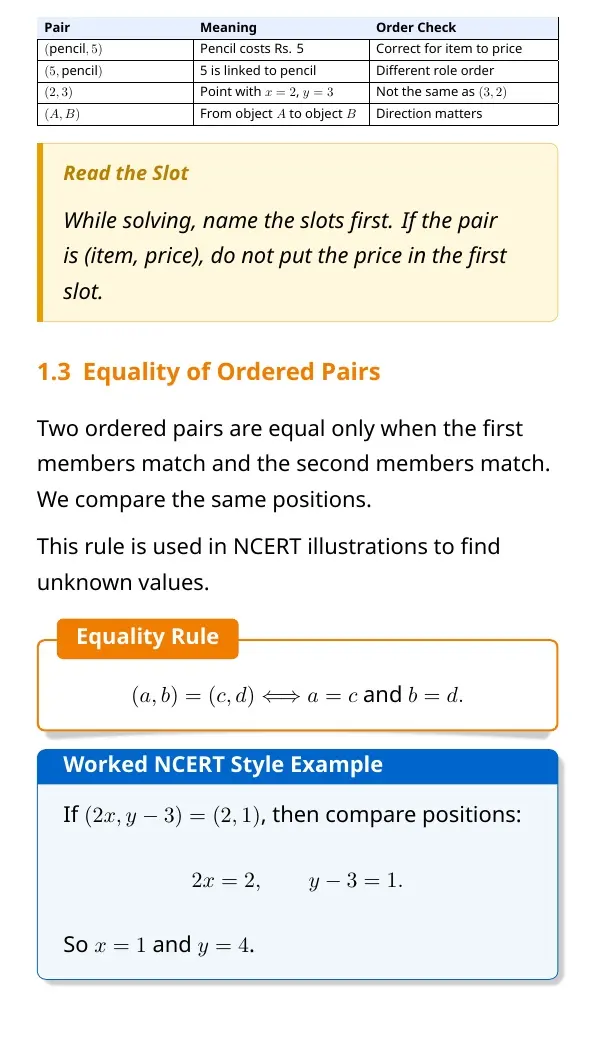
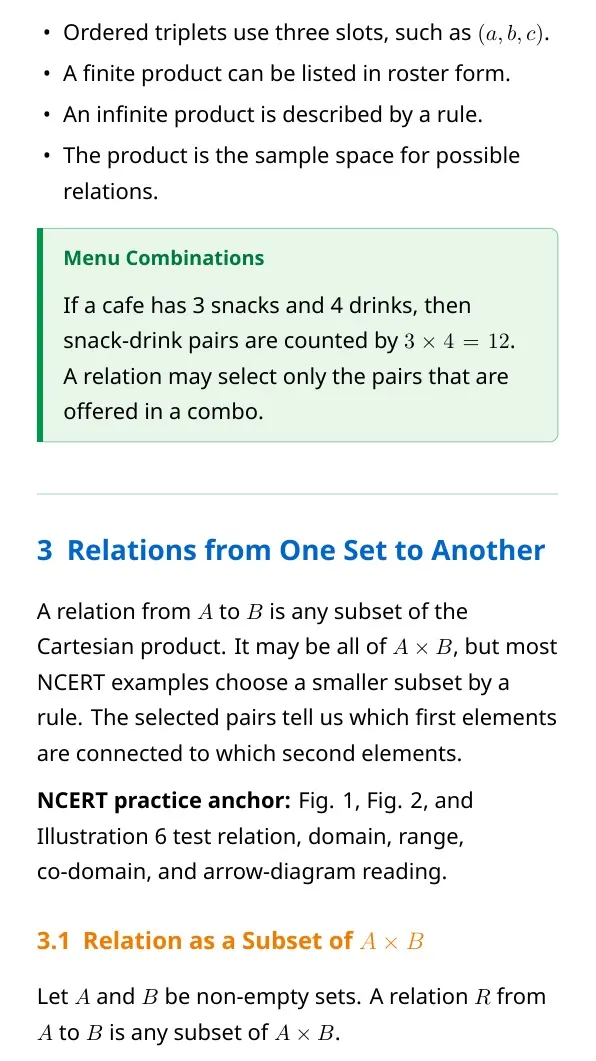
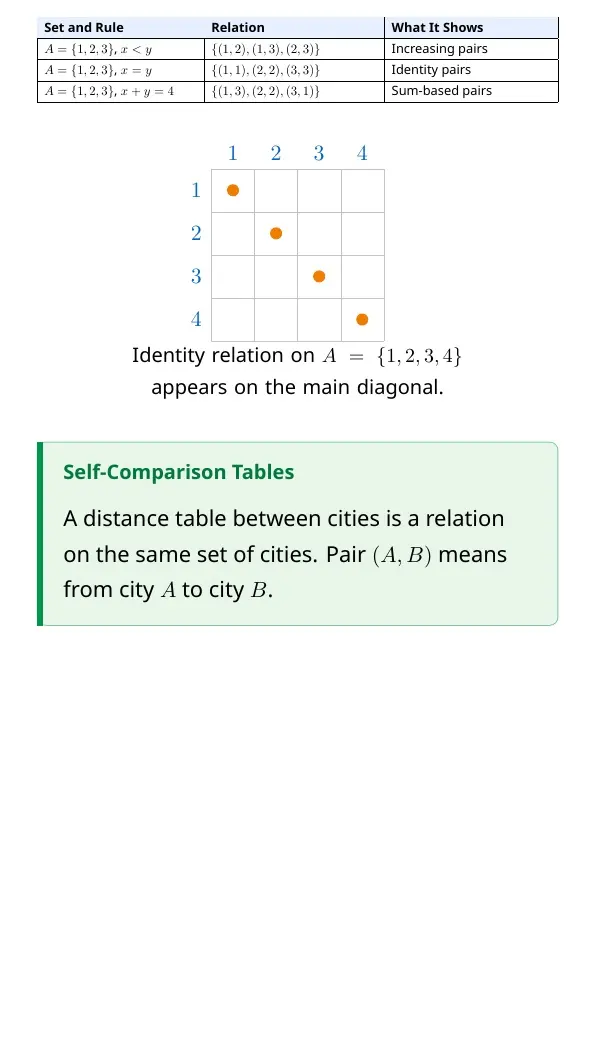
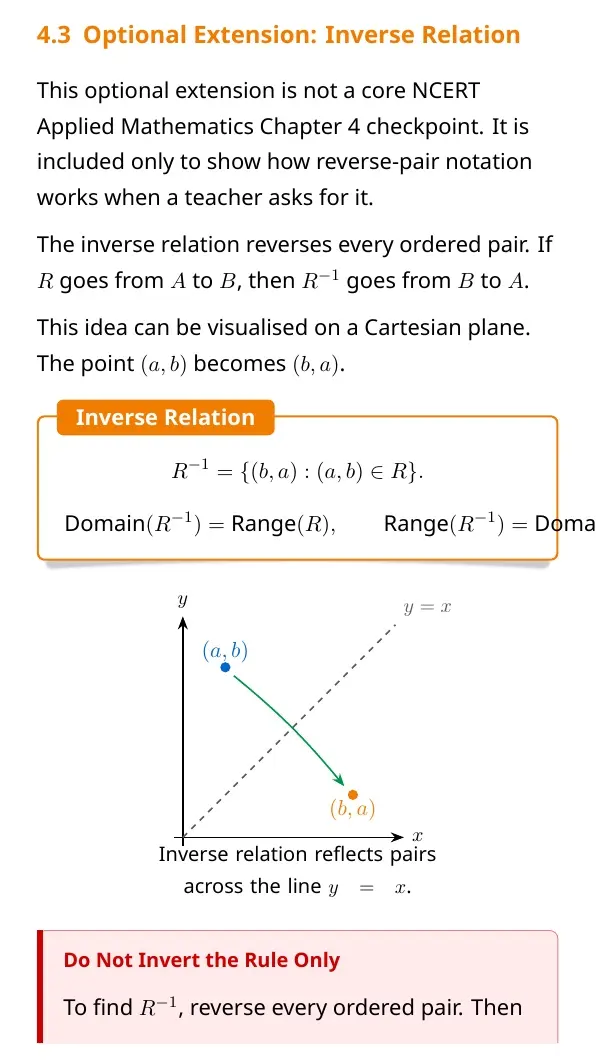
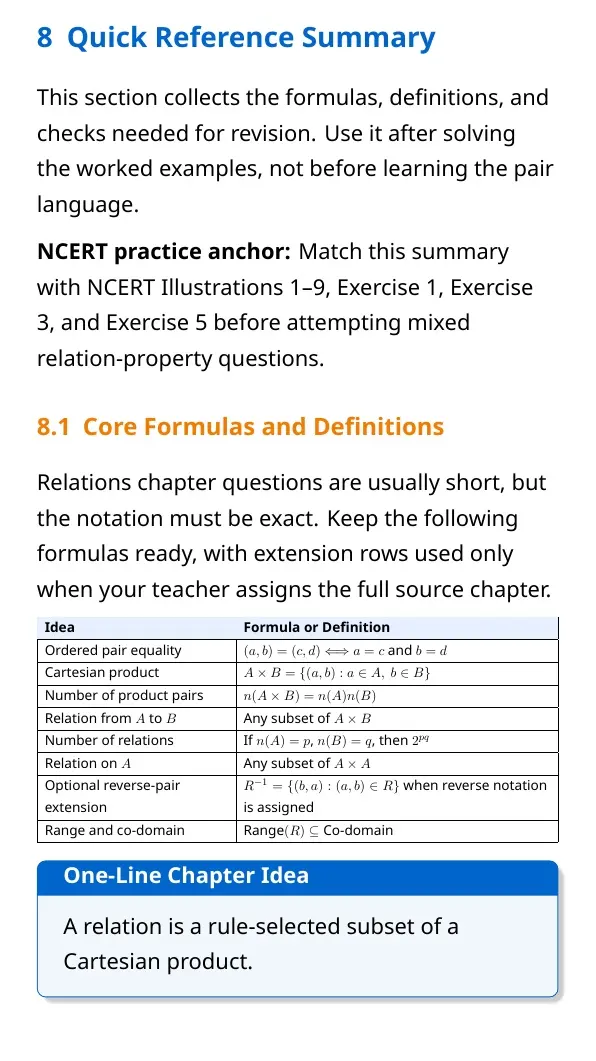
A relation starts with an ordered pair. In the pair (a, b), a is the first entry and b is the second entry. The order matters because (a, b) and (b, a) usually mean different things.
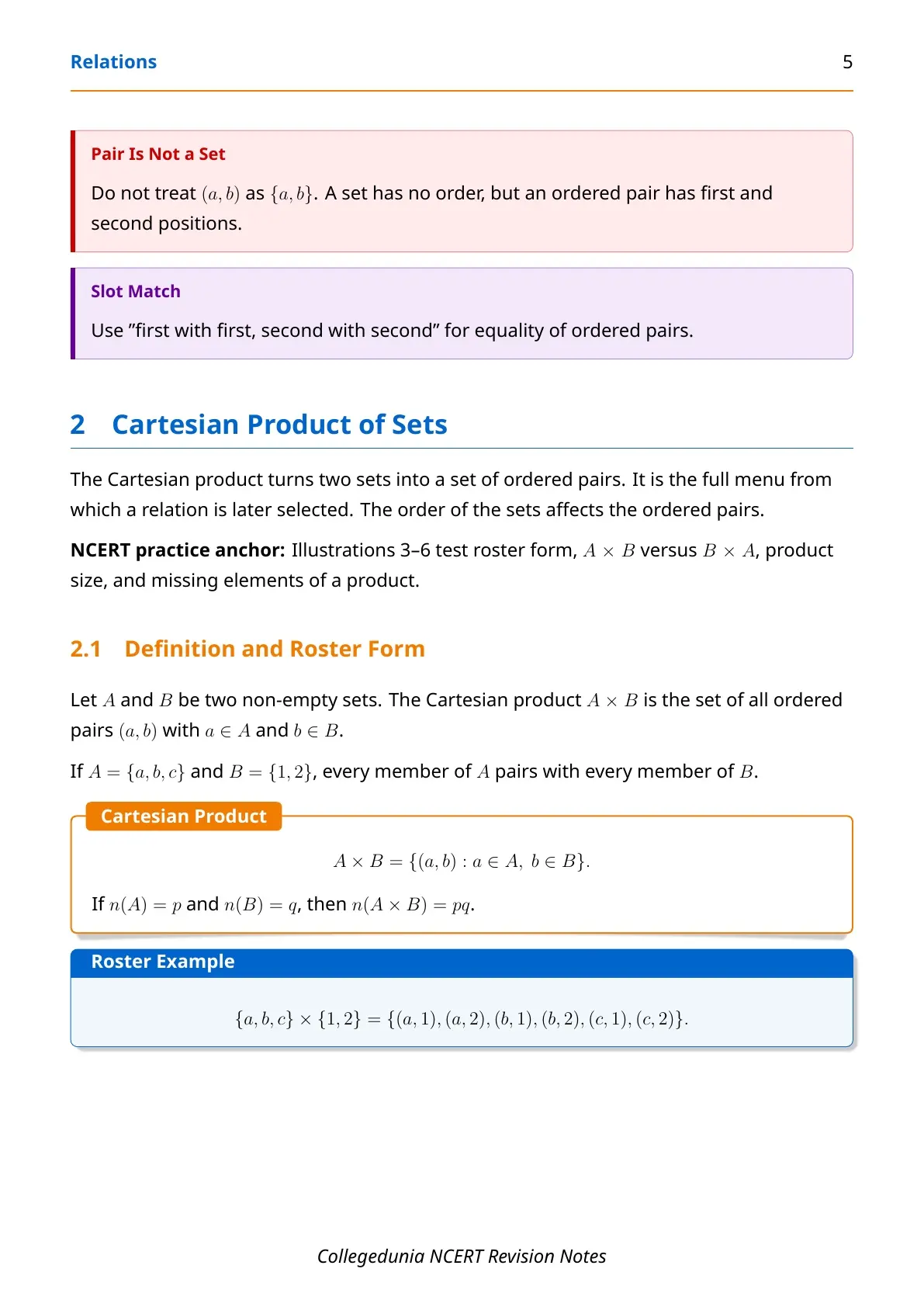
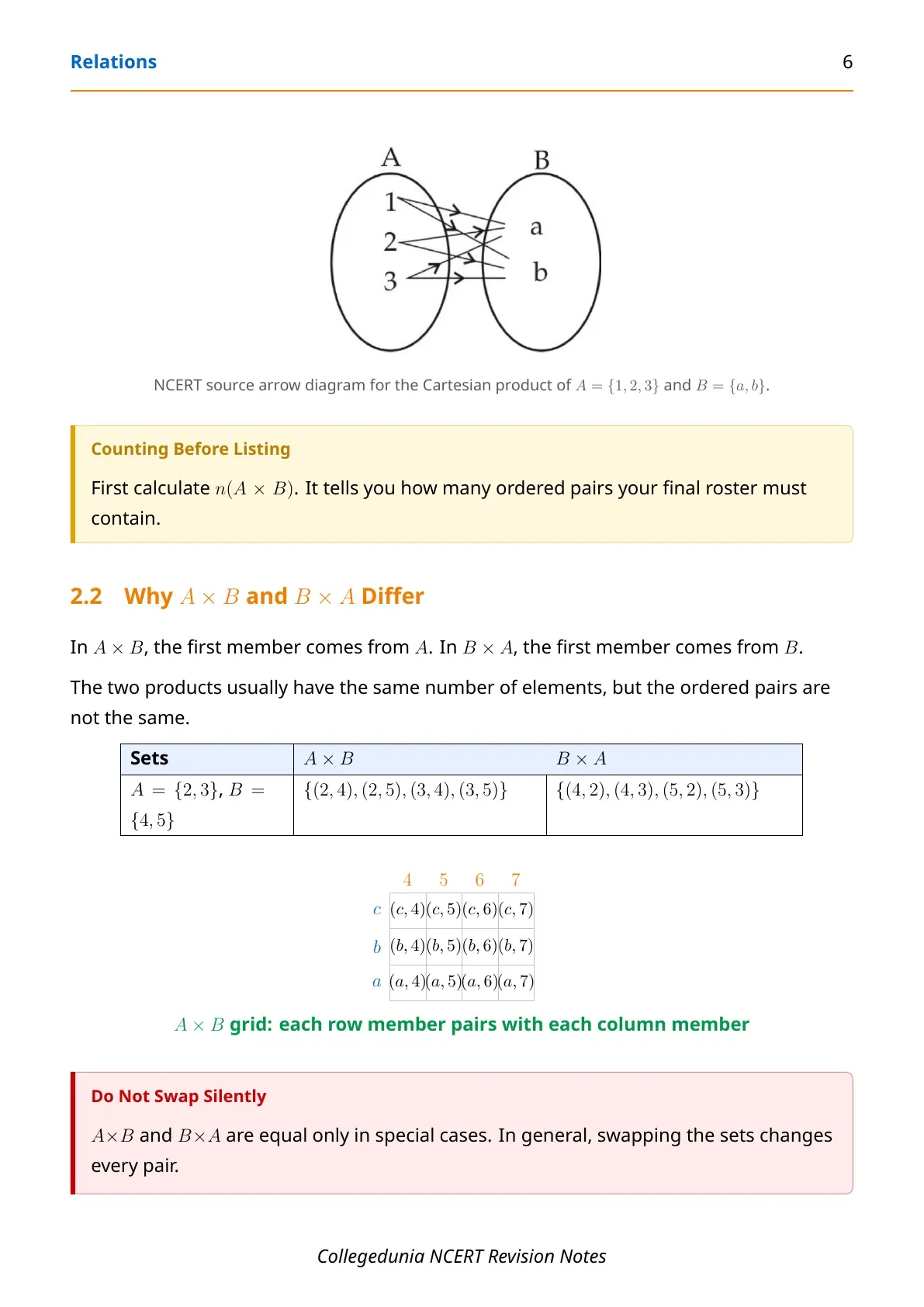
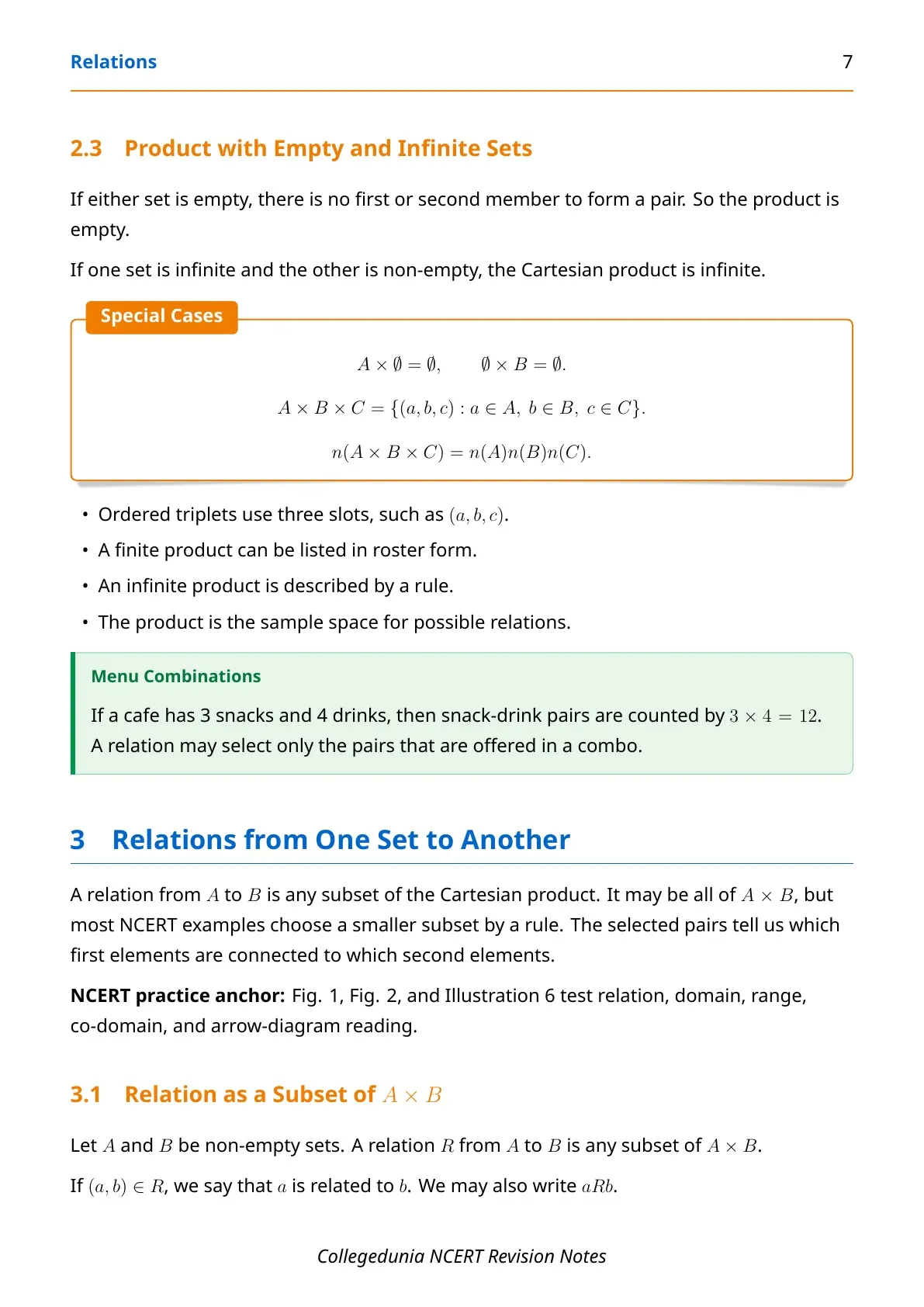
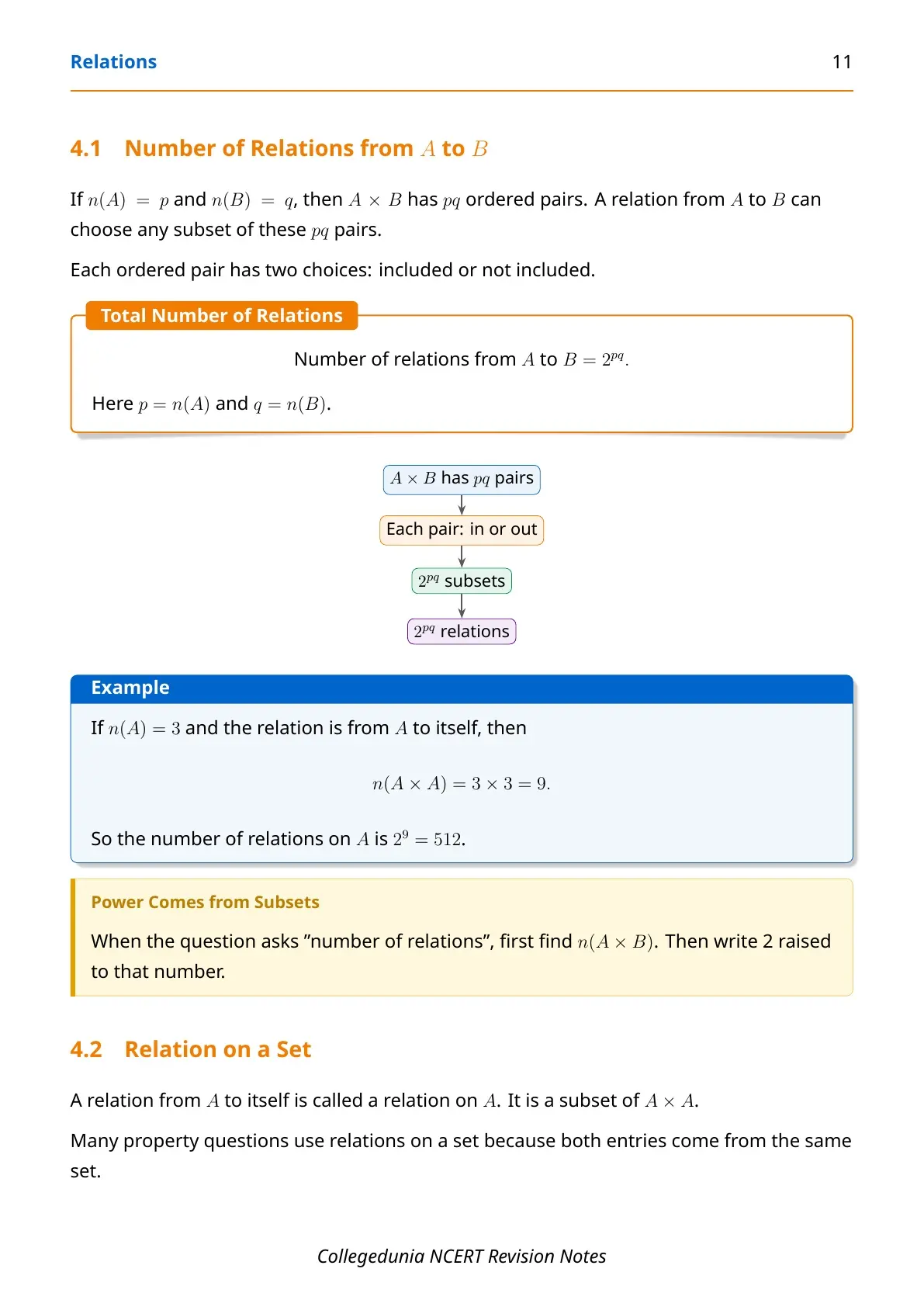
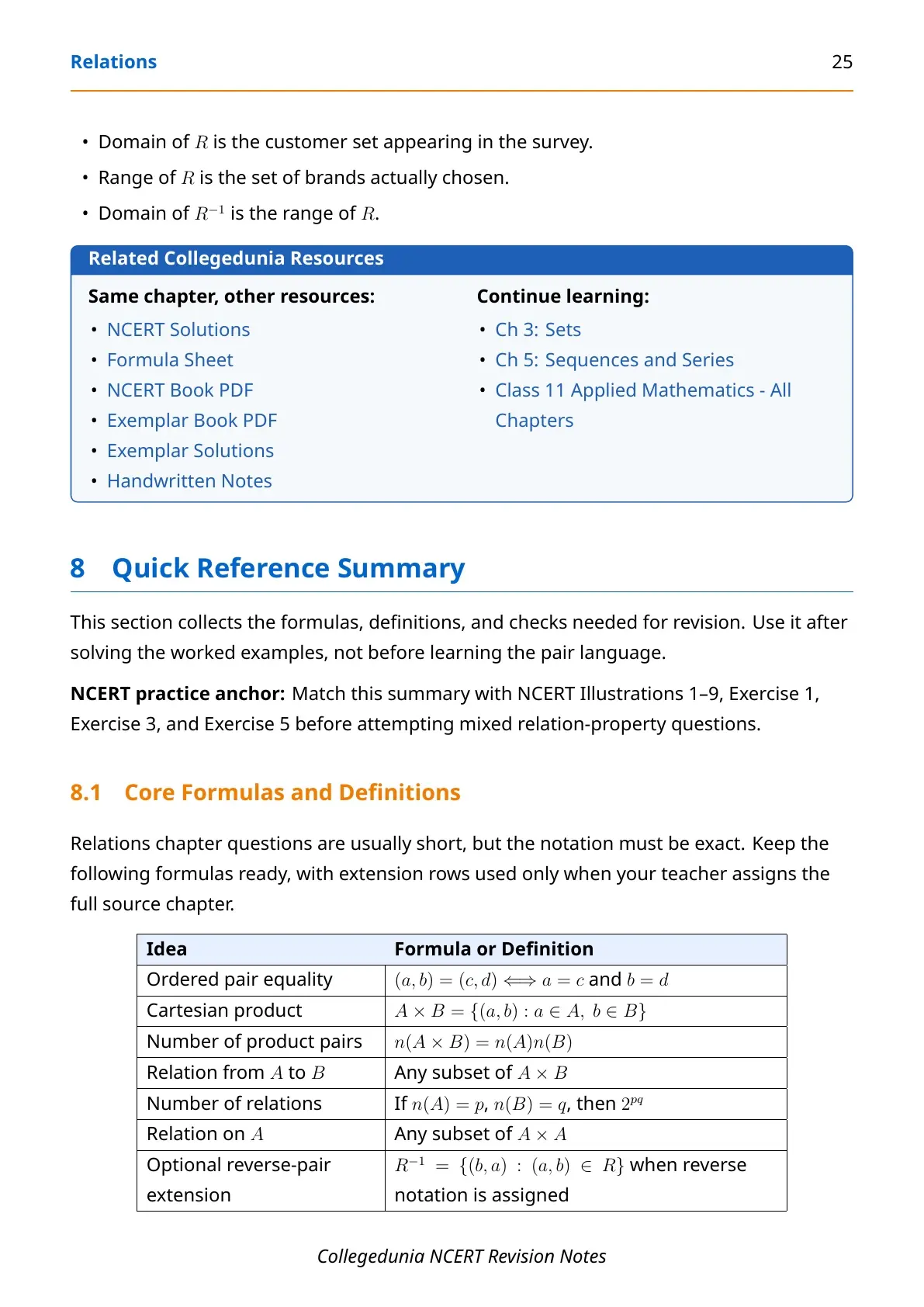
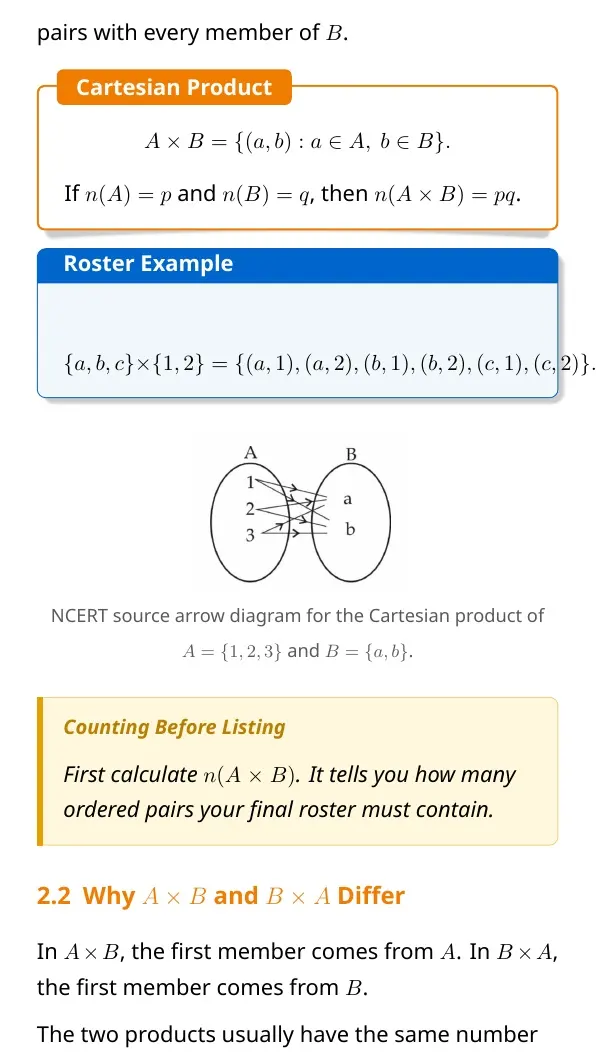
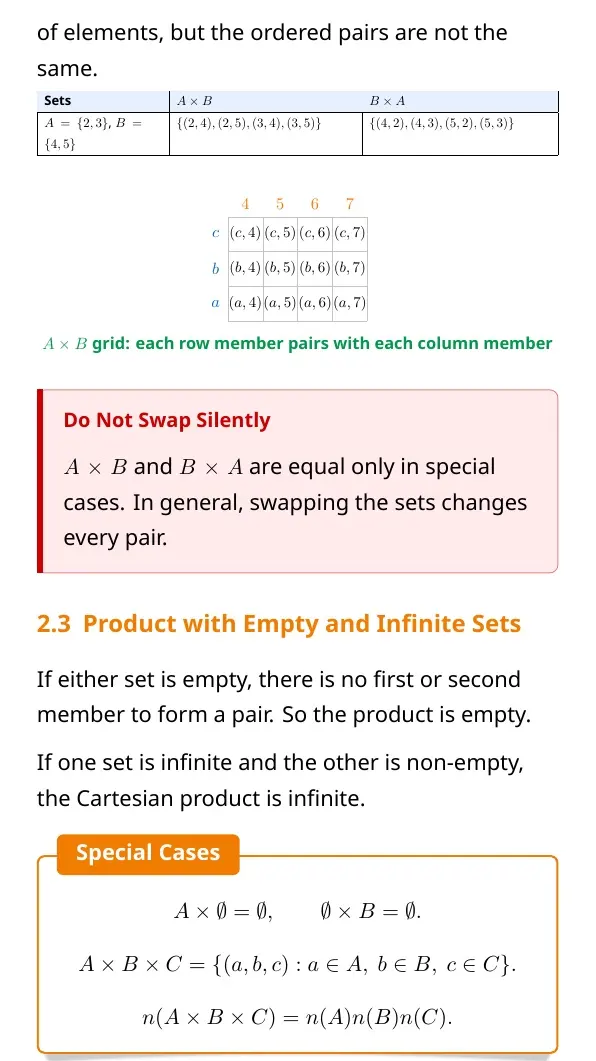
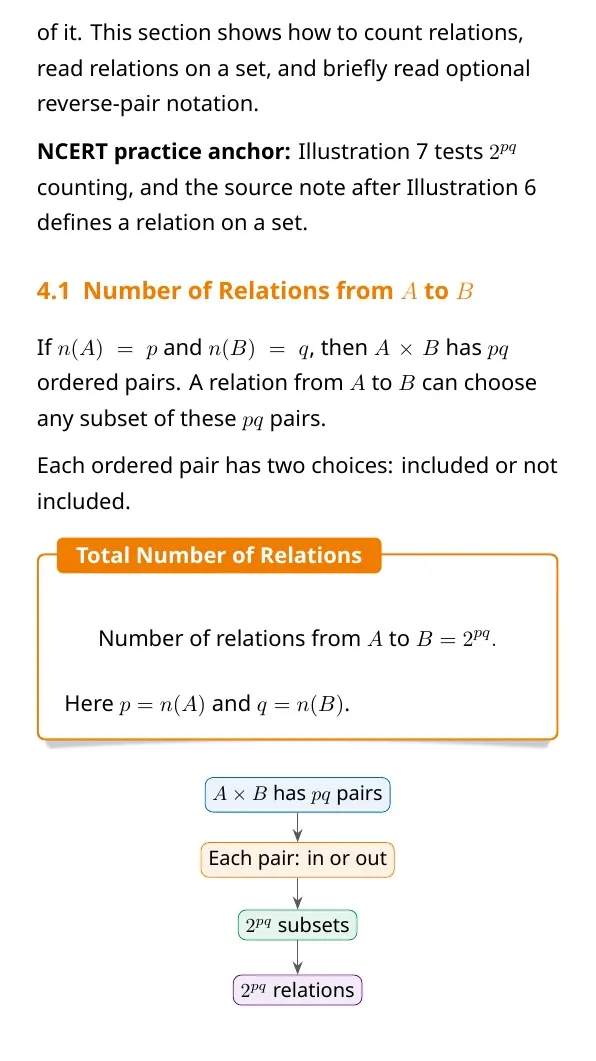
The Cartesian product A x B is the set of all possible ordered pairs with first entry from A and second entry from B. If A has p elements and B has q elements, A x B has pq ordered pairs.
| Idea | Meaning | Fast check |
|---|---|---|
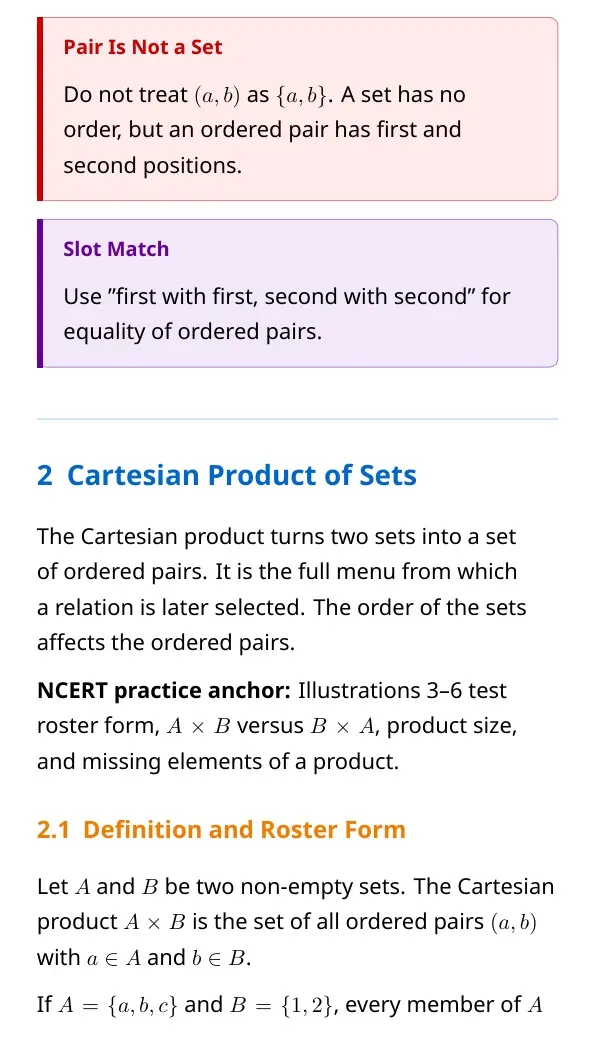
| Ordered pair | (a, b) has fixed first and second slots | Match first with first, second with second |
| Cartesian product | A x B lists all possible ordered pairs | Count p x q pairs before writing the roster |
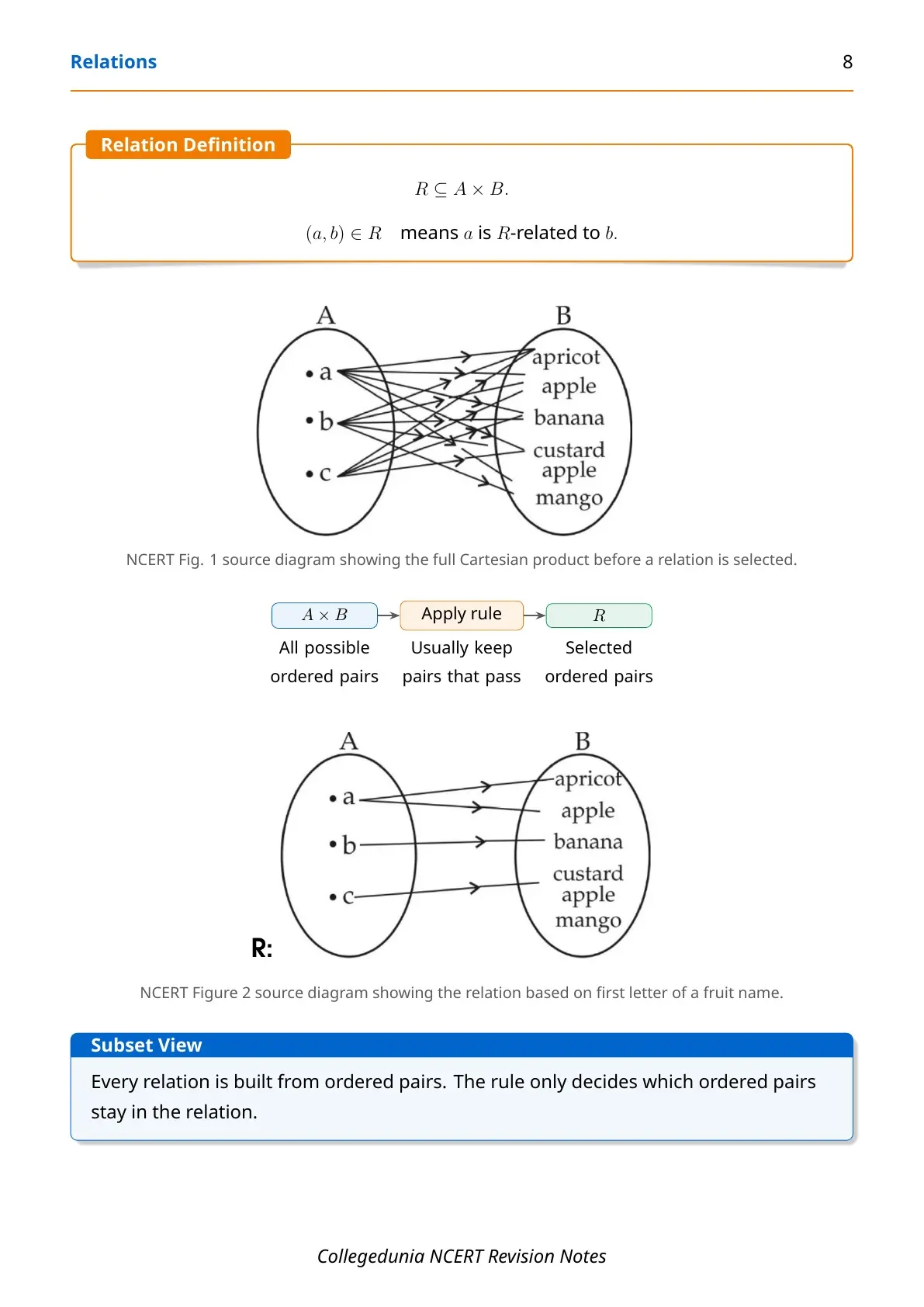
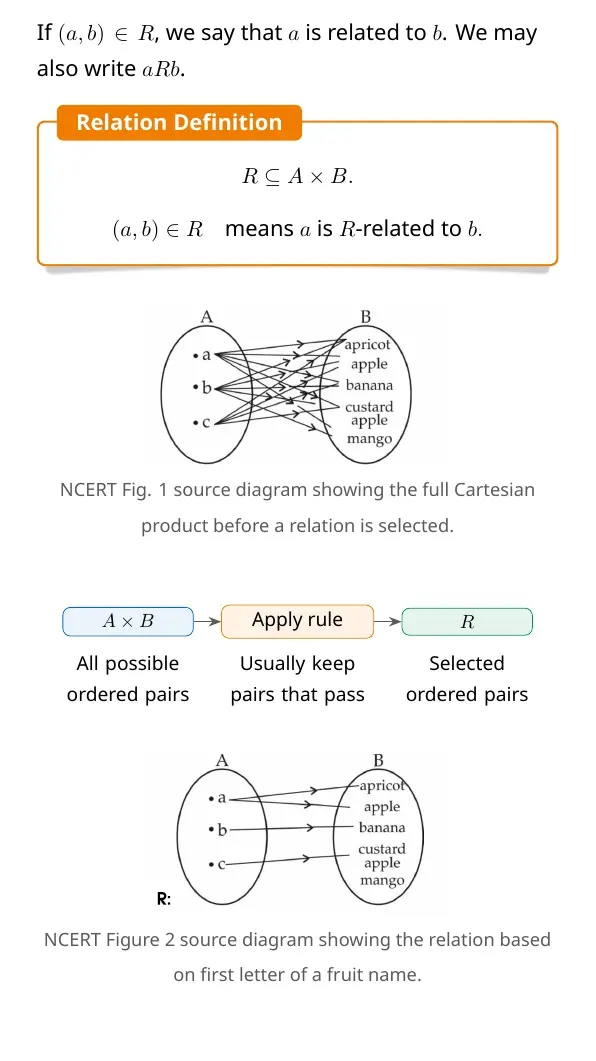
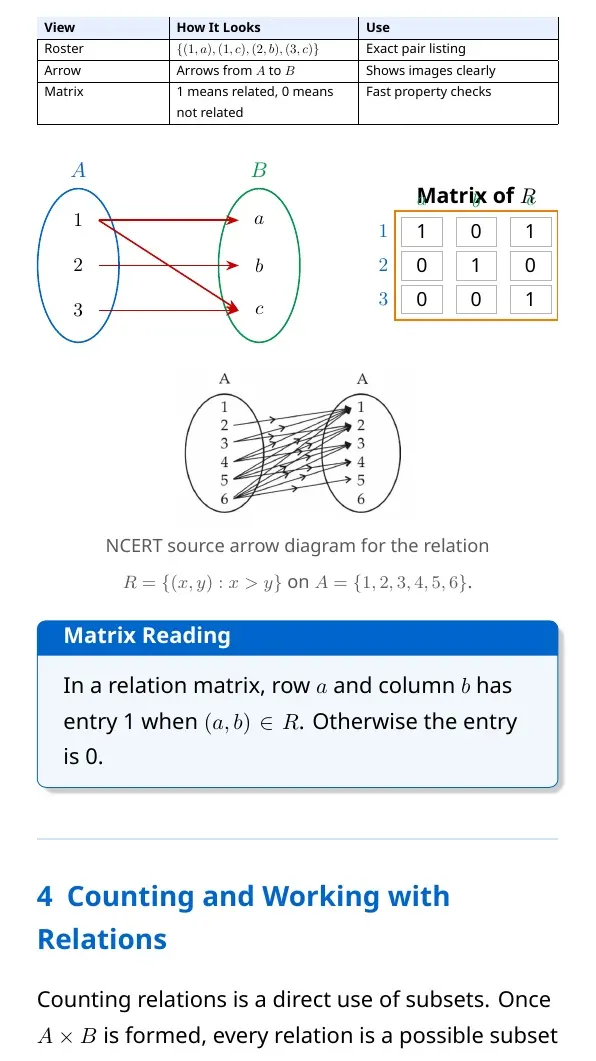
| Relation | A selected subset of A x B | Keep only pairs that satisfy the rule |
Relations Domain and Range Video Revision
Source: Magnet Brains on YouTube
Domain, Range and Co-domain in the Relations Chapter
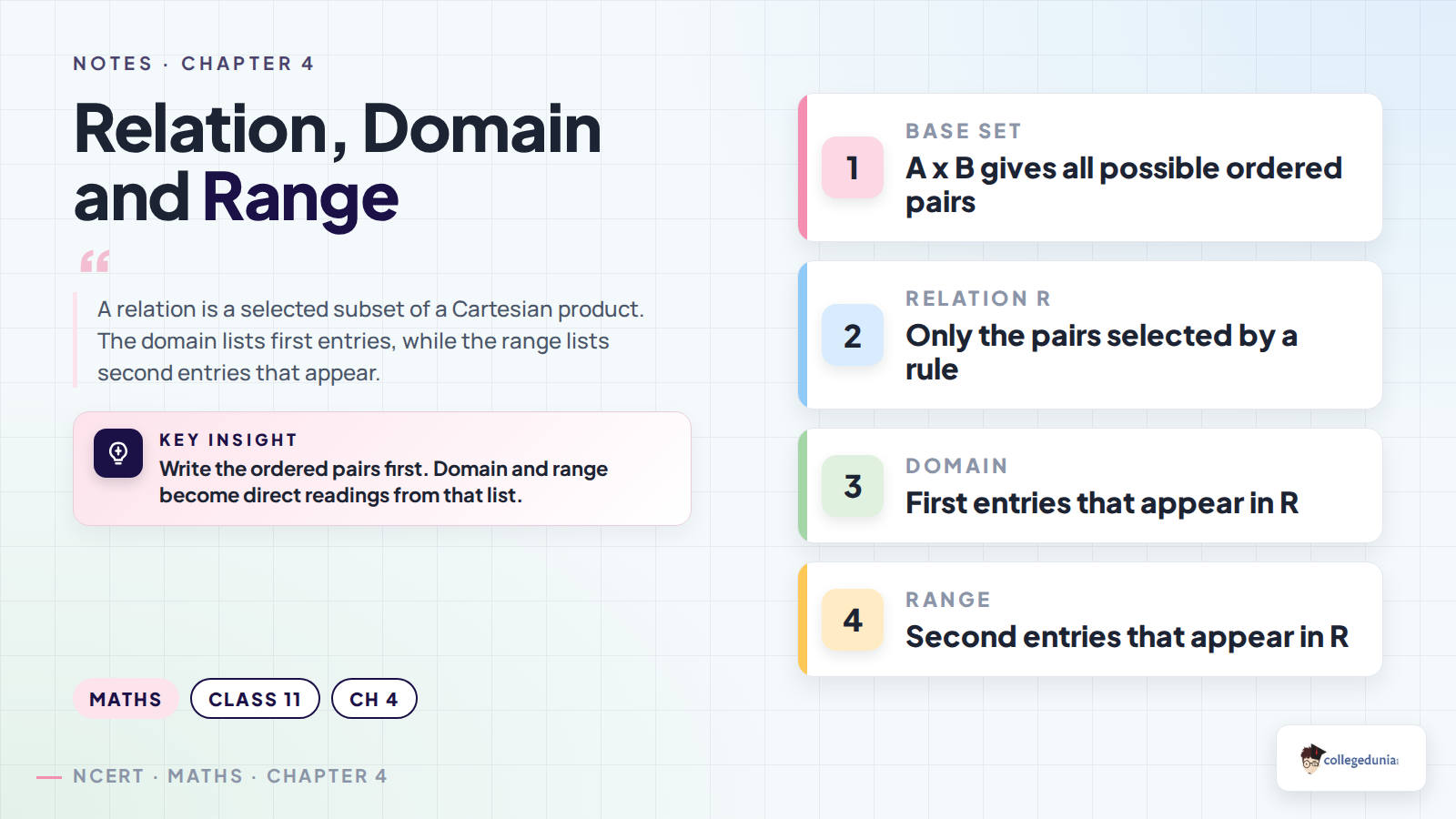
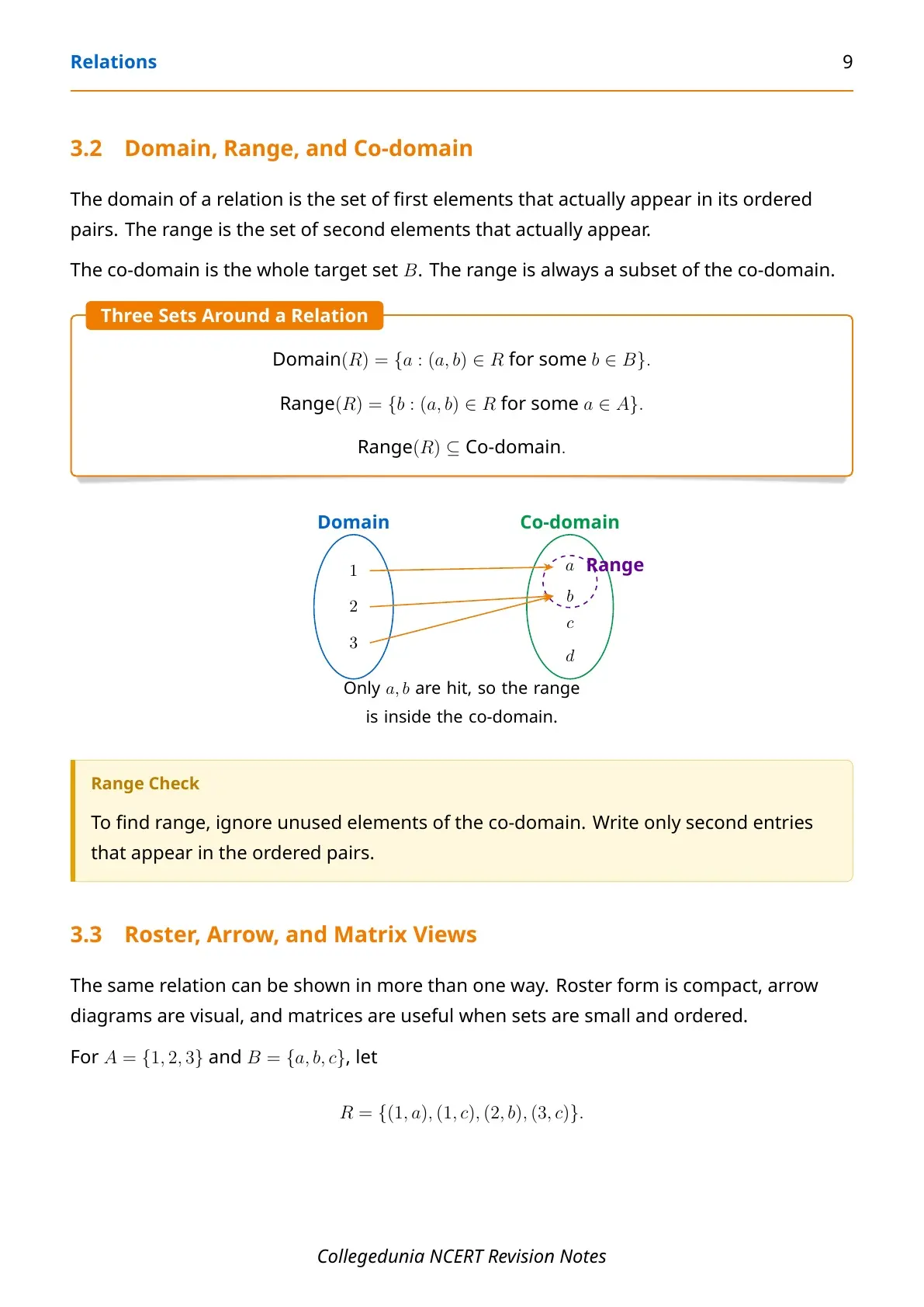
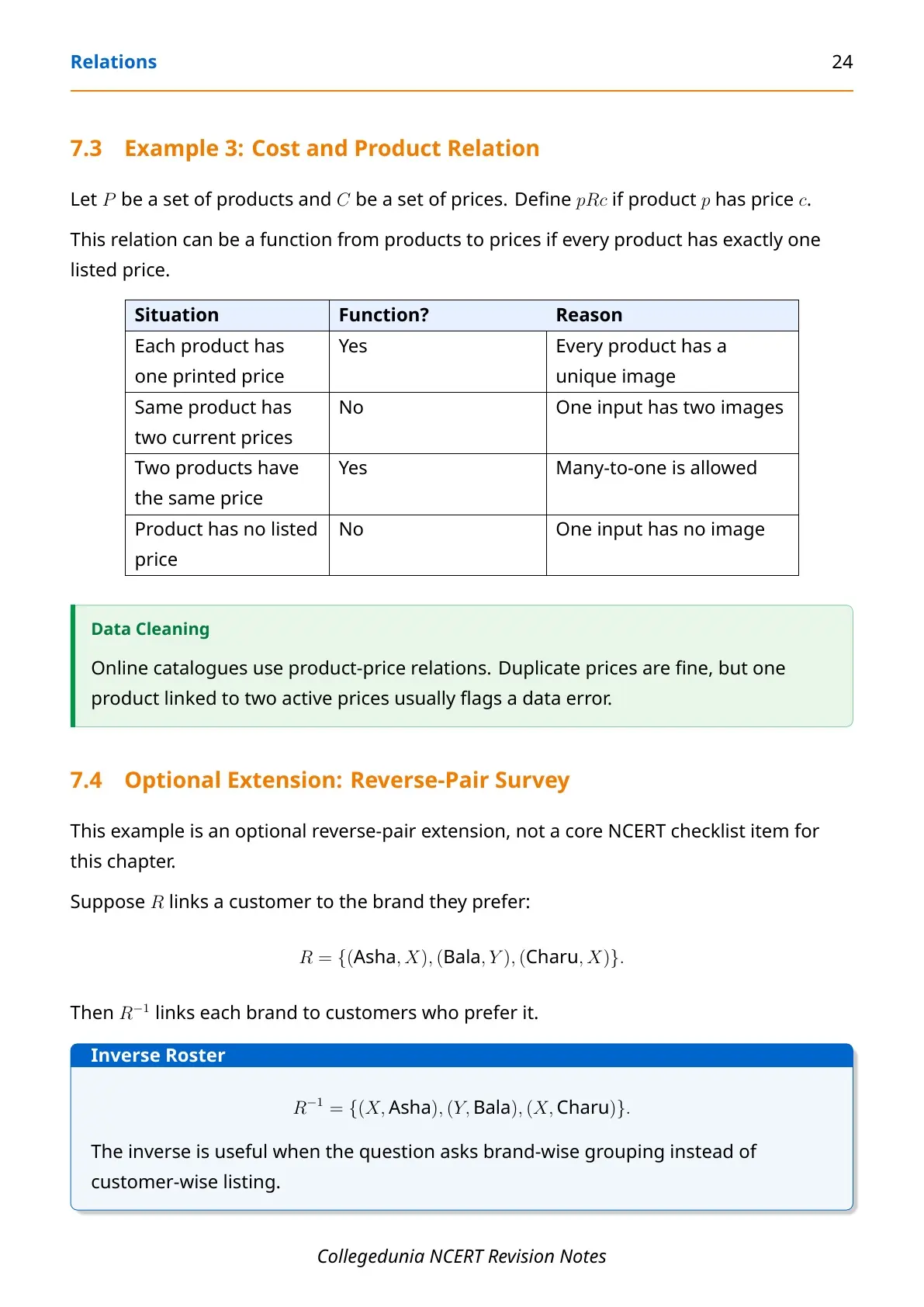
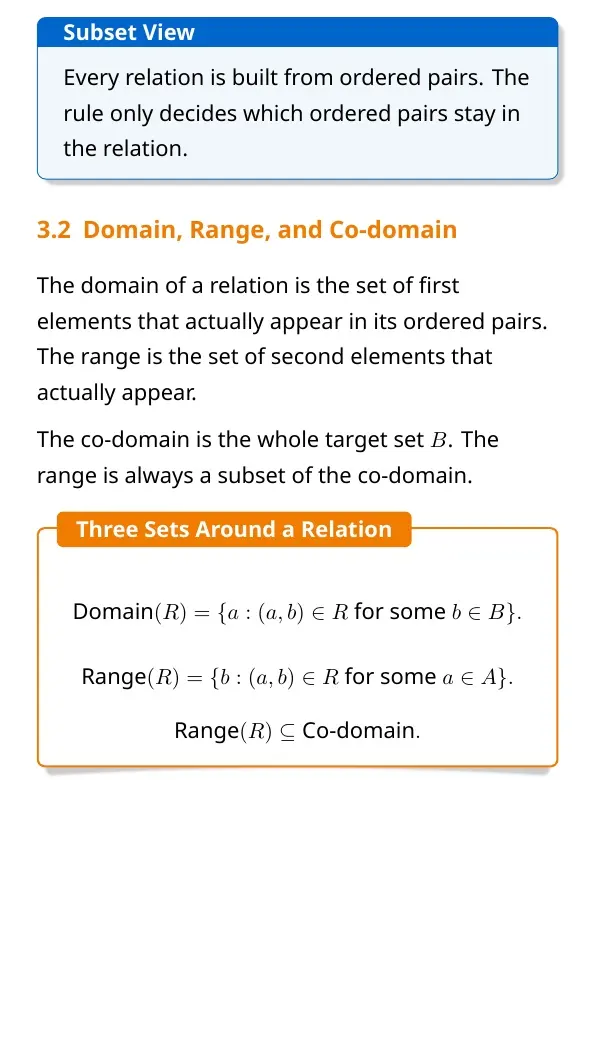
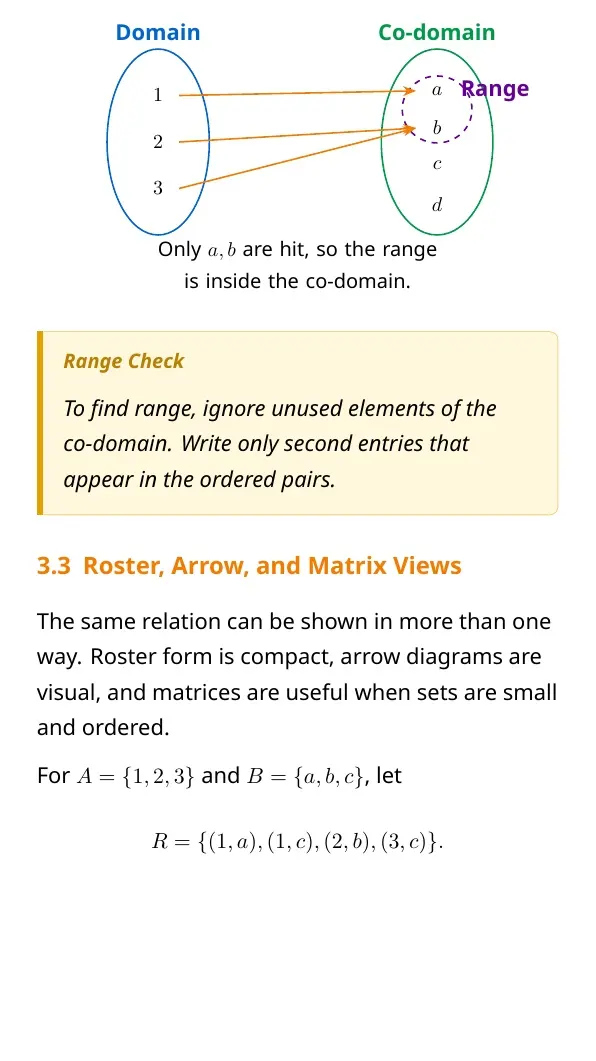
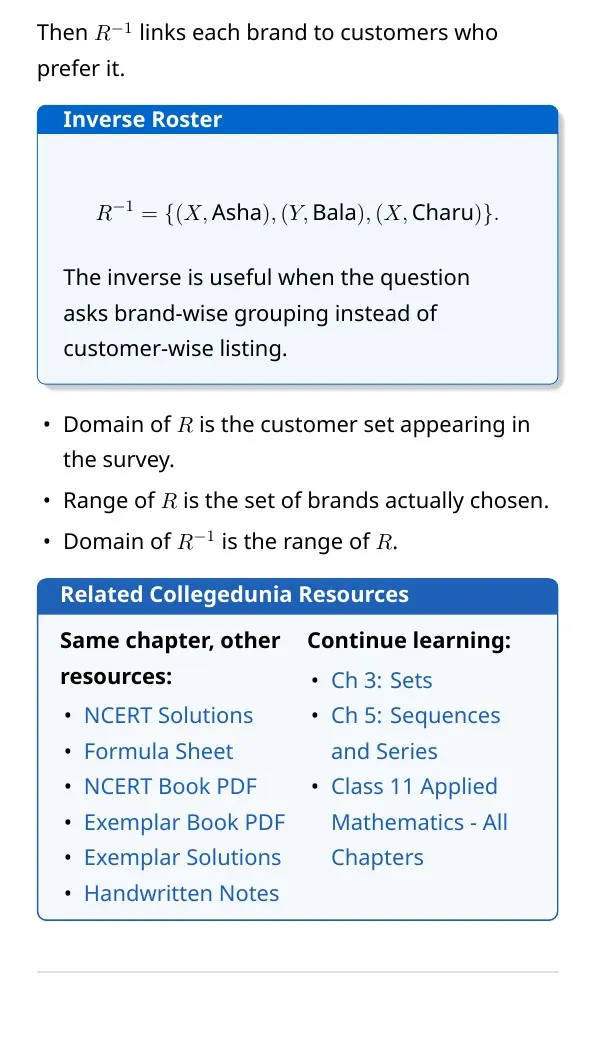
The domain of a relation is the set of first entries that appear in its ordered pairs. The range is the set of second entries that appear. The co-domain is the full target set, so range is always inside the co-domain.
- Domain: read the first coordinate of each selected pair.
- Range: read only the second coordinates that actually appear.
- Co-domain: keep the full target set given in the question.
Common check: unused elements of the co-domain do not enter the range.
Types of Relations for Class 11 Applied Mathematics
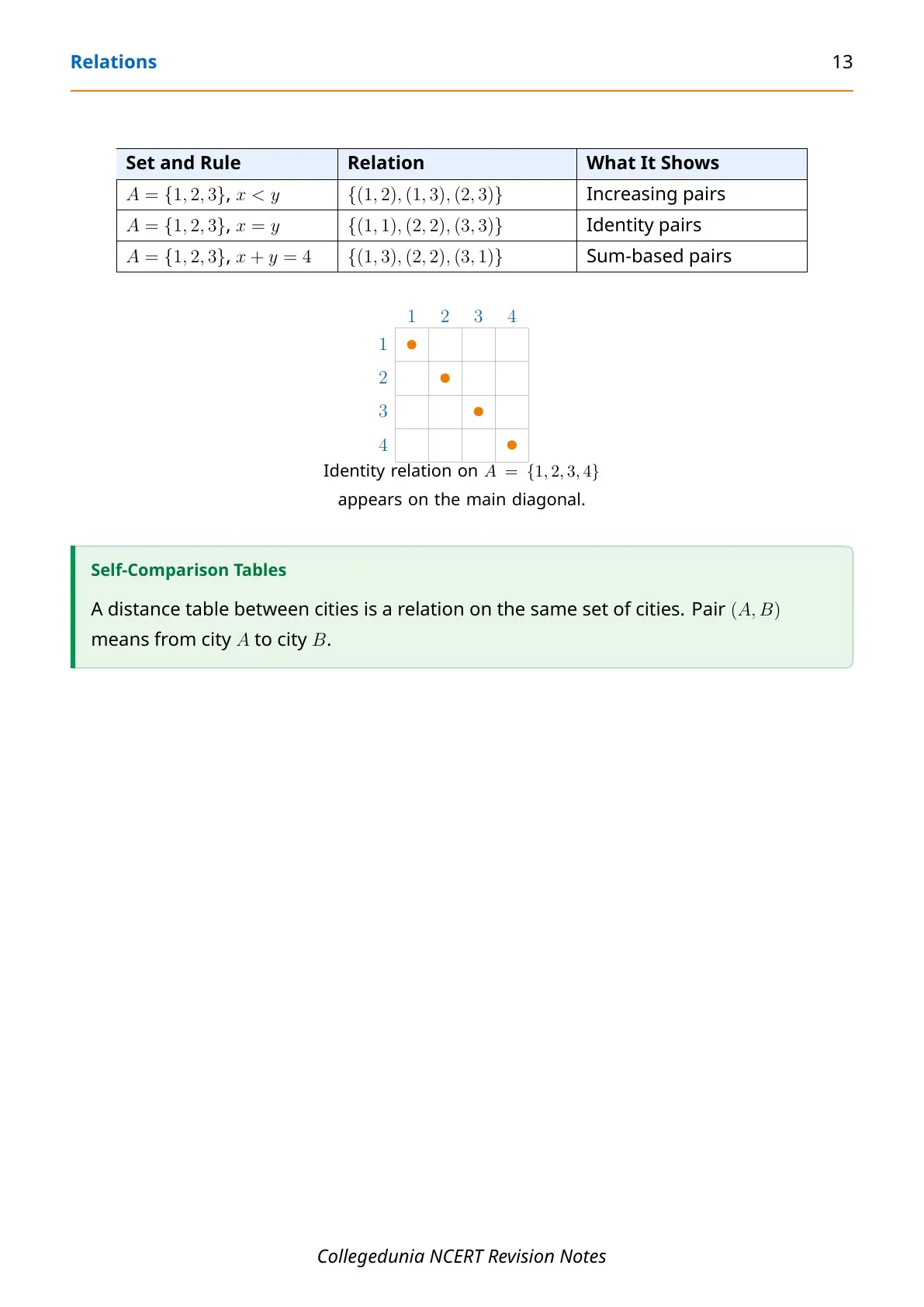
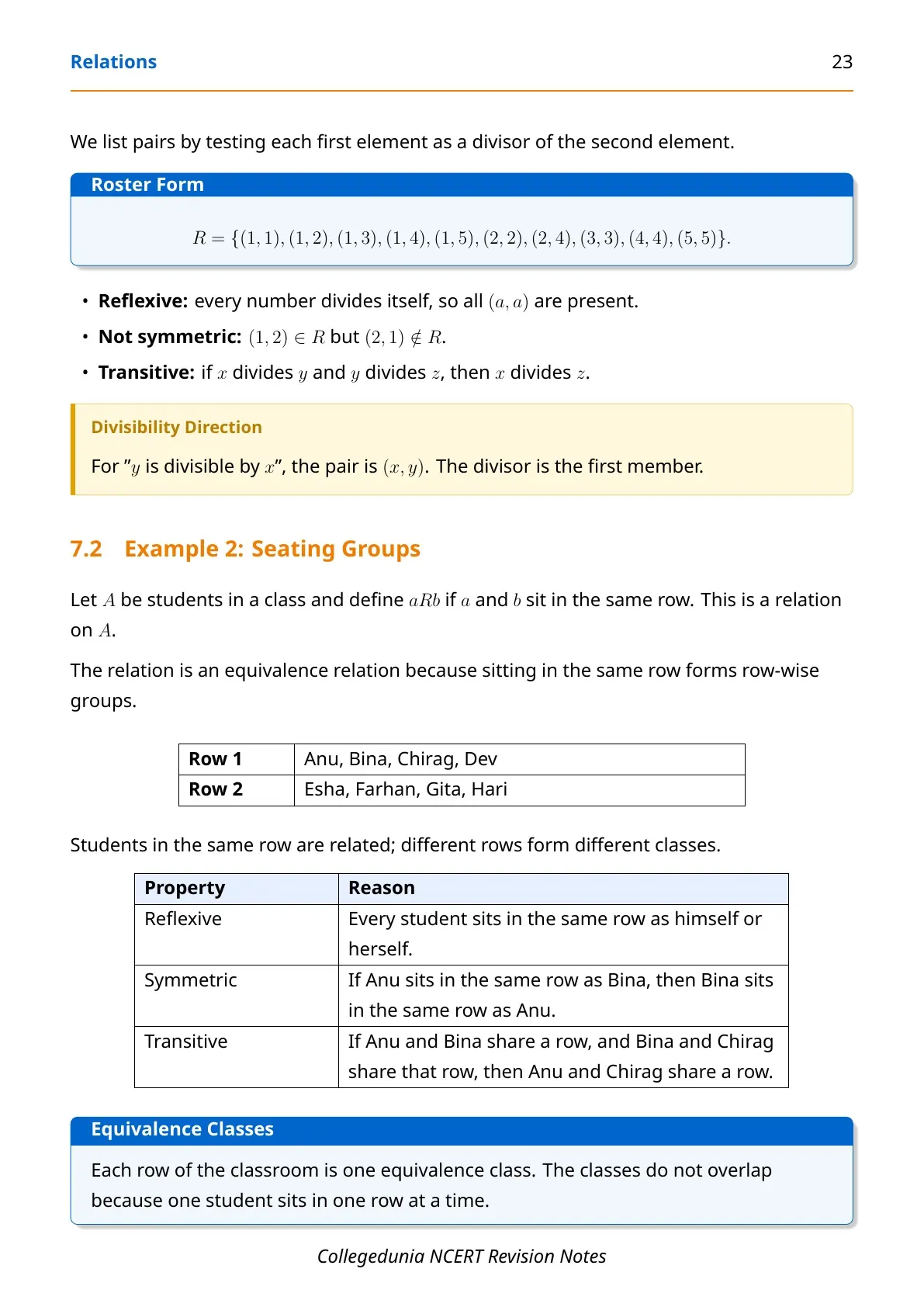
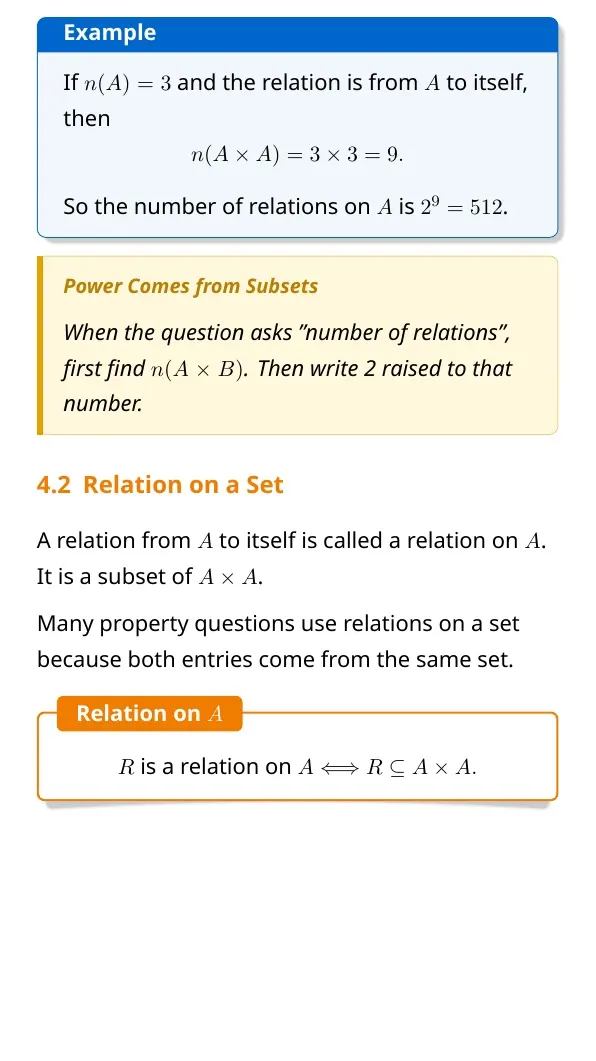
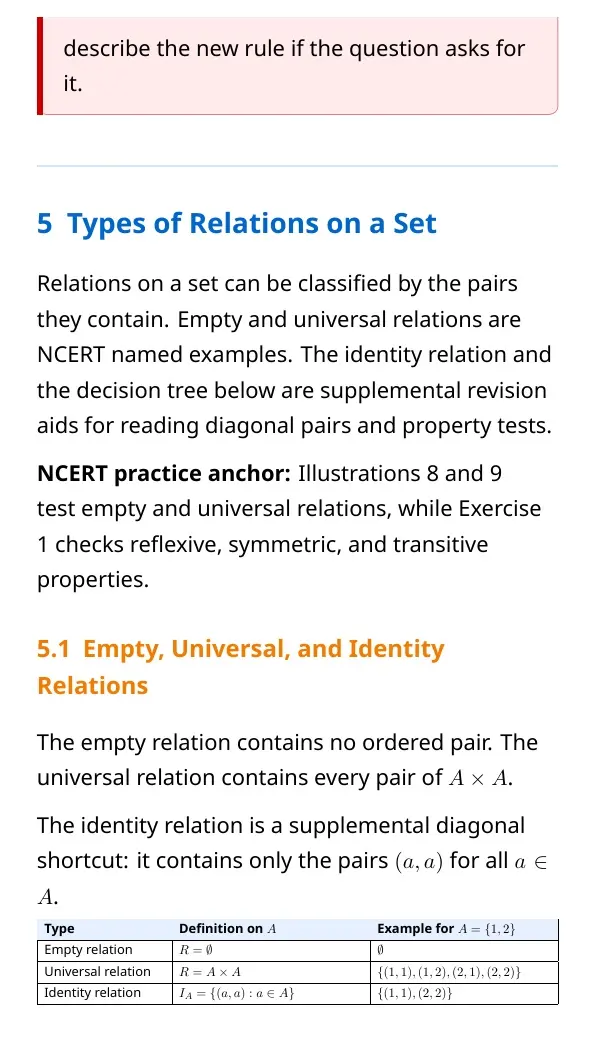
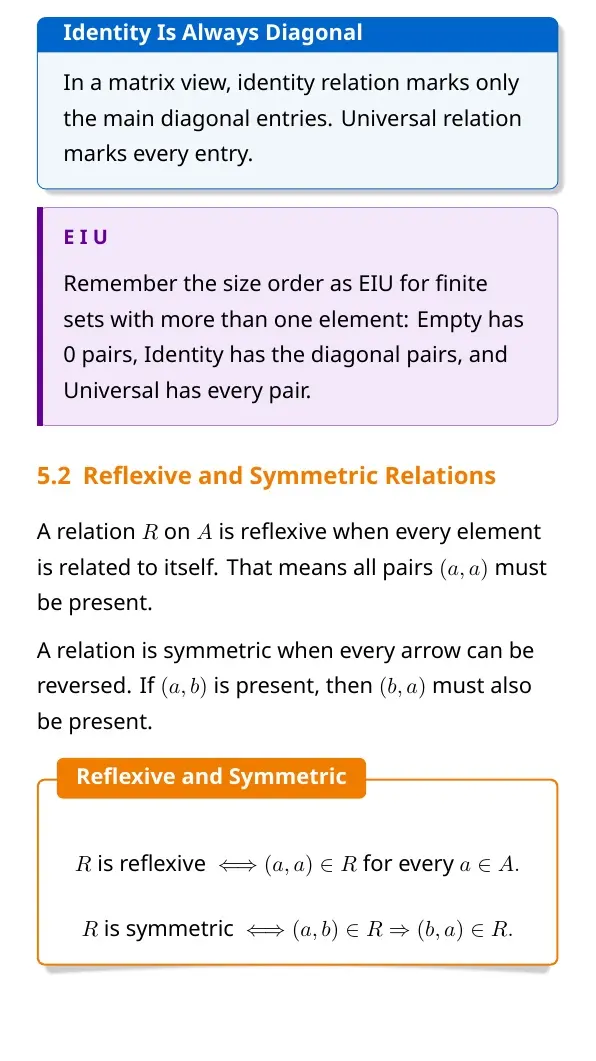
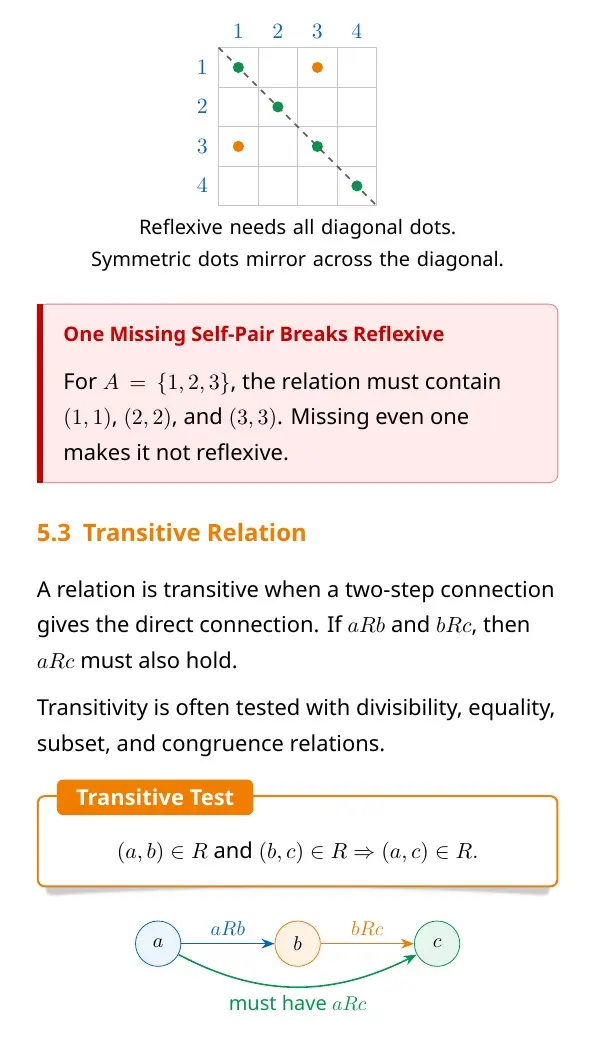
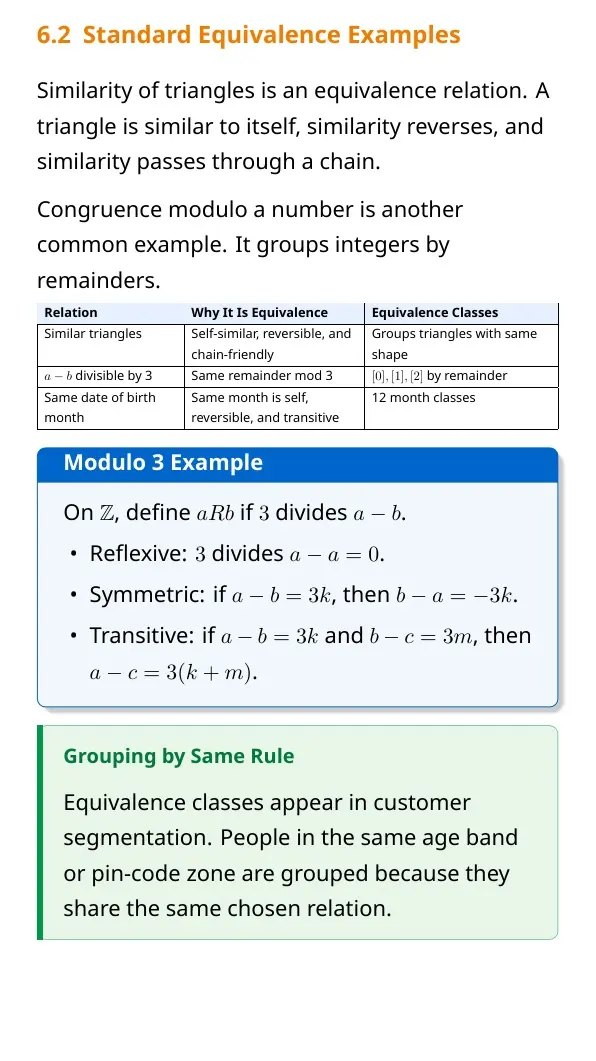
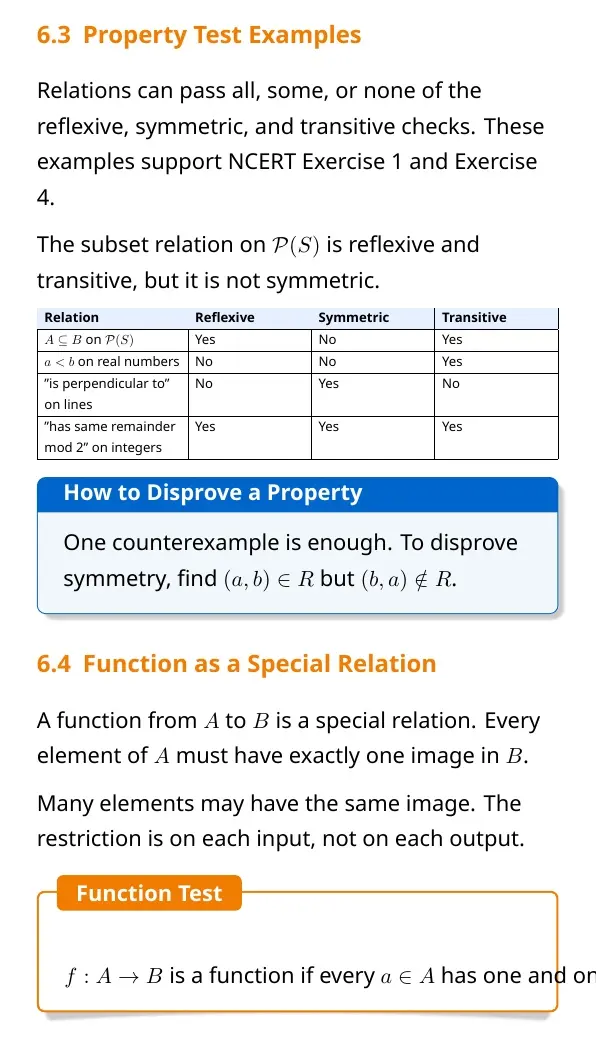
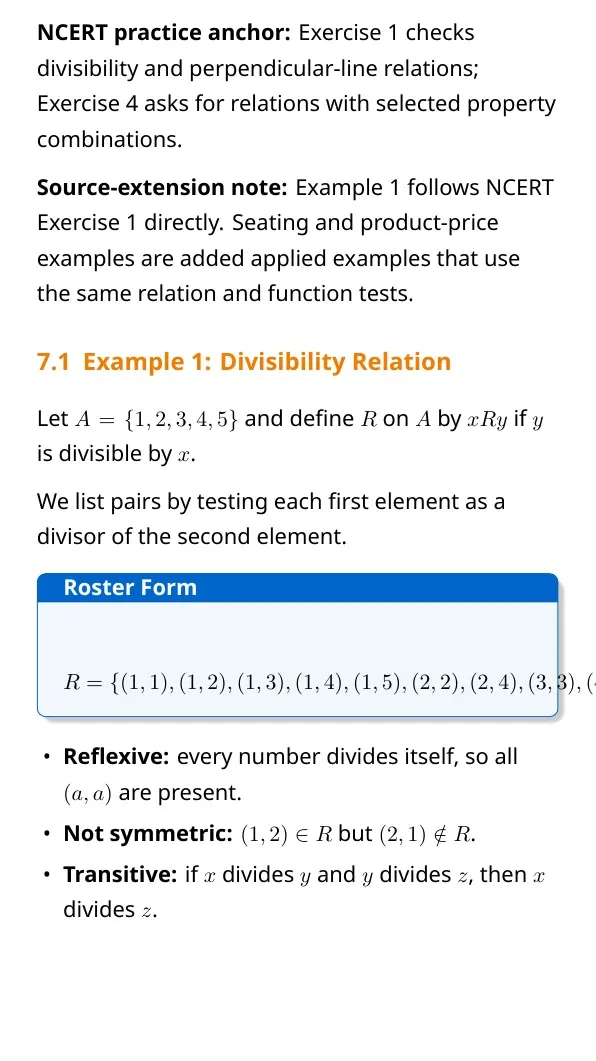
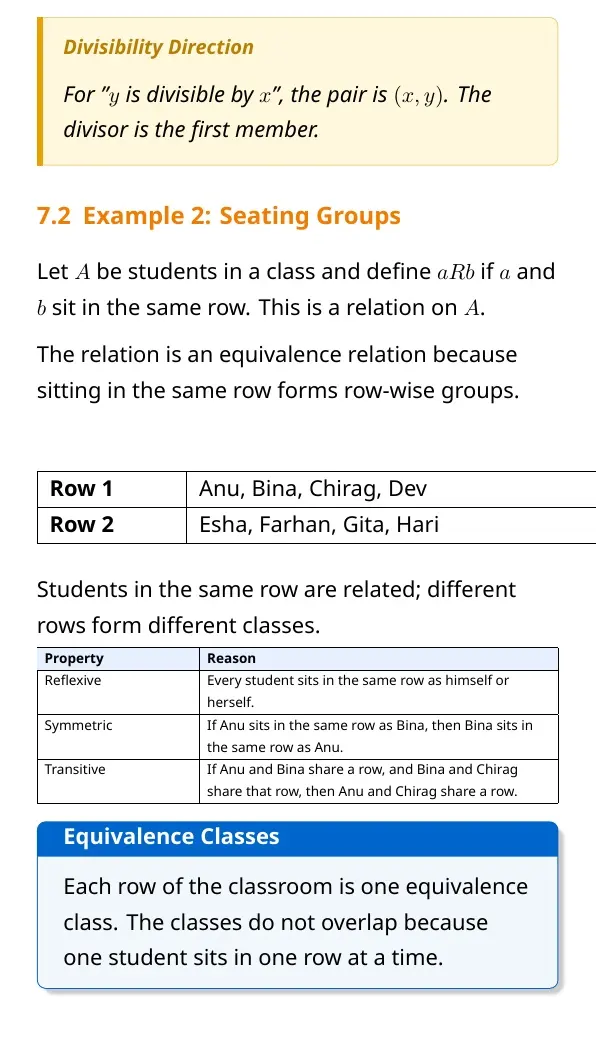
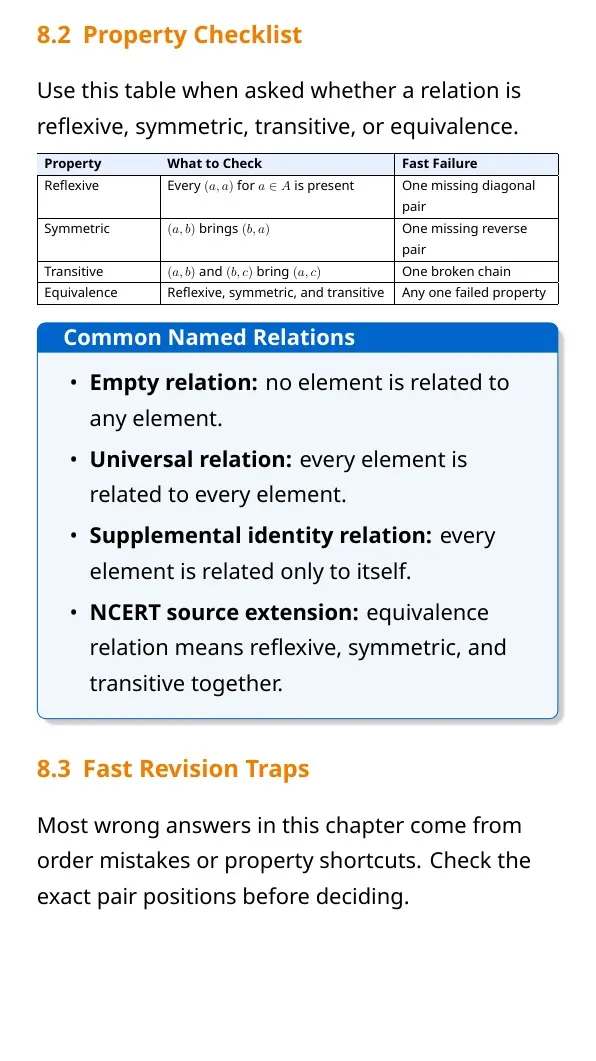
Relations on a set use pairs from A x A. The same set supplies both coordinates, so property tests become possible. The three main tests are reflexive, symmetric and transitive.
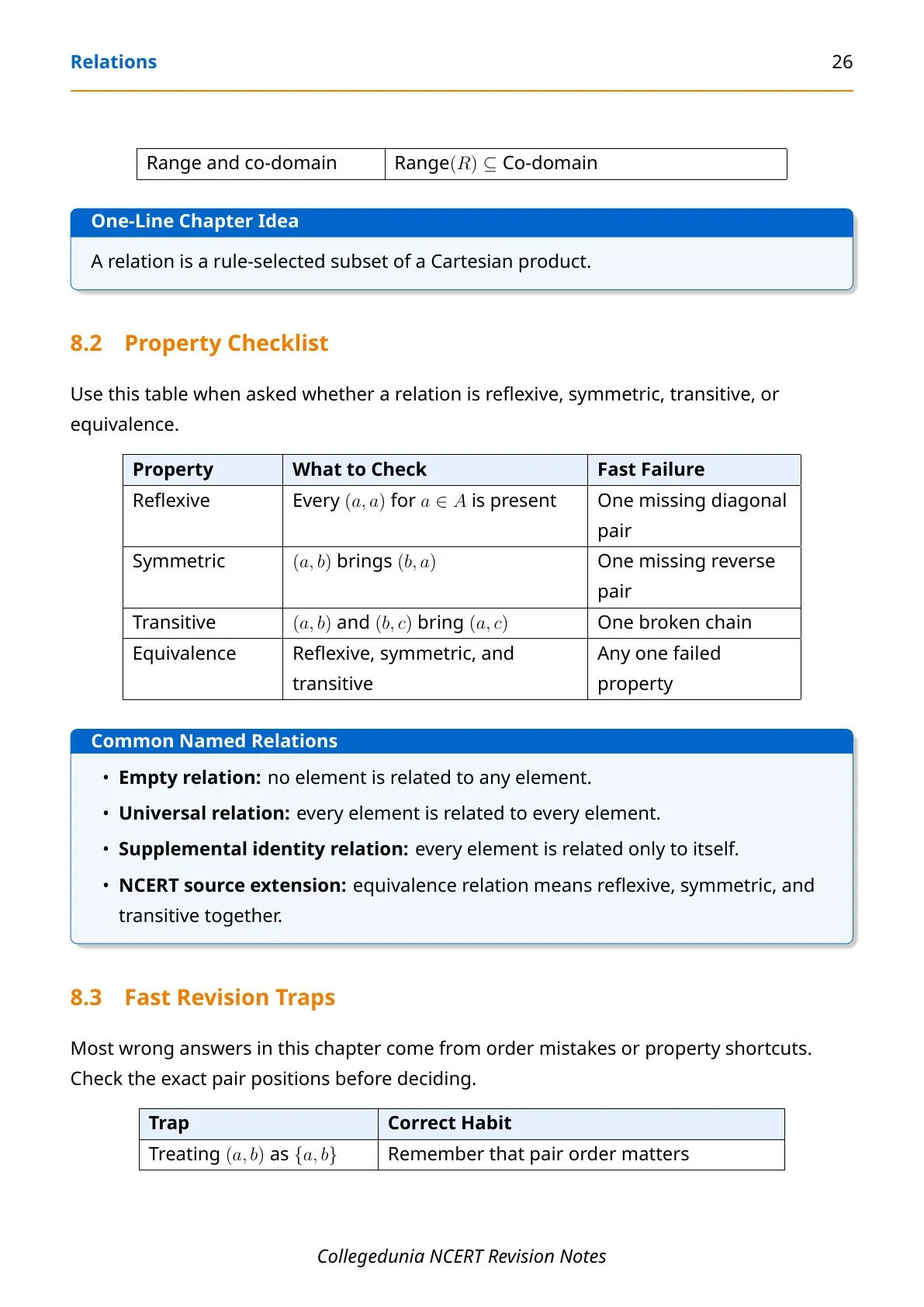
| Type | What to check | How it can fail |
|---|---|---|
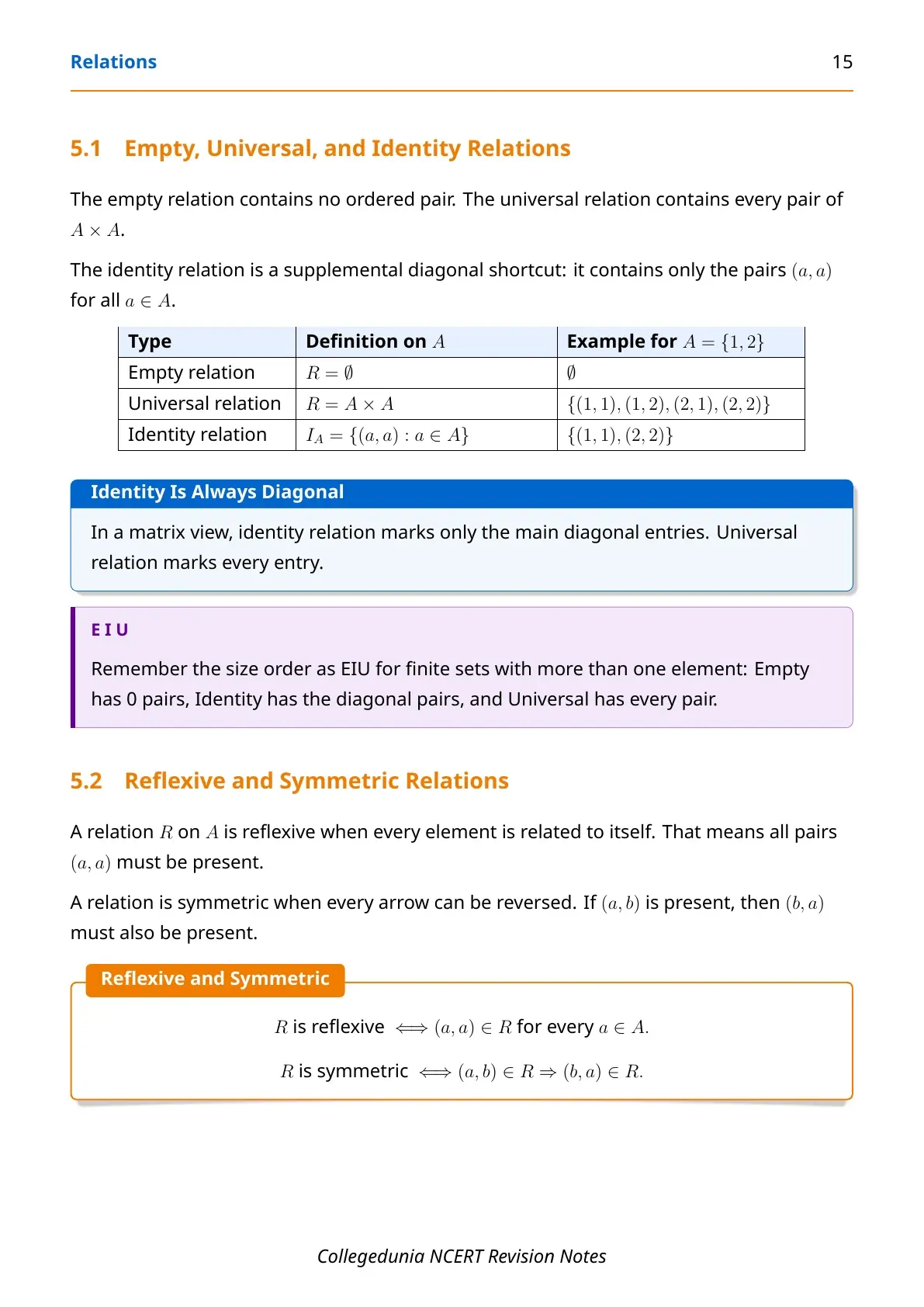
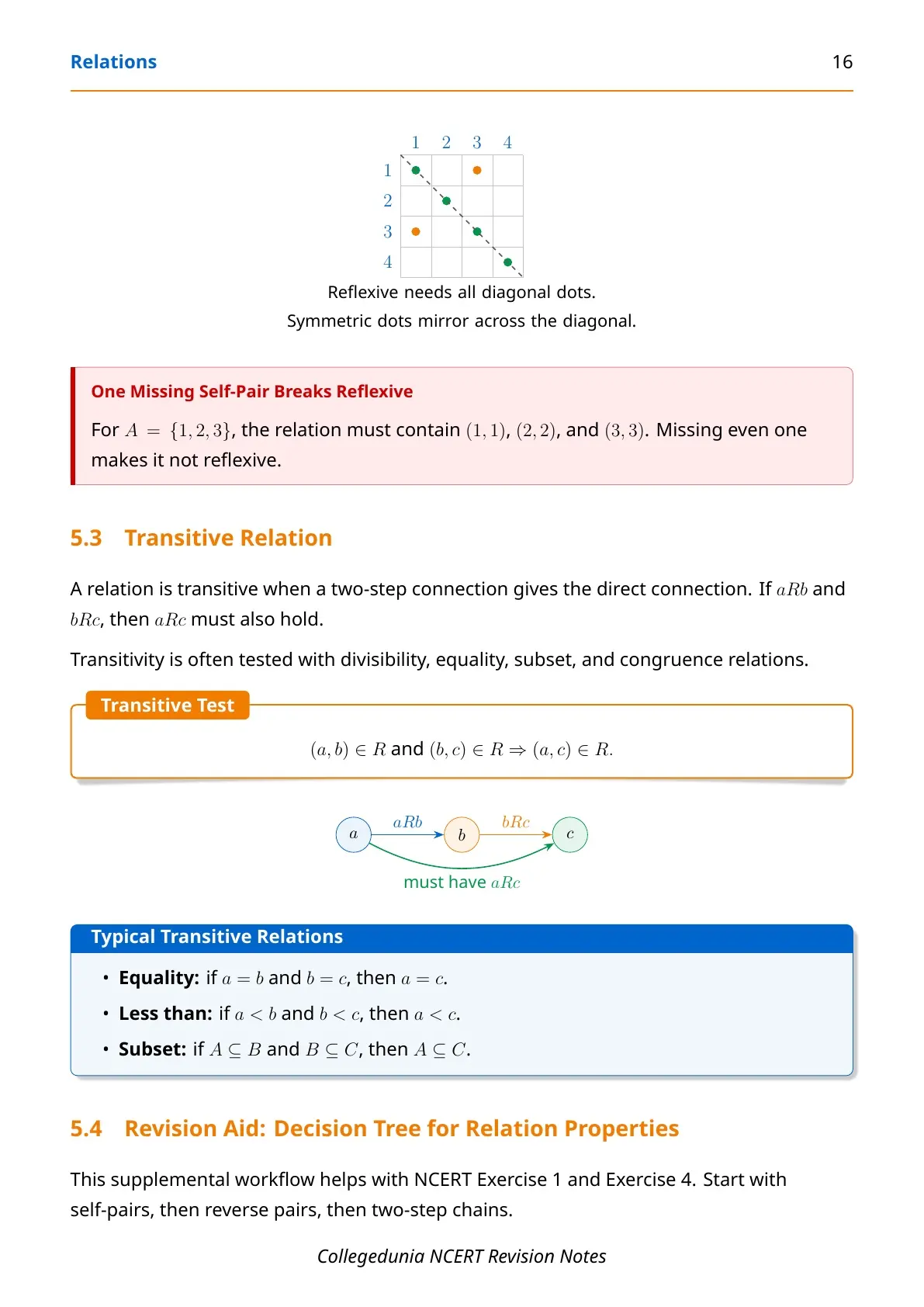
| Reflexive | Every (a, a) must be present | One missing self-pair breaks it |
| Symmetric | If (a, b) is present, (b, a) must be present | One missing reverse pair breaks it |
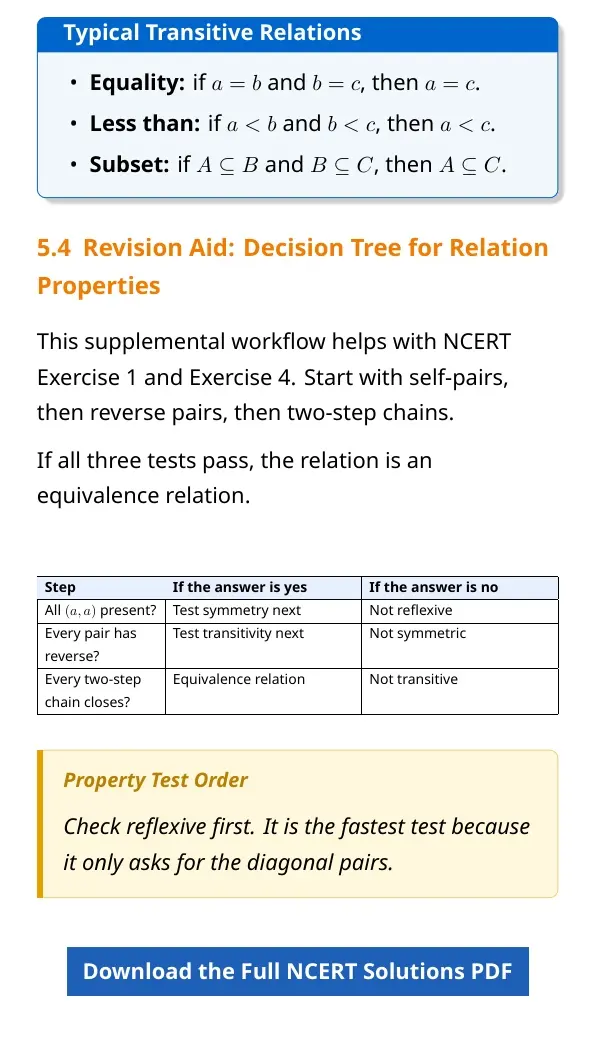
| Transitive | If (a, b) and (b, c) are present, (a, c) must be present | One broken chain breaks it |
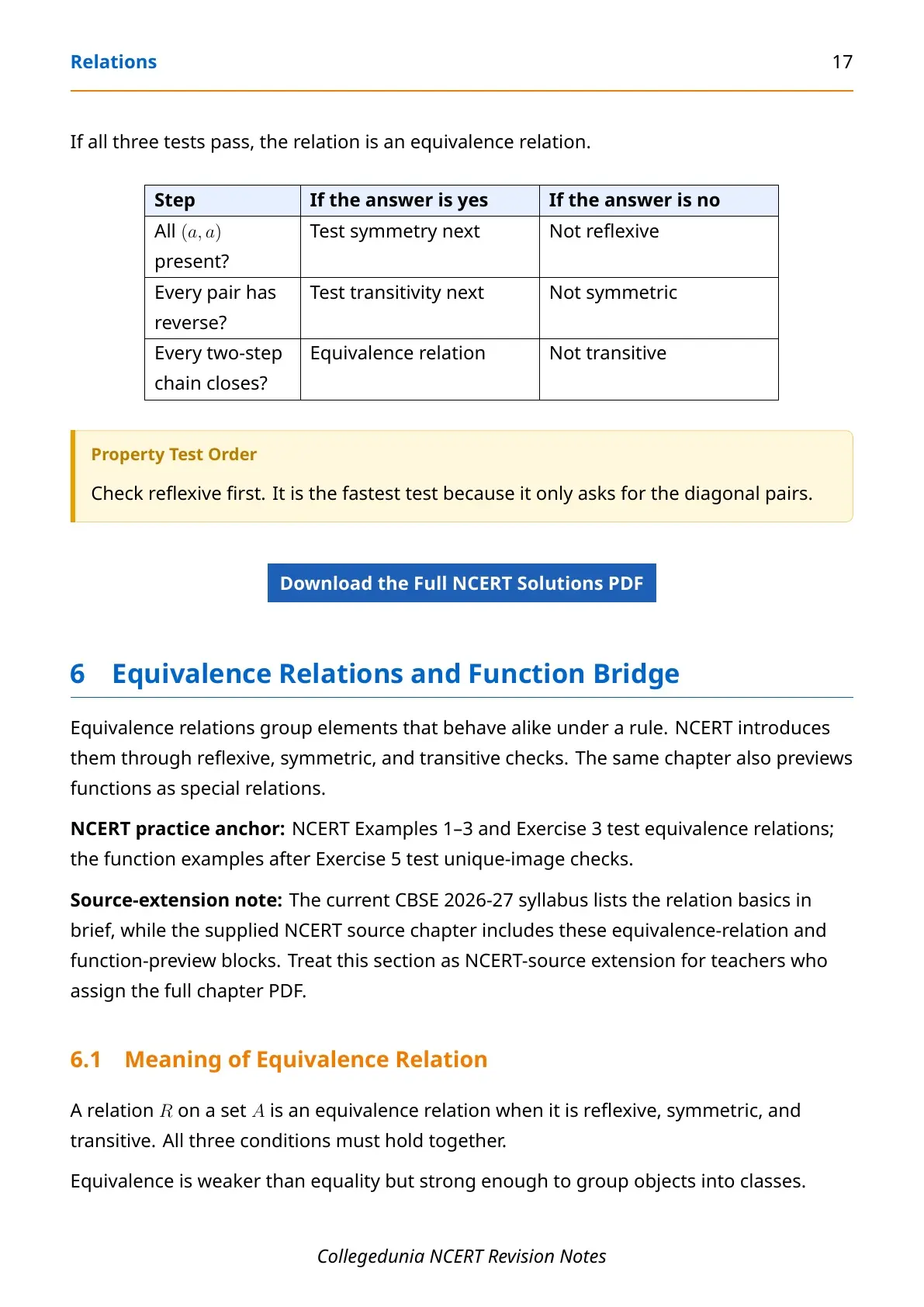
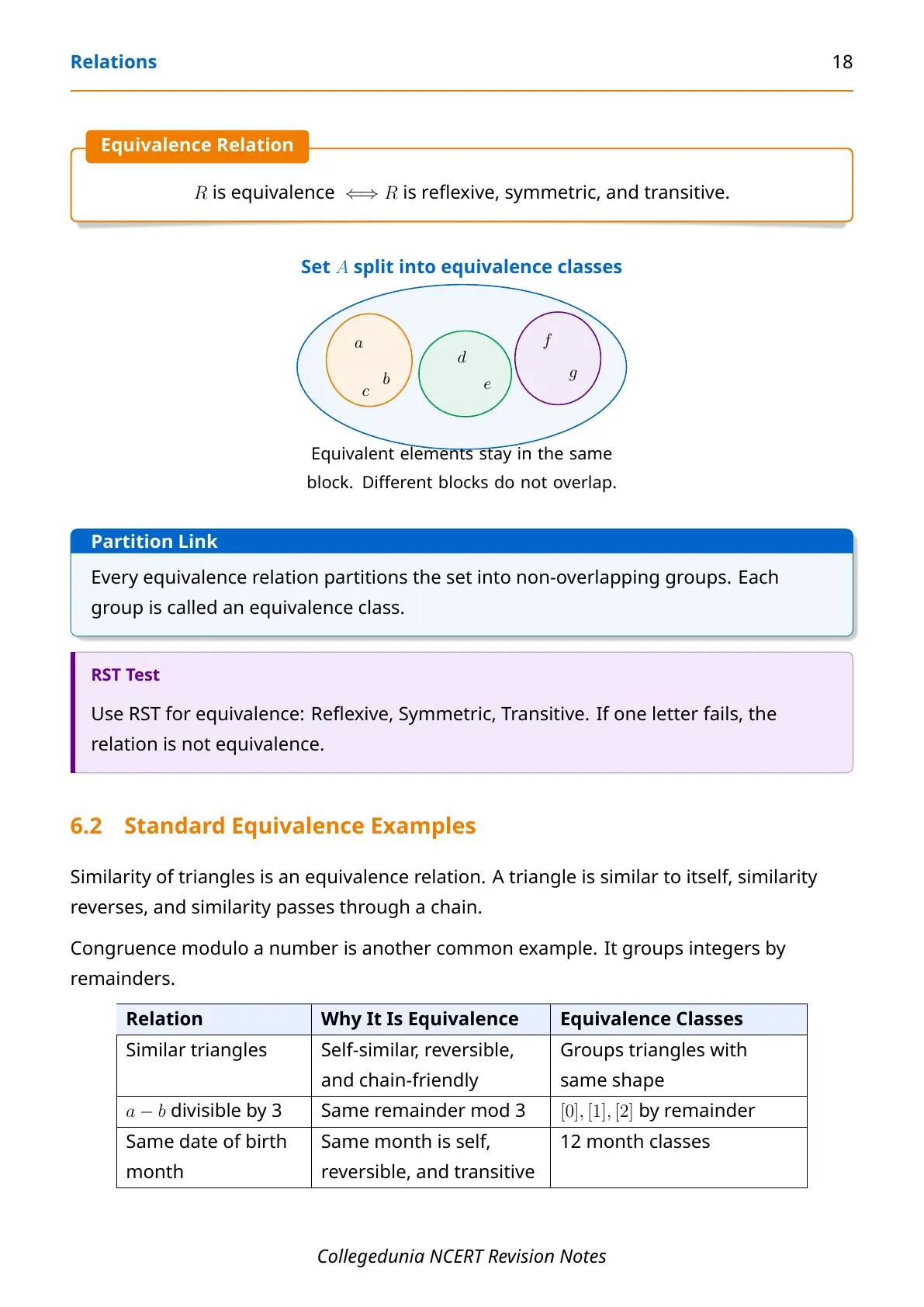
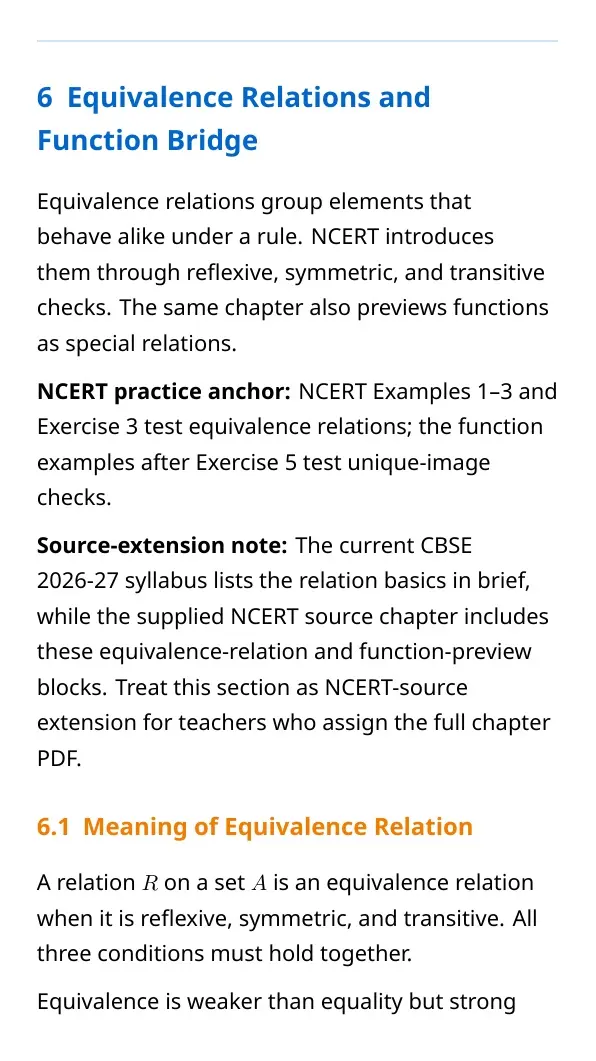
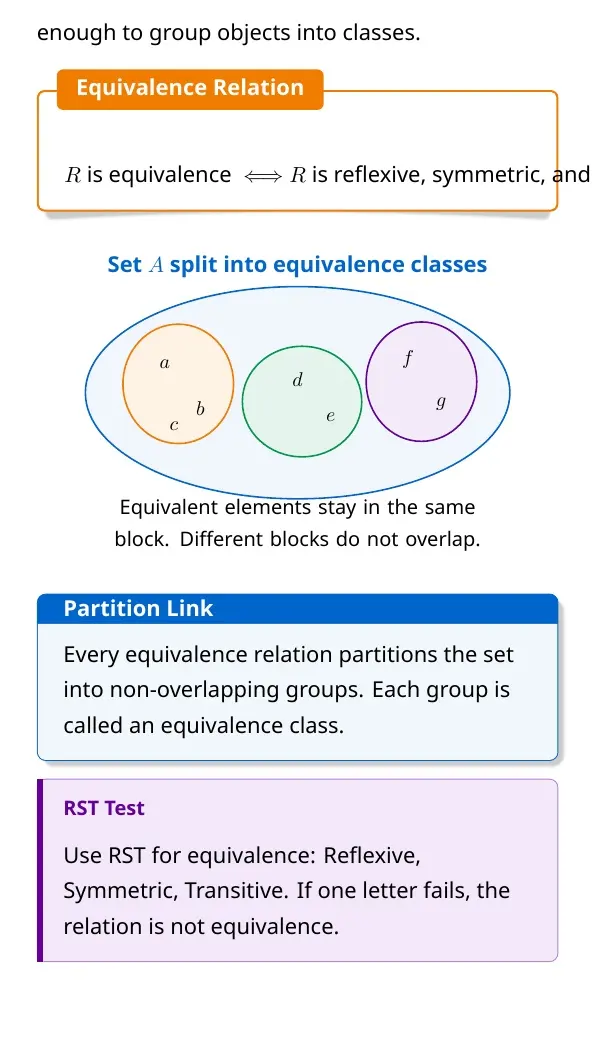
| Equivalence relation | Reflexive, symmetric and transitive together | Any one failed test rejects it |
How to Test a Relation in Exam Questions
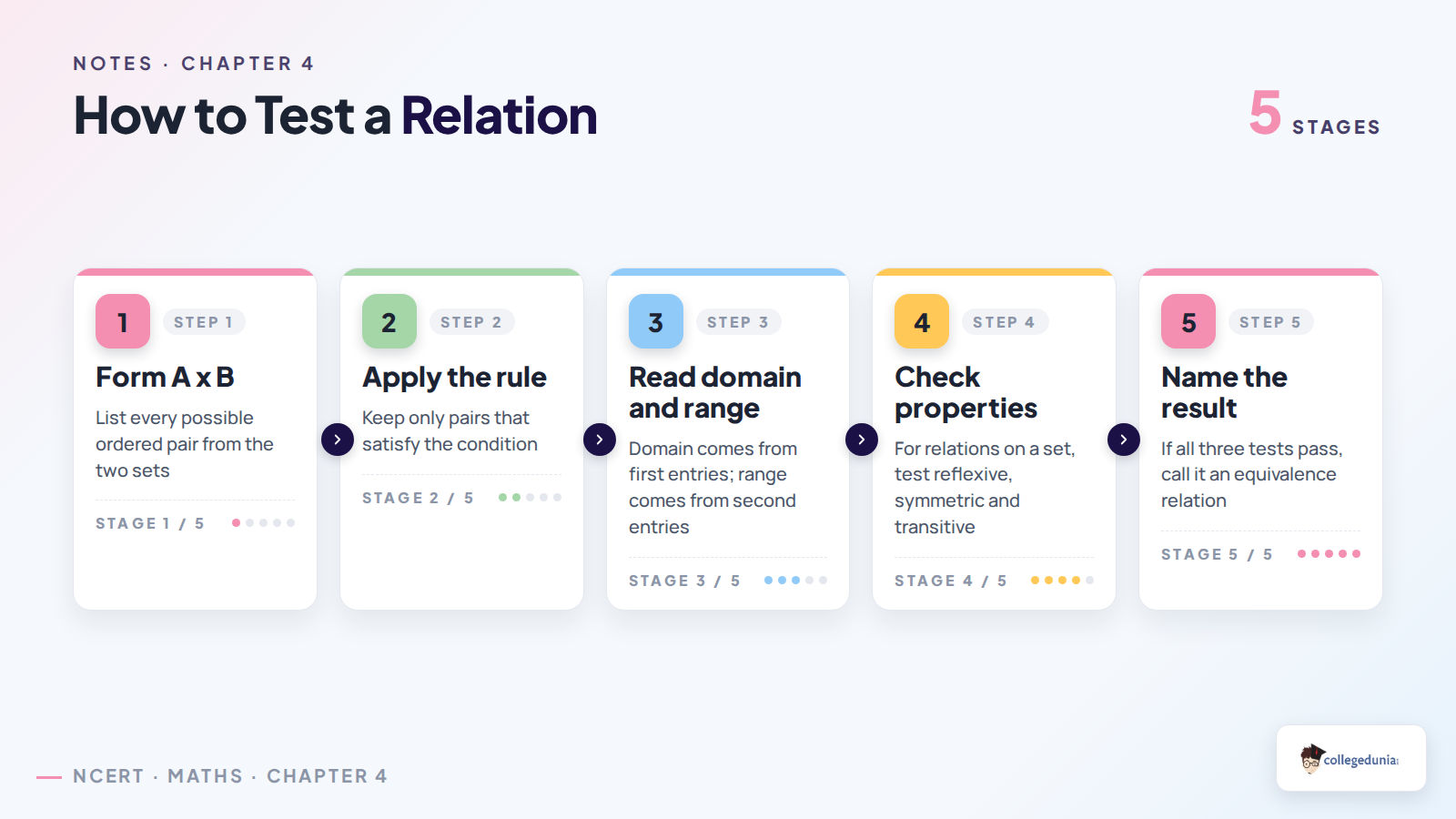
Most Relations questions are short, but the notation must be exact. First write the ordered pairs from the rule. Then read the domain and range from the list before naming the relation type.
- Form the product: write A x B or A x A as needed.
- Apply the rule: keep only the pairs that satisfy it.
- Read sets: identify domain, range and co-domain.
- Run property tests: check self-pairs, reverse pairs and chains.
Common Mistakes in the Relations Chapter
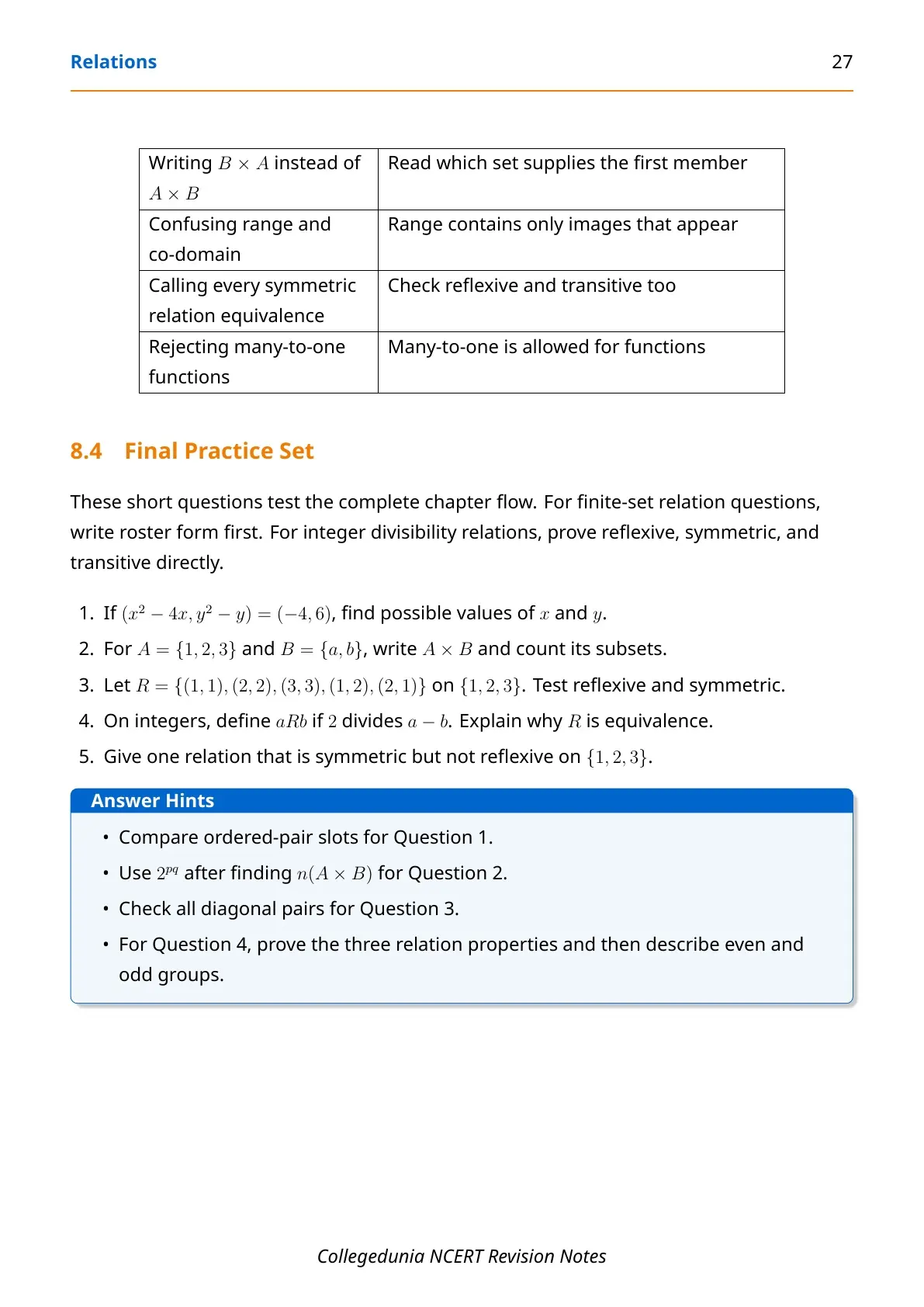
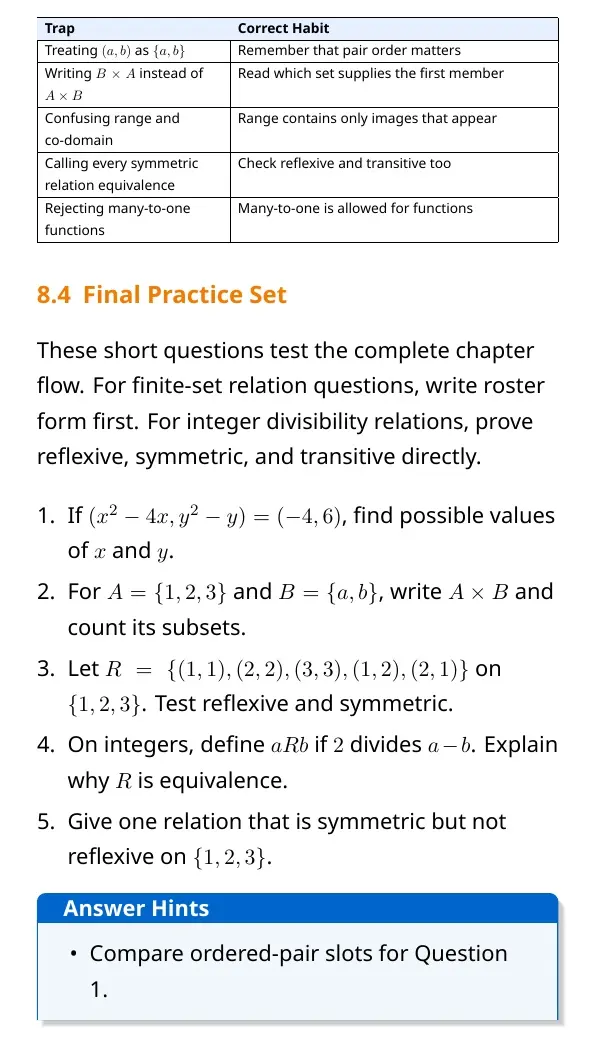
Students often lose marks because they swap pair order or confuse range with co-domain. The fix is simple: write the pair slots before solving.
- Do not treat (a, b) as {a, b}: a pair has order, while a set does not.
- Do not swap A x B and B x A: the first set supplies the first entry.
- Do not include unused co-domain values in range: range uses only actual second entries.
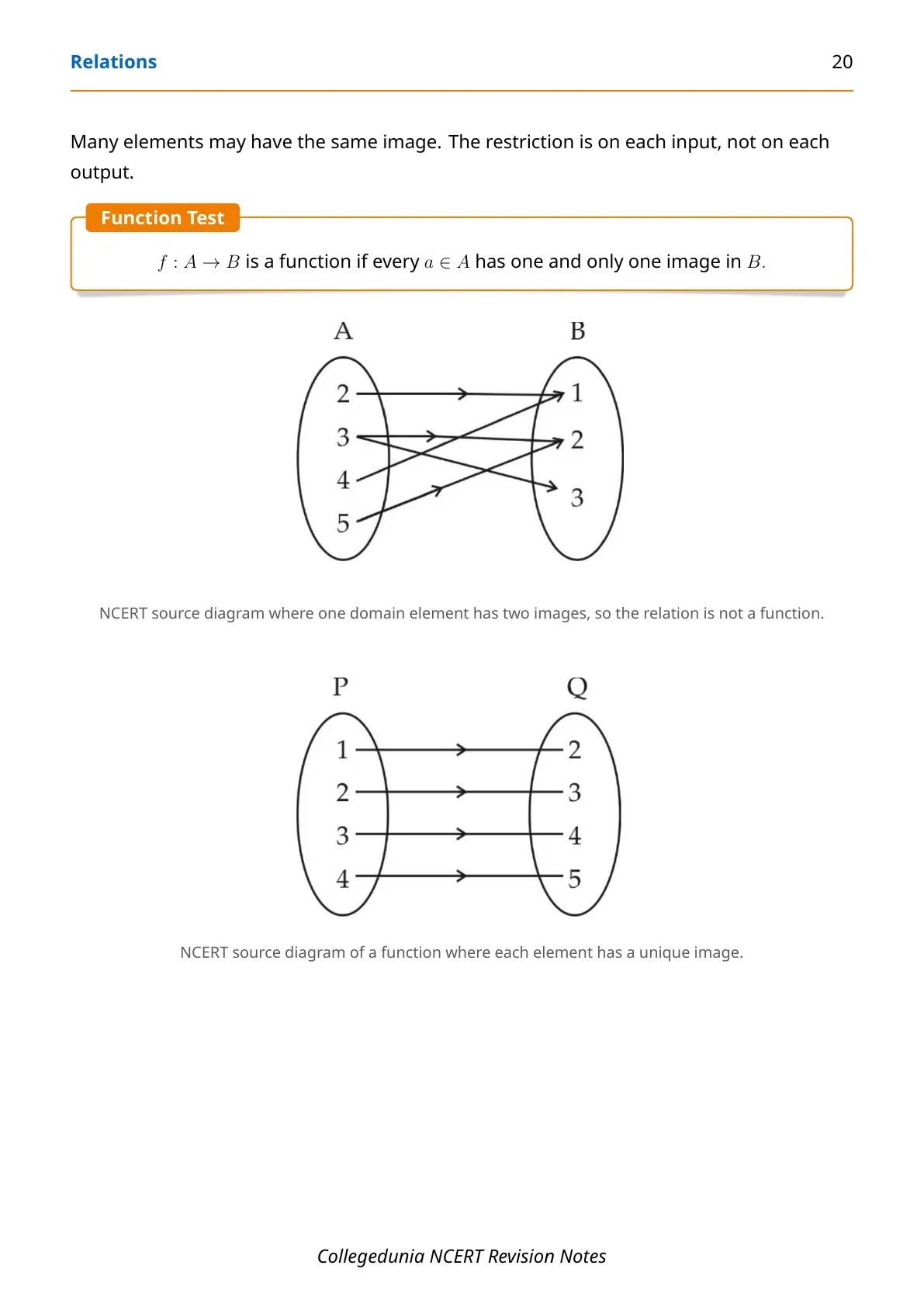
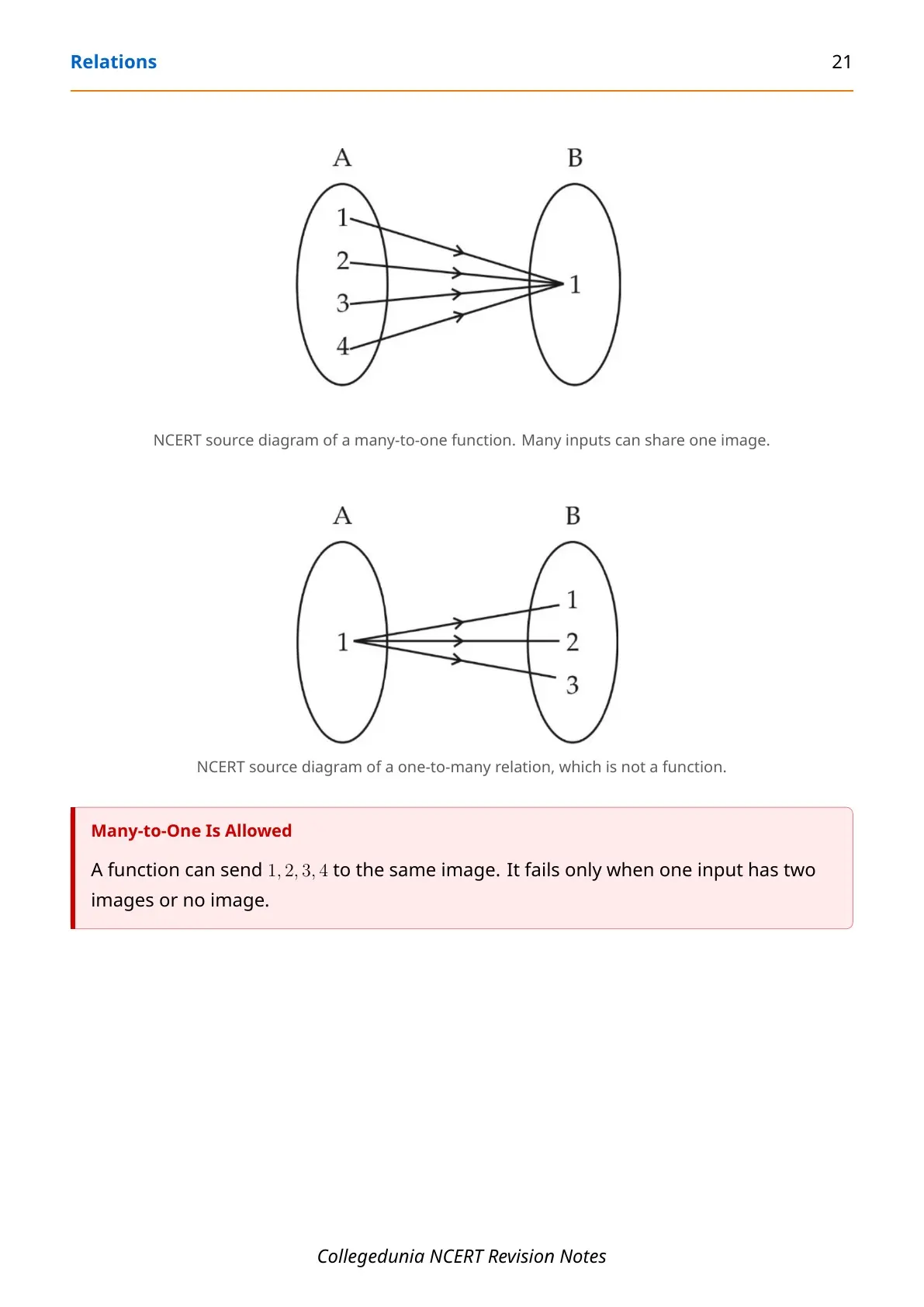
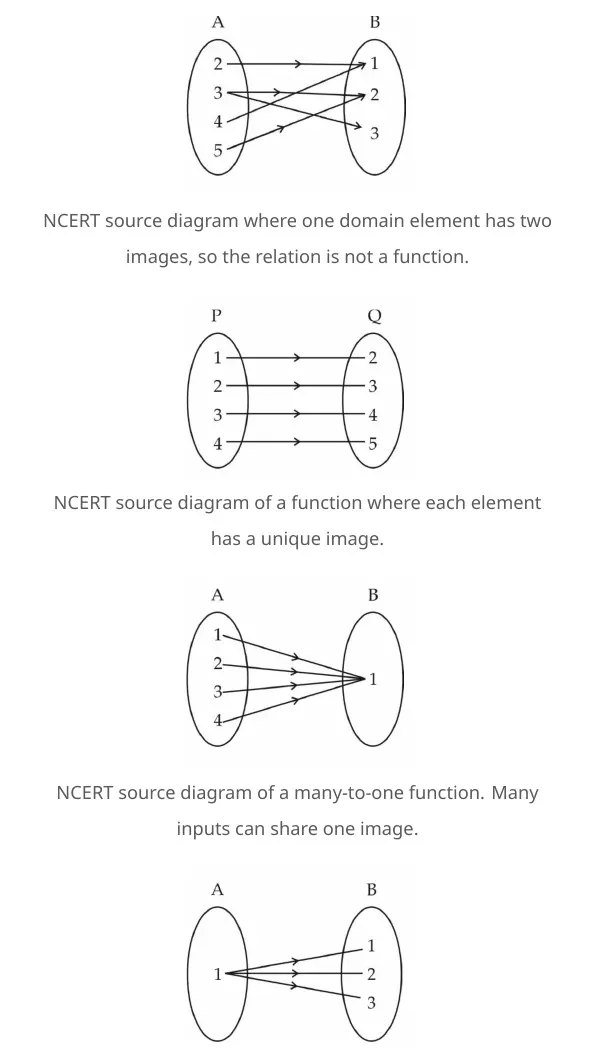
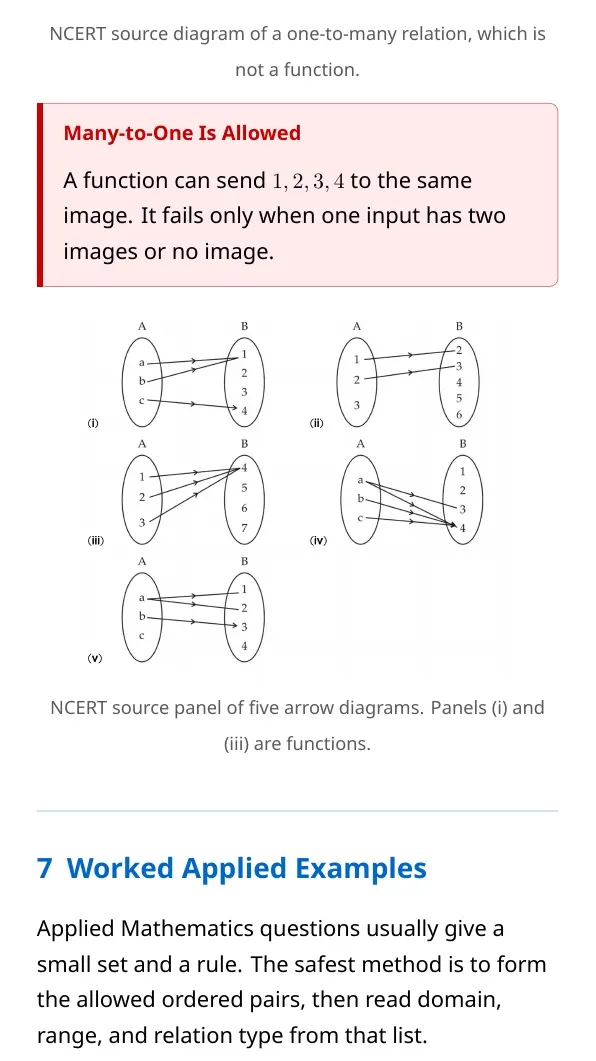
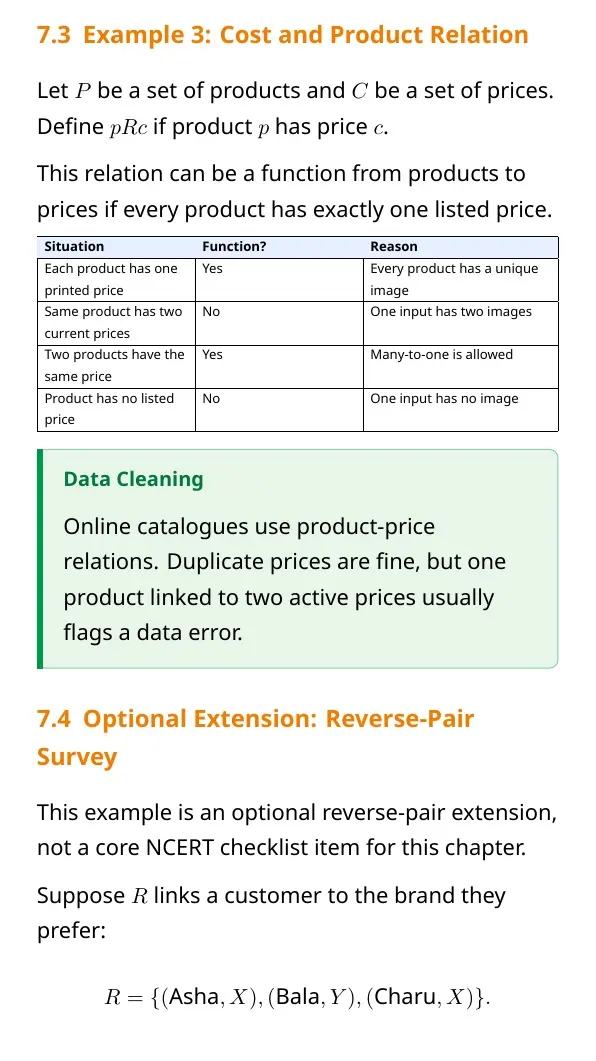
- Do not call many-to-one invalid: many inputs may share one output in a function.
Exam tip: one counterexample is enough to disprove symmetry or transitivity.
How to Use the Relations Notes PDF
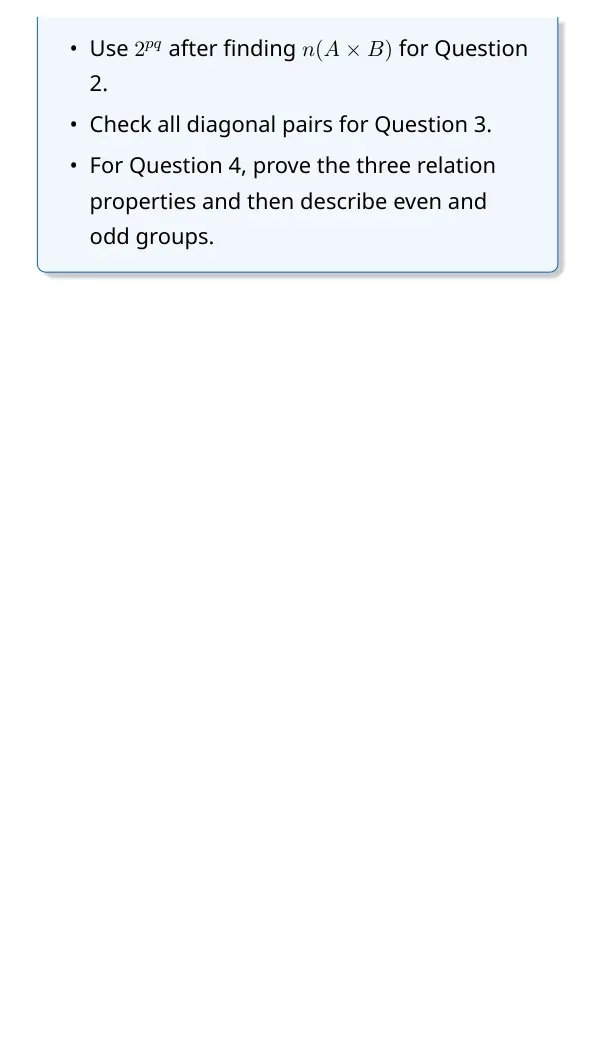
The PDF is best used in two passes. In the first pass, revise definitions and examples. In the second pass, cover the final answer and test whether you can rebuild the ordered-pair list.
| Study pass | What to do | Target |
|---|---|---|
| Pass 1 | Read ordered pair, Cartesian product and relation definitions | Clear notation |
| Pass 2 | Solve one example each on domain, range and relation type | Exam speed |
| Final recap | Write the RST test for equivalence relations | Fast recall |
Download the Relations Notes PDF for Class 11 Applied Mathematics
Use the PDF for ordered pairs, Cartesian product, domain, range, relation types and equivalence relation revision.
Download PDFRelated Class 11 Applied Mathematics Resources for Relations
Also Check: use the notes with the book PDF, solutions and handwritten notes when you need the same Relations chapter in a different format.
| Resource | Best used for | Link |
|---|---|---|
| NCERT Book PDF | Original chapter wording and examples | Relations Class 11 NCERT Book PDF |
| NCERT Solutions | Step-by-step answers to textbook questions | Relations Class 11 NCERT Solutions |
| Handwritten Notes | Quick visual recall before class tests | Relations Class 11 Handwritten Notes |
Applied Mathematics Notes for All Chapters
Related Links: revise the neighbouring Algebra chapters with the same Notes format.
| Chapter | Class 11 Applied Mathematics Notes |
|---|---|
| Chapter 1 | Numbers and Quantification Class 11 Notes |
| Chapter 2 | Numerical Applications Class 11 Notes |
| Chapter 3 | Set Class 11 Notes |
| Chapter 5 | Sequences and Series Class 11 Notes |
| Chapter 6 | Permutations and Combinations Class 11 Notes |
| Chapter 7 | Mathematical and Logical Reasoning Class 11 Notes |
Relations Class 11 Applied Mathematics Notes FAQs
Ques. What are relations in Class 11 Applied Mathematics?
Ans. A relation is a selected subset of a Cartesian product. It shows which first entries are connected to which second entries.
Ques. What is the difference between range and co-domain?
Ans. Range contains only the second entries that appear in the relation. Co-domain is the full target set given in the question.
Ques. How do I test whether a relation is an equivalence relation?
Ans. Check reflexive, symmetric and transitive properties. If all three tests pass on the same set, the relation is an equivalence relation.
Ques. Are these Relations notes aligned to the 2026-27 syllabus?
Ans. Yes. These Class 11 Applied Mathematics Relations notes follow the 2026-27 CBSE syllabus scope for the Algebra unit.



Comments