



These Notes for Class 10 Science Chapter 7 How do Organisms Reproduce? give you a fast, concept-first revision of the whole chapter, built on the latest 2026-27 CBSE syllabus. They cover why organisms reproduce and the role of DNA copying, the modes of asexual reproduction, the meaning of sexual reproduction and variation, reproduction in flowering plants through pollination and fertilisation, and reproduction in human beings with the male and female systems, the menstrual cycle and reproductive health.
- Every idea explained with a one-line meaning, a simple diagram, and the everyday example CBSE keeps repeating in the board exam.
- Full coverage of fission, budding, fragmentation, regeneration, spore formation, vegetative propagation, pollination, fertilisation, the placenta and menstruation.
- Notes aligned with the 2026-27 CBSE Class 10 Science syllabus and written for the board exam; no NEET or JEE references because this is a Class 10 board chapter.
These Collegedunia revision notes are curated by Science subject experts, mapped to the 2026-27 NCERT textbook, and refined against the last five years of CBSE Class 10 Science board papers.
Student Feedback: What 12,400 students told us about this chapter
74% of Class 10 students said they kept mixing up pollination with fertilisation when they first revised this chapter. 3 out of 5 students told us a single labelled diagram of a flower and one flow chart of the asexual modes helped them lock the diagram questions before the board exam.
Toppers found that learning the six asexual modes as one quick list, and the human male and female systems as a labelled pair, saved 10 to 12 minutes in the exam, and the average student spent 2 to 3 hours on these notes across the first read and the final revision.
Source: 2026-27 Class 10 Science student poll. Sample of 12,400 students from CBSE schools across 13 states, conducted before the 2026 boards.
What the Notes for Class 10 Science Chapter 7 How do Organisms Reproduce? Cover
Reproduction is the one life process an individual can live without, yet it keeps a species going. This chapter answers one question: how do living things make more of their own kind? These notes follow the NCERT order in exam-ready blocks:
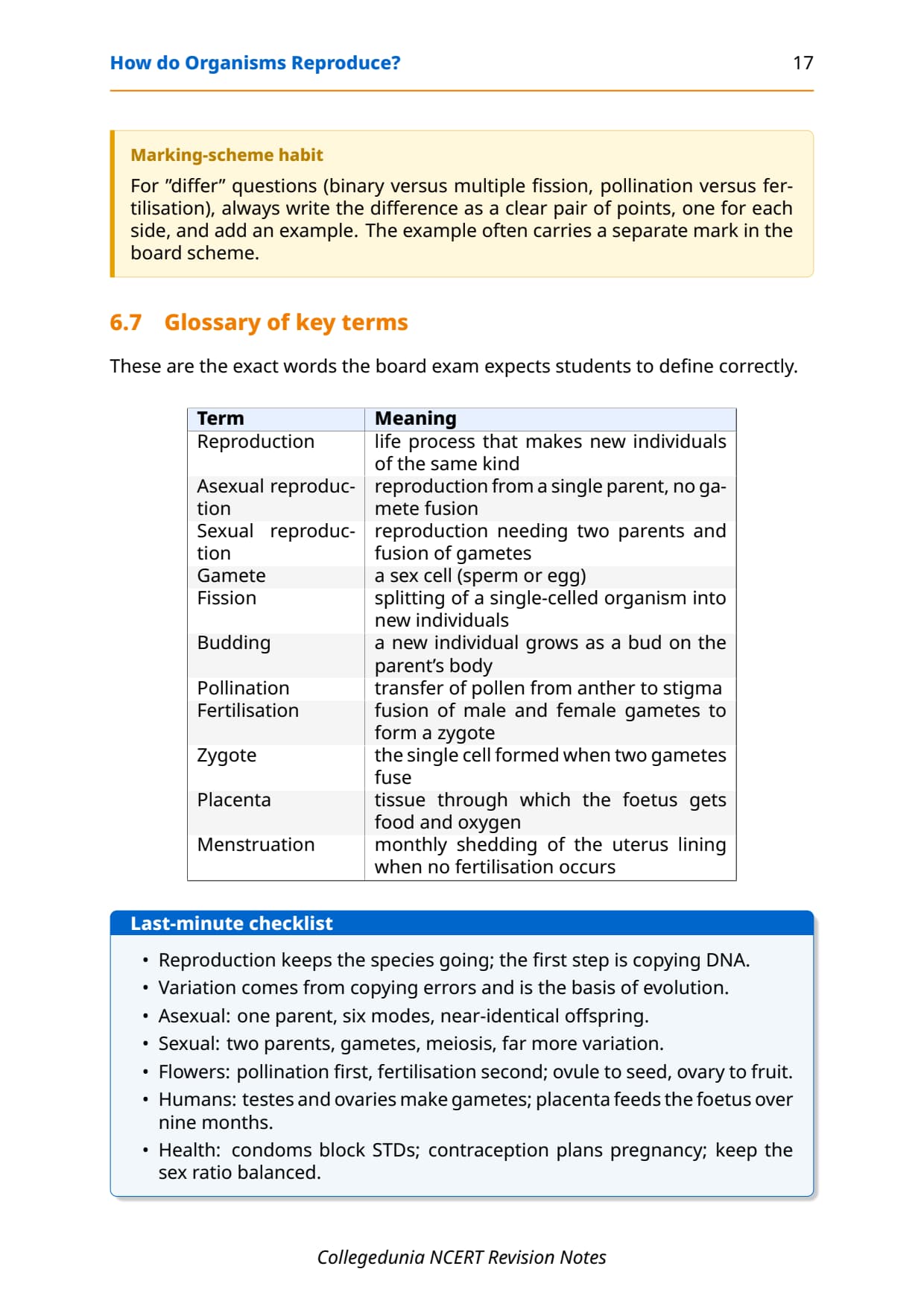
- Why reproduce: DNA copying, why offspring look like parents, and how variation keeps a species alive.
- Asexual reproduction: fission, fragmentation, regeneration, budding, spores and vegetative propagation.
- Sexual reproduction: gametes, meiosis, pollination and fertilisation; and human reproduction with the placenta and menstrual cycle.
Source: Magnet Brains on YouTube
Why and How Do Organisms Reproduce in Class 10 Science
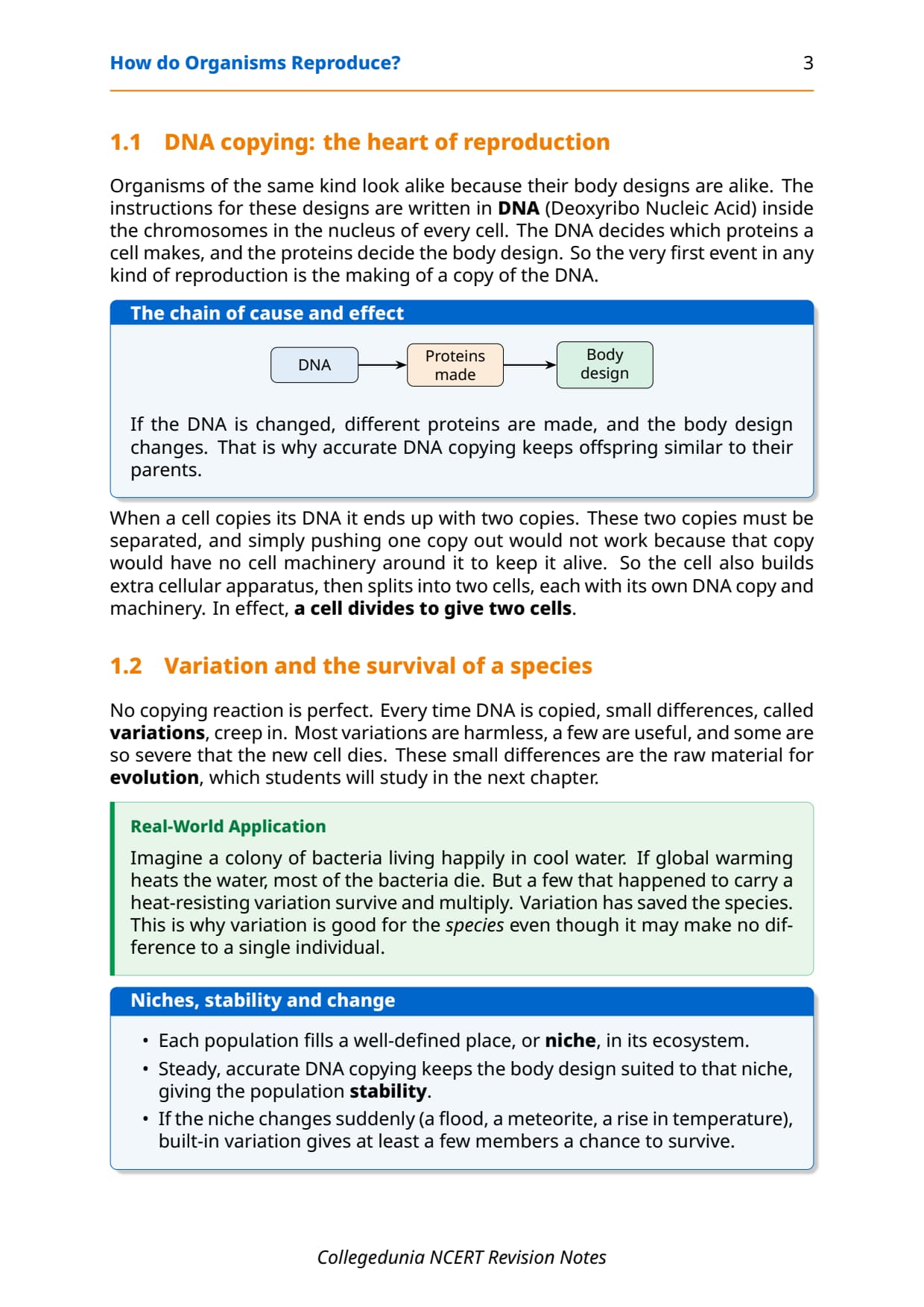
Organisms of the same kind look alike because their body designs are written in DNA (Deoxyribo Nucleic Acid) inside the chromosomes of every cell. DNA decides which proteins a cell makes, and proteins decide the body design. So the first event in any reproduction is the making of a fresh copy of the DNA, after which the cell divides into two.
DNA → proteins made → body design
No copying is perfect. Every time DNA is copied, tiny differences called variations creep in. These are the raw material for evolution and help the species survive.
- Each population fills a well-defined place, or niche, in its ecosystem.
- Accurate DNA copying keeps the body design suited to that niche, giving stability.
- If the niche changes suddenly, built-in variation gives a few members a chance to survive.
Asexual Reproduction in Class 10 Science: Fission, Budding and More
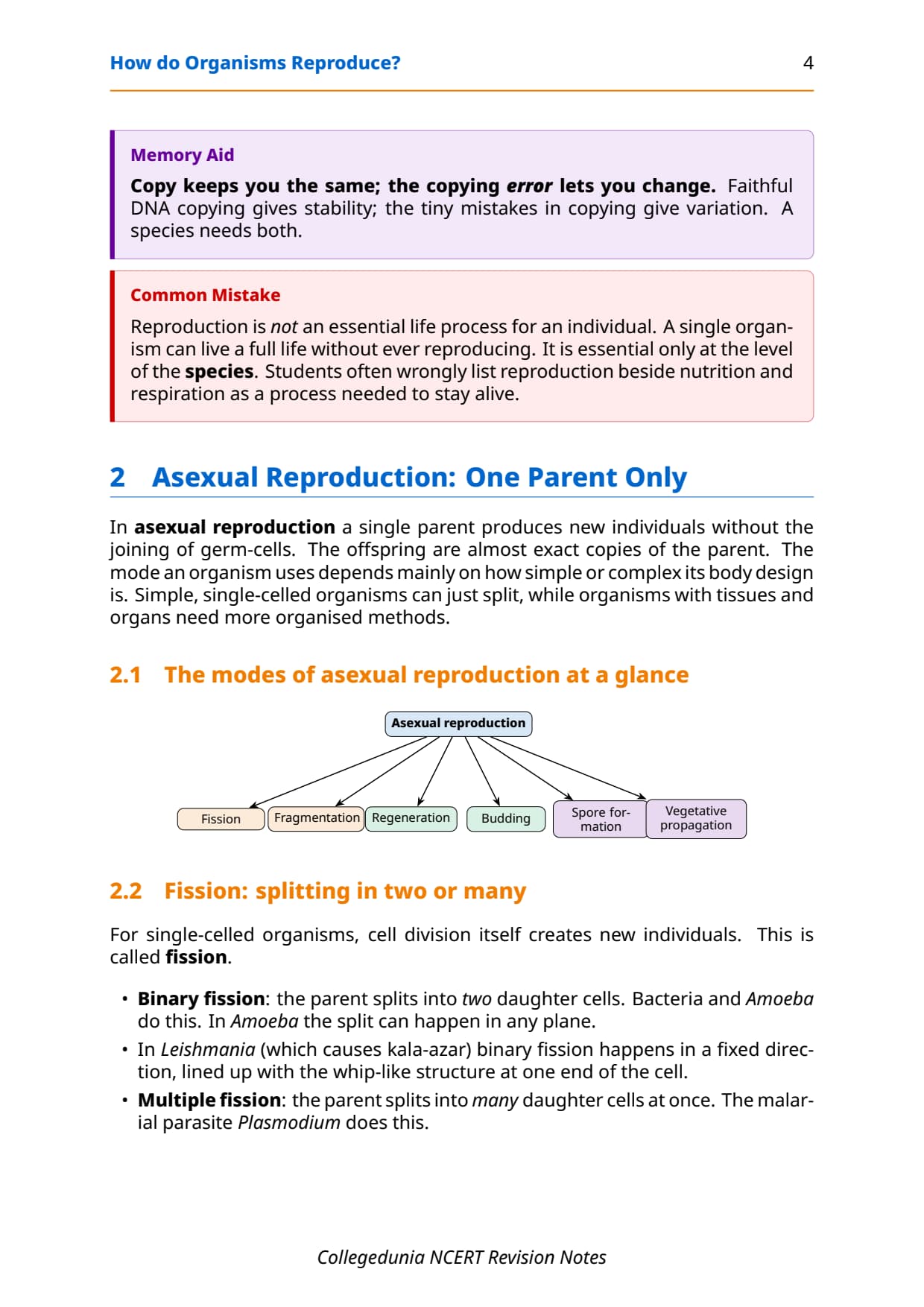
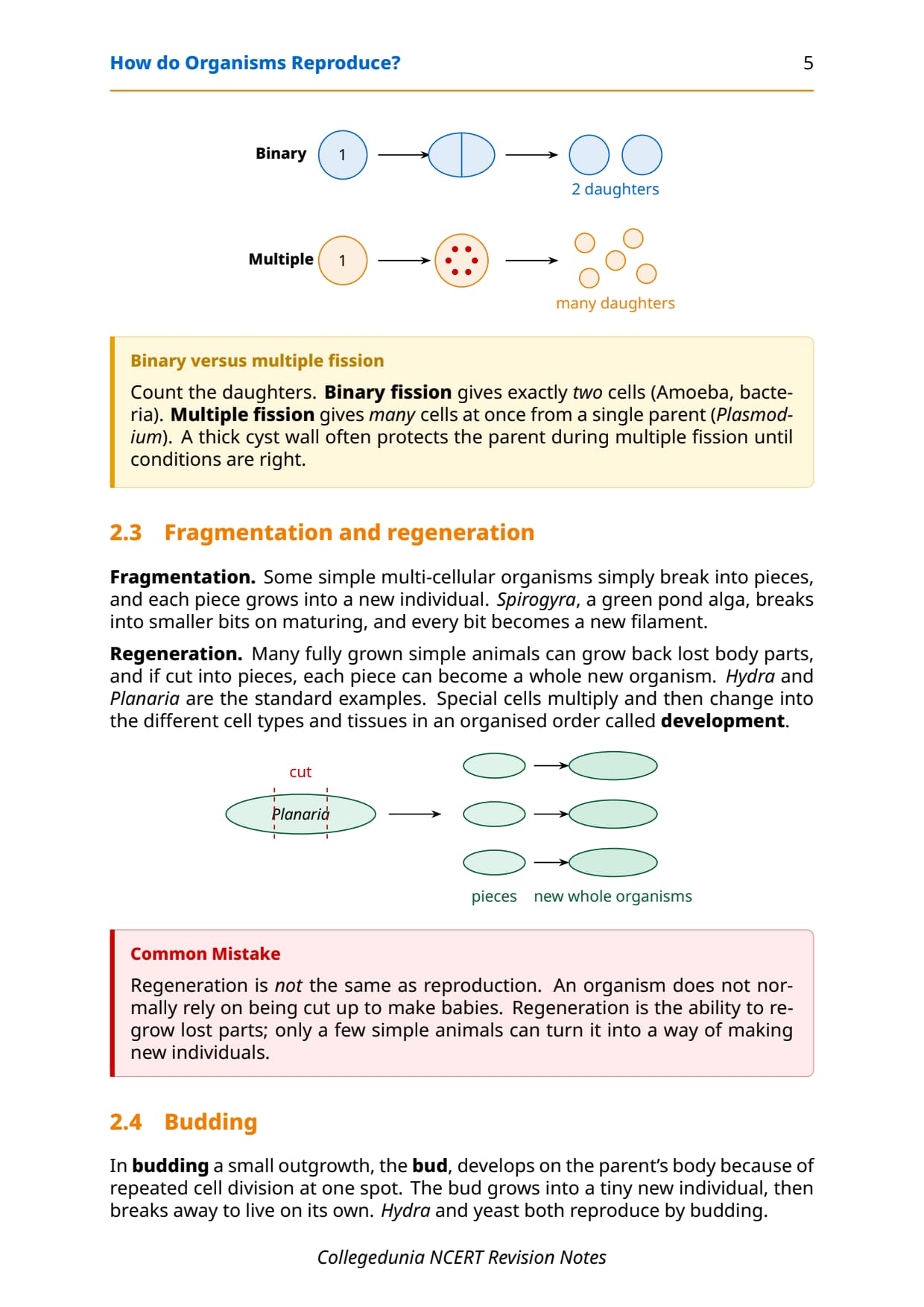
In asexual reproduction a single parent produces new individuals without joining germ-cells, so the offspring are almost exact copies, called a clone. Single-celled organisms just split, while organisms with tissues use more organised methods.
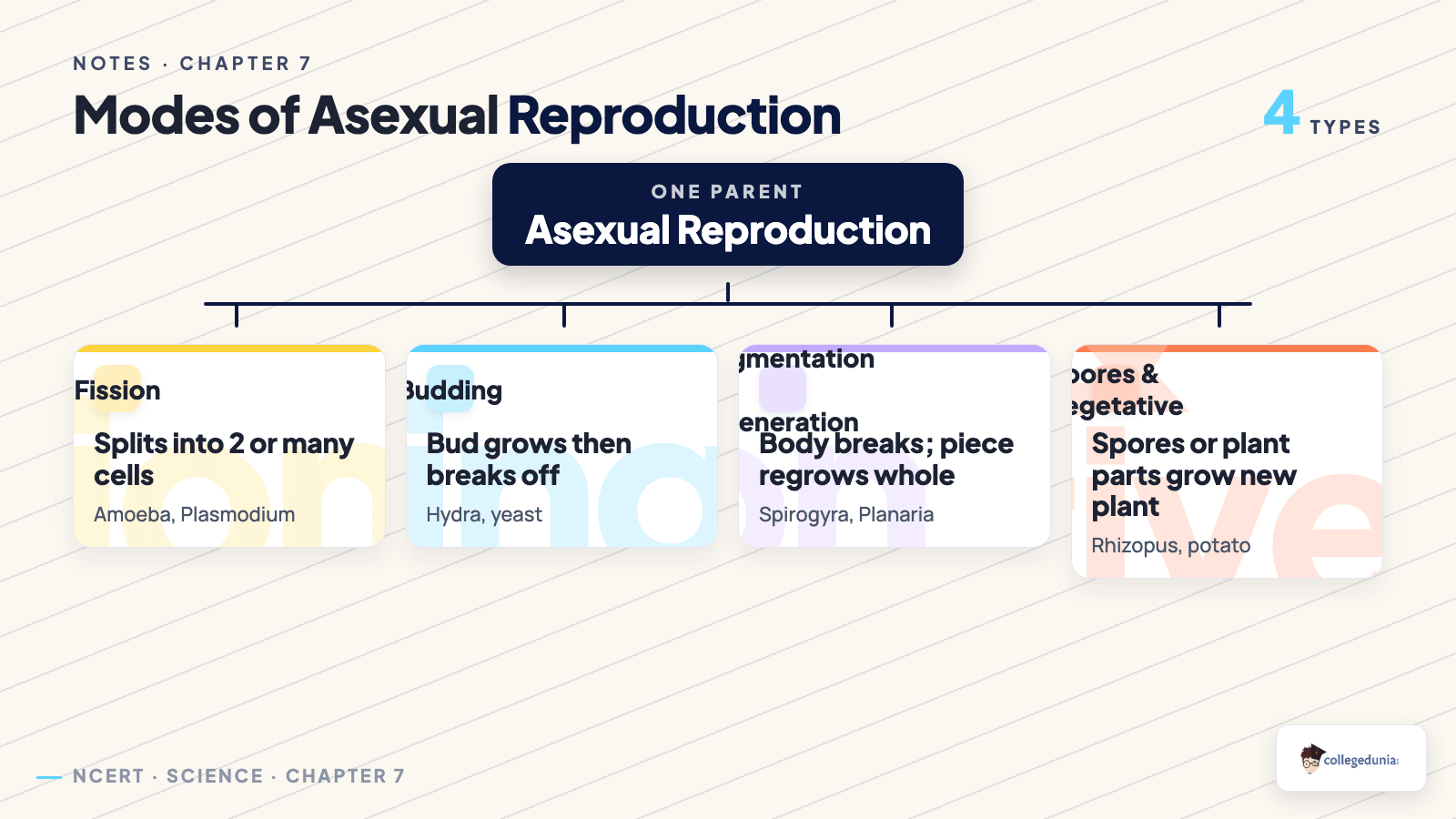
| Mode | What happens | Example |
|---|---|---|
| Binary fission | Splits into two cells | Amoeba, bacteria |
| Multiple fission | Splits into many cells at once | Plasmodium |
| Fragmentation | Body breaks into pieces, each grows anew | Spirogyra |
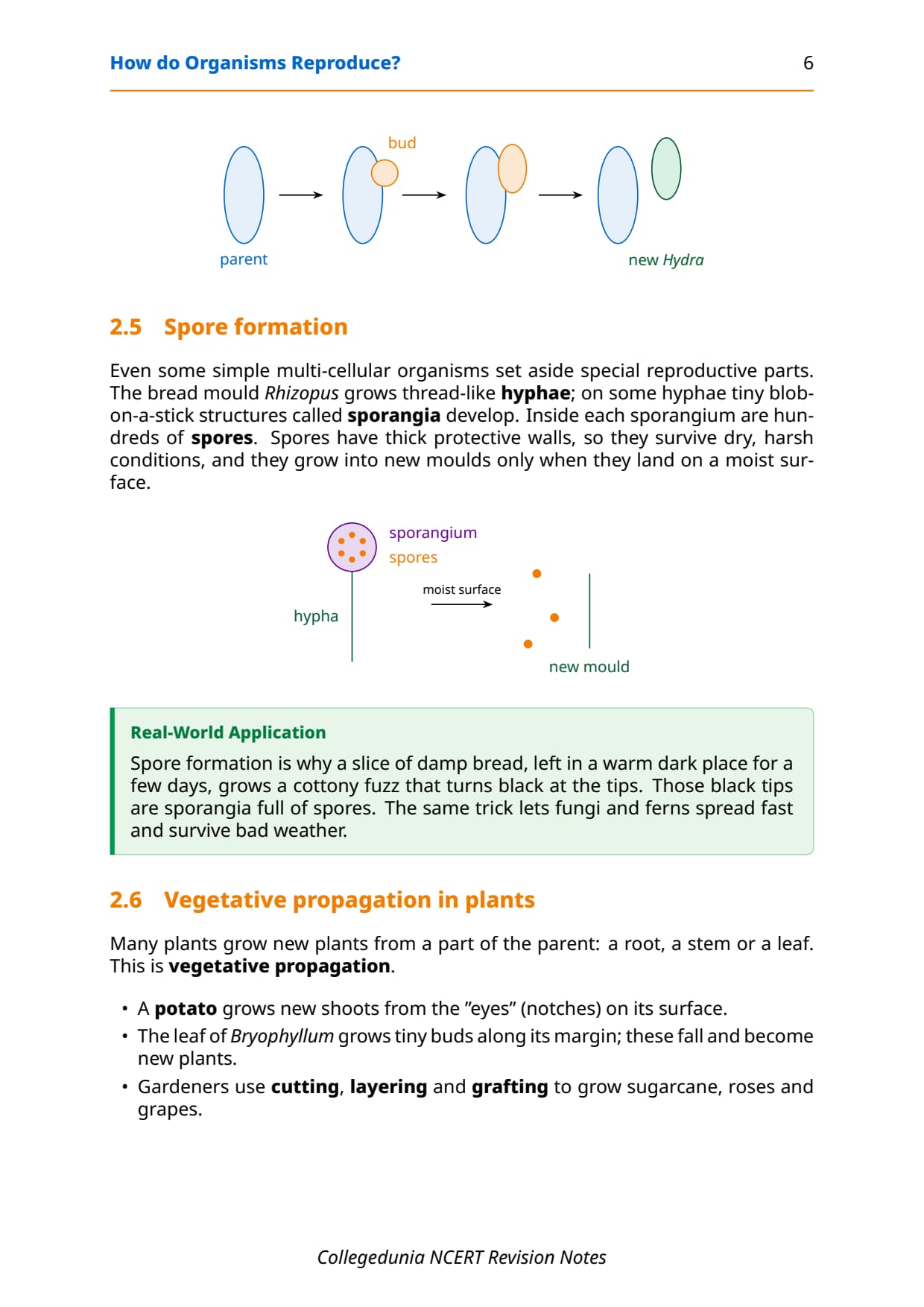
| Regeneration | A cut piece grows back the whole body | Hydra, Planaria |
| Budding | A bud grows, then breaks away | Hydra, yeast |
Spore Formation and Vegetative Propagation in Plants
In spore formation, used by simple multi-cellular organisms, the bread mould Rhizopus grows thread-like hyphae bearing sporangia, each holding hundreds of spores. Spores have thick protective walls, so they survive harsh conditions and grow into new moulds on a moist surface.
In vegetative propagation, a part of the parent plant grows into a whole new plant. It is natural (shoots from a potato's "eyes", buds on a Bryophyllum leaf) or artificial (cutting, layering, grafting and tissue culture).
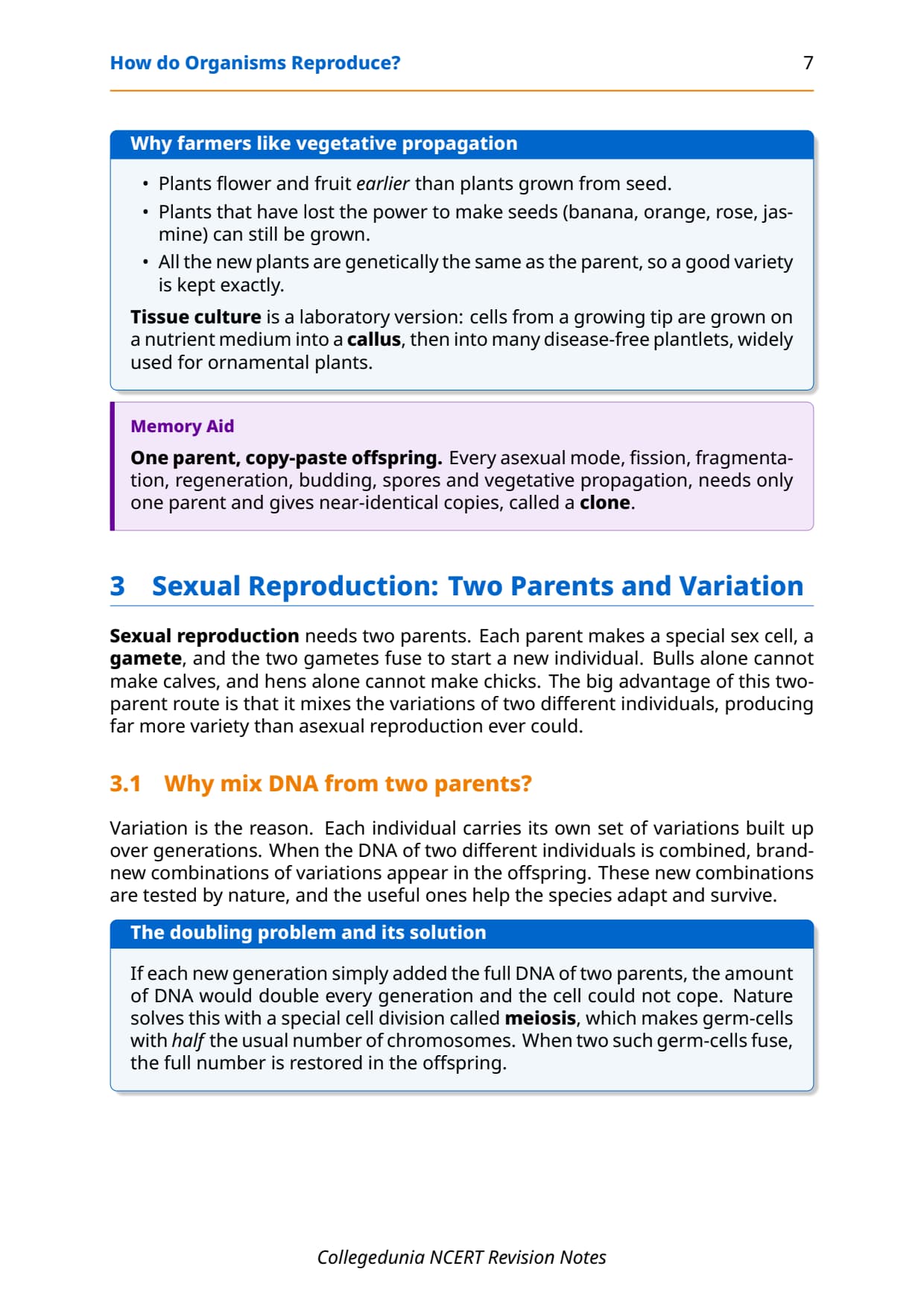
Farmers like it because plants flower and fruit earlier, seedless plants (banana, orange) can still be grown, and every new plant is genetically identical to the parent.
Sexual Reproduction and Variation in Class 10 Science
Sexual reproduction needs two parents. Each makes a gamete, and the two fuse to start a new individual. Its big advantage is that it mixes the variations of two individuals, producing far more variation than asexual modes.
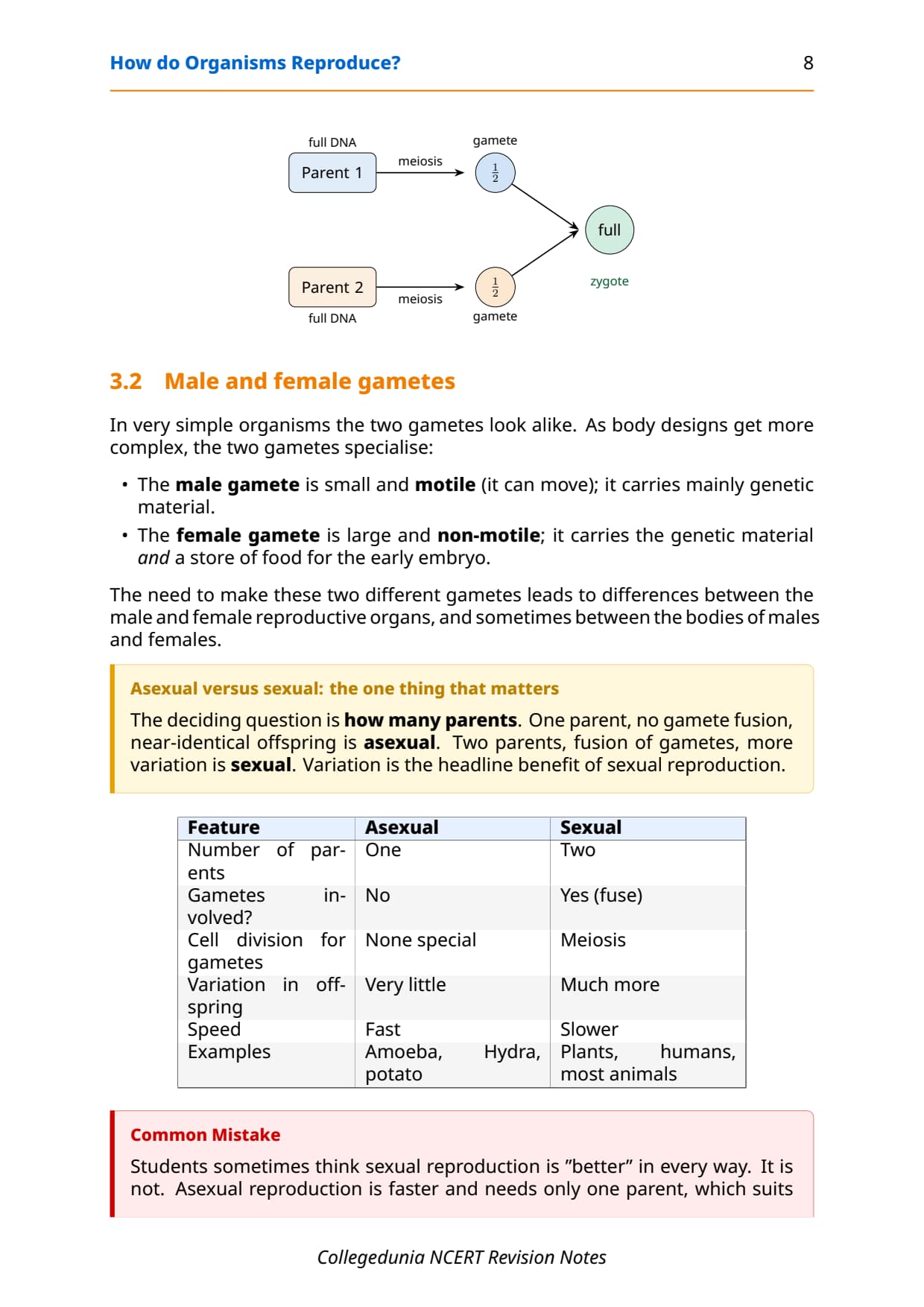
If each generation simply added the full DNA of two parents, it would double each time. Meiosis, a special cell division, makes germ-cells with half the usual chromosomes, so when two gametes fuse the full number is restored.
parent (full) → meiosis → gamete (half) + gamete (half) → zygote (full)
The male gamete is small and motile; the female gamete is large, non-motile and carries food for the early embryo. The table compares the two types.
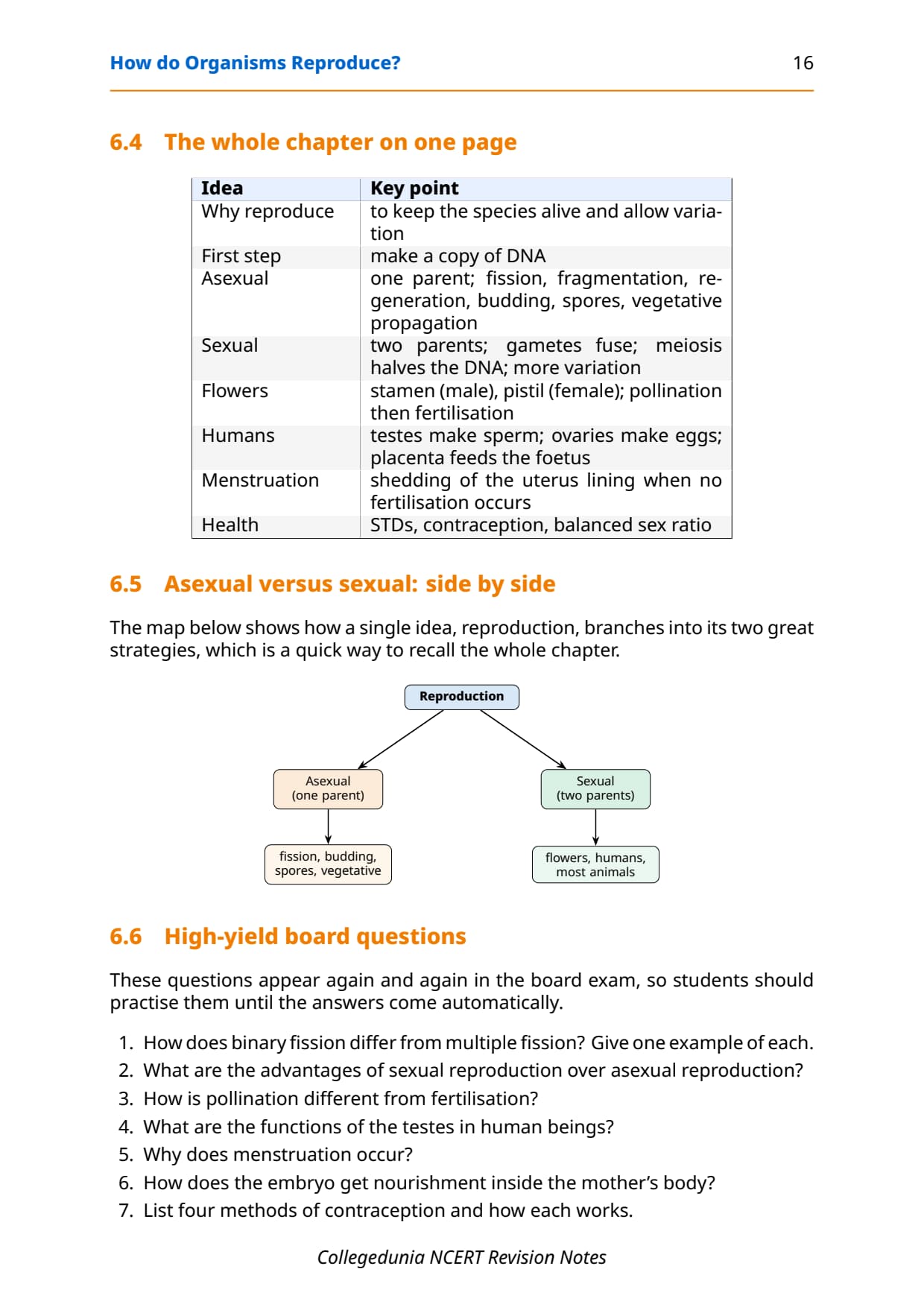
| Feature | Asexual | Sexual |
|---|---|---|
| Parents | One | Two |
| Gametes / meiosis | No | Yes |
| Variation | Very little | Much more |
Sexual Reproduction in Flowering Plants: Pollination and Fertilisation
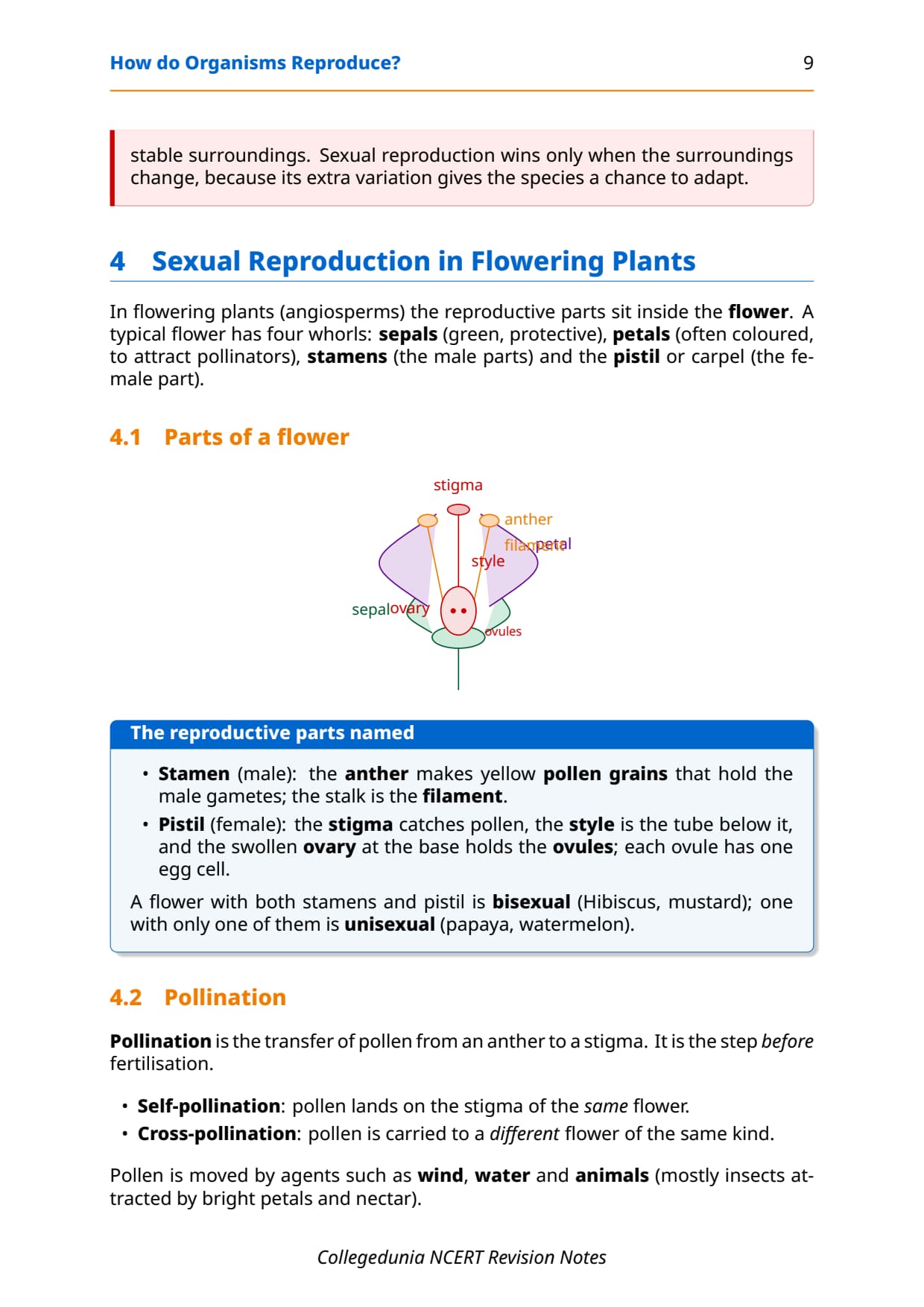
In flowering plants the reproductive parts sit inside the flower: sepals (protective), petals (attract pollinators), stamens (male) and the pistil or carpel (female). A flower with both stamens and pistil is bisexual (Hibiscus); one with only one is unisexual (papaya).
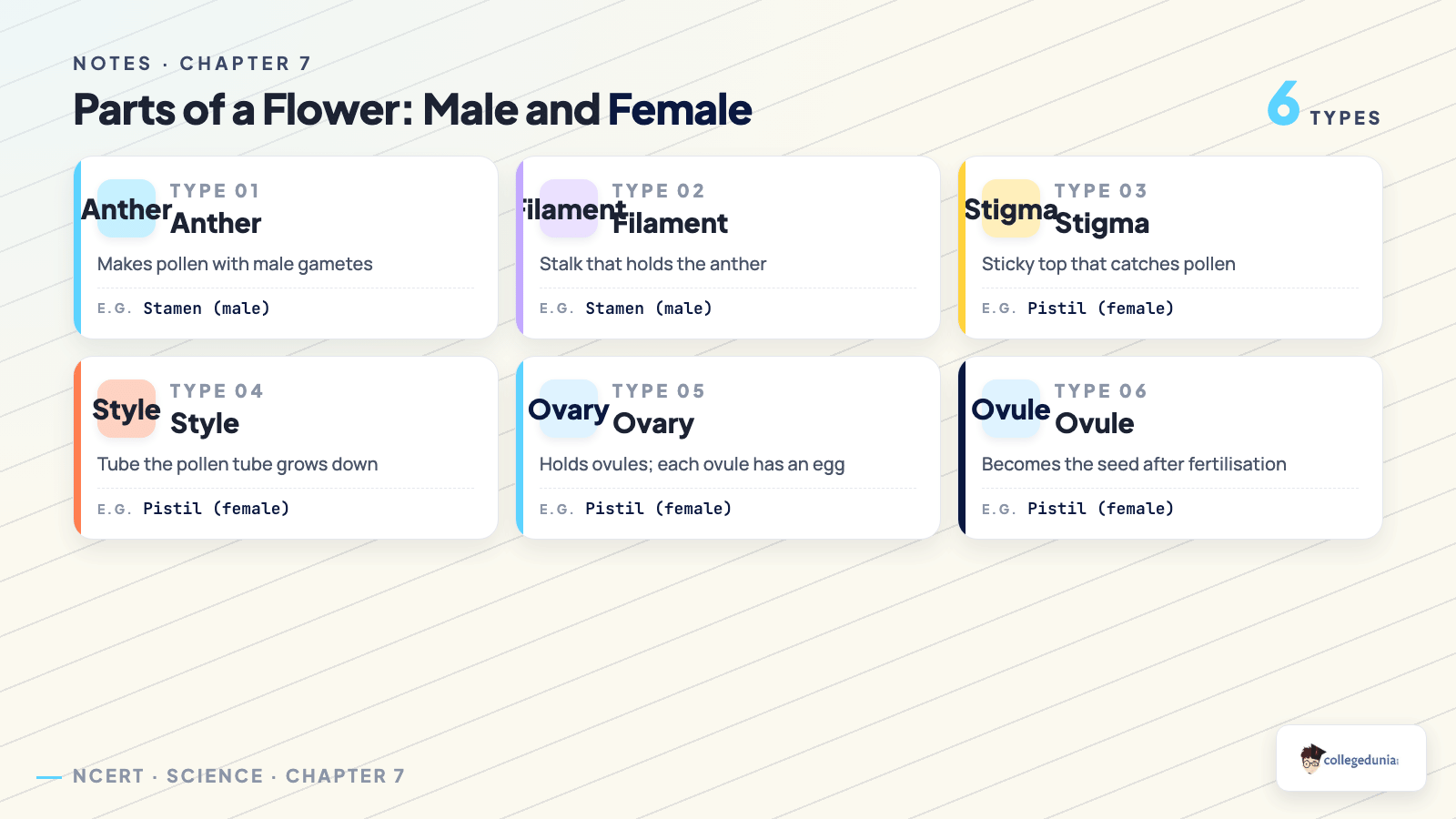
The anther makes pollen grains holding the male gametes; the stigma catches pollen, the style is the tube the pollen tube grows down, and the ovary holds the ovules, each with one egg.
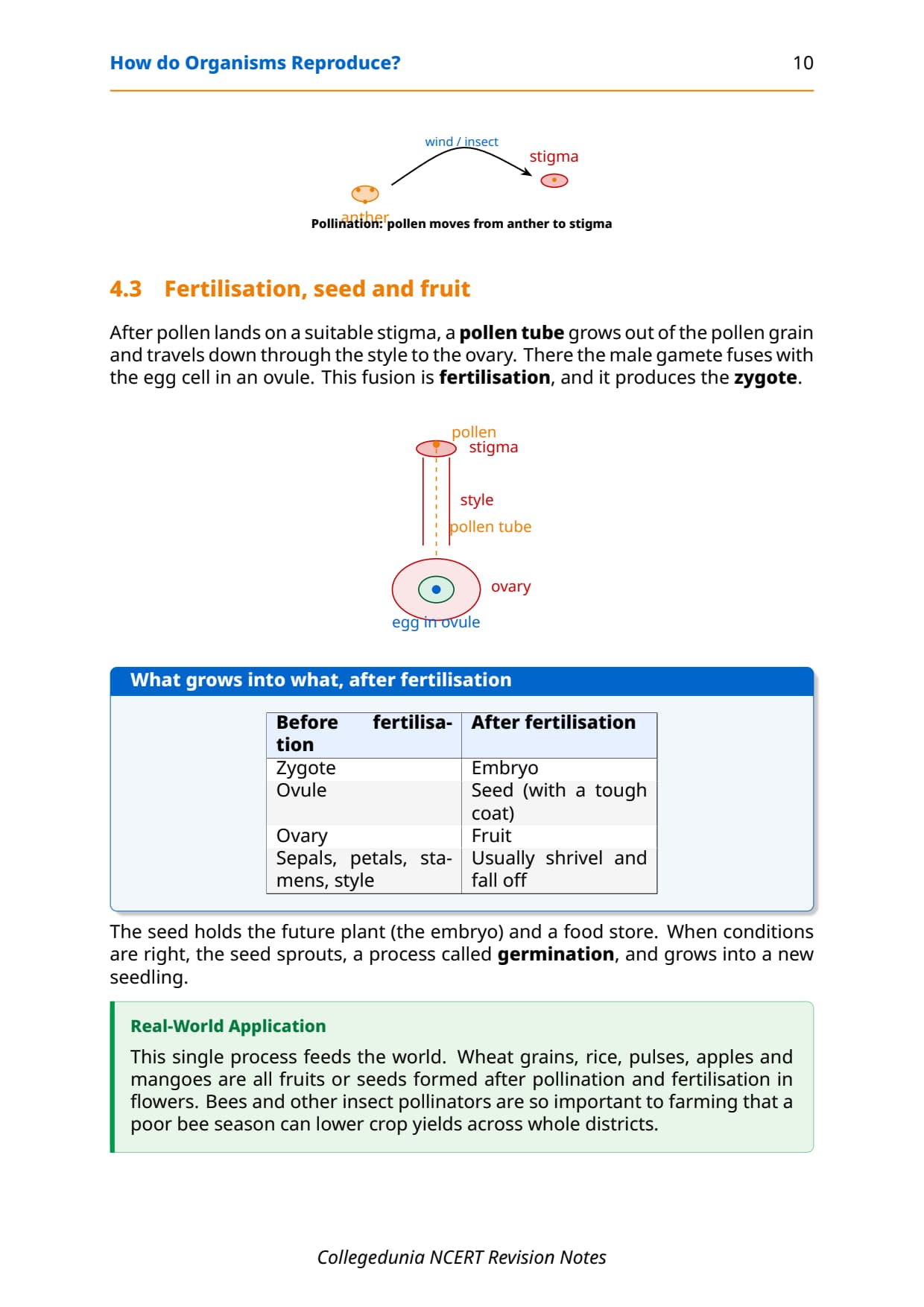
Pollination is the transfer of pollen from an anther to a stigma, the step before fertilisation. It is self-pollination (same flower) or cross-pollination, where wind, water or insects carry pollen to another flower of the same kind. A pollen tube then grows down the style to the ovary, where the male gamete fuses with the egg. This fusion is fertilisation, producing the zygote.
After fertilisation, the flower parts change in a fixed, often-tested way:
| Before fertilisation | After fertilisation |
|---|---|
| Zygote | Embryo |
| Ovule | Seed (with a tough coat) |
| Ovary | Fruit |
Reproduction in Human Beings: Male and Female Reproductive Systems
Humans reproduce sexually, and the body matures for this at puberty. In girls the breasts develop and menstruation begins; in boys facial hair grows and the voice deepens. Puberty marks physical maturity, not readiness for sexual activity or raising children.
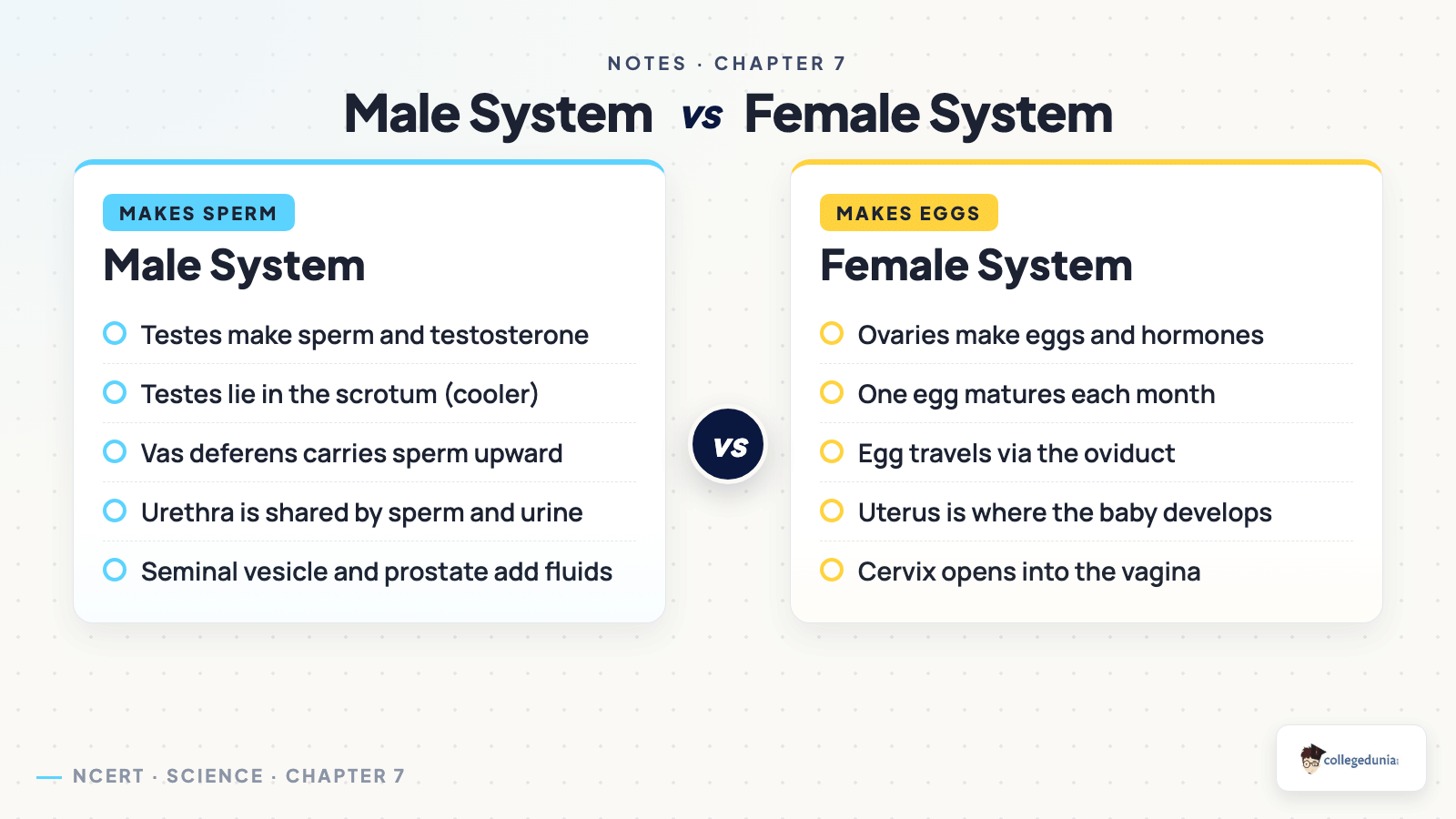
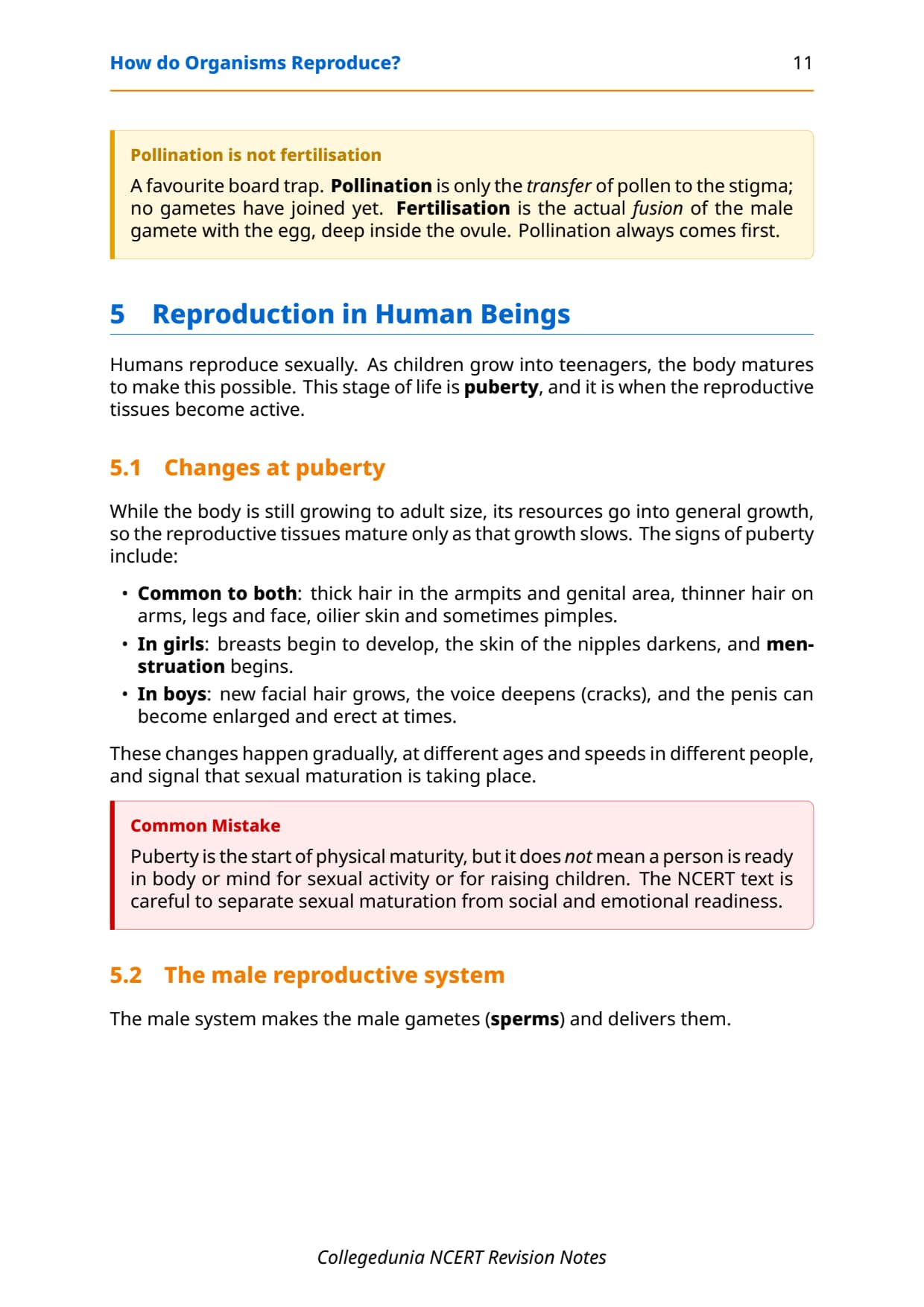
The male reproductive system makes and delivers the sperms. The testes make sperms and testosterone, and lie in the scrotum outside the body, because sperm formation needs a temperature below body temperature. The vas deferens carries sperms to the urethra, which carries both sperm and urine. The seminal vesicles and prostate gland add fluids; sperms plus these fluids make semen.
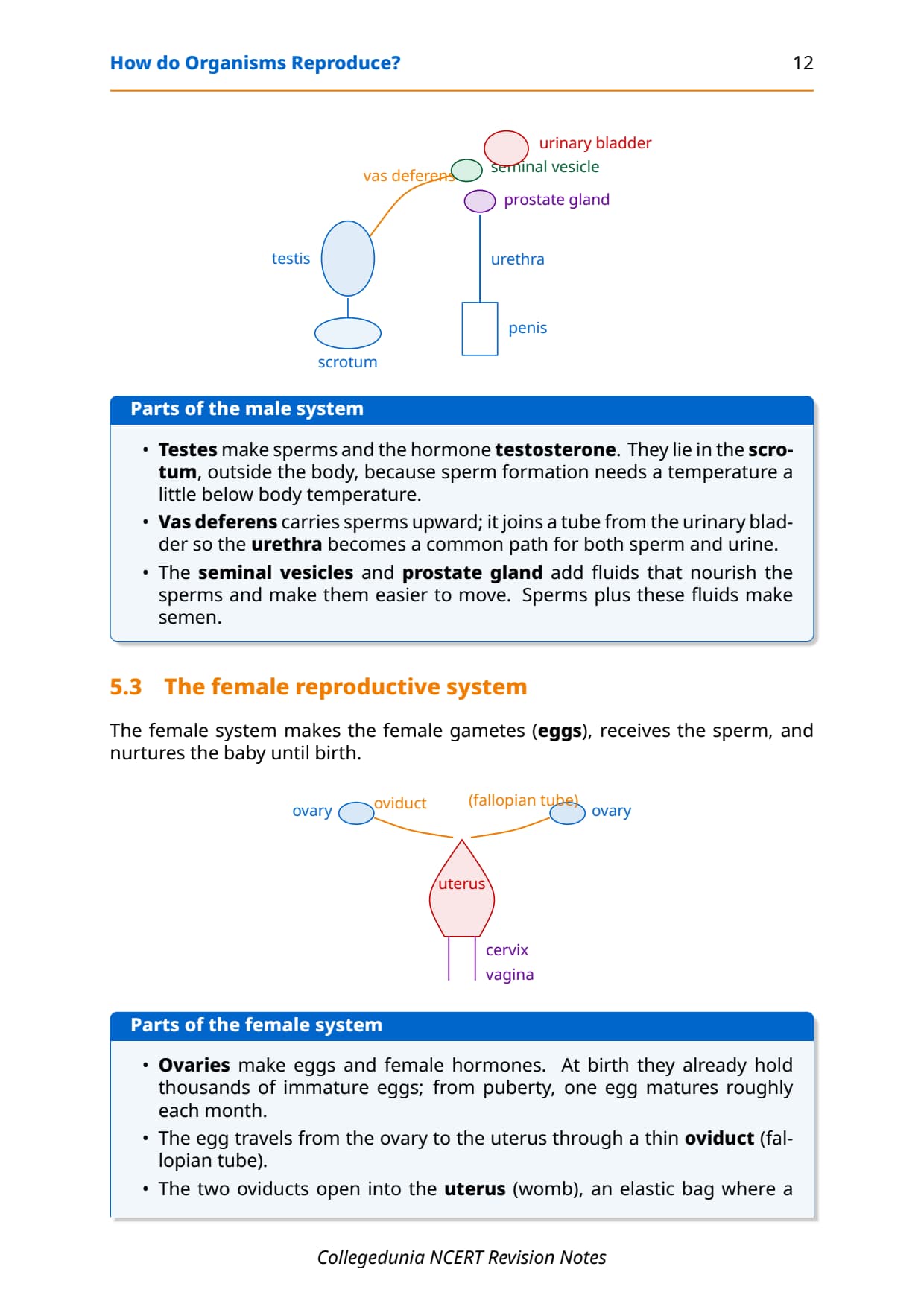
The female reproductive system makes the eggs, receives the sperm, and nurtures the baby until birth.
- Ovaries make eggs and female hormones; from puberty, one egg matures roughly each month.
- The egg travels to the uterus through a thin oviduct (fallopian tube).
- The uterus (womb) is where the baby develops; it opens into the vagina through the cervix.
Fertilisation, the Placenta and the Menstrual Cycle
During intercourse, sperms enter through the vagina, swim up, and meet the egg in the oviduct. If a sperm fuses with the egg, fertilisation occurs and a zygote forms. The zygote divides into the embryo, which embeds in the uterus lining and grows organs to become a foetus over about nine months.
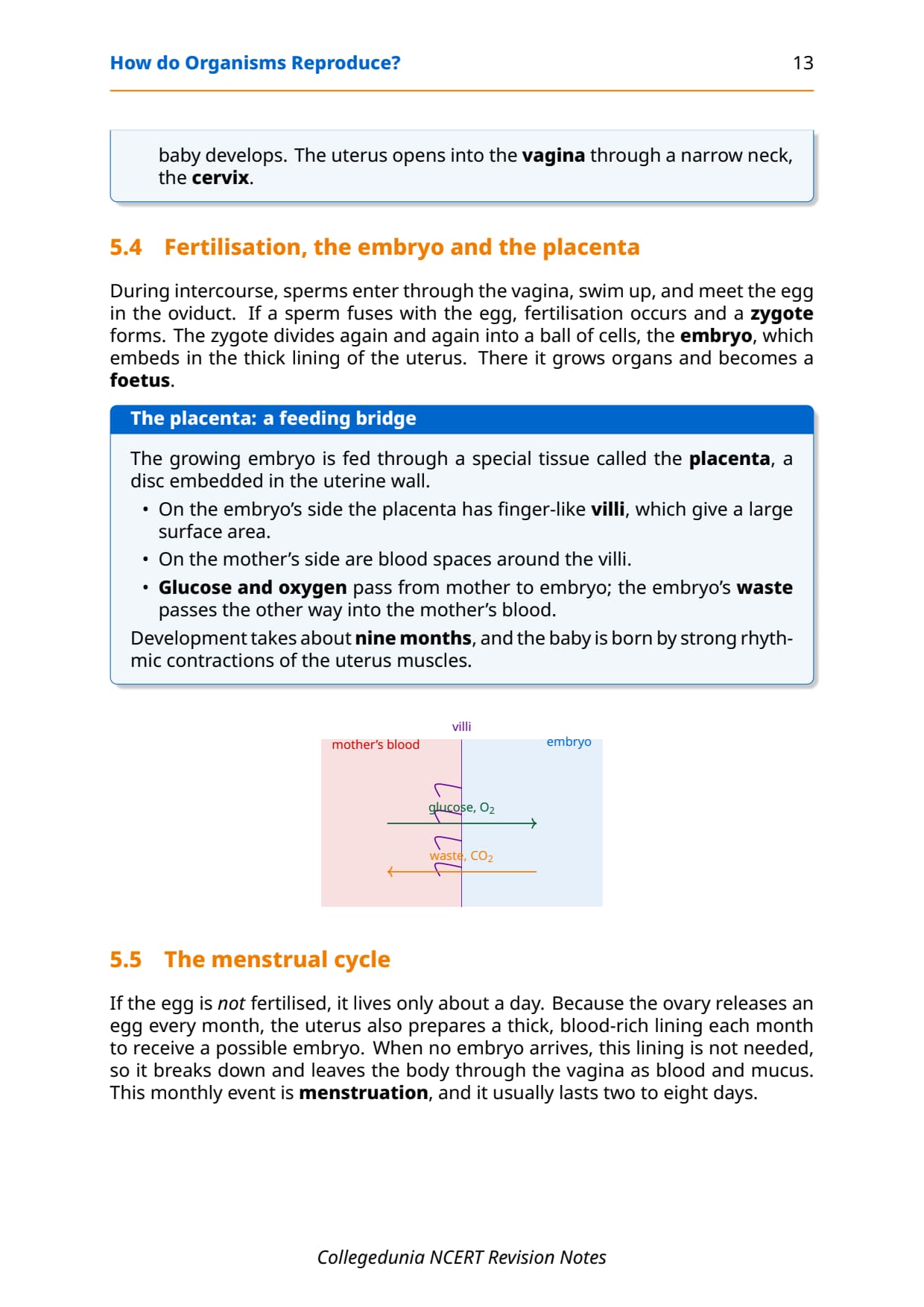
The embryo is fed through the placenta, a disc in the uterine wall. On the embryo's side are finger-like villi giving a large surface area; on the mother's side are blood spaces around them. Glucose and oxygen pass from mother to embryo, and the embryo's waste passes back into the mother's blood. The baby is born by rhythmic contractions of the uterus.
mother → glucose, O₂ → embryo | embryo → waste, CO₂ → mother
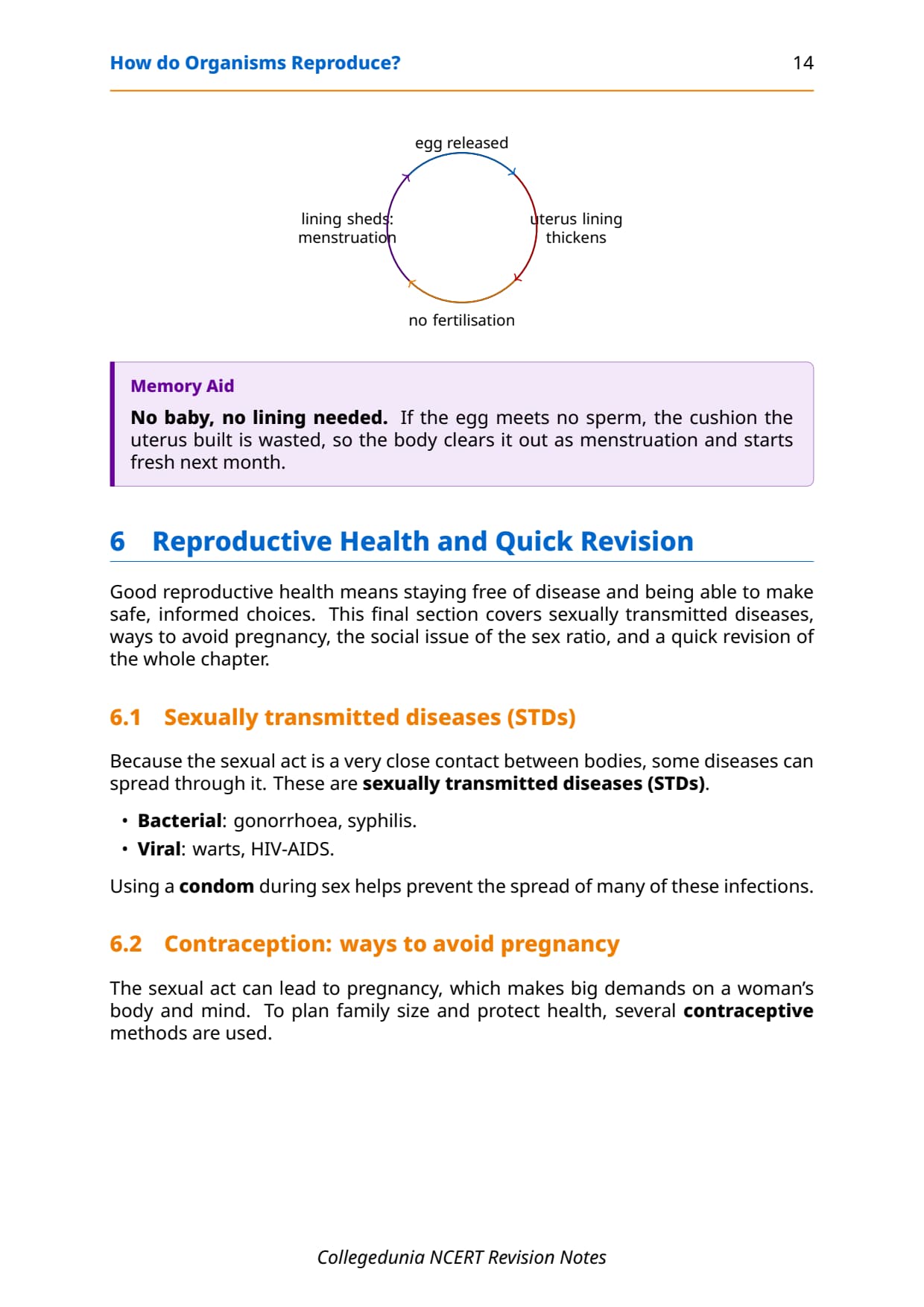
Each month the uterus prepares a thick, blood-rich lining for a possible embryo. If the egg is not fertilised, no embryo arrives, so this lining breaks down and leaves the body as blood and mucus. This is menstruation, lasting two to eight days.
Reproductive Health, Contraception and the Sex Ratio
Good reproductive health means staying free of disease and making safe choices. Sexually transmitted diseases (STDs) spread through the sexual act and include bacterial ones (gonorrhoea, syphilis) and viral ones (warts, HIV-AIDS). A condom helps prevent many of these infections.
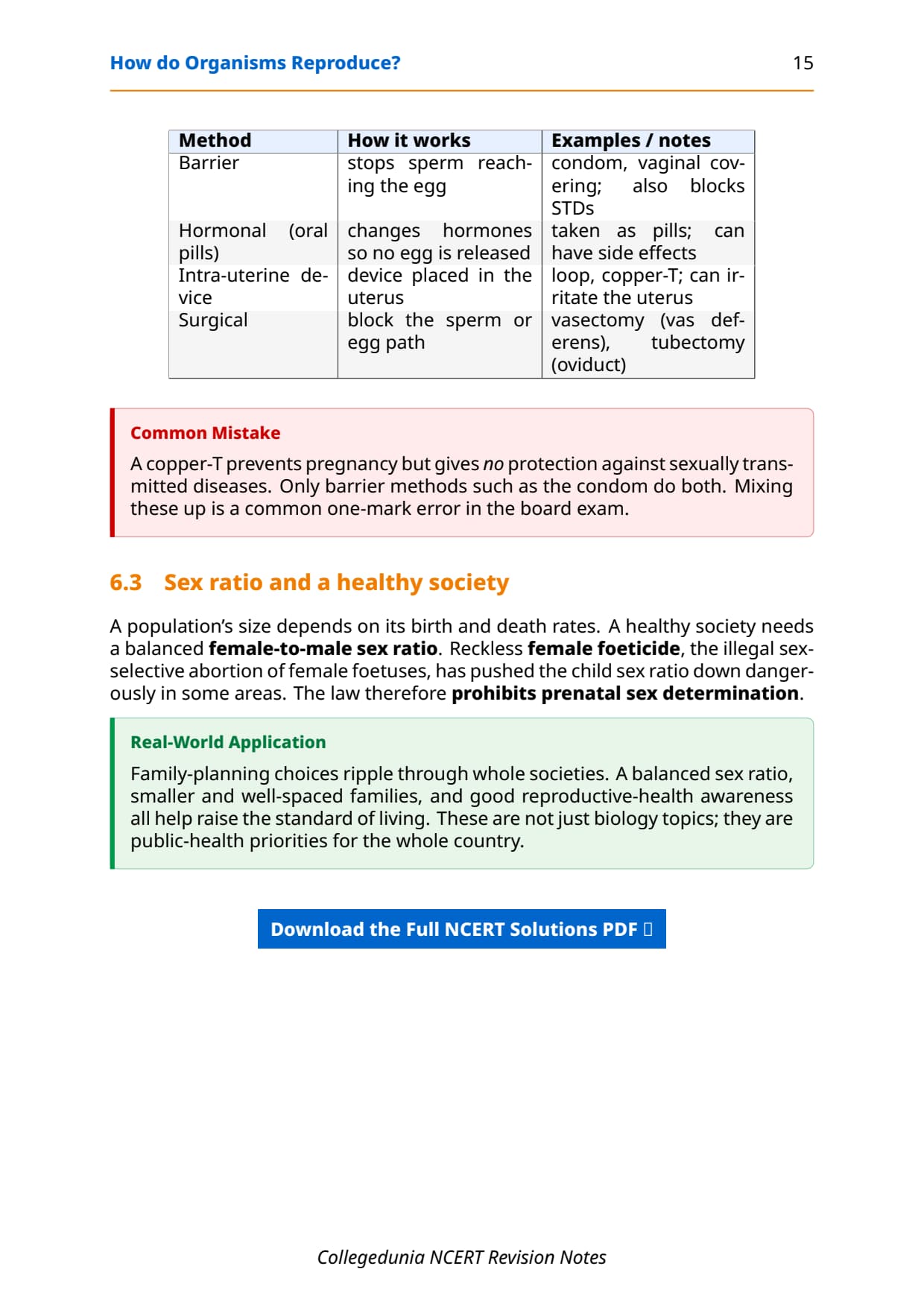
To plan family size and protect health, several contraceptive methods are used, grouped by how they work:
- Barrier (condom): stops sperm reaching the egg, and also blocks STDs.
- Hormonal (oral pills): change hormones so no egg is released.
- Intra-uterine device (loop, copper-T): placed inside the uterus.
- Surgical: vasectomy (vas deferens) and tubectomy (oviduct) block the gamete path.
A healthy society also needs a balanced female-to-male sex ratio. Female foeticide, the illegal sex-selective abortion of female foetuses, has pushed the child sex ratio down, so the law prohibits prenatal sex determination.
Also Check: The full set of CBSE board paper questions for this chapter, with step-by-step answers, is included in the downloadable PDF above, updated for the 2026-27 cycle.
Other Resources for Class 10 Science Chapter 7 How do Organisms Reproduce?
Pair these revision notes with the matching NCERT Solutions, the formula sheet, handwritten notes and the official NCERT book chapter. All resources for Class 10 Science Chapter 7 How do Organisms Reproduce? are linked below.
| Resource | What it covers | Open |
|---|---|---|
| Notes | Concept-first revision notes on DNA copying, the asexual modes, sexual reproduction, flowers, the human systems, the placenta and the menstrual cycle. | You are here |
| NCERT Solutions | Step-by-step answers to all in-text and exercise questions, with an Expert Solution for each. | Class 10 Science Chapter 7 NCERT Solutions |
| Formula Sheet | Quick reference of the must-know diagrams, definitions and the key terms of the chapter. | Class 10 Science Chapter 7 Formula Sheet |
| Handwritten Notes | Scanned-style handwritten pages for last-minute board revision. | Class 10 Science Chapter 7 Handwritten Notes |
| NCERT Book PDF | Official NCERT Science Chapter 7 How do Organisms Reproduce? textbook in PDF form. | Class 10 Science Chapter 7 NCERT Book PDF |
Notes for Class 10 Science: All Chapters
Related Links: Use the table below to open the revision notes for the other chapters of Class 10 Science. Every chapter ships with the same concept-first notes style, full PDF download, and revision FAQ.
| Chapter | Notes link |
|---|---|
| Chapter 1 | Chemical Reactions and Equations Notes |
| Chapter 2 | Acids, Bases and Salts Notes |
| Chapter 3 | Metals and Non-metals Notes |
| Chapter 4 | Carbon and its Compounds Notes |
| Chapter 5 | Life Processes Notes |
| Chapter 6 | Control and Coordination Notes |
| Chapter 7 | How do Organisms Reproduce? Notes (You are here) |
| Chapter 8 | Heredity Notes |
| Chapter 9 | Light - Reflection and Refraction Notes |
| Chapter 10 | The Human Eye and the Colourful World Notes |
| Chapter 11 | Electricity Notes |
| Chapter 12 | Magnetic Effects of Electric Current Notes |
| Chapter 13 | Our Environment Notes |
Notes Class 10 Science Chapter 7 How do Organisms Reproduce? FAQs
Ques. What does Chapter 7 How do Organisms Reproduce? cover in Class 10 Science?
Ans. Chapter 7 covers how living things make more of their own kind. The notes explain why organisms reproduce and the role of DNA copying, the six modes of asexual reproduction (fission, fragmentation, regeneration, budding, spore formation and vegetative propagation), and sexual reproduction with two parents, gametes and meiosis. They also cover sexual reproduction in flowering plants through pollination and fertilisation, reproduction in human beings with the male and female systems, the placenta and the menstrual cycle, and reproductive health, including STDs, contraception and the sex ratio. Everything is aligned with the 2026-27 CBSE syllabus.
Ques. What is the difference between pollination and fertilisation?
Ans. Pollination is the transfer of pollen from an anther to a stigma, and it is the step before fertilisation; at this stage no gametes have joined yet. Fertilisation is the actual fusion of the male gamete, carried down by the pollen tube, with the egg cell inside the ovule, and it produces the zygote. Pollination can be self-pollination, where pollen lands on the stigma of the same flower, or cross-pollination, where it is carried to a different flower of the same kind by wind, water or insects. The key point for the board exam is that pollination always comes first, and fertilisation only happens deep inside the ovule.
Ques. What is the difference between binary fission and multiple fission?
Ans. Binary fission and multiple fission are both kinds of asexual reproduction in single-celled organisms, and the difference is the number of daughter cells. In binary fission the parent splits into exactly two daughter cells, as in Amoeba and bacteria; in Amoeba the split can happen in any plane, while in Leishmania it happens in a fixed direction. In multiple fission the parent splits into many daughter cells at once, as in the malarial parasite Plasmodium, often inside a protective cyst until conditions are right. So the simple test is to count the daughters: two for binary fission, many for multiple fission.
Ques. How does the embryo get nourishment inside the mother's body?
Ans. The growing embryo is fed through a special tissue called the placenta, a disc embedded in the wall of the uterus. On the embryo's side the placenta has finger-like villi that give a large surface area, and on the mother's side are blood spaces around these villi. Glucose and oxygen pass from the mother's blood to the embryo through the placenta, and the embryo's waste, such as carbon dioxide, passes the other way into the mother's blood to be removed. Development takes about nine months, after which the baby is born by strong rhythmic contractions of the uterus muscles.
Ques. Why does menstruation occur in Class 10 Science?
Ans. The ovary releases one egg roughly every month, and at the same time the uterus prepares a thick, blood-rich lining to receive a possible embryo if the egg is fertilised. If the egg is not fertilised it lives only about a day, so no embryo embeds in the lining. Because the prepared lining is then not needed, it breaks down and leaves the body through the vagina as blood and mucus. This monthly shedding of the uterus lining is called menstruation, and it usually lasts two to eight days. A simple way to remember it is that if there is no baby, the cushion the uterus built is not needed and is cleared out.
Ques. What are the functions of the testes in human beings?
Ans. The testes are the male reproductive organs and they have two main jobs. First, they make the male gametes, called sperms. Second, they make the male hormone testosterone, which brings about the changes of puberty in boys, such as facial hair and a deeper voice. The testes lie in the scrotum, a sac outside the main body, because sperm formation needs a temperature a little below normal body temperature. From the testes, sperms travel through the vas deferens, which joins a tube from the urinary bladder so that the urethra carries both sperm and urine out of the body.
Ques. How many pages is the Class 10 Science How do Organisms Reproduce? Notes PDF?
Ans. The How do Organisms Reproduce? Notes PDF runs about 18 to 20 pages and covers the full chapter in concept-first revision blocks, with labelled diagrams of the asexual modes, a flower, and the human male and female reproductive systems, comparison tables, common-mistake boxes, memory aids and a one-glance revision strip. The PDF is free to download for the 2026-27 session, and a green Handwritten Notes button on this page opens the scanned-style version for last-minute revision.
Ques. Are these Notes for Class 10 Science Chapter 7 aligned with the 2026-27 syllabus?
Ans. Yes. This page reflects the current 2026-27 CBSE syllabus for Class 10 Science. The How do Organisms Reproduce? chapter is part of the current cycle, and these notes follow the NCERT textbook, covering why organisms reproduce and DNA copying, the modes of asexual reproduction, sexual reproduction and variation, reproduction in flowering plants through pollination and fertilisation, reproduction in human beings with the placenta and the menstrual cycle, and reproductive health. The notes are written for the CBSE board exam, with the high-frequency question types and diagram questions highlighted throughout.



Comments