




These Notes for Class 10 Science Chapter 6 Control and Coordination give you a fast, concept-first revision of the whole chapter, built on the latest 2026-27 CBSE syllabus. They cover how living things sense the world and respond, the nervous system with its neuron and reflex arc, the human brain, coordination in plants through tropisms and plant hormones, and the endocrine (hormonal) system in animals.
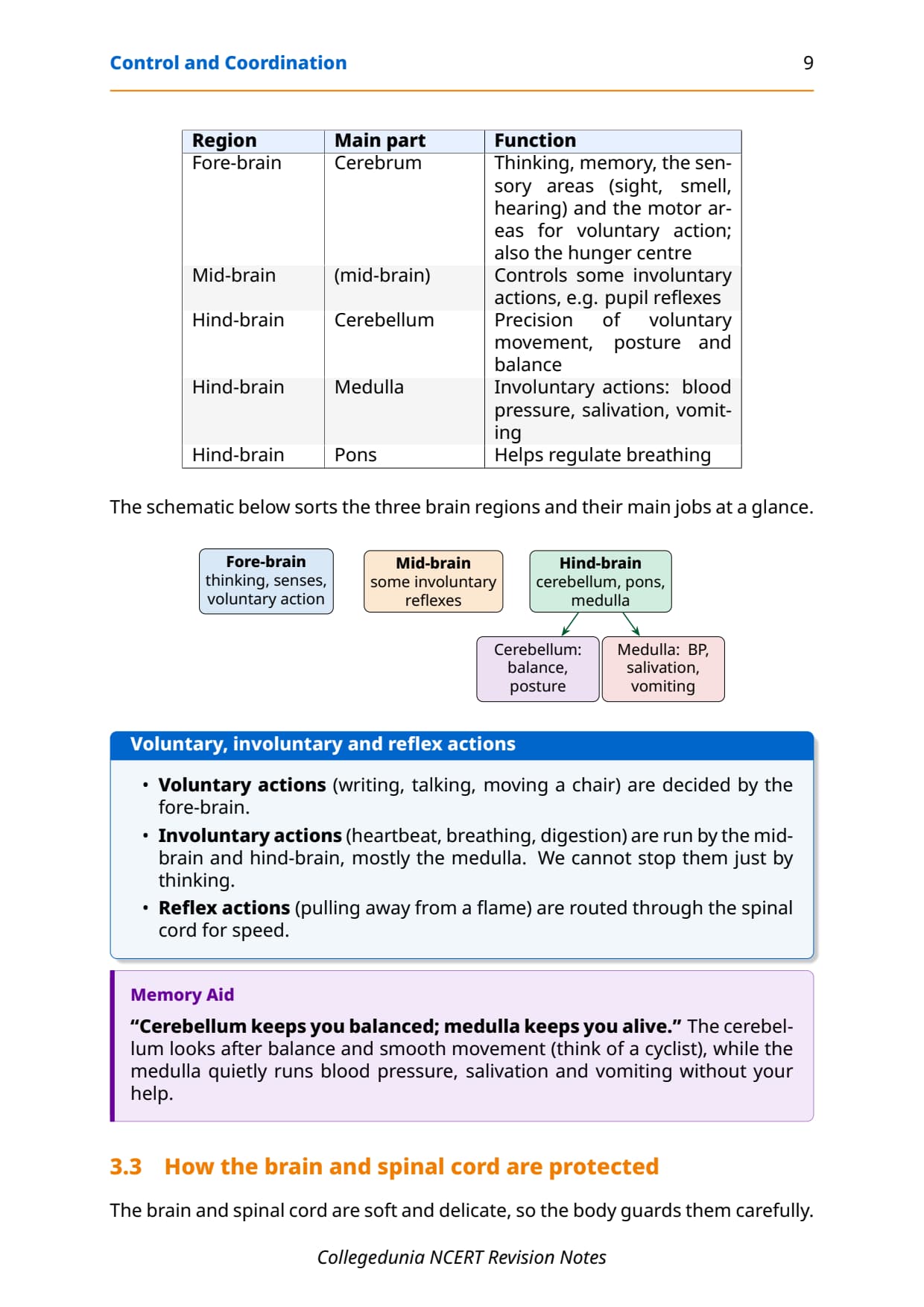
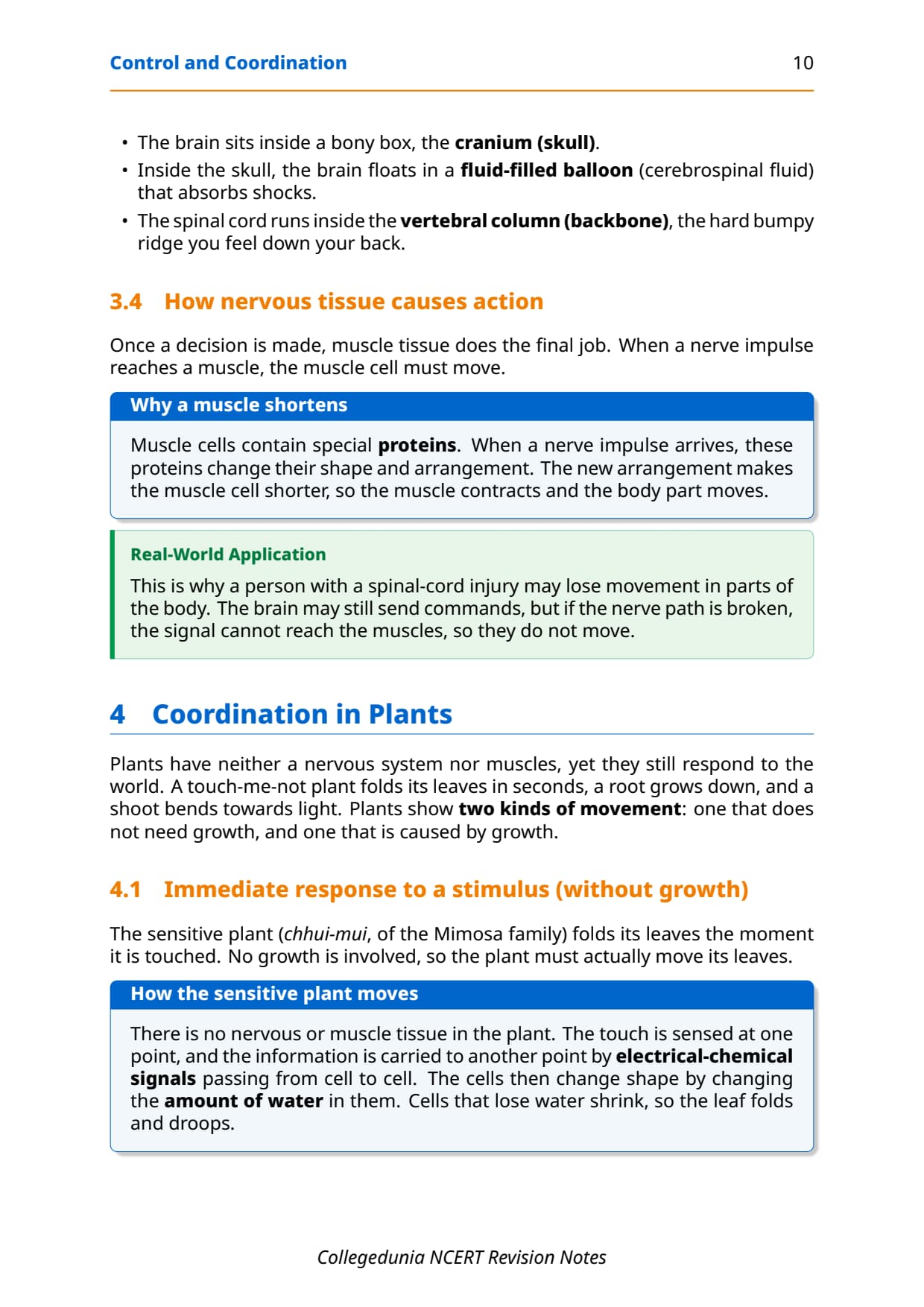
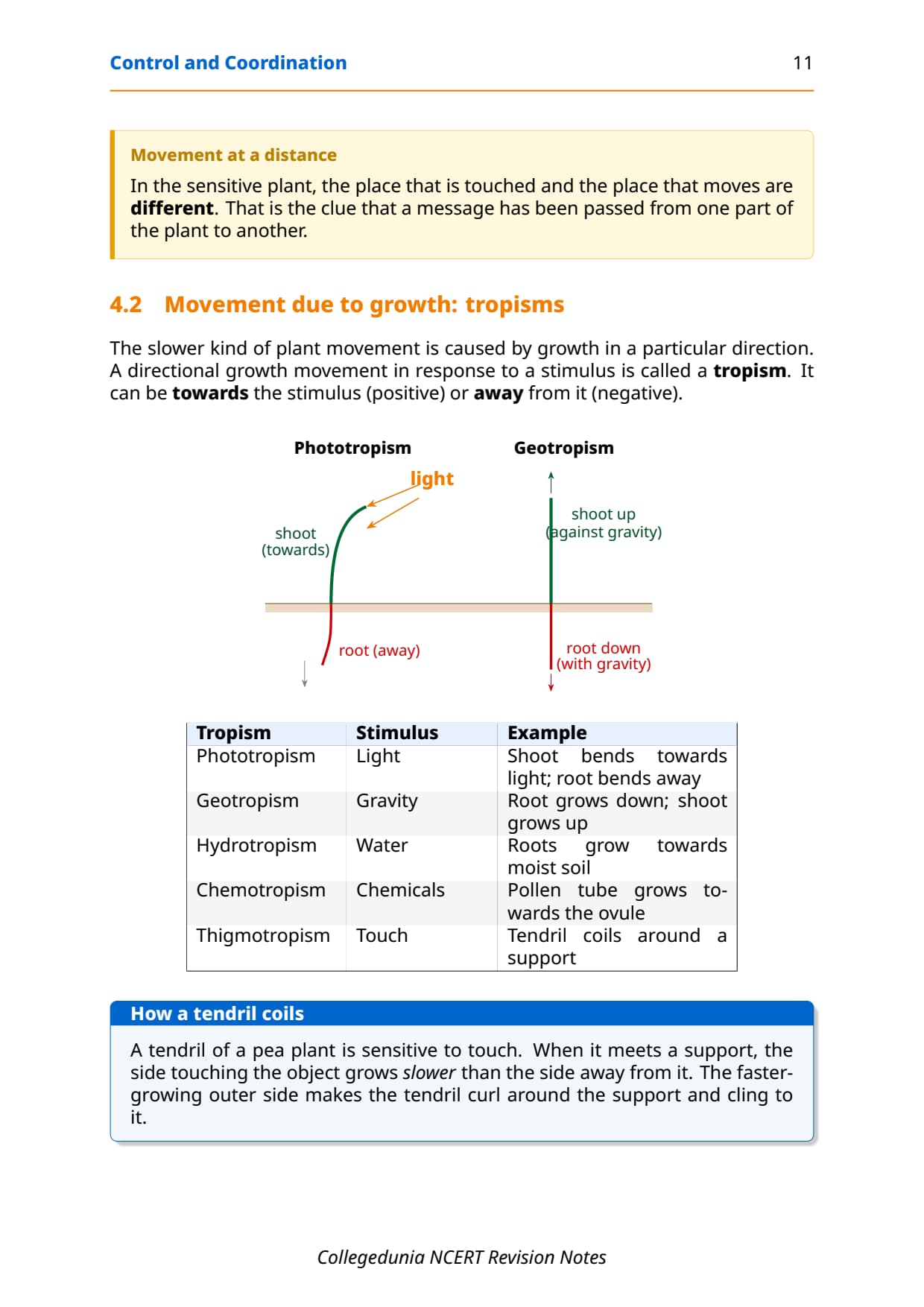
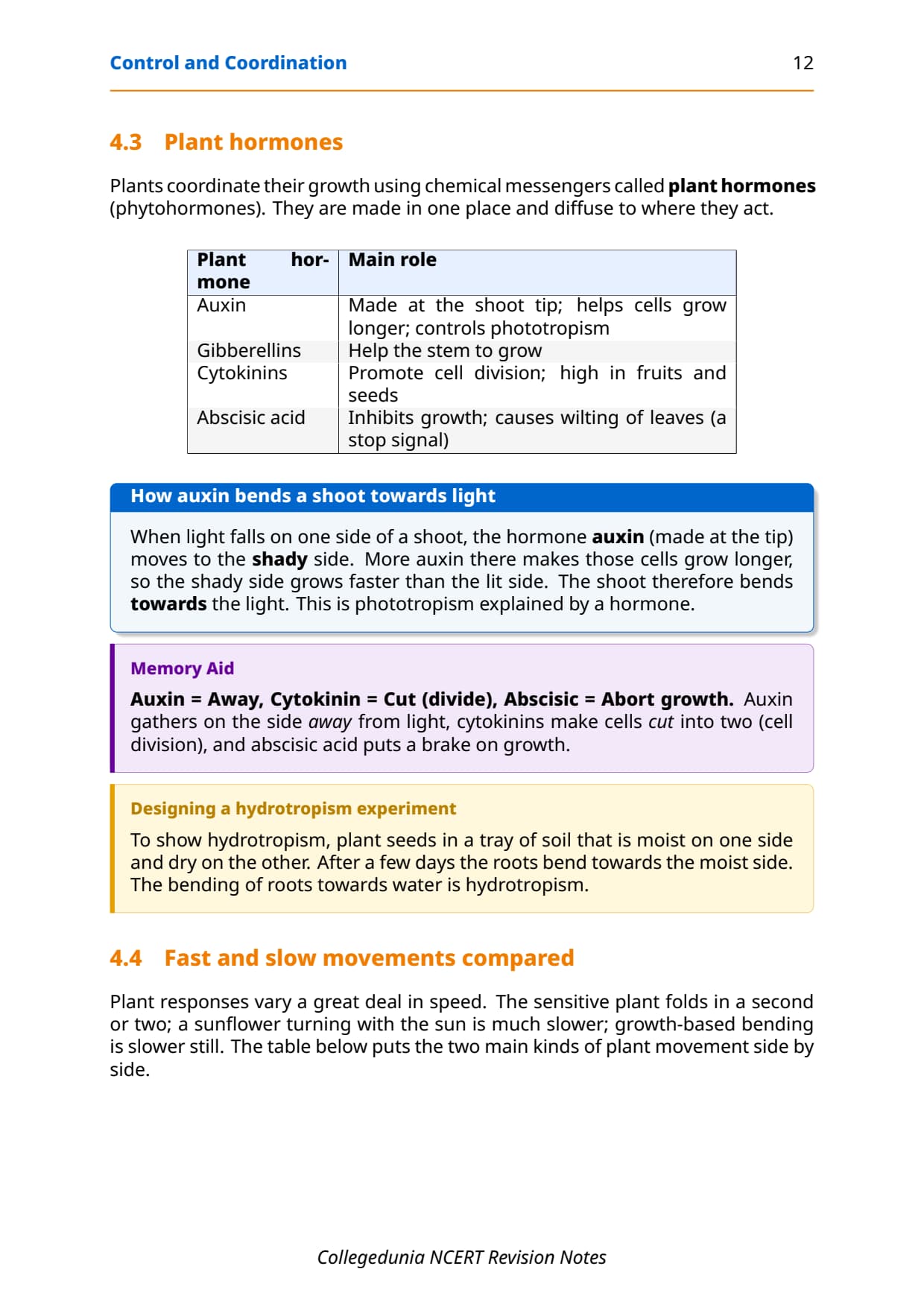
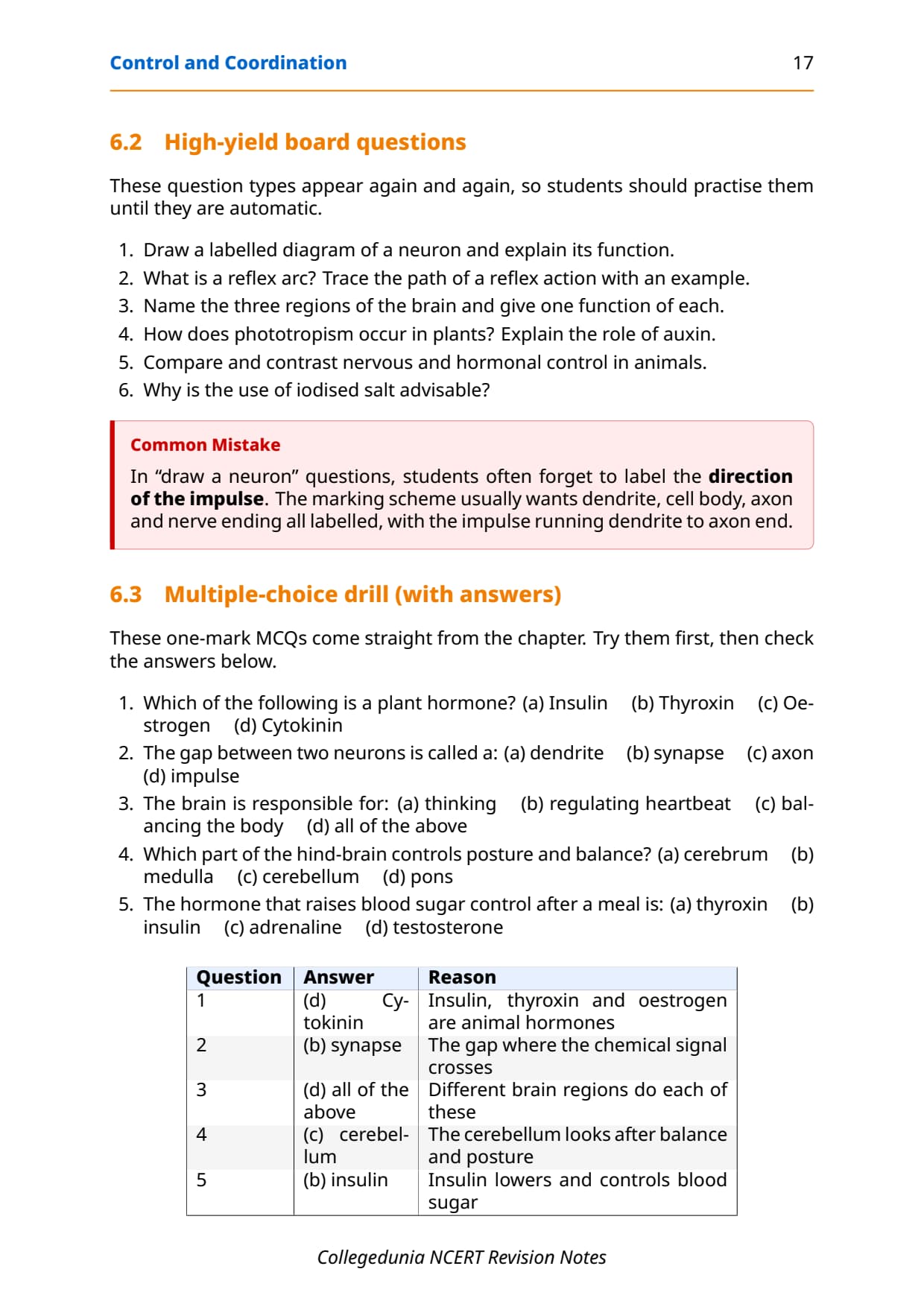
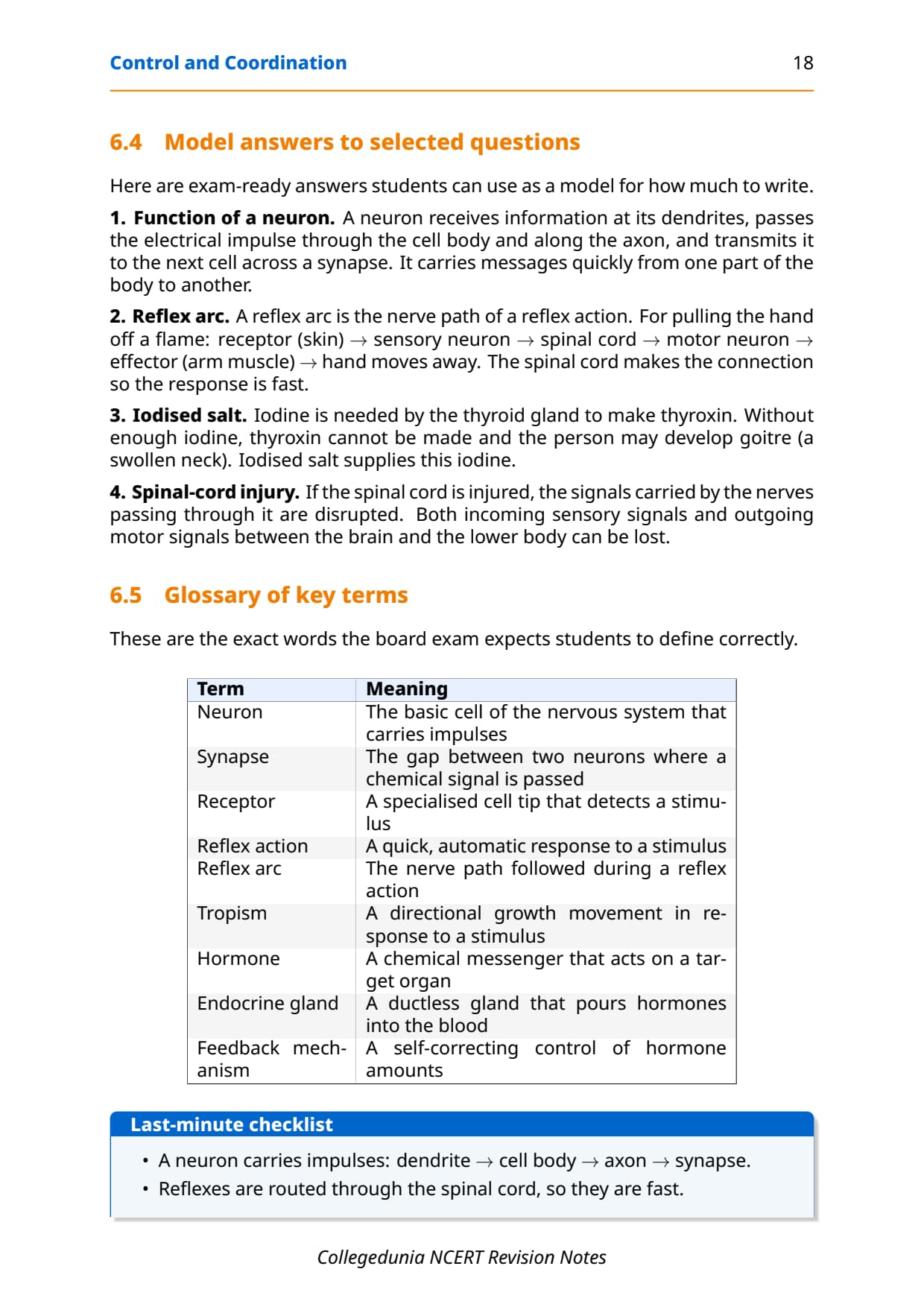
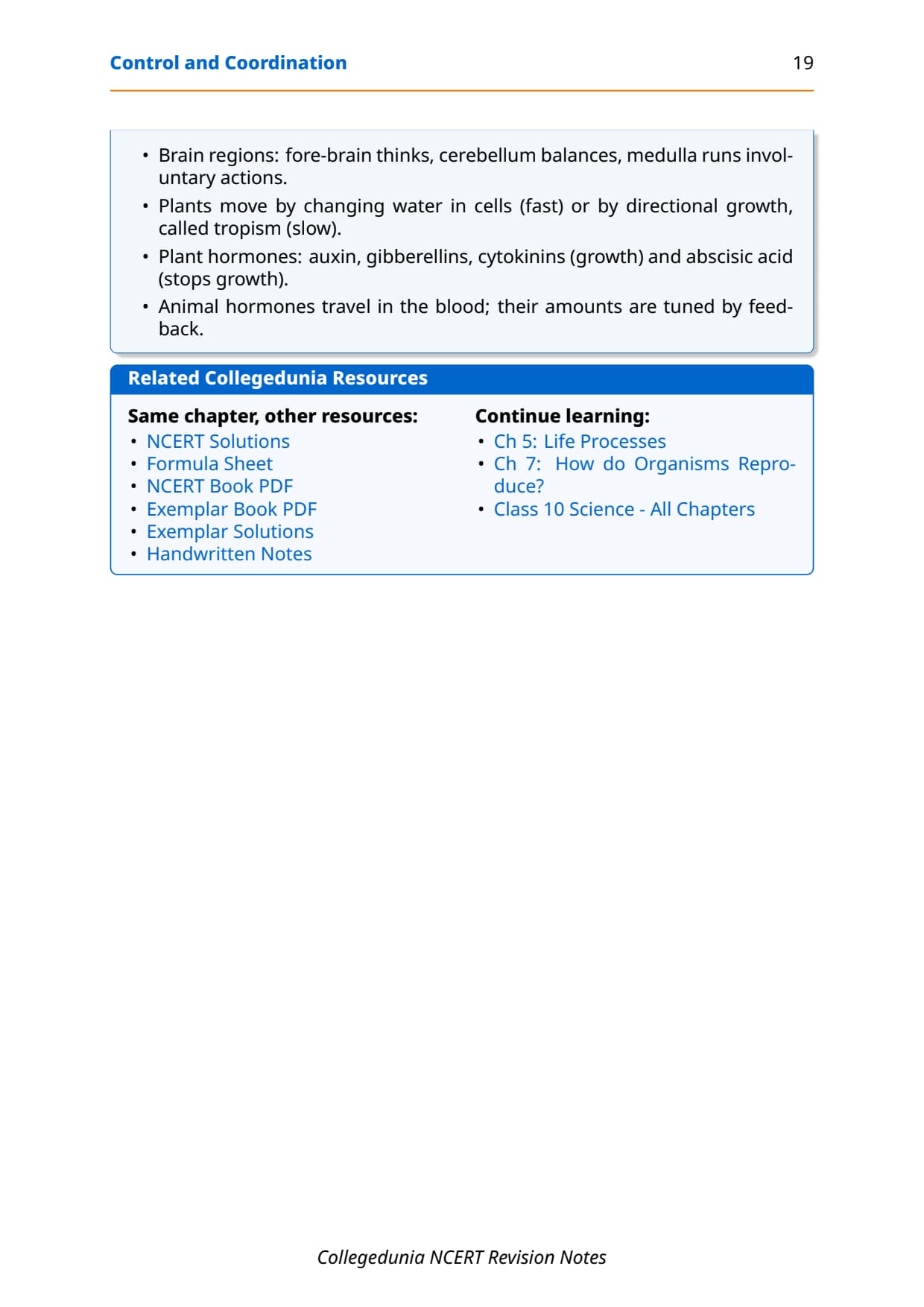
- Every idea explained with a one-line meaning, a simple diagram, and the everyday example CBSE keeps repeating in the board exam.
- Full coverage of the neuron, synapse, reflex action, the three regions of the brain, tropisms, plant hormones and the main endocrine glands.
- Notes aligned with the 2026-27 CBSE Class 10 Science syllabus and written for the board exam; no NEET or JEE references because this is a Class 10 board chapter.
These Collegedunia revision notes are curated by Science subject experts, mapped to the 2026-27 NCERT textbook, and refined against the last five years of CBSE Class 10 Science board papers.
Student Feedback: What 11,800 students told us about this chapter
72% of Class 10 students said they kept mixing up reflex action with an involuntary action like the heartbeat when they first revised. 3 out of 5 students told us a single labelled diagram of the neuron and one block diagram of the reflex arc helped them lock the diagram questions before the board exam.
Toppers found that learning the two control systems as a pair, the fast nervous system and the slow endocrine system, saved 10 to 12 minutes in the exam, and the average student spent 2 to 3 hours on these notes across the first read and the final revision.
Source: 2026-27 Class 10 Science student poll. Sample of 11,800 students from CBSE schools across 13 states, conducted before the 2026 boards.
What the Notes for Class 10 Science Chapter 6 Control and Coordination Cover
Every living thing must sense the world and respond. A hand jerks back from a flame; a shoot bends towards light. This chapter answers one question: how do animals and plants take in a signal and produce the correct response? These notes keep the NCERT order in exam-ready blocks.
- Nervous system: the neuron, receptors, the synapse, and how an impulse travels.
- Reflex action: the five-step reflex arc, and how a reflex differs from walking.
- The human brain: the central and peripheral nervous systems, and the three brain regions.
- Plants and hormones: tropisms, plant hormones, and the endocrine glands with feedback.
Source: Magnet Brains on YouTube
The Nervous System and the Neuron in Class 10 Science
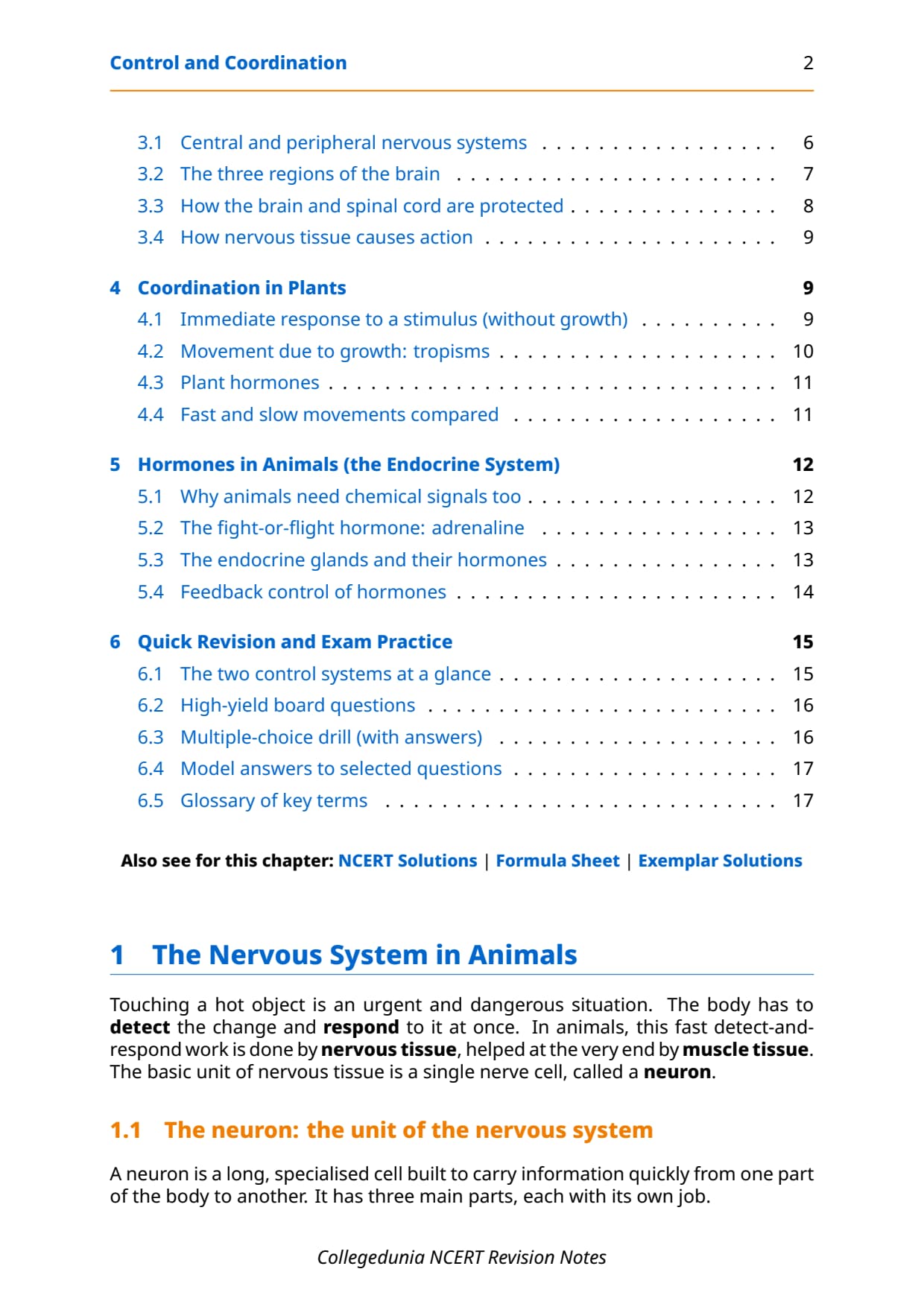
In animals, fast detect-and-respond work is done by nervous tissue, helped by muscle tissue. Its basic unit is a single nerve cell, a neuron, built to carry information quickly across the body.
| Part of the neuron | Job |
|---|---|
| Dendrites | Short, branched tips that receive information; their specialised ends act as receptors |
| Cell body | Contains the nucleus and the cell machinery; the impulse passes through it |
| Axon | A single long fibre that carries the impulse away from the cell body, ending in fine nerve endings |
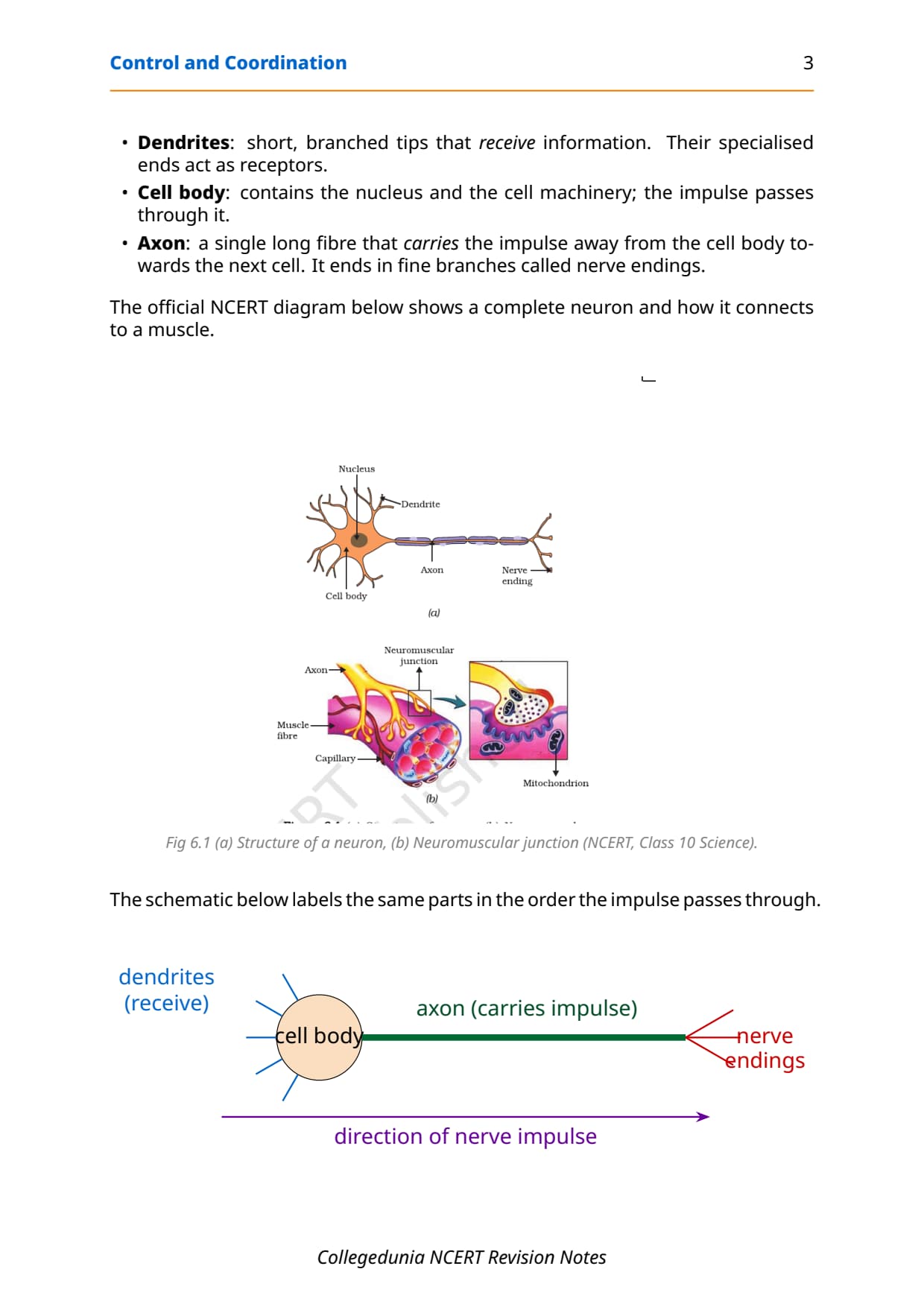
Information at a dendrite tip creates an electrical impulse that always travels in one order: dendrite → cell body → axon → axon end. At the axon end the electrical signal becomes a chemical one for the next cell.
stimulus → dendrite → cell body → axon → axon end → next cell
Receptors, the Synapse and Nervous Tissue
We sense the world through receptors, the specialised tips of certain nerve cells. Most sit in our sense organs, each detecting one type of stimulus.
| Receptor | Sense organ | Detects |
|---|---|---|
| Gustatory receptors | Tongue | Taste |
| Olfactory receptors | Nose | Smell |
| Photoreceptors | Eye | Light |
| Phonoreceptors | Inner ear | Sound and balance |
| Thermoreceptors | Skin | Heat and cold |
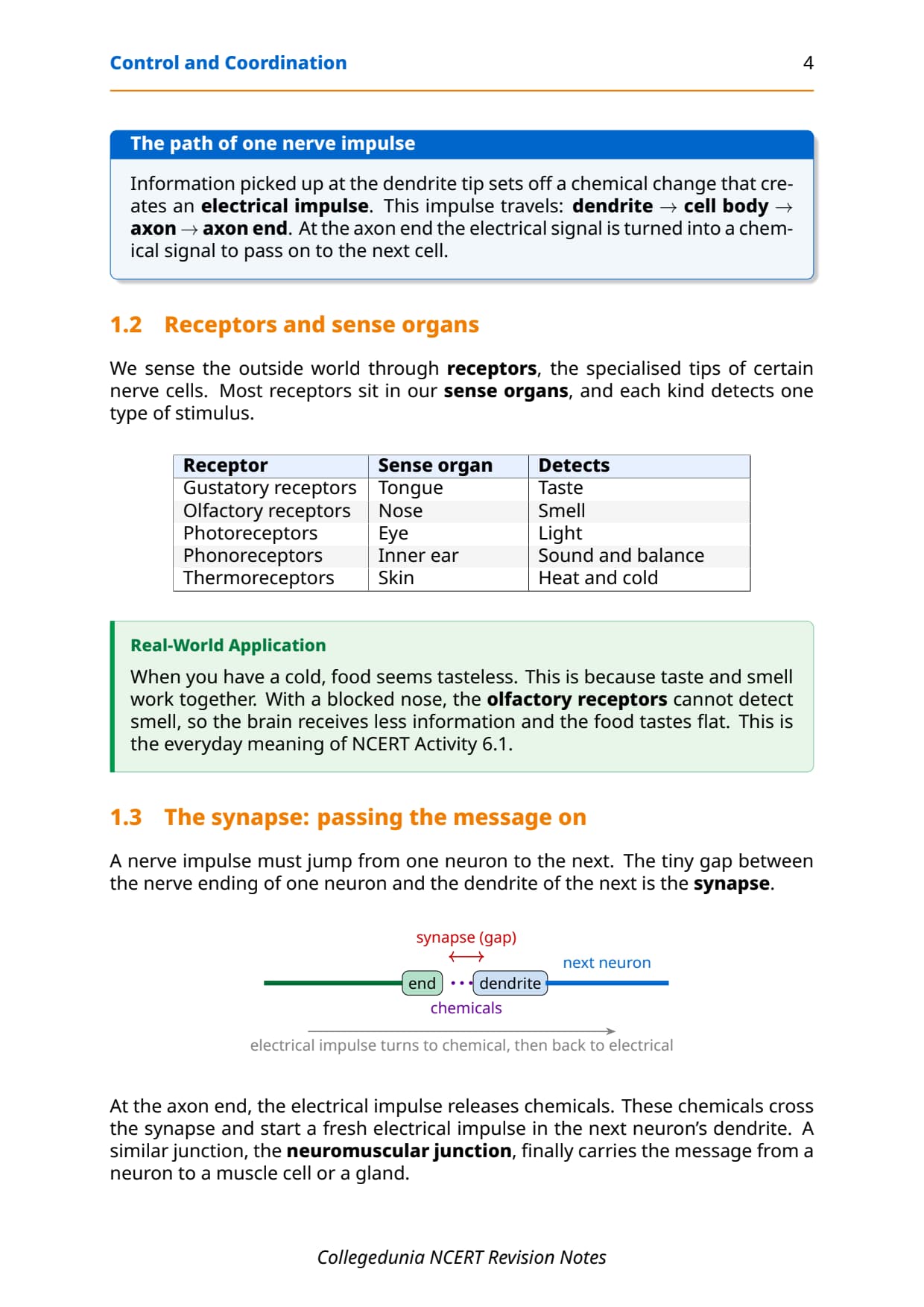
The tiny gap between one neuron's nerve ending and the next neuron's dendrite is the synapse. The electrical impulse releases chemicals that cross it and start a fresh impulse. A similar neuromuscular junction carries the message to a muscle cell or gland.
- Receptors gather information; sensory neurons carry it inward to the CNS.
- Motor neurons carry decisions outward to muscles and glands.
Reflex Action and the Reflex Arc in Class 10 Science
We pull our hand back from a flame before we feel the pain. This sudden, automatic response to a stimulus is a reflex action: fast, needing no conscious thought, and protective. Thinking is slow, so if the hand waited for the brain to decide, we might get burnt first.
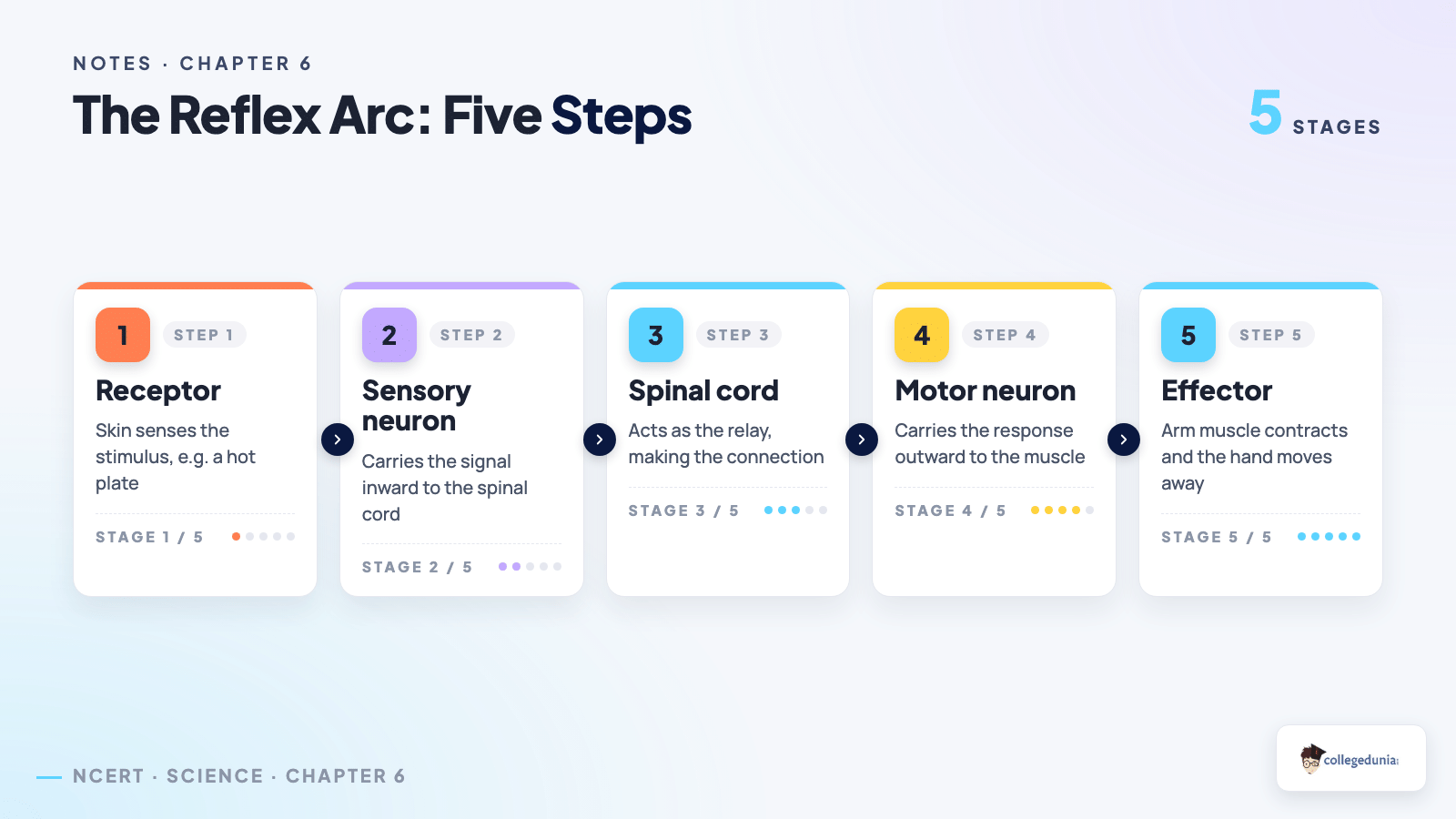
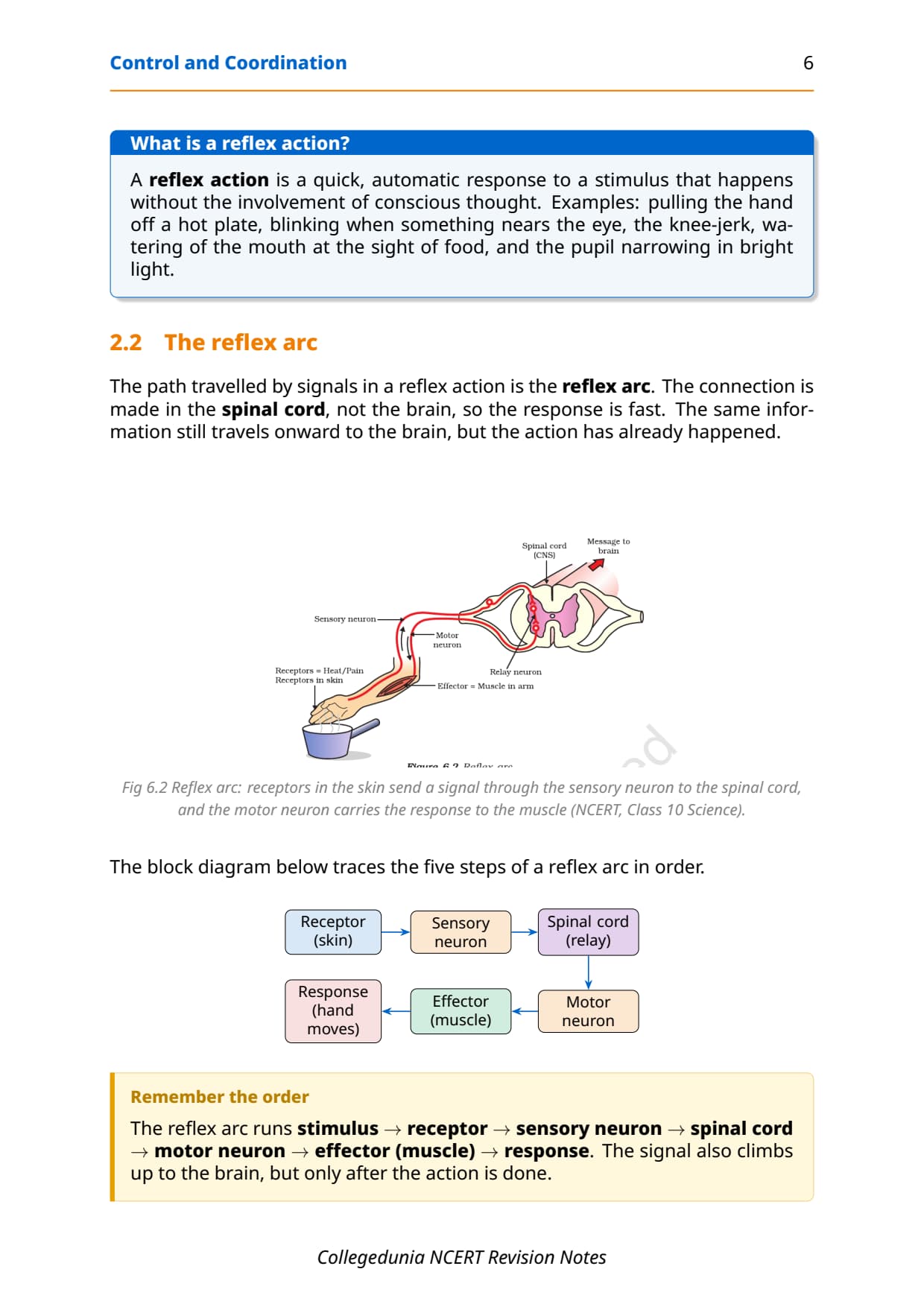
The path signals travel in a reflex is the reflex arc. The connection is made in the spinal cord, not the brain, so the response is fast; the brain learns of it only after the action. The arc runs in a fixed order:
stimulus → receptor → sensory neuron → spinal cord → motor neuron → effector (muscle) → response
A reflex action and walking differ: one is automatic, the other planned by the brain.
| Feature | Reflex action | Walking |
|---|---|---|
| Under conscious control? | No | Yes |
| Speed | Very fast | Slower, deliberate |
| Controlled by | Spinal cord (reflex arc) | Brain (cerebellum, motor area) |
| Need for thought | None | Yes, it is voluntary |
The Human Brain and Nervous System Organisation
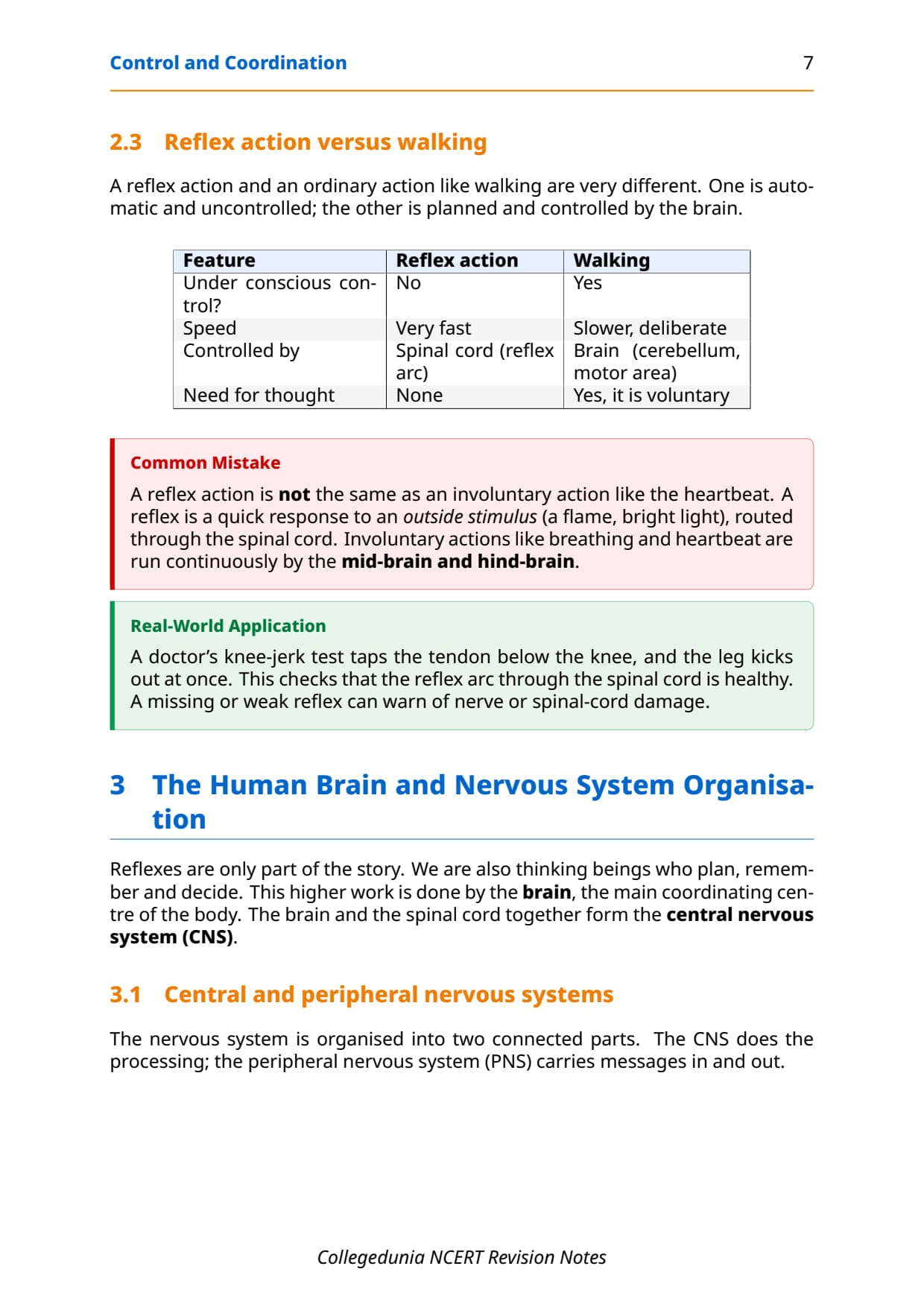
Higher work like planning, memory and decisions is done by the brain. The brain and spinal cord form the central nervous system (CNS), which processes; the peripheral nervous system (PNS), made of cranial nerves (from the brain) and spinal nerves (from the spinal cord), carries messages in and out.
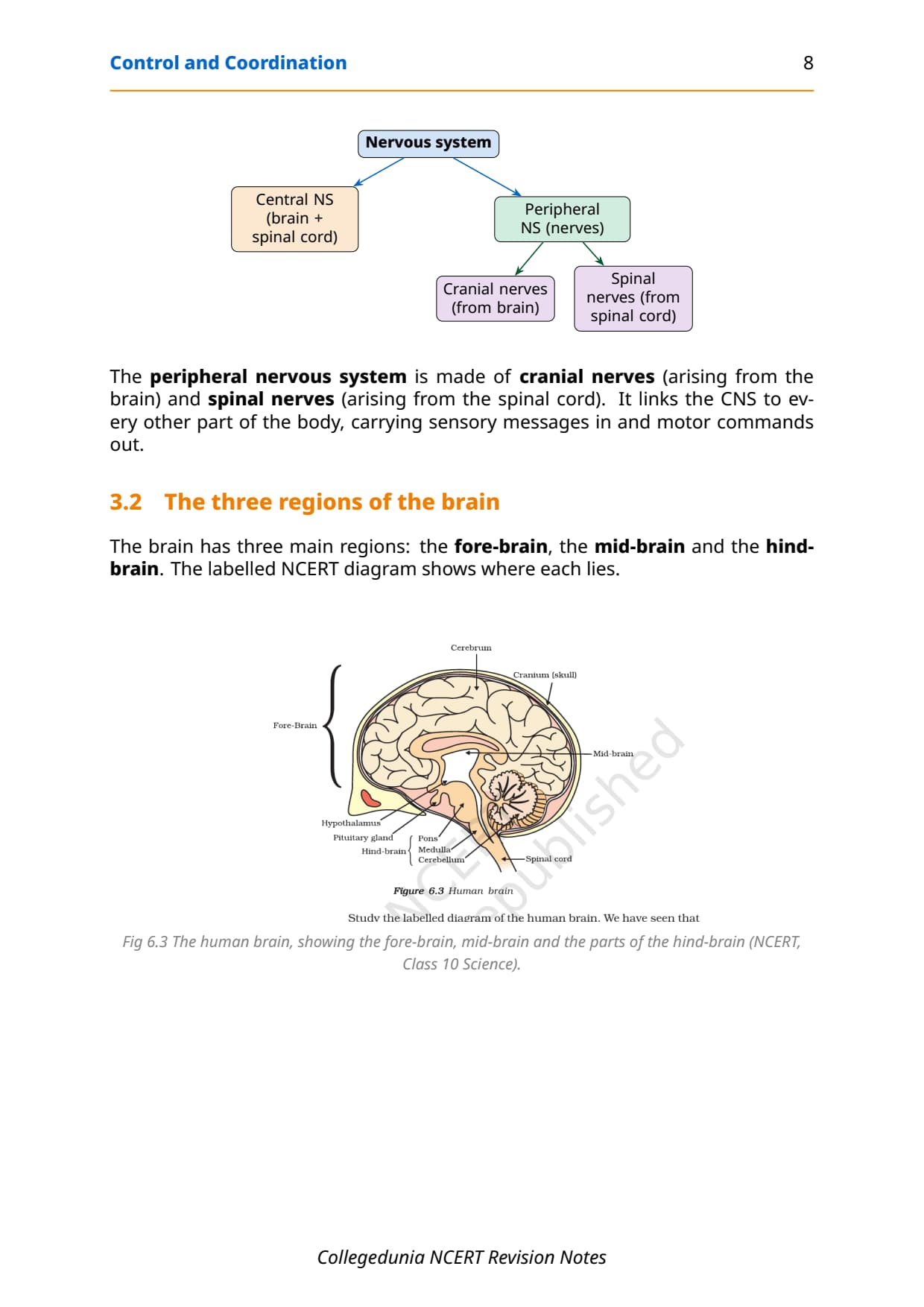
The brain has three main regions: the fore-brain, mid-brain and hind-brain. Naming the region and its job is a favourite board question.
| Region | Main part | Function |
|---|---|---|
| Fore-brain | Cerebrum | Thinking, memory, the sensory areas (sight, smell, hearing), the motor areas for voluntary action, and the hunger centre |
| Mid-brain | (mid-brain) | Controls some involuntary actions, for example pupil reflexes |
| Hind-brain | Cerebellum | Precision of voluntary movement, posture and balance |
| Hind-brain | Medulla | Involuntary actions: blood pressure, salivation, vomiting |
| Hind-brain | Pons | Helps regulate breathing |
Being soft, the brain sits in the cranium (skull) in shock-absorbing cerebrospinal fluid; the spinal cord runs inside the backbone.
Coordination in Plants: Tropisms and Movements
Plants have no nervous system or muscles, yet they respond, through two kinds of movement: one without growth, and one caused by growth.
The fast kind needs no growth. The sensitive plant (chhui-mui) folds its leaves the moment it is touched. With no nervous or muscle tissue, the touch is carried cell to cell by electrical-chemical signals; cells then lose water and shrink, so the leaf folds.
The slower kind is directional growth in response to a stimulus, called a tropism, either towards the stimulus (positive) or away (negative).
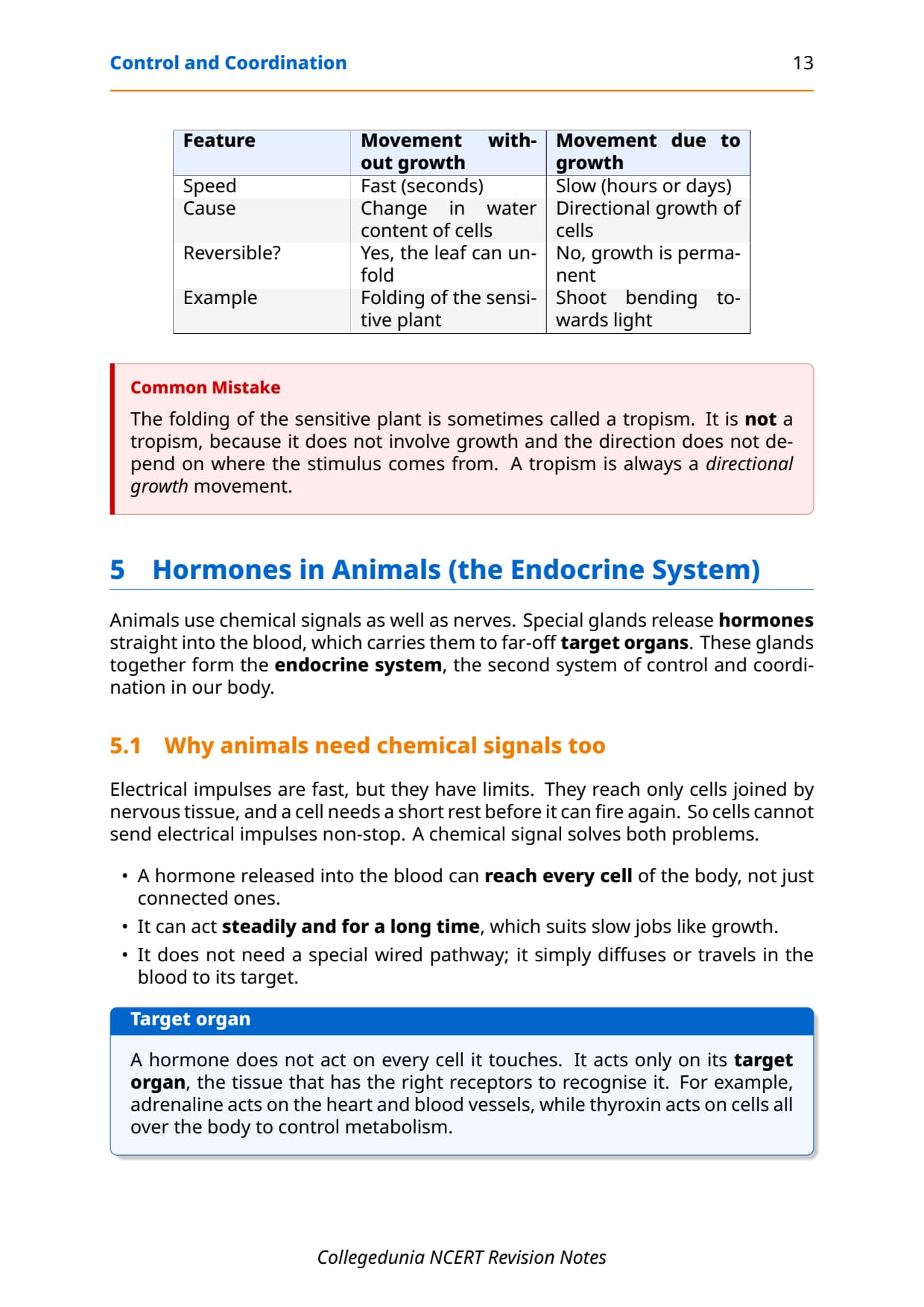
| Tropism | Stimulus | Example |
|---|---|---|
| Phototropism | Light | Shoot bends towards light; root bends away |
| Geotropism | Gravity | Root grows down; shoot grows up |
| Hydrotropism | Water | Roots grow towards moist soil |
| Chemotropism | Chemicals | Pollen tube grows towards the ovule |
| Thigmotropism | Touch | Tendril coils around a support |
Plant Hormones in Class 10 Science
Plants coordinate growth using chemical messengers called plant hormones (phytohormones), made in one place and diffusing to where they act. Four are named in NCERT.
| Plant hormone | Main role |
|---|---|
| Auxin | Made at the shoot tip; helps cells grow longer; controls phototropism |
| Gibberellins | Help the stem to grow |
| Cytokinins | Promote cell division; high in fruits and seeds |
| Abscisic acid | Inhibits growth; causes wilting of leaves (a stop signal) |
Auxin explains how a shoot bends towards light. When light falls on one side, auxin (made at the tip) moves to the shady side, making those cells grow longer, so the shady side grows faster and the shoot bends towards the light. A frequent 3-mark question.
Hormones in Animals: The Endocrine System
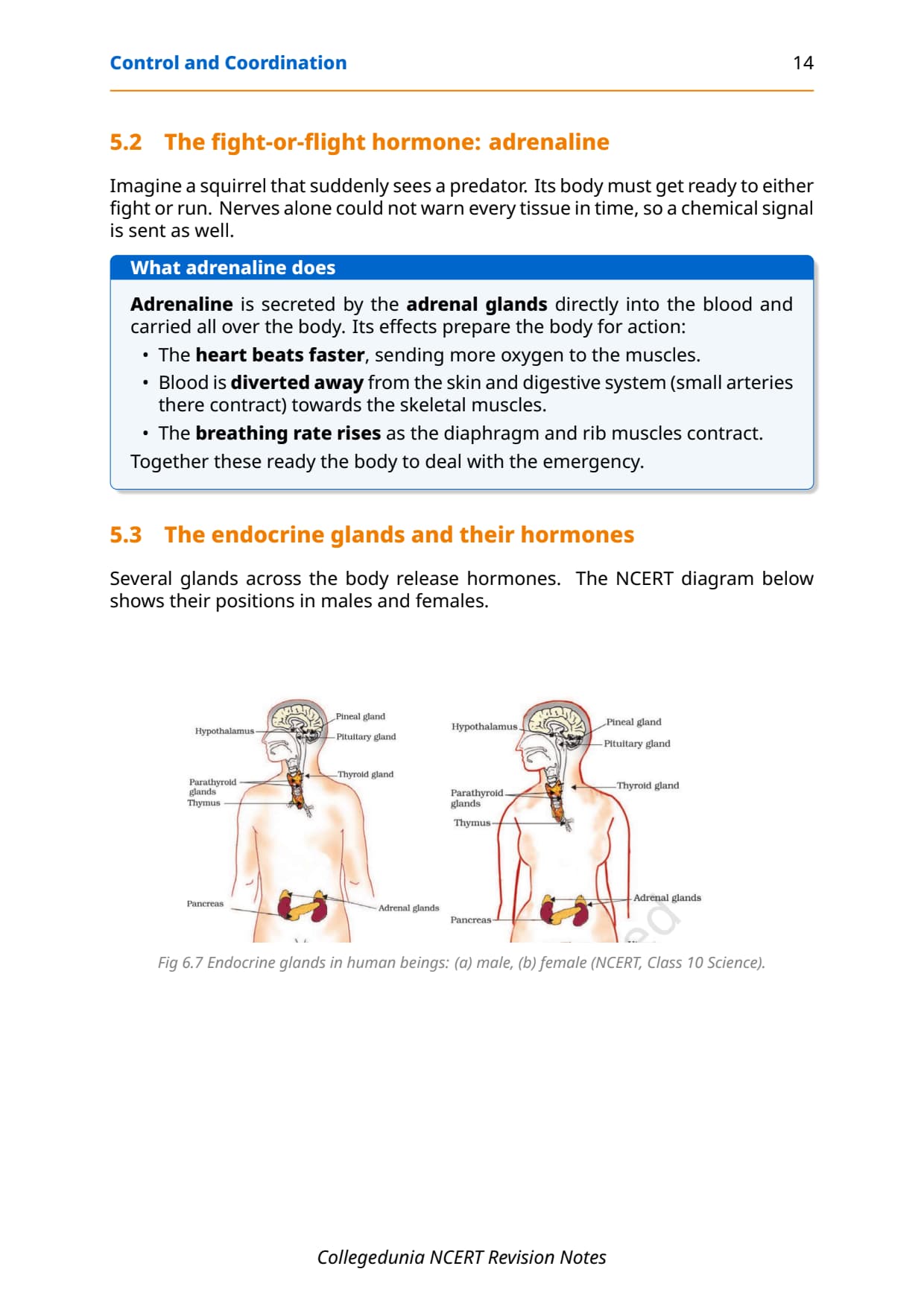
Animals use chemical signals as well as nerves. Glands of the endocrine system release hormones into the blood, which carries them to far-off target organs. A hormone acts only on its target organ, the tissue with the right receptors.
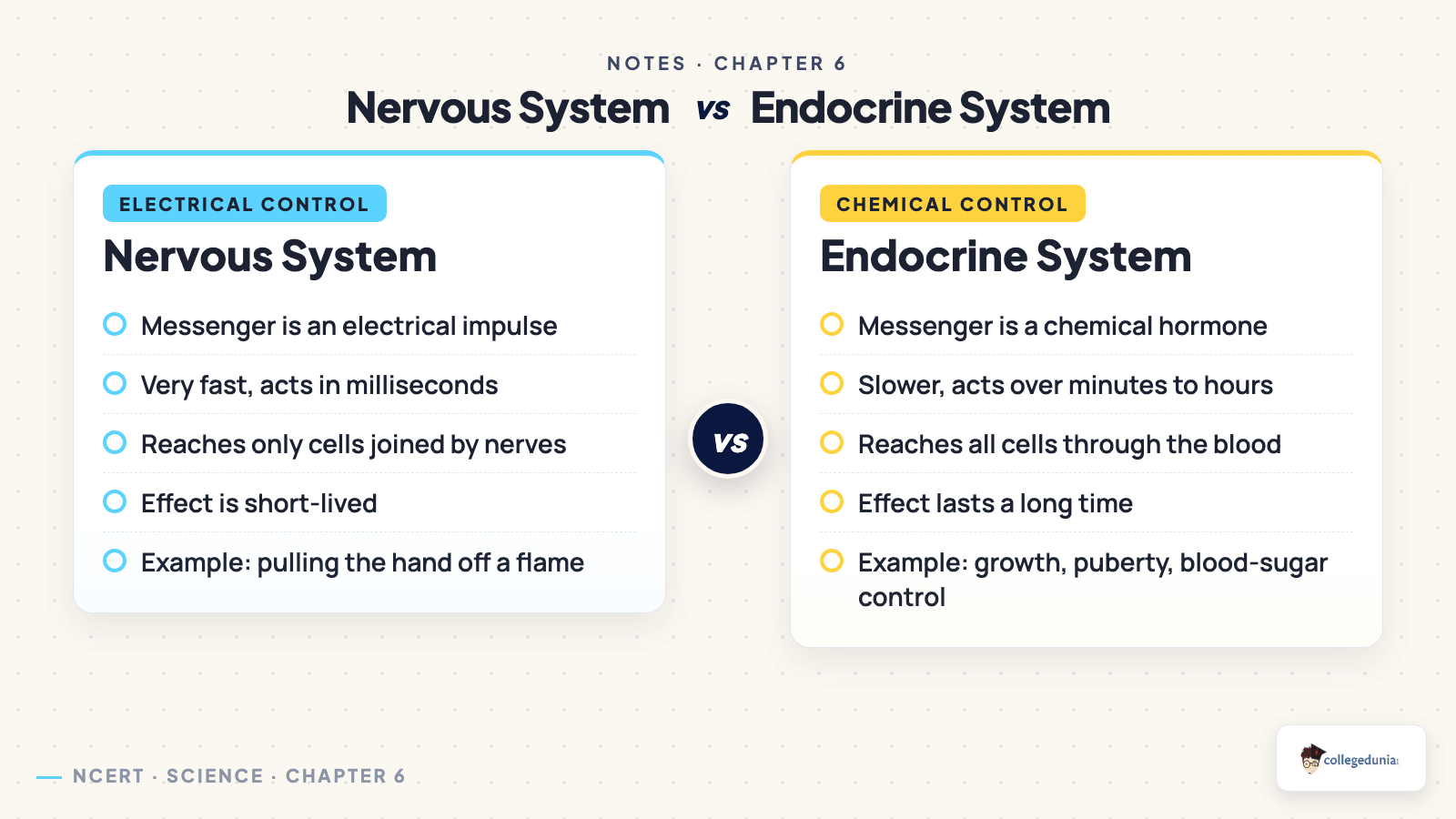
Electrical impulses reach only wired cells and need a rest before firing again. A hormone in the blood can reach every cell and act steadily for a long time, with no wired pathway. The main glands and their hormones are below.
| Gland | Hormone | Function |
|---|---|---|
| Pituitary | Growth hormone | Regulates growth of the body |
| Thyroid | Thyroxin | Regulates carbohydrate, protein and fat metabolism; needs iodine |
| Pancreas | Insulin | Regulates blood sugar level |
| Adrenal | Adrenaline | Prepares the body for emergencies (fight-or-flight) |
| Testes | Testosterone | Male sexual characters at puberty |
| Ovaries | Oestrogen | Female sexual characters; menstrual cycle |
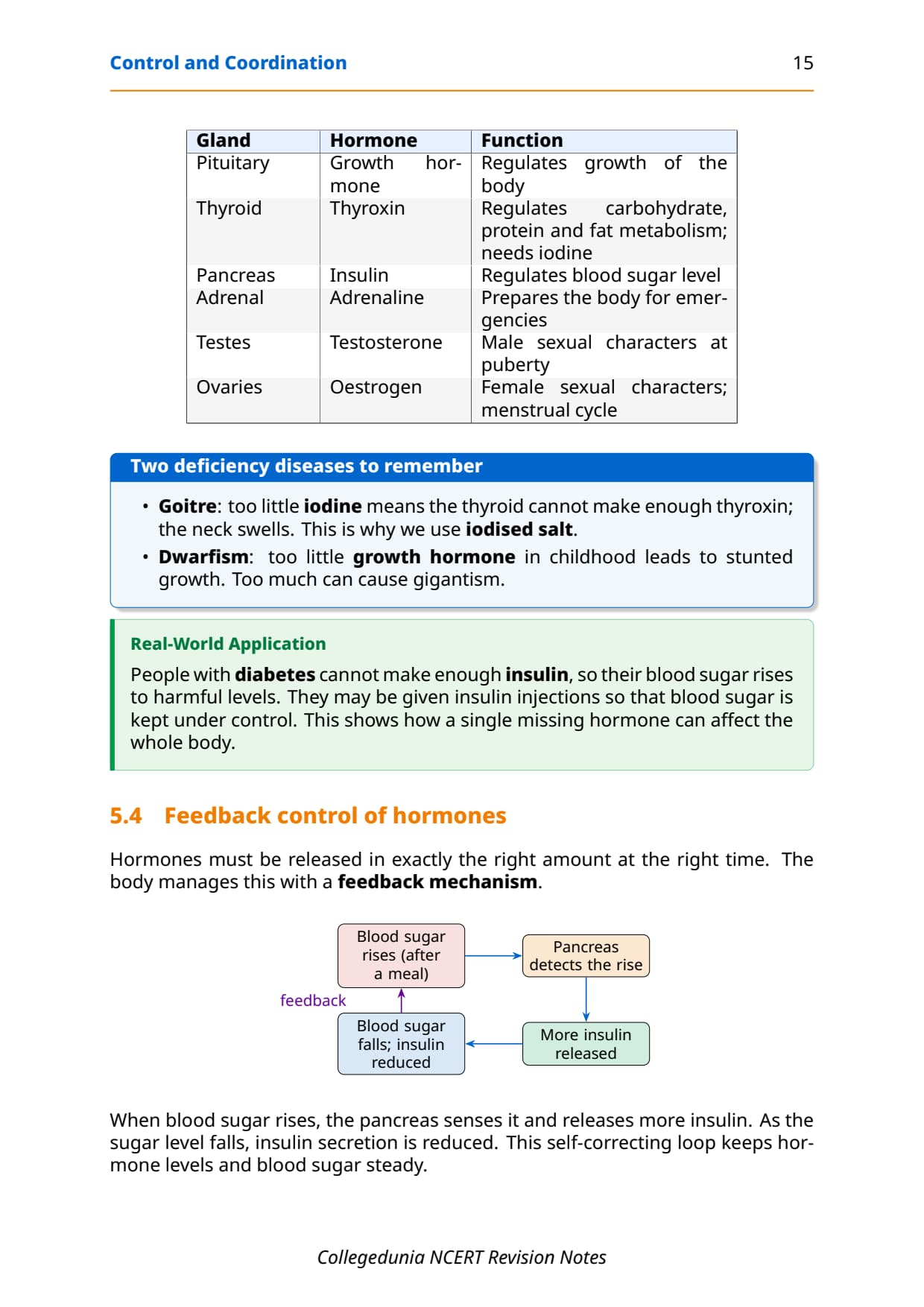
Two deficiency diseases: too little iodine lowers thyroxin and swells the neck (goitre), hence iodised salt; too little growth hormone in childhood causes dwarfism, too much causes gigantism. Hormones are tuned by feedback: as blood sugar rises the pancreas releases more insulin, and as it falls insulin secretion drops.
Quick Revision Strip and Common Exam Traps
Read this in the last few minutes before the exam: each big idea with its one-line key point.
| Idea | Key point |
|---|---|
| Neuron | Carries the impulse: dendrite → cell body → axon → nerve ending |
| Synapse | Gap between neurons; electrical inside, chemical between, one-way only |
| Reflex arc | Receptor → sensory neuron → spinal cord → motor neuron → effector |
| Brain regions | Fore-brain thinks, cerebellum balances, medulla runs involuntary actions |
| Plant movement | Fast (water change, no growth) or slow (directional growth = tropism) |
| Plant hormones | Auxin, gibberellins, cytokinins (growth); abscisic acid (stops growth) |
| Animal hormones | Travel in the blood to target organs; amounts tuned by feedback |
Also Check: The full set of CBSE board paper questions for this chapter, with step-by-step answers, is included in the downloadable PDF above, updated for the 2026-27 cycle.
Other Resources for Class 10 Science Chapter 6 Control and Coordination
Pair these notes with the matching NCERT Solutions, formula sheet, handwritten notes and NCERT book chapter, all linked below.
| Resource | What it covers | Open |
|---|---|---|
| Notes | Concept-first revision notes on the neuron, the reflex arc, the human brain, plant tropisms and hormones, and the endocrine system. | You are here |
| NCERT Solutions | Step-by-step answers to all in-text and exercise questions, with an Expert Solution for each. | Class 10 Science Chapter 6 NCERT Solutions |
| Formula Sheet | Quick reference of the must-know diagrams, definitions and the key terms of the chapter. | Class 10 Science Chapter 6 Formula Sheet |
| Handwritten Notes | Scanned-style handwritten pages for last-minute board revision. | Class 10 Science Chapter 6 Handwritten Notes |
| NCERT Book PDF | Official NCERT Science Chapter 6 Control and Coordination textbook in PDF form. | Class 10 Science Chapter 6 NCERT Book PDF |
Notes for Class 10 Science: All Chapters
Related Links: Use the table below to open the revision notes for the other chapters of Class 10 Science. Every chapter ships with the same concept-first notes style, full PDF download, and revision FAQ.
| Chapter | Notes link |
|---|---|
| Chapter 1 | Chemical Reactions and Equations Notes |
| Chapter 2 | Acids, Bases and Salts Notes |
| Chapter 3 | Metals and Non-metals Notes |
| Chapter 4 | Carbon and its Compounds Notes |
| Chapter 5 | Life Processes Notes |
| Chapter 6 | Control and Coordination Notes (You are here) |
| Chapter 7 | How do Organisms Reproduce? Notes |
| Chapter 8 | Heredity Notes |
| Chapter 9 | Light - Reflection and Refraction Notes |
| Chapter 10 | The Human Eye and the Colourful World Notes |
| Chapter 11 | Electricity Notes |
| Chapter 12 | Magnetic Effects of Electric Current Notes |
| Chapter 13 | Our Environment Notes |
Notes Class 10 Science Chapter 6 Control and Coordination FAQs
Ques. What does Chapter 6 Control and Coordination cover in Class 10 Science?
Ans. Chapter 6 covers how living things sense the world and respond to it. The notes explain the nervous system with the neuron, receptors, the synapse and nervous tissue, reflex action and the five-step reflex arc, the human brain and its three regions, and how the brain and spinal cord are protected. They also cover coordination in plants through fast water-driven movements and slow directional growth called tropisms, the four plant hormones, and the endocrine system in animals with the main glands, their hormones and feedback control. Everything is aligned with the 2026-27 CBSE syllabus.
Ques. What is a reflex arc in Class 10 Science?
Ans. A reflex arc is the path travelled by signals during a reflex action. It runs in a fixed order: a stimulus is picked up by a receptor, a sensory neuron carries the signal to the spinal cord, the connection is made in the spinal cord, a motor neuron carries the response outward, and the effector (a muscle) produces the response. The connection is made in the spinal cord rather than the brain, which is why a reflex is so fast. The same information still travels onward to the brain, but only after the action has already happened, for example pulling the hand off a hot plate.
Ques. What is the difference between nervous and hormonal control in animals?
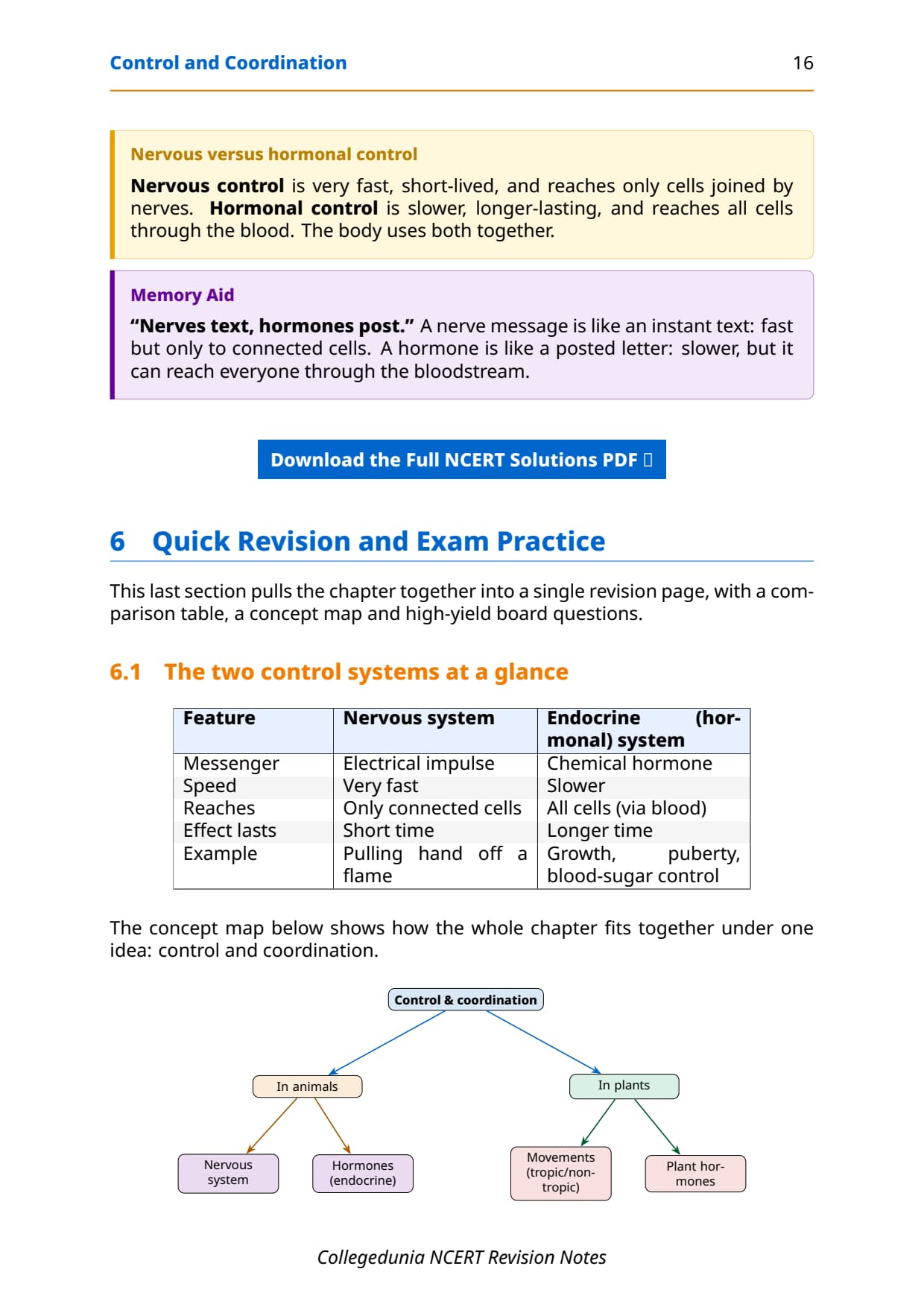
Ans. Nervous control uses electrical impulses carried by neurons. It is very fast, short-lived, and reaches only cells joined by nervous tissue, for example pulling the hand off a flame. Hormonal control uses chemical hormones released into the blood. It is slower, longer-lasting, and reaches all cells through the bloodstream, which suits slow jobs like growth, puberty and blood-sugar control. The body uses both systems together: nerves handle fast, targeted responses, while hormones handle steady, body-wide responses. A simple line is that nerves are like an instant text and hormones are like a posted letter.
Ques. What are the three regions of the brain and their functions?
Ans. The brain has three main regions. The fore-brain, whose main part is the cerebrum, handles thinking, memory, the sensory areas for sight, smell and hearing, the motor areas for voluntary action, and the hunger centre. The mid-brain controls some involuntary actions such as pupil reflexes. The hind-brain has three parts: the cerebellum, which gives precision to voluntary movement, posture and balance; the medulla, which runs involuntary actions like blood pressure, salivation and vomiting; and the pons, which helps regulate breathing. A useful line is that the cerebellum keeps you balanced and the medulla keeps you alive.
Ques. How does phototropism occur in plants, and what is the role of auxin?
Ans. Phototropism is the bending of a plant part towards or away from light. A shoot shows positive phototropism by bending towards light. The hormone auxin, which is made at the shoot tip, explains how this happens. When light falls on one side of a shoot, auxin moves to the shady side. The extra auxin there makes those cells grow longer, so the shady side grows faster than the lit side. Because one side grows more than the other, the shoot bends towards the light. So phototropism is a directional growth movement controlled by the plant hormone auxin.
Ques. What is the difference between a reflex action and an involuntary action?
Ans. A reflex action is a quick, automatic response to an outside stimulus, such as pulling the hand off a hot plate, blinking, or the knee-jerk response. It is routed through the spinal cord for speed and does not need conscious thought. An involuntary action, such as the heartbeat, breathing and digestion, is run continuously by the mid-brain and hind-brain, mostly the medulla, and is not a response to a single outside stimulus. The key difference is that a reflex is triggered by an outside stimulus and routed through the spinal cord, while an involuntary action runs on its own without an external trigger.
Ques. How many pages is the Class 10 Science Control and Coordination Notes PDF?
Ans. The Control and Coordination Notes PDF runs about 18 to 20 pages and covers the full chapter in concept-first revision blocks, with labelled diagrams of the neuron, the reflex arc, the human brain and the endocrine glands, comparison tables, common-mistake boxes, memory aids and a one-glance revision strip. The PDF is free to download for the 2026-27 session, and a green Handwritten Notes button on this page opens the scanned-style version for last-minute revision.
Ques. Are these Notes for Class 10 Science Chapter 6 aligned with the 2026-27 syllabus?
Ans. Yes. This page reflects the current 2026-27 CBSE syllabus for Class 10 Science. The Control and Coordination chapter is part of the current cycle, and these notes follow the NCERT textbook, covering the nervous system and the neuron, the synapse and reflex action, the human brain and its three regions, coordination in plants through tropisms and plant hormones, and the endocrine system in animals with feedback control. The notes are written for the CBSE board exam, with the high-frequency question types and diagram questions highlighted throughout.



Comments