




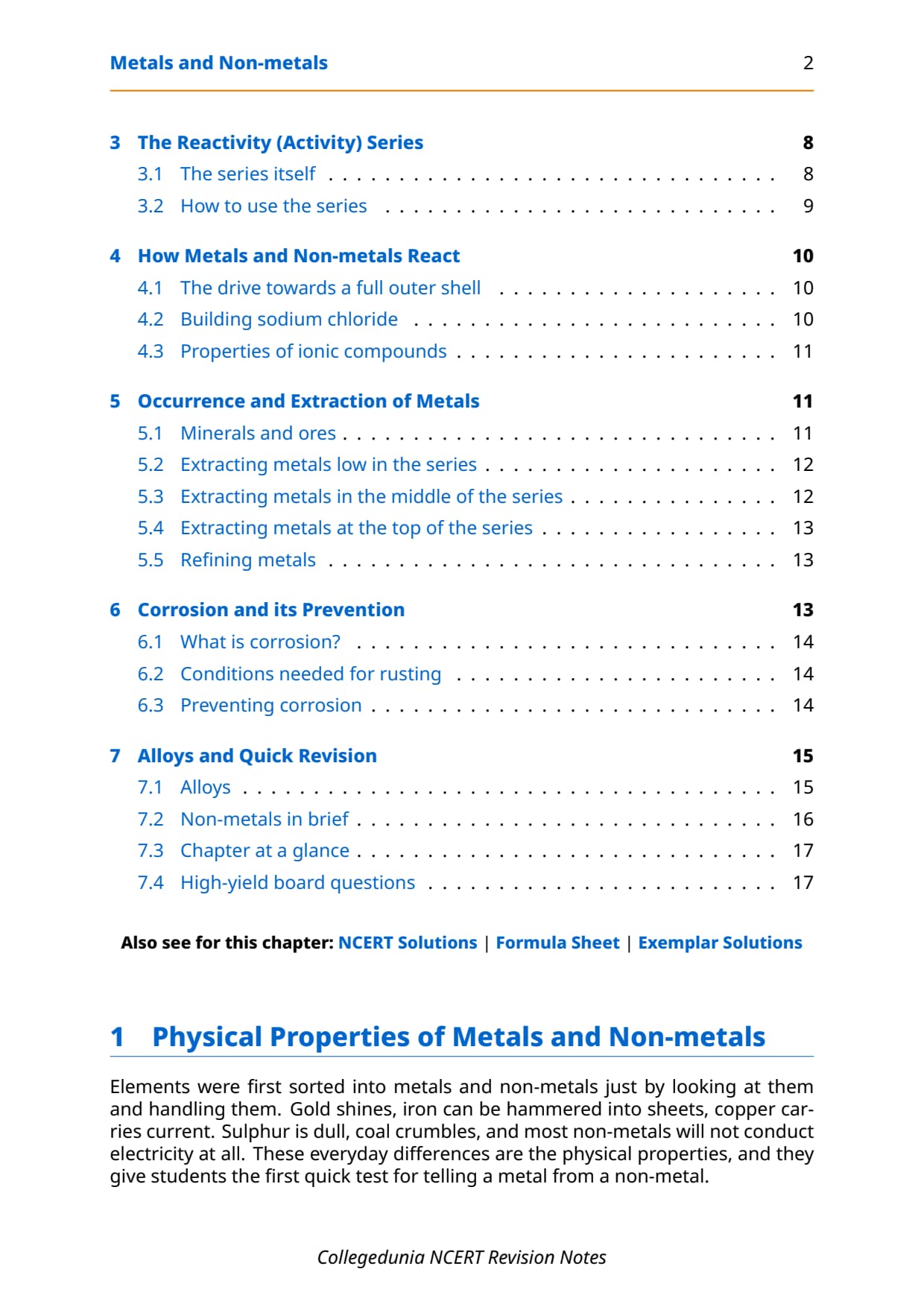
These Notes for Class 10 Science Chapter 3 Metals and Non-metals give you a fast, concept-first revision of the whole chapter, built on the latest 2026-27 CBSE syllabus. They cover the physical and chemical properties of metals and non-metals, the reactivity series, how metals and non-metals form ionic compounds, the steps of metallurgy, and how iron rusts (corrosion) and how we stop it.
- Every reaction explained with a one-line rule, a balanced equation, and the everyday example the CBSE board paper likes to ask.
- Full coverage of metals lose electrons, non-metals gain electrons, the reactivity series, roasting versus calcination, corrosion and the common alloys.
- Notes aligned with the 2026-27 CBSE Class 10 Science syllabus and written for the board exam; no NEET or JEE references because this is a Class 10 board chapter.
These Collegedunia revision notes are curated by Science subject experts, mapped to the 2026-27 NCERT textbook, and refined against the last five years of CBSE Class 10 Science board papers.
Student Feedback: What 9,400 students told us about this chapter
74% of Class 10 students said the reactivity series was the part they kept forgetting when they first revised this chapter. 3 out of 5 students told us a one-page table linking each metal to its extraction method helped them answer the metallurgy question correctly in the board exam.
Toppers found that learning the reactivity series order and the three extraction routes cold saved 8 to 10 minutes in the exam, and the average student spent 1.5 to 2 hours on these notes across the first read and the final revision.
Source: 2026-27 Class 10 Science student poll. Sample of 9,400 students from CBSE schools across 13 states, conducted before the 2026 boards.
What the Notes for Class 10 Science Chapter 3 Metals and Non-metals Cover
This chapter answers one question: how do metals and non-metals differ, and why does that difference decide everything from rusting to extraction? These notes cover physical and chemical properties, the reactivity series, ionic compounds, metallurgy and corrosion, compressed into exam-ready blocks.
Source: Magnet Brains on YouTube
Physical Properties of Metals and Non-metals in Class 10 Science
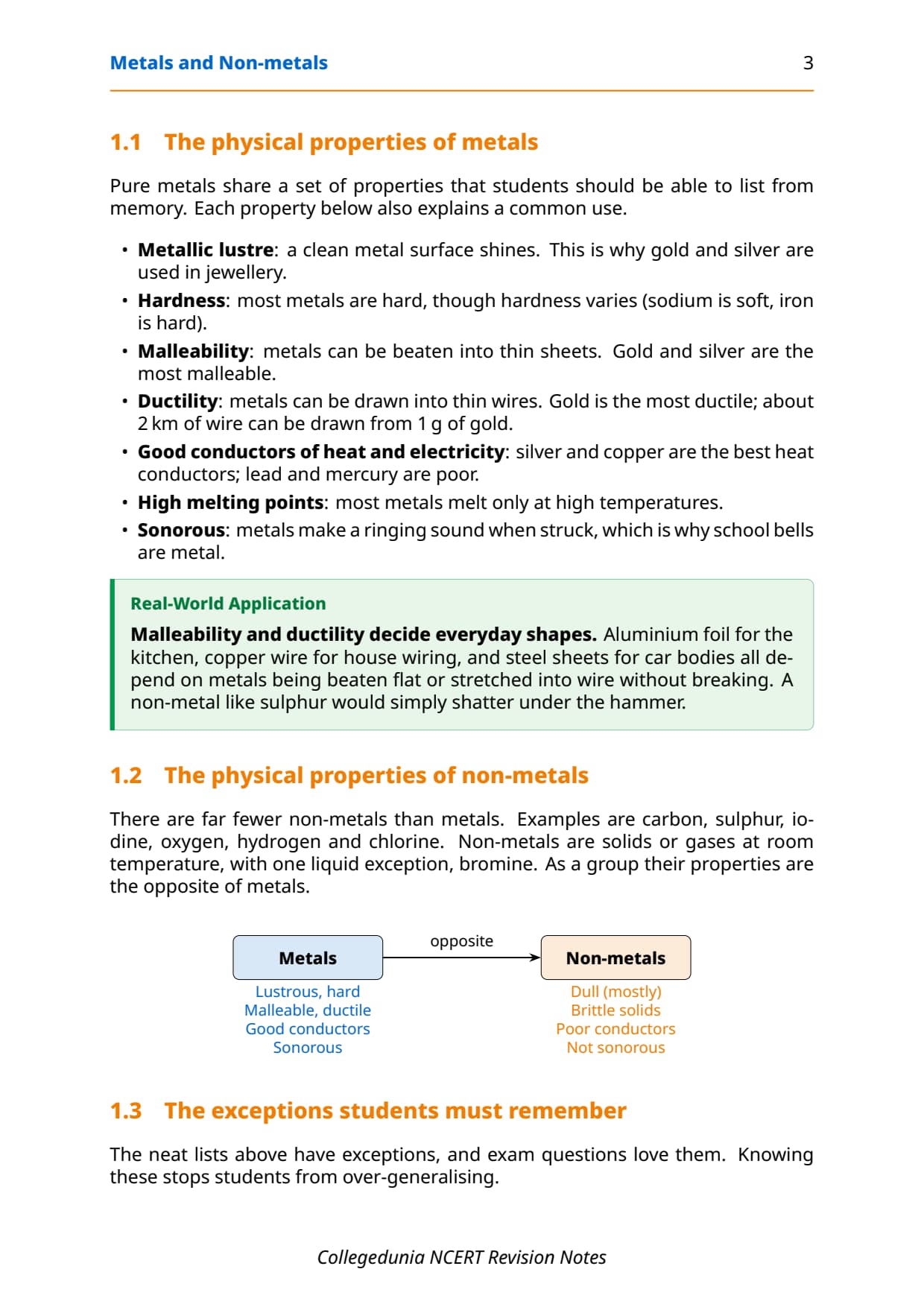
Elements were first sorted by sight. Gold shines, iron can be hammered into sheets, copper carries current; sulphur is dull and most non-metals do not conduct. These everyday differences are the physical properties, the first quick test for telling a metal from a non-metal.
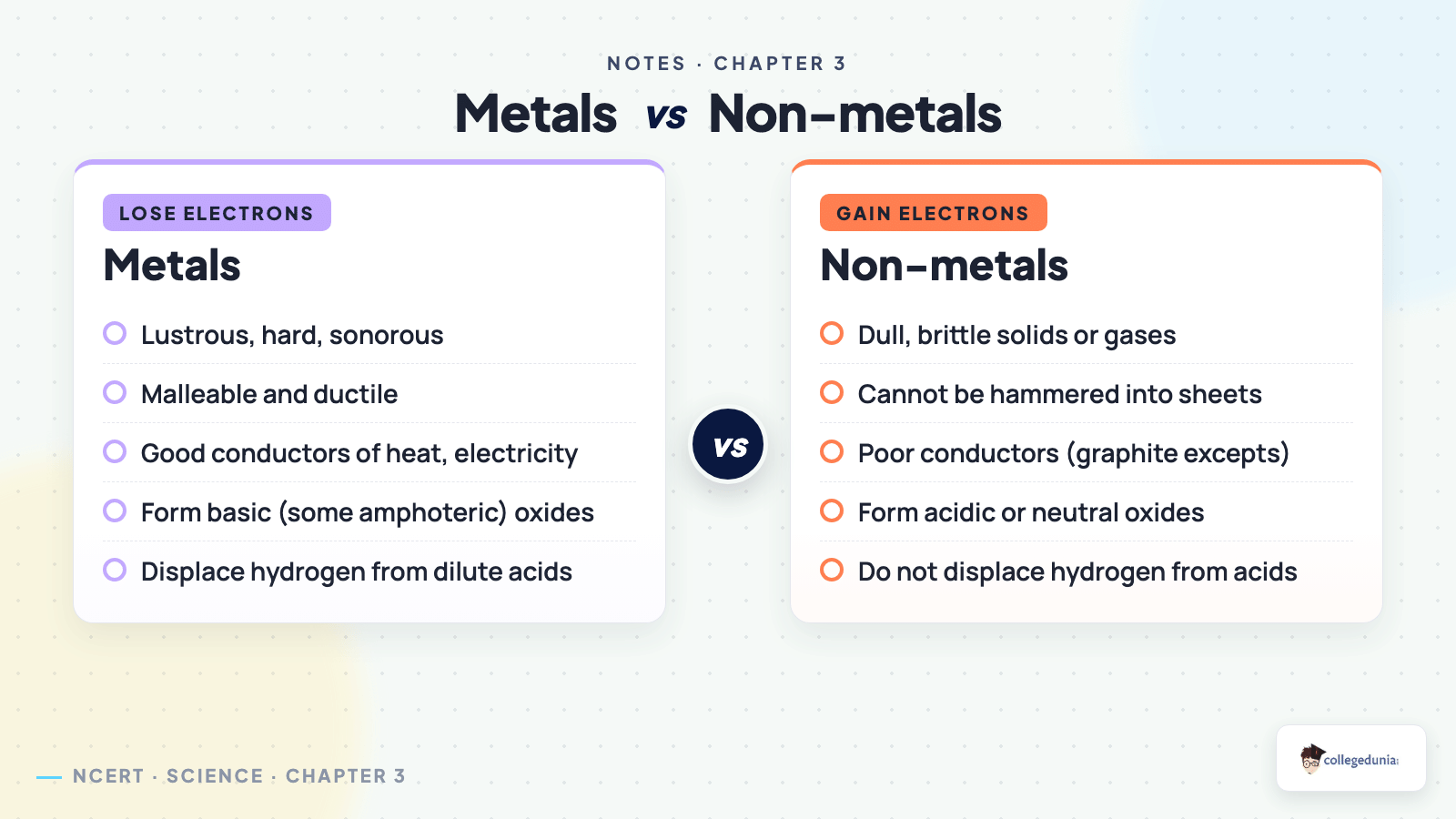
| Property | Metals | Non-metals |
|---|---|---|
| Lustre | Shiny (metallic lustre) | Dull (iodine is an exception) |
| Hardness / state | Mostly hard solids | Soft solids or gases; bromine is liquid |
| Malleability and ductility | Can be beaten into sheets and drawn into wire | Brittle; shatter when struck |
| Conductivity | Good conductors of heat and electricity | Poor conductors (graphite is an exception) |
| Sonority | Sonorous (ring when struck) | Not sonorous |
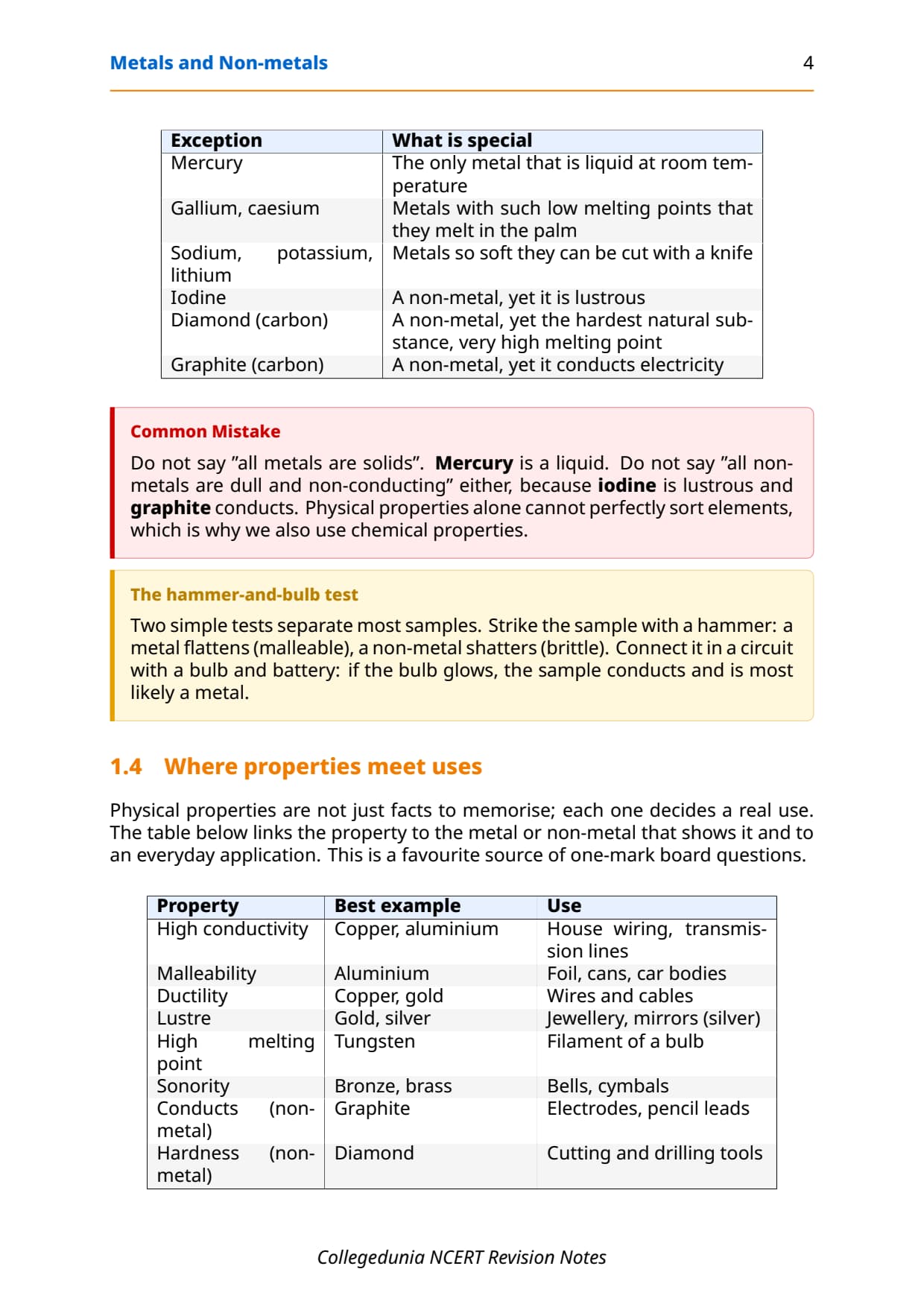
Each property explains a use: copper and aluminium conduct, so they make wires; tungsten has a high melting point, so it forms bulb filaments; graphite conducts, so it makes electrodes; diamond is hardest, so it cuts and drills.
The exceptions students must remember
Exam questions love the exceptions: mercury is a liquid metal; gallium and caesium melt in the palm; sodium, potassium and lithium can be cut with a knife; iodine is a lustrous non-metal; diamond is the hardest natural substance; and graphite is a non-metal that conducts electricity.
Chemical Properties of Metals in Class 10 Science
The surer test is how an element behaves in a reaction with oxygen, water, acids and salt solutions. The key idea is that different metals have different reactivity.
Reaction with oxygen
Almost all metals form an oxide: Metal + Oxygen → Metal oxide. Most are basic, but aluminium oxide and zinc oxide react with both acids and bases and are amphoteric oxides. Sodium and potassium catch fire in air, so they are kept under kerosene; silver and gold do not react even when hot.
Amphoteric (both ways): Al2O3 + 6HCl → 2AlCl3 + 3H2O; Al2O3 + 2NaOH → 2NaAlO2 + H2O
Reaction with water
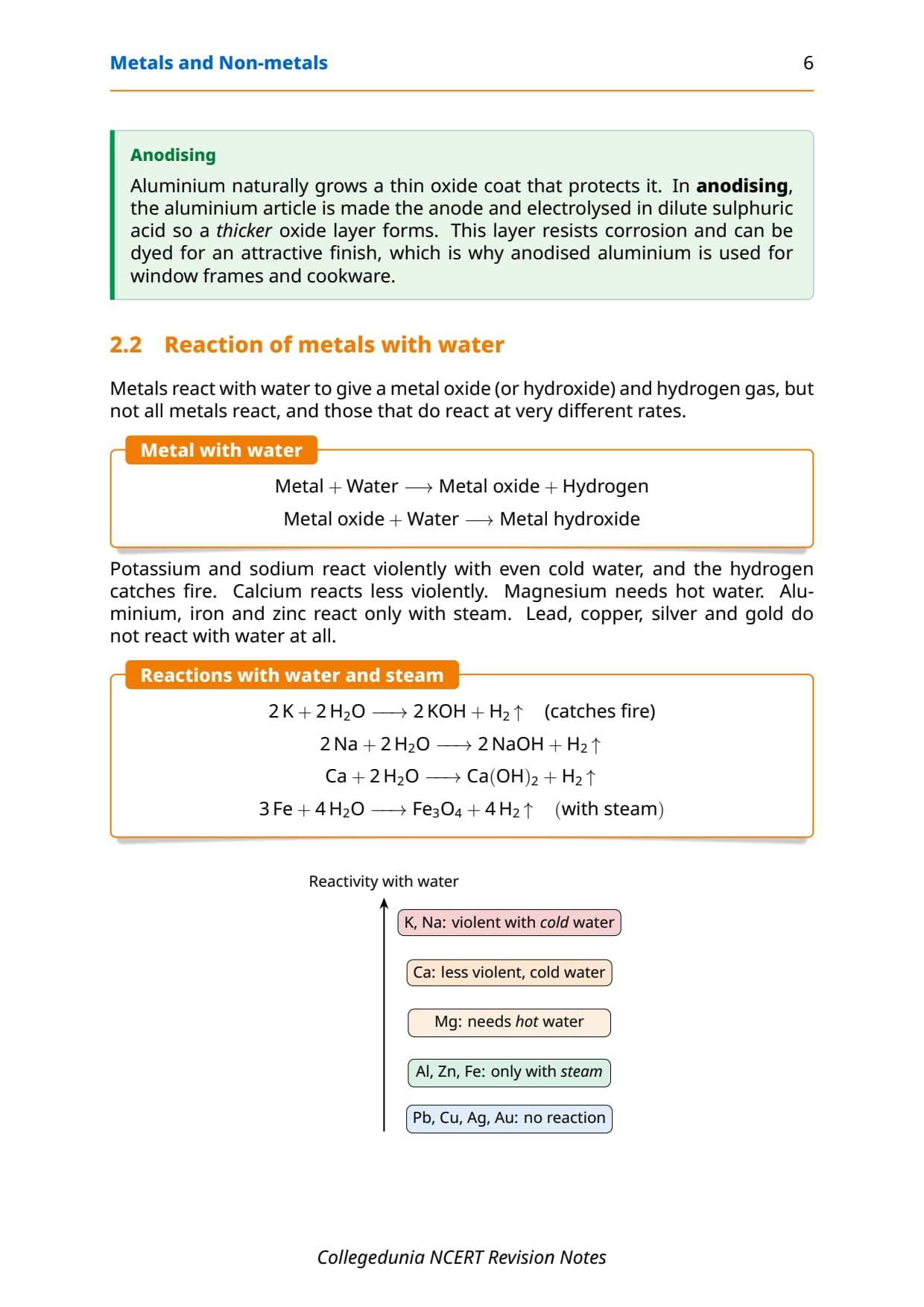
Metals react with water to give an oxide or hydroxide and hydrogen, but at very different rates: K and Na react violently with cold water, Ca less violently, Mg needs hot water, Al/Zn/Fe react only with steam, and Pb/Cu/Ag/Au not at all. This ranking is the first clue to the reactivity series.
Reaction with acids
Metals above hydrogen react with dilute acids: Metal + Dilute acid → Salt + Hydrogen. Bubbling speed gives the order Mg > Al > Zn > Fe, while copper gives no reaction. Note that nitric acid (HNO3) usually does not release hydrogen, as it is a strong oxidising agent.
Displacement from salt solutions
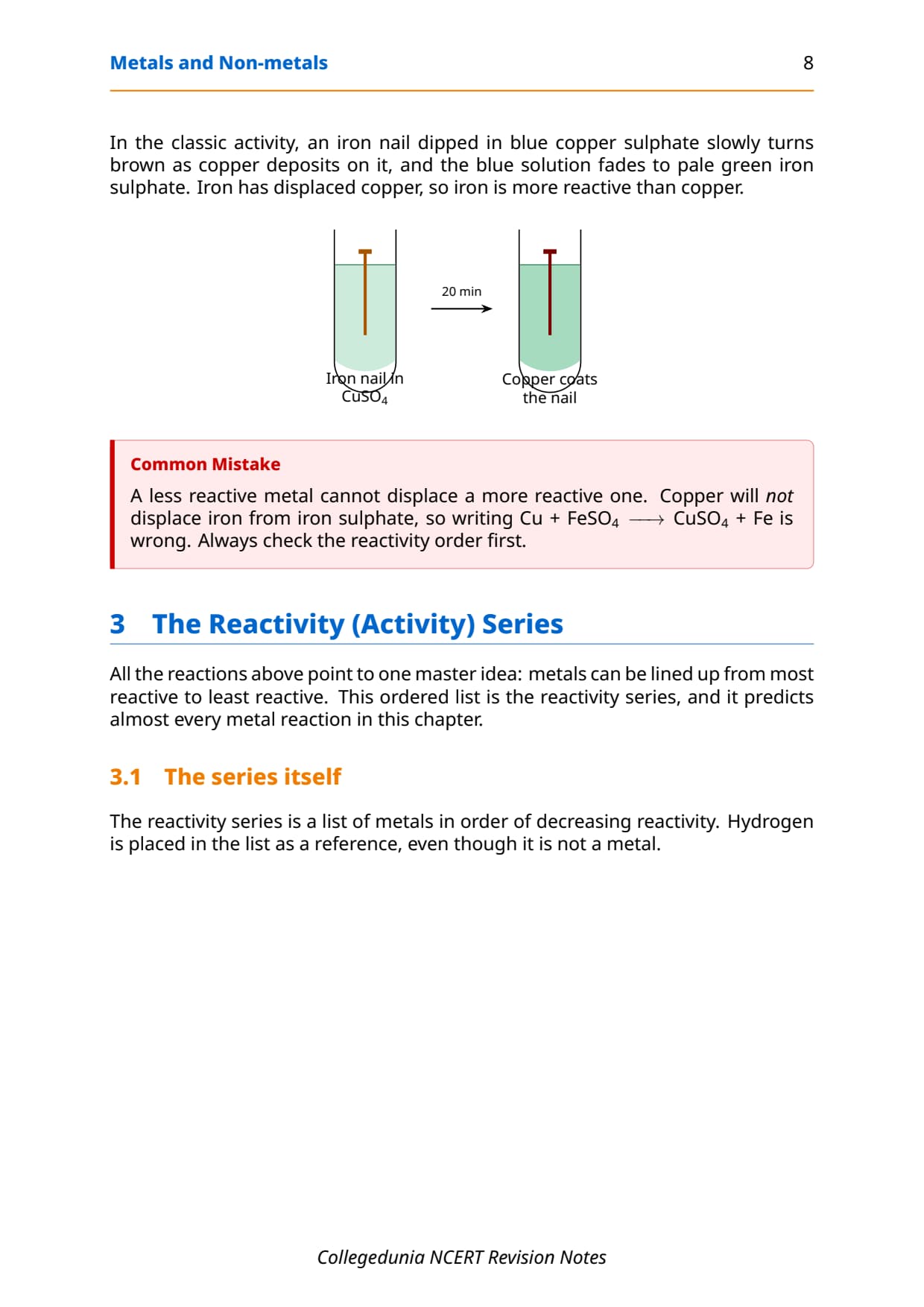
A more reactive metal displaces a less reactive one: Metal A + Salt of B → Salt of A + Metal B. An iron nail in blue copper sulphate turns brown as copper deposits and the solution fades to pale green, proving iron is more reactive than copper.
Fe + CuSO4 → FeSO4 + Cu
Zn + FeSO4 → ZnSO4 + Fe
The Reactivity (Activity) Series in Class 10 Science
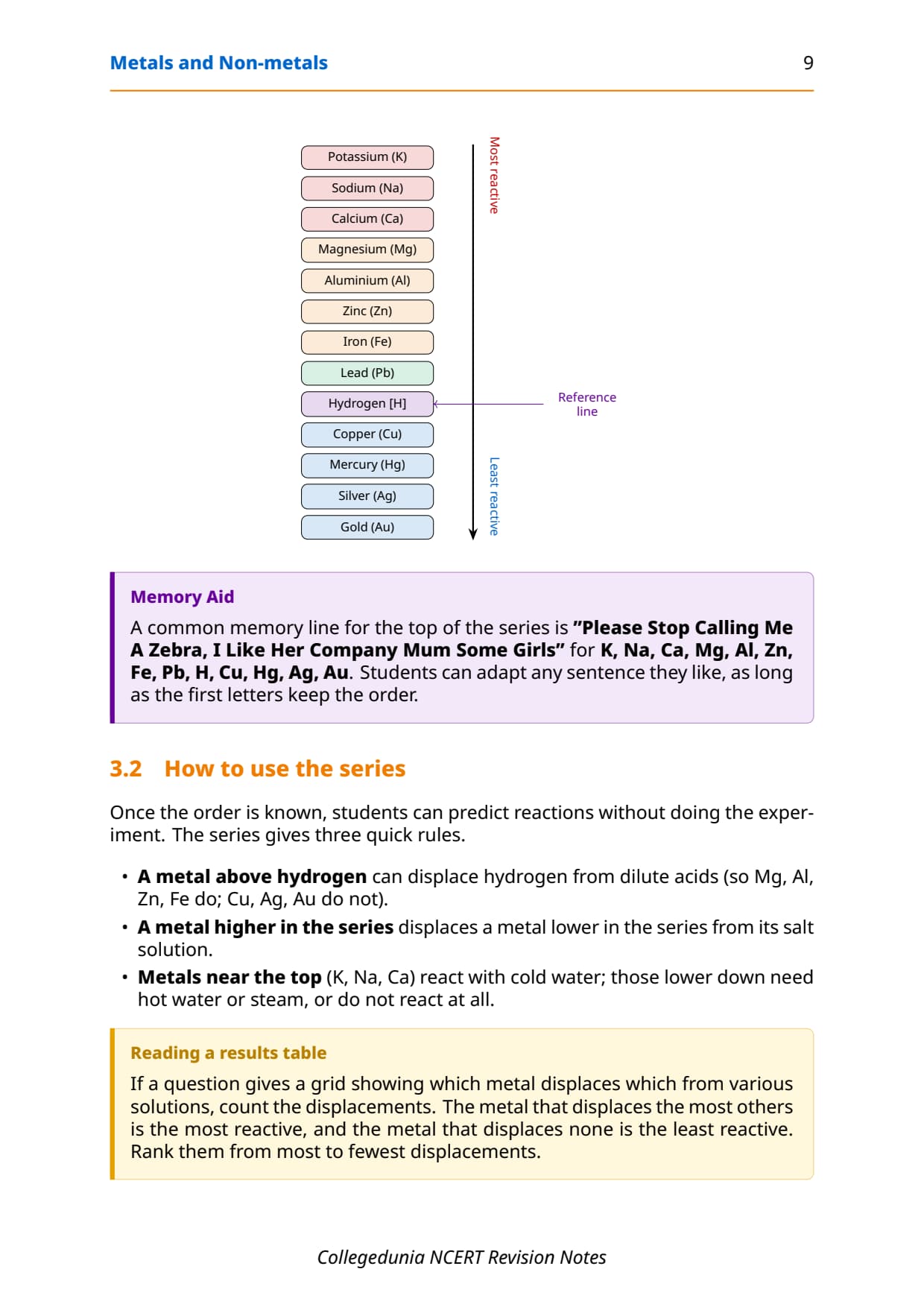
Metals can be lined up from most to least reactive. This ordered list is the reactivity series, and it predicts almost every metal reaction in this chapter. Hydrogen is placed as a reference, though it is not a metal.
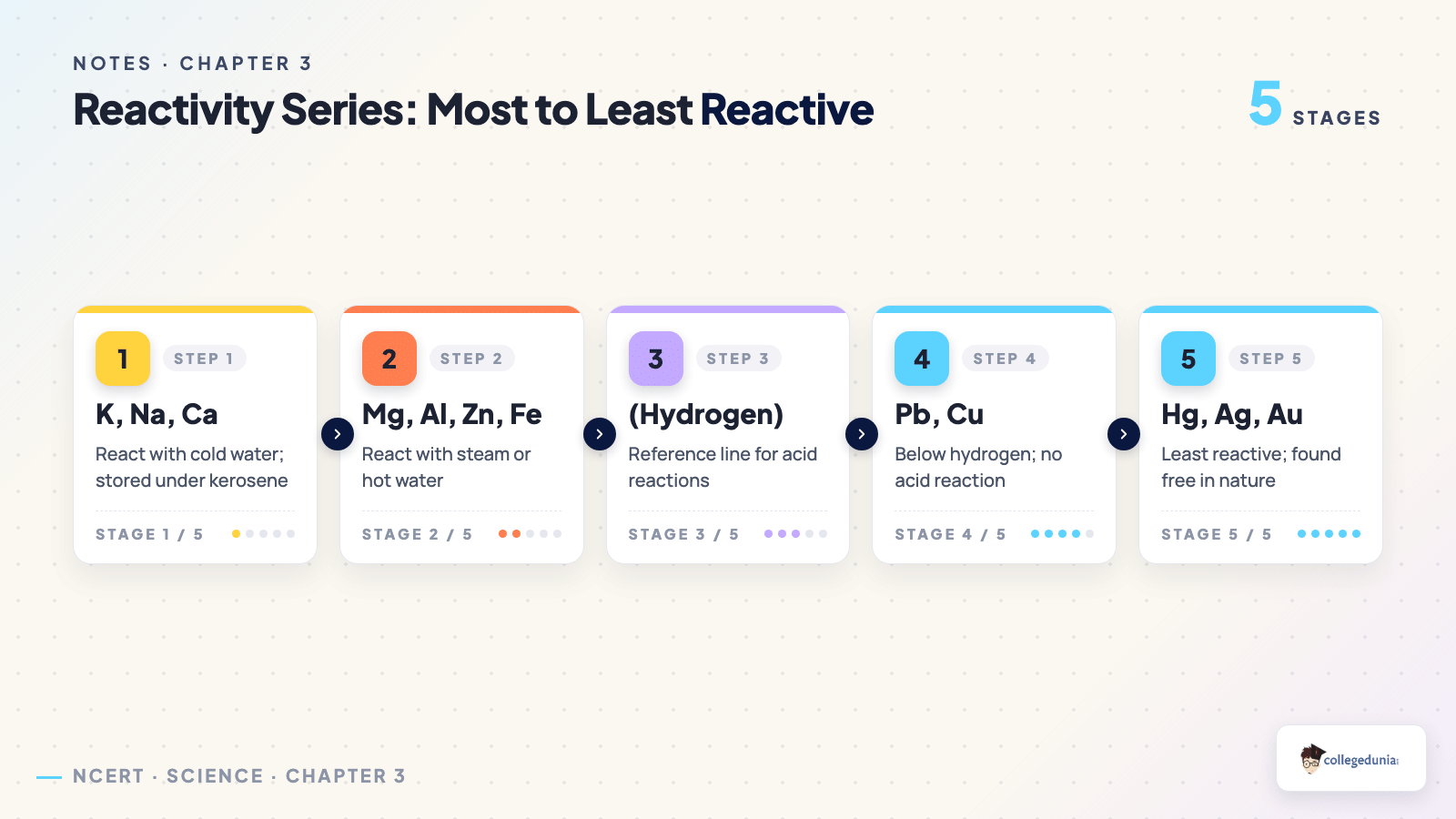
The order, from most to least reactive, is K, Na, Ca, Mg, Al, Zn, Fe, Pb, (H), Cu, Hg, Ag, Au. Once you know it, three quick rules cover the whole chapter.
- A metal above hydrogen can displace hydrogen from dilute acids (so Mg, Al, Zn, Fe do; Cu, Ag, Au do not).
- A metal higher in the series displaces a metal lower down from its salt solution.
- Metals near the top (K, Na, Ca) react with cold water; those lower down need hot water or steam, or do not react at all.
How Metals and Non-metals React: Ionic Compounds
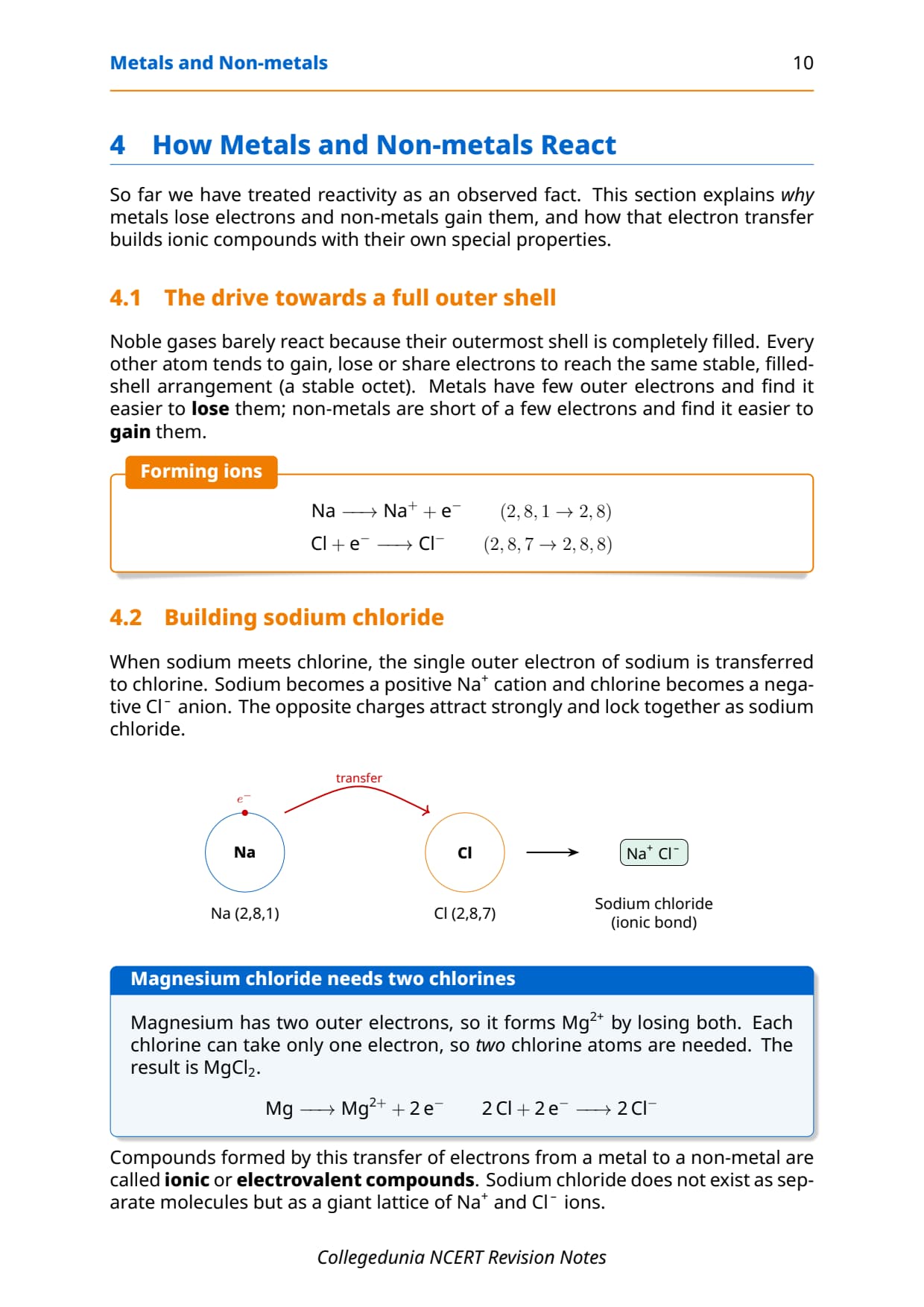
This explains why metals lose electrons and non-metals gain them. Every atom tends to gain, lose or share electrons to reach a stable filled outer shell (an octet), like the noble gases. Metals have few outer electrons and easily lose them; non-metals easily gain them. When sodium meets chlorine, sodium's outer electron transfers across: sodium becomes Na+, chlorine becomes Cl-, and the opposite charges lock together as sodium chloride.
Na → Na+ + e- (2,8,1 → 2,8)
Cl + e- → Cl- (2,8,7 → 2,8,8)
Magnesium chloride needs two chlorines:
Mg → Mg2+ + 2e- 2Cl + 2e- → 2Cl- → MgCl2
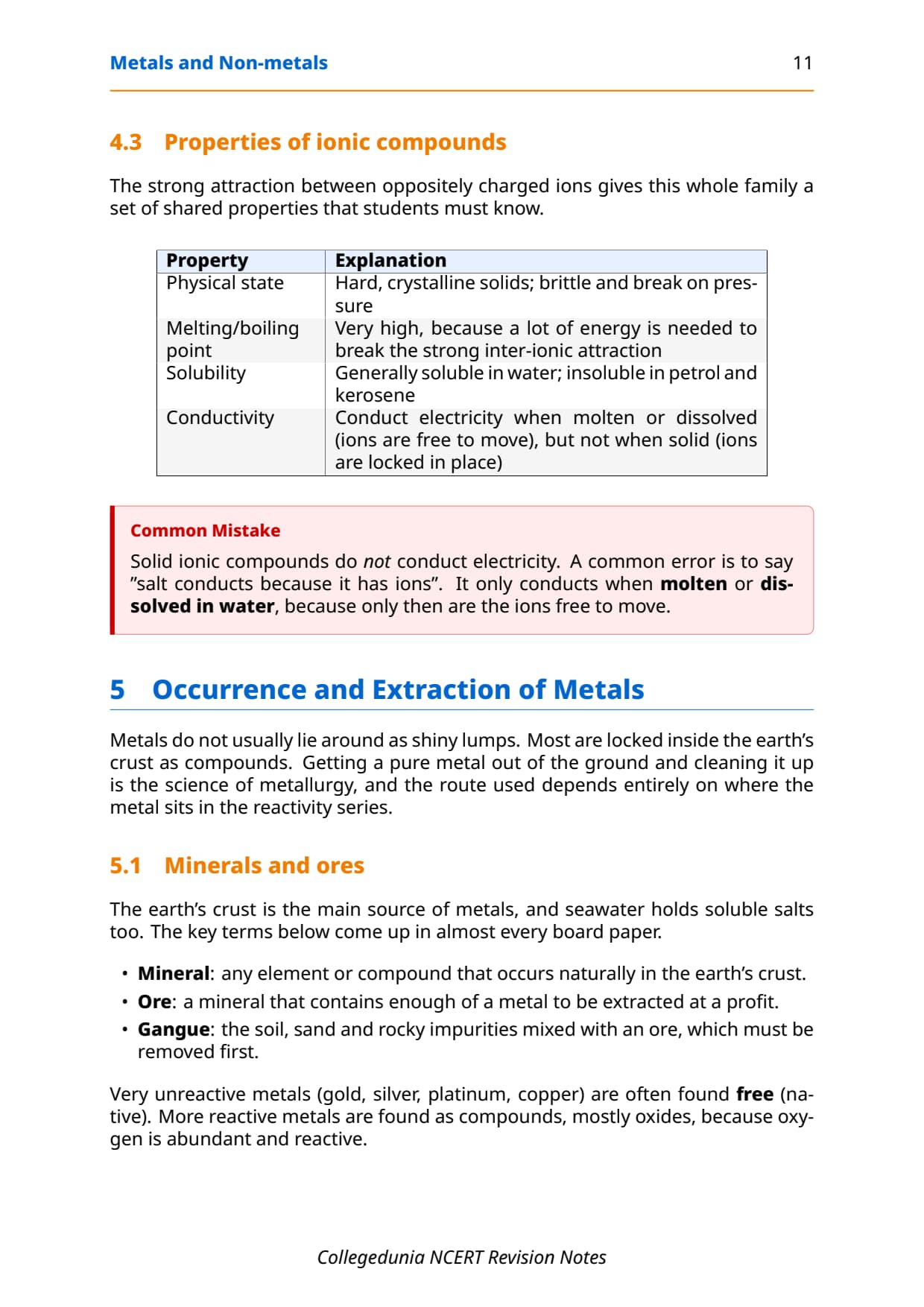
Compounds formed by this electron transfer are called ionic or electrovalent compounds. Sodium chloride is not separate molecules but a giant lattice of Na+ and Cl- ions, and the strong attraction between them gives shared properties.
| Property | Explanation |
|---|---|
| Physical state | Hard, crystalline solids; brittle and break on pressure |
| Melting and boiling point | Very high, because a lot of energy is needed to break the strong inter-ionic attraction |
| Solubility | Generally soluble in water; insoluble in petrol and kerosene |
| Conductivity | Conduct electricity when molten or dissolved (ions free to move), but not when solid |
Occurrence and Extraction of Metals (Metallurgy)
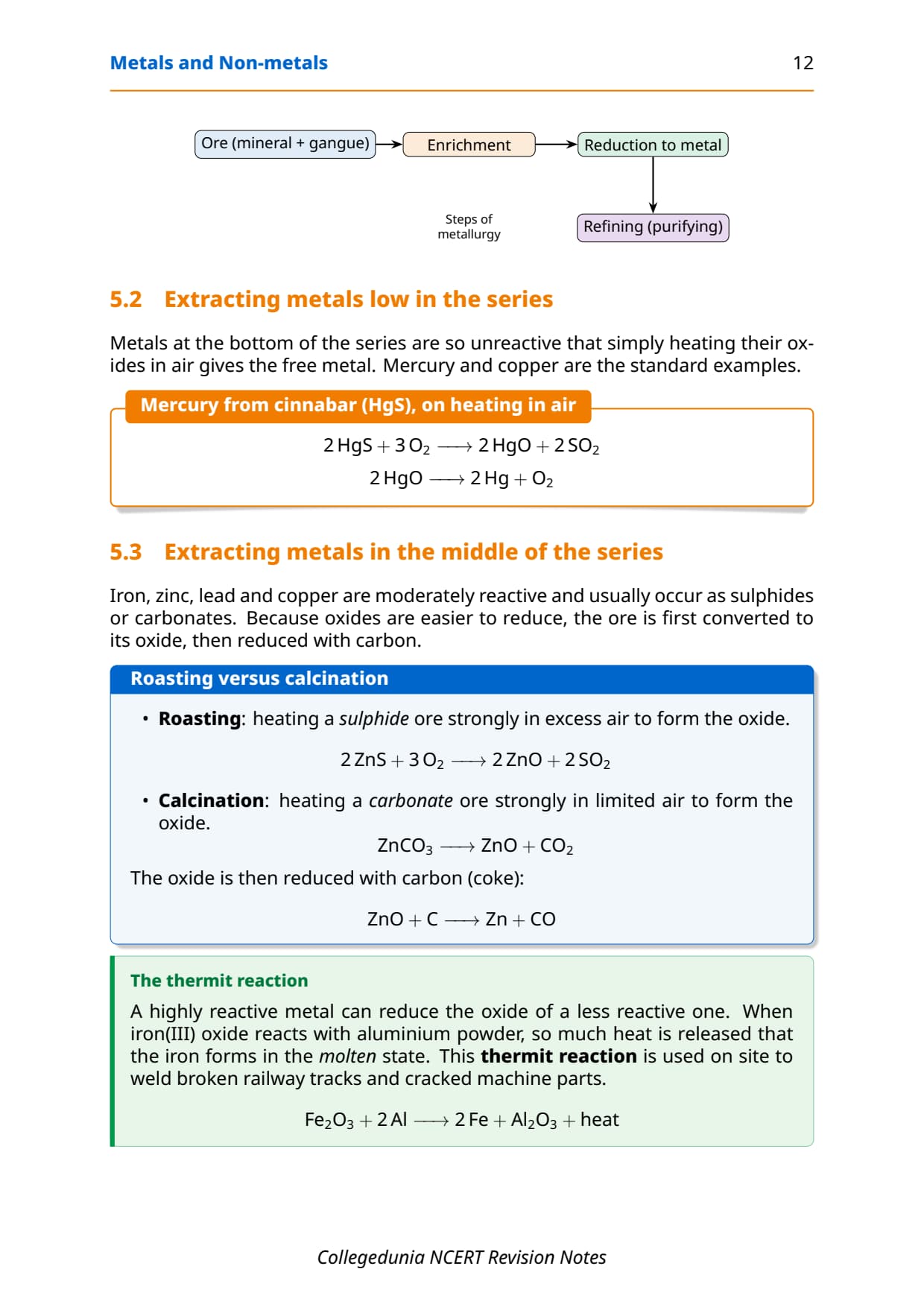
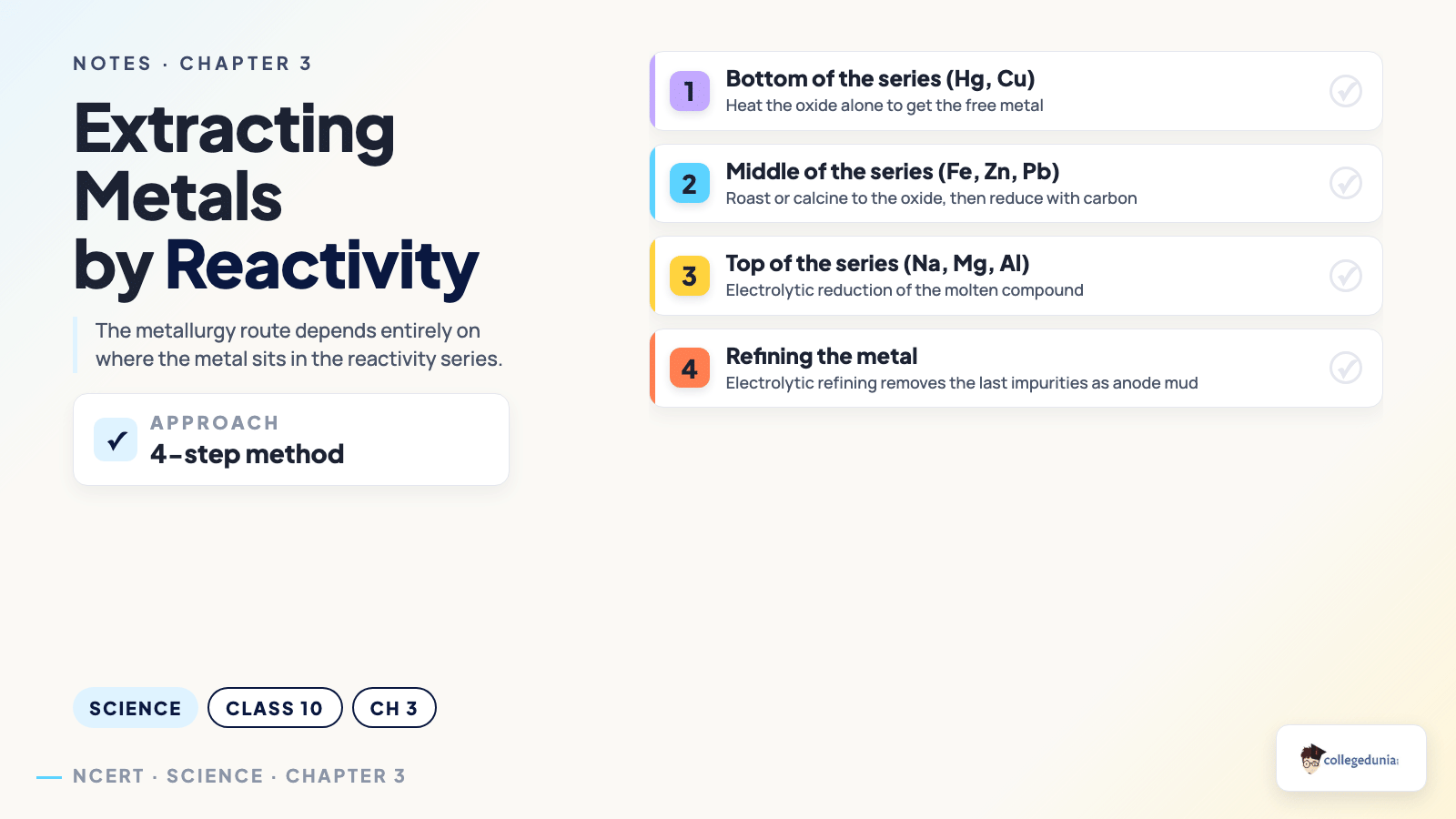
Most metals are locked in the crust as compounds. Extracting and purifying a metal is metallurgy, and the route depends on where the metal sits in the reactivity series.
Minerals and ores
A mineral is any naturally occurring element or compound; an ore is a mineral with enough metal to extract at a profit; gangue is the sand and rock impurity removed first. Unreactive metals (gold, silver, platinum, copper) occur free; reactive metals occur as compounds, mostly oxides.
The three extraction routes
Reactivity decides the route, in a three-way split.
| Position in series | How the metal is obtained | Example |
|---|---|---|
| Bottom (Hg, Cu) | Heat the oxide alone; the free metal is set free | 2HgO → 2Hg + O2 |
| Middle (Fe, Zn, Pb) | Roast or calcine to the oxide, then reduce with carbon | ZnO + C → Zn + CO |
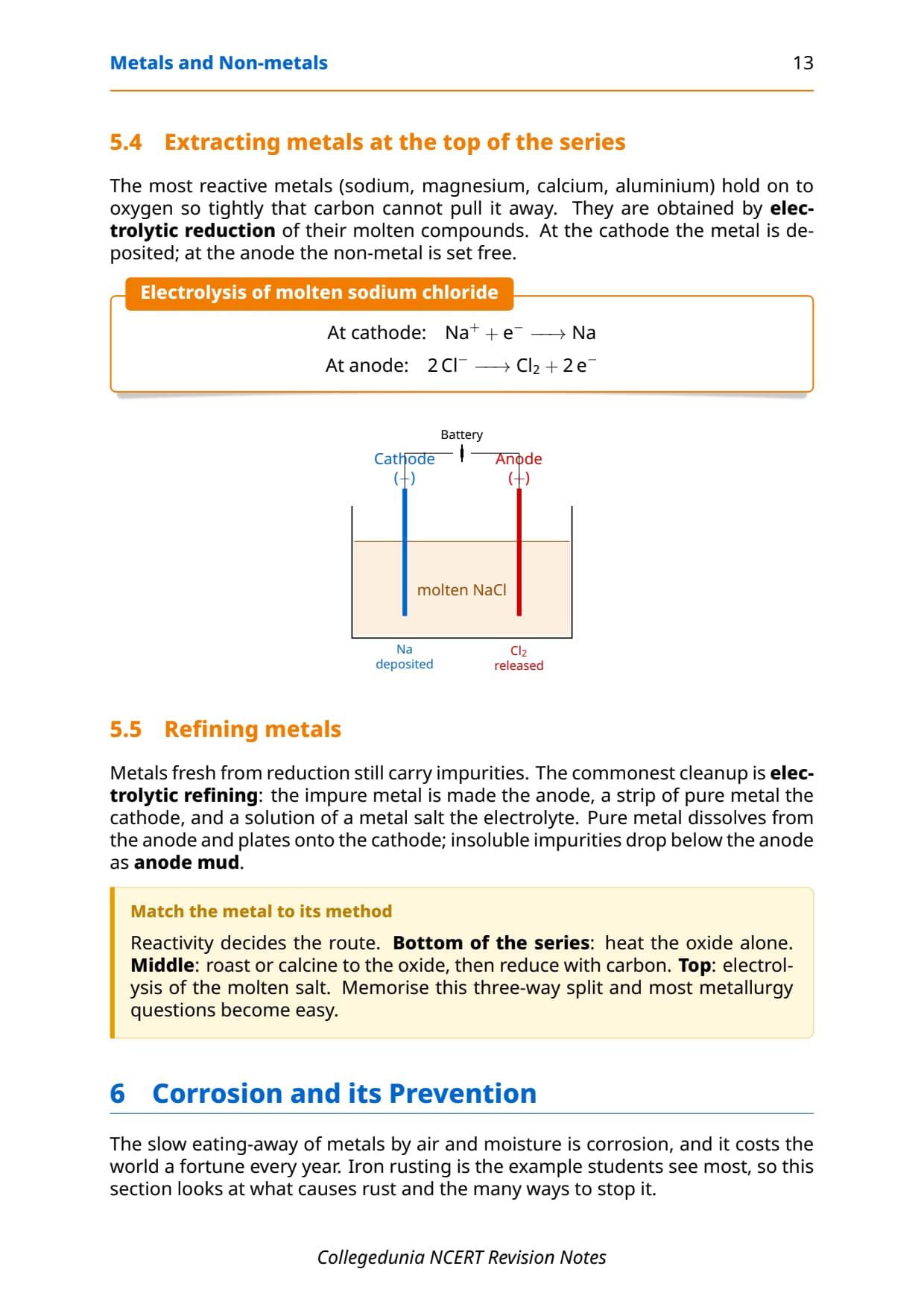
| Top (Na, Mg, Al) | Electrolytic reduction of the molten compound | At cathode: Na+ + e- → Na |
Roasting heats a sulphide ore in excess air to the oxide (2ZnS + 3O2 → 2ZnO + 2SO2); calcination heats a carbonate ore in limited air (ZnCO3 → ZnO + CO2). For top-of-series metals, carbon cannot remove the oxygen, so molten compounds are split by electricity, then cleaned by electrolytic refining (pure metal plates onto the cathode, impurities drop as anode mud). In the thermit reaction, aluminium reduces iron(III) oxide with such heat the iron melts (Fe2O3 + 2Al → 2Fe + Al2O3), used to weld rails.
Corrosion, Alloys and Non-metals in Brief
The slow eating-away of metals by air and moisture is corrosion. Iron rusting is the common example.
Corrosion and rust
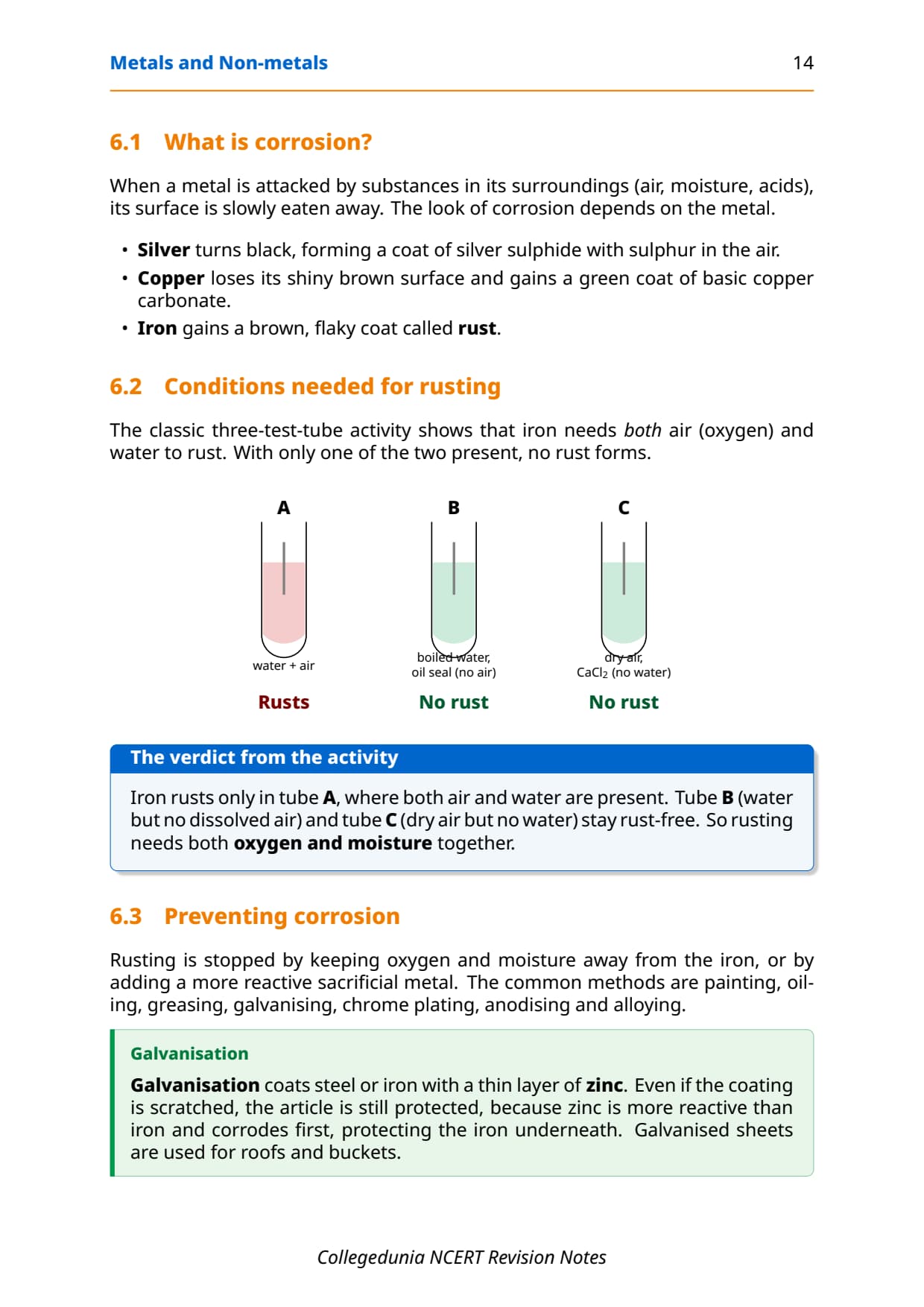
Silver turns black, copper gains a green coat, and iron gains a brown flaky coat called rust. The three-test-tube activity proves iron needs both air and water: tube A (water + air) rusts, while tube B (boiled water, oil seal) and tube C (dry air, CaCl2) stay rust-free. Rusting is stopped by painting, oiling, greasing, galvanising, chrome plating, anodising or alloying. Galvanising coats iron with zinc, which corrodes first and protects the iron even if scratched. (Food cans use tin, since zinc would react with food.)
Alloys
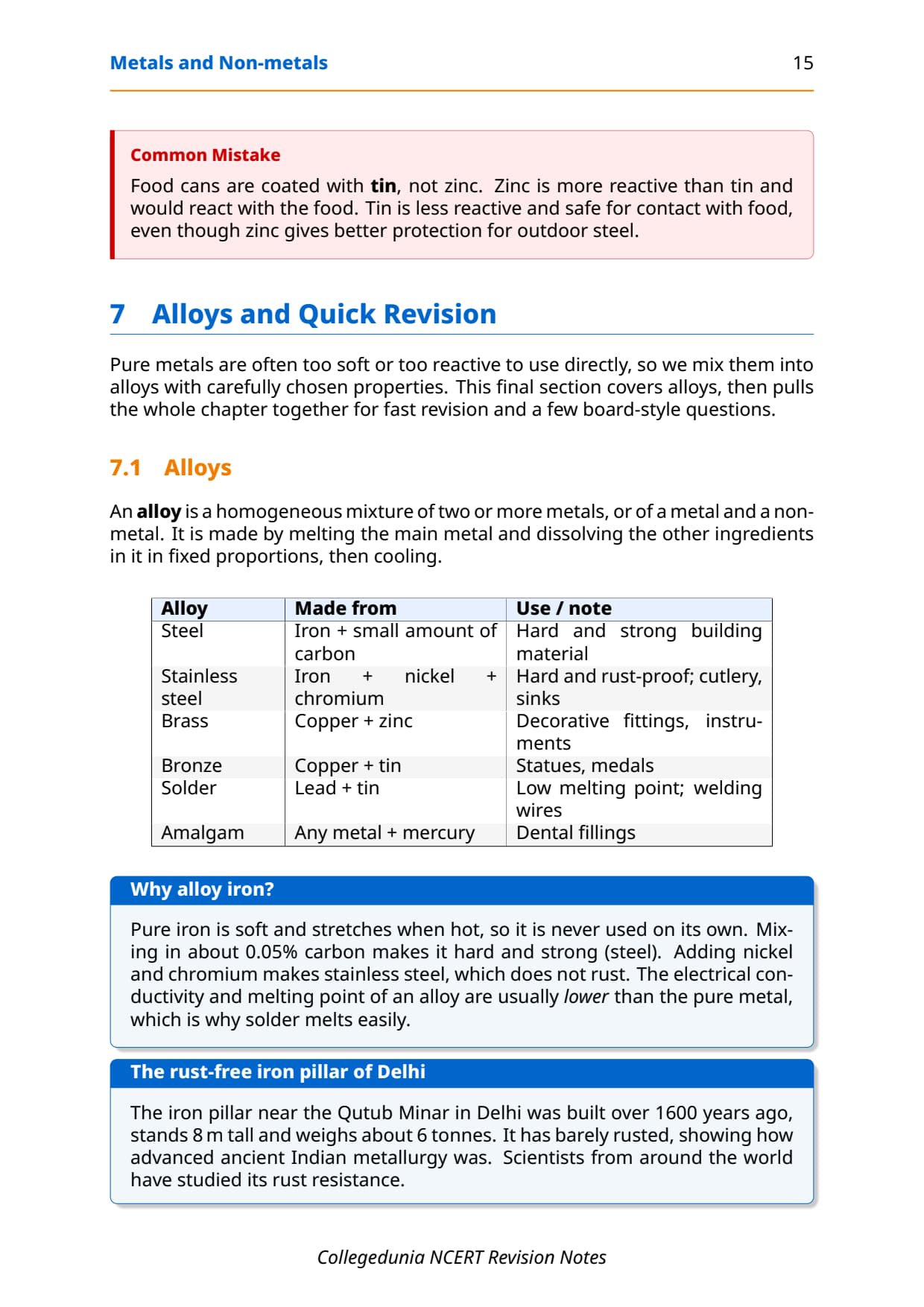
Pure metals are often too soft or reactive, so we mix them into alloys, a homogeneous mixture of two or more metals, or a metal and a non-metal.
| Alloy | Made from | Use |
|---|---|---|
| Steel | Iron + a little carbon | Hard, strong building material |
| Stainless steel | Iron + nickel + chromium | Rust-proof cutlery and sinks |
| Brass | Copper + zinc | Decorative fittings, instruments |
| Bronze | Copper + tin | Statues, medals |
| Solder | Lead + tin | Low melting point; welding wires |
| Amalgam | Any metal + mercury | Dental fillings |
Non-metals in brief
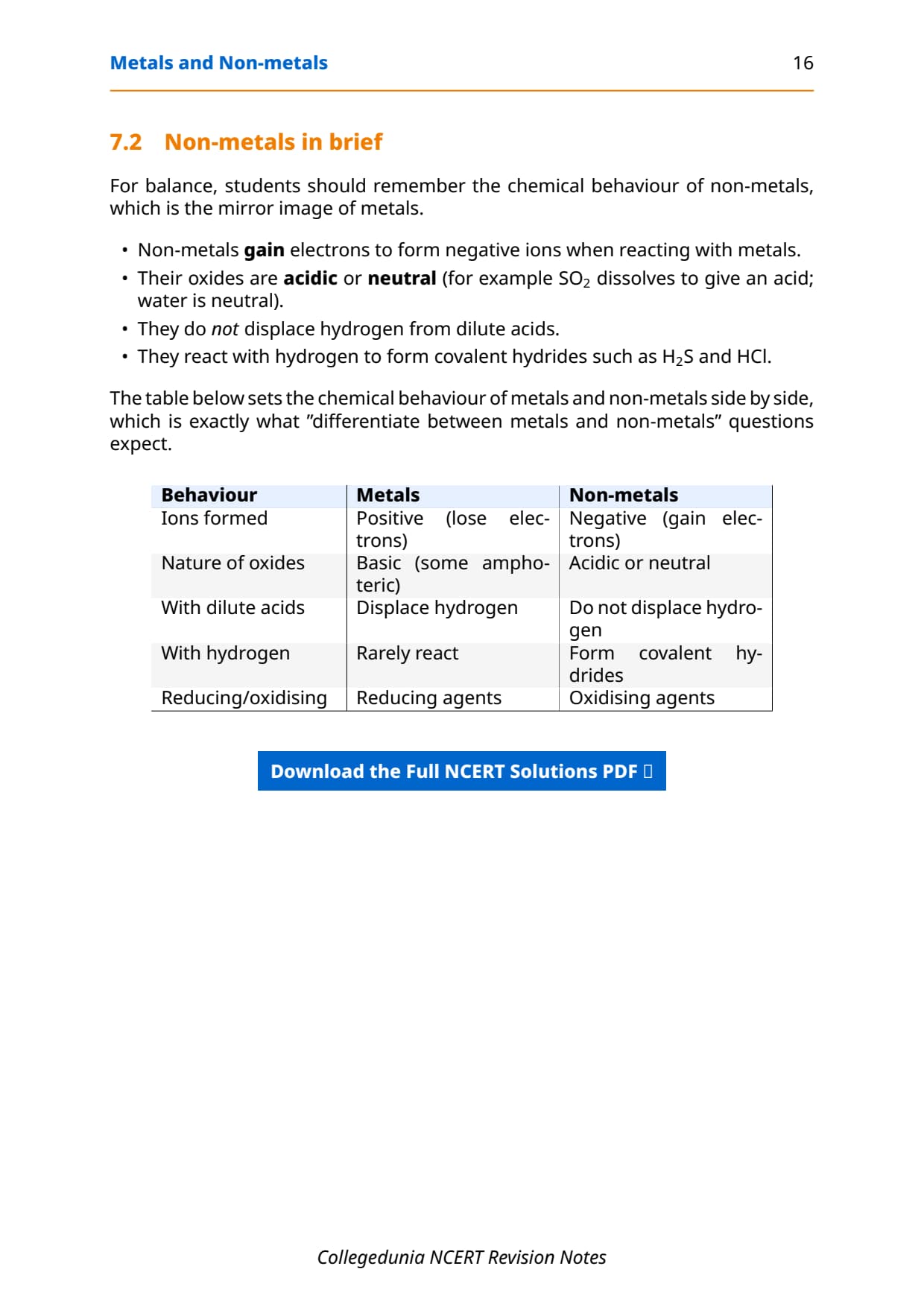
Non-metals are the mirror image of metals. They gain electrons to form negative ions; their oxides are acidic or neutral; they do not displace hydrogen from dilute acids; and they form covalent hydrides such as H2S and HCl.
Quick Revision Strip and Common Exam Traps
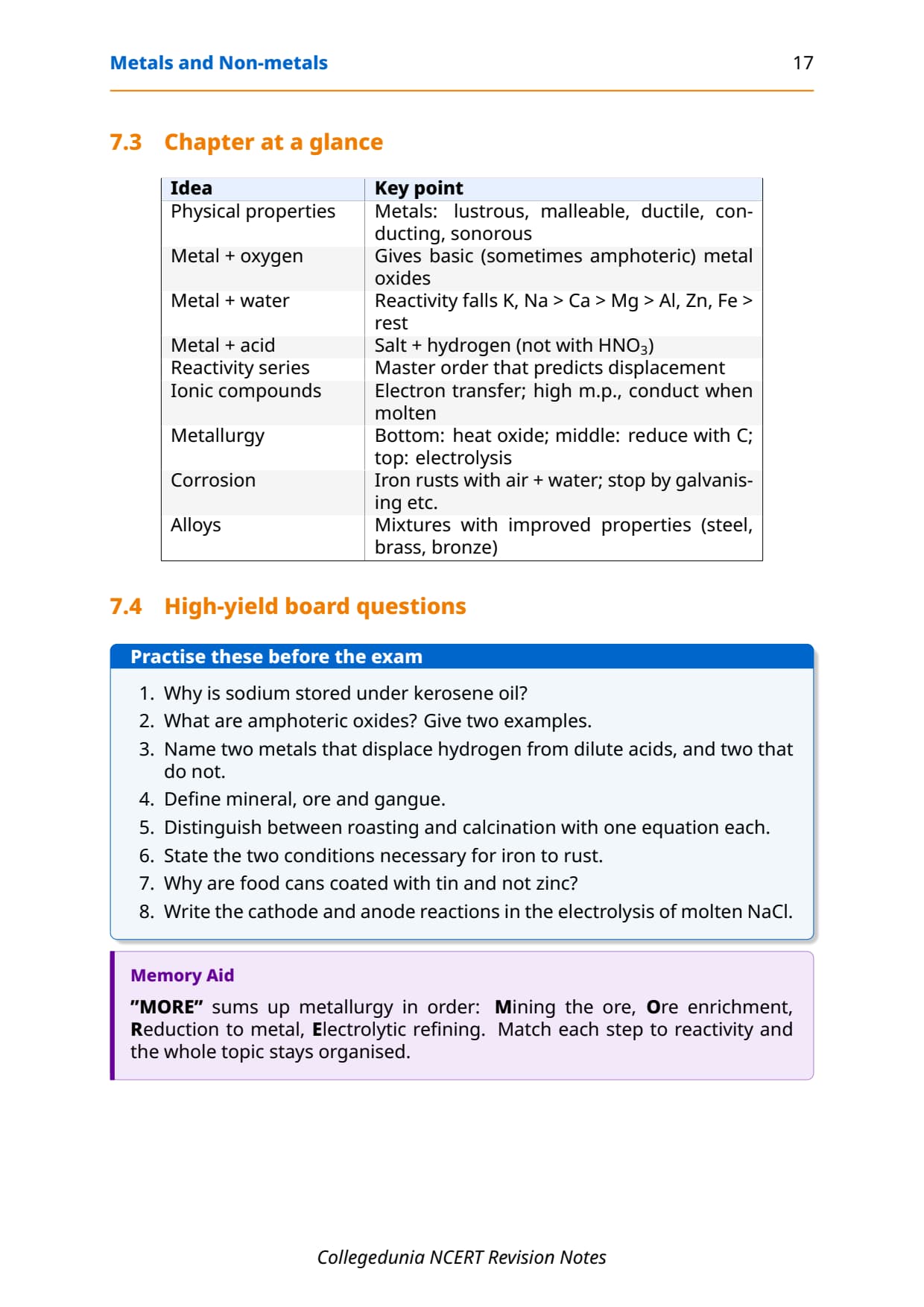
The last-minute one-liners: metals are lustrous, malleable, ductile, conducting and sonorous; metal + oxygen gives basic (sometimes amphoteric) oxides; water reactivity falls K, Na > Ca > Mg > Al, Zn, Fe; metal + acid gives salt + hydrogen (not with HNO3); ionic compounds transfer electrons, melt high and conduct when molten; metallurgy splits into heat-oxide, reduce-with-carbon, electrolysis; iron rusts with air + water, stopped by galvanising.
Previous Year Question Trends from the Metals and Non-metals Chapter
This chapter is tested mainly through reaction-and-equation questions, reactivity-series application, and short answers on metallurgy and corrosion, as the recent board papers below show.
| Year | Question type asked | Marks |
|---|---|---|
| 2025 | Distinguish between roasting and calcination with one equation each | 3 |
| 2024 | What are amphoteric oxides; why is sodium stored under kerosene | 2 + 1 |
| 2023 | Reaction of metal with acid and with salt solution, with balanced equations | 3 |
| 2022 | State the two conditions for rusting; why are food cans coated with tin not zinc | 2 + 2 |
| 2021 | Define mineral, ore and gangue; properties of ionic compounds | 3 + 2 |
Also Check: The full set of CBSE board paper questions for this chapter, with step-by-step answers, is included in the downloadable PDF above, updated for the 2026-27 cycle.
Other Resources for Class 10 Science Chapter 3 Metals and Non-metals
Pair these revision notes with the matching NCERT Solutions, the formula sheet, handwritten notes and the official NCERT book chapter. All resources for Class 10 Science Chapter 3 Metals and Non-metals are linked below.
| Resource | What it covers | Open |
|---|---|---|
| Notes | Concept-first revision notes on properties, the reactivity series, ionic compounds, metallurgy and corrosion. | You are here |
| NCERT Solutions | Step-by-step answers to all in-text and exercise questions, with an Expert Solution for each. | Class 10 Science Chapter 3 NCERT Solutions |
| Formula Sheet | Quick reference of the must-know reactions, the reactivity series and key metallurgy terms. | Class 10 Science Chapter 3 Formula Sheet |
| Handwritten Notes | Scanned-style handwritten pages for last-minute board revision. | Class 10 Science Chapter 3 Handwritten Notes |
| NCERT Book PDF | Official NCERT Science Chapter 3 Metals and Non-metals textbook in PDF form. | Class 10 Science Chapter 3 NCERT Book PDF |
Notes for Class 10 Science: All Chapters
Related Links: Use the table below to open the revision notes for the other chapters of Class 10 Science. Every chapter ships with the same concept-first notes style, full PDF download, and revision FAQ.
| Chapter | Notes link |
|---|---|
| Chapter 1 | Chemical Reactions and Equations Notes |
| Chapter 2 | Acids, Bases and Salts Notes |
| Chapter 3 | Metals and Non-metals Notes (You are here) |
| Chapter 4 | Carbon and its Compounds Notes |
| Chapter 5 | Life Processes Notes |
| Chapter 6 | Control and Coordination Notes |
| Chapter 7 | How do Organisms Reproduce? Notes |
| Chapter 8 | Heredity Notes |
| Chapter 9 | Light - Reflection and Refraction Notes |
| Chapter 10 | The Human Eye and the Colourful World Notes |
| Chapter 11 | Electricity Notes |
| Chapter 12 | Magnetic Effects of Electric Current Notes |
| Chapter 13 | Our Environment Notes |
Notes Class 10 Science Chapter 3 Metals and Non-metals FAQs
Ques. What does Chapter 3 Metals and Non-metals cover in Class 10 Science?
Ans. Chapter 3 covers how metals and non-metals differ and why that difference matters. The notes explain the physical properties of metals and non-metals with their exceptions, the chemical properties of metals with oxygen, water, acids and salt solutions, and the reactivity series that ties all those reactions together. They then cover how metals lose electrons and non-metals gain them to form ionic compounds, the three extraction routes of metallurgy, and corrosion with the alloys and methods that prevent it, all aligned with the 2026-27 CBSE syllabus.
Ques. What is the difference between a metal and a non-metal in Class 10 Science?
Ans. A metal is lustrous, hard, malleable, ductile, sonorous and a good conductor of heat and electricity; it loses electrons to form positive ions, gives basic or amphoteric oxides, and displaces hydrogen from dilute acids. A non-metal is usually dull, brittle and a poor conductor; it gains electrons to form negative ions, gives acidic or neutral oxides, and does not displace hydrogen from acids. Exceptions matter: mercury is a liquid metal, iodine is a lustrous non-metal, and graphite is a non-metal that conducts electricity, which is why both physical and chemical properties are used to classify elements.
Ques. What is the reactivity series and how is it used?
Ans. The reactivity series is a list of metals arranged in order of decreasing reactivity: K, Na, Ca, Mg, Al, Zn, Fe, Pb, then hydrogen as a reference, then Cu, Hg, Ag, Au. It predicts almost every metal reaction in the chapter. A metal above hydrogen displaces hydrogen from dilute acids, a metal higher in the series displaces a lower one from its salt solution, and metals near the top react with cold water while those lower down need steam or do not react. A common memory line is "Please Stop Calling Me A Zebra, I Like Her Company Mum Some Girls."
Ques. What are amphoteric oxides in Class 10 Science?
Ans. Amphoteric oxides are metal oxides that react with both acids and bases to give a salt and water. The two standard examples are aluminium oxide (Al2O3) and zinc oxide (ZnO). With an acid, Al2O3 behaves like a base: Al2O3 + 6HCl gives 2AlCl3 + 3H2O. With a base it behaves like an acid: Al2O3 + 2NaOH gives 2NaAlO2 + H2O. Most other metal oxides are simply basic, so amphoteric oxides are a favourite one-mark and two-mark board question.
Ques. What is the difference between roasting and calcination?
Ans. Both convert an ore into its oxide before reduction, but they apply to different ores. Roasting is the strong heating of a sulphide ore in excess air to form the oxide, for example 2ZnS + 3O2 giving 2ZnO + 2SO2. Calcination is the strong heating of a carbonate ore in limited air to form the oxide, for example ZnCO3 giving ZnO + CO2. The oxide produced is then reduced with carbon for middle-of-the-series metals. The simple test is whether the ore is a sulphide (roasting) or a carbonate (calcination).
Ques. What are the conditions necessary for iron to rust?
Ans. Iron rusts only when both air (oxygen) and water (moisture) are present together. The classic three-test-tube activity proves this: the nail in tube A with both water and air rusts, while the nail in tube B with boiled water and an oil seal (no air) and the nail in tube C with dry air and calcium chloride (no water) stay rust-free. Rusting is prevented by keeping oxygen and moisture away through painting, oiling, greasing, galvanising, chrome plating, anodising or alloying, with galvanising using a sacrificial zinc coat that corrodes before the iron.
Ques. How many pages is the Class 10 Science Metals and Non-metals Notes PDF?
Ans. The Metals and Non-metals Notes PDF runs about 17 to 20 pages and covers the full chapter in concept-first revision blocks, with balanced equations, a physical-property table, the reactivity series, comparison tables, common-mistake boxes and a one-glance revision strip. The PDF is free to download for the 2026-27 session, and a green Handwritten Notes button on this page opens the scanned-style version for last-minute revision.
Ques. Are these Notes for Class 10 Science Chapter 3 aligned with the 2026-27 syllabus?
Ans. Yes. This page reflects the current 2026-27 CBSE syllabus for Class 10 Science. The Metals and Non-metals chapter is unchanged for the current cycle, and these notes follow the NCERT textbook, covering physical and chemical properties, the reactivity series, ionic compounds, the occurrence and extraction of metals, and corrosion with alloys. The notes are written for the CBSE board exam, with the high-frequency question types and marking-scheme habits highlighted throughout.



Comments