




These Notes for Class 10 Science Chapter 1 Chemical Reactions and Equations give you a fast, concept-first revision of the whole chapter, built on the latest 2026-27 CBSE syllabus. They cover how to spot a chemical reaction, how to write and balance a chemical equation, and the five reaction types: combination, decomposition, displacement, double displacement and redox, plus corrosion and rancidity.
- Every reaction type explained with a one-line rule, a balanced equation, and the everyday example the CBSE board paper likes to ask.
- Full coverage of balancing by the law of conservation of mass, exothermic vs endothermic reactions, the reactivity series, and oxidation vs reduction.
- Notes aligned with the 2026-27 CBSE Class 10 Science syllabus and written for the board exam; no NEET or JEE references because this is a Class 10 board chapter.
These Collegedunia revision notes are curated by Science subject experts, mapped to the 2026-27 NCERT textbook, and refined against the last five years of CBSE Class 10 Science board papers.
Student Feedback: What 9,400 students told us about this chapter
68% of Class 10 students said balancing chemical equations was the single hardest skill in this chapter when they first revised it. 3 out of 5 students told us a one-page table of the five reaction types helped them name the reaction correctly in the board exam.
Toppers found that learning the must-know equations cold saved 8 to 10 minutes in the exam, and the average student spent 1.5 to 2 hours on these notes across the first read and the final revision.
Source: 2026-27 Class 10 Science student poll. Sample of 9,400 students from CBSE schools across 13 states, conducted before the 2026 boards.
What the Notes for Class 10 Science Chapter 1 Chemical Reactions and Equations Cover
This chapter answers one question: how do substances change into new substances, and how do we write that change down correctly? These notes compress the NCERT order into exam-ready blocks. They cover:
- Spotting a reaction: the five signs, physical vs chemical change, reactants vs products.
- Balancing equations: the law of conservation of mass, the hit-and-trial method, and state symbols (s), (l), (g), (aq).
- The five reaction types: combination, decomposition, displacement, double displacement and redox.
- Everyday oxidation: corrosion (rusting of iron) and rancidity, with prevention methods.
Source: Magnet Brains on YouTube
Chemical Reactions: How to Spot One in Class 10 Science
A chemical reaction turns one set of substances into a new set. The substances we start with are the reactants; the new ones formed are the products. We cannot see atoms rearrange, so we watch for these clues:
- Change in state or colour: green ferrous sulphate turns brown; blue copper sulphate fades.
- Evolution of a gas: bubbles rise (zinc with dilute acid gives hydrogen).
- Change in temperature: the test tube feels hot or cold.
- Formation of a precipitate: an insoluble solid settles out.
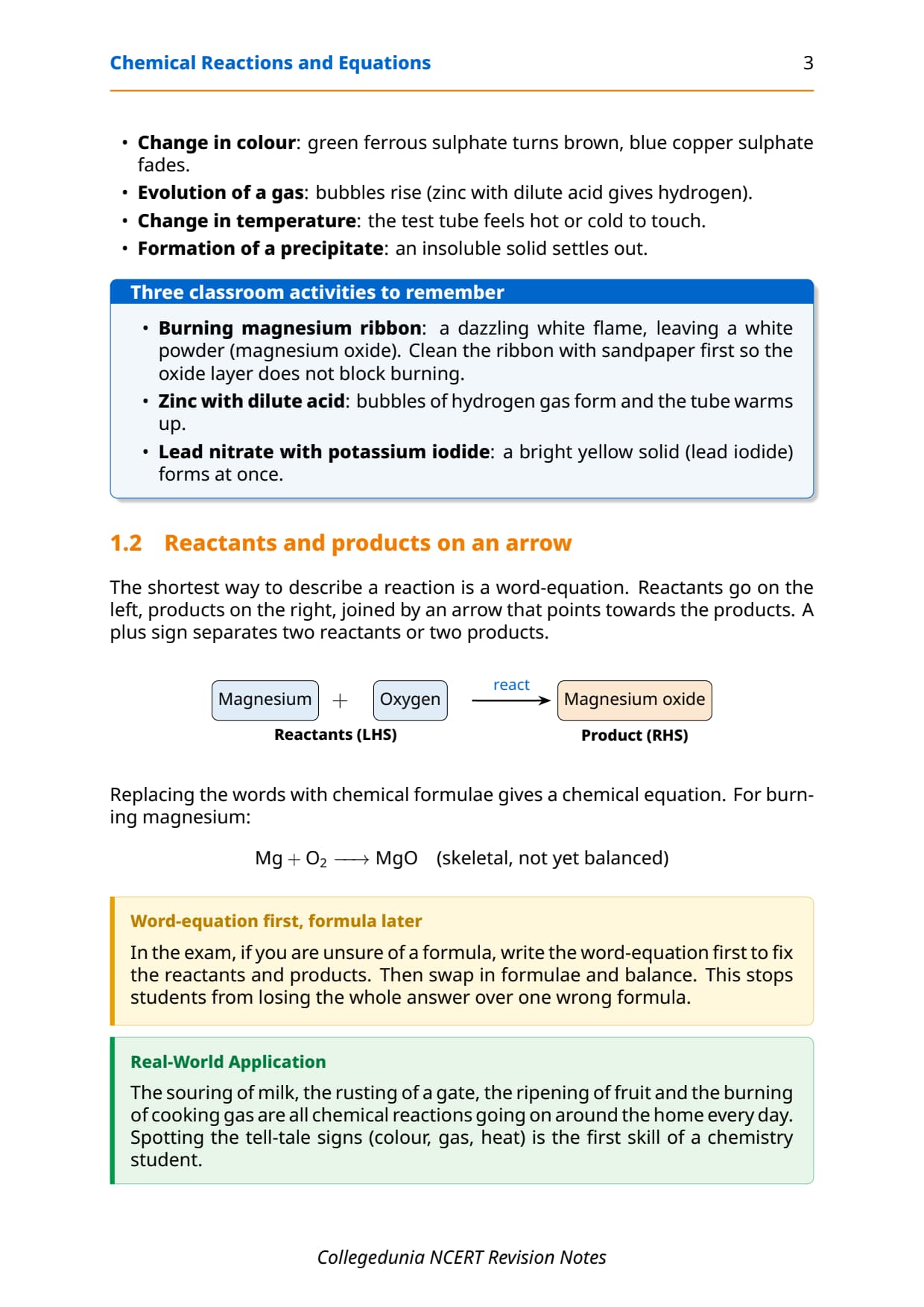
A word-equation puts reactants on the left, products on the right, joined by an arrow. For burning magnesium, "Magnesium + Oxygen gives Magnesium oxide" becomes Mg + O2 → MgO (skeletal, not yet balanced).
Physical change versus chemical change
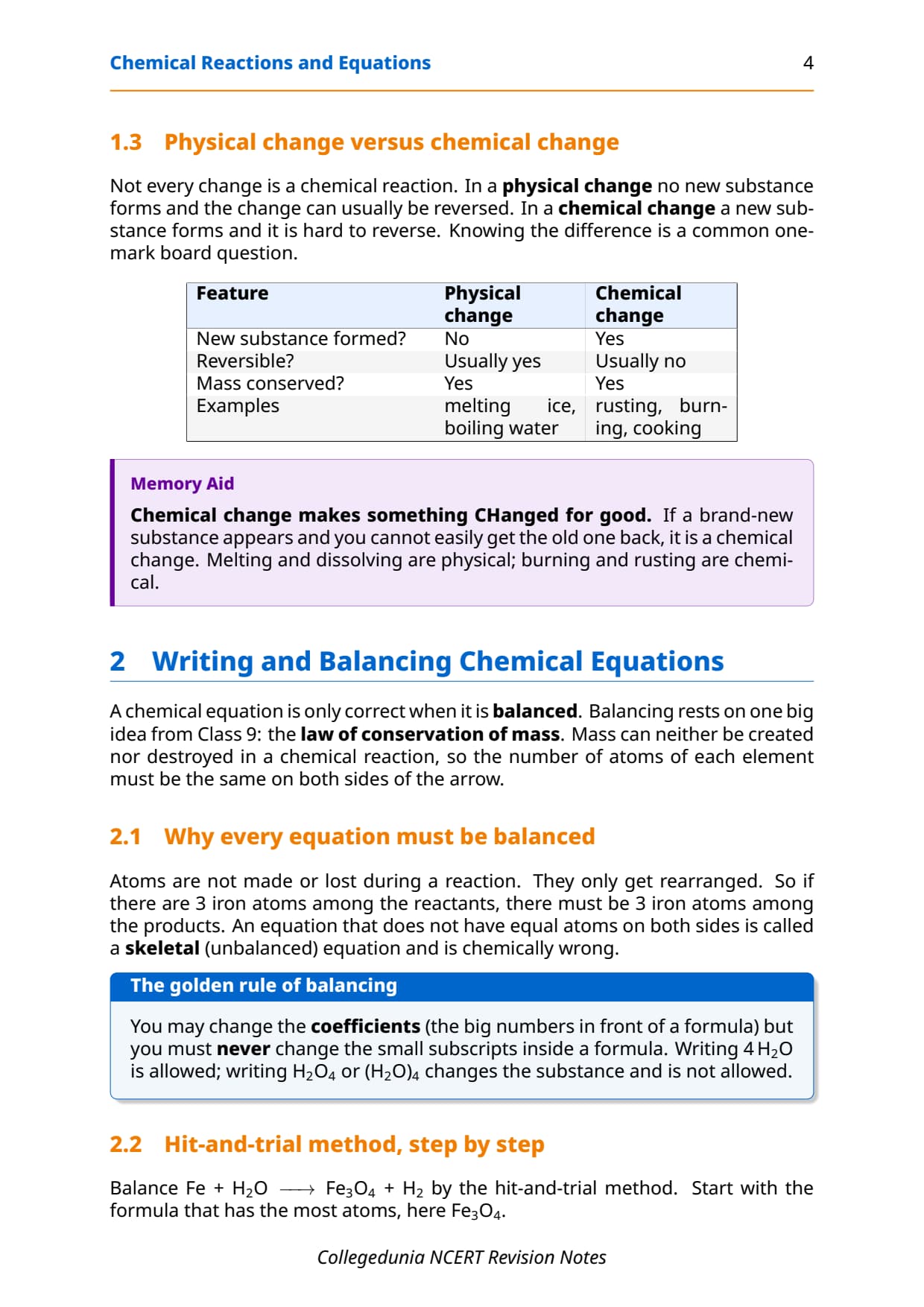
In a physical change no new substance forms and it can usually be reversed; in a chemical change a new substance forms and it is hard to reverse. A common one-mark board question.
| Feature | Physical change | Chemical change |
|---|---|---|
| New substance formed? | No | Yes |
| Reversible? | Usually yes | Usually no |
| Mass conserved? | Yes | Yes |
| Examples | melting ice, boiling water | rusting, burning, cooking |
Writing and Balancing Chemical Equations in Class 10 Science
A chemical equation is correct only when balanced, resting on the law of conservation of mass: the atoms of each element must be equal on both sides. An equation without equal atoms is skeletal (unbalanced).
Hit-and-trial method, step by step
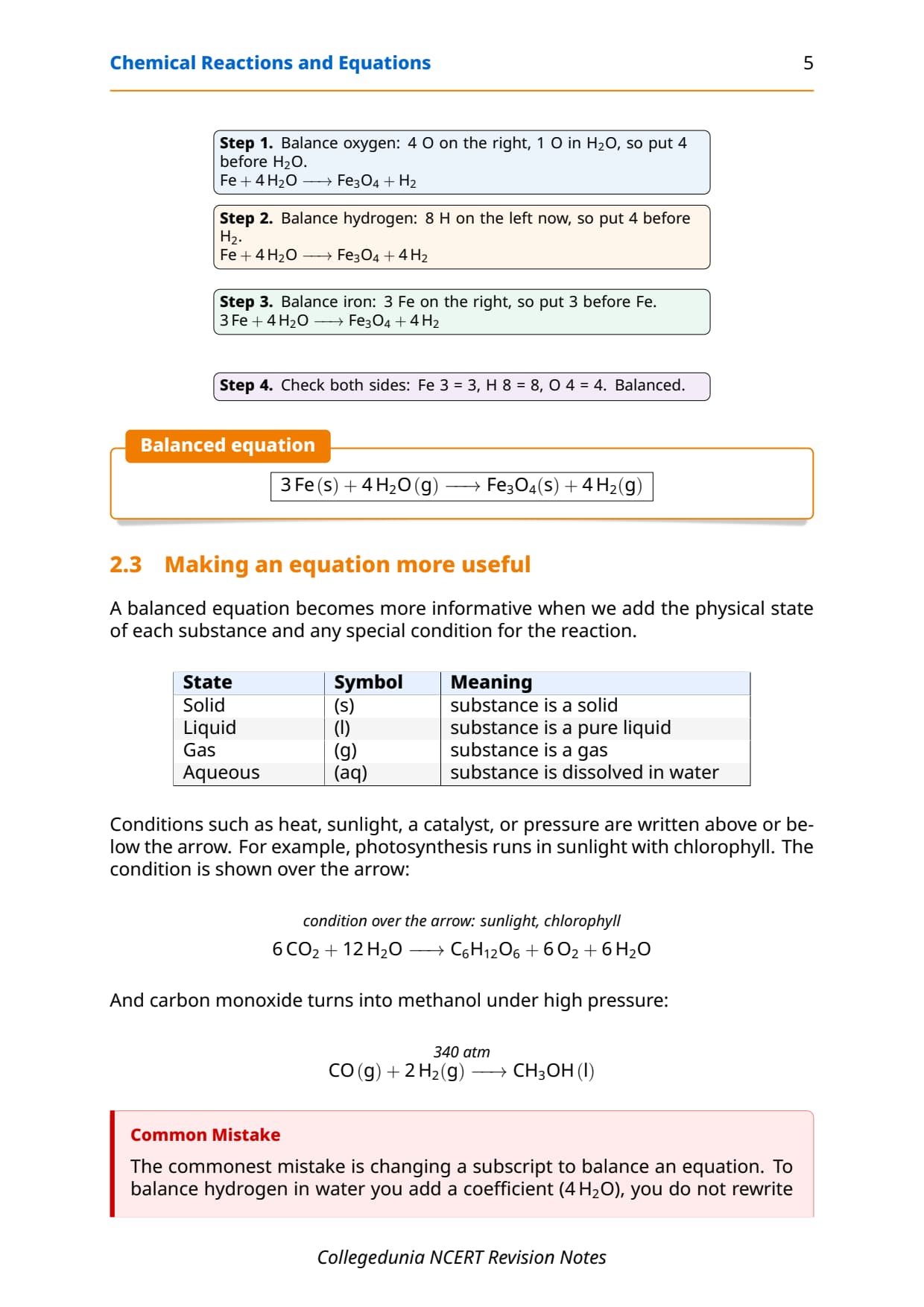
Balance Fe + H2O → Fe3O4 + H2, starting with the formula that has the most atoms (Fe3O4):
- Step 1. Balance oxygen: 4 O on the right, so put 4 before H2O.
- Step 2. Balance hydrogen: 8 H on the left now, so put 4 before H2.
- Step 3. Balance iron: 3 Fe on the right, so put 3 before Fe.
- Step 4. Check: Fe 3 = 3, H 8 = 8, O 4 = 4. Balanced.
Add the physical state after each formula: (s) solid, (l) liquid, (g) gas, (aq) aqueous. Conditions like heat, sunlight or a catalyst go above or below the arrow. For tricky equations, balance metals first, then other non-metals, and leave hydrogen and oxygen for last.
Combination and Decomposition Reactions in Class 10 Science
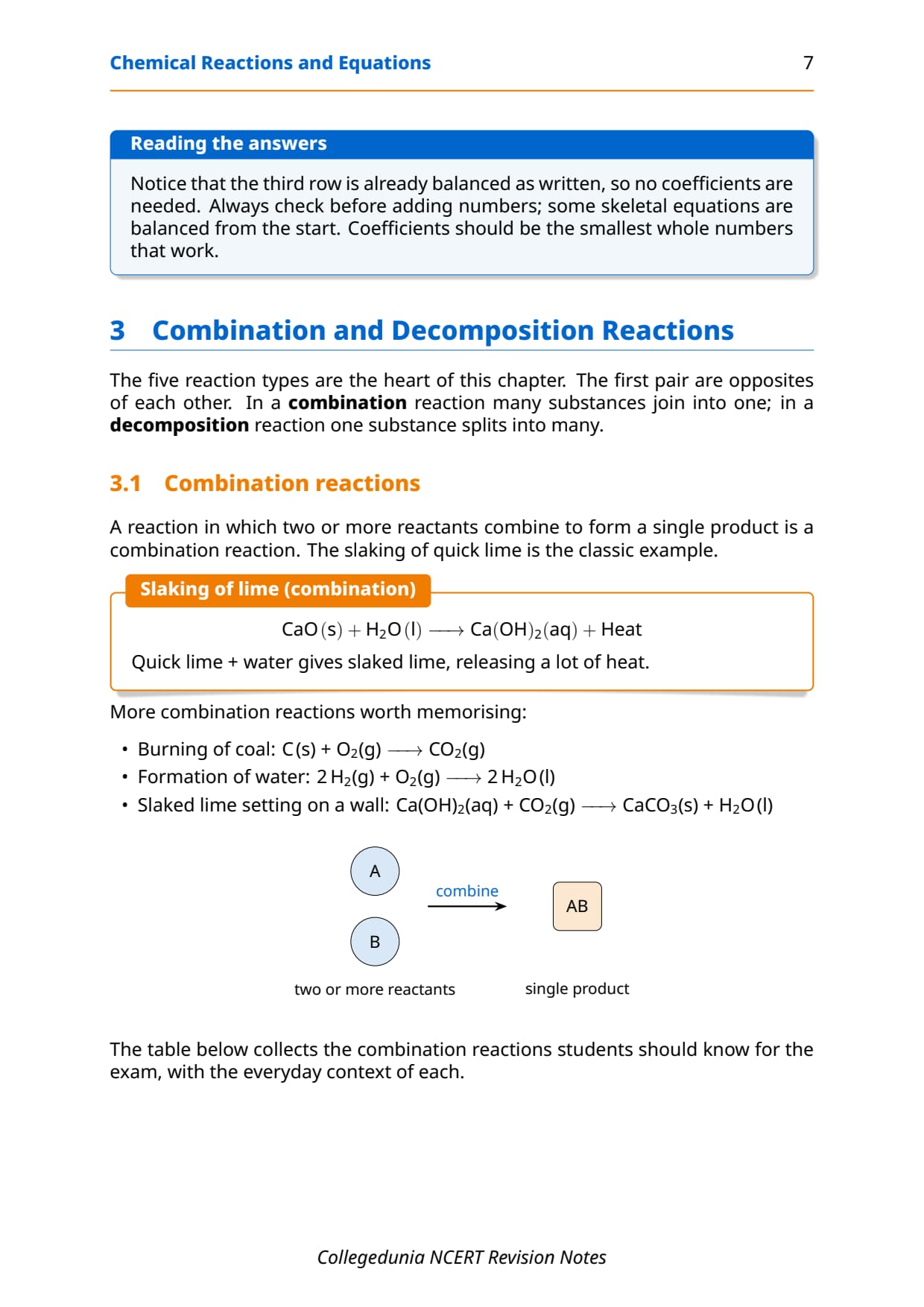
The first pair are opposites. In a combination reaction many substances join into one; in a decomposition reaction one substance splits into many.
Combination reactions
Two or more reactants combine to form a single product. The classic example is the slaking of quick lime: CaO(s) + H2O(l) → Ca(OH)2(aq) + Heat. Others worth memorising:
- Burning of coal: C(s) + O2(g) → CO2(g)
- Whitewash hardening: Ca(OH)2(aq) + CO2(g) → CaCO3(s) + H2O(l)
Exothermic and endothermic reactions
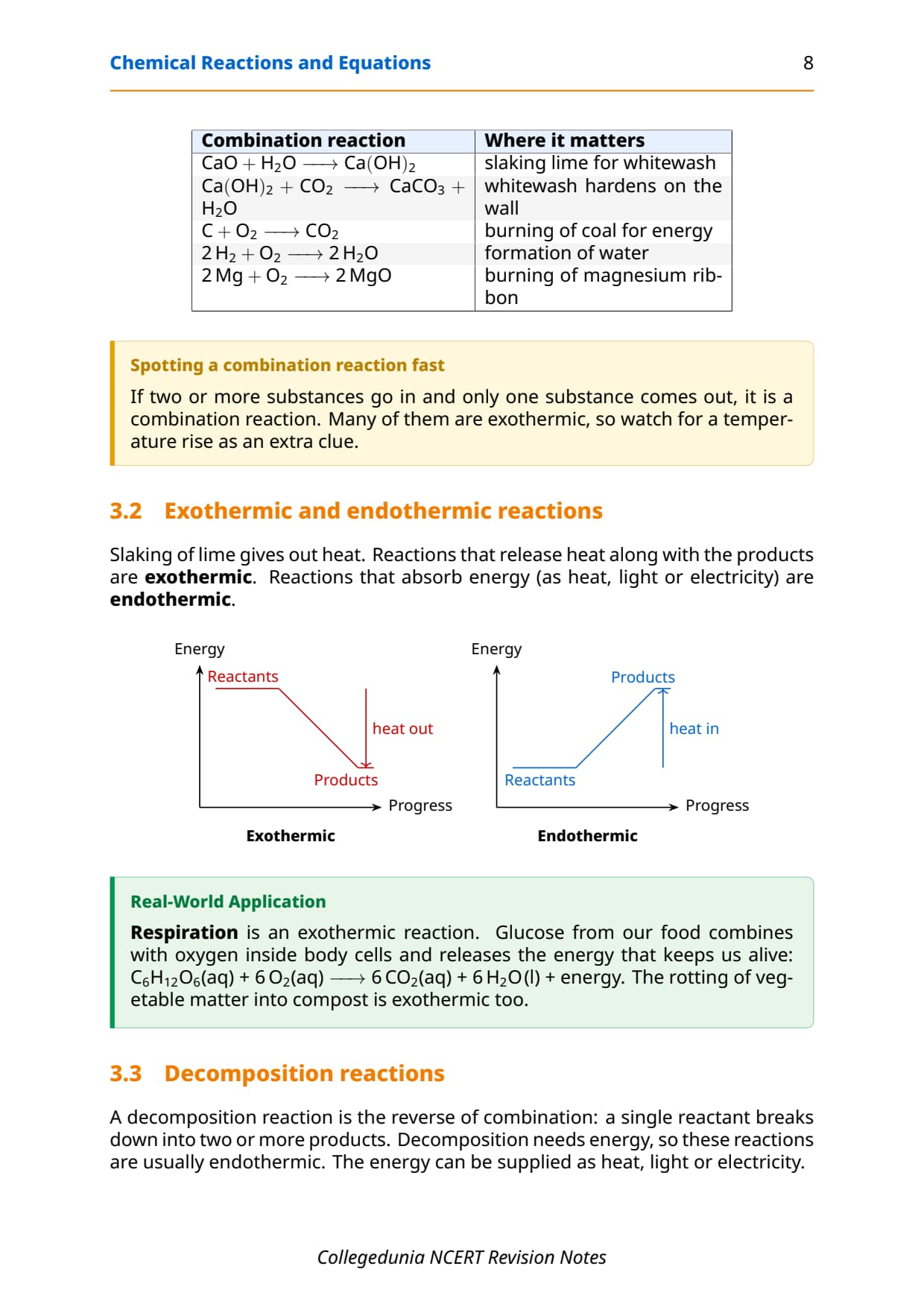
Reactions that release heat are exothermic; those that absorb energy are endothermic. Respiration is an everyday exothermic reaction: C6H12O6(aq) + 6O2(aq) → 6CO2(aq) + 6H2O(l) + energy.
Decomposition reactions
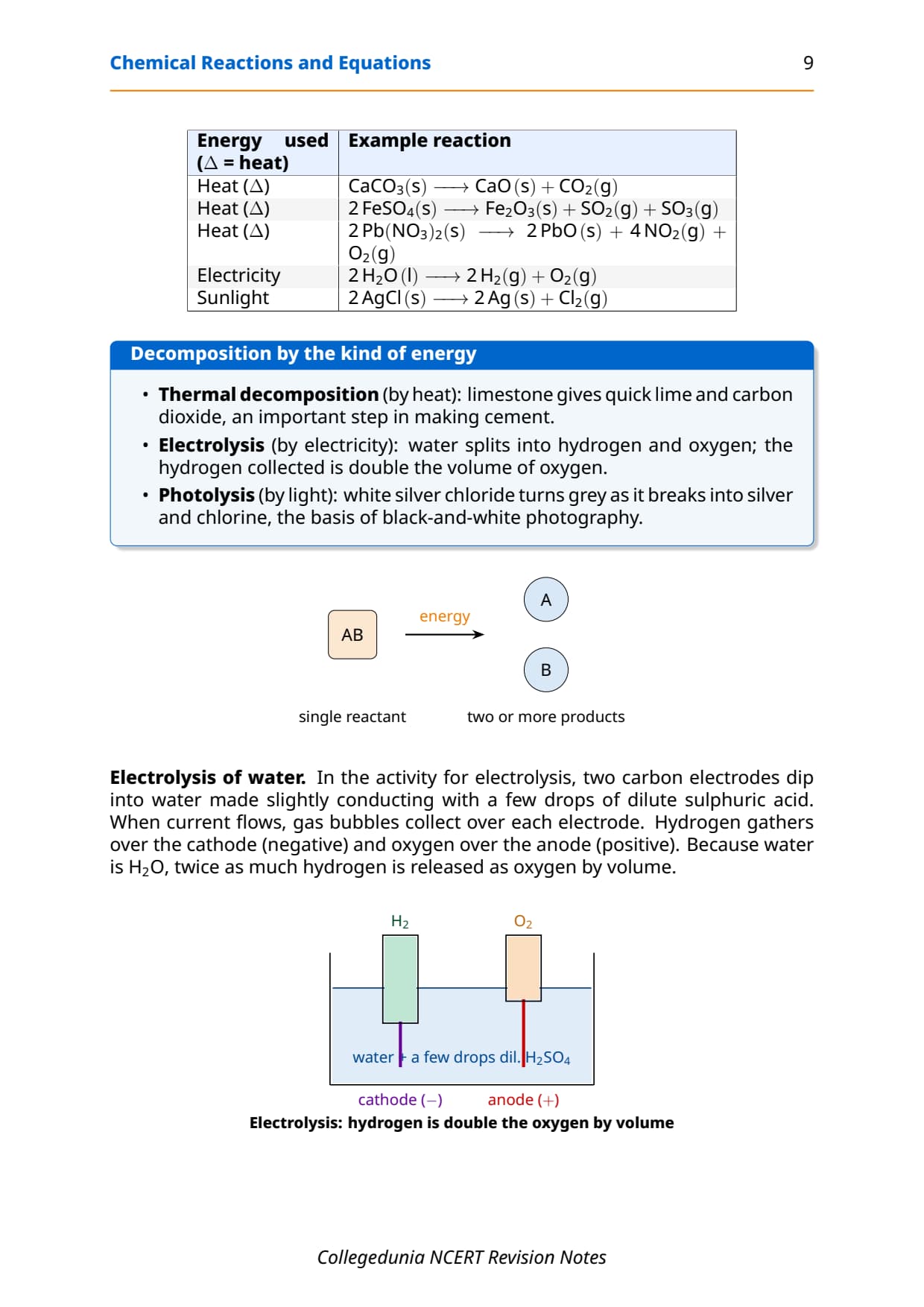
A decomposition reaction is the reverse: a single reactant breaks into two or more products. It needs energy (heat, light or electricity), so these reactions are usually endothermic.
| Energy used | Example reaction | Name of process |
|---|---|---|
| Heat | CaCO3(s) → CaO(s) + CO2(g) | Thermal decomposition (cement step) |
| Electricity | 2H2O(l) → 2H2(g) + O2(g) | Electrolysis |
| Sunlight | 2AgCl(s) → 2Ag(s) + Cl2(g) | Photolysis (photography) |
In the electrolysis of water, hydrogen gathers over the cathode and oxygen over the anode, with twice as much hydrogen as oxygen by volume.
Displacement and Double Displacement Reactions in Class 10 Science
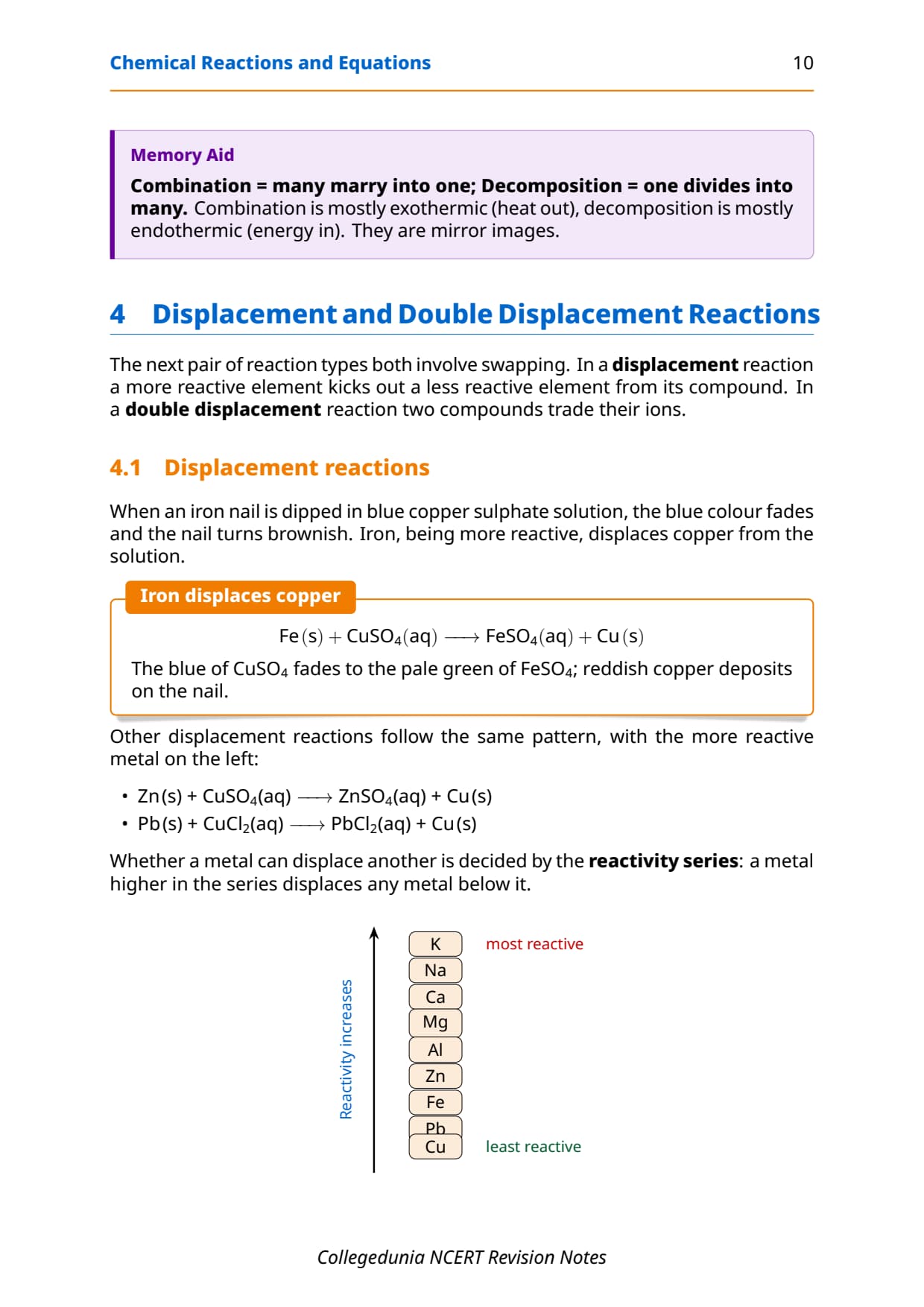
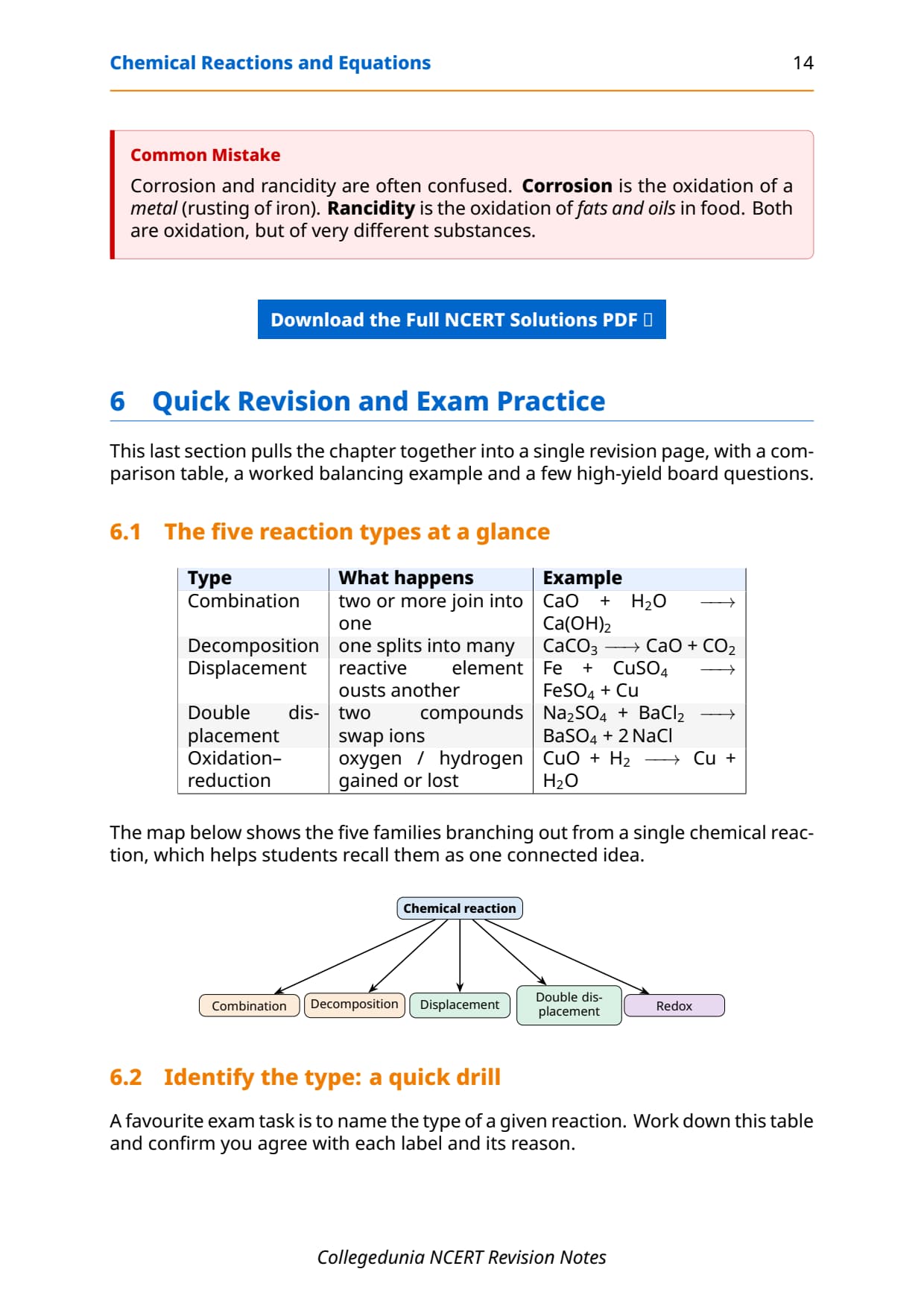
In a displacement reaction a more reactive element kicks out a less reactive one from its compound. In a double displacement reaction two compounds trade their ions.
Displacement reactions
An iron nail in blue copper sulphate turns the solution pale and the nail brownish: Fe(s) + CuSO4(aq) → FeSO4(aq) + Cu(s). The reactivity series decides this: a metal higher up displaces any below it (K, Na, Ca, Mg, Al, Zn, Fe, Pb, Cu).
- Zinc displaces copper: Zn(s) + CuSO4(aq) → ZnSO4(aq) + Cu(s)
Double displacement and precipitation
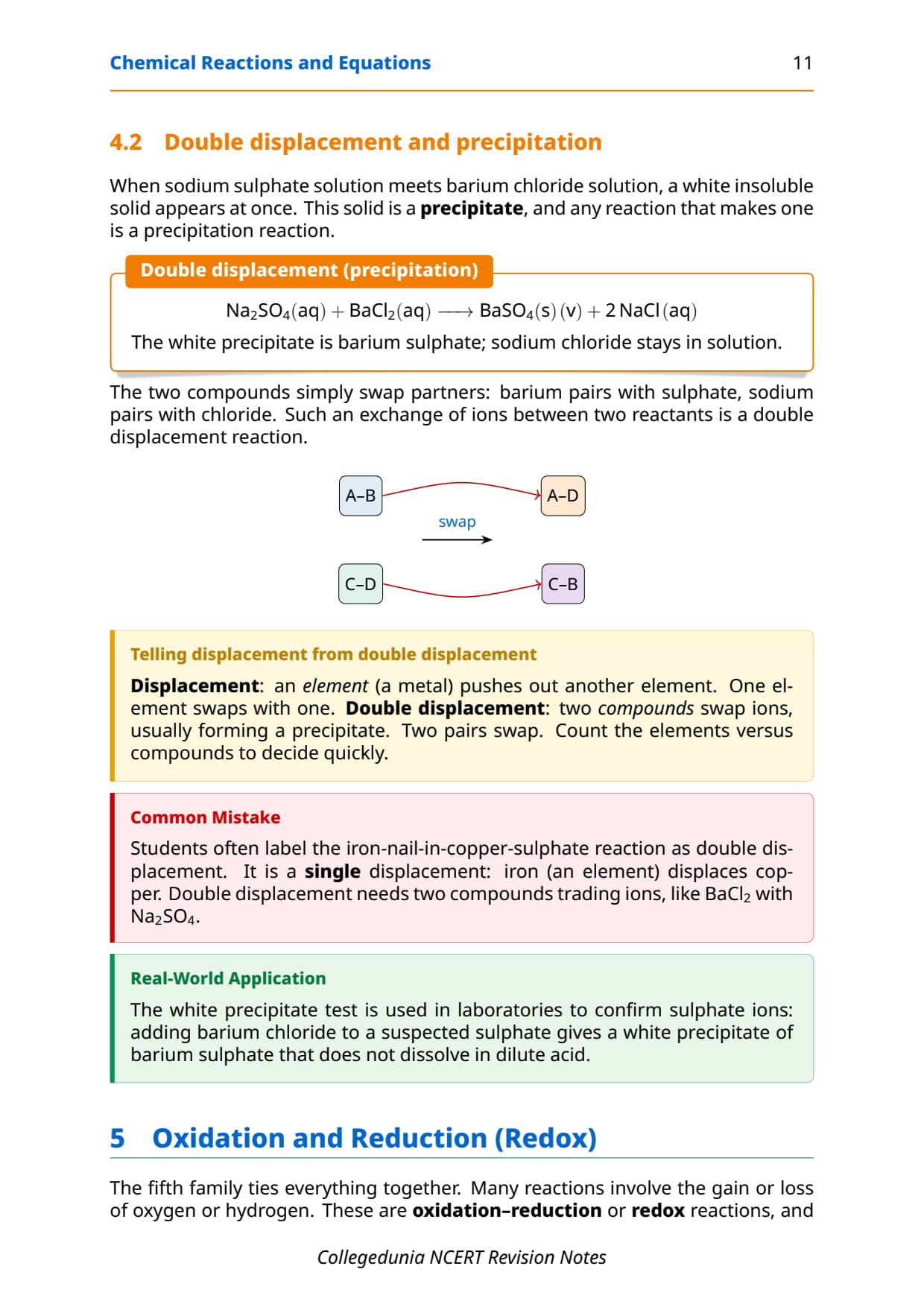
When sodium sulphate meets barium chloride, a white precipitate appears at once (a precipitation reaction): Na2SO4(aq) + BaCl2(aq) → BaSO4(s) + 2NaCl(aq). The two compounds swap partners. This exchange of ions is a double displacement reaction.
Oxidation and Reduction (Redox), Corrosion and Rancidity
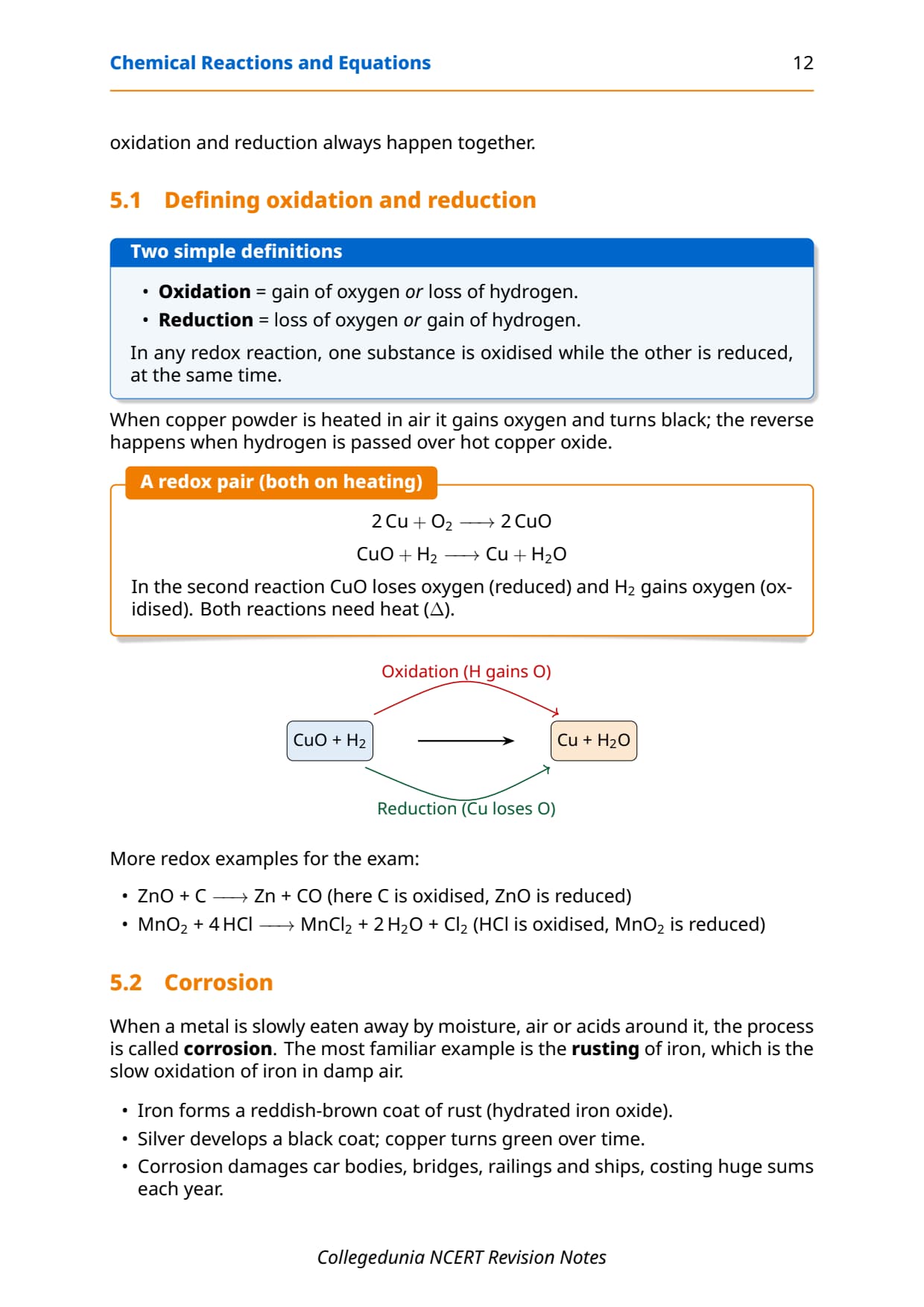
Many reactions involve gain or loss of oxygen or hydrogen. These are redox reactions, and the two always happen together. Oxidation = gain of oxygen or loss of hydrogen; reduction = loss of oxygen or gain of hydrogen.
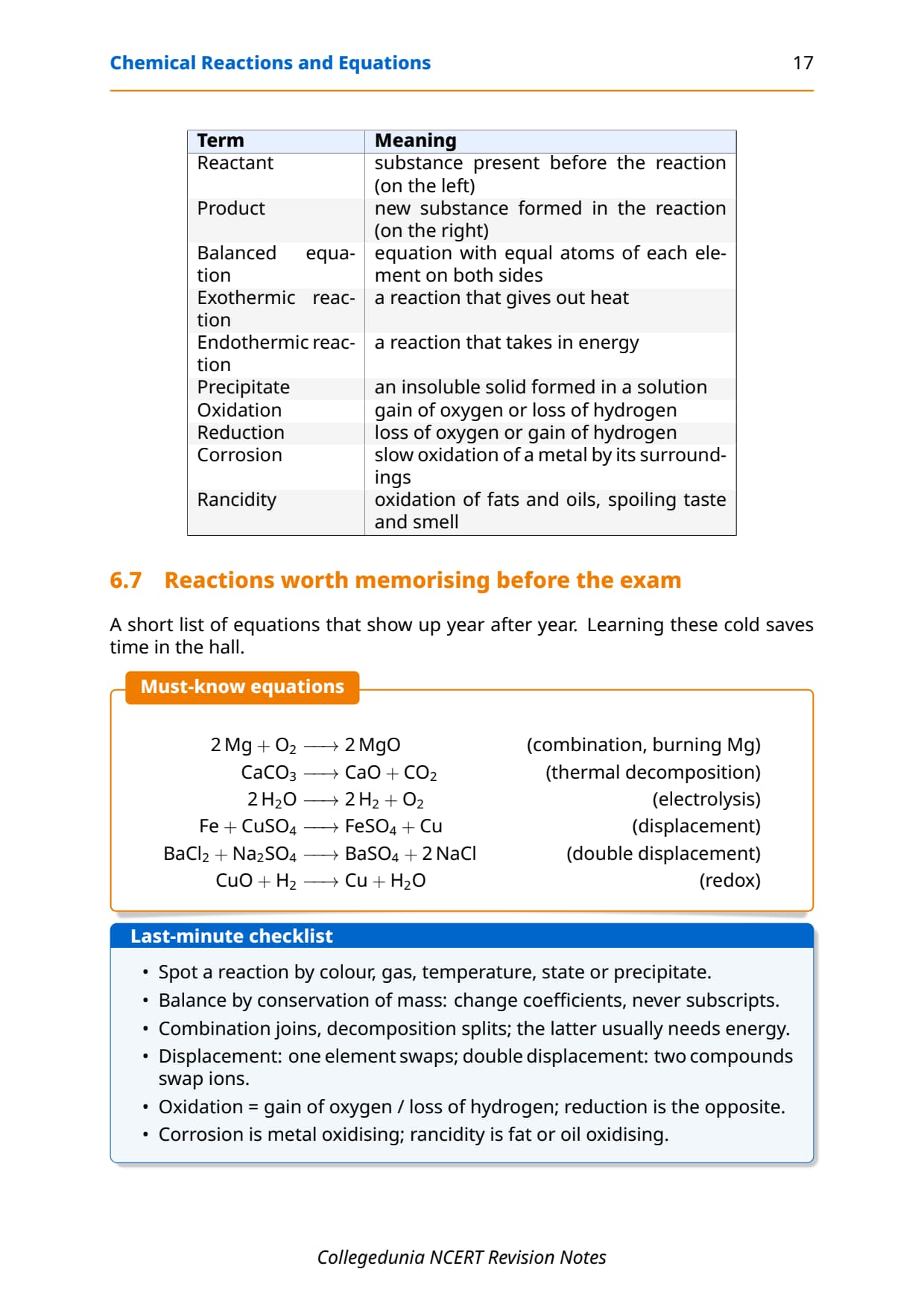
In CuO + H2 → Cu + H2O, CuO loses oxygen (reduced) while H2 gains oxygen (oxidised). A hook is OIL RIG: Oxidation Is Loss, Reduction Is Gain.
Corrosion
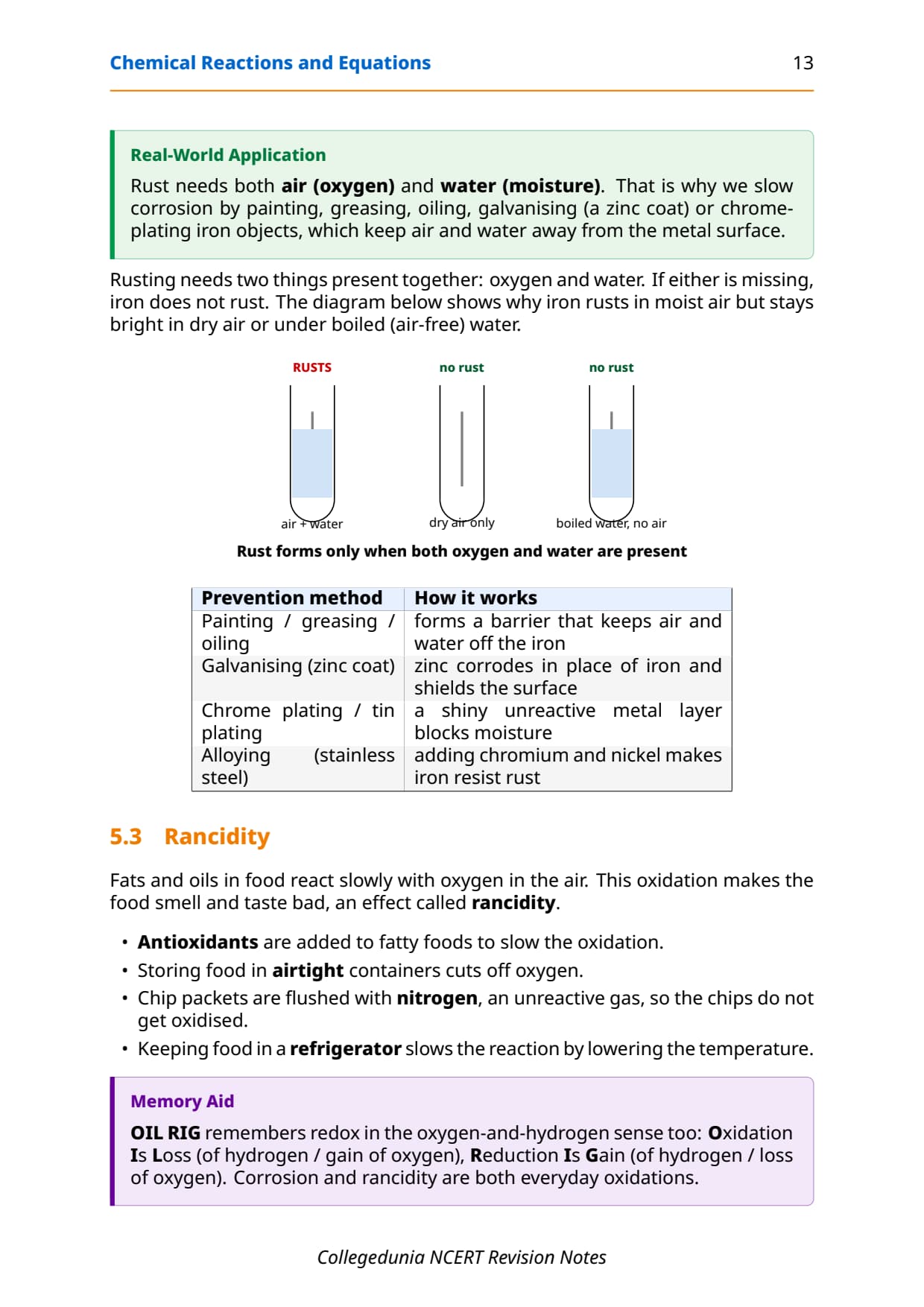
Corrosion is a metal being slowly eaten away by moisture, air or acids. The familiar example is the rusting of iron, its slow oxidation in damp air. Rusting needs both oxygen and water together; if either is missing, iron does not rust.
| Prevention method | How it works |
|---|---|
| Painting, greasing, oiling | a barrier keeping air and water off the iron |
| Galvanising (zinc coat) | zinc corrodes in place of iron and shields the surface |
| Alloying (stainless steel) | chromium and nickel make iron resist rust |
Rancidity
Fats and oils react slowly with oxygen, making food smell and taste bad. This oxidation is rancidity, slowed by antioxidants, airtight containers, nitrogen flushing and refrigeration. Corrosion is the oxidation of a metal; rancidity is the oxidation of fats and oils in food.
Five Reaction Types at a Glance and Exam Practice
This strip lines up the five reaction types with a one-line rule and a balanced example each, to read just before the exam.
| Type | What happens | Example |
|---|---|---|
| Combination | two or more join into one | CaO + H2O → Ca(OH)2 |
| Decomposition | one splits into many | CaCO3 → CaO + CO2 |
| Displacement | reactive element ousts another | Fe + CuSO4 → FeSO4 + Cu |
| Double displacement | two compounds swap ions | Na2SO4 + BaCl2 → BaSO4 + 2NaCl |
| Oxidation-reduction | oxygen or hydrogen gained or lost | CuO + H2 → Cu + H2O |
For "identify the type of reaction" questions, justify your answer in a few words, e.g. "double displacement, because two compounds exchange ions and a precipitate forms". The reason often carries a separate mark.
Also Check: The full set of CBSE board paper questions for this chapter, with step-by-step answers, is included in the downloadable PDF above, updated for the 2026-27 cycle.
Other Resources for Class 10 Science Chapter 1 Chemical Reactions and Equations
Pair these revision notes with the matching NCERT Solutions, the formula sheet, handwritten notes and the official NCERT book chapter. All resources for Class 10 Science Chapter 1 Chemical Reactions and Equations are linked below.
| Resource | What it covers | Open |
|---|---|---|
| Notes | Concept-first revision notes on spotting reactions, balancing equations, the five reaction types, corrosion and rancidity. | You are here |
| NCERT Solutions | Step-by-step answers to all in-text and exercise questions, with an Expert Solution for each. | Class 10 Science Chapter 1 NCERT Solutions |
| Formula Sheet | Quick reference of the must-know equations, reaction types and key definitions. | Class 10 Science Chapter 1 Formula Sheet |
| Handwritten Notes | Scanned-style handwritten pages for last-minute board revision. | Class 10 Science Chapter 1 Handwritten Notes |
| NCERT Book PDF | Official NCERT Science Chapter 1 Chemical Reactions and Equations textbook in PDF form. | Class 10 Science Chapter 1 NCERT Book PDF |
Notes for Class 10 Science: All Chapters
Related Links: Use the table below to open the revision notes for the other chapters of Class 10 Science. Every chapter ships with the same concept-first notes style, full PDF download, and revision FAQ.
| Chapter | Notes link |
|---|---|
| Chapter 1 | Chemical Reactions and Equations Notes (You are here) |
| Chapter 2 | Acids, Bases and Salts Notes |
| Chapter 3 | Metals and Non-metals Notes |
| Chapter 4 | Carbon and its Compounds Notes |
| Chapter 5 | Life Processes Notes |
| Chapter 6 | Control and Coordination Notes |
| Chapter 7 | How do Organisms Reproduce? Notes |
| Chapter 8 | Heredity Notes |
| Chapter 9 | Light - Reflection and Refraction Notes |
| Chapter 10 | The Human Eye and the Colourful World Notes |
| Chapter 11 | Electricity Notes |
| Chapter 12 | Magnetic Effects of Electric Current Notes |
| Chapter 13 | Our Environment Notes |
Notes Class 10 Science Chapter 1 Chemical Reactions and Equations FAQs
Ques. What does Chapter 1 Chemical Reactions and Equations cover in Class 10 Science?
Ans. Chapter 1 covers how one set of substances changes into a new set of substances. The notes explain how to spot a chemical reaction by colour, gas, temperature, state or precipitate, the difference between a physical and a chemical change, and how to write and balance a chemical equation using the law of conservation of mass. They then cover the five reaction types, combination, decomposition, displacement, double displacement and oxidation-reduction, and finish with corrosion (rusting of iron) and rancidity, all aligned with the 2026-27 CBSE syllabus.
Ques. How do you balance a chemical equation in Class 10 Science?
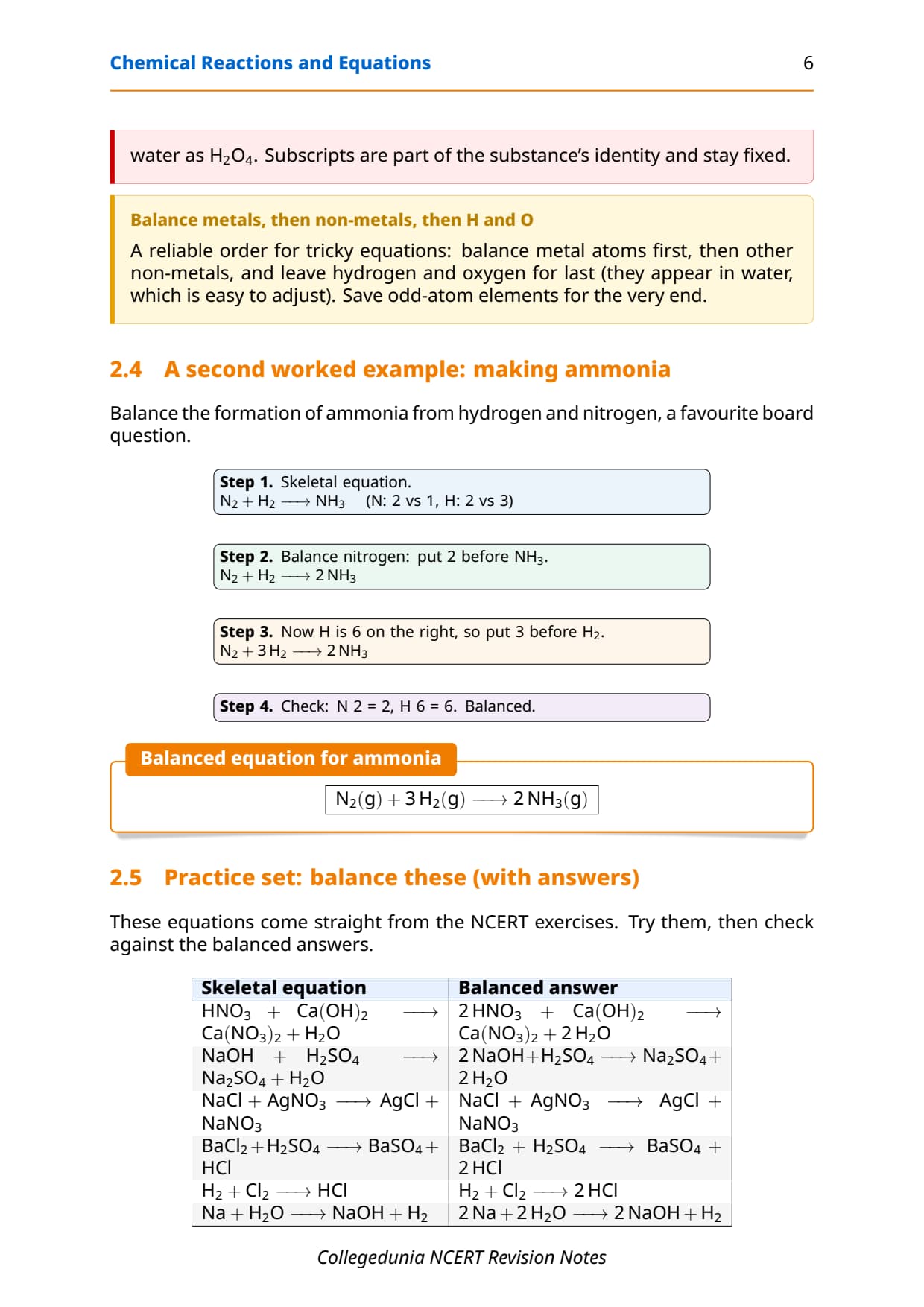
Ans. You balance an equation by the hit-and-trial method, which rests on the law of conservation of mass: the number of atoms of each element must be equal on both sides. Start with the formula that has the most atoms and adjust the coefficients (the big numbers in front of formulae). A reliable order is to balance metals first, then other non-metals, and leave hydrogen and oxygen for last. The golden rule is that you may change coefficients but you must never change the small subscripts inside a formula, because that would change the substance itself.
Ques. What are the five types of chemical reactions in Class 10 Science?
Ans. The five types are combination, decomposition, displacement, double displacement and oxidation-reduction (redox). In a combination reaction two or more substances join into one, such as CaO + H2O giving Ca(OH)2. In a decomposition reaction one substance splits into many, such as CaCO3 giving CaO and CO2. In a displacement reaction a more reactive element pushes out a less reactive one, while in a double displacement reaction two compounds swap ions, often forming a precipitate. In a redox reaction, oxygen or hydrogen is gained or lost.
Ques. What is the difference between a displacement and a double displacement reaction?
Ans. In a displacement reaction a single more reactive element pushes out a less reactive element from its compound, for example iron displacing copper in Fe + CuSO4 giving FeSO4 + Cu. Only one element swaps. In a double displacement reaction two compounds exchange their ions, for example Na2SO4 reacting with BaCl2 to give a white precipitate of BaSO4 and NaCl. Two pairs of ions swap. A quick test is to count the elements versus compounds: an element displacing another means displacement, two compounds trading ions means double displacement.
Ques. What is the difference between corrosion and rancidity?
Ans. Both corrosion and rancidity are oxidation reactions, but they happen to different substances. Corrosion is the slow oxidation of a metal by the moisture, air or acids around it, the most common example being the rusting of iron, which needs both oxygen and water to be present. Rancidity is the oxidation of fats and oils in food, which spoils its smell and taste. Corrosion is prevented by painting, oiling, galvanising or alloying, while rancidity is slowed by antioxidants, airtight packing, flushing packets with nitrogen, and refrigeration.
Ques. Why is respiration called an exothermic reaction in Class 10 Science?
Ans. Respiration is called an exothermic reaction because it gives out energy. During respiration, glucose from our food combines with oxygen inside body cells and breaks down into carbon dioxide and water, releasing the energy that keeps the body working: C6H12O6 + 6O2 giving 6CO2 + 6H2O + energy. Since heat energy is released along with the products, respiration is exothermic, just like the slaking of lime and the burning of fuels.
Ques. How many pages is the Class 10 Science Chemical Reactions and Equations Notes PDF?
Ans. The Chemical Reactions and Equations Notes PDF runs about 20 to 22 pages and covers the full chapter in concept-first revision blocks, with balanced equations, labelled diagrams, comparison tables, common-mistake boxes and a one-glance revision strip of the five reaction types. The PDF is free to download for the 2026-27 session, and a green Handwritten Notes button on this page opens the scanned-style version for last-minute revision.
Ques. Are these Notes for Class 10 Science Chapter 1 aligned with the 2026-27 syllabus?
Ans. Yes. This page reflects the current 2026-27 CBSE syllabus for Class 10 Science. The Chemical Reactions and Equations chapter is unchanged for the current cycle, and these notes follow the NCERT textbook, covering how to spot a reaction, balancing chemical equations, the five reaction types, and corrosion and rancidity. The notes are written for the CBSE board exam, with the high-frequency question types and marking-scheme habits highlighted throughout.



Comments