




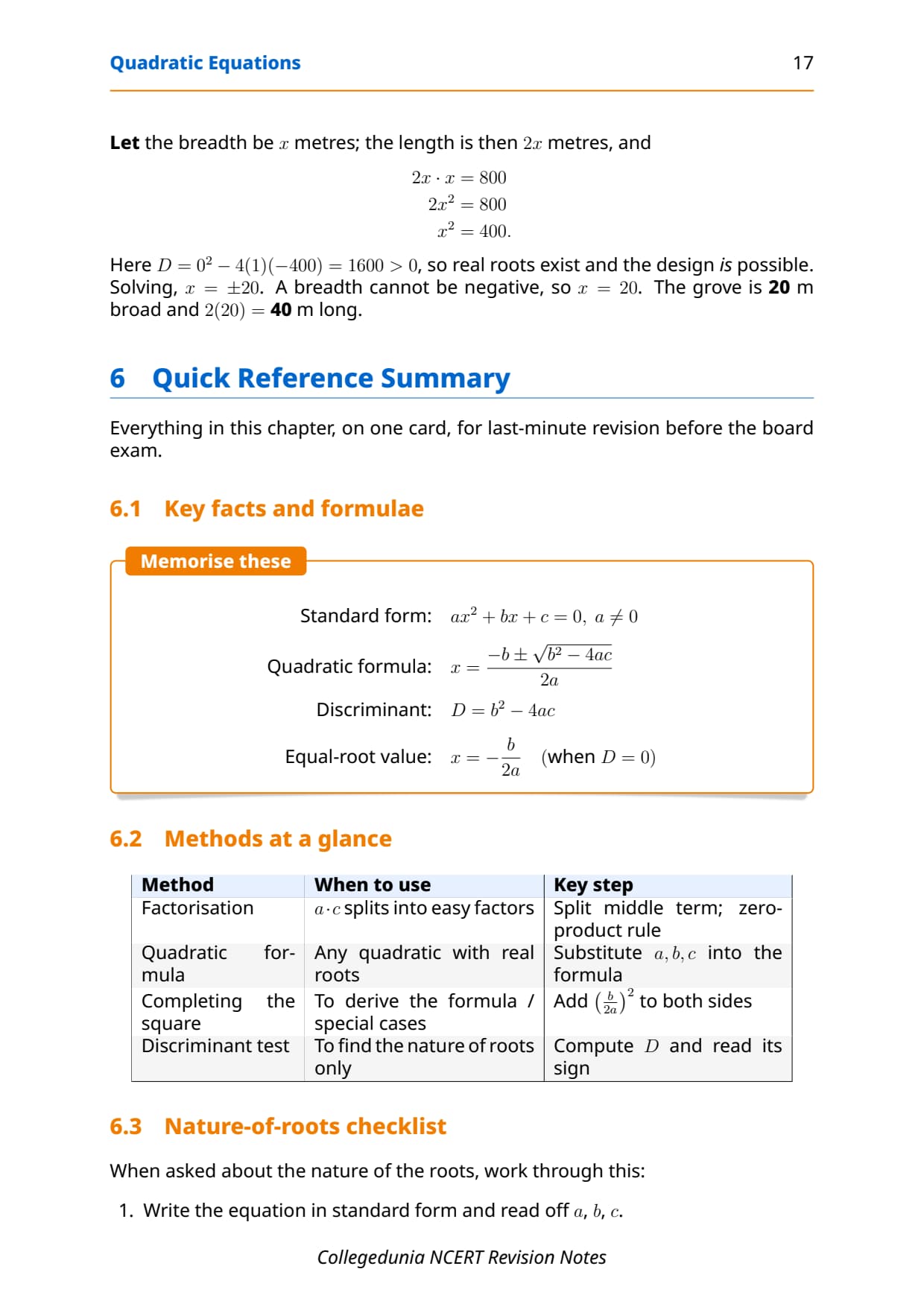
These Notes for Class 10 Maths Chapter 4 Quadratic Equations give a fast, concept-first revision of the whole chapter. They cover the standard form ax² + bx + c = 0, how to check if an equation is quadratic, the roots by factorisation (splitting the middle term), the quadratic formula of Sridharacharya, and how the discriminant b² - 4ac tells you the nature of the roots before you solve. All notes follow the 2026-27 CBSE syllabus.
- Every method explained in plain words, with one short solved example and a board-exam tip.
- Full cover of factorisation, the quadratic formula and the discriminant, plus the word-problem types asked most.
- Aligned with the 2026-27 CBSE syllabus, and useful for CUET and Class 11 algebra ahead.
These notes are written by Maths subject experts from the 2026-27 NCERT textbook and checked against the last five years of CBSE board papers.
Student Feedback: What 9,800 students told us about this chapter
68% of Class 10 students said splitting the middle term was the hardest part before the board exam. 3 out of 5 students said learning the discriminant test first saved the most time, because they could read the nature of the roots without solving.
Toppers said memorising the quadratic formula as a safety net stopped them getting stuck on awkward equations. The average student spent 2 to 3 hours on these notes across the first read and final revision.
Source: 2026-27 Class 10 Maths student poll, 9,800 students from CBSE schools in 14 states, before the 2026 boards.
|
Table of Contents |
Watch Quadratic Equations Class 10 Maths Explained
Source: Magnet Brains on YouTube
What These Notes Cover
The chapter answers one question: for which values of x does ax² + bx + c = 0 become true? Those values are the roots. These notes keep the NCERT order but pack it into revision-ready blocks, so you can read the whole chapter in one sitting. The 2026-27 syllabus has three big ideas.
- Recognising a quadratic: writing an equation in the standard form ax² + bx + c = 0 and checking the degree is 2.
- Finding the roots: by factorisation (splitting the middle term) and by the quadratic formula, both giving the same answer.
- Nature of roots: using the discriminant b² - 4ac to decide two distinct, two equal, or no real roots.
Quadratic Equation and Its Standard Form
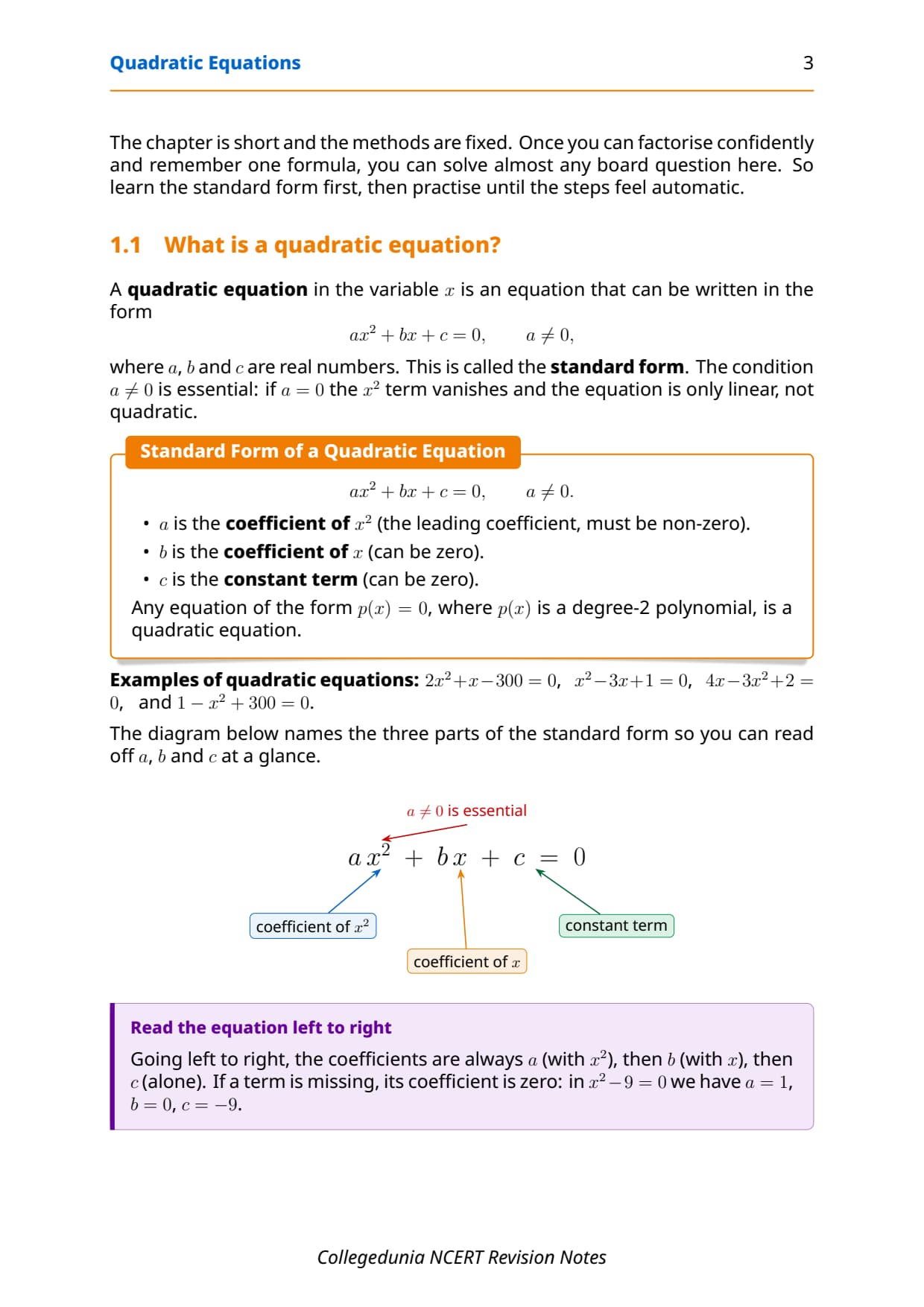
First, fix the vocabulary. A quadratic equation in x is any equation you can write as ax² + bx + c = 0, where a, b and c are real numbers and a is not 0. The condition a ≠ 0 matters. If a were 0, the x² term would vanish and the equation would only be linear.
Written in descending order of degree, ax² + bx + c = 0 is the standard form: a is the coefficient of x², b of x, and c the constant. Many equations do not look quadratic at first, so simplify, bring everything to one side, then check if the highest power of x is exactly 2.
| Equation | Quadratic? | Reason |
|---|---|---|
| 2x² + x - 300 = 0 | Yes | Highest power is 2; here a = 2, b = 1, c = −300 |
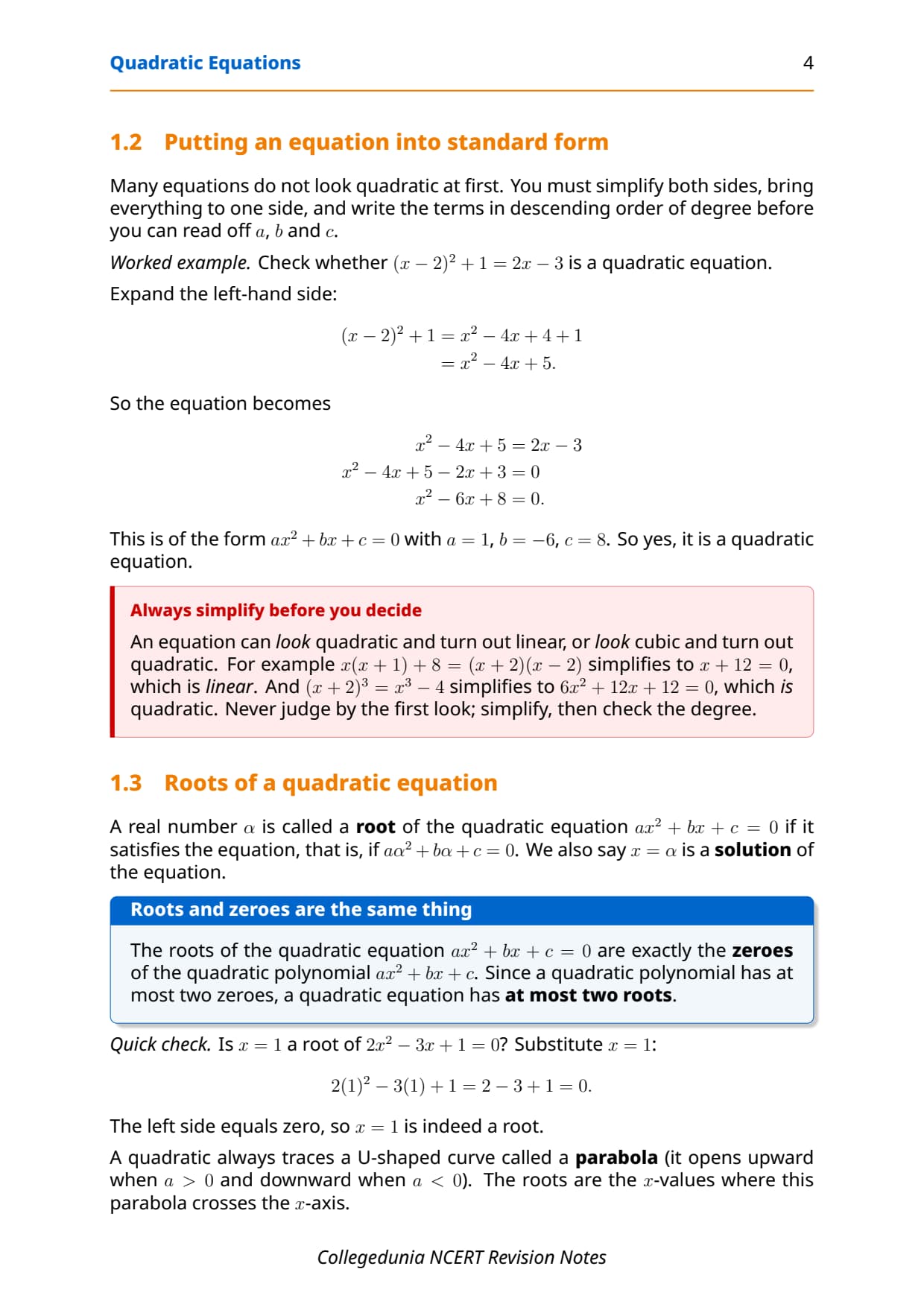
| (x - 2)² + 1 = 2x - 3 | Yes | Simplifies to x² − 6x + 8 = 0 |
| x(x + 1) + 8 = (x + 2)(x - 2) | No | The x² terms cancel, leaving x + 12 = 0, a linear equation |
| (x + 2)³ = x³ - 4 | Yes | The x³ terms cancel, leaving x² + 2x + 2 = 0 |
The table teaches one rule: always simplify first. An equation can look cubic but be quadratic, or look quadratic but be linear.
Roots of a Quadratic Equation
A root (or solution) of ax² + bx + c = 0 is a real number that makes the equation true when you put it in place of x. For example, x = 1 is a root of 2x² - 3x + 1 = 0, because 2(1)² - 3(1) + 1 = 0. The roots are exactly the zeroes of the matching polynomial, so the Polynomials chapter joins up here.
A key fact: a quadratic has at most two roots. Every method below just finds those one or two values of x cleanly.
- Checking a root: put the value in and confirm the left side equals 0. Examiners reward this verify step.
- How many roots: never more than two, and sometimes none, which the discriminant tells you.
Solving by Factorisation Step by Step
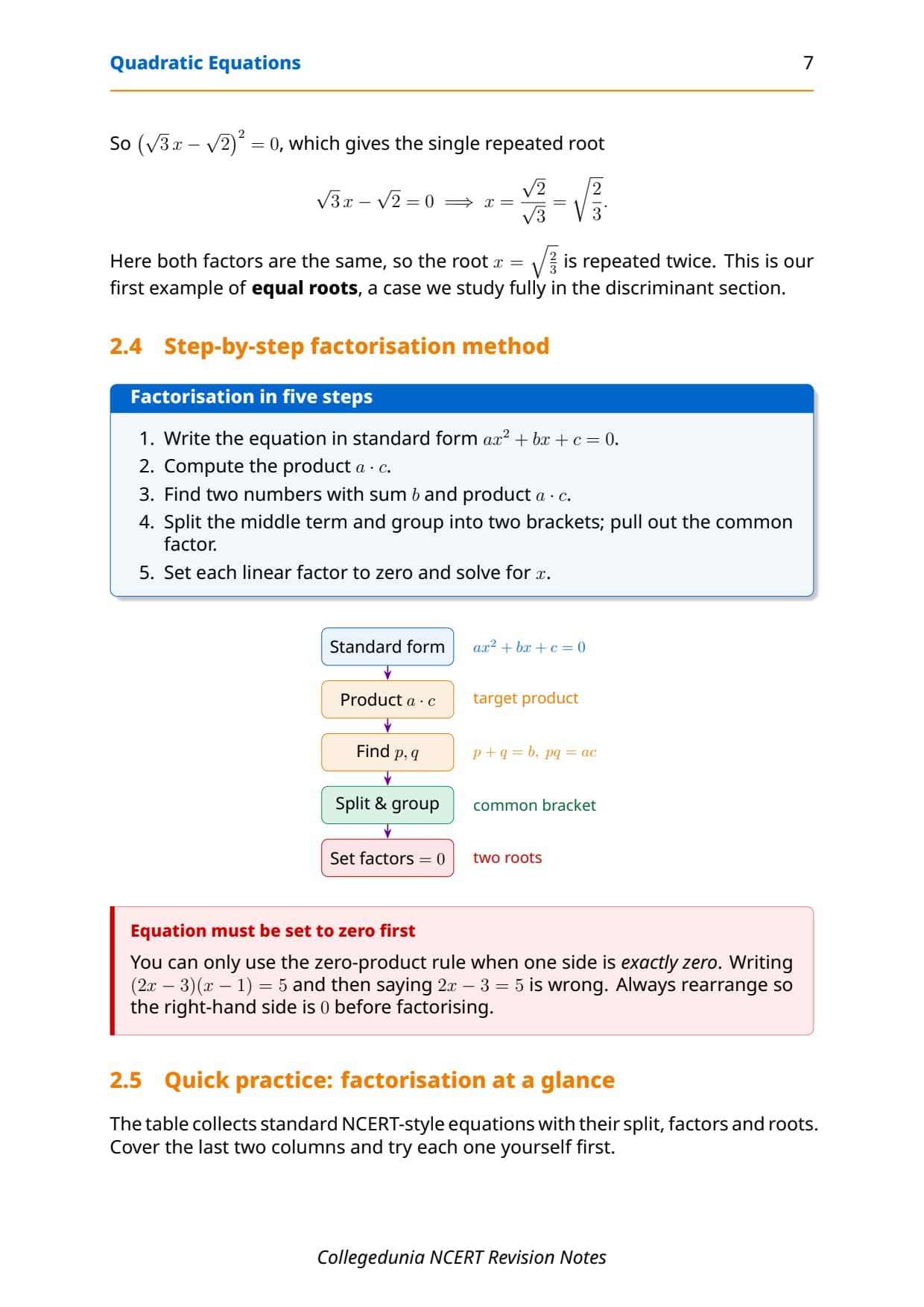
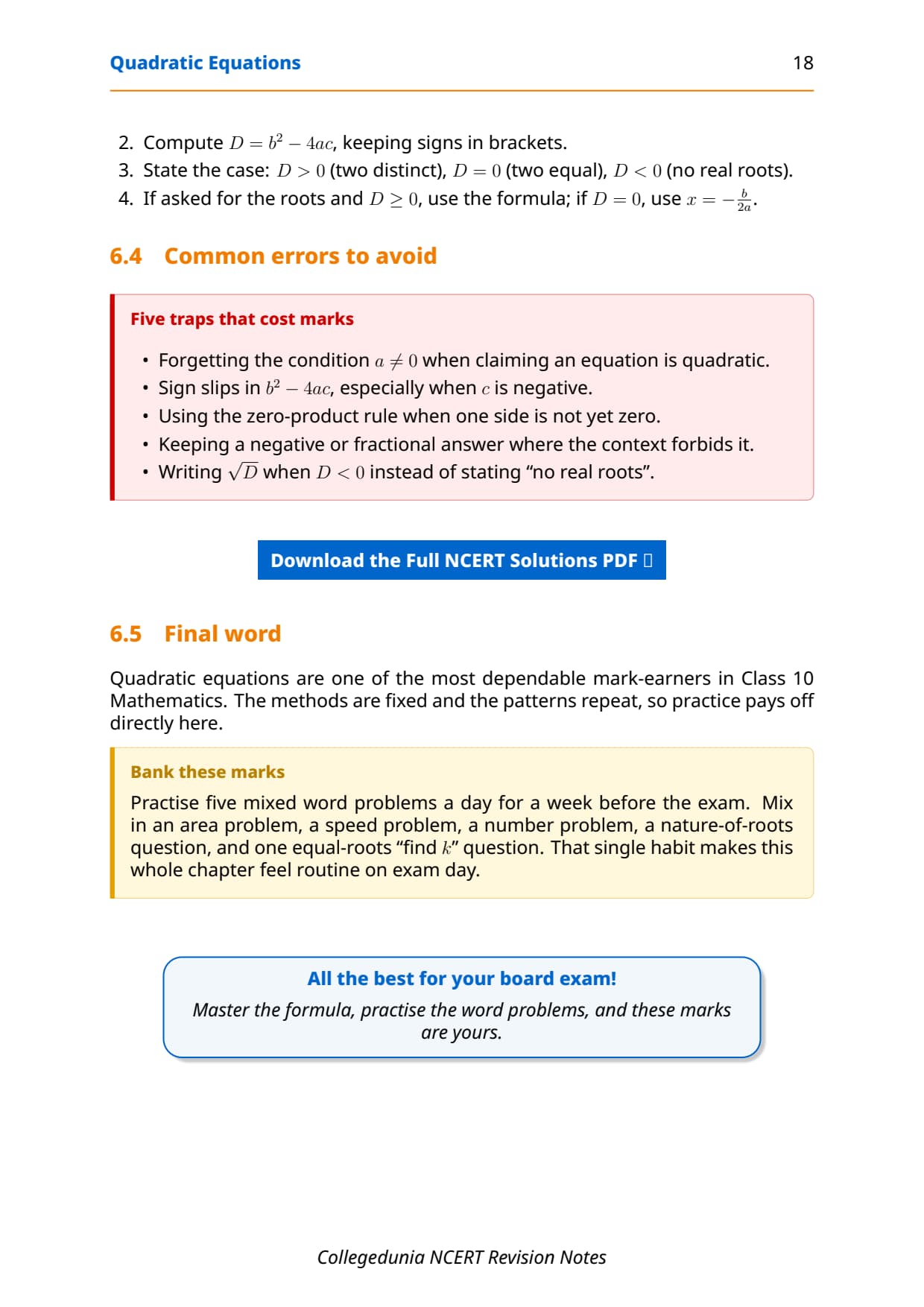
The first method is factorisation, done by splitting the middle term. Write the x term as a sum of two terms whose coefficients multiply to give a×c, factorise in pairs, then set each factor to 0. It works in clean steps.
- Find the product a × c. Look for two numbers that multiply to a×c and add to b.
- Split the middle term bx into those two terms, then group the four terms into two pairs.
- Factor each pair and take out the common bracket. You now have two linear factors equal to 0.
- Set each factor to 0 and solve. Each gives one root.
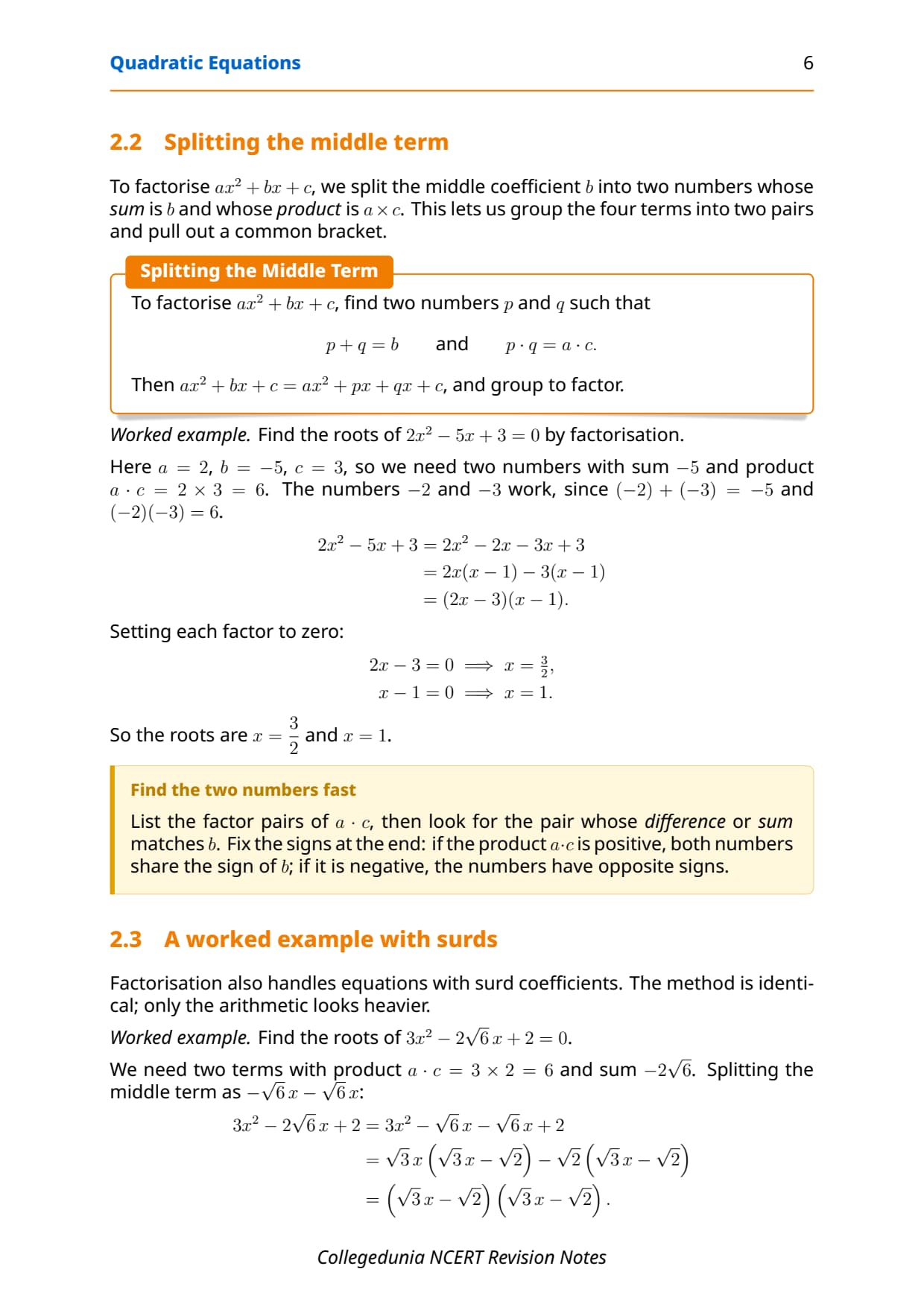
Take 2x² - 5x + 3 = 0. Here a×c = 6 and b = −5, so split −5x as −2x − 3x: 2x² − 2x − 3x + 3 = 0, which groups as 2x(x − 1) − 3(x − 1) = 0, giving (2x − 3)(x − 1) = 0, so x = 3/2 or x = 1. The split numbers must multiply to a×c (not just c) and add to b.
The Quadratic Formula (Sridharacharya Formula)
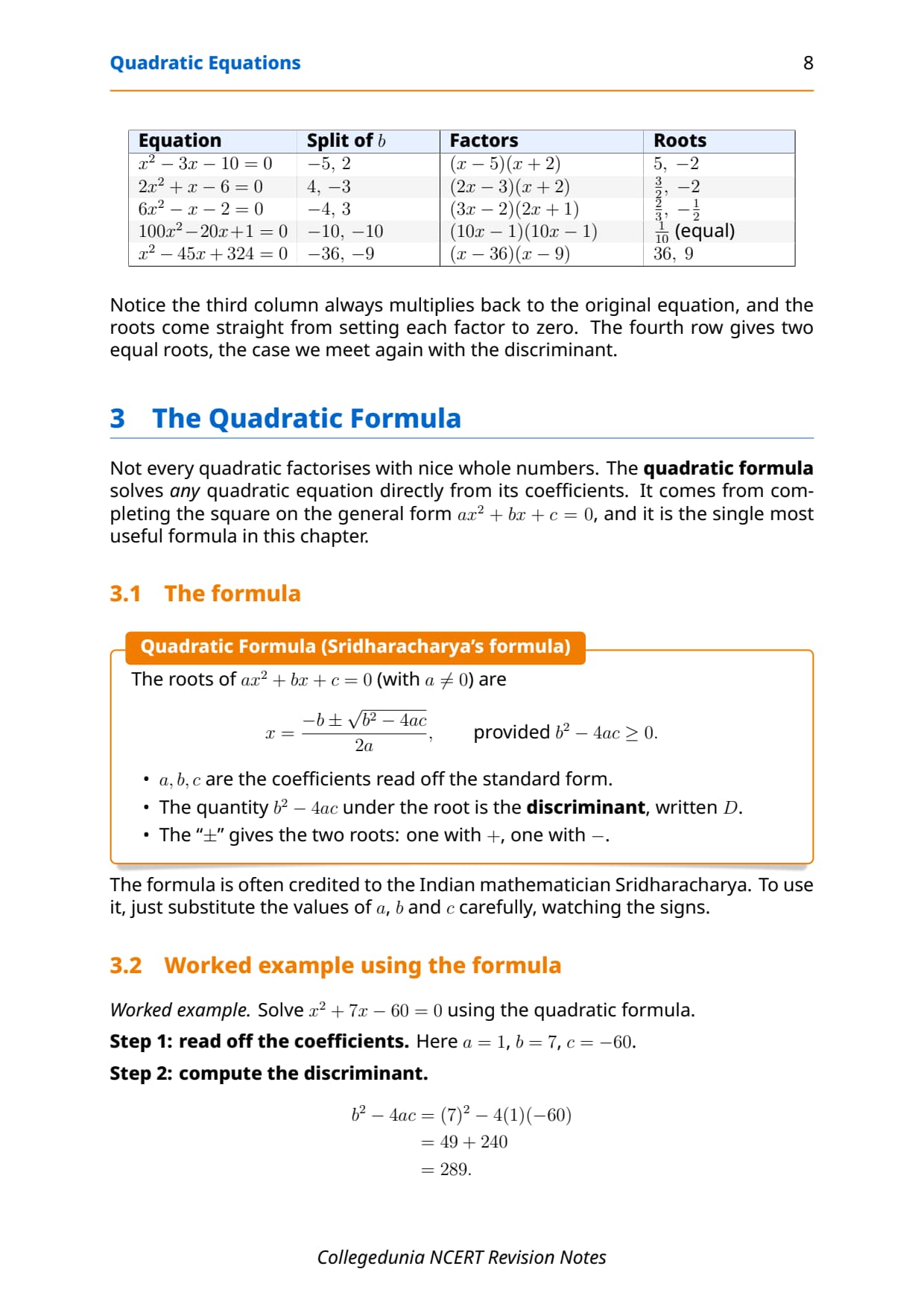
Not every quadratic factorises with nice whole numbers. For those, use the quadratic formula. It is derived by completing the square and credited to the Indian mathematician Sridharacharya. For any equation ax² + bx + c = 0 with a ≠ 0, the roots are:
x = ( −b ± √(b² − 4ac) ) / 2a, provided b² − 4ac ≥ 0.
The formula always works, so it is your safe fallback. Read off a, b and c, compute the value under the root first, then apply the ±: the plus gives one root, the minus the other. If b² − 4ac is negative, stop: there are no real roots.
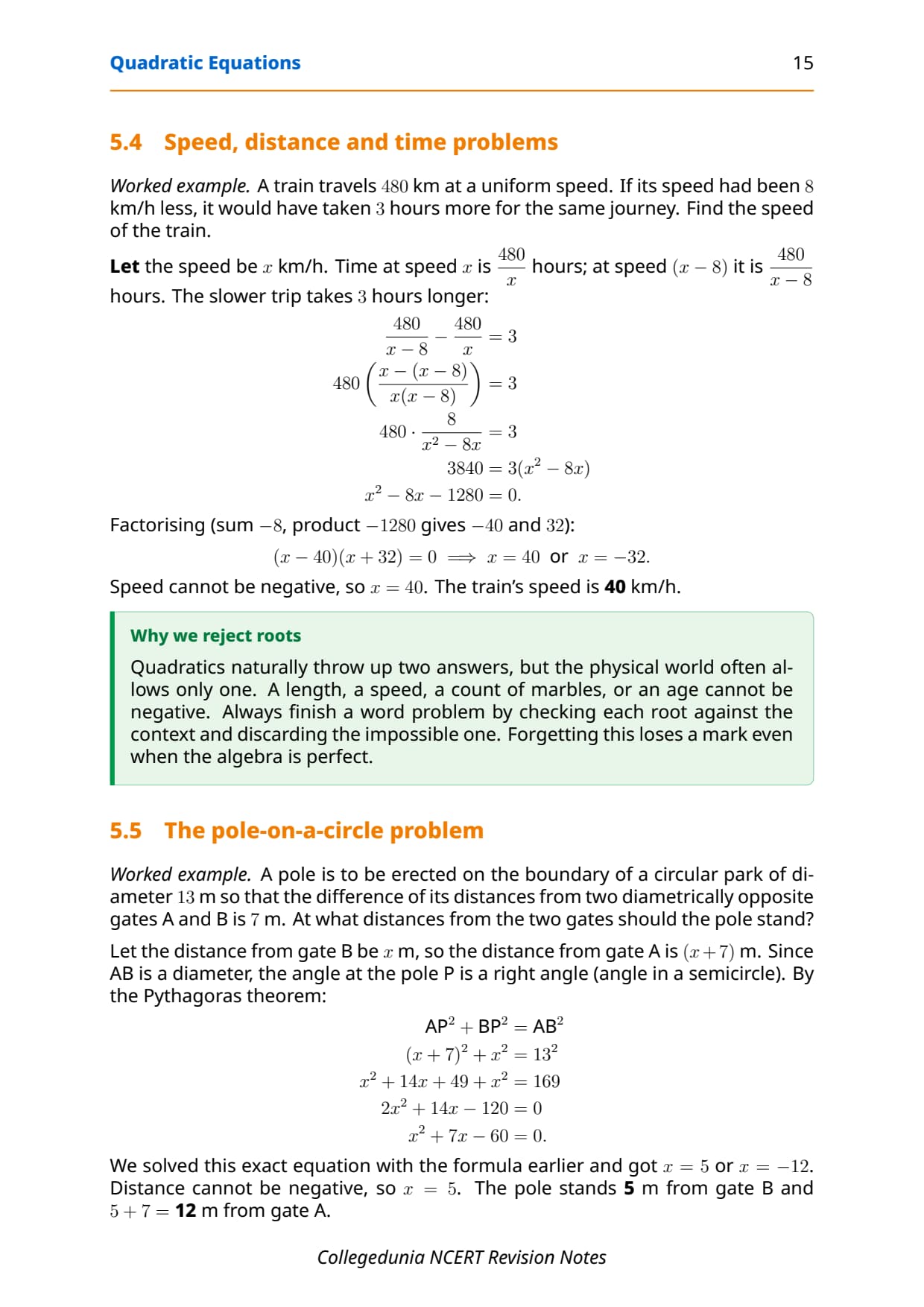
For x² + 7x - 60 = 0, a = 1, b = 7, c = −60, so b² − 4ac = 49 + 240 = 289 and √289 = 17. Then x = (−7 ± 17)/2, giving x = 5 or x = −12. Factorising (x − 5)(x + 12) = 0 gives the same answer, so the methods agree.
Discriminant and the Nature of Roots
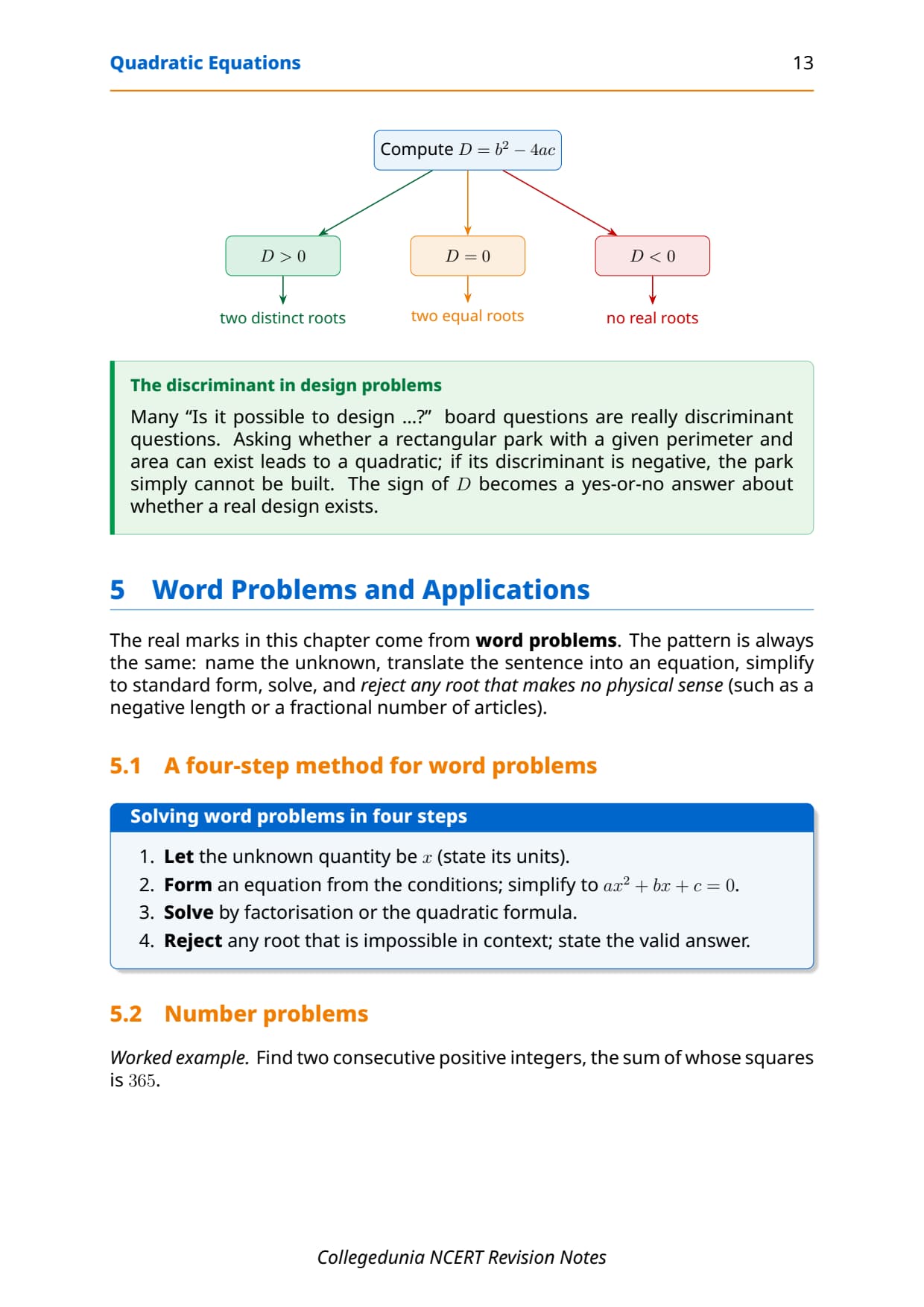
The expression under the square root, b² - 4ac, is the discriminant, written D. It decides the nature of the roots before you finish solving, because its sign controls whether the square root is real. This is a favourite one-mark and two-mark board topic, so learn all three cases together.
| Discriminant D = b² - 4ac | Nature of roots | What the graph does |
|---|---|---|
| D > 0 | Two distinct real roots | Curve cuts the x-axis at two points |
| D = 0 | Two equal real roots (coincident) | Curve just touches the x-axis |
| D < 0 | No real roots | Curve never meets the x-axis |
For 2x² - 4x + 3 = 0, D = (−4)² − 4(2)(3) = 16 − 24 = −8, which is less than 0, so it has no real roots. A common board question gives a constant k and asks for the value that makes D = 0, forcing equal roots. Just set b² − 4ac = 0 and solve for k.
Previous Year Question Trends
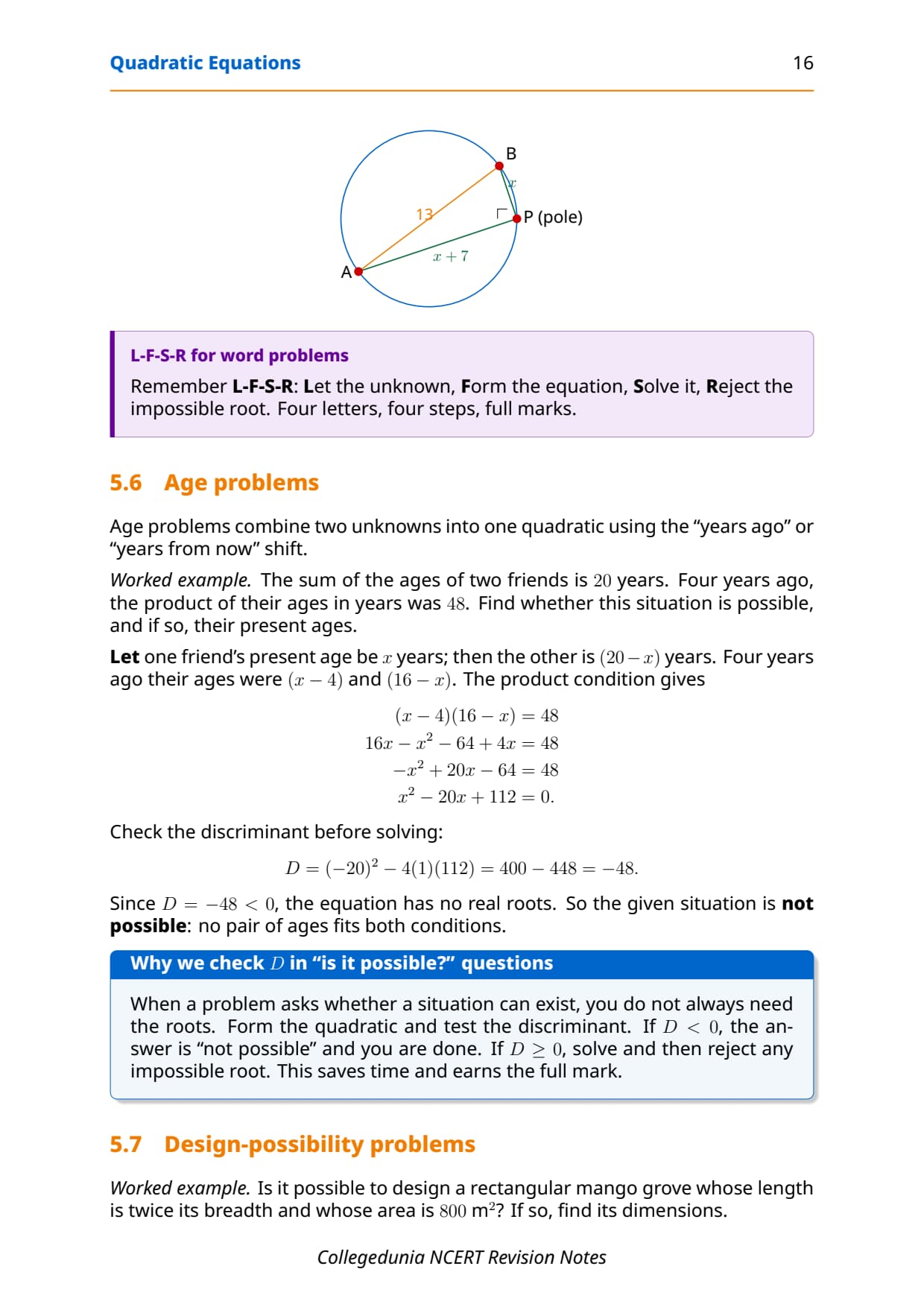
CBSE papers test this chapter mainly through solving by factorisation or the formula, the discriminant and nature of roots, finding a constant k for equal roots, and word problems on area, ages or speed.
| Year | Question type asked | Marks |
|---|---|---|
| 2025 | Solve a word problem (speed and distance or ages) using a quadratic equation | 3 |
| 2024 | Find the value of k for which the equation has two equal roots | 2 or 3 |
| 2023 | Solve a given quadratic equation by the quadratic formula | 2 or 3 |
| 2022 | Find the discriminant and state the nature of the roots | 1 or 2 |
| 2021 | Find the roots by factorisation and verify them | 2 |
Also Check: The full set of CBSE board paper questions for this chapter, with step-by-step answers, is in the PDF above, updated for the 2026-27 cycle.
Common Mistakes to Avoid
The repeat-offender mistakes in board answers:
- Judging before simplifying: calling an equation quadratic without bringing every term to one side.
- Wrong split in factorisation: the two numbers must multiply to a×c, not just c, and add to b.
- Breaking the formula: the full −b and the root are both over 2a.
- Sign slips in the discriminant: (−4)² is 16, and a negative c makes −4ac positive.
- Skipping the check: not putting the roots back to verify. It is an easy mark.
Other Resources for This Chapter
Pair these notes with the matching NCERT Solutions, formula sheet, handwritten notes and the official NCERT book chapter. All resources for Quadratic Equations are linked below.
| Resource | What it covers | Open |
|---|---|---|
| Notes | Concept-first notes on the standard form, factorisation, the quadratic formula, and the discriminant. | You are here |
| NCERT Solutions | Step-by-step answers to all exercise questions, with an Expert Solution for each. | Class 10 Maths Chapter 4 NCERT Solutions |
| Formula Sheet | One-page list of the standard form, the quadratic formula, and the discriminant rules for fast revision. | Class 10 Maths Chapter 4 Formula Sheet |
| Handwritten Notes | Scanned-style handwritten pages for last-minute board revision. | Class 10 Maths Chapter 4 Handwritten Notes |
| NCERT Book PDF | Official NCERT Maths Chapter 4 Quadratic Equations textbook in PDF form. | Class 10 Maths Chapter 4 NCERT Book PDF |
| Exemplar Solutions | Worked answers to the harder NCERT Exemplar problems for extra practice. | Class 10 Maths Chapter 4 Exemplar Solutions |
Notes for Class 10 Maths: All Chapters
Related Links: Use the table below to open the notes for the other chapters of Class 10 Maths. Every chapter has the same concept-first style, a PDF download, and a revision FAQ.
| Chapter | Notes link |
|---|---|
| Chapter 1 | Real Numbers Notes |
| Chapter 2 | Polynomials Notes |
| Chapter 3 | Pair of Linear Equations in Two Variables Notes |
| Chapter 4 | Quadratic Equations Notes (You are here) |
| Chapter 5 | Arithmetic Progressions Notes |
| Chapter 6 | Triangles Notes |
| Chapter 7 | Coordinate Geometry Notes |
| Chapter 8 | Introduction to Trigonometry Notes |
| Chapter 9 | Some Applications of Trigonometry Notes |
| Chapter 10 | Circles Notes |
| Chapter 11 | Areas Related to Circles Notes |
| Chapter 12 | Surface Areas and Volumes Notes |
| Chapter 13 | Statistics Notes |
| Chapter 14 | Probability Notes |
Notes Class 10 Maths Chapter 4 Quadratic Equations FAQs
Ques. What does Chapter 4 Quadratic Equations cover in Class 10 Maths?
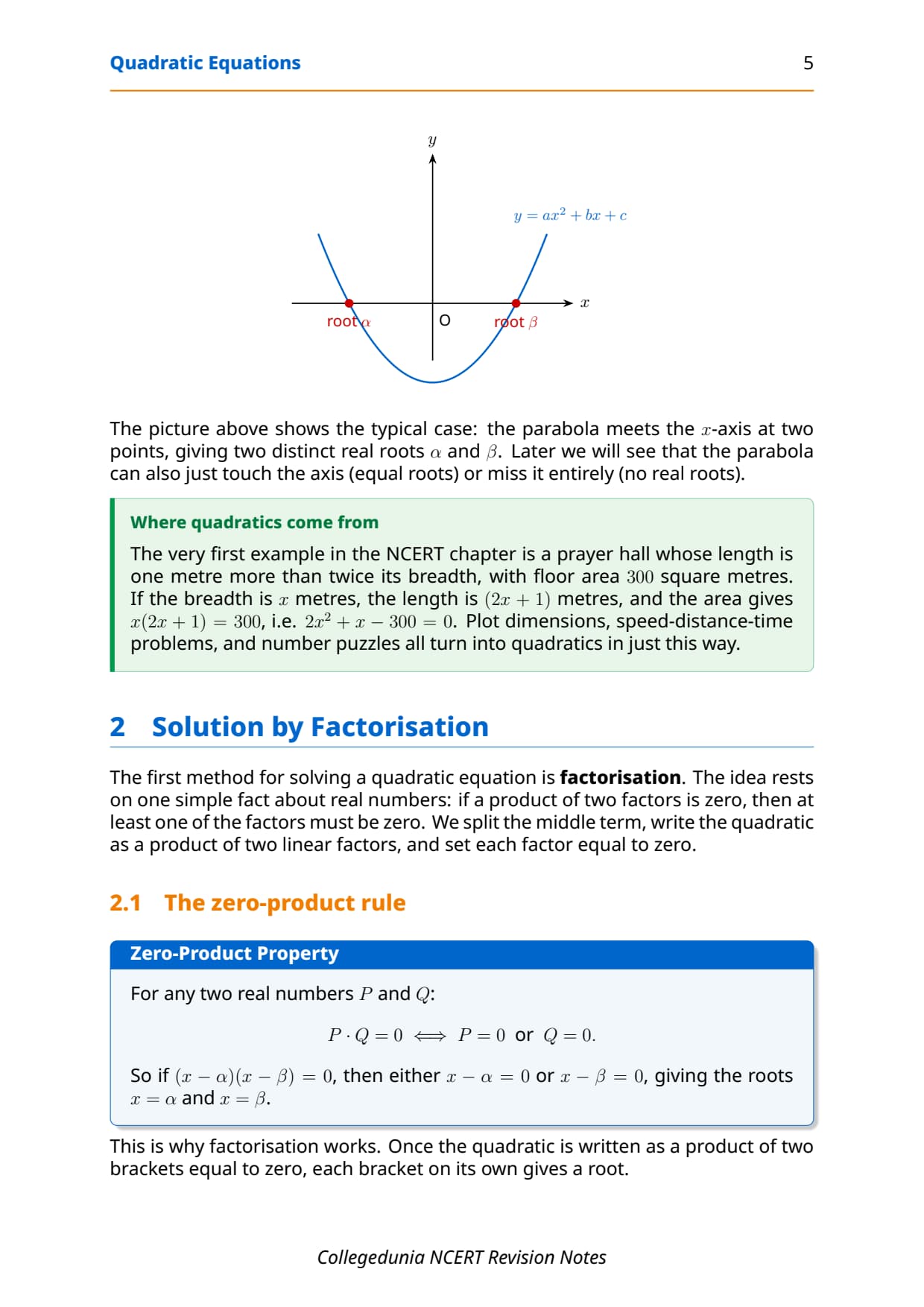
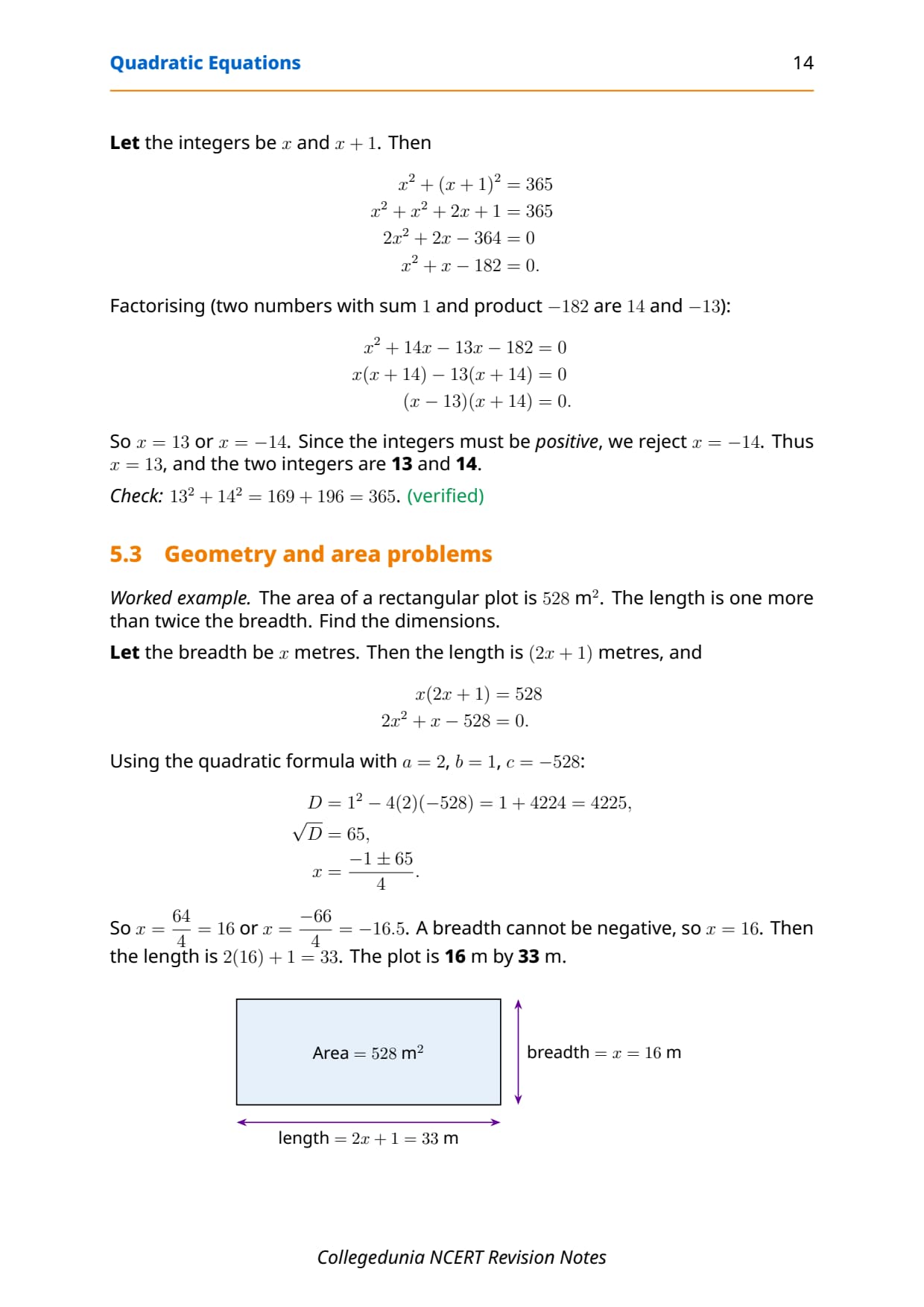
Ans. Chapter 4 covers three main ideas in the 2026-27 CBSE syllabus. First, recognising a quadratic equation and writing it in the standard form ax² + bx + c = 0, where a, b and c are real numbers and a is not 0. Second, finding the roots two ways: factorisation, where you split the middle term and set each linear factor to zero, and the quadratic formula x = (−b ± the square root of b² − 4ac) all over 2a. Third, reading the nature of the roots from the discriminant b² − 4ac, which tells you whether the equation has two distinct real roots, two equal real roots, or no real roots. The chapter also applies these tools to word problems on area, consecutive integers, ages and uniform speed.
Ques. What is the standard form of a quadratic equation?
Ans. The standard form of a quadratic equation is ax² + bx + c = 0, where a, b and c are real numbers and a is not equal to 0. Here a is the coefficient of x squared, b is the coefficient of x, and c is the constant term. The condition that a is not 0 is essential, because if a were 0 the x squared term would disappear and the equation would only be linear. Many equations do not look quadratic at first, so you simplify both sides, bring every term to one side so the other side is 0, and then check that the highest power of x is exactly 2 before reading off a, b and c.
Ques. How do you solve a quadratic equation by factorisation?
Ans. To solve by factorisation you split the middle term. First multiply the coefficient of x squared by the constant, that is a times c, and look for two numbers that multiply to give that product and add to give b, the coefficient of x. Split the middle term bx into those two terms, group the four terms into two pairs, and factor each pair so a common bracket appears. This gives a product of two linear factors equal to 0, so you set each factor to 0 and solve. For example, 2x² − 5x + 3 = 0 becomes (2x − 3)(x − 1) = 0, giving x = 3/2 or x = 1. Always substitute the roots back to verify them.
Ques. What is the quadratic formula in Class 10 Maths?
Ans. The quadratic formula gives the roots of any equation ax² + bx + c = 0 with a not 0. The roots are x = (−b ± the square root of b² − 4ac) all over 2a, provided b² − 4ac is not negative. This formula, credited to the Indian mathematician Sridharacharya and derived by completing the square, always works, so it is the safe fallback when an equation does not factorise neatly. Read off a, b and c from the standard form, compute the value under the square root first, then apply the plus and the minus in turn to get the two roots. Remember that the whole of −b and the square root sit over the single denominator 2a.
Ques. What is the discriminant and how does it decide the nature of the roots?
Ans. The discriminant is the expression b² − 4ac, the part that sits under the square root in the quadratic formula, and it is written as D. Its sign decides the nature of the roots without solving the equation. If D is greater than 0, the equation has two distinct real roots and its curve cuts the x-axis at two points. If D equals 0, the equation has two equal real roots, also called coincident roots, and its curve just touches the x-axis. If D is less than 0, the equation has no real roots, because the square root of a negative number is not real, and the curve never meets the x-axis. A common board question asks for the value of a constant that makes D = 0 so the roots are equal.
Ques. What is the difference between factorisation and the quadratic formula?
Ans. Both methods find the same roots, but they suit different equations. Factorisation by splitting the middle term is fastest when a times c gives a small product whose factors add to b easily, so the linear factors come out with whole numbers or simple fractions. The quadratic formula always works, even when the equation does not factorise with nice numbers, so it is the reliable fallback and the method to reach for whenever the split is not obvious. A good exam habit is to try factorisation first for a quick answer, and switch to the formula if the two split numbers are hard to find. Both methods can also reveal equal roots or, through the discriminant, that there are no real roots.
Ques. How do you turn a word problem into a quadratic equation?
Ans. Follow four steps you can remember as Name, Form, Solve, Check. First name the unknown with a clear statement such as let x be the breadth or let x be the smaller integer. Then form one quadratic equation by translating the conditions, for example area equals length times breadth, or a product of two consecutive integers, or distance equals speed times time for a uniform-speed problem. Next solve the equation by factorisation or the quadratic formula. Finally check the answer in the original situation and reject any root that makes no sense, such as a negative length or a negative number of items. This last step matters because a quadratic gives two roots but a real-world quantity often allows only one.
Ques. How many pages is the Class 10 Maths Quadratic Equations Notes PDF?
Ans. The Quadratic Equations Notes PDF runs about 20 pages and covers the full chapter in concept-first revision blocks. It includes the standard form ax² + bx + c = 0, how to check whether an equation is quadratic, finding roots by factorisation through splitting the middle term, the quadratic formula of Sridharacharya, the discriminant b² − 4ac with the three cases for the nature of the roots, and a set of common word-problem types with full working. The PDF is free to download for the 2026-27 session, and a green Handwritten Notes button on this page opens the scanned-style version for last-minute revision.
Ques. Are these Notes for Class 10 Maths Chapter 4 aligned with the 2026-27 syllabus?
Ans. Yes. This page reflects the current rationalised 2026-27 CBSE syllabus for Class 10 Maths. Quadratic Equations is the fourth chapter of the Algebra unit, and the focus is on the standard form, finding roots by factorisation and by the quadratic formula, and reading the nature of the roots from the discriminant. These notes follow the NCERT textbook order and are useful for the CBSE board exam, while the same algebra ideas also help with the CUET General Test and Class 11 algebra ahead.



Comments