




These class 10 geography notes chapter 3 Water Resources pull together every idea NCERT tests: why water is renewable, what causes water scarcity, multi-purpose river projects and their criticism, the Narmada Bachao Andolan, and the traditional rainwater harvesting methods of India.
Chapter3WaterResourcesNotes.pdf?page=1&dpi=150)
Chapter3WaterResourcesNotes.pdf?page=2&dpi=150)
Chapter3WaterResourcesNotes.pdf?page=3&dpi=150)
Chapter3WaterResourcesNotes.pdf?page=4&dpi=150)
Chapter3WaterResourcesNotes.pdf?page=5&dpi=150)
Chapter3WaterResourcesNotes.pdf?page=6&dpi=150)
Chapter3WaterResourcesNotes.pdf?page=7&dpi=150)
Chapter3WaterResourcesNotes.pdf?page=8&dpi=150)
Chapter3WaterResourcesNotes.pdf?page=9&dpi=150)
Chapter3WaterResourcesNotes.pdf?page=10&dpi=150)
Chapter3WaterResourcesNotes.pdf?page=11&dpi=150)
Chapter3WaterResourcesNotes.pdf?page=12&dpi=150)
Chapter3WaterResourcesNotes.pdf?page=13&dpi=150)
Chapter3WaterResourcesNotes.pdf?page=14&dpi=150)
Chapter3WaterResourcesNotes.pdf?page=15&dpi=150)
Chapter3WaterResourcesNotes.pdf?page=16&dpi=150)
Chapter3WaterResourcesNotes.pdf?page=17&dpi=150)
Chapter3WaterResourcesNotes.pdf?page=18&dpi=150)
Chapter3WaterResourcesNotes.pdf?page=19&dpi=150)
Chapter3WaterResourcesNotes.pdf?page=20&dpi=150)
Chapter3WaterResourcesNotes.pdf?page=21&dpi=150)
The file takes a student from a cold start back to chapter-fluency in about thirty minutes the night before the board exam, according to the latest 2026-27 CBSE syllabus.
- Concept-first revision of the full chapter: water scarcity, dams and multi-purpose projects, the NBA, and rainwater harvesting.
- Every must-know number and name, including the 96.5% salt water fact, Bhakra Nangal, Hirakud and Sardar Sarovar, with the exact one-line definitions CBSE markers reward.
- Cross-pointers to the matching NCERT Solutions, Handwritten Notes and NCERT Book PDF for Chapter 3.
Every line in these water resources class 10 notes is written by Collegedunia geography experts, based on the 2026-27 NCERT Contemporary India II textbook, and checked against the last five years of CBSE Class 10 Social Science board papers.
Student Feedback: What 9,800 students told us about revising this chapter
71% of Class 10 students said the criticism of multi-purpose projects was the single hardest 5-mark answer to recall in this chapter. 3 out of 4 students rated the rainwater harvesting section and the dam project list as the parts most worth revising from a printable notes sheet.
Toppers reported that pairing these class 10 geography notes chapter 3 Water Resources with the matching NCERT Solutions PDF added 2 to 3 marks per 5-mark answer in mock tests. The average student finished the full notes revision in 28 minutes against a one-hour budget for the chapter.
Source: 2026-27 Class 10 Social Science student poll. Sample of 9,800 students from CBSE schools across 13 states, conducted before the 2026 boards.
Quick Concept Recap: Water Resources at a Glance
Chapter 3 explains why a renewable resource like water still becomes scarce, and how India manages it through dams and rainwater harvesting. About 96.5 per cent of the world's water is salt water in the oceans, and only a tiny share is usable freshwater.
- Renewable but scarce: water is renewed by the hydrological cycle, yet scarcity arises from over-exploitation, excessive use and unequal access.
- Multi-purpose projects: dams integrating irrigation, power, water supply, flood control and navigation; Nehru's "temples of modern India".
- Criticism and the NBA: dams fragment rivers, submerge land and displace people; the Narmada Bachao Andolan opposed the Sardar Sarovar Dam.
- Rainwater harvesting: tankas of Rajasthan, bamboo drip irrigation of Meghalaya and rooftop harvesting in Gendathur and Tamil Nadu.
Read these notes first, then drop into the matching NCERT Solutions for Class 10 Geography Chapter 3 for the exercise drill.
Water Resources Class 10 Explained in Simple Language
Source: Magnet Brains on YouTube
Why Water Is Renewable Yet Still Becomes Scarce
The first thing CBSE tests is the renewable-yet-scarce paradox. Water is renewable because the hydrological cycle constantly recharges rivers, lakes and groundwater, the one-word trigger for "why is water renewable".
| Term | One-line definition |
|---|---|
| Renewable resource | Renewed by nature within a short time; water through the hydrological cycle. |
| Water scarcity | Shortage of usable water from over-use, pollution or unequal access, not always low rainfall. |
| Over-exploitation | Pumping groundwater faster than it recharges, lowering the water table. |
| Unequal access | A few social or economic groups control most of the available water. |
- About 96.5 per cent of the world's water is salt water; only about 2.5 per cent is freshwater, most locked in ice and deep groundwater.
- Scarcity does not always mean low rainfall; an area can be water-scarce if water is polluted or controlled by a few groups.
- By 2025, nearly two billion people will live in absolute water scarcity.
Easy mark: "water is renewable because of the hydrological cycle" earns full marks. For "why does scarcity occur", name both quantity (over-use, falling water table) and quality (pollution). A handy hook for the causes is POUR: Pollution, Over-exploitation, Unequal access, Rising population.
What Drives the Demand for Water in India
A large and growing population needs water for drinking and to grow more food. Irrigated agriculture is the largest consumer of water in India, and many farmers run their own wells and tube-wells, slowly lowering groundwater levels and threatening food security.
- Farming: dry-season agriculture and well-and-tube-well irrigation are the biggest pull on water.
- Industry: factories are heavy water users and also need power, much from hydroelectricity.
- Cities: dense urban centres with private groundwater pumps have over-exploited fragile resources.
Two flagship schemes answer this: the Jal Jeevan Mission aims to give every rural household 55 litres of safe piped drinking water per person per day, and the Atal Bhujal Yojana targets over-exploited groundwater blocks in water-stressed gram panchayats.
Multi-purpose River Projects and Integrated Water Management
A dam is a barrier across flowing water that obstructs, directs or slows the flow, often creating a reservoir, usually with a spillway for excess water. A multi-purpose project integrates the many uses of the stored water rather than serving a single purpose.
Dams are classified by structure (timber, embankment, masonry), by height (low, medium, high) and by purpose (irrigation, power, water supply, flood control).
Jawaharlal Nehru called dams the "temples of modern India", because they would link agriculture and the village economy with industry and urban growth. Hydraulic structures are not new to India: a flood-water channel at Sringaverapura near Allahabad dates to the 1st century B.C., and Bhopal Lake was built in the 11th century.
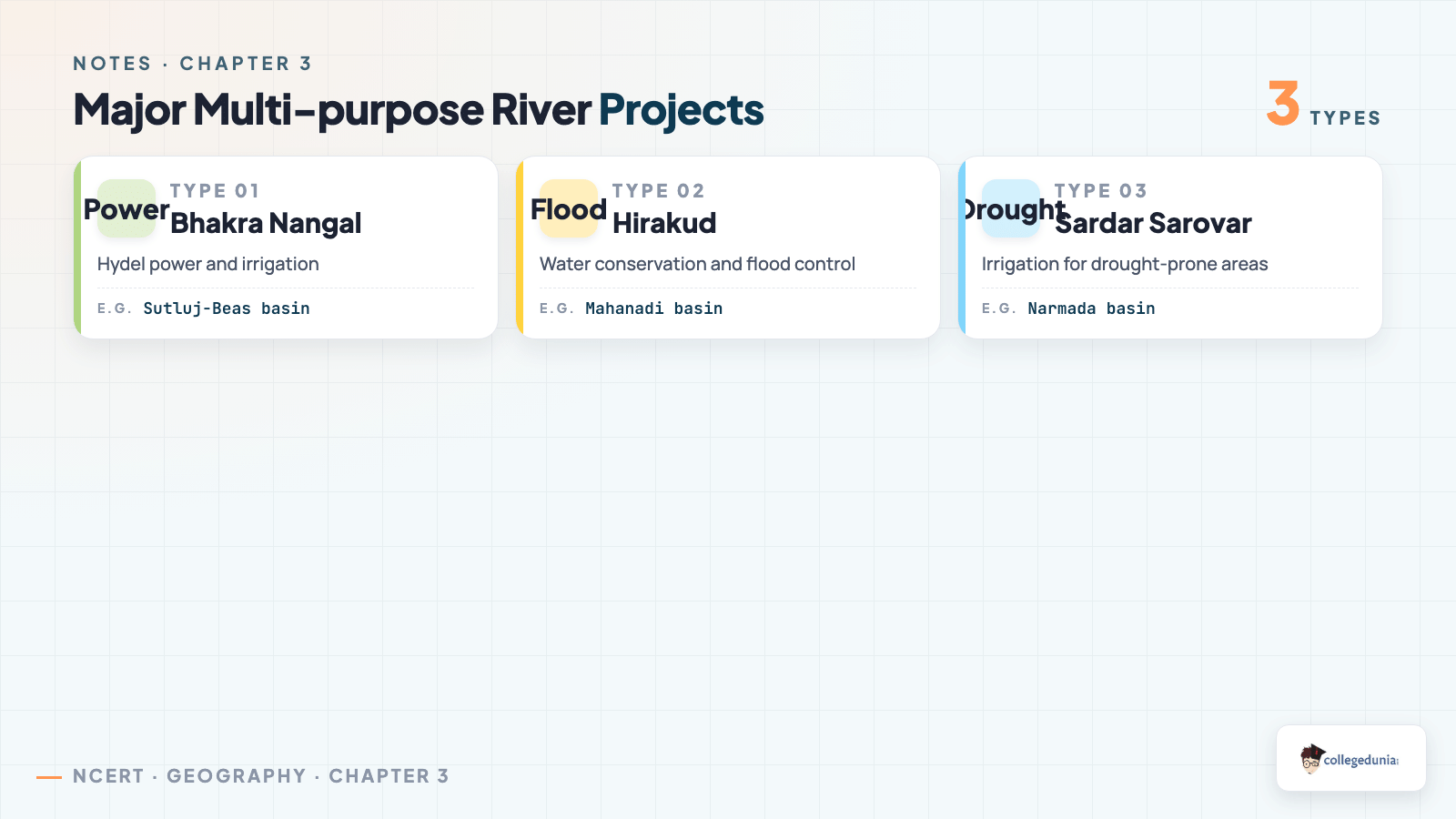
| Project | River / Basin | Key purpose |
|---|---|---|
| Bhakra Nangal | Sutluj-Beas | Hydel power and irrigation |
| Hirakud | Mahanadi | Water conservation and flood control |
| Sardar Sarovar | Narmada | Irrigation and drinking water for drought-prone areas |
The uses of a multi-purpose project are irrigation, power, water supply, flood control, navigation and recreation. Integrated water resources management plans a whole river basin so these demands are balanced; the Pradhan Mantri Krishi Sinchayee Yojana is a modern example.
Criticism of Multi-purpose Projects and the Narmada Bachao Andolan
This is where the heaviest 5-mark question sits. The criticism of dams is a CBSE favourite, so learn the points below as a clean list.
Main criticisms of multi-purpose river projects:
- Affect natural flow: poor sediment flow and heavy sedimentation leave rockier stream beds and poorer aquatic habitats.
- Fragment rivers: aquatic life finds it hard to migrate, especially for spawning.
- Submerge land: reservoirs drown vegetation and soil, and displace people.
- Induced problems: projects have triggered earthquakes, water-borne diseases and pollution.
- Changed cropping pattern: farmers shift to water-intensive crops, causing soil salinisation.
- Triggered floods: ironically, dams built to control floods have triggered them through sedimentation and largely failed in very heavy rain.
A frequent error is to claim dams always control floods. Inter-state water disputes also arise, such as the Krishna-Godavari dispute, where Karnataka and Andhra Pradesh objected to Maharashtra diverting more water at Koyna.
The Narmada Bachao Andolan (NBA)
The Narmada Bachao Andolan mobilised tribal people, farmers and activists against the Sardar Sarovar Dam on the Narmada in Gujarat. For a 3-mark answer: it opposed the dam, began over submergence and environmental damage, and later shifted to displacement and rehabilitation of affected people.
- The Sardar Sarovar is one of India's largest water projects, covering Maharashtra, Madhya Pradesh, Gujarat and Rajasthan, and meets the needs of drought-prone areas.
- It will provide irrigation to about 18.45 lakh hectare of land.
Rainwater Harvesting: Traditional and Modern Methods
This section is the most scoring, because it is full of named, place-specific examples. Each region developed its own method to match its land and rainfall.
| Method | Region | What it does |
|---|---|---|
| Guls / kuls | Western Himalayas | Diversion channels carrying water for hill farming. |
| Tankas + rooftop harvesting | Rajasthan (Bikaner, Phalodi, Barmer) | Underground tanks storing rooftop rainwater for drinking. |
| Inundation channels | West Bengal floodplains | Channels spreading flood water to irrigate fields. |
| Khadins / johads | Rajasthan | Earthen structures storing rainwater to recharge soil and wells. |
Tankas of Rajasthan and Palar Pani
In arid Rajasthan (Bikaner, Phalodi, Barmer), almost every traditional house had an underground tank called a tanka for drinking water, built inside the house or courtyard and connected by a pipe to the sloping rooftop.
- The first spell of rain was discarded to clean the roof and pipes; only later showers were collected.
- The stored water, called palar pani, is considered the purest natural water and a reliable summer drinking source.
Common one-mark question: the "first-spell" rule, where the first rain is discarded to wash the roof and only later showers are stored as palar pani.
Modern Rooftop Harvesting and Bamboo Drip Irrigation
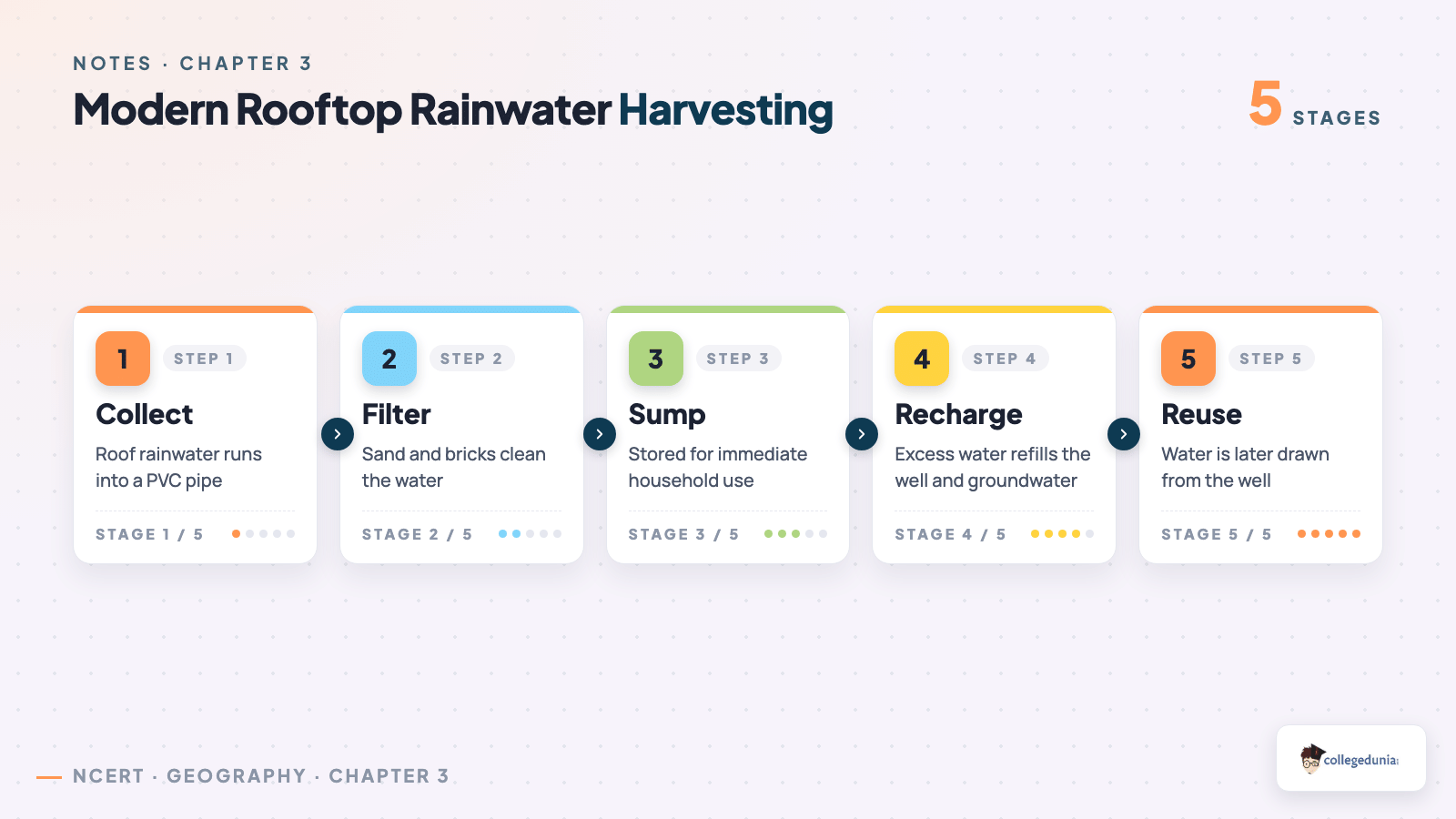
Modern rooftop harvesting collects roof water through a PVC pipe, filters it, and lets the excess recharge the well. In Gendathur (Mysuru, Karnataka), nearly 200 households harvest about 50,000 litres per house each year. Tamil Nadu is the first state to make rooftop harvesting compulsory.
Do not confuse this with bamboo drip irrigation, a 200-year-old Meghalaya system that taps stream and spring water (not rooftop rain) using bamboo pipes and gravity. A paradox: Cherrapunji and Mawsynram get the world's highest rainfall, yet nearby Shillong faces acute shortage, proving storage is what makes rainwater usable.
Why Conserve Water and Everyday Conservation Practices
Conservation often appears as a 3-mark question. For "why conserve water", give the four NCERT reasons: health, food security, livelihoods and protecting ecosystems.
- Fix leaking taps and pipes; reuse household water for gardening and cleaning.
- Harvest rooftop rainwater and recharge groundwater.
- Use drip and sprinkler irrigation ("per drop more crop").
- Treat and reuse industrial and domestic waste water instead of polluting rivers.
CBSE Previous Year Trends and Highest-Yield Topics
This chapter is a steady source of marks. Prioritise these for the 2026-27 cycle:
- Highest-yield topics: criticism of multi-purpose projects (5 marks) and causes of water scarcity (3 to 5 marks).
- Must-know names: Bhakra Nangal (Sutluj-Beas), Hirakud (Mahanadi) and Sardar Sarovar (Narmada).
- Must-know facts: 96.5 per cent salt water, the POUR causes, palar pani and the first-spell rule, and Tamil Nadu's compulsory rooftop harvesting.
Other Resources for Class 10 Geography Chapter 3 Water Resources
Pair these revision notes with the matching NCERT Solutions, handwritten notes and the official NCERT book chapter. The cross-resource table below links to every Collegedunia file for Class 10 Geography Chapter 3.
| Resource | What it covers | Open |
|---|---|---|
| Notes | Concept-first revision notes covering water scarcity, multi-purpose projects, dam criticism, the NBA and rainwater harvesting. | You are here |
| NCERT Solutions | Step-by-step answers to every exercise question, including the 5-mark answers with full detail. | Class 10 Geography Chapter 3 NCERT Solutions |
| Handwritten Notes | Scanned-style handwritten revision pages for last-minute board exam practice. | Class 10 Geography Chapter 3 Handwritten Notes |
| NCERT Book PDF | Official NCERT Contemporary India II Chapter 3 textbook in PDF form. | Class 10 Geography Chapter 3 NCERT Book PDF |
All Chapters Notes for Class 10 Geography Contemporary India II
Related Links: Use the table below to reach the Notes for the other chapters of Class 10 Geography Contemporary India II. Every chapter ships with the same revision-friendly structure, key definitions and FAQ block.
| Chapter | Topic | Notes link |
|---|---|---|
| Chapter 1 | Resources and Development | Class 10 Geography Chapter 1 Notes |
| Chapter 2 | Forest and Wildlife Resources | Class 10 Geography Chapter 2 Notes |
| Chapter 3 | Water Resources | You are here |
| Chapter 4 | Agriculture | Class 10 Geography Chapter 4 Notes |
| Chapter 5 | Minerals and Energy Resources | Class 10 Geography Chapter 5 Notes |
| Chapter 6 | Manufacturing Industries | Class 10 Geography Chapter 6 Notes |
| Chapter 7 | Lifelines of National Economy | Class 10 Geography Chapter 7 Notes |
NCERT Notes Class 10 Geography Chapter 3 Water Resources FAQs
Ques. What do the class 10 geography notes chapter 3 Water Resources cover?
Ans. These class 10 geography notes chapter 3 Water Resources are a concept-first revision file that compress the entire NCERT Chapter 3 of Class 10 Geography Contemporary India II into a printable study guide. They cover why water is renewable yet scarce, the causes of water scarcity, multi-purpose river projects such as Bhakra Nangal and Hirakud, the criticism of dams, the Narmada Bachao Andolan, and rainwater harvesting through tankas, bamboo drip irrigation and rooftop systems. Students typically use these notes for a 30-minute first-pass revision and a 20-minute night-before pass, while the worked answers to the exercise questions live in the matching NCERT Solutions PDF.
Ques. Why is water called a renewable resource that still becomes scarce?
Ans. Water is renewable because the hydrological cycle constantly recharges rivers, lakes and groundwater, so the one-word answer for "why is water renewable" is the hydrological cycle. Yet about 96.5 per cent of the world's water is salt water in the oceans, and only a small share of freshwater is usable. Scarcity occurs not only from low rainfall but from over-exploitation of groundwater, a growing population, industrial and urban demand, unequal access and pollution. An easy memory hook is POUR: Pollution, Over-exploitation, Unequal access and Rising population. It is predicted that by 2025 nearly two billion people will live in absolute water scarcity.
Ques. What is a multi-purpose river project and why did Nehru call dams temples of modern India?
Ans. A multi-purpose river project is one where the many uses of the stored water are integrated with one another, instead of serving a single purpose. A dam is a barrier across flowing water, usually with a spillway for excess flow. The uses can be remembered as irrigation, power, water supply, flood control, navigation and recreation. Jawaharlal Nehru called dams the "temples of modern India" because they would link the development of agriculture and the village economy with industry and urban growth. Examples include Bhakra Nangal on the Sutluj-Beas, Hirakud on the Mahanadi and Sardar Sarovar on the Narmada.
Ques. Why are multi-purpose projects criticised in Class 10 Geography?
Ans. Multi-purpose projects are criticised on several counts. They affect the natural flow of rivers and cause heavy sedimentation in the reservoir. They fragment rivers, making it hard for aquatic life to migrate and spawn. They submerge land and vegetation, and they displace large numbers of people. They have induced earthquakes, water-borne diseases and pollution, and they push farmers towards water-intensive crops that cause soil salinisation. Ironically, dams built to control floods have sometimes triggered them through sedimentation and have largely failed during very heavy rain. This is the most common 5-mark question from the chapter.
Ques. What was the Narmada Bachao Andolan?
Ans. The Narmada Bachao Andolan is a non-governmental organisation that mobilised tribal people, farmers, environmentalists and human-rights activists against the Sardar Sarovar Dam being built across the Narmada in Gujarat. For a 3-mark answer, hit three beats: it opposed the Sardar Sarovar Dam, it began over the submergence of land and environmental damage, and it later shifted its focus to the displacement and rehabilitation of the affected people. The Sardar Sarovar is one of India's largest water projects, covering Maharashtra, Madhya Pradesh, Gujarat and Rajasthan, and is meant to irrigate about 18.45 lakh hectare of land.
Ques. What are the main rainwater harvesting methods in this chapter?
Ans. The chapter describes both traditional and modern rainwater harvesting. In the hills, guls and kuls divert water for farming. In the deserts of Rajasthan, underground tankas store rooftop rainwater as palar pani, with the first spell of rain discarded to clean the roof. In West Bengal, inundation channels spread flood water onto fields. Meghalaya uses a 200-year-old bamboo drip irrigation system that taps stream and spring water by gravity. Modern rooftop harvesting is reviving across India: Gendathur in Karnataka harvests about 50,000 litres per house each year, and Tamil Nadu is the first state to make rooftop harvesting compulsory for all houses.
Ques. Are these water resources class 10 notes updated for the 2026-27 session?
Ans. Yes. These class 10 geography notes chapter 3 Water Resources are based on the 2026-27 NCERT Contemporary India II textbook and the latest CBSE Class 10 Social Science sample paper. The chapter structure is unchanged for the current cycle, and the CBSE marking scheme continues to reward point-wise answers with clear cause-and-effect links for the 5-mark questions on dam criticism and water scarcity. Students should use these notes for both the short-answer and long-answer parts of the chapter, then move to the matching NCERT Solutions PDF for full worked answers.



Comments