




Inside the NCERT notes for Class 10 Economics Chapter 5 Consumer Rights, you get the six consumer rights with one example each, the ISI versus Agmark versus Hallmark logo table, the COPRA 1986 three-tier money ladder, and the four NCERT case studies examiners love, all according to the latest 2026-27 CBSE syllabus.
Chapter5ConsumerRightsNotes.pdf?page=1&dpi=150)
Chapter5ConsumerRightsNotes.pdf?page=2&dpi=150)
Chapter5ConsumerRightsNotes.pdf?page=3&dpi=150)
Chapter5ConsumerRightsNotes.pdf?page=4&dpi=150)
Chapter5ConsumerRightsNotes.pdf?page=5&dpi=150)
Chapter5ConsumerRightsNotes.pdf?page=6&dpi=150)
Chapter5ConsumerRightsNotes.pdf?page=7&dpi=150)
Chapter5ConsumerRightsNotes.pdf?page=8&dpi=150)
Chapter5ConsumerRightsNotes.pdf?page=9&dpi=150)
Chapter5ConsumerRightsNotes.pdf?page=10&dpi=150)
Chapter5ConsumerRightsNotes.pdf?page=11&dpi=150)
Chapter5ConsumerRightsNotes.pdf?page=12&dpi=150)
Chapter5ConsumerRightsNotes.pdf?page=13&dpi=150)
Chapter5ConsumerRightsNotes.pdf?page=14&dpi=150)
Chapter5ConsumerRightsNotes.pdf?page=15&dpi=150)
Chapter5ConsumerRightsNotes.pdf?page=16&dpi=150)
Chapter5ConsumerRightsNotes.pdf?page=17&dpi=150)
Chapter5ConsumerRightsNotes.pdf?page=18&dpi=150)
Chapter5ConsumerRightsNotes.pdf?page=19&dpi=150)
Chapter5ConsumerRightsNotes.pdf?page=20&dpi=150)
Chapter5ConsumerRightsNotes.pdf?page=21&dpi=150)
These consumer rights class 10 notes compress the whole chapter into quick-recall diagrams, definitions, and a CBSE previous-year trend table for fast revision.
- CBSE Weightage: 5 to 6 marks per board paper, drawn from Unit 5 Consumer Rights
- Question Spread: one 1-mark logo or date MCQ, one 3-mark difference question, and one 5-mark answer on the six rights or COPRA
Also Check:
- Consumer Rights Class 10 NCERT Solutions
- Globalisation and the Indian Economy Class 10 Economics Notes
- CBSE Class 10 Social Science Syllabus 2026-27
|
Table of Contents |
Consumer Rights Class 10 Notes Overview
This chapter answers one question: why is the buyer often weak, and how does the law protect them? These consumer rights class 10 notes follow the NCERT order, from exploitation to the six rights, complaints, quality logos and COPRA 1986.
| Topic | What It Covers | Board Weightage |
|---|---|---|
| Why the Consumer Is Weak | How buyers are exploited and why rules are needed | 1 to 3 marks |
| The Six Rights | Safety, Information, Choose, Redressal, Represent, Education | 3 to 5 marks |
| Filing a Complaint | The nine steps from Prakash's money-order case | 3 marks |
| Standardisation Logos | ISI, Agmark, Hallmark, FSSAI and Ecomark | 1 to 3 marks |
| COPRA and Three Tiers | District, State and National Commissions by claim value | 3 to 5 marks |
The biggest mark-earners are the six consumer rights and the three-tier redressal system; practise both as 5-mark answers.
Consumer Rights Class 10 Explained in Simple Language
Source: Magnet Brains on YouTube
What the Consumer Rights Class 10 Notes PDF Contains
- Exploitation tree grouping the four families of unfair trade practice the board asks you to "mention".
- Movement timeline from the 1960s food shortages to the 1985 UN Guidelines and COPRA in 1986.
- Six-rights diagram with the SICRRE mnemonic.
- Logo lookup table for ISI, Agmark, Hallmark, FSSAI and Ecomark.
- Three-tier money ladder for District, State and National Commissions.
- Case-to-right mapping for Reji, Amritha, Abirami and Prakash, plus a glossary and CBSE PYQ trend table.
Why the Consumer Is in a Weak Position
Markets do not work fairly when producers are few and powerful while consumers are many, small and scattered. The seller usually shifts blame onto the buyer, so rules are needed to protect the weaker side.
- Underweighing and overcharging: weighing less, charging above MRP, or hidden charges.
- Adulteration and defects: mixing cheaper material into food, selling poor-quality or defective goods.
- False information: misleading advertisements and false claims through the media.
- Unsafe and tied sales: selling hazardous goods, or forcing "buy this with that".
Rules are required because sellers shift blame, producers are few but consumers scattered, and false information and unfair trade practices are common. Add one example, such as a faulty weighing scale.
The Consumer Movement and Consumers International
The consumer movement is an organised, social effort by consumers to protect themselves against unfair trade practices. Earlier, an unhappy consumer simply avoided the shop, as it was assumed the buyer alone had to be careful. The movement turned that individual struggle into a shared one.
| Period | What Happened |
|---|---|
| 1960s | Food shortages and adulteration; the organised movement is born in India |
| 1970s | Articles and exhibitions; awareness work begins |
| 1985 | UN Guidelines adopted, the base for Consumers International |
| 1986 | COPRA enacted (amended 2019); the six rights get legal force |
At the international level, Consumers International is an umbrella body of over 200 organisations from 100+ countries. In India the movement led to consumer forums and voluntary groups that guide people on filing complaints.
The Six Rights of a Consumer in Class 10 Economics
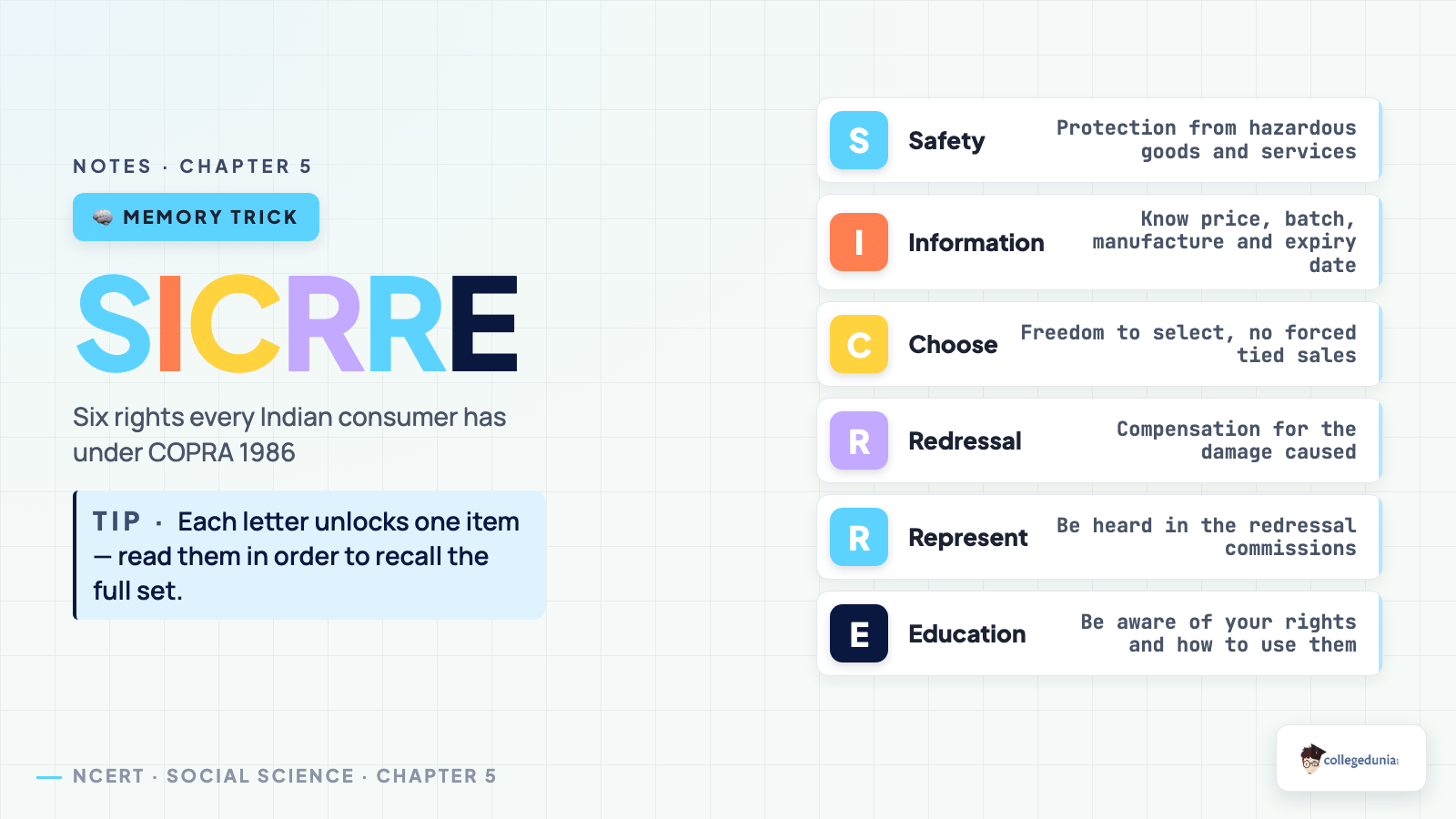
COPRA gives every consumer six rights, the most important section for the board exam. Learn each with a one-line meaning and one example.
| Right | What It Means | Example or NCERT Case |
|---|---|---|
| Right to Safety | Protection from goods and services hazardous to life and property | Reji's anaesthesia negligence case |
| Right to Information | Know ingredients, price, batch, manufacture and expiry date | RTI Act 2005; Amritha's case |
| Right to Choose | Freedom to select; cannot be forced into tied sales | Abirami's coaching refund case |
| Right to Seek Redressal | Compensation according to the degree of damage | Prakash's money-order case |
| Right to Represent | Be heard or represented in the redressal commissions | Consumer forums plead on your behalf |
| Right to Consumer Education | Be aware of one's rights and how to use them | The "Jago Grahak Jago" campaign |
MRP is the maximum legal price, so no shop may charge above it, and Reji's case proves the right to safety covers services too.
How to File a Consumer Complaint: The Nine Steps
The NCERT chapter shows the route to justice through Prakash, who sent a money order that never reached his daughter and took the failure to a verdict. His path is a ready-made flow for a 3-mark answer.
- Steps 1 to 3: he sends the money order, learns it never reached, and enquires at the post office.
- Steps 4 to 6: the reply is poor, so he visits the consumer protection council and files at the District Commission.
- Steps 7 to 9: he pleads the case himself, the judge hears both sides, and the commission gives the verdict.
A consumer can file alone or as a group, with or without a lawyer, and today even online. Most cases fail for missing proof, so always keep the cash memo, warranty card and receipts.
Standardisation Logos: ISI, Agmark and Hallmark
A key skill is reading the certification logos on packets. These are usually voluntary, but for products affecting health and safety, such as LPG cylinders, cement and packaged drinking water, certification is mandatory.
| Logo | Certifying Body | Products Covered |
|---|---|---|
| ISI | Bureau of Indian Standards | Electrical goods, LPG stoves, cement, helmets |
| Agmark | Directorate of Marketing and Inspection | Edible oil, cereals, spices, honey, pulses |
| Hallmark | Bureau of Indian Standards | Gold and silver jewellery (purity) |
| FSSAI / +F | FSSAI | Packaged and fortified food safety |
| Ecomark | Bureau of Indian Standards | Eco-friendly products |
ISI is for industrial goods, Agmark for agricultural and food goods, and Hallmark for jewellery. ISI and Hallmark are both issued by the Bureau of Indian Standards.
COPRA 1986 and the Three-Tier Redressal System
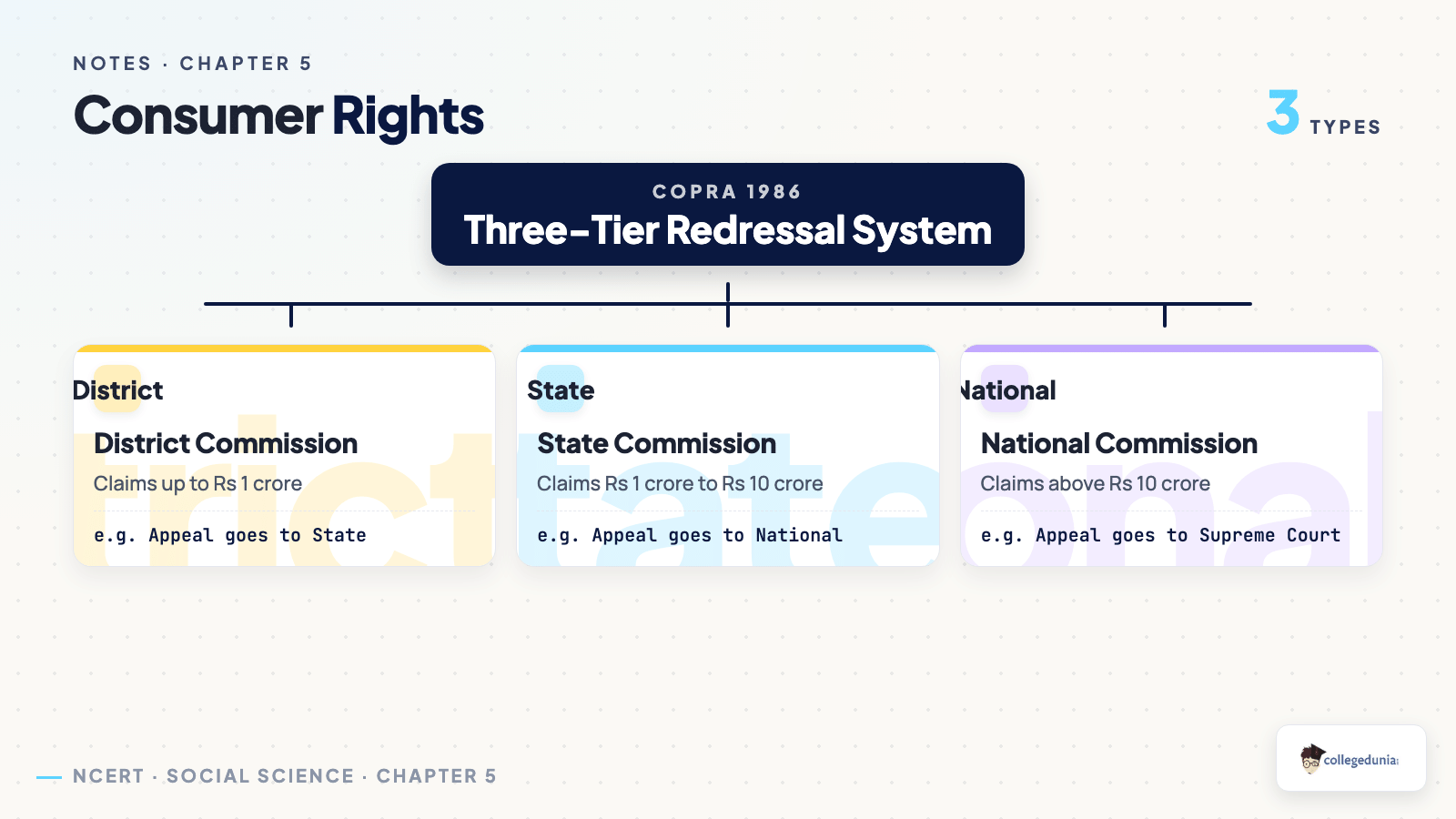
In 1986 the government enacted the Consumer Protection Act (COPRA), amended in 2019. It set up a three-tier machinery to settle disputes by claim value, and gave legal force to the six rights.
| Level | Claim Value | Appeal Goes To |
|---|---|---|
| District Commission | Up to Rs 1 crore | State Commission |
| State Commission | Rs 1 crore to Rs 10 crore | National Commission |
| National Commission | Above Rs 10 crore | Supreme Court |
The 2019 amendment added internet buying and made the manufacturer responsible for a defect. Note the difference examiners test: a Consumer Protection Council only guides consumers, while a Consumer Disputes Redressal Commission hears cases and gives verdicts.
NCERT Case Studies at a Glance
Examiners often quote a case and ask "which right does this illustrate?" Map each case to its right to answer instantly.
| Case | Right Shown | What Happened |
|---|---|---|
| Reji's Suffering | Right to Safety | Anaesthesia negligence; the National Commission held the hospital responsible |
| Waiting (Amritha) | Right to Information | An RTI application forced the department to reveal her result |
| A Refund (Abirami) | Right to Choose | Commissions ordered a coaching-fee refund and fined the institute |
| Prakash's Money Order | Right to Seek Redressal | A failed money order taken to a District Commission verdict |
Taking the Consumer Movement Forward
India observes 24 December as National Consumers' Day, the day Parliament enacted COPRA in 1986. There are today over 2000 consumer groups, of which only about 50 to 60 are well organised.
- Achievements: COPRA and its 2019 update, over 2000 consumer groups, dedicated redressal authority.
- Hurdles: redressal is costly and slow, lawyers are often needed, and cash memos are usually not issued, so evidence is hard to gather.
- Closing idea: the movement works only with the active involvement of consumers; an alert consumer is a safe consumer.
How to Use the Consumer Rights Class 10 Notes Most Effectively
- First read: go section by section through why the consumer is weak, the movement, and the six rights.
- Second pass: drill the tables and diagrams, reciting SICRRE, the money ladder and the ISI-Agmark-Hallmark hooks.
- Night before: read the glossary, then attempt last year's PYQ. For case questions, name the right, then its meaning, then the remedy, quoting Reji, Amritha, Abirami and Prakash for application marks.
Related Resources for Class 10 Economics Chapter 5
| Resource | What You Get |
|---|---|
| Consumer Rights Class 10 NCERT Solutions | Step-by-step answers to every NCERT in-text and exercise question |
| Consumer Rights Class 10 Handwritten Notes | Scanned pen-on-paper notes for quick one-shot revision |
| Consumer Rights Class 10 NCERT Book PDF | The original NCERT chapter text for offline reading |
NCERT Notes for Class 10 Economics: All Chapters
| Chapter | Title |
|---|---|
| Chapter 1 | Development Notes |
| Chapter 2 | Sectors of the Indian Economy Notes |
| Chapter 3 | Money and Credit Notes |
| Chapter 4 | Globalisation and the Indian Economy Notes |
Ques. What are the six consumer rights in Class 10 Economics Chapter 5?
Ans. The six rights are the Right to Safety, Right to Information, Right to Choose, Right to Seek Redressal, Right to Represent and Right to Consumer Education. Remember them with the SICRRE mnemonic. Each is given legal force by COPRA 1986, and every right has an NCERT case or example attached to it.
Ques. What is COPRA 1986 and what is the three-tier redressal system?
Ans. COPRA is the Consumer Protection Act of 1986, amended in 2019, which set up a quasi-judicial machinery to settle consumer disputes. The three tiers are the District Commission for claims up to Rs 1 crore, the State Commission for Rs 1 crore to Rs 10 crore, and the National Commission for claims above Rs 10 crore. Appeals move upward, from district to state to national.
Ques. What is the difference between ISI, Agmark and Hallmark?
Ans. ISI certifies industrial goods such as electrical items, LPG stoves and cement. Agmark certifies agricultural and food goods such as edible oil, cereals and spices. Hallmark certifies the purity of gold and silver jewellery. Both ISI and Hallmark are issued by the Bureau of Indian Standards, while Agmark comes from the Directorate of Marketing and Inspection.
Ques. Why is the consumer in a weak position in the market?
Ans. Markets do not work fairly when producers are few and powerful while consumers are many, small and scattered. Sellers often shift blame onto buyers, use false information and unfair trade practices like underweighing, adulteration and tied sales. This imbalance is why rules and regulations, and finally COPRA, were needed to protect the consumer.
Ques. When is National Consumers' Day and how is it different from World Consumer Rights Day?
Ans. National Consumers' Day is observed on 24 December, because Parliament enacted COPRA on that day in 1986. It is the Indian observance. World Consumer Rights Day is observed on 15 March and is the global one. Examiners often swap these two dates in True or False questions, so keep them separate.
Ques. Are these Class 10 Economics Chapter 5 notes aligned to the 2026-27 syllabus?
Ans. Yes. Every definition, diagram, NCERT case and the CBSE previous-year trend table match the latest 2026-27 NCERT textbook and the current CBSE board pattern for Consumer Rights.
Ques. Are these Collegedunia notes free to download?
Ans. Yes. The complete consumer rights class 10 notes PDF is free to download from this page, with no signup or paywall.



Comments