




The Exploring Mixtures and their Separation Class 9 Science Handwritten Notes are a topper's own neat revision of Chapter 5 from the new Exploration textbook. Every idea, pure substance and mixture, solute and solvent, solution, suspension and colloid, the Tyndall effect, and each separation method, is written by hand with the concentration formulas boxed in the margin. You revise the whole 2026-27 chapter in one short sitting, just as you would set it out in the exam.
- What you get: pure substances and mixtures, solutions, concentration, suspensions and colloids, the Tyndall effect, and every separation method, all in clear handwriting.
- Colour-coded: new sub-topics in red, each formula in a hand-drawn box, and solved examples in blue.
- Why by hand: writing the concentration formulas and each set-up sketch by hand helps you recall them fast in the exam.
Student Feedback
In a Collegedunia study of 1,210 Class 9 students, 81% said the hand-drawn solution-suspension-colloid table was easier to recall than typed notes. About 4 out of 5 rated the boxed concentration formulas and the red-marked mistakes as the most useful part before a test.
Exploring Mixtures and their Separation Class 9 Science Explained in One Shot
Source: Vedantu CBSE 9th on YouTube
Why Use Handwritten Notes for Class 9 Science Chapter 5 Exploring Mixtures and their Separation
Chapter 5 mixes short definitions with a few formulas and many lab set-up diagrams, so a clean, hand-written page saves real time. The Exploring Mixtures and their Separation Class 9 Science Handwritten Notes keep one idea per line, with a small sketch of the apparatus beside it, so nothing runs together. You revise the full chapter in one sitting without flipping through the Exploration book.
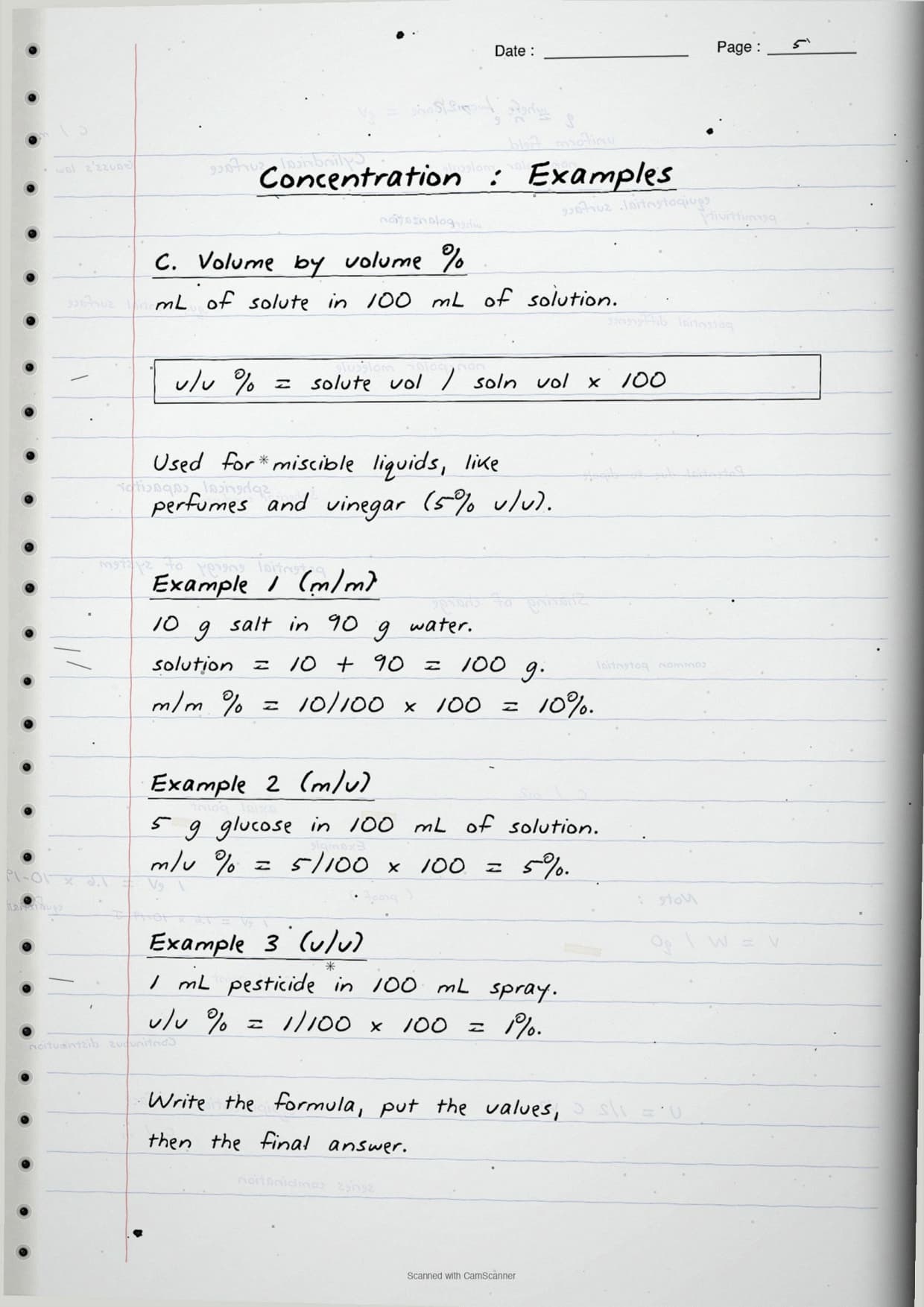
- Each concentration formula, like % m/m, sits in its own hand-drawn box.
- A quick sketch of the distillation or filtration set-up is drawn next to the method it explains.
- Red sub-headings split the chapter into short, easy parts.
- The wording is plain, like a senior showing you the method.
What Is Inside the Exploring Mixtures and their Separation Handwritten Notes PDF
The PDF runs to 24 pages of neat, hand-written revision. It moves from pure substances and mixtures, to solutions and concentration, then suspensions and colloids, and ends with every separation method, with a solved example or labelled sketch after each idea. The colour code below tells you what every mark means.
- Red: new sub-topic headings, such as Solubility, Colloid, or Distillation.
- Boxes: each formula, like the three percentage concentration rules, drawn by hand.
- Blue: solved examples and the numbers worked out in them.
Classifying Mixtures: Pure, Homogeneous and Heterogeneous in the Notes
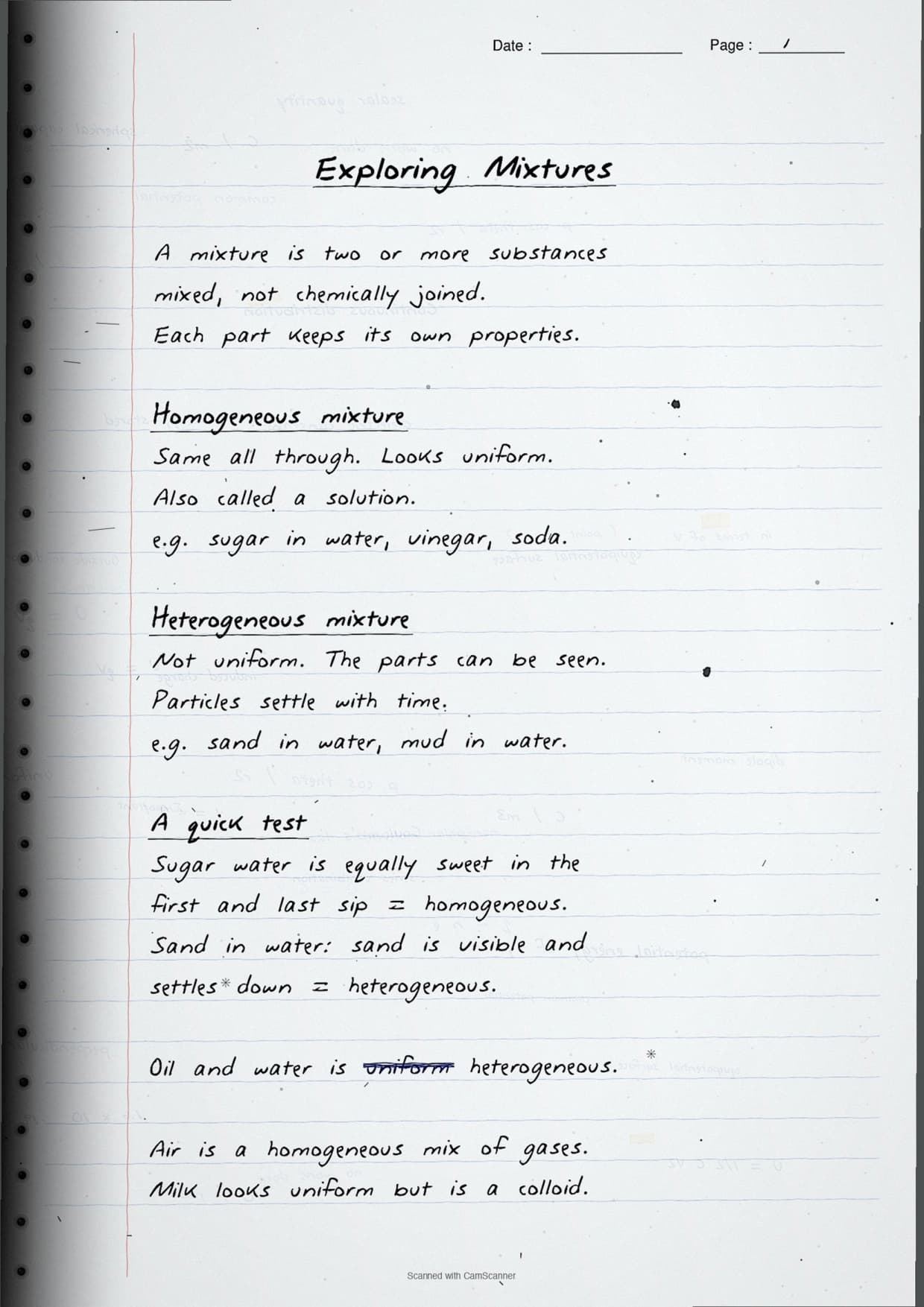
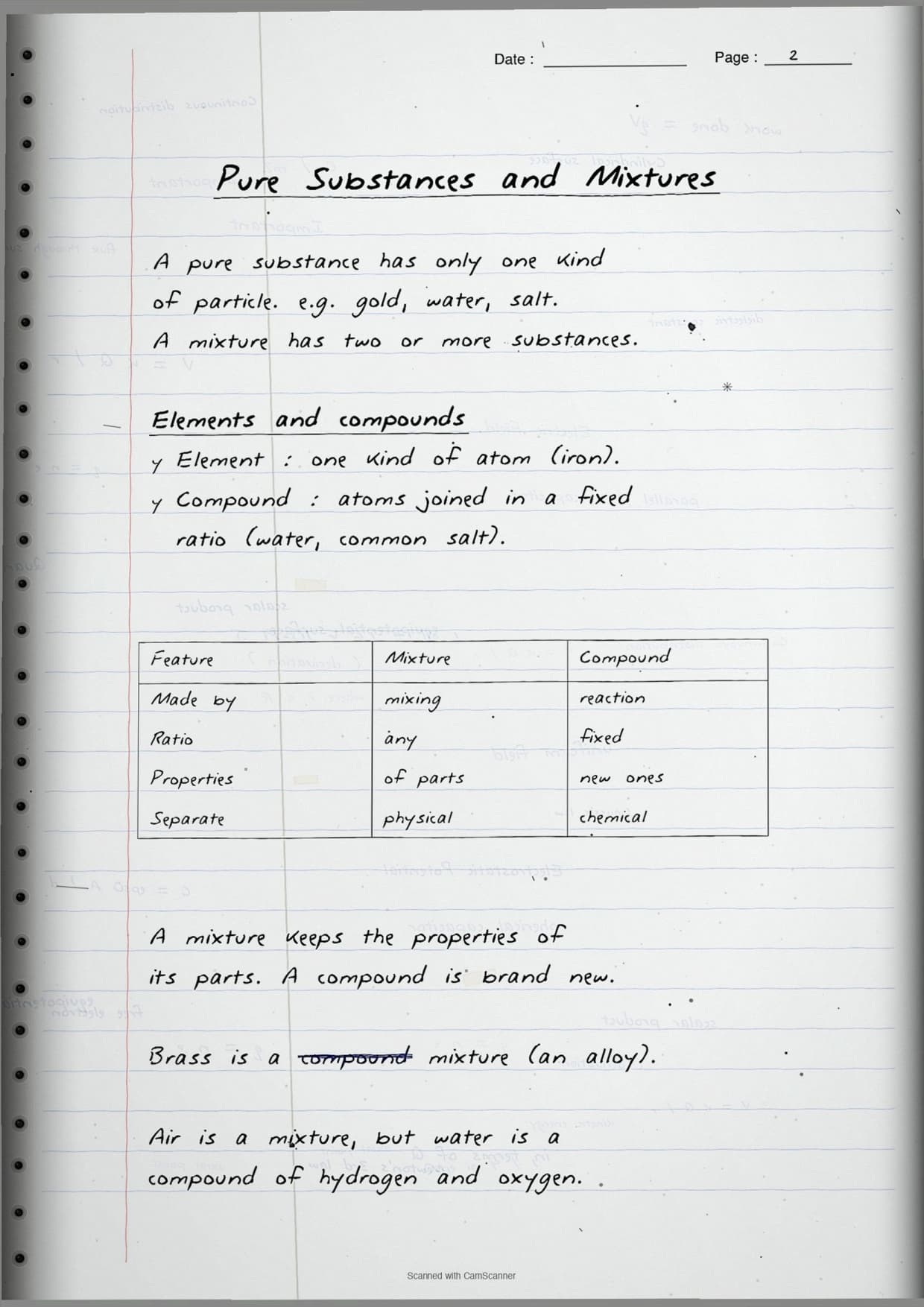
The chapter opens by sorting matter, so the notes start here. A pure substance is made of only one kind of building block and has a fixed composition, like distilled water or pure copper. A mixture has two or more substances that keep their own properties and can be split by physical methods.
- Quick test: if a sample can be split by filtering, settling or evaporating, it is a mixture, not a pure substance.
- Homogeneous mixture: the same throughout, with no visible parts, such as salt water or air. It is also called a solution.
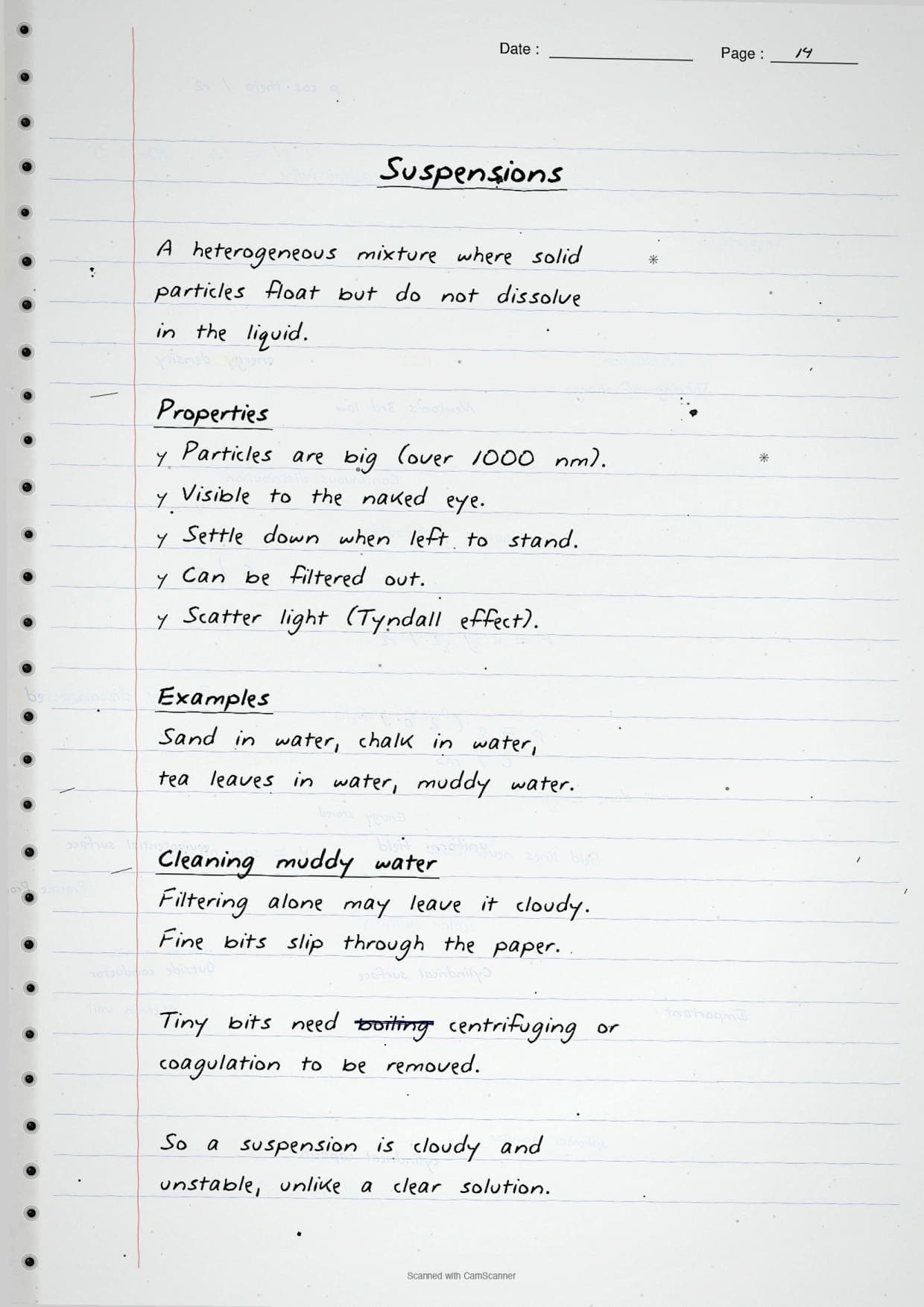
- Heterogeneous mixture: not uniform, with parts you can often see, such as sand in water or oil and water.
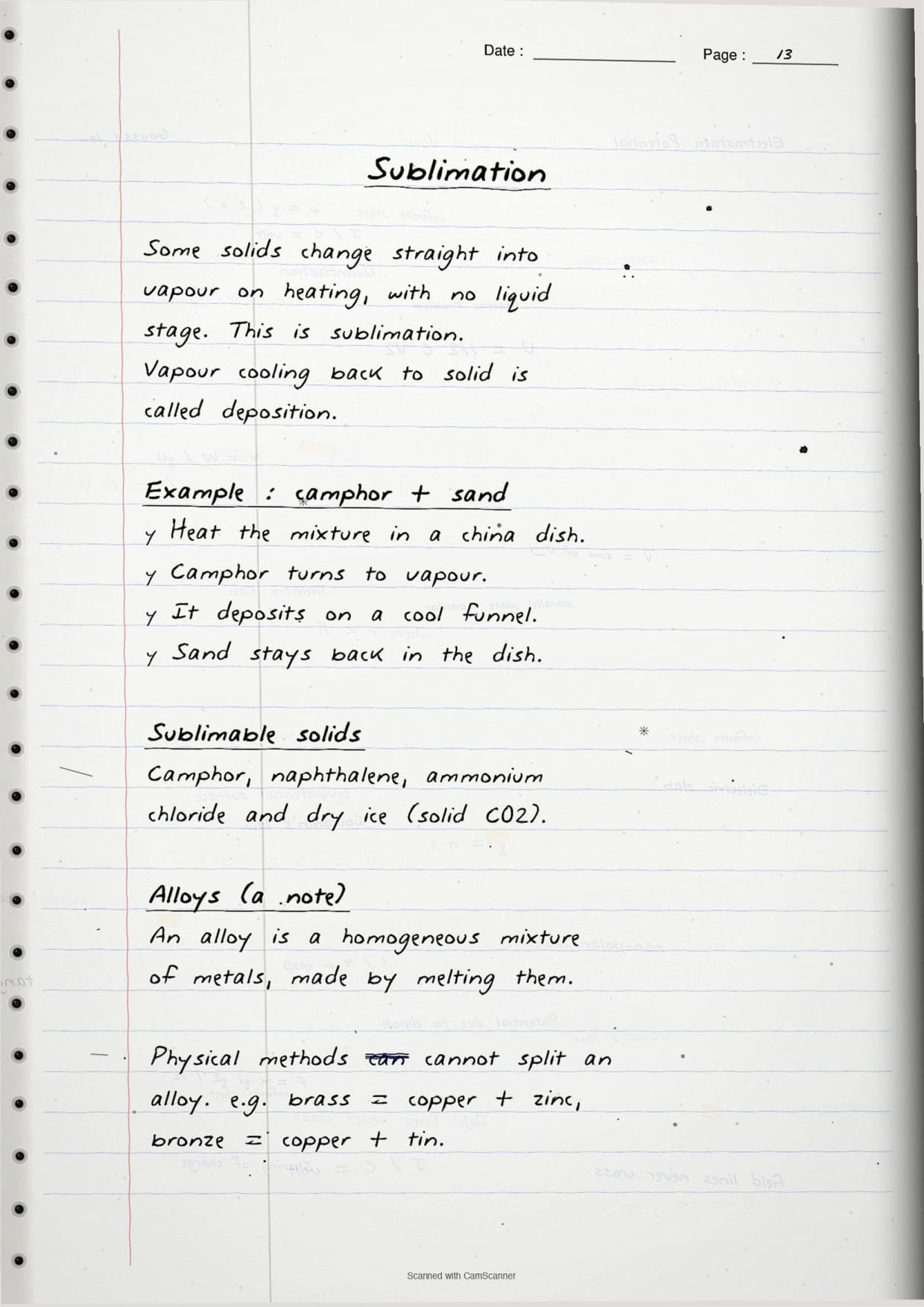
- Alloys: brass and bronze are solid solutions of metals, a homogeneous mixture that physical methods cannot separate.
The notes draw a small branching tree from matter down to pure substance and mixture, then split the mixture branch into homogeneous and heterogeneous. One red warning is pinned beside it: milk looks uniform but is not a true solution, so judge a mixture by particle size, not by looks alone.
The margin also reminds you that mixtures are not only liquids. Gas particles move freely and mix evenly, so most gas mixtures, like air, are homogeneous, while smoke and fog are heterogeneous mixtures with a gas as one part. Most solid-solid mixtures, such as iron filings and sulfur, are heterogeneous, and a property of one solid, like its response to a magnet, is used to separate them.
Solute, Solvent and Concentration in the Class 9 Science Notes
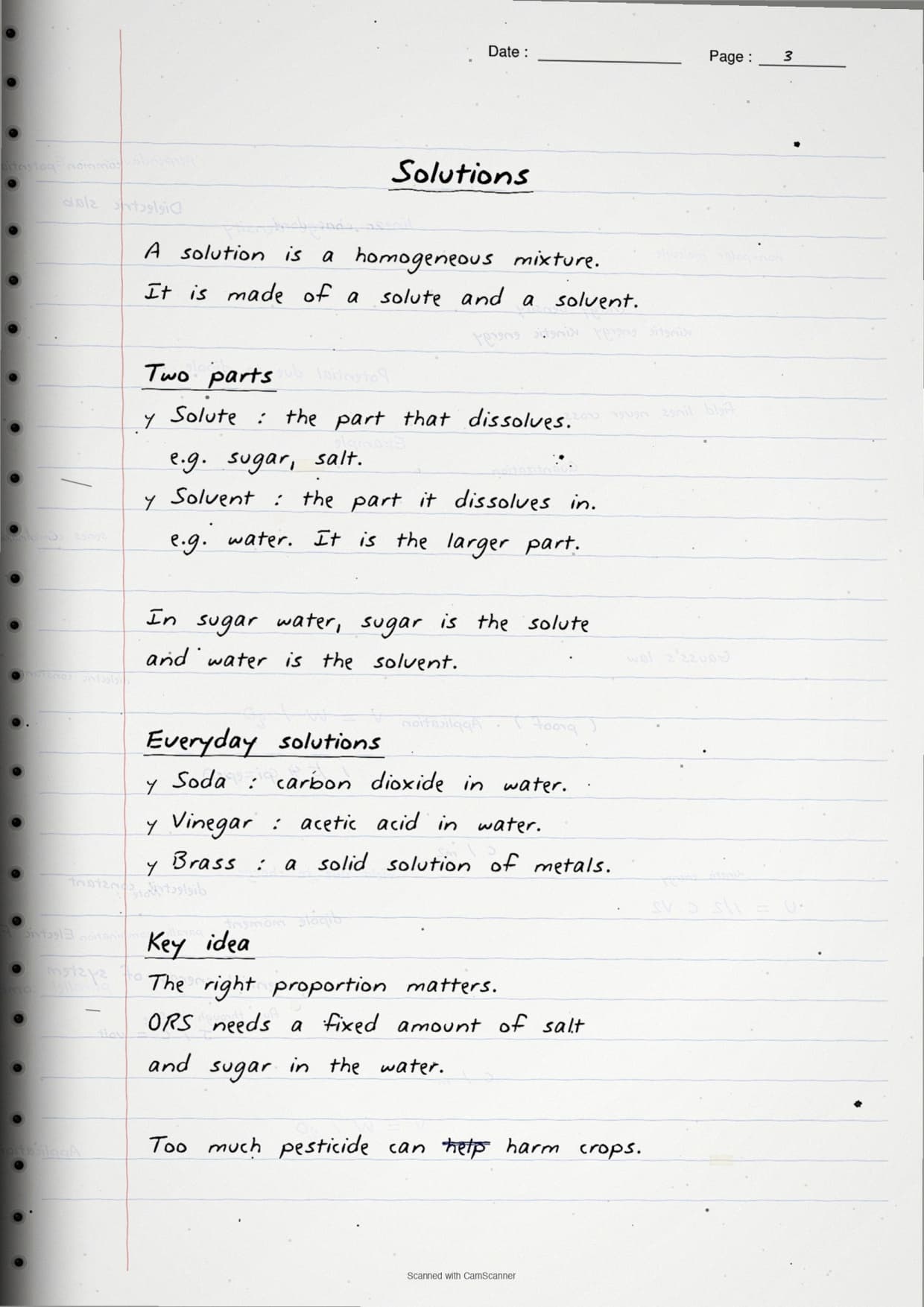
A solution is a homogeneous mixture of a solute and a solvent, so the notes give it a clear block. The solute is the substance that dissolves, like sugar or salt, and is usually the smaller amount. The solvent is the substance that does the dissolving, like water, and is usually the larger amount.
- Solution: solute plus solvent. In salt water, salt is the solute and water is the solvent.
- Concentration: the amount of solute in a given amount of solvent or solution. A dilute solution has little solute; a concentrated one has a lot.
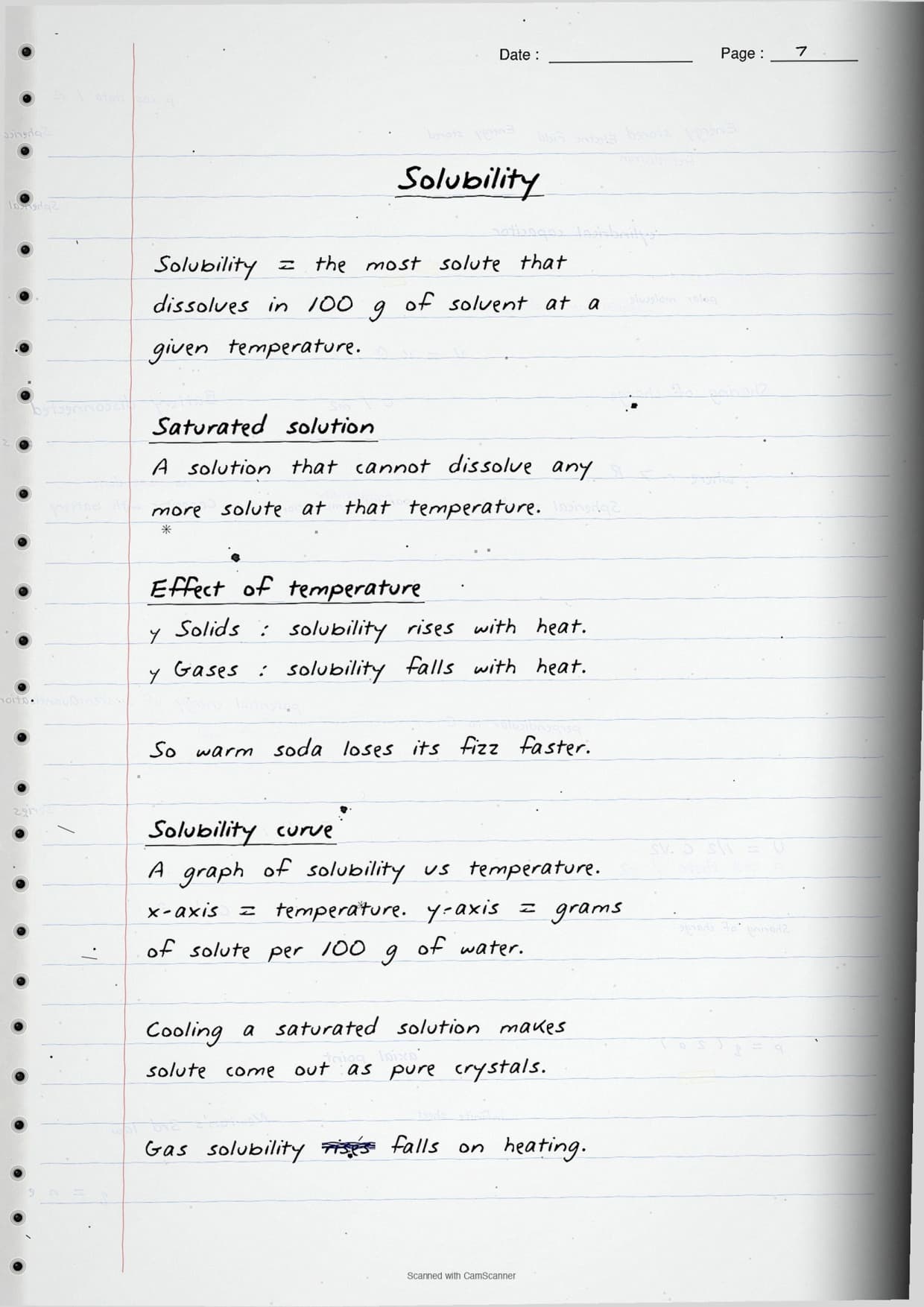
- Solubility: the maximum solute that dissolves in a fixed solvent at a set temperature. A saturated solution can hold no more.
- Rule to box: solubility of most solids rises with temperature, while solubility of gases falls with temperature.
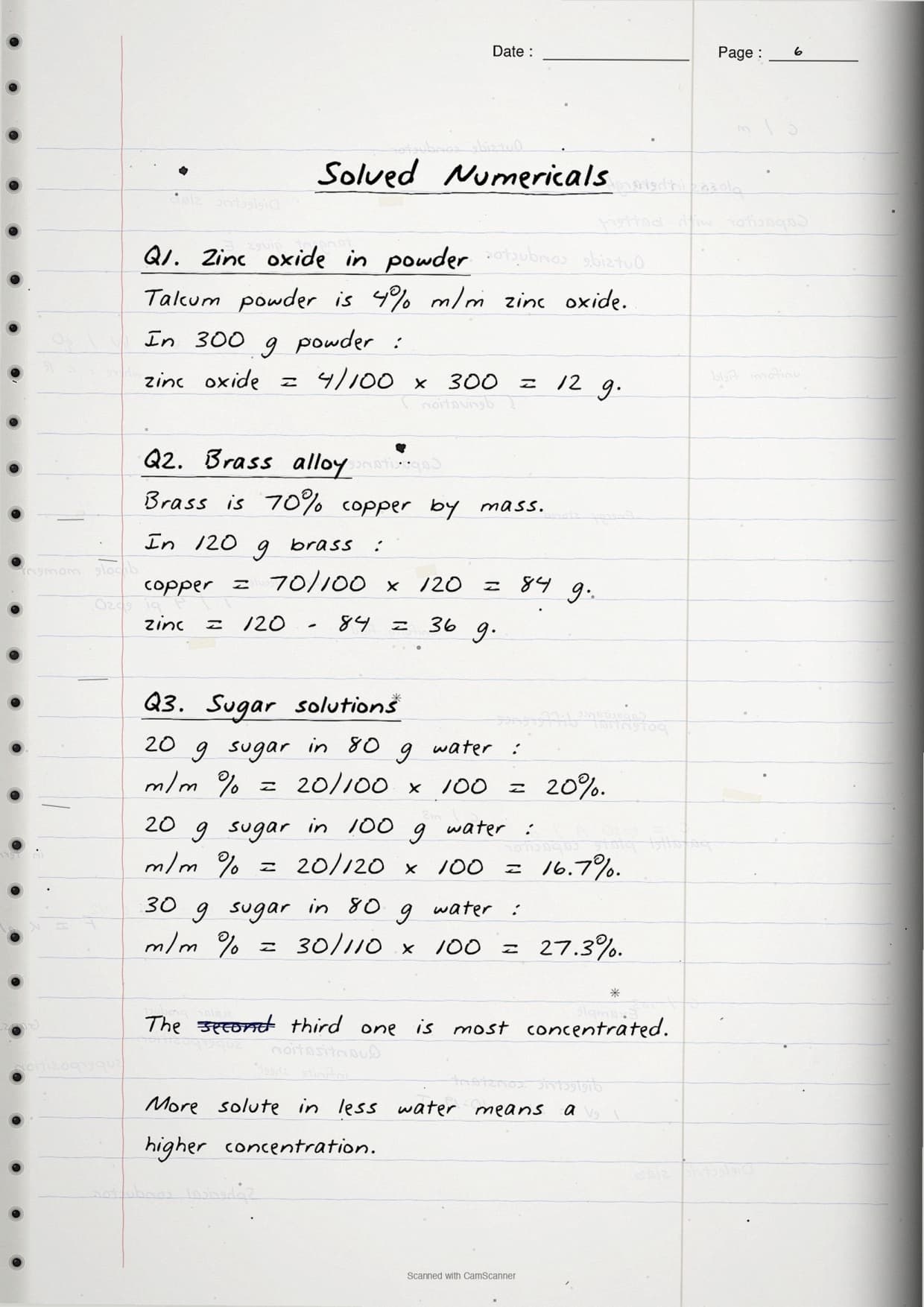
A solved example is written out in blue: 10 g of salt in 90 g of water gives a 100 g solution, so the strength is 10100 × 100 = 10% mass by mass. The notes also sketch a small solubility curve to show how much more solid dissolves as the water is warmed.
Solutions, Suspensions and Colloids: Hand-Drawn Comparison Table
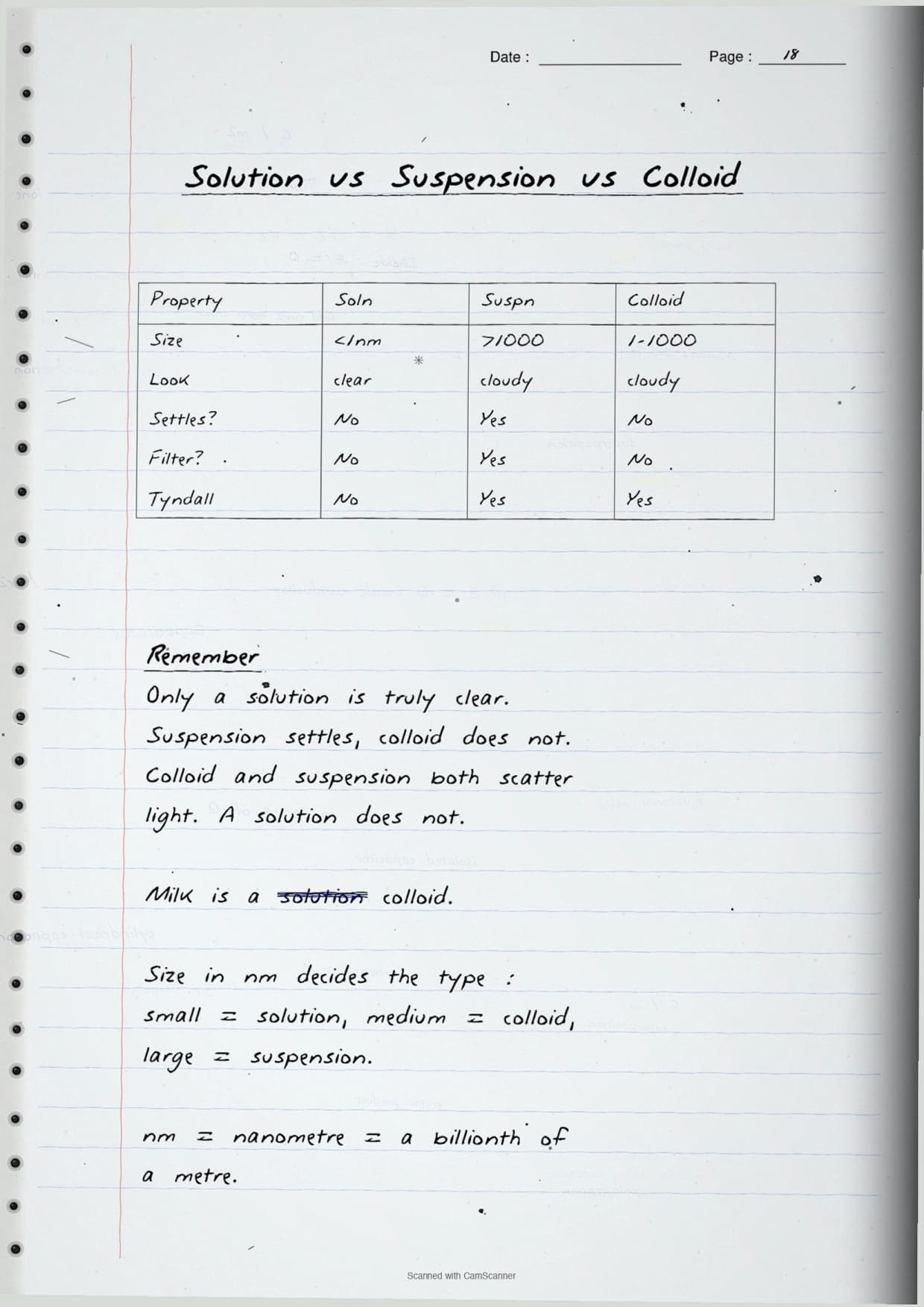
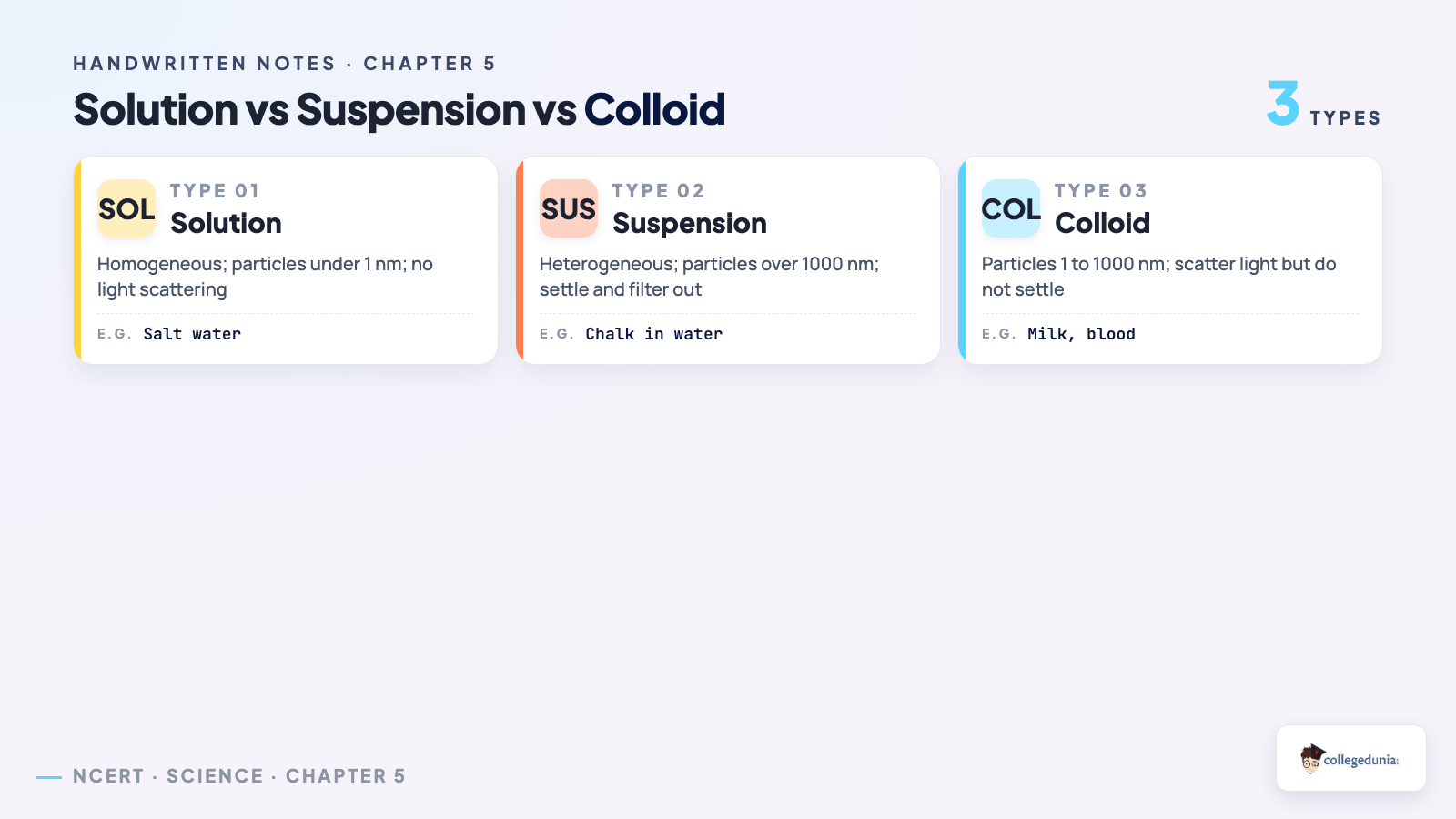
This is one of the most tested ideas in Chapter 5, so the notes give it a clear hand-drawn table. The three mixtures look alike but differ in particle size, and that single difference decides whether a mixture settles, scatters light, or can be filtered.
| Property | Solution | Suspension | Colloid |
|---|---|---|---|
| Nature | Homogeneous | Heterogeneous | Heterogeneous |
| Particle size | Less than 1 nm | More than 1000 nm | 1 to 1000 nm |
| Particles visible | No | Yes | No |
| Settles on standing | No | Yes | No |
| Filtration | Cannot separate | Can separate | Cannot separate |
| Tyndall effect | No | Yes | Yes |
| Example | Salt water | Chalk in water | Milk, blood |
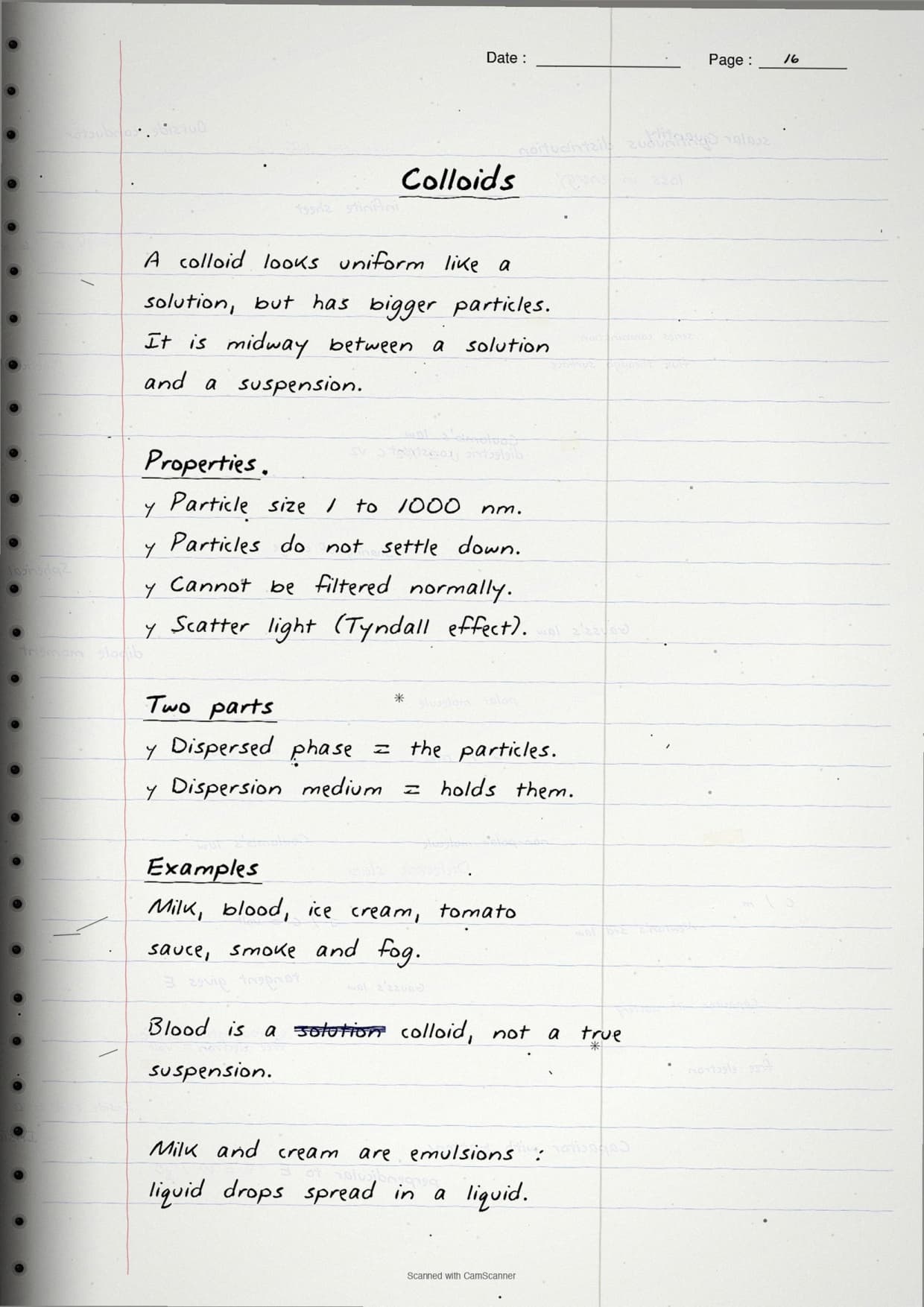
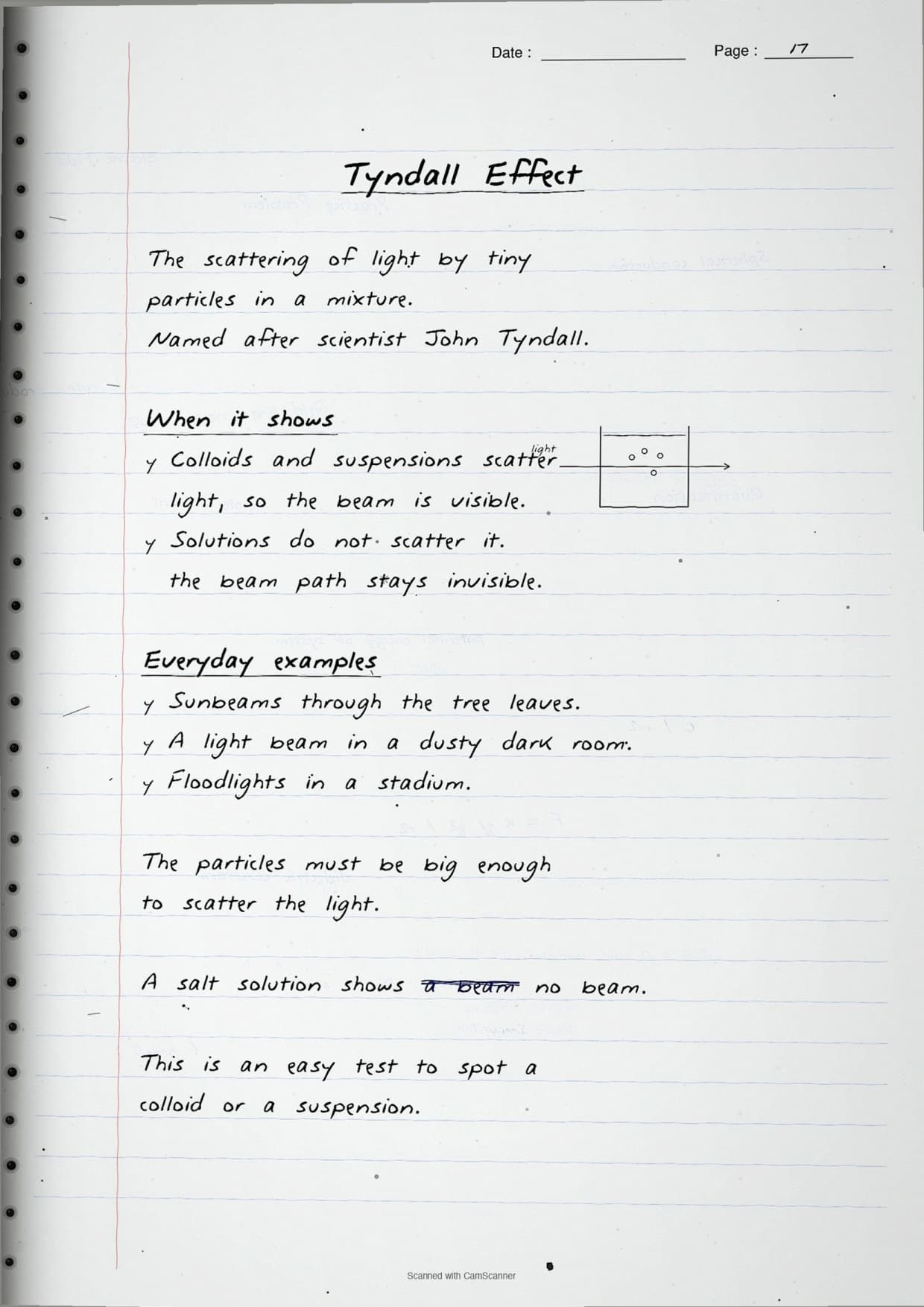
The notes flag one common trap in red: milk is a colloid, not a solution. Its particles are too small to see but large enough to scatter light, which is why a torch beam shows up when passed through it.
Separation Methods Drawn by Hand: Filtration to Chromatography
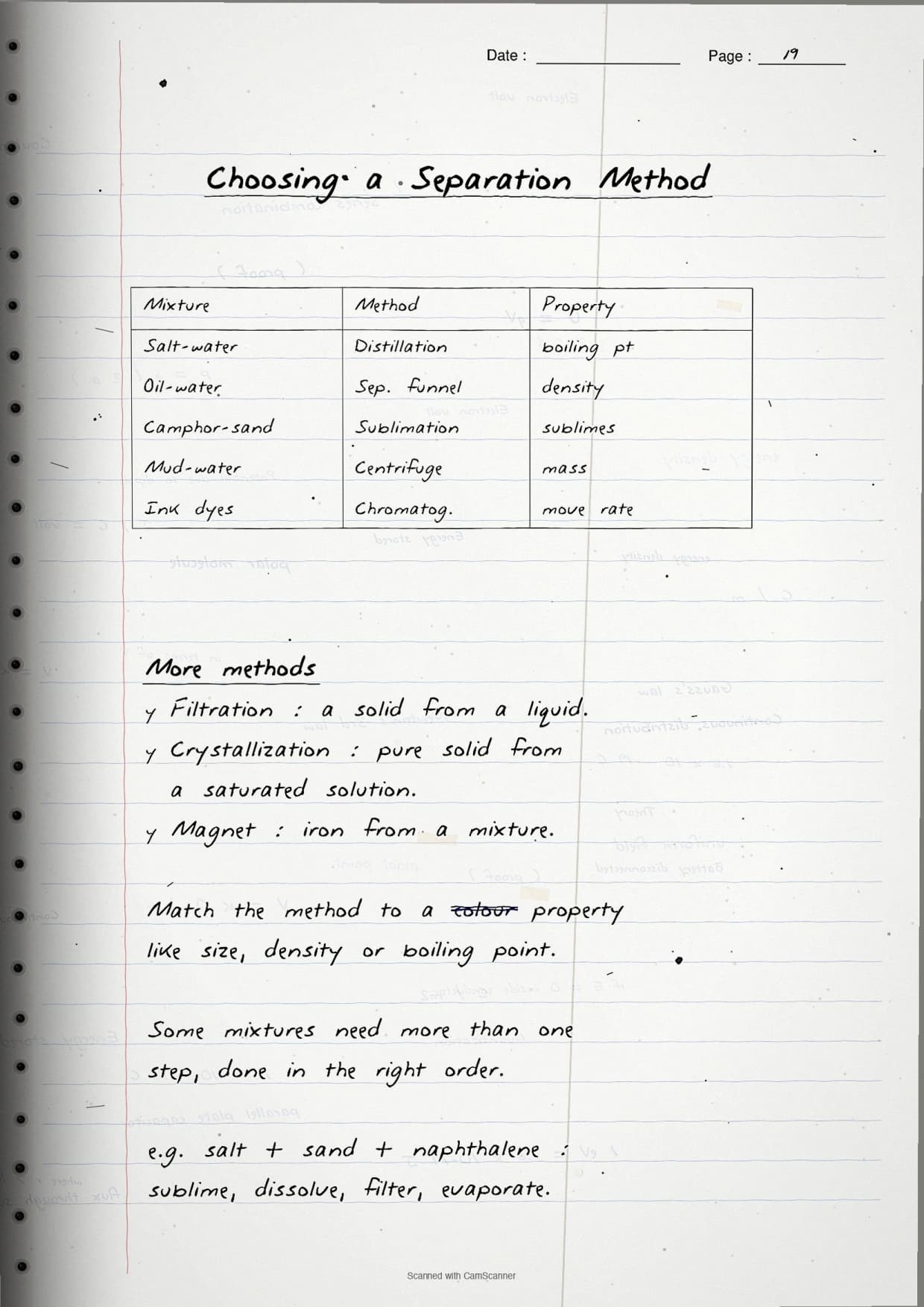
Half of Chapter 5 is about pulling a mixture apart into pure parts, so the notes give each method a labelled sketch and a one-line principle. The table below is the chooser you should copy into your own notes, since matching a method to its principle is asked almost every year.
| Method | Separates | Based on |
|---|---|---|
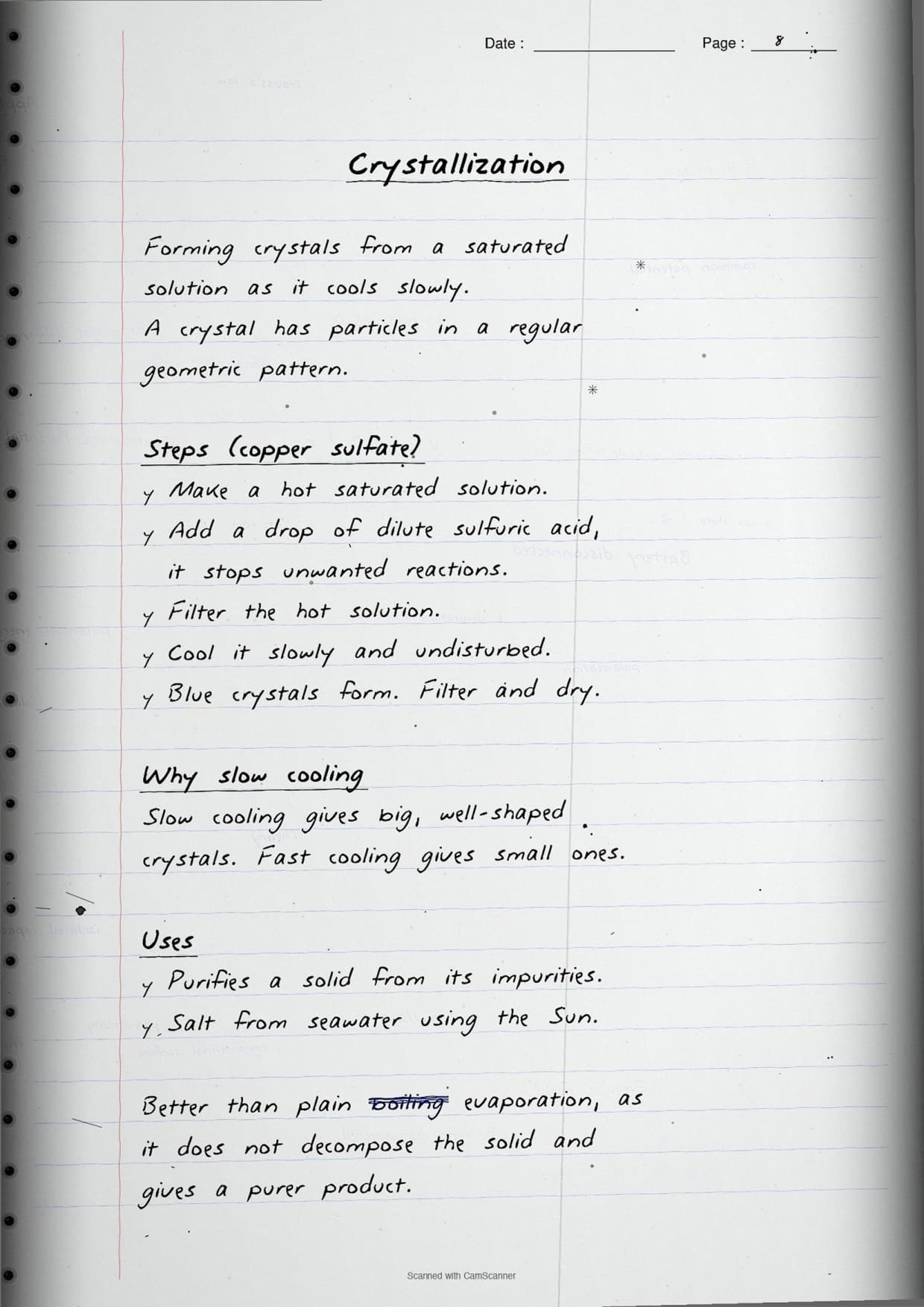
| Crystallization | Pure solid from its solution | Solubility falls as the solution cools |
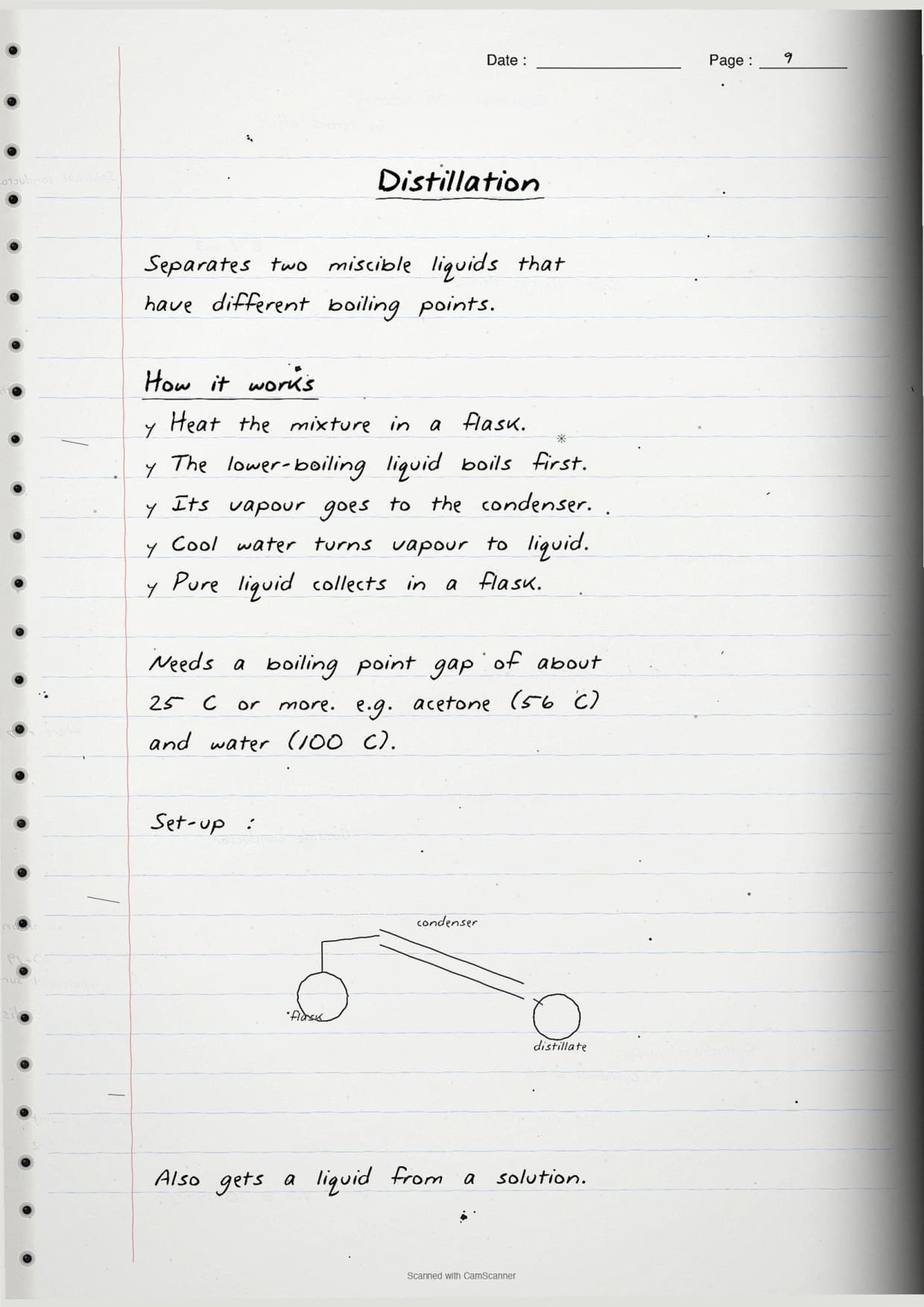
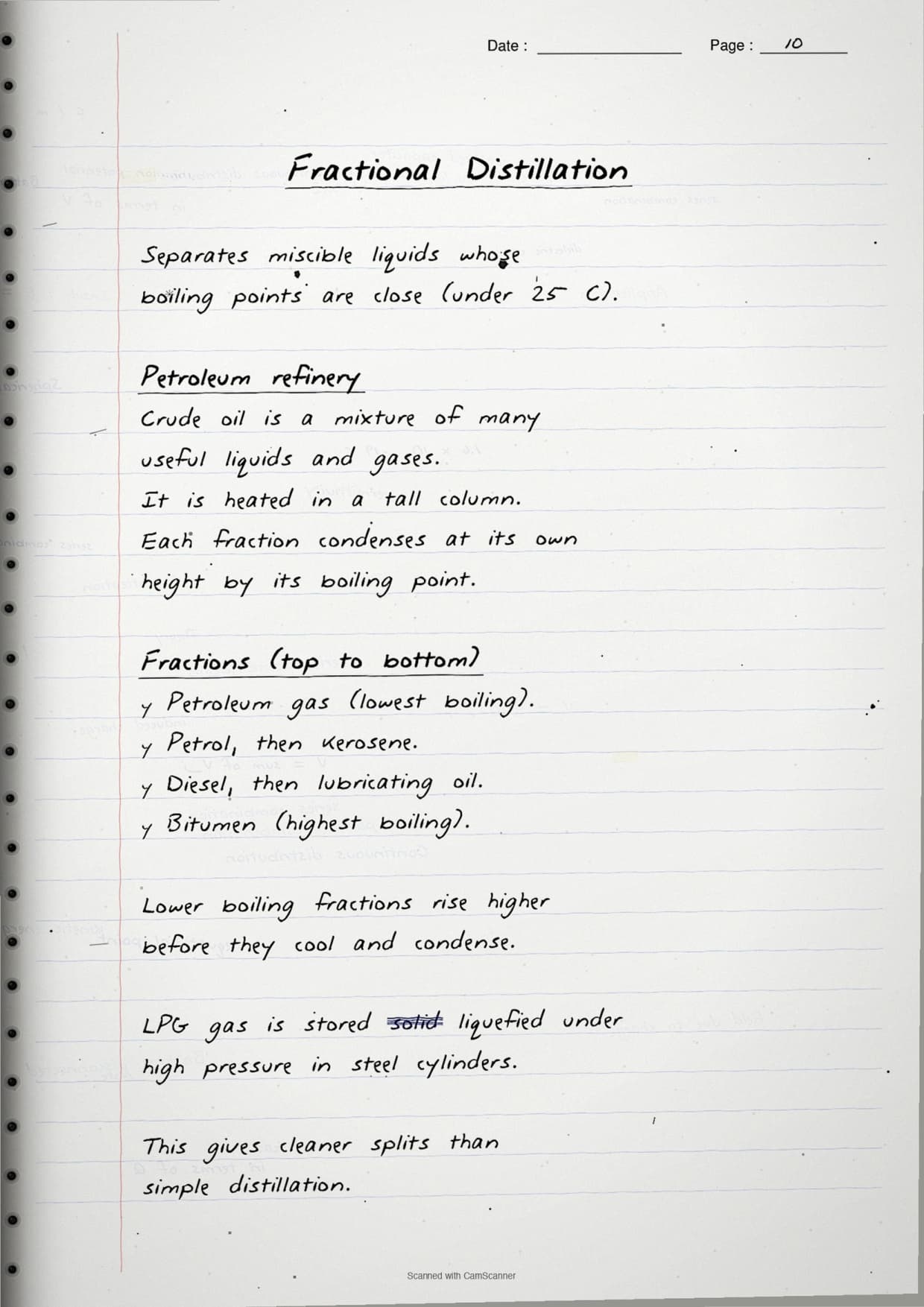
| Distillation | Two miscible liquids, or solvent from solution | Difference in boiling point |
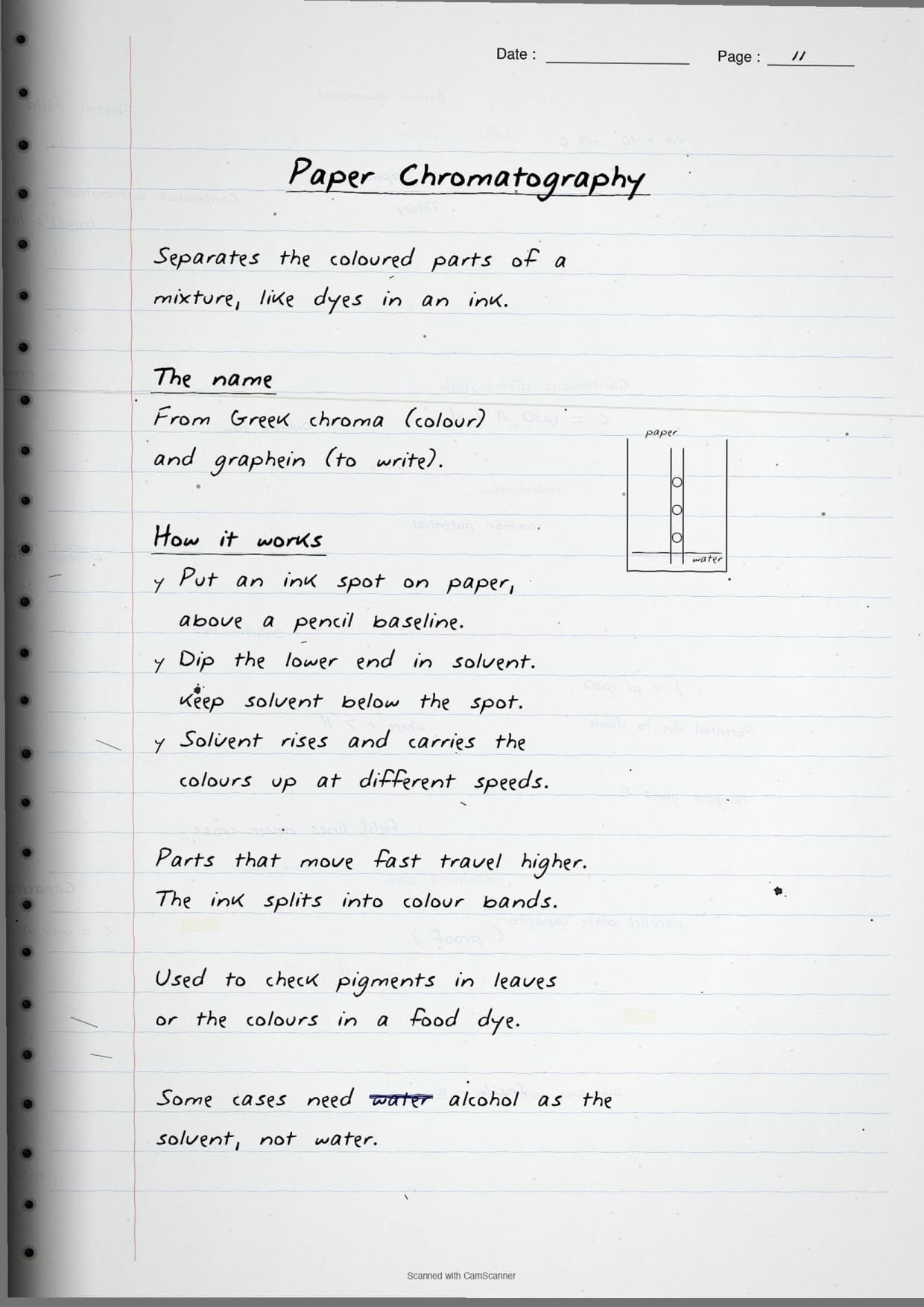
| Paper chromatography | Coloured parts of a mixture, like dyes in ink | Speed of movement up the paper |
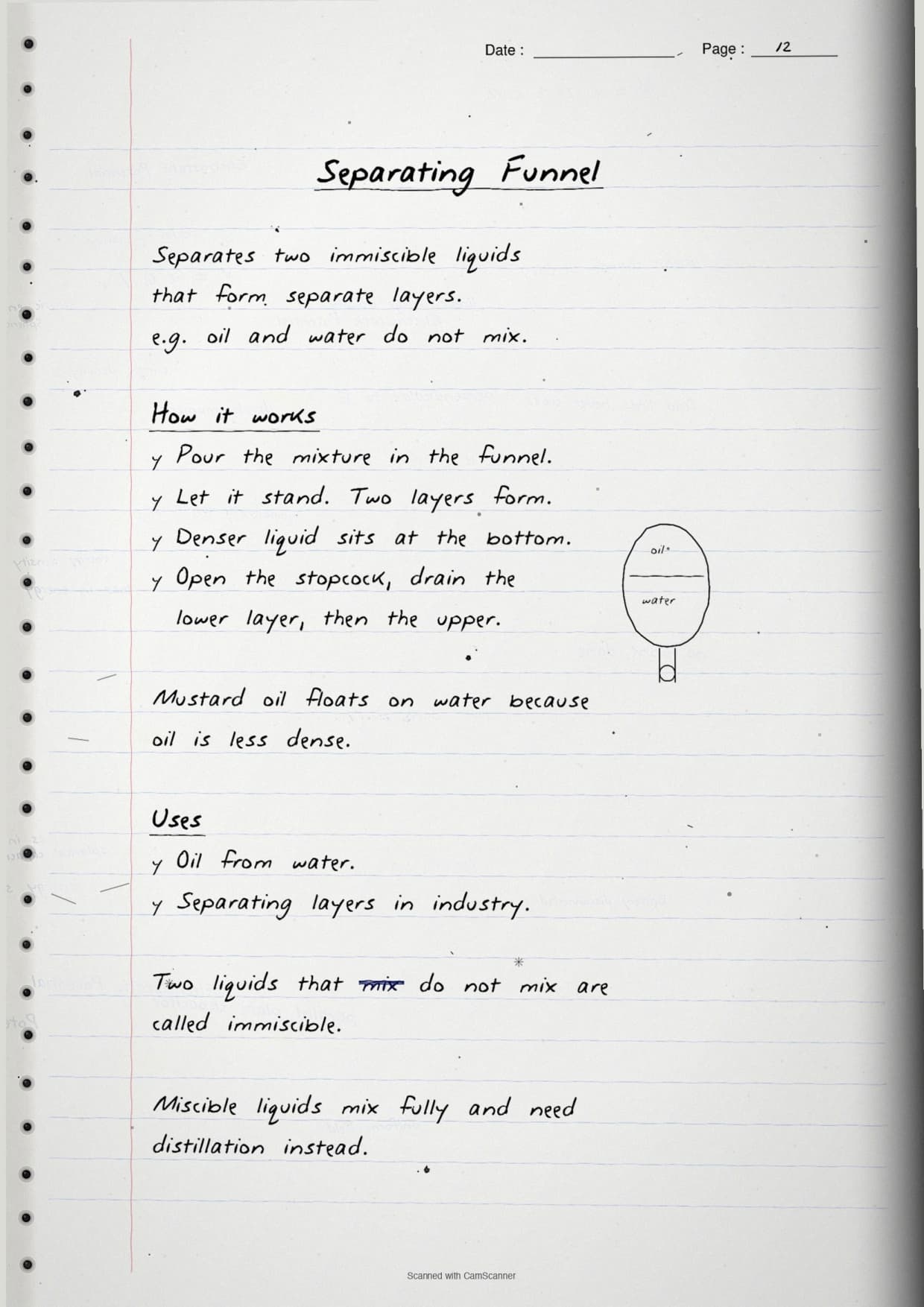
| Separating funnel | Two immiscible liquids, like oil and water | Difference in density |
| Sublimation | A subliming solid from a non-subliming one | Direct solid to vapour change |
| Centrifugation | Fine solids from a liquid, like blood parts | Spinning throws heavy parts outward |
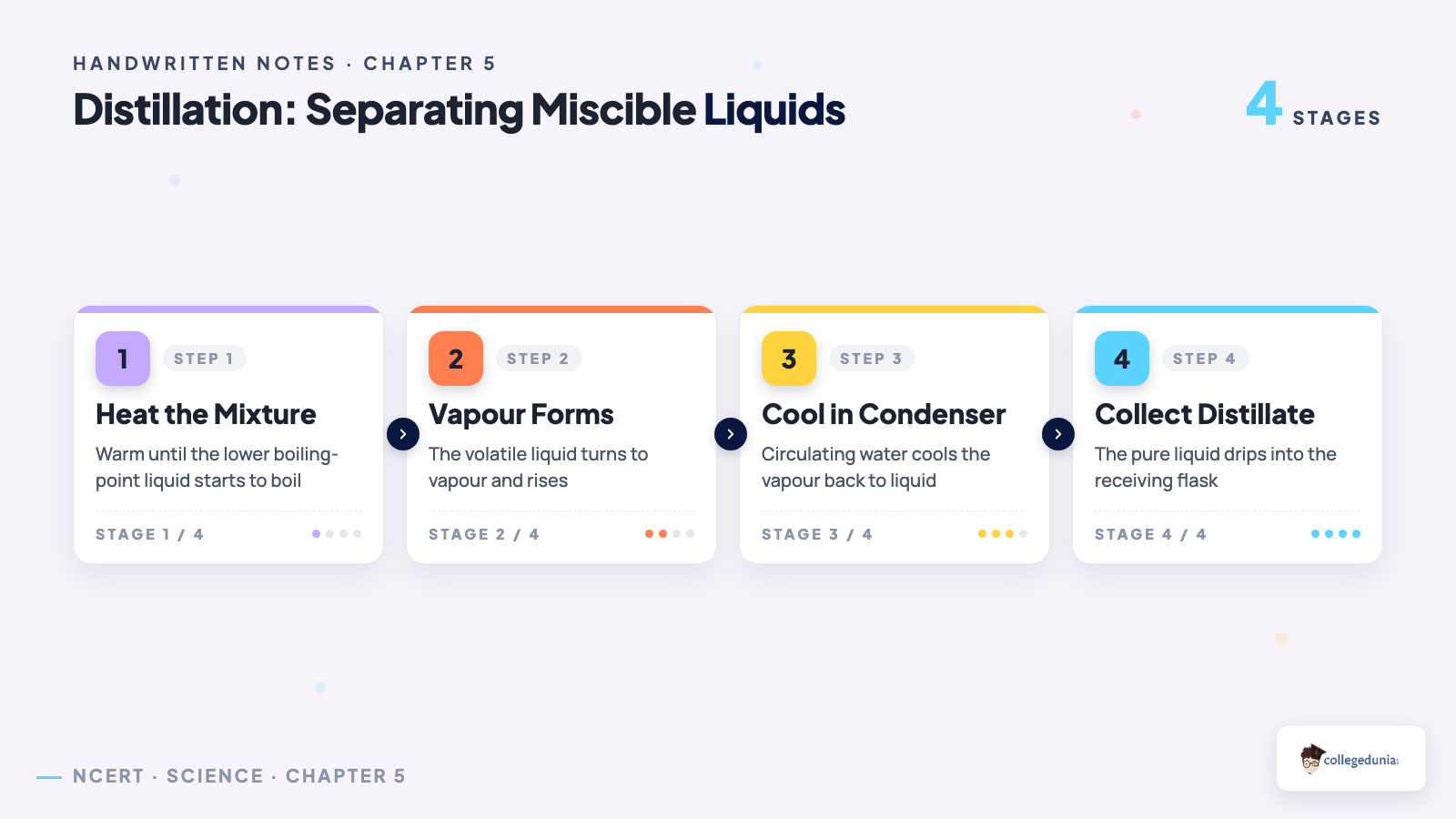
- Distillation: the mixture is heated, the vapour is cooled in a condenser, and the pure distillate is collected. It works when boiling points differ by about 25 degrees Celsius or more. When the gap is smaller, as in crude oil, fractional distillation is used instead.
- Crystallization: a hot saturated solution is cooled slowly so large, pure crystals grow, leaving impurities behind in the liquid. The notes flag that this gives a purer solid than plain evaporation, which can leave impurities behind with the dried solute.
- Separating funnel: two immiscible liquids form layers, the denser one at the bottom. The stopcock is opened to run off the lower layer, then closed before the upper liquid reaches it.
- Sublimation: a solid that turns straight to vapour, like camphor or ammonium chloride, is separated from one that does not, such as sand. The notes stress that sublimation skips the liquid state.
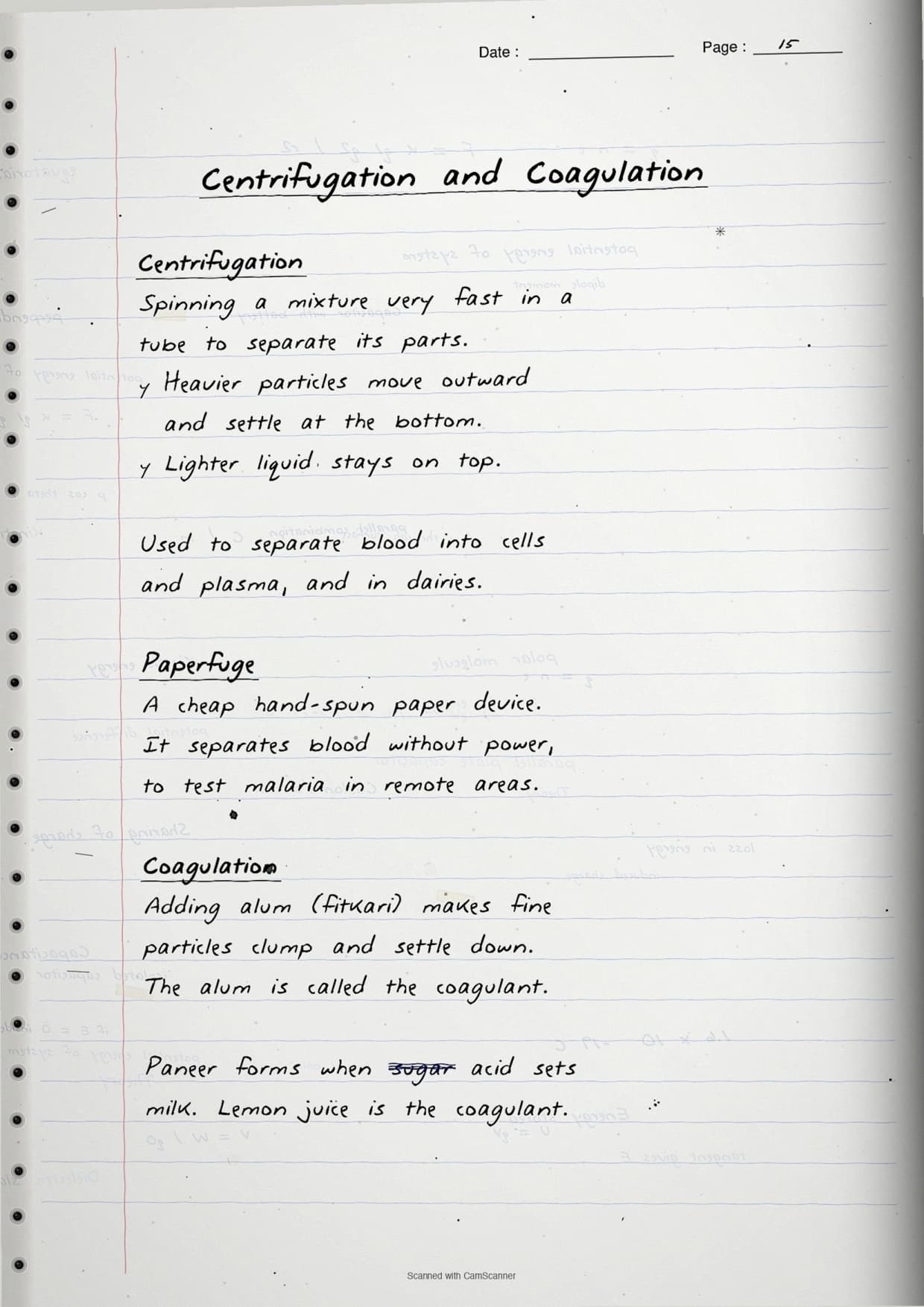
- Coagulation: alum (fitkari) makes fine mud clump so it settles, then the clear water is decanted, exactly as a water plant cleans river water.
Centrifugation gets a small sketch of a spinning tube, since ordinary filtration cannot catch very fine solids. Spinning the mixture at high speed throws the heavier particles to the bottom while the lighter liquid stays on top, which is how a laboratory separates the parts of blood or skims cream from milk.
Concentration Formula Boxes and the Tyndall Effect Drawn by Hand
Keep these boxed formulas ready for the numericals in the Revise, Reflect, Refine exercise. Each one is written out in the notes exactly as you should copy it in the exam, with its units beside it.
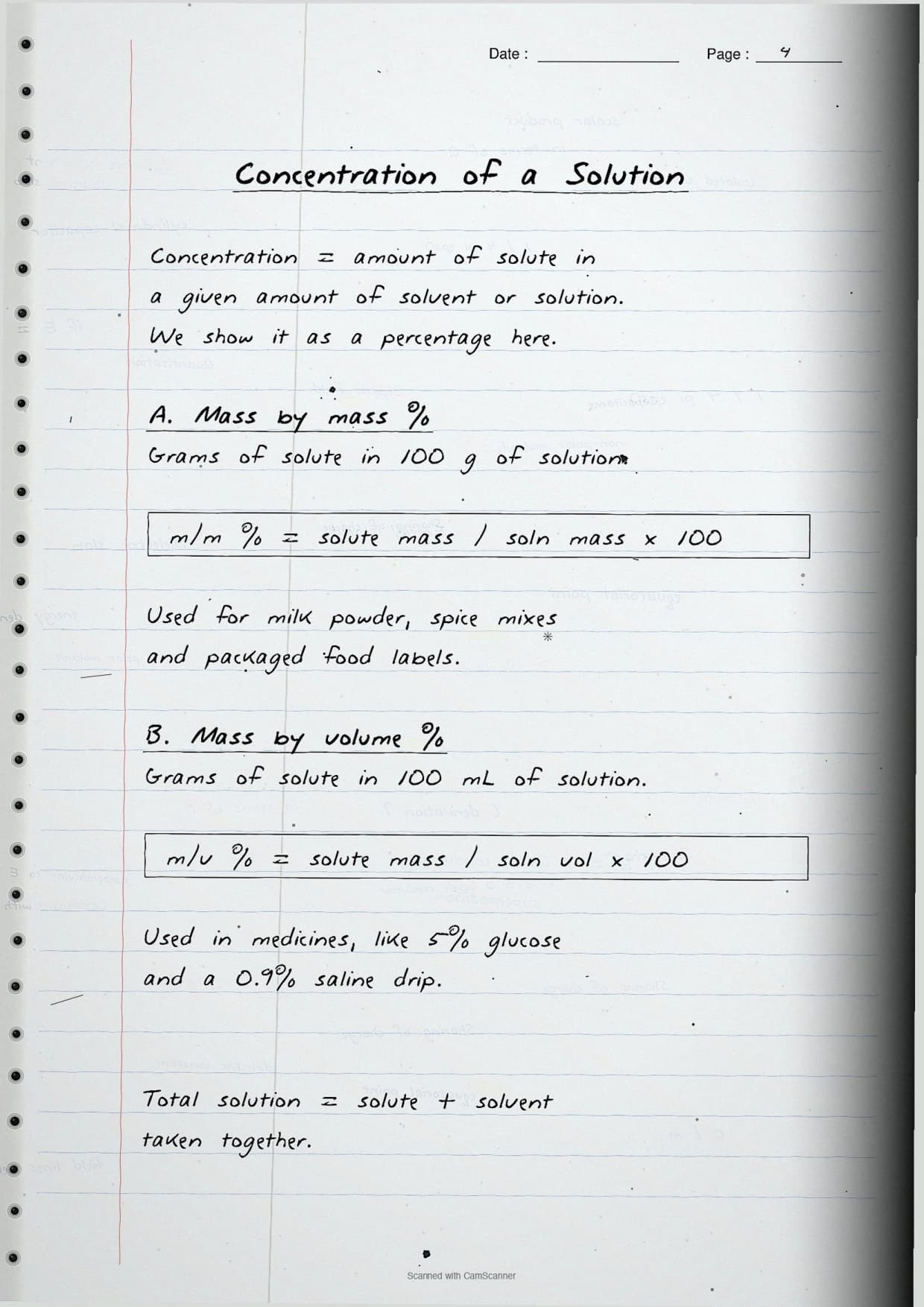
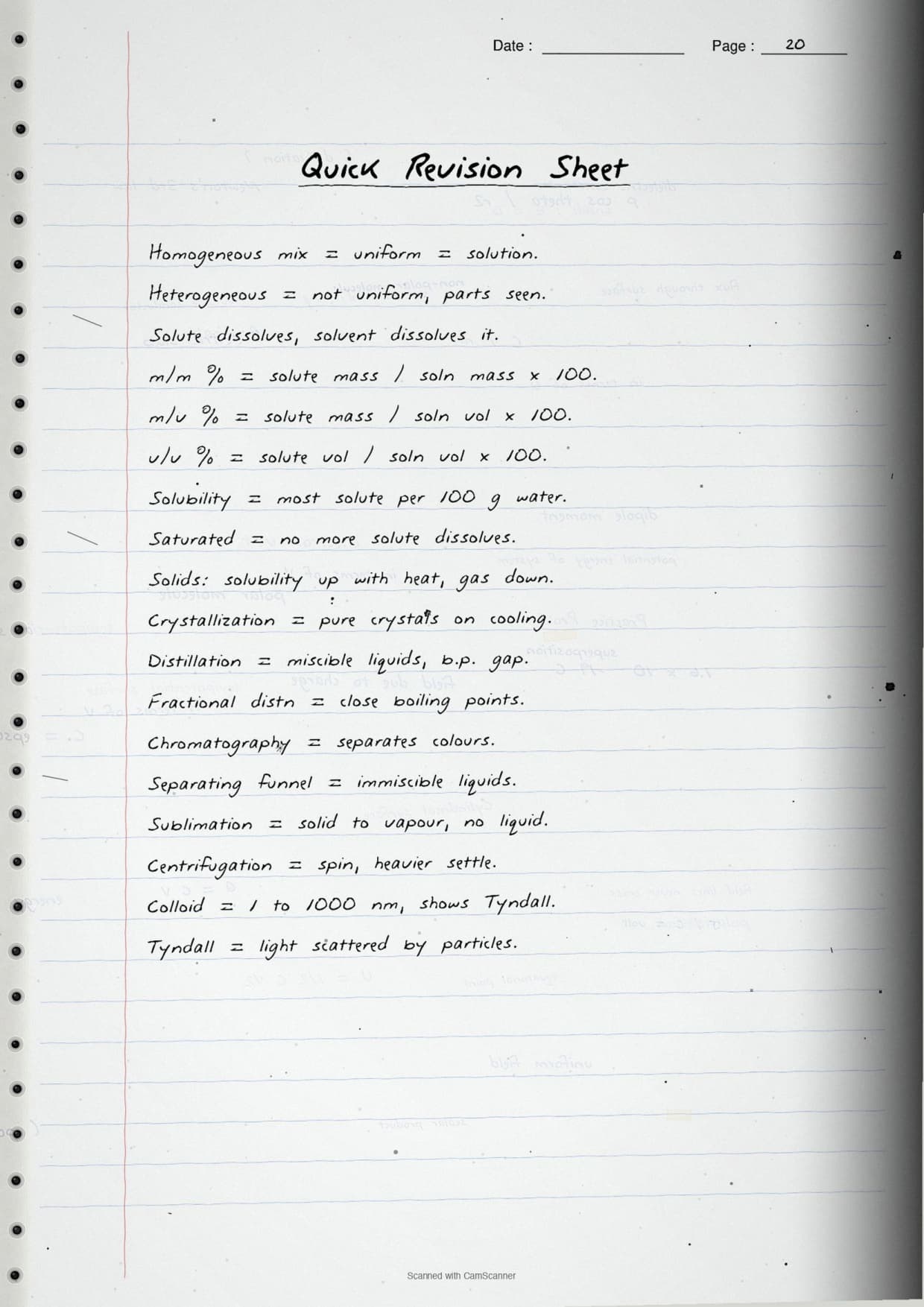
- Mass by mass: % m/m = Mass of soluteMass of solution × 100
- Mass by volume: % m/v = Mass of soluteVolume of solution × 100
- Volume by volume: % v/v = Volume of soluteVolume of solution × 100
The Tyndall effect gets its own red heading. It is the scattering of a beam of light by the particles of a colloid or a suspension. Light passes straight through a true solution, so its path is not seen, but in milk or fog the beam becomes visible from the side.
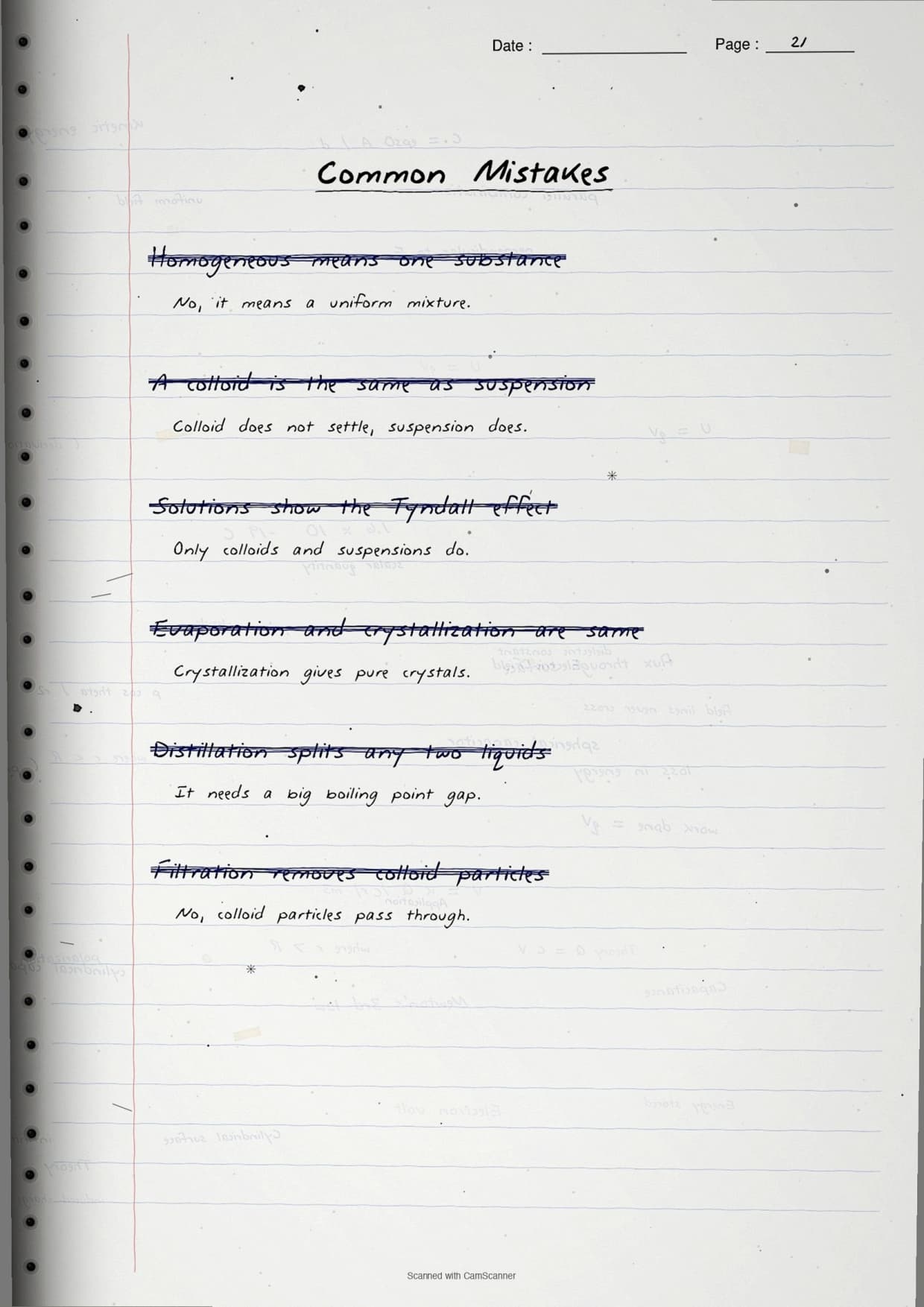
Common Mistakes Flagged in Red
Most lost marks in this chapter come from small slips, not hard ideas. The handwritten notes circle these in red so you fix them while you revise.
- Dividing by the solvent mass instead of the whole solution mass in % m/m.
- Mixing up sublimation with evaporation: sublimation skips the liquid state.
- Letting the solvent cover the ink spot in chromatography, so the spot dissolves away.
- Thinking distillation can split liquids with the same boiling point.
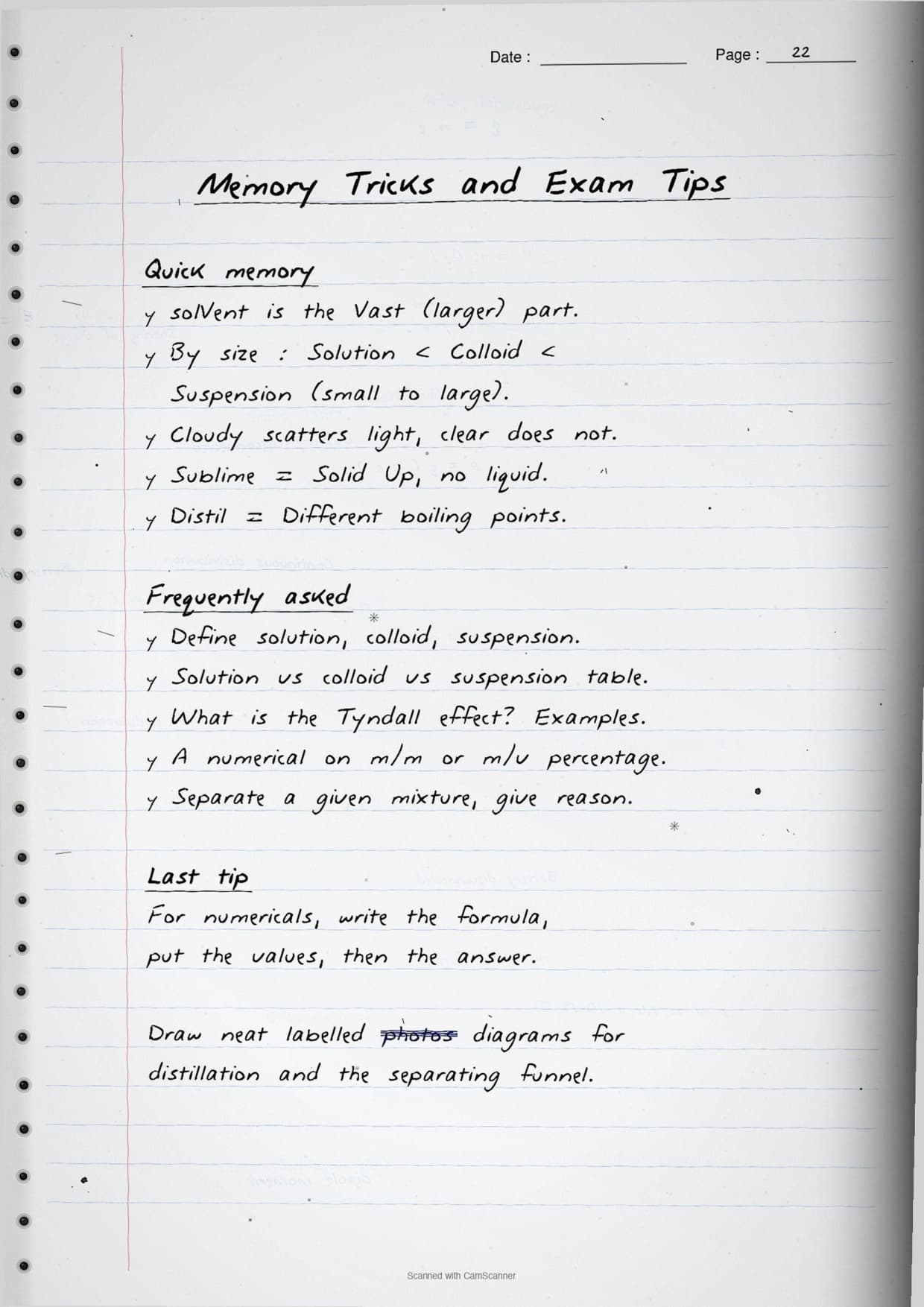
Last-Minute Revision with These Handwritten Notes
The night before your exam, the Exploring Mixtures and their Separation Class 9 Science Handwritten Notes work as a quick skim. Every boxed formula and red heading is a checkpoint, so you can cover the whole chapter in well under an hour.
- State the difference between a homogeneous and a heterogeneous mixture.
- Write the three percentage concentration formulas from their boxes.
- Recall the solution, suspension and colloid table in one glance.
- Match each separation method to its principle from the chooser table.
- Read the red mistake note about milk being a colloid before you close the notes.
How Collegedunia's Handwritten Notes Help You With Mixtures and Separation
Collegedunia brings you the Exploring Mixtures and their Separation Class 9 Science Handwritten Notes as a free, clear PDF you can open on any phone. It saves you the time of making your own notes and matches the new Exploration book.
- 2026-27 match: every page follows the new textbook and the Revise, Reflect, Refine flow.
- Clean handwriting: a topper's neat writing makes each formula and set-up sketch easy to read.
- Exam-ready: boxes and colour cues let you revise fast before the annual exam, and later for CBSE, JEE, and NEET basics.
- Free download: keep the PDF offline and revise any time.
More Exploring Mixtures and their Separation Class 9 Science Resources
Use the table below to open the other resources for this chapter of the new Class 9 Science Exploration book.
| Resource | Open |
|---|---|
| Handwritten Notes | Exploring Mixtures and their Separation Class 9 Science Handwritten Notes |
| NCERT Solutions | Exploring Mixtures and their Separation Class 9 Science NCERT Solutions |
| Revision Notes | Exploring Mixtures and their Separation Class 9 Science Notes |
| Formula Sheet | Exploring Mixtures and their Separation Class 9 Science Formula Sheet |
| NCERT Book PDF | Exploring Mixtures and their Separation Class 9 Science NCERT Book PDF |
NCERT Handwritten Notes for Class 9 Science: All Chapters
Use the table below to open the handwritten notes for any other chapter of the new Class 9 Science Exploration book.
| Chapter | Handwritten Notes |
|---|---|
| Chapter 2 | Cell The Building Block of Life |
| Chapter 3 | Tissues in Action |
| Chapter 4 | Describing Motion Around Us |
| Chapter 5 | Exploring Mixtures and their Separation |
| Chapter 6 | How Forces Affect Motion |
| Chapter 7 | Work, Energy, and Simple Machines |
| Chapter 8 | Journey Inside the Atom |
| Chapter 9 | Atomic Foundations of Matter |
| Chapter 10 | Sound Waves Characteristics and Applications |
| Chapter 11 | Reproduction How Life Continues |
| Chapter 12 | Patterns in Life Diversity and Classification |
| Chapter 13 | Earth as a System Energy, Matter, and Life |
Exploring Mixtures and their Separation Class 9 Science Handwritten Notes FAQs
Ques. How many pages are the Exploring Mixtures and their Separation Class 9 Science handwritten notes?
Ans. The handwritten notes run to 24 pages. They cover the full chapter, from pure substances and mixtures to solutions, concentration, suspensions and colloids, the Tyndall effect, and every separation method, with a solved example or labelled sketch after each idea.
Ques. Are these real handwritten notes?
Ans. Yes. They are a topper's own clear handwritten revision notes, with each concentration formula boxed, the lab set-ups drawn by hand, and sub-headings colour-coded in red.
Ques. What are the main formulas in the Chapter 5 notes?
Ans. The key formulas are the three percentage concentration rules: mass by mass, mass by volume, and volume by volume, each equal to the amount of solute divided by the amount of solution, times 100.
Ques. What is the difference between a solution, a suspension and a colloid?
Ans. They differ by particle size. A solution has tiny particles under 1 nm and does not scatter light. A suspension has large particles over 1000 nm that settle and can be filtered. A colloid sits in between, with particles that scatter light, the Tyndall effect, but do not settle.
Ques. Is Exploring Mixtures and their Separation part of the new Class 9 Science book?
Ans. Yes. Exploring Mixtures and their Separation is Chapter 5 of the new Exploration textbook for the 2026-27 syllabus. It is a core base chapter for later chemistry topics on matter and atoms.



Comments