




The Describing Motion Around Us Class 9 Science Handwritten Notes are a topper's own neat revision of Chapter 4 from the new Exploration textbook. Every idea, distance and displacement, speed, velocity, acceleration, motion graphs, the three equations of motion, and uniform circular motion, is written by hand with each formula, like v = u + at, boxed in the margin. You revise the whole 2026-27 chapter in one short sitting, just as you would set it out in the exam.
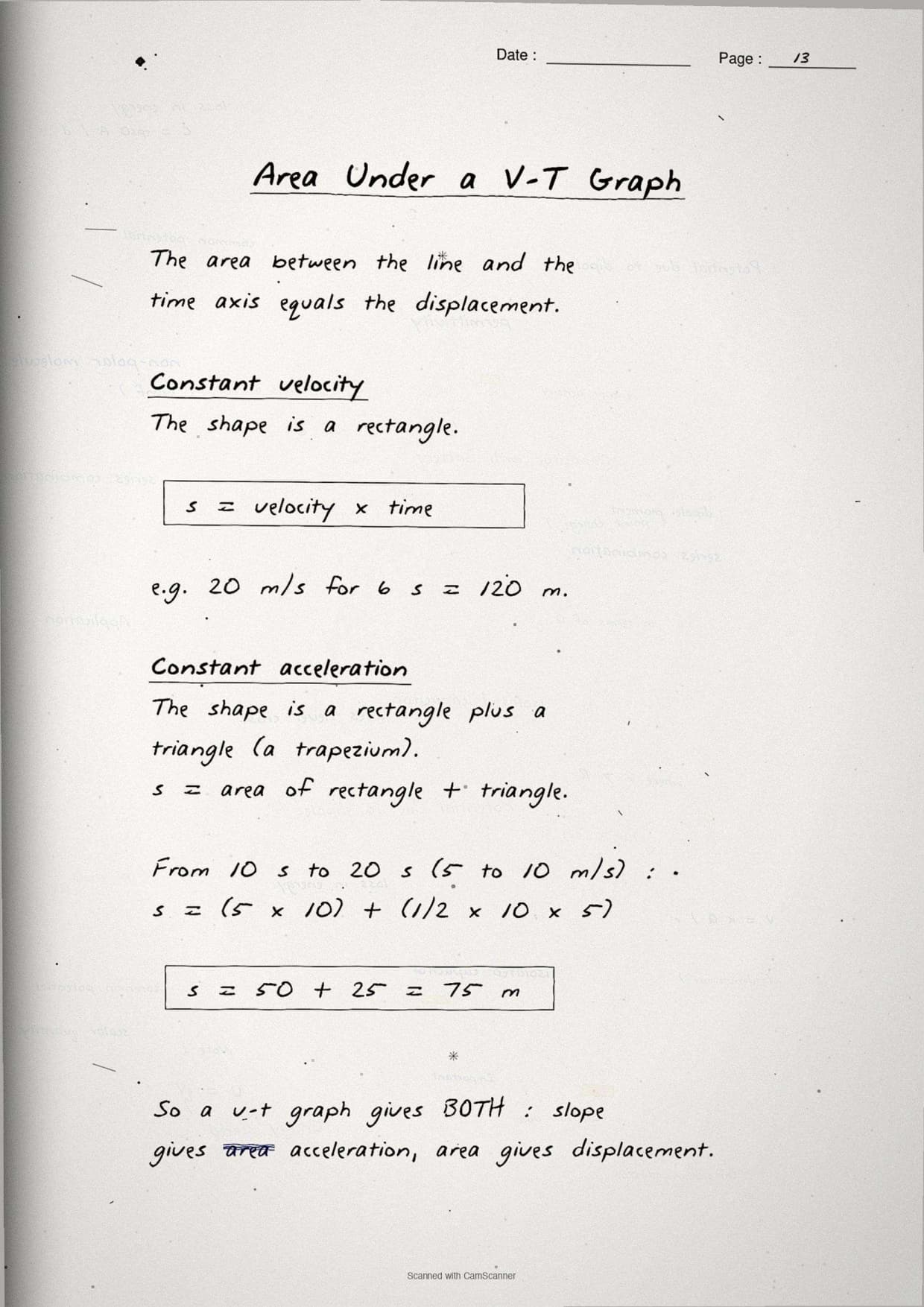
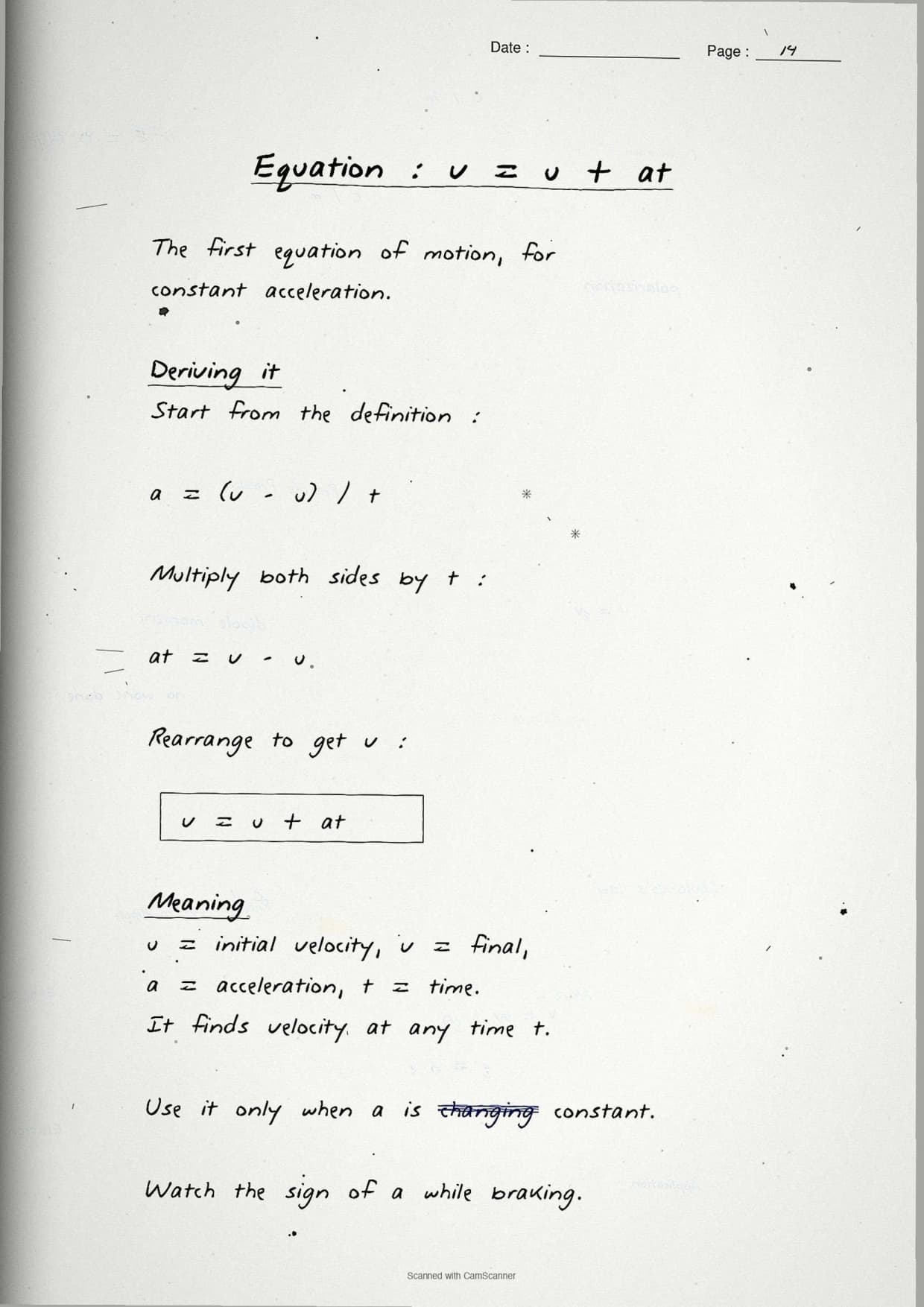
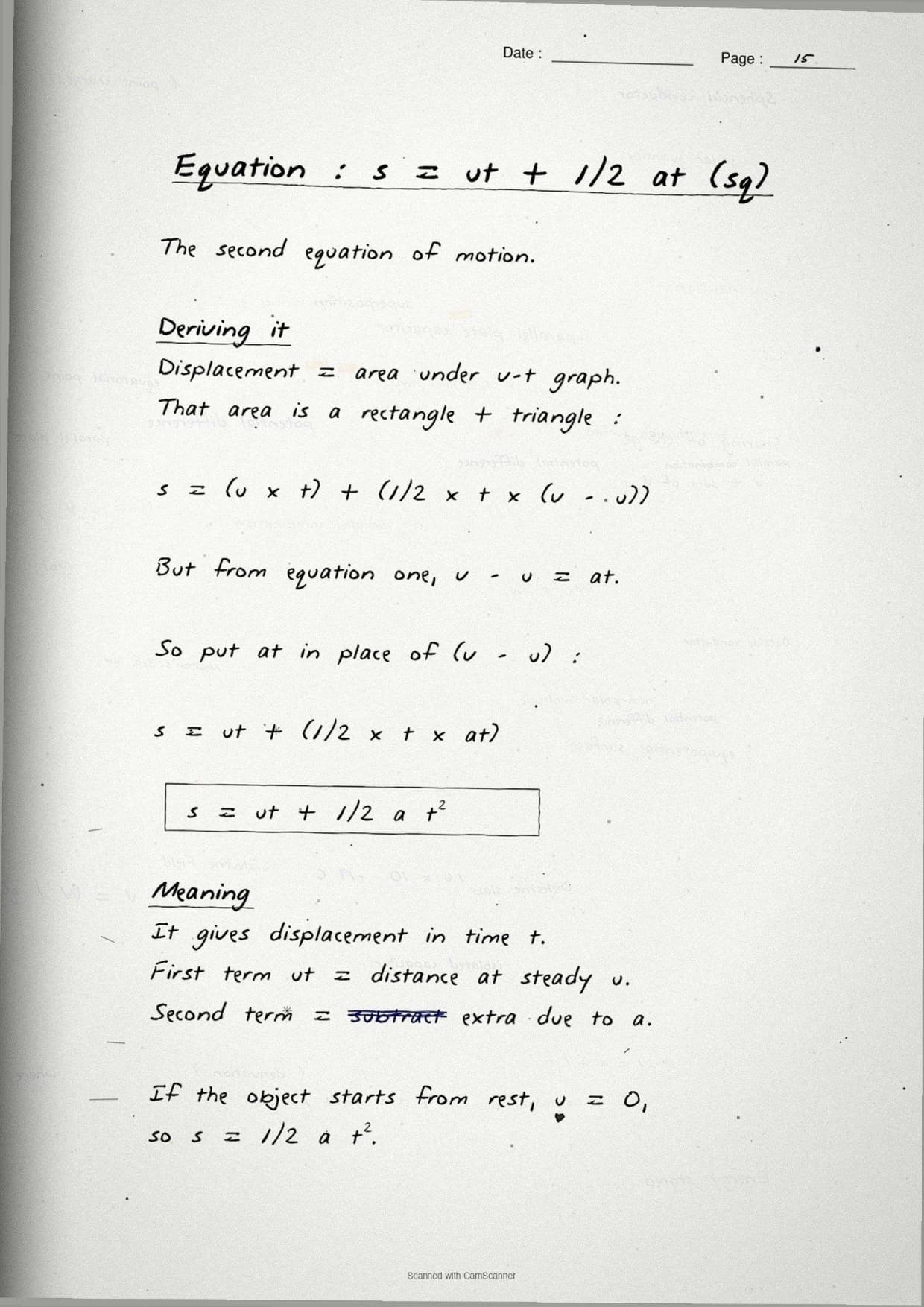
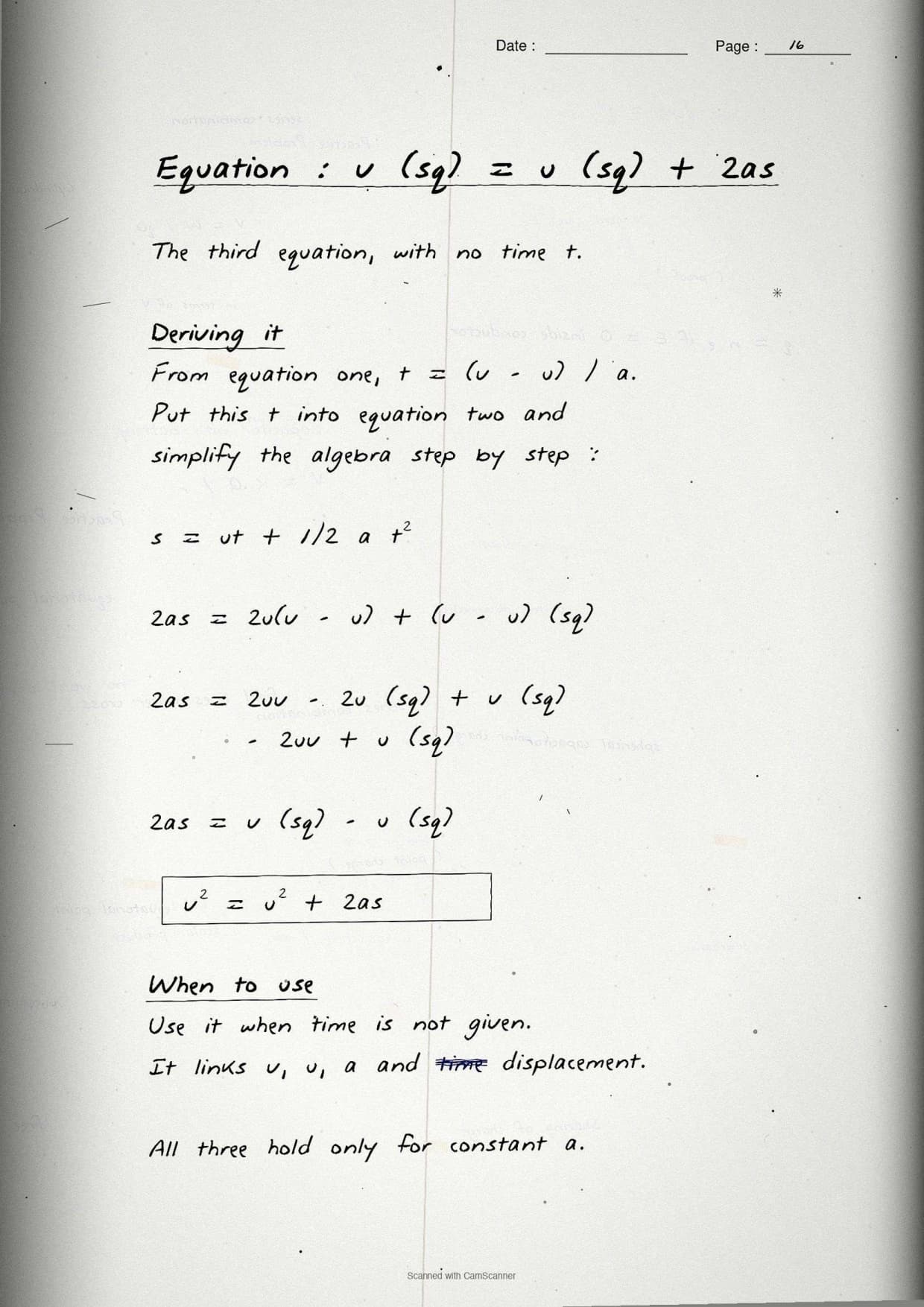
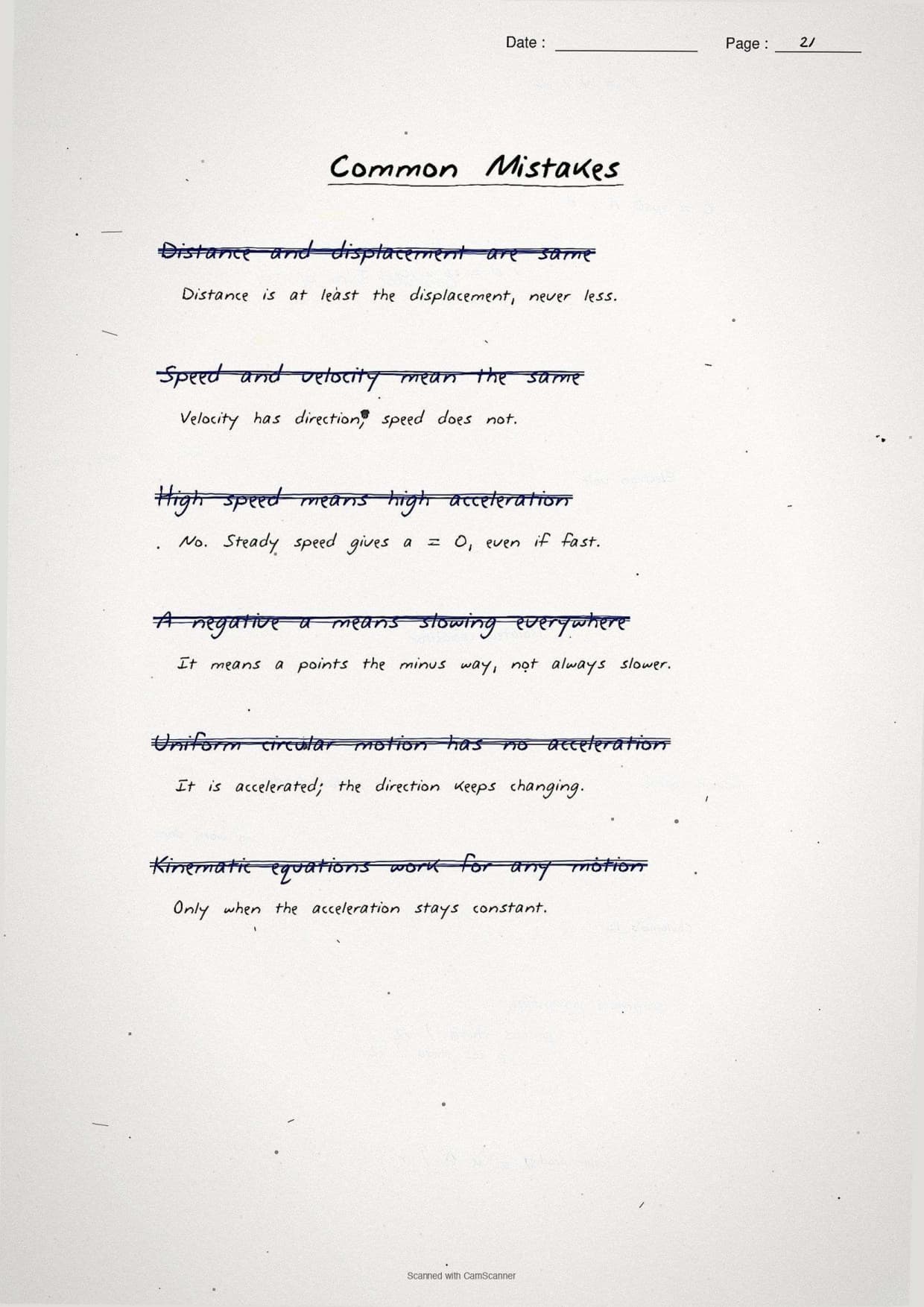
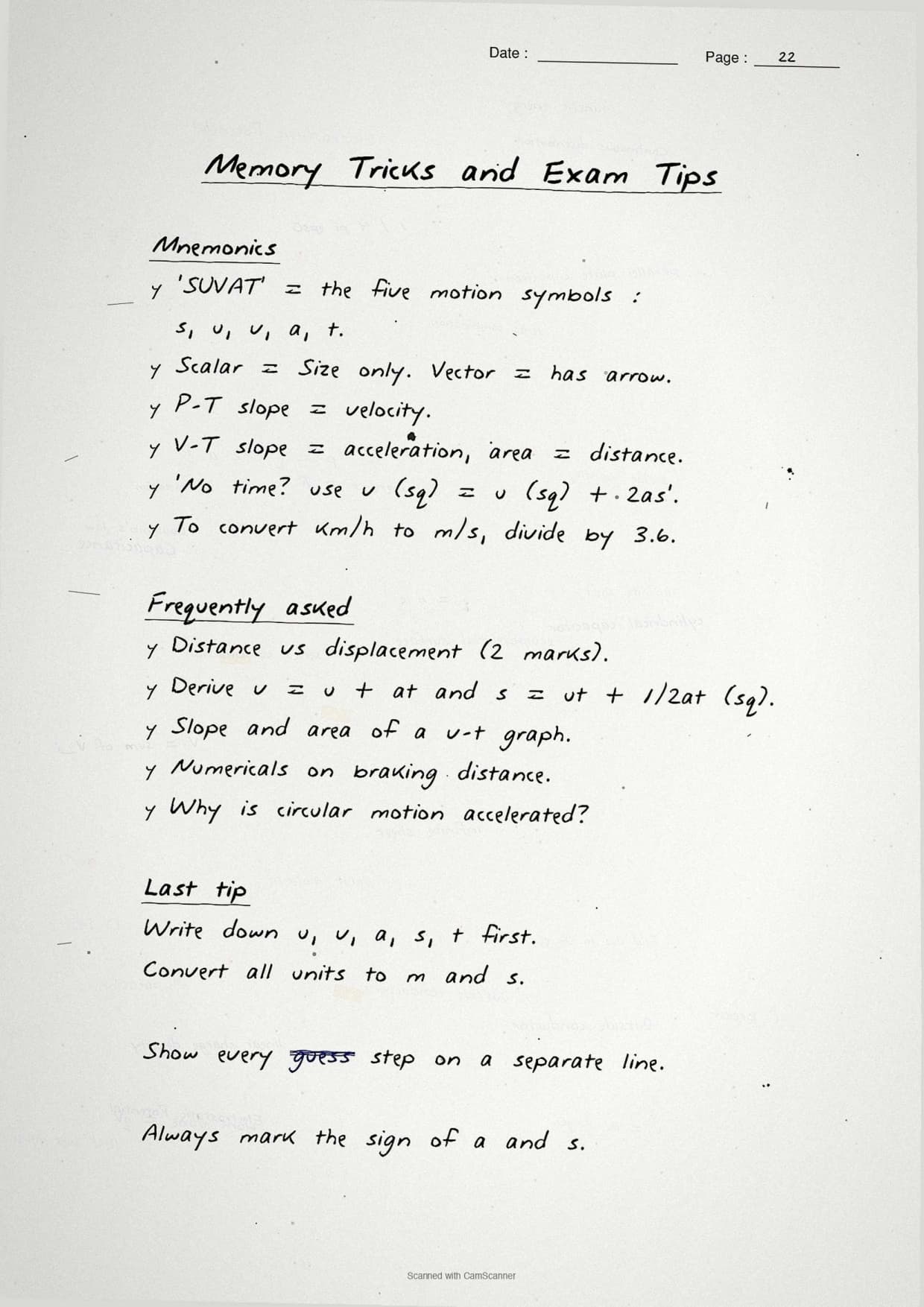
- What you get: distance and displacement, speed, velocity, acceleration, motion graphs, the three equations of motion, and uniform circular motion, all in clear handwriting.
- Colour-coded: new sub-topics in red, each formula in a hand-drawn box, and solved examples in blue.
- Why by hand: writing v = u + at and each graph by hand helps you recall the method fast in the exam.
Student Feedback
In a Collegedunia study of 1,240 Class 9 students, 81% said hand-written pages of the motion graphs and equations were easier to recall than typed notes. About 4 out of 5 rated the boxed equations of motion and the red-marked distance versus displacement note as the most useful part before a test.
Describing Motion Around Us Class 9 Science Explained in One Shot
Source: Vedantu Class 9 & 10 on YouTube
Why Use Handwritten Notes for Class 9 Science Chapter 4 Describing Motion Around Us
Chapter 4 mixes short definitions with a few formulas and many graphs, so a clean, hand-written page saves real time. The Describing Motion Around Us Class 9 Science Handwritten Notes keep one idea per line, with a small sketch or graph beside it, so nothing runs together. You revise the full chapter in one sitting without flipping through the Exploration book.
- Each formula, like v = u + at, sits in its own hand-drawn box.
- A quick number line or motion graph is drawn next to the idea it explains.
- Red sub-headings split the chapter into short, easy parts.
- The wording is plain, like a senior showing you the method.
What Is Inside the Describing Motion Around Us Handwritten Notes PDF
The PDF runs to 22 pages of neat, hand-written revision. It moves from rest and motion, to distance and displacement, speed, velocity, acceleration, motion graphs, the three equations of motion, and uniform circular motion, with a solved example after each idea. The colour code below tells you what every mark means.
- Red: new sub-topic headings, such as Displacement, Acceleration, or Uniform Circular Motion.
- Boxes: each formula, like v = u + at and s = ut + ½at2, drawn by hand.
- Blue: solved examples and the numbers worked out in them.
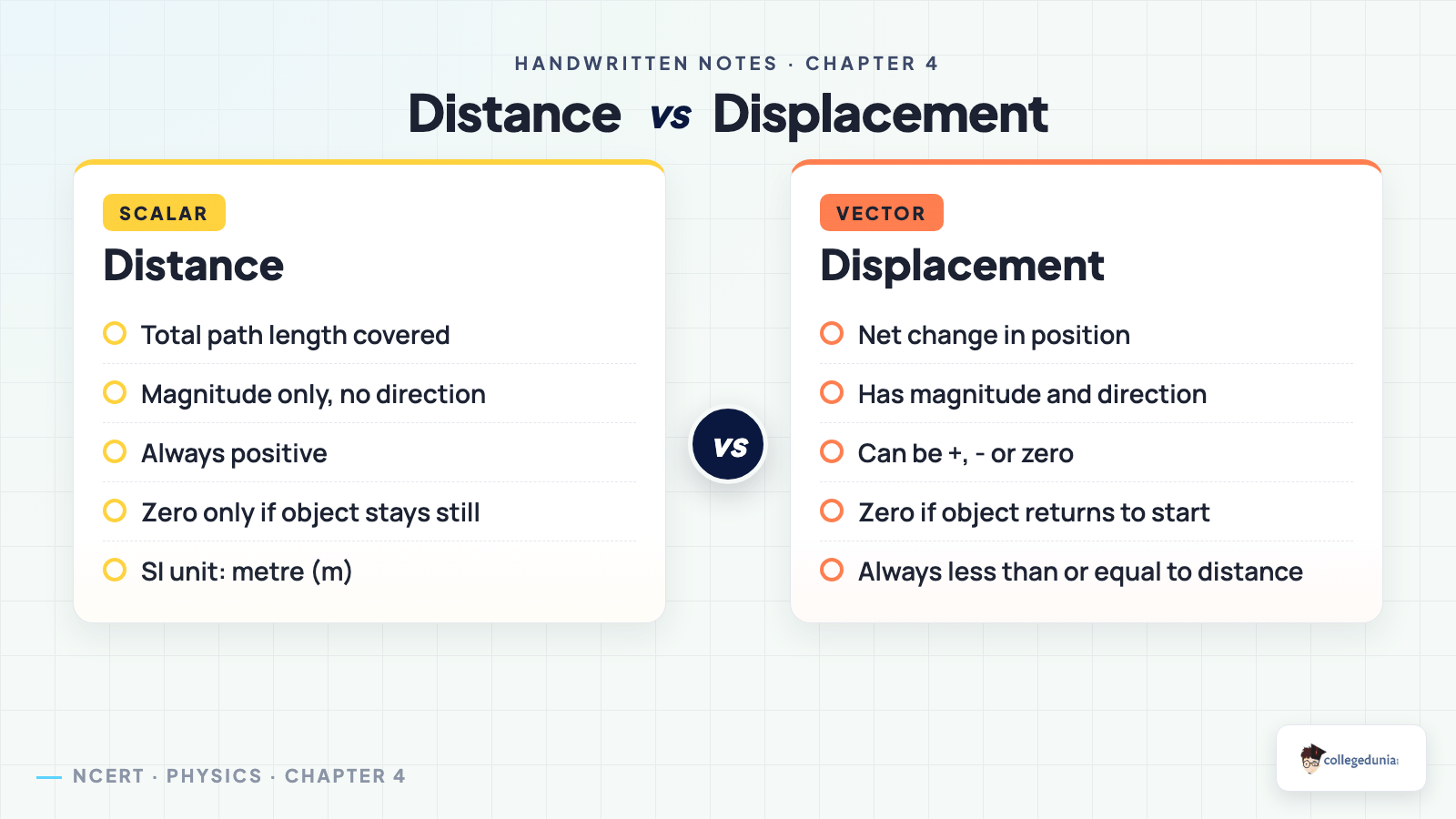
Distance and Displacement Compared in the Handwritten Notes
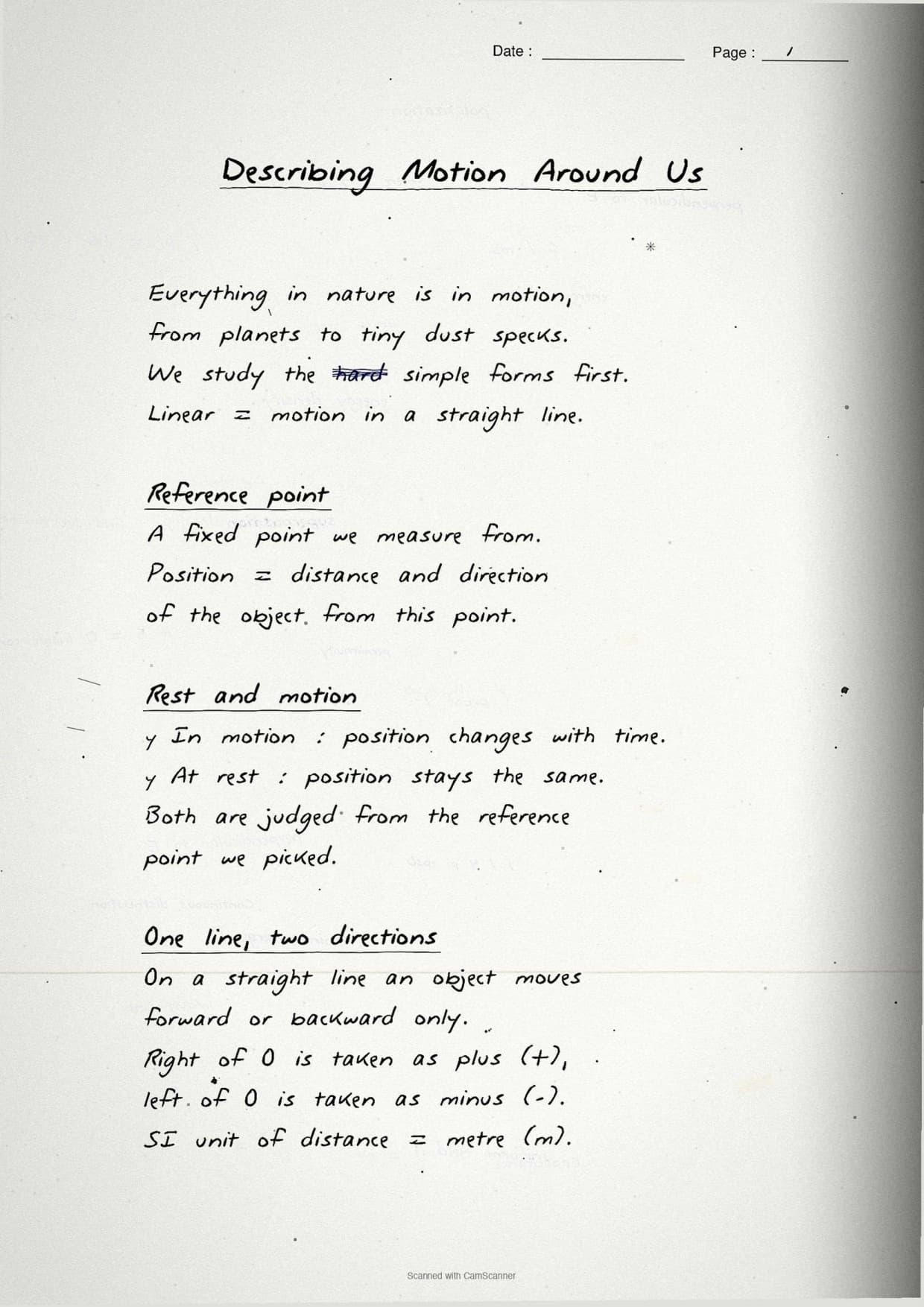
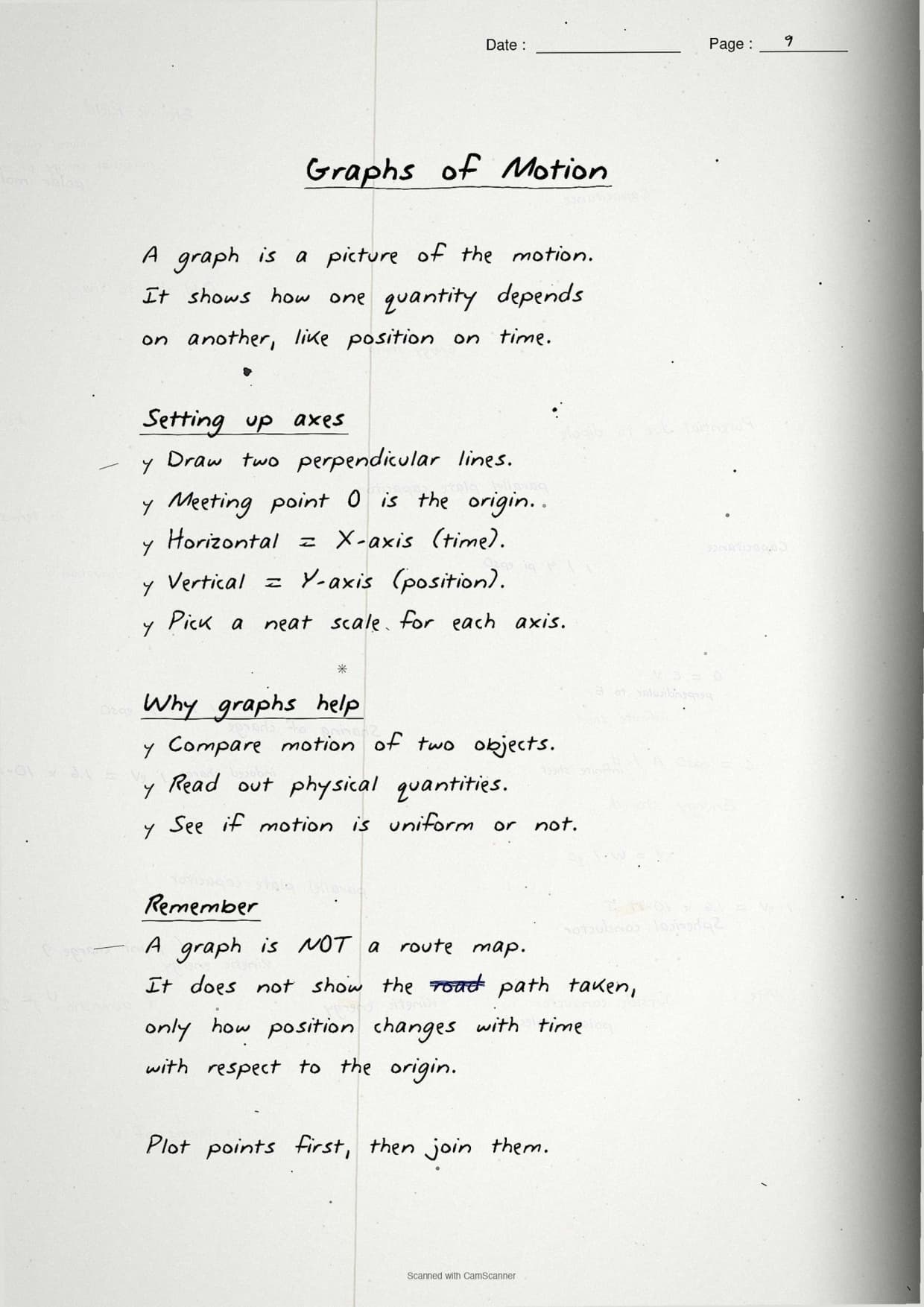
This is one of the most tested ideas in Chapter 4, so the notes open the chapter here with a clear side-by-side. To describe motion, you first fix a reference point (an origin). An object is in motion if its position changes with time, and at rest if it does not.
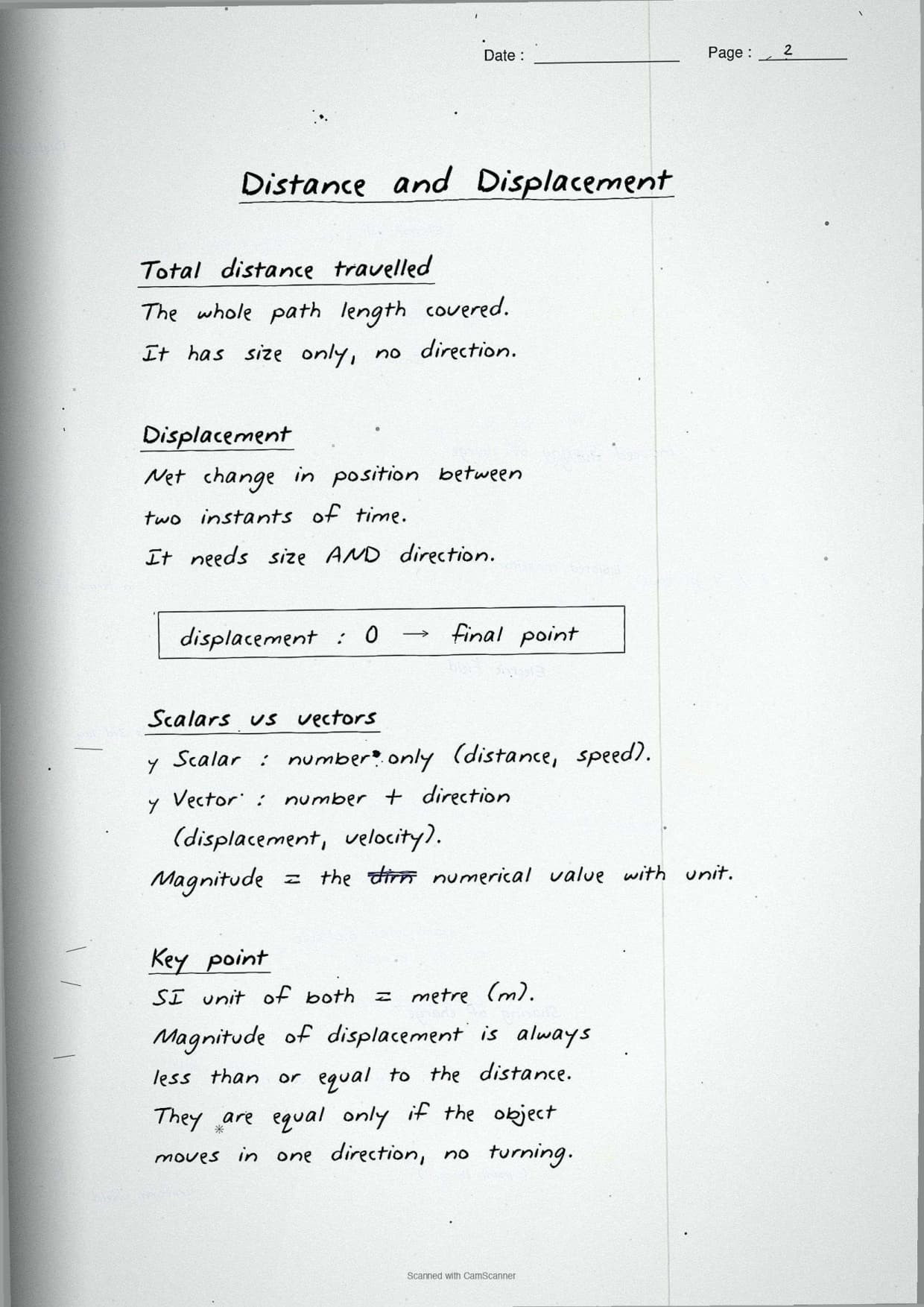
- Distance travelled is the total length of the path covered. It is a scalar, so it has size only, no direction, and is always positive.
- Displacement is the net change in position between two instants. It is a vector, so it has both size and direction, and it can be positive, negative, or zero.
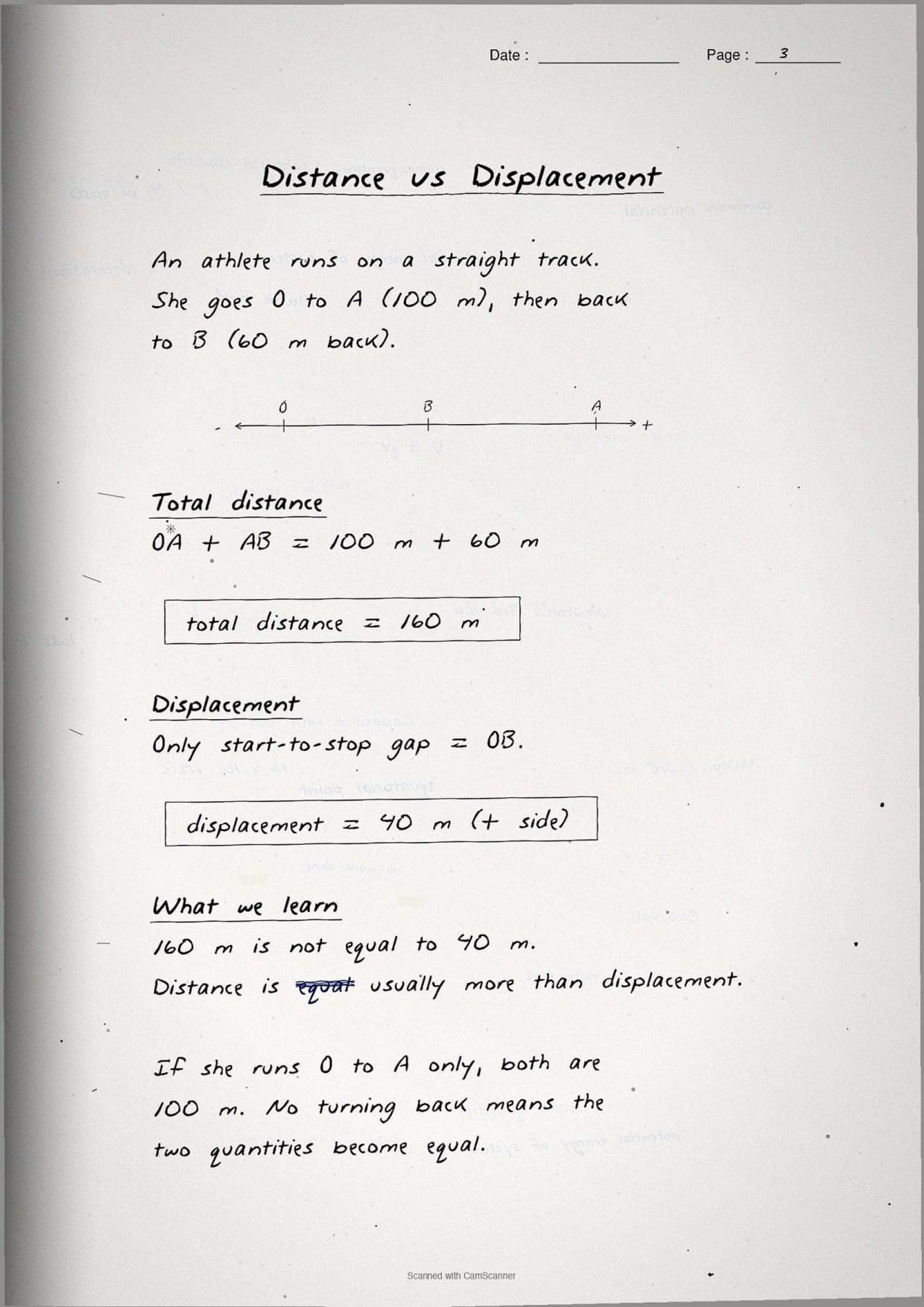
The notes use the athlete example: run from O to A (100 m), then back to B at the 40 m mark. The distance travelled is 100 + 60 = 160 m, but the displacement is only 40 m. A red margin note reminds you that the size of displacement is always less than or equal to the distance, never more. The SI unit of both is the metre (m).
Speed, Velocity and Acceleration Written by Hand
Knowing how far an object moves is not enough. The notes next box the three quantities that tell you how fast it moves and how its motion changes. Learn these three lines and most numericals become one clean substitution.
| Quantity | Type | Formula | SI unit |
|---|---|---|---|
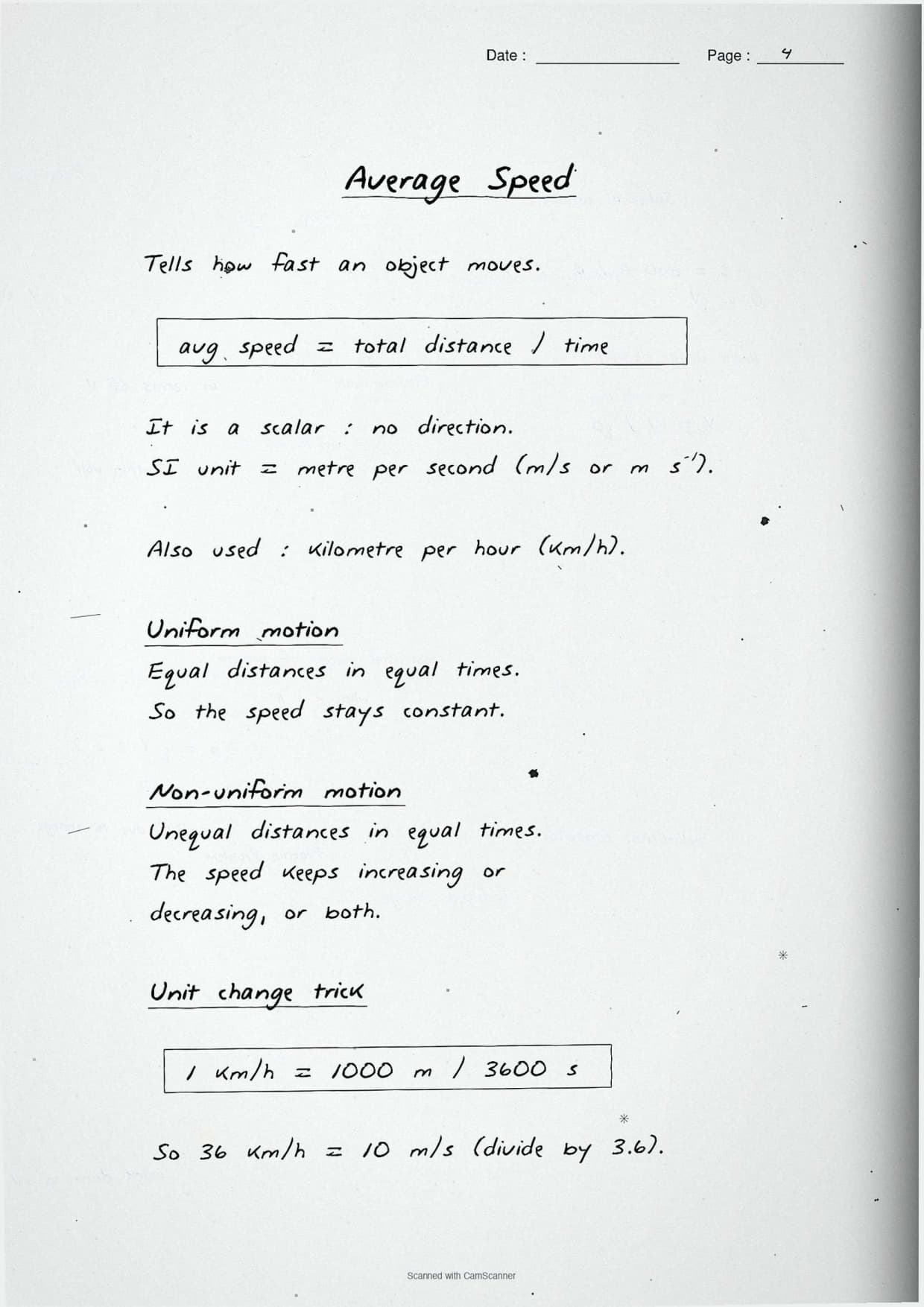
| Average speed | Scalar | total distance ÷ time | m s-1 |
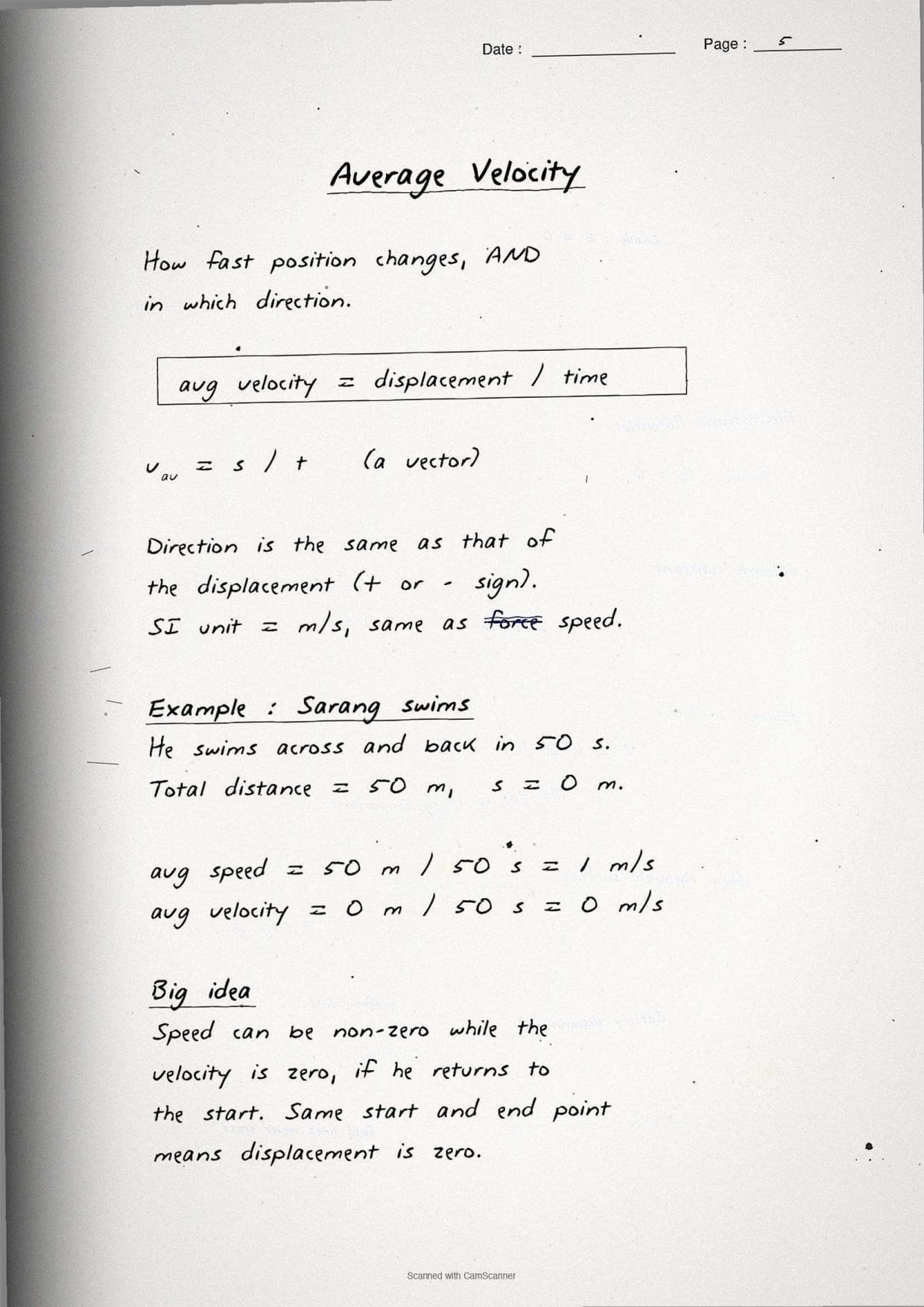
| Average velocity | Vector | displacement ÷ time | m s-1 |
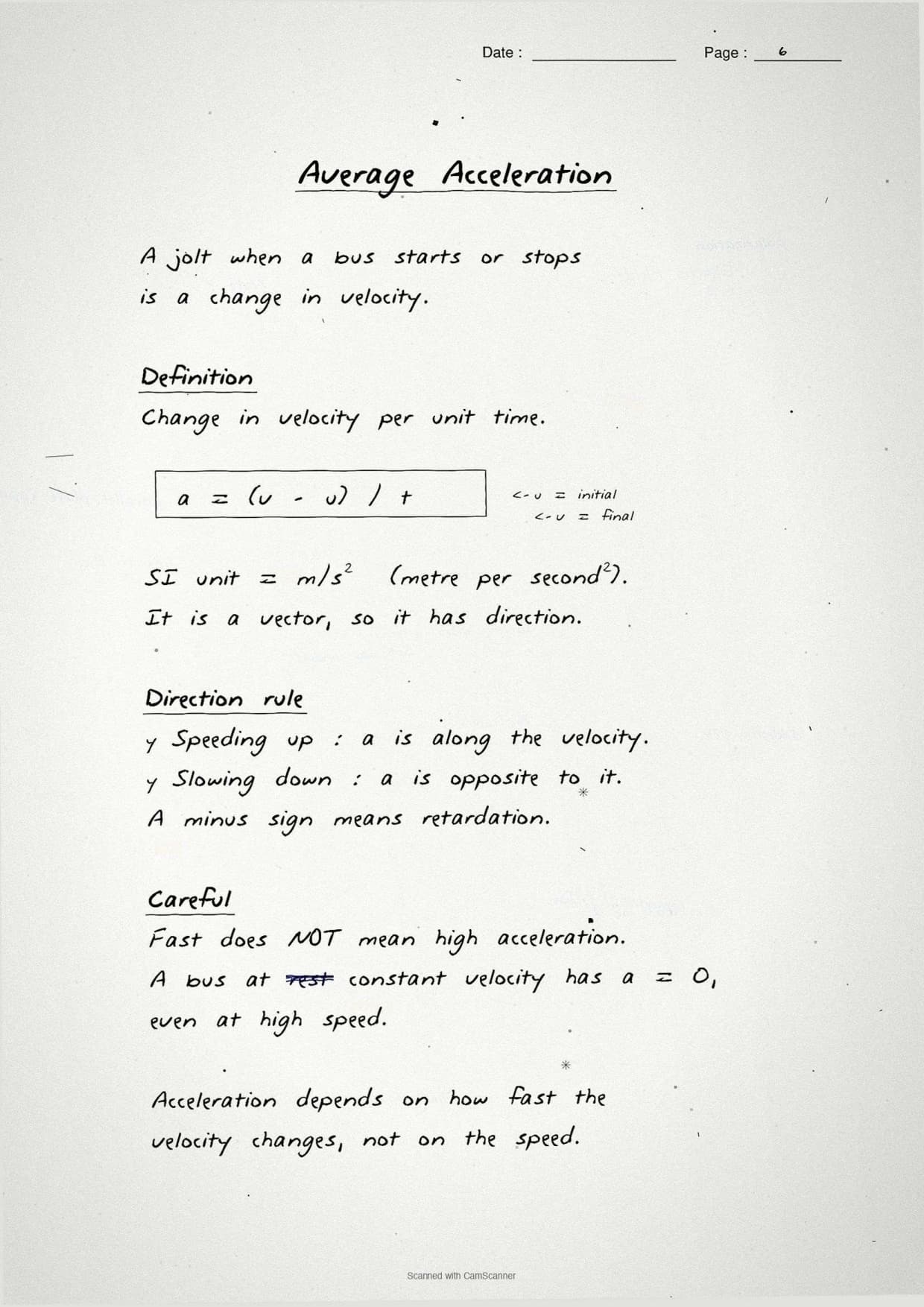
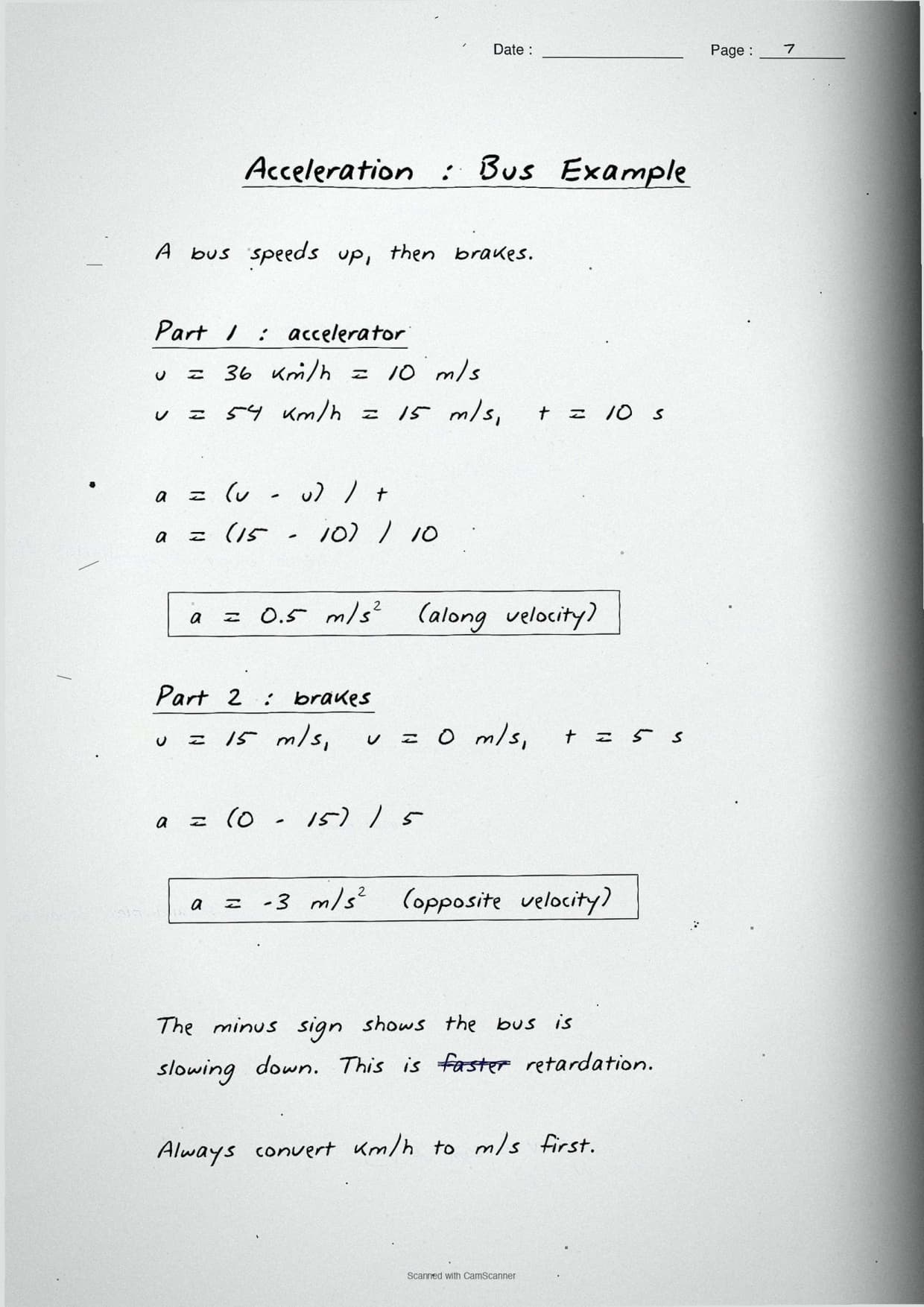
| Average acceleration | Vector | a = v - ut | m s-2 |
- Uniform motion: equal distances in equal times, so the speed stays constant.
- Non-uniform motion: unequal distances in equal times, so the speed keeps changing.
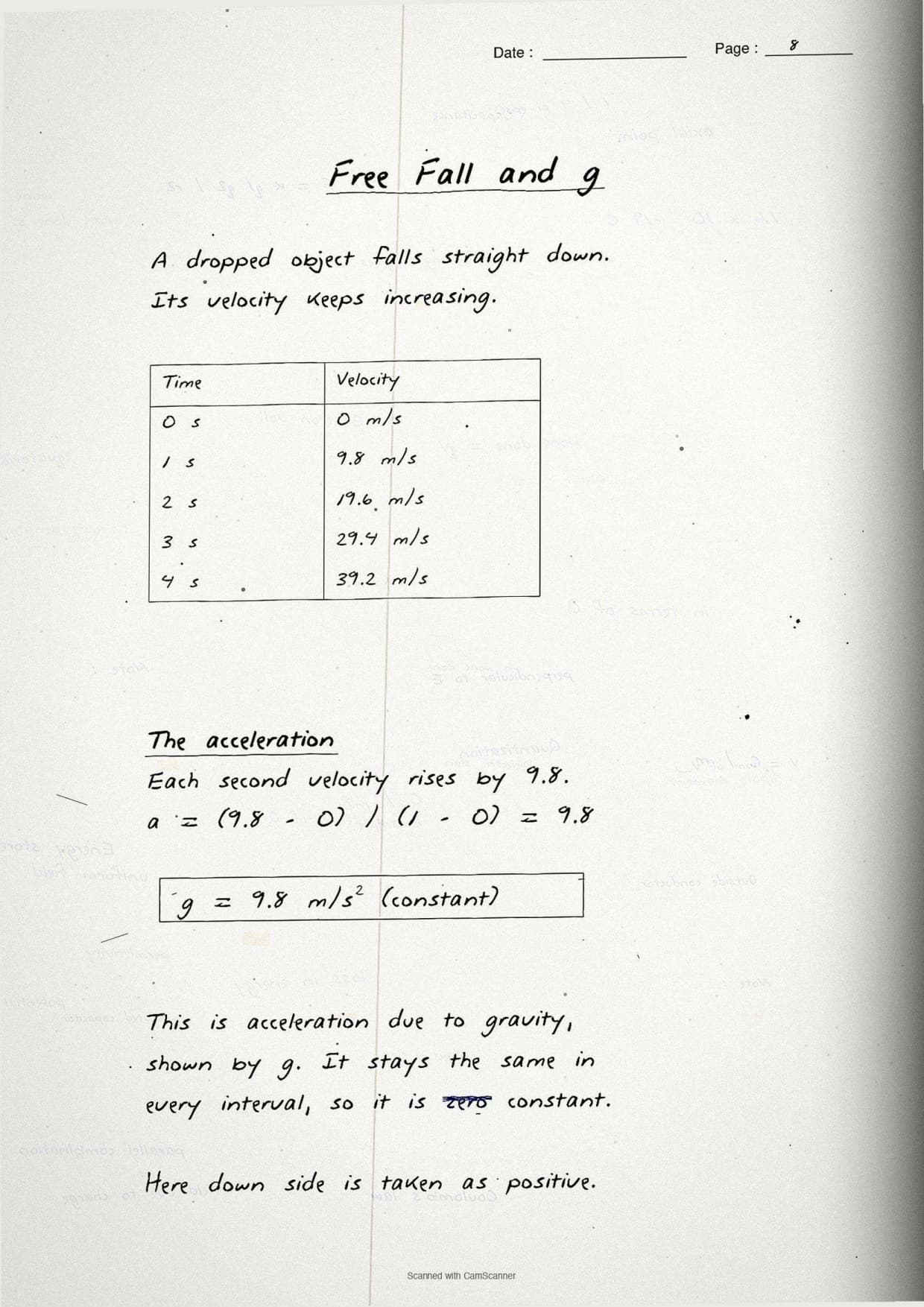
- Motion under gravity: a dropped object speeds up by 9.8 m s-1 every second, so its acceleration is a constant g = 9.8 m s-2 downward.
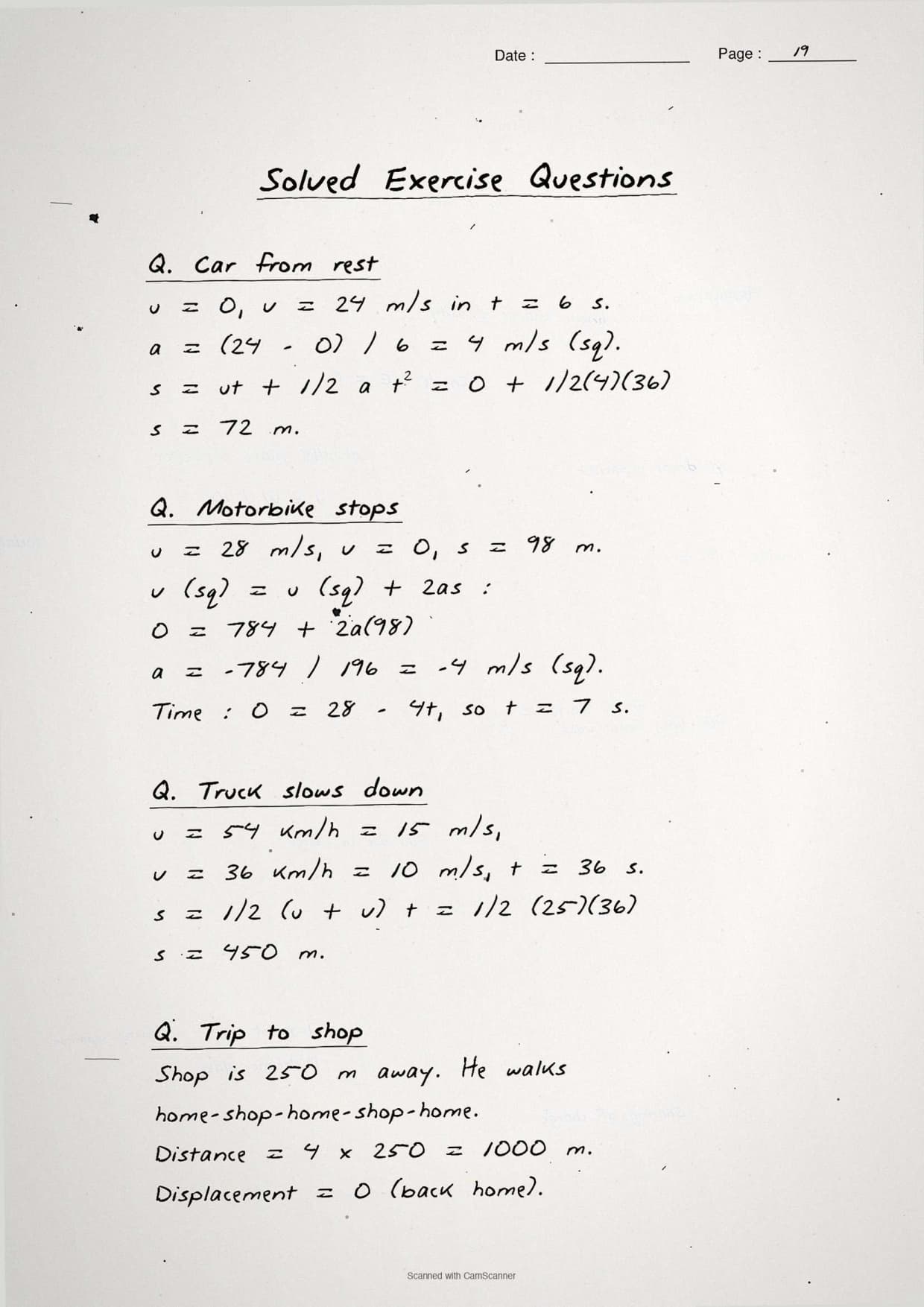
A blue solved example in the notes shows the swimmer who swims a 25 m pool and back in 50 s: the average speed is 1 m s-1, but the average velocity is 0, because the displacement is zero. A red note beside it warns that speed uses distance while velocity uses displacement.
Reading Position-Time and Velocity-Time Graphs in Your Own Handwriting
Graphs turn the whole chapter into pictures, so the notes give them a full block with hand-drawn axes. The single habit to learn is that the slope of a motion graph carries the information.
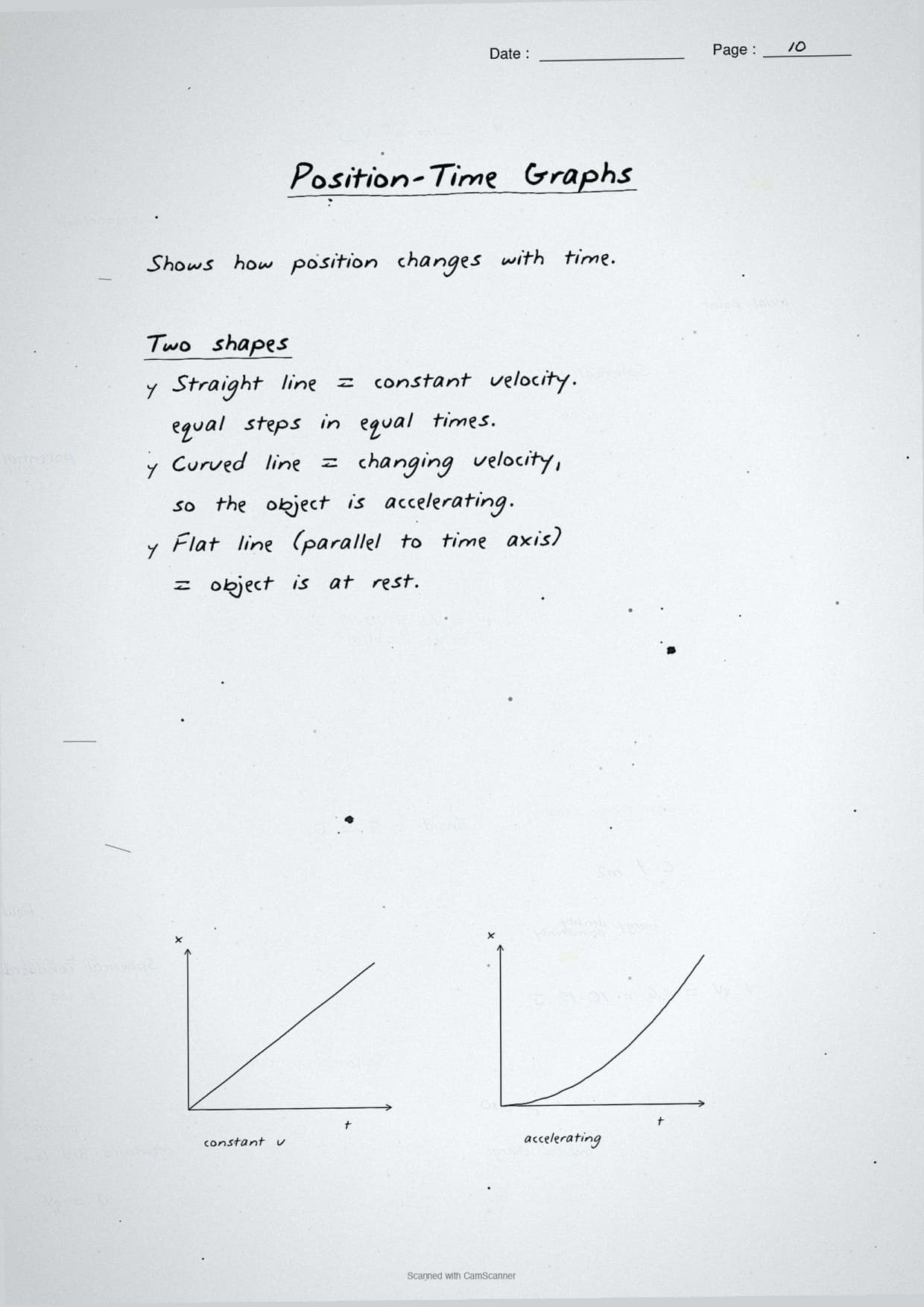
| Graph | Slope gives | Area gives |
|---|---|---|
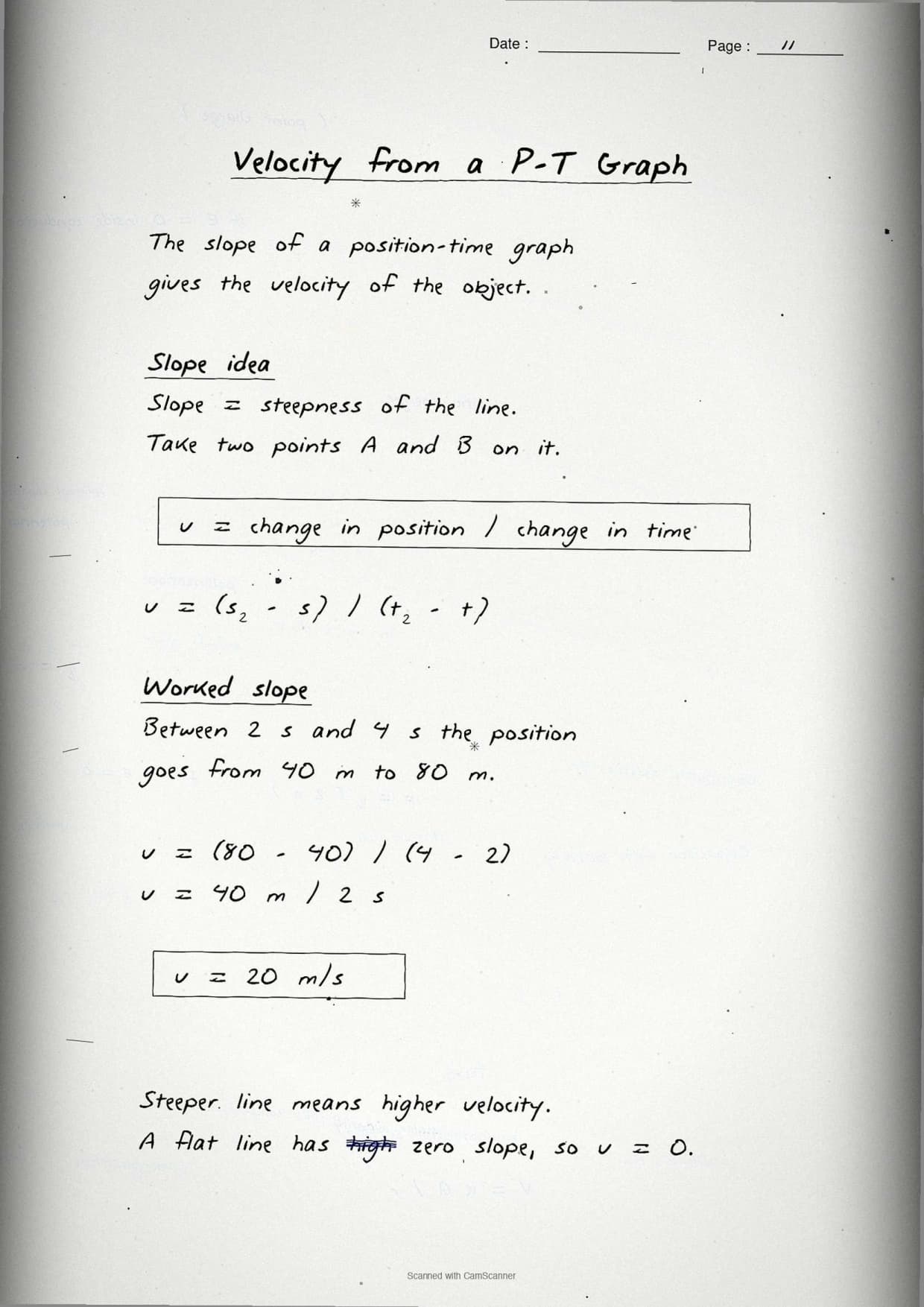
| Position-time | Velocity | Not used |
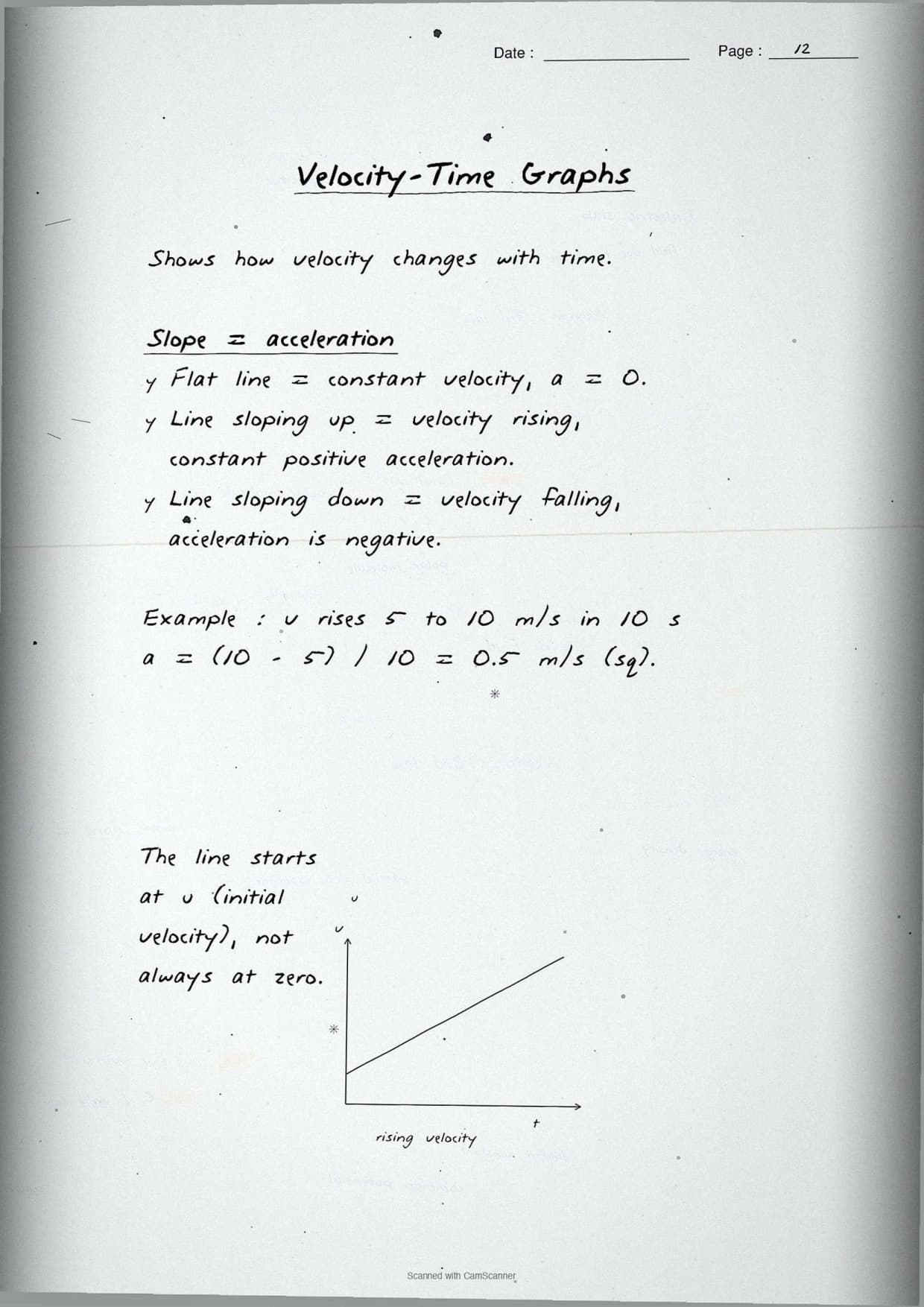
| Velocity-time | Acceleration | Displacement |
- A straight line on a position-time graph means constant velocity; a curve means the velocity is changing.
- A flat line on a velocity-time graph means zero acceleration; a line sloping up or down means positive or negative acceleration.
- The area under a velocity-time line gives the displacement, split into a rectangle plus a triangle when needed.
The notes work one blue example on the side: if the position rises from 40 m to 80 m between 2 s and 4 s, the velocity is 80 - 404 - 2 = 20 m s-1.
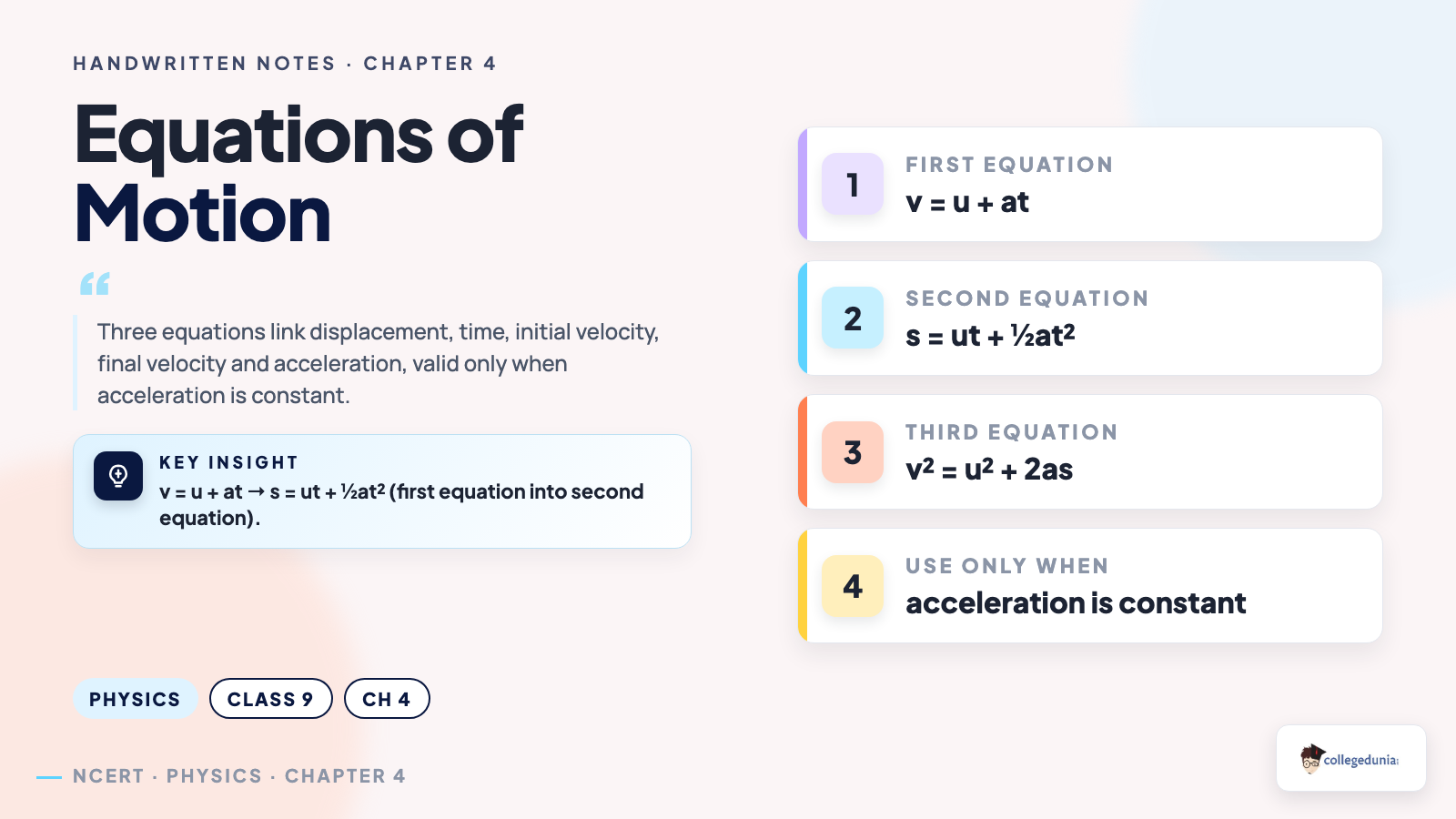
Equations of Motion Boxed by Hand
For straight-line motion with constant acceleration, three equations link the five quantities: displacement s, time t, initial velocity u, final velocity v, and acceleration a. Each one is drawn in its own box in the notes so you can copy it straight into the exam.
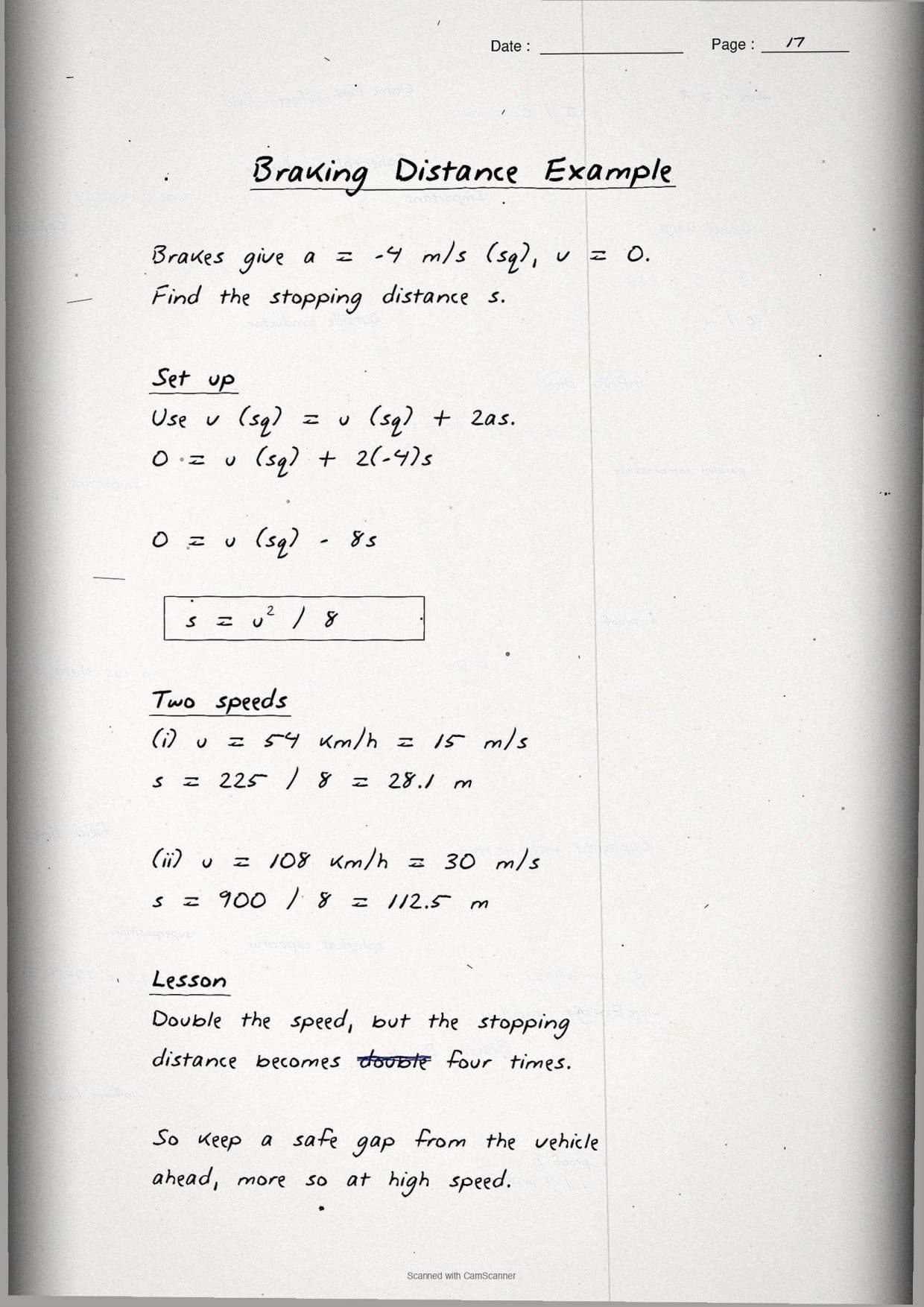
- First equation: v = u + at, which leaves out displacement s.
- Second equation: s = ut + ½at2, which leaves out final velocity v.
- Third equation: v2 = u2 + 2as, which leaves out time t.
Pick the equation that skips the quantity you do not know. A blue solved example in the notes: a car brakes with a = -4 m s-2 from u = 15 m s-1, so from v2 = u2 + 2as it stops after 2258 ≈ 28.1 m. The margin reminds you to give braking a minus sign and to convert km/h to m s-1 first.
Uniform Circular Motion Marked in the Margins
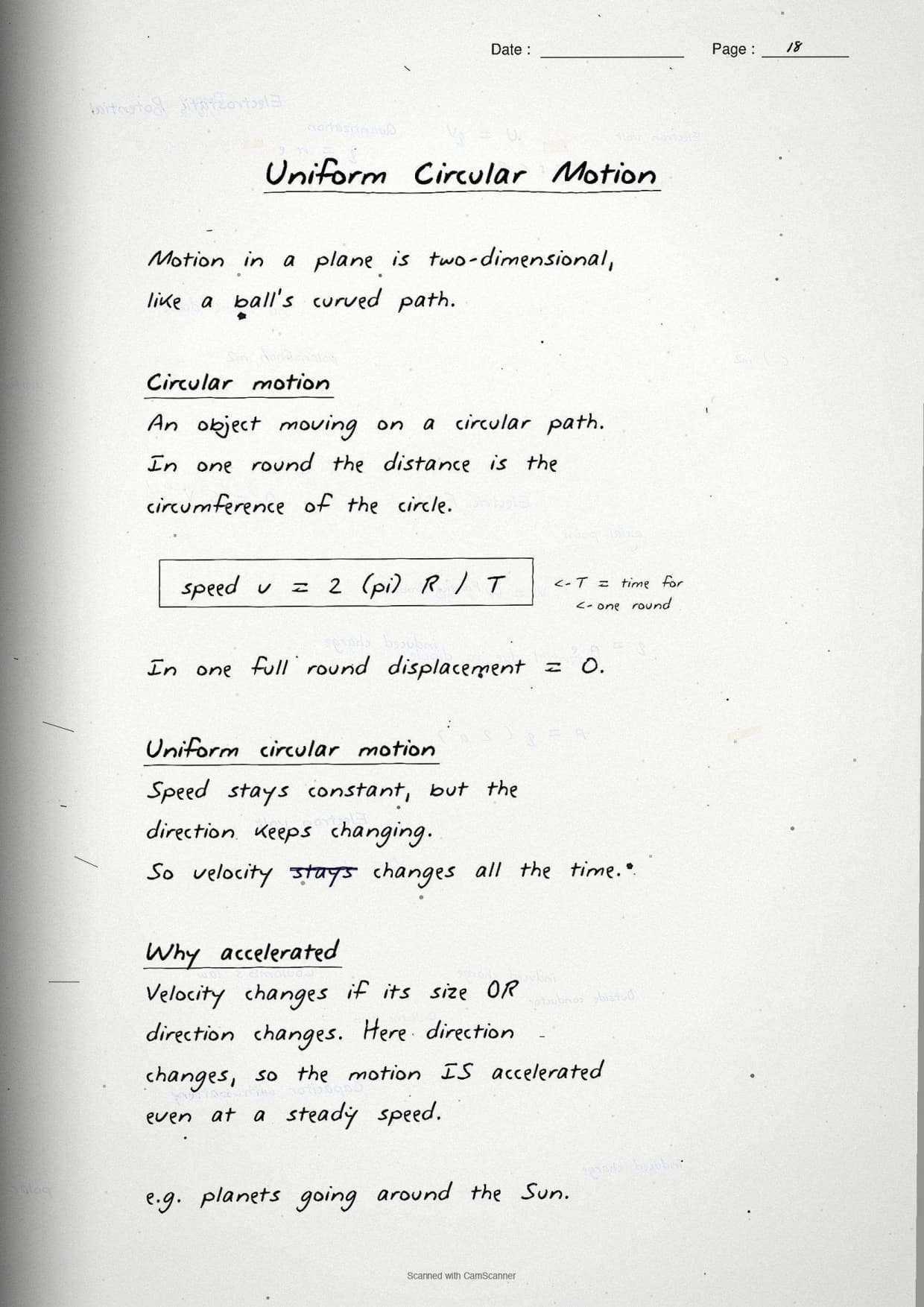
The last idea of the chapter is often missed, so the notes give it a short block of its own. When an object moves round a circle at constant speed, its motion is called uniform circular motion. The speed stays fixed, but the direction of the velocity keeps turning.
- Over one full revolution the distance travelled is 2πR, but the displacement is zero, so the average velocity over one round is also zero.
- At every point the velocity is directed along the tangent to the circle.
- Because the direction changes all the time, the velocity changes, so uniform circular motion is an accelerated motion even though the speed never changes.
The notes pin everyday examples in the margins so the idea sticks: a stone whirled on a string, the hands of a clock, a merry-go-round, and a satellite orbiting the Earth all move in near-circular paths.
Formula Boxes and Units Drawn by Hand
Keep these boxed formulas ready for the numericals in the Revise, Reflect, Refine exercise. Each one is written out in the notes exactly as you should copy it in the exam.
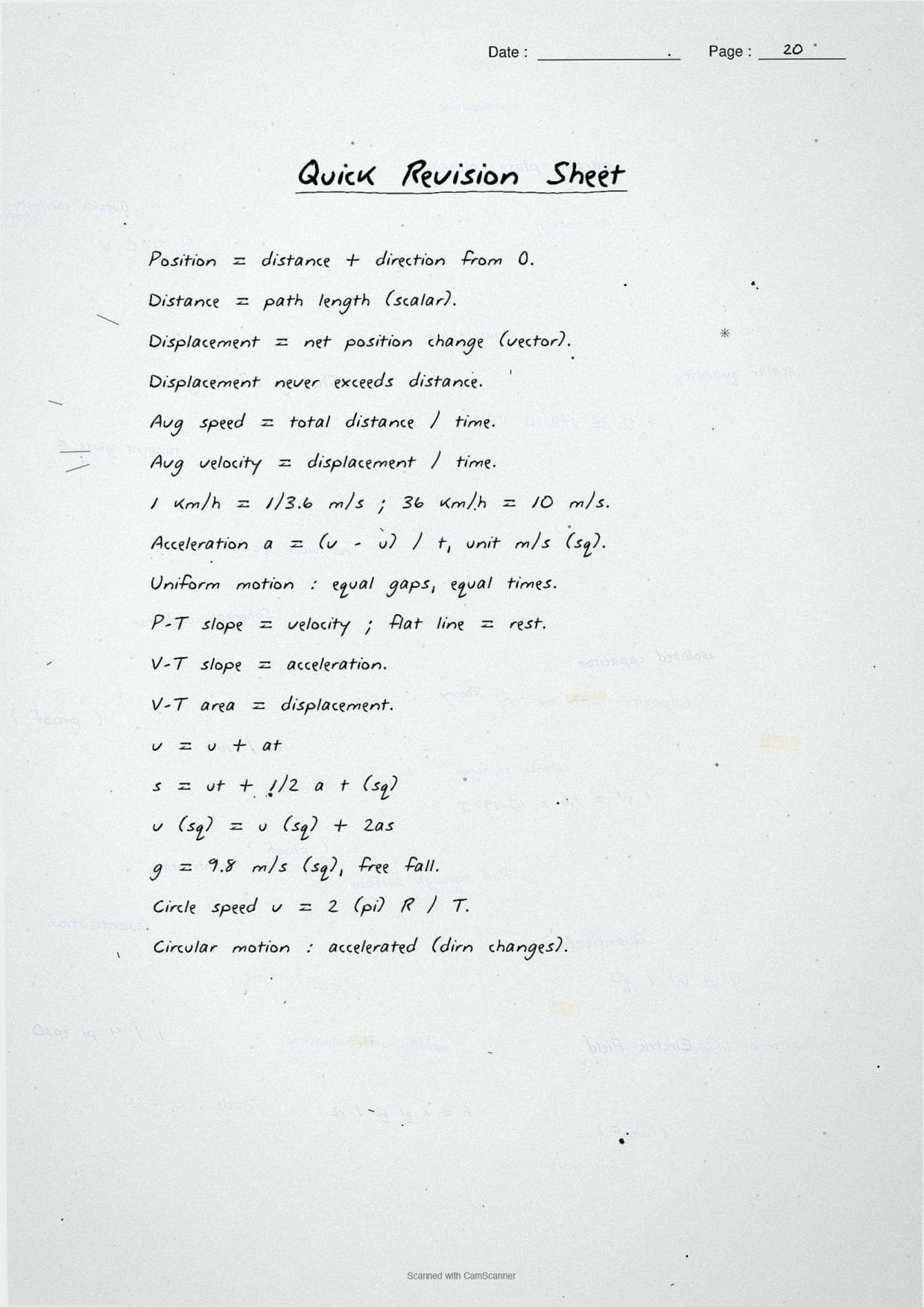
- Average speed: total distancetime, and average velocity = displacementtime.
- Acceleration: a = v - ut, read as the slope of a velocity-time graph.
- Equations of motion: v = u + at, s = ut + ½at2, and v2 = u2 + 2as.
Common Mistakes Flagged in Red
Most lost marks in this chapter come from small slips, not hard ideas. The handwritten notes circle these in red so you fix them while you revise.
- Swapping distance (a scalar) with displacement (a vector).
- Using distance in the average velocity formula instead of displacement.
- Forgetting the minus sign for retardation, or mixing km/h with m s-1.
- Thinking uniform circular motion is not accelerated, when the changing direction means it is.
Last-Minute Revision with These Handwritten Notes
The night before your exam, the Describing Motion Around Us Class 9 Science Handwritten Notes work as a quick skim. Every boxed formula and red heading is a checkpoint, so you can cover the whole chapter in well under an hour.
- State the difference between distance and displacement in one line.
- Write the average speed, velocity, and acceleration formulas from their boxes.
- Recall what the slope and area of each motion graph give.
- Write the three equations of motion and name the quantity each one leaves out.
- Read the red note on uniform circular motion before you close the notes.
Collegedunia brings you these handwritten notes as a free, clear PDF you can open on any phone. Every page follows the new Exploration book and the Revise, Reflect, Refine flow, so the notes match the 2026-27 syllabus and prepare you for the annual exam and later for CBSE, JEE, and NEET basics.
More Describing Motion Around Us Class 9 Science Resources
Use the table below to open the other resources for this chapter of the new Class 9 Science Exploration book.
| Resource | Open |
|---|---|
| Handwritten Notes | Describing Motion Around Us Class 9 Science Handwritten Notes |
| NCERT Solutions | Describing Motion Around Us Class 9 Science NCERT Solutions |
| Revision Notes | Describing Motion Around Us Class 9 Science Notes |
| Formula Sheet | Describing Motion Around Us Class 9 Science Formula Sheet |
| NCERT Book PDF | Describing Motion Around Us Class 9 Science NCERT Book PDF |
NCERT Handwritten Notes for Class 9 Science: All Chapters
Use the table below to open the handwritten notes for any other chapter of the new Class 9 Science Exploration book.
| Chapter | Handwritten Notes |
|---|---|
| Chapter 2 | Cell The Building Block of Life |
| Chapter 3 | Tissues in Action |
| Chapter 4 | Describing Motion Around Us |
| Chapter 5 | Exploring Mixtures and their Separation |
| Chapter 6 | How Forces Affect Motion |
| Chapter 7 | Work, Energy, and Simple Machines |
| Chapter 8 | Journey Inside the Atom |
| Chapter 9 | Atomic Foundations of Matter |
| Chapter 10 | Sound Waves Characteristics and Applications |
| Chapter 11 | Reproduction How Life Continues |
| Chapter 12 | Patterns in Life Diversity and Classification |
| Chapter 13 | Earth as a System Energy, Matter, and Life |
Describing Motion Around Us Class 9 Science Handwritten Notes FAQs
Ques. How many pages are the Describing Motion Around Us Class 9 Science handwritten notes?
Ans. The handwritten notes run to 22 pages. They cover the full chapter, from distance and displacement to speed, velocity, acceleration, motion graphs, the three equations of motion, and uniform circular motion, with a solved example after each idea.
Ques. Are these real handwritten notes?
Ans. Yes. They are a topper's own clear handwritten revision notes, with each formula boxed, motion graphs drawn by hand, and sub-headings colour-coded in red.
Ques. What are the three equations of motion in the Chapter 4 notes?
Ans. The three equations, valid only for constant acceleration, are v = u + at, s = ut + ½at2, and v2 = u2 + 2as, where u is initial velocity, v is final velocity, a is acceleration, s is displacement, and t is time.
Ques. Can I use these handwritten notes for last-minute revision?
Ans. Yes. The boxed formulas and red headings let you skim the whole chapter in under an hour, so they suit the night before your annual exam.
Ques. Is Describing Motion Around Us part of the new Class 9 Science book?
Ans. Yes. Describing Motion Around Us is Chapter 4 of the new Exploration textbook for the 2026-27 syllabus. It is a core base chapter for later work on forces, energy, and motion.



Comments