




The Patterns in Life: Diversity and Classification Class 9 Science Handwritten Notes are a topper's own neat revision of Chapter 12 from the new Exploration textbook. Every idea, biodiversity, the five kingdoms, plant and animal groups, the classification hierarchy, and binomial naming, is written by hand with the key groups boxed and colour-coded in the margin. You revise the whole 2026-27 chapter in one short sitting, just as you would set it out in the exam.
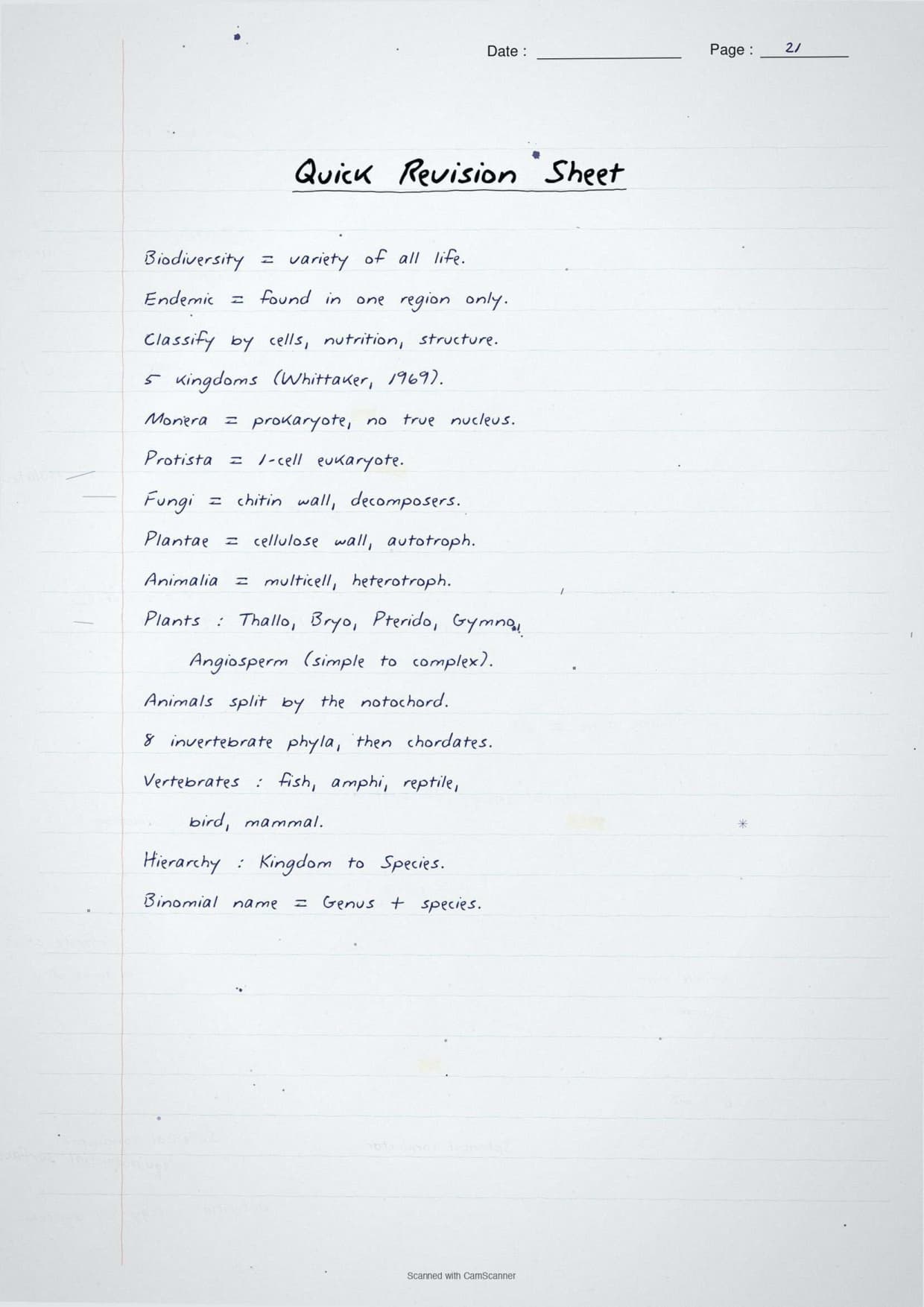
- What you get: biodiversity, the five kingdoms, plant and animal groups, the classification hierarchy, and binomial naming, all in clear handwriting.
- Colour-coded: new sub-topics in red, each kingdom and key term in a hand-drawn box, and examples in blue.
- Why by hand: drawing the five-kingdom chart and the classification ladder by hand helps you recall the whole system fast in the exam.
Student Feedback
In a Collegedunia study of 1,240 Class 9 students, 81% said a hand-drawn five-kingdom chart was easier to recall than typed notes. About 4 out of 5 rated the boxed kingdom features and the red-marked mistakes as the most useful part before a test.
Patterns in Life Diversity and Classification Class 9 Science Explained in One Shot
Source: Physics Wallah Foundation on YouTube
Why Use Handwritten Notes for Class 9 Science Chapter 12 Patterns in Life
Chapter 12 is full of names, groups and short definitions, so a clean, hand-written page saves real time. The Patterns in Life: Diversity and Classification Class 9 Science Handwritten Notes keep one group per line, with a small sketch or tick beside it, so nothing runs together. You revise the full chapter in one sitting without flipping through the Exploration book.
- Each kingdom sits in its own hand-drawn box with its key features listed beside it.
- A quick branching chart shows how the five kingdoms and the plant groups split.
- Red sub-headings split the chapter into short, easy parts.
- The wording is plain, like a senior showing you the method.
What Is Inside the Patterns in Life Handwritten Notes PDF
The PDF runs to 22 pages of neat, hand-written revision. It moves from biodiversity and why we classify, to the five kingdoms, the plant and animal groups, the classification hierarchy, and binomial naming, with a clear example after each idea. The colour code below tells you what every mark means.
- Red: new sub-topic headings, such as Biodiversity, Five Kingdoms, or Binomial Nomenclature.
- Boxes: each kingdom and each key term, like endemic species or notochord, drawn by hand.
- Blue: examples such as Amoeba, Spirogyra and Panthera tigris.
Biodiversity and the Need for Classification in the Notes
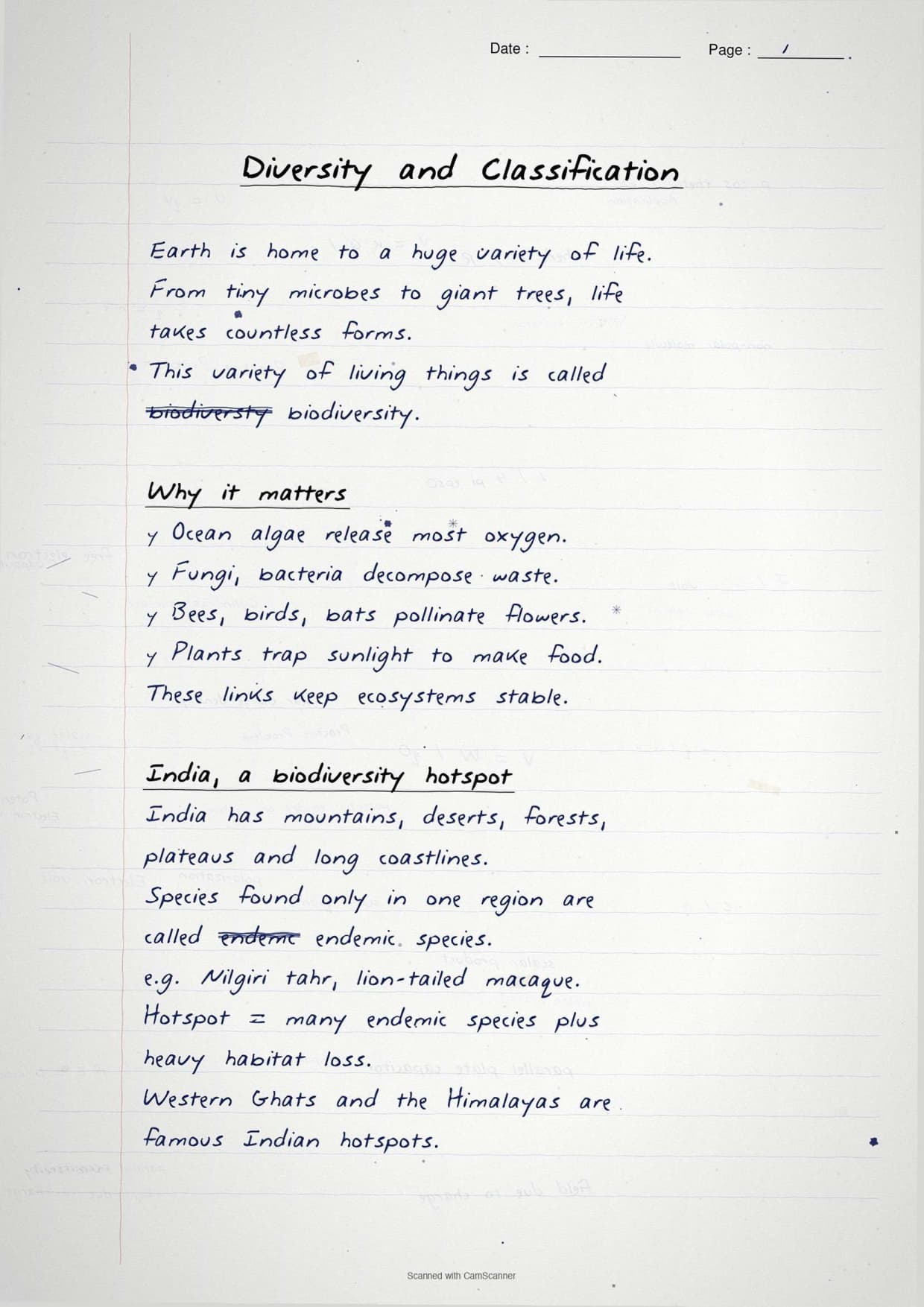
Biodiversity is the starting idea of the chapter, so the notes open here. Biodiversity is the whole variety of living organisms on the Earth, from tiny bacteria to giant trees and blue whales, along with the habitats they live in. India is very rich in biodiversity because it has mountains, deserts, rainforests and long coastlines.
- Endemic species: found naturally in only one region, such as the Nilgiri tahr and the Lion-tailed macaque, both marked in blue in the notes.
- Biodiversity hotspot: a region rich in endemic species that has also lost a lot of habitat, like the Western Ghats.
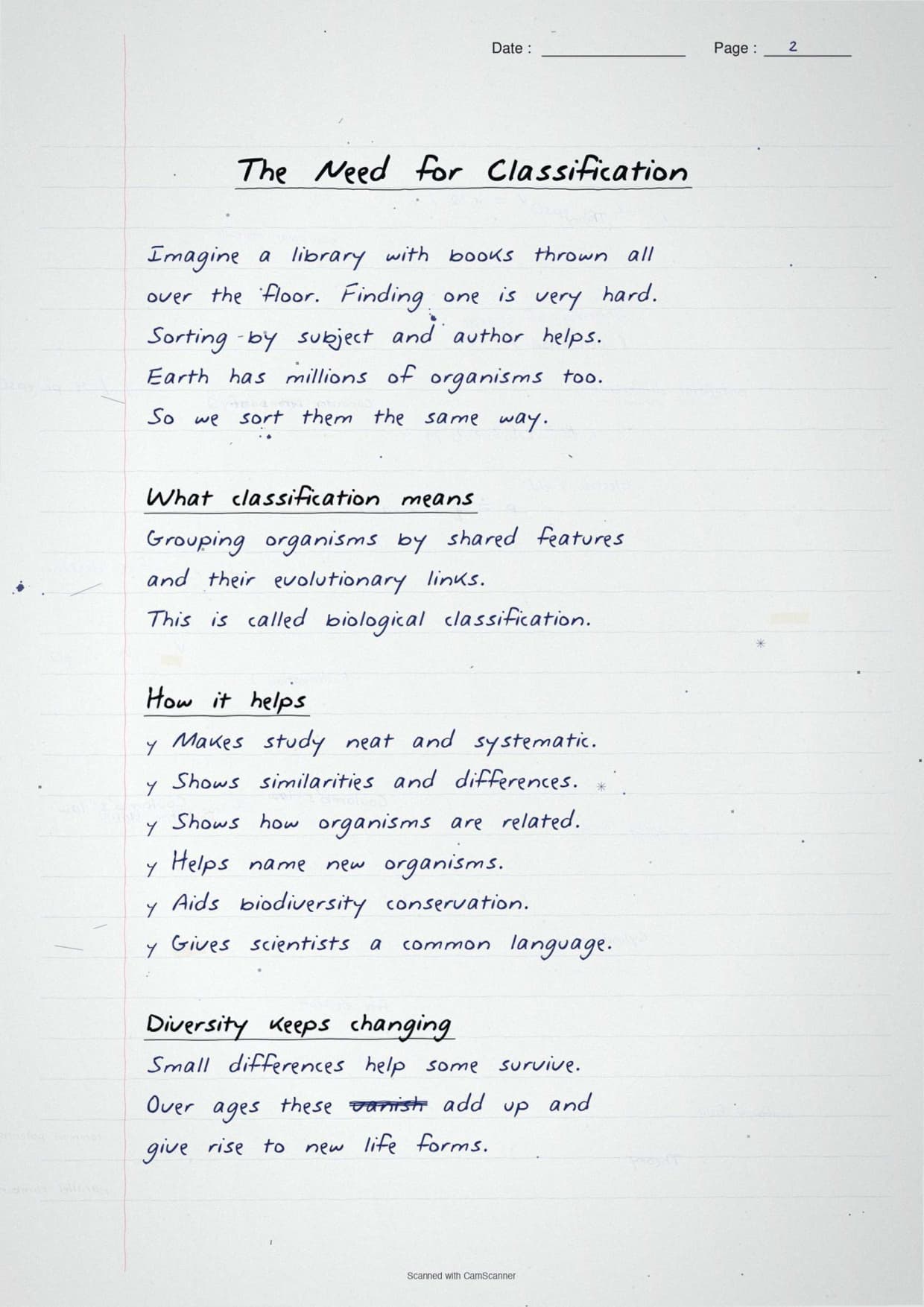
- Why classify: with millions of organisms, sorting them into groups makes study systematic, shows how organisms are related, and helps in naming and conserving them.
The notes use a simple picture in the margin: a floor of scattered books is hard to search, but the same books on labelled shelves are easy to find. Biological classification does the same job for living things, grouping them by their similarities and differences.
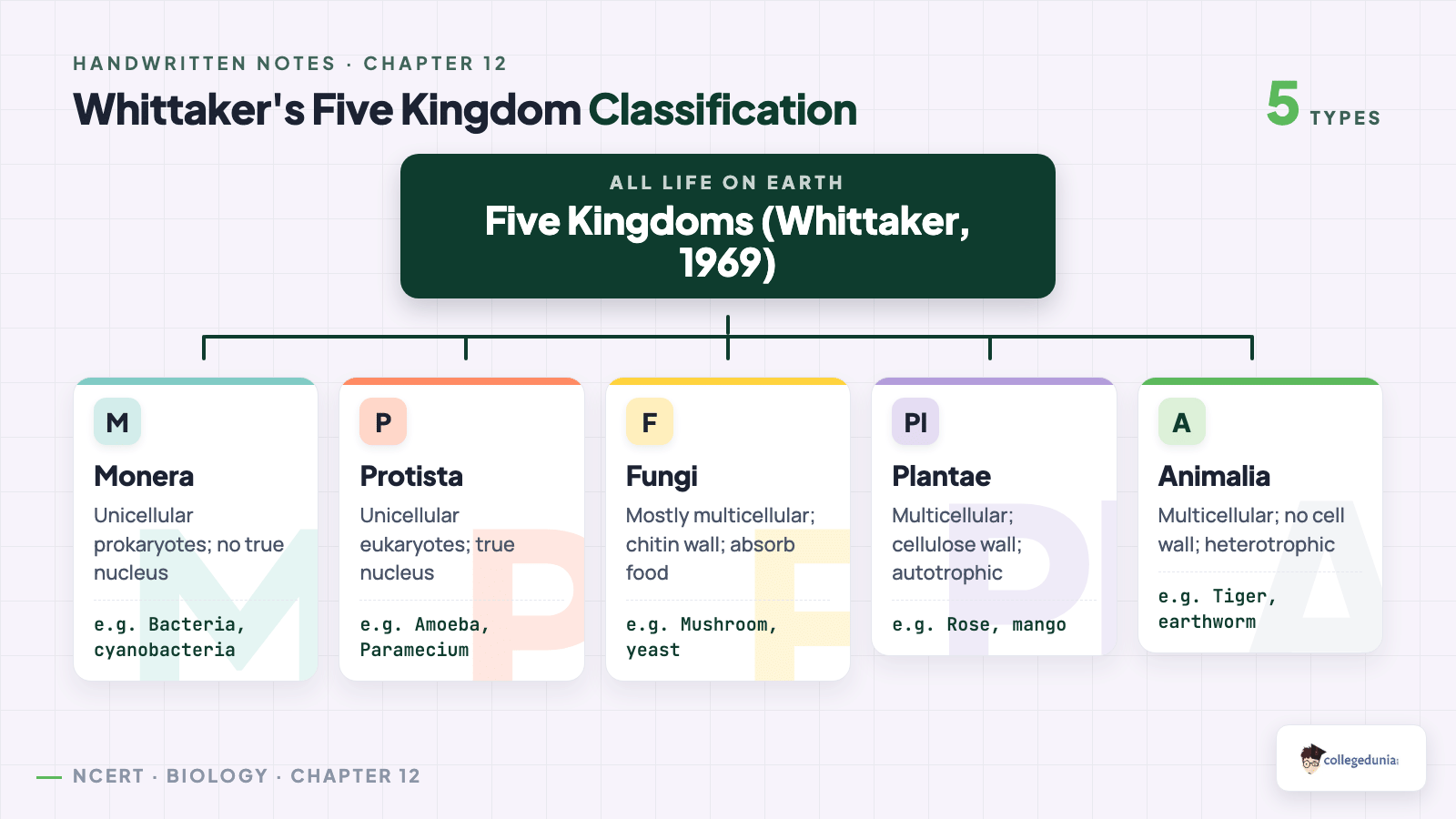
Whittaker's Five Kingdoms: Hand-Drawn Table
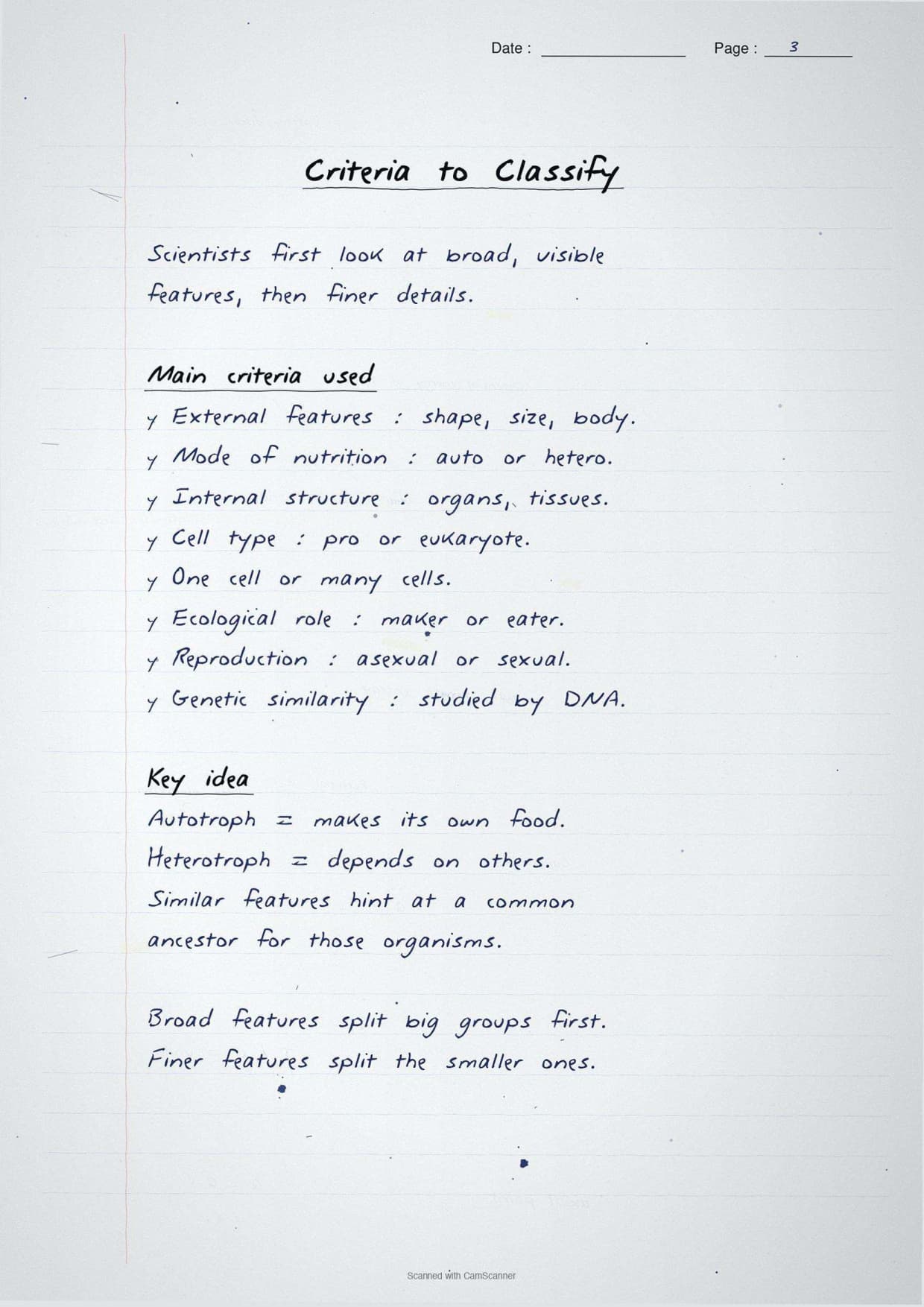
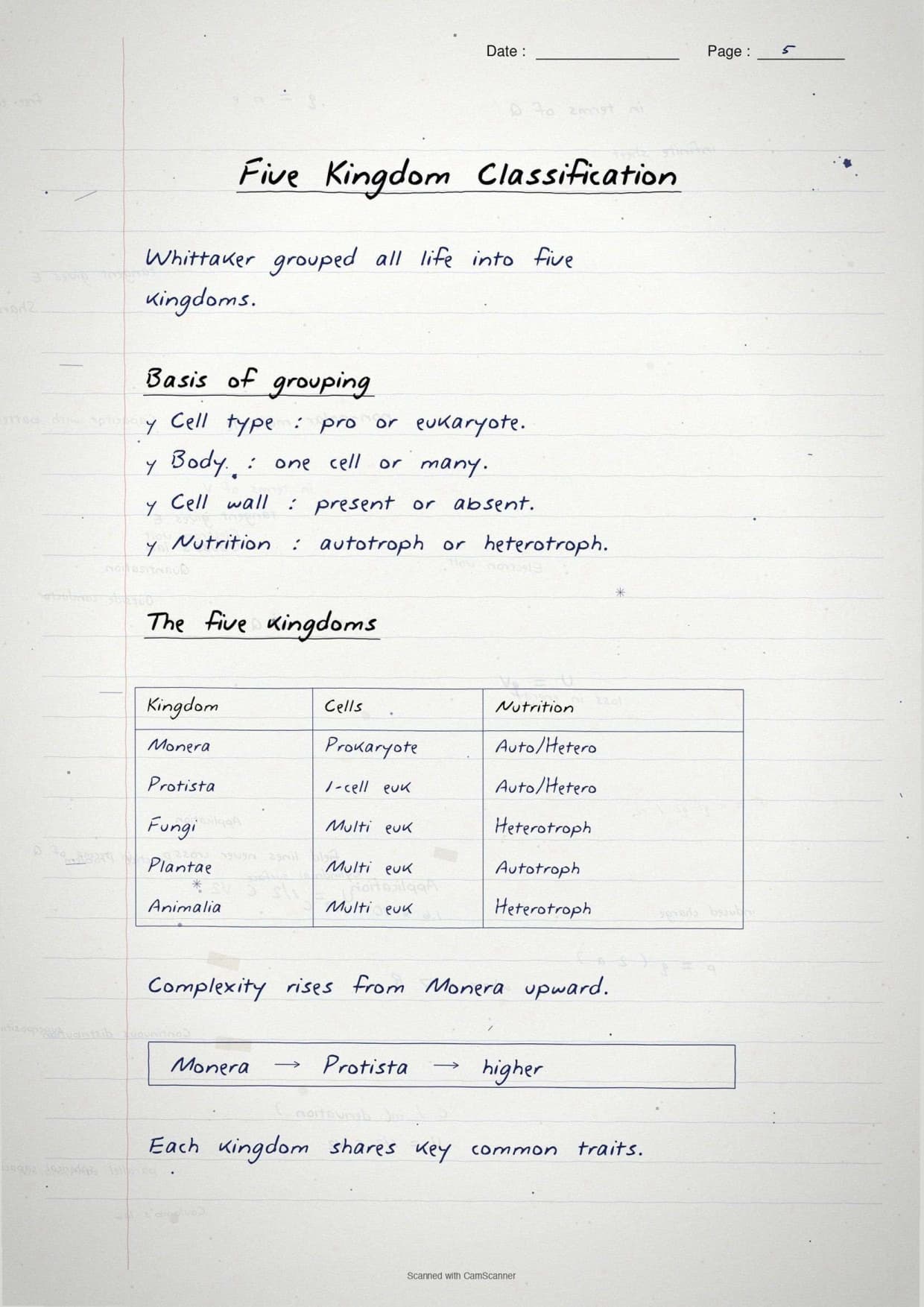
This is the most tested idea in Chapter 12, so the notes give it a clear hand-drawn table. In 1969 Robert Whittaker sorted all life into five kingdoms using four features: cell type, level of organisation, cell structure, and mode of nutrition. Learn this one table and half the chapter is done.
| Kingdom | Cell type | Cells | Nutrition |
|---|---|---|---|
| Monera | Prokaryote | Unicellular | Autotrophic or heterotrophic |
| Protista | Eukaryote | Unicellular | Autotrophic or heterotrophic |
| Fungi | Eukaryote | Mostly multicellular | Heterotrophic, by absorption |
| Plantae | Eukaryote | Multicellular | Autotrophic |
| Animalia | Eukaryote | Multicellular | Heterotrophic, by ingestion |
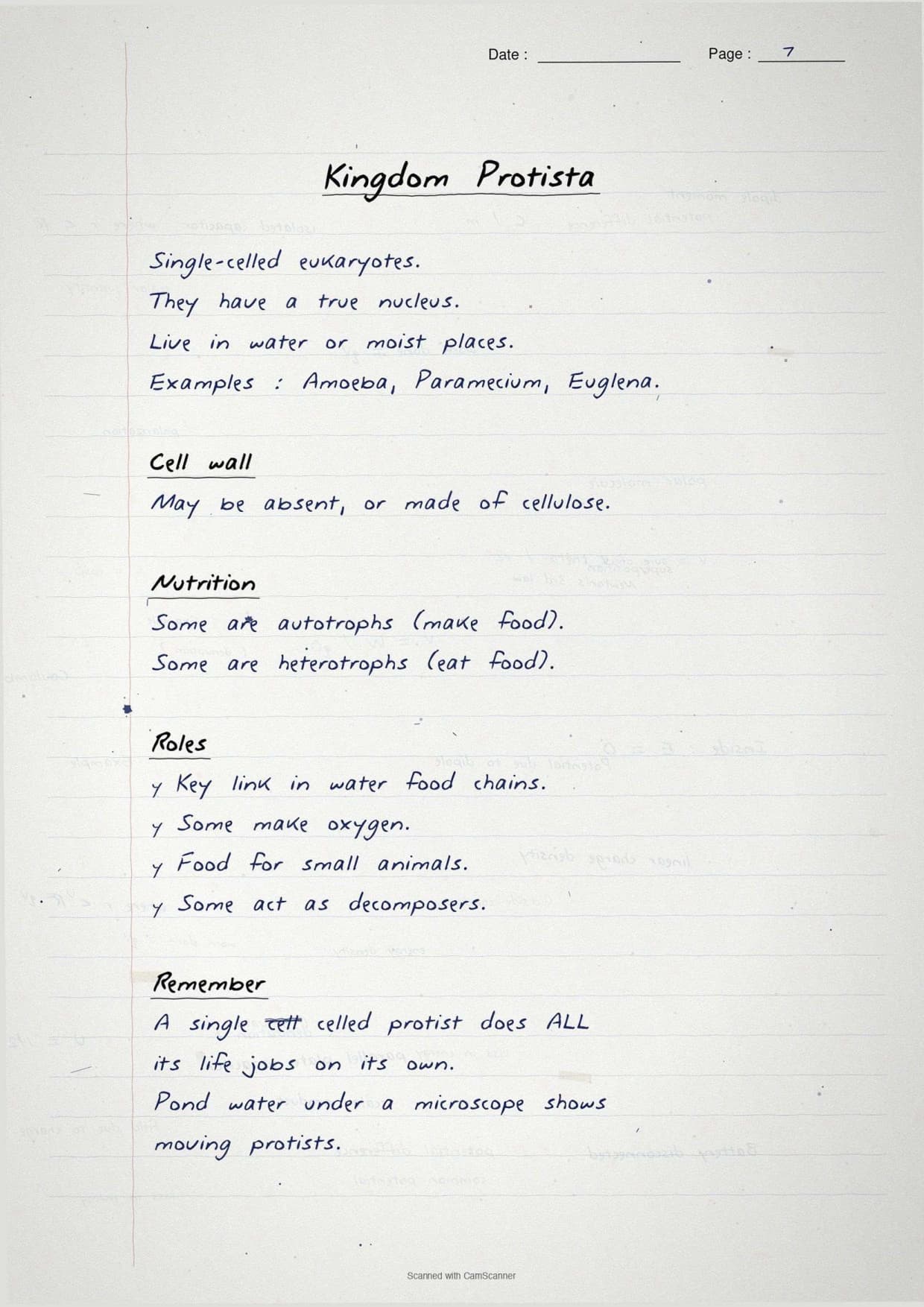
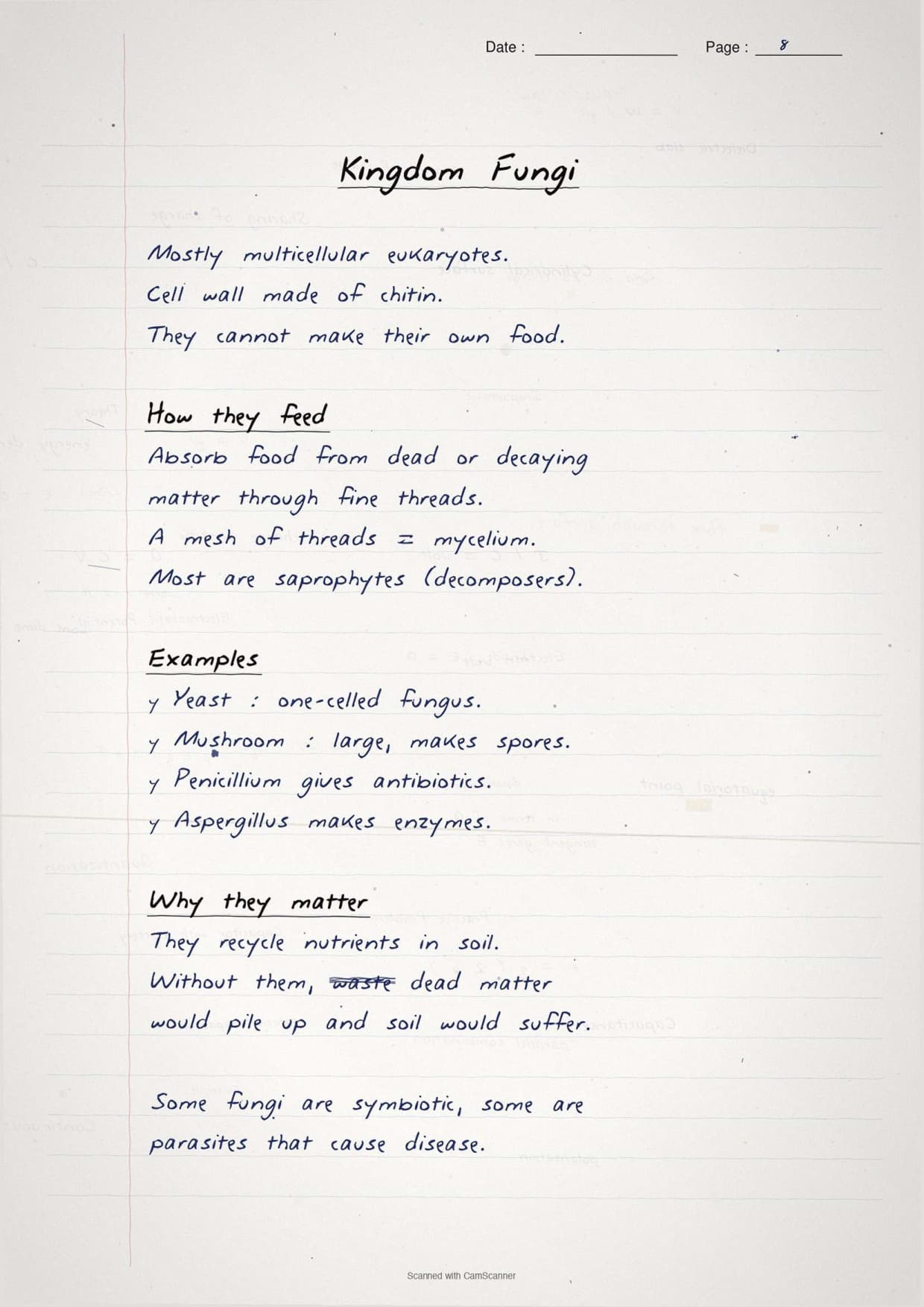
The notes flag one common trap in red: Monera are prokaryotes while Protista are eukaryotes. Both are single-celled, but only Protista, such as Amoeba and Paramecium, have a true nucleus. A short mnemonic in the margin fixes the cell walls: chitin for Fungi, cellulose for Plantae, none for Animalia.
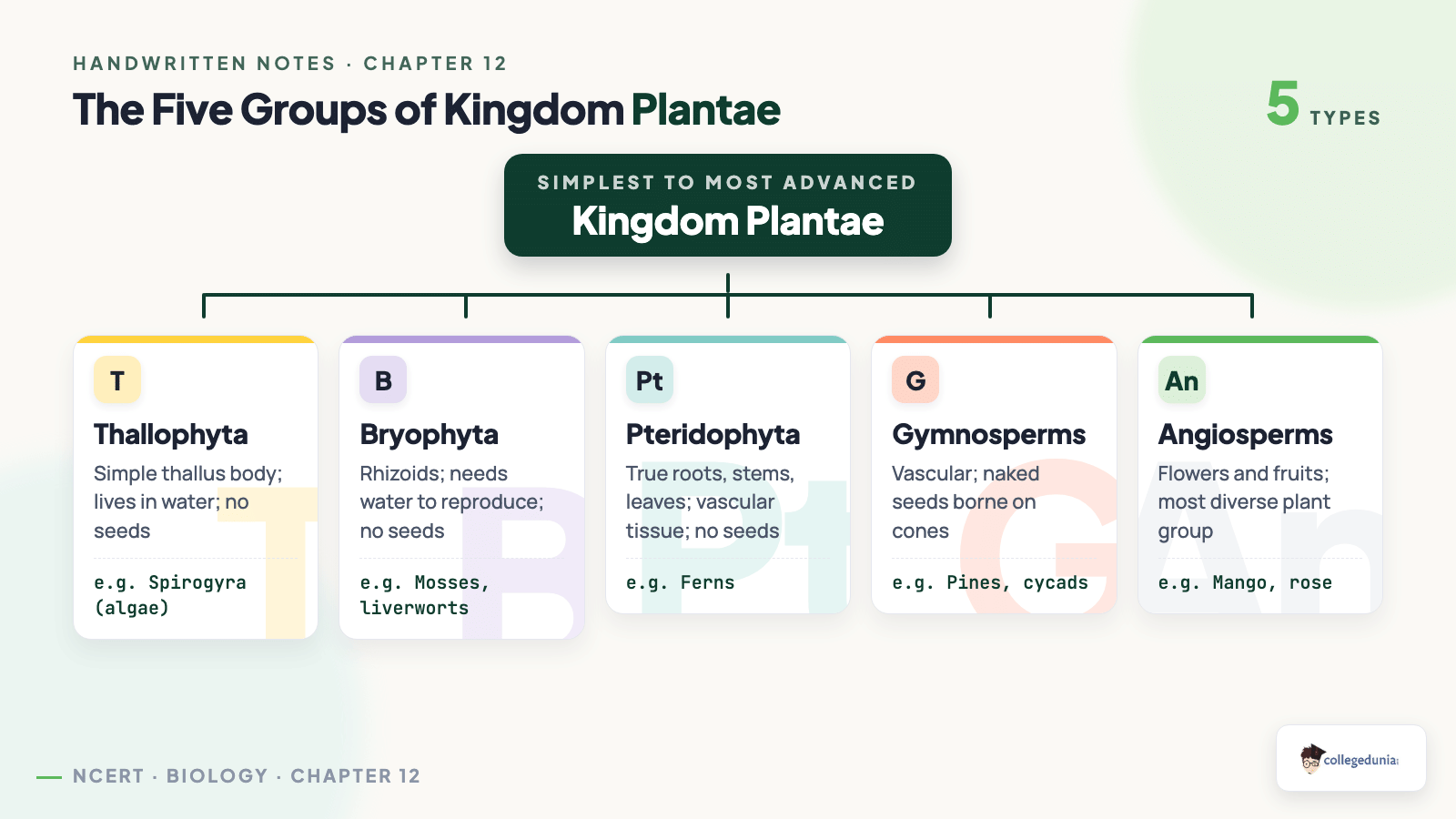
Diversity in Plants and Animals in Your Own Handwriting
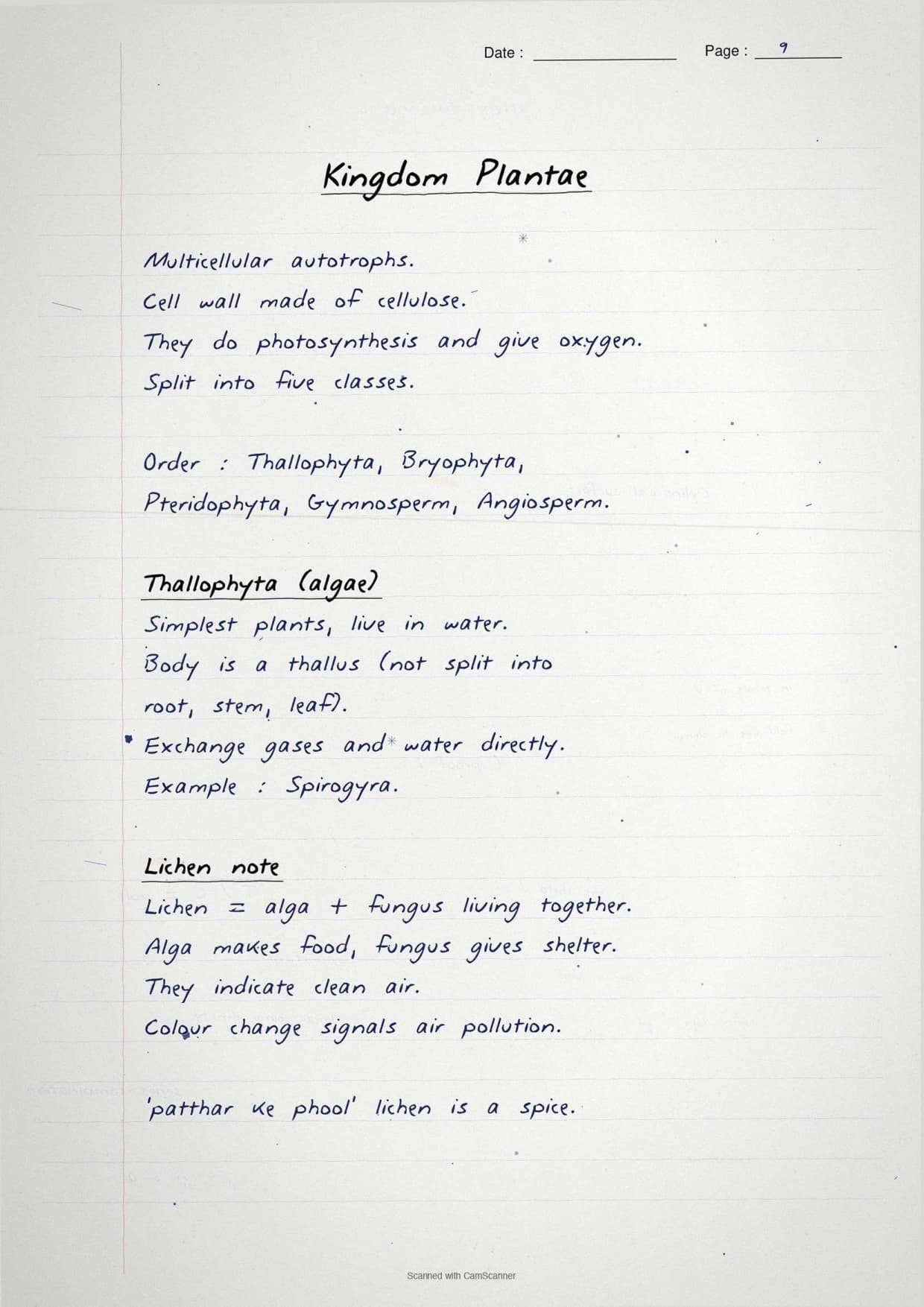
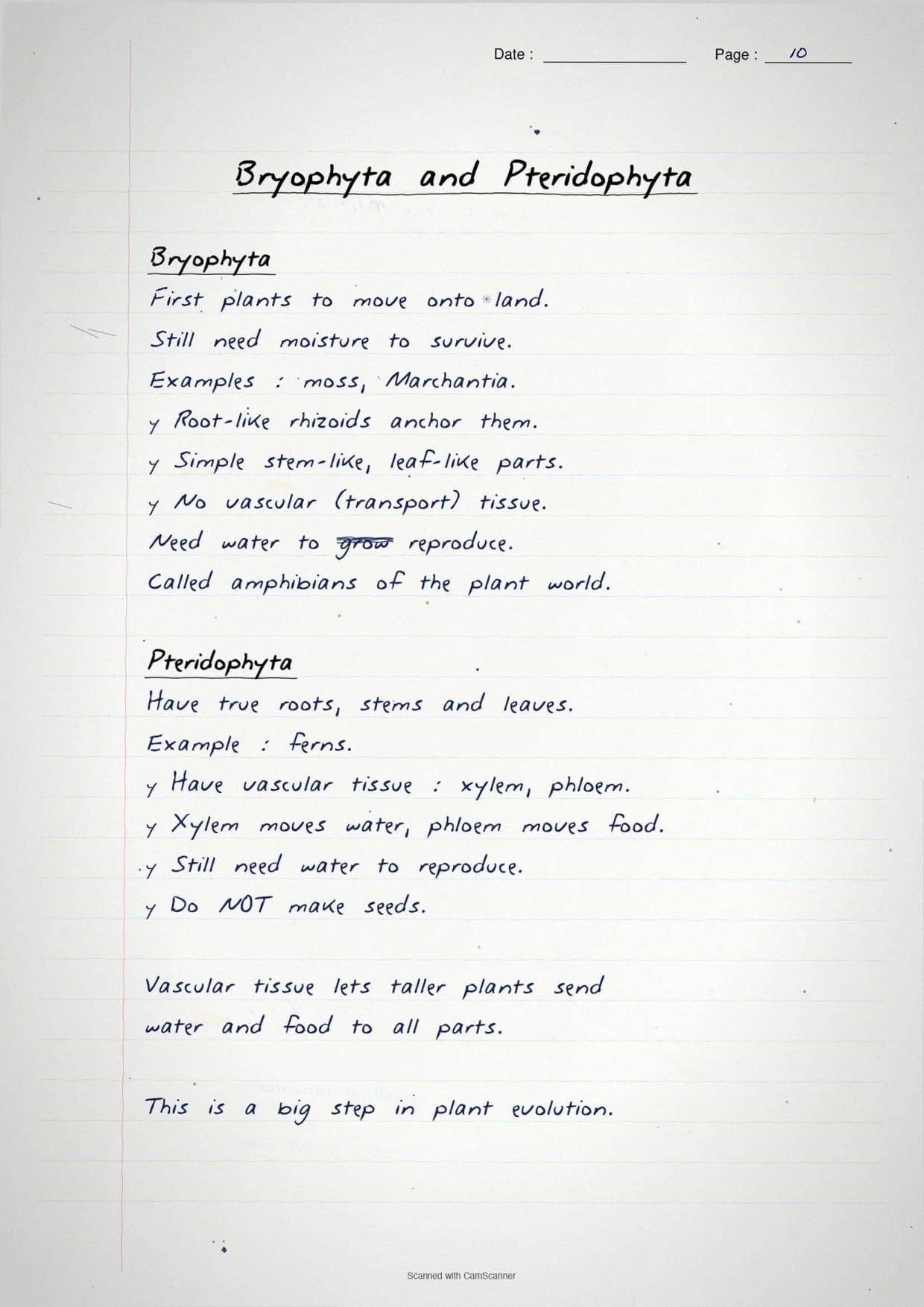
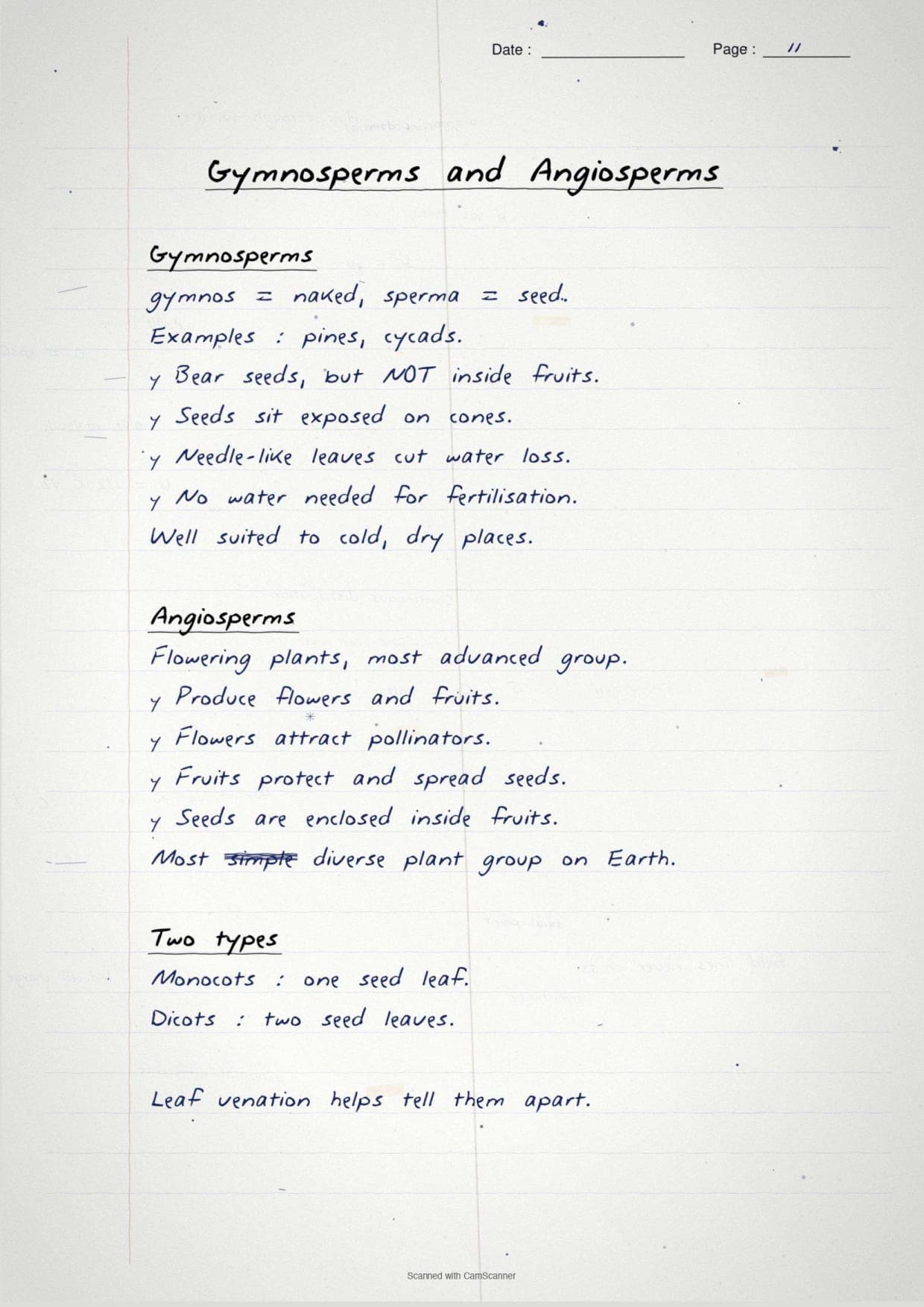
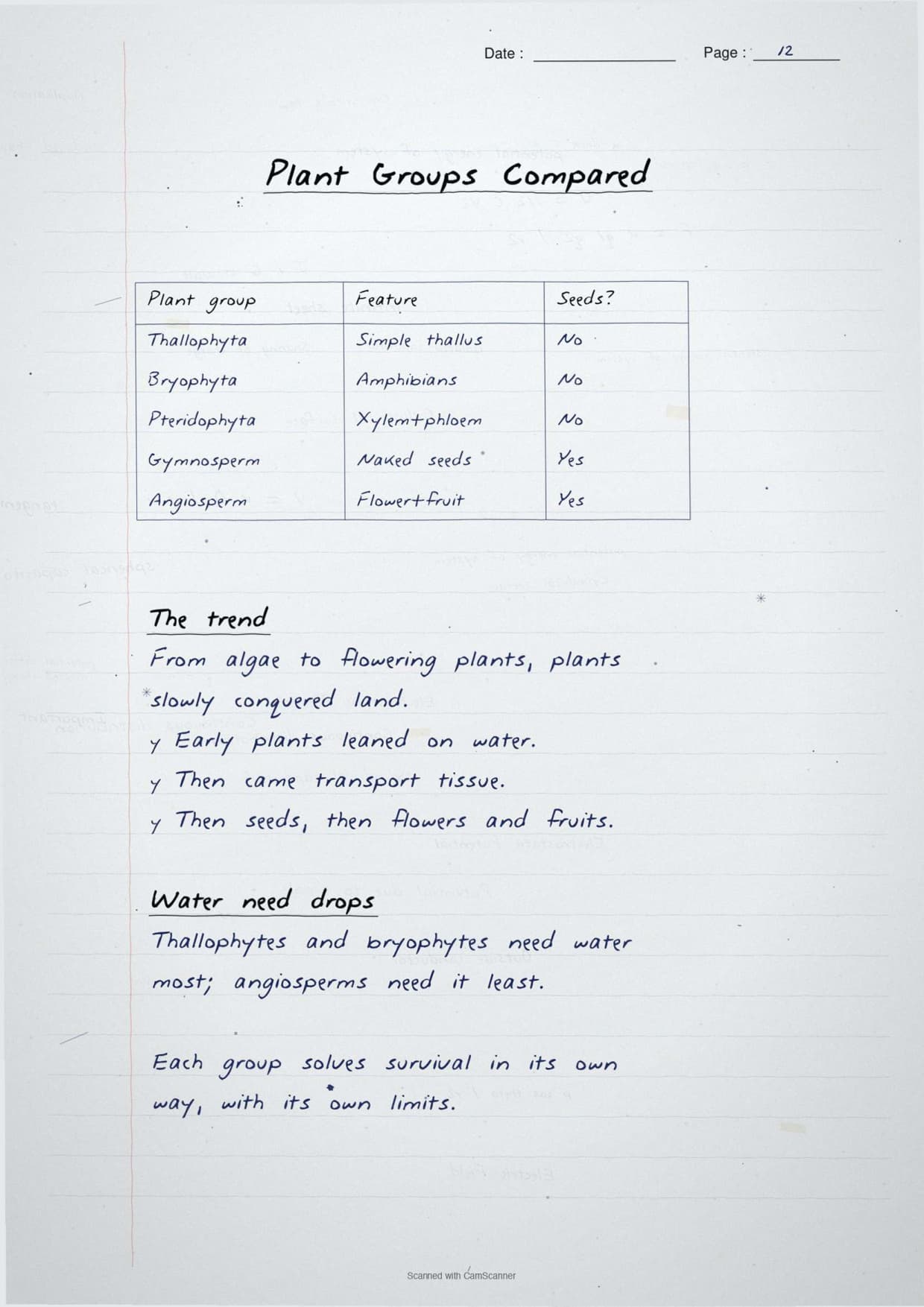
After the kingdoms, the notes zoom into Plantae and Animalia, because both are asked often. Kingdom Plantae is read from simplest to most advanced, which also tells the story of how plants slowly moved onto land.
| Plant group | Vascular tissue | Seeds | Key feature |
|---|---|---|---|
| Thallophyta (algae) | Absent | Absent | Thallus, lives in water |
| Bryophyta (mosses) | Absent | Absent | Rhizoids; needs water |
| Pteridophyta (ferns) | Present | Absent | True roots, stems, leaves |
| Gymnosperms (pines) | Present | Naked | Seeds on cones |
| Angiosperms (flowering) | Present | In fruit | Flowers and fruits |
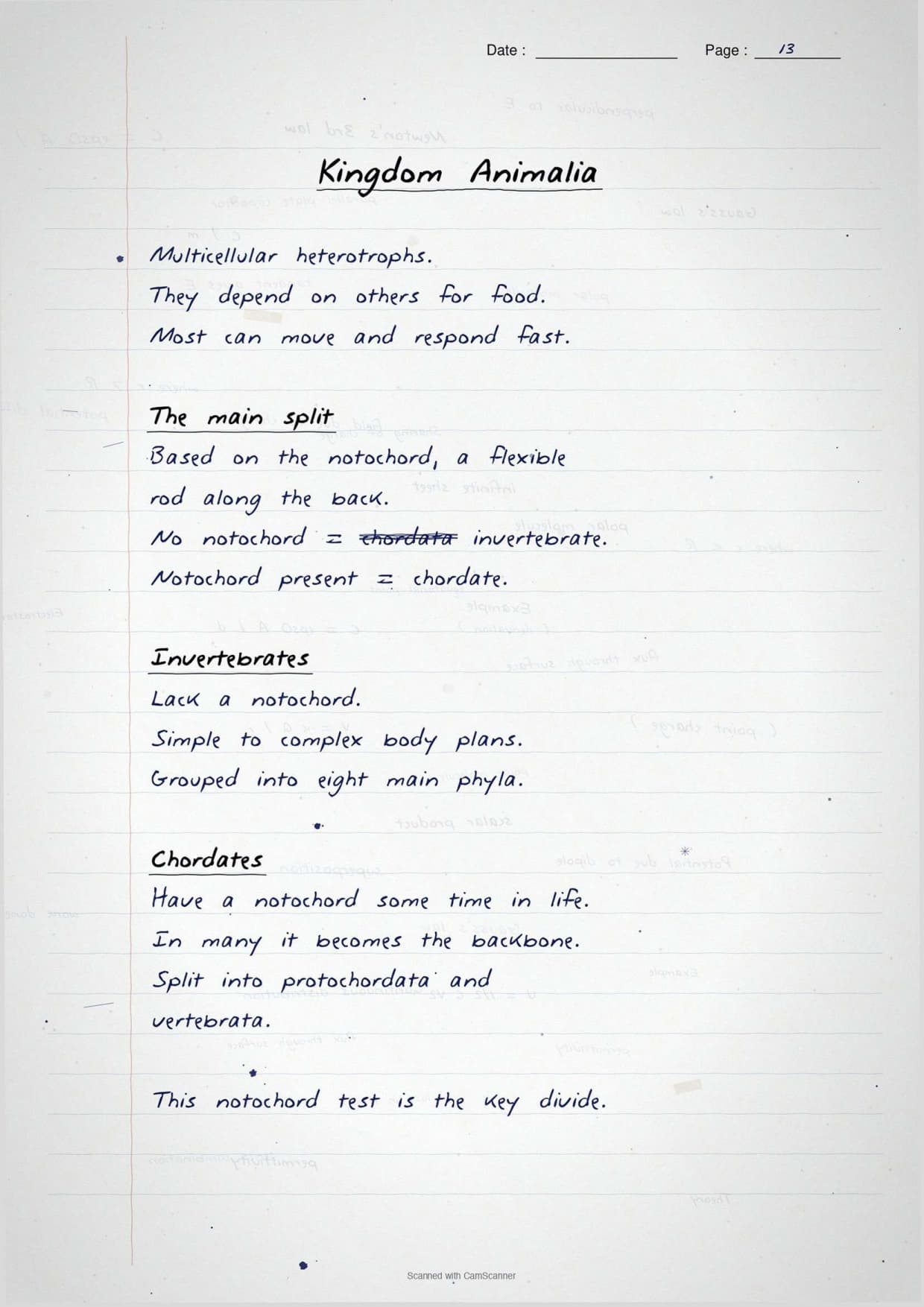
For Kingdom Animalia, the notes draw the first big split by the notochord, a flexible rod that supports the body.
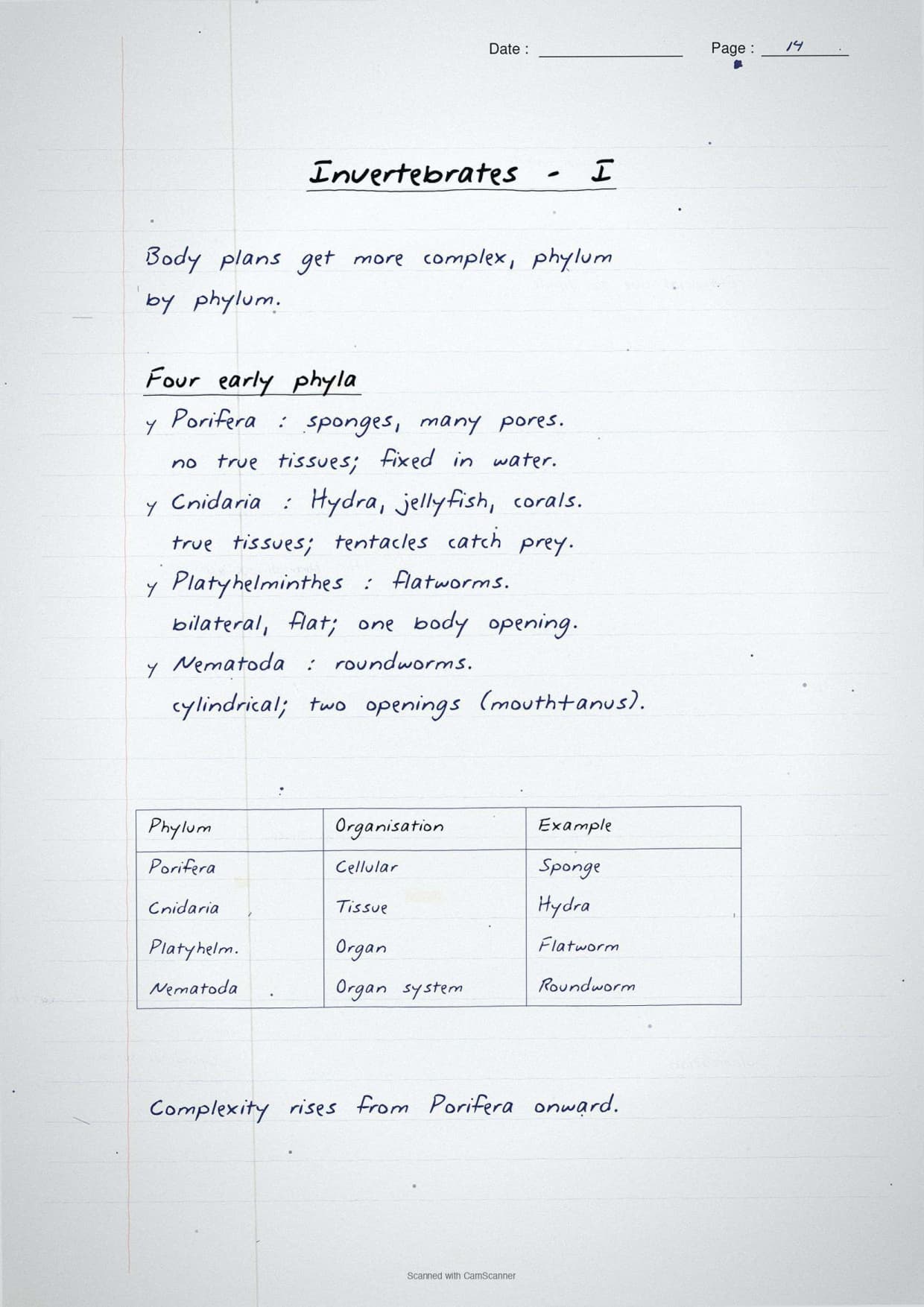
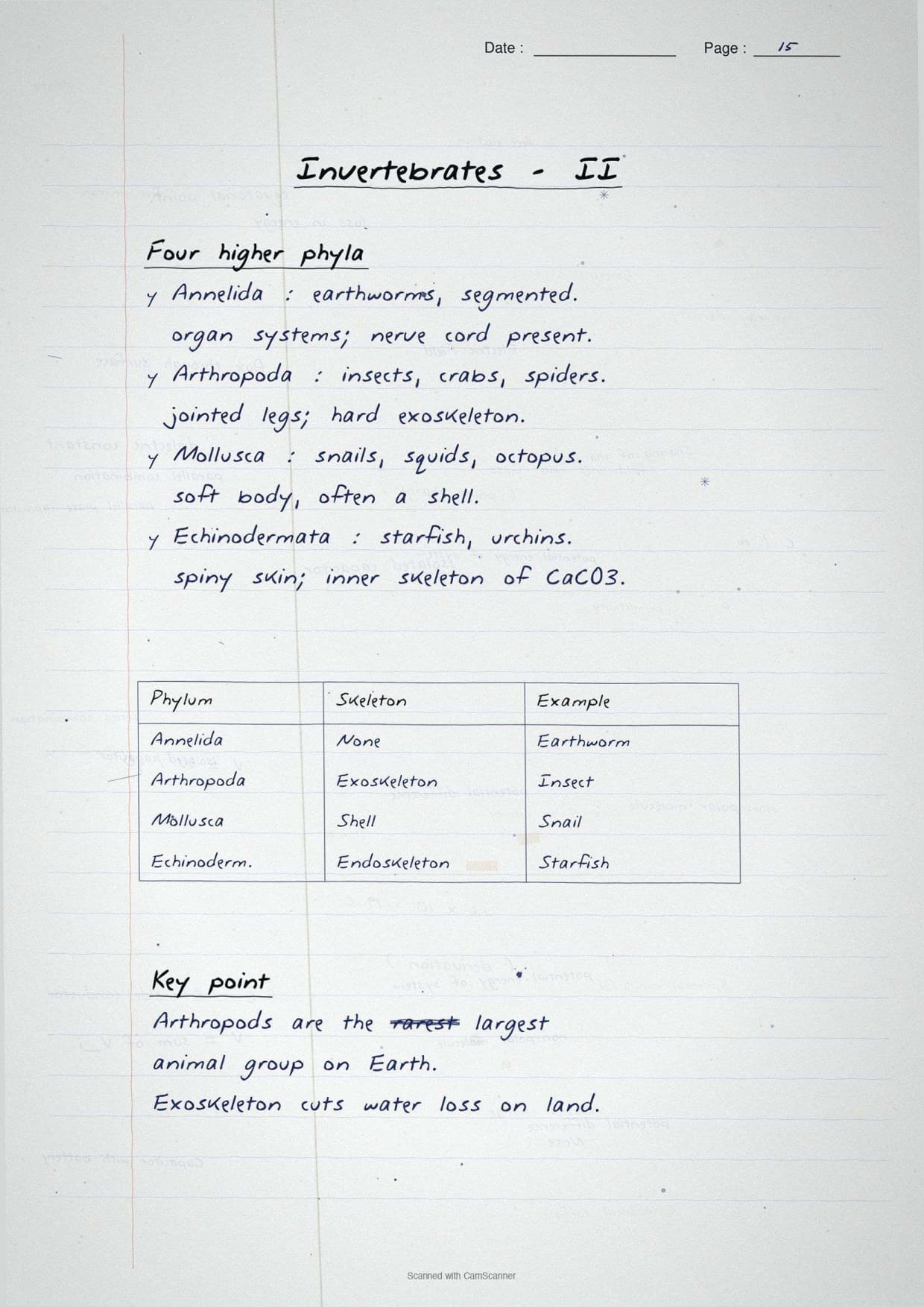
- Non-chordata: the invertebrates, with no notochord, running from sponges (Porifera) to starfish (Echinodermata) in rising body plan.
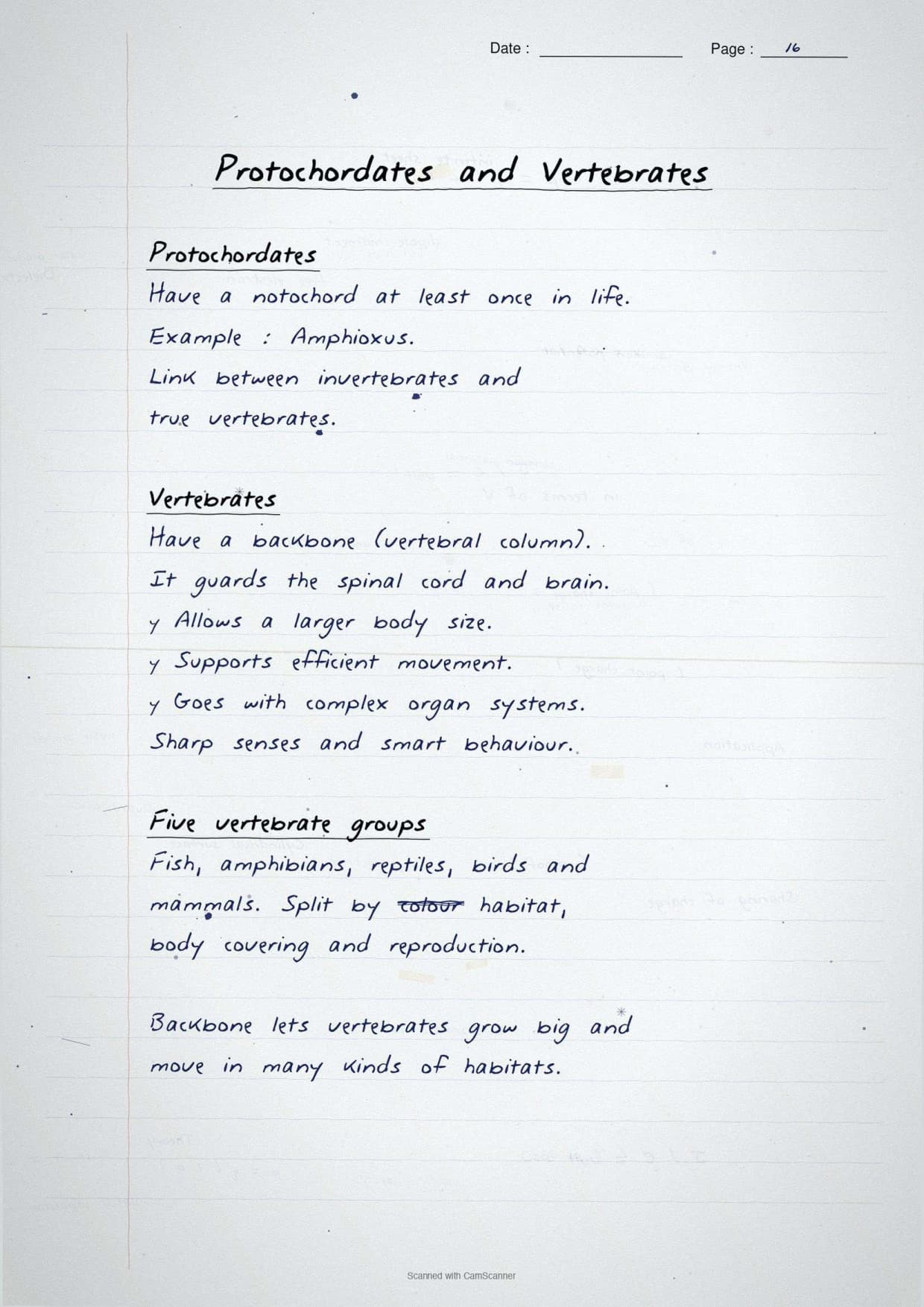
- Chordata: a notochord at some stage; these split into protochordata and vertebrata, the animals with a backbone.
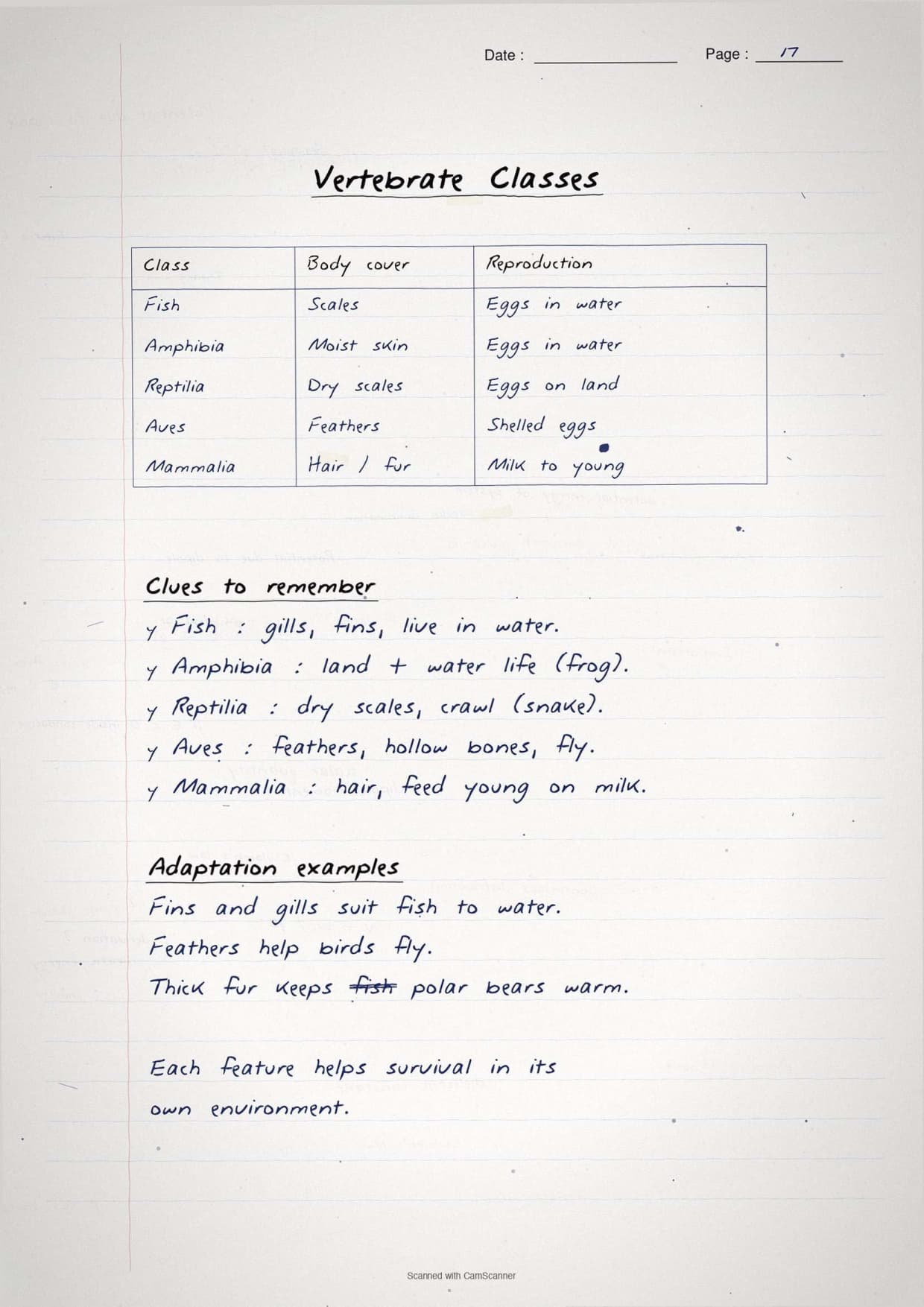
- Five vertebrate groups: fish, amphibians, reptiles, birds and mammals, remembered by the margin mnemonic "FARBM".
Classification Hierarchy and Binomial Names Drawn by Hand
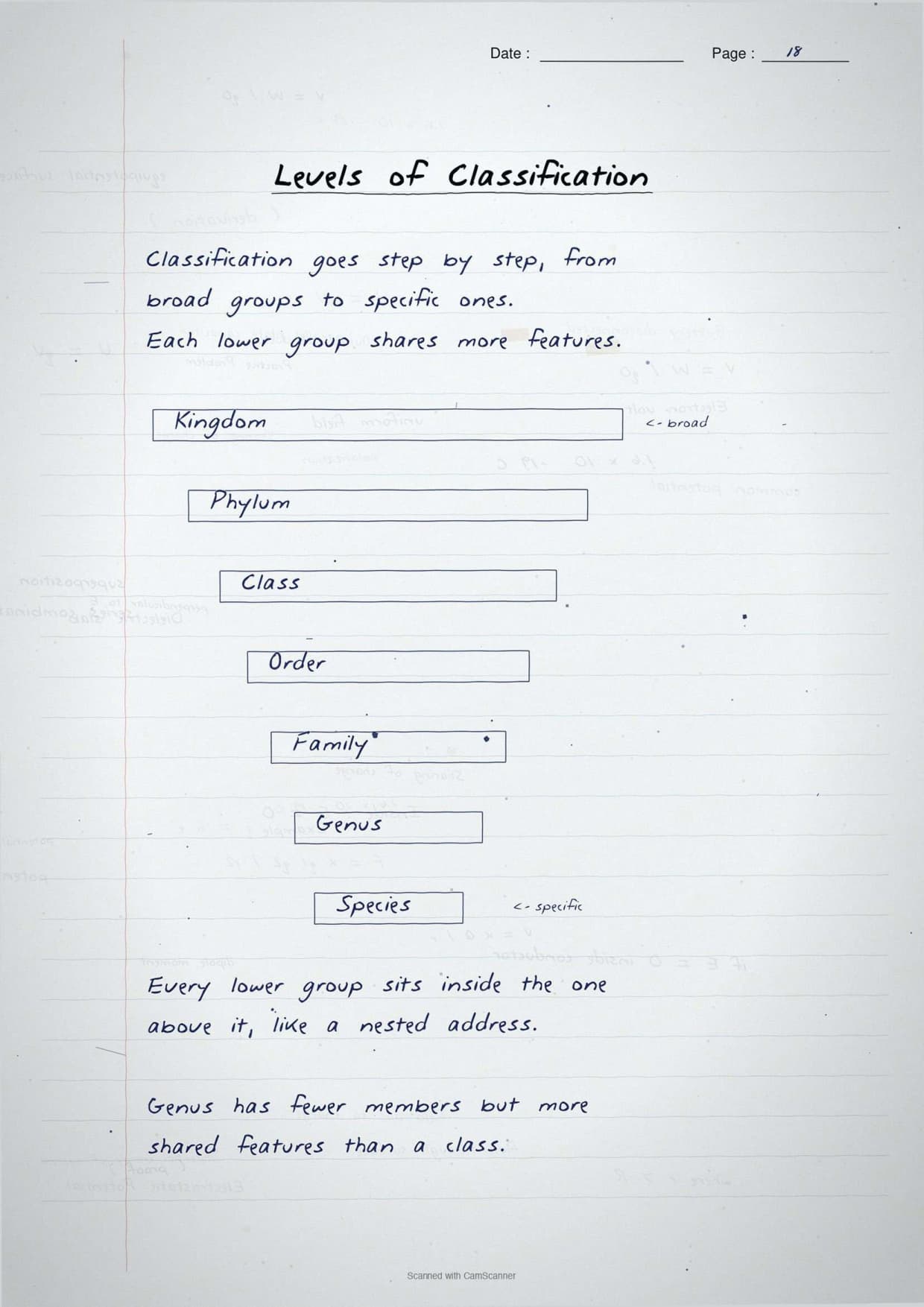
Keep these two ideas ready for the Revise, Reflect, Refine exercise. The notes draw the hierarchy as a ladder and box the naming rule so you can copy both in the exam.
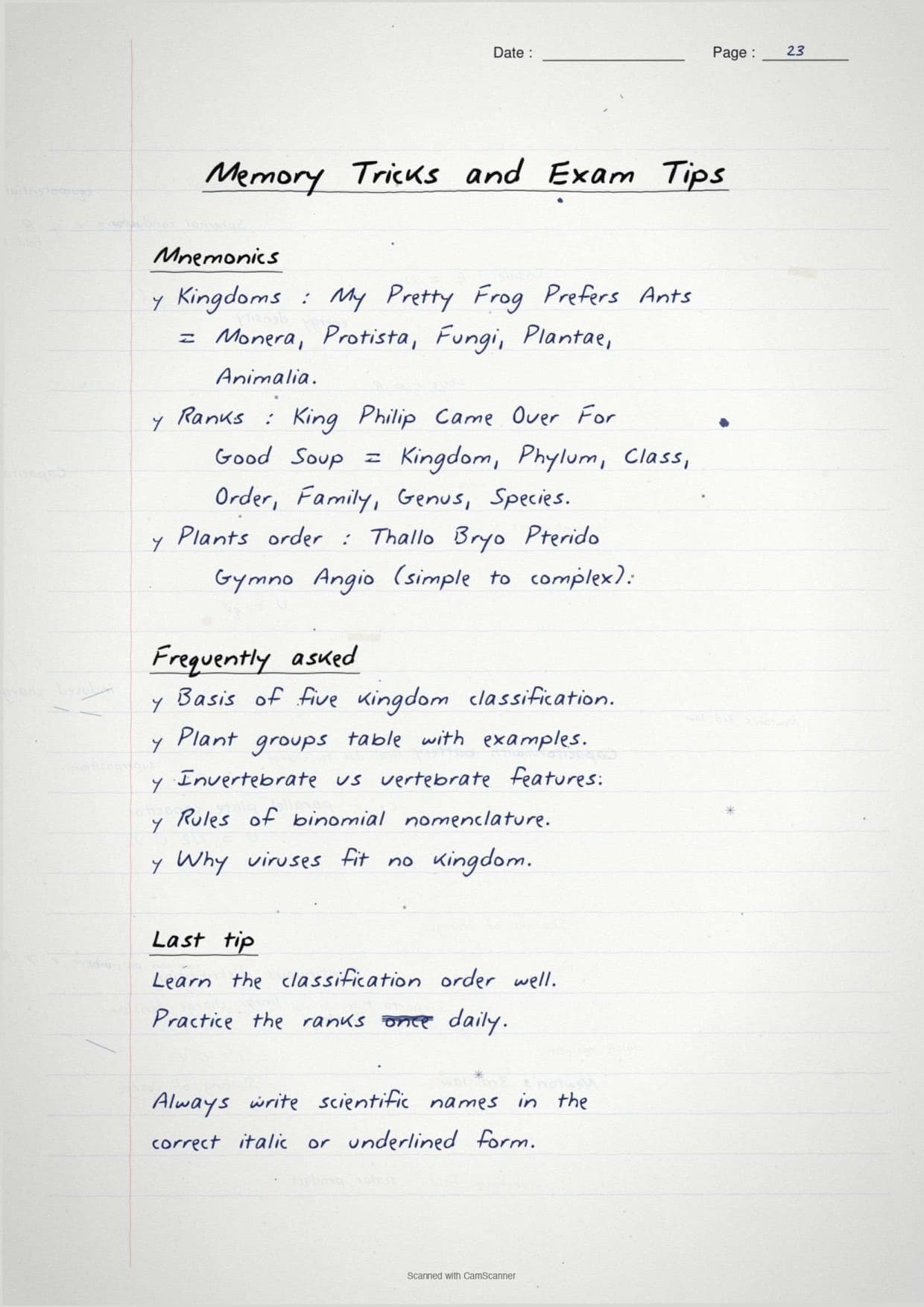
- The hierarchy: Kingdom, Phylum, Class, Order, Family, Genus, Species. Each step down means fewer members but more shared features. The margin mnemonic is "King Philip Came Over For Good Soup".
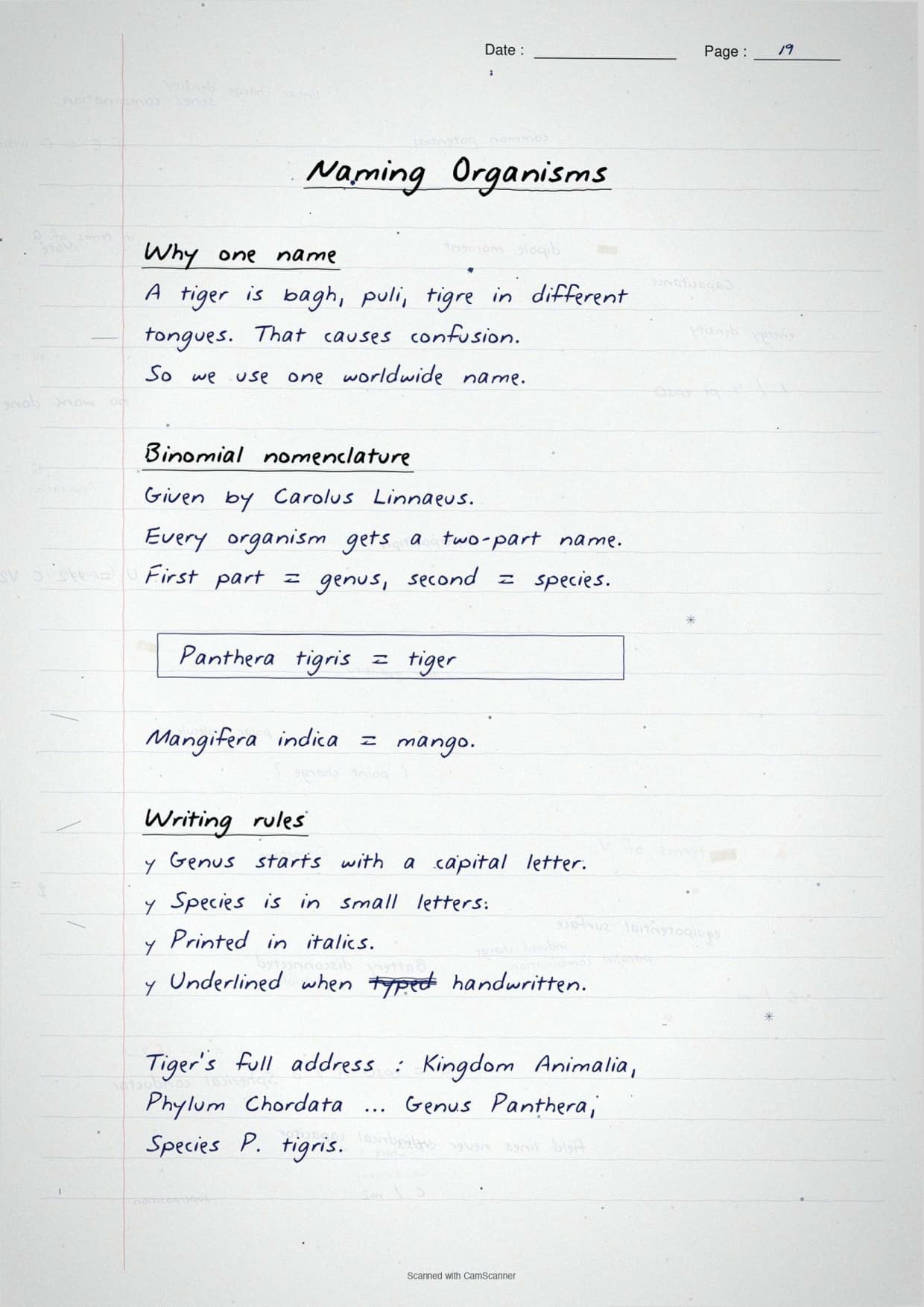
- Binomial nomenclature: scientific name = Genus name + species name, given by Carolus Linnaeus. Example: tiger is Panthera tigris, mango is Mangifera indica.
- Naming rules: the genus name starts with a capital letter, the species name is in small letters, and both words are in italics or underlined separately when handwritten.
Endemic Species and Everyday Examples Marked in the Margins
Real examples show up across the chapter, so the notes pin them in the margins to make the ideas stick. Each one links a group or idea to something you can picture.
- Endemic species of India: the Nilgiri tahr, the Lion-tailed macaque, Nepenthes khasiana and Neelakurinji, all found naturally nowhere else.
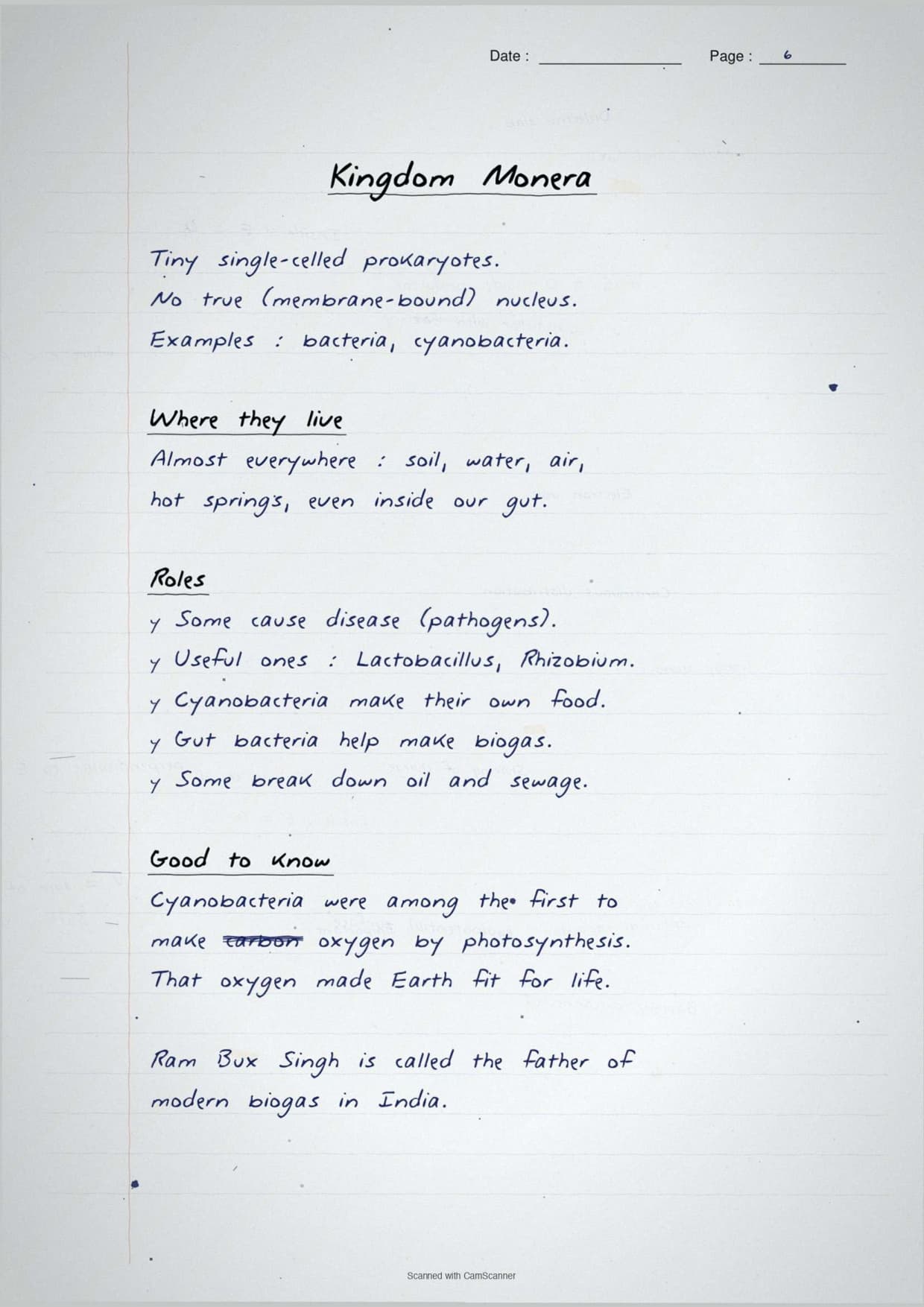
- Helpful microbes: Lactobacillus sets curd, Rhizobium fixes nitrogen, and bacteria in cattle dung release biogas, a clean fuel.
- Lichens as pollution meters: a partnership of an alga and a fungus that changes colour with air pollution, so it acts as a natural bioindicator.
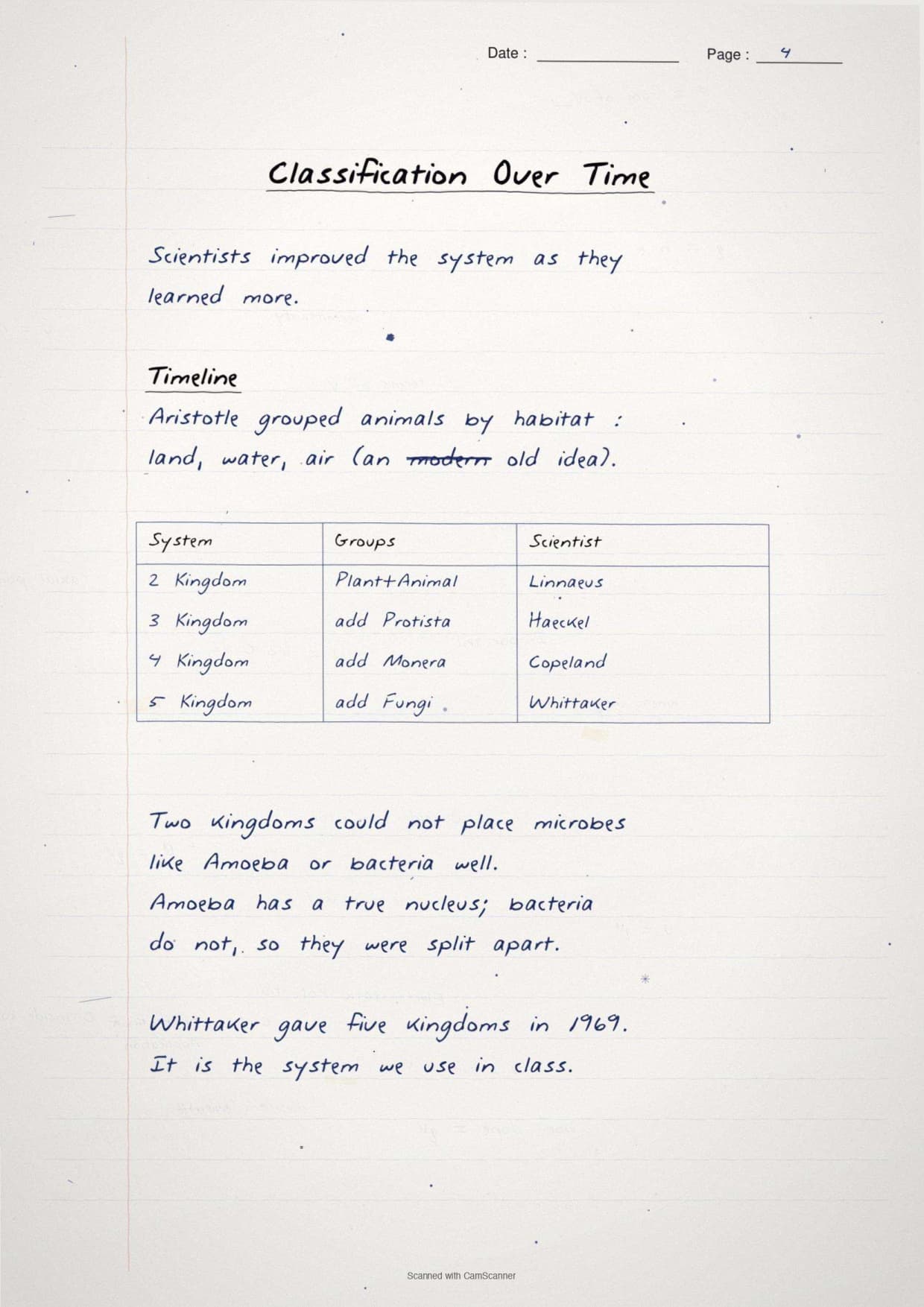
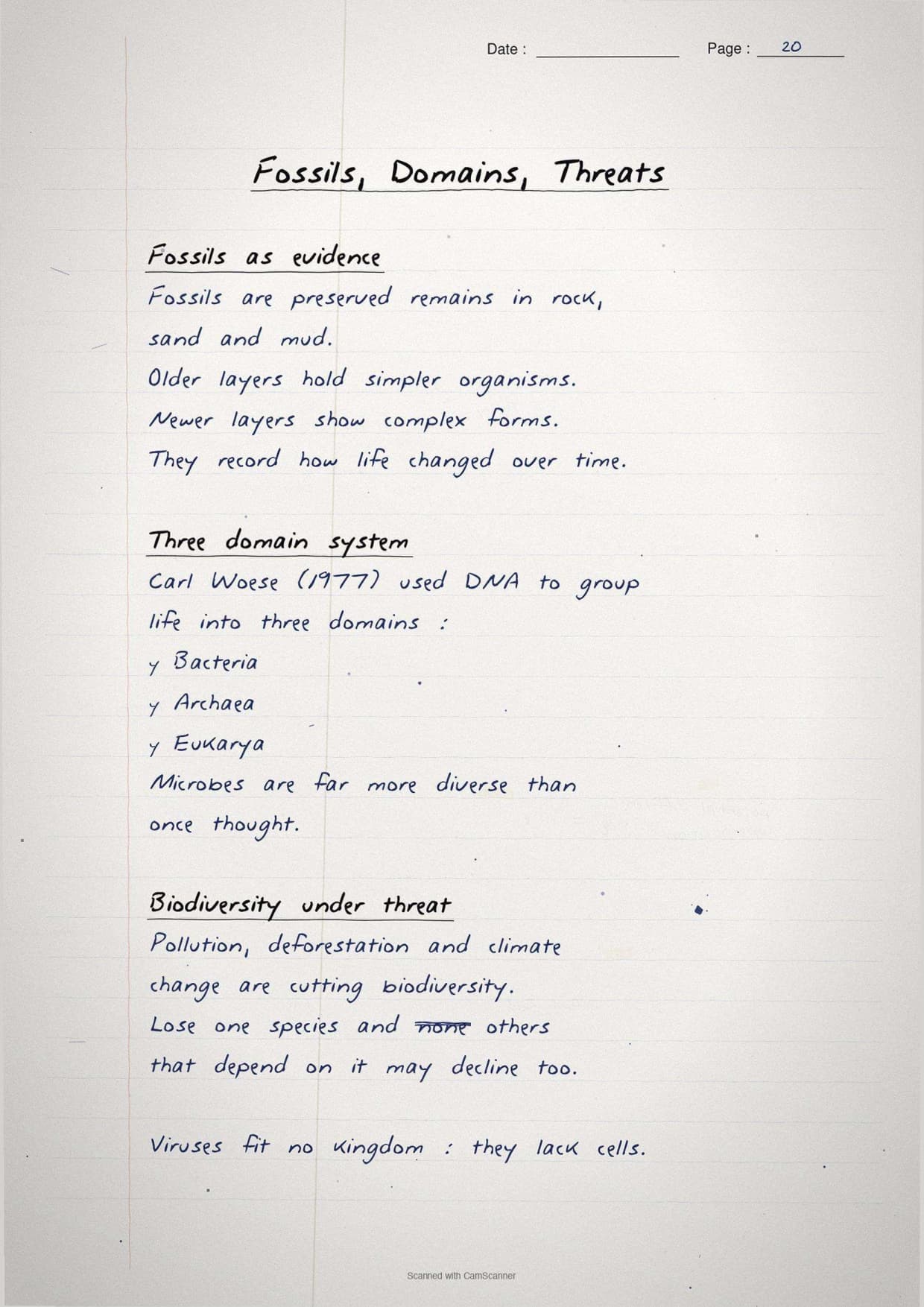
The notes also record how classification systems grew, from Aristotle's habitat groups to Linnaeus's two kingdoms, then three, four, and finally Whittaker's five. Later, Carl Woese used DNA to propose the three domain system: Bacteria, Archaea and Eukarya.
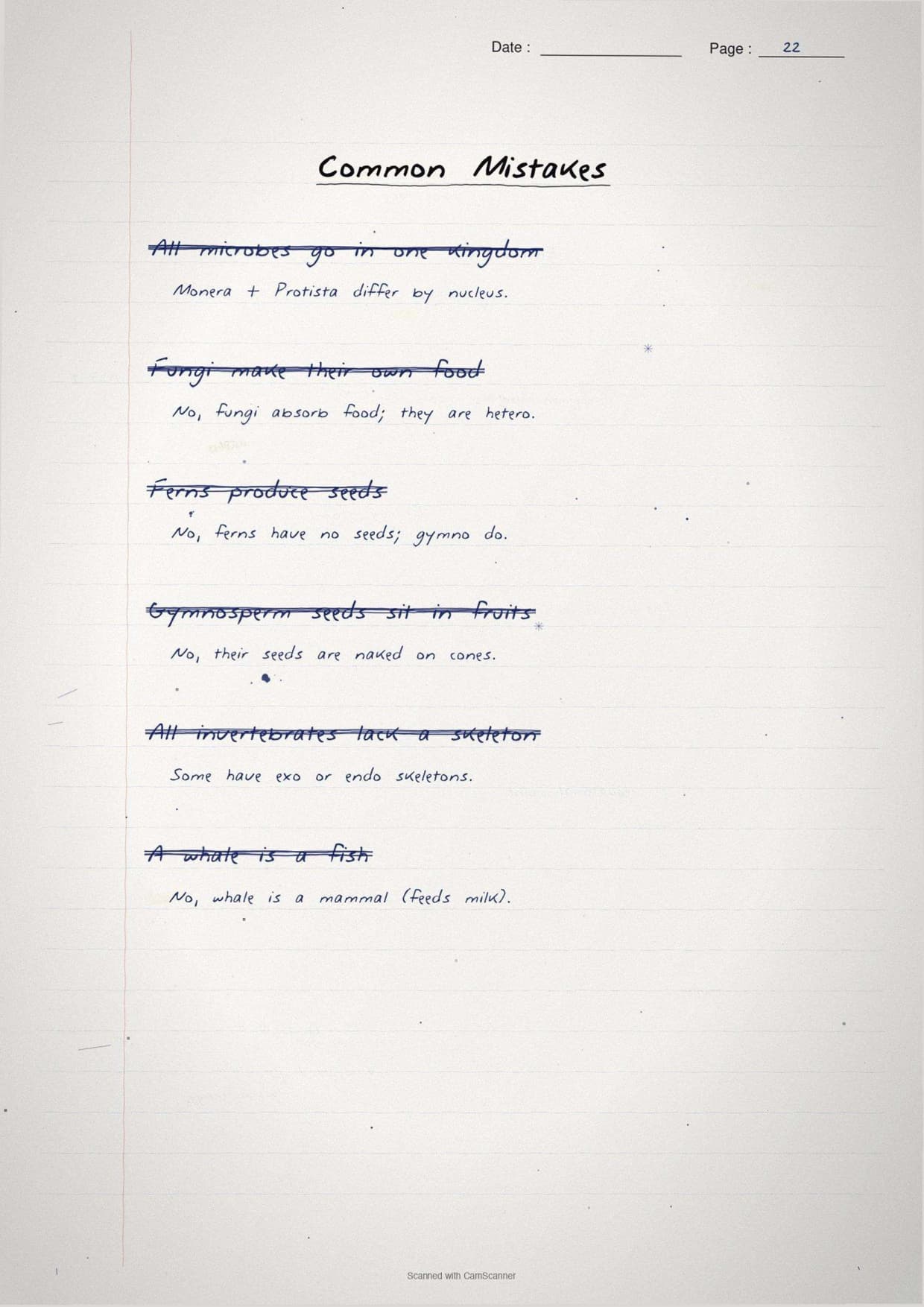
Common Mistakes Flagged in Red
Most lost marks in this chapter come from small mix-ups, not hard ideas. The handwritten notes circle these in red so you fix them while you revise.
- Calling Monera eukaryotes; they are prokaryotes, with no true nucleus.
- Saying gymnosperm seeds are absent; the seeds are just naked, not covered by a fruit.
- Treating yeast as a bacterium; it has a nucleus and a chitin wall, so it is a fungus.
- Capitalising the species name; only the genus name takes a capital letter, and both words are italicised.
Last-Minute Revision with These Handwritten Notes
The night before your exam, the Patterns in Life: Diversity and Classification Class 9 Science Handwritten Notes work as a quick skim. Every boxed group and red heading is a checkpoint, so you can cover the whole chapter in well under an hour.
- Define biodiversity and give one reason it matters.
- Write the five-kingdom table from its box, with cell type and nutrition.
- Arrange the five plant groups from simplest to most advanced.
- State the feature that first splits the animal kingdom, the notochord.
- Write the seven levels of the hierarchy and one binomial name.
- Read the red mistake notes before you close the notes.
How Collegedunia's Handwritten Notes Help You With Diversity and Classification
Collegedunia brings you the Patterns in Life: Diversity and Classification Class 9 Science Handwritten Notes as a free, clear PDF you can open on any phone. It saves you the time of making your own notes and matches the new Exploration book.
- 2026-27 match: every page follows the new textbook and the Revise, Reflect, Refine flow.
- Clean handwriting: a topper's neat writing makes each kingdom box and branching chart easy to read.
- Exam-ready: boxes and colour cues let you revise fast before the annual exam, and later for CBSE, NEET and CUET basics.
- Free download: keep the PDF offline and revise any time.
More Patterns in Life Diversity and Classification Class 9 Science Resources
Use the table below to open the other resources for this chapter of the new Class 9 Science Exploration book.
NCERT Handwritten Notes for Class 9 Science: All Chapters
Use the table below to open the handwritten notes for any other chapter of the new Class 9 Science Exploration book.
| Chapter | Handwritten Notes |
|---|---|
| Chapter 2 | Cell The Building Block of Life |
| Chapter 3 | Tissues in Action |
| Chapter 4 | Describing Motion Around Us |
| Chapter 5 | Exploring Mixtures and their Separation |
| Chapter 6 | How Forces Affect Motion |
| Chapter 7 | Work, Energy, and Simple Machines |
| Chapter 8 | Journey Inside the Atom |
| Chapter 9 | Atomic Foundations of Matter |
| Chapter 10 | Sound Waves Characteristics and Applications |
| Chapter 11 | Reproduction How Life Continues |
| Chapter 12 | Patterns in Life Diversity and Classification |
| Chapter 13 | Earth as a System Energy, Matter, and Life |
Patterns in Life Diversity and Classification Class 9 Science Handwritten Notes FAQs
Ques. How many pages are the Patterns in Life Diversity and Classification Class 9 Science handwritten notes?
Ans. The handwritten notes run to 22 pages. They cover the full chapter, from biodiversity and the need for classification to the five kingdoms, the plant and animal groups, the classification hierarchy, and binomial naming, with a clear example after each idea.
Ques. Are these real handwritten notes?
Ans. Yes. They are a topper's own clear handwritten revision notes, with each kingdom boxed, the five-kingdom and plant-group charts drawn by hand, and sub-headings colour-coded in red.
Ques. What are the five kingdoms in the Chapter 12 notes?
Ans. The five kingdoms are Monera, Protista, Fungi, Plantae and Animalia, given by Robert Whittaker in 1969. The notes sort them using four features: cell type, level of organisation, cell structure, and mode of nutrition.
Ques. Can I use these handwritten notes for last-minute revision?
Ans. Yes. The boxed kingdoms and red headings let you skim the whole chapter in under an hour, so they suit the night before your annual exam.
Ques. Is Patterns in Life Diversity and Classification part of the new Class 9 Science book?
Ans. Yes. Patterns in Life: Diversity and Classification is Chapter 12 of the new Exploration textbook for the 2026-27 syllabus. It builds the base for later study of life science and biology.



Comments