




The Sound Waves Characteristics and Applications Class 9 Science Handwritten Notes are a topper's own neat revision of Chapter 10 from the new Exploration textbook. Every idea, how vibrations make sound, compressions and rarefactions, wavelength, frequency, amplitude, speed, echo and SONAR, is written by hand with the key formula v = λ × ν boxed in the margin. You revise the whole 2026-27 chapter in one short sitting, just as you would set it out in the exam.
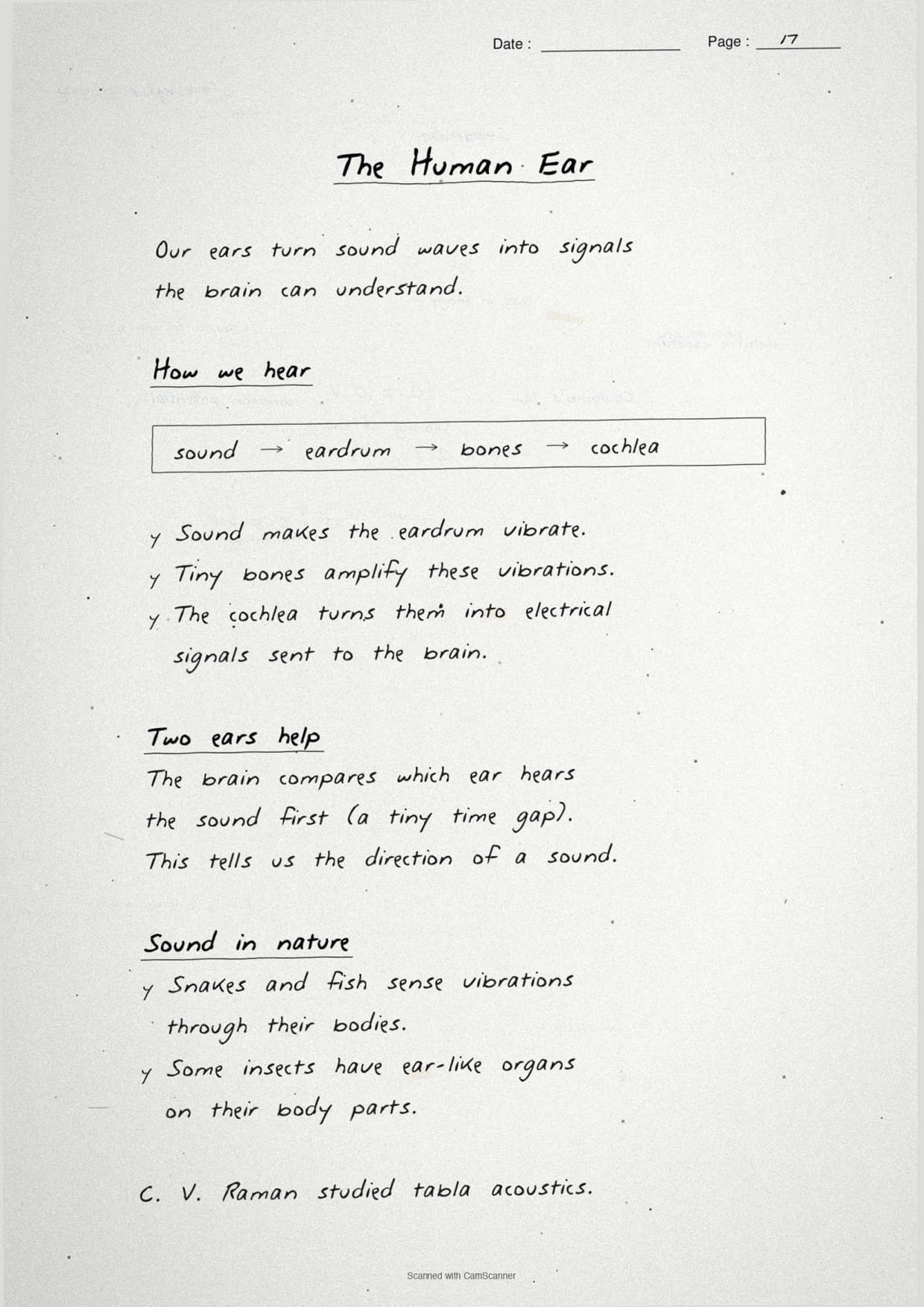
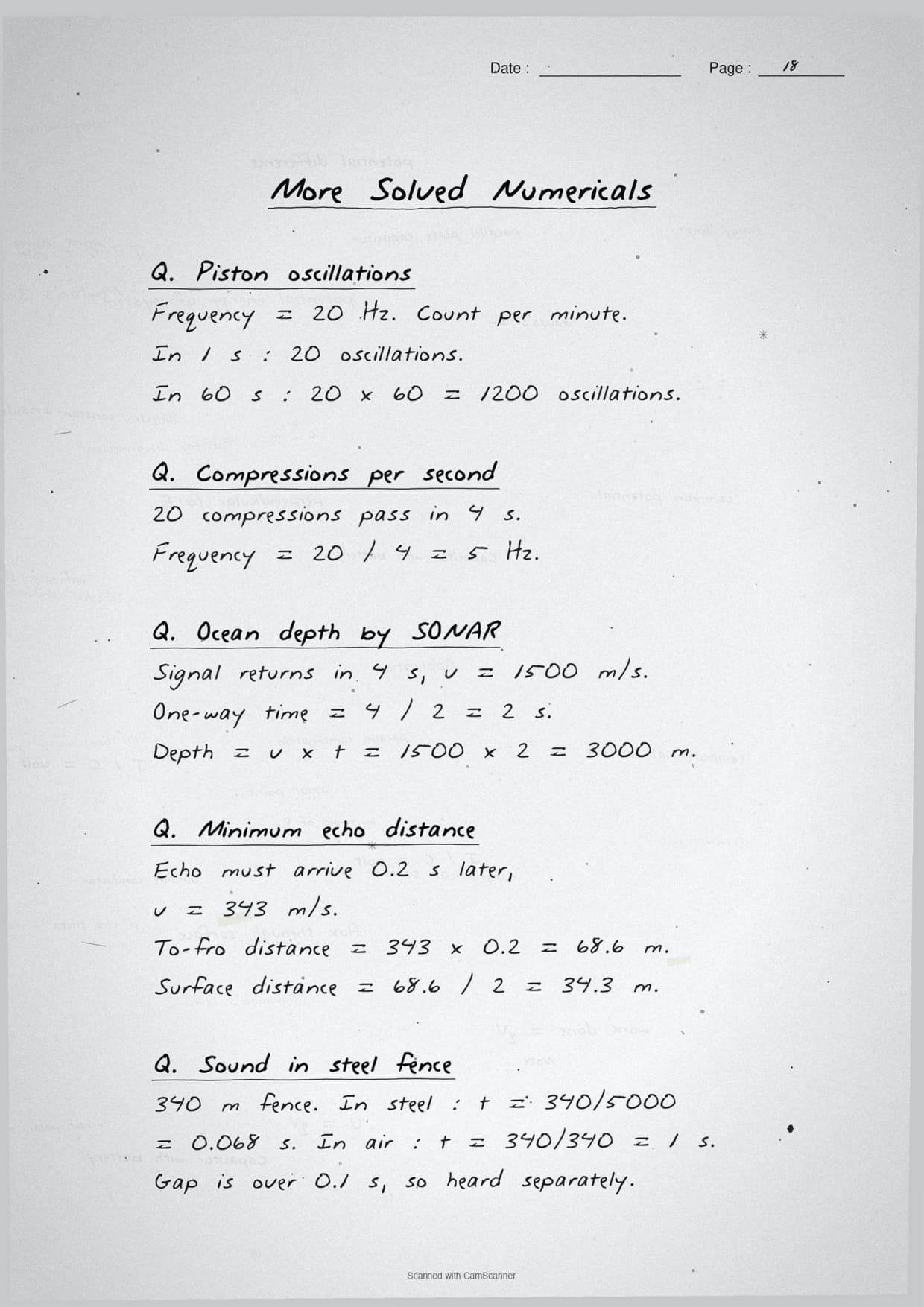
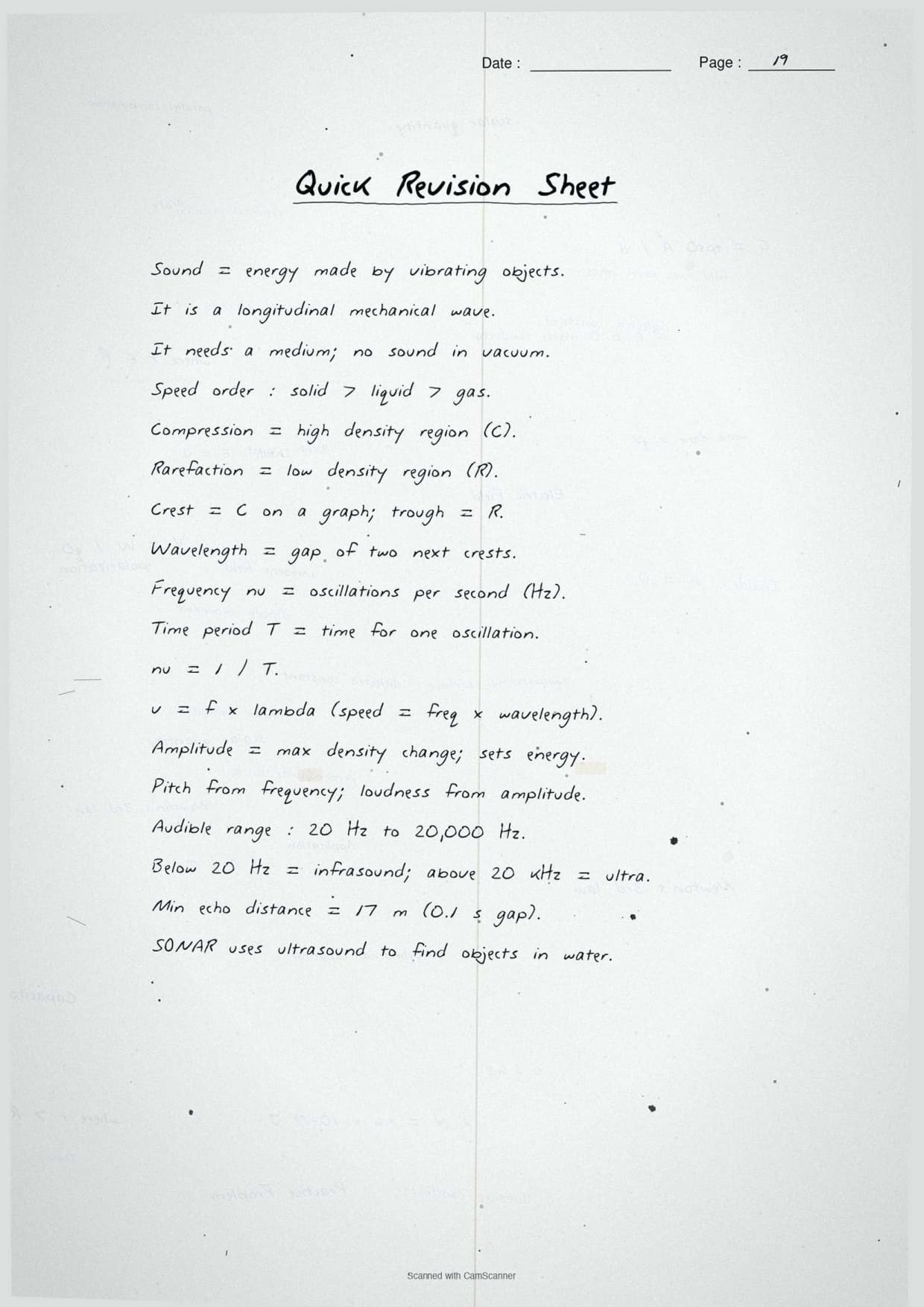
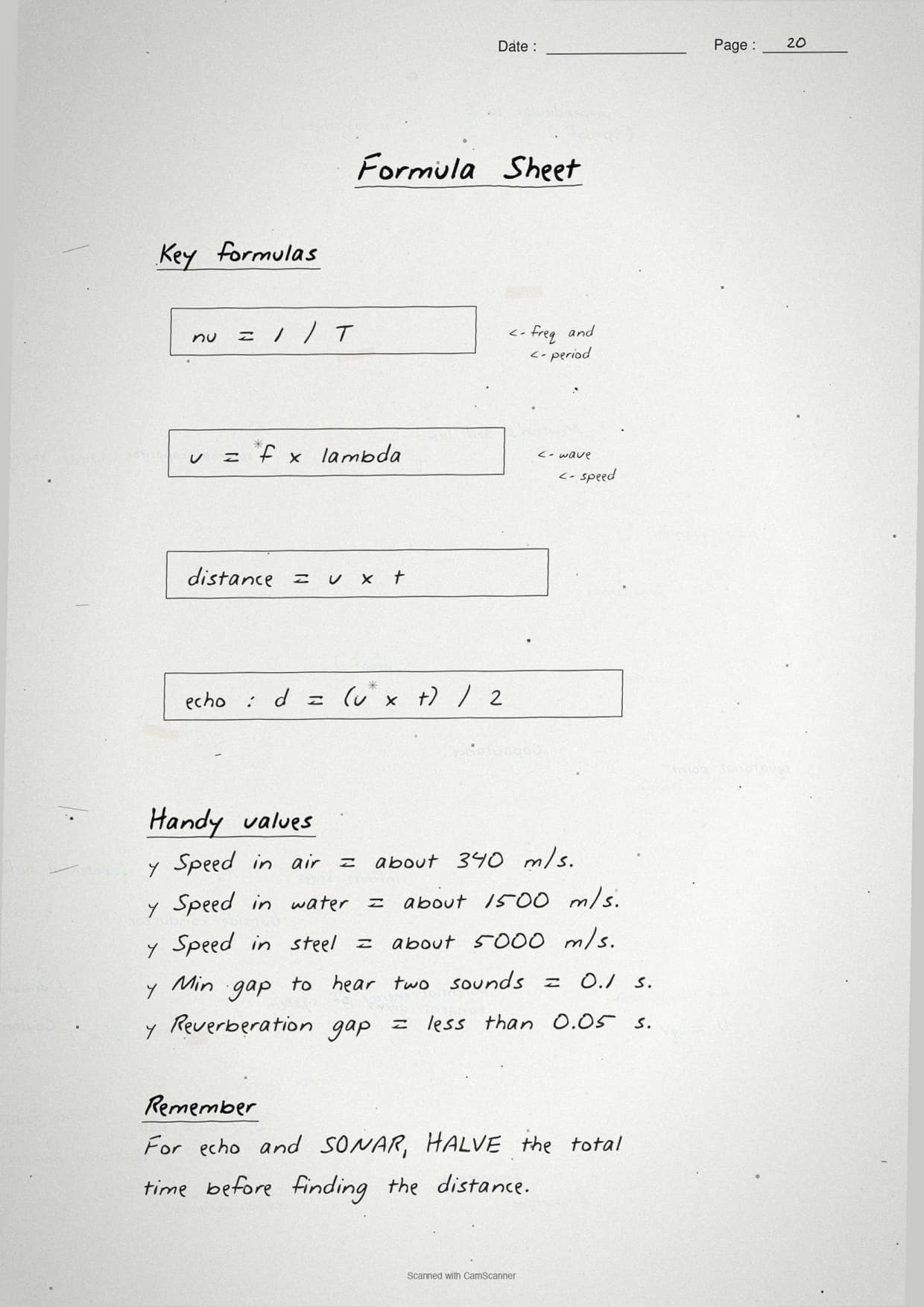
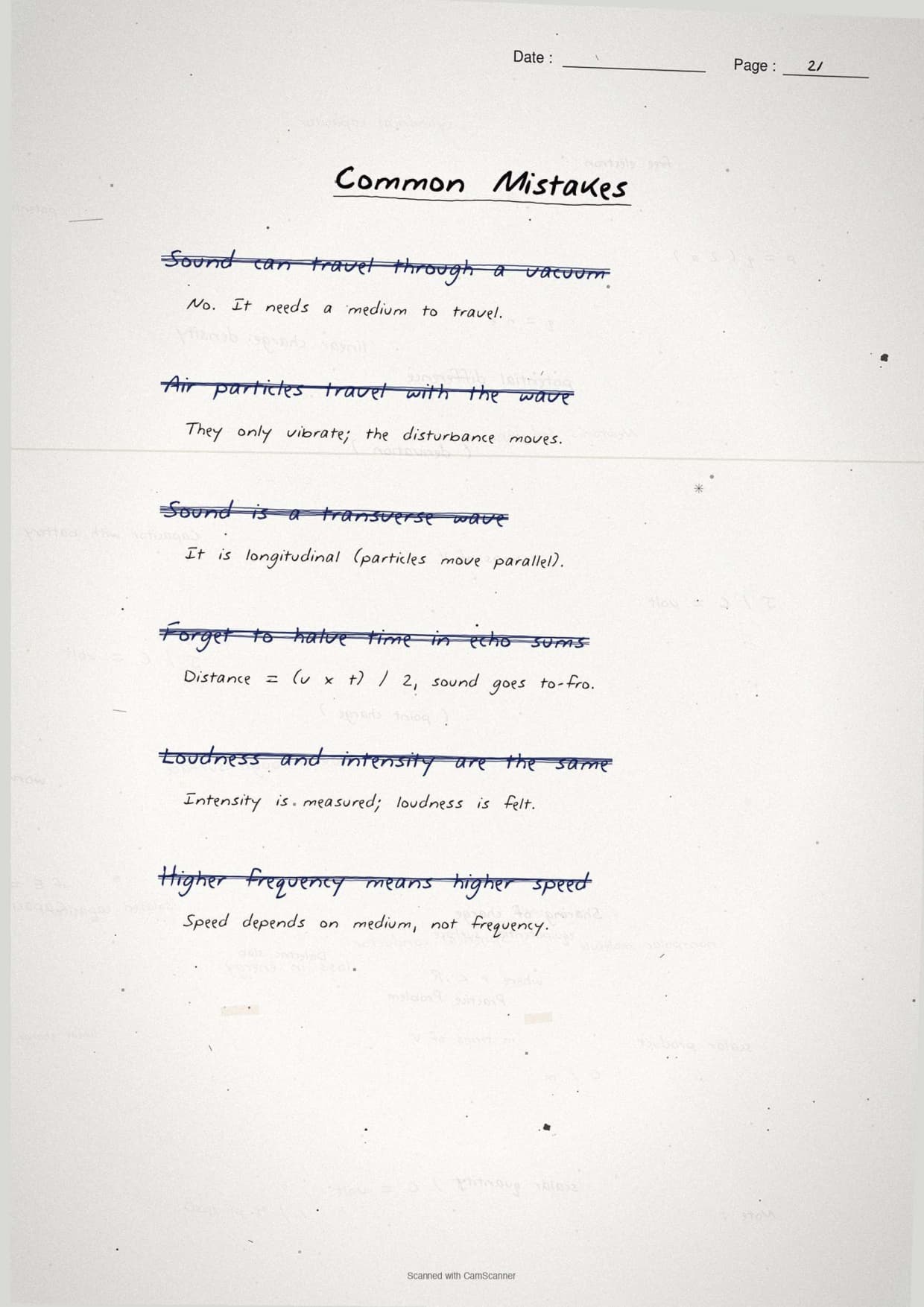
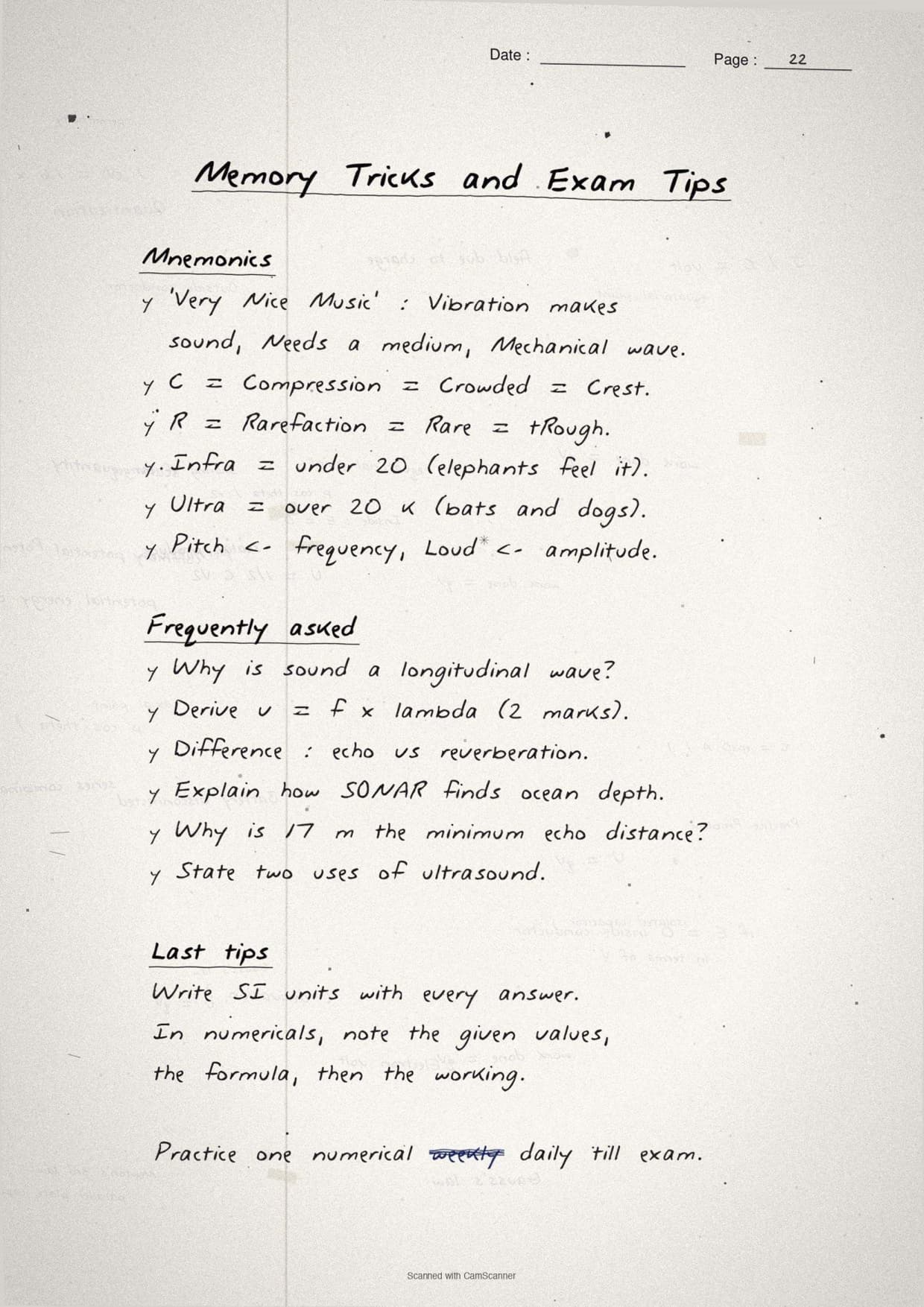
- What you get: production of sound, compressions and rarefactions, wavelength, frequency, amplitude, speed, pitch, loudness, echo and SONAR, all in clear handwriting.
- Colour-coded: new sub-topics in red, each formula in a hand-drawn box, and solved examples in blue.
- Why by hand: writing v = λ × ν and each waveform sketch by hand helps you recall it fast in the exam.
Student Feedback
In a Collegedunia study of 1,240 Class 9 students, 79% said hand-written pages of the sound wave formulas and the compression-rarefaction sketch were easier to recall than typed notes. About 4 out of 5 rated the boxed v = λ × ν formula and the red-marked echo mistakes as the most useful part before a test.
Sound Waves Characteristics and Applications Class 9 Science Explained in One Shot
Source: Physics Wallah Foundation on YouTube
Why Use Handwritten Notes for Class 9 Science Chapter 10 Sound Waves
Chapter 10 mixes short definitions with a few formulas and many wave diagrams, so a clean, hand-written page saves real time. The Sound Waves Characteristics and Applications Class 9 Science Handwritten Notes keep one idea per line, with a small waveform sketch beside it, so nothing runs together. You revise the full chapter in one sitting without flipping through the Exploration book.
- Each formula, like v = λ × ν, sits in its own hand-drawn box.
- A quick sketch of compressions and rarefactions is drawn next to the idea it explains.
- Red sub-headings split the chapter into short, easy parts.
- The wording is plain, like a senior showing you the method.
What Is Inside the Sound Waves Handwritten Notes PDF
The PDF runs to 22 pages of neat, hand-written revision. It moves from how vibrations make sound, to how sound travels as a longitudinal wave, then to wavelength, frequency, amplitude and speed, and ends with echo, reverberation and SONAR, with a solved example after each idea. The colour code below tells you what every mark means.
- Red: new sub-topic headings, such as Compression, Rarefaction, Amplitude, or Echo.
- Boxes: each formula, like ν = 1T and v = λ × ν, drawn by hand.
- Blue: solved examples and the numbers worked out in them.
Production and Propagation of Sound in the Notes
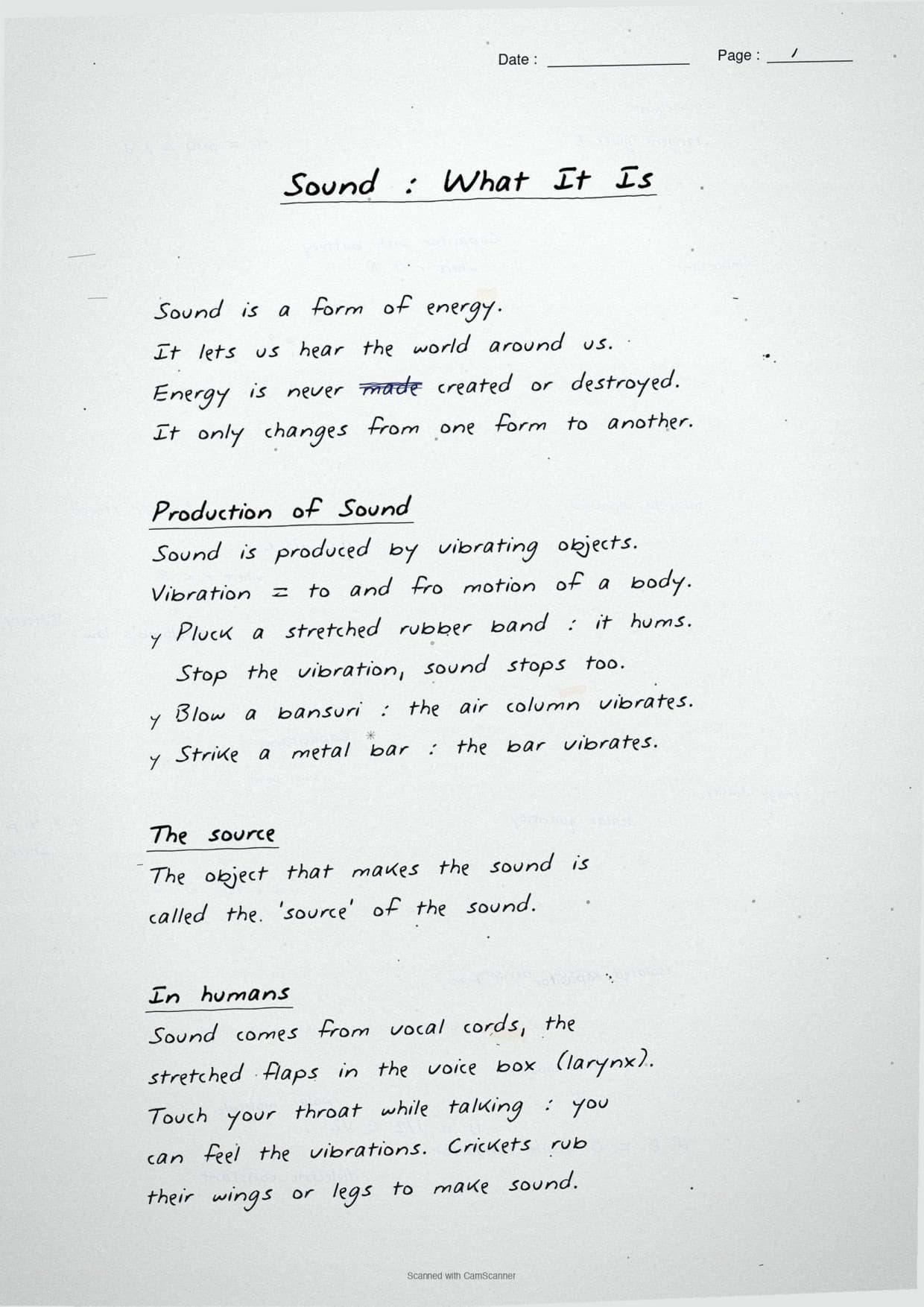
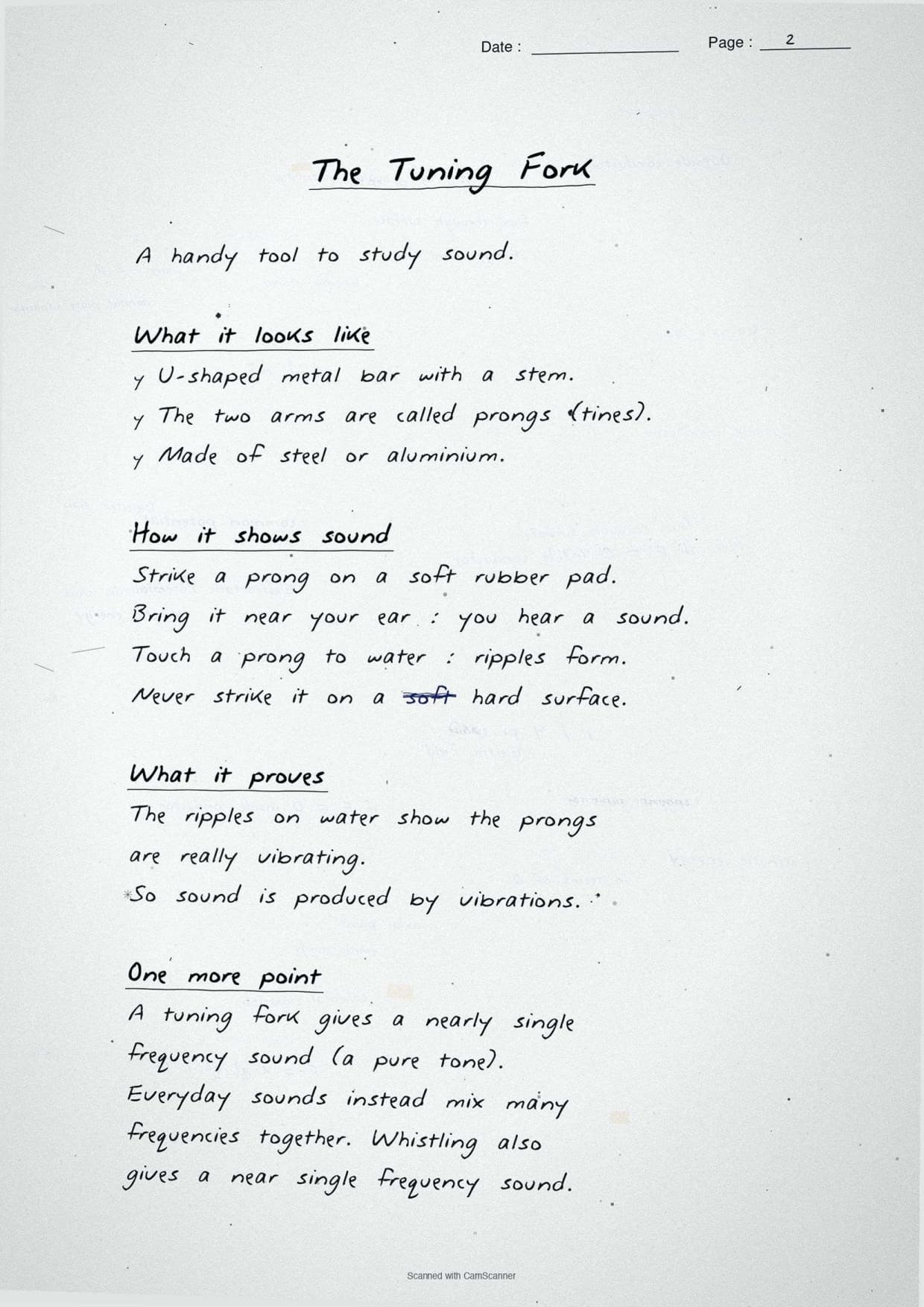
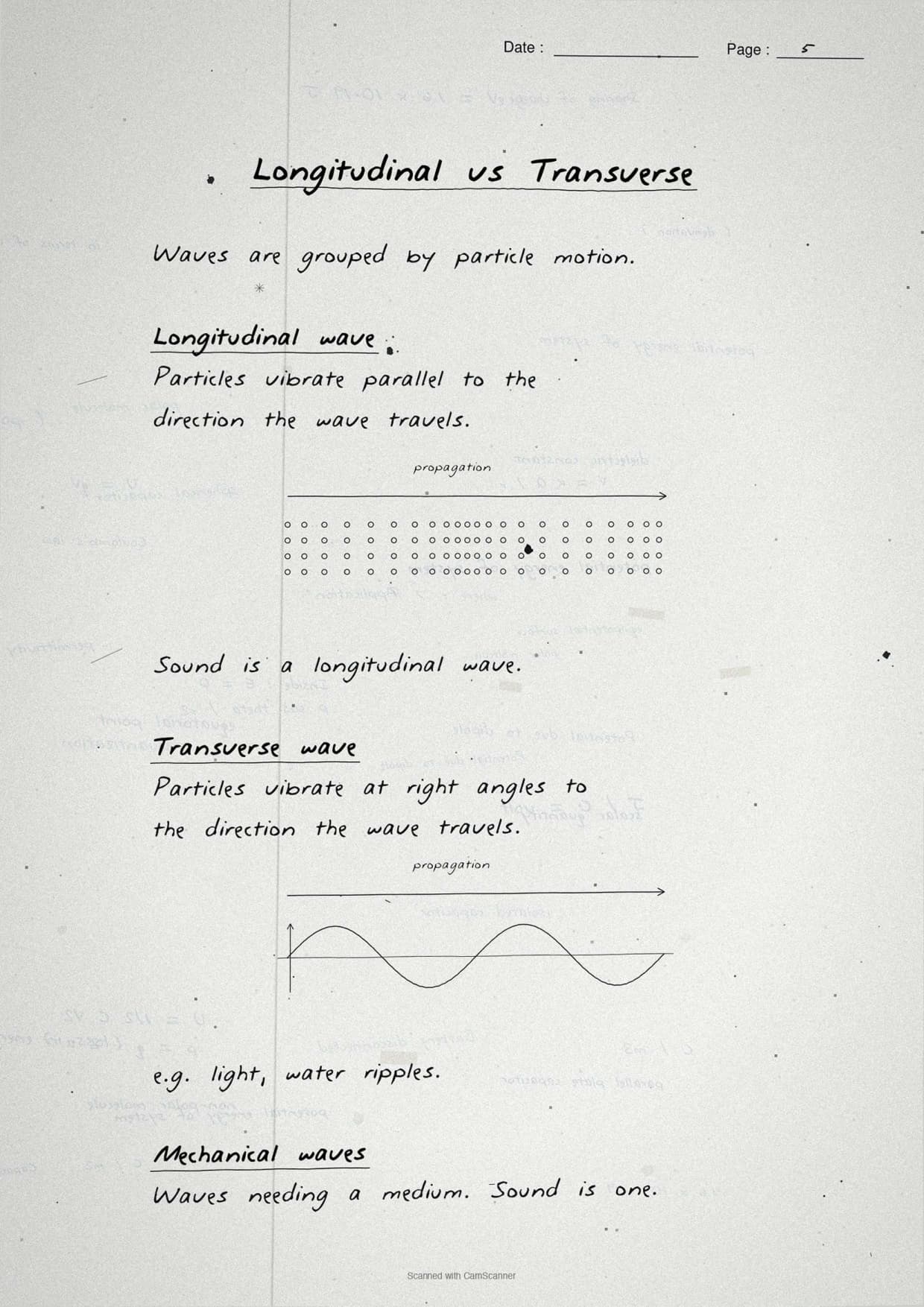
Sound is the central idea of the chapter, so the notes open here. A sound is a form of energy that is produced when an object vibrates. A vibration is the rapid to and fro motion of an object about its rest position. When the vibration stops, the sound stops too.
- The source: a plucked string, a struck plate, a stretched drum skin, or the vocal cords in your throat all vibrate to make sound.
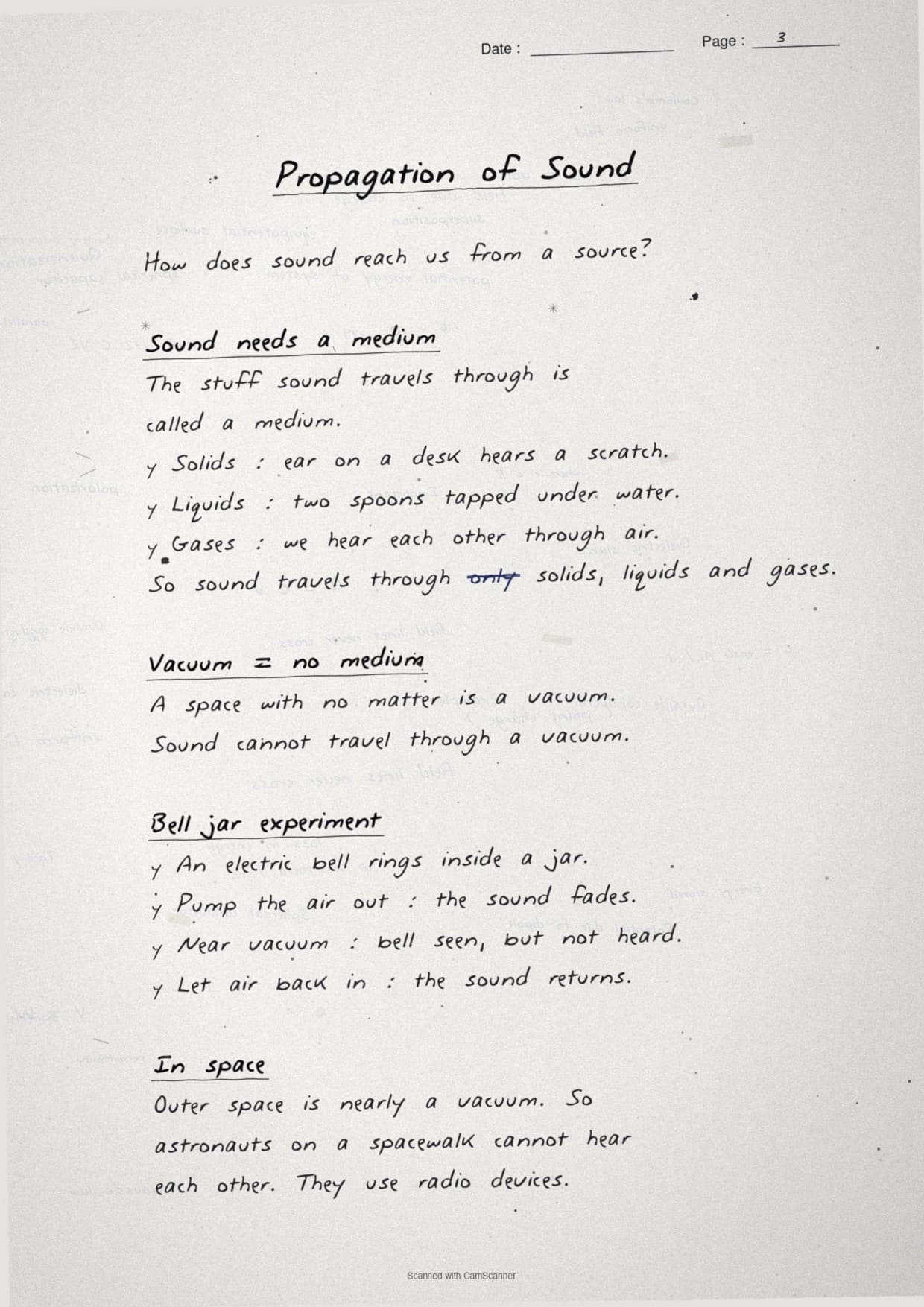
- Sound needs a medium: it travels through solids, liquids and gases, but not through a vacuum, so the bell in the bell-jar experiment falls silent as air is pumped out.
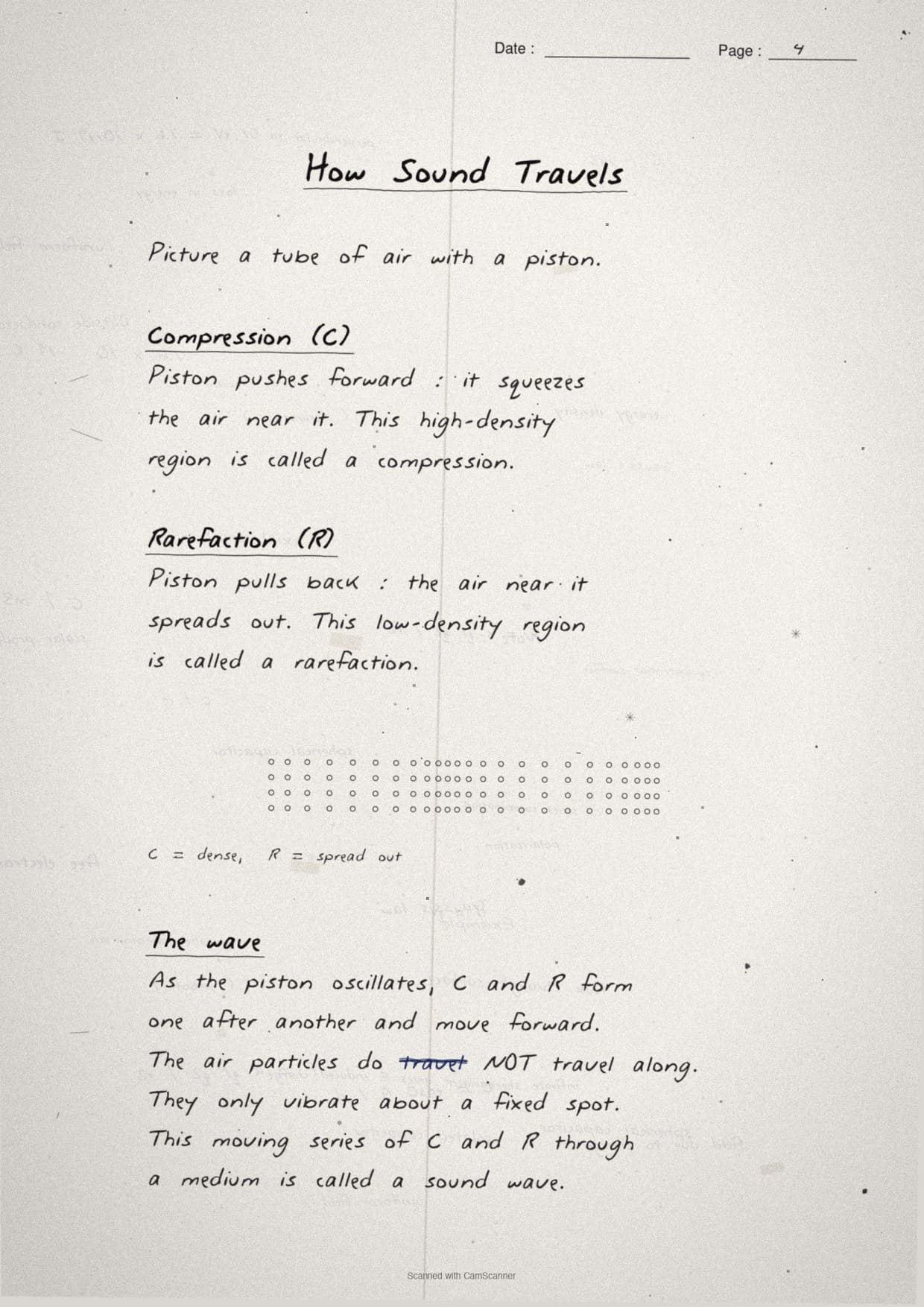
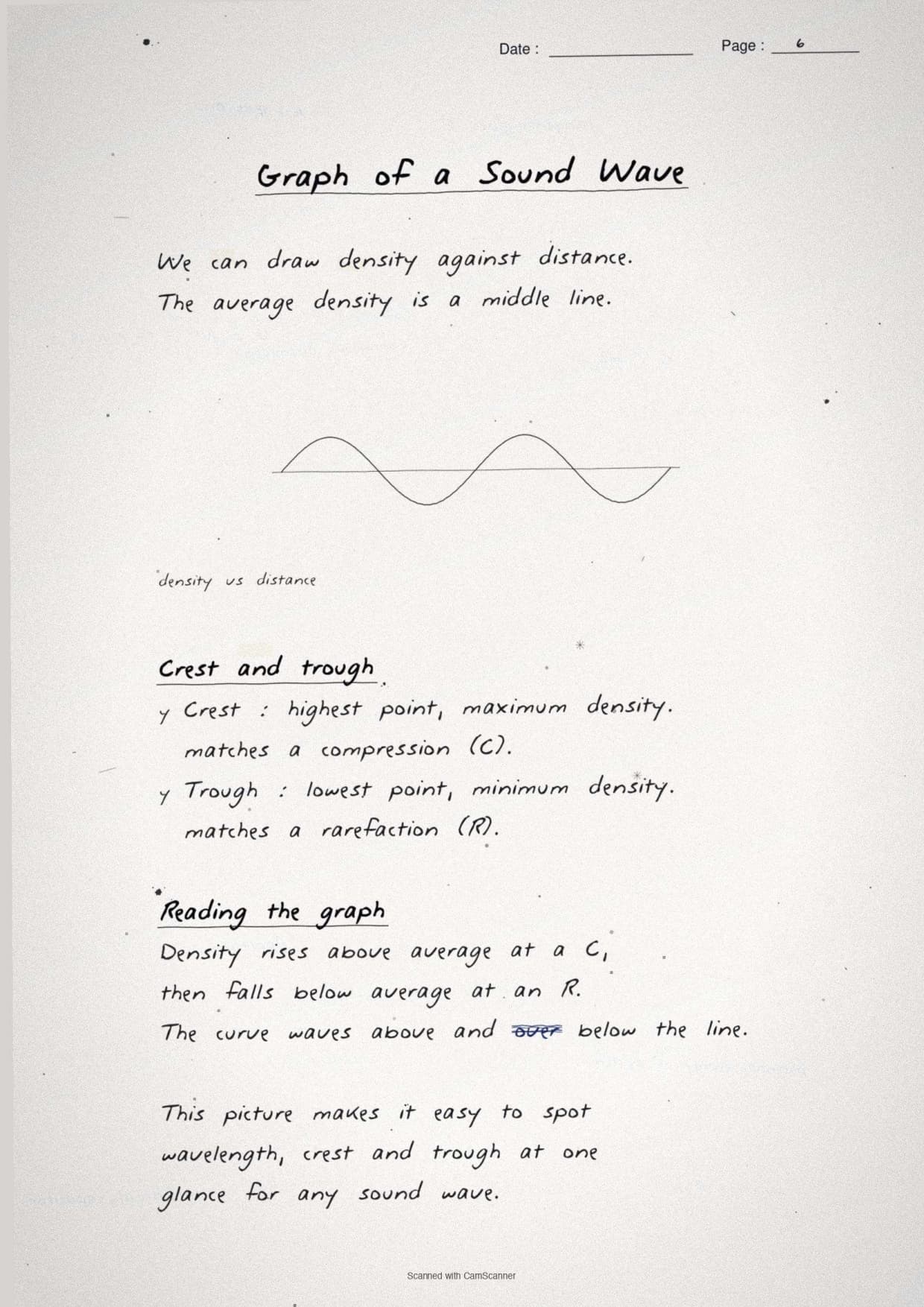
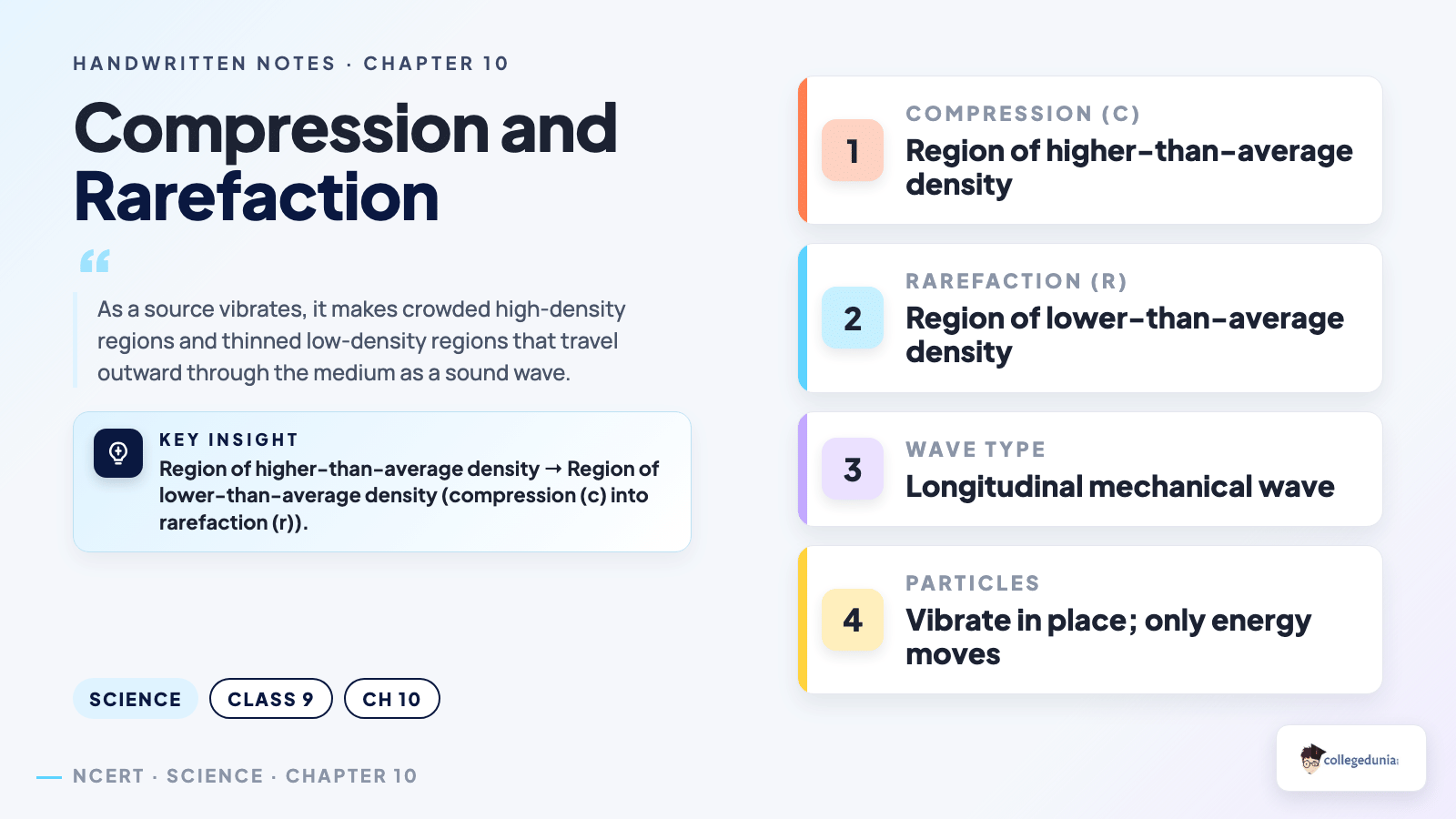
- Compressions and rarefactions: as the source vibrates, it makes crowded regions of high density, called compressions (C), and thinned regions of low density, called rarefactions (R), that travel outward.
Because the air particles only vibrate about fixed spots and pass the energy on, the notes teach you one habit: draw the row of compressions and rarefactions first, then label the direction of travel. That single sketch makes it clear that sound is a longitudinal mechanical wave, where particles move along the same line as the wave.
Characteristics of a Sound Wave: Hand-Drawn Table
This is one of the most tested ideas in Chapter 10, so the notes give it a clear hand-drawn table. Every sound wave can be described by a few measurable quantities, and each one can be read straight off the density-distance graph.
| Quantity | What it means | SI unit |
|---|---|---|
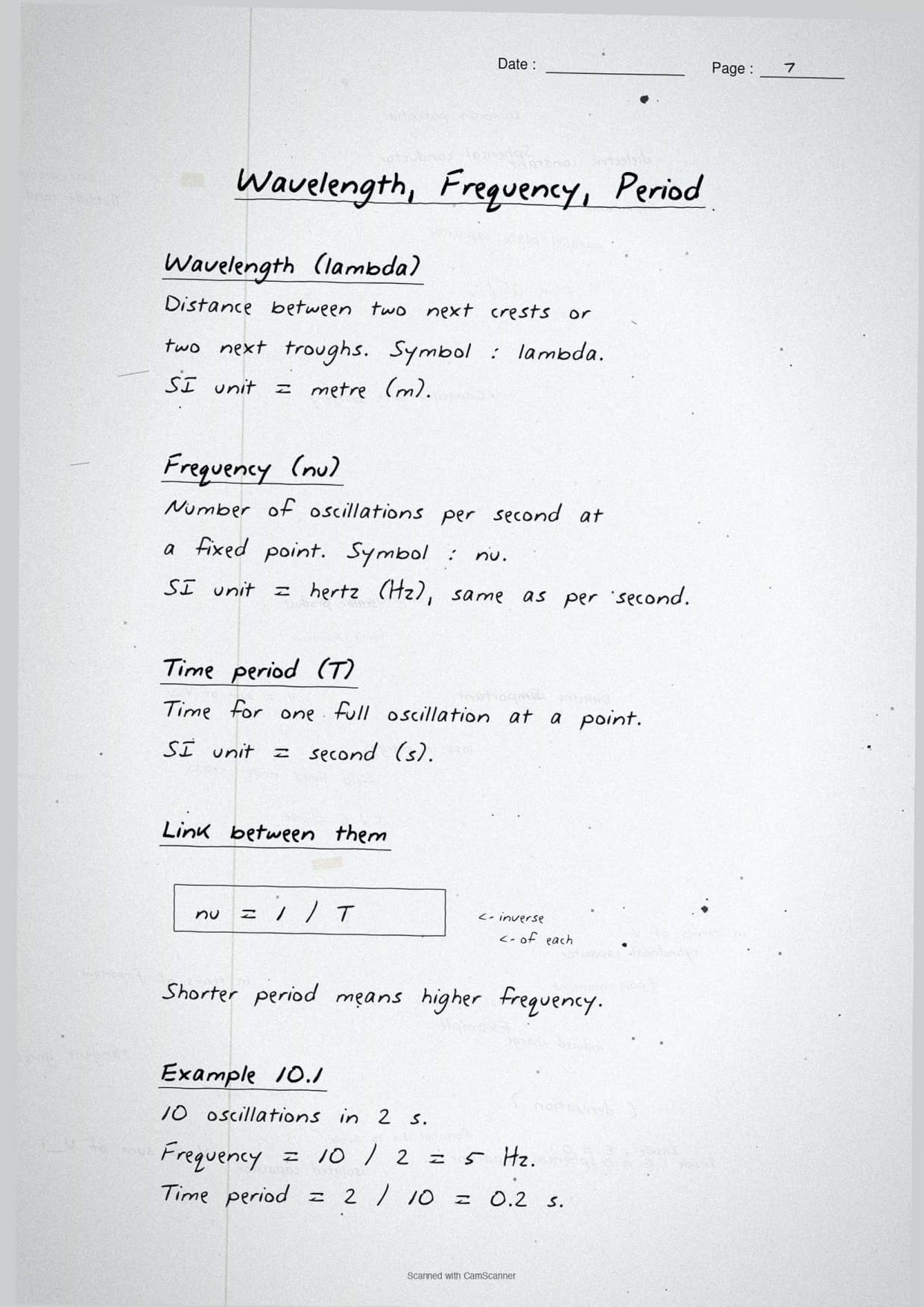
| Wavelength (λ) | Distance between two consecutive crests or troughs | metre (m) |
| Frequency (ν) | Number of oscillations per second at a fixed point | hertz (Hz) |
| Time period (T) | Time for one full oscillation | second (s) |
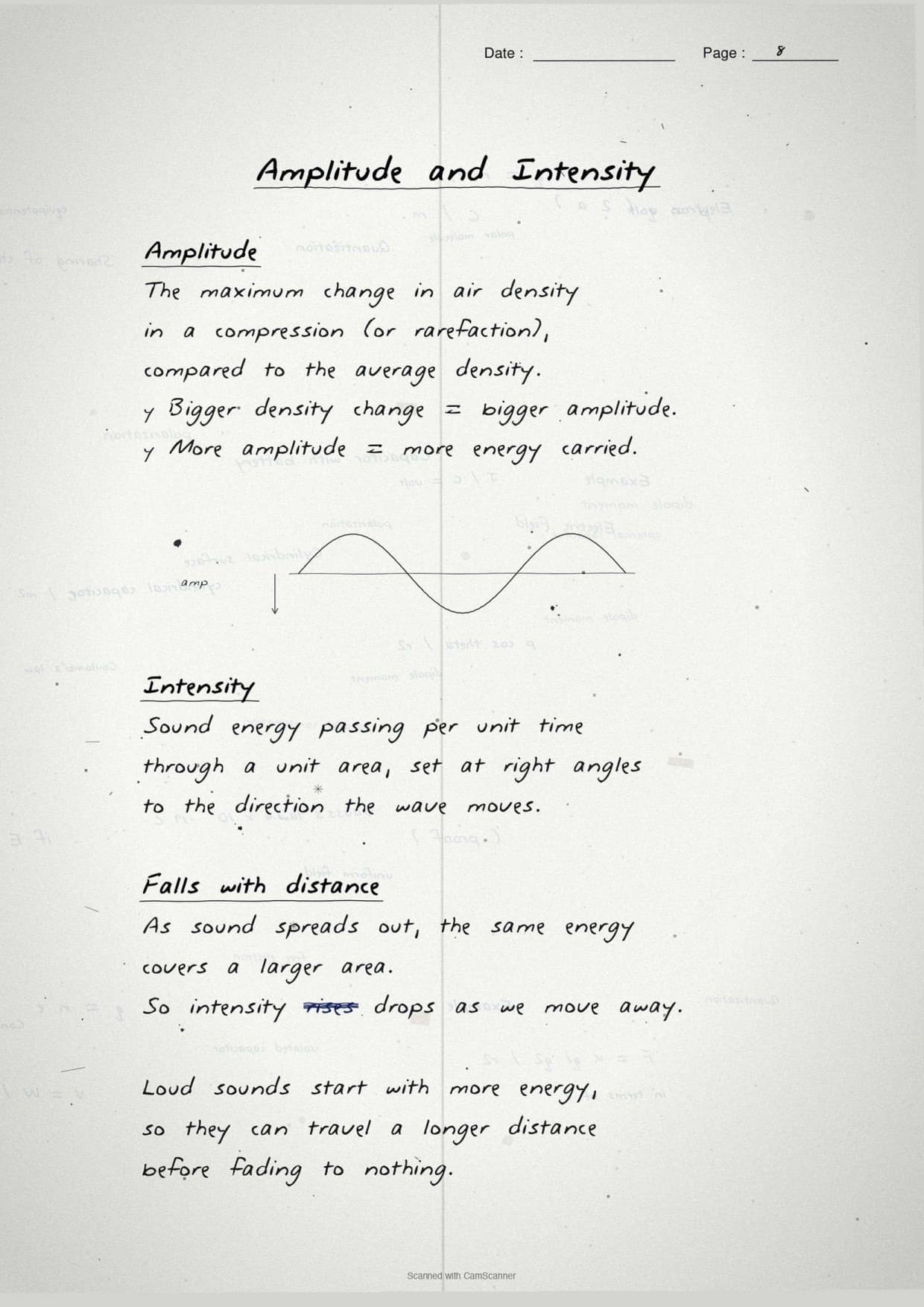
| Amplitude | Maximum density change from the average | density change |
| Speed (v) | Distance a crest travels each second | m s-1 |
The notes flag one common trap in red: amplitude is the height of the wave, not its length. Amplitude tells you how strong the density change is, while wavelength is the crest-to-crest distance. A loud, deep sound has a large amplitude but can still have a long wavelength.
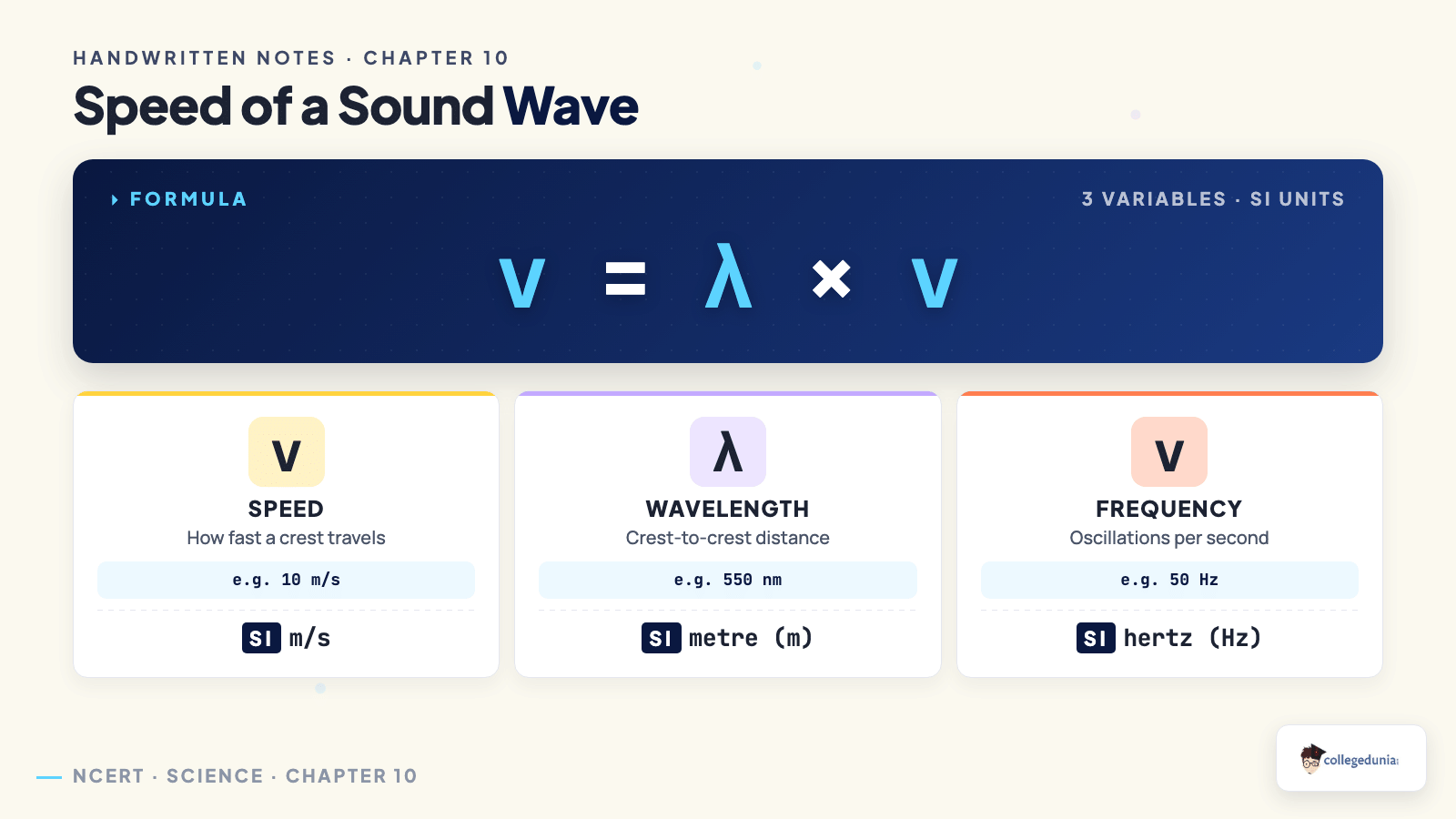
Sound Formulas Boxed in Your Own Handwriting
Keep these boxed formulas ready for the numericals in the Revise, Reflect, Refine exercise. Each one is written out in the notes exactly as you should copy it in the exam.
| Formula | What it finds | Units |
|---|---|---|
| ν = 1T | Frequency from time period, and the reverse | Hz and s |
| v = λ × ν | Speed from wavelength and frequency | m s-1 |
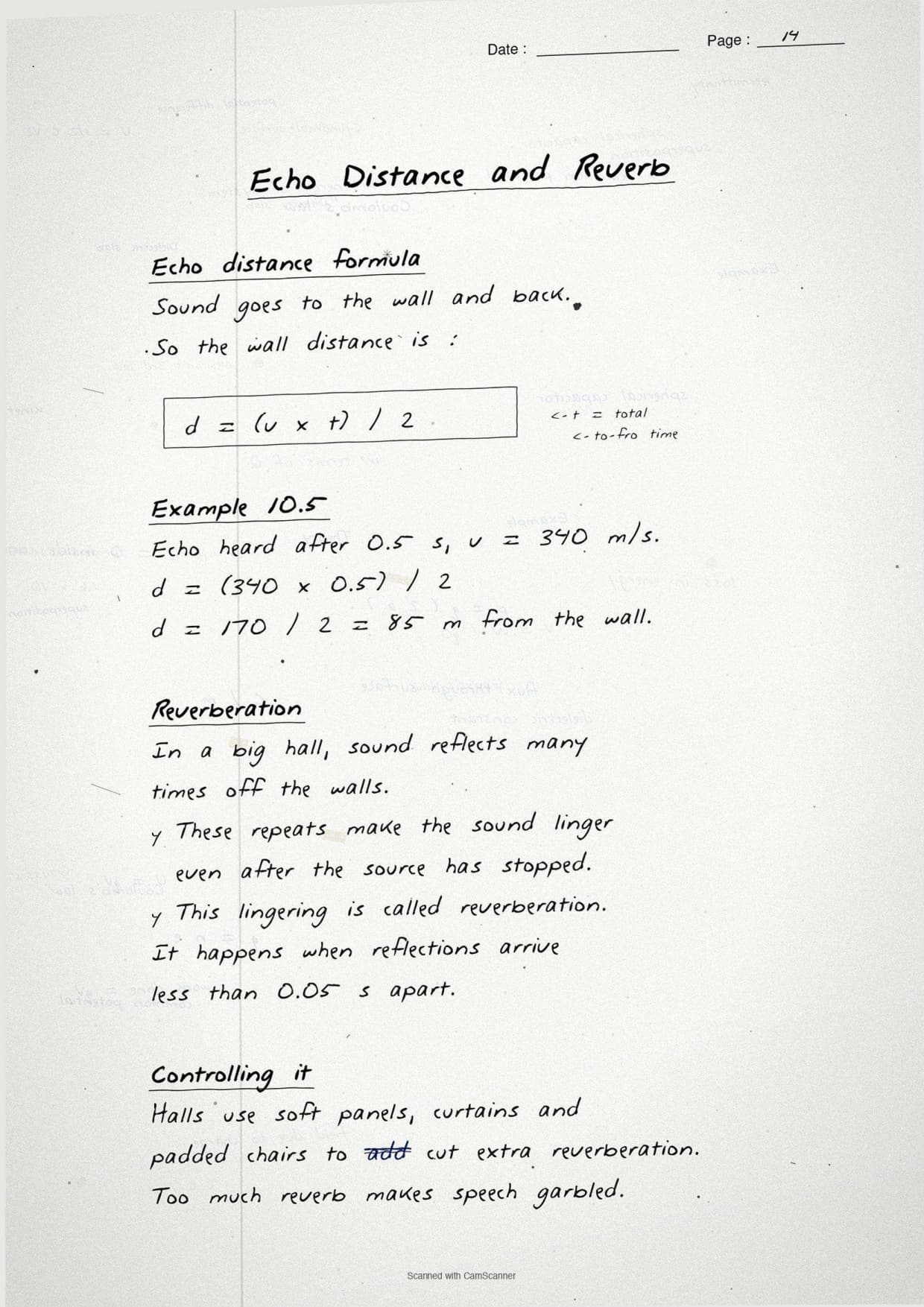
| distance = v × t2 | Distance to a wall or object in echo and SONAR sums | metre (m) |
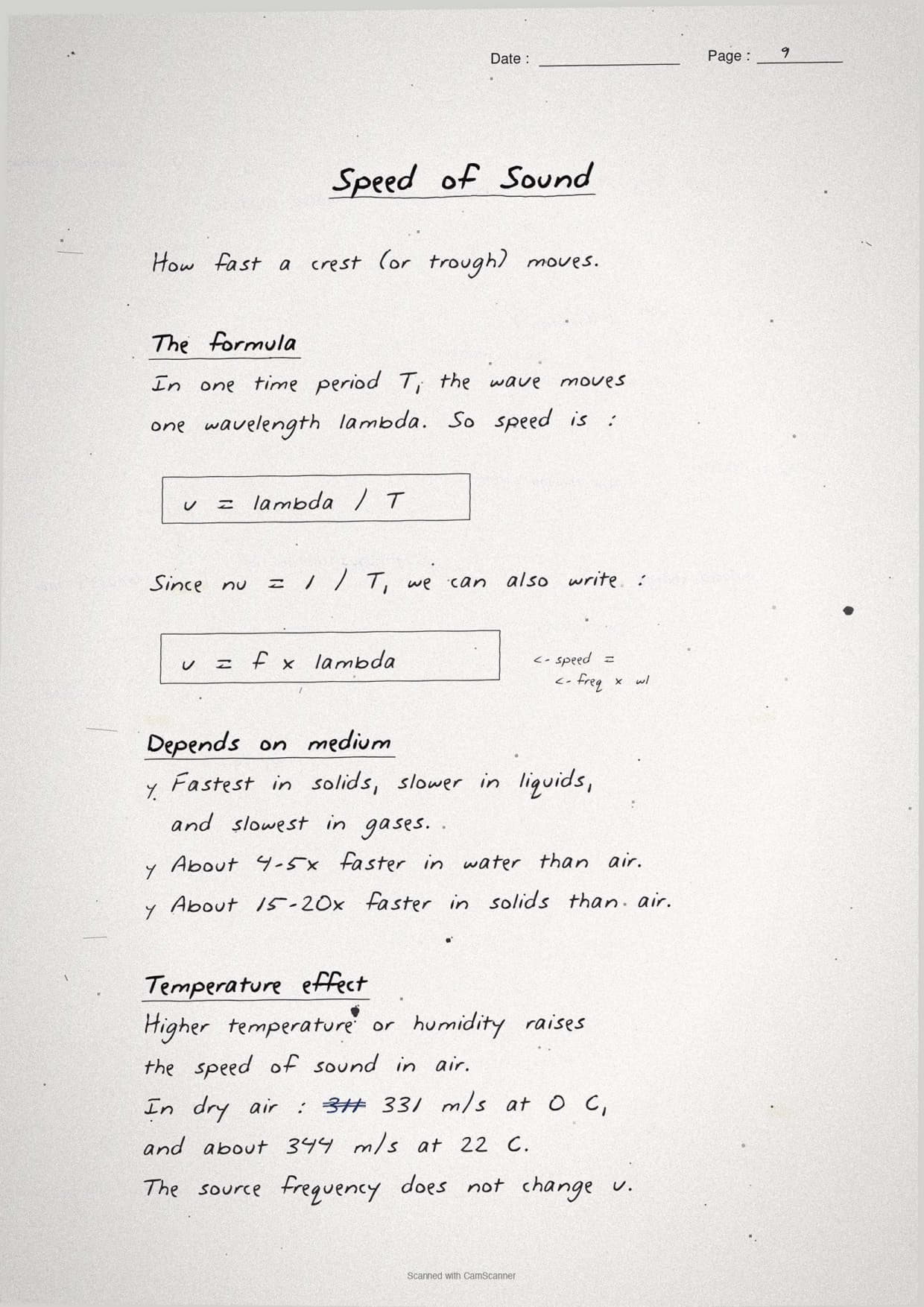
- Speed relation: v = λ × ν, with v in m s-1, λ in metres, and ν in hertz. Rearrange it to find any one quantity from the other two.
- Frequency and time period: ν = 1T, so a shorter time period means a higher frequency.
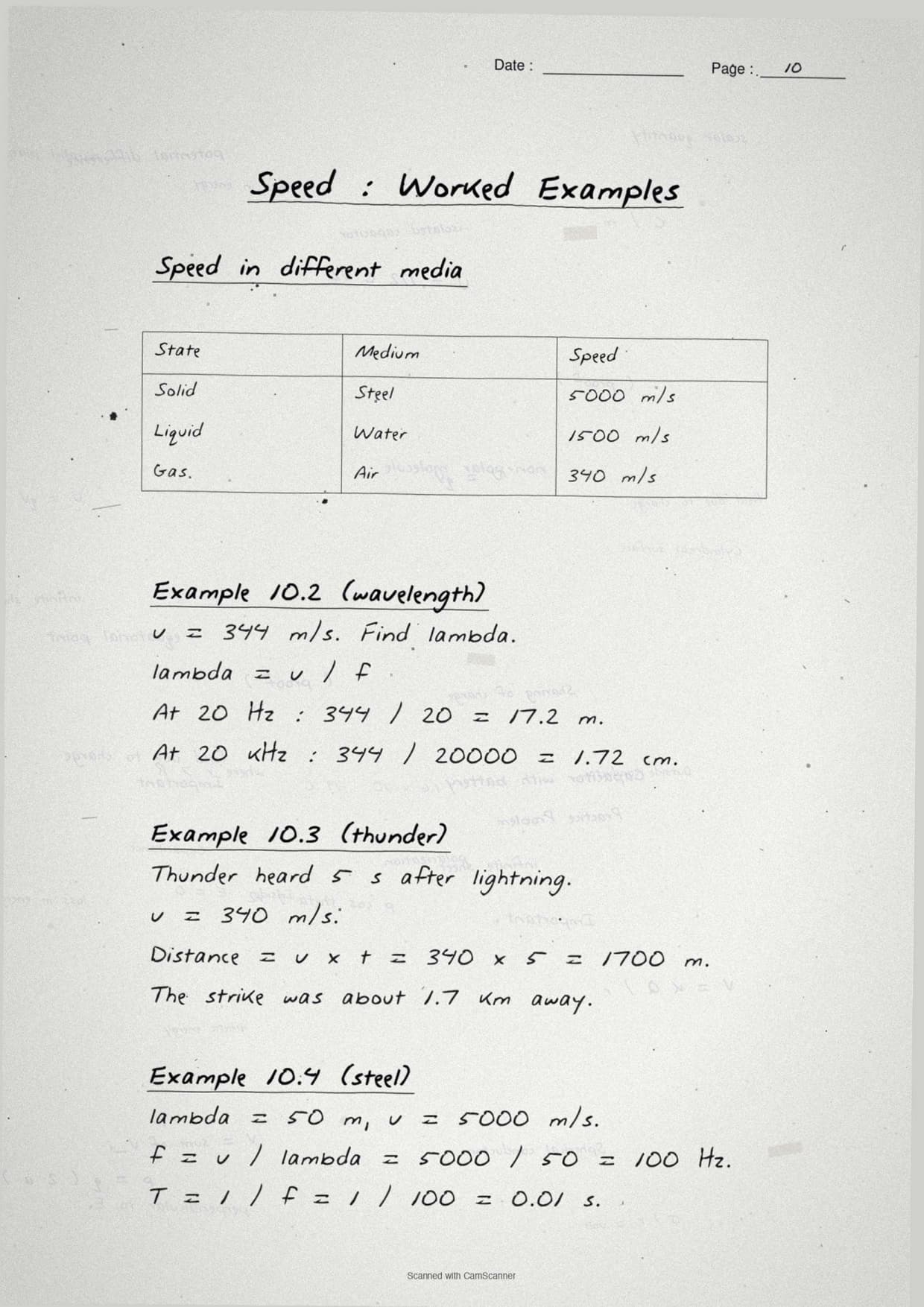
- Speed depends on the medium: sound is fastest in solids (about 5000 m s-1 in steel), slower in water (about 1500 m s-1), and slowest in air (about 340 m s-1).
Pitch, Loudness and Quality Explained Simply
Most of Chapter 10 links a measured wave property to what your ear actually senses, so the notes box each pair and add a real example beside it. Learn these three links and the perception part of the chapter becomes easy to recall.
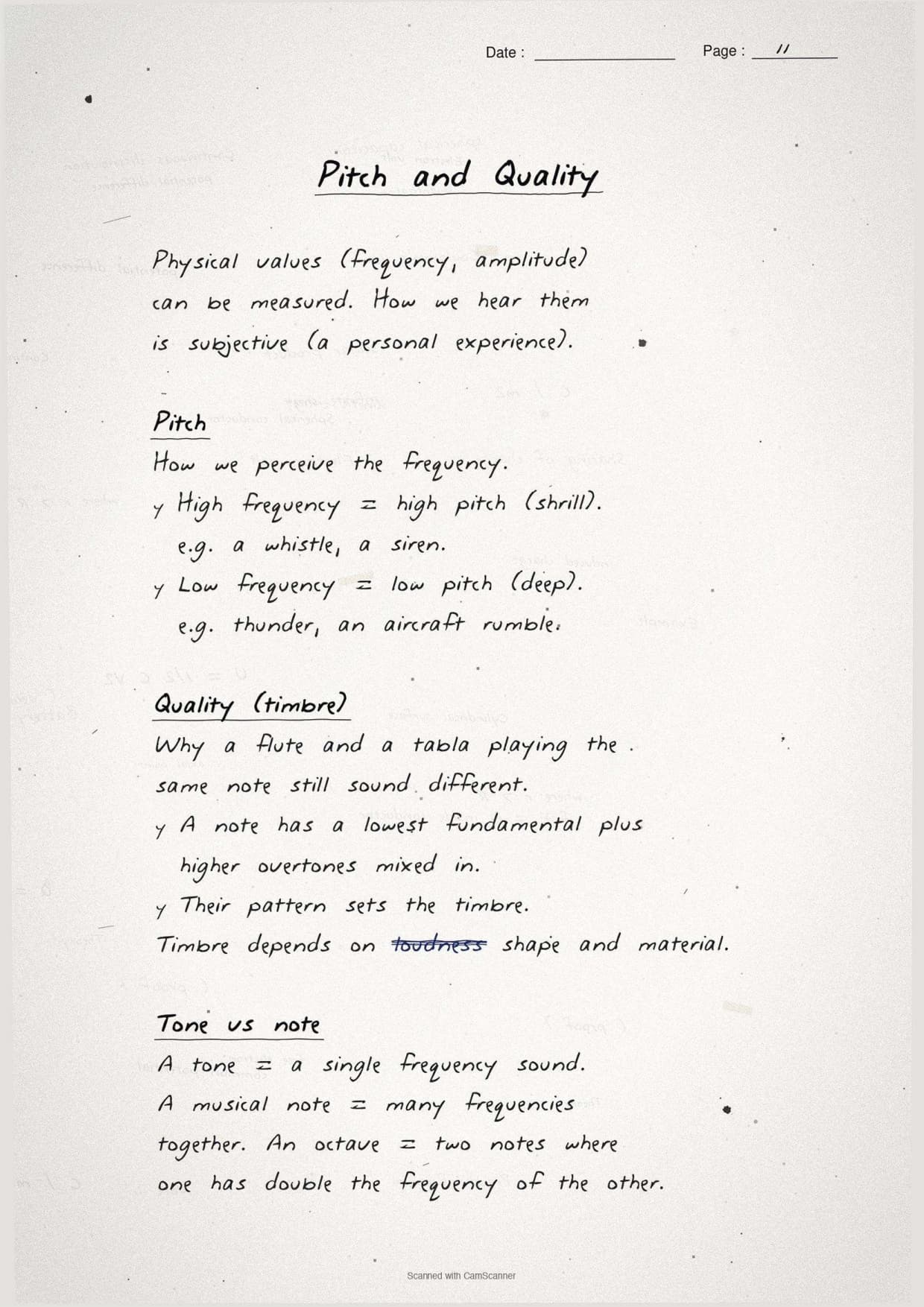
| What we sense | Depends mainly on | Example |
|---|---|---|
| Pitch | Frequency | Whistle is high, thunder is low |
| Loudness | Amplitude | Shout is loud, whisper is soft |
| Quality (timbre) | Mix of overtones | Flute and tabla, same note, different sound |
- Pitch: the brain's sense of frequency. A high-frequency siren has high pitch; a low-frequency rumble has low pitch.
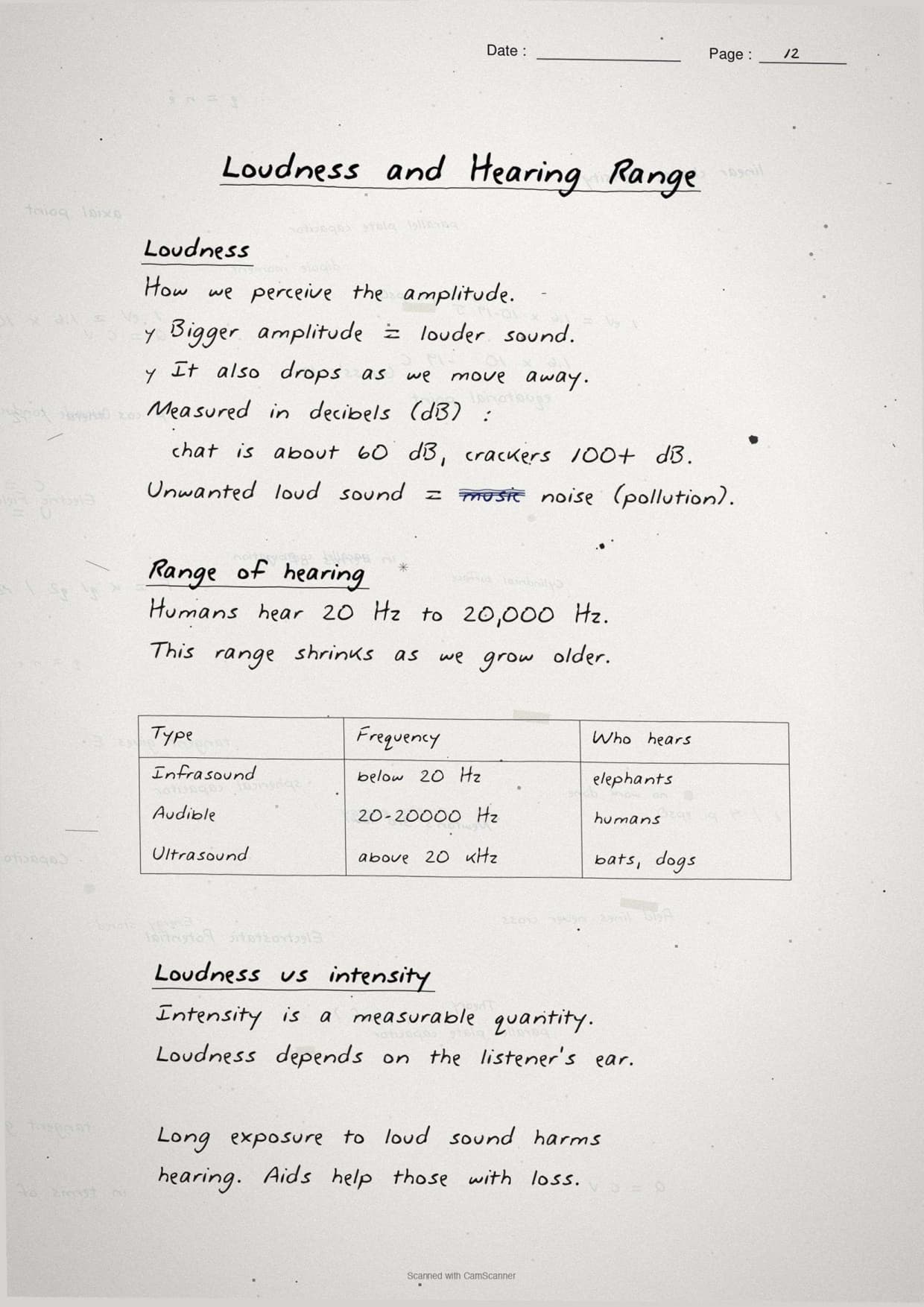
- Loudness: the brain's sense of amplitude, measured in decibels (dB). Normal talk is about 60 dB and firecrackers can cross 100 dB.
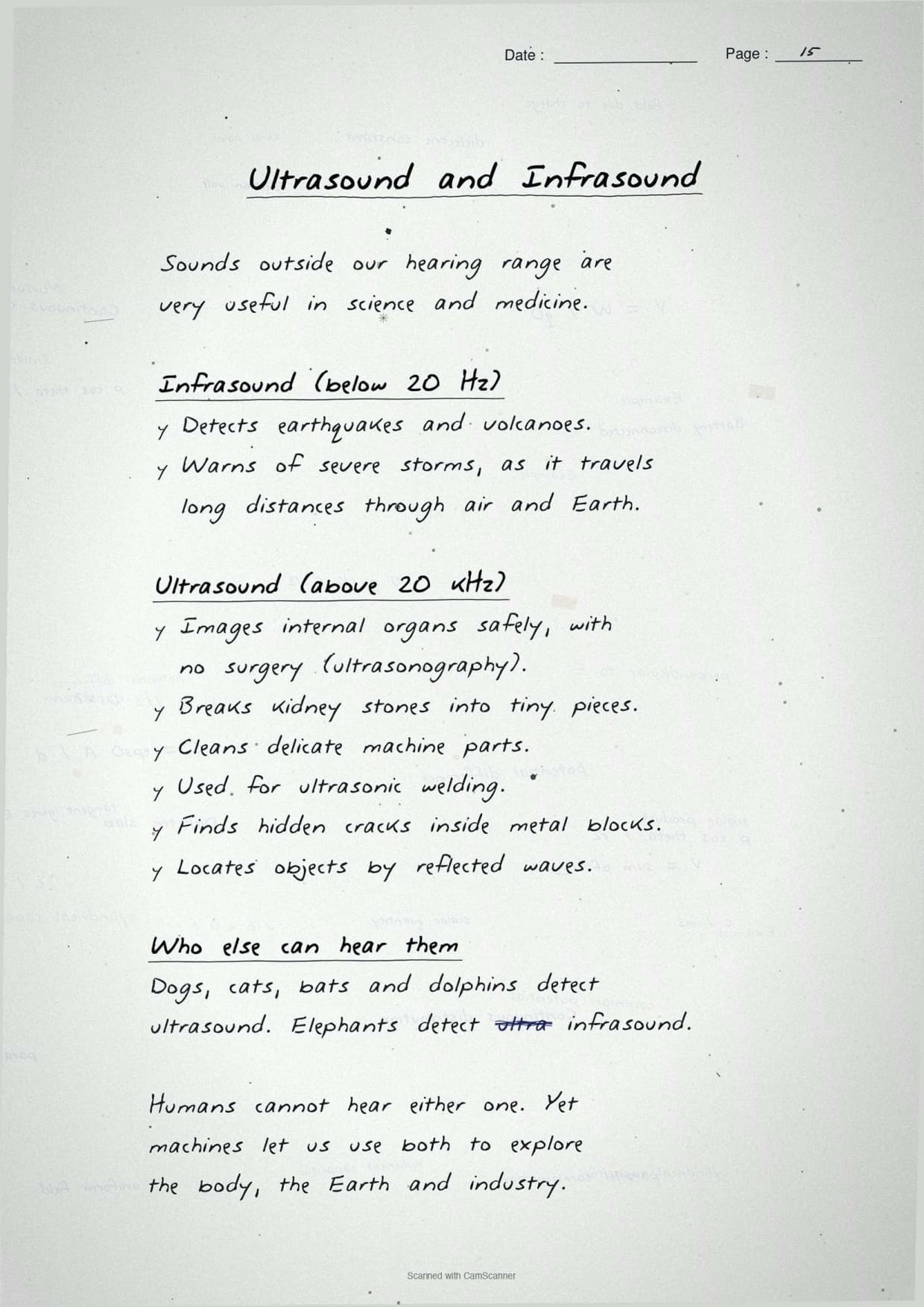
- Range of hearing: humans hear about 20 Hz to 20,000 Hz. Below 20 Hz is infrasonic; above 20 kHz is ultrasonic, which bats and dolphins can detect.
Echo, Reverberation and SONAR Marked in the Margins
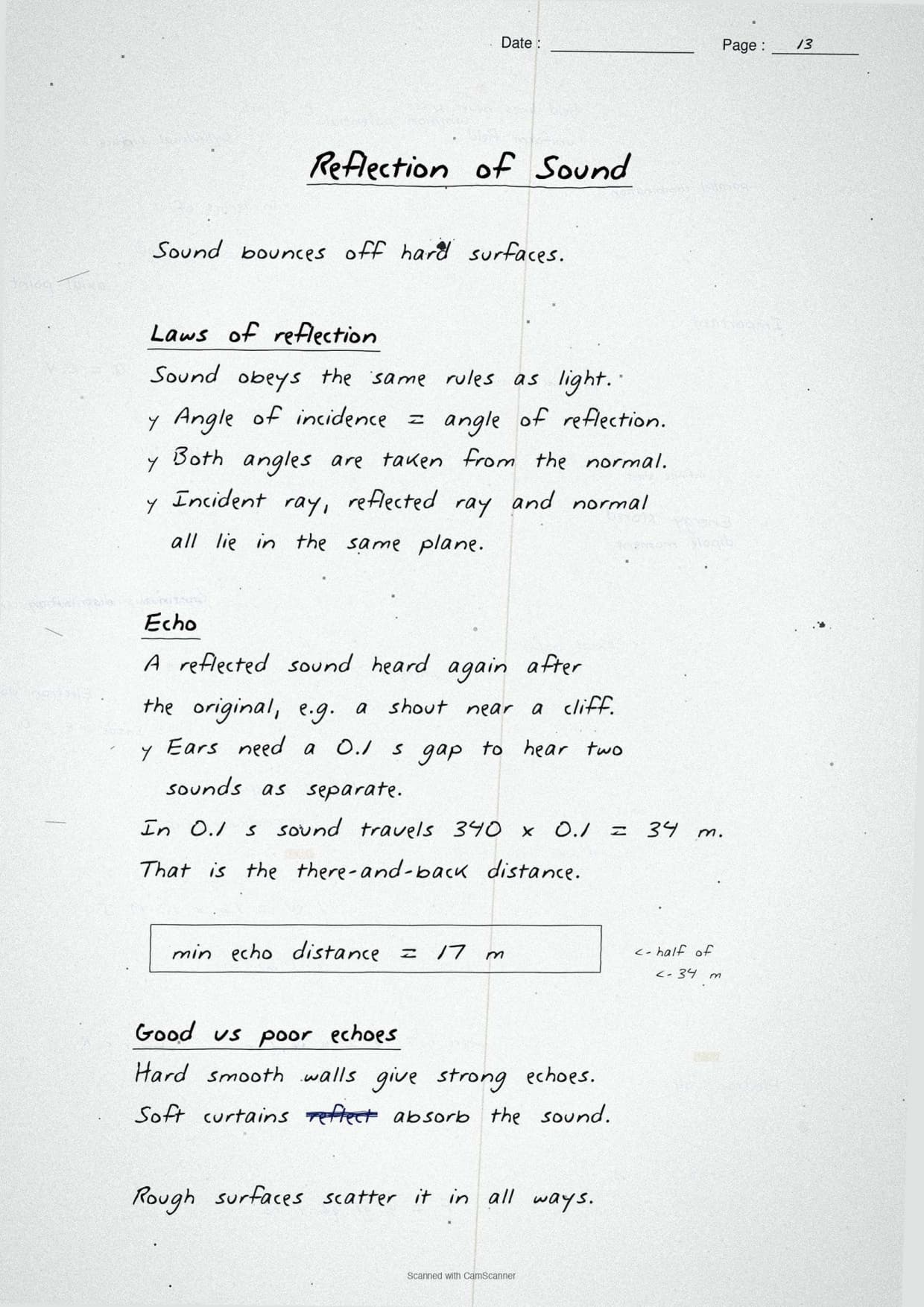
Reflection of sound runs across the last part of the chapter, so the notes give it a short block of its own. Sound bounces off a hard surface following the same laws as light: the angle of incidence equals the angle of reflection.
- Echo: a sound heard again after reflection off a distant surface. To hear it as separate, the reflected sound must arrive at least 0.1 s later, so the wall must be at least 17 m away.
- Reverberation: the lingering of sound from many quick reflections in a hall. Soft curtains, carpets and padded seats absorb sound to cut it.
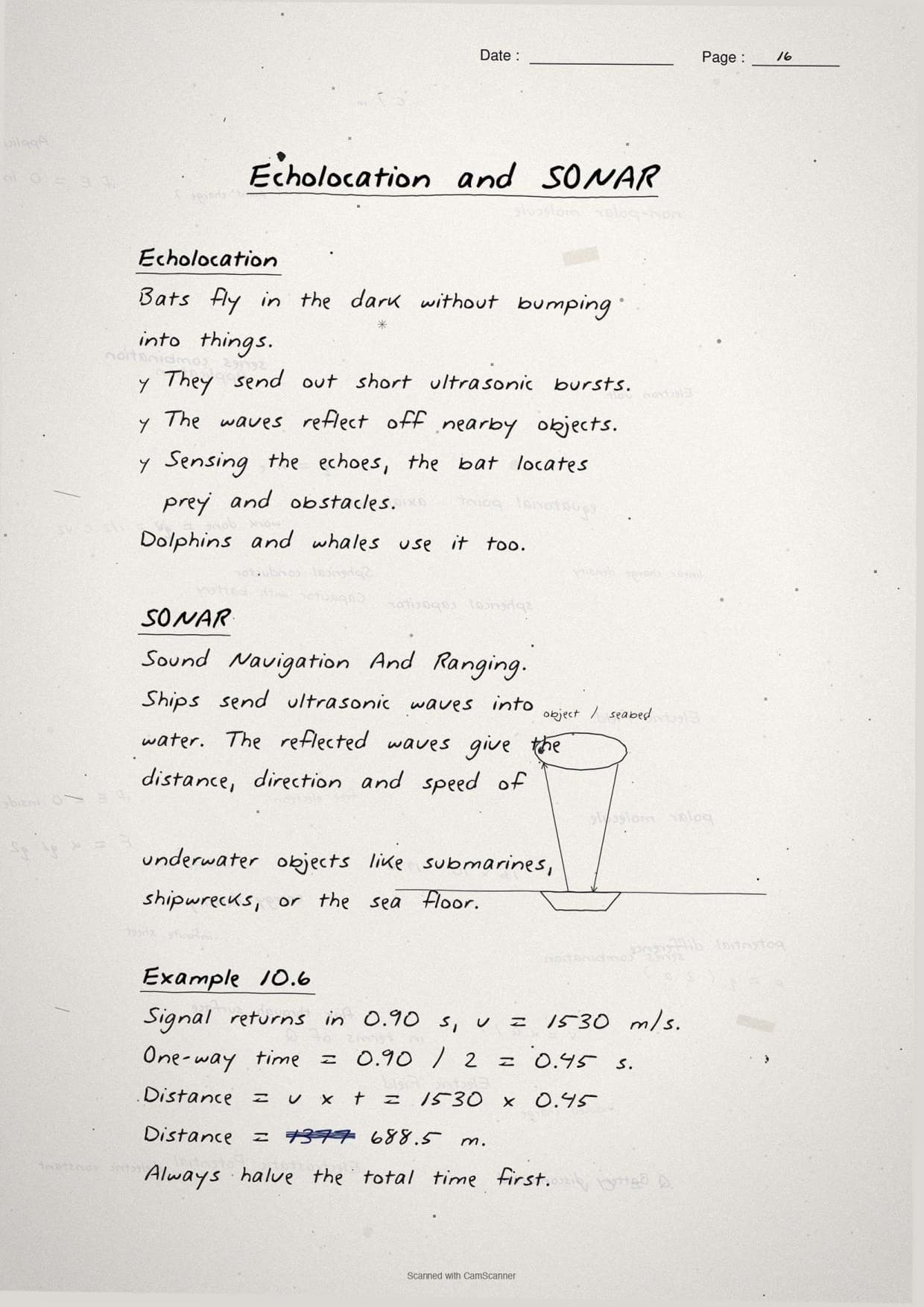
- SONAR: Sound Navigation And Ranging. A ship sends ultrasonic waves into water and times the echo to find the distance to a submarine or the sea floor.
Everyday uses are pinned in the margins so the ideas stick: bats hunt by echolocation, doctors use ultrasound to image organs and an unborn baby, and ultrasound also breaks kidney stones and cleans delicate parts.
Common Mistakes Flagged in Red
Most lost marks in this chapter come from small slips, not hard ideas. The handwritten notes circle these in red so you fix them while you revise.
- In echo and SONAR sums, forgetting to halve the round-trip time, which doubles the answer.
- Swapping the two links: amplitude sets loudness and frequency sets pitch, not the other way round.
- Confusing amplitude (the height of the wave) with wavelength (the crest-to-crest length).
- Saying sound can travel through a vacuum. It cannot; it needs a material medium.
Last-Minute Revision with These Handwritten Notes
The night before your exam, the Sound Waves Characteristics and Applications Class 9 Science Handwritten Notes work as a quick skim. Every boxed formula and red heading is a checkpoint, so you can cover the whole chapter in well under an hour.
- State that sound is produced by vibrations and needs a medium.
- Write v = λ × ν and ν = 1T from their boxes and give each unit.
- Recall the wave-quantity table in one glance and match crests to compressions.
- Say the pitch, loudness and quality links with one example each.
- Read the red echo and vacuum notes before you close the notes.
How Collegedunia's Handwritten Notes Help You With Sound Waves
Collegedunia brings you the Sound Waves Characteristics and Applications Class 9 Science Handwritten Notes as a free, clear PDF you can open on any phone. It saves you the time of making your own notes and matches the new Exploration book.
- 2026-27 match: every page follows the new textbook and the Revise, Reflect, Refine flow.
- Clean handwriting: a topper's neat writing makes each formula and waveform sketch easy to read.
- Exam-ready: boxes and colour cues let you revise fast before the annual exam, and later for CBSE, JEE, and NEET basics.
- Free download: keep the PDF offline and revise any time.
More Sound Waves Class 9 Science Resources
Use the table below to open the other resources for this chapter of the new Class 9 Science Exploration book.
NCERT Handwritten Notes for Class 9 Science: All Chapters
Use the table below to open the handwritten notes for any other chapter of the new Class 9 Science Exploration book.
| Chapter | Handwritten Notes |
|---|---|
| Chapter 2 | Cell The Building Block of Life |
| Chapter 3 | Tissues in Action |
| Chapter 4 | Describing Motion Around Us |
| Chapter 5 | Exploring Mixtures and their Separation |
| Chapter 6 | How Forces Affect Motion |
| Chapter 7 | Work, Energy, and Simple Machines |
| Chapter 8 | Journey Inside the Atom |
| Chapter 9 | Atomic Foundations of Matter |
| Chapter 10 | Sound Waves Characteristics and Applications |
| Chapter 11 | Reproduction How Life Continues |
| Chapter 12 | Patterns in Life Diversity and Classification |
| Chapter 13 | Earth as a System Energy, Matter, and Life |
Sound Waves Characteristics and Applications Class 9 Science Handwritten Notes FAQs
Ques. How many pages are the Sound Waves Characteristics and Applications Class 9 Science handwritten notes?
Ans. The handwritten notes run to 22 pages. They cover the full chapter, from how vibrations make sound and travel as compressions and rarefactions to wavelength, frequency, amplitude, speed, echo and SONAR, with a solved example after each idea.
Ques. Are these real handwritten notes?
Ans. Yes. They are a topper's own clear handwritten revision notes, with each formula boxed, waveform and compression-rarefaction sketches drawn by hand, and sub-headings colour-coded in red.
Ques. What is the main formula in the Chapter 10 notes?
Ans. The key formula is the speed relation, v = λ × ν, where v is speed in metres per second, λ is wavelength in metres, and ν is frequency in hertz. The notes also box ν = 1/T.
Ques. Can I use these handwritten notes for last-minute revision?
Ans. Yes. The boxed formulas and red headings let you skim the whole chapter in under an hour, so they suit the night before your annual exam.
Ques. Is Sound Waves Characteristics and Applications part of the new Class 9 Science book?
Ans. Yes. Sound Waves: Characteristics and Applications is Chapter 10 of the new Exploration textbook for the 2026-27 syllabus. It builds on the wave and motion ideas from earlier chapters.



Comments