




The handwritten notes on Class 12 Physical Education Chapter 1 Management of Sporting Events have been prepared for one-shot revision, according to the latest 2026-27 CBSE syllabus. Every committee chart, fixture formula and points tally is written out by hand in the order the chapter teaches them.
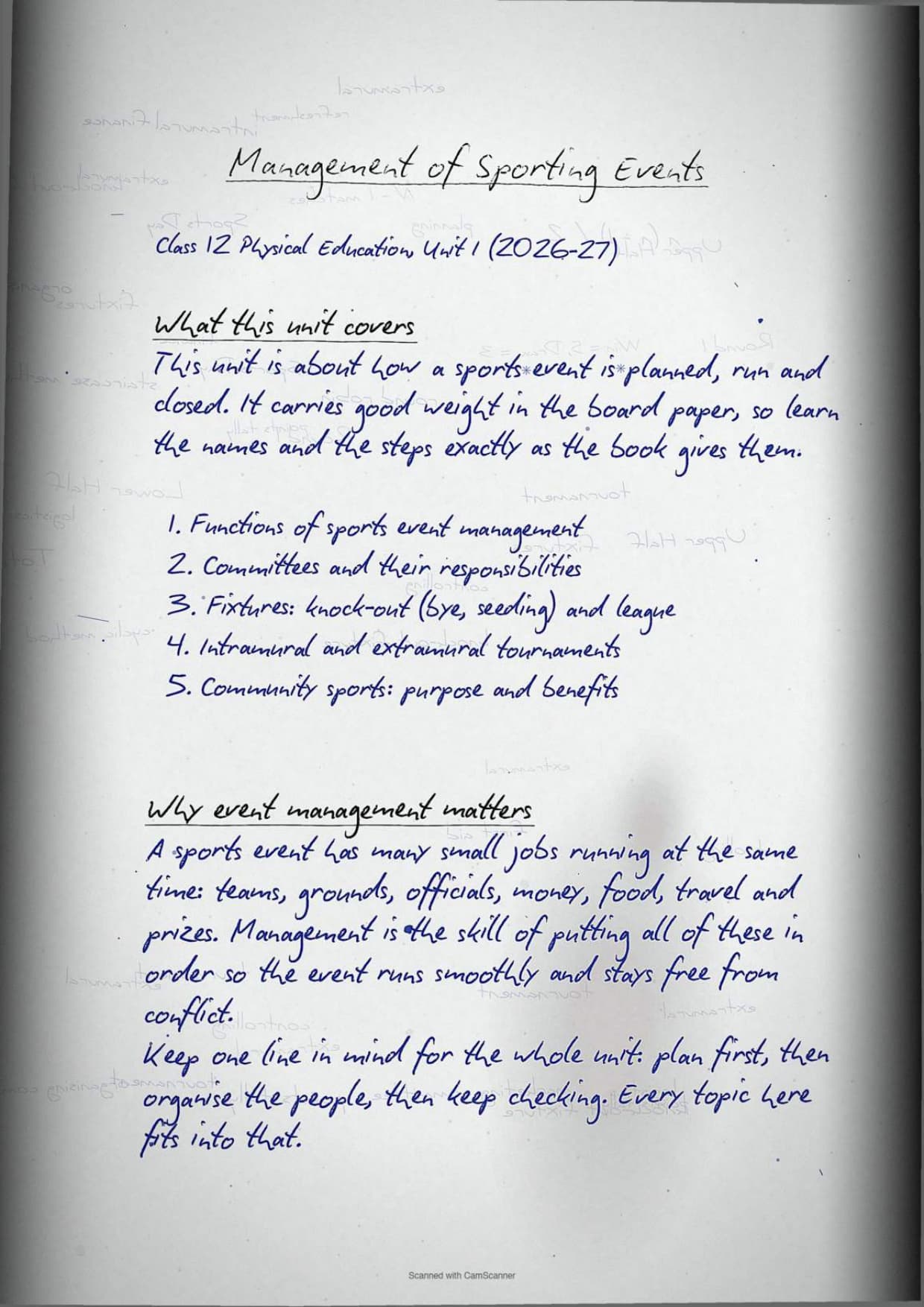
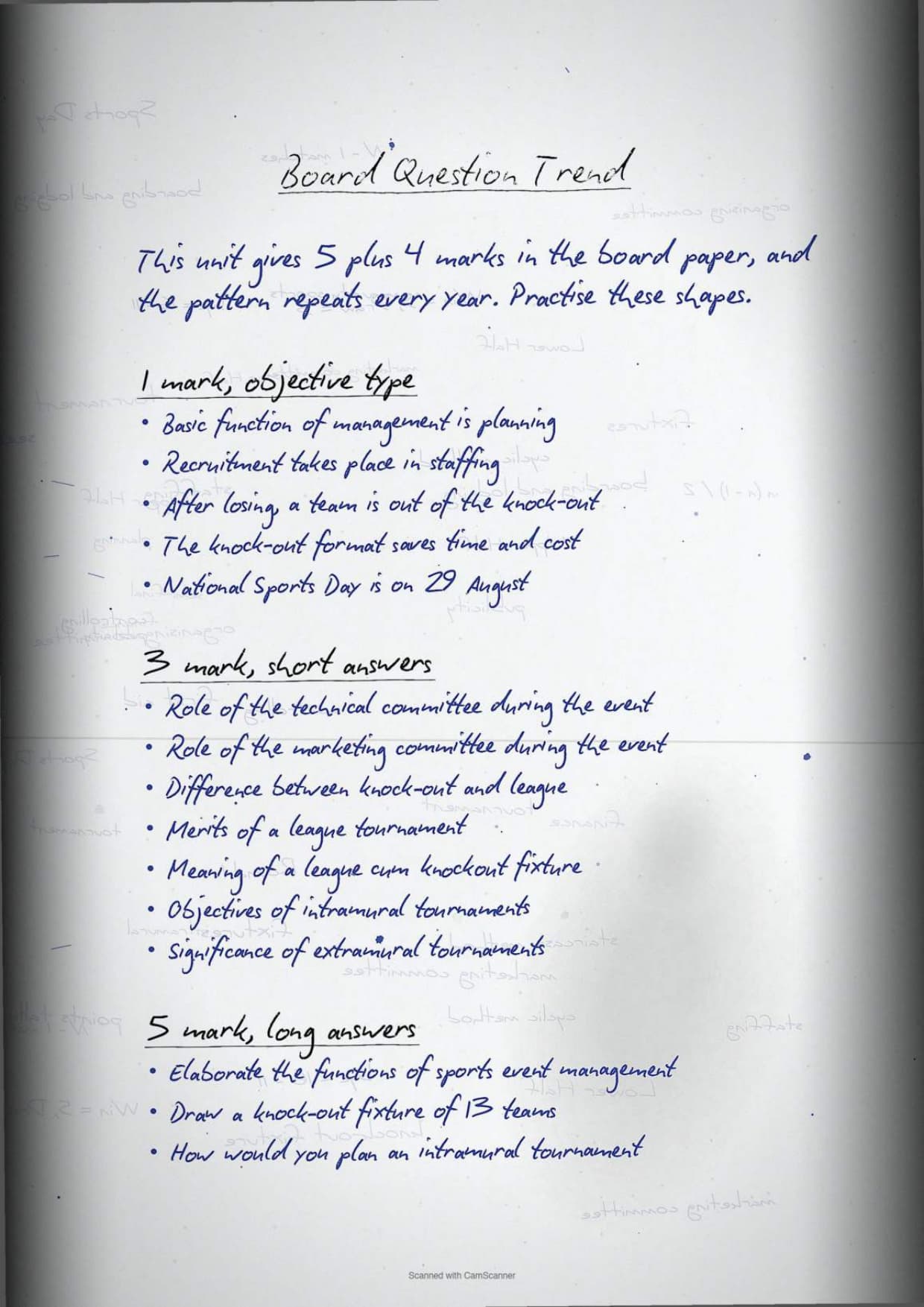
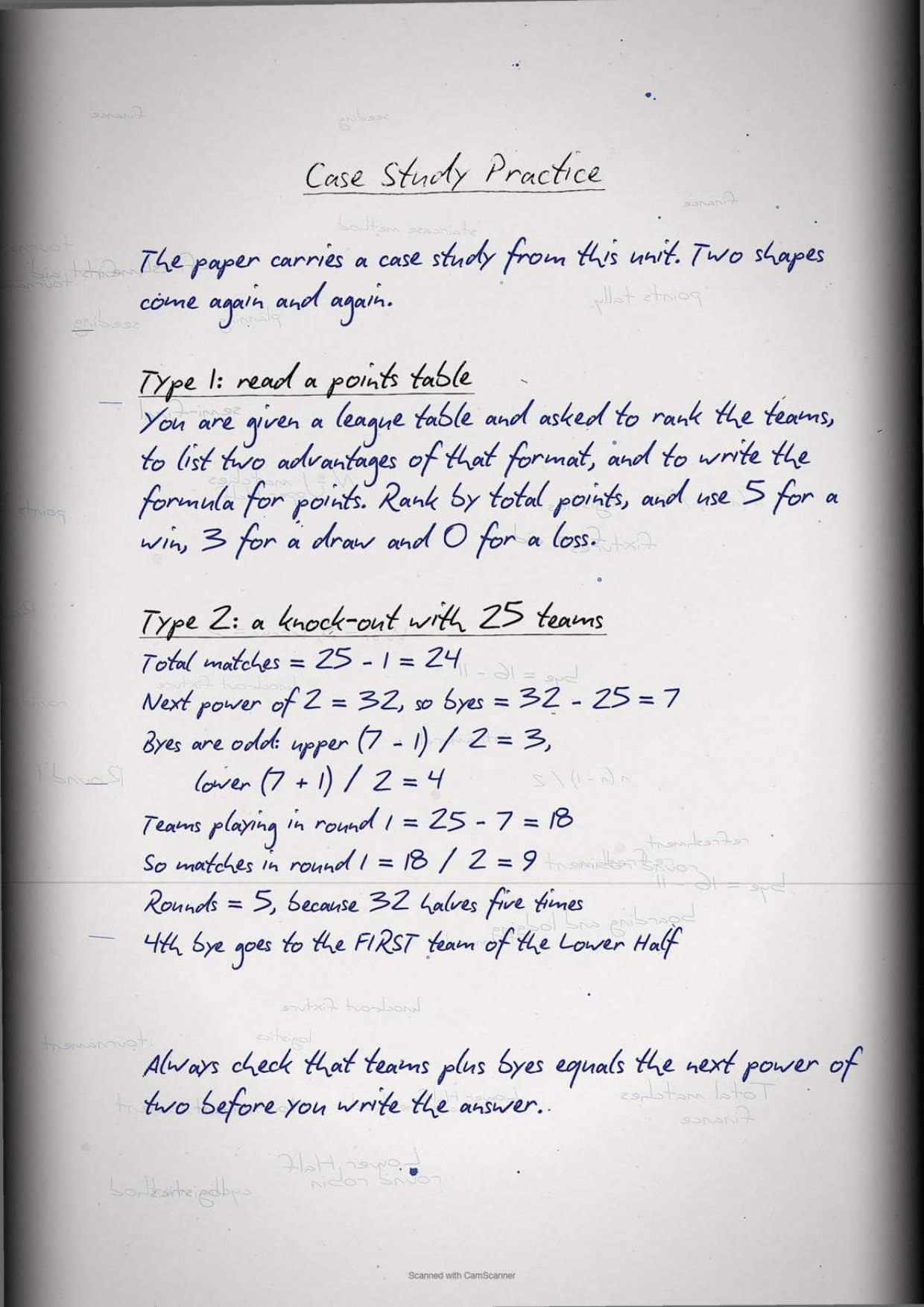
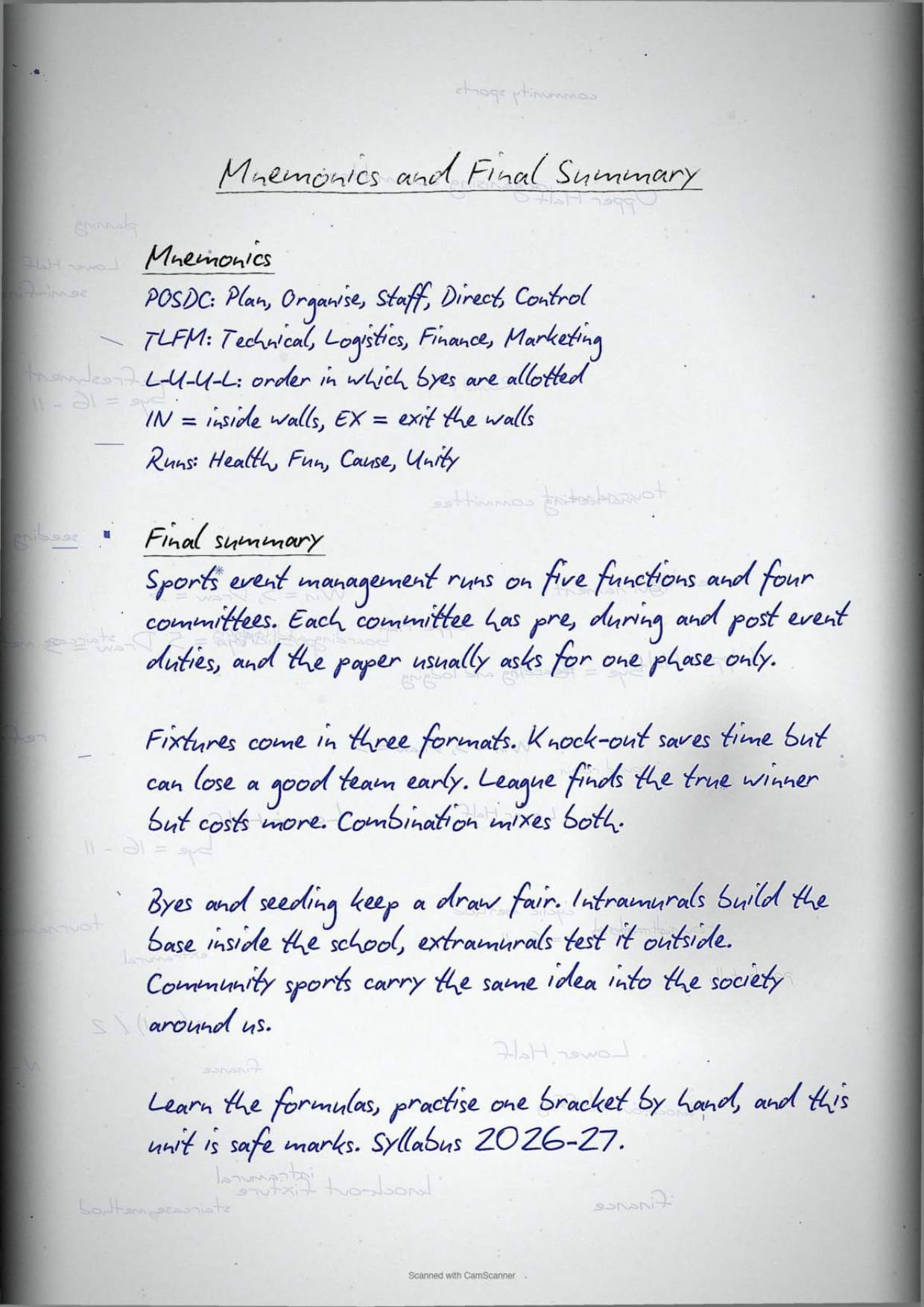
This is the first unit of the Class 12 course, and it is the one chapter where you have to draw as well as write. Knock-out brackets, league grids and hierarchy charts all carry marks, so the notes keep every diagram on the page it belongs to.
- Length: 47 handwritten pages covering management functions, the four committees, fixtures, intramural and extramural events, and community sports.
- Board weight: this unit carries 5 + 4 marks, so a long answer and a case study usually come from it.
- Must-learn formulas: total matches, upper and lower half, byes, and the league match count, each boxed on the fixture pages.
Every page of these Management of Sporting Events notes is written by hand, checked line by line against the 2026-27 Physical Education textbook, and matched to the way the Class 12 board paper asks about committees, fixtures and community sports.
Student Feedback: In a Collegedunia survey of 12,840 Class 12 Physical Education students conducted before the 2026 boards, 71% of students said the bye formula was the single step they got wrong most often. Students who drew one full 11-team bracket by hand, instead of only reading the steps, reported clearing the fixture question on the first attempt.
Source: 2026-27 Class 12 Physical Education student poll. Sample of 12,840 students from CBSE schools across 17 states.
What Management of Sporting Events Covers in the Class 12 Syllabus
This unit teaches you how a sports event is actually run, from the first planning meeting to the closing ceremony. It is the only Class 12 unit that mixes theory answers with drawn fixtures, so both have to be practised. The table below is the map the rest of these notes follow.
| Part | What it covers | What you must be able to do |
|---|---|---|
| 1.1 | Functions of sports event management | Explain planning, organising, staffing, directing and controlling |
| 1.2 | Formation of committees and their duties | Classify the four committees and split their work into pre, during and post event |
| 1.3 | Fixtures and their procedures | Draw knock-out and league fixtures, with byes and seeding |
| 1.4 | Intramural and extramural events | State the meaning, objectives and significance of each, and tell them apart |
| 1.5 | Community sports | Design a community sports programme and list its purpose and benefits |
One idea runs through the whole unit: an event is only as good as the people who plan it. Planning sits at the top of the function list, the committees turn that plan into jobs, and the fixture is simply the plan written as a timetable of matches.
Five Functions of Sports Event Management from Planning to Controlling
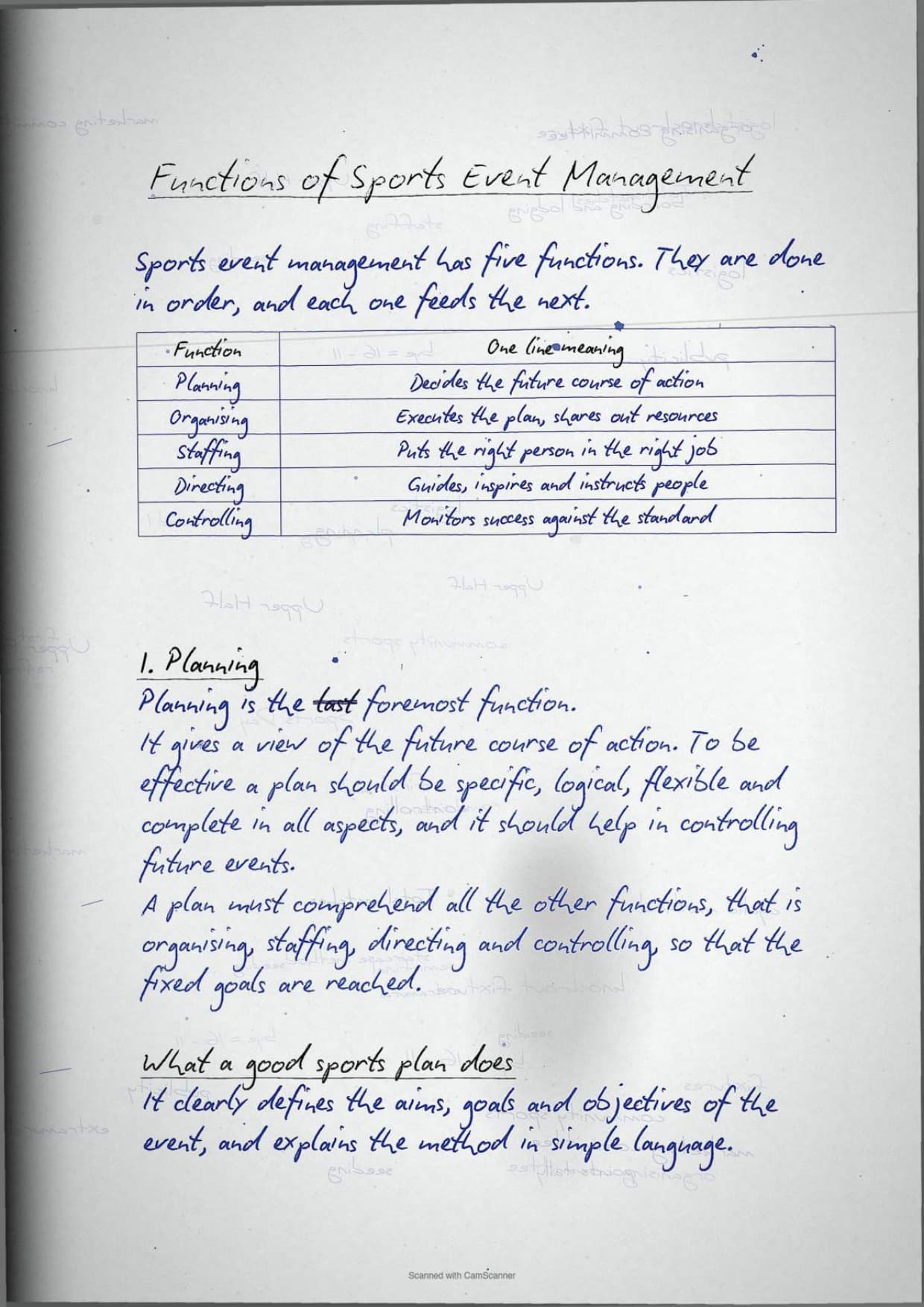
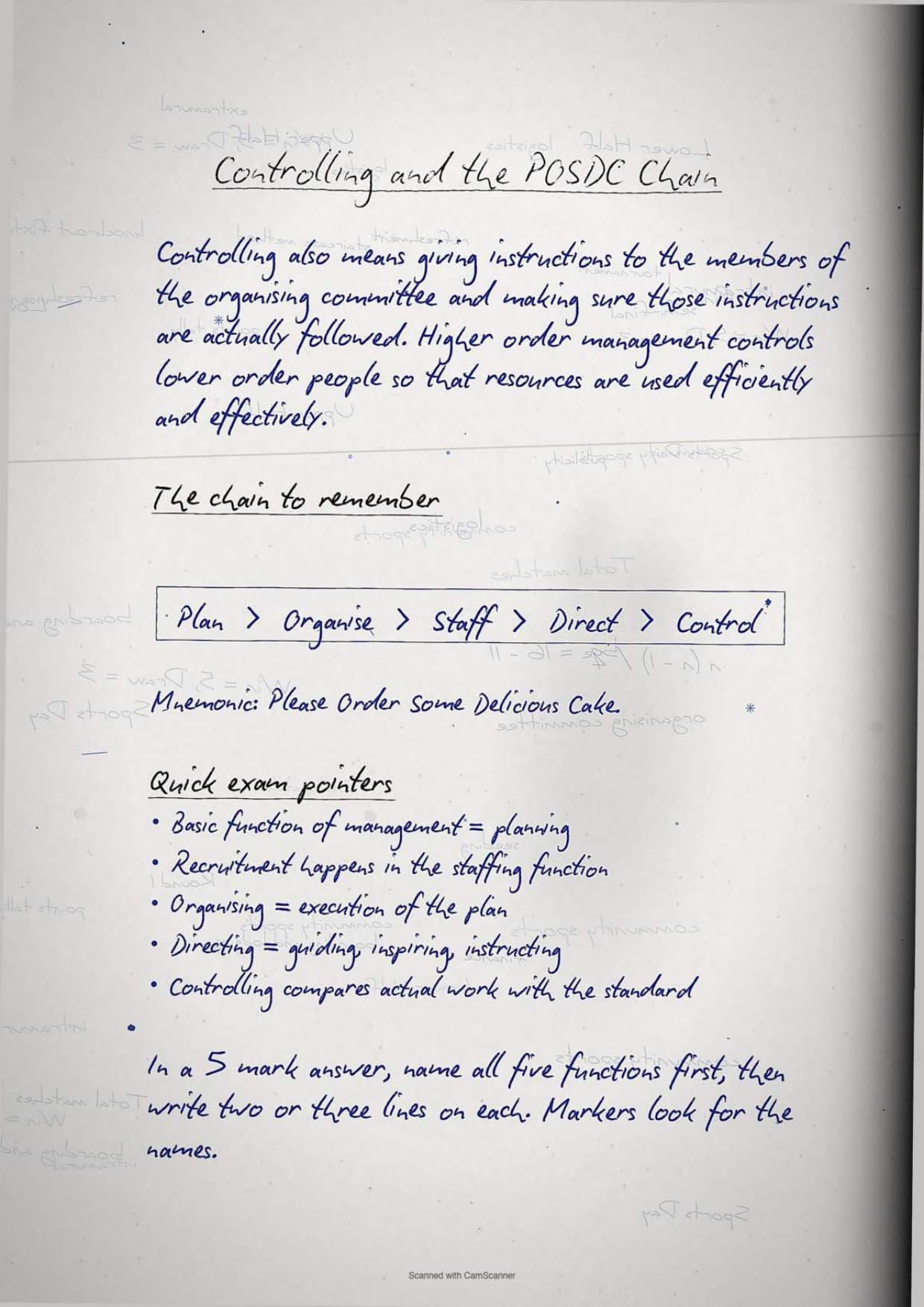
The chapter opens with five functions in a fixed order, and the order itself is worth marks. Planning comes first because it gives a view of the future course of action, and controlling comes last because it checks whether that plan worked.
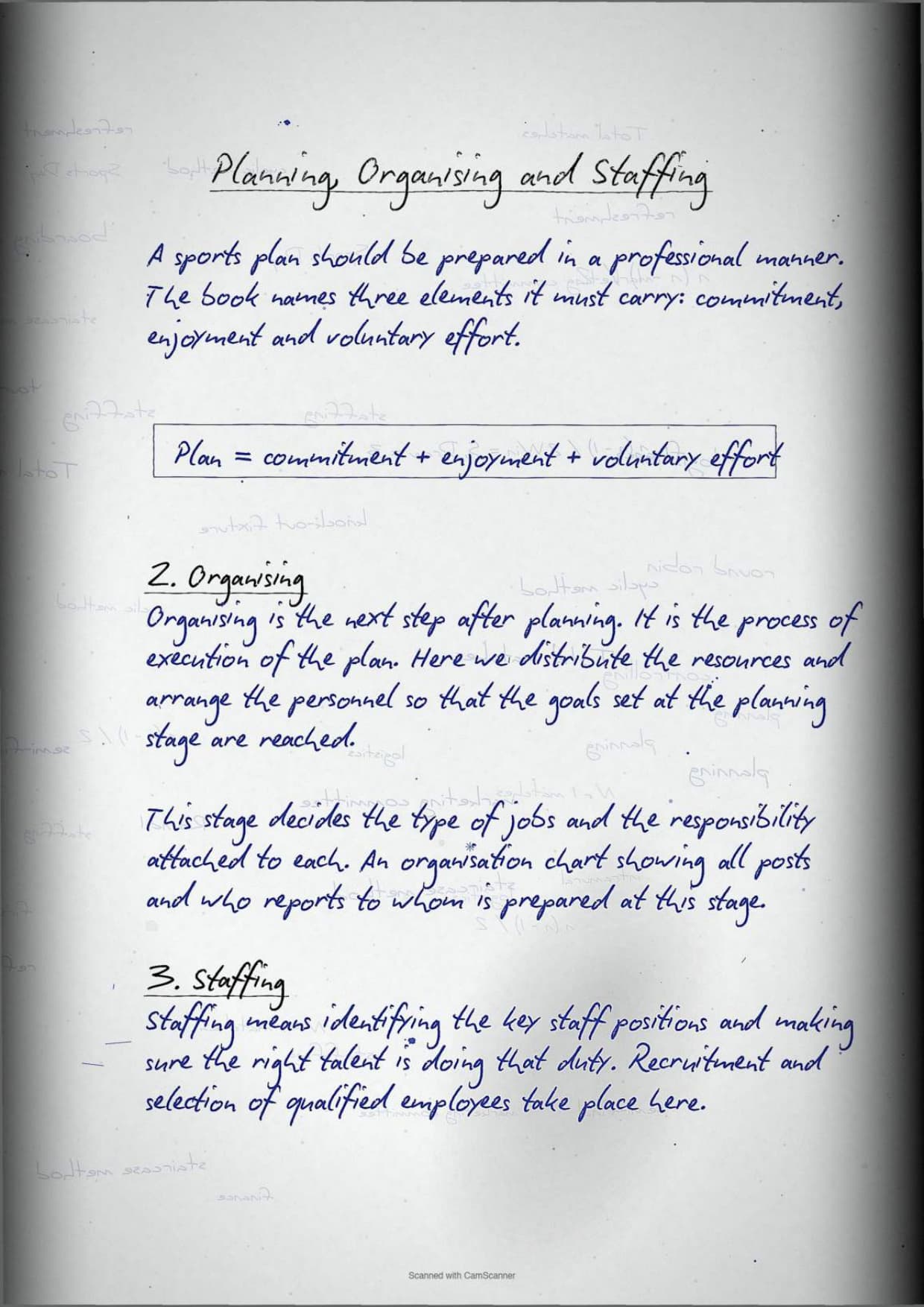
- Planning: the foremost function. A plan must be specific, logical, flexible and complete, and it must define the aims, goals and objectives of the event in simple language.
- Organising: the process of executing the plan by distributing resources and arranging personnel. The organisation chart, with every position and reporting line, is prepared at this stage.
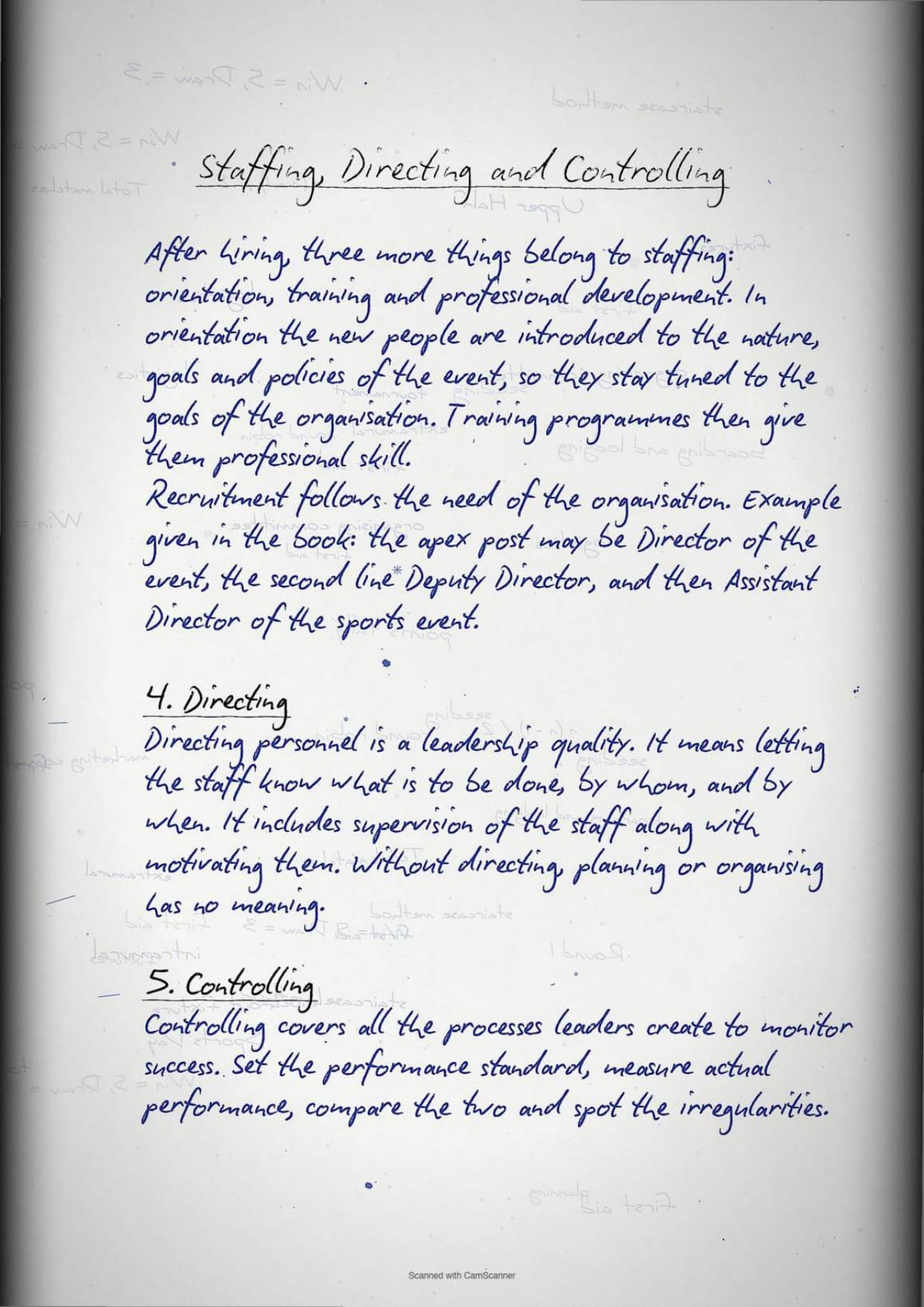
- Staffing: identifying key posts and recruiting the right person for each duty, followed by orientation, training and professional development.
- Directing: a leadership function. It means telling staff what has to be done, by whom and by when, while supervising and motivating them.
- Controlling: setting performance standards, measuring actual performance, and comparing the two to find irregularities.
Without directing, planning and organising have no meaning, because nobody has been told to act on them. A staffing answer scores better if you name a real hierarchy: Director of the event at the top, then Deputy Director, then Assistant Director of Sports. That example comes straight from the textbook and examiners look for it.
Management of Sporting Events Chapter Explained with Board PYQs
Source: Zaki Saudagar on YouTube
Three Levels of Management and the Organising Committee Hierarchy
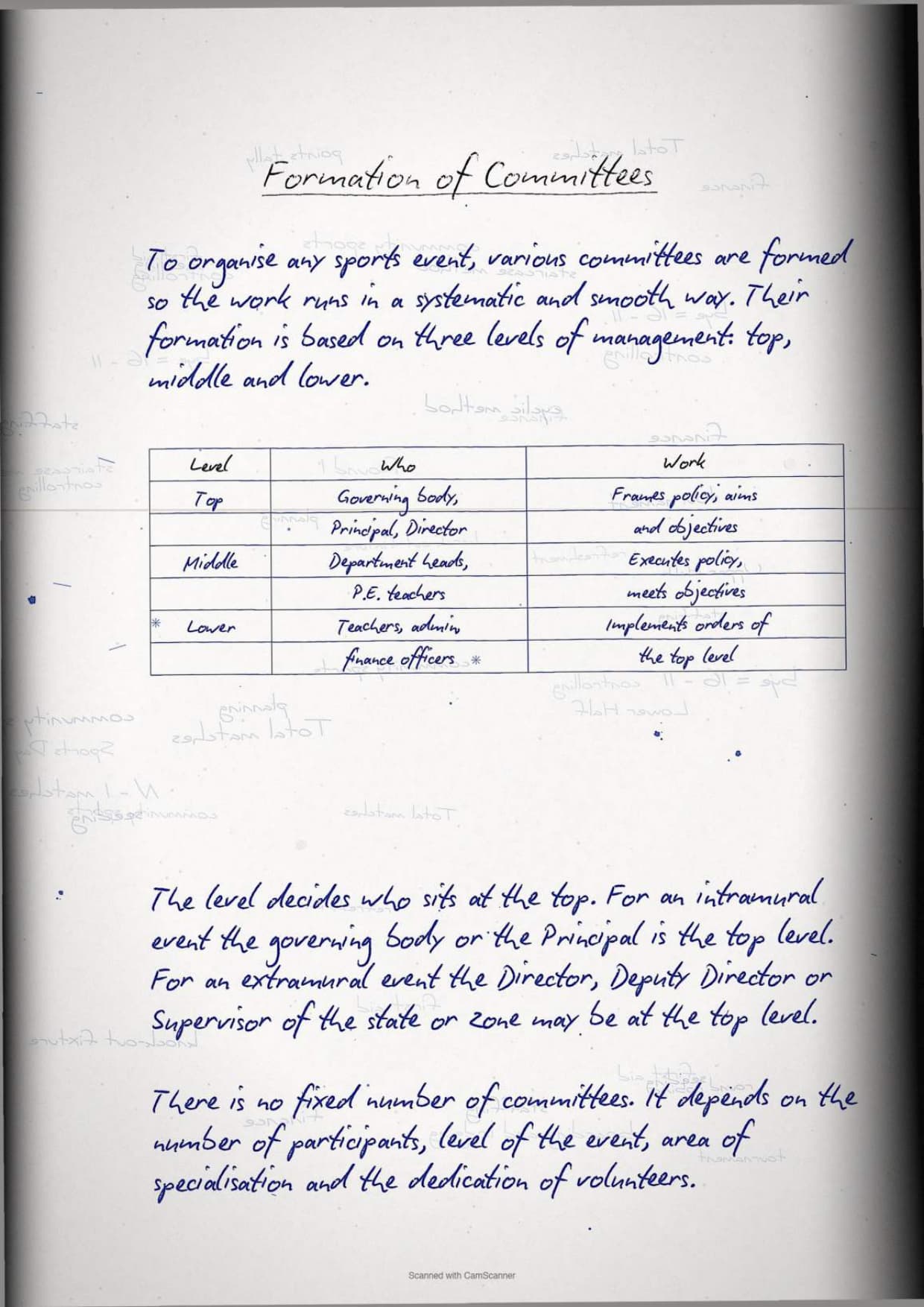
Committees are staffed on three levels of management: top, middle and lower. Who sits at the top changes depending on whether the event is inside one school or between schools, and that difference is a favourite short-answer question.
| Level | Who sits here | What they do |
|---|---|---|
| Top | Governing body members or the Principal for an intramural event; the state or zone Director, Deputy Director or Supervisor for an extramural event | Frame the policies, aims and objectives of the event |
| Middle | Department heads and physical education teachers | Execute the policies and achieve the aims and objectives |
| Lower | Teachers, administrators and finance officers | Implement the orders and directives of the top level |
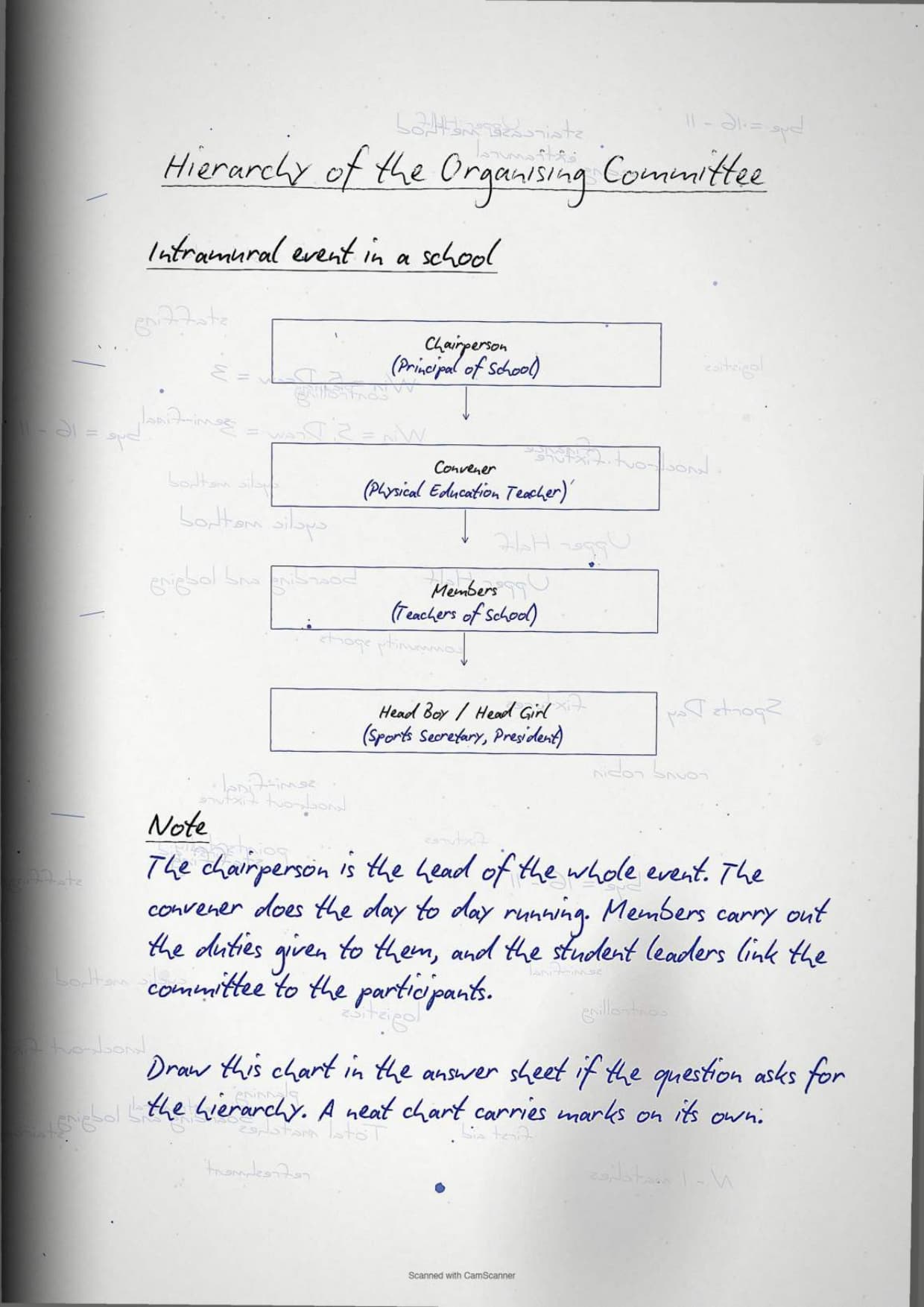
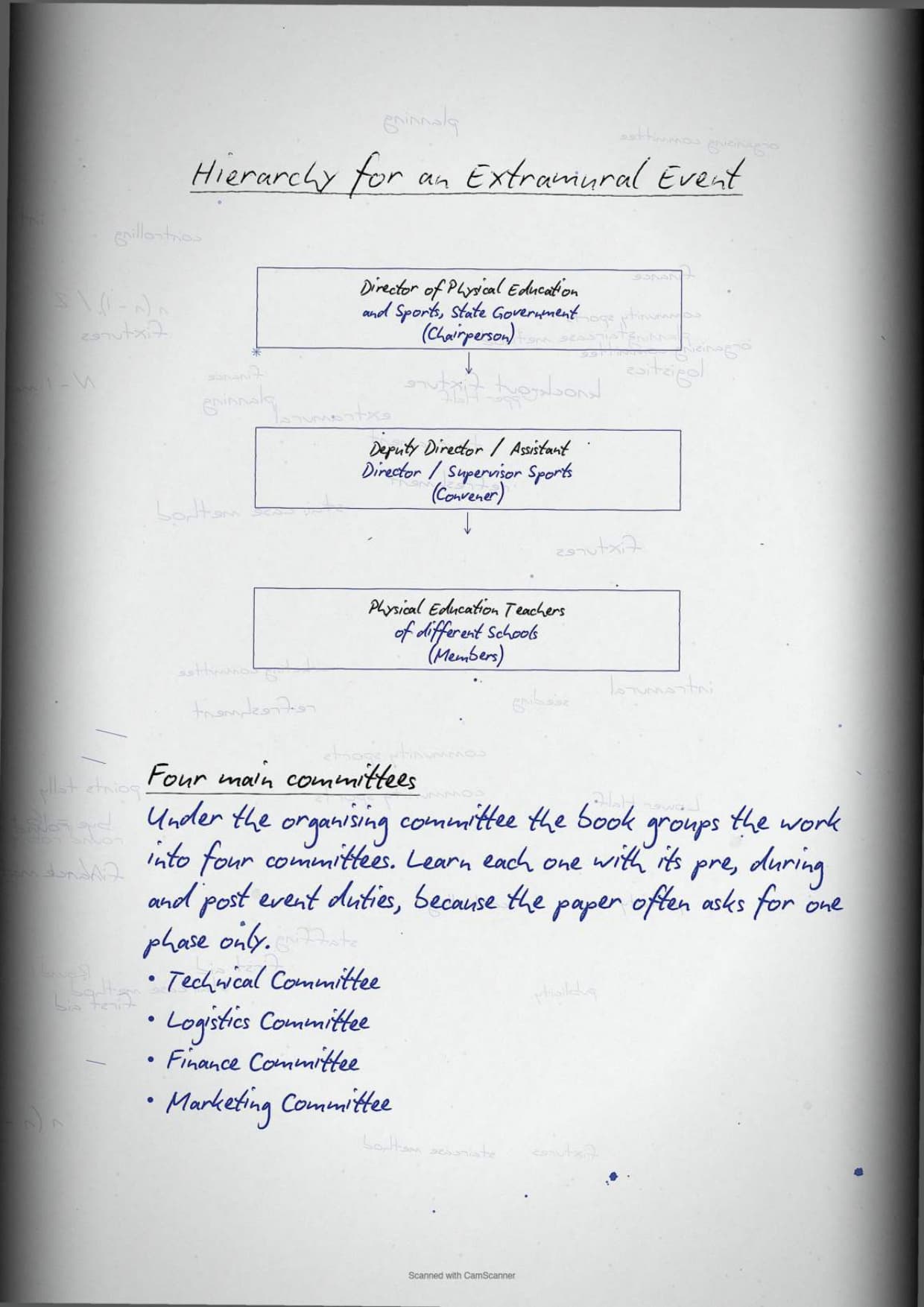
The chapter then gives two hierarchy charts, and both are drawn out by hand in the notes because a chart earns marks faster than a paragraph.
- Intramural chart: Chairperson (Principal of the school) to Convener (Physical Education Teacher) to Members (teachers of the school) to Head Boy or Head Girl (Sports Secretary or President).
- Extramural chart: Director of Physical Education and Sports in the State Government (Chairperson) to Deputy Director, Assistant Director or Supervisor Sports (Convener) to Physical Education Teachers of different schools (Members).
The Four Committees of a Sports Event and What Each One Does
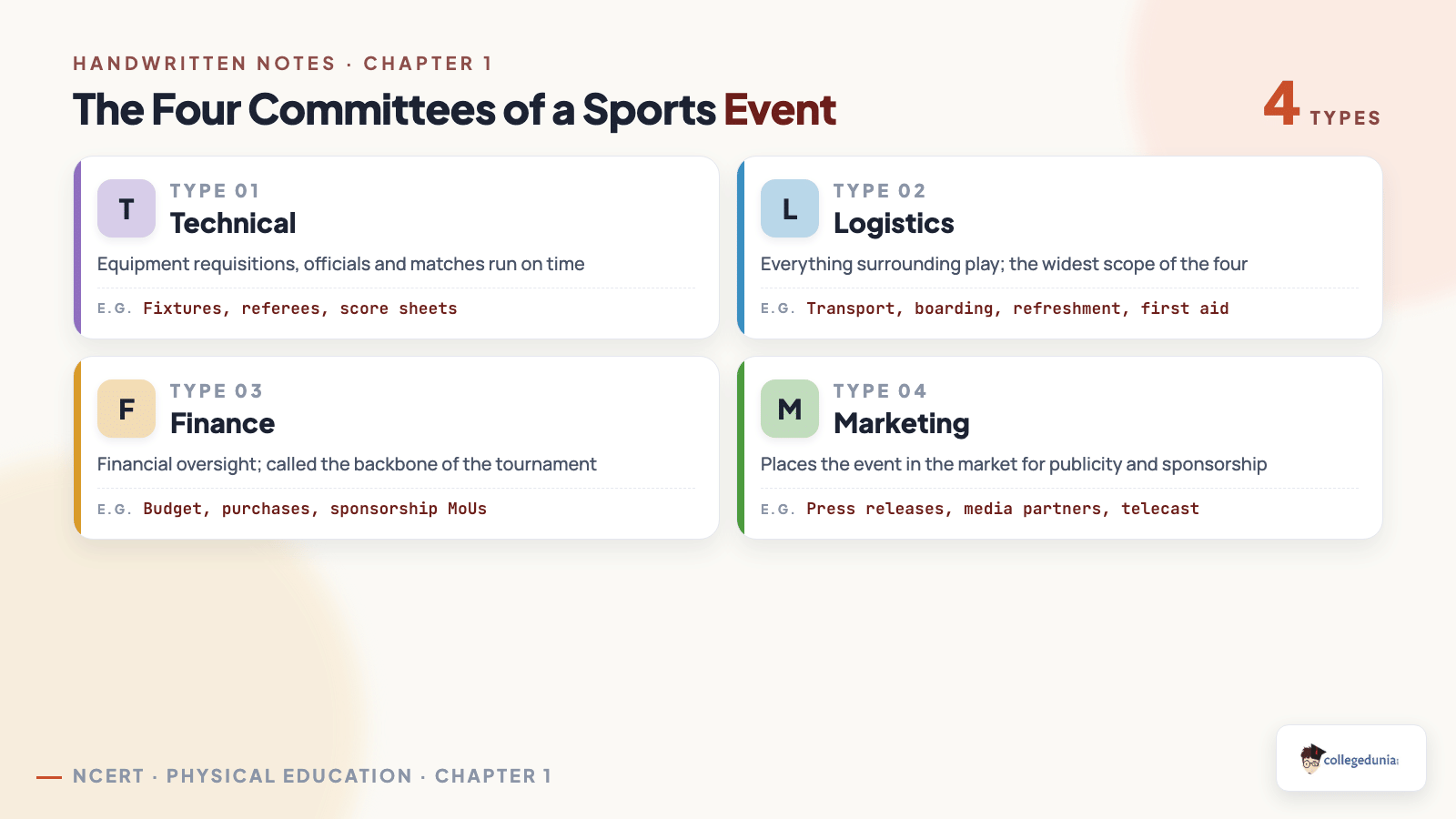
There is no fixed number of committees. It depends on the number of participants, the level of the event, the area of specialisation and how many volunteers are willing to work. By and large the chapter groups the work under four committees, and everything else, from transport to first aid, is a sub-area under one of these four.
| Committee | Core job | Sub-areas that sit under it |
|---|---|---|
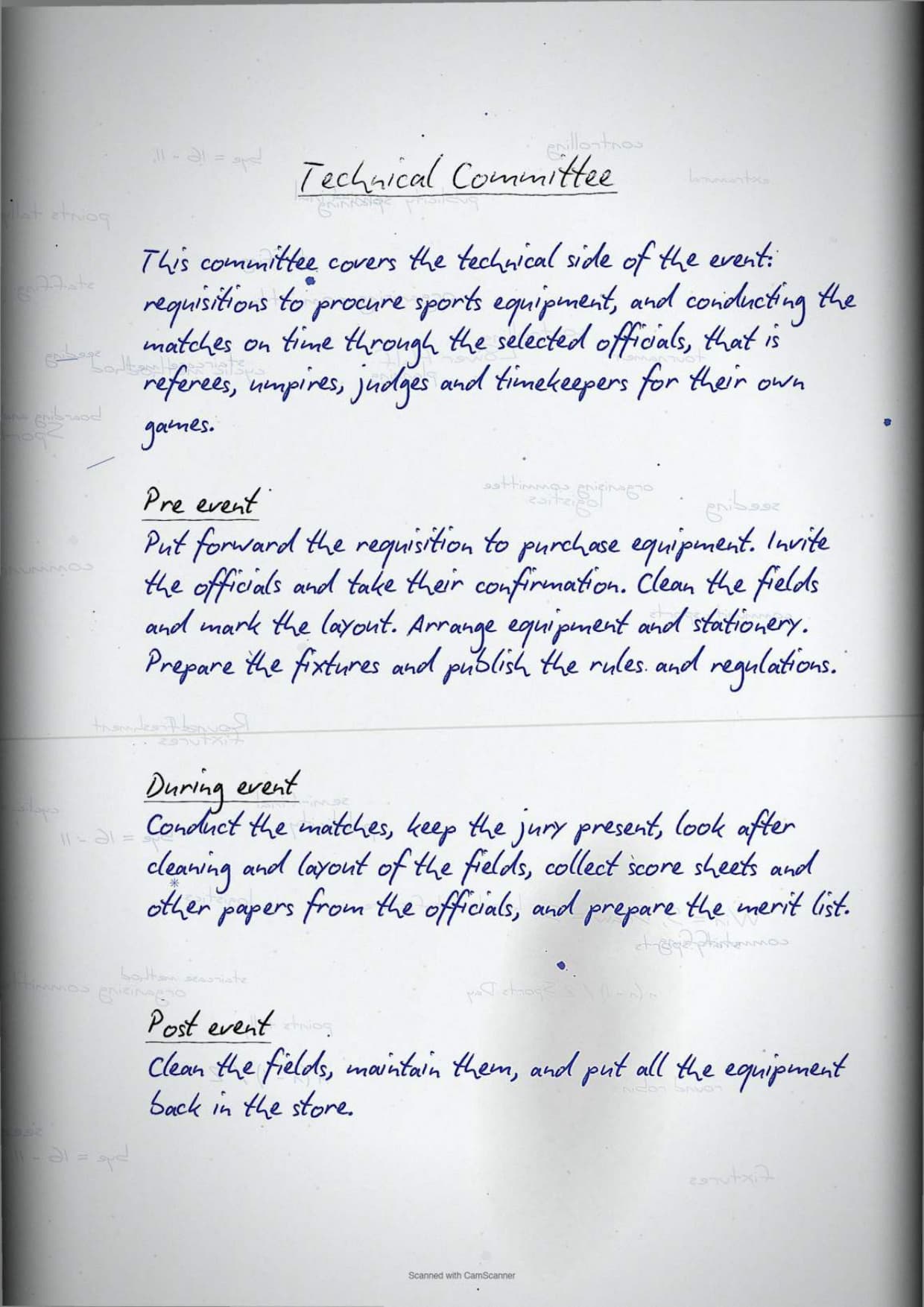
| Technical | The technical side of play: equipment requisitions, officials, and matches conducted on time | Ground and field layout, equipment and stationery, referees, umpires, judges, timekeepers, fixtures, rules and regulations, score sheets |
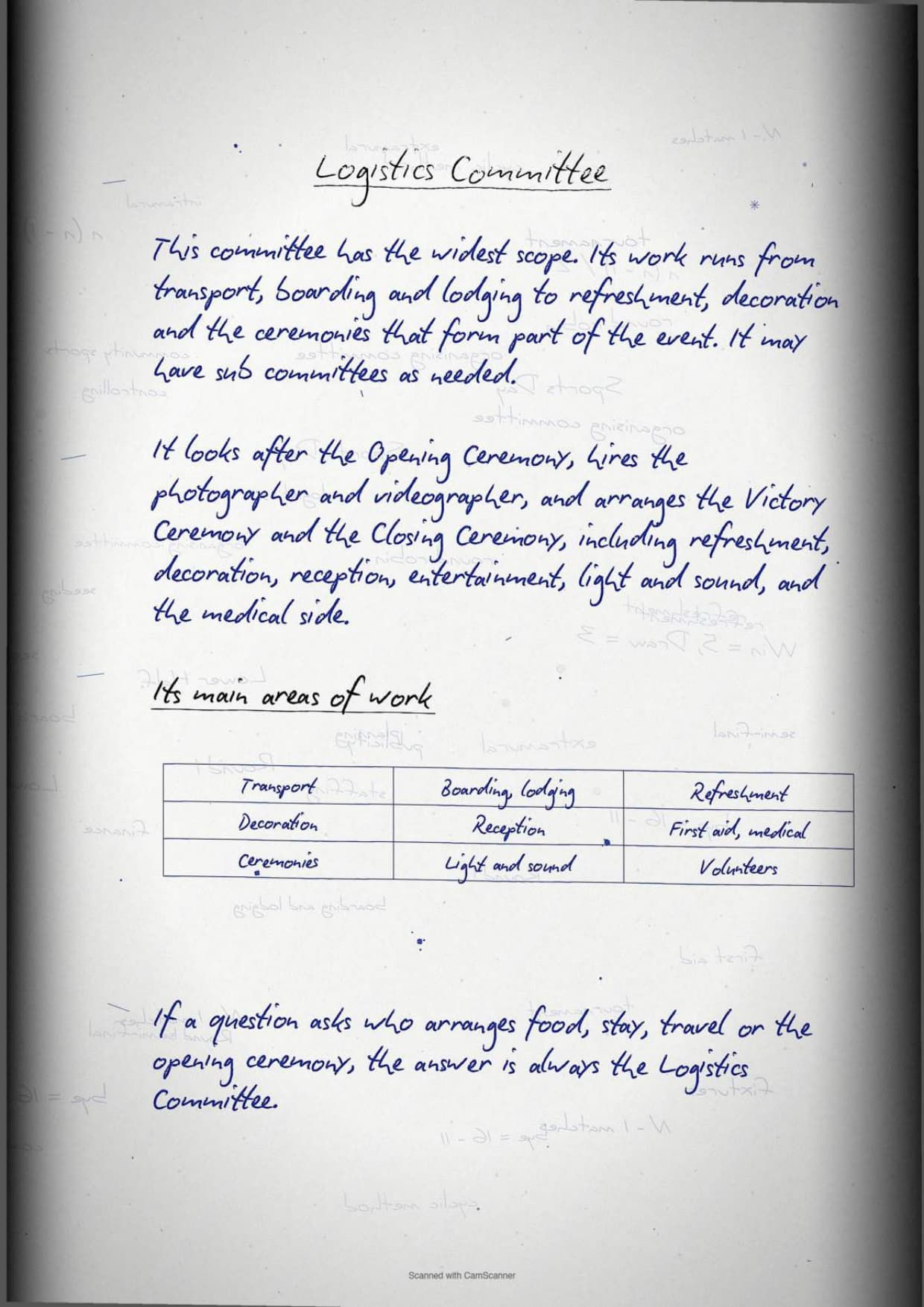
| Logistics | Everything that surrounds the play, with the widest scope of the four | Transport, boarding and lodging, refreshment, decoration, reception, first aid and medical, ceremonies, light and sound, photography, volunteers |
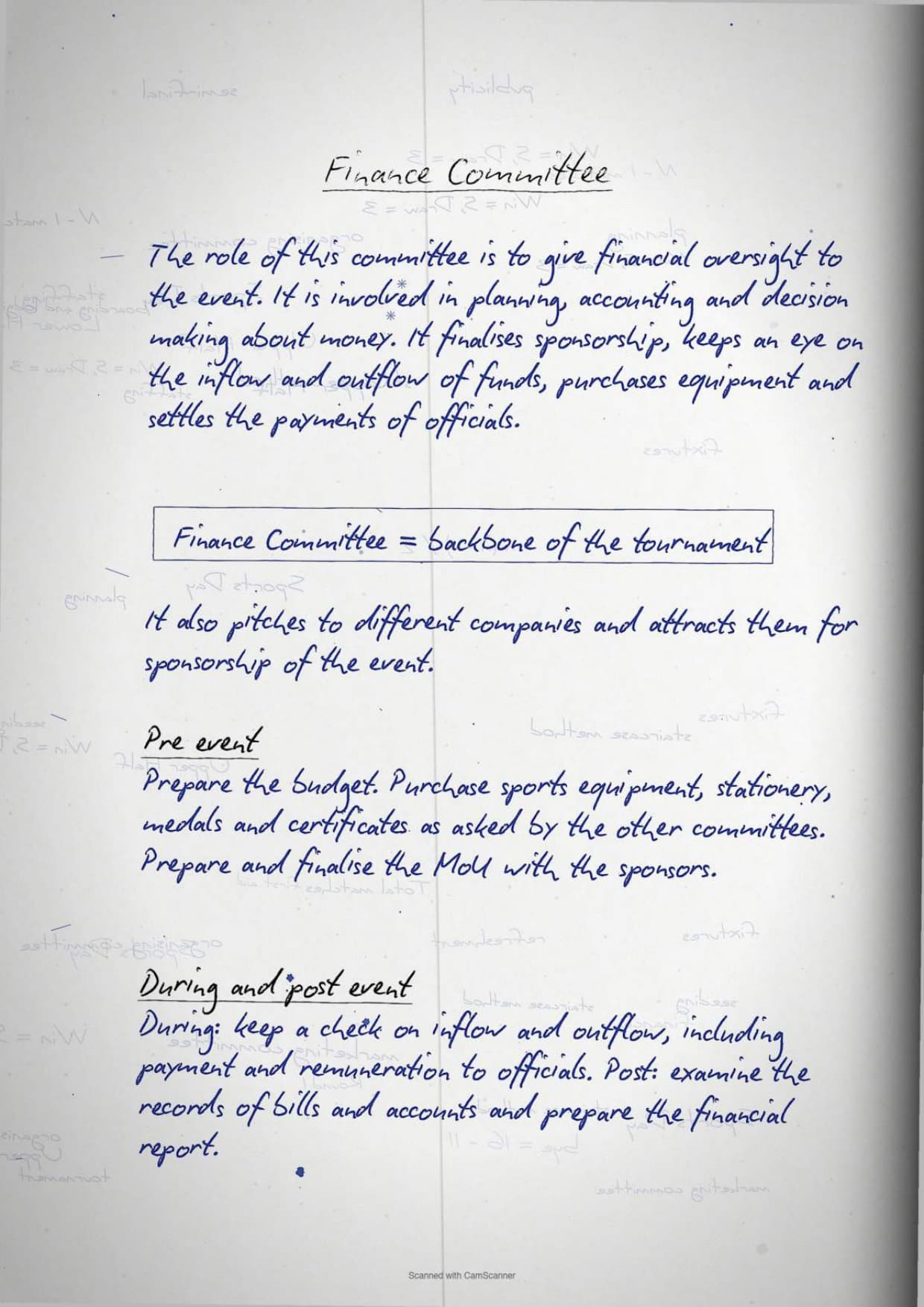
| Finance | Financial oversight of the whole event, called the backbone of the tournament | Budget, accounting, purchases, sponsorship MoUs, payments to officials, final financial report |
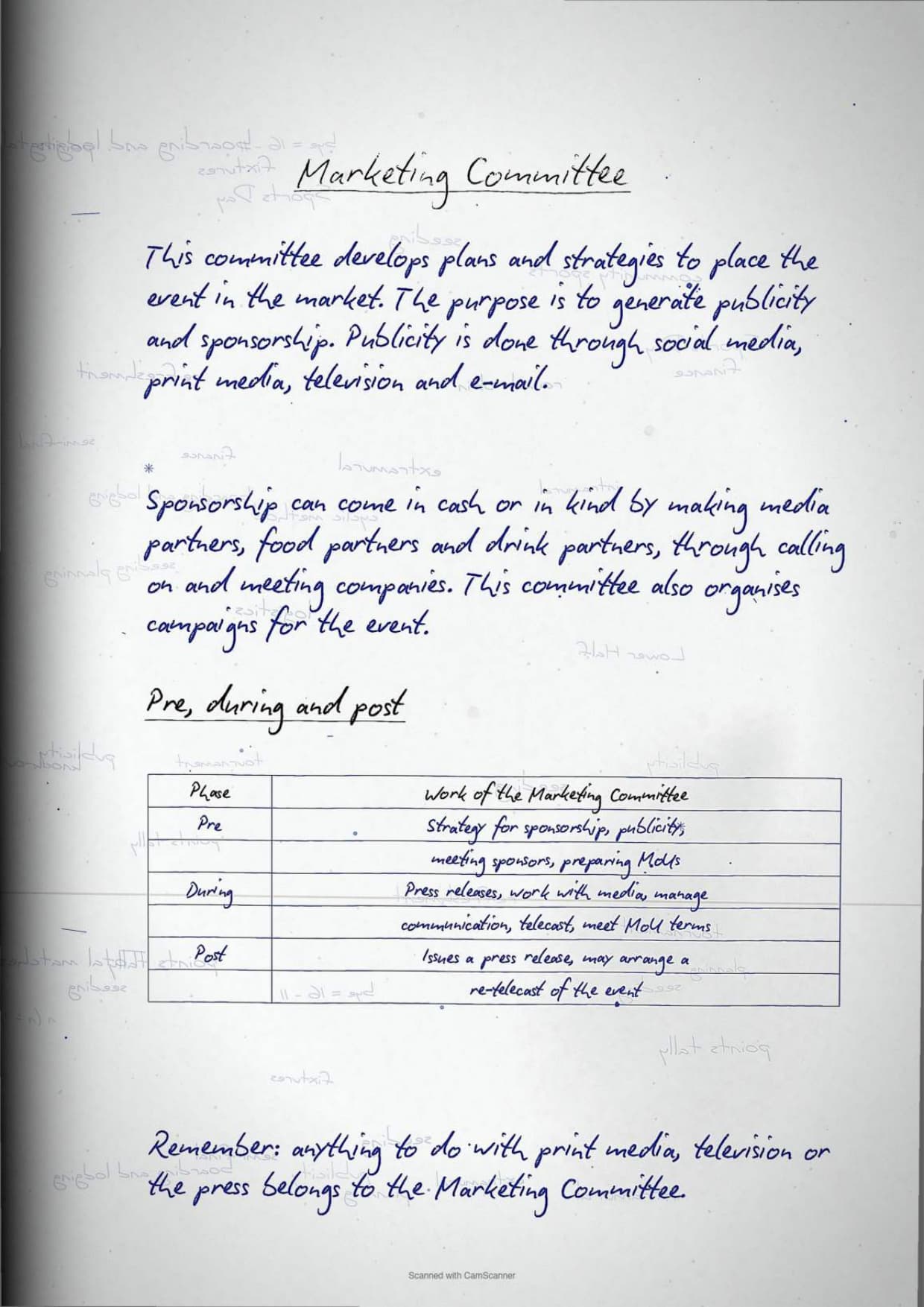
| Marketing | Placing the event in the market to generate publicity and sponsorship | Publicity through social media, print media, TV and email, media and food and drink partners, campaigns, press releases, telecast |
A common trap sits inside this table. The Technical Committee raises the requisition to purchase equipment, but the Finance Committee is the one that actually makes the purchase. Read the wording of the question before you pick, because the two duties look identical at a glance.
Pre, During and Post Event Duties of Every Sports Event Committee
Each committee is examined in three time slots, and the chapter is strict about which duty belongs to which slot. The table below is the version written on the notebook pages, kept short enough to memorise.
| Committee | Pre event | During event | Post event |
|---|---|---|---|
| Technical | Equipment requisition, inviting and confirming officials, cleaning and field layout, stationery, preparing fixtures, publishing rules | Conducting matches, presence of the jury, field layout, collecting score sheets, preparing the merit list | Cleaning and layout of fields, maintenance, returning all equipment to store |
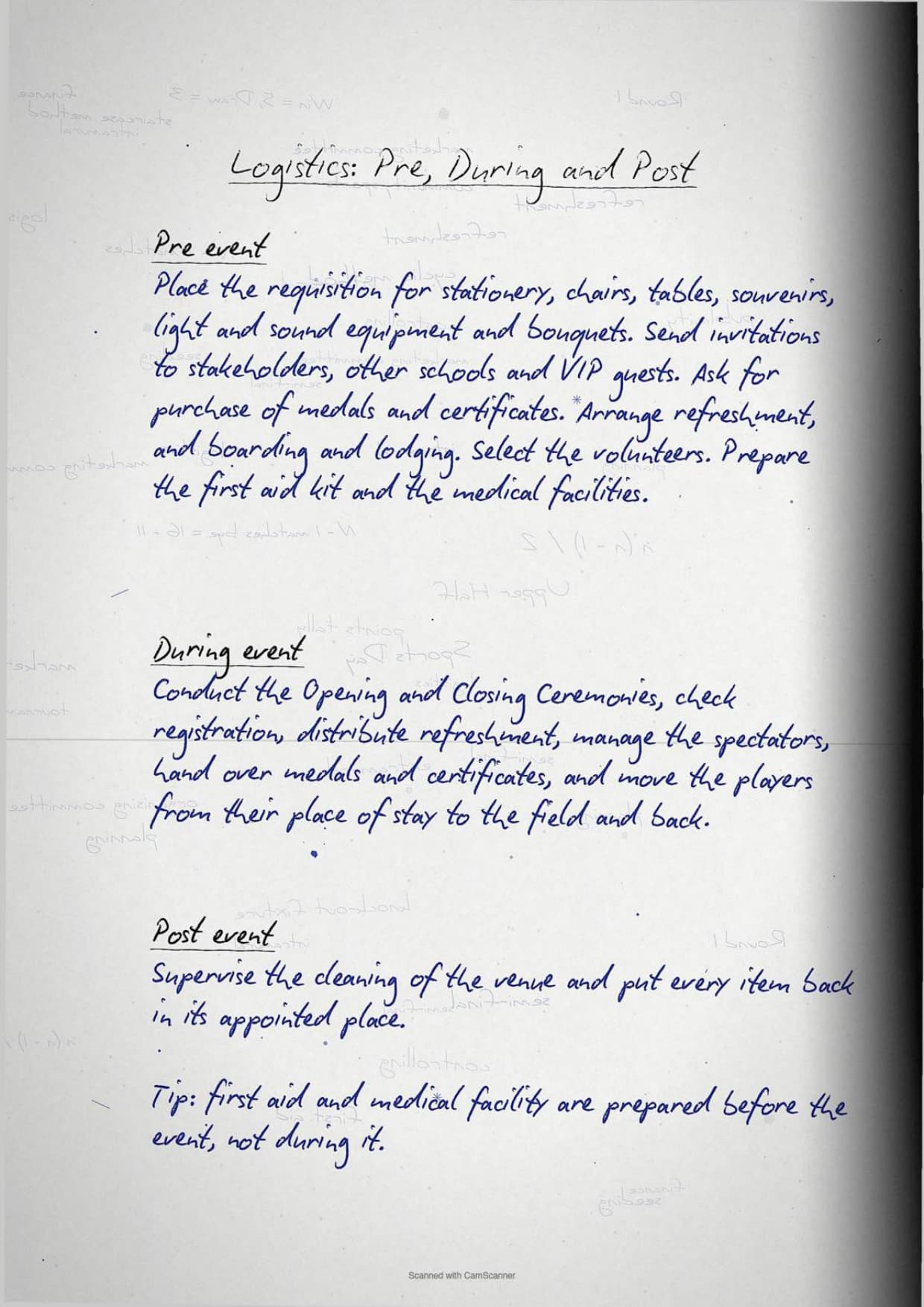
| Logistics | Chairs, tables, souvenirs, light and sound, bouquets, invitations to schools and guests, medals and certificates, refreshment, boarding and lodging, volunteers, first aid kit and medical facilities | Opening and closing ceremonies, checking registration, distributing refreshment, managing spectators, handing over medals and certificates, transport of participants | Supervising cleaning of the venue and putting items back in place |
| Finance | Preparing the budget, purchasing equipment, stationery, medals and certificates, finalising the MoU with sponsors | Watching the inflow and outflow of money, paying remuneration to officials | Settling bills and accounts, preparing the financial report |
| Marketing | Sponsorship strategy, publicity, meeting sponsors, preparing sponsorship MoUs | Press releases, working with media, meeting sponsor requirements, arranging the telecast | Issuing a press release and arranging a re-telecast |
Rules and regulations are always published before the event, never during it. That single line has appeared as a one-mark question, and students lose it by assuming rules are announced on match day.
The 23-Point Checklist for Organising a Sports Event
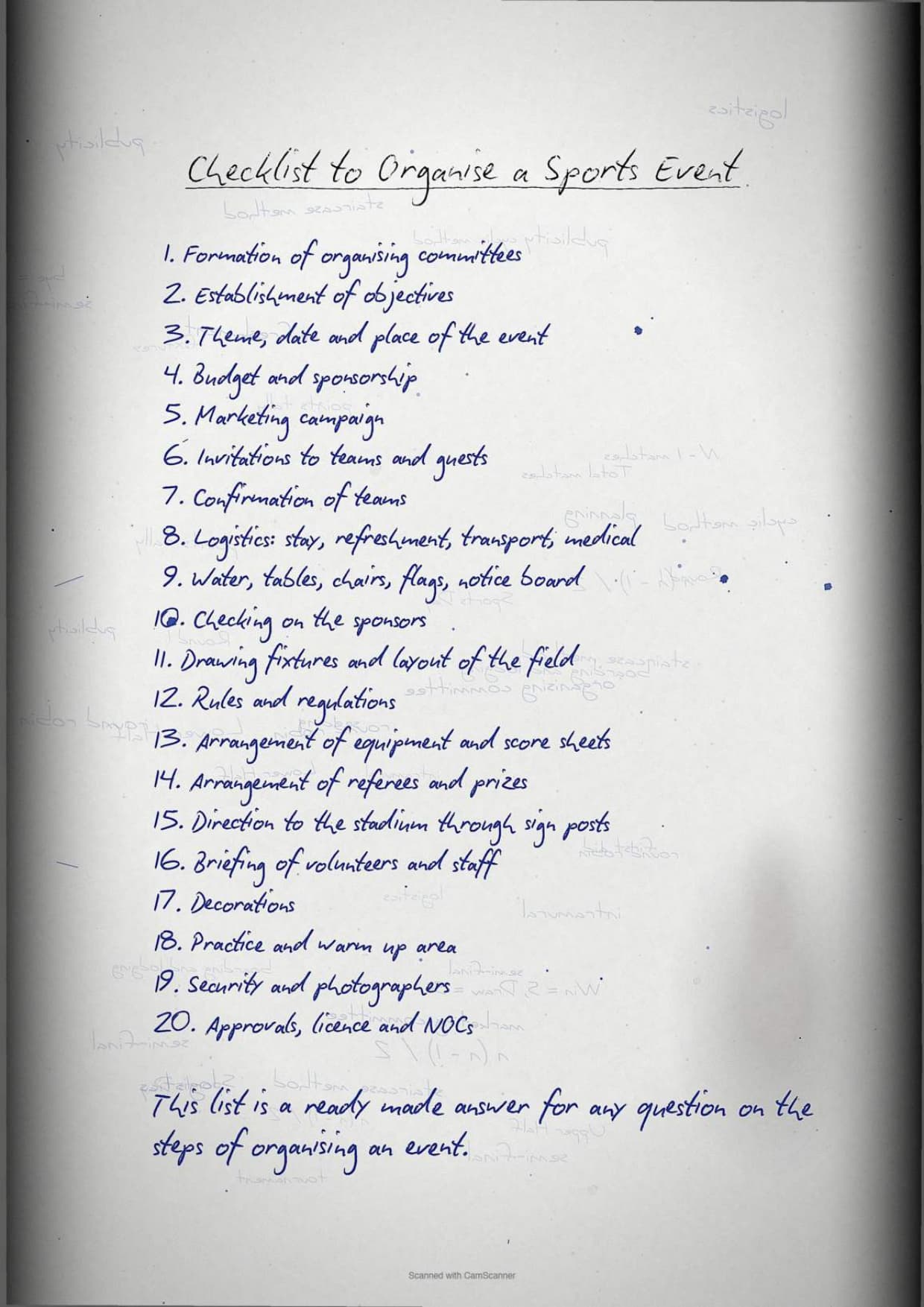
The textbook gives a numbered checklist in its "Do You Know" box, and it is the fastest way to answer any "how would you plan an event" question. The notes keep all 23 points in the original order.
- Formation of organising committees
- Establishment of objectives
- Theme of the event
- Date of the event
- Place of the event
- Budget
- Sponsorship
- Marketing campaign
- Invitations to teams and guests
- Confirmation of teams
- Logistics: accommodation, refreshment, transport, medical staff, water, tables, chairs, flags, notice board
- Checking on the sponsors
- Drawing fixtures and layout of the field
- Rules and regulations
- Arrangement of equipment and score sheets
- Arrangement of referees and prizes
- Direction to the stadium through sign posts
- Briefing of volunteers and staff
- Decorations
- Practice and warm up area
- Security
- Photographers
- Approvals, licence and no-objection certificates
You will not be asked to reproduce all 23 in one answer. Learn the first eight in order and pick the rest by the situation in the question, since a school sports day and a district championship need different items from this list.
Types of Tournament: Knock-Out, League and Combination Compared
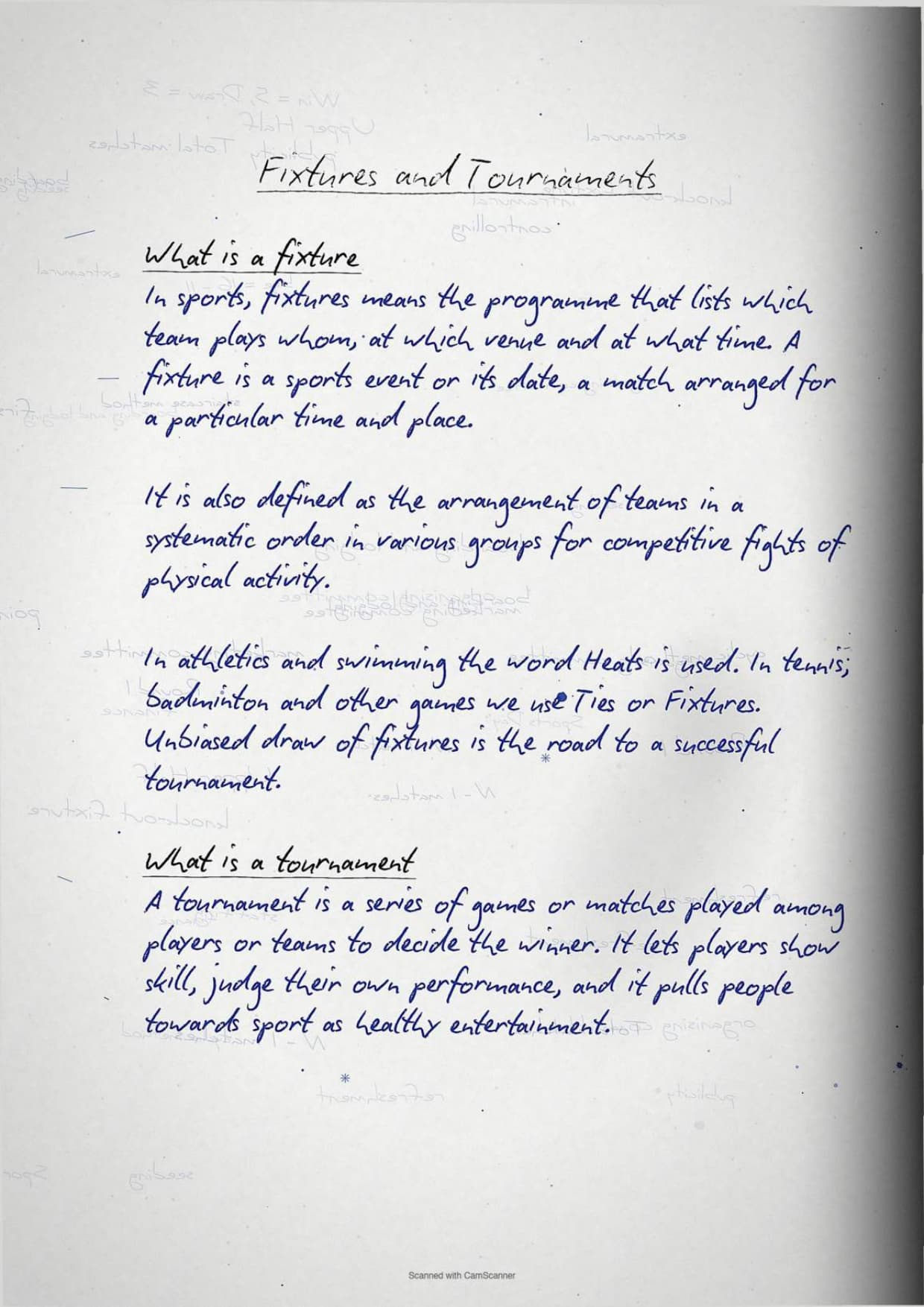
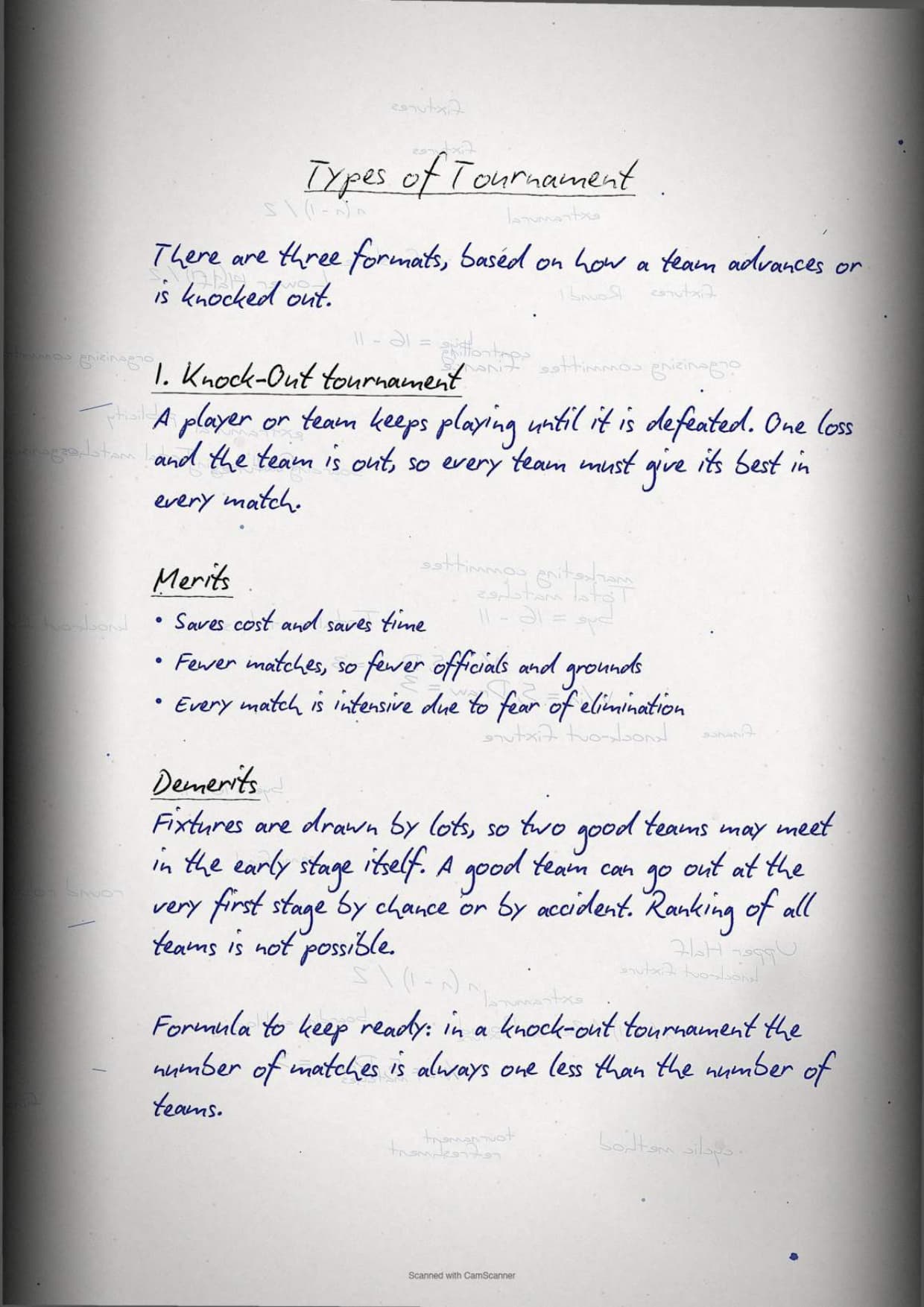
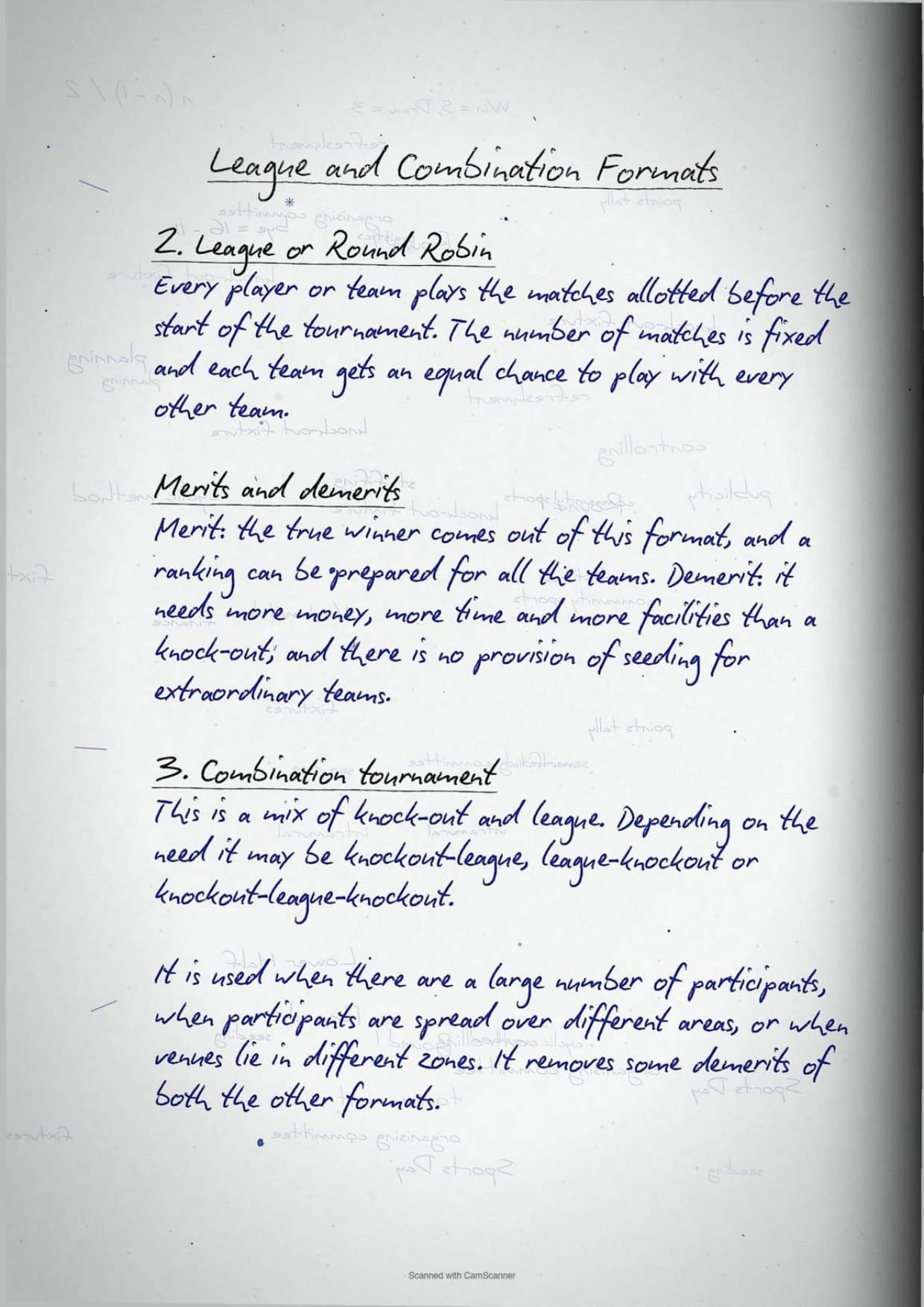
A tournament is a series of games or matches played among players or teams to decide a winner. The chapter names three formats, and a five-mark comparison question expects the merits and demerits of each, not just the definitions.
| Format | How it works | Merits | Demerits |
|---|---|---|---|
| Knock-Out | A team keeps playing until it is defeated, then it is out | Saves cost and time, every match is intense because of the fear of elimination | Fixtures are drawn by lots, so two strong teams can meet early and a good team can go out by accident |
| League or Round Robin | Every team plays every other team a fixed number of matches decided before the start | Equal chance for all, a true winner emerges, full ranking can be prepared | Needs more money, time and facilities, and there is no provision of seeding for strong teams |
| Combination | Knock-out and league joined together, such as League-Knockout, Knockout-League or Knockout-League-Knockout | Removes some demerits of both formats | Used only when the entry list is large or venues are spread out |
Combination fixtures are chosen for three stated reasons: a large number of participants, participants spread across different areas, and venues located in different zones or places. The FIFA World Cup is the example the chapter uses: eight groups from A to H, four teams in each, top two from every group moving into the knockout rounds.
Bye and Seeding in a Knock-Out Tournament Explained
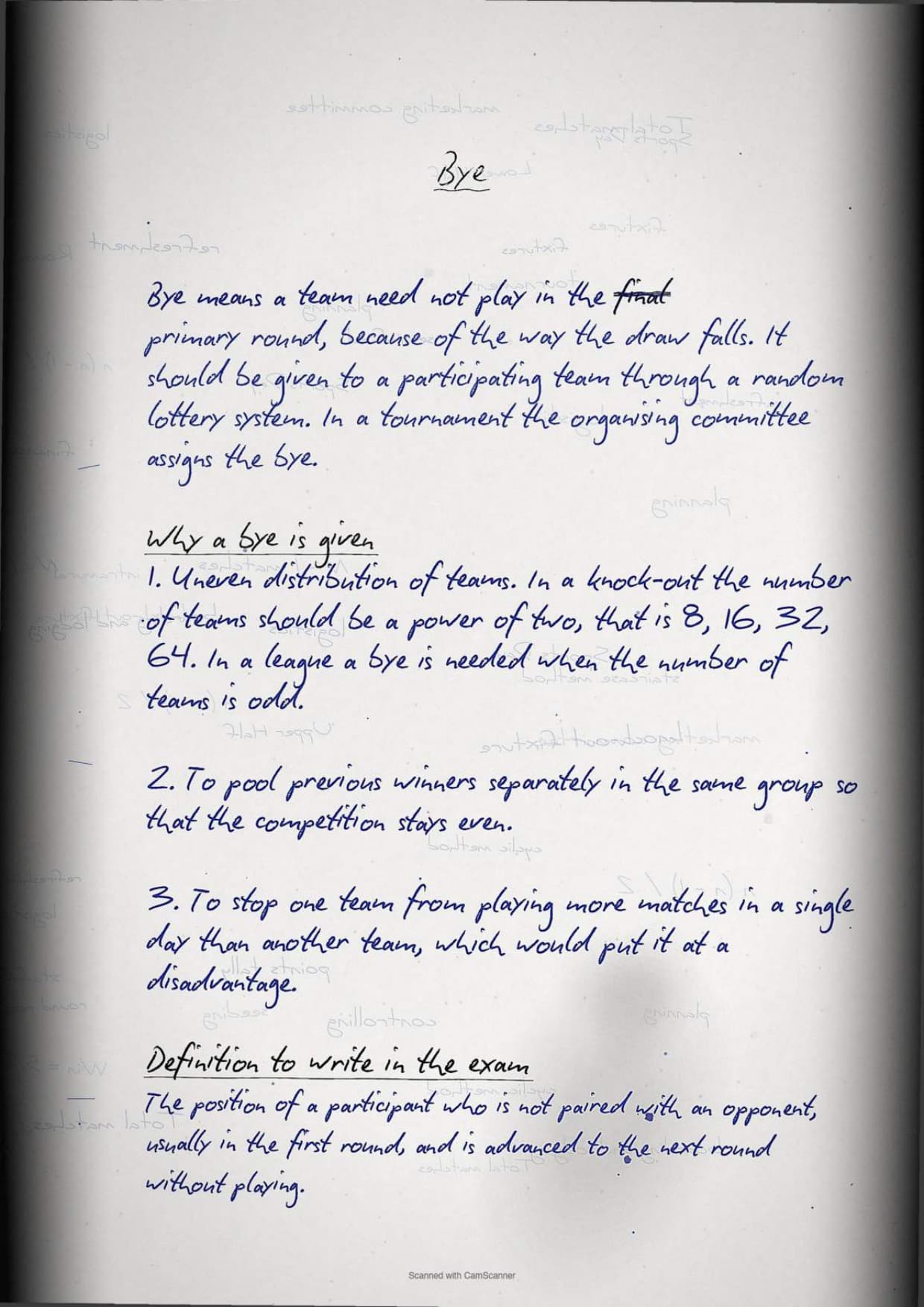
A bye means a team is not required to play in the primary round because of how the draw fell. It is handed out through a random lottery system, and the chapter gives three reasons why the organising committee grants one.
- Uneven distribution of teams: a knock-out draw works cleanly only when the entry count is a power of two, such as 8, 16, 32 or 64, and a league draw only when the count is not odd.
- Separate pooling of previous winners in the same group, so the competition stays even.
- Match load: to stop one team playing more matches in a single day than another, which would put it at a disadvantage.
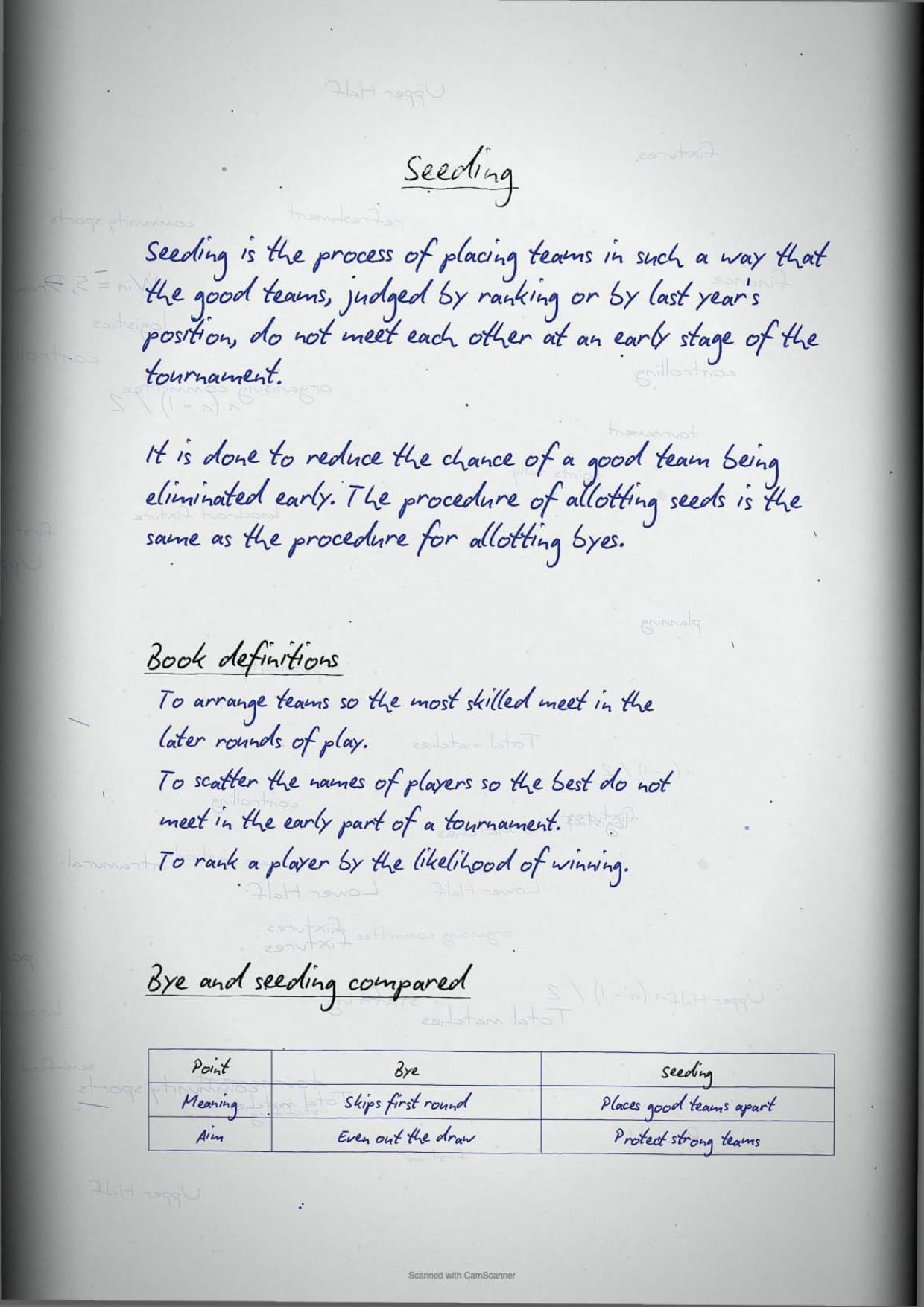
Seeding is different. It places strong teams, ranked on their record or last year's position, so that they do not meet each other early in the tournament. The aim is to reduce the chance of a good team being knocked out in round one. The procedure for allotting seeds is the same as the procedure for byes, so learn one and you have both.
Drawing a Knock-Out Fixture: The Six-Step Procedure with Formulas
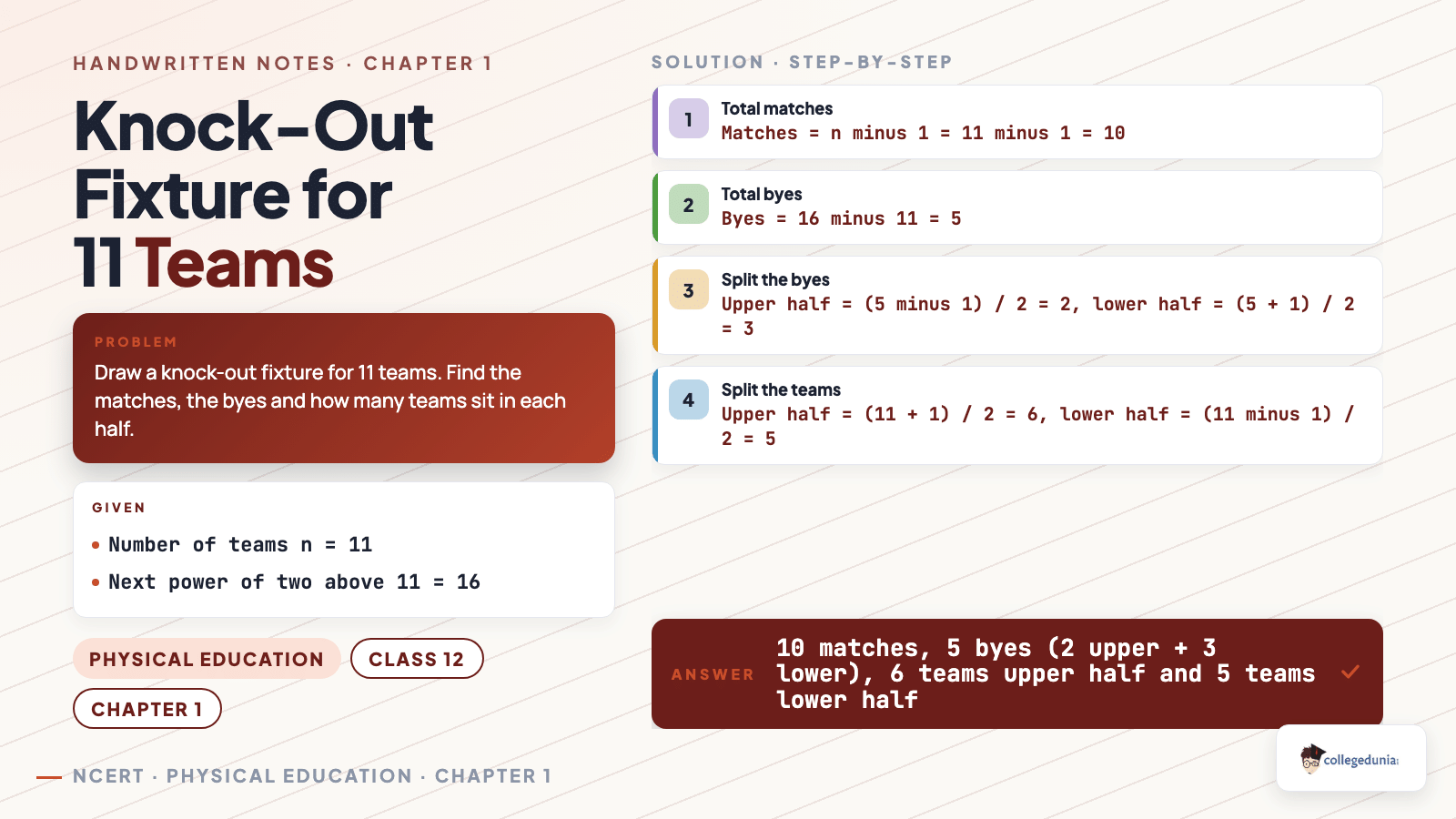
This is the part of the chapter that carries the most marks and takes the most practice. The notes work through the full six-step order with a boxed formula at every step.
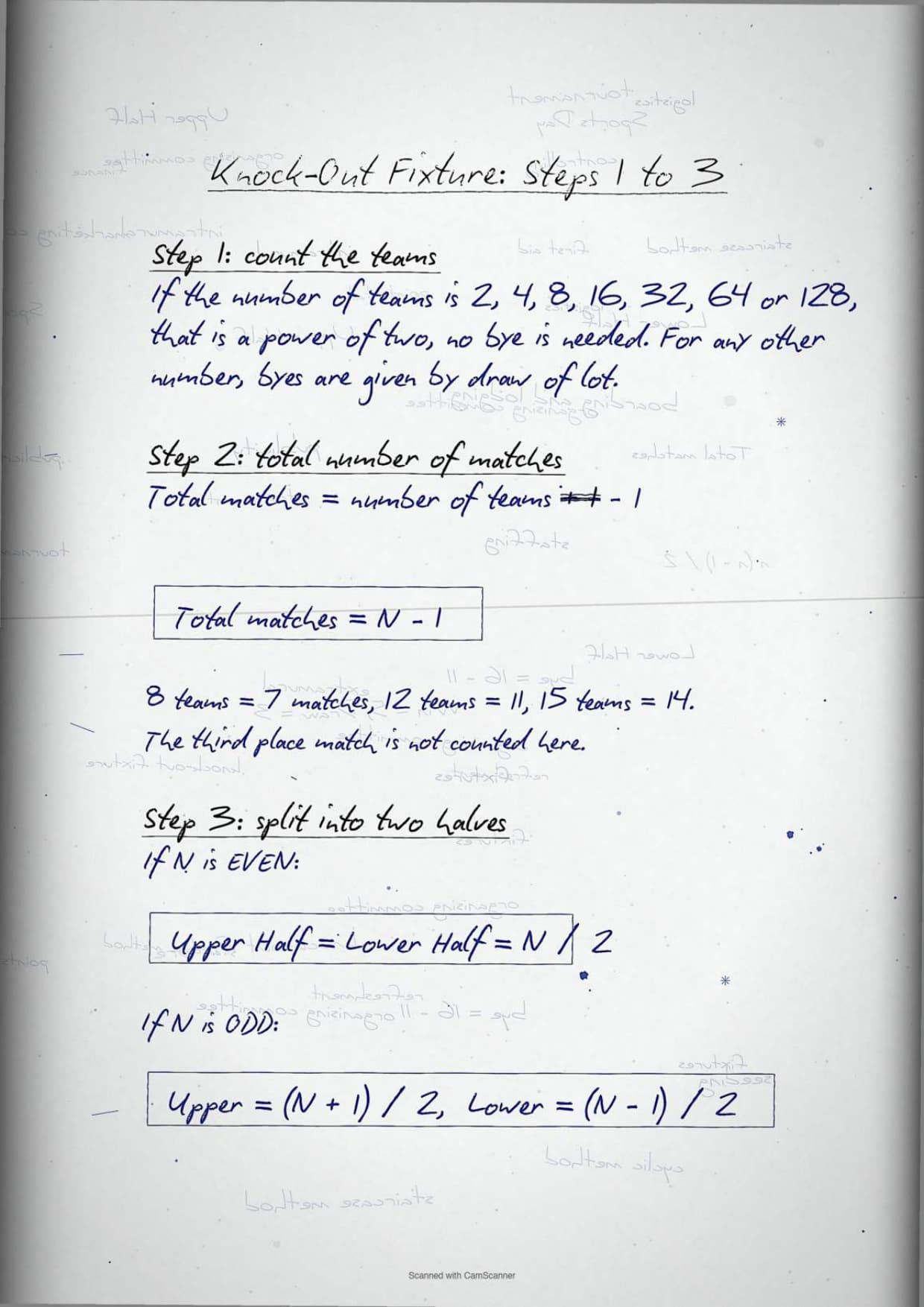
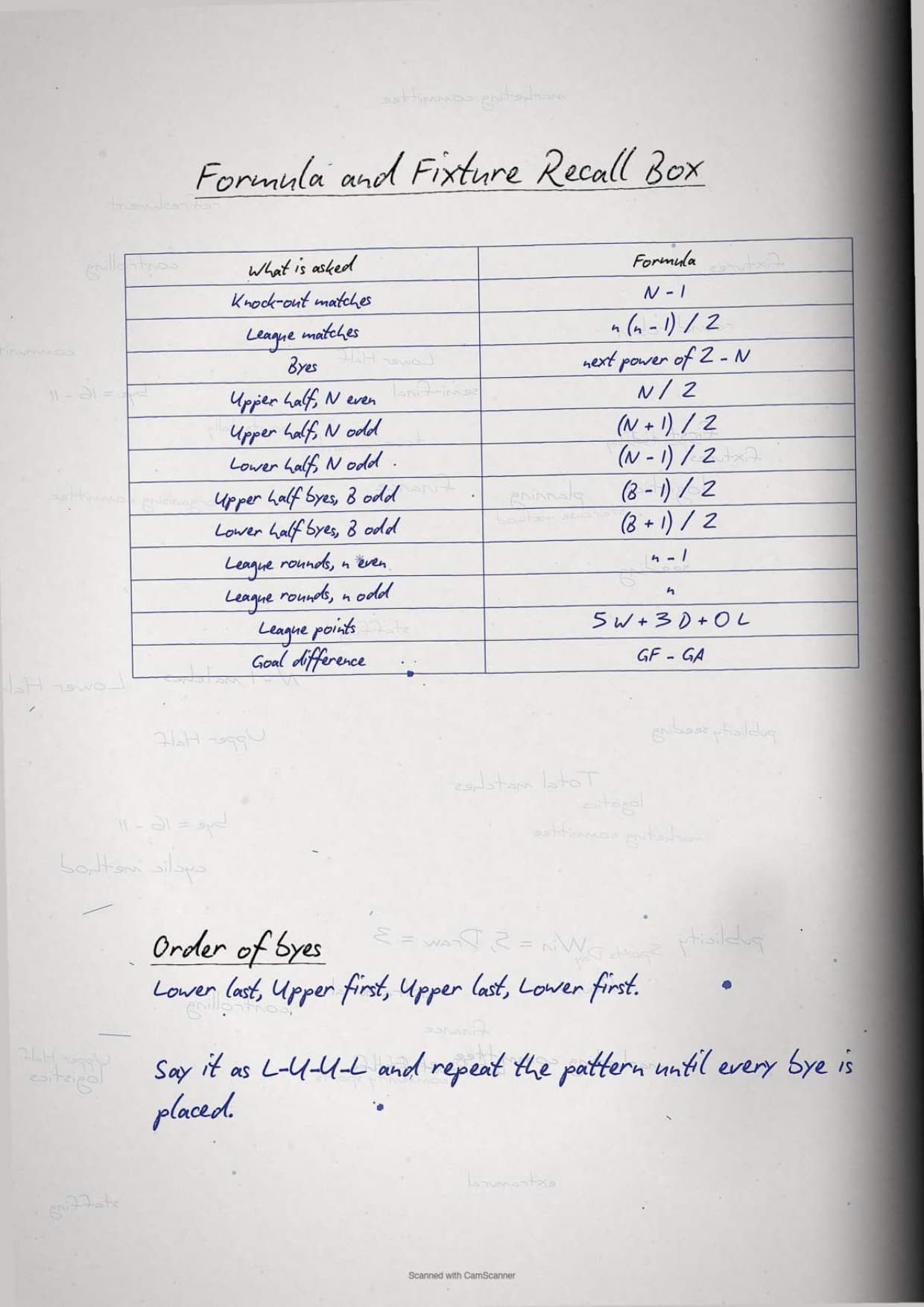
| Step | What to do | Formula |
|---|---|---|
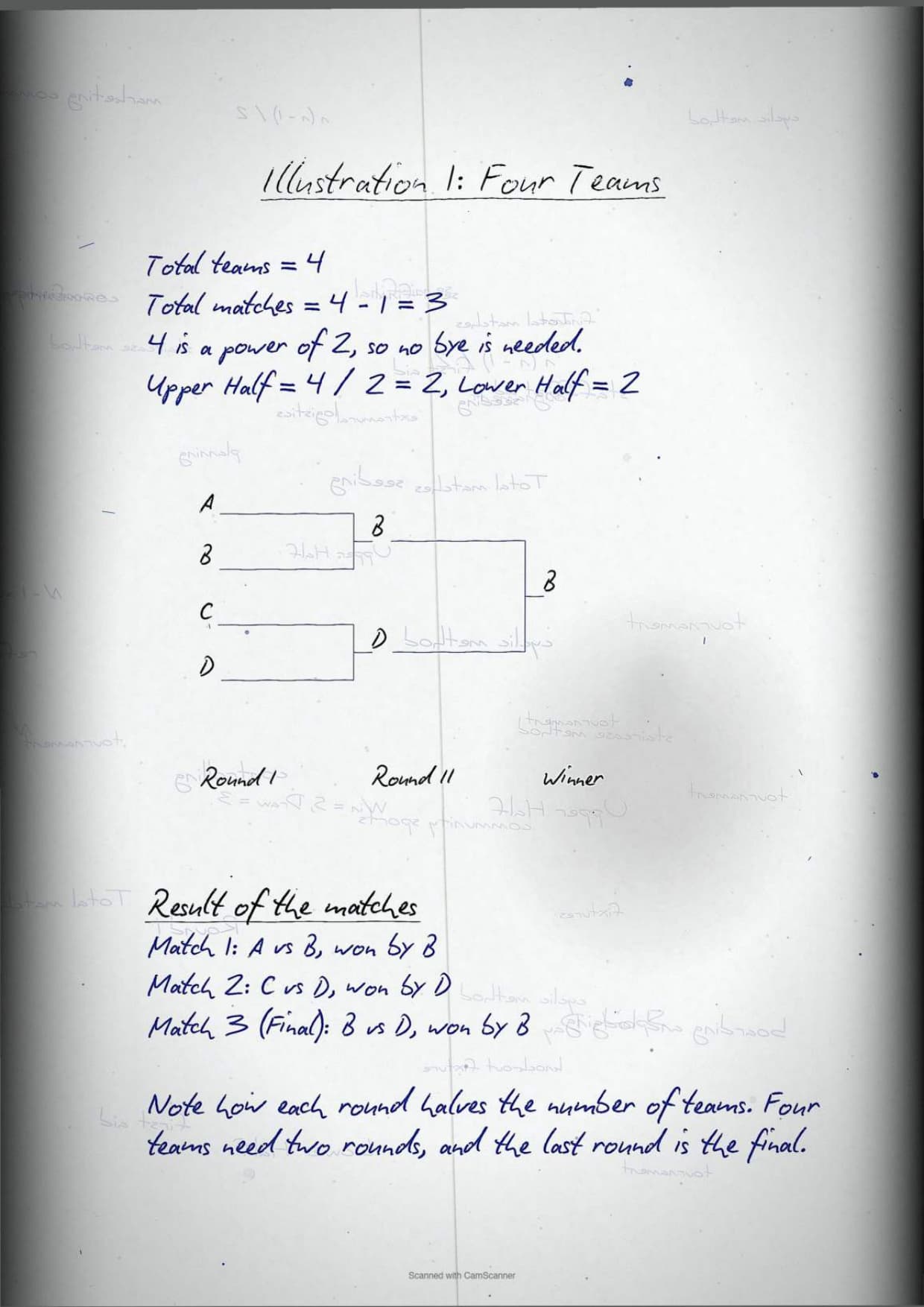
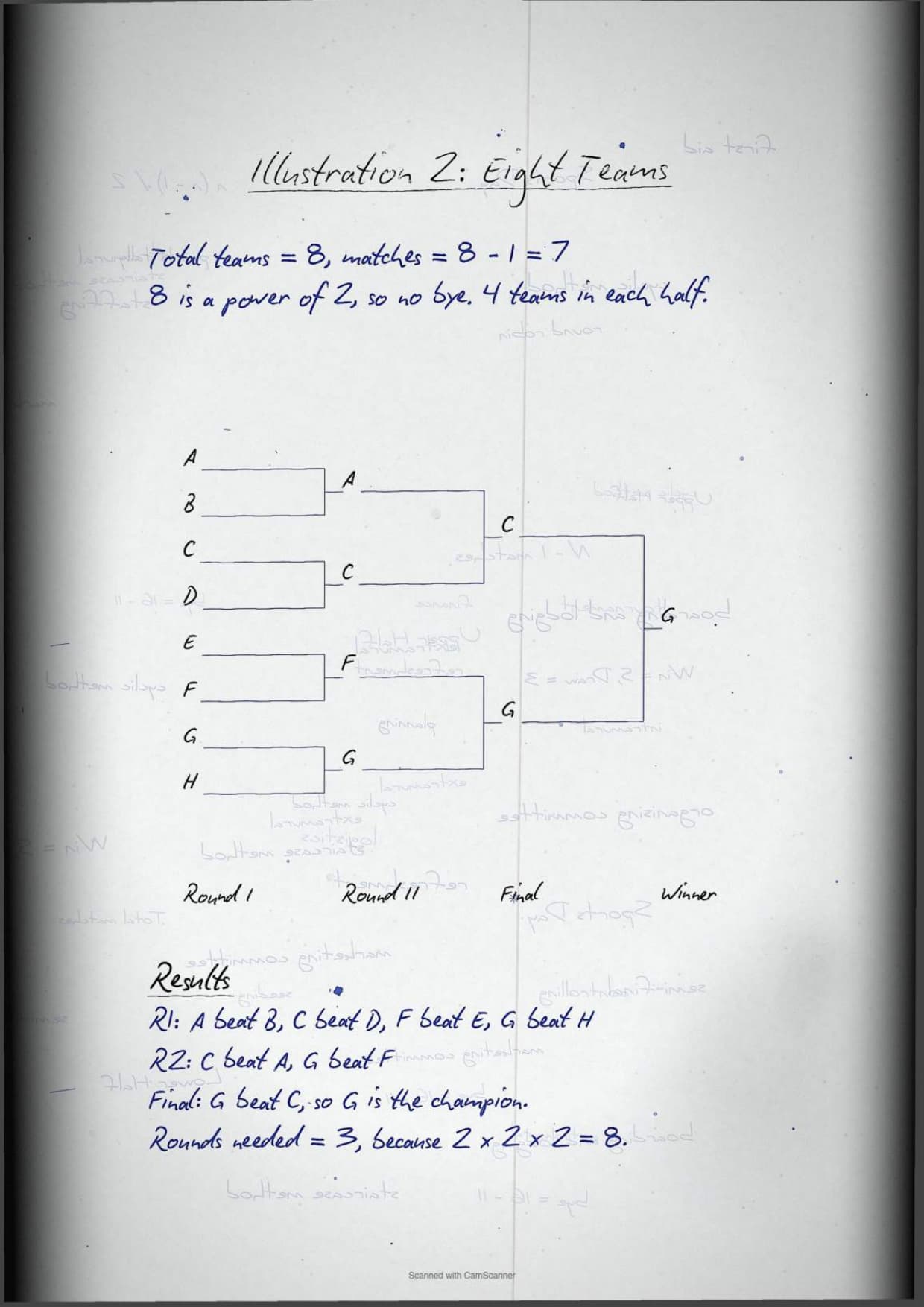
| 1 | Fix the total number of teams. Powers of two need no bye | 2, 4, 8, 16, 32, 64, 128 |
| 2 | Find the total number of matches | Number of teams minus 1 |
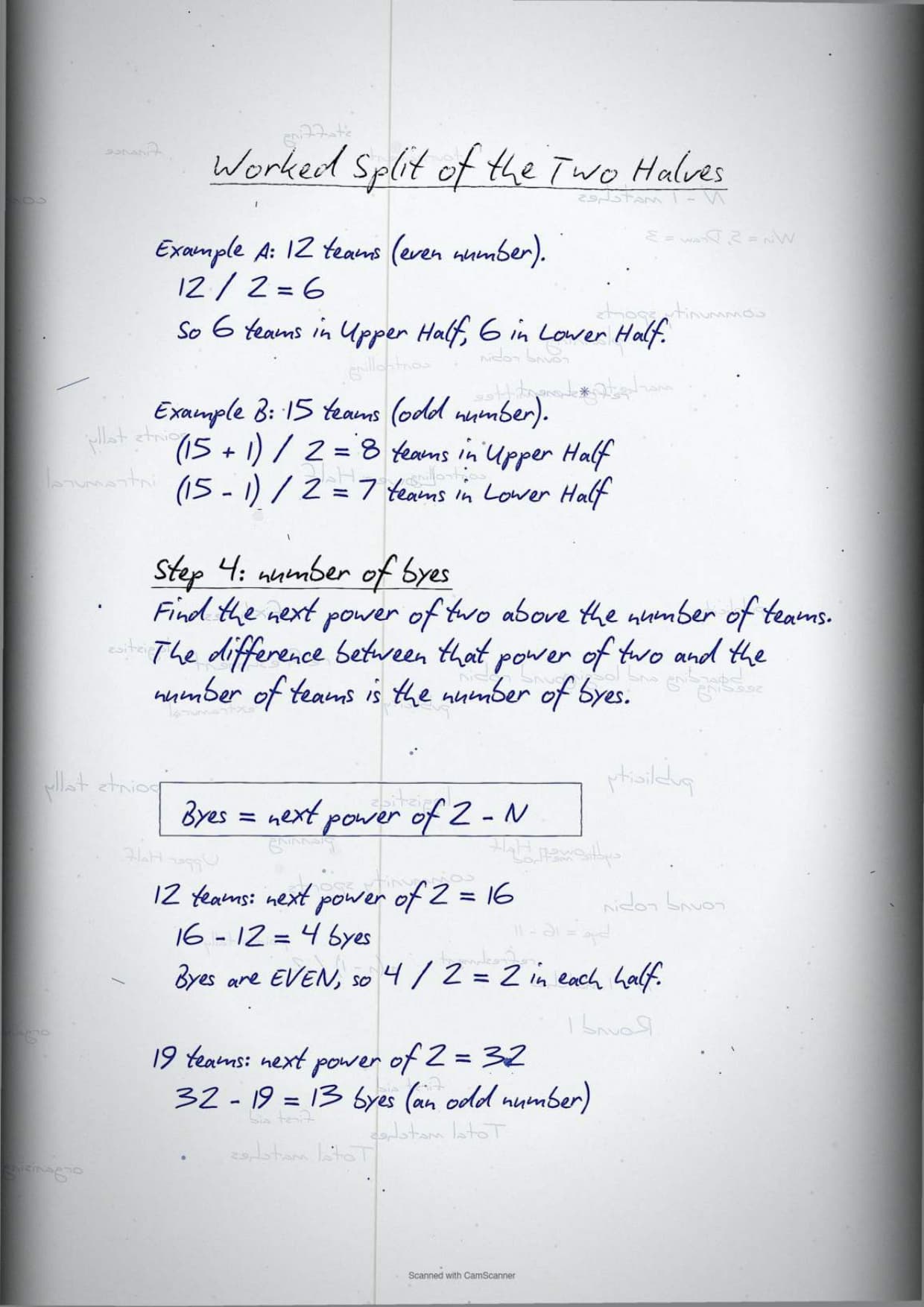
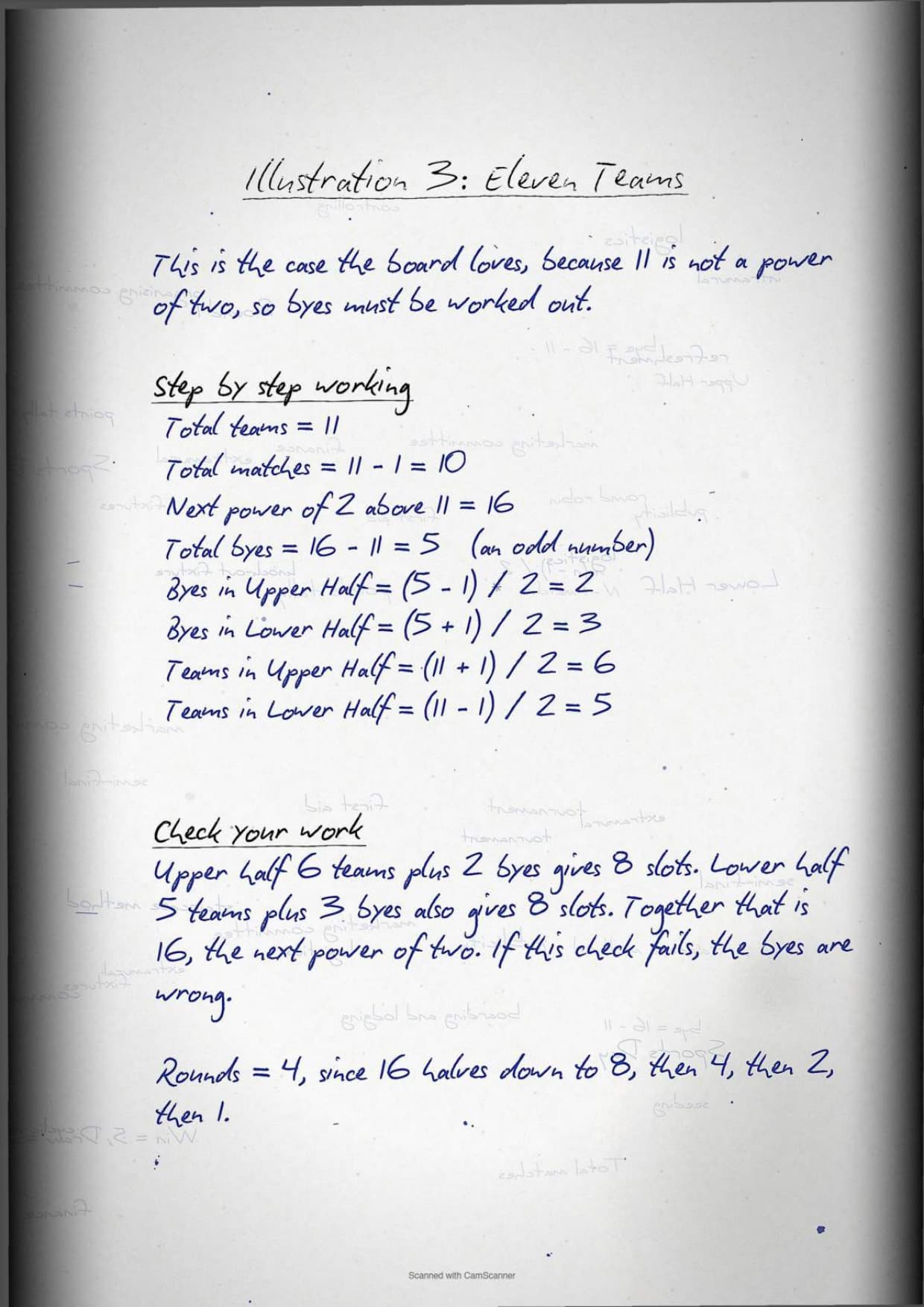
| 3 | Split the teams into an upper half and a lower half | Even count: teams divided by 2 in each half. Odd count: (teams + 1) divided by 2 in the upper half, (teams minus 1) divided by 2 in the lower half |
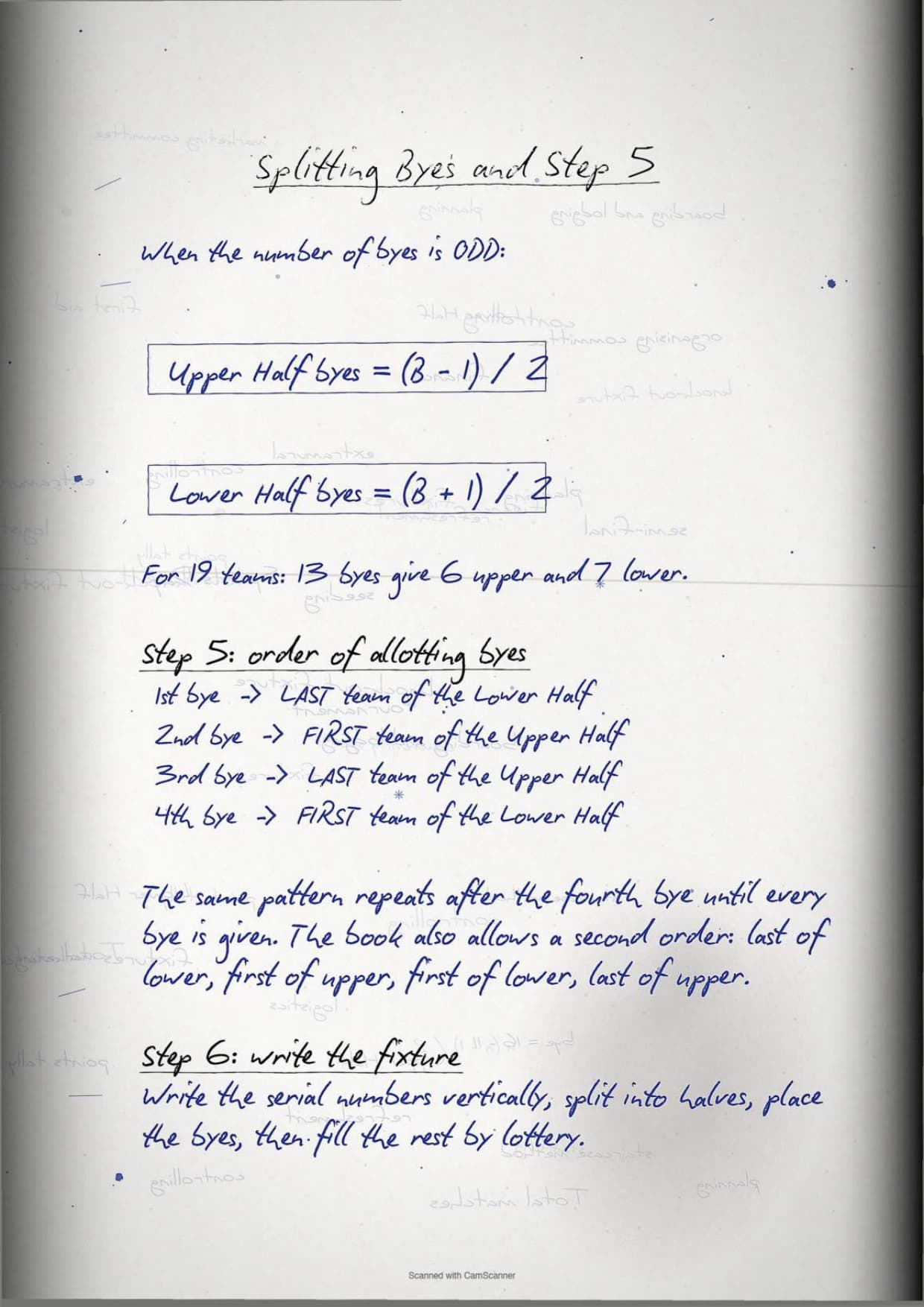
| 4 | Work out the byes | Next power of two minus the number of teams. Even byes: half in each side. Odd byes: (byes minus 1) divided by 2 in the upper half, (byes + 1) divided by 2 in the lower half |
| 5 | Allot the byes in the fixed order | First bye to the last team of the lower half, second to the first team of the upper half, third to the last team of the upper half, fourth to the first team of the lower half, then repeat |
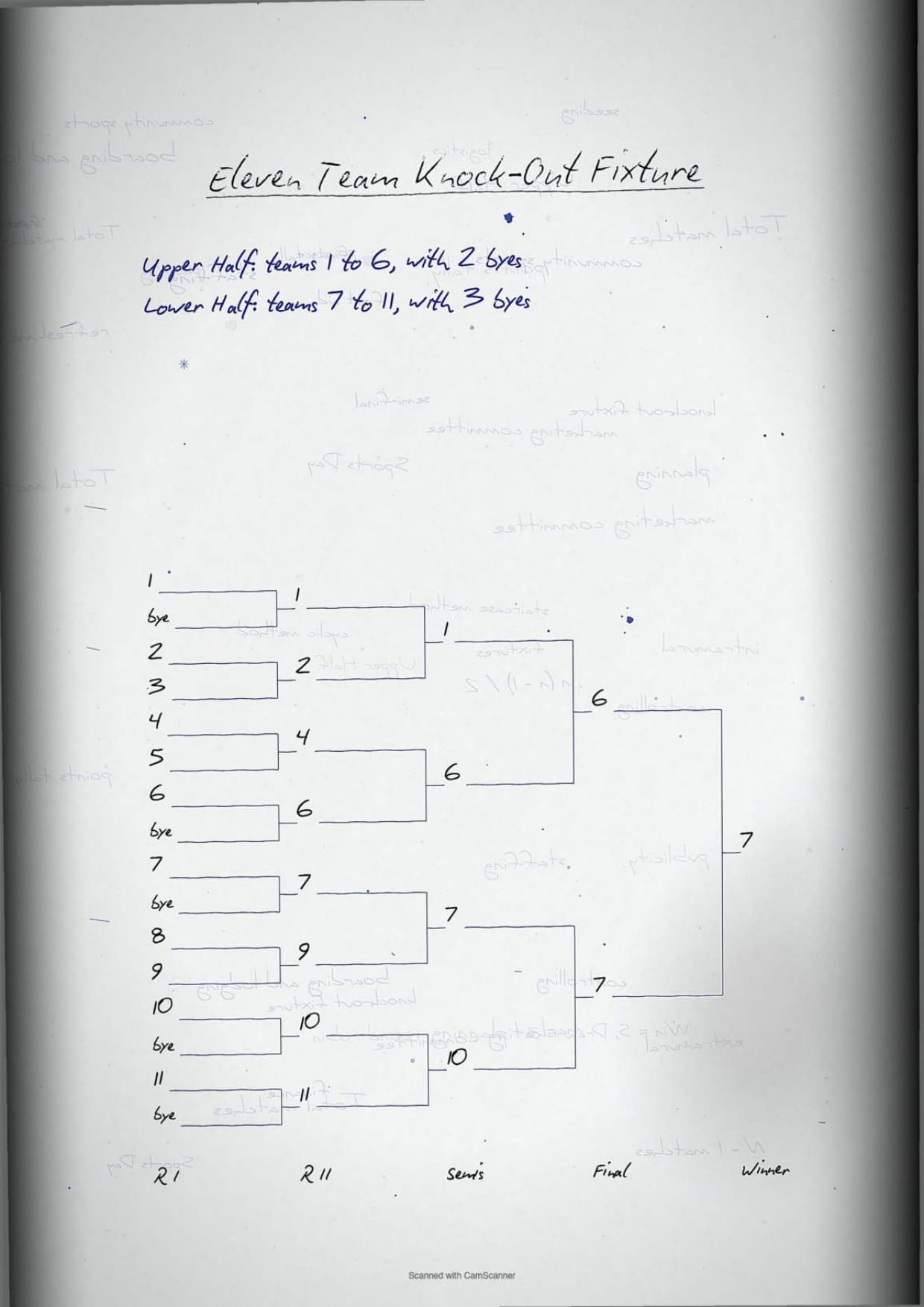
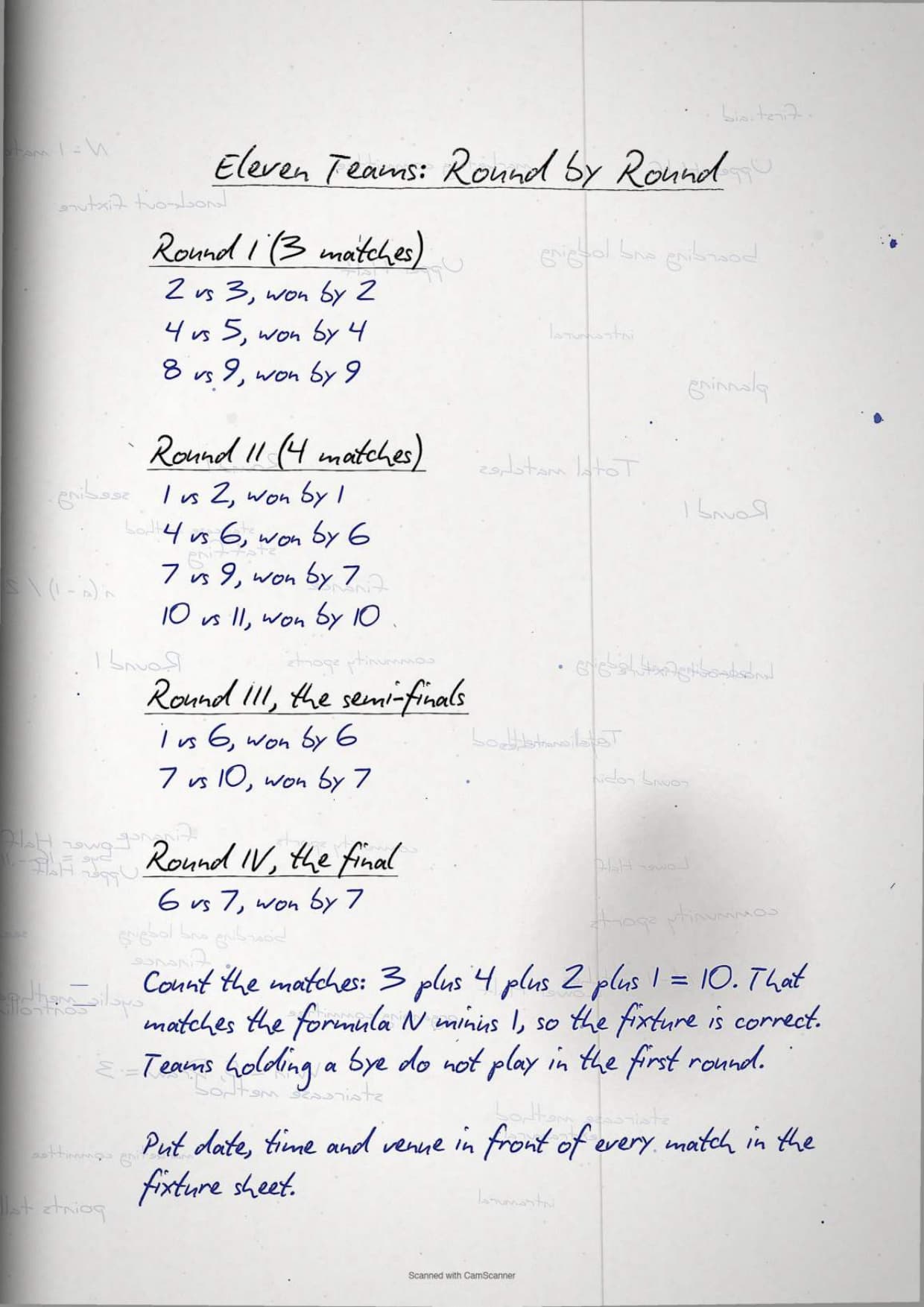
| 6 | Write serial numbers vertically, split the halves, place the byes, then fill the remaining teams by lottery | Teams holding a bye skip the first round. Add date, time and venue against each match |
Worked example with 11 teams, the illustration the chapter uses. Total matches are 11 minus 1, which is 10. The next power of two above 11 is 16, so byes are 16 minus 11, which is 5. Upper half byes are (5 minus 1) divided by 2, which is 2, and lower half byes are (5 + 1) divided by 2, which is 3. Upper half teams are (11 + 1) divided by 2, which is 6, and lower half teams are (11 minus 1) divided by 2, which is 5.
League Fixtures: Cyclic and Staircase Methods with the Match Formula
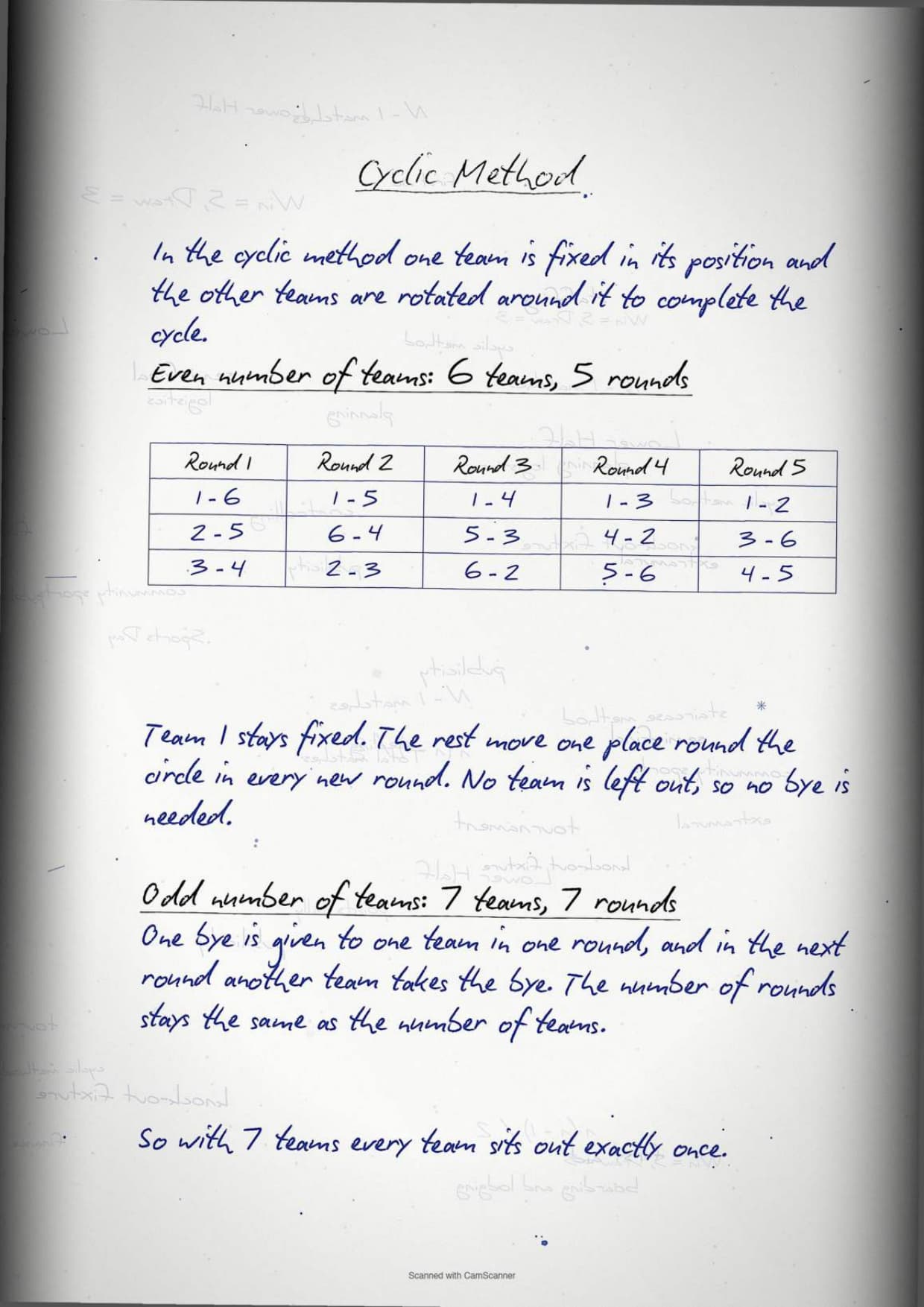
In a league or round robin tournament each team plays every other team once. The match count comes first, and only then do you choose a method for laying the fixture out.
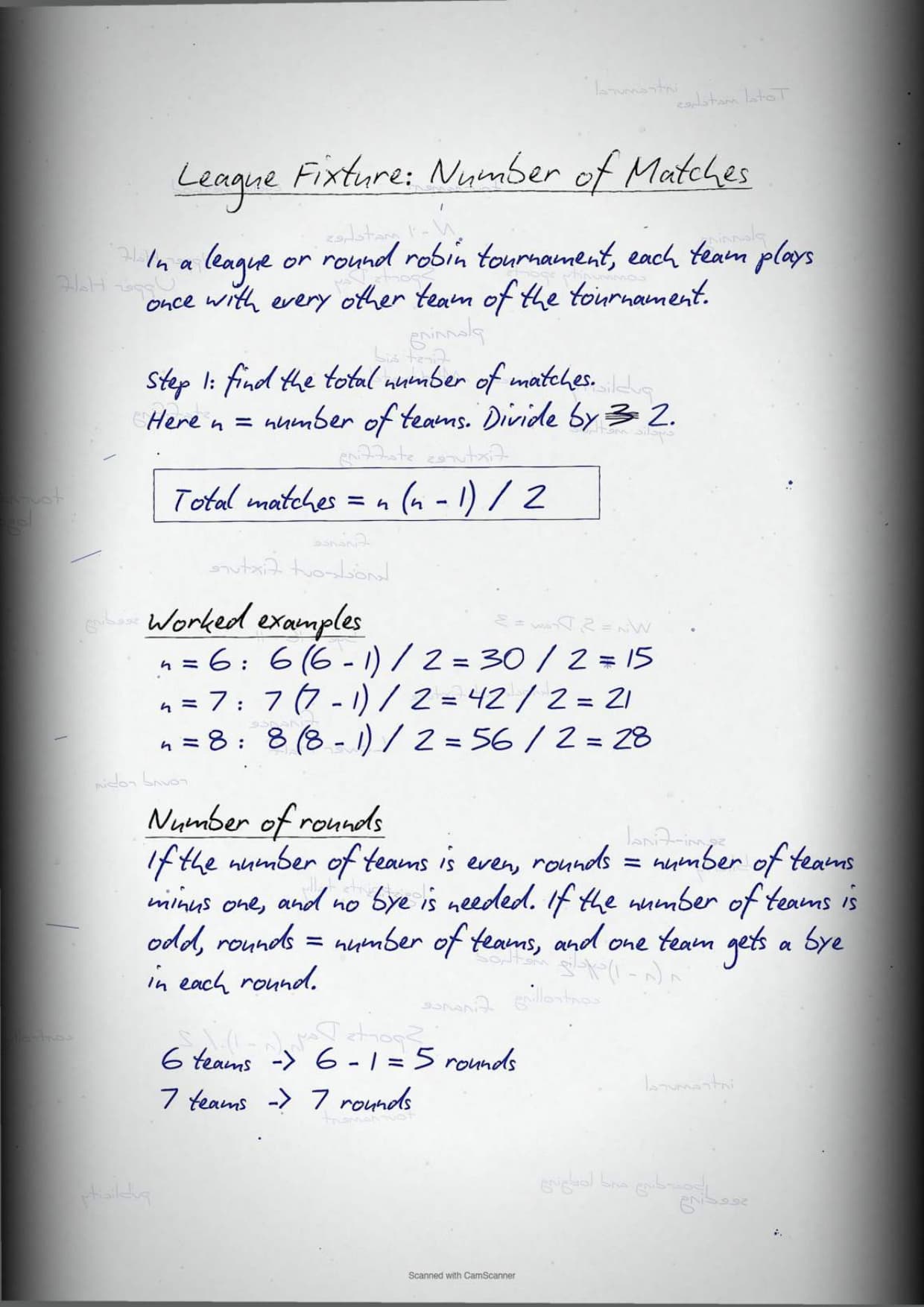
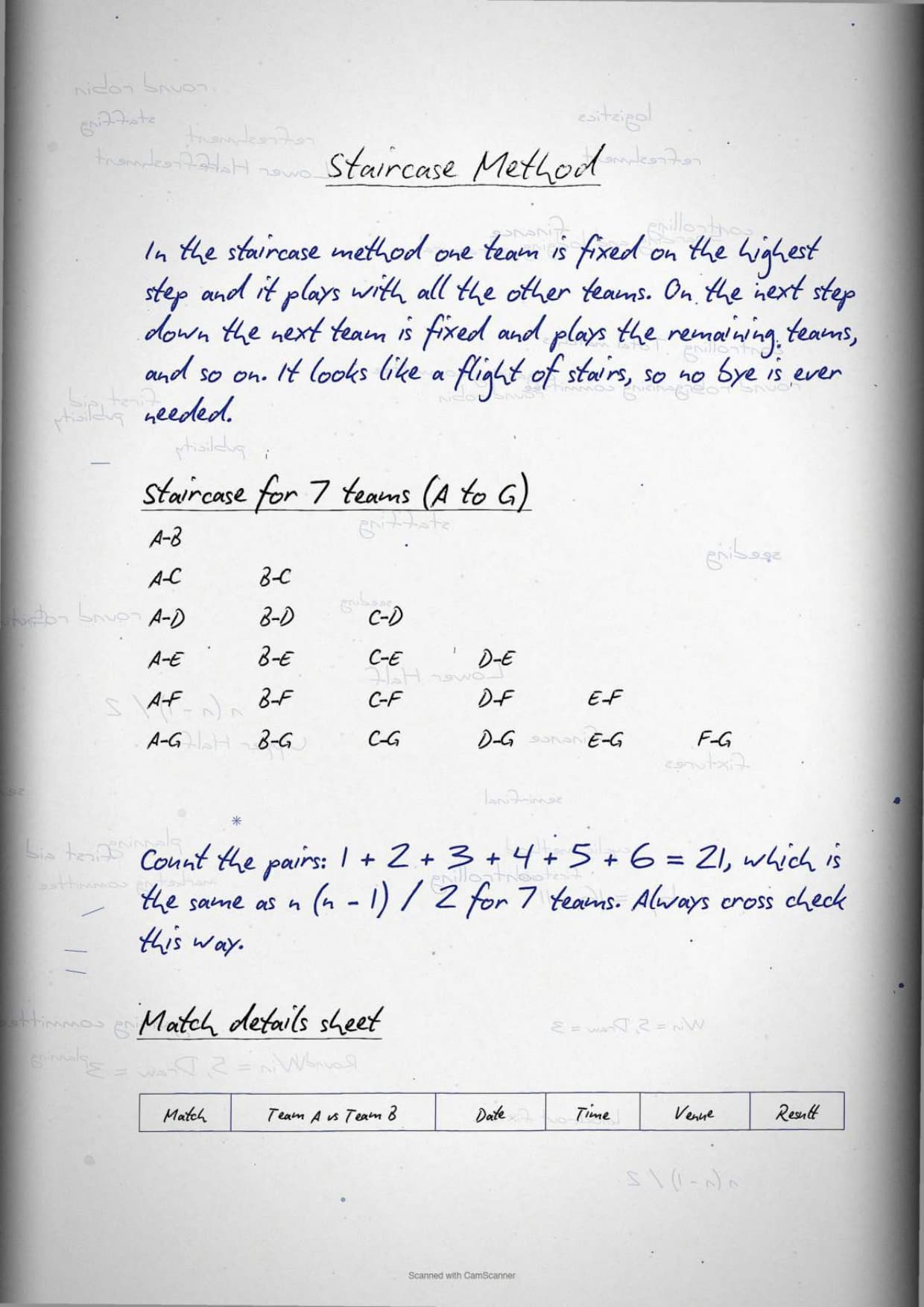
Total number of matches = n (n minus 1) divided by 2, where n is the number of teams. For 6 teams that gives 15 matches, and for 7 teams it gives 21 matches.
| Method | How the fixture is built | Rounds |
|---|---|---|
| Cyclic | One team is fixed in position and the rest rotate around it until the cycle is complete | Even number of teams: no bye needed, rounds equal teams minus 1, so 6 teams give 5 rounds. Odd number of teams: one team gets a bye in each round and a different team gets it next round, so 7 teams give 7 rounds |
| Staircase | One team is fixed on the highest step and plays all the others, then the next team down is fixed and plays the remaining teams, and so on | The fixture grows step by step, so no bye is needed at any point |
The staircase grid for 7 teams starts with A against B on the top step, then A against C and B against C on the next, and keeps widening until the last step carries A, B, C, D, E and F each against G. Underneath it the chapter keeps a details-of-matches table with columns for match number, the two teams, date, time, venue and result.
Deciding the Winner in a League Tournament: The Points Tally
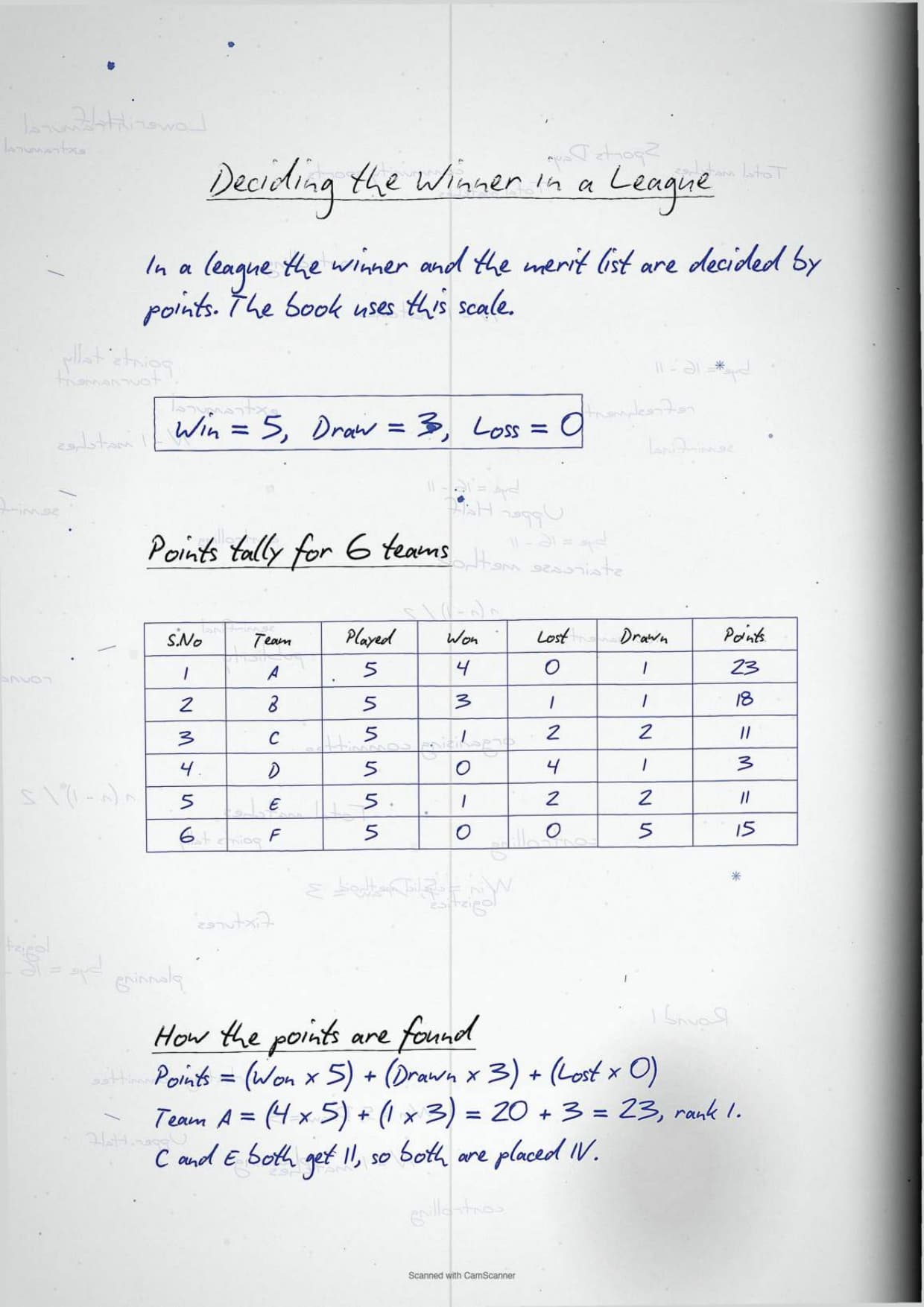
League standings are settled on points, not on wins alone, and the chapter fixes the value of each result. Win = 5, Draw = 3, Loss = 0. Missing this and using the football convention of 3, 1 and 0 is the fastest way to lose a case-study question.
| Team | Played | Won | Lost | Drawn | Total points | Rank |
|---|---|---|---|---|---|---|
| A | 5 | 4 | 0 | 1 | 23 | I |
| B | 5 | 3 | 1 | 1 | 18 | II |
| F | 5 | 0 | 0 | 5 | 15 | III |
| C | 5 | 1 | 2 | 2 | 11 | IV |
| E | 5 | 1 | 2 | 2 | 11 | IV |
| D | 5 | 0 | 4 | 1 | 3 | V |
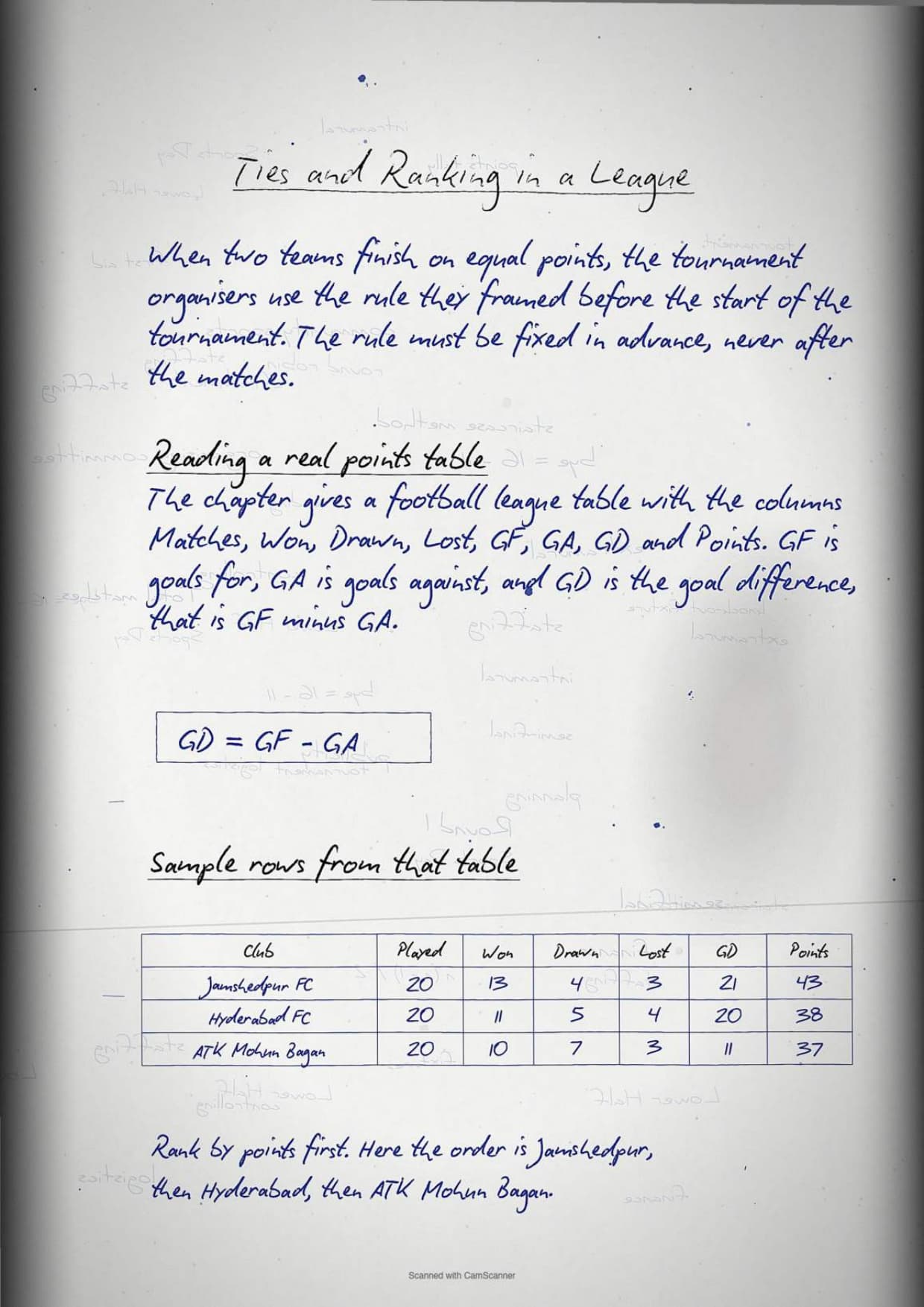
Check the arithmetic yourself: team A has 4 wins at 5 points and 1 draw at 3 points, which is 23. Rules about a tie are framed by the tournament organisers before the tournament starts, not decided afterwards, which is a one-line answer worth memorising.
Combination Fixtures: How a League-Knockout Tournament Is Drawn
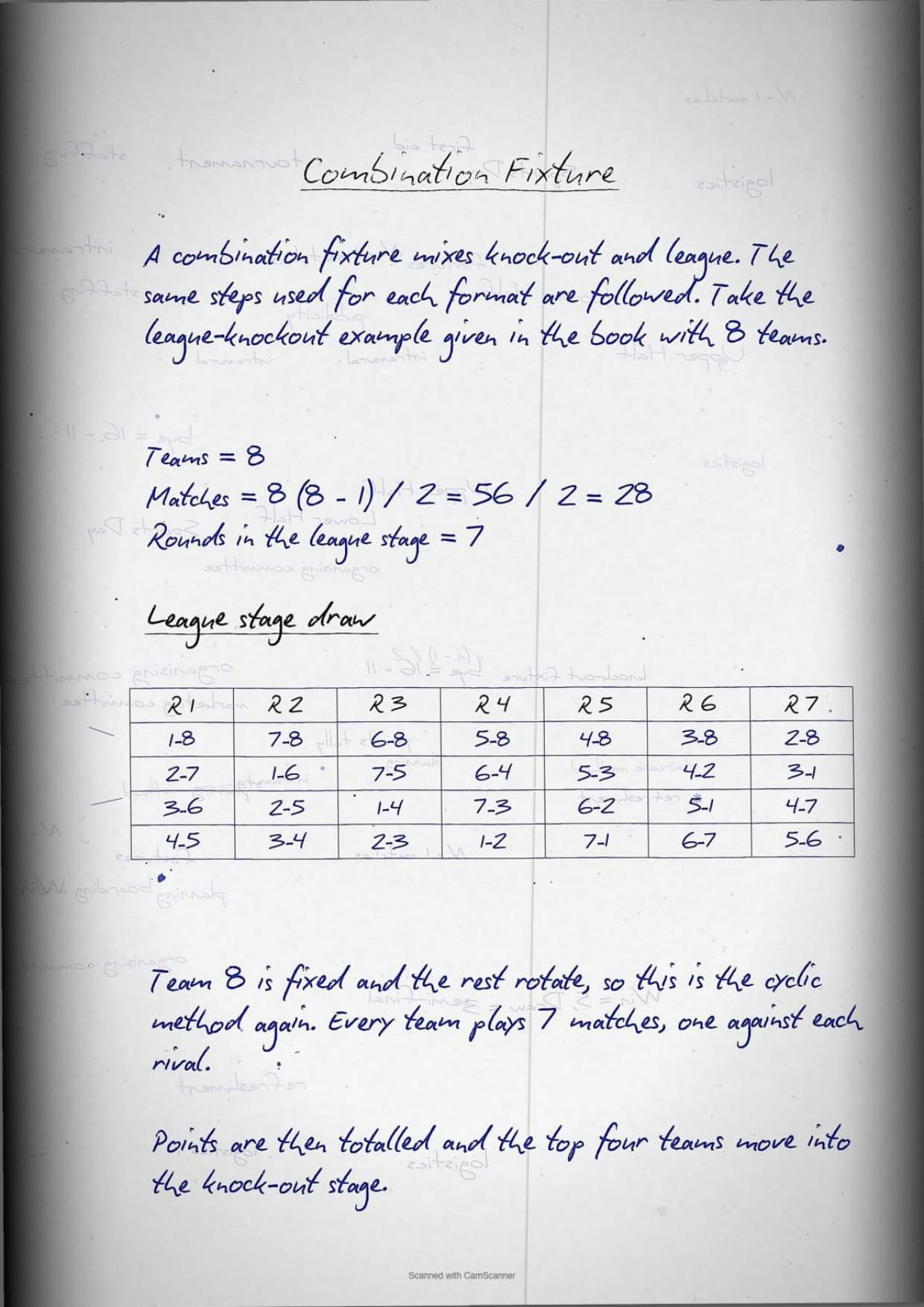
A combination fixture follows the same steps as the two formats it joins. The chapter works through a League-Knockout example with 8 teams, and the notes redraw the whole round grid by hand.
- Match count: 8 multiplied by 7, divided by 2, gives 28 matches in the league stage.
- Rounds: 7 rounds, with 4 matches in each round.
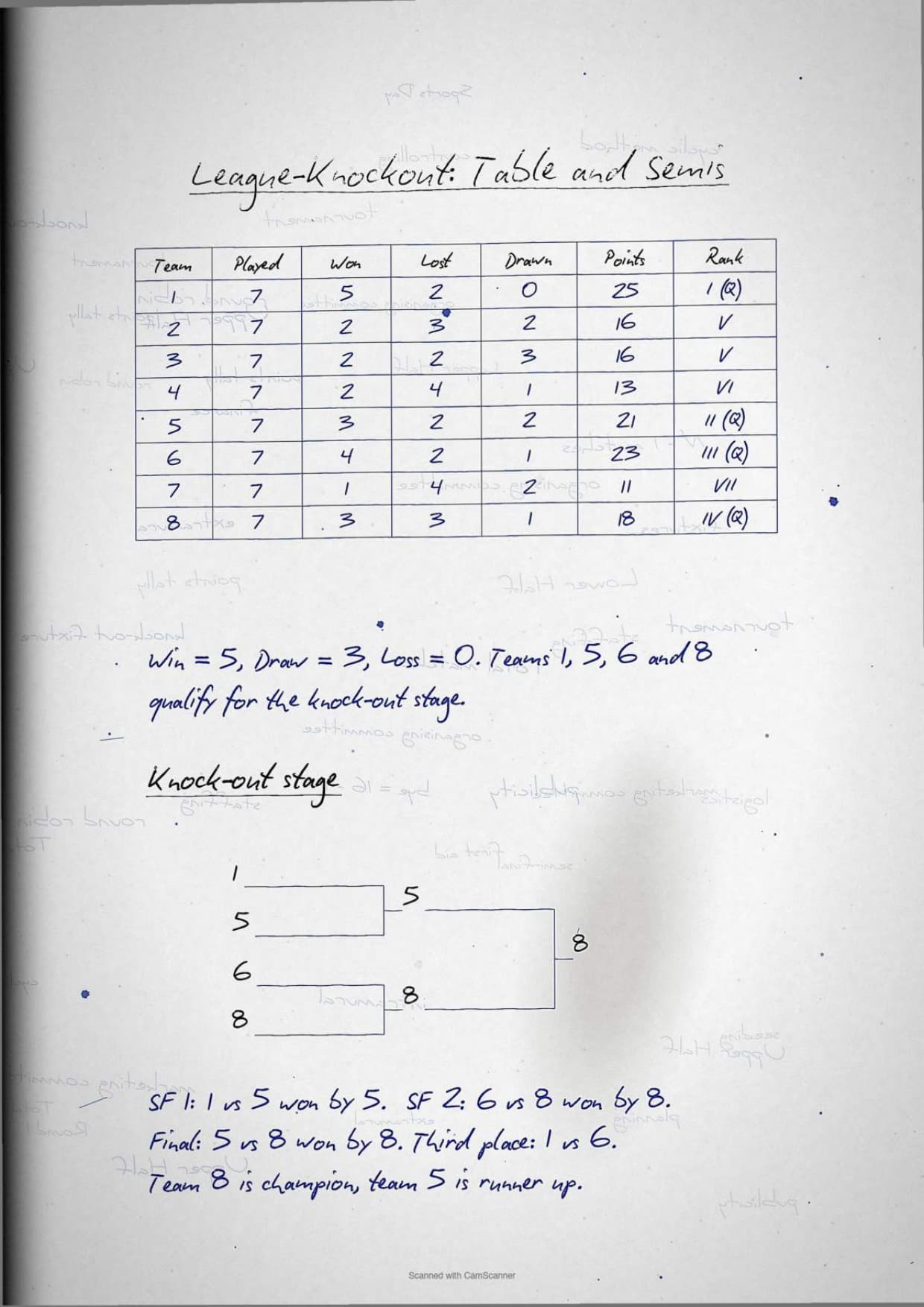
- Qualifiers: the top four teams on points move into the knockout stage.
- Semi-final pairing: the tournament committee fixes the rule before the event. First against third with second against fourth, or first against fourth with second against third, or a draw of lots.
The knockout stage then runs exactly like a normal knock-out bracket, with two semi-finals, a final and an optional third-place match between the two losing semi-finalists.
Intramural and Extramural Tournaments Compared
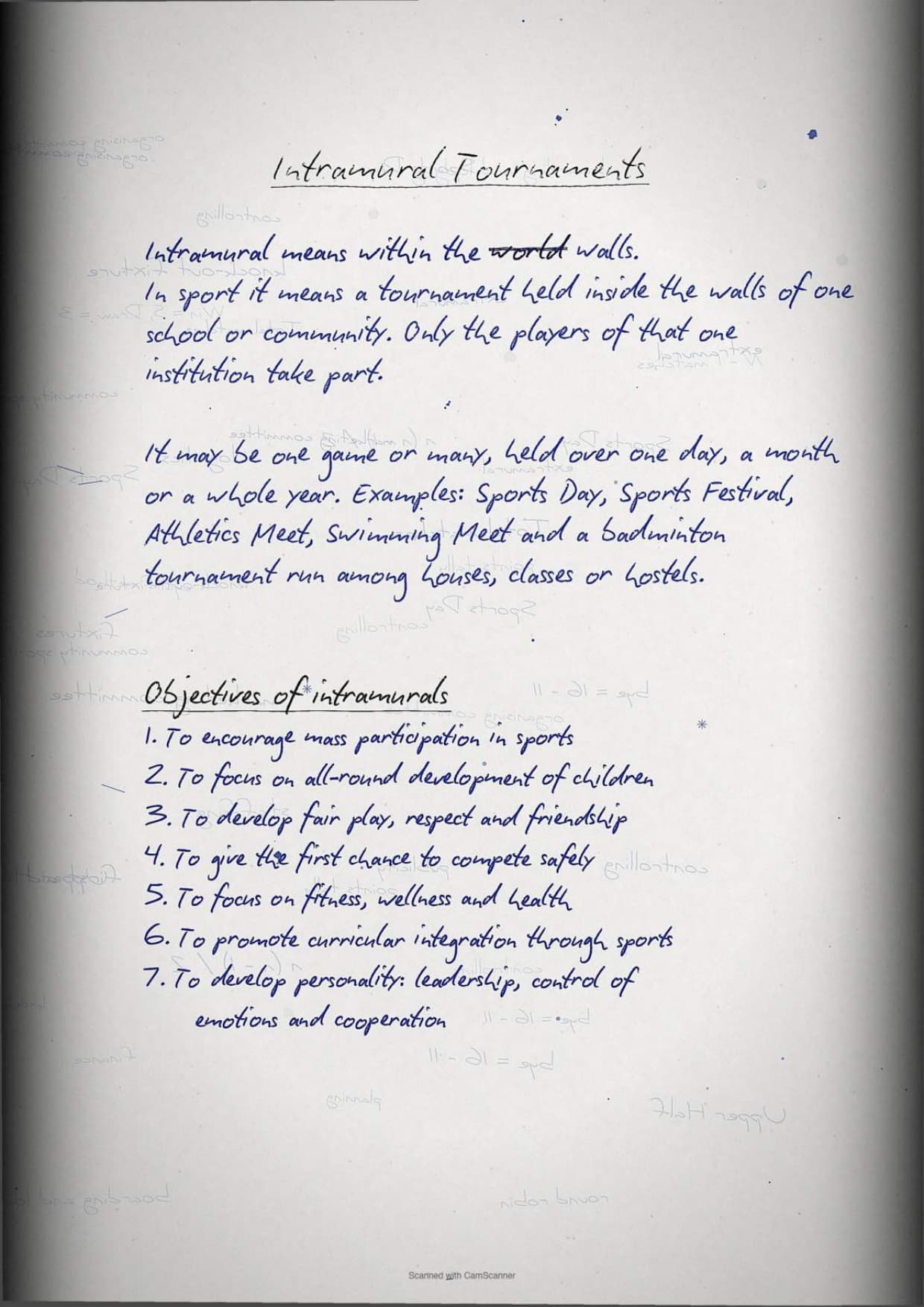
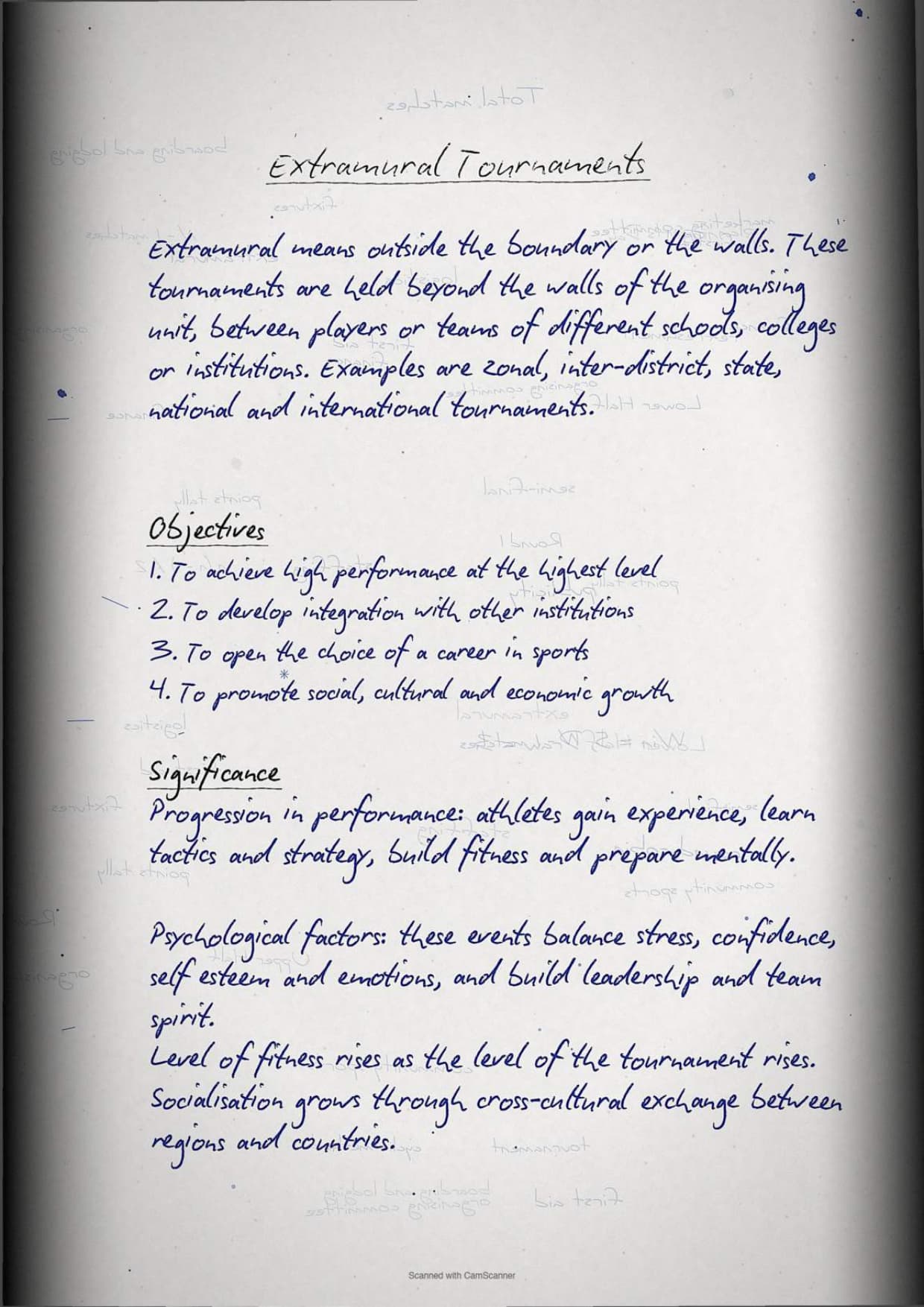
The word intramural means "within the walls" and extramural means "outside the boundary or walls". Everything else in this section follows from those two meanings, so learn them first and the rest becomes easy.
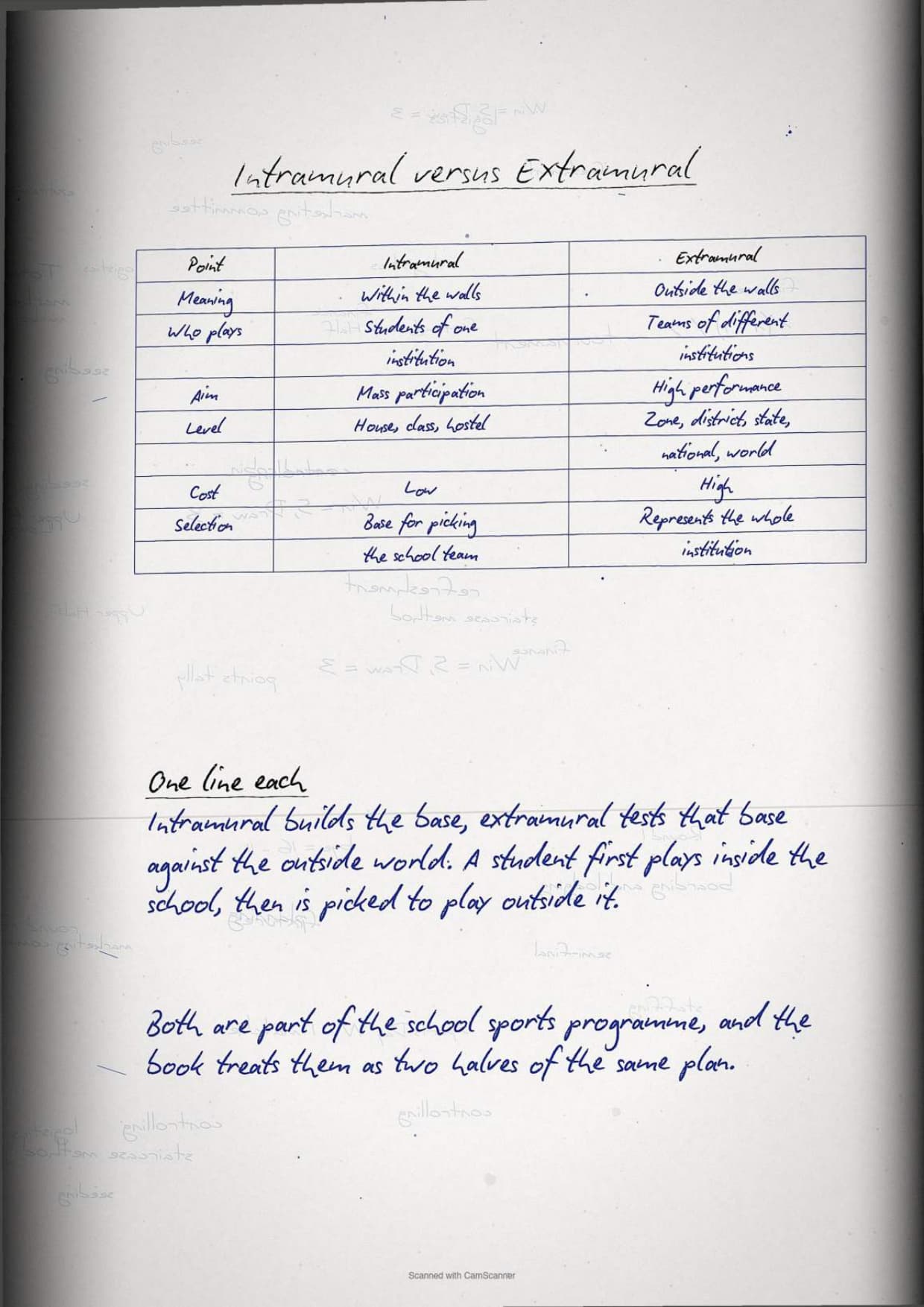
| Point | Intramural | Extramural |
|---|---|---|
| Meaning | Held within the walls of one school, institution or community | Held beyond the walls, between two or more institutions |
| Who competes | Houses, classes, hostels or residents of the same institution | Different schools, colleges or institutions at zonal, inter-district, state, national or international level |
| Examples | Sports Day, sports festival, athletics meet, swimming meet, an inter-house badminton tournament | Zonal, inter-district, state, national and international tournaments |
| Objectives | Mass participation, all-round development, values of fair play, respect and friendship, a first controlled competition, fitness and wellness, curricular integration, personality development | High performance at the highest level, integration with other institutions, career opportunities in sports, social, cultural and economic development |
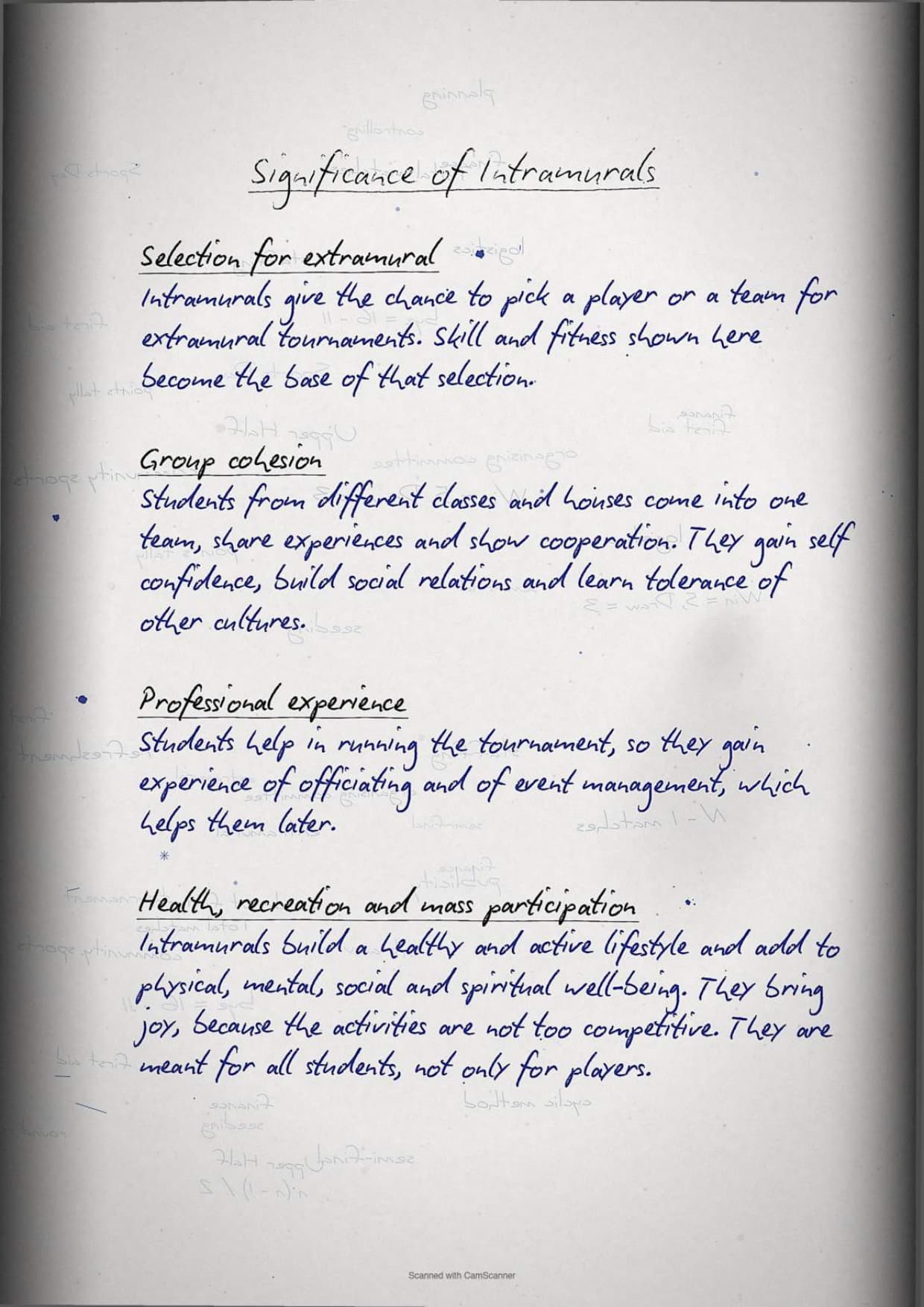
| Significance | Selection for extramural events, group cohesion, professional experience, health, recreation, mass participation | Progression in performance, better handling of psychological factors, higher level of fitness, socialisation across communities and regions |
Intramural events are the feeder system for extramural ones. A student first shows skill and fitness inside the school, and that performance becomes the base on which the school picks its team for outside competition. Recreation is listed only under intramural significance, because those activities are deliberately less competitive.
Community Sports: Purpose, Benefits and the Events You Can Design
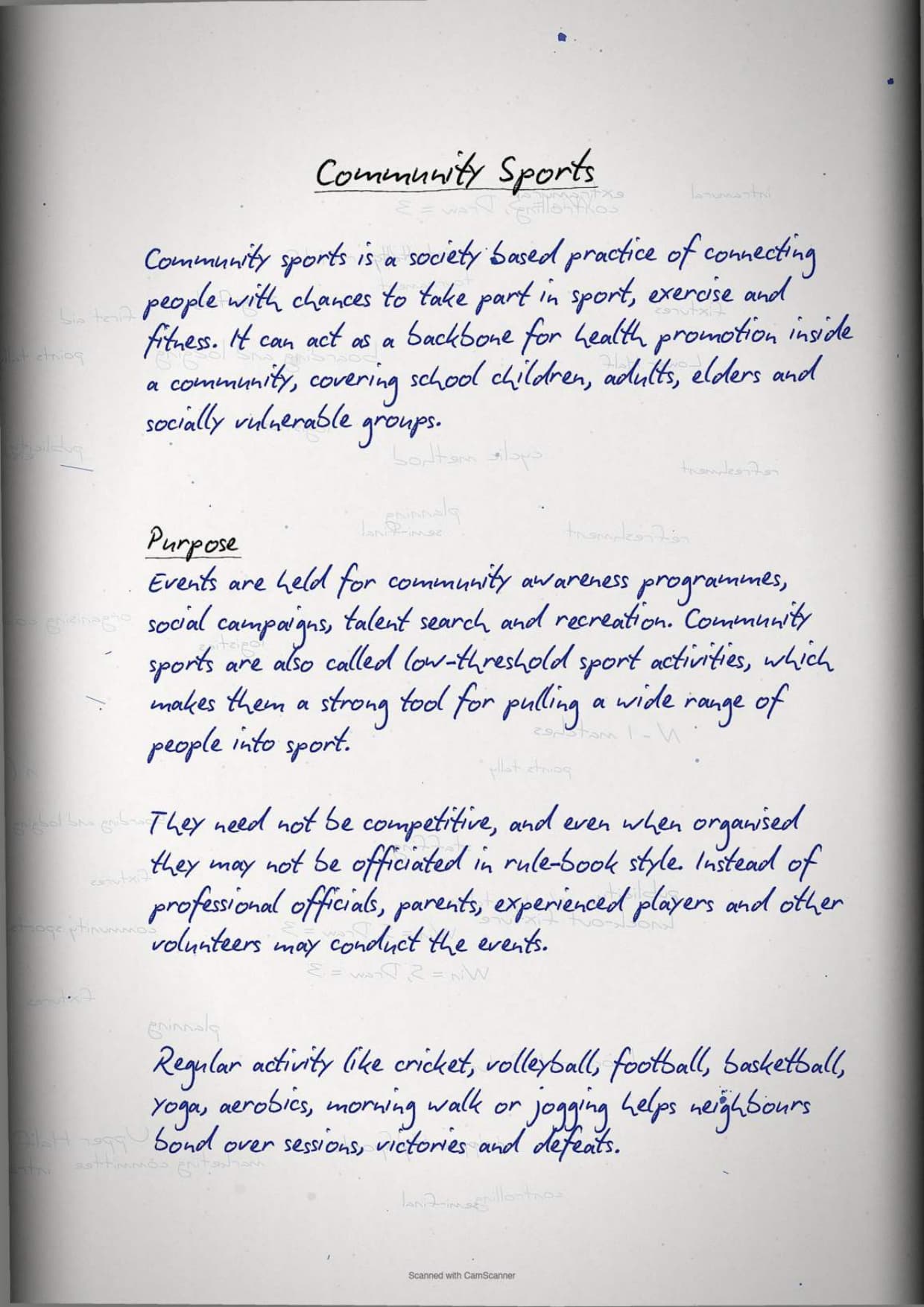
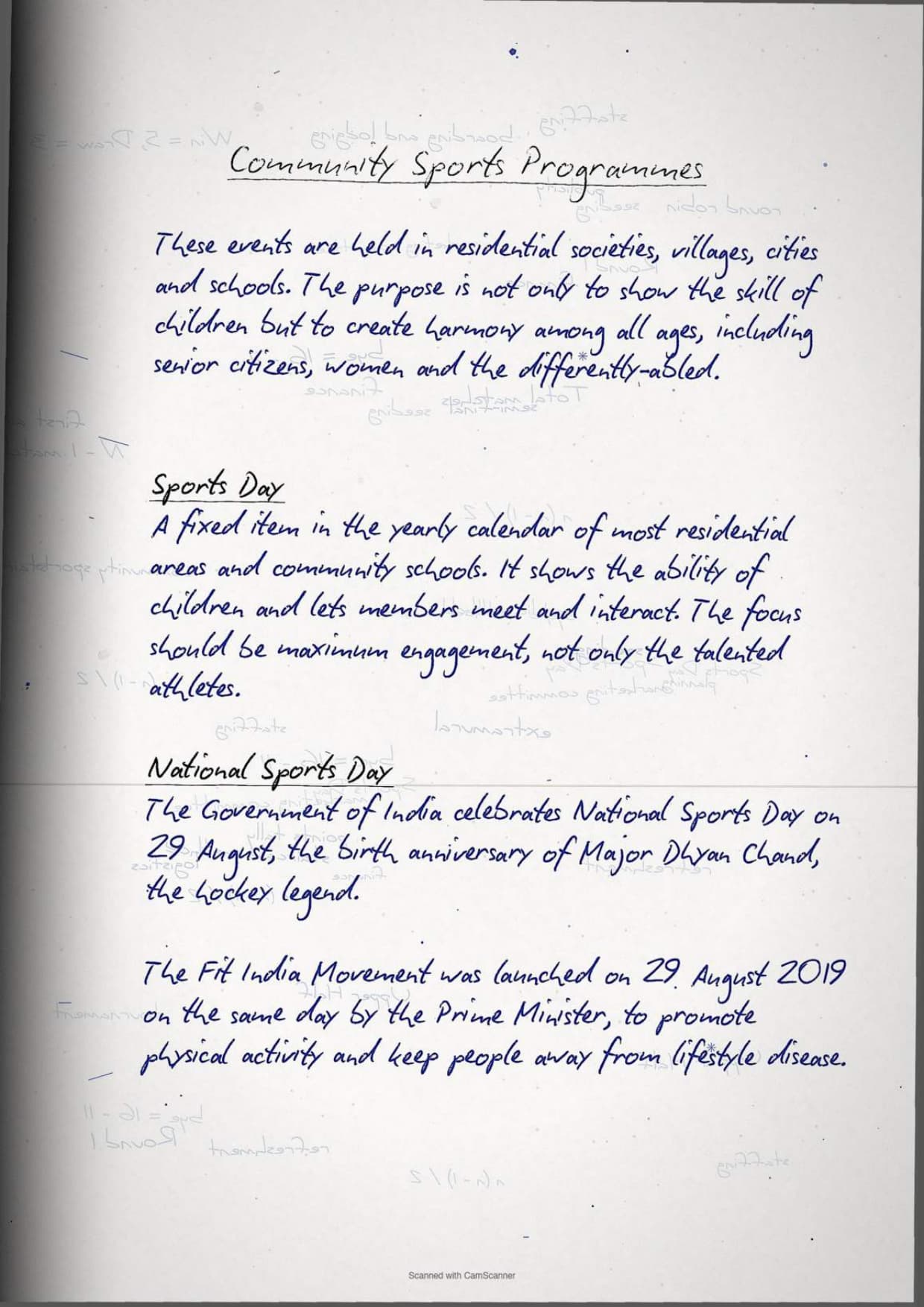
Community sports is a society-based practice of connecting people with chances to take part in sport, exercise and fitness activity. It is often called a low-threshold sport activity, which is exactly why it pulls in school children, adults, elders and socially vulnerable groups alike.
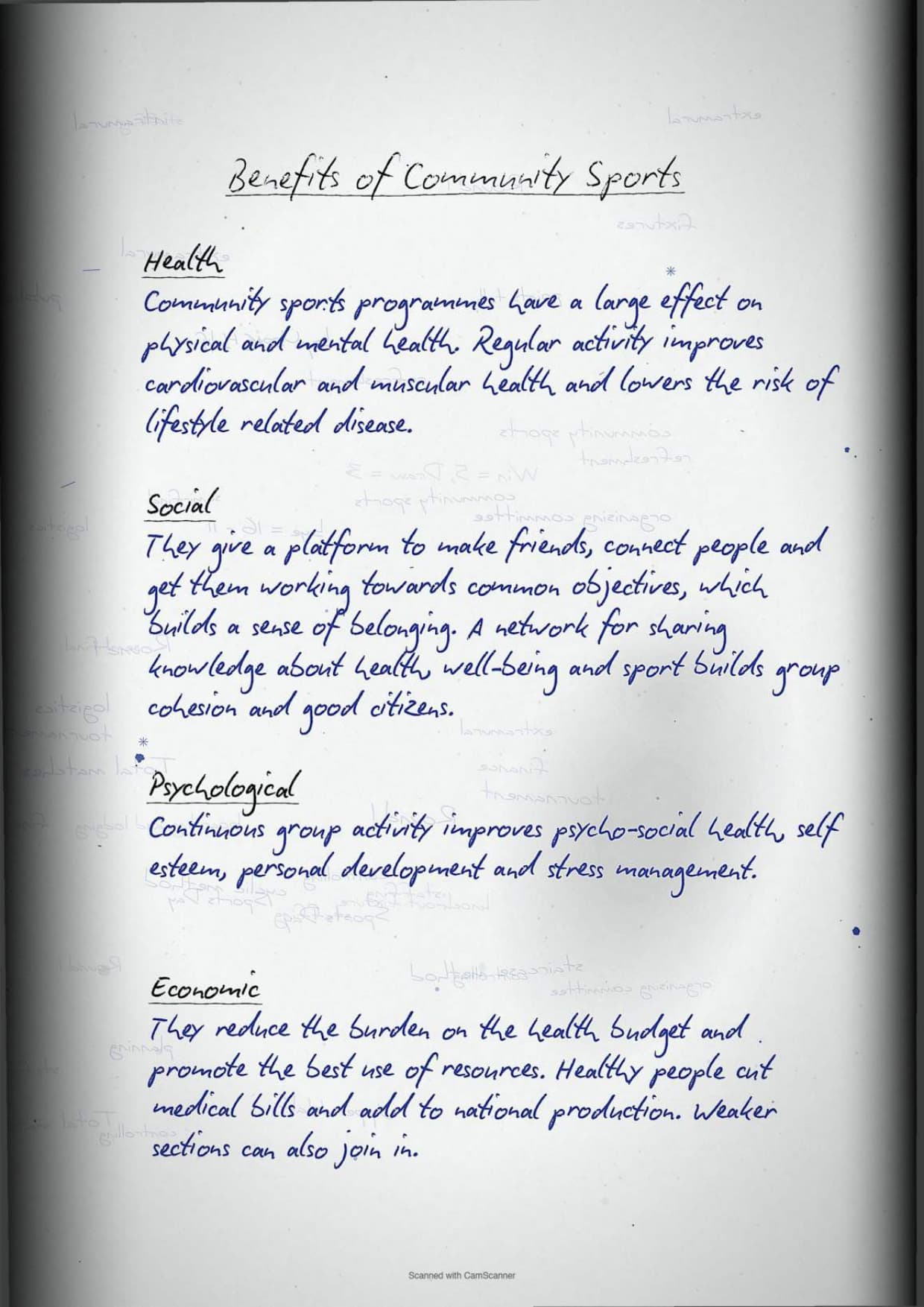
- Health: regular activity improves heart and muscle health and lowers the risk of lifestyle related disease.
- Social: a platform to make friends, build a sense of belonging and share knowledge about health and wellbeing.
- Psychological: better self-esteem, personal development and stress management through continuous group activity.
- Economic: lower medical bills, less burden on the health budget, and better use of a community's resources.
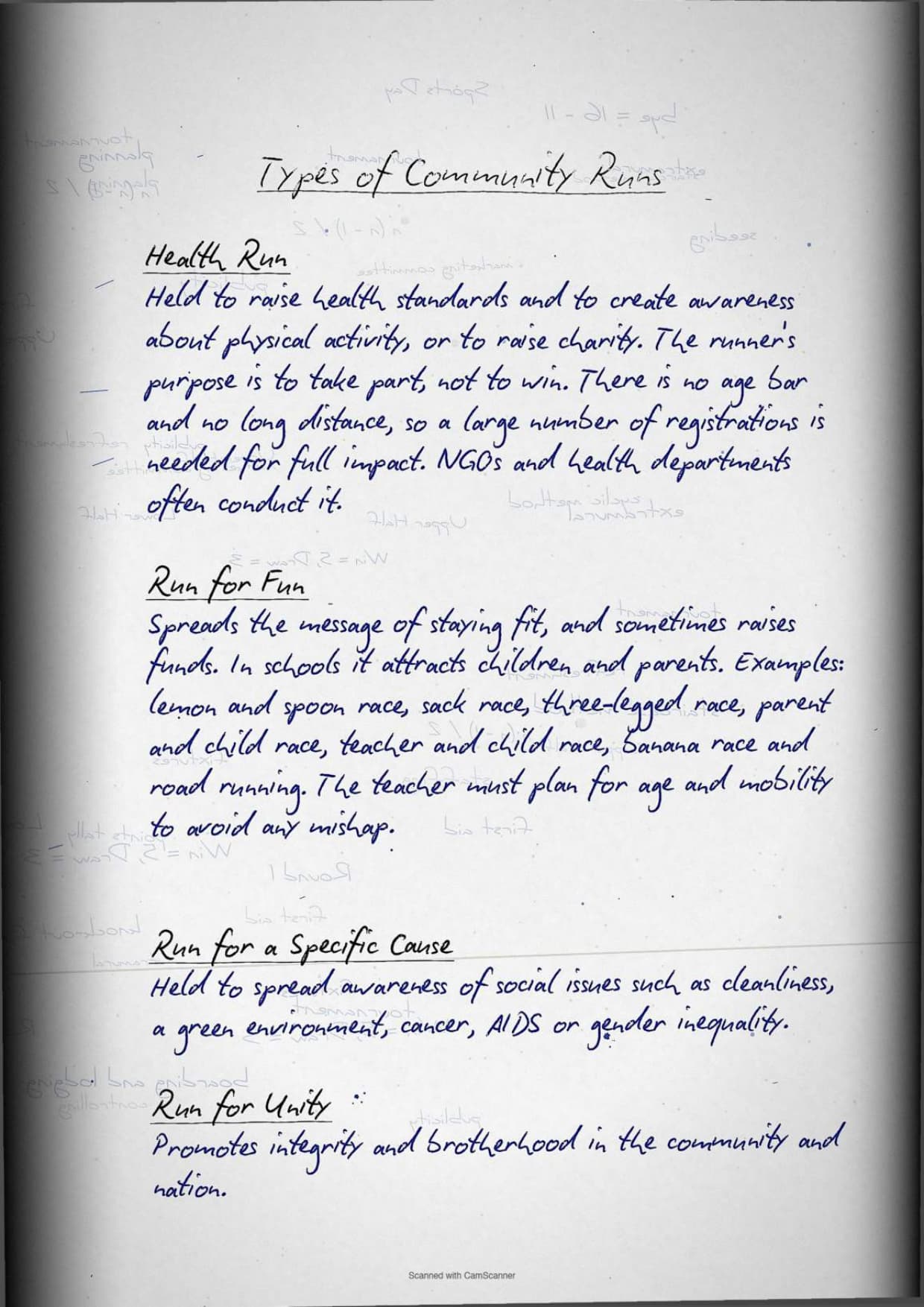
Community events do not need professional officials. Parents, experienced players and community volunteers can run them, and the events are often not officiated by the rule book at all. The chapter names six event types you can be asked to design.
| Event | Purpose |
|---|---|
| Sports Day | Show the abilities of children and youth while bringing community members together to meet and interact |
| Health Run | Raise health standards and awareness, or collect charity. The aim is participation, not winning, and there is no age bar |
| Run for Fun | Spread the message of staying fit through friendly races such as lemon and spoon, sack race, three-legged race and parent and child race |
| Run for a Specific Cause | Build awareness of a social issue such as cleanliness, a green environment, cancer, AIDS or gender inequality |
| Run for Unity | Promote integrity and brotherhood across a community, state, nation or between religions |
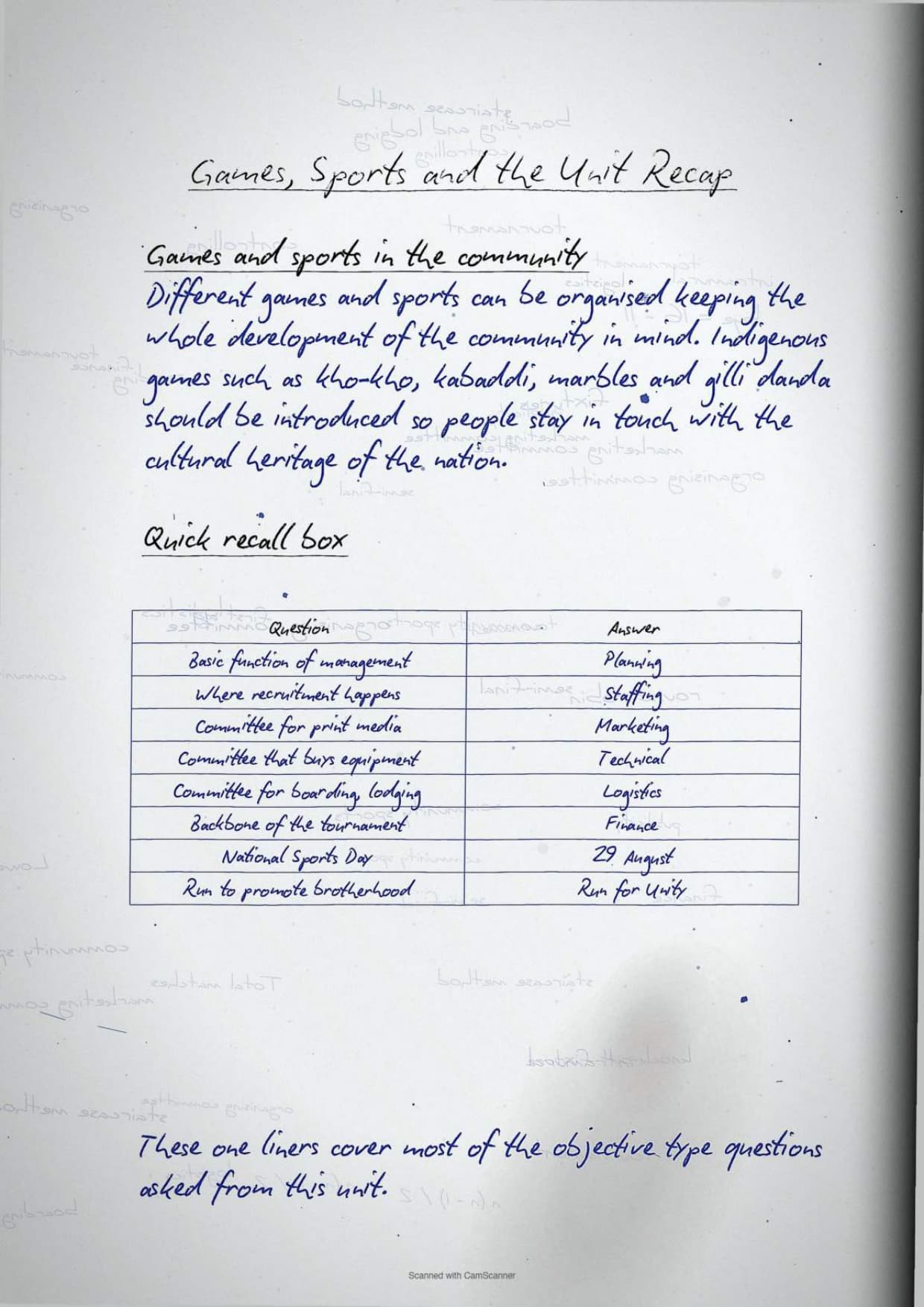
| Games and Sports | Indigenous games such as kho-kho, kabaddi, marbles and gilli danda, to keep people close to the cultural heritage of the nation |
Two dates from this section come up again and again. National Sports Day is 29 August, the birth anniversary of the hockey legend Major Dhyan Chand, and the Fit India Movement was launched on 29 August 2019 by Prime Minister Narendra Modi to keep people active and away from lifestyle diseases.
Common Mistakes Students Make in the Management of Sporting Events Chapter
Six traps that cost easy marks in this chapter:
- Listing eight or more committees. The 2026-27 chapter groups the work under four: Technical, Logistics, Finance and Marketing. Transport, refreshment, decoration, reception, first aid, publicity and ground and equipment are sub-areas, not separate committees.
- Naming the wrong league methods. The two methods taught here are Cyclic and Staircase. Any other pair of names loses the mark.
- Using football points. The chapter fixes Win at 5, Draw at 3 and Loss at 0.
- Getting the bye split backwards. For an odd number of byes, the smaller share goes to the upper half and the larger share to the lower half.
- Forgetting the bye order. The first bye always goes to the last team of the lower half, never to the first team of the upper half.
- Mixing up requisition and purchase. The Technical Committee requisitions equipment, the Finance Committee buys it.
Write these six out from memory once before the exam. Students who did this reported that the fixture question stopped being the section they left for last.
Quick Recall Sheet for Management of Sporting Events
| Term or formula | One-line meaning |
|---|---|
| Five functions | Planning, organising, staffing, directing, controlling |
| Three levels | Top frames policy, middle executes it, lower implements orders |
| Four committees | Technical, Logistics, Finance, Marketing |
| Fixture | The programme showing which team plays whom, where and when |
| Bye | A team advances without playing the primary round, allotted by lottery |
| Seeding | Strong teams placed apart so they do not meet in the early rounds |
| Knock-out matches | Number of teams minus 1 |
| League matches | n (n minus 1) divided by 2 |
| League rounds | Teams minus 1 when even, equal to the number of teams when odd |
| Points | Win 5, Draw 3, Loss 0 |
| Intramural | Within the walls of one institution |
| Extramural | Outside the walls, between institutions |
| Community sports | Society-based, low-threshold activity open to every age group |
The notebook also carries a short mnemonic for the five functions: P-O-S-D-C, standing for Planning, Organising, Staffing, Directing and Controlling.
What the Management of Sporting Events Handwritten Notes PDF Contains
The file is written by hand in the chapter's own order, with each formula boxed and each chart drawn on the page where the topic is explained.
- Pages 1 to 10: the five functions of management, the three levels, and both organising committee hierarchy charts.
- Pages 11 to 20: the four committees with their pre, during and post event duties, plus the full 23-point checklist.
- Pages 21 to 32: tournament types, bye and seeding, and the six-step knock-out procedure with worked brackets.
- Pages 33 to 40: league fixtures by cyclic and staircase method, the points tally, and the League-Knockout combination grid.
- Pages 41 to 47: intramural and extramural events with objectives and significance, and community sports with all six event types.
Textbook Exercise Questions and How These Notes Answer Them
The chapter closes with exercises spread across its five sections. The table below shows where the answer material sits in these notes.
| Exercise question | Where the answer is built |
|---|---|
| Elaborate the functions of sports event management | The five-function list with the Director to Deputy Director to Assistant Director staffing example |
| Role of the technical committee while organising the event | The pre, during and post duty table, technical row |
| Role of the marketing committee during the event | The same table, marketing row, during-event column |
| Differentiate between knockout and league tournament | The three-format comparison table with merits and demerits |
| Draw a knockout fixture of 13 teams | The six-step procedure, applied the same way as the 11-team illustration |
| Objectives and significance of intramural and extramural tournaments | The intramural against extramural comparison table |
| Write briefly about any two types of run | The community sports event table, run rows |
| Case study on a 25-team knockout invitation tournament | The worked bye example: 24 matches, 7 byes, 9 first-round matches, 5 rounds |
How to Use These Handwritten Notes Most Effectively
This unit rewards drawing more than reading, so split it into short blocks with a pen in hand. Students who worked through it this way reported finishing the whole unit in about three and a half hours.
- Block 1, 35 minutes. The five functions, the three levels, and both hierarchy charts, drawn out once from memory.
- Block 2, 40 minutes. The four committees and the pre, during and post duty table, then the 23-point checklist read twice.
- Block 3, 50 minutes. Tournament types, bye and seeding, and one full knock-out bracket drawn for 11 teams and one for 13.
- Block 4, 40 minutes. League fixtures by both methods, the points tally recalculated by hand, and the League-Knockout grid.
- Block 5, 30 minutes. Intramural against extramural, and community sports with the two August dates.
- Night before, 15 minutes. Quick recall sheet and the six common mistakes, nothing else.
How These Handwritten Notes Pair with Other Class 12 Physical Education Resources
Also Check: fixtures are introduced a year earlier in the Class 11 course, so if the bye formula still feels shaky, the Class 11 tournaments chapter is the right place to go back to.
| Resource | Best used for | Open it |
|---|---|---|
| Notes | Typed revision notes with the four committees and every fixture formula set out in full | Management of Sporting Events Class 12 Notes (coming soon) |
| Solutions | Written answers to the tick-the-option, brief-answer and 150 to 200 word questions | Management of Sporting Events Class 12 Solutions (coming soon) |
| Book PDF | The official chapter text with the 23-point checklist and the sample points tally | Management of Sporting Events Class 12 Book PDF (coming soon) |
| Class 11 Handwritten Notes | The Class 11 chapter that first introduces knock-out and league fixtures | Tournaments and Competitions Class 11 Handwritten Notes |
| Class 11 Handwritten Notes | Groundwork on records and score sheets that the technical committee maintains | Measurement and Evaluation Class 11 Handwritten Notes |
| Next Chapter Handwritten Notes | The chapter that follows this one in the Class 12 syllabus | Children and Women in Sports Class 12 Handwritten Notes (coming soon) |
NCERT Handwritten Notes for Class 12 Physical Education: All Chapters
Related Links: handwritten revision notes for the full Class 12 Physical Education course, written to the 2026-27 syllabus.
| Chapter | Class 12 Physical Education Handwritten Notes |
|---|---|
| Chapter 1 | Management of Sporting Events Class 12 Handwritten Notes (this page) |
| Chapter 2 | Children and Women in Sports Class 12 Handwritten Notes (coming soon) |
| Chapter 3 | Yoga as Preventive Measure for Lifestyle Disease Class 12 Handwritten Notes (coming soon) |
| Chapter 4 | Physical Education & Sports for CWSN Class 12 Handwritten Notes (coming soon) |
| Chapter 5 | Sports & Nutrition Class 12 Handwritten Notes (coming soon) |
| Chapter 6 | Test and Measurement in Sports Class 12 Handwritten Notes (coming soon) |
| Chapter 7 | Physiology and Injuries in Sports Class 12 Handwritten Notes (coming soon) |
| Chapter 8 | Biomechanics & Sports Class 12 Handwritten Notes (coming soon) |
| Chapter 9 | Psychology and Sports Class 12 Handwritten Notes (coming soon) |
| Chapter 10 | Training in Sports Class 12 Handwritten Notes (coming soon) |
Management of Sporting Events Class 12 Handwritten Notes FAQs
Questions Students Ask Before Downloading These Notes
Ques. What are the five functions of sports event management?
Ans. Planning, organising, staffing, directing and controlling. Planning is the foremost function and must be specific, logical, flexible and complete. Organising executes the plan by distributing resources, staffing recruits and trains the right people, directing tells staff what to do and by when, and controlling sets performance standards and measures actual performance against them.
Ques. How many committees are formed to organise a sports event?
Ans. There is no fixed number, because it depends on the number of participants, the level of the event, the area of specialisation and the number of volunteers. The chapter groups the work under four committees: Technical, Logistics, Finance and Marketing. Transport, boarding, refreshment, decoration, reception, first aid, publicity and ground and equipment work all sit as sub-areas under these four.
Ques. What is a bye in a knock-out tournament?
Ans. A bye means a team does not have to play in the primary round because of the way the draw fell, and it moves straight to the next round. It is given through a random lottery system. Byes are used when the entry count is not a power of two, when previous winners need to be pooled separately, and to stop one team playing more matches in a day than another.
Ques. How do you calculate the number of byes in a knockout fixture?
Ans. Subtract the number of participating teams from the next power of two. For 12 teams the next power of two is 16, so there are 4 byes, split 2 in the upper half and 2 in the lower half. For 19 teams the next power is 32, giving 13 byes: 6 in the upper half using (13 minus 1) divided by 2, and 7 in the lower half using (13 + 1) divided by 2.
Ques. What are the cyclic and staircase methods in a league tournament?
Ans. In the cyclic method one team stays fixed in position and the others rotate around it until the cycle is complete. With an even number of teams no bye is needed and the rounds equal teams minus one, so 6 teams give 5 rounds. With an odd number one team takes a bye each round, so 7 teams give 7 rounds. In the staircase method the first team is fixed on the highest step and plays everyone, then the next team down plays the remaining teams, and so on, so no bye is ever needed.
Ques. How are points awarded in a league or round robin tournament?
Ans. A win is worth 5 points, a draw 3 points and a loss 0 points. The team with the highest total is ranked first. Rules covering a tie are framed by the tournament organisers before the tournament begins, not after the standings are drawn up.
Ques. How many matches are played in a league tournament of 6 teams?
Ans. Fifteen. Use the formula n (n minus 1) divided by 2, where n is the number of teams. For 6 teams that is 6 multiplied by 5, divided by 2, which gives 15. For 7 teams the same formula gives 21 matches, and for 8 teams it gives 28.
Ques. What is the difference between intramural and extramural tournaments?
Ans. Intramural means within the walls, so the competition is held between houses, classes or hostels of a single institution. Extramural means outside the boundary or walls, so the competition is held between two or more different schools, colleges or institutions at zonal, inter-district, state, national or international level. Intramural events aim at mass participation and all-round development, while extramural events aim at high performance and integration with other institutions.
Ques. What is seeding and how is it different from a bye?
Ans. Seeding places strong teams, ranked on their record or last year's position, so that they do not meet each other in the early rounds. Its aim is to stop a good team going out at the start. A bye simply lets a team skip the primary round because of the draw. The procedure for allotting seeds is the same as the procedure for allotting byes.
Ques. What are community sports and what benefits do they bring?
Ans. Community sports is a society-based practice of connecting people with chances to take part in sport, exercise and fitness activity. It is often called a low-threshold activity because it is open to school children, adults, elders and socially vulnerable groups. The four benefits are health, social, psychological and economic. Events include Sports Day, health runs, runs for fun, runs for a specific cause, runs for unity, and indigenous games such as kho-kho and kabaddi.
Ques. When is National Sports Day celebrated in India?
Ans. On 29 August, the birth anniversary of the hockey legend Major Dhyan Chand. The Fit India Movement was launched on the same date in 2019 by Prime Minister Narendra Modi, to promote physical activity and sport among the public and keep people away from lifestyle diseases.
Ques. Where can I download the Class 12 Physical Education Chapter 1 handwritten notes PDF?
Ans. Use the download option at the top of this page. The file is free and printable, runs to 47 handwritten pages, and follows the 2026-27 chapter order, so it can sit beside the textbook while you revise.



Comments