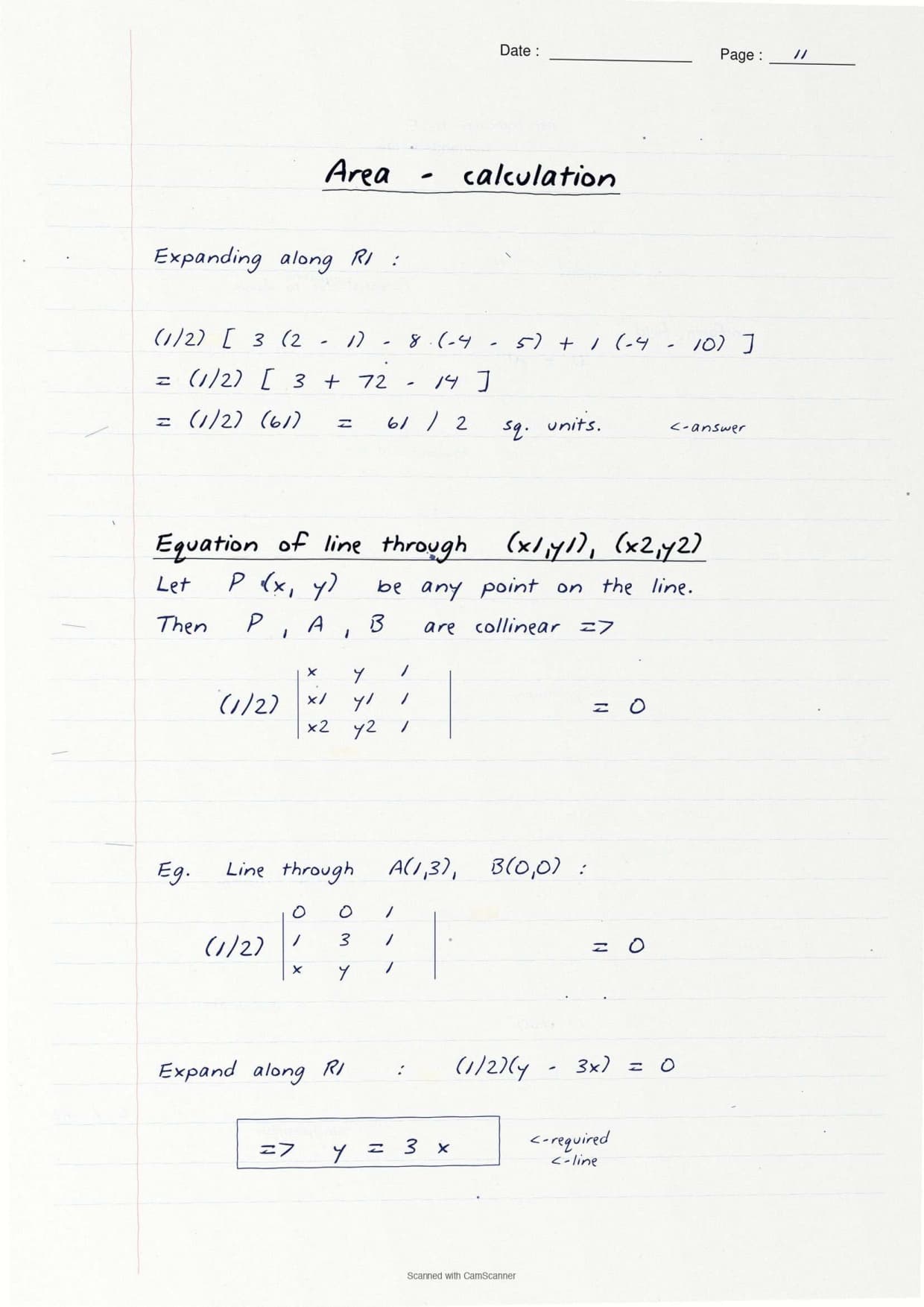
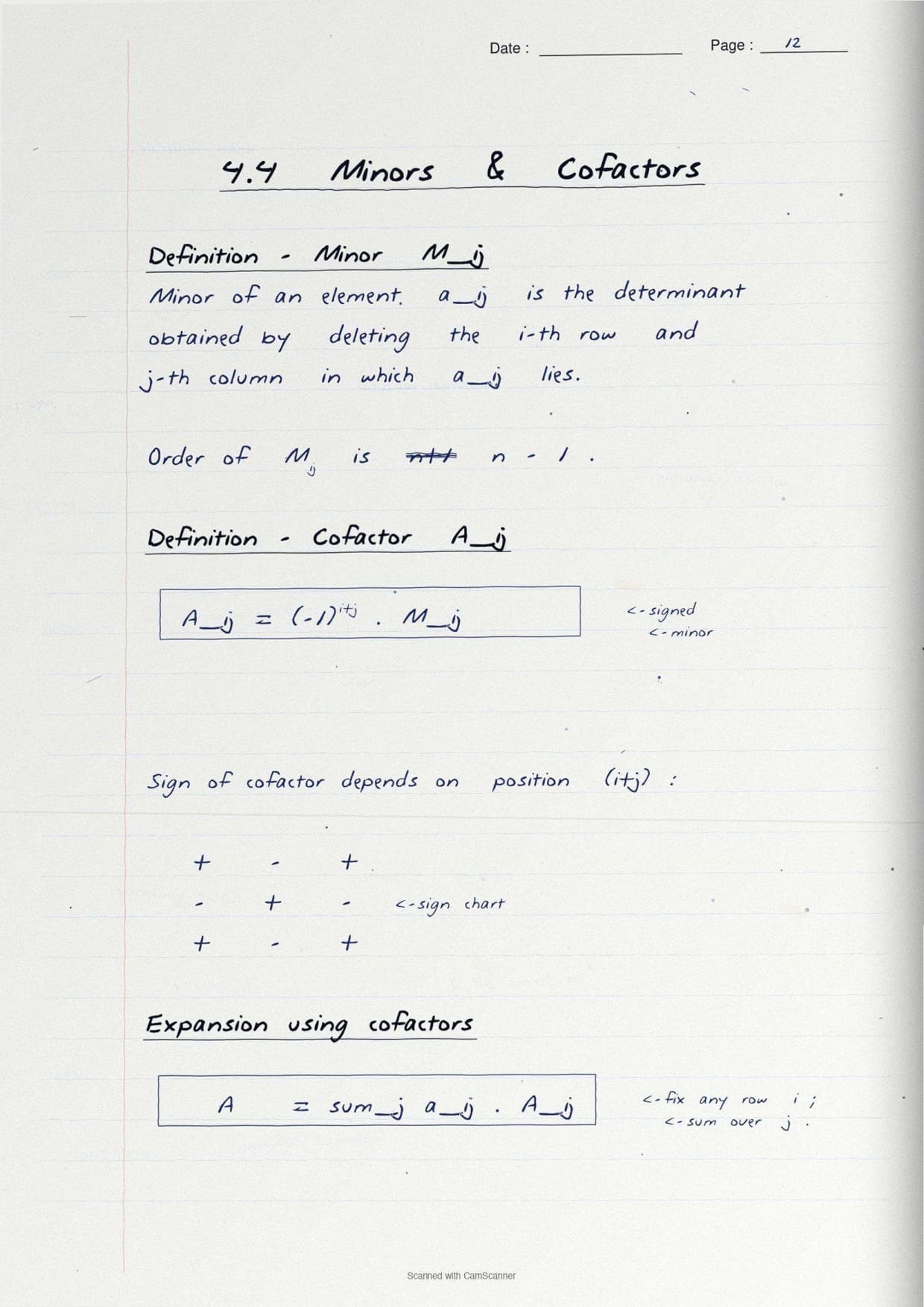
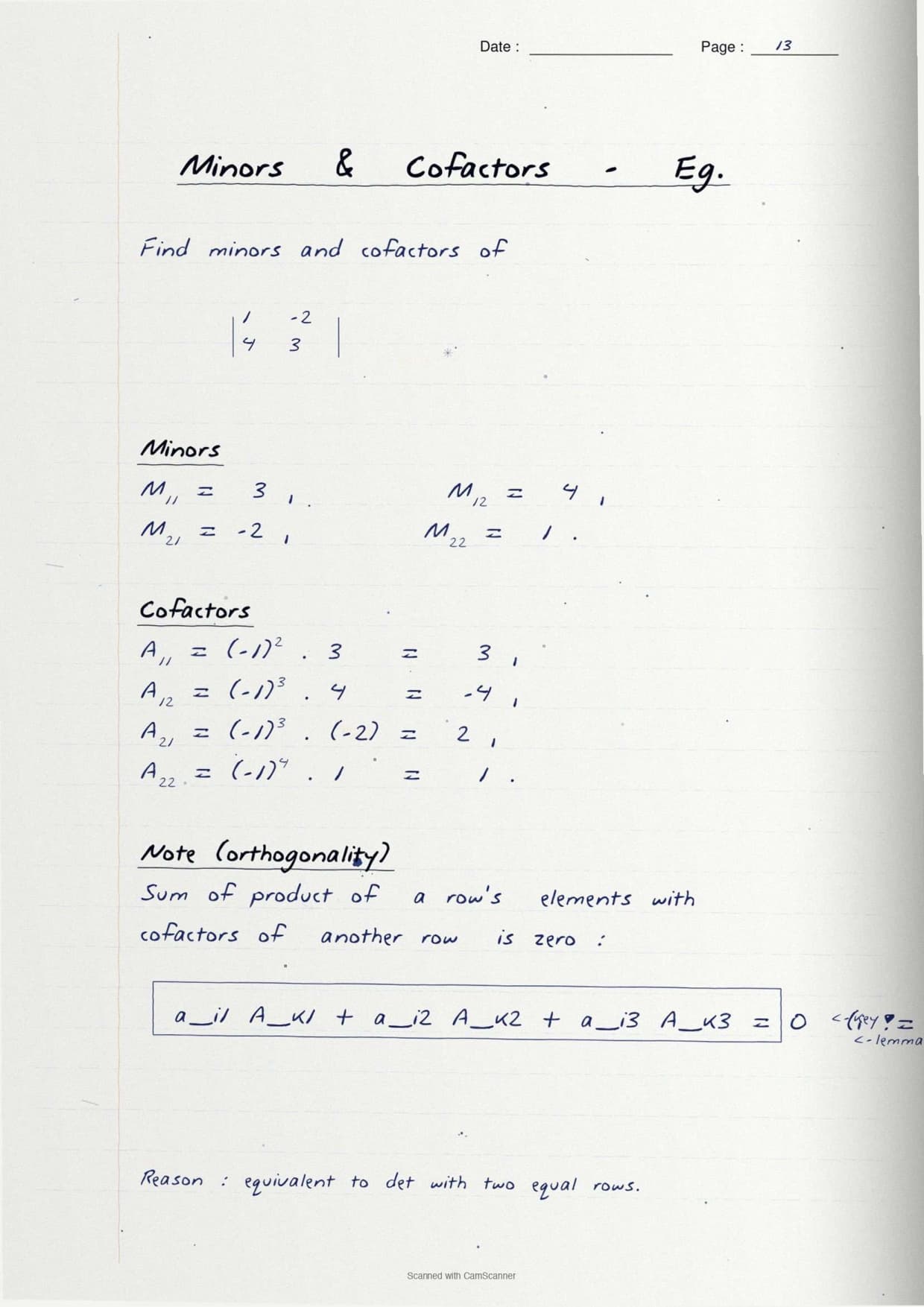
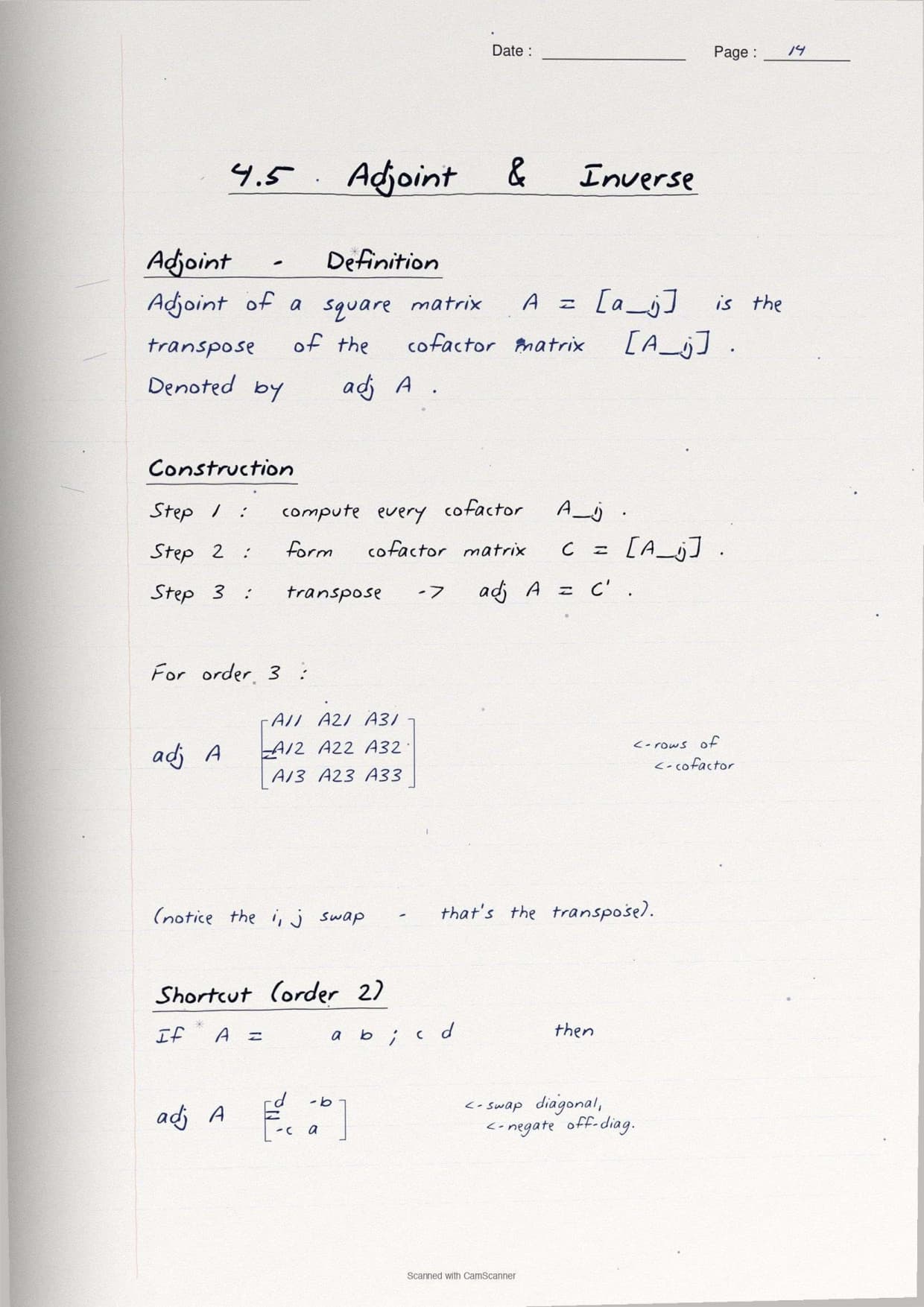
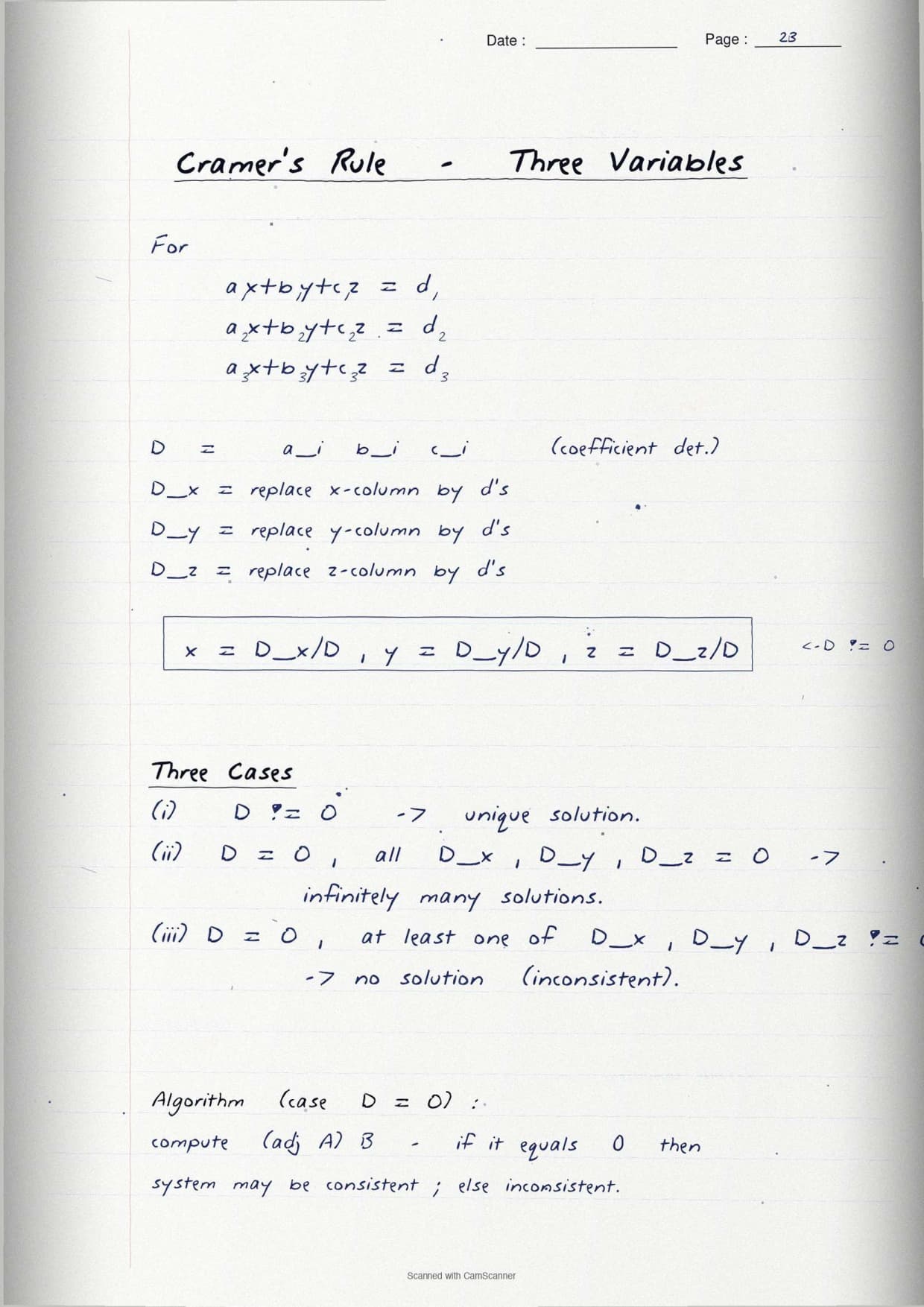
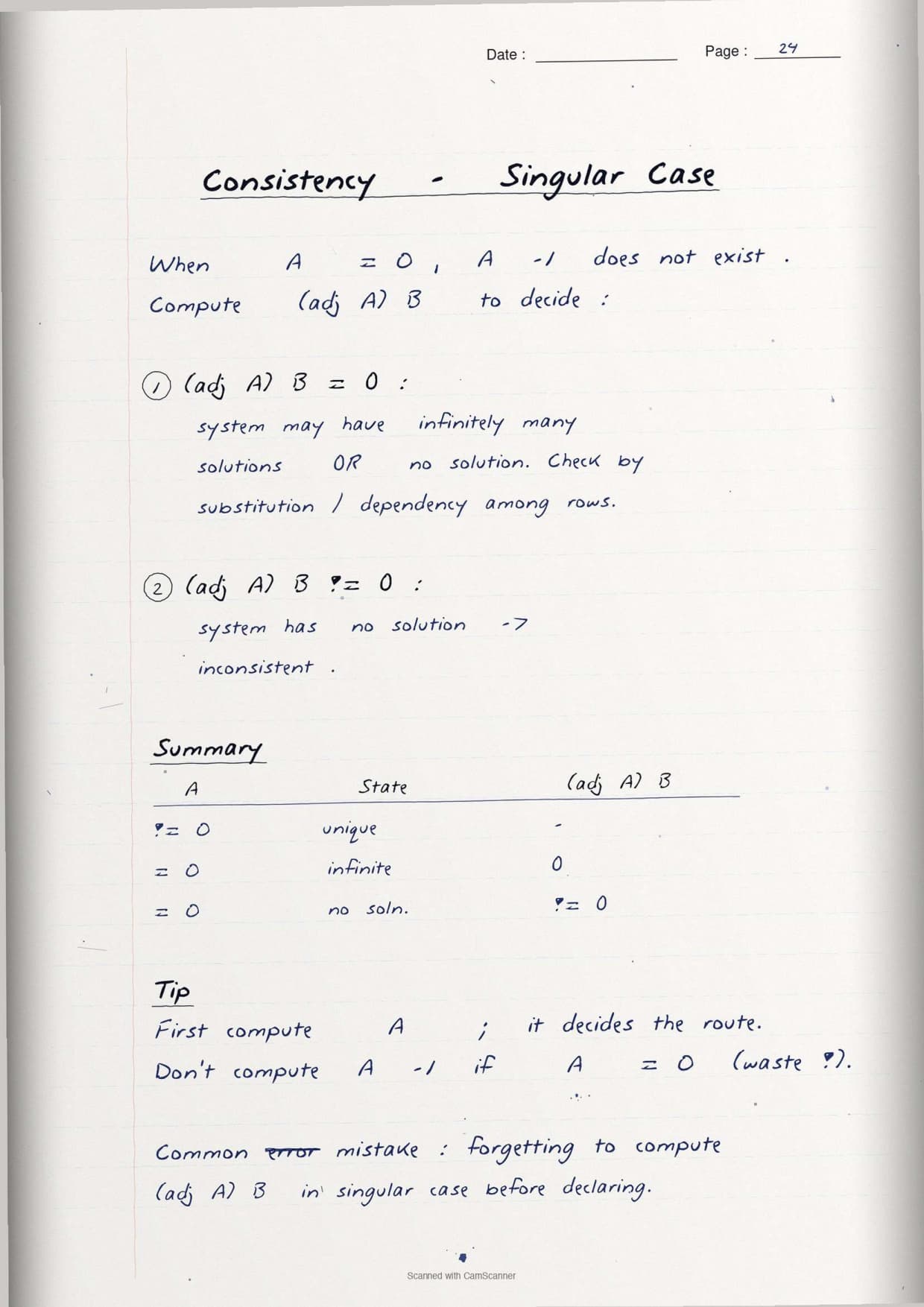
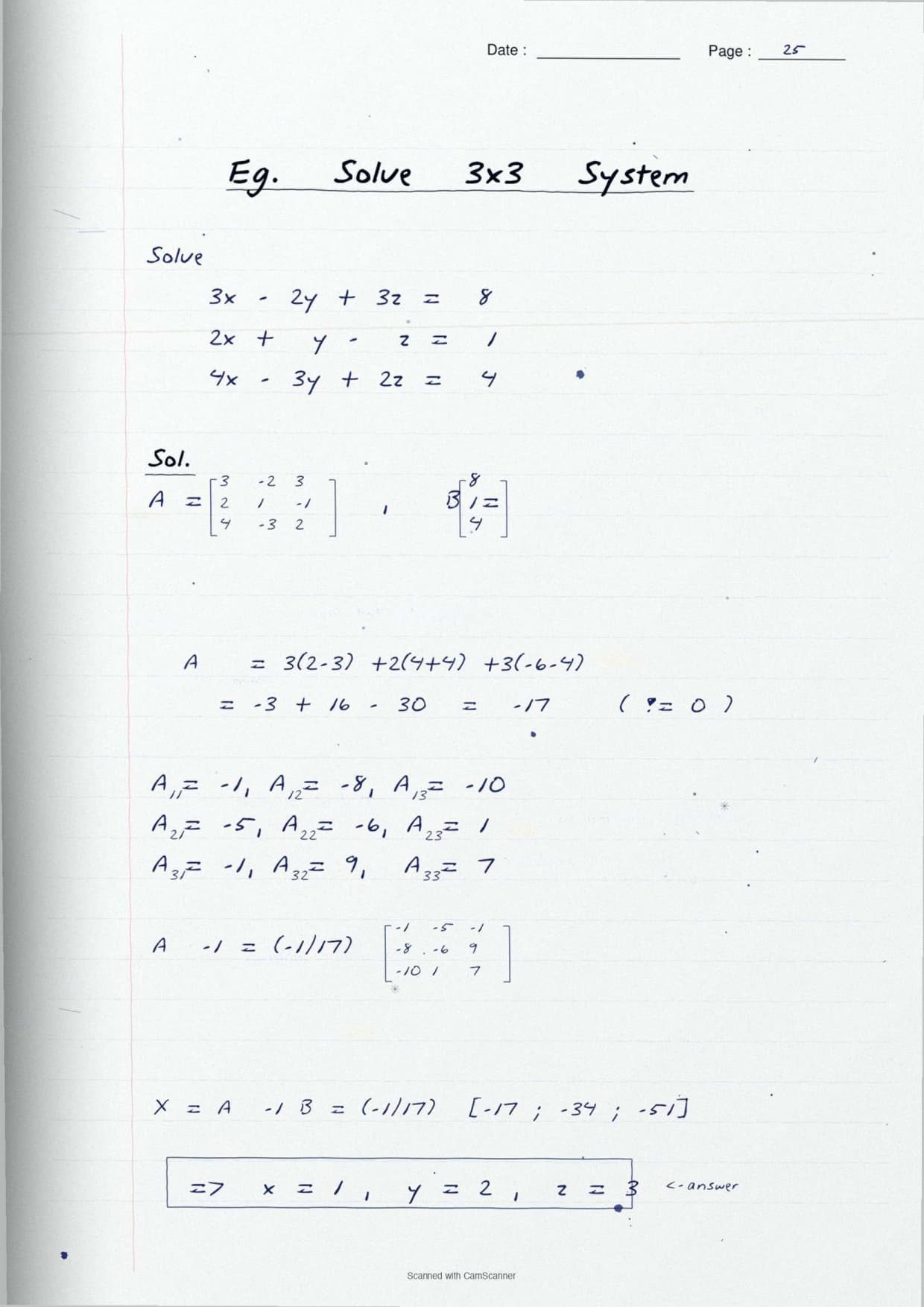
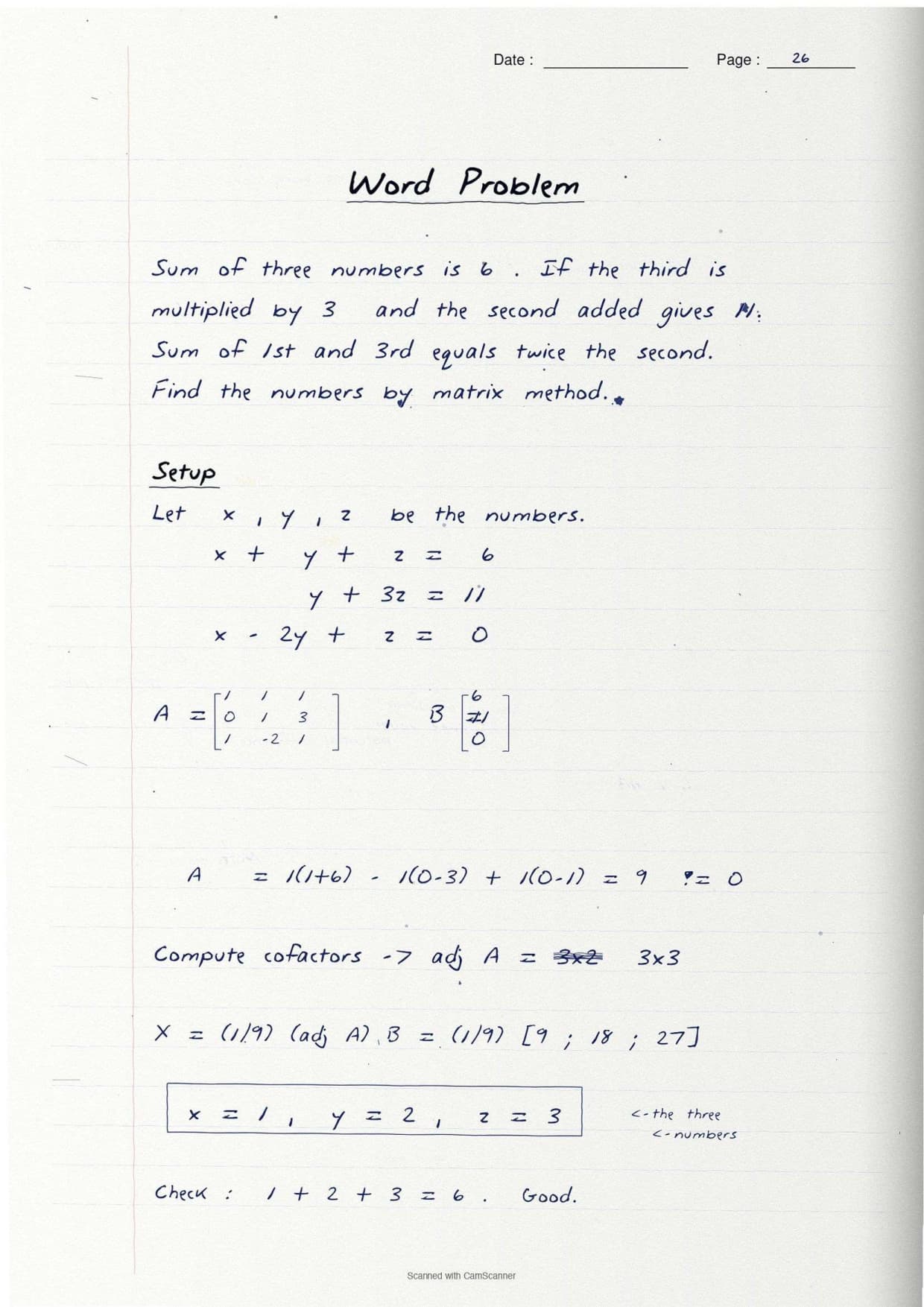
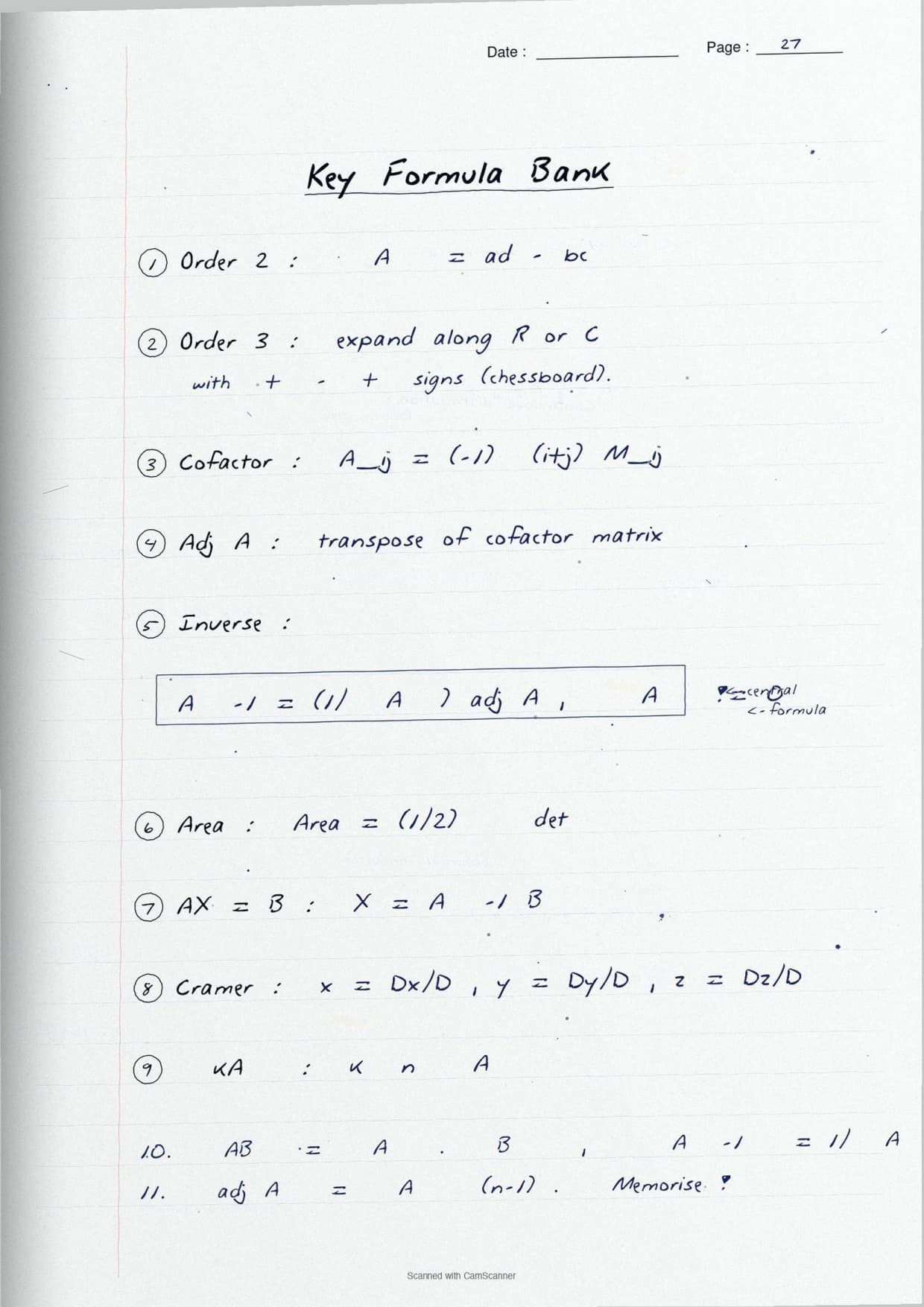
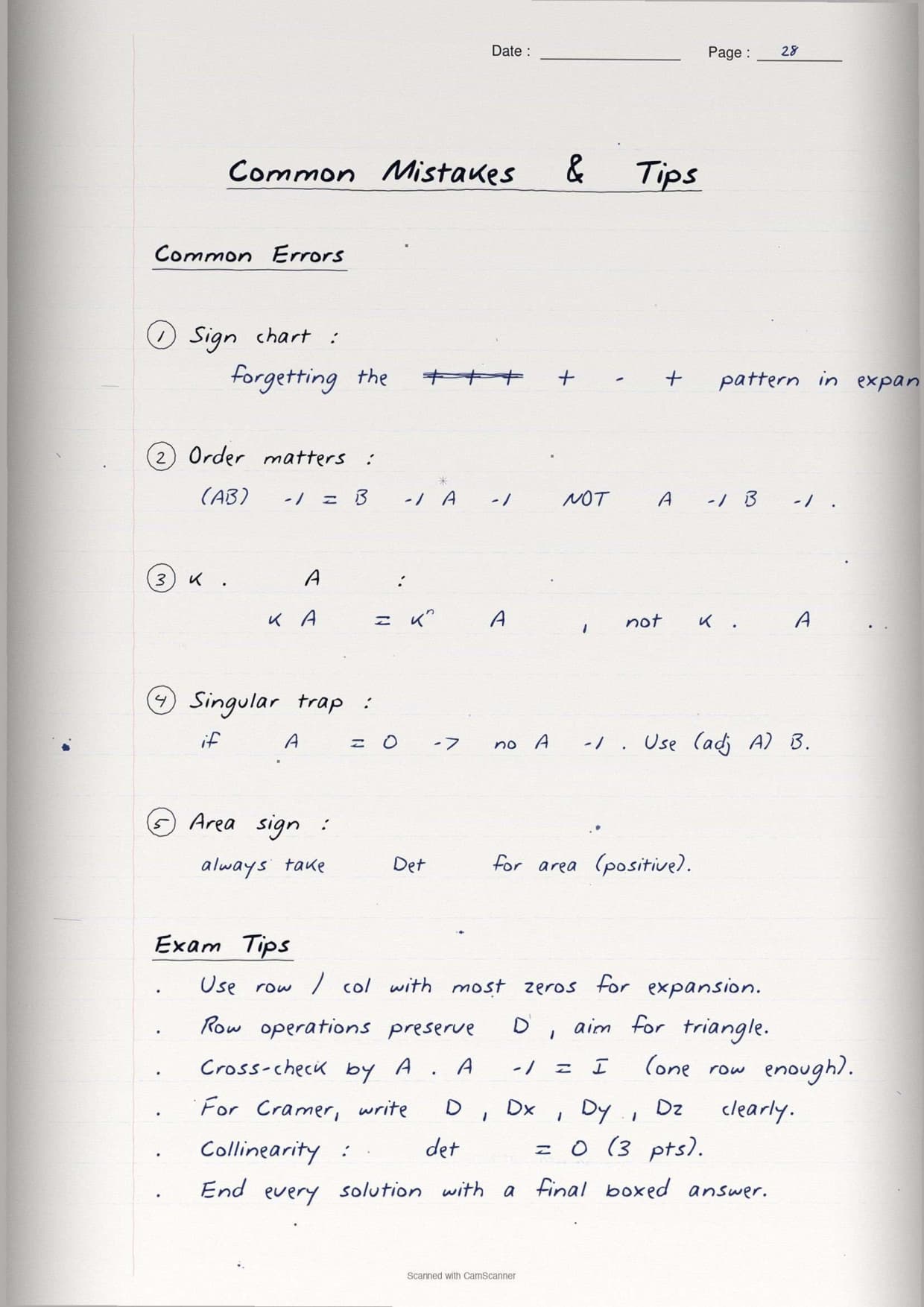
Download the Class 12 Maths Handwritten Notes PDF below as a free PDF reference for Class 12 Mathematics Chapter 4 Determinants. The Class 12 Maths Handwritten Notes PDF match the NCERT chapter section by section and present every formula in a boxed display for fast recall. The notebook is sized for both phone and A4 print.
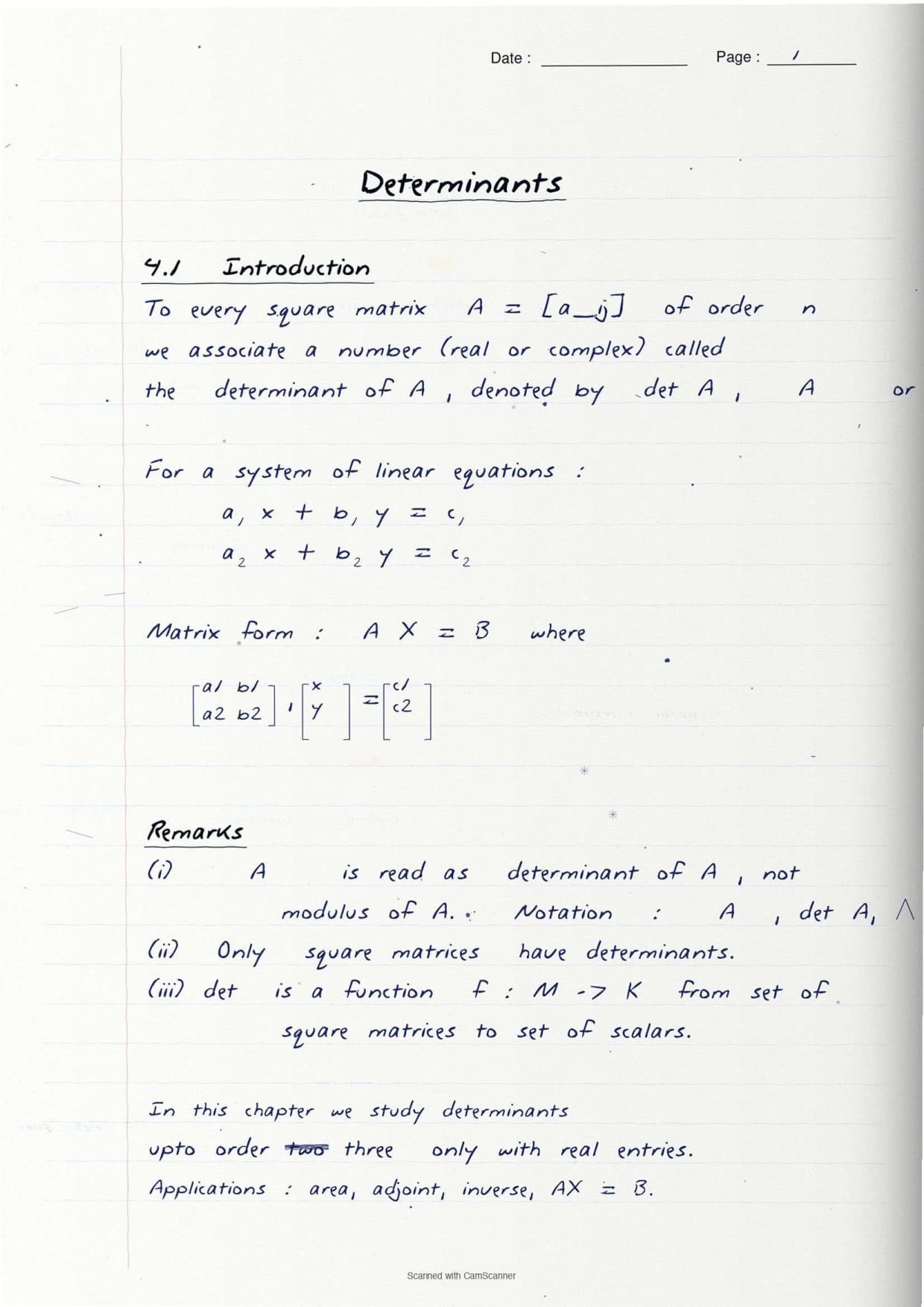
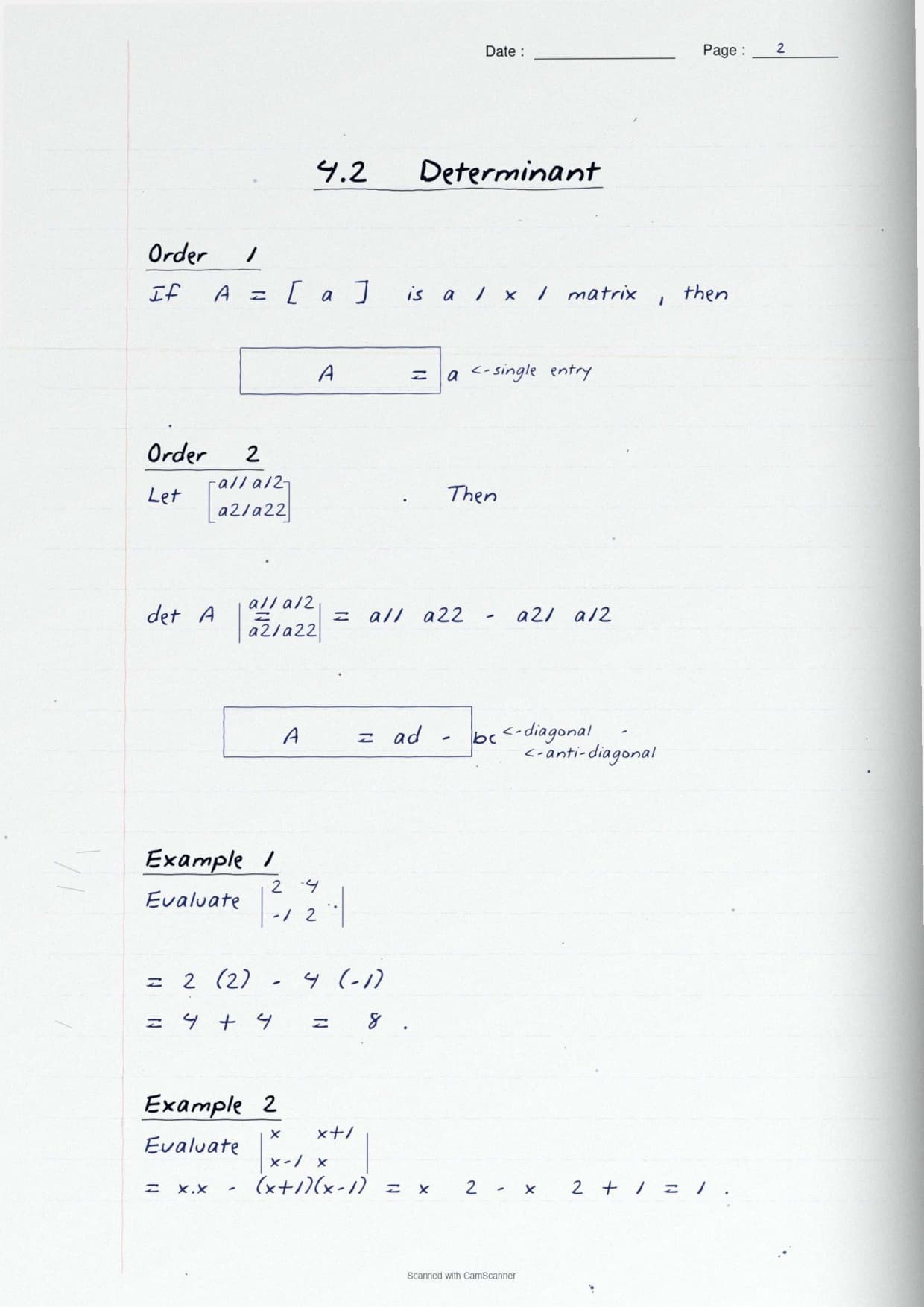
  • CBSE Weightage: 5 to 7 marks (Determinants + Matrices together carry 10 to 12 marks of the Algebra unit; expect one 3-marker on properties or area and one 5-marker on Cramer's rule / system of equations)
  • JEE Main Weightage: 6 to 8% (2 to 3 questions per shift on property-based simplification, adjoint / inverse, and consistency of linear systems)
  • JEE Main Weightage: Not in JEE Main syllabus (Maths-only chapter; high weight for JEE Main, JEE Advanced, and CUET Mathematics)
Chapter 4 Determinants Handwritten Notes PDF
9 pages · 8 hand-drawn 3 × 3 grids · 12 dashed property boxes · Class 12 Maths Chapter 4, 2026-27 NCERT

The notebook opens with the formal definition and the 2 × 2 / 3 × 3 expansion drawn by hand, locks in the seven property boxes, then covers minors and cofactors, adjoint, inverse, area of triangle, and Cramer's rule, ending with a one-page summary.

These handwritten notes are prepared by Collegedunia subject mentors, mapped to the 2026-27 NCERT print, and cross-checked against the last five years of CBSE Board and JEE Main papers on Determinants.

Also Check:

Determinants Handwritten Notes - Class 12 Maths
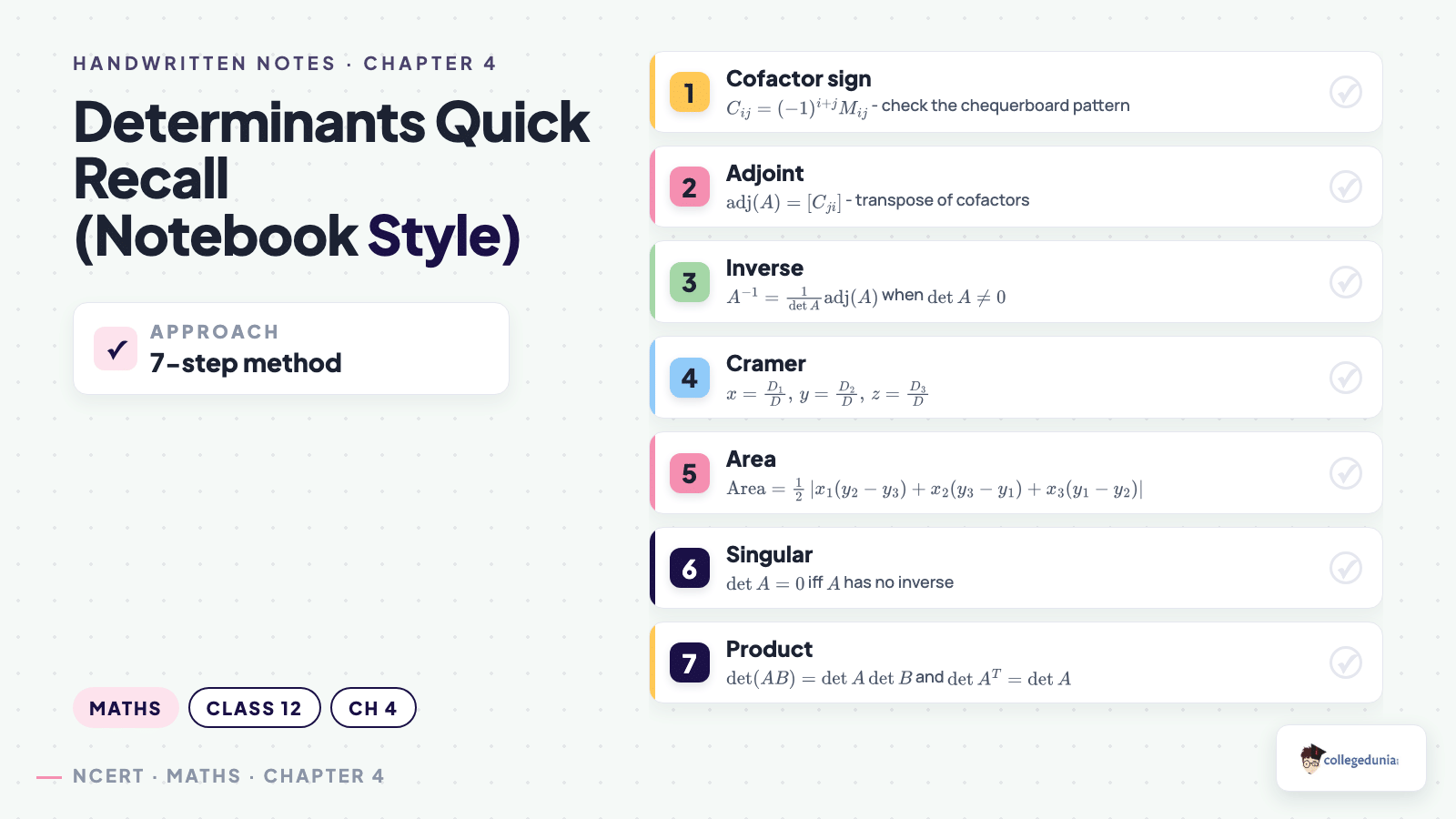
Determinants quick recall notebook style

Why Handwritten Notes Beat Typed Notes for Determinants Revision

The Class 12 Maths Handwritten Notes PDF address this in the same order as the NCERT textbook.

Determinants is a visual-memory chapter. The expansion pattern of a 3 × 3 grid, the sign chessboard for cofactors, and the shape of each property are spatial facts that typed notes flatten into prose.

  • Spatial encoding of the 3 × 3 grid: The row-1 expansion is drawn with curved arrows from each entry to its 2 × 2 minor, so you can redraw the cofactor expansion in under 30 seconds instead of reading nine algebraic terms.
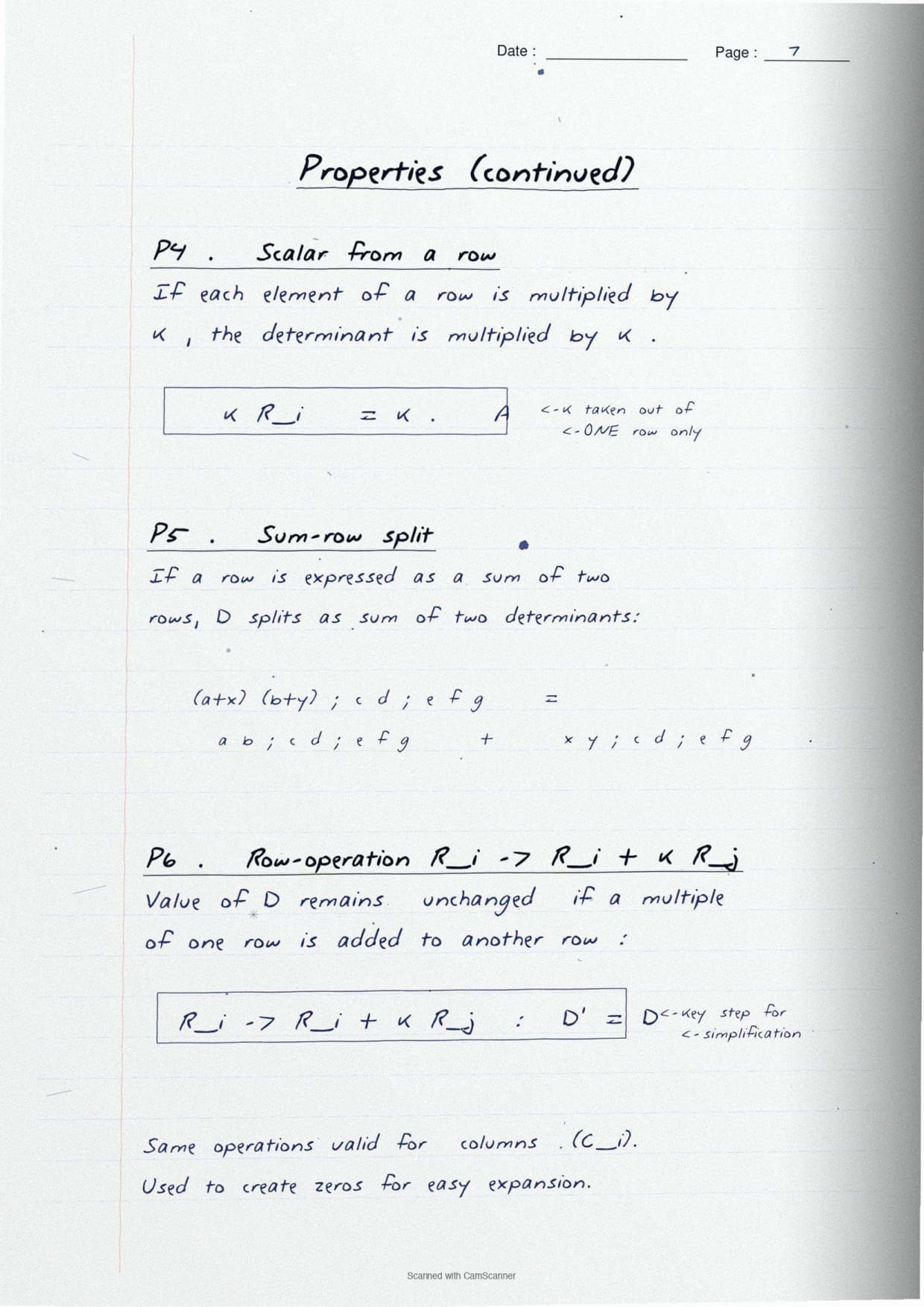
  • Dashed property boxes: Each of the seven determinant properties sits in its own hand-drawn dashed rectangle. The property is the visual unit; CBSE's 5-mark property question targets exactly these seven boxes.
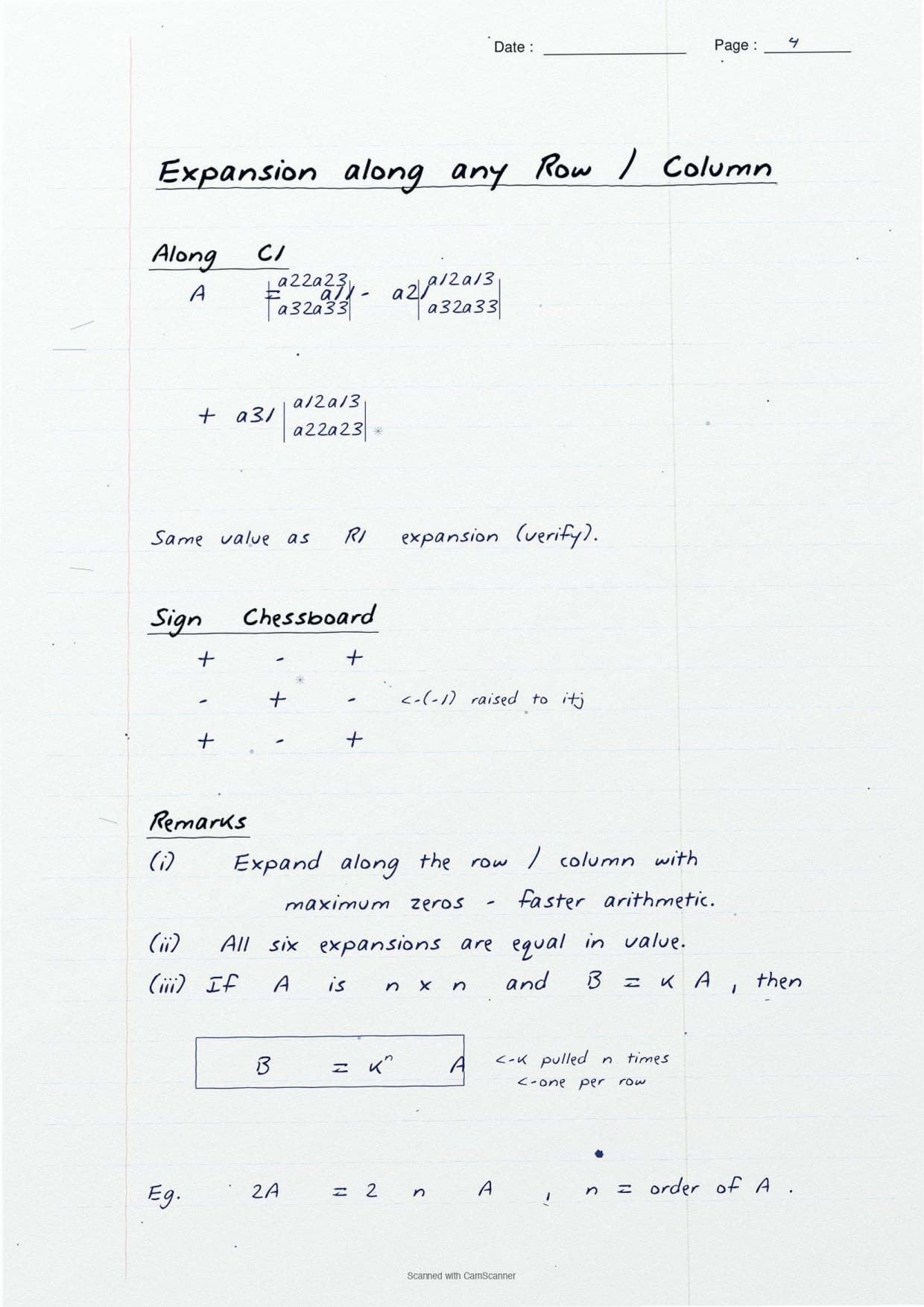
  • Sign chessboard for cofactors: The +/−/+ pattern is shown as a 3 × 3 sign grid you overlay on any matrix, not as the formula Cij = (-1)i+j Mij buried in a paragraph.
  • Single-page summary sheet: The last page consolidates every formula and property in a hand-ruled grid you can photograph the morning of the exam.

Determinants Video Walkthrough

Source: Magnet Brains on YouTube

How the Class 12 Maths Handwritten Notes PDF on the Class 12 Maths Handwritten Notes PDF Help You

The Class 12 Maths Handwritten Notes PDF address this in the same order as the NCERT textbook.

The 9-page notebook is built for two revision modes: a first read where you internalise the geometry of the 3 × 3 expansion, and last-day passes where you only re-skim the dashed boxes and the summary sheet.

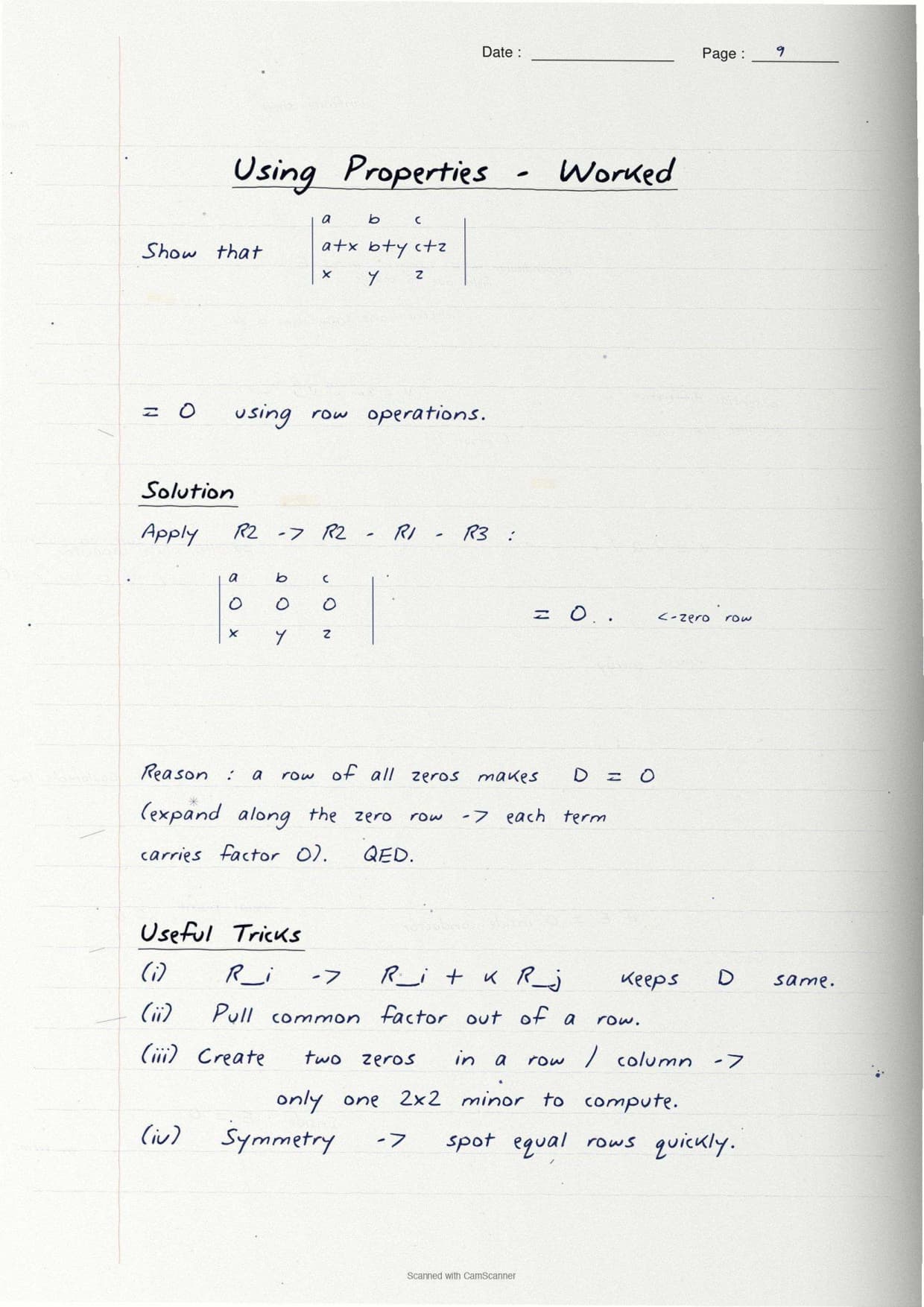
  • Hand-drawn 3 × 3 grids on every property page: Properties are illustrated on a solved grids rather than stated abstractly, so you see what "two equal rows give zero" looks like before reading the algebra.
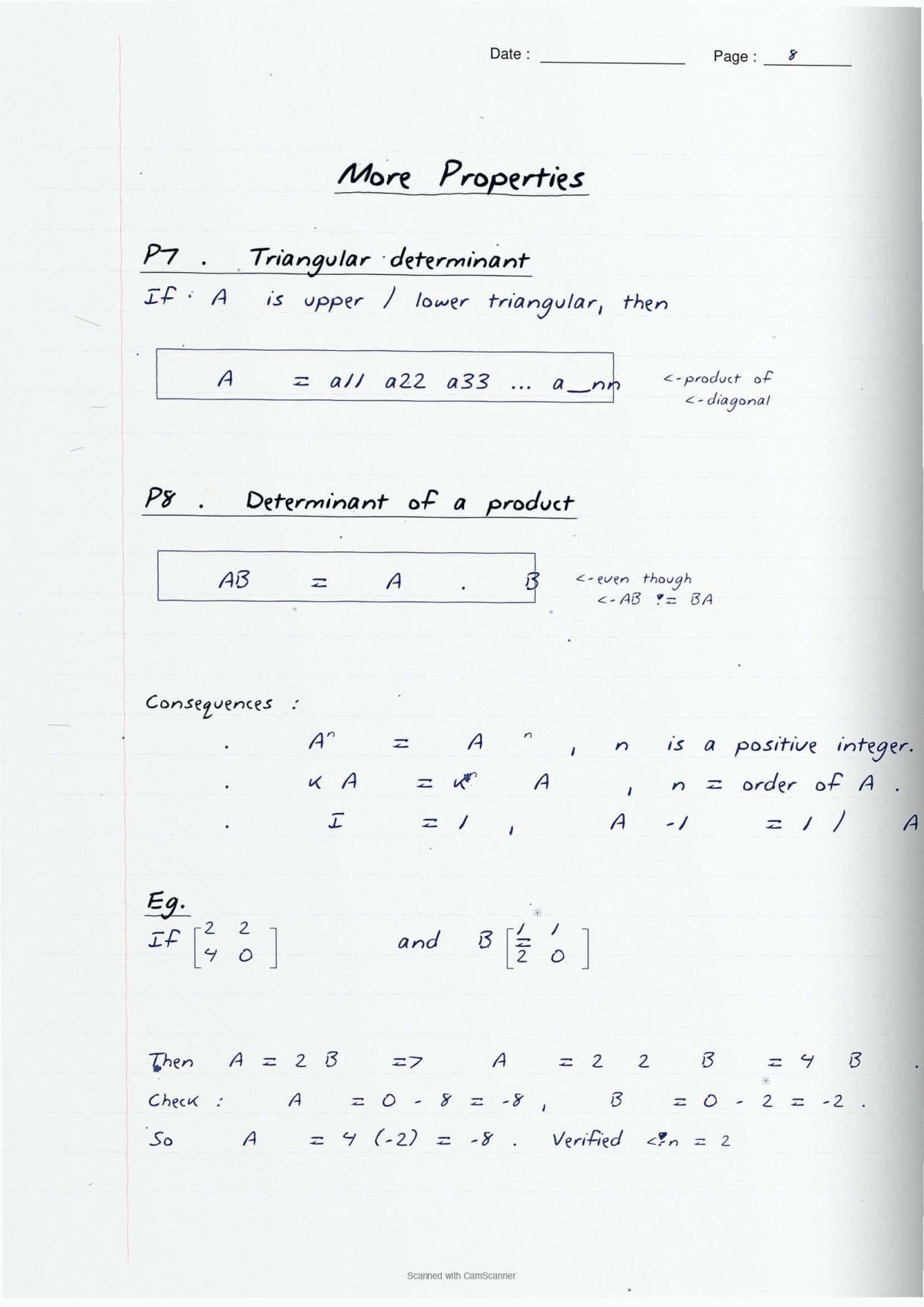
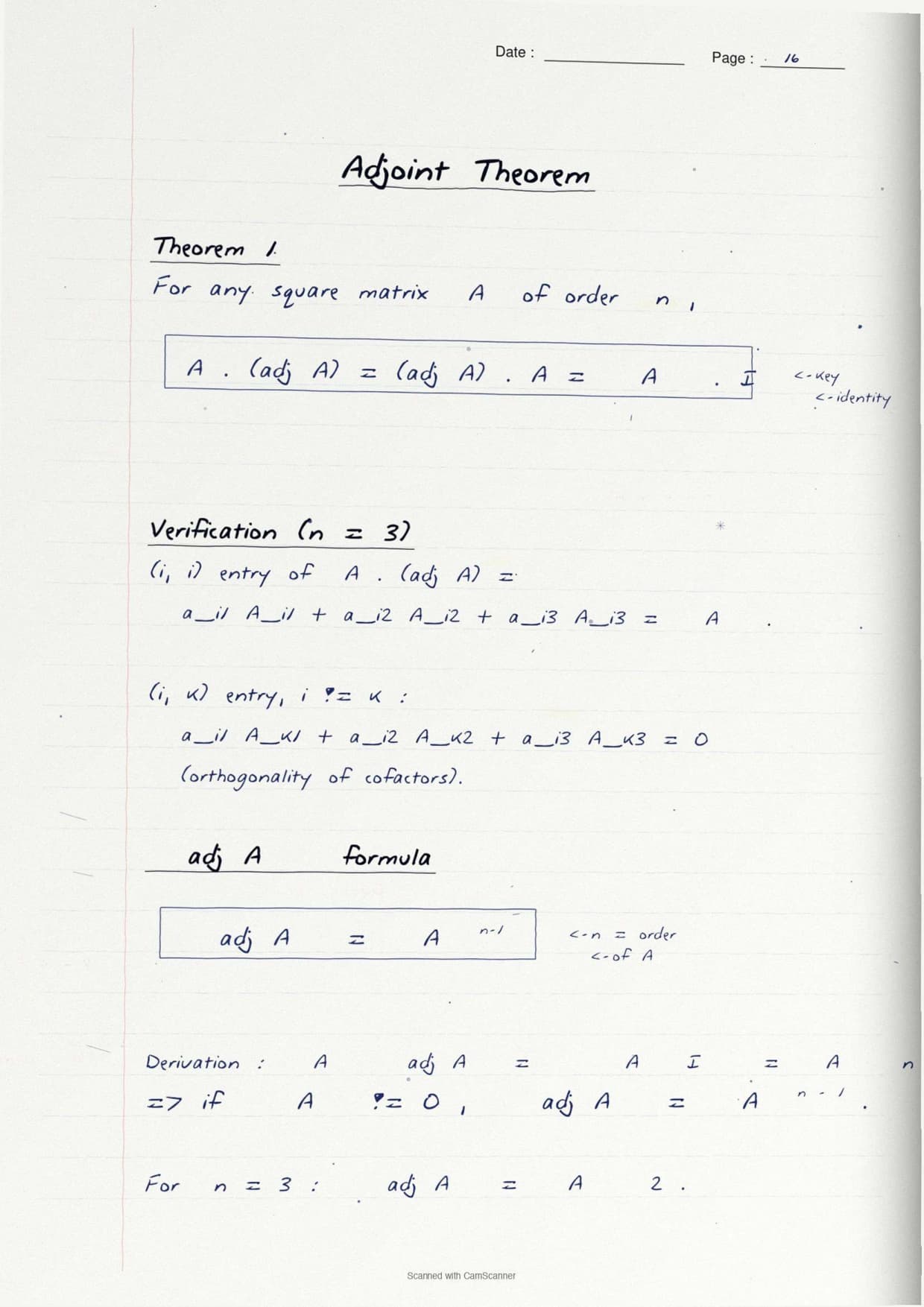
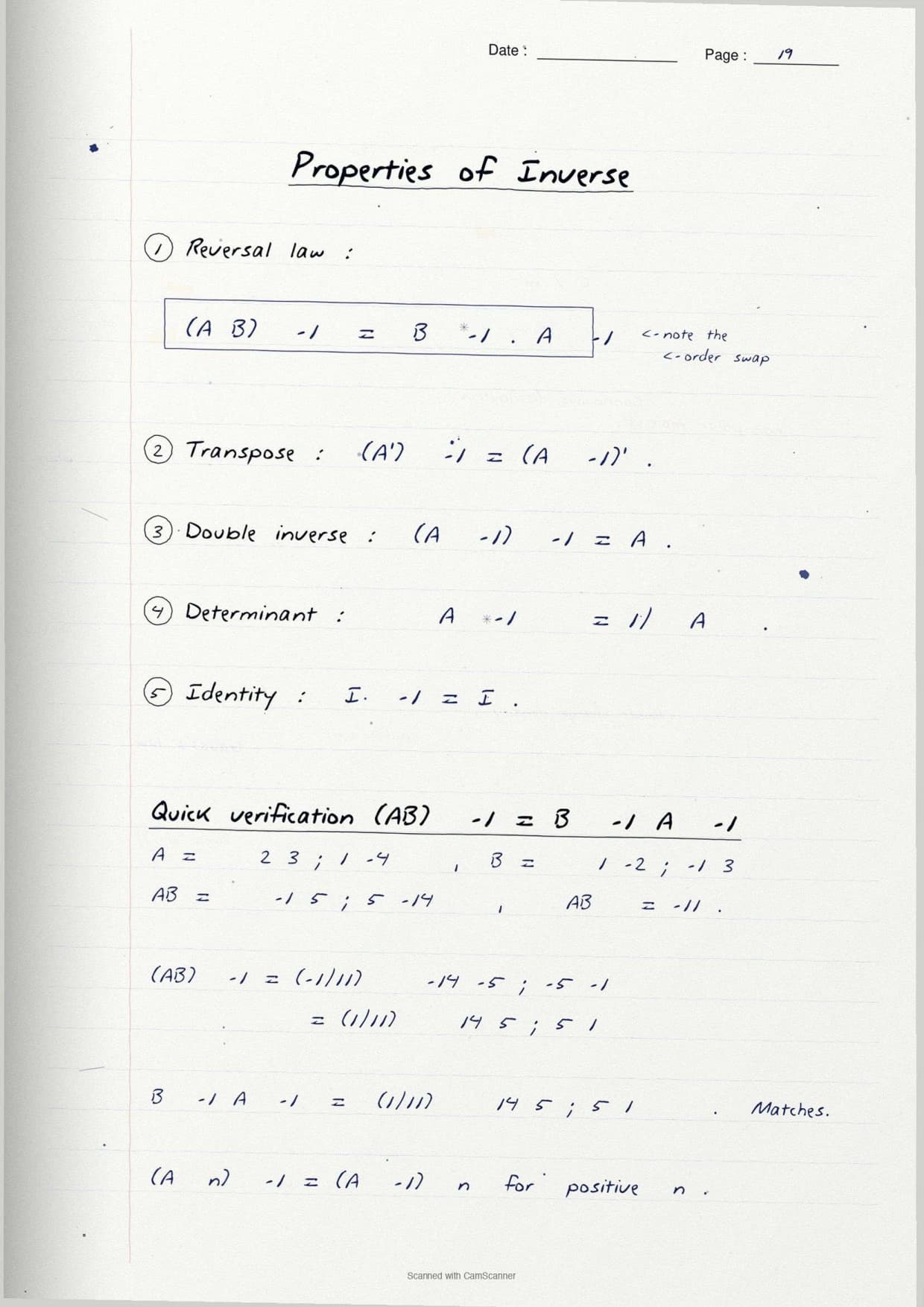
  • Boxed key results: Every theorem CBSE asks verbatim, |AB| = |A||B|, |kA| = kn|A|, adj(A) · A = |A| I, A−1 = (1/|A|) adj(A), is enclosed in a hand-drawn rectangle.
  • 2026-27 NCERT alignment: The notebook reflects the current 2026-27 syllabus. NCERT retains the full chapter, definition through Cramer's rule. The notebook flags exactly the sub-topics CBSE has tested every year since 2022.
  • Solved Cramer's-rule template: One fully-solved 3-equation system serves as a pattern you can match against any CBSE 5-marker in the Class 12 Maths Handwritten Notes PDF.
Minor to cofactor to adjoint to inverse cycle

Determinants Concept-Flavoured Mnemonics for Class 12 Maths

Four concept mnemonics the notebook repeats on its property pages. Memorise these and you can recover most MCQ-style facts on the Class 12 Maths Handwritten Notes PDF without re-deriving anything.

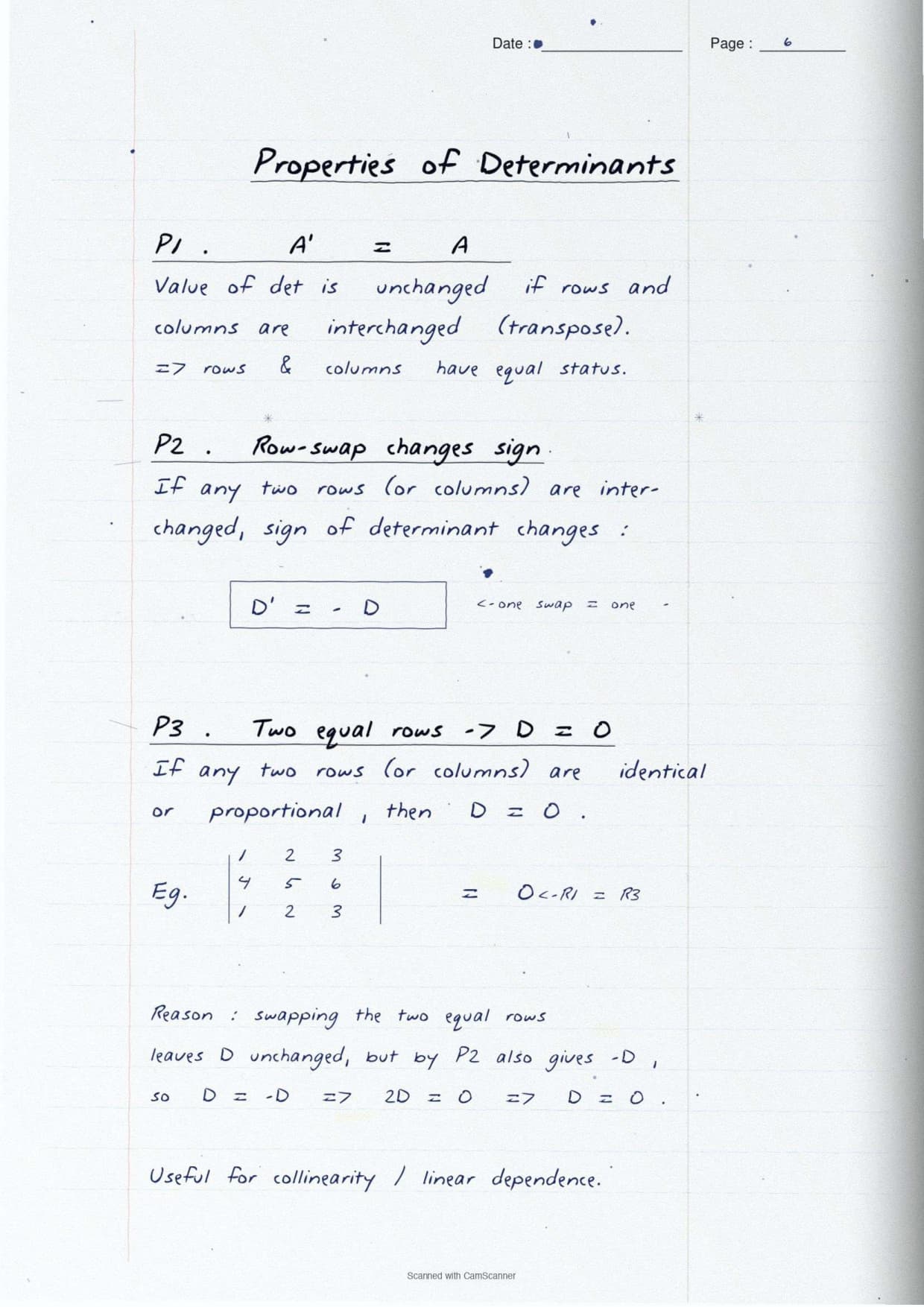
Interchange Flips Sign: Swapping any two rows (or columns) multiplies the determinant by −1. So two equal rows force |A| = -|A| ⇒ |A| = 0 . The most-tested CBSE property fact in this chapter.
k Pulls Out Once Per Row: Scaling one row by k scales |A| by k. So |kA| = kn |A| for an n × n matrix, NOT k |A| . The JEE Main trap that catches a quarter of students every year.
Row-Operation Ri → Ri + kRj Is Free: Adding a multiple of one row to another leaves the determinant unchanged. 90% of CBSE 3-mark property questions reduce to one or two such row operations.
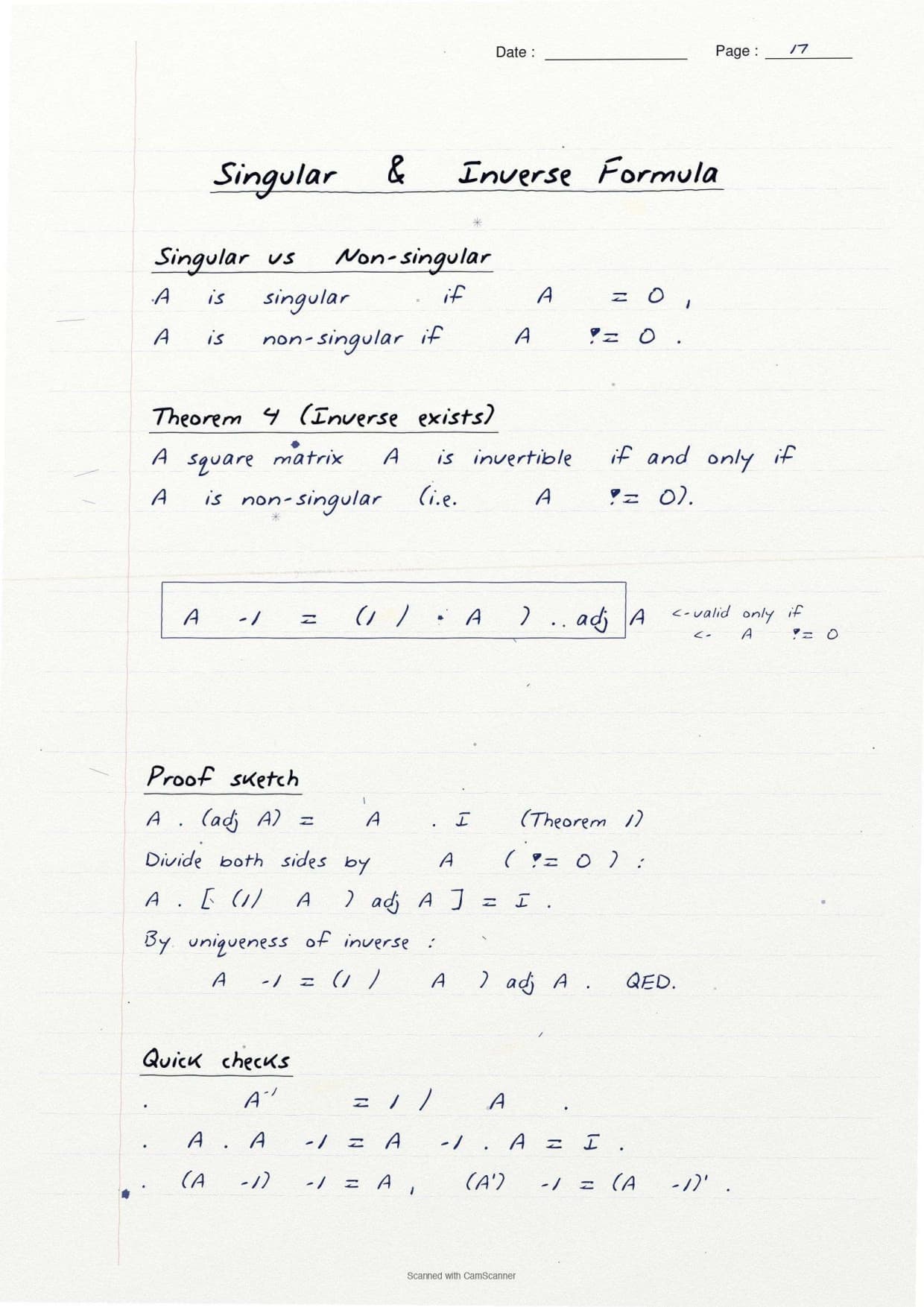
A Singular iff |A| = 0: A square matrix is invertible exactly when its determinant is non-zero. So |A| = 0 means no inverse, no unique Cramer solution, and the linear system is either inconsistent or has infinitely many solutions.

Determinants Handwritten Notes Diagram Inventory for Class 12 Maths

The Class 12 Maths Handwritten Notes PDF address this in the same order as the NCERT textbook.

The notebook contains 8 hand-sketched figures and grid diagrams. The table below maps every figure to its page so a reader hunting one specific concept can jump straight to the right spread.

PageDiagramWhat It Shows
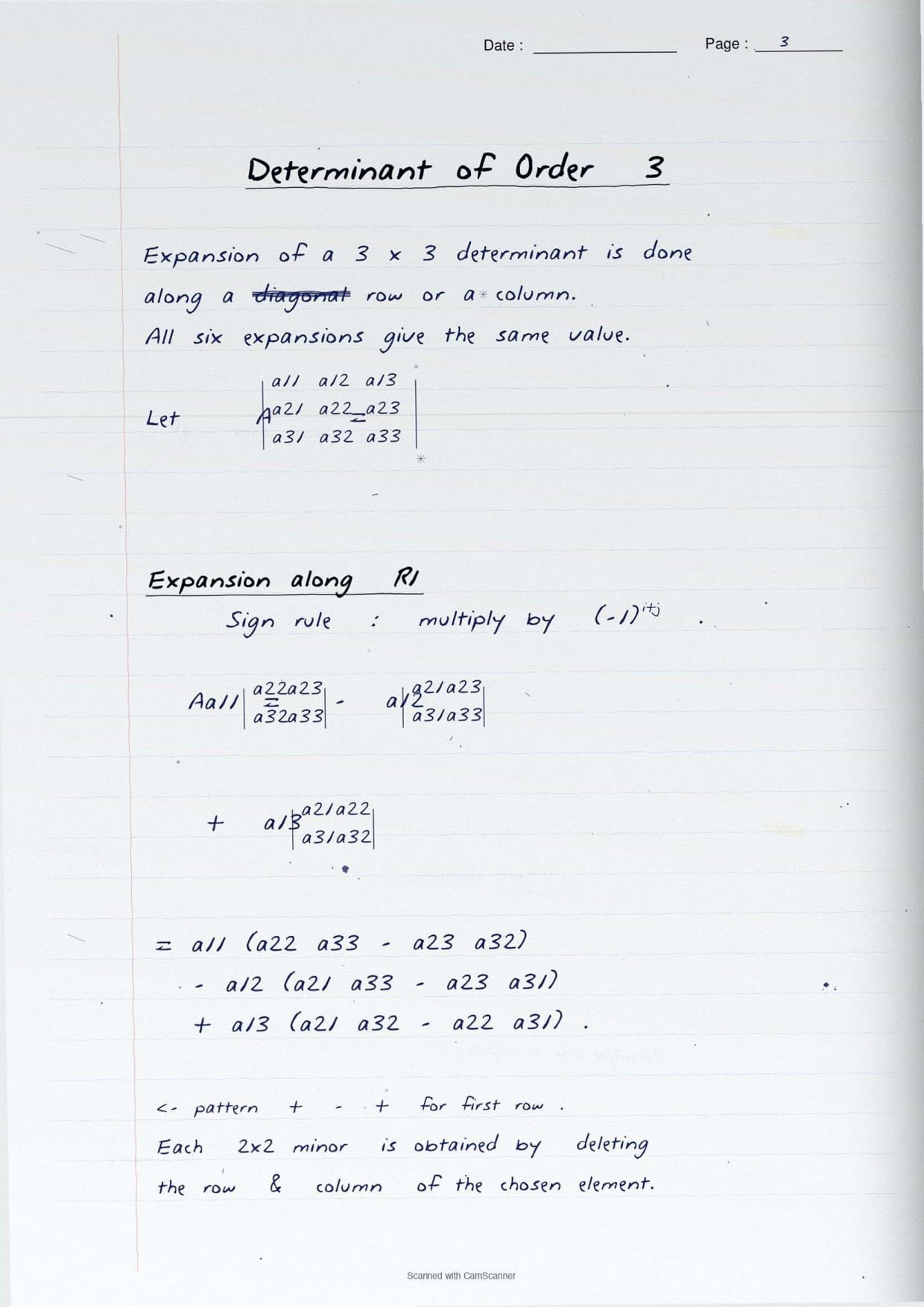
13 × 3 grid with row-1 cofactor expansionCurved arrows from each a1j to its minor; |A| = a11M11 - a12M12 + a13M13
2Sign chessboard for cofactors+/−/+ sign grid to overlay on any matrix; saves recomputing (-1)i+j
3Interchange and equal-row panelSide-by-side grids before / after a row swap with sign flip; equal-row case collapsing |A| to 0
4Scaling and row-addition invariancek pulled out of a single row; R2 → R2 + 3R1 leaving |A| unchanged
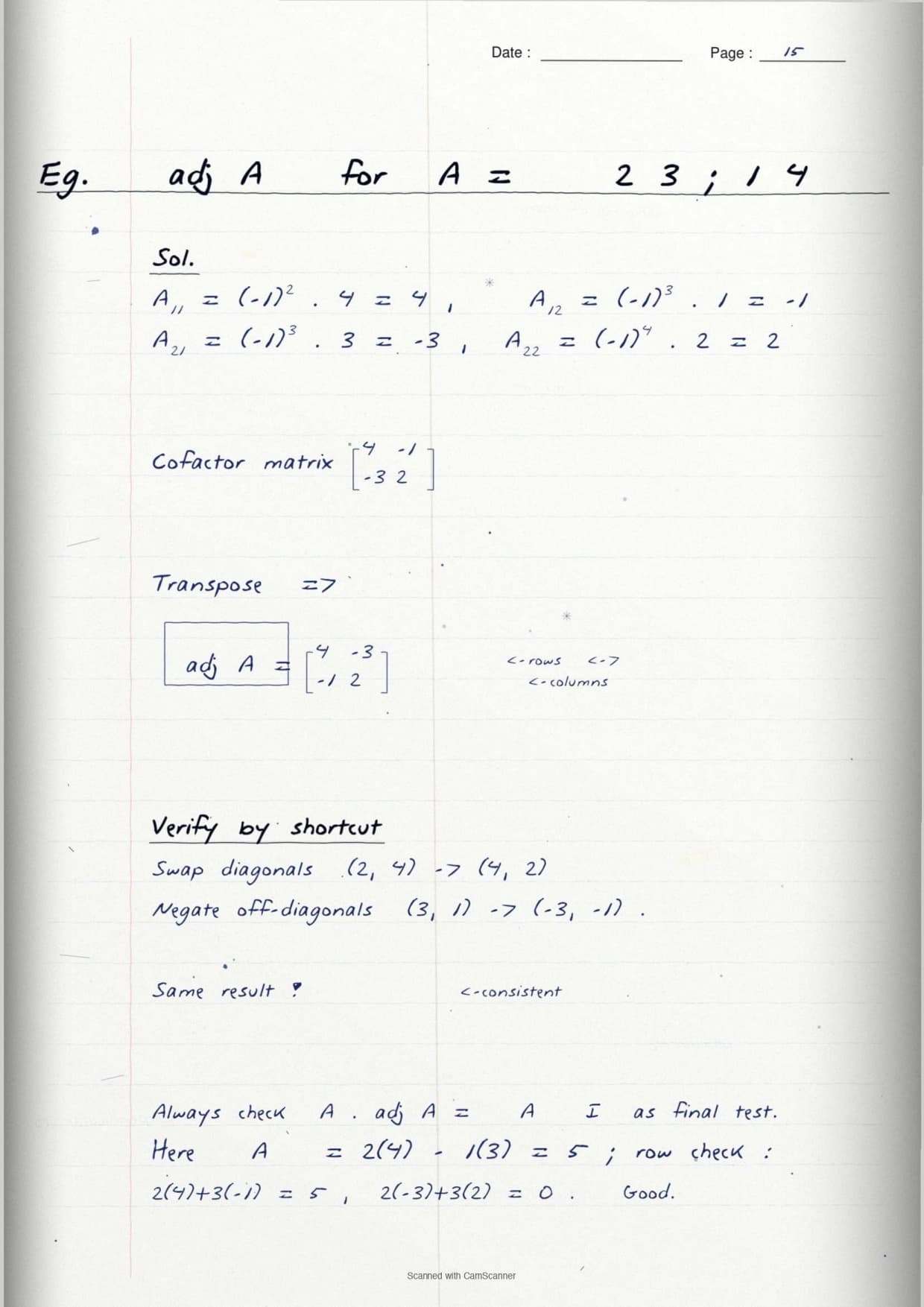
5Minor and cofactor walk-through3 × 3 grid with Mij and Cij labelled; ends with adj(A) as transpose of cofactor grid
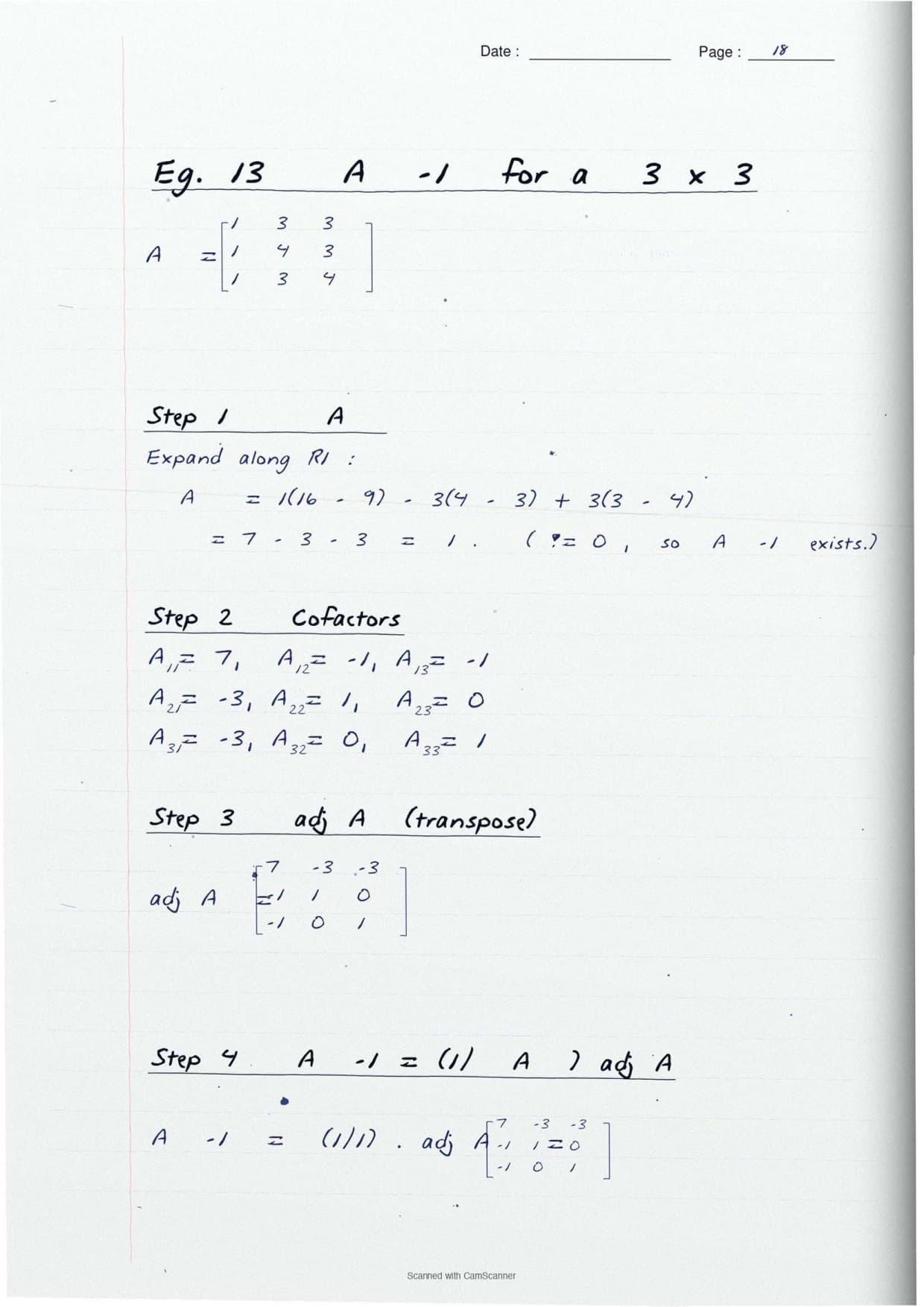
6Adjoint and inverse flowcofactors → transpose → multiply by 1/|A|; final box flagged "only if |A| ≠ 0"
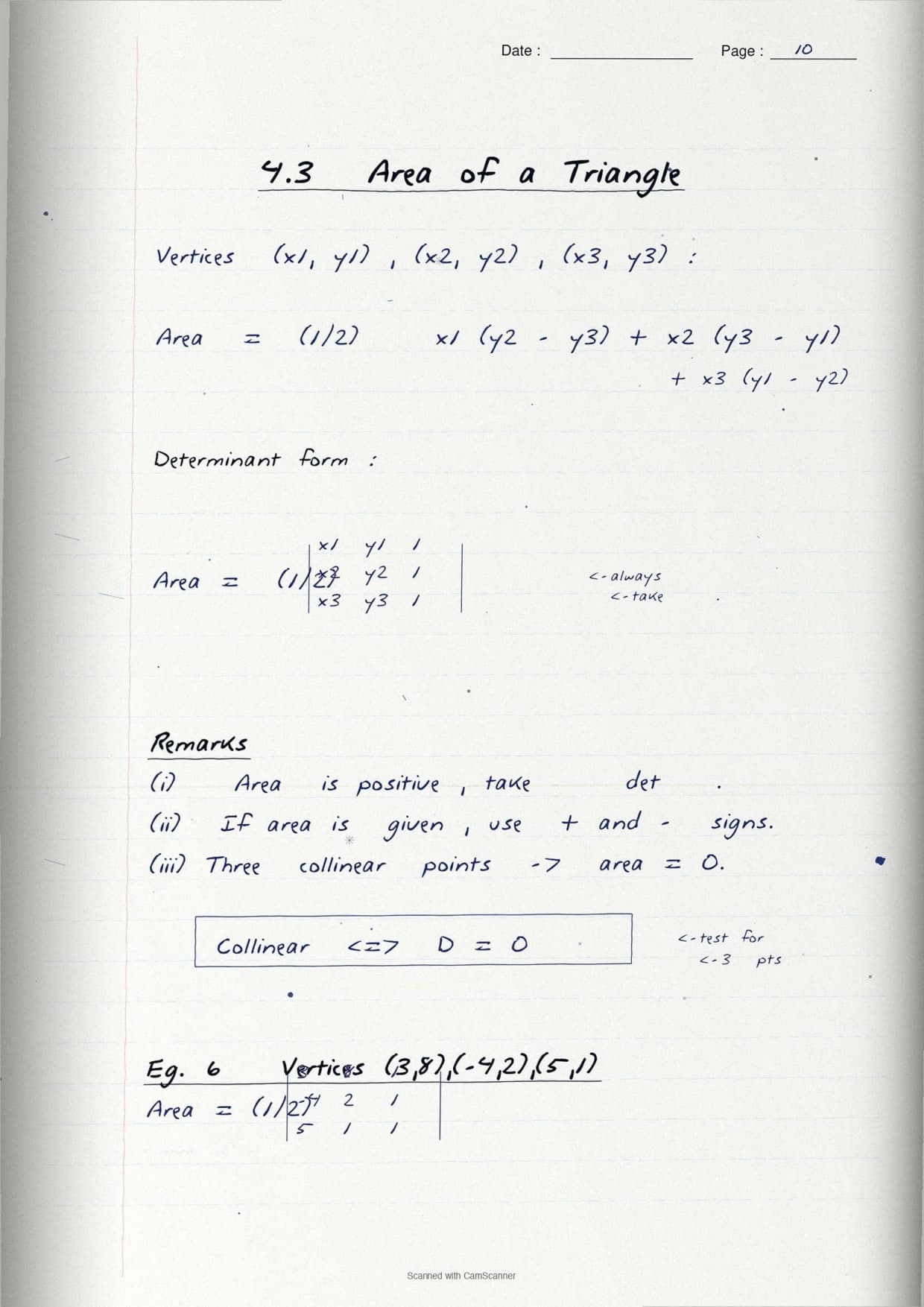
7Area of triangle sketchTriangle on axes with 3 × 3 vertex determinant and absolute-value bars highlighted
9Consistency decision treeThree branches off |A|: non-zero → unique; zero with (adj A)B = 0 → infinite; zero else → inconsistent
Quick Tip: Copy the sign chessboard (page 2) and the consistency decision tree (page 9) onto the back of your rough sheet during the exam. CBSE has asked at least one property-based simplification AND one Cramer-rule consistency question in every Board paper since 2022.

Determinants Top 6 Key Results for Class 12 Maths Quick Recall

These six results cover nearly every Board / JEE Main question on this chapter since 2021. The full learn table with every property and "when to use which" decision tree lives on the dedicated Formula Sheet.

ConceptResult
Expansion (3 × 3) |A| = a11(a22a33 - a23a32) - a12(a21a33 - a23a31) + a13(a21a32 - a22a31)
Scaling Rule |kA| = kn|A| for an n × n matrix
Product Rule |AB| = |A| · |B| , hence |A-1| = 1/|A|
Adjoint Identity A · adj(A) = adj(A) · A = |A| · I
Inverse Formula A-1 = 1|A| adj(A) , provided |A| ≠ 0
Area of TriangleArea = 12 | smallmatrix x1 & y1 & 1 x2 & y2 & 1 x3 & y3 & 1 smallmatrix | ; collinearity iff determinant = 0

Full learn table: this chapter Maths Formula Sheet

Determinants: Last 24-Hour Revision Card for Class 12 Maths

The card below is the single page you scan the night before the Board exam. Skip the long property proofs; the marks come from the seven property boxes plus one solved Cramer's-rule example and the area-of-triangle formula.

  1. Definition: 2 × 2: |A| = ad - bc . 3 × 3: cofactor expansion along any row or column.
  2. Seven properties: interchange flips sign; equal rows give 0; scaling one row by k scales |A| by k; Ri → Ri + kRj leaves |A| unchanged; linear in each row; |A'| = |A| ; |AB| = |A||B| .
  3. Minors and cofactors: Mij = 2 × 2 determinant after deleting row i and column j; Cij = (-1)i+j Mij . Use the sign chessboard, do not recompute the power.
  4. Adjoint and inverse: adj(A) = transpose of the cofactor matrix; A · adj(A) = |A| I ; A-1 = 1|A|adj(A) when |A| ≠ 0. 5-mark CBSE favourite.
  5. Area of triangle: half the absolute value of the 3 × 3 vertex determinant; zero value means three points are collinear.
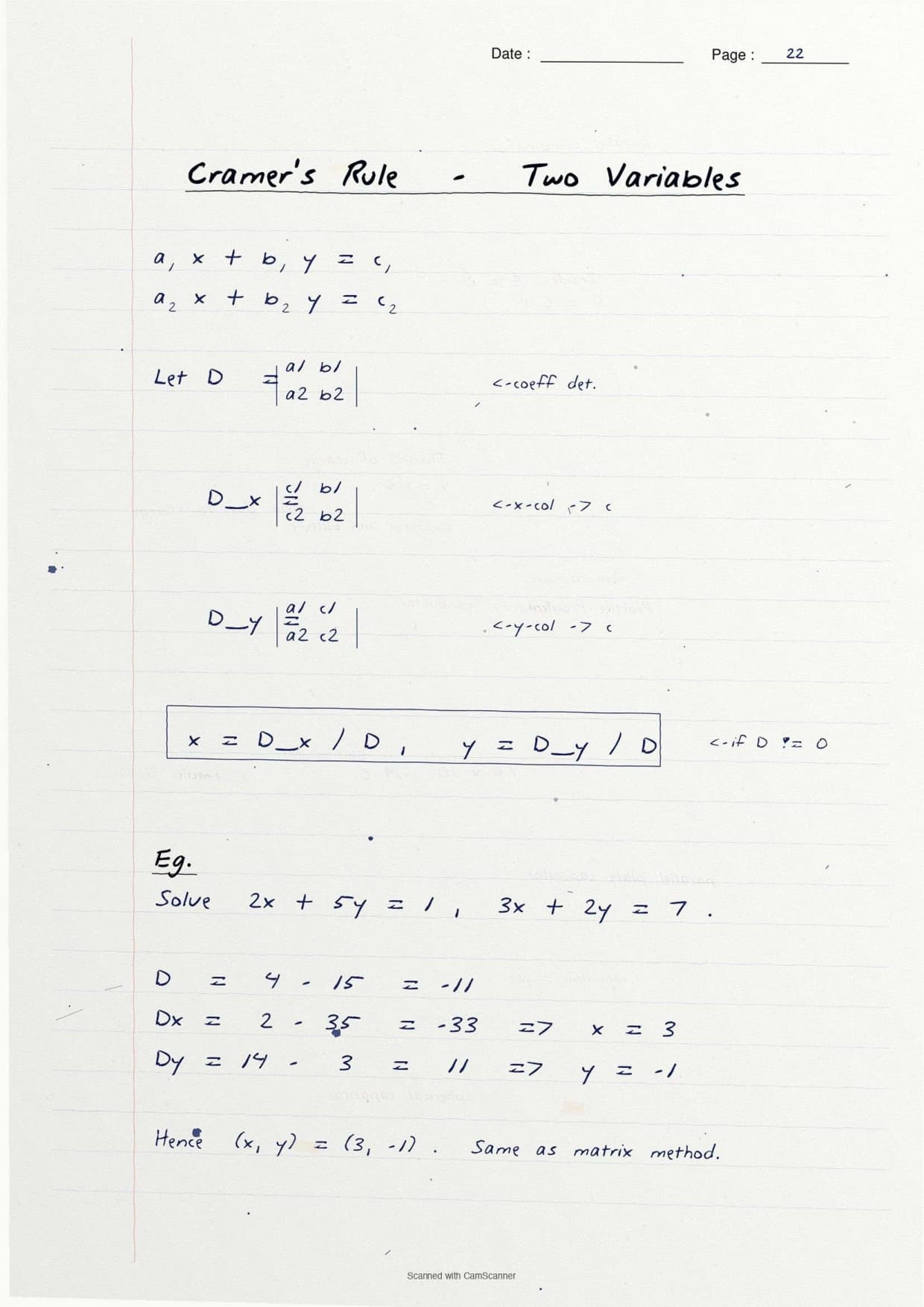
  6. Cramer's rule: x = D1/D, y = D2/D, z = D3/D ; D = |A|, Dk replaces column k by b; requires D ≠ 0.
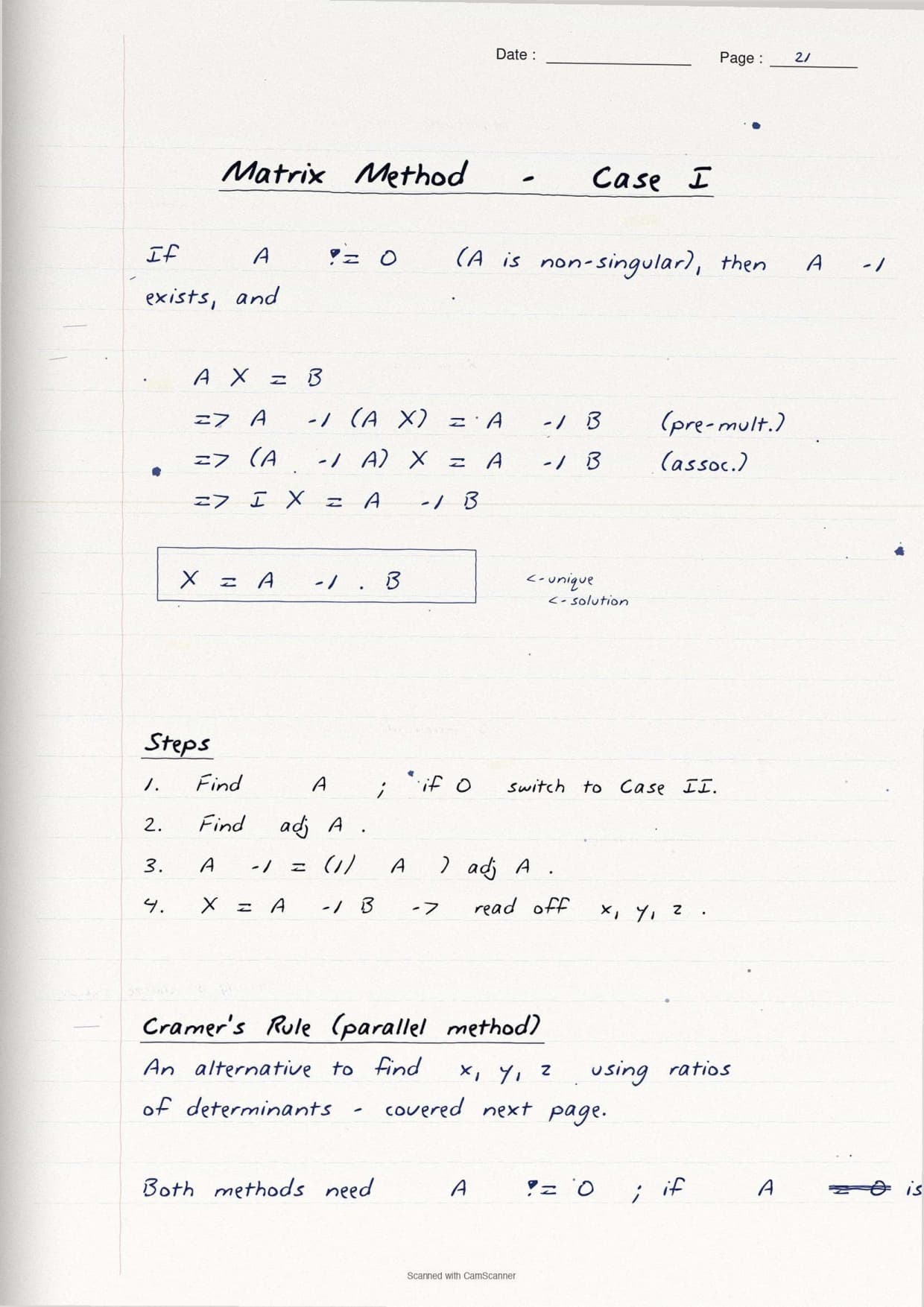
  7. Consistency: D ≠ 0 → unique. D = 0 and every Dk = 0 → infinitely many. D = 0 and some Dk ≠ 0 → inconsistent. Matrix-method alternative: X = A-1B .
Watch Out: Students routinely write |kA| = k|A| instead of kn|A| , losing 2 marks on a 3-mark scaling question. CBSE deducts every time. For a 3 × 3 matrix, |2A| = 8|A|, not 2|A|.

Handwritten Notes vs Printed Notes for Determinants: When to Use Which

The notebook is not a replacement for the typed Notes page. The two resources serve different stages of prep.

ResourceBest ForTime Per Pass
Typed NotesFirst read, deep concept walk, property proofs, adjoint-inverse derivation90 to 120 min
Handwritten NotesSecond and third revision passes, visual property encoding, last-24-hour skim30 to 45 min
Formula SheetFinal 10 minutes before the paper, formula and sign-chessboard recall10 min

The recommended sequence is typed Notes first, then two passes through these handwritten notes, then the Formula Sheet on exam morning.

Related Links:

Class 12th Maths Chapter 4 Determinants Pen-Colour Convention

the Class 12 Maths Handwritten Notes PDF uses four ink colours consistently so you can skim a 9-page notebook in under five minutes during last-day revision.

Ink ColourWhat It MarksWhat's Inside
BlueDefinition / statementNCERT one-line definitions: determinant, minor, cofactor, adjoint, inverse, singular vs non-singular, area-of-triangle formula
OrangeProperty box (dashed)The seven row / column properties. Each property has its own hand-drawn dashed rectangle with a solved examples beside it
Yellow highlightMCQ-trap calloutThe 6 facts CBSE and JEE re-use as MCQ distractors: |kA| = kn|A|, |A'| = |A|, |A−1| = 1/|A|, equal-row gives 0
RedCommon-mistake boxCommon slips: |kA| written as k|A|, dropped absolute-value bars in the area formula, or Cramer's rule applied when |A| = 0

Determinants Weightage Across Class 12 Maths Chapters

The bar chart below maps the typical CBSE Board mark distribution across the 13 chapters of the 2026-27 NCERT Mathematics book, averaged over the last five years. Chapter 4 Determinants is highlighted in orange.

Ch 1 Relations and Functions
5 marks
Ch 2 Inverse Trigonometric Functions
4 marks
Ch 3 Matrices
6 marks
Ch 4 Determinants
6 marks
Ch 5 Continuity and Differentiability
8 marks
Ch 6 Application of Derivatives
6 marks
Ch 7 Integrals
9 marks
Ch 8 Application of Integrals
4 marks
Ch 9 Differential Equations
5 marks
Ch 10 Vector Algebra
5 marks
Ch 11 Three Dimensional Geometry
5 marks
Ch 12 Linear Programming
5 marks
Ch 13 Probability
6 marks

Determinants sits at 6 marks of the typical 80-mark CBSE paper and pairs with Chapter 3 Matrices for a combined 10 to 12 marks in the Algebra unit, a high-yield share you can lock down in one focused revision pass.

More Determinants Maths Class 12 Resources

NCERT Handwritten Notes for Class 12 Maths: All Chapters

Use the table below to jump to any other Class 12 Maths chapter's handwritten notebook PDF. The same dashed property-box convention and last-day revision card runs through every chapter.

Class 12 Maths Handwritten Notes PDF: available above as a free PDF download, aligned to the 2026-27 NCERT Class 12 Mathematics syllabus.

Exercise-wise Breakdown of the Determinants Chapter

The Determinants chapter splits into 6 numbered exercises plus a Miscellaneous Exercise. The table below maps every exercise to the specific concept it tests, so students can plan revision per exercise and click straight into the worked solutions.

ExerciseTopic Tested
Exercise 4.1Evaluation of 2x2 and 3x3 determinants
Exercise 4.2Properties of determinants; area of a triangle
Exercise 4.3Minors and cofactors
Exercise 4.4Adjoint and inverse of a matrix
Exercise 4.5Applications: solving systems of linear equations
Exercise 4.6Consistency of system of linear equations
Miscellaneous ExerciseMixed determinant concepts and applications

PDF Download Formats and Languages for the Determinants Chapter

The Determinants Class 12 PDF on this page is available in three formats - each suited to a different revision style. The table below summarises what each format is best for:

FormatBest forApprox. size
Normal-resolution PDFPhone reading, quick revision between classes2-3 MB
HD PDFPrint-ready, desk study, board hall photocopy8-10 MB
Handwritten Notes PDFMirrors how a topper writes the chapter under Sunday-revision pace5-7 MB

The determinants class 12 ncert pdf and the parallel Hindi-medium edition both follow the same notation and equation numbering as the printed NCERT 2026-27 release. Key points students should know:

  • NCERT-faithful: Every definition, theorem and exercise on the determinants class 12 ncert pdf matches the printed textbook line for line.
  • Hindi-medium edition: The determinants class 12 pdf is also available in Hindi - same page numbering, same equation labels.
  • Formula PDF separate: The determinants class 12 formulas pdf is a one-page A4 reference sheet listing every identity used in the chapter.
  • Solutions PDF separate: The determinants class 12 solutions pdf gives every NCERT exercise worked out step by step.
  • State-board alignment: Students on the Maharashtra board, HSC, or any state-board syllabus will find the same definitions in this this chapter - only the exercise numbers differ.

Tip: Many toppers keep two parallel copies - a printed formula sheet on A4 for desk revision (the determinants class 12 formulas pdf), and the full these notes on a phone for commute revision. Both files are free and linked above.

Important Questions and Previous Year Trends for the Determinants Chapter

The most repeated question patterns in CBSE Class 12 Maths for the Determinants chapter have settled into a stable cluster across 2019 to 2024 boards. Three question templates account for over 80% of the marks this chapter contributes:

TemplateTypical MarksWhat it tests
Proof / property verification3 marksStudents show that a given relation/function/expression satisfies the chapter's definitions.
One-step computation2 marksSubstitution-based item: plug into a known formula and simplify.
Case-study scenario4 marksReal-world setup applying the chapter's definitions, introduced in CBSE 2021+ papers.

Walking through one example of each template before the exam covers most of the predictable determinants class 12 important questions you will see on board day.

  • these notes previous year questions for 2019-2024 are linked from the PYQ block at the bottom of this page - the exact CBSE phrasings.
  • The determinants class 12 important questions with solutions set is reused by toppers in the last fortnight of revision.
  • For NCERT Exemplar practice, the matching determinants class 12 extra questions set adds advanced problems suitable for JEE Main and JEE Advanced.
  • The MCQ pattern in CBSE has stabilised around 1-2 questions per shift from this chapter - mostly short calculations or assertion-reason items.

Year-wise PYQ Distribution

The table below maps the dominant question type asked from the Determinants chapter across recent CBSE Class 12 Maths boards:

YearDominant Question TypeApprox. Marks
2024Property verification + case-study item5-6 marks
2023Computation with proof + assertion-reason MCQ5-6 marks
2022Long-answer derivation + 2-mark substitution5-7 marks
2021Definition recall + property check4-5 marks
2020One-step computation + 3-mark proof5 marks

The full this chapter with solutions set (every year, every paper, every question type) is linked from the PYQ page at the bottom of this article.

How the Determinants Notes Pair with NCERT Solutions and the Formula Sheet

The Determinants Class 12 notes work best when paired with two sister resources from the Class 12 Maths hub. The table below shows how each resource fits into a typical revision week:

ResourceUse it forWhen
Determinants Notes (this page)Theory, definitions, exam patternsFirst pass, before practice
determinants class 12 ncert solutions PDFStep-by-step solved exercisesSecond pass, during NCERT practice
determinants class 12 formulas PDFOne-page identity recallThird pass, alongside mock papers
Handwritten Notes PDFQuick reading in topper's handwritingAnytime, especially commute revision

Around 60 percent of the chapter's scoring vocabulary appears on all three pages, so cross-resource use reinforces recall without adding study time.

  • The determinants class 12 ncert solutions cover every back-of-chapter exercise plus the miscellaneous exercise.
  • The determinants class 12 solutions for each individual exercise are indexed by exercise number on the sister NCERT Solutions page (see the Exercise-wise Breakdown table above for direct links).
  • The determinants class 12 formulas reference sheet is the same A4 file students sometimes refer to as this Class 12 page all formulas - it lists every identity used in the chapter.
  • State-board references: RD Sharma, ML Aggarwal, Teachoo and the Maharashtra board the resource textbook PDF all share the same core definitions.
  • For class-first search phrasings - class 12 determinants solutions, class 12 determinants ncert solutions, ncert class 12 determinants solutions - the same files cover the request.

Reference Books and State-Board Mapping

Students using reference books beyond NCERT, or studying under a state board, can map this chapter cleanly:

ReferenceHow it maps to the chapter notes
RD Sharma Class 12 DeterminantsQuestion patterns overlap with NCERT at ~70%; an advanced supplement.
ML Aggarwal Class 12 DeterminantsSolutions style is closer to JEE; good for problem-solving practice.
Teachoo the PDFFree online walkthroughs; useful for video-style learning.
Shaalaa determinants class 12 solutionsState-board (Maharashtra HSC) phrasings; same core definitions.
Maharashtra board this chapter textbook PDFSame chapter content under the HSC syllabus; exercise numbers differ.
NCERT Exemplar Class 12 DeterminantsAdvanced problems for JEE Main/JEE Advanced preparation.

How to Use the Determinants Notes Page Most Effectively

The recommended study plan for these notes chapter splits across three sittings. The table below outlines what to do in each:

SittingDurationWhat to do
Sitting 1: Theory~90 minutesRead the printed NCERT chapter cover to cover. Mark every definition and theorem statement. Then read the formula recall section on this page.
Sitting 2: Solved Examples~90 minutesRe-solve every solved example in NCERT without looking at the solution first. Compare your steps against the printed working. Use the determinants class 12 ncert solutions PDF if stuck.
Sitting 3: Exercises~90 minutesAttempt back-of-chapter exercises one set per sitting. Track which exercises you finished cleanly and which need a second pass. Click into the linked exercise pages above for verification.

For students preparing for both CBSE board and JEE Main:

  • 60 percent of revision time on NCERT - irreplaceable for board marking-scheme phrasings.
  • 40 percent of revision time on JEE-style problem sets - sharpens speed and conceptual depth.
  • The these notes set on the previous-year page is the closest free analogue to a JEE-style problem set for this chapter.
  • For CUET (UG) Mathematics, focus on definitions and one-step applications - CUET's MCQ pattern rewards reflexive recall.

Class 12 Maths Handwritten Notes PDF - Frequently Asked Questions

Ques. Where can I download the Class 12 Maths Handwritten Notes PDF for free?

Ans. You can download these notes Maths Handwritten Notes PDF directly from the Class 12 Maths Handwritten Notes PDF. Both the Normal and HD versions are available, and both are free.

Ques. Is this Class 12 Maths Handwritten Notes PDF aligned with the 2026-27 NCERT syllabus?

Ans. Yes. The notebook reflects the current 2026-27 syllabus for Class 12 Mathematics. The chapter is retained intact: definition, properties, minors and cofactors, adjoint, inverse, area of triangle, applications to system of equations via the matrix method, and Cramer's rule. The handwritten layer mirrors every sub-topic CBSE has tested in every Board paper since 2022.

Ques. How many pages is the Class 12th Maths Determinants Handwritten Notes PDF?

Ans. The handwritten notes PDF runs 9 pages and covers the definition of a determinant, 2 × 2 and 3 × 3 expansion, the seven row / column properties, minors and cofactors with the sign chessboard, adjoint, inverse and its existence condition, area of triangle, the consistency decision tree for Ax = b, and Cramer's rule, ending with a one-page summary sheet.

Ques. Why use handwritten notes instead of typed notes for Determinants?

Ans. Determinants is a visual chapter. The expansion of a 3 × 3 grid, the +/−/+ sign chessboard for cofactors, and the seven property boxes are spatial facts that typed notes flatten into prose.

The handwritten notebook encodes each property as a drawn box and each expansion as an arrow diagram, so the reader can recall the pattern by eye rather than by re-reading sentences. Use typed Notes for the first read; switch to these handwritten notes for the second and third revision passes.

Ques. Do these handwritten notes cover Cramer's rule and the matrix method for systems of equations?

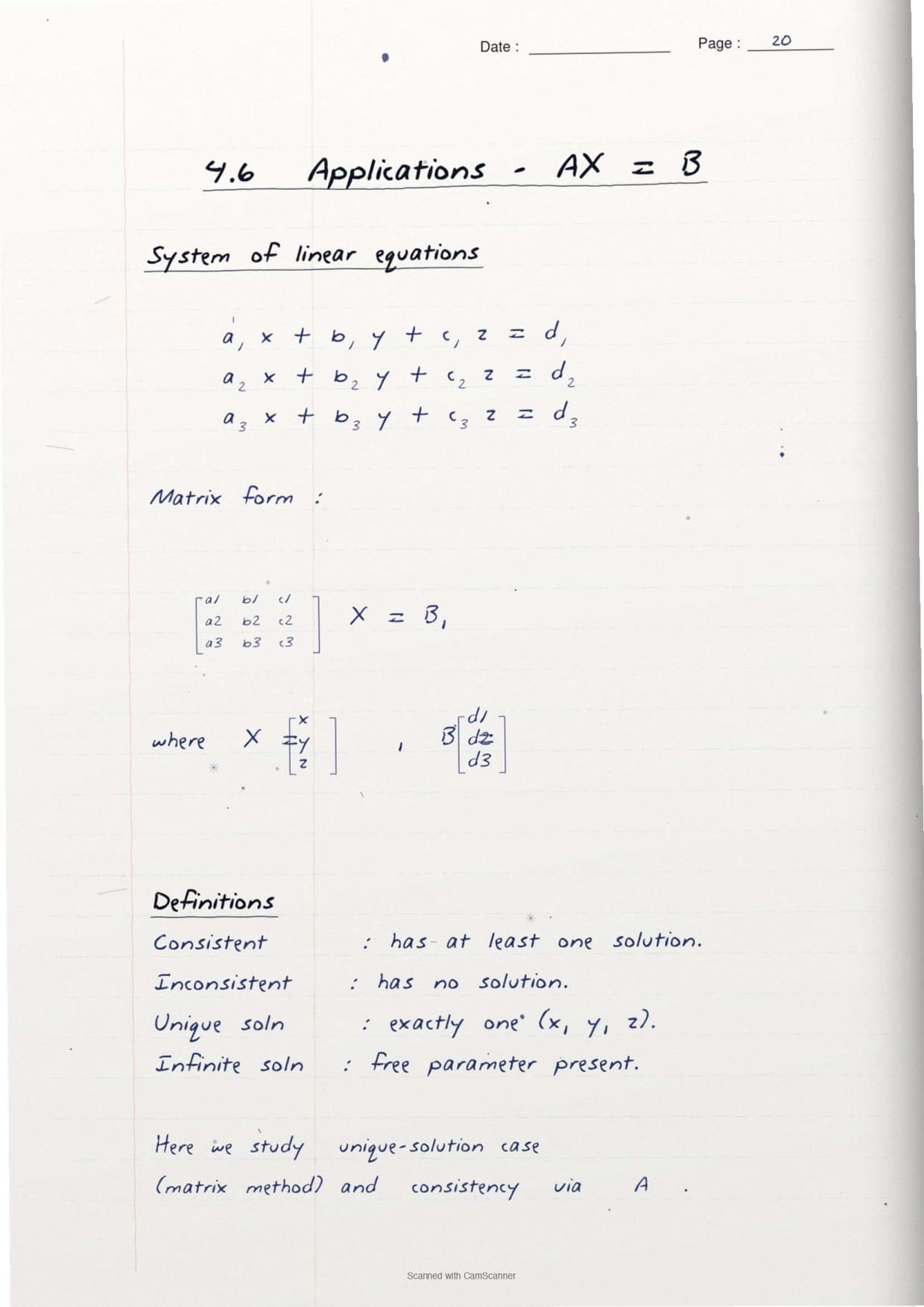
Ans. Yes. Page 9 carries the consistency decision tree (unique solution, infinitely many, inconsistent) and a fully solved 3-equation Cramer's-rule example. The same page also shows the matrix-method alternative X = A-1B , which CBSE has alternated with Cramer's rule on every 5-mark Board question since 2022.

Ques. Do these handwritten notes help with JEE Main Determinants questions?

Ans. Yes. JEE Main draws 2 to 3 questions per shift from Matrices and Determinants combined, and the yellow MCQ-trap boxes in the notebook is calibrated against the last five years of JEE Main papers, particularly on property-based simplification, the scaling rule |kA| = kn|A| , the singular vs non-singular distinction, and the consistency check for Ax = b.

Ques. What's the difference between Collegedunia's Handwritten Notes and the regular Notes for Class 12 Maths Chapter 4?

Ans. The regular typed Notes carry the deep concept walk-through with detailed proofs of every property and the full derivation of the adjoint-inverse identity.

These Handwritten Notes compress the same content into a faster, more visual revision tool with hand-drawn property boxes, a sign chessboard, the consistency decision tree, and a 24-hour pre-exam recall card. Use the Class 12 Maths Handwritten Notes PDF for first read, then these for two recall passes.

Ques. Which sub-topic of Determinants carries the most weight in CBSE Board exams?

Ans. The 5-mark Board question almost always comes from one of two places: applying the seven row / column properties to simplify a 3 × 3 determinant, or solving a system of three linear equations using Cramer's rule or the matrix method X = A-1B .

Together these two sub-topics account for roughly 5 of the 5 to 7 marks CBSE assigns to this chapter. The notebook places its dashed property boxes and consistency decision tree on exactly these two sub-topics.