




These Class 12 Geography Chapter 7 Transport and Communication handwritten notes are a topper's genuine handwritten revision pages, written by hand for quick last-mile revision in line with the 2026-27 CBSE syllabus. They cover all key ideas: modes of transport (land, water, air, pipeline), communication systems, satellite technology and cyberspace. Use the PDF in the 24 hours before the board paper.
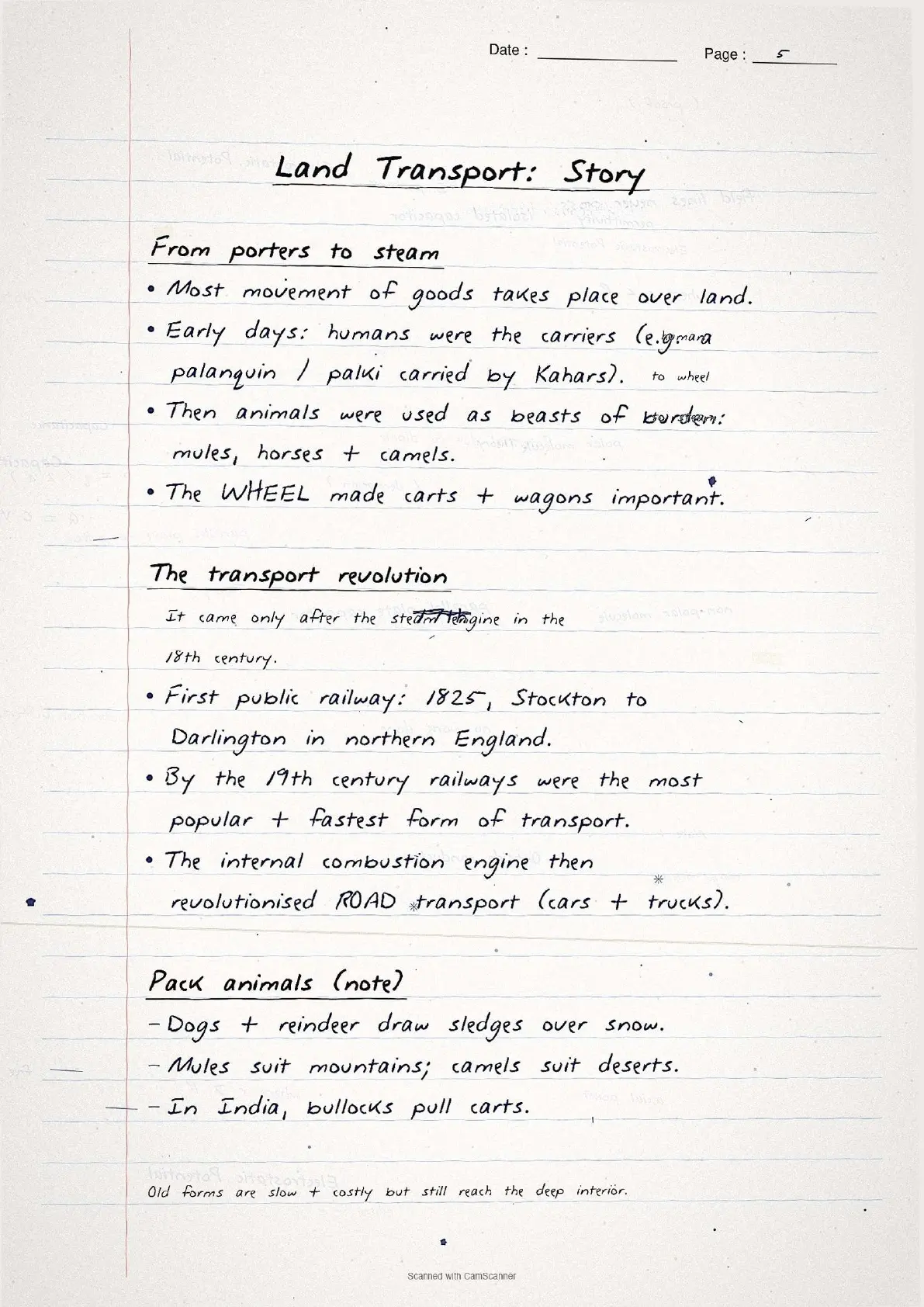
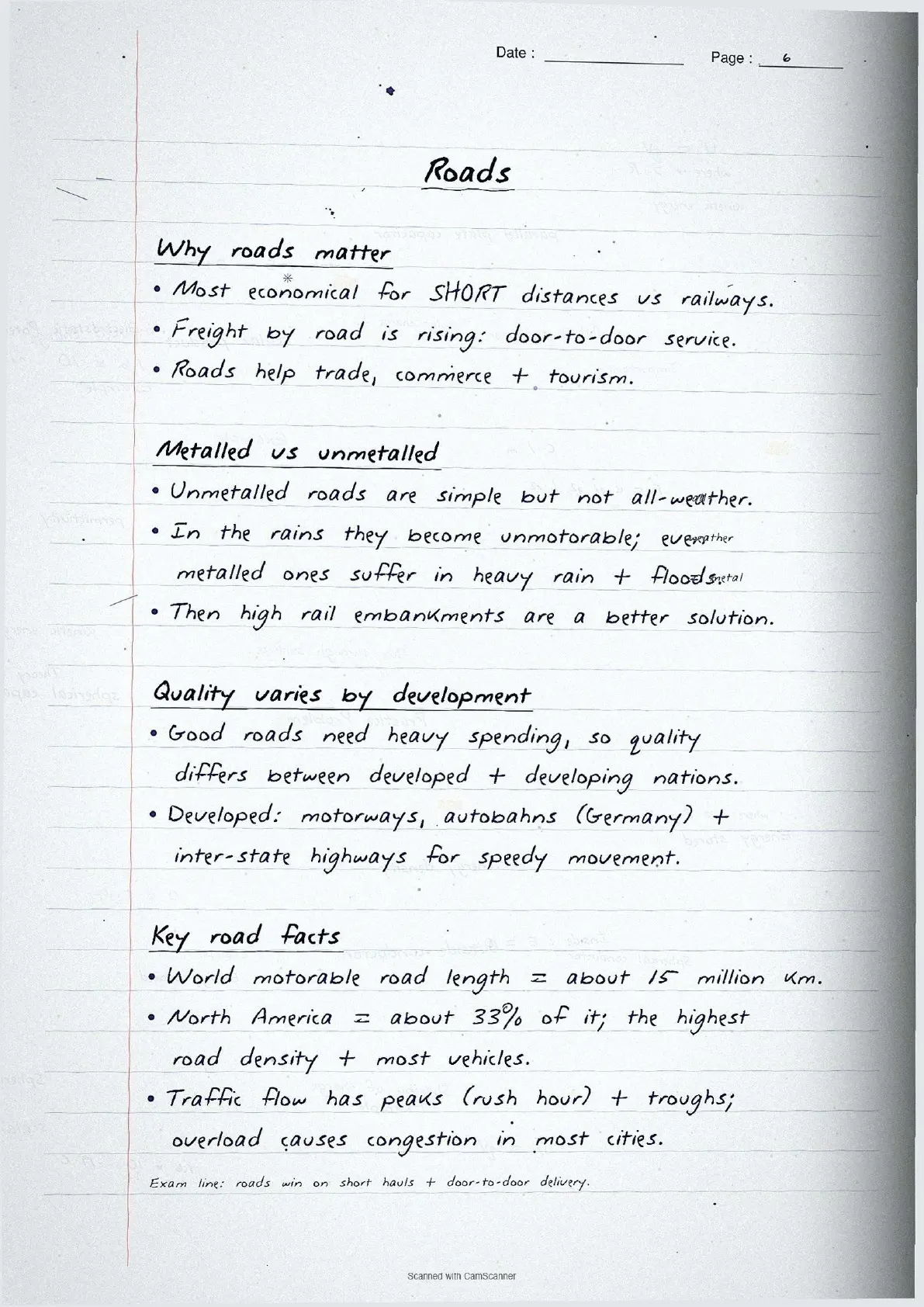
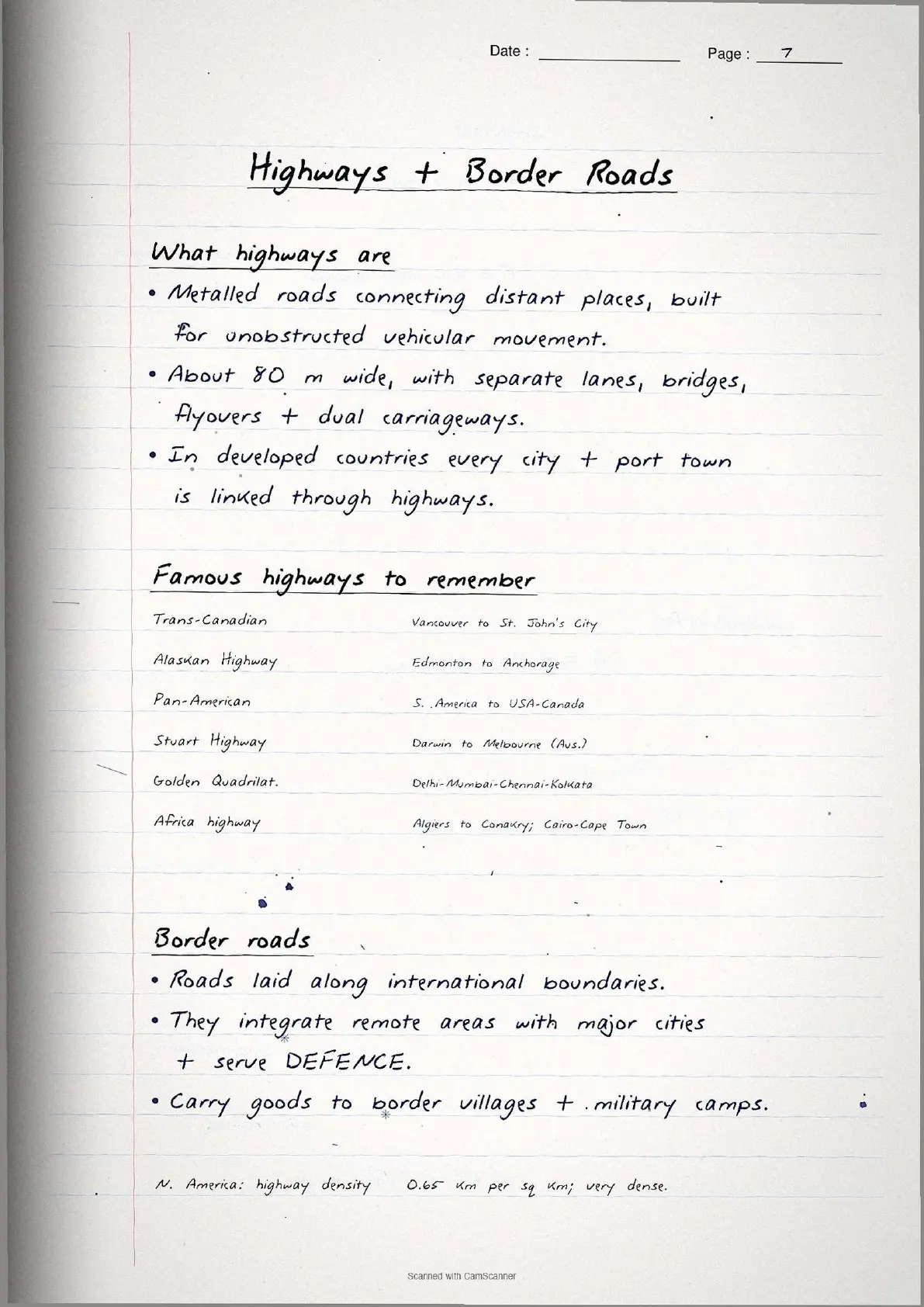
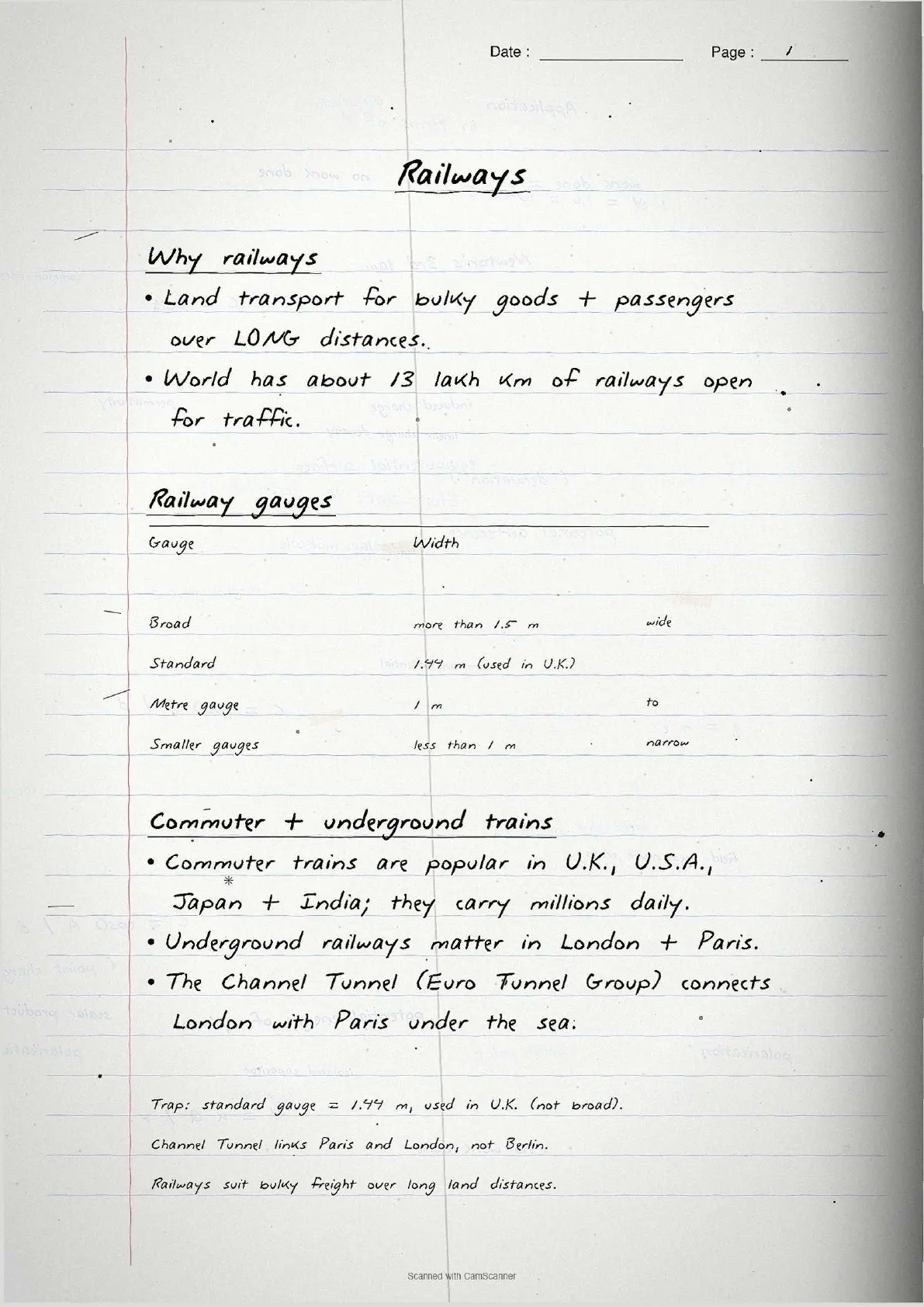
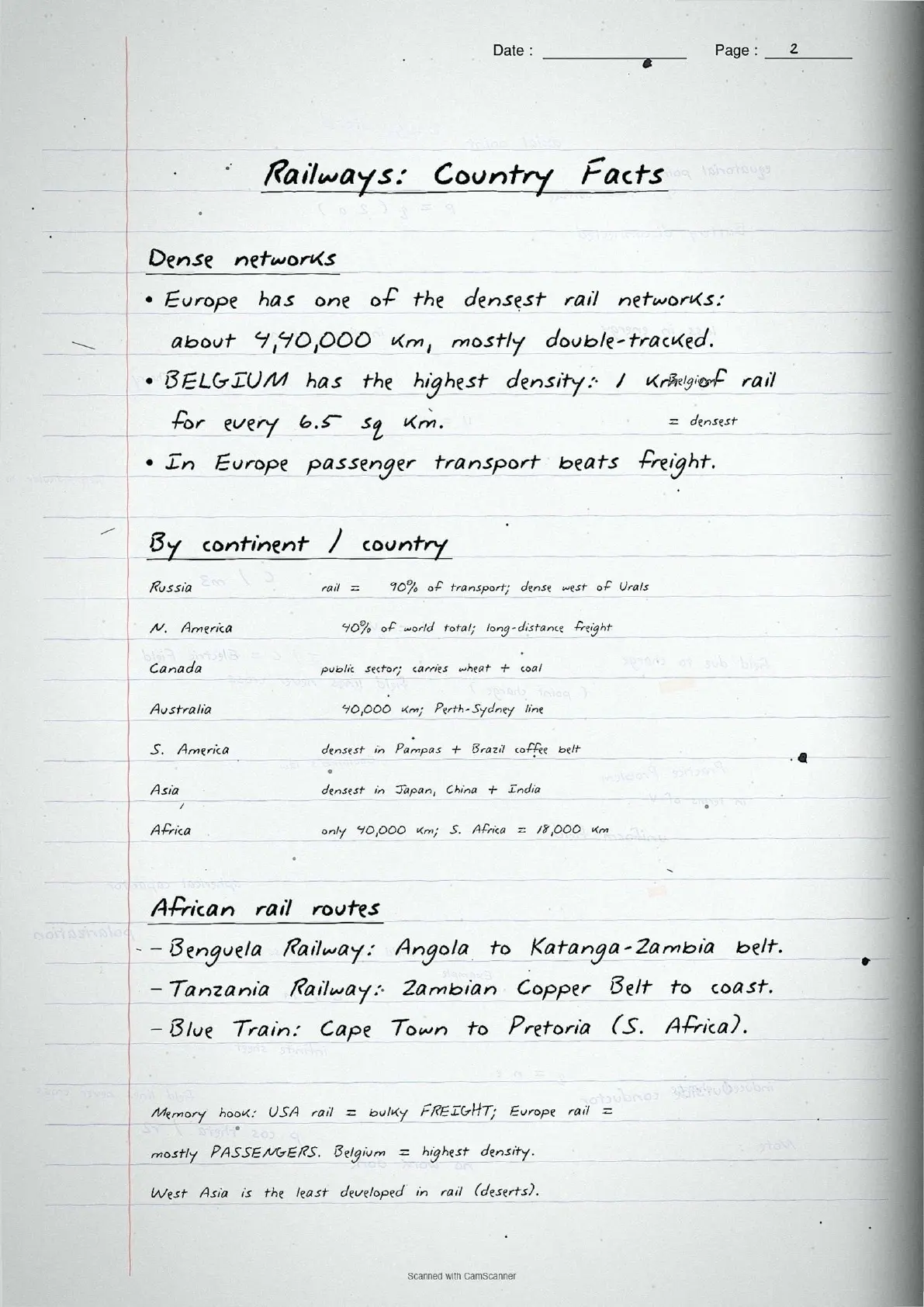
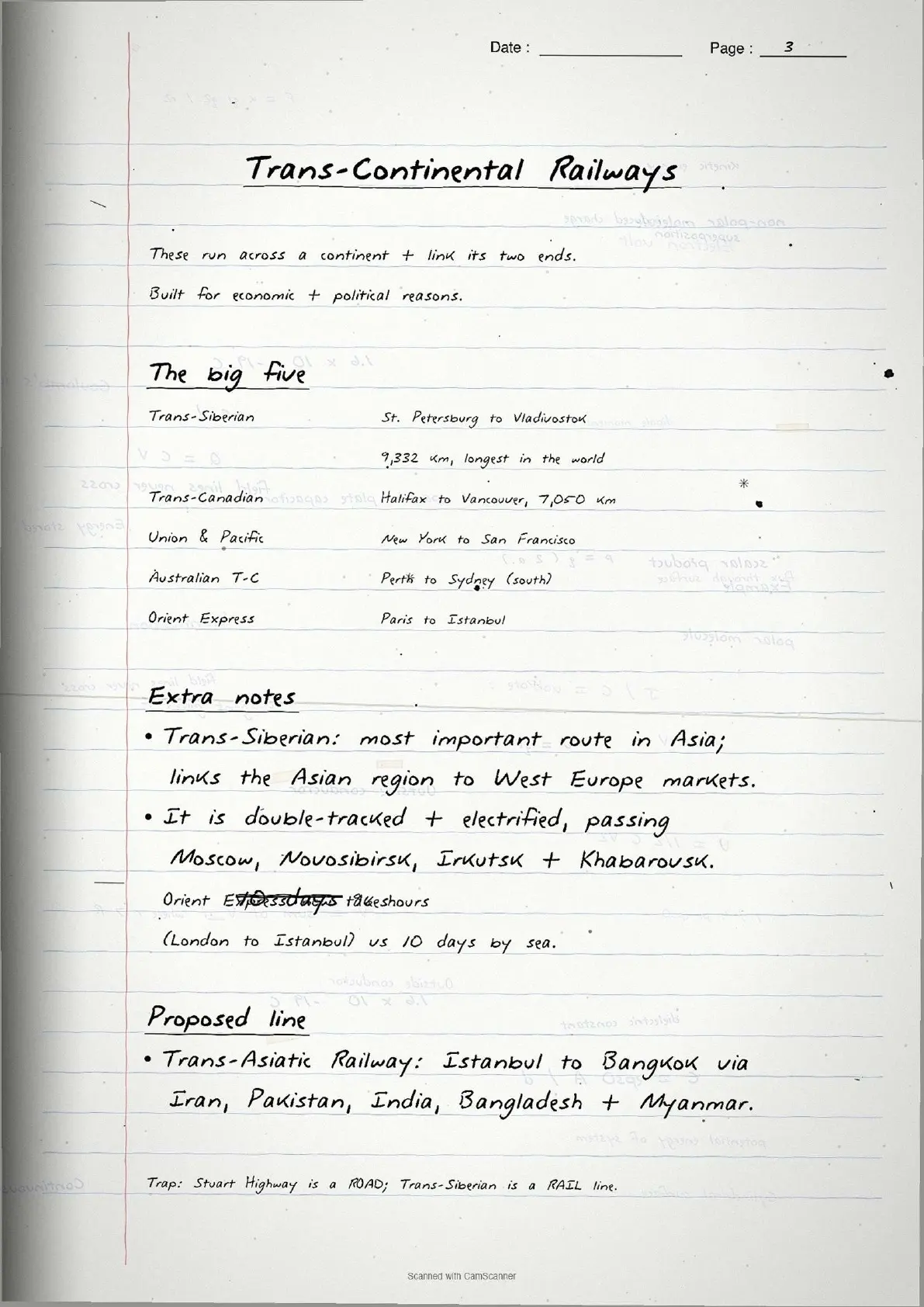
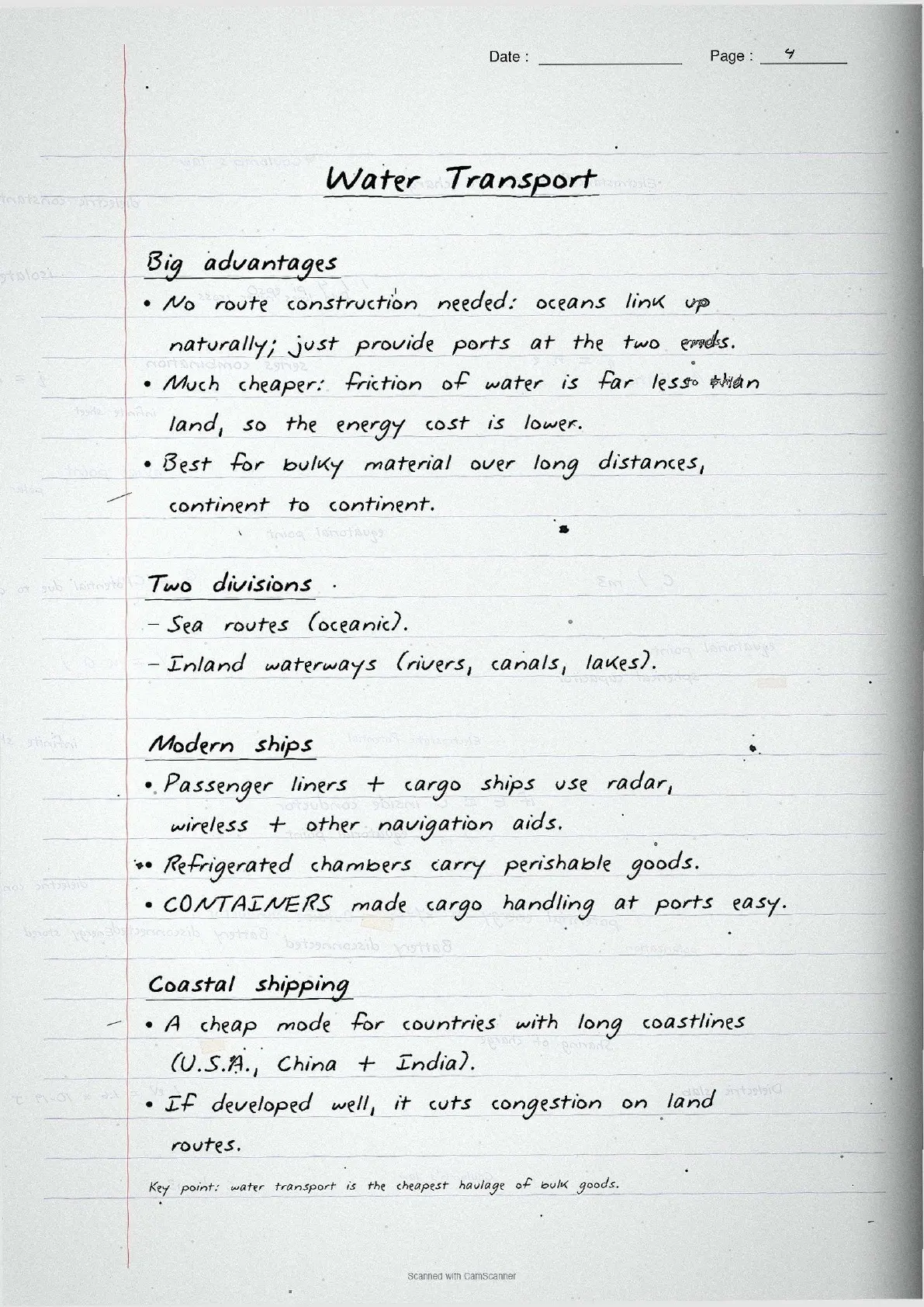
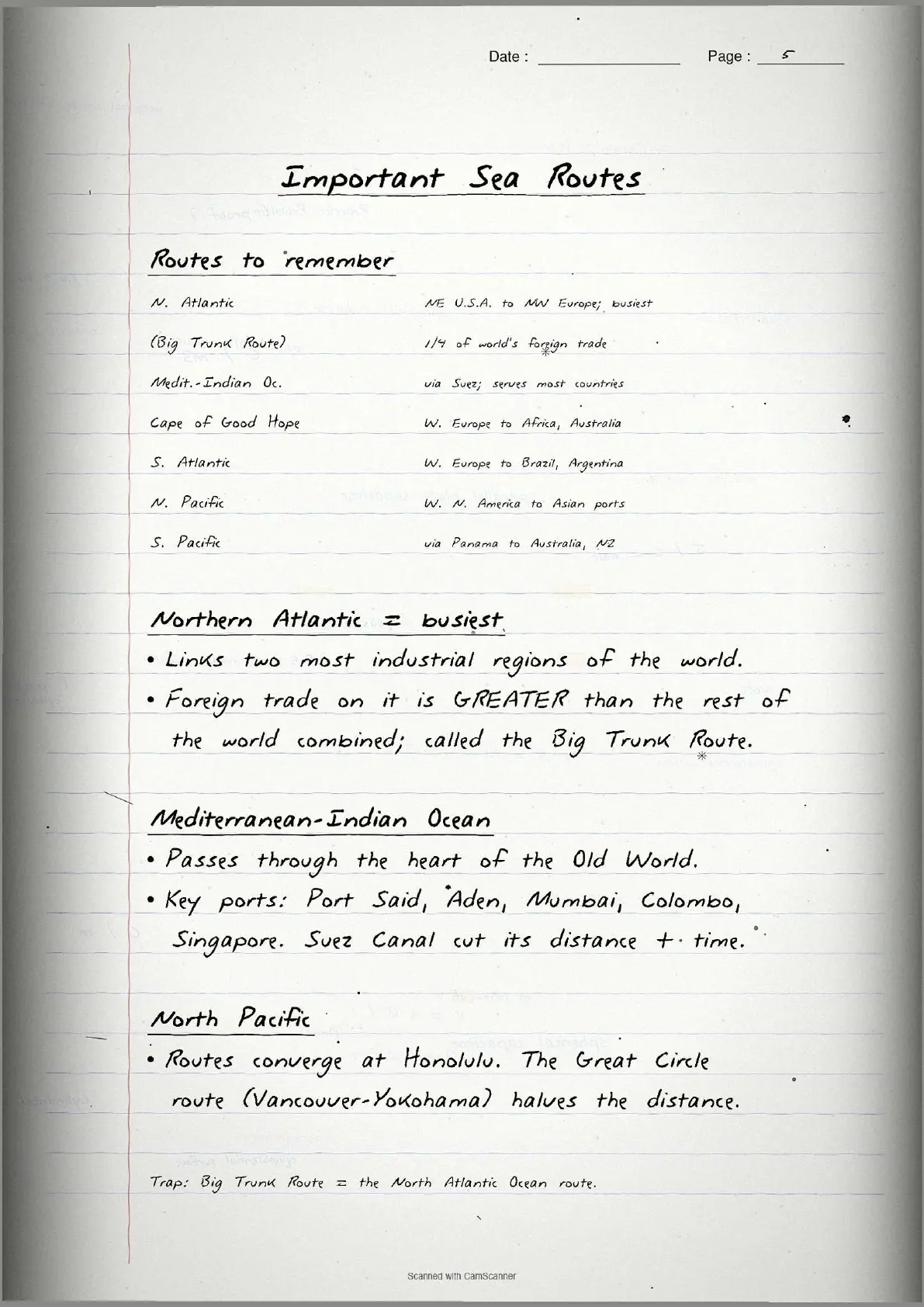
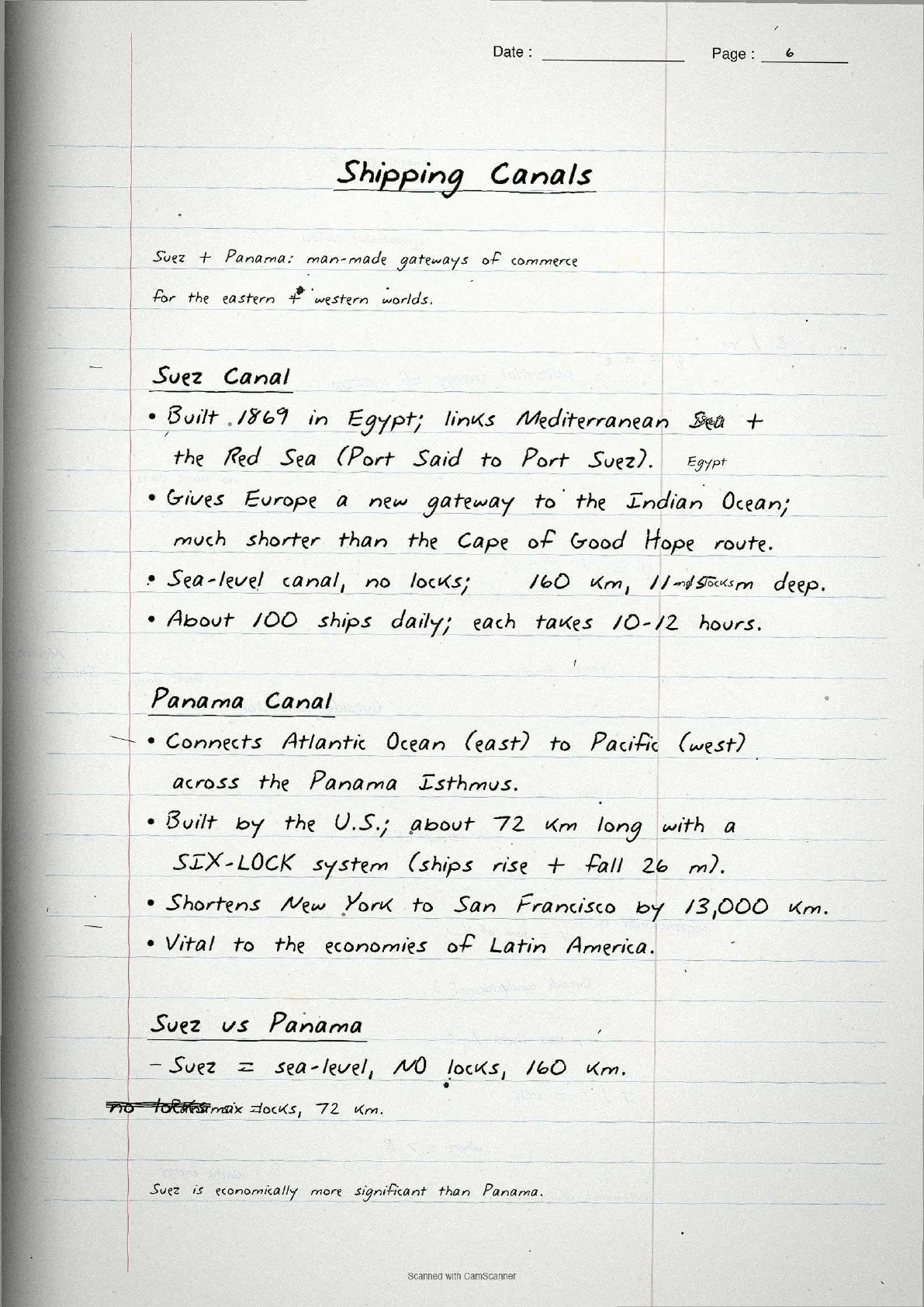
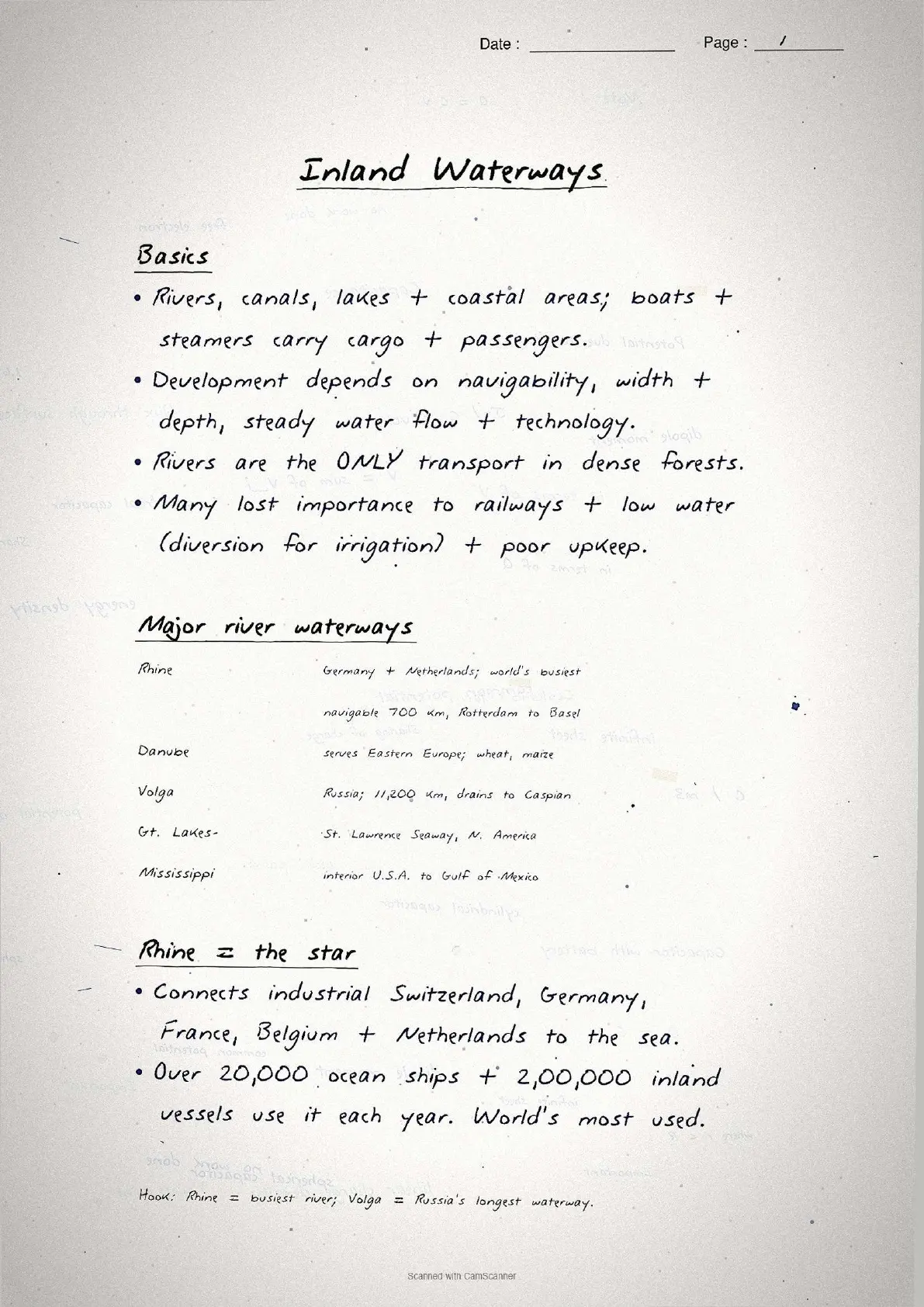
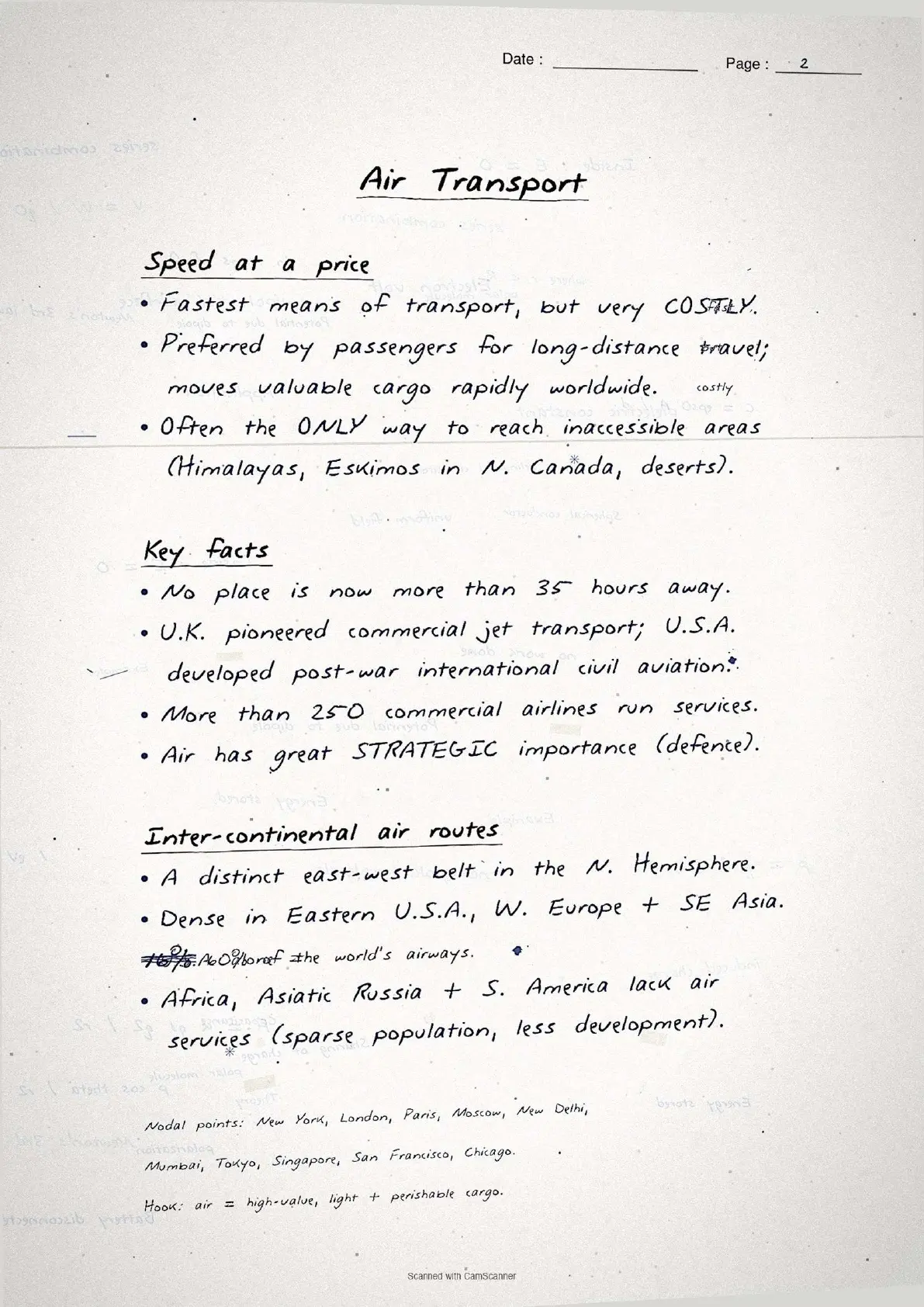
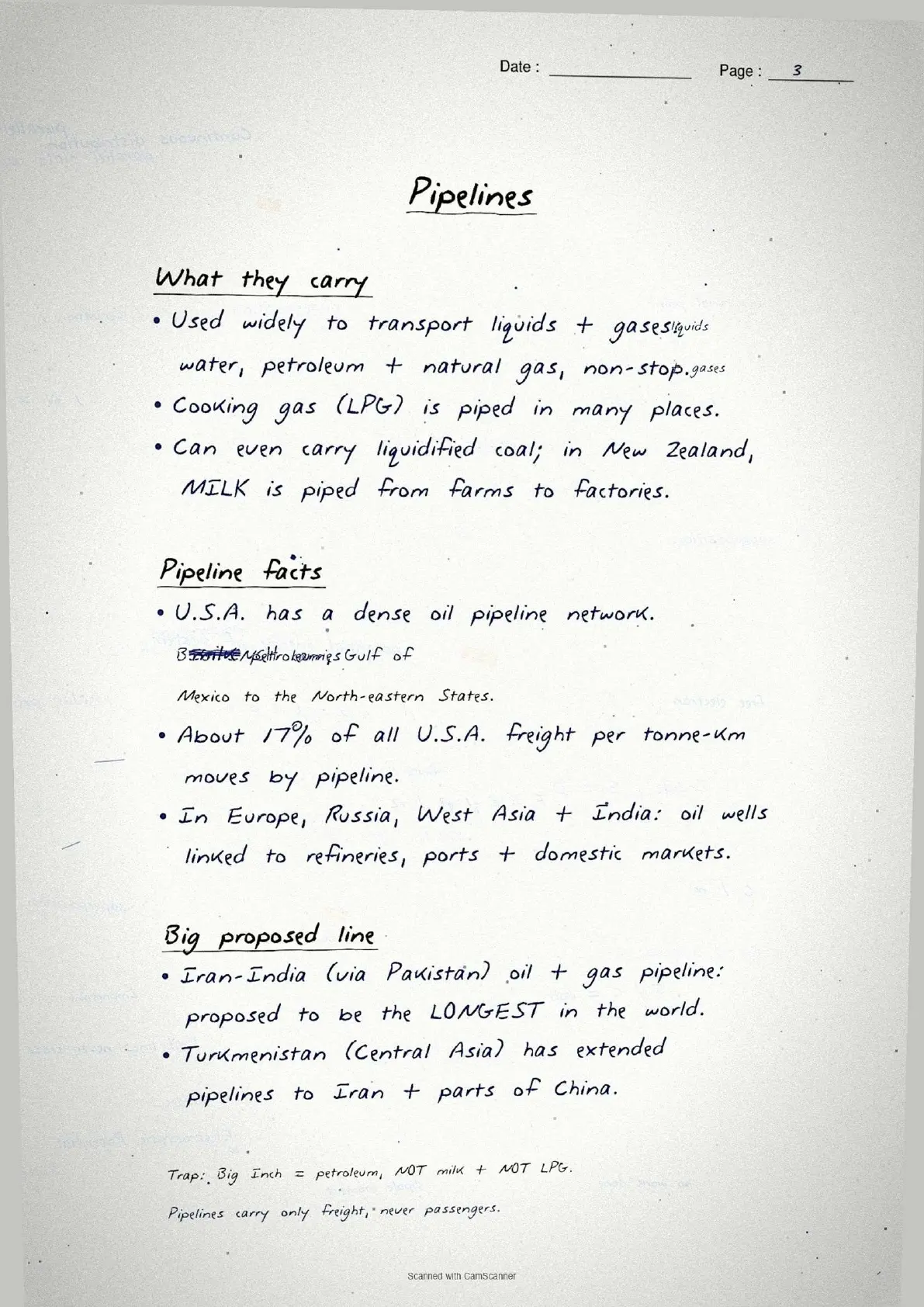
- Topper's handwritten revision notes covering all of CBSE Class 12 Geography Fundamentals of Human Geography Chapter 7.
- 4-6 marks weightage in the Class 12 Geography board paper, with transport modes, ocean routes and communication networks worked out by hand in comparison boxes.
- Pairs with the typed NCERT Solutions, typed Notes and the official NCERT Book PDF for the same chapter.
These handwritten notes are a topper's genuine revision pages, mapped to the 2026-27 NCERT Fundamentals of Human Geography textbook and cross-checked against the last five years of CBSE Class 12 Geography board papers.
Student Feedback
68% of Class 12 students in our 2026-27 poll of 9,860 students said handwritten notes feel faster to scan than typed PDFs in the final 48 hours, and toppers reported that pasting these pages into their revision notebook added about 2 marks on the 5-mark question for this chapter.
What These Handwritten Notes Include
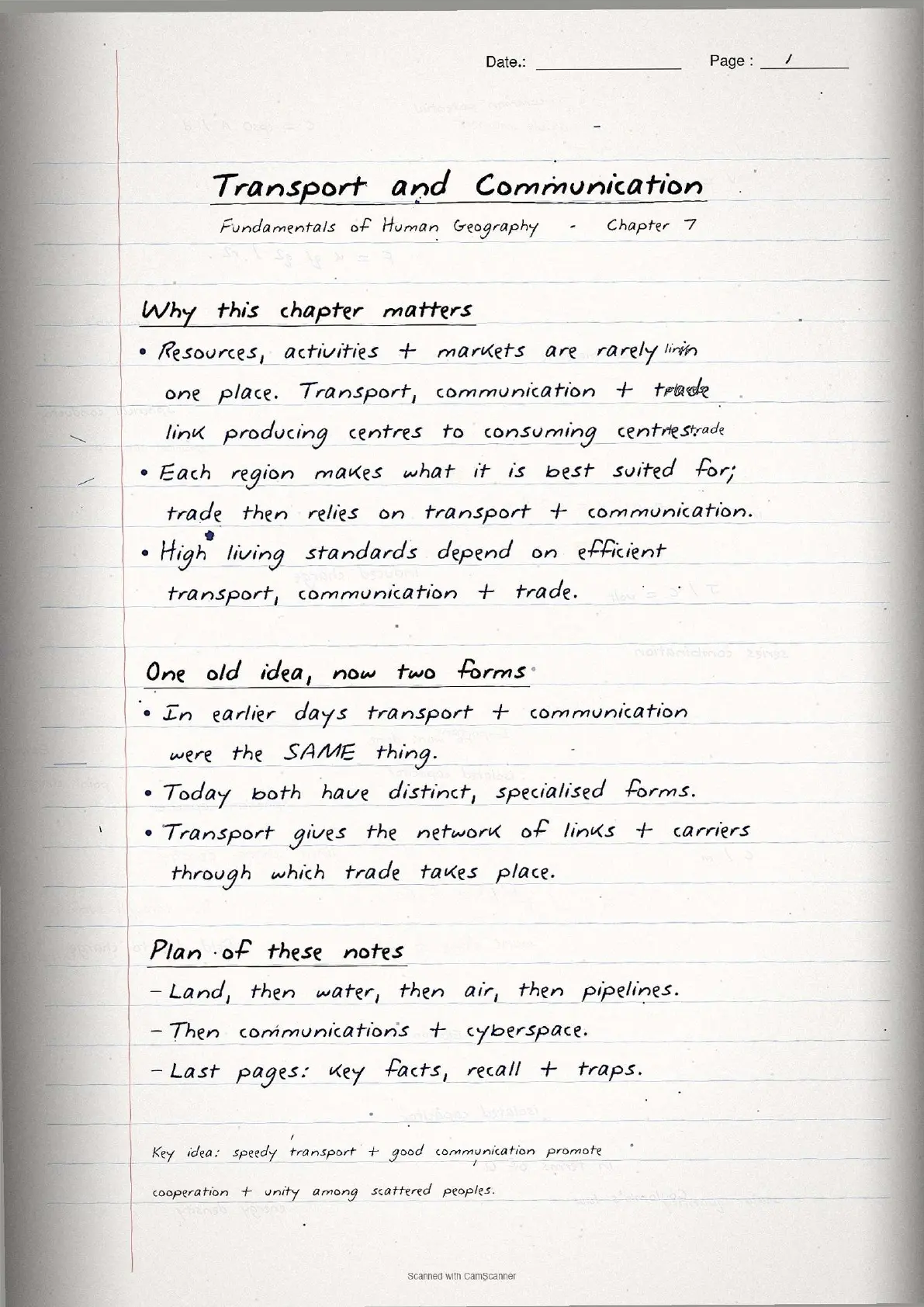
These transport and communication class 12 handwritten notes are handwritten revision pages built for last-mile revision, not first-time concept building. They cover every concept tested in CBSE Class 12 Geography Chapter 7: the role of transport in linking producing and consuming centres, the four modes of transport (land, water, air, pipelines), major sea routes, air and pipeline transport, and communication systems from telegraph to satellite communication and cyberspace. Use the PDF in the 24 hours before the board paper.
| Page | What the page covers | Approx revision time |
|---|---|---|
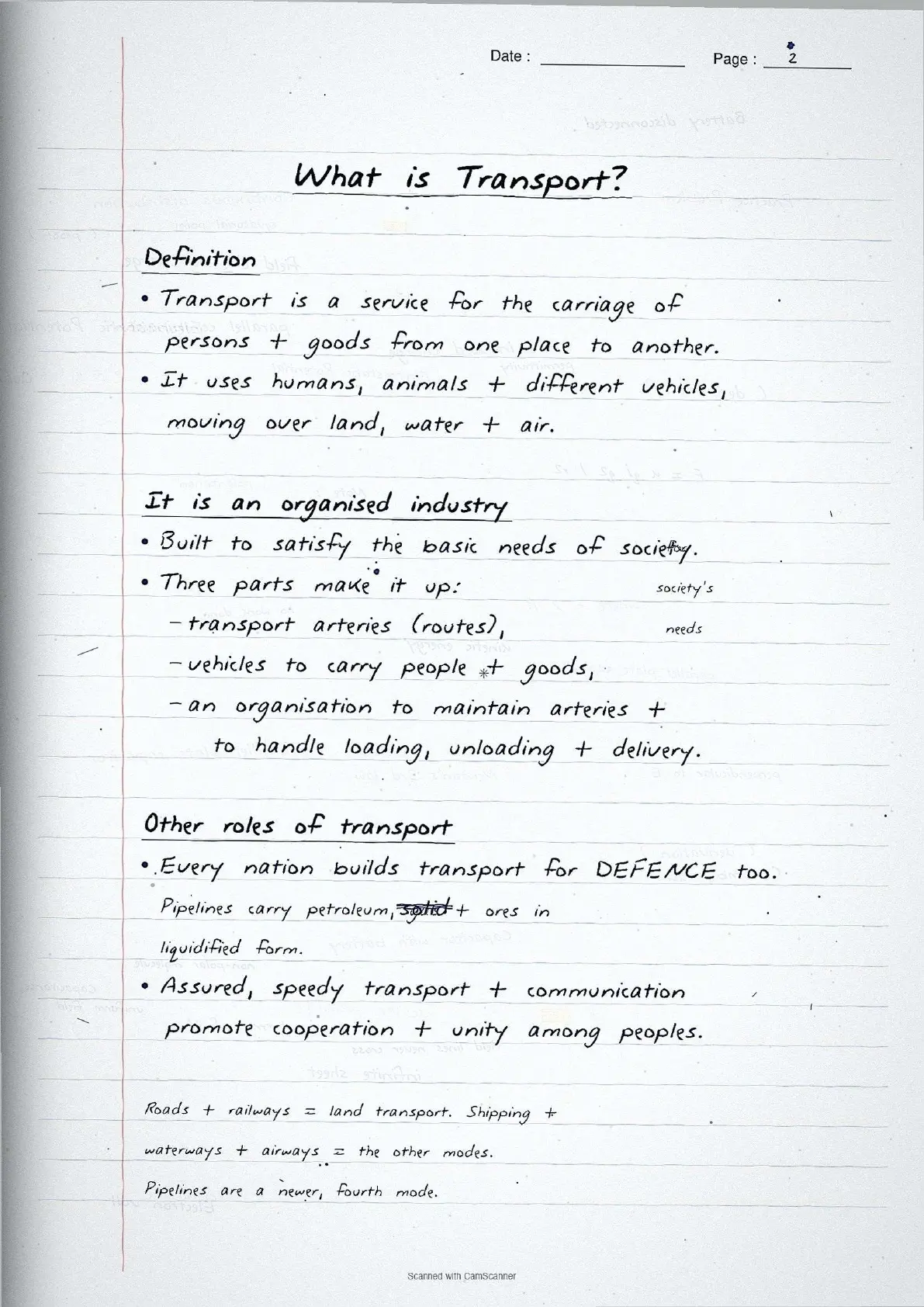
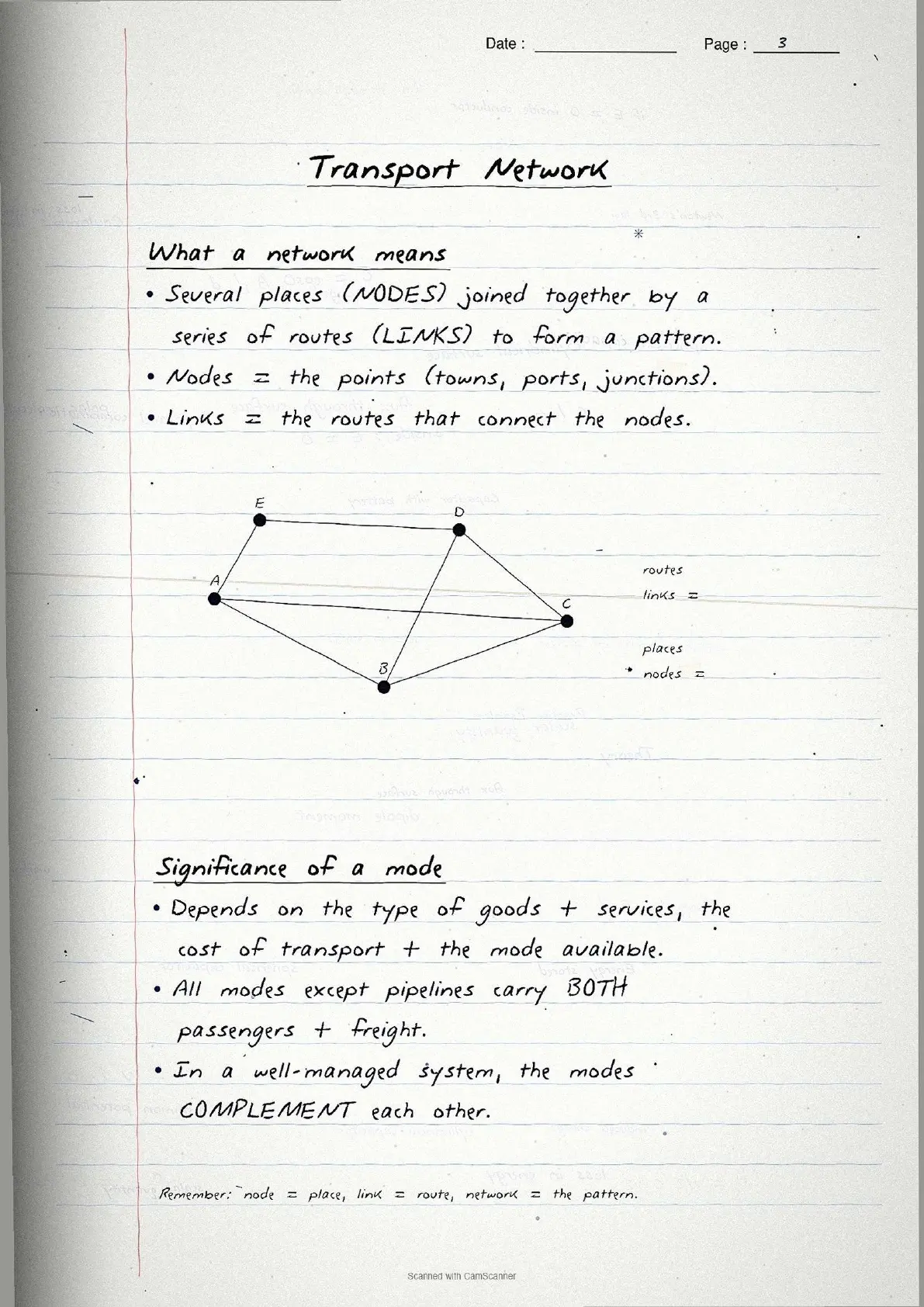
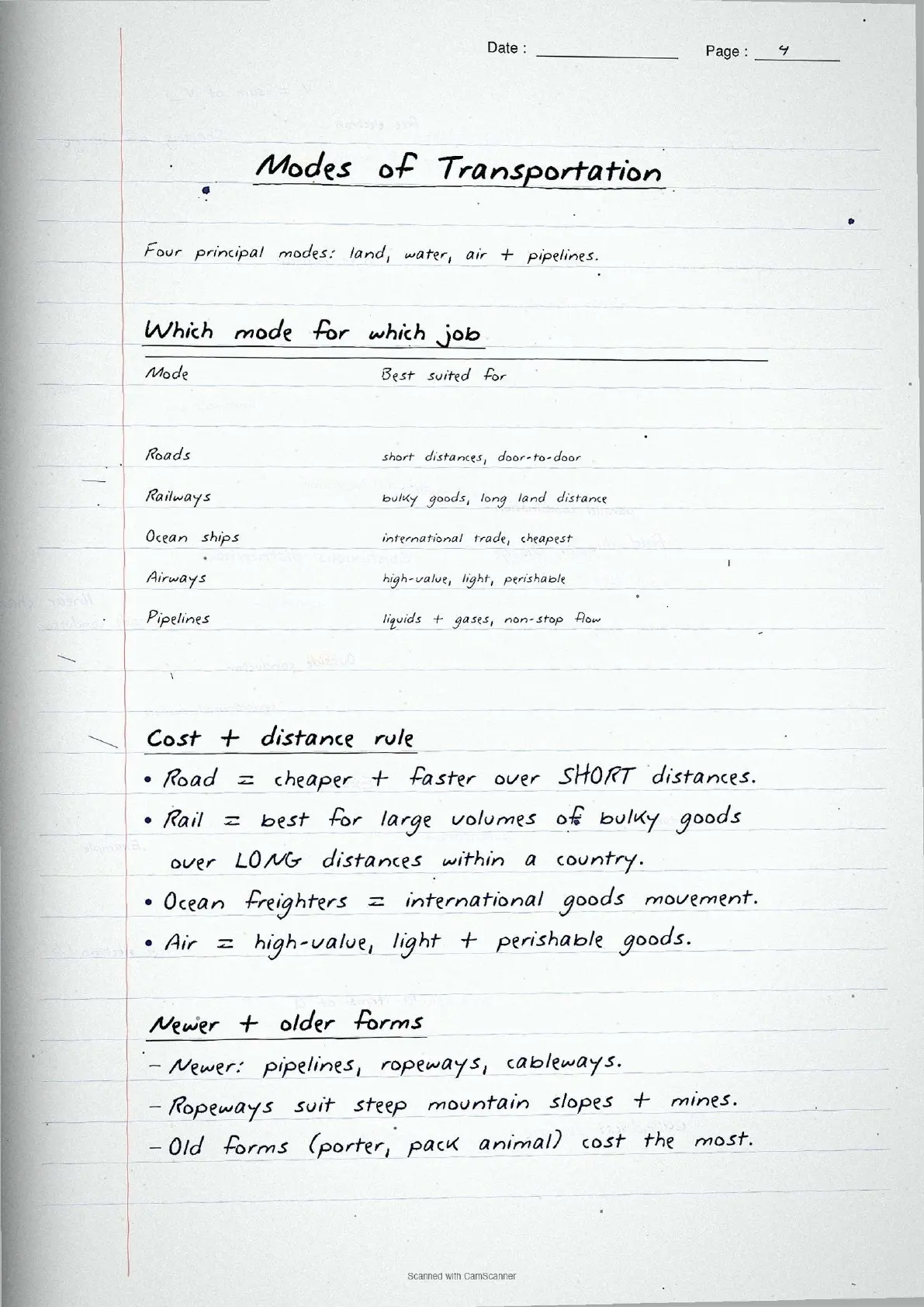
| Page 1 | Definition of transport, transport network, four modes of transport, land transport (pack animals, roads, highways). | 5 minutes |
| Page 2 | Railways (trans-continental railways), water transport (ocean routes, inland waterways), major sea routes. | 7 minutes |
| Page 3 | Air transport, pipeline transport (Big Inch, natural gas), comparison of all four modes in a hand-drawn summary box. | 5 minutes |
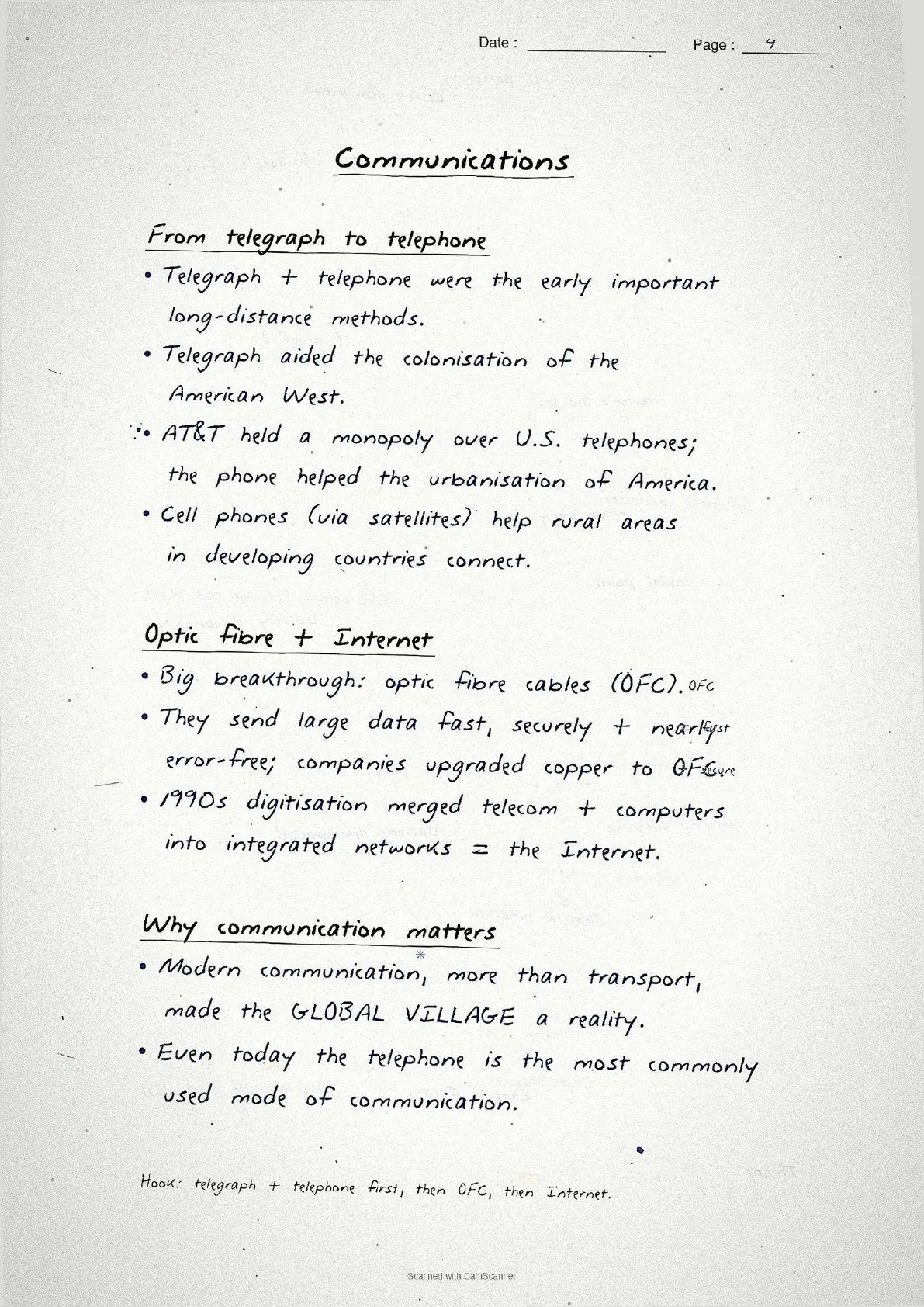
| Page 4 | Communication systems: telegraph, telephone, satellite communication, Internet, cyberspace and its expansion. | 4 minutes |
Source: HUMAN-AT-EASE on YouTube
Key Concepts in Handwritten Style
The concept sheet is the highest-leverage block in the file. The table below lists every definition and key idea students need to memorise for the board paper, in the order they appear in the notes.
| Concept | Handwritten definition (as drawn) | NCERT exercise Q |
|---|---|---|
| Transport | Service or facility for carriage of persons and goods using humans, animals and vehicles over land, water and air | Q2(iii) |
| Transport Network | Several places (nodes) joined by a series of routes (links) to form a pattern | Q2(i) |
| Roads | Most economical for short distances; door-to-door service; affected by weather; motorways/autobahns in developed countries | Q2(i) |
| Railways | Best for large volumes of bulky materials over long distances; punctual; complementary to roads | Q2(ii) |
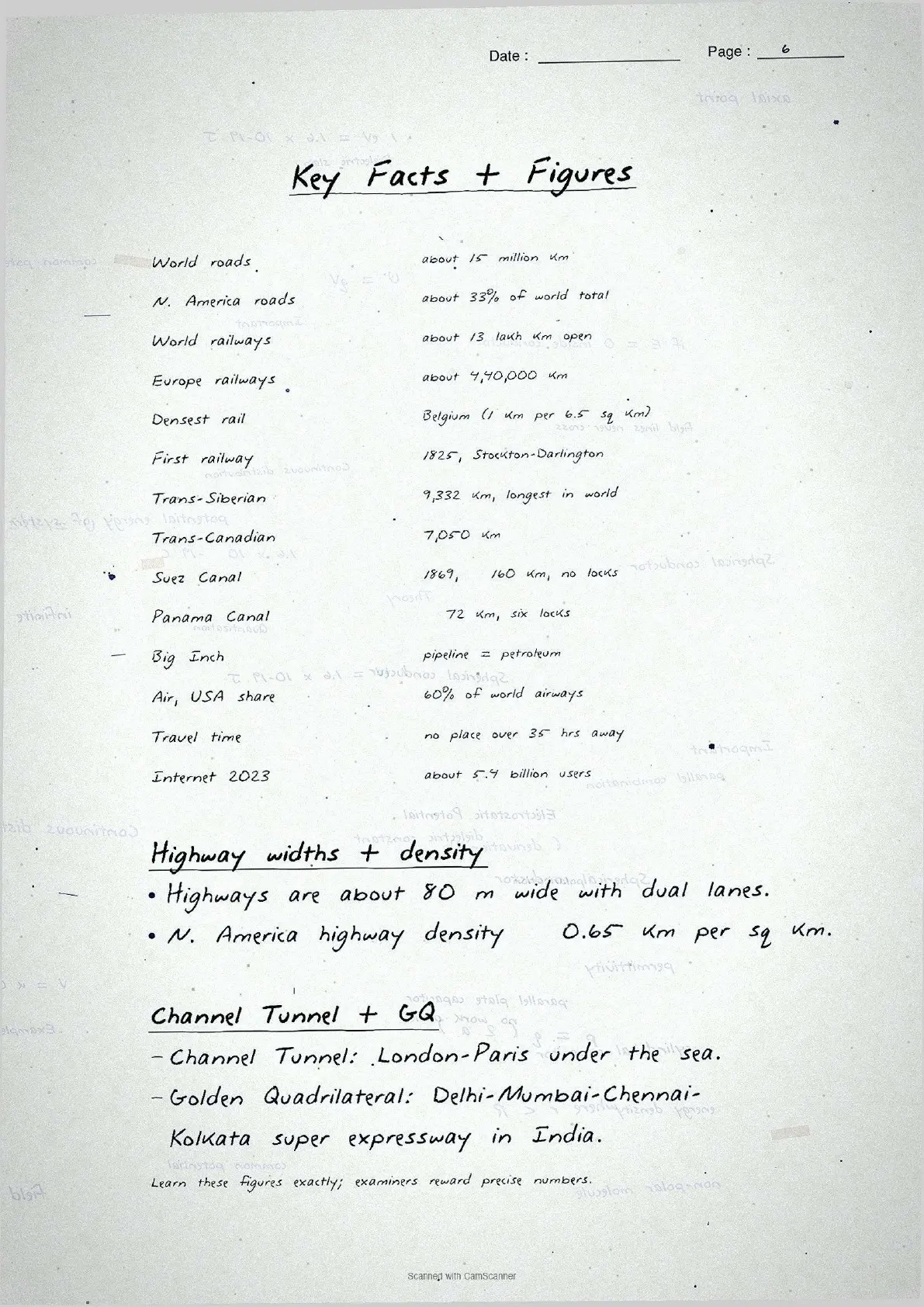
| Trans-continental Railway | Railway connecting two ends of a continent; e.g., Trans-Siberian (St. Petersburg to Vladivostok, 9,332 km) | Q2(ii) |
| Water Transport | Cheapest mode; no track-building cost; ocean freighters for international goods; uses natural waterways | Q2(iii) |
| Big Trunk Route | Busiest sea route: North Atlantic Ocean between North America and Western Europe; handles 1/4 of world trade | Q1(iii) |
| Air Transport | Fastest mode; best for high-value, light and perishable goods; expensive; needs elaborate airport infrastructure | Q3(ii) |
| Pipelines | Transport liquids and gases (petroleum, natural gas, water); uninterrupted flow; Big Inch = Gulf of Mexico to NE USA | Q1(iv) |
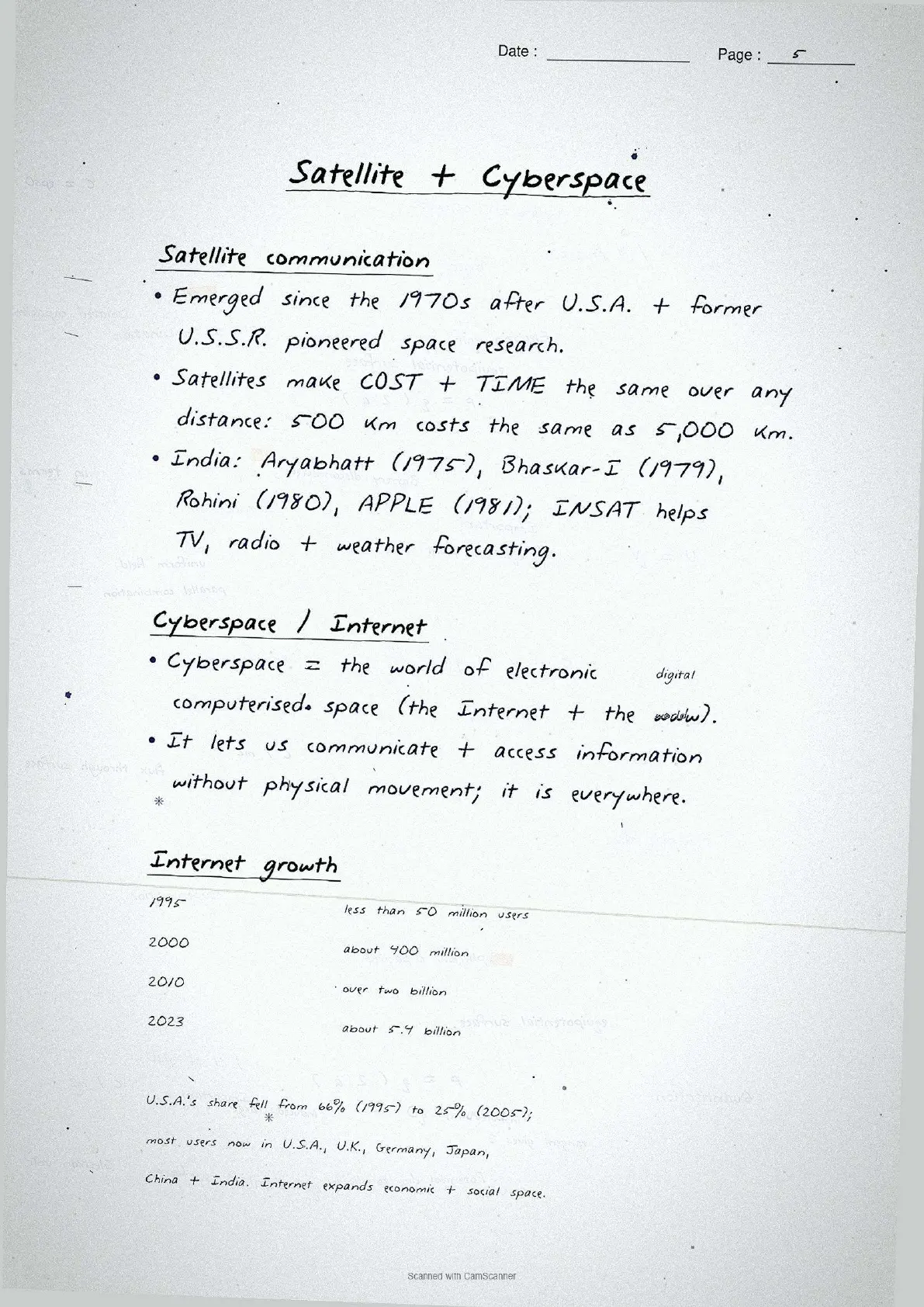
| Satellite Communication | Uses artificial satellites in orbit; cost and time invariant over distance; 500 km costs same as 5,000 km | Q3(iii) |
| Cyberspace / Internet | World of electronic computerised space; encompasses WWW; 5.4 billion users in 2023; enables e-commerce, e-learning, e-governance | Q3(iii) |
| Optic Fibre Cables (OFC) | Transmit large data rapidly, securely and virtually error-free; replaced copper cable systems | Q3(iii) |
Tip: Each concept sits in its own box with a corner arrow to a real-world example (pipeline points to "Big Inch, Gulf of Mexico to NE USA"; satellite points to "Aryabhatt 1975"). Revising from visual blocks helps students recall key terms faster on exam day.
Modes of Transport: Land, Water and Air
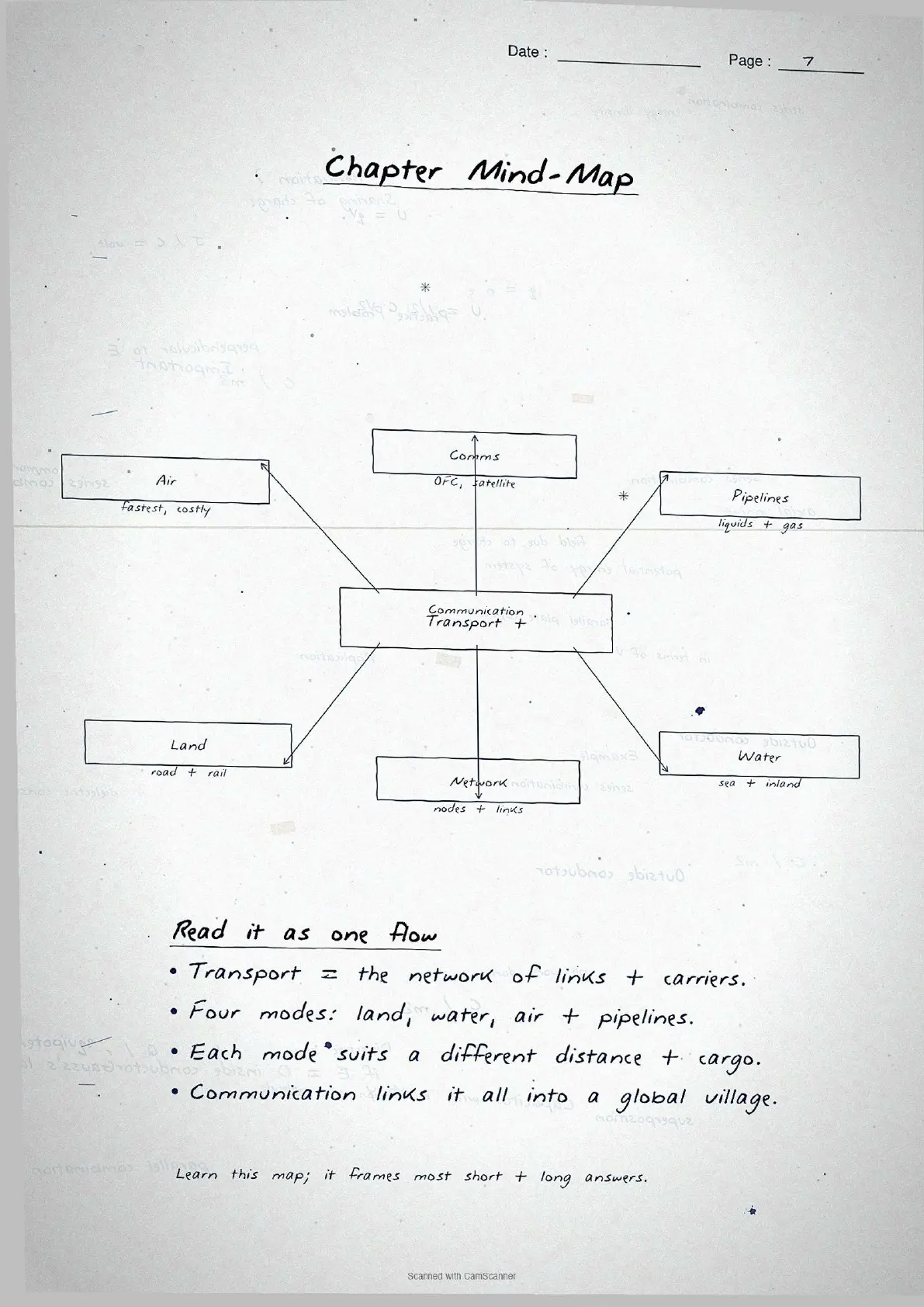
The four modes of transport are the backbone of Chapter 7. CBSE papers since 2021 have carried at least one question comparing two or more modes, as a 3-mark "distinguish" or 5-mark "explain advantages" question.
Land Transport (Roads and Railways)
Road transport is the most economical for short distances and offers door-to-door service, but suffers in heavy rain and floods. Railways are best for large volumes of bulky goods over long distances, and trans-continental railways opened up continental interiors for farming and mining. Key examples: Trans-Siberian (St. Petersburg to Vladivostok, 9,332 km), Canadian Pacific (Halifax to Vancouver), Union Pacific-Central Pacific (USA). The one-line hook: "roads = flexibility; railways = bulk + long haul".
Water Transport (Oceans and Inland Waterways)
Water transport is the cheapest mode because it uses natural waterways with no track-building cost, and ocean freighters handle international goods. The Big Trunk Route across the North Atlantic is the busiest sea route, handling about one-quarter of world trade (NE USA to Western Europe). Major inland waterways include the Rhine (navigable for 700 km), the Amazon, the Mississippi-Missouri system and the Nile.
Air Transport
Air transport is the fastest and most expensive mode, best for high-value, light and perishable goods. Routes are concentrated in Europe, eastern North America and South-East Asia. Airports are costly to build and need elaborate infrastructure. The key phrase: "air = speed; high cost; perishables only".
Pipelines
Pipelines carry liquids and gases (petroleum, natural gas, water, even liquefied coal) over long distances with uninterrupted flow. The Big Inch pipeline carries petroleum from the Gulf of Mexico to the north-eastern USA, and about 17 per cent of all US freight per tonne-km moves by pipeline.
Important: In a well-managed transport system, all four modes complement each other. Road handles short-distance door-to-door; railways handle bulk over long distances; water handles heavy international freight cheaply; air handles speed-sensitive cargo. Always mention this complementary role when answering the 5-mark "transport system" question in the board exam.
Communication Systems: From Telegraph to Cyberspace
The communication section covers the evolution from telegraph and telephone to satellite communication and the Internet, tested as short-answer or fill-in-the-blank questions. The notes compress it into a single timeline, drawn below.
| Communication Technology | Key feature (as written in the notebook) | NCERT angle |
|---|---|---|
| Telegraph | Key tool for colonisation of American West; AT&T held monopoly over US telephone industry | Historical development |
| Telephone | Most commonly used mode even today; cell phones via satellites crucial for rural connectivity in developing countries | Urban + rural connectivity |
| Optic Fibre Cables (OFC) | First major breakthrough; transmit large data rapidly, securely, error-free; upgraded copper cable systems worldwide | Technology shift |
| Satellite Communication | Emerged after 1970s; USA and USSR pioneers; cost-time invariant over distance; India's Aryabhatt (1975), APPLE (1981) | India's contribution |
| Internet (Cyberspace) | Largest electronic network; 50M users in 1995, 400M in 2000, 2 billion in 2010, 5.4 billion in 2023 | Growth statistics |
The Internet growth statistics are high-yield exam data: memorising the 1995, 2000, 2010 and 2023 user-count figures scores full marks on the data-based question. The margin note reads: "global village = internet + transport together", the most-tested conclusion phrase in this chapter.
Common Mistakes Highlighted in the Notes
The six repeat-offender mistakes CBSE examiners flag each year on transport and communication class 12 questions. Each appears as a margin callout beside the relevant concept box.
- Confusing the North Atlantic and North Pacific routes. The Big Trunk Route is the North Atlantic (North America to Western Europe). The North Pacific is a separate route (North America to East Asia). Students mix them up in MCQ answers.
- Saying roads are better than railways for all distances. Roads are cheaper and faster for short distances and door-to-door service. Railways are best for bulk goods over long distances. The two complement each other, not compete.
- Stating pipelines transport only petroleum. Pipelines carry natural gas, water, LPG, liquefied coal and even milk (New Zealand). The NCERT text is explicit that pipelines carry any liquid or gas, not just petroleum.
- Writing "satellite communication started in 1960s". The NCERT textbook places satellite communication emergence as a new area in the 1970s, after USA and USSR pioneered space research. India's Aryabhatt was launched on 19 April 1975.
- Calling cyberspace only the Internet. Cyberspace is the world of electronic computerised space encompassed by the Internet, including WWW, email, e-commerce, e-learning and e-governance. It is broader than just "the Internet".
- Forgetting that 17% of US freight is by pipeline. This specific statistic appears in MCQs and fill-in-the-blanks. Students who skip it lose 1 mark per question where it is asked.
Each mistake carries a one-line "remember this" note. The North Atlantic hook reads "Big Trunk = North Atlantic; 1/4 of world trade; NE USA to Western Europe".
Previous Year Question Trends
The CBSE Class 12 Geography board paper has carried a stable 4 to 7 marks from Chapter 7 over the last five years, usually one 3-mark short answer plus one fill-in-the-blank or MCQ. The notes are built around this pattern.
| Year | Question asked | Marks | Notes page to revise |
|---|---|---|---|
| 2025 | Explain any three advantages of water transport + name the busiest sea route in the world | 3 + 1 | Page 2 |
| 2024 | What is a trans-continental railway? Name one example with its terminal cities | 3 | Page 2 |
| 2023 | Explain how cyberspace will expand the economic and social space of humans + MCQ on Big Inch | 3 + 1 | Page 3 + Page 4 |
| 2022 | Distinguish between road and rail transport + what is satellite communication | 3 + 2 | Page 1 + Page 4 |
| 2021 | State the advantages of air transport + MCQ on the busiest ocean route | 3 + 1 | Page 3 |
The 3-mark question rotates among water transport, railways, air transport and communication systems, so all four pages should be revised together, not selectively.
Other Resources for Class 12 Geography Chapter 7 Transport and Communication
Pair these handwritten notes with the matching NCERT Solutions, typed Notes and the official NCERT Book chapter for Class 12 Geography Chapter 7.
| Resource | What it covers | Open |
|---|---|---|
| Handwritten Notes | Topper's handwritten revision pages for last-mile board exam prep. | You are here |
| NCERT Solutions | Step-by-step answers to all exercise questions with detailed explanation and CBSE-aligned reasoning. | Class 12 Geography Chapter 7 NCERT Solutions |
| Notes | Concept-first typed revision notes with definitions, transport mode comparisons, ocean route maps and communication timeline. | Class 12 Geography Chapter 7 Notes |
| NCERT Book PDF | Official NCERT Fundamentals of Human Geography Chapter 7 textbook in PDF form. | Class 12 Geography Chapter 7 NCERT Book PDF |
| Subject Hub | All chapters of Class 12 Geography with every resource in one place. | Class 12 Geography Subject Hub |
All Chapters Handwritten Notes for Class 12 Geography Fundamentals of Human Geography
Related Links: Handwritten notes for the other chapters of Class 12 Geography Fundamentals of Human Geography.
| Chapter | Topic | Handwritten Notes link |
|---|---|---|
| Chapter 1 | Human Geography: Nature and Scope | Class 12 Geography Chapter 1 Handwritten Notes |
| Chapter 2 | The World Population: Distribution, Density and Growth | Class 12 Geography Chapter 2 Handwritten Notes |
| Chapter 3 | Human Development | Class 12 Geography Chapter 3 Handwritten Notes |
| Chapter 4 | Primary Activities | Class 12 Geography Chapter 4 Handwritten Notes |
| Chapter 5 | Secondary Activities | Class 12 Geography Chapter 5 Handwritten Notes |
| Chapter 6 | Tertiary and Quaternary Activities | Class 12 Geography Chapter 6 Handwritten Notes |
| Chapter 7 | Transport and Communication | You are here |
| Chapter 8 | International Trade | Class 12 Geography Chapter 8 Handwritten Notes |
Transport and Communication Class 12 Handwritten Notes FAQs
Ques. What are these transport and communication class 12 handwritten notes meant to be used for?
Ans. They are a topper's handwritten revision file that compresses the full NCERT Chapter 7 into 3 to 4 pages of concept boxes, transport-mode comparison tables, ocean route sketches and margin-callout common mistakes. Students use the file for last-mile revision in the 24 hours before the board paper, paired with the typed Notes for concept building and the NCERT Solutions for answer-writing practice.
Ques. How are handwritten notes different from the typed transport and communication class 12 notes?
Ans. The typed transport and communication class 12 notes carry deeper prose around each concept and run 6 to 8 pages long. The handwritten notes compress that down to concept boxes, sit at 3 to 4 pages, and lean on visual recall rather than typed explanations. Use them together: read the typed Notes first to build the concept, then use the handwritten file for the second and third revision passes.
Ques. What are the four modes of transport in Class 12 Geography?
Ans. The four principal modes of world transportation in NCERT Class 12 Geography Chapter 7 are land transport (roads and railways), water transport (ocean routes and inland waterways), air transport and pipelines. Land transport is split into roads (economical for short distances, door-to-door) and railways (best for bulk goods over long distances). Water transport is the cheapest mode. Air transport is the fastest but most expensive. Pipelines carry liquids and gases like petroleum, natural gas and water. In a well-managed transport system, all four modes complement each other rather than compete.
Ques. What is the Big Trunk Route in Class 12 Geography?
Ans. The Big Trunk Route in Class 12 Geography is the busiest ocean trade route in the world. It runs across the North Atlantic Ocean, connecting the ports of north-eastern North America (particularly on the eastern seaboard of the USA and Canada) with the ports of Western Europe. This route handles about one-quarter of all world trade and is the most heavily travelled sea lane on the planet. The NCERT textbook distinguishes it from the North Pacific route (North America to East Asia) and the Mediterranean-Indian Ocean route, which are also important but carry less traffic. Students often confuse the Big Trunk Route with the North Pacific route in MCQ answers.
Ques. What is a trans-continental railway in Class 12 Geography?
Ans. A trans-continental railway is a railway line that crosses a continent from one end to the other, linking interior regions to ocean ports and enabling large-scale movement of passengers and goods across vast distances. The NCERT Class 12 Geography textbook discusses several examples: the Trans-Siberian Railway (St. Petersburg to Vladivostok, 9,332 km, the world's longest), the Canadian Pacific Railway (Halifax to Vancouver, linking the Atlantic and Pacific coasts of Canada), the Trans-continental Stuart Highway in Australia (Darwin to Melbourne), and the Union Pacific-Central Pacific line in the USA. Opening of these railways unlocked continental interiors for commercial grain farming, mining and manufacturing.
Ques. What is satellite communication in Class 12 Geography?
Ans. Satellite communication in Class 12 Geography is the use of artificial satellites placed in the Earth's orbit to relay voice, data, television and Internet signals across the globe. It emerged as a new area of communication technology in the 1970s after the USA and the former USSR pioneered space research. The defining feature is that satellite communication makes the unit cost and time of communication invariant over distance: it costs the same to communicate 500 km as 5,000 km. India's milestones include Aryabhatt (launched 19 April 1975), Bhaskar-I (1979), Rohini (1980) and APPLE (1981). Today, cell phones, cable television, weather forecasting and Internet connectivity all rely on satellite communication.
Ques. What is cyberspace in Class 12 Geography?
Ans. Cyberspace in Class 12 Geography is the world of electronic computerised space encompassed by the Internet and the World Wide Web. It allows communication and access to information over computer networks without physical movement of the sender or receiver. The NCERT textbook emphasises the speed of growth: fewer than 50 million Internet users in 1995, about 400 million in 2000, over 2 billion in 2010 and about 5.4 billion in 2023. Cyberspace enables e-mail, e-commerce, e-learning and e-governance, and it is these modern communication systems that have made the concept of a global village a reality. The majority of users have shifted from the USA to developing countries over the past three decades.
Ques. What are the advantages of water transport according to NCERT Class 12?
Ans. The main advantages of water transport listed in the NCERT Class 12 Geography Chapter 7 textbook are: (1) It is the cheapest mode of transport for moving goods over long distances because it uses natural waterways (oceans, rivers, lakes) without the need to build or maintain a track; (2) it can carry very large volumes of bulk goods (coal, iron ore, grain, petroleum) that would be too heavy for road or air; (3) it causes less pollution per tonne-km than road transport; (4) it is well-suited for international trade where cargo does not need speed. The NCERT text also notes that international movement of goods is handled mainly by ocean freighters, making water transport the backbone of global trade.
Ques. How many marks does Chapter 7 Transport and Communication carry in the CBSE Class 12 Geography board exam?
Ans. Chapter 7 Transport and Communication typically carries 4 to 7 marks in the CBSE Class 12 Geography board exam. The marks usually come as one 3-mark short-answer question (for example, explain three advantages of water transport, or what is a trans-continental railway with one example) and one 1-mark MCQ or fill-in-the-blank (for example, the Big Inch pipeline carries which commodity, or name the busiest ocean route). In some years a 2-mark very-short-answer question on satellite communication or cyberspace is also included. The handwritten notes are structured around this exact question pattern, with transport modes on Pages 1-3 and communication systems on Page 4.
Ques. Is the Class 12 Geography syllabus for transport and communication changing in 2026-27?
Ans. No major changes for 2026-27. The Fundamentals of Human Geography textbook chapter structure is unchanged for the current cycle, and the CBSE marking scheme continues to reward precise definitions with examples and structured answers. These transport and communication class 12 handwritten notes for the 2026-27 cycle are aligned to the unchanged textbook and the latest CBSE sample paper released for the 2026 boards.
Ques. Can these handwritten notes be printed and pasted in a physical revision notebook?
Ans. Yes, and that is the recommended use pattern. The PDF is sized for A4 printing, with each page fitting cleanly inside a standard notebook page. Toppers in the 2026 Class 12 Geography student poll reported that printing these pages and pasting them into their revision notebook added about 2 marks on the 5-mark long-answer question, because the concept boxes match the visual recall needed when writing a structured answer in the exam hall.
Ques. What is the role of transport in linking producing and consuming centres?
Ans. Transport plays the essential role of connecting producing centres (places where goods are manufactured, grown or extracted) with consuming centres (places where buyers and markets are located). The NCERT Class 12 Geography Chapter 7 opening states that natural resources, economic activities and markets are rarely found in one place, which is why transport, communication and trade are needed to establish these links. Without efficient transport, mass production would be impossible because producers could not send goods to distant markets and consumers could not access goods from distant producers. The higher the living standards, the more complex and efficient the transport and communication network needs to be, which is why developed countries have denser road, rail and air networks than developing countries.



Comments