




Journey to the End of the Earth class 12 english handwritten notes from Collegedunia give you a 9-page scanned notebook covering the Madras-to-Antarctic peninsula route, the Akademik Shokalskiy and Students on Ice context, the three sub-headings (Part of history, Human impact, Walk on the ocean), Gondwana 650 Ma and the daughter continents, the six-link ozone-phytoplankton-food-chain cascade, the 65.55-degrees-south walk on the ocean, and the high-frequency value-points that examiners build the Vistas Section C question around for the 2026-27 CBSE English Core paper.
- CBSE Weightage: 6 marks per Vistas Long Answer in Section C, drawn from the four Reading with Insight questions
The notebook runs 9 ruled pages with a faded red margin line, blue ballpoint strokes, and hand-drawn arrows that mirror the way a topper would condense the chapter on the night before the paper.
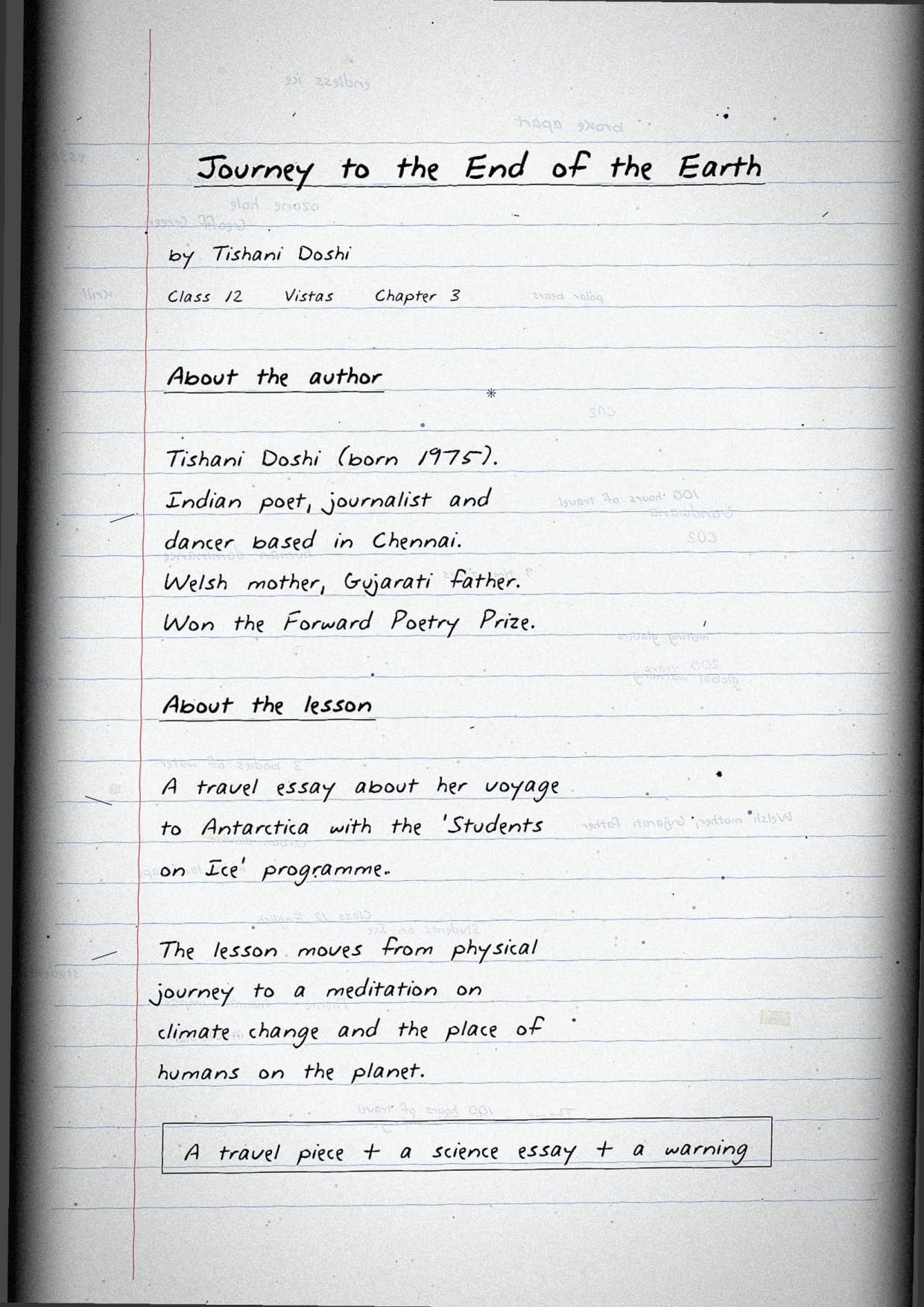


Every page mirrors a question slot you will actually face: the setting + author on page 1, the three-phase summary on page 2, the Gondwana past anchor on page 3, the climate-change present anchor on page 4, the phytoplankton parable on page 5, Geoff Green and Students on Ice on page 6, the walk on the ocean on page 7, the glossary and quote bank on page 8, and the PYQ + last-week recall strip on page 9. Read in that order on the morning of the exam and you carry the chapter end-to-end in fifteen minutes.
Also Check:
- Journey to the End of the Earth Class 12 Notes (Typeset)
- Journey to the End of the Earth Class 12 NCERT Solutions
Journey to the End of the Earth Class 12 English Handwritten Notes: What the 9 Pages Cover
The Journey to the End of the Earth class 12 english handwritten notes are structured as nine themed pages, each anchored on one question slot. Use the strip below as a contents map before you flip the PDF open.
| Page | Focus | What you copy onto your rough sheet first |
|---|---|---|
| Page 1 | Setting + author | Madras 13.09 N to Antarctic peninsula 65.55 S; Akademik Shokalskiy (Russian); Tishani Doshi (b. 1975); five-word anchor MADRAS - SHOKALSKIY - GONDWANA - PHYTOPLANKTON - CONNECT. |
| Page 2 | Three-phase summary in 3 beats + climax | Part of history (past), Human impact (present), Walk on the ocean (future) + the metre-thick ice pack climax. |
| Page 3 | Gondwana past anchor | 650 Ma supercontinent; daughter continents (India, S. America, Africa, Australia, Antarctica); Cordilleran folds; pre-Cambrian shields; Drake Passage opens. |
| Page 4 | Climate change present anchor | "A paltry 12,000 years"; carbon-dioxide blanket; three urgent debates; half-million-year ice-core records; pristine archive. |
| Page 5 | Phytoplankton parable | "Those grasses of the sea"; six-link cascade (ozone-UV-phytoplankton-krill-whales-carbon pump); "take care of the small things". |
| Page 6 | Geoff Green and Students on Ice | Canadian founder; switched from celebrities to high-schoolers; absorb, learn, act; future-policy-maker bet. |
| Page 7 | Walk on the ocean | 65.55 S near Tadpole Island; 52 passengers down the gangplank; metre of ice over 180 m of water; crabeater seals; "everything does indeed connect". |
| Page 8 | Glossary flash cards + quote bank | 8 glossary terms (Gondwana, Cordilleran folds, granite shields, Drake Passage, phytoplankton, ozone layer, Akademik Shokalskiy, Students on Ice) + 7 must-memorise quotations. |
| Page 9 | PYQ map + last-week recall strip | 2020-2025 long-answer rotations; four 1-mark MCQ facts; three 4-mark SA prompts; four 6-mark LA prompts. |
Journey to the End of the Earth Video Walkthrough
Source: Magnet Brains on YouTube
Setting Map: The Page-1 Skeleton
Page 1 of the notebook draws the setting as a long arrow - 13.09 degrees north (Madras) on the left, 65.55 degrees south (just past the Antarctic Circle near Tadpole Island) on the right - with the Akademik Shokalskiy steaming across nine time zones, six checkpoints and three bodies of water. The handwritten note next to the map summarises the five facts that drive the entire chapter and that CBSE tests in 1-mark MCQs.

Three-Phase Summary: The Page-2 Past-Present-Future Walk
Page 2 is the most reproduced spread in the notebook. It walks the chapter in three tense-phases with hand-drawn arrows linking each phase to the next: Part of history (past - Gondwana 650 Ma, the daughter continents, the Drake Passage opening), Human impact (present - the 12,000-year line, the carbon-dioxide blanket, the half-million-year ice-core records), Walk on the ocean (future - the phytoplankton cascade and the literal walk at 65.55 degrees south). Memorise the three-phase skeleton and any Long Answer becomes a fill-in-the-blank exercise on Doshi's own sub-headings.
Gondwana and Climate-Change Anchors: Pages 3 and 4
Pages 3 and 4 give the past-anchor and present-anchor for the chapter. Page 3 is Gondwana: a southern supercontinent 650 million years ago, daughter continents (India, South America, Africa, Australia, Antarctica), Cordilleran folds and pre-Cambrian granite shields, the Drake Passage opening 200 Ma that chilled Antarctica permanently. Page 4 is climate change: the "paltry 12,000 years" line, the carbon-dioxide blanket, the three urgent debates (West Antarctic ice sheet, Gulf Stream disruption, end-of-world-as-we-know-it), and the half-million-year ice-core carbon records that no other continent can match because no human population has ever sustained itself in Antarctica.
Phytoplankton Parable: The Page-5 Cascade
Page 5 is the chapter's moral engine drawn as a six-step arrow chain. The cascade reads: ozone depletion to ultraviolet penetration to phytoplankton damage to krill collapse to whale and Adelie penguin starvation to weakened carbon pump. The notebook tags each step with the exact word Doshi uses ("those grasses of the sea", "single-celled plants", "in the parable of the phytoplankton"). The moral - "take care of the small things and the big things will fall into place" - sits at the foot of the page in a hand-drawn box. The small things are the microscopic mechanisms (ozone, phytoplankton, photosynthesis), NOT the visible animals - the page repeats this in red ink as the chapter's single most common error.
Geoff Green, Walk on the Ocean and Glossary: Pages 6, 7 and 8
Page 6 gives Geoff Green as the Canadian founder of Students on Ice and walks the four reasons he switched from celebrity tourists to high-schoolers (future policy-makers; the absorb-learn-act developmental band; the unmatched effect of standing on ice; the lifetime-advocacy return). Page 7 is the walk on the ocean - 52 passengers down the gangplank at 65.55 degrees south near Tadpole Island, a metre-thick ice pack above 180 metres of living salt water, crabeater seals sunning on ice floes like stray dogs under a banyan tree, the Captain's decision to turn back, and the chapter's one-line revelation ("everything does indeed connect"). Page 8 is the glossary flash card plus the seven-line quote bank for direct exam evidence.
PYQ Map and Last-Week Recall Strip: Page 9
Page 9 of the notebook is the year-wise CBSE PYQ map (2020-2025) paired with the value-point cheatsheet for the climate-change prompt. The Indian-context value points (Indian Antarctic Programme, Maitri and Bharati stations, IPCC sixth assessment) and the policy extensions (Montreal Protocol 1987, Paris Agreement 2015, the 1.5-degree target) are the difference between a 4-mark and a 6-mark answer. The bottom strip is the one-page exam-morning recall: four 1-mark MCQ facts (650 Ma, 12,000 years, 65.55 S, Akademik Shokalskiy), three 4-mark SA prompts and four 6-mark LA prompts - each with the skeleton of an ideal answer. Carry this page into the exam hall as your final lap revision.
Why Handwritten Notes Work for CBSE Vistas
- Visual memory: handwritten text triggers a different memory pathway than typed text; recall of dates (650 Ma, 12,000 years, 65.55 S) is faster.
- Spaced repetition: the notebook's nine themed pages mirror the chapter's natural exam slots so each glance is a small practice session.
- Margin notes: the red margin line carries a sparse set of one-word triggers (MADRAS, SHOKALSKIY, GONDWANA, PHYTOPLANKTON, CONNECT) that you can scan in under thirty seconds.
- Hand-drawn arrows: the three-phase plot map and the six-link phytoplankton cascade are laid out as connected diagrams, not as paragraphs.
FAQs on Journey to the End of the Earth Class 12 Handwritten Notes
FAQs on Journey to the End of the Earth Class 12 Handwritten Notes
How many pages is the Journey to the End of the Earth Handwritten Notes PDF?
The Collegedunia handwritten notes for Journey to the End of the Earth run 9 ruled notebook pages, scanned-style, covering the setting, three-phase summary, Gondwana past anchor, climate-change present anchor, phytoplankton parable, Geoff Green and Students on Ice, the walk on the ocean, glossary and quote bank, and the year-wise PYQ + last-week recall strip.
Are these handwritten notes different from the typeset notes?
Yes. The handwritten notes are designed as a scanned student notebook with blue ballpoint strokes, faded red margin line and hand-drawn arrows. The typeset notes are a longer 13-page revision PDF with detailed prose explanations of Doshi's three sub-headings, the five embedded markers and the four Reading with Insight questions. Use the handwritten notes for last-week revision and the typeset notes for first-read study.
Are these notes aligned to the 2026-27 NCERT syllabus?
Yes. The notes are line-by-line aligned to the 2026-27 NCERT Vistas reprint of Chapter 3 Journey to the End of the Earth. All four Reading with Insight questions (geological history thesis, Geoff Green's reasons, the phytoplankton parable, past-present-future synthesis) are mapped to themes in the notebook's pages 3-7 and to the PYQ slot on page 9.
What is the recommended way to use the handwritten notes?
Read the typeset notes (long-form) for first-time study, then use the handwritten notes for revision the week before the exam. The nine pages are designed to be read in fifteen minutes, with page 9's recall strip carried into the exam hall as the final pass. Memorise the five-word anchor MADRAS - SHOKALSKIY - GONDWANA - PHYTOPLANKTON - CONNECT on page 1 and you carry the chapter's skeleton in one breath.



Comments