




The Third Level class 12 english handwritten notes from Collegedunia give you a 9-page scanned notebook covering the New York 1950s and Galesburg 1894 setting, the scene-by-scene summary, Charley and Sam character arcs, the five embedded markers (gas lamps, The World newspaper, old-style currency, the first-day cover, 941 Willard Street), and the high-frequency value-points that examiners build the Vistas Section C question around for the 2026-27 CBSE English Core paper.
- CBSE Weightage: 6 marks per Vistas Long Answer in Section C, drawn from the seven Reading with Insight questions
The notebook runs 9 ruled pages with a faded red margin line, blue ballpoint strokes, and hand-drawn arrows that mirror the way a topper would condense the chapter on the night before the paper.
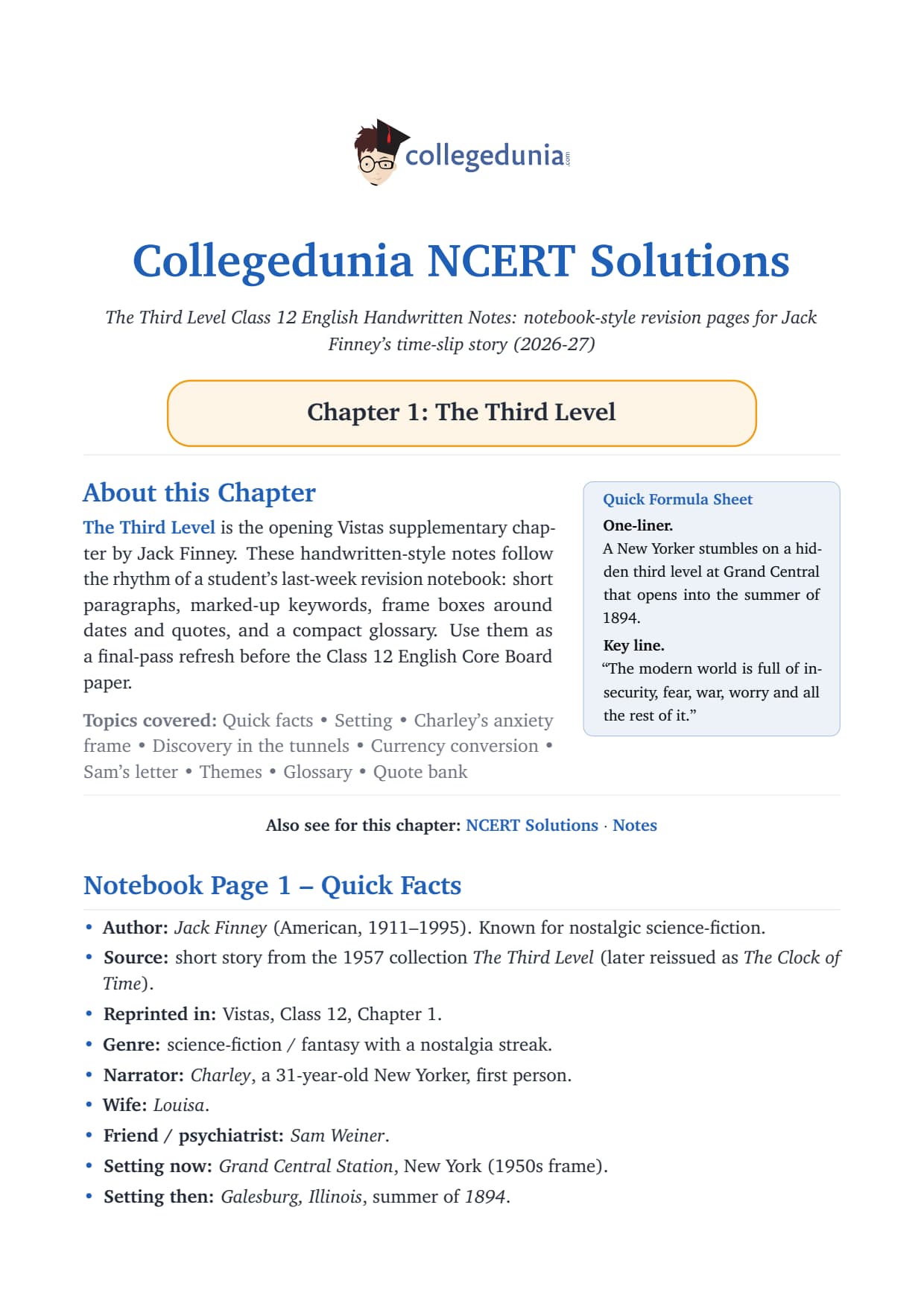
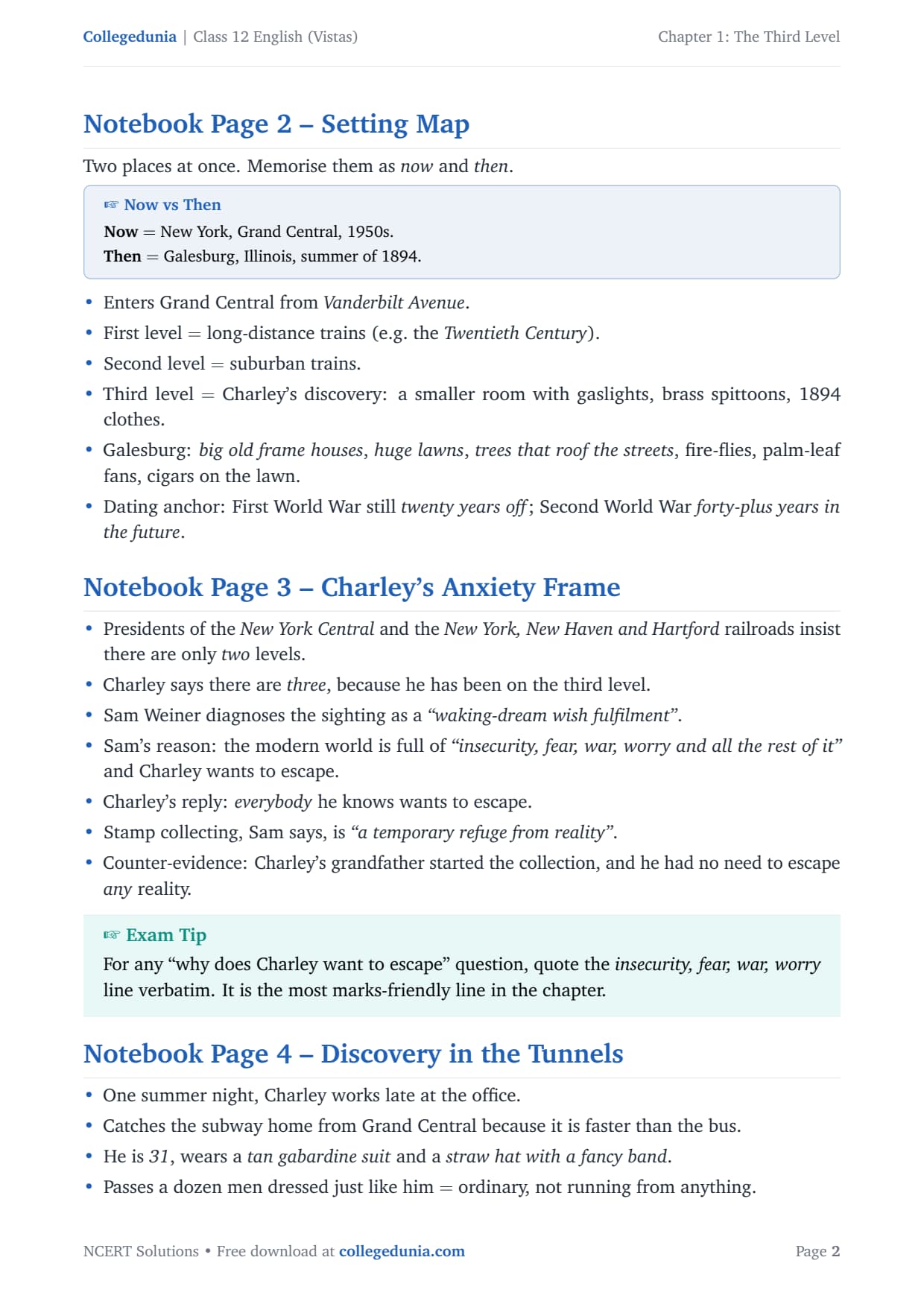
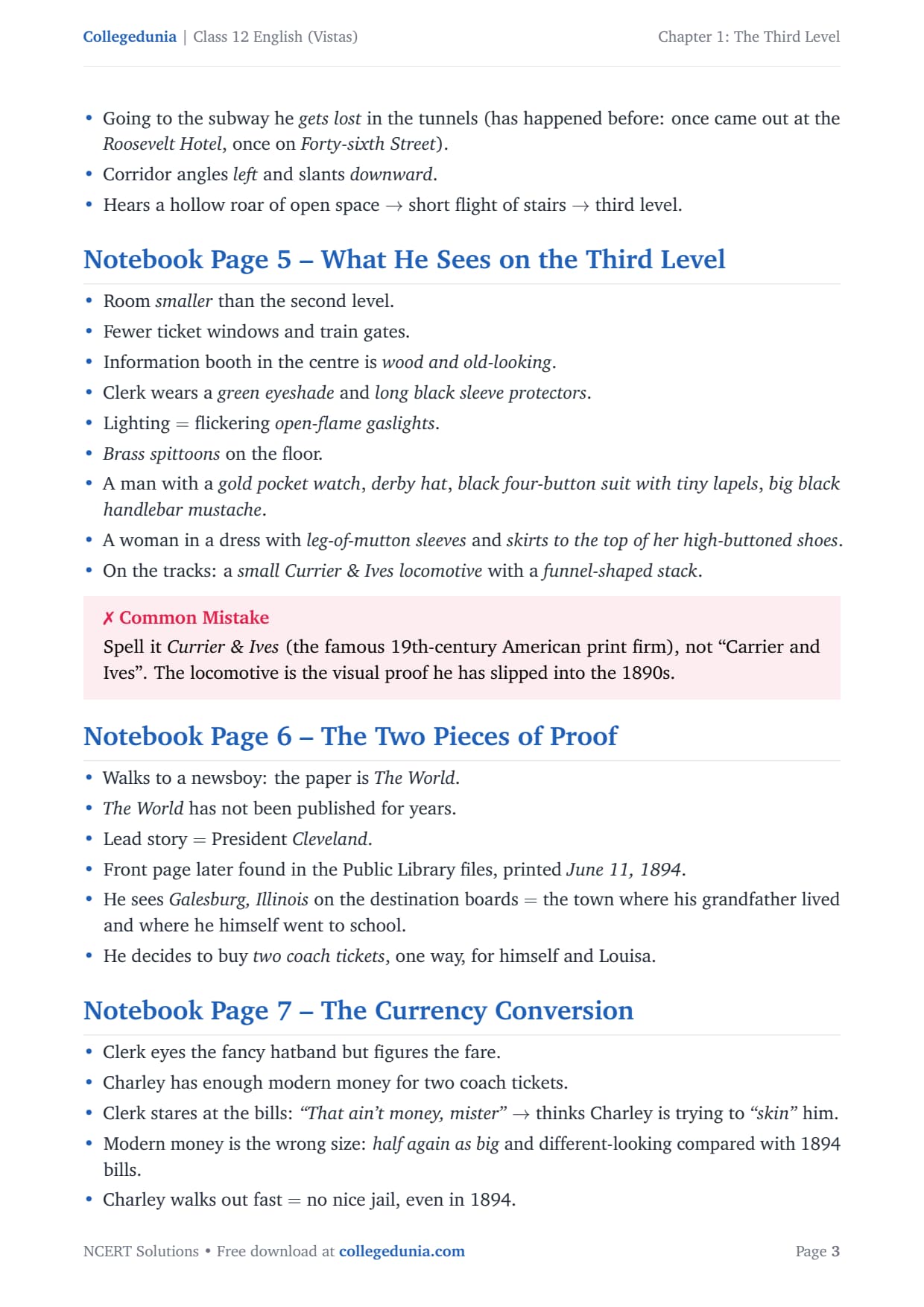
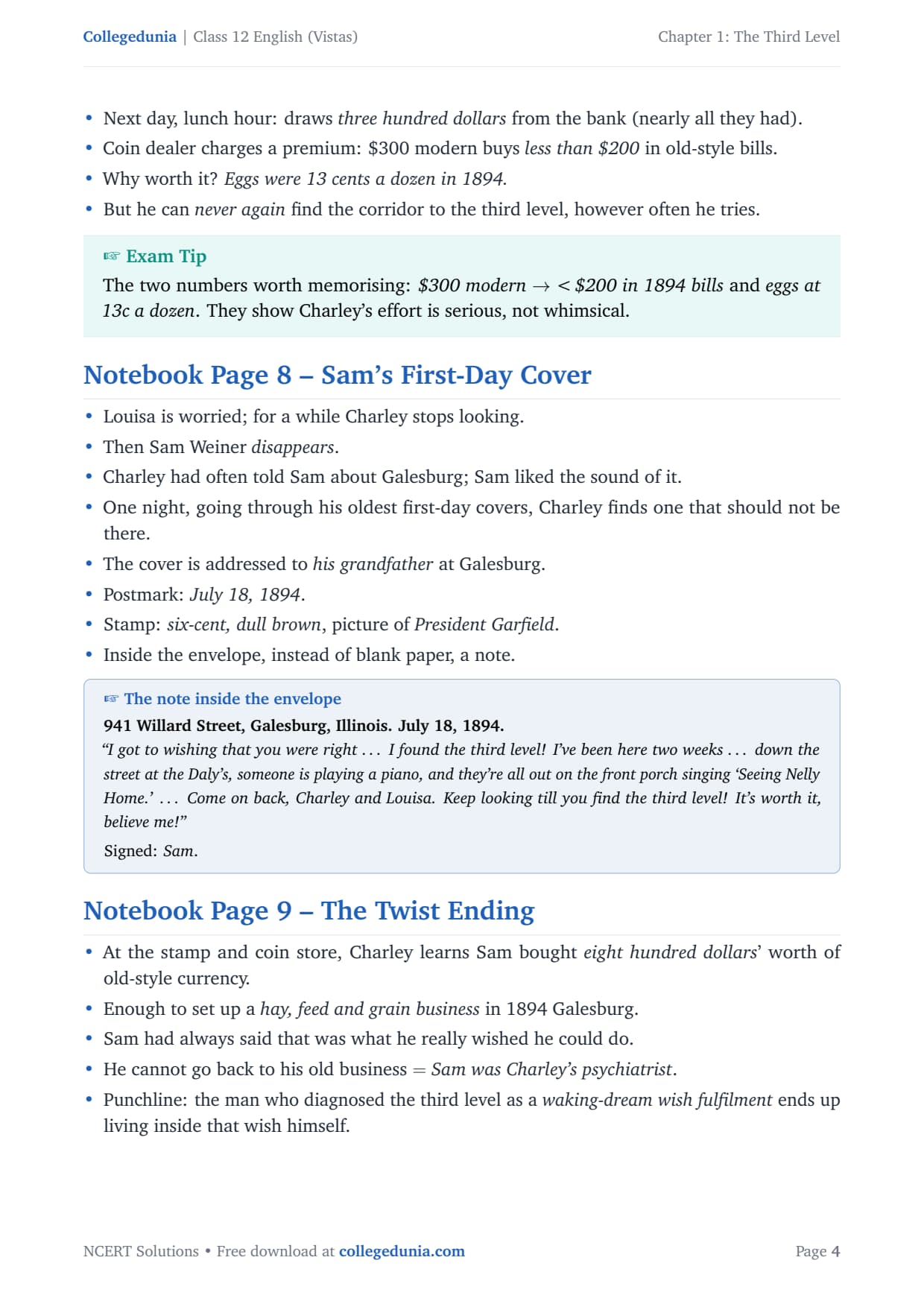
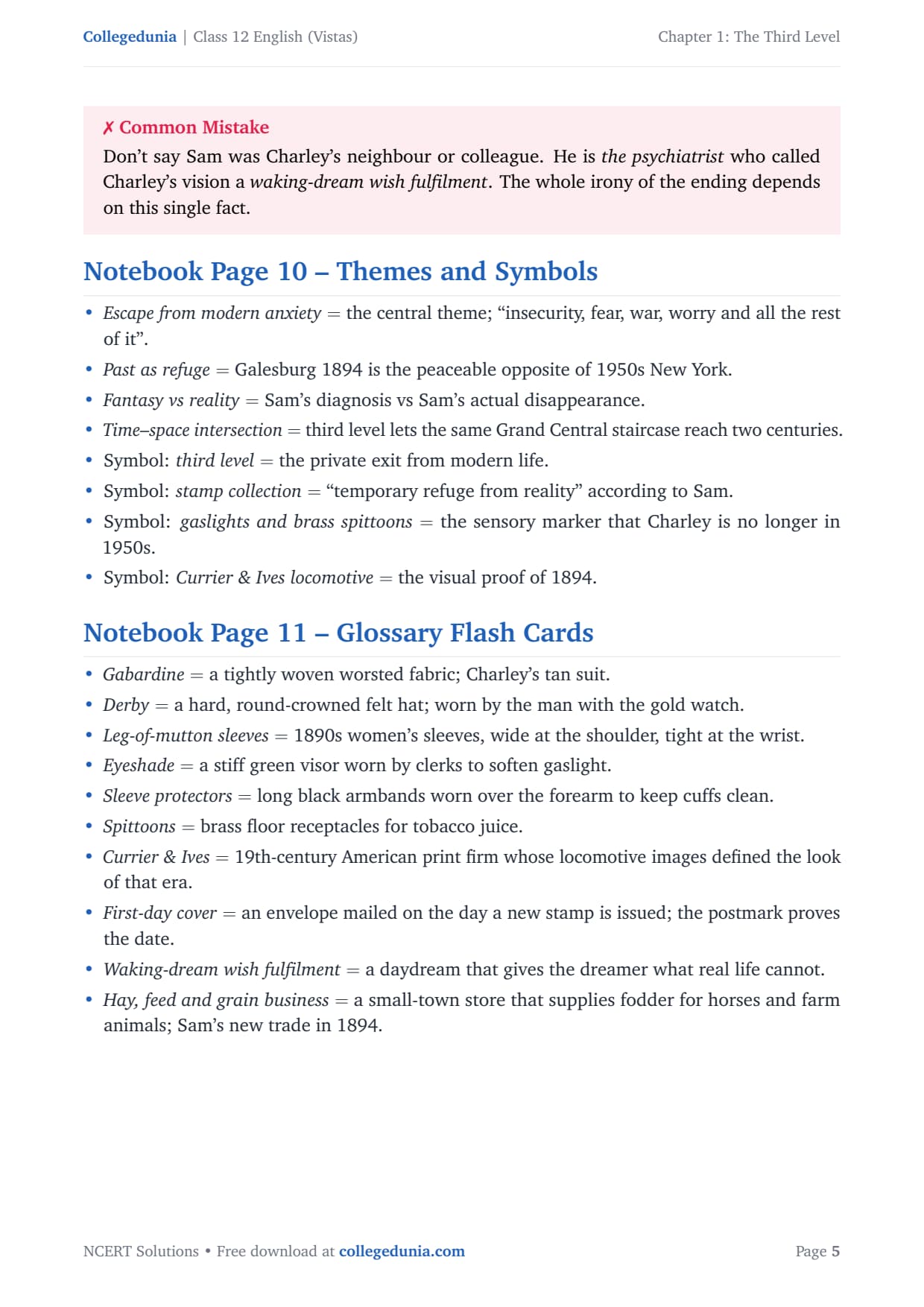
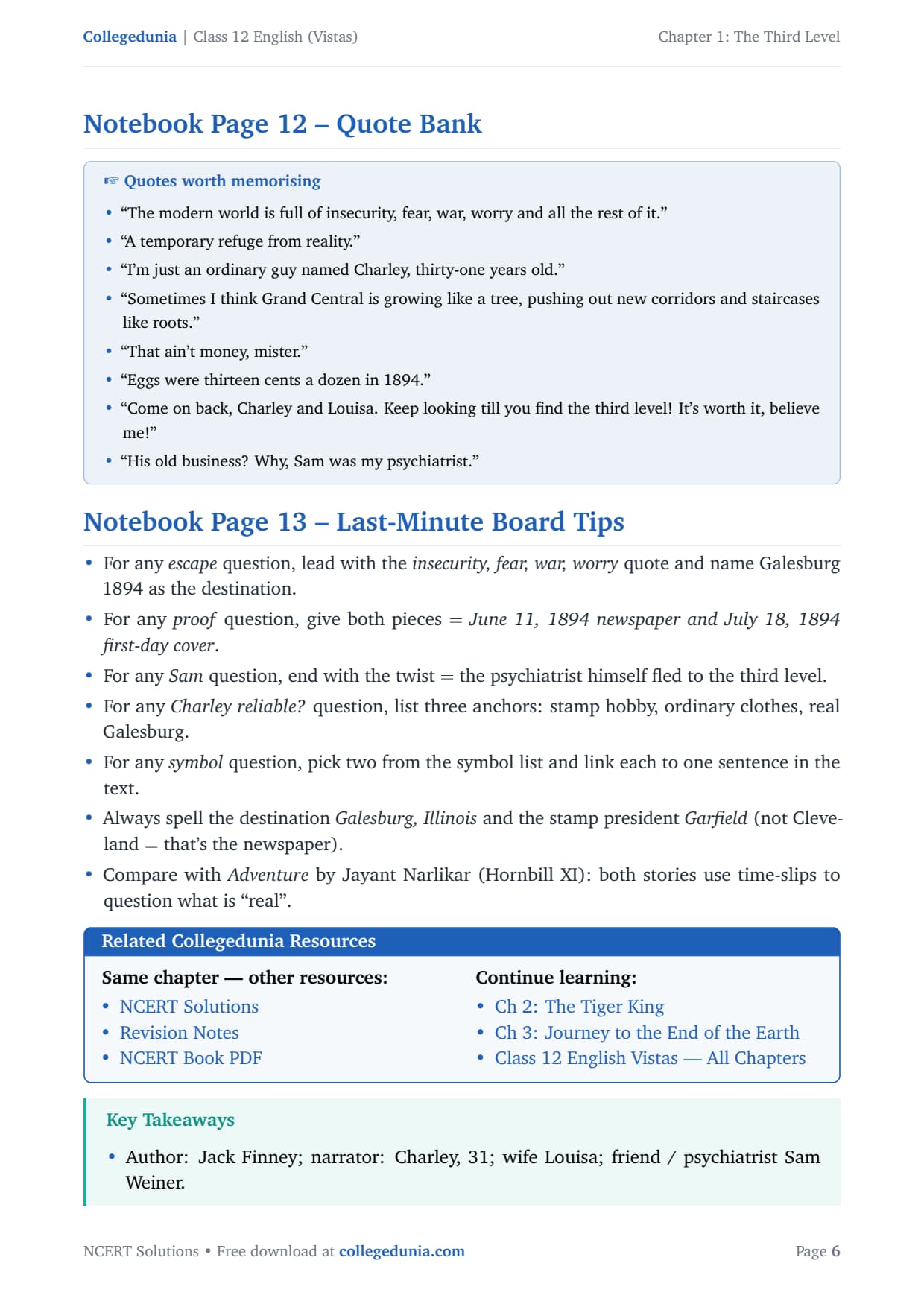
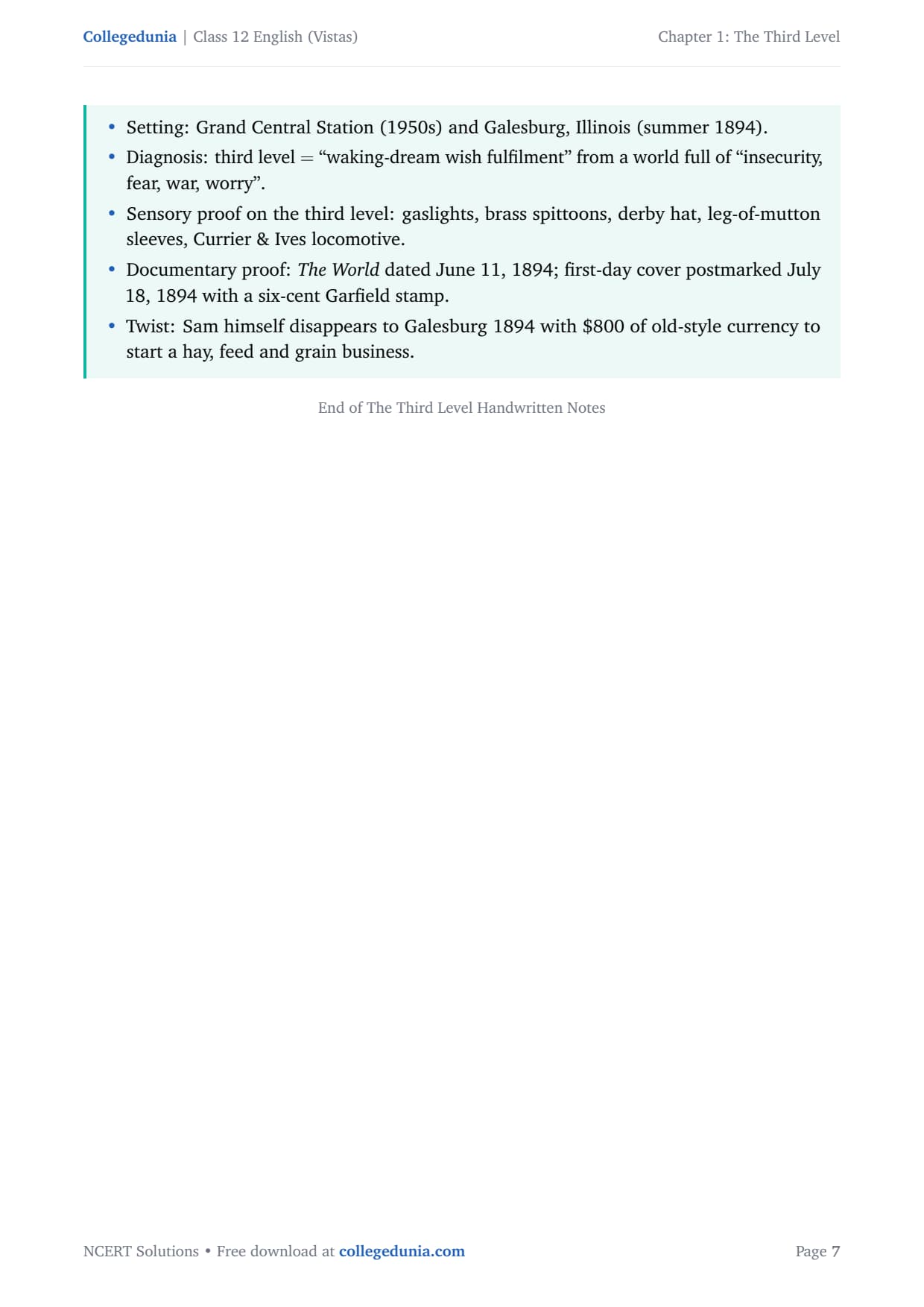

Every page mirrors a question slot you will actually face: the setting + author on page 1, the scene-by-scene summary on page 2, the Charley character arc on page 3, the Sam character arc on page 4, the five-symbol table on page 5, the theme tags on page 6, the key quotations on page 7, the PYQ + value-point cheatsheet on page 8, and the last-week recall strip on page 9. Read in that order on the morning of the exam and you carry the chapter end-to-end in fifteen minutes.
Also Check:
The Third Level Class 12 English Handwritten Notes: What the 9 Pages Cover
The Third Level class 12 english handwritten notes are structured as nine themed pages, each anchored on one question slot. Use the strip below as a contents map before you flip the PDF open.
| Page | Focus | What you copy onto your rough sheet first |
|---|---|---|
| Page 1 | Setting + author | 1950s New York / Galesburg 1894; Jack Finney (1911-1995); five-word anchor STRESS - STATION - 1894 - CURRENCY - SAM. |
| Page 2 | Scene-by-scene summary in 5 beats | Anxiety frame, discovery in tunnels, currency conversion, failed search, Sam's letter from Galesburg. |
| Page 3 | Charley character arc | From "modern stresses" to "Galesburg destination" to "first-day cover vindication". |
| Page 4 | Sam character arc + Louisa | Sceptic to believer; eight hundred dollars; hay, feed and grain business; Louisa joins the search. |
| Page 5 | Five-marker table | Gas lamps, The World newspaper, old-style currency, first-day cover, 941 Willard Street - one line of meaning each. |
| Page 6 | Theme tags | Escape, fantasy vs reality, intersection of time and space, philately, apparent illogicality. |
| Page 7 | Key quotations | "Insecurity, fear, war, worry and stress"; "waking dream wish fulfilment"; "temporary refuge from reality"; Sam's role-reversal quote. |
| Page 8 | PYQ map + value points | 2021-2025 long-answer rotations; Indian escape forms (hill stations, pilgrimage); Article 49 (monument protection). |
| Page 9 | Last-week recall strip | Four 1-mark MCQ facts; three 4-mark SA prompts; four 6-mark LA prompts. |
The Third Level Video Walkthrough
Source: Magnet Brains on YouTube
Setting Map: The Page-1 Skeleton
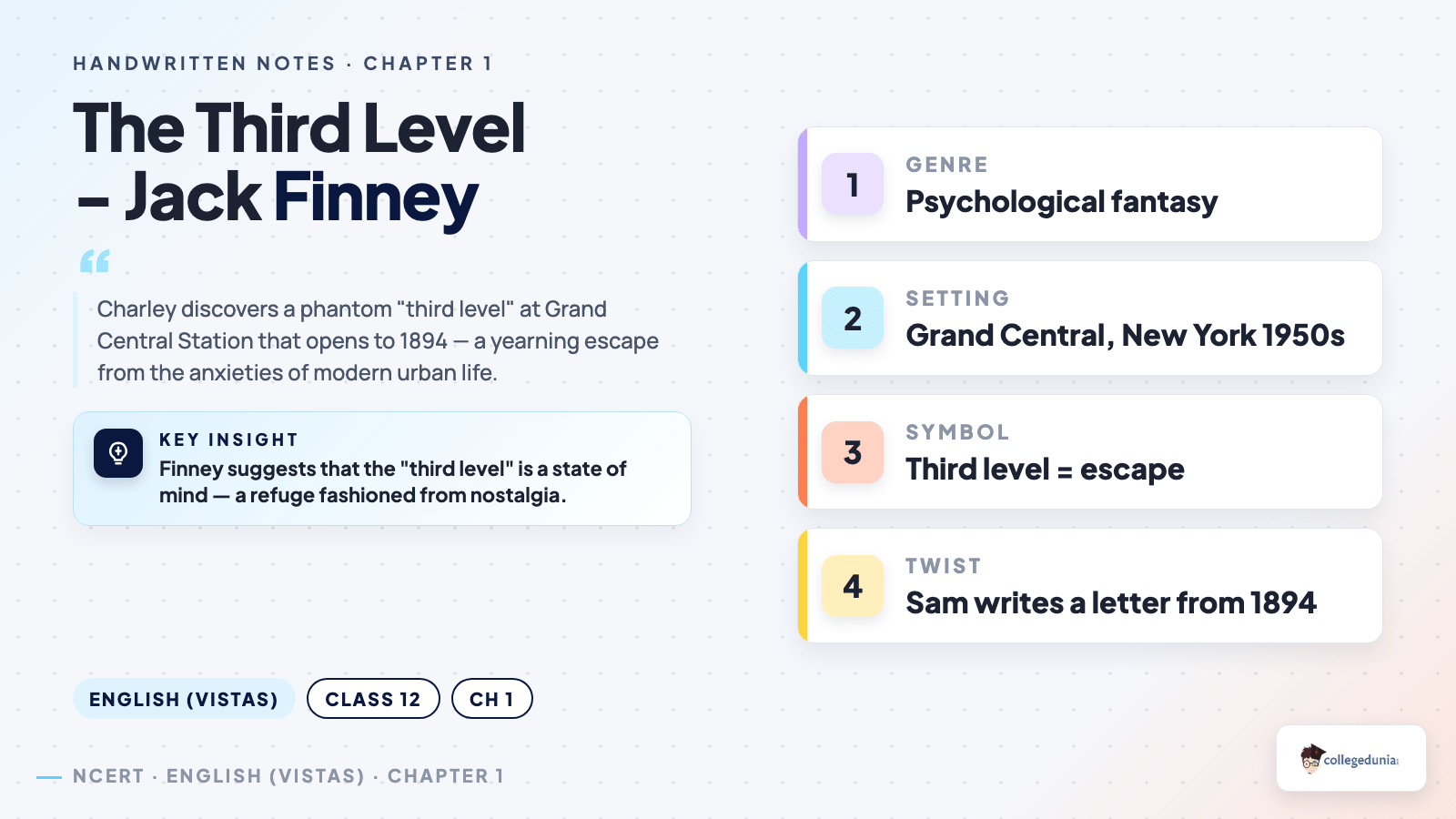
Page 1 of the notebook draws the setting in two halves - 1950s New York on the left, Galesburg, Illinois 1894 on the right - with the third level corridor as the connecting arrow. The handwritten note next to the map summarises the four facts that drive the entire chapter and that CBSE tests in 1-mark MCQs.
Scene-by-Scene Summary: The Page-2 Five-Beat Walk
Page 2 is the most reproduced spread in the notebook. It walks the chapter in five beats with hand-drawn arrows linking each beat to the next: anxiety frame (Charley's stress list, Sam's diagnosis), discovery in tunnels (gas lamps, brass clocks, The World newspaper dated 11 June 1894), currency conversion (three hundred dollars at a loss), failed search (Louisa joins the nightly search), and Sam's letter (first-day cover from Galesburg, eight hundred dollars, hay, feed and grain business). Memorise the five-beat skeleton and any Long Answer becomes a fill-in-the-blank exercise.
Character Arcs: Pages 3 and 4
Pages 3 and 4 give the three-marker arcs for Charley and Sam respectively, with a small box at the bottom of page 4 for Louisa. The handwritten notebook deliberately keeps each arc on one page so the reader can flip from arc to arc without losing the thread.
Five-Symbol Table: The Page-5 Cheatsheet
The five embedded markers in the chapter - gas lamps, The World newspaper, old-style currency, the first-day cover, and 941 Willard Street - are the chapter's evidence box. The handwritten notebook tags each marker with its surface image and its meaning, in a single line per marker.
Themes and Quotations: Pages 6 and 7
Page 6 maps the five themes (escape, fantasy vs reality, time and space, philately, apparent illogicality) as a small theme web with arrows linking each theme to the central plot device. Page 7 carries the five top-mark quotations the marker expects to see.
PYQ Map and Value Points: Page 8
Page 8 of the notebook is the year-wise CBSE PYQ map (2021-2025) paired with the value-point cheatsheet for the modern-stress prompt. The Indian-context value points (Bishnoi, Chipko, Article 49) and the modern-stress extensions (screen fatigue, climate anxiety, economic precarity) are the difference between a 4-mark and a 6-mark answer.
Last-Week Recall Strip: Page 9
Page 9 is the one-page exam-morning recall strip. Four 1-mark MCQ facts, three 4-mark SA prompts, four 6-mark LA prompts - each with the skeleton of an ideal answer. Carry this page into the exam hall as your final lap revision.
Why Handwritten Notes Work for CBSE Vistas
- Visual memory: handwritten text triggers a different memory pathway than typed text; recall is faster.
- Spaced repetition: the notebook's nine themed pages mirror the chapter's natural exam slots so each glance is a small practice session.
- Margin notes: the red margin line carries a sparse set of one-word triggers (STRESS, STATION, 1894, CURRENCY, SAM) that you can scan in under thirty seconds.
- Hand-drawn arrows: the five-beat plot map and the five-symbol table are laid out as connected diagrams, not as paragraphs.
FAQs on The Third Level Class 12 Handwritten Notes
FAQs on The Third Level Class 12 Handwritten Notes
How many pages is the The Third Level Handwritten Notes PDF?
The Collegedunia handwritten notes for The Third Level run 9 ruled notebook pages, scanned-style, covering the setting, plot, character arcs of Charley and Sam, the five embedded markers, themes, key quotations, year-wise PYQ map and a last-week recall strip.
Are these handwritten notes different from the typeset notes?
Yes. The handwritten notes are designed as a scanned student notebook with blue ballpoint strokes, faded red margin line and hand-drawn arrows. The typeset notes are a longer (13-page) revision PDF with detailed prose explanations. Use the handwritten notes for last-week revision and the typeset notes for first-read study.
Are these notes aligned to the 2026-27 NCERT syllabus?
Yes. The notes are line-by-line aligned to the 2026-27 NCERT Vistas reprint of Chapter 1 The Third Level. All seven Reading with Insight questions are mapped to themes in the notebook's page 6 and PYQ slot in page 8.
What is the recommended way to use the handwritten notes?
Read the typeset notes (long-form) for first-time study, then use the handwritten notes for revision the week before the exam. The nine pages are designed to be read in fifteen minutes, with page 9's recall strip carried into the exam hall as the final pass.
Why is escapism the central motif of The Third Level?
Jack Finney builds the chapter around escapism because Charley's modern stresses (insecurity, fear, war, worry and stress) need a release valve. The third level corridor at Grand Central Station, the imagined journey to Galesburg, Illinois 1894, and philately as a hobby are all forms of psychological escape. Page 6 of the handwritten notebook tags this as the primary theme that the CBSE Vistas 6-mark Long Answer keeps returning to.



Comments