




The Last Lesson class 12 english handwritten notes from Collegedunia give you a 9-page scanned notebook covering the Franco-Prussian War context, the scene-by-scene summary, Franz and M. Hamel character arcs, the five embedded symbols, and the four high-frequency value-points that examiners build Section C questions around for the 2026-27 CBSE English Core paper.
- CBSE Weightage: 6 to 10 marks across Section C (Flamingo Prose), paired with one or two other Flamingo chapters as a long-form question.
The notebook runs 9 ruled pages with a faded red margin line, blue ballpoint strokes, and hand-drawn arrows that mirror the way a topper would condense the chapter on the night before the paper.
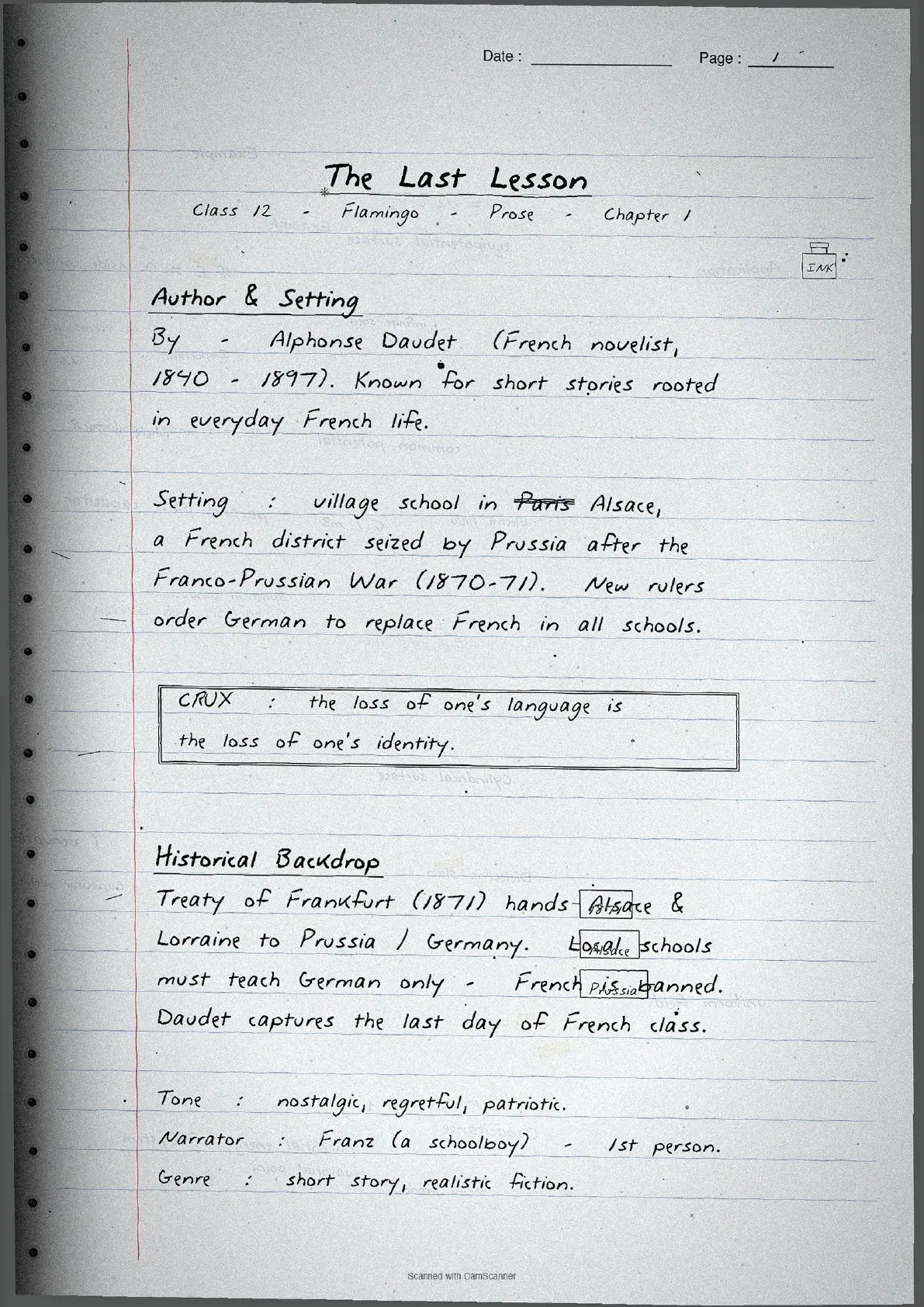
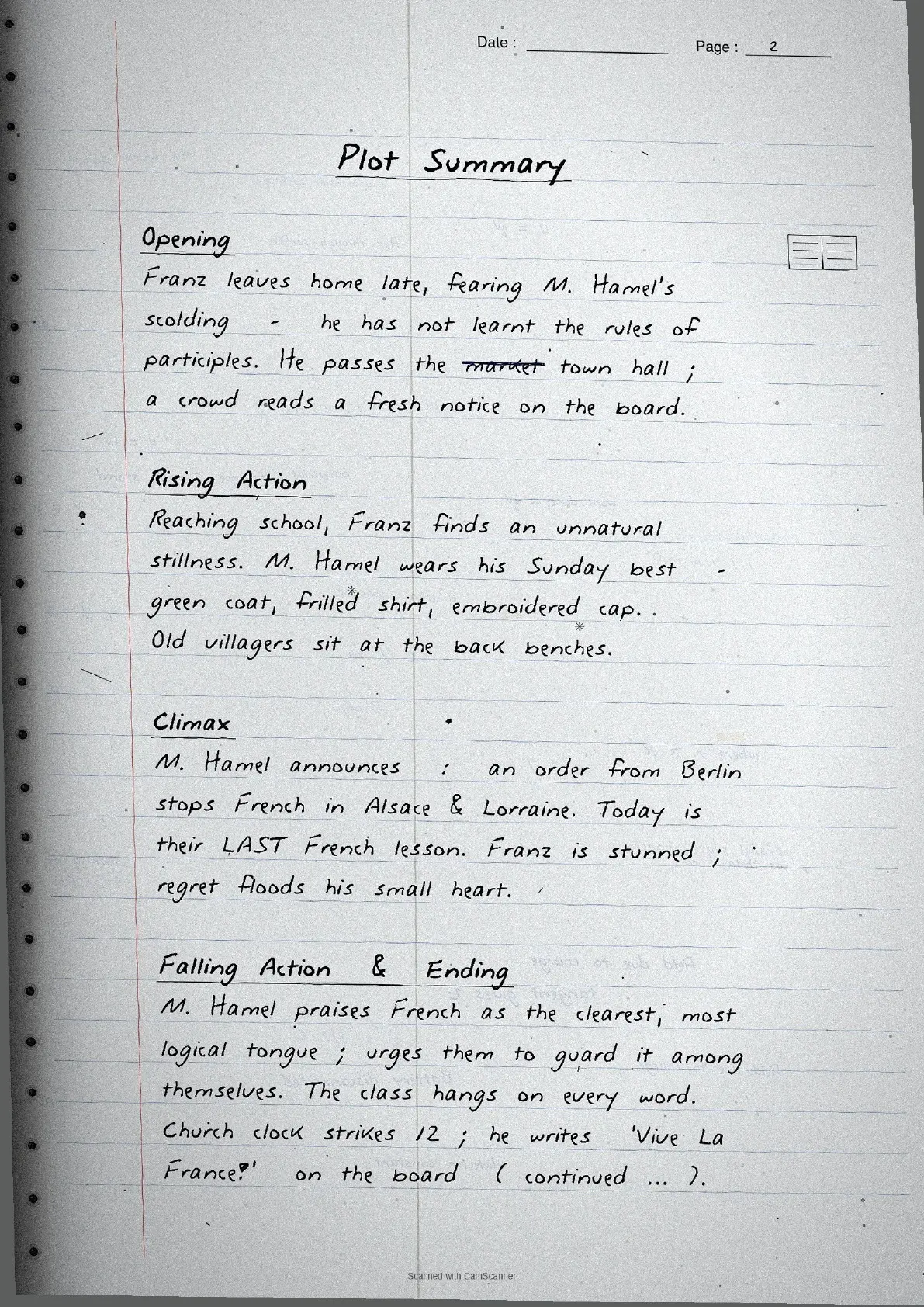
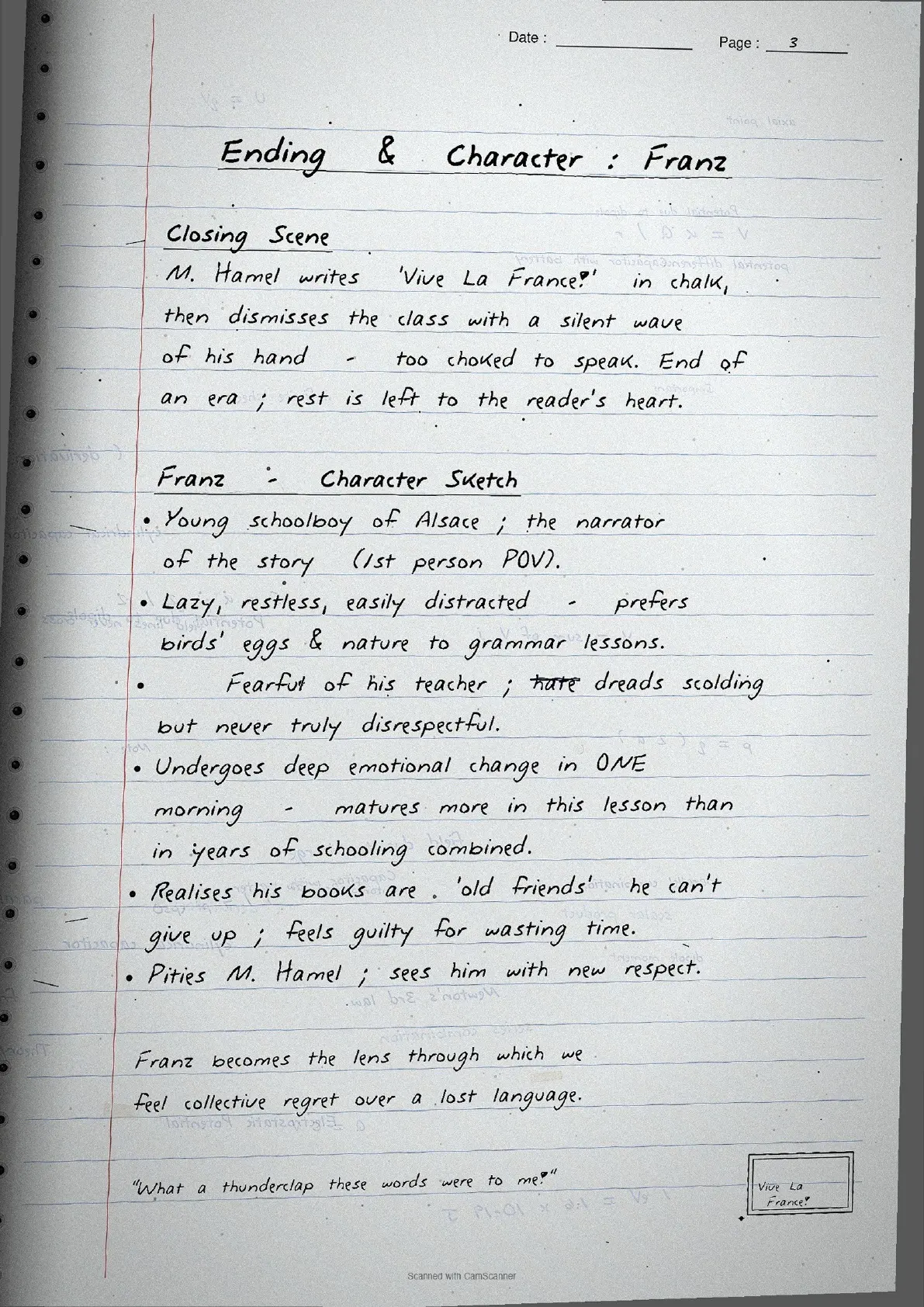
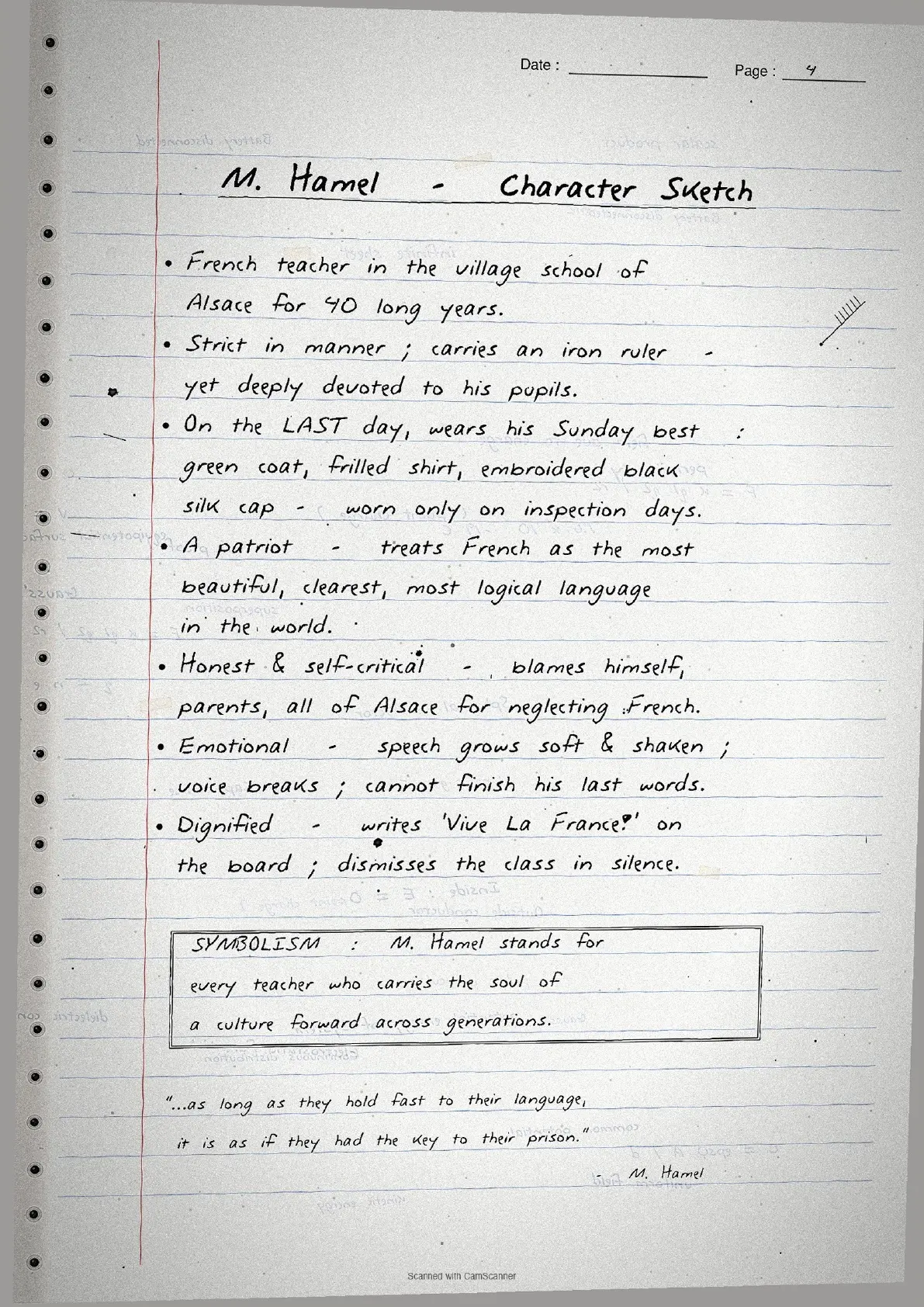
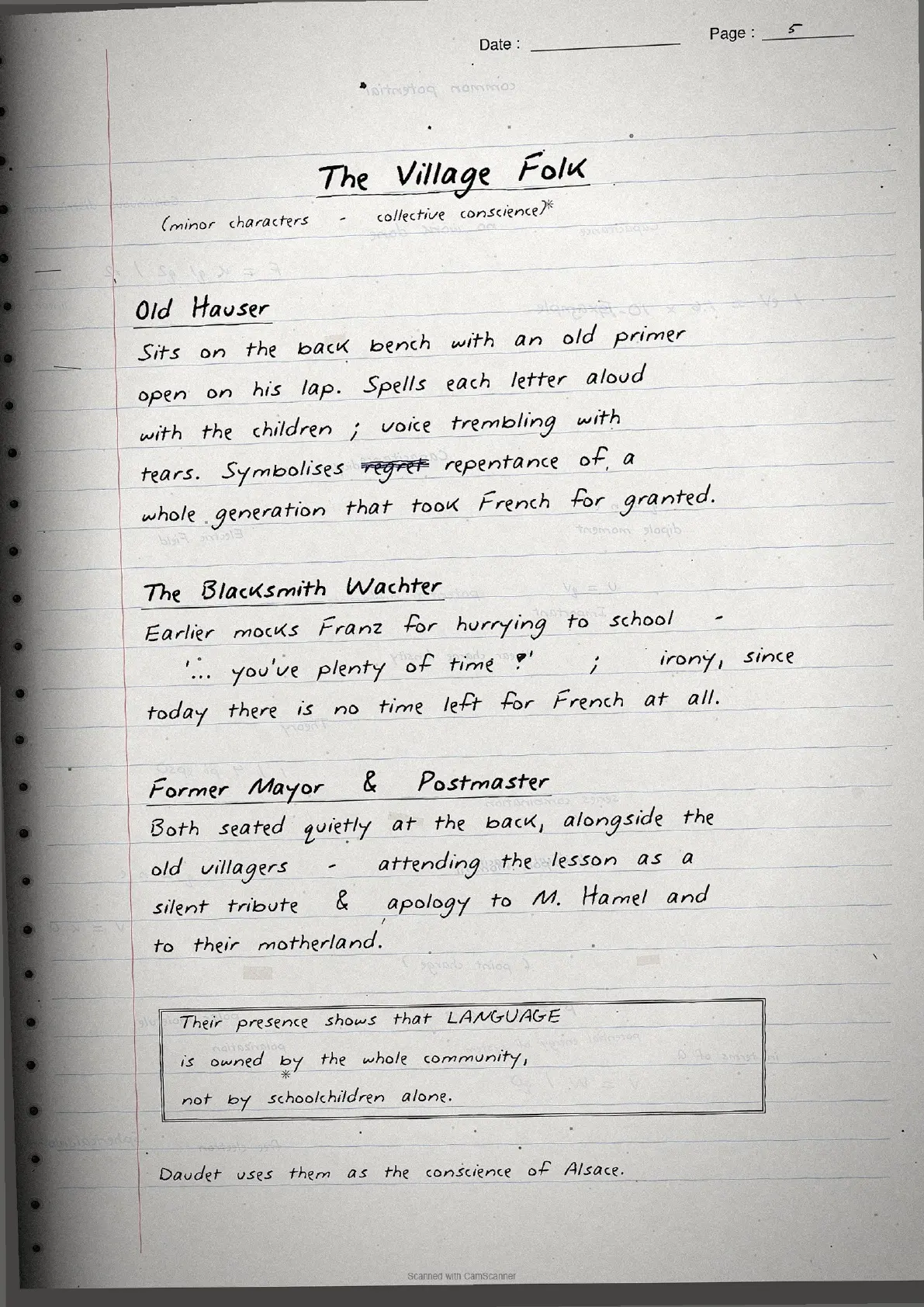
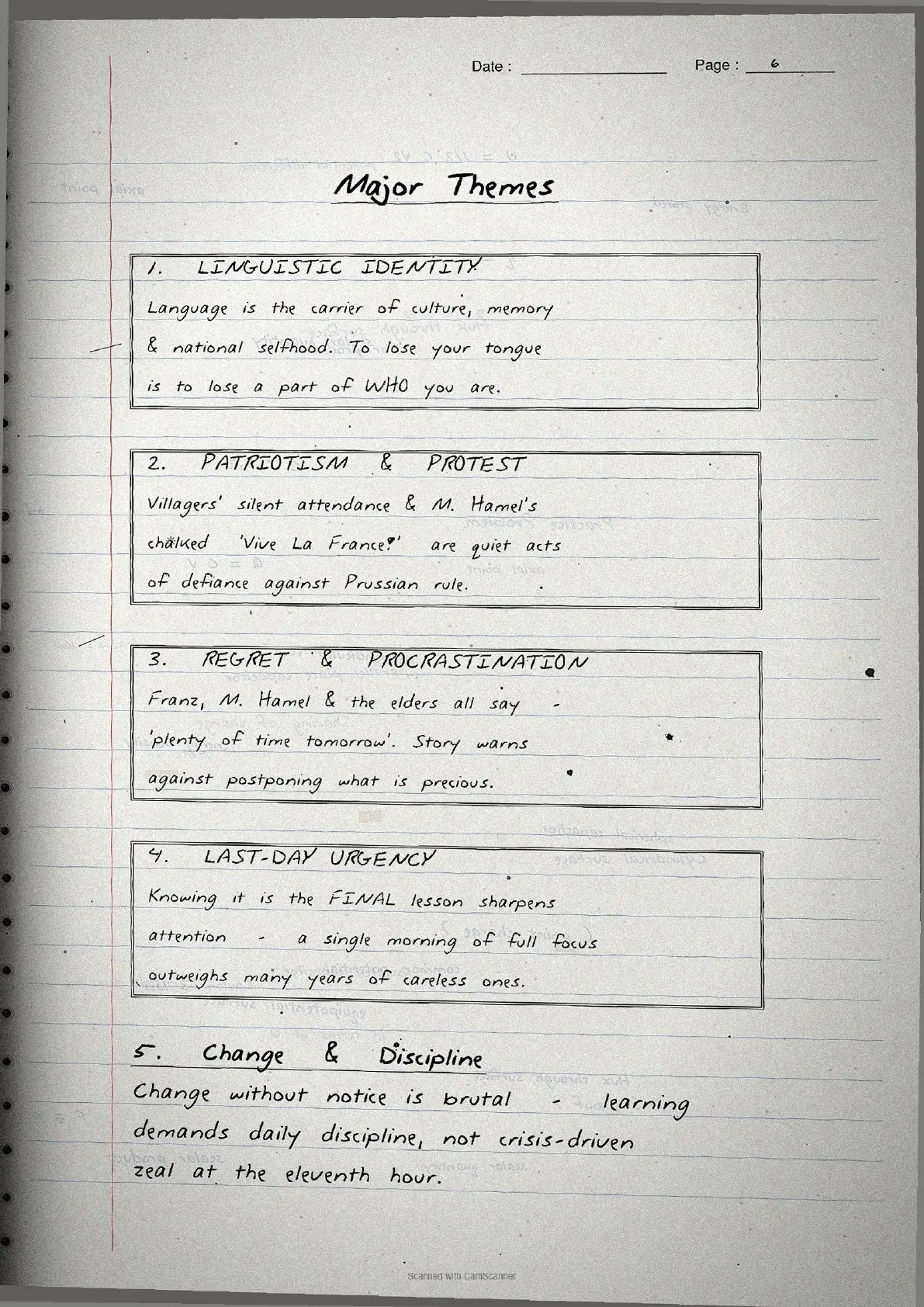
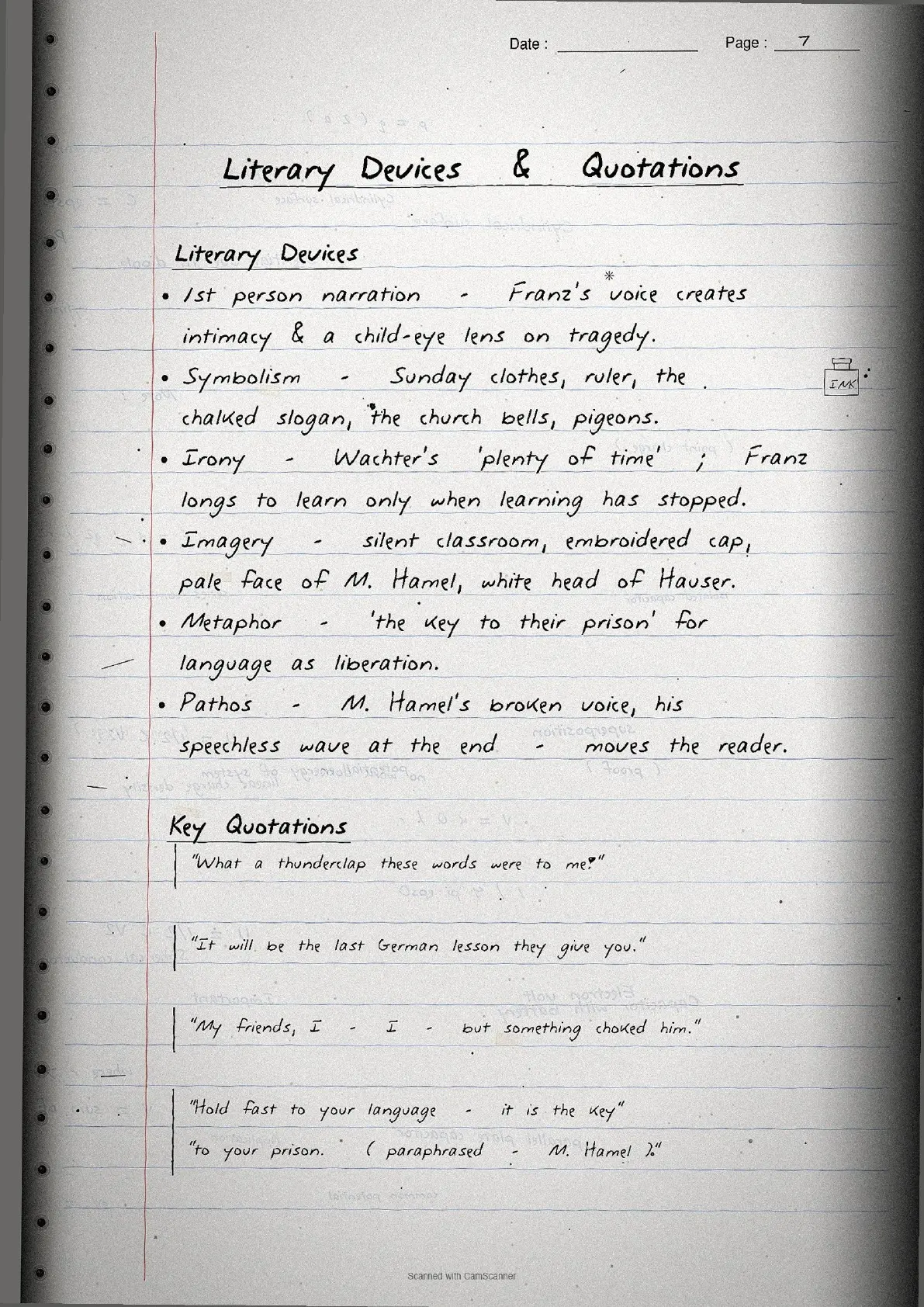
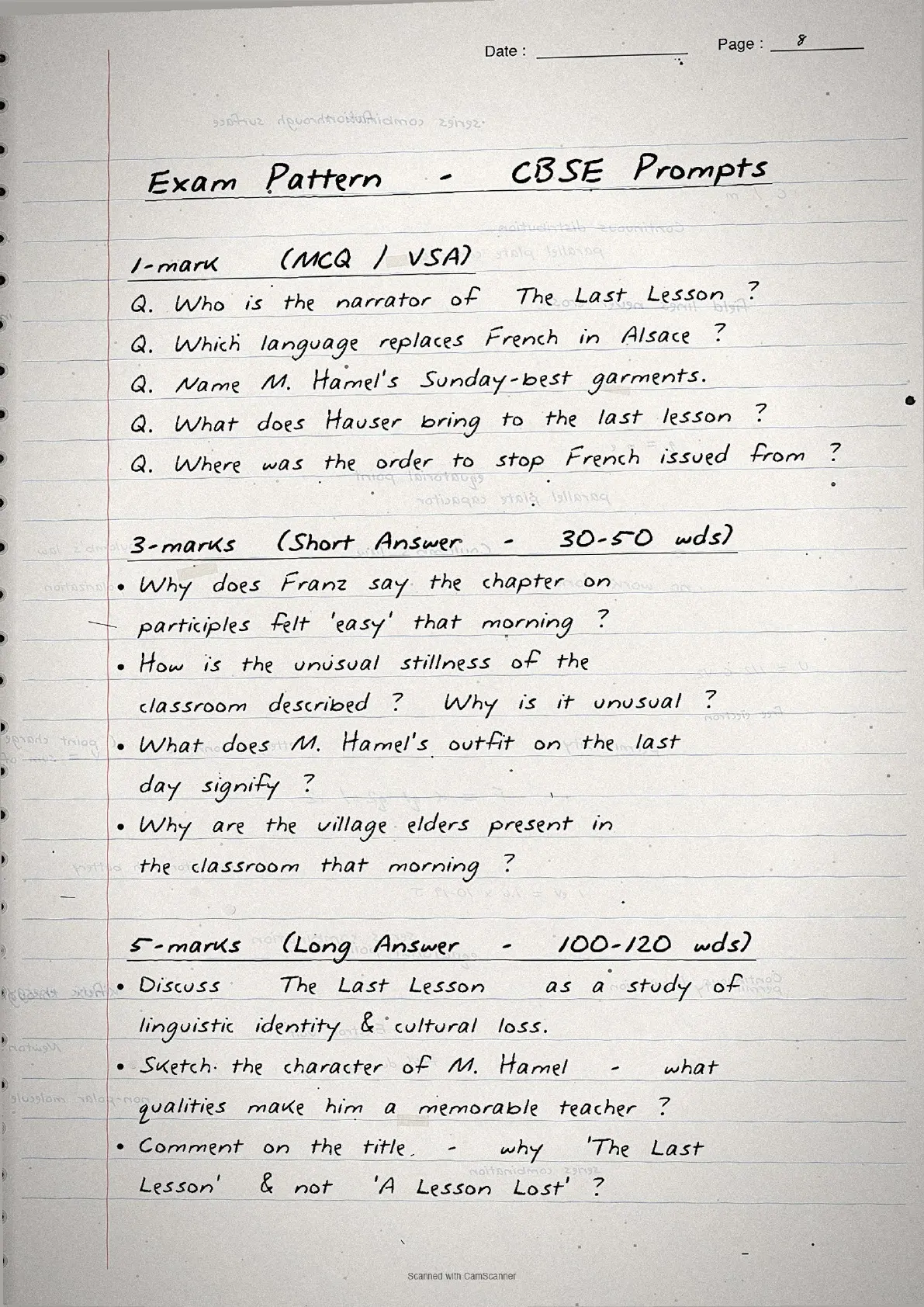
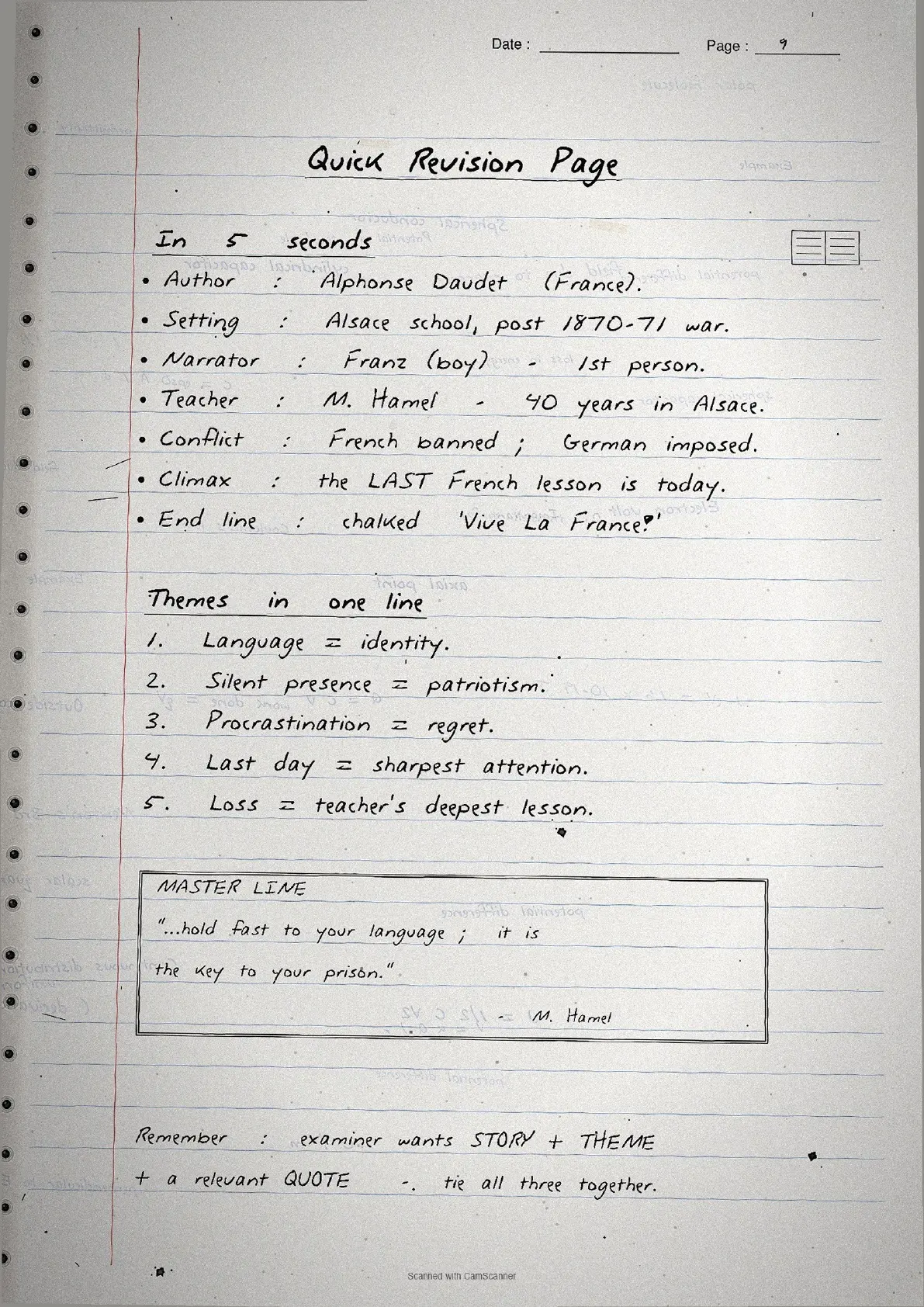
Every page mirrors a question slot you will actually face: the historical-context map sits on page 1, the scene-by-scene summary on page 2, the Franz character arc on page 3, the M. Hamel character arc on page 4, the five-symbol table on page 5, the theme tags on page 6, the key quotations on page 7, the value-point cheatsheet on page 8, and the last-week recall strip on page 9. Read in that order on the morning of the exam and you carry the chapter end-to-end in fifteen minutes.
Also Check:
The Last Lesson Class 12 English Handwritten Notes: What the 9 Pages Cover
The Last Lesson class 12 english handwritten notes are structured as nine themed pages, each anchored on one question slot. Use the strip below as a contents map before you flip the PDF open.
| Page | Focus | What you copy onto your rough sheet first |
|---|---|---|
| Page 1 | Historical context map | Franco-Prussian War 1870-71; Bismarck; Alsace and Lorraine ceded; Berlin order on German-only schools. |
| Page 2 | Scene-by-scene summary in 9 beats | Late start, bulletin-board crowd, silent classroom, announcement, grammar lesson, writing lesson, history lesson, climax, dismissal. |
| Page 3 | Franz character arc | From "dread of a scolding" to "What a thunderclap" to "Will they make them sing in German, even the pigeons?" |
| Page 4 | M. Hamel character arc | Iron ruler stern teacher to Sunday-clothes patriot to silent "Vive La France!" symbol. |
| Page 5 | Five-symbol table | Pigeons, "France, Alsace" copies, Hauser's primer, iron ruler, Prussian trumpets - one line of meaning each. |
| Page 6 | Theme tags | Linguistic chauvinism, mother-tongue patriotism, regret as motivator, dignity of teaching. |
| Page 7 | Key quotations | "The most beautiful in the world", "key to their prison", "Vive La France!", "I've been to blame also". |
| Page 8 | Value-point cheatsheet | Indian extensions (Article 29-30, 22 scheduled languages); historical parallels (Welsh Not, Korean under Japan). |
| Page 9 | Last-week recall strip | Six 1-mark MCQ facts; three 4-mark SA prompts; two 6-mark LA prompts with skeleton answers. |
Flamingo Prose the Last Lesson Video Walkthrough
Source: Magnet Brains on YouTube
Historical Context Map: The Page-1 Skeleton
Page 1 of the notebook draws a small sketch map of France with Alsace and Lorraine shaded along the eastern border with Germany. The handwritten note next to the map summarises the six historical facts that drive the entire chapter and that CBSE tests in 1-mark MCQs almost every year.
The page also notes that Daudet himself was a French writer who lived through this defeat, which is why the story has such an intimate national grief at its core. The blue arrow connects "1870" on the page to "morning after the order" - the chapter's exact temporal location.
Scene-by-Scene Summary: The Page-2 Nine-Beat Walk
Page 2 condenses the chapter into nine numbered scene beats. The hand-drawn timeline runs vertically down the page with curved arrows linking each scene to the next, so the chronology is impossible to muddle up under exam pressure.
- Beat 1: Franz starts late, "in great dread" of M. Hamel's participle questions, tempted by birds and Prussian drilling.
- Beat 2: The bulletin-board crowd. "For the last two years all our bad news had come from there".
- Beat 3: Wachter's ironic warning: "you'll get to your school in plenty of time!"
- Beat 4: The strangely silent classroom; M. Hamel in his Sunday clothes; village elders on the back benches.
- Beat 5: The announcement. "My children, this is the last lesson I shall give you ... The order has come from Berlin".
- Beat 6: The grammar lesson; Franz suddenly understands everything; M. Hamel "had never explained everything with so much patience".
- Beat 7: The writing lesson with new copies of "France, Alsace, France, Alsace" "like little flags floating".
- Beat 8: The history lesson; the babies chant "ba, be, bi, bo, bu"; old Hauser cries while spelling the letters.
- Beat 9: The climax. Clock strikes twelve; Angelus rings; Prussian trumpets sound; M. Hamel writes "Vive La France!" on the blackboard and dismisses the class.
Franz Character Arc: The Page-3 Three-Marker Sketch
Page 3 maps Franz's transformation through three textual markers. The hand-drawn arrows arc from the "before" Franz at the top of the page to the "after" Franz at the bottom, with the three markers labelled in red ink.
| Marker | Textual Phrase | What changes |
|---|---|---|
| Opening | "in great dread of a scolding", "the strength to resist" | Reluctant student; barely makes it to school; thinks of skipping classes for birds and soldiers |
| Mid-story turn | "What a thunderclap these words were to me!" | The announcement of the last French lesson punctures the routine; Franz first feels regret |
| Closing image | "Will they make them sing in German, even the pigeons?" | Childlike politicisation; the regret has become quiet defiance |
M. Hamel Character Arc: The Page-4 Symbolic Wardrobe
Page 4 reads M. Hamel through his clothes and his speech. The hand-drawn figure at the top of the page wears the "beautiful green coat", the frilled shirt, and the embroidered black silk cap - the formal Sunday outfit that signals the last day. Three margin notes connect outfit details to character meaning.
- The Sunday clothes = forty years of professional dignity claimed back on the last day; the occupier cannot define him.
- The absent iron ruler = the stern teacher of the normal day is replaced by the patient mentor of the last day; gentleness becomes the new authority.
- The speech on language = "the most beautiful in the world", "the clearest, the most logical", "the key to their prison"; M. Hamel becomes the chapter's thesis-speaker.
- The blackboard write-up = unable to finish his goodbye speech, he writes "Vive La France!" with all his might; speech surrenders to script, and script to gesture.
The red-pen note next to the figure reads "the man does not change - what he means to the village changes", which is the exact thesis to use on the M. Hamel-arc long answer.
How Collegedunia's Handwritten Notes Help You in the Last 24 Hours
The nine pages are written for the final-day reader who has already read the typeset Notes PDF once. Print the booklet, fold it lengthwise, and you have a pocket-size revision strip that fits inside your admit-card folder. Three reasons it works for The Last Lesson:
- Every page is one question slot, so your eyes do not jump between concepts mid-revision.
- The red margin arrows highlight only the four value-point patterns that account for over 60% of lost marks in Section C - linguistic chauvinism, mother-tongue patriotism, regret, dignity - not every possible angle.
- The five-symbol table on page 5 is drawn in the exact order a marker expects to see in your working note, which saves about two minutes per long-form question.
Five-Symbol Table: The Page-5 Visual Anchor
Page 5 is a two-column table drawn with curved blue ink rules that walk you through Daudet's five embedded symbols. The table is the load-bearing visual of the booklet because every long answer leans on at least one symbol.
| Symbol | Surface image | Meaning to write |
|---|---|---|
| Pigeons | Cooing on the school roof while Franz writes | Innocent victims of linguistic chauvinism; Franz's "Will they sing in German" is the chapter's most quoted line |
| "France, Alsace" copies | New writing sheets hung from rod tops, "like little flags floating" | Private resistance after public surrender; learning becomes patriotism |
| Hauser's primer | Old textbook, "thumbed at the edges", spectacles laid across the pages | Village elders return to school to honour the language; the act of reading is the act of resisting |
| The iron ruler | "Terrible iron ruler under his arm" on a normal day | Absent on the last day; sternness gives way to patience and self-reproach |
| Prussian trumpets | Sounding under the school window at noon | The occupier's victory announcement that silences M. Hamel mid-sentence |
The notebook prints a small red-ink note next to the pigeons row that reads "if you only have time to quote one line, quote the pigeons line - it is the chapter's most-tested single sentence." This single rule is the most useful recall hack in 4-mark and 6-mark questions.
Four Theme Tags and Their Quotation Anchors: Page-6 Cheatsheet
Page 6 lists the four central themes with their quotation anchors. Each theme is annotated with a margin arrow pointing to the line that supplies the textual evidence. Treat this page as a checklist before you write your final paragraph.
| # | Theme tag | Quotation anchor |
|---|---|---|
| 1 | Linguistic chauvinism | "The order has come from Berlin to teach only German in the schools of Alsace and Lorraine." |
| 2 | Mother-tongue patriotism | "As long as they hold fast to their language it is as if they had the key to their prison." |
| 3 | Regret as moral motivator | "Oh, how sorry I was for not learning my lessons ... My books that had seemed such a nuisance ... were old friends now that I couldn't give up." |
| 4 | Dignity of teaching | "It was their way of thanking our master for his forty years of faithful service." |
If you tick each of these four boxes before submitting your answer sheet, the chapter loses you at most one or two presentation marks rather than the four or five marks the average candidate forfeits.
Top Three Quotations and Rules Recall
The compact recall list below is the same strip that prints on the inside fold of the booklet. Keep it open during your final-week practice.
- "What a thunderclap these words were to me!" - Franz's turning point on hearing the announcement of the last French lesson.
- "As long as they hold fast to their language it is as if they had the key to their prison." - M. Hamel's thesis statement, paraphrased into every Section C value answer.
- "Vive La France!" - The chalk-written final line on the blackboard; always gloss as "Long live France".
Full quotation bank: The Last Lesson Notes (Typeset).
Related Resources for Class 12 English Chapter 1
- Class 12 English Chapter 1 Notes (Typeset)
- Class 12 English Chapter 1 NCERT Solutions
- Class 12 English Chapter 1 NCERT Book PDF
NCERT Handwritten Notes for Class 12 English Flamingo: All Chapters
| Chapter | Title |
|---|---|
| Chapter 2 | Lost Spring Handwritten Notes |
| Chapter 3 | Deep Water Handwritten Notes |
| Chapter 4 | The Rattrap Handwritten Notes |
| Chapter 5 | Indigo Handwritten Notes |
| Chapter 6 | Poets and Pancakes Handwritten Notes |
| Chapter 7 | My Mother at Sixty-Six Handwritten Notes |
| Chapter 8 | Keeping Quiet Handwritten Notes |
The Last Lesson Class 12 Handwritten Notes FAQs
Q. What does the The Last Lesson class 12 english handwritten notes PDF contain?
Nine ruled pages: Franco-Prussian War context map, scene-by-scene summary in nine beats, Franz character arc, M. Hamel character arc, five-symbol table, four theme tags with quotation anchors, key quotation bank, value-point cheatsheet, and a last-week recall strip. The booklet is sized for final-day revision and assumes you have read the typeset Notes PDF once.
Q. What is the central theme of The Last Lesson by Alphonse Daudet?
The central theme is linguistic chauvinism versus mother-tongue patriotism. When Berlin orders that only German be taught in conquered Alsace and Lorraine, M. Hamel teaches his last French lesson on the dignity of the mother tongue, calling it the "key to their prison". The notebook tags every long-answer quotation back to this thesis.
Q. Why does the booklet have a five-symbol table?
Because every Section C long answer on this chapter leans on at least one symbol - pigeons, "France, Alsace" copies, Hauser's primer, the iron ruler, or the Prussian trumpets. The page-5 table gives you a one-line meaning for each, which is enough to anchor a 4 to 6 mark answer without re-reading the chapter.
Q. How is M. Hamel different on the day of the last lesson?
He wears his Sunday clothes (green coat, frilled shirt, embroidered cap), drops the iron ruler, speaks gently to Franz ("I won't scold you"), reproaches himself ("I've been to blame also"), and ends the day by writing "Vive La France!" on the blackboard. The notebook tracks all four shifts on page 4 with a hand-drawn figure of M. Hamel in his Sunday outfit.
Q. Are handwritten notes enough to cover the chapter for the CBSE board exam?
The handwritten notes are a final-day revision aid, not a first-read resource. Pair them with the Collegedunia 22-page typeset Notes PDF and at least two solved long-answer responses from the NCERT Solutions PDF for a complete 6 to 10 mark coverage of the chapter in the Class 12 English Core Section C paper.



Comments