



The Queue Class 12 Computer Science handwritten notes have been carefully prepared by hand for quick one-shot revision, according to the latest 2026-27 CBSE syllabus. They cover the FIFO rule of a queue, ENQUEUE and DEQUEUE on the rear and front ends, overflow and underflow, the deque (double ended queue), and how a queue differs from a stack.
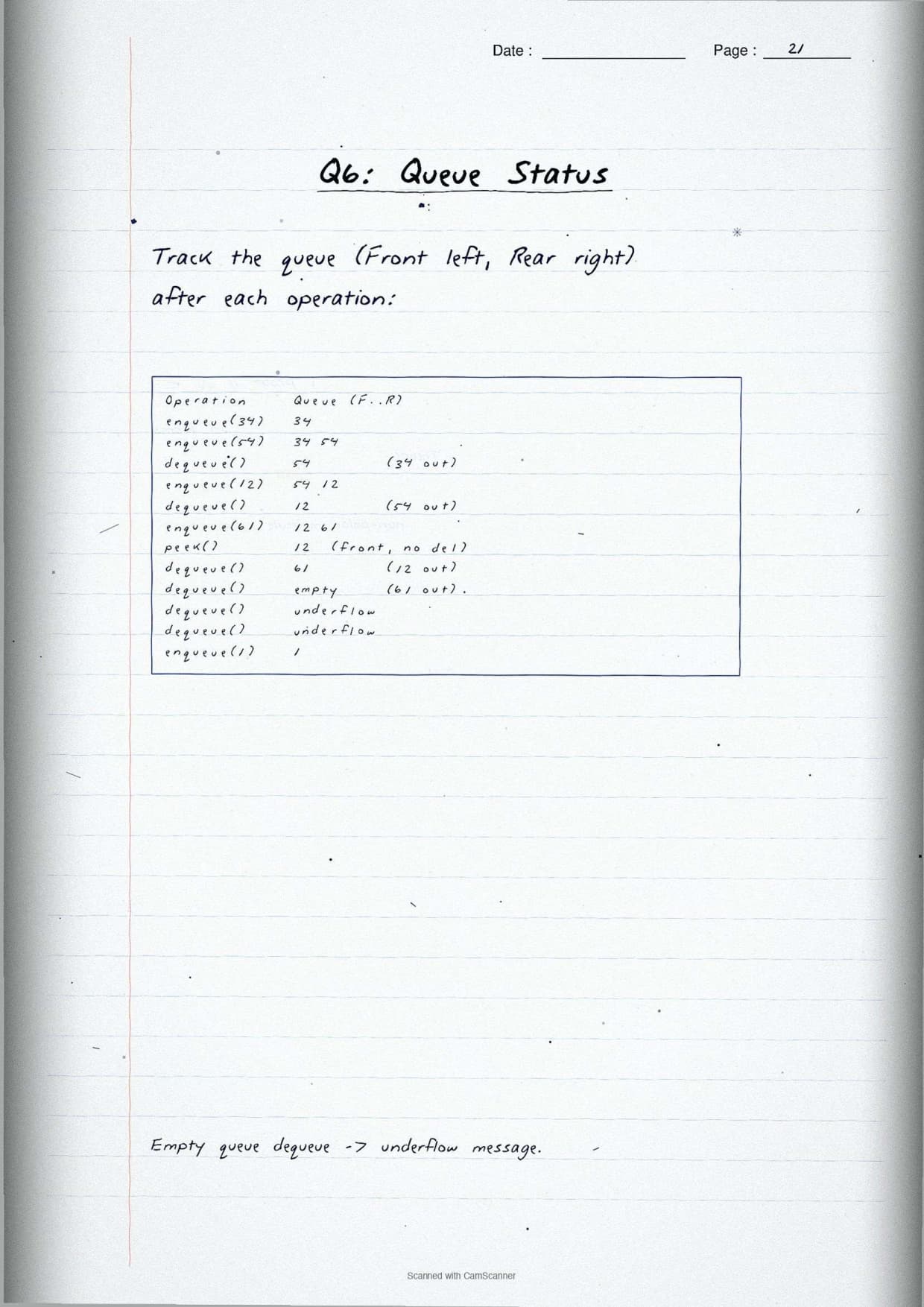
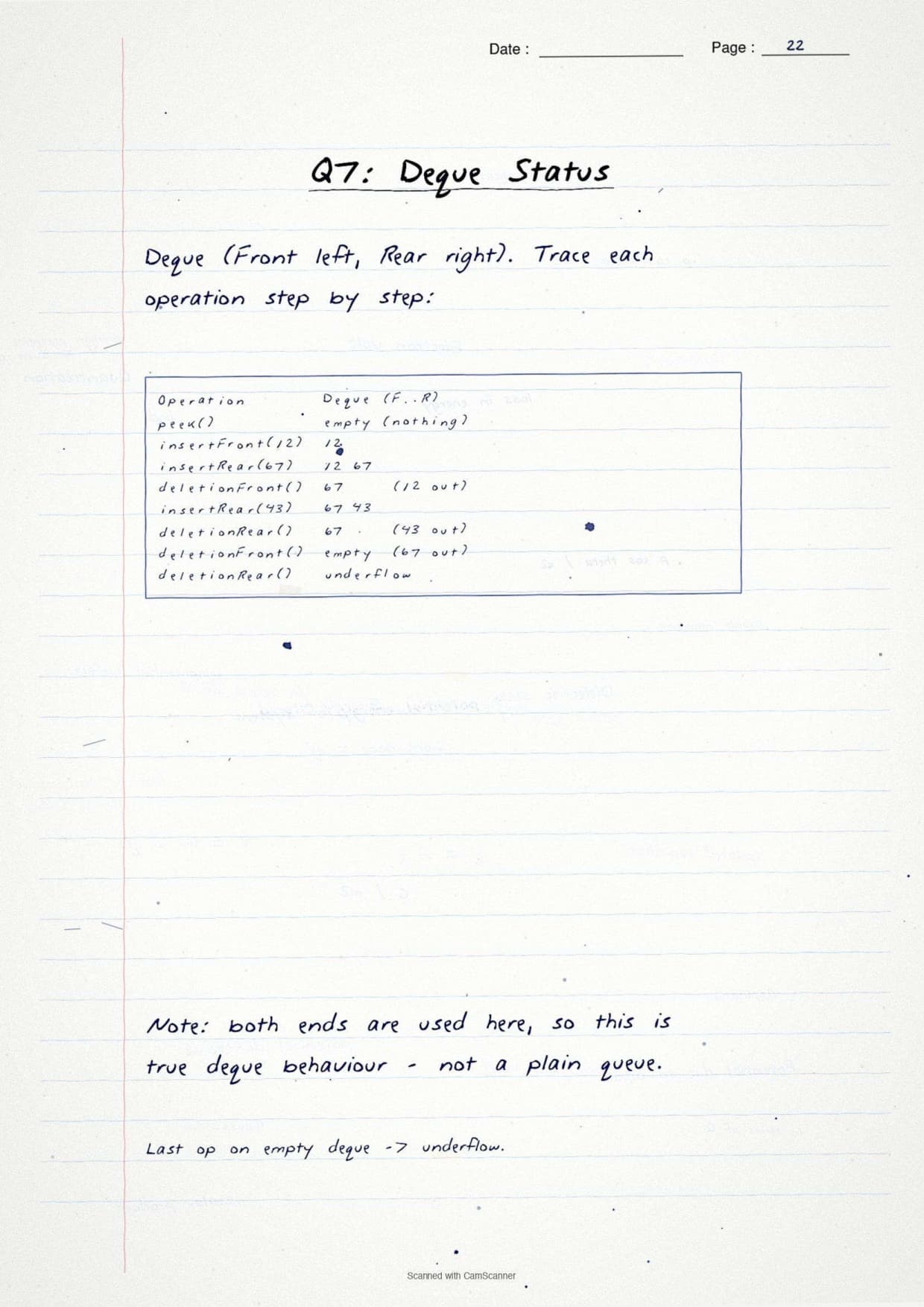
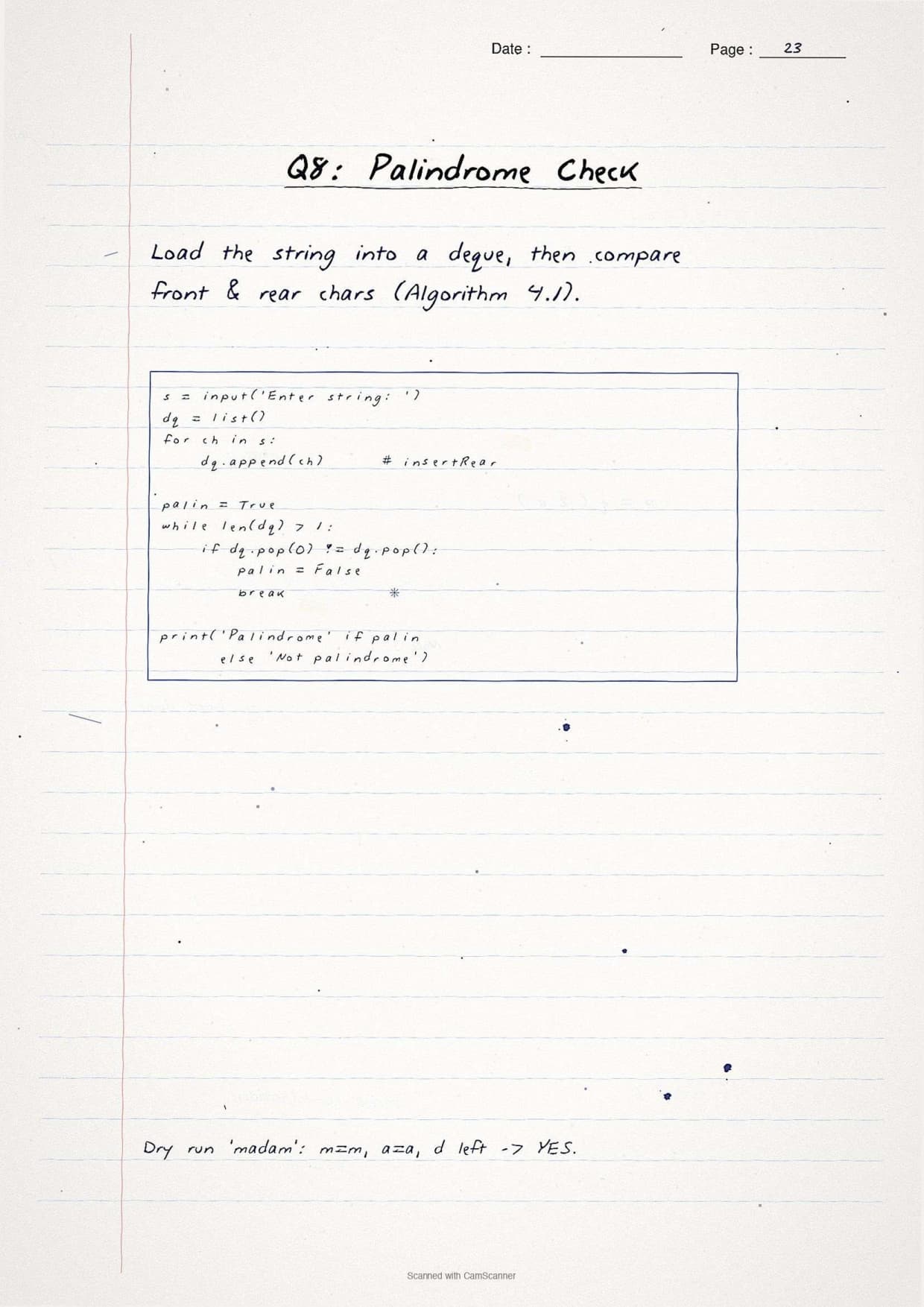
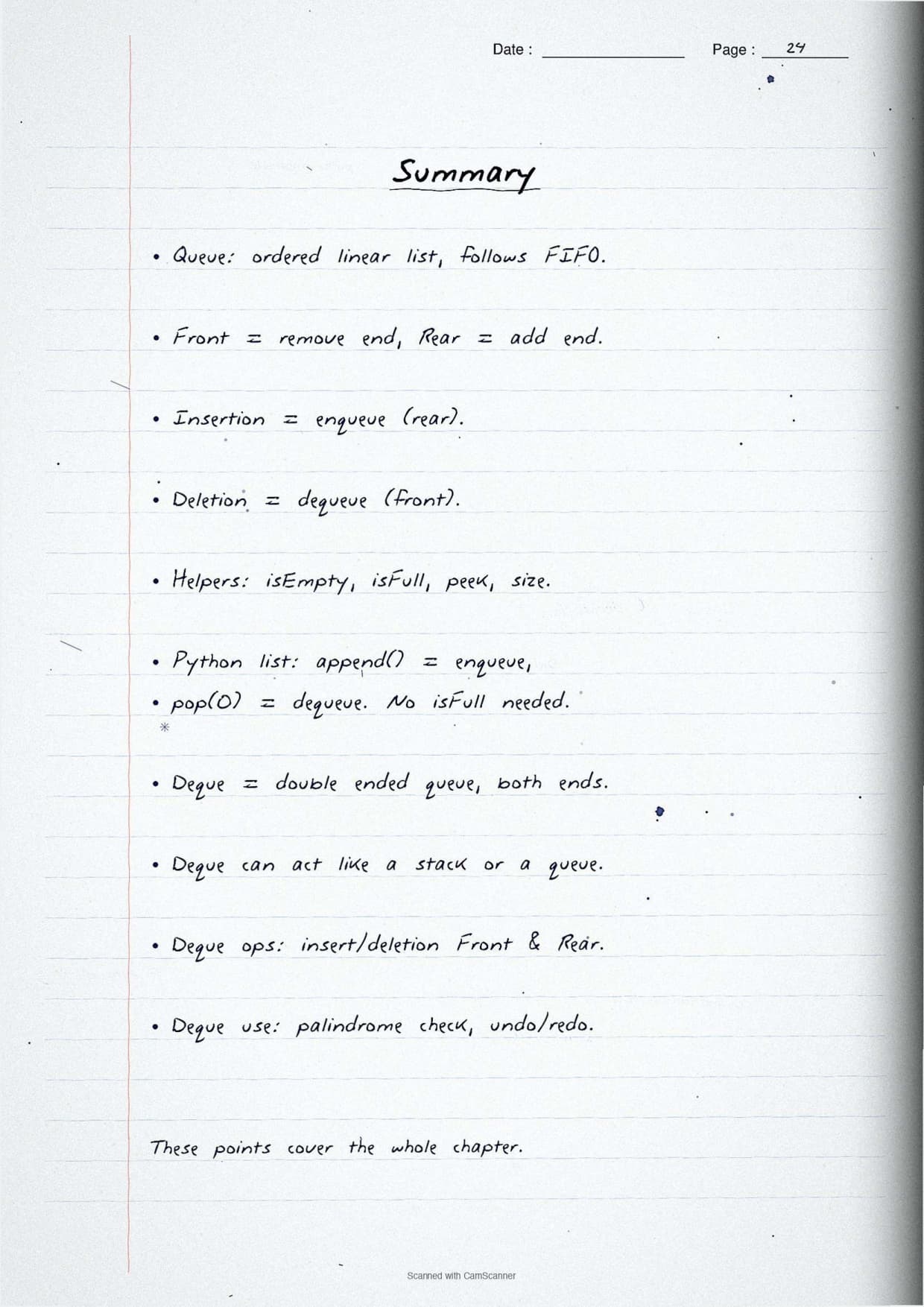
- CBSE Weightage: 6 to 8 marks from Unit 1 (Computational Thinking and Programming), shared with Stack.
- Boxed keywords and hand-written code blocks for ENQUEUE, DEQUEUE, peek and the deque operations.
- Pairs with the NCERT Solutions, Notes and Book PDF linked lower on this page.
These Queue handwritten notes are prepared from the official NCERT Computer Science textbook and matched to the 2026-27 CBSE syllabus.
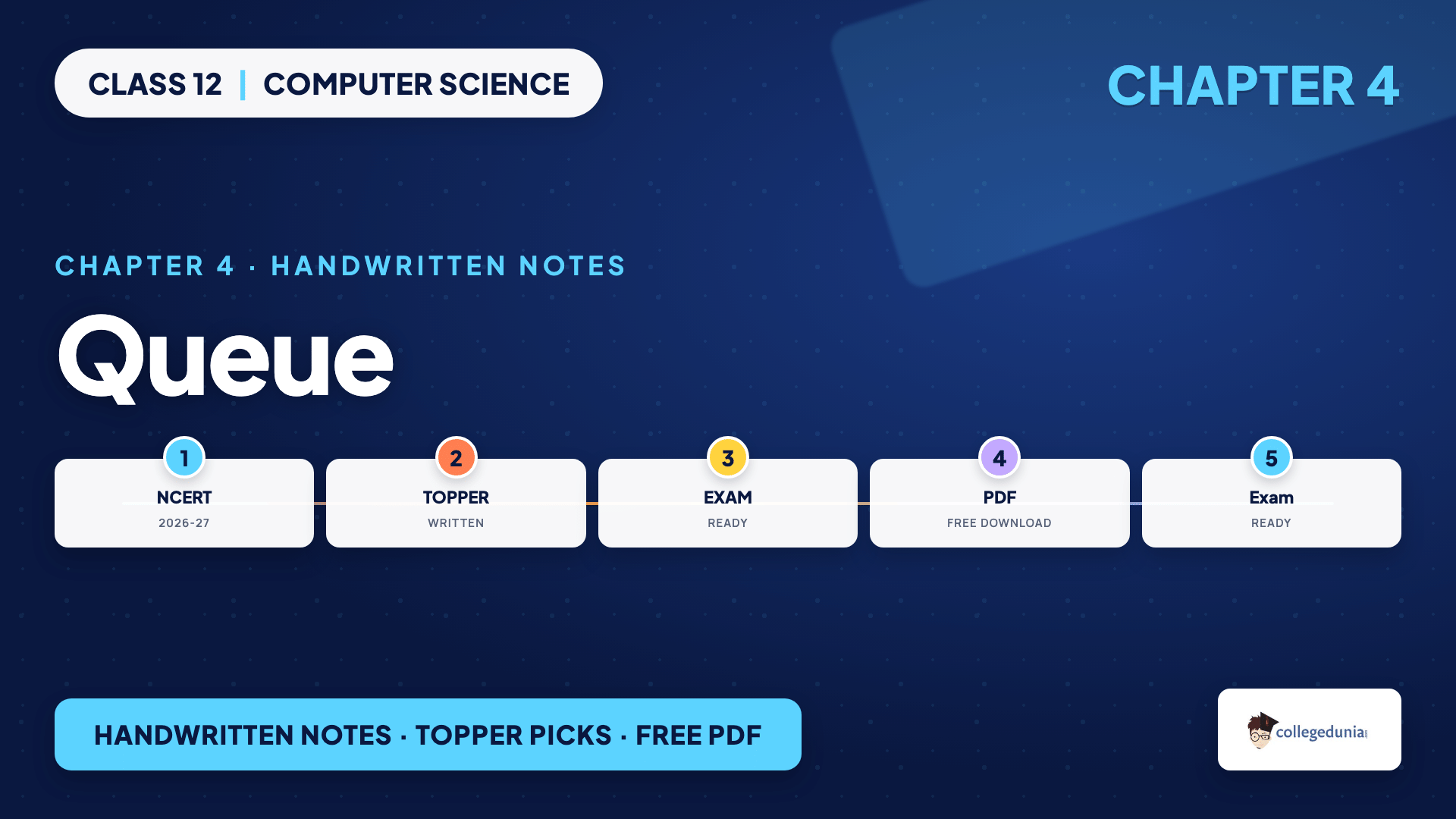
Student Feedback: In a Collegedunia poll of 10,900 Class 12 Computer Science students before the 2026 boards, 71% of students said the hand-drawn FIFO diagram with the front and rear ends labelled was the fastest way to fix the chapter in memory. Most students copied the boxed enqueue and dequeue lines straight onto practice answer sheets.
Source: 2026-27 Class 12 Computer Science student poll. Sample of 10,900 students from CBSE schools across 13 states.
What These Queue Handwritten Notes Include
Typed notes read like a textbook. Handwritten notes read like a friend's revision book, so the eye finds the keyword fast on exam day. These Queue handwritten notes condense the whole chapter into 25 handwritten pages of ruled paper, with every operation in a box and the front and rear ends clearly labelled on each diagram.
The pages are built around the three threads that the CBSE board paper tests:
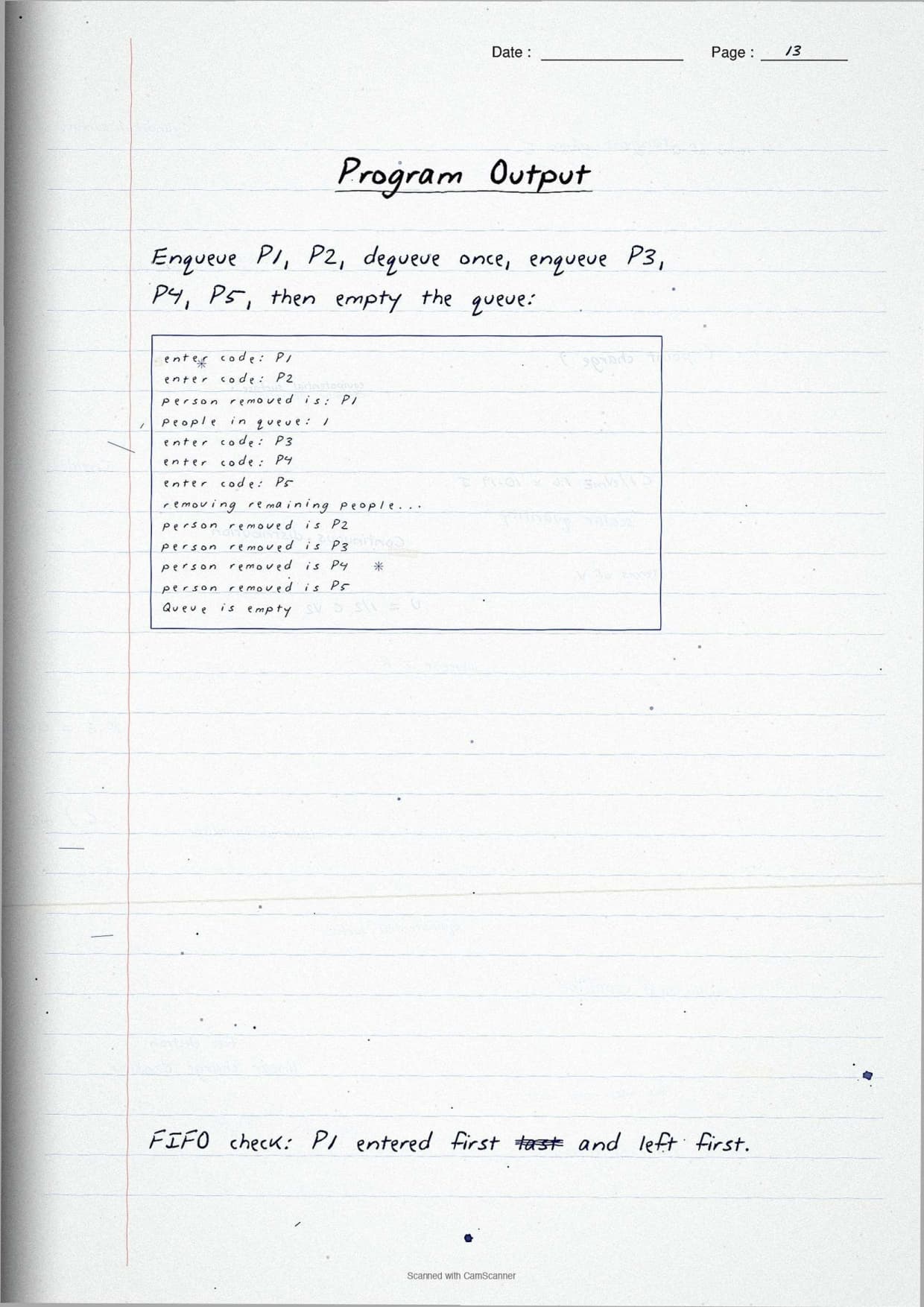
- The rule: what the FIFO rule means and why a queue uses two ends.
- Operations: ENQUEUE, DEQUEUE and peek, plus the overflow and underflow conditions.
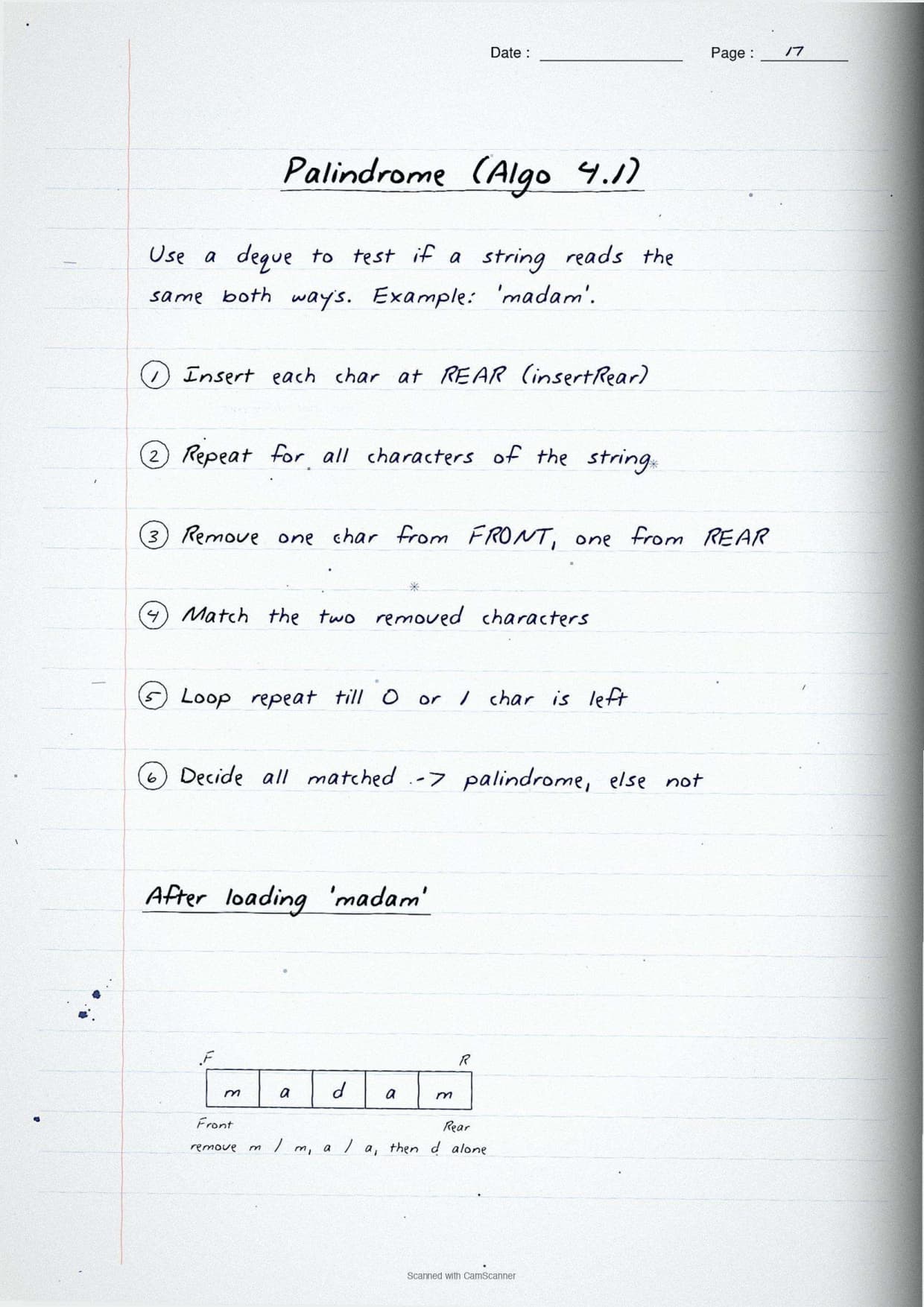
- Extensions: the deque, the queue versus stack contrast, and the menu driven and palindrome programs.
Because the notes are handwritten, the code blocks sit in pen-drawn boxes and each operation is tied to the end it touches, so locating a single line during last-week revision takes seconds. This makes the set ideal for a fast recap the night before the exam.
Queue and the FIFO Rule: The First Page of the Notes
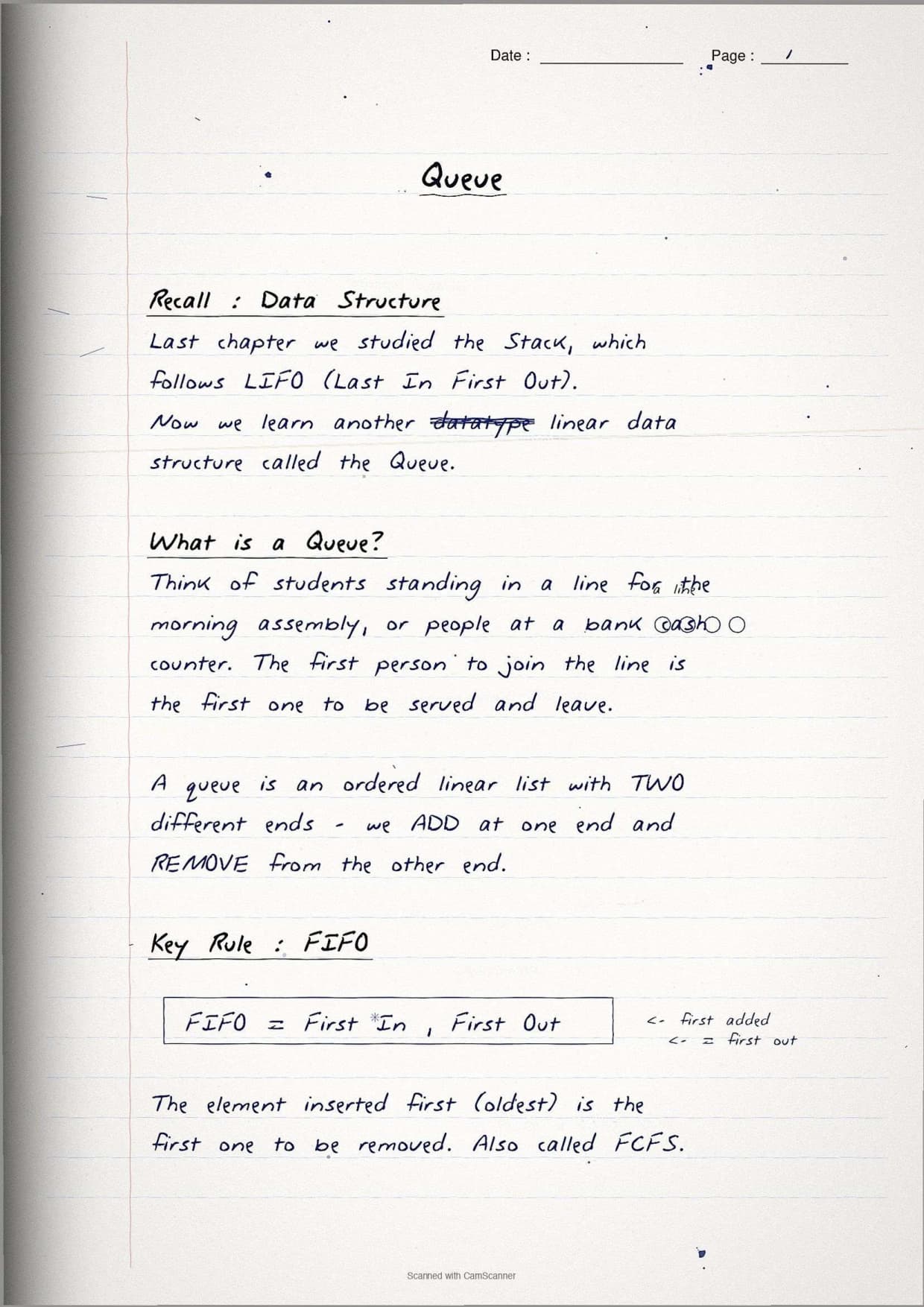
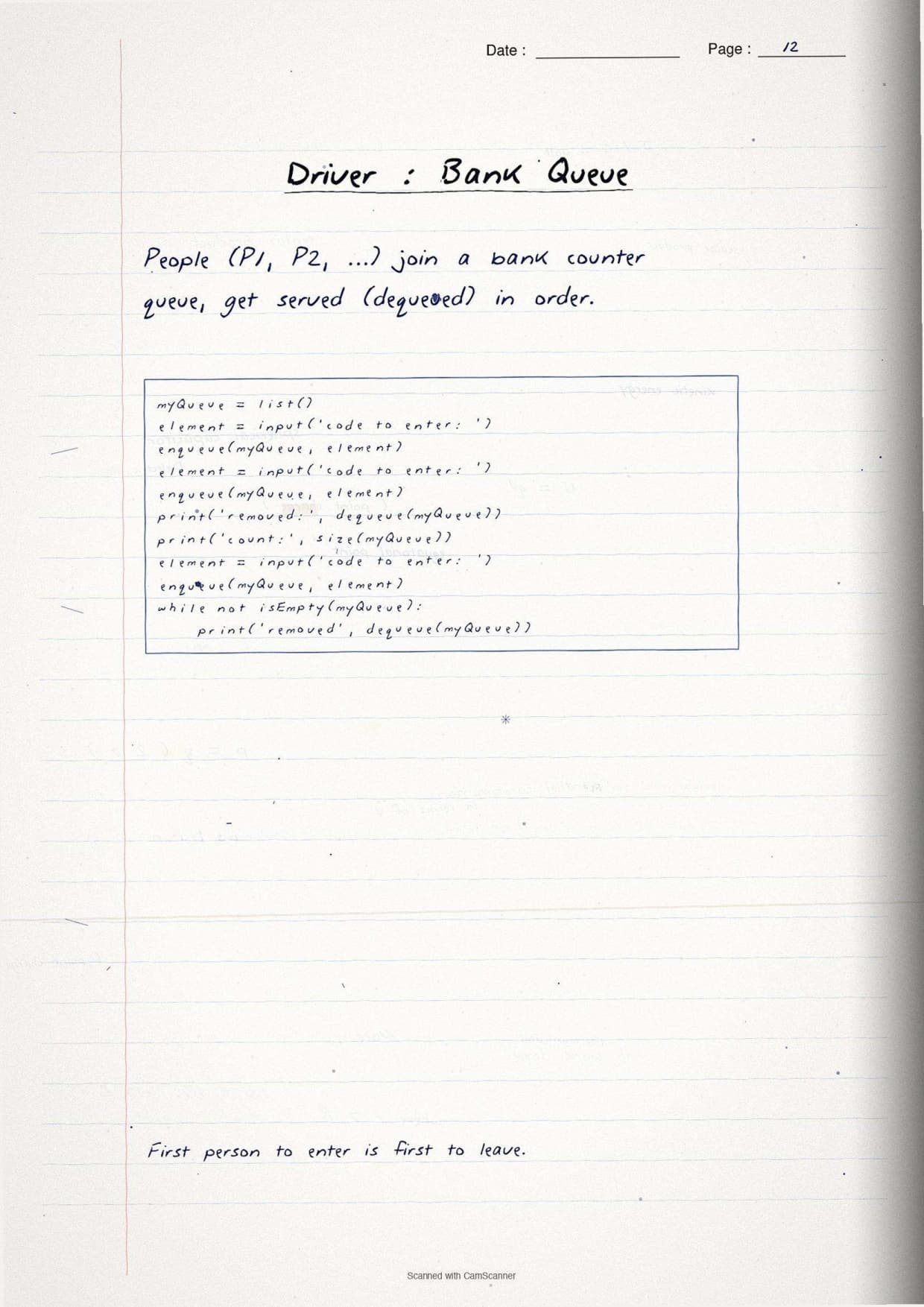
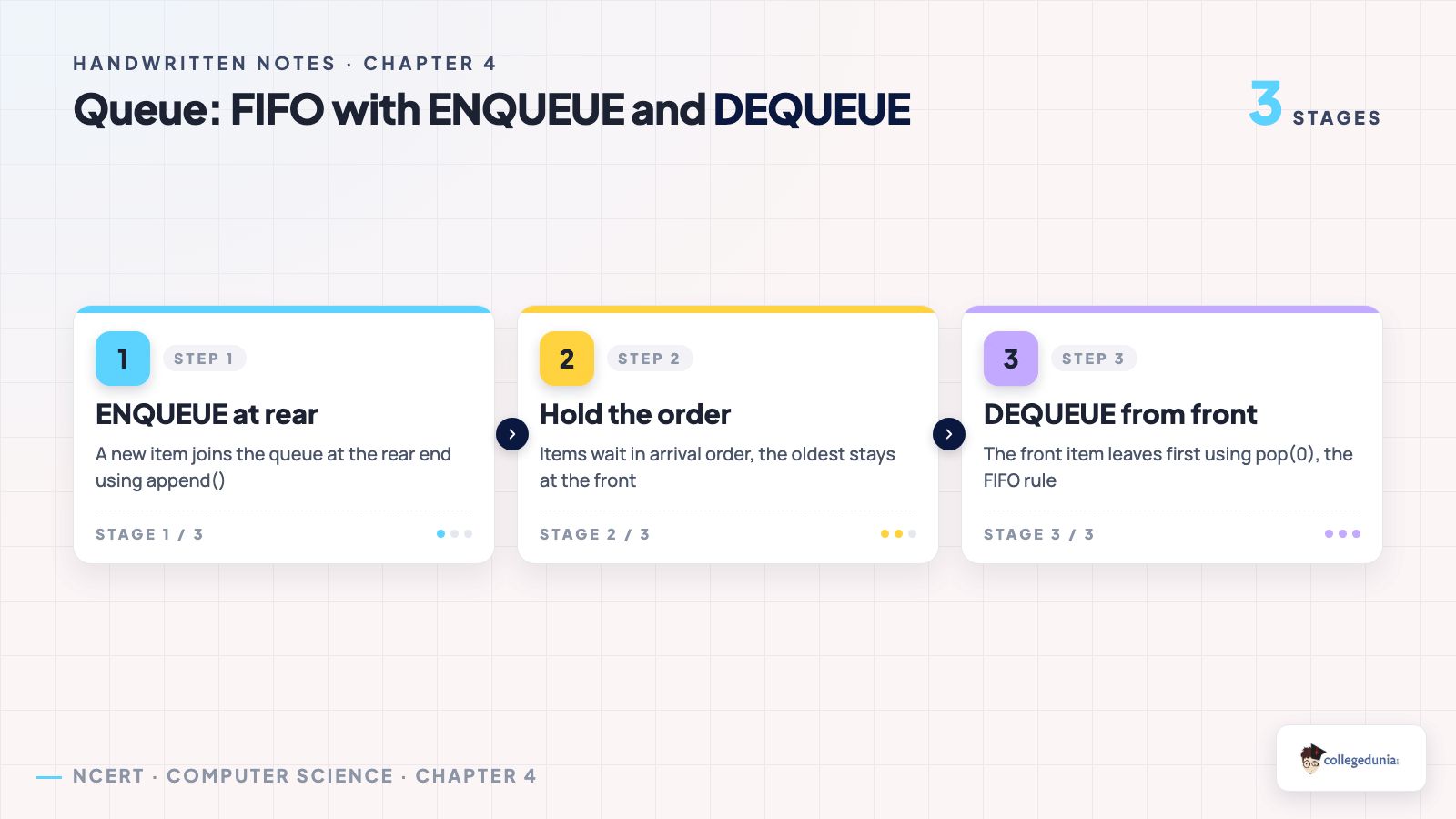
The opening page settles the most common board question: what a queue is and how the FIFO rule works. The notes box the one-line rule and draw a line of people at a ticket counter, so students can reproduce the answer from memory.
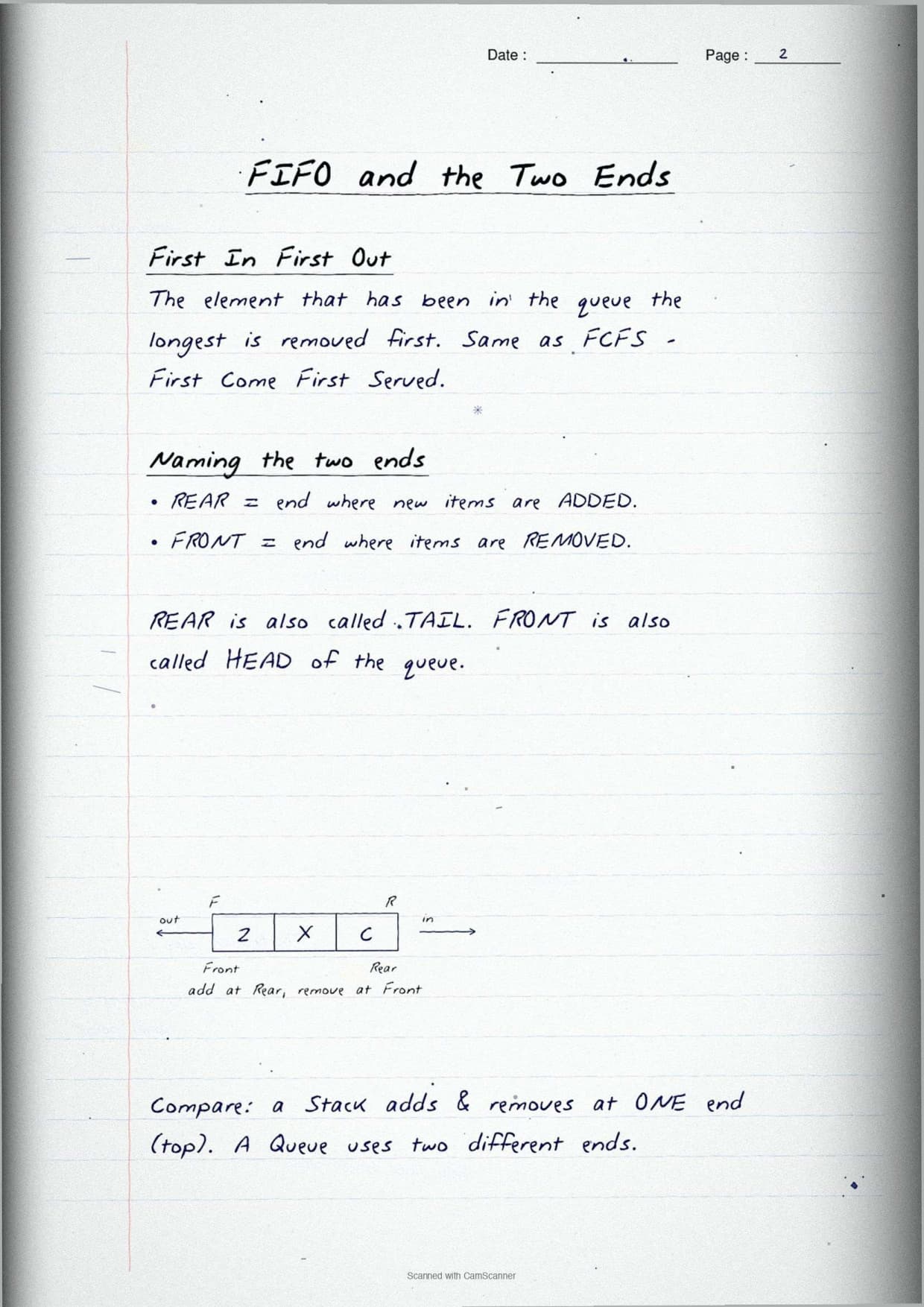
- Queue: a linear data structure with two open ends, where you add at one end and remove from the other.
- FIFO: First In, First Out. The item added first is the item removed first.
- The exam line: insertion happens at the rear and deletion at the front, two different ends.
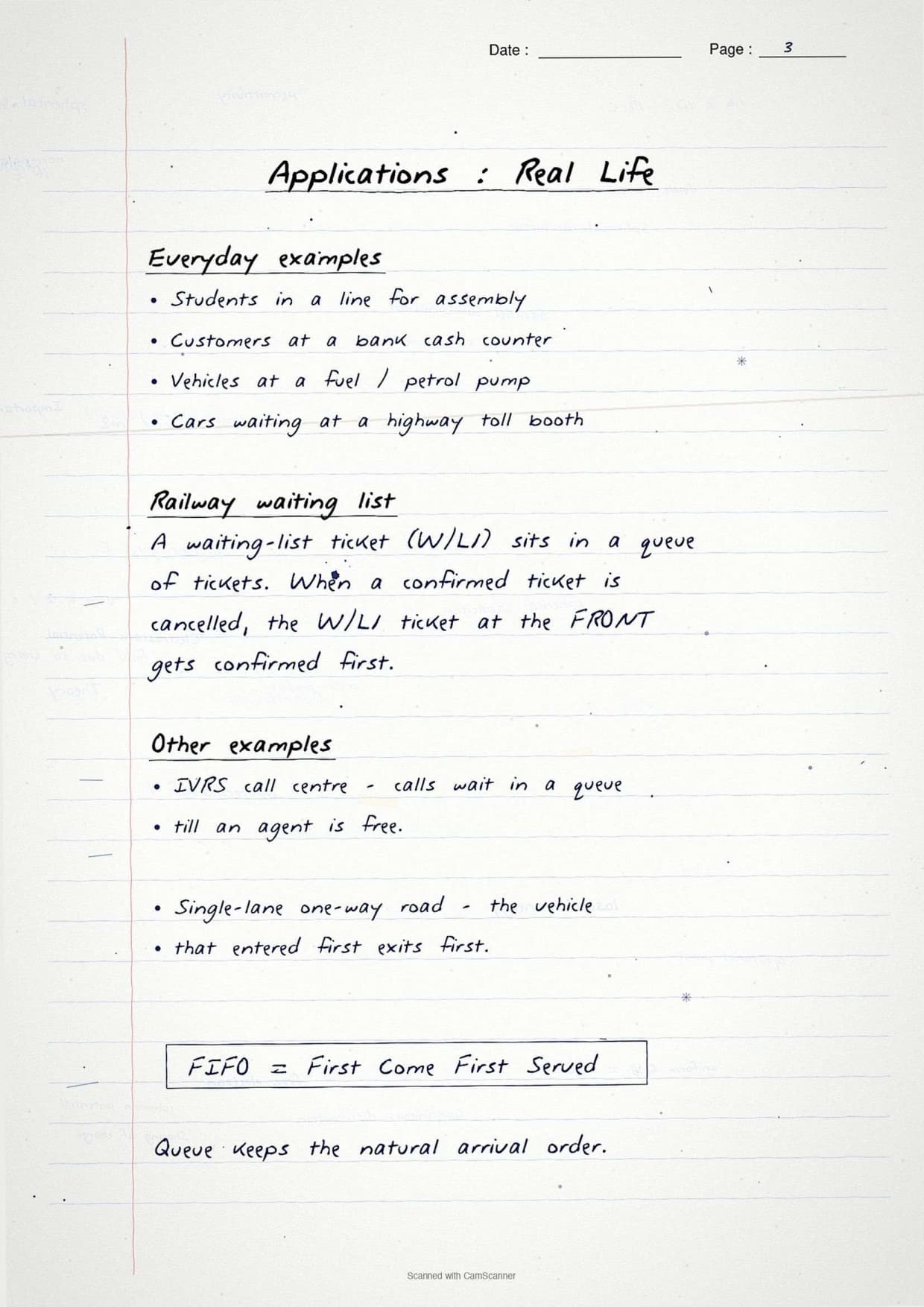
The margin note underlines the takeaway with a daily picture: a line at a ticket counter, where the first person to join is the first served. A late arrival joins the back and waits their turn, so no one is served out of order. That single image is enough to answer the 2-mark "how does FIFO describe a queue" question.
ENQUEUE, DEQUEUE, Overflow and Underflow
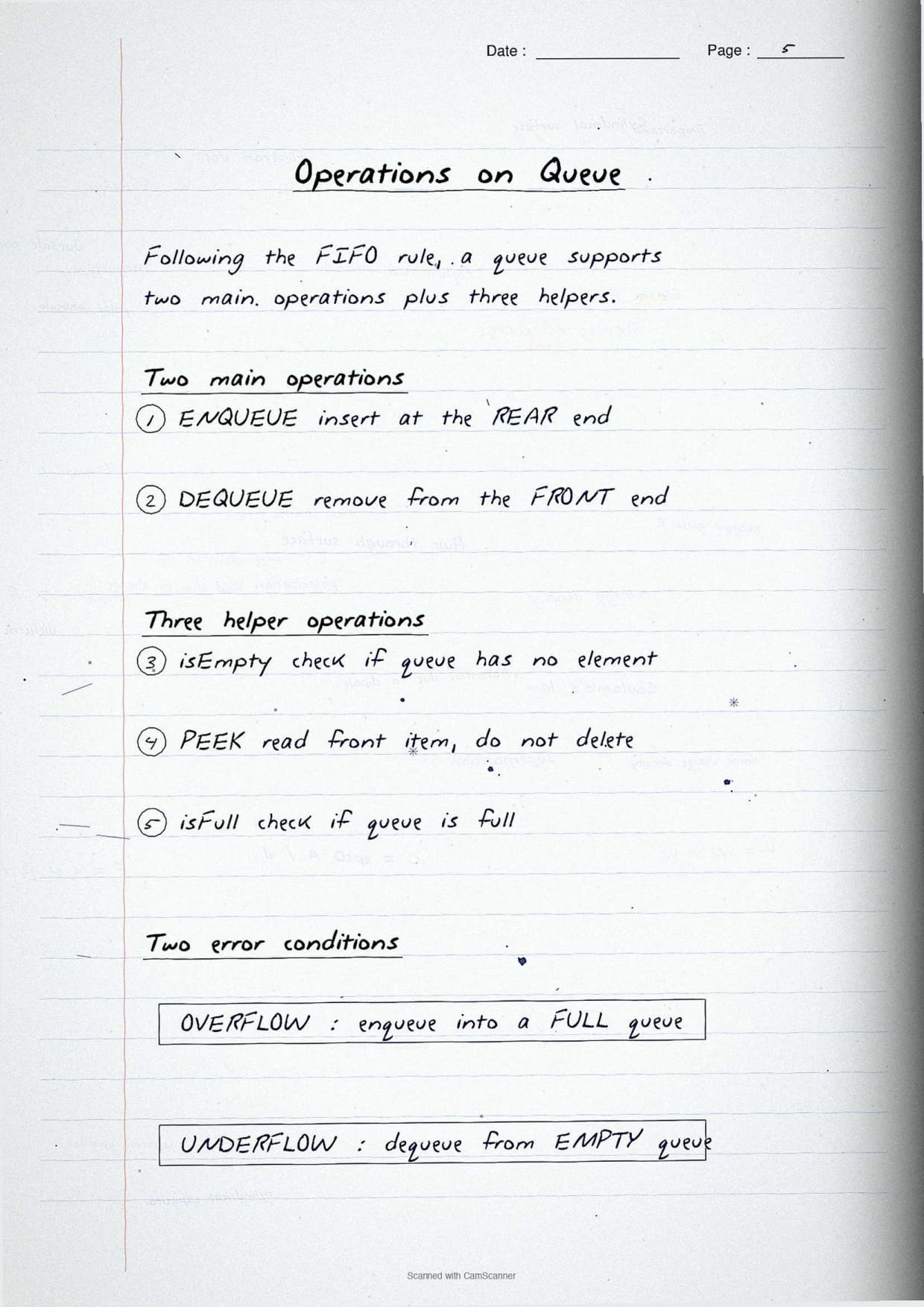
One full page lists the queue operations the CBSE paper asks about by name. The notes give each one a one-line meaning and the end it acts on, so students can write the answer in a single sentence.
| Term | What it does | End it acts on |
|---|---|---|
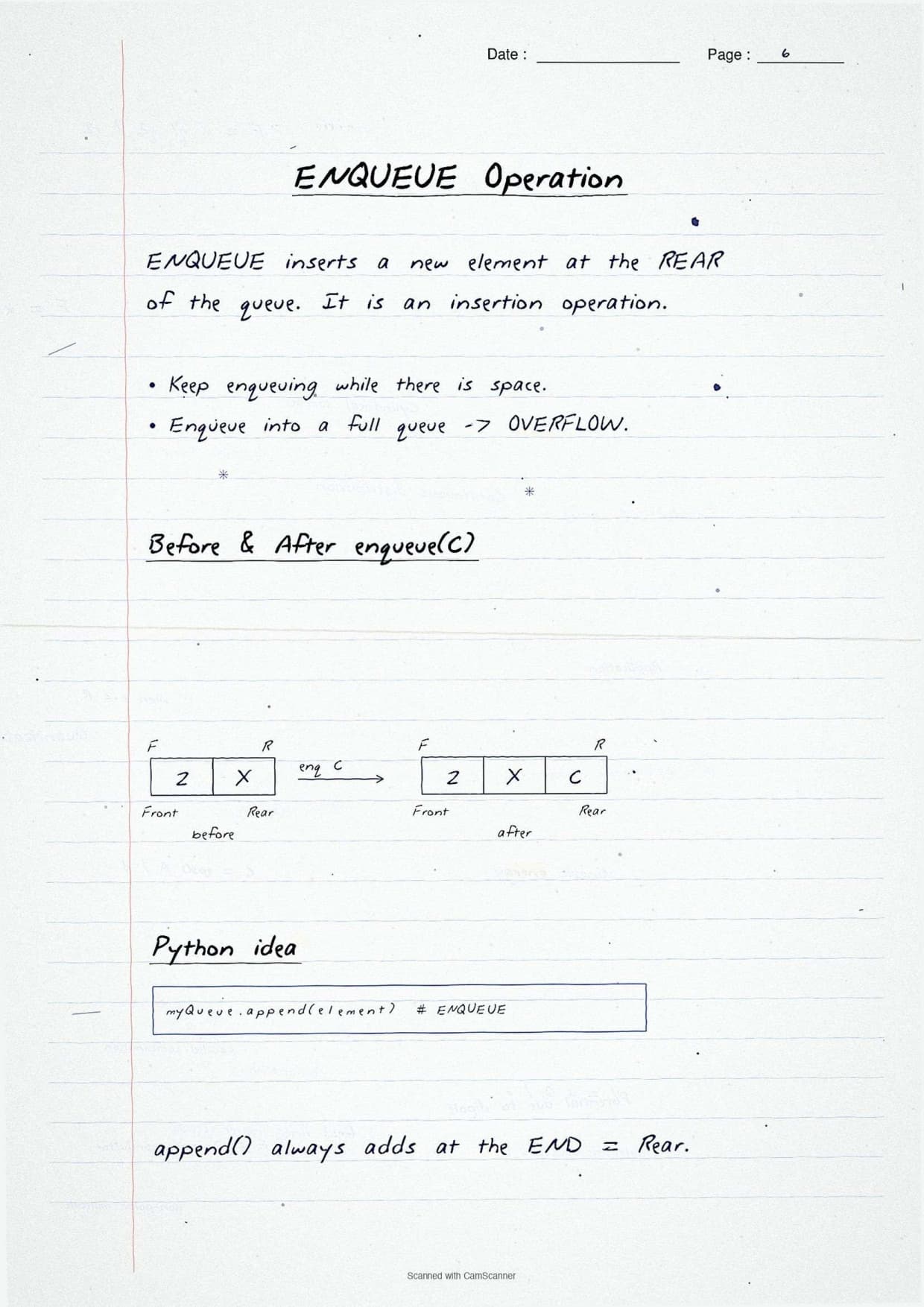
ENQUEUE | Adds a new item to the queue | Rear |
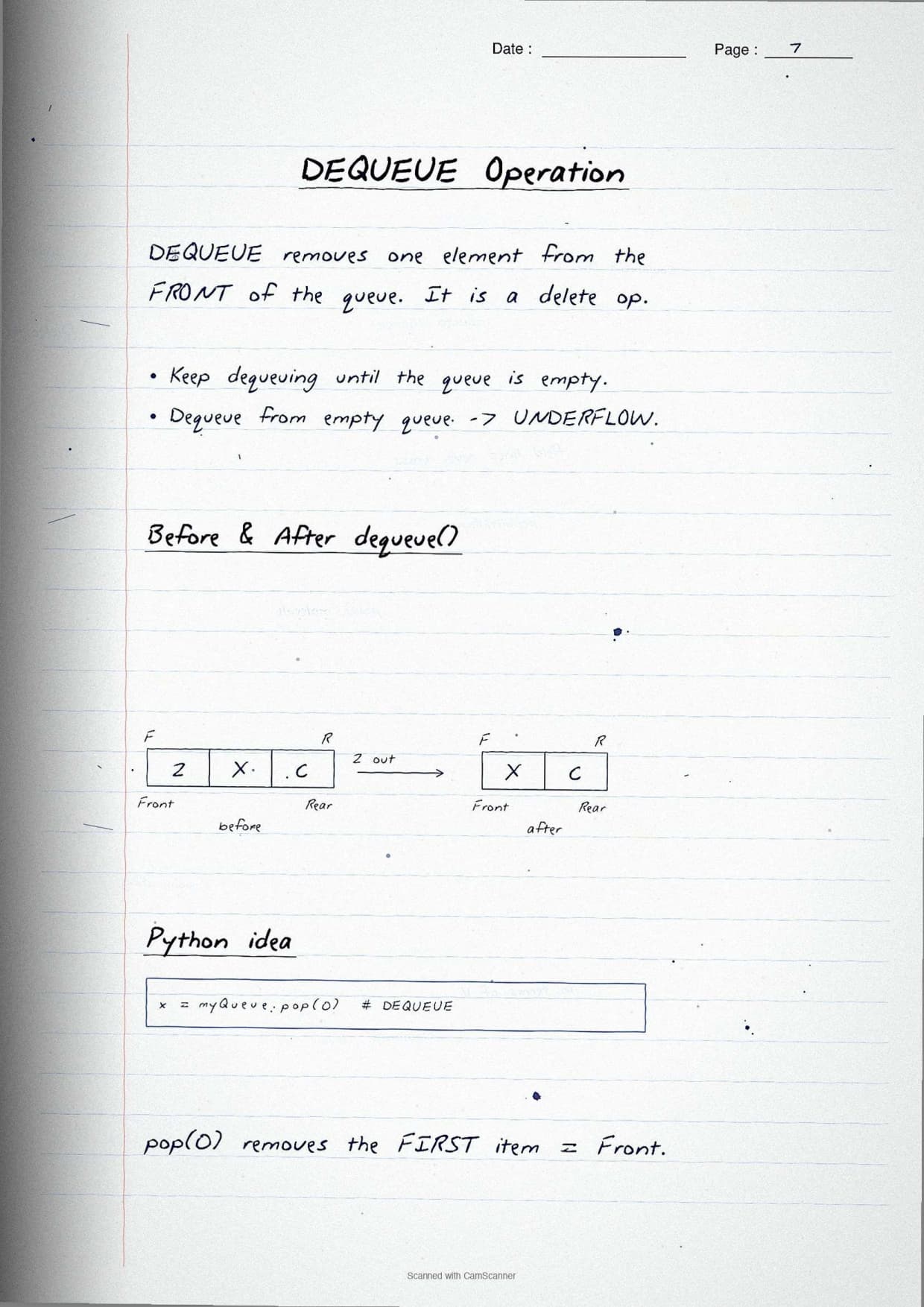
DEQUEUE | Removes and returns an item | Front |
peek | Reads the next item without removing it | Front |
| Overflow | ENQUEUE on a queue with no free space | Rear |
| Underflow | DEQUEUE on an empty queue | Front |
The page boxes the sharpest distinction students miss: only ENQUEUE can cause overflow, and only DEQUEUE can cause underflow. Keeping that one line in mind turns a vague answer into a full-marks one, because the 1-mark definition question almost always pairs the two words.
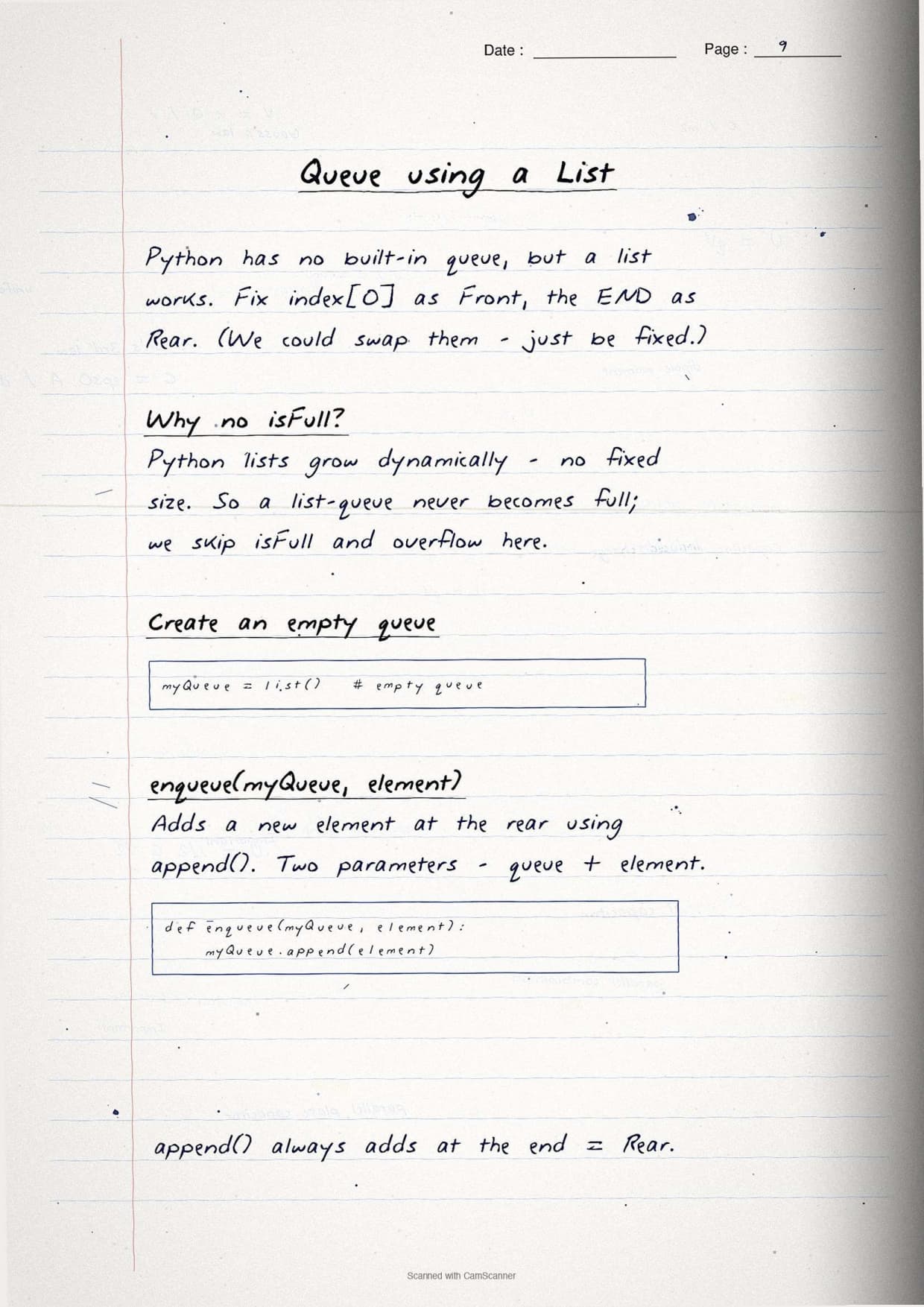
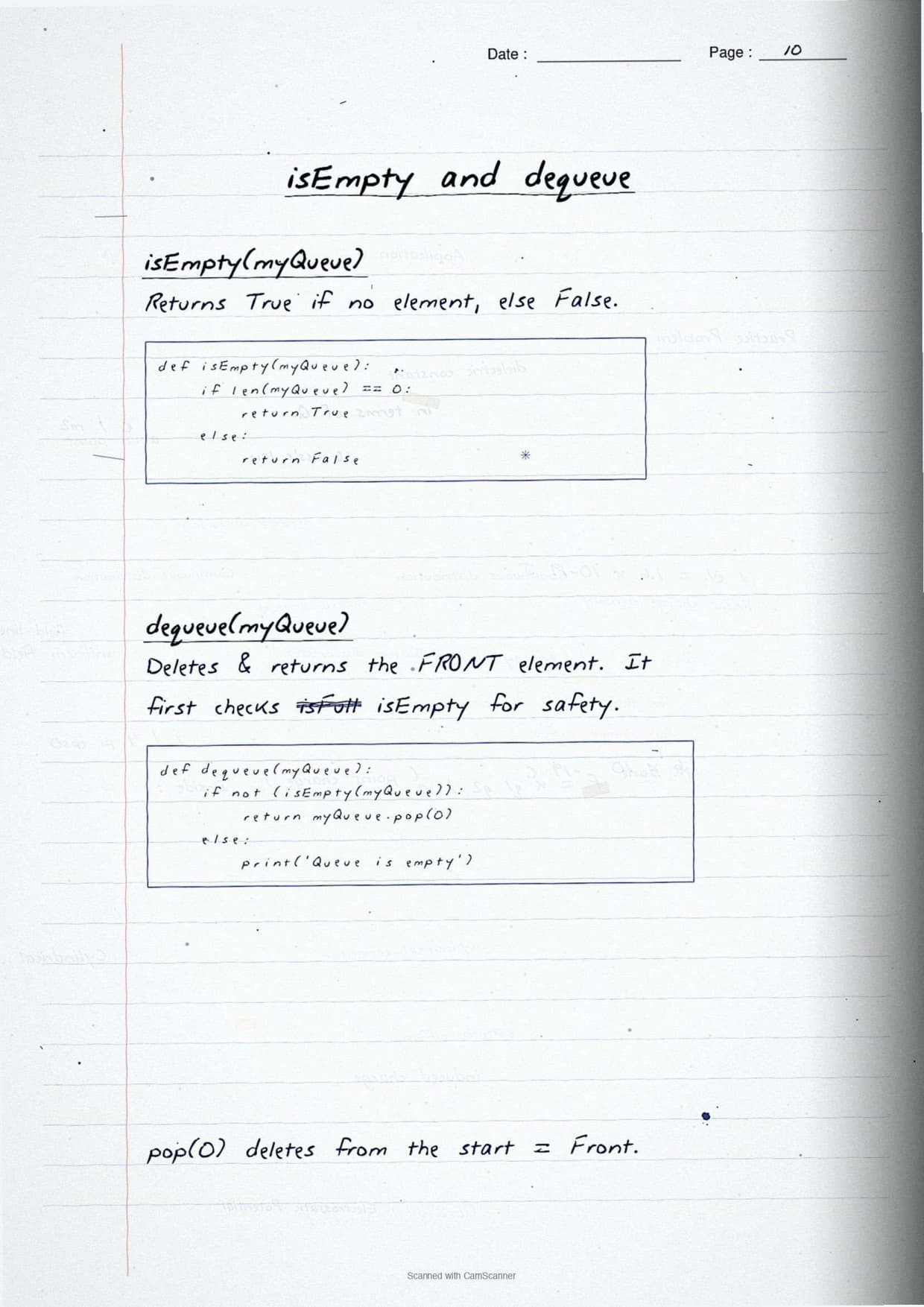
Queue with Python Lists: append() and pop(0)
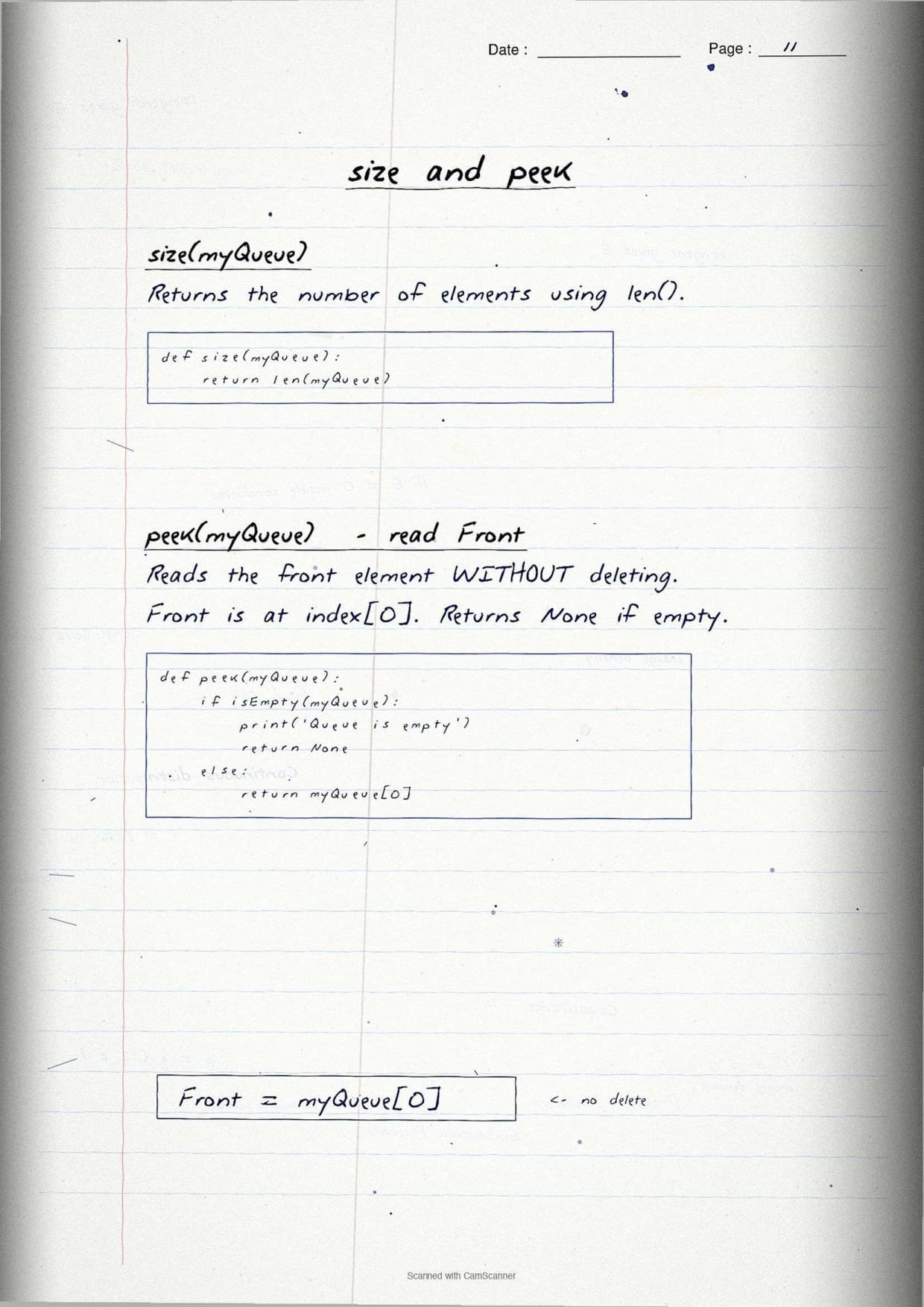
This is the page students revise most. The notes show that a Python list is a ready-made queue, with append() as ENQUEUE and pop(0) as DEQUEUE. The boxed code below mirrors the page so students can copy the methods straight onto the answer sheet.
queue = []
queue.append(10)      # ENQUEUE 10 -> [10]
queue.append(20)      # ENQUEUE 20 -> [10, 20]
front = queue.pop(0)  # DEQUEUE    -> returns 10, list is [20]
peek = queue[0]       # PEEK       -> reads 20, list unchanged
empty = len(queue) == 0   # test for an empty queue
The notes pin down which method matches which operation:
- append(x): adds
xat the end of the list, which acts as the rear. - pop(0): removes and returns index 0, the front, so the oldest item leaves first.
- queue[0]: reads the front without removing it, the peek operation.
- len(queue) == 0: the empty check that guards every DEQUEUE against underflow.
The margin note boxes the exam rule examiners check first: use pop(0), never plain pop(). A bare pop() removes the rear item, which behaves like a stack, while a queue must remove the front. This is the single most repeated 1-mark error in the chapter, so the notes circle it in red.
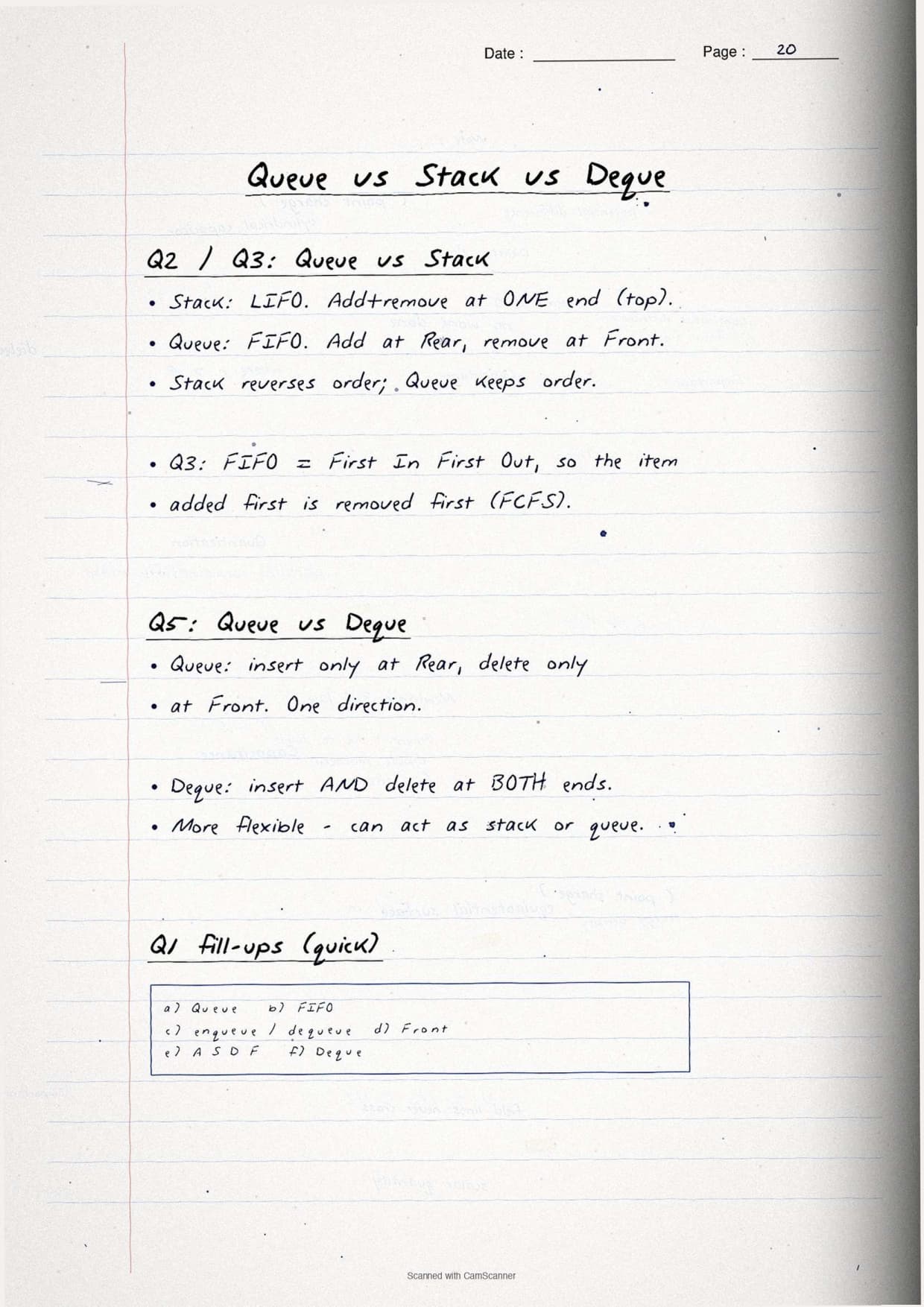
Deque and Queue versus Stack
The last concept page covers the two contrasts students forget: the deque and the queue versus stack comparison. The notes box a one-line rule for each, because both turn up as 2-mark or 3-mark direct questions in the board paper.
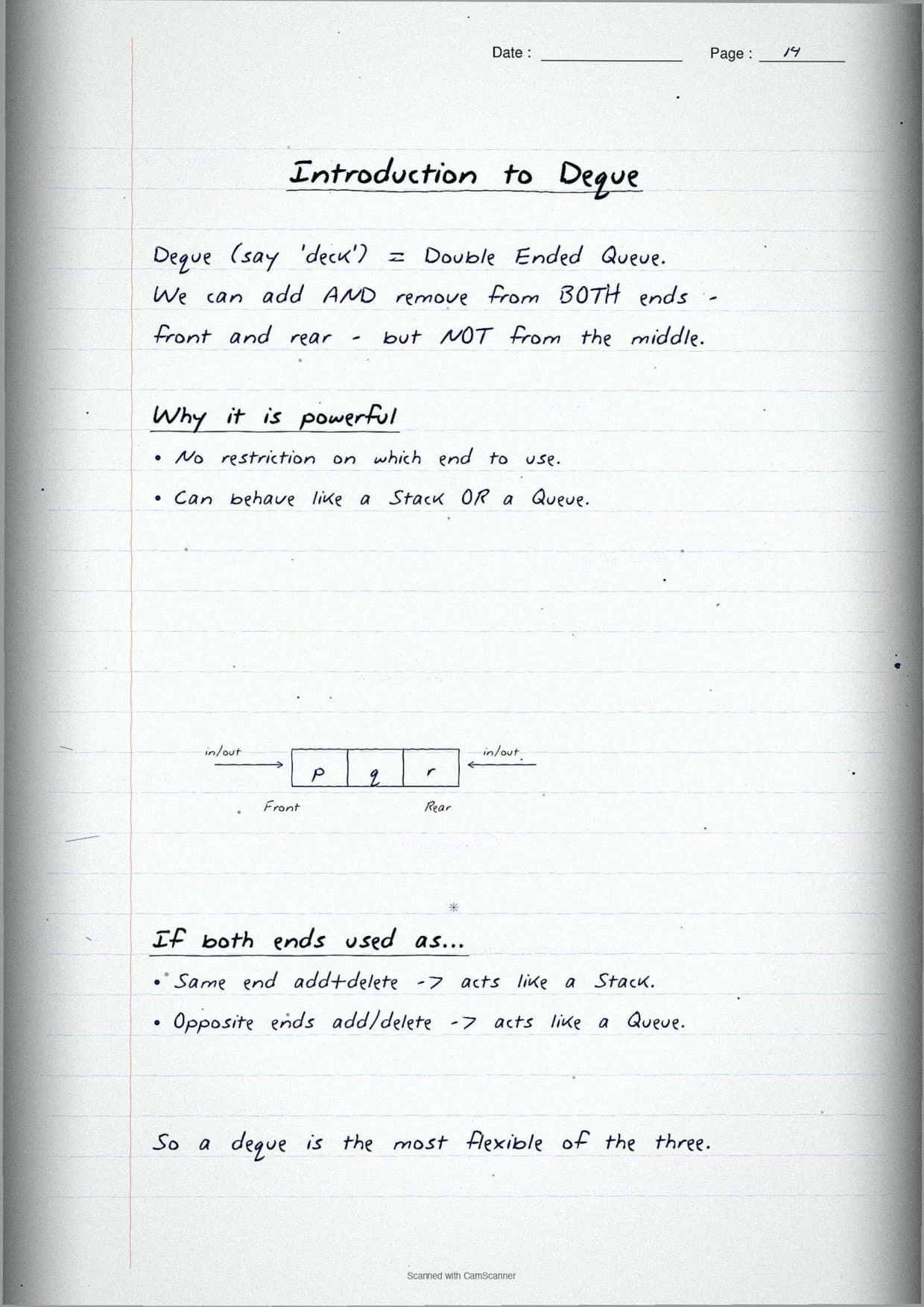
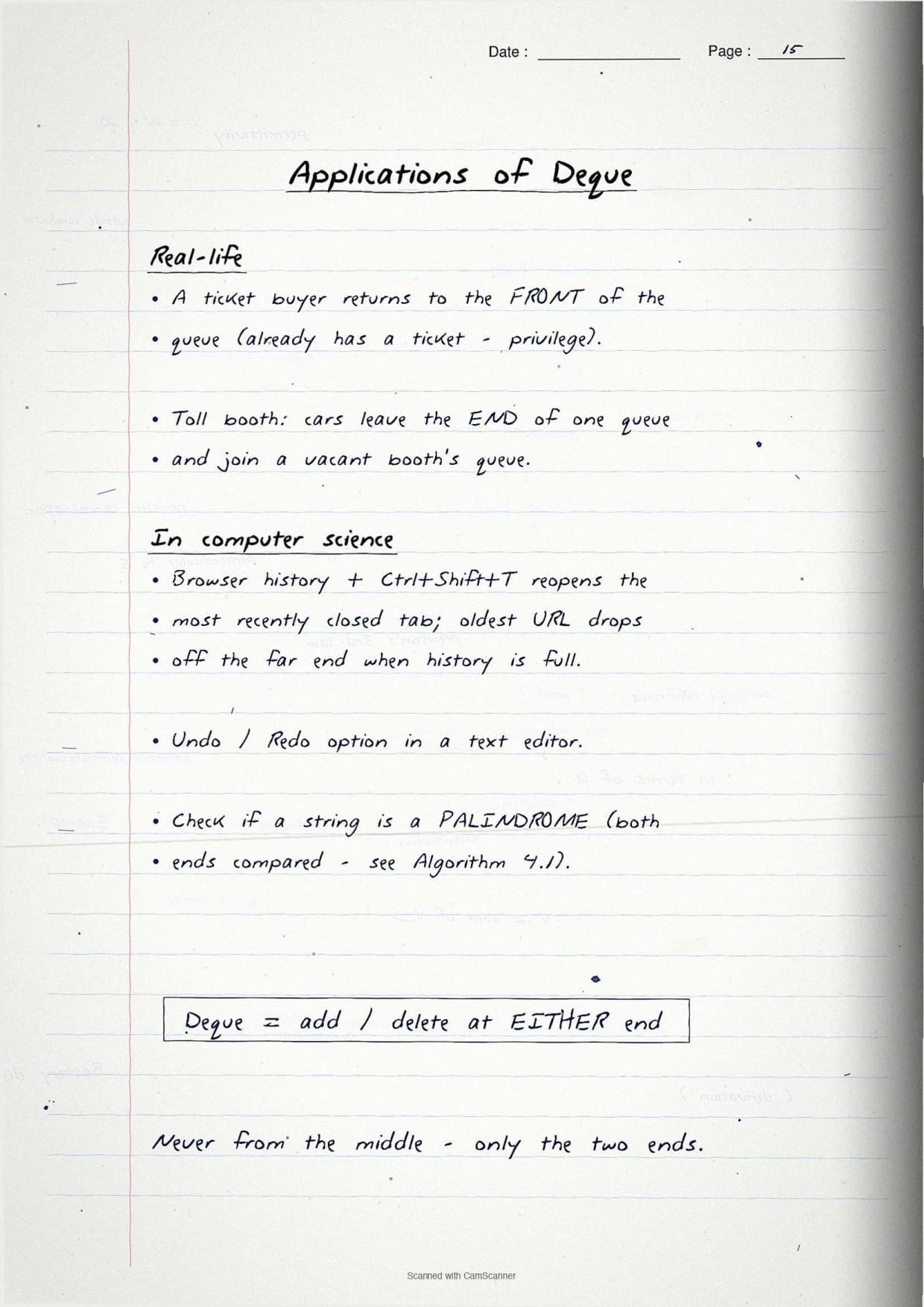
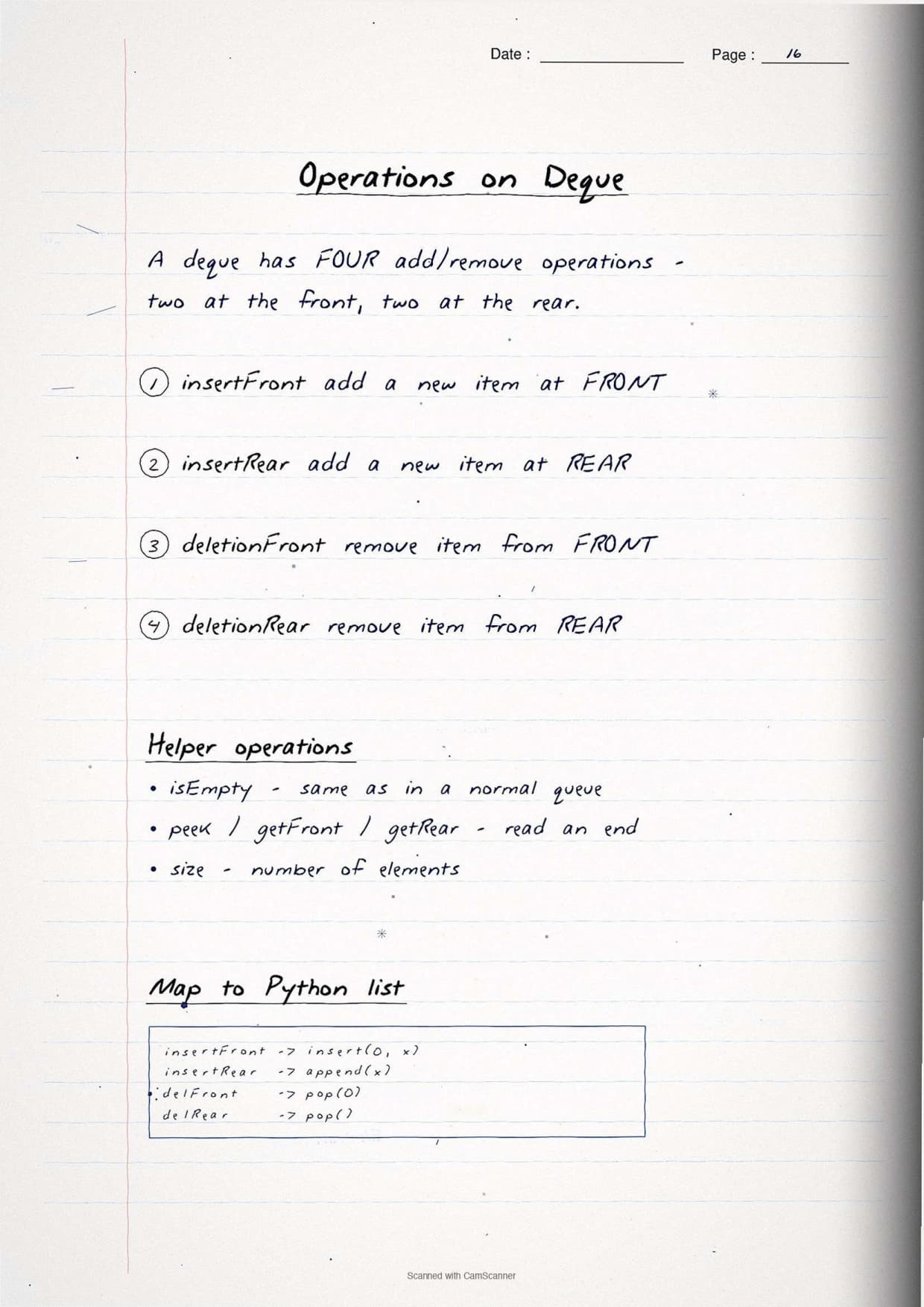
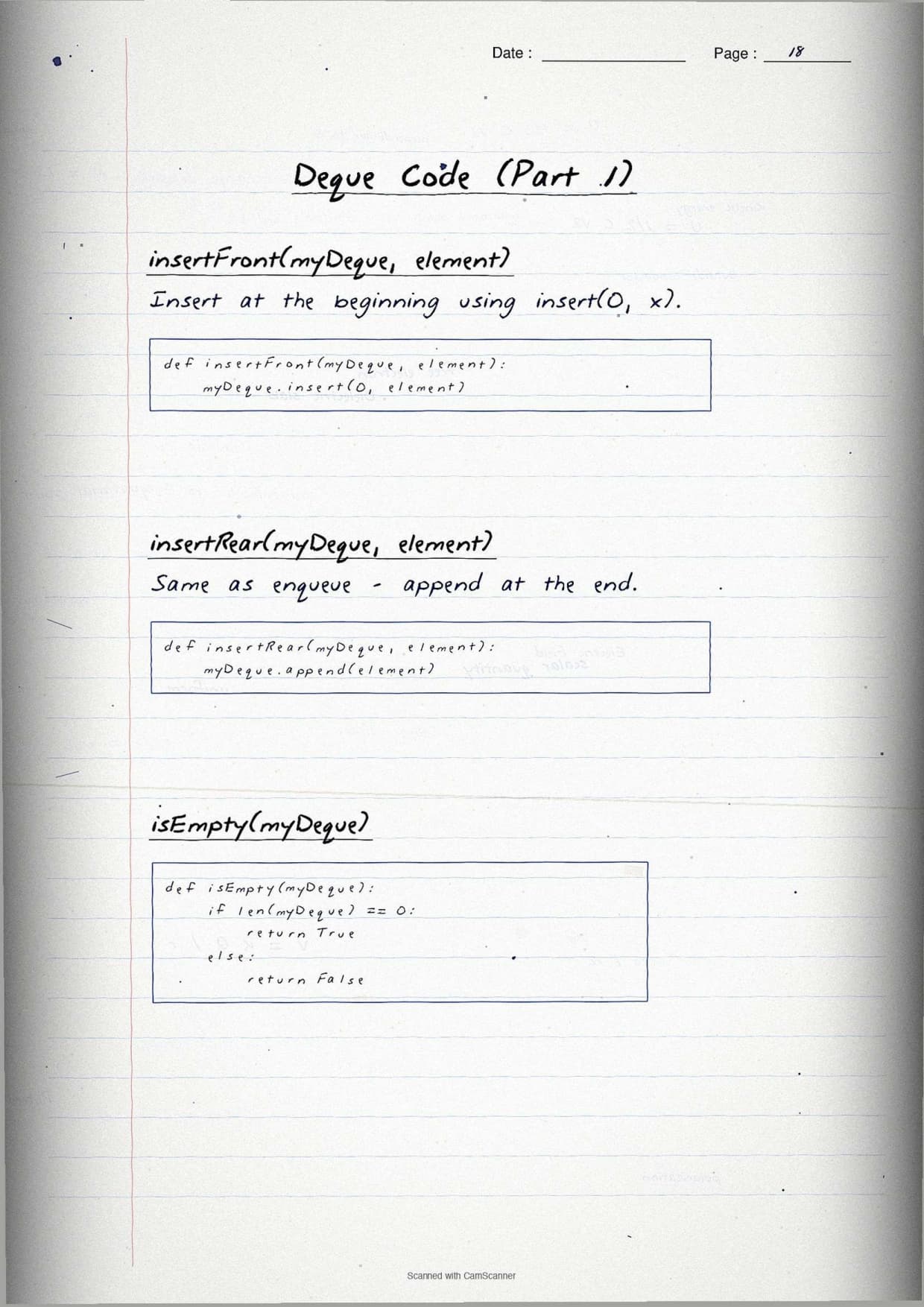
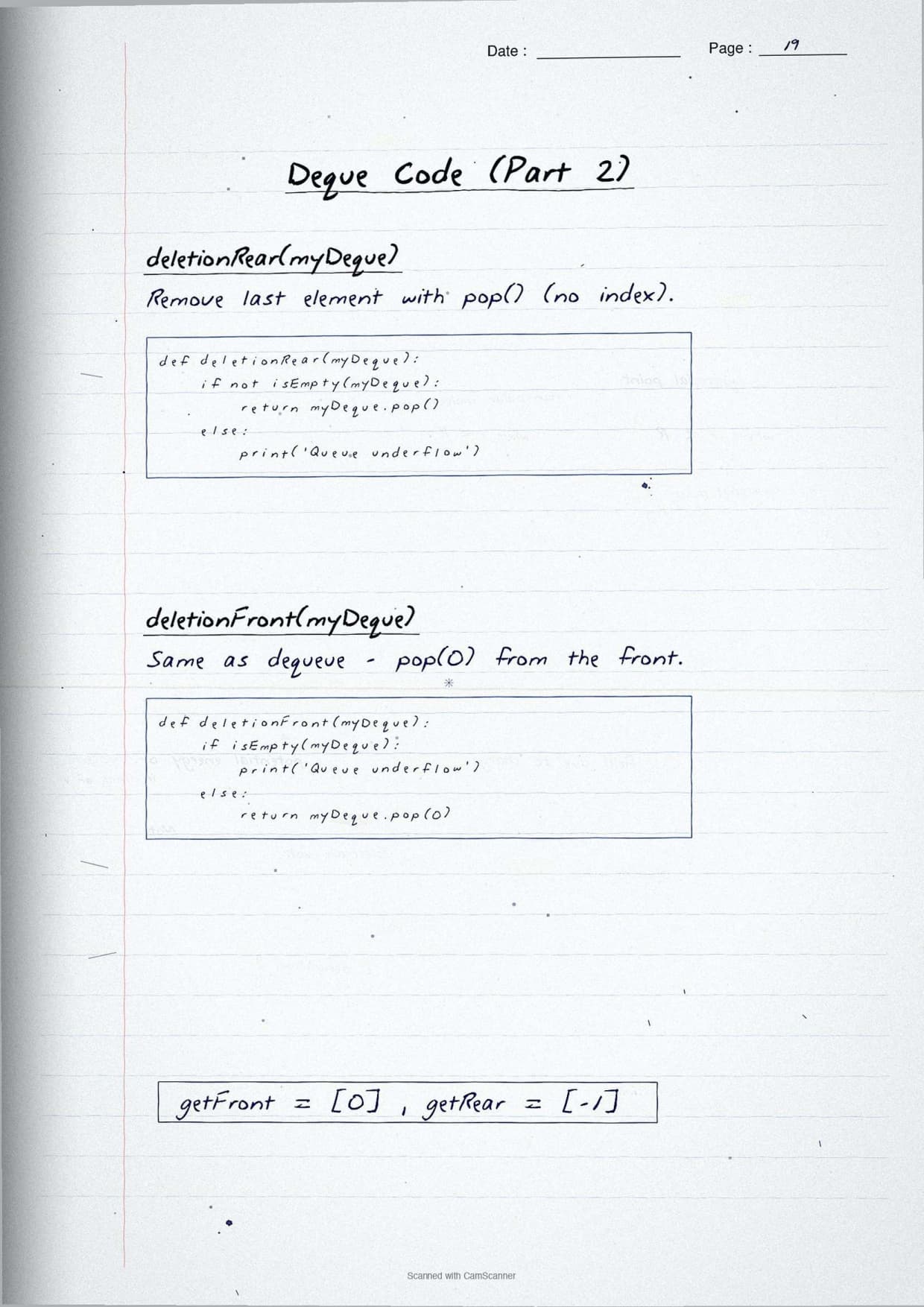
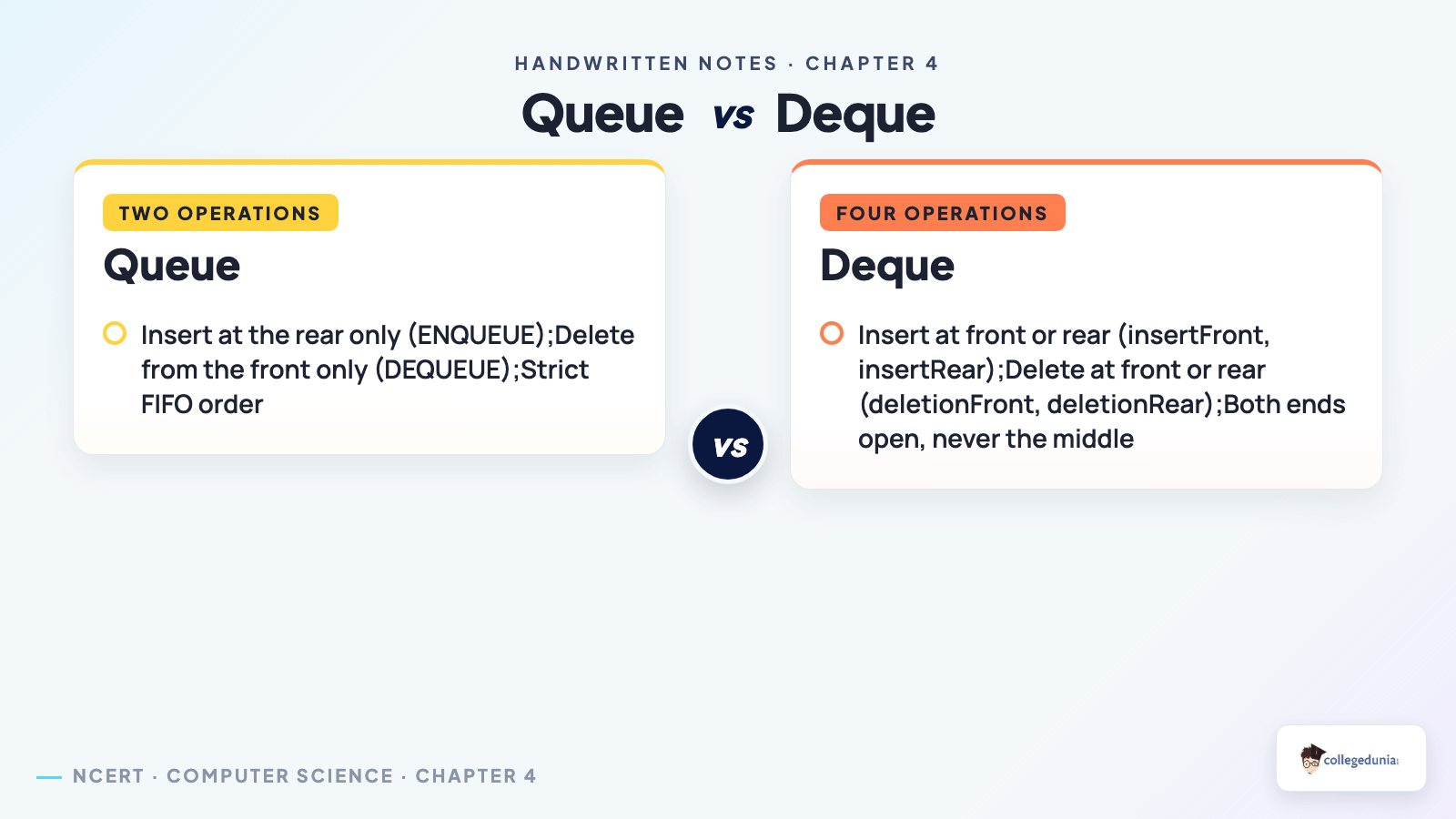
A deque, short for double ended queue, lets you insert and delete at either end, the front or the rear, but never the middle. So a deque has four operations while a plain queue has just two:
dq = []
dq.append(67)         # insertRear 67  -> [67]
dq.insert(0, 12)      # insertFront 12 -> [12, 67]
dq.pop(0)             # deletionFront  -> removes 12
dq.pop()              # deletionRear   -> removes 67
The notes keep the difference between the structures in one boxed table, so students can name the right one in a glance:
| Point | Stack | Queue | Deque |
|---|---|---|---|
| Order rule | LIFO | FIFO | Both ends open |
| Ends used | One (top) | Two (front, rear) | Two, either end |
| Operations | PUSH, POP | ENQUEUE, DEQUEUE | insertFront, insertRear, deletionFront, deletionRear |
The margin note boxes the exam shortcut: if the question lets you delete from the rear, it is a deque, not a queue. A plain queue is really a restricted deque, while a stack uses one end and reverses its input. Counting the operations is the quickest way to tell the three apart.
How to Use These Handwritten Notes Effectively
Handwritten notes work best as a final layer of revision, not as your first read. The plan below helps students get the most out of the Queue handwritten notes before the board and practical exams. Follow it once a week in the run-up to the test.
- First pass: read the pages in order, the FIFO rule, then the operations, then the deque and stack contrast.
- Active recall: cover the boxed code and try to write each
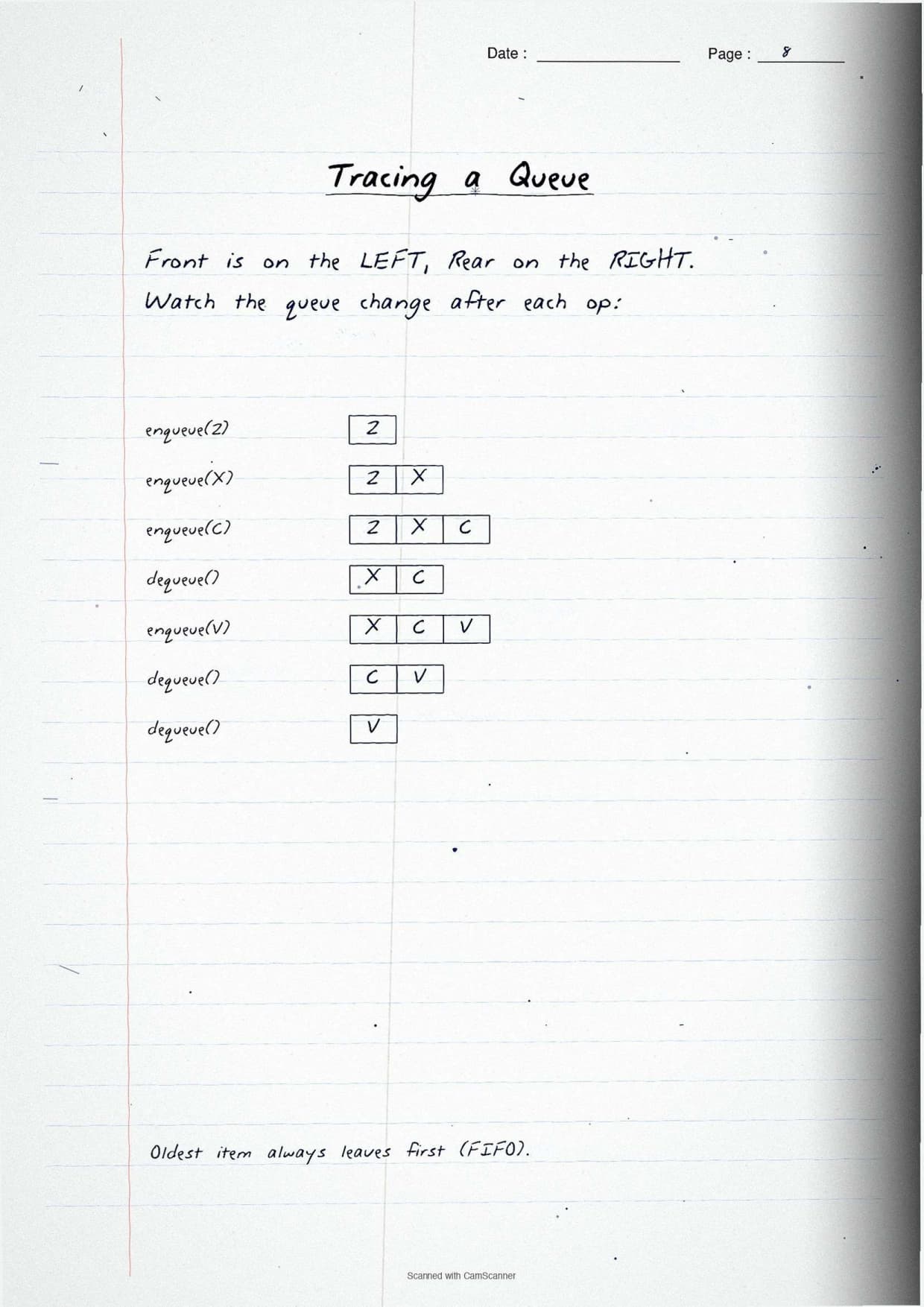
appendandpop(0)line from memory. - Trace by hand: draw the queue after every operation with the front on the left, then check it against the boxed traces.
- Self-test: attempt a short class 12 computer science chapter 4 queue drill to check the small facts.
Because the notes come as a downloadable PDF, students can save them on a phone and revise offline on the way to the exam centre. Many students open queue class 12 computer science notes on their phone the night before a test, so a saved PDF means revision is always at hand. Pair these pages with the full solutions to check your written code against model answers.
Common Mistakes These Notes Help You Avoid
A few errors cost marks in this chapter every year. Most come from mixing up the two ends or forgetting the underflow check. The notes flag each soft point in the margin so students phrase it safely on the answer sheet.
- Using plain
pop()instead ofpop(0). A bare pop removes the rear and turns the queue into a stack. - Treating peek like a DEQUEUE. Peek only reads the front, it never removes it.
- Mixing up overflow and underflow. Overflow is a full queue, underflow is an empty one.
- Swapping the deque ends, so
deletionFrontremoves the wrong value. Label each step with its end. - Reversing the output order. A queue keeps order, so A, S, D, F come out as A, S, D, F, not reversed like a stack.
Students who fix these five points usually move from average to high marks. The exam rewards exact end labelling, so always tie removal to the front and addition to the rear. The handwritten margin notes nudge you to keep that precision in the right places.
How These Notes Pair with the Solutions and Book PDF
These handwritten notes are a revision layer. To prepare fully, students should use them with the other resources for the same chapter, all linked in the table below. Read the notes, then test yourself with the solutions, and open the book PDF for the original text.
| Resource | Best used for |
|---|---|
| Queue NCERT Solutions | Step-by-step code and queue traces for all 8 back-exercise questions |
| Queue Class 12 Notes | Quick typed summary with FIFO, the operations and the deque in one place |
| Queue NCERT Book PDF | Reading the original NCERT chapter text from the textbook |
Tip: redraw the queue once with the front and rear labelled, then write the enqueue and dequeue lines in your own words. Drawing that diagram once fixes the two ends for good.
All Class 12 Computer Science Handwritten Notes by Chapter
The table links the handwritten notes for every chapter in Class 12 Computer Science, so students can move across the course in one click. Queue is highlighted, with Stack just before it and Sorting just after.
| Chapter | Handwritten Notes |
|---|---|
| Chapter 1 | Exception Handling in Python |
| Chapter 2 | File Handling in Python |
| Chapter 3 | Stack |
| Chapter 4 | Queue |
| Chapter 5 | Sorting |
| Chapter 6 | Searching |
| Chapter 7 | Understanding Data |
| Chapter 8 | Database Concepts |
| Chapter 9 | Structured Query Language (SQL) |
| Chapter 10 | Computer Networks |
| Chapter 11 | Data Communication |
| Chapter 12 | Security Aspects |
FAQs on Queue Handwritten Notes
Queue Class 12 Computer Science Handwritten Notes Common Questions
Ques. Are these class 12 computer science chapter 4 Queue handwritten notes free to download?
Ans. Yes. The Queue handwritten notes are free to download as a PDF from this page. They follow the 2026-27 NCERT syllabus and cover the full chapter across 25 handwritten, boxed-keyword pages for quick revision.
Ques. What does the Queue chapter cover in Class 12 Computer Science?
Ans. The notes cover the FIFO rule, the ENQUEUE, DEQUEUE and peek operations, overflow and underflow, the deque (double ended queue), and the queue versus stack contrast that the CBSE board paper tests directly, all with hand-drawn diagrams and boxed Python code.
Ques. What is the FIFO rule of a queue?
Ans. FIFO stands for First In, First Out. The element added first is removed first, because a queue adds only at the rear (ENQUEUE) and removes only from the front (DEQUEUE), exactly like a line at a ticket counter.
Ques. What is the difference between a queue and a deque?
Ans. A plain queue inserts at the rear and deletes from the front, so it has two operations. A deque, the double ended queue, can insert and delete at either end, so it has four operations: insertFront, insertRear, deletionFront and deletionRear. A queue is a restricted deque.
Ques. Are these notes enough for the class 12 computer science chapter 4 board exam?
Ans. They are a strong final revision layer. For full preparation, pair them with the NCERT Solutions linked on this page so you can write out complete code answers to all 8 back-exercise questions and check your queue traces against the model output.



Comments